USER MANUAL VSX-528-S PIONEER
Discover the benefits of registering your product online at http://www.pioneer.co.uk (or http://www.pioneer.eu).
Operating Instructions
CAUTION
TO PREVENT THE RISK OF ELECTRIC SHOCK, DO NOT REMOVE COVER (OR BACK). NO USER-SERVICEABLE PARTS INSIDE. REFER SERVICING TO QUALIFIED SERVICE PERSONNEL.
D3-4-2-1-1_B1_En
WARNING
This equipment is not waterproof. To prevent a fire or shock hazard, do not place any container filled with liquid near this equipment (such as a vase or flower pot) or expose it to dripping, splashing, rain or moisture.
D3-4-2-1-3_A1_En
WARNING
To prevent a fire hazard, do not place any naked flame sources (such as a lighted candle) on the equipment.
D3-4-2-1-7a_A1_En
Operating Environment
Operating environment temperature and humidity: +5^ to +35^ (+41^ to +95^) ; less than 85% RH (cooling vents not blocked)
Do not install this unit in a poorly ventilated area, or in locations exposed to high humidity or direct sunlight (or strong artificial light) D3-4-2-1-7c*A1.En
This product is for general household purposes. Any failure due to use for other than household purposes (such as long-term use for business purposes in a restaurant or use in a car or ship) and which requires repair will be charged for even during the warranty period.
K041_A1_En
VENTILATION CAUTION
When installing this unit, make sure to leave space around the unit for ventilation to improve heat radiation (at least 40~cm at top, 20~cm at rear, and 20~cm at each side).
WARNING
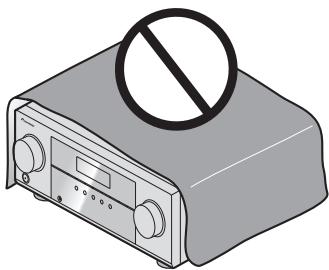
Slots and openings in the cabinet are provided for ventilation to ensure reliable operation of the product, and to protect it from overheating. To prevent fire hazard, the openings should never be blocked or covered with items (such as newspapers, table-cloths, curtains) or by operating the equipment on thick carpet or a bed.
D3-4-2-1-7b*A1En
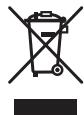
(Symbol for equipment)
(Symbol examples) for batteries

These symbols on the products, packaging, and/or accompanying documents mean that used electrical and electronic products and batteries should not be mixed with general household waste.
For proper treatment, recovery and recycling of old products and used batteries, please take them to applicable collection points in accordance with your national legislation.
By disposing of these products and batteries correctly, you will help to save valuable resources and prevent any potential negative effects on human health and the environment which could otherwise arise from inappropriate waste handling.
For more information about collection and recycling of old products and batteries, please contact your local municipality, your waste disposal service or the point of sale where you purchased the items.
These symbols are only valid in the European Union.
For countries outside the European Union:
If you wish to discard these items, please contact your local authorities or dealer and ask for the correct method of disposal.
K058a_A1_En
CAUTION
The OSTANDBY/ON switch on this unit will not completely shut off all power from the AC outlet. Since the power cord serves as the main disconnect device for the unit, you will need to unplug it from the AC outlet to shut down all power. Therefore, make sure the unit has been installed so that the power cord can be easily unplugged from the AC outlet in case of an accident. To avoid fire hazard, the power cord should also be unplugged from the AC outlet when left unused for a long period of time (for example, when on vacation).
D3-4-2-2-2a*A1_EN
WARNING
Store small parts out of the reach of children and infants. If accidentally swallowed, contact a doctor immediately.
D41-6-4_A1_En
Contents
Thank you for buying this Pioneer product. Please read through these operating instructions so you will know how to operate your model properly.
Before you start. 6
Checking what's in the box. 6
Installing the receiver 6
Flow of settings on the receiver 6
01 Controls and displays
Front panel. 7
Display 8
Remote control. 9
Loading the batteries. 10
Operating range of remote control 10
02 Connecting your equipment
Determining the speakers' application 11
Some tips for improving sound quality 12
Connecting the speakers 12
Connect the surround back or front height speakers (VSX-828 only). 13
Switching the speaker terminal. 15
Making cable connections 15
HDMI cables. 15
About HDMI 15
Analog audio cables 16
Digital audio cables. 16
Video cables 16
About video outputs connection. 16
Connecting a TV and playback components. 17
Connecting using HDMI 17
Connecting your TV with no HDMI input 18
Connecting optional Bluetooth ADAPTER 19
Connecting to the network through LAN interface 19
Connecting antennas 20
Using external antennas 20
Connecting an IR receiver (VSX-828 only) 21
Connecting an iPod 21
Use a dedicated cable to enjoy iPod video. 21
Connecting a USB device. 22
Connecting an MHL-compatible device 22
Connecting an HDMI-equipped component to the front panel input 22
Plugging in the receiver 23
03 Basic Setup
Before setting up (for Australia) 24
aging the TV format setting (for Australia) 24
Canceling the Auto Power Down (for Europe, Russia and
U.K.) 24
Automatically setting up for surround sound
(MCACC) 24
Other problems when using the Auto MCACC setup... 26
04 Basic playback
Playing a source 27
Selecting the audio input signal 27
Playing an iPod. 29
Playing back files stored on an iPod 30
Basic playback controls. 30
Watching photos and video content 30
Playing a USB device 30
Playing back audio files stored on a USB memory device 31
Playing back photo files stored on a USB memory device 31
About playable file formats 31
Playing an MHL-compatible device. 32
Bluetooth® ADAPTER for Wireless Enjoyment of
Music 33
Wireless music play. 33
Pairing the Bluetooth ADAPTER and Bluetooth wireless technology device 33
Listening to Music Contents of Bluetooth wireless technology device with Your System 34
AIRJAM 34
Listening to the radio 34
Improving FM sound 35
Saving station presets 35
Listening to station presets 35
Naming preset stations 35
Changing the radio frequency step (for Australia) 35
An introduction to RDS (for Europe) 36
Searching for RDS programs. 36
05 Listening to your system
Choosing the listening mode 37
Auto playback 37
Listening in surround sound 37
Using the Advanced surround 38
Using Stream Direct 38
Using the Sound Retriever 39
Listening with Acoustic Calibration EQ. 39
Better sound using Phase Control 39
Using surround back channel processing
(VSX-828 only) 40
Setting the Up Mix function (VSX-828 only) 40
Setting the Audio options 41
06Playback with NETWORK features
Introduction 43
About playable DLNA network devices. 43
Using AirPlay on iPod touch, iPhone, iPad, and iTunes 43
About the DHCP server function 43
Authorizing this receiver 43
About HTC Connect. 44
Playback with Network functions 44
Basic playback controls. 44
Listening to Internet radio stations. 45
Playing back audio files stored on components on the network 46
Playing back your favorite songs 46
The Network Setup menu 46
Network Configuration 46
Language. 47
Firmware Update 47
Network setting using Safari browser 48
Friendly Name setting using Safari browser 48
Firmware update using Safari browser. 48
Factory Reset. 49
System Information 49
About network playback 50
Content playable over a network 50
About playback behavior over a network 50
Glossary 50
About playable file formats 51
Using the Home Menu 52
Manual speaker setup. 52
Speaker Setting 52
X.Over 53
Channel Level 53
Speaker Distance. 54
The Input Assign menu. 54
Analog Input 54
Component Input (VSX-828 only). 54
The Auto Power Down menu 55
The Network Standby menu 55
The MHL Setup menu. 55
The Speaker System setting (VSX-828 only) 55
The OSD Setup menu. 56
08 Using the MULTI-ZONE feature (VSX-828 only)
MULTI-ZONE listening 57
Making MULTI-ZONE connections 57
Using the MULTI-ZONE controls 57
09 Control with HDMI function
Making Control with HDMI connections. 58
HDMI Setup 58
Before using synchronization. 59
About synchronized operations 59
Cautions on the Control with HDMI function 59
10 Controlling the rest of your system
Setting the remote to control other components 60
Selecting preset codes directly 60
Clearing all the remote control settings 60
Controls for TVs 61
Controls for other components. 61
Preset Code List 61
Troubleshooting 65
General 65
NETWORK feature. 66
HDMI 67
Important information regarding the HDMI connection 67
Windows 7 67
MHL 67
HTC Connect 68
About iPod/Phone/iPad 68
Apple Lossless Audio Codec 68
About FLAC 68
About messages displayed when using network functions 68
Resetting the main unit 69
Cleaning the unit 69
Specifications. 70
Before you start
Flow of settings on the receiver
Checking what's in the box
Please check that you've received the following supplied accessories:
- Setup microphone
Remote control
- AAA size IEC R03 dry cell batteries (to confirm system operation) x2
AM loop antenna
FM wire antenna
Power cord (for Europe & Russia of VSX-828, and U.K. & Australia of VSX-528)
Warranty card
- Quick start guide
- Safety Brochure
SPEAKER CAUTION Sheet (English only)
These operating instructions (CD-ROM)
Installing the receiver
- When installing this unit, make sure to put it on a level and stable surface.
Don't install it on the following places:
-on a color TV (the screen may distort)
- near a cassette deck (or close to a device that gives off a magnetic field). This may interfere with the sound.
-in direct sunlight
-in damp or wet areas
- in extremely hot or cold areas
- in places where there is vibration or other movement
- in places that are very dusty
- in places that have hot fumes or oils (such as a kitchen)
The unit is a full-fledged AV receiver equipped with an abundance of functions and terminals. It can be used easily after following the procedure below to make the connections and settings.
The colors of the steps indicate the following:
Required setting item
Setting to be made as necessary
1 Connecting the speakers
Where you place the speakers will have a big effect on the sound.
Determining the speakers' application (page 11)
- Connecting the speakers (page 12)
- Switching the speaker terminal (page 15)

2 Connecting the components
For surround sound, you'll want to hook up using a digital connection from the Blu-ray Disc/DVD player to the receiver.
- About video outputs connection (page 16)
- Connecting a TV and playback components (page 17)
- Connecting antennas (page 20)
- Plugging in the receiver (page 23)

Power On
Make sure you've set the video input on your TV to this receiver. Check the manual that came with the TV if you don't know how to do this.

4 The Speaker System setting (VSX-828 only) (page 55) (Specify either using the surround back front height Speaker Bi-amp ZONE 2 speaker.)
The Input Assign menu (page 54)
(When using connections other than the recommended connections.)
HDMI Setup (page 58)
(When the connected TV supports the HDMI Audio Return Channel function.)

Use the on-screen automatic MCACC setup to set up your system
- Automatically setting up for surround sound (MCACC) (page 24)

6 Basic playback (page 27)
- Selecting the audio input signal (page 27)
- Playing an iPod (page 29)
- Playing a USB device (page 30)
- Choosing the listening mode (page 37)

7 Adjusting the sound as desired
Using the Sound Retriever (page 39)
- Better sound using Phase Control (page 39)
- Listening with Acoustic Calibration EQ (page 39)
- Using surround back channel processing (VSX-828 only) (page 40)
- Setting the Up Mix function (VSX-828 only) (page 40)
- Setting the Audio options (page 41)
- Manual speaker setup (page 52)

Making maximum use of the remote control
- Setting the remote to control other components (page 60)
Front panel
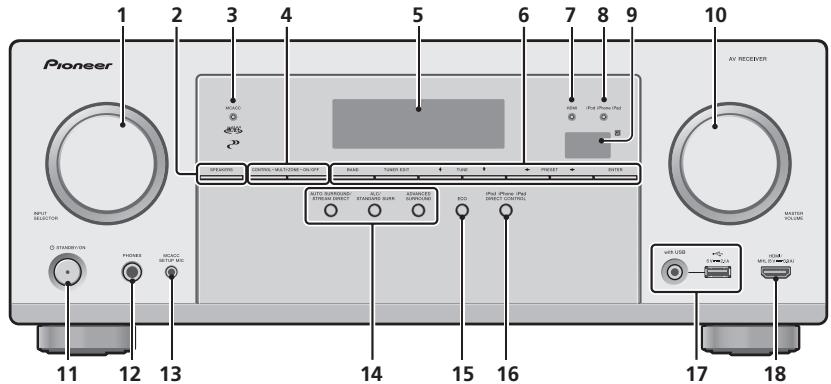
VSX-828
Selects an input source (page 27).
2 SPEAKERS
See Switching the speaker terminal on page 15.
The Speaker System setting may or may not be displayed, depending on the input source you have selected.
3 MCACC indicator
Lights when Acoustic Calibration EQ (page 39) is on (Acoustic Calibration EQ is automatically set to on after the Auto MCACC setup (page 24)).
4 ZONE controls (VSX-828 only)
If you've made MULTI-ZONE connections (see Making MULTI-ZONE connections on page 57) use these controls to control the sub zone from the main zone (see Using the MULTI-ZONE controls on page 57).
DIMMER - Dims or brightens the display. The brightness can be controlled in four steps.
DISPLAY - Switches the display of this unit. The listening mode, sound volume, input name can be checked by selecting an input source.
5 Character display
See Display on page 8.
BAND - Switches between AM, FM ST (stereo) and FM MONO radio bands (page 34).
TUNER EDIT - Use with TUNE ↑/↓, PRESET ←/→ and ENTER to memorize and name stations for recall (page 34).
TUNE ↑/↓ - Used to find radio frequencies (page 34).
PRESET / - Use to select preset radio stations (page 35).
7 HDMI indicator
Blinks when connecting an HDMI-equipped component; lights when the component is connected (page 17).
8 iPod iPhone iPad indicator
Lights when an iPod/iPhone/iPad is connected and iPod/USB input is selected (page 29).
9 Remote sensor
Receives the signals from the remote control (see Operating range of remote control on page 10).
10 MASTER VOLUME dial
11STANDBY/ON
12 PHONES jack
Use to connect headphones. When the headphones are connected, there is no sound output from the speakers. The listening mode when the sound is heard from the microphone can be selected only from PHONES SURR, STEREO or STEREO ALC mode (S.R AIR mode can be also selected with ADAPTER input).
13 MCACC SETUP MIC jack
Use to connect a microphone when performing Auto MCACC setup (page 24).
AUTO SURROUND/STREAM DIRECT - Switches between Auto surround mode (page 37) and Stream Direct playback (page 38).
ALC/STANDARD SURR (VSX-828 only) - Press for standard decoding and to switch between the modes of Pro Logic II, Pro Logic IIx, Pro Logic IIz and NEO:6, and the Auto level control stereo mode (page 37).


ALC/STANDARD SURR (VSX-528 only) - Press for standard decoding and to switch between the modes of
Pro Logic II and NEO:6, and the Auto level control stereo mode (page 37).
ADVANCED SURROUND - Switches between the various surround modes (page 38).
15 ECO
Switches between ECO Mode 1/ECO Mode 2. When ECO Mode is turned ON, the display will go dark (page 38).
16 iPod iPhone iPad DIRECT CONTROL
Change the receiver's input to the iPod and enable iPod operations on the iPod (page 31).
17 iPod/iPhone/iPad terminals
Use to connect your Apple iPod/iPhone/iPad or USB mass storage device as an audio source (page 21).
18 HDMI input/MHL connector
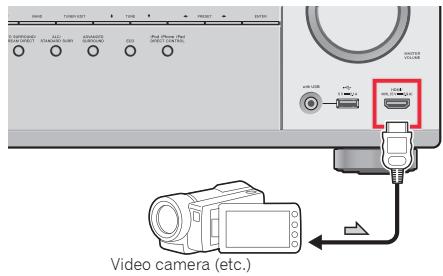
Use for connection to a compatible HDMI device (Video camera, etc.) (page 22). An MHL-compatible mobile device can also be connected here using a MHL cable (sold separately) (page 22).
Display
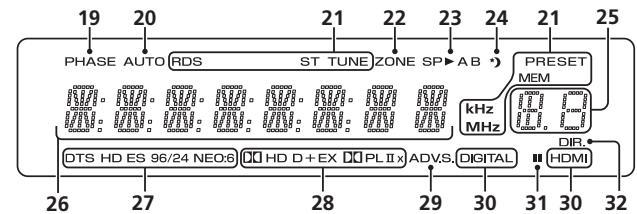
19 PHASE
Lights when the Phase Control is switched on (page 39).
20 AUTO
Lights when the Auto Surround feature is switched on (page 37).
21 Tuner indicators
RDS - Lights when an RDS broadcast is received (page 36). (for Europe)
ST-Lights when a stereo FM broadcast is being received in auto stereo mode (page 34).
TUNE - Lights when a normal broadcast channel.
PRESET - Shows when a preset radio station is registered or called.
MEM - Blinks when a radio station is registered.
kHz/MHz - Lights when the character display is showing the currently received AM/FM broadcast frequency.
22 ZONE (VSX-828 only)
Lights when the MULTI-ZONE feature is active (page 57).
23 Speaker indicators
Shows if the speaker system is on or not (page 15).
24 Sleep timer indicator
Lights when the receiver is in sleep mode (page 9).
25 PRESET information or input signal indicator
Shows the preset number of the tuner or the input signal type, etc.
26 Character display
Displays various system information.
27 DTS indicators
DTS - Lights when a source with DTS encoded audio signals is detected.
HD - Lights when a source with DTS-EXPRESS or DTS-HD encoded audio signals is detected.
ES - Lights to indicate DTS-ES decoding.
96/24 - Lights when a source with DTS 96/24 encoded audio signals is detected.
NEO:6 - When one of the NEO:6 modes of the receiver is on, this lights to indicate NEO:6 processing (page 37).
28 Dolby Digital indicators
D - Lights when a Dolby Digital encoded signal is detected.
D+ - Lights when a source with Dolby Digital Plus encoded audio signals is detected.
DDHD-Lights when a source with Dolby TrueHD encoded audio signals is detected.
EX (VSX-828 only) - Lights to indicate Dolby Digital EX decoding.
DPLII(x) (VSX-828 only) - Lights to indicate Pro Logic II decoding. Light will go off during Pro Logic Ilz decoding (see Listening in surround sound on page 37 for more on this).
DOLII (VSX-528 only)-Lights to indicate Pro Logic II decoding. (see Listening in surround sound on page 37 for more on this).
29 ADV.S.
Lights when one of the Advanced Surround modes has been selected (see Using the Advanced surround on page 38 for more on this).
30 SIGNAL SELECT indicators
DIGITAL - Lights when a digital audio signal is selected. Blinks when a digital audio signal is selected and selected audio input is not provided.
HDMI - Lights when an HDMI signal is selected. Blinks when an HDMI signal is selected and selected HDMI input is not provided.
31 Up Mix indicator (VSX-828 only)
Lights when the Up Mix function is set to ON (page 40).
32 DIR.
Lights when the DIRECT or PURE DIRECT mode is switched on (page 38).


Remote control
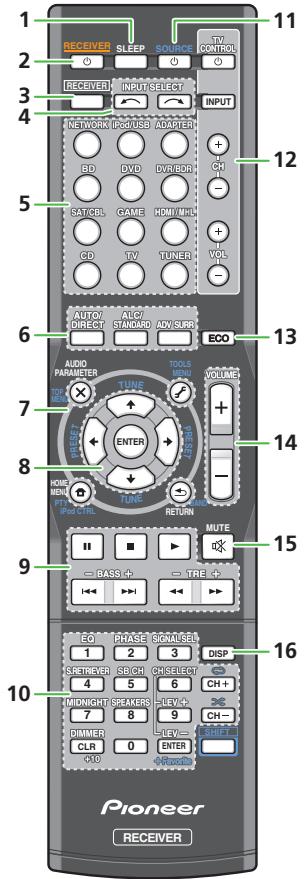
The following buttons are not used with this receiver:
SHIFT
1 SLEEP
Press to change the amount of time before the receiver switches into standby (30 min - 60 min - 90 min - Off). You can check the remaining sleep time at any time by pressing SLEEP once.
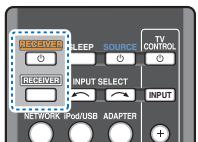
2 RECEIVER
Switches the receiver between standby and on.
3 RECEIVER
Switches the remote to control the receiver (used to select the white commands above the number buttons (MIDNIGHT, etc)). Also use this button to set up surround sound (page 52) or Audio parameters (page 41).

Use to select the input source (page 27).
Use to select the input source to this receiver (page 27). This will enable you to control other components with the remote control (page 60).
AUTO/DIRECT - Switches between Auto surround mode (page 37) and Stream Direct playback (page 38).
ALC/STANDARD SURR (VSX-828 only) - Press for standard decoding and to switch between the modes of Pro Logic II, Pro Logic IIx, Pro Logic Ilz and NEO:6, and the Auto level control stereo mode (page 37).
ALC/STANDARD SURR (VSX-528 only) - Press for standard decoding and to switch between the modes of Pro Logic II and NEO:6, and the Auto level control stereo mode (page 37).
ADV SURR - Switches between the various surround modes (page 38).
The following button controls can be accessed after you have selected the corresponding input function button (BD, DVD, etc.).
Press RECEIVER first to access:
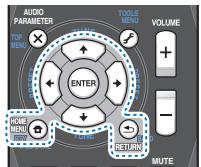
AUDIO PARAMETER - Use to access the Audio options (page 41).
HOME MENU - Press to access the Home Menu (page 52).
RETURN - Confirm and exit the current menu screen. Press BD, DVD or DVR/BDR first to access:
TOP MENU - Displays the disc 'top' menu of a Blu-ray Disc/DVD.
HOME MENU - Displays the HOME MENU screen.
RETURN - Confirm and exit the current menu screen.
MENU - Displays the TOOLS menu of Blu-ray Disc player. Press TUNER first to access:
TOOLS - Memorizes stations for recall (page 34), also used to change the name (page 35).
BAND - Switches between AM, FM ST (stereo) and FM MONO radio bands (page 34).
Press iPod/USB first to access:
iPod CTRL - Switches between the iPod controls and the receiver controls (page 30).
PTY- Use to search for RDS program types (page 36). (for Europe)
8 / / (TUNE / , PRESET / ), ENTER
Use the arrow buttons when setting up your surround sound system (page 52). Also used to control Blu-ray Disc/DVD menus/options.
Use TUNE / can be used to find radio frequencies and PRESET / can be used to select preset radio stations (page 35).
The main buttons (一 , 一 , 一 , 一 , 一 , 一 , 一 , 一 , 一 , 一 , 一 , 一 , 一 , 一 , 一 , 一 , 一 , 一 etc.) are used to control a component after you have selected it using the input function buttons. The controls above these buttons can be accessed after you have selected the corresponding input function button (BD, DVD and CD). These buttons also function as described below.
Press RECEIVER first to access:
BASS +/- TRE +/- Use to adjust Bass or Treble.
These controls are disabled when the listening mode is set to DIRECT or PURE DIRECT.
- When the front speaker is set at SMALL in the Speaker Setting (or automatically via the Auto MCACC setup) and the X.Over is set above 150Hz , the subwoofer channel level will be adjusted by pressing BASS +/-(page 53).
Use the number buttons to directly select a radio frequency (page 34) or the tracks on a CD, etc. There are other buttons that can be accessed after RECEIVER is pressed. (For example MIDNIGHT, etc.)
EQ - Press to switch on/off Acoustic Calibration EQ setting (page 39).
PHASE - Press to switch on/off Phase Control (page 39).
SIGNAL SEL - Press to select the audio input signal of the component to play back (page 27).
S.RETRIEVER - Press to restore CD quality sound to compressed audio sources (page 39).
SB CH (VSX-828 only) - Press to select ON, AUTO or OFF the surround back channel (page 40).
CH SELECT - Press repeatedly to select a channel, then use LEV +/- to adjust the level (page 53).
LEV +/- Use to adjust the channel level.
MIDNIGHT - Switches to Midnight or Loudness listening (page 41).
SPEAKERS - See Switching the speaker terminal on page 15.
DIMMER - Dims or brightens the display. The brightness can be controlled in four steps.
During ECO mode, the brightness switches between 2 levels. If the dimmest level is selected, DIMMER will be shown on the display. (Mode other than ECO: 4 levels, ECO mode: 2 levels)
+Favorite - Press while a song is being played back or stopped. The selected song is then registered in the Favorites folder (page 46).
11 SOURCE
Press to turn on/off other components connected to the receiver (page 60).
These buttons are dedicated to control the TV assigned to the TV button. Thus if you only have one TV to hook up to this system assign it to the TV button (page 61).
O - U se to turn on/off the power of the TV.
INPUT - Use to select the TV input signal.
CH + / - Use to select channels.
VOL +1 - Use to adjust the volume on your TV.
13 ECO
Switches between ECO Mode 1/ECO Mode 2. When ECO Mode is turned ON, the display will go dark (page 38).
14 VOLUME +/-
Use to set the listening volume.
15 MUTE
Mutes/unmates the sound.
16 DISP
Switches the display of this unit. The listening mode, sound volume, Speaker System (V/SX-828) setting or input name can be checked by selecting an input source.
- The Speaker System setting may or may not be displayed, depending on the input source you have selected.
Loading the batteries
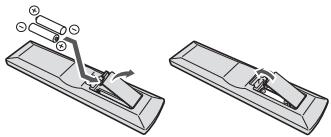
The batteries included with the unit are to check initial operations; they may not last over a long period. We recommend using alkaline batteries that have a longer life.
WARNING
- Do not use or store batteries in direct sunlight or other excessively hot place, such as inside a car or near a heater. This can cause batteries to leak, overheat, explode or catch fire. It can also reduce the life or performance of batteries.

CAUTION
-
Incorrect use of batteries may result in such hazards as leakage and bursting. Observe the following precautions:
-
Never use new and old batteries together.
-
Insert the plus and minus sides of the batteries properly according to the marks in the battery case.
-
Batteries with the same shape may have different voltages. Do not use different batteries together.
-
When disposing of used batteries, please comply with governmental regulations or environmental public institution's rules that apply in your country/area.
-
When inserting the batteries, make sure not to damage the springs on the battery's (-) terminals. This can cause batteries to leak or overheat.
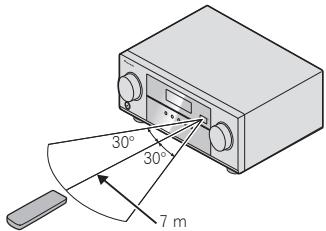
Operating range of remote control
The remote control may not work properly if:
There are obstacles between the remote control and the receiver's remote sensor.
- Direct sunlight or fluorescent light is shining onto the remote sensor.
- The receiver is located near a device that is emitting infrared rays.
- The receiver is operated simultaneously with another infrared remote control unit.


Determining the speakers' application
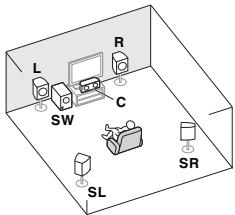
By connecting the left and right front speakers (L/R), the center speaker (C), the left and right surround speakers (SL/ SR), the left and right surround back speakers (SBL/SBR) (or the left and right front height speakers (FHL/FHR)), and the subwoofer (SW), a surround sound system up to 7.1 channel can be enjoyed.
The 5.1 channel surround system is the most commonly-used in home theaters. To achieve the best possible surround sound, install your speakers as shown below.
5.1 channel surround system:
6.1 channel surround (Surround back) system (VSX-828 only):
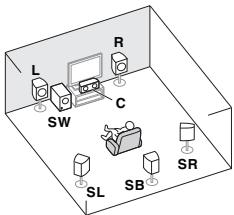
7.1 channel surround (Surround back) system (VSX-828 only):
7.1 channel surround (Front height) system (VSX-828 only):
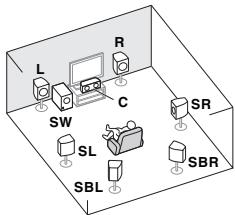
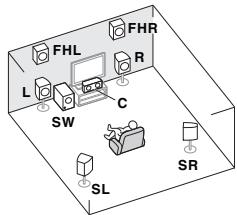

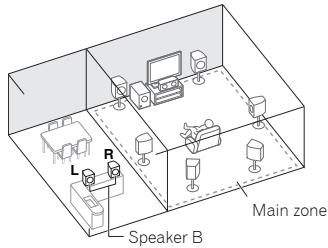
Important
VSX-828 only
- Both the surround back speakers and the front height speakers can be connected at the same time. In this case, sound will be output from either the front height speaker or the surround back speaker depending on which one was selected in the Speaker System setting (see The Speaker System setting (VSX-828 only) on page 55).
Speaker B connection
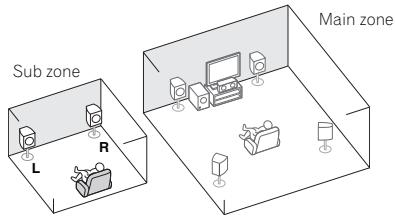
You can use the speakers connected to the B speaker terminals to listen to stereo playback in another room. See Switching the speaker terminal on page 15 for the listening options with this setup.
- You will not be able to connect the B speakers if you connect the front height speakers in the main zone.
Further, if you use the B speakers, a 5.1 ch playback will be the maximum in the main zone. (No sound is output from the surround back speaker.)
Bi-amping connection
Bi-amping connection of the front speakers for high sound quality with 5.1-channel surround sound.
- When using the Front Bi-amping connection, sound will only be output from the front speakers, the surround speakers and the subwoofer.
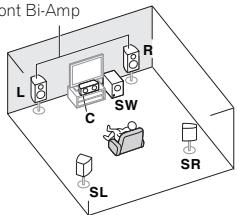
Front Bi-Amp
ZONE 2 connection (Multi Zone)
With these connections you can simultaneously enjoy the surround sound in the main zone with stereo playback on another component in ZONE 2 (The selection of input devices is limited). See MULTI-ZONE listening on page 57.


Some tips for improving sound quality
Where you put your speakers in the room has a big effect on the quality of the sound. The following guidelines should help you to get the best sound from your system.
- It is best to angle the speakers towards the listening position. The angle depends on the size of the room. Use less of an angle for bigger rooms.
Refer to the chart below for placement of speakers you intend to connect.
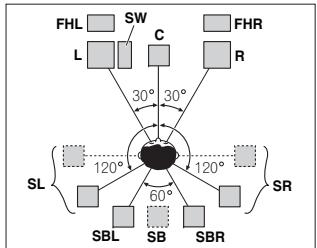
- Place the surround speakers at 120^ from the center. If you, (1) use the surround back speaker, and, (2) don't use the front height speakers, we recommend placing the surround speaker right beside you.
- If you intend to connect only one surround back speakers, place it directly behind you.
- If the surround speakers cannot be set directly to the side of the listening position with a 7.1-channel system, the surround effect can be enhanced by turning off the Up Mix function (see Setting the Up Mix function (VSX-828 only) on page 40).
For the best stereo effect, place the front speakers 2m to 3m apart, at equal distance from the TV.
- If you're using a center speaker, place the front speakers at a wider angle. If not, place them at a narrower angle.
-
Place the center speaker above or below the TV so that the sound of the center channel is localized at the TV screen. Also, make sure the center speaker does not cross the line formed by the leading edge of the front left and right speakers.
-
Surround and surround back speakers should be positioned 60~cm to 90~cm higher than your ears and tilted slight downward. Make sure the speakers don't face each other. For DVD-Audio, the speakers should be more directly behind the listener than for home theater playback.
- Try not to place the surround speakers farther away from the listening position than the front and center speakers. Doing so can weaken the surround sound effect.
- Place the left and right front height speakers at least one meter directly above the left and right front speakers.
- If you're going to place speakers around your CRT TV, use shielded speakers or place the speakers at a sufficient distance from your CRT TV.
- The subwoofer can be placed on the floor. Ideally, the other speakers should be at about ear-level when you're listening to them. Putting the speakers on the floor (except the subwoofer), or mounting them very high on a wall is not recommended.
- When not connecting a subwoofer, connect speakers with low frequency reproduction capabilities to the front channel. (The subwoofer's low frequency component is played from the front speakers, so the speakers could be damaged.)
After connecting, be sure to conduct the Auto MCACC (speaker environment setting) procedure.
See Automatically setting up for surround sound (MCACC) on page 24.
CAUTION
- Make sure that all speakers are securely installed. This not only improves sound quality, but also reduces the risk of damage or injury resulting from speakers being knocked over or falling in the event of external shocks such as earthquakes.
Connecting the speakers
The receiver will work with just two stereo speakers (the front speakers in the diagram) but using at least three speakers is recommended, and a complete setup is best for surround sound.
Make sure you connect the speaker on the right to the right (R) terminal and the speaker on the left to the left (L) terminal. Also make sure the positive and negative (+/-) terminals on the receiver match those on the speakers.
You can use speakers with a normal impedance between 6 and 16
Be sure to complete all connections before connecting this unit to the AC power source.
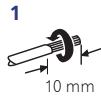
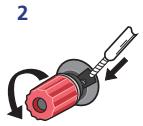
Bare wire connections
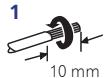
1 Twist exposed wire strands together.
2 Loosen terminal and insert exposed wire.
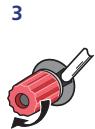
3 Tighten terminal.
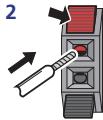
Connect the wires to the B-Speakers terminals of the VSX-828 as shown below:
1 Twist exposed wire strands together.
2 Push open the tabs and insert exposed wire.
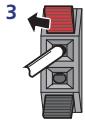
3 Release the tabs.

CAUTION
- These speaker terminals carry HAZARDOUS LIVE voltage. To prevent the risk of electric shock when connecting or disconnecting the speaker cables, disconnect the power cord before touching any uninsulated parts.
- Make sure that all the bare speaker wire is twisted together and inserted fully into the speaker terminal. If any of the bare speaker wire touches the back panel it may cause the power to cut off as a safety measure.
Connect the surround back or front height speakers (VSX-828 only)
The Speaker System setting must be set if the above connections are performed. Select Surr.Back if the surround back speaker is connected and Height if the front height speaker is connected (If neither the surround back speaker nor the front height speaker is connected, either setting will suffice) (see The Speaker System setting (VSX-828 only) on page 55).
- When using only one surround back speaker, connect it to the SURROUND BACK L (Single) terminals.
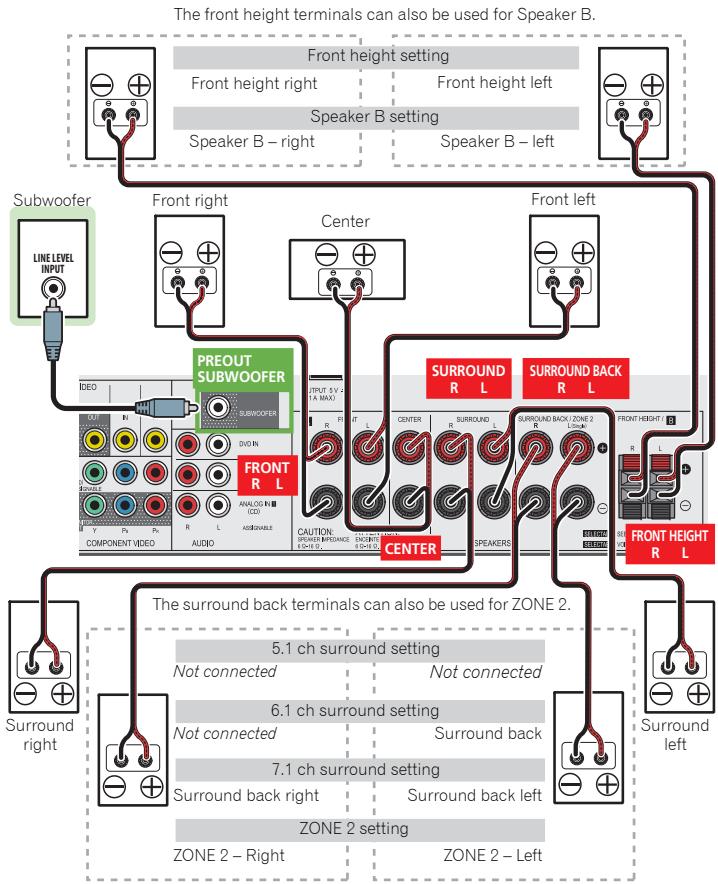
VSX-828 connection diagram


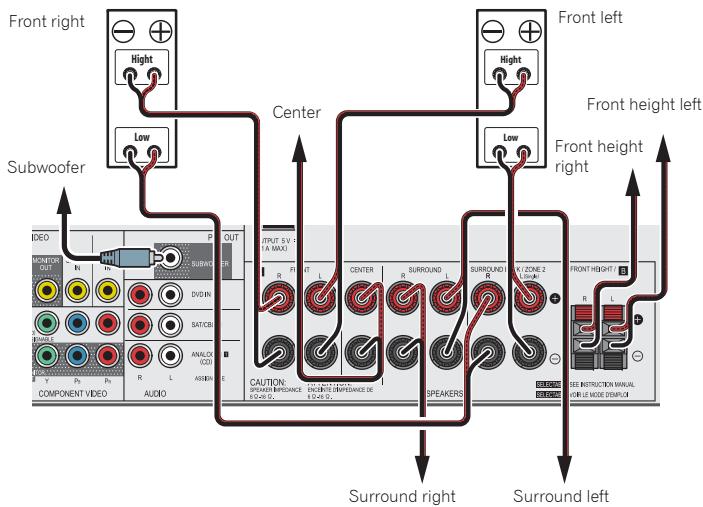
Front Bi-Amp connection (VSX-828 only)
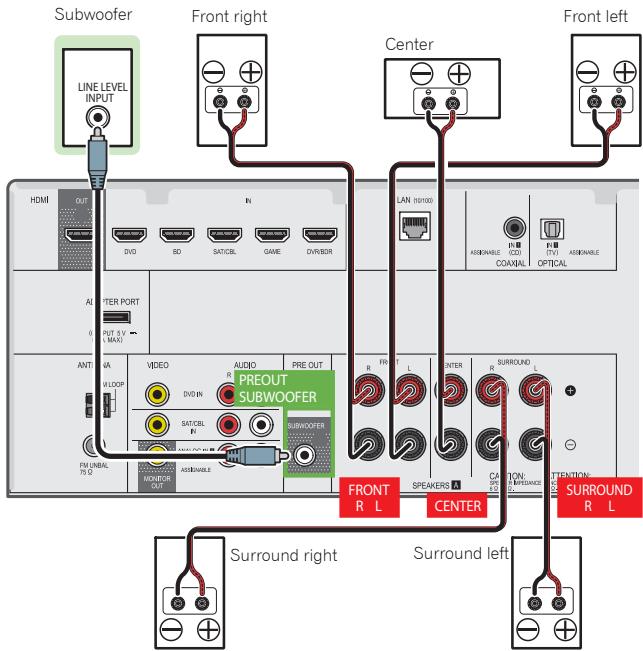
VSX-528 connection diagram


Switching the speaker terminal
VSX-828: When the The Speaker System setting (VSX-828 only) on page 55 is set to SP▶B, each press of the speaker button will switch the speaker used for playback: SP▶, SP▶A, SP▶B, SP▶AB.
VSX-528: Each press of the speaker button will switch the speaker used for playback: SP▶, SP▶A.
When the speaker system is set to SP-B: Each press of the speaker button will switch the speaker used for playback: OFF, A, B, AB.
When the speaker system is set to anything other than SP-B: Each press of the speaker button will switch the speaker used for playback: OFF, A. For more details on the speaker system please refer to The Speaker System setting (VSX-828 only) on page 55.
Press repeatedly to choose a speaker terminal option:
- SP▶A - Sound is output from the speakers connected to the A-speaker terminals (multichannel playback is possible).
- SP▶ B (VSX-828 only) - Sound is output from the two speakers connected to the B-speaker terminals (only stereo playback is possible).
- SP▶AB (VSX-828 only) - Sound is output from the A-speaker terminals, the two speakers in the B-speaker terminals, and the subwoofer. Multichannel sources are downmixed only when the STEREO or STEREO ALC mode is selected for stereo output from A- and B-speaker terminals.
- SP▶ - No sound is output from the speakers.
Note
- VSX-828 only: The subwoofer output depends on the settings you made in Speaker Setting on page 52. However, if SP▶B is selected above, no sound is heard from the subwoofer (the LFE channel is not downmixed).
- All speaker terminals are switched off (SP▶) when headphones are connected. SP▶B can be selected even when headphones are connected for VSX-828.
Making cable connections
Make sure not to bend the cables over the top of this unit (as shown in the illustration). If this happens, the magnetic field produced by the transformers in this unit may cause a humming noise from the speakers.
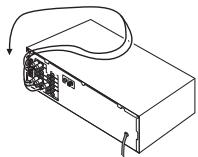

Important
- Before making or changing connections, switch off the power and disconnect the power cord from the AC outlet.
- Before unplugging the power cord, switch the power into standby.
HDMI cables
Both video and sound signals can be transmitted simultaneously with one cable. If connecting the player and the TV via this receiver, for both connections, use HDMI cables.
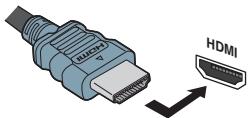
Be careful to connect the terminal in the proper direction.
Note
- Set the HDMI parameter in Setting the Audio options on page 41 to THRU (THROUGH) and set the input signal in Selecting the audio input signal on page 27 to HDMI, if you want to hear HDMI audio output from your TV (no sound will be heard from this receiver).
- If the video signal does not appear on your TV, try adjusting the resolution settings on your component or display. Note that some components (such as video game units) have resolutions that may not be displayed. In this case, use a (analog) composite connection.
- When the video signal from the HDMI is 480i, 480p, 576i or 576p, Multi Ch PCM sound and HD sound cannot be received.
About HDMI
The HDMI connection transfers uncompressed digital video, as well as almost every kind of digital audio that the connected component is compatible with, including DVD-Video, DVD-Audio, SACD, Dolby Digital Plus, Dolby TrueHD, DTS-HD Master Audio (see below for limitations), Video CD/ Super VCD and CD.
This receiver incorporates High-Definition Multimedia Interface (HDM(®/w)) technology.
This receiver supports the functions described below through HDMI connections.
Digital transfer of uncompressed video (contents protected by HDCP (1080p/24, 1080p/60, etc.))
3D signal transfer
- Deep Color signal transfer
x.v.Color signal transfer
Audio Return Channel
- Input of multi-channel linear PCM digital audio signals (192 kHz or less) for up to 8 channels
- Input of the following digital audio formats:
- Dolby Digital, Dolby Digital Plus, DTS, High bitrate audio (Dolby TrueHD, DTS-HD Master Audio), DVD-Audio, CD, SACD (DSD 2 ch only), Video CD, Super VCD
- Synchronized operation with components using the Control with HDMI function (see Control with HDMI function on page 58)
4K signal transfer
- This may not operate properly, depending on the connected equipment.
- 4K 24p, 4K 25p and 4K 30p signals are supported
Note
- Use a High Speed HDMI®/TM Cable. If HDMI cable other than a High Speed HDMI®/TM Cable is used, it may not work properly.
- When an HDMI cable with a built-in equalizer is connected, it may not operate properly.
- 3D, Deep Color, x.v.Color, 4K signal transfer and Audio Return Channel are only possible when connected to a compatible component.
- HDMI format digital audio transmissions require a longer time to be recognized. Due to this, interruption in the audio may occur when switching between audio formats or beginning playback.


- Turning on/off the device connected to this unit's HDMI OUT terminal during playback, or disconnecting/ connecting the HDMI cable during playback, may cause noise or interrupted audio.

HIGH-DEFINITION MULTIMEDIA INTERFACE
The terms HDMI and HDMI High-Definition Multimedia Interface, and the HDMI Logo are trademarks or registered trademarks of HDMI Licensing, LLC in the United States and other countries.
"x.v.Color" and Corporation.

are trademarks of Sony
Analog audio cables
Use stereo RCA phono cables to connect analog audio components. These cables are typically red and white, and you should connect the red plugs to R (right) terminals and white plugs to L (left) terminals.
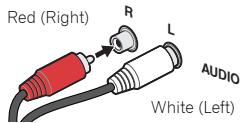
Digital audio cables
Commercially available coaxial digital audio cables or optical cables should be used to connect digital components to this receiver.
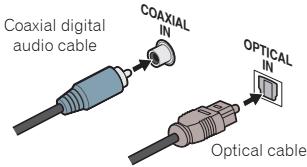
Note
- When connecting optical cables, be careful when inserting the plug not to damage the shutter protecting the optical socket.
- When storing optical cable, coil loosely. The cable may be damaged if bent around sharp corners.
- You can also use a standard RCA video cable for coaxial digital connections.
Video cables
Standard RCA video cables
These cables are the most common type of video connection and are used to connect to the composite video terminals. The yellow plugs distinguish them from cables for audio.
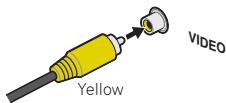
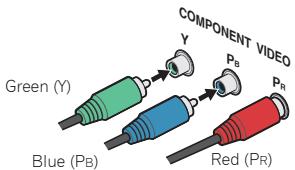
Component video cables (VSX-828 only)
Use component video cables to get the best possible color reproduction of your video source. The color signal of the TV is divided into the luminance (Y) signal and the color (Pb and Pr) signals and then output. In this way, interference between the signals is avoided.
About video outputs connection
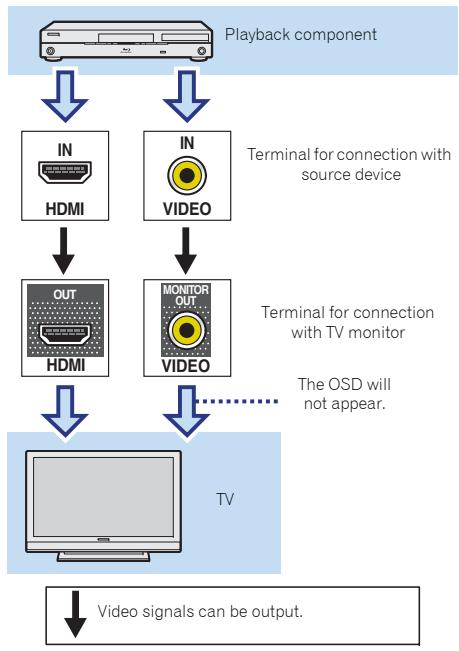
This receiver is not loaded with a video converter. When you use HDMI cables for connecting to the input device, the same cables should be used for connecting to the TV.
The signals input from the analog (composite) video inputs of this unit will not be output from the HDMI OUT terminal.
Connecting a TV and playback components
Connecting using HDMI
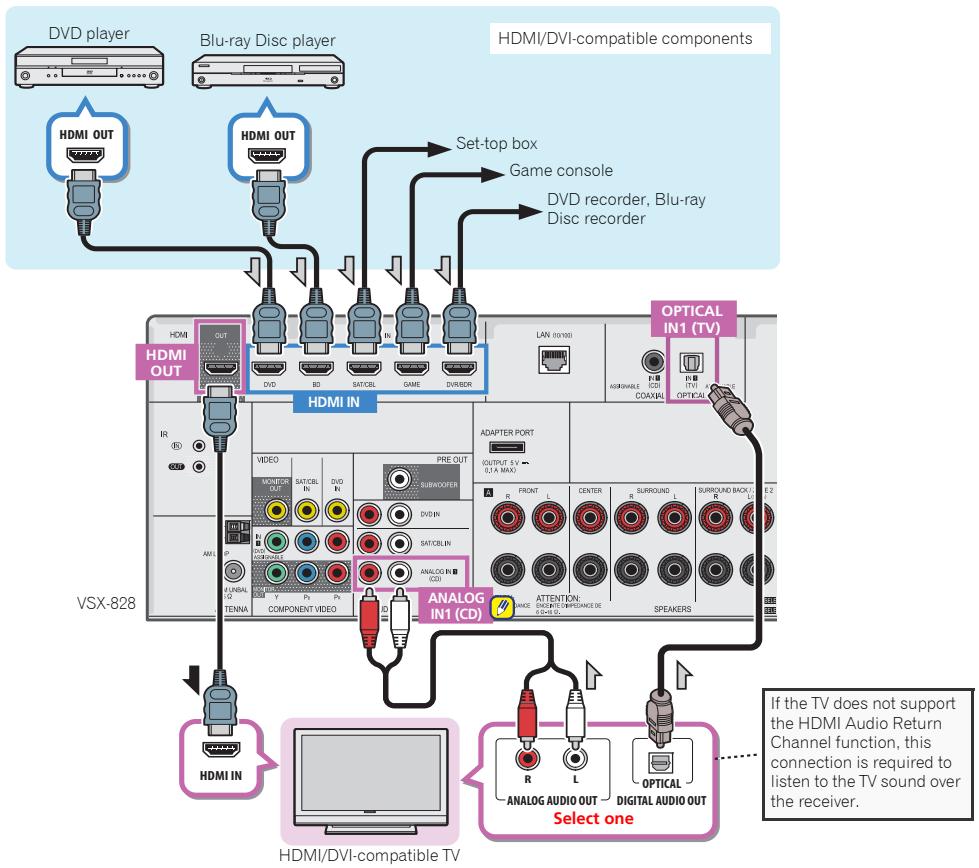
If you have an HDMI or DVI (with HDCP) equipped component (Blu-ray Disc player, etc.), you can connect it to this receiver using a commercially available HDMI cable.
If the TV and playback components support the Control with HDMI feature, the convenient Control with HDMI functions can be used (see Control with HDMI function on page 58).
- The following connection/setting is required to listen to the sound of the TV over this receiver.
- If the TV does not support the HDMI Audio Return Channel function, connect the receiver and TV with audio cables (as shown).
- If the TV supports the HDMI Audio Return Channel function, the sound of the TV can be input to the receiver via the HDMI terminal, so there is no need to connect an audio cable. In this case, set ARC at HDMI Setup to ON (see HDMI Setup on page 58).
- Please refer to the TV's operation manual for directions on connections and setup for the TV.

Note
- In order to listen to the audio from the TV that is connected to this receiver using an analog audio cables, set-up for analog audio input is required (see The Input Assign menu on page 54).


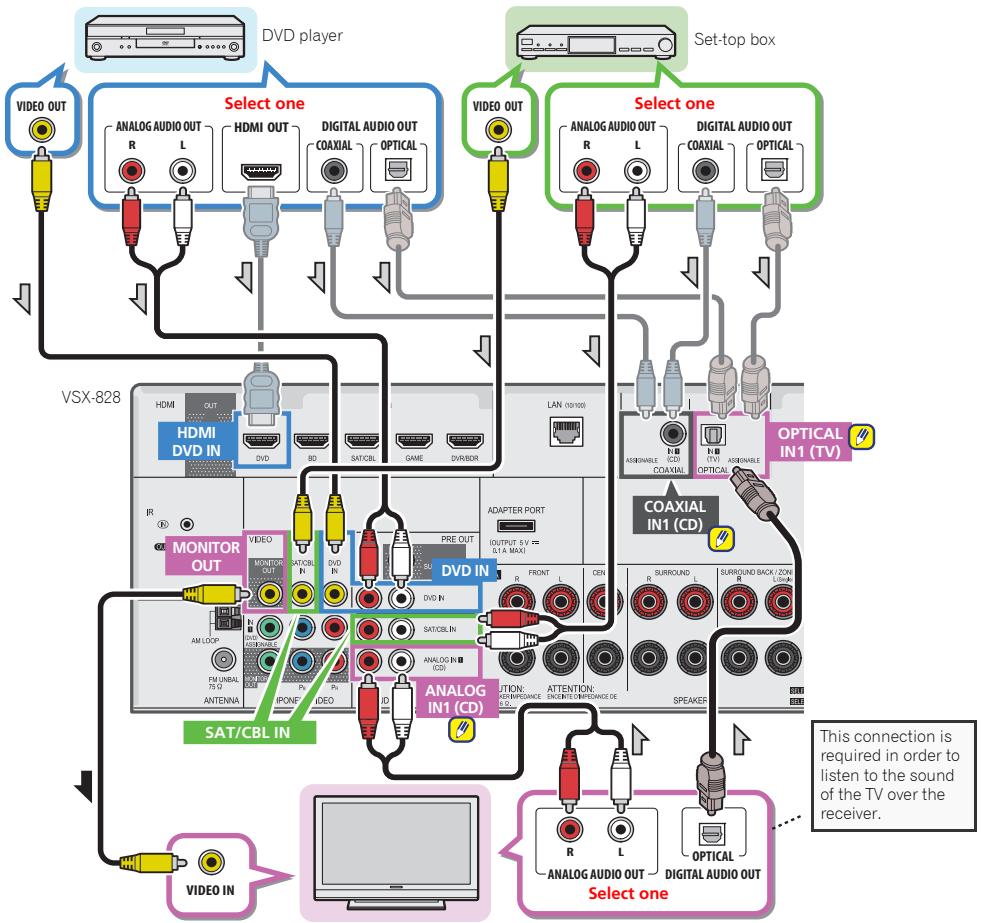
This diagram shows connections of a TV (with no HDMI input) and DVD player (or other playback component) to the receiver.
- With these connections, the picture is not output to the TV even if the DVD player is connected with an HDMI cable. Connect the DVD player's video signals using a composite cable.
- In order to listening to HD audio with this receiver, connect an HDMI cable, and use analog video cable for video signal input.
Depending on the player, it may not be possible to output video signals to both HDMI and other video output (composite, etc.) simultaneously, and it may be necessary to make video output settings. Please refer to the operating instructions supplied with your player for more information.

Important
- When the receiver and TV are connected by composite cable, the OSD function allowing display of the receiver's settings, operations, etc., on the TV's screen cannot be used. In this case, watch the receiver's front panel display while performing the various operations and making settings.

Note
- In order to listen to the audio from the TV that is connected to this receiver using a analog audio cables, set-up for analog audio input is required (see The Input Assign menu on page 54).
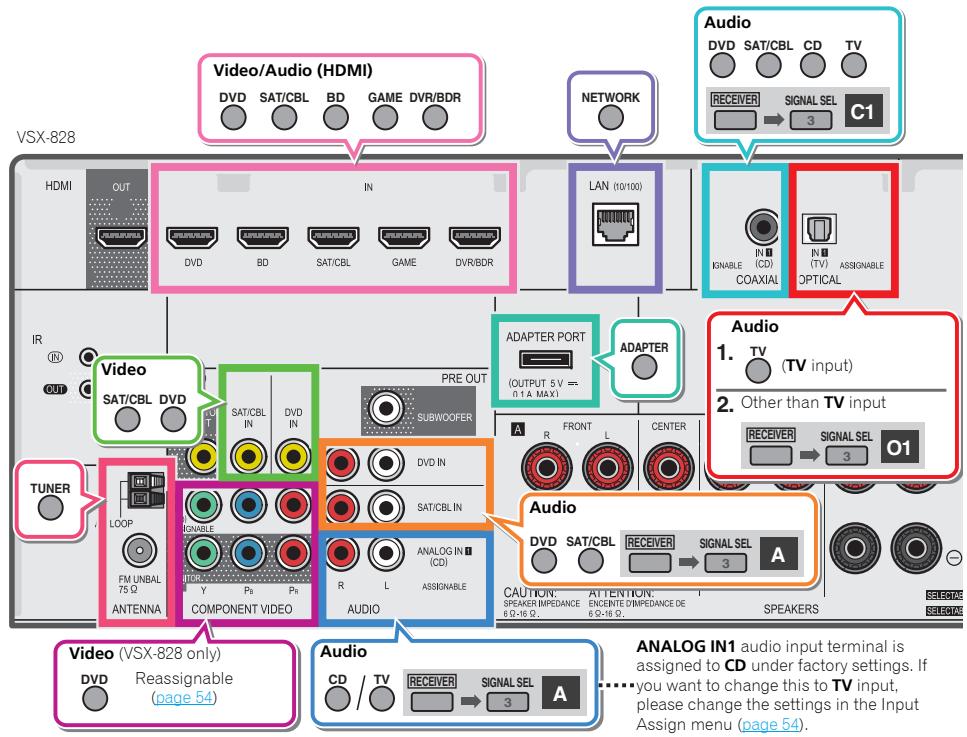
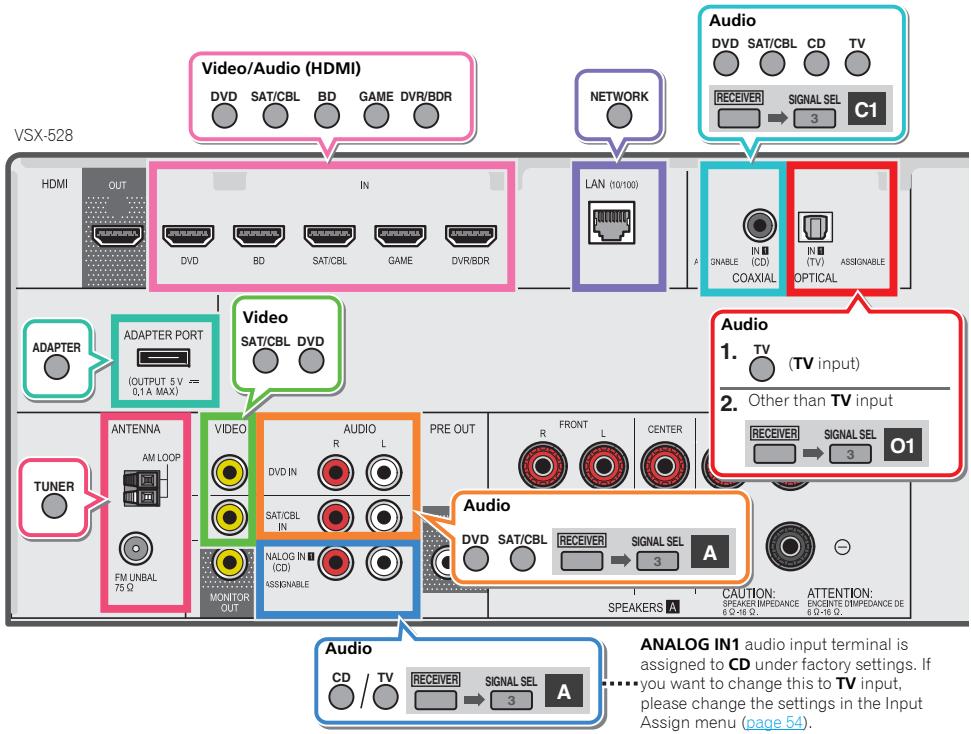
- Only one component can be connected to both the optical input terminal and coaxial input terminal. If connecting other devices, please use a different method to connect the audio.
In order to listen to the audio from the source component that is connected to this receiver using an optical cable or a coaxial cable, first, switch to the DVD (DVD player) or
SAT/CBL (set-top box), then use RECEIVER and SIGNAL SEL to choose the audio signal O1 (OPTICAL1) or C1 (COAXIAL1) (see Selecting the audio input signal on page 27).
TV


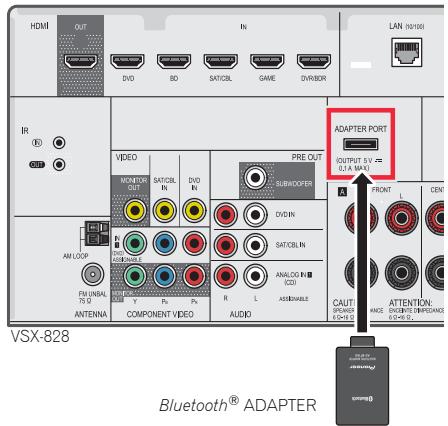
Connecting optional Bluetooth® ADAPTER
When the Bluetooth ADAPTER (Pioneer Model No. AS-BT100 or AS-BT200) is connected to this unit, a product equipped with Bluetooth wireless technology (portable cell phone, digital music player, etc.) can be used to listen to music wirelessly.
Connect a Bluetooth ADAPTER to the ADAPTER PORT terminal on the rear panel.
- For instructions on playing the Bluetooth wireless technology device, see Pairing the Bluetooth ADAPTER and Bluetooth wireless technology device on page 33.

Important
- Do not move the receiver with the Bluetooth ADAPTER connected. Doing so could cause damage or faulty contact.
Connecting to the network through LAN interface
By connecting this receiver to the network via the LAN terminal, you can listen to Internet radio stations. To listen to Internet radio stations, you must sign a contract with an ISP (Internet Service Provider) beforehand.
When connected in this way, you can play audio files stored on the components on the local network, including your computer.
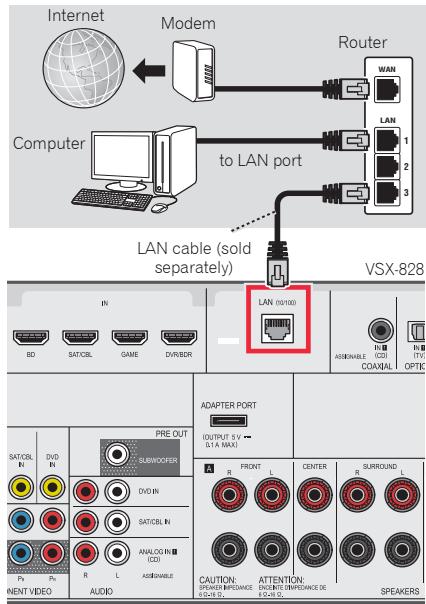
Connect the LAN terminal on this receiver to the LAN terminal on your router (with or without the built-in DHCP server function) with a straight LAN cable (CAT 5 or higher).
Turn on the DHCP server function of your router. In case your router does not have the built-in DHCP server function, it is necessary to set up the network manually. For details, see The Network Setup menu on page 46.
Note
Refer to the operation manual of the equipment you have as the connected equipment and connection method may differ depending on your Internet environment.
- When using a broadband Internet connection, a contract with an Internet service provider is required. For more details, contact your nearest Internet service provider.


Connecting antennas
Connect the AM loop antenna and the FM wire antenna as shown below. To improve reception and sound quality, connect external antennas (see Using external antennas below).
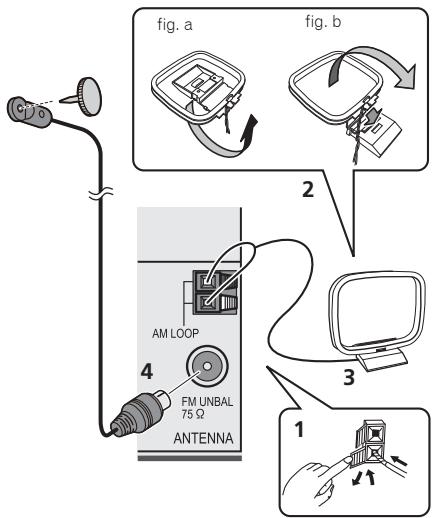
1 Push open the tabs, then insert one wire fully into each terminal, then release the tabs to secure the AM antenna wires.
2 Fix the AM loop antenna to the attached stand.
To fix the stand to the antenna, bend in the direction indicated by the arrow (fig. a) then clip the loop onto the stand (fig. b).
3 Place the AM antenna on a flat surface and in a direction giving the best reception.
4 Connect the FM wire antenna into the FM antenna socket.
For best results, extend the FM antenna fully and fix to a wall or door frame. Don't drape loosely or leave coiled up.
Using external antennas
To improve FM reception
For Europe, Russia and U.K.
Use a PAL connector (not supplied) to connect an external FM antenna.
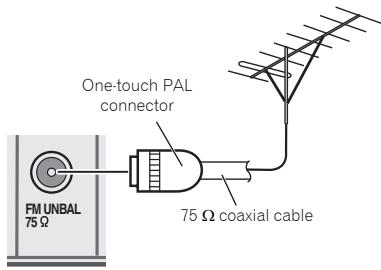
For Australia
Connect an external FM antenna as shown below.
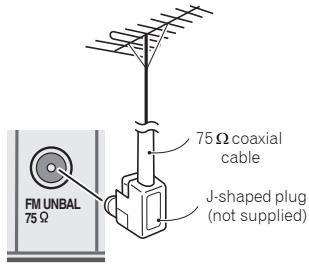
To improve AM reception
Connect a 5 m to 6 m length of vinyl-coated wire to the AM antenna terminal without disconnecting the supplied AM loop antenna.
For the best possible reception, suspend horizontally outdoors.
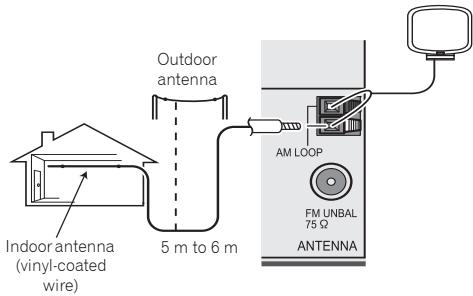


Connecting an IR receiver (VSX-828 only)
If you keep your stereo components in a closed cabinet or shelving unit, or you wish to use the sub zone remote control in another zone, you can use an optional IR receiver (such as a Niles or Xantech unit) to control your system instead of the remote sensor on the front panel of this receiver.

Note
- Remote operation may not be possible if direct light from a strong fluorescent lamp is shining on the IR receiver remote sensor window.
- Note that other manufacturers may not use the IR terminology. Refer to the manual that came with your component to check for IR compatibility.
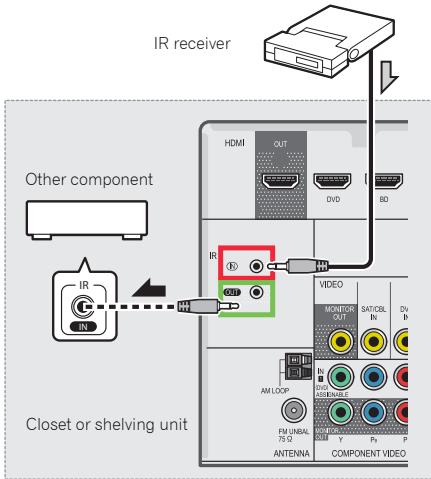
Connect the IR receiver sensor to the IR IN jack on the rear of this receiver.
For more information on connecting the IR receiver, see the Installation Instructions for the IR Receiver.
Connecting an iPod
This receiver has a dedicated iPod/iPhone/iPad terminals that will allow you to control playback of audio content from your iPod using the controls of this receiver.
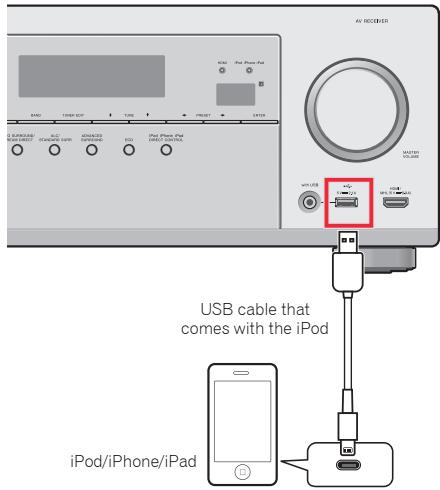

Note
- An iPod/iPhone/iPad can be connected to the receiver. For details on supported models and versions of the respective products, see Playing an iPod on page 29.
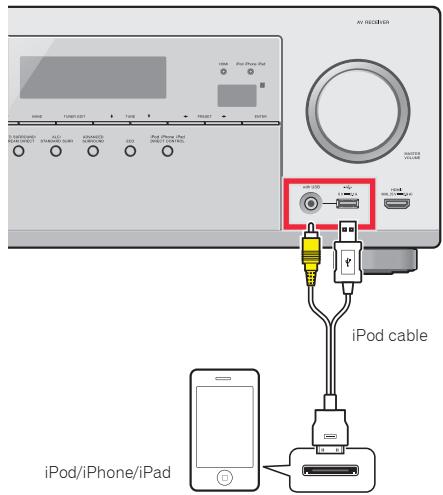
- Switch the receiver into standby, and then use the iPod cable to connect your iPod to the iPod/iPhone/iPad terminals on the front panel of this receiver.
For the cable connection, also refer to the operating instructions for your iPod.
- When connecting an iPhone to this unit, keep the iPhone at least 20cm away from this unit. If the iPhone is kept closer to this unit and a telephone call is received by the iPhone, noise may be output from this device.
- iPod recharging occurs whenever an iPod is connected to this unit. (Recharging is enabled only when the unit's power is turned on.)
- For instructions on playing the iPod, see Playing an iPod on page 29.
Use a dedicated cable to enjoy iPod video
If an iPod is connected using a dedicated iPod connection cable (sold separately), then video from the iPod can also be enjoyed on a TV that is connected to the receiver.
- The iPod cable is not included with this receiver. The optional iPod cable from Pioneer is sold separately under the part number L308102013030-IL. Contact the Pioneer Customer Support division for more information on obtaining an optional iPod cable.
- iPhone 5, iPad 4th generation, iPad mini, iPod touch 5th generation and iPod nano 7th generation cannot be connected using a separately sold iPod cable.


Note
- Due to linked operation of the HDMI control function, if a supported TV and receiver are connected using a HDMI cable and the TV input is changed during iPod input, the receiver may automatically also change to TV input. If this happens, please either change the receiver's input back to iPod, or turn OFF the HDMI control function (see HDMI Setup on page 58).
Connecting a USB device
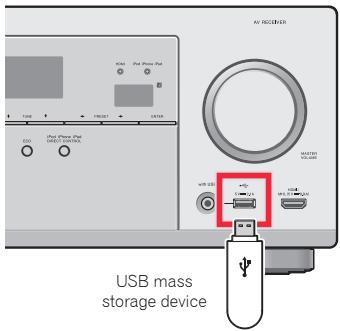
It is possible to play audio and photo files by connecting USB devices to this receiver.
- Switch the receiver into standby then connect your USB device to the iPod/iPhone/iPad terminals on the front panel of this receiver.
- This receiver does not support a USB hub.
For instructions on playing the USB device, see Playing a USB device on page 30.
Connecting an MHL-compatible device
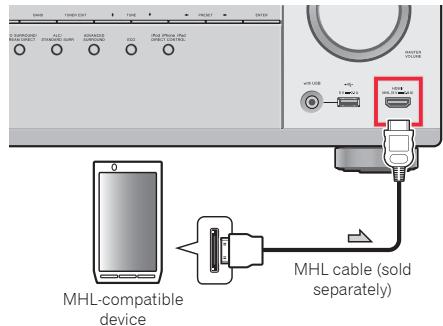
An MHL-compatible mobile device can be connected to enjoy full-HD videos, high quality multi-channel audio, and photos etc., with charge the battery on the receiver. Use the MHL cable (sold separately) to connect the device.
-
Switch the receiver into standby then use the MHL cable (sold separately) to connect your MHL enabled device to the MHL terminal on the front panel of this receiver.
-
The MHL-compatible device is recharged whenever it is connected to this unit. (Recharging is enabled only when the unit's power is turned on.)
- For instructions on playing the MHL-compatible device, see Playing an MHL-compatible device on page 32.


Plugging in the receiver
Only plug in after you have connected all your components to this receiver, including the speakers.
For U.K. and Australia
1 Plug the supplied power cord into the AC IN socket on the back of the receiver.
2 Plug the other end into a power outlet.
For Europe and Russia
Plug the AC power cord into a convenient AC power outlet.

CAUTION
- Handle the power cord by the plug. Do not pull out the plug by tugging the cord and never touch the power cord when your hands are wet as this could cause a short circuit or electric shock. Do not place the unit, a piece of furniture, etc., on the power cord, or pinch the cord. Never make a knot in the cord or tie it with other cords. The power cords should be routed such that they are not likely to be stepped on. A damaged power cord can cause a fire or give you an electrical shock. Check the power cord once in a while. When you find it damaged, ask your nearest PIONEER authorized service center or your dealer for a replacement.
- The receiver should be disconnected by removing the mains plug from the wall socket when not in regular use, e.g., when on vacation.

Note
- After this receiver is connected to an AC outlet, a 2 second to 10 second HDMI initialization process begins. You cannot carry out any operations during this process. The HDMI indicator in the front panel display blinks during this process, and you can turn on this receiver once it has stopped blinking. When you set the Control with HDMI to OFF, you can skip this process. For details about the Control with HDMI feature, see HDMI Setup on page 58.
Before setting up (for Australia)
This receiver allows you to adjust the system setup, using the on-screen display (OSD) that is shown on the TV screen.
- The OSD will not appear if you have connected using the HDMI output to your TV. Use composite connections for system setup.
First, follow the procedure below to make sure that the OSD screen is displayed.
1 Switch on the receiver and your TV.
2 Switch the TV input to the input that connects this receiver to the TV through the corresponding composite video cable.
For example, if you connected this receiver to theVIDEO jacks on your TV, make sure that theVIDEO input is now selected.
3 Press RECEIVER on the remote control, then press the HOME MENU button.
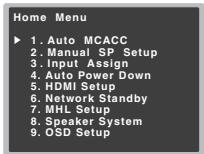
The Home Menu of the OSD screen will be displayed on the TV. If nothing appears on the screen, try to change the TV format setting on the receiver (see below).
If the OSD screen is not displayed correctly, it may be that the TV system is set incorrectly for your country or region.
1 Switch the receiver into standby.
2 While holding down the TUNE button, press and hold the STANDBY/ON button for about two seconds.
The display shows the new setting (PAL or NTSC).
Canceling the Auto Power Down (for Europe, Russia and U.K.)
When this receiver is not used over a period of several hours, it will power down automatically. The automatic power-off timer is set to six hours under factory settings, and the timing can be changed or the power-off function switched off altogether. For details, see The Auto Power Down menu on page 55.
Automatically setting up for surround sound (MCACC)
The Auto Multi-Channel ACooustic Calibration (MCACC) setup measures the acoustic characteristics of your listening area, taking into account ambient noise, speaker size and distance, and tests for both channel delay and channel level. After you have set up the microphone provided with your system, the receiver uses the information from a series of test tones to optimize the speaker settings and equalization for your particular room.
CAUTION
- The test tones used in the Auto MCACC setup are output at high volume.
Important
- The OSD will not appear if you have connected using the composite output to your TV. Use HDMI connection for Auto MCACC setup.
- The Auto MCACC setup will overwrite any existing speaker settings you've made.
-
Before using the Auto MCACC setup, the NETRADIO.M.SERVER, FAVORITE, iPod/USB or ADAPTER input should not be selected as an input source.
-
VSX-828 only: When both the surround back speaker and the front height speaker are connected, conduct Auto MCACC setup twice: once with the Speaker System setting is in Surr.Back and once with the Speaker System setting is in Height. (There is no need to conduct Auto MCACC setup every time the Speaker System setting is changed.)
1 Switch on the receiver and your TV.
2 Switch the TV input to the input that connects this receiver to the TV through the corresponding HDMI cable.
3 Connect the microphone to the MCACC SETUP MIC jack on the front panel.
Make sure there are no obstacles between the speakers and the microphone.


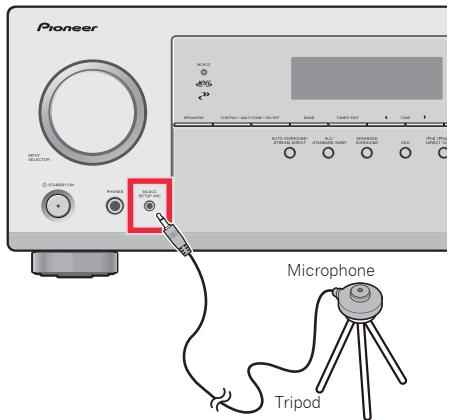
If you have a tripod, use it to place the microphone so that it's about ear level at your normal listening position. Otherwise, place the microphone at ear level using a table or a chair.
4 Press BD button on the remote control to switch to BD entry.
The Home Menu appears on your TV. Use / / and ENTER on the remote control to navigate through the screens and select menu items. Press RETURN to exit the current menu.
- Press HOME MENU at any time to exit the Home Menu. If you cancel the Auto MCACC setup at any time, the receiver automatically exits and no settings will be made.
- The screensaver automatically starts after three minutes of inactivity.
VSX-828
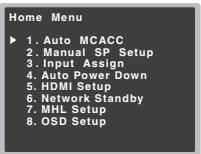
VSX-528
- Mic In! blinks when the microphone is not connected to MCACC SETUP MIC jack.
Try to be as quiet as possible after pressing ENTER. The system outputs a series of test tones to establish the ambient noise level.
7 Follow the instructions on-screen.
Make sure the microphone is connected.
- Make sure the subwoofer is on and the volume is turned up.
- When using surround back or front height speakers, turn on the power to the amplifier to which the surround back or front height speakers are connected, and adjust the sound level to the desired level (VSX-828 only).
See below for notes regarding background noise and other possible interference.
8 Wait for the test tones to finish.
A progress report is displayed on-screen while the receiver outputs test tones to determine the speakers present in your setup. Try to be as quiet as possible while it's doing this.
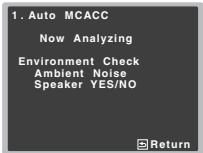
- For correct speaker settings, do not adjust the volume during the test tones.
9 Confirm the speaker configuration.
The configuration shown on-screen should reflect the actual speakers you have.
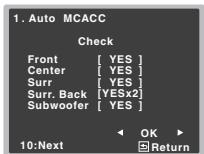
VSX-828
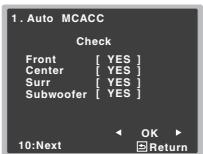
VSX-528
- With error messages (such as Too much ambient noise) select RETRY after checking for ambient noise (see Other problems when using the Auto MCACC setup below).
If the speaker configuration displayed isn't correct, use / to select the speaker and to change the setting. When you're finished, go to the next step. If you see an error message (ERR) in the right side column, there may be a problem with the speaker connection. If selecting RETRY doesn't fix the problem, turn off the power and check the speaker connections.
10 Make sure 'OK' is selected, then press ENTER.
If the screen in step 9 is left untouched for 10 seconds and ENTER is not pressed in step 10, the Auto MCACC setup will start automatically as shown.
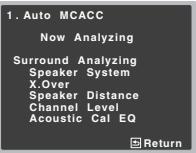
A progress report is displayed on-screen while the receiver outputs more test tones to determine the optimum receiver settings for channel level, speaker distance, X.Over, and Acoustic Calibration EQ.
Again, try to be as quiet as possible while this is happening. It may take 1 to 3 minutes.
The settings made in the Auto MCACC setup should give you excellent surround sound from your system, but it is also possible to adjust these settings manually using the Home Menu (starting on page 52).
Note
- Depending on the characteristics of your room, sometimes identical speakers with cone sizes of around 12cm will end up with different size settings. You can correct the setting manually using the Speaker Setting on page 52.
- The subwoofer distance setting may be farther than the actual distance from the listening position. This setting should be accurate (taking delay and room characteristics into account) and generally does not need to be changed.
Other problems when using the Auto MCACC setup
If the room environment is not optimal for the Auto MCACC setup (too much background noise, echo off the walls, obstacles blocking the speakers from the microphone) the final settings may be incorrect. Check for household appliances (air conditioner, fridge, fan, etc.), that may be affecting the environment and switch them off if necessary. If there are any instructions showing in the front panel display, please follow them.
Some older TVs may interfere with the operation of the microphone. If this seems to be happening, switch off the TV when doing the Auto MCACC setup.


Playing a source
Here are the basic instructions for playing a source (such as a DVD disc) with your home theater system.
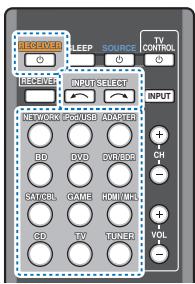
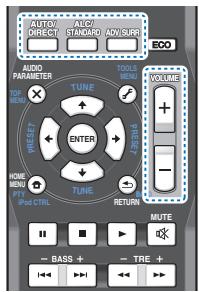
1 Switch on your system components and receiver.
Start by switching on the playback component (for example a DVD player), your TV and subwoofer (if you have one), then the receiver (press oRECEIVER).
- Make sure the setup microphone is disconnected.
2 Switch the TV input to the input that connects this receiver.
For example, if you connected this receiver to theVIDEO jacks on your TV, make sure that theVIDEO input is now selected.
3 Press input function buttons to select the input function you want to play.
- The input of the receiver will switch over, and you will be able to operate other components using the remote control. To operate the receiver, first press RECEIVER on the remote control, then press the appropriate button to operate.
- The input source can also be selected by using INPUT SELECT button on the remote control, or by using the front panel INPUT SELECTOR dial. In this case, the remote control won't switch operational modes.
If you selected the proper input source and there is still no sound, select the audio input signal for playback (see Selecting the audio input signal below).
4 Press AUTO/DIRECT to select 'AUTO SURROUND' and start playback of the source.
If you're playing a Dolby Digital or DTS surround sound DVD disc, with a digital audio connection, you should hear surround sound. If you're playing a stereo source or if the connection is an analog audio connection, you will only hear sound from the front left/right speakers in the default listening mode.
It is possible to check on the front panel display whether or not surround sound playback is being performed properly.
When using a surround back speaker, DID+PLIIx (VSX828 only) and DID+PLII are displayed when playing Dolby Digital 5.1-channel signals, and DTS+NEO:6 is displayed when playing DTS 5.1-channel signals.
When not using a surround back speaker, D/D is displayed when playing Dolby Digital signals.
If the display does not correspond to the input signal and listening mode, check the connections and settings.
Note
- You may need to check the digital audio output settings on your DVD player or digital satellite receiver. It should be set to output Dolby Digital, DTS and 88.2kHz / 96kHz PCM (2 channel) audio, and if there is an MPEG audio option, set this to convert the MPEG audio to PCM.
- Depending on your DVD player or source discs, you may only get digital 2 channel stereo and analog sound. In this case, the receiver must be set to a multichannel listening mode if you want multichannel surround sound.
5 Use VOLUME +1 - to adjust the volume level.
Turn down the volume of your TV so that all sound is coming from the speakers connected to this receiver.
The audio input signal can be selected for each input source. Once it is set, the audio input that was selected will be applied whenever you select the input source using the input function buttons.
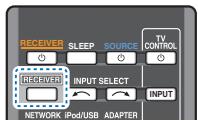
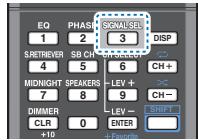
Press RECEIVER, then press SIGNAL SEL to select the audio input signal corresponding to the source component.
Each press cycles through the following:
- H - Selects an HDMI signal. H can be selected for BD, DVD, SAT/CBL, DVR/BDR, HDMI/MHL or GAME input. For other inputs, H cannot be selected.
- When the HDMI option in Setting the Audio options on page 41 is set to THRU, the sound will be heard through your TV, not from this receiver.
- A - Selects the analog inputs.
- C1/O1 - Selects the digital input. The coaxial 1 input is selected for C1, and the optical 1 audio input is selected for O1.
When H (HDMI) or C1/O1 (digital) is selected and the selected audio input is not provided, A (analog) is automatically selected.
Note
BD, DVR/BDR, HDMI/MHL and GAME inputs are fixed to H (HDMI). It cannot be changed.
- For the TV input, only A (analog) or C1/O1 (digital) can be selected. However, if the ARC at HDMI Setup is set to ON, the input is fixed to H (HDMI) and cannot be changed.
- When set to H (HDMI) or C1/O1 (digital), D0 lights when a Dolby Digital signal is input, and DTS lights when a DTS signal is input.
- When the H (HDMI) is selected, the A and DIGITAL indicators are off (see page 8).


- When digital input (optical or coaxial) is selected, this receiver can only play back Dolby Digital, PCM (32 kHz to 96 kHz) and DTS (including DTS 96 kHz/24 bit) digital signal formats. The compatible signals via the HDMI terminals are: Dolby Digital, DTS, SACD (DSD 2 ch only), PCM (32 kHz to 192 kHz sampling frequencies), Dolby TrueHD, Dolby Digital Plus, DTS-EXPRESS, DTS-HD Master Audio and DVD Audio (including 192 kHz). With other digital signal formats, set to A (analog).
- You may get digital noise when a LD or CD player compatible with DTS is playing an analog signal. To prevent noise, make the proper digital connections (page 16) and set the signal input to C1/O1 (digital).
- Some DVD players don't output DTS signals. For more details, refer to the instruction manual supplied with your DVD player.

Tip
- In order to enjoy the picture and/or sound from devices connected to each terminal, select the input by doing the following.


Tip
- In order to enjoy the picture and/or sound from devices connected to each terminal, select the input by doing the following.
Playing an iPod
This receiver has the iPod iPhone iPad USB terminal that will allow you to control playback of audio content from your iPod using the controls of this receiver.

Important
- Pioneer cannot under any circumstances accept responsibility for any direct or indirect loss arising from any inconvenience or loss of recorded material resulting from the iPod failure.
- About one minute is required between turning the power on and completion of startup.
- USB works with iPhone 5, iPhone 4S, iPhone 4, iPhone 3GS, iPhone 3G, iPhone, iPad (3rd and 4th generation), iPad 2, iPad, iPad mini, iPod touch (1st through 5th generation) and iPod nano (3rd through 7th generation). Audio only for iPhone 5, iPad 4th generation, iPad mini, iPod touch 5th generation and iPod nano (6th and 7th generation). However, some of the functions may be restricted for some models.
- This receiver has been developed and tested for the software version of iPod/iPhone/iPad indicated on the website of Pioneer (http://pioneer.jp/homeav/support/ios/eu/).
- Installing software versions other than indicated on the website of Pioneer to your iPod/iPhone/iPad may result in incompatibility with this receiver.
- iPod, iPhone and iPad are licensed for reproduction of noncopyrighted materials or materials the user is legally permitted to reproduce.
- Features such as the equalizer cannot be controlled using this receiver, and we recommend switching the equalizer off before connecting.
- Make sure the receiver is in standby when disconnecting the iPod/iPhone/iPad.
1 Switch on the receiver and your TV.
See Connecting an iPod on page 21.
- Switch the TV input to the input that connects this receiver to the TV through the corresponding HDMI cable.


When the display shows the names of folders and files, you're ready to play music from the iPod.
- If after pressing iPod/USB the display shows NO DEVICE, try switching off the receiver and reconnecting the iPod to the receiver.
- The controls of your iPod will be inoperable when connected to this receiver.
Playing back files stored on an iPod
To navigate songs on your iPod, you can take advantage of the OSD of your TV connected to this receiver.
Note that non-roman characters in the title are displayed as #
- This feature is not available for photos or video clips on your iPod.
Finding what you want to play
When your iPod is connected to this receiver, you can browse songs stored on your iPod by playlist, artist, album name, song name, genre or composer, similar to using your iPod directly.

Use / to select a category, then press ENTER to browse that category.
- When I or is pressed at the list screen, the page switches.
To return to the previous level any time, press RETURN.

Use / to browse the selected category (e.g., albums).
- Use / to move to previous/next levels.

Continue browsing until you arrive at what you want to play, then press to start playback.

Tip
- If you're in the song category, you can also press ENTER to start playback.
- You can play all of the songs in a particular category by selecting the All item at the top of each category list. For example, you can play all the songs by a particular artist.
Basic playback controls
This receiver's remote control buttons can be used for basic playback of files stored on an iPod.
- Press iPod/USB to switch the remote control to the iPod/USB operation mode.
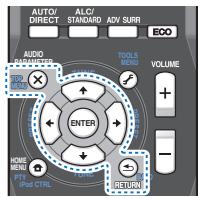
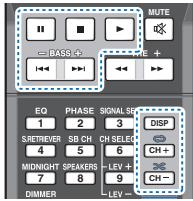
Watching photos and video content
To view photos or video on your iPod, since video control is not possible using this receiver, you must use the main controls of your iPod instead.

Important
- In order to display the images or video on the iPod on the receiver, an iPod cable sold separately is required.
-
To play photos or video on your iPod, you must connect the composite MONITOR OUT jack and TV. The photos and video content will not appear if you have connected using the HDMI output to your TV.
-
iPod photos and video content can be viewed only when the iPod is connected to the iPod VIDEO input on the front panel.
- When making the connection, please use a dedicated iPod cable (sold separately).
- This feature can only be used with an iPod having video output.

Press iPod CTRL to switch to the iPod controls for photo and video playback.
The receiver controls will be unavailable while you are watching iPod videos or browsing photos.

Tip
- Change the receiver's input to the iPod in one action by pressing iPod iPhone iPad DIRECT CONTROL on the front panel to enable iPod operations on the iPod.

Press iPod CTRL again to switch back to the receiver controls when you're done.

Tip
- Change the receiver's input to the iPod in one action by pressing iPod iPhone iPad DIRECT CONTROL on the front panel to enable iPod operations on the iPod.
Playing a USB device
It is possible to play files using the USB interface on the front of this receiver.

Important
- Pioneer cannot guarantee compatibility (operation and/or bus power) with all USB mass storage devices and assumes no responsibility for any loss of data that may occur when connected to this receiver.
- About one minute is required between turning the power on and completion of startup.

Note
- Compatible USB devices include external magnetic hard drives, portable flash memory (particularly keydrives) and digital audio players (MP3 players) of format FAT16/32.
Copyrighted audio files cannot be played back on this receiver.
- With large amounts of data, it may take longer for the receiver to read the contents of a USB device.
- If the file selected cannot be played back, this receiver automatically skips to the next file playable.
- When the file currently being played back has no title assigned to it, the file name is displayed in the OSD instead; when neither the album name nor the artist name is present, the row is displayed as a blank space.
Note that non-roman characters in the playlist are displayed as '#'.
- Make sure the receiver is in standby when disconnecting the USB device.

Switch on the receiver and your TV.
See Connecting a USB device on page 22.
- Switch the TV input to the input that connects this receiver to the TV through the corresponding HDMI cable.
When the display shows the names of folders and files, you're ready to play from the USB device.
If a USB Error message lights in the display, try following the points below:
- Switch the receiver off, then on again.
- Reconnect the USB device with the receiver switched off.
- Select another input source (like BD), then switch back to iPod/USB.
- Use a dedicated AC adapter (supplied with the device) for USB power.
If this doesn't remedy the problem, it is likely your USB device is incompatible.
Playing back audio files stored on a USB memory device
The maximum number of levels that you can select in Step 1 (below) is 9.
Note that non-Roman characters in the playlist are displayed as '#'.
1 Use / to select a folder, then press ENTER to browse that folder.
To return to the previous level any time, press RETURN.
2 Continue browsing until you arrive at what you want to play, then press to start playback.
Basic playback controls
This receiver's remote control buttons can be used for basic playback of files stored on USB devices.
- Press iPod/USB to switch the remote control to the iPod/USB operation mode.
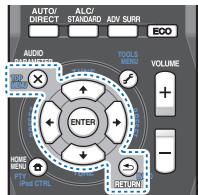
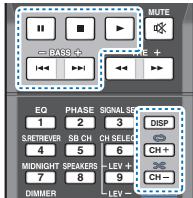
Playing back photo files stored on a USB memory device
1 Use / to select a folder, then press ENTER to browse that folder.
- For high resolution files, some time may be required for the photo to appear.
To return to the previous level any time, press RETURN.
2 Continue browsing until you arrive at what you want to play, then press to start playback.
The selected content is displayed in full screen and a slideshow starts.
Basic playback controls
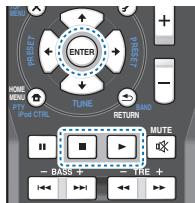
ENTER, -Starts displaying a photo and playing a slideshow.
- Stops the player and returns to the previous menu.

- Slideshows of photo files can be played while listening to music files by returning to the folder/file list display while playing a music file on a USB device then playing the photo files.
The USB function of this receiver supports the following file formats. Note that some file formats are not available for playback although they are listed as playable file formats.
With WAV, FLAC, AIFF and Apple Lossless files, when music files with the same format, sampling frequency, quantization bit number and number of channels are played successively, they are played with no gap.


Music files
| Extension | Stream | |
| MP3 (MPEG-1 Audio Layer 3) | |
| .mp3a | Sampling frequency | 32 kHz, 44.1 kHz, 48 kHz |
| Quantization bitrate | 16 bit |
| Channel | 2 ch |
| Bitrate | 8 kbps to 320 kbps |
| VBR/CBR | Supported/Supported |
| WAV (LPCM) |
| .wav | Sampling frequency 32 kHz, 44.1 kHz, 48 kHz, 88.2 kHz, 96 kHz, 176.4 kHz, 192 kHz |
| Quantization bitrate 16 bit, 24 bit |
| Channel 2 ch |
| WMA (WMA2/7/8/9) |
| .wma | Sampling frequency | 32 kHz, 44.1 kHz, 48 kHz |
| Quantization bitrate | 16 bit |
| Channel | 2 ch |
| Bitrate | 5 kbps to 320 kbps |
| VBR/CBR | Supported/Supported |
| AAC (MPEG-4 AAC LC, MPEG-4 HE AAC (aacPlus v1/2)) |
| .m4a | Sampling frequency | 32 kHz, 44.1 kHz, 48 kHz |
| .aac | Quantization bitrate | 16 bit |
| .3gp | Channel | 2 ch |
| .3g2 | Bitrate | 16 kbps to 320 kbps |
| VBR/CBR | Supported/Supported |
| FLAC |
| .flacc | Sampling frequency | 32 kHz, 44.1 kHz, 48 kHz, 88.2 kHz, 96 kHz, 176.4 kHz, 192 kHz |
| Quantization bitrate | 16 bit, 24 bit |
| Channel | 2 ch |
| AIFF |
| .aif | Sampling frequency | 32 kHz, 44.1 kHz, 48 kHz, 88.2 kHz, 96 kHz, 176.4 kHz, 192 kHz |
| .aiff |
| Quantization bitrate | 16 bit, 24 bit |
| Channel | 2 ch |
| Apple Lossless |
| .m4a | Sampling frequency | 32 kHz, 44.1 kHz, 48 kHz, 88.2 kHz, 96 kHz |
| .mp4 |
| Quantization bitrate | 16 bit, 24 bit |
| Channel | 2 ch |
| a. MPEG Layer-3 audio decoding technology licensed from Fraunhofer I/S and Thomson multimedia. |
| b. Files encoded using Windows Media Codec 9 may be playable but some parts of the specification are not supported; specifically, Pro, Lossless, Voice. |
| c. Uncompressed FLAC files are not supported. Pioneer does not guarantee playback. |
| Photo files |
| Extension | Format | |
| JPEG |
| .jpg | Meeting the following conditions:
• Baseline JPEG format
• YCbCr - 4:2:2 | |
Playing an MHL-compatible device
MHL (Mobile High-definition Link) is an interface standard for transmitting digital signals with mobile devices. MHL can carry high quality multi-channel audio data and full-HD video formats.
The MHL-compatible device's video signals are output from the TV connected to the receiver, the audio signals are output from the speakers connected to the receiver or TV.
1 Press RECEIVER to switch on the receiver and your TV.
See Connecting an MHL-compatible device on page 22.
2 Press HDMI/MHL on the remote control to switch the receiver to the MHL.
3 Select and play the desired contents on the MHL-compatible device.
Note
- MHL-compatible devices can be operated with the receiver's remote control by pressing the remote control's HDMI/MHL button, but depending on the MHL-compatible device being used, some buttons may not be operable.
- To playback from a MHL-compatible device connected to the receiver on a TV that is also connected to the receiver, the power to the receiver must be turned on.


Bluetooth® ADAPTER for Wireless Enjoyment of Music

Bluetooth wireless technology enabled device: cell phone

Bluetooth wireless technology enabled device: Digital music player

Device not equipped with Bluetooth wireless technology: Digital music player + Bluetooth audio transmitter (sold commercially)
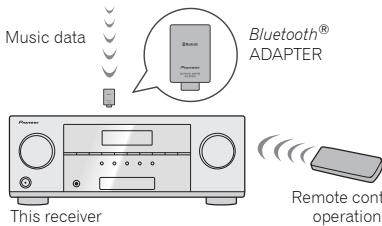
Wireless music play
When the Bluetooth ADAPTER (Pioneer Model No. AS-BT100 or AS-BT200) is connected to this unit, a product equipped with Bluetooth wireless technology (portable cell phone, digital music player, etc.) can be used to listen to music wirelessly. Also, by using a commercially available transmitter supporting Bluetooth wireless technology, you can listen to music on a device not equipped with Bluetooth wireless technology. The AS-BT100 and AS-BT200 model supports SCMS-T contents protection, so music can also be enjoyed on devices equipped with SCMS-T type Bluetooth wireless technology.
-
With the AS-BT100, some functions may not be available on this receiver.
-
It must be necessary that the Bluetooth wireless technology enabled device supports A2DP profiles.

Important
- Pioneer does not guarantee proper connection and operation of this unit with all Bluetooth wireless technology enabled devices.
- About one minute is required between turning the power on and completion of startup.
Remote control operation
The remote control supplied with this unit allows you to play and stop media, and perform other operations.
- It must be necessary that the Bluetooth wireless technology enabled device supports AVRCP profiles.
- Remote control operations cannot be guaranteed for all Bluetooth wireless technology enabled devices.
Pairing the Bluetooth ADAPTER and Bluetooth wireless technology device
"Pairing" must be done before you start playback of Bluetooth wireless technology content using Bluetooth ADAPTER. Make sure to perform pairing first time you operate the system or any time pairing data is cleared. "Pairing" is the step necessary to register Bluetooth wireless technology device to enable Bluetooth communications. For more details, see also the operating instructions of your Bluetooth wireless technology device.
- Pairing is required when you first use Bluetooth wireless technology device and Bluetooth ADAPTER.
- To enable Bluetooth communication, pairing should be done with both of your system and Bluetooth wireless technology device.
-
If the Bluetooth wireless technology device's security code is "0000", there is no need to make the security code setting on the receiver. Press ADAPTER to switch the ADAPTER input, then conduct the pairing operation on the Bluetooth wireless technology device. If pairing is successful, there is no need to performing the pairing operation below.
-
When using the AS-BT200 only: This unit complies with Bluetooth Specifications Ver. 2.1. When this unit and another device equipped with Bluetooth wireless technology both comply with Bluetooth Specification Ver. 2.1, pairing of the two may be possible without the need for inputting a password.
In this case, a passcode may be displayed on this receiver and on the device equipped with Bluetooth wireless technology. If this happens, check that the same passcode is displayed on this receiver and the device equipped with Bluetooth wireless technology, then press ENTER. After this, also perform the connection operation on the Bluetooth device to be connected. If the passcode does not match the code displayed on the Bluetooth device to be connected, press RETURN to cancel pairing, then try starting over.
Press ADAPTER to set the ADAPTER input, then conduct the pairing operation on the Bluetooth wireless technology device. If pairing is successful, there is no need to performing the pairing operation below.
- Pair one unit at a time.
- When connecting this receiver by Bluetooth connections with a device equipped with the Bluetooth function to listen to music, do not connect any devices other than this receiver by Bluetooth connection to the Bluetooth-equipped device. If a Bluetooth connection is already established with a device other than this receiver, disconnect the other device before connecting this receiver.
1 Press ADAPTER to switch the receiver to ADAPTER input.
2 Press TOP MENU to select Bluetooth Setup.
3 Use / to select PIN, then press ENTER.
Use / to select one of PIN codes 0000, 1234 or 8888, then press ENTER.
You can use any of 0000/1234/8888 PIN codes. Bluetooth wireless technology device using any other PIN code cannot be used with this system.


Switch on the Bluetooth wireless technology device that you want to make pairing, place it near the system and set it into the pairing mode.
6 Check to see that the Bluetooth ADAPTER is detected by the Bluetooth wireless technology device.
When Bluetooth wireless technology device is connected: Bluetooth wireless technology device name appears in the receiver display.
- The system can display alphanumeric characters only. Other characters may not be displayed correctly.
When Bluetooth wireless technology device is not connected:
WAITING appears in the receiver display. In this case, perform the connection operation from the side of the Bluetooth wireless technology device.
7 From the Bluetooth wireless technology device list, select Bluetooth ADAPTER and enter the PIN code selected in the step 4.
PIN code may in some case be referred to as PASSKEY.
Listening to Music Contents of Bluetooth wireless technology device with Your System
1 Press ADAPTER to switch the receiver to ADAPTER input.
The ADAPTER input can also be selected by pressing SOUND RETRIEVER AIR on the front panel. In this case,
S.R AIR, the optimum listening mode, is selected automatically.
2 Perform the connection operation from the side of the Bluetooth wireless technology device to the Bluetooth ADAPTER.
- When the Bluetooth ADAPTER is not plugged into the ADAPTER PORT terminal, NO ADP will be displayed if ADAPTER input is selected.
3 Start playback of music contents stored in Bluetooth wireless technology device.
This receiver's remote control buttons can be used for basic playback of files stored on the Bluetooth wireless technology device.
- Bluetooth wireless technology device should be compatible with AVRCP profile.
- Depending on Bluetooth wireless technology device you use, operation may differ from what is shown in the remote control buttons.
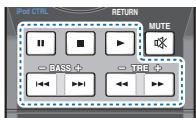
4 While listening to a source, press RECEIVER then press ADV SURR repeatedly to select S.R AIR.
AIR JAM
Air Jam - a Pioneer-exclusive application and available for free.
Air Jam lets you connect multi compatible devices to this unit using Bluetooth wireless technology. With it, you can make a group playlist directly on a supported device to play in your home theater through the unit. You and your friends can add songs from your devices to the playlist. Also Air Jam lets you delete the song before anyone has to hear it.
1 Press ADAPTER to switch the receiver to ADAPTER input.
2 Press TOP MENU to select Bluetooth Setup.
3 Use / to select 'Air Jam', then press ENTER.
4. Use ↑/↓ to select 'Air Jam ON', then press ENTER.
For more details on using Air Jam, access our website. http://pioneer.jp/support/soft/iapp_airjam/en.html
The Bluetooth® word mark and logos are registered trademarks owned by Bluetooth SIG, Inc. and any use of such marks by PIONEER CORPORATION is under license. Other trademarks and trade names are those of their respective owners.
Note
- Bluetooth technology works with iPhone 5, iPhone 4S, iPhone 4, iPhone 3GS, iPhone 3G, iPhone, iPad (3rd and 4th generation), iPad 2, iPad, iPad mini, and iPod touch (2nd through 5th generation).
- The Air Jam function cannot be used while an iPod is connected to this receiver.
- With this receiver, when an iPod is connected or disconnected while the music of a Bluetooth wireless technology device is playing, the connection with the Bluetooth wireless technology device may be canceled.
Listening to the radio
The following steps show you how to tune in to FM and AM radio broadcasts using the automatic (search) and manual (step) tuning functions. Once you are tuned to a station you can memorize the frequency for recall later—see Saving station presets below for more on how to do this.
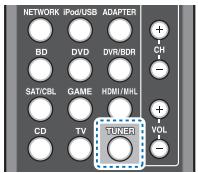
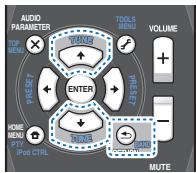
1 Press TUNER to select the tuner.
2 Use BAND to change the band (FM or AM), if necessary. Each press switches the band between FM (stereo or mono) and AM.
3 Tune to a station. There are three ways to do this:
Automatic tuning
To search for stations in the currently selected band, press and hold TUNE / for about a second. The receiver will start searching for the next station, stopping when it has found one. Repeat to search for other stations.
Manual tuning
To change the frequency one step at a time, press TUNE ↑/↓.
High speed tuning
Press and hold TUNE / for high speed tuning.
Improving FM sound
If the TUNE or ST indicators don't light when tuning to an FM station because the signal is weak, set the receiver to the mono reception mode.

Press BAND to select FM MONO.
This should improve the sound quality and allow you to enjoy the broadcast.
Saving station presets
If you often listen to a particular radio station, it's convenient to have the receiver store the frequency for easy recall whenever you want to listen to that station. This saves the effort of manually tuning in each time. This unit can memorize up to 30 stations.
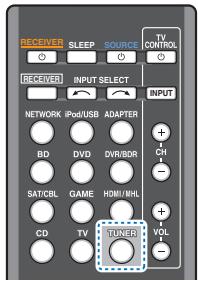
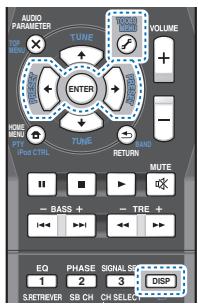
1 Tune to a station you want to memorize.
See Listening to the radio above for more on this.
The display shows PRESET, then a blinking MEM and station preset.

Press PRESET / to select the station preset you want.
You can also use the number buttons.

Press ENTER.
The preset number stop blinking and the receiver stores the station.
Note
- If the receiver is left disconnected from the AC power outlet for over a month, the station memories will be lost and will have to be reprogrammed.
- Stations are stored in stereo. When the station is stored in the FM MONO mode, it shows as ST when recalled.
Listening to station presets
You will need to have some presets stored to do this. See Saving station presets above if you haven't done this already.

Press PRESET / to select the station preset you want.
- You can also use the number buttons on the remote control to recall the station preset.
Naming preset stations
For easier identification, you can name all of your preset stations.

Choose the station preset you want to name.
See Listening to station presets above for how to do this.

Press TOOLS twice.
The cursor at the first character position is blinking on the display.

Input the name you want.
Choose a name up to eight characters long.
- Use PRESET / to select character position.
- Use TUNE / to select characters.
- The name is stored when ENTER is pressed.

Tip
-
To erase a station name, follow steps 1 and 2, and press ENTER while the display is blank. Press TOOLS while the display is blank, to keep the previous name.
-
Once you have named a station preset, Press DISP to show the name. When you want to return to the frequency display, press DISP several times to show the frequency.
Changing the radio frequency step (for Australia)
If you find that you can't tune into stations successfully, the frequency step may not be suitable for your country/region. Here's how to switch the setting:

Switch the receiver into standby.
2 While holding down TUNE button, press and hold STANDBY/ON button for about two seconds.
The channel tuning step alternates between 10K STEP and 9K STEP each time you do this.


An introduction to RDS (for Europe)
Radio Data System (RDS) is a system used by most FM radio stations to provide listeners with various kinds of information—the name of the station and the kind of show they're broadcasting, for example.
One feature of RDS is that you can search by type of program. For example, you can search for a station that's broadcasting a show with the program type, JAZZ.
You can search the following program types:
NEWS - News
AFFAIRS - Current Affairs
INFO - General Information
SPORT-Sport
EDUCATE - Educational
DRAMAR - Radio plays, etc.
CULTURE - National or regional culture, theater, etc.
SCIENCE - Science and technology
VARIRED - Usually talk-based material, such as quiz shows or interviews.
POP M-Pop music
ROCK M - Rock music
EASY M - Easy listening
LIGHT M - 'Light' classical music
CLASSICS - 'Serious' classical music
OTHER M - Music not fitting above categories
WEATHER - Weather reports
FINANCE - Stock market reports, commerce, trading, etc.
CHILDREN - Programs for children
SOCIAL-Social affairs
RELIGION - Programs concerning religion
PHONE IN - Public expressing their views by phone
TRAVEL - Holiday-type travel rather than traffic announcements
LEISURE - Leisure interests and hobbies
JAZZ-Jazz
COUNTRY - Country music
NATION M Popular music in a language other than English
OLDIES - Popular music from the '50s and '60s
FOLK M - Folk music
DOCUMENT - Documentary
4 Note
- In addition, there are three other program types, ALARM, ALARMTST, and NO TYPE. ALARM and ALARMTST are used for emergency announcements. NO TYPE appears when a program type cannot be found.
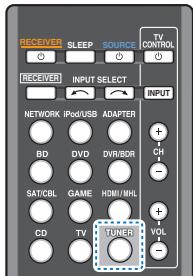
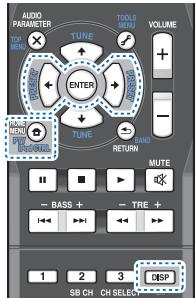
Searching for RDS programs
You can search for a program type listed above.
Press TUNER then press BAND to select the FM band. RDS is only possible in the FM band.
2 Press PTY. SEARCH shows in the display.
3 Press PRESET to select the program type you want to hear.
4 Press ENTER to search for the program type.
The system starts searching through the station presets for a match, stopping when it was found one. Repeat to search for other stations.
If NO PTY is displayed it means the tuner couldn't find that program type at the time of the search.
RDS searches station presets only. If no stations have been preset, or if the program type could not be found among the station presets NO PTY is displayed.
FINISH means the search is complete.


Choosing the listening mode
This receiver offers a variety of listening modes to accommodate playback of various audio formats. Choose one according to your speaker environment or the source.
While listening to a source, press the listening mode button repeatedly to select a listening mode you want.
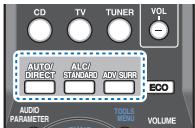
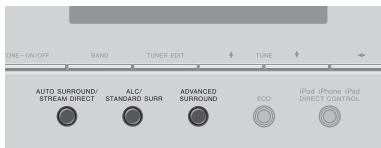
- The listening mode is shown on the display on the front panel.

Important
- The listening modes and many features described in this section may not be available depending on the current source, settings and status of the receiver.
Auto playback
AUTO/DIRECT

AUTO SURROUND
STREAM DIRECT

The simplest, most direct listening option is the AUTO SURROUND feature. With this, the receiver automatically detects what kind of source you're playing and selects multichannel or stereo playback as necessary.
- Press AUTO/DIRECT repeatedly until AUTO SURROUND shows briefly in the display (it will then show the decoding or playback format). Check the digital format indicators in the display to see how the source is being processed.
4 Note
- Stereo surround (matrix) formats are decoded accordingly using NEO:6 CINEMA or DOLBY PLlIx MUSIC (VSX-828 only) (see Listening in surround sound below for more on these decoding formats).
- When listening to the ADAPTER input, the S.R. AIR feature is selected automatically (see Using the Advanced surround on page 38 for more on this).
Listening in surround sound

ALC/ STANDARD SURR

Using this receiver, you can listen to any source in surround sound. However, the options available will depend on your speaker setup and the type of source you're listening to.
- If the source is Dolby Digital, DTS, or Dolby Surround encoded, the proper decoding format will automatically be selected and shows in the display.
When you select STEREO ALC (Auto Level Control stereo mode), this unit equalizes playback sound levels if each sound level varies with the music source recorded in a portable audio player.
When you select STEREO, you will hear the source through just the front left and right speakers (and possibly your subwoofer depending on your speaker settings). Dolby Digital and DTS multichannel sources are downmixed to stereo.
The following modes provide basic surround sound for stereo and multichannel sources.
Explanatory notes
No: No connected / Yes: Connected / Two: Two speakers are connected / -: Whether connected or no
| Type of surround modes | Suitable sources | Surround back speaker(s) (VSX-828 only) | Front height speakers (VSX-828 only) |
| Two channel sources |
| STEREO ALC | See above. | - | - |
| DOLBY PLIIx MOVIEg | Movie | Yesa | No |
| DOLBY PLII Movie | | No | - |
| DOLBY PLIIx MUSICb,g | Music | Yesa | No |
| DOLBY PLII MUSICb | | No | - |
| DOLBY PLIIx GAMEg | Video games | Yesa | No |
| DOLBY PLII Game | | No | - |
| DOLBY PLIIz HEIGHTc,g | Movie/Music | No | Yes |
| NEO:6 CINEMAd | Movie | - | - |
| NEO:6 MUSICd | Music | - | - |
| DOLBY PRO LOGIC | Old movies | - | - |
| Straight Decodee | No additional effects | No | - |
| STEREOf | See above. | - | - |
| Multichannel sources |
| STEREO ALC | See above. | - | - |
| DOLBY PLIIx MOVIEg | Movie | Two | No |
| DOLBY PLIIx MUSICb,g | Music | Yes | No |
| DOLBY DIGITAL EXg | Movie/Music | Yes | No |
| DTS-ESg | Movie/Music | Yes | No |
| DTS NEO:6g | Movie/Music | Yes | No |
| DOLBY PLIIz HEIGHTg | Movie/Music | No | Yes |
| Straight Decodee | No additional effects | - | - |
| STEREOf | See above. | - | - |


m - 1 0 ;
a. If surround back channel processing (page 40) is switched off, or the surround back speakers are set to NO, DOLBY PLIIx becomes DOLBY PLII (5.1 channel sound).
b. You can also adjust the C.WIDTH, DIMEN., and PNRM. effect (see Setting the Audio options on page 41).
c. In case of VSX-828: You can also adjust the H.GAIN effect (see Setting the Audio options on page 41).
d. You can also adjust the C.I.MG effect (see Setting the Audio options on page 41).
e. In case of VSX-828: Cannot be selected when the Speaker System is set to Surr. Back (see The Speaker System setting (VSX-828 only) on page 55).
f. The audio is heard with your surround settings and you can still use the Midnight, Loudness, Phase Control, Sound Retriever and Tone functions.
g. VSX-828 only

Note
- In modes that give 6.1 channel sound, the same signal is heard from both surround back speakers (VSX-828 only).
Using the Advanced surround

ADVANCED SURROUND

The Advanced surround feature creates a variety of surround effects. Try different modes with various soundtracks to see which you like.
| ACTION | Designed for action movies with dynamic soundtracks. |
| DRAMA | Designed for movies with lots of dialog. |
| ADVANCED GAME | Suitable for video games. |
| SPORTS | Suitable for sports programs. |
| CLASSICAL | Gives a large concert hall-type sound. |
| ROCK/POP | Creates a live concert sound for rock and/or pop music. |
| EXT.STEREO | Gives multichannel sound to a stereo source, using all of your speakers. |
| ECO MODE 1 | Cut back on power consumption. Suitable for contents that are mainly high level (mainly music). |
| ECO MODE 2 | Cut back on even more power consumption than ECO MODE 1. Suitable for contents with wider dynamic range (mainly movies). |
4 Note
- During ECO mode, the brightness switches between 2 levels. If the dimmest level is selected, DIMMER will be shown on the display. (Mode other than ECO: 4 levels, ECO mode: 2 levels)
- ECO MODE will switch OFF automatically when switched to other listening modes (Advanced surround mode and Auto surround mode).
F.S.S.ADVANCE
(Front Stage Surround ADVANCE)
Allows you to create natural surround sound effects using just the front speakers and the subwoofer. Use to provide a rich surround sound effect directed to the center of where the front left and right speakers sound projection area converges.
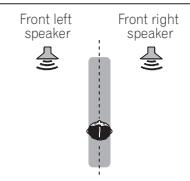
S.R AIR (Sound Retriever Air)
Suitable for listening to the sound from a Bluetooth wireless technology device. The S.R AIR listening mode can only be selected when the ADAPTER input.
PHONES SURR
When listening through headphones, you can still get the effect of overall surround.
Using Stream Direct

Use the Stream Direct modes when you want to hear the truest possible reproduction of a source. All unnecessary signal processing is bypassed.
AUTO SURROUND See Auto playback on page 37.
| DIRECT | Sources are heard according to the settings made in the Manual SP Setup (speaker setting, channel level, speaker distance), as well as with dual mono settings. You will hear sources according to the number of channels in the signal.
Phase Control, Acoustic Calibration EQ, Sound Delay, Auto Delay, LFE Attenuate and Center image functions are available. |
| PURE DIRECT | Analog and PCM sources are heard without any digital processing. |
Using the Sound Retriever
When audio data is removed during the compression process, sound quality often suffers from an uneven sound image. The Sound Retriever feature employs new DSP technology that helps bring CD quality sound back to compressed 2-channel audio by restoring sound pressure and smoothing jagged artifacts left over after compression.
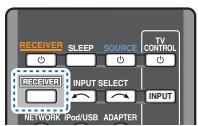
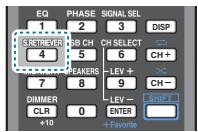
Press [RECEIVER], then press S.RETRIEVER to switch the S.RTV (Sound Retriever) ON or OFF.
Note
- The Sound Retriever is only applicable to 2-channel sources.
Listening with Acoustic Calibration EQ
You can listen to sources using the Acoustic Calibration Equalization set in Automatically setting up for surround sound (MCACC) on page 24. Refer to these pages for more on Acoustic Calibration Equalization.
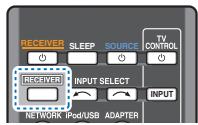
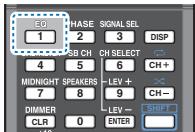
While listening to a source, press [RECEIVER], then press EQ to switch the EQ (Acoustic Calibration EQ) ON or OFF.
The MCACC indicator on the front panel lights when Acoustic Calibration EQ is active.
- You can't use Acoustic Calibration EQ with Stream Direct mode and it has no effect with headphones.
Better sound using Phase Control
This receiver's Phase Control feature uses phase correction measures to make sure your sound source arrives at the listening position in phase, preventing unwanted distortion and/or coloring of the sound.
Phase Control technology provides coherent sound reproduction through the use of phase matching for an optimal sound image at your listening position. The default setting is on and we recommend leaving Phase Control switched on for all sound sources.
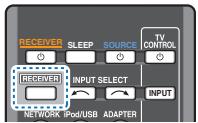
While listening to a source, press (RECEIVER), then press PHASE to switch the P.CTL (Phase Control) ON or OFF.
Note
- Phase matching is a very important factor in achieving proper sound reproduction. If two waveforms are 'in phase', they crest and trough together, resulting in increased amplitude, clarity and presence of the sound signal. If a crest of a wave meets a trough, then the sound will be 'out of phase' and an unreliable sound image will be produced.
- If your subwoofer has a phase control switch, set it to the plus (+) sign (or 0^ ). However, the effect you can actually feel when Phase Control is set to ON on this receiver depends on the type of your subwoofer. Set your subwoofer to maximize the effect. It is also recommended you try changing the orientation or the place of your subwoofer.
- Set the built-in lowpass filter switch of your subwoofer to OFF. If this cannot be done on your subwoofer, set the cutoff frequency to a higher value.
-
If the speaker distance is not properly set, you may not have a maximized Phase Control effect.
The Phase Control mode cannot be set to ON in the following cases:
-
When the PURE DIRECT mode is switched on.
- When the headphones are connected.
Using surround back channel processing (VSX828 only)
You can have the receiver automatically use 6.1 or 7.1 decoding for 6.1 encoded sources (for example, Dolby Digital EX or DTS-ES), or you can choose to always use 6.1 or 7.1 decoding (for example, with 5.1 encoded material). With 5.1 encoded sources, a surround back channel will be generated, but the material may sound better in the 5.1 format for which it was originally encoded (in which case, you can simply switch surround back channel processing off).
- With a 7.1-channel surround system, audio signals that have undergone matrix decoding processing through surround back channel processing to which the Up Mix function is added are output from the surround back speakers.
Press RECEIVER, then press SB CH repeatedly to cycle the surround back channel options.
Each press cycles through the options as follows:
- SB ON - Matrix decoding processing for generating the surround back component from the surround component is turned on.
- SB AUTO - Matrix decoding processing for generating the surround back component from the surround component is switched automatically. Matrix decoding processing is only performed when surround back channel signals are detected in the input signals.
- SB OFF - Matrix decoding processing for generating the surround back component from the surround component is turned off.
Setting the Up Mix function (VSX-828 only)
In a 7.1-channel surround system with surround speakers placed directly at the sides of the listening position, the surround sound of 5.1-channel sources is heard from the side. The Up Mix function mixes the sound of the surround speakers with the surround back speakers so that the surround sound is heard from diagonally to the rear as it should be.
- Using the Up Mix function is effective when the speakers in the 7.1-channel surround system are set up as recommended in the example on page 11.
- Depending on the positions of the speakers and the sound source, in some cases it may not be possible to achieve good results. In this case, set the setting to OFF.
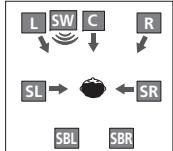
UP MIX OFF
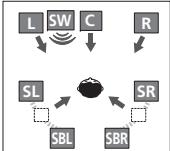
UP MIX ON
1 Switch the receiver into standby.
2 While holding down PRESET on the front panel, and hold the STANDBY/ON for about two seconds.
UP MIX: OFF appears and the Up Mix function turns off. If you want to turn this function on, perform steps 1 and 2 again.
- When set to ON, the (Up Mix) indicator on the front panel lights.
Note
- Set to ON regardless of this setting when playing DTS-HD signals.
- May automatically be set to OFF even when set to ON, depending on the input signal and listening mode.
- If the Network Standby is set to ON or Standby Through is not set to OFF, you may not be able to set the Up Mix function.
HDMI Control should also be set to OFF, not ON.
Setting the Audio options
There are a number of additional sound settings you can make using the AUDIO PARAMETER menu. The defaults, if not stated, are listed in bold.

Important
Note that if a setting doesn't appear in the AUDIO PARAMETER menu, it is unavailable due to the current source, settings and status of the receiver.
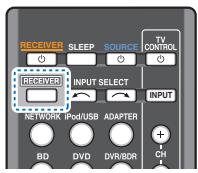

1 Press RECEIVER, then press AUDIO PARAMETER.
2 Use / to select the setting you want to adjust. Depending on the current status/mode of the receiver, certain options may not be able to be selected. Check the table below for notes on this.
3 Use to set it as necessary. See the table below for the options available for each setting.
4 Press RETURN to confirm and exit the menu.
| Setting/What it does | Option(s) |
| EQ (Acoustic Calibration EQ) | ON |
| Switches on/off the effect of Acoustic Calibration EQ. | OFF |
| S.DELAY (Sound Delay) | 0 to 500 ms (1 step : 5 ms) |
| Some monitors have a slight delay when showing video, so the soundtrack will be slightly out of sync with the picture. By adding a bit of delay, you can adjust the sound to match the presentation of the video. | Default: 0 |
| MIDNIGHT/LOUDNESSa | M/L OFF |
| The MIDNIGHT allows you to hear effective surround sound of movies at low volumes. | MIDNIGHT |
| The LOUDNESS is used to get good bass and treble from music sources at low volumes. | LOUDNESS |
| S.RTV (Sound Retriever)b | OFFc |
| When audio data is removed during the compression process, sound quality often suffers from an uneven sound image. The Sound Retriever feature employs new DSP technology that helps bring CD quality sound back to compressed 2-channel audio by restoring sound pressure and smoothing jagged artifacts left over after compression. | ON |
| DUAL MONOd | CH1 – Channel 1 is heard only |
| Specifies how dual mono encoded Dolby Digital soundtracks should be played. | CH2 – Channel 2 is heard only |
| CH1 CH2 – Both channels heard from front speakers |
| F.PCM (Fixed PCM) | OFF |
| This is useful if you find there is a slight delay before OFF recognizes the PCM signal on a CD, for instance. | ON |
| When ON is selected, noise may be output during playback of non-PCM sources. Please select another input signal if this is a problem. | |
| Setting/What it does | Option(s) |
| DRC (Dynamic Range Control) | AUTOe |
| Adjusts the level of dynamic range for movie soundtracks optimized for Dolby Digital, DTS, Dolby Digital Plus, Dolby TrueHD, DTS-HD and DTS-HD Master Audio (you may need to use this feature when listening to surround sound at low volumes). | MAX |
| MID |
| OFF |
| LFE ATT (LFE Attenuate) | 0 (0 dB) |
| Some Dolby Digital and DTS audio sources include ultra-low bass tones. Set the LFE attenuator as necessary to prevent the ultra-low bass tones from distorting the sound from the speakers. | 5 (-5 dB) |
| 10 (-10 dB) |
| 15 (-15 dB) |
| The LFE is not limited when set to 0 dB, which is the recommended value. When set to -15 dB, the LFE is limited by the respective degree. When OFF is selected, no sound is output from the LFE channel. | 20 (-20 dB) |
| ** (OFF) |
| SACD G. (SACD Gain)f | 0 (0 dB) |
| Brings out detail in SACDs by maximizing the dynamic range (during digital processing). | +6 (+6 dB) |
| HDMI (HDMI Audio) | AMP |
| Specifies the routing of the HDMI audio signal out of this receiver (AMP) or through to a TV (THRU). When THRU is selected, no sound is output from this receiver. | THRU |
| The HDMI Audio setting cannot be switched while performing synchronized amp mode operations (page 58). | |
| A.DLY (Auto Delay)g | OFF |
| This feature automatically corrects the audio-to-video delay between components connected with an HDMI cable. The audio delay time is set depending on the operational status of the display connected with an HDMI cable. The video delay time is automatically adjusted according to the audio delay time. | ON |
| C.WIDTH (Center Width)h | 0 to 7 |
| (Applicable only when using a center speaker) | Default: 3 |
| Spreads the center channel between the front right and left speakers, making it sound wider (higher settings) or narrower (lower settings). | |


| Setting/What it does | Option(s) |
| DIMEN (Dimension)\( ^h \) | -3 to +3 Default: 0 |
| Adjusts the surround sound balance from front to back, making the sound more distant (minus settings), or more forward (positive settings). |
| PNRM. (Panorama)\( ^h \) | OFF |
| Extends the front stereo image to include surround speakers for a 'wraparound' effect. | ON |
| C.IMG (Center Image)\( ^l \)(Applicable only when using a center speaker) | 0 to 10 Default: 3 (NEO:6 MUSIC), 10 (NEO:6 CINEMA) |
| Adjust the center image to create a wider stereo effect with vocals. Adjust the effect from 0 (all center channel sent to front right and left speakers) to 10 (center channel sent to the center speaker only). |
| H.GAIN (Height Gain) (VSX-828 only) | L (Low) |
| Adjusts the output from the front height speaker when listening in DOLBY PLILz | M (Mid) |
| HEIGHT mode. If set to H, the sound from the top will be more emphasized. | H (High) |
a. You can change the MIDNIGHT/LOUDNESS options at any time by using MIDNIGHT button.
b. You can change the Sound Retriever feature at any time by using S.RETRIEVER button.
C. The default setting when the iPod/USB, ADAPTER, NETRADIO, MSERVER or FAVORITE input is selected is ON
d. This setting works only with dual mono encoded Dolby Digital and DTS soundtracks.
e. The initial set AUTO is only available for Dolby TrueHD signals. Select MAX or MID for signals other than Dolby TrueHD.
f. You shouldn't have any problems using this with most SACD discs, but if the sound distorts, it is best to switch the gain setting back to 0 dB.
g. This feature is only available when the connected display supports the automatic audio/video synchronizing capability ('lip-sync') for HDMI. If you find the automatically set delay time unsuitable, set A.DLY to OFF and adjust the delay time manually. For more details about the lip-sync feature of your display, contact the manufacturer directly.
h. Only available with 2-channel sources in DOLBY PLII MUSIC mode.
i. Only when listening to 2-channel sources in NEO:6 CINEMA and NEO:6 MUSIC mode.


Introduction
This receiver is equipped with the LAN terminal and you can enjoy the following features by connecting your components to these terminals.
Listening to Internet radio stations
You can select and listen to your favorite Internet radio station from the list of Internet radio stations created, edited, and managed by the vTuner database service exclusively for use with the Pioneer products.
See Playback with Network functions on page 44 and Listening to Internet radio stations on page 45.
Playback the music files stored in Computer
You can playback a lot of musics stored in your Computer using this unit.
Besides a Computer, you can also play back audio files stored on your other components with the built-in media server function based on DLNA 1.0 or DLNA 1.5 framework and protocols (i.e. network-capable hard disks and audio systems).
See Playback with Network functions on page 44 and Playing back audio files stored on components on the network on page 46.
Note
- To listen to Internet radio stations, you must sign a contract with an ISP (Internet Service Provider) beforehand.
- Photo or video files cannot be played back.
- With Windows Media Player 11 or Windows Media Player 12, you cannot play back copyrighted audio files on this receiver.
About playable DLNA network devices
This unit allows you to play music on media servers connected on an identical Local Area Network (LAN) as the receiver. This unit allows for the playing of files stored on the following devices:
- Computer running Microsoft Windows Vista or XP with Windows Media Player 11 installed
- Computer running Microsoft Windows 7 with Windows Media Player 12 installed
- DLNA-compatible digital media servers (on Computer or other components)
Files stored in a Computer or DMS (Digital Media Server) as described above can be played via command from an external Digital Media Controller (DMC). Devices controlled by this DMC to play files are called DMRs (Digital Media Renderers). This receiver supports this DMR function. When in the DMR mode, such operations as playing and stopping files can be performed from the external controller. Volume adjustment and the muting control are also possible.
- Depending on the external controller being used, playback may be interrupted when the volume is adjusted from the controller. In this case, adjust the volume from the receiver or remote control.
Using AirPlay on iPod touch, iPhone, iPad, and iTunes
AirPlay works with iPhone, iPad, and iPod touch with iOS 4.3.3 or later, Mac with OS X Mountain Lion, and Mac and PC with iTunes 10.2.2 or later.
To use AirPlay, select your receiver on your iPod touch, iPhone, iPad or in iTunes. *1
The receiver's input will switch automatically to AirPlay when AirPlay is in use. *2
The following operations can be performed when in AirPlay mode:
-
Adjustment of the receiver's volume from iPod touch, iPhone, iPad or iTunes.
-
Pause/resume, next/previous track, and shuffle/repeat from the remote control of the receiver. (Press NETWORK to switch the remote control to the network operation mode.)
1: For more information, see the Apple website (http:// www.apple.com).
2: The receiver's power automatically turns on when Network Standby is set to ON (page 55).
Note
- A network environment is required to use AirPlay.
AirPlay provided on this receiver has been developed and tested based on the software versions for the iPod, iPhone, iPad and the software versions for iTunes that are indicated on the Pioneer website. AirPlay may not be compatible with iPod, iPhone, iPad or iTunes software versions other than those indicated on the Pioneer website.
About the DHCP server function
To play back audio files stored on components on the network or listen to Internet radio stations, you must turn on the DHCP server function of your router. In case your router does not have the built-in DHCP server function, it is necessary to set up the network manually. Otherwise, you cannot play back audio files stored on components on the network or listen to Internet radio stations. See The Network Setup menu on page 46 for more on this.
Authorizing this receiver
This receiver must be authorized to enable playback. This happens automatically when the receiver makes a connection over the network to the PC. If not, please authorize this receiver manually on the PC. The authorization (or permission) method for access varies depending on the type of server currently being connected. For more information on authorizing this receiver, refer to the instruction manual of your server.
About HTC Connect
This receiver features "HTC Connect", a simple way to enjoy music content from your HTC Connect certified smart phone.
1 HTC Connect music streaming provided on this product has been developed based on interoperability testing as defined by the HTC Connect Certification program with the HTC Connect-compatible smartphones.
2 Music Navigation via the music progress bar is not currently supported with HTC Connect.
3 Third party music applications (those other than HTC's pre-installed "Music" app) have not been tested for compatibility and may not work. HTC Connect has been tested with MP3, AAC, WMA and WAV encoding formats. Other formats may not be compatible.
4 High network congestion may interfere with the operation of HTC Connect.
HTC Connect Certified Smartphones
The HTC Connect-compatible smartphones, Please check Pioneer website for up to date information about compatible devices and audio format support.
http://www.pioneerelectronics.com/htc (for USA)
http://www.pioneerelectronics.ca/htc (for Canada)
Specifications and design subject to modification without notice.
HTC, HTC Connect and the HTC Connect logo are trademarks of HTC Corporation.
Playback with Network functions

Important
- In case a domain is configured in a Windows network environment, you cannot access a PC on the network while you are logged onto the domain. Instead of logging onto the domain, log onto the local machine.
- There are cases where the time elapsed may not be correctly displayed.
- About one minute is required between turning the power on and completion of startup.
1 Press NETWORK repeatedly to select the category you want to play back.
It may take several seconds for this receiver to access the network.
Select a category from the following list:
- NETRADIO - Internet radio
- When NETRADIO is selected, the radio station that was playing last time is played.
- M.SERVER - Server components on the network (Media server)
- FAVORITE - Favorite songs currently being registered. Depending on the selected category, the names of folders, files, and Internet radio stations are displayed.
2 Use / to select the folder, music files or Internet radio station to play back, and then press ENTER.
Press ↑/↓ to scroll up and down the list and select the desired item. When you press ENTER, playback starts with the playback screen being displayed for the selected item. To return to the list screen, press RETURN.
When the list screen is displayed from the playback screen, the playback screen reappears automatically if no operation is performed for 10 seconds while the list screen is displayed.
Only audio files with the mark can be played. In case of the folders with the mark, use / and ENTER to select the desired folder and audio files.
- When I or is pressed at the list screen, the page switches.
Repeat step 2 to play back the desired song.
For detailed operating instructions, refer to the section shown below.
- Internet radio stations - See Listening to Internet radio stations below.
Media server - See Playing back audio files stored on components on the network on page 46.
- Favorites - See Playing back your favorite songs on page 46.
Basic playback controls
You can perform the following operations with the remote control of this receiver. Note that some buttons are not available for operation depending on the category currently being played back.

Press NETWORK to switch the remote control to the NETRADIO, M.SERVER or FAVORITE operation mode.
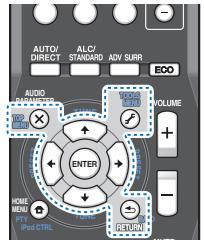
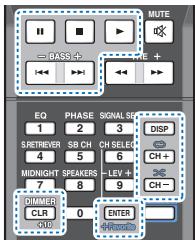


Listening to Internet radio stations
Internet radio is an audio broadcasting service transmitted via the Internet. There are a large number of Internet radio stations broadcasting a variety of services from every corner of the world. Some are hosted, managed, and broadcast by private individuals while others are by the corresponding traditional terrestrial radio stations or radio networks. Whereas terrestrial, or OTA (over-the-air), radio stations are geographically restricted on the range of radio waves broadcast from a transmitter through the air, Internet radio stations are accessible from anywhere in the world, as long as there is a connection to the Internet, as services are not transmitted through the air but are delivered over the World Wide Web. On this receiver you can select Internet radio stations by genre as well as by region.
Depending on the Internet line conditions, the sound may not be smooth when playing Internet radio.
About list of Internet radio
The list of Internet radio stations on this receiver is created, edited, and managed by the vTuner database service exclusively for use with this receiver. For details about vTuner, see vTuner on page 50.
Saving and retrieving Internet radio stations
You can easily save and retrieve saved Internet radio stations. See Playing back your favorite songs on page 46 for more on this.
- To listen to Internet radio stations, you must have high-speed broadband Internet access. With a 56 K or ISDN modem, you may not enjoy the full benefits of Internet radio.
- The port number varies depending on the Internet radio station. Check the firewall settings.
- A list of Internet radio stations provided by the vTuner database service is subject to change or deletion without notice due to various reasons.
- Broadcasts may be stopped or interrupted depending on the Internet radio station. In this case, you cannot listen to a radio station selected from the list of Internet radio stations.
Registering broadcast stations not on the vTuner list from the special Pioneer site
With the receiver, broadcast stations not included on the list of station distributed by vTuner can be registered and played. Check the access code required for registration on the receiver, use this access code to access the special Pioneer Internet radio site and register the desired broadcast stations in your favorites. The address of the special Pioneer Internet radio site is:
http://www-radio-pioneer.com
1 Display the Internet Radio list screen.
To display the Internet Radio list screen, perform step 1 at Playback with Network functions on page 44.
Use / to select 'Help', then press ENTER.
3 Use / to select 'Get access code', then press ENTER.
The access code required for registration on the special Pioneer Internet radio site is displayed. Make a memo of this address.
The following can be checked on the Help screen:
- Get access code - The access code required for registration on the special Pioneer Internet radio site is displayed.
- Show Your WebID/PW - After registering on the special Pioneer Internet radio site, the registered ID and password are displayed.
- Reset Your WebID/PW - Resets all the information registered on the special Pioneer Internet radio site. When reset, all the registered broadcast stations are also cleared. If you want to listen to the same stations, re-register after resetting.
http://www-radio-pioneer.com
Access the above site and use the access code in step 3 to perform user registration, following the instructions on the screen.
5 Register the desired broadcast stations as your favorites, following the instructions on the computer's screen.
Both broadcast stations not on the vTuner list and stations on the vTuner list can be registered. In this case they are registered on the receiver as favorite broadcast stations and can be played.


Playing back audio files stored on components on the network
This unit allows you to play music on media servers connected on an identical Local Area Network (LAN) as the receiver. This unit allows for the playing of files stored on the following devices:
- Computer running Microsoft® Windows Vista® or Windows XP with Windows Media Player 11 installed
- Computer running Microsoft Windows 7 with Windows Media Player 12 installed
- DLNA-compatible digital media servers (on Computer or other components)
Playing back your favorite songs
Up to 64 favorite tracks on the media server and/or Internet radio stations can be registered in the Favorites folder. Note that only the audio files stored on components on the network can be registered.
Registering and deleting audio files and Internet radio stations in and from the Favorites folder
1 Press NETWORK to switch the remote control to the M.SERVER or NETRADIO operation mode.
2 With the track or Internet radio station you want to register selected, press ^+ Favorite.
The selected song or Internet radio station is then registered in the Favorite.
Note
- To delete a registered song, select the Favorites folder, select the song you want to delete from the folder, and press CLEAR. The selected song is then deleted from the Favorites folder.
Setting up the network to listen to Internet radio on this receiver.
1 Press NETWORK.
Press HOME MENU.
Network Setup menu appears on your TV. Use / /
and ENTER on the remote control to navigate through the screens and select menu items. Press RETURN to exit the current menu.
- Press HOME MENU at any time to exit the Network Setup menu.
3 Select the setting you want to adjust.
Network Configuration
Network Configuration
IP address/Proxy setting
In case the router connected to the LAN terminal on this receiver is a broadband router (with a built-in DHCP server function), simply turn on the DHCP server function, and you will not need to set up the network manually. You must set up the network as described below only when you have connected this receiver to a broadband router without a DHCP server function. Before you set up the network, consult with your ISP or the network manager for the required settings. It is advised that you also refer to the operation manual supplied with your network component.
The IP address to be entered must be defined within the following ranges. If the IP address defined is beyond the following ranges, you cannot play back audio files stored on components on the network or listen to Internet radio stations.
Class A: 10.0.0.1 to 10.255.255.254
Class B: 172.16.0.1 to 172.31.255.254
Class C: 192.168.0.1 to 192.168.255.254
In case an xDSL modem or a terminal adapter is directly connected to this receiver, enter the subnet mask provided by your ISP on paper. In most cases, enter 255.255.255.0.
In case a gateway (router) is connected to this receiver, enter the corresponding IP address.
Primary DNS Server/Secondary DNS Server
In case there is only one DNS server address provided by your ISP on paper, enter it in the "Primary DNS Server" field. In case there are more than two DNS server addresses, enter "Secondary DNS Server" in the other DNS server address field.
- Proxy Hostname/Proxy Port
This setting is required when you connect this receiver to the Internet via a proxy server. Enter the IP address of your proxy server in the "Proxy Hostname" field. Also, enter the port number of your proxy server in the "Proxy Port" field.


1 Select 'Network Configuration' from the Network Setup menu.
2 Select 'IP Address, Proxy' from the Network Configuration menu.
3 Select the DHCP setting you want.
When you select ON, the network is automatically set up, and you do not need to follow Steps 4. Proceed with Step 5.
If there is no DHCP server on the network and you select ON, this receiver will use its own Auto IP function to determine the IP address.
- The IP address determined by the Auto IP function is 169.254.X.X. You cannot listen to an Internet radio station if the IP address is set for the Auto IP function.
4 Enter the IP Address, Subnet Mask, Default Gateway, Primary DNS Server and Secondary DNS Server.
Press / to select a number and to move the cursor.
5 Select 'OFF' or 'ON' for the Enable Proxy Server setting to deactivate or activate the proxy server.
In case you select OFF, proceed with Step 8. In case you select ON, on the other hand, proceed with Step 6.
6 Enter the address of your proxy server or the domain name.
Use / to select a character, / to set the position, and ENTER to confirm your selection.
7 Enter the port number of your proxy server.
Use / to select a character, / to set the position, and ENTER to confirm your selection.
8 Select 'OK' to confirm the IP Address/Proxy setup.
Friendly Name
1 Select 'Network Configuration' from the Network Setup menu.
2 Select 'Friendly Name' from the Network Configuration menu.
3 Select 'Edit Name' then select 'Rename'. If after changing the name you want to restore the name to the default, select Default.
4 Input the name you want.
Use / to select a character, / to set the position, and ENTER to confirm your selection.
Parental Lock
Set restrictions for using Internet services. Also set the password accompanying the usage restrictions.
- Upon shipment from the factory, the password is set to "0000".
1 Select 'Network Configuration' from the Network Setup menu.
2 Select 'Parental Lock' from the Network Configuration menu.
3 Input the password.
Use / to select a character, / to set the position, and ENTER to confirm your selection.
4 Specify whether to turn Parental Lock on or off.
- OFF - Internet services are not restricted.
- ON - Internet services are restricted.
5 If you want to change the password, select 'Change Password'.
In this case, the procedure returns to step 3.
Language
Language can be set on the NETWORK function OSD screen.
1 Select 'Language' from the Network Setup menu.
2 Select the language you want.
3 When you're finished, press RETURN.
You return to the Network Setup menu.
Firmware Update
Use this procedure to update the receiver's firmware. If an update file does not exist in the Pioneer's website, updating the firmware for the receiver is not necessary. Updating via a USB memory device is performed by downloading the update file from a computer, reading this file onto a USB memory device then inserting this USB memory device into the USB port on the receiver's front panel. With this procedure, the USB memory device containing the update file must first be inserted into the USB port on the receiver's front panel.
- If an update file is provided on the Pioneer website, download it onto your computer. When downloading an update file from the Pioneer website onto your computer, the file will be in ZIP format. Unzip the ZIP file before saving it on the USB memory device. If there are any old downloaded files or downloaded files for other models on the USB memory device, delete them.
Important
- DO NOT unplug the power cord during updating.
- Do not disconnect the USB memory device during updating.
- Verify the firmware version of the receiver in the System Info menu before updating and confirm that the firmware in the USB memory device is a newer version.
- Updating may reset the receiver's settings to the initial, factory-setting condition. Whether this is applicable to your receiver can be confirmed at our Pioneer website.


1 Select 'Firmware Update' from the Network Setup menu.
The receiver checks whether the USB memory device inserted into the USB port on the receiver's front panel contains updatable firmware.
2 To update, select 'Start'.
3 When 'Updating in progress, don't unplug!' is displayed, select 'Start'.
-
If 'File Not Found' is displayed, try the following:
-
No update file was found on the USB memory device. Store the file in the USB memory device's root directory.
- Try disconnecting then reconnecting the USB device or storing the update file again. If the error still occurs, try using a different USB memory device.
4 The firmware update will start. Please wait.
The OSD display will turn off during update and the words 'UPDATE' will flash on the front panel.
5 If 'COMPLETE' is displayed, updating is completed.
The screen will return automatically to the play screen.
- If 'FAIL' is displayed on the front panel display, updating has failed. Try the following:
- Turn the receiver's power off, then turn it back on and try updating the firmware again.
- Try disconnecting then reconnecting the USB device or storing the update file again. If the error still occurs, try using a different USB memory device.
Network setting using Safari browser
1 Launch Safari on your computer.
2 PressBookmark icon. Click Bonjour list (a), and then select this receiver's name (Friendly Name) (b) inBookmark.
If Bonjour list is not displayed, access the IP address "http://the receiver's IP address" from Safari.
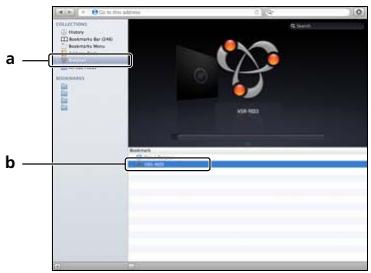
3 Click IP, Proxy Setting.
4 Setup the network settings manually and then press Apply.
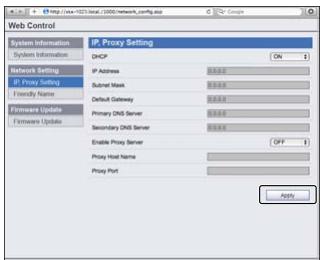
Note
- This setting for the network has been confirmed for Mac OS X 10.7 and Safari 5.1.
Friendly Name setting using Safari browser
1 Launch Safari on your computer.
2 PressBookmark icon. Click Bonjour list (a), and then select this receiver's name (Friendly Name) (b) inBookmark.
3 Click Friendly Name.
4. Enter friendly name and then press Apply.
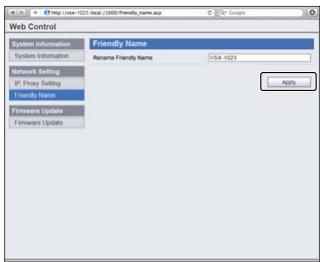
Note
- This setting for the network has been confirmed for Mac OS X 10.7 and Safari 5.1.
Firmware update using Safari browser
1 Launch Safari on your computer.
2 PressBookmark icon. Click Bonjour list (a), and then select this receiver's name (Friendly Name) (b) inBookmark.
3 Click Firmware Update.
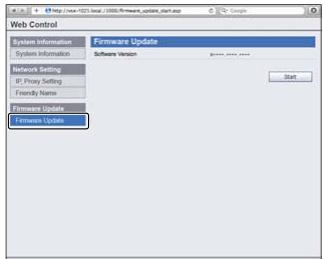
4 Press Start.
The firmware update prepare screen is displayed. If the screen does not switch automatically, click Click here.
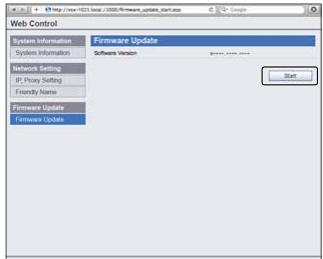
5 Browse the latest firmware on your computer (a) and then press Upload (b).
The extension of the firmware is fw. Please select a file that has the fw extension.
The confirmation screen is displayed. If you continue the firmware update, press OK. Once the firmware update process starts, you can't stop it. Wait until the file is uploaded (about one minute may be required depending on your LAN connection environment).
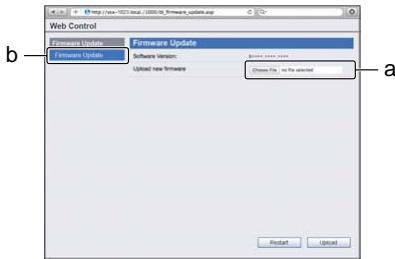
The firmware upload status screen is displayed.
"The upload process finished successfully," will be shown when the update is completed. Unplug the power cord from the AC outlet after the update is completed.
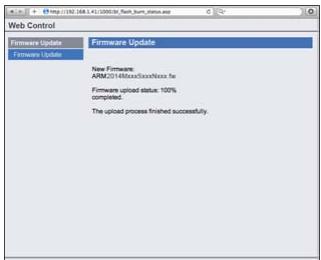
Factory Reset
Use to reset all network connection settings to their initial, factory-setting condition.
1 Select 'Factory Reset' from the Network Setup menu.
2 Select 'Start'.
3 Select 'OK' to confirm.
The screen will return automatically to the play screen.
The setting status of the following network-related items can be checked.
- IP Address - Check the IP address of this receiver.
- MAC Address - Check the MAC address of this receiver.
- Release ID - Check the firmware version of this receiver.
1 Select 'System Info' from the Network Setup menu.
Display the setting status of the network-related items.
2 When you're finished, press RETURN.
You return to the Network Setup menu.
About network playback
The network playback function of this unit uses the following technologies:
See Windows Media Player 11/Windows Media Player 12 on
page 51 for more on this.
DLNA

dlna
CERTIFIED
DLNA CERTIFIED™ Audio Player
The Digital Living Network Alliance (DLNA) is a cross-industry organization of consumer electronics, computing industry and mobile device companies. Digital Living provides consumers with easy sharing of digital media through a wired or wireless network in the home.
The DLNA certification logo makes it easy to find products that comply with the DLNA Interoperability Guidelines. This unit complies with DLNA Interoperability Guidelines v1.5. When a PC running DLNA server software or other DLNA compatible device is connected to this player, some setting changes of software or other devices may be required. Please refer to the operating instructions for the software or device for more information.
DLNA™, the DLNA Logo and DLNA CERTIFIED™ are trademarks, service marks, or certification marks of the Digital Living Network Alliance.
Content playable over a network
- Even when encoded in a compatible format, some files may not play correctly.
- Movie or Photo files cannot be played back.
-
There are cases where you cannot listen to an Internet radio station even if the station can be selected from a list of radio stations.
-
Some functions may not be supported depending on the server type or version used.
- Supported file formats vary by server. As such, files not supported by your server are not displayed on this unit. For more information check with the manufacturer of your server.
Disclaimer for Third Party Content
Access to content provided by third parties requires a high speed internet connection and may also require account registration and a paid subscription.
Third party content services may be changed, suspended, interrupted, or discontinued at any time without notice, and Pioneer disclaims any liability in connection with such occurrences.
Pioneer does not represent or warrant that content services will continue to be provided or available for a particular period of time, and any such warranty, express or implied, is disclaimed.
About playback behavior over a network
- Playback may stall when the PC is switched off or any media files stored on it are deleted while playing content.
- If there are problems within the network environment (heavy network traffic, etc.) content may not be displayed or played properly (playback may be interrupted or stalled). For best performance, a 100BASE-TX connection between player and PC is recommended.
- If several clients are playing simultaneously, as the case may be, playback is interrupted or stalled.
Depending on the security software installed on a connected PC and the setting of such software, network connection may be blocked.
Pioneer is not responsible for any malfunction of the player and/or the NETWORK features due to communication error/ malfunctions associated with your network connection and/ or your PC, or other connected equipment. Please contact your PC manufacturer or Internet service provider.
This product includes technology owned by Microsoft Corporation and cannot be used or distributed without a license from Microsoft Licensing, Inc.
Microsoft, Windows, Windows Media and Windows Vista are either registered trademarks or trademarks of Microsoft Corporation in the United States and/or other countries.
Glossary
aacPlus
AAC decoder uses AACPlus developed by Coding Technologies. (www.codingtechnologies.com)


FLAC
FLAC (Free Lossless Audio Codec) is an audio format allows lossless codec. Audio is compressed in FLAC without any loss in quality. For more details about FLAC, visit the following website: http://flac.sourceforge.net/
vTuner
vTuner is a paid online database service that allows you to listen to radio and TV broadcasts on the Internet. vTuner lists thousands of stations from over 100 different countries around the globe. For more detail about vTuner, visit the following website:
http://www-radio-pioneer.com
"This product is protected by certain intellectual property rights of NEMS and BridgeCo. Use or distribution of such technology outside of this product is prohibited without a license from NEMS and BridgeCo or an authorized subsidiary."
Windows Media is a multimedia framework for media creation and distribution for Microsoft Windows. Windows Media is either a registered trademark or trademark of Microsoft Corporation in the U.S. and/or other countries. Use an application licensed by Microsoft Corporation to author, distribute, or play Windows Media formatted content. Using an application unauthorized by Microsoft Corporation is subject to malfunction.
Windows Media Player is software to deliver music, photos and movies from a Microsoft Windows computer to home stereo systems and TVs.
With this software, you can play back files stored on the PC through various devices wherever you like in your home.
This software can be downloaded from Microsoft's website.
- Windows Media Player 11 (for Windows XP or Windows Vista)
- Windows Media Player 12 (for Windows 7)
For more information check the official Microsoft website.
The NETWORK feature of this receiver supports the following file formats. Note that some file formats are not available for playback although they are listed as playable file formats.
Also, the compatibility of file formats varies depending on the type of server. Check with your server to ensure the compatibility of file formats supported by your server.
- Internet radio playback may be affected by the Internet communications environment, and in this case playback may not be possible even with the file formats listed here.
-
With WAV, FLAC, AIFF and Apple Lossless files, when music files with the same format, sampling frequency, quantization bit number and number of channels are played successively, they are played with no gap.
-
Gapless playback is not possible when the format is being converted (transcoded) by the server.
- Gapless playback is not possible in the DMR mode.
Music files
| Extension | Stream | |
| MP3 (MPEG-1 Audio Layer 3) |
| .mp3a | Sampling frequency | 32 kHz, 44.1 kHz, 48 kHz |
| Quantization bitrate | 16 bit |
| Channel | 2 ch |
| Bitrate | 8 kbps to 320 kbps |
| VBR/CBR | Supported/Supported |
WAV (LPCM)
| .wav | Sampling frequency | 32 kHz, 44.1 kHz, 48 kHz, 88.2 kHz, 96 kHz, 176.4 kHz, 192 kHz |
| Quantization bitrate | 16 bit, 24 bit |
| Channel | 2 ch |
WMA (WMA2/7/8/9)
| Sampling frequency | 32 kHz, 44.1 kHz, 48 kHz |
| Quantization bitrate | 16 bit |
| Channel | 2 ch |
| Bitrate | 5 kbps to 320 kbps |
| VBR/CBR | Supported/Supported |
AAC (MPEG-4 AAC LC, MPEG-4 HE AAC (aacPlus v1/2))
| .m4a | Sampling frequency | 32 kHz, 44.1 kHz, 48 kHz |
| .aac | Quantization bitrate | 16 bit |
| .3gp | Channel | 2 ch |
| .3g2 | Bitrate | 16 kbps to 320 kbps |
| VBR/CBR | Supported/Supported |
FLAC
| .flacc | Sampling frequency | 32 kHz, 44.1 kHz, 48 kHz, 88.2 kHz, 96 kHz, 176.4 kHz, 192 kHz |
| Quantization bitrate | 16 bit, 24 bit |
| Channel | 2 ch |
AIFF
| .aif | Sampling frequency | 32 kHz, 44.1 kHz, 48 kHz, 88.2 kHz, 96 kHz, 176.4 kHz, 192 kHz |
| .aiff |
| Quantization bitrate | 16 bit, 24 bit |
| Channel | 2 ch |
Apple Lossless
| .m4a | Sampling frequency | 32 kHz, 44.1 kHz, 48 kHz, 88.2 kHz, 96 kHz |
| .mp4 | | |
| Quantization bitrate | 16 bit, 24 bit |
| Channel | 2 ch |
a. MPEG Layer-3 audio decoding technology licensed from Fraunhofer IIS and Thomson multimedia.
b. Files encoded using Windows Media Codec 9 may be playable but some parts of the specification are not supported; specifically, Pro, Lossless, Voice.
c. Uncompressed FLAC files are not supported. Pioneer does not guarantee playback.


The following section shows you how to make detailed settings to specify how you're using the receiver, and also explains how to fine-tune individual speaker system settings to your liking.

Important
- The OSD will not appear if you have connected using the composite output to your TV. Use HDMI connection for Home Menu.
- If headphones are connected to the receiver, disconnect them.
- You can't use the Home Menu when the NETRADIO, M.SERVER, FAVORITE, iPod/USB or ADAPTER input is selected.
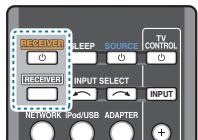
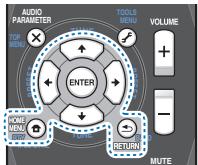
1 Switch on the receiver and your TV.
Press oRECEIVER to switch on.
2 Switch the TV input to the input that connects this receiver to the TV through the corresponding HDMI cable.
3 Press RECEIVER, then press HOME MENU.
The Home Menu appears on your TV. Use / / and ENTER on the remote control to navigate through the screens and select menu items. Press RETURN to exit the current menu.
- Press HOME MENU at any time to exit the Home Menu.
4 Select the setting you want to adjust.
1.Auto MCACC
2. Manual SP Setup
3. Input Assign
4. Auto Power Down
5.HDMI Setup
6. Network Standby
7. MHL Setup
8. Speaker System
9.OSD Setup
VSX-828
1.Auto MCACC
2. Manual SP Setup
3. Input Assign
4. Auto Power Down
5.HDMI Setup
6. Network Standby
7. MHL Setup
8. OSD Setup
VSX-528
-
Auto MCACC - This is a quick and effective automatic surround setup (see Automatically setting up for surround sound (MCACC) on page 24).
-
Manual SP Setup
-
Speaker Setting - Specify the size and number of speakers you've connected (see below).
- X.Over - Specify which frequencies will be sent to the subwoofer (page 53).
- Channel Level - Adjust the overall balance of your speaker system (page 53).
-
Speaker Distance - Specify the distance of your speakers from the listening position (page 54).
-
Input Assign
-
Analog Input - Specify what you've connected to the ANALOG IN1 audio input (page 54).
-
Component Input (VSX-828 only) - Specify what you've connected to the component video inputs (page 54).
-
Auto Power Down - Sets to automatically turn off the power when the receiver has not operated for several hours (see The Auto Power Down menu on page 55).
- HDMI Setup - Set the audio return channel function or set the HDMI input signal to Standby Through output or not during standby (see HDMI Setup on page S8).
Network Standby - Allows the AirPlay function to be used even when the receiver is in the standby mode (see The Network Standby menu on page 55).
- MHL Setup - Changes the settings related to MHL.
- Speaker System (VSX-828 on/y) - Specifies how you are using the speaker terminals (page 55).
- OSD Setup - Sets the overlay function ON/OFF.
Manual speaker setup
This receiver allows you to make detailed settings to optimize the surround sound performance. You only need to make these settings once (unless you change the placement of your current speaker system or add new speakers).
These settings are designed to fine-tune your system, but if you're satisfied with the settings made in Automatically setting up for surround sound (MCACC) on page 24, it isn't necessary to make all of these settings.

Important
- VSX-828 only: Depending on the Speaker System setting, there will be differences in the speaker items that can be adjusted. The OSD display for these operating instructions is an example of when the Speaker System setting is set to Surr. Back.
Speaker Setting
Use this setting to specify your speaker configuration (size, number of speakers). It is a good idea to make sure that the settings made in Automatically setting up for surround sound (MCACC) on page 24 are correct.
1 Select 'Manual SP Setup' from the Home Menu.
2 Select 'Speaker Setting' from the Manual SP Setup menu.
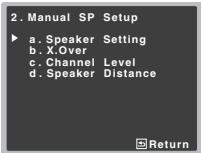
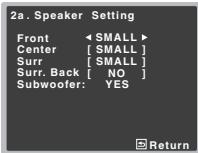
3 Choose the set of speakers that you want to set then select a speaker size.
Use / to select the size (and number) of each of the following speakers:
-
Front - Select LARGE if your front speakers reproduce bass frequencies effectively, or if you didn't connect a subwoofer. Select SMALL to send the bass frequencies to the subwoofer.
-
Center - Select LARGE if your center speaker reproduces bass frequencies effectively, or select SMALL to send bass frequencies to the other speakers or subwoofer. If you didn't connect a center speaker, choose NO (the center channel is sent to the other speakers).
-
Front Height (VSX-828 only) - Select LARGE if your front height speakers reproduce bass frequencies effectively. Select SMALL to send bass frequencies to the other speakers or subwoofer. If you didn't connect front height speakers choose NO.
-
You can only adjust the Front Height setting when Pre Out Setting is set to Height.
-
Surr - Select LARGE if your surround speakers reproduce bass frequencies effectively. Select SMALL to send bass frequencies to the other speakers or subwoofer. If you didn't connect surround speakers choose NO (the sound of the surround channels is sent to the other speakers).
-
Surr. Back (VSX-828 only) - Select the number of surround back speakers you have (one, two or none). Select LARGE if your surround back speakers reproduce bass frequencies effectively. Select SMALL to send bass frequencies to the other speakers or subwoofer. If you didn't connect surround back speakers choose NO.
-
VSX-828 only: When using only one surround back speaker, connect it to the SURROUND BACK L (Single) terminals.
-
Subwoofer - LFE signals and bass frequencies of channels set to SMALL are output from the subwoofer when YES is selected (see notes below). Choose the PLUS setting if you want the subwoofer to output bass sound continuously or you want deeper bass (the bass frequencies that would normally come out the front and center speakers are also routed to the subwoofer). If you did not connect a subwoofer choose NO (the bass frequencies are output from other speakers).
4 When you're finished, press RETURN.
You return to the Manual SP Setup menu.
4 Note
- If you select SMALL for the front speakers, the subwoofer will automatically be fixed to YES. Also, the center, surround, surround back and front height speakers (VSX-828 only) can't be set to LARGE if the front speakers are set to SMALL. In this case, all bass frequencies are sent to the subwoofer.
- If the surround speakers are set to NO, the surround back speakers will automatically be set to NO (VSX-828 only).
- If you have a subwoofer and like lots of bass, it may seem logical to select LARGE for your front speakers and PLUS for the subwoofer. This may not, however, yield the best bass results. Depending on the speaker placement of your room you may actually experience a decrease in the amount of bass due to low frequency cancellations. In this case, try changing the position or direction of speakers. If you can't get good results, listen to the bass response with it set to PLUS and YES or the front speakers set to LARGE and SMALL alternatively and let your ears judge which sounds best. If you're having problems, the easiest option is to route all the bass sounds to the subwoofer by selecting SMALL for the front speakers.
X.Over
- Default setting: 100Hz
This setting decides the cutoff between bass sounds playing back from the speakers selected as LARGE, or the subwoofer, and bass sounds playing back from those selected as SMALL. It also decides where the cutoff will be for bass sounds in the LFE channel.
- For more on selecting the speaker sizes, see Speaker Setting on page 52.
1
Select 'Manual SP Setup' from the Home Menu.
2
Select 'X.Over' from the Manual SP Setup menu.
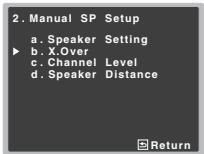
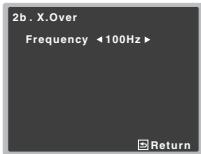
3
Choose the frequency cutoff point.
Frequencies below the cutoff point will be sent to the subwoofer (or LARGE speakers).
4
When you're finished, press RETURN.
You return to the Manual SP Setup menu.
Channel Level
Using the channel level settings, you can adjust the overall balance of your speaker system, an important factor when setting up a home theater system.
!
CAUTION
- The test tones used in the Channel Level settings are output at high volume.
1
Select 'Manual SP Setup' from the Home Menu.
2
Select 'Channel Level' from the Manual SP Setup menu.
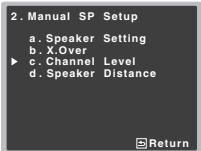
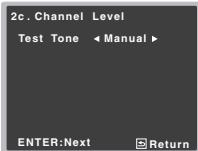
3
Select a setup option.
- Manual - Move the test tone manually from speaker to speaker and adjust individual channel levels.
- Auto - Adjust channel levels as the test tone moves from speaker to speaker automatically.
4 Confirm your selected setup option.
The test tones will start after you press ENTER. After the volume increases to the reference level, test tones will be output.
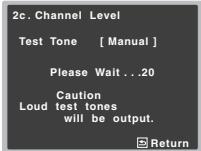
5 Adjust the level of each channel using /
If you selected Manual, use ↑/↓ to switch speakers. The Auto setup will output test tones in the order shown on-screen:
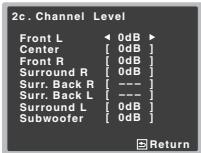
Adjust the level of each speaker as the test tone is emitted.
Note
- If you are using a Sound Pressure Level (SPL) meter, take the readings from your main listening position and adjust the level of each speaker to 75 dB SPL (C-weighting/slow reading).
- The subwoofer test tone is output at low volumes. You may need to adjust the level after testing with an actual soundtrack.
6 When you're finished, press RETURN.
You return to the Manual SP Setup menu.
Tip
- You can change the channel levels at any time by press [RECEIVER], then press CH SELECT and LEV +/- on the remote control. You can also press CH SELECT and use ↑/↓ to select the channel, and then use / to adjust the channel levels.
Speaker Distance
For good sound depth and separation from your system, you need to specify the distance of your speakers from the listening position. The receiver can then add the proper delay needed for effective surround sound.
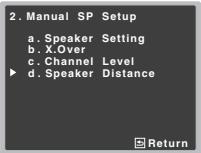
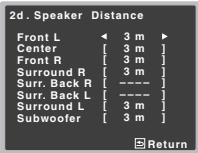
3 Adjust the distance of each speaker using .
You can adjust the distance of each speaker in 0.03 m increments.
4 When you're finished, press RETURN.
You return to the Manual SP Setup menu.
Assigns input function for analog audio input terminal and component video input terminal (component video input terminal for VSX-828 only).
- For the assignment of the digital signal inputs, see Selecting the audio input signal on page 27.
ANALOG IN1 audio input terminal is assigned to CD under factory settings, but this can be changed to TV input.
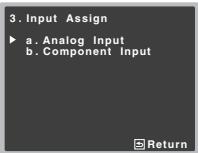
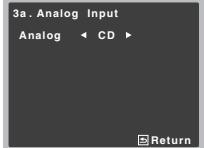
VSX-828
4 When you're finished, press RETURN.
You return to the Input Assign menu.
Note
- When playing analog input audio, switch to the CD or TV input menu, press RECEIVER and press SIGNAL SEL several times to choose A (Analog). (see Selecting the audio input signal on page 27)
COMPONENTVIDEOIN1inputterminalisassignedtoDVD under factory settings,but this can be changed to SAT/CBL input.
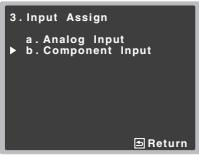
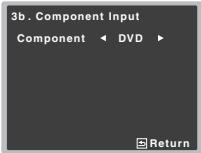
Select between DVD, SAT/CBL or OFF.
4 When you're finished, press RETURN.
You return to the Input Assign menu.
- Make sure you have connected the audio from the component to the corresponding inputs on the rear of the receiver.
Set to automatically turn off the receiver after a specified time has passed (when the power has been on with no operation for several hours).
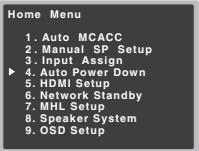
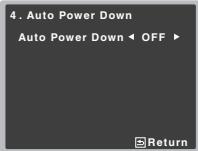
VSX-828
2 Specify the amount of time to allow before the power is turned off (when there has been no operation).
- You can select 2, 4 or 6 hours, or OFF (if no automatic shutoff is desired).
3 When you're finished, press RETURN.
You return to the Home Menu.
The Network Standby menu
This setting allows the AirPlay function for operating the receiver from a computer connected on the same LAN as the receiver to be used even when the receiver is in the standby mode.
1 Select 'Network Standby' from the Home Menu.

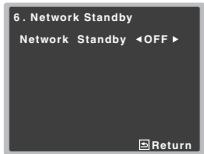
VSX-828
2 Choose ON or OFF for the Network Standby.
- ON - The AirPlay function can be used even when the receiver is in the standby mode.
- OFF - The AirPlay function cannot be used when the receiver is in the standby mode (This lets you reduce power consumption in the standby mode).
- If the Network Standby setting is set to ON, the power consumption during standby will increase.
3 When you're finished, press RETURN.
You return to the Home Menu.
Select whether or not to switch the input automatically to the MHL input when an MHL-compatible device is connected.
Note
- This is only valid for MHL-compatible devices supporting this function.
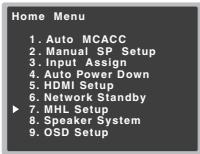
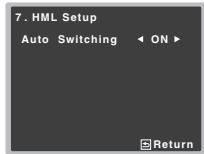
VSX-828
2 Choose ON or OFF for the MHL Setup.
3 When you're finished, press RETURN.
You return to the Home Menu.
The Speaker System setting (VSX-828 only)
Specify either using the surround back speaker (or the speaker B), or the front height speaker connection with the B-speaker terminals.
- Default setting: Surr. Back
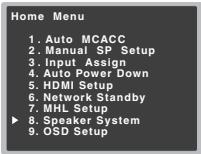
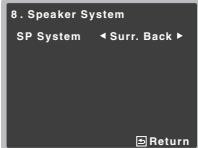
2 Select the speaker system setting using /
3 When you're finished, press RETURN.
You return to the Home Menu.
Sets the overlay function ON/OFF.
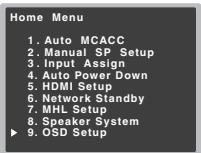
VSX-828
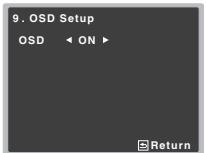
2 Choose ON or OFF for the OSD Setup.
3 When you're finished, press RETURN.
You return to the Home Menu.
MULTI-ZONE listening
This receiver can power up to two independent systems in separate rooms after you have made the proper MULTI-ZONE connections.
Different sources can be playing in two zones at the same time or, depending on your needs, the same source can also be used. The main and sub zones have independent power (the main zone power can be off while the sub zone is on) and the sub zone can be controlled by the remote or front panel controls.
Making MULTI-ZONE connections
It is possible to make these connections if you have a separate speakers for your sub zone.

Note
- You can listen to the built-in tuner and other analog audio sources in the sub zone.
- You can't use sound controls (such as the bass/treble controls or Midnight listening) or any surround modes with a separate amplifier in the sub zone. You can, however, use the features available with your sub zone amplifier.
- Use this after selecting ZONE 2 for The Speaker System setting (VSX-828 only) on page 55 on the Home Menu.
Connect a speaker to the SURROUND BACK/ZONE2 terminal on the rear of this receiver.
For details, see VSX-828 connection diagram on page 11.
You should have a pair of speakers attached to the sub zone amplifier as shown.
Using the MULTI-ZONE controls
The following steps use the front panel controls to select sources. See MULTI-ZONE remote controls below.

1 Press CONTROL MULTI-ZONE ON/OFF button on the front panel.
The ZONE indicator lights when the MULTI-ZONE control has been switched ON.
- When the receiver is on, make sure that any operations for the sub zone are done while ZONE lights in the display. If this is not showing, the front panel controls affect the main zone only. If the receiver is in standby, the display is dimmed, and ZONE continues to light in the display.
Each press will switch between main zone and sub zone control.
- If no operation is performed for a few seconds, MULTI-ZONE CONTROL mode will automatically end.
For example, Z2: DVD sends the source connected to the DVD inputs to the sub room (ZONE 2).
- If you select TUNER, you can use the tuner controls to select a preset station (see Saving station presets on page 35 if you're unsure how to do this). The tuner cannot be tuned to more than one station at a time. Therefore, changing the station in one zone also changes the station in the other zone. Please be careful not to change stations when recording a radio broadcast.
4 Use MASTER VOLUME dial to adjust the volume for the sub zone.
5 When you're finished, press CONTROL MULTI-ZONE ON/OFF again to return to the main zone controls.
You can also press CONTROL MULTI-ZONE ON/OFF button on the front panel to switch off all output to the sub zone.
Note
- You won't be able to switch the main zone off completely unless you've switched off the MULTI-ZONE control first.
- If you don't plan to use the MULTI-ZONE feature for a while, turn off the power in both the sub and main rooms so that this receiver is in standby.
MULTI-ZONE remote controls
Press RECEIVER button on the remote control, then with SHIFT button pressed, press the buttons below to operate the corresponding zone.
The following table shows the possible MULTI-ZONE remote controls:
| Button | What it does |
| ○RECEIVER | Switches on/off power in the sub zone. |
| INPUT SELECT | Use to select the input source in the sub zone. |
| Input function buttons | Use to select the input source directly in the sub zone. |
| VOLUME +/- | Use to set the listening volume in the sub zone. |
| MUTE | Mutes the sound or restores the sound if it has been muted (adjusting the volume also restores the sound). |


Synchronized operations below with a Control with HDMI-compatible Pioneer TV or Blu-ray Disc player are possible when the component is connected to the receiver using an HDMI cable.
- Synchronized amp mode
The receiver's volume can be set and the sound can be muted using the TV's remote control.
Power synchronization with TV
The receiver's input switches over automatically when the TV's input is changed or a Control with HDMI-compatible component is played.

Important
- With Pioneer devices, the Control with HDMI functions are referred to as "KURO LINK".
- You cannot use this function with components that do not support Control with HDMI.
- We only guarantee this receiver will work with Pioneer made Control with HDMI-compatible components. However, we do not guarantee that all synchronized operations will work with components that support the Control with HDMI function.
- Use a High Speed HDMI®/TM Cable when you want to use the Control with HDMI function. The Control with HDMI function may not work properly if a different type of HDMI cable is used.
- For details about concrete operations, settings, etc., refer to also the operating instructions for each component.
Making Control with HDMI connections
You can use synchronized operation for a connected TV and other components.
- Be sure to connect the TV's audio cable to the audio input of this unit. When the TV and receiver are connected by HDMI connections, if the TV supports the HDMI Audio Return Channel function, the sound of the TV is input to the receiver via the HDMI terminal, so there is no need to connect an audio cable. In this case, set ARC at HDMI Setup to ON (see HDMI Setup below).
For details, see Connecting using HDMI on page 17.

Important
- When connecting this system or changing connections, be sure to switch the power off and disconnect the power cord from the wall socket.
After completing all connections, connect the power cords to the wall socket.
- After this receiver is connected to an AC outlet, a 2 second to 10 second HDMI initialization process begins. You cannot carry out any operations during initialization. The HDMI indicator on the display unit blinks during initialization, and you can turn this receiver on once it has stopped blinking.
- To get the most out of this function, we recommend that you connect your HDMI component not to a TV but rather directly to the HDMI terminal on this receiver.
HDMI Setup
You must adjust the settings of this receiver as well as the connected Control with HDMI-compatible components in order to make use of the Control with HDMI function. For more information see the operating instructions for each component.

Switch on the receiver and your TV.
Press oRECEIVER to switch on.


The Home Menu appears on your TV. Use / / / and ENTER on the remote control to navigate through the screens and select menu items. Press RETURN to exit the current menu.
- Press HOME MENU at any time to exit the Home Menu.

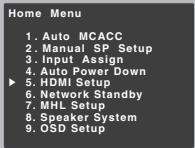
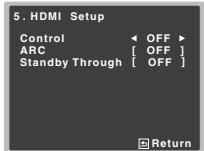
VSX-828


Select the 'Control' setting you want.
Choose whether to set this unit's Control with HDMI function ON or OFF. You will need to set it to ON to use the Control with HDMI function.
When using a component that does not support the Control with HDMI function, set this to OFF.
- ON - Enables the Control with HDMI function. When this unit's power is turned off and you have a supported source begin playback while using the Control with HDMI function, the audio and video outputs from the HDMI connection are output from the TV.
- OFF - The Control with HDMI is disabled. Synchronized operations cannot be used. When this unit's power is turned off, audio and video of sources connected via HDMI are not output.
- If the Control setting is not set to OFF, the power consumption during standby will increase.

Select the 'ARC' setting you want.
When a TV supporting the HDMI Audio Return Channel function is connected to the receiver, the sound of the TV can be input via the HDMI terminal.
- ON - The TV's sound is input via the HDMI terminal. This can only be selected when Control is set to ON
-
OFF - The TV's sound is input from the audio input terminals other than HDMI inputs.
-
If the ARC setting is not set to OFF, the power consumption during standby will increase.

Choose the 'Standby Through' setting you want.
When the receiver is in standby, the HDMI input signal selected here will be output to the TV by HDMI.
LAST- The HDMI input signal selected previously will be output.
- BD, DVD, SAT/CBL, DVR/BDR, HDMI/MHL, GAME - The HDMI input signal selected here will be output.
- OFF - Signal will not be output during standby. (However, when Control is set to ON, the HDMI signal is transferred through by the Control with HDMI function even when in the standby mode.)
- If the Standby Through setting is not set to OFF, the power consumption during standby will increase.
- -This setting can be used even with devices that are not compatible with the Control with HDMI function.
- -The Standby Through function cannot be used with MHL-compatible devices.

When you're finished, press RETURN.
You return to the Home Menu.
Before using synchronization
Once you have finished all connections and settings, you must:
1 Put all components into standby mode.
2 Turn the power on for all components, with the power for the TV being turned on last.
3 Choose the HDMI input to which the TV is connected to this receiver, and see if video output from connected components displays properly on the screen or not.
4 Check whether the components connected to all HDMI inputs are properly displayed.
About synchronized operations
The Control with HDMI-compatible component connected to the receiver operates in sync as described below.
- Synchronized amp mode
-
From the menu screen of the Control with HDMI-compatible TV, set audio to be played through this receiver, and the receiver will switch to the synchronized amp mode.
-
When in the synchronized amp mode, the synchronized amp mode is canceled when the receiver's power is turned off. To turn the synchronized amp mode back on, set audio to be played through the receiver from the TV's menu screen, etc. This receiver will power up and switch to the synchronized amp mode.
- When in the synchronized amp mode, the synchronized amp mode is canceled if an operation that produces sound from the TV is performed from the TV's menu screen, etc.
- When the synchronized amp mode is canceled, the receiver's power turns off if you were viewing an HDMI input or a TV program on the TV.
- Power synchronization with TV
- When the TV's power is set to standby, the receiver's power is also set to standby. (Only when the input for a component connected to the receiver by HDMI connection is selected or when watching the TV.)
- The receiver's input switches automatically when the Control with HDMI-compatible component is played.
- The receiver's input switches automatically when the TV's input is switched.
- The synchronized amp mode remains in effect even if the receiver's input is switched to a component other than one connected by HDMI.
Cautions on the Control with HDMI function
- Connect the TV and components (Blu-ray Disc player, etc.) directly to this receiver. Interrupting a direct connection with other amps or an AV converter (such as an HDMI switch) can cause operational errors.
- When the receiver's Control is turned ON, even if the receiver's power is in the standby mode, it is possible to output the audio and video signals from a player via HDMI to the TV without producing sound from the receiver, but only when a Control with HDMI-compatible component (Blu-ray Disc player, etc.) and compatible TV are connected. In this case, the receiver's power turns on and the power and HDMI indicators light.
Setting the remote to control other components
Most components can be assigned to one of the input function buttons using the component's manufacturer preset code stored in the remote.
However, please note that there are cases where only certain functions may be controllable after assigning the proper preset code, or the codes for the manufacturer in the remote control will not work for the model that you are using.
Note
- TV CONTROL buttons are only dedicated to control the TV (for example, codes for TV, CATV, Satellite TV or DTV).
- You can cancel or exit any of the steps by pressing [RECEIVER].
After one minute of inactivity, the remote automatically exits the operation.
Selecting preset codes directly
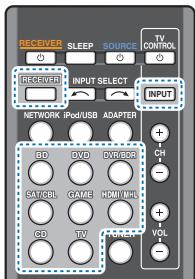
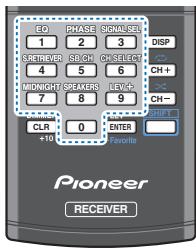
1 While pressing RECEIVER, press and hold the '1' button for three seconds.
2 Press the input function button for the component you want to control.
The component can be assigned to the BD, DVD, DVR/ BDR, SAT/CBL, GAME, CD, or TV button.
- When assigning preset codes to TV CONTROL, press INPUT here.
3 Use the number buttons to enter the preset code.
You can find the preset codes on page 61.
If the correct code has been input the power of the component being input will turn on or off.
The power of the component being input will only turn on or off if that component is able to be turned on directly by remote control.
4 Repeat steps 2 through 3 to try a different code, or to enter a code for another component you want to control.
5 When you're done, press RECEIVER.
Clearing all the remote control settings
You can clear all presets and restore the factory default settings.

While pressing RECEIVER, press and hold the '0' button for three seconds.
Default preset codes
| Input function button | Preset code |
| BD | 2 2 5 5 |
| DVD | 2 2 5 6 |
| DVR/BDR | 2 2 5 7 |
| SAT/CBL | 6 3 2 5 |
| GAME | 5 0 0 3 |
| CD | 5 0 0 0 |
| TV | 0 2 9 1 |
| TV CONTROL | 0 2 9 1 |


Controls for TVs
This remote control can control components (TV, DTV, Satellite TV or Cable TV) after entering the proper codes (see Controlling the rest of your system on page 60 for more on this). Use the input function buttons to select the component.
- The TV CONTROL buttons on the remote control are dedicated to control the TV assigned to the TV CONTROL INPUT button.
| Button(s) | Function |
| TV CONTROL | Switches the TV between standby and on. |
| TV CONTROL INPUT | Switches the TV input. (Not possible with all models.) |
| TV CONTROL CH +/- | Selects channels. |
| TV CONTROL VOL +/- | Adjust the TV volume. |
| SOURCE | Press to switch the component assigned to the TV button on or off. |
| HOME MENU | Use as the GUIDE button for navigating. |
| RETURN | Use to select closed captioning with DTV. |
| Number buttons | Use to select a specific TV channel. |
| ENTER | Use to enter a channel. |
| MENU | Press to display the TV menu. |
| ↑/↓/←/→/ENTER | Press to select or adjust and navigate items on the menu screen. |
| CH +/- | Selects channels. |
Controls for other components
This remote control can control these components (BD, DVD, CD, DVR (BDR), VCR, CD-R) after entering the proper codes (see Controlling the rest of your system on page 60 for more on this). Use the input function buttons to select the component. For Blu-ray Disc player, DVD player, CD player, DVR (BDR), VCR, CD-R:
| Button(s) | Function |
| SOURCE | Press to switch the component between standby and on. |
| ←← | Press to return to the start of the current track. Repeated presses skips to the start of previous tracks. |
| →→ | Press to advance to the start of the next track. Repeated presses skips to the start of following tracks. |
| II | Pause playback or recording. |
| ▶ | Start playback. |
| ▶→ | Hold down for fast forward playback. |
| ←← | Hold down for fast reverse playback. |
| ■ | Stops playback (on some models, pressing this when the disc is already stopped will cause the disc tray to open). |
| Number buttons | Use to enter a title/chapter/track number. |
| DISP | Press to display information. |
| TOP MENU | Displays the disc 'top' menu of a BD/DVD player. |
| MENU | Displays menus for the current BD/DVD or DVR you are using. |
| ↑/↓/←/→/ENTER/RETURN | Navigates BD/DVD menu/options. |
| HOME MENU | Displays the HOME MENU. |
| CH +/- | Selects channels. (DVR/VCR only) |
Preset Code List
You should have no problem controlling a component if you find the manufacturer in this list, but please note that there are cases where codes for the manufacturer in the list will not work for the model that you are using. There are also cases where only certain functions may be controllable after assigning the proper preset code.

Important
- We do not guarantee the operations of all the manufacturers and devices listed. Operation may not be possible even if a preset code is entered.
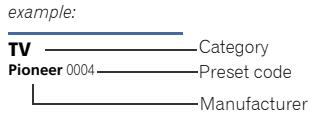


TV
Pioneer 0004, 0006, 0113, 0233, 0252, 0275, 0291, 0305
Admiral 0001, 0014
Adventure 0012
Aiwa 0002
Akai 0002,0100
Albatron 0097
Alleron 0009
America Action 0104
Amtron 0008
Anam 0104
Anam National 0003,0008
AOC 0004,0005,0006,0100
Apex 0021, 0102, 0106
Audiovox 0008.0104
Aventura 0103
Axion 0094
Bang & Olufsen 0111
Belcor 0004
Bell & Howell 0001
Beng 0064
Bradford 0008, 0104
Brillian 0109
Brockwood 0004
Broksonic 0104
Candle 0004,0006,0012,0100
Carnivale 0100
Carver 0101
CCE 0110
Celebrity 0002
Celera 0106
Changhong 0106
Citizen 0004, 0006, 0008, 0100
Clarion 0104
Coby 0056
White Westinghouse 0023
Yamaha 0004, 0005, 0006, 0100
Zenith 0001,0004,0011,0015,0099
DVD
If operations are not possible using the preset codes below, you may be able to conduct operations with the preset codes for the BD, DVR (BDR, HDR).
Pioneer 2014, 2197, 2256
Accurian 2092
Advent 2072
Aiwa 2012
Akai 2066
Alco 2070
Allegro 2087
Amphion MediaWorks 2037
AMW 2037
Apex 2002, 2018, 2079, 2080
Apple 2058
Arrgo 2088
Aspire 2073
Astar 2052
Audiovox 2070
Axion 2040
Bang & Olufsen 2081
Blaupunkt 2080
Blue Parade 2078
Boston 2059
Broksonic 2066
California Audio Labs 2068
CambridgeSoundWorks 2065
CineVision 2087
Coby 2029
Curtis Mathes 2089
CyberHome 2000, 2088
Cytron 2039
Daewoo 2021, 2087
Denon 2026, 2068
Desay 2055
DiamondVision 2042
Disney 2022
Durabrand 2090
Emerson 2067, 2082, 2091
Enterprise 2082
ESA 2053, 2091
Fisher 2083
Funai 2091
GE 2016, 2077, 2080
GFM 2043
Go Video 2087
Gradiente 2068
Greenhill 2080
Hajer 2094
Harman/Kardon 2030, 2084
Hitachi 2011
Hiteker 2079
ilive 2062
Live 2002
Ilo 2038
Initial 2038,2080
Insignia 2036, 2064, 2091
Integra 207
iSymphony 2060
JBL 2084
JVC 2013
Kawasaki 2070
Kenwood 2028, 2068
KLH 2070, 2080
Koss 2024, 2069, 2075
Landel 2093
Lasonic 2085
Lenoxx 2074, 2090
LG 2019, 2051, 2061, 2082, 2087
Liquid Video 2075
Liteon 2025, 2092
Magnavox 2067, 2076, 2091
Memorex 2066
Microsoft 2077
Mintek 2038, 2080, 2086
Mitsubishi 2020
Nesa 2080
Next Base 2093
Nexxtech 2056
Onkyo 2076
Oppo 2041, 2057
Oritron 2069, 2075
Panasonic 2005, 2007, 2017, 2032, 2033, 2050, 2068, 2076
Philips 2045, 2076
Proceed 2079
Proscan 2077
Qwestar 2069
RCA 2008, 2016, 2070, 2077, 2078, 2080
Regent 2074
Rio 2087
Rowa 2071
Samsung 2009, 2011, 2015, 2031
2044, 2068
Sansui 2066
Sanyo 2066, 2083
Sharp 2035
Sherwood 2063
Shinsonic 2086
Sonic Blue 2087
Sony 2003, 2004, 2010, 2012, 2027, 2046, 2047, 2048
Sungale 2054
Superscan 2067
Sylvania 2023, 2067, 2091
Symphonic 2023
Teac 2070
Technics 2068
Theta Digital 2078
Toshiba 2001, 2006, 2049, 2066, 2076
Tritech 2000
Urban Concepts 2076
US Logic 2086
Venturer 2070
Xbox 2017
Yamaha 2005, 2068
Zenith 2019, 2076, 2082, 2087


BD
If operations are not possible using the preset codes below, you may be able to conduct operations with the preset codes for the DVD. DVR (BDR, HDR).
Pioneer 2034, 2192, 2255, 2258, 2259, 2260, 2281
Denon 2310, 2311, 2312
Hitachi 2307, 2308, 2309
JVC 2290, 2291, 2293, 2294, 2295, 2296
LG 2286, 2287
Marantz 2302, 2303
Mitsubishi 2300, 2301
Onkyo 2289
Panasonic 2277, 2278, 2279
Philips 2280
Samsung 2282
Sharp 2304, 2305, 2306
Sony 2283, 2284, 2285, 2292
Toshiba 2288, 2262
Yamaha 2297, 2298, 2299
DVR (BDR, HDR)
If operations are not possible using the preset codes below, you may be able to conduct operations with the preset codes for the DVD, BD.
Pioneer 2078, 2099, 2107, 2109, 2144, 2193, 2194, 2195, 2196, 2257, 2258, 2259, 2260, 2261, 2264, 2265, 2266, 2270
Panasonic 2263, 2269
Sharp 2267, 2275
Sony 2268, 2271, 2272, 2273, 2276
Toshiba 2274
VCR
Pioneer 1053.1108
ABS 1017
Adventure 1005
Aiwa 1005
Alienware 1017
American High 1004
Asha 1002
Audio Dynamics 1000
Audiovox 1003
Bang & Olufsen 1032
Beaumark 1002
Bell & Howell 1001
Calix 1003
Candle 1002, 1003
Canon 1004
Citizen 1002.1003
Colortyme 1000
Craig 1002, 1003
Curtis Mathes 1000, 1002, 1004
Cybernex 1002
CyberPower 1017
Daewoo 1005
DBX 1000
Dell 1017
DIRECT 1016, 1020, 1022, 1023, 1024, 1027, 1030, 1031
Dish Network 1029
Dishpro 1029
Durabrand 1018
Dynatech 1005
Echostar 1029
Electrohome 1003
Electrophonic 1003
Emerson 1003, 1004, 1005
Expressvu 1029
Fisher 1001
Fuji 1004
Funai 1005
Garrard 1005
Gateway 1017
GE 1002, 1004
GOI 1029
Goldstar 1000, 1003
Gradiente 1005
Harley Davidson 1005
Harman/Kardon 1000
Headquarter 1001
Hewlett Packard 1017
HNS 1016
Howard Computers 1017
HP 1017
HTS 1029
Hughes Network Systems 1016
1020, 1022, 1023, 1024
Humax 1016, 1020
Hush 1017
iBUYPOWER 1017
Instant Replay 1004
JC Penney 1000, 1001, 1002, 1003, 1004
JCL 1004
JVC 1000, 1001, 1020, 1029
Kenwood 1000, 1001
Kodak 1003.1004
LG 1003
Linksys 1017
Lloyd's 1005
LXI 1003
Magnavox 1004, 1018
Magnin 1003
Marantz 1000, 1001, 1004
Marta 1003
Media Center PC 1017
MEI 1004
Memorex 1001, 1002, 1003, 1004, 1005, 1018, 1019
MGN Technology 1002
Microsoft 1017
Mind 1017
Mitsubishi 1010
Motorola 1004
MTC 1002
Multitech 1002, 1005
NEC 1000, 1001
Nikko 1003
Niveus Media 1017
Noblex 1002
Northgate 1017
Olympus 1004
Optimus 1003
Orion 1014, 1019
Panasonic 1004, 1008
Philco 1004
Philips 1004, 1011, 1016, 1020, 1022, 1023, 1024, 1025
Philips Magnavox 1011
Pilot 1003
Proscan 1030
Pulsar 1018
Quarter 1001
Quartz 1001
Quasar 1004
Radio Shack 1003
Radio Shack/Realistic 1001, 1002
1003, 1004, 1005
Radix 1003
Ranex 1003
RCA 1002, 1004, 1007, 1016, 1020, 1022, 1030, 1031
Realistic 1001, 1002, 1003, 1004, 1005
ReplayTV 1026
Ricavision 1017
Bunco 1018
Samsung 1002, 1016, 1022, 1024
Sanky 1018
Sansui 1014, 1019
Sanyo 1001, 1002
Sears 1001, 1003, 1004
Sharp 1012
Shogun 1002
Singer 1004
Sonic Blue 1026
Sony 1006, 1009, 1017, 1021
Stack 1017
STS 1004
Sylvania 1004, 1005
Symphonic 1005
Systemax 1017
Taqar Systems 1017
Tandy 1001
Tashiko 1003
Teac 1005
Technics 1004
British Sky Broadcasting 6030
Canal 6105
Chaparral 6034
CNS 6001
Coolsat 6021
Crossdigital 6043
Digenius 6104
Digiwave 6053
DirectTV 6070,6110,6111,6062,6063, 6113,6008,6038,6054,6069,6060, 6059,6043,6018,6114,6115,6116, 6093
Dish Network System 6002, 6089, 6003, 6004
Dishpro 6002, 6089, 6004
Echostar 6002, 6089, 6036, 6005, 6003, 6004
Expressvu 6002, 6004
Fortec Star 6123, 6023
Fresat 6014
Funai 6070
GE 6111
General Instrument 6032
GOI 6002, 6004
Grundig 6007, 6030
Hirschmann 6033
Hisense 6020
Hitachi 6038, 6049
Houston 6002
HTS 6002, 6004
Hughes Network Systems 6113, 6038, 6054, 6114, 6115, 6116
Hyundai 6016
jL6020
Innova 6059
Jerrold 6032
JVC 6002, 6003, 6004
Kathrein 6096
Laya 6053
LG 6047, 6018
Marantz 6102
McIntosh 6032
Mitsubishi 6038
Motorola 6032, 6042
NEC 6050
Netsat 6059
Next Level 6032
nfusion 6015
Nokia 6025, 6026, 6118, 6119, 6121
Pace 6035, 6005, 6030, 6031
Panarex 6016
Panasonic 6008, 6009, 6030
Pansat 6016, 6022
Philips 6002, 6113, 6038, 6054, 6060, 6059, 6102, 6103, 6030, 6114
Primestar 6032
Proscan 6110, 6111
Proton 6020
RadioShack 6002, 6111, 6032
Radix 6036
RCA 6002, 6110, 6111, 6113, 6109, 6061, 6114
Saba 6014
Sagem 6041, 6120
Samsung 6070, 6113, 6091, 6043, 6017, 6114, 6093
Sanyo 6046
SatCruiser 6015
Schwaiger 606
Siemens 6007, 6036
SKY 6042, 6059, 6030, 6031
SM Electronic 6011
Smart 6051
Sonicview 6055, 6107
Sony 6062, 6063, 6030
Star Choice 6032
StarTrak6032
TechniSat 6033
Thomson 6110, 6111, 6014
Tivo 6113, 6114, 6115, 6116
Toshiba 6038, 6054, 6039
TPS 6041
Triasat 6033
Ultrasat 6021
US Digital 6020
USDTV 6020
ViewSat 6048
Voom 6032
Zehnder 6101
Zenith 6042, 6069, 6037
Satellite Set Top Box (SAT/PVR Combination)
Bell ExpressVu 6002, 6003
DirectV6070,6110,6062,6113,6060, 6059,6114,6115,6116
Dish Network System 6002, 6089
Dishpro 6002, 6089
Echostar 6002, 6089, 6003
Expressvu 6002
Hughes Network Systems 6113, 6114, 6115, 6116
JVC 6003
Motorola 6032
Philips 6113, 6114
Proscan 6110
Samsung 6114
Sonicview 6055, 6107
Sony 6062
Star Choice 6032
Tivo 6113, 6114, 6115, 6116
Cable Set Top Box
Pioneer 0297,6028,6029,6095,6099 6325,6328,6329
ABC 6122
Accuphase 6122
Amino 6077, 6078
Auna 6082
BCC 6072
Bell & Howell 6122
Bright House 6074, 6029
Cable One 6074, 6029
Cablevision 6074, 6029
Charter 6074, 6029, 6058
Cisco 6029, 6028, 6083
Comcast 6074, 6029, 1982
Cox 6074, 6029
Digeo 6029, 6058
Director 6073
Emerson 6122
Fosgate 6072
General Instrument 6073, 6072, 6122
Homecast 6024


i3 Micro 6077
Insight 6074, 6073, 6029
Jebsee 6122
Jerrold 6073,6072,6122
Knology 6029
Macab 6040
Mediacom 6074, 6029
Memorex 6112
Motorola 6074, 6073, 6072, 6029
6122, 6094
MTS 6094
Myrio 6077, 6078
Noos 6040
Pace 6074, 6029, 6028, 6106, 6083
Panasonic 6112, 6083
Paragon 6112
Penney 6112
Philips 6012
Pulsar 6112
Quasar 6112
Regal 6072
Rogers 6029
Runco 6112
Samsung 6095
Scientific Atlanta 6029, 6028, 6027
6112
Sejin 6077
Shaw 6074
Starcom 6122
Stargate 6122
Suddenlink 6074, 6029
Supercable 6072
Time Warner 6074, 6029, 6058
Tivo 6076
Toshiba 6112
United Cable 6072, 6122
US Electronics 6072
Videoway 6112
Zenith 6112
Cable Set Top Box (Cable/ PVR Combination)
Pioneer 6029,6325,6328,6329
Amino 6078
Bright House 6074, 6029
Cable One 6074, 6029
Cablevision 6074, 6029
Charter 6074, 6029, 6058
Cisco 6029, 6083
Comcast 6074, 6029, 6083, 6076
Cox 6074, 6029
Digeo 6081, 6058
Homecast 6024
Insight 6074, 6029
Knology 6029
Mediacom 6074, 6029
Motorola 6074, 6081
Myrio 6078
Pace 6029
Panasonic 6083
Rogers 6029
Scientific Atlanta 6029
Shaw 6074
Suddenlink 6074, 6029
Supercable 6072
Time Warner 6074, 6029, 6058
Tivo 6076
CD
Pioneer 5000, 5011, 5070
AKAI 5043
Asuka 5045
Denon 5019
Fisher 5048
Goldstar 5040
Hitachi 5042
Kenwood 5020, 5021, 5031
Luxman 5049
Marantz 5033
Onkyo 5017, 5018, 5030, 5050
Panasonic 5036
Philips 5022, 5032, 5044
RCA 5013,5029
Roadstar 5052
Sharp 5051
Sony 5012, 5023, 5026, 5027, 5028, 5039
TEAC 5015, 5016, 5034, 5035, 5037
Technics 5041
Victor 5014
Yamaha 5024, 5025, 5038, 5046, 5047
CD-R
Pioneer 5001, 5053, 5071
Philips 5054
Yamaha 5055
Tuner
Pioneer 5060
Laser Disc Player
Pioneer 5002, 5003
Casette Deck
Pioneer 5058, 5059
Digital Tape
Pioneer 5057
MD
Pioneer 5056
Network Audio Player
Pioneer 5063
Game
X-Box 2313
AV Receiver
Pioneer 5062
Troubleshooting
Incorrect operations are often mistaken for trouble and malfunctions. If you think that there is something wrong with this component, check the points below. Take a look at the other components and electrical appliances being used, because sometimes the problem may lie there. If the trouble isn't sorted out even after going through the checks below, ask your nearest Pioneer authorized independent service company to carry out repair work.
- If the unit does not operate normally due to external effects such as static electricity disconnect the power plug from the outlet and insert again to return to normal operating conditions.
General
The power does not turn on.
Disconnect the power plug from the outlet, and insert again.
Make sure there are no loose strands of speaker wire touching the rear panel. This could cause the receiver to shut off automatically.
The receiver suddenly switches off.
When the Auto Power Down function is working, the power will automatically turn off if the receiver has not operated for several hours. Check the setting for the Auto Power Down function (see The Auto Power Down menu on page 55).
After about a minute (you won't be able to switch the unit on during this time), switch the receiver back on. If the message persists, call a Pioneer authorized independent service company.
If there is very little low frequency information in the source material, change your speaker settings to Front: SMALL/ Subwoofer: YES, or Front: LARGE / Subwoofer: PLUS (page 52).
The receiver suddenly switches off or the HDMI indicator blinks.
- Check that there are no loose strands of speaker wire touching the rear panel or another set of wires. If so, re-attach the speaker wires, making sure there are no stray strands.
The receiver may have a serious problem. Disconnect from the power and call a Pioneer authorized independent service company.
The power suddenly turns on or off, or the input suddenly changes (When the Control with HDMI is ON).
This happens because of the synchronized operation due to the Control with HDMI function. If synchronized operations
are not needed, set the Control with HDMI to OFF (see HDMI. Setup on page 58).
OVERHEAT shows in the display and the power turns off.
The temperature within the unit has exceeded the allowable value. Try moving the unit for better ventilation (page 2).
Lower the volume level.
TEMP shows in the display and the volume level drops.
The temperature within the unit has exceeded the allowable value. Try moving the unit for better ventilation (page 2).
Lower the volume level.
No sound is output when an input function is selected.
Use VOLUME + / - to turn up the volume.
Press MUTE on the remote control to turn muting off.
Press SPEAKERS to select the proper speaker set (see Switching the speaker terminal on page 15).
Set the SIGNAL SEL to H (HDMI), C1/O1 (digital) or A (analog) according to the type of connections made (page 27).
Make sure the component is connected correctly (refer to Connecting your equipment on page 11).
Check the audio output settings of the source component.
Refer to the instruction manual supplied with the source component.
No image is output when an input function is selected.
Make sure the component is connected correctly (refer to Connecting your equipment on page 11).
Use the same type of video cables for the source component and TV to connect to this receiver (see About video outputs connection on page 16).
VSX-828 only: Check The Input Assign menu on page 54 to make sure you're assigned the correct input.
The video input selected on the TV monitor is incorrect. Refer to the instruction manual supplied with the TV.
No sound from subwoofer.
Make sure the subwoofer is switched on.
If the subwoofer has a volume knob, make sure it's turned up.
→ The Dolby Digital or DTS source you are listening to may not have an LFE channel.
Switch the subwoofer setting in Speaker Setting on page 52 to YES or PLUS.
Switch the LFE ATT (LFE Attenuate) on page 41 to LFEATT 0 or LFEATT 5.
No sound from surround or center speakers.
Connect the speakers properly (page 12).
Refer to Speaker Setting on page 52 to check the speaker settings.
Refer to Channel Level on page 53 to check the speaker levels.
The OSD screen (Home Menu, etc.) isn't displayed.
- The OSD will not appear if you have connected using the composite output to your TV. Use HDMI connection when setting up the system.
The Phase Control feature doesn't seem to have an audible effect.
If applicable, check that the lowpass filter switch on your subwoofer is off, or the lowpass cutoff is set to the highest frequency setting. If there is a PHASE setting on your subwoofer, set it to 0^ (or depending on the subwoofer, the setting where you think it has the best overall effect on the sound).
Make sure the speaker distance setting is correct for all speakers (see Speaker Distance on page 54).
Considerable noise in radio broadcasts.
Connect the antenna (page 20) and adjust the position for best reception.
Route any loose cables away from the antenna terminals and wires.
Fully extend the FM wire antenna, position for best reception, and secure to a wall (or connect an outdoor FM antenna).
Connect an additional internal or external AM antenna (page 20).
Turn off equipment causing interference or move it away from the receiver (or move antennas farther away from equipment causing noise).
Broadcast stations cannot be selected automatically.
Connect an outdoor antenna (page 20).
Noise during playback of a cassette deck.
- Move the cassette deck away from your receiver, until the noise disappears.
No sound is output or a noise is output when software with DTS is played back.
Make sure the player's settings are correct and/or the DTS signal out is on. Refer to the instruction manual supplied with the DVD player.
There seems to be a time lag between the speakers and the output of the subwoofer.
See Automatically setting up for surround sound (MCACC) on page 24 to set up your system again using MCACC (this will automatically compensate for a delay in the subwoofer output).


After using the Auto MCACC setup, the speaker size setting (LARGE or SMALL) is incorrect.
Low-frequency noise could have been caused by an air conditioner or motor. Switch off all appliances in the room and rerun the Auto MCACC setup.
Can't operate the remote control.
Replace the batteries (page 10).
Operate within 7m 30^ of the remote sensor (page 10).
Remove the obstacle or operate from another position.
Avoid exposing the remote sensor on the front panel to direct light.
Press the remote control's RECEIVER button and switch to receiver control mode.
The display is dark.
Press DIMMER on the remote control repeatedly to return to the default.
During ECO mode, the brightness switches between 2 levels. If the dimmest level is selected, DIMMER will be shown on the display. (Mode other than ECO: 4 levels, ECO mode: 2 levels)
The receiver doesn't recognize iPod touch/iPhone/iPad.
Try the following.
1. Simultaneously keep pressing the sleep button and home button on the iPod touch or iPhone for over 10 seconds to restart.
2 .Turn on the receiver.
3. Connect the iPod touch/iPhone to the receiver.
The Bluetooth wireless technology device cannot be connected or operated. Sound from the Bluetooth wireless technology device is not emitted or the sound is interrupted.
Check that no object that emits electromagnetic waves in the 2.4 GHz band (microwave oven, wireless LAN device or Bluetooth wireless technology apparatus) is near the unit. If such an object is near the unit, set the unit far from it. Or, stop using the object emitting the electromagnetic waves.
- Check that the Bluetooth wireless technology device is not too far from the unit and that obstructions are not set between the Bluetooth wireless technology device and the unit. Set the Bluetooth wireless technology device and the unit so that the distance between them is less than about 10m and no obstructions exist between them.
Check that the Bluetooth ADAPTER and the ADAPTER PORT terminal of the unit are correctly connected.
The Bluetooth wireless technology device may not be set to the communication mode supporting the Bluetooth wireless
technology. Check the setting of the Bluetooth wireless technology device.
Check that pairing is correct. The pairing setting was deleted from this unit or the Bluetooth wireless technology device. Reset the pairing.
Check that the profile is correct. Use a Bluetooth wireless technology device that supports A2DP profile and AVRCP profile.
The Air Jam function cannot be used.
An iPod is connected to this receiver. Disconnect the iPod from this receiver (page 34).
Display flashes and cannot be operated.
Depending on the input signal or listening mode, there may be functions that cannot be selected.
NETWORK feature
Cannot access the network.
- The LAN cable is not firmly connected. Firmly connect the LAN cable (page 19).
→ The router is not switched on. Switch on the router.
Internet security software is currently installed in the connected component. There are cases where a component with Internet security software installed cannot be accessed.
The audio component on the network which has been switched off is switched on. Switch on the audio component on the network before switching on this receiver.
Playback does not start while 'Connecting Wired...' continues to be displayed.
The component is currently disconnected from this receiver or the power supply. Check whether the component is properly connected to this receiver or the power supply.
The PC or Internet radio is not properly operated.
The corresponding IP address is not properly set. Switch on the built-in DHCP server function of your router, or set up the network manually according to your network environment (page 55).
- The IP address is being automatically configured. The automatic configuration process takes time. Please wait.
The audio files stored on components on the network, such as a PC, cannot be played back.
→ Windows Media Player 11 or Windows Media Player 12 is not currently installed on your PC. Install Windows Media Player 11 or Windows Media Player 12 on your PC.
Audio files recorded in MPEG-4 AAC or FLAC are being played back on Windows Media Player 11 or Windows Media Player 12. Audio files recorded in MPEG-4 AAC or FLAC cannot be
played back on Windows Media Player 11 or Windows Media Player 12. Try using another server. Refer to the operation manual supplied with your server.
→ The component connected to the network is not properly operated.
- Check whether the component is affected by special circumstances or is in the sleep mode.
- Try rebooting the component if necessary.
The component connected to the network does not permit file sharing. Try changing the settings for the component connected to the network.
The folder stored on the component connected to the network has been deleted or damaged. Check the folder stored on the component connected to the network.
Network connections could be restricted due to the computer's network settings, security settings, etc. Check the computer's network settings, security settings, etc.
The audio files are copyrighted. DRM-protected audio files cannot be played back on this receiver.
Cannot access the component connected to the network.
The component connected to the network is not properly set. If the client is automatically authorized, you need to enter the corresponding information again. Check whether the connection status is set to "Do not authorize".
There are no playable audio files on the component connected to the network. Check the audio files stored on the component connected to the network.
Audio playback is undesirably stopped or disturbed.
The audio file currently being played back was not recorded in a format playable on this receiver.
- Check whether the audio file was recorded in a format supported by this receiver.
- Check whether the folder has been damaged or corrupted.
Note that there are cases where even the audio files listed as playable on this receiver cannot be played back or displayed (page 51).
The LAN cable is currently disconnected. Connect the LAN cable properly (page 19).
There is heavy traffic on the network with the Internet being accessed on the same network. Use 100BASE-TX to access the components on the network.
When in the DMR mode, depending on the external controller being used, playback may be interrupted when a volume operation is performed from the controller. In this case, adjust the volume from the receiver or remote control.
Cannot access Windows Media Player 11 or Windows Media Player 12.
In case of Windows Media Player 11: You are currently logged onto the domain through your Computer with Windows XP or Windows Vista installed. Instead of logging onto the domain, log onto the local machine (page 44).
In case of Windows Media Player 12: You are currently logged onto the domain through your Computer with Windows 7 installed. Instead of logging onto the domain, log onto the local machine (page 44).
Cannot listen to Internet radio stations.
The firewall settings for components on the network are currently in operation. Check the firewall settings for components on the network.
You are currently disconnected from the Internet. Check the connection settings for components on the network, and consult with your network service provider if necessary (page 46).
The broadcasts from an Internet radio station are stopped or interrupted. There are cases where you cannot listen to some Internet radio stations even when they are listed in the list of Internet radio stations on this receiver (page 45).
The NETWORK function cannot be operated with the buttons on the remote control.
→ The remote control is not currently set to the NETWORK mode. Press NETWORK to set the remote control to the NETWORK mode (page 50).
HDMI
No picture or sound.
If the problem still persists when connecting your HDMI component directly to your monitor, please consult the component or monitor manual or contact the manufacturer for support.
No picture.
Video signals that are input from the analog video terminal will not output from the HDMI terminal. Signals that are input from the HDMI terminal will not output from the analog video terminal. Be consistent with the type of cable between input and output.
Depending in the output settings of the source component, it may be outputting a video format that can't be displayed. Change the output settings of the source, or connect using the composite video jacks.
→ This receiver is HDCP-compatible. Check that the components you are connecting are also HDCP-compatible. If they are not, please connect them using the composite video jackets.
Depending on the connected source component, it's possible that it will not work with this receiver (even if it is HDCP-compatible). In this case, connect using the composite video jacks between source and receiver.
If video images do not appear on your TV, try adjusting the resolution, Deep Color or other setting for your component
To output signals in Deep Color, use an HDMI cable (High Speed HDMI®/™ Cable) to connect this receiver to a component or TV with the Deep Color feature.
No sound, or sound suddenly ceases.
Check that the HDMI setting is set to AMP (page 41).
If the component is a DVI device, use a separate connection for the audio.
HDMI format digital audio transmissions require a longer time to be recognized. Due to this, interruption in the audio may occur when switching between audio formats or beginning playback.
Turning on/off the device connected to this unit's HDMI OUT terminal during playback, or disconnecting/connecting the HDMI cable during playback, may cause noise or interrupted audio.
Synchronized operation not possible using Control with HDMI function.
Check the HDMI connections.
The cable may be damaged.
Select ON for the Control with HDMI setting (see HDMI Setup on page 58).
Turn the TV's power on before turning on this receiver's power.
Set the TV side Control with HDMI setting to on (see TV's operating instructions).
There are cases where you may not be able to route HDMI signals through this receiver (this depends on the HDMI equipped component you are connecting-check with the manufacturer for HDMI compatibility information).
If you aren't receiving HDMI signals properly through this receiver (from your component), please try the following configuration when connecting up.
Configuration
Connect your HDMI-equipped component directly to the display using an HDMI cable. Then use the most convenient connection (digital is recommended) for sending audio to the receiver. See the operating instructions for more on audio connections. Set the display volume to minimum when using this configuration.
Note
- Depending on the component, audio output may be limited to the number of channels available from the connected display unit (for example audio output is reduced to 2 channels for a monitor with stereo audio limitations).
- If you want to switch the input source, you'll have to switch functions on both the receiver and your display unit.
- Since the sound is muted on the display when using the HDMI connection, you must adjust the volume on the display every time you switch input sources.
Windows 7
Windows and the Windows logo are trademarks of the Microsoft group of companies.
MHL

Mobile High-Definition Link
MHL, the MHL Logo, and Mobile High-Definition Link are trademarks or registered trademarks of MHL, LLC in the United States and other countries.
This receiver incorporates MHL 2.
HTC Connect
hTc
connect
HTC, HTC Connect and the HTC Connect logo are trademarks of HTC Corporation.
About iPod/Phone/iPad
Made for

iPod

iPhone

iPad

AirPlay works with iPhone, iPad, and iPod touch with iOS 4.3.3 or later, Mac with OS X Mountain Lion, and Mac and PC with iTunes 10.2.2 or later.
Bluetooth technology works with iPhone 5, iPhone 4S, iPhone 4, iPhone 3GS, iPhone 3G, iPhone, iPad (3rd and 4th generation), iPad 2, iPad, iPad mini, and iPod touch (2nd through 5th generation).
USB works with iPhone 5, iPhone 4S, iPhone 4, iPhone 3GS, iPhone 3G, iPhone, iPad (3rd and 4th generation), iPad 2, iPad, iPad mini, iPod touch (1st through 5th generation) and iPod nano (3rd through 7th generation).
"Made for iPod," "Made for iPhone," and "Made for iPad" mean that an electronic accessory has been designed to connect specifically to iPod, iPhone, or iPad, respectively, and has been certified by the developer to meet Apple performance standards. Apple is not responsible for the operation of this device or its compliance with safety and regulatory standards. Please note that the use of this accessory with iPod, iPhone, or iPad may affect wireless performance.
Apple, AirPlay, iPad, iPhone, iPod, iPod nano, iPod touch, iTunes, Safari, Bonjour and Mac are trademarks of Apple Inc., registered in the U.S. and other countries. The Airplay logo is a trademark of Apple Inc.
Apple Lossless Audio Codec
Copyright © 2011 Apple Inc. All rights reserved.
Licensed under the Apache License, Version 2.0. You may obtain a copy of the License at http://www.apache.org/licenses/License-2.0.
About FLAC
FLAC Decoder
Copyright © 2000, 2001, 2002, 2003, 2004, 2005, 2006, 2007, 2008, 2009 Josh Coalson
Redistribution and use in source and binary forms, with or without modification, are permitted provided that the following conditions are met:
- Redistributions of source code must retain the above copyright notice, this list of conditions and the following disclaimer.
- Redistributions in binary form must reproduce the above copyright notice, this list of conditions and the following disclaimer in the documentation and/or other materials provided with the distribution.
- Neither the name of the Xiph.org Foundation nor the names of its contributors may be used to endorse or promote products derived from this software without specific prior written permission.
THIS SOFTWARE IS PROVIDED BY THE COPYRIGHT HOLDERS AND EDITORS "AS IS" AND ANY EXPRESS OR IMPLIED WARRANTY, INCLUDING, BUT NOT LIMITED TO, THE IMPLIED WARRANTY OF MERCHANTABILITY AND FITNESS FOR A PARTICULAR PURPOSE ARE DISCLAIMED. IN NO EVENT SHALL THE FOUNDATION OR EDITORS BE LIABLE FOR ANY DIRECT, INDIRECT, INCIDENTAL, SPECIAL, EXEMPLARY, OR CONSEQUENTIAL DAMAGES (INCLUDING, BUT NOT LIMITED TO, PROCEDURE OF SUBSTITUTE GOODS OR SERVICES; LOSS OF USE, DATA, OR PROFITS; OR BUSINESS INTERRUPTION) HOWEVER CAUSED AND ON ANYTHEORY OF LIABILITY, WHETHER IN CONTRACT, STRICT LIABILITY, OR TORT (INCLUDING NEGLIGENCE OR OTHERWISE) ARISING IN ANY WAY OUT OF THE USE OF THIS SOFTWARE, EVEN IF ADVISED OF THE POSSIBILITY OF SUCH DAMAGE.


About messages displayed when using network functions
Refer to the following information when you come up with a status message while operating the Network functions.
| Status messages | Descriptions |
| Connection Down | The selected category or Internet radio station cannot be accessed. |
| File Format Error | Cannot be played back for some reasons. |
| Track Not Found | The selected song has not been found anywhere on the network. |
| Server Error | The selected server cannot be accessed. |
| Server Disconnected | The server has been disconnected. |
| Empty | There are no files stored in the selected folder. |
| License Error | The license for the contents to be played back is invalid. |
| Item AlreadyExists | This is displayed when the file you have attempted to register in the Favorites folder has already been registered. |
Status messages Descriptions
Favorite List Full
This is displayed when you have attempted to register a file in the Favorites folder but the Favorites folder is already full.
Resetting the main unit
Use this procedure to reset all the receiver's settings to the factory default. Use the front panel controls to do this.
- For instructions on resetting the network connection settings, see Factory Reset on page 49.
1 Switch the receiver into standby.
2 While holding down BAND, press and hold STANDBY/ON for about two seconds.
3 When you see RESET? appear in the display, press AUTO SURROUND/STREAM DIRECT.
OK? shows in the display.
4 Press ALC/STANDARD SURR to confirm.
OK appears in the display to indicate that the receiver has been reset to the factory default settings.
Important
- If the Control with HDMI function is set to ON, the HDMI function's Standby Through is set to anything other than OFF, or the Network Standby is set to ON, you may not be able to reset the unit. In this case, reset either by turning OFF the Control with HDMI function, or by putting the unit into standby mode by turning off the power of all the connected devices, and resetting after the HDMI indicator on the front panel turns off.
Cleaning the unit
- Use a polishing cloth or dry cloth to wipe off dust and dirt.
-
When the surface is dirty, wipe with a soft cloth dipped in some neutral cleanser diluted five or six times with water, and wrung out well, and then wipe again with a dry cloth. Do not use furniture wax or cleansers.
-
Never use thinners, benzine, insecticide sprays or other chemicals on or near this unit, since these will corrode the surface.
VSX-828
DOLBY
TRUEHD
PRO LOGIC IIz
Manufactured under license from Dolby Laboratories. "Dolby", "Pro Logic", "Surround EX", and the double-D symbol are trademarks of Dolby Laboratories.
VSX-528

DOLBY
TRUEHD
Manufactured under license from Dolby Laboratories. Dolby, Pro Logic, and the double-D symbol are trademarks of Dolby Laboratories.
VSX-828

dtshD
Master Audio
Manufactured under license under U.S. Patent Nos: 5,956,674, 5,974,380; 6,226,616; 6,487,535; 7,212,872; 7,333,929; 7,392,195; 7,272,567 & other U.S. and worldwide patents issued & pending. DTS-HD, the Symbol, & DTS-HD and the Symbol together are registered trademarks & DTS-HD Master Audio is a trademark of DTS, Inc. Product includes software. © DTS, Inc. All Rights Reserved.
VSX-528

dtts-HD
Manufactured under license under U.S. Patent Nos: 5,956,674; 5,974,380; 6,226,616; 6,487,535; 7,212,872; 7,333,929; 7,392,195; 7,272,567 & other U.S. and worldwide patents issued & pending. DTS-HD, the Symbol, & DTS-HD and the Symbol together are registered trademarks of DTS, Inc. Product includes software. © DTS, Inc. All Rights Reserved.
Specifications
Audio section
Rated power output
(Front, Center, Surround and Surround back for VSX-828)
130 W per channel (1 kHz, 6 Ω, 1%)
100 W per channel (20 Hz to 20 kHz, 8 Ω, 0.09 %)
For Oceania model
Maximum power output (Front, Center, Surround)
150 W per channel (1 kHz, 6 Ω, 10 %)
Total Harmonic Distortion
0.06% (20 Hz to 20 kHz, 8 Ω, 50 W/ch)
Frequency response (LINE Pure Direct mode)
5 Hz to 100 kHz +3 dB
Guaranteed speaker impedance. 6 Ω to 16 Ω
Input (Sensitivity/Impedance)
LINE. .200 mV/47 kΩ
Signal-to-Noise Ratio (IHF, short circuited, A network)
LINE. 98 dB
Video Section
Signal level
Composite. 1 Vp-p (75 Ω)
Component Video (VSX-828)
Y:1.0 Vp-p (75Ω),PB/PR:0.7 Vp-p (75Ω)
Corresponding maximum resolution (VSX-828)
Component Video. 1080P (1125P)
Tuner Section
Frequency Range (FM). 87.5 MHz to 108 MHz
Antenna Input (FM) 75Ω unbalanced
Frequency Range (AM) 531 kHz to 1602 kHz
Antenna (AM) .Loop antenna
Digital In/Out Section
HDMI terminal .Type A (19-pin)
HDMI output type. 5 V, 100 mA
HDMI input/MHL terminal. 5 V, 900 mA
USB terminal USB2.0 High Speed (Type A) 5 V, 2.1 A
iPod terminal USB, and Video (Composite)
ADAPTER PORT terminal 5V,100mA
Network Section
LAN terminal. 10 BASE-T/100 BASE-TX
Miscellaneous
Power Requirements. .AC 220 V to 230 V, 50 Hz/60 Hz
Power Consumption 520 W (VSX-828)
450 W (VSX-528)
In standby 0.1 W
Dimensions
435 mm (W) x 168 mm (H) x 342.5 mm (D) (VSX-828)
435mm W × 168mm H × 331.5mm D VSX-528
Weight (without package). 9.2 kg (VSX-828)
8.5 kg (VSX-528)
Furnished Parts
Microphone (for Auto MCACC setup) 1
Remote control 1
Dry cell batteries (AAA size IEC R03). 2
AM loop antenna. 1
FM wire antenna 1
Warranty card 1
Quick start guide. 1
Safety Brochure. 1
SPEAKER CAUTION Sheet (English only). 1
Power cord (for Europe & Russia of VSX-828, and U.K. &
These operating instructions (CD-ROM)
Note
- The specifications are applicable when the power supply is 230 V.
- Specifications and the design are subject to possible modifications without notice, due to improvements.
- This product includes FontAvenue® fonts licensed by NEC Corporation. FontAvenue is a registered trademark of NEC Corporation.
- Microsoft, Windows, Windows Media and Windows Vista are either registered trademarks or trademarks of Microsoft Corporation in the United States and/or other countries.


http://www.pioneer.co.uk
http://www.pioneer.eu
© 2013 PIONEER CORPORATION.
All rights reserved.
PIONEER CORPORATION
1-1, Shin-ogura, Saiwai-ku, Kawasaki-shi, Kanagawa 212-0031, Japan
PIONEER ELECTRONICS (USA) INC.
P.O. BOX 1540, Long Beach, California 90801-1540, U.S.A. TEL: (800) 421-1404
PIONEER ELECTRONICS OF CANADA, INC.
340 Ferrier Street, Unit 2, Markham, Ontario L3R 2Z5, Canada TEL: 1-877-283-5901, 905-479-4411
PIONEER EUROPE NV
Haven 1087, Keetberglaan 1, B-9120 Melsele, Belgium TEL: 03/570.05.11
PIONEER ELECTRONICS ASIACENTRE PTE. LTD.
253 Alexandra Road, #04-01, Singapore 159936 TEL: 65-6472-7555
PIONEER ELECTRONICS AUSTRALIA PTY. LTD.
5 Arco Lane, Heatherton, Victoria, 3202, Australia, TEL: (03) 9586-6300
PIONEER ELECTRONICS DE MEXICO S.A. DE C.V.
Blvd. Manuel Avila Camacho 138 10 piso Col.Lomas de Chapultepec, Mexico, D.F. 11000 TEL: 55-9178-4270
K002_B3_En