E4106-5-M DE R08 - Built-in oven AEG-ELECTROLUX - Free user manual and instructions
Find the device manual for free E4106-5-M DE R08 AEG-ELECTROLUX in PDF.


| Type of product | Built-in oven |
| Brand | AEG-ELECTROLUX |
| Model | E4106-5-M DE R08 |
| Overall dimensions (W x H x D) | 595 x 595 x 569 mm |
| Built-in dimensions (W x H x D) | 560 x 590 x 550 mm |
| Usable volume | 71 L |
| Net weight | 35 kg |
| Power supply | 220-240 V, 50/60 Hz, 16 A |
| Total power | 3.0 kW |
| Energy type | Electric |
| Cooking functions | Fan-forced, humid fan-forced, grill, fan grill, bottom heat, conventional heat, defrost, keep warm, pyrolytic |
| Cleaning | Pyrolytic (self-cleaning) |
| Safety | Door lock, automatic shut-off, child lock, LED interior lighting |
| Interior lighting | LED |
| Number of shelves | 3 (multi-position) |
| Included accessories | Metal rack, baking tray, drip pan |
| Repairability | Repairability index of 8.0/10 |
| Spare parts | Available (seals, heating elements, bulbs, glass panes, boards) |
| Energy class | A+ |
| Consumption in conventional mode | 0.99 kWh |
| Consumption in fan-forced mode | 0.79 kWh |
Frequently Asked Questions - E4106-5-M DE R08 AEG-ELECTROLUX
User questions about E4106-5-M DE R08 AEG-ELECTROLUX
0 question about this device. Answer the ones you know or ask your own.
Ask a new question about this device
Download the instructions for your Built-in oven in PDF format for free! Find your manual E4106-5-M DE R08 - AEG-ELECTROLUX and take your electronic device back in hand. On this page are published all the documents necessary for the use of your device. E4106-5-M DE R08 by AEG-ELECTROLUX.
USER MANUAL E4106-5-M DE R08 AEG-ELECTROLUX
Built-In Electric Oven
Thank you for choosing one of our high-quality products.
To ensure optimal and regular performance of your appliance please read this instruction manual carefully. It will enable you to navigate all processes perfectly and most efficiently.
To refer to this manual any time you need to, we recommend you to keep it in a safe place. And please pass it to any future owner of the appliance.
We wish you much joy with your new appliance.
Contents
| Operating Instructions | 3 |
| Safety instructions | 3 |
| Description of the Appliance | 4 |
| General Overview | 4 |
| Control Panel | 5 |
| Oven Features | 5 |
| Oven accessories | 6 |
| Before Using for the first time | 7 |
| Setting and changing the time | 7 |
| Initial Cleaning | 8 |
| Using the Rings | 8 |
| Setting the heat setting | 9 |
| Cooking with the automatic warm up function 10 | |
| Automatic cut-out function for the rings | 11 |
| Using the Oven | 11 |
| Switching the Oven On and Off | 11 |
| Oven Functions | 12 |
| Inserting the Oven Shelf, Baking Tray and Roasting Pan | 13 |
| Inserting/Removing the Fat Filter | 14 |
| Clock Functions | 14 |
| Uses, Tables and Tips | 20 |
| Cooking table | 20 |
| Baking | 21 |
| Roasting | 27 |
| Grill sizes | 29 |
| Defrosting | 29 |
| Drying | 30 |
| Making preserves | 31 |
| Cleaning and Care | 32 |
| Outside of the appliance | 32 |
| Oven interior | 32 |
| Accessories | 32 |
| Fat Filter | 32 |
| Shelf Support Rails | 33 |
| Oven lighting | 34 |
| Oven Ceiling | 34 |
| Oven door | 35 |
| Oven door glass | 37 |
| What to do if ... | 41 |
| Disposal | 42 |
| Service | 43 |
The following symbols are used in this user manual:

Important information concerning your personal safety and information on how to avoid damaging the appliance.

General information and tips

Environmental information
Operating Instructions
Safety instructions
Electrical safety
- This appliance must be only connected by a registered electrician.
- In the event of a fault or damage to the appliance: Take the fuses out or switch off.
- Repairs to the appliance must only be carried out by qualified service engineers. Considerable danger may result from improper repairs. If repairs become necessary, please contact our Customer Services or your dealer.
Child Safety
- Never leave children unsupervised when the appliance is in use.
Safety whilst using
- People (including children) who, because of their physical, sensory or mental capabilities or their inexperience or ignorance are not able to use the device safely, should not use this device without supervision or instruction by a responsible person.
- This appliance is intended to be used for cooking, roasting and baking food in the home.
- Take care when connecting electric appliances to sockets nearby. Do not allow connecting leads to come into contact with or to catch beneath the hot oven door.
- Warning: Risk of burns! The interior of the oven becomes hot during use.
- Using ingredients containing alcohol in the oven may create an alcohol-air mixture that is easily ignited. In this case, open the door carefully. Do not have embers, sparks or naked flames in the vicinity when opening the door.
i Information on acrylamides
According to the latest scientific knowledge, intensive browning of food, especially in products containing starch, can constitute a health risk due to acrylamides. Therefore we recommend cooking at the lowest possible temperatures and not browning foods too much.
How to avoid damage to the appliance
- Do not line the oven with aluminium foil and do not place baking trays, pots, etc. on the oven floor, as the heat that builds up will damage the oven enamel.
- Fruit juices dripping from the baking tray will leave stains, which you will not be able to remove. For very moist cakes, use a deep tray.
- Do not put any strain on the oven door when open.
- Never pour water directly into the oven when it is hot. This could cause damage to or discolouration of the enamel.
- Rough handling, especially around the edges of the front panel, can cause the glass to break.
-
Do not store any flammable materials inside the oven. These could ignite when the oven is switched on.
-
Do not store any moist foods inside the oven. This could damage the oven enamel.
- After switching off the cooling fan, do not keep uncovered dishes in the oven. Moisture may condense in the oven interior or on the glass doors and may get into the units.

Note on enamel coating
Changes in the colour of the oven's enamel coating as a result of use do not affect the appliance's suitability for normal and correct use. They therefore do not constitute a defect in the sense of the warranty law.
Description of the Appliance
General Overview
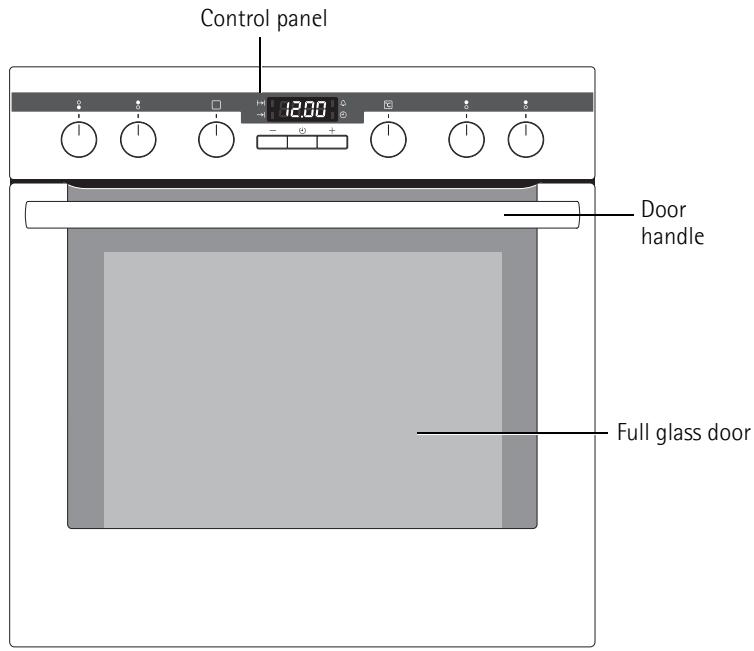
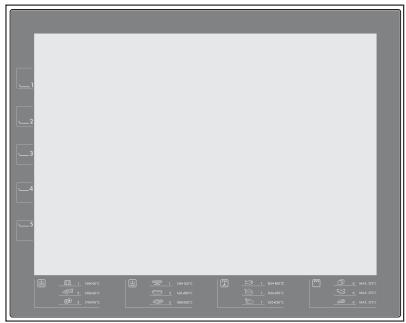
Control Panel
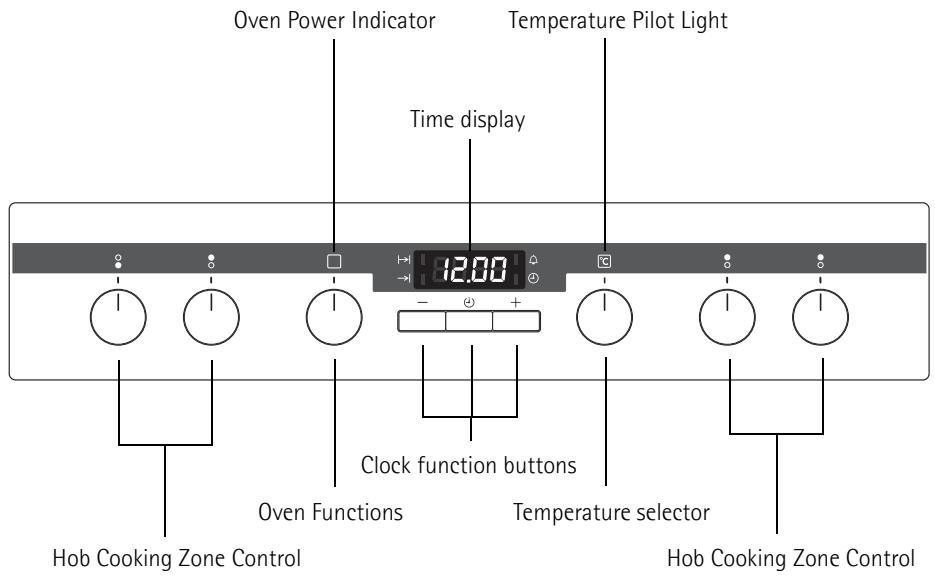
Oven Features
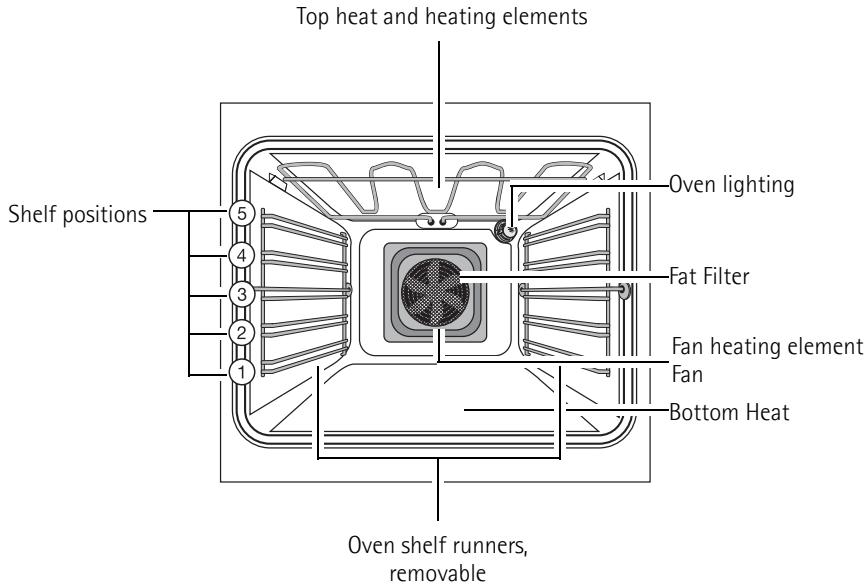
Inside of door
On the inside of the oven door you will find the numbers of the different oven shelves.
You will also find some brief information about the oven's functions, recommended shelves and temperatures for cooking the most popular dishes.
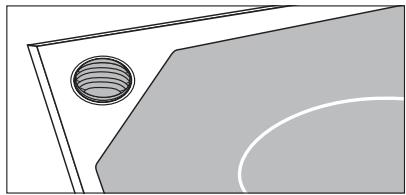
Oven steam vent
The steam from the oven is fed directly upwards via the duct in the rear of the cooking surface.
natural_image
Pure technical diagram of a mechanical component with no text, numbers, or symbolsOven accessories
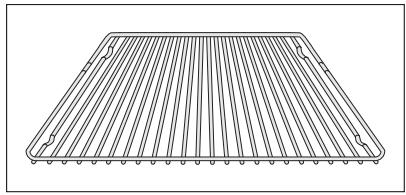
Oven shelf
For cookware, cake tins, roasts and grilled foods.
natural_image
Line drawing of a rectangular metal grate or rack structure with evenly spaced slots and two side handles (no text or symbols)Baking tray
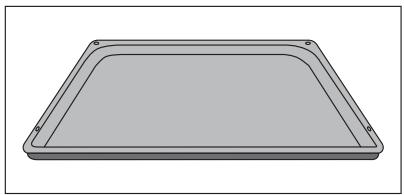
For cakes and biscuits.
natural_image
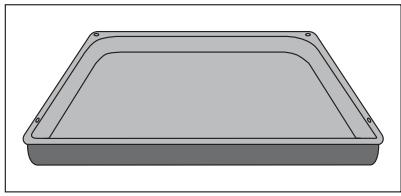
Simple 3D rendering of a rectangular tray or baking tray with rounded corners and no text or symbolsRoasting Pan
For baking and roasting or as a pan for collecting fat.
natural_image
3D rendering of a rectangular tray or tray with rounded edges and corner holes (no text or symbols)Before Using for the first time
Setting and changing the time

The oven only operates when the time has been set.
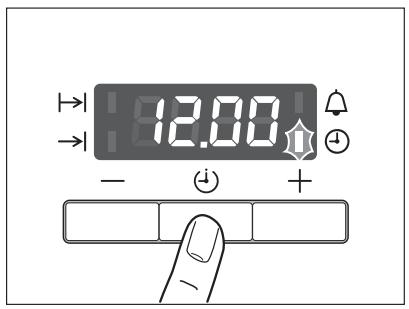
When the appliance has been connected to the electrical supply or when there has been a power cut, the function indicator Time of day flashes automatically.
- To change a time that has already been set, press the Selection button repeatedly until the function indicator Time of day flashes.
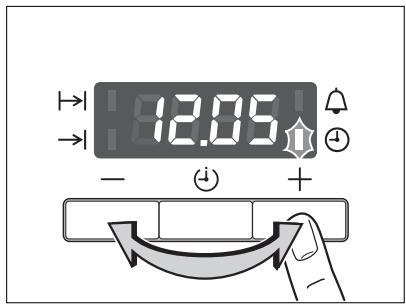
- Using the + or - button, set the current time.
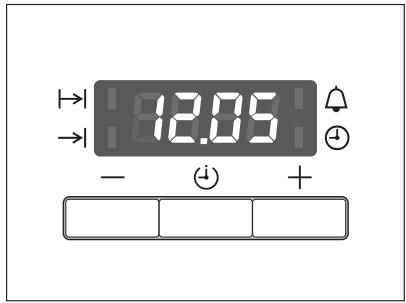
After approx. 5 seconds, the flashing stops and the clock displays the time set.
The appliance is now ready to use.

The time can only be changed if no automatic function (Duration or End) has been set.
Initial Cleaning
Before using the oven for the first time you should clean it thoroughly.

Caution: Do not use any caustic, abrasive cleaners! The surface could be damaged.
To clean metal fronts use commercially available cleaning agents.
- Turn the oven function switch to oven lighting 📂.
- Remove all accessories and the shelf support rails and wash them with warm water and washing up liquid.
- Then wash out the oven with warm water and washing-up liquid, and dry.
- Wipe the front of the appliance with a damp cloth.
Using the Rings

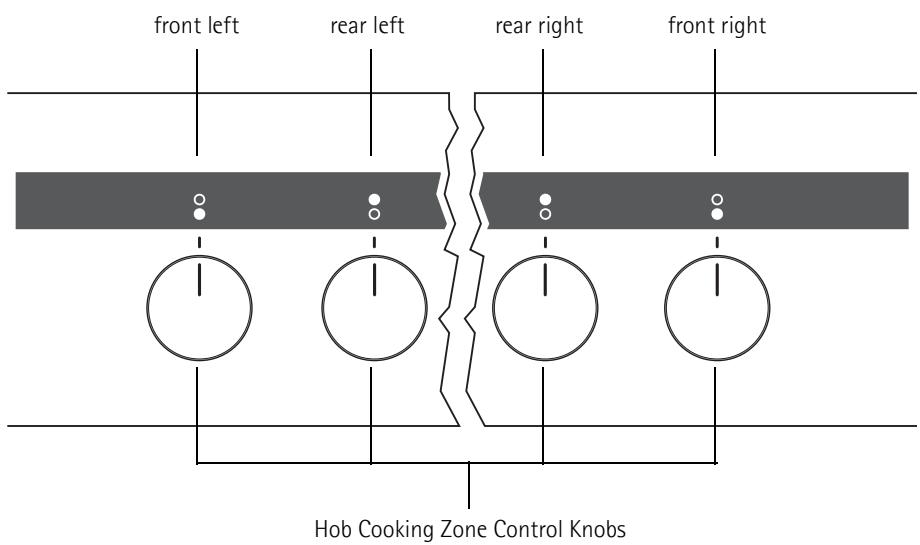
Also refer to the operating instructions for your built-in hob. It contains important information on ovenware, operation, cleaning and care.
The following description does not apply to induction cooking zones.
Heat settings
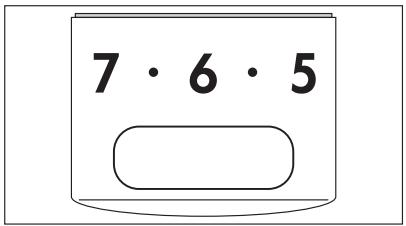
- You can set the heat settings from 1 -9.
- You can set intermediate settings between 2 and 7.
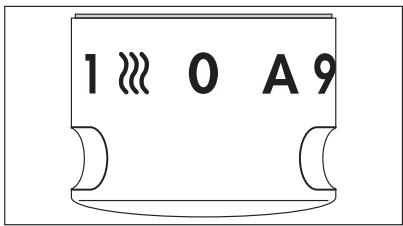
- In addition each of the ring switches is fitted with an automatic warm up function.
!!! =Keep warm setting
1 = lowest power 9 = highest power A = Automatic warm up function

Switch the cooking zone off approx. 5-10 minutes before cooking is finished to make use of the residual heat. This saves electricity.

The cooker has pop-up ring switches.
Press the ring switch to use it. The switch will then pop up.
Setting the heat setting
- Select the heat setting.
- To end the cooking process, turn back to the Off position.

The corresponding ring pilot light is lit while the ring is operating.
Cooking with the automatic warm up function
When cooking with the automatic warm up function, the cooking zone works with full power for a certain amount of time and then switches back to the heat setting set to continue cooking.
- To switch on the automatic warm up period, turn the ring switch clockwise as far as it will go.
- Then turn the ring switch back to the desired heat setting for the continuing cooking period.
- To end the cooking process, turn back to the "O" position.

If you select a higher heat setting during the warming up time, e. g. turning from "3" up to "6", the time that has already elapsed for the warming up period is taken into consideration. If you select a lower heat setting, the warm up period will end immediately.

You can end the automatic warm up function early by turning the ring switch back to the Off position and then setting the required heat setting for the continuing cooking period again.
Warming up times when cooking with the automatic warm up function
| Switch setting: | Warming up time with the automatic warm up function |
| A and 9 | no automatic warm up function |
| A and 8 | 4.5 minutes |
| A and 7 | 3.5 minutes |
| A and 6 | 3 minutes |
| A and 6 | 2 minutes |
| A and 5 | 12.5 minutes |
| A and 5 | 10 minutes |
| A and 4 | 8 minutes |
| A and 4 | 6.5 minutes |
| A and 3 | 5.5 minutes |
| A and 3 | 5 minutes |
| A and 2 | 3 minutes |
| A and 2 | 2 minutes |
| A and 1 | 1 minutes |
| A and >> | 0.5 minutes |

When cooking with the appliance for the first few times, take careful note of how it performs. This will help you decide which heat settings are best for "your cookware" and "your recipes and quantities".
Automatic cut-out function for the rings
If one of the rings is not switched off after a certain period of time or the cooking setting is not altered, the ring will automatically switch itself off.
— will appear in the ring display for the ring that has been switcheed off.
The rings switch themselves off for:
- Heat settings 1 - "2 after 6 hours
- Heat settings 3 - 4 after 5 hours
- Heat settings '4 - '5 after 4 hours
- Heat settings 6 - 9 after 1.5 hours
Starting up after an automatic cut-out
To start up again after an automatic cut-out, turn the ring switch that is turned on to the Off position.
After that the ring is ready to use again.
Using the Oven

The oven is equipped with retractable buttons for "Oven functions" and "Temperature selection". To use, press the relevant button. The button then sticks out.
Switching the Oven On and Off
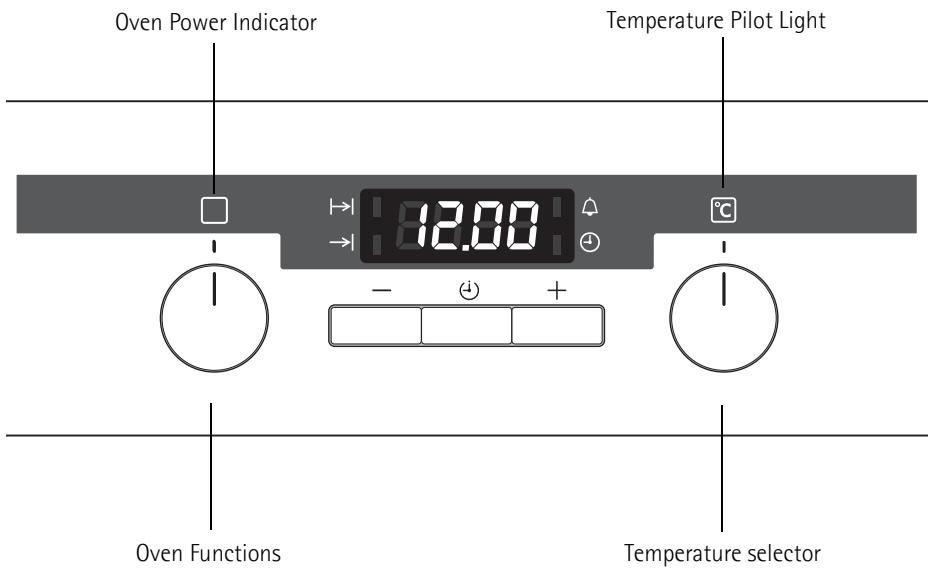
- Turn the oven functions dial to the desired function.
- Turn the temperature selector to the desired temperature.
The power indicator is lit as long as the oven is in operation.
The temperature pilot light is lit as long as the oven is heating up.
- To turn the oven off, turn the oven functions dial and the temperature selector to the Off position.

Cooling fan
The fan switches on automatically in order to keep the appliance's surfaces cool. When the oven is switched off, the fan continues to run to cool the appliance down, then switches itself off automatically.
Oven Functions
The oven has the following functions:
| Oven function | Application | |
| Light | Using this function you can light up the oven interior, e.g. for cleaning. | |
| True fan | For baking on up to three oven levels at the same time. Set the oven temperatures 20-40 °C lower than when using Conventional. | |
| Fan baking | For baking on one oven level dishes that require more intensive browning and a crispy base. Set the oven temperatures 20-40 °C lower than when using Conventional. | |
| Conventional | For baking and roasting on one oven level. | |
| Base heat | For baking cakes with crispy or crusty bases. | |
| Defrost | For defrosting e. g. flans and gateaux, butter, bread, fruit or other frozen foods. | |
| Single grill | For grilling flat food items placed in the middle of the grill and for toasting. | |
| Dual grill | For grilling flat food items in large quantities and for toasting. | |
| Rotitherm | For roasting larger joints of meat or poultry on one level. The function is also suitable for gratinating and browning. | |
Inserting the Oven Shelf, Baking Tray and Roasting Pan

Shelf runner safety and anti-tip device
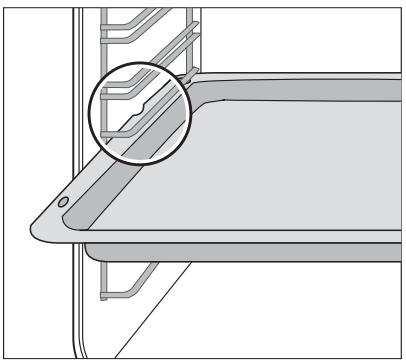
As a shelf runner safety device, all insertable components have a small curved indentation at the bottom on the right and left-hand edge.
Always insert insertable components so that this indentation is at the back of the oven interior. This indentation is also important for preventing the insertable components from tipping.
Inserting the baking tray or roasting pan
Push the baking tray or roasting pan between the guide bars of the selected oven level.
natural_image
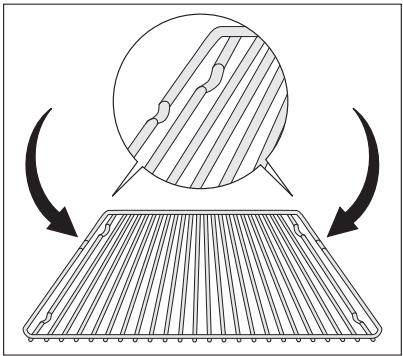
Technical diagram of a mechanical assembly with a magnified detail of a component (no text or symbols)Inserting the oven shelf:
Insert the oven shelf so that the feet point downwards.
Push the oven shelf between the guide bars of the selected oven level.
natural_image
Diagram showing a grid structure with arrows indicating rotation or deformation, and a magnified circular detail of a striped pattern (no text or symbols)
The high rim around the oven shelf is an additional device to prevent cookware from slipping.
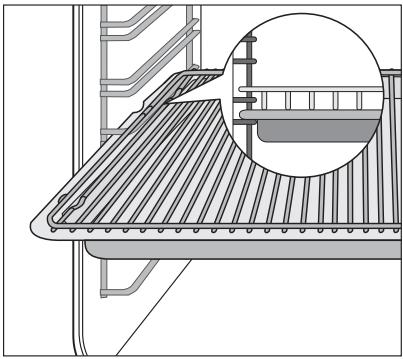
Inserting the oven shelf and roasting pan together
Lay the oven shelf on the roasting pan.
Push the roasting pan between the guide bars of the selected oven level.
natural_image
Technical line drawing of a mechanical assembly with a magnified inset showing internal components (no text or symbols)Inserting/Removing the Fat Filter
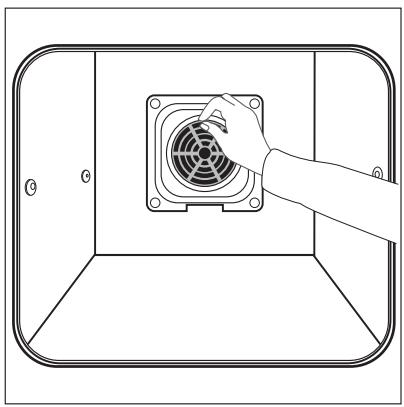
Only use the fat filter when roasting to protect the rear heating elements from fat splashes.
Inserting the fat filter
Hold the fat filter by the grip and insert the two mounts downwards into the opening on the rear wall of the oven (fan opening).
Taking out the fat filter
Hold the fat filter by the grip and un-hook it.
natural_image
Line drawing of a hand placing a fan-shaped vent into a rectangular chamber (no text or symbols)Clock Functions
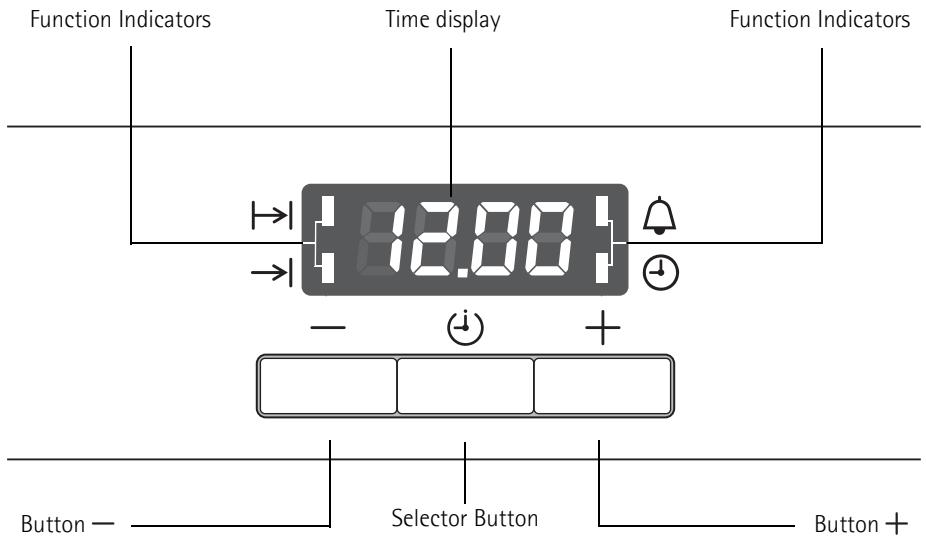
Minute minder
To set a countdown. A signal sounds after the time has elapsed.
This function does not affect the functioning of the oven.
Duration
To set how long the oven is to be in use.
End
To set when the oven is to switch off again.
Time of day
To set, change or check the time
(See also section "Before Using for the First Time").

How to use the clock functions
- After a function has been selected, the corresponding function indicator flashes for about 5 seconds. During this period, the desired times can be set using the + or — button.
- When the desired time has been set, the function indicator continues to flash for approx. 5 seconds. After that the function indicator is then lit. The set time begins to run.
- Press any of the buttons to stop the audible signal.
- The desired oven function and temperature can be selected before or after the clock functions Duration and End are set.
- When the cooking process is completed, turn the oven function dial and the temperature selector back to the OFF position.

Switching Off the Time Display
By switching off the time display you can save energy.
Switching off the time display
Press and hold down any two buttons until the display becomes dark.
Switching on the time display
Hold down any button until the time reappears in the display.

The display can only be switched off if none of the clock functions Duration, End or Minute minder is in use.
Minute minder
- Press the Selection button repeatedly until the function indicator Minute minder flashes.
- Using the + or - button set the desired Countdown (max. 2 hours 30 minutes).
- Using the + or — button set the desired Countdown (max. 2 hours 30 minutes).
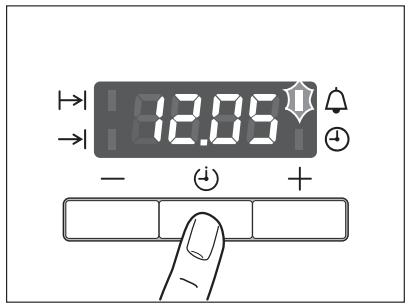
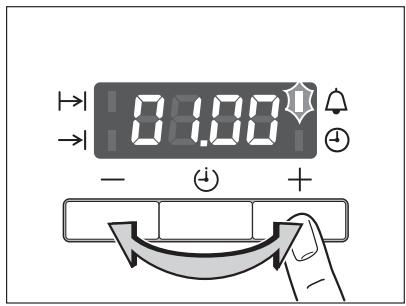
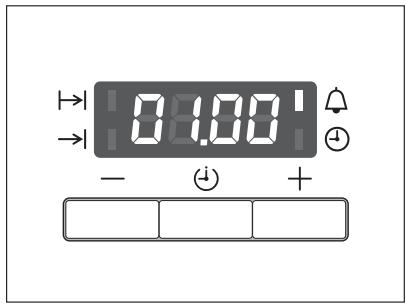
After approx. 5 seconds the display shows the time remaining. The function indicator Minute minder lights up.
When the time has elapsed, the function indicator flashes and an audible signal sounds for 2 minutes.
The signal can be stopped by pressing any button.
Duration
-
Press the Selection button repeatedly until the function indicator Duration flashes.
-
Using the + or - button set the desired cooking time.
After approx. 5 seconds the display returns to showing the current time. The function indicator Duration lights up.
When the time has elapsed, the function indicator flashes, an audible signal sounds for 2 minutes and the oven switches itself off.
- The signal and the programme can be stopped by pressing any button.

End
-
Press the Selection button repeatedly until the function indicator End flashes.
-
Using the + or — button set the desired switch-off time.
After approx. 5 seconds the display returns to showing the current time. The function indicator End lights up.
When the time has elapsed, the function indicator flashes, an audible signal sounds for 2 minutes and the oven switches itself off.
- The signal and the programme can be stopped by pressing any button.
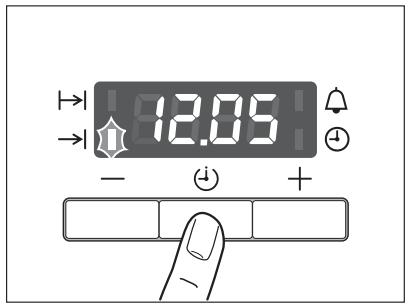
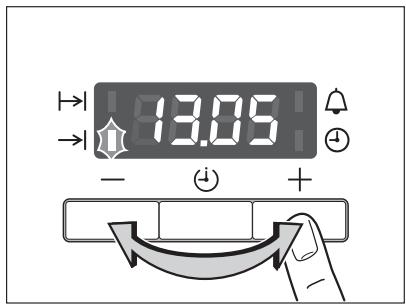
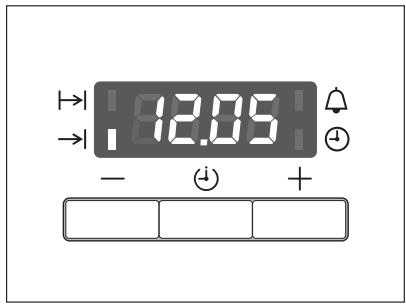
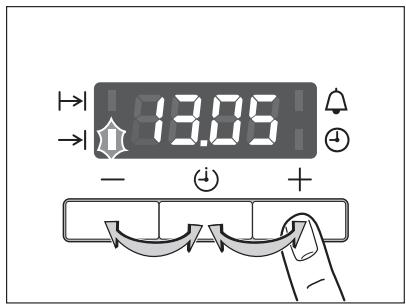
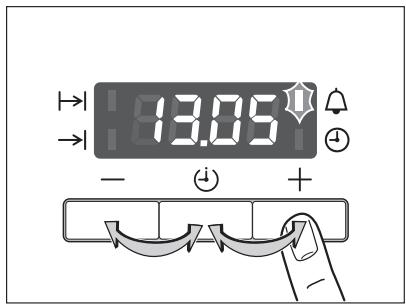
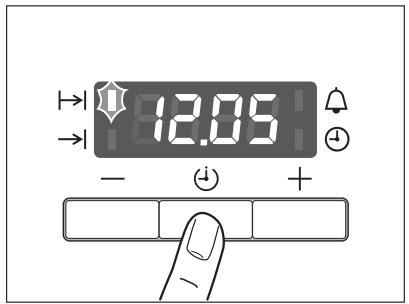
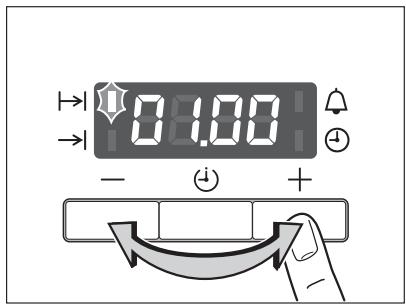
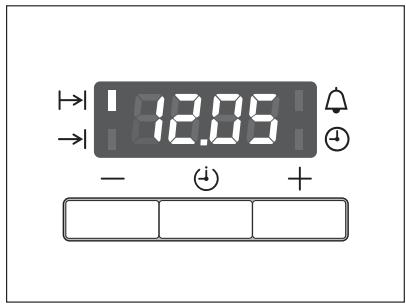
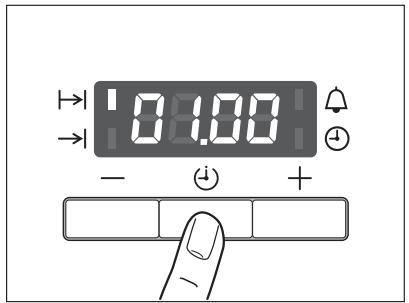
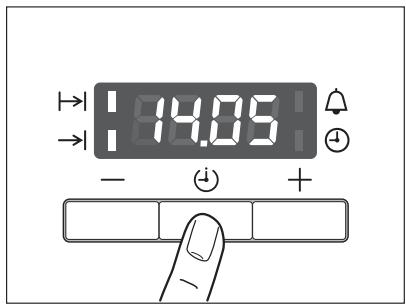
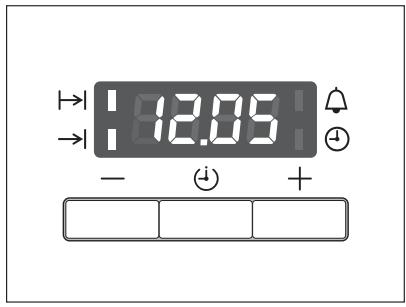
Duration and End combined

Duration and End can be used simultaneously, if the oven is to be switched on and off automatically at a later time.
- Using the Duration function, set the time required for cooking the dish. In this example, 1 hour.
- Using the End function, set the time at which the dish should be ready. In this case 14:05:00.
The function indicators Duration and End light up and the current time is shown in the display. In this case 12:05.
The oven switches on automatically at the time calculated. In this case, at 13:05:00.
And switches itself off again when the cooking time entered has elapsed. In this case, at 14:05.
Uses, Tables and Tips
Cooking table
The information given in the following table is for guidance only.
| Heat setting | Cooking-process | suitable for | Cooking time | Tips/Hints |
| 0 | Residual heat, Off position | |||
| ### | Keeping food warm | Keeping cooked foods warm | as required | Cover |
| 1-2 | Melting | Hollandaise sauce, melting butter, chocolate, gelatine | 5-25 mins. | Stir occasionally |
| Solidifying | Fluffy omelettes, baked eggs | 10-40 mins. | Cook with lid on | |
| 2-3 | Simmer-ing on low heat | Simmering rice and milk-based dishesHeating up ready-cooked meals | 25-50 mins. | Add at least twice as much liquid as rice, stir milk dishes part way through cooking |
| 3-4 | Steaming Braising | Steaming vegetables, fish braising meat | 20-45 mins. | With vegetables add only a little liquid (a few table-spoons) |
| 4-5 | Boiling | Steaming potatoes | 20-60 mins. | Use only a little liquid, e.g.: max. 1/4 l water for 750 g potatoes |
| Cooking larger quantities of food, stews and soups | 60-150 mins. | Up to 3 l liquid plus in-gredients | ||
| 6-7 | Gentle Frying | Frying escalopes, veal cor-don bleu, cutlets, rissoles, sausages, liver, roux, eggs, pancakes, doughnuts | Steady frying | Turn halfway through cooking |
| 7-8 | Heavy Frying | Hash browns, loin steaks,steaks, Flädle (pancakes for garnishing soup) | 5-15 mins.per pan | Turn halfway through cooking |
| 9 | Boiling Searing Deep frying | Boiling large quantities of water, cooking pasta, searing meat (goulash,pot roast), deep frying chips | ||

We recommend when boiling or searing foods using the highest heat setting at first and then letting foods requiring a longer cooking time finish cooking on the desired heat setting.

Overheated fats and oils can ignite very quickly. Warning! Fire hazard!
Baking
Oven function: True fan 📋 or Conventional □
Baking tins
- For Conventional □ dark metal and non-stick tins are suitable.
- For True fan 📋 bright metal tins are also suitable.
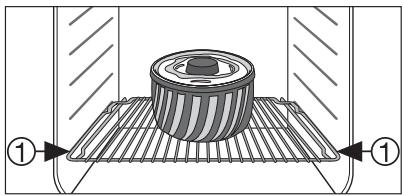
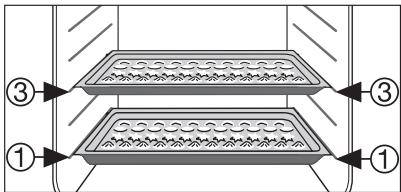
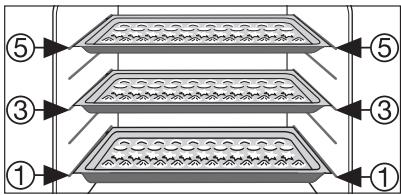
Oven levels
- Baking with Conventional □ is possible on one oven level.
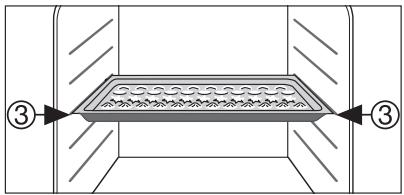
- With True fan 📋 you can bake on up to 3 baking trays at the same time:
1 baking tray: e.g. oven level 3
natural_image
Diagram of a rectangular device with internal components and directional arrows, no text or symbols present1 cake tin: e.g. oven level 1
natural_image
Diagram of a mechanical component inside a rack, showing internal structure and directional arrows (no text or symbols)2 baking trays: z. g., oven levels 1 and 3
3 baking trays: oven levels 1, 3 and 5
flowchart
graph TD
    A["Step 1"] --> B["Step 3"]
    B --> C["Step 5"]
    D["Step 3"] --> E["Step 5"]
    E --> F["Step 5"]
    G["Step 1"] --> H["Step 5"]
General instructions
- Insert the tray with the bevel at the front.
- With Conventional □ or True fan 🔊 you can also bake with two tins next to one another on the oven shelf at the same time. This does not significantly increase baking time.

When frozen foods are used the trays inserted may distort during cooking. This is due to the large difference in temperature between the freezing temperature and the temperature in the oven. Once the trays have cooled the distortion will disappear again.
How to use the baking tables
The tables give the required temperature settings, baking times and oven shelf levels for a selection of typical dishes.
- Temperatures and baking times are for guidance only, as these will depend on the consistency of pastry, dough or mixture, the amount and the type of baking tin.
- We recommend using the lower temperature the first time and then if necessary, for example, if a deeper browning is required, or baking time is too long, selecting a higher temperature.
- If you cannot find the settings for a particular recipe, look for the one that is most similar.
- If baking cakes on baking trays or in tins on more than one level, baking time may be extended by 10–15 minutes.
- Moist recipes (for example, pizzas, fruit flans, etc.) are baked on one level.
- Cakes and pastries at different heights may brown at an uneven rate at first. If this occurs, please do not change the temperature setting. Different rates of browning even out as baking progresses.
- Your new oven may bake or roast differently to your previous appliance. So adapt your normal settings (temperature, cooking times) and oven shelf levels to the recommendations in the following tables.

With longer baking times, the oven can be switched off about 10 minutes before the end of baking time, to make use of the residual heat.
Unless otherwise stated, the values given in the tables assume that cooking is started with the oven cold.
Baking table
1) Pre-heat the oven
2) Use the drip tray or roasting tray
Baking on one oven level
| Type of baking | Oven function | Oven level | Temperature °C | Time Hr: Mins. | |
| Baking in tins | |||||
| Ring cake or brioche | True fan | 1 | 150-160 | 0:50-1:10 | |
| Madeira cake/fruit cakes | True fan | 1 | 140-160 | 1:10-1:30 | |
| Sponge cake | True fan | 1 | 140 | 0:25-0:40 | |
| Sponge cake | Conventional | 1 | 160 | 0:25-0:40 | |
| Flan base - short pastry | True fan | 3 | 170-180^1) | 0:10-0:25 | |
| Flan base - sponge mixture | True fan | 3 | 150-170 | 0:20-0:25 | |
| Apple pie | Conventional | 1 | 170-190 | 0:50-1:00 | |
| Apple pie (2 tins ∅20cm, diagonally off set) | True fan | 1 | 160 | 1:10-1:30 | |
| Apple pie (2 tins ∅20cm, diagonally off set) | Conventional | 1 | 180 | 1:10-1:30 | |
| Savoury flan (e. g, quiche lorraine) | True fan | 1 | 160-180 | 0:30-1:10 | |
| Cheesecake | Conventional | 1 | 170-190 | 1:00-1:30 | |
| Cakes/pastries/breads on baking trays | |||||
| Plaited bread/bread crown | Conventional | 3 | 170-190 | 0:30-0:40 | |
| Christmas stolen | Conventional | 3 | 160-180^1) | 0:40-1:00 | |
| Bread (rye bread)-first of all-then | Conventional | 1 | 230^1) 160-180 | 0:250:30-1:00 | |
| Cream puffs/eclairs | Conventional | 3 | 160-170^1) | 0:15-0:30 | |
| Swiss roll | Conventional | 3 | 180-200^1) | 0:10-0:20 | |
| Cake with crumble topping (dry) | True fan | 3 | 150-160 | 0:20-0:40 | |
| Buttered almond cake/sugar cakes | Conventional | 3 | 190-210^1) | 0:15-0:30 | |
| Fruit flans (made with yeast dough/ sponge mixture) ^2) | True fan | 3 | 150 | 0:35-0:50 | |
| Fruit flans (made with yeast dough/ sponge mixture) ^2) | Conventional | 3 | 170 | 0:35-0:50 | |
| Fruit flans made with short pastry | True fan | 3 | 160-170 | 0:40-1:20 | |
| Yeast cakes with delicate toppings (e. g, quark, cream, custard) | Conventional | 3 | 160-180^1) | 0:40-1:20 | |
| Pizza (with a lot of top- ping) ^2) | True fan | 1 | 180-200^1) | 0:30-1:00 | |
| Pizza (thin crust) | True fan | 1 | 200-220^1) | 0:10-0:25 | |
| Unleavened bread | True fan | 1 | 200-220 | 0:08-0:15 | |
| Tarts (CH) | True fan | 1 | 180-200 | 0:35-0:50 | |
| Biscuits | |||||
| Short pastry biscuits | True fan | 3 | 150-160 | 0:06-0:20 | |
| Viennese whirls | True fan | 3 | 140 | 0:20-0:30 | |
| Viennese whirls | Conventional | 3 | 160^1) | 0:20-0:30 | |
| Biscuits made with sponge mixture | True fan | 3 | 150-160 | 0:15-0:20 | |
| Pastries made with egg white, meringues | True fan | 3 | 80-100 | 2:00-2:30 | |
| Macaroons | True fan | 3 | 100-120 | 0:30-0:60 | |
| Biscuits made with yeast dough | True fan | 3 | 150-160 | 0:20-0:40 | |
| Puff pastries | True fan | 3 | 170-180^1) | 0:20-0:30 | |
| Rolls | True fan | 3 | 160^1) | 0:20-0:35 | |
| Rolls | Conventional | 3 | 180^1) | 0:20-0:35 | |
| Small cakes (20 per tray) | True fan | 3 | 140^1) | 0:20-0:30 | |
| Small cakes (20 per tray) | Conventional | 3 | 170^1) | 0:20-0:30 | |
Baking on more than one oven level
| Type of baking | True fan ⚠Shelf positions from bottom | Temperature in °C | Time Hours: Mins. | |
| 2 levels | 3 levels | |||
| Cakes/pastries/breads on baking trays | ||||
| Cream puffs/Eclairs | 1 / 4 | --- | 160-180^1) | 0:35-0:60 |
| Dry streusel cake | 1 / 3 | --- | 140-160 | 0:30-0:60 |
| Biscuits/small cakes/pastries/rolls | ||||
| Short pastry biscuits | 1 / 3 | 1 / 3 / 5 | 150-160 | 0:15-0:35 |
| Viennese whirls | 1 / 3 | 1 / 3 / 5 | 140 | 0:20-0:60 |
| Biscuits made with sponge mixture | 1 / 3 | --- | 160-170 | 0:25-0:40 |
| Biscuits made with egg white,meringues | 1 / 3 | --- | 80-100 | 2:10-2:50 |
| Macaroons | 1 / 3 | --- | 100-120 | 0:40-1:20 |
| Biscuits made with yeast dough | 1 / 3 | --- | 160-170 | 0:30-0:60 |
| Puff pastries | 1 / 3 | --- | 170-180^1) | 0:30-0:50 |
| Rolls | 1 / 4 | --- | 160 | 0:30-0:55 |
| Small cakes (20 per tray) | 1 / 4 | --- | 140^1) | 0:25-0:40 |
1) Pre-heat the oven
Tips on Baking
| Baking results | Possible cause | Remedy |
| The cake is not browned enough underneath | Wrong oven level | Place cake lower |
| The cake sinks (becomes soggy, lumpy, streaky) | Oven temperature too high | Use a slightly lower setting |
| Baking time too short | Set a longer baking timeBaking times cannot be reduced by setting higher temperatures | |
| Too much liquid in the mixture | Use less liquid.Pay attention to mixing times, especially if using mixing machines | |
| Cake is too dry | Oven temperature too low | Set oven temperature higher. |
| Baking time too long | Set a shorter baking time | |
| Cake browns unevenly | Oven temperature too high and baking time too short | Set a lower oven temperature and a longer baking time |
| Mixture is unevenly distributed | Spread the mixture evenly on the baking tray | |
| Grease filter is inserted | Take out the grease filter | |
| Cake does not cook in the baking time given | Temperature too low | Use a slightly higher oven setting |
| Grease filter is inserted | Take out the grease filter |
1) Pre-heat the oven
Fan baking 📋 table
| Type of baking | Shelf position | Temperature °C | Time Hr: Mins. |
| Pizza (thin crust) | 1 | 180 - 200^1) | 20 - 30 |
| Pizza (with a lot of topping) | 1 | 180 - 200 | 20 - 30 |
| Tarts | 1 | 180 - 200 | 45 - 60 |
| Spinach flan | 1 | 160 - 180 | 45 - 60 |
| Quiche Lorraine | 1 | 170 - 190 | 40 - 50 |
| Quark flan, round | 1 | 140 - 160 | 60 - 90 |
| Quark flan on tray | 1 | 140 - 160 | 50 - 60 |
| Apple cake, covered | 1 | 150 - 170 | 50 - 70 |
| Vegetable pie | 1 | 160 - 180 | 50 - 60 |
| Unleavened bread | 1 | 250 - 270^1) | 10 - 20 |
| Puff pastry flan | 1 | 160 - 180^1) | 40 - 50 |
| Flammekuchen (Pizza-like dish from Alsace) | 1 | 250 - 2701) | 12 - 20 |
| Piroggen (Russian version of cal-zone) | 1 | 180 - 2001) | 15 - 25 |
Table for Bakes and Gratins
| Dish | Oven function | Shelf position | Temperature °C | Time Hr: Mins. | |
| Pasta bake | Conventional | 1 | 180-200 | 0:45-1:00 | |
| Lasagne | Conventional | 1 | 180-200 | 0:25-0:40 | |
| Vegetables au gratin ^1) | True fan | 1 | 160-170 | 0:15-0:30 | |
| Baguettes topped with melted cheese ^1) | True fan | 1 | 160-170 | 0:15-0:30 | |
| Sweet bakes | Conventional | 1 | 180-200 | 0:40-0:60 | |
| Fish bakes | Conventional | 1 | 180-200 | 0:30-1:00 | |
| Stuffed vegetables | True fan | 1 | 160-170 | 0:30-1:00 | |
1) Pre-heat the oven
Frozen Ready Meals Table
| Food to be cooked | Oven function | Shelf position | Temperature °C | Time | |
| Frozen pizza | Conventional | 3 | as per manufacturer's instructions | as per manufacturer's instructions | |
| Chips1)(500 g) | True fan | 3 | 200-220 | as per manufacturer's instructions | |
| Baguettes | Conventional | 3 | as per manufacturer's instructions | as per manufacturer's instructions | |
| Fruit flans | Conventional | 3 | as per manufacturer's instructions | as per manufacturer's instructions | |
1) Comments: Turn chips 2 or 3 times during cooking
Roasting
Oven function: Conventional □ or Rotitherm 🌐
Roasting dishes
- Any heat-resistant ovenware is suitable to use for roasting (please read the manufacturer's instructions).
- Large roasting joints can be roasted directly in the roasting tray or on the oven shelf with the roasting tray placed below it.
- For all lean meats, we recommend roasting these in a roasting tin with a lid. This will keep the meat more succulent.
- All types of meat, that can be browned or have crackling, can be roasted in the roasting tin without the lid.

Tips on using the roasting chart
The information given in the following table is for guidance only.
- We recommend cooking meat and fish weighing 1 kg and above in the oven.
- To prevent escaping meat juices or fat from burning on to the pan, we recommend placing some liquid in the roasting pan.
- If required, turn the roast (after 1/2 - 2/3 of the cooking time).
- Baste large roasts and poultry with their juices several times during roasting. This will give better roasting results.
- You can switch the oven off about 10 minutes before the end of the roasting time, in order to utilise the residual heat.
1) Pre-heat the oven
Roasting table
| Type of meat | Quantity | Ovenfunction | Shelf position | Tempera-ture °C | Time Hours mins. | |
| Beef | ||||||
| Pot roast | 1-1.5 kg | Convention-al | 1 | 200-250 | 2:00-2:30 | |
| Roast beef or fillet | ||||||
| - rare | per cm.of thickness | Rotitherm | 1 | 190-200^1) | per cm. of thickness | |
| - medium | per cm.of thickness | Rotitherm | 1 | 180-190 | 0:05-0:06 | |
| - well done | per cm.of thickness | Rotitherm | 1 | 170-180 | 0:06-0:08 | |
| Pork | ||||||
| Shoulder, neck, ham joint | 1-1.5 kg | Rotitherm | 1 | 160-180 | 1:30-2:00 | |
| Chop, spare rib | 1-1.5 kg | Rotitherm | 1 | 170-180 | 1:00-1:30 | |
| Meat loaf | 750 g-1 kg | Rotitherm | 1 | 160-170 | 0:45-1:00 | |
| Porkknuckle (pre-cooked) | 750 g-1 kg | Rotitherm | 1 | 150-170 | 1:30-2:00 | |
| Veal | ||||||
| Roast veal | 1 kg | Rotitherm | 1 | 160-180 | 1:30-2:00 | |
| Knuckle of veal | 1.5-2 kg | Rotitherm | 1 | 160-180 | 2:00-2:30 | |
| Lamb | ||||||
| Leg of lamb, roast lamb | 1-1.5 kg | Rotitherm | 1 | 150-170 | 1:15-2:00 | |
| Saddle of lamb | 1-1.5 kg | Rotitherm | 1 | 160-180 | 1:00-1:30 | |
| Game | ||||||
| Saddle of hare, leg of hare | up to 1 kg | Convention-al | 3 | 220-250^1) | 0:25-0:40 | |
| Saddle of venison | 1.5-2 kg | Convention-al | 1 | 210-220 | 1:15-1:45 | |
| Haunch of venison | 1.5-2 kg | Convention-al | 1 | 200-210 | 1:30-2:15 | |
| Poultry | ||||||
| Poultry portions | 200-250g each | Rotitherm | 1 | 200-220 | 0:35-0:50 | |
| Half chicken | 400-500g each | Rotitherm | 1 | 190-210 | 0:35-0:50 | |
| Chicken, poulard | 1-1.5 kg | Rotitherm | 1 | 190-210 | 0:45-1:15 | |
| Duck | 1.5-2 kg | Rotitherm | 1 | 180-200 | 1:15-1:45 | |
| Goose | 3.5-5 kg | Rotitherm | 1 | 160-180 | 2:30-3:30 | |
| Turkey | 2.5-3.5 kg | Rotitherm | 1 | 160-180 | 1:45-2:30 | |
| Turkey | 4-6 kg | Rotitherm | 1 | 140-160 | 2:30-4:00 | |
| Fish (steamed) | ||||||
| Whole fish | 1-1.5 kg | Convention-al | 1 | 210-220 | 0:45-1:15 | |
Grill sizes
Oven function: Single grill ☐ or Dual grill ☑ with maximum temperature setting

Important: Always grill with the oven door closed.

The empty oven should always be pre-heated with the grill functions for 5 minutes.
- For grilling, place the shelf in the recommended shelf position.
- Always insert the tray for collecting the fat into the first shelf position from the bottom.
- The grilling times are guidelines.
- Grilling is particularly suitable for flat pieces of meat or fish.
Grilling table
| Food to be grilled | Oven level | Grilling time | |
| 1st side | 2nd side | ||
| Burgers | 4 | 8-10 mins. | 6-8 mins. |
| Pork fillet | 4 | 10-12 mins. | 6-10 mins. |
| Sausages | 4 | 8-10 mins. | 6-8 mins. |
| Fillet steaks, veal steaks | 4 | 6-7 mins. | 5-6 mins. |
| Fillet of beef, roast beef (approx. 1 kg) | 3 | 10-12 mins. | 10-12 mins. |
| Toast^1) | 3 | 4-6 mins. | 3-5 mins. |
| Toast with topping | 3 | 6-8 mins. | --- |
1) Do not pre-heat
Defrosting
Oven function: Defrost ☐ (no temperature setting)
- Unwrap the food and place it on a plate on the oven shelf.
- Do not cover with a plate or bowl, as these can substantially lengthen the defrosting time.
- For defrosting, place the shelf in the 1st oven level from the bottom.
Defrosting table
| Dish | Defrosting time mins. | Further defrosting time (mins.) | Comments |
| Chicken, 1000 g | 100-140 | 20-30 | Place the chicken on an upturned saucer placed on a large plateTurn halfway through |
| Meat, 1000 g | 100-140 | 20-30 | Turn halfway through |
| Meat, 500 g | 90-120 | 20-30 | Turn halfway through |
| Trout, 150g | 25-35 | 10-15 | --- |
| Strawberries, 300g | 30-40 | 10-20 | --- |
| Butter, 250g | 30-40 | 10-15 | --- |
| Cream, 2 x 200g | 80-100 | 10-15 | Cream can also be whipped when still slightly frozen in places |
| Gateau, 1400g | 60 | 60 | --- |
Drying
- Use oven shelves covered with greaseproof paper or baking parchment.
- You get a better result if you switch the oven off halfway through the drying time, open the door and leave the oven to cool down overnight.
• After this, finish drying the food to be dried.
| Food to be dried | Temperature in °C | Oven level | Time in hours (Guideline) | |
| 1 level | 2 levels | |||
| Vegetables | ||||
| Beans | 60-70 | 3 | 1 / 4 | 6-8 |
| Peppers (strips) | 60-70 | 3 | 1 / 4 | 5-6 |
| Vegetables for soup | 60-70 | 3 | 1 / 4 | 5-6 |
| Mushrooms | 50-60 | 3 | 1 / 4 | 6-8 |
| Herbs | 40-50 | 3 | 1 / 4 | 2-3 |
| Fruit | ||||
| Plums | 60-70 | 3 | 1 / 4 | 8-10 |
| Apricots | 60-70 | 3 | 1 / 4 | 8-10 |
| Apple slices | 60-70 | 3 | 1 / 4 | 6-8 |
| Pears | 60-70 | 3 | 1 / 4 | 6-9 |
Making preserves
Oven function: Base heat
- For preserving, use only commercially available preserve jars of the same size.
- Jars with twist-off or bayonet type lids and metal tins are not suitable.
- When making preserves, the first shelf position from the bottom is the one most used.
- Use the shelf for making preserves. There is enough room on this for up to six 1-litre preserving jars.
- The jars should all be filled to the same level and clamped shut.
- Place the jars on the baking tray in such a way that they are not touching each other.
- Pour approx. 1/2 litre of water into the baking tray so that sufficient moisture is produced in the oven.
- As soon as the liquid starts to pearl in the first jars (after about 35-60 minutes with 1 litre jars), switch the oven off or reduce the temperature to 100^ (see table).
Preserves table
The times and temperatures for making preserves are for guidance only.
| Preserve | Temperature in °C | Cooking time until simmering in mins. | Continue to cook at 100°C in mins. |
| Soft fruit | |||
| Strawberries, blueberries, raspberries, ripe gooseberries | 160-170 | 35-45 | --- |
| Unripe gooseberries | 160-170 | 35-45 | 10-15 |
| Stone fruit | |||
| Pears, quinces, plums | 160-170 | 35-45 | 10-15 |
| Vegetables | |||
| Carrots^1) | 160-170 | 50-60 | 5-10 |
| Mushrooms^1) | 160-170 | 40-60 | 10-15 |
| Cucumbers | 160-170 | 50-60 | --- |
| Mixed pickles | 160-170 | 50-60 | 15 |
| Kohlrabi, peas, asparagus | 160-170 | 50-60 | 15-20 |
| Beans | 160-170 | 50-60 | --- |
1) Leave standing in oven when switched off
Cleaning and Care

Warning: First switch off the appliance and let it cool down before carrying out any cleaning.
Warning: For safety reasons, do not clean the appliance with steam blasters or high-pressure cleaners.
Attention: Do not use any corrosive cleaning fluids, sharp objects or stain remov-ers.
Do not clean the glass oven door with abrasive fluids or metal scrapers, which could scratch the surface. The glass could crack and shatter.
Outside of the appliance
- Wipe the front of the appliance with a soft cloth and a solution of hot water and washing up liquid.
- For metal fronts, use normal commercially available cleaning agents.
- Please do not use scouring agents and abrasive sponges.
Oven interior
Clean the appliance after each use. In this way, dirt is easier to clean off and is not allowed to burn on.
- For cleaning, turn the oven light on.
- After every use, wipe the oven with a solution of washing-up liquid and allow to dry.

Clean stubborn dirt with a special oven cleaner.

Important: If using an oven spray, please follow the manufacturer's instructions exactly.
Accessories
Wash all slide-in units (shelf unit, baking tray, shelf support rails etc.) after each use and dry well. Soak briefly to make them easier to clean.
Fat Filter
- Clean the fat filter in hot water and washing up liquid or in the dishwasher.
- Badly burned on soiling can be removed by boiling the filter in a little water to which 2-3 tablespoonsful of dishwasher cleaner has been added.
Shelf Support Rails
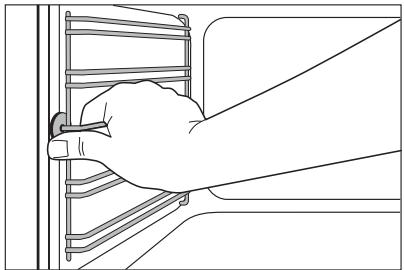
The shelf support rails on the left and right hand sides of the oven can be removed for cleaning the side walls.
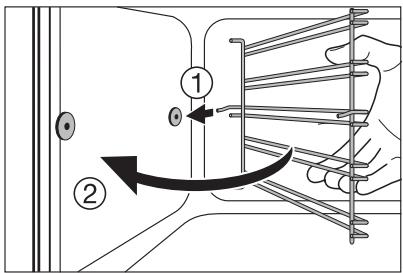
Removing the shelf support rails
First pull the front of the rail away from the oven wall (1) and then unhitch at the back (2).
natural_image
Line drawing of a hand holding a tool inside a window frame (no text or symbols)

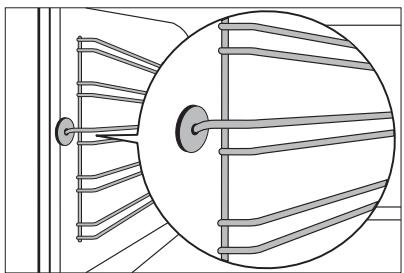
Fitting the shelf support rails
Important! The rounded ends of the guide rails must be pointing forwards!
natural_image
Diagram of a circular structure with horizontal lines and a central vertical element, no text or symbols presentTo re-insert, first hook the rail into place at the back (1) and then insert the front and press into place (2).
Oven lighting

Warning: There is a danger of electric shock! Prior to changing the oven light bulb:
- Switch off the oven!
- Remove the fuses in the fuse box or switch off the circuit breaker.

Place a cloth on the oven floor to protect the oven light and glass cover.
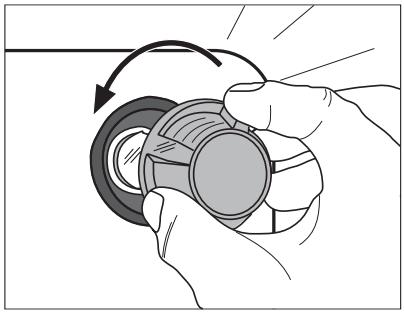
Replacing the oven light bulb/cleaning the glass cover
- Remove the glass cover by turning it anticlockwise and then clean it.
- If necessary: Replace bulb with a 40 watt, 230 V, 300 °C heat-resistant oven light bulb.
- Refit the glass cover.
natural_image
Illustration of hands holding a ball bearing with an arrow indicating rotation (no text or symbols)Oven Ceiling
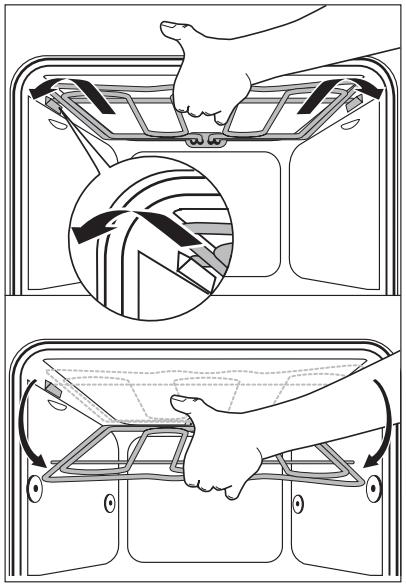
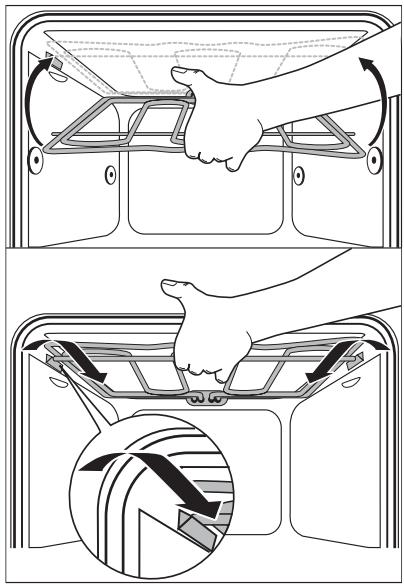
The upper heating element can be folded down to make it easier to clean the oven ceiling.
Folding down the heating element

Warning: Only fold down the heating element when the oven is switched off and there is no risk of being burnt!
- Remove the side shelf support rails.
- Grip the heating element at the front and pull it forwards and out over the support lug on the inner wall of the oven.
- The heating element will now fold down.

Caution: Do not use force to press the heating element down! The heating element might break.
Cleaning the oven ceiling
Repositioning the heating element
- Move the heating element back up towards the oven ceiling.
- Pull the heating element forwards against the spring pressure and guide it over the oven support lug.
- Settle it onto the support.
- Insert shelf support rail.

Important: The heating element must be positioned correctly and securely on both sides above the support lug on the inner wall of the oven.
Oven door
For easier cleaning of the oven interior the oven door of your appliance can be taken off its hinges.
Removing the oven door from its hinges
-
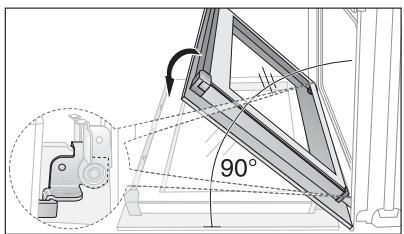
Open the oven door as far as it will go.
-
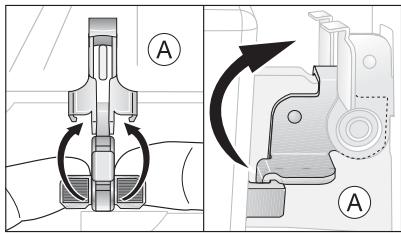
Undo the clamping levers (A) on both door hinges fully.
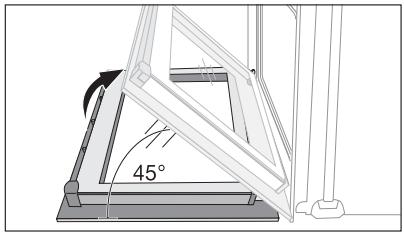
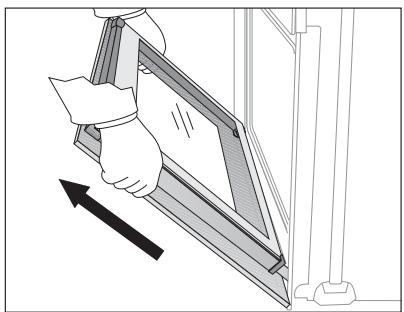
- Close the oven door as far as the first position (approx. 45°).
- Take hold of the oven door with a hand on each side and pull it away from the oven at an upwards angle (Take care: It is heavy).

Lay the oven door with the outer side facing downwards on something soft and level, for example, a blanket in order to prevent scratches.
natural_image
Illustration of a person opening a door with an arrow indicating direction (no text or symbols)Hanging the oven door back on its hinges
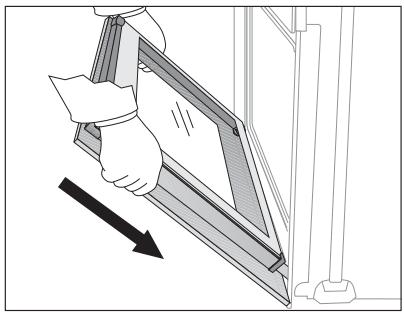
- From the handle side take hold of the oven door with a hand on each side and hold at an angle of approx. 45^ .
Position the recesses on the bottom of the oven door on the hinges on the oven.
Let the door slide down as far as it will go.
natural_image
Illustration of a person using a directional arrow to cut a window frame (no text or symbols)- Open the oven door as far as it will go.
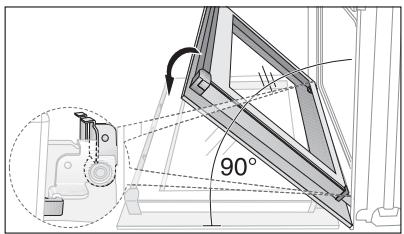
- Fold up the clamping levers (A) on both door hinges back into their original positions.
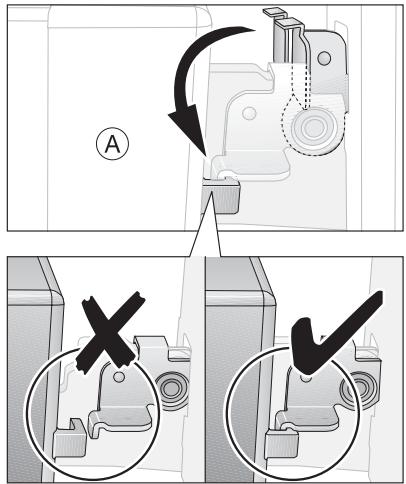
- Close the oven door.
Oven door glass
The oven door is fitted with three panels of glass mounted one behind the other. The inner panels can be removed for cleaning.

Important! Rough handling, especially around the edges of the front panel, can cause the glass to break.
Removing the door glass panels
- Open the oven door as far as it will go.
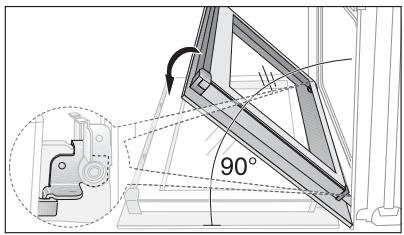
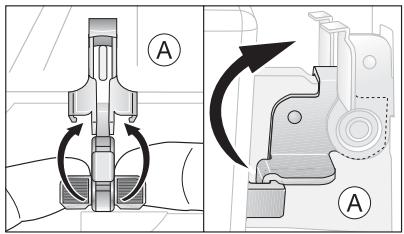
- Undo the clamping levers (A) on both door hinges fully
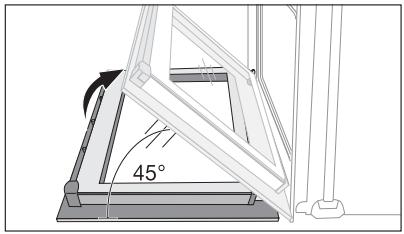
- Close the oven door as far as the first position (approx. 45°).
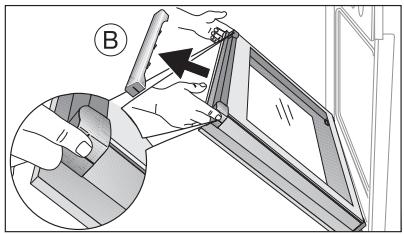
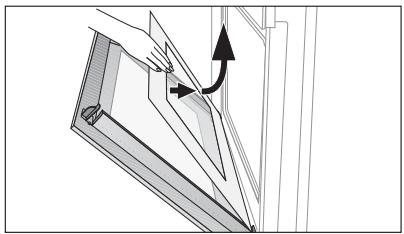
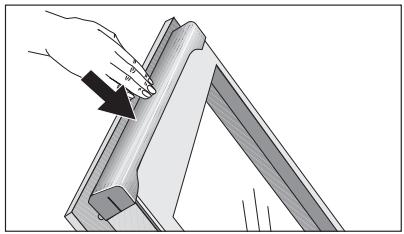
- Take hold of the door trim (B) on the upper edge of the door at both sides and press inwards to release the clip seal. Then remove the door trim by pulling it upwards.
- Take hold of the door glass panels on their upper edge one after the other and take them out of the guide by pulling them upwards..
natural_image
Pure technical diagram of a mechanical component with no visible text, numbers, or symbolsCleaning the door glass panels
Clean the door glass panels thoroughly with a solution of water and washing up liquid. Then dry them carefully
Putting the door glass panels back.
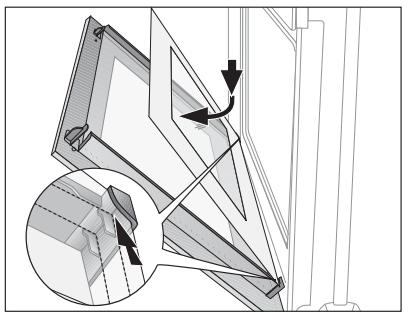
- From above insert the door glass panels at an angle into the door profile at the bottom edge of the door one after the other and lower them.

Insert the smaller panel first, then the larger panel.
natural_image
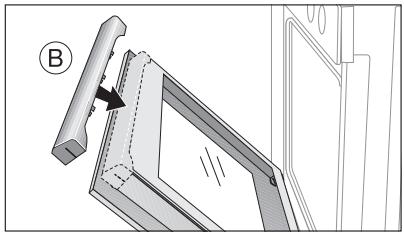
Technical diagram of a mechanical assembly with directional arrows and a magnified inset showing internal components (no text or symbols)- Take hold of the door trim (B) at each side, position it on the inside edge of the door and plug the door trim (B) into the upper edge of the door
natural_image
Technical line drawing of a door panel with a pull rod and label B, showing no text or symbols
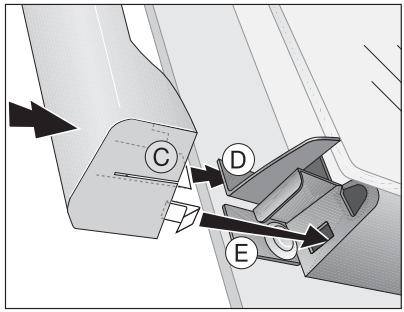
On the open side of the door trim (B) there is a guide bar (C). This must be pushed between the outer door panel and the guide corner (D). The clip seal (E) must be snapped in.
natural_image
Illustration of a hand using a tool to cut or install a metal bracket (no text or symbols visible)- Open the oven door as far as it will go.
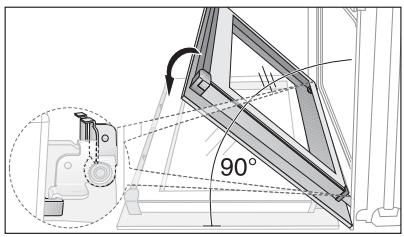
- Fold up the clamping levers (A) on both door hinges back into their original positions
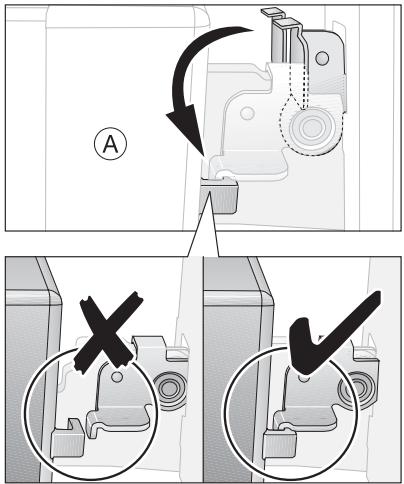
- Close the oven door.
What to do if ...
| Problem | Possible cause | Remedy |
| The cooking zones are not functioning | Consult the operating instructions for the built-in cooking surface | |
| The oven does not heat up | The oven is not switched on | Switch the oven on |
| The clock is not set | Set the current time on the clock | |
| The required settings have not been set | Check the settings | |
| The house wiring fuse (in the fuse box) has tripped | Check the fuse. If the fuses trip a number of times, please call an authorised electrician. | |
| The oven lighting is not operating | The oven light bulb is faulty | Replace the oven bulb |
If you are unable to remedy the problem by following the above suggestions, please contact your local Service Force Centre.

Warning! Repairs to the appliance are only to be carried out by qualified service engineers. Considerable danger to the user may result from improper repairs.

If the appliance has been operated incorrectly, the engineer's visit will be chargeable, even during the warranty period.

Advice on cookers with metal fronts:
Because of the cold surface at the front of the cooker, opening the oven door during (or just after) baking or roasting may cause the glass to steam up.
Disposal

Packaging material
The packaging materials are environmentally friendly and can be recycled. The plastic components are identified by markings, e.g. >PE<, >PS<, etc. Please dispose of the packaging materials in the appropriate container at the community waste disposal facilities.

Old appliance
The symbol 📋 on the product or on its packaging indicates that this product may not be treated as household waste. Instead it shall be handed over to the applicable collection point for the recycling of electrical and electronic equipment. By ensuring this product is disposed of correctly, you will help prevent potential negative consequences for the environment and human health, which could otherwise be caused by inappropriate waste handling of this product. For more detailed information about recycling of this product, please contact your local city office, your household waste disposal service or the shop where you purchased the product.

Warning: So that the old appliance can no longer cause any danger, make it unusable before disposing of it.
To do this, disconnect the appliance from the mains supply and remove the mains cable from the appliance.
Service
In the event of technical faults, please first check whether you can remedy the problem yourself with the help of the operating instructions (section "What to do if...").
If you were not able to remedy the problem yourself, please contact the Customer Care Department or one of our service partners.
In order to be able to assist you quickly, we require the following information:
- Model description
- Product number (PNC)
- Serial number (S No.) (for numbers see rating plate)
- Type of fault
– Any error messages displayed by the appliance
So that you have the necessary reference numbers from your appliance at hand, we recommend that you write them in here:
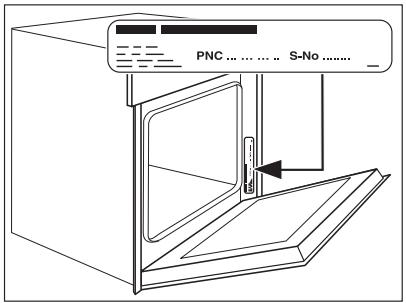
Model description: ____
PNC:
S No: ....
- Operating Instructions
- Safety instructions
- Electrical safety
- Child Safety
- Safety whilst using
- i Information on acrylamides
- How to avoid damage to the appliance
- Note on enamel coating
- Description of the Appliance
- General Overview
- Inside of door
- Oven steam vent
- Oven accessories
- Oven shelf
- Baking tray
- Roasting Pan
- Before Using for the first time
- Setting and changing the time
- Initial Cleaning
- Using the Rings
- Heat settings
- Setting the heat setting
- Cooking with the automatic warm up function
- Automatic cut-out function for the rings
- The rings switch themselves off for:
- Starting up after an automatic cut-out
- Using the Oven
- Cooling fan
- Oven Functions
- Inserting the Oven Shelf, Baking Tray and Roasting Pan
- Shelf runner safety and anti-tip device
- Inserting the baking tray or roasting pan
- Inserting the oven shelf:
- Inserting the oven shelf and roasting pan together
- Inserting/Removing the Fat Filter
- Inserting the fat filter
- Taking out the fat filter
- Minute minder
- Duration
- End
- Time of day
- How to use the clock functions
- Switching Off the Time Display
- Switching on the time display
- Duration and End combined
- Uses, Tables and Tips
- Cooking table
- Baking
- Oven function: True fan 📋 or Conventional □
- Baking tins
- Oven levels
- General instructions
- How to use the baking tables
- Baking table
- Roasting
- Oven function: Conventional □ or Rotitherm 🌐
- Roasting dishes
- Tips on using the roasting chart
- Grill sizes
- Defrosting
- Drying
- Making preserves
- Oven function: Base heat
- Preserves table
- Cleaning and Care
- Outside of the appliance
- Oven interior
- Accessories
- Fat Filter
- Shelf Support Rails
- Removing the shelf support rails
- Fitting the shelf support rails
- Oven lighting
- Replacing the oven light bulb/cleaning the glass cover
- Oven Ceiling
- Folding down the heating element
- Cleaning the oven ceiling
- Repositioning the heating element
- Oven door
- Removing the oven door from its hinges
- Hanging the oven door back on its hinges
- Oven door glass
- Cleaning the door glass panels
- Putting the door glass panels back.
- What to do if ...
- Disposal
- Packaging material
- Old appliance
- Service
Brand : AEG-ELECTROLUX
Model : E4106-5-M DE R08
Category : Built-in oven