CK130G - Oven Manta - Free user manual and instructions
Find the device manual for free CK130G Manta in PDF.


| Product Type | Gas Cooker (Hob) |
| Model | CK130G |
| Dimensions (W x D x H) | 614 x 375 x 83 mm |
| Weight | 3.9 kg |
| Gas Type | LPG Propane-Butane G30 |
| Gas Pressure | 36/37 mbar |
| Total Power | 4.30 kW |
| Number of Burners | 3 |
| Ignition | Manual (match or spark) |
| Rated Voltage | 220-240 V (50/60 Hz) |
| Material | Enamel coated steel |
| Installation | Must be installed by a professional; requires well-ventilated area; min. 20 cm from walls |
| Gas Connection | Via rubber hose and regulator; not direct to cylinder |
| Safety Features | Gas shut-off valve on cylinder; never use open flame for leak test |
| Cleaning | Wait for cooling; use mild detergent; avoid abrasives |
| Disposal | Do not dispose with household waste; recycle at collection points |
| Warranty | Keep receipt and guarantee card |
| Intended Use | Household cooking only |
| Certification | CE marked |
Frequently Asked Questions - CK130G Manta
User questions about CK130G Manta
0 question about this device. Answer the ones you know or ask your own.
Ask a new question about this device
Download the instructions for your Oven in PDF format for free! Find your manual CK130G - Manta and take your electronic device back in hand. On this page are published all the documents necessary for the use of your device. CK130G by Manta.
USER MANUAL CK130G Manta
natural_image
Abstract black-and-white circular logo with interlocking curved shapes (no text or symbols)MANTA
Gas cooker
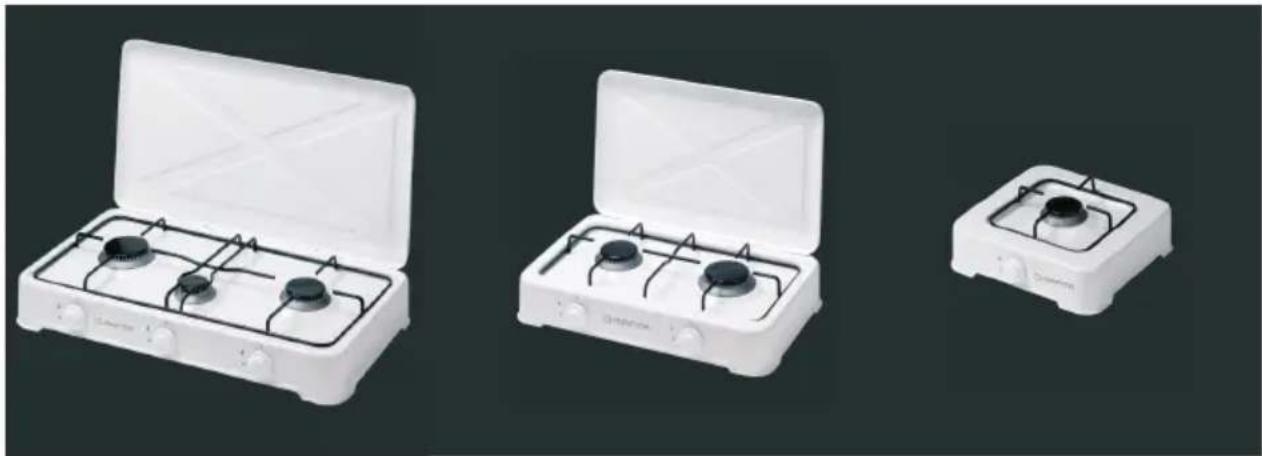
CK110G/CK120G/CK130G
natural_image
Three white electric cookers with black end caps and open doors, displayed against a dark background (no text or symbols visible)CK 130G CK 120G CK 110G
Instrukcja obsługi
User's Manual
Instrukcja obsługi
INFORMACJE OGÓLE 5
INSTALACJA 7
ZAPALANIE I GASZENIE PALNIKÓW....12
CZYSZCZENIE I KONSERWACJA....13
WAŻNE UWAGI 14
CLEANING AND MAINTENANCE 27
IMPORTANT NOTICES 28
TECHNICAL PARAMETERS 28
Uwaga!
URZĄDZENIE MOŻNA PODŁĄCZAĆ TYLKO DO BUTLI Z GAZEM LPG PROPAN-BUTAN (3B/P) G30, NIE NALEŻY PODŁĄCZAĆ KUCHENKI DO INSTALACJI ZIEMNEJ ZASILANEJ METANEM STOSOWANEJ W MIESZKANIACH I BLOKACH.

URZĄDZENIE SŁUŻY DO UŻYTKU ZEWNĘTRZNEGO, NIE NALEŻY INSTALOWAĆ KUCHENKI W MIEJSCACH ZA-MKNIĘTYCH ANI W POMIESZCZENIACH MIESZKALNYCH
Uwaga!
Palniki gazowe
natural_image
Simple line drawing of a heating setup with steam rising from a pot (no text or symbols)natural_image
Simple line drawing of a cooking pot on a gas stove (no text or symbols)natural_image
Symbol of a trash bin with crossed lines indicating no waste or discharge, and a solid black rectangle below (no text or labels)
MANTA

INFOLINIA SERWISOWA
- THE EQUIPMENT SHOULD BE INSTALLED ACCORDING TO THE APPLICABLE LAW AND USED ONLY IN WELL VENTILATED ROOMS. READ THE MANUAL BEFORE INSTALLATION AND OPERATION.
- The device may be placed on any flat surface which is mechanically strong and withstands the temperature of up to 80oC.
- The cooker should be installed away from combustible materials, with the minimum distance of 20 cm from the walls. Any objects hanging over the cooker should be at least 75 cm above it.
- The room where the cooker is operated must be ventilated suitably. The cooker is not designed to and has no option for driving off the fumes, therefore, flow of air must be ensured to ensure the safety of the household members.
- The equipment is not connected to ducts driving off fumes. It should be installed and connected in accordance with the existing regulations related to installation. In particular, take account of the relevant requirements regarding ventilation.
- The gas duct must have clamps on both ends. The duct must be secured against slipping off the gas termination.
-
The method of installing the gas duct must prevent its stretching, twisting, or bending. Also, secure it in a way that prevents exposure to fire or high temperatures.
-
Regularly check the condition of the gas duct; in case of any damages, e.g. never repair a gas leakage, but replace the entire duct.
- Having installed the cooker, test for its tightness. Never use fire to do that. Instead, use soap solution or a special device for checking tightness. When using the soap solution for testing, the soap bubbles appearing indicate a gas leak. If that happens, close the main gas valve and contact the authorised service station.
- Make sure the output pressure becomes main pressure of 36/37 mbar for propane-butane
- The recommended gas is propane-butane (3B/P) G30, feed pressure of 36/37 mbar.
- The conditions for setting up the equipment are provided on the label (or the rating plate).
- Before installation, make sure the local conditions for distribution (type of gas and pressure) and the settings are correct.
- The equipment must not be connected directly to a gas cylinder. It should be connected via a regulator. The feed conditions are specified on the rating plate.
- The equipment may be fed only with LPG propane-butane (G30), at pressure reduced to 36 mbar.
- Before installing, make sure the local conditions for distribution (gas type and pressure) and the settings of the equipment comply with the conditions specified in the rating plate. It should be installed and connected in accordance with the current regulations related to installation. A special attention should be given to the relevant requirements related to ventilation.
- Using cooking equipment causes heat and humidity in the room it is installed. Make sure the room in which the cooker is located is well ventilated. Make sure the ventilation grid is always open or install a forced ventilation system (kitchen hood). Continued intensive use of the equipment may require additional ventilation, e.g. opening
windows or improving the capacity of the ventilation e.g. by switching the hood's operating mode to a higher intensity if available.
-
No repairs or upgrades of the equipment are permitted.
-
Cookers are repaired only by an authorised repair shop. Incorrect repairs may pose a significant threat.
-
A used cooker should be destroyed in a way that prevents its reuse. Next, the equipment should be disposed of with specialised entities dealing with waste or scrape metal. The packaging materials may be used for recycling.
GENERAL INFORMATION
The cooker is designed for preparing dishes, in households only. Using the cooker for other purposes is not permitted!
Important notes
- The cooker becomes hot when operating. Be careful not to touch the hot elements.
- Use protective gloves to take dishes off the gas burner.
- Overheated greases and oils may be ignited. Therefore always supervise the dishes being prepared using them.
- Before closing the lid, turn off all burners.
- Notice if all elements of the burners are correctly positioned before using them.
- Store inflammable objects away from the burners.
- Do not use the equipment for heating rooms.
- If the gas leaks:
- turn off the main valve on the cylinder or in the gas installation.
- close all burner valves
-
put out all burners and other inflammable sources
• air the room thoroughly, open windows -
do not operate electric devices (including the light)
-
report the issue in an authorised repair shop or call a certified installer.
-
The user may not:
-
independently convert the cooker to run on another type of gas, introduce changes to the kitchen installations,
• repair the equipment individually, - use the equipment in a room with no working ventilation,
- use the cooker in conditions of hindered access.
Preparing
- After unpacking, check if the equipment has no visible damages. Never connect the cooker that was damaged in transportation.
- Remove the film covering the cooker.
- Clean enamelled surfaces and burner covers with a moist cloth.
- Check if the individual elements of the burners are positioned correctly.
INSTALLATION
The instructions below are meant for a professional installer. Those instructions are to ensure that the actions related to the installation and maintenance of the equipment are performed professionally.
POSITIONING OF THE COOKER
-
The kitchen should be dry and airy and have working ventilation in line with the applicable technical regulations. The legal basis, based on which we assess if the gas cooker is fit for installation is the Regulation of the Minister of Infrastructure dated April 12, 2002 on technical conditions that should be met by buildings and their locations (Journal of Laws, 2002 No. 75 item 690) as amended
-
The room should be equipped with ventilation system that drives off the combustion fumes from the room. The installation should consist of a ventilation outlet or a hood. The hoods should be installed in line with the instructions from the manuals attached. The positioning of the cooker should guarantee unrestricted access to all controlling elements.
- The room should also guarantee access of fresh air, which is necessary to burn gas correctly. The air supply should not be less than 2 m3/h for burner power of 1 kW. The air may be supplied as a result of direct flow from outside via a duct with a minimum cross-section of 100 cm2, or indirectly from the neighbouring rooms, which are provided with ventilation ducts leading outside.
- If equipment is used intensively and for a long time, it may be necessary to open the window for improved ventilation.
- Liquid gas on which the cooker runs is heavier than air and therefore it has a tendency to gather at lower levels. The rooms in which the gas cylinders are installed should be equipped with ventilation ducts, led outside, allowing the gas to escape in the case there is a leakage. For that reason, the gas cylinders, both empty and full ones, should not be either stored or installed in rooms that are situated underground (e.g. cellars). Cylinders may not be located too close to sources of heat (stoves, chimneys, ovens, etc.), which could increase temperature inside the cylinder above 50oC.
- The cooker must be located 20 cm from the surrounding vertical surfaces. The surface on which the cooker stands should be sufficiently stable and be mechanically strong (for example, take account of the weight of the dishes with food). The thermal resistance of the material on which the cooker stands should be at least 80oC (in terms of temperature increment).
-
The cooker should stand on a hard, horizontal and even surface (do not set the cooker on any props, stands etc.).
-
The positioning of the cooker should guarantee unrestricted access to all controlling elements. Also, provide a free access to the main gas valve (e.g. the valve on the cylinder).
- In order to avoid the negative influence of the draughts on the operation of the burners, the cooker should not be located in line with a window and a door.
- Above the cooker, free space should be provided for the outflow of kitchen vapours. It is best to install a kitchen hood that will absorb or drive off those vapours.
After positioning it, the cooker should be connected to the internal gas installation (LPG) or a gas cylinder through a regulator with a hose.
Connecting the cooker to the gas installation (LPG)
Before connecting the cooker to the gas installation, make sure if the device complies with the local conditions (type of gas and pressure). In the case of any inconsistencies, do not connect the cooker to the installation Connecting the cooker to a gas cylinder (LPG)
- The cooker is provided with a termination, on which a certified rubber duct can be slipped.
- The duct connected to the cooker should be secured against slipping off the termination.
- The cooker may not be connected directly with the cylinder - always use a regulator.
- Each time the cooker is connected, check the tightness of the valve on the cylinder and the connection of the regulator to the cylinder and its operation.
Uwaga!
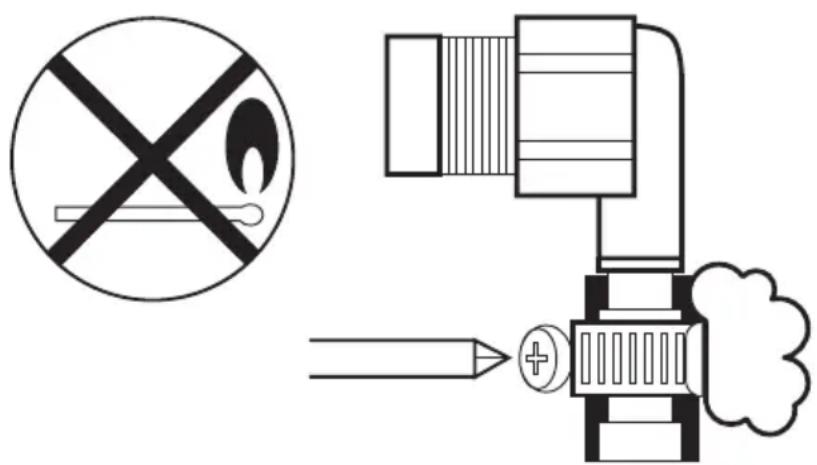
- Never check the tightness using an open flame (e.g. using matches or a candle). It poses the risk of explosion!
- Regularly, check the condition of the hose and the tightness of the connection, in line with the applicable regulations.
Gas burners
- Do not put deformed or unstable dishes on the grid as they may fall and flood the burners.
- Do not remove the grids to put the dishes directly on the burners.
- Do not put empty dishes over ignited burners.
- Before taking dishes off the burners, reduce the flame or put it out.
- The burners should be kept clean, as the dirt has a negative impact on their operation.
- The flow of gas in the individual burners is opened and closed using the gas knobs.
- Before igniting a burner, make sure the knob you want to turn matches the right burner that you want to use.
Selecting the flame
- The flame should not reach beyond the bottom of the dish, but cover two-thirds of its surface. Such use will allow to save gas and the flame will not stain dishes.
The size of the flame depends on the position of the knob. Full flame should be used until the food boils, and co -oking further is done best using a smaller, economy flame.
Igniting and putting out the burners Igniting
- before igniting the first burner, open the valve on the gas cylinder,
- press the knob of the selected burner until you feel its resistance, turn it anti-clockwise and put flame or spark to the selected burner,
• after igniting the gas, release the ignition button, - set the size of the flame.
-
Turning off
-
the burner is turned off by turning the gas knobs clockwise, to the closed position. (burner put down - knob blocked)
- When closing off the flow of gas, before turning off the last burner:
- turn off the valve on the gas cylinder,
• after putting down the flame, close the knob for that burner. - When the cooker is not in use, the valve of the gas cylinder should be closed.
Selection of dishes
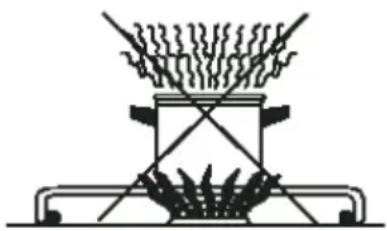
natural_image
Simple line drawing of a heating setup with steam rising from a pot (no text or symbols)Dish too small compared to the size of the burner, no lid
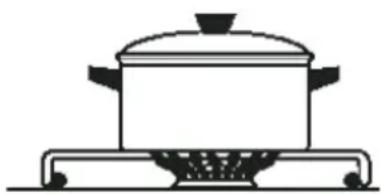
natural_image
Simple line drawing of a cooking pot on a gas stove (no text or symbols)Dish well selected
The dishes for cooking food should not be too tall. Their optimum height is two-thirds of the bottom's diameter.
Dishes should be always clean and dry, as that is when they conduct and retain heat best.
When cooking, the dishes should be covered by lids, which prevents excess vapours gathering in the kitchen.
CLEANING AND MAINTENANCE
NOTE!
If the cooker was used and is hot, wait for it to cool down before starting to clean it. Disconnect the gas from the cooker when cleaning.
- The cooker should be cleaned regularly. Cleaning should not be done using coarse cleaning agents that scratch the surface, wire meshes, aggressive chemicals and sharp objects.
- The knobs and the front panel should be cleaned using delicate fluids that do not contain any abrasives.
- Parts covered with enamel should be cleaned using a soft cloth or sponge with warm water and delicate detergent, not using too much water. Bigger stains should be removed with special products for cleaning kitchen.
- When cleaning the heating plate, do not allow water to get to the gas burners. The surface of the plate next to burners should always be clean, as stains make it more difficult for the gas mixture to burn.
- The burners should always be clean and dry, to make sure it always works correctly. They should be cleaned each time they are flooded with the food being cooked and cleaned regularly by removing the surface stains.
- A dirty grid should be taken off the heating plate, soaked in warm water with detergent, washed and dried.
- To clean the burners, take off the lids and covers and soak them in warm water with detergent.
IMPORTANT NOTICES
- Keep the guarantee and the receipt for the purchased cooker.
- After unpacking, check the cooker for mechanical damages.
- The packaging and installation parts should be protected from children.
- In the case of a failure or incorrect operation, please contact the authorised maintenance service.
- The cookers are designed to be used in the household. Using the cooker for purposes other than the purpose originally intended may be dangerous.
- The cooker is fed with propane-butane gas.
- The cooker may not be turned upside down.
- When using, the cooker should stand on a flat, horizontal surface.
TECHNICAL PARAMETERS
| Model: CK 110G CK 120G CK 130G | |||
| Product Size: 348 X 314 X 86mm | 486 X 341 X 83mm 614 | X 375 X 83mm | |
| WEIGHT: 1,44 kg 2,9 kg 3,9 kg | |||
| TYPE OF GAS: G30 G30 G30 | |||
| NOMINAL GAS PESSURE: | 36/37mbar | 36/37mbar | 36/37mbar |
| Power: | 1,83 kW | 3,30 kW | 4,30 kW |
| Rated voltage: | 220 V~240 V | 220 V~240 V | 220 V~240 V |
| Rated frequency: | 50 Hz/ 60 Hz | 50 Hz/ 60 Hz | 50 Hz/ 60 Hz |
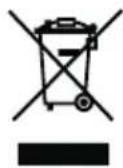
INFORMATION ON THE CORRECT PROCEEDINGS IN THE CASE OF DISPOSING OF ELECTRONIC AND ELECTRIC DEVICE
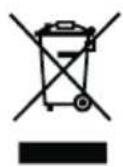
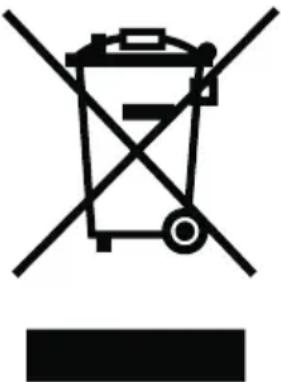
The crossed dust bin symbol placed on our products indicates that the redundant electric or electronic products should not be disposed together with household waste.
Appropriate action in the event of having to dispose of equipment or components, or recycle them involves bringing the machine to a collection point where it will be accepted free of charge. In some countries you may dispose of the product when purchasing a new device.
The correct disposal of this product makes it possible to preserve the earth's natural resources for longer and prevents the degradation of the environment. Information about collection points is issued by local authorities.
Incorrect disposal of waste is subject to penalties provided for in the law of the relevant area.
natural_image
Symbol of a trash bin crossed with no text or numbers, representing waste sorting or disposal (no text present)
natural_image
Abstract black-and-white circular logo design with interlocking curved shapes (no text or symbols)MANTA

CUSTOMER SERVICE
tel: +48 22 332 34 63 or e-mail: serwis@manta.com.pl
FROM MONDAY TO FRIDAY, IN HOURS: 9.00-17.00
The manufacturer reserves the right to introduce changes
- MANTA
- Gas cooker
- CK110G/CK120G/CK130G
- Instrukcja obsługi
- Uwaga!
- Palniki gazowe
- INFOLINIA SERWISOWA
- GENERAL INFORMATION
- Important notes
- Preparing
- INSTALLATION
- POSITIONING OF THE COOKER
- Connecting the cooker to the gas installation (LPG)
- Gas burners
- Selecting the flame
- Igniting and putting out the burners Igniting
- Selection of dishes
- CLEANING AND MAINTENANCE
- NOTE!
- IMPORTANT NOTICES
- INFORMATION ON THE CORRECT PROCEEDINGS IN THE CASE OF DISPOSING OF ELECTRONIC AND ELECTRIC DEVICE
- CUSTOMER SERVICE
Brand : Manta
Model : CK130G
Category : Oven