
XP-5000 - Audio Amplifier YAMAHA - Free user manual and instructions
Find the device manual for free XP-5000 YAMAHA in PDF.


| Product Type | Professional Audio Amplifier |
| Brand | YAMAHA |
| Model | XP-5000 |
| Output Power | 5000 W (sum of channels) |
| Number of Channels | 2 channels (stereo) |
| Impedance | 4 ohms per channel |
| Frequency Response | 20 Hz - 20 kHz |
| Signal-to-Noise Ratio | > 100 dB |
| Total Harmonic Distortion | < 0.05 % |
| Power Supply | 230 V AC, 50/60 Hz |
| Dimensions (W x H x D) | 480 x 89 x 420 mm (2U rack) |
| Weight | 15.5 kg |
| Inputs | XLR, 6.35 mm Jack, RCA |
| Outputs | Speaker terminals, SpeakON |
| Protection | Short-circuit, overload, clipping protection |
| Cooling | Variable speed fans |
| Main Functions | Stereo amplification, mono bridge mode, high-pass filters |
| Maintenance and Cleaning | Unplug before cleaning; use a dry cloth |
| Safety | Do not expose to moisture; use a grounded outlet |
| Spare Parts and Repairability | Contact a Yamaha authorized center |
Frequently Asked Questions - XP-5000 YAMAHA
User questions about XP-5000 YAMAHA
0 question about this device. Answer the ones you know or ask your own.
Ask a new question about this device
Download the instructions for your Audio Amplifier in PDF format for free! Find your manual XP-5000 - YAMAHA and take your electronic device back in hand. On this page are published all the documents necessary for the use of your device. XP-5000 by YAMAHA.
USER MANUAL XP-5000 YAMAHA
This product, when installed as indicated in the instructions contained in this manual, meets FCC requirements. Modifications not expressly approved by Yamaha may void your authority, granted by the FCC, to use the product.
2. IMPORTANT: When connecting this product to accessories and/or another product use only high quality shielded cables. Cable/s supplied with this product MUST be used. Follow all installation instructions. Failure to follow instructions could void your FCC authorization to use this product in the USA.
- This applies only to products (XP7000, XP5000) distributed by YAMAHA CORPORATION OF AMERICA.
(oscillator)
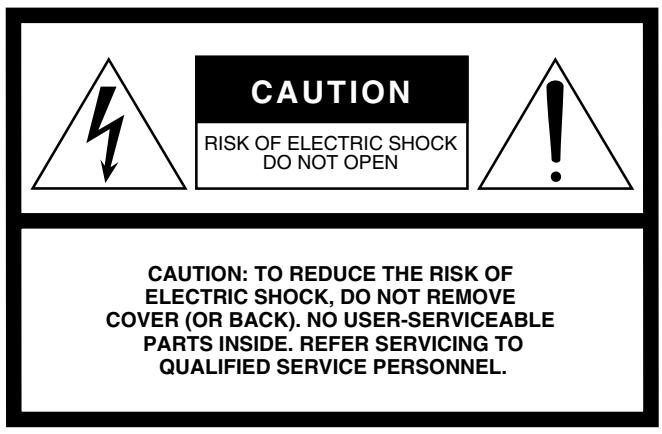
The above warning is located on the top of the unit.
Explanation of Graphical Symbols
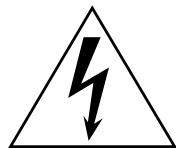
The lightning flash with arrowhead symbol within an equilateral triangle is intended to alert the user to the presence of uninsulated "dangerous voltage" within the product's enclosure that may be of sufficient magnitude to constitute a risk of electric shock to persons.

The exclamation point within an equilateral triangle is intended to alert the user to the presence of important operating and maintenance (servicing) instructions in the literature accompanying the product.
IMPORTANT SAFETY INSTRUCTIONS
1 Read these instructions.
2 Keep these instructions.
3 Heed all warnings.
4 Follow all instructions.
5 Do not use this apparatus near water.
6 Clean only with dry cloth.
7 Do not block any ventilation openings. Install in accordance with the manufacturer's instructions.
8 Do not install near any heat sources such as radiators, heat registers, stoves, or other apparatus (including amplifiers) that produce heat.
9 Do not defeat the safety purpose of the polarized or grounding-type plug. A polarized plug has two blades with one wider than the other. A grounding type plug has two blades and a third grounding prong. The wide blade or the third prong are provided for your safety. If the provided plug does not fit into your outlet, consult an electrician for replacement of the obsolete outlet.
10 Protect the power cord from being walked on or pinched particularly at plugs, convenience receptacles, and the point where they exit from the apparatus.
11 Only use attachments/accessories specified by the manufacturer.
12 Use only with the cart, stand, tripod, bracket, or table specified by the manufacturer, or sold with the apparatus. When a cart is used, use caution when moving the cart/apparatus combination to avoid injury from tip-over.
13 Unplug this apparatus during lightning storms or when unused for long periods of time.
14 Refer all servicing to qualified service personnel. Servicing is required when the apparatus has been damaged in any way, such as power-supply cord or plug is damaged, liquid has been spilled or objects have fallen into the apparatus, the apparatus has been exposed to rain or moisture, does not operate normally, or has been dropped.
WARNING
TO REDUCE THE RISK OF FIRE OR ELECTRIC SHOCK, DO NOT EXPOSE THIS APPARATUS TO RAIN OR MOISTURE.
(98-6500)
PRECAUTIONS
PLEASE READ CAREFULLY BEFORE PROCEEDING
- Please keep this manual in a safe place for future reference.

WARNING
Always follow the basic precautions listed below to avoid the possibility of serious injury or even death from electrical shock, short-circuiting, damages, fire or other hazards. These precautions include, but are not limited to, the following:
Power supply/Power cord
- Only use the voltage specified as correct for the device. The required voltage is printed on the name plate of the device.
- Use only the included power cord.
- Do not place the power cord near heat sources such as heaters or radiators, and do not excessively bend or otherwise damage the cord, place heavy objects on it, or place it in a position where anyone could walk on, trip over, or roll anything over it.
- Be sure to connect to an appropriate outlet with a protective grounding connection. Improper grounding can result in electrical shock.
Do not open
- Do not open the device or attempt to disassemble the internal parts or modify them in any way. The device contains no user-serviceable parts. If it should appear to be malfunctioning, discontinue use immediately and have it inspected by qualified Yamaha service personnel.
Water warning
- Do not expose the device to rain, use it near water or in damp or wet conditions, or place containers on it containing liquids which might spill into any openings.
- Never insert or remove an electric plug with wet hands.
If you notice any abnormality
- If the power cord or plug becomes frayed or damaged, or if there is a sudden loss of sound during use of the device, or if any unusual smells or smoke should appear to be caused by it, immediately turn off the power switch, disconnect the electric plug from the outlet, and have the device inspected by qualified Yamaha service personnel.
- If this device should be dropped or damaged, immediately turn off the power switch, disconnect the electric plug from the outlet, and have the device inspected by qualified Yamaha service personnel.

CAUTION
Always follow the basic precautions listed below to avoid the possibility of physical injury to you or others, or damage to the device or other property. These precautions include, but are not limited to, the following:
Power supply/Power cord
- Remove the electric plug from the outlet when the device is not to be used for extended periods of time, or during electrical storms.
- When removing the electric plug from the device or an outlet, always hold the plug itself and not the cord. Pulling by the cord can damage it.
Location
- Before moving the device, remove all connected cables.
- When setting up the product, make sure that the AC outlet you are using is easily accessible. If some trouble or malfunction occurs, immediately turn off the power switch and disconnect the plug from the outlet. Even when the power switch is turned off, electricity is still flowing to the product at the minimum level. When you are not using the product for a long time, make sure to unplug the power cord from the wall AC outlet.
- Do not use the device in a confined, poorly-ventilated location. If this device is to be used in a small space other than an EIA-standard rack, make sure that there is adequate space between the device and surrounding walls or other devices: at least 5cm at the sides, 10cm behind and 10cm above. Inadequate ventilation can result in overheating, possibly causing damage to the device(s), or even fire.
- Do not expose the device to excessive dust or vibrations, or extreme cold or heat (such as in direct sunlight, near a heater, or in a car during the day) to prevent the possibility of panel disfiguration or damage to the internal components.
-
Do not place the device in an unstable position where it might accidentally fall over.
-
Do not block the vents. This device has ventilation holes at the front and rear to prevent the internal temperature from becoming too high. In particular, do not place the device on its side or upside down. Inadequate ventilation can result in overheating, possibly causing damage to the device(s), or even fire.
- Do not use the device in the vicinity of a TV, radio, stereo equipment, mobile phone, or other electric devices. Doing so may result in noise, both in the device itself and in the TV or radio next to it.
- Do not place the device in a location where it may come into contact with corrosive gases or salt air. Doing so may result in malfunction.
Connections
- Before connecting the device to other devices, turn off the power for all devices. Before turning the power on or off for all devices, set all volume levels to minimum.
- Use only speaker cables for connecting speakers to the speaker jacks. Use of other types of cables may result in fire.
- Be sure to connect to a properly grounded power source. A ground screw is provided on the rear panel of this device for maximum safety and shock prevention. If the mains outlet is not grounded, be sure to connect the ground screw to a confirmed ground point before plugging the device into the mains. Improper grounding can result in electrical shock.
Maintenance
- Remove the power plug from the AC outlet when cleaning the device.
Handling caution
- When turning on the AC power in your audio system, always turn on the device LAST, to avoid speaker damage. When turning the power off, the device should be turned off FIRST for the same reason.
- Do not insert your fingers or hands in any gaps or openings on the device (vents, etc.).
-
Avoid inserting or dropping foreign objects (paper, plastic, metal, etc.) into any gaps or openings on the device (vents, etc.) If this happens, turn off the power immediately and unplug the power cord from the AC outlet. Then have the device inspected by qualified Yamaha service personnel.
-
Do not use the device for a long period of time at a high or uncomfortable volume level, since this can cause permanent hearing loss. If you experience any hearing loss or ringing in the ears, consult a physician.
- Do not rest your weight on the device or place heavy objects on it, and avoid use excessive force on the buttons, switches or connectors.
- Do not use this device for any purpose other than driving loudspeakers.
Yamaha cannot be held responsible for damage caused by improper use or modifications to the device, or data that is lost or destroyed.
Always turn the power off when the device is not in use.
Even when the power switch is in the "STANDBY", electricity is still flowing to the device at the minimum level. When you are not using the device for a long time, make sure you unplug the power cord from the wall AC outlet.
The performance of components with moving contacts, such as switches, volume controls, and connectors, deteriorates over time. Consult qualified Yamaha service personnel about replacing defective components.
Illustrations in this manual are for explanatory purposes only, and may not match the actual appearance of the product during operation.
Company names and product names used in this Owner's Manual are trademarks or registered trademarks of their respective owners.
IMPORTANT NOTICE FOR THE UNITED KINGDOM
Connecting the Plug and Cord
WARNING: THIS APPARATUS MUST BE EARTHED
IMPORTANT. The wires in this mains lead are coloured in accordance with the following code:
GREEN-AND-YELLOW : EARTH
BLUE : NEUTRAL
BROWN : LIVE
As the colours of the wires in the mains lead of this apparatus may not correspond with the coloured markings identifying the terminals in your plug proceed as follows:
The wire which is coloured GREEN-and-YELLOW must be connected to the terminal in the plug which is marked by the letter E or by the safety earth symbol ① or colored GREEN or GREEN-and-YELLOW.
The wire which is coloured BLUE must be connected to the terminal which is marked with the letter N or coloured BLACK.
The wire which is coloured BROWN must be connected to the terminal which is marked with the letter L or coloured RED.
- This applies only to products distributed by Yamaha-Kemble Music (U.K.) Ltd. (3 wires)
This mark indicates a dangerous electrically live terminal. When connecting an external wire to this terminal, it is necessary either to have "a person who have received appropriate guidance on handling" make the connection or to use leads or a cord that have been manufactured in such a way that the connection can be made simply and without problem.
Thank you for purchasing a Yamaha XP7000, XP5000, XP3500, XP2500, XP1000 Series Power Amplifier.
The XP Series of power amplifiers was developed from Yamaha's wealth of experience in building PA equipment and its tradition of careful attention to every detail of circuit design. These power amplifiers feature high power—thanks to EEEngine (Energy Efficient Engine) technology—and superb quality together with superior reliability and stability, guaranteeing the highest possible audio performance.
Main features include
- Three modes are provided to support a broad range of applications: STEREO mode which can be driven by two independent sources, PARALLEL mode in which a monaural source drives both channels, and BRIDGE mode in which the two internal amps function as a single high-power mono amp.
- Balanced XLR connector and Euroblock connector inputs, and Speakon connector and five-way binding post outputs are provided.
- A high pass filter switch that enables selection of the cutoff frequency (20Hz or 55Hz).
- Signal indicator, clip indicator and sophisticated dB step Volume control are provided for each channel.
- A PROTECTION indicator that shows the state of various protection systems (power on/off detection, output protection, DC detection), a TEMP indicator that indicates heat sink overheating, and a POWER/STANDBY indicator that indicates the power status.
- Variable-speed low-noise fans ensure high reliability.
- The XP7000 enables parallel connection of multiple high-impedance speakers that support 70V line output.
- The XP3500 enables parallel connection of multiple high-impedance speakers that support 100 V line output.
- A MONITOR/REMOTE terminal that allows monitoring or control over the amplifier via a network.
This Owner's Manual applies to the XP7000, XP5000, XP3500, XP2500, XP1000 power amplifier. In order to take full advantage of your power amplifier and enjoy long and trouble-free operation, please read this Owner's Manual carefully before using your Power Amplifier.
Contents
Controls and Functions. 6
Front Panel 6
Rear Panel 7
Speaker Connections 8
Stereo Mode 8
Parallel Mode 8
Bridged Mode
(use as high-power mono amplifier) 9
High-impedance speaker connections.. 10
Connection 11
Using a Euroblock connector 11
Speaker Connection 11
Troubleshooting 12
Specifications 13
General Specifications 13
MONITOR/REMOTE PIN layout 15
Dimensions 15
Block Diagram 16
Current Draw 18
■ Front Panel

* The illustration shows model XP7000.
① POWER switch and indicator
Press this to turn the power on or off. The POWER/STANDBY indicator lights up in green when the power is ON. If the amplifier has been set to STANDBY mode, the indicator is lit in orange.
② TEMP indicator
Lights up red if the heat sink temperature exceeds 85^ (185^) .
③ PROTECTION indicator
When the protection system is active, the PROTECT indicator light up in red and the speakers are automatically disconnected from the amplifier's outputs. The protection system activates in the following situations:
When the amplifier is turned on
The protection system activates for approximately three seconds when the amplifier is turned on. After three seconds, the protection system deactivates automatically and the amplifier is ready for normal operation.
If a DC voltage is detected at the amplifier's outputs
XP7000/5000: Power shut down and the indicator is not lit.
XP3500/2500/1000: The protection system is active. Once the DC voltage problem is corrected, the protection system deactivates automatically and the amplifier is ready for normal operation.
If the amplifier overheats
When overheating occurs, the PROTECT/MUTE indicator lights. You should immediately turn off the amplifier and allow it time to cool down. See the Precautions section of this Owner's Manual for ways to prevent the amplifier from overheating.
④ CLIP indicator
Lights up red when the output signal distortion on the corresponding channel rises above 1% — indicating that “clipping” has occurred because the signal level is too high.
⑤ SIGNAL indicator
Lights up green when the corresponding channel's output level exceeds 2 Vrms (equivalent to 1/2W into an 8Ω load, or 1 W into a 4 load).
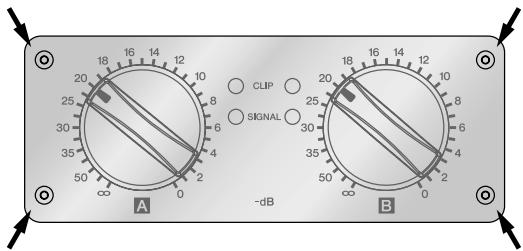
Volume control knobs
Each control knob adjusts the volume of the corresponding channel, in 31 steps from - dB to 0dB
- If you wish to lock in the knob settings, you can fasten the supplied security cover over the knobs so that the settings will not be disturbed.
- How to install the security cover
(1) Use the supplied hex wrench to remove the four attachment screws from the amplifier.
(2) Adjust the security cover to the position of screw holes. Fasten it into place using the same screws.
⑦ Air intakes
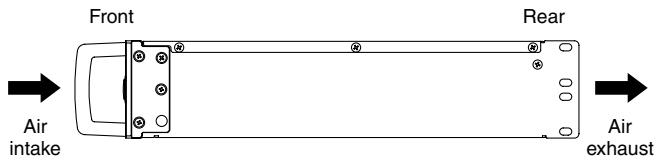
The amplifier uses forced-air cooling. The cooling fans draw air in from the front and exhaust it through the rear. Please be sure that you do not block the air intakes or exhaust vents.
- The fans do not come on at initial power-on, but will switch on automatically when the temperature of the heat sink rises above 50^ (122°F). The fan speed will then vary automatically as the temperature changes.
Rear Panel
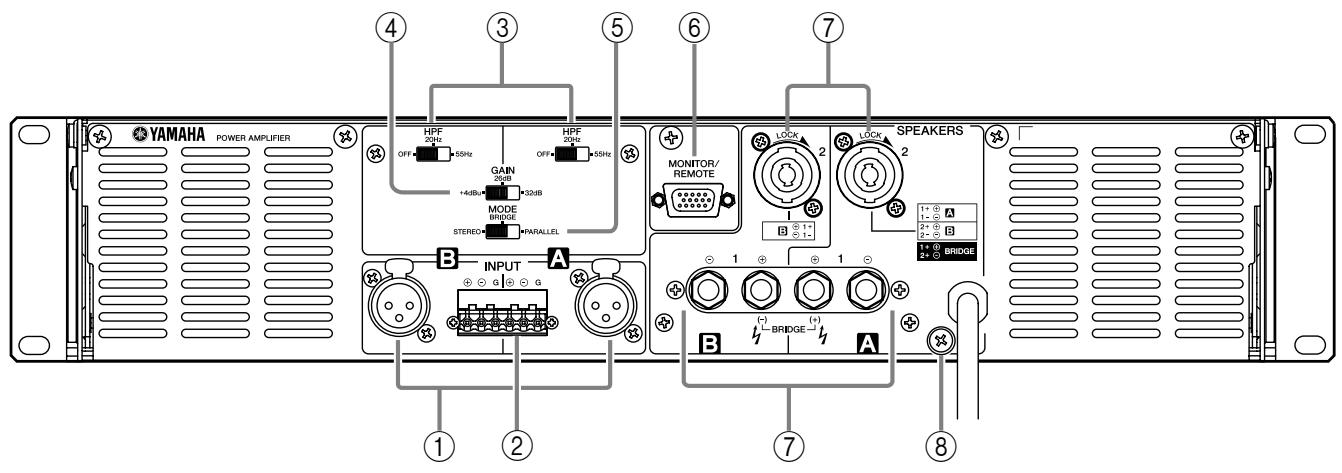
① XLR inputs connectors
These balanced XLR-3-31 type connectors are used to connect input signals.
The pins are wired as shown below (IEC 60268).
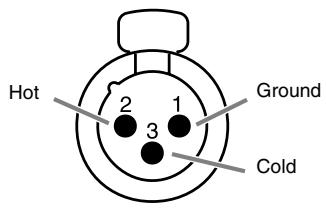
- In bridged mode, only the first channel in the pair is active; i.e., channel A of pair A/B. Make sure not to input an audio signal to an inactive input terminal.
② Euroblock connectors
These balanced Euroblock connectors are used to connect input signals.
③ HPF switches
These switches are used to turn on and off the HPF (High Pass Filter) for each channel. When this is set to 20Hz or 55Hz , frequencies below the respective settings are filtered using a 12 dB/octave high pass filter.
④ GAIN switch
This switch is used when changing the Gain of the A and B channels simultaneously.
- +4dBu: The maximum output power can be obtained when +4dBu is input.
26dB: Setting of 26dB - 32dB: Setting of 32dB
⑤ MODE switch
- STEREO mode
In STEREO mode, channels A and B are completely independent.
PARALLEL mode
In PARALLEL mode, the channel A input signal is sent both to the channel A power amp and the channel B power amp. In this case, loads are automatically connected between the A and B input terminals.
BRIDGED mode
In BRIDGED mode, channels A and B operate simultaneously, functioning as a single mono amplifier.
Note: When in PARALLEL and BRIDGED modes, input terminals A and B are shorted automatically. Make sure not to input an audio signal to an inactive input terminal.
⑥ MONITOR/REMOTE terminals
This terminal is used to connect the external device for monitoring or remote control. Refer to "MONITOR/REMOTE PIN layout" on page 15.
⑦ SPEAKERS terminals
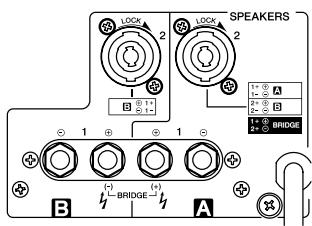
1: These 5-way binding posts are used to connect speakers.
2: These are Speakon type output jacks. Speakon type cable plugs can be connected here.
(8) GND terminal
If you are having a problem with hum or noise, use this terminal to connect to ground (earth) or to connect to the chassis of a mixer, preamp, or other device in your system.
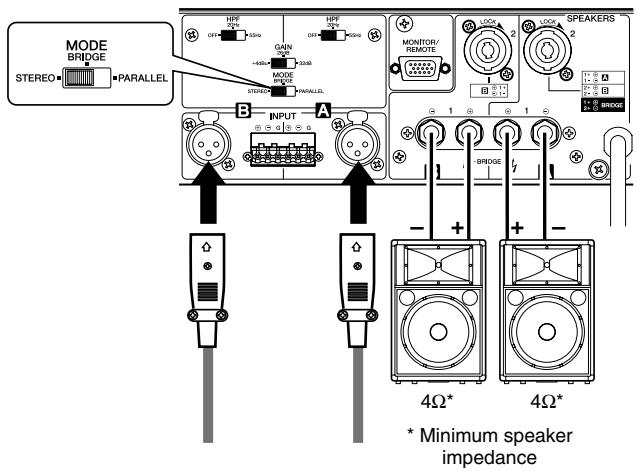
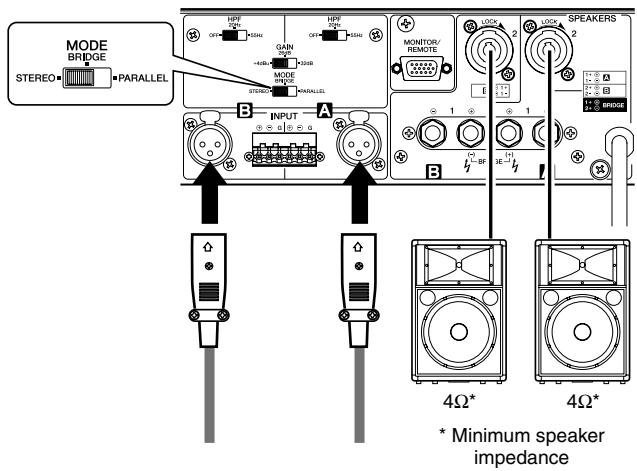
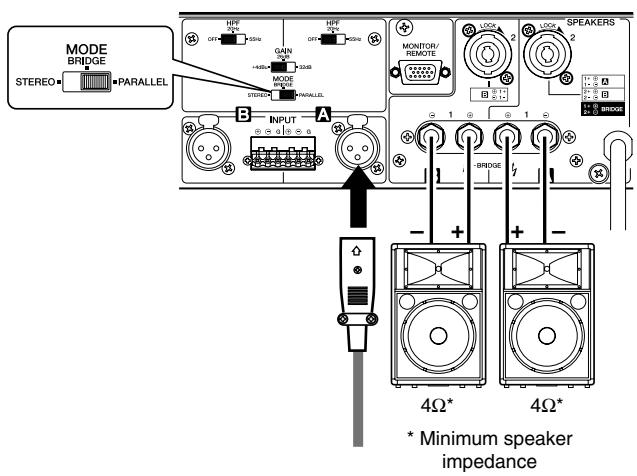
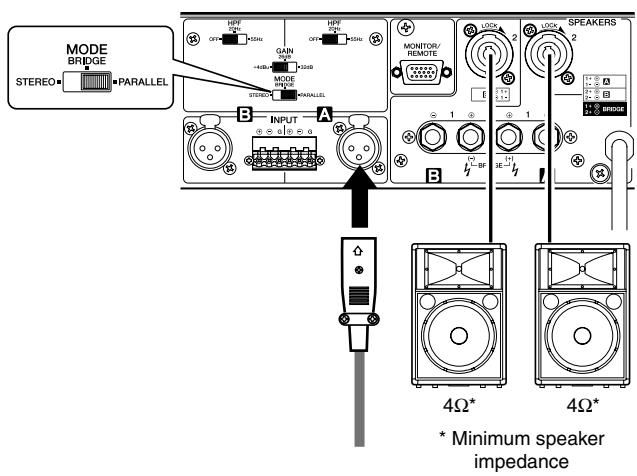
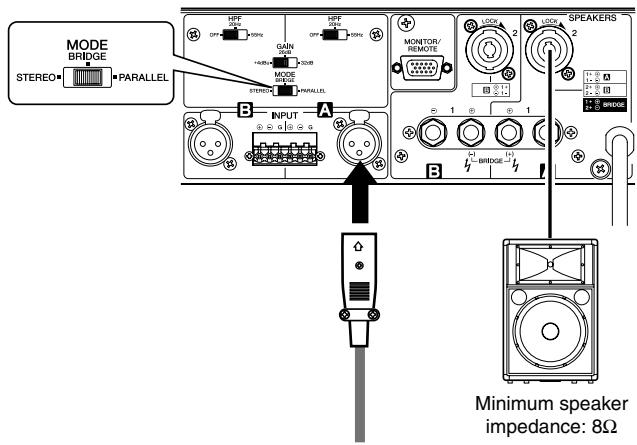
Speakers can be connected to the amplifier in three ways, as shown below. Note that speaker impedance will vary according to the connection method and the number of speakers. Please be sure that your speaker's impedance is not less than the relevant minimum value indicated below.
■ Stereo Mode
Set the Mode switch to STEREO to use the unit as a stereo amplifier. The volume controls on the front panel (A and B) let you control the volume of each channel independently.
- 5-way binding post
- Speakon connector
Parallel Mode
Set the Mode switch to PARALLEL to use the unit as a two-channel mono amplifier. The volume controls on the front panel (A and B) let you control the volume of each channel independently.
Note: In this case, the loads for A and B are connected directly in the amplifier. Make sure not to input any signal to the B terminal.
- 5-way binding post
- Speakon connector
■ Bridged Mode (use as high-power mono amplifier)
Set the Mode switch to BRIDGE to use the unit as a high-power mono amplifier. The volume control A on the front panel A lets you control the volume.
Note: In this case, the loads for A and B are directly connected in the amplifier. Make sure not to input any signal to the B terminal.
5-way binding post
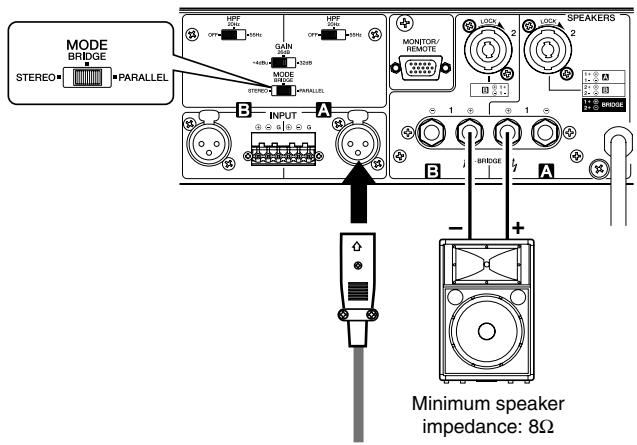
- Speakon connector
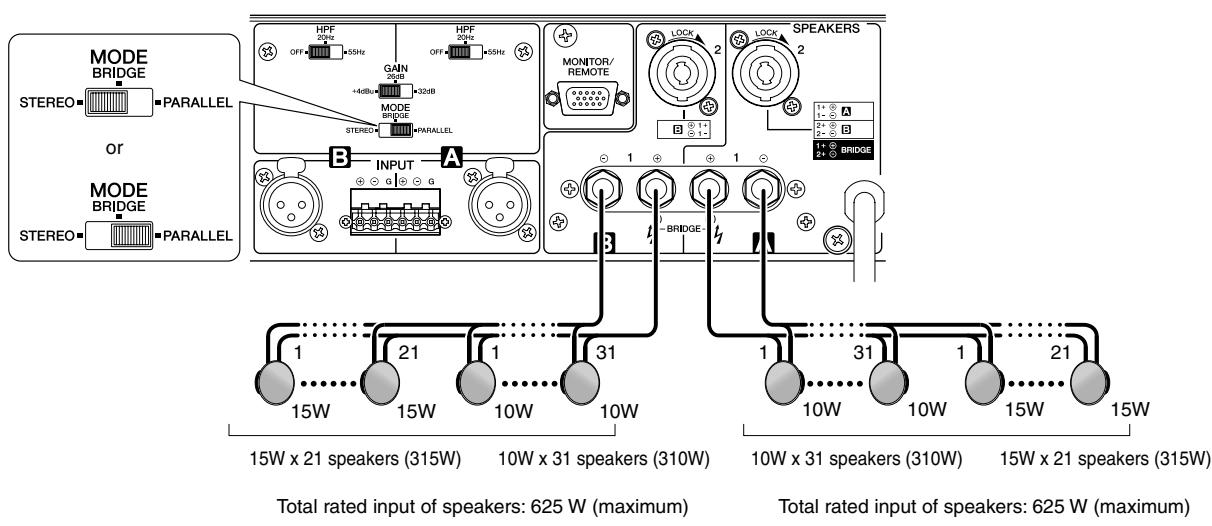
The XP7000 enables you to connect in stereo or parallel fashion multiple high-impedance speakers that support 70V line output.
The number of speakers that can be connected varies depending on the speaker's rated input. You can connect speakers with a total rated input per channel of up to 625 W.
For example, if you are using speakers with a rated input of 10W and 15W , you can connect up to 31 speakers at 10W (for 310W ), and 21 speakers at 15W (for 315W ). The total is 625W per channel.

CAUTION
Be sure to use speakers that support the XP7000's line-out voltage of 70 V.
The XP3500 enables you to connect in bridge fashion multiple high-impedance speakers that support 100V line output. You can connect speakers with a total rated input of up to 625 W.

CAUTION
Be sure to use speakers that support the XP3500's line-out voltage of 100 V.
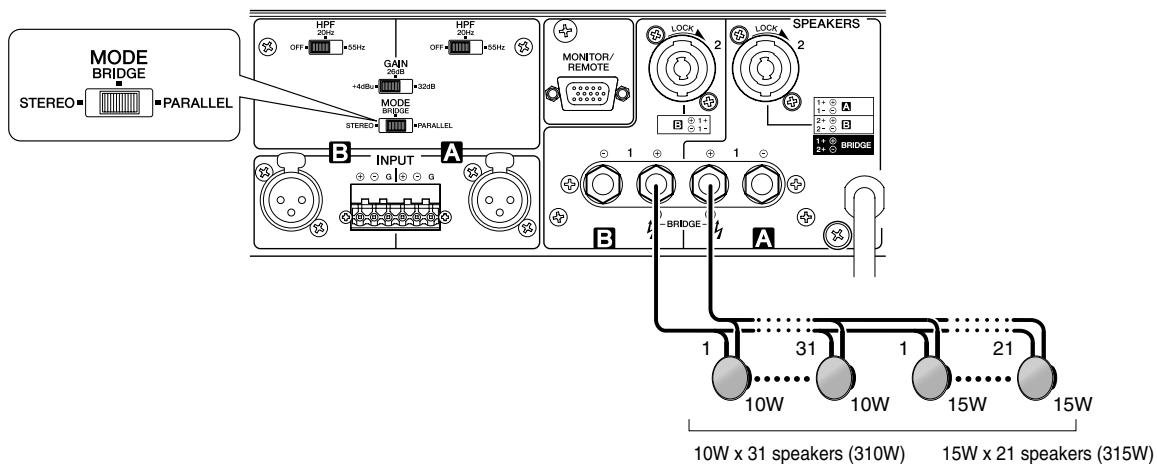
Total rated input of speakers: 625 W (maximum)
Using a Euroblock connector
If cables will be frequently connected and disconnected, as in the case of a portable installation, we recommend that you use ferrules with insulation sleeves. Use a ferrule whose conductor portion has an external diameter of 1.6mm or less, and a length of approximately 7 mm (such as the Al0,5-6WH made by the Phoenix Contact corporation).
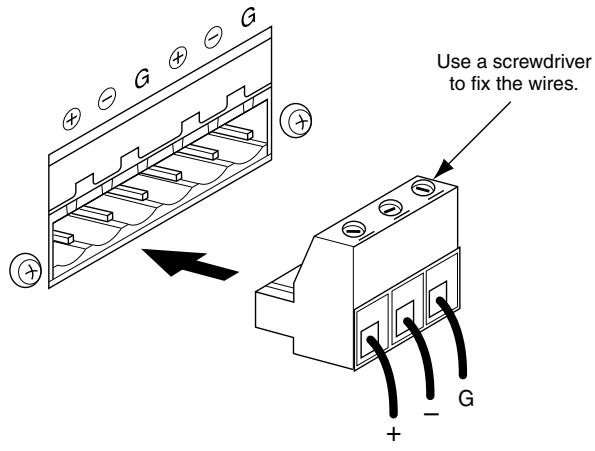
1 If the wire insertion ports are closed, turn the screws on top of the connector counterclockwise to open the ports.
2 Insert the wires into the appropriate ports, following the indication of the pole on the input terminal, turn the screws on top of the connector clockwise to fix the wires.
3 Attach the Euroblock connector to the input terminal on the unit.
Speaker Connection
5-way binding post
1 Turn off the POWER switch.
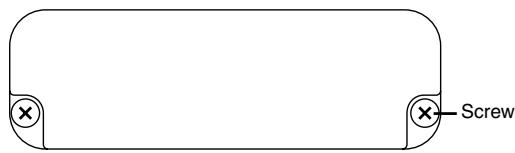
2 Remove the cover attachment screws and remove the protective cover from the speaker terminals.
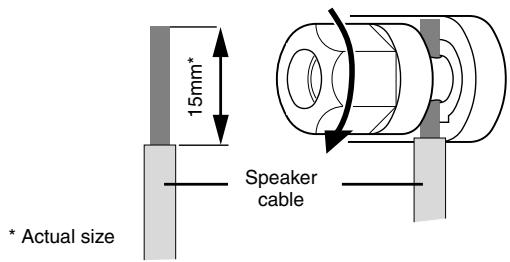
3 Remove about 15mm of insulation from the end of each speaker cable.
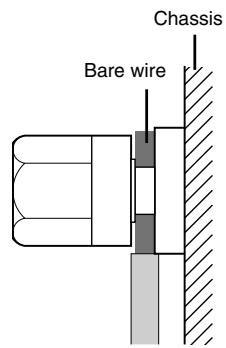
Pass the bare wire through the holes in the appropriate speaker terminals. Tighten the terminals to securely clamp the wires. Refer to page 8 for speaker polarities.
Be sure that the bare wire ends do not jut out from the terminals and touch the chassis.
4 Reattach the protective cover over the speaker terminals.
- Speakon connector
1 Turn off the POWER switch.
2 Insert the Neutrik NL4FC plugs into the Speakon connector on the rear of the amplifier, and turn clockwise to lock.
Neutrik NL4FC plugs
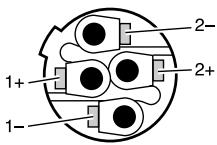
CHANNEL A STEREO or PARALLEL
| 1+ | A+ |
| 1- | A- |
| 2+ | B+ |
| 2- | B- |
BRIDGE
| 1+ | + |
| 1- | / |
| 2+ | - |
| 2- | / |
CHANNEL B
| 1+ | B+ |
| 1- | B- |
The following table lists the main causes of abnormal operation and the corrective measures required as well as the protective circuit operation in each case.
| Indicator(s) | Possible Cause | Remedy | Protection Circuit |
| CLIP indicator lights. | There is a short at a speaker ter- minal, amplifier terminal, or wire. | Locate and correct the cause of the short. | The PC limiter circuit operates to protect the power transistors. |
| The amplifier load is excessive. | Use a speaker system with an impedance of at least 4 Ω (STE- REO/PARALLEL mode) or 8 Ω (BRIDGE mode). | ||
| TEMP indicator lights. | The heat sink temperature has exceeded 85°C (185°F). | Check the ventilation slots, and provide better airflow around the amplifier. | The TEMP indicator lights up to indicate tem- perature warning. |
| PROTECTION induca- tor lights. | The heat sink temperature has exceeded 90°C (194°F). | Check the amplifier ventilation conditions and take appropriate measures to improve the airflow around the amplifier. | The thermal protection circuit operates to protect the power transistors. |
XP3500, XP2500
| Indicator(s) | Possible Cause | Remedy | Protection Circuit |
| PROTECTION indicator lights. | A DC voltage of +2 V/-2 V or greater was generated in the power amplifier's output circuit. | Consult your dealer or the nearest Yamaha service center. | The relay operates to protect the speaker system. |
XP7000, XP5000
| Indicator(s) | Possible Cause | Remedy | Protection Circuit |
| Power has been shut down. (All indicators are off.) | A DC voltage of +2 V/-2 V or greater was generated in the power amplifier's output circuit. | Consult your dealer or the nearest Yamaha service center. | The protection circuitry shut off the power to protect the speaker system. |
General Specifications
| XP7000 | 120 V (US) | 230 V (EU) | 240 V (A) | |||
| Output Power | 1 kHzTHD+N= 1 % | 8 Ω/STEREO | MIN | 750 W + 750 W | 750 W + 750 W | 750 W + 750 W |
| 4 Ω/STEREO | 1100 W + 1100 W | 1100 W + 1100 W | 1100 W + 1100 W | |||
| 8 Ω/BRIDGED | 2200 W | 2200 W | 2200 W | |||
| 20 -20 kHzTHD+N= 0.1 % | 8 Ω/STEREO | 700 W + 700 W | 690 W + 690 W | 700 W + 700 W | ||
| 4 Ω/STEREO | 950 W + 950 W | 950 W + 950 W | 950 W + 950 W | |||
| 70 V/STEREO RL=8 Ω | 625 W + 625 W | 625 W + 625 W | 625 W + 625 W | |||
| 8 Ω/BRIDGED | 1900 W | 1900 W | 1900 W | |||
| 1 kHz20mS nonclip | 2 Ω/STEREO | 1600 W + 1600 W | 1600 W + 1600 W | 1600 W + 1600 W | ||
| 4 Ω/BRIDGED | 3200 W | 3200 W | 3200 W | |||
| SN Ratio | 20Hz-20kHz(DIN AUDIO) | MIN | 104 dB | |||
| Power Consumption | Standby / Idle1/8 (4 Ω/Pink noise) | 5 W / 35 W | ||||
| XP5000 | 650 W | 650 W | 650 W | |||
| Output Power | 1 kHzTHD+N= 1 % | 8 Ω/STEREO | MIN | 525 W+525 W | 525 W+525 W | 525 W+525 W |
| 4 Ω/STEREO | 750 W+750 W | 750 W+750 W | 750 W+750 W | |||
| 8 Ω/BRIDGED | 1500 W | 1500 W | 1500 W | |||
| 20 -20 kHzTHD+N= 0.1 % | 8 Ω/STEREO | 500 W+500 W | 500 W+500 W | 500 W+500 W | ||
| 4 Ω/STEREO | 700 W+700 W | 700 W+700 W | 700 W+700 W | |||
| 8 Ω/BRIDGED | 1400 W | 1400 W | 1400 W | |||
| 1 kHz20mS nonclip | 2 Ω/STEREO | 1300 W+1300 W | 1300 W+1300 W | 1300 W+1300 W | ||
| 4 Ω/BRIDGED | 2600 W | 2600 W | 2600 W | |||
| SN Ratio | 20Hz-20kHz(DIN AUDIO) | MIN | 103 dB | |||
| Power Consumption | Standby / idle1/8 (4 Ω/Pink noise) | 5 W / 35 W | ||||
| XP3500 | 500 W | 500 W | 500 W | |||
| Output Power | 1 kHzTHD+N= 1 % | 8 Ω/STEREO | MIN | 390 W+390 W | 390 W+390 W | 390 W+390 W |
| 4 Ω/STEREO | 590 W+590 W | 590 W+590 W | 590 W+590 W | |||
| 8 Ω/BRIDGED | 1180 W | 1180 W | 1180 W | |||
| 20 -20 kHzTHD+N= 0.1 % | 8 Ω/STEREO | 350 W+350 W | 350 W+350 W | 350 W+350 W | ||
| 4 Ω/STEREO | 450 W+450 W | 435 W+435 W | 450 W+450 W | |||
| 8 Ω/BRIDGED | 900 W | 870 W | 900 W | |||
| 100 V/BRIDGED RL=16 Ω | 625 W | 625 W | 625 W | |||
| 1 kHz20mS nonclip | 2 Ω/STEREO | 1000 W+1000 W | 925 W+925 W | 1000 W+1000 W | ||
| 4 Ω/BRIDGED | 2000 W | 1850 W | 2000 W | |||
| SN Ratio | 20Hz-20kHz(DIN AUDIO) | MIN | 102 dB | |||
| Power Consumption | Standby / idle1/8 (4 Ω/Pink noise) | 5 W / 30 | ||||
| XP2500 | 450 W | 450 W | 450 W | |||
| Output Power | 1 kHzTHD+N= 1 % | 8 Ω/STEREO | MIN | 275 W+275 W | 275 W+275 W | 275 W+275 W |
| 4 Ω/STEREO | 390 W+390 W | 390 W+390 W | 390 W+390 W | |||
| 8 Ω/BRIDGED | 780 W | 780 W | 780 W | |||
| 20 -20 kHzTHD+N= 0.1 % | 8 Ω/STEREO | 250 W+250 W | 250 W+250 W | 250 W+250 W | ||
| 4 Ω/STEREO | 300 W+300 W | 295 W+295 W | 300 W+300 W | |||
| 8 Ω/BRIDGED | 600 W | 590 W | 600 W | |||
| 1 kHz20mS nonclip | 2 Ω/STEREO | 650 W+650 W | 650 W+650 W | 650 W+650 W | ||
| 4 Ω/BRIDGED | 1300 W | 1300 W | 1300 W | |||
| SN Ratio | 20Hz-20kHz(DIN AUDIO) | MIN | 100 dB | |||
| Power Consumption | Standby / idle1/8 (4 Ω/Pink noise) | 5 W / 25 W | ||||
| XP1000 | 320 W | 320 W | 320 W | |||
| Output Power | 1 kHzTHD+N= 1 % | 8 Ω/STEREO | MIN | 135 W+135 W | 125 W+125 W | 120 W+120 W |
| 4 Ω/STEREO | 165 W+165 W | 155 W+155 W | 155 W+155 W | |||
| 8 Ω/BRIDGED | 330 W | 310 W | 310 W | |||
| 20 -20 kHzTHD+N= 0.1 % | 8 Ω/STEREO | 110 W+110 W | 100 W+100 W | 100 W+100 W | ||
| 4 Ω/STEREO | 125 W+125 W | 115 W+115 W | 110 W+110 W | |||
| 8 Ω/BRIDGED | 250 W | 230 W | 220 W | |||
| 1 kHz20mS nonclip | 2 Ω/STEREO | 250 W+250 W | 250 W+250 W | 250 W+250 W | ||
| 4 Ω/BRIDGED | 500 W | 500 W | 500 W | |||
| SN Ratio | 20 Hz-20 kHz(DIN AUDIO) | MIN | 96 dB | |||
| Power Consumption | Standby / idle1/8 (4 Ω/Pink noise) | 5 W / 20 W | ||||
| All Models | ||||||
| Power Bandwidth | Half Power, THD+N=0.5% | MIN | 10 Hz-40 kHz | |||
| THD+N | 20 Hz-20 kHz, Half Power | MAX | 0.1% | |||
| Intermoduration Distortion | 60 Hz:7 kHz, 4:1, Half Power | MAX | 0.1% | |||
| Frequency Response | RL=8 Ω, Po=1 W, HPF=OFF20 Hz-50 kHz | MAX | 0 dB | |||
| TYP | 0 dB | |||||
| MIN | -1 dB | |||||
| Channel Separation | Half Power, RL=8 Ω, 1 kHz, Att. max, input 600 Ω shunt | MIN | 70 dB | |||
| Residual Noise | 20 Hz-20 kHz, Att. min, (DIN AUDIO) | MAX | -70 dBu | |||
| Damping Factor | RL=8 Ω, 1 kHz | MIN | 350 (XP7000, XP5000), 200 (XP3500, XP2500, XP1000) | |||
| Voltage Gain | Att. max | TYP | Selectable from 32 dB or 26 dB (or +4 dBu input sensitivity) by select switch | |||
| Input Sensitivity (dBu) | Att. max, Rated Power 8 Ω | XP7000 | XP5000 | XP3500 | XP2500 | |
| Switch Position | +4 dBu | +4 | +4 | +4 | +4 | |
| 26 dB | +13.7 | +12.2 | +10.7 | +9.2 | ||
| 32 dB | +7.7 | +6.2 | +4.7 | +3.2 | ||
| Maximum Input Voltage | MIN | +22 dBu | ||||
| Input Impedance | TYP | 20 kΩ (balanced), 10 kΩ (unbalanced) | ||||
| Controls | Front Panel | POWER switch (push on/push off) | ||||
| attenuator (31 position) x 2 | ||||||
| Rear Panel | MODE switch (STEREO/BRIDGED/PARALLEL) x 1 | |||||
| HPF switch (20 Hz/55 Hz/OFF 12 dB/oct) x 2 | ||||||
| GAIN SELECT switch (32 dB/26 dB/+4 dBu) x 1 | ||||||
| Connectors | Input | XLR-3-31 type/ch, Euroblock connector (balanced) /ch | ||||
| Output | SPEAKON/ch, 5 way binding post x 1 | |||||
| MONITOR/REMOTE | Dsub 15 P x 1 | |||||
| Indicators | POWER/STANDBY | x 1 (Green/Orange) | ||||
| SIGNAL | x 2 (Green) | |||||
| CLIP/LIMIT | x 2 (Red) | |||||
| PROTECTION/TEMP | x 1 (Red) x 1 (Red) heatsink temp ≥ 85 °C | |||||
| Load Protection | POWER switch on/off mute | |||||
| DC-fault: power supply shutdown/operation not restored automatically. (XP7000, XP5000) output relay off/restored automatically. (XP3500, XP2500, XP1000) | ||||||
| Clip limiting :THD ≥ 0.5% | ||||||
| Amplifier Protection | Thermal: Cuts the output (heatsink temp ≥ 90 °C); operation not restored automatically. | |||||
| VI limiter (RL ≤ 1 Ω): Limit the output. | ||||||
| Power Supply Protection | Thermal: Power supply shutdown (heatsink temp ≥ 100 °C); operation not restored automatically. (XP7000, XP5000). power supply shutdown (transformer temp ≥ 130 °C); restored automatically. (XP3500, XP2500, XP1000) | |||||
| Cooling | Variable-speed fan: x 1(XP3500, XP2500, XP1000), x 2 (XP7000, XP5000) Fan stop at heatsink temp < 55 °C | |||||
| Power Requirements | UC: 120 V/60 HzHB: 230 V/50 HzA: 240 V/50 Hz | |||||
| Dimensions (W x H x D) | 480 x 88 x 456 mm | |||||
| Weight | XP700014 kg | XP500014 kg | XP350015 kg | XP250014 kg | ||
| Included Accessories | Security cover (with a hex wrench), Owner's Manual | |||||
- These specifications apply to rated power supplies of 120V, 230V and 240V.
0 dBu=0.775 Vrms, Half Power=1/2 Output Power (3 dB below rated power)
Specifications and descriptions in this owner's manual are for information purposes only.
Yamaha Corp. reserves the right to change or modify products or specifications at any time without prior notice. Since specifications, equipment or options may not be the same in every locale, please check with your Yamaha dealer.
European models
Purchaser/User Information specified in EN55103-1 and EN55103-2.
Inrush Current: XP7000/5000 25A, XP3500 22A, XP2500 20A, XP1000 14A
Conforms to Environments: E1, E2, E3 and E4
■ MONITOR/REMOTE PIN layout
| Pin No. | Signal | Description | |
| 1 | GND | ||
| 2 | REMOTE CONTROL | STANDBY | STANDBY Control: Supply 5 VDC, 5 mADC |
| 3 | MONITOR | MODEL ID | XP7000: 1.0 kΩ, XP5000: 1.2 kΩ, XP3500: 1.5 kΩ, XP2500: 1.8 kΩ, XP1000: 2.2 kΩ (Impedance to GND) |
| 4 | REMOTE CONTROL | NC | |
| 5 | NC | ||
| 6 | MUTE CH B | MUTE On Control: Connect the pin to GND (max. 1mA flows) | |
| 7 | MUTE CH A | MUTE Off Control: Open the pin (+5V applied) | |
| 8 | MONITOR | NC | |
| 9 | NC | ||
| 10 | PROTECTION/MUTE STATUS CH B | Protection/Mute On: +5 VDC, Zo=270 Ω | |
| 11 | PROTECTION/MUTE STATUS CH A | Protection/Mute Off: 0 VDC, Zo=High | |
| 12 | NC | ||
| 13 | NC | ||
| 14 | OUTPUT LEVEL CH B | XP7000, XP5000, XP3500, XP2500, XP1000 | |
| 15 | OUTPUT LEVEL CH A | +4dBu (-27.2 dB of Speaker Output Level) at 100 W/8Ω, RL=7.5 kΩ, Zo=300 Ω | |
Dimensions
Unit: mm
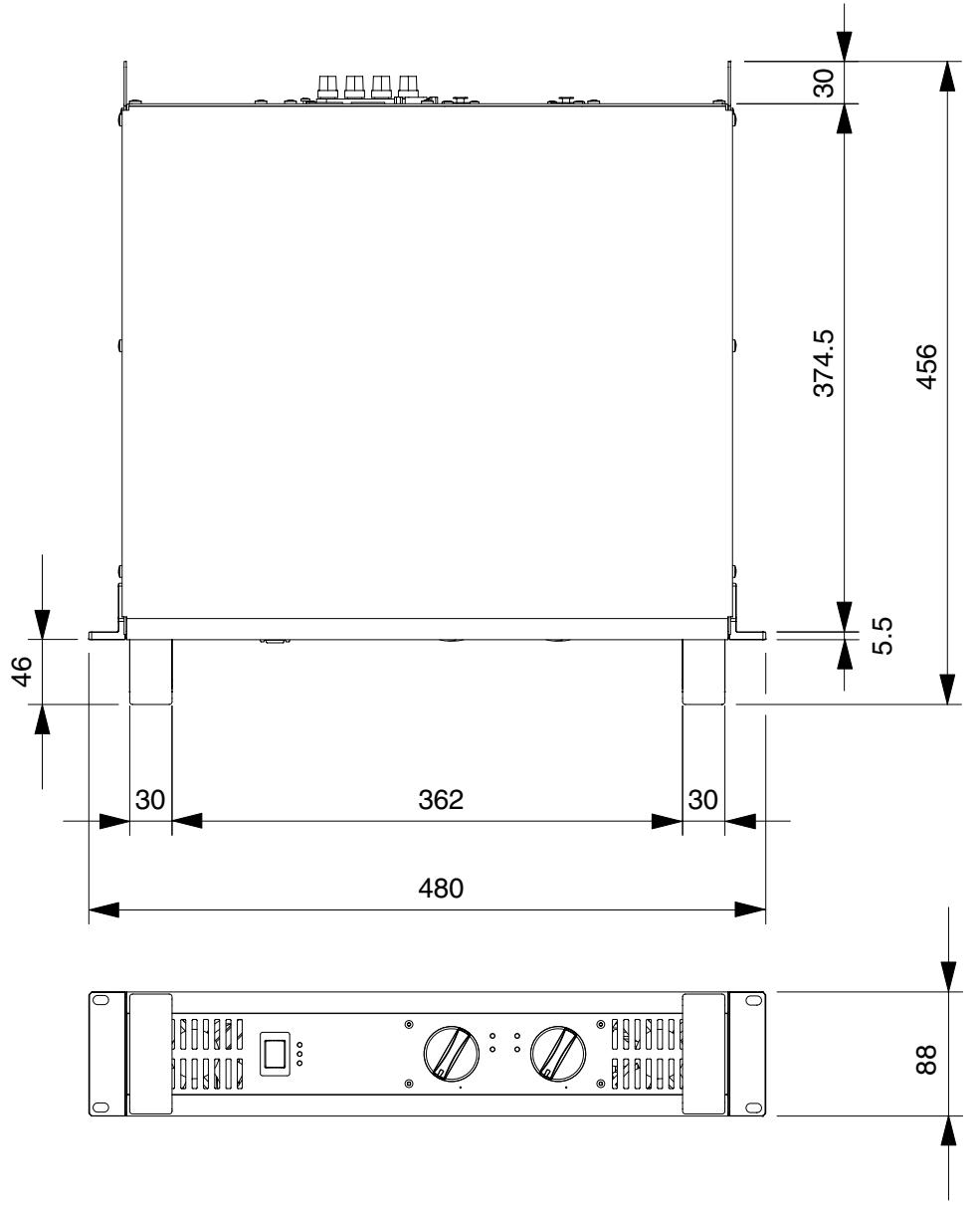
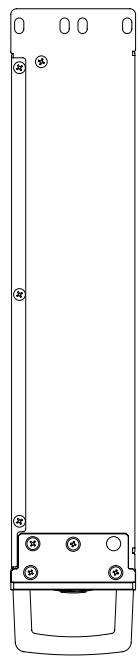
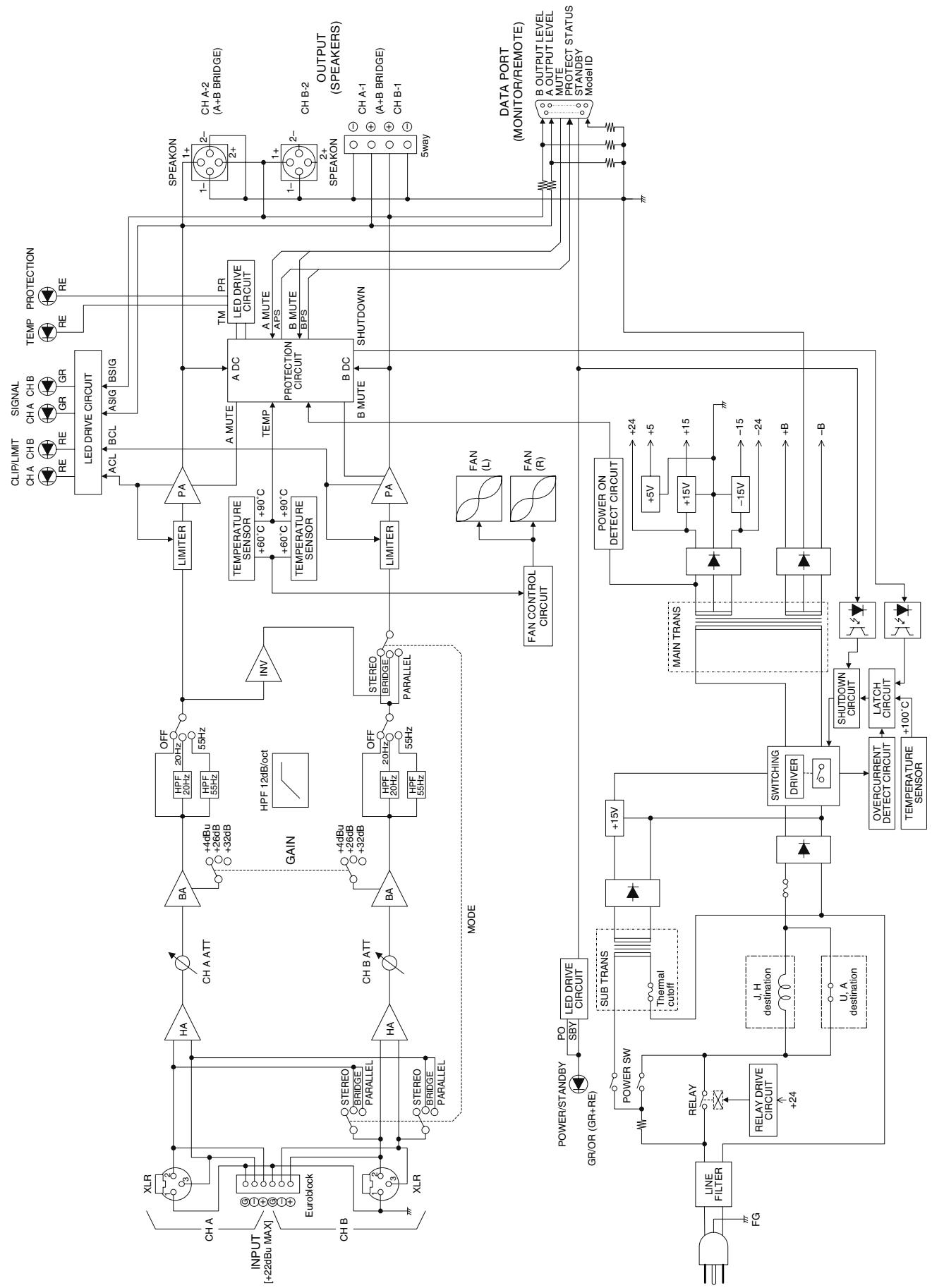
■ Block Diagram
XP7000/XP5000
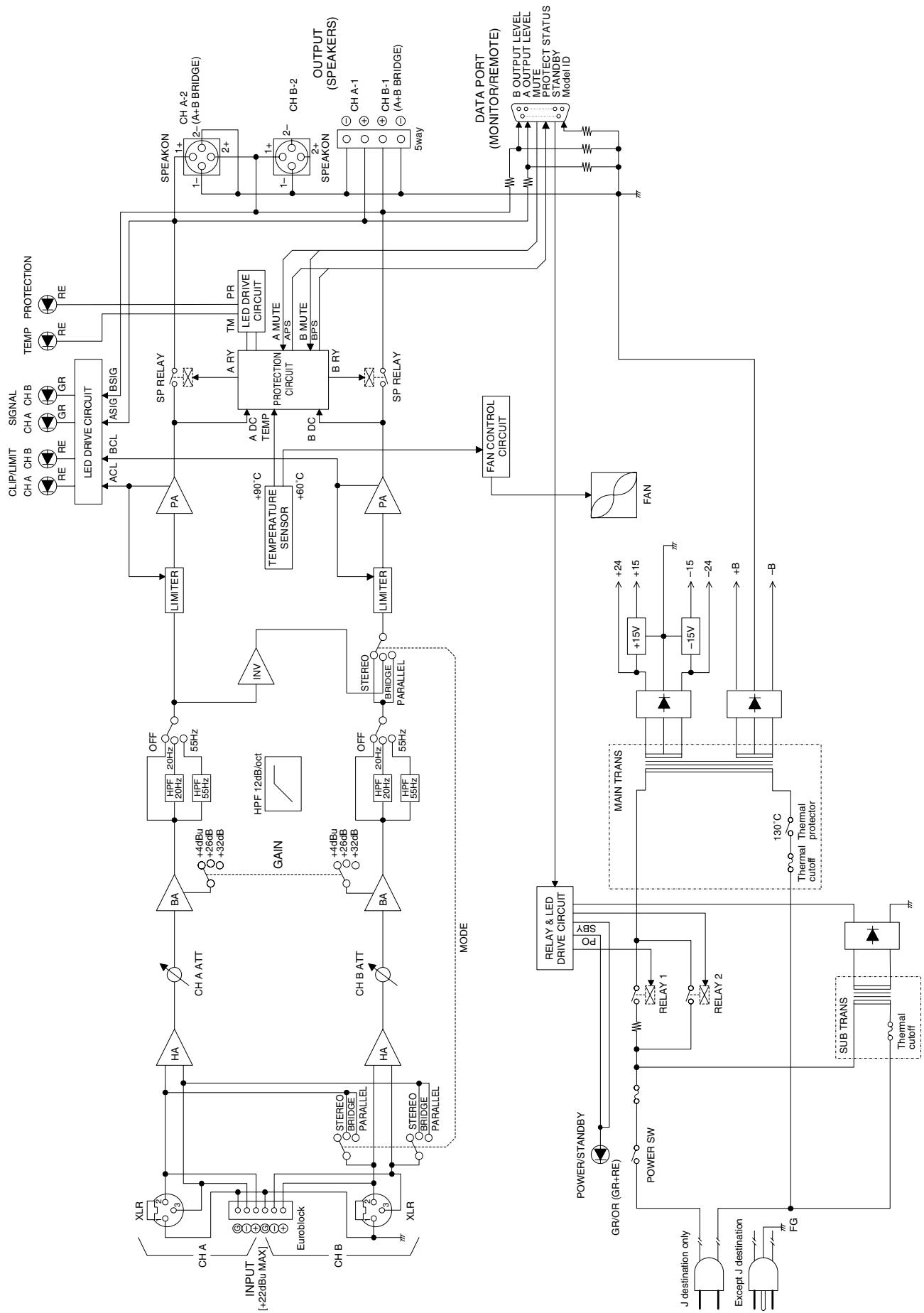
Current Draw
XP7000
| Line Current (A) | Power (W) | Thermal Dissipation | ||||||
| 100/120V | 230/240V | In | Out | Dissipated | Btu/h | kcal/h | ||
| standby | 0.08 | 0.04 | 5 | 0 | 5 | 17 | 4 | |
| idle | 1.0 | 0.5 | 35 | 0 | 35 | 119 | 30 | |
| 1/8 power | 8Ω/ch | 5.4 | 3.0 | 379 | 188 | 191 | 653 | 165 |
| 4Ω/ch | 8.5 | 4.7 | 611 | 275 | 336 | 1150 | 289 | |
| 1/3 power | 8Ω/ch | 12.8 | 7.0 | 918 | 500 | 418 | 1430 | 360 |
| 4Ω/ch | 20.6 | 11.3 | 1481 | 733 | 748 | 2550 | 643 | |
XP5000
| Line Current (A) | Power (W) | Thermal Dissipation | ||||||
| 100/120V | 230/240V | In | Out | Dissipated | Btu/h | kcal/h | ||
| standby | 0.08 | 0.04 | 5 | 0 | 5 | 17 | 4 | |
| idle | 1.0 | 0.5 | 35 | 0 | 35 | 119 | 30 | |
| 1/8 power | 8Ω/ch | 4.0 | 2.2 | 277 | 131 | 146 | 499 | 126 |
| 4Ω/ch | 6.2 | 3.4 | 436 | 188 | 249 | 848 | 214 | |
| 1/3 power | 8Ω/ch | 9.3 | 5.1 | 673 | 350 | 323 | 1100 | 278 |
| 4Ω/ch | 14.7 | 8.1 | 1057 | 500 | 557 | 1900 | 479 | |
XP3500
| Line Current (A) | Power (W) | Thermal Dissipation | ||||||
| 100/120V | 230/240V | In | Out | Dissipated | Btu/h | kcal/h | ||
| standby | 0.08 | 0.04 | 5 | 0 | 5 | 17 | 4 | |
| idle | 1.0 | 0.5 | 30 | 0 | 30 | 102 | 26 | |
| 1/8 power | 8Ω/ch | 3.2 | 1.7 | 227 | 98 | 130 | 443 | 112 |
| 4Ω/ch | 5.0 | 2.8 | 378 | 148 | 231 | 787 | 198 | |
| 1/3 power | 8Ω/ch | 7.3 | 4.0 | 551 | 260 | 291 | 993 | 250 |
| 4Ω/ch | 12.2 | 6.7 | 917 | 393 | 524 | 1790 | 450 | |
XP2500
| Line Current (A) | Power (W) | Thermal Dissipation | ||||||
| 100/120V | 230/240V | In | Out | Dissipated | Btu/h | kcal/h | ||
| standby | 0.08 | 0.04 | 5 | 0 | 5 | 17 | 4 | |
| idle | 1.0 | 0.5 | 25 | 0 | 25 | 85 | 22 | |
| 1/8 power | 8Ω/ch | 2.4 | 1.3 | 174 | 69 | 105 | 358 | 90 |
| 4Ω/ch | 3.6 | 2.0 | 271 | 98 | 173 | 592 | 149 | |
| 1/3 power | 8Ω/ch | 5.6 | 3.1 | 421 | 183 | 238 | 811 | 204 |
| 4Ω/ch | 8.8 | 4.8 | 657 | 260 | 397 | 1350 | 341 | |
XP1000
| Line Current (A) | Power (W) | Thermal Dissipation | ||||||
| 100/120V | 230/240V | In | Out | Dissipated | Btu/h | kcal/h | ||
| standby | 0.08 | 0.04 | 5 | 0 | 5 | 17 | 4 | |
| idle | 1.0 | 0.5 | 20 | 0 | 20 | 68 | 17 | |
| 1/8 power | 8Ω/ch | 1.1 | 0.6 | 76 | 28 | 48 | 165 | 42 |
| 4Ω/ch | 1.2 | 0.7 | 91 | 30 | 61 | 208 | 52 | |
| 1/3 power | 8Ω/ch | 2.4 | 1.3 | 184 | 73 | 110 | 376 | 95 |
| 4Ω/ch | 2.9 | 1.6 | 220 | 80 | 140 | 479 | 121 | |
1/8 power is typical of program material with occasional clipping. Refer to these figures for most applications.
1/3 power represents program material with extremely heavy clipping.
Test signal: Pink Noise, bandwidth limited from 22Hz to 22kHz
1W = 0.860kcal/h, 1BTU = 0.252kcal
Note that Line Voltage [V] × Line Current [A] = [VA] not equals to [W].
Inrush current
XP7000, XP5000: 11A (100V), 13A (120V), 25A (240V)
XP3500: 11A (100V), 13A (120V), 22A (240V)
XP2500: 10A (100V), 12A (120V), 20A (240V)
XP1000: 9A (100V), 11A (120V), 14A (240V)
For details of products, please contact your nearest Yamaha representative or the authorized distributor listed below.
Yamaha Canada Music Ltd.
135 Milner Avenue, Scarborough, Ontario,
M1S 3R1, Canada
Tel: 416-298-1311
U.S.A.
Yamaha Corporation of America
6600 Orangethorpe Ave., Buena Park, Calif. 90620,
U.S.A.
Tel: 714-522-9011
CENTRAL & SOUTH AMERICA
MEXICO
Yamaha de Mexico S.A. de C.V.
Calz.Javier Rojo Gomez #1149
Col. Guadalupe del Moral
C.P.09300, Mexico,D.F.,Mexico
Tel: 55-5804-0600
BRAZIL
PANAMA AND OTHER LATIN
AMERICAN COUNTRIES
CARIBBEAN COUNTRIES
Yamaha Music Latin America, S.A.
Torre Banco General, Piso 7, Urbanizacion Marbella,
Sherbourne Drive, Tilbrook, Milton Keynes,
MK7 8BL, England
Tel: 01908-366700
GERMANY
Yamaha Music Europe GmbH
Siemensstraße 22-34, 25462 Rellingen, Germany
Tel: 04101-3030
Branch Switzerland in Zurich
Seefeldstrasse 94, 8008 Zurich, Switzerland
Tel: 01-383 3990
AUSTRIA
Yamaha Music Europe GmbH Branch Austria
Schleiergasse 20, A-1100 Wien, Austria
Tel: 01-60203900
CZECH REPUBLIC/SLOVAKIA/
HUNGARY/SLOVENIA
Yamaha Music Europe GmbH Branch Austria
Schleiergasse 20, A-1100 Wien, Austria
Tel: 01-602039025
POLAND
Yamaha Music Europe GmbH
YS Copenhagen Liaison Office
Generatorvej 6A, DK-2730 Herlev, Denmark
Tel: 44 92 49 00
NORWAY
Yamaha Music (Russia)
Office 4015, entrance 2, 21/5 Kuznetskii
Most street, Moscow, 107996, Russia
Tel: 495 626 0660
OTHER EUROPEAN COUNTRIES
Yamaha Music Europe GmbH
Siemensstraße 22-34, 25462 Rellingen, Germany
Tel: +49-4101-3030
AFRICA
Yamaha Corporation,
Asia-Pacific Music Marketing Group
Nakazawa-cho 10-1, Naka-ku, Hamamatsu,
Japan 430-8650
Tel: +81-53-460-2313
MIDDLE EAST
TURKEY/CYPRUS
Yamaha Music Europe GmbH
Siemensstraße 22-34, 25462 Rellingen, Germany
Tel: 04101-3030
OTHER COUNTRIES
Yamaha Music Gulf FZE
LOB 16-513, P.O.Box 17328, Jubel Ali,
Dubai, United Arab Emirates
Tel: +971-4-881-5868
ASIA
THE PEOPLE'S REPUBLIC OF CHINA
Yamaha Music & Electronics (China) Co.,Ltd.
2F, Yunhedasha, 1818 Xinzha-lu, Jingan-qu,
Shanghai, China
Tel: 021-6247-2211
INDIA
Yamaha Music India Pvt. Ltd.
5F Ambience Corporate Tower Ambience Mall Complex
Ambience Island, NH-8, Gurgaon-122001, Haryana, India
Tel: 0124-466-5551
INDONESIA
PT. Yamaha Music Indonesia (Distributor)
PT. Nusantik
Gedung Yamaha Music Center, Jalan Jend. Gatot
SubROTO Kav. 4, Jakarta 12930, Indonesia
Tel: 21-520-2577
KOREA
Yamaha Music Korea Ltd.
8F, 9F, Dongsung Bldg. 158-9 Samsung-Dong,
Kangnam-Gu, Seoul, Korea
Tel: 080-004-0022
MALAYSIA
Yamaha Music Malaysia, Sdn., Bhd.
Lot 8, Jalan Perbandaran, 47301 Kelana Jaya,
Petaling Jaya, Selangor, Malaysia
Tel: 3-78030900
SINGAPORE
Yamaha Music Asia Pte., Ltd.
03-11 A-Z Building
140 Paya Lebor Road, Singapore 409015
Tel: 747-4374
TAIWAN
Yamaha KHS Music Co., Ltd.
3F, #6, Sec.2, Nan Jing E. Rd. Taipei.
Taiwan 104, R.O.C.
Tel: 02-2511-8688
THAILAND
Siam Music Yamaha Co., Ltd.
4, 6, 15 and 16^th floor, Siam Motors Building,
891/1 Rama 1 Road, Wangmai,
Pathumwan, Bangkok 10330, Thailand
Tel: 02-215-2626
OTHER ASIAN COUNTRIES
Yamaha Corporation,
Asia-Pacific Music Marketing Group
Nakazawa-cho 10-1, Naka-ku, Hamamatsu,
Japan 430-8650
Tel: +81-53-460-2317
OCEANIA
AUSTRALIA
Yamaha Music Australia Pty. Ltd.
Level 1, 99 Queensbridge Street, Southbank,
Victoria 3006, Australia
Tel: 3-9693-5111
COUNTRIES AND TRUST
TERRITORIES IN PACIFIC OCEAN
Yamaha Corporation,
Asia-Pacific Music Marketing Group
Nakazawa-cho 10-1, Naka-ku, Hamamatsu,
Japan 430-8650
Tel: +81-53-460-2313

YAMAHA
Yamaha Pro Audio global web site:
http://www.yamahaaproaudio.com/
Yamaha Manual Library
http://www.yamaha.co.jp/manual/english/