ManualGo.com
TP-3126 - Musical instrument YAMAHA - Free user manual and instructions
Find the device manual for free TP-3126 YAMAHA in PDF.


Download the instructions for your Musical instrument in PDF format for free! Find your manual TP-3126 - YAMAHA and take your electronic device back in hand. On this page are published all the documents necessary for the use of your device. TP-3126 by YAMAHA.
USER MANUAL TP-3126 YAMAHA
PEDAL TIMPANI TP3 1 OO(EA) Series TP3123(EA) / TP3126(EA) / TP3129(EA) / TP3132(EA) Owner’s Manual Thank you for purchasing a Yamaha Timpani. Please read through this manual carefully as it contains impor- tant information about your instrument's care. Before using your timpani for the first time be sure to carefully read the instructions on “Initial Preparation” pages 6 and 7. © Contents ——— Precautions Nomenclature & Lubrication Transporting and Setting Up the Timpani. Setting up the Timpani Adjusting Pedal Height Transporting Relocating the Tuning Indicato: Oo muumsp & ND Initial Preparation Adjusting the Pitch... 8 Head Tuning Pedal Adjustment Tuning Indicator Adjustment 10 Replacing the Head 11 1p3100ea_en_om.6pm 1 08.25, 9:28 AM English
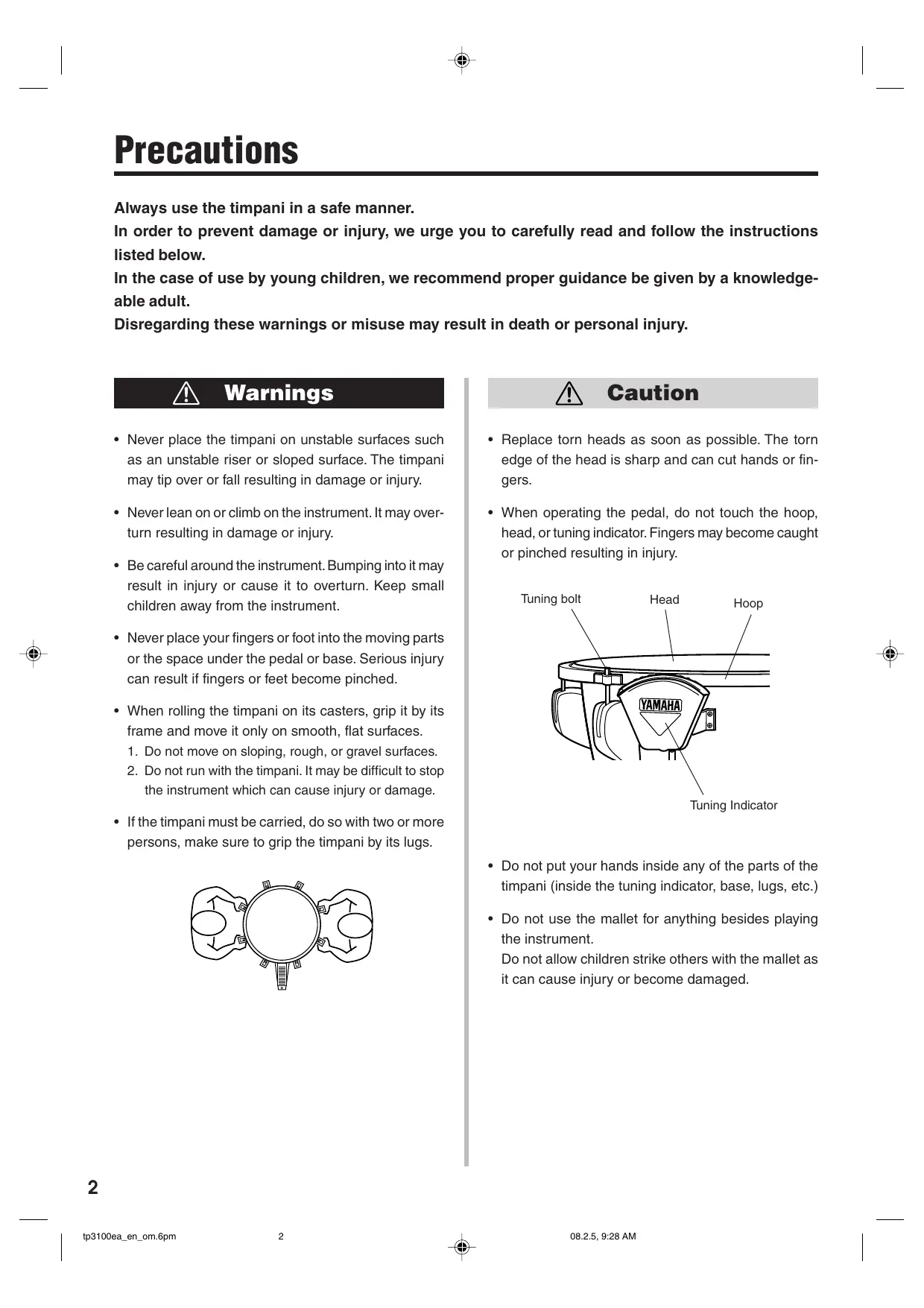
Precautions Always use the timpani in a safe manner. In order to prevent damage or injury, we urge you to carefully read and follow the instructions listed below. In the case of use by young children, we recommend proper guidance be given by a knowledge- able adult. Disregarding these warnings or misuse may result in death or personal i jury. A Caution Never place the timpani on unstable surfaces such Replace torn heads as soon as possible. The torn as an unstable riser or sloped surface. The timpani edge of the head is sharp and can cut hands or fin- may tip over or fall resulting in damage or injury. gers. Never lean on or climb on the instrument. lt may over- When operating the pedal, do not touch the hoop, turn resulting in damage or injury. head, or tuning indicator. Fingers may become caught or pinched resulting in injury. Be careful around the instrument. Bumping into it may result in injury or cause it to overturn. Keep small children away from the instrument. Tuning boit Head Hoop Never place your fingers or foot into the moving parts or the space under the pedal or base. Serious injury can result if fingers or feet become pinched. When rolling the timpani on its casters, grip it by its frame and move it only on smooth, flat surfaces.
1. Do not move on sloping, rough, or gravel surfaces.
2. Do not run with the timpani. It may be difficult to stop
the instrument which can cause injury or damage. Tuning Indicator Ifthe timpani must be carried, do so with two or more persons, make sure to grip the timpani by its lugs. Do not put your hands inside any of the parts of the timpani (inside the tuning indicator, base, lugs, etc.) Do not use the mallet for anything besides playing the instrument. Do not allow children strike others with the mallet as it can cause injury or become damaged. 1p3100ea_en_om.6pm 2 08.25, 9:28 AM
Nomenclature & Lubrication E Nomenclature Head Protector —— ——> Ketile Edge Head Tuning Bolt Tuning Indicator Hoop (Counter Hoop) Pointer Lock Nut Pointer Adjustment Knob Kettle Leg Lock Bolt Handle Sliding Leg Spring Tension Adjustment Bolt Supplied Accessories + Tuning Key … + Mallets … Never place your fingers or foot into the moving parts or the + Hex Wrench … nn À RL a . Serious injury can result if fingers or feet become pinched. + Spring Adjustment Wrench…….….… 1 E Lubrication Apply a high quality grease or lubricant to the moving parts indicated by the arrows in the diagram on the right. This should be done at least once a year, or as needed.
- A spray type lubricant is recommended.
Transporting and Setting Up the Timpani Li Setting up the Timpani 2 Gently lower the pedal section. The TP-3100(EA) series features a folding design to reduce the space required to store or transport the tim- pani. Use the procedure described below when setting up or storing the timpani. Never place your fingers or foot into the mov- ing parts or the space under the pedal or base. 3 Lower the pedal section until the large metal Serious injury can result if fingers or feet be- washer shown in Fig. B aligns with the guide hole come pinched. shown in Fig. C and then tighten the lock bolt. Tighten until the large metal washer shown in Fig. B fits completely into the guide hole. Î First make sure that the casters are locked (Fig. A). Fig. À Then with the timpani posi- tioned as shown in the illus- tration below, use both Y hands to loosen the left and right side lock bolts. Loosen Lock the bolts until the large metal washer comes out of & the guide hole. (Fig. B) [A Lay the timpani on its side, grasp the leg lock boit handle and loosen the leg lock boit. 5 Slowiy extend the sliding leg then tighten the leg lock bolt at the chosen length. Make sure that the Lock Bolts marks on the sliding leg are aligned with the slit in the leg holder. The casters may not function properly if the marks are misaligned. Make sure the marks are properly aligned. Loosen the lock bolts until the “— large metal washer is fully visible.
Transporting and Setting Up the Timpani 6 mine timpani over and extend and secure the EH Transporting other leg. Make sure that the marks on the slid- When moving the timpani over a distance, such as from ing leg are aligned with the slit in the leg holder. room to room, make sure that the instrument is carried by at least two persons. The casters on the sliding legs are convenient when moving the timpani short distances over smooth surfaces 8 when it comes time to store or pack up the tim- such as when changing stage setups, etc. To move the pani, simply reverse the setup procedure order. timpani, unlock the casters, then slightly lift the timpani by the lugs so that the pedal frame is off of the ground and slowly move the timpani forward or backward as shown in the illustration below. Make sure your fingers do not get pinched be- Be careful not to damage the legs while moving the tween the pedal and kettle when folding the timpani pedal or pedal base. n ; si a mea * Damage may occur if the timpani is dropped or Seriou ury can result if fingers or feet be- . a falls from a high place. come pinched. 7 Return the timpani to an upright position, and then adjust the length of the left and right legs. E Adjusting Pedal Height Loosen the stopper and use the height adjustment screw to adjust pedal height. After determining the height, tighten the stopper to secure. Height Adjustment Screw Stopper HRelocating the Tuning Indicator The timpani is shipped with a universal style tuning indicator already attached (performer's left side) however, the tuning indicator can be relocated for German style tuning (performer's right side). Using the supplied hex wrench, remove the two bolts holding the tuning indicator in place as shown in the diagram below, then slide the bolts through the holes on the tuning indicator from the opposite side. In either position, make sure that the note indicator bridge is easily viewable. Universal Style Attachment German Style Attachment Tuning Indicator Bolt Tuning Indicator Bolt
Initial Preparation Your Yamaha timpani is equipped with a plastic head carefully mounted and adjusted at the factory. However, new heads tend to stretch during shipping and storage, so it may be necessary to re-tune the instrument before using. Please perform the following steps to check and, if necessary, readjust your instrument. 1 The area between the kettle edge and the inner 3 If the heel of the pedal is fully lowered as in Fig. circle of the counter hoop is called the collar. C, proceed with step 5. Please make sure that the width of this collar is If the pedal position is as shown in Fig. D or the uniform, as shown in the illustration titled “Cor- toe of the pedal is fully lowered, perform step # rect”. first. == Correct = «Wrong mm Fig. C
Kettle Counter Kettle Counter edge Collar hoop edge Collar hoop If the collar is not uniform (illustration titled “Wrong”), keep the heel of the pedal fully de- pressed as shown in Fig. C, and align the head Fig. D and hoop as shown in the illustration titled “Cor- rect”. 2 Make sure that the end of the wire tube is not disengaged from the adjuster of the tuning indi- cator as shown in Fig. A. If it is disengaged, in- sert it into the adjuster as shown in Fig. B. Never place your fingers or foot into the mov- ing parts or the space under the pedal or base. Serious injury can result if fingers or feet be- come pinched. [A Fully depress the heel of the pedal as shown in Fig. C. Hold the pedal in this position, as it will Adjuster u return otherwise. Wire tube
Initial Preparation 5 Using the supplied timpani key, tighten the tun- 9 Tighten each tuning bolt by 1/8 of a turn (45°) in ing bolts by 1/4 of a turn (90°) in the order shown the order shown in step 5. below. It is very important to always turn all tuning 10 - Toe and heel feel equal bolts by the same amount. — Go to step ff. + Heel still feels heavier than toe Timpani key — Repeat steps 8 through 10. + Heel feels lighter than toe — Head is tightened too much. Loosen the head as described in step 7 (*1).
60) 11 Move the pedal into an intermediate position, as
shown in Fig. D , and remover your foot from the pedal. Confirm that the pedal stays in this posi- tion and does not move. 29", 32” 23", 26” If the pedal stops in this position, adjustment is complete. Return the pedal to the position 6 race your foot off the pedal. shown in Fig. C. + Heel still moves up - f the toe of the pedal moves downward — Repeat steps through 6. — Repeat steps 8 through 10. + Heel stays down + If the heel of the pedal moves downward — Goto step 7. — Head is tightened too much. Loosen the & head as described in step 7. 7 Put your foot on the pedal and fully depress it in either direction (toe and heel). 12 Strike the head lightly with the supplied mallet. + Heel feels heavier than toe The standard striking point is shown below. — Go to step 8.
- Toe and heel feel equal The standard striking — Go to step f. point lies at distance B + Heel feels lighter than toe (*1) from the kettle edge, — Headis too tight and should be loosened. which corresponds Keeping the heel of the pedal depressed, mA man lo A ù loosen the first tuning bolt by 1/2 turn and between the kettle then re-tighten it by 1/4 of a turn. Perform edge and the center of this operation for all other tuning bolts in the head the order shown in step 5. lf necessary, repeat this procedure, until proper tension For pitch reference, a tuner or piano can be used. is obtained. As the toe of the pedal is pressed down, the pitch is raised. 8 Fully depress the heel of the pedal as shown in For details on precise tuning refer to “Adjusting Fig. C. the Pitch” on the following page. As the head will stretch over time, readjustment should be performed periodically (starting with step 7). 1p3100ea_en_om.6pm 7 08.25, 9:28 AM
When using the timpani for the first time, be sure to set it up according to the instructions of “Initial Preparation” on pages 6 and 7. E Head Tuning 1 Tuning is adjusted on the lowest note of the tim- pani. For this reason, the heel of the pedal must stay fully lowered during the tuning procedure. The pitch of the lowest note (and the tonal range) depends on the size of your timpani. For example, as shown in the chart below, the lowest sound of a 26" timpani should be tuned to A. When tuned properly, your Yamaha timpani will play through- out its full tonal range with balanced tension in the paddle. HE Standard Tonal Ranges for Yamaha Timpani 32" (8icm) 29" (74cm) 26" (66cm) 23" (58cm)
D Be F D A F C Ab Keep the heel of the pedal fully lowered during the tuning procedure (steps 2 through 7 below) if not specified otherwise. 2 Strike the head and check the sound. The standard striking point is shown below. The standard striking point lies at distance B from the kettle edge, which corresponds approximately to 1/4 to 1/8 of the distance between the kettle edge and the center of the head. + Sound is lower than the tuning note — Go to step 3. + Sound is higher than the tuning note — Loosen the tuning bolts by an equal amount in the order shown in the figure of step 5 on page 7. 1p3100ea_en_om.6pm 8 When loosening the tuning bolts, always loosen them by double the desired amount, and then return (re-tighten) them by half. When the sound lies within 1 halftone below the desired pitch af- ter loosening the tuning bolts (repeatedly, if nec- essary), proceed with step 7. Lightly strike the head with the mallet about 2 inches (5 cm) from the kettle edge at each tuning bolt. Check which tuning bolt has the highest sound. + Pitch of the highest sound is higher than the tuning note (*2) — Loosen the corresponding tuning bolt by about 1/16 to 1/18 of a turn. First loosen the bolt by double the desired amount, and then return (re-tighten) it by half. After loos- ening the tuning bolt, repeat from the be- ginning of step 3. + Pitch of the highest sound is lower than the tuning note — Go to step #. Tighten the other bolts little by little (by about 1/ 16 to 1/8 of a turn) until the sounds at the corre- sponding striking points match the pitch of the highest sound. Please note that tightening one bolt also raises the pitch at neighboring and op- posite tuning bolts. Thus, after tightening the tun- ing bolt with the lowest sound, again check the pitch at the other tuning bolts before tightening the tuning bolt with the next lowest pitch. While alternately tightening the other bolts, do not touch the tuning bolt with the highest pitch (reference pitch). 08.25, 9:28 AM
Adjusting the Pitch 5 Loosen all over-tightened bolts according to the EH Pedal Adjustment procedure described in step 3 (*2).When the pitch After depressing the toe and heel of the pedal, turn the is approximately the same at each bolt, repeat- spring tension adjustment bolt as described below. edly depress the toe and heel of the pedal sev- eral times. 6 Repeat steps ? through 5 until the pitch at each bolt is exactly the same. Spring Tension 7 Check the sound by striking the head as de- Adjustment Bolt scribed in step 2. + Heel moves up when releasing the foot from the pedal after depressing the heel, or the heel feels heavier than the toe. + Sound is lower than the tuning note — Tune the instrument by tightening all tun- ing bolts by an equal amount (max. 146 of a turn). — Turn the spring tension adjustment bolt to the left (counterclockwise). + Toe moves up when releasing the foot from the pedal after depressing the toe, or the toe feels heavier than the heel + Sound is higher than the tuning note — Tune the instrument by loosening all tun- ing bolts by an equal amount (max. 1/16 of a turn) according to the procedure described in step 3. — Turn the spring tension adjustment bolt to the right (clockwise). 8 Operate the pedal as described in step 5. If the Use the supplied spring adjustment wrench to turn the & pitch does not change, the instrument is tuned spring adjustment boit. Do not turn too many full rota- properly. tions at once, and re-check the adjustment every 2 turns (fthe pitch changes, repeat from step 7.) by pressing the toe and heel of the pedal. The instrument is now tuned to the lowest sound . aution (note) of its tonal range. Depress the toe of the pedal to change to a higher pitch (note). Never place your fingers or foot into the mov- ing parts or the space under the pedal or base. Serious injury can result if fingers or feet be- 9 After tuning, perform M Pedal Adjustment and come pinched. then M Tuning Indicator Adjustment. Do not loosen the spring tension ad- justment bolt by more than 3 rotations at a time, as the toe of the pedal tends to drop abruptly after a specific point. © Pedal balance spring mechanism Your Yamaha timpani is equipped with a unique pedal balance spring mechanism (a coil spring counteracting the tension of the head) which allows you to freely change the pitch (note) ofthe instrument. When the pedal is moved, the pitch of the head will change, and the bal- ance spring ensures that the pedal angle (pitch) will not change when you remove your foot from the pedal. 1p3100ea_en_om.6pm 9 08.25, 9:28 AM
Adjusting the Pitch BE Tuning Indicator Adjustment The tuning indicator shows where to set the pedal for each note. After tuning the instrument, you must set each note on the indicator to its proper position. 1 After you have tuned your timpani to the lowest note of its tonal range, make sure that the pointer is located within 10 mm from the pedal-side end of the indicator rail.
- If not, refer to “Adjusting the Pointer Position”. 2 Slide the lowest note of the indicator (‘A” in the case of a 26" timpani—see “Standard Tonal Ranges for Yamaha Timpani” on page 8) to the position where its center line coincides with the pointer. 3 Tune the instrument to the next higher pitch (note) by moving the pedal, and then slide the corre- sponding note on the rail to the respective pointer position. Repeat for each remaining note. © Adjusting the Pointer Position First loosen the pointer lock nut and then turn the ad- juster as follows: + Pointer is located beyond the lower rail end when the heel of the pedal is lowered fully (low- est note). — Turn the adjuster to the left (counter clockwise) until the pointer is aligned with the lowest note of the indicator. + Pointer moves beyond the upper rail end before the toe of the pedal reaches the end ofits stroke, or Pointer does not reach the lower rail end when the heel of the pedal is lowered fully (low- est sound) — Turn the adjuster to the right (clockwise) to correct the pointer position as required. Indicator rail Pointer Note Adjuster Adjuster nut 1p3100ea_en_om.6pm 10 08.25, 9:28 AM
Replacing the Head T Loosen the tuning bolts on opposite sides of the 3 Place the new head with the hoop on the kettle. timpani. When using a Yamaha timpani head, make sure its YAMAHA logo is on the side opposite the pedal. The hoop must be re-mounted in the same posi- tion as marked with cellophane tape in step 2. In Do not touch the pedal when loosening the tun- the proper order, tighten the tuning bolts alter- ing bolts (loosening the head). Also, never place nately by hand until the head is tensioned slightly. your fingers or foot into space under the pedal, At this time, make sure that the head and hoop around its base, or its moving parts. Changes are centered on the kettle. in spring tension can cause the pedal to sud- k Tighten each tuning bolt an additional 1/4 of a denly move, posing a great danger. turn using the timpani key. Repeat at least 4 times. [A Adjust the timpani as described on page 6 “Initial Preparation” starting with step 5. For precise tuning, refer to the section “Adjusting the Pitch” on page 8. 2 After removing all tuning bolts, mark the pedal side of the hoop with cellophane tape, so that the hoop can be re-mounted in the same position as it was prior to removal. Remove the head together with the hoop. Be careful not to lose any of the tuning bolts and prevent dust from adhering to them. Also, avoid touching the tuning bolt threads, as they are greased. > 7 Hoop ë © Interval for head replacement The maximum head life normally is approximately 2 years and depends on the frequency and duration of use. However, the head should always be replaced be-
- Cellophane tape fore the sound quality deteriorates dramatically. If a head Pedal is left on and used more than two years, the following
- Be careful not to make any scratches in the edge problems may occur: tape attached to the kettle’s edge. Ifthe tape is peel- It may become impossible to tune the head to the ing or badly damaged, it must be replaced with Tim- 8 proper pitch range. pani Edge Tape (TPT-100 Teflon'* tape) It may become impossible to balance the pedal The main unit mechanisms themselves may become damaged. When the head is slightly tensioned and its surface looks wavy or shows dents, it is time to replace the head with a new one.