DN-16067 - Security Camera ASSMANN Electronic - Free user manual and instructions
Find the device manual for free DN-16067 ASSMANN Electronic in PDF.


User questions about DN-16067 ASSMANN Electronic
0 question about this device. Answer the ones you know or ask your own.
Ask a new question about this device
Download the instructions for your Security Camera in PDF format for free! Find your manual DN-16067 - ASSMANN Electronic and take your electronic device back in hand. On this page are published all the documents necessary for the use of your device. DN-16067 by ASSMANN Electronic.
USER MANUAL DN-16067 ASSMANN Electronic
All lead-free products offered by the company comply with the requirements of the European law on the Restriction of Hazardous Substances (RoHS) directive, which means our manufacture processes and products are strictly “lead-free” and without the hazardous substances cited in the directive.

The crossed-out wheeled bin mark symbolizes that within the European Union the product must be collected separately at the product end-of-life. This applies to your product and any peripherals marked with this symbol. Do not dispose of these products as unsorted municipal waste. Contact your local dealer for procedures for recycling this equipment.

This apparatus is manufactured to comply with the radio interference requirements.
Federal Communications Commission Interference Statement
This equipment has been tested and found to comply with the limits for a Class B digital service, pursuant to Part 15 of the FCC rules. These limits are designed to provide reasonable protection against harmful interference in a residential installation.
Any changes or modifications made to this equipment may void the user's authority to operate this equipment. This equipment generates, uses, and can radiate radio frequency energy. If not installed and used in accordance with the instructions, may cause harmful interference to radio communications. However, there is no guarantee that interference will not occur in a particular installation. If this equipment does cause harmful interference to radio or television reception, which can be determined by turning the equipment off and on, the user is encouraged to try to correct the interference by one or more of the following measures:
➢ Reorient or relocate the receiving antenna.
- Increase the separation between the equipment and receiver.
Connect the equipment into an outlet on a circuit different from that to which the receiver is connected.
Consult the dealer or an experienced radio/TV technician for help.
➢ FCC Caution: Any changes or modifications not expressly approved by the party responsible for compliance could void the user's authority to operate this equipment.
All external cables connecting to this basic unit must be shielded.
For cables connecting to PCMCIA cards, see the option manual or installation instructions.
This device complies with Part 15 of the FCC Rules. Operation is subject to the following two conditions:
(1) This device mat not cause harmful interference, and
(2) This device must accept any interference received, including interference that may cause undesired operation.
Trademark Acknowledgements
iPad® & iPhone® are the registered trademarks of Apple Inc.
Android ^™ is a trademark of Google Inc. Use of this trademark is subject to Google Permissions.
Microsoft®, Windows® & Internet Explorer® are registered trademarks of Microsoft Corporation in the United States and/or other countries.
Disclaimer
We reserve the right to revise or remove any content in this manual at any time. We do not warrant or assume any legal liability or responsibility for the accuracy, completeness, or usefulness of this manual. The content of this manual is subject to change without notice.
This product doesn't have a standby / shutdown mode.
MPEG4 Licensing
THIS PRODUCT IS LICENSED UNDER THE MPEG4 VISUAL PATENT PORTFOLIO LICENSE FOR THE PERSONAL AND NON-COMMERCIAL USE OF A CONSUMER FOR (i) ENCODING VIDEO IN COMPLIANCE WITH THE MPEG4 VISUAL STANDARD ("MPEG-4 VIDEO") AND/OR (ii) DECODING MPEG4 VIDEO THAT WAS ENCODED BY A CONSUMER ENGAGED IN A PERSONAL AND NON-COMMERCIAL ACTIVITY AND/OR WAS OBTAINED FROM A VIDEO PROVIDER LICENSED BY MPEG LA TO PROVIDE MPEG4 VIDEO. NO LICENSE IS GRANTED OR SHALL BE IMPLIED FOR ANY OTHER USE. ADDITIONAL INFORMATION INCLUDING THAT RELATING TO PROMOTIONAL INTERNAL AND COMMERCIAL USES AND LICENSING MAY BE OBTAINED FROM MPEG LA, LLC. SEE HTTP://WWW.MPEGLA.COM.
GPL Licensing

This product contains codes which are developed by Third-Party-Companies and which are subject to the GNU General Public License ("GPL") or the GNU Lesser Public License ("LGPL").
The GPL Code used in this product is released without warranty and is subject to the copyright of the corresponding author.
Further source codes which are subject to the GPL-licenses are available upon request.
We are pleased to provide our modifications to the Linux Kernel, as well as a few new commands, and some tools to get you into the code. The codes are provided on the FTP site, and please download them from the following site or you can refer to your distributor:
http://download.dvrtw.com.tw/GPL/076D_Series/arm-linux-2.6.tar.gz
TABLE OF CONTENTS
1. OVERVIEW.... 1
1.1 Product Features....1
1.2 Package Content....1
1.3 Product Overview....1
1.4 Rear Panel 1
1.5 External I/O Port....2
1.6 Status Indicator....2
2. CAMERA ACCESS WITH INTERNET EXPLORER.... 3
2.1 Camera Login....3
2.2 Control Panel Overview .... 3
2.3 Digital PTZ (DPTZ) Operations (AVM417A / 317A Only) 5
2.4 Event Record Search & Playback....6
3. CAMERA CONFIGURATIONS....7
3.1 System configuration menu....7
3.2 Network 8
3.2.1 Network....8
3.2.2 QoS 8
3.2.3 DDNS 8
3.2.4 SNTP 9
3.2.5 FTP 9
3.2.6 MAIL 9
3.2.7 SMS....10
3.2.8 Filter 11
3.2.9 UPnP / Bonjour....11
3.2.10 RTP 12
3.3 Camera 13
3.3.1 Camera....13
3.3.2 Video 13
3.3.3 Color....14
3.3.4 Audio 14
3.3.5 Advance....14
3.4 Record....15
3.4.1 Record....15
3.4.2 Record Timer....15
3.5 Storage 15
3.5.1 Memory 15
3.6 Trigger 16
3.6.1 Trigger 16
3.7 General 17
3.7.1 General....17
3.7.2 Time....18
3.7.3 Server Log....18
3.7.4 Online....19
3.7.5 Account....19
3.7.6 Google Maps....20
3.7.7 Maintenance....20
APPENDIX 1 PRODUCT SPECIFICATIONS....22
APPENDIX 2 BIT RATE TABLE FOR REFERENCE 23
APPENDIX 3 POE CONNECTION (AVM417A / 317A Only)....26
APPENDIX 4 API ID APPLICATION FOR SMS MESSAGING....27
APPENDIX 5 Q&A 29
1.1 Product Features
● Easy network setup with your iPhone / iPad
- ONVIF standard supported to simplify system integration
- External alarm I/O device connection
● Microphone & speaker built-in for audio transmission
- Remote Surveillance
-- Fully compatibility on iPhone & iPad, and Internet Explorer® on Windows® operating system
● (AVM417A / 317A Only) POE (Power-over-Ethernet) support to eliminate the use of power cables and reduce installation costs
● (AVM417A Only) 2 Megapixel SONY sensor with HDTV 1080p quality, allowing users to notice minor details more easily
● (AVM317A Only) 1.3 Megapixel SONY sensor with HDTV 720p quality, allowing users to notice minor details more easily
1.2 Package Content
□ Network camera
□ Camera Bracket
□ 3-pin Terminal
□ Quick Setup with iPhone / iPad □ Adapter
1.3 Product Overview
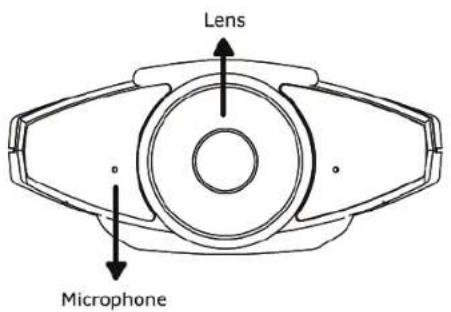
Front View
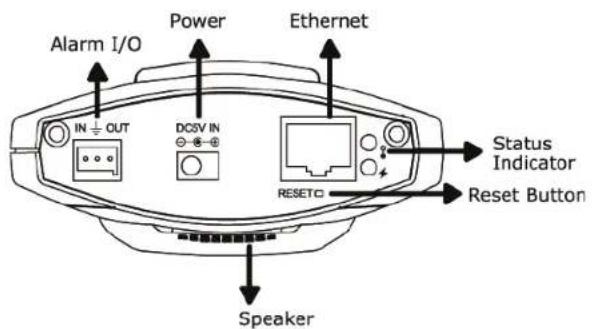
Rear View
1.4 Rear Panel
| Ethernet: | Connect a RJ45 network cable. |
| Power: Connect the supplied regulated power supply. | |
| RESET: With the power connected, press to reset all parameters, including the IP address to factory default settings.The camera will reboot after default reset. Please do not disconnect your camera during the reset process. | |
| Alarm I/O: | A 3-pin I/O terminal is supplied with the camera for external alarm device connection. For details, please refer to “1.5 External I/O Port” at page 2. |
| Status Indicator | is the indicator for LAN connection, and is the indicator for Internet connection. For details, please refer to “1.6 Status Indicator” at page 2. |
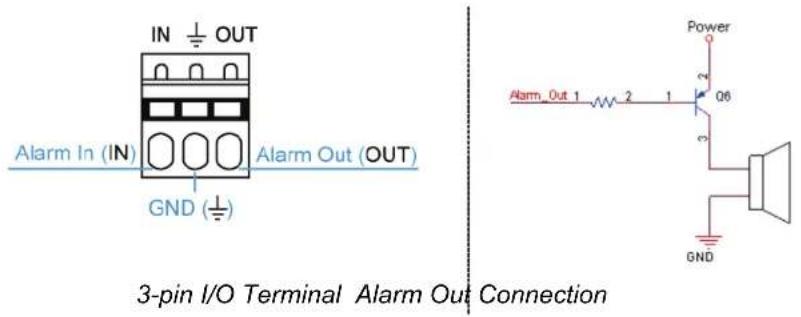
1.5 External I/O Port
This camera supports external I/O device connection, and a 3-pin I/O terminal is supplied with this camera for easy connection.
Below shows which input on the I/O terminal you should use for wiring when you want to connect an external device to this camera.
1.6 Status Indicator
| ICON | LAN connection status Internet connection status | |
| System Status | ||
| During powering on | Always on | Always on |
| Reset default | Blinking (on 250 ms, off 250 ms)●○●○●○●○●○ | Always |
| Upgrade | Blinking (on 250 ms, off 250 ms)●○●○●○●○●○ ●○●○●○●○●○ | Blinking (on 250 ms, off 250 ms) |
| Connection Status | ||
| LAN connected | Always on -- | |
| LAN disconnected | Blinking (on 100 ms, off 500 ms)●○○●○○●○○ | -- |
| Internet connected -- | Always on | |
| Internet disconnected -- | Blinking (on 100 ms, off 500 ms)●○○●○○●○○ | |
| 3G Connection Error on iPhone / iPad / Android Mobile Device | ||
| 3G Connection Setting Uncompleted | -- | Blinking(on 5 sec, off 0.5 sec, on 0.5 sec, off 0.5 sec, on 5 sec) |
| -- ●●●●○●○●●●● | ||
* LED blinking frequency - ● LED on / ○ LED off
2. CAMERA ACCESS WITH INTERNET EXPLORER
This network camera can be accessed via Microsoft® Internet Explorer® and iPhone / iPad / Android mobile devices with our self-developed program "EagleEyes" installed depending on different using situations.
Note: For details about accessing network cameras via iPhone / iPad / Android mobile devices, please refer to http://www.eagleeyescctv.com.
Before using the camera, make sure you have configured the network settings, and the network connection is fine.
For network configurations, please refer to:
■ "Quick Setup With iPhone / iPad" supplied with your camera if you're using iPhone / iPad, and your network environment is wireless.
■ "ADVANCED NETWORK SETUP" downloadable from www.surveillance-download.com/user/m317a.swf if your network environment is not wireless.
2.1 Camera Login
Step1: Open your web browser, and key in http://ipaddress:portnum in the URL address box.
For example, for the IP address 60.121.46.236 and port No. 888, please key in "http://60.121.46.236:888" into the URL address box, and press "Enter".
Step2: In the login page, key in the user name and password, and enter the security code from the image below if any. Then, click "LOGIN".
Step3: The wizard is then started.
• To skip the wizard and directly access the camera live view, click "Close".
• To directly access the camera live view without starting the wizard for the login next time, check "Do not start wizard at login".
Note: If you're prompted to install "VLC player", "Software" or "H264 Streaming Viewer", please agree to proceed the installation. Or, you might not be able to see the live view properly.
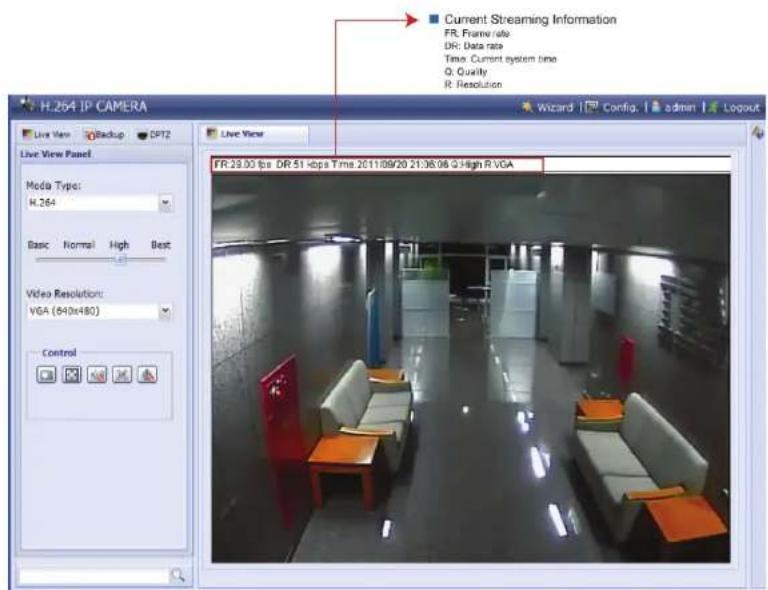
Step5: When the login is successful, the live view is shown.
2.2 Control Panel Overview
Note: The buttons available depend on the model number used and the user level used to log in.
| FUNCTION ICON DESCRIPTION | ||
| Resolution | -- | Select the video resolution for the DPTZ function. Only "VGA" and "QVGA" are available. |
| Take snapshots | Click to take a snapshot of the current view on a new window. Right click on the picture and re-save it to the location you want. | |
| Audio On / Off | Click to switch the audio-in on / off. | |
| Alarm Out | Click to force your alarm-out device to work. For example, when your alarm device is a buzzer, click this button and your buzzer will start to sound even if there's no alarm event. | |
| Microphone | Click to switch the audio-out on / off.Available only when you're a "Supervisor". | |
2.4 Event Record Search & Playback
This camera can only save up to three alarm recordings. Note: To save more recorded data, it's recommended to use this camera with the compatible NVR.    Event Icon Alarm| / | Previous / Next Hour | Click to jump to the next / previous time interval in an hour, for example, 11:00 ~ 12:00 or 14:00 ~ 15:00, and start playing the earliest event video clip recorded during this whole hour. |
| Fast Forward | Increase the speed for fast forward. Click to get 2X, 4X, 8X & 16X speed forward eventually. | |
| Fast Rewind | Increase the speed for fast rewind. Click to get 2X, 4X, 8X & 16X speed rewind eventually. | |
| Play | Click to play the current video clip. | |
| Pause | Click to pause the video playback. | |
| Stop | Click to stop the video playback. | |
| Step | In the pause mode, click to get one frame forward. | |
| Audio Click to mute the playback if necessary, and click again to restore. | ||
| Download | Click to download the current video clip to the specified path in your PC.The downloaded video can only be opened by our own video player. Please go to “General” > “Maintenance” to download the video player, or get the player from the CD supplied with the sales package. | |
3. CAMERA CONFIGURATIONS
Users can further configure this network camera by accessing via Internet Explorer.3.1 System configuration menu
Click "Config." to enter the configuration page. The functions are categorized into six menus: Network, Camera, Record Timer, Storage, Trigger and General. ■ For details about "Network", please refer to "3.2 Network" at page 8. ■ For details about "Camera", please refer to "3.3 Camera" at page 12. ■ For details about "Record", please refer to "3.4 Record" at page 15. ■ For details about "Storage", please refer to "3.5 Storage" at page 15. ■ For details about "Trigger", please refer to "3.6 Trigger" at page 16. ■ For details about "General", please refer to "3.7 General" at page 17.| Main Menu Sub-Menu Reference | ||
| Network Network | Configure network settings. | |
| DDNS Enter DDNS SNTP Synchronize | QoS Limit the data flow for live streaming. | |
| information when the network type is PPPOE or DHCP. | ||
| your camera time with the networked computer systems. | ||
| Filter | FTP | Enter the FTP information for event notifications when “FTP” is chosen in “Trigger” → “Trigger”. |
| Enter Email information for event notifications when “Email” is chosen in “Trigger” → “Trigger”. | ||
| SMS | Enter text messaging information for SMS notifications when “SMS” is chosen in “Trigger” → “Trigger”. | |
| Choose to permit or block the IP address(es) which can access this camera. | ||
| UPnP | *Suitable for Windows-based operating system.Allow this camera to be detected among devices within the same network area for easy and quick usage. | |
| Bonjour | *Suitable for Apple Mac-based operating system.Allow this camera to be detected among devices within the same network area for easy and quick usage. | |
| RTP | Set the parameters for video data transmission when you’re using multimedia other than web browsers and Video Viewer for remote access. | |
| Camera | Camera | 1. Rename the camera.2. Change the place where the camera name is shown on the screen. |
| Video | Adjust video-related settings in different video format. | |
| Color | Adjust the color performance. | |
| Audio | Adjust the audio volume of the microphone and speaker. | |
| Advance | Adjust the camera parameters if necessary. | |
| Record | Record | Configure the record function. |
| Record Timer Schedule external alarm recording. | ||
| Storage | Memory | Check the current storage capacity and clear all recorded data when needed. |
| Trigger | Trigger | 1. Enable / disable motion and alarm detection.2. Set the motion detection area.3. Configure how the camera reacts for any event. |
| General | General | 1. Select the language of the web browser.2. Check the MAC address of the camera.3. Lock camera access after the specified time. |
| Time Set daylight | saving time and the current time. | |
| Server Log Check | the system event logs. | |
| Online Check the | current online user(s). | |
| Google Maps Allow | Account | 1. Create a new user account with different access privilege.2. Modify or delete an existing user account. |
| you to know where the network camera is. | ||
| Maintenance | 1. Check the current firmware version and upgrade your camera.2. Copy system configurations.3. Reboot the camera.4. Download the video player to play the recorded data. | |
3.2 Network
3.2.1 Network
You can set the network configuration of the network camera depending on your network type. For details, please refer to "Advanced Network Setup" from www.surveillance-download.com/user/m317a.swf. 3.2.2 QoS
QoS, Quality of Service, is the ability to control the data flow for real-time streaming. This function is important if your network bandwidth is insufficient and you have other devices to share the network bandwidth. Check "QoS Enable", and set the max. upload rate from 256 to 10240 kbps. 3.2.3 DDNS
Select "On" when the selected network type in "Network" is "PPPOE" or "DHCP". For details, please refer to "Advanced Network Setup" from www.surveillance-download.com/user/m317a.swf. 3.2.4 SNTP
SNTP (Simple Network Time Protocol) is used to synchronize your camera time with the networked computer systems. | Function Description | |
| GMT Once users | choose the time zone, the network camera will adjust the local area time of the system automatically. |
| NTP Server | Simply use the default SNTP server (For example, tock.stdtime.gov.tw) or change to another server with which users are familiar. |
| Sync. Period | Select “Daily” to synchronize the camera time with the network time every day or “None” to turn off this function. |
| Sync Click and the | network camera will synchronize the time with the network time. |
3.2.5 FTP
Enter the detailed FTP information and click "Save" to confirm. The information you set here will be applied when "FTP" is selected in "Trigger" → "Trigger". 3.2.6 MAIL
Enter the detailed e-mail information and click "Save" to confirm. The information you set here will be applied when "Email" is selected in "Trigger" → "Trigger". | Function Description | |
| SMTP Server Enter the SMTP server address provided from your e-mail system supplier. | |
| Port | Enter the port number provided from your e-mail system supplier. If this column is left blank, the e-mail server will use port 25 to send e-mails. |
| Mail From Enter the name of the sender. | |
| SSL Encryption | Select "Yes" if your e-mail server is using SSL encryption to protect your e-mail content from unauthorized access. |
| Verify Password Some mail servers are required to verify the password. Please enter the "user name" and "password". | |
| E-Mail Address List Add the e-mail address(s) of the assigned recipient(s). | |
Function Description
Test When all information is entered, click "Test Mail" to try if the receipt.3.2.7 SMS
Note: Before using this function, you need to apply an API ID from the mobile messaging company, Clickatell, and you will be charged starting from the 11 ^th message. For details, please refer to "APPENDIX 4 API ID APPLICATION FOR SMS MESSAGING' at page 27. Enter the detailed information needed for text messaging, and click "Save" to confirm. The information you set here will be applied when "SMS" is selected in "General" > "Trigger".  Function Description| System The text messaging service provider is Clickatell. | |
| User name / Password Enter the account user name and password you created in Clickatell. | |
| API ID Enter the API ID you applied from Clickatell. | |
| Recipient Click "Add" to enter the phone number, including the country code, to receive the text message. Five sets of phone numbers are allowed. | |
| Transfer Interval Set the interval time in minutes between two-message sending.The options are 0, 15, 30 & 60. | |
| Reset Counter Click to restart the text messaging, and the SMS will be sent after the specified time interval since you click this button. | |
| Message | Enter the text content (up to 70 characters) you want to send with the text message. |
| Test | To know whether your SMS setting is correct, click this button to immediately send a SMS to your phone.Note: This testing is not free and you will be charged for SMS sending base on your local rate. |
3.2.8 Filter
Choose to permit or block the IP address(es) which can access this camera, and click "Save" to confirm.  Function Description| ■ Filter Configuration | |
| Error Count | Set the maximum count for login failure. When the maximum count is reached, the IP address trying to access the network camera will be locked. |
| Error Lock Time Set the lock time in minutes when the maximum count of error login for an IP address is reached. | |
| Echo Request | Select “Non-Block” to allow other users to use the ping command to detect the IP address of your network camera, or “Block” to deny the ping command request. |
| ■ IP/MAC Filter Configuration | |
| IP/MAC Filter Choose to enable or disable the filter function. | |
| IP/MAC Filter Policy | If “Enable” is selected, choose whether you want to permit (Allow) or block (Deny) the IP address list below. |
| ■ IP/MAC Filter Rules | |
| Rule | To add an item to the IP address list, key in the IP address in “Rule”, and click “Add”.To remove an existing item in the IP address list, click the item you want to remove, and click “Delete”. |
3.2.9 UPnP / Bonjour
"UPnP" stands for "Universal Plug and Play", which allows devices to connect seamlessly in the home and corporate environments and simplify installation of computer components, and is only suitable for Microsoft Windows-based operating system. "Bonjour" functions the same as "UPnP", but it's only suitable for Apple Mac-based operating system.UPnP
> Bonjour
 Check "Enable" to allow the network camera to be detected among devices within the same network area, and set the identification name of the camera in "Friendly name". When this function is activated, the other PC within the same domain as this camera will be able to search this camera in: “Network Neighbor” with the identification name set in “Friendly name” for Windows-based PC, or “” (finder) or “Bookmark” with the identification name set in “Device Name” for Mac-based PC. Double-click it to quickly open the web browser for camera access.Port Mapping (Available only in UPnP)
This function can eliminate the need to additionally access the router for port forwarding. For details, please refer to "Advanced Network Setup" from www.surveillance-download.com/user/m317a.swf. Note: Before using this function, make sure your router supports UPnP, and this function is enabled. If not, please access your router additionally for port forwarding. When "Port Mapping" is set to "Enable", the system will automatically assign an IP address or port number for you if no IP address or port number is entered.  Note: When the configurations are saved successfully, you'll see a message indicating the IP address and port number assigned to this network camera.3.2.10 RTP
The Real-time Transport Protocol (RTP) is an Internet protocol standard to manage the real-time transmission of multimedia, such as VLC player. The media player you want to use for remote access must support RTP transmission for this function to work normally. Note: When you're about to end the remote access, please press the stop button on your media player first, and then close the program. This is to ensure the server receives the stop command, and also help to protect the server from redundant data transmission. Function Description
■ Port Range
The port range used by RTP is limited, and preserving 100 ports between the start port and end port is necessary. Start Port The range of the start port is 1024 \~ 65434. End Port The range of the end port is 1124 \~ 65534.■ Multicast
Address and port for | Set a specific address and port for multicast of each stream format (H264/ MPEG4/ JPEG). H264 / MPEG4 / IPEC transmission The range of the address is limited between 224.0.0.1 \~ 239.255.255.255. The port for multicast must be an even number. Address and port for Set a specific address and port for multicast of audio. audio transmission | The range of the address is limited between 224.0.0.1 \~ 239.255.255.255. The port for multicast must be an even number. Time to Live (TTL) The range of Time to Live of the package is between 1 \~ 255. As soon as Time to Live of the package is 0, it will be dropped.3.3 Camera
3.3.1 Camera
Rename the camera, and change the place where the camera name is shown on the screen, UP-LEFT / UP-RIGHT / DOWN-LEFT / DOWN-RIGHT. 3.3.2 Video
Adjust video-related settings in different video format. ■ "Quality" is related to image clearness. ■ "FPS" is related to the fluency of the video. The more the FPS, the more fluent the video. ■ "Max Bit Rate" is the maximum limitation of data transmission in the selected image format and resolution. Take AVM417A as an example below. For AVM317A / AVM217, please refer to its actual display. Note: QQVGA is for mobile surveillance only. 3.3.3 Color
Adjust the color performance from Brightness, Contract, Hue and Saturation. Click and drag the slider to preview the color change on the right side of this page and adjust the image color. To restore the default values, click "Back to Default". 3.3.4 Audio
Drag the slider to adjust the volume of the microphone and speaker. 3.3.5 Advance
Adjust the camera parameters if necessary. AVM417A / 317A AVM217   Item Description| Shutter Speed* Set the shutter speed based on your need. The options are: Up to 1/10 sec, Up to 1/30, Up to 1/15, Up to 1/6, Up to 1 and Up to 2. | |
| Back Light** | It is the function to adjust the image to compensate for an area that is overpowered by brightness because of excessive light. The image will be properly exposed for clearness. Select to activate (ON) or disable (OFF) this function. Note: This function is available only in the day mode. |
| Mirror Select "ON" to rotate the images horizontally based on your installation situation when necessary. | |
| Flip Select "ON" to rotate the image 180° when necessary. | |
| De-noise* | Click and drag the slider to adjust the level from 0 ~ 10 to decrease the noise shown in the dark environment. |
| IR Control | Select "Auto" to automatically enable IR LEDs at night or in the dark environment, "On" to always enable IR LEDs, or "OFF" to disable this function. |
| White Balance* | Process the current image to retain color balance over a color temperature range. The options are: Auto, Incandescent Light, Cool Light, sun Light, Cloudy & Sun Shade. |
| Sharpness | Sharpness enhances the clarity of image detail by adjusting the aperture and sharpening the edges in the pictures. Hold and drag the slider to adjust the level of sharpness from 0 ~ 100. The higher the value, the sharper the image. |
3.4 Record
3.4.1 Record
In "Record Configuration", you can: > Enable or disable the alarm record function. When "Enable" is set to "No", the alarm record function is disabled even if you enable it in other configuration pages. Select if the data should be overwritten when the memory storage is full. ➢ Enable or disable the audio record function. Select the video resolution for event recording. Note: The higher resolution you choose, the more accuracy and higher image quality the recording will be, but the faster the memory storage is consumed and become full. 3.4.2 Record Timer
To schedule alarm recording, enable it, and select the day and time for recording. Note: The timer must be enabled for the record function to work properly. 3.5 Storage
3.5.1 Memory
In "Memory", you can check the remaining capacity for recording, or clear all recorded data saved if needed. Note: The recorded data will be removed also when you reset or reboot this camera. This camera can only save up to three alarm recordings. Note: To save more recorded data, it's recommended to use this camera with the compatible NVR. Note: To know the total recording time per recording resolution, please refer to "APPENDIX 6 RECORDING TIME TABLE" at page 30. 3.6 Trigger
3.6.1 Trigger
You can configure how this camera reacts when there's an alarm or motion event. ◆ Detect
| Item Description | |
| External Alarm | Enable or disable detection from external alarm-in device, and click the title “External Alarm” (in blue) to set “N.O.” or “N.C.” depending on the configuration of your alarm-in device. |
| Motion Enable or disable motion detection.Motion detection is not supported when the stream format is Motion JPEG. | |
When “Enable” is selected, click “Detection” to enter the motion detection area setting page as follows: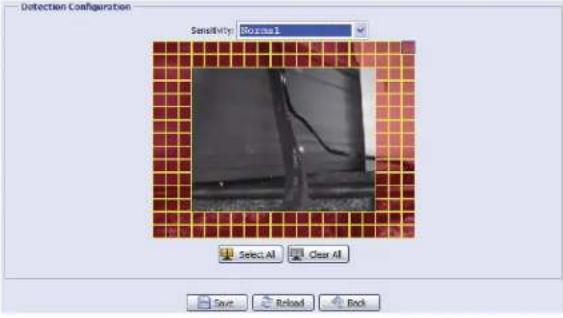 | |
| Sensitivity:Set the detection sensitivity from the drop-down list: High, Normal or Low. | |
| Area Setting:Set the motion detection area by selecting the area grids with your mouse. Pink grids represent the area that is not being detected while the transparent grids are the area under detection. You can set multiple areas under detection.Click “Clear All” to set the whole area undetected.Click “Select All” to set the whole area under detection. | |
| Duration Set the duration time for trigger recording (5 / 10 / 20 / 40 seconds). | |
Action
Here defines how the camera delivers alerts to you for any event.| Item Description | |
| E-Mail Select the event type you want to receive E-mail notifications when it occurs.Then, click the title “E-Mail” (in blue) to configure the media type (H264 / JPEG / MPEG4), file format (AVC / AVI), and record time (1 ~ 5 seconds) for the event video clip.The camera will send the captured video clip to the E-mail address(s) you assigned in “Network” → “Mail” once the selected event type occurs. | |
| FTP Select the event type you want to receive FTP notifications when it occurs.Then, click the title “FTP” (in blue) to configure the media type (H264 / JPEG / MPEG4), file format (AVC / AVI), and record time (1 ~ 5 seconds) for the event video clip.The camera will upload the captured video clip to the FTP site you assigned in “Network” → “FTP” once the selected event type occurs. | |
| SMS Select the event type you want to receive a text message when it occurs.The camera will send a text message to the mobile phone number you assigned in “Network” → “SMS” once the selected event type occurs. | |
| Alarm Out | Select the event type you want to trigger the alarm-out device to work when it occurs.Then, click the title “Alarm Out” (in blue) to configure the trigger rule (LOW / HIGH). |
| Record Select the event type you want to enable event recording when it occurs. | |
| Audio Alert Select the event type you want to enable audio alert when it occurs. | |
3.7 General
3.7.1 General
To change the language of UI interface, select from the drop-down list in "Language". To allow the status LED indicators to show the status as indicated in "1.6 Status Indicator" at page 2, select "Enable" in "Status LED Mode"; to hide the status, select "OFF"; to only show the error status, select "Temporary Disable". Note: The status LED mode will be restored to "Enable" after camera reboot when "Temporary OFF" is selected. To lock camera access when it's not used after the specified time, select "5 MIN", "15 MIN" or "30 MIN" from the drop-down list of "Auto Lock Time", or select "NEVER" to disable this function. Note: When the camera access is locked after the specified time, to resume camera access, please enter the password. 3.7.2 Time
Set daylight saving time and the current time, and click "Save" to confirm. Function Description
■ Time Configuration| Date | Set the current date. |
| Time | Set the current time. |
| ■ Daylight Saving Time Configuration | |
| Daylight Saving Time | Specify whether to use daylight saving time (Enable / Disable). |
| If this function is enabled, set the time period (Start Time / End Time), and adjust the daylight saving time in hours (Adjust Time). | |
3.7.3 Server Log
To quickly search the system logs you want by event type, click "Prev. Page" or "Next Page" to find the logs you want, or check the event type(s) and click "Reload" to start searching. To clear all system event logs, click "Clear All".| Server Log List | |||
| No. | Event | Time | Result |
| 1 | Remote Login | 2011/08/30 20:54:41 | admin |
| 2 | Remote Login | 2011/08/30 20:29:58 | admin |
| 3 | Remote Login | 2011/08/30 18:22:08 | admin |
| 4 | SNTP Update | 2011/08/30 18:20:06 | Failed |
| 5 | Remote Login | 2011/08/30 18:20:03 | admin |
| 6 | Power On | 2011/08/30 18:19:24 | ON |
| 7 | Power On | 2011/08/30 18:18:46 | OFF |
| 8 | Remote Login | 2011/08/30 18:11:21 | admin |
| 9 | Remote Login | 2011/08/30 18:11:18 | admin |
| 10 | Remote Login | 2011/08/30 18:07:19 | admin |
| 11 | Remote Login | 2011/08/30 18:03:19 | admin |
| 12 | Remote Login | 2011/08/30 18:02:15 | admin |
| 13 | Remote Login | 2011/08/30 18:02:07 | admin |
| 14 | Remote Login | 2011/08/30 18:01:51 | admin |
| 15 | Remote Login | 2011/08/30 17:57:01 | admin |
| 16 | Remote Login | 2011/08/30 17:56:59 | admin |
| 17 | Remote Login | 2011/08/30 17:56:53 | admin |
| 18 | Remote Login | 2011/08/30 17:54:44 | admin |
| 19 | SNTP Update | 2011/08/30 17:50:48 | Failed |
| 20 | Power On | 2011/08/30 17:50:07 | ON |
3.7.4 Online
You can check the current online user(s) with respective online information. To refresh the list, click "Reload". To allow anonymous login, select "Enable" in "Anonymous Viewer Login". To disable image code verification at login, select "No" in "Login with CAPTCHA Image". 3.7.5 Account
You can create a new account with different user access privilege, or delete or modify an existing account setting.How to create a new account
Step1: Click "New", and fill in the following columns. | Column Description | |
| User Name Set a user | name that will be used for camera access. The user name allows up to 16 alphanumeric characters. |
| Password Set the password | that will be used for remote login. The password allows up to 16 alphanumeric characters. |
| Confirm Password Enter the password again to confirm. | |
| User Level | Set the security level of an account to give the permission to control different functions. There are four user levels: SUPERVISOR, POWER USER, NORMAL USER and GUEST. |
| Life Time Select how long this account is allowed to stay online (1 MIN / 5 MIN / 10 MIN / 1 HOUR / 1 DAY / INFINITE) | |
3.7.6 Google Maps
This function is used to let you know where the network camera is. The system will prompt you to apply a Goole Maps Key if your access is denied. Please follow the instructions below when you're denied: Step1: Click "Sign up for a Google Maps key" to enter the application page. Step2: Check the terms and conditions, and enter the IP address of the network camera. Then, click "Generate API Key". Step3: Copy the generated API key, and click "Update Google Maps Key" on the web browser to paste it. 3.7.7 Maintenance
Firmware Upgrade
This function is used when users need to upgrade the camera for function scalability. Note: Before using this function, make sure you have the correct upgrade files provided by your installer or distributor. Note: The event videos saved in the camera will be removed after firmware upgrade. Make sure you've copied important events to your PC before firmware upgrade. Step1: Select “☐” to browse to where you save the upgrade files, and select them one by one until all files are selected (up to four files).  Step2: Select "Upgrade" to start system upgrading. Note: You'll be prompted to keep current configurations. It's recommended to keep them, or all configurations will be restored to default values after upgrade. Note: It takes a few minutes to finish the upgrade process. Do not disconnect the power during firmware upgrade, or the upgrade may be failed. The camera will reboot after the upgrade.System Configuration Backup
This function is used to copy your system configuration to a "System.bin" file. You may import the same system configuration to another camera, or restore your system configuration when the camera is reset to default values. Select "System.bin" in "Firmware Upgrade", and select "Upgrade" to import the system configuration. System Reboot
Select "Reboot" to restart your camera if needed. Player Download
To see the event video clips downloaded to your PC, you need to first install our own video player in your PC. Select "Free Download" to download the video player, and double click the file to install it. APPENDIX 1 PRODUCT SPECIFICATIONS
| AVM417A AVM317A AVM217 | |||
| ■ Network | |||
| Network Compression H.264 / MPEG4 / MJPEG | |||
| Multiple Video Streaming (Encode Modes, IPS, Resolution) | 3 (H.264, MJPEG, MPEG4) | ||
| LAN Port YES | |||
| LAN Speed 10/100 Based-T Ethernet | |||
| Supported Protocols | DDNS, PPPoE, DHCP, NTP, SNTP, TCP/IP, ICMP, SMTP, FTP, HTTP, RTP, RTSP, RTCP,IPv4, Bonjour, UPnP, DNS,UDP,IGMP, QoS | ||
| Frame Rate 30 FPS | |||
| Number of Online Users 10 | |||
| Security | 1. Multiple user access levels with password2. IP address filtering3. Digest authentication | ||
| Remote Access | 1. Internet Explorer on Windows operating system2. EagleEyes on iPhone, iPad and Android mobile devices | ||
| ONVIF Compatible YES | |||
| ■ Camera | |||
| Image Sensor | 1/2.9" SONY CMOS image sensor | 1/4" SONY H.R. image sensor | 1/3" H.R. image sensor |
| Video Resolution | HD1080P / HD720P / VGA / QVGA / QQVGA*** | SXGA / HD720P / VGA / QVGA | D1 / CIF |
| Min Illumination 0.1 Lux / F1.5, 0 Lux (IR LED ON) | |||
| Shutter Speed 1 / 60 (1/50) to 1 / 100,000 sec. | |||
| S/N Ratio More than 48dB (AGC off) | |||
| Lens f3.8mm / F1.5 | |||
| Viewing Angle | 83.2°(Diagonal) | 62.7°(Diagonal) | 80.4°(Diagonal) |
| IR LED | 12 units (10 meters) | ||
| IR Shifter | YES | ||
| White Balance | ATW | ||
| AGC | Auto | ||
| IRIS Mode | AES | ||
| External Alarm I/O | YES | ||
| POE | YES (IEEE 802.3af) | NO | |
| Microphone | YES | ||
| Speaker | YES | ||
| Power Source (±10%) | 12V / 1A | 5V / 1A | |
| Operating Temperature | 0°C~40°C | ||
| ■ Others | |||
| Mobile Surveillance | iPad, iPhone & Android | ||
| Audio Detection | YES | ||
| RTC (real-time clock) | YES | ||
| Motion Detection | YES | ||
| Digital Pan / Tilt / Zoom | YES | NO | |
| Event Notification | FTP / Email / SMS | ||
| Minimum Web Browsing Requirements | Pentium 4 CPU 1.3 GHz or higher, or equivalent AMD256 MB RAMAGP graphics card, Direct Draw, 32MB RAMWindows 7, Vista & XP, DirectX 9.0 or laterInternet Explorer 7.x or later | ||
APPENDIX 2 BIT RATE TABLE FOR REFERENCE
The data below is for reference only. The bit rates listed here may vary depending on the resolution, image quality & frame rate you choose, the complexity of your monitoring area, and how often the moving objects show in your monitoring area.AVM317A
Testing Environment
■ Place: Office Entrance ■ Network translation: H.264 ■ Camera type: Megapixel camera   Static: No one coming in and out Dynamic: One or two people coming in and out| Resolution Quality Frame Rate | (Dynamic) kbps (Static) kbps | |||
| SXGA | Best | FULL | 3253 | |
| High | 2375 | 2160 | ||
| Normal | 1571 | |||
| Basic | 1465 | 873 | ||
| VGA | Best | 2010 | 1261 | |
| High | 1042 | 1034 | ||
| Normal | 685 | 572 | ||
| Basic | 457 | 350 | ||
| QVGA | Best | 646 | 366 | |
| High | 482 | |||
| Normal | 302 | 286 | ||
| Basic | 168 | 161 | ||
| SXGA | Best | 1/4 | 1163 | 1076 |
| High | 989 | |||
| Normal | 855 | 534 | ||
| Basic | 719 | 443 | ||
| VGA | Best | 789 | 571 | |
| High | 451 | |||
| Normal | 349 | 237 | ||
| Basic | 217 | 165 | ||
| QVGA | Best | 269 | 147 | |
| High | 182 | |||
| Normal | 164 | 113 | ||
| Basic | 97 | 71 | ||
| SXGA | Best | 1/15 | 581 | |
| High | 405 | |||
| Normal | 487 | |||
| Basic | 337 | |||
| VGA | Best | 358 | ||
| High | 201 | |||
| Normal | 180 | |||
| Basic | 92 | 15 | ||
| QVGA | Best | 111 | 84 | |
| High | 99 | 68 | ||
| Normal | 97 | |||
| Basic | 58 | 42 | ||
Testing Environment
■ Place: Office Entrance ■ Network translation: H.264   Static: No one coming in and out Dynamic: One or two people coming in and out| Resolution Quality Frame Rate | (Dynamic) kbps (Static) kbps | |||
| D1 | Best | FULL | 2786 | 1546 |
| High | 1375 | 705 | ||
| Normal | 1234 | |||
| Basic | 441 | |||
| CIF | Best | 955 | 290 | |
| High | 364 | |||
| Normal | 328 | 111 | ||
| Basic | 161 | |||
| D1 | Best | 1/5 | 935 | 474 |
| High | 506 | |||
| Normal | 297 | 175 | ||
| Basic | 223 | |||
| CIF | Best | 222 | 109 | |
| High | 133 | |||
| Normal | 81 | |||
| Basic | 71 | 32 | ||
| D1 | Best | 1/30 | 127 | 70 |
| High | 197 | |||
| Normal | 61 | 11 | ||
| Basic | 50 | |||
| CIF | Best | 42 | 7 | |
| High | 38 | |||
| Normal | 22 | 1 | ||
| Basic | 28 | |||
APPENDIX 3 POE CONNECTION (AVM417A / 317A Only)
This device supports PoE (Power-over-Ethernet), developed by the IEEE802.3af task force, and power can be supplied over the same network (Ethernet) cable as the one used to connect to Internet. No power cable is needed. Below shows two examples of POE application for reference. ■ When your router / hub supports POE connection  \- When your router / hub doesn't support POE connection (An optional POE connected required) APPENDIX 4 API ID APPLICATION FOR SMS MESSAGING
To allow the camera automatically sending a text message when an event happens, you need to apply an API ID from Clickatell, one mobile messaging company, first. Note: The SMS messaging is not totally free. You will be charged starting from the 11^th message. Please follow the steps below for application. Step1: Go to http://www.clickatell.com/login.php. In "New Customers", select "Clickatell Central (API)" from the drop-down list.  Step2: Fill in your information to create an account, and click "CONTINUE". Note: Note down the user name and password, and the mobile phone number you specified here for SMS notification setting later.  Step2: When the account is created, the system will automatically send an Email to your specified Email address and ask you to activate your account. Click the link in the Email to complete account activation, and enter the login page as follows. Enter the password you set, and click "Login". My Account Login  Step3: Enter the mobile phone number (including your country code) you want the text message to be sent, and click "SEND ACTIVATION CODE". The system will send an activation code to that number for verification. Check if you receive a text message from Clickatell.  Step4: Go back to Clickatell, and click the tab "Manage my Products". Then, select "HTTP" from the drop-down list "My Connections".  Step5: In "Add HTTP API", enter a descriptive name for this service, and make sure the dial prefix is correct and callback type is "HTTP GET". Then, click "Submit".  Step5: You will get an API ID as follows. Note: Note down the API ID for SMS notification setting later. APPENDIX 5 Q&A
For more details about EagleEyes Q&A, please visit our official website: www.eagleeyescctv.com/supp\_QnA.aspx.| Question Answer | |
| I can connect to this camera in my house or office where it's installed with wireless network.But when I leave my house or office, I can't connect to it from my mobile phone (with 3G network), or other PC (connected to Internet). Why? | You didn't configure this camera to Internet, but only in LAN.Please follow the steps in the advanced network setup guide to complete network configurations, or it's recommended for you to check with your local installer or reseller for this service because it's usually hard for a person who doesn't have network knowledge to set network configurations. |
| My live images are not fluent. Why? | Image fluency could be affected by the local network upload bandwidth, router efficiency, client network download bandwidth, complexity of live view, and more.(Recommended) To have the best image fluency, select QVGA; to have the best image quality, select “HD1080P” or “SXVGA” based on the model you have; to have normal image fluency and quality, select “VGA”. |
| My image is vague. Why? | The camera might lose its focus. Please rotate the lens to adjust. |
| The live video keeps flickering. Why? | Please try adjusting the power line frequency to “60 Hz” or “50 Hz” for the camera.For iPhone users, access the camera, and select “on the top right corner to enter IPCAM Configuration page. Then, go to “Advance Setup” → “Camera” to change setting.For access from Internet Explorer, log into the camera, and select “Config.” → “Camera” → “Video”. |
APPENDIX 6 RECORDING TIME TABLE
Below shows the estimated total recording time for each recording resolution. The recording time per resolution is the average value collected from the both alarm trigger conditions indicated in "Testing Environment", and is for reference only. The time may vary depending on the resolution, image quality & frame rate you choose, the complexity of your monitoring area, and how often the moving objects show in your monitoring area.Testing Environment
■ Place: Office ■ Monitoring area: 1.5 meters away from the camera ■ Alarm trigger conditions: (1) One person walks by the monitoring area and leaves immediately. (2) Two persons walk by the monitoring area. One goes away immediately, and the other one stays a while and goes away.| Recording Resolution SXGA | VGA | QVGA |
| Recording time (second) 25 | 115 | 211 |