M4K15 - Video projector Barco - Free user manual and instructions
Find the device manual for free M4K15 Barco in PDF.


| Product Type | Video Projector |
| Brand | Barco |
| Model | M4K15 |
| Display Technology | DLP 0.9" DMD |
| Resolution | 3840 x 2400 (4K UHD) |
| Brightness | 15,000 lumens |
| Contrast Ratio | 1500:1 (typical) |
| Light Source | Laser phosphor |
| Light Source Life | 20,000 hours |
| Lens Mount | Interchangeable, motorized zoom/focus |
| Inputs | 2x HDMI 2.0, 2x DisplayPort 1.2, 1x HDBaseT, 1x 3G-SDI |
| Control | RS232, IR, Wired remote, Ethernet |
| Networking | 10/100 Ethernet with Projector Toolset |
| Dimensions (W x D x H) | 475 x 594 x 250 mm |
| Weight | 25 kg (55 lbs) |
| Power Consumption | 1200 W (typical) |
| Operating Noise | 55 dB (typical) |
| Operating Temperature | 5°C to 40°C (41°F to 104°F) |
| Safety Features | Laser safety interlock, overheat protection |
| Maintenance | Clean air filters regularly, keep vents clear |
| Repairability | Professional service required, no user-serviceable parts |
| Included Accessories | Power cord, wired remote, lens mount cover, user manual |
Frequently Asked Questions - M4K15 Barco
User questions about M4K15 Barco
0 question about this device. Answer the ones you know or ask your own.
Ask a new question about this device
Download the instructions for your Video projector in PDF format for free! Find your manual M4K15 - Barco and take your electronic device back in hand. On this page are published all the documents necessary for the use of your device. M4K15 by Barco.
USER MANUAL M4K15 Barco
natural_image
Black rectangular projector with a large lens and control panel, shown against a white background (no visible text or symbols)User manual
Product revision
Software Revision: 2.2
Barco Fredrikstad AS
Habornveien 53, N-1630 Gamle Fredrikstad, Norway
Support.fre@barco.com
www.barco.com
Barco NV
Beneluxpark 21, 8500 Kortrijk, Belgium
www.barco.com/en/support
www.barco.com
Copyright ©
All rights reserved. No part of this document may be copied, reproduced or translated. It shall not otherwise be recorded, transmitted or stored in a retrieval system without the prior written consent of Barco.
Changes
Barco provides this manual 'as is' without warranty of any kind, either expressed or implied, including but not limited to the implied warranties or merchantability and fitness for a particular purpose. Barco may make improvements and/or changes to the product(s) and/or the program(s) described in this publication at any time without notice.
This publication could contain technical inaccuracies or typographical errors. Changes are periodically made to the information in this publication; these changes are incorporated in new editions of this publication.
The latest edition of Barco manuals can be downloaded from the Barco web site www.barco.com or from the secured Barco web site https://www.barco.com/en/signin.
Trademarks
Brand and product names mentioned in this manual may be trademarks, registered trademarks or copyrights of their respective holders. All brand and product names mentioned in this manual serve as comments or examples and are not to be understood as advertising for the products or their manufacturers.
Product Security Incident Response
As a global technology leader, Barco is committed to deliver secure solutions and services to our customers, while protecting Barco's intellectual property. When product security concerns are received, the product security incident response process will be triggered immediately. To address specific security concerns or to report security issues with Barco products, please inform us via contact details mentioned on https://www.barco.com/psirt. To protect our customers, Barco does not publicly disclose or confirm security vulnerabilities until Barco has conducted an analysis of the product and issued fixes and/or mitigations.
Patent protection
Please refer to www.barco.com/about-barco/legal/patents.
Guarantee and Compensation
Barco provides a guarantee relating to perfect manufacturing as part of the legally stipulated terms of guarantee. On receipt, the purchaser must immediately inspect all delivered goods for damage incurred during transport, as well as for material and manufacturing faults Barco must be informed immediately in writing of any complaints.
The period of guarantee begins on the date of transfer of risks, in the case of special systems and software or the date of commissioning, at latest 30 days after the transfer of risks. In the event of justified notice of complaint, Barco can repair the fault or provide a replacement at its own discretion within an appropriate period. If this measure proves to be impossible or unsuccessful, the purchaser can demand a reduction in the purchase price or cancellation of the contract. All other claims, in particular those relating to compensation for direct or indirect damage, and also damage attributed to the operation of software as well as to other services provided by Barco, being a component of the system or independent service, will be deemed invalid provided the damage is not proven to be attributed to the absence of properties guaranteed in writing or due to the intent or gross negligence or part of Barco.
If the purchaser or a third party carries out modifications or repairs on goods delivered by Barco, or if the goods are handled incorrectly, in particular if the systems are operated incorrectly or if, after the transfer of risks, the goods are subject to influences not agreed upon in the contract, all guarantee claims of the purchaser will be rendered invalid. Not included in the guarantee coverage are system failures which are attributed to programs or special electronic circuitry provided by the purchaser, e.g. interfaces. Normal wear as well as normal maintenance are not subject to the guarantee provided by Barco either.
The environmental conditions as well as the servicing and maintenance regulations specified in this manual must be complied with by the customer.
Disclaimer on GUI images used in this manual
The GUI images in this manual are example illustrations and should be treated as such. While the name of the projector displayed in the illustrations may be different from the projector model you are currently using, the menu lay-out and functionality is identical.
Disclaimer for camera usage
Barco provides a kit with a laser range finder and USB camera to help measure the distance from the front of the projector to the projected surface and to help monitor the performance of the projector. Barco disclaims any liability for any use of the USB camera outside this intended use.
Disclaimer for network usage
Barco highly recommends to install the projector in a closed network environment to minimize the risk of leaking, hacking or corrupting of company confidential information; commercial sensitive information and/or personal data. Furthermore, strengthen your network security to protect the projector against unauthorized access by third parties. To the maximum extent permitted by law, Barco disclaims any liability for the use of the projector in an open network environment.
Table of contents
1 Safety information 9
1.1 General Considerations .... 10
1.2 Important safety instructions.... 11
1.3 Product safety labels....15
1.4 High Brightness precautions: Hazard Distance 16
1.5 HD for fully enclosed projection systems....18
1.6 HD in function of modifying optics 19
1.7 Radio equipment (optional)....20
1.8 Compliance 20
1.9 Download Product Manual 20
2 Getting Started 21
2.1 Getting to know the projector 22
2.2 Power on the projector 24
2.3 Start image projection 25
2.4 Switching to ready mode 28
2.5 Power off projector 28
3 Pulse Remote Control Unit 29
3.1 Pulse RCU, battery installation 30
3.2 Pulse RCU, protocol setup 31
3.3 Pulse RCU, function of the on/off button....31
3.4 Using the RCU 32
3.5 Pulse RCU, Functionality overview....33
3.6 Pulse RCU, function of the "button pressed indicator"....33
3.7 Pulse RCU, function of the "RGB filter" button 34
3.8 Displaying and Programming addresses into the RCU 34
3.9 Using the XLR connector of the RCU 34
3.10 Using the mini-jack connector of the RCU 35
3.11 Pulse RCU, silicone protection sleeve (optional) 35
4 Input & Communication 37
4.1 Introduction....38
4.2 Local Keypad and LCD panel 38
4.3 LCD touch panel 39
4.4 Communication connections....40
4.5 LED and Button indication chart....42
4.6 Pulse Quad Combo input Mk II 43
4.7 Pulse Quad Combo input Mk I....44
4.8 Pulse Quad DP 1.2 input 45
4.9 Pulse SFP input 46
5 GUI – Introduction......47
5.1 Overview 48
5.2 Navigation....51
5.3 Test Patterns....53
6 GUI – Source 55
6.1 Displaying a single source 56
6.2 Displaying multiple sources: Stitched layouts....56
6.3 Connector Settings 58
7 GUI – Image 61
7.1 Setting image levels manually 62
7.2 Adjusting the sharpness....63
7.3 Adjusting the gamma correction....64
7.4 Setting the desired Gamma type....65
7.5 Digital Shift & Zoom 67
7.6 RealColor P7 71
7.7 Displaying HDR content....73
7.8 Dynamic contrast 74
8 GUI – Installation 77
8.1 Configuring the lens, optical zoom-focus 78
8.2 Configuring the lens, shift....78
8.3 Configuring the lens, dynamic focus....79
8.4 Configuring the lens, Shift to center 80
8.5 Configuring the lens, tilt sensor....81
8.6 Laser ranging 82
8.7 Manipulating the rigging frame 83
8.8 Manipulating the rigging frame, center position 85
8.9 Orientation 85
8.10 Scaling modes 86
8.11 Warping 87
8.11.1 Warping – On/Off 88
8.11.2 Warping – Screen Size 88
8.11.3 Warping - 4 corners adjustment....91
8.11.4 Warping-Bow 93
8.11.5 Warping – Warp files 97
8.11.6 Warping – Latency control in a multi projector setup 99
8.12 Blending & masking.... 100
8.12.1 Basic blend 101
8.12.2 Blend & Blend mask 103
8.12.3 Blend Files 105
8.12.4 Basic black level adjustment 106
8.12.5 RGB gain adjustment.... 108
8.12.6 Black Level Files....109
8.13 Illumination 110
8.14 3D projection 111
8.14.1 Active Stereo & Passive Stereo 111
8.14.2 Setup process 3D projection .....112
8.14.3 Connection possibilities....112
8.14.4 3D Setup....113
9 GUI – Profiles 115
9.1 Profiles introduction....116
9.2 Profiles setup parameters....116
9.3 Saving settings to a new profile ....117
9.4 Deleting a projector profile....119
10 GUI – System Settings 121
10.1 Remote control.... 122
10.1.1 Broadcast address 122
10.1.2 Projector address.... 122
10.1.3 IR sensors....123
10.2 Host name - custom projector name setup.... 124
10.3 Communication, LAN setup 125
10.3.1 Introduction to a Network connection 125
10.3.2 Wired IP address set up 126
10.3.3 Wireless IP address set up.... 128
10.3.4 LAN over HDBaseT™ IP address set up.... 131
10.4 DMX....133
10.5 Front XLR output voltage control 135
10.6 GSM configuration.... 135
10.7 Changing the User Interface language 136
10.8 Themes.... 137
10.9 Units (measurement) system setup.... 138
10.10 Controlling the backlight of the LCD Display 138
10.11 Date and time setup - manually 139
10.12 Date and time setup - automatically.... 140
10.13 Power saving settings 142
10.14 Lens features.... 143
10.15 Factory reset.... 144
10.16 Lens Calibration.... 148
10.17 Flex brightness 149
10.18 Rigging frame Calibration....150
10.19 Electronic Convergence 151
10.20 Operational mode 153
10.21 Capture mode 154
10.22 Login to advanced settings.... 154
10.23 List of open source licenses.... 155
11 Advanced Settings 157
11.1 Remote access – Enable source preview.... 158
11.2 Remote access – Enable camera preview 159
11.3 Advanced Settings – Color 160
11.4 Advanced Settings – Statistics 161
11.5 Checking the status of the Laser Banks.... 162
11.6 Advanced settings – Tilt sensor calibration.... 163
12 GUI – Status menu.... 165
12.1 Status menu overview.... 166
13 Product maintenance.... 169
13.1 Software update.... 170
13.2 Cleaning the lens 171
13.3 Cleaning the exterior of the projector.... 172
13.4 Cleaning / replace the air filters.... 172
A Specifications 177
A.1 Specifications SDI inputs.... 178
A.2 Specifications HDMI inputs 178
A.3 Specifications HDBaseT inputs....179
A.4 Specifications DisplayPort 1.2 inputs 180
A.5 Specifications SFP inputs 181
B Video timing tables 183
B.1 Overview video timings.... 184
B.2 Overview video timings SDI Inputs 185
B.3 Overview video timings HDMI 2.0 inputs....186
B.4 Overview video timings DisplayPort 1.2 inputs 188
B.5 Overview video timings HDBaseT inputs 190
C DMX chart 193
C.1 DMX chart input board positioning.... 194
C.2 DMX chart, Basic 194
C.3 DMX chart, Extended....195
D WiFi & GSM compliance information 199
D.1 Compliance FCC 200
D.2 Compliance IC 200
D.3 KCC Certification....201
E Regulatory information 203
E.1 Product compliance 204
E.2 China RoHS compliance.... 205
E.3 Taiwan RoHS compliance 206
E.4 Turkey RoHS compliance....207
E.5 Disposal information....207
E.6 Contact information....208
E.7 Production address....208
Glossary 209
List of tools 211
Index 213
Safety information
1
1.1 General Considerations .... 10
1.2 Important safety instructions.... 11
1.3 Product safety labels....15
1.4 High Brightness precautions: Hazard Distance....16
1.5 HD for fully enclosed projection systems....18
1.6 HD in function of modifying optics 19
1.7 Radio equipment (optional) 20
1.8 Compliance....20
1.9 Download Product Manual 20
About this document
Read this document attentively. It contains important information to prevent personal injury while installing and using the UDM projector. Furthermore, it includes several cautions to prevent damage to the UDM projector. Ensure that you understand and follow all safety guidelines, safety instructions and warnings mentioned in this chapter before installing the UDM projector.
Clarification of the term "UDM" used in this document
When referring in this document to the term "UDM" means that the content is applicable for following Barco products:
• UDM 4K15, UDM 4K22, UDM W15, UDM W19, UDM W22
Model certification name
• UDM

Barco provides a guarantee relating to perfect manufacturing as part of the legally stipulated terms of guarantee. Observing the specification mentioned in this chapter is critical for projector performance. Neglecting this can result in loss of warranty.
1.1 General Considerations

WARNING: Be aware of suspended loads.

WARNING: Wear a hard hat to reduce the risk of personal injury.

WARNING: Be careful while working with heavy loads.

WARNING: Mind your fingers while working with heavy loads.

WARNING: In case of optical radiation emergency, please disconnect the device from the mains current; this by employing the mains switch. In case the mains switch is not easily accessible, the projectors shall be disconnected by other means for example the mains junction box.
It is advised to employ the shutter or select a black image on the projector in order to reduce the risk of the emergency.
General safety instructions
- This product contains no user serviceable parts. Attempts to modify/replace mechanics or electronics inside the housing or compartments will violate any warranties and may be hazardous.
- Do not stare into beam when the projector is on. The bright light may result in permanent eye damage.
- Before operating this equipment please read this manual thoroughly and retain it for future reference.
- Installation and preliminary adjustments must be performed by qualified Barco personnel or by authorized Barco service dealers.
- All warnings on the projector and in the documentation manuals must be adhered to.
- All instructions for operating and use of this equipment must be followed precisely.
- All local installation codes should be adhered to.
Notice on safety
This equipment is built in accordance with the requirements of the applicable international safety standards. These safety standards impose important requirements on the use of safety critical components, materials and insulation, in order to protect the user or operator against risk of electric shock and energy hazard and having access to live parts. Safety standards also impose limits to the internal and external temperature rises, radiation levels, mechanical stability and strength, enclosure construction and protection against the risk of fire. Simulated single fault condition testing ensures the safety of the equipment to the user even when the equipment's normal operation fails.
Notice on optical radiation
This projector embeds extremely high brightness (radiance) lasers; this laser light is processed through the projector's optical path. Native laser light is not accessible by the end user in any use case. The light exiting the projection lens has been diffused within the optical path, representing a larger source and lower radiance value than native laser light. Nevertheless the projected light represents a significant risk for the human eye and skin when exposed directly within the beam. This risk is not specifically related to the characteristics of laser light but solely to the high thermal induced energy of the light source; which is equivalent with lamp based systems.
Thermal retinal eye injury is possible when exposed within the Hazard Distance (HD). The HD is defined from the projection lens surface towards the position of the projected beam where the irradiance equals the maximum permissible exposure as described in the chapter "Hazard Distance".

WARNING: No direct exposure to the beam within the hazard distance shall be permitted, RG3 (Risk Group 3) IEC EN 62471-5:2015

CAUTION: Use of controls or adjustments or performance of procedures other than those specified herein may result in hazardous radiation exposure.
Notice on laser radiation
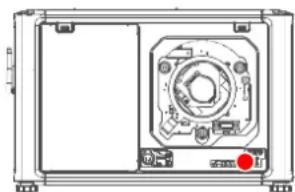
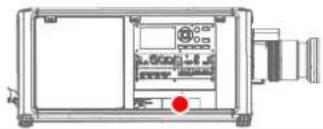
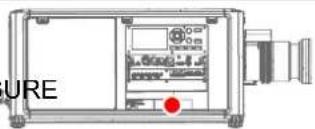
The laser distance meter that is optional equipment for this projector can emit a class 2 laser ranging beam of 0.95 mW / 638 nm. When installed correctly, this distance meter is located on the front side of the projector (see ). The laser beam can be enabled by either pressing the button on the equipment, via the projector menu, or via the projector software. Thermal retinal eye injury is possible when staring into the laser ranging beam.
natural_image
Technical line drawing of a mechanical device with mounting holes and a central circular component (no text or symbols)Image 1-1

WARNING: Laser Radiation — Do not stare into laser ranging beam, Class 2 IEC EN 60825-1:2014 See the product safety manual for details.
Users definition
Throughout this manual, the term SERVICE PERSONNEL refers to Barco authorized persons having appropriate technical training and experience necessary to be knowledgeable of potential hazards to which they are exposed (including, but not limited to HIGH VOLTAGE ELECTRIC and ELECTRONIC CIRCUITRY and HIGH BRIGHTNESS PROJECTORS) in performing a task, and of measures to minimize the potential risk to themselves or other persons. The term USER and OPERATOR refers to any person other than SERVICE PERSONNEL, AUTHORIZED to operate professional projection systems.
The UDM projector is intended "FOR PROFESSIONAL USE ONLY" by AUTHORIZED PERSONNEL familiar with potential hazards associated with high voltage, high intensity light beams and high temperatures generated by the light source and associated circuits. Only qualified SERVICE PERSONNEL, knowledgeable of such risks, are allowed to perform service functions inside the product enclosure.
1.2 Important safety instructions
To prevent risk of electrical shock
- This product should be operated from a mono phase AC power source. Ensure that the mains voltage and capacity matches the projector electrical ratings: 120-180V / 200-240V (+/-10%), 16A-12A, 50-60Hz. If you are unable to install the AC requirements, contact your electrician. Do not defeat the purpose of the grounding.
- This apparatus must be grounded (earthed) via the supplied 3 conductor AC power cable.
- If none of the supplied power cables are the correct one, consult your dealer.
- If you are unable to insert the plug into the outlet, contact your electrician to replace your obsolete outlet. Do not defeat the purpose of the grounding-type plug.
- Never use 2- wire power cords, as this is dangerous and could lead to electrical shock. Always use a power connector with a ground terminal.
- Do not allow anything to rest on the power cord. Do not locate this product where persons will walk on the cord. To disconnect the cord, pull it out by the plug. Never pull the cord itself.
- Use only the power cord supplied with your device. While appearing to be similar, other power cords have not been safety tested at the factory and may not be used to power the device. For a replacement power cord, contact your dealer.
- If you are unable to insert the plug into the outlet, contact your electrician to replace your obsolete outlet. Do not defeat the purpose of the grounding-type plug.
- Do not operate the projector with a damaged cord. Replace the cord.
-
Do not operate the projector if the projector has been dropped or damaged - until it has been examined and approved for operation by qualified service personnel.
-
Position the cord so that it will not be tripped over, pulled, or contact hot surfaces.
- If an extension cord is necessary, a cord with a current rating at least equal to that of the projector should be used. A cord rated for less amperage than the projector may overheat.
- Never push objects of any kind into this product through cabinet slots as they may touch dangerous voltage points or short out parts that could result in a risk of fire or electrical shock.
- Make sure that no objects enter into the vents and openings of the set.
- Do not expose this projector to rain or moisture.
- The projector is designed for indoor use only. Never operate the unit outdoors.
- Do not immerse or expose this projector in water or other liquids.
- Do not spill liquid of any kind on this projector.
- Should any liquid or solid object fall into the cabinet, unplug the set and have it checked by qualified service personnel before resuming operations.
- Do not disassemble this projector, always take it to qualified service personnel when service or repair work is required.
- Do not use an accessory attachment which is not recommended by the manufacturer.
• Lightning - For added protection for this video product during a lightning storm, or when it is left unattended and unused for long periods of time, unplug it from the wall outlet. This will prevent damage to the device due to lightning and AC power-line surges.
To prevent personal injury
- To prevent injury and physical damage, always read this manual and all labels on the system before powering the projector or adjusting the projector.
- To prevent injury, take note of the weight of the projector. The weight of a basic projector is about 48 kg (105 lb) without lens.
- To prevent injury, ensure that the lens and all covers are correctly installed. See installation procedures.
- Warning: high intensity light beam. NEVER look into the lens! High luminance could result in damage to the eye.
- Warning: extremely high brightness projector: This projector embeds extremely high brightness (radiance) lasers; this laser light is processed through the projectors optical path. Native laser light is not accessible by the end user in any use case. The light exiting the projection lens has been diffused within the optical path, representing a larger source and lower radiance value than native laser light. Nevertheless the projected light represents a significant risk for the human eye when exposed directly within the beam. This risk is not specific related to the characteristics of laser light but solely to the high thermal induced energy of the light source; which is comparable with lamp based systems. Thermal retinal eye injury is possible when exposed within the Hazard Distance. The Hazard Distance (HD) is defined from the projection lens surface towards the position of the projected beam where the irradiance equals the maximum permissible exposure as described in the chapter “High Brightness precautions: Hazard Distance”, page 16.
- High Brightness Warning: The projector light source may not be switched on or the shutter must be closed when no projection lens is installed.
- Based on international requirements, no person is allowed to enter the projected beam within the zone between the projection lens and the related Hazard Distance (HD). This shall be physically impossible by creating sufficient separation height or by placing optional barriers. Within the restricted area operator training is considered sufficient. The applicable separation heights are discussed in “High Brightness precautions: Hazard Distance”, page 16.
- Warning: Laser radiation when optional laser distance meter is installed. Do not stare into laser ranging beam. Class 2 laser beam could result in damage to the eye.
- Don't put your hand in front of the beam.
- This product contains no user serviceable parts. Attempts to modify/replace mechanics or electronics inside the housing or compartments will violate any warranties and may be hazardous. This kind of operations shall only be performed by Barco authorized service personnel.
- Before attempting to remove any of the projector's covers, you must turn off the projector and disconnect from the wall outlet.
- When required to switch off the projector, to access parts inside, always disconnect the power cord from the power net.
- The power input at the projector side is considered as the disconnect device. When required to switch off the projector, to access parts inside, always disconnect the power cord at the projector side. In case the power input at the projector side is not accessible (e.g. ceiling mount), the soil outlet supplying the projector shall be installed nearby the projector and be easily accessible, or readily accessible general disconnect device shall be incorporated in the fixed wiring.
- Do not stack or hang projectors without using the stacking frame.
- Max units in stacked configuration, 3 units.
- Max units in hanging configuration, 2 units.
- When hanging projectors on a truss with the Barco stacking frame, always secure the stack with safety cables between the projectors and the truss.
- When using the projector in a hanging configuration, always mount 2 safety cables. See installation manual for the correct use of these cables.
- Do not place this equipment on an unstable cart, stand, or table. The product may fall, causing serious damage to it and possible injury to the user.
- Only place the projector on a stable surface, or mount it securely using an approved ceiling mount rig.
- It is hazardous to operate without lens or shield. Always switch the output light off when replacing a lens.
- Lenses or shields shall be changed if they have become visibly damaged to such an extent that their effectiveness is impaired. For example by cracks or deep scratches.
- Cooling liquid circuit. The projector contains a cooling circuit filled with Mono-ethylene glycol (1,2-ethane diol) and inhibitors in aqueous solution (34% active). If the unlikely event that the cooling circuits have a leak, switch off the device and contact qualified service personnel. The liquid is not for household use. Keep out of reach of children. Harmful by oral intake. Avoid exposure to pregnant women. Avoid contact with eyes, skin and clothing. Avoid inhale of the noxious fumes.
- Never point or allow light to be directed on people or reflective objects within the HD zone.
- All operators shall have received adequate training and be aware of the potential hazards.
- In case of using an external cooling system position the hoses of the cooling system so that they will not be tripped over, pulled, or contact hot surfaces.
To prevent fire hazard
- Do not place flammable or combustible materials near the projector!
- Barco large screen projection products are designed and manufactured to meet the most stringent safety regulations. This projector radiates heat on its external surfaces and from ventilation ducts during normal operation, which is both normal and safe. Exposing flammable or combustible materials into close proximity of this projector could result in the spontaneous ignition of that material, resulting in a fire. For this reason, it is absolutely necessary to leave an “exclusion zone” around all external surfaces of the projector whereby no flammable or combustible materials are present. The exclusion zone must be not less than 40 cm (16") for this projector.
- Do not place any object in the projection light path at close distance to the projection lens output. The concentrated light at the projection lens output may result in damage, fire or burn injuries.
- Ensure that the projector is solidly mounted so that the projection light path cannot be changed by accident.
- Do not cover the projector or the lens with any material while the projector is in operation. . Mount the projector in a well ventilated area away from sources of ignition and out of direct sun light. Never expose the projector to rain or moisture. In the event of fire, use sand, dry powder fire extinguishers. Never use water on an electrical fire. Always have service performed on this projector by authorized Barco service personnel. Always insist on genuine Barco replacement parts. Never use non-Barco replacement parts as they may degrade the safety of this projector.
- Slots and openings in this equipment are provided for ventilation. To ensure reliable operation of the projector and to protect it from overheating, these openings must not be blocked or covered. The openings should never be blocked by placing the projector too close to walls, or other similar surface. This projector should never be placed near or over a radiator or heat register. This projector should not be placed in a built-in installation or enclosure unless proper ventilation is provided.
- Projection rooms must be well ventilated or cooled in order to avoid build up of heat. It is necessary to vent hot exhaust air from projector and cooling system to the outside of the building.
- Let the projector cool completely before storing. Remove cord from the projector when storing.
To prevent battery explosion
- Danger of explosion if battery is incorrectly installed.
- Replace only with the same or equivalent type recommended by the manufacturer.
- For disposal of used batteries, always consult federal, state, local and provincial hazardous waste disposal rules and regulations to ensure proper disposal.
To prevent projector damage
- The air filters of the projector must be cleaned or replaced on a regular basis. Cleaning the booth area would be monthly-minimum. Neglecting this could result in disrupting the air flow inside the projector, causing overheating. Overheating may lead to the projector shutting down during operation.
- The projector must always be installed in a manner which ensures free flow of air into its air inlets.
- If more than one projector is installed in a common projection booth, the exhaust air flow requirements are valid for EACH individual projector system. Note that inadequate air extraction or cooling will result in decreased life expectancy of the projector as a whole as well as causing premature failure of the lasers.
- In order to ensure that correct airflow is maintained, and that the projector complies with Electromagnetic Compatibility (EMC) and safety requirements, it should always be operated with all of its covers in place.
- Slots and openings in the cabinet are provided for ventilation. To ensure reliable operation of the product and to protect it from overheating, these openings must not be blocked or covered. The openings should never be blocked by placing the product on a bed, sofa, rug, or other similar surface. This product should never be placed near or over a radiator or heat register. The device should not be placed in a built-in installation or enclosure unless proper ventilation is provided.
- Ensure that nothing can be spilled on, or dropped inside the projector. If this does happen, switch off and remove all power from the projector. Do not operate the projector again until it has been checked by qualified service personnel.
- Do not block the projector cooling fans or free air movement around the projector.
- Do not use this equipment near water.
- Special care for Laser Beams: Special care should be used when DLP projectors are used in the same room as high power laser equipment. Direct or indirect hitting of a laser beam on to the lens can severely damage the Digital Mirror Devices in which case there is a loss of warranty.
- Never place the projector in direct sunlight. Sunlight on the lens can severely damage the Digital Mirror Devices™ in which case there is a loss of warranty.
- Save the original shipping carton and packing material. They will come in handy if you ever have to ship your equipment. For maximum protection, repack your set as it was originally packed at the factory.
- Unplug this product from the wall outlet before cleaning. Do not use liquid cleaners or aerosol cleaners. Use a damp cloth for cleaning. Never use strong solvents, such as thinner or benzine, or abrasive cleaners, since these will damage the cabinet. Stubborn stains may be removed with a cloth lightly dampened with mild detergent solution.
- To ensure the highest optical performance and resolution, the projection lenses are specially treated with an anti-reflective coating, therefore, avoid touching the lens. To remove dust on the lens, use a soft dry cloth. For lens cleaning follow the instructions precisely as stipulated in the projector manual.
- Only use zoom lenses of the Barco TLD+ series on the 4K models of the projector. Using other lenses will damage the internal optics. For suitable fixed TLD+ lenses contact Barco or see Barco website.
- Allowed ambient temperature range depends on altitude:
- between 0 and 1000 meter altitude: ambient temperature range = 0^ (32°F) to 40^ (104°F)
- between 1000 and 3000 meter altitude: ambient temperature range = 0^ (32°F) to 30^ (86°F)
- Rated humidity = 0% RH to 80% RH Non-condensed.
On servicing
- Do not attempt to service this product yourself, as opening or removing covers may expose you to dangerous voltage potentials and risk of electric shock.
• Refer all servicing to qualified service personnel. - Attempts to alter the factory-set internal controls or to change other control settings not specially discussed in this manual can lead to permanent damage to the projector and cancellation of the warranty.
- Replacement parts: When replacement parts are required, be sure the service technician has used original Barco replacement parts or authorized replacement parts which have the same characteristics as the Barco original part. Unauthorized substitutions may result in degraded performance and reliability, fire, electric shock or other hazards. Unauthorized substitutions may void warranty.
- Safety check: Upon completion of any service or repairs to this projector, ask the service technician to perform safety checks to determine that the product is in proper operating condition.
Malfunction unit
Remove all power from the projector and refer servicing to qualified service technicians under the following conditions:
- When the power cord or plug is damaged or frayed.
- If liquid has been spilled into the equipment.
- If the product has been exposed to rain or water.
- If the product does not operate normally when the operating instructions are followed. Adjust only those controls that are covered by the operating instructions since improper adjustment of the other controls may result in damage and will often require extensive work by a qualified technician to restore the product to normal operation.
- If the product has been dropped or the cabinet has been damaged.
- If the product exhibits a distinct change in performance, indicating a need for service.
Stacking and transporting
- Stack maximum 2 rental flight cases high. Never higher.
- Surface on which flight case is standing must be level to ensure that the total load is evenly spread out among the four wheels. The surface must also be able to support the load safely.
- Before stacking or transporting flight cases, check the wheels and their fixation screws for wear or defects.
- Before stacking or transporting flight cases, check that the four lock handles on each flight case are in good working order and locked securely.
- When stacked, make sure the wheels of the upper flight case are precisely positioned in the stacking dishes of the flight case below.
- Stacked flight cases may not be moved. Before stacking, the lower flight case must already be in its final resting position before placing the second upon it.
- Never stack loaded flight cases in a truck or other transport medium, unless each flight case is rigidly strapped tight.
• In the event of a wheel breaking, flight cases must be rigidly strapped tight to prevent a stack collapsing. - Use an appropriate forklift to raise flight cases and take the necessary precautions to avoid personnel injury.
Safety Data Sheets for Hazardous Chemicals
For safe handling information on chemical products, consult the Safety Data Sheet (SDS). SDSs are available upon request via safetydatasheets@barco.com.
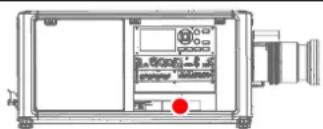
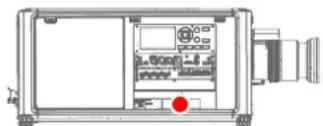
1.3 Product safety labels
Light beam related safety labels
Label image Label description
Label location

Hazard RG3: not for household use symbol
natural_image
Technical line drawing of a mechanical device with control panel and mounting bracket (no text or symbols)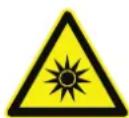
Hazard RG3: optical radiation warning symbol
natural_image
Technical line drawing of a mechanical device with control panel and mounting bracket (no text or symbols)Label image Label description
Label location
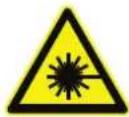
Hazard class 2: laser radiation warning symbol.
0.95 mW - 638 nm.
natural_image
Technical line drawing of a mechanical device with internal components and a red indicator point (no text or symbols)
natural_image
Technical diagram of an electrical enclosure with labeled component 'URE' and a red dot on the side (no readable text or symbols beyond label)WARNING! DO NOT LOOK INTO THE BEAM NO DIRECT EYE EXPOSURE TO THE PROJECTOR BEAM IS PERMITTED LASER RADIATION - DO NOT STARE INTO LASER RANGING BEAM RG3 IEC EN 62471-5:2015 CLASS 2 IEC EN 60825-1:2014 HAZARD DISTANCE: CONSULT SAFETY MANUAL
THIS PRODUCT IS IN CONFORMITY WITH PERFORMANCE STANDARDS FOR LASER PRODUCTS UNDER 21 CFR 1040, EXCEPT WITH RESPECT TO THOSE CHARACTERISTICS AUTHORIZED BY VARIANCE NUMBER 2016-V-0144 EFFECTIVE ON DECEMBER 12, 2019.
1.4 High Brightness precautions: Hazard Distance
HD

Hazard Distance (HD) is the distance measured from the projection lens at which the intensity or the energy per surface unit becomes lower than the applicable exposure limit on the cornea or on the skin. The light beam is considered (to be) unsafe for exposure if the distance from a person to the light source is less than the HD.
Restriction Zone (RZ) based on the HD
The HD depends on the amount of lumens produced by the projector and the type of lens installed. See chapter "HD in function of modifying optics", page 19.
To protect untrained end users (as cinema visitors, spectators) the installation shall comply with the following installation requirements: Operators shall control access to the beam within the hazard distance or install the product at a height that will prevent spectators' eyes from being in the hazard distance. Radiation levels in excess of the limits will not be permitted at any point less than 2.0 meter (SH) above any surface upon which persons other than operators, performers, or employees are permitted to stand or less than 1.0 meter (SW) lateral separation from any place where such persons are permitted to be. In environments where unrestrained behavior is reasonably foreseeable, the minimum separation height should be greater than or equal to 3.0 meter to prevent potential exposure, for example by an individual sitting on another individual's shoulders, within the HD.
These values are minimum values and are based on the guidance provided in IEC 62471-5:2015 section 6.6.3.5.
The installer and user must understand the risk and apply protective measures based upon the hazard distance as indicated on the label and in the user information. Installation method, separation height, barriers, detection system or other applicable control measure shall prevent hazardous eye access to the radiation within the hazard distance.
For example, projectors that have a HD greater than 1 m and emit light into an uncontrolled area where persons may be present should be positioned in accordance with “the fixed projector installation” parameters, resulting in a HD that does not extend into the audience area unless the beam is at least 2.0 meter above the floor level. In environments where unrestrained behavior is reasonably foreseeable, the minimum separation height should be greater than or equal to 3.0 meter to prevent potential exposure, for example by an individual sitting on another individual's shoulders, within the HD. Sufficiently large separation height may be achieved by mounting the image projector on the ceiling or through the use of physical barriers.
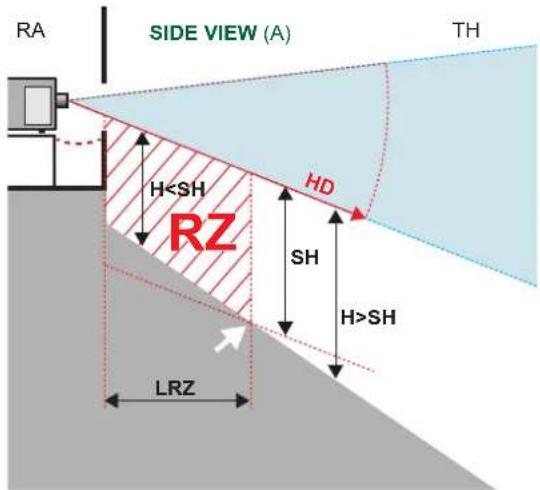
Image 1-2
A Side view
B Top view
RA Restricted Access location (boot area of projector).
TH Theater
RZ Restriction Zone in the theater
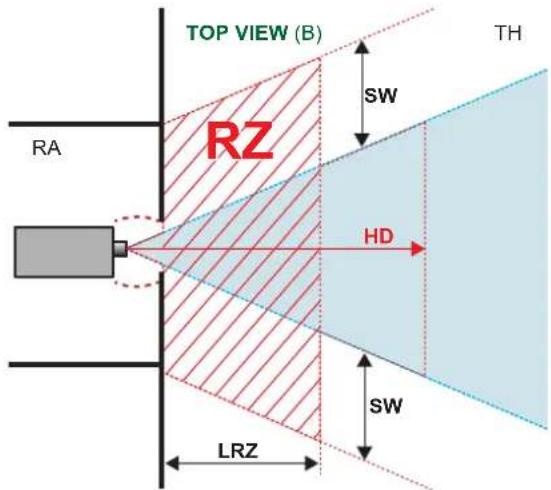
HD Hazard Distance
LRZ Length Restriction Zone in the theater
H Height between surface floor and the light beam
SH Separation Height
SW Separation Width
Based on national requirements, no person is allowed to enter the projected beam within the zone between the projection lens and the related hazard distance (HD). This shall be physically impossible by creating sufficient separation height or by placing barriers. The minimum separation height takes into account the surface upon which persons other than operator, performers or employees are permitted to stand.
On Image 1–3 a typical setup is displayed. It must be verified if these minimum requirements are met. If required a restricted zone (RZ) in the theater must be established. This can be done by using physical barrier, like a red rope as illustrated in Image 1–3.
The restricted area sticker can be replaced by a sticker with only the symbol.
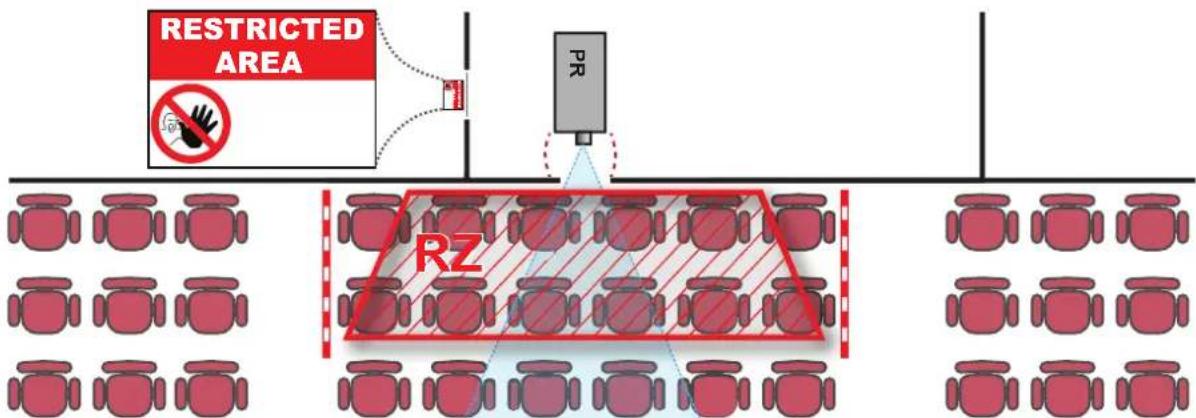
Image 1-3
USA market
For LIPs (Laser Illuminated Projectors) installed in the USA market other restriction zone conditions apply.
LIPs for installation in restrained environment (cinema theaters, business rooms, class rooms, museums ...) shall be installed at height vertically above the floor such that the bottom plane of the hazard distance zone shall be no lower than 2.5 meters above the floor. Horizontal clearance to the hazard distance zone shall be
not less than 1 meter. Alternatively, in case the height of the separation barrier for the horizontal clearance is at least 1 meter high then the horizontal clearance (SW) can be reduced to:
- 0 meter if the height of the hazard zone is minimum 2.5 meter.
- 0.1 meter if the height of the hazard zone is minimum 2.4 meter.
- 0.6 meter if the height of the hazard zone is minimum 2.2 meter.
LIPs for installations in unrestrained environment (concerts, ...) shall be installed at a height vertically above the floor such that the bottom plane of the Hazard distance Zone shall be no lower than 3 meters above the floor. Horizontal clearance to the hazard distance zone shall be not less than 2.5 meters. Any human access horizontally to the Hazard Zone, if applicable, shall be restricted by barriers. If human access is possible in an unsupervised environment, the horizontal or vertical clearances shall be increased to prevent exposure to the hazard distance zone.
The LIP shall be installed by Barco or by a trained and Barco-authorized installer or shall only be transferred to laser light show variance holders. This is applicable for dealers and distributors since they may need to install the LIP (demo install) and/or they transfer (sell, rent, lease) the LIP. Dealers and distributors shall preserve sales and installation records for a period of 5 years. Variance holders may currently hold a variance for production of Class IIIB and IV laser light shows and/or for incorporating RG3 LIPs. Laser light show variance for RG3 LIPs can be requested by mailing the application to RadHealthCustomerService@fda.hhs.gov.
The installation checklist for laser illuminated RG3 projectors must be fully completed after the installation. The installation checklist can be downloaded from the Barco website. The installer shall preserve the checklist for a period of 5 years.
Install one or more readily accessible controls to immediately terminate LIP projection light. The power input at the projector side is considered as a reliable disconnect device. When required to switch off the projector, disconnect the power cord at the projector side. In case the power input at the projector side is not accessible (e.g. truss mount), the socket outlet supplying the projector shall be installed nearby the projector and be easily accessible, or a readily accessible general disconnect device shall be incorporated in the fixed wiring.
1.5 HD for fully enclosed projection systems

HD
Hazard Distance (HD) is the distance measured from the projection lens at which the intensity or the energy per surface unit becomes lower than the applicable exposure limit on the cornea or on the skin. The light beam is considered (to be) unsafe for exposure if the distance from a person to the light source is less than the HD.
Restriction Zone (RZ) based on the HD
The projector is also suitable for rear projection applications; projecting a beam onto a defuse coated projection screen. As displayed in Image 1-4 two areas should be considered: the restricted enclosed projection area (RA) and the observation area (TH).
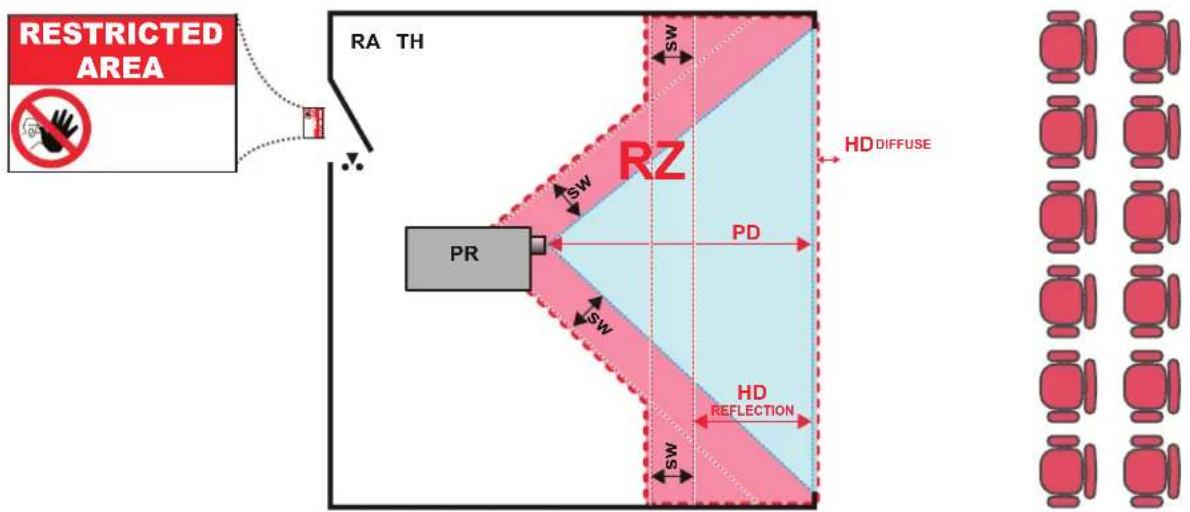
Image 1-4
RA Restricted Access location (enclosed projection area).
PR Projector.
TH Theater (observation area).
RZ Restriction Zone.
PD Projection Distance.
SW Separation Width. Must be minimum 1 meter.
For this type of setup 3 different HD shall be considered:
- HD as discussed in "High Brightness precautions: Hazard Distance", page 16, relevant for intrabeam exposure.
- HD_ reflection : the distance that has to be kept restrictive related to the reflected light from the rear projection screen.
- HD_diffuse : the relevant distance to be considered while observing the diffuse surface of the rear projection screen.
As described in “High Brightness precautions: Hazard Distance”, page 16, it is mandatory to create a restricted zone within the beam areas closer than any HD. In the enclosed projection area the combination of two restricted zones are relevant: The restricted zone of the projected beam toward the screen; taking into account 1 meter Separation Width (SW) from the beam onward. Combined with the restricted zone related to the rear reflection from the screen (HD), also taking into account a 1 meter lateral separation.
The HD_reflection distance equals 25% of the difference between the determined HD distance and the projection distance to the rear projection screen. To determine the HD distance for the used lens and projector model see chapter “HD in function of modifying optics”, page 19.
$$ \mathrm{HDreflection} = 25 \% (\mathrm{HD} - \mathrm{PD}) $$
The light emitted from the screen within the observation shall never exceed the RG2 exposure limit, determined at 10 cm. The HDase can be neglected if the measured light at the screen surface is below 5000 cd/m² or 15000 LUX.
1.6 HD in function of modifying optics
Hazard distance
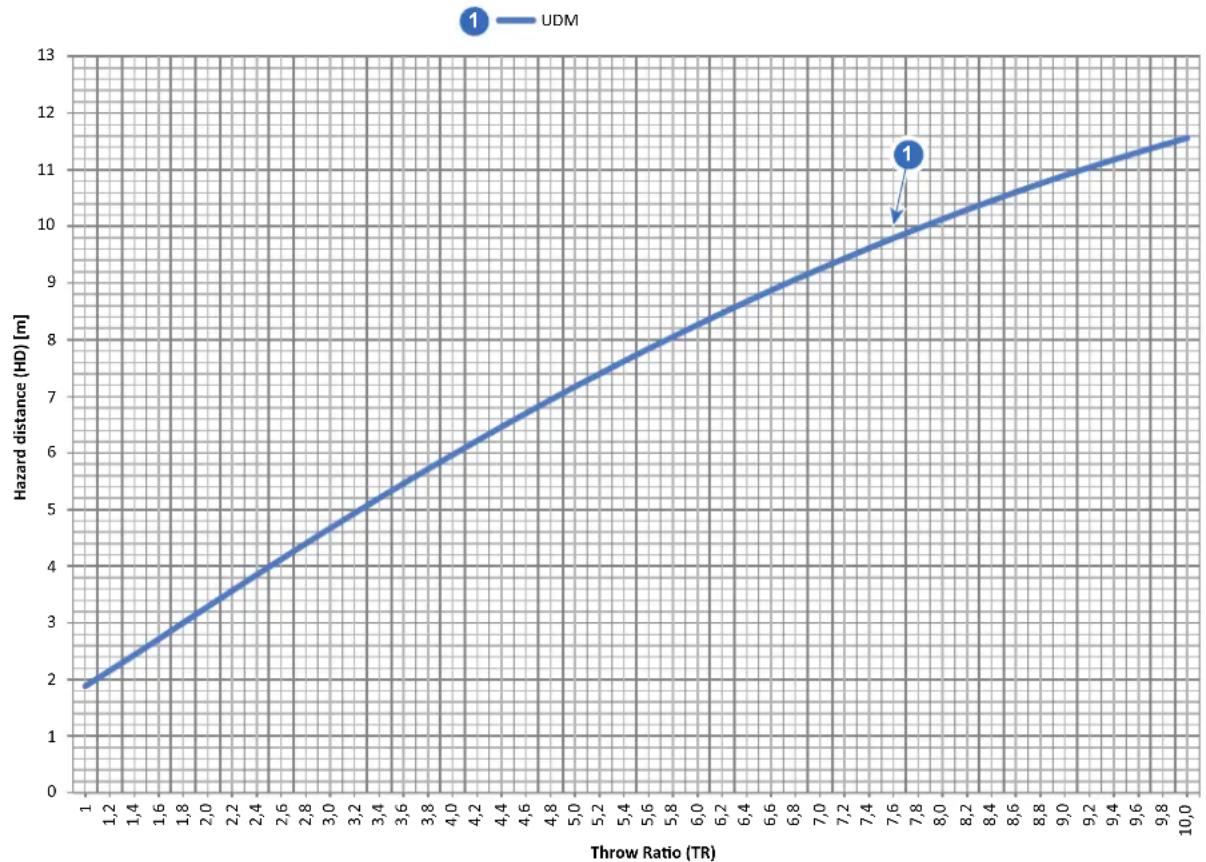
line
| Throw Ratio (TR) | Hazard distance (HD) [m] | | ---------------- | ------------------------ | | 1.0 | 2.0 | | 7.6 | 10.0 | | 10.0 | 11.5 |Image 1–5
HD Hazard Distance
TR Throw Ratio
1.7 Radio equipment (optional)
CE Conformity

This device may be equipped with WiFi & GSM modules for Pulse Input & Communication unit, which are fit for use in the European Union countries, EFTA and Turkey.
This device is restricted to indoor use only when operating in the 5150 to 5250 MHz frequency range.
Hereby, Barco declares that the radio equipment type UDM is in compliance with Directive 2014/53/EU. The full text of the EU declaration of conformity is available at the following internet address: https://www.barco.com/support
WiFi & GSM module
For WLAN:
• Frequency: 2402 MHz - 2482 Mhz
• Max EIRP: 19 dBm
• Frequency: 5150 - 5350 MHz / 5470 - 5725
• Max EIRP: 23 dBm
For UMTS:
- Band 1:
- Frequency: 2100 MHz
- Max EIRP: 24 dBm
- Band 8:
- Frequency: 900 MHz
- Max EIRP: 24 dBm
For GSM:
E-GSM:
- Frequency: 900 MHz
Mhz- Max EIRP: 33.5 dBm
- EDGE:
- Frequency: 900 MHz
- Max EIRP: 28 dBm
• DCS:
- Frequency: 1800 MHz
- Max EIRP: 30.5 dBm
- EDGE:
- Frequency: 1800 MHz
- Max EIRP: 27 dBm
1.8 Compliance
UK Compliance

This product is fit for use in the UK.
Authorised Representative: Barco UK Ltd
Address: Building 329, Doncastle Road
Bracknell RG12 8PE, Berkshire, United Kingdom
1.9 Download Product Manual
Download Product Manual
Product manuals and documentation are available online at www.barco.com/td.
Registration may be required; follow the instructions given on the website.
IMPORTANT! Read Installation Instructions before connecting equipment to the mains power supply.
Getting Started 2
2.1 Getting to know the projector 22
2.2 Power on the projector 24
2.3 Start image projection 25
2.4 Switching to ready mode 28
2.5 Power off projector....28
About this chapter
This chapter and by extension this whole document, the user manual, is intended for the user who want's to operate the projector. It does not contain installation instructions because the installation has to be done by trained and qualified service technicians. Refer to the projector installation manual for detailed installation instructions.
2.1 Getting to know the projector
Orientation convention
This manual refers to the left side of the projector as the side at your left hand when standing behind the projector and looking at the projection screen in front of the projector.
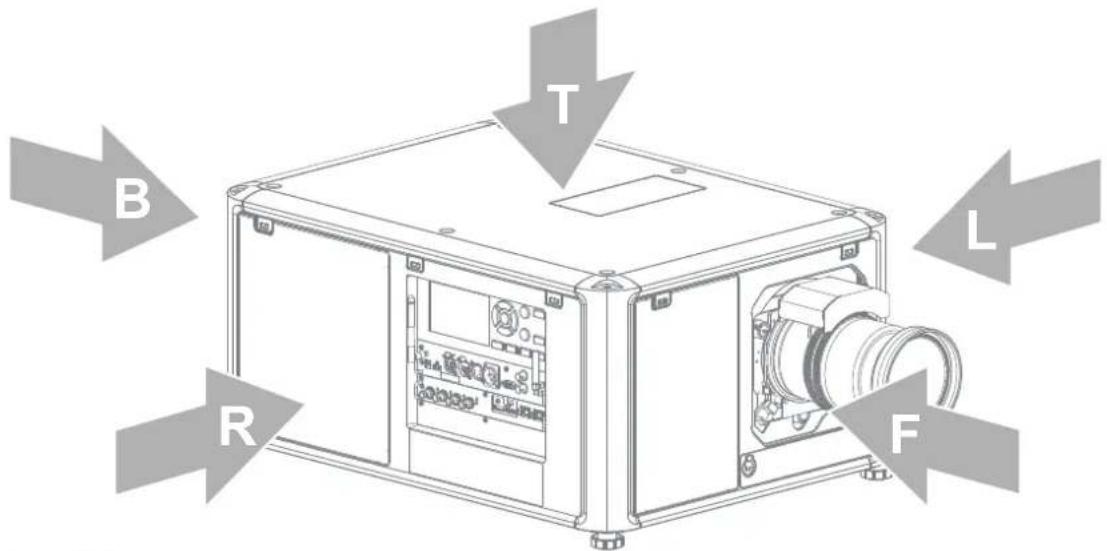
Image 2-1
T Top
L Left
F Front
R Right
B Back
Projector component location
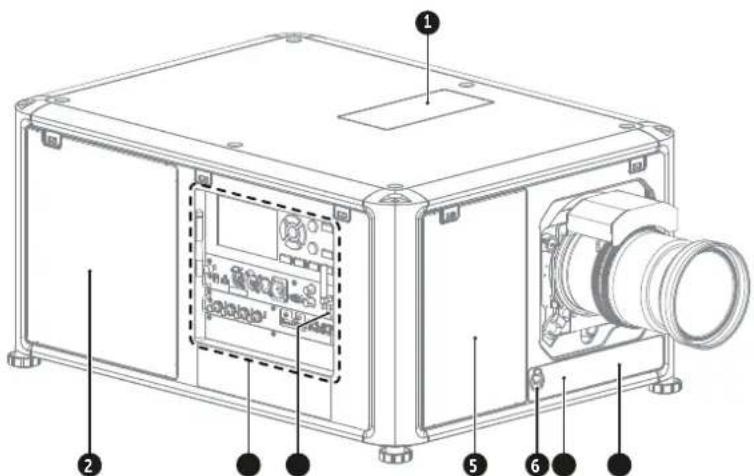
Image 2-2
1 Dust filter top air inlet
2 Dust filter side air inlet
3 Input & Communication module
4 IR receiver projector right side
5 Dust filter front air inlet
6 Auxiliary connector (for external shutter, DMX, ...)
7 IR receiver projector front side
8 Distance meter (optional)
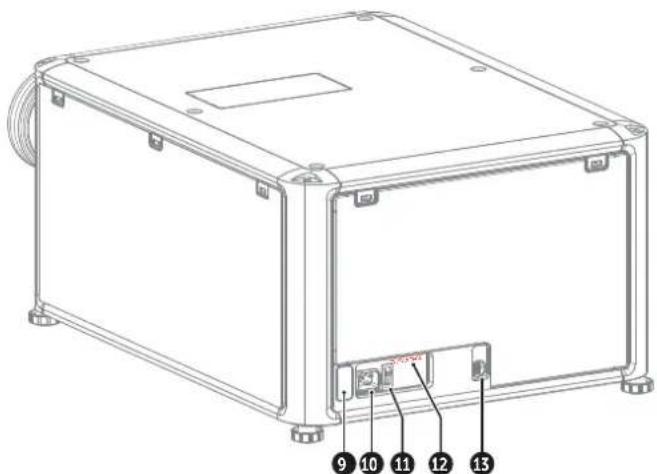
Image 2-3
9 IR receiver projector rear side
10 Mains power input socket (for C19 plug)
11 Power ON/OFF switch
12 Overvoltage status light
13 USB port (to control motorized rigging frame)
For detailed info about the Input & Communication module see chapter "Input & Communication", page 37.
Environment conditions
Table below summarizes the physical environment in which the projector safely operates or can be stored.
| Environment | Operating Non-Operating | |
| Ambient Temperature (depends on altitude) | 0-1000 meter: 0°C (32°F) to 40°C (104°F)1000-3000 meter: 0°C (32°F) to 30°C (86°F) | -15°C (5°F) to 60°C (140°F) |
| Humidity 0% RH to 80% | RH Non-condensed 0% RH to 90% RH Non-Condensed | |
| Altitude -60 m (-197 Ft) | to 3000 m (9843 Ft)1 | -60 m (-197 Ft) to 10000 m (32810 Ft) |
Projector airflow
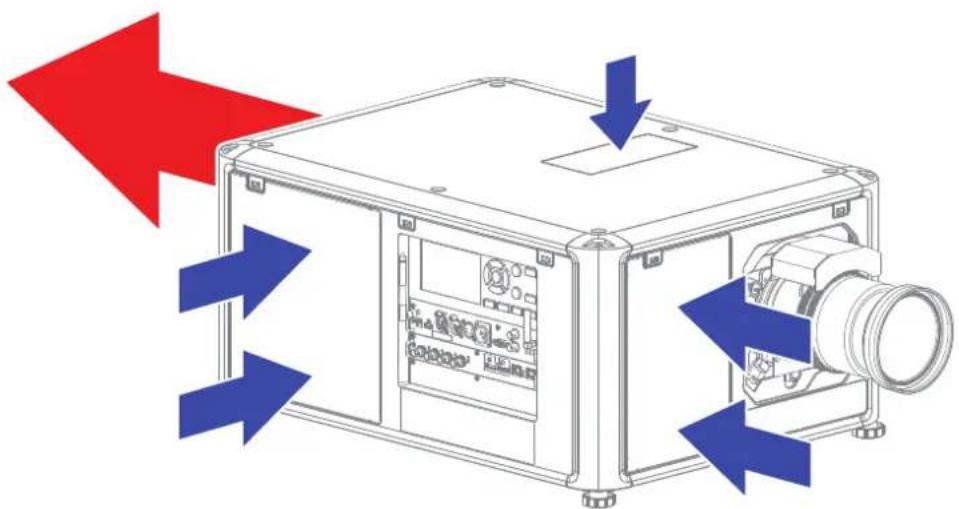
The projector has three air inlets: one at the top, one at the front and one at the right side of the projector. Each air inlet is equipped with a dust filter. For cleaning/replacement instructions see chapter "Product maintenance", page 169.
There is only one air outlet which is located at the rear of the projector.
natural_image
Illustration of a mechanical device with blue arrows indicating direction, no text or symbols presentImage 2-4

CAUTION: Keep the air inlets and outlet at all times free. Make sure there is a minimum distance of 40 cm (15.7 in) between the air outlet and the nearest solid object.
Projector Infra Red receivers and Remote Controle Unit
The projector has three Infra Red receivers: one at the rear (next to the power input), one at the front (below the lens holder) and one at the right side (integrated in the Input & Communication module).
Point the Remote Controle Unit (RCU) directly to the Infra Red (IR) receiver. Make sure you are within the effective operating distance (30 m, 100 ft in a straight line)
The RCU will not function properly if strong light strikes the IR sensor window or if there are obstacles between the RCU and the IR sensor.
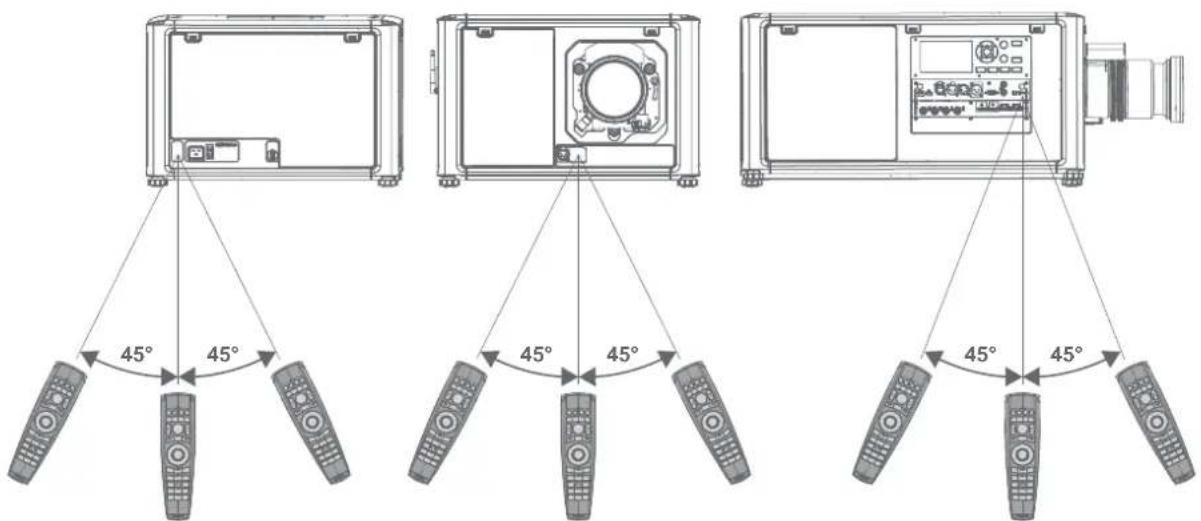
Image 2-5
For detailed info about the RCU see chapter "Pulse Remote Control Unit", page 29.
2.2 Power on the projector
How to power on
- Does the OVERVOLTAGE status light (reference 1) lit up?
▶ If yes, pull out the power cord immediately. Contact a qualified technician to check the power net.

Warning: Never switch on the projector if the OVERVOLTAGE status light lit up. Neglecting will cause irreversible damage to the projector.
▶ If no, proceed with the next step.
- Press the mains switch (reference 2) to switch on this projector.
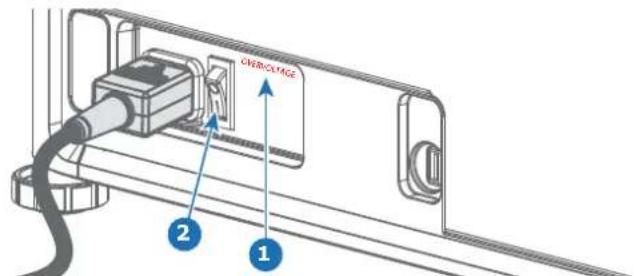
Image 2-6
- When '0' is pressed, the projector is switched off.
- When 'I' is pressed, the projector is switched on.
The projector starts up to ready mode. The Power on/off button will blink until ready mode is achieved. Once in ready mode, the Power on/off button will be lit WHITE.
The start up screen is displayed on the touch panel.

- Press the Power on/off button on the projector, or the Power On button on the remote control.
The projector will continue to power on mode. The Power on/off button will blink until the projector is ready. Once the projector is ready, the Power button will be lit BLUE.

The background image of the startup screen and info screens can be changed with Projector Toolset with an installed UDM plug-in.
2.3 Start image projection
Connect the source
- Connect the source cable with the appropriate input port on the Input & Communication module.

Tip: See chapter "Input & Communication", page 37, for more info about supported input formats.
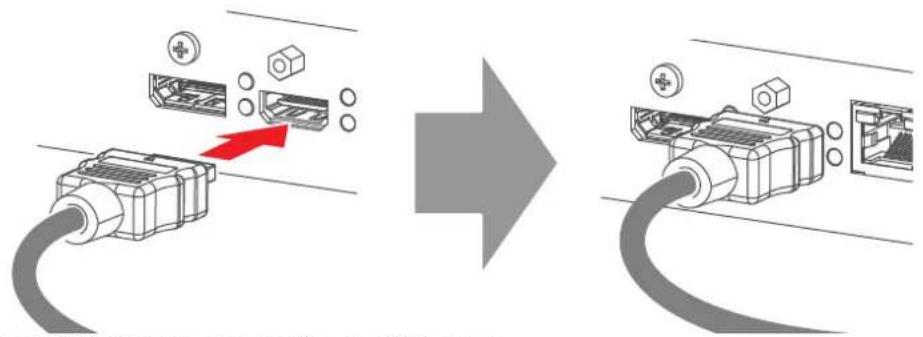
Image 2-9 Example of connecting an HDMI source.
- Check if the SYNC LED lit up ORANGE (reference 1). This indicates that the sync is detected on the input signal.
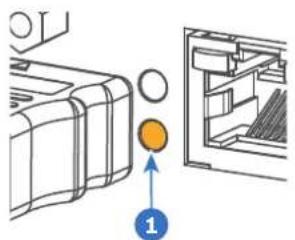
Image 2-10
Select the source
- Press the Input button (reference I) on the remote control or local keypad.
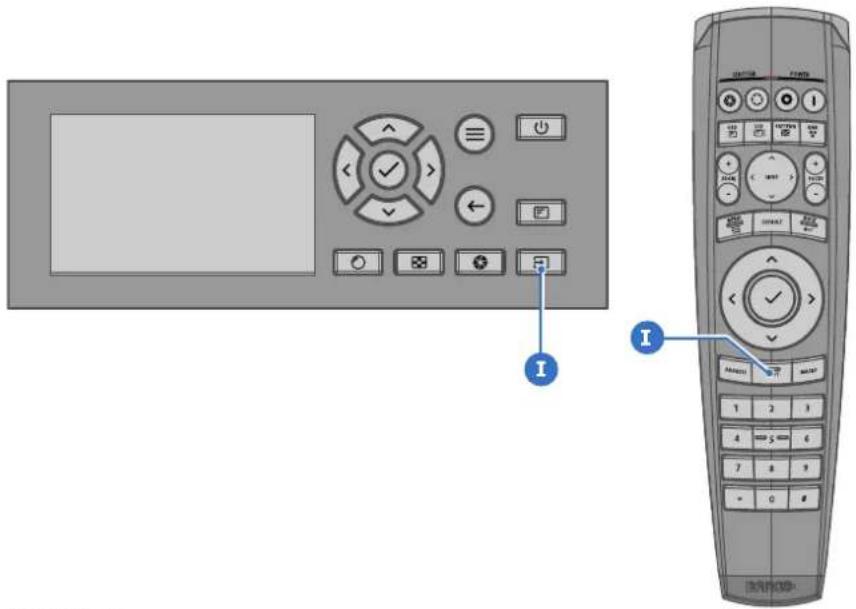
Image 2-11
The Source selection menu opens on the LCD display.
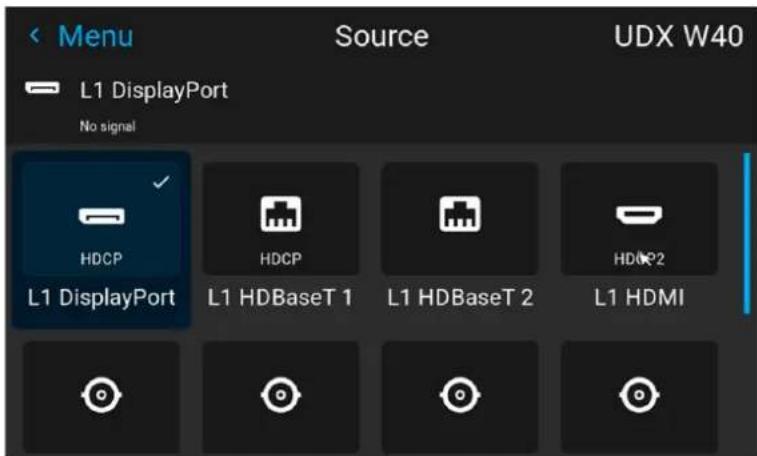
Image 2-12 Example of the input selection menu
- Use the arrow keys to select the desired source.
• the SEL LED (reference 2) of the selected source lit up GREEN, and
- the image of the selected source is projected.
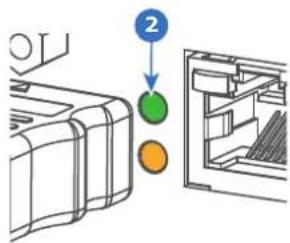
Image 2-13
Quick test pattern selection
- Press the Test pattern button (references P) on the remote control or local keypad.
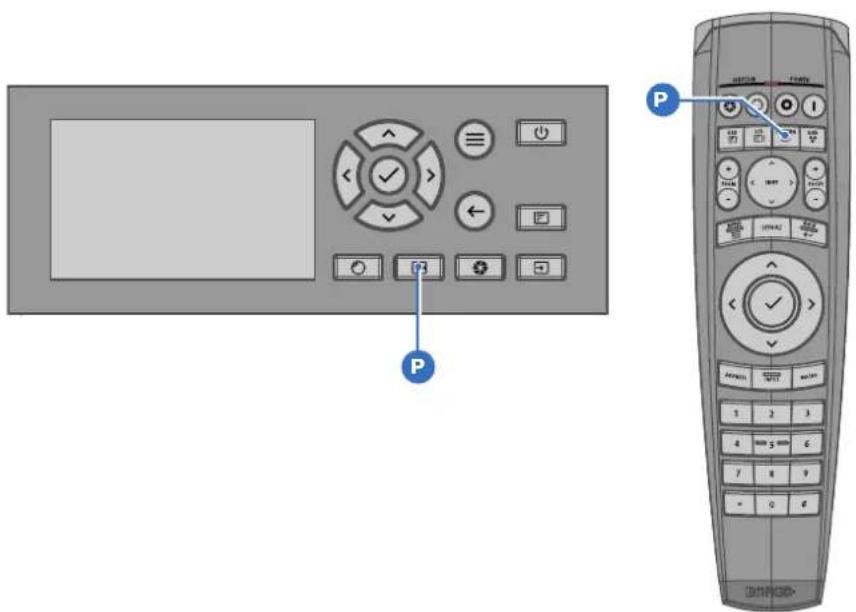
Image 2-14
The Test pattern menu opens on the LCD display.
- Use the arrow keys to select the desired test pattern.
2.4 Switching to ready mode
How to switch to ready mode
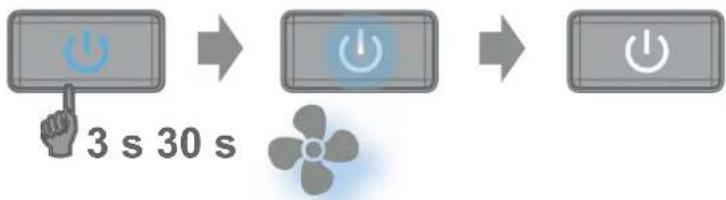
- Press and hold the Power on/off button for 3 seconds on the local keypad, or press the Power Off button on the remote control.
The projector goes to Ready mode. The after-cooling cycle will start (about 30 seconds). During this period the Power on/off button will blink. Once the after-cooling cycle has ended, the projector will be in ready mode and the Power on/off button will be lit WHITE.
flowchart
graph LR
    A["3 s"] --> B["30 s"]
    B --> C["Power"]
Image 2-15

While in ready mode, you can still navigate through the menus and set a limited amount of parameters.
Depending on the power savings settings of your device, if left untouched the projector will eventually go into standby or eco mode.
2.5 Power off projector

CAUTION: This procedure assumes the projector is in standby or ready mode.
How to power off
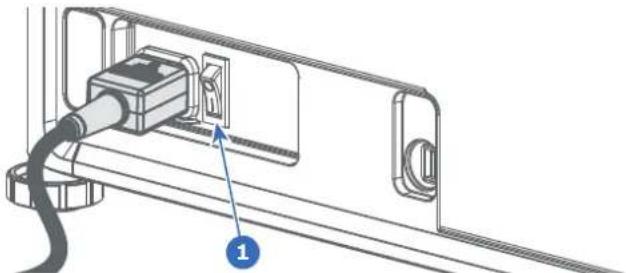
- Switch off the projector with the mains switch. '0' must be pressed.
natural_image
Diagram of a cable inserted into a device panel, showing a plug and connector (no text or symbols)Image 2-16 Mains switch
- Unplug the power cord from the projector.
Pulse Remote Control Unit
3
3.1 Pulse RCU, battery installation 30
3.2 Pulse RCU, protocol setup 31
3.3 Pulse RCU, function of the on/off button 31
3.4 Using the RCU 32
3.5 Pulse RCU, Functionality overview 33
3.6 Pulse RCU, function of the "button pressed indicator" 33
3.7 Pulse RCU, function of the "RGB filter" button 34
3.8 Displaying and Programming addresses into the RCU 34
3.9 Using the XLR connector of the RCU 34
3.10 Using the mini-jack connector of the RCU 35
3.11 Pulse RCU, silicone protection sleeve (optional) 35
3.1 Pulse RCU, battery installation
Where to find the batteries for the remote control ?
The batteries are not placed in the remote control unit to avoid control operation in its package, resulting in a shorter battery life time. At delivery the batteries can be found in a separated bag attached to the remote control unit. Before using your remote control, install the batteries first.
How to install
- Push the battery cover tab with the fingernail a little backwards (1) and pull, at the same time, the cover upwards (2).
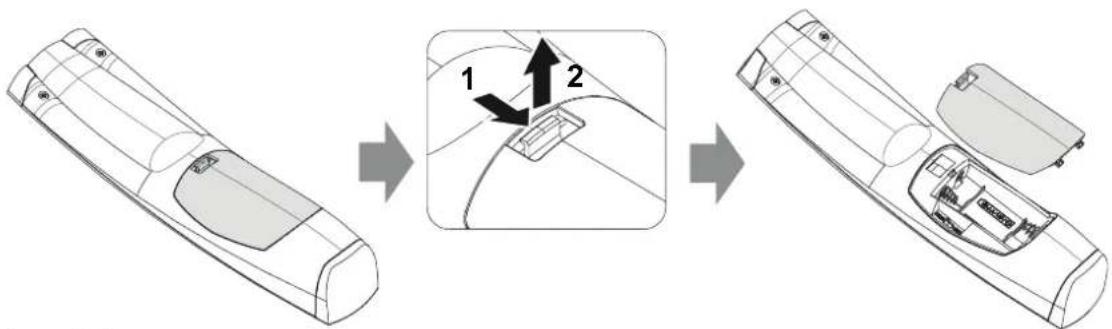
Image 3-1
- Insert the two AA size batteries, making sure the polarities match the + and - marks inside the battery compartment.

Tip: Use alkaline batteries for optimum range and life time.
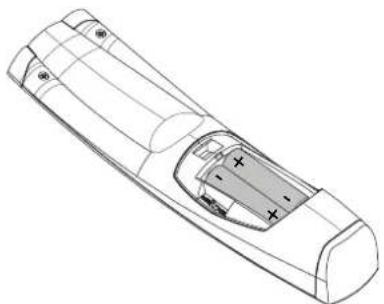
natural_image
Line drawing of a remote control casing with visible internal compartments and mounting points (no text or symbols)Image 3-2
- Insert (1) both lower tabs of the battery cover in the gaps at the bottom of the remote control, and press (2) the cover until it clicks in place.
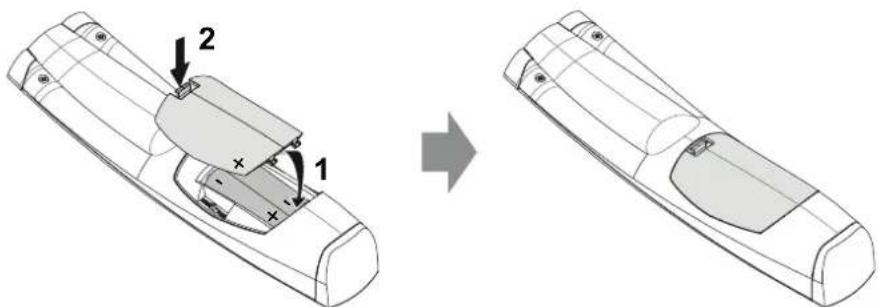
Image 3-3

When replacing batteries, the broadcast address of the RCU will be reset to its default value '0'.

CAUTION: Replace with the correct battery type. Use two AA size batteries. There is a risk of explosion if the battery is replaced with an incorrect type.

CAUTION: Replace the battery as explained above. There is a risk of explosion if the battery is incorrectly installed.
3.2 Pulse RCU, protocol setup
About the used protocol
The protocol is the code send out by the remote control when a button is pressed. Depending on this code, the projector can decode the signals. The remote control can be used with two different protocols: RC5 and NEC. Depending on the projector to control the remote control can be switched between these protocols.
Which protocol to use
- The NEC protocol has to be used for Barco projectors based on the Pulse platform: F70, F80, F90, HDX 4K, UDX, UDM, XDL, etc.
• The RC5 protocol has to be used all legacy Barco projectors: HDQ 2k40, HDF, HDX W, etc.
How to set
- Remove the cover. For more info on how to remove, see "Pulse RCU, battery installation", page 30.
- Place the switch in the desired position.
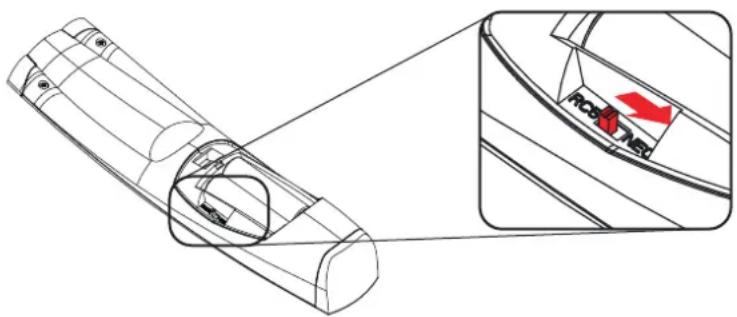
Image 3-4
Remarks when using the RC5 protocol
Due to new or updated functionality not all buttons of the Pulse RCU are one-to-one compatible with the legacy Barco RCU and projectors. Take the following limitations into account:
- Buttons Shutter open and Shutter close emit the same code when in RC5 mode. This because the legacy RCU's only had 1 button for Shutter functionality.
- Buttons Power on and Power off emit the same code when in RC5 mode. This because the legacy RCU's only had 1 button for Power functionality.
- The RGB filter button is not supported.
- The Input selection button is not supported.
- The Default value button is not supported.
- The Macro button is not supported.
3.3 Pulse RCU, function of the on/off button
Function of the remote control on/off button
The Pulse remote control unit has at the front side an on/off switch (reference 1 Image 3–5). Switching off the remote control prevents that unwanted commands are send due to an accidental key press. Furthermore, switching the RCU off will extend the battery life time of the remote control.
To activate the remote control, press the on/off button.
To deactivate the remote control, press the on/off button again.
Default after (re)placing batteries, is "ON".
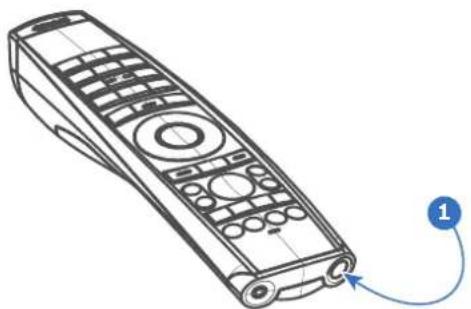
natural_image
Line drawing of a remote control device with labeled connection point (no text or symbols on the device itself)Image 3-5
3.4 Using the RCU
Pointing to the reflective screen or IR sensors
Switch on the RCU and point the front of the RCU to the reflective screen surface or point directly to one of the projector IR sensors. Make sure you are within the effective operating distance (30 m, 100 ft in a straight line). The RCU will not function properly if strong light strikes the IR sensor window or if there are obstacles between the RCU and the IR receiver.
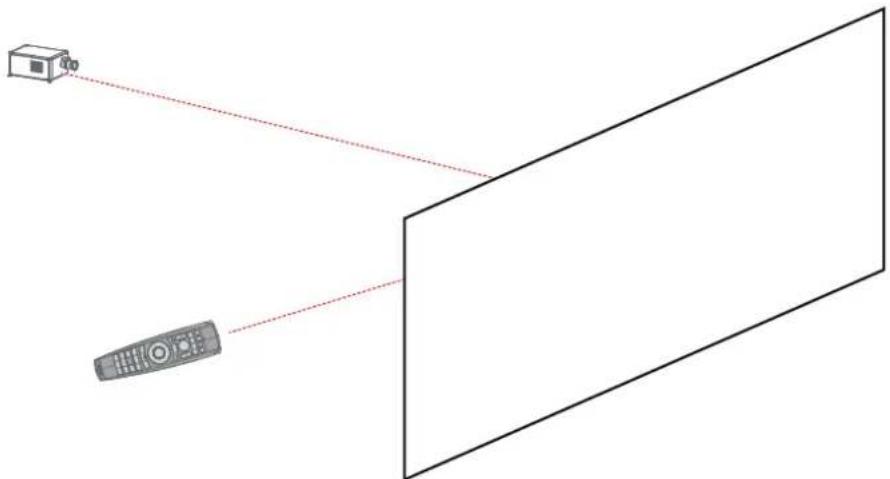
natural_image
Diagram showing a remote connected to a rectangular screen, with a small box nearby (no text or symbols)Image 3-6
The RCU can also hard-wired been used. See chapter "Using the XLR connector of the RCU", page 34.
Using the RCU in combination with a 3D emitter
When using a 3D emitter that radiates IR beams (e.g. the optional 3D emitter that Barco provides), the IR beams of the 3D emitter may interfere with the IR communication between projector and the RCU.
If such interference occurs, connect the RCU to the projector using the remote cable with XLR connector. It is also be advised to turn the IR receivers of the projector off to avoid the 3D emitter interference. The IR receivers can be turned off in the GUI: System Settings > Communication > IR Control.
3.5 Pulse RCU, Functionality overview
Remote Control Unit buttons
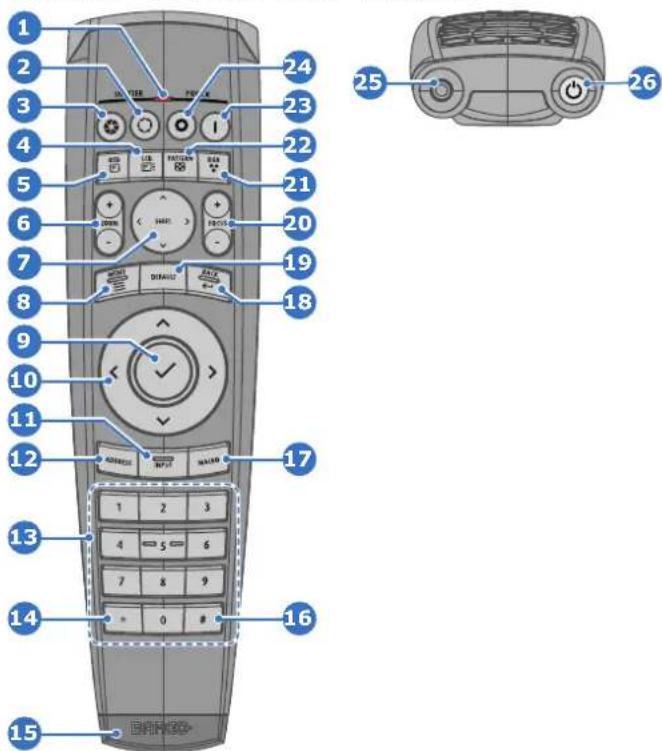
Image 3-7
1 Button pressed indicator
2 Shutter open
3 Shutter close
4 LCD panel on / off
5 Project OSD on / off
6 Lens zoom
7 Lens shift
8 Menu open / close
9 Menu selection, OK button
10 Menu navigation
11 Input selection
12 Address button
13 Numeric buttons
14 Backspace (while entering values)
15 XLR connector
16 Decimal mark (while entering values)
17 Macro button
18 Menu back
19 Default value button
20 Lens focus
21 RGB filter
22 Test patterns
23 Power on
24 Power off
25 3.5 mm jack
26 RCU on / off
3.6 Pulse RCU, function of the “button pressed indicator”
Functions button pressed indicator
- Rapidly flashes when commands are sent, this is the normal "button pressed" indication.
- 1 Short flash when remote control is switched ON by means of the on/off button.
- Continuously lit (up to 5 seconds) when address digits are expected after pressing the ADDR button.
- Slowly flashes (2 times a second) when the battery level is becoming low; typically when more than 85% of the useful life is past.
3.7 Pulse RCU, function of the "RGB filter" button
Filtering the color of the projected image
By pressing the RGB filter button on the RCU you can place a color filter on the output of the projector. This feature can be useful during the installation and configuration of a multi-projector or multi-channel setup. By having one projector project a red image and another project a green image, it is easier to spot and adjust the overlap section.
By pressing this button multiple times, you will have different active filters, in the following cycle:
• Red + Green + Blue (default)
- Red only
- Green only
- Blue only
- Red + Green
- Green + Blue
- Red + Blue
- Red + Green + Blue
• etc

After powering up, the colors will always revert back to full RGB.
3.8 Displaying and Programming addresses into the RCU
Displaying the Projector Address on the Screen.
- If the projector is on, press the menu key and navigate to the Status page. The projector address and the broadcast address can be seen under the Communication heading.
The projector's address is displayed on the LCD status screen and / or the OSD.
How to Program an Address into the RCU?
- Press the Address button until the Button pressed indicator lights up continuously (proximately 5 seconds).
- Enter the address with the digit buttons within the time the indicator lights up (also proximately 5 seconds).

Note: That address can be any value between 0 and 31.

Tip: A few examples:
To enter address 3, press "3" digit button on the RCU to set the RCU's address to 3 and wait until the button pressed indicator is out. Alternatively, you can also press "0" and "3". This way, the button pressed indicator goes out immediately.
To enter address 31, then press "3" and "1" on the digit button on the RCU and the button pressed indicator goes out immediately.
3.9 Using the XLR connector of the RCU

Connecting a cable with the XLR connector will reset the broadcast address of the RCU to its default value '0'.
How to use the XLR connector
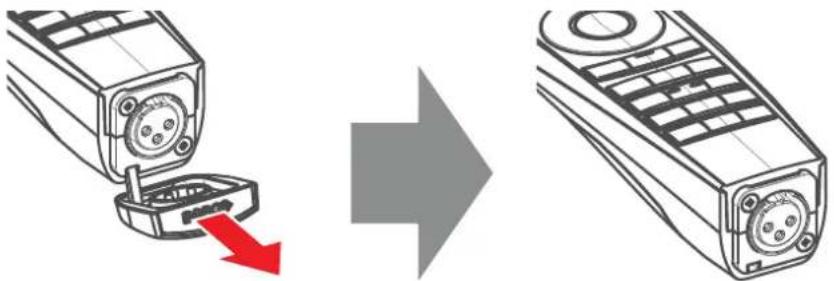
- Remove the XLR cover by pulling it backwards.
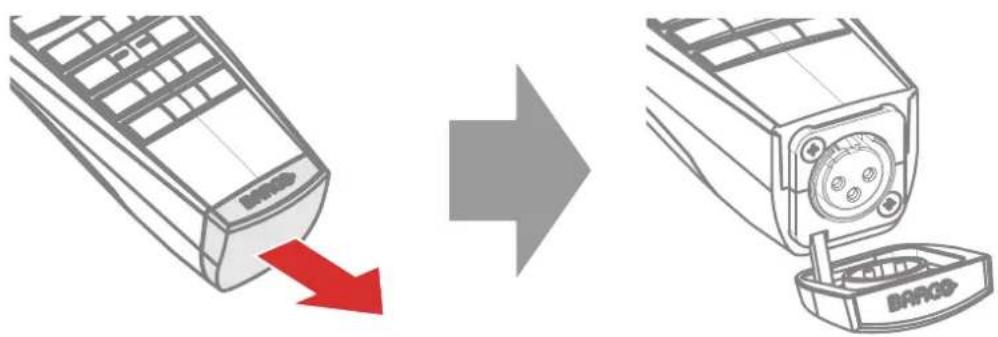
Image 3-8
-
Connect a cable with XLR plug into the XLR connector of the RCU.
-
Connect the other end of the cable with the XLR input of the projector.

Note: While the XLR cable is connected, the IR beam of the RCU is switched off.
3.10 Using the mini-jack connector of the RCU

Connecting a cable with the mini-jack connector will reset the broadcast address of the RCU to its default value '0'.
How to use the mini-jack connector
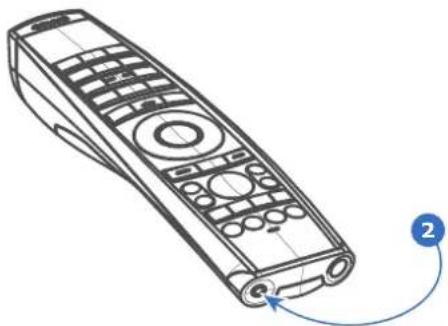
-
Connect a cable with the mini-jack connector (reference 2 Image 3-9) of the RCU.
-
Connect the other end of the cable with the mini-jack input of the projector.
natural_image
Line drawing of a remote control with labeled button (no text or symbols on device)Image 3-9

Note: While the mini-jack cable is connected, the IR beam of the RCU is switched off.
3.11 Pulse RCU, silicone protection sleeve (optional)
Introduction
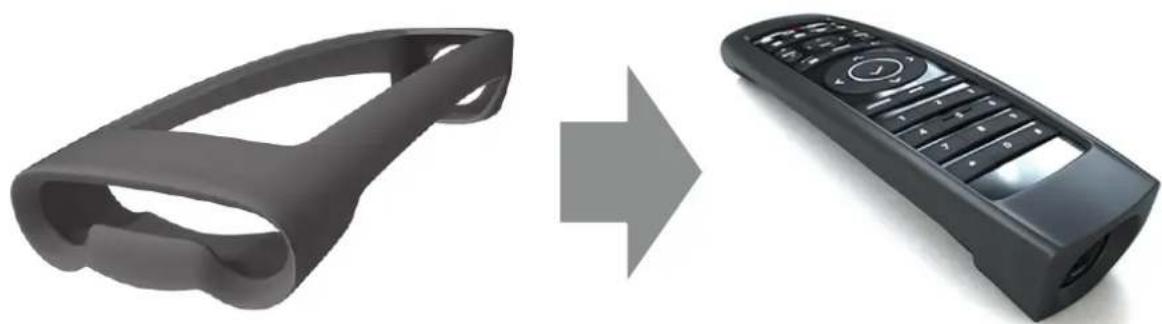
Barco offers a silicone form fitting protection sleeve for the Pulse RCU. The silicone material keeps it comfortably, non slip and soft touch. All buttons and holes remain accessible. The sleeve is quick and easy installed. For ordering information see Barco website.
How to install
- Pull off the rubber XLR-lid from the RCU.
natural_image
Diagram showing a mobile phone with a red arrow indicating a drop, followed by an arrow pointing to the right side of the phone (no text or symbols present)Image 3-10
- Place back side (XLR side) of the RCU into the sleeve and pull the other side of the sleeve over the front side of the RCU.
natural_image
Two black remote control devices, one with a handle and the other with a keypad, shown in transformation from left to right (no text or symbols)Image 3-11
Input & Communication
4
4.1 Introduction....38
4.2 Local Keypad and LCD panel 38
4.3 LCD touch panel....39
4.4 Communication connections....40
4.5 LED and Button indication chart....42
4.6 Pulse Quad Combo input Mk II 43
4.7 Pulse Quad Combo input Mk I 44
4.8 Pulse Quad DP 1.2 input 45
4.9 Pulse SFP input....46
4.1 Introduction
General
The Input & Communication module consists of a local keypad with LCD panel (1), a communication panel (4) and a Quad Combo input board (5). The free input slot can be used for optional modules (e.g. the Quad DP 1.2 input board).

Two boards of the same type can be used without restrictions. You can mount a second Quad Combo Input board in the free input slot (6). Alternatively, you can also remove the pre-mounted Quad Combo Input board and replace it with a second optional module (for example, a second Quad DP 1.2 input board).
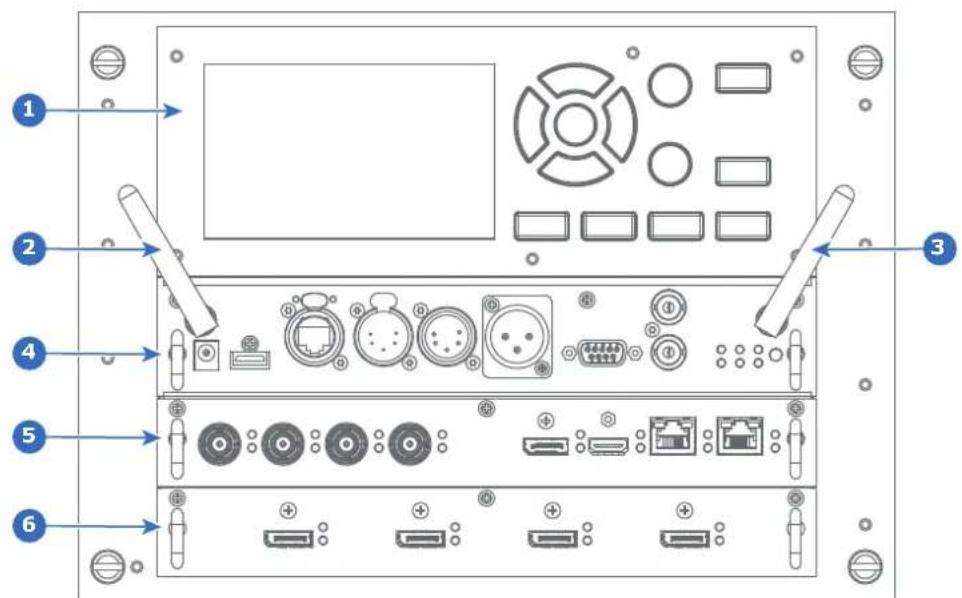
Image 4-1
1 Local Keypad and LCD panel
2 Optional antenna for WiFi connection
3 Optional antenna for GSM
4 Communication Panel
5 Quad Combo Input board
6 Free input slot (here filled with the Quad DP 1.2 Input board)
4.2 Local Keypad and LCD panel
Overview
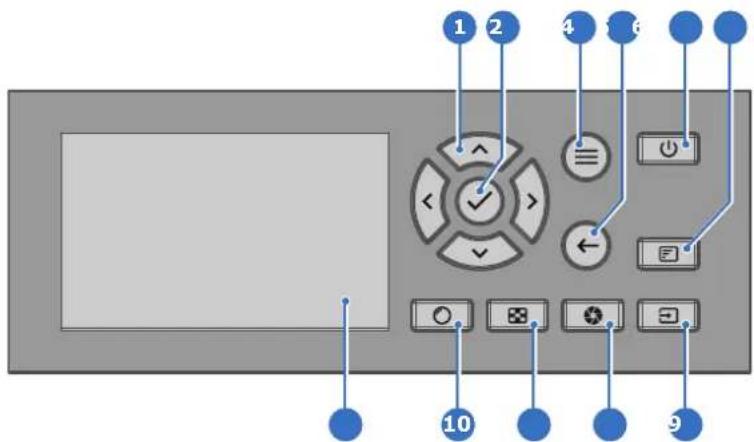
Image 4-2
1 Menu navigation
2 Menu confirmation, OK button
3 Menu open / close
4 Menu back
5 Power on / off
6 Project OSD on / off
7 Input selection
8 Shutter open / close
9 Test patterns
10 Lens adjustment
11 LCD panel
Local Keypad
The Keypad gives direct access to several functions, in addition to access to the menu system.
The keypad has a backlight that can be switched on and off manually. By default the light turns off after 5 minutes.
The Power button and Shutter buttons are equipped with white, blue and red backlit LEDs. The other keys are only equipped with white and blue backlit LEDs. The LEDs are controlled according to the features available.
LCD panel
The LCD panel has two main functions:
- Showing the menus, the adjustment information and also a mirror of the OSD, (On Screen Display) described in User Interface when this is enabled.
-
Information regarding the status of the projector showing this data:
-
Projector status
- Network address
- Active source
- Current firmware version
- Operation Data
• Active functions (Enabled Functions).
Toggle between the two indications by using the Menu button on the keypad, or on the remote control.
The LCD Display will fade out 30 seconds after the last key operation.
4.3 LCD touch panel

The LCD menus can occasionally be slightly different in layout compared with the OSD menu, due to a more optimal layout regarding to the touch functionality of the LCD.
LCD touch panel functionality
In addition to the remote control and the keypad, it is also possible to navigate in the menus with the touch functionality in the LCD panel.
Press the icons to select the functions.
Select switches to toggle.
Select and drag sliders to adjust slider value.
4.4 Communication connections
Communication Panel
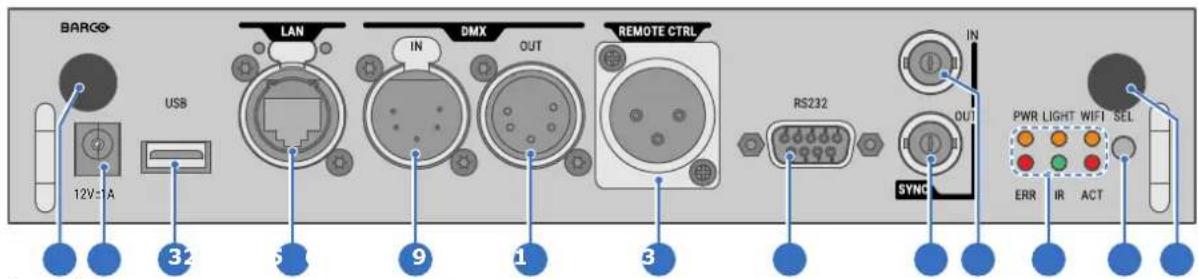
Image 4–3
1 WIFI antenna for wireless IP (optional)
2 12V 1A output
3 Firmware update / USB download log files
4 10/100 base-T for external control over IP and Art-Net
5 DMX interface input
6 DMX interface output
7 XLR input for wired projector control
8 RS232 for serial communication
9 Sync Out 3D
10 Sync In 3D
11 Status lights
12 IR receive sensor
13 GSM antenna input (optional)

CAUTION: Ethernet should only be connected to either the 10/100 base-T port (on the communication panel) or the HDBaseT input (on the Quad Combo Input Mk II). Using both at the same time will lead to undefined behavior.
12 V output
12 V output, maximum 1 A, available when projector is not in stand by.
DMX interface
DMX is used as communication bus between different devices in the light technic. Each device has an input and an output, so that the bus can be looped between the different devices. According to the standard a five wire cable with XLR connector is used.
You can use the DMX input port to connect a DMX device (DMX console) to the projector. This way you can control the projector from that DMX device (console). The DMX output port can be connected with the next device in the loop.
DMX
| Pin | Description |
| 1 | Earth |
| 2 | Cold |
| 3 | Hot |
| 4 | Return - (or not used) |
| 5 | Return + (or not used) |

DMX
DMX-512 Lighting protocol over RS-485 interface. Carries information of 512 channels from a lighting controller to lighting devices. Standardized by USITT.
RS232/RS422 input
The communication interface of the UDM series projector supports RS232 and RS422 serial communication on two different types of input connectors, a Sub-D connector and an USB connector acting as RS input when connected to an USB input of a PC.
You can use the RS232/RS422 input to connect a local PC to your UDM series projector. By this way you can configure and control your projector from your local PC.
Advantages of using RS232/RS422 serial communication:
- easy adjustment of the projector via PC (or MAC).
- allow storage of multiple projector configurations and set ups.
- wide range of control possibilities.
- address range from 0 to 255.
- sending data to the projector (update).
- copying data from the projector (backup).
RS232/422 input (Sub-D) port
| Pin | Description |
| 1 | DCD : Data Carrier Detect |
| 2 | RXD- : Receive Data |
| 3 | TXD- : Transmitted Data |
| 4 | DTR : Data Terminal Ready [RS232] / TXD+ : Transmitted Data [RS422] |
| 5 | GND : Ground |
| 6 | DSR : Data Set Ready [RS232] / RXD+ : Received Data [RS422] |
| 7 | — (not connected) — |
| 8 | CTS : Clear To Send |
9 RI : Ring Indicator
RS232

An Electronic Industries Association (EIA) serial digital interface standard specifying the characteristics of the communication path between two devices using either D-SUB 9 pins or D-SUB 25 pins connectors. This standard is used for relatively short-range communications and does not specify balanced control lines. RS-232 is a serial control standard with a set number of conductors, data rate, word length and type of connector to be used. The standard specifies component connection standards with regard to computer interface. It is also called RS-232-C, which is the third version of the RS-232 standard, and is functionally identical to the CCITT V.24 standard. Logical '0' is > + 3V, Logical '1' is < - 3V. The range between -3V and +3V is the transition zone.
RS422

An EIA serial digital interface standard that specifies the electrical characteristics of balanced (differential) voltage, digital interface circuits. This standard is usable over longer distances than RS-232. This signal governs the asynchronous transmission of computer data at speeds of up to 920,000 bits per second. It is also used as the serial port standard for Macintosh computers. When the difference between the 2 lines is < - 0.2V that equals with a logical '0'. When the difference is > +0.2V that equals to a logical '1'.
USB port
The communication interface is equipped with a master USB port, type "A" connector. This USB port will simplify the service procedures for firmware updates or for downloading the log files without a network connection.
If the only file on the USB device is the firmware file (a “*.fw” file), the projector will automatically start one of the following processes.
- cornet
.fw: The projector will upgrade or downgrade, depending on the version number. - LogExtractor.fw: The log files will be downloaded.

Make sure that any used USB-stick is FAT32 compatible and contains no other files or folders.
4.5 LED and Button indication chart
Button Backlight Status
| Button Color status | Description | |
| Power button | [Blinking WHITE (slow) Projector starts up (booting)] | |
 | Blinking WHITE (fast) Firmware upgrade | |
| Solid WHITE Projector is in Standby or Ready mode | ||
| Blinking BLUE Projector goes to ON mode | ||
| Solid BLUE Projector is ON | ||
| Blinking RED Error condition | ||
| Shutter button | Off (no color) Projector is OFF, starts up, or is in Standby or Ready mode. | |
 | Solid WHITE Projector is ON, shutter is open | |
| Solid RED Projector is ON, shutter is closed | ||
LED Status
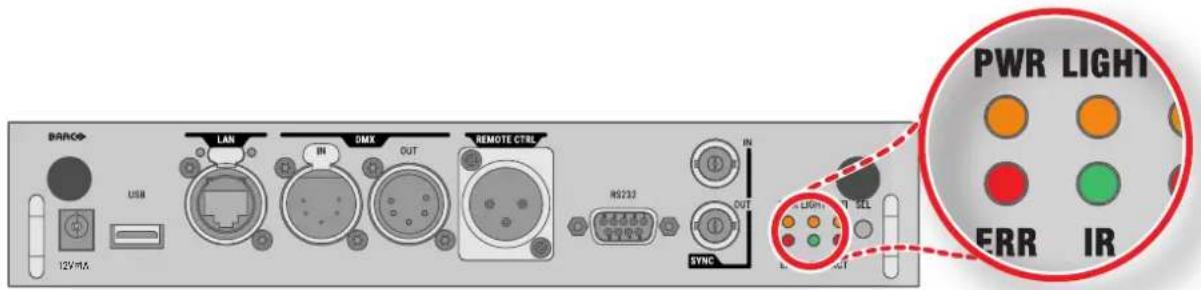
| LED | Color status | Description |
| PWR (power LED) | Off | Projector powers up |
| RED | Projector is in Standby mode | |
| ORANGE | Projector is in Ready mode | |
| GREEN | Projector is on | |
| LIGHT (Illumination LED) | Off | Light source is off |
| RED | No light source detected | |
| ORANGE | Light source is on in ECO mode | |
| GREEN | Light source is on in normal mode | |
| GREEN-ORANGE | Light source is on in CLO mode | |
| ERR (error LED) | Off | No error |
| RED toggles on/off | Error | |
| ORANGE toggles on/off | Warning | |
| IR | RED | IR signal received |
| GREEN | IR signal acknowledged |
4.6 Pulse Quad Combo input Mk II
Overview Quad Combo Input Mk II

Image 4-4
1 Quad SDI channel A: 3G/12G input
2 Quad SDI channel B: 3G input
3 Quad SDI channel C: 3G SDI input + 3G/12G output
4 Quad SDI channel D: 3G SDI input / output
5 DisplayPort Input
6 HDMI input
7 HDBaseT input 1
8 HDBaseT input 2
Functionality of the Quad Combo input Mk II
The Quad Combo Input Mk II support 12G input and throughput on the SDI connectors.
Compared with the Mk I the Mk II includes the following:
• SDI input A supports 12G input signals.
• SDI input C functions as a loop-through output for any signal placed on input A.
• SDI input D functions as a loop-through output for any signal placed on input B.
- HDBaseT input 1 supports network connectivity.

CAUTION: Ethernet should only be connected to either the 10/100 base-T port (on the communication panel) or the HDBaseT input (on the Quad Combo Input Mk II). Using both at the same time will lead to undefined behavior.
SDI input & output - How does it work?
When connecting an SDI source to the projector and the signal is HD or 3G, you can choose any of the four input connectors.
When connecting multiple projectors with the same signal, you can connect the signal as follows:
- Connect the source signal to Input A or B of the first projector.
• If the source signal is connected to input A, connect input/output C to the Input of the following projector.
• If the source signal is connected to input B, connect input/output D to the Input of the following projector. - Continue in the same fashion until all projectors are connected.
When connecting a 12G SDI source to the projector, you can only connect that source to input A.

Only Input A accepts 12G SDI signals. While it is technically possible to connect a 12G SDI source to Input B and connect that source to another projector in line (using Input/Output D), this first projector itself will not be able to process the 12G signal.
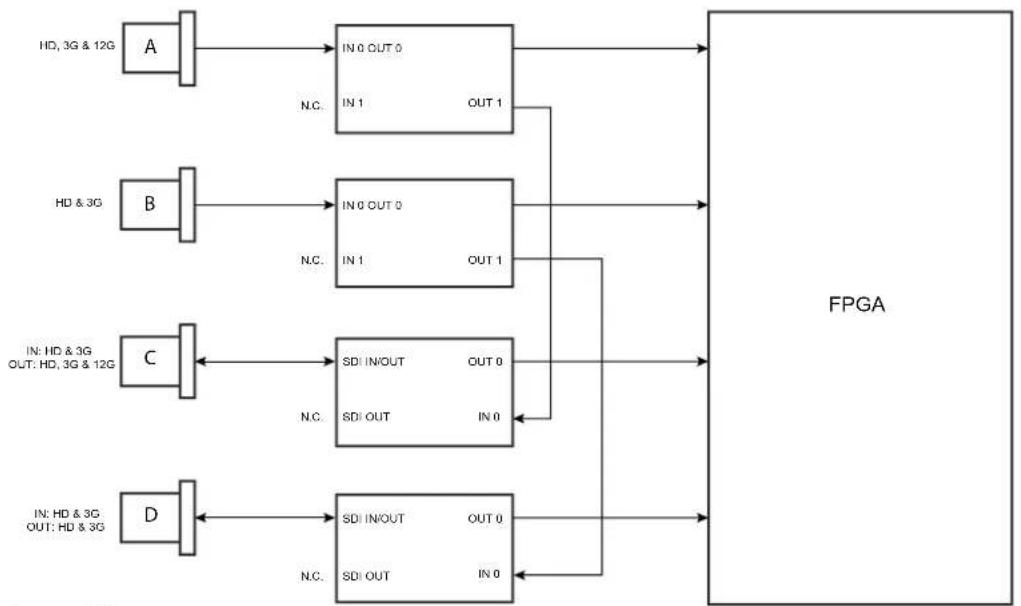
flowchart
graph LR
    A["HD, 3G & 12G"] --> IN0OUT0["IN 0 OUT 0"]
    IN0OUT0 --> FPGA["FPGA"]
    IN1OUT1["IN 1 OUT 1"] --> FPGA
    HD&3G["HD & 3G"] --> IN0OUT0
    IN0OUT0 --> FPGA
    HD&3G --> IN1OUT1["IN 1 OUT 1"]
    IN1OUT1 --> FPGA
    HD&3G --> SDIOUT0["SDI IN/OUT OUT 0"]
    INH3G["IN: HD & 3G OUT: HD, 3G & 12G"] --> SDIOUT0
    INH3G --> SDIOUT0
    HD&3G --> SDIOUT0
    HD&3G --> SDIOUT0
    D["IN: HD & 3G OUT: HD & 3G"] --> SDIOUT0
    D --> SDIOUT0
    D --> SDIOUT0
    style HD_3G fill:#f9f,stroke:#333
    style HD_3G_OUT fill:#ccf,stroke:#333
    style HD_3G fill:#cfc,stroke:#333
    style HD_3G_OUT fill:#fcc,stroke:#333
    style HD_3G fill:#ffc,stroke:#333
    style HD_3G_OUT fill:#cfc,stroke:#333
    style HD_3G fill:#fcc,stroke:#333
    style HD_3G_OUT fill:#cfc,stroke:#333
    style HD_3G fill:#ffc,stroke:#333
    style HD_3G_OUT fill:#cfc,stroke:#333
    style HD_3G fill:#fcc,stroke:#333
    style HD_3G_OUT fill:#cfc,stroke:#333
    style HD_3G fill:#ffc,stroke:#333
    style HD_3G_OUT fill :ccf,stroke:#333
    style HD_3G fill:#fcc,stroke:#333
    style HD_3G_OUT fill :cfc,stroke:#333
    style HD_3G fill:#ffc,stroke:#333
    style HD_3G_OUT fill :cfc,stroke:#333
    style HD_4G fill:#fcc,stroke:#333
    style HD_4G_OUT fill:#cfc,stroke:#333
    style HD_4G fill:#fcc,stroke:#333
    style HD_4G_OUT fill:#cfc,stroke:#333
    style HD_4G fill:#fcc,stroke:#333
    style HD_4G_OUT fill:#cfc,stroke:#333
Image 4-5
LED behavior
- The SYNC LED lit up ORANGE when valid input sync is detected.
- The SEL LED lit up GREEN when the input is selected.
- The SEL LED blinks GREEN when the input/output is selected and configured as output.

For specifications about the supported inputs for SDI, HDMI, HDBaseT and DisplayPort 1.2 see chapter "Specifications", page 177.
4.7 Pulse Quad Combo input Mk I
Overview Quad Combo input Mk I

Image 4-6
1 Quad SDI channel A: 3G input
2 Quad SDI channel B: 3G input
3 Quad SDI channel C: 3G input
4 Quad SDI channel D: 3G input
5 DisplayPort Input
6 HDMI input
7 HDBaseT input 1
8 HDBaseT input 2
LED behavior
- The SYNC LED lit up ORANGE when valid input sync is detected.
- The SEL LED lit up GREEN when the input is selected.

For specifications about the supported inputs for SDI, HDMI, HDBaseT and DisplayPort 1.2 see chapter "Specifications", page 177.
Remark concerning the Mk I and Mk II inputs boards
The Mk I input board miss functionality that has been implemented on the Mk II input board. These missing features include:
- Loop-through functionality
• 12G SDI support
• Network connectivity on HDBaseT inputs
The projector is now standard equipped with the Mk II input board. For details and specifications see chapter "Pulse Quad Combo input Mk II", page 43.
Visual difference between the Mk I and Mk II input boards
There is one real visual aid to tell the two variants apart. There are visual markings added on the Mk II input board, marking which connector supports 12G and which only supports 3G.
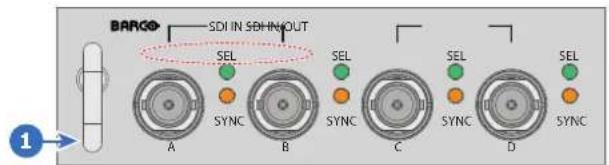
Image 4-7 Quad Combo Input Mk I board, without markings above the SDI inputs
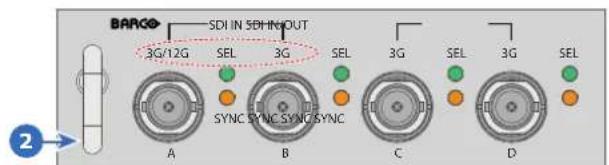
Image 4-8 Quad Combo Input Mk II board, with 3G/12G markings above the SDI inputs/outputs.
4.8 Pulse Quad DP 1.2 input
Quad DP 1.2 input

Image 4-9
1 Quad DisplayPort channel A input
2 Quad DisplayPort channel B input
3 Quad DisplayPort channel C input
4 Quad DisplayPort channel D input
LED behavior
- The SYNC LED lit up ORANGE when valid input sync is detected.
- The SEL LED lit up GREEN when the input is selected.

For specifications about the supported inputs for DisplayPort 1.2 see chapter "Specifications", page 177.
4.9 Pulse SFP input

The Barco SFP Input Board has been designed and tested to work alongside the Barco SFP Output Board.
However, it is possible that the SFP Input board can also work with other third-party devices that support 12G over fiber. Due to the many third-party options available on the market, the input board could not be tested for every option available.
Overview SFP input
The SFP Input board is used to connect 12G SDI over fiber. The SFP input is delivered without any connector. It is up to the customer to buy the necessary connectors, transceivers and cables. These parts can be mounted on the indicated places on the front panel of the board.

Image 4-10
1 Neutrik Duo optical connector or Neutrik Quad optical connector
2 Neutrik Duo optical connector or Neutrik Quad optical connector
3 2x12G SDI/10GE transceiver

For specifications about the supported inputs for SFP see chapter "Specifications", page 177.
LED behavior
- The SYNC LED lit up ORANGE when valid input sync is detected.
- The SEL LED lit up GREEN when the input is selected.
Use cases
The SFP can be configured as follows:
- SFP+ transceiver + Fiber connection (integrated or separated)
- Neutrik OpticalCon Duo + SFP+ transceiver + internal fiber
- Neutrik OpticalCon Quad + SFP+ transceiver + internal fiber
- Loop-through mode

See projector installation manual for detailed instructions on how to install/configure the SFP input.

WARNING: Only by Barco trained and qualified technicians are allowed to install the SFP input.

Optical Trancever to comply with Laser Class 1, IEC60825-1: 2014
GUI - Introduction
5
5.1 Overview 48
5.2 Navigation....51
5.3 Test Patterns....53
About this chapter
This chapter gives an general overview of the Graphic User Interface.
5.1 Overview
Disclaimer on GUI images used in this manual
The GUI images in this manual are example illustrations and should be treated as such. While the name of the projector displayed in the illustrations may be different from the projector model you are currently using, the menu lay-out and functionality is identical.
GUI - First start of the software
When you start the projector for the first time, you will be requested to choose the system language. You can choose between the following languages:
- German (DE)
- English (EN-US)
- Spanish (ES)
- French (FR)
- Japanese (JA)
- Korean (KO)
- Portuguese (PT-BR)
- Russian (RU)
- Chinese (ZH)
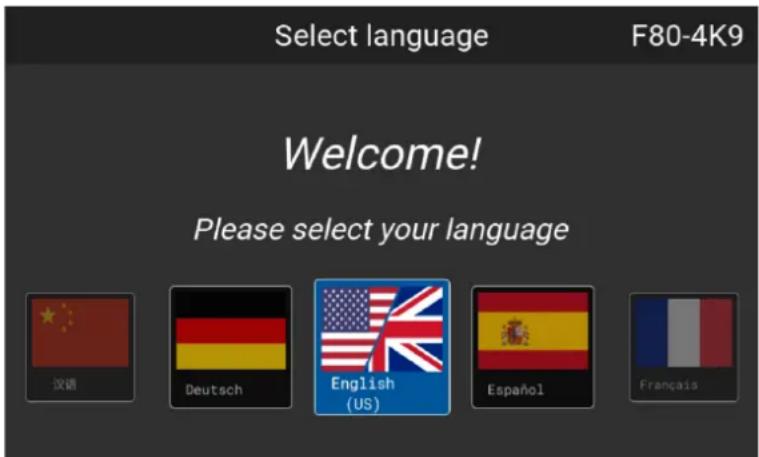
Image 5-1 Example of the welcome screen
Once you confirmed your choice, you will be prompted with the Pulse product-specific End User License Agreement (EULA). You will only be able to access the projector software once you have fully read and approved the EULA.
GUI - Product Registration
Upon first startup you will be requested to register the projector. You can perform the registration procedure now, or choose to Register Later. For more information on the entire registration procedure, refer to the Projector Registration user guide.
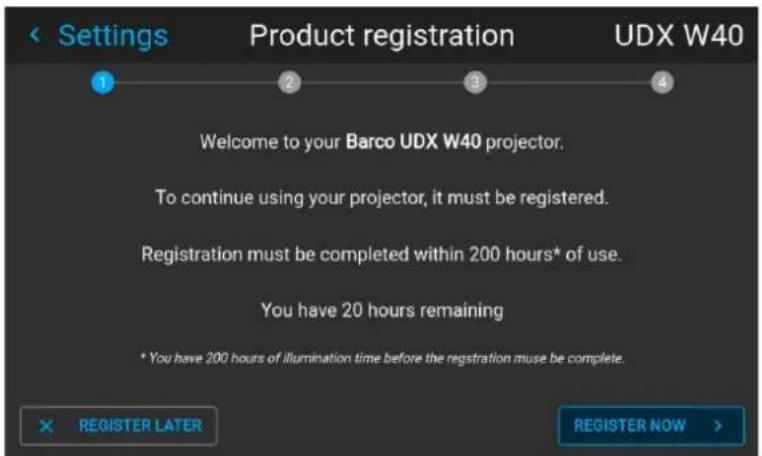
Image 5-2 Example of the Product registration form
GUI - Status Screens
While the projector menu is not active, or the projector is Ready or Standby mode, the Status screens remain visible. These screens give an overview of the state of the projector and can be navigated through using the left and right arrow keys, or by swiping the screen left or right. The status screens are the following:
- Dashboard: The main overview. This screen displays all the chosen options on the projector (chosen source, blending/masking, display mode, etc).
- About: General info about the projector. This includes serial number, software version, mounted lens and light source runtime. It also includes altitude, and the pitch and roll tilt angles.
- Notifications: The error and/or warning messages that are currently active. If no messages are active, this list will be empty.
- Preview: A preview pane of the projected image. If no image is being projected, a test image is displayed instead.
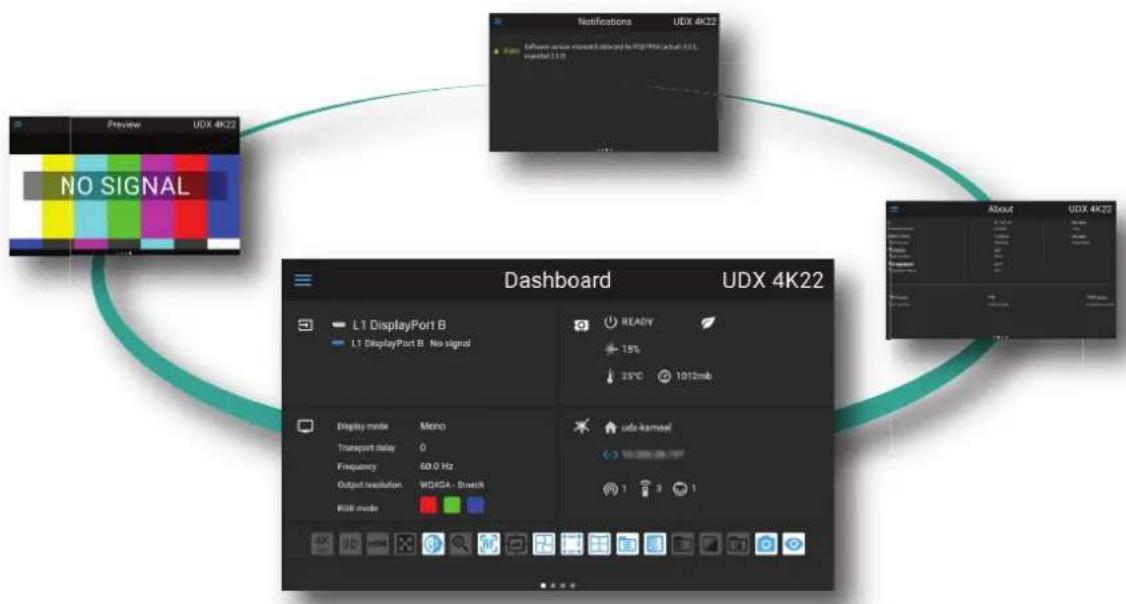
flowchart
graph TD
    A["Preview UDX 4K22"] --> B["NO SIGNAL"]
    B --> C["Dashboard UDX 4K22"]
    C --> D["L1 DisplayPort B No signal"]
    C --> E["READY 15% 25°C 1012mb"]
    C --> F["udr-kancel 1 3 1"]
Image 5-3 Example of a Dashboard status screen
GUI - Main Menu overview
The projector on-screen display (OSD) is the primary user interface (UI). From here, you can review and adjust all projector and display settings.
The OSD interface uses buttons to display the main menu. Each main menu contains submenus.
The OSD can be disabled by pressing the OSD on/off button.
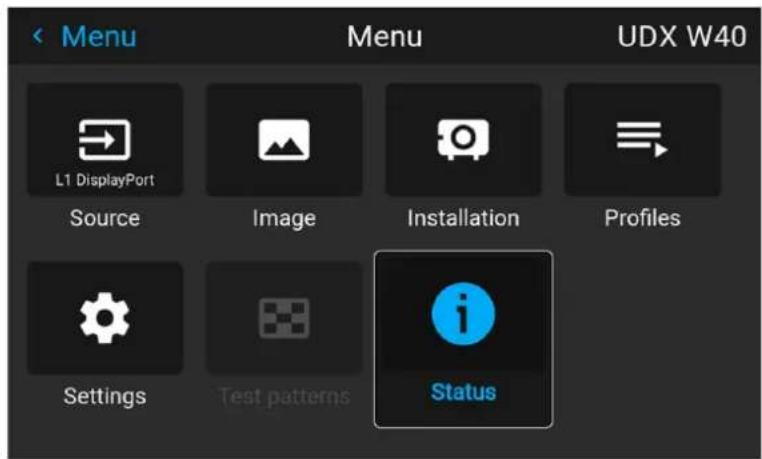
Image 5-4 Example of the home menu
The projector software platform uses access levels what each user can do. A standard user has access to the standard projector functionality. A certified service technician has also access to the advanced settings menu. This menu is password protected. This password can only be obtained by following the service partner training.
GUI - Pulse software menu tree
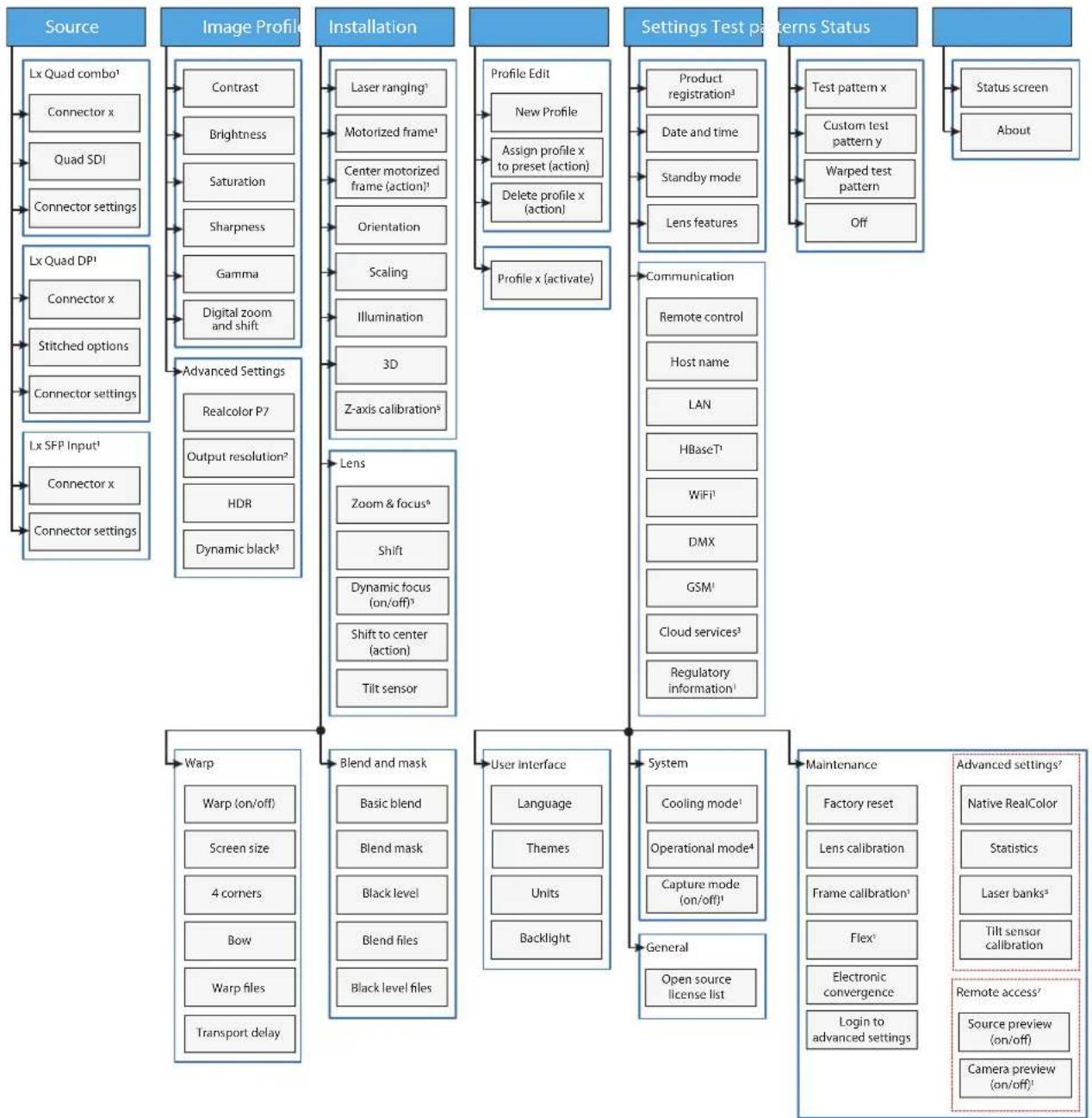
flowchart
graph TD
    A["Source"] --> B["Lx Quad combo¹"]
    B --> C["Connector x"]
    B --> D["Quad SDI"]
    B --> E["Connector settings"]
    A --> F["Lx Quad DP¹"]
    F --> G["Connector x"]
    F --> H["Stitched options"]
    F --> I["Connector settings"]
    A --> J["Lx SFP Input¹"]
    J --> K["Connector x"]
    J --> L["Connector settings"]
    A --> M["Image Profile"]
    M --> N["Contrast"]
    M --> O["Brightness"]
    M --> P["Saturation"]
    M --> Q["Sharpness"]
    M --> R["Gamma"]
    M --> S["Digital zoom and shift"]
    M --> T["Advanced Settings"]
    T --> U["Realcolor P7"]
    T --> V["Output resolution²"]
    T --> W["HOR"]
    T --> X["Dynamic black³"]
    A --> Y["Installation"]
    Y --> Z["Laser ranging¹"]
    Y --> AA["Motorized frame¹"]
    Y --> AB["Center motorized frame (action)¹"]
    Y --> AC["Orientation"]
    Y --> AD["Scaling"]
    Y --> AE["Illumination"]
    Y --> AF["3D"]
    Y --> AG["Z-axis calibration⁵"]
    A --> AH["Settings Test patterns Status"]
    AH --> AI["Product registration³"]
    AH --> AJ["Date and time"]
    AH --> AK["Standby mode"]
    AH --> AL["Lens features"]
    AH --> AM["Communication"]
    AM --> AN["Remote control"]
    AM --> AO["Host name"]
    AM --> AP["LAN"]
    AM --> AQ["HBaseT³"]
    AM --> AR["WiFi¹"]
    AM --> AS["DMX"]
    AM --> AT["GSM¹"]
    AM --> AU["Cloud services³"]
    AM --> AV["Regulatory information¹"]
    A --> AW["Warp"]
    AW --> AX["Warp (on/off)"]
    AW --> AY["Screen size"]
    AW --> AZ["4 corners"]
    AW --> BA["Bow"]
    AW --> BB["Warp files"]
    AW --> BC["Transport delay"]
    A --> BD["Blend and mask"]
    BD --> BE["Basic blend"]
    BD --> BF["Blend mask"]
    BD --> BG["Black level"]
    BD --> BH["Blend files"]
    BD --> BI["Black level files"]
    A --> BJ["User Interface"]
    BJ --> BK["Language"]
    BJ --> BL["Themes"]
    BJ --> BM["Units"]
    BJ --> BN["Backlight"]
    A --> BO["System"]
    BO --> BP["Cooling mode¹"]
    BO --> BQ["Operational mode⁴"]
    BO --> BR["Capture mode (on/off)¹"]
    BO --> BS["General"]
    BS --> BT["Open source license list"]
    A --> BU["Maintenance"]
    BU --> BV["Factory reset"]
    BU --> BW["Lens calibration"]
    BU --> BX["Frame calibration¹"]
    BU --> BY["Flex²"]
    BU --> BZ["Electronic convergence"]
    BU --> CA["Login to advanced settings"]
    BU --> CB["Remote access²"]
    BU --> CC["Source preview (on/off)"]
    BU --> CD["Camera preview (on/off)²"]
Image 5-5 Menu tree of the Pulse software, with the following footnotes
1 Only visible if specific option is installed
2 Only visible on 4K models with actuators
3 Only visible on UDX & UDM
4 Only visible on UDM
5 Only visible on HDX4K
6 Only visible when motorized lens is installed
7 Only visible when logged in as service user
5.2 Navigation
Navigation via the RCU or local keypad
Navigating the OSD can be done using the remote control or the local keypad.
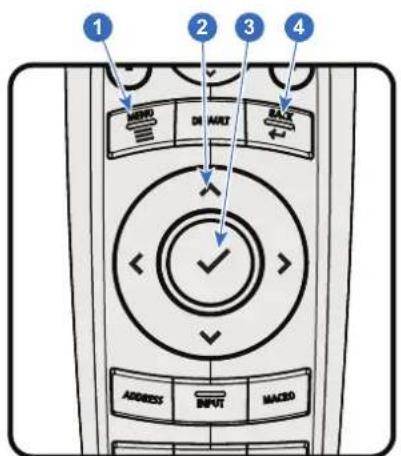
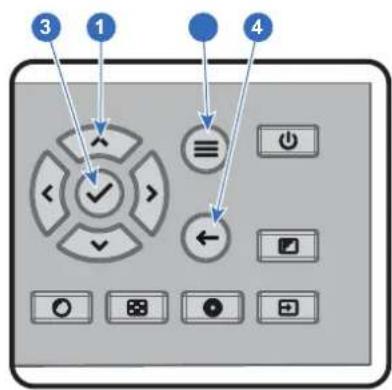
Image 5-6
To start up the menu structure, press MENU (1).
Use the arrow keys (Menu Navigation buttons) to navigate to the desired menu item (2). The background color changes to light blue.
Press the Menu Selection button (center key of the arrow keys), also called OK button, to activate that item and to jump one level deeper (3).
Use the numeral keys to enter values, or use the arrow keys to move the bar scale up or down.
Press the Back button to go up one level (4).
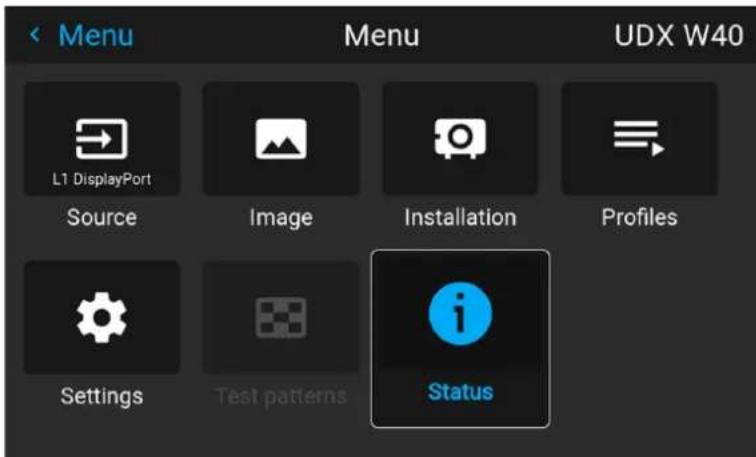
Image 5-7 Example of the home menu
Remark: a blue slider bar on the right side of the window means that there are more items to show than those currently displayed.
Define values
Menu settings are displayed using check boxes, bar scale sliders, and drop-down lists.
To set a value:
- Press OK to select or deselect a checkbox (turn a function ON or OFF).
- Use the arrow keys to move the bar scale slider up or down on the value line. For a bar scale 0-9, each step will equal 10% of the total value.
- To enter the value as a direct number, press OK, input the digit(s), and then press OK again to execute and exit cursor mode e.g. OK 79 OK.
Within an input field, use the * button as backspace button to remove an entered digit. Use the # button to enter a dot (.).
Changes to values are implemented dynamically.
To enter values with the local keyboard, use the arrow keys to select the first digit, press OK. Select the second digit and press OK. Continue until all digits are entered. Close the action by selecting the enter (↓) button and press OK. Select the backspace button and press OK to remove the last entered digit.
Using the LCD touch display
From Pulse software 2.0 onward, the touch display functionality of the LCD panel has been activated and can be used.
Instead of using the remote control buttons or keypad keys or button, you can now:
- Touch menu icons to enter the respective menu.
- Swipe a menu up and down if not all information is not immediately visible (e.g. more than 8 (sub)menu icons being visible)
- Return to a higher menu level, by touching the blue name in the top left corner of the display.
- Use touch functionality to use menu items (check boxes, sliders, digital keyboard or keypads, etc).
- Swipe menu panes left or right when multiple panes are available (e.g. the Status menu)
Menu memory
The OSD menu remembers the last selected sub-item as long as the projector is running. The menu memory is reset when restarting the projector from standby.
5.3 Test Patterns
List of standard test patterns
The test patterns that are available by default are the following:
- Aspect
- Focus-Green
- Focus-bursts
- White / Black/ Red / Green / Blue
• Cyan / Magenta / Yellow - Color bars
- Color gradients
- Checkerboard
- Cross hatch
- Geometry
• Horizontal gray bars - Vertical gray bars
- 3D Stereo
About the test pattern types
There are three types of test patterns possible in the projector:
| Type Explanation | Example of test pattern icon | |
| Standard test patterns | Standard test patterns. See previous list to see all test patterns available for your device. |  |
| Warped test patterns | Available from software 2.2 onward. Every test pattern will have “warped” variant available, symbolized with a “warp” symbol on the top-left corner of the icon.If active and configured, the warping will be applied to this test pattern. If warping is not active, or not configured, this will be identical to the standard test pattern. |  |
| Custom test patterns | If uploaded via an external tool, you will find your custom upload test patterns (and its warped variant) at the bottom of the list of available patterns.All custom uploaded test patterns will be marked with the default “test pattern file” icon. |  |
How to use test patterns
- In the main menu, select Test Patterns.
or
Push the Test Patterns button on the RC.
Image 5-8 Main menu, Test patterns
- In the Test pattern menu, select the desired test pattern from the list.
- To turn the test pattern off, select off instead.
Image 5–9 Test patterns menu, test pattern off
GUI - Source
6
6.1 Displaying a single source....56
6.2 Displaying multiple sources: Stitched layouts....56
6.3 Connector Settings 58
About the Source menu
This menu is used to select, review and configure sources into the projector.
6.1 Displaying a single source
About selecting a source
Before a source can be projected, the source signal must be connected to the source input(s) of the device and a valid synchronization signal must be available along with the source signal on at least one of the input connectors.
How to select?
- Press Menu to activate the menus and select Source.
Image 6-1 Main menu, Source
- Press OK.
The Select Source menu is displayed with the actual available sources filled out.
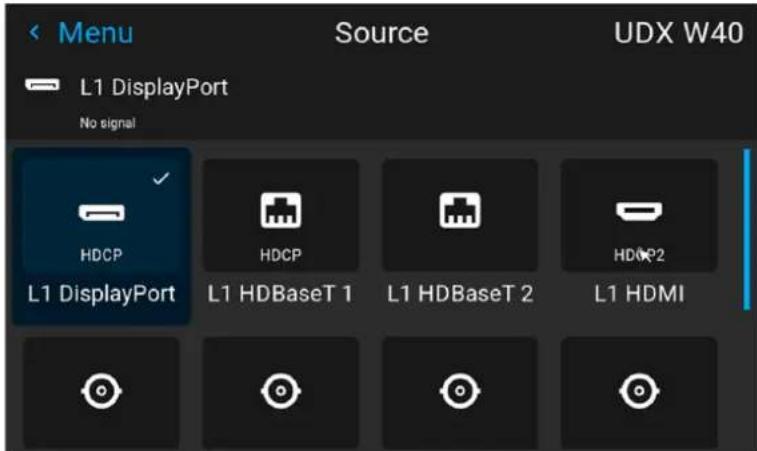
Image 6-2 Example of the input selection menu
- Select the desired input.
6.2 Displaying multiple sources: Stitched layouts
About stitched layouts
The first time you use a selected single source, the source will be displayed in the projector's native resolution. If the resolution of the source is different to the projector's resolution, the image is stretched or shrunk.
It is however possible to configure and display two or four source signals to make up one single image in full native resolution. This is called a Stitched Layout: the sources are stitched together.
The following table lists which stitched layouts you can use, and in which display mode these layouts can be used.
The table below describes the different Stitch Layouts and scan directions.
Type of layout Description
| 1: Single | A single source is displayed in full screen | Quad Combo input:• SDI (4x)• HDBaseT (2x)• DisplayPort• HDMIQuad DP 1.2 Input:• DisplayPort (4x) | Mono / Active stereo | |
| 1 | 2: Dual 1 x 2 | Two inputs are required. The sources are displayed next to each other. | Quad DP 1.2 Input:• 2x DisplayPort | Mono / Active stereo |
| 1 | 2: Quad 2 x 2 | Four inputs are required. The sources are displayed in four quadrants. | Quad Combo input:• 4x SDI inputQuad DP 1.2 Input:• 4x DisplayPort | Mono / Active stereo |
| 3 | 4: Quad 2 x 2 | |||
| 1 | 2 | Four inputs are required. The sources are displayed next to each other. | Quad DP 1.2 Input:• 4x DisplayPort | Mono / Active stereo |
| 1 | 3 | Two inputs are required. The sources are displayed one above the other. | Quad DP 1.2 Input:• 2 x DisplayPort | Passive stereo |
| 1 | 2: 2 x single | |||
| 1 | 2: 2 x Dual 1 x 2 | Four inputs are required. Two sources are displayed next to each other, while the other two are displayed above the first two | Quad DP 1.2 Input:• 4x DisplayPort | Passive stereo |

Even if passive stereo sources are selected, the output of this projector can only be in either 2D or in Active Stereo. Advanced image processing will make sure a passive stereo image is properly converted to active stereo.
How to select a stitched layout
- Press Menu to activate the menus and select Source.
Image 6–3 Main menu, Source
- Press OK.
The Select Source menu is displayed with the actual available sources filled out, including all available stitched layout options.
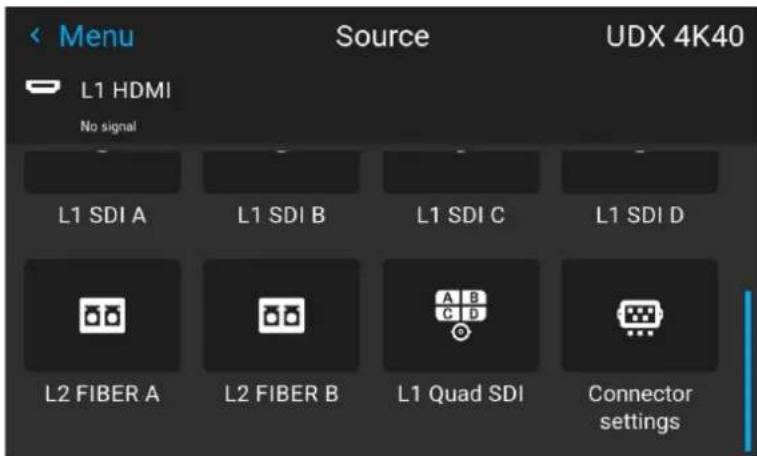
Image 6-4 Example of the stitched layout options
- Select the desired stitched input.

Tip: If the Quad DP input board is installed, scroll all the way down the menu for the stitched options on that board.
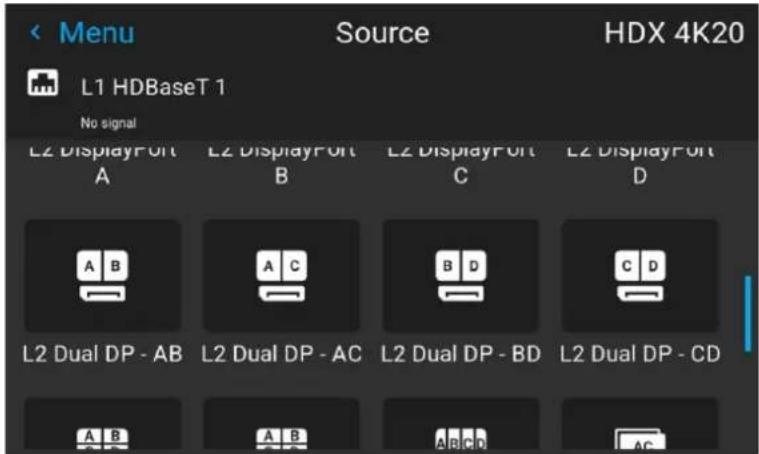
Image 6-5 Example of the stitched input options with the Quad DP board installed
6.3 Connector Settings
About Connector Settings
The Connector Settings menu allows you to change settings for each input connector of the projector.
By default all options for every connector are set to automatic, together with the native Extended Display Identification Data (EDID).
When entering the menu for each input connector, you can change the following:
- Color Space
- Signal Range
• EDID
How to configure a connector
- Press Menu to activate the menus and select Source.
Image 6-6 Main menu, Source
2. Press OK.
The Select Source menu is displayed with the actual available sources filled out.
- Scroll down to the bottom of the list of available sources and select Connector Settings.
Image 6-7 Source menu, connector settings
The available input connectors are displayed.
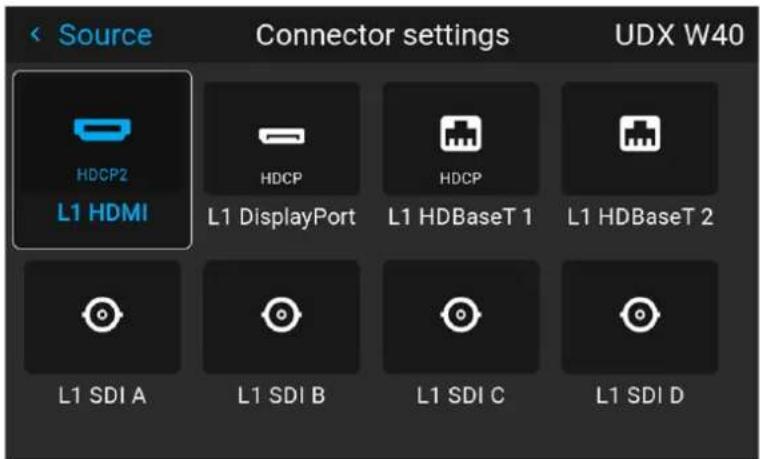
Image 6-8 Example of the Connector settings menu
4. Select the desired connector.
The Connector Settings menu for this connector will be displayed.
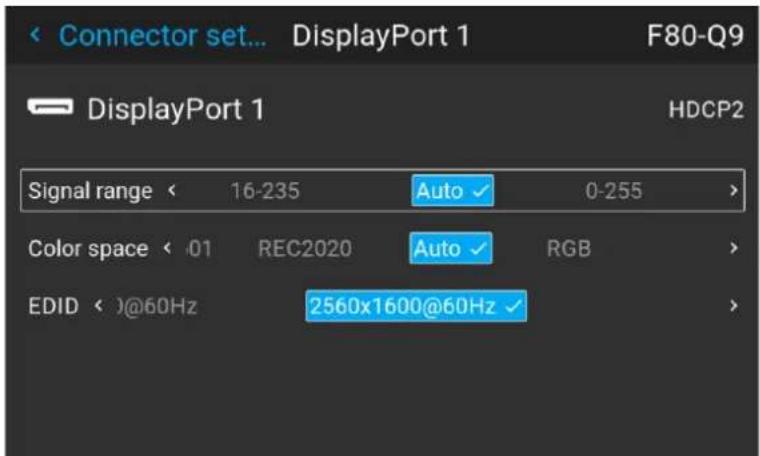
Image 6-9 Example of connector settings for an HDMI connector
-
You can change the following:
-
To force a limit on the used signal range, select one of the available signal ranges.
- To force a limit on the color space, select one of the available color spaces.
• To set a video timing other than the one native for the connector, select one of the options under EDID.

Note: You cannot change the EDID for SDI connectors.
GUI - Image 7
7.1 Setting image levels manually....62
7.2 Adjusting the sharpness....63
7.3 Adjusting the gamma correction....64
7.4 Setting the desired Gamma type....65
7.5 Digital Shift & Zoom 67
7.6 RealColor P7....71
7.7 Displaying HDR content 73
7.8 Dynamic contrast....74
7.1 Setting image levels manually
Purpose
Contrast: Change the contrast of the complete output signal of the projected image.
Brightness: Change the brightness of the complete output signal of the projected image.
Saturation: Change the saturation of the complete output signal of the projected image.
How to set up Contrast
- In the main menu, select Image → Contrast.
Image 7-1 Image menu — Contrast
- Use the ◀ or ▶ key to change the contrast enhancement until the desired value is reached (adjustable between 0 and 2).
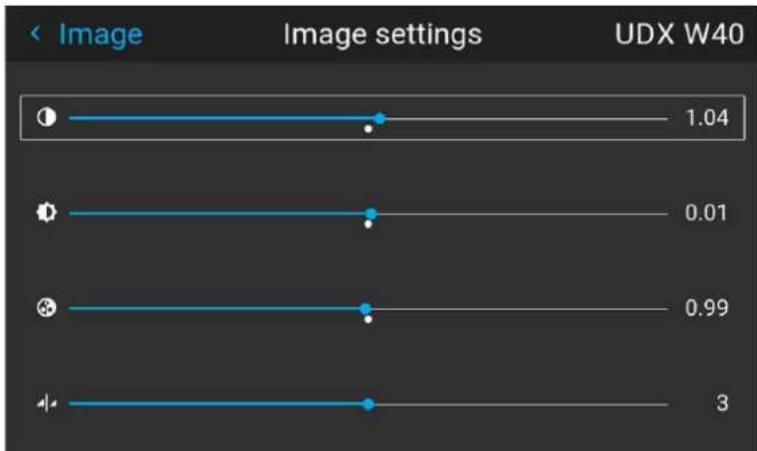
line
| Image setting | Value | | ------------- | ----- | | 1 | 1.04 | | 2 | 0.01 | | 3 | 0.99 | | 4 | 3 |Image 7-2 Example of the image sliders, contrast is the first slider
- If necessary, use the ▲ or ▼ key to select the other image adjustment options.
How to set up Brightness Level
- In the main menu, select Image → Brightness.
Image 7-3 Image menu — Brightness
- Use the ◀ or ▶ key to change the brightness until the desired value is reached (adjustable between -1 and 1).
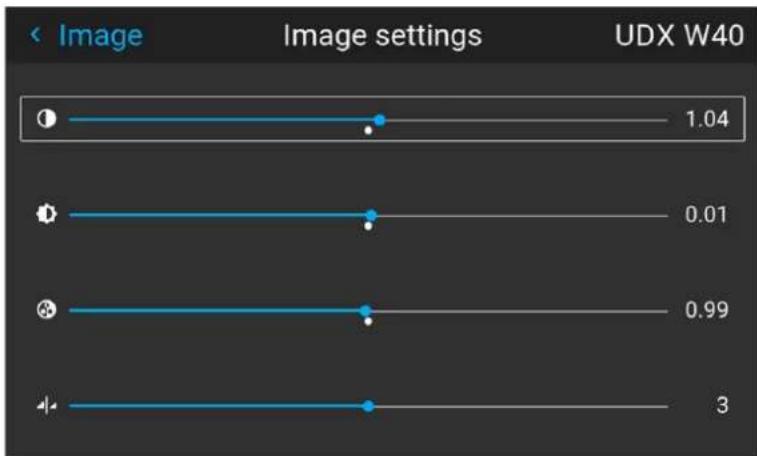
line
| Image Settings | Value | | -------------- | ----- | | 1 | 1.04 | | 2 | 0.01 | | 3 | 0.99 | | 4 | 3 |Image 7-4 Example of the image sliders, brightness is the second slider
- If necessary, use the ▲ or ▼ key to select the other image adjustment options.
How to set up Saturation Level
- In the main menu, select Image → Saturation.
Image 7-5 Image menu — Saturation
- Use the ◀ or ▶ key to change the saturation until the desired value is reached (adjustable between 0 and 2).
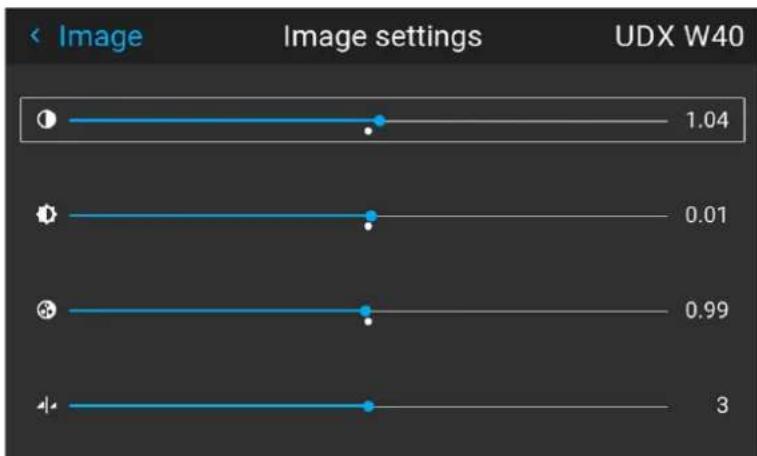
line
| Image | Value | |-------|-------| | 1 | 1.04 | | 2 | 0.01 | | 3 | 0.99 | | 4 | 3 |Image 7-6 Example of the image sliders, Saturation is the third slider
- If necessary, use the ▲ or ▼ key to select the other image adjustment options.
7.2 Adjusting the sharpness
About adjusting the sharpness
The sharpness adjustment amplifies the high frequency components in the picture. This means that by increase the sharpness, the picture will be perceived as sharper, and if decreased, the picture will be perceived as more blurry.
Increasing the sharpness will have the best effect in high contrast images, eg a table with text and borders. In a natural picture, high sharpness can be perceived as noise, as all details in the picture will be amplified. Available range: -2 to 8.
Default value: 0
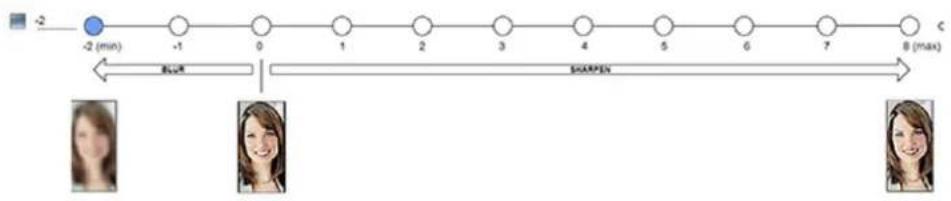
flowchart
graph LR
    A["-2 (min)"] --> B["-1"]
    B --> C["0"]
    C --> D["1"]
    D --> E["2"]
    E --> F["3"]
    F --> G["4"]
    G --> H["5"]
    H --> I["6"]
    I --> J["7"]
    J --> K["C (max)"]
    style A fill:#000,stroke:#fff,color:#fff
    style K fill:#000,stroke:#fff,color:#fff
    subgraph Time_Steps
        L["Blue"] --> M["Sharpen"]
    end
Image 7-7 Effect of sharpness adjust
How to adjust
- In the main menu, select Image → Sharpness.
Image 7-8 Image menu - Sharpness
- Use the ◀ or ▶ key to change the sharpness until the desired value is reached.
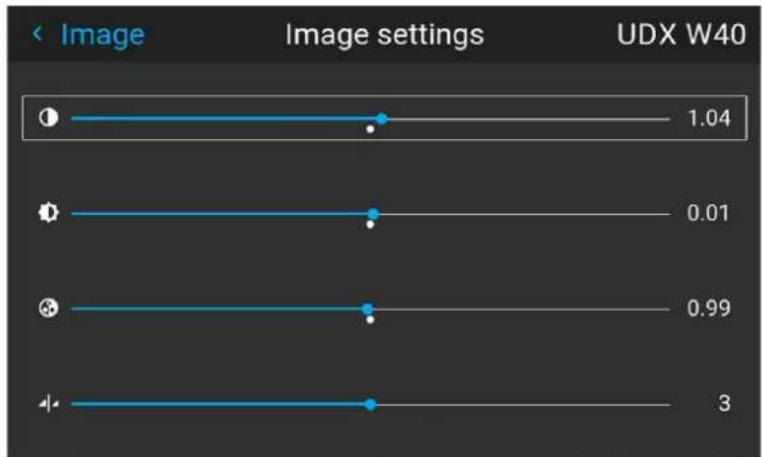
line
| Image Settings | Value | | -------------- | ----- | | 1 | 1.04 | | 2 | 0.01 | | 3 | 0.99 | | 4 | 3 |Image 7-9 Example of the image sliders, Sharpness is the bottommost slider
- If necessary, use the ▲ or ▼ key to select the other image adjustment options.
7.3 Adjusting the gamma correction
About gamma correction
Gamma correction is an image quality enhancement function that offers a richer image by brightening the already darker portions of the image without altering the brightness of the brighter portions (contrast feeling enhanced).
How to adjust
- In the main menu, select Image → Gamma.
Image 7-10 Image menu - Gamma
-
Use the ▼ key to select the slider.
-
Use the ◀ or ▶ key to change the gamma value between 1.0 and 2.8. The default value is 2,2.

Tip: The slider can be adjusted with a precision of 0.1.
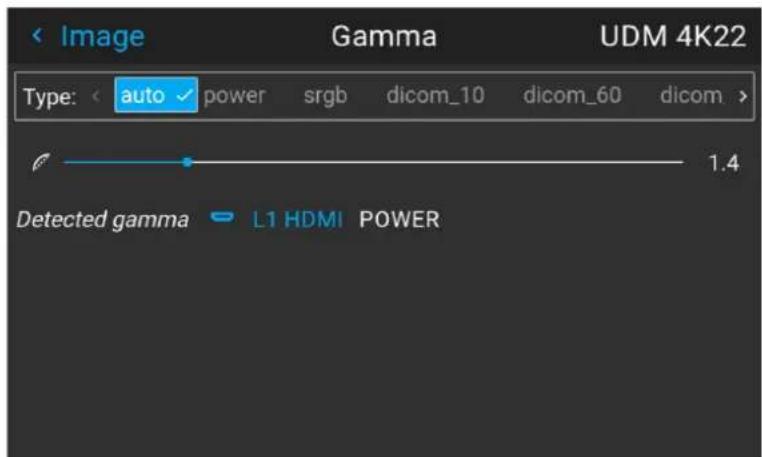
Image 7-11 Example of the gamma menu
7.4 Setting the desired Gamma type
About the alternate gamma types
Next to the standard gamma correction, the projectors can be manipulated in a way to simulate gamma types for other devices or purposes. This includes sRGB (standard Red-Green-Blue), Power gamma, DICOM gamma ranges and for simulation projectors sim1.
DICOM gamma ranges are usually reserved for medical displays. While this projector is not a certified DICOM display, it can simulate certain specific DICOM gammas at a few selected max light outputs. The DICOM gamma assumes that both ambient light and the projector outputs black as 0 cd/m^2 . Then there will be a few predefined gamma curves at the following light outputs:
• DICOM 10: 10 cd/m²
• DICOM 60: 60 cd/m²
• DICOM 180: 180 cd/m²
• DICOM 250: 250 cd/m²
• DICOM 300: 300 cd/m²
• DICOM 400: 400 cd/m²

This is the full list. Take into account that the available DICOM gamma types for your projector type may be more limited than this list.
Exception when using an HDR source
The only alternate color gamma that can not be selected in this menu is PQ/HDR. Because the color output of HDR is dependant on extra factors such as screen luminance, a separate menu has been made available for this (PQ).
If the source signal is HDR encoded an HDR icon will be visible next to the source signal. This is visible both the Source selection menu, as well as the status menu.
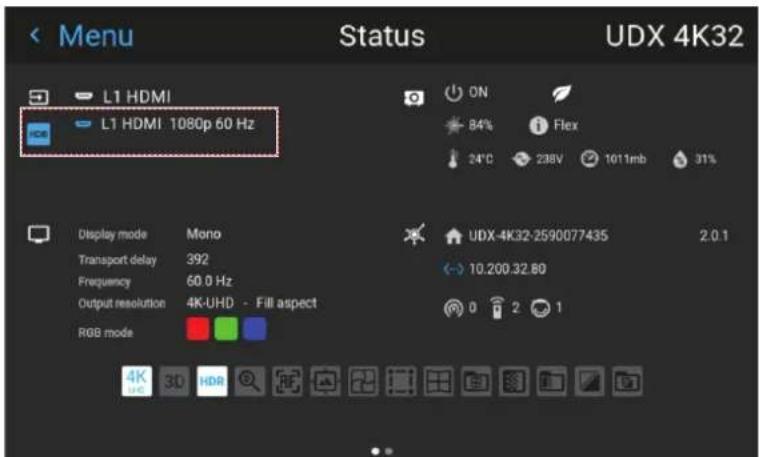
Image 7-12 Example of the HDR icon on the status menu
For more info on PQ and HDR, refer to "Displaying HDR content", page 73.
How to adjust the gamma type?
- In the main menu, select Image → Gamma type.
Image 7-13 Image menu - Gamma
The Gamma type menu is displayed. If source content is available, the detected gamma of the source will be displayed at the bottom of the menu.
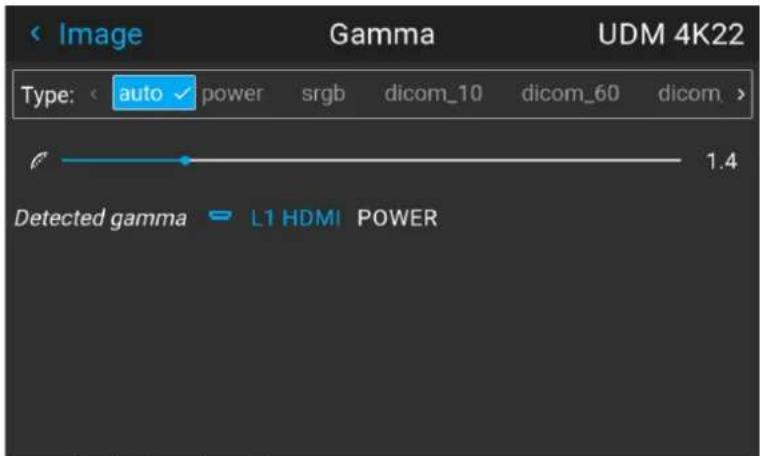
Image 7-14 Example of the gamma menu
- Use the ◀ or ▶ key to select the desired gamma type and confirm.
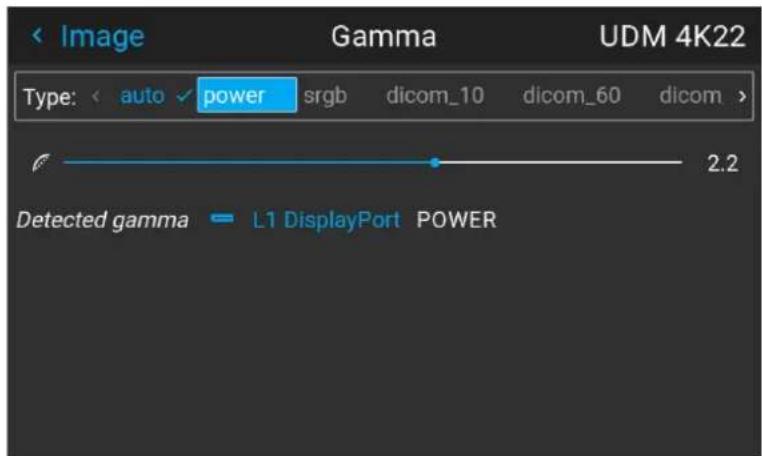
Image 7–15 Example of selecting a gamma type

Tip: If not sure what gamma type to select, keep the default value auto selected. This automatic mode will determine the used gamma type based on the incoming signal.
However: keep in mind when using the automatic mode, your media player needs to be configured correctly as well. While most mainstream media player devices will be configured correctly by default, we cannot guarantee this is the case for every device available on the market. If you notice the projected image seems "off", it may be necessary to check the configuration of your media player. For more info, check the user guide of your media player device.
7.5 Digital Shift & Zoom
What can be done?
The image can be optically shifted by using the vertical and horizontal lens shift.
If you want to reach a lens shift beyond what is possible with the optical shift, you can also perform a digital lens shift. This digital shift will occur on the DMD, rather than the lens holder. So take into account that this additional shift is minimal and restricted to the limits of the chip used.
For the optical zoom and lens shift, navigate to Home → Installation → Lens.

Lens shift is only possible when the used lens has been fully calibrated. To calibrate the current lens, navigate to System Settings → Maintenance → Lens Calibration.
The effect of Digital Zoom
This function zooms in the picture digitally. When zooming in, the center of the image will increase in size. This means that the outer part of the picture will be outside the picture frame. When zooming out, the result is that the picture will be smaller than the projectors picture frame. The area outside the rendered picture will then be black.
For an example, see the following photos. The red lines in the figures represent the DMD outline.

natural_image
Close-up of a koala with textured gray skin and visible eye, partially obscured by foliage (no text or symbols)Image 7-16 Originally picture, not digitally zoomed

natural_image
Close-up of a koala's face showing its distinctive nose and mouth (no text or symbols visible)
natural_image
Close-up photo of a koala with visible facial features and whiskers (no text or symbols)Image 7-17 Picture digitally zoomed in Image 7-18 Picture digitally zoomed out
The effect of Digital Shift
This function will shift the picture digitally, meaning that the picture will be moved in any direction. As a result, some parts of the picture might be shifted outside the DMD range.
For an example, see the following pictures. The red lines in the figures represent the DMD outline

natural_image
Close-up of a koala with visible facial features and open mouth, surrounded by foliage (no text or symbols)Image 7-19 Original Picture, not digitally shifted

natural_image
Close-up of a koala interacting with its face, showing its mouth and whisker (no text or symbols visible)
natural_image
Close-up photo of a koala with visible eye and mouth, no text or symbols presentImage 7-20 Picture shifted horizontally Image 7-21 Picture shifted vertically
Digital Shift & Zoom
- In the main menu, select Image → Digital Zoom Shift.
Image 7-22 Image menu, digital zoom and shift
The Digital Zoom Shift menu is displayed.
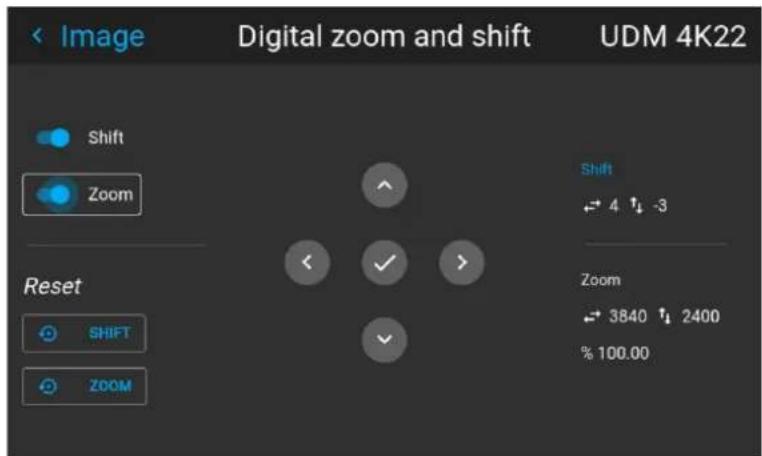
Image 7-23 Example of the digital zoom and shift menu
- In order to optimize the digital zoom, enable the Zoom slider. In order to optimize the digital shift, enable the Shift slider.
- When one or both of the modes are enabled, use the arrow keys to select the mini-keypad in this menu. Use the enter key to activate this mini-keypad.
If digital shift is enabled, the keypad will transform into the keypad for digital shift. If only digital zoom is active, it will automatically transform in they keypad for digital zoom.
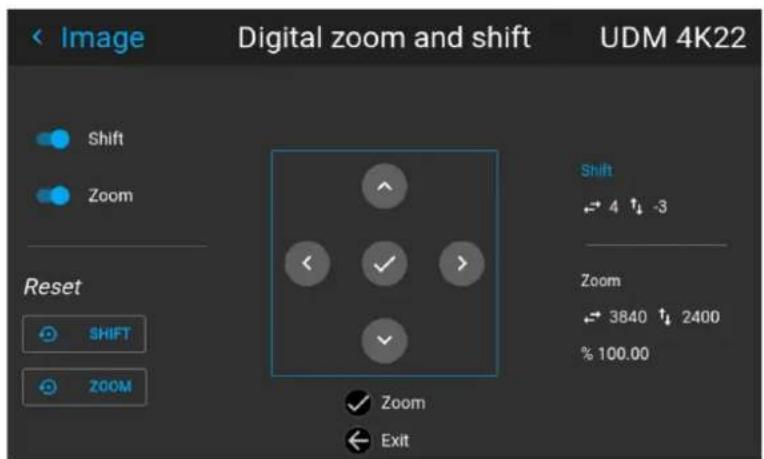
Image 7-24 Example of the enabled digital shift mode
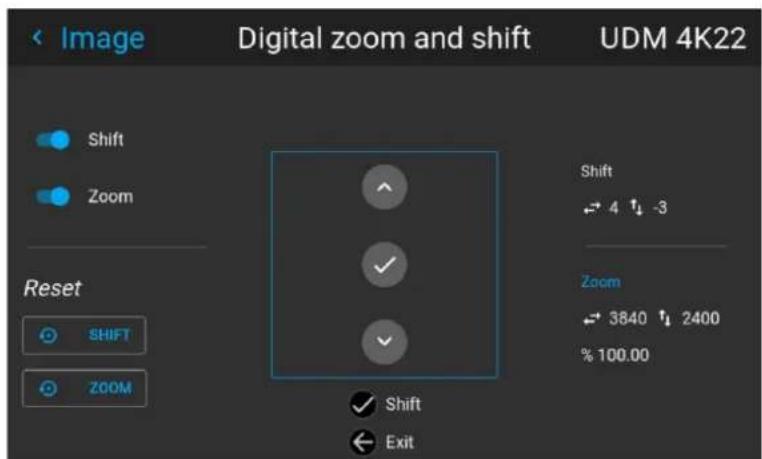
Image 7-25 Example of the enabled digital zoom mode
-
If digital shift is enabled, you can now do the following: • Use the ◀ or ▶ key to shift the lens (image) in horizontal direction.
-
Use the ▲ or ▼ key to shift the lens (image) in vertical direction.
- Use the enter key to transform the keypad to digital zoom mode (if enabled).
-
Use the return key to exit without saving.
-
If digital zoom is enabled, you can now do the following:
-
Use the ◀ or ▶ key to zoom the lens in or out.
- Use the enter key to either finish digital shift and zoom.
- Use the return key to exit without saving.
7.6 RealColor P7
Purpose
When blending images from multiple projectors, the measured color coordination of each projector can be altered to a desired common level. This so that the projected colors are identical over all projectors used.
Alternatively, if you are unfamiliar with how to adjust the colors to a specific setting, there are also a certain number of presets available, which forces the color output to specific color standards.
How to set custom P7 values
- In the main menu, select Image → Advanced → RealColor P7.
Image 7-26 Advanced settings menu - RealColor P7
The P7 menu is displayed.
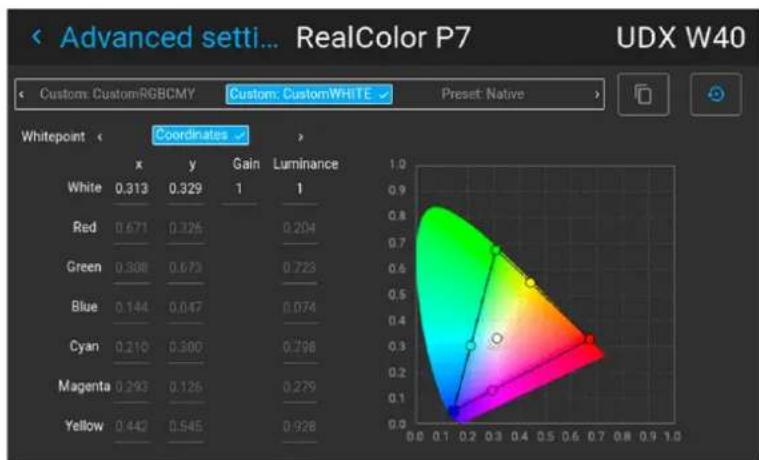
heatmap
| Whitepoint | x | y | Gain | Luminance | | ---------- | ---- | ---- | ---- | --------- | | White | 0.313| 0.329| 1 | 1 | | Red | 0.671| 0.325| 0.204| | | Green | 0.308| 0.673| 0.723| | | Blue | 0.144| 0.047| 0.074| | | Cyan | 0.210| 0.300| 0.798| | | Magenta | 0.293| 0.125| 0.279| | | Yellow | 0.442| 0.545| 0.928| |Image 7-27 Example of the RealColor P7 menu, here on a UDX
-
Select the desired Custom Mode. Select one of the following Custom options and confirm:
-
Custom RGB: 3-point color configuration.
In RGB mode, the C, M and Y coordinates will be calculated automatically based on the R, G and B coordinates. - Custom RGBCMY: 6-point color configuration (both RGB and CMY).
In RGBCMY mode, each color can be given a specific coordinate within the measured color triangle. -
Custom WHITE: Configure only the White temperature.
-
Choose how to determine the Whitepoint. Choose one of the following:
- Coordinates: Configure the white point via specific coordinates.
The white point is specified using an x, y coordinate in the CIE 1931 Chart.
GUI - Image
• Temperature: Configure the white point via a color temperature slider.
The white point is specified on a Kelvin scale between 3200K and 13000K tracking along the black body curve.
- Define the coordinates for each available color.
Click on a coordinate value and select the current value. Enter the desired value with the numeric keys.
Note: You can only pick coordinates within the measured color triangle.
You can reset all coordinates to the default values (to native) by clicking the Reset icon.
How to choose one of the P7 presets
- In the main menu, select Image → Advanced → Realcolor P7.
Image 7-28 Advanced settings menu - RealColor P7
The P7 menu is displayed.
Image 7-29 Example of the RealColor P7 menu
-
Select one of the pre-defined presets:
-
Standard: A color standard for all UDX projectors, which may be considered the new native settings for all UDX projectors. Default for UDX.
- Native: Projector native color settings.
- DCI-P3: Color standard for Cinema.
- EBU: European color standard for broadcasting.
- SMPTE-C: American color standard for broadcasting.
• Rec. 709: Color standard for high-definition televisions (HDTV).
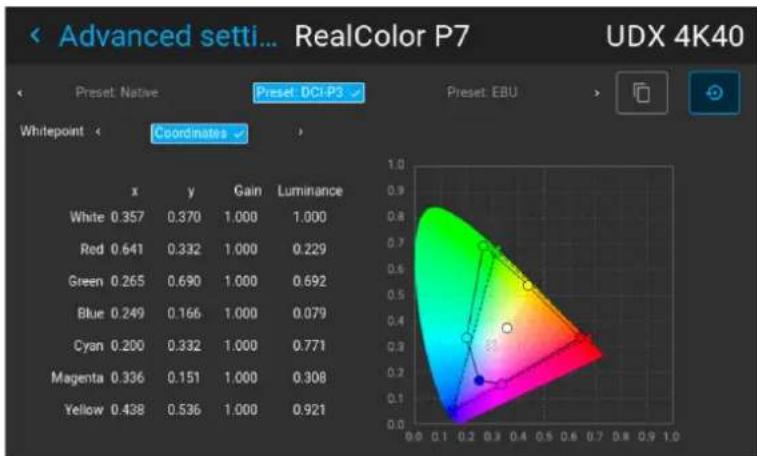
radar
| | White | Red | Green | Blue | Cyan | Magenta | Yellow | | ------ | ----- | ----- | ----- | ----- | ----- | ------- | ------ | | x | 0.357 | 0.641 | 0.265 | 0.249 | 0.200 | 0.336 | 0.438 | | y | 0.370 | 0.332 | 0.690 | 0.166 | 0.332 | 0.151 | 0.536 | | Gain | | | | | | | | | Luminance | | | | | | | | | | | | | | | | | | | | | | | | | | | | | | | | | | | | | | | | | | | | | | | | | | | | | | | | | | | | | |Image 7-30 Example of one of the presets, here DCI-P3

Note: After choosing one of the presets, you can still alter the values of the coordinates to your own choosing, similarly to how you set custom P7 values.
Use the Reset icon to return to the default values of the chosen preset.
7.7 Displaying HDR content
About HDR and PQ
Perceptual Quantizer (PQ) is a non-linear electro-optical transfer function (EOTF) that allows for the display of High Dynamic Range (HDR) content with a luminance level of up to 10 000 cd/m² and can be used with the Rec. 2020 color space.
When do I know my content is HDR encoded?
If the source signal is HDR encoded, an HDR icon will be visible next to the source signal. This is visible both in the Source selection menu, as well as the status menu.
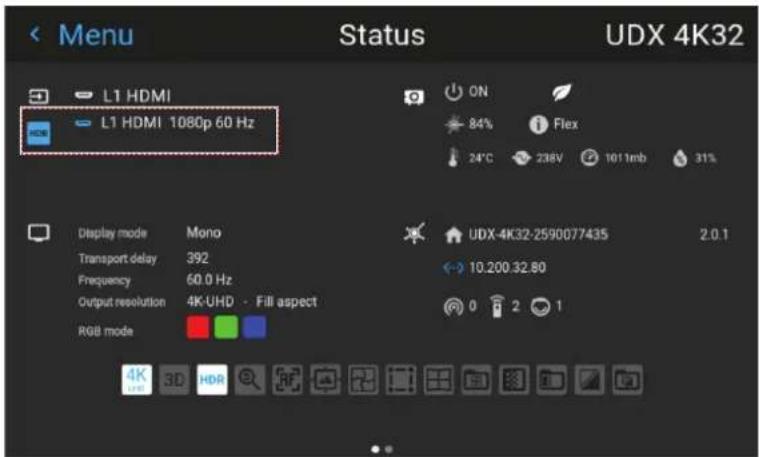
Image 7-31 Example of the HDR icon on the status menu
How to properly display HDR content?
If your provided HDR content has been mastered with PQ (e.g. HDR10 and Dolby Vision), a few changes can be made in order to project the intended mastering on screen. These changes are necessary because HDR content has been mastered specifically for HDR capable displays that are watched in living rooms. These conditions are different from a non-HDR projector and darker cinema-like environments.
The projected HDR content depends on the following factors:
- Mastering luminance: This is content-specific and cannot be changed.
- Screen luminance: Every projection screen has a specific luminance (measured in nits or foot-Lambert). Entering this luminance in the projector will adapt the content towards the intended HDR result.
- HDR Boost: A variable "booster" that may amplify or downplay the HDR output.
How to set the HDR-related parameters?
- Make sure the chosen Gamma Type is set to AUTO. For more info, refer to "Setting the desired Gamma type", page 65.
- In the main menu, select Image → Advanced → HDR.
Image 7–32 Advanced settings menu, HDR
The HDR menu is displayed.
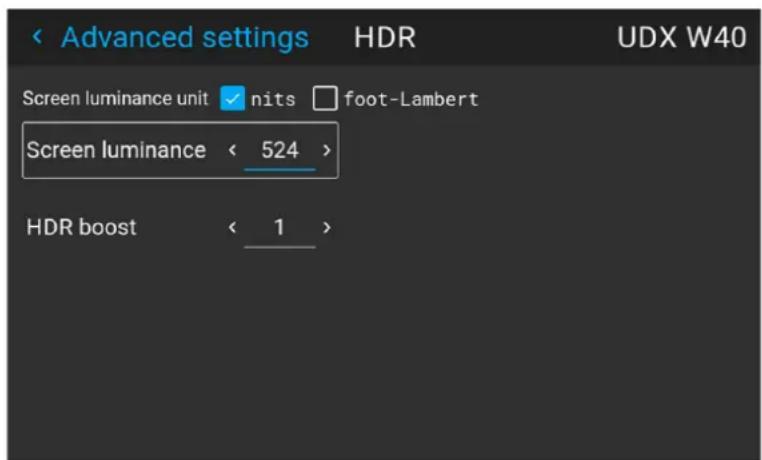
Image 7-33 Example of the HDR menu
- Select the desired Screen luminance unit (nits or foot-Lambert).
- Enter the Screen luminance (which is measured in nits or foot-Lambert).
- Alter the HDR boost if necessary. You can modify this value to somewhere between 0.8 and 1.2.
7.8 Dynamic contrast
About dynamic contrast
Projectors rely on contrast to showcase dark scenes or black parts on the projected surface. Whites and light areas are usually projected without issue, but blacks and dark areas are a different matter. With low contrast, blacks and dark areas appear more grey. The dynamic contrast menu is here to improve the dark scene accuracy.
Dynamic contrast checks the projected content dynamically and adapts the power of the light source accordingly to create the best possible outcome.

Take note that dynamic contrast isn't magic. Adapting the light source to adapt its contrast according to the played content will have an impact on the total light output of the projector. If you do not care about this feature and want your projector to display the brightest possible content instead, you can turn this feature off.
How to set the dynamic contrast?
- In the main menu, select Image → Advanced → DynaBlack.
Image 7-34
The DynaBlack menu is displayed.
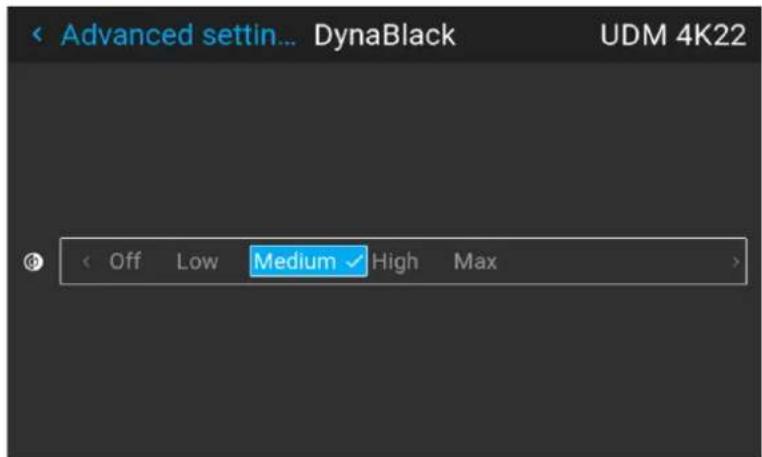
Image 7-35 Example of the DynaBlack menu
- Select the desired dynamic contrast setting, or leave the default on (medium).
The result will slowly become visible.

Do not panic if there isn't a visible change after a few seconds. Each change in the dynamic contrast menu has an impact on the light source, thus these changes will only become visible over time.
GUI - Installation
8
8.1 Configuring the lens, optical zoom-focus 78
8.2 Configuring the lens, shift 78
8.3 Configuring the lens, dynamic focus....79
8.4 Configuring the lens, Shift to center....80
8.5 Configuring the lens, tilt sensor....81
8.6 Laser ranging 82
8.7 Manipulating the rigging frame 83
8.8 Manipulating the rigging frame, center position 85
8.9 Orientation....85
8.10 Scaling modes....86
8.11 Warping....87
8.12 Blending & masking....100
8.13 Illumination 110
8.14 3D projection....111
8.1 Configuring the lens, optical zoom-focus
What can be done?
If a motorized lens has been mounted onto the projector, you can fine-tune the projected image.
Zoom - Focus
- In the main menu, select Installation → Lens → Zoom focus.
Image 8-1 Lens menu, Zoom & Focus
The Zoom and focus menu is displayed.
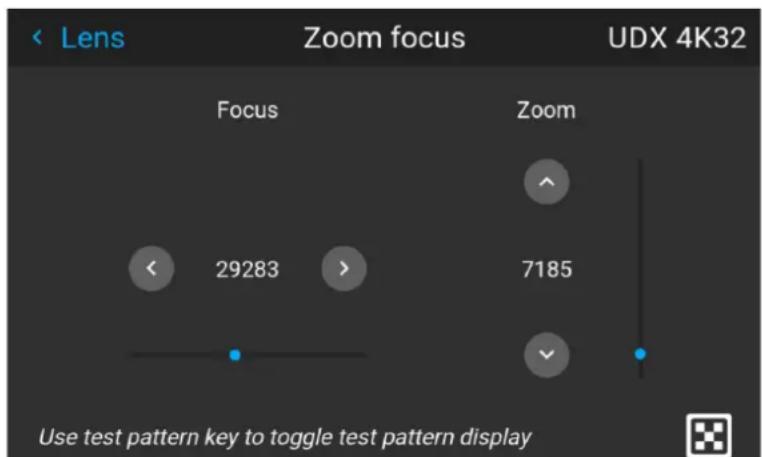
Image 8-2 Example of the zoom and focus adjustment menu
- Use the ▲ or ▼ key to zoom the lens in or out.
Use the ◀ or ▶ key to focus the lens to far or near.
8.2 Configuring the lens, shift
What can be done?
The image can be optically shifted by using the vertical and horizontal lens shift.
If you want to reach a lens shift beyond what is possible with the optical shift, you can also perform a digital lens shift. This digital shift will occur on the DMD, rather than the lens holder. So take into account that this additional shift is minimal and restricted to the limits of the chip used.
For the digital zoom and shift, navigate to Home → Image → Digital Zoom Shift. For more info, see “Digital Shift & Zoom”, page 67.

Optical lens shift is only possible when the used lens has been fully calibrated. To calibrate the lens, navigate to System Settings → Maintenance → Lens Calibration.
Vertical and Horizontal Shift
- In the main menu, select Installation → Lens → Shift.
Image 8-3 Lens menu, lens shift
The Lens shift menu is displayed.
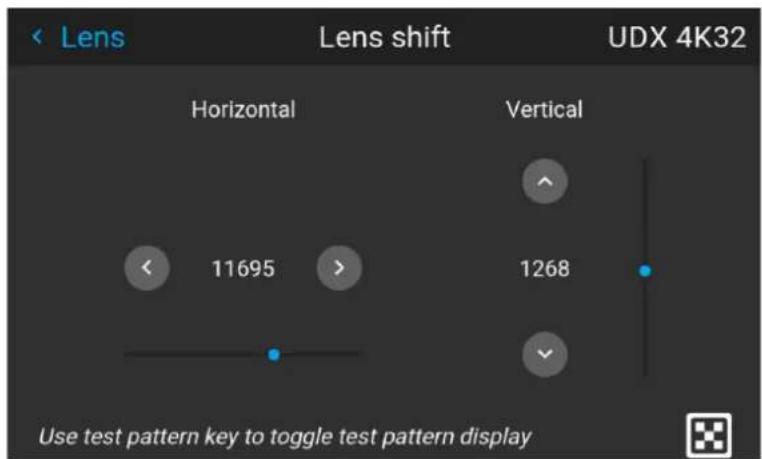
Image 8-4 Example of the lens shift menu
- Use the ◀ and ▶ keys to shift the lens (image) in horizontal direction.
Use the ▲ and ▼ keys to shift the lens (image) in vertical direction.
8.3 Configuring the lens, dynamic focus
About focus drift and dynamic focus
Due to the design of TLD+ lenses and ultra-short throw lenses (UST lenses), these type of lenses tends to heat up over time when used in projectors. This has the side-effect of a slight shift in focus between the lens in its cold state and the lens in its heated state, which is referred to as "focus drift".
While there are external solutions available that perform a "focus drift compensation", a dynamic focus feature has been implemented from Pulse software version 2.0 onward that handles this focus drift. While enabled, the projector will perform the necessary calculations in order to handle this drift in focus.

The amount of focus drift can differ between lenses. For that reason it is important to calibrate the focus drift when a new lens is mounted in the projector.
Use the calibration wizard in the Projector Toolset to calibrate focus drift. For more info on the focus drift calibration, consult the Projector Toolset user guide.
How to enable dynamic focus?
- To enable dynamic focus mode, select Installation → Lens.
The Lens menu is displayed.
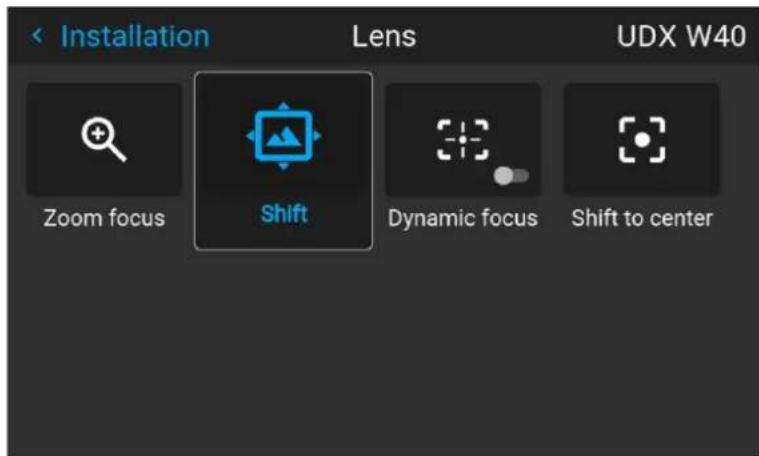
Image 8-5 Example of the Lens menu
- In the Lens menu, click Dynamic focus to toggle between On and Off.
Image 8-6 Lens menu, Dynamic focus enabled Image 8-7 Lens menu, Dynamic focus disabled

Note: The Dynamic focus slider is only visible when the light source is on.
8.4 Configuring the lens, Shift to center
What can be done?
The lens can be forced back to the center position by selecting Shift to center.
How force lens in Mid position
- To force lens in Mid position, select Installation → Lens → Shift to center.
Image 8-8 Lens menu, Shift to center
- Confirm by pressing the CONFIRM button.
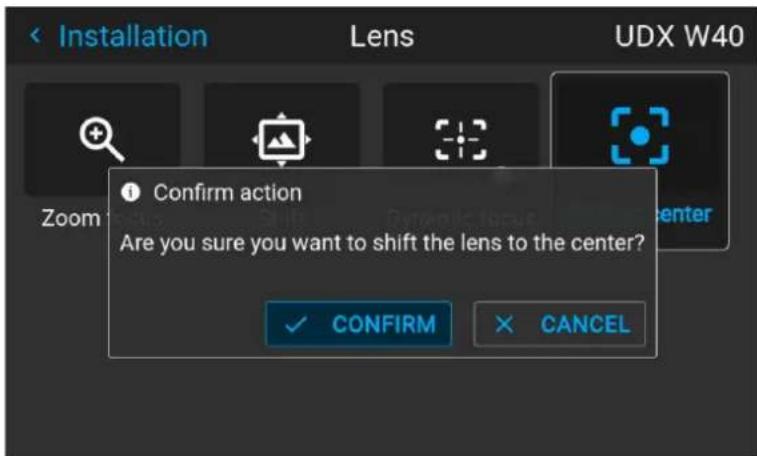
Image 8-9 Example of the Shift to center action
The lens will calibrate itself and return to the center position.
8.5 Configuring the lens, tilt sensor
When to use the tilt sensor menu
The projector has a built-in tilt sensor that detects the angle at which the projector is mounted. If you are in a situation where you need to fine-tune the projector because you want to achieve a picture at a specific angle (e.g. perfectly level, or a perfect fit in a multi-projector setup), you can use the tilt sensor menu as an aide when adjusting the projector feet, rigging frame or other used mounting mechanisms.
How to read the tilt sensor values
- In the main menu, select Installation → Lens → Tilt sensor.
Image 8-10 Lens menu, Tilt sensor
The Tilt sensor menu is displayed.
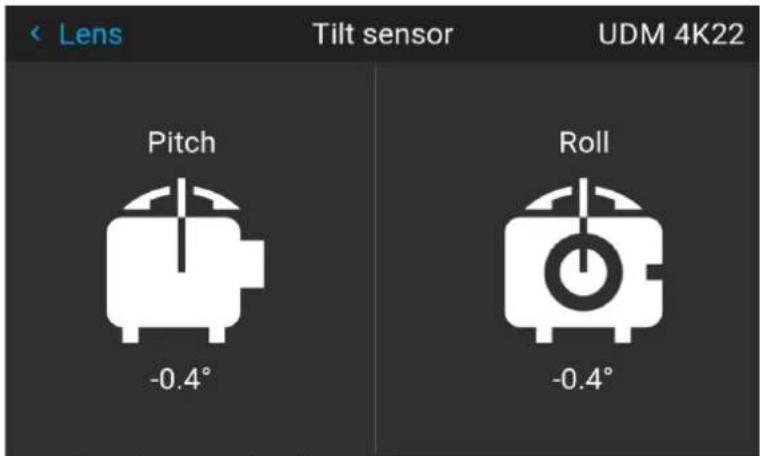
Image 8-11 Example of the tilt sensor menu

If you notice the tilt sensor isn't working correctly (e.g. when compared to a level), you can calibrate the sensor in the settings menu. For more info, see "Advanced settings – Tilt sensor calibration", page 163.
8.6 Laser ranging
What can be done?
When the optional laser range finder is installed on the projector, you can use the laser source to measure the distance between the front of the projector and the surface you are projecting on.
This can help you fine-tune the position of the projector.

Take into account that while a laser ranging session is active, the projected image will be off. This to have no interference between laser pointer and projected image. Instead, a red border will be projected giving the outline of where the projected image should be.
How to manipulate the laser range finder?
- In the main menu, select Installation → Laser ranging.
Image 8–12 Installation menu, laser ranging
The Laser ranging menu is displayed.
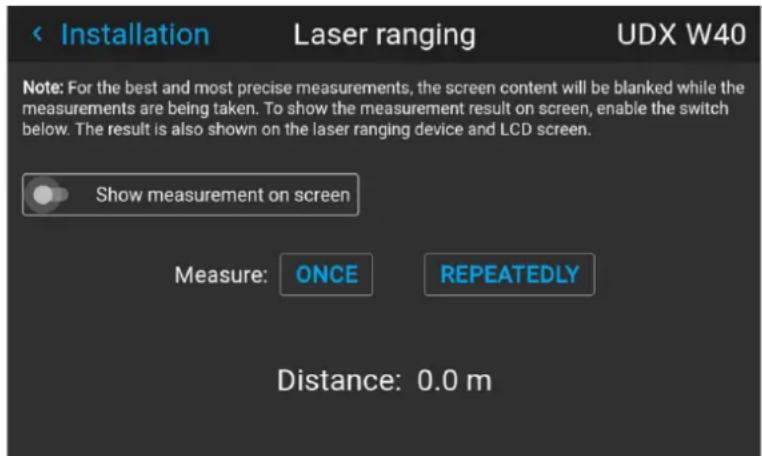
Image 8–13 Example of the laser ranging menu
- For a single laser ranging calculation, press Once. This will continue the laser for 30 seconds.
- If you want a continued laser ranging (e.g. when fine-tuning the position of the projector), press Repeatedly.
- If you cannot see the display of the laser range finder while performing a laser ranging session, select Show measurement on screen. This way, the measurement will be projected alongside the laser dot and the red border.
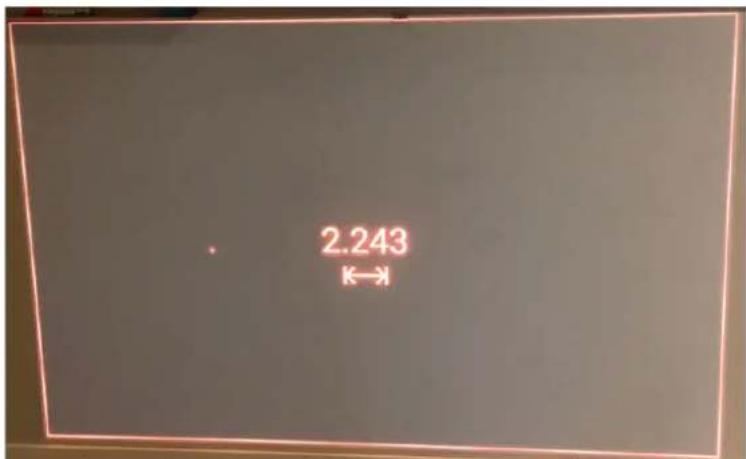
Image 8–14 Example of projected image during laser ranging session with measurement on screen

By default the measurement is in meters. If you want the distance projected in feet, you can change the measurement system in the System settings menu. For more info, refer to "Units (measurement) system setup", page 138.
8.7 Manipulating the rigging frame
When can you manipulate the rigging frame?
You can manipulate the rigging frame in the Pulse menu when:
- The projector is mounted in a motorized rigging frame.
- The wiring of the motorization is connected to the projector, including the XLR connector.
- The XLR connector is enabled and powered to 24V. For more info on how to power the XLR connector, see "Front XLR output voltage control", page 135.
How to manipulate the rigging frame?
- In the main menu, select Installation → Lens → Motorized frame.
Image 8-15 Lens menu - Motorized frame
The Motorized frame menu is displayed.
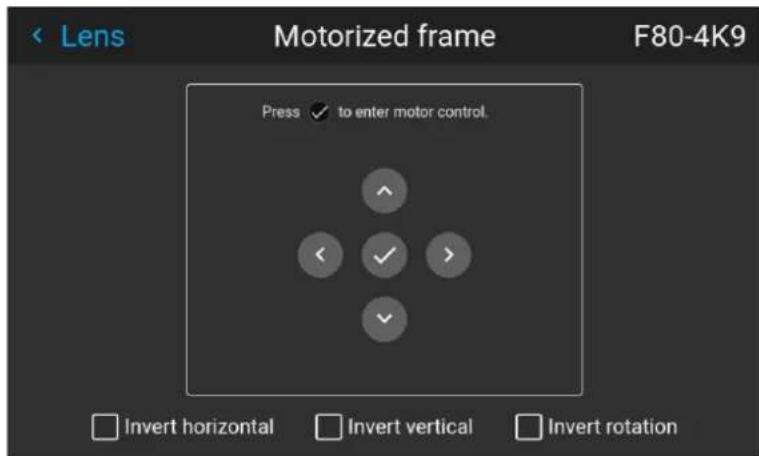
Image 8-16 Example of the Motorized frame menu
- Press the OK key or button to activate the frame shift motors.
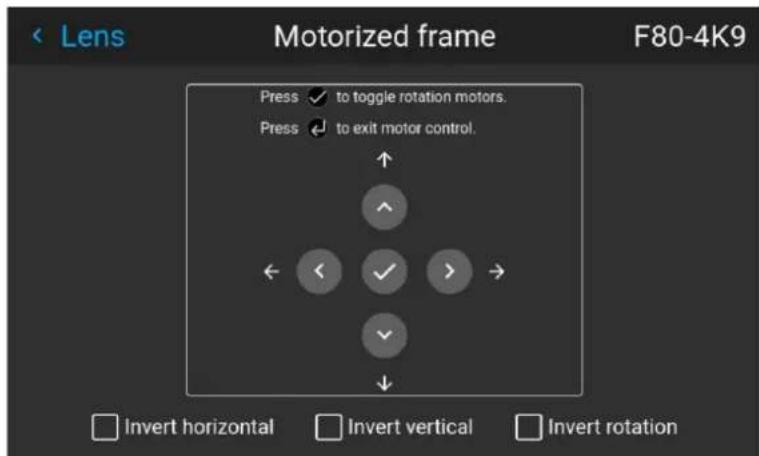
Image 8-17 Example of horizontal and vertical frame shift
- Use the ▲ or ▼ button to shift the rigging frame (image) in vertical direction.
Use the ◀ or ▶ button to shift the rigging frame (image) in horizontal direction.
- Confirm with the OK button.
The frame rotation menu is displayed.
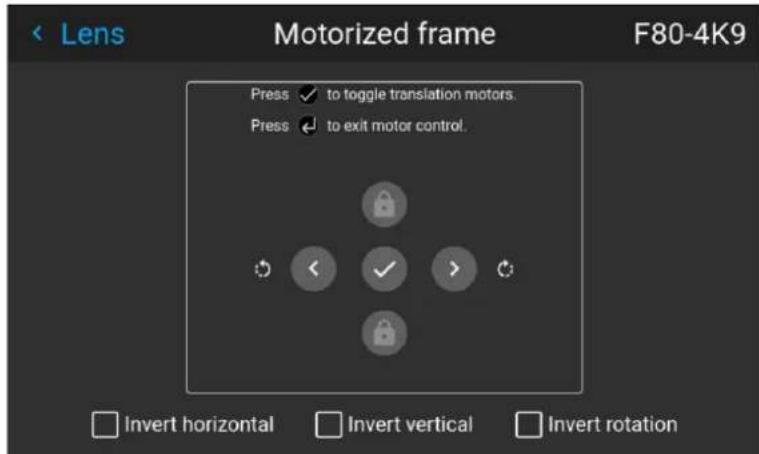
Image 8-18 Example of frame rotation
-
Use the ◀ or ▶ button to rotate the rigging frame (image) either clockwise or counterclockwise.
-
Confirm with the OK button to return to the frame shift menu, or use the Menu back button to return to the Lens menu.
8.8 Manipulating the rigging frame, center position
What can be done?
The motorized frame can be forced back to the center position by selecting Center motorized frame.
How to reset the motorized frame?
- In the main menu, select Installation → Lens → Center motorized frame.
Image 8-19 Lens menu, Center motorized frame
A confirm action prompt will be displayed.
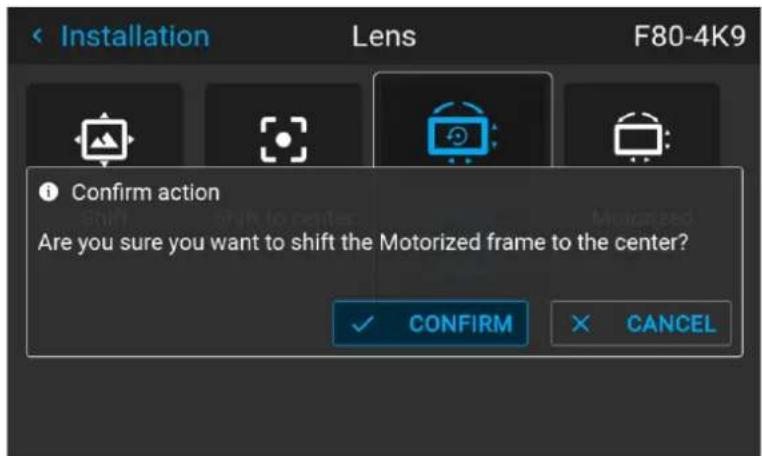
Image 8-20 Example of the Center motorized frame action prompt
- Confirm to reset the frame to its center position.
Wait until the frame motors have stopped before doing other actions.
8.9 Orientation
What can be done?
The way of physical installation of the projector can be defined to the projector.
The following installation are possible:
- Desktop front: Projected image will not be flipped or mirrored.
- Desktop rear: Projected image will be flipped horizontally (left side switches to the right side).
• Ceiling front: Projected image will be flipped vertically (top side switches to the bottom side). - Ceiling rear: Projected image will be flipped both vertically and horizontally.
- Auto front: The tilt sensor will detect if the projector is desktop or ceiling mounted and will project a readable image accordingly.
- Auto rear: The image will be flipped horizontally. The tilt sensor will detect if the projector is desktop or ceiling mounted and will project a readable image accordingly.
How to set the correct orientation
- In the main menu, select Installation → Orientation.
Image 8-21 Installation menu, orientation
The Orientation menu is displayed.
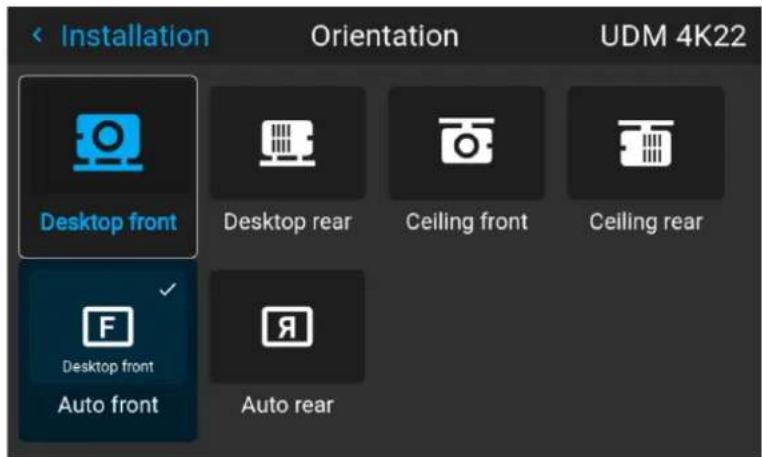
Image 8-22 Example of the orientation menu
- Use the ◀ or ▶ keys to select the projector orientation mode and press OK to activate.
8.10 Scaling modes
About scaling modes
While the default mode of projection is to fill the screen while respecting the aspect ratio (fill aspect), it is also possible to stretch the image in a different way. You can choose from one of the following scaling methods:
| Scaling Mode | Explanation Example image | 2 |
| Fill aspect Default scaling mode. Stretches the image to the native resolution of the DMD, while respecting the original aspect ratio. | 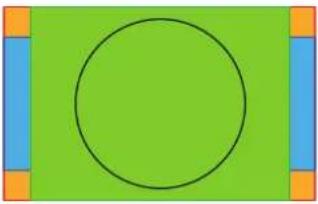 | |
| 1:1 An exact rendering of the source signal, which may be smaller than the native resolution | 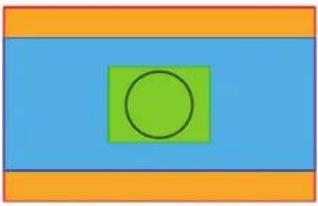 | |
| Scaling Mode | Explanation Example image | 3 |
| Fill screen Fills | the screen to the screen size defined in the Screen Size menu, while respecting the original aspect ratio. For more info on adjusting the Screen Size menu, $ “Warping - Screen Size”, page 88. | 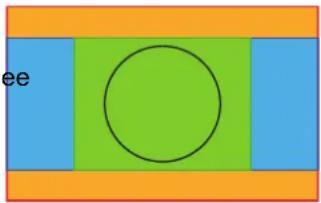 |
| Stretch This mode stretches the image to the screen size defined in the Screen Size menu, while ignoring the original aspect ratio. For more info on adjusting the Screen Size menu, see “Warping - Screen Size”, pa 88. | 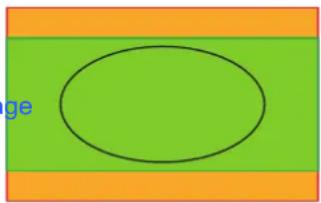 | |
Setting a scaling mode
- In the main menu, select Installation → Scaling.
Image 8–23 Installation menu, scaling
The scaling mode menu is displayed.
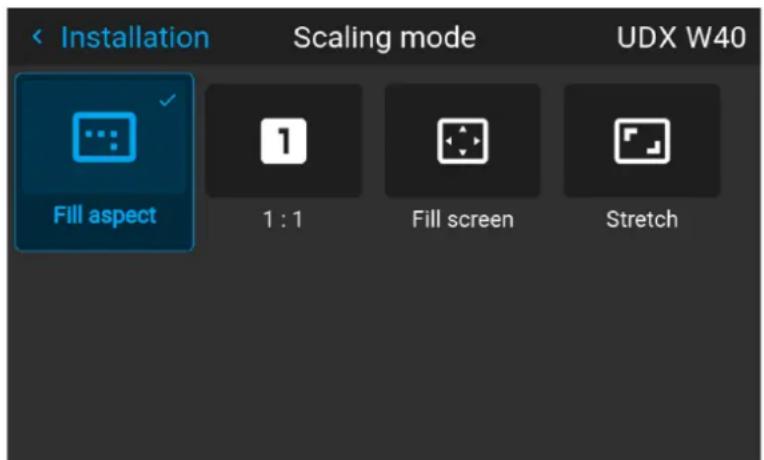
Image 8-24 Example of the scaling mode menu
- In the Scaling menu, select the desired scaling mode and confirm.
8.11 Warping
About warping
Image warping is the process of digitally manipulating an image to compensate for the distortion of the screen. Consequently, it can also be used to generate an image with irregular shape.
While an image can be transformed in various ways, pure warping doesn't affect the colors.
8.11.1 Warping - On/Off
About warping on/off
By toggling between on and off the warping functionality can be enabled or disabled.
How to toggle
- In the main menu, select Installation → Warp.
Image 8–25 Installation menu, warp
The Warp menu is displayed.
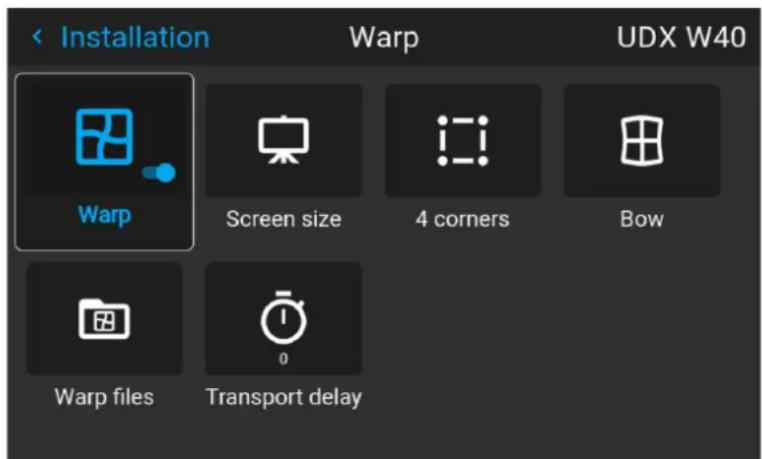
Image 8–26 Example of the Warp menu
- In the Warp menu, click Warp to toggle between On and Off.
Image 8–27 Image 8–28
8.11.2 Warping - Screen Size
About (Warp) Screen Size adjustment
If the used source aspect ratio is different than the projector aspect ratio (e.g. source is 16:9 and projector is 16:10), then black bars will be projected. In this example case a black bar on top and bottom of the image will be projected. The warp area contains not only the image information but also the black bars.
If we want to position (e.g. the active left top corner exactly on the screen using 4 corner warp), then it is very hard to do that as we are moving the black left top corner and we do not have control over the exact position image left top corner. By moving the outline of the warp screen size to the active image information, the corner points of the warp area are now exactly on the corner points of the active image information and makes warping much easier.
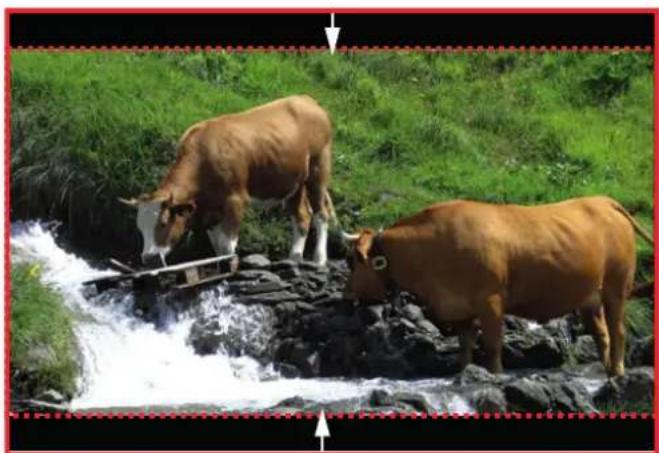
natural_image
Two cows grazing on a rocky stream surrounded by green grass (no text or symbols visible)Image 8–29 Warp outline example
Using the screen aspect ratio presets
- In the main menu, select Installation → Warp → Screen Size.
Image 8-30 Warp menu, screen size
The Screen Size menu is displayed.
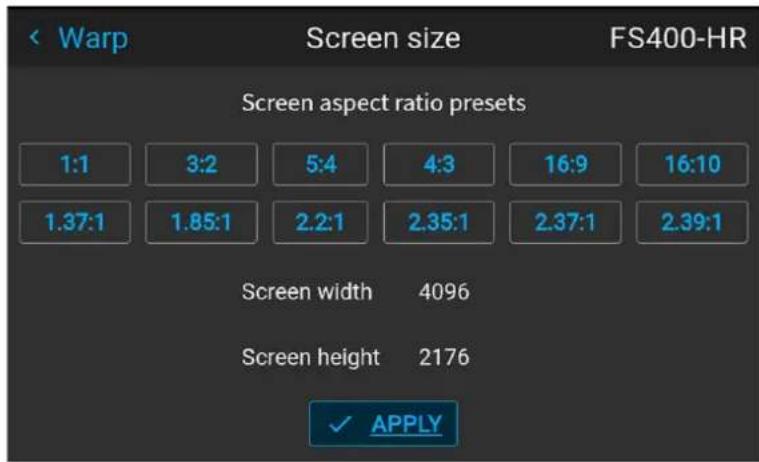
Image 8-31 Example of the screen size menu
- Click on one of the predefined presets for the screen aspect ratio.
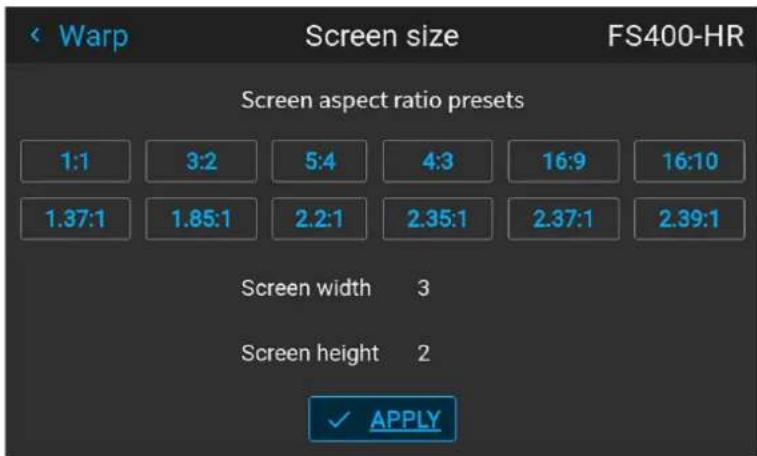
Image 8-32 Example of the screen size menu, with preset "3:2" selected.
The selected ratio is filled out next to Screen width and Screen height.
3. Click Apply.
How to adjust the image with pixels?
- In the main menu, select Installation → Warp → Screen Size.
Image 8-33 Warp menu, screen size
The Screen Size menu is displayed.
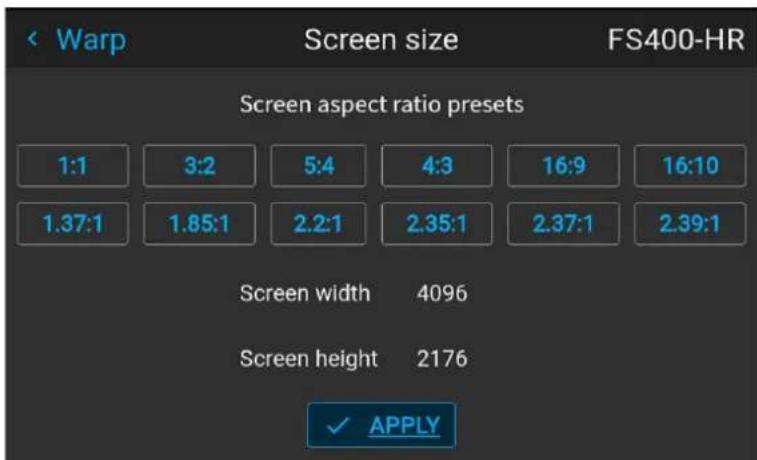
Image 8-34 Example of the screen size menu
- Select either Screen width or Screen height.
- Set the new value to shrink either the width or height of the warp outline so that the outline is equal with the active source.
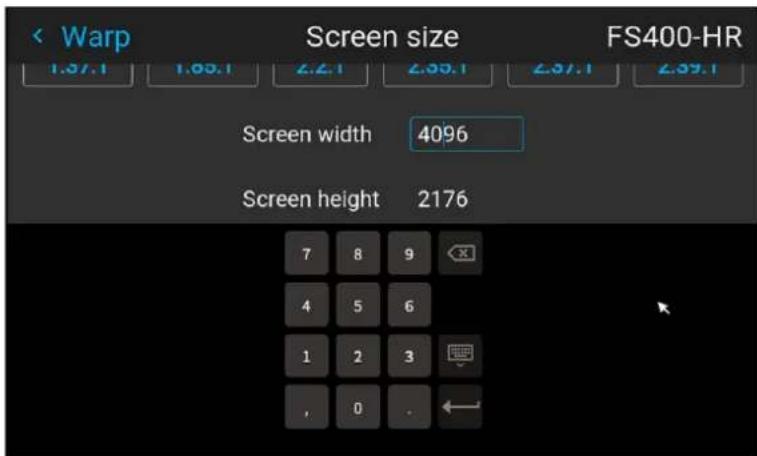
Image 8-35 Example of the Screen size menu, editing the screen width

Tip: A red border will be projected along with the current image. The border is a visual tool, showing the result of the adjusted outline.

Image 8-36

Tip: The value can also be entered by the numeric keys on the remote control. Press * to delete existing numbers, and enter the new value by the numeric keys.
4. Click Apply.
8.11.3 Warping - 4 corners adjustment
About 4 Corners adjustment
4 corner adjustment is typically used when the mechanical installation of the projector prevents it from pointing perpendicularly at the screen. For example, you can overshoot the screen and use 4 corner adjustment to pull your projected image corners back into the screen.
Some examples:
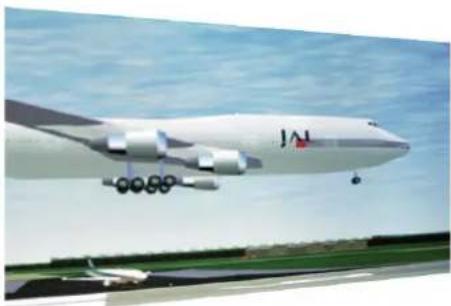
natural_image
Exterior view of a large cargo aircraft (JAL) in flight over a runway, with no visible text or symbols on the aircraft body.Image 8-37 4 corner adjustment
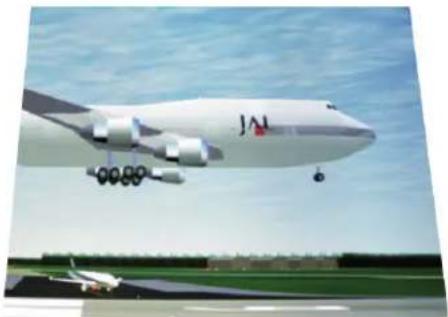
natural_image
Exterior view of a large JAM aircraft in flight over an airport runway, with no visible text or symbols on the aircraft or surroundings.How to adjust the image?
- In the main menu, select Installation → Warp → 4 Corners.
Image 8–38 Warp menu, 4 corners
The 4 corners menu is displayed.
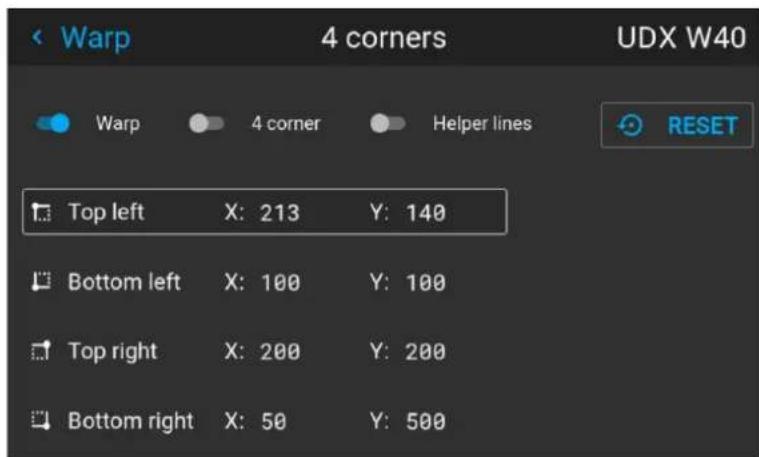
Image 8–39 Example of the 4 corners menu
- To enable 4 Corners warping, enable the 4 corner slider.
- To have a visual representation of what your warp will look like, enable the Helper lines slider.
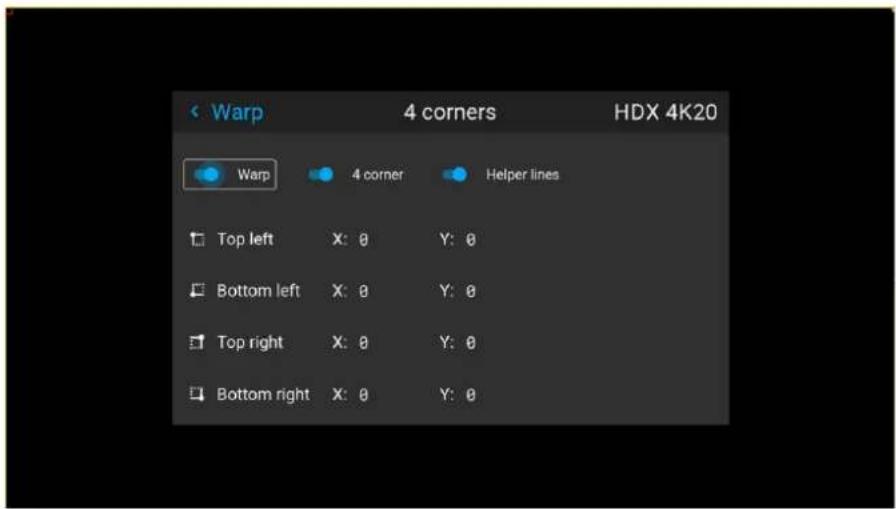
Image 8-40 Example of 4 corners warping menu, with helper lines active on the edges of the screen
- To set warping on one of the four corners, select one of the four corners and confirm.
- Set the desired X and Y coordinates for this corner, using the arrow keys, and confirm.
After confirming, the helper lines for that corner will jump to the entered XY coordinate (if helper lines were enabled).
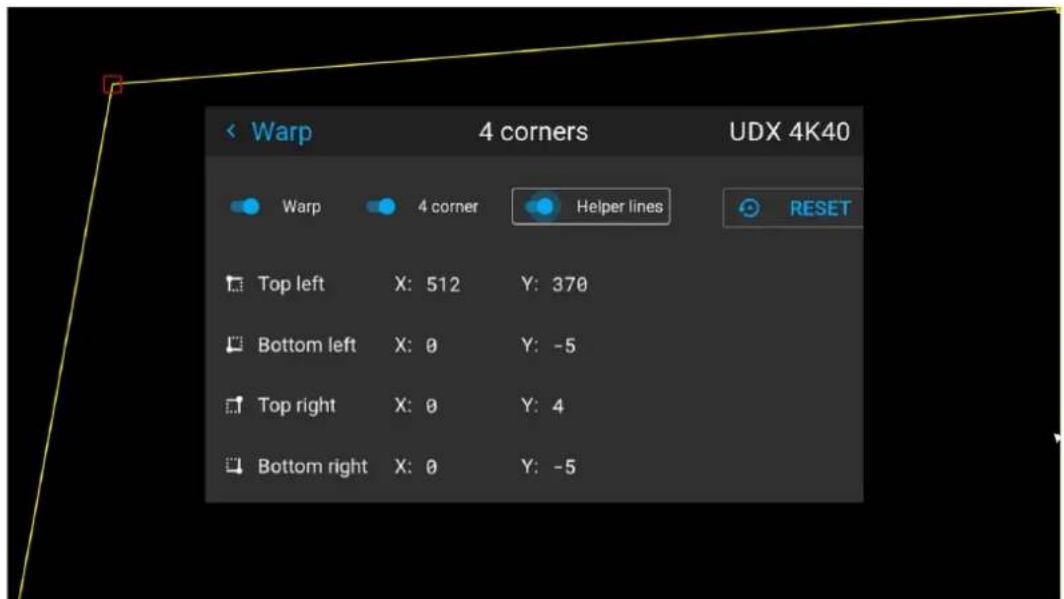
Image 8-41 Example of the 4 corners menu, with 4 corner warping and helper lines enabled
- Repeat from go to step 4 for each corner, until all corners are warped in the desired position.

To reset the 4 corner adjustments, select Reset and press the OK button.
8.11.4 Warping - Bow
About bow adjustment
A bow distortion can be adjusted so that a normal image is displayed. Positive adjustments introduce more outside bow distortion. Negative adjustments introduce more inside bow distortion.
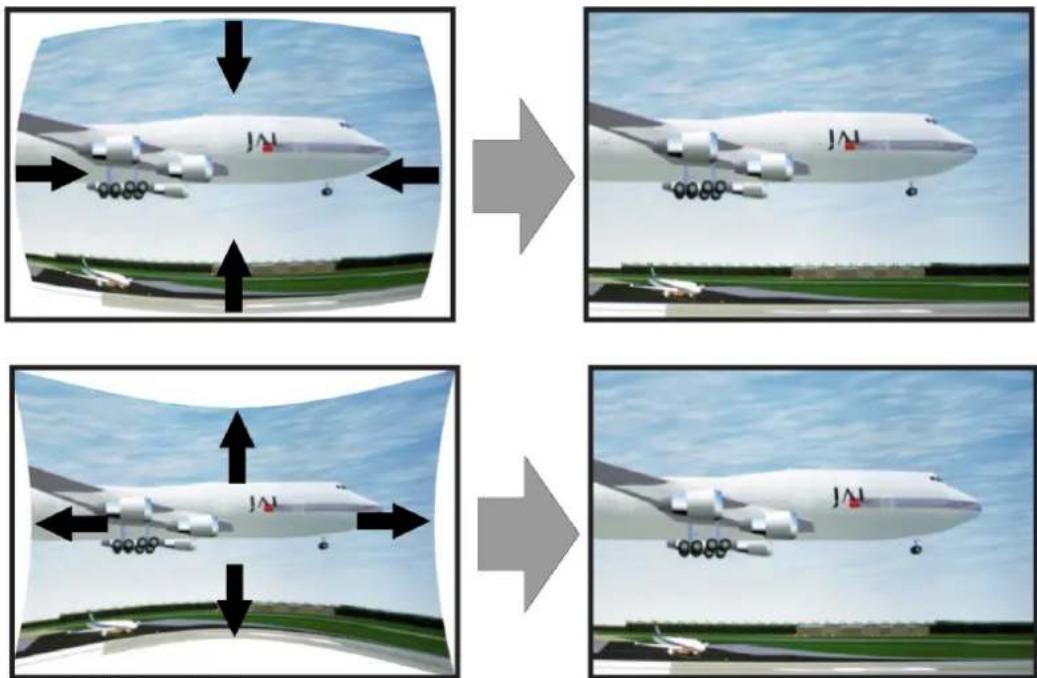
Image 8-42 Bow distortion
Definition of angle and linearity (length) in the bow warp procedure
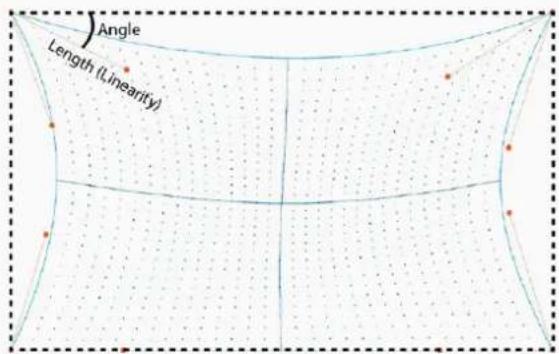
Image 8-43
Symmetric bow correction
- In the main menu, select Installation → Warp → Bow.
Image 8-44 Warp menu, Bow
The bow menu is displayed.
-
To enable bow correction, make sure the Bow slider is enabled (visible by the blue highlight).
-
To perform a symmetric adjustment, make sure the Symmetric slider is set to On (visible by the blue highlight).
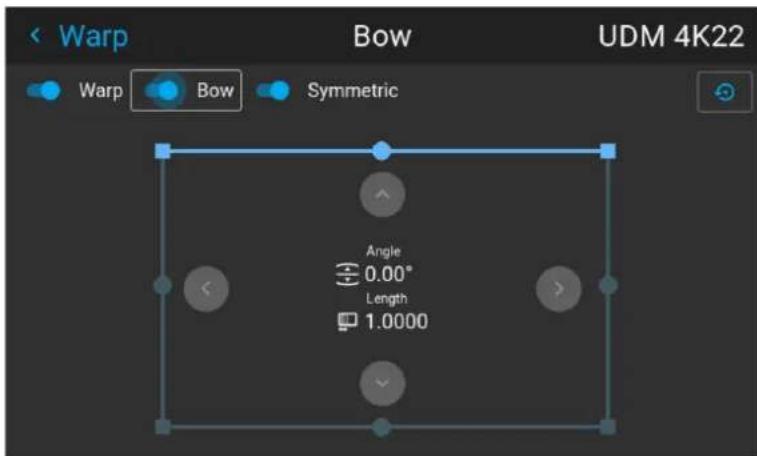
Image 8-45 Both the Bow and Symmetric sliders are set to on
- Use the arrow keys to select the helping lines that represent the picture and confirm.
The helping lines that represent the projected picture are now colored blue, while the others are colored white.
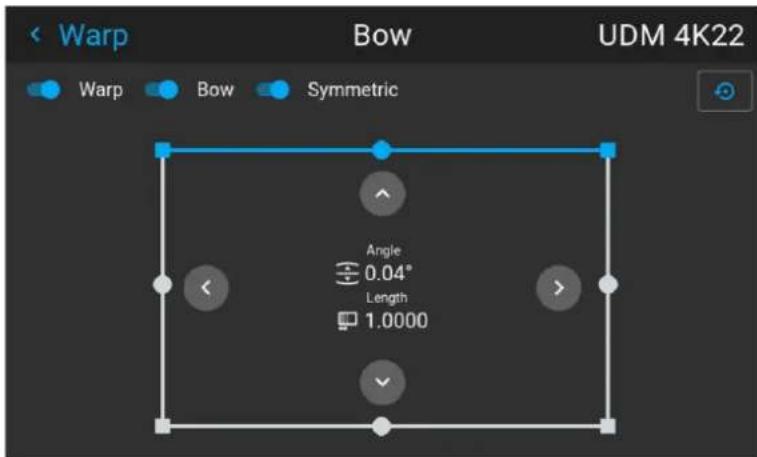
Image 8-46 The upper line is colored blue, the other sides are colored white
- Use the arrow keys to select the side of the picture that needs a correction and confirm.
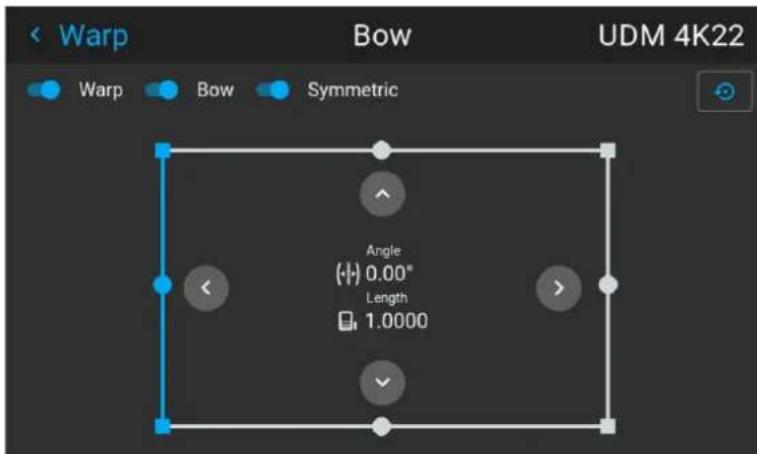
Image 8-47 Symmetric bow correction
- Use the arrow keys to adjust the angle and linearity (length) of the vectors. Press enter to confirm and switch between angle and length.

Tip: The angle is adjusted by using the up and down arrow keys. The linearity is adjusted by using the left and right arrow keys.
The correction will occur symmetrically on each side of the center of the highlighted side.
- Repeat this step for all sides of the picture that has to be corrected, until the desired transformation has been achieved.
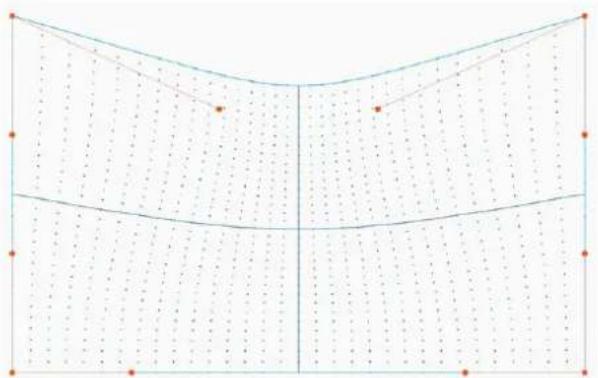
natural_image
Pure geometric diagram with grid lines and dots, no text or symbols presentImage 8-48 Example of a symmetric bow correction
Asymmetric bow correction
- In the Bow menu, enable the Bow slider and disable the symmetric slider.
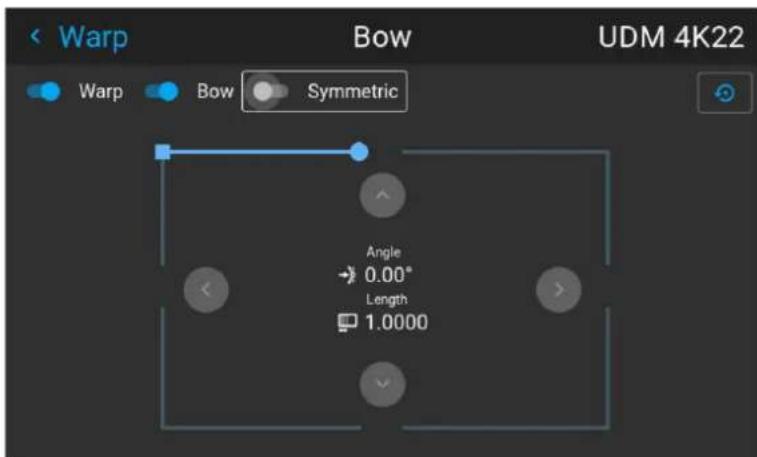
Image 8-49 Example of the bow menu, with the Symmetric slider disabled
There are now two vectors on each side of the picture that can be adjusted individually.
- Use the arrow keys to select the helping lines that represent the picture and confirm.
The helping lines that represent the projected picture are now colored blue, while the others are colored white.
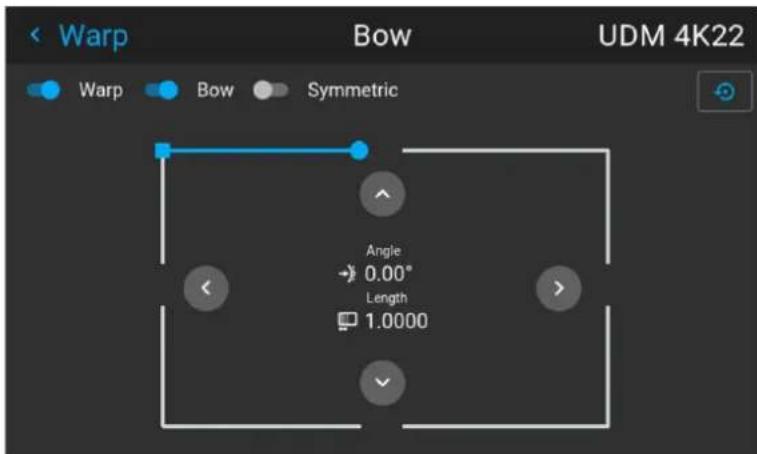
Image 8–50
- Select the desired slider and confirm.
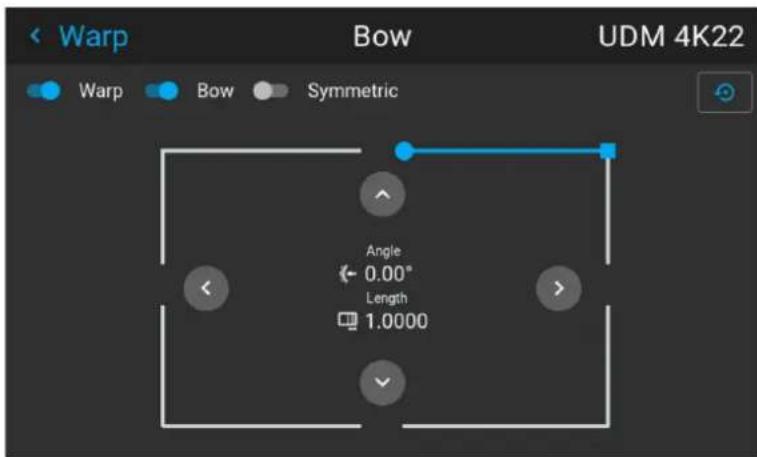
Image 8-51
- Adjust angle and linearity (length) individually to obtain the correct correction. Press enter to confirm and to switch between angle and length.

Tip: Adjust the angle by using the up and down arrow keys. Adjust the linearity by using the left and right arrow keys.
-
Repeat the previous steps for each side of the picture that must be corrected.
-
When completed, a transformation will occur in a way similar to the following example. Observe that the upper side of the picture now has an asymmetric correction.
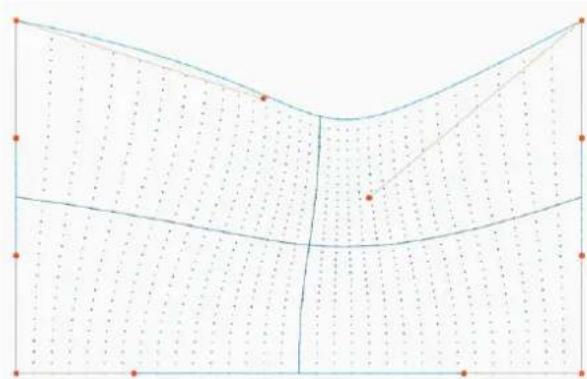
natural_image
Pure geometric diagram with grid lines and dots, no text or symbols presentImage 8-52 Example of an asymmetric bow correction

To reset the bow adjustments, select Reset and confirm.
8.11.5 Warping - Warp files
About custom Warp Files
Next to setting your specific warp configuration in the GUI, you can also upload or download a custom warp grid in XML format to/from the projector. This is a time-saving option when multiple projectors need an identical Warp configuration.
To upload or download warp files you can use Projector Toolset or Prospector tool to upload/download the warp grid in the format of an XML file. Alternatively, you can contact the "file endpoint" directly via the curl program or some other tool that supports http upload.
For more information on uploading/downloading Warp files using the Projector Toolset, refer to the Projector Toolset user manual.
For more information on uploading/downloading Warp files using curl or other tools that supports HTTP upload, refer to the Pulse API Reference Guide.

When uploading a warp file that is too big, or with warp parameters outside the limits of the projector, some irregularities can occur. It will show up in two ways:
1: No warp enabled, picture still unwarped.
2: Distortions and artifacts in the edges of the picture.
There will be no error messages or warnings in the display when this occurs. The above mentioned symptoms is the only indication of this case.
How to activate an uploaded Warp grid?
- In the main menu, select Installation → Warp.
Image 8–53 Installation menu, Warp
- In the Warp menu, select Warp files.
Image 8–54 Warp menu, Warp files
The Warp Files menu is displayed.
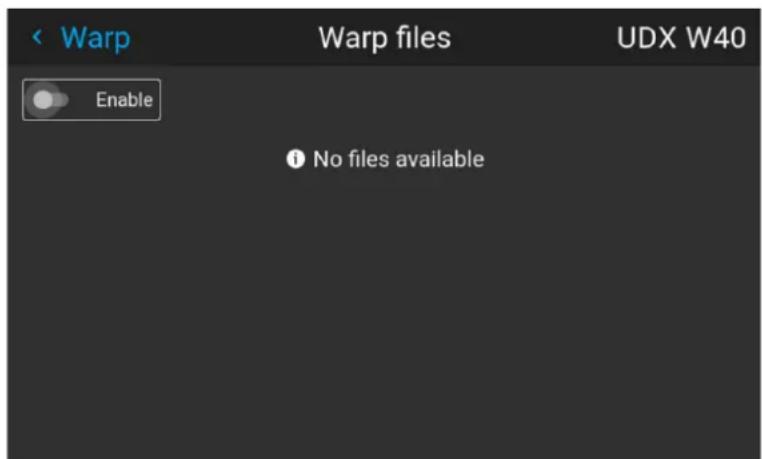
Image 8–55 Example of the Warp files menu
- Make sure the Enable slider is set to right.
- Select the desired warp file.
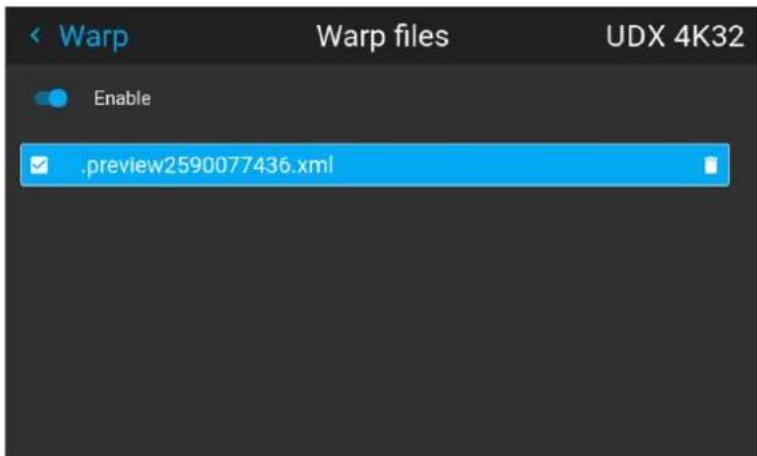
Image 8-56 Example of the Warp files menu
8.11.6 Warping - Latency control in a multi projector setup

Transport latency
The added delay in the image processing chain. The value is the number of lines relative to the output resolution.

Latency
The total time from the first pixel is coming in on an input source, until the first light representing that pixel is visible on the screen. This includes the transport delay. The value is normally given in milliseconds.
Functional description
Every projector in a multi-projector setup will have a different latency. This latency depends on the amount of warp and on the frequency of the projected image. In order to have no visible difference in the overall projected image, the user needs to be able to control the latency of each projector.
The latency value can be read out in the status menu for each individual projector.
How to configure transport delay?
- Read out and note the latency of each projector in the multi-projector setup. You can find this latency under Transport delay in the status menu for each projector.
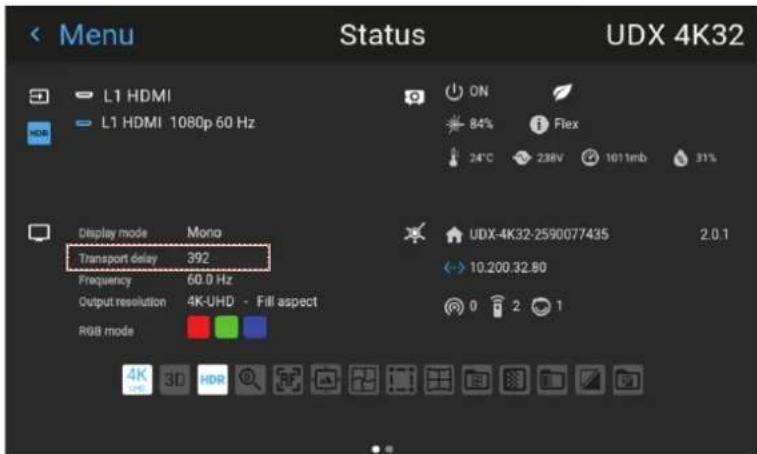
Image 8-57 Example of the Transport delay in the status menu
- Identify the projector with the longest delay.
- For each projector in the setup, select Installation → Warp in the main menu.
Image 8-58 Installation menu, Warp
- In the Warp menu, select Transport Delay.
Image 8-59 Warp menu, Transport delay
The Transport menu is displayed.
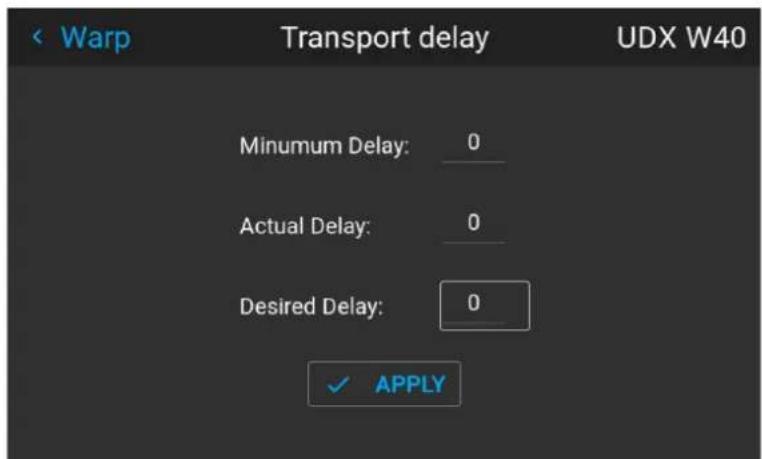
Image 8-60 Example of the Transport delay menu
- Enter the value either by the arrow keys (one step at a time) or directly by the numeric keys on the remote control.
- Click "Apply" to confirm the value.
- Repeat this process for every projector in the setup.
8.12 Blending & masking
About blending
Blending is used in multi channel installation to have a seamless transition between the channels. Image blending gives the appearance of a single view, thus achieving realistic immersion for the majority of wide screen applications.
The principle is that the light intensity in the blend zone from each projector will be adjusted individually, so that the rendering on the screen are perceived as from one projector.
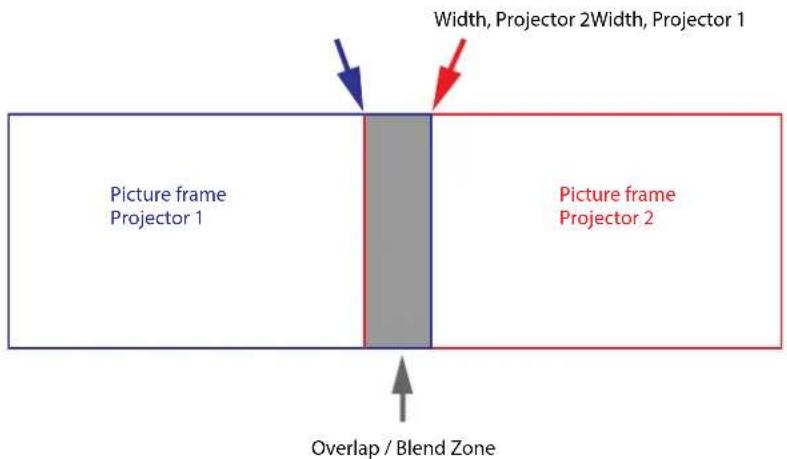
Image 8-61
From the start (mask) position, you can blend zone size per edge (left, top, right, bottom). For each edge there will be a drop-off curve for the blend zone.
Waiting period and blend maintenance period
The heating and cooling down of the lens in a projector startup and shutdown cycle can have a minor drifting effect on the blending and masking areas. Due to this, it is advised to wait 15–20 minutes after projector startup before performing blending and masking actions. This to make sure the drift on the blend region is as minimal as possible. For a similar reason, it is advised to wait 15–20 minutes after projector startup before starting any blending maintenance in your existing setup.

It is recommended to perform a blend maintenance after every 10–20 startup-shutdown cycles of the projector.
8.12.1 Basic blend
How to set up a basic blend zone?
- In the main menu, select Installation → Blend and Mask → Basic blend.
Image 8-62 Blend menu, Basic blend
The Basic blend menu is displayed.
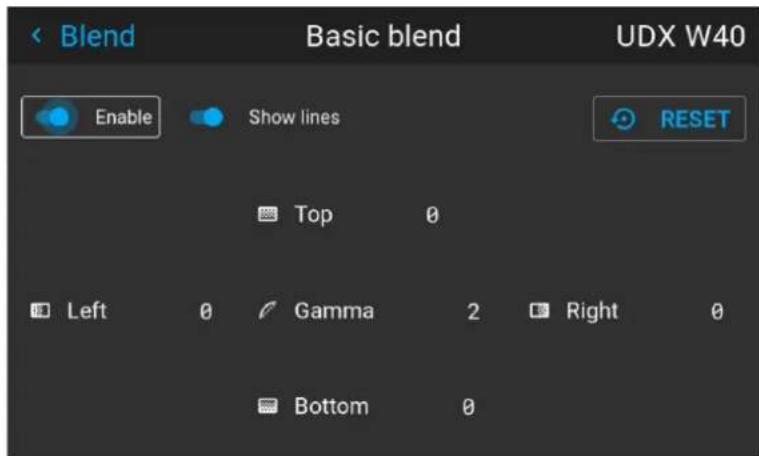
Image 8-63 Example of the basic blend menu
- To enable blending, put the Enable switch to the right. The color of the switch becomes blue when enabled.
- To project masking lines on the screen, put the Show lines switch to the right. The color of the switch becomes blue when enabled.
- Determine the start position of the blend area height and width to determine the dimension of the blend zone.
When the helping lines are activated, you will get a visual indication of the screen of the installed blending area.
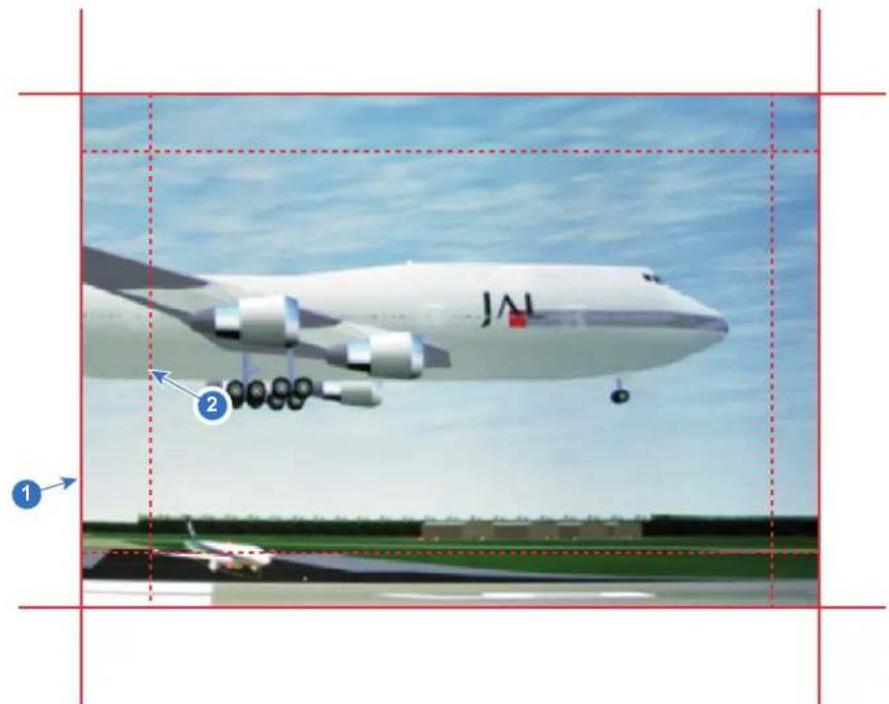
Image 8-64
1 Start position (mask)
2 Blending width
- Select one of the four starting positions values with the arrow keys and confirm.
- Use the arrow keys or remote digits to change the value of the blend zone and confirm.
- Repeat this process for all other desired sides.
- Continue by creating the blend mask. For more info, see "Blend & Blend mask", page 103.

Do not forget to disable the Show lines button after you achieved the desired blend zone.
8.12.2 Blend & Blend mask
About masking and blending width or height
Offset is used to clip the image on one or multiple sides (masking). This is used to hide parts of the picture that should not be shown on the screen. For example: if the source is a Windows PC, you can hide the menu bar using this method.
The larger the Mask value, the more the image is masked (by black bar) at the corresponding side. E.g. Top mask of 100 will blank the top 100 lines.
Height or width is used to create a blending zone with a smooth brightness drop off. This is used to compensate for the double brightness in overlap areas. The value is the size of the blended area in pixels.
How to set up basic blend zones?
- In the main menu, select Installation → Blend and Mask → Blend mask.
Image 8–65 Blend menu, Blend mask
The Blend mask menu is displayed.
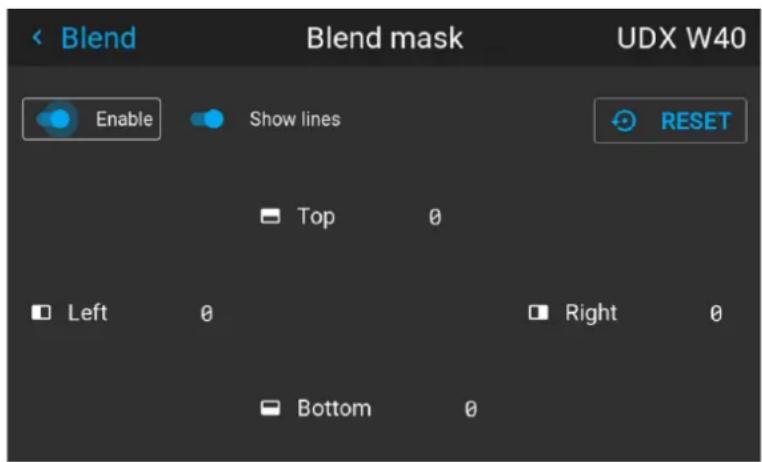
Image 8–66 Example of the blend mask menu
- To enable the blend mask, put the Enable slider to the right. The color of the slider becomes blue when enabled.
- To project masking lines on the screen, put the Show lines slider to the right. The color of the slider becomes blue when enabled.
- Determine the start position of the mask (1) for the masking height and width, together with the desired size of the mask (2) to determine the width of the masked area.
When the helping lines are activated, you will get a visual indication of the screen of the installed blending area.
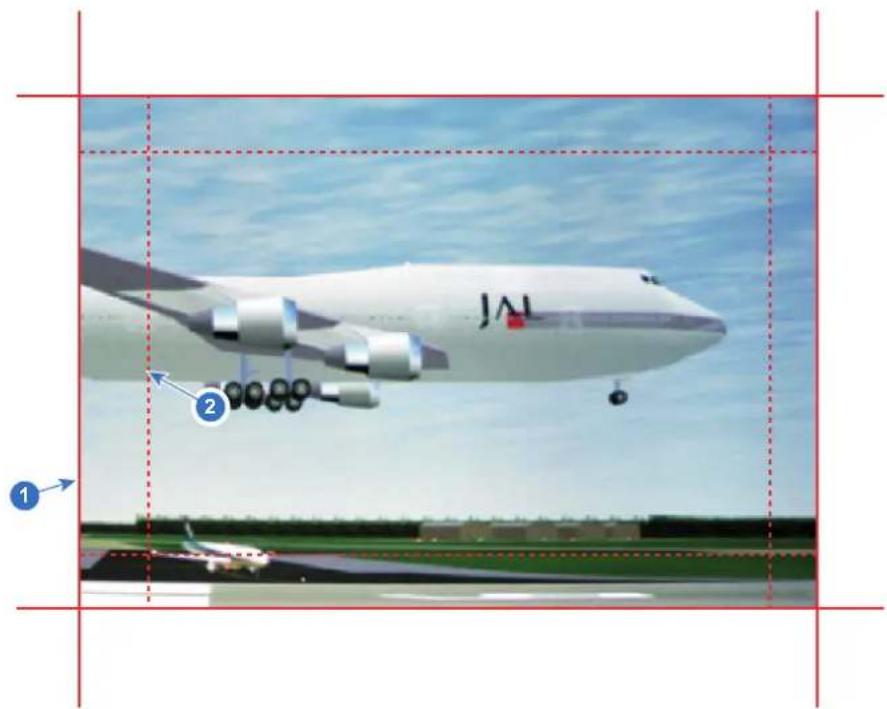
Image 8-67
1 Start position (mask)
2 Blending width
- Select one of the four starting positions values with the arrow keys and confirm.
- Use the arrow keys or remote digits to change the value of the mask and confirm.
- Repeat this process for all other desired sides.

Do not forget to disable the Show lines button after you achieved the desired blend zone.
Example of the use of blending
When projecting an image with 2 or more projectors, there is always an small overlap that should be corrected by using the blending function.

In order to obtain a satisfying result for the Blend function, the overlap / mask zone are recommended to be at least 10% of the picture width.
The basic principle is that the overlap setup in the source shall correspond with the mask width setup for the projector. That means that if the overlap zone for the source is set to 500 pixels, the width of the mask zone is the projector also must be set to 500 pixels.
First step is to align the image from the projectors as accurate as possible in a mechanical way, meaning without any optical corrections. At the same time, establish an overlap in the pictures between the two screens.
Then adjust the remaining irregularities by using the shift and warp features in the projectors to obtain the last fine tuning of the alignment.
Enable blending and activate Show lines.
First set the mask width for the right edge of the first projector. Enter a width value equal to the overlap area (width1).
Repeat for the left edge of the second projector.
Adjust the offset to cut the image on each side (masking).
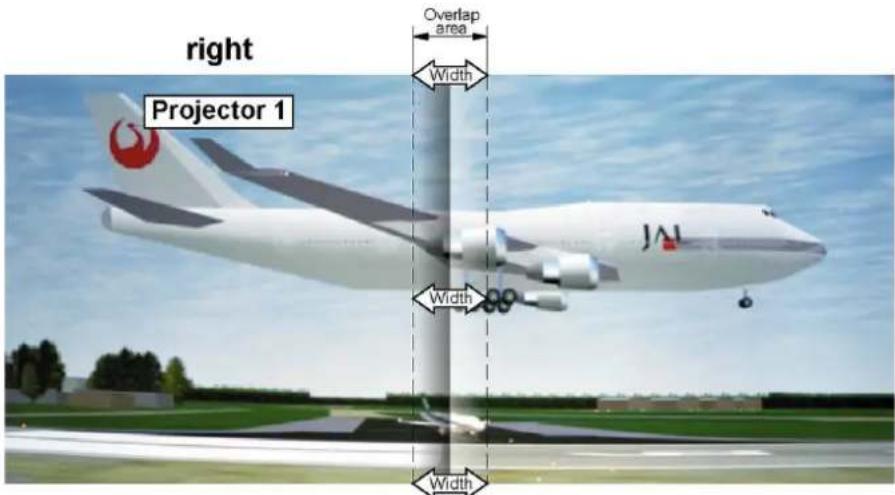
Image 8-68 Set up for projector 1
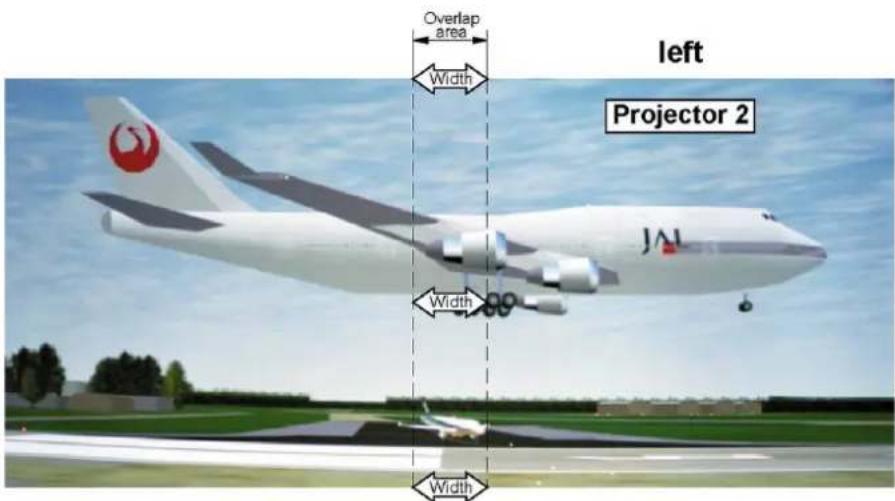
Image 8-69 Set up for projector 2
8.12.3 Blend Files
About custom Blend Files
Next to setting your specific Blending configuration in the GUI, you can also upload or download a custom Blend configuration file in png, jpg or tiff format to/from the projector. This is a timesaving option when multiple projectors need an identical blending configuration.
To upload or download Blend configuration files you can use Projector Toolset or upload/download the Blend configuration file in the format of an xml file. Alternatively, you can contact the "file endpoint" directly via the curl program or some other tool that supports http upload.
For more information on uploading/downloading blend files using the Projector Toolset, refer to the Projector Toolset user manual. For more information on uploading/downloading blend files using curl or other tools that supports HTTP upload, refer to the Pulse API reference guide.

When uploading custom blend files onto multiple projectors, make sure that the resolution of the blend file is supported by the projector you are uploading it to. A mismatch of projector resolution and blend mask resolution will result in a sub-optimal image performance. Verify the supported resolutions for the specific projector model via the Introspection tool [Introspection – image – resolution – alpha]. For more info on the introspection tool, consult the Pulse API reference guide.
How to activate an uploaded Blend configuration file?
- In the main menu, select Installation → Blend and Mask → Blend Files.
Image 8-70 Blend and mask menu, Blend files
The Blend Files menu is displayed.
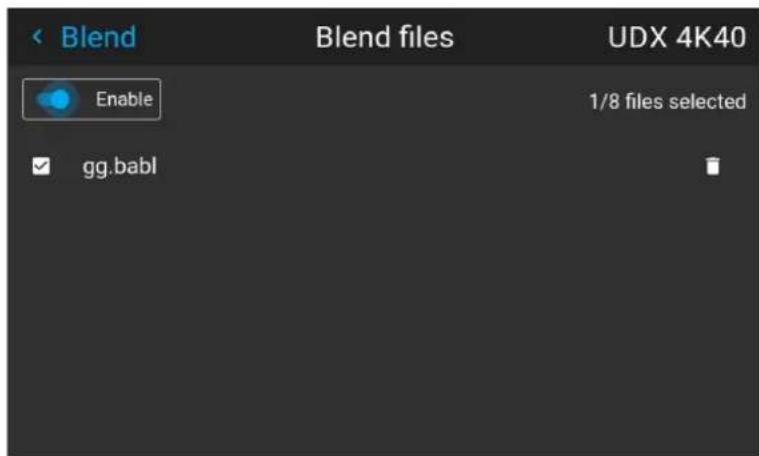
Image 8-71 Example of the blend files menu
- If any custom Blend files are available, select the desired file.
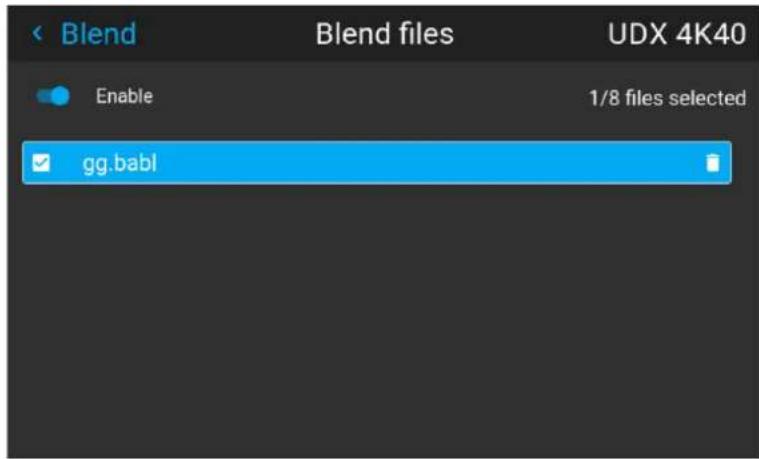
Image 8-72
- To enable the selected blend file, make sure the Enable slider is set to the right. The color of the slider becomes blue when enabled.
8.12.4 Basic black level adjustment
About adjusting the black level
The purpose of the black level adjustment is to align the black levels in the overlapped regions with the black levels in the other regions.
This is needed because the black levels will be brighter in the blend zones, since multiple projectors will project on the same screen area.
The size of the black level area is calculated automatically from the blend zones. This is done by using the start position and size of each edge of the blend and adding an additional size of 8 pixels to reduce the effect known as "sea of mirrors".
You can also specify the offsets manually by turning off the automatic calculation. The black level value is adjusted in a 16-bit resolution from 0 to 65535.
The following figure shows how this occurs in a side by side configuration without any correction of the black level.
Picture Left Picture RightBlend Zone
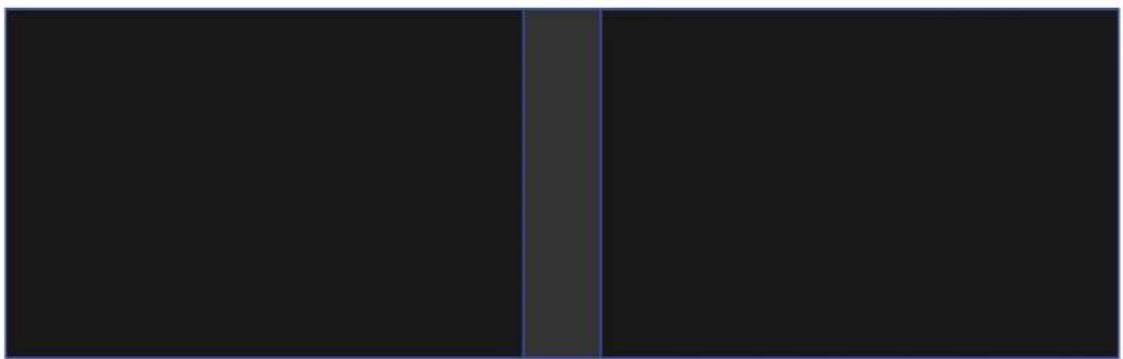
natural_image
Two vertical dark gray bars separated by a single vertical gray stripe (no text or symbols)Image 8-73
How to adjust the black level manually
- In the main menu, select Installation → Blend and Mask → Black Level.
Image 8-74 Blend and Mask menu, Black level
The Basic black level menu is displayed.
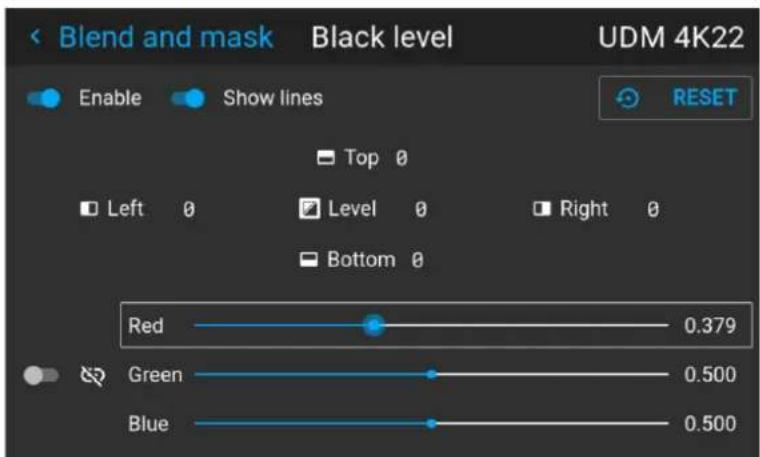
Image 8-75 Example of the default black level menu
- Enable the Black level slider. If you want a visual aid, enable the Show lines slider as well.
- Move the cursor to the side where the overlapped area occurs (Top, Left, Right or Bottom) and press enter.
- Adjust the level with the arrow keys and press enter when the desired black level zone is reached.
or
enter the black level value with the numeric keys in the remote control. - Move the cursor to Level, press enter and adjust this level until the black level equals the level in the blend zone.
This value can also be entered by the numeric keys on the remote control.
- Repeat the same procedure for any other projector connected to this projector, but on the opposite side.

Note: Do not forget to disable the Show lines button after you achieved the desired blend zone.
8.12.5 RGB gain adjustment
About RGB gain adjustment
The purpose of black level correction is to ensure a uniform black level in multi projector setups. Even when two projectors are of the same type, different projectors will output slightly different colors for black due to minor variations in their optical components. So if the projected image of the projectors overlap, there will be 3 different black levels: one for the zone where only the picture of the left projector (zone 1), one for the Blend zone (zone 2), and one for the zone where there is only the picture of the right projector (zone 3).
Picture Left Picture RightBlend Zone
natural_image
Pure black rectangle with a vertical gray stripe on the left edge (no text or symbols)Image 8–76
The black levels for zone 1 and zone 3 are typically corrected by defining a black level mask, which is applied to the image of each projector. This system is already in place but the applied mask is monochrome.
Using the Basic Black Level menu, you can already specify the area of the mask and its contents. But by using the RGB Adjustment page, you can specify the multiplication factors (gains) for the Red, Green and Blue colors separately.
How to perform an RGB adjustment
- In the main menu, select Installation → Blend and Mask → Black Level.
Image 8–77 Blend and Mask menu, Black level
The Basic black level menu is displayed.
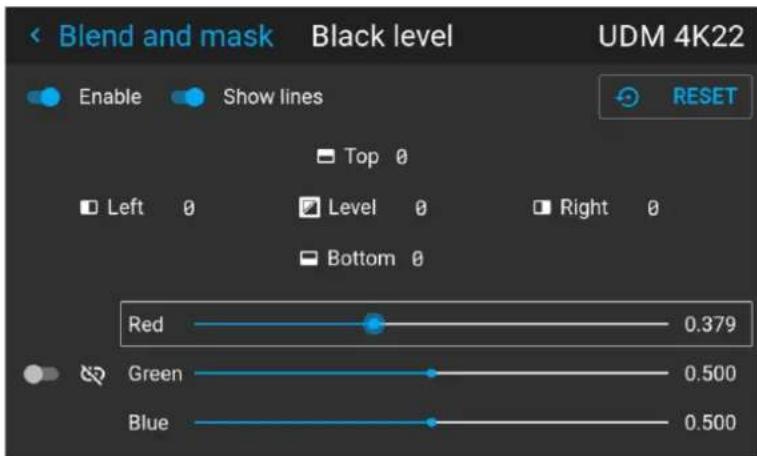
Image 8-78 Example of the default black level menu
- Select one of the three sliders on the bottom of the menu (Red, Green or Blue).
- Use the left and right arrow keys to modify the gain of the chosen color.
- Repeat for every slider until the desired result is achieved on screen.
8.12.6 Black Level Files
About custom Black Level Files
Next to setting your specific Black Level Adjustment in the GUI, you can also upload or download a custom Black Level adjustment file in png, jpeg or tiff format to/from the projector.
To upload or download Black Level adjustment files you can use Projector Toolset or upload/download the Black Level adjustment file in the format of an XML file. Alternatively, you can contact the "file endpoint" directly via the curl program or some other tool that supports http upload.
For more information on uploading/downloading Black Level files using the Projector Toolset, refer to the Projector Toolset user manual. For more information on uploading/downloading Black Level files using curl or other tools that supports HTTP upload, refer to the Pulse API Reference Guide.

When uploading custom black level files onto multiple projectors, make sure that the resolution of the file is supported by the projector you are uploading it to. A mismatch of projector resolution and black level file resolution will result in a sub-optimal image performance. Verify the supported resolutions for the specific projector model via the Introspection tool [Introspection – image – resolution – alpha]. For more info on the introspection tool, consult the Pulse API reference guide.
How to activate an uploaded Black Level adjustment file?
- In the main menu, select Installation → Blend and Mask → Black Level → Black Level Files.
Image 8-79 Blend and mask menu, Black level files
The Black Level Files menu is displayed.
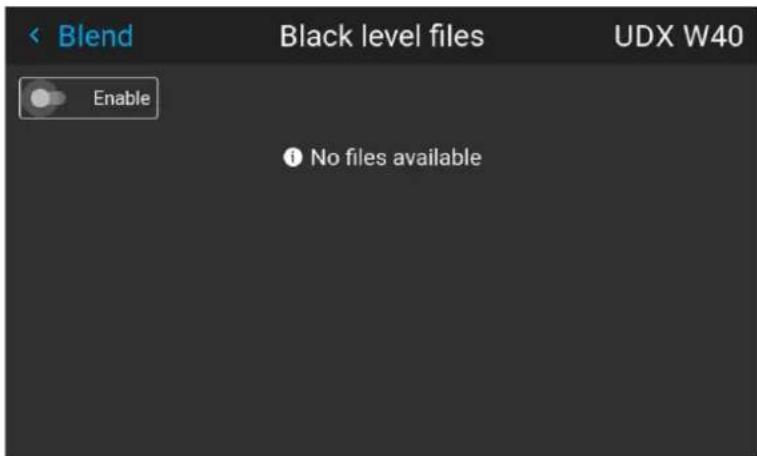
Image 8–80 Example of the black level files menu
- If any custom Black Level adjustment files are available, select the desired file.
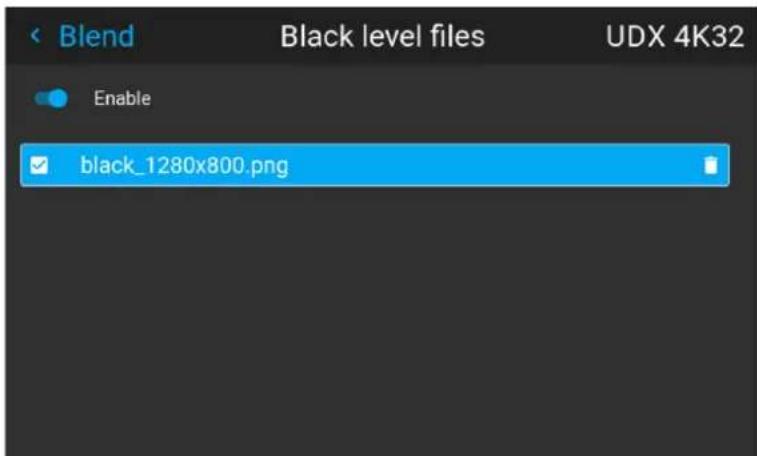
Image 8-81 Example of custom black level files selected
- Make sure the Enable slider is set to the right to activate the selected black level file
8.13 Illumination
What can be done?
Within a certain percentage, the light output of the light source can be reduced by reducing the power slider. Alternatively, you can enable CLO mode (Constant light output) for a constant light output over a longer period of time.

You can only change the power output when the shutter is opened.
About CLO mode
All light sources naturally decrease their intensity over time. In order to prevent a decreasing output in a multi-projector setup, you can activate CLO mode to make sure that the light output remains constant.
CLO mode will ensure that the projector regulates its illumination power to maintain the same level of output light during the lifetime of the light source. This requires that the light source power is not set to 100% from the start, but to a lower value. The lower this value is set, the longer the projector will be able to maintain the output level.

CLO can not be used when the light source is off, the shutter is closed or if the Dynamic Black feature is active (if available).
How to reduce the power
- In the main menu, select Installation → Illumination.
Image 8–82 Installation menu, illumination
The Illumination menu is displayed.
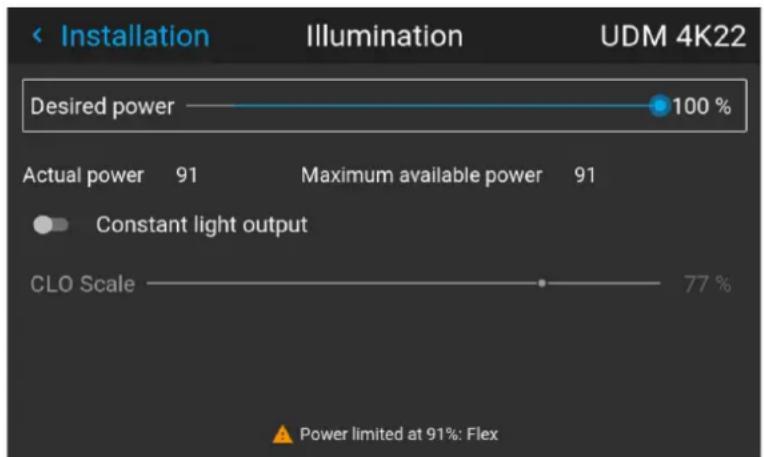
bar
| Category | Value | | --------------------- | ----- | | Desired power | 100% | | Actual power | 91% | | Maximum available power| 91% | | Constant light output | | | CLO Scale | 77% |Image 8–83 Example of the Illumination menu
- Use the Slider to change the power value.
- Enable the Constant light output slider if you want to enable CLO mode.
- If CLO mode is active, you can use the CLO Scale slider to scale the light output.
8.14 3D projection
3D setup
The projector is capable of displaying 3D images and movies in active stereoscopic 3D.
Setup of a 3D installation requires an advanced understanding of 3D systems, both for the projector as well as for the system the signal source originates from. In a 3D setup it is crucial that the projected images are perfectly synchronized through the whole signal path, from the signal source to the picture viewed through the 3D goggles.
Regarding setting up the proper signal source, please refer to the user manual or online help for that graphic card. For example: when using NVIDIA Quadro cards, use the NVIDIA Control Panel to manage your 3D settings.
8.14.1 Active Stereo & Passive Stereo
What is Passive Stereo?
Passive Stereoscopic 3D (also known as “Passive Stereo”) is the standard method of creating the illusion of depth in an image, by means of stereopsis for binocular vision.
To present stereoscopic pictures, two images are projected superimposed onto the same screen through polarizing filters or presented on a display with polarized filters. For Digital Cinema, a silver screen is used so that polarization is preserved. On most passive displays every other row of pixels are polarized for one eye or the other. This method is also known as interlacing.
The viewer wears glasses which contain a pair of opposite polarizing filters. As each filter only passes light which is similarly polarized and blocks the opposite polarized light, each eye only sees one of the images, and the effect is achieved.
What is Active Stereo?
Field sequential 3D (also known as active 3D or “Active Stereo”) is a technique of displaying stereoscopic 3D images. It works by only presenting the image intended for the left eye while blocking the right eye's view, then presenting the right-eye image while blocking the left eye, and repeating this so rapidly that the interruptions do not interfere with the perceived fusion of the two images into a single 3D image.
This system setup uses liquid crystal shutter glasses (also known as active shutter glasses). Each eye's glass contains a liquid crystal layer which has the property of becoming opaque when voltage is applied, being otherwise transparent. The glasses are controlled by a timing signal that allows the glasses to alternately block one eye, and then the other, in synchronization with the refresh rate of the screen. The timing synchronization to the video equipment may be achieved via a wired signal or via wireless communication, this by using either an infrared or radio frequency (e.g. Bluetooth, DLP link) transmitter.
Projection method used
This projector can only show active 3D images, used in combination with a 3D emitter and active shutter glasses. While it is allowed to connect passive stereo source signals, the image processing of the projector will convert those signals to an active 3D compatible image.
The options on the projector software allow you to fine-tune the 3D settings accordingly to the specifications of the 3D emitter.

If a 3D emitter is used that radiates IR beams, the IR beams may interfere with the IR communication between projector and the RCU. If such interference occurs, connect the RCU to the projector using the remote cable. It is also advised to turn the IR receivers on the projector off to avoid the 3D emitter interference. To turn off the IR receivers, see “Pulse RCU, function of the on/off button”, page 31.
8.14.2 Setup process 3D projection
How to setup 3D projection?
- Connect the proper source cables to the projector. For more info, see "Connection possibilities", page 112.
- Set up and connect your 3D emitter to the projector. For more info, refer to the user manual of your 3D emitter.
- Power on the projector completely.
- Select the correct stitched source Input in the Source menu. See "Displaying multiple sources: Stitched layouts", page 56.
- Depending on the chosen 3D emitter and chosen source, correct the 3D setup. For more info, see "3D Setup", page 113.
8.14.3 Connection possibilities

At this moment, the only inputs supporting 3D on the Pulse input boards are the DisplayPort inputs and HDMI input. More inputs may support 3D in a future release.
Connecting with the quad combo input card
There is only one way of projecting Active stereoscopic 3D with the Combo input card, using the following setup:
• Source: Active Stereo (sequential L/R)
- Layout mode: Standard layout (1x1 layout)
• Video Timing: 2560 x 1600 (WQXGA) @120 Hz
• Color depth: 30 bpp - Connector: DisplayPort 1.2 or HDMI
Connecting with the quad DP 1.2 Input card
You can use one of the following methods. The resulting image will always be an Active Stereo image.
| Source | Layout mode | Video Timing / cable | Fixed configuration? | Color depth |
| Active Stereo (sequential L/R) | Standard layout (1x1 layout) | 2560 x 1600 @120 Hz | 30 bpp | |
| Active Stereo (sequential L/R) | 4 Column mode (4x1 layout) | 960 x 2160 @120 Hz | 30 bpp | |
| Active Stereo (sequential L/R) | 4 Quadrant mode (2x2 layout) | 1920 x 1080 @120 Hz | 30 bpp | |
| Passive Stereo (separate L/R) | Standard layout (1x1 layout) | 3840 x 2160 @60 Hz | Cable 1: left eyeCable 2: right eye | 30 bpp |
| Passive Stereo (dual pipe L/R) | 2 Column mode (2x1 layout) | 1920 x 2160 @60 Hz | Cable 1: left eye, 30 bpp left columnCable 2: left eye, right columnCable 3: right eye, left columnCable 4: right eye, right column | 30 bpp |
8.14.4 3D Setup
Why change the 3D setup?
While Barco can provide a 3D emitter and active shutter glasses as options to this projector, you are also free to use a 3D emitter and active shutter glasses of your own choice. Since glasses and emitter can have various specifications compared to the ones Barco can provide, the 3D setup menu allows you to configure the output image to the specifications of your glasses and emitter. The following can be configured:
- Swap Eyes: You can choose to invert the stereo Sync output signal (depending on the chosen 3D emitter and glasses).
- Swap frame pair: This setting allows you to correct the frame doubling sequence. If the frame rate of the projected moving 3D content doesn't look smooth, this option may help improve this.
- Dark time: You can select how much dark time the projected image will have between frames. You can choose one of the options between 1000 μs and 2500 μs.
- Output mode: Choose the desired output mode. For more details, see further.
- Sync Delay: You can increase or decrease the sync delay. The scale goes from -10 000 s to +10 000 s with a step of 100 s.
Choosing the desired output mode
The following output modes are available:
- AutoStereo: Automatic mode (2D input = 2D output, 3D input = Active Stereo output).
- Mono: Forces all source signals to 2D output.
• ActiveStereo: Forces all source signals to Active Stereoscopic 3D.
Use the following table as an indicator of what display mode you require.
Source signal
AutoStereo Mono ActiveStereo
2D Source Output is a 2D image Output is a 2D image Output is in Active Stereo
Active Stereo source Output is in Active Stereo Output is a 2D image Output is in Active Stereo
Passive Stereo source Output is in Active Stereo Output is a 2D image Output is in Active Stereo

When a different Display Mode is chosen compared to the source signal (e.g. Active Stereo source with Mono output), advanced image processing will make sure you a desirable image will be displayed.

If a 3D emitter is used that radiates infrared beams (IR beams), the IR beams may interfere with the IR communication between projector and the RCU. If such interference occurs, connect the RCU to the projector using the remote cable. It is also advised to turn the IR receivers on the projector off to avoid the 3D emitter interference. To turn off the IR receivers, see "Pulse RCU, function of the on/off button", page 31.
How to adjust the projector to the 3D emitter?
- In the main menu, select Installation → 3D Setup.
Image 8–84 Installation menu, 3D setup
The 3D setup menu is displayed.
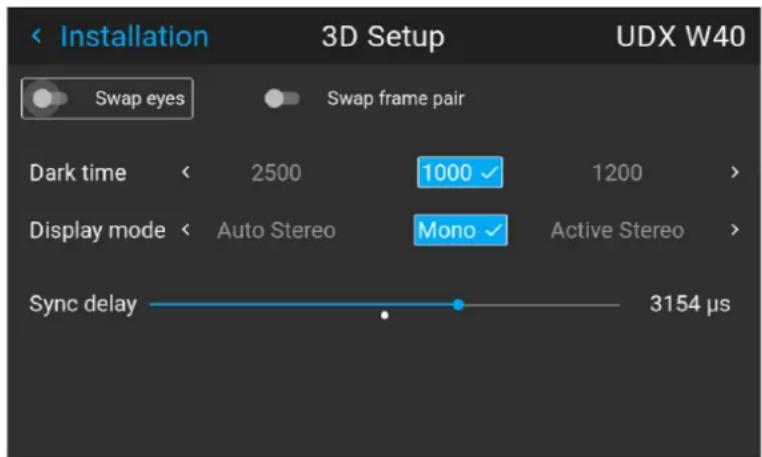
Image 8-85 Example of the 3D setup menu on a UDX
- If it is necessary to invert the stereo sync output, enable the Swap eyes option.
- If the projected moving 3D content doesn't look smooth enough, enable the Swap frame pair option to help improve this.
- Select the desired the stereo Dark Time.
- Select the desired Display mode.
- Use the slider to set the desired stereo Sync delay.
GUI - Profiles
9
9.1 Profiles introduction 116
9.2 Profiles setup parameters.... 116
9.3 Saving settings to a new profile.... 117
9.4 Deleting a projector profile.... 119
9.1 Profiles introduction
About Profiles
The profile function makes it possible to store different profiles / projector setups for different use cases, and quickly recall them when needed. This means that it is not necessary to enter a lot of different menus to adjust the projector setup for specific recurring use cases. Due to the limited nature of this function and to avoid terminology confusion with more complex macro's, these are not called "macro's", but "profiles".
A few examples of different user cases are:
- Building temporary gaming setups in bright auditorium-level environment, versus a darker "gaming room" or "cave".
- Playing content from an old DVD versus playing the latest release from an HDR-coded Blu-Ray.
- A rental projector that can be rented out for business presentations, concerts and other events that have different but recurring forms of content.
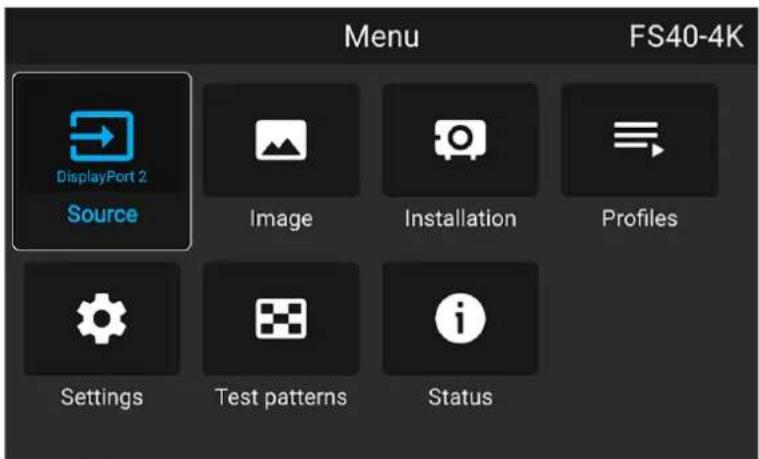
Image 9-1
9.2 Profiles setup parameters
Available profile settings
| Profile domain name | Settings saved |
| Illumination | ·Illumination power for each source·Light sensor enabled / disabled·Light sensor set point |
| Source Active source selection & EDID | |
| Image | ·Contrast·Brightness·Saturation·Sharpness·Gamma·Used gamma type·Digital zoom (width / height / factor + enabled/disabled)·Digital shift (x / y + enabled / disabled)·Output resolution |
| Display (3D settings) | ·3D Display mode used·Swap eyes on / off·Swap frame pair on / off·Dark time and sync delay values |
| RealcolorTM | ·Brilliant Color mode (if available)P7 desired valuesP7 measured values |
| Warp | Warp status enabled / disabledScreen sizeWarp file selected (if available)Transport delayNote: Bow and 4 corners warp cannot be saved. |
| Blend | Blend mask enabled / disabledAll Masks (top / bottom / left / right) and heights (top / bottom / left / right)Blend files enabled / disabled (if available)Blend file selected (if available) |
| Black level | Black level file enabled / disabledBlack Level file selected (if available)Basic black level enabled / disabledBlack level settings (top / bottom / left / right)RGB gain values (Red, Green and Blue values) |
| PQ (HDR) | Screen luminance (unit and value)HDR Boost valueDynaBlack mode |
| Installation | Lens parameters (lens zoom, focus, shift and iris (if available))Orientation (mounting & projection)Scaling modePosition of motorized frame (if used).Shutter status (open or closed). |
| Cooling5 | Selected Cooling mode |
9.3 Saving settings to a new profile
How to save the current projector settings?
- Adjust the necessary projector set up values for the actual user case as described in the specific topics in this manual.
- Enter the menu Profiles
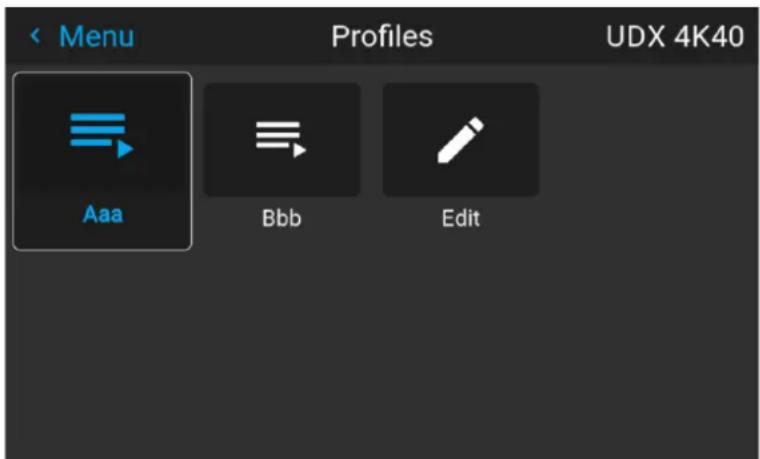
Image 9-2
- Select the Edit button
Image 9-3
The Profile edit menu shows up.
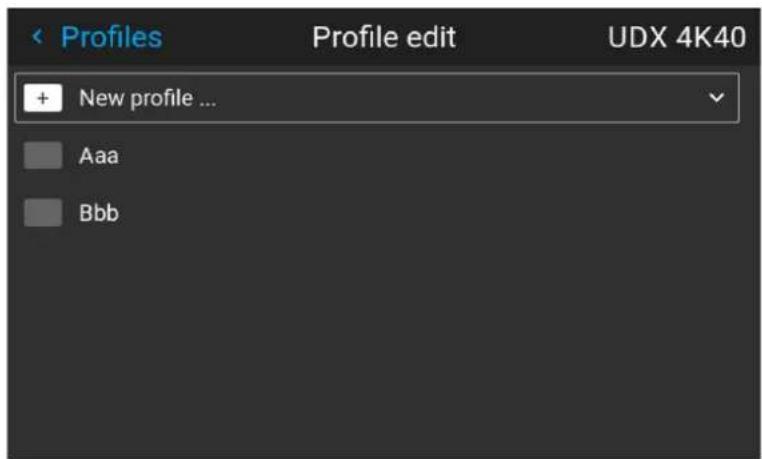
Image 9-4
- Select New profile
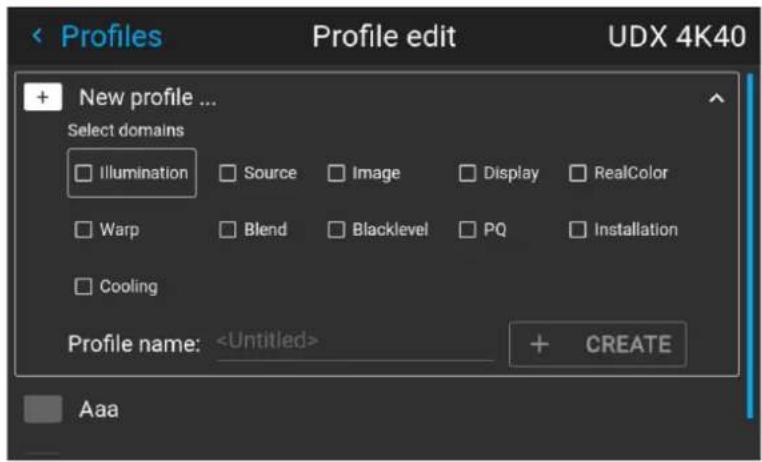
Image 9-5
-
Enter a suitable name for this profile via the pop up keyboard (arrow keys and OK (√) to select). End the name entry by selecting the "return" key on the pop up keyboard.
-
Select the "Assign to preset slot". A drop down menu will show up, select the preferred value.

Note: The function "Assign to preset slot" enables a shortcut to the actual profile from the remote control. If assigned preset slot are set to 1, this profile can be recalled by pressing the key MACRO and then 01 on the remote control. It is not a requirement to use this function, just an option.

Note: The maximum number of profile presets is 30.
- Select the domains in the menu that shall be stored in the profile.
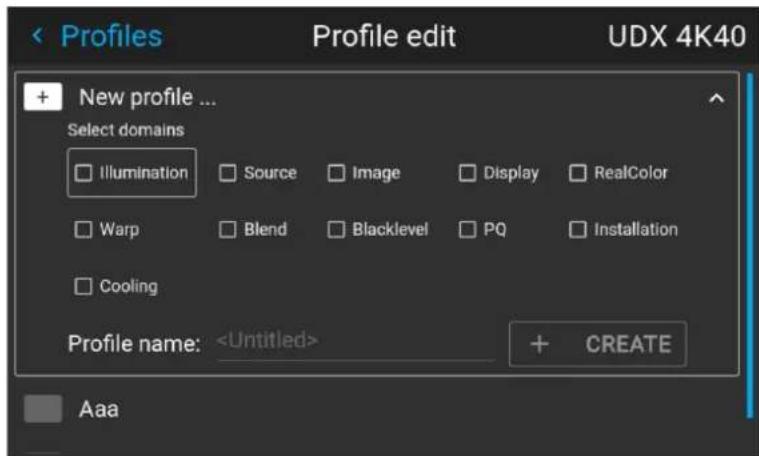
Image 9-6 Select domains
- Select "Profile name". A keyboard will show up, and enter a proper name for the profile.
- Select "create" and confirm by the OK button.
The new profile is now created and saved.
- Repeat step 1 to 6 for creating of more profiles.
Recall a profile.
- Enter the Menu/Profile
The stored profiles will be visible in the menu. Select the actual profile.
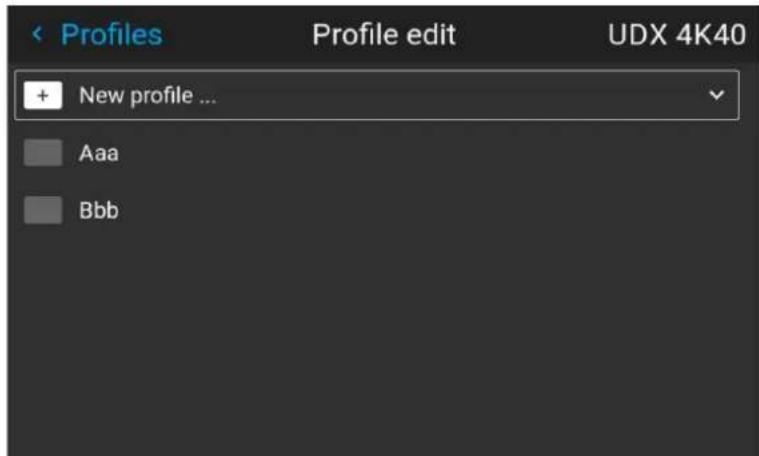
Image 9-7
or
Select the numeric shortcut from the remote control.
9.4 Deleting a projector profile
How to delete a profile
- In the main menu, select Profiles → Edit.
Image 9-8 Profiles menu, edit
The edit menu is displayed.
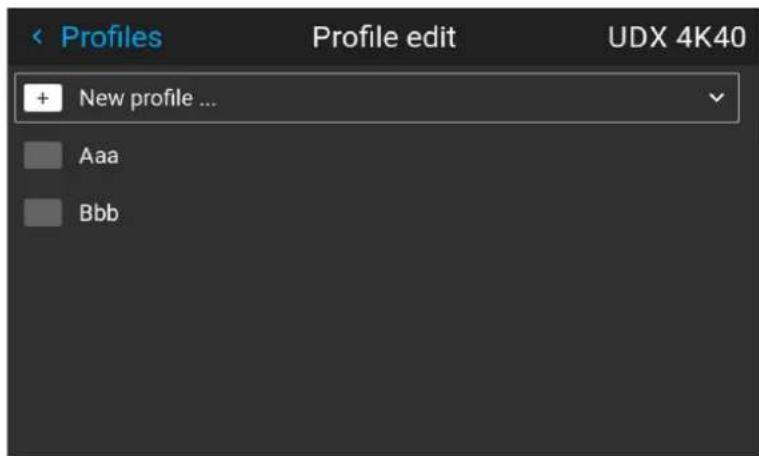
Image 9-9 Profile edit menu
- Select the undesired projector profile and confirm to expand it.
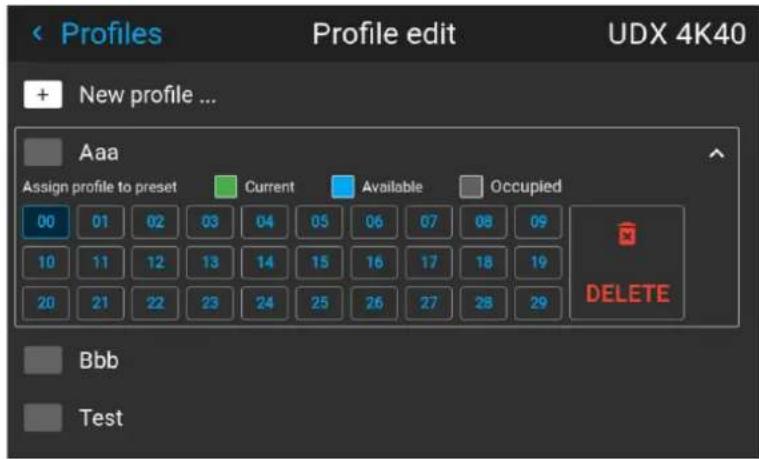
Image 9-10 Example of a projector profile with available preset slots
- Use the arrow keys to select Delete and confirm. confirm the delete action.
GUI - System Settings
10
10.1 Remote control.... 122
10.2 Host name - custom projector name setup.... 124
10.3 Communication, LAN setup 125
10.4 DMX....133
10.5 Front XLR output voltage control.... 135
10.6 GSM configuration....135
10.7 Changing the User Interface language 136
10.8 Themes 137
10.9 Units (measurement) system setup....138
10.10 Controlling the backlight of the LCD Display.... 138
10.11 Date and time setup - manually.... 139
10.12 Date and time setup - automatically.... 140
10.13 Power saving settings 142
10.14 Lens features 143
10.15 Factory reset....144
10.16 Lens Calibration 148
10.17 Flex brightness....149
10.18 Rigging frame Calibration.... 150
10.19 Electronic Convergence 151
10.20 Operational mode 153
10.21 Capture mode 154
10.22 Login to advanced settings.... 154
10.23 List of open source licenses.... 155
10.1 Remote control
10.1.1 Broadcast address
About broadcast address
Broadcast address is a common address that can be set on the projector. That can be "0" or "1". The default broadcast address is '0'.
Any command coming from an RCU programmed with that common address will be executed.
How to the broadcast address
- In the main menu, select Settings → Communication → Remote control.
Image 10-1 Communication menu, Remote Control
The Remote control menu is displayed.
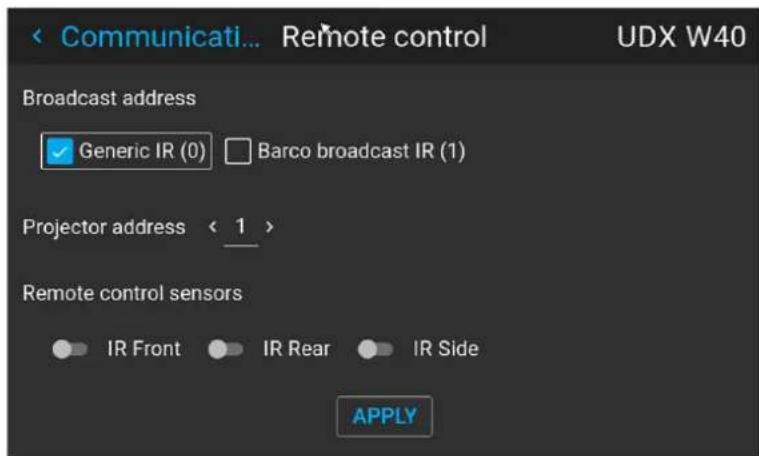
Image 10-2 Example of the Remote control menu
- To change the broadcast address select the radio button of your choice.
The following choices are possible:
-
Generic IR (address 0)
• Barco broadcast IR (address 1) -
Select APPLY and click OK to apply the changes.
10.1.2 Projector address
About individual projector address
As more than one projector can be installed in a room, each projector should be separately addressable with an RCU or with a computer using serial communication. Therefore each projector has its own address. The factory default individual projector address is '0'.
When the address is set, the projector can be controlled with the RCU. Only addresses between 0 and 31 are supported for the RCU.
Next to an individual projector address, each projector has also a broadcast address for group control.
How to change
- In the main menu, select Settings → Communication → IR control.
Image 10-3 Communication menu, Remote Control
The Remote control menu is displayed.
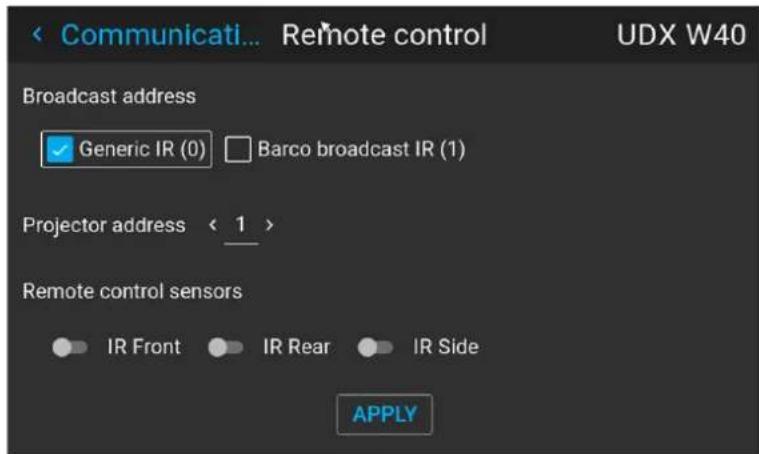
Image 10-4 Example of the Remote control menu
-
Select the current projector address and enter a new address.
-
Select APPLY and click OK to apply the changes.
From now on the projector will only listen to this new address and to its broadcast address.
10.1.3 IR sensors
What can be done?
Each IR sensor can be individually disabled or enabled.
When all sensors are turned off, the projector will no longer respond to signals from the remote control. To re-enable the sensors, use the menu keypad on the projector.
How to disable
- In the main menu, select Settings → Communication → IR Control.
Image 10-5 Communication menu, Remote Control
The IR control menu is displayed.
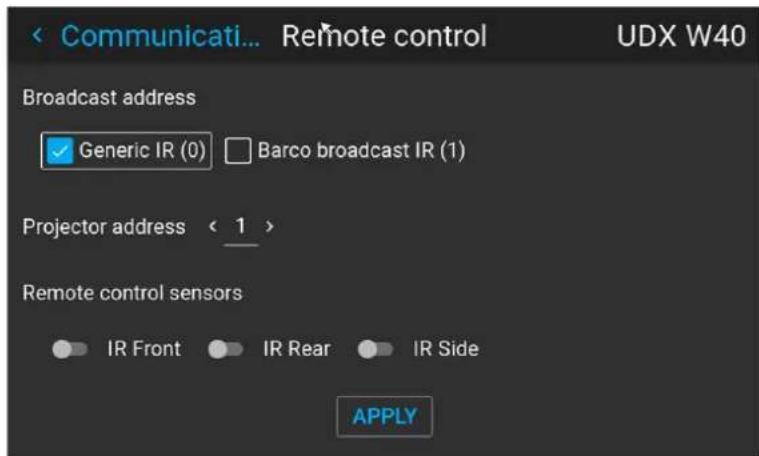
Image 10-6 Example of the IR control menu
- To disable an IR sensor, select the slider and drag to the left.
A blue slider means an active IR sensor.
A gray slider means an inactive IR sensor.
- Select APPLY and click OK to apply the changes.
10.2 Host name - custom projector name setup
What can be done?
The default host name of the projector is the projector type along with the serial number of your projector (e.g. "UDX-4K40-0123456789").
You can change this name to make it easier to spot in a network with multiple devices or projectors
How to set a different Host name
- In the main menu, select Settings → Communication → Host name.
Image 10-7 Communication menu, Host name
The Host name menu is displayed.
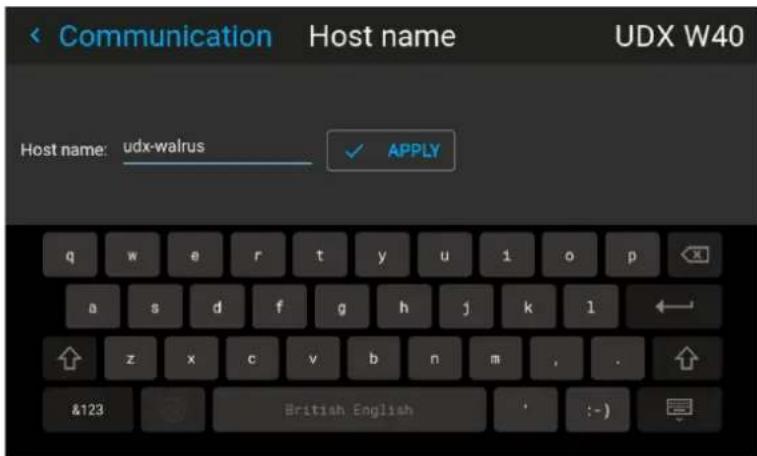
Image 10-8 Example of the host name menu
- Press confirm to edit the Host name field.
- Use the digital keyboard to change the Host name to the desired custom name.
- Press the OK key, or press the enter icon to confirm the typed name. Click Apply to update the host name.
10.3 Communication, LAN setup
About a network connection
A network connection can be made via a wired connection or via the optional wireless unit.
10.3.1 Introduction to a Network connection

DHCP
Dynamic host configuration protocol. DHCP is a communications protocol that lets network administrators manage centrally and automate the assignment of IP addresses in an organization's network. Using the Internet Protocol, each machine that can connect to the Internet needs a unique IP address. When an organization sets up its computer users with a connection to the Internet, an IP address must be assigned to each machine. Without DHCP, the IP address must be entered manually at each computer and, if computers move to another location in another part of the network, a new IP address must be entered. DHCP lets a network administrator supervise and distribute IP addresses from a central point and automatically sends a new IP address when a computer is plugged into a different place in the network.

IP
Internet Protocol. The network layer of TCP/IP. Required for communication with the internet.

Subnet mask
A number that is used to identify a subnetwork so that IP addresses can be shared on a local area network.

Default Gateway
A router that serves as an entry point into and exit point out of a network. For example, a local network (LAN) may need a gateway to connect it to a wide area network (WAN) or to the Internet.

MAC address
Media Access Control address. Unique hardware number, used in combination with the IP-address to connect to the network (LAN or WAN).
What should be set up for an Ethernet address?
Two ways can be used to assign an address:
- use the Automatic setting so that an automatic address will be assigned.
- Assign manually an IP address, Net-mask (subnet-mask), (default) gateway address.
- Set the IP-Address field to the desired value. This must NOT be 0.0.0.0 for static IP-Address assignment. The IP address identifies a projector's location on the network in the same way a street address identifies a house on a city block. Just as a street address must identify a unique residence, an IP address must be globally unique and have a uniform format.
- Set the Subnet-Mask as appropriate for the local subnet.
- Set the Default-Gateway to the IP-Address of the local router (MUST be on the local subnet!) on the same network as this projector that is used to forward traffic to destinations beyond the local network. This must not be 0.0.0.0. If there is no router on the projector's local subnet then just set this field to an IP-Address on the subnet.
10.3.2 Wired IP address set up
How to automatically set up the IP address
- In the main menu, select Settings → Communication → LAN.
Image 10-9 Communication menu, LAN
The LAN menu is displayed.
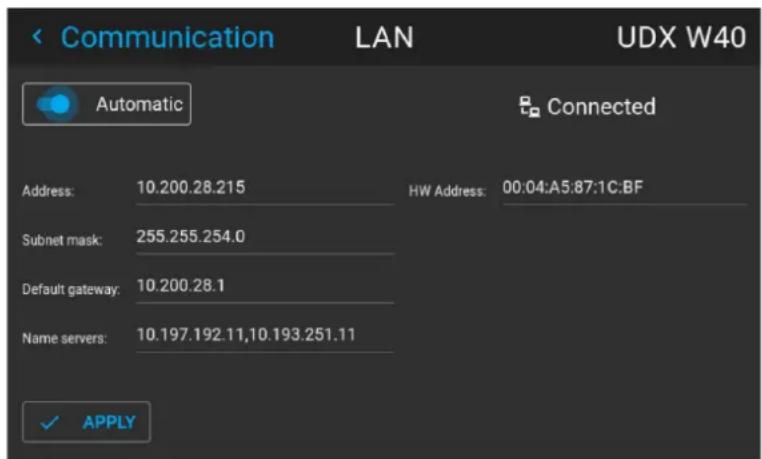
Image 10–10 Example of the LAN menu
- To enable Automatic, make sure the Automatic slider is set to the right. The color of the slider will be blue.
An IP address will be automatically assigned if it can make a connection to the network..
When connected, it is indicated with the connection symbol and the indication Connected.
- Select APPLY and confirm.
How to manually set up the IP address
- In the main menu, select Settings → Communication → LAN.
Image 10-11 Communication menu, LAN
The LAN menu is displayed
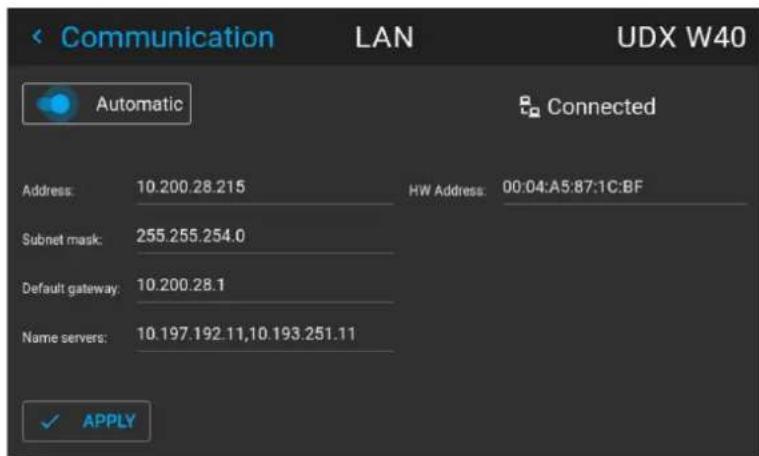
Image 10-12 Example of the LAN menu
- Disable the Automatic slider. The slider becomes gray.
- Use the arrow keys to select Address and press OK button to activate the input box.
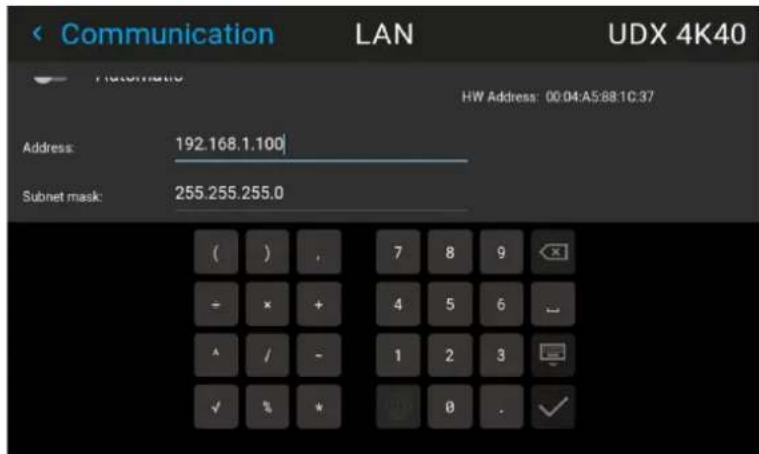
Image 10-13 Example of entering the IP address
- Use the arrow keys and enter key to enter in the IP address.

Note: Digits can be entered with the digit keys on the remote control or the local keypad. When a digit is entered in that way, the next character will be selected automatically.
- Once filled in, select the √ symbol and confirm.
- Repeat steps 4 and 5 for the Subnet mask and Default Gateway.
- Select APPLY and click OK to confirm all changes.
When the connection is established, it is indicated with the connection symbol and the indication Connected.
10.3.3 Wireless IP address set up
When can the wireless IP address be used?
When the optional WiFi module has been installed on the projector, you can configure the projector in such a way it can access the network via WiFi instead of a LAN cable.
For more information on how to install the WiFi module, please refer to the installation manual.
How to connect to a wireless network?
- In the main menu, select Settings → Communication → WiFi.
Image 10–14 Communication menu, WiFi
The WiFi menu is displayed.
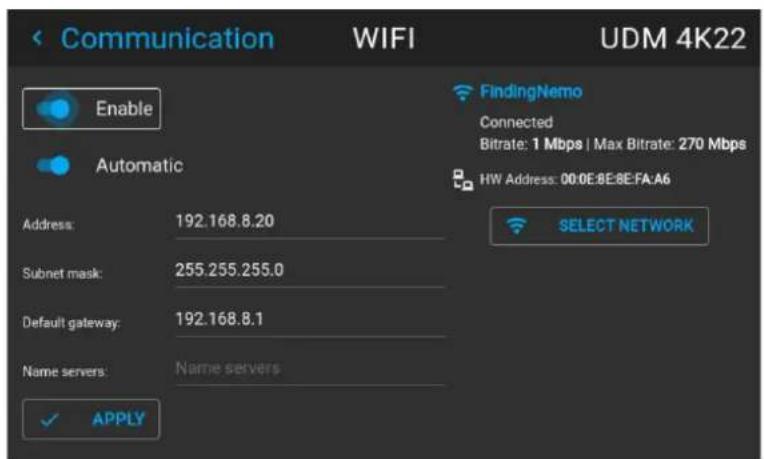
Image 10-15 Example of the WiFi menu
- Make sure the Enable slider is set to the right to enable the WiFi module. The color of the slider becomes blue.
- Make sure the Automatic slider is set to the right to automatically assign an IP address.
- Use the Select Network button to select the desired network from the available list.
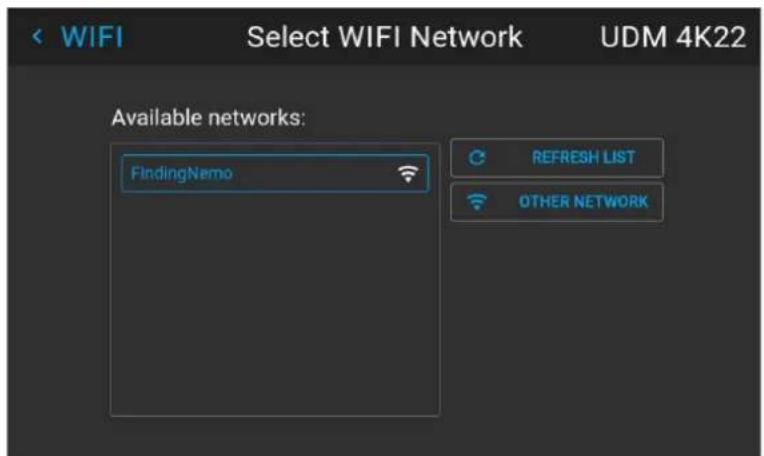
Image 10–16 Example of the available networks list.

Tip: If the desired wireless network is not in the list or hidden by default, select Other network. A form will pop up, allowing you to fill in the details of the network.
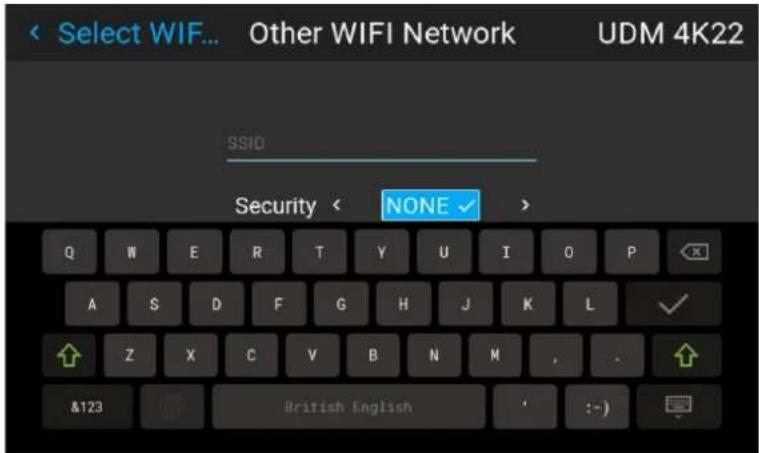
Image 10–17 Example of the entry form to search for other wireless networks
- If required by the chosen wireless network fill in the user name, password and confirm.

Tip: If you already connected to this network in the past using this projector, the software will remember the user name and password, ensuring you do not have to fill this in again.
-
Press Connect to connect to the selected network.
-
If required by the chosen wireless network, fill in the user name and password and confirm.
An automatic IP address is assigned.
When connected to this network, it is indicated in the upper right corner of the menu with the term "connected".
How to manually set up the IP address
- In the main menu, select Settings → Communication → WiFi.
Image 10-18 Communication menu, WiFi
The WiFi menu is displayed.
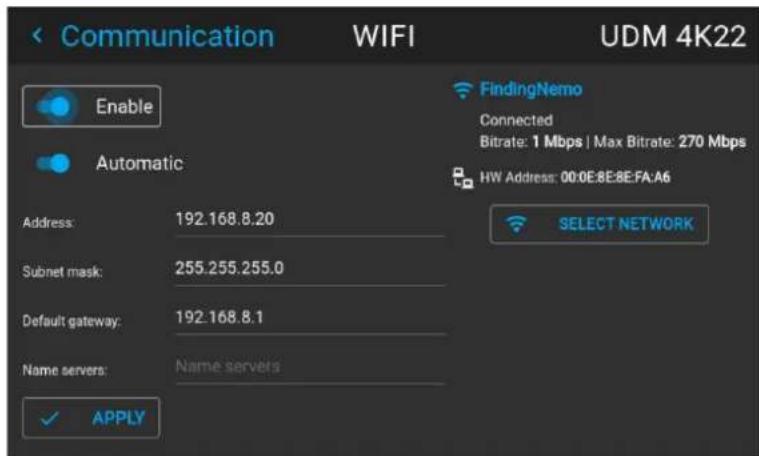
Image 10-19 Example of the WiFi menu
- Make sure the Enable slider is set to the right to enable the WiFi module. The color of the slider becomes blue.
- Disable the Automatic slider by setting it to the left. The switch becomes gray.
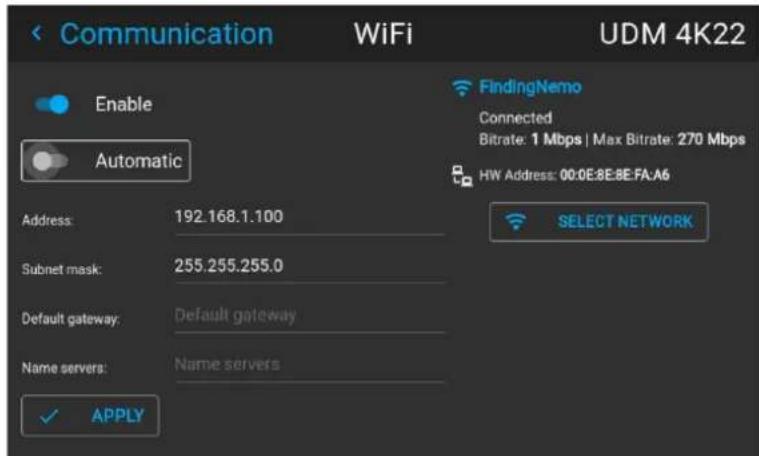
Image 10-20
- Use the arrow keys to select Address and press OK button to activate the input box.
- Use the arrow keys and enter key to enter in the IP address.

Note: Digits can be entered with the digit keys on the remote control or the local keypad. When a digit is entered in that way, the next character will be selected automatically.
- Once filled in, select the √ symbol and confirm.
- Repeat steps 4 and 5 for the Subnet mask and Default Gateway.
- Select APPLY and click OK to confirm all changes.
- Select the Select Network button to select the desired wireless network from the list.
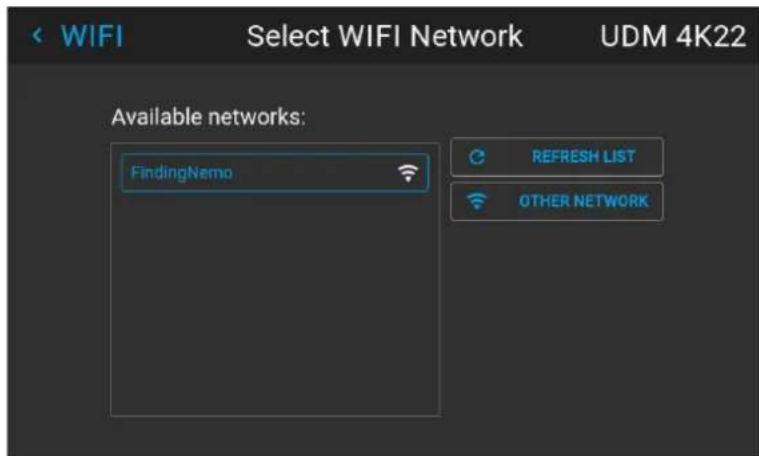
Image 10-21 Example of the available networks list.
- Press Connect to connect to the selected network.
- If required by the chosen wireless network, fill in the username and password and confirm.
When connected to this network, it is indicated in the upper right corner of the menu with the term "connected".
10.3.4 LAN over HDBaseMIP address set up

LAN over HDBaseT is only supported on HDBaseT input 1 on the Pulse Quad Combo Input board Mk II.
About LAN over HDBaseT
When a LAN cable is mounted in HDBaseInput 1, the HDBase™ menu will appear in the Settings menu. Using the menu, you can assign a custom IP address, or leave the automatic IP address setup.

Keep into account that the HDBase Network will be unavailable if the projector is in Standby mode or ECO mode (whichever is applicable to your projector). If you want to use this connector as your main network connection, it is thus advised to disable the standby or ECO mode. For more info, see power settings.
How to automatically set up the IP address
- In the main menu, select Settings → Communication → HDBaseT ^TM .
Image 10-22 Communication menu, HDBase
The HDBase™ menu is displayed.
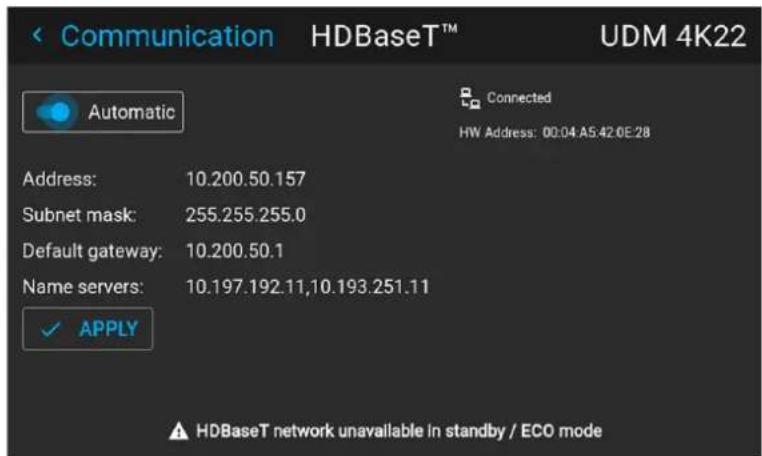
Image 10-23 Example of the HDBaseTmenu
- To enable Automatic, make sure the Automatic slider is set to the right. The color of the slider will be blue. An IP address will be automatically assigned if it can make a connection to the network.. When connected, it is indicated with the connection symbol and the indication Connected.
- Select APPLY and confirm.
How to manually set up the IP address
- In the main menu, select Settings → Communication → HDBaseT ^TM .
Image 10-24 Communication menu, HDBase™
The HDBase™ menu is displayed.
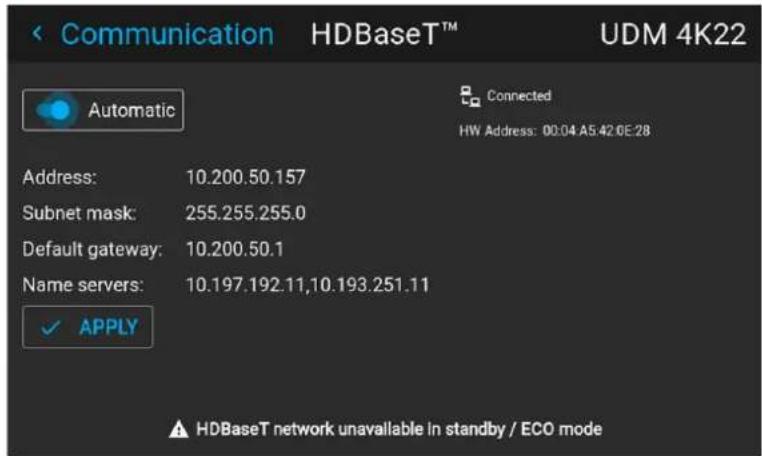
Image 10-25 Example of the HDBaseTmenu
- Disable the Automatic slider. The slider becomes gray.
- Use the arrow keys to select Address and press OK button to activate the input box.
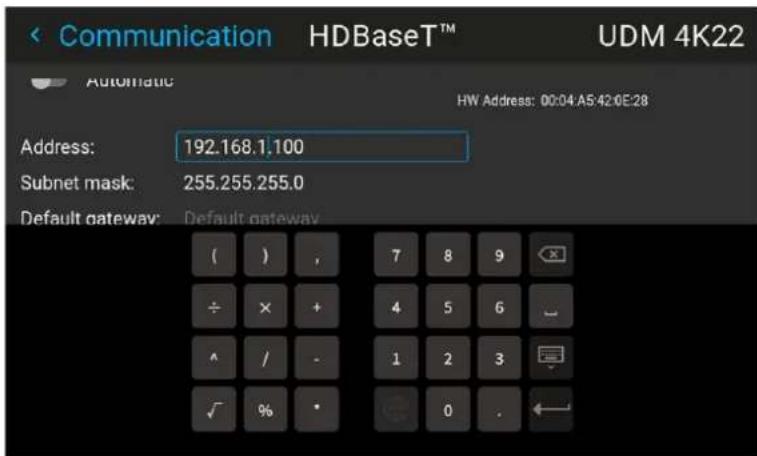
Image 10-26 Example of entering the IP address
- Use the arrow keys and enter key to enter in the IP address.

Note: Digits can be entered with the digit keys on the remote control or the local keypad. When a digit is entered in that way, the next character will be selected automatically.
- Once filled in, select the Enter symbol and confirm.
- Repeat steps 4 and 5 for the Subnet mask and Default Gateway.
- Select APPLY and click OK to confirm all changes.
When the connection is established, it is indicated with the connection symbol and the indication Connected.
10.4 DMX
About the ways to control the projector via DMX
DMX signals can be connected to the DMX In port on the communicator interface when using a standard DMX cable equipped with XLR connector. The DMX out can be used to create a chain of DMX devices. One universe can control up to 512 channels.
If you are using a DMX console and other automated lighting products compatible with Art-Net, the Ethernet network can serve as the link for DMX control. All DMX controls can be sent over the Ethernet cable. Multiple universes are possible.
For a full list of all DMX channels, values and possible actions, see "DMX chart", page 193.
About the DMX menu
| DMX Feature | What can be done? |
| DMX Mode Two different modes for DMX are available.Basic: A basic configuration where 2 channels are implemented.Extended: A full configuration, spread over 14 channels.For the full mapping of each used channel, refer to the DMX chart in the appendices. See “DMX chart”, page 193. | |
| Start Channel | Before a projector can execute DMX commands, a unique address (named DMX address or Starting channel) should be given to the projector.This address can vary from 1 to 512. |
| DMX Monitor | If a DMX device is connected, the settings per channel can be displayed via theMonitorbutton. |
| Reset for Max intensity | You can change the Shutter and intensity via DMX Channel 1 (both in Basic and Extended mode).If no DMX signals are available, you can reset the intensity value to its default (maximum) value of 255 using the Max Intensity button. |
| Auto power down | The projector can be forced to shut down after a certain time-out period if no DMX signals are available.Note: Value is set in minutes. |
| DMX Art-Net | DMX can be sent via the Ethernet connector to the projector instead of the classic DMX connector. This function can be enabled or disabled. Art-Net is generally used when more than 512 addresses are used in your setup. |
| DMX Art-Net Universe | Note: DMX Art-Net Universe can only be used when Art-Net DMX is enabled.If Art-Net is enabled, you can specify which DMX universe this projector belongs to. |
| Front XLR connector | If available on your projector, the power of the XLR connector on the front side of the projector can be enabled and set to a desired value.Note: If no front XLR connector is available on your projector, this option remains hidden. |
How to set up DMX?
- In the main menu, select System Settings → Communication → DMX.
Image 10–27 Communication menu, DMX
The DMX menu is displayed.
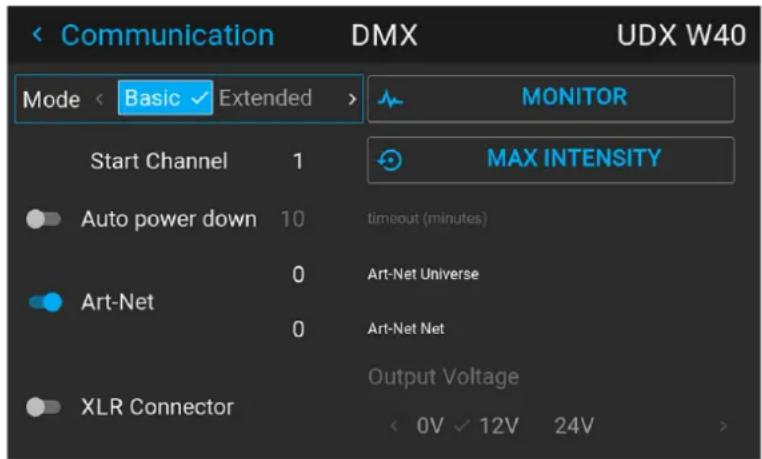
Image 10–28 Example of the DMX menu
- Choose the desired DMX mode.
- Choose the desired starting channel.
- Choose whether or not you want the Auto power-down feature to be enabled. If enabled, determine the time-out.
- If required, enable Art-Net. If enabled, determine the desired Art-Net Universe and Art-Net channel.
- If a front XLR connector is available on your projector, you can enable the output voltage on this connector.
10.5 Front XLR output voltage control
What can be done?
The output voltage on the front XLR connector can be enabled or disabled. If enabled, the output voltage level can be set to 0 V, 12 V or 24 V.
The output voltage will depend on the application or peripheral used. For example, the optional external mechanical shutter requires 12 V. The motorized rigging frame on the other end requires 24 V.
How to enable or disable?
- In the main menu, select System Settings → Communication → DMX.
Image 10–29 Communication menu, DMX
The DMX menu is displayed.
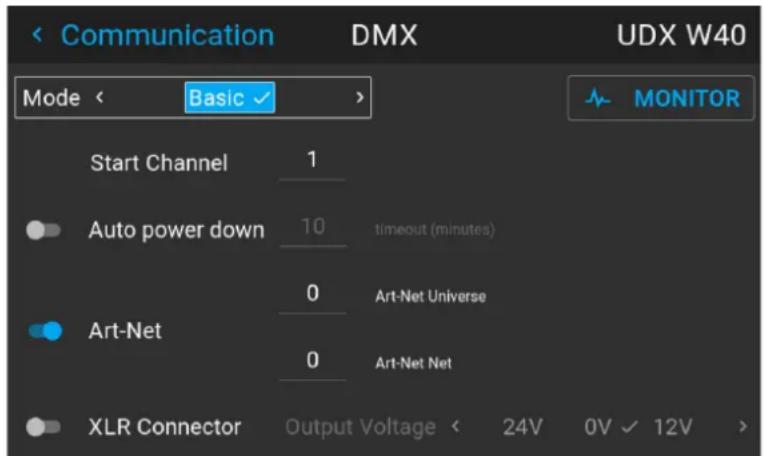
Image 10–30 Example of the DMX menu
- On the bottom of the DMX menu, Enable the XLR connector slider.
- Select the desired Output Voltage.
10.6 GSM configuration

Only possible when a GSM module with SIM card is installed in the projector.
When to use the GSM menu
The GSM menu by itself does not have any functionality. The main purpose of this menu is to read out the necessary data from the SIM card in the GSM module.
You may require this information when using specific connectivity functions (e.g. configuring the Projector Management Suite in a mobile-only setup).
About the SIM card PIN code
To configure the projector software with the installed SIM card for the first time, a correct PIN code (4 digits) must be entered.

As the PIN code cannot be checked with the one on the SIM card, ensure to enter the correct PIN code.

When your SIM card is blocked, you have to remove the SIM card from the GSM module and to insert the SIM card in a mobile phone so that you can enter the PUK code to unblock the SIM card.
How to activate
- In the main menu, select Settings → Communication → GSM.
Image 10–31 Communication menu, GSM
At first use, the GSM pin code input menu is displayed. If a correct pin code has been entered in the past, it will not be necessary to enter the pin code again and you can skip the next step.
- Enter the 4 digits of the PIN code and confirm.
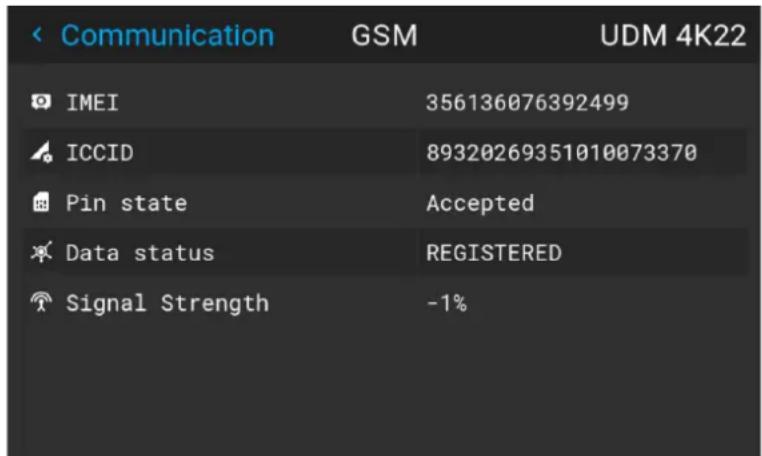
Image 10–32 Example of the GSM menu once the pin code has been applied
10.7 Changing the User Interface language
How to change the language of the user interface
- In the main menu, select Settings → User interface → Language.

Image 10–33 Interface
The Language menu is displayed.
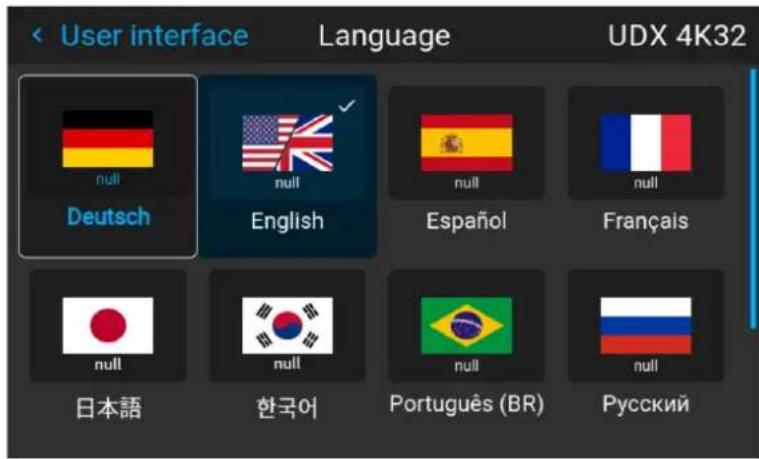
Image 10-34 Example of the Language menu
-
Select the desired language. You can choose between the following:
-
German (DE)
- English (EN)
- Spanish (ES)
- French (FR)
- Japanese (JA)
- Korean (KO)
- Portuguese (PT-BR)
- Russian (RU)
- Chinese (ZH)
10.8 Themes
About Themes
Themes are used to apply a predefined functionality to the OSD display. There are two options: light or dark (default).

While the default theme is dark, all images in this manual are taken while using the light theme.
How to select a different interface theme
- In the main menu, select Settings → User interface → Themes.
Image 10–35 Settings menu, themes
- In the themes menu, select the desired Theme.
You can choose one of the following: Light, or Dark.
10.9 Units (measurement) system setup
About the measurement systems
You can use this menu to change the default measurement systems. By default the metric system is used. But you can choose between the following:
• Temperature: °C or °F
• Distance: meter, centimeter, feet or inch.
How to set a different metric system
- In the main menu, select Settings → User interface → Units.
Image 10–36 Settings menu, units
The Units menu is displayed.
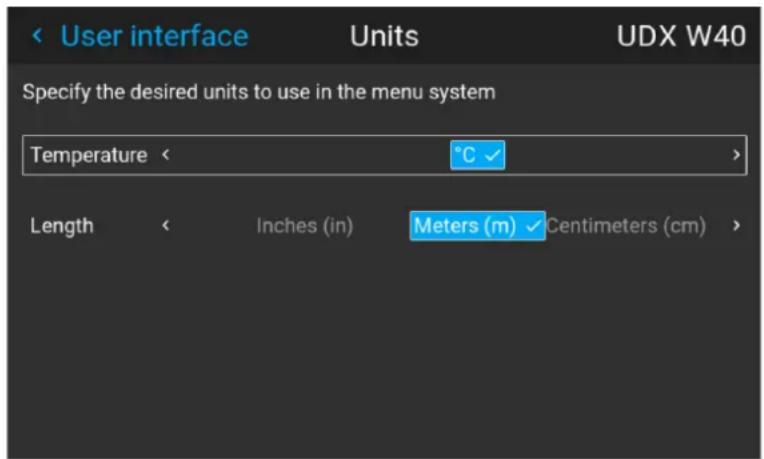
Image 10–37 Example of the Units menu
- Select the desired Temperature unit and Length unit and confirm.
10.10 Controlling the backlight of the LCD Display
What lighting can be controlled?
You can choose how quickly the backlight of the LCD turns off. You can select one of the default values, or enter a custom value.
Stealth Mode
Alternatively, you can turn on Stealth Mode instead. By activating this mode, the backlight of the LCD, the backlight of all the buttons of the keypad and the indication LEDs for the LAN and HDbaseT inputs will be disabled.
Stealth Mode is enabled and disabled by pressing the OSD button on the remote control for 3 seconds.
How to set the backlight
- In the main menu, Settings → User interface → Backlight.
Image 10-38 Settings menu, backlight
The Backlight menu will be displayed.
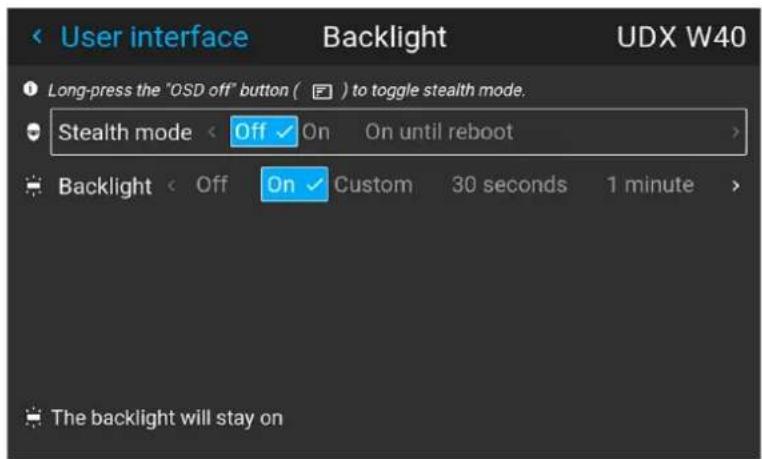
Image 10-39 Example of the backlight menu
- Choose the desired setting for the backlights. Select one of the predetermined options, or a custom value.
10.11 Date and time setup - manually
About date and time
The date and time setting can be set manually or automatically via an NTP server based on region and city location.

Date is displayed by default as: day / month / year.
Time is displayed by default as: hour : minutes : seconds, in the 24-hour clock.
How to set manually
- In the main menu, select Settings → Date and time.
Image 10-40 Settings menu, Date and time
The Date and time menu is displayed.
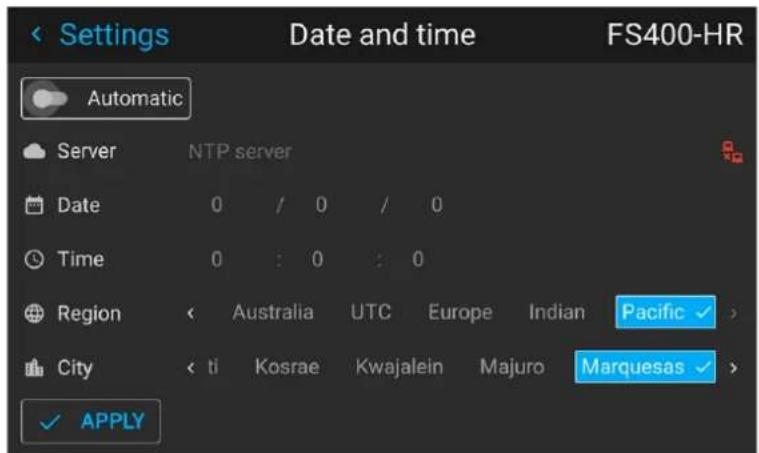
Image 10-41 Example of the Date and time menu
- Disable the Automatic slider.
Gray slider: automatic is off
Blue slider: automatic is on
- Select Date
The Date dialog is prompted. The active day is selected by default.
- Slide the Day, Month and Year slider up or down until the desired date is obtained.
or
Alternatively, use the up, down and OK buttons on the RCU or control panel until the desired date is obtained.
- Select Time.
The Time dialog is prompted. The active time is selected by default.
- Slide the Hour, Minute and second slider up or down until the desired time is obtained.
or
Alternatively, use the up, down and OK buttons on the RCU or control panel until the desired time is obtained.
- Select Apply to activate.
10.12 Date and time setup - automatically

Date is displayed by default as: day / month / year.
Time is displayed by default as: hour : minutes : seconds, in the 24-hour clock.
To set date and time automatically
- In the main menu, select Settings → Date and time.
Image 10-42
The Date and time menu is displayed.
2. Enable the Automatic slider.
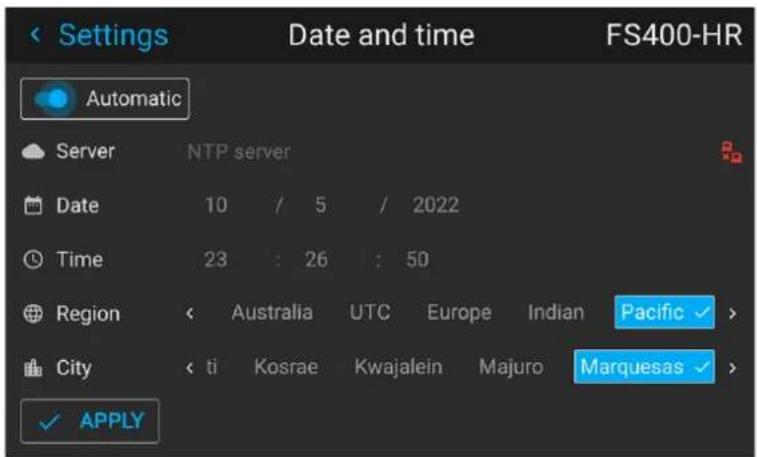
Image 10-43
Gray slider: automatic is off
Blue slider: automatic is on
3. Select Server and click OK.
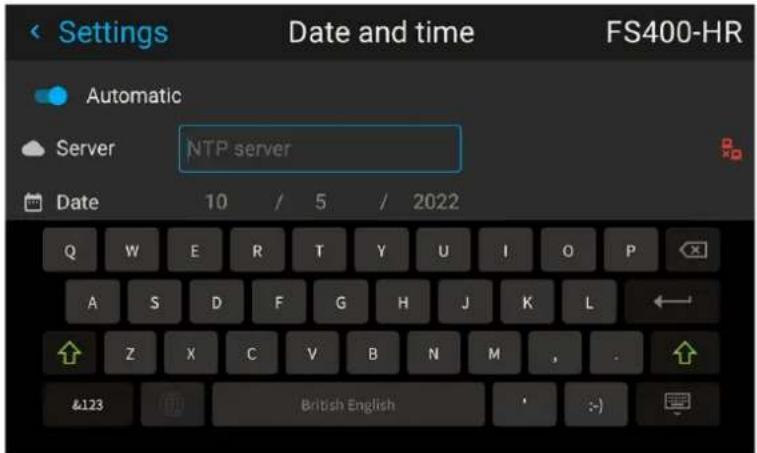
Image 10-44
4. Enter the name or the IP address of the NTP server.

Tip: In case you cannot connect to an external NTP server although you can PING this server, the connection is blocked by the local firewall policy. Contact your IT system administrator.
In case the connection is successful, a green icon appears at the right side of the server line.
5. Select Region and select with the arrow keys the region where the projector is installed.
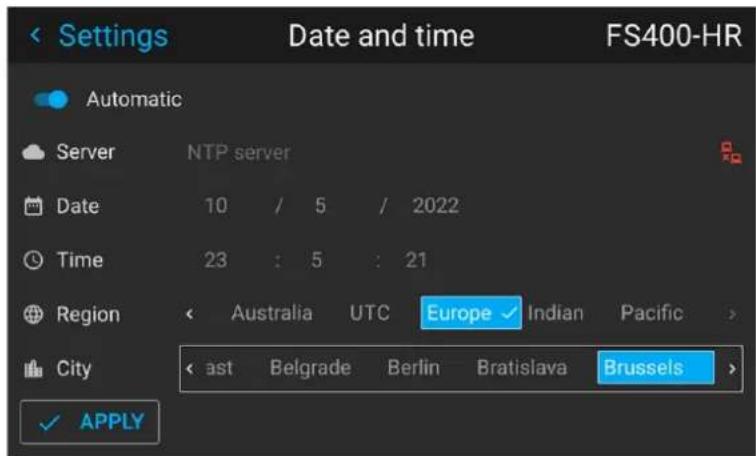
Image 10–45
The list of cities is updated according the selected region.
- Select City and select the city corresponding with your time line.
- Select Apply to activate.
10.13 Power saving settings
Why change the power saving features?
Standby Mode exists in the projector as a power-saving feature. If the projector is projecting no image, it will automatically go to Ready and standby mode after 15 minutes each. While in standby mode, it is no longer possible to use the OSD for anything other than a status overview.
Power saving features comes at the cost of disabling projection functionality. Depending on your specific installation, you may either want to:
- increase the power-saving features to an absolute maximum (e.g. using the Standby ECO mode and reducing time-out to an absolute minimum)
- reduce the power-saving features to allow technicians to modify the projector for as long as needed, or
- disable the power saving features all together.
Available power modes
- Ready: Disables Standby mode all together. Uses the most power, but keeps most of the projector functionality available.
- Standby mode: After a set time-out, the projector disables most functionality to save power, safe the communication options. This allows the projector to be awoken either using the local keypad, the RCU or remotely using Projector Toolset, DMX or other automation controllers.
- Standby ECO mode: After a set time-out, the projector disables almost all functionality to save power, safe a single small wake-up controller. This allows the projector to be awoken only using the local keypad or the RCU. The projector can not be awoken remotely using this method.
How to change the power saving feature?
- In the main menu, select Settings → Power settings.
Image 10-46 Settings menu, Standby mode
The Standby mode menu is displayed.
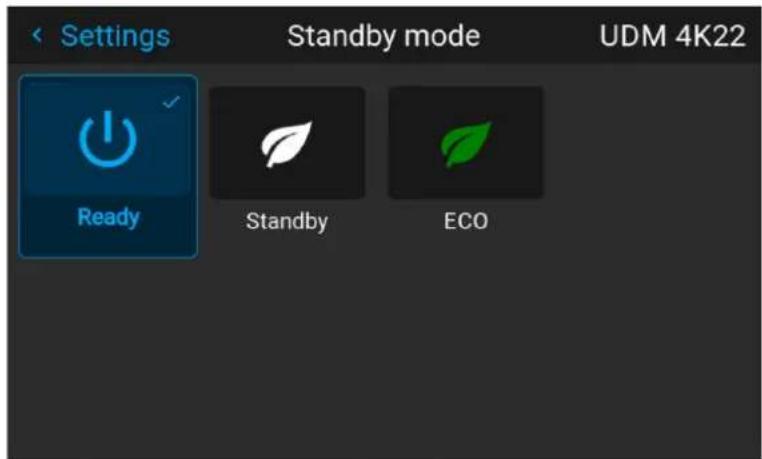
Image 10-47 Example of the Standby mode menu
- Select the desired standby mode feature, or disable it by choosing Ready.
How to change the chosen standby time-out?
- In the main menu, select Settings → Power settings.
Image 10-48 Settings menu, Power settings
The Power settings menu is displayed.
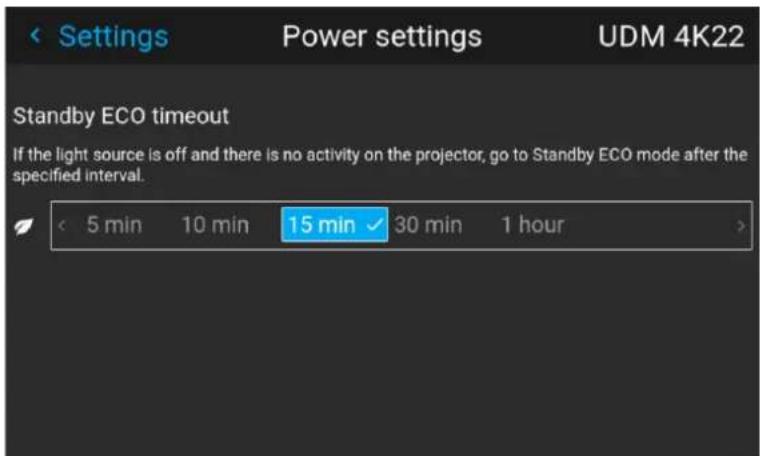
Image 10-49 Example of the Power settings menu, here with ECO standby mode active
- Select the desired standby time-out timeframe.
10.14 Lens features
What can be done?
Some lens features can be disabled once they are correctly aligned so that a misalignment during a show is not possible.
How to enable/disable
- In the main menu, select System Settings → Lens Features.
Image 10-50 Settings menu, Lens features
The Lens features menu is displayed.
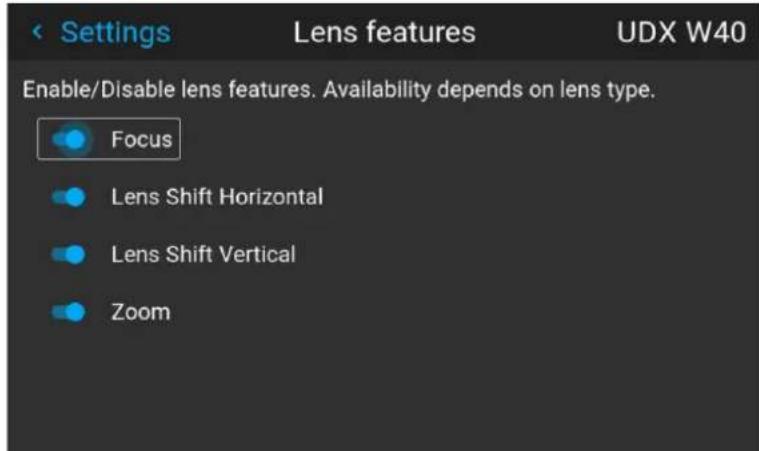
Image 10-51 Example of the lens features menu
Depending on the mounted lens type, different functions may or may not be available such as:
- Focus
• Horizontal lens shift
• Vertical lens shift -
Zoom
-
To enable/disable a feature, click on the slider and drag it to the left to disable the feature or the right to enable the feature.
When enabled, the slider becomes blue; when disabled, the slider is gray.
10.15 Factory reset
What can be done?
All settings and values on the projector can be reset to its default values. This can be done for one or more settings separately, or all settings together (factory reset).
Factory settings
The following settings are the default factory settings:

All Factory settings are listed, regardless of the projector type or chosen projector options. If an option in this list is not present in your menu, the feature is not available or enabled on your projector.
| Option / Domain | Setting Factory setting | |
| DMX DMX Mode | Basic | |
| Start Channel | 1 | |
| Auto power downArt-netXLR Connector | Disabled | |
| GSM PIN State Unconfirmed | ||
| Illumination Power | 100% | |
| Constant light output (CLO) Disabled | ||
| ImageActuator 4K Actuator enabled / disabled | Enabled | |
| Blend Blend / Mask sizeBlack Level | Disabled, all value to zero | |
| ImageCapture Camera Camera disabled, all measurements reset to 0 | ||
| Connectors Signal range | Auto | |
| Color space | Auto | |
| EDID | Default EDID for projector typeNote: All uploaded custom EDID files w be deleted. | |
| Convergence | Electronic Convergence | All values to zero |
| Display | Display mode | AutoStereo |
| Image features | Contrast | mid value |
| Brightness | mid value | |
| Saturation | mid value | |
| Sharpness | mid value | |
| Gamma mid value, auto | ||
| Digital Shift and Zoom | Disabled, set to mid values | |
| Cropping | Off | |
| Aspect Ratio | 16:9 | |
| Scaling | Fill Aspect ratio | |
| Orientation | Orientation | Table, Front |
| RealColorTM P7 | P7 RealcolorTM | all set to native |
| Resolution | Output Resolution | 4K UHD (4K devices)WQXGA (W devices)WUXGA (U devices) |
| Source | Source files | Standard |
| 3D | Sync delay | 0 μs |
| Swap eye | Off | |
| Dark time lowest value available | ||
| Test patterns | Test Pattern | Off, none selected,Note: All uploaded custom test patterns will be deleted |
| Uniformity DynaBlack Off | ||
| Warp Screen size | 5120x3200 / 2560x1600 | |
| 4 cornerBow | Warp disabled, no warp | |
| Warp files Disabled | Note: all uploaded warp files will be deleted | |
| Network Communication LAN, Automatic settings | ||
| Optics High Contrast Off | ||
| Peripheral | Settings for External Cooler | Cooling mode set to internal. |
| Settings for Motorized Frame | All values to mid value | |
| Profiles | Settings for projector profiles | All profiles will be deleted |
| Screen | Screen luminance unit | nits |
| Screen Luminance | 400 | |
| HDR Boost | 1.0 | |
| System | Auto off / Eco Mode / Standby Mode (depending on availability) | Enabled |
| Ready Time-out | auto | |
| Operational Mode | Normal | |
| Time | Time server Automatic disabled, NTP server removed | |
| Date | 0/0/0 | |
| Time | 0:0:0 | |
| Region / City | UTC | |
| User | User profiles | Only default users remain |
| Capture mode | Disabled | |
| User interface | Theme | Dark |
| Units - Temperature | °C | |
| Units - Length | Meters (m) | |
| Language | English | |
| Backlight - Stealth ModeBacklight - Timeout | Off5 minutes | |
How to reset all projector settings
- In the main menu, select Settings → Maintenance → Reset.
Image 10-52 Settings menu, factory reset
The Reset menu is displayed.
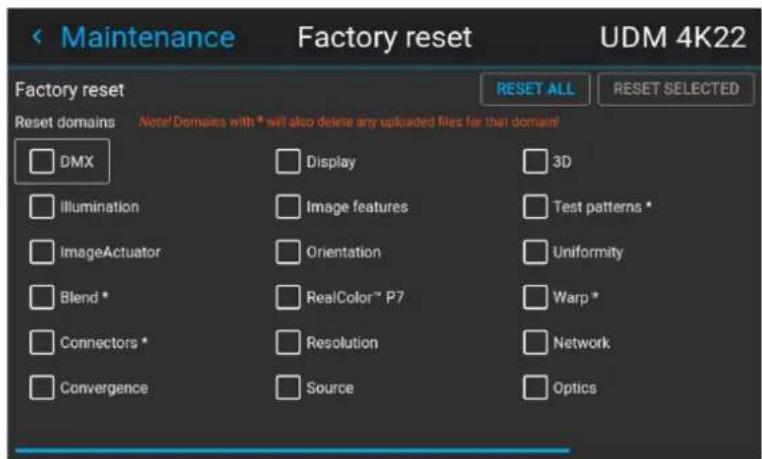
Image 10-53 Example of the reset menu
- In the Reset menu, select RESETALL and confirm with OK.
How to reset one or more projector settings
- In the main menu, select Settings → Maintenance → Reset.
Image 10-54 Settings menu, factory reset
The Reset menu is displayed.
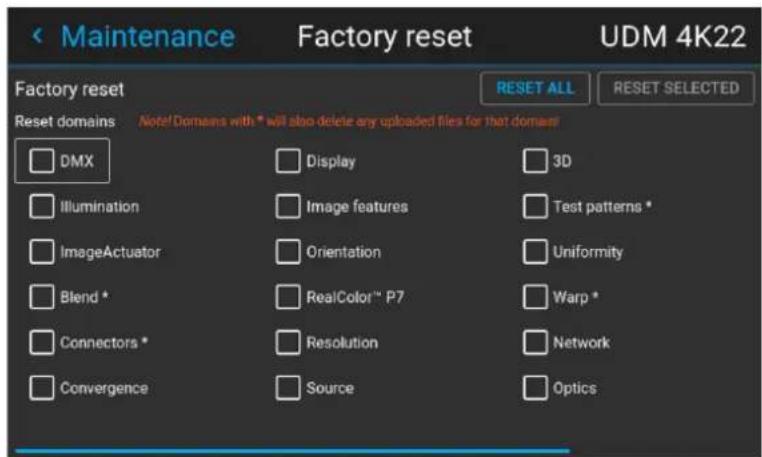
Image 10–55 Example of the reset menu
- Navigate to the checkbox next to the settings that need to be reset and press OK.
Multiple selections are possible.
- Select RESET SELECTED and confirm with OK to reset all selected settings.
10.16 Lens Calibration
How to calibrate
- In the main menu, Settings → Maintenance → Lens Calibration.
Image 10-56 Maintenance menu, lens calibration
The Lens Calibration menu is displayed, alongside the status of each
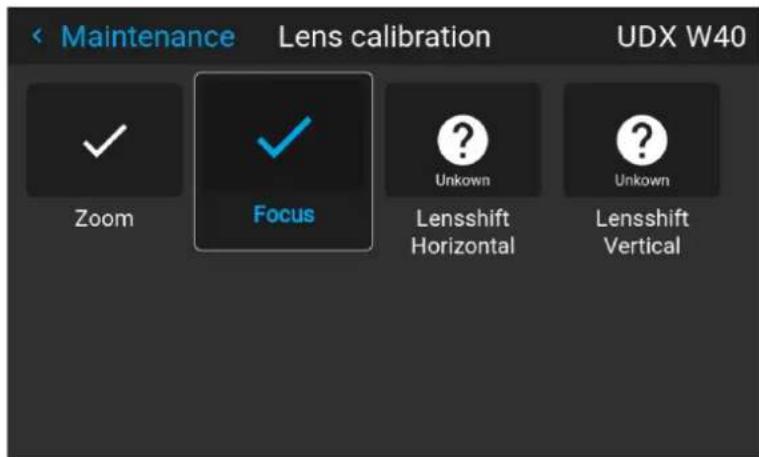
Image 10-57 Example of the lens calibration menu
- In the Lens Calibration menu, select the desired calibration action and click OK.
You can select one of the following functions, depending on the type of mounted lens:
• Horizontal lens shift
• Vertical lens shift
- Focus
- Zoom
The text Calibrating will be displayed in the icon of the selected function until the calibration is completed.
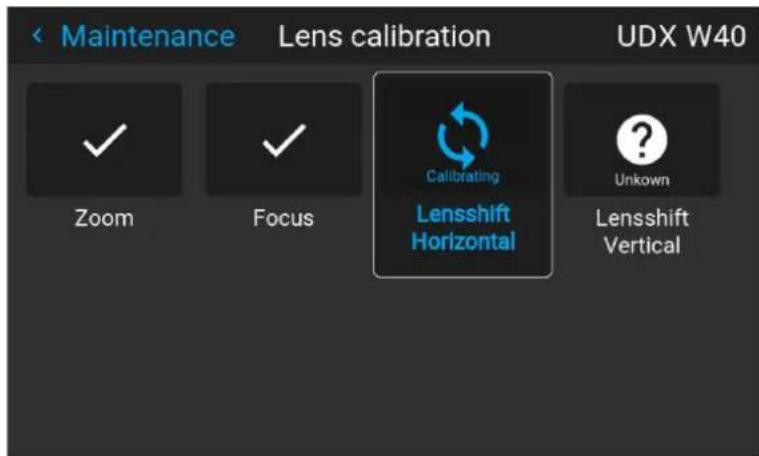
Image 10–58 example of calibration in progress
When an error is detected, the message Calibration Error is displayed next to function.
10.17 Flex brightness

This feature is available by default on the following devices: UDM 4k22, UDM W22.
This feature is also available as an option on the following devices: UDM 4K15, UDM W19, UDM W15.
Overview
With the FLEX technology the projector owners can lock the light output to different levels. The locking can be done via 3 different ways:
- Via Projector Toolset when connected via an ethernet connection with the projector. For more information on how to set up and use the Flex license, see the Projector Toolset's user guide, chapter "Configuration, License / registration".
- Via Barco Insights Management Suite when the GSM module is installed. For more information on how to set up and use the Flex license, see Projector Management Suite user guide, chapter "Projector Configuration tab" – "Flex brightness"
• Via the OSD menu of the projector itself
To lock to a specific value a 4 digit code is necessary. These codes can be created by the projector owner using Projector Toolset or the Projector Management Suite.
Availability
The flex brightness function is license protected. This license is already available in the projector. To activate the flex brightness a flex code is necessary. This flex code can be requested for free and uploaded via Projector Toolset or the Projector Management Suite. For more information about uploading this flex code, see Projector Toolset's user guide, chapter “FLEX, light output control”.
For other models, Flex brightness is an option. You can order and buy a license file. This license file is linked with the projector type and projector serial number. Once you received you license file, upload this file via Projector Toolset to your projector. Once the file is uploaded, the same file has to be used to upload the Flex code.
Flex codes
Once your flex code is correctly uploaded, the projector creates a number of flex codes, one for each possible maximum light output. These codes are used for rental activities when adapting the light output of the projector.
The created flex codes are only visible in Projector Toolset and the Projector Management Suite by the projector owner. To make these visible he will need his license for this typical projector.
Maximum Light output setup via OSD menu
- In the main menu, select Settings → Maintenance → Flex.
Image 10-59 Maintenance menu, Flex
The Flex license menu is displayed.
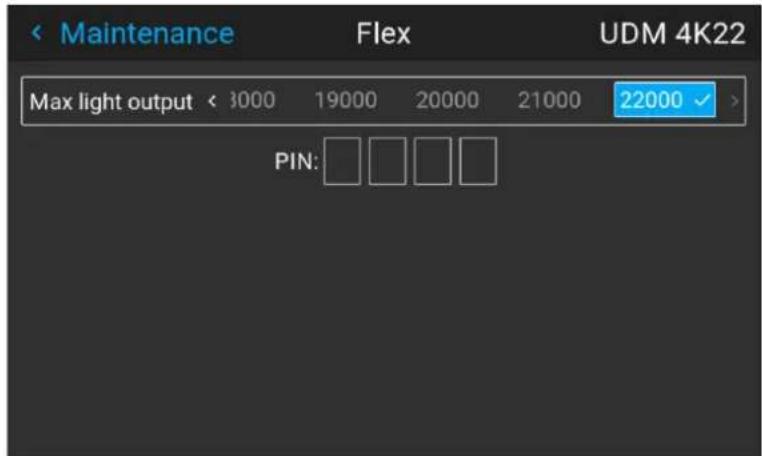
Image 10-60 Example of the Flex license menu
- Choose the desired Light output (in lumens) for which you have a code available.
- Enter the code via the OSD menu and confirm.
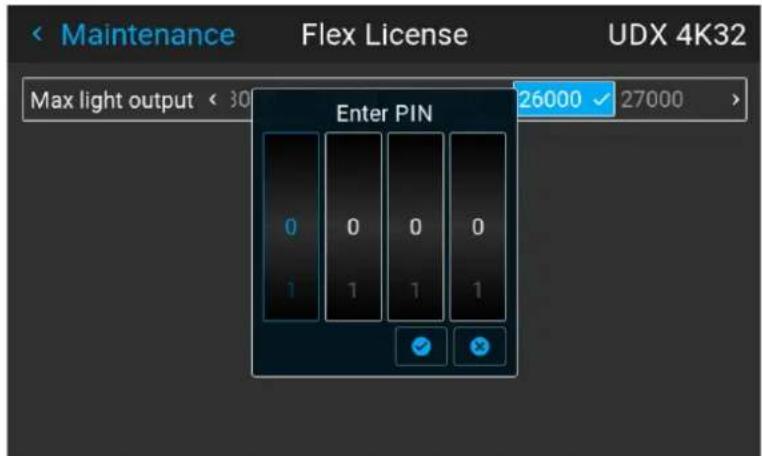
Image 10-61 Example of entering the code in the Flex license menu
10.18 Rigging frame Calibration
How to calibrate the motorized rigging frame
- In the main menu, select Settings → Maintenance → Frame Calibration.
Image 10-62 Maintenance menu, Frame calibration
The Frame calibration menu is displayed.
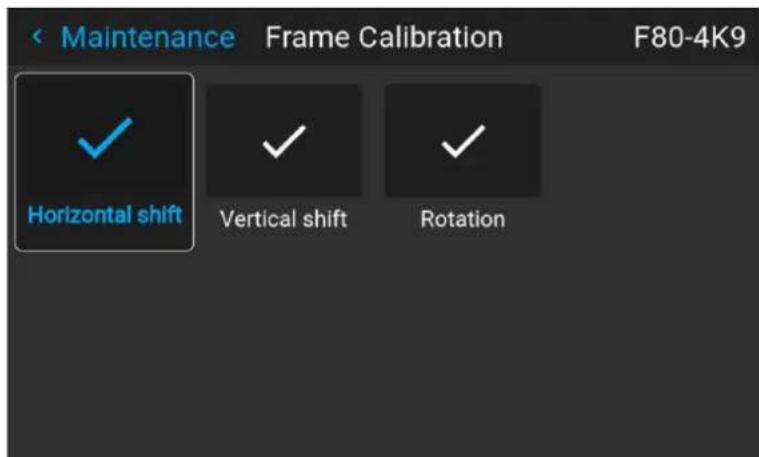
Image 10-63 Example of the Frame calibration menu
- In the Frame Calibration menu, select the desired calibration action and click OK.
You can select one of the following functions:
• Horizontal shift
- Vertical shift
- Rotation
The text Calibrating will be displayed until the calibration is completed.
Image 10–64 Example of a calibration in progress
When an error is detected, the message Calibration Error is displayed next to function.
10.19 Electronic Convergence
What can be done?
The convergence patterns can be used to check the convergence alignment of red, green and blue. If there is a misalignment of at least one 1 pixel, an electronic realignment is possible.
Mechanical realignment of the convergence can only be done by a qualified service technician.
How to display the convergence settings
- In the main menu, navigate to Settings → Maintenance → Electronic Convergence.
Image 10-65 Maintenance menu, electronic convergence
The Electronic Convergence menu is displayed.
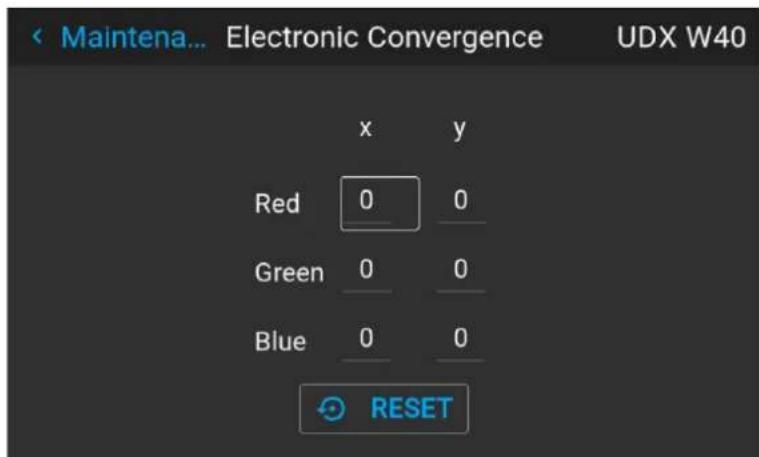
Image 10–66 Example of the electronic convergence menu
- Select the desired X or Y value for one of the three colors and confirm.
- Use the arrow keys to raise or lower the value and confirm.
- Confirm all changes by pressing Enter.
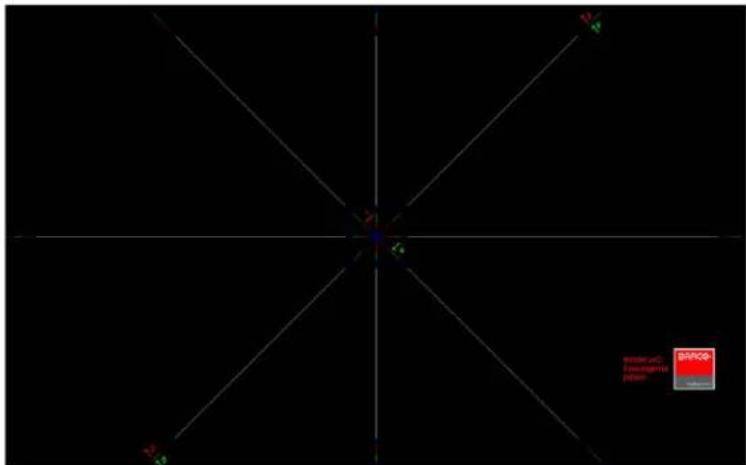
Image 10-67

Tip: Press Reset to return all values to the factory settings.
- Repeat all steps until the desired alignment is achieved.
10.20 Operational mode
Overview
The UDM range now offers you a possibility to choose the most relevant user mode for your application. You can select, setup and tweak the mode which you need, while a smart monitoring algorithm in the background keeps on balancing and optimizing between illumination output power, minimal noise level and optimized temperature household.
These are the presets being offered to start from:
- "Normal mode": This is the standard mode delivering highest possible brightness while ensuring a life time of 20 000 hours and keeping the noise level around 48 dBA.
- "Silent mode": controlling maximal fan speed staying 47 dBA.
How to change the operational mode of your projector
- In the main menu, navigate to Settings → System → Operational mode.
Image 10–68 Maintenance menu, operational mode
The Operational Mode menu is displayed.
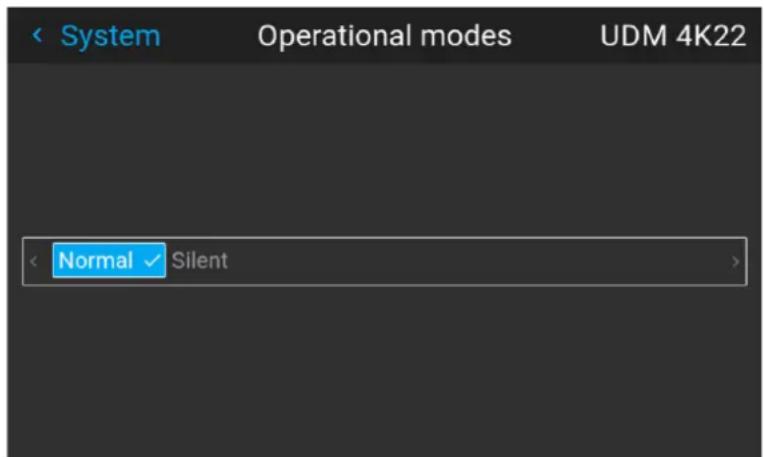
Image 10–69 Example of the Operational modes menu
- Choose the desired operational mode.
You may immediately notice a small difference, depending on the chosen operational mode.
- Navigate to the Illumination menu and update the desired light output, depending on the chosen operational mode.

Note: If the light source cannot sustain the desired power, it will automatically be reduced to a power level that's sustainable for the light source and the chosen cooling power.
10.21 Capture mode
Why use capture mode?
Various technical features are used inside the projector to display the best possible image on the projected surface. However, in expositions and setups where visitors are expected to film or take pictures of the projected surface, some of these technical features may have side-effects on the captured footage, such as solarization.
Enabling the Capture mode feature disables some of the technical features of the projector that are known to cause solarization and gives the visiting audience an experience they can “capture” and post on social media without worries.
How to enable Capture mode
- In the main menu, navigate to Settings → System.
- In the Lens menu, click Capture mode to toggle between On and Off.
Image 10-70 System menu, Capture mode disabled Image 10-71 System menu, Capture mode enabled
10.22 Login to advanced settings
How to login
- In the main menu, Settings → Maintenance → Login.
Image 10-72
The Login menu is displayed.
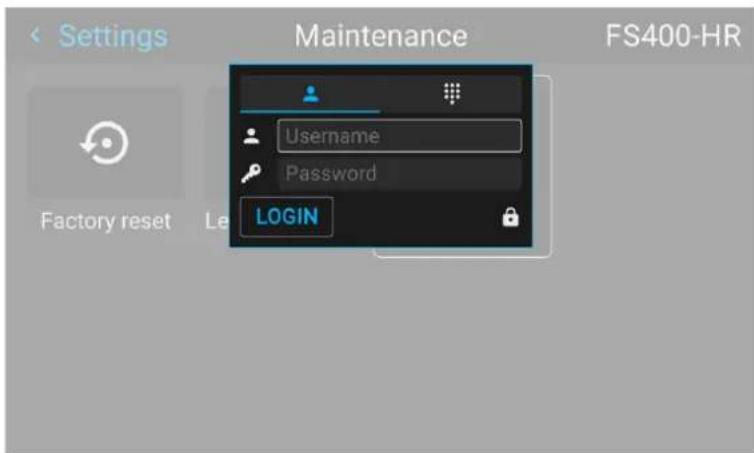
Image 10-73
There are 2 ways to login:
• Via user & password, go to step 2
• Via a digit code, go to step 5
-
To login via user & password, select User and click OK.
-
Navigate to user name and click OK.
A keyboard is displayed. Enter the user name Navigate to Password and enter the password.
- Select LOGIN and click OK to login.
- To login via digit code, select digit keyboard and click OK.
- Navigate to Pin code and click OK.
A keyboard is displayed. Enter the pin code.
10.23 List of open source licenses
About open source licenses
Open source licenses are licenses that comply with the Open Source Definition. In brief, they allow software to be freely used, modified, and shared.
To be open and transparent about the open source software used on the projector, there is a list of all open source licenses available in the software.
How to find the open source licenses
For the complete and most up-to-date list of the used open source software and the version used, go to the main menu and select Settings → General → Open source licenses.

Image 10–74 General menu – Open source licenses
Advanced Settings
11
11.1 Remote access – Enable source preview 158
11.2 Remote access – Enable camera preview 159
11.3 Advanced Settings – Color 160
11.4 Advanced Settings – Statistics.... 161
11.5 Checking the status of the Laser Banks 162
11.6 Advanced settings – Tilt sensor calibration 163
About the Advanced Settings menu
The Advanced Settings and Remote access menus are hidden by default for the regular user. you can only make these menus visible after entering a User name and Password or a Service code with the remote control. See "Login to advanced settings", page 154 for more info.
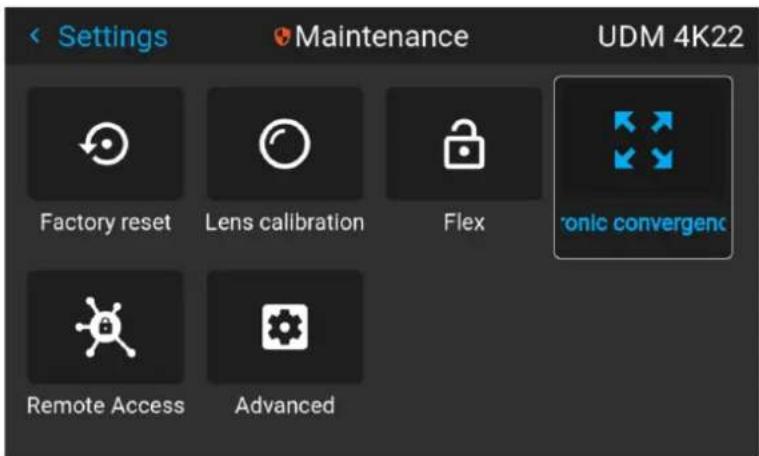
Image 11-1 Example of the Maintenance menu, with the Advanced menu and Remote access menu unlocked

The Advanced Settings and Remote access menu items will remain visible until you leave the Maintenance menu.
11.1 Remote access – Enable source preview
Source preview
Up until Pulse software 2.0. x, you were able to see a preview of the connected source when you remotely accessed the projector. This was a feature you could disable using Projector Toolset.
However, from Pulse 2.1. x onward, this feature is disabled by default and can now be enabled in both Projector Toolset and the Pulse GUI.

Upgrading your projector from a software version 2.0.x or older to 2.1.x or newer will disable Source preview by default. Once the software has been successfully upgraded, you can always opt to enable this feature again.
How to enable source preview
- In the main menu, select Settings → Maintenance and login to visualize the hidden Remote access menu.
- Select Remote access.
Image 11-2 Maintenance menu, Remote access
The Remote access menu is displayed.
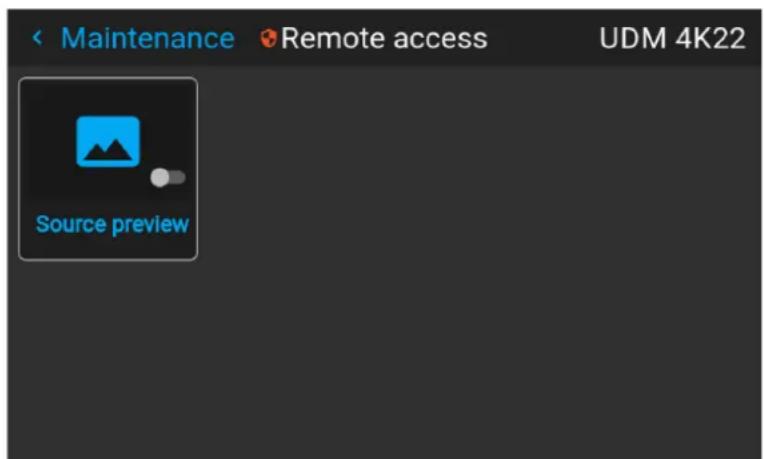
Image 11-3 Example of the Remote access menu
- Enable the slider to enable the source preview feature.
Image 11-4 Remote access menu, Source preview is enabled
11.2 Remote access – Enable camera preview
Camera preview
Up until Pulse software 2.0.x, you were able to see the footage of the camera when you remotely accessed the projector. This was a feature you could disable using Projector Toolset.
However, from Pulse 2.1. x onward, this feature is disabled by default and can now be enabled in both Projector Toolset and the Pulse GUI.

Upgrading your projector from a software version 2.0.x or older to 2.1.x or newer will disable Camera preview by default. Once the software has been successfully upgraded, you can always opt to enable this feature again.
How to enable Camera preview
- In the main menu, select Settings → Maintenance and login to visualize the hidden Remote access menu.
- Select Remote access.
Image 11-5 Maintenance menu, Remote access
The Remote access menu is displayed.
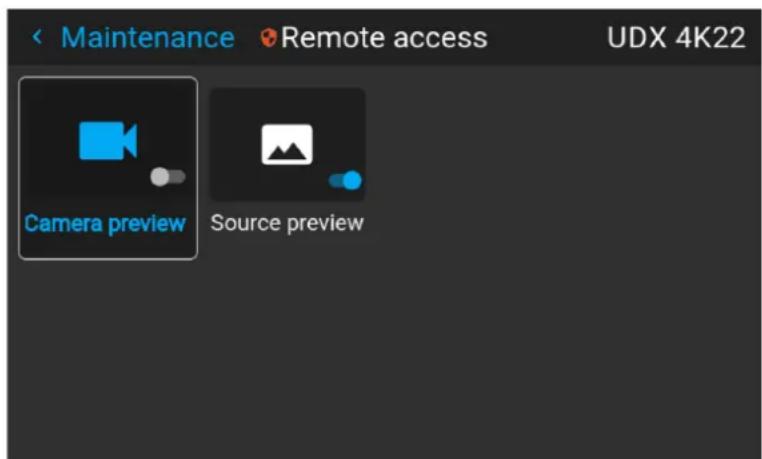
Image 11–6 Example of the Remote access menu
- Enable the slider to enable the Camera preview feature.
Image 11-7 Remote access menu, Camera preview is enabled
11.3 Advanced Settings - Color

CAUTION: The native colors have been measured and set during factory production. Do not change them, unless parts of the optical path have been replaced due to servicing. If you need to change the native colors on the device, make sure to also perform a P7 calibration, using the Projector Toolset and a chroma meter. For more info on P7 calibration, refer to the Projector Toolset Reference guide.
How to adjust the P7 native settings
- In the main menu, navigate to Settings → Maintenance → Advanced, while you are logged in.
Image 11-8 Maintenance menu, Advanced
- In the Advanced Settings menu, select Native RealColor.
Image 11-9 Advanced Settings, Native Realcolor
The RealColor calibration menu will be displayed.
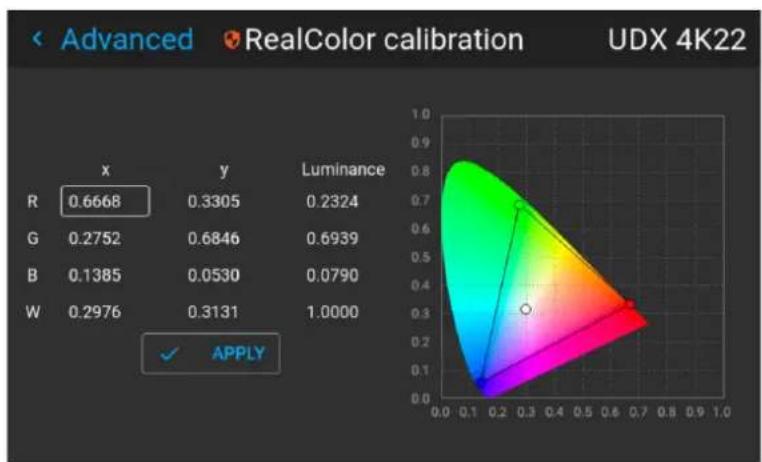
radar
| | R | G | B | W | | ------ | ------ | ------ | ------ | ------ | | Value | 0.6668 | 0.2752 | 0.1385 | 0.2976 | | Luminance | 0.3305 | 0.6846 | 0.0530 | 0.3131 | | | 0.2324 | 0.6939 | 0.0790 | 1.0000 |Image 11-10 Example of the RealColor calibration menu
- Select the desired value to change and confirm.
- Change the values to the desired position, taking into account the color gamut values.
- Select APPLY and confirm.
11.4 Advanced Settings – Statistics
What can be seen?
The statistics screen shows the general information about the projector, spread over two tab pages. The following items will be displayed:
- Laser runtime
- Laser Strikes
- Laser bank x runtime
- Projector runtime
- System runtime
- System uptime
How to display the statistics
- In the main menu, navigate to System Settings → Maintenance → Advanced Settings, while you are logged in.
Image 11-11 Maintenance menu, Advanced
- In the Advanced Settings menu, select Statistics.
Image 11–12 Advanced settings, Statistics
The Statistics will be displayed.
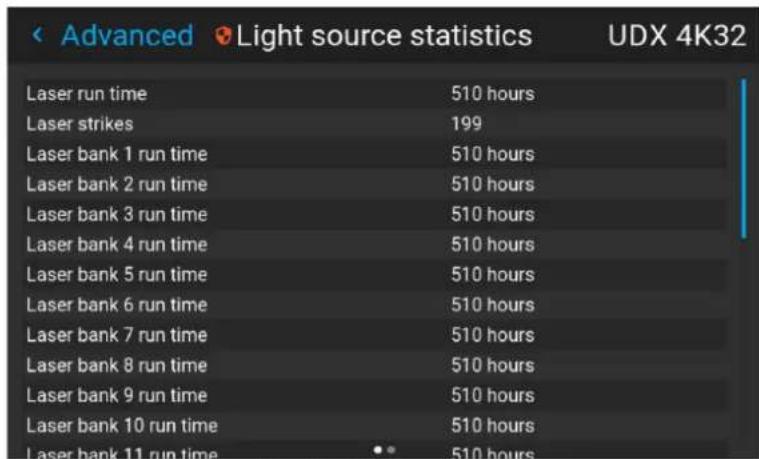
Image 11–13 Example of the Statistics menu
11.5 Checking the status of the Laser Banks
About failing laser banks
The projector is powered by a laser light source, which has multiple laser banks. The light output and color performance is dependant on the number of active laser banks.
If one or more laser banks have failed of a certain type, you will notice a decreased light input and decrease i color performance. But the projector will keep on playing, unless too many banks of a certain color will have failed.

In order to disable a certain laser bank, or calibrate the projector after disabling one or more laser banks, please refer to the Projector Toolset User Manual.
How to check the status of the Laser Banks
- In the main menu, navigate to Settings → Maintenance → Advanced, while you are logged in.
Image 11–14 Maintenance menu, Advanced
- Enter the service code.
- In the Service menu, select Laser Banks.
Image 11–15 Advanced menu, Laser banks
The Laser group statistics menu is displayed.
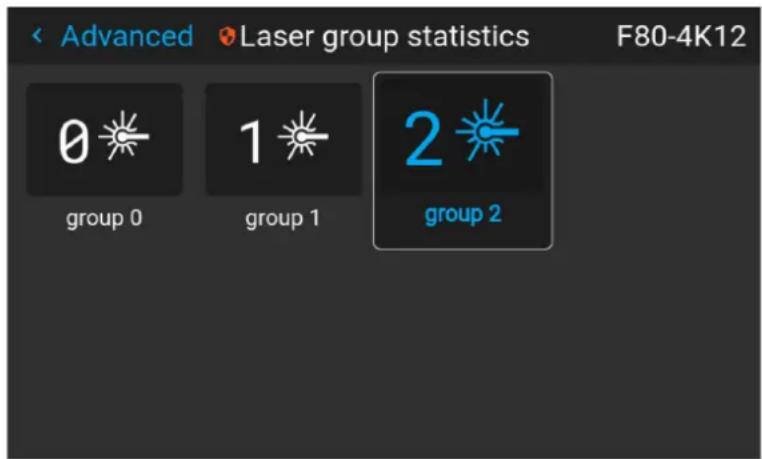
Image 11–16 Example of the Laser group statistics menu
- Select the desired laser group.
- In the laser banks group page, you can see which laser banks are part of this specific group. You can also see which laser banks are operational and which have failed.
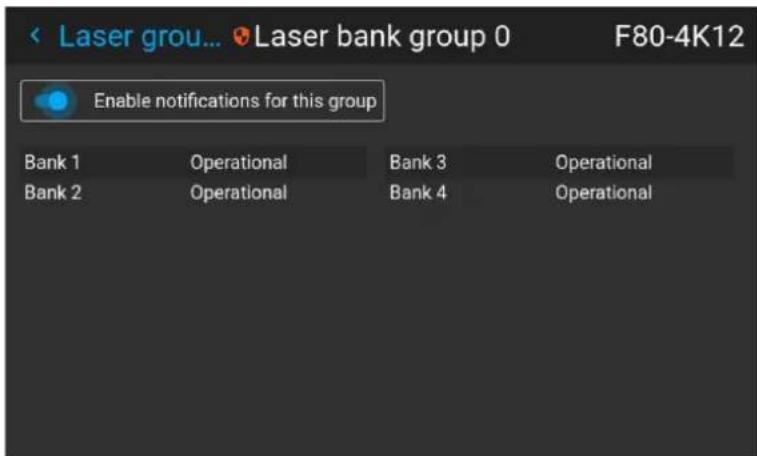
Image 11–17 Example of the laser bank group menu
- If you want notifications to be disabled for a specific group of laser banks, disable the Enable notifications for this group slider.
11.6 Advanced settings - Tilt sensor calibration

CAUTION: The calibration procedure resets the values of the tilt sensor to 0 in the current position of the projector. For the optimal working of the tilt sensor it is important to make sure the projector is perfectly level when performing this procedure. If not, the tilt sensor will not function as desired once the calibration has been completed.
Required tools
Level
How to calibrate the tilt sensor?
- Place the projector on a flat surface and make sure it is positioned level in all directions. Use a level tool to help ensure this.
- In the main menu, navigate to Settings → Maintenance → Advanced, while you are logged in.
Image 11–18 Maintenance menu, Advanced
- Enter the service code.
- In the Service menu, select Tilt sensor calibration.
Image 11–19 Advanced menu, Tilt sensor calibration
- Confirm your action.
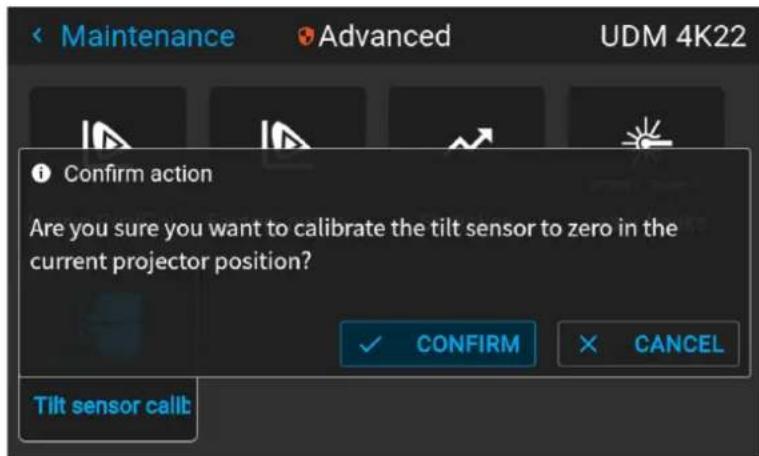
Image 11–20 Example of the Advanced menu with the Tilt sensor menu
The tilt sensor will be set to zero in the current position of the projector.
GUI - Status menu
12
12.1 Status menu overview.... 166

No settings can be modified in the status menu. Its only for consulting.
12.1 Status menu overview
How to access the status menu
While in the main menu, press Status.
Image 12-1 Main menu, status
The status menu is displayed.

Image 12-2 Example of the first page of the status menu
Swipe the screen left of right to swap between the Status pages.
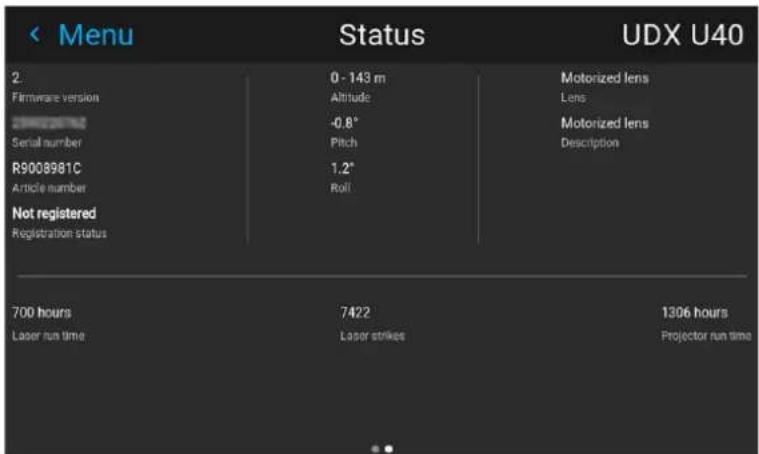
Image 12-3 Example of the second page of the Status menu
What can be seen on the Status page?
- Connected source and signal details
- Display settings (e.g. display mode, transport delay, output resolution, etc)
- Projector power and environmental details (e.g. power, temperature, pressure, etc)
• Network status (e.g. host name, IP address, software version)
• Active function icons (e.g. warp, blend, files, etc). Active functions are highlighted, while inactive functions are muted.
What can be seen on the About page?
- Projector information, e.g. firmware version, serial number, projector article number and registration status (only if applicable for your device)
- Mounted lens: Lens type and Lens description (if available).
- Installation information: Altitude, pitch angle, roll angle, distance (only if applicable for your device)
- Basic statistics, Light source run time, light source strikes, projector runtime.
Product maintenance
13
13.1 Software update 170
13.2 Cleaning the lens.... 171
13.3 Cleaning the exterior of the projector....172
13.4 Cleaning / replace the air filters 172
About this chapter
This chapter contains general maintenance procedures.
13.1 Software update

CAUTION: Do not power off or unplug the projector while the software update is ongoing.
How to update the software
- Power on the projector. Wait until the Power on/off button is lit white or blue.
- Download and install the latest version of Projector Toolset for Pulse. The program can be downloaded for free from Barco's website, (URL: http://www.barco.com). Click on myBarco and log in to get access to secured information. Registration is necessary.
If you are not yet registered, click on New to myBarco and follow the instructions. With the created login and password, it is possible to log in where you can download the software. - Download the latest firmware (format .fw) from Barco's website in the same way as for Projector Toolset.
- Start Projector Toolset and make a connection with the projector. For more information, see the "Projector Toolset" user guide.
- Select tab Update settings.
- Fill out the path to the update file (1)

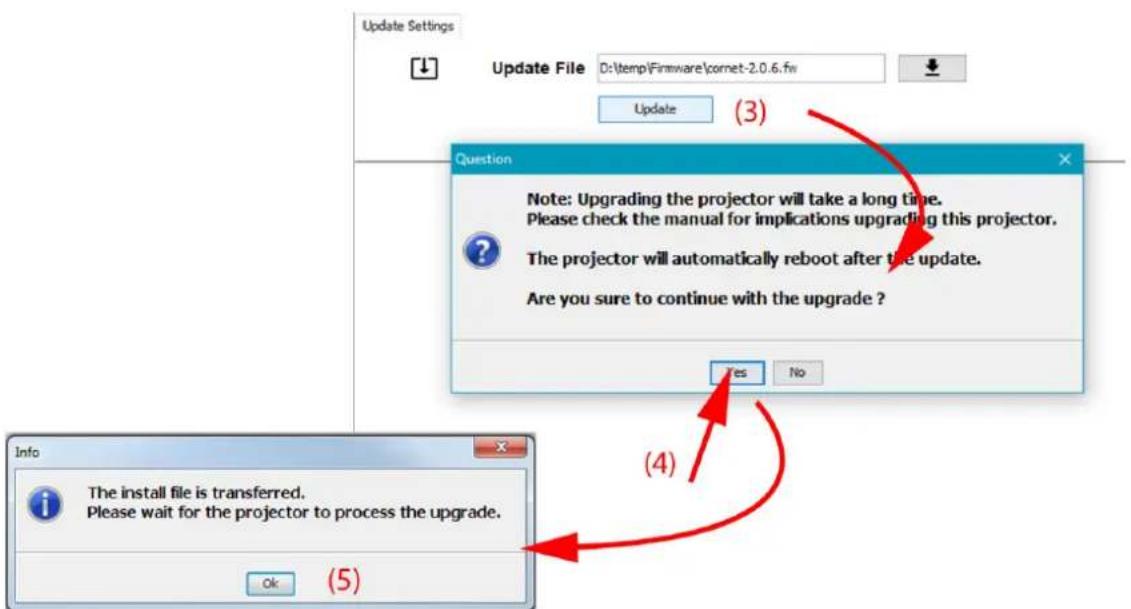
Image 13-1 Update Pulse projector
or
click on the path selection icon (2) to open a browser window.
- Browse to the desired update package (format .fw) and click Select Update Package.
The path will be filled out in the input field next to Update File.
- Click Update (3).
The update starts. This action can take a long time. A message is displayed.
- Click Yes to continue (4).
The update file will be transferred to the projector and installed. The projector will reboot.
A message is displayed. Click Ok to clear the message.
How to update the software if the projector isn't connected to the network
-
Power on the projector. Wait until the Power on/off button is either lit white or blue.
-
Download the latest firmware file ( format .fw) from Barco's website. The firmware can be downloaded for free from Barco's website, (URL: http://www.barco.com). Click on myBarco and log in to get access to secured information. Registration is necessary.
If you are not yet registered, click on New to myBarco and follow the instructions. With the created login and password, it is possible to log in where you can download the software.
- Place the firmware file on a clean USB flash drive.

Note: Make sure the flash drive is FAT32 compatible & no other files are on the flash drive.
- Plug the flash drive in the USB port on the Communication Panel.
The update file will be transferred to the projector and installed. The projector will reboot when completed.

CAUTION: While it is technically possible to "downgrade" the software to an older version using this method, it is NOT recommended and should be avoided as much as possible. Certain features will no longer be supported, projectors can display unwanted behavior during the downgrade and in some rare cases, this may even bring damage to the device. Always contact Barco if you want to make sure a downgrade will not hurt your device.

Take note that the update process can take a long time to complete.

For more info about the Projector Toolset see user guide of the Projector Toolset.
13.2 Cleaning the lens

To minimize the possibility of damage to optical coatings, or scratches to lens surfaces follow the cleaning procedure as described here precisely.
Required tools
- Compressed air
- Clean micro fiber lens cleaning cloth (e.g. Toraysee® cloth(s))
- Clean cotton cloth
- Lens cleaner (e.g. ZEISS lens cleaner, Purosol™ or other water based lens cleaner products)
How to clean the lens?
- Blow off dust with clean compressed air (or pressurized air) cans
- Clean with lens cleaner together with a clean lens cleaning cloth to remove the dust and contamination. Use big wipes in one single direction.

Warning: Do not wipe back and forwards across the lens surface as this tends to grind dirt into the coating.
-
Use a dry lens cleaning cloth to remove left liquid or stripes. Polish with small circles.
-
If there are still fingerprints on the surface, wipe them off with lens cleaner together with a clean lens cleaning cloth. Polish again with a dry one.

If smears occur when cleaning lenses, replace the cloth. Smears are the first indication of a dirty cloth.
13.3 Cleaning the exterior of the projector
How to clean the exterior of the projector?
- Switch off the projector and unplug the projector from the mains power net.
- Clean the housing of the projector with a damp cloth. Stubborn stains may be removed with a cloth lightly dampened with a mild detergent solution.
13.4 Cleaning / replace the air filters
About the air filters
There are three air filters in the projector; at the front, at the top and on the right side of the projector. It is not regular interval for cleaning or replace the filters, but they must be inspected regularly to avoid clogging, and by that also a possibility of increased temperature internally in the projector.
Cleaning of the filters
The top-, and side filter can be rinsed with lukewarm water and dried.
The filter in the front can be vacuum cleaned.
About the cover locks
All the covers are fastened to the projector by “easylock” tabs. The procedure below shows the technique for releasing and locking of the tabs.
Required tools
Flat screwdriver 5mm
Unlocking the covers
- Push down the inner side of the easylock with a screwdriver.

natural_image
Diagram showing a screwdriver being inserted into a red package, with no text or symbols present.Image 13-2
As a result the lock jumps loose.
Locking the covers
- Ensure that the cover is in the correct position.
- Press the easylock into the housing.
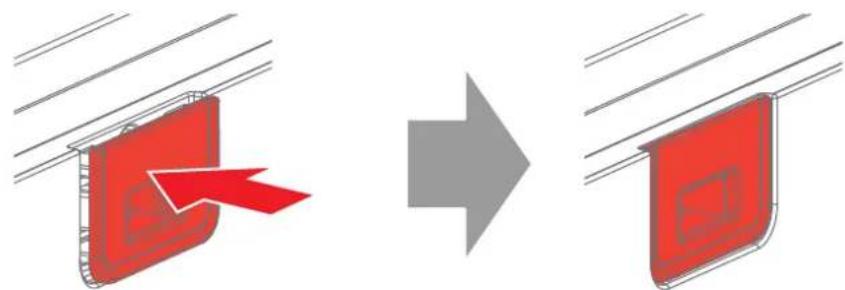
natural_image
Diagram showing a red object being shifted from a blue arrow into a gray arrow, with no text or symbols present.Image 13-3

If the top cover do not have "easylocks" for the filter cover (older UDM models), the filter must be serviced by authorized Barco personnel.
The filter also can be vacuum cleaned from the outside, with less cleaning efficiency.
Removing the top filter
- Unlock the "easylock", and flip the filter cover up.
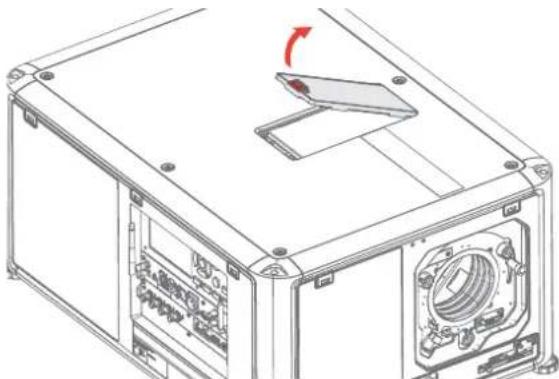
natural_image
Technical line drawing of a mechanical device with internal components and a red arrow indicating rotation (no text or symbols)Image 13-4
- Remove the filter from the projector.
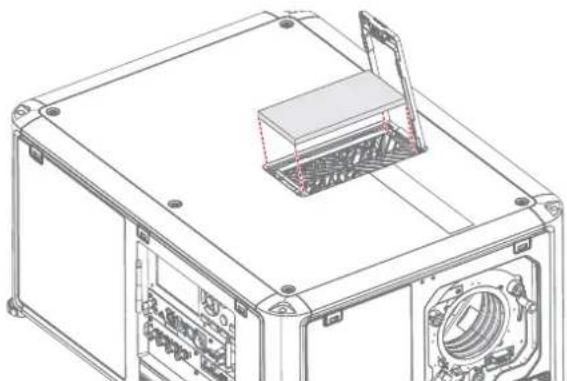
natural_image
Technical line drawing of a mechanical device with internal components and mounting holes (no text or symbols)Image 13-5
- Clean the filter with lukewarm water, and let it dry.
- Insert the filter, and close and lock the filter cover.
Removing the right side filter
- Unlock the "easylocks", and remove the right side cover.
Product maintenance
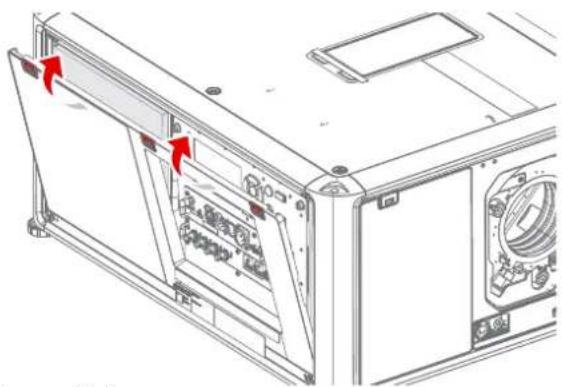
natural_image
Technical line drawing of a computer case with ventilation grilles and door (no text or symbols)Image 13-6
- Remove the filter from the projector.
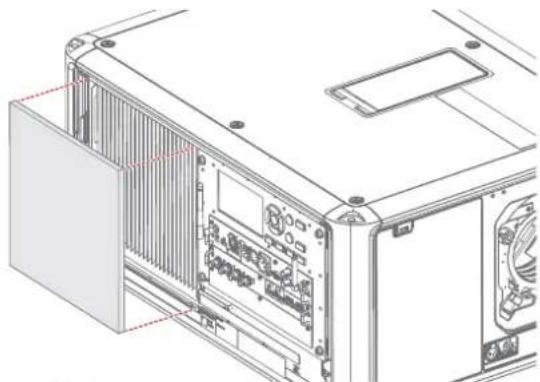
natural_image
Technical line drawing of a computer tower rear panel with visible internal components and ventilation slots (no text or labels)Image 13-7
-
Clean the filter with lukewarm water, and let dry.
-
Reinstall the filter in to the correct position.
-
Reinstall the side cover in the correct position, and press the "easylock"s

Note: Ensure that the cover is in correct position, and correctly locked to the projector.
Removing the front filter
- Unlock the "easylocks", and remove the front cover.
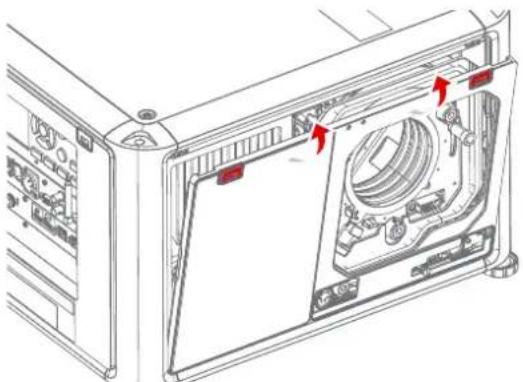
natural_image
Technical line drawing of a computer case with labeled components and red arrows indicating parts (no text or symbols present)Image 13-8
- Remove the filter from the front cover.
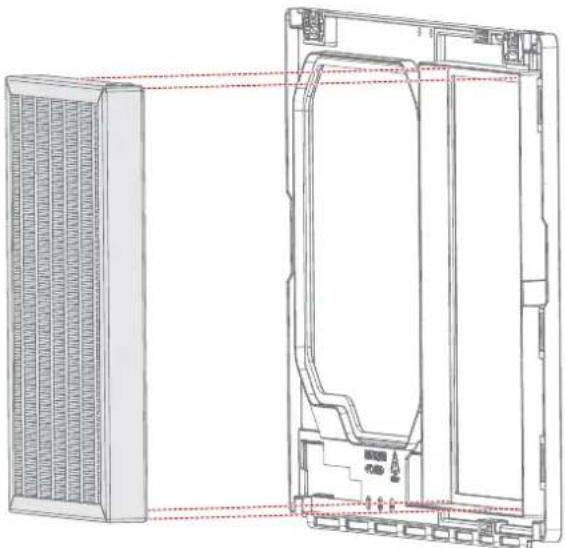
natural_image
Technical line drawing of a front panel with internal components and ventilation grilles (no text or symbols)Image 13–9
- Vacuum clean the filter.
- Reinstall the filter in the front cover.
- Reinstall the front cover in the correct position, and press the "easylock"s

Note: Ensure that the cover is in correct position, and correctly locked to the projector.
Specifications
A
A.1 Specifications SDI inputs.... 178
A.2 Specifications HDMI inputs.... 178
A.3 Specifications HDBaseT inputs 179
A.4 Specifications DisplayPort 1.2 inputs....180
A.5 Specifications SFP inputs....181
About this chapter
This chapter gives an overview of the projector specifications
A.1 Specifications SDI inputs

For readability, the video timings listed are summarized. For the full list of video timings, refer to the appendices.

HD-SDI follows the SMPTE 292M standard. 3G SDI follows the SMPTE 425M standard Level A. 12G-SDI ^7 follows the SMPTE ST-2082-1 and ST-2082-10 standards.
SDI specifications
| Specification | Value | ||
| Color space YCbCr | |||
| Color depth 10 bpc | |||
| Chroma sampling 4:2:2 | |||
| Audio not supported | |||
| For future release | • 3D support• Interlaced support• Segmented frame support | ||
| Video timings progressive8 | Type Port type Format | ||
| HD-SDI Single link | Quad link | • Up to 1920 x 1080 @24 Hz• Up to 1920 x 1080 @25 Hz• Up to 1920 x 1080 @30 Hz• Up to 1280 x 720 @50 Hz• Up to 1280 x 720 @60 Hz | |
| 3G-SDI Level A | Single linkQuad link | Up to 2048 x 1080 @50 HzUp to 2048 x 1080 @60 Hz | |
| 3G-SDI “BarcoLink” | Single linkQuad link | 1920 x 1200 @50 Hz, @59.94 Hz and @60 Hz | |
| 12G-SDI (Channel A only) | Single link 3840 x | 2160 @50 Hz and @60 Hz4096 x 2160 @50 Hz and @60 Hz | |
| 12G-SDI “BarcoLink 4k” (Channel A only) | Single link 3840 x | 2400 @50 Hz, @59.94 Hz and @60 Hz. | |
A.2 Specifications HDMI inputs

For readability, the video timings listed are summarized. For the full list of video timings, refer to the appendices.
HDMI specifications
| Specification | Value |
| Pixel rate 25 – 600 | MHz pixel clock |
| HDCP support | • HDCP 1.x |
| HDCP 2.2RGB 4:4:4 | |
| Color space | YCbCr 4:2:0YCbCr 4:2:2YCbCr 4:4:4RGB 4:4:4 |
| Color depth | 24 bpp30 bpp36 bpp |
| 3D support | Field sequential 3D (Active 3D)- Frame-packed- Top Bottom progressive- Side-by-side progressivePassive 3D not supported. |
| For future release | Interlaced support |
| Audio Not supported | |
| Video timings | Up to 4096 x 2160 @24 HzUp to 4096 x 2160 @25 HzUp to 4096 x 2160 @30 HzUp to 2048 x 1080 @48 HzUp to 4096 x 2160 @50 HzUp to 4096 x 2160 @60 Hz |
| Native video timings | UDM-W: 1920 x 1200 @60 HzUDM-4K: 3840 x 2400 @60 Hz |
A.3 Specifications HDBaseT inputs

For readability, the video timings listed are summarized. For the full list of video timings, refer to the appendices.
HDBase T specifications
| Specification Value | ||
| Pixel rate 25 – 297 | MHz pixel clock | |
| Color space | • YCbCr 4:2:2• YCbCr 4:4:4• RGB 4:4:4 | |
| Color depth | • 24 bpp• 30 bpp• 36 bpp | |
| HDCP support HDCP | 1.x supported on HDBaseT Input 1 | |
| Network support Yes, on HDBaseT Input 1 | ||
| For future release | • 3D support• Interlaced support | |
| Not supported | • Audio• Power over HDBaseT | |
| Video timings progressive^8 | Layout mode Supported formats | |
| Standard layout (1x1 layout) | ·Up to 4096 x 2160 @24 Hz·Up to 4096 x 2160 @25 Hz·Up to 4096 x 2160 @30 Hz·Up to 2048 x 1080 @48 Hz·Up to 2560 x 1600 @50 Hz·Up to 2560 x 1600 @60 Hz | |
| 2 Column mode (2x1 layout) | ·1920 x 2160 @50 Hz·1920 x 2160 @60 Hz·2048 x 2160 @50 Hz·2048 x 2400 @60 Hz | |
| Native video timings. UDM-W: 1920 x 1200 @60 Hz·UDM-4K: 3840 x 2160 @60 Hz | ||

CAUTION: The HDBaseT inputs can bridge a distance of 100 m but are sensitive to radiated electromagnetic interference: radiated electromagnetic interference (e.g. from GSM or switching inductive or capacitive loads) within the limits of electromagnetic compatibility requirements of 3 V/m can cause random flashes or temporary loss of the projected image.
As such, shielded CAT-6 cables with metal RJ-45 connectors are recommended; choose cable length no longer than required and route HDBT cable optimally screened from possible sources of electromagnetic emission.
A.4 Specifications DisplayPort 1.2 inputs

For readability, the video timings listed are summarized. For the full list of video timings, refer to the appendices.
DisplayPort 1.2 specifications
| Pixel rate Up to 60D MHz pixel clock | |||
| Color space | · YCbCr 4:2:2· YCbCr 4:4:4· RGB 4:4:4 | ||
| Color depth | · 24 bpp· 30 bpp· 36 bpp | ||
| Data rate support | · 1.62 Gbps: Reduced Bit Rate (RBR)· 2.7 Gbps: High Bit Rate (HBR)· 5.4 Gbps: High Bit Rate 2 (HBR2) | ||
| For future release | · Interlaced support· HDCP 1.4 | ||
| Audio not supported | |||
| 3D support | · Field sequential 3D (Active 3D)· Passive stereoscopic 3D (Passive stereo) converted to active 3D | ||
| Video timings progressive ^10 | 2D / 3D | Layout Modé ^1 | Supported formats |
| 2D Standard layout (1x1 layout) | • Up to 4096 x 2160 @24 Hz• Up to 4096 x 2160 @30 Hz• Up to 2048 x 1080 @48 Hz• Up to 4096 x 2160 @50 Hz• Up to 4096 x 2160 @60 Hz• Up to 2560 x 1600 @120 Hz | |
| 2D 2 column mode (2x1 layout) | • 1920 x 2160 @60 Hz• 1920 x 2160 @120 Hz• 1920 x 2400 @60 Hz• 2048 x 2160 @60 Hz• 2048 x 2160 @120 Hz | |
| 2D 4 quadrant mode (2x2 layout) | • 960 x 1080 @120 Hz• 960 x 1200 @120 Hz• 1280 x 1080 @60 Hz• 1280 x 1080 @120 Hz• 1280 x 1600 @60 Hz• 1280 x 1600 @120 Hz• 1920 x 1080 @120 Hz• 1920 x 1200 @120 Hz• 2048 x 1080 @120 Hz | |
| 2D 4 column mode (4x1 layout) | • 960 x 2160 @120 Hz• 960 x 2400 @120 Hz• 1024 x 2160 @60 Hz | |
| Active 3D Standard layout (1x1 layout) | • 1600 x 1200 @120 Hz• 2560 x 1080 @120 Hz• 2560 x 1600 @120 Hz | |
| Active 3D 2 column mode (2x1 layout) | 1920 x 2160 @120 Hz | |
| Active 3D 4 quadrant mode (2x2 layout) | • 1920 x 1080 @120 Hz• 1920 x 1200 @120 Hz• 2048 x 1080 @120 Hz | |
| Active 3D 4 column mode (4x1 layout) | • 960 x 2160 @120 Hz• 960 x 2400 @120 Hz• 1024 x 2160 @120 Hz | |
| Passive stereo Standard layout (1x1 layout) | 3840 x 2160 @60 Hz | |
| Passive stereo 2 column mode (2x1 layout) | 1920 x 2160 @60 Hz | |
| Native video timings UDM-W: 1920 x 1200 @60 Hz• UDM-4K: 3840 x 2400 @60 Hz | ||

CAUTION: In order to display high resolution images (e.g.: 3840 x 2160 @60 Hz) via the DP1.2 input, the quality of the cable must be adequate, in addition the length of the cable can also influence the performance. In case there is an issue with one of these criteria the automatic link-training initiated by the DP-standard may decide to switch to a lower resolution.
A.5 Specifications SFP inputs

For readability, the video timings listed are summarized. For the full list of video timings, refer to the appendices.
SFP specifications
| Color space YCbCr | |||
| Color depth 10 bpc | |||
| Chroma sampling 4:2:2 | |||
| Audio support not supported | |||
| Video timings progressive ^12 | Type Port type Format | ||
| HD-SDI Single link | • Up to 1920 x 1080 @24 Hz• Up to 1920 x 1080 @25 Hz• Up to 1920 x 1080 @30 Hz• Up to 1280 x 720 @50 Hz• Up to 1280 x 720 @60 Hz• Up to 1280 x 720 @24 Hz• Up to 1280 x 720 @30 Hz• Up to 1280 x 720 @25 Hz | ||
| 3G-SDI Single link | 1920 x 1080 @50 | Hz and @60 Hz1920 x 1200 @50 Hz, @59.94 Hz and @60 Hz.2048 x 1080 @50 Hz and @60 Hz | |
| 12G-SDI Single link | 3840 x 2160 @50 | Hz and @60 Hz4096 x 2160 @50 Hz and @60 Hz3840 x 2400 @50 Hz, @59.94 and @60 Hz | |
Video timing tables
B
B.1 Overview video timings 184
B.2 Overview video timings SDI Inputs 185
B.3 Overview video timings HDMI 2.0 inputs....186
B.4 Overview video timings DisplayPort 1.2 inputs 188
B.5 Overview video timings HDBaseT inputs 190
About this chapter
This chapter contains the tables with video timings for video interfaces.
B.1 Overview video timings
List of compatible signals
The following table specifies the video signals that the projector can project. Barco Events projectors supports the signal with "X" in the Compatible signals column.
Note: Support for refresh rates 24.00, 30.00, 60.00 Hz automatically includes support of 1/1.001 x those refresh rates.
| Resolution | Vertical refresh rate (Hz) | Compatible signal | ||||
| HDMI 2.0 Inputs | 12G SDI Input on Mk II Input board & Fiber Network Inputs | 3G SDI Inputs | DisplayPort 1.2 Inputs | HDBaseT & HDMI 1.4 Inputs | ||
| 640 x 480 | 60 X — — X | X | ||||
| 720 x 480 | 60 X — — — | X | ||||
| 720 x 576 | 50 X — — — | X | ||||
| 800 x 600 | 60 X — — X | X | ||||
| 1024 x 768 | 60 X — — X | X | ||||
| 1280 x 720 | 24 — X X — | — | ||||
| 1280 x 720 | 25 — X X — | — | ||||
| 1280 x 720 | 30 — X X — | — | ||||
| 1280 x 720 | 50 X X X X | X | ||||
| 1280 x 720 | 60 X X X X | X | ||||
| 1280 x 800 | 60 X — — X | X | ||||
| 1280 x 960 | 60 X — — X | X | ||||
| 1280 x 1024 | 60 X — — | X X | ||||
| 1400 x 1050 | 60 X — — | X X | ||||
| 1600 x 1200 | 60 X — — | X X | ||||
| 1600 x 1200 | 120 — — — | X — | ||||
| 1920 x 1080 | 24 X X X X | X | ||||
| 1920 x 1080 | 25 X X X — | X | ||||
| 1920 x 1080 | 30 X X X — | X | ||||
| 1920 x 1080 | 50 X X X X | X | ||||
| 1920 x 1080 | 60 X X X X | X | ||||
| 1920 x 1080 | 120 — — — | X — | ||||
| 1920 x 1200 | 50 X X X X | X | ||||
| 1920 x 1200 | 60 X X X X | X | ||||
| 1920 x 1200 | 120 — — — | X — | ||||
| 2048 x 1080 | 24 X — — | X X | ||||
| 2048 x 1080 | 25 X — — | X X | ||||
| 2048 x 1080 | 30 X — — | X X | ||||
| 2048 x 1080 | 48 X — — | X X | ||||
| 2048 x 1080 | 50 X X X X | X | ||||
| 2048 x 1080 | 60 X X X X | X | ||||
| 2048 x 1080 | 120 — — — | X — | ||||
| 2560 x 1600 | 50 X — — | X X | ||||
| 2560 x 1600 | 60 X — — | X X | ||||
| 2560 x 1600 | 120 — — — | X — | ||||
| 3840 x 2160 | 24 X — — | X X | ||||
| 3840 x 2160 | 25 X — — | X X | ||||
| 3840 x 2160 | 30 X — — | X X | ||||
| 3840 x 2160 | 50 X X — | X — | ||||
| 3840 x 2160 | 60 X X — | X — | ||||
| 3840 x 2400 | 50 X — — | X — | ||||
| 3840 x 2400 | 60 X — — | X — | ||||
| 4096 x 2160 | 24 X — — | X X | ||||
| 4096 x 2160 | 25 X — — | X X | ||||
| 4096 x 2160 | 30 X — — | X X | ||||
| 4096 x 2160 | 50 X X — | X — | ||||
| 4096 x 2160 | 60 X X — | X — | ||||
B.2 Overview video timings SDI Inputs
Overview
The following standard video formats are available for the projector.
| Video timing(active pixels x active lines) | Vertical refresh rate (Hz) ^13 | Type Port Type |
| 1280 x 720 24 HD-SDI Single Link & Quad Link | ||
| 1280 x 720 25 HD-SDI Single Link & Quad Link | ||
| 1280 x 720 30 HD-SDI Single Link & Quad Link | ||
| 1280 x 720 50 HD-SDI Single Link & Quad Link |
| Video timing(active pixels x active lines) | Vertical refresh rate (Hz) ^14 | Type Port Type | |
| 1280 x 720 60 HD-SDI Single Link & Quad Link | |||
| 1920 x 1080 24 HD-SDI Single Link & Quad Link | |||
| 1920 x 1080 25 HD-SDI Single Link & Quad Link | |||
| 1920 x 1080 30 HD-SDI Single Link & Quad Link | |||
| 1920 x 1080 50 3G-SDI Single Link & Quad Link | |||
| 1920 x 1080 60 3G-SDI Single Link & Quad Link | |||
| 1920 x 1200 50 3G-SDI “BarcoLink” Single | Link & Quad Link | ||
| 1920 x 1200 59.94 3G-SDI “BarcoLink” Single Link & Quad Link | |||
| 1920 x 1200 60 3G-SDI “BarcoLink” Single | Link & Quad Link | ||
| 2048 x 1080 50 3G-SDI Single Link & Quad Link | |||
| 2048 x 1080 60 3G-SDI Single Link & Quad Link | |||
| 3840 x 2160 50 12G-SDI | ^15 | Single Link | |
| 3840 x 2160 60 12G-SDI | ^15 | Single Link | |
| 3840 x 2400 50 12G-SDI “BarcoLink ^4k ” ^15 | Single Link | ||
| 3840 x 2400 59.94 12G-SDI “BarcoLink ^4k ” ^15 | Single Link | ||
| 3840 x 2400 60 12G-SDI “BarcoLink ^4k ” ^15 | Single Link | ||
| 4096 x 2160 50 12G-SDI | ^15 | Single Link | |
| 4096 x 2160 60 12G-SDI | ^15 | Single Link | |
B.3 Overview video timings HDMI 2.0 inputs
Overview
The following standard video formats are available for the projector.
Note: support for refresh rates 24.00, 30.00, 60.00 Hz automatically includes support of 1/1.001 x those refresh rates
| Video timing(active pixels x active lines) | Vertical refresh rate (Hz) | 3D support? |
| 640 x 480 | 60 | |
| 720 x 480 | 60 | |
| 720 x576 | 50 | |
| 800 x 600 | 60 | |
| 1024x 768 60 | ||
| 1280 x720 50 Frame | packing | Top - bottom |
| 1280 x 720 60 Frame | packing | Top - bottom |
| 1280 x 800 60 | ||
| 1280 x 960 60 | ||
| 1280 x1024 60 | ||
| 1400 x 1050 60 | ||
| 1600 x 1200 60 | ||
| 1920 x 1080 24 Frame | packing | Top - bottom |
| 1920 x 1080 25 | ||
| 1920 x 1080 30 | ||
| 1920 x 1080 50 Side | by Side (SbS) progressive | |
| 1920 x 1080 60 Side | by Side (SbS) progressive | |
| 1920 x 1200 50 | ||
| 1920 x 1200 60 | ||
| 2048 x 1080 24 | ||
| 2048 x 1080 25 | ||
| 2048 x 1080 30 | ||
| 2048 x 1080 48 | ||
| 2048 x 1080 50 | ||
| 2048 x 1080 60 | ||
| 2560 x 1600 50 | ||
| 2560 x 1600 60 | ||
| 3840 x 2160 24 | ||
| 3840 x 2160 25 | ||
| 3840 x 2160 30 | ||
| 3840 x 2160 50 | ||
| 3840 x 2160 60 | ||
| 3840 x 2400 50 | ||
| 3840 x 2400 60 | ||
| 4096 x 2160 24 | ||
| 4096 x 2160 25 | ||
| 4096 x 2160 30 | ||
| 4096 x 2160 50 | ||
| 4096 x 2160 60 |
B.4 Overview video timings DisplayPort 1.2 inputs
Overview
The following standard video formats are available for the projector.
Note: support for refresh rates 24.00, 30.00, 60.00 Hz automatically includes support of 1/1.001 x those refresh rates
| Video timing(active pixels x active lines) | Vertical refresh rate (Hz) | Available layout modes,other than standardlayout (1 x 1 layout) | Support for 3D? |
| 640 x 480 60 | |||
| 800 x 600 60 | |||
| 960 x 1080 120 | 4 Quadrant mode (2 x 2 layout) | layout) | Active 3D |
| 960 x 1200 120 | 4 Quadrant mode (2 x 2 layout) | layout) | Active 3D |
| 960 x 2160 120 | 4 Column mode (4 x 1 layout) | layout) | Active 3D |
| 960 x 2400 120 | 4 Column mode (4 x 1 layout) | layout) | Active 3D |
| 1024x 768 60 | |||
| 1024 x 2160 60 | 4 Column mode (4 x 1 layout) | layout) | |
| 1024 x 2160 120 | 4 Column mode (4 x 1 layout) | layout) | Active 3D |
| 1280 x720 50 | |||
| 1280 x 720 60 | |||
| 1280 x 800 60 | |||
| 1280 x 960 60 | |||
| 1280 x1024 | 60 | ||
| 1280 x 1080 60 | 4 Quadrant | mode (2 x 2 layout) | |
| 1280 x 1080 120 | 4 Quadrant mode (2 x 2 layout) | layout) | Active 3D |
| 1280 x 1600 60 | 4 Quadrant | mode (2 x 2 layout) | |
| 1280 x 1600 120 | 4 Quadrant mode (2 x layout) | Active 3D | |
| 1400 x 1050 60 | |||
| 1600 x 1200 60 | |||
| 1600 x 1200 120 | Active 3D | ||
| 1920 x 1080 50 | |||
| 1920 x 1080 60 | |||
| 1920 x 1080 120 | 4 Quadrant mode (2 x layout) | Active 3D | |
| 1920 x 1200 50 | |||
| 1920 x 1200 60 | |||
| 1920 x 1200 120 | 4 Quadrant mode (2 x layout) | Active 3D | |
| 1920 x 2160 60 2 | Column mode (2 x 1 layout) | Passive stereo | |
| 1920 x 2160 120 | 2 Column mode (2 x 1 layout) | Active 3D | |
| 1920 x 2400 60 2 | Column mode (2 x 1 layout) | ||
| 2048 x 1080 24 | |||
| 2048 x 1080 25 | |||
| 2048 x 1080 30 | |||
| 2048 x 1080 48 | |||
| 2048 x 1080 50 | |||
| 2048 x 1080 60 | |||
| 2048 x 1080 120 | 4 Quadrant mode (2 x layout) | Active 3D | |
| 2048 x 2160 60 2 | Column mode (2 x 1 layout) | ||
| 2048 x 2160 120 | 2 Column mode (2 x 1 layout) | Active 3D | |
| 2560 x 1080 120 | Active 3D | ||
| 2560 x 1440 120 | Active 3D | ||
| 2560 x 1600 50 | |||
| 2560 x 1600 60 | |||
| 2560 x 1600 120 | |||
| 3840 x 2160 24 | |||
| 3840 x 2160 25 | |||
| 3840 x 2160 30 | |||
| 3840 x 2160 50 | |||
| 3840 x 2160 60 Passive Stereo | |||
| 3840 x 2400 50 | |||
| 3840 x 2400 60 | |||
| 4096 x 2160 24 | |||
| 4096 x 2160 25 | |||
| 4096 x 2160 30 | |||
| 4096 x 2160 50 | |||
| 4096 x 2160 60 |
B.5 Overview video timings HDBaseT inputs
Overview
The following standard video formats are available for the projector.
Note: support for refresh rates 24.00, 30.00, 60.00 Hz automatically includes support of 1/1.001 x those refresh rates.
| Video timing(active pixels x active lines) | Vertical refresh rate (Hz) |
| 640 x 480 60 | |
| 720 x 480 60 | |
| 720 x576 50 | |
| 800 x 600 60 | |
| 1024x 768 60 | |
| 1280 x720 50 | |
| 1280 x 720 60 | |
| 1280 x 800 60 | |
| 1280 x 960 60 | |
| 1280 x1024 60 | |
| 1400 x 1050 60 | |
| 1600 x 1200 60 | |
| 1920 x 1080 24 | |
| 1920 x 1080 25 | |
| 1920 x 1080 30 | |
| 1920 x 1080 50 | |
| 1920 x 1080 60 | |
| 1920 x 1200 50 | |
| 1920 x 1200 60 | |
| 1920 x 2160 50 | |
| 1920 x 2160 60 | |
| 2048 x 1080 24 | |
| 2048 x 1080 25 | |
| 2048 x 1080 30 | |
| 2048 x 1080 48 | |
| 2048 x 1080 50 | |
| 2048 x 1080 60 | |
| 2048 x 2160 50 | |
| 2048 x 2160 60 | |
| 2560 x 1600 50 | |
| 2560 x 1600 60 | |
| 3840 x 2160 24 | |
| 3840 x 2160 25 | |
| 3840 x 2160 30 | |
| 4096 x 2160 24 | |
| 4096 x 2160 25 | |
| 4096 x 2160 30 |
DMX chart
C
C.1 DMX chart input board positioning 194
C.2 DMX chart, Basic....194
C.3 DMX chart, Extended 195
C.1 DMX chart input board positioning
About the input boards
6 Input selection ranges are reserved in the DMX chart per input board location (named L1 and L2). With the current version of DMX support, it is important to take into account to keep the input boards in their original slots.

Image C-1
1 Slot L1, here filled with the Quad combo Input board
2 Slot L2, here filled with the Quad DP 1.2 Input board
C.2 DMX chart, Basic
Overview
| Ch. | Function Value | Default Action | ||
| 1 | Shutter + Intensity 0 | -7 255 Close shutter | ||
| 8 - 255 | Adjust intensity | |||
| 2 | Function select | 0 - 7 | 0 No function | |
| 8 - 15 | Activate first profile preset (If held for 1 second) | |||
| 16 - 23 | Activate second profile preset (If held for 1 second) | |||
| 24 - 31 | Activate third profile preset (If held for 1 second) | |||
| 32 - 39 | Activate fourth profile preset (If held for 1 second) | |||
| 40 - 47 | Activate fifth profile preset (If held for 1 second) | |||
| 48 - 55 | Activate sixth profile preset (If held for 1 second) | |||
| 56 - 63 | Activate seventh profile preset (If held for 1 second) | |||
| 64 - 71 | Activate eighth profile preset (If held for 1 second) | |||
| 72 - 79 | Activate ninth profile preset (If held for 1 second) | |||
| 80 - 87 | Activate tenth profile preset (If held for 1 second) | |||
| 88 - 95 | Select input 1: HDMI Input (If held for 1 second) | |||
| 96 - 103 | Select input 2: DisplayPort Input (If held for 1 second) | |||
| 104 - 111 | Select input 3: SDI Input A (If held for 1 second) | |||
| 112 - 119 | Select input 4: SDI Input B (If held for 1 second) | |||
| 120 - 127 | Select input 5: HDBaseT Input 1 (if held for 1 second) | |||
| 128 - 135 | Select input 6: Quad SDI input (if held for 1 second) | |||
| 136 - 143 | Select input | 7: Quad DP board Input A (if held for 1 second) ^20 | ||
| 144 - 151 | Select input | 8: Quad DP board Input B (if held for 1 second) ^20 | ||
| 152 - 159 | Select input | 9: Quad DP board Input C (if held for 1 second) ^20 | ||
| 160 - 167 | Select input | 10: Quad DP board Input D (if held for 1 second) ^20 | ||
| 168 - 175 | Select input | 11: Quad DP board Inputs A-B (if held for 1 second) ^20 | ||
| 176 - 183 | Select input | 12: Quad DP board quad column mode (if held for 1 second) | ||
| 184 - 207 | Reserved for Power on / Power down Reserved for | future functionality | ||
| 208 - 115 | Light source on (If held for 5 seconds) | |||
| 216 - 223 | / Light source off (if held for 5 seconds) | |||
| 224 - 255 | future functionality |
C.3 DMX chart, Extended
Overview
| Ch. | Function Value | Default Actions | ||
| 1 | Shutter + Intensity 0 | -7 255 | Close shutter | Adjust intensity |
| 8 - 255 | ||||
| 2 | Brightness | 0 - 255 | 128 | Adjusts the brightness between 0 and 100% on input. |
| 3 | Contrast | 0 - 255 | 128 | Adjusts the contrast between 0 and 100% on input |
| 4 | Input selection | 0 - 7 | 0 No function | |
| 8 - 15 | ||||
| 16 - 23 | ||||
| 24 - 31 | ||||
| 32 - 39 | ||||
| 40 - 47 | ||||
| 48 - 55 | ||||
| 56 - 63 | ||||
| 64 - 71 | ||||
| 72 - 79 | ||||
| 80 - 87 | ||||
| 88 - 95 | ||||
| 96 - 103 | ||||
| 104 - 111 | ||||
| 112 - 119 | ||||
| 120 - 127 | Select input | Select input 3: SDI Input A (If held for 1 second) | ||
| Select input 4: SDI Input B (If held for 1 second) | ||||
| Select input 5: HDBaseT Input 1 (if held for 1 second) | ||||
| 128 - 135 | Select input | 6: Quad SDI input (if held for 1 second) ^19 | ||
| 136 - 143 | Select input | 7: Quad DP board Input A (if held for 1 second) ^20 | ||
| 144 - 151 | Select input | 8: Quad DP board Input B (if held for 1 second) ^20 | ||
| 152 - 159 | Select input | 9: Quad DP board Input C (if held for 1 second) ^20 | ||
| 160 - 167 | Select input | 10: Quad DP board Input D (if held for 1 second) ^20 | ||
| 168 - 175 | Select input | 11: Quad DP board Inputs A-B (if held for 1 second) ^20 | ||
| 176 - 183 | Select input | 12: Quad DP board quad column mode (if held for 1 second) | ||
| 184 - 255 | Reserved for | future functionality | ||
| 5 Focus (MSB) 0 - 255 | 128 Set coarse lens focus adjustment ^21 | |||
| 6 Focus (LSB) 0 - 255 | 128 Set fine lens focus adjustment ^21 | |||
| 7 Zoom (MSB) 0 - 255 | 128 Set coarse lens zoom adjustment ^21 | |||
| 8 Zoom (LSB) 0 - 255 | 128 Set fine lens zoom adjustment ^21 | |||
| 9 Lens shift vertical (MSB) | 0 - 255 | 128 Set coarse lens shift in vertical direction | ||
| 10 Lens shift vertical (LSB) | 0 - 255 | 128 Set fine lens shift in vertical direction | ||
| 11 Lens shift horizontal (MSB) | 0 - 255 | 128 Set coarse lens shift in horizontal direction | ||
| 12 Lens shift horizontal (LSB) | 0 - 255 | 128 Set fine lens shift in horizontal direction | ||
| 13 Light Source Power ^22 | 0 | 0 Set light source to 100% | ||
| 1 - 61 | ||||
| 64 | ||||
| 67 | ||||
| 70 | ||||
| 73 | ||||
| 76 | ||||
| 79 | ||||
| 80 - 87 | ||||
| 88- 95 | ||||
| 96 - 255 | ||||
| 14 Various | 0 - 7 | 0 | Reserved for future functionality | |
| 8 - 15 | Calibrate lens zoom & focus (if held for 5 seconds) | |||
| 16 - 23 | Calibrate lens horizontal and vertical shift (if held for 5 seconds) | |||
| 24 - 31 | Calibrate lensReserved for | (zoom, focus and shift) (if held for 5 seconds) | ||
| 32 - 255 | future functionality | |||
WiFi & GSM compliance information
D
D.1 Compliance FCC 200
D.2 Compliance IC....200
D.3 KCC Certification 201
About this chapter
This chapter contains important compliance information related to the WiFi and GSM module.

Regulatory information for US and Canada can be accessed in the OSD of the projector. In order to access it, select System Settings → Regulatory Information → Country.
D.1 Compliance FCC
Federal Communication Commission Interference Statement
You are cautioned that changes or modifications not expressly approved by the part responsible for compliance could void the user's authority to operate the equipment.
This equipment has been tested and found to comply with the limits for a Class A digital device, pursuant to Part 15 of the FCC rules. These limits are designed to provide reasonable protection against harmful interference in a residential installation. This equipment generates, uses and can radiate radio frequency energy and, if not installed and used in accordance with the instructions, may cause harmful interference to radio communications. However, there is no guarantee that interference will not occur in a particular installation.
If this equipment does cause harmful interference to radio or television reception, which can be determined by turning the equipment off and on, the user is encouraged to try to correct the interference by one or more of the following measures:
- Reorient or relocate the receiving antenna.
- Increase the separation between the equipment and receiver.
- Connect the equipment into an outlet on a circuit different from that to which the receiver is connected.
- Consult the dealer or an experienced radio/TV technician for help.
This device complies with Part 15 of the FCC Rules. Operation is subject to the following two conditions:
- This device may not cause harmful interference, and
- This device must accept any interference received, including interference that may cause undesired operation of the device.
FCC RF Radiation Exposure Statement:
- This Transmitter must not be co-located or operating in conjunction with any other antenna or transmitter.
- This equipment complies with RF radiation exposure limits set forth for an uncontrolled environment. This equipment should be installed and operated with a minimum distance of 20 cm between the radiator and your body.
D.2 Compliance IC
Radio Frequency (RF) exposure information
This equipment (IC 23575-R8767900X) complies with IC radiation exposure limits set forth for an uncontrolled environment.
This equipment should be installed and operated with a minimum distance of 20 centimeters between the radiator and your body.
Industry Canada statement
This device complies with Industry Canada's license-exempt RSSs
Operation is subject to the following two conditions:
- this device may not cause interference, and
- this device must accept any interference, including interference that may cause undesired operation of the device.
Operation in the band 5150-5250 MHz is only for indoor use to reduce the potential for harmful interference to co-channel mobile satellite systems. For the frequency 5600-5650 MHz, no operation is permitted".
Industry Canada class A emission compliance statement
This equipment has been tested and found to comply with the limits for a Class A digital device, pursuant to Canadian ICES-003.
These limits are designed to provide reasonable protection against harmful interference when the equipment is operated in a commercial environment. This equipment generates, uses, and can radiate radio frequency
energy and, if not installed and used in accordance with the instruction manual, may cause harmful interference to radio communications. Operation of this equipment in a residential area is likely to cause harmful interference in which case the user will be required to correct the interference at his own expense.
D.3 KCC Certification
KCC 인증

모듈 ID: KCC-CRM-TCS-HE910-D
제조연월: 2019.
Regulatory information
E
E.1 Product compliance 204
E.2 China RoHS compliance 205
E.3 Taiwan RoHS compliance....206
E.4 Turkey RoHS compliance....207
E.5 Disposal information 207
E.6 Contact information....208
E.7 Production address....208
E.1 Product compliance
UK Compliance

This product is fit for use in the UK.
Authorised Representative: Barco UK Ltd
Address: Building 329, Doncastle Road
Bracknell RG12 8PE, Berkshire, United Kingdom
EurAsian Conformity (EAC)

This product complies with the Safety of Low-Voltage Equipment (LVE Technical Regulation 004/2011, CU TR 004/2011) and the Electromagnetic Compatibility of Technical Products (EMC Technical regulation, CU TR 020/2011)
Federal Communications Commission (FCC Statement)
This equipment has been tested and found to comply with the limits for a class A digital device, pursuant to Part 15 of the FCC rules. These limits are designed to provide reasonable protection against harmful interference when the equipment is operated in a commercial environment. This equipment generates, uses, and can radiate radio frequency energy and, if not installed and used in accordance with the instruction manual, may cause harmful interference to radio communications. Operation of this equipment in a residential area may cause harmful interference, in which case the user will be responsible for correcting any interference at his own expense
Changes or modifications not expressly approved by the party responsible for compliance could void the user's authority to operate the equipment
FCC responsible: Barco Inc.
3059 Premiere Parkway Suite 400
30097 Duluth GA, United States
Tel: +1 678 475 8000
EMC notices
EN55032/CISPR32 Class A MME (MultiMedia Equipment)
Warning : This equipment is compliant with Class A of CISPR 32. In a residential environment this equipment may cause radio interference.
BSMI Taiwan Class A statement:
E.2 China RoHS compliance
中国大陆 RoHS (Information for China ROHS compliance)
According to the “Management Methods for the Restriction of the Use of Hazardous Substances in Electrical and Electronic Products” (Also called RoHS of Chinese Mainland), the table below lists the names and contents of toxic and/or hazardous substances that Barco’s product may contain. The RoHS of Chinese Mainland is included in the MCV standard of the Ministry of Information Industry of China, in the section “Limit Requirements of toxic substances in Electronic Information Products”.
| 零件项目(名称)Component name | 有毒有害物质或元素Hazardous substances and elements | |||||
| 铅(Pb) | 汞(Hg) | 镉(Cd) | 六价铬(Cr6+) | 多溴联苯(PBB) | 多溴二苯醚(PBDE) | |
| 印制电路配件Printed Circuit Assemblies | X O | O O O | O | |||
| 外接电(线)缆External cables | X O | O O O | O | |||
| 内部线路Internal wiring | X O | O O O | O | |||
| 镜头支架Lens holder | X O | O O O | O | |||
| 光学镜头Optical lenses | X O | O O O | O | |||
| 螺帽,螺钉(栓),螺旋(钉),垫圈,紧固件Nuts, bolts, screws, washers, fasteners | X O | O O O | O | |||
| 激光发生器Laser | X O | O O O | O | |||
| 电源供应器Power Supply Unit | X O | O O O | O | |||
| 风扇Fan | X | O O | O O O | |||
| 附電池遥控器Remote control | X O | O O O | O | |||
| 泵Pump | X O | O O O | O | |||
| 本表格依据SJ/T 11364的规定编制This table is prepared in accordance with the provisions of SJ/T 11364.O:表示该有毒有害物质在该部件所有均质材料中的含量均在 GB/T 26572 标准规定的限量要求以下.O:Indicates that this toxic or hazardous substance contained in all of the homogeneous materials for this part is below the limit requirement in GB/T 26572.X:表示该有毒有害物质至少在该部件的某一均质材料中的含量超出 GB/T 26572 标准规定的限量要求.X:Indicates that this toxic or hazardous substance contained in at least one of the homogeneous materials used for this part is above the limit requirement in GB/T 26572. | ||||||

All Electronic Information Products (EIP) that are sold within Chinese Mainland must comply with the “Marking for the restriction of the use of hazardous substances in electrical and electronic product” of Chinese Mainland, marked with the Environmental Friendly Use Period (EFUP) logo. The number inside the EFUP logo that Barco uses (please refer to the photo) is based on the “General guidelines of environment-friendly use period of electronic information products” of Chinese Mainland.
E.3 Taiwan RoHS compliance
限用物質含有情況標示聲明書 (Declaration of the Presence Condition of the Restricted Substances Marking)
| 設備名稱: 投影機, 型號(型式): UDMEquipment name: Projector, Type designation: UDM | ||||||
| 限用物質及其化學符號Restricted substances and its chemical symbols | ||||||
| 單元Unit | 鉛Lead(Pb) | 汞Mercury(Hg) | 鎘Cadmium(Cd) | 六價鉻Hexavalentchromium(Cr6+) | 多溴聯苯Polybrominatedbiphenyls(PBB) | 多溴二苯醚Polybrominateddiphenylethers(PBDE) |
| 印製電路板配件Printed Circuit Assemblies | — | ○ | ○ ○ ○ | ○ | ||
| 外接電(線)纜External cables | — | ○ | ○ ○ ○ | ○ | ||
| 內部線路Internal wiring | — | ○ | ○ ○ ○ | ○ | ||
| 光學鏡頭Optical lenses | — | ○ | ○ ○ ○ | ○ | ||
| 鏡頭支架Lens holder | — | ○ | ○ ○ ○ | ○ | ||
| 螺帽, 螺釘(栓), 螺旋(釘), 塊圈, 緊固件Nuts, bolts, screws, washers, fasteners | — | ○ | ○ ○ ○ | ○ | ||
| 激光發生器Laser | — | ○ | ○ ○ ○ | ○ | ||
| 電源供應器Power Supply Unit | — | ○ | ○ ○ ○ | ○ | ||
| 風扇Fan | — | ○ | ○ ○ ○ | ○ | ||
| 遙控器Remote Control | — | ○ | ○ ○ ○ | ○ | ||
| 泵Pump | — | ○ ○ | ○ ○ | ○ | ||
| 備考1. “超出0.1 wt %”及“超出0.01 wt %”係指限用物質之百分比含量超出百分比含量基準值。Note 1: “Exceeding 0.1 wt %” and “exceeding 0.01 wt %” indicate that the percentage content of the restricted substance exceeds the reference percentage value of presence condition.備考2. “○”係指該項限用物質之百分比含量未超出百分比含量基準值。Note 2: “○” indicates that the percentage content of the restricted substance does not exceed the percentage of reference value of presence.備考3. “—”係指該項限用物質為排除項目。Note 3: The “—” indicates that the restricted substance corresponds to the exemption. | ||||||
E.4 Turkey RoHS compliance
Turkey RoHS compliance
[Republic of Turkey: In conformity with the WEEE Regulation]
E.5 Disposal information
Disposal Information
Waste Electrical and Electronic Equipment (WEEE)
This symbol on the product indicates that, under the European Directive 2012/19/EU governing waste from electrical and electronic equipment, this product must not be disposed of with other municipal waste. Please dispose of your waste equipment by handing it over to a designated collection point for the recycling of waste electrical and electronic equipment. To prevent possible harm to the environment or human health from uncontrolled waste disposal, please separate these items from other types of waste and recycle them responsibly to promote the sustainable reuse of material resources.
For more information about recycling of this product, please contact your local city office or your municipal waste disposal service. For details, please visit the Barco website at: http://www.barco.com/AboutBarco/weee
Disposal of batteries in the product

This product contains batteries covered by the Directive 2006/66/EC which must be collected and disposed of separately from municipal waste.
If the battery contains more than the specified values of lead (Pb), mercury (Hg) or cadmium (Cd), these chemical symbols will appear below the crossed-out wheeled bin symbol.
By participating in separate collection of batteries, you will help to ensure proper disposal and to prevent potential negative effects on the environment and human health.
E.6 Contact information
Barco contact information
Registered office address: Habornveien 53, N-1630 Gamle Fredrikstad, Norway
Contact address: Beneluxpark 21, 8500 Kortrijk, Belgium
Importers contact information
To find your local importer, contact Barco directly or one of Barco's regional offices via the contact information given on Barco's web site, www.barco.com.
E.7 Production address
Factories
Barco NV (BELGIUM)
President Kennedypark 35, B-8500 Kortrijk
CFG Barco (Beijing) Electronics Co., Ltd.
中影巴可(北京)电子有限公司*
No. 16, Changsheng Road Changping Park, Changping District, 102200, Beijing, P.R.C
The made in country is indicated on the product ID label on the product itself.
Production date
The month and year of production is indicated on the product ID label on the product itself.
Glossary
Default Gateway
A router that serves as an entry point into and exit point out of a network. For example, a local network (LAN) may need a gateway to connect it to a wide area network (WAN) or to the Internet.
DHCP
Dynamic host configuration protocol. DHCP is a communications protocol that lets network administrators manage centrally and automate the assignment of IP addresses in an organization's network. Using the Internet Protocol, each machine that can connect to the Internet needs a unique IP address. When an organization sets up its computer users with a connection to the Internet, an IP address must be assigned to each machine. Without DHCP, the IP address must be entered manually at each computer and, if computers move to another location in another part of the network, a new IP address must be entered. DHCP lets a network administrator supervise and distribute IP addresses from a central point and automatically sends a new IP address when a computer is plugged into a different place in the network.
DMX
DMX-512 Lighting protocol over RS-485 interface. Carries information of 512 channels from a lighting controller to lighting devices. Standardized by USITT.
HD
Hazard Distance (HD) is the distance measured from the projection lens at which the intensity or the energy per surface unit becomes lower than the applicable exposure limit on the cornea or on the skin. The light beam is considered (to be) unsafe for exposure if the distance from a person to the light source is less than the HD.
IP
Internet Protocol. The network layer of TCP/IP. Required for communication with the internet.
Latency
The total time from the first pixel is coming in on an input source, until the first light representing that pixel is visible on the screen. This includes the transport delay. The value is normally given in milliseconds.
MAC address
Media Access Control address. Unique hardware number, used in combination with the IP-address to connect to the network (LAN or WAN).
RS232
An Electronic Industries Association (EIA) serial digital interface standard specifying the characteristics of the communication path between two devices using either D-SUB 9 pins or D-SUB 25 pins connectors. This standard is used for relatively short-range communications and does not specify balanced control lines. RS-232 is a serial control standard with a set number of conductors, data rate, word length and type of connector to be used. The standard specifies component connection standards with regard to computer interface. It is also called RS-232-C, which is the third version of the RS-232 standard, and is functionally identical to the CCITT V.24 standard. Logical '0' is > + 3V, Logical '1' is < - 3V. The range between -3V and +3V is the transition zone.
RS422
An EIA serial digital interface standard that specifies the electrical characteristics of balanced (differential) voltage, digital interface circuits. This standard is usable over longer distances than RS-232. This signal governs the asynchronous transmission of computer data at speeds of up to 920,000 bits per second. It is also used as the serial port standard for Macintosh computers. When the difference between the 2 lines is < - 0.2V that equals with a logical '0'. When the difference is > +0.2V that equals to a logical '1'.
Subnet mask
A number that is used to identify a subnetwork so that IP addresses can be shared on a local area network.
Transport latency
The added delay in the image processing chain. The value is the number of lines relative to the output resolution.
List of tools
Clean cotton cloth
Clean micro fiber lens cleaning cloth (e.g. Toraysee® cloth(s))
Compressed air
Flat screwdriver 5mm
Lens cleaner (e.g. ZEISS lens cleaner, Purosol™ or other water based lens cleaner products) Level
Index
Numbers/Symbols
3D emitter
setup 113
3D projection 111
3D setup 112
A
Active 3D 111
setup 113
Active Stereo 111
Address
Program
RCU 34
Alignment
Warping 87
4 Corners 91
Bow 93
Files 97
Latency Control 99
On/Off 88
Screen Size 88
B
Backlight
Control 138
LCD Display 138
Battery
Disposal 208
Blending 100
Basic blend 101, 103
Black level adjustment 106
Files 109
RGB adjustment 108
Black Level Files 109
Blend Files 105
Blend mask 103
Blend Zones 103
Masking 103
RGB adjustment 108
RGB gain 108
Brightness 62
C
CE Certification 20
Clean
Exterior 169
Filters 169
Lens 169
Cleaning
Exterior 172
Lens 171
Communication 37
DMX 40
Introduction 38
IR control
Broadcast address 122
IR sensors 123
Projector address 122
Remote control
Broadcast address 122
Projector address 122
RS232 40
RS422 40
USB port 41
Communication panel 40
Compliance 20
GSM 199
Product 204
WiFi 199
Compliance FCC 200
Compliance IC 200
Connect
Source 25
Connection possibilities 112
Contact address 208
Contact information 208
Contrast 62
Convergence 151
Cooling liquid circuit warning 13
Create profile 117
Custom projector name 124
D
Digital Shift 67
Digital Zoom 67
Display
Multiple sources 56
Single source 56
DisplayPort 1.2 inputs
Specifications 180
Disposal 207
Battery 208
DMX 133
DMX chart 193
Basic 194
Extended 195
DMX Chart
Input mapping 194
DMX input 40
DMX interface 40
DMX out 40
Download
Product manual 20
E
Electronic Convergence 151
Enclosed projection 18
Environment conditions 23
Environmental information
Disposal information 207
RoHS compliance
China 205
Taiwan 206
Turkey 207
Ethernet connection 125
IP address, wired connection 126
IP address, wireless connection 128
EurAsian Conformity (EAC) 204
Exterior
Cleaning 172
F
Fiber
Input 46
SFP 46
Flex brightness 149
Focus 78
Function
Button pressed indicator 33
G
Gamma correction 64
Gamma type
DICOM 65
sRGB 65
General Considerations 10
Getting started 21
Graphic User Interface
Overview 48
Graphics User Interface 47
GSM
Compliance 199
GSM activation
SIM card 135
GUI
Image 61
Installation 77
Introduction 47
Navigation 51
Overview 48
Test Patterns 53
H
Hazard Distance 16, 18
Modifying optics 19
Hazardous Chemicals 15
HDBaseT inputs
Specifications 179
HDBaseT ^TM connection
IP address, wired connection 131
HDMI inputs
Specifications 178
High Brightness precautions 16
Host name 124
|
Illumination 110
Image
DynaBlack 74
Dynamic contrast 74
Gamma 64–65
HDR 73
Perceptual Quantizer 73
PQ 73
Sharpness 63
Image projection 25
Importer 208
Input 37
Fiber 46
Introduction 38
Quad Combo Mk I 44
Quad Combo Mk II 43
Quad DP 1.2 45
SFP 46
Small Form-factor Pluggable 46
Input & Communication
Terminology overview 38
Installation requirements
Environment conditions 23
Introduction
GUI 47
IR control
Broadcast address 122
IR sensors 123
Projector address 122
K
KCC Certification 201
KCC 인증 201
L
Laser Banks
Status 162
Laser radiation 11
Laser range finder 82
Laser ranging 82
LED behavior
Quad Combo Mk I 44
Quad Combo Mk II 43
Quad DP 1.2 45
SFP 46
Lens
Adjustment
Calibration 148
Cleaning 171
Dynamic focus 79
Focus 78
Focus drift compensation 79
Shift 78
Shift to center 80
Tilt sensor 81
Zoom 78
Lens adjustment
Calibration 148
Lens features 143
Lens shift 78
Local keypad
Functionality overview 38
M
Macro
Delete 119
Maintenance
Clean exterior 169
Clean filters 169
Clean lens 169
Software updated 169
Masking 100
Measuring system 138
mini-jack
RCU 35
Mobile activation
SIM card 135
Motorized frame
XLR connector 135
Multiple sources
Display 56
N
Network
Introduction 125
Network connection 125
IP address, wired connection 126
IP address, wireless connection 128
Notice on optical radiation
Optical radiation 10
0
Open source licenses 155
Orientation 85
Projector 22
Overview video timings 184
P
P7
RealColor 71
Passive 3D 111
Passive stereo 111
Power off 28
Power on 24
Prevent
Damage 14
Electrical shock 11
Fire hazard 13
Personal injury 12
Product safety labels 15
Production address 208
Profile
Delete 119
Profile setup matrix
Profile 116
Profiles
Introduction 116
Preset variables 115
Projector
Components 22
Orientation 22
Projector control
DMX 133
Network
Introduction 125
XLR connector 135
Pulse
RCU 29
Remote Control Unit 29
Pulse RCU
battery 30
Functionality overview 33
on/off button 31
protection sleeve 35
Protocol setup 31
RGB button 34
RGB filter 34
Q
Quad Combo Mk I
Introduction 44
LED behavior 44
Quad Combo Mk II
Introduction 43
LED behavior 43
Quad DP 1.2
Introduction 45
LED behavior 45
R
RCU
Address 34
mini-jack 35
Use 32
XLR 34
Ready mode 28
RealColor
P7 71
Rear projection 18
Registered office 208
Regulatory information 203
Remote access
Camera preview 159
Source preview 158
Remote control
Broadcast address 122
Projector address 122
Reset
3D settings 144
All 144
Blending 144
DMX 144
Features 144
Illumination 144
Image 144
Network settings 144
Optics 144
Orientation 144
Other 144
Projector Profiles 144
Test Patterns 144
User Interface 144
User Interface settings 144
Warping 144
Rigging frame 83
Center position 85
RS232 40
RS422 40
S
Safety
Battery explosion 13
Cooling liquid circuit 13
Environment 9
Hazard Distance 16, 18
Hazardous Chemicals 15
Important instructions 11
Safety Data Sheet (SDS) 15
Servicing 14
Stacking 15
Safety Data Sheet (SDS) 15
Safety instructions 10
Safety Notice 10
Saturation 62
Scaling modes 86
SDI inputs
Specifications 178
Serial communication 40
Service
Convergence 151
Electronic Convergence 151
Settings
Capture mode 154
Date and time
Automatically 140
Manually 139
General
Open source licenses 155
SFP
Introduction 46
LED behavior 46
SFP inputs
Specifications 181
SIM card
Blocked 136
Single source
Display 56
Software
Update 169
Software update 170
Solarization
Capture mode 154
Remove 154
Source 55
Connect 25
Connector Settings 58
Fiber 46
SFP 46
Single source 56
Small Form-factor Pluggable 46
Specifications 177
DisplayPort 1.2 inputs 180
HDBaseT inputs 179
HDMI inputs 178
SDI inputs 178
SFP inputs 181
Standard source files 183
Standby mode 28
Start
Image projection 25
Status Light 42
Status menu 16
Overview 166
Stealth mode 138
Stitched layouts 56
Switching off 28
Switching on 24
Switching to ready mode 28
Switching to standby mode 28
System settings
Advanced settings
Login 154
Language 136
User interface
language 136
System Settings 121, 137
Advanced settings 157
Advanced Settings
Color 160
Statistics 161
Communication 125
IP address, HDBase™ 131
IP address, wired connection 126
IP address, wireless connection 128
ECO mode
Power settings 142
Factory reset 144
Flex brightness 149
Frame 150
Frame Calibration 150
Lens adjustment
Calibration 148
Lens features 143
Maintenance 157
Network 125
Operational mode
Silent mode 153
Power saving settings
ECO mode 142
Standby ECO mode 142
Standby mode 142
Service 157
Units
Distance 138
Temperature 138
T
Test Patterns 53
Themes 137
Tilt sensor
Calibration 163
Touch panel 39
Turkey RoHS 207
U
UK Compliance 20, 204
Units 138
Update
Software 169
USB port 41
User definition 11
V
Video timings
DisplayPort Inputs 188
HDBaseT Inputs 190
HDMI Inputs 186
Video Timings
SDI Inputs 185
W
Warnings
Cooling liquid circuit 13
Warping 87
WEEE 207-208
WiFi
Compliance 199
X
XLR
RCU 34
XLR connector
Control 135
Z
Zoom 78