
THL2000B - Heat gun Tryton - Free user manual and instructions
Find the device manual for free THL2000B Tryton in PDF.


| Product Type | Heat Gun |
| Brand | Tryton |
| Model | THL2000B |
| Power Consumption | 2000 W |
| Temperature Range | 50°C – 600°C |
| Air Flow Rate | 250 – 500 L/min |
| Temperature Settings | 2 (Low/High) |
| Air Flow Settings | 2 (Low/High) |
| Weight | 0.8 kg |
| Dimensions (L x W x H) | 25 x 18 x 8 cm |
| Power Cord Length | 2 m |
| Operating Voltage | 220-240 V ~ 50/60 Hz |
| Included Nozzles | 3 concentrator nozzles |
| Safety Features | Overheat protection, double insulation, lock-off button |
| Housing Material | ABS plastic |
| Color | Black and blue |
| Display | LED temperature indicator (optional) |
| Maintenance | Clean nozzles regularly; wipe housing with damp cloth |
| Spare Parts | Nozzle set, heating element (user-replaceable) |
| Reparability | Heating element and switch can be replaced by user; consult manual |
| Certificate | CE, RoHS |
Frequently Asked Questions - THL2000B Tryton
User questions about THL2000B Tryton
0 question about this device. Answer the ones you know or ask your own.
Ask a new question about this device
Download the instructions for your Heat gun in PDF format for free! Find your manual THL2000B - Tryton and take your electronic device back in hand. On this page are published all the documents necessary for the use of your device. THL2000B by Tryton.
USER MANUAL THL2000B Tryton
E E K T R O N A R Z I
natural_image
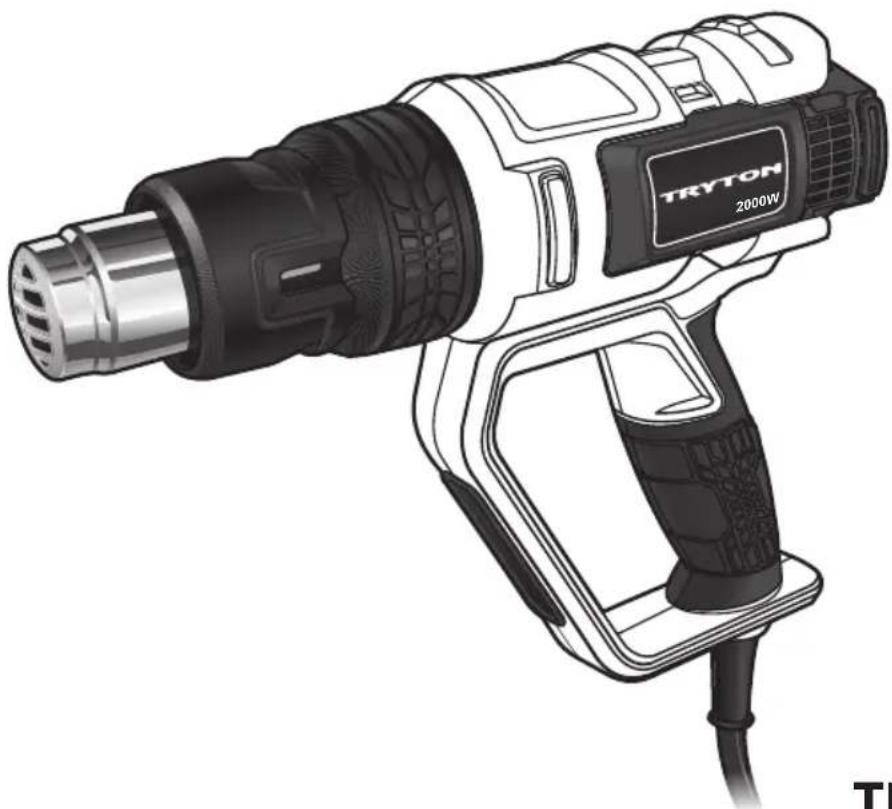
Illustration of a 2000W TRYTON handheld electric heater (no text or symbols on body)THL2000B
EN
Instruction manual
HOT AIR GUN (HEAT GUN) 3
PL
DMUCHAWA GRZEJNA (OPALARKA) 10
RU
OPALOVACÍ (POŽEHOVACÍ) PISTOLE ....42
LT
Naudojimo instrukcija
KARŠTO ORO PŮSTUVAS....49
HU
natural_image
Line drawing of a portable electric tool with a black handle and label, placed on a wooden table (no text or symbols on the device itself)
BEFORE YOU START USING THE MACHINE READ THOROUGHLY THIS MANUAL.
Keep this document for future reference.

WARNING! Read all safety warnings marked with a symbol ⚠ and all operating safety instructions.
To limit the risk of fire, electric shock and injury while using the device, follow all operating safety instructions and tips provided below.
Keep all work safety instructions and tips for future reference.
In warnings provided herein the expression "power tool" means a power tool powered from the mains (with a power cord) or a battery powered power tool (cordless).

WARNING! General work safety warnings for use of the tool.
Workplace safety:
a) Keep your workplace tidy and well lit.
Untidiness and bad lighting result in higher accident rate.
b) Do not use the power tool in explosive environments, created by flammable liquids, gases or dusts. The power tool generates sparks that can ignite dust or vapors.
c) Keep children and unauthorized persons away from the place where
the power tools are used. Inattention may result in losing control over your power tool.

WARNING! General warnings regarding the use of power tools.
Electric safety:
a) Plugs used in power tools must match wall outlets. Never modify the plug of your power tool. Do not use any extension cables when operating a power tool with a grounding /earthing conductor (PE). Any modifications of plugs and outlets increase the risk of electric shock.
b) Avoid touching earthed surfaces or grounded items like pipes, heaters, central heating radiators and refrigerators. Touching earthed or grounded surfaces increases the risk of electric shock.
c) Do not expose your power tool to rain or damp environments. Water penetrating the tool increases the risk of electric shock.
d) Do not damage the power cord. Never use the power cord to carry, pull the power tool and do not pull by its power cord to disconnect plug from the outlet. Keep the power cord away from sources of heat, oils, sharp edges and moving parts. Damaged or
entangled power cords increase the risk of electric shock.
e) When your power tool is operated outdoors use extension cords intended for outdoor use only. Using an extension cable intended for outdoor use decreases the risk of electric shock.
f) It is recommended to connect the device to a mains supply equipped with a residual current device (RCD) with a rated current of 30 mA or less.
g) When it is unavoidable to use your power tool in a damp environment use an RCD (Residual Current Device) for protection. The use of RCDs decreases the risk of electric shock.

WARNING! General warnings regarding the use of power tools.
Personal safety:
a) This equipment is not intended for use by persons (including children) disabled physically, mentally, sensorial or persons with no experience and knowledge in operating the equipment unless they operate the equipment under super vision or follow user's instructions provided by persons responsible for their safety.
b) It is necessary to predict steps, watch and keep common sense when using power tools. Do not operate power
tools when you are tired, under influence of drugs, medicine or alcohol. A moment of inattention while operating a power tool may result in serious personal injury.
c) Use personal protective equipment (PPE). Always wear safety goggles. Wearing personal protective equipment (PPE) including a dust mask, anti-slippery footwear, a helmet and ear protection reduces personal injury.
d) Avoid unexpected start up. Before connecting your power tool to the mains and/or inserting a battery make sure its power switch is in off position. Carrying your power tool with a finger on its power switch or without disconnecting it from the mains (switched on) may result in an accident.
e) Before starting your power tool remove any keys/wrenches. Leaving a key/wrench in the rotating part of your power tool may result in personal injury.
f) Do not lean forward too far. Always remain stable and maintain balance.
It will allow you to have a better control over your power tool in unpredictable situations.
g) Wear appropriate clothing. Do not wear loose clothes or jewelry. Keep your hair tied. Keep your clothes away from moving parts. Loose clothes, jewelry or long hair may be caught by moving parts.
h) If your power tool allows for using an external dust extraction or collection
system, make sure it is connected and used properly. Using dust collectors may reduce dust affected risks.
i) Do not let your skills gained through the frequent use of the power tool make you overconfident and disregard safety rules. Carelessness may cause injury in a fraction of a second.

WARNING! General warnings regarding the use of power tools.
Use and taking care of your power tool:
a) Do not overload your power tool. Use a power tool with power adjusted to work being done. An appropriately chosen power tool will allow you to work better and safer under load it has been designed for.
b) Do not use a power tool when its power switch is out of order (it does not switch it on or off). Any power tool with its power switch out of order is dangerous and must be repaired.
c) Always disconnect the plug from the power source and/or disconnect its battery before changing any settings, performing replacement or storage. Such preventive measures reduce the risk of accidental power tool start up.
d) Keep your power tool out of reach of children and do not allow unauthorized persons to use the power tool. Power tools in hands of untrained persons can be dangerous.
e) Power tools require maintenance. Check power tools for concentricity or jamming of moving parts, any cracks and all other factors affecting the power tool work safety. If any damage to the power tool is detected, it should be repaired before use. Improper power tool maintenance is a reason for many accidents.
f) Cutting tools should be sharp and clean. Keeping sharp cutting edges in good condition reduces the risk of jamming and facilitates operation.
g) Power tools, equipment, working tools etc. should be used according to this user's manual taking into account operating conditions and the work to be done. Misusing a power tool can result in dangerous situations.
h) At low temperatures and after a long brakes in operation it is recommended to turn the power tool to operate it with no load for a few minutes to provide proper grease distribution inside its driving mechanism.
i) Use soft, damp (cannot be wet) cloth and soap to clean power tools. Do not use petrol, solvents and other agents that may damage your equipment.
j) Power tools can be stored/carried after making sure that all moving components are locked and protected against release with original devices intended for this purpose.
k) Store power tools in a dry, dust and water-protected place.
I) Carry your power tool in its original packaging to provide protection against mechanical damage.
m) Keep handles and grip surfaces clean and free from oil and grease. Secure grip and control over the tool in unexpected circumstances are impossible if handles and grip surfaces are slippery.

WARNING! General warnings regarding the use of power tools.
Repair:
a) Warranty and post-warranty repairs of its power tools are carried out by PROFIX Service, which guarantees the best quality or repair and use of genuine spare parts.

WARNING! HOT AIR GUN, additional safety instructions – Workplace safety:
a) Always work in a well ventilated area. Gases, vapors and fumes generated during operation are frequently dangerous to human health.
b) If handled carelessly, the tool can cause fire, therefore:
- be extremely careful when using the tool in places where combustible materials are stored;
- do not keep the hot air stream aimed at the same place for a longer period;
-do not use the tool in explosive environments;
- be aware that heat can be transferred to combustible materials located beyond your field of vision;
- always place the tool on its base after use and allow to cool down before storing;
- never leave your tool unattended when it is on.
c) Do not point the nozzle with hot air at other persons, animals and towards the places where flammable materials are stored.
Electrical safety:
a) Do not use the device when it rains or under high humidity conditions. It may result in injuries or death caused by electric shock.
b) When operating the hot air gun outdoors always use a residual current device (RCD). The use of RCD reduces the risk of electric shock.
c) Before each use check the tool, its power cord and plug for any damage. If any damage is found, stop working and have the tool repaired sending it to a service center (the address provided in the warranty card). Using a defected device can be dangerous to health and life. Never open its housing as the tool does not contain any user serviceable parts.
d) Do not put any objects into the nozzle.
It may result in damage to the tool and electric shock.
e) The power cord should be placed behind the tool at all times during operation.
f) Do not point the hot air stream at the power cord and do not touch the power cord with the nozzle when hot. It may result in damage to its insulation and electric shock.
g) Do not carry or hang the tool on its power cord.
h) Do not use a power tool with its power cord damaged. Do not touch the power cord when damaged; if the damage to power cord occurs during operation, unplug the cord from the mains socket. Damaged power cords increase the risk of electric shock.

WARNING!
If the undetachable power cord is damaged, it should be replaced either by the manufacturer or by an authorized service center or a qualified electrician to avoid any risks.
Personal safety:
a) When processing plastics, paints, varnishes and other materials, flammable and toxic gases are generated. Do not use the tool near flammable materials and explosive gases.
b) To provide protection against vapors and fumes wear a special mask protecting against dusts and vapors emitted by lead-containing paints
and bear in mind the safety of other persons staying at your workplace.
c) Danger of burns! Never touch the nozzle when hot. Always wear protective gloves.
d) Do not look into the nozzle when the tool is on.
e) Always wear safety goggles when operating the tool.
f) Do not use the tool as a hair dryer! The hot air emitted by the hot air gun exceeds the temperature of air provided by a hair dryer.
Working instructions and use tips:
a) Protect the hot air gun against impacts and surface damage caused by sharp objects.
b) Before you use the tool always check air inlet and outlet for any obstacles restricting a free air flow.
c) Do not burn the paint as it may result in fire. Keep the paint away from the nozzle, as it can ignite after some period.
d) Do not obstruct either air inlets or nozzle outlet as it can result in excessive temperature and damage to the tool. Do not keep the hot air outlet closer than 5 cm from the surface processed.
e) Do not put the nozzle on any object during and directly after operation. Do not place the tool on its side. Whenever you wish to put the hot air gun aside, set it in a vertical position.
f) When you stop using the tool, during breaks or carrying out any
maintenance operations (e.g. inspections, cleaning, adjustments) always unplug the power cord from the mains socket.
g) Never allow children to use the tool.
APPLICATIONS AND CONSTRUCTION:
The hot air gun is a portable power tool. It features small dimensions, ergonomic design, low noise emission, high speed air flow, adjustment of operating temperature and speed of airflow.
The tool is intended for removing paint coats, shaping and welding plastics and fitting shrinking plastic tubing. It can be also used to soften adhesives and defrost water pipes.
WARNING! The appliance is not intended to be operated by means of an external timer or separate remote-control system.
Do not use the tool in professional applications. Any use in applications other than indicated is prohibited and results in making the warranty void and null and waiving manufacturer's liability for any resulting damage.
Any modification to the tool carried out by the user waives manufacturer's liability for damage to the tool, user or other property.
Specific residual risks cannot be eliminated despite proper use. The following threats may occur resulting from the design and structure of the machine:
- Injury from contact with hot parts;
- Ejection of a workpiece or its parts.
■The set includes:
- Hot air gun - 1 piece
- User's manual - 1 piece
- Warranty card - 1 piece
■Tool components (seeFig.A):
The numbering of tool components refers to graphics presented on page 2 of the user's manual:
- Outlet nozzle
- Operating temperature control
- On/off switch/ Operation mode selector
- Power cord
TECHNICAL DATA:
| Voltage | 220-240 V | |
| Frequency | 50/60 Hz | |
| Power consumption | 2000W | |
| Operating temperature/ Air flow | mode I | 50°C / 250 l/min |
| mode II | 50-450°C / 250 l/min | |
| mode III | 90-600°C / 500 l/min | |
| Device class | II | |
| Weight | 0,9 kg | |
■Noise emission information
Sound pressure value measured is lower than 70 dB (A).
BEFORE YOU START:
- Make sure that power supply parameters meet the requirements provided on the tool nameplate.
- Make sure the tool switch is in off position. Connecting the tool to the mains socket when its switch is in on position can result in serious accident, as the hot air gun starts immediately.
- When your workplace is too far to plug the tool directly to the mains socket, use an extension cord with a cable cross-section meeting the tool requirements. Extension cords should be as short as possible. When in use extension cords must be fully uncoiled.
DURING OPERATION:
■Switching on/off
To switch on the tool set the on/off switch/ operation mode selector (3) to position I, II or III.
- To switch the tool off set the on/off switch/ operation mode selector (3) to position 0.
■ Setting operation mode
The on/off switch/ operation mode selector (3) can be set in three positions.
The air flow and temperature required can be adjusted by using the table:
| Operation mode I | 250 l/min - 50°C |
| Operation mode II | 250 l/min - 50-450°C |
| Operation mode III | 500 l/min - 90-600°C |
The operation mode I is suitable for cooling down heated objects or for drying a paint coat. It can be also used to cool the tool before putting in storage or replacing its nozzle (spare nozzles not provided).
NOTE: After changing from higher to lower temperature always allow the tool to cool down.
■ Temperature adjustment
Temperature can be adjusted only in hot air mode II or III. The target temperature can be increased by rotating the operating temperature control (2) clockwise. It is decreased by rotating the control anticlockwise ().see Fig. A
WORKING TIPS:

NOTE! Avoid holding the tool perpendicularly to surface processed. It results in hot air reflection and sucking it back by the motor rotor. It results in increasing temperature inside the
motor and damage to the tool. The hot air gun should be held at an angle of approx. 45° to the surface processed.
The distance between the nozzle and object processed depends on the material, but cannot be lower than 5 cm.
Before you turn the tool off, set the temperature to minimum and select the maximum air flow for a short period (more than ten seconds) to cool down the heating element. It will extend the life of your tool.
■Putting the tool aside
To cool the hot tool down or to have both hands free, put the hot air gun vertically onto a horizontal surface (see Fig. B).
NOTE: Be especially careful when working with the tool aside! There's a risk of burns caused by its hot nozzle or hot air stream.
CLEANING AND MAINTENANCE:
- Keep the tool clean and provide unrestricted air flow.
- Protect the hot air gun against any penetration of water, dust and other small objects.
- Do not clean the plastic housing with chemical cleaning agents. Use a slightly damp cloth and soap. Allow the tool housing to dry under natural conditions before you start to use it again.
- Check the power cord for technical shape on a regular basis and replace it immediately when any damage is found.
- In case of technical problems please contact our service. The addresses of authorized service points are listed in the warranty card.
MANUFACTURER:
PROFIX Ltd.,
34 Marywilska Street,
03-228 Warsaw, POLAND.
PROTECTION OF THE ENVIRONMENT:

NOTE: The symbol nearby denotes that old equipment must never be thrown away together with other waste (with the penalty of a fine). Hazardous components of electronic
equipment may adversely affect the natural environment and human health.
Each household may contribute to the recovery and reuse (recycling) of old machinery and equipment. Both in Poland and Europe a system for recovery of used equipment either exists or is being created. The system obliges all organizations that sell such equipment to collect the used machinery and appliances. Moreover, general purpose collecting points for such equipment are available.

PRZED PRZYSTĄPIENIEM DO UŻYTKOWANIA NALEŻY ZAPOZNAĆ SIĘ Z NINIEJSZĄ INSTRUKCJĄ.


- E E K T R O N A R Z I
- THL2000B
- EN
- PL
- RU
- LT
- HU
- BEFORE YOU START USING THE MACHINE READ THOROUGHLY THIS MANUAL.
- WARNING! Read all safety warnings marked with a symbol ⚠ and all operating safety instructions.
- Keep all work safety instructions and tips for future reference.
- WARNING! General work safety warnings for use of the tool.
- Workplace safety:
- WARNING! General warnings regarding the use of power tools.
- Electric safety:
- Repair:
- Electrical safety:
- WARNING!
- Personal safety:
- maintenance operations (e.g. inspections, cleaning, adjustments) always unplug the power cord from the mains socket.
- g) Never allow children to use the tool.
- APPLICATIONS AND CONSTRUCTION:
- WARNING! The appliance is not intended to be operated by means of an external timer or separate remote-control system.
- ■The set includes:
- ■Tool components (seeFig.A):
- ■Noise emission information
- BEFORE YOU START:
- DURING OPERATION:
- ■Switching on/off
- ■ Setting operation mode
- ■ Temperature adjustment
- WORKING TIPS:
- ■Putting the tool aside
- CLEANING AND MAINTENANCE:
- MANUFACTURER:
- PROTECTION OF THE ENVIRONMENT:
Brand : Tryton
Model : THL2000B
Category : Heat gun