
14-704 - Paint gun NEO tools - Free user manual and instructions
Find the device manual for free 14-704 NEO tools in PDF.


| Product Type | Paint Gun |
| Brand | NEO tools |
| Model | 14-704 |
| Spray Pattern Type | HVLP (High Volume Low Pressure) |
| Nozzle Diameter | 1.4 mm |
| Cup Capacity | 600 ml (20 oz) |
| Operating Pressure | 2.0 - 4.0 bar (29 - 58 psi) |
| Air Consumption | 200 - 300 l/min (7 - 10 cfm) |
| Material Feed Type | Gravity feed |
| Weight (without cup) | 0.9 kg (2.0 lbs) |
| Dimensions (L x W x H) | 200 x 120 x 250 mm (7.9 x 4.7 x 9.8 in) |
| Power Source | Compressed air (pneumatic) |
| Main Functions | Spray painting, priming, varnishing |
| Maintenance & Cleaning | Clean thoroughly after each use with suitable solvent; lubricate moving parts regularly |
| Safety Features | Trigger lock, pressure relief valve |
| Spare Parts & Repairability | Replacement nozzles, needles, air caps, seals and gaskets available |
| General Information | Designed for automotive and DIY painting; provides a fine, even finish |
Frequently Asked Questions - 14-704 NEO tools
User questions about 14-704 NEO tools
0 question about this device. Answer the ones you know or ask your own.
Ask a new question about this device
Download the instructions for your Paint gun in PDF format for free! Find your manual 14-704 - NEO tools and take your electronic device back in hand. On this page are published all the documents necessary for the use of your device. 14-704 by NEO tools.
USER MANUAL 14-704 NEO tools
| 14-700 | 14-702 | 14-703 | 14-704 | 14-706 | |
| PL | Pistolet lakierniczy górný zbiorník 0.6 l, dysza 1.4 mm, HVLP | Pistolet lakierniczy górný zbiorník 0.6 l, dysza 1.5 mm | Pistolet natryskowy górný zbiorník 0.5 l, 1.4 mm | Pistolet lakierniczy dolny zbiorník 1.0 l, dysza 1.5 mm | Pistolet do ropowania 1.0 l |
| EN | Paint spray gun upper tank 0.6 l, nozzle 1.4 mm, HVLP | Spray gun upper tank 0.6 l, nozzle 1.5 mm | Spray gun upper tank 0.5 l, 1.4 mm | Spray gun lower tank 1.0 l, nozzle 1.5 mm | Oil gun 1.0 l |
| RU | Верхний бак для краскопульта 0,6 л, форсунка 1,4 мм, HVLP | Пистолет-распылитель верхний бачок 0,6 л, форсунка 1,5 мм | Верхний бачок пистолета 0,5 л, 1,4 мм | Нижний бачок пистолета-распылителя 1,0 л, сопло 1,5 мм | Масляный пистолет 1.0 л |
| HU | Festékszóró pisztoly felső tartálya 0,6 l, fúvóka 1,4 mm, HVLP | Permetező pisztoly felső tartálya 0,6 l, fúvóka 1,5 mm | Permetező pisztoly felső tartálya 0,5 l, 1,4 mm | Permetező pisztoly alsó tartálya 1,0 l, fúvóka 1,5 mm | Olajpuska 1,0 l |
| RO | Vopsea pistolul cu rezervor superior 0,6 l, dužá 1,4 mm, HVLP | Rezervorul superior al pistolului de pulverizare 0,6 l, duza 1,5 mm | Rezervorul superior al pistolului de pulverizare 0,5 l, 1,4 mm | Rezervorul inferior al pistolului de pulverizare 1,0 l, duza 1,5 mm | Pistol de ulei 1,0 l |
| SK | Horná nádrž na striekaciu pištol' 0,6 l, dýza 1,4 mm, HVLP | Horná nádrž striekacej pištole 0,6 l, dýza 1,5 mm | Horná nádrž striekacej pištole 0,5 l, 1,4 mm | Spodná nádrž striekacej pištole 1,0 l, dýza 1,5 mm | Olejová pištol' 1,0 l |
PL
Instrukcja obsługi
Szanowny Kliencie,
When using an air tool (hereinafter "tool" or "product"), read the manual and observe the following basic safety precautions to avoid injury or loss of life, protection against electric shock, injury, explosion and fire hazards.
The use of the tool should be in accordance with the health and safety regulations in force in the area of their use.
Failure to follow these warnings and / or tampering with the structure of pneumatic tools cancels rights WARRANTIES tive and releases the manufacturer from the area and edzialności for damages arising in connection with the operation of the device - caused to people, animals, the property or the device itself. Please keep the instructions and directions for reference at any time. If you pass the device on to someone else, also include the operating manual. We are not responsible for accidents and damage that occur as a result of non-compliance with these instructions and the safety instructions. DISCLAIMER: Due to continuous improvement of our products, we reserve the right to make changes that are not included in the instructions below.
General safety instructions when using air tools
Tool application
- Use the tool and the recommended accessories in accordance with the operating instructions. Use the tool and accessories (and adhere to the manufacturer's instructions) only for the purposes for which they are intended. Using the device for any other purpose is strictly prohibited. As a rule, it should be turned off before approaching the material / place on which we will act.
- Keep the workplace tidy. Clutter in the workplace increases the likelihood of an accident. Work in well-ventilated rooms.
- Pay attention to your surroundings. Do not expose the tool to rain. Please remember about the correct lighting. Do not point the gun at people or animals. Do not let bystanders move the spiral hose, the compressor or the compressor power cord. Keep these people away from the work area. Bystanders should not stay in the work area. Keep children away from the device.
- Working condition of the tool. Check the tool and spiral hose for completeness and damage.
- Protect yourself against electric shock. During work, avoid contact of body parts and the tool with live objects, e.g. electrical installation elements, heating elements, electric devices.
- Store the tool out of the reach of unauthorized persons. When not in use, tools should be stored in a dry, locked place out of the reach of children. Carry out all maintenance operations after disconnecting the compressed air line and tank.
- Do not overload the tool. It is better and safer to work with the performance specified in the technical data.
- Always wear suitable work clothes. Do not wear loose clothing or jewelry when working with the tool. For work, rubber gloves and non-slip shoes are recommended. Use a hair net for long hair.
- Do not use the spiral hose for other purposes. Do not carry the tool with the spiral hose. Protect the hose from heat, oil and sharp edges.
- Take good care of the tool. Always keep the tool clean for effective and safe work. Observe the maintenance rules. Regularly check the couplings and spiral hose, and if damaged, have them repaired by an authorized service center.
- Transportation. Before transport, tools should be properly cleaned and dried of the materials used. They may only be transported with appropriate protection against contamination.
Attention! Always be attentive when working. Evaluate the efficiency of work. Proceed wisely. Responsiveness may be impaired due to alcohol, medication and drug use, as well as illness and fatigue. In such cases, you should refrain from working with tools.
- Check the device for possible faults. Before each use of the tool, carefully check it, in particular its safety elements and parts that are suspected of being damaged. It should be assessed whether they fulfill the proper and intended functions. Check that the moving parts function perfectly, do not jam and are not
damaged. All parts must be properly installed to ensure safe operation of the device. If you notice any signs of the device malfunctioning, turn it off immediately and disconnect it from the power source. Damaged safety elements and parts should only be repaired / replaced by an authorized service center, unless otherwise stated in the operating manual.
Attention! For your own safety, use only those accessories and additional devices that are specified in the operating instructions or recommended by the manufacturer. The use of accessories and equipment other than those recommended in the instruction manual or the manufacturer's catalog may mean a risk of causing damage to health or property.
Occupational Health and Safety
- It is the employer's responsibility to pass these operating instructions on to the tool operator.
- Before starting work, read the manufacturer's recommendations and familiarize yourself with the technical parameters.
- Work, inspection and maintenance should always be in accordance with the applicable health and safety standards.
- Safety goggles and ear muffs should be worn when using air tools.
- When working with chemical liquids, use masks and protective filters to protect the respiratory system and eyes.
- The compressor reaches a high temperature during operation. Touching it leads to burns.
- The air drawn in by the compressor must be free of any admixtures with other gases and / or vapors, as these may ignite or explode in the compressor.
- When disconnecting the quick coupler, hold the hose coupler with your hand to avoid injury from the hose popping up.
- Safety goggles must be worn when working with guns, including the blow-off gun. Foreign objects and blown parts can easily injure your eyes.
Safety instructions for working with the sprayed substances
- Do not use varnishes or thinners with a flash point lower than 55 degrees.
- Do not heat varnishes and solvents.
- When working with substances harmful to health, the use of filtering devices to protect the eyes and respiratory tract (face mask) is required to protect the respiratory tract. Also pay attention to the information on protective measures provided by the manufacturers of these materials.
- Observe the rules for handling hazardous materials, which are given in the form of data and labels on their packaging. If necessary, take additional protective measures, in particular wear appropriate clothes and masks.
- Do not smoke while spraying or in the workplace. The fumes can also be flammable.
- Fireplaces, open light sources or spark-generating devices must not be located or used in the vicinity of open containers with paint, and must not be located in the vicinity of tool work, maintenance and cleaning sites, as this may lead to the formation of an explosive atmosphere, fire and explosion. Smoking is also forbidden in these situations for the same reason.
- Do not store or eat food or drink in the working room. The vapors of the substances used are harmful to health.
- The room in which spraying works with harmful substances is carried out must have a cubic capacity of more than 30 m3. Sufficient air exchange must be ensured during spraying and drying. Avoid the hazards of inhalation, contact or absorption of the varnish or cleaning fluids caused by insufficient ventilation, inadequate spray pressure, poor optimization of spray parameters to reduce contamination, lack of personal protective equipment, inhalation of solvent vapors or other hazardous substances. Too close distance of the working gun from the painted surface may cause paint particles to bounce in the direction of use, posing a threat to the user. You must anticipate the dangers of using a damaged compressor or poorly adjusted compressor pressure, and the dangers of using unsuitable or unsafe fluids. Do not spray against the wind. As a general rule, observe the legal regulations of the local authorities
when spraying, spraying flammable or potentially hazardous substances.
- When connecting with a PVC pressure hose, do not use substances such as white spirit, butyl alcohol, methylene chloride (this will shorten the hose "life").
Attention! Do not use thinner or cleaning agents that will oxidize the aluminum container, the gun itself, and its galvanized parts. In extreme situations, oxidation may cause an explosion. Manufacturers of painting materials and solvents provide relevant information on their products. Never use acids to clean air tools.
Please keep and follow the safety instructions.
Start-up and use of pneumatic tools
Recommendations for compressed air supply of pneumatic tools:
- The air supplied must always be clean and dry.
- It is recommended to use filter elements that catch water, solid and oily particles.
- Check the hose and couplings before each use for suitability for use, tightness and correct connection.
- Check the supply device (e.g. compressor, pneumatic system) before each use.
- To take full advantage of the power and efficiency of the tool, use quick couplings and hoses of the correct length and diameter.
- Avoid kinking the hose.
- Do not use tools for industrial purposes.
- Do not use tools in the food industry.
- Do not use tools in a dusty environment.
Attention! The admissible supply pressure must not be exceeded!
Excessive pressure causes the tool to be exceeded allowable parameters and may result in damage and / or hose damage and an accident.
Recommendations when working with a pneumatic tool:
Before starting work with a pneumatic tool, make sure that it has been connected to the power source in the correct sequence.

Diagram of installation of pneumatic tools
-
Compressor (optional - with oil separator)
-
Filter - pressure regulator, water separator
-
Quick coupler
-
Coiled snake
-
Quick coupler
-
Air tool (example drawing)
* Only valid for spray guns.
The tool cannot be repaired, adjusted or replaced during operation.
During breaks at work or when moving from one place to another, it is necessary to remove the sprayed substance from the tank (when using a spray gun or an oil gun), then disconnect the compressed air supply, and then remove the tip of the tool from the hose connector. When replacing the working tip, the supply of compressed air should be closed to prevent it from being ejected when the tool is accidentally started. Tools should be protected against falls and blows as well as against contamination, e.g. mud, water, sand, etc., and maintained in accordance with the operating instructions, and pay attention to the maintenance of a good technical condition of compressed air supply lines.
Recommendations for the use of spiral hoses:
The hoses should be:
- firmly attached to their ends.
- gas-tight (in case of leakage, immediately turn off the compressed air supply),
- connected to power sources equipped with air separators and condensation pots.
- protected against mechanical damage and the influence of caustic materials (acids, bases), oily substances and greases. In places exposed to mechanical damage, reinforced hoses should be used. In the event of contact of the hose with corrosive materials, wash the hose with plenty of water and check whether it is still tight, whether any discoloration and / or deformation has occurred, whether the hardness of the external surface of the hose has changed. A damaged hose must not be used.
A hose contaminated externally with grease or oil should be carefully cleaned with a dry cotton tow.
Using a damaged and / or contaminated hose as above. May cause an accident at work.
Connect and disconnect the hose from the tool only with the air valve closed. The air supply must not be cut off by kinking the hose.
After connecting the hose to the power source, blow it first, taking proper precautions to remove any dust build-up, and then attach the air tool.
The hoses should not touch or be near live electrical cables.
Functional description and application:
The paint spray gun is intended for the application of the following paint and varnish materials: metallized and non-metallized varnishes, enamels, undercoat paints, acrylic paints, undercoating acrylics and spray putties (according to the manufacturer's recommendations).
A metal housing and trigger are used. The gun has an adjustment of the amount of paint, adjustment of the cone of the jet (round or flattened jet), and adjustment of the air supply from the compressor.
Read the paint and thinner manufacturer's instructions before spraying.
Wash the gun in a solvent appropriate for the painting material used, but do not immerse it in it.
Use the appropriate size of quick couplings and the appropriate diameter spiral hoses - this will allow you to fully use the parameters of the tool, including its performance.
Working diagram of a spray gun with an upper tank

-
Lever "on / off"
-
Nozzle head
-
Gun body (handle)
-
Hanger
-
Air supply regulator
-
Input coupler
-
Spray intensity regulator
-
Spray cone regulator
-
Nozzle head mounting ring
-
Tank cover
-
Tank
-
Air vent (small hole)
-
Tank fixing nut
-
Breather plug
* Only valid for a spray gun with an upper reservoir.
Assembly diagram of a spray gun with an upper tank
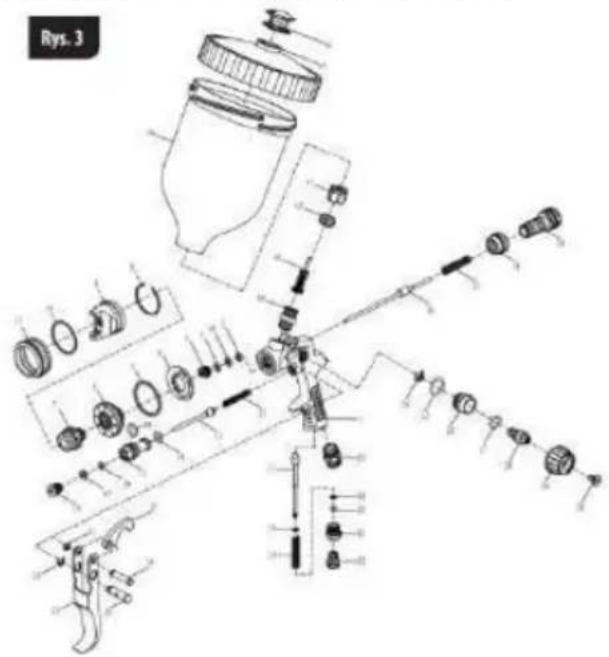
| 1. Gun body | 18. Gasket 3 | 35. Flexible spindle |
| 2. Gasket | 19. Air flow adjustment spring | 36. The spindle |
| 3. Sealing screw | 20. O-ring 2.5x1.8 | 37. Needle adjustment spring |
| 4. Air ring | 21. Air flow adjustment socket | 38. Needle adjustment seat |
| 5. Nozzle seat gasket | 22. Air flow adjustment knob | 39. Needle adjustment knob |
| 6. Nozzle seat | 23. Air fitting | 40. Tank connection |
| 7. Material nozzle | 24. Lock ring 3.5 | 41. Filter |
| 8. Air Nozzle Snap Ring | 25. O-ring 8 x 1.5 | 42. Gasket |
| 9. Air nozzle | 26. Regulator socket | 43. Rivet |
| 10. Air Nozzle Gasket | 27. O-ring 6 x 1.8 | 44. Tank |
| 11. Locking knob | 28. Regulator spindle | 45. Tank cover |
| 12. Air valve spring | 29. Regulator knob | 46. Tank cover cap |
| 13. Air valve spindle | 30. M4 x 8 screw | 47. Gasket |
| 14. Gasket | 31. Lock ring 4 | 48. O-ring 7.5 x 1.8 |
| 15. Air valve body | 32. Handle | 49. PE foam pad |
| 16. Sealing screw | 33. The trigger | 50. O-ring 2.8 x 1.8 |
| 17. Air flow regulating spindle | 34. Trigger pin |
* Only valid for spray guns with an upper reservoir.
Start-up and use
- Tighten the reservoir (11) to the gun body with the bolt (13).
- Make sure that the vent hole (12) in the cover (10) is clean and unobstructed and close it with a plug (14). A blocked vent will prevent operation - the plug has a small gap for the vent to function.
- Fill the tank (11) with the varnish and tighten the cover (10).
- Attach the spiral hose to supply the gun with air to the inlet fitting (6) and adjust the compressor to the maximum pressure to 4 Bar. The regulator (5), if necessary, can reduce the air pressure in the gun - i.e. below 4 bar.
- By turning the spray intensity regulator (7), adjust the spray intensity of the paint material (tighten the regulator if you use more liquid paints, and unscrew the regulator when using thicker paints. Then, by turning the spray cone regulator (8), adjust the spread of the spray stream.
- With the lever (1) on, the position of the "nozzle head" (2) can be changed by slightly unscrewing the ring (9), changing the spray pattern. Always remember to tighten the ring (9) correctly before starting work.
Spray intensity adjustment:
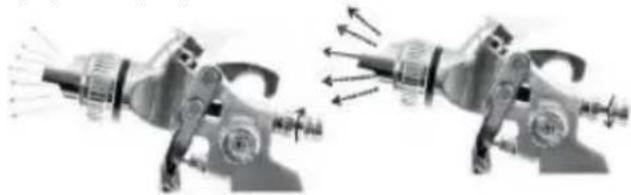
Spray "cone" adjustment:

7. Aim the nozzle head (2) perpendicular to the painted surface.
-
Before using it properly, a trial should be carried out on the substitute material until the optimum effect is obtained. Never leave the paint material in the tank of the spray gun for later use, as the instrument may be damaged beyond repair in its precision parts.
-
After use, always clean the inside of the device thoroughly by filling the tank with a clean solvent appropriate for the painting material used and starting the spray without contaminating the environment (spray towards the rag or towards the absorbing surface). Carry out cleaning until there are no traces of the painting material in the outgoing stream of thinner. This procedure should also be used if the nozzle is clogged. Using a rag soaked in thinner, clean the outside of the gun where it is soiled with the paint used. For a more thorough cleaning, carefully disassemble the gun into its parts with the brush provided. Soak all internal components for several hours in a tank filled with clean diluent, then follow the reverse assembly procedure for reassembling all components thoroughly after drying them thoroughly.
Warning! Do not use the spray gun for painting indoors, with a volume of less than 30 m³ and without ventilation. Do not use the gun without wearing a respirator.
Storage, maintenance, repair
The gun does not require any special maintenance. The gun should be kept out of the reach of children, kept clean, protected against moisture and dust. The storage conditions should exclude the possibility of mechanical damage and the influence of weather conditions. In the event of irregularities in the operation of the gun, check and clean the nozzles as described in the "Start-up and Operation" section in point 9 and check the tightness of the nozzle mounting connections and compressed air supply. In the event of further problems, please have the GTX Service repaired.
Transport
The gun is to be transported and stored in a packaging that is protected against moisture, dust penetration and mechanical damage.
During transport, the tank must be emptied of the substance.
The total value of the vibrations acting on the operator's upper limbs does not exceed 2.5 m / s2 (EN 1953: 1998 + A1: 2009)
Explanation of the icons on the information stickers on the device
 | Wear safety glasses. |
 | Wear hearing protection. |
 | Wear protective gloves. |
 | Use a dust mask. |
 | Read the operating manual before commissioning. |
 | The product meets the requirements of the EU directive |
WARRANTY AND SERVICE
The warranty conditions and the description of how to proceed in the event of a complaint are included in the attached Warranty Card.
A network of Service Points for warranty and post-warranty repairs available on the gtxservice.pl internet platform
Scan the QR code and visit gtxservice.pl


RU
Ajustare pulverizare "con":

/Signed for and on behalf of:/
/GRUPA TOPEX Quality Agent/
/Signed for and on behalf of:/
/GRUPA TOPEX Quality Agent/
/Signed for and on behalf of:/
/GRUPA TOPEX Quality Agent/
/Signed for and on behalf of:/
/GRUPA TOPEX Quality Agent/
/Signed for and on behalf of:/
/GRUPA TOPEX Quality Agent/


Brand : NEO tools
Model : 14-704
Category : Paint gun