
Reference 20 - Amplifier NuPrime - Free user manual and instructions
Find the device manual for free Reference 20 NuPrime in PDF.


| Product Type | Mono Amplifier |
| Brand | NuPrime |
| Model | Reference 20 |
| Configuration | Mono, Single-ended RCA and Balanced XLR Inputs |
| RMS Power Output | 200W @ 8Ω, 420W @ 4Ω, 420W @ 2Ω |
| Peak Power Output (20ms hold) | 400W @ 8Ω, 800W @ 4Ω, 1600W @ 2Ω |
| Frequency Response | 20 Hz -0.3 dB to 120 kHz -3 dB |
| Total Harmonic Distortion (THD+N) | 0.01% (1 kHz, 1W to 10W, A-weighted) |
| Input Impedance | 22 kΩ |
| Input Sensitivity | 161 mV (1W @ 8Ω), 1.61V (100W @ 8Ω), 1.136V (100W @ 4Ω), 2.34V (425W @ 4Ω); Max power: 2.5V |
| Gain | 27 dB |
| Signal-to-Noise Ratio (SNR) | >100 dB at 100W |
| Damping Factor | >4000 |
| Chassis Material | High-grade anodized brushed aluminum |
| Dimensions (W x D x H) | 17" x 15" x 2.95" (432 mm x 381 mm x 75 mm) |
| Weight | 16 lb (7.26 kg) |
| AC Voltage Range | 84VAC to 264VAC (worldwide, no regulator needed) |
| AC Fuse | Slow blow, 5A, 250VAC |
| Trigger Input | 12V DC (3.5mm mono jack) |
| Speaker Terminals | WBT binding posts (spade and banana plug compatible) |
| Warranty | 3 years limited warranty |
| Safety Certifications | FCC Class B, grounded AC power cord required |
Frequently Asked Questions - Reference 20 NuPrime
User questions about Reference 20 NuPrime
0 question about this device. Answer the ones you know or ask your own.
Ask a new question about this device
Download the instructions for your Amplifier in PDF format for free! Find your manual Reference 20 - NuPrime and take your electronic device back in hand. On this page are published all the documents necessary for the use of your device. Reference 20 by NuPrime.
USER MANUAL Reference 20 NuPrime
FCC Notice: Declaration of Conformity Information
This equipment has been tested and found to comply with the limits for a Class B digital device, pursuant to part 15 of the FCC Rules. These limits are designed to provide reasonable protection against harmful interference in a residential installation. This equipment generates, uses and can radiate radio frequency energy and, if not installed and used in accordance with the instructions, may cause harmful interference to radio communications.
However, there is no guarantee that interference will not occur in a particular installation. If this equipment does cause harmful interference to radio or television reception, which can be determined by turning the equipment off and on, the user is encouraged to try to correct the interference by one or more of the following measures:
- Reorient or relocate the receiving antenna. Locate the antenna more than 30 feet away from the equipment and connect it to the receiver using a shield cable.
- Increase the separation between the equipment and receiver.
- Connect the equipment into an outlet on a circuit different from that to which the receiver is connected.
- Consult the dealer or an experienced radio/TV technician for help.
WARNING: Only peripherals complying with the FCC class B limits may be attached to this equipment.
Changes or modifications made to this equipment, not expressly approved by us or parties authorized by us could void the user's authority to operate the equipment. This device complies with part 15 of the FCC Rules. Operation is subject to the following two conditions: (1) This device may not cause harmful interference, and (2) this device must accept any interference received, including interference that may cause undesired operation.
SAFETY INSTRUCTIONS
There are two categories of Safety Instructions included in this manual:
- Product Warnings (i.e., what must never be done to assure avoiding those hazards that could cause bodily injury or property damage); and
- User Directions (i.e., what must always be done to assure the safe use of your device).
The Safety Instructions contained in this manual have been categorized in accordance with the seriousness of the potential hazards through the use of Signal Words. Those Signal Words, and their intended meanings, are as follows:
- DANGER: Indicates that failure to observe the Safety Instructions could result in death or catastrophic injury.
- WARNING: Indicates that failure to observe the Safety Instructions could result in a serious injury.
- CAUTION: Indicates that failure to observe the Safety Instructions could result in a minor injury or property damage.
- NOTE: Designates important information that relates to activities and/or conditions that might result in loss of data and/or damage to your device.
Safe Use and Operation of Your Device
This equipment emits RF energy that can interfere with the reception of signals by airborne electronic navigational devices or medical devices. Do not operate this equipment near medical devices, especially heart pacemakers.
WARNING: Use grounded AC power cords only.
DANGER: If NuForce equipment and other equipment connected to it lacks a proper AC ground, excessive amount of radio-frequency emission can occur and interfere moreover with medical devices such as pacemakers, airborne electronic navigational devices and other radio-frequency receivers.
Disconnect its power cord if the device emits an unusual odor or sound or generates smoke.
WARNING: Never attempt to disassemble, repair or make any modification to your device. Disassembly, modification or any attempt at repair can cause injury or property damage, as well as damage to the device itself.
WARNING: Never allow children to play with this device. Misuse, rough or improper handling can result in serious injury. In addition, to avoid chocking hazards, always keep components and accessories out of the reach of small children. Seek immediate medical attention if choking occurs or if any small part has been swallowed.
CAUTION: When using your device with earphones, exercise caution. Loud earphone volume levels have been shown to damage hearing.
WARNING: To reduce the risk of fire or shock, do not expose the unit to moisture or water.
Prevent foreign objects from entering the enclosure. If moisture or a foreign object get into the unit, disconnect the power cord. Take the unit to a qualified service person for inspection and, if necessary, repair.
Read all instructions carefully before connecting or operating the component.
Keep this manual as your reference, particularly with respect to safety instructions.
Heed all warnings and safety information in these instructions and on the product itself. Follow all operating instructions.
Do not use this unit near water.
You must allow a minimum 10 cm or 4 inches of unobstructed clearance around the unit. Do not place the unit on a bed, sofa, rug, or similar soft surface capable of impeding ventilation. If the unit is placed in a bookcase or cabinet, provide for adequate ventilation. Keep the component away from radiators, heat registers, stoves, or other appliances that produces heat.
The unit must be connected to a power supply of the type and voltage specified on the rear panel. (USA: 115 V/60Hz, EC: 230V/50Hz)
Connect the unit to the power outlet with the supplied power cord or an exact equivalent. Under no circumstances should you modify the supplied power cord.
Do not route the power cord where it will be crushed, pinched, bent, exposed to heat or other potential damage. Be certain that the connector is firmly set where the power cord enters the back of the unit.
The power cord should be unplugged from the wall outlet during a lightning storm or if the unit is to be left unused for a long period of time.
Stop using the component and have it inspected and/or serviced by a qualified service agency if:
- The power cord or its plug have been damaged
- Objects or liquid have entered the unit
• The unit has been exposed to rain - The unit shows signs of improper operation
- The unit has been dropped or otherwise damaged
Read This First!
Your NuForce™ Reference 20 amplifier utilizes a unique analog-switching topology. To avoid mishaps, before initially connecting and powering up the amp, take a few moments to read at the following.
Serious listeners who want to enjoy the Reference 20's full potential should allow for a 75-hour maturation period, often referred to as "burn-in." In other words, give the amp about 75 hours of play time before attempting to listen to it critically.
WARNING: Do not connect speaker-level outputs to line-level inputs of active devices such as active subwoofers or semi-active speakers with powered woofers.
If you use semi-active speakers where the woofer is powered, or a subwoofer that accepts speaker-level signals or sums the left and right signals from two NuForce mono amplifiers, before proceeding, you must first consult NuForce or your dealer.
WARNING: We can't say this often enough. Use only properly grounded AC power cords.
If your NuForce or other equipment lacks a proper AC ground, excessive amounts of radio-frequency emission capable of interfering with medical devices such as pacemakers, airborne electronic navigational devices and other radio frequency receivers can occur.
AC Input: The NuForce Reference 20 amplifier is designed to work with AC voltages worldwide (100VAC - 240VAC).
Speaker cables should be securely attached to the correct positive and negative speaker binding posts. Similarly, interconnects should be connected prior to turning on the AC power. Do not disconnect any cables when the AC power is switched to ON.
WARNING: Be certain to properly position the RCA/XLR selector switch
Make sure that the selector switch on the rear panel is set to the outside for (balanced) XLR interconnects and to the inside — toward the speaker posts — for (single ended) RCA interconnects. Do not connect RCA and XLR interconnects simultaneously. The selector switch provides the correct grounding for either configuration. It is not intended to function as a signal selector. Running the RCA interconnect with the switch flipped to XLR may result in a noise capable of damaging tweeters. Running XLR interconnects with the switch flipped to RCA will not produce this potentially dangerous noise.
CAUTION: Do not turn on the unit when there is no load at the speaker terminals. Turn on the unit ONLY after you have correctly connected your speaker cables. Strong resonant currents can occur under a no-load condition capable of overheating the unit's passive components.
CAUTION: Always turn off the amp when the source component directly connected to it (normally the preamp) is turned off. Otherwise, the amplifier can pick up noise from the floating input and overheat.
If the amplifier overheats due to a no-load accident (which doesn't always happen), the protection circuit will shut the amp down — but the power LED will remain lit. The unit will restart after it has cooled down. Should such a shutdown occur, it is good practice to switch the power OFF and permit the amp cool down before turning it ON again
On/Off Noise: It is normal for the amp to produce a small on/off noise. The noise's loudness and character will vary a little from unit to unit. This noise is insignificant. It will not put any stress on your speakers.
Equipment Compatibility: Your NuForce amplifier has a usable power bandwidth up to 100 kHz. High-frequency noise or grounding flaws created by some manner of system modification or aging components such as a CD player, D/A converter, or preamplifier can become audible, usually as a hiss or buzz.
Adjusting Speaker Toe-In and Listening Position: Your NuForce amplifier produces a well-dimensioned soundstage. To fine-tune the amp's capabilities in this regard, try experimenting with speaker toe-in and your distance from the speakers. Be especially aware that these adjustments can affect your perception of high-frequency balance and level.
Floating Speaker Output: The speaker output terminals are floating, with a 24VDC offset. (DC across the speaker terminals is still 0V.) Please consult NuForce Support (support@nuforce.com) if your setup requires any of the following configurations:
- Multiple amplifiers to drive a single speaker driver (Never do this!)
- Subwoofers that sum left and right input signals from two NuForce amplifiers' speaker terminals
- Grounding other audio signal grounds to any of the speaker terminals on the NuForce amplifier
- Using two amplifiers to drive a bi-amp-capable, series-crossover speaker (an uncommon setup)
Acceptable Speaker Configurations
![graph LR A["NuForce"] --> B["+"] B --> C["+"] C --> D["High Pass Crossover"] C --> E["Low Pass Crossover"] D --> F["Tweeter"] E --> G["Driver/Wofer"]](/content/2026/05/1064387/images/c1caf978e86523b28d8ac0d40dbb670e095cf6240d7bb6f01db37879ee200d13.jpg)
Single Amp., Single Wire (most common)
![graph TD A["NuForce"] --> B["+"] B --> C["High Pass Crossover"] B --> D["Low Pass Crossover"] C --> E["Tweeter"] D --> F["Driver/Woofer"]](/content/2026/05/1064387/images/02391a250fab1f6fa103b105cc12475584f841e4540eb360094cb55de25cc04f.jpg)
Single Amp., Bi-Wire (common in high-end speaker)
![graph LR A["NuForce"] --> B["High Pass Crossover"] C["NuForce"] --> D["Low Pass Crossover"] B --> E["Tweeter"] D --> F["Driver/Woofer"]](/content/2026/05/1064387/images/02e20c77f59b26da65147c52385773927cdcdb098ae2d3a1edf75c6e0b3cacb8.jpg)
Bi-Amp., Bi-Wire (common in high-end speaker)
Heat Dissipation
The internal heat sink is mounted to the chassis for superior heat dissipation. The amplifier is extremely efficient and generates little heat. Its normal operating temperature is around 45 degrees Celsius. The chassis temperature can go as high as 60 degrees Celsius after hours of maximum power usage or when installed in a confined space.
Be aware that the NuForce Reference 20 amplifier is capable of supplying high continuous current. To avoid possible damage to your loudspeakers, exercise common sense. To say it again, DO NOT unplug interconnect or loudspeaker cables when the unit's power is ON.
Turning on your Reference 20 for the first time
To turn on the Reference 20, please first make sure the voltage selector switch on the back panel is set correctly according to your country's regulation (110V \~ 230V). Plug in the power cord and turn on the power switch on the back panel. Press the power button on the front panel located on the left gently to turn on the Reference 20.
Note: As an additional safety feature, once the user turns on the unit, it cannot be turned off in less than thirty seconds. Similarly, once turned off, the unit cannot be turned on in less than thirty seconds. (By needlessly charging and discharging the power supply, rapid on-off actions create the likelihood of a potentially damaging voltage surge.)
The NuForce Reference 20 Mono Amplifier
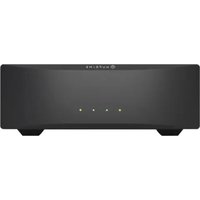
The Ref 20 Mono carries developments embodied in our award-winning amplifiers to a yet higher plateau wherein we've applied the latest in-house research and top-quality components to a level of performance exceeding even that of our celebrated Ref 9V3SE mono amplifier.
The Ref 20's every aspect has been evaluated against those of the Ref 9V3SE in order to identify areas available to improvement. Input-stage circuitry, solid-state and passive components have been reconfigured with an eye to providing a quieter, more distortion-free environment, and greater speed via a capacitor board we call the Cross-Matrix Array (CMA), the effectiveness of which becomes especially apparent in the supremely fast delivery of musical transients.
Owing to the CMA's larger size relative to the Ref 9V3SE's Sequential Linear Array, the Ref 20 occupies a commensurately wider chassis that likewise allows for a more effective routing of internal wiring, resulting in a reduction of background noise.
In addition to the Ref 20's performance gains, the amp features a touch-sensitive front panel, WBT binding posts and a 12-volt On-Off trigger permitting it to operate as the cornerstone of any premium installation, be it two-channel, home theater, and other domestic or commercial application.
As always, in keeping with NuForce policy, customer access to upgrades offers an assurance of non-obsolesce. Advances in technology and circuit architecture will remain available for the new Ref 20 platform, as well as for that of our Ref 9 designs -- and again, as always, at a reasonable cost.
In summary, NuForce's Ref 20 elevates the already excellent performance characteristics of the Ref 9V3SE -- most notably, liquidity and neutrality -- to a degree that must be heard to be believed. As with the Ref 9V3SE, operation in a less than well resolved and transparent system may mask the Ref 20 's advantages. Conversely, a pair of Ref 20s in a fine, audiophile-grade system will reveal the following qualities:
- Sweeter, more natural highs.
- A near-palpable midrange and harmonic structure, resulting in a more natural and relaxed presentation.
- A beautifully textured low end exceeding even that of the Ref 9V3SE's exemplary authority and control.
• A deeper, more coherent soundstage.
In short, the answer to a discriminating audiophile's prayers.
Specifications:
- Configuration: Mono Input: RCA and true balance XLR
• Power Output (see Power FAQ)
| Power/Load 8 ohm 4 ohm 2 ohm | |||
| Peak Power (20mscc hold time) | 400W | 800W | 1600W |
| *RMS Power | 200W | 420W | 420W |
*RMS power denotes maximum continuous power. Peak power denotes an instantaneous power boost. Note that typical listening normally requires about 15W of power. These high power amplifiers provide more than sufficient power for just about any speakers on the market.
• Frequency Response: 20 Hz -0.3 dB - 120 kHz -3 dB
- THD+N = 0.01%, 1kHz, 1W to 10W, A Weighted.
- Input impedance: 22K ohm
- Input sensitivity = 161mV, 1W@8 Ohm; 1.61V, 100W@8 Ohm; 1.136V, 100W@4 Ohm; 2.34V, 425W@4 ohm
- Input sensitivity for m aximum power: 2.5V
- Gain: 27 db
• SN R > 100 db at 100W
• 12V DC Trigger Input
• WBT binding post for spade and banana plug
- Chassis is made of high-grade anodized brushed aluminum to reduce audio resonance
• Dimension: 17"x 15"x 2.95"
- Worldwide AC voltage (84VAC to 264VAC). No need for AC regulator if the AC voltage falls within the specified range.
• Weight: 16 lb
• AC Fuse: Slow blow, 5A, 250VAC
Amplifier FAQ
What is an Analog Switching Amplifier? What's the difference between NuForce's amplifier and other digital amplifiers?
NuForce's switching amplifier is a drastic departure from conventional approaches to switching amplifier design. Most class-D amplifiers use a fixed sawtooth waveform to modulate an audio signal and suffer from the 180-degree phase shift of the LC reconstruction filter. This would normally cause feedback from the load to the error amplifier to oscillate unless phase compensation is used. That compensation network drastically reduces the amplifier bandwidth to below the corner frequency of the LC reconstruction filter. Thus most class-D amplifiers have low bandwidth and high distortion due to limited gain of the phase-corrected error amplifier at audio frequencies.
NuForce's amplifier technology is based upon the principle that a power oscillator can be modulated by an audio signal, producing an amplified audio signal obtained with a reconstruction filter without the bandwidth limitation of a fixed frequency carrier-based conventional PWM control. It uses analog modulation technique and close-loop control systems. Therefore NuForce refers to its audio amplifier as Analog Switching Amplifier.
What are the problems with traditional Class-A and A/B amplifiers?
Traditional linear amplifiers such as Class-A and Class-A/B amplifiers are bulky and inefficient. The inefficiency compromises the reproduction of music signal's full dynamic range. The resulting higher operating temperature also shortens the life of the electrolytic capacitors used in these amplifiers. To get around that problem, today's better amplifiers employ bulky heatsinks and costly linear power supplies to provide enough headroom to handle the full dynamics. These huge power supplies are unregulated and can add noise and ripples at low volume. Besides being inefficient, linear amplifiers depend on transistors or MOSFET devices to generate power. Big (high-power) bipolar transistors or MOSFETs have inherently low bandwidth and do not provide adequate audio performance. Therefore, smaller (up to 20+) MOSFETs with decent audio bandwidth performance are paralleled to provide sufficient power. Each MOSFET has an inherent junction noise - actually worse low frequency noise than bipolar transistors - and the aggregated noise corrupts music reproduction. What you hear is haziness and a lack of clarity in music reproduction. MOSFETs are used in parallel because technically, they are easier to drive (although they have inherently higher distortion than bipolar transistors, which are much harder to drive when they are paralleled). Class-AB amplifiers - the most popular amplifier circuit - have to overcome the inherent crossover distortion that occurs when the audio signal goes from negative to positive and vice-versa, crossing the “zero region” where gains of transistors are much reduced. They are actually down to zero when the transistors stop conducting current. Close-loop system designers know that lower gain means higher inaccuracy of the amplification loop.
What are the problems with Class-D digital switching amplifiers?
Digital Switching Amplifiers (commonly known as Class-D) have been around for years. Nevertheless, it is nearly impossible to engineer a conventional Class-D amplifier that handles the full requirement, 20-20,000Hz, for full-bandwidth music reproduction. A Class-D amplifier works by utilizing a high-frequency sawtooth waveform to modulate the music signal (to learn more about how Class-D amplifier works, click here). The constant presence of the sawtooth waveform, which is very high in the frequency spectrum and its inevitable frequency jittering, can mask or corrupt a low-level music signal. The output filter designed to filter out noise and overtones caused by the sawtooth waveform adds a 180 degree phase shift to Class-D output stage, causing possible instability and adding distortion due to its own inherent non-lincarities. Additionally, the output filter presents frequency-variant output impedance that can interact with a speaker's complex impedance. Variants of Class-D amplifiers with the addition of Digital Signal Processor claim to improve music reproductions. However, because of their lack of close-loop design, especially from the speaker's terminals, spurious interaction between the speaker's complex impedance and back-EMF with the amplifier's resonant output filter can result in harsh sound reproduction. The fundamental flaws of conventional Class-D amplifiers remain unresolved.
Does NuForce's amplifier experience crowding-out phenomenon as in conventional audio amplifiers?
Many audiophiles have observed that the main voices in a recording when produced by amplifiers that have impressive specification numbers are crowded out or submerged in the presence of strong bass tones. Yet these amplifiers boast about 100kHz bandwidth. Is this a human hearing characteristic or do the amplifiers have something strange going on?
While it is true that human ears are highly non-linear vs. amplitude and frequencies, it is also true that no datasheet of transistors contain straight lines on any parameter such as gain (or rise time) vs. any other parameter such as drain/collector current (or the voltage across the transistor terminals). In particular, the current gain of a bipolar transistor or the transconductance of a MOSFET varies not only with the collector current or drain current but also the frequency of the input signal. For example, it is well known that the transconductance of a bipolar transistor is at first approximation proportional to the collector current, but on the other hand its current gain decreases with collector current. Therefore when a bass note appears during a continuous main voice, the gains of the transistors actually become lower than they are during the absence of the bass note, especially a strong one, because the transistor currents are higher during the vibration of the bass note. This means that its F.sub.t also go lower, causing the higher frequencies of the main voice to be less amplified.
Thus in conventional amplifiers, especially class-AB amplifiers using bipolar transistors, the crowding-out or submersion of high-frequency voices is real.
NuForce's amplifiers on the other hand do not suffer from this crowding-out phenomenon. This is because the output MOSFETs only switch between ON and OFF regardless of the amplitude of the audio input signal, the gain in such amplifiers is independent of the transistor current level. NuForce's amplifiers have exceptionally huge bandwidth exceeding 100kHz and very low phase shift in the same frequency range. Therefore all the audio frequencies and their pitch-defining harmonics are faithfully reproduced. Additionally its extremely high damping factor (exceeding 4000) guarantees very tight bass reproduction.
Why is switching amplifier better than linear amplifier in reproducing music? Music is a blend of sine waves, isn't it?
While any waveform theoretically consists of sinc waves, that mathematical decomposition assumes that the waveform is periodic, in other words, a repeating waveform. Musical instruments, on the other hand, produce waveforms with full sharp edges such that even trained eyes have a difficult time figuring out what the fundamental frequency is, because even a single note produced by any instrument is full of attacks and decays (except for instruments that are based on natural resonance such as the pipe organ or the flute). A violin produces very complex waveforms full of high frequencies called harmonics. Harmonics are so named because their frequencies are multiples of the fundamental frequency of the note being played. Faithful reproduction of such complex waveforms requires an amplifier capable of very high bandwidth, and more importantly, with no crossover distortion. The most popular amplifiers use a class of amplifying circuit called class-AB amplifier. It is actually a compromise between the huge inefficiency of class-A amplifiers - the simplest circuit universally used in low power amplification - and the high distortion but higher efficiency of class-B amplifier. Class-A amplifiers theoretically have no crossover distortion. This is the main reason why audiophiles are willing to pay sky high prices for some class-A amplifiers. Likewise, NuForce's analog switching amplifier circuit has no crossover distortion. And while typical linear amplifiers have a bandwidth that is barely over 20 kHz - lower still in boomboxes and in conventional switching amplifiers - NuForce's analog switching amplifier uses proprietary technologies to achieve bandwidth up to ten times higher than typical linear amplifiers. Its huge bandwidth allows it to amplify complex music faithfully, much beyond the concept of high-fidelity. A good side effect of zero crossover distortion and huge bandwidth is a huge sound stage most music lovers never experienced before, because now spatial information contained in a stereo program is completely reproduced.
NuForce amp uses a lot of Surface-mount components (SMD). Are SMD worse than traditional through-hole discrete components?
SMD components are rated and performed as well and sometimes better than through-hole components in several ways: (1) The proximity of lead-less components reduces parasitic inductances, capacitances, and spurious induced noise, so the circuit performs closer to theoretical ideal even when operating at high speed/frequencies; (2) SMD manufacturing technology, driven by PC and telecommunication industries, are more reliable and consistent to produce quality circuit boards. Additionally, our rigorous component selection and scientific circuit design methodologies coupled with extensive computerized simulations and analyses, made possible by our deep insight of high-performance high-precision analog design, make very high fidelity a scientific reality and not marketing hypes of voodoo electronics. Using SMD with the resulting minimum parasitic inductances, capacitances, and minimum antenna effects, NuForce's analog switching amplifiers achieve the highest bandwidth at lowest distortion of a magnitude higher than that of linear and conventional switching amplifiers.
What is damping factor and how does it affect an amplifier's performance?
We shall start with a simplified explanation for the less technical reader. The damping factor tells you how good the amplifier is at driving a speaker. The larger the number, the better it is. It is considered good above 100, poor below 20. Other factors that affect an amplifier's performance are frequency response, distortion, and phase shift etc.
One of the factors affecting how an amplifier drives a speaker system is the amplifier's output impedance. The lower it is, the better the amplifier can present needed current to the speaker system. The better the amplifier can provide varying amounts of current without changing the applied voltage to the speaker system, the more accurate the speaker's reproduction of music. The apparent impedance of the speaker system changes depending on the direction, moving speed and position of the speaker drivers when the voltage is applied. At one moment, it might appear to be 2 ohms, and a moment later, it might appear to be 40 ohms. The applied voltage waveform is, for all intents and purposes, an exact graph of the desired physical motion of the speaker.
But because the speaker's load impedance will vary widely depending on what it was doing when particular voltage (say 15 volts) was applied, the amount of current that the speaker will draw with the applied 15 volts will vary widely as well. The amplifier needs to present the applied voltage correctly no matter what the speaker impedance is. If it can do that, the speaker's cone movements will produce the most accurate reproduction of the applied voltage changes - in other words, the least distortion will occur because the driver(s) will move to the desired position with the least amount of error in time and space.
Summing up, since music is comprised of a constantly changing set of applied voltages, except when silence is being reproduced, the speaker is always moving in some complex pattern of strokes in and out, and that in turn means that when the amplifier changes the applied voltage, the amount of current consumed by the speaker system in complying with that applied voltage will vary over a wide range. So the amplifier must, to the best of its ability, supply that current and not change the applied voltage as a result. If the voltage changes in the process, the speaker will not reach the originally intended excursion, and distortion is the result.
Technical definition of the damping factor is the specified load impedance (in use, this would be the speaker system) divided by the amplifier's output impedance.
In the following diagram, R1 is the source impedance, R2 the load impedance, and Damping Factor = R2/R1

It is very important to note that the load impedance is very hard to measure and it is not constant as it consists of capacitive, resistive and inductive load. And the load impedance also changes with frequencies.
With NuForce amplifiers, measured Vload is equal to no-load output voltage (= Vs) at any audio frequency, therefore its output impedance is practically zero, otherwise said, its damping factor is very high, DF >> 1000. Output impedance is less than 10 milliohm (due to speaker cable and contact) within the entire frequency response!. IcePower500ASP has a damping factor of 70 at 10 kHz, and only 12 @20kHz. For another comparison, Hypex UcD180 output impedance is 20mOhm at low frequencies, 100milliohms at 25kHz, going up at a slope of 20dB/decade (Fc=10kHz).
Power FAQ
NuForce's amplifier is so small and light, does it provide adequate performance?
NuForce's amplifier utilizes high-performance switch-mode power supplies (SMPS). SMPS, as opposed to traditional huge and bulky linear power supplies, offers smaller size and higher efficiency. Most importantly, SMPS operates at much higher frequencies. These are thousands of times faster than linear power supplies operating at 50/60Hz. Therefore, they respond faster to provide the instantaneous power required by high-performance music reproduction. Transformers and capacitors are more efficient and smaller at higher frequency. Hence, even a very small SMPS is still several times more capable than a 50/60Hz linear power supply. SMPS also offers sophisticated over-current and short circuit protection, in addition to meeting all leading safety and industry reliability standard. Running very cool, the SMPS used in NuForce's amplifier provides an unequalled regulated output without the 100/120 Hz ripple voltage found in linear power supplies (even when huge cans of filter capacitors are used such as the case of high end amplifiers).
What are Peak and RMS (Root Mean Square) power ratings? What's the effect on audio output?
RMS power is continuous power that the amplifier is capable of outputting over long periods. Peak power is short-term power that an amplifier is capable of briefly outputting when faced with sudden, high-energy signals.
Headroom is referred to an amplifier's ability to go beyond its rated average power (RMS or continuous power) for a short time in order to recreate loud or explosive audio signals that rise very quickly. In order to have high headroom (an ability to achieve loud peak levels without distorting), an amplifier must have a stiff power supply with a good amount of reserve energy on which it can call (stored in capacitors). The ability of the power supply to quickly recharge the capacitors is also very critical. A typical low frequency (50Hz for example) explosive sound consists of an attack followed by a series of rapidly decaying lobes of a 50Hz sine wave. Therefore, an amplifier with 140W peak power with 20ms holdtime is capable of providing 140W power to the 50Hz musical note (full cycle of 50 Hz is 20ms). A series of successive explosive sound might be sounded very close to human ear, but their base notes are far apart enough (1 second = 1000 ms) for the amplifier to provide the required peak power. For most typical home listening, hardly more than 20W of power is consumed. Therefore, a good amplifier should provide sufficient RMS power and a high peak power with low distortion (NuForce's Amplifier is capable of generating the peak power at ultra low distortion of less than 0.05% THD+N).
Is NuForce's 140W amplifier less or more powerful than a linear solid state or tube amplifier rated for 140W?
In terms of reproducing the dynamics and headrooms of music, the more power the better. The commonly accepted measurement is to rate the output power when the amplifier clips with a 1% THD. Now, what is clipping? Clipping occurs in a linear amplifier when its output signal tries to exceed the limits of its power supply voltage. In a linear amplifier using transistors and bulky a transformer/rectifier, the storage capacitor is recharged only once every 8.33 milliseconds, and its voltage is only slightly above the maximum output voltage, so it could clip rather easily. To put it simply, it has very little headroom. With tube amplifiers, the supply voltage is very high, typically 300
to 600V. Therefore even though tube amplifiers have higher overall distortion, perceptively, they sound more 'powerful'. NuForce's amplifier is a switching amplifier designed with lots of headroom, so that there is no clipping at its rated 140W. Its 140W is perceptively better sounding than a 140W linear amplifier.
NuForce's Limited Warranty and Limitation of Liabilities
ADDITIONAL RIGHTS
FOR CONSUMERS, WHO ARE COVERED BY CONSUMER PROTECTION LAWS OR REGULATIONS IN THEIR COUNTRY OF PURCHASE OR, IF DIFFERENT, THEIR COUNTRY OF RESIDENCE, THE BENEFITS CONFERRED BY THIS WARRANTY ARE IN ADDITION TO ALL RIGHTS AND REMEDIES CONVEYED BY SUCH CONSUMER PROTECTION LAWS AND REGULATIONS. THIS WARRANTY DOES NOT EXCLUDE, LIMIT OR SUSPEND ANY RIGHTS OF CONSUMERS ARISING OUT OF NONCONFORMITY WITH A SALES CONTRACT. SOME COUNTRIES, STATES AND PROVINCES DO NOT ALLOW THE EXCLUSION OR LIMITATION OF INCIDENTAL OR CONSEQUENTIAL DAMAGES OR ALLOW LIMITATIONS ON HOW LONG AN IMPLIED WARRANTY OR CONDITION MAY LAST, SO THE LIMITATIONS OR EXCLUSIONS DESCRIBED BELOW MAY NOT APPLY TO YOU. THIS WARRANTY GIVES YOU SPECIFIC LEGAL RIGHTS, AND YOU MAY ALSO HAVE OTHER RIGHTS THAT VARY BY COUNTRY, STATE OR PROVINCE. THIS LIMITED WARRANTY IS GOVERNED BY AND CONSTRUED UNDER THE LAWS OF THE COUNTRY IN WHICH THE PRODUCT PURCHASE TOOK PLACE.
LIMITED WARRANTY
For a period of Three(3) YEAR from the date of retail purchase by the original end-user purchaser ("Warranty Period"), NuForce warrants (i) this product against defects in materials and workmanship, and (ii) that each Product, unmodified and under normal use and conditions, will substantially comply with NuForce' applicable written technical documentation for the Product. NuForce reserves the right to make substitutions and modifications from time to time in the specifications of Products sold by NuForce, provided that such substitutions or modifications do not materially affect overall Product performance.
If a hardware defect exists and a valid claim is received within the Warranty Period, at its option and to the extent permitted by law, Nuforce will (1) repair the hardware defect at no charge, using new or refurbished replacement parts, (2) exchange the product with a product that is new or which has been manufactured from new or serviceable used parts and is at least functionally equivalent to the original product, or (3) refund the purchase price of the product. Nuforce may request that you replace defective parts with user-installable new or refurbished parts that Nuforce provides in fulfillment of its warranty obligation. A replacement product/part assumes the remaining warranty of the original product or ninety (90) days from the date of replacement or repair, whichever provides longer coverage for you. When a product or part is exchanged, any replacement item becomes your property and the replaced item becomes Nuforce's property. When a refund is given, your product becomes Nuforce's property.
OBTAINING WARRANTY SERVICE
If you purchased the product in the U.S., deliver the product, at your expense, to any Nuforce Service Center located in the U.S. If you purchased the product outside of the U.S., deliver the product to any Nuforce Authorized Importer in the country where you purchased the product. Be aware, however, that not all countries have Nuforce Authorized Service Providers ('NASP') and not all Authorized Service Providers outside the country of purchase have all parts or replacement units for the product. If the product cannot be repaired or replaced in the country it is in, it may need to be sent to a different country or returned to the country of purchase at your expense for repair or replacement. If you seek service in a country that is not the country of original purchase, you will comply with all applicable Import and export laws and regulations and be responsible for all custom duties, V.A.T. and other associated taxes and charges. Where international service is available, Nuforce may repair or exchange defective products and parts with comparable products and parts that comply with local standards.
You can always deliver the product to NuForce's U.S. main service center for obtaining warranty service, however, you may have to pay for return shipping cost.
Nuforce may send you user-installable new or refurbished replacement product or parts to enable you to service or exchange your own product ("DIY Service"). Upon receipt of the replacement product or part, the original product or part becomes the property of Nuforce and you agree to follow instructions, including, if required, arranging the return of original product or part to Nuforce in a timely manner.
When providing DIY Service requiring the return of the original product or part, Nuforce may require a credit card authorization as security for the retail price of the replacement product or part and applicable shipping costs. If you follow instructions, Nuforce will cancel the credit card authorization, so you will not be charged for the product or part and shipping costs. If you fail to return the replaced product or part as instructed or the replaced product or part is not eligible for warranty service, Nuforce will charge the credit card for the authorized amount.
EXCLUSIONS AND LIMITATIONS
This Limited Warranty applies only to hardware products manufactured by or for Nuforce that can be identified by the "Nuforce" trademark, trade name, or logo affixed to them. The Limited Warranty does not apply to any non-Nuforce hardware products or any accessories, even if packaged or sold with Nuforce hardware. Non-Nuforce manufacturers, suppliers, may provide their own warranties. Other accessories distributed by Nuforce under the Nuforce brand name are not covered under this Limited Warranty. This warranty does not apply: (a) to damage caused by accident, abuse, misuse, misapplication, liquid contact, fire, earthquake, non-Nuforce products, or other external causes; (b) to damage caused by service performed by anyone who is not a NASP; (c) to a product or a part that has been modified without the written permission of Nuforce; (d) to consumable parts, such as batteries, or protective coatings designed to diminish over time unless failure has occurred due to a defect in materials or workmanship; (e) to cosmetic damage, including but not limited to scratches, dents, and broken plastic on ports; (f) to defects caused by normal wear and tear or otherwise due to the normal aging of the product; or (g) if any Nuforce serial number has been removed or defaced.
Important: Do not open the hardware product. Opening the hardware product may cause damage that is not covered by this warranty. Only Nuforce or a NASP should perform service on this hardware product.
THIS WARRANTY AND REMEDIES SET FORTH ABOVE ARE EXCLUSIVE AND IN LIEU OF ALL OTHER WARRANTIES, REMEDIES AND CONDITIONS, WHETHER ORAL OR WRITTEN, EXPRESS OR IMPLIED. NUFORCE SPECIFICALLY DISCLAIMS ANY AND ALL IMPLIED WARRANTIES, INCLUDING, WITHOUT LIMITATION, WARRANTIES OF MERCHANTABILITY AND FITNESS FOR A PARTICULAR PURPOSE. IF NUFORCE CANNOT LAWFULLY DISCLAIM IMPLIED WARRANTIES UNDER THIS LIMITED WARRANTY, ALL SUCH WARRANTIES, INCLUDING WARRANTIES OF MERCHANTABILITY AND FITNESS FOR A PARTICULAR PURPOSE ARE LIMITED IN DURATION TO THE DURATION OF THIS WARRANTY. No Nuforce reseller, agent, or employee is authorized to make any modification, extension, or addition to this warranty.
NUFORCE IS NOT RESPONSIBLE FOR DIRECT, SPECIAL, INCIDENTAL OR CONSEQUENTIAL DAMAGES RESULTING FROM ANY BREACH OF WARRANTY OR CONDITION, OR UNDER ANY OTHER LEGAL THEORY, INCLUDING BUT NOT LIMITED TO LOST PROFITS, DOWNTIME, GOODWILL, DAMAGE TO OR REPLACEMENT OF EQUIPMENT AND PROPERTY, ANY COSTS OF RECOVERING, REPROGRAMMING, OR REPRODUCING ANY PROGRAM OR DATA STORED IN OR USED WITH NUFORCE PRODUCTS, AND ANY FAILURE TO MAINTAIN THE CONFIDENTIALITY OF DATA STORED ON THE PRODUCT.
NUFORCE SPECIFICALLY DOES NOT REPRESENT THAT IT WILL BE ABLE TO REPAIR ANY PRODUCT UNDER THIS WARRANTY OR MAKE A PRODUCT EXCHANGE WITHOUT RISK TO OR LOSS OF PROGRAMS OR DATA.
Some states and provinces do not allow the exclusion or limitation of incidental or consequential damages or exclusions or limitations on the duration of implied warranties or conditions, so the above limitations or exclusions may not apply to you. This warranty gives you specific legal rights, and you may also have other rights that vary by state or province.
Proof of purchase in the form of a bill of sale or receipted invoice which is evidence that the unit is within the Warranty period must be presented to obtain warranty service.
REPLACEMENT AS PROVIDED UNDER THIS WARRANTY IS THE EXCLUSIVE REMEDY OF THE CONSUMER. NUFORCE SHALL NOT BE LIABLE FOR ANY INCIDENTAL OR CONSEQUENTIAL DAMAGES FOR BREACH OF ANY EXPRESS OR IMPLIED WARRANTY ON THIS PRODUCT. EXCEPT TO THE EXTENT PROHIBITED BY APPLICABLE LAW, ANY IMPLIED WARRANTY OF MERCHANTABILITY OR FITNESS FOR A PARTICULAR PURPOSE ON THIS PRODUCT IS LIMITED IN DURATION TO THE DURATION OF THIS WARRANTY.
- FCC NOTICE: DECLARATION OF CONFORMITY INFORMATION
- SAFETY INSTRUCTIONS
- SAFE USE AND OPERATION OF YOUR DEVICE
- WARNING: USE GROUNDED AC POWER CORDS ONLY
- READ THIS FIRST
- WARNING: BE CERTAIN TO PROPERLY POSITION THE RCA/XLR SELECTOR SWITCH
- HEAT DISSIPATION
- TURNING ON YOUR REFERENCE 20 FOR THE FIRST TIME
- THE NUFORCE REFERENCE 20 MONO AMPLIFIER
- SPECIFICATIONS
- AMPLIFIER FAQ
- WHAT ARE THE PROBLEMS WITH TRADITIONAL CLASS-A AND A/B AMPLIFIERS
- WHAT ARE THE PROBLEMS WITH CLASS-D DIGITAL SWITCHING AMPLIFIERS
- DOES NUFORCE'S AMPLIFIER EXPERIENCE CROWDING-OUT PHENOMENON AS IN CONVENTIONAL AUDIO AMPLIFIERS
- NUFORCE AMP USES A LOT OF SURFACE-MOUNT COMPONENTS (SMD). ARE SMD WORSE THAN TRADITIONAL THROUGH-HOLE DISCRETE COMPONENTS
- WHAT IS DAMPING FACTOR AND HOW DOES IT AFFECT AN AMPLIFIER'S PERFORMANCE
- POWER FAQ
- NUFORCE'S LIMITED WARRANTY AND LIMITATION OF LIABILITIES
- ADDITIONAL RIGHTS
- LIMITED WARRANTY
- OBTAINING WARRANTY SERVICE
- EXCLUSIONS AND LIMITATIONS
Brand : NuPrime
Model : Reference 20
Category : Amplifier