
KA4KOADRONA - Drone Kogan - Free user manual and instructions
Find the device manual for free KA4KOADRONA Kogan in PDF.


| Product Type | Drone |
| Brand | Kogan |
| Model | KA4KOADRONA |
| Dimensions (Unfolded) | Approx. 30 x 25 x 6 cm |
| Weight (with battery) | Approx. 250 g |
| Battery Type | Li-Po 3.7V 1500mAh |
| Charging Time | Approx. 120 minutes |
| Flight Time | Approx. 15 minutes |
| Control Range | Up to 100 meters |
| Camera Resolution | 720p HD |
| Stabilization | 6-axis gyroscope |
| Flight Modes | Altitude hold, headless mode, one-key return |
| Speed Modes | Low, medium, high |
| Built-in Memory | MicroSD card slot (up to 32GB, not included) |
| Controller | 2.4GHz remote control with smartphone holder |
| Material | ABS plastic |
| Cleaning | Wipe with a soft, dry cloth. Avoid solvents. |
| Safety Features | Propeller guards, low battery warning, emergency stop |
| Spare Parts Availability | Propellers, batteries, and chargers available from Kogan |
| Repairability | Modular design; user can replace propellers and battery |
| Certifications | CE, FCC |
Frequently Asked Questions - KA4KOADRONA Kogan
User questions about KA4KOADRONA Kogan
0 question about this device. Answer the ones you know or ask your own.
Ask a new question about this device
Download the instructions for your Drone in PDF format for free! Find your manual KA4KOADRONA - Kogan and take your electronic device back in hand. On this page are published all the documents necessary for the use of your device. KA4KOADRONA by Kogan.
USER MANUAL KA4KOADRONA Kogan
natural_image
Line drawing of a quadcopter drone with four propellers and control panels (no text or symbols)4K CAMERA DRONE WITH OBSTACLE AVOIDANCE
INCLUDING 2 BATTERIES
KA4KOADRONA
Safety & Warnings 3
Components 5
Overview 6
Before First Use 8
Operation 11
KY UFO App 15
Cleaning & Care 17
Troubleshooting 18
Notes 19
SAFETY & WARNINGS
Ensure to read all instructions and warnings in this user guide prior to first use. Retain this user guide for future reference.
WARNING: This drone may need to be registered. Check with your local authority on the rules for registration.
- Do not attempt to touch the drone whilst it is operating under any circumstances.
- This drone is not a toy and can be dangerous when used incorrectly. Follow all instructions while operating. Disassembling or modifying the drone arbitrarily, operating improperly, or being unfamiliar with this product may lead to an accident and possible injuries.
- This drone is intended for use by persons aged 14 years or older. It is recommended that people between 14-18 years operate the drone under adult supervision.
- Ensure the drone is operated in a safe environment.
- It is recommended that you seek the assistance of an experienced drone pilot before attempting to fly the drone for the first time. Asking a local expert is the best way to properly assemble, setup, and fly your drone for the first time. It requires a certain degree of skill to operate and is subject to normal wear and tear.
- Do not fly this drone higher than 120 metres above ground level.
- Do not fly multiple drones simultaneously. Only one drone can be flown at any given time.
- Do not allow drone to fly out of visible range.
- Ensure the drone is flown at least 30 metres away from any people.
- Do not fly the drone over populated areas (for example, beaches, parks, and event venues).
- Do not fly drones within 5.5km of airports. Many locations are considered no-fly zones and you must ensure that you fly in areas that align with local laws and ordinances.
- Do not record or photograph people without consent.
- Drones are prone to accidents and failures when piloted incorrectly. Operators are responsible for their actions as well as any damage or injury caused by pilot error and radio interference.
- This drone is suitable for indoor and outdoor use. Always fly in a place clear of obstacles and do not fly the drone in a way that would cause hazards to nearby people and property.
- Do not operate the drone in unsafe conditions and keep clear of heat sources, wires, or electric power sources.
- Do not fly the drone over areas affecting public safety or where there are emergency operations taking place.
- This drone contains electrical components. Always keep this drone away from water and other liquids. Exposure to water or moisture in any form can cause this drone to malfunction resulting in a crash.
- To avoid a potential fire hazard, do not short, reverse the polarity, or puncture batteries. Battery charging must be done under supervision and in a location out of reach of children.
- Remove the batteries if they will not be used on the drone for an extended period. Always dispose of old batteries according to the laws of local environmental authorities.
- Li-Polymer batteries pose higher operational risks compared to other battery types; thus it is imperative to follow its usage instructions.
- Avoid contact between the battery and metallic objects.
- If there is an increase in battery temperature after operation, cease use immediately and allow it to cool down. Continuous use of this battery may cause it to expand, deform, explode, or result in potential fire hazards.
- Do not place heavy objects directly onto the drone or any of its components.
- Images used in this user guide are for reference only.
Battery warnings
- There is a certain risk when using a lithium battery. It may cause fire, bodily injuries, or property loss. Users must be aware of the risks and take full of responsibility if using the battery improperly.
- If battery leakage occurs, avoid contact with your eyes or skin. If there is contact, wash your eyes with water and seek medical care immediately.
- Remove the plug immediately if there is any peculiar smell, noise, or smog.
- Do not use third-party chargers.
- Do not charge a diluted or outworn battery.
- Do not overcharge the battery. Unplug the charger once fully charged.
- Do not charge the battery next to inflammables (for example, carpet, timber floors, wood furniture, or on the surface of electro-conductive objects).
• Always keep an eye on the battery when charging.
- Do not charge the battery if it has not had sufficient time to cool after use.
- The ambient temperature when charging is between 0–40°C.
- Do not dispose of the battery as rubbish. Familiarise yourself with the local disposal laws and follow them accordingly.
COMPONENTS

natural_image
Line drawing of a quadcopter drone with four propellers and a central cockpit (no text or symbols)A Drone (x1)
natural_image
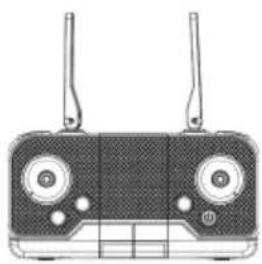
Front view of a handheld smart control device with dual speakers (no visible text or symbols)B Remote control (x1)
natural_image
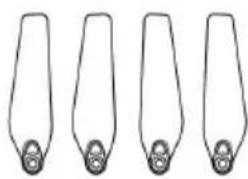
Four identical line drawings of a conical object with a central base and circular ends (no text or symbols)C Spare propellers (x4)
natural_image
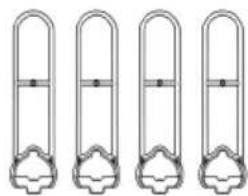
Four identical vertical cylindrical objects with rounded ends and flanges, arranged horizontally (no text or symbols)D Protective guards (x4)
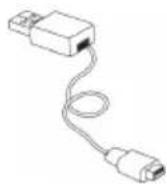
E USB charging cable (x1)
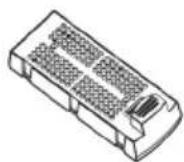
F Batteries (x2)
G Screwdriver (x1)
H User guide (x1)
OVERVIEW
Drone
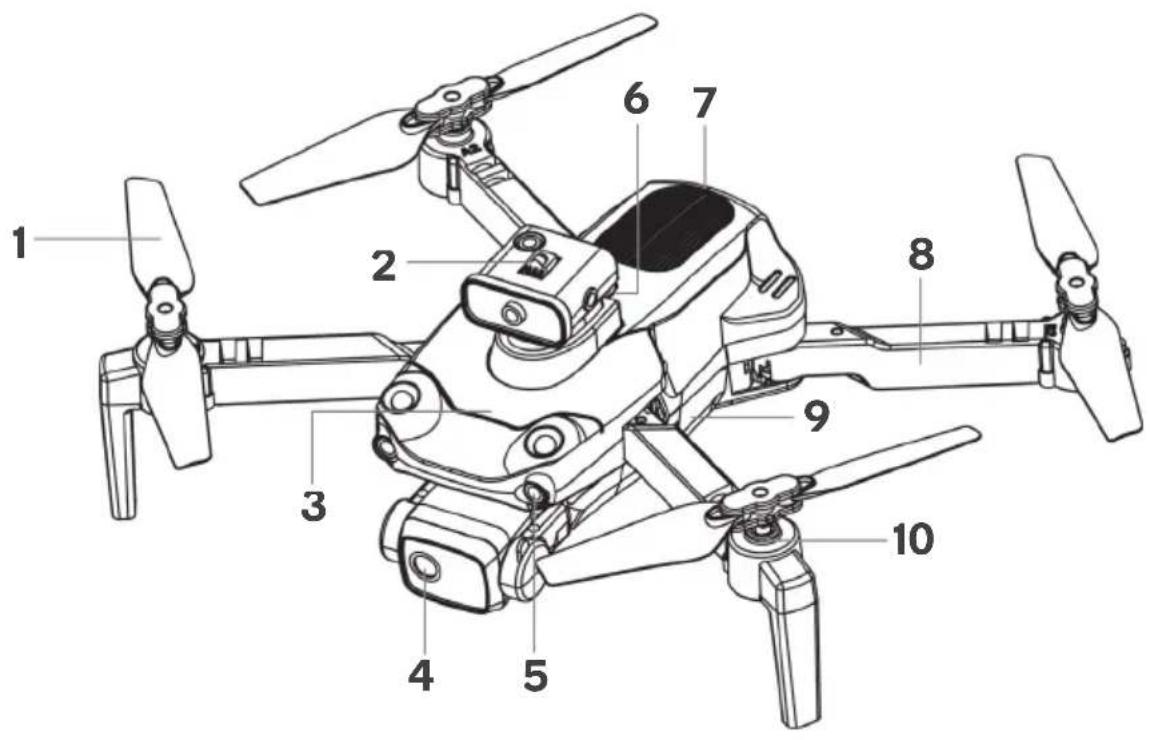
1 Propeller
6 Power button
2 Obstacle avoidance sensor
7 Battery
3 Upper casing
8 Arm
4 Camera 9 Lower casing
10 Motor
5 Indicator light

11 Trim button
12 Speed/headless mode button
13 Left joystick
14 Camera angle up button
15 Camera angle down button
16 Capture/record button
17 Flip and roll/return button
18 Right joystick
19 Take-off/land/emergency stop button
20 Power/obstacle avoidance button
BEFORE FIRST USE
Remote control
The remote control needs x3 AA batteries (not supplied) to operate.
- Open the battery cover.
- Noting the polarity markings (+/-), insert x3 AA batteries into the remote control. Reattach the battery cover.
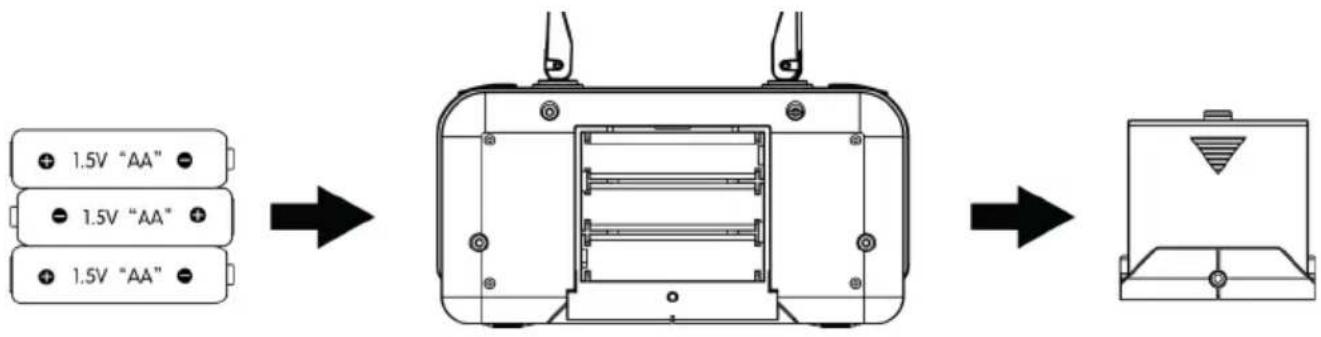
Notes:
- Do not mix old and new batteries together.
- Do not mix different types of batteries.
Drone
Arms
Open the front arms closest to the camera, then open the back arms.

natural_image
Top-down line drawing of a quadcopter drone with four propellers and two labeled parts (no text or symbols on the diagram itself)Note:
After use, fold the back arms in before folding the front arms.
Protective guards
Align the protective guards with the motors on the arms, then attach them by pressing them into place.

natural_image
Technical line drawing of a mechanical device with a tool and bracket, showing no text or symbols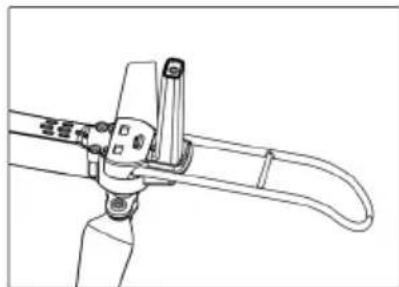
natural_image
Technical line drawing of a mechanical tool or clamp assembly (no text or symbols)Battery for the drone
The battery must be charged before first use.
- Remove the lithium battery from the bottom of the drone.

natural_image
Diagram of a mechanical component with a black arrow pointing to a specific part (no text or symbols present)
natural_image
Diagram showing a drone's internal components being inserted into a device (no text or symbols present)- Connect the USB charging cable to the charging port on the battery and a power adapter (not supplied). Plug the power adapter into a socket and switch it on to charge.
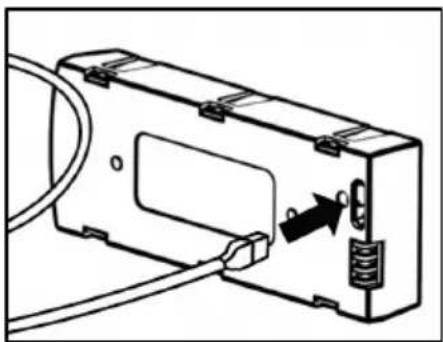
natural_image
Diagram of an electronic device with cable and switch, showing internal components without any text or symbolsNotes:
-
The lights on the battery will illuminate red when charging. The battery lights will turn off when fully charged.
• A full charge takes around 60–90 minutes. -
After charging, reattach the battery to the drone.
Connecting the signals of the transmitter and receiver
- Long press the power button on the drone and remote control to turn on the drone and place it on a level surface. The indicator lights of the transmitter and drone will be flashing.
- Push the left joystick to the highest position upwards then push it down to the lowest position.
- When you hear two beeps, the indicator lights on the transmitter and drone will become solidly illuminated. The signal connection is now complete.
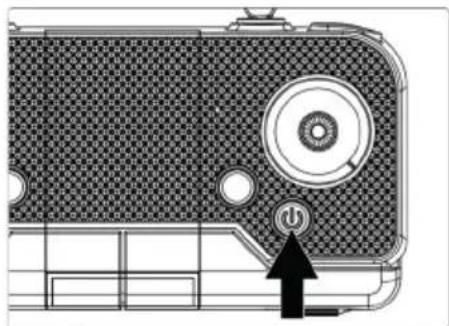
natural_image
Technical line drawing of a device casing with a button and arrow indicator (no text or symbols)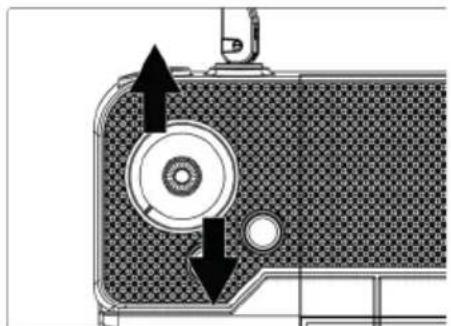
natural_image
Technical diagram of a mechanical component with directional arrows indicating movement or force (no text or symbols present)Calibrating the transmitter with the drone
This calibration can also be used when the drone is drifting or rotating by itself.
- Long press the power button to turn on the drone and place it on a level surface.
- Move and hold the left and right joysticks on the remote control for three seconds in the positions indicated. The remote control will make a beep and the indicator lights will flicker.

natural_image
Top-down technical diagram of a handheld device with circular ports and control buttons (no text or symbols)- Wait for about three seconds and then the indicator lights will become solidly illuminated. Calibration is now complete.
OPERATION
Take-off
- Long press the power button on the drone and remote control to turn on the drone.
- Press the take-off button and the drone propellers will start rotating. The drone will automatically fly at a height of 1.5 metres.
Flight controls
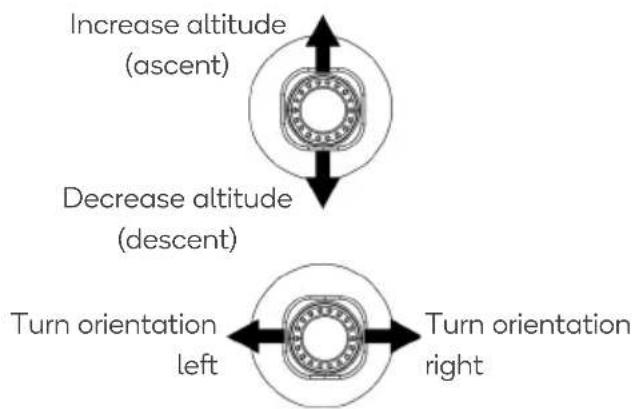
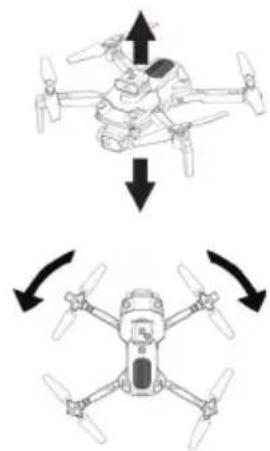
- Use the left joystick to control the flight altitude and to turn the drone's orientation left and right
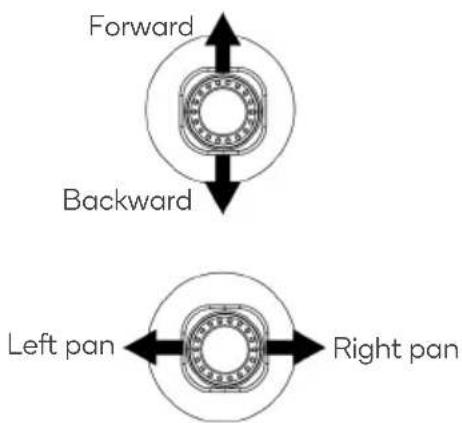
- Use the right joystick to control the forward, backward, left, and right-pan movements
- If the left joystick is released, the drone will hover at the given height
Left joystick
natural_image
Two diagrams showing a drone with directional arrows indicating rotation or movement (no text or symbols present)Right joystick
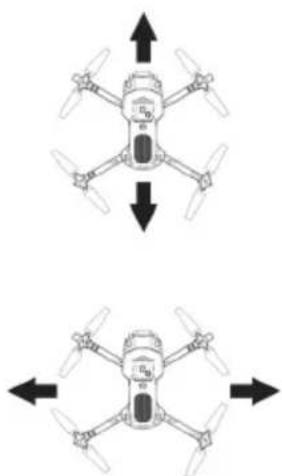
natural_image
Two identical line drawings of a quadcopter drone with six propellers and directional arrows indicating flight or movement (no text or symbols)Note:
The drone must only be flown during the day in suitable weather conditions. Do not fly the drone through cloud or fog.
Speed
This drone features three speed settings. Press the speed button to switch between the three speeds.
Flips and rolls
When the drone is more than three metres off the ground, press the flip and roll button and move the right joystick either left or right. The drone will then flip in that direction.

Return
If you wish the drone to come back to its take-off point, long press the return button. The drone will then return to the location where it took off.
Taking photos and recording videos
- Press the capture button and the drone will take a photo
- Press the record button and the drone will start/stop recording video footage
Landing
There are two methods to land the drone:
- Use the left joystick and decrease altitude manually in a desired location and land
- Press the land button. The drone will then automatically slow down and land at its current location.
Emergency stop
The emergency stop should only be used in emergencies. This will result in the motors stopping immediately and cause the drone to free fall and crash onto the ground, which may cause damage. To perform an emergency stop, long press the emergency stop button.
Headless mode
By default, the flight controls of the drone are based on the position of the nose of the drone at any given time. For beginners, this may make the drone difficult to control if the drone changes its orientation.
Activating headless mode allows easier control of the drone as it will move according to the joystick controls regardless of where the nose is facing. To activate headless mode, long press the headless mode button. The remote control will beep once to confirm.
To exit headless mode, long press the headless mode button again. The remote control will beep once to confirm.
Note:
When the drone is flying within 30cm from the ground, it will have reduced drag which may lead to the drone being unstable. The lower the drone flies, the more unstable it will become.
Obstacle avoidance mode
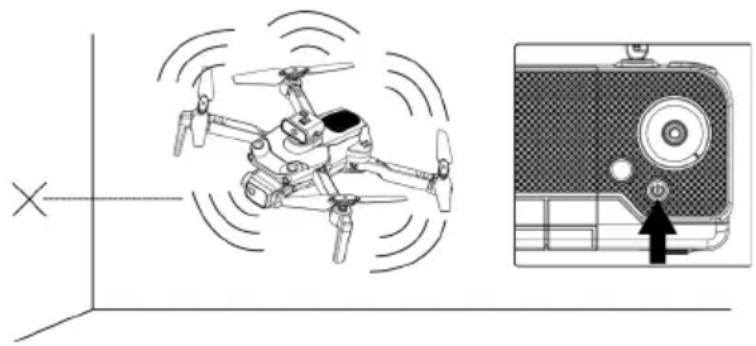
It is recommended to turn on the obstacle avoidance mode when flying indoors in an environment at least 6 x 6m in area.
When turned on, if the drone approaches obstacles on three sides (for example, walls), it will retreat and move in the opposite direction to avoid contact with the obstacles.
Note:
The speed of the drone will also slow down, and the faster speed setting will not function when using this mode.
To turn on obstacle avoidance mode, press the obstacle avoidance button. To turn off obstacle avoidance mode, press the same button again.
natural_image
Illustration of a quadcopter drone with motion arrows and a camera module inset (no text or symbols)Trim adjustment
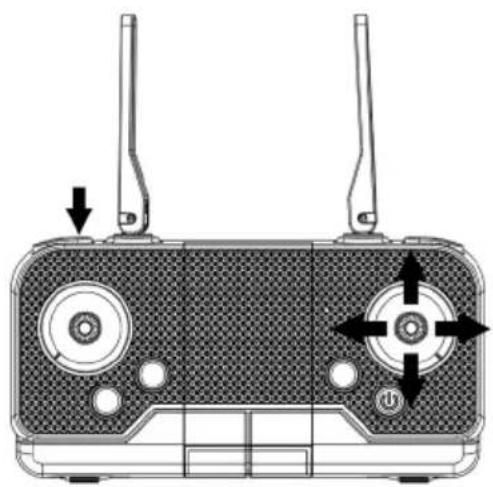
If the drone is deviating off-course or has lost its balance when stationary, trim adjustments will need to be made.
- Press the trim button and you will hear a beep.
- Move the right joystick in the appropriate direction to regain balance on the drone. For example, if the drone is tilting towards the right, move the joystick left. Make these adjustments with the joystick until balance is achieved.
- After adjusting, once there is no input on the remote control for 5–6 seconds, the remote control will deactivate the trim function and the right joystick can be used normally.
natural_image
Top-down technical diagram of a remote control device with dual-mounted ports and directional arrows indicating orientation (no text or symbols)
Camera angle adjustment
- Press the camera up button to adjust the camera angle upwards
- Press the camera down button to adjust the camera angle downwards

natural_image
Diagram of a game controller with labeled buttons and control panel (no text or symbols present)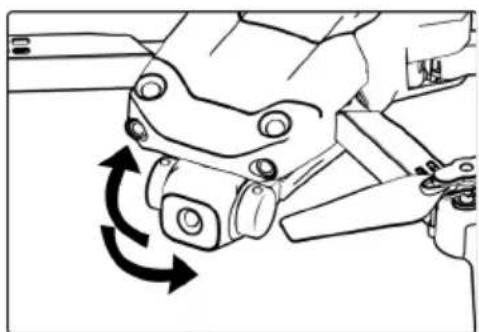
natural_image
Mechanical assembly diagram showing a clamping mechanism with rotational arrows (no text or symbols)Powering off
Long press the power button on the drone and remote control to switch the drone off.
KY UFO APP
Apart from the remote control, the drone can also be controlled by using the 'KY UFO' app.
App installation
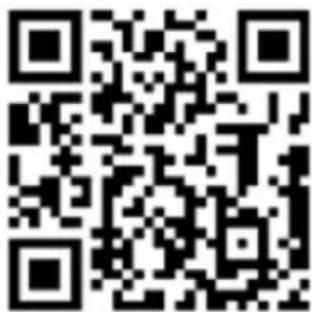
- Scan the below QR code below or search 'KY UFO' on the Google Play or Apple Store to download.
- Turn on the drone. Enter the Wi-Fi settings of your phone and search for the Wi-Fi network, 'FLOW-WIFI_xxxxx'. Tap to connect.
3.Open the 'KY UFO' app and tap 'Start' to begin use.

flowchart
graph LR
    A["WiFi list"] --> B["APP"]
    B --> C["Main interface"]

    subgraph APP
        D["Data transfer"]
        E["0x16"]
        F["0x20"]
        G["0x25"]
        H["0x30"]
        I["0x35"]
        J["0x40"]
        K["0x45"]
        L["0x50"]
        M["0x55"]
        N["0x60"]
        O["0x65"]
        P["0x70"]
        Q["0x75"]
        R["0x80"]
        S["0x85"]
        T["0x90"]
        U["0x95"]
        V["0x100"]
    end

    subgraph Main interface
        W["Main interface"]
        X["Main interface"]
        Y["Main interface"]
    end

    D --> F --> G --> H --> I --> J --> K --> L --> M --> N --> O --> P --> Q --> R --> S --> T --> U --> V --> W --> X --> Y --> Z --> AA --> AB --> AC --> AD --> AE --> AF --> AG --> AH
    end
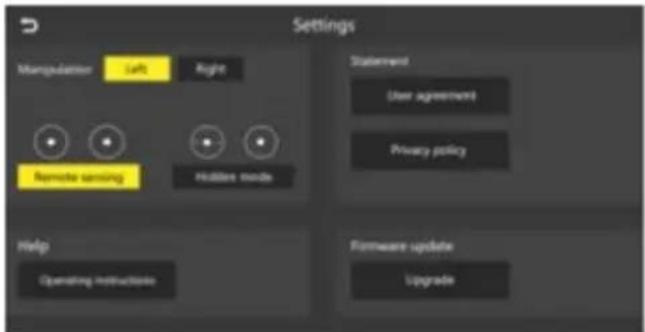
Interface
Press the 'Off' icon to reveal more functions and movement controls.
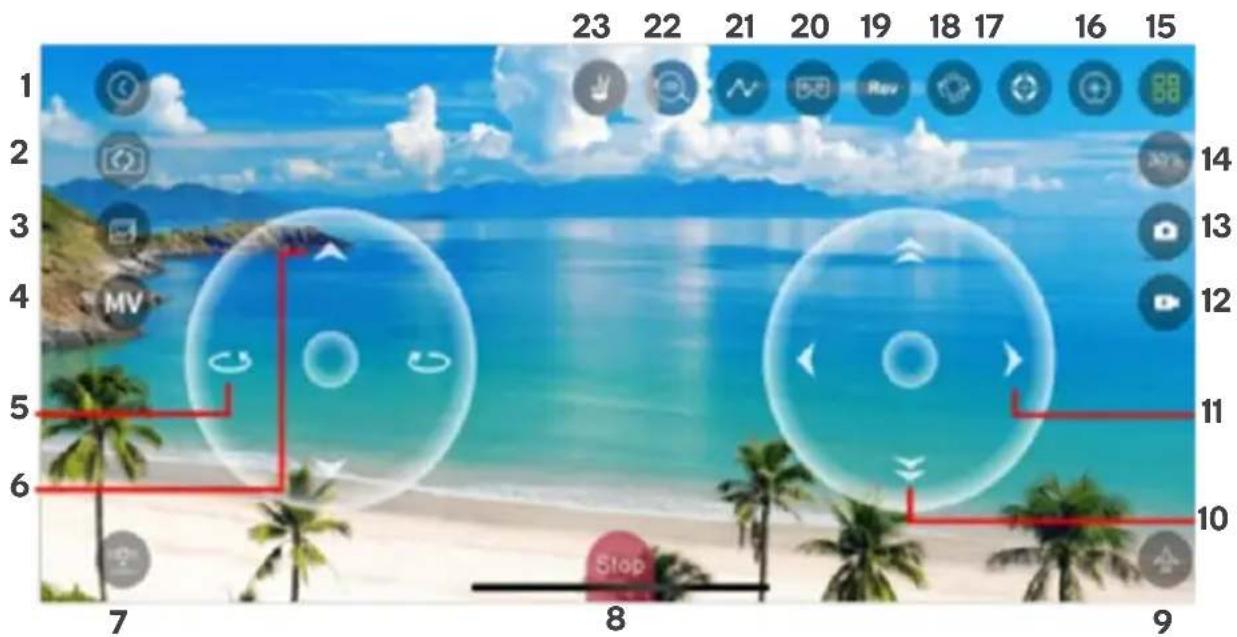
1 Return 12 Videotape
2 Lens switch 13 Photograph
3 Photo album 14 Speed
4 MV 15 More
5 Rotation 16 Headless
6 Throttle 17 Calibration
7 One touch take-off and landing 18 Gravity
8 Emergency stop 19 Mirror flip
9 Control switch 20 3D split screen
10 Front and back 21 Trajectory
11 Side flight 22 Zoom
23 Gesture
Note:
The trajectory function allows users to pinpoint certain areas they wish the drone to fly.
Gesture control
- When activated, make a "V" sign with your right hand towards the camera and the drone will take a photo after three seconds.
- Face your palm towards the camera and the drone will start a video recording after three seconds. Face your palm towards the camera again to stop recording.
CLEANING & CARE
Once powered off, wipe the drone with a dry cloth.
Propeller replacement
-
Use the screwdriver to remove the screws that are attached to the current propellers. Remove the propellers.
-
Noting the 'A' and 'B' lettering on the spare propellers, insert the spare propellers onto the matching motors.
-
Use the screwdriver to tighten the screws onto the propellers to secure them into place.

natural_image
Diagram of a helicopter's propeller assembly with labeled parts (no text or symbols present)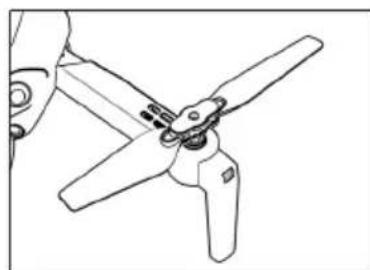
natural_image
Line drawing of a propeller with three blades and a handle (no text or symbols)TROUBLESHOOTING
| Problem | Cause | Solution |
| The drone is not responding to the remote control. | The battery on the drone is not attached correctly. | Ensure the battery is securely attached to the drone. |
| The wind is too strong. | Do not fly the drone in strong wind conditions. | |
| The drone cannot ascend. | The rotational speed of the propellers is too slow. | Push the left joystick up higher. |
| The battery of the drone is not fully charged. | Fully charge the battery of the drone. | |
| The drone is landing too quickly/not landing properly. | The left joystick is pushed down too fast. | Push the left joystick down slowly to perform a smooth landing. |
| The drone cannot be controlled. | The drone is beyond the effective controlling distance. | If using the remote control, ensure the drone stays within 100 metresIf using the ‘KY UFO’ app, ensure the drone stays within 40–50 metres |
NOTES
Need more information?
We hope that this user guide has given you the assistance needed for a simple set-up.
For the most up-to-date guide for your product, as well as any additional assistance you may require, head online to help.kogan.com
kogan.com


- 4K CAMERA DRONE WITH OBSTACLE AVOIDANCE
- SAFETY & WARNINGS
- WARNING: This drone may need to be registered. Check with your local authority on the rules for registration.
- Battery warnings
- COMPONENTS
- OVERVIEW
- Drone
- BEFORE FIRST USE
- Remote control
- Notes:
- Arms
- Note:
- Protective guards
- Battery for the drone
- Connecting the signals of the transmitter and receiver
- Calibrating the transmitter with the drone
- OPERATION
- Take-off
- Flight controls
- Left joystick
- Right joystick
- Speed
- Flips and rolls
- Return
- Taking photos and recording videos
- Landing
- Emergency stop
- Headless mode
- Obstacle avoidance mode
- Trim adjustment
- Camera angle adjustment
- Powering off
- KY UFO APP
- App installation
- Interface
- Gesture control
- CLEANING & CARE
- Propeller replacement
- TROUBLESHOOTING
- NOTES
- Need more information?
Brand : Kogan
Model : KA4KOADRONA
Category : Drone