SkySeeker JC-200 - Telescope Carson - Free user manual and instructions
Find the device manual for free SkySeeker JC-200 Carson in PDF.


| Product type | Refracting telescope |
| Model | SkySeeker JC-200 |
| Brand | Carson |
| Optical design | Refractor |
| Aperture | 60 mm (2.36 in) |
| Focal length | 700 mm |
| Focal ratio | f/11.7 |
| Magnification (max useful) | 120x |
| Eyepieces included | 20 mm and 4 mm (35x and 175x) |
| Finder scope | 5x24 optical finder |
| Mount type | Alt-azimuth |
| Tripod material | Aluminum |
| Dimensions (telescope tube) | 24 x 3.5 in (61 x 8.9 cm) |
| Weight (total) | 5.5 lb (2.5 kg) |
| Power | None (manual operation) |
| Batteries | Not required |
| Main functions | Observation of celestial objects: moon, planets, stars |
| Care and cleaning | Lens: use blower and lens brush; avoid solvents. Store dry |
| Safety warnings | Never observe the sun directly; risk of permanent eye damage |
| Spare parts and repairability | Replacement eyepieces and finderscope available online |
| Warranty | 1-year limited warranty |
Frequently Asked Questions - SkySeeker JC-200 Carson
User questions about SkySeeker JC-200 Carson
0 question about this device. Answer the ones you know or ask your own.
Ask a new question about this device
Download the instructions for your Telescope in PDF format for free! Find your manual SkySeeker JC-200 - Carson and take your electronic device back in hand. On this page are published all the documents necessary for the use of your device. SkySeeker JC-200 by Carson.
USER MANUAL SkySeeker JC-200 Carson
natural_image
Black and white photo of a Carson carbar with a black base mount, no visible text or symbols on the device itself.TABLE OF CONTENTS
Introduction 2
Box Contents / Visual Key Diagram 3
Telescope Assembly 4
- Setting up Your Tripod
- Attaching the Eyepieces
- Removing the Eyepieces
Using the Telescope 4-5
Calculating Power 6
Care and Maintenance of Your Telescope 6
Specifications 7
Warnings 7
Customer Service 7
Warranty Information 8
Congratulations on your purchase of a Carson JC-200 SkySeeker™ telescope. This telescope features an easy-to-use design and high performance optics that are perfect for beginning astronomers looking to explore the wonders of outer space and the world around them. Please read this manual carefully to ensure that you assemble and use your telescope correctly. When used properly, your SkySeeker™ telescope should provide years of exciting observations of the universe. Please note that this Newtonian Reflector telescope was designed for astronomical viewing only.
IMPORTANT: DO NOT USE YOUR SKYSEEKER ^™ TELESCOPE TO LOOK AT OR NEAR THE SUN! DOING SO WILL CAUSE INSTANT AND PERMANENT EYE DAMAGE.
BOX CONTENTS
- Complete Optical Tube Assembly on Dobsonian Tabletop Mount
- 8mm Huygenian Eyepiece (1.25"O.D.).
• 20mm Huygenian Eyepiece (1.25"O.D.).
Please unpack your telescope carefully and make sure that all accessories are included in the box.
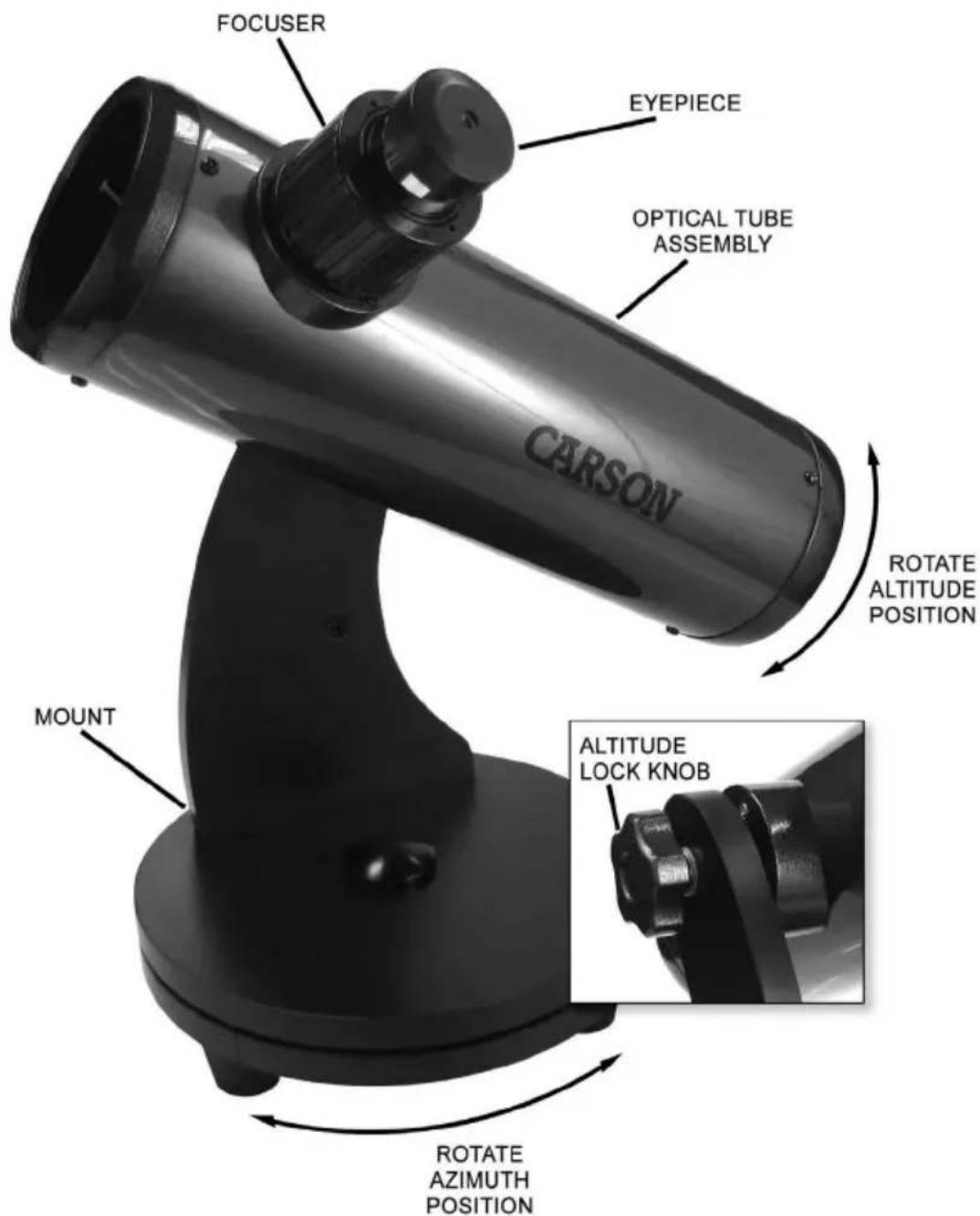
VISUAL KEY DIAGRAM
TELESCOPE ASSEMBLY
Setting Up Your Telescope:
The mount and optical tube assembly comes preassembled and ready-to-use. Carefully remove the telescope from the box.
Attaching the Eyepieces:
Insert the Huygenian 20mm eyepiece into the focuser and rotate clockwise into focuser until tight. Be careful not to over-tighten the eyepiece.
Removing the Eyepieces:
To remove eyepieces, hold onto the silver metal portion of the eyepiece, and rotate counter-clockwise until loose, and remove from focuser.
USING THE TELESCOPE
Once you have properly assembled your telescope you are ready to start using it.
- First, place your telescope on a stable surface or hold the mount steadily in your arms.
- To locate an object using the telescope, first loosen the altitude lock knob allowing the telescope to rotate freely along both axes.
- Aim the optical tube assembly at your desired target by rotating the azimuth position left or right. Look through the eyepiece at the desired target, and make altitude adjustments by moving the optical tube assembly vertically by hand. When the altitude direction is aligned, you may re-tighten the altitude lock knob.
- Once the object is centered in the field of view, turn the focuser until the image is clear and sharp.
- It is best to use the lowest power eyepiece (the Huygenian 20mm eyepiece) at first. This allows for a wider field of view making it easier to locate objects. Once the object is centered in the field of view you can switch the eyepiece to higher magnifications.
- You will notice that the view through the telescope is inverted (upside-down). This is common in telescopes used for astronomical viewing. At night it is best to start by looking at the moon or other easy to find celestial objects. As you become more experienced using your telescope you can begin to try locating harder to find objects.
USING THE TELESCOPE CONT.
- If you are viewing celestial objects, you will notice that the object will slowly move across the field of view (caused by the rotation of the Earth). You will need to slowly move the telescope vertically and/or horizontally to keep the object centered.
There are many conditions that may affect your ability to focus or observe celestial objects clearly.
- Brightly lit areas (light pollution) will make it difficult to see faint objects in the sky. It will also make it difficult for your eyes to adjust to the dark. You should try and find a dark area and allow your eyes to adjust to the dark before making observations. Using a red filtered flashlight to view charts and your telescope components is recommended to preserve your night sight. The best viewing conditions are when the sky is inky black.
- Hazy skies, pollution, clouds and moisture can all affect the clarity of your viewing image.
- Avoid touching the eyepiece or optical tube while looking through the telescope. The vibrations caused by this contact will cause the object you are looking at to move. You should also make sure that the surface you place your telescope on does not vibrate or move as this will also cause your viewing object to move.
- You should avoid setting up your telescope inside a room looking through an open window. The difference in air temperatures may result in a blurry image.
- Viewing through a closed window might also result in a distorted image due to the varying densities of window glass.
- Avoid viewing objects that are low on the horizon. Objects that are higher up in the sky will appear much sharper.
- Sudden changes in temperature may cause condensation to appear on the optical components of the telescope. It is best to set up your telescope ahead of time and then wait while the telescope adjusts to the new temperature before using it.
CALCULATING POWER
The magnification of a telescope depends on both the focal length of your telescope as well as the eyepiece you use. There is a simple formula you can use to determine the magnification you are using at any given time. Simply divide the focal length of the telescope by the focal length of the eyepiece. For example, if you are using the included 20mm eyepiece with your JC-200 telescope the power would be:
Power = 300mm / 20mm = 15x
Using an eyepiece with a smaller focal length will increase the magnification of your telescope. It is always best to start at the lowest magnification configuration. The wider field of view makes it easier to spot far away objects. Once an object is centered in your field of view you can switch to the higher power configurations.
CARE AND MAINTENANCE
• Always replace dust covers and lens caps when not in use. This will minimize the amount of dust and debris that gets into your telescope.
- Cleaning should be performed only if absolutely necessary. If dust has built up on the optics use a soft camel's hair brush or pressurized air to gently remove it.
- If dew collects on the optics of your telescope or moisture condenses inside the optics, remove all accessories and place the telescope in a dry, dust free environment and point the telescope downward. This should help eliminate the moisture.
- Avoid touching the surface of the mirror.
- Do not attempt to take apart your telescope to clean it.
SPECIFICATIONS
Optical Design: Newtonian Reflector
Aperture: 76mm (2.99")
Focal Length: 300mm (11.8")
Focal Ratio: f/3.95
Eyepiece 1: Huygenian 20mm
Magnification 1: 15x
Eyepiece 2: Huygenian 8mm
Magnification 2: 37.5x
Mount: Dobsonian (Alt-azimuth mount)
Weight: 3.7 lbs.
WARNINGS
- Never use this telescope to look directly at or near the sun. Viewing the sun can cause instant and irreversible eye damage.
• Always supervise children when using this telescope. - Do not leave telescope unattended at any time. Untrained adults or children may not be familiar with the correcting operating procedure.
- Do not point the telescope at the sun even when you are not looking through it. This will cause internal damage to the telescope.
- Handle this telescope with care. Rough handling might knock the internal optical components out of alignment.
CUSTOMER SERVICE
We will be happy to help you with any problems you may experience while using your telescope. Please call our toll-free customer service line at 1-800-967-8427.
WARRANTY INFORMATION
This Carson product is warranted to be free from defects in material and workmanship for a period of one year from date of purchase.
During this period Carson will, at its option and without charge, either repair any part or assembly of parts found to be defective in material or workmanship, or replace this Carson product with a Carson product of comparable value and condition, subject to the limitations and exclusions noted herein.
This warranty extends to the original purchaser only and is not assignable or transferable. It shall not apply to any product that has been subject to misuse, abuse, negligence or accident, or to any defects or damage directly or indirectly caused by the use of unauthorized replacement parts and/or service performed by unauthorized personnel. This warranty gives you specific legal rights, and you may also have other rights which could vary from state to state. Some states do not allow limitations on the life of an implied warranty and/or do not allow excluding or limiting incidental or consequential damages. If so, the above limitations or exclusions may not apply to you.
Provide proof of purchase. A receipt or other dated proof of purchase must be included with merchandise being returned for a warranty claim to be processed. Call or write for authorization. Before returning any product for a warranty claim, a Return Authorization (RA) number must be obtained. No merchandise will be accepted without an RA, and failure to obtain an RA will prevent or delay processing of the warranty claim. To obtain an RA call 631-963-5000, or write to Carson Warranty Service, 2070 5th Avenue, Ronkonkoma NY, 11779 with a description of the problem. Include your name, address and telephone number.
Package the return carefully. Shippers will not reimburse for damages due to insufficient packaging, even if the merchandise is insured. Print the RA number prominently on the top of the package.
Prepay shipping. Insure the package. Send it to Carson Warranty Service, 2070 5th Avenue, Ronkonkoma NY, 11779. Merchandise must be shipped prepaid. Carson will not accept merchandise C.O.D.
CARSON®
Carson | 2070 5th Avenue | Ronkonkoma, New York 11779
Phone 631-963-5000 | Fax 631-427-6749
For information, call toll-free: 1-800-967-8427
info@carson.com | sales@carson.com | www.carson.com
Brand : Carson
Model : SkySeeker JC-200
Category : Telescope