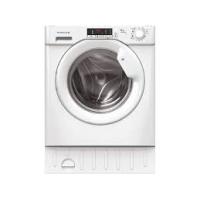
DFW814W - Washing machine DE DIETRICH - Free user manual and instructions
Find the device manual for free DFW814W DE DIETRICH in PDF.


| Product Type | Freestanding Washing Machine |
| Brand | De Dietrich |
| Model | DFW814W |
| Capacity | 8 kg |
| Spin Speed | 1400 rpm |
| Energy Class | A+++ |
| Noise Level Wash | 54 dB(A) |
| Noise Level Spin | 74 dB(A) |
| Water Consumption | 52 L |
| Dimensions (H x W x D) | 850 x 600 x 550 mm |
| Weight | 72 kg |
| Color | White |
| Door Opening | Left |
| Display | LED |
| Programs | 15+ (Cotton, Synthetics, Delicates, Quick Wash, etc.) |
| Functions | Delay Start, Remaining Time, Child Lock, Anti-Flood |
| Safety Features | Overflow protection, Unbalanced load detection |
| Maintenance | Clean filter regularly, Clean drum every 3 months |
| Spare Parts Availability | Easy availability through De Dietrich service |
| Repairability Index | 8.5/10 |
Frequently Asked Questions - DFW814W DE DIETRICH
User questions about DFW814W DE DIETRICH
0 question about this device. Answer the ones you know or ask your own.
Ask a new question about this device
Download the instructions for your Washing machine in PDF format for free! Find your manual DFW814W - DE DIETRICH and take your electronic device back in hand. On this page are published all the documents necessary for the use of your device. DFW814W by DE DIETRICH.
USER MANUAL DFW814W DE DIETRICH
H. NISTUOSTERHANDLHD NO
(1) 甲乙酰胺A和乙酰胺A的反应
75 MINI A DISTRUCION
- MANUAL OF INSTRUCION
21 Washing machine
Lavadora
v. Miquina de lavar rouna
w. 100-126
2.5046
上
立 Pracka
-1 Mosagan
K. Pračka
- Pralka
v. Wastecchio
- 2016年1月8日
■ Partingulate
- Garbogards
(4) Rentadora
LaVadora
De Dietrich
1. RENGLISH 1
2. ESPAVICL 5
3. PORTUGUES 9
4. FRANCANS 13
5. DEUTSCH 17
6. ČESKY 21
7. MAGYAR 25
8. SLOVENSKY 29
9. POLSKI 30
10. NEDERLANDS 37
11. PYKASIN 41
12. BUSKARA 45
13. CATALA 49
14. GLENBO 60
Instruction manual
Very important: Please, read the whole of this manual before installation and using the washing machine. This manual is designed with the corresponding illustration accompanying the texts.
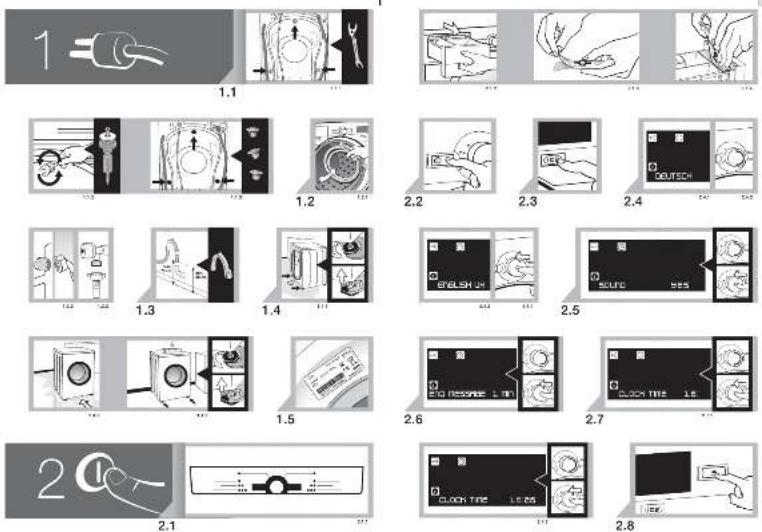
1 Installation

1.1 Unpacking the washing machine (1.1.1, 1.1.2 and 1.1.3). Remove the transit brackers and the fixing and blocking elements used for transport.
1.2 Connection to the mains water (1.2.1, 1.2.2 and 1.2.3). Always use the new hose supplied with the appliance. Remove any previously used supply tubes.
1.3 Draining. Install the elbow supplied, in accordance with the measurements shown in the diagram.
1.4 Levelling. Correctly level the washing machine to prevent any noise or shifting. The recommended order is as follows: 1. Position the rear legs and fix them in place (1.4.1). 2. Place the washing machine in its final location (1.4.2). 3. Position the front legs and fix them in place (1.4.3).
1.5 Connection to the mains electric. Refer to the plate data.
2 Use

2.1 Before using the washing machine. Find the label with your language (2.1.1.) and stick it on to the tub (2.1.2., 2.1.3 and 2.1.4.).
CONFIGURATION MENU
2.2 Switching on. Press ①.
2.3 Configuration menu. Press ICS.
2.4 Selecting the language. You can choose the language by turning the control knob (2.4.1 and 2.4.2). Press the control to select it (2.4.3 and 2.4.4).
2.5 Adjusting the sound. You can adjust the sound by turning the control knob. Press the control to select it.
2.6 Adjusting the end of programme. You can adjust the duration of the sound for the end of programme by turning the control knob. Press the control to select it.
2.7 Adjusting the clock time. Set the clock at the correct time. Turn the control knob and the two hour digits will appear. Press the control to select it (2.7.1). Turn the control knob and the two digits corresponding to minutes will appear. Press the control to select it (2.7.2).
LOADING THE WASHING MACHINE
2.8 Opening the hatch. Press ▲ .
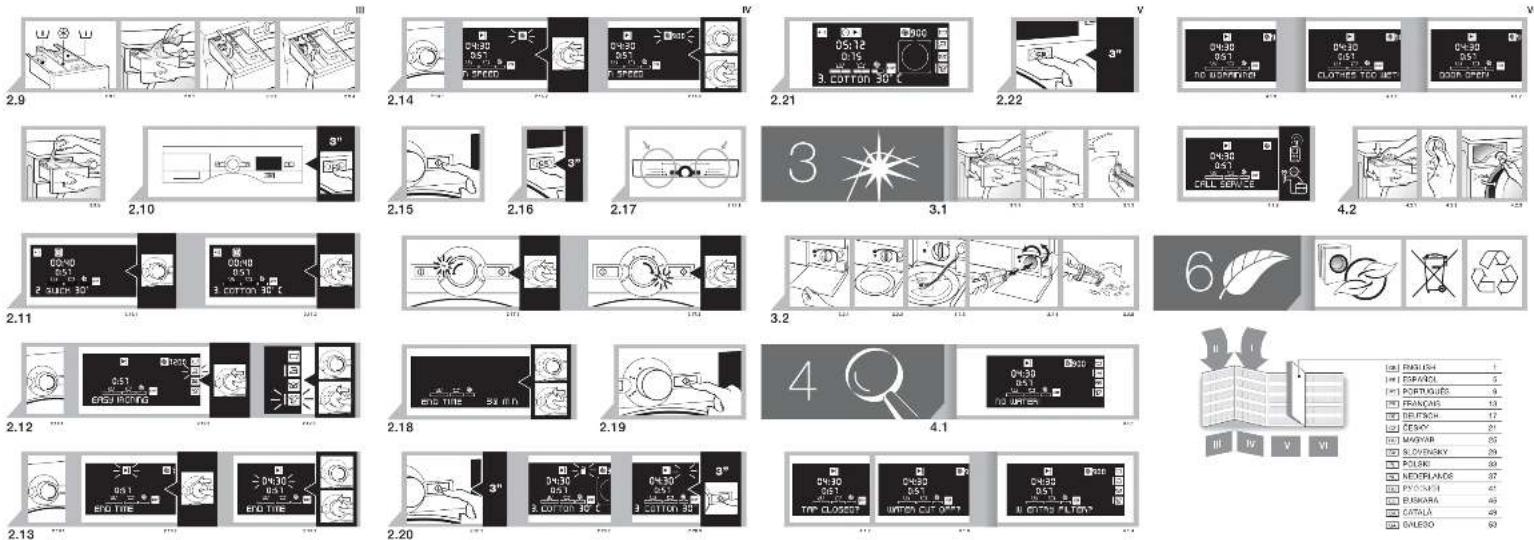
2.9 Detergents and additives. Load the clothes into the washing machine after having separated them according to colour, level of dirt and type of fabric. The tub contains the following compartments: wash 🎯, prewash 🎯 and softener ⚙ (2.9.1).
All washing machines are prepared for powdered detergents (2.9.2).
If you wish to use liquid detergent (2.9.5), you will find a blue latch (2.9.3) in the wash compartment. Pull it outwards as far as it will go, release it and it will remain in the vertical position (2.9.4). This prevents the liquid detergent from escaping. To go back to using powdered detergent, move the blue latch to the horizontal position and push it backwards as far as it will go to open the door.
Remember that you should not exceed the MAX level marked on the softener compartment.
OPERATING MODE
2.10 The washing machine has been designed to function both in manual and automatic mode. Initial configuration is required in both cases. Press the key ICS for 3 seconds to change from one mode to another.
Manual mode: Select the programme according to the table of programmes.
Automatic mode: Select the wash either for white or coloured fabrics and the level of dirt, so that the washing machine may carry out the optimum programme.
MANUAL MODE
2.11 Selecting the programme. You can choose the washing programme by turning the control (2.11.1) after having checked the table of programmes. Press the control to select it (2.11.2).
2.12 Additional functions. Anti-wrinkle/Flot ☐, easy ironing ☐, extra rinse ☐ and intensive wash ☐ for very dirty clothes, Turn the control knob (2.12.1) to choose the additional function which will flashing on and off (2.12.2). Press the control to select it (2.12.3). You may select more than one additional option. These functions feed the programme times.
2.13 End of programme ▶ | . This enables you to select the time when you wish to end the washing programme (2.13.1, 2.13.2 y and 2.13.3).
2.14 Selecting the speed of the spin dry Ⓤ . You can choose the degree of spin dry or remove it by rotating the control (2.14.1). Press the control to select it (2.14.2), (2.14.3).
2.15 Starting. Press ◆
AUTOMATIC MODE
2.16 Changing the mode. Press ICS for 3 seconds.
2.17 Selecting the wash. Check the label on the tub (2.17.1) to select either the wash for white or coloured fabrics and the level of dirt of the clothes.
Selecting the white fabric wash. Turn the control knob according to the level of dirt (2.17.1). Press the control to select it (2.17.2).
Selecting the coloured fabric wash. Turn the control knob according to the level of dirt (2.17.1). Press the control to select it (2.17.3). Not very dirty colour must be selected to wash wool in automatic mode.
2.18 End of programme. This enables you to select the time when you wish to end the washing programme.
2.19 Starting. Press ◆ and the washing machine will start the automatic or manual programme selected.
2.20 Locking ☑ . In the case of both modes, press ◆ for three seconds (2.20.1), (2.20.2). This is used to prevent handling by children. Deactivate it by once again pressing the key for a further three seconds (2.20.3).
2.21 Washing process. In the case of both modes, you can check the programme phase and the time remaining.
CHANGING THE MODE
2.22 Returning to manual mode. To return to the manual programme mode, press ICS for 3 seconds.
Recommendations for use: As soon as the washing machine has been fitted, you will be able to carry out a prior cleaning and check that it is working properly (normal wash, without clothes and at 60°). Use one bag of washing for small items of clothing: handkerchiefs and underwear.
Warnings about use: 1. If you stop the washing machine to add more clothes, please ensure that the water level does not reach that of the hatch. 2. The additional functions increase washing time.
©
3
Maintenance

3.1 Cleaning the detergent compartment. It is recommendable to do this once a month.
3.2 Cleaning the filter. It is recommendable to do this once a year.
For cleaning the outside of the washing machine, use non-abrasive products and dry thoroughly with a soft cloth.
4
Troubleshooting

4.1 The washing machine incorporates a troubleshooting system that detects and warns you of any type of incident. You can display them on the screen.
4.1.1 Water does not enter the washing machine. The warnings appear together with possible solutions, which in this case are three: Tap turned off? (4.1.2), water cut off? (4.1.3) and house drainpipe? (4.1.4).
4.1.5 Does not empty the water. Check the state of the filter and the drainpipe.
4.1.6 Very damp clothes. Select programme 16.
4.1.7 Door open. Check that the hatch is properly shut.
4.1.8 With any other warning. Call customer service.
4.2 Loading door opening. In case of failure or electricity cut, pull out the detergent compartment by pulling the handle outwards and press the blue lever down (4.2.1). On the right side you will see a button with a groove. Turn this button to the left with the aid of a coin (4.2.2), and the loading door will open (4.2.3).
4.3 Vibrations or noise. Check it has been properly installed (points 1.1 and 1.4 of this manual).
4.4 Water in the detergent compartment.
Check the detergent compartment is not clogged (3.1).
5
Safety

- The mains water pressure must be between 0.05 and 1 Mpa (0.5 - 10 kg/cm ^2 ).
- Do not use extension leads or adapters to connect the washing machine.
- The electrical installation must be suitably dimensioned for the maximum power indicated on the reference plate and the plug must have the regulatory earth connection.
!
- Do not interfere with the inside of the washing machine. If you have any problems you cannot solve yourself, call the technical service.
6
The environment

This washing machine has been designed with environmental protection in mind.
Respect the environment. Always load the washing machine to the maximum recommended capacity for each programme: this will save water and power. Avoid the prewash whenever you can. Do not use too much detergent. Only use the extra rinse function for garments belonging to people with sensitive skin.
Waste electrical and electronic equipment management.
Do not dispose of these appliances together with the general domestic waste.
Take your washing machine to a special waste collection centre.
Recycling domestic appliances avoids negative consequences for health and the environment and saves power and natural resources.
For further information, contact your local authorities or the shop you purchased the washing machine at.