
CT3234 - Coffee grinder Cotech - Free user manual and instructions
Find the device manual for free CT3234 Cotech in PDF.


| Product Type | Coffee Grinder |
| Brand | Cotech |
| Model | CT3234 |
| Dimensions (approx.) | 12 x 12 x 20 cm |
| Weight (approx.) | 0.8 kg |
| Power | 150 W |
| Voltage | 220-240 V, 50/60 Hz |
| Bean Capacity | 60 g |
| Grinding Material | Stainless Steel Blades |
| Grind Settings | One-touch pulse operation |
| Functions | Grind, Pulse |
| Safety Features | Overheat protection, Non-slip base |
| Housing Material | Plastic and Stainless Steel |
| Dishwasher Safe Parts | Removable bowl and lid (top rack) |
| Cleaning | Wipe exterior with damp cloth; clean bowl after each use |
| Maintenance | Regularly clean blade and bowl; avoid immersing in water |
| Spare Parts Available | Replacement bowl and blade unit |
| Warranty | 2 years |
| Manual Included | Yes, PDF download available |
Frequently Asked Questions - CT3234 Cotech
User questions about CT3234 Cotech
0 question about this device. Answer the ones you know or ask your own.
Ask a new question about this device
Download the instructions for your Coffee grinder in PDF format for free! Find your manual CT3234 - Cotech and take your electronic device back in hand. On this page are published all the documents necessary for the use of your device. CT3234 by Cotech.
USER MANUAL CT3234 Cotech
Read the entire instruction manual carefully and make sure that you fully understand it before you use the equipment. Keep the manual for future reference.
Viktig information:
natural_image
Exterior view of a COTECH power tool (no signage or text beyond brand name)Angle Grinder
ART. NO. 30-9316, MODEL CT3234
Please read the entire instruction manual before using the product and save it for future reference. We apologise for any text or photographic errors and any changes of technical data. If you have any questions concerning technical problems please contact our Customer Service Department (see address on reverse.)
Table of Contents
Safety 4
Product Description 11
Assembly 12
Use 13
Changing of grinding wheel 14
Rotating the rear handle 14
Care and Maintenance 15
Troubleshooting Guide 15
Disposal 15
Specifications 15
1. General safety instructions
Warning! Read all the instructions. Failure to adhere to the following instructions may lead to electric shocks, fires and/or serious injury. The term “electrical hand tools” in the warning text below is referring to your mains operated or battery operated hand tool.
1) The work space
a) Keep the work space clean and well illuminated. Cluttered and poorly lit areas invite accidents.
b) Do not use electrical hand tools in explosive environments, i.e. nearby flammable liquids, gas or dust. Electrical hand tools generate sparks that could easily ignite dust or fumes.
c) Keep away from children and other spectators while using the electrical hand tool. Distractions can make you lose your concentration and control.
2) Electrical safety
a) The electrical hand tool's plug must fit correctly in the wall socket. Never modify the plug in any way. Never use an adaptor together with earthed electrical hand tools. Unmodified plugs and suitable wall sockets decrease the risk of electric shock.
b) Avoid body contact with earthed objects, such as pipes, radiators, ovens or refrigerators. There is an increased risk of electrical shock if your body is earthed.
c) Do not expose the electrical hand tool to rain or other wet conditions. If water gets inside an electrical hand tool it increases the risk of electrical shock.
d) Do not misuse the lead. Never use the lead to carry, drag or pull the plug out of the wall socket. Keep the lead away from heat, oil, sharp edges and movable parts. Damaged or tangled leads increase the risk of electrical shock.
e) When you use an electrical hand tool outdoors; use an extension cord suitable for this purpose. Use of an extension cord for outdoor use decreases the risk of electrical shock.
3) Personal safety
a) Pay attention to what you do and use common sense when using electrical hand tools. Never use an electrical hand tool if you are tired or under the influence of drugs, alcohol or medication. One moment of inattention while using an electrical hand tool may result in serious injury.
b) Use protective equipment. Always use safety glasses. Using protective equipment such as a face mask, slip resistant protection shoes, a helmet and ear plugs when needed decreases the risk of injury.
c) Avoid unexpected starts. Make sure that the switch is set to OFF before you connect the device to the wall socket. Never carry an electrical hand tool with one finger on the trigger or never connect the hand tool to a wall socket when the switch is set to ON, since it may result in injury.
d) Remove all service tools/keys before switching on the hand tool. A forgotten service tool on a rotating part of the electrical hand tool may result in injury.
e) Do not overreach. Make sure you stand steady and well balanced at all times. This gives better control in unexpected situations.
f) Wear suitable clothing. Do not wear loose fitting clothes or jewellery. Keep hair, clothes and gloves away from movable parts. Loose fitting clothes, jewellery or long hair could get caught in movable parts.
g) If the equipment for suctioning or dust collecting is available make sure it is connected and used properly. Using technical aids may reduce dust related hazards.
4) Use and maintenance of the electrical hand tools
a) Do not overdrive the hand tool. Use a hand tool suitable for the work you are to perform. At the correct rate of feed, the correct tool will carry out the work better and more safely.
b) Never use the electrical hand tool if the switch does not work properly to turn on and shut off the tool. All electrical hand tools that cannot be operated by the switch are dangerous and must be repaired.
c) Unplug the lead from the wall socket before making any adjustments, changes of accessories or storing the electrical hand tool away. These precautions reduce the risk of unexpected starts of the electrical hand tool.
d) Store electrical hand tools that are not being used out of reach from children. Do not let people unfamiliar with the electrical hand tool or its instructions use it. Electrical hand tools can be dangerous if they get into the hands of inexperienced users.
e) Maintenance of electrical hand tools. Check if something is incorrectly set, if movable parts are getting jammed, or parts are broken or something else that might cause the electrical hand tool to malfunction. If something is damaged it must be repaired before use. Many accidents are caused by poorly maintained electrical hand tools.
f) Keep the tools sharp and clean. Properly maintained cutting tools with sharp blades are less likely to jam and are easier to control.
g) Use the electrical hand tool, accessories and such according to the instructions and in a way suitable for the type of electrical hand tool used. Using the electrical hand tool for work other than that for which it is intended could result in a dangerous situation.
5) Service
a) Let only qualified personnel perform service and repairs using original parts. This guarantees that the safety of the electrical hand tool is maintained.
2. Safety warnings common for grinding, sanding, wire brushing, polishing or abrasive cutting-off operations
a) This power tool is intended to function as a grinder, sander, wire brush or cut-off tool. Read all safety warnings, instructions, illustrations and specifications provided with this power tool. Failure to follow all instructions listed below may result in electric shock, fire and/or serious injury.
b) Operations such as polishing are not recommended to be performed with this power tool. Operations for which the power tool was not designed may create a hazard and cause personal injury.
c) Do not use accessories which are not specifically designed and recommended by the tool manufacturer. Just because the accessory can be attached to your power tool, it does not assure safe operation.
d) The rated speed of the accessory must be at least equal to the maximum speed marked on the power tool. Accessories running faster than their rated speed can break and fly apart.
e) The outside diameter and the thickness of your accessory must be within the capacity rating of your power tool. Incorrectly sized accessories cannot be adequately guarded or controlled.
f) The arbour size of wheels, flanges, backing pads or any other accessory must properly fit the spindle of the power tool. Accessories with arbour holes that do not match the mounting hardware of the power tool will run out of balance, vibrate excessively and may cause loss of control.
g) Do not use a damaged accessory. Before each use inspect the accessory such as abrasive wheels for chips and cracks, backing pad for cracks, tear or excess wear, wire brush for loose or cracked wires. If power tool or accessory is dropped, inspect for damage or install an undamaged accessory. After inspecting and installing an accessory, position yourself and bystanders away from the plane of the rotating accessory and run the power tool at maximum no-load speed for one minute. Damaged accessories will normally break apart during this test time.
h) Wear personal protective equipment. Depending on application, use face shield, safety goggles or safety glasses. As appropriate, wear dust mask, hearing protectors, gloves and workshop apron capable of stopping small abrasive or workpiece fragments. The eye protection must be capable of stopping flying debris generated by various operations. The dust mask or respirator must be capable of filtrating particles generated by your operation. Prolonged exposure to high intensity noise may cause hearing loss.
i) Keep bystanders a safe distance away from work area. Anyone entering the work area must wear personal protective equipment. Fragments of workpiece or of a broken accessory may fly away and cause injury beyond immediate area of operation.
j) Hold power tool by insulated gripping surfaces only, when performing an operation where the cutting accessory may contact hidden wiring or its own cord. Cutting accessory contacting a “live” wire may make exposed metal parts of the power tool “live” and shock the operator.
k) Position the cord clear of the spinning accessory. If you lose control, the cord may be cut or snagged and your hand or arm may be pulled into the spinning accessory.
I) Never lay the power tool down until the accessory has come to a complete stop. The spinning accessory may grab the surface and pull the power tool out of your control.
m) Do not run the power tool while carrying it at your side. Accidental contact with the spinning accessory could snag your clothing, pulling the accessory into your body.
n) Regularly clean the power tool's air vents. The motor's fan will draw the dust inside the housing and excessive accumulation of powdered metal may cause electrical hazards.
o) Do not operate the power tool near flammable materials. Sparks could ignite these materials.
p) Do not use accessories that require liquid coolants. Using water or other liquid coolants may result in electrocution or shock.
Kickback and Related Warnings
Kickback is a sudden reaction to a pinched or snagged rotating wheel, backing pad, brush or any other accessory. Pinching or snagging causes rapid stalling of the rotating accessory which in turn causes the uncontrolled power tool to be forced in the direction opposite of the accessory's rotation at the point of the binding.
For example, if an abrasive wheel is snagged or pinched by the workpiece, the edge of the wheel that is entering into the pinch point can dig into the surface of the material causing the wheel to climb out or kick out. The wheel may either jump toward or away from the operator, depending on direction of the wheel's movement at the point of pinching. Abrasive wheels may also break under these conditions.
Kickback is the result of power tool misuse and/or incorrect operating procedures or conditions and can be avoided by taking proper precautions as given below.
a) Maintain a firm grip on the power tool and position your body and arm to allow you to resist kickback forces. Always use auxiliary handle, if provided, for maximum control over kickback or torque reaction during start-up. The operator can control torque reactions or kickback forces, if proper precautions are taken.
b) Never place your hand near the rotating accessory. Accessory may kickback over your hand.
c) Do not position your body in the area where power tool will move if kickback occurs. Kickback will propel the tool in direction opposite to the wheel's movement at the point of snagging.
d) Use special care when working corners, sharp edges etc. Avoid bouncing and snagging the accessory. Corners, sharp edges or bouncing have a tendency to snag the rotating accessory and cause loss of control or kickback.
e) Do not attach a saw chain woodcarving blade or toothed saw blade. Such blades create frequent kickback and loss of control.
Safety Warnings specific for grinding and abrasive cutting-off operations
a) Use only wheel types that are recommended for your power tool and the specific guard designed for the selected wheel. Wheels for which the power tool was not designed cannot be adequately guarded and are unsafe.
b) The guard must be securely attached to the power tool and positioned for maximum safety, so the least amount of wheel is exposed towards the operator. The guard helps to protect operator from broken wheel fragments and accidental contact with wheel.
c) Wheels must be used only for recommended applications. For example: do not grind with the side of cut-off wheel. Abrasive cut-off wheels are intended for peripheral grinding, side forces applied to these wheels may cause them to shatter.
d) Always use undamaged wheel flanges that are of correct size and shape for your selected wheel. Proper wheel flanges support the wheel thus reducing the possibility of wheel breakage. Flanges for cut-off wheels may be different from grinding wheel flanges.
e) Do not use worn down wheels from larger power tools. Wheels intended for larger power tool are not suitable for the higher speed of a smaller tools and may burst.
Additional Safety Warnings specific for abrasive cutting-off operations
a) Do not “jam” the cut-off wheel or apply excessive pressure. Do not attempt to make an excessive depth of cut. Overstressing the wheel increases the loading and susceptibility to twisting or binding of the wheel in the cut and the possibility of kickback or wheel breakage.
b) Do not position your body in line with and behind the rotating wheel. When the wheel, at the point of operation, is moving away from your body, the possible kickback may propel the spinning wheel and the power tool directly at you.
c) When wheel is binding or when interrupting a cut for any reason, switch off the power tool and hold the power tool motionless until the wheel comes to a complete stop. Never attempt to remove the cut-off wheel from the cut while the wheel is in motion otherwise kickback may occur. Investigate and take corrective action to eliminate the cause of wheel binding.
d) Do not restart the cutting operation in the workpiece. Let the wheel reach full speed and carefully re-enter the cut. The wheel may bind, walk up or kickback if the power tool is restarted in the workpiece.
e) Support panels or any oversized workpiece to minimize the risk of wheel pinching and kickback. Large workpieces tend to sag under their own weight. Supports must be placed under the workpiece near the line of cut and near the edge of the workpiece on both sides of the wheel.
f) Use extra caution when making a “pocket cut” into existing walls or other blind areas. The protruding wheel may cut gas or water pipes, electrical wiring or objects that can cause kickback.
Safety Warnings specific for sanding operations
a) Do not use excessively oversized sanding disc paper. Follow manufacturers recommendations, when selecting sanding paper. Larger sanding paper extending beyond the sanding pad presents a laceration hazard and may cause snagging, tearing of the disc or kickback.
Safety Warnings specific for wire brushing operations
a) Be aware that wire bristles are thrown by the brush even during ordinary operation. Do not overstress the wires by applying excessive load to the brush. The wire bristles can easily penetrate light clothing and/or skin.
b) If the use of a guard is recommended for wire brushing, do not allow any interference of the wire wheel or brush with the guard. Wire wheel or brush may expand in diameter due to work load and centrifugal forces.
Product marking with safety symbols

Read the safety and operating instructions

Always use ear defenders. Always use safety glasses or a visor and wear a face mask.
3. Product Description
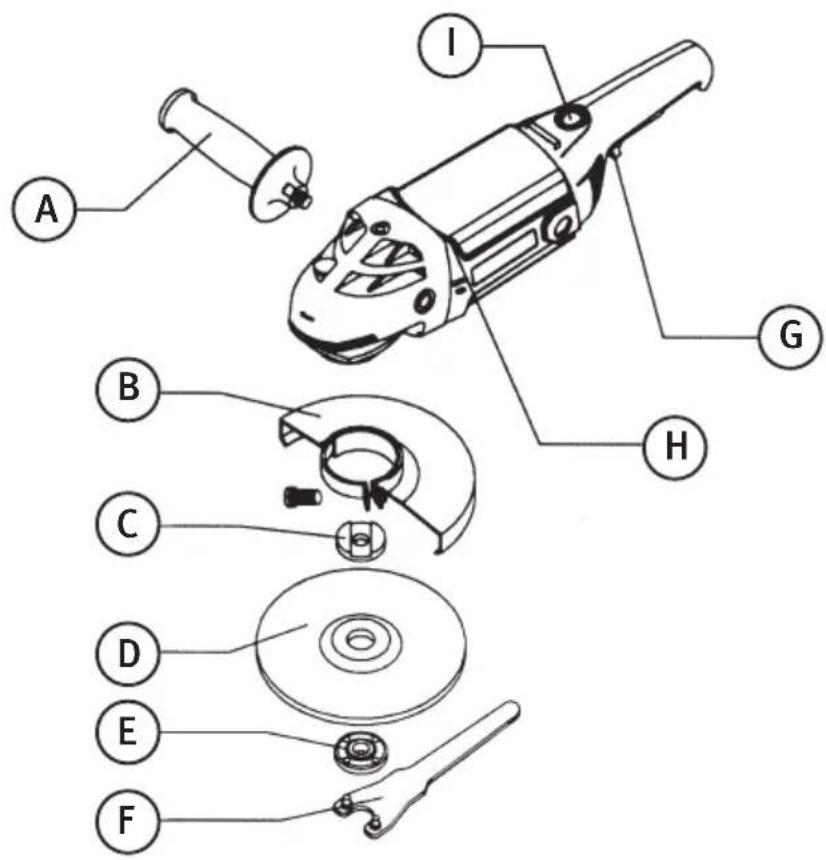
a) Handle
b) Shatter guard
c) Inner flange
d) Grinding wheel (not included)
e) Outer flange
f) Spanner
g) Power Switch
h) Machine body
i) Locking button for rotation of handle
4. Assembly
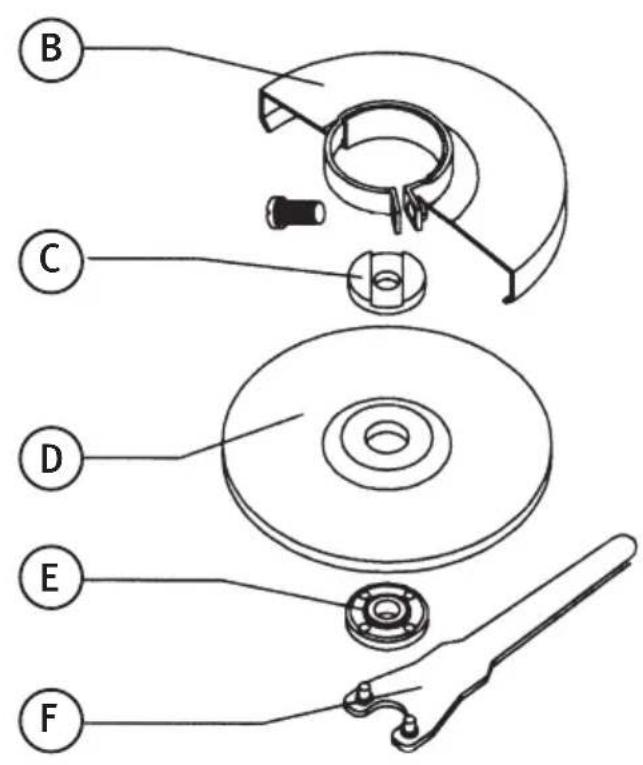
- Screw the side handle on the side of the gearbox that fits best. Insert the rubber plugs in the holes that are not used. Three different kinds of assembly are possible.
- Place the inner unthreaded flange (C) on the spindle and twist it until it locks on the spindle.
- Put on a grinding/cutting disc (D) on the spindle so it centres.
- Put on the outer flange (E) with the concave side towards the disc.
- Push in the spindle lock and tighten the flange clockwise with the included key.
- Start the machine and let it run for awhile to make sure the disc is balanced before grinding.
5. Use
- Let the machine come up to speed before grinding.
• Make sure you have good overview when grinding. - Do not use the side of cutting discs for grinding since they cannot handle pressure to the face.
- Use a diamond grinding wheel when cutting stone etc.
-
Do not angle the machine while cutting. Make straight cuts only with a cutting disc.
-
Stand steady and hold the machine firmly in both hands.
-
Push the switch forward and then up.

natural_image
Technical line drawing of a mechanical component with no visible text or symbols- Turn off the machine by releasing the switch.
- The best method for grinding is to hold the machine in at a 10-15° angle.

natural_image
Technical line drawing of a mechanical power tool with angular dimension标注 (10~15 degrees)6. Changing of grinding wheel
The grinding wheel must have the correct inner diameter. Never use loose sleeves. It should be approved for at least 8500 rpm.
- Pull out the plug from the outlet before changing the grinding disc.
- Activate the spindle loc. Loosen the spindle bolt from the outer flange of the spindle.
- Remove the old grinding disc and attach a new one.
- Assemble in reversed order.
- Start the machine and let it run for awhile to make sure the disc is balanced before grinding.

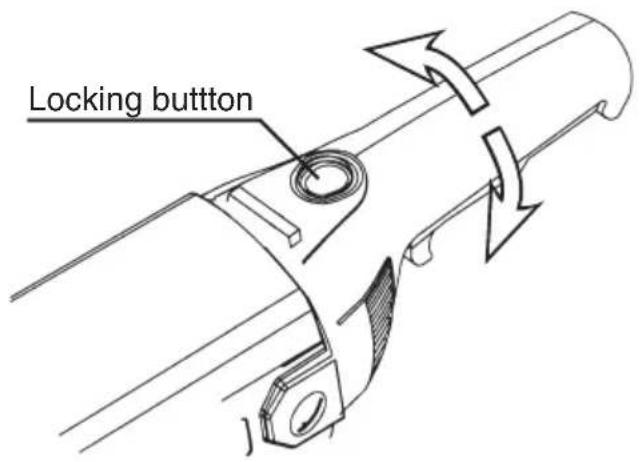
7. Rotating the rear handle
- Unplug the mains lead before rotating the handle.
- Push in the locking button to rotate the handle.
- Rotate the handle to one of the three set positions.
- Release the locking button and make sure the handle clicks in position.
8. Care and Maintenance
Always keep the motor's ventilation openings free of dust and debris. If needed dry off the angle grinder with a soft damp cloth. Avoid strong detergents or solvents.
9. Troubleshooting Guide
| Problem Possible Cause Remedy | ||
| The machine does not start. | No power. Check the power point. | |
| Worn brushes. Contact Customer Service in case of motor or electrical faults. | ||
| Short circuit. | ||
| Faulty power switch. | ||
| The machine runs slowly. | Worn/damaged cutter/bit. Sharpen or change the cutter/bit. | |
| Speed too low. Do not press down too hard. | ||
| The motor is overheated. | ||
| Strange noise. Mech | anical fault. Contact us in case of motor or electrical faults. | |
| Faulty windings. | ||
| Strong vibrations. Loose cutter/bit. Tighten the tool and make sure it is set correctly. | ||
| Sparks in the motor. | Brushes jammed. Contact Customer Service in case of motor or electrical faults. | |
| Winding short circuited. | ||
| Dirt on collector. | ||
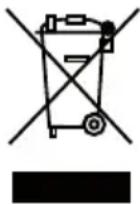
10. Disposal
Follow local ordinances when disposing this product. If you are unsure about the disposal of this product contact your municipality.
11. Specifications
Power Supply 230 V \~ 50 Hz
Power 1800 W
No-Load Speed: 8500 rpm
Grinding Wheel ∅ 180 mm, hole ∅ 22 mm
Weight 4.7 kg (excluding grinding wheel)
Sound Pressure (LpA) 95 dB (A)
Sound Power (Lwa) 108 dB (A)
Vibration Value 4.7 m/s ^2
Vinkelslipmaskin
ART.NR 30-9316, MODELL CT3234
5. Användning
natural_image
Technical line drawing of a mechanical component with arrows indicating motion or force direction (no text or symbols)natural_image
Technical line drawing of a mechanical power tool with angular dimension标注 (10~15 degrees)ART.NR 30-9316, MODELL CT3234
5. Bruk
natural_image
Technical line drawing of a mechanical component with no visible text or symbols- Maskinen skrus av ved å slippe opp strømbryteren.
- Best jobber vinkelsliperen när den holdes i en vinkel på ca 10° til 15°.

natural_image
Technical line drawing of a mechanical power tool with angular dimension标注 (10~15 degrees)A. Kahva
B. Laikan suojus
C. Sisempi laippa
D. Hiomalevy
E. Ulompi laippa
F. Avain
G. Virtakytkin
H. Kotelo
5. Käyttö
natural_image
Technical line drawing of a mechanical component with no visible text or symbolsnatural_image
Technical line drawing of a mechanical power tool with angular dimension标注 (10~15 degrees)Declaration of Conformity

Hereby, Clas Ohlson AB, declares that the machinery:
Angle Grinder Cotech
30-9316 / CT3234
Complies with the provisions of the following Directives:
98/37/EC Machinery
2006/95/EC LOW VOLTAGE EQUIPMENT
89/336/EEC EMC
Insjön, Sweden, February 2008

Klas Balkow
President
Clas Ohlson, 793 85 Insjön, Sweden
CO TECH®
SVERIGE
KUNDTJÄNST Tel: 0247/445 00
Fax: 0247/445 09
E-post: kundtjanst@clasohlson.se
INTERNET www.clasohlson.se
BREV Clas Ohlson AB, 793 85
INSJÖN
NORGE
KUNDESENTER Tlf.: 23 21 40 00
Faks: 23 21 40 80
E-post: kundesenter@clasohlson.no
INTERNETT www.clasohlson.no
POST Clas Ohlson AS, Postboks 485 Sentrum, 0105 OSLO
SUOMI
ASIAKASPALVELU Puh: 020 111 2222
Faksi: 020 111 2221
For consumer contact, please visit www.clasohlson.co.uk and click on customer service.
INTERNET www.clasohlson.co.uk
- Viktig information:
- Angle Grinder
- Table of Contents
- General safety instructions
- 1) The work space
- 2) Electrical safety
- 3) Personal safety
- 4) Use and maintenance of the electrical hand tools
- 5) Service
- Safety warnings common for grinding, sanding, wire brushing, polishing or abrasive cutting-off operations
- Kickback and Related Warnings
- Kickback is the result of power tool misuse and/or incorrect operating procedures or conditions and can be avoided by taking proper precautions as given below.
- Safety Warnings specific for grinding and abrasive cutting-off operations
- Additional Safety Warnings specific for abrasive cutting-off operations
- Safety Warnings specific for sanding operations
- Safety Warnings specific for wire brushing operations
- Product marking with safety symbols
- Product Description
- Assembly
- Use
- Changing of grinding wheel
- Rotating the rear handle
- Care and Maintenance
- Troubleshooting Guide
- Disposal
- Specifications
- Vinkelslipmaskin
- Användning
- Bruk
- Käyttö
- Declaration of Conformity
- CO TECH®
- SVERIGE
- NORGE
- SUOMI
Brand : Cotech
Model : CT3234
Category : Coffee grinder