
GD90 - Mobile Phone PANASONIC - Free user manual and instructions
Find the device manual for free GD90 PANASONIC in PDF.


| Product Type | GSM Digital Cellular Phone |
| Brand | Panasonic |
| Model | GD90 |
| Network Support | GSM900 / GSM1800 |
| Dimensions (H x W x D) | 118 x 42 x 16.5 mm |
| Weight (with battery) | 88 g |
| Battery Type | Li-Ion 3.7V, 650 mAh |
| Standby Time | Up to 95 hours |
| Talk Time | Up to 3.3 hours |
| Charging Time | Approx. 100 minutes |
| Display | Graphical LCD with icons |
| Phonebook | SIM and Mobile phonebook; capacity SIM-dependent |
| Short Messaging Service (SMS) | Send/receive up to 160 characters |
| Security Features | PIN, PIN2, Phone Lock, Fixed Dial, Call Bar |
| Voice Memo | Record up to 15 seconds during call |
| Vibration Alert | Yes, switchable via # key or menu |
| Alarm Clock | Yes, with snooze and power on/off timer |
| Key Guard | Prevents accidental key presses |
| Call Management | Call waiting, call transfer, multi-party (up to 5) |
| Charging Temperature | +5°C to +35°C |
| Storage Temperature | -20°C to +60°C |
| Optional Accessories | Car Mount Kit, Personal Handsfree Adaptor |
| Warranty (EU/EEA) | 12 months main body, 3 months battery |
Frequently Asked Questions - GD90 PANASONIC
User questions about GD90 PANASONIC
0 question about this device. Answer the ones you know or ask your own.
Ask a new question about this device
Download the instructions for your Mobile Phone in PDF format for free! Find your manual GD90 - PANASONIC and take your electronic device back in hand. On this page are published all the documents necessary for the use of your device. GD90 by PANASONIC.
USER MANUAL GD90 PANASONIC
Operating Instructions EB-GD90 Digital Cellular Telephone Main Kit
Before operating this equipment please read these instructions completely.
| The Serial Number can be found on the outside of the phone under the battery. For your convenience we recommend that note the following details as a record of your purchase. | |
| Part Number | |
| Serial Number | |
| Dealer Name | |
| Purchase Date | |
Contents
Introduction. 1
Symbols Used 1
Using This Manual. 1
Safety 3
Getting Started 4
Fitting/Removing the SIM 4
Fitting/Removing the Battery 5
Charging the Battery 6
Low Battery Warning 6
Location of Controls 7
Display. 8
Basic Operation 9
Power On/Off 9
Making a Call 9
Automatic Redial 10
Ending a Call 10
Answering a Call 10
Volume Control. 1 1
Vibration Alert 12
Key Guard 12
Phone Clock 12
Phone Security 15
Phone Lock 15
PIN 16
Changing Security Codes 16
Advanced Operation 17
Voice Memo 17
DTMF Tones 18
Alert Profile. 18
Call Hold and Call Waiting 19
Call Transfer 20
Multi-party Calls 20
Phonebook Basics 2 2
Storing a Number 2 2
Browsing Phonebooks by Name or Location ..... 2 3
Retrieving a Number 23
Editing Phonebook Entries 24
Hot Key Phone Numbers. 2 5
Advanced Phonebook 26
Note Pad 26
Recent Numbers 26
Fixed Dial 27
Service Dial 28
Short Text Messages 29
Setting your Phone for Short Text Messages ..... 2 9
Sending a Short Text Message ..... 2 9
Receiving Short Text Messages ..... 3 0
Cell Broadcasts 3 1
Alpha Entry 32
Menu Structures. 3 3
Key Guard 3 3
Phonebook 33
Messages 34
Call Service 35
Call Divert 36
Security 36
Network 37
Personalise. 38
Care and Maintenance 40
Glossary of Terms 4 1
Trouble Shooting 43
Important Error Messages ..... 4 5
Specifications 4 6
EU Warranty 47
Notes. 54
Introduction
Introduction
Thank you for purchasing this Panasonic GD90 digital cellular phone. This phone is designed to operate on the Global System for Mobile Communications (GSM), GSM900 or GSM1800.
These operating instructions detail use of the equipment contained in the Main Kit.
Some services are network dependent or may only be available on a subscription basis. Some functions are SIM dependent. For more information contact your Service Provider.
Symbols Used

Shows that you should press the following key(s).
→Text←Shows that the display text will be flashing.

Shows that the information is a Quick Tip.
Using This Manual
This manual is designed in sections to guide you through the many functions of this phone. Listed below is a brief outline of each section, to help you find the information you need.
Getting Started: Details how to fit the battery, insert the SIM card, introduces the controls and display of the phone.
Basic Operation: Details how to make and receive calls, change the phone volume, use Vibration Alert and Key Guard the Clock/Alarm.
Phone Security: Details how to use the Phone Lock and PIN Security features as well as how to change security codes.
Advanced Operation: Details how to record using Voice Memo, send DTMF tones, create Alert Profiles, use Call Waiting, Call Transfer and Multi-party.
Phonebook Basics: Details how to create, store, retrieve, and browse a number in a Phonebook as well as the more advanced Phonebook features.
Advanced Phonebook: Details the operation of the Note Pad, Recent Number recall and limiting the numbers available using Fixed Dialling.
Introduction
Short Text Messages: Details how to set up your phone to receive and send Short Text Messages and to receive Cell Broadcasts.
Alpha Entry: Details how to access alternative characters with the keypad.
Menu Structures: Details the features that can be accessed from the phone menu.
The remaining sections details how to take care of your phone, lists terms used in this manual, a Troubleshooting and Error Message section and the Specifications.
Safety

This equipment is intended for use when supplied with power from the built-in charger or Dual Charger (EB-CRD90) through the AC Adaptor (EB-CAD70Vxx)*. Other usage will invalidate any approval given to this apparatus and may be dangerous. The use of approved accessories is recommended to ensure optimum performance and avoid damage to your phone.

Switch off your cellular phone when in an aircraft. The use of cellular phones in an aircraft may be dangerous to the operation of the aircraft, disrupt the cellular network and may be illegal. Failure to observe this instruction may lead to the suspension or denial of cellular phone services to the offender, or legal action or both.

You are advised not to use the equipment at a refueling point. You are reminded of the need to observe restrictions on the use of radio equipment in fuel depots, chemical plants or where blasting operations are in progress. Never expose the battery pack to extreme temperatures (in excess of 60^ C) or charge the battery pack for much longer than recommended.

You MUST exercise proper control of your vehicle at all times. Do not use a hand held phone or microphone while you are driving. Find a safe place to stop first. Do not speak into a hands free microphone if it will take your mind off the road. Acquaint yourself thoroughly with restrictions concerning the use of cellular phones within the country you are driving and observe them at all times.

Care must be taken when using the phone in close proximity to personal medical devices, such as pacemakers and hearing aids.
Getting Started
Getting Started
Fitting/Removing the SIM
The SIM is fitted into a holder at the back of the phone underneath the battery.
Fitting the SIM
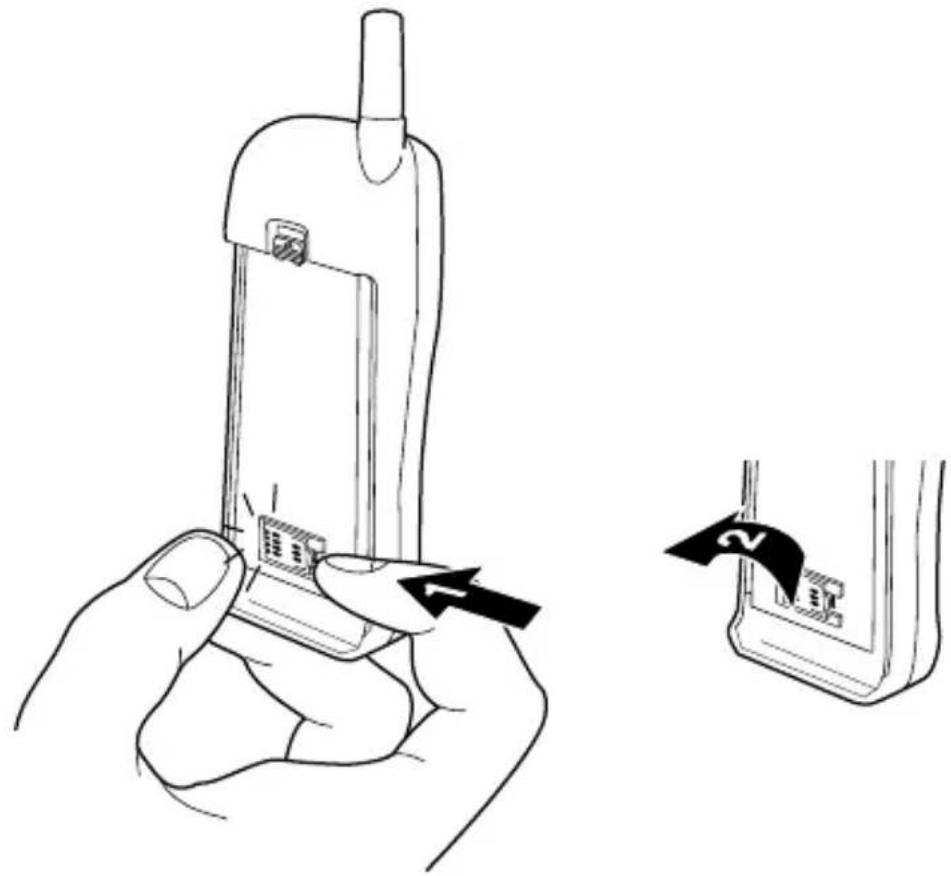
natural_image
Line drawing of a hand inserting a mobile phone into a device, showing the right-hand rule for inserting a key (no text or symbols present)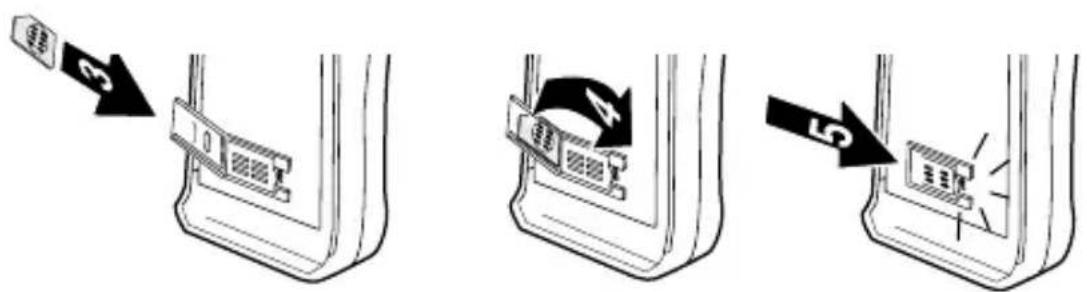
Removing the SIM
To remove the SIM follow the above steps in reverse.
Getting Started
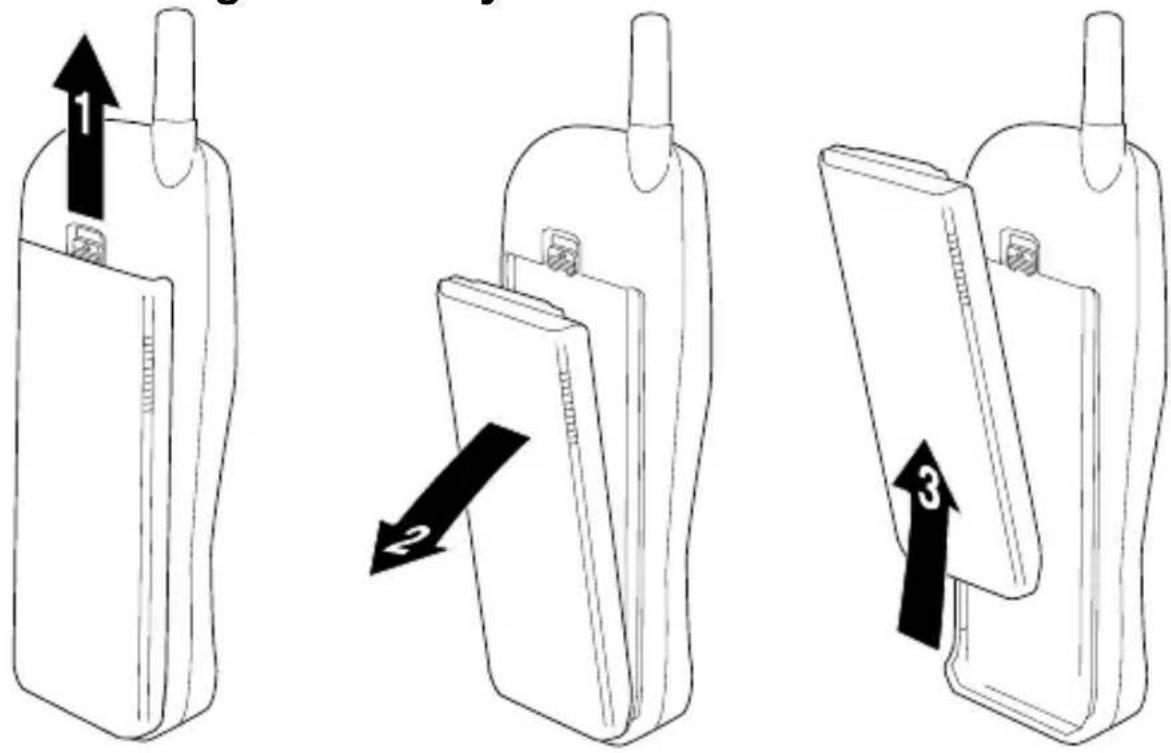
Fitting/Removing the Battery
Fit a fully charged battery pack. If the battery pack is not fully charged then it must be charged as shown in “Charging the Battery”.
Fitting the Battery
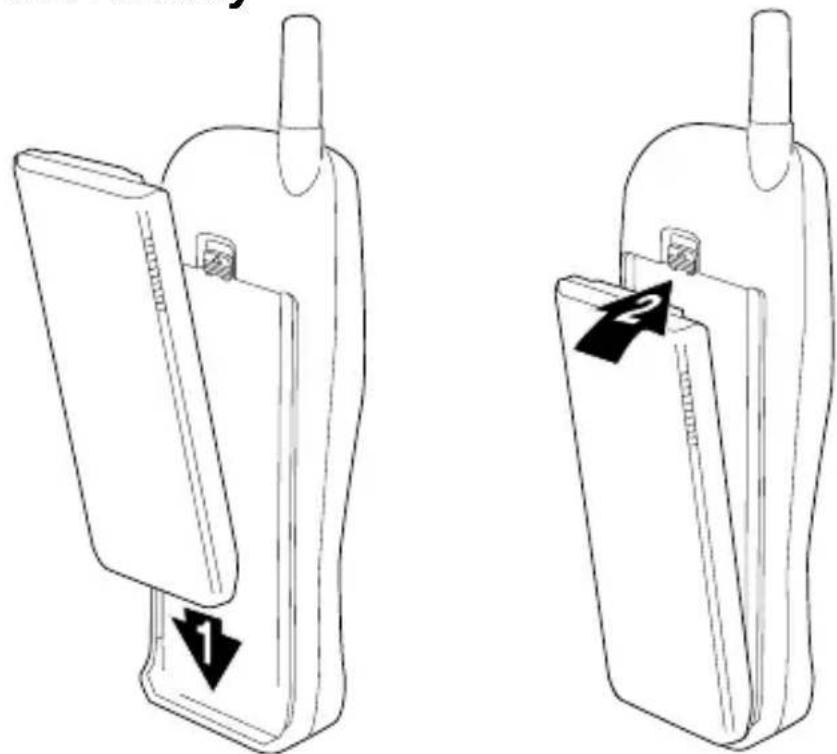
natural_image
Line drawings of two mobile phone holders with directional arrows indicating movement (no text or symbols)Removing the Battery
Getting Started
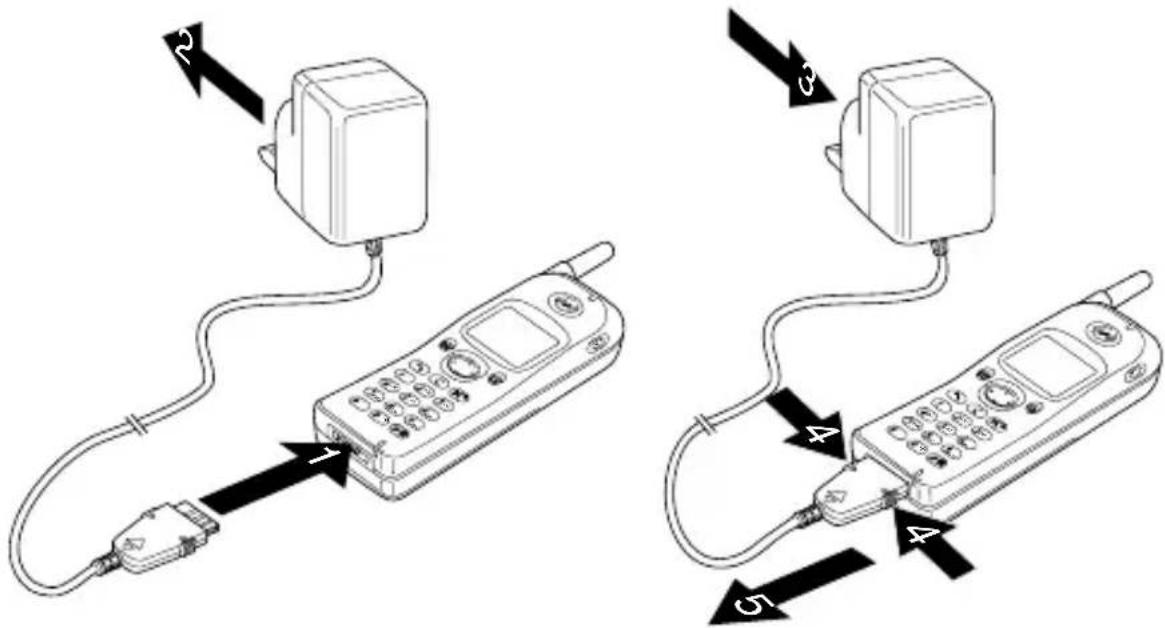
Charging the Battery
The battery pack must be attached to the phone before the AC Adaptor.
DO NOT force the connector as this may damage the phone and/or the AC Adaptor.
When charging is complete remove the AC Adaptor.
NOTE: If the Battery Pack is deeply discharged, the phone may take some time to detect which type of Battery Pack it is charging. During this period leave the phone connected to the charger until the charge LED and Battery Level Indicator appears and charging is complete.
Operation of Battery Level Indicator
| While charging | Charging complete | |
| Telephone on |
Telephone off ◀ Indicator off
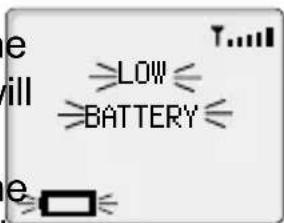
Low Battery Warning
When the battery power is low a warning tone will sound and a LOW BATTERY message will flash. The power will automatically shut off shortly after the warning tone. Fully charge the battery pack or replace it with a fully charged one. During conversation finish your call imme
Location of Controls
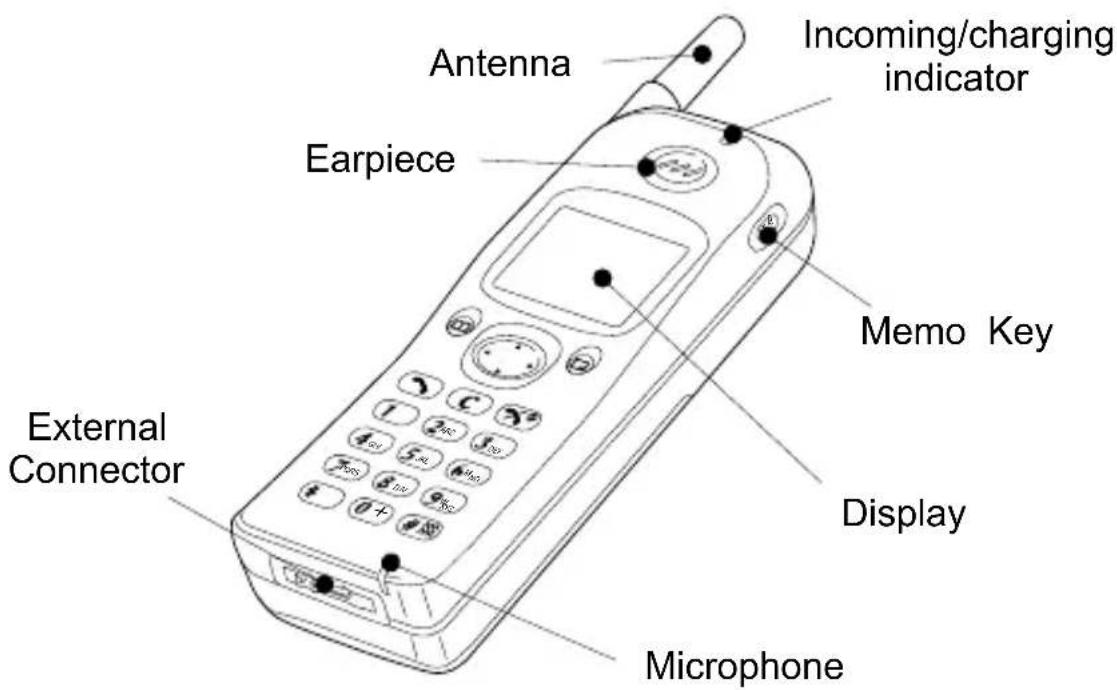

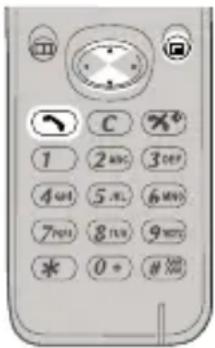
Navigation key – pressing up/down scrolls through options in the main area of the display or adjusts the volume. Pressing left/right scrolls through options in the option area of the display

Select key – selects an option in the option area of the display

accesses Phonebook or switches character types

makes a call or recalls recently dialled phone numbers

clears the last digit entered, clears all digits when pressed and held or returns to the previous display

ends a call or switches the phone on/off when pressed and held

Digit keys 0 to 9, * and # – the # key will switch on and off vibration alert
records a conversation during a call or plays it back during standby
Getting Started
Display
Phone/SIM Phonebook indicator
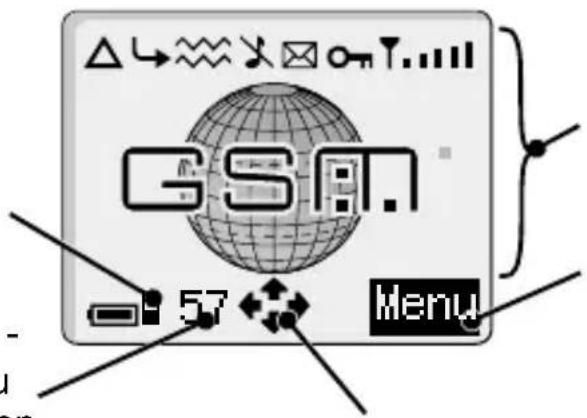
Main Display area
Option area - shows options that can be selected by the
key
Location area - indicates menu number, location number, alpha mode or alarm mark Ⓛ.
Navigation prompt - ⏻ scrolls through the main area of the display, ⏻ scrolls through options at the bottom right of the display.
Following some operations the display will automatically clear after three seconds or after pressing any key.
△ lights when you are registered to a non-home network - roaming
lights when call divert is enabled
lights when vibration alert is enabled
lights when all tones or ring volume is off
flashes when an unread message is stored or lights when message area is full
lights when phone lock is enabled
indicates that it is possible to make emergency calls
indicates the received signal strength - weak signal, strong signal
indicates the battery level - full, low battery
indicates that the source of the currently selected number is the Mobile Phonebook
indicates that the source of the currently selected number is the SIM Phonebook
① displayed in the Location area indicates alarm is set
indicates that the Navigation key (💡) can be pressed
Basic Operation
Power On/Off
To turn the phone on or off.
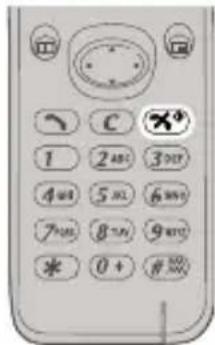
and hold to switch power on
A greeting will be displayed.
and hold to switch power off

Making a Call
Make sure that the phone is switched on and the signal strength meter is displayed.
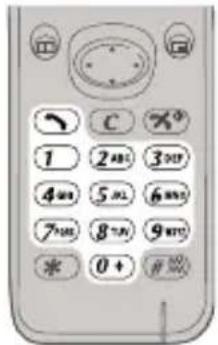
1 area code and phone number
2
International Dialling
Using the Automatic International Access Code “+” you will be able to dial international numbers without having to know the code for the international exchange.
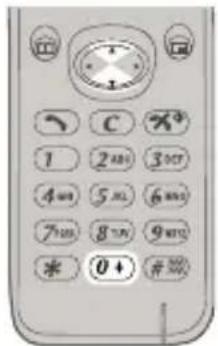
1 0+ and hold until a "+" appears
2 country code or ⚙ to scroll through the
abbreviated international names
3 area code and phone number
4
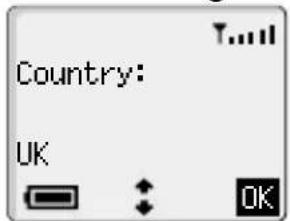
NOTE: Many countries include an initial "0" in the area code. This should, in most cases, be left out when dialling international numbers. If you have difficulties making international calls, contact your Service Provider.
Basic Operation
Emergency Calls
To make an emergency call the antenna symbol (Y) must be present.
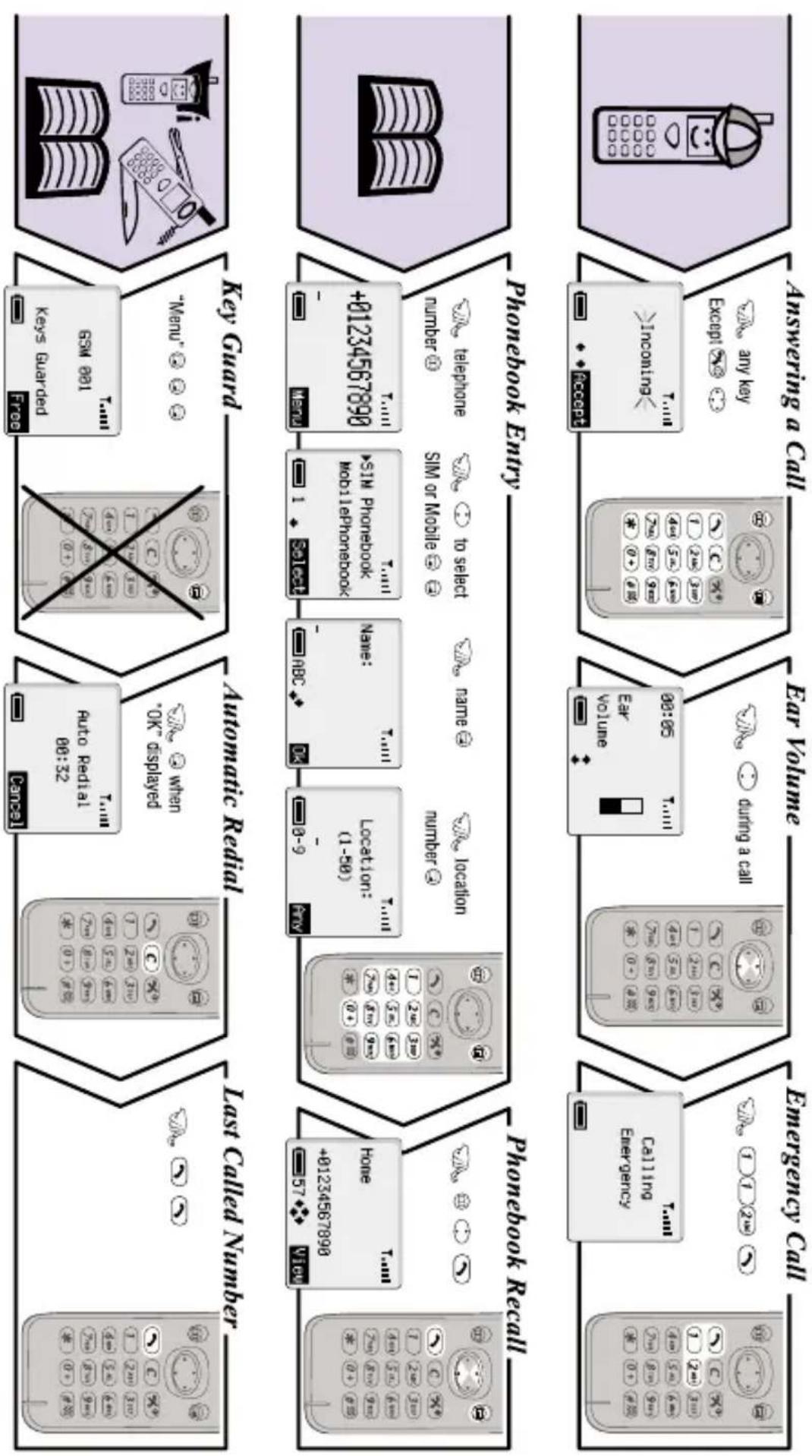
1 1 2 ABC or press ☐ when "SOS" is displayed in the option area of the display
Automatic Redial
When a call is unsuccessful the phone will ask if you want to redial the phone number again automatically.
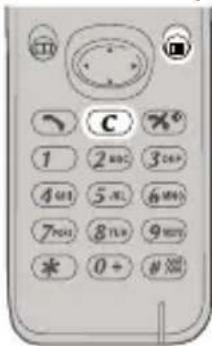

② when “OK” is displayed in the option
Auto Redial will countdown the display to the next redial.
To stop redialling, press ☐ when "Cancel" is displayed in the option area
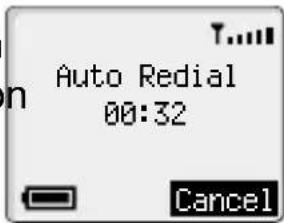
If a call is repeatedly unsuccessful you will not be able to automatically redial the phone number. In this case you must redial the phone number manually.
Ending a Call

Answering a Call
To receive a call the phone must be switched on and the signal strength meter must be displayed.
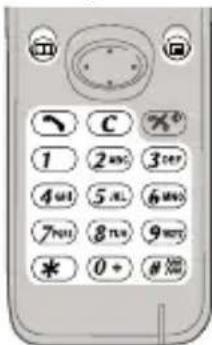

any key except ⏱① or

to reject the call
If a call is not answered the number of unanswered calls will displayed.

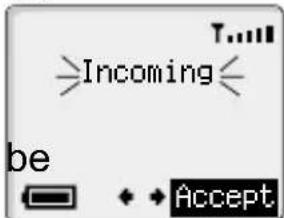

any key to clear the display
Caller Identification
This feature allows you to identify incoming calls and accept or reject them. The caller's phone number, and name if stored in Phonebook, will be displayed.
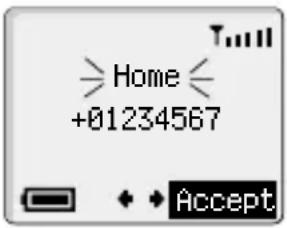
NOTE: Caller Identification may not always be available.
Volume Control
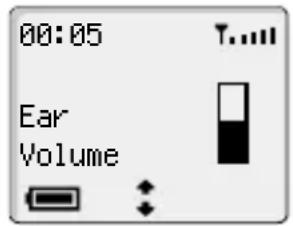
Earpiece Volume
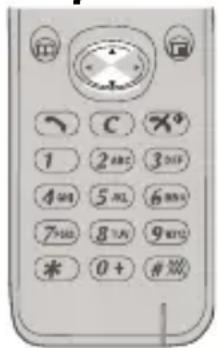
Four levels of volume adjustment are available.
During a call:
to decrease the volume
to increase the volume
Ring and Key Volume
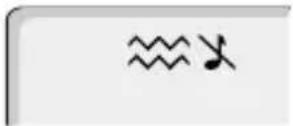
Changing the ring and key volume is done in the same way. If you increase the ring volume above maximum it will set an escalating ring tone. If you turn the ring volume off, the silent indicator icon (✗) will be displayed.
When “Menu” is displayed in the option area of the display:
1 ☐ and ⚙ to point to “Personalise”
2 📋 and ⚙ to point to “Tones”
3 ☐ and ⚙ to point to "Ring Volume" or "Key Volume"
4
5 Use ⏻ to set the volume
6
Basic Operation
Vibration Alert
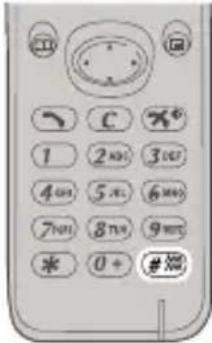
When vibration alert is switched on the phone will vibrate when a call is received. Switching on vibration alert will silence the ring volume.
However, when the ring volume is adjusted after the vibration alert is switched on, the phone will ring and vibrate when a call is received.
During standby:
and hold to switch on or off. When switched on, the phone will vibrate briefly
Key Guard
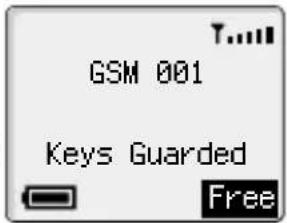
Key Guard will prevent any keys from being accidentally pressed e.g. when the phone is being carried.
When "Menu" is displayed in the option area of the display:
three times to enable Key Guard
When a call is received Key Guard will be temporarily disabled, allowing you to press any key to answer the call. Emergency calls can still be made.
Disabling Key Guard

☐ twice when “Free” is displayed in the option area of the display.
Phone Clock
This phone incorporates a clock with date/time, an alarm and a power on/off feature.
Initially Setting the Clock
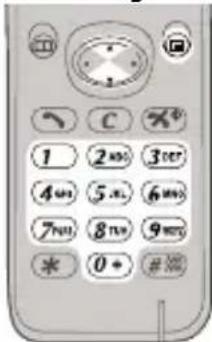
When "Menu" is displayed in the option area of the display:
1 and to point to "Personalise"
2 and to point to "Clock Function"
3 and to point to "Clock Set"
4
5 enter the digits for the date in the format day/month/year
6
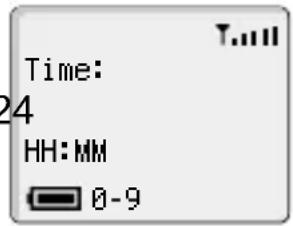
7 enter the digits for the time using 24 hour clock
8
Setting the Clock Format
1 ☐ and ⚙ to point to “Personalise”
2 ☐ and ⚙ to point to “Clock Function”
3 📂 and ⚙ to point to “Clock Format”
4
5 ☐ to select the format of clock and/or date
6
Setting the Alarm
NOTE: If you have not already set the clock, you will be asked to do so prior to setting the alarm.
When “Menu” is displayed in the option area of the display:
1 ☐ and ⚙ to point to “Personalise”
2 ☐ and ⚙ to point to “Clock Function”
3 ☐ and ⚠ to point to "Alarm Set"
4
5 enter the digits for the time
6
7 🏠 🔊 to select the frequency of the alarm
8
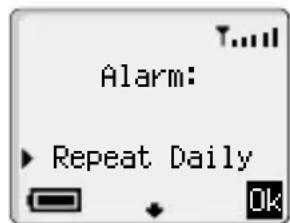
Once the alarm has been set, Ⓛ will be displayed when the phone is in standby mode.
Basic Operation
Muting the Alarm
When the set time is reached the alarm will sound and the display will flash with an alarm message. The alarm will sound for 30 seconds. If the alarm goes off during a call, it will a vibration alert.
To end the alarm:

any key
Disabling the Alarm

To disable the alarm point to "Alarm Set"
1 twice
2 ⚠️ to point to “Disabled”
3
Adjusting the Alarm Time
When “Menu” is displayed in the option area of the display:
1 ☐ and ⚠ to point to “Personalise”
2 ☐ and ⚙ to point to “Clock Function”
3 ☐ and ⚠ to point to “Alarm Set”
4
5 C four times
6 enter the digits for the time
7
8 🔊 to select the frequency of the alarm
9
Setting a Power On/Off Time
You can set your phone to turn itself on or off automatically at a specified time using the Power On/Off feature. The procedure for setting the Power On/Off automatically is similar to that for setting the Alarm. Adjustment of the Power On/Off Time is also similar to that for the alarm. For either setting or adjusting the time you need to select “Power On Time” or “Power Off Time” in the “Clock Function” menu.
Phone Security
There are a number of security features for this phone that will protect against unauthorized use, and enable you to restrict access to certain features.
It is recommended that you memorize your security codes. If you need to make a note of your security codes, never write them in a way that they can be recognized by another person. If you forget them contact your dealer for the Phone Lock Code or your Service Provider for PIN and PIN2.
Phone Lock
With the Phone Lock enabled you will be restricted to answer incoming calls and make emergency calls only. The Phone Lock Code is set to "0000" at the factory.
When “Menu” is displayed in the option area of the display:
1 ☐ and ⚠ to point to "Security"
2 ☐ twice to enable Phone Lock
3 Enter the 4-digit code press ☐
The phone will be locked and the lock icon will appear in the display
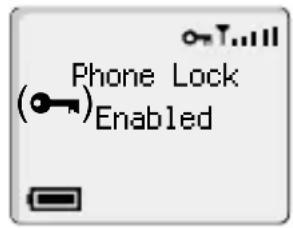
Unlocking the Phone
To restore normal operation, enter your Lock Code and press ☐ The lock icon will disappear from the display. However, once you turn the phone off and on again you will be asked to enter the Lock Code again.
Disabling Phone Lock
When “Menu” is displayed in the option area of the display:
1 ☐ and ⏻ to point to "Security"
2 📋 and ⚙ to point to “Phone Lock”
3 until "Disable" appears in the option area of the display
4
5 Enter the Lock Code and press ☐
Phone Security
PIN
The PIN (Personal Identification Number) protects your SIM card against unauthorized use. If you enable the PIN, every time the phone is turned on you will be asked to enter the PIN. Once this has been correctly entered you will be able to use the phone. As with the Phone Lock you can change the PIN at any time.
PIN2 controls security for the Fixed Dial Store and Call Charge metering.
Enabling/Disabling the PIN
When “Menu” is displayed in the option area of the display:
1 ☐ and ⚠ to point to "Security"
2 ☐ and ⚙ to point to "PIN"
3 ☐ to enable/disable the PIN
4 PIN number
Changing Security Codes
When “Menu” is displayed in the option area of the display:
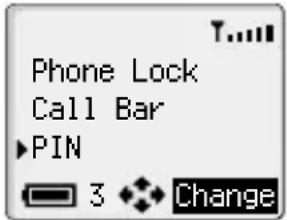
1 ☐ and ⚙ to point to "Security"
2 ☐ and ⏻ to point to "Phone Lock" or "PIN"
3 🎨 🔒 until “Change” appears in the option area of the display
4 ☐ enter the current code
5 enter the new code
6 ☐ verify the new code
7
Advanced Operation
Voice Memo
You can record a conversation for up to 15 seconds during a call. There are two separate areas for voice memo messages (Voice memo 1, Voice memo 2) allowing you to record two separate voice calls. If a different SIM is installed any voice memos will be lost.
CAUTION: Security of a recorded message is your responsibility. You MUST ask for the other party's consent before recording.
Recording
MEMO during a call
A tone will sound when recording starts. When the recording stops a tone will sound to you.
If you press (MEMO) while recording a voice memo, recording to the current voice memo area will stop and will start in the other voice memo area.
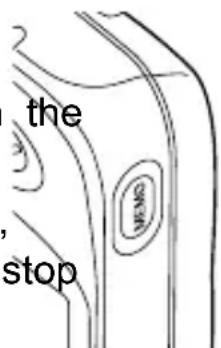
If MEMO is pressed when the two voice memo areas are occupied, the older record will be overwritten by the new memo.
Play Back
MEMO during standby.
If there are two voice memos recorded they will both be played back continuously. To swap playback between the two voice memos areas press MEMO during playback.
If there is no recording two tones will sound.
To stop playing, press ⏱①
Volume Control During Playback
While playing back:
and ⚙ to adjust the playback volume of the voice memo
Deleting
☐ twice during playback
Advanced Operation
DTMF Tones
DTMF tones can be sent during conversation. These are often used to access voice mail, paging and computerized home banking. For example, you may need to input a number to remotely access voice mail messages.
Send DTMF Tones During a Call

digits (0 to 9, # and *)
Pause Dial
Using pauses allows you to send DTMF tones automatically.
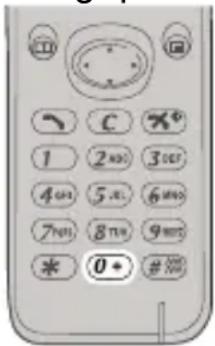
1 phone number
2 0 and hold until a "P appears
3 DTMF digits after the pause e.g. Enter the number to access voice mail messages.
4
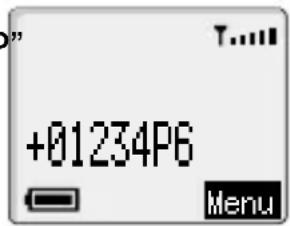
When the call is successful DTMF tones will be sent after 3 seconds or when ⏻ is pressed.
Alert Profile
Alert Profile enables you to identify up to five callers with a particular ring tone and alternate backlight colour, making it easier to distinguish between callers.
Creating an Alert Profile
When “Menu” is displayed in the option area of the display:
1 ☐ and ⚙ to point to “Personalise”
2 📁 and 🔒 to point to “Alert Profile”
3 ☐ when "Select" is displayed
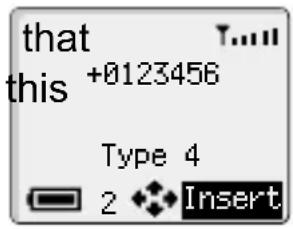
4 ☐ when "Insert" is displayed
5 enter the phone number or recall from the Phonebook – see “Retrieving a Number” page 23
6
7 🏠 and use ⚙ to select the ring tone you wish to use for incoming calls from phone number
8
Call Hold and Call Waiting
Holding/Resuming a Call
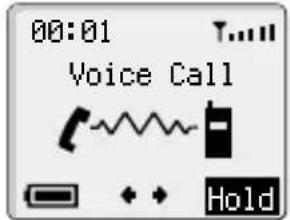
1 ☐ when "Hold" is displayed in the option area
2 ☐ when "Resume" is displayed in the option area
Making a Second Call
1 phone number, or recall from Phonebook – see "Retrieving a Number" page 23
2
The first call will be placed on hold.
Receiving a Second Call
A second call can be received, if call waiting is switched on – see “Call Service” page 35. It is not possible to have more than one fax or data call. All voice calls must be ended before you can make or receive a fax or data call.
Accept a Second Call
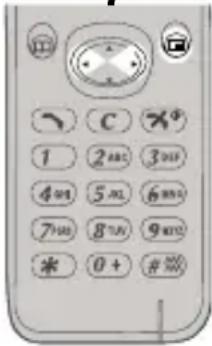
☐ when “Accept” is displayed in the option area
The current call will be placed on hold.
Reject a Second Call
1 📋 to display "Reject" in the option area
2
End Current Call and Receive Second Call
1 📋 ✗① with a waiting call
2 any key except ⏻ or ⚡
Advanced Operation
Operation During Two Calls
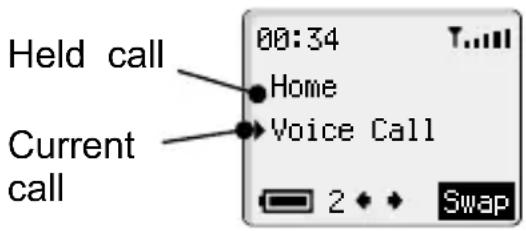
Swapping Between Calls
when “Swap” is displayed in the option area
End Current Call
1 📋 to display "End" in the option area
2
The held call will remain held.
End Both Calls

Call Transfer
With two calls connected, Call Transfer enables you to connect them together ending your connection, leaving them to talk together without you.
When you have two calls:
1 📋 to display "Trans." in the option area
2
The two calls will be connected to each other and your call will be ended.
NOTE: Two call transfer cannot be utilized while in Multi-party mode.
Multi-party Calls
A Multi-party call enables three to five people to be in conversation at the same time. It is possible to swap between a Multi-party call and another call in the same way as with two separate calls.
Enabling Multi-party
With two calls connected (one active, one on hold)
1 📁 to display "Merge" in the option area
2
A Multi-party call has been enabled, all three people will be able to talk to each other.
Advanced Operation
Adding to Multi-party
You can add to the Multi-party call (up to a maximum of five). Either by making a call or accepting an incoming call. The call can then be merged into the Multi-party.
NOTE: When making a call or accepting an incoming call the Multi-party call will be placed on hold. The callers in the Multi-party call can continue to communicate with each other while on hold.
Splitting a Multi-party
You can select an individual from the Multi-party and remove their connection. This enables you to talk privately without the participation of the rest of the Multi-party.
During a Multi-party call:
1 📋 to display "Option" in the option area
2
3 📂 to select a caller in the Multi-party
4 🍻 🔵 to display "Split" in the option area
5
The selected caller will be split from the Multi-party call and the Multi-party call will be placed on hold (the remaining Multi-party call callers can still communicate).
Ending Multi-party Calls
You can either select an individual in the Multi-party and end the call or end the entire Multi-party call.
Ending a Single Connection
During a Multi-party call
1 📋 to display "Option" in the option area
2 📂 to select a caller in the Multi-party
3 📋 to display "End" in the option area
4
Ending a Multi-party Call
During a Multi-party call:
to end all the calls at once
Phonebook Basics
Phonebook Basics
Phone numbers can be stored in two locations. You can store numbers in the SIM Phonebook (therefore the number of locations, length of name and number of phone numbers are SIM dependant). Alternatively you can store phone numbers in the Mobile Phonebook, this means that if you change the SIM the numbers in the phone are not lost.
Storing a Number
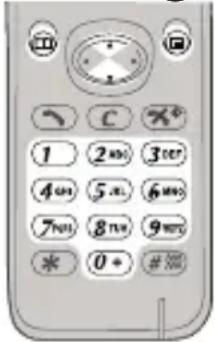
1 phone number
2
3 🏠 🔵 select the Phonebook (either SIM or Mobile)
4
5 The phone number you entered will be displayed, edit the number if necessary
6 📋 to enter the phone number
7 enter the name – see “Alpha Entry” page 32
8
9 location number
10
Automatic Location
The phone number can be stored automatically at the first available location. This can be done instead of entering a location number.
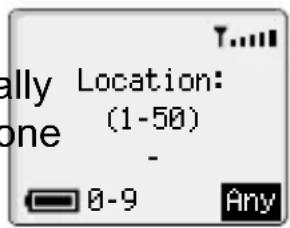
☐ when “Any” is displayed in the option area of the display
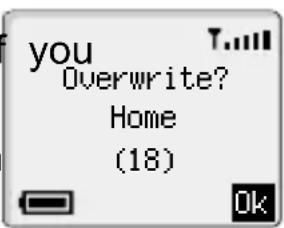
Overwrite Protection
If a location is occupied you will be asked if wish to overwrite the current information.
to overwrite the selected location
C to choose another location number
Browsing Phonebooks by Name or Location
You can search the phonebook by either Name or Location. The default setting for browsing is “Names”. All Phonebook entries will be listed in alphabetical order of both SIM and Mobile Phonebook merged. When browsing by name pressing a lettered key will take you to the first entry starting with that letter.
When “Menu” is displayed in the option area of the display:
1 📋 and 🔵 to point to "Phonebook"
2 📋 and ⚙ to point to “Browse”
3 📂 to toggle between “Names” and “Loc’ns”
4
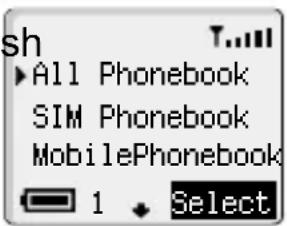
5 📁 🔒 to select the Phonebook you wish to browse
6
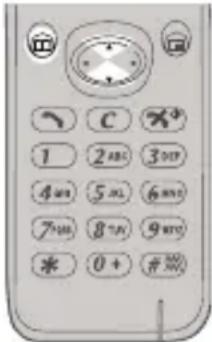
Retrieving a Number
1 When in standby:
2
3 🔍 to browse through the Phonebook
NOTE: The Phonebook you last viewed will be the default when you next press ☎. To change the default, use the Phonebook menu to select a particular phonebook.
Once you have selected a phone number or name, there are a number of actions that you can perform. You can dial the selected number by pressing ↗.
Phonebook Basics
Editing Phonebook Entries
You can View, Recall, Edit, Delete or Create in the Phonebook. To access these features you follow the same procedure. With a phone number or name displayed:
1 and scroll between "View", "Recall", "Edit", "Delete" or "Create"
2 ☐ to select an option
View
Displays an individual phone number and name or names list.
Recall
Displays the phone number, enabling you to either change it or call the number.
Edit
Displays the phone number, allowing you to make changes, followed by the name, enabling you to make changes.
Delete
Deletes the entry from the Phonebook.
Create
Enables you to create a new entry in the Phonebook.
Speed Dial a Stored Number

1 location number – leading zeros may be left out
2 #
3
Phonebook Basics
Hot Key Phone Numbers
It is possible to dial phone numbers from the Phonebook or Service Dial part of Phonebook very quickly. Some Hot Key Phone numbers may be reserved by the Service Provider, for example the first three Hot Key Phone numbers may be linked to the Service Dial part of the Phonebook - see page 28. To select a source for the Hot Key phone numbers see "Personalise" – page 39.
1 1 to 9wxyz and hold
2
Advanced Phonebook
Advanced Phonebook
Note Pad
During a call you can enter numbers which you may wish to dial when the call has ended.
During a call:
1 phone number
2 When the call has ended press ↗ to call that number
To store in Phonebook, press ☐ while the number is displayed – see “Storing a Number” page 22.
Recent Numbers
Recently dialled phone numbers will be stored in “Last Dialled”. If Caller Identification is available the caller’s phone number for an answered call will be stored in “Answered” and an unanswered call will be stored in “Unanswered”.
When the store is full the next phone number will overwrite the oldest.
1
2 ⏻ to point at “Last Dialled”, “Answered” or “Unanswered”
3
4 ⚙ to point at the phone number (or name) you wish to dial
5 To store in Phonebook, press ☐ while the number is displayed – see “Storing a Number” page 22.
6
You can edit or delete the phone number before dialling – see "Editing Phonebook Entries" page 24.
Calling the Last Dialled Number

To redial your last called phone number


Advanced Phonebook
Returning an Unanswered Call
When the display shows that you have received calls but not answered them.
1
2 The last caller's phone number will be displayed if it is available
3 📁 🔍 to point at the phone number you wish to dial
4
Fixed Dial
The Fixed Dial Store is part of Phonebook, but with additional security. When the security feature Fixed Dial is switched on it is only possible to make calls with phone numbers that are in the Fixed Dial Store.
When Fixed Dial is switched on any manually dialled phone numbers must match a phone number in the Fixed Dial Store.
To store, edit or delete a phone number in the Fixed Dial Store "Fixed Dial" must be switched on – see "Security" page 36. With Fixed Dial switched on, all phone numbers can be added, edited or deleted as normal, but you will be asked for PIN2 – see "Phone Security" page 15.
"Wild" Numbers
Wild numbers are spaces that can be stored in a phone number. The “wild” numbers must be filled before the phone number is dialled. In this way a call can be restricted to a specific area by storing the area code of a phone and when recalled the remainder can be added.
The “wild” numbers can be anywhere within a stored phone number.
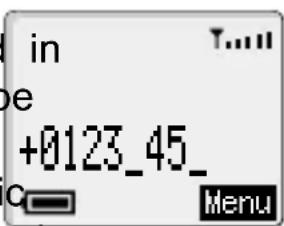
1 📂 0+ and hold until “_” appears to enter a wild number
2 When the phone number is recalled pressing a numeric key will fill in a “wild” number.
Advanced Phonebook
Service Dial
Your Service Provider may program some special phone numbers into your SIM. It is not possible to modify the Service Dial numbers.
1 and hold
2 🎨 🔍 to browse through the Service Dial list of phone numbers
The phone number pointed to can only be recalled or dialled.
Short Text Messages
You can receive, display, edit and/or send short text messages, of up to 160 characters to mobile phones on the same net or any network that has a roaming agreement.
Setting your Phone for Short Text Messages
Before you can send a message you must enter the Message Centre number into Parameters (your Service Provider will supply the Message Centre number).
NOTE: The Message Centre number may have been preprogrammed, on your SIM card
Setting the Message Centre Number
When “Menu” is displayed in the option area of the display:
1 📋 and ⚙ to point to “Messages”
2 📂 and ⚙ to point to “Parameters”
3 and to point to "Message Centre"
4
5 🍎 0+ and hold until a “+” appears
6 country code or ⚙ to scroll through the abbreviated international names – see “International Dialling” page 9
7 message centre number (including area code)
8
NOTE: If you do not include the international access code, you will not be able to send or receive Short Text Messages.
Sending a Short Text Message
When “Menu” is displayed in the option area of the display:
1 📁 and ⚙ to point to “Messages”
2 📋 and ⚙ to point to "Create"
3 enter the message (up to 160 characters) – see “Alpha Entry” page 32.
4
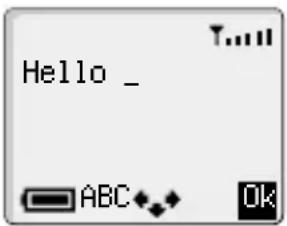
Short Text Messages
You will be asked if you wish to send the message, if you do not wish to send the message press , the message will be stored.
5 📂, enter the destination phone number (or recall a number from the Phonebook) - see “Retrieving a Number” page 23
6 twice
7 You maybe asked if you wish to have delivery confirmation, if you want confirmation press ☐
8 If you do not, use ⬇ to indicate "No", then press 📋
Receiving Short Text Messages
When a Short Text Message is sent to your phone the message indicator (✉) will flash in the display, with an audible tone or vibration alert. This indicates that a new message has been received.
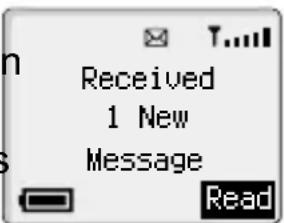
If the message indicator appears constantly in the display this indicates that the message area is full and you will need to delete old messages in order to be able to receive new messages in the future.
When “Menu” is displayed in the option area of the display:
1 ☐ and ⏻ to point to “Messages”
2 🍻 and 🔒 to point to "Receive List"
3 📁 and ⏻ to scroll to the message
4 ☐ to read the message
5 To delete the message use ⏻ to select "Delete"
6 twice
Reading a Short Text Message

To read the message press ☐ when “Read” is displayed in the option area.
Cell Broadcasts
Cell broadcasts are general information that is sent to your phone by a network operator. The information can be district traffic or weather.
Selecting Broadcast Topics
You need to specify the topic(s) of information that you wish to receive as broadcasts before you can receive them.
When “Menu” is displayed in the option area of the display:
1 📋 and ⚙ to point to “Messages”
2 📁 and ⏻ to point to “Broadcasts”
3 📁 and ⚙ to point to "Topics"
4
5 🍻 and ⏻ to select a Topic
6 ☐ twice to insert the Topic into your broadcast list
Enabling/Disabling Broadcasts
When “Menu” is displayed in the option area of the display:
1 📋 and ⚙ to point to “Messages”
2 📋 and 🔊 to point to “Broadcasts”
3 ☐ and ⚠ to point to "Receive"
4
Once broadcasts have been enabled, the same procedure will disable broadcasts.
Alpha Entry
Alpha Entry
Alpha Entry is used to enter alphanumeric characters into Phonebook, Short Text Messages, Price Per Unit and the Greeting Message.
| Key Character entry type | |||
| Normal(ABC) | Greek(ABΓ) | Extended(AÄÅ) | |
| 1 | Space“@,.;:!i?¿()[]{'&%+-/^~|<>=_£$¥α§ | ||
| 2 ABC | ABCabc | AÄÄÄEBCÇaäåæàbc | |
| 3 DEF | DEFdef | DEÉFdeéèf | |
| 4 GHI | GHIghi | GHIghìì | |
| 5 JKL | JKLjkl | JKLjkl | |
| 6 MNO | MNOmno | MNÑOÖØmnñoöøò | |
| 7 PQRS | PQRSpqrs | PQRSpqrsß | |
| 8 TUV | TUVtuv | TUÜVtuüùv | |
| 9 WXYZ | WXYZwxyz | WXYZwxyz | |
Each time a key is pressed in quick succession it will display the next character available on that key (or if the key is pressed and held down it will cycle through the available characters).
Releasing the key, or pressing another key will enter the currently displayed character and the cursor will move to the next position.
To access the different character types, normal (ABC), numerals (0–9), Greek characters (ABΓ) and extended characters (AÄÅ) press 📋.
Editing Alpha Entry
Pressing ⏻ will move you up or down one line. Pressing ⏻ will move you left or right one character. When the cursor is moved over a character and another key pressed this will insert the new character. Pressing Ⓖ will delete the character to the left of the cursor or delete the current line when pressed and held.
Menu Structures
When the word “Menu” is in the option area of the display pressing the ☐ will display a menu of phone features. To select a feature press ⏻ so that the pointer is showing next to the feature that you require then press ☐.
A quick way of selecting a feature is to press the menu number shown in the bottom left of the display.
To leave the menu press repeatedly.
During a call a restricted menu will be available.
NOTE: Any feature that does not appear with it's corresponding menu structure has already been detailed earlier in this manual.
Key Guard
For instructions on "Key Guard" – see page 12.
Phonebook
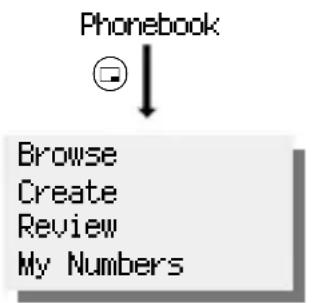
Most common use of the Phonebook is covered in “Phonebook Basics” – see page 22.
Review shows how many locations are available in the Phonebook. Occupied locations are shown with “■”.
My Numbers is a convenient part of Phonebook where your voice, fax and data phone number(s) can be stored and viewed.
Menu Structures
Messages
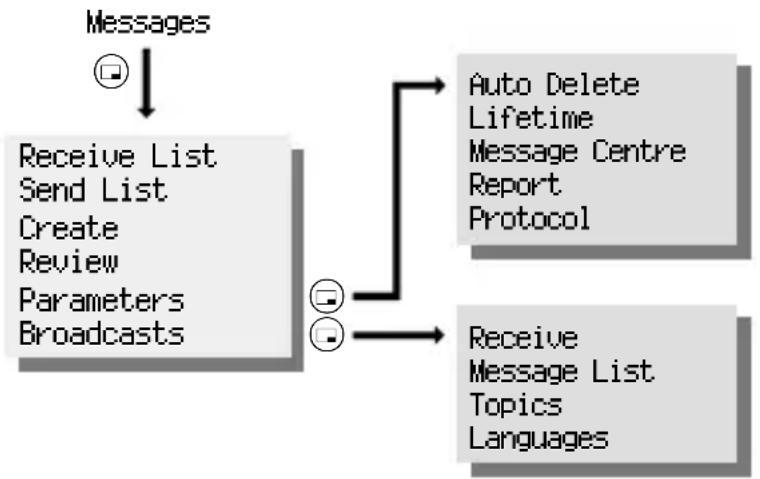
flowchart
graph TD
    A["Messages"] --> B["Receive List\nSend List\nCreate\nReview\nParameters\nBroadcasts"]
    B --> C["Auto Delete\nLifetime\nMessage Centre\nReport\nProtocol"]
    B --> D["Receive\nMessage List\nTopics\nLanguages"]
    C --> D
Most common use of the Messages is covered in "Short Text Messages" – see page 29
Received messages will be stored in the Receive List. Flashing “•” will indicate unread messages. Once the message is selected, you can read, delete, edit and reply. With the word “Sender:” displayed or a phone number in quotation marks (“”), pressing ⏻ dials the phone number or pressing Ⓤ stores the phone number in the Phonebook.
When a message has been sent or edited it will be stored in the Send List. Review allows you to check usage of the message area.
Parameters
The Parameters are necessary for receiving or sending message.
Auto Delete will erase messages automatically. When “Received Read” is selected, a new message will overwrite the oldest read message. When “Received Any” is selected, a new message will overwrite the oldest message even though it may not have been read.
Lifetime is the duration that your message is stored at the Message Centre. Delivery attempts will be repeated until the message has been delivered or the Lifetime expires.
When your message has been delivered a confirmation can be received if Report is set to "Yes".
The Message Centre may be able to convert the message to the format specified by Protocol.
Broadcasts
The Message List will display the last received broadcast messages.
The Language in which broadcast messages are displayed can be changed.
Call Service
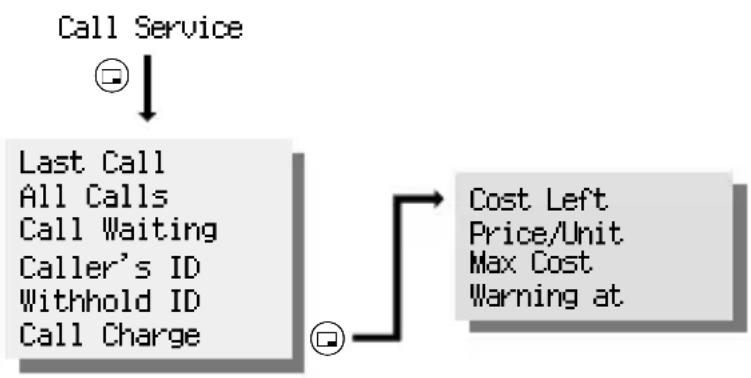
flowchart
graph TD
    A["Call Service"] --> B["Last Call"]
    B --> C["All Calls"]
    C --> D["Call Waiting"]
    D --> E["Caller's ID"]
    E --> F["Withhold ID"]
    F --> G["Call Charge"]
    G --> H["Cost Left"]
    H --> I["Price/Unit"]
    I --> J["Max Cost"]
    J --> K["Warning at"]
Last Call will display the duration and call charge, if available, of the last call during standby or the current call during a call. Times are indicated as: hours (0-99), minutes (0-59), seconds (0-59) - HH:MM:SS.
All Calls displays the accumulated duration and call charge, if available, of incoming and outgoing calls. The lock code or PIN2 is required to reset the timer and call charge.
Call Waiting allows you to receive a second call during your current call. When updating or checking the status of call waiting the phone must be registered with a network.
Caller's ID allows you to check the status of Caller's Identification. The phone must be registered with a network.
Using Withhold ID it is possible to check if you send Caller's Identification information when you make a call. When checking the Status of Withhold ID the phone must be registered with a network.
Call Charge will set the cost of each unit for call charge information and the required currency in which call charge is displayed.
Using Max Cost can restrict use of the phone to a specified number of units.
Menu Structures
NOTE: The duration of one unit may vary during the day, peak and off-peak times. Therefore, the call charge can be calculated accordingly. However, call charge information may not give an accurate reflection of the tariffs charged by your Service Provider.
Call Divert
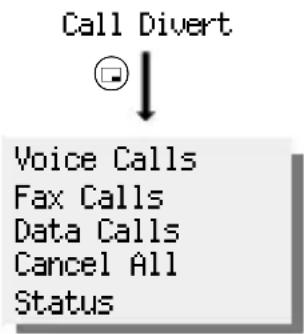
When Call Divert is enabled the divert icon ( ) is displayed.
You can divert voice, fax and data calls using different circumstances and to different phone numbers.
When updating or checking the Status of Call Divert the phone must be registered with a network.
Security
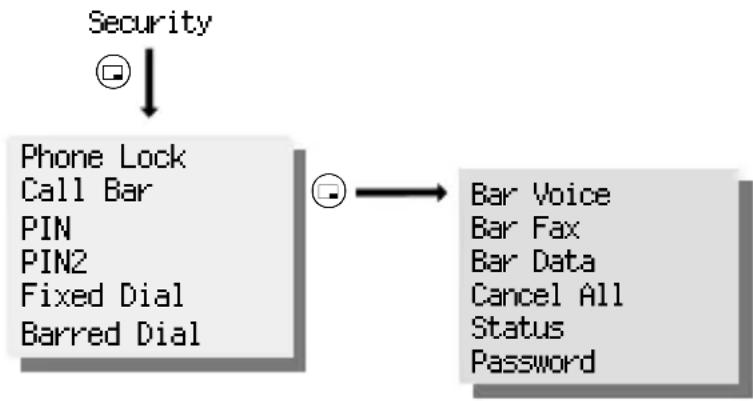
flowchart
graph TD
    A["Security"] --> B["Phone Lock"]
    B --> C["Call Bar"]
    B --> D["PIN"]
    B --> E["PIN2"]
    B --> F["Fixed Dial"]
    B --> G["Barred Dial"]
    C --> H["Bar Voice"]
    C --> I["Bar Fax"]
    C --> J["Bar Data"]
    C --> K["Cancel All"]
    C --> L["Status"]
    C --> M["Password"]
Most common uses of Security are detailed in “Phone Security” - see page 15
Call Bar is used to restrict certain outgoing and/or incoming calls. Call Bar is controlled by a security Password that is supplied by your Service Provider. When updating or checking the Status of Call Bar the phone must be registered with a network. Different Call Bar restrictions can be used for voice, fax and data calls. Any combination of call restrictions can be set.
Menu Structures
With Fixed Dial switched on you can only make calls with the phone numbers stored in Fixed Dial area of the Phonebook – see “Fixed Dial” page 27. Emergency calls can be made at any time. To use this function PIN2 is required.
Barred Dial enables you to bar all phone numbers from being dialled on the phone. To use this function PIN2 is required.
Network
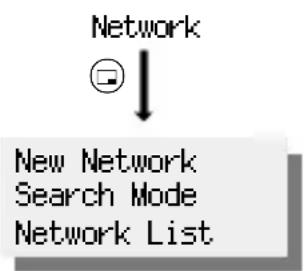
When not in your home country you may use a network that you do not directly subscribe to, this is called ROAMING. National Law may not permit roaming in your home country.
New Network is used to manually select a network that is available in your current location.
When the Search Mode is set to “Automatic” the phone will automatically reselect a new network in order to maintain optimum network availability. While the Search Mode is set to “Manual” the phone will only use a selected network. If coverage is lost another network should be selected.
The Network List is used when the Search Mode has been set to “Automatic”. The location numbers in the Preferred Network List show the search priority.
Selecting “Insert” stores a new network in the currently displayed location and then moves other networks down, “Edit” overwrites the old network with a new one, and “Add” stores a new network at the end of the list.
Menu Structures
Personalise
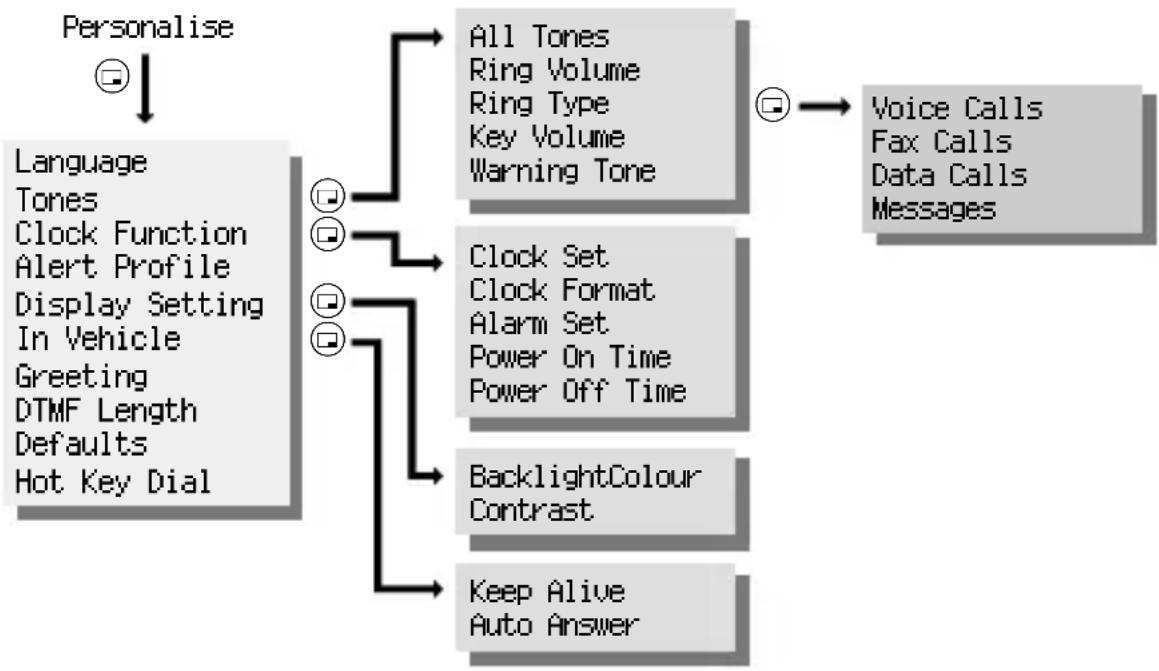
flowchart
graph TD
    A["Personalise"] --> B["Language Tones"]
    B --> C["Clock Function Alert Profile Display Setting In Vehicle Greeting DTMF Length Defaults Hot Key Dial"]
    B --> D["All Tones Ring Volume Ring Type Key Volume Warning Tone"]
    D --> E["Clock Set"]
    E --> F["Clock Format Alarm Set Power On Time Power Off Time"]
    E --> G["BacklightColour Contrast"]
    G --> H["Keep Alive Auto Answer"]
    I["Voice Calls Fax Calls Data Calls Messages"] --> J["→"]
The Language that the phone will use for display messages can be changed.
In Tones, the phone key, ring and warning tones (except low battery warning), can be switched off. When All Tones are switched off the silent indicator (♪) is displayed.
A different Ring Type can be used for voice, fax, data and messages. There is a selection of 6 tones and 14 melodies.
Display Setting allows the colour and the contrast of the display to be changed.
When the phone is mounted in the optional Car Mount Kit and the vehicle ignition is turned off the In Vehicle - Keep Alive timer will start, delaying the switching off of the phone. If the ignition is turned off during a call, the call will be maintained; when the call ends the timer will continue, or the phone will be switched off if the timer has expired. If the delay timer expires during a call, the call will still be maintained. If the phone is removed from the Car Mount Kit during the specified delay time, the timer will be canceled and the phone will not be turned off.
When Auto Answer is switched on, and the phone is mounted in the optional Car Mount Kit or Personal Handsfree Adaptor, a call will be answered without pressing any keys.
Menu Structures
A personalised Greeting can be programmed for when the phone is switched on – see “Alpha Entry” page 32.
The duration of DTMF tones that are played during pause dial can be changed from short and long in DTMF Length.
Defaults will return your Personal Settings to their factory default, except the Phone Lock code and language.
The source for the Hot Key phone numbers can be set using the Hot Key Dial menu.
Care and Maintenance
Pressing any of the keys may produce a loud tone. Avoid holding the phone close to the ear while pressing the keys.
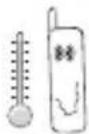
Extreme temperatures may have a temporary effect on the operation of your phone. This is normal and does not indicate a fault.

Do not disassemble the equipment. There are no user-serviceable parts.

Do not subject the equipment to excessive vibration or shock.

Avoid contact with liquids. If the equipment becomes wet immediately remove the power and contact your dealer.

Do not leave the equipment in direct sunlight or a humid, dusty or hot area.

Keep metallic items that may accidentally touch the terminals away from the equipment.
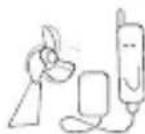
Always charge the Battery Pack in a well ventilated area, not in direct sunlight, between +5°C and +35°C. It is not possible to recharge the battery pack if it is outside this temperature range.
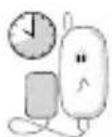
Avoid recharging battery packs for longer than recommended.

Do not incinerate or dispose of the battery packs as ordinary rubbish. The battery packs must be disposed of in accordance with local legislation and may be recycled.

When disposing of any packing materials or old equipment check with your local authorities for information on recycling.
Glossary of Terms
| DTMF Tones | Dual Tone Multi-Frequency tones allow you to communicate with computerized phone systems, voice mailboxes etc. |
| GSM | Global System for Mobile Communications. The name given to the advanced digital technology that your phone uses. |
| Home country | The country where your home network operates. |
| Home network | The GSM network on which your subscription details are held. |
| Network Operator | The organization responsible for operating a GSM network. |
| Password | Used for the control of the Call Bar. Supplied by your Service Provider. |
| PIN | Personal Identification Number used for SIM security. Supplied by your Service Provider. If the PIN is entered incorrectly 3 times, the PIN will be blocked. |
| PIN2 | Personal Identification Number used for the control of Fixed Dial Store and Call Charge metering. Supplied by your Service Provider. If the PIN2 is entered incorrectly 3 times, the PIN2 will be blocked. |
| PUK/ PUK2 | PIN/PIN2 Unblocking Key. Used to unblock the PIN/PIN2. Supplied by your Service Provider. If the PUK/PUK2 is entered incorrectly 10 times, the PUK/PUK2 will be blocked. |
Glossary of Terms
| Registration | The act of locking on to a GSM network. This is usually performed automatically by your phone. |
| Roaming | The ability to use your phone on networks other than your Home network. |
| Service Provider | The organization responsible for providing access to the GSM network. |
| SIM | Subscriber Identity Module. A small smart-card which stores unique subscriber and user-entered information such as Phonebook and Short Messages. Supplied by your Service Provider. |
Trouble Shooting
Should any problem persist contact your dealer.
| Problem Cause Remedy | ||
| Telephone will not switch on. | Check that the Battery Pack is fully charged and correctly connected to the phone. | |
| Extremely short battery life for a new battery pack. | The network you are using and the condition of the battery pack can affect battery life. | |
| Short battery life for an old battery pack. | The battery pack was worn out. | Replace with a new one. |
| The phone cannot be switched on when charging | When the Battery Pack has been deeply discharged the phone will take a short time to detect which type of Battery Pack it is charging | Leave the phone charging the Battery Pack for a few minutes before attempting to switch it on. |
| Calls cannot be made. | The phone is locked. | Unlock the phone (Menu: Security: Phone Lock) |
| Outgoing calls are barred. | Disable the outgoing call barring, or barred dial (Menu: Security: Call Bar/Barred Dial) | |
| The phone is not registered to a network. | Move to a coverage area and operate your phone after it has registered with a network. | |
Trouble Shooting
| Calls cannot be made from Fixed Dial Store | Check your SIM supports Fixed Dial.Check if the Fixed Dial is switched on (Menu: Security: Fixed Dial).Check the phone number is stored in the Fixed Dial. | |
| Calls cannot be received. | The phone is not switched on. | Switch the phone on. |
| Incoming calls are barred. | Disable the incoming call barring (Menu: Security: Call Bar) | |
| The phone is not registered to a network. | Move to a coverage area and operate your phone after it has registered with a network. | |
| Emergency calls cannot be made. | You are not in a GSM coverage area. | Check that the antenna symbol ↗ is displayed.Move to a coverage area and operate your phone when the antenna symbol is displayed. |
| Telephone numbers cannot be recalled. | The phone is locked. | Unlock the phone (Menu: Security: Phone Lock) |
| Fixed Dial is switched on. | Switch off Fixed Dial (Menu: Security: Fixed Dial) |
Important Error Messages
| Area not Allowed | Roaming in the selected area is not allowed. |
| Network not Allowed | Roaming with the selected network is not allowed. |
| Security Failure | The network has detected authentication failure because your SIM is not registered with that network. Contact your Service Provider. |
| SIM Blocked | The SIM is blocked because the wrong PUK has been entered ten times. Contact your Service Provider. |
| SIM Error | The phone has detected a problem with the SIM. Switch the phone off and then back on. If the message does not disappear contact your Service Provider. |
| Message Rejected Store Full | A message has been received but the message store is full. To receive messages, delete some of the currently stored messages or set messages to automatically clear (Menu: Messages: Parameters: Auto Delete) |
| PIN2 Invalidated | The PIN2 is blocked permanently because the wrong PUK2 has been entered 10 times. Services controlled by PIN2 cannot be used. Contact your Service Provider. |
| Warning Store Full Continue? | The message area is full. Your messages cannot be stored until some of the currently stored messages are deleted. |
| Auto Redial List Full | Redial list of unsuccessfully dialled numbers is full. Switch the phone off and then on again. |
Specifications
Telephone
| Type | GSM900 Class 4GSM1800 Class 1 |
| Temperature range | |
| Charging | +5°C to +35°C |
| Storage | -20°C to +60°C |
Battery – Attached to phone
| Battery Pack (S) | |
| Weight 88g | |
| DimensionsHeight x Width x Depth | 118 x 42 x 16.5mm |
| Supply Voltage 3.7V DC, 650mAh Li-Ion | |
| Standby time (h)Talk Time (h) | Up to 953.3 |
| Charge Time (min) 100 | |
NOTE: Charge time will be longer when the phone is turned on. Battery life is affected by the network you are using and the condition of the battery pack.

BULL CP8 PATENT
© Matsushita Communication Industrial UK Limited 1999 Information in this document is subject to change without notice. No part of these instructions may be reproduced or transmitted in any form or by any means without obtaining express permission from Matsushita Communication Industrial UK Limited
EU Warranty
EU/EEA-Wide guarantee is applicable in the EU/EEA and Switzerland.
Panasonic GSM European Service Guarantee Conditions
Dear Customer,
Thank you for buying this Panasonic digital cellular telephone. The Panasonic GSM European Service Guarantee only applies while traveling in countries other than where the product was purchased. Your local guarantee is applicable in all other cases. If your Panasonic GSM telephone requires service while abroad, please contact the local service company shown on this document.
The Guarantee
The applicable period of the European wide guarantee for GSM is generally 12 months for the main body and 3 months for the rechargeable battery. With respect to a product used in a country other than a country of purchase, notwithstanding what is stated in the conditions below, the customer will benefit, in that country of use, from these guarantee periods of, respectively, 12 and 3 months, if these conditions are more favorable to him than the local guarantee conditions applicable in such country of use.
Conditions of Guarantee
When requesting guarantee service the purchaser should present the warranty card together with proof of purchase, to an authorized service centre.
The guarantee covers breakdowns due to manufacturing or design faults; it does not apply to other events such as accidental damage, however caused, wear and tear, negligence, adjustment, modification or repair not authorized by us.
Your sole and exclusive remedy under this guarantee against us is the repair, or at our option the replacement, of the product, or any defective part or parts. No other remedy, including, but not limited to, incidental or consequential damage or loss of whatsoever nature shall be available to the purchaser.
This is in addition to and does not in any way affect any statutory or other rights of consumer purchasers. This guarantee applies in countries shown on this document at the authorized service centres detailed for that country.
UK
Service Centres in the UK
Tel. +44 990 159159
D
Panasonic Service Center Dresden
SERKO GmbH
Panasonic Service Center Rostock
warnow electronic service gmbh
An der Jägerbäk 2
18069 Rostock
Tel. +49 (0)381/ 82 016
Panasonic Service Center Hamburg
ELVICE Service GmbH
Spaldingstraße 74
20097 Hamburg
Tel. +49 (0)40/ 23 08 07
Panasonic Service Center Rendsburg
FERNSEH-DIENST B&W Service GmbH
Kieler Straße 41
24768 Rendsburg
Tel. +49 (0)4331/ 14 11-0
Panasonic Service Center Bremen
Laxenburger Straße 252
1232 Wien
Tel. +43 222/61080
FR
Technologies 126 Sygrou Ave.
17671 Kallithea
Tel. +30-1-9248300
INTERTECH S.A. International
Technologies Northern Greece Branch
Office 26 Gr.Labraki & 145 Egnatia Ave.
54638 Salonika
GREECE
Tel. +30-31-245840
P
Tel. +32 09/386 76 67
TOP SERVICE
Westerloseweg 10
2440 GEEL
Tel. +32 014/54 76 24
TELECTRO SC
EU/EEA-Wide Guarantee: Conditions applicable in any country other than the country of original purchase.
A When the purchaser finds the appliance to be defective, he should promptly contact the proper sales company or national distributor in the EU/EEA country where this guarantee is claimed, as indicated in the "Product Service Guide" or the nearest authorized dealer together with this guarantee and proof of date of purchase. The purchaser will then be informed whether:
(i) the sales company or national distributor will handle the repair service: or (ii) the sales company or national distributor will arrange for trans-shipment of the appliance to the EU/EEA country where the appliance was originally marketed; or (iii) the purchaser may himself send the appliance to the sales company or national distributor in the EU/EEA country where the appliance was originally marketed.
B If the appliance is a product model which is normally supplied by the sales company or national distributor in the country where it is used by the purchaser, then the appliance, together with this guarantee card and proof of date of purchase, should be returned at the purchaser's risk and expense to such sales company or distributor, which will handle the repair service. In some countries, the affiliated sales company or national distributor will designate dealers or certain service centres to execute the repairs involved.
C If the appliance is a product model which is not normally supplied in the country where used, or if the appliance's internal or external product characteristics are different from those of the equivalent model in the country where used, the sales company or national distributor may be able to have the guarantee repair service executed by obtaining spare parts from the country where the appliance was originally marketed, or it may be necessary to have the guarantee repair service executed the sales company or national distributor in the country where the appliance was originally marketed. In either case, the purchaser must furnish this guarantee card and proof of date of purchase. Any necessary transportation, both of the appliance and of any spare parts, will be at the purchaser's risk and expense, and there may be a consequent delay in the repair service.
D Where the consumer sends the appliance for repair to the sales company or national distributor in the country of use of the appliance, the service will be provided on the same local terms and conditions (including the period of guarantee coverage) as prevail for the same model appliance in the country of use, and not the country of initial sale in the EU/EEA. Where the consumer sends the appliance for repair to the sales company or national distributor in the EU/EEA country where the appliance was originally marketed, the repair service will be provided on the local terms and conditions prevailing in the country of initial sale in the EU/EEA.
E Some product models require adjustment or adaptation for proper performance and safe use in different EU/EEA countries, in accordance with local voltage requirements and safety or other technical standards imposed or recommended by applicable regulations. For certain product models, the cost of such adjustment or adaptation may be substantial and it may be difficult to satisfy local voltage requirements and safety or other technical standards. It is strongly recommended that the purchaser investigates these local technical and safety factors before using the appliance in another EU/EEA country.
F This guarantee shall not cover the cost of any adjustments or adaptations to meet local voltage requirements and safety or other technical standards. The sales company or national distributor may be in a position to make the necessary adjustments or adaptations to certain product models at the cost of the purchaser. However, for technical reasons it is not possible to adjust or adapt all product models to comply with local voltage requirements and safety or other technical standards. Moreover, where adaptations or adjustments are carried out the performance of the appliance may be affected.
G If in the opinion of the sales company or national distributor in the country where the appliance is used the purchaser has the necessary adjustments or adaptations to local voltage requirements and technical or safety standards properly made, any subsequent guarantee repair service will be provided as above indicated, provided the purchaser discloses the nature of the adjustment or adaptation if relevant to the repair. (It is recommended that the purchaser should not send adapted or adjusted equipment for repair to the sales company or national distributor in the country where the appliance was originally marketed if the repair relates in any way to the adaptation or adjustment).
H This guarantee shall only be valid in territories subject to the laws of the European Union and the EEA.
Please keep this guarantee with your receipt.
Notes
Notes

flowchart
graph LR
    A["Making a Call"] --> B["Correct an Error"]
    B --> C["Ending a Call"]
    C --> D["Interrentational Dialining"]

    subgraph A
        A1["Mobile Phone Icon: 0+ + 2cm 5cm 6cm 7cm 8cm 9cm 10cm 11cm 12cm 13cm 14cm 15cm 16cm 17cm 18cm 19cm 20cm 21cm 22cm 23cm 24cm 25cm 26cm 27cm 28cm 29cm 30cm 31cm 32cm 33cm 34cm 35cm 36cm 37cm 38cm 39cm 40cm 41cm 42cm 43cm 44cm 45cm 46cm 47cm 48cm 49cm 50cm 51cm 52cm 53cm 54cm 55cm 56cm 57cm 58cm 59cm 60cm 61cm 62cm 63cm 64cm 65cm 66cm 67cm 68cm 69cm 70cm 71cm 72cm 73cm 74cm 75cm 76cm 77cm 78cm 79cm 80cm 81cm 82cm 83cm 84cm 85cm 86cm 87cm 88cm 89cm<br>    end<br>    <br>    subgraph B<br>        B1[Mobile Phone Icon: +012348 use C"]
        B2["Mobile Phone Icon: +012348 use C"]
        B3["Mobile Phone Icon: +012348 use C"]
        B4["Mobile Phone Icon: +012348 use C"]
        B5["Mobile Phone Icon: +012348 use C"]
        B6["Mobile Phone Icon: +012348 use C"]
        B7["Mobile Phone Icon: +012348 use C"]
        B8["Mobile Phone Icon: +012348 use C"]
        B9["Mobile Phone Icon: +012348 use C"]
        B10["Mobile Phone Icon: +012348 use C"]
        B11["Mobile Phone Icon: +012348 use C"]
        B12["Mobile Phone Icon: +012348 use C"]
        B13["Mobile Phone Icon: +012348 use C"]
        B14["Mobile Phone Icon: +012348 use C"]
        B15["Mobile Phone Icon: +012348 use C"]
        B16["Mobile Phone Icon: +012348 use C"]
        B17["Mobile Phone Icon: +012348 use C"]
        B18["Mobile Phone Icon: +012348 use C"]
        B19["Mobile Phone Icon: +012348 use C"]
        B20["Mobile Phone Icon: +012348 use C"]
        B21["Mobile Phone Icon: +012348 use C"]
        B22["Mobile Phone Icon: +012348 use C"]
        B23["Mobile Phone Icon: +012348 use C"]
        B24["Mobile Phone Icon: +012348 use C"]
        B25["Mobile Phone Icon: +012348 use C"]
        B26["Mobile Phone Icon: +012348 use C"]
        B27["Mobile Phone Icon: +012348 use C"]
        B28["Mobile Phone Icon: +012348 use C"]
        B29["Mobile Phone Icon: +012348 use C"]
        B30["Mobile Phone Icon: +012348 use C"]
        B31["Mobile Phone Icon: +012348 use C"]
        B32["Mobile Phone Icon: +012348 use C"]
        B33["Mobile Phone Icon: +012348 use C"]
        B34["Mobile Phone Icon: +012348 use C"]
        B35["Mobile Phone Icon: +012348 use C"]
        B36["Mobile Phone Icon: +012348 use C"]
        B37["Mobile Phone Icon: +012348 use C"]
        B38["Mobile Phone Icon: +012348 use C"]
        B39["Mobile Phone Icon: +012348 use C"]
        B40["Mobile Phone Icon: +012348 use C"]
    end

flowchart
graph LR
    A["Lock Code"] --> B["Menu 65M 001"]
    B --> C["Enter PIN 700-8-9"]
    C --> D["GPS with globe icon"]
    D --> E["Power on/off"]
    A --> F["Factory default is 0000"]
    F --> G["Load Code"]
    C --> H["Service Provider 1 24m 3m"]
    H --> I["Pin supplied by your Service Provider"]
    I --> J["Power on/off"]
GD90
Panasonic

- Operating Instructions EB-GD90 Digital Cellular Telephone Main Kit
- Contents
- Introduction. 1
- Safety 3
- Getting Started 4
- Basic Operation 9
- Phone Security 15
- Advanced Operation 17
- Phonebook Basics 2 2
- Advanced Phonebook 26
- Short Text Messages 29
- Alpha Entry 32
- Menu Structures. 3 3
- Care and Maintenance 40
- Glossary of Terms 4 1
- Trouble Shooting 43
- Important Error Messages ..... 4 5
- Specifications 4 6
- EU Warranty 47
- Notes. 54
- Introduction
- Symbols Used
- Using This Manual
- Safety
- Getting Started
- Fitting/Removing the SIM
- Fitting the SIM
- Removing the SIM
- Fitting/Removing the Battery
- Charging the Battery
- Operation of Battery Level Indicator
- Low Battery Warning
- Location of Controls
- Display
- Basic Operation
- Power On/Off
- Making a Call
- International Dialling
- Emergency Calls
- Automatic Redial
- Ending a Call
- Answering a Call
- Caller Identification
- Volume Control
- Earpiece Volume
- Ring and Key Volume
- Vibration Alert
- Key Guard
- Disabling Key Guard
- Phone Clock
- Initially Setting the Clock
- Setting the Clock Format
- Setting the Alarm
- Muting the Alarm
- Disabling the Alarm
- Adjusting the Alarm Time
- Setting a Power On/Off Time
- Phone Security
- Phone Lock
- Unlocking the Phone
- Disabling Phone Lock
- PIN
- Enabling/Disabling the PIN
- Changing Security Codes
- Advanced Operation
- Voice Memo
- Recording
- Play Back
- Volume Control During Playback
- Deleting
- DTMF Tones
- Send DTMF Tones During a Call
- Pause Dial
- Alert Profile
- Creating an Alert Profile
- Call Hold and Call Waiting
- Holding/Resuming a Call
- Making a Second Call
- Receiving a Second Call
- Accept a Second Call
- Reject a Second Call
- End Current Call and Receive Second Call
- Operation During Two Calls
- Swapping Between Calls
- End Current Call
- End Both Calls
- Call Transfer
- Multi-party Calls
- Enabling Multi-party
- Adding to Multi-party
- Splitting a Multi-party
- Ending Multi-party Calls
- Ending a Single Connection
- Ending a Multi-party Call
- Phonebook Basics
- Storing a Number
- Automatic Location
- Overwrite Protection
- Browsing Phonebooks by Name or Location
- Retrieving a Number
- Editing Phonebook Entries
- View
- Recall
- Edit
- Delete
- Create
- Speed Dial a Stored Number
- Hot Key Phone Numbers
- Advanced Phonebook
- Note Pad
- Recent Numbers
- Calling the Last Dialled Number
- Returning an Unanswered Call
- Fixed Dial
- "Wild" Numbers
- Service Dial
- Short Text Messages
- Setting your Phone for Short Text Messages
- Setting the Message Centre Number
- Sending a Short Text Message
- Receiving Short Text Messages
- Reading a Short Text Message
- Cell Broadcasts
- Selecting Broadcast Topics
- Enabling/Disabling Broadcasts
- Alpha Entry
- Editing Alpha Entry
- Menu Structures
- Phonebook
- Messages
- Parameters
- Broadcasts
- Call Service
- Call Divert
- Security
- Network
- Personalise
- Care and Maintenance
- Trouble Shooting
- Specifications
- BULL CP8 PATENT
- EU Warranty
- Panasonic GSM European Service Guarantee Conditions
- Dear Customer,
- The Guarantee
- Conditions of Guarantee
- UK
- D
- FR
- P
- EU/EEA-Wide Guarantee: Conditions applicable in any country other than the country of original purchase.
- Notes
Brand : PANASONIC
Model : GD90
Category : Mobile Phone