LP-7316K - Access Point Premiertek - Free user manual and instructions
Find the device manual for free LP-7316K Premiertek in PDF.


| Product Type | Wireless Access Point |
| Brand | Premiertek |
| Model | LP-7316K |
| Wireless Standard | IEEE 802.11b/g/n |
| Frequency Band | 2.4 GHz |
| Maximum Data Rate | 300 Mbps |
| Ethernet Ports | 1 x 10/100/1000 Mbps (PoE capable) |
| Power Supply | Power over Ethernet (PoE) 802.3af or DC 12V/1A |
| Security | WEP, WPA/WPA2-PSK, WPA/WPA2 Enterprise |
| Mounting | Wall or ceiling mount (bracket included) |
| Dimensions (W x D x H) | 140 x 110 x 30 mm |
| Weight | 200 g |
| Operating Temperature | 0°C to 40°C |
| Management | Web interface, SSH, SNMP |
| Antenna | 2 x external 2dBi dipole antennas (detachable) |
| LED Indicators | Power, LAN, WLAN |
| Reset Button | Yes, to factory defaults |
| Power Consumption | ≤ 8W |
| Compliance | FCC, CE |
| Warranty | 1 year limited |
Frequently Asked Questions - LP-7316K Premiertek
User questions about LP-7316K Premiertek
0 question about this device. Answer the ones you know or ask your own.
Ask a new question about this device
Download the instructions for your Access Point in PDF format for free! Find your manual LP-7316K - Premiertek and take your electronic device back in hand. On this page are published all the documents necessary for the use of your device. LP-7316K by Premiertek.
USER MANUAL LP-7316K Premiertek
2.4GHz Outdoor Router User Manual
© 2012
Table of Contents
- Terminology....5
- Introduction......7
2.1 Package Content....7
2.2 Product Features....7
2.3 Rear Panel Description....8
2.3 Front Panel Description ......9
- Hardware Installation ....10
3.1 Appearance and Interface Introduction ...... 10
3.2 Hardware Installation Steps....12
- Software Configuration....14
4.1 Prepare your PC to configure the WLAN Broadband Router ....15
4.2 Connect to the WLAN Broadband Router ....16
4.3 Management and configuration on the Outdoor Router ....16
4.3.1 Wizard....16
4.3.1.1 Bridge Mode 16
4.3.1.2 Gateway Mode....21
4.3.1.3 WISP Mode....30
4.3.2 Operation Mode ...... 41
4.3.3 Internet Settings....43
4.3.3.1 WAN 43
4.3.3.2 LAN 48
4.3.3.3 VPN Pass Through....49
4.3.4 Wireless Settings....50
4.3.4.1 Basic 50
4.3.4.2 Advanced....52
4.3.4.3 Security 54
4.3.4.4 Site Survey....61
4.3.4.5 WPS....62
4.3.5 Firewall 63
4.3.5.1 MAC/IP/Port Filtering 63
4.3.5.2 Port Forwarding....65
4.3.5.3 DMZ 67
4.3.5.4 System Security 68
4.3.5.5 Content Filtering....69
4.3.6 Administration....70
4.3.6.1 Management 70
4.3.6.2 Qos....72
4.3.6.3 Upload Firmware 73
4.3.6.4 Settings Management....73
4.3.6.5 Status....74
4.3.6.6 System Log....75
5. FREQUENTLY ASKED QUESTIONS (FAQ)....76
5.1 What and how to find my PC's IP and MAC address? ....76
5.2 What is Wireless LAN? 76
5.3 What are ISM bands?......76
5.4 How does wireless networking work? 77
5.5 What is BSSID?......78
5.6 What is ESSID?......78
5.7 What are potential factors that may causes interference? .....78
5.8 What are the Open System and Shared Key authentications?......78
5.9 What is WEP? 78
5.10 What is Fragment Threshold? 79
5.11 What is RTS (Request to Send) Threshold? 79
5.12 What is Beacon Interval? 79
5.13 What is Preamble Type?......80
5.14 What is SSID Broadcast? 80
5.15 What is Wi-Fi Protected Access (WPA)? 80
5.16 What is WPA2? 80
5.17 What is 802.1x Authentication?......80
5.18 What is Temporal Key Integrity Protocol (TKIP)?......81
5.19 What is Advanced Encryption Standard (AES)? ......81
5.20 What is Inter-Access Point Protocol (IAPP)?......81
5.21 What is Wireless Distribution System (WDS)?......81
5.22 What is Universal Plug and Play (uPNP)? 81
5.23 What is Maximum Transmission Unit (MTU) Size? 81
5.24 What is Clone MAC Address? 81
5.25 What is DDNS? 82
5.26 What is NTP Client? 82
5.27 What is VPN? 82
5.28 What is IPSEC?......82
5.29 What is WLAN Block Relay between Clients? 82
5.30 What is WMM? 82
5.31 What is WLAN ACK TIMEOUT? 82
5.32 What is Modulation Coding Scheme (MCS)? ......83
5.33 What is Frame Aggregation? 83
5.34 What is Guard Intervals (GI)? 83
- Terminology
| 3DES Triple Data Encryption Standard | |
| AES Advanced Encryption Standard | |
| ANSI American National Standards Institute | |
| AP Access Point | |
| CCK Complementary Code Keying | |
| CSMA/CA Carrier Sense Multiple Access/Collision Avoidance | |
| CSMA/CD | Carrier Sense Multiple Access/Collision Detection |
| DDNS Dynamic Domain Name Server | |
| DH Diffie-Hellman Algorithm | |
| DHCP Dynamic Host Configuration Protocol | |
| DSSS Direct Sequence Spread Spectrum | |
| EAP Extensible Authentication Protocol | |
| ESP Encapsulating Security Payload | |
| FCC Federal Communications Commission | |
| FTP File Transfer Protocol | |
| IEEE | Institute of Electrical and Electronic Engineers |
| IKE | Internet Key Exchange |
| IP | Internet Protocol |
| ISM | Industrial, Scientific and Medical |
| LAN | Local Area Network |
| MAC | Media Access Control |
| MD5 | Message Digest 5 |
| NAT Network Address Translation | |
| NT | Network Termination |
| NTP | Network Time Protocol |
| PPTP | Point to Point Tunneling Protocol |
| PSD | Power Spectral Density |
| RF | Radio Frequency |
| SHA1 | Secure Hash Algorithm |
| SNR | Signal to Noise Ratio |
| SSID Service Set Identification | |
| TCP | Transmission Control Protocol |
| TFTP Trivial File Transfer Protocol | |
| TKIP Temporal Key Integrity Protocol | |
| UPNP Universal Plug and Play | |
| VPN Virtual Private Network | |
| WDS Wireless Distribution System | |
| WEP Wired Equivalent Privacy | |
| WLAN Wireless Local Area Network | |
| WPA Wi-Fi Protected Access | |
2. Introduction
The Outdoor Router is an affordable IEEE 802.11b/g /n specifications of Outdoor Router solution; setting SOHO and enterprise standard for high performance, secure, manageable and reliable WLAN. This document describes the steps required for the initial IP address assign and other configuration of the outdoor router. The description includes the implementation of the above steps.
2.1 Package Content
The package of the WLAN Broadband Router includes the following items,
√ Outdoor Router
√ DC 12V Power Adapter
√ Documentation CD
√ POE Injector
√ Tie
2.2 Product Features
Compatible with IEEE 802.11n Specifications provides wireless speed up to 150Mbps data rate.
Compatible with IEEE 802.11g standard to provide wireless speeds of 54Mbps data rate.
Compatible with IEEE 802.11b standard to provide wireless speeds of 11Mbps data rate.
Maximizes the performance and ideal for media-centric applications like streaming video, gaming and Voice over IP technology.
➢ Support various operation (Bridge/Gateway/Ethernet Converter) modes between wireless and wired Ethernet interfaces.
Supports WPS, 64-bit and 128-bit WEP, WPA, WPA2 encryption to protect the wireless data transmission.
➢ Support TKIP/AES/TKIPAES of WPA algorithms.
➢ Support IEEE 802.3x full duplex flow control on 10/100M Ethernet interface.
➢ Support DHCP server to provide clients auto IP addresses assignment.
➢ Support DHCP client, static IP, PPPoE, L2TP and PPTP of WAN Interface.
Supports firewall security with port filtering, IP filtering, MAC filtering, port forwarding, DMZ hosting and URL filtering functions.
➢ Support WEB based management and configuration.
➢ Support System Log.
▶ Support Dynamic DNS
▶ Support NTP
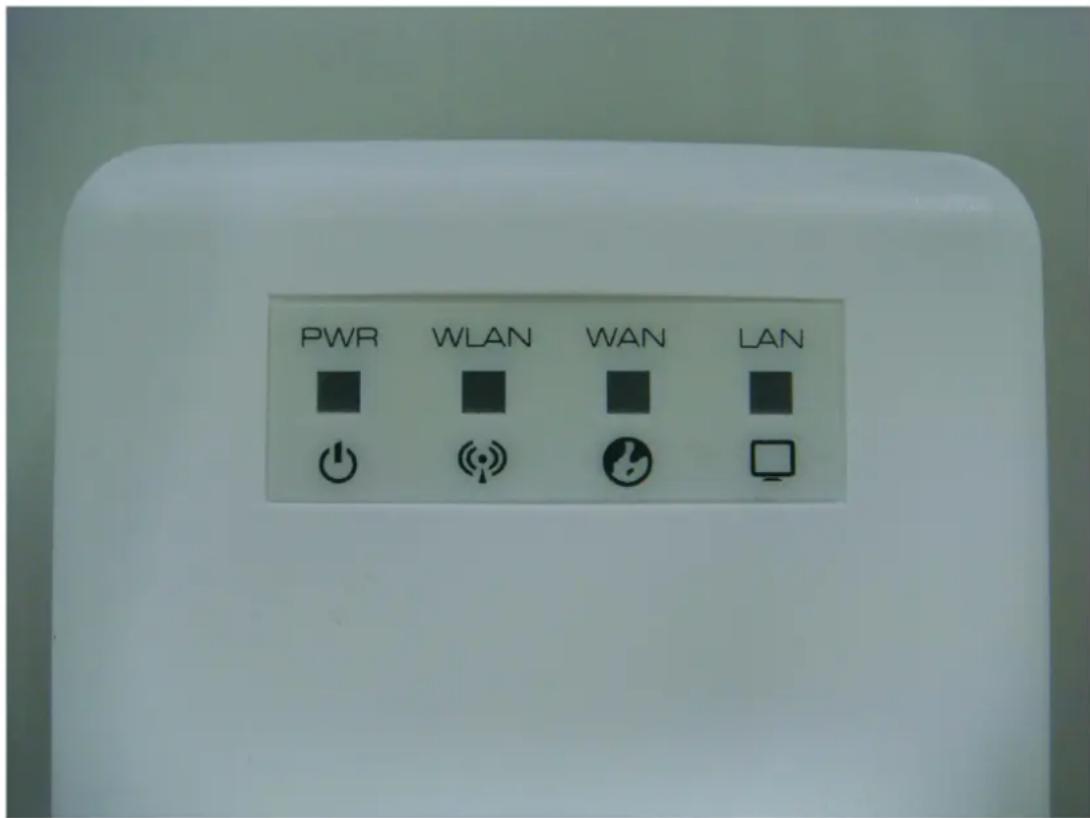
2.3 Rear Panel Description
text_image
PWR WLAN WAN LAN| LED Indicator State | Description | |
| 1. PWR LED | ON | The WLAN Broadband Router is powered ON. |
| Off | The WLAN Broadband Router is powered Off. | |
| 2. WLAN LED | ON | Wireless Radio ON. |
| Off | Wireless Radio Off. | |
| Flashing | Data is transmitting or receiving on the wireless. | |
| 3. WAN LED | ON | Port linked. |
| Off | No link. | |
| Flashing | Data is transmitting or receiving on the WAN interface. | |
| 4. LAN LED | ON | Port linked. |
| Off | No link. | |
| Flashing | Data is transmitting or receiving on the LAN interface. | |
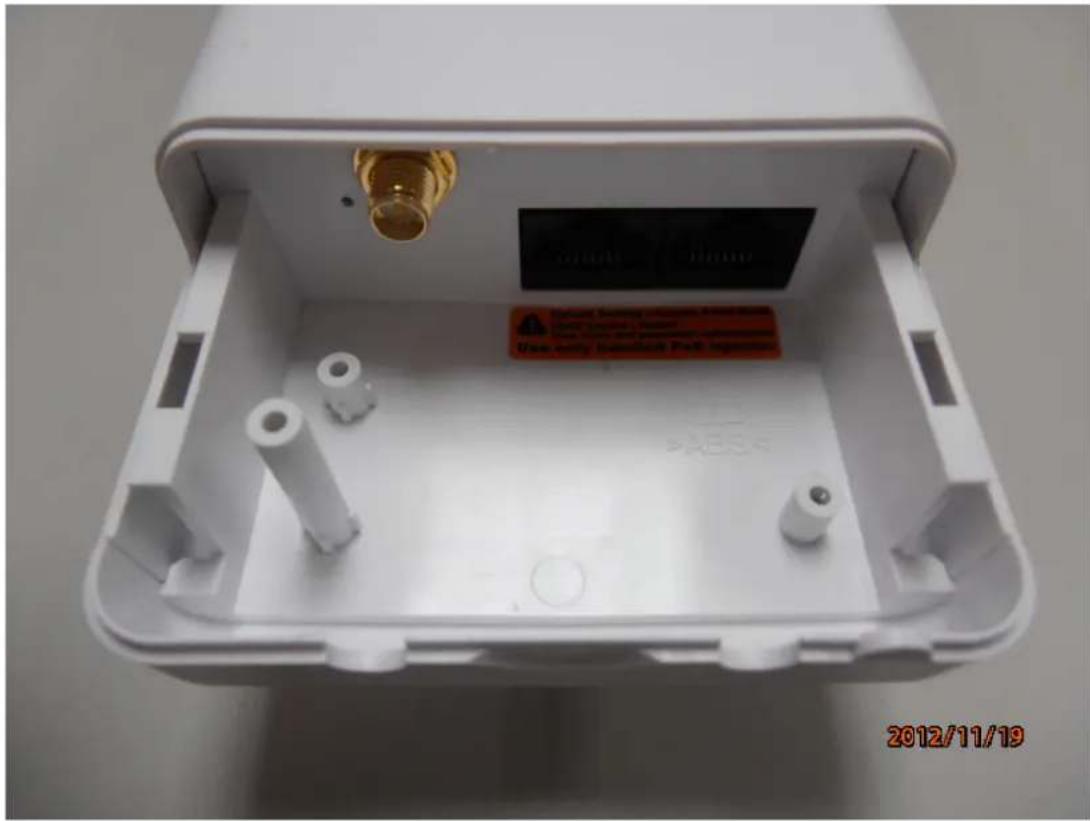
2.3 Front Panel Description
natural_image
White electronic device casing with brass connector and multiple cylindrical components (no visible text or symbols)| Interfaces Description | |
| SMA connector | For external antenna. You can use the SMA connector to connect with 5GHz external antenna. |
| Secondary(Middle) | The RJ-45 sockets allow LAN connection through Category 5 cables.Support auto-sensing on 10/100M speed and half/ full duplex; comply with IEEE 802.3/ 802.3u respectively. |
| Main(Right) | The RJ-45 socket allows WAN connection through a Category 5 cable.Support auto-sensing on 10/100M speed and half/ full duplex; comply with IEEE 802.3/ 802.3u respectively. |
| Reset Bottom | Press continually the reset button about 5 ~ 10 seconds to reset the configuration parameters to factory defaults |
3. Hardware Installation
3.1 Appearance and Interface Introduction
Notes: The product shot is for reference only please refer to physical product.
- LED Panel

text_image
PWR WLAN WAN LAN 1- Waterproof Sliding Door
- Pass trough Ethernet cable from this cable
- Push this button to remove upper housing

text_image
② ③ ④- Pole Mount
- Wall Mount

natural_image
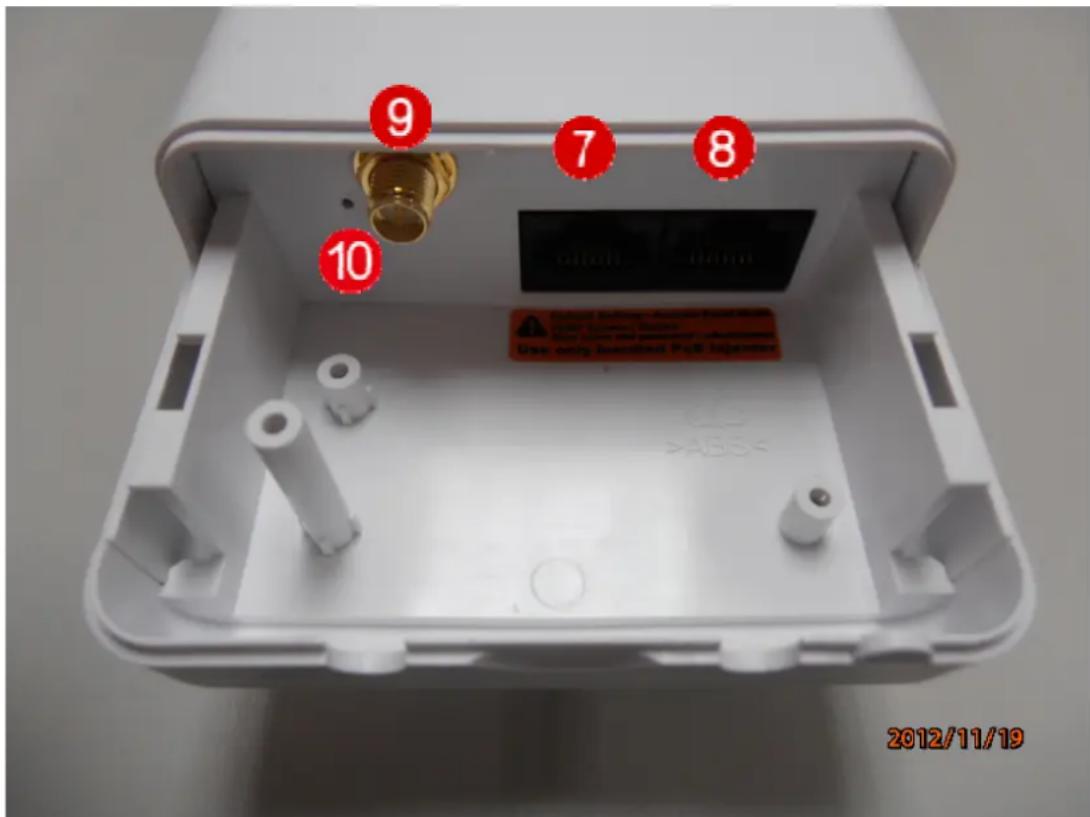
Close-up of a white plastic door handle with numbered red annotations (5, 6) pointing to its side panel (no text or symbols on the door itself)- Secondary port with POE
- Main port
- SMA connector for external antenna
- Reset button
text_image
9 7 8 10 Use only enclosed Roll Impenter 2012/11/193.2 Hardware Installation Steps
Step1: Push the button in the side to remove upper housing.

natural_image
Close-up of a white electronic device's top component with a red arrow pointing to a slot, showing no text or symbols.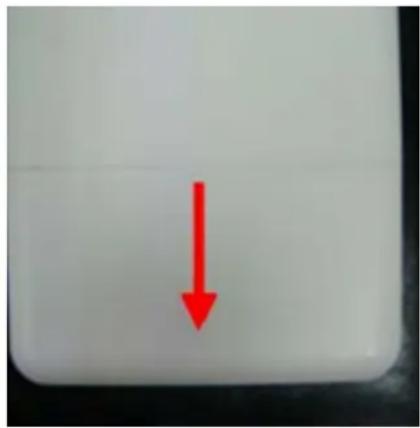
natural_image
White container with a red downward arrow pointing downward (no text or symbols)Step2: Pass through Ethernet cable from the hole; insert the cable to Secondary port.
Note: RJ-45 8P8C Ethernet cable is required.
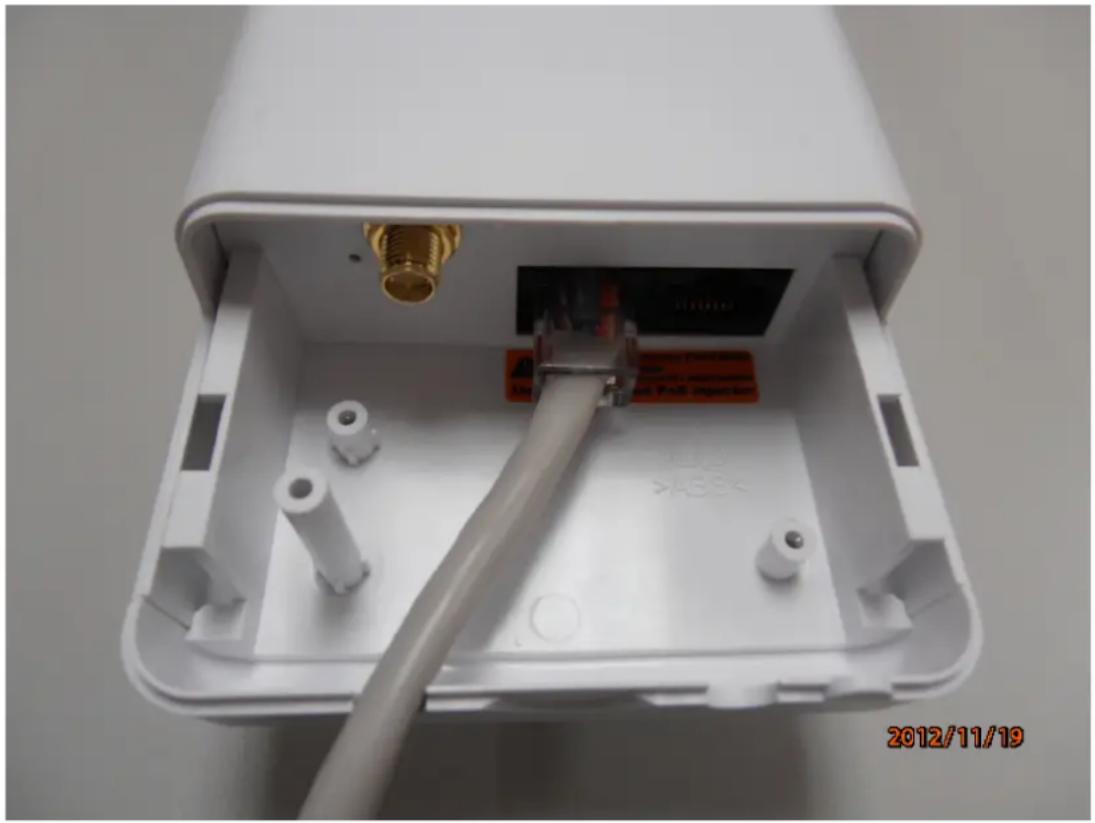
natural_image
White electronic device casing with attached cable and connector, showing internal components and no visible text or symbols.Step3: Install the upper housing and make sure the housing is well installed.

natural_image
Close-up of a white rectangular electronic device with a black horizontal bar and wires attached (no visible text or symbols)Step4: Complete the hardware installation as diagram at below
Install POE Injector
DC: Insert adapter
POE: This hole is linked to Secondary port of the Outdoor Router with RJ-45.
LAN: This hole is linked to LAN side PC/Hub or Router/ADSL modem device with RJ-45
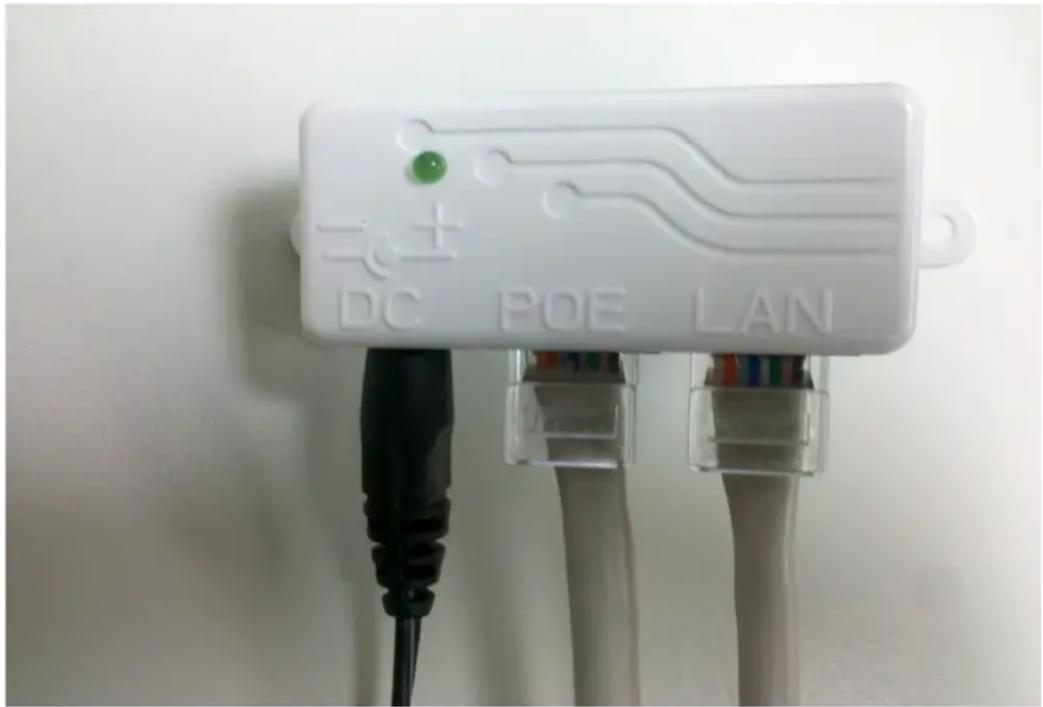
text_image
DC POE LANThere is no software driver or utility installation needed, but only the configuration setting. Please refer to chapter 4 for software configuration.
Notice: It will take about 50 seconds to complete the boot up sequence after powered on the Outdoor Router; Power LED will be active, and after that the WLAN Activity LED will be flashing to show the WLAN interface is enabled and working now.
4. Software Configuration
There are web based management and configuration functions allowing you to have the jobs done easily.
The Outdoor Router is delivered with the following factory default parameters on the Ethernet LAN interfaces.
Default IP Address: 192.168.1.200
Default IP subnet mask: 255.255.255.0
WEB login User Name: admin
WEB login Password: admin
Telnet login User Name: admin
Telnet login Password: admin
4.1 Prepare your PC to configure the WLAN Broadband Router For OS of Microsoft Windows 2000/ XP:
- Click the Start button and select Settings, then click Control Panel. The Control Panel window will appear.
- Move mouse and double-click the right button on Network and Dial-up Connections icon. Move mouse and double-click the Local Area Connection icon. The Local Area Connection window will appear. Click Properties button in the Local Area Connection window.
- Check the installed list of Network Components. If TCP/IP is not installed, click the Add button to install it; otherwise go to step 6.
- Select Protocol in the Network Component Type dialog box and click Add button.
- Select TCP/IP in Microsoft of Select Network Protocol dialog box then click OK button to install the TCP/IP protocol, it may need the Microsoft Windows CD to complete the installation. Close and go back to Network dialog box after the TCP/IP installation.
- Select TCP/IP and click the properties button on the Network dialog box.
- Select Specify an IP address and type in values as following example.
IP Address: 192.168.1.1, any IP address within 192.168.1.1 to 192.168.1.254 is good to connect the Wireless LAN Access Point. Don't use 192.168.1.200
√ IP Subnet Mask: 255.255.255.0 - Click OK to complete the IP parameters setting.
For OS of Microsoft Windows Vista / 7:
- Click the Start button and select Settings, then click Control Panel. The Control Panel window will appear.
- Move mouse and double-click the right button on Network Connections item. The Network Connections window will appear. Double click Local Area Connection icon, then User Account Control window shown. Right click Continue button to set properties.
- In Local Area Connection Properties window, Choose Networking tab, move mouse and click Internet Protocol Version 4 (TCP/IPv4), then click Properties button.
- Move mouse and click General tab, Select Specify an IP address and type in values as following example.
√ IP Address: 192.168.1.1,, any IP address within 192.168.1.1 to 192.168.1.254 is good to connect the Wireless LAN Access Point. Don't use 192.168.1.200
√ IP Subnet Mask: 255.255.255.0
- Click OK to complete the IP parameters setting.
4.2 Connect to the WLAN Broadband Router
Open a WEB browser, i.e. Microsoft Internet Explorer 6.1 SP1 or above, then enter 192.168.1.200 on the URL to connect the WLAN Broadband Router.
4.3 Management and configuration on the Outdoor Router
4.3.1 Wizard
The setup wizard will be changed when the user selects different operation modes.
4.3.1.1 Bridge Mode
This mode is for bridge setting. The 'Setup Wizard' will guide you to configure the router to connect to your ISP(Internet Service Provider).
Setup Wizard
This mode is for bridge setting. The 'Setup Wizard' will guide you to configure the mode to setting AP, AP Client, WDS+AP or WDS.
The wizard will guide you through these three quick steps. Begin by clicking on Next.
Step 1. Configure LAN IP address settings.
Step 2. Configure Wireless mode settings.
Step 3. Configure WDS mode AP Client mode or AP mode or Apply.
Back
Next
Cancel
Apply
Click Next button to next step for LAN IP address settings.
Step 1: configure LAN IP address settings
Setup Wizard
This mode is for home networking. The 'Setup Wizard' will guide you to configure the router to connect to your ISP(Internet Service Provider).
Step 1. Configure LAN IP address settings
| LAN Setup | |
| IP Address | 192.168.1.200 |
| Subnet Mask | 255.255.255.0 |
Back
Next
Cancel
Apply
Step 2: configure Wireless Settings
There are four options (Disable, Open-WEP, Shared-WEP, WPA-PSK/WPA2-PSK) for Wireless security connection.
Setup Wizard
This mode is for bridge setting. The 'Setup Wizard' will guide you to configure the mode to setting AP, AP Client, WDS+AP or WDS.
Step 2. Configure Wireless settings

text_image
Wireless Settings Wireless Band 802.11B/G/N Wireless Mode AP Frequency (Channel) AutoSelect Current Channel: 1 Network Name (SSID) 802.11n_Router Channel BandWidth ○ 20 ● 20/40 Security Mode DisableBack
Next
Cancel
Apply
| Item Description | |
| Network Band Click to | select wireless band from pull down menu. |
| Network Mode Click to | select wireless mode from pull down menu. |
| Frequency (Channel) | Select the wireless communication frequency/channel from pull-down menu. |
| Network Name (SSID) | It is the wireless network name. The SSID can be 32 bytes long. |
| Channel Bandwidth | Select the operating channel width 20 MHz or 20/40 MHz. |
| Security Mode Please select the security mode related wireless data encryption. | |
| Pre-Shared Key | WEP: When you select WEP, please input 5, 13 (ASCII), 10 or 26 (HEX) characters for WEP Key.WPA-PSK/WPA2-PSK: When WPA/WPA2 Pre-shared key encryption is selected, please fill in the Pre-shared key. The format can be passphrase or Hex (64 characters). |
OPEN WEP
Setup Wizard
This mode is for bridge setting. The 'Setup Wizard' will guide you to configure the mode to setting AP, AP Client, WDS+AP or WDS.
Step 2. Configure Wireless settings
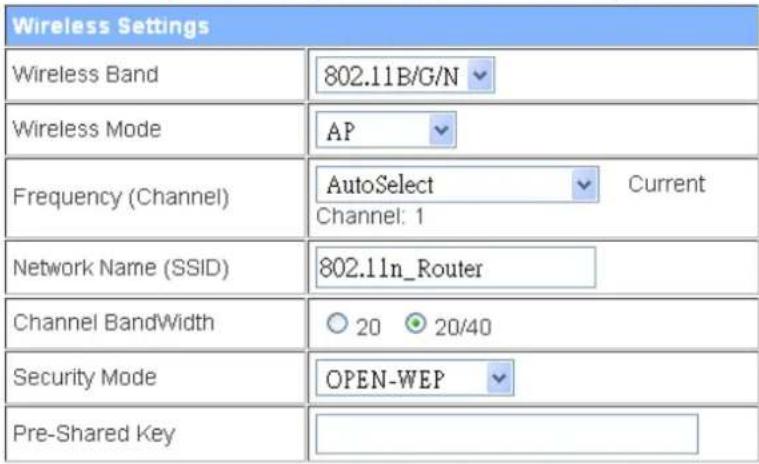
text_image
Wireless Settings Wireless Band 802.11B/G/N Wireless Mode AP Frequency (Channel) AutoSelect Current Channel: 1 Network Name (SSID) 802.11n_Router Channel BandWidth 20 20/40 Security Mode OPEN-WEP Pre-Shared KeyBack
Next
Cancel
Apply
SHAREDWEP
Setup Wizard
This mode is for bridge setting. The 'Setup Wizard' will guide you to configure the mode to setting AP, AP Client, WDS+AP or WDS.
Step 2. Configure Wireless settings

text_image
Wireless Settings Wireless Band 802.11B/G/N Wireless Mode AP Frequency (Channel) AutoSelect Current Channel: 1 Network Name (SSID) 802.11n_Router Channel BandWidth 20 20/40 Security Mode SHARED-WEP Pre-Shared KeyBack
Next
Cancel
Apply
WPA-PSK
Setup Wizard
This mode is for bridge setting. The 'Setup Wizard' will guide you to configure the mode to setting AP, AP Client, WDS+AP or WDS.
Step 2. Configure Wireless settings

text_image
Wireless Settings Wireless Band 802.11B/G/N Wireless Mode AP Frequency (Channel) AutoSelect Current Channel: 1 Network Name (SSID) 802.11n_Router Channel BandWidth 20 20/40 Security Mode WPA-PSK Pre-Shared KeyBack
Next
Cancel
Apply
WPA2-PSK
Setup Wizard
This mode is for bridge setting. The 'Setup Wizard' will guide you to configure the mode to setting AP, AP Client, WDS+AP or WDS.
Step 2. Configure Wireless settings

text_image
Wireless Settings Wireless Band 802.11B/G/N Wireless Mode AP Frequency (Channel) AutoSelect Current Channel: 1 Network Name (SSID) 802.11n_Router Channel BandWidth 20 20/40 Security Mode WPA2-PSK Pre-Shared KeyBack
Next
Cancel
Apply
When you finish these settings, then click Apply button to save.
Choose either Client or WDS, then click Next button to step 3.
Step 3:
a. Configure AP Client Mode Settings
Setup Wizard
This mode is for bridge setting. The 'Setup Wizard' will guide you to configure the mode to setting AP, AP Client, WDS+AP or WDS.
Step 3. Configure AP Client Mode Settings
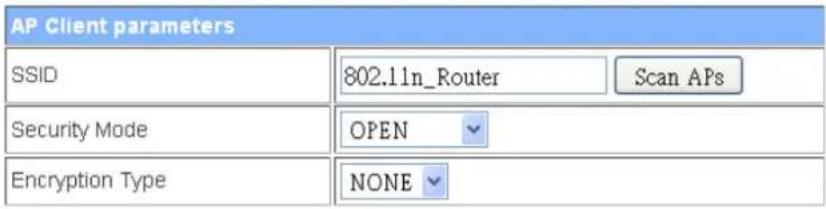
text_image
AP Client parameters SSID 802.11n_Router Scan APs Security Mode OPEN Encryption Type NONE
text_image
Back Next Cancel Applyb. Configure WDS Mode Settings
Setup Wizard
This mode is for bridge setting. The 'Setup Wizard' will guide you to configure the mode to setting AP, AP Client, WDS+AP or WDS.
Step 3. Configure WDS Mode Settings
| Encryp Type | Encryp Key | AP MAC Address |
| NONE | ||
| NONE | ||
| NONE | ||
| NONE |

text_image
Back Next Cancel ApplyThis mode is for home networking. The 'Setup Wizard' will guide you to configure the router to connect to your ISP(Internet Service Provider).
Setup Wizard
This mode is for home networking. The 'Setup Wizard' will guide you to configure the router to connect to your ISP(Internet Service Provider).
The wizard will guide you through these three quick steps. Begin by clicking on Next.
Step 1. Configure LAN IP address settings.
Step 2. Configure Internet connection.
Step 3. Configure Wireless settings.
Back
Next
Cancel
Apply
Step 1: configure LAN IP address settings
Setup Wizard
This mode is for home networking. The 'Setup Wizard' will guide you to configure the router to connect to your ISP(Internet Service Provider).
Step 1. Configure LAN IP address settings
| LAN Setup | |
| IP Address | 192.168.1.200 |
| Subnet Mask | 255.255.255.0 |
Back
Next
Cancel
Apply
Step2: configure Internet connection
Click Next button to next step for Internet connection settings. There are five options (DHCP, Static Mode, PPPOE, L2TP, PPTP) for Internet connection on WAN port.
a. DHCP (Auto Configure)
Setup Wizard
This mode is for home networking. The 'Setup Wizard' will guide you to configure the router to connect to your ISP(Internet Service Provider).
Step 2. Configure Internet Connection
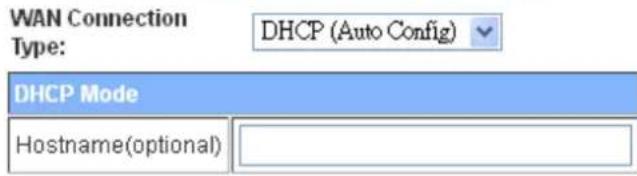
text_image
WAN Connection Type: DHCP (Auto Config) DHCP Mode Hostname(optional)Back
Next
Cancel
Apply
If you select DHCP option, please click Next button to jump at Step3.
b. Static Mode (fixed IP)
If you select Static Mode (fixed IP), please fill in these fields on next page.
Setup Wizard
This mode is for home networking. The 'Setup Wizard' will guide you to configure the router to connect to your ISP(Internet Service Provider).
Step 2. Configure Internet Connection

text_image
WAN Connection Type: Static Mode (fixed IP) Static Mode IP Address Subnet Mask Default Gateway Primary DNS Server Secondary DNS Server
text_image
Back Next Cancel Apply| Item Description | |
| IP Address | Fill in the IP address for WAN interface. |
| Subnet Mask Fill | In the subnet mask for WAN interface. |
| Default Gateway | Fill in the default gateway for WAN interface out going data packets. |
| Primary DNS Server | Fill in the IP address of Domain Name Server 1. |
| Secondary DNS Server | Fill in the IP address of Domain Name Server 2. |
When you finish these settings, then click Next button to jump at Step3.
c. PPPOE (ADSL)
If you select PPPOE, please fill in these fields on next page.
Setup Wizard
This mode is for home networking. The 'Setup Wizard' will guide you to configure the router to connect to your ISP(Internet Service Provider).
Step 2. Configure Internet Connection
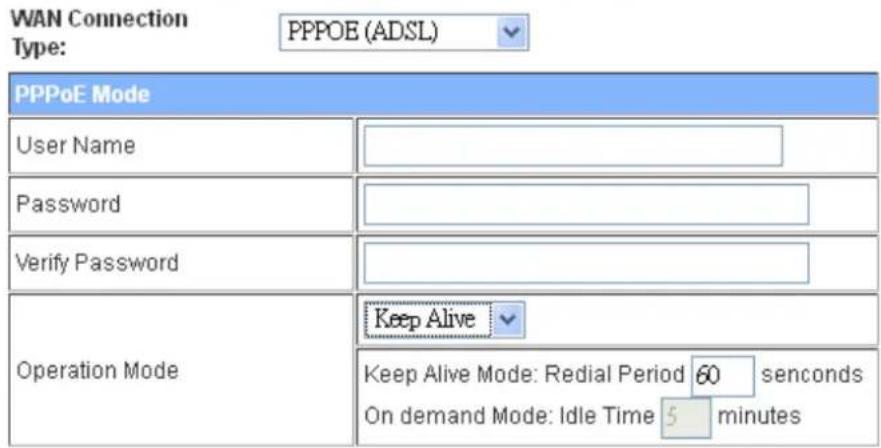
text_image
WAN Connection Type: PPPOE (ADSL) PPPoE Mode User Name Password Verify Password Operation Mode Keep Alive Keep Alive Mode: Redial Period 60 seconds On demand Mode: Idle Time 5 minutes
text_image
Back Next Cancel Apply| Item Description | |
| User Name | If you select the PPPoE support on WAN interface, fill in the user name and password to login the PPPoE server. |
| Password | If you select the PPPoE support on WAN interface, fill in the user name and password to login the PPPoE server. |
| Verify Password | Fill in the password again for verification. |
| Operation Mode | Keep Alive: Keep the PPPoE connection all the time. Please also configure the Redial Period field.On Demand: Please configure the Idle Time field. When time is up, the PPPoE connection will disconnect. The connection will re-connect when any outgoing packet arise.Manual: Let user connect the PPPoE connection manually. |
When you finish these settings, then click Next button to jump at Step3.
d. L2TP
If you select L2TP, please fill in these fields on next page.
Setup Wizard
This mode is for home networking. The 'Setup Wizard' will guide you to configure the router to connect to your ISP(Internet Service Provider).
Step 2. Configure Internet Connection
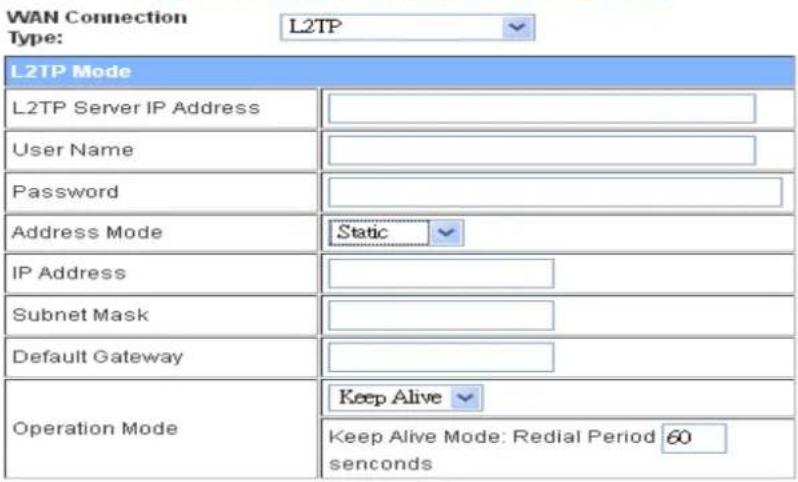
text_image
WAN Connection Type: L2TP L2TP Mode L2TP Server IP Address User Name Password Address Mode Static IP Address Subnet Mask Default Gateway Operation Mode Keep Alive Keep Alive Mode: Redial Period 60 secondsBack
Next
Cancel
Apply
| Item Description | |
| L2TP Server IP Address | Allow user to make a tunnel with remote site directly to secure the data transmission among the connection. User can use embedded L2TP client supported by this router to make a VPN connection. If you select the L2TP support on WAN interface, fill in the IP address for it. |
| User Name | Fill in the user name and password to login the L2TP server. |
| Password | Fill in the user name and password to login the L2TP server. |
| Address Mode | Static: To configure the IP address information by manually, please fill in the related setting at below.Dynamic: The option allows the machine to get IP address information automatically from DHCP server on WAN side. |
| IP Address | Fill in the IP address for WAN interface. |
| Subnet Mask Fill in | the subnet mask for WAN interface. |
| Default Gateway | Fill in the default gateway for WAN interface out going data packets. |
| Operation Mode | Keep Alive: Keep the L2TP connection all the time. Please also configure the Redial Period field.Manual: Let user connect the L2TP connection manually. |
When you finish these settings, then click Next button to jump at Step3.
e. PPTP
If you select PPTP, please fill in these fields on next page.
Setup Wizard
This mode is for home networking. The 'Setup Wizard' will guide you to configure the router to connect to your ISP(Internet Service Provider).
Step 2. Configure Internet Connection

text_image
WAN Connection Type: PPTP PPTP Mode PPTP Server IP Address User Name Password Address Mode Static IP Address Subnet Mask Default Gateway Operation Mode Keep Alive Keep Alive Mode: Redial Period 60 seconds
| Item Description | |
| PPTP Server IP Address | Allow user to make a tunnel with remote site directly to secure the data transmission among the connection. User can use embedded PPTP client supported by this router to make a VPN connection. If you select the PPTP support on WAN interface, fill in the IP address for it. |
| User Name | Fill in the user name and password to login the PPTP server. |
| Password | Fill in the user name and password to login the PPTP server. |
| Address Mode | Static: To configure the IP address information by manually, please fill in the related setting at below.Dynamic: The option allows the machine to get IP address information automatically from DHCP server on WAN side. |
| IP Address | Fill in the IP address for WAN interface. |
| Subnet Mask Fill | In the subnet mask for WAN interface. |
| Default Gateway | Fill in the default gateway for WAN interface out going data packets. |
| Operation Mode | Keep Alive: Keep the PPTP connection all the time. Please also configure the Redial Period field.Manual: Let user connect the PPTP connection manually. |
When you finish these settings, then click Next button to jump at Step3.
Step 3: configure Wireless Settings
There are three options (Disable, WEP, WPA-PSK/WPA2-PSK) for Wireless security connection.
Setup Wizard
This mode is for home networking. The 'Setup Wizard' will guide you to configure the router to connect to your ISP(Internet Service Provider).
Step 3. Configure Wireless Settings

text_image
Wireless Settings Wireless Band 802.11B/G/N Frequency (Channel) AutoSelect Current Channel: 1 Network Name (SSID) 802.11n_Router Channel BandWidth 20 20/40 Security Mode Disable Disable OPENWEP SHAREDWEP WPA-PSK WPA2-PSK Back Next Apply| Item Description | |
| Network Band Click to | select wireless band from pull down menu. |
| Network Mode Click to | select wireless mode from pull down menu. |
| Frequency (Channel) | Select the wireless communication frequency/channel from pull-down menu. |
| Network Name (SSID) | It is the wireless network name. The SSID can be 32 bytes long. |
| Channel Bandwidth | Select the operating channel width 20 MHz or 20/40 MHz. |
| Security Mode Please select the security mode related wireless data encryption. | |
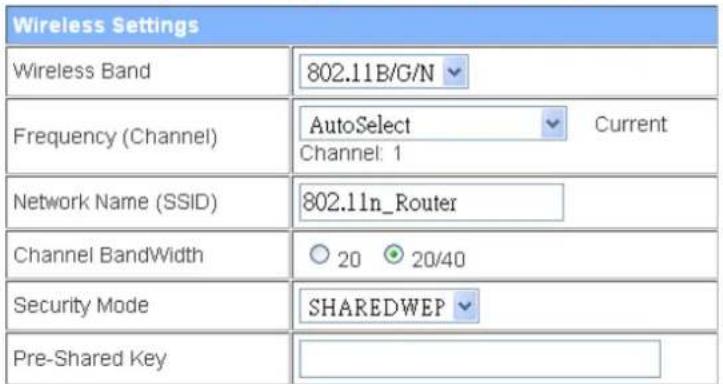
| Pre-Shared Key | WEP: When you select WEP, please input 5, 13 (ASCII), 10 or 26 (HEX) characters for WEP Key.WPA-PSK/WPA2-PSK: When WPA/WPA2 Pre-shared key encryption is selected, please fill in the Pre-shared key. The format can be passphrase or Hex (64 characters). |
OPEN WEP
Setup Wizard
This mode is for home networking. The 'Setup Wizard' will guide you to configure the router to connect to your ISP(Internet Service Provider).
Step 3. Configure Wireless Settings
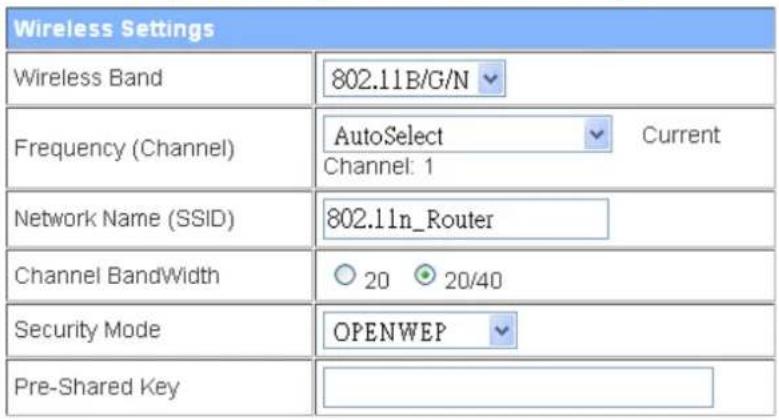
text_image
Wireless Settings Wireless Band 802.11B/G/N Frequency (Channel) AutoSelect Current Channel: 1 Network Name (SSID) 802.11n_Router Channel BandWidth 20 20/40 Security Mode OPENWEP Pre-Shared KeyBack
Next
Cancel
Apply
SHAREDWEP
Setup Wizard
This mode is for home networking. The 'Setup Wizard' will guide you to configure the router to connect to your ISP(Internet Service Provider).
Step 3. Configure Wireless Settings
text_image
Wireless Settings Wireless Band 802.11B/G/N Frequency (Channel) AutoSelect Current Channel: 1 Network Name (SSID) 802.11n_Router Channel BandWidth 20 20/40 Security Mode SHAREDWEP Pre-Shared KeyBack
Next
Cancel
Apply
WPA-PSK
Setup Wizard
This mode is for home networking. The 'Setup Wizard' will guide you to configure the router to connect to your ISP(Internet Service Provider).
Step 3. Configure Wireless Settings

text_image
Wireless Settings Wireless Band 802.11B/G/N Frequency (Channel) AutoSelect Current Channel: 1 Network Name (SSID) 802.11n_Router Channel BandWidth 20 20/40 Security Mode WPA-PSK Pre-Shared KeyBack
Next
Cancel
Apply
WPA2-PSK
Setup Wizard
This mode is for home networking. The 'Setup Wizard' will guide you to configure the router to connect to your ISP(Internet Service Provider).
Step 3. Configure Wireless Settings

text_image
Wireless Settings Wireless Band 802.11B/G/N Frequency (Channel) AutoSelect Current Channel: 1 Network Name (SSID) 802.11n_Router Channel BandWidth 20 20/40 Security Mode WPA2-PSK Pre-Shared KeyBack
Next
Cancel
Apply
When you finish these settings, then click Apply button to save.
Choose either Client or WDS, then click Next button to step 3.
4.3.1.3 WISP Mode
This mode is for home networking. The 'Setup Wizard' will guide you to configure the router to connect to your ISP(Internet Service Provider).
Setup Wizard
This mode is use wireless to connected APs. The 'Setup Wizard' will guide you to configure the wireless how to connect any APs, and setting WAN mode to connected internet.
The wizard will guide you through these four quick steps. Begin by clicking on Next.
Step 1. Configure LAN IP address settings.
Step 2. Configure Internet connection.
Step 3. Configure Wireless settings.
Step 4. Site survey APs to connected internet.
Back
Next
Cancel
Apply
Step 1: configure LAN IP address settings
Setup Wizard
This mode is use wireless to connected APs. The 'Setup Wizard' will guide you to configure the wireless how to connect any APs, and setting WAN mode to connected internet.
Step 1. Configure LAN IP address settings
| LAN Setup | |
| IP Address | 192.168.1.200 |
| Subnet Mask | 255.255.255.0 |
Back
Next
Cancel
Apply
Step2: configure Internet connection
Setup Wizard
This mode is use wireless to connected APs. The 'Setup Wizard' will guide you to configure the wireless how to connect any APs, and setting WAN mode to connected internet.
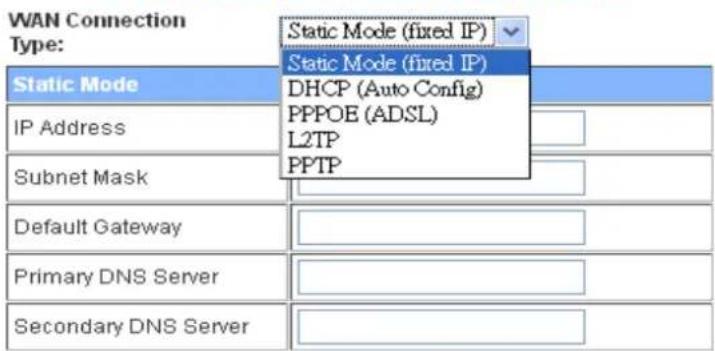
Step 2. Configure Internet Connection
text_image
WAN Connection Type: Static Mode (fixed IP) Static Mode (fixed IP) DHCP (Auto Config) PPPOE (ADSL) L2TP PPTPBack
Next
Cancel
Apply
Click Next button to next step for Internet connection settings. There are five options (DHCP, Static Mode, PPPOE, L2TP, PPTP) for Internet connection on WAN port.
a. DHCP (Auto Configure)
Setup Wizard
This mode is use wireless to connected APs. The 'Setup Wizard' will guide you to configure the wireless how to connect any APs, and setting WAN mode to connected internet.
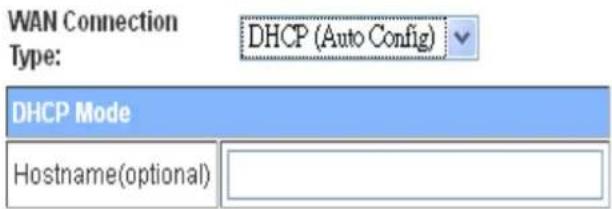
Step 2. Configure Internet Connection
text_image
WAN Connection Type: DHCP (Auto Config) DHCP Mode Hostname(optional)Back
Next
Cancel
Apply
If you select DHCP option, please click Next button to jump at Step3.
b. Static Mode (fixed IP)
If you select Static Mode (fixed IP), please fill in these fields on next page.
Setup Wizard
This mode is use wireless to connected APs. The 'Setup Wizard' will guide you to configure the wireless how to connect any APs, and setting WAN mode to connected internet.
Step 2. Configure Internet Connection

text_image
WAN Connection Type: Static Mode (fixed IP) Static Mode IP Address Subnet Mask Default Gateway Primary DNS Server Secondary DNS ServerBack
Next
Cancel
Apply
| Item Description | |
| IP Address | Fill in the IP address for WAN interface. |
| Subnet Mask Fill | In the subnet mask for WAN interface. |
| Default Gateway | Fill in the default gateway for WAN interface out going data packets. |
| Primary DNS Server | Fill in the IP address of Domain Name Server 1. |
| Secondary DNS Server | Fill in the IP address of Domain Name Server 2. |
When you finish these settings, then click Next button to jump at Step3.
c. PPPOE (ADSL)
If you select PPPOE, please fill in these fields on next page.
Setup Wizard
This mode is use wireless to connected APs. The 'Setup Wizard' will guide you to configure the wireless how to connect any APs, and setting WAN mode to connected internet.
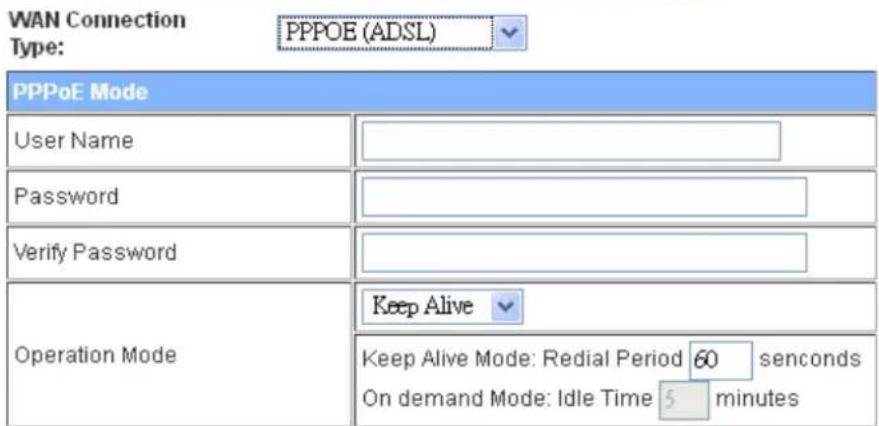
Step 2. Configure Internet Connection
text_image
WAN Connection Type: PPPOE (ADSL) PPPoE Mode User Name Password Verify Password Operation Mode Keep Alive Keep Alive Mode: Redial Period 60 seconds On demand Mode: Idle Time 5 minutes
text_image
Back Next Cancel Apply| Item Description | |
| User Name | If you select the PPPoE support on WAN interface, fill in the user name and password to login the PPPoE server. |
| Password | If you select the PPPoE support on WAN interface, fill in the user name and password to login the PPPoE server. |
| Verify Password | Fill in the password again for verification. |
| Operation Mode | Keep Alive: Keep the PPPoE connection all the time. Please also configure the Redial Period field.On Demand: Please configure the Idle Time field. When time is up, the PPPoE connection will disconnect. The connection will re-connect when any outgoing packet arise.Manual: Let user connect the PPPoE connection manually. |
When you finish these settings, then click Next button to jump at Step3.
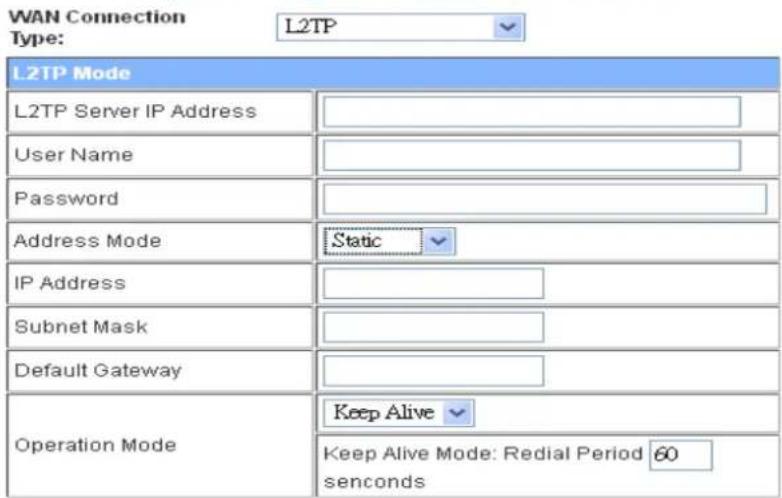
d. L2TP
If you select L2TP, please fill in these fields on next page.
Setup Wizard
This mode is use wireless to connected APs. The 'Setup Wizard' will guide you to configure the wireless how to connect any APs, and setting WAN mode to connected internet.
Step 2. Configure Internet Connection
text_image
WAN Connection Type: L2TP L2TP Mode L2TP Server IP Address User Name Password Address Mode Static IP Address Subnet Mask Default Gateway Operation Mode Keep Alive Keep Alive Mode: Redial Period 60 seconds
| Item Description | |
| L2TP Server IP Address | Allow user to make a tunnel with remote site directly to secure the data transmission among the connection. User can use embedded L2TP client supported by this router to make a VPN connection. If you select the L2TP support on WAN interface, fill in the IP address for it. |
| User Name | Fill in the user name and password to login the L2TP server. |
| Password | Fill in the user name and password to login the L2TP server. |
| Address Mode | Static: To configure the IP address information by manually, please fill in the related setting at below.Dynamic: The option allows the machine to get IP address information automatically from DHCP server on WAN side. |
| IP Address | Fill in the IP address for WAN interface. |
| Subnet Mask Fill in | the subnet mask for WAN interface. |
| Default Gateway | Fill in the default gateway for WAN interface out going data packets. |
| Operation Mode | Keep Alive: Keep the L2TP connection all the time. Please also configure the Redial Period field.Manual: Let user connect the L2TP connection manually. |
When you finish these settings, then click Next button to jump at Step3.
e. PPTP
If you select PPTP, please fill in these fields on next page.
Setup Wizard
This mode is use wireless to connected APs. The 'Setup Wizard' will guide you to configure the wireless how to connect any APs, and setting WAN mode to connected internet.
Step 2. Configure Internet Connection

text_image
WAN Connection Type: PPTP PPTP Mode PPTP Server IP Address User Name Password Address Mode Static IP Address Subnet Mask Default Gateway Operation Mode Keep Alive Keep Alive Mode: Redial Period 60 secondsBack
Next
Cancel
Apply
| Item Description | |
| PPTP Server IP Address | Allow user to make a tunnel with remote site directly to secure the data transmission among the connection. User can use embedded PPTP client supported by this router to make a VPN connection. If you select the PPTP support on WAN interface, fill in the IP address for it. |
| User Name | Fill in the user name and password to login the PPTP server. |
| Password | Fill in the user name and password to login the PPTP server. |
| Address Mode | Static: To configure the IP address information by manually, please fill in the related setting at below.Dynamic: The option allows the machine to get IP address information automatically from DHCP server on WAN side. |
| IP Address | Fill in the IP address for WAN interface. |
| Subnet Mask Fill | In the subnet mask for WAN interface. |
| Default Gateway | Fill in the default gateway for WAN interface out going data packets. |
| Operation Mode | Keep Alive: Keep the PPTP connection all the time. Please also configure the Redial Period field.Manual: Let user connect the PPTP connection manually. |
When you finish these settings, then click Next button to jump at Step3.
Step 3: configure Wireless Settings
There are five options (Disable, OPENWEP, WPA-PSK WPA2-PSK) for Wireless security connection.
Setup Wizard
This mode is use wireless to connected APs. The 'Setup Wizard' will guide you to configure the wireless how to connect any APs, and setting WAN mode to connected internet.
Step 3. Configure Wireless Settings

text_image
Wireless Settings Wireless Band 802.11B/G/N Frequency (Channel) AutoSelect Current Channel: 1 Network Name (SSID) 802.11n_Router Channel BandWidth 20 20/40 Security Mode Disable Disable OPENWEP SHAREDWEP WPA-PSK WPA2-PSK Back Next Apply| Item Description | |
| Network Band Click to | select wireless band from pull down menu. |
| Network Mode Click to | select wireless mode from pull down menu. |
| Frequency (Channel) | Select the wireless communication frequency/channel from pull-down menu. |
| Network Name (SSID) | It is the wireless network name. The SSID can be 32 bytes long. |
| Channel Bandwidth | Select the operating channel width 20 MHz or 20/40 MHz. |
| Security Mode Please select the security mode related wireless data encryption. | |
| Pre-Shared Key | WEP: When you select WEP, please input 5, 13 (ASCII), 10 or 26 (HEX) characters for WEP Key.WPA-PSK/WPA2-PSK: When WPA/WPA2 Pre-shared key encryption is selected, please fill in the Pre-shared key. The format can be passphrase or Hex (64 characters). |
OPEN WEP
Setup Wizard
This mode is use wireless to connected APs. The 'Setup Wizard' will guide you to configure the wireless how to connect any APs, and setting WAN mode to connected internet.
Step 3. Configure Wireless Settings

text_image
Wireless Settings Wireless Band 802.11B/G/N Frequency (Channel) AutoSelect Current Channel: 1 Network Name (SSID) 802.11n_Router Channel BandWidth 20 20/40 Security Mode OPENWEP Pre-Shared KeyBack
Next
Cancel
Apply
When you finish these settings, then click Next button to jump at Step4
SHAREDWEP
Setup Wizard
This mode is use wireless to connected APs. The 'Setup Wizard' will guide you to configure the wireless how to connect any APs, and setting WAN mode to connected internet.
Step 3. Configure Wireless Settings

text_image
Wireless Settings Wireless Band 802.11B/G/N Frequency (Channel) AutoSelect Current Channel: 1 Network Name (SSID) 802.11n_Router Channel BandWidth ○ 20 ○ 20/40 Security Mode SHAREDWEP Pre-Shared KeyBack
Next
Cancel
Apply
When you finish these settings, then click Next button to jump at Step4
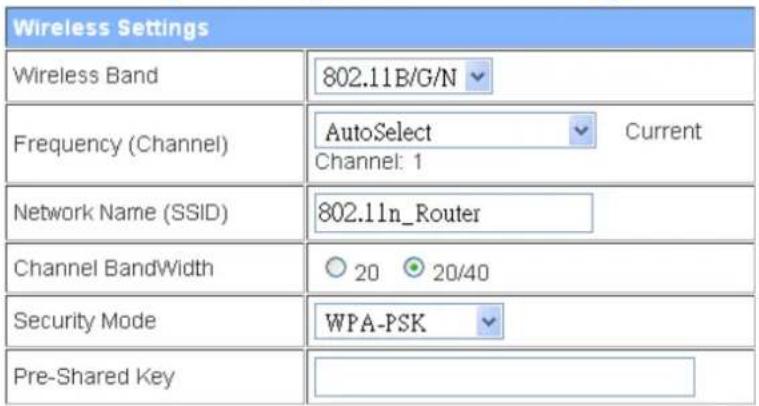
WPA-PSK
Setup Wizard
This mode is use wireless to connected APs. The 'Setup Wizard' will guide you to configure the wireless how to connect any APs, and setting WAN mode to connected internet.
Step 3. Configure Wireless Settings
text_image
Wireless Settings Wireless Band 802.11B/G/N Frequency (Channel) AutoSelect Current Channel: 1 Network Name (SSID) 802.11n_Router Channel BandWidth ○ 20 ○ 20/40 Security Mode WPA-PSK Pre-Shared KeyBack
Next
Cancel
Apply
When you finish these settings, then click Next button to jump at Step4
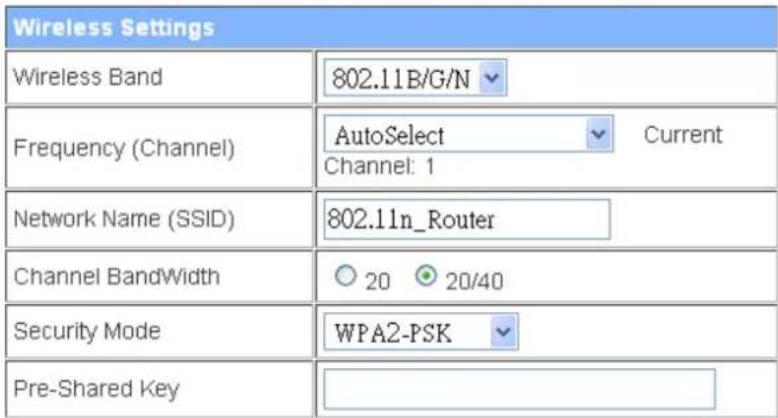
WPA2-PSK
Setup Wizard
This mode is use wireless to connected APs. The 'Setup Wizard' will guide you to configure the wireless how to connect any APs, and setting WAN mode to connected internet.
Step 3. Configure Wireless Settings
text_image
Wireless Settings Wireless Band 802.11B/G/N Frequency (Channel) AutoSelect Current Channel: 1 Network Name (SSID) 802.11n_Router Channel BandWidth 20 20/40 Security Mode WPA2-PSK Pre-Shared KeyBack
Next
Cancel
Apply
| Item Description | |
| Network Band Click to | select wireless band from pull down menu. |
| Network Mode Click to | select wireless mode from pull down menu. |
| Frequency (Channel) | Select the wireless communication frequency/channel from pull-down menu. |
| Network Name (SSID) | It is the wireless network name. The SSID can be 32 bytes long. |
| Channel Bandwidth | Select the operating channel width 20 MHz or 20/40 MHz. |
| Security Mode Please select the security mode related wireless data encryption. | |
| Pre-Shared Key | WEP: When you select WEP, please input 5, 13 (ASCII), 10 or 26 (HEX) characters for WEP Key.WPA-PSK/WPA2-PSK: When WPA/WPA2 Pre-shared key encryption is selected, please fill in the Pre-shared key. The format can be passphrase or Hex (64 characters). |
When you finish these settings, then click Apply button to save.
Step 4. Configure AP Client setting
Setup Wizard
This mode is use wireless to connected APs. The 'Setup Wizard' will guide you to configure the wireless how to connect any APs, and setting WAN mode to connected internet.
Step 4. Configure AP Client setting

text_image
AP Client parameters SSID 802.11n_Router Scan APs Security Mode OPEN Encryption Type NONEBack
Next
Cancel
Apply
SCAN APs
| SSID | BSSID | RSSI | Channel | Authentication | Wireless Mode | |
| ○ | LP-7696_RD | 00:1a:ef:00:00:08 | 20% | 1 | WPA2PSK/AES | 11b/g/n |
| ○ | XPossible-charles | 00:1a:ef:2c:e0:3c | 10% | 1 | WPA1PSKWPA2PSK/AES | 11b/g/n |
| ○ | Amped_2.4GHz | 00:1a:ef:00:20:03 | 9% | 1 | WPA1PSKWPA2PSK/AES | 11b/g/n |
| ○ | CD-R King test | 00:1a:ef:20:f8:8a | 20% | 1 | WPAPSK/AES | 11b/g/n |
| ○ | hinet_VDSL | 28:10:7b:42:de:de | 5% | 6 | WPAPSK/TKIP | 11b/g |
| ○ | RTK 11n AP | 00:1a:ef:18:7d:18 | 25% | 6 | NONE | 11b/g/n |
| ○ | RTK 11n AP_LNK | 00:1a:ef:21:f2:4a | 9% | 11 | WEP | 11b/g |
| ○ | LP-8696C | 00:1a:ef:18:4c:78 | 5% | 11 | WPA2PSK/AES | 11b/g |
| ○ | loopcomm | 00:1a:ef:28:54:25 | 10% | 11 | WPA2PSK/AES | 11b/g/n |
| ○ | XPossible | 00:1a:ef:21:f2:77 | 50% | 11 | NONE | 11b/g/n |
4.3.2 Operation Mode
a. Bridge:
Operation Mode Configuration
You may configure the operation mode suitable for you environment.
| ○ Bridge: | In this mode, all ethernet ports and wireless interface are bridged together and NAT function is disabled. All the WAN related function and firewall are not supported. |
| ○ Gateway: | In this mode, the device is supposed to connect to internet via ADSL/Cable Modem. The NAT is enabled and PCs in LAN ports share the same IP to ISP through WAN port. The connection type can be setup in WAN page by using PPPOE, DHCP client, PPTP client , L2TP client or static IP. |
| ○ Wireless ISP: | In this mode, all ethernet ports are bridged together and the wireless client will connect to ISP access point. The NAT is enabled and PCs in ethernet ports share the same IP to ISP through wireless LAN. You must set the wireless to client mode first and connect to the ISP AP in Site-Survey page. |

The Bridge mode allows that all Ethernet and wireless interfaces are bridged into a single bridge interface.
b. Gateway:
Operation Mode Configuration
You may configure the operation mode suitable for you environment.
| ○ Bridge: | In this mode, all ethernet ports and wireless interface are bridged together and NAT function is disabled. All the WAN related function and firewall are not supported. |
| ○ Gateway: | In this mode, the device is supposed to connect to internet via ADSL/Cable Modem. The NAT is enabled and PCs in LAN ports share the same IP to ISP through WAN port. The connection type can be setup in WAN page by using PPPOE, DHCP client, PPTP client , L2TP client or static IP. |
| ○ Wireless ISP: | In this mode, all ethernet ports are bridged together and the wireless client will connect to ISP access point. The NAT is enabled and PCs in ethernet ports share the same IP to ISP through wireless LAN. You must set the wireless to client mode first and connect to the ISP AP in Site-Survey page. |

The Gateway mode allows that the first Ethernet port is treated as WAN port and the Ethernet port and the wireless interface are bridged together and are treated as LAN ports.
c. Wireless ISP
Operation Mode Configuration
You may configure the operation mode suitable for you environment.
| ○ Bridge: | In this mode, all ethernet ports and wireless interface are bridged together and NAT function is disabled. All the WAN related function and firewall are not supported. |
| ○ Gateway: | In this mode, the device is supposed to connect to internet via ADSL/Cable Modem. The NAT is enabled and PCs in LAN ports share the same IP to ISP through WAN port. The connection type can be setup in WAN page by using PPPOE, DHCP client, PPTP client , L2TP client or static IP. |
| ○ Wireless ISP: | In this mode, all ethernet ports are bridged together and the wireless client will connect to ISP access point. The NAT is enabled and PCs in ethernet ports share the same IP to ISP through wireless LAN. You must set the wireless to client mode first and connect to the ISP AP in Site-Survey page. |
Apply
Cancel
The Wireless ISP mode allows that the wireless interface is treated as WAN port, and the Ethernet ports are LAN ports.
4.3.3 Internet Settings
4.3.3.1 WAN
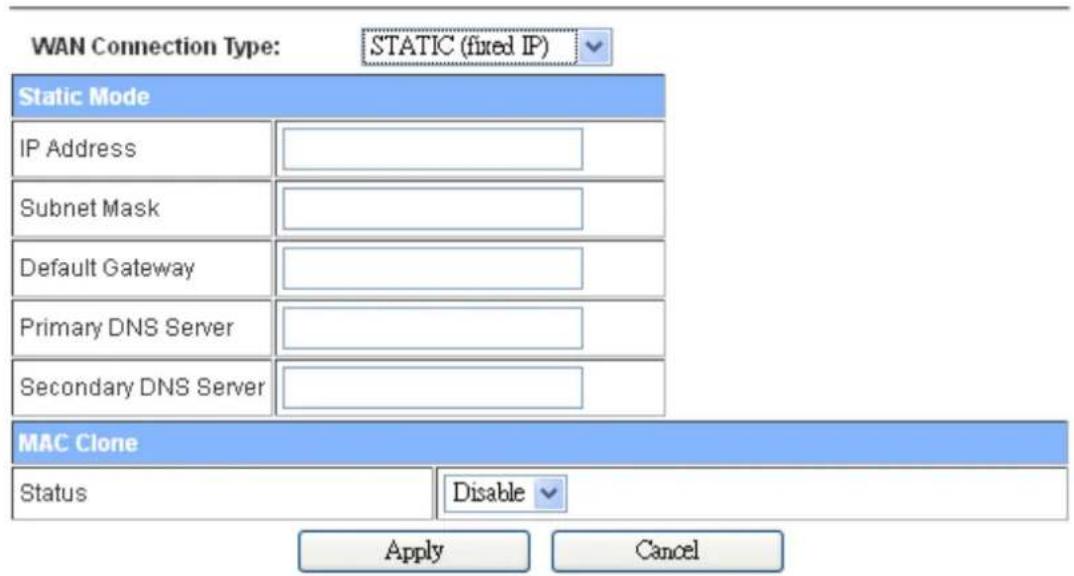
a. STATIC
Wide Area Network (WAN) Settings
You may choose different connection type suitable for your environment. Besides, you may also configure parameters according to the selected connection type.
text_image
WAN Connection Type: STATIC (fixed IP) Static Mode IP Address Subnet Mask Default Gateway Primary DNS Server Secondary DNS Server MAC Clone Status Disable Apply Cancel| Item Description | |
| IP Address Fill in the IP address for WAN interface. | |
| Subnet Mask Fill in the subnet mask for WAN interface. | |
| Default Gateway Fill in the default gateway for WAN interface out going data packets. | |
| Primary DNS Server | Fill in the IP address of Domain Name Server 1. |
| Secondary DNS Server | Fill in the IP address of Domain Name Server 2. |
| MAC Clone Take | NIC MAC address of PC on LAN side as the MAC address of WAN interface. |
b. DHCP
Wide Area Network (WAN) Settings
You may choose different connection type suitable for your environment. Besides, you may also configure parameters according to the selected connection type.

text_image
WAN Connection Type: DHCP (Auto config) DHCP Mode Hostname(optional) MAC Clone Status Disable Apply Cancel| Item Description | |
| Hostname Fill in the host name of Host Name of DHCP server. The default value is empty. | |
| MAC Clone Take NIC MAC address of PC on LAN side as the MAC address of WAN interface. | |
.PPPoE
Wide Area Network (WAN) Settings
You may choose different connection type suitable for your environment. Besides, you may also configure parameters according to the selected connection type.
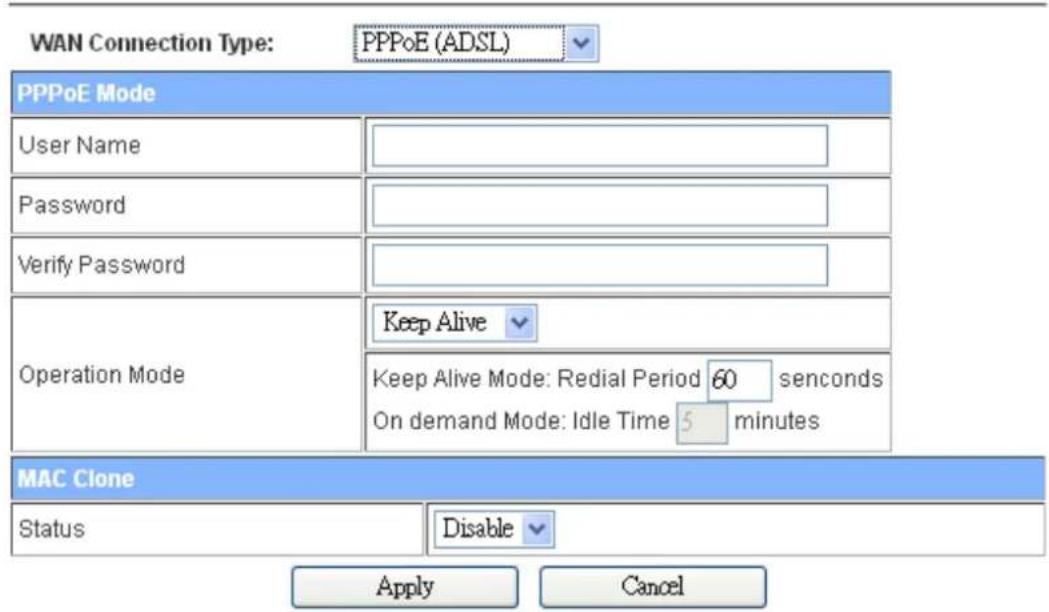
text_image
WAN Connection Type: PPPoE (ADSL) PPPoE Mode User Name Password Verify Password Operation Mode Keep Alive Keep Alive Mode: Redial Period 60 seconds On demand Mode: Idle Time 5 minutes MAC Clone Status Disable Apply Cancel| Item Description | |
| User Name If you select the PPPoE support on WAN interface, fill in the user name and password to login the PPPoE server. | |
| Password If you select the PPPoE support on WAN interface, fill in the user name and password to login the PPPoE server. | |
| Verify Password Fil in the password again for verification. | |
| Operation Mode | Keep Alive: Keep the PPPoE connection all the time. Please also configure the Redial Period field.On Demand: Please configure the Idle Time field. When time is up, the PPPoE connection will disconnect. The connection will re-connect when any outgoing packet arise.Manual: Let user connect the PPPoE connection manually. |
| MAC Clone Take N | C MAC address of PC on LAN side as the MAC address of WAN interface. |
d. L2TP
Wide Area Network (WAN) Settings
You may choose different connection type suitable for your environment. Besides, you may also configure parameters according to the selected connection type.
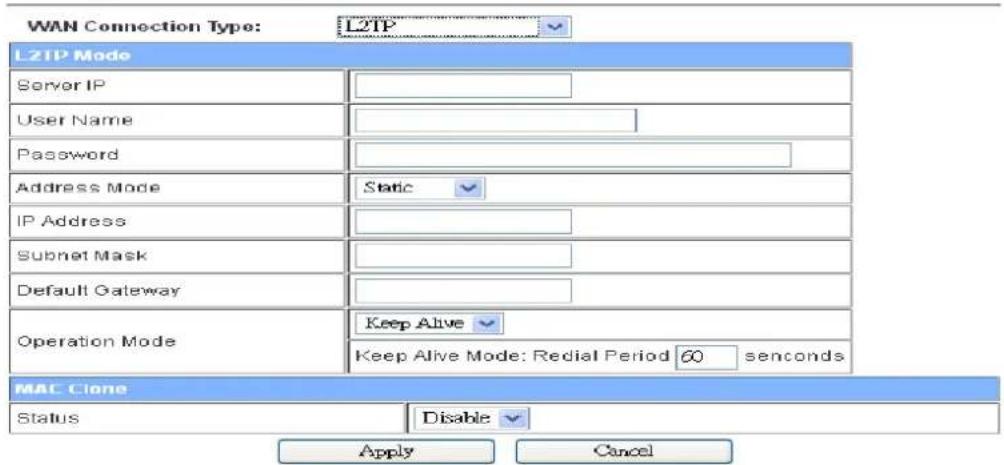
text_image
WAN Connection Type: L2TP L2TP Mode Server IP User Name Password Address Mode Static IP Address Subnet Mask Default Gateway Operation Mode Keep Alive Keep Alive Mode: Redial Period 60 seconds MAC Clone Status Disable Apply Cancel| Item Description | |
| Server IP Allow user to make a tunnel with remote site directly to secure the data transmission among the connection. User can use embedded L2TP client supported by this router to make a VPN connection.If you select the L2TP support on WAN interface, fill in the IP address for it. | |
| User Name Fill in the user name and password to login the L2TP server. | |
| Password Fill in the user name and password to login the L2TP server. | |
| Address Mode | Static: To configure the IP address information by manually, please fill in the related setting at below.Dynamic: The option allows the machine to get IP address information automatically from DHCP server on WAN side. |
| IP Address Fill in the IP address for WAN interface. | |
| Subnet Mask Fill in the subnet mask for WAN interface. | |
| Default Gateway Fil in the default gateway for WAN interface out going data packets. | |
| Operation Mode | Keep Alive: Keep the L2TP connection all the time. Please also configure the Redial Period field.On Demand: Please configure the Idle Time field. When time is up, the L2TP connection will disconnect. The connection will re-connect when any outgoing packet arise.Manual: Let user connect the L2TP connection manually. |
| MAC Clone Take N C MAC address of PC on LAN side as the MAC address of WAN interface. | |
e. PPTP
Wide Area Network (WAN) Settings
You may choose different connection type suitable for your environment. Besides, you may also configure parameters according to the selected connection type.
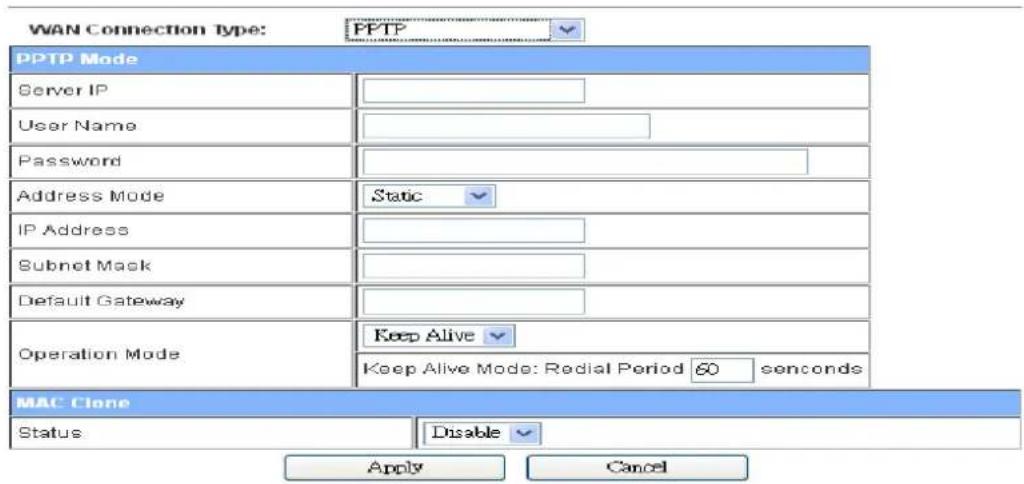
text_image
WAN Connection Type: PPTP PPTP Mode Server IP User Name Password Address Mode Static IP Address Subnet Mask Default Gateway Operation Mode Keep Alive Keep Alive Mode: Redial Period 60 seconds MAC Clone Status Disable Apply Cancel| Item Description | |
| Server IP Allow | user to make a tunnel with remote site directly to secure the data transmission among the connection. User can use embedded PPTP client supported by this router to make a VPN connection.If you select the PPTP support on WAN interface, fill in the IP address for it. |
| User Name Fill in the | user name and password to login the PPTP server. |
| Password Fill in the | user name and password to login the PPTP server. |
| Address Mode | Static: To configure the IP address information by manually, please fill in the related setting at below.Dynamic: The option allows the machine to get IP address information automatically from DHCP server on WAN side. |
| IP Address Fill in the | IP address for WAN interface. |
| Subnet Mask Fill in | the subnet mask for WAN interface. |
| Default Gateway Fil | in the default gateway for WAN interface out going data packets. |
| Operation Mode | Keep Alive: Keep the PPTP connection all the time. Please also configure the Redial Period field.On Demand: Please configure the Idle Time field. When time is up, the PPTP connection will disconnect. The connection will re-connect when any outgoing packet arise.Manual: Let user connect the PPTP connection manually. |
| MAC Clone Take N | C MAC address of PC on LAN side as the MAC address of WAN interface. |
4.3.3.2 LAN
Local Area Network (LAN) Settings
You may enable/disable networking functions and configure their parameters as your wish.
| LAN Setup | |
| MAC Address | 8C:92:36:00:66:F8 |
| IP Address | 192.168.1.200 |
| Subnet Mask | 255.255.255.0 |
| DHCP Type | Disable |
| Lease Time | 86400 |
| 802.1d Spanning Tree | Disable |
| LLTD | Disable |
| IGMP Proxy | Disable |
| UPNP | Disable |
| Router Advertisement | Disable |
| PPPoE Relay | Disable |
| DNS Proxy | Disable |
Apply
Cancel
| Item Description | |
| MAC Address | Take NIC MAC address of PC on LAN side as the MAC address of WAN interface. |
| IP Address Fill in | the IP address for WAN interface. |
| Subnet Mask Fill | in the subnet mask for WAN interface. |
| DHCP Type | Disable: Disable DHCP server on LAN side.Server: Enable DHCP server on LAN side. |
| Lease Time Fill in | the lease time of DHCP server function. |
| LLTD | Select enable or disable the Link Layer Topology Discover function from pull-down menu. |
| IGMP Proxy | Select enable or disable the IGMP proxy function from pull-down menu. |
| UPNP Select enable | le or disable the UPnP protocol from pull-down menu. |
| DNS Proxy | Select enable or disable the DNS Proxy function from pull-down menu. |
4.3.3.3 VPN Pass Through
VPN Passthrough
VPN passthrough configurations including: L2TP, IPSec, and PPTP passthrough.
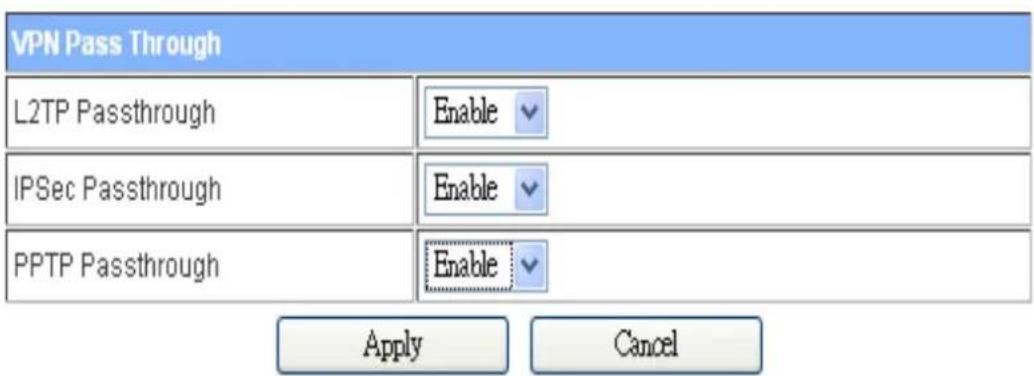
text_image
VPN Pass Through L2TP Passthrough Enable ✓ IPSec Passthrough Enable ✓ PPTP Passthrough Enable ✓ Apply Cancel| Item Description | |
| L2TP Passthrough | Select enable or disable the L2TP pass-through function from pull-down menu. |
| IPSec Passthrough | Select enable or disable the IPSec pass-through function from pull-down menu. |
| PPTP Passthrough | Select enable or disable the PPTP pass-through function from pull-down menu. |
4.3.4 Wireless Settings
4.3.4.1 Basic
Basic Wireless Settings
You could configure the minimum number of Wireless settings for communication, such as Network Name (SSID) and Channel. The Access Point can be set simply with only the minimum setting items.

text_image
Wireless Network Wireless On/Off Wireless OFF Current Status:Radio ON Antenna Switch External Internal Wireless Band 802.11B/G/N SSID 802.11n_Router Broadcast Network Name (SSID) Enabled Disabled AP Isolation Enabled Disabled BSSID 00:30:4F:93:BF:E8 Frequency (Channel) AutoSelect Current Channel: 1 HT Physical Mode Operating Mode Mixed Mode Green Field Channel BandWidth 20 20/40 Guard Interval Long Auto MCS AutoApply
Cancel
| Item Description | |
| Wireless On/Off | Click Wireless OFF button to turn off wireless RF radio. Click Wireless ON button to turn on wireless RF radio. |
| Antenna Switch | Select Internal antenna or External antenna for using. The default is using Internal antenna. |
| Wireless Mode Click | Click to select wireless mode from pull down menu. |
| Wireless Band Click | Click to select wireless band from pull down menu. |
| SSID | It is the wireless network name. The SSID can be 32 bytes long. User can use the default SSID or change it. |
| Broadcast Network Name (SSID) | Enable or disable the SSID broadcast function. |
| AP Isolation | Wireless network is similar to the virtual local area network. All of the Wireless client devices can access each other completely. When you enable this function,it will turn off connection between wireless clients. Only allows connection between wireless client and this AP router. |
| BSSID Show the | MAC address of Wireless interface. |
| Frequency (Channel) | Select the wireless communication frequency/channel from pull-down menu. |
| Operating Mode | Select “Mixed Mode” for 11b/g/n mode or “Green Field” for 11n mode. |
| Channel Bandwidth | Select the operating channel width 20 MHz or 20/40 MHz. |
| Guard Interval | Select “Long” or “Auto”. Guard intervals are used to ensure that distinct transmissions do not interfere with one another. Only effect under Mixed Mode. |
| MCS | Select 0~7 or “Auto” from pull down menu. The default is “Auto”. Only effect under Mixed Mode. |
4.3.4.2 Advanced
Advanced Wireless Settings
Use the Advanced Setup page to make detailed settings for the Wireless. Advanced Setup includes items that are not available from the Basic Setup page, such as Beacon Interval, Control Tx Rates and Basic Data Rates.
| Advanced Wireless | |
| B/G Protection Mode | Auto |
| Beacon Interval | 100 ms (range 20 - 999, default 100) |
| Data Beacon Rate (DTIM) | 1 ms (range 1 - 255, default 1) |
| Fragment Threshold | 2346 (range 256 - 2346, default 2346) |
| RTS Threshold | 2347 (range 1 - 2347, default 2347) |
| TX Power | 100 (range 1 - 100, default 100) |
| Short Preamble | Enabled Disabled |
| Short Slot | Enabled Disabled |
| Tx Burst | Enabled Disabled |
| Country Code | US (United States) |
Apply
Cancel
| Item Description | |
| Beacon Interval | Beacons are the packets sending by Access point to synchronize the wireless network. The beacon interval is the time interval between beacons sending by this unit in AP or AP+WDS operation. The default and recommended beacon interval is 100 milliseconds. |
| Data Beacon Rate(DTM) | This is the Delivery Traffic Indication Map. It is used to alert the clients that multicast and broadcast packets buffered at the AP will be transmitted immediately after the transmission of this beacon frame. You can change the value from 1 to 255. The AP will check the buffered data according to this value. For example, selecting “1” means to check the buffered data at every beacon. |
| Fragment Threshold | The fragmentation threshold determines the size at which packets are fragmented (sent as several pieces instead of as one block). Use a low setting in areas where communication is poor or where there is a great deal of radio interference. This function will help you to improve the network performance. |
| RTS Threshold | The RTS threshold determines the packet size at which the radio issues a request to send (RTS) before sending the packet. A low RTS Threshold settingcan be useful in areas where many client devices are associating with the device, or in areas where the clients are far apart and can detect only the device and not each other. You can enter a setting ranging from 0 to 2347 bytes. |
| TX Power The default TX power is 100%. In case of shortening the distance and the coverage of the wireless network, input a smaller value to reduce the radio transmission power. For example, input 80 to apply 80% Tx power. | |
| Short Preamble Default: Disable. It is a performance parameter for 802.11 b/g mode and not supported by some of very early stage of 802.11b station cards. If there is no such kind of stations associated to this AP, you can enable this function. | |
| Short Slot | It is used to shorten the communication time between this AP and station. |
| TX Burst | The device will try to send a serial of packages with single ACK reply from the clients. Enable this function to apply it. |
| Country Code | Select the country code for wireless from pull down menu. |
4.3.4.3 Security
a. Disable
Wireless Security/Encryption Settings
Setup the wireless security and encryption to prevent from unauthorized access and monitoring.

text_image
Security Wireless Security Mode Disable Access Policy Policy Disabled Add a station Mac: Apply CancelIf you set Security Mode to "Disable", the wireless data transmission will not include encryption to prevent from unauthorized access and monitoring.
b. OPEN-WEP // SHARED-WEP
Wireless Security/Encryption Settings
Setup the wireless security and encryption to prevent from unauthorized access and monitoring.
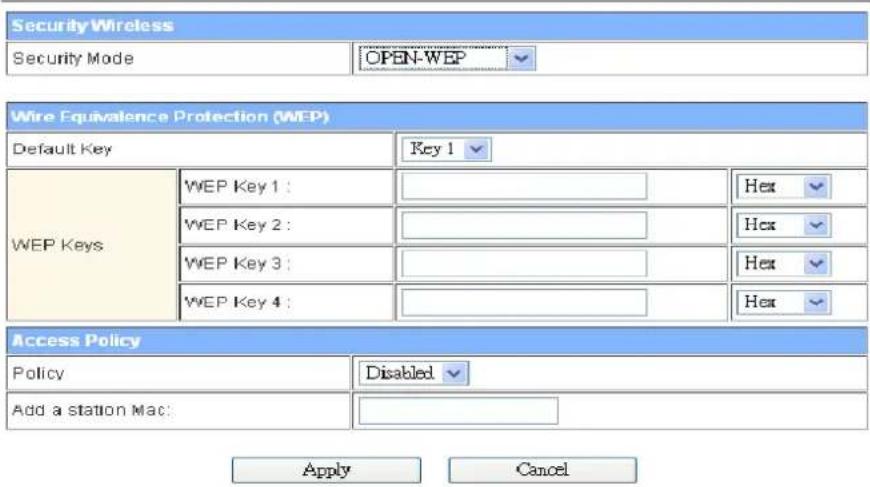
text_image
Security Wireless Security Mode OPEN-WEP Wire Equivalence Protection (WEP) Default Key Key 1 WEP Keys WEP Key 1: Hex WEP Key 2: Hex WEP Key 3: Hex WEP Key 4: Hex Access Policy Policy Disabled Add a station Mac: Apply CancelWireless Security/Encryption Settings
Setup the wireless security and encryption to prevent from unauthorized access and monitoring.
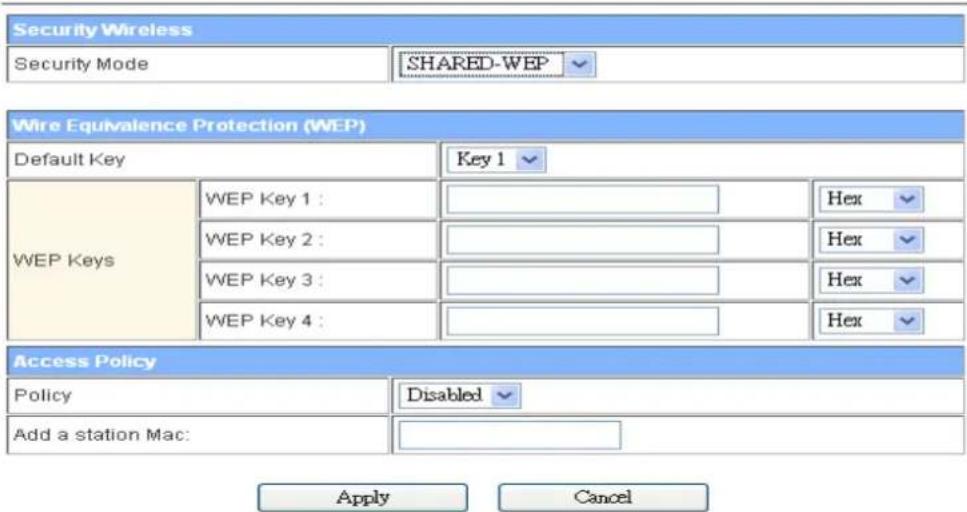
text_image
Security Wireless Security Mode SHARED-WEP Wire Equivalence Protection (WEP) Default Key Key 1 WEP Keys WEP Key 1 : Hex WEP Key 2 : Hex WEP Key 3 : Hex WEP Key 4 : Hex Access Policy Policy Disabled Add a station Mac: Apply CancelIf you set Security Mode to "OPEN-WEP or SHARED-WEP", please fill in the related configurations at below.
| Item Description | |
| Default Key Specify a Key number for effective. | |
| WEP Keys (1~4) | When you select WEPAUTO, please input 5, 13 (ASCII), 10 or 26 (HEX) characters for WEP Key. |
c. WPA-PSK/WPA2PSK
Wireless Security/Encryption Settings
Setup the wireless security and encryption to prevent from unauthorized access and monitoring.
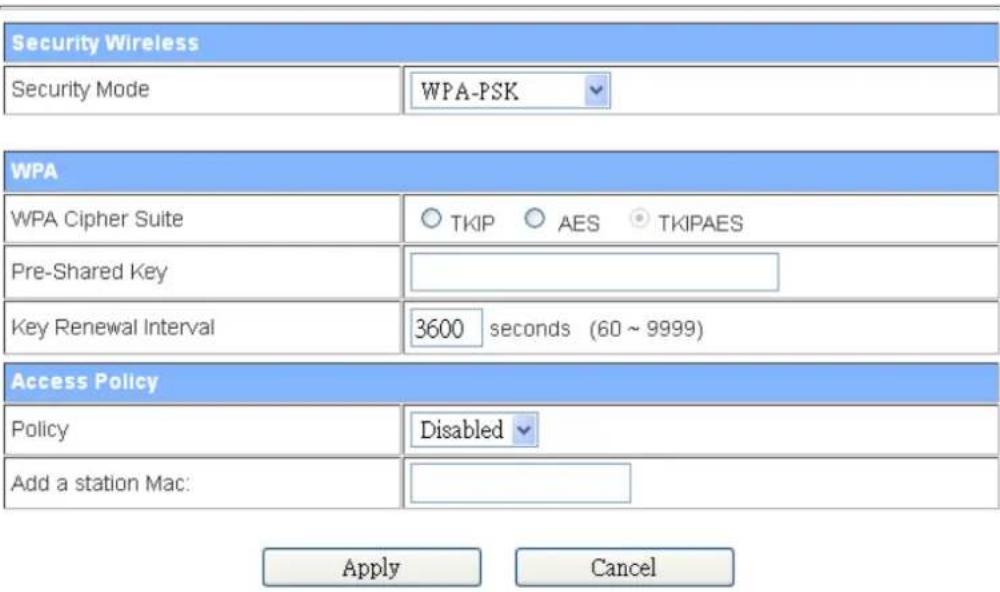
text_image
Security Wireless Security Mode WPA-PSK WPA WPA Cipher Suite ○ TKIP ○ AES ● TKIPAES Pre-Shared Key Key Renewal Interval 3600 seconds (60 ~ 9999) Access Policy Policy Disabled Add a station Mac: Apply CancelWireless Security/Encryption Settings
Setup the wireless security and encryption to prevent from unauthorized access and monitoring.

text_image
Security Wireless Security Mode WPA2-PSK WPA WPA Cipher Suite ○ TKIP ○ AES ● TKIPAES Pre-Shared Key Key Renewal Interval 3600 seconds (60 ~ 9999) Access Policy Policy Disabled Add a station Mac: Apply CancelIf you set Security Mode to "WPAPSK or WPA2-PSK", please fill in the related configurations at below.
| Item Description | |
| WPA Cipher Suite | Select TKIP, AES, or TKIPAES for WPA algorithms. |
 |
d. WPA-RADIUS/WPA2-RADIUS
Wireless Security/Encryption Settings
Setup the wireless security and encryption to prevent from unauthorized access and monitoring.

text_image
Security Wireless Security Mode WPA-RADIUS WPA WPA Cipher Suite ○ TKIP ○ AES ○ TKIPAES Key Renewal Interval 3600 seconds (60 ~ 9999) Radius Server IP Address 0 Port 1812 Shared Secret Session Timeout 0 Idle Timeout Access Policy Policy Disabled Add a station Mac
Wireless Security/Encryption Settings
Setup the wireless security and encryption to prevent from unauthorized access and monitoring
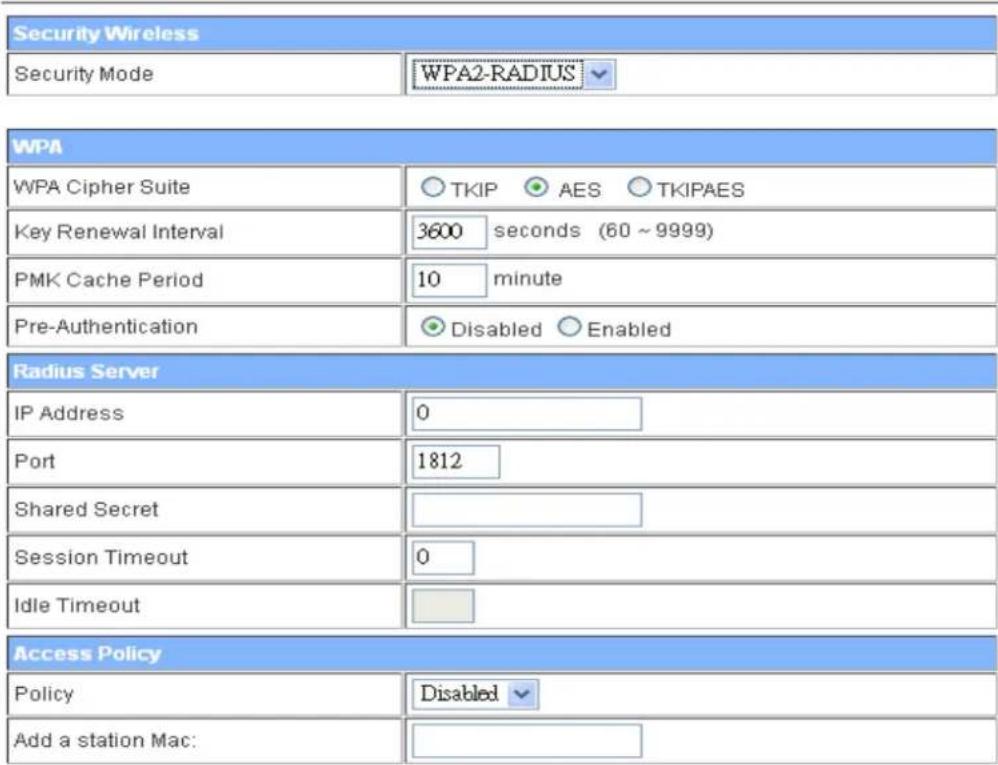
text_image
Security Wireless Security Mode WPA2-RADIUS WPA WPA Cipher Suite ○ TKIP ○ AES ○ TKIPAES Key Renewal Interval 3600 seconds (60 ~ 9999) PMK Cache Period 10 minute Pre-Authentication ● Disabled ○ Enabled Radius Server IP Address 0 Port 1812 Shared Secret Session Timeout 0 Idle Timeout Access Policy Policy Disabled Add a station Mac:
| Item Description | |
| WPA Cipher Suite | Select TKIP or AES for WPA algorithms. |
| Key Renewal Interval | Please fill in a number for Group Key Renewal interval time. |
| IP Address | Enter the RADIUS Server's IP Address provided by your ISP. |
| Port Enter the RADIUS Server's port number provided by your ISP. (The Default is 1812.) | |
| Shared Secret | Enter the password that the Wireless Router shares with the RADIUS Server. |
| Session Timeout | Session timeout interval is for 802.1x re-authentication setting. Set to zero to disable 802.1x re-authentication service for each session. Session timeout interval unit is second and must be larger than 60. |
| Idle Timeout Enter the idle timeout in the column. | |
e. 802.1X
Wireless Security/Encryption Settings
Setup the wireless security and encryption to prevent from unauthorized access and monitoring.
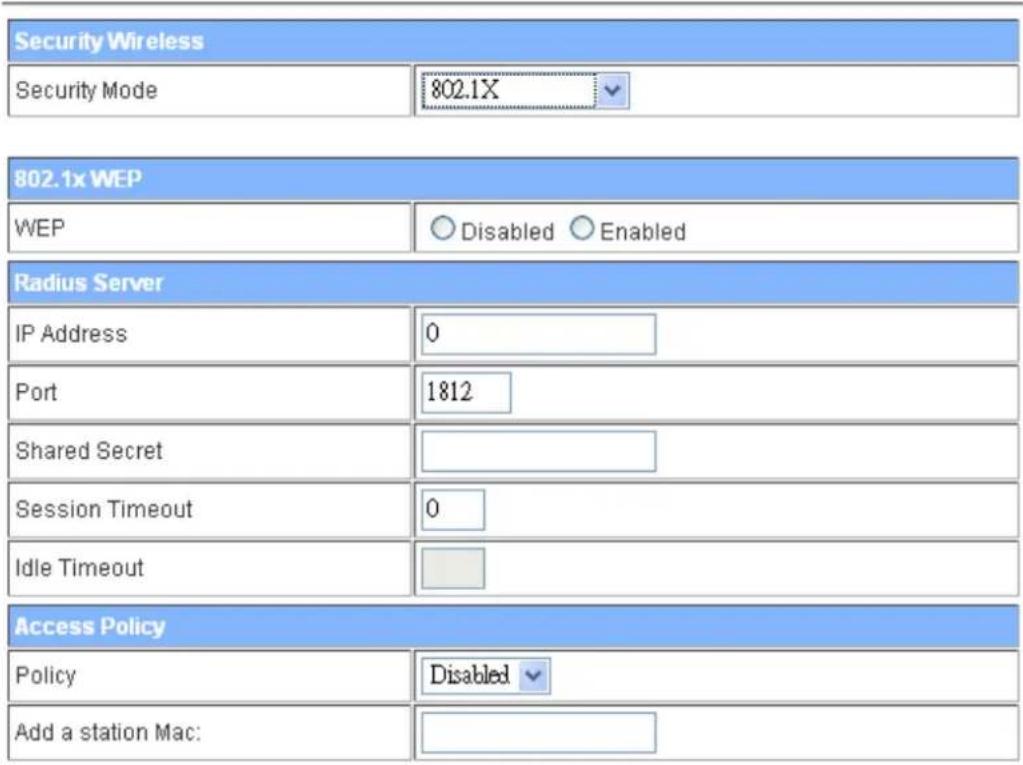
text_image
Security Wireless Security Mode 802.1X 802.1x WEP WEP Disabled Enabled Radius Server IP Address 0 Port 1812 Shared Secret Session Timeout 0 Idle Timeout Access Policy Policy Disabled Add a station Mac:
| Item Description | |
| WEP Select Disable or Enable For WEP | |
| IP Address | Enter the RADIUS Server's IP Address provided by your ISP. |
| Port Enter the RADIUS Server's port number provided by your ISP. (The Default is 1812.) | |
| Shared Secret | Enter the password that the Wireless Router shares with the RADIUS Server. |
| Session Timeout | Session timeout interval is for 802.1x re-authentication setting. Set to zero to disable 802.1x re-authentication service for each session. Session timeout interval unit is second and must be larger than 60. |
| Idle Timeout Enter the idle timeout in the column. | |
f. Access Policy
| Access Policy | |
| Policy | Disabled |
| Add a station Mac: | |
| Item Description | |
| Policy | Select the Disabled, Allow or Reject of drop down menu choose wireless access control mode. This is a security control function; only those clients registered in the access control list can link to this WLAN Broadband Router. |
| Add a station MAC | Fill in the MAC address of client to register this AP router access capability. |
4.3.4.4 Site Survey
Site Survey
You could configure AP Client parameters here.
| SSID | BSSID | RSSI | Channel | Authentication | Wireless Mode | |
| ○ | XPossible-charles | 00:1a:ef.2c:e0:3c | 9% | 1 | WPA1PSKWPA2PSK/AES | 11b/g/n |
| ○ | Amped_2.4GHz | 00:1a:ef.00:20:03 | 15% | 1 | WPA1PSKWPA2PSK/AES | 11b/g/n |
| ○ | LP-7696_RD | 00:1a:ef.00:00:08 | 10% | 1 | WPA2PSK/AES | 11b/g/n |
| ○ | Inkoutside | 00:50:7f:50:fd:28 | 3% | 6 | WPAPSK/TKIP | 11b/g/n |
| ○ | RTK 11n AP | 00:1a:ef.18:7d:18 | 25% | 6 | NONE | 11b/g/n |
| ○ | loopcomm | 00:1a:ef.28:54:25 | 10% | 11 | WPA2PSK/AES | 11b/g/n |
| ○ | XPossible | 00:1a:ef.21:f2:77 | 60% | 11 | NONE | 11b/g/n |
| ○ | RTK 11n AP_LNK | 00:1a:ef.21:f2:4a | 7% | 11 | WEP | 11b/g |

You could configure AP Client parameters here.
4.3.4.5 WPS
Wi-Fi Protected Setup
You could setup security easily by choosing PIN or PBC method to do Wi-Fi Protected Setup.
| WPS Config | |
| WPS: | Enabled |
| Apply | |
| WPS Summary | |
| WPS Current Status: | Not used |
| WPS Configured: | No |
| WPS SSID: | 802.11n_Router |
| WPS Auth Mode: | Open |
| WPS Encryp Type: | None |
| WPS Default Key Index: | 1 |
| WPS Key(ASCII) | |
| AP PIN: | 96829202 Generate |
| Reset OOB | |
| WPS Progress | |
| WPS mode | PIN PBC |
| PIN | |
| Apply | |
| Item Description | |
| WPS | Select Enable or Disable the Wi-Fi Protected Setup function. Then click Apply button to take effect function after change. |
| WPS Summary | After enabling the WPS function, if there is connection the WPS Summary will show related information and status. |
| AP PIN | Here shows the AP's PIN code (Personal Identification Number) that the enrollee should enter the registrar's PIN code to make a connection. Click Generate button to generate a new AP PIN code. |
| Reset OOB | Click Reset OOB button to reset WPS AP to the OOB (out-of-box) configuration. |
| WPS mode | Select WPS mode. PIN: Personal Identification Number. PBC: Push Button Communication. |
| PIN Input enrolled's PIN code to AP-registrar. | |
4.3.5 Firewall
4.3.5.1 MAC/IP/Port Filtering
MAC/IP/Port Filtering Settings
You may setup firewall rules to protect your network from virus, worm and malicious activity on the Internet.

text_image
Basic Settings MAC/IP/Port Filtering Disable Apply Reset| Item Description | |
| MAC/IP/Port Filtering | Select Enable or Disable the MAC/IP/Port Filtering function. |
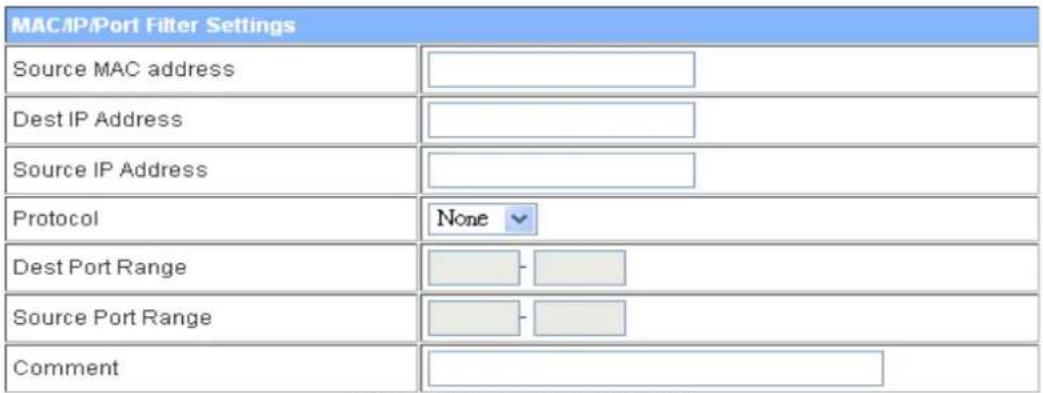
text_image
MAC/IP/Port Filter Settings Source MAC address Dest IP Address Source IP Address Protocol None Dest Port Range Source Port Range Comment(The maximum rule count is 32.)

| Item Description | |||||||||
| Source MAC address | Fill in the MAC address of source NIC, to restrict data transmission. | ||||||||
| Dest IP Address Fill | in the IP address of destination, to restrict data transmission. | ||||||||
| Source IP Address Fill | in the IP address of source, to restrict data transmission. | ||||||||
| Protocol Select the protocol that you want to restrict. There are four options: None, TCP, UDP and ICMP. | |||||||||
| Dest Port Range | Fill in the start-port and end-port number of destination, to restrict data transmission. | ||||||||
| Source Port Range | Fill in the start-port and end-port number of source, to restrict data transmission. | ||||||||
| Action | Select Accept or Drop to specify the action of filtering policies. | ||||||||
| Comment Make a comment for the filtering policy. | |||||||||
| Current MAC/IP/Port filtering rules in system: | |||||||||
| No. | Source MAC address | Dest IP Address | Source IP Address | Protocol | Dest Port Range | Source Port Range | Action | Comment | Pkt Cnt |
| Others would be dropped | - | ||||||||
| Delete Selected Reset | |||||||||
| Item Description | |
| □ | Make a mark for next action. |
| Delete Selected | Click Delete Selected button to delete all that you selected. |
| Reset | Click Reset button to clear selected items. |
4.3.5.2 Port Forwarding
Virtual Server Settings
You may setup Virtual Servers to provide services on Internet.
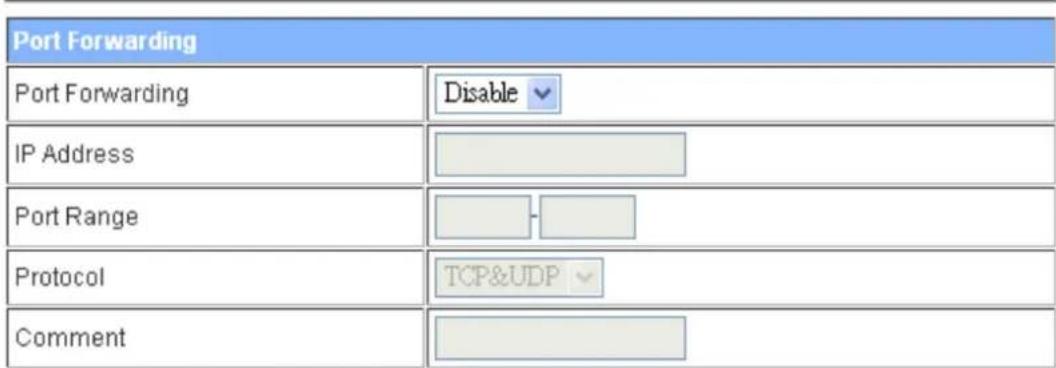
text_image
Port Forwarding Port Forwarding Disable IP Address Port Range Protocol TCP&UDP Comment(The maximum rule count is 32.)
Apply
Reset
| Item Description | |
| Port Forwarding | Select Enable or Disable the Port Forwarding function. |
| IP Address To forward data packets coming from WAN to a specific IP address that hosted in local network behind the NAT firewall, fill in the IP address. | |
| Port Range To forward data packets coming from WAN to a specific IP address that hosted in local network behind the NAT firewall, fill in the port range. | |
| Protocol Specify protocol, TCP&UDP, TCP or UDP. | |
| Comment Make a comment for the port forwarding policy. | |
| Virtual Server | |
| Virtual Server | Enable |
| IP Address | |
| Public Port | |
| Private Port | |
| Protocol | TCP&UDP |
| Comment | |
(The maximum rule count is 32.)
Apply Reset
| Item Description | |
| Virtual Server | Select Enable or Disable the Virtual Server function. |
| IP Address To forward data packets coming from WAN to a specific IP address that hosted in local network behind the NAT firewall, fill in the IP address. | |
| Public Port To forward data packets coming from WAN to a specific IP address that hosted in local network behind the NAT firewall, fill in the public port. | |
| Private Port To forward data packets coming from WAN to a specific IP address that hosted in local network behind the NAT firewall, fill in the private port. | |
| Protocol Specify protocol, TCP&UDP, TCP or UDP. | |
| Comment Make a comment for the virtual server policy. | |
4.3.5.3 DMZ
DMZ Settings
You may setup a De-militarized Zone(DMZ) to separate internal network and Internet.

text_image
DMZ Settings DMZ Settings Disable DMZ IP AddressApply
Reset
| Item Description | |
| DMZ Settings | Enable or Disable the DMZ function. |
| DMZ IP Address To | support DMZ in your firewall design, fill in the IP address of DMZ host that can be access from the WAN interface. |
4.3.5.4 System Security
System Security Settings
You may configure the system firewall to protect AP/Router itself from attacking.

text_image
Remote management Remote management (via WAN) Deny Ping form WAN Filter Ping form WAN Filter Disable Stateful Packet Inspection (SPI) SPI Firewall DisableApply Reset
| Item Description | |
| Remote management | Select Deny or Allow for remote management function. |
| Ping form WAN Filter | Select Disable or Enable for Ping permit from WAN. |
| SPI Firewall | Select Disable or Enable for SPI firewall function. |
4.3.5.5 Content Filtering
Webs Host Filter Settings

text_image
Add a Host(keyword) Filter: Keyword Add Reset
text_image
Current Website Host Filters: No Host(Keyword) 1 □ Hydro test Delete Reset| Item Description | |
| Keyword | Fill in a word for Webs Host Filter policy. |
| Add Make a mark for next action. | |
| Delete | Click Delete button to delete all that you selected. |
| Reset | Click Reset button to clear selected items. |
4.3.6 Administration
4.3.6.1 Management
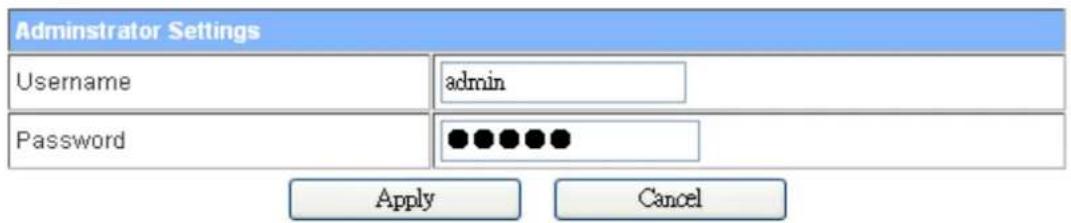
text_image
Administrator Settings Username admin Password Apply Cancel
text_image
NTP Settings Current Time Sat Jan 1 05:19:03 UTC 2000 Sync with host Time Zone: (GMT-11:00) Midway Island, Samoa NTP Server ex: time.nist.gov ntp0.broad.mit.edu time.stdtime.gov.tw NTP synchronization(hours) Apply Cancel| Item Description | |
| Username Fill in the user name for web management login control. | |
| Password Fill in the password for web management login control. | |
| Current Time It shows the current time. | |
| Time Zone Select the time zone in your country from pull-down menu.. | |
| NTP Server Fill in NTP server IP address. | |
| NTP synchronization | Fill in a number to decide the synchronization frequency with NTP server. |
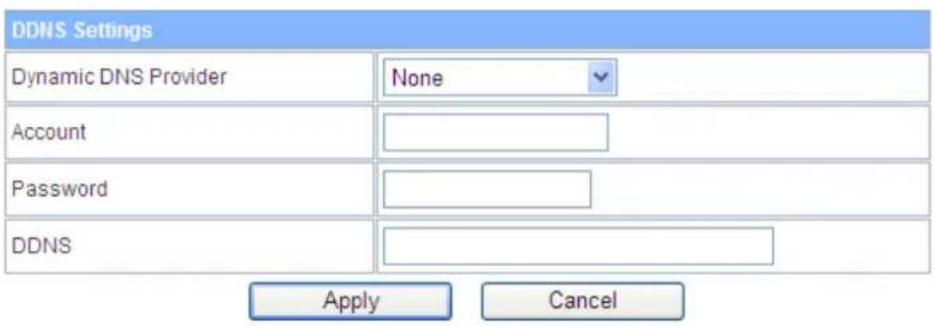
text_image
DDNS Settings Dynamic DNS Provider None Account Password DDNS Apply Cancel| Item Description | |
| Dynamic DNS Provider | Click the drop down menu to pick up the right DDNS provider you registered. |
| Account | Fill in the account of DDNS you registered. |
| Password | Fill in the password of DDNS you registered. |
| DDNS Fill in the domain name that you registered. | |
4.3.6.2 Qos
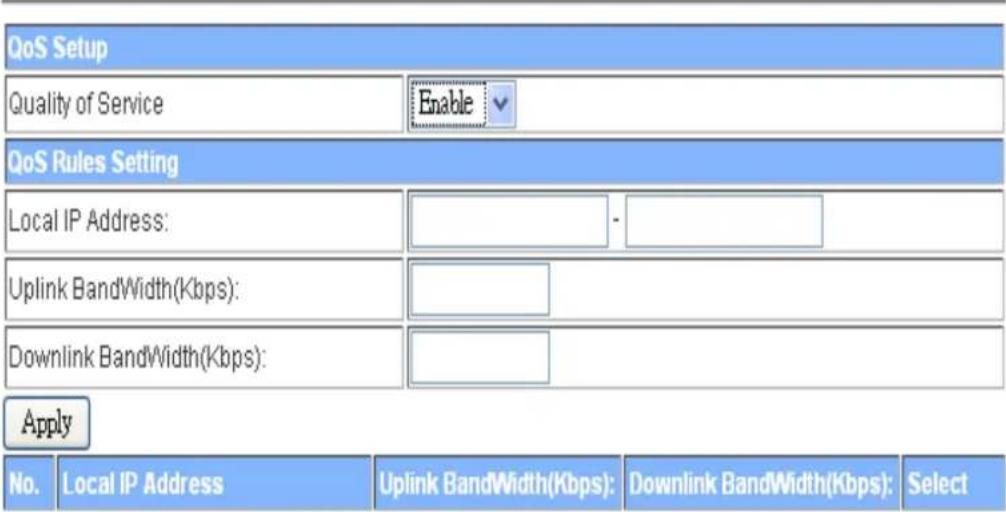
Quality of Service Settings
You may setup rules to provide Quality of Service guarantees for specific applications.
text_image
QoS Setup Quality of Service Enable QoS Rules Setting Local IP Address: - Uplink BandWidth(Kbps): Downlink BandWidth(Kbps): Apply No. Local IP Address Uplink BandWidth(Kbps): Downlink BandWidth(Kbps): Select| Item Description | |
| Uplink Speed Input | uplink Maximum upload speed |
| Downlink Speed Input | downlink Maximum upload speed |
| Local IP Address Fill in the local IP address | |
| Uplink Bandwidth | fill limit upload bandwidth |
| Downlink Bandwidth | Fill limit downlink bandwidth |
4.3.6.3 Upload Firmware
Upgrade Firmware
Upgrade the Device firmware to obtain new functionality. It takes about 1 minute to upload upgrade flash and be patient please. Caution! A corrupted image will hang up the system.
Update Firmware
Location:
瀏覽…
Apply
| Item Description | |
| Location | Click theBrowsebutton to select the new firmware image file on PC. And click theApplybutton to upgrade firmware. |
4.3.6.4 Settings Management
Settings Management
You might save system settings by exporting them to a configuration file, restore them by importing the file, or reset them to factory default.

text_image
Export Settings Export Button Export
text_image
Import Settings Settings file location 瀏覽… Import Cancel
text_image
Load Factory Defaults Load Default Button Load Default| Item Description | |
| Export Button | Click Export button to export the current configuration to your PC. |
| Settings file location | Click Browse button to select the configuration file from your PC, then click Import button to update the configuration. |
| Load Default Button | Click the Load Default button to reset the configuration parameter to factory defaults. |
This page shows the current status and some basic settings of the device, includes system info, Internet Configurations and Local Network.
4.3.6.5 Status
This page shows the current status and some basic settings of the device, includes system info, Internet Configurations and Local Network.
Access Point Status
This page shows the current status and some basic settings of the device.
| System Information | |
| Firmware Version | 1.1.06-N_H (Nov 19 2012) |
| System Up Time | 0 days, 0 hours, 46 mins, 41 secs |
| Operation Mode | Wireless ISP Mode |
| Repeater Information | |
| Repeater Status | N/A |
| Repeater Device | N/A |
| Repeater Mac Address | N/A |
| Repeater RSSI | N/A |
| Wireless Information | |
| Status | Radio ON |
| Mode | AP |
| SSID | 802.11n_Router |
| Channel | 1 |
| Encryption | Disable |
| BSSID | 00:30:4F:93:BF:E8 |
| WAN Information | |
| Connected Type | DHCP |
| WAN IP Address | |
| Subnet Mask | |
| Default Gateway | |
| DNS1 | |
| DNS2 | |
| MAC Address | 00:30:4F:93:BF:E9 |
| LAN Information | |
| DHCP Server | Enabled |
| LAN IP Address | 192.168.1.200 |
| Subnet Mask | 255.255.255.0 |
| MAC Address | 00:30:4F:93:BF:E8 |
4.3.6.6 System Log
This page is used to view system logs
System Log
Syslog:
Refresh
Clear
System Log
Jan 1 01:49:36 ralink syslog.info syslogd started: BusyBox v1.12.1
Jan 1 01:49:36 ralink user.notice kernel: klogd started: BusyBox v1.12.1 (2012-10-
Jan 1 01:49:39 ralink user.debug kernel: ra0: no IPv6 routers present
Jan 1 01:49:39 ralink user.debug kernel: eth2.1: no IPv6 routers present
Jan 1 01:49:39 ralink user.debug kernel: eth2.2: no IPv6 routers present
Jan 1 01:49:41 ralink user.debug kernel: apcli0: no IPv6 routers present
Jan 1 01:49:41 ralink user.debug kernel: br0: no IPv6 routers present
| Item Description | |
| Refresh | Click the Refresh button to refresh the log shown on the screen. |
| Clear | Click the Clear button to clear the log display screen. |
5. FREQUENTLY ASKED QUESTIONS (FAQ)
5.1 What and how to find my PC's IP and MAC address?
IP address is the identifier for a computer or device on a TCP/IP network. Networks using the TCP/IP protocol route messages based on the IP address of the destination. The format of an IP address is a 32-bit numeric address written as four numbers separated by periods. Each number can be zero to 255. For example, 191.168.1.254 could be an IP address
The MAC (Media Access Control) address is your computer's unique hardware number. (On an Ethernet LAN, it's the same as your Ethernet address.) When you're connected to the Internet from your computer (or host as the Internet protocol thinks of it), a correspondence table relates your IP address to your computer's physical (MAC) address on the LAN.
To find your PC's IP and MAC address,
√ Open the Command program in the Microsoft Windows.
√ Type in "ipconfig /all", then press the Enter button.
√ Your PC's IP address is the one entitled IP Address and your PC's MAC address is the one entitled Physical Address.
5.2 What is Wireless LAN?
A wireless LAN (WLAN) is a network that allows access to Internet without the need for any wired connections to the user's machine.
5.3 What are ISM bands?
ISM stands for Industrial, Scientific and Medical; radio frequency bands that the Federal Communications Commission (FCC) authorized for wireless LANs. The ISM bands are located at 915 +/-13 MHz, 2450 +/-50 MHz and 5800 +/-75 MHz.
5.4 How does wireless networking work?
The 802.11 standard define two modes: infrastructure mode and ad hoc mode. In infrastructure mode, the wireless network consists of at least one access point connected to the wired network infrastructure and a set of wireless end stations. This configuration is called a Basic Service Set (BSS). An Extended Service Set (ESS) is a set of two or more BSSs forming a single sub-network. Since most corporate WLANs require access to the wired LAN for services (file servers, printers, Internet links) they will operate in infrastructure mode.

flowchart
graph TD
    A["Access Point"] --> B["Basic Service Set (BSS)"]
    A --> C["Extended Service Set (ESS)"]
    D["Access Point"] --> E["Basic Service Set (BSS)"]
    D --> F["Extended Service Set (ESS)"]
    G["Distribution System (DS)"] --> H["Basic Service Set (BSS)"]
    G --> I["Extended Service Set (ESS)"]
Example 1: wireless Infrastructure Mode
Ad hoc mode (also called peer-to-peer mode or an Independent Basic Service Set, or IBSS) is simply a set of 802.11 wireless stations that communicate directly with one another without using an access point or any connection to a wired network. This mode is useful for quickly and easily setting up a wireless network anywhere that a wireless infrastructure does not exist or is not required for services, such as a hotel room, convention center, or airport, or where access to the wired network is barred (such as for consultants at a client site).
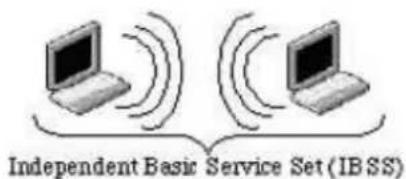
text_image
Independent Basic Service Set (IB SS)Example 2: wireless Ad Hoc Mode
5.5 What is BSSID?
A six-byte address is that distinguish a particular a particular access point from others. Also know as just SSID. Serve as a network ID or name.
5.6 What is ESSID?
The Extended Service Set ID (ESSID) is the name of the network you want to access. It is used to identify different wireless networks.
5.7 What are potential factors that may causes interference?
Factors of interference:
√ Obstacles: walls, ceilings, furniture... etc.
√ Building Materials: metal door, aluminum studs.
√ Electrical devices: microwaves, monitors and electrical motors.
Solutions to overcome the interferences:
√ Minimizing the number of walls and ceilings.
√ Position the WLAN antenna for best reception.
√ Keep WLAN devices away from other electrical devices, eg: microwaves, monitors, electric motors...etc.
√ Add additional WLAN Access Points if necessary.
5.8 What are the Open System and Shared Key authentications?
IEEE 802.11 supports two subtypes of network authentication services: open system and shared key.
Under open system authentication, any wireless station can request authentication. The station that needs to authenticate with another wireless station sends an authentication management frame that contains the identity of the sending station. The receiving station then returns a frame that indicates whether it recognizes the sending station. Under shared key authentication, each wireless station is assumed to have received a secret shared key over a secure channel that is independent from the 802.11 wireless network communications channel.
5.9 What is WEP?
An option of IEEE 802.11 function is that offers frame transmission privacy similar to a wired network.
The Wired Equivalent Privacy generates secret shared encryption keys that both source and destination stations can use to alert frame bits to avoid disclosure to eavesdroppers.
WEP relies on a secret key that is shared between a mobile station (e.g. a laptop with a wireless Ethernet card) and an access point (i.e. a base station). The secret key is used to encrypt packets before they are transmitted, and an integrity check is used to ensure that packets are not modified in transit.
5.10 What is Fragment Threshold?
The proposed protocol uses the frame fragmentation mechanism defined in IEEE 802.11 to achieve parallel transmissions. A large data frame is fragmented into several fragments each of size equal to fragment threshold. By tuning the fragment threshold value, we can get varying fragment sizes. The determination of an efficient fragment threshold is an important issue in this scheme. If the fragment threshold is small, the overlap part of the master and parallel transmissions is large. This means the spatial reuse ratio of parallel transmissions is high. In contrast, with a large fragment threshold, the overlap is small and the spatial reuse ratio is low. However high fragment threshold leads to low fragment overhead. Hence there is a trade-off between spatial re-use and fragment overhead.
Fragment threshold is the maximum packet size used for fragmentation. Packets larger than the size programmed in this field will be fragmented.
If you find that your corrupted packets or asymmetric packet reception (all send packets, for example). You may want to try lowering your fragmentation threshold. This will cause packets to be broken into smaller fragments. These small fragments, if corrupted, can be resent faster than a larger fragment.
Fragmentation increases overhead, so you'll want to keep this value as close to the maximum value as possible.
5.11 What is RTS (Request to Send) Threshold?
The RTS threshold is the packet size at which packet transmission is governed by the RTS/CTS transaction. The IEEE 802.11-1997 standard allows for short packets to be transmitted without RTS/CTS transactions. Each station can have a different RTS threshold. RTS/CTS is used when the data packet size exceeds the defined RTS threshold. With the CSMA/CA transmission mechanism, the transmitting station sends out an RTS packet to the receiving station, and waits for the receiving station to send back a CTS (Clear to Send) packet before sending the actual packet data.
This setting is useful for networks with many clients. With many clients, and a high network load, there will be many more collisions. By lowering the RTS threshold, there may be fewer collisions, and performance should improve. Basically, with a faster RTS threshold, the system can recover from problems faster. RTS packets consume valuable bandwidth, however, so setting this value too low will limit performance.
5.12 What is Beacon Interval?
In addition to data frames that carry information from higher layers, 802.11 include management and control frames that support data transfer. The beacon frame, which is a type of management frame, provides the "heartbeat" of a wireless LAN, enabling stations to establish and maintain communications in an orderly fashion.
Beacon Interval represents the amount of time between beacon transmissions. Before a station enters power save mode, the station needs the beacon interval to know when to wake up to receive the beacon (and learn whether there are buffered frames at the access point).
5.13 What is Preamble Type?
There are two preamble types defined in IEEE 802.11 specification. A long preamble basically gives the decoder more time to process the preamble. All 802.11 devices support a long preamble. The short preamble is designed to improve efficiency (for example, for VoIP systems). The difference between the two is in the Synchronization field. The long preamble is 128 bits, and the short is 56 bit
5.14 What is SSID Broadcast?
Broadcast of SSID is done in access points by the beacon. This announces your access point (including various bits of information about it) to the wireless world around it. By disabling that feature, the SSID configured in the client must match the SSID of the access point.
Some wireless devices don't work properly if SSID isn't broadcast (for example the D-link DWL-120 USB 802.11b adapter). Generally if your client hardware supports operation with SSID disabled, it's not a bad idea to run that way to enhance network security. However it's no replacement for WEP, MAC filtering or other protections.
5.15 What is Wi-Fi Protected Access (WPA)?
Wi-Fi's original security mechanism, Wired Equivalent Privacy (WEP), has been viewed as insufficient for securing confidential business communications. A longer-term solution, the IEEE 802.11i standard, is under development. However, since the IEEE 802.11i standard is not expected to be published until the end of 2003, several members of the WI-Fi Alliance teamed up with members of the IEEE 802.11i task group to develop a significant near-term enhancement to Wi-Fi security. Together, this team developed Wi-Fi Protected Access.
To upgrade a WLAN network to support WPA, Access Points will require a WPA software upgrade. Clients will require a software upgrade for the network interface card, and possibly a software update for the operating system. For enterprise networks, an authentication server, typically one that supports RADIUS and the selected EAP authentication protocol, will be added to the network.
5.16 What is WPA2?
It is the second generation of WPA. WPA2 is based on the final IEEE 802.11i amendment to the 802.11 standard.
5.17 What is 802.1x Authentication?
802.1x is a framework for authenticated MAC-level access control, defines Extensible Authentication Protocol (EAP) over LANs (WAPOL). The standard encapsulates and leverages much of EAP, which was defined for dial-up authentication with Point-to-Point Protocol in RFC 2284.
Beyond encapsulating EAP packets, the 802.1x standard also defines EAPOL messages that convey the shared key information critical for wireless security.
5.18 What is Temporal Key Integrity Protocol (TKIP)?
The Temporal Key Integrity Protocol, pronounced tee-kip, is part of the IEEE 802.11i encryption standard for wireless LANs. TKIP is the next generation of WEP, the Wired Equivalency Protocol, which is used to secure 802.11 wireless LANs. TKIP provides per-packet key mixing, a message integrity check and a re-keying mechanism, thus fixing the flaws of WEP.
5.19 What is Advanced Encryption Standard (AES)?
Security issues are a major concern for wireless LANs, AES is the U.S. government's next-generation cryptography algorithm, which will replace DES and 3DES.
5.20 What is Inter-Access Point Protocol (IAPP)?
The IEEE 802.11f Inter-Access Point Protocol (IAPP) supports Access Point Vendor interoperability, enabling roaming of 802.11 Stations within IP subnet.
IAPP defines messages and data to be exchanged between Access Points and between the IAPP and high layer management entities to support roaming. The IAPP protocol uses TCP for inter-Access Point communication and UDP for RADIUS request/response exchanges. It also uses Layer 2 frames to update the forwarding tables of Layer 2 devices.
5.21 What is Wireless Distribution System (WDS)?
The Wireless Distribution System feature allows WLAN AP to talk directly to other APs via wireless channel, like the wireless bridge or repeater service.
5.22 What is Universal Plug and Play (uPNP)?
UPnP is an open networking architecture that consists of services, devices, and control points. The ultimate goal is to allow data communication among all UPnP devices regardless of media, operating system, programming language, and wired/wireless connection.
5.23 What is Maximum Transmission Unit (MTU) Size?
Maximum Transmission Unit (MTU) indicates the network stack of any packet is larger than this value will be fragmented before the transmission. During the PPP negotiation, the peer of the PPP connection will indicate its MRU and will be accepted. The actual MTU of the PPP connection will be set to the smaller one of MTU and the peer's MRU.
5.24 What is Clone MAC Address?
Clone MAC address is designed for your special application that request the clients to register to a server machine with one identified MAC address. Since that all the clients will communicate outside world through the WLAN Broadband Router, so have the cloned MAC address set on the WLAN Broadband Router will solve the issue.
5.25 What is DDNS?
DDNS is the abbreviation of Dynamic Domain Name Server. It is designed for user owned the DNS server with dynamic WAN IP address.
5.26 What is NTP Client?
NTP client is designed for fetching the current timestamp from internet via Network Time protocol. User can specify time zone, NTP server IP address.
5.27 What is VPN?
VPN is the abbreviation of Virtual Private Network. It is designed for creating point-to point private link via shared or public network.
5.28 What is IPSEC?
IPSEC is the abbreviation of IP Security. It is used to transferring data securely under VPN.
5.29 What is WLAN Block Relay between Clients?
An Infrastructure Basic Service Set is a BSS with a component called an Access Point (AP). The access point provides a local relay function for the BSS. All stations in the BSS communicate with the access point and no longer communicate directly. All frames are relayed between stations by the access point.
This local relay function effectively doubles the range of the IBSS.
5.30 What is WMM?
WMM is based on a subset of the IEEE 802.11e WLAN QoS draft standard. WMM adds prioritized capabilities to Wi-Fi networks and optimizes their performance when multiple concurring applications, each with different latency and throughput requirements, compete for network resources. By using WMM, end-user satisfaction is maintained in a wider variety of environments and traffic conditions. WMM makes it possible for home network users and enterprise network managers to decide which data streams are most important and assign them a higher traffic priority.
5.31 What is WLAN ACK TIMEOUT?
ACK frame has to receive ACK timeout frame. If remote does not receive in specified period, it will be retransmitted.
5.32 What is Modulation Coding Scheme (MCS)?
MCS is Wireless link data rate for 802.11n. The throughput/range performance of an AP will depend on its implementation of coding schemes. MCS includes variables such as the number of spatial streams modulation, and the data rate on each stream. Radios establishing and maintaining a link must automatically negotiate the optimum MCS based on channel conditions and then continuously adjust the selection of MCS as conditions change due to interference, motion, fading, and other events.
5.33 What is Frame Aggregation?
Every 802.11 packet, no matter how small, has a fixed amount of overhead associated with it. Frame Aggregation combines multiple smaller packets together to form one larger packet. The larger packet can be sent without the overhead of the individual packets. This technique helps improve the efficiency of the 802.11n radio allowing more end user data to be sent in a given time.
5.34 What is Guard Intervals (GI)?
. A GI is a period of time between symbol transmissions that allows reflections (from multipath) from the previous data transmission to settle before transmitting a new symbol. The 802.11n draft specifies two guard intervals: 400ns (short) and 800ns (long). Support of the 400ns GI is optional for transmit and receive. The purpose of a guard interval is to introduce immunity to propagation delays, echoes, and reflections to which digital data is normally very sensitive.