 ManualGo.com
VPL-CS7 - Projector SONY - Free user manual and instructions
Find the device manual for free VPL-CS7 SONY in PDF.



Download the instructions for your Projector in PDF format for free! Find your manual VPL-CS7 - SONY and take your electronic device back in hand. On this page are published all the documents necessary for the use of your device. VPL-CS7 by SONY.
USER MANUAL VPL-CS7 SONY
VPL-CS7 VPL-ES2 2004 Sony Corporation About the Quick Reference Manual This Quick Reference Manual explains the connections and basic operations of this unit, and gives notes on operations and information required for maintenance. For details on the operations, refer to the Operating Instructions contained in the supplied CD-ROM. For safety precautions, refer to the separate “Safety Regulations.” Using the CD-ROM Manuals The supplied CD-ROM contains Operating Instructions and ReadMe file in Japanese, English, French, German, Italian, Spanish and Chinese. First, refer to the ReadMe file. Preparations To read the Operating Instructions in the CD-ROM, Adobe Acrobat Reader 5.0 or later is required. If the Adobe Acrobat Reader is not installed in your computer, you can download free Acrobat Reader software from URL of Adobe Systems. To read the Operating Instructions The Operating Instructions are contained in the supplied CD-ROM. Insert the supplied CD-ROM into the CD-ROM drive of your computer, and the CD-ROM will start automatically after a while. Select the Operating Instructions you want to read. The CD-ROM may not start automatically depending on the computer. In this case, open the Operating Instructions file as follows: (In case of Windows) 1 Open “My Computer.” 2 Right-click the CD-ROM icon and select “Explorer.” 3 Double-click “index.htm” file and select the Operating Instructions you want to read. (In case of Macintosh) 1 Double-click the CD-ROM icon on the desk top. 2 Double-click “index.htm” file and select the Operating Instructions you want to read. Note If you cannot open “index.htm” file, double-click on the Operating Instructions you want to read from among those in “Operating_Instructions” folder. On trademarks
- Windows is a registered trademark of Microsoft Corporation in the United States and/or other countries.
- Macintosh is a registered trademark of Apple Computer, Inc. in the United States and/or other countries.
- Adobe and Acrobat Reader is a registered trademark of Adobe Systems Incorporated in the United States and/or other countries.
About the Quick Reference Manual / Using the CD-ROM Manuals Table of Contents Notes on Use Note on the Ventilation Holes Do not block ventilation holes (exhaust/ intake). If they are blocked, internal heat may build up and cause fire or damage to the unit. Check the positions of the ventilation holes shown in the following illustrations. For other precautions, read the separate “Safety Regulations” carefully.
Ventilation holes (exhaust) Indicators Remote control detector Ventilation holes (intake) Note on the Power Cord Use a proper power cord for your local power supply. Plug type Connector type Cord type Rated voltage/ Current Safety approval Cord length (max.) The United States, Canada Continental Europe VM0233 VM0089 SJT 10A/125V COX-07 COX-02 H05VV-F 10A/250V VDE VDE 290B 386A SJT 10A/125V UL/CSA UL/CSA
4.5 m (14 feet 9 inches)
UK, Ireland, Australia, New Zealand _1) VM0310B N13237/CO-228 10A/250V VDE
1) Use an appropriate rating plug which is applied to local regulations.
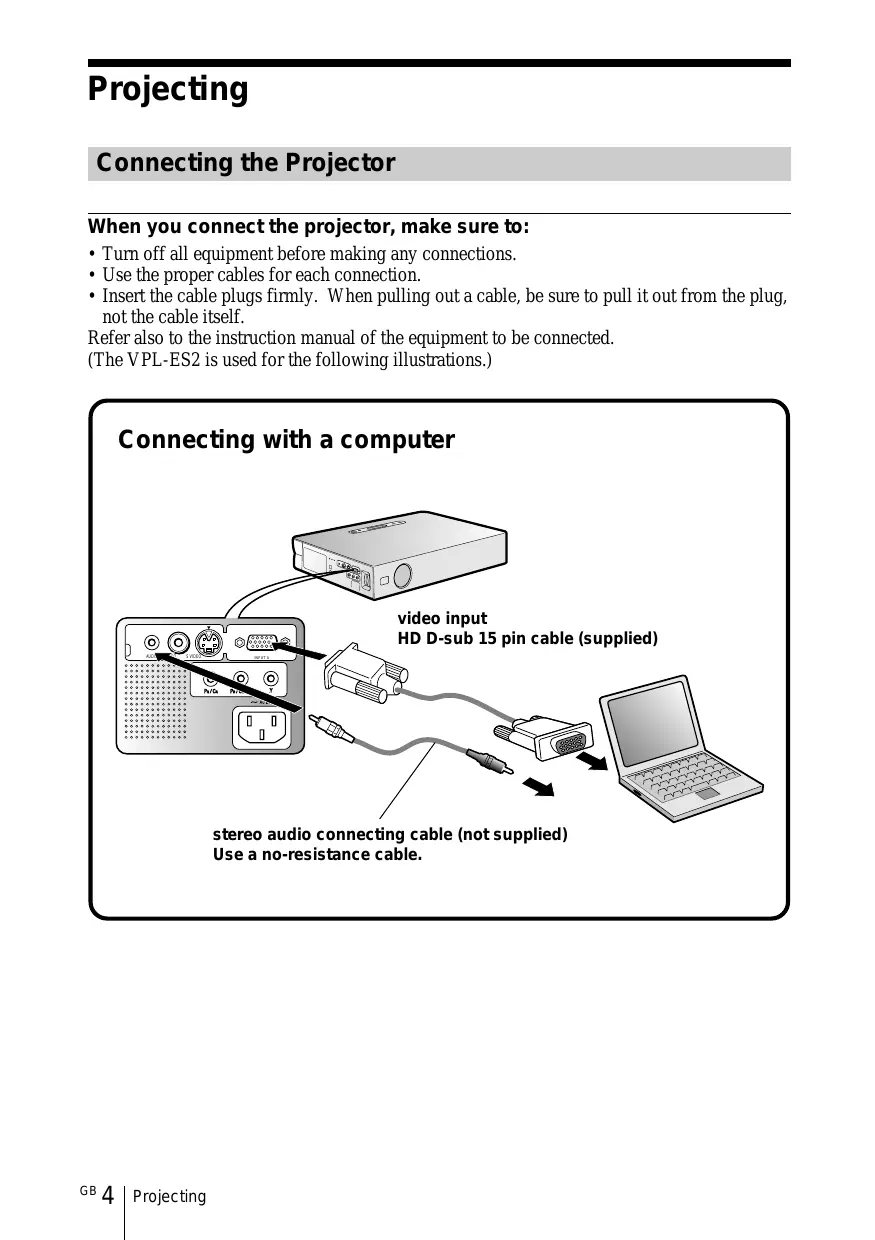
Table of Contents / Notes on Use 3 GB Projecting Connecting the Projector When you connect the projector, make sure to:
- Turn off all equipment before making any connections.
- Use the proper cables for each connection.
- Insert the cable plugs firmly. When pulling out a cable, be sure to pull it out from the plug, not the cable itself. Refer also to the instruction manual of the equipment to be connected. (The VPL-ES2 is used for the following illustrations.) Connecting with a computer video input HD D-sub 15 pin cable (supplied) AUDIO VIDEO S VIDEO INPUT A stereo audio connecting cable (not supplied) Use a no-resistance cable.
Projecting Connecting with a VCR/DVD player AUDIO VIDEO S VIDEO INPUT A
stereo audio connecting cable (not supplied) Use a no-resistance cable. For video signal connections, the following four connecting options are available: 1 Composite video (phono plug)* cable (not supplied) 2 S video (Mini DIN 4-pin)* cable (not supplied) 3 Component (3 × phono plug)* (VPL-ES2 only) cable (not supplied) (Use a 75 Ω coaxial cable) 4 Component (D-sub 15-pin y 3 × phono plug)* cable (not supplied) If connection 4 is made, select the input signal with the “Input-A Signal Sel.” in the SET SETTING menu. For details, see the Operating Instructions contained in the CD-ROM. Projecting 5 GB Projecting Before connecting the equipments, plug the AC power cord into a wall outlet. 1 Press the I/1 (on/standby) key. 2 Turn on the equipment connected to the projector. 3 Press the INPUT key to select the input source. 4 When the computer is connected, set it to output the signal to only the external monitor.
Projecting Adjusting the Projector 1 Adjust the position of the picture. 2 Adjust the size of the picture. 3 Adjust the focus. The projector is equipped with the PICTURE SETTING menu to select the picture mode, and the INPUT SETTING menu to select the appropriate aspect ratio of the picture. For details, see the Operating Instructions contained in the CD-ROM.
TILT Focus Zoom Turning off the Power 1 Press the I/1 (on/standby) key. 2 When a message appears, press the I/1 (on/standby) key again. 3 Unplug the AC power cord from the wall outlet after the fan has stopped running and the ON/STANDBY indicator has lit in red. Notes
- Do not unplug the AC power cord while the fan is still running. Doing this may cause damage to the unit. (VPL-ES2 only)
- The internal circuitry of the Off & Go function may cause the fan to continue to operate for a short time even after the I/1 key is pressed to turn off the power and the ON/STANDBY indicator changes to red. (VPL-CS7 only)
Projecting 7 GB Replacing the Lamp Notes
- Use LMP-E180 (VPL-CS7) / LMP-E150 (VPL-ES2) Projector Lamp as the replacement lamp. Use of any other lamps than the LMPE180 or the LMP-E150 may cause damage of the projector.
- Be sure to turn off the projector, and disconnect the AC power cord from the AC outlet before replacing the lamp. Note Caution The lamp becomes a high temperature after turning off the projector with the I/1 key. If you touch the lamp, you may scald your finger. When you replace the lamp, wait for at least an hour for the lamp to cool. For safety sake, do not loosen any other screws.
Loosen the two screws on the lamp unit with the Phillips screwdriver (1). Fold out the handle (2), pull out the lamp unit by the handle (3).
Insert the new lamp all the way in until it is securely in place. Tighten the two screws. Fold the handle. Notes
- If the lamp breaks, consult with customer service center.
- Pull out the lamp by holding the handle. If you touch the lamp, you may be burned or injured.
- When removing the lamp, make sure it remains horizontal, then pull straight up. Do not tilt the lamp. If you pull out the lamp while tilted and if the lamp breaks, the pieces may scatter, causing injury.
Turn off the projector, and disconnect the AC power cord from the AC outlet.
Place a protective sheet (cloth) beneath the projector. Turn the projector over so you can see its underside. Note Be sure that the projector is stable after turning it over.
Open the lamp cover by loosening a screw with the Phillips screwdriver. Replacing the Lamp Notes
- Be careful not to touch the glass surface of the lamp.
- The power will not turn on if the lamp is not secured properly.
Close the lamp cover and tighten the screws.
Turn the projector back over.
Connect the power cord. The ON/ STANDBY indicator around the I/1 key lights in red. Press the following keys on the remote commander in the following order for less than five seconds each: RESET, b, B, ENTER. Note Do not put your hands into the lamp replacement spot, or not fall any liquid or object into it to avoid electrical shock or fire Cleaning the Air Filter The air filter should be cleaned every 500 hours. Remove dust from the outside of the ventilation holes with a vacuum cleaner when the message “Please clean the filter” appears in the display. 500 hours are approximate. This value varies depending on the environment or how the projector is used. Disposal of the used lamp For the customers in the USA This product contains mercury. Disposal of this product may be regulated if sold in the Untied States. For disposal or recycling information, please contact your local authorities or Electronics Industries Alliance (http://www.eiae.org). When it becomes difficult to remove the dust from the filter with a vacuum cleaner, remove the air filter and wash it.
Turn off the power and unplug the power cord.
Place a protective sheet (cloth) beneath the projector and turn the projector over.
Remove the air filter cover. Cleaning the Air Filter 9 GB
Remove the air filter.
Wash the air filter with a mild detergent solution and dry it in a shaded place.
Attach the air filter and replace the cover. Notes
- If you neglect to clean the air filter, dust may accumulate, clogging it. As a result, the temperature may rise inside the unit, leading to a possible malfunction or fire.
- If the dust cannot be removed from the air filter, replace the air filter with the supplied new one.
- Be sure to attach the air filter cover firmly. Otherwise, dust may accumulate inside the projector, leading to a possible malfunction.
Cleaning the Air Filter Troubleshooting If the projector appears to be operating erratically, try to diagnose and correct the problem using the following instructions. If the problem persists, consult with qualified Sony personnel. For details on the symptoms, see the Operating Instructions contained in the CD-ROM. Messages Symptom The power is not turned on. Cause and Remedy
- The power has been turned off and on with the I/1 key at a short interval. c Wait for about 90 seconds before turning on the power.
- The lamp cover is detached. c Close the lamp cover securely. The powered tilt adjuster and the lens protector do not close.
- The AC power cord is unplugged with the power of the projector turned on. c Connect the power cord plug to the AC outlet again, then turn off the power of the projector. No picture.
- Cable is disconnected or the connections are wrong. c Check that the proper connections have been made.
- Connections have been made according to the incorrect procedures. c Check the proper procedures.
- Input selection is incorrect. c Select the input source correctly using the INPUT key.
- The computer signal is not set to output to an external monitor or set to output both to an external monitor and a LCD monitor of a computer. c Set the computer signal to output only to an external monitor. c Depending on the type of your computer, for example a notebook, or an all-in-one LCD type, you may have to switch the computer to output to the projector by pressing certain keys or by changing your computer’s settings. For details, refer to the computer’s operating instructions supplied with your computer.
- Noise may appear on the background depending on the combination of the numbers of dot input from the connector and numbers of pixel on the LCD panel. c Change the desktop pattern on the connected computer. The picture is noisy. The picture from INPUT A connector is colored strange.
- Setting of “Input-A Signal Sel.” in the SET SETTING menu is incorrect. c Select “Computer,” “Video GBR” or “Component” correctly according to the input signal. The picture is not clear.
- Picture is out of focus. c Adjust the focus.
- Condensation has occurred on the lens. c Leave the projector for about two hours with the power on. Troubleshooting 11 GB Symptom Cause and Remedy The image extends beyond the screen.
- The APA key is pressed although there are black edges around the image. c Display the full image on the screen and press the APA key. c Adjust “shift” in the INPUT SETTING menu properly. The picture flickers.
- “Dot Phase” in the INPUT SETTING menu has not been adjusted properly. c Adjust “Dot Phase” in the INPUT SETTING menu properly. Lights up when the projector is in power saving mode. TEMP/FAN Lights up when temperature inside the projector becomes unusually high. Check to see if anything is blocking the ventilation holes. Flashes when the fan is broken. Consult with qualified Sony personnel. LAMP/COVER Lights up when the lamp has reached the end of its life or becomes a high temperature. Wait for 90 seconds to cool down the lamp and turn on the power again, or replace the lamp. Flashes when the lamp cover is not secured firmly. Attach the cover securely. I /1 indicator Lights in red when a AC power cord is plugged into a wall outlet. Once in standby mode, you can turn on the projector with the I /1 key. Lights in green when the power is turned on. Flashes in green while the cooling fan runs after the power is turned off with the I /1 key. During this time, you will not be able to turn on the projector.
Troubleshooting Specifications Projection system 3 LCD panels, 1 lens, projection system LCD panel Superhigh-aperture 0.62-inch SVGA panel, 1,440,000 pixels (480,000 pixels × 3) Lens
1.2 times zoom lens (manual)
f 18.0 to 21.6 mm/F 2.2 to 2.4 Lamp
VPL-CS7: 185 W UHP
VPL-ES2: 157 W UHP
Projection picture size Range: 40 to 300 inches (diagonal measure) Light output VPL-CS7: 1800 ANSI1) lm VPL-ES2: 1500 ANSI1) lm (When the Lamp Mode is set to “High”) Throwing distance (When placing on the floor) When the SVGA signal is input: 40-inch: 1.1 to 1.4 m (3.6 to 4.6 feet) 60-inch: 1.7 to 2.1 m (5.6 to 6.9 feet) 80-inch: 2.3 to 2.8 m (7.5 to 9.2 feet) 100-inch: 2.9 to 3.5 m (9.5 to 11.5 feet) 120-inch: 3.5 to 4.2 m (11.5 to 13.8 feet) 150-inch: 4.4 to 5.3 m (14.4 to 17.4 feet) 200-inch: 5.9 to 7.0 m (19.4 to 28.9 feet) 300-inch: 8.8 to 10.6 m (23 to 34.8 feet) There may be a slight difference between the actual value and the design value shown above. Applicable video signals 15 kHz RGB/Component 50/60 Hz, Progressive Component 50/60 Hz, DTV (480/60i, 575/50i, 1080/60i, 480/60p, 575/50p, 1080/50i 720/60p, 720/50p, 540/ 60p), Composite video, Y/C video Dimensions 295 × 78 × 238 mm (11 5/8 × 3 1/8 × 9 3/8 inches) (w/h/d) (without the projection parts) Mass VPL-CS7: Approx. 2.9 kg (6 lb 6 oz) VPL-ES2: Approx. 2.8 kg (6 lb 3 oz) Power requirements AC 100 to 240 V, 50/60 Hz Power consumption VPL-CS7: Max. 250 W VPL-ES2: Max. 220 W (Standby mode: 4.6 W) Supplied accessories Remote Commander (1) Lithium battery CR2025 (1) HD D-sub 15 pin cable (2 m) (1) (1-791-992-21) Soft case (1) AC power cord (1) Air filter (for replacement) (1) Operating Instructions (CD-ROM) (1) Quick Reference Manual (1) Security Label (1) Design and specifications are subject to change without notice. Optional accessories Projector Lamp (for replacement) LMP-E180 (for VPL-CS7 only) LMP-E150 (for VPL-ES2 only) Signal Cable SMF-402 (HD D-sub 15-pin (male) y 3 × phono type (male)) Color systemNTSC3.58/PAL/SECAM/NTSC4.43/ PAL-M/PAL-N/PAL60 system, switched automatically/manually Acceptable computer signals2) fH: 19 to 72 kHz fV: 48 to 92 Hz (Maximum input signal resolution: XGA 1024 × 768 fV: 85 Hz)
1) ANSI lumen is a measuring method of American National Standard IT 7.228.
2) Set the resolution and the frequency of the signal of the connected computer within the range of
acceptable preset signals of the projector. For details, see the Operating Instructions contained in the CD-ROM. Specifications 13 GB YP332 YC-13 VCTF 7A/125V UL/CSA UL/CSA VDE VDE DENAN 4,5 m VDE
YP332 YC-13 VCTF 7A/125V UL/CSA UL/CSA VDE VDE DENAN 4,5 m VDE
YP332 YC-13 VCTF 7A/125V VDE VDE DENAN 290B 386A SJT 10A/125V Sony Corporation Printed in Japan