
DPP-EX50 - Photo printer SONY - Free user manual and instructions
Find the device manual for free DPP-EX50 SONY in PDF.


| Product Type | Digital photo printer with thermal sublimation |
| Brand and Model | Sony DPP-EX50 |
| Dimensions (W × H × D) | Approx. 83 × 199 × 290 mm (without protruding parts); depth with paper tray: approx. 400 mm |
| Weight | Approx. 2.05 kg (printer only) + 0.16 kg (paper tray) |
| Power Supply | 120 V AC, 50/60 Hz, 1 A (USA/Canada); 100-240 V AC, 50/60 Hz, 1.2-0.6 A (other countries) |
| Printing Method | Thermal sublimation (yellow/magenta/cyan, 3 passes) |
| Resolution | 403 × 403 dpi |
| Number of Colors | 256 levels per color, approx. 16.77 million colors |
| Print Sizes | Postcard (4 × 6 inches / 101.6 × 152.4 mm), 3.5 × 5 inches (89 × 127 mm), Small (3.5 × 4 inches / 71.7 × 95.5 mm) |
| Print Time per Sheet | Postcard: approx. 80 s; 3.5 × 5: approx. 70 s; Small: approx. 55 s (excluding data processing) |
| Compatible Image File Formats | JPEG (DCF, Exif 2.2, JFIF), TIFF (Exif 2.2), BMP (24-bit Windows) |
| Connectors | USB (1), PictBridge (1), VIDEO OUT (phono jack, 1 Vc-c, 75 ohms) |
| Memory Card Slots | Memory Stick (1), CompactFlash (1) |
| Main Functions | Auto Fine Print 3, Super Coat 2, red-eye correction, image filters (sepia, monochrome, painting, fish-eye), creative print (calendar, card, free layout, split images), slideshow, image search |
| Print Modes | MONITOR OUT (via TV), LCD (via printer screen), PictBridge (camera), PC (via computer) |
| Operating Temperature | 5 °C to 35 °C |
| Maintenance and Cleaning | Clean the casing with a soft dry or slightly damp cloth (mild detergent). Do not use alcohol or solvents. In case of paper jam, open the cover and gently remove the paper. Use the supplied cleaning cartridge. |
| Safety | Do not expose to rain or moisture. Unplug before cleaning. Do not open the casing (risk of electric shock). Leave ventilation spaces. Avoid electromagnetic fields. |
| Spare Parts and Reparability | Optional print packs (cartridge + paper) are available: SVM-25LS (postcard, 25 sheets), SVM-75LS (75 sheets), SVM-30MS (3.5×5, 30 sheets), SVM-30SS (Small, 30 sheets). Repairs should be entrusted to qualified personnel. |
| Supplied Accessories | Paper tray, video cable, CD-ROM (drivers and PictureGear Studio), cleaning cartridge, noise filter, quick start guide, instruction manual, warranty card, registration card |
Frequently Asked Questions - DPP-EX50 SONY
User questions about DPP-EX50 SONY
0 question about this device. Answer the ones you know or ask your own.
Ask a new question about this device
Download the instructions for your Photo printer in PDF format for free! Find your manual DPP-EX50 - SONY and take your electronic device back in hand. On this page are published all the documents necessary for the use of your device. DPP-EX50 by SONY.
USER MANUAL DPP-EX50 SONY
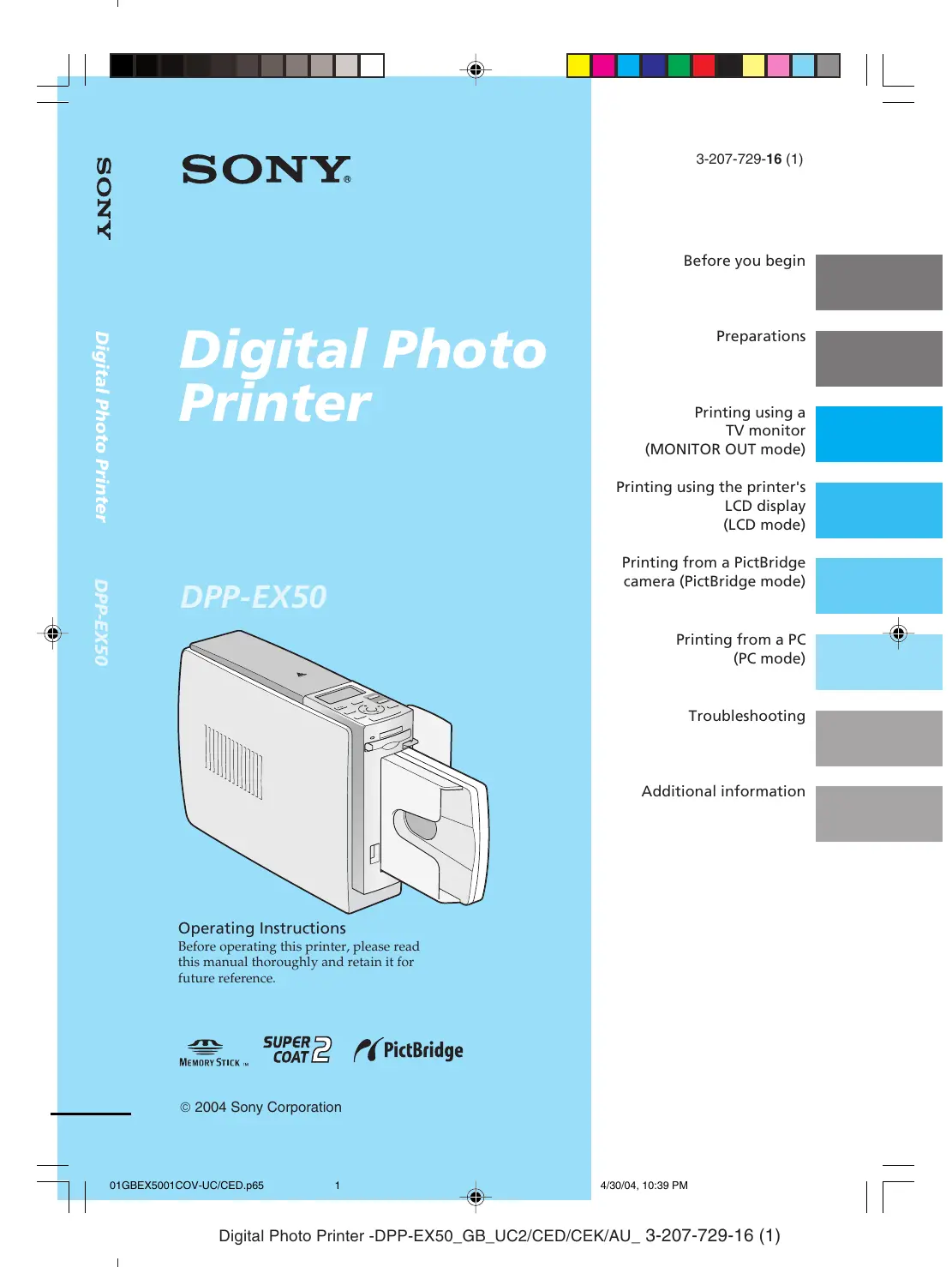
Digital Photo Printer
Before you begin
Preparations
Printing using a TV monitor (MONITOR OUT mode)
Printing using the printer's LCD display (LCD mode)
Printing from a PictBridge camera (PictBridge mode)
Printing from a PC (PC mode)
Troubleshooting
Additional information
DPP-EX50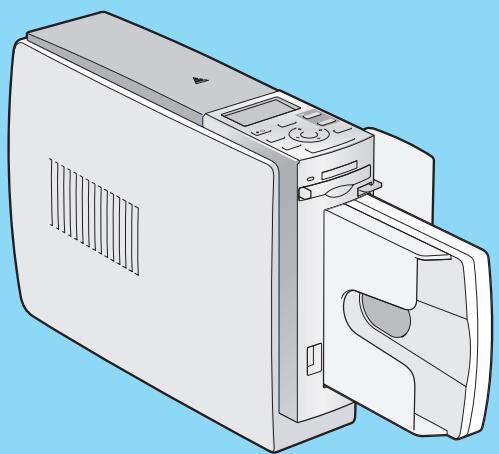
Operating Instructions Before operating this printer, please read this manual thoroughly and retain it for future reference.
WARNING
To prevent fire or shock hazard, do not expose the unit to rain or moisture.
To avoid electrical shock, do not open the cabinet. Refer servicing to qualified personnel only.
CAUTION
Pictures and/or sound distortion may occur if this product is positioned in close proximity to equipment emitting electromagnetic radiation.
CAUTION
Sony shall assume no responsibility for any accidental or consequential damages or loss of the recording contents which may be caused by use or malfunction of the printer or "Memory Stick".
Owner's Record
The model and serial numbers are located on the bottom. Record the serial number in the space provided below. Refer to these numbers whenever you call upon your Sony dealer regarding this product.
Model No. DPP-EX50
Serial No.
WARNING
This unit has no power switch.
When installing the unit, incorporate a readily accessible disconnect device in the fixed wiring, or connect the power cord to a socket-outlet which must be provided near the unit and easily accessible. If a fault should occur during operation of the unit, operate the disconnect device to switch the power supply off, or disconnect the power cord.
For the customers in the U.S.A.
WARNING
This equipment has been tested and found to comply with the limits for a Class B digital device, pursuant to Part 15 of the FCC Rules.
These limits are designed to provide reasonable protection against harmful interference in a residential installation. This equipment generates, uses, and can radiate radio frequency energy and, if not installed and used in accordance with the instructions, may cause harmful interference to radio communications. However, there is no guarantee that interference will not occur in a particular installation. If this equipment does cause harmful interference to radio or television reception, which can be determined by turning the equipment off and on, the user is encouraged to try to correct the interference by one or more of the following measures:
- Reorient or relocate the receiving antenna.
- Increase the separation between the equipment and receiver.
- Connect the equipment into an outlet on a circuit different from that to which the receiver is connected.
- Consult the dealer or an experienced radio/TV technician for help.
You are cautioned that any changes or modifications not expressly approved in this manual could void your authority to operate this equipment.
The shielded interface cable recommended in this manual must be used with this equipment in order to comply with the limits for a digital device pursuant to Subpart B of Part 15 of FCC Rules.
If you have any questions about this product, you may contact:
Sony's Customer Information Services Center (CISC) at 1-866-328-SONY (7669)
or Sony Web site at www.sony.com
Declaration of Conformity
Trade Name: SONY
Model No.: DPP-EX50
Responsible Party:
Sony Electronics Inc.
Address: 16450 W. Bernardo Dr, San
Diego, CA 92127 U.S.A.
Telephone No.: 858-942-2230
This device complies with part 15 of the FCC Rules. Operation is subject to the following two conditions:
(1) this device may not cause harmful interference, and (2) this device must accept any interference received, including interference that may cause undesired operation.
Duplication, editing, or printing of a CD, TV programs, copyrighted materials such as pictures or publications, or any other materials except for your own recording or creation is limited to private or domestic use only. Unless you hold copyright or have permission of copyright holders for the materials to be duplicated, use of those materials beyond this limit may infringe the provisions of the copyright law and be subject to the copyright holder's claim for damages.
When using photo images with this printer, pay special attention not to infringe the provisions of the copyright law. Any unauthorized use or modification of others' portraits may also infringe their rights.
For some demonstrations, performances, or exhibits, photography may be forbidden.
Backup recommendations
To avoid potential risk of data loss caused by accidental operation or malfunction of the printer, we recommend that you save a backup copy of your data.
Information
IN NO EVENT SHALL SELLER BE LIABLE FOR ANY DIRECT, INCIDENTAL OR CONSEQUENTIAL DAMAGES OF ANY NATURE, OR LOSSES OR EXPENSES RESULTING FROM ANY DEFECTIVE PRODUCT OR THE USE OF ANY PRODUCT.
On trademarks and copyrights
- VAIO is the trademark of Sony Corporation.
- Microsoft and Windows® are registered trademarks or trademarks of Microsoft Corporation in the United States and other countries.
- IBM and PC/AT are registered trademarks of International Business Machines Corporation.
- MMX and Pentium are registered trademarks of Intel Corporation.
- "Memory Stick", "=", "MagicGate Memory Stick", "Memory Stick Duo", "Memory Stick PRO" and "Memory Stick-ROM" are trademarks of Sony Corporation. "MagicGate" is the trademark of Sony Corporation.
- The raster process of true type fonts is based on the FreeType Team software.
- This software is based in part on the work of the independent JPEG Group.
- Libtiff Copyright © 1988-1997 Sam Leffler Copyright © 1991-1997 Silicon Graphics, Inc.
- Lib png Copyright © 1995, 1996 Guy Eric Schalnat, Group 42, Inc. Copyright © 1996, 1997 Andreas Dilger Copyright © 1998, 1999 Glenn Randers-Pehrson Zlib © 1995-2002 Jean-loup Gailly and Mark Adler
- This product uses "Exif Toolkit For Windows Ver.2.4 (Copyright © 1998 FUJI PHOTO FILM CO., LTD. All rights reserved)." Exif is the exchangeable image file format for digital still cameras specified by the JEIDA (Japan Electronics Industrial Development Association).
- All other companies and product names mentioned herein may be the trademarks or registered trademarks of their respective companies. Furthermore, "TM" and "®" are not mentioned in each case in this manual.
Notice for users
Program © 2004 Sony Corporation Documentation ©2004 Sony Corporation
All rights reserved. This manual or the software described herein, in whole or in part, may not be reproduced, translated or reduced to any machine readable form without prior written approval from Sony Corporation.
IN NO EVENT SHALL SONY CORPORATION BE LIABLE FOR ANY INCIDENTAL, CONSEQUENTIAL OR SPECIAL DAMAGES, WHETHER BASED ON TORT, CONTACT, OR OTHERWISE,ARISING OUT OF OR IN CONNECTION WITH THIS MANUAL, THE SOFTWARE OR OTHER INFORMATION CONTAINED HEREIN OR THE USE THEREOF.
By breaking the seal of the envelope of the CD-ROM package, you accept all the terms and conditions of this agreement. If you do not accept these terms and conditions, please return this disk envelope unopened, along with the rest of the package, immediately to the dealer where you obtained it.
Sony Corporation reserves the right to make any modification to this manual or the information contained herein at any time without notice.
The software described herein may also be governed by the terms of a separate user license agreement.
User Registration
To receive customer services, complete and return the registration card included in your package.
Any design data such as sample pictures provided in this software cannot be modified or duplicated except for the purpose of personal use. Any unauthorized duplication of this software is prohibited under copyright law. Please note that unauthorized duplication or modification of others' portraits or copyrighted work could infringe the rights reserved by right holders.
Table of contents
Before you begin
Overview 6
What you can do with this printer 6
Operation flows 8
Features 9
Preparations
1 Checking the contents of the package 11 2 Preparing the printing pack (not supplied) 12
Sizes of print paper 12
Optional printing packs 12
3 Loading the print cartridge 13 4 Inserting the print paper 15
Printing using a TV monitor (MONITOR OUT mode)
Connections 18 Connecting to a TV monitor 18 Connecting the AC power cord 19
Inserting a memory card 19
Inserting a "Memory Stick" 19 Inserting a CompactFlash card 20
Displaying the images on a TV monitor 20
Basic printing operations 22
Printing a selected image 22 Printing multiple images 24 AUTO printing (INDEX/DPOF/ALL) 27
Editing an image 30
Displaying the EDIT menu 31 Editing an image 32 Saving and printing the edited image.....40
Making various prints (Creative Print) .. 42 Displaying the Creative Print menu 43 Making a Creative print 43 Saving and printing a Creative print image 58 Changing the print settings (SET UP).... 60 Changing the printer preferences (OPTION) 63 Viewing a slideshow 65 Deleting images 67 Deleting selected images 67 Formatting a "Memory Stick" 69 Searching for an image 69
Printing using the printer's LCD display (LCD mode)
Connections 72 Connecting the AC power cord 72 Inserting a memory card 73 Inserting a "Memory Stick" 73 Inserting a CompactFlash card 73 Printing images 74 Printing a selected image 74 AUTO printing (INDEX/DPOF/ALL) 76 Changing the print settings 79
Printing from a PictBridge camera (PictBridge mode)
Printing images from the digital camera 81 Changing the print settings 83
Printing from a PC (PC mode)
Installing the software 85
System requirements 85 Installing the printer driver 87 Installing the PictureGear Studio 92
Printing photos from the PictureGear Studio 96
Printing from other application software 102
Troubleshooting
If trouble occurs 104 If an error message appears 120 If paper jams 124 Cleaning the inside of the printer 124
Additional information
Precautions 126 About the "Memory Stick" 127
What is "Memory Stick"? 127 Types of "Memory Stick" 127 Types of "Memory Stick" that the printer can use 128 Notes on use 129
About the CompactFlash card 130 Notes on use 130 Specifications 131 Printing range 133 Glossary 135 Lists of templates and patterns in Creative Print (MONITOR OUT mode only) 136 Identifying the parts 139 Index 141
Overview
What you can do with this printer
The Digital Photo Printer DPP-EX50 provides the following four operation modes, depending on the medium or device you use for printing.
When you print an image on a "Memory Stick" or a CompactFlash card
Printing using a TV monitor (MONITOR OUT mode) -> Page 18
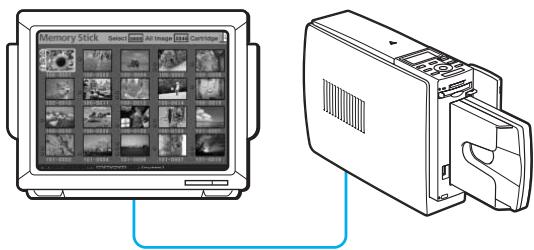
Connect the printer to a TV monitor to view the images and monitor operations for printing an image. You can enjoy a variety of printing and editing features.
A variety of prints you can make
Basic one-image prints (p.22)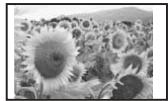
INDEX/DPOF/ALL prints (p.27)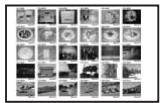
Enlarged/Reduced/Moved/Rotated image prints (p.32, 33)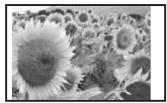
Superimposed images (p.36)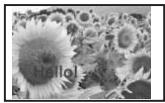
Free layout prints (p.43)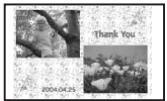
Calendar prints (p.50)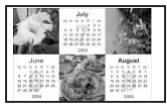
Card prints (p.53)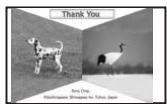
Split image prints (p.56)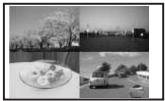
When you print an image on a "Memory Stick" or a CompactFlash card
Printing using the printer's LCD display (LCD mode) → Page 72
Print images while checking the image number and conduct operations on the printer's LCD display.
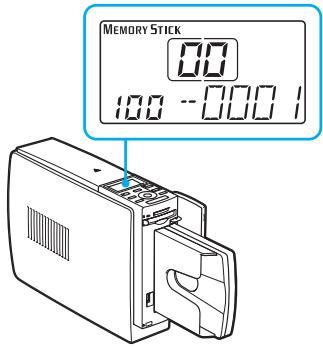
Prints you can make
Basic one-image prints (p.74)
INDEX/DPOF/ALL prints (p.76)
Printing from a PictBridge camera (PictBridge mode)
→ Page 81
Connect a PictBridge-compliant digital camera to the printer to print images using the camera.
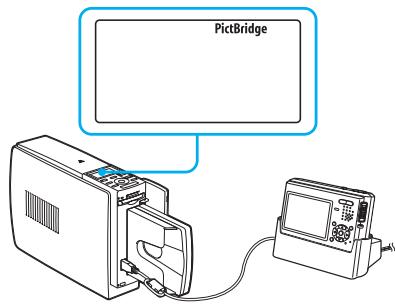
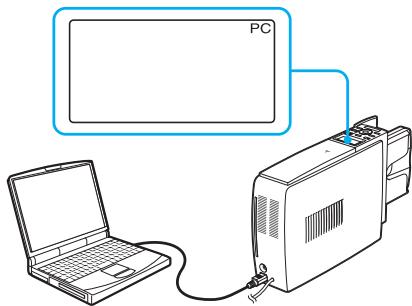
Printing from a PC
(PC mode) → Page 85
Connect the printer to your computer to print images using the computer.
Operation flows
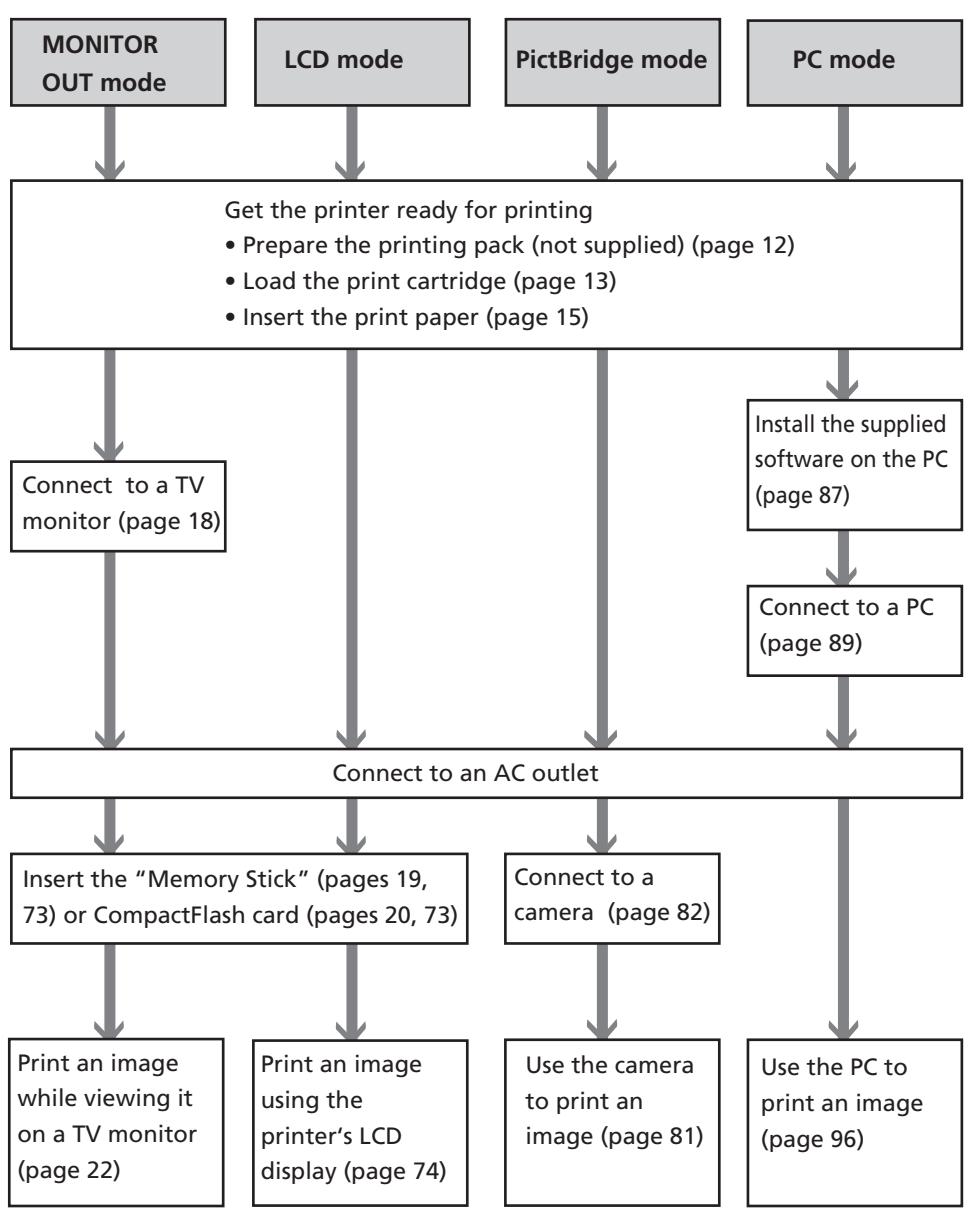
Depending on the operation mode you choose, follow the operation flow below:
Features
Supreme picture quality functions enabling photo-realistic printing
High performance heat-resistant technology for dye sublimation printing
The printer employs the professional dye sublimation printing systems. With its professional digital filter, the printer eliminates color deterioration that may occur because of the heated head, and reproduces photo-realistic prints.
Super Coat 2
The Super Coat 2 feature enables high durability and moisture or fingerprint resistance, keeping your prints in good condition for an extended period of time.
Auto Fine Print 3
The Auto Fine Print 3 analyses the picture information of an image, including the Exif data, and corrects the resulting picture. You can select a correction option from "Vivid" to improve the vividness of an image, or "Photographical" to make an image look more natural and beautiful. Thanks to the heat-resistance process and a high-speed CPU, Auto Fine Print 3 realizes even higher-definition reproduction and quicker adjustments than the previous Auto Fine Print 2 could.
Exif 2.2* (Exif Print) support (page 61)
Exif Print
- The printer supports Exif 2.2. Coupled with the Auto Fine Print 3 feature, the printer automatically adjusts an image of an Exif Print-compliant digital camera and prints it with optimal picture quality.
- When you use the supplied PictureGear Studio software to print an image from your PC, you can choose Exif Print picture correction in addition to the conventional OS picture correction. In Exif Print correction, the supplied printer driver uses the Exif data of an image and the printer's color processing to adjust and reproduce an image with supreme picture quality.
Red-eye reduction and other adjustments (MONITOR OUT/PC modes only, page 35)
You can adjust an image to reduce the red-eye phenomenon that may occur when the subject was shot with flash. Adjustments of brightness, hue, and other elements of picture quality are also possible.
Convenient printing operations
High-speed CPU enabling quick adjustment and printing
The printer employs a high-speed CPU, which allows you to process, preview, and print an image quickly.
3D animation interface (MONITOR OUT mode only)
The printer's 3D animation interface will allow you to figure out the next step easily, learn what the icon or cursor means, and enjoy operating the printer.
Paper tray allowing bulk printing of 25/30 sheets (page 15)
With the supplied paper tray, you can print up to 25 sheets for Post Card size and 30 sheets for 3.5 x 5 inch size or Small size print paper, at one time.
Versatile printing
A choice of print sizes (page 12)
You can select from Post Card size, 3.5 x 5 inch size, and Small size prints.
Border or borderless prints (page 61)
You can select a borderless or border print for the Post Card and 3.5 x 5 inch size prints.
A choice of print finish (page 61)
You can select from either glossy or texture print finish.
A wide variety of image filters (MONITOR OUT mode only, page 34)
A variety of image processing functions allows you to add a special effect to the picture to produce sepia, monochrome, or paint effects. By applying the GUI 3D engine to the printing data process, you can enjoy the look of a fish-eye filter or other interesting 3D print effects.
Slideshow feature (MONITOR OUT mode only, page 65)
You can view a slide show of the images on the memory card. You can also print the image displayed on the monitor.
PictBridge-compliant** (page 81) PictBridge
The printer supports the PictBridge standard, so that you can print an image easily from a PictBridge-compliant digital camera.
Windows PC support with a convenient USB connection (page 85)
By connecting the printer to your computer via a USB connector and installing the supplied printer driver, you can print images from your computer.
This section explains how to prepare your printer. Follow the procedures in this section to get the printer ready for printing.
1 Checking the contents of the package (this page)

2 Prepare the printing pack (not supplied) (page 12)

3 Loading the print cartridge (page 13)

4 Inserting the print paper (page 15)
After you finish preparations, read the explanations for each operation mode (pages 6 to 7) to print an image.
1 Checking the contents of the package
Make sure that the following accessories are supplied with your printer.
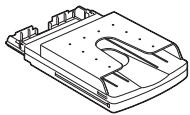
Paper tray (1)
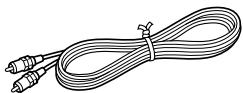
Video connecting cable (1)
CD-ROM (1)
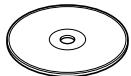
- Sony DPP-EX50 Printer Driver Software for Windows® 98SE/ Me/2000 Professional/XP Home Edition/XP Professional
- PictureGear Studio V.2.0
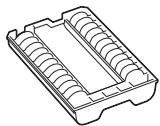
Cleaning cartridge (1)
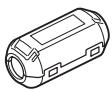
Clamp filter (1)
- Operating Instructions (this booklet, 1)
- Quick Start Guide (1) Warranty (1)
- Owner registration card (1)
- Sony End User Software License Agreement (1)
2 Preparing the printing pack (not supplied)
To print an image, you need an optional printing pack designed for the printer. The pack contains a set of print paper and a print cartridge.
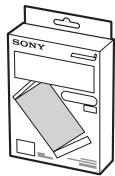
Sizes of print paper
You can select the print paper from the following three sizes:
Post card (4 x 6 inch) size - 3.5 x 5 inch size - Small (3.5 x 4 inch) size
Optional printing packs
Select the printing pack according to the type of printing you intend to do:
For post card size printing:
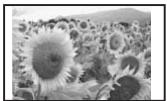
SVM-25LS
- 25 sheets of Post Card size photo paper
- Print cartridge for 25 prints
SVM-75LS
- 3 packages of 25 sheets of Post Card size photo paper
- 3 print cartridges each for 25 prints
For 3.5 x 5 inch size printing:
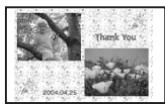
=> SVM-30MS
- 30 sheets of 3.5 x 5 inch size photo paper
- Print cartridge for 30 prints
For Small size printing:
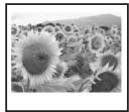
=> SVM-30SS
- 30 sheets of Small size photo paper
- Print cartridge for 30 prints
To order printing packs, visit the following web site:
www.sony.com/printers
Notes
- Use the printing pack for this printer only.
- For high quality prints, avoid placing the printing pack in locations that are subject to high temperature, high humidity, excessive dust, or direct sunlight.
- When storing a partially-used pack of the print cartridge and print paper, store it in its original bag or in a similar container.
3 Loading the print cartridge
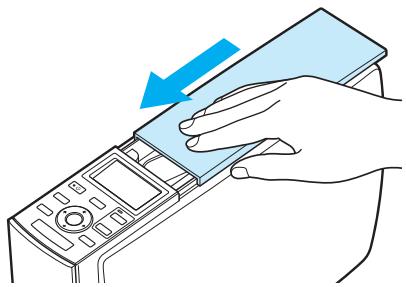
1 Slide open the cartridge compartment cover.
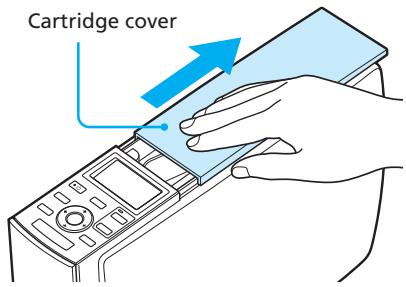
2 Insert the print cartridge.
Insert the print cartridge, with the Sony logo side up, until it clicks into place.
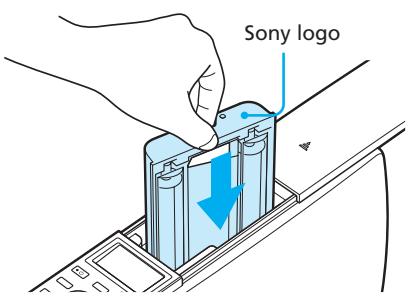
3 Close the cartridge compartment cover.
Removing the print cartridge
When the print cartridge runs out, the (cartridge error) indicator appears on the printer's LCD display.
Open the cartridge compartment cover, push the green eject lever outsides, and remove the used print cartridge.
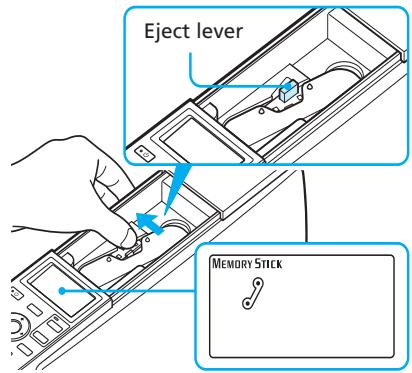
Notes
- Do not touch the ink ribbon or place the print cartridge in a dusty location. Fingerprints or dust on the ink ribbon may result in imperfect printing.
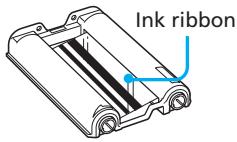
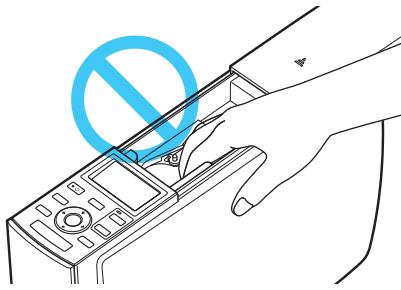
- Never put your hand into the cartridge compartment. The thermal head reaches high temperatures, especially after repeated printing.
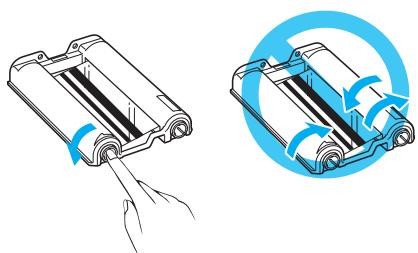
- Do not rewind the ink ribbon and use the rewound print cartridge for printing. Otherwise, proper printing result will not be obtained, or even a malfunction may occur.
- If the print cartridge does not click into place, remove it and then re-insert it. If the ink ribbon is too slack to be loaded, wind the ink ribbon in the direction of the arrow to remove the slack.
- Do not remove the print cartridge while printing.
Notes on storing the print cartridge
- Avoid placing the print cartridge in a location subject to high temperatures, high humidity, excessive dust or direct sunlight.
- When you are going to store a partially-used cartridge, store it in its original bag.
4 Inserting the print paper
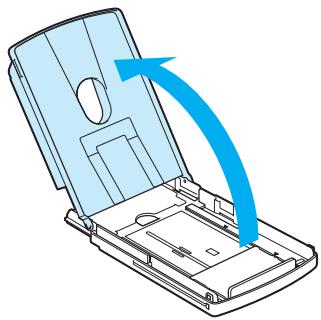
1 Open the paper tray cover.
2 Adjust the spacer to the paper size you want to use.
On the bottom inside of the paper tray, there are three arrow markers showing the slider stopper positions for the three paper sizes.
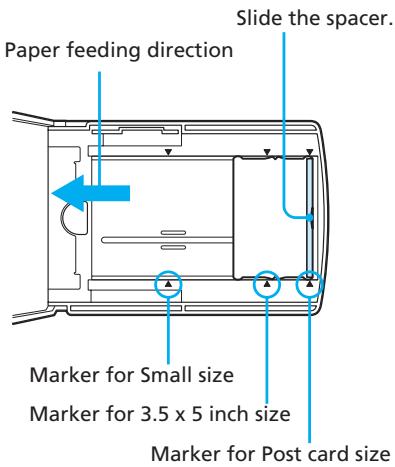
To use Post Card size print paper
Slide the spacer towards outsides until it clicks into place at the most outside arrow marker.
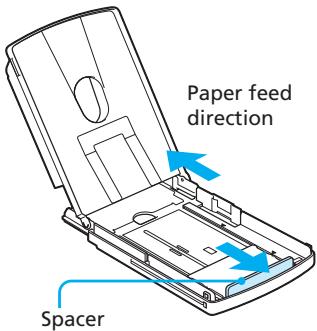
To use 3.5 x 5 inch size print paper
Slide the spacer toward the paper feed direction until it clicks into place at the middle arrow marker.
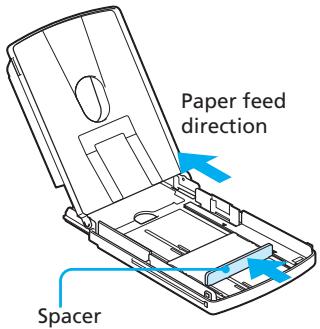
To use Small size paper
Slide the spacer toward the paper feed direction until it clicks into place at the most inside arrow marker.
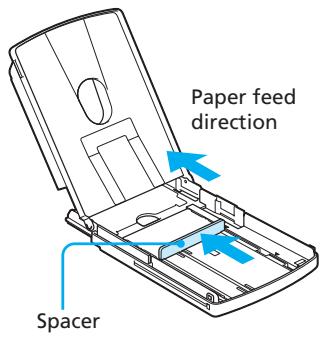
Note
Make sure to adjust the slider to the paper size before you install the print paper. If you insert the print paper and then adjust the spacer, a trouble may occur.
3 Set the print paper into the tray.
Riffle the print paper. Then insert the print paper and the protection sheet together with its printing surface (the side with no imprint) facing up and the arrow pointing to the paper feed direction.
You can set up to 25 sheets for Post Card size and 30 sheets for 3.5 x 5 inch size or Small size print paper.
Printing surface Arrows pointing the feed direction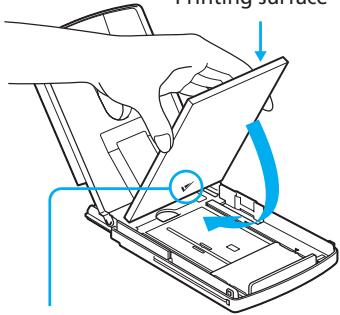
Note
Do not touch the printing surface. Fingerprints on the printing surface may result in imperfect printing.
4 Remove the protective sheet.
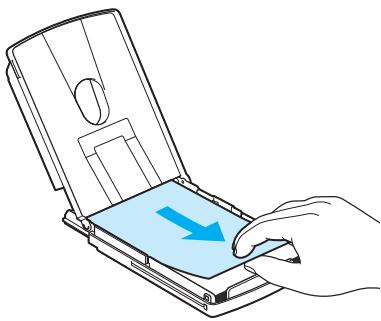
Note
You can use the protective sheet as cleaning sheet. Make sure to keep it together with the supplied cleaning cartridge. (page 124)
5 Close the paper tray cover.
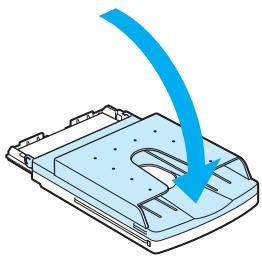
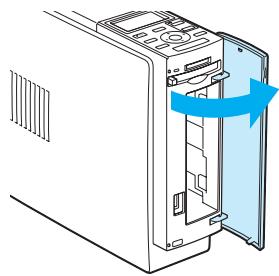
6 Push and open the printer's paper tray compartment cover.
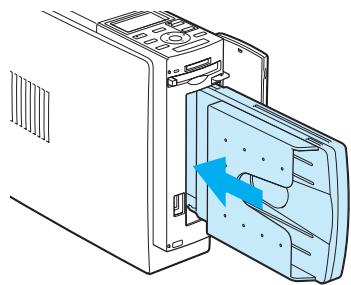
7 Insert the paper tray into the printer.
Insert it firmly until it clicks into place.
Notes
- Do not remove the paper tray during printing.
- To avoid paper jam or malfunctions of the printer, make sure the following before printing:
- Do not write or type on the print paper. Use an oil-based ink pen to write on the paper after printing. You cannot type on the print paper.
- Do not attach stickers or stamps to the print paper.
- Do not hold or bend the print paper.
- When adding print paper to a partially full tray, ensure that the total number of sheets does not exceed 25 for Post Card size, or 30 for 3.5 x 5 inch size and Small size print paper.
- Do not place different types or sizes of paper in the tray.
- Do not print on used print paper. Printing an image twice on the same paper will not make the printed image thicker.
- Use the print paper for this printer only.
- Do not use print paper that has been ejected without being printed on.
Notes on storing the print paper
- Avoid storing the paper with the printed faces touching each other or in contact with rubber or plastic products, including vinyl chloride or plasticizer, for an extended period of time; color changes or deterioration of the printed image may occur.
- Avoid placing the print paper in a location subject to high temperatures, high humidity, excessive dust, or direct sunlight.
- When you are going to store partially-used print paper, store it in its original bag.
When you connect your printer to a TV monitor, you can display the images and check the operations on the TV monitor. You can perform the following printing operations:
- Printing a selected image (page 22)
- AUTO printing (INDEX/DPOF/ALL) (page 27)
- Editing an image (enlarging/reducing, moving, rotating, adjusting, adding a special filter, red-eye reduction, entering characters) (page 30)
- Making various prints (Creative Print) (free layout, calendar, card, split images) (page 42)
- Changing the print settings (page 60)
- Changing the printer preferences (page 63) Viewing the slideshow (page 65)
- Deleting images (page 67)
- Searching an image (page 69)
Connections
Connecting to a TV monitor
Connect the VIDEO OUT (output) connector of the printer to the video input of a TV monitor.
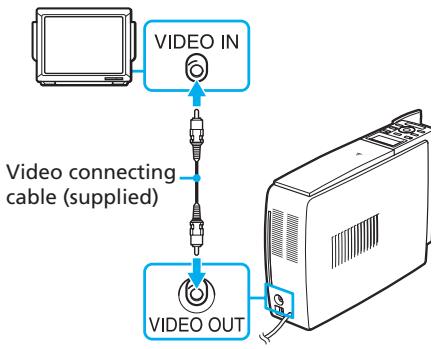
Notes
- Before making connections, unplug the AC power cord of the printer and turn off a TV monitor.
- When you do not use the supplied video connecting cable, use a commercially available video connecting cable shorter than 3 m.
Connecting the AC power cord
After you have made the connections, connect the AC power cord to the AC outlet.
The ON/STANDBY indicator lights in red.
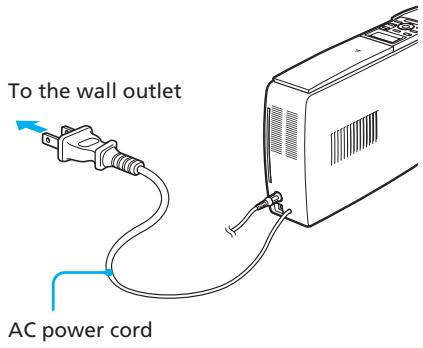
Note
The AC power cord in the above illustration is for 120 V AC only. The plug shape of the AC power cord for 100 to 240 V is different.
Inserting a memory card
Inserting a "Memory Stick"
To print an image stored on a "Memory Stick," insert it into the "Memory Stick" slot until it clicks into place.
For the varieties of "Memory Stick" that you can use with the printer, see page 127.
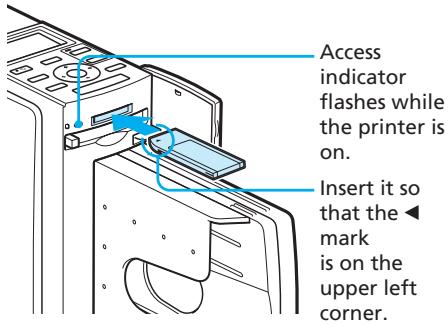
To eject a "Memory Stick"
Push the "Memory Stick" lightly into the insertion slot. After the "Memory Stick" pops back out, remove it slowly.
Notes
- When using a "Memory Stick Duo," be sure to use the Memory Stick Duo adaptor.
- Do not attempt to insert a "Memory Stick" forcibly into or out of the slot. If you do so, the "Memory Stick" or the printer may be damaged.
Inserting a CompactFlash card
To print an image stored on a CompactFlash card, insert the
CompactFlash card into the
CompactFlash card slot until it clicks into place.
For the varieties of CompactFlash card that you can use with the printer, see page 130.
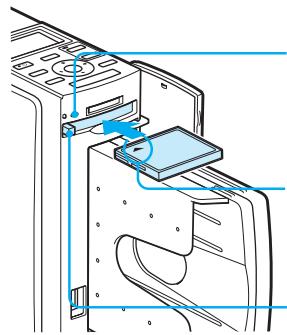
The access indicator flashes while the printer is on.
Insert it with the wider side facing the printer.
Eject button
To eject a CompactFlash card
Press the CompactFlash card eject button. After the card pops back out, remove it slowly.
Note
Do not attempt to insert a CompactFlash forcibly into or out of the slot. If you do so, the CompactFlash or the printer may be damaged.
On using the memory card
- To avoid potential loss of data, make a backup copy of the contents of the memory card. We cannot compensate for any damage to or loss of data.
- Check the memory card and insert it in the correct direction. If a memory card is forcibly inserted in the wrong direction, the memory card and its slot may be damaged.
Displaying the images on a TV monitor
This section explains how to display the images of the memory card on a TV monitor.
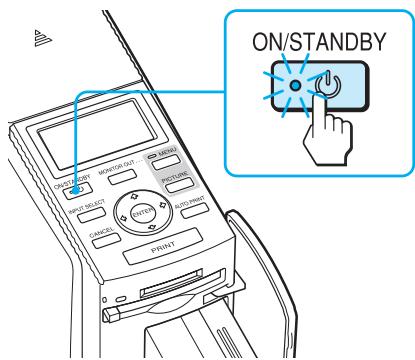
1 Turn on the printer.
The ON/STANDBY indicator of the printer lights in green.
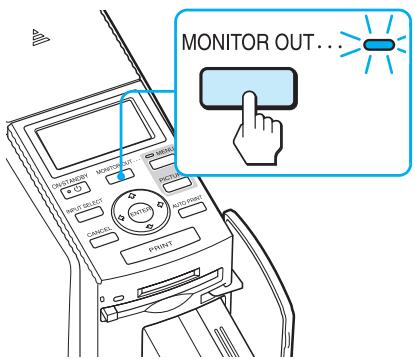
2 Turn on a TV monitor and set its input selector to "VIDEO". 3 Make sure that the MONITOR OUT indicator lights.
If not, press MONITOR OUT to turn on the indicator to select the MONITOR OUT mode.
4 Press INPUT SELECT repeatedly to select the memory card containing the images that you want to print.
Display the desired memory card type on the upper left of the TV monitor ("Memory Stick" or "CompactFlash").
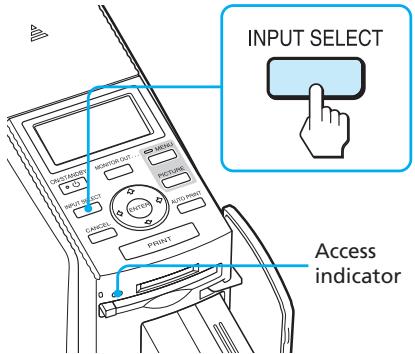
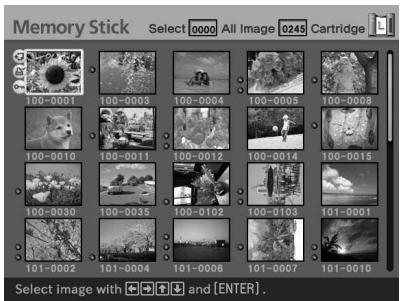
The access indicator flashes, and the images on the selected memory card are displayed on the TV monitor. This is called the image list.
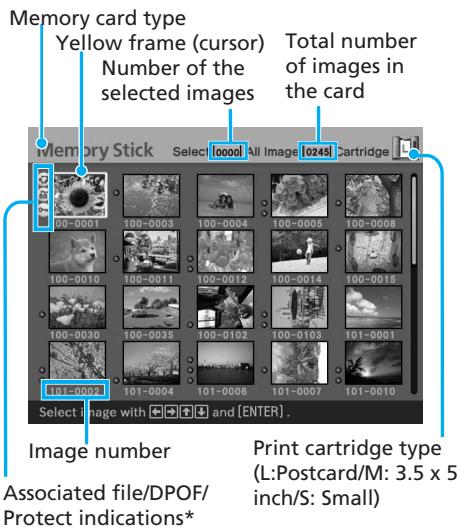
* On Associated file/DPOF/Protect indications
- Associated file indication:

The image, in addition to the displayed image, has an associated file such as a motion file or a miniature e-mail image file.
DPOF indication:

The image is DPOF preset with a digital camera.
- Protect indication:

The image is protected with a digital camera.
To display another page
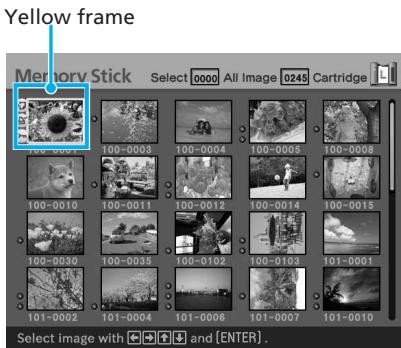
When multiple pages exist, you can switch pages. To display the next page, move the yellow frame to the bottom line of the image list and press the down arrow. To display the previous page, move the yellow frame to the top line and press the up arrow.
Displaying the printer images (demonstration mode)
When no memory card is inserted and no computer or digital camera is connected to the printer, you can display and print the printer's built-in images. Press INPUT SELECT repeatedly until "DEMO"
(demonstration) is displayed on the TV monitor. Among the image list of the printer's built-in images, you can select and print an image.
To exit the demonstration mode, display the image list of the printer's built-in image, and then press INPUT SELECT again.
Basic printing operations
Printing a selected image
This section explains how to select an image and print it in full size.
Borderless standard print
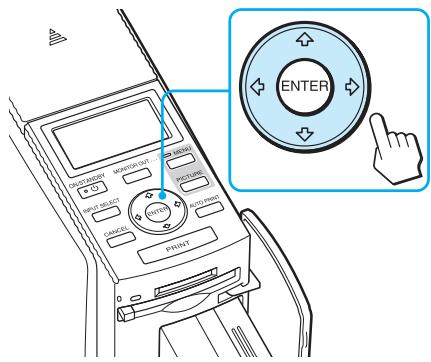
1 Press the arrow button (up/down/left/right) to move the yellow frame (cursor) to the image you want to print.
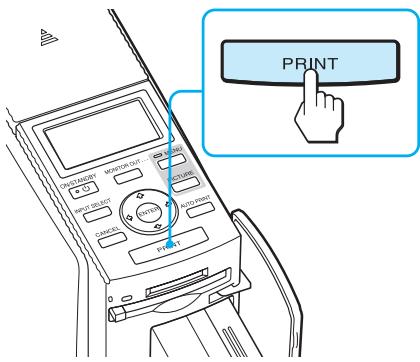
2 Press PRINT.
Printing of the image selected with the cursor starts.
During printing, the printing process is displayed on the TV monitor.
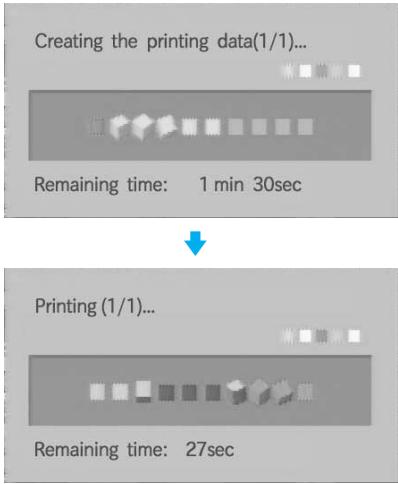
3 When printing is complete and the print paper automatically emerges, remove the printed paper from the paper tray.
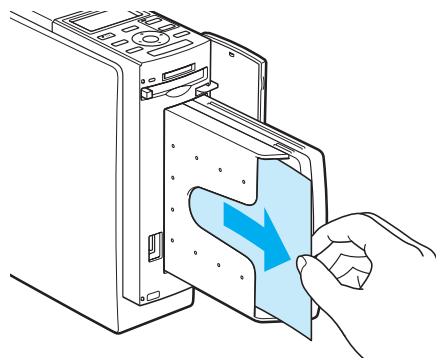
Notes
- Do not remove the memory card while the access indicator is flashing; the memory card or printer may be damaged.
- Never move or turn off the printer while it is printing; the print cartridge or paper may become stuck. If this happens, turn the printer off and then on, and resume printing from the beginning.
Checking the preview image before printing
You can display and check an image in full-screen size before printing.
Move the yellow frame (cursor) to the desired image, then press PICTURE.
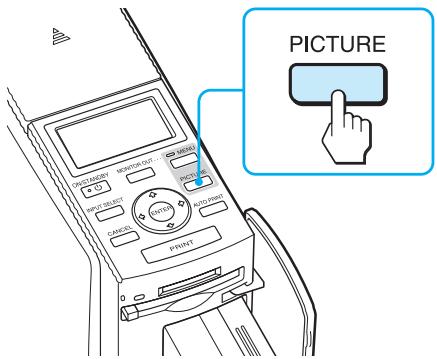
The selected image is displayed in full-screen size. This is called the preview image.
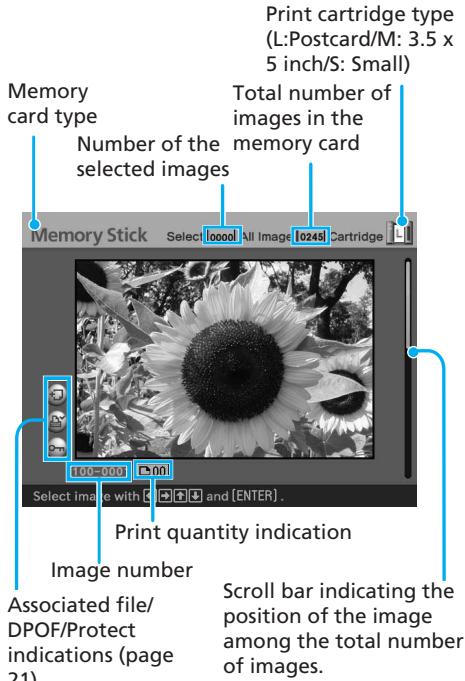
To display the preview of another image
Press the arrow (left/right/up/down) button to display an image positioned left, right, upper, or below of the selected image in the image list.
To print the previewed image
Press PRINT. The previewed image is printed.
Note
Even if there are selected images and print quantity for the images is specified, only the previewed image is printed. To print multiple images at a time, print them in the image list.
To cancel print setting
Press CANCEL for more than two seconds.
To display the image list again
Press PICTURE.
Note
The displayed picture on a TV monitor is not identical with the printed picture because phosphor methods or profiles of each TV monitor differ. Please regard the displayed picture as just a reference.
Printing multiple images
This section explains how to select multiple images, specify print quantity for each of them and print them at a time.
1 Press the arrow (left/right/up/down) button to move the yellow frame (cursor) to the image you want to print, then press ENTER.
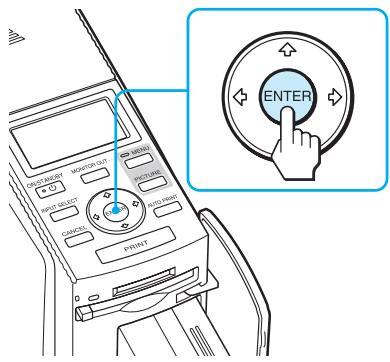
The print quantity indication becomes "01".
Print quantity indication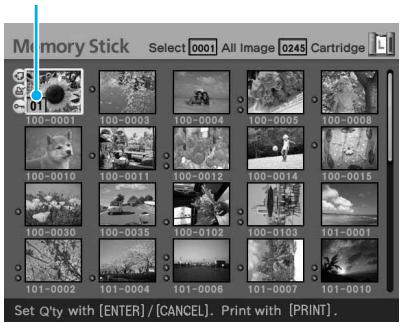
2 Press ENTER or CANCEL to set the print quantity.
- To increase the print quantity one by one, press ENTER.
- To decrease the print quantity one by one, press CANCEL.
- To cancel the selection, press CANCEL for more than two seconds.
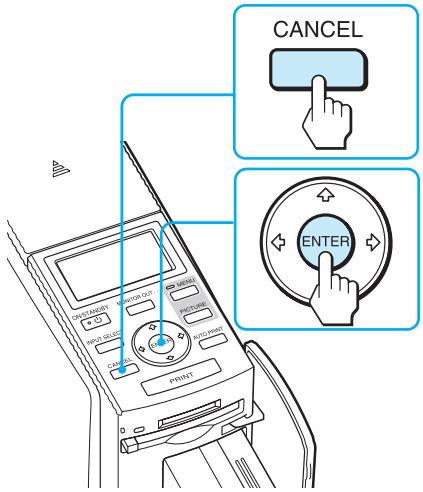
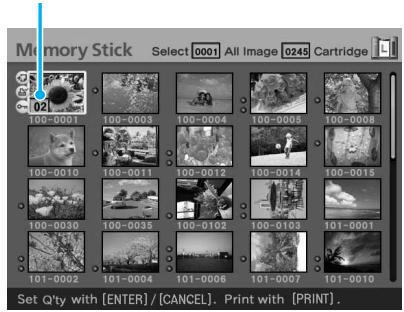
You can set up to 30 copies of print quantity for an image.
Print quantity increases or decreases.
3 Repeat steps 1 and 2 to select other images and set print quantity for each of them.
When you move the yellow frame, the previously selected image is displayed with the orange frame.
Selected images with orange frame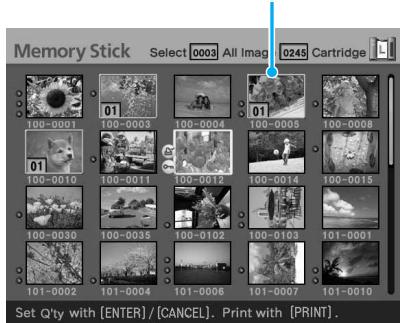
To cancel the selection
Press the arrow (left/right/up/down) button to move the yellow frame (cursor) to the image you want to cancel in the image list and press CANCEL for more than two seconds.
The orange frame disappears.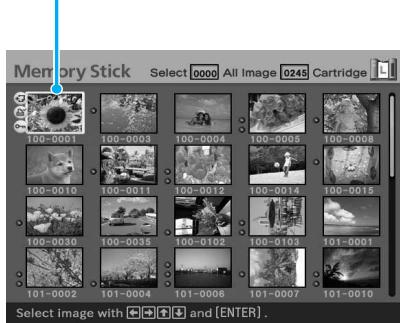
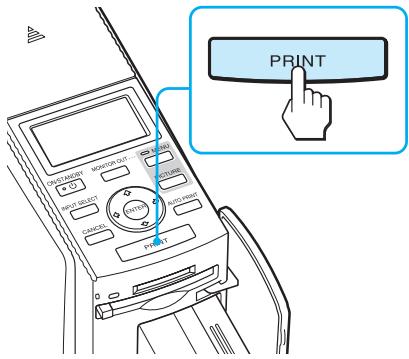
4 Press PRINT.
Printing of the images selected with orange frames starts.
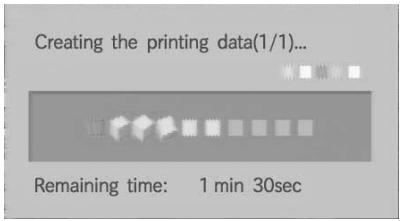
During printing, the printing process is displayed on the TV monitor.
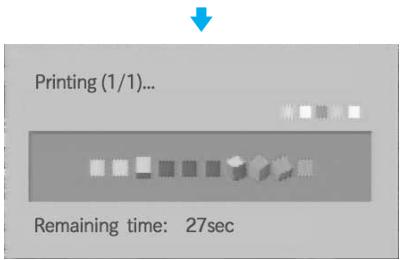
To stop printing
Press CANCEL. When you are printing multiple copies, the next printing after the one currently printing will be cancelled.
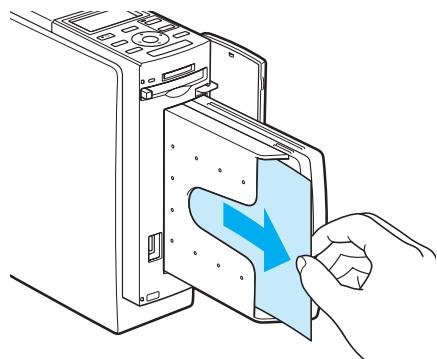
5 When printing is complete and the print paper automatically emerges, remove the printed paper from the paper tray.
Notes
- Do not remove the memory card while the access indicator is flashing; the memory card or printer may be damaged.
- Never move or turn off the printer while it is printing; the print cartridge or paper may become stuck. If this happens, turn the printer off and then on, and resume printing from step 1 on page 24.
AUTO printing (INDEX/DPOF/ALL)
AUTO (automatic) printing allows you to print multiple images stored on the "Memory Stick" or a CompactFlash card at one time.
The printer provides the following three AUTO printing methods:
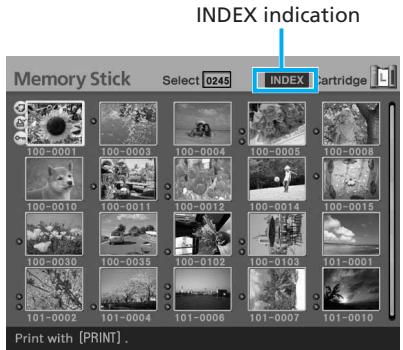
- INDEX printing
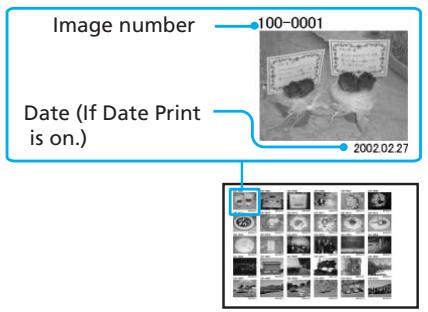
You can print a list (index) of all the images contained in the "Memory Stick" or CompactFlash card in split panes, which allows you to check the contents of the memory card easily. The number of split panes on a sheet will be calculated automatically. Images are printed with their corresponding image numbers.
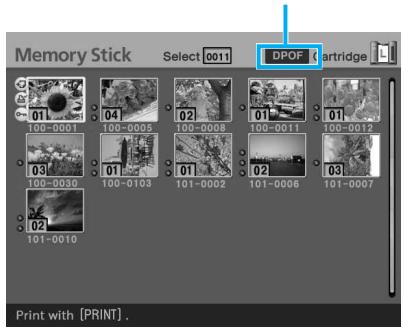
- DPOF preset image printing
The images which are DPOF (Digital Print Order Format) preset for printing are displayed with the print mark () in the image list. You can print those images at one time. The images are printed with the preset number of copies in the order they were displayed.
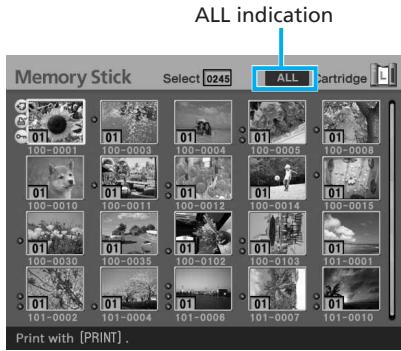
- ALL images printing
You can print all the images stored in the "Memory Stick" or CompactFlash card at one time. The images are printed one by one in the order of their image numbers.
Notes
- For how to preset images for printing, see the manual of your digital camera.
- Some types of digital camera do not support the DPOF function, or the printer may not support some of the functions of the digital camera.
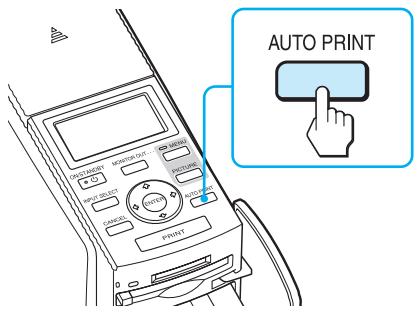
1 Press AUTO PRINT repeatedly to display "INDEX," "DPOF," or "ALL" on the TV monitor.
To make an index print: INDEX
All the images are selected with orange frames.
Continued
To print DPOF-preset images: DPOF
Only the DPOF-preset images are displayed with orange frames, each with the preset print quantity.
DPOF indication
To print all the images in a memory card: ALL
All the images are selected with orange frames.
To cancel selection (except for the DPOF printing)
Press the arrow (left/right/up/down) button to move the yellow frame (cursor) to the image of which you want to cancel selection in the image list and press CANCEL.
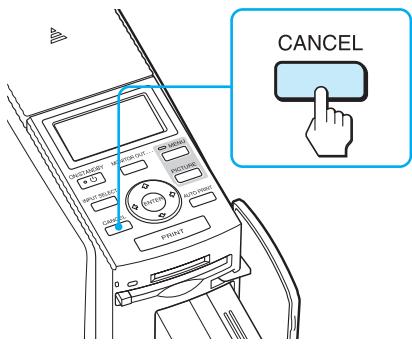
The orange frame disappears and the selection is canceled.
Note
You cannot cancel the selection of the DPOF preset images.
2 Press PRINT.
Printing starts.
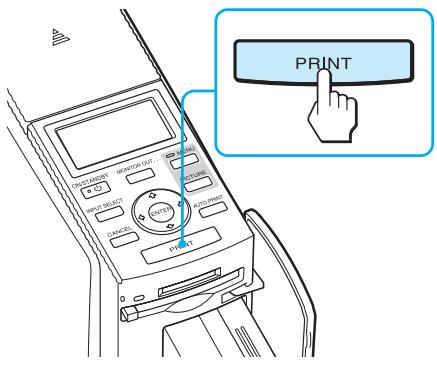
During printing, the printing process is displayed on the TV monitor.
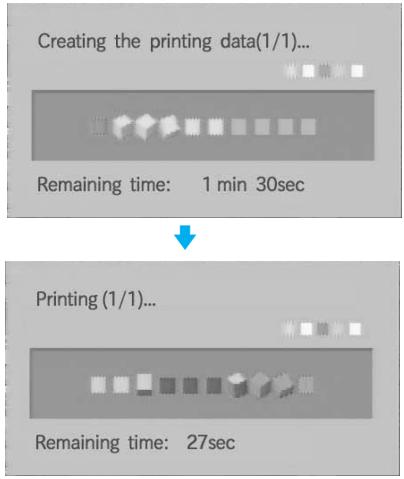
To stop printing
Press CANCEL. When you are printing multiple copies, the next printing after the one currently printing will be cancelled.
3 When printing is complete and the print paper automatically emerges, remove the printed paper from the paper tray.
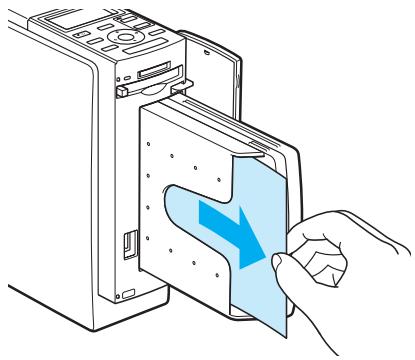
To resume the normal printing mode
Press AUTO PRINT repeatedly until either INDEX, DPOF, or ALL disappears from the TV monitor.
Tips
- Even if the print cartridge runs out in the middle of printing, you can proceed with printing. If a message appears, follow the instructions on a TV monitor to replace the printing pack (pages 13 through 17).
- When the "Date Print" is set to "ON", the recorded date (year, month and day) is also printed (page 62).
Editing an image
You can display the EDIT menu on the TV monitor and edit or add an effect to an image.
This section explains how to edit an image as follows:
Displaying the EDIT menu (page 31)

Editing an image
- Enlarging or reducing the size of an image (page 32)
- Moving an image (page 32)
- Rotating an image (page 33)
- Adjusting an image (page 33)
- Adding a special filter to an image (page 34)
- Reducing red-eye phenomenon (page 35) Superimposing characters (page 36)

Saving and printing an edited image (pages 40 and 41)
Buttons to be used in this section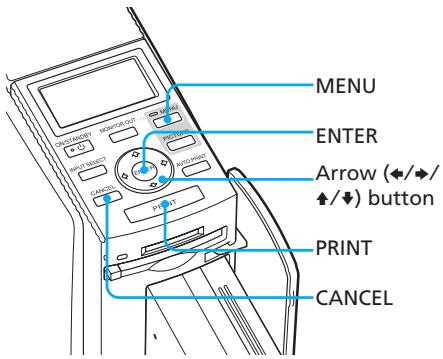
Displaying the EDIT menu
1 Follow step 1 on page 22 to select an image that you want to edit or press PICTURE to display its preview image.
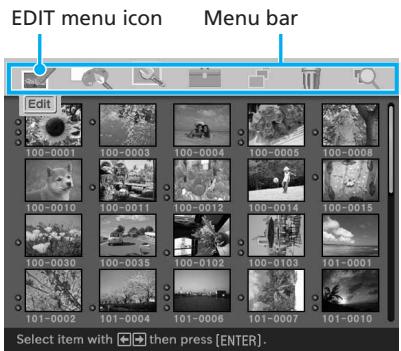
2 Press MENU.
The menu bar is displayed.
To exit the menu mode
Press MENU again. The previous window is displayed.
3 Press the arrow (left/right) button to select (EDIT) and then press ENTER.
The EDIT menu is displayed.
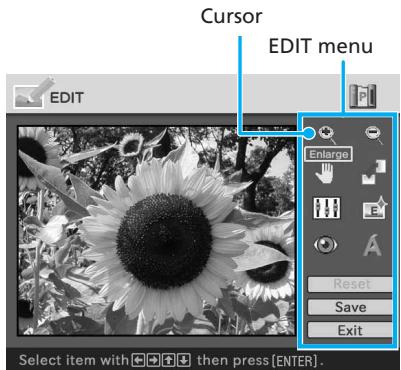
| Items | Procedures |
| Increases the size of an image or item (page 32). | |
| Reduces the size of an image or item (page 32). | |
| Moves an image or item (page 32). | |
| Rotates an image or item (page 33). | |
| Adjusts the picture quality of an image (page 33). | |
| Adds an filter to an image (page 34). | |
| Corrects the red-eye phenomenon (page 35). | |
| Superimposes characters on an image (page 36). | |
| Reset | Resetsethe editing (page 40). |
| Save | Saves the edited image (page 40). |
| Exit | Exits the EDIT menu (page 41). |
Editing an image
Enlarging and reducing the size of an image
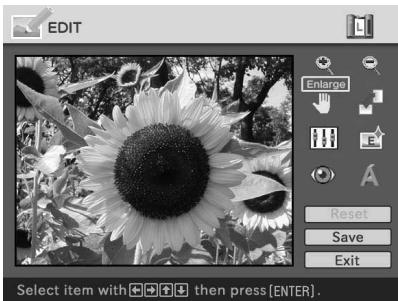
1 Display the EDIT menu (page 31). 2 Press the arrow (left/right/up/down) button to select to enlarge an image or to reduce the size of it and then press ENTER.
Each time you press ENTER, the image becomes larger or smaller:

: up to 200%

: up to 60%
Note
The picture quality of an enlarged image may be deteriorated depending on its size.
Moving an image
1 Display the EDIT menu (page 31). 2 Press the arrow (left/right/up/down) button to select (Position) and then press ENTER.
The image frames become yellow and you can move an image.
Image frame becomes yellow.
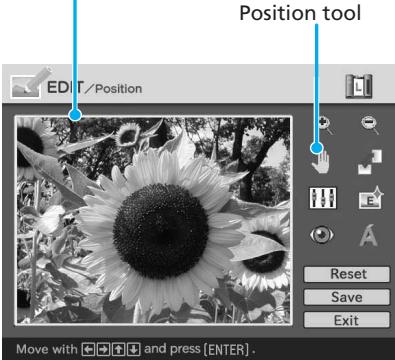
3 Move the image with the arrow (left/right/up/down) button.
The image moves to the selected direction.
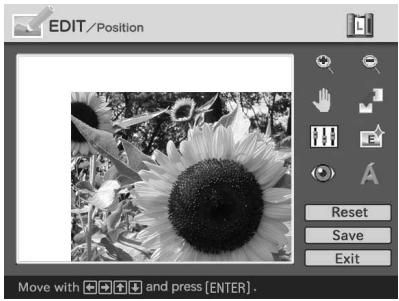
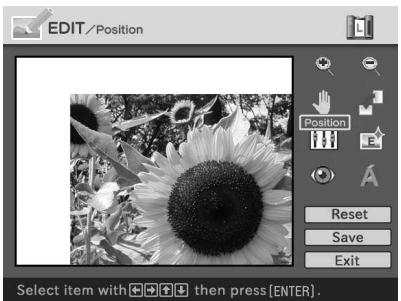
4 Press ENTER.
The image is fixed to the position.
Rotating an image
You can rotate an image clockwise or counterclockwise.
1 Display the EDIT menu (page 31). 2 Press the arrow (left/right/up/down) button to select (Rotate) and then press ENTER.
The Rotate menu is displayed.
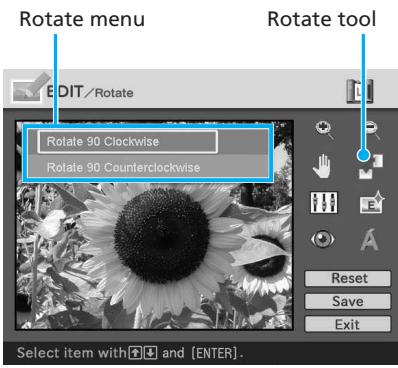
3 Press the arrow (up/down) button to select the direction to rotate the image and then press ENTER.
- Rotate 90° Clockwise: Each time you press ENTER, the image rotates 90° clockwise.
- Rotate 90° Counterclockwise: Each time you press ENTER, the image rotates 90° counterclockwise.
Adjusting an image
1 Display the EDIT menu (page 31). 2 Press the arrow (left/right/up/down) button to select (Adjust) and then press ENTER.
The Adjust menu is displayed.
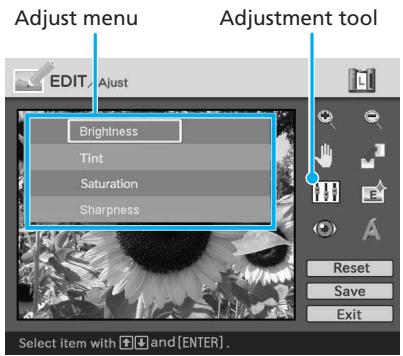
3 Press the arrow (up/down) button to select the desired adjustment tool and press ENTER.
The adjustment slider appears.
When "Brightness" is selected.
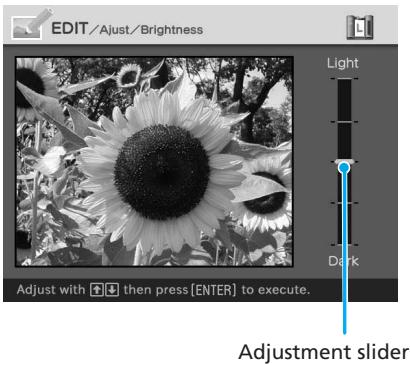
4 Move the slider to the desired position to adjust the level.
- Brightness: Press up to brighten the picture or down to darken it.
- Tint: Press to make the picture bluish or to make it reddish.
- Saturation: Press to deepen the colors or to lighten the colors.
- Sharpness: Press to sharpen the outlines or to reset them.
5 Press ENTER.
The adjustment takes effect.
To reset the adjustment
Press the arrow ( / / /) button to select "Reset" and then press ENTER. The image resets to the status before the adjustment is added.
Adding a special filter to an image
1 Display the EDIT menu (page 31). 2 Press the arrow ( / → / / ) button to select (Filter) and then press ENTER.
The Filter menu is displayed.
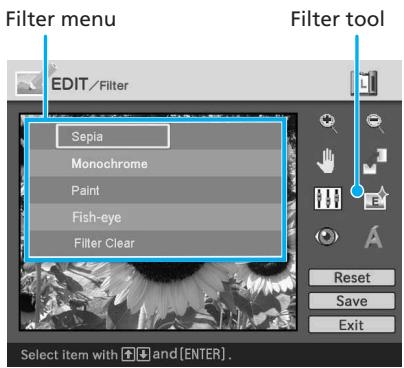
3 Press the arrow ( / ) button to select the desired filter you want to add to the image.
- Sepia: Changes the image like an old photograph with faded colors.
- Monochrome: Changes the image into a monochrome picture.
- Paint: Makes the image look like a painted picture.
- Fish-eye: Makes the image look like a photo taken with a fish-eye lens.
- Clear Filter: Removes the filter from the image.
4 Press ENTER.
The filter takes effect.
Reducing the red-eye phenomenon
You can reduce the red-eye phenomenon of a subject shot using a flash.
Note
If you perform editions such as enlarging, reducing the size of, rotating or moving an image after the red-eye reduction adjustment, the red-eye reduction may not take effect. Perform the red-eye reduction after these editorial operations.
1 Display the EDIT menu (page 31). 2 Press the arrow (left/right/up/down) button to select (Red-eye reduction) and then press ENTER.
The adjustment frame appears on the image, which indicates the range for red-eye reduction adjustment.
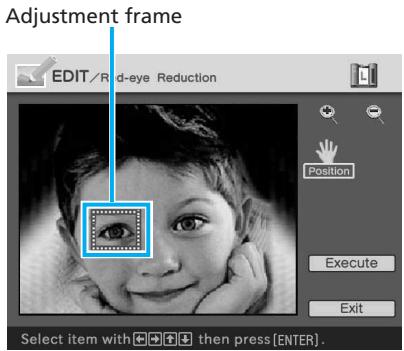
3 Adjust the position and size of the adjustment frame.
Make the red-eye reduction adjustment for the right and left eyes separately.
To move the adjustment frame
① Press the arrow (up/up/up/up) button to select (Position) and press ENTER. ② Move the frame with the arrow (left/right/up/down) button.
The frame moves in the selected direction.
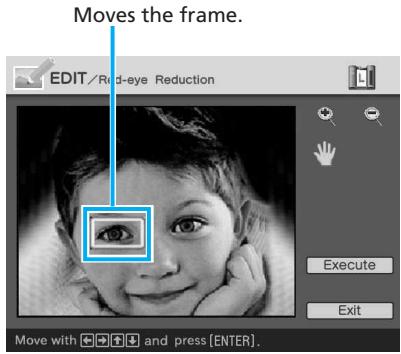
③ Press ENTER.
The frame is fixed in the current position.
To adjust the size of the adjustment frame
Press the arrow (left/right/up/down) button to select (Enlarge) or
(Reduce) and press ENTER.
Each time you press ENTER, the frame becomes larger or smaller.
Enlarge/reduce the size of the frame
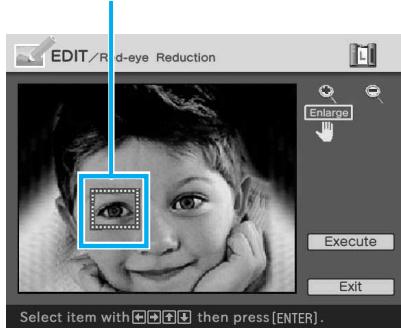
Tip
Make the size of the adjustment frame two to seven times as large as the eye size.
Note
Make sure to perform the red-eye reduction adjustment for the right and left eye separately.
4 Press the arrow (left/right/up/down) button to select "Execute" and press ENTER.
The range of red-eye reduction adjustment is enlarged.
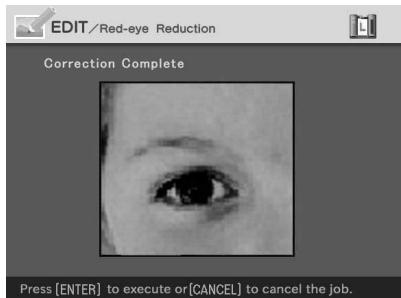
5 Press ENTER to execute the red-eye reduction adjustment. The adjustment takes place.
To reset the adjustment
Press CANCEL in step 5. The red-eye reduction is canceled and the window of step 2 is displayed.
Superimposing characters
You can enter up to 5 lines of characters to be superimposed on an image.
1 Display the EDIT menu (page 31).
2 Press the arrow (left/right/up/down) button to select (Text) and then press ENTER.
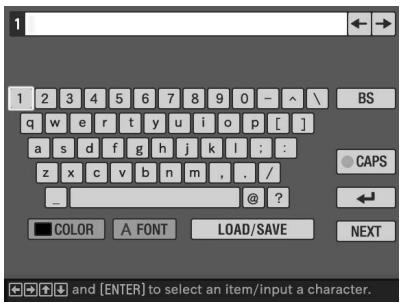
The keyboard is displayed.
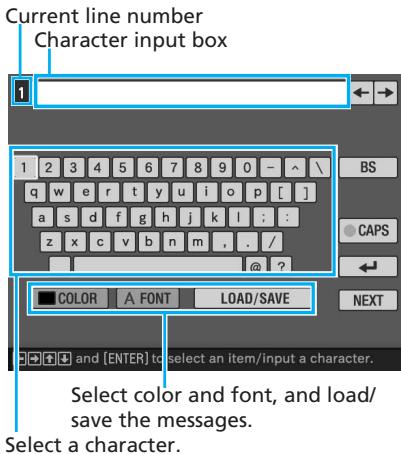
3 Select a font.
The characters are input in the font displayed in the "FONT" button. To select a different font, do the following:
① Press the arrow (left/right/up/down) button to select "FONT." ② Press ENTER repeatedly until the desired font is displayed:
ABCDEFGHIJK ABCDEFGHIJK
ABCDEFGHIJK
ABCDEFGHIJK
ABCDEFGHIIJK
Note
You cannot specify multiple fonts and colors for a sequence of characters input. All the lines of characters are input in the identical font and color. You can change font and color in the middle of input procedures; The changed font and color will be applied to all the input characters.
4 Select a color.
The characters are input in the color displayed next to "COLOR". To apply a different color, do the following:
① Press the arrow (left / right / up / down)
button to select "COLOR" and press ENTER.
The color selection window is displayed.
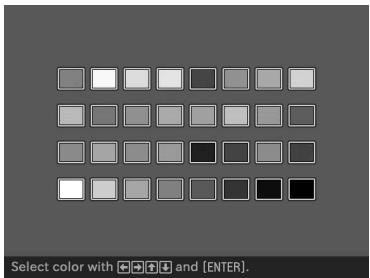
② Press the arrow (left / right / up / down) button to select the desired color and press ENTER.
Note
You cannot apply multiple colors for each line of characters.
5 Press the arrow (left / right / up / down) button to select the desired character, then press ENTER to input a character.
The selected characters are input in the character input box. You can enter up to 50 characters for each single line.
To change lines
Press the arrow (left / right / up / down) button to select the square and press ENTER.
You can enter the maximum of 5 lines.
To input a capital letter
Press the arrow (up / down / left / right) button to select "CAPS" and press ENTER. The capital letters keyboard is displayed. To return to the small letters input keyboard, select "CAPS" again.
To correct characters in the input box
- To delete a character before the cursor (I) in the input box
Press the arrow (left/right/up/down) button to select "BS" (Back Space) and press ENTER. Each time you press ENTER, a character before the cursor is deleted.
- To insert a character among the input characters
Press the arrow (left/right/up/down) button to select " ←" or "→" on the window and then press ENTER repeatedly until the cursor (1) moves to the position where you want to insert a character.
6 After you finish entering the remaining characters, press the arrow (left/right/up/down) button to select "NEXT", and then press ENTER.
The keyboard is closed and the input characters are superimposed on the image.
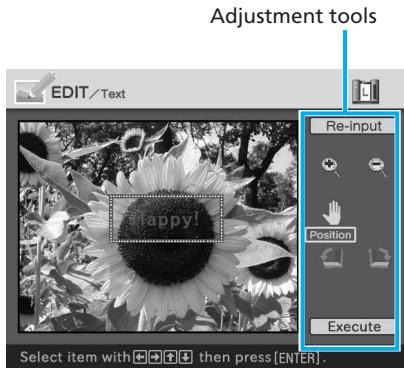
7 Press the arrow (left/right/up/down) button to select the desired adjustment tool, then press ENTER to adjust the size and position of the characters. To make multiple adjustments, repeat this step.
| Items | Procedures |
| Re-input | The keyboard is displayed. Input characters again. |
| Each time you press ENTER, the characters become larger. | |
| Each time you press ENTER, the characters become smaller. | |
| Move the characters with the arrow (▲/▲/▲/▲) button, and then press ENTER. | |
| Each time you press ENTER, the characters rotate 90° clockwise. | |
| Each time you press ENTER, the characters rotate 90° counterclockwise. |
Note
If a number of input characters is large, you may not be able to rotate, increase or decrease the size of characters.
Press the arrow (up/down) button to select "Execute", then press ENTER.
The characters are fixed to the image.
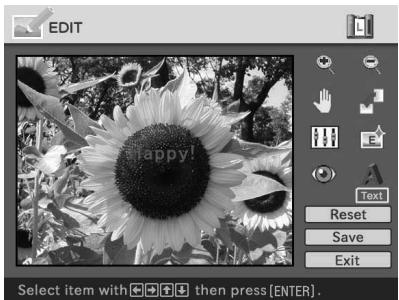
Note
Once you select "Execute", you cannot move or delete the characters.
Registering commonly-used characters as a message
You can register commonly-used characters as a message and can load them later onto the character input box. Up to three messages, each message with the maximum of 80 characters, can be registered.
1 Follow steps 1 through 5 in "Superimposing characters" (pages 36 and 37) to enter characters that you want to register as a message in the input box. 2 Press the arrow button to select "LOAD/SAVE" and press ENTER.
The dialog box to register and save messages is displayed.
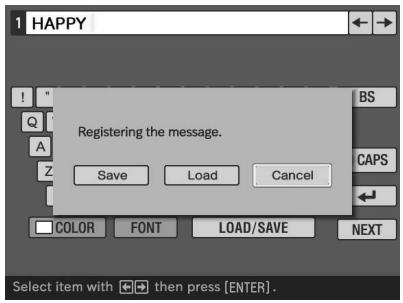
3 Press the arrow button to select "Save" and then press ENTER.
The message selection screen is displayed.
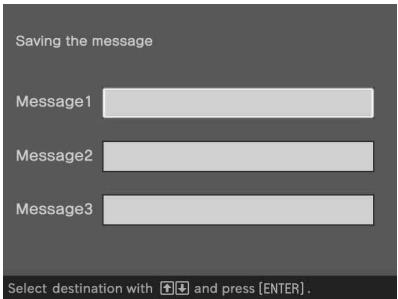
4 Press the arrow button to select the message box that you want to save the characters in and press ENTER. The input characters are registered as a message.
To load a registered message
In step 3 above, select "Load" to display the window used for selecting a message.
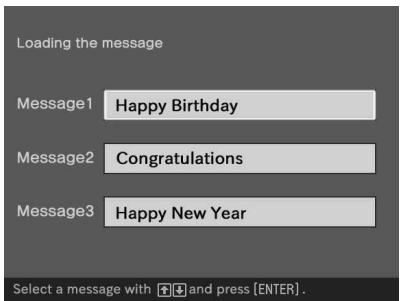
Press the arrow button to select the desired message and press ENTER. The selected message is placed in the character input box.
Note
The characters having been input in the input box will be overwritten and replaced with the message.
Saving and printing the edited image
Saving the edited image
After you finish editing, you can save the edited image under a new file number.
Tip
The selected image will not be overwritten.
1 Press the arrow (left/right/up/down) button to select "Save" and press ENTER.
The dialog box to select the media to save the image in is displayed.
2 Select the destination memory card.
Press the arrow (down/up) button to select the "Memory Stick" or "Compact Flash" and press ENTER.
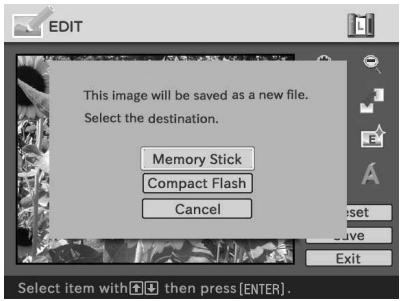
The dialog box for setting date is displayed. You can save the date with the image.
3 Set date.
Press the arrow (up/down) button to select the number and press the arrow (left/right) button to select the day, month or year. Then press ENTER.
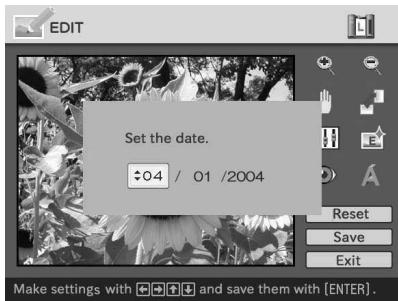
The image is saved. The dialog box to notify the new file number is displayed.
4 Press ENTER.
Note
While saving the image, do not turn off the printer or remove the memory card from the printer. The memory card may be damaged.
Resetting the editing
You can remove editing done in the EDIT window and reset the edited image to its original status.
1 Press the arrow (left/right/up/down) button to select "Reset" and press ENTER.
The confirmation dialog box is displayed.
2 Press the arrow (left/right) button to select "OK" and press ENTER.
The image is reset to its original status.
Printing an edited image
1 Press PRINT.
The dialog box to specify the print quantity is displayed.
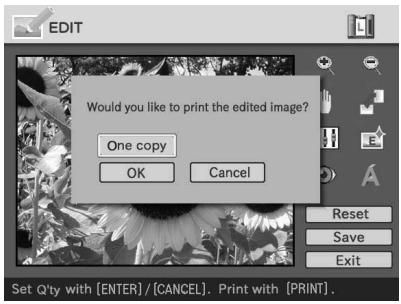
2 Set the print quantity.
- To increase the print quantity one by one, press ENTER repeatedly.
- To reduce the print quantity one by one, press CANCEL repeatedly.
- To reset the print quantity to one, press CANCEL for more than two seconds.
3 Press the arrow (left/right/up/down) button to select "OK" to start printing.
The image previewed is printed.
To stop printing
Press CANCEL. When you are printing multiple copies, the next printing after the one currently printing will be cancelled.
Displaying other menu while editing an image
Press MENU.
The menu bar is displayed. Even while editing an image, you can change some printer settings or option menu items such as "Finish," "Date Print" or "Beep."
Exiting the EDIT menu
Press the arrow button to select "Exit" and press ENTER.
The dialog box for saving an image may be displayed. To save an edited image, follow the steps in "Saving an edited image."
Making various prints (Creative Print)
You can display the Creative Print menu on the TV monitor and make a card, calendar, split images prints using the image of the "Memory Stick" or CompactFlash card.
This section explains how to make a print as follows:
Displaying the Creative Print menu (page 43)

Making a Creative print
- Making a free layout print (page 43)
- Making a calendar (page 50)
- Making a card (page 53)
- Making split images (page 56)

Saving and printing a Creative print image (page 58)
Buttons to be used in this section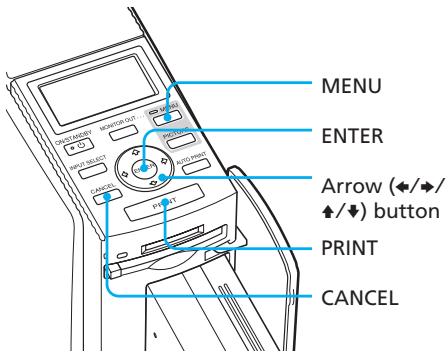
Displaying the Creative Print menu
1 Press MENU.
The menu bar is displayed.
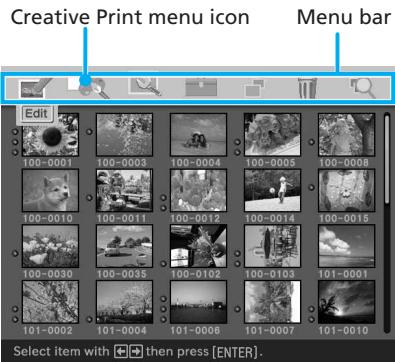
To exit the menu mode
Press MENU. The previous window is displayed.
2 Press the arrow (left/right) button to select (Creative Print) and then press ENTER.
The Creative Print menu is displayed.
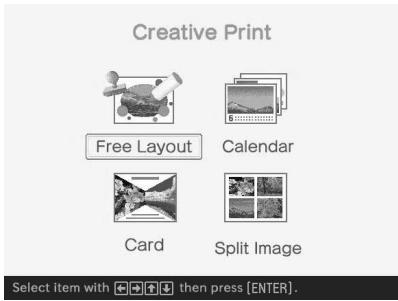
Making a Creative print
Making a free layout print
You can add an image, wallpaper, a message, characters, a calendar, or stamps to make an original free layout print.
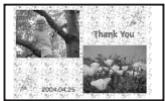
Tip
For the list of wallpaper, frames, or templates, see pages 136 and 137.
1 Display the Creative Print menu (page 43). 2 Press the arrow (up/down/left/right) button to select "Free Layout" and then press ENTER.
The print size selection window is displayed.
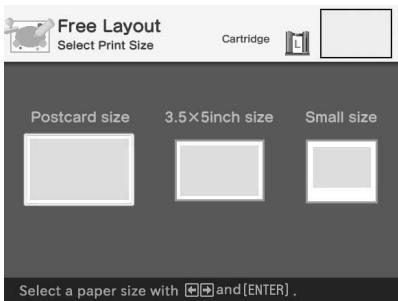
3 Press the arrow (left/right) button to select the print size, then press ENTER.
The wallpaper selection window is displayed.
When you select "Postcard size"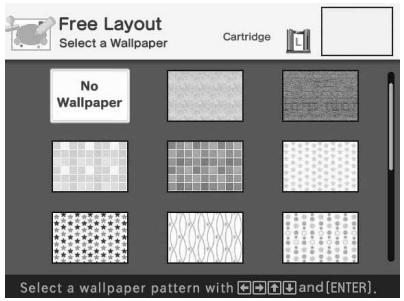
Press the arrow (left/right/up/down) button to select the desired wallpaper, then press ENTER.
If you do not want to place wallpaper on the image, select "No Wallpaper."
The preview window of the selected wallpaper is displayed.
Selected wallpaper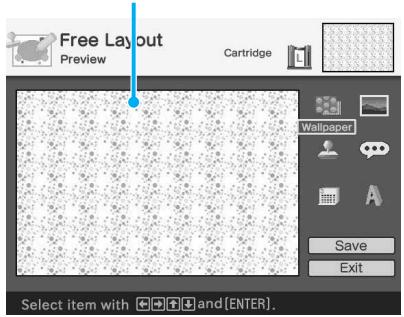
Press the arrow (left/right/up/down) button to select (Image) and press ENTER.
The frame selection window is displayed.
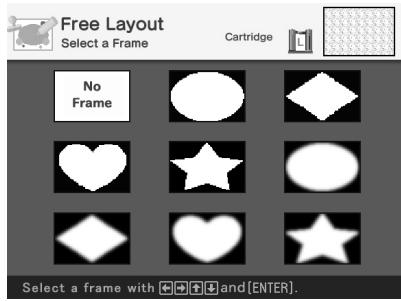
Press the arrow (left/right/up/down) button to select the desired frame that you want to shape an image with, then press ENTER.
If you do not want to use a frame, select "No Frame."
The image list is displayed.
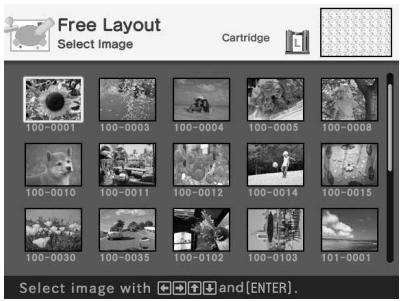
Press the arrow (left/right/up/down) button to select the desired image, then press ENTER.
The window used for adjusting the image size and position is displayed.
Adjustment tools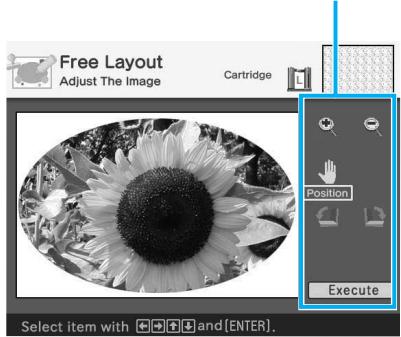
Press the arrow (left/right/up/down) button to select the desired adjustment tool, then press ENTER.
| Items | Procedures |
| Each time you press ENTER, the image becomes larger. | |
| Each time you press ENTER, the image becomes smaller. | |
| Move the adjustment frame with the arrow (▲/▲/▲/▲) button, and then press ENTER. | |
| Each time you press ENTER, the image rotates 90° clockwise. | |
| Each time you press ENTER, the image rotates 90° counterclockwise. |
9 Press the arrow (left/right/up/down) button to select "Execute" and press ENTER.
The window used for adjusting the framed image size and position is displayed.
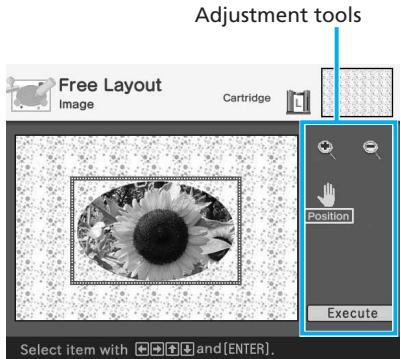
10 Press the arrow (left/right/up/down) button to select the desired adjustment tool, then press ENTER.
| Items | Procedures |
| Each time you press ENTER, the framed image becomes larger. | |
| Each time you press ENTER, the framed image becomes smaller. | |
| Move the framed image surrounded by the adjustment frame with the arrow (▲/▲/▲/▲) button, and then press ENTER. |
11 Press the arrow (left/right/up/down) button to select "Execute" and press ENTER.
The framed image is displayed.
Using the items in this window, you can add your favorite effects on the print (pages 46 to 49).
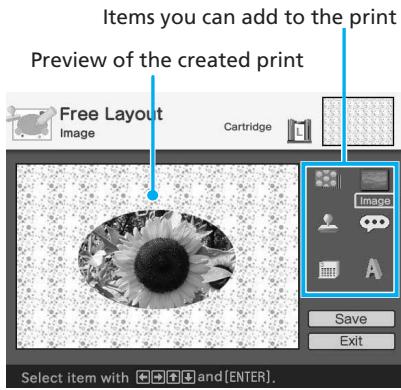
12 Check the preview, then save and print your Creative print.
For details, see page 58.
Adding your favorite effects to the print
Adding a stamp
① Press the arrow (left/right/up/down) button to select (Stamp) and press ENTER.
The stamp selection window is displayed.
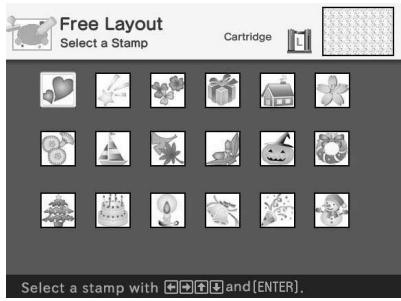
② Press the arrow (up/down/up/down) button to select the desired stamp, then press ENTER.
The window used for adjusting the stamp size and position is displayed.
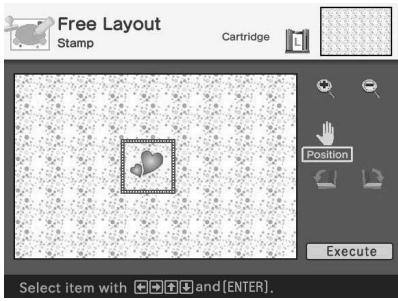
③ Adjust the size and position of the stamp.
For information on adjustment, see step 8 on page 45.
To cancel the operation
Press CANCEL. The window of the previous step is displayed.
④ Press the arrow (← / → / ↑ / ↓) button to select "Execute" and then press ENTER.
The selected stamp is pasted on the image.
Adding a message
① Press the arrow (← / → / ↑ / ↓) button to select (Message) and press ENTER.
The message selection window is displayed.
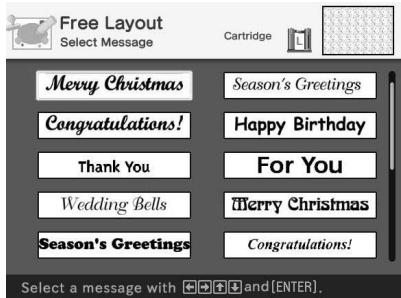
② Press the arrow (← / → / ↑ / ↓) button to select the desired message, then press ENTER.
The character color selection window is displayed.
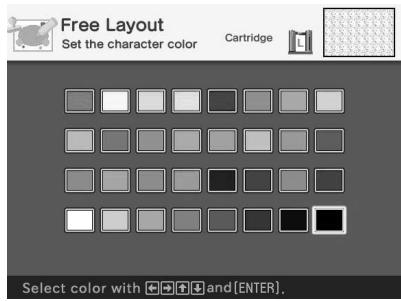
③ Press the arrow (← / → / ↑ / ↓) button to select the desired color and then press ENTER.
The window used for adjusting the message size and position is displayed.
To cancel the operation
Press CANCEL. The window of the previous step is displayed.
④ Adjust the size and position of the message.
For information on adjustment, see step 8 on page 45.
⑤ Press the arrow (left/right/up/down) button to select "Execute" and then press ENTER.
The selected message is pasted on the image.
Adding a calendar
① Press the arrow (left/right/up/down) button to select Calendar and press ENTER.
The window used for selecting a calendar type is displayed.
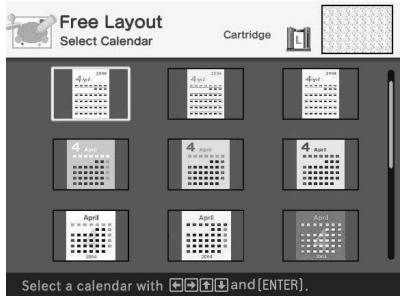
② Press the arrow (left/right/up/down) button to select the desired calendar type and press ENTER.
The calendar setting window is displayed.
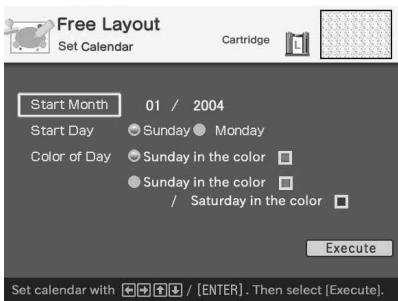
To cancel the operation
Press CANCEL. The window of the previous step is displayed.
③ Set the calendar.
Press the arrow (up/down) button to select the following items and then press the arrow (up/down) to select an option.
Item Procedures
Start Month
Set the first month and the year starting the calendar. Press the arrow (left/right) to select the month or year and press the arrow (up/down) button to set the number. Press ENTER.
Start Day
Set the day of the week (placed furthest left in the calendar). Press the arrow (left/right) button to select "Sunday" or "Monday." Then press ENTER.
Color of Day
Set the color of Sunday and Saturday to be displayed in the calendar. Press the arrow (up/down) button and then the arrow (left/right) button to select the desired color for Sunday and Saturday. Then press ENTER.
④ Press the arrow (up/down/left/right) button to select "Execute" and then press ENTER.
The window used for adjusting the calendar size and position is displayed.
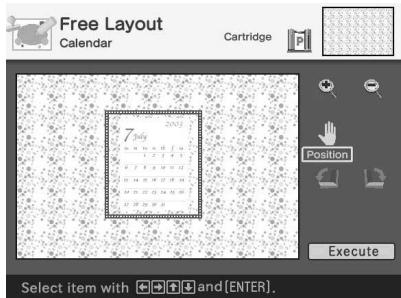
⑤ Adjust the size and position of the calendar.
For information on adjustment, see step 8 on page 45.
⑥ Press the arrow (up/down/left/right) button to select "Execute" and then press ENTER.
The selected calendar is pasted on the image.
Superimposing characters
Press the arrow (up/down/left/right) button to select (Text) and press ENTER. The keyboard is displayed. For how to enter characters, see "Superimposing characters" on pages 36 to 39.
Making a calendar
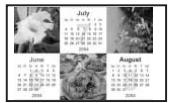
You can add a selected calendar to an image or images to make an original calendar.
1 Display the Creative Print menu (page 43). 2 Press the arrow (up/down/left/right) button to select "Calendar", then press ENTER.
The print size selection window is displayed.
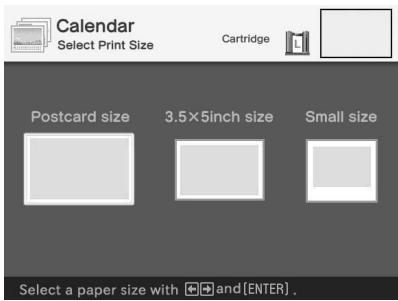
3 Press the arrow (left/right) button to select the print size, then press ENTER.
The window used for selecting the calendar type is displayed.
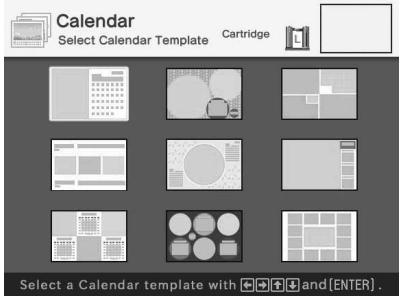
When you select "Postcard size"
4 Press the arrow (up/down/left/right) button to select the desired template, then press ENTER.
The preview of the selected template is displayed.
Image area
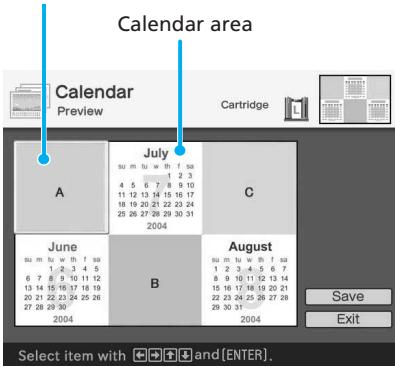
Tip
You can select and set an image area or calendar area in any order.
5 Select an image.
When you select a template with multiple images, repeat the procedures below to select an image for each area.
1 Press the arrow (left/right/up/down)
button to select an image area, then press ENTER.
The image list is displayed.
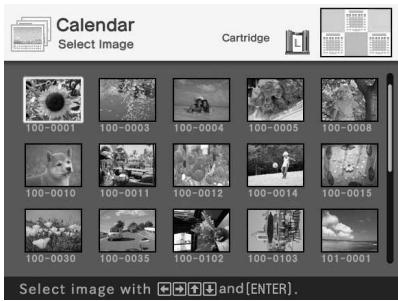
2 Press the arrow (down/up/up/down) button to select the desired image, then press ENTER. The window used for adjusting the image size and position is displayed.
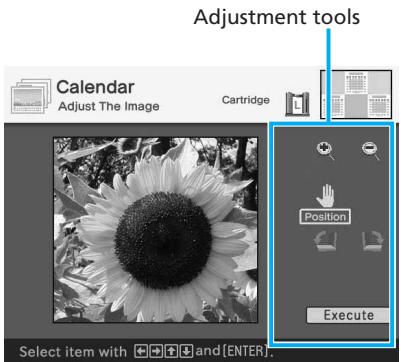
Press the arrow (▲/▲/▲/▲) button to select the desired adjustment tool, then press ENTER.
| Item | Procedures |
| Each time you press ENTER, the image becomes larger. | |
| Each time you press ENTER, the image becomes smaller. | |
| Move the image with the arrow (▲/▲/▲/▲) button, and then press ENTER. | |
| Each time you press ENTER, the image rotates 90° clockwise. | |
| Each time you press ENTER, the image rotates 90° counterclockwise. |
Press the arrow (▼/▲/▲/▼) button to select "Execute" and then press ENTER. The image is selected and displayed in the relevant area.
6 Set the calendar.
Press the arrow (▲/▲/▲/▲) button to select the calendar area and press ENTER. The calendar setting window is displayed.
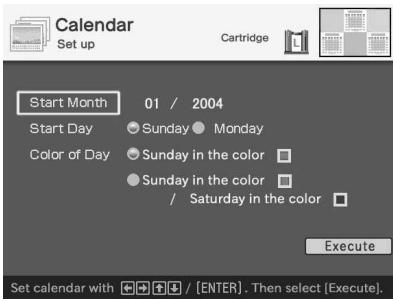
Set the calendar.
Press the arrow (▲/▼) button to select the following items and press the arrow (◀/▶) to select an option.
Item Procedures
Start Month
Set the first month and the year starting the calendar. Press the arrow (▲/▼) to select the month or year and press the arrow (▲/▼) button to set the number. Press ENTER.
Start Day
Set the day starting the week (placed furthest left in the calendar). Press the arrow (◀/▶) button to select "Sunday" or "Monday". Then press ENTER.
Color of Day
Set the color of Sunday and Saturday to be displayed in the calendar. Press the arrow (▲) button and then the arrow (▲/▼) button to select the desired color for Sunday and Saturday. Then press ENTER.
Press the arrow (▲/▲/▲/▼)
button to select "Execute" and then press ENTER.
The calendar is displayed in the calendar area.
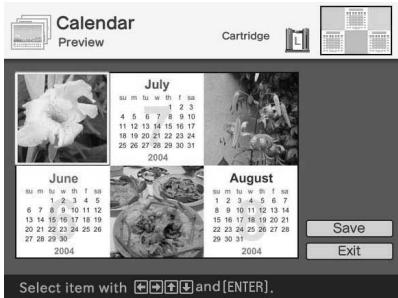
7 Check the preview, then save and print your Creative print. For details, see page 58.
Making a card
You can add a greeting and your own message to images and make an original card like the one shown below.
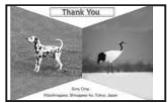
1 Display the Creative Print menu (page 43). 2 Press the arrow (left/right/up/down) button to select "Card", then press ENTER.
The print size selection window is displayed.
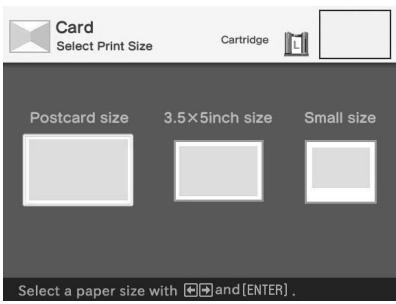
3 Press the arrow (left/right) button to select the print size, then press ENTER.
The card templates are displayed.
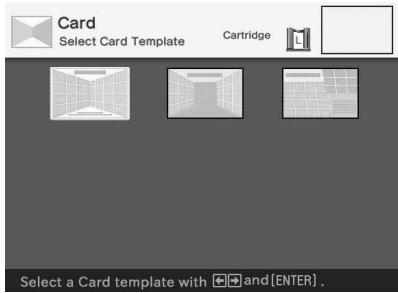
When you select "Postcard size"
4 Press the arrow (left/right/up/down) button to select the desired template and press ENTER.
The preview of the selected template is displayed.
Image area
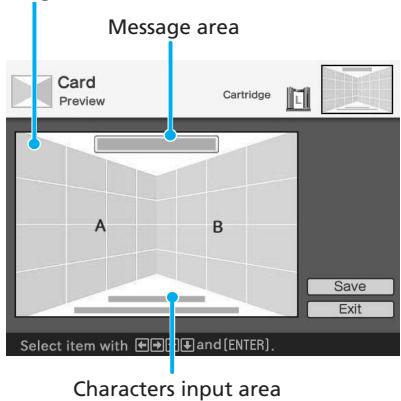
Tip
You can select and set an area in any order.
5 Select an image.
When you select a template with multiple images, repeat the procedures below.
① Press the arrow (▲/▲/▲/▲) button to select the image area, then press ENTER.
button to select the image area, then press ENTER.
Continued
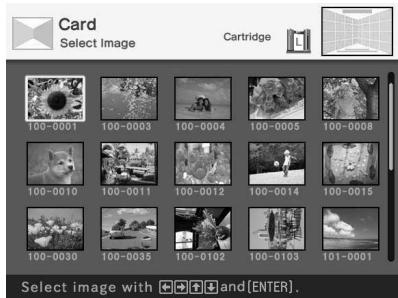
② Press the arrow (↓/↑/↑/↓) button to select the desired image, then press ENTER. The window used for adjusting the image size and position is displayed.
③ Press the arrow (↓/↑/↑/↓) button to select the desired adjustment tool, then press ENTER.
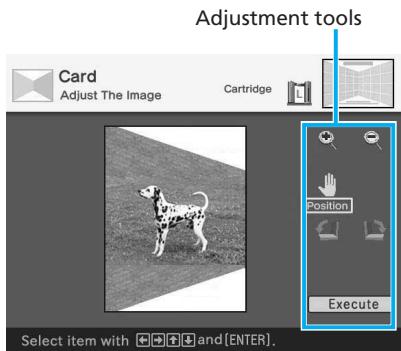
Press the arrow (down/up/up/down) button to select the desired adjustment tool, then press ENTER.
Each time you press ENTER, the image becomes larger.

Each time you press ENTER, the image becomes smaller.

Move the image with the arrow (◄/►/▲/▼) button, and then press ENTER.

Move the image with the arrow (▲/▼/◀/▶) button, and then press ENTER.

Each time you press ENTER, the image rotates 90° counterclockwise.

Each time you press ENTER, the image rotates 90 degrees counterclockwise.
④ Press the arrow (↓ / ↑ / ↑ / ↓) button to select "Execute" and then press ENTER. The image is selected and displayed in the relevant area.
6 Enter a message.
① Press the arrow (←/◆/◆/◆) button to select the message area, then press ENTER. The message selection window is displayed.
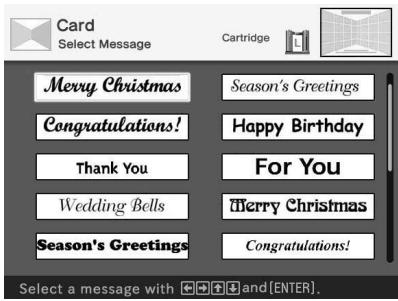
② Press the arrow (↓/↑/↑/↓) button to select the desired message, then press ENTER. The color selection window for the message is displayed.
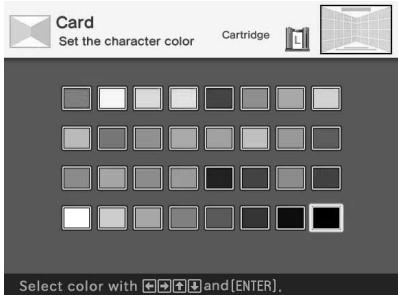
③ Press the arrow (▲/▲/▲/▲)
button to select the desired color, then press ENTER.
The selected message is placed in the message area.
7 Enter characters.
Press the arrow (←/→/↑/↓) button to select the characters area, then press ENTER.
The keyboard is displayed. For how to enter characters, see "Superimposing characters" on pages 36 to 39.
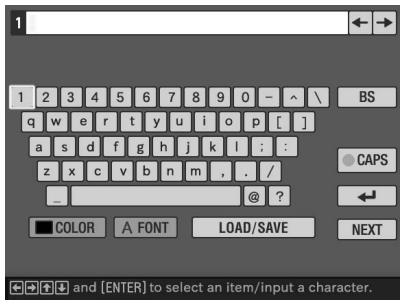
8 After you enter and adjust the characters, press the arrow (↓/ ) button to select "Execute", then press ENTER.
The characters are fixed to the image.
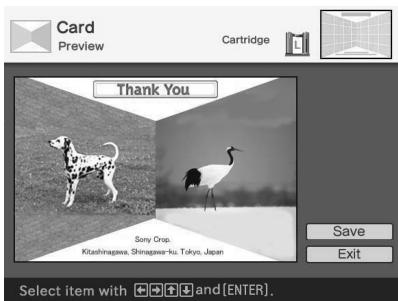
9 Check the preview, then save and print your Creative print. For details, see page 58.
Making split images
You can make a print with 2-split, 4-split, 9-split, 13-split, or 16-split images.
1 Display the Creative Print menu (page 43). 2 Press the arrow (←/→/→/→) button to select "Split Image", then press ENTER.
The print size selection window is displayed.

Split Image
Select Print Size
Cartridge


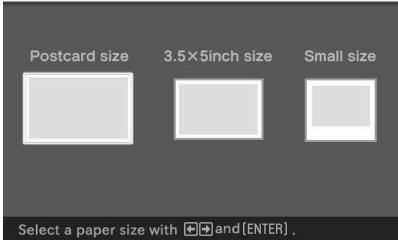
3 Press the arrow (left/right) button to select the print size, then press ENTER.
The split image templates are displayed.
When you select "Small size"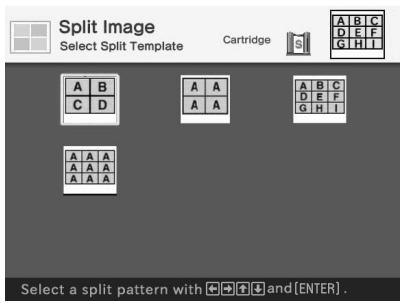
4 Press the arrow (up/down/left/right) button to select the desired template, then press ENTER.
The preview of the selected template is displayed.
Image area
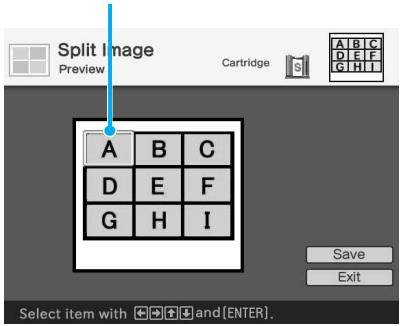
Tip
You can select and set each area in any order.
5 Press the arrow (up/down/left/right) button to select the desired area and press ENTER.
When you have selected a template with frames (a 9-split "Small size" template), the window for selecting a frame is displayed. In other cases, the window for selecting an image shown in step 6 is displayed.
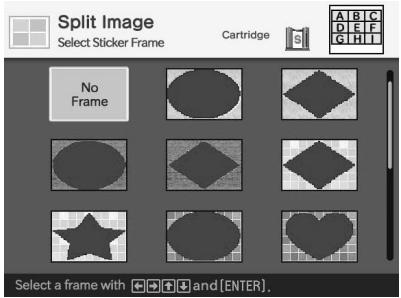
6 Press the arrow (up/down/left/right) button to select the desired frame that you want to add to an image, then press ENTER.
If you do not want to use any frame, select "No Frame."
The image list is displayed.
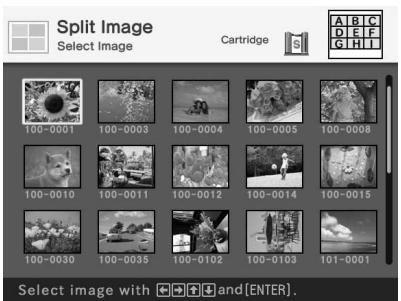
7 Press the arrow (left/right/up/down) button to select the desired image, and then press ENTER.
The window used for adjusting the image position is displayed.
Select item with and [ENTER].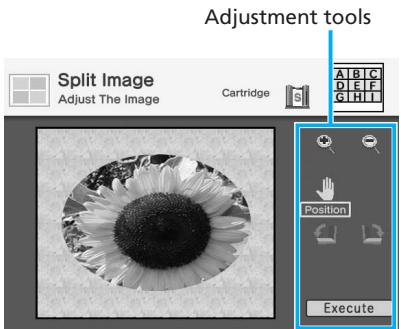
Press the arrow (left/right/up/down) button to select the desired adjustment tool, then press ENTER.
| Item | Procedures |
| Each time you press ENTER, the image becomes larger. | |
| Each time you press ENTER, the image becomes smaller. | |
| Move the image with the arrow (▲/▲/▲/▲) button, and then press ENTER. | |
| Each time you press ENTER, the image rotates 90° clockwise. | |
| Each time you press ENTER, the image rotates 90° counterclockwise. |
9 Press the arrow (left/right/up/down) button to select "Execute" and press ENTER.
The preview image is displayed.
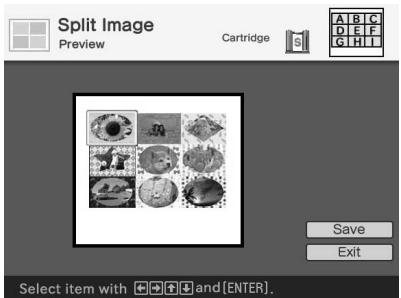
10 Check the preview, then save and print your Creative print. For details, see page 58.
Saving and printing a Creative print image
Saving a Creative print
After you finish making a Creative print, you can save the image with a new file number.
Tip
The selected image will not be overwritten.
1 Press the arrow (left/right/up/down) button to select "Save" and press ENTER.
The dialog box to select the media to save the image in is displayed.
2 Select the destination memory card.
Press the arrow (up/down) button to select "Memory Stick" or "Compact Flash" and press ENTER.
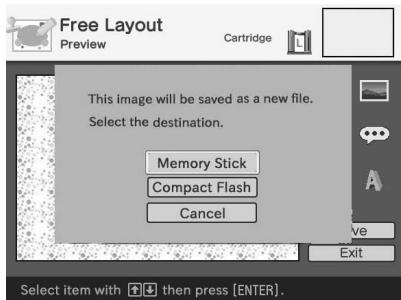
The dialog box for setting the date is displayed. You can save the date with the image.
3 Set the date.
Press the arrow (up/down) button to select the number and press the arrow (down/up) button to select the day, month, or year. Then press ENTER.
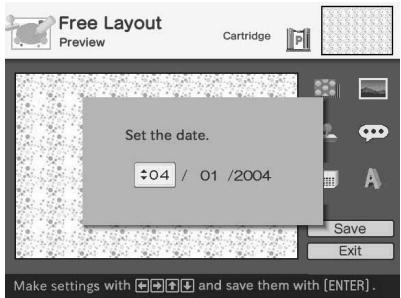
The image is saved. The dialog box to notify the new file number is displayed.
4 Press ENTER.
Note
While saving the image, do not turn off the printer or remove the memory card from the printer. The memory card may be damaged.
Printing an edited image
1 Press PRINT.
The dialog box to specify the print quantity is displayed.
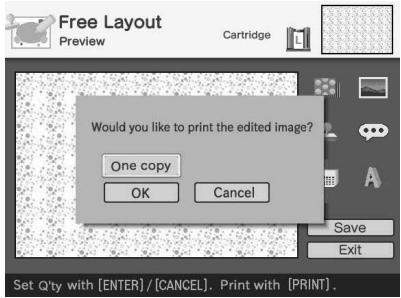
2 Set the print quantity.
- To increase the print quantity one by one, press ENTER repeatedly.
- To reduce the print quantity one by one, press CANCEL repeatedly.
- To reset the print quantity to one, press CANCEL for more than two seconds.
3 Press the arrow button to select "OK" to start printing.
The image previewed is printed.
To stop printing
Press CANCEL. When you are printing multiple copies, the next printing after the one currently printing will be cancelled.
Displaying other menu while editing an image
Press MENU.
The menu bar is displayed. Even while editing an image, you can change some printer settings or option menu items such as "Finish," "Date Print" or "Beep."
Exiting the Creative Print menu
- Press MENU in the middle of the operations and select "Creative Print Complete."
- Display the preview image and then press the arrow button to select "Exit" and press ENTER.
The dialog box for saving an image may be displayed. To save an edited image, follow the steps in "Saving a Creative print."
Changing the print settings (SET UP)
The SET UP menu allows you to change various print settings listed on pages 61 and 62.
Buttons to be used in this section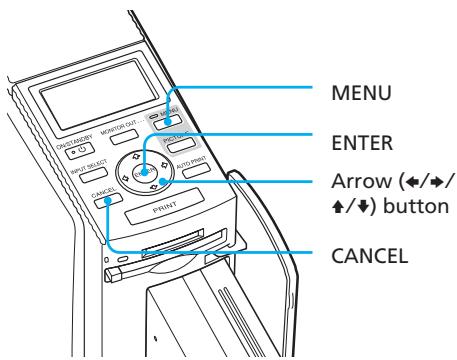
1 Press MENU.
The menu bar is displayed.
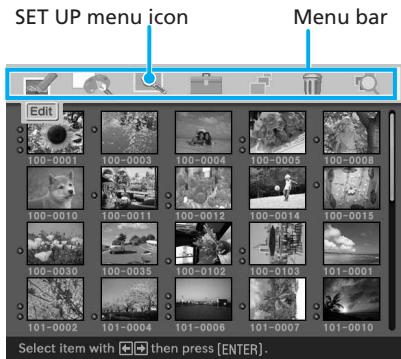
To exit the menu mode
Press MENU. The previous window is displayed.
2 Press the arrow (left/right) button to select (SET UP) and then press ENTER.
The SET UP menu is displayed.
Cursor
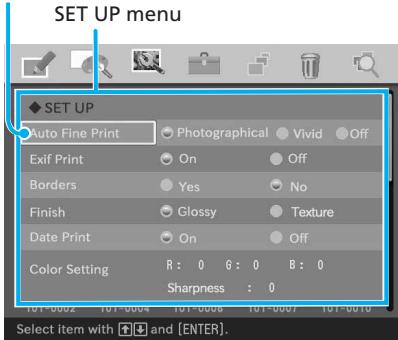
Note
Setting items which cannot be changed are displayed in gray and cannot be selected.
3 Press the arrow (up/down) button to select the desired setting item, press the arrow (left/right) button to change the option, and then press ENTER.
| Item | Settings | Contents |
| Auto Fine Print 3 | Photographical*/ Vivid | ·Photographical: Adjusts an image automatically so that the image is printed with natural and beautiful pictures. ·Vivid: Adjusts an image automatically so that the image is printed with stronger sharpness correction and more vivid pictures than the Photographical mode. |
| Off | ·Notes ·The image data is not corrected. ·When printing in PC mode, the Auto Fine Print 3 setting with the printer driver has priority over the setting here. In the LCD and PictBridge modes, this setting holds effective. | |
| Exif Print | On* | Adjusts an image shot by an Exif Print (Exif 2.2)-compliant digital camera to its optimum picture quality. |
| ·Note ·The image data is not corrected. | ||
| Off | Prints an image without any adjustments. | |
| Borders | Yes | Prints an image with borders around the image. |
| ·Note Depending on an image, its top and bottom edges or right and left edges may be trimmed and printed. | ||
| No* | Prints an image without blank space around the image. | |
| ·You cannot make borderless prints with Small (3.5 x 4 inch) size print paper. ·When printing a standard 4:3 picture shot by a digital camera, the top and bottom edges of the image are cut and it is printed as a 3:2 picture. | ||
| Finish | Glossy* | Prints an image vividly with glossy finish. |
| Texture | Prints an image softly with a uniform and uneven finish. |
*: Factory settings
| Item | Settings | Contents |
| Date Print | On | Prints the date of shooting with an image when the image is a file recorded in the DCF (Design rule for Camera File system) format. To make a print with the date of shooting, shoot an image in the DCF file format.When the image is saved with the printer, the date of saving is printed. |
| OFF* | Prints an image without the date. | |
| Color Setting | Adjusts the colors and sharpness of a print. Press the arrow (▲/▲) button to select a color element ("R" (red), "G" (green), or "B" (blue)) or "Sharpness," and then press the arrow (▲/▲) button to set the level. (*R: 0/G:0/B:0/ Sharpness:0)R: Adjusts the red and blue elements. The higher you set the level, the more reddish the picture becomes as if it receives red light. The lower you set the level, the darker the picture becomes as if light blue is added.G: Adjusts the green and purple elements. The higher you set the level, the more greenish the picture becomes as if it receives green light. The lower you set the level, the darker the picture becomes as if red purple is added.B: Adjusts the blue and yellow elements. The higher you set the level, the more bluish the picture becomes as if it receives blue light. The lower you set the level, the darker the picture becomes as if yellow is added.Sharpness: The higher you set the level, the more distinct the outlines become. |
*: Factory settings
To cancel settings
Press CANCEL. The settings will be returned to the state they were in before you made changes.
Changing the printer preferences (OPTION)
The OPTION menu allows you to change the preferences listed on page 64.
Buttons to be used in this section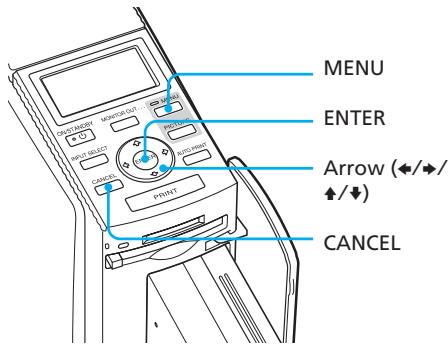
1 Press MENU.
The menu bar is displayed.
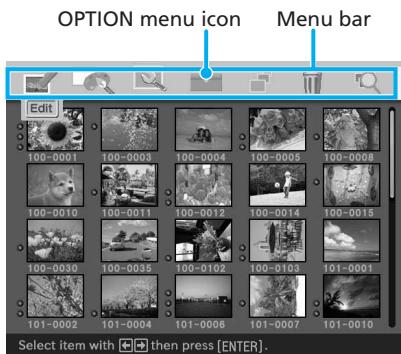
To exit the menu mode
Press MENU. The previous window is displayed.
2 Press the arrow (left/right) button to select (OPTION) and then press ENTER.
The OPTION menu is displayed.
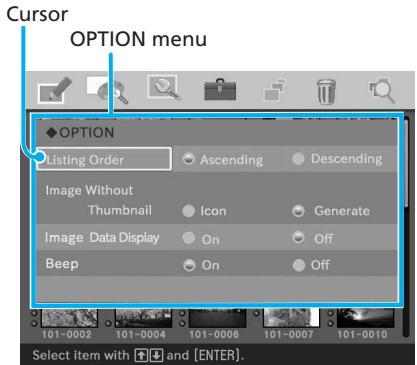
3 Press the arrow (up/down) button to select the desired setting item, press the arrow (up/down) button to change the option, and then press ENTER.
Note
Items which cannot be changed are displayed in gray and cannot be selected.
| item | Settings | Contents |
| Listing Order | Ascending* | In the image list window, the images are displayed in the order of their image numbers, starting from the smallest number. |
| Descending | In the image list window, the images are displayed in the order of their image numbers, starting from the largest number. | |
| Image Without Thumbnail | Icon* | In the image list window, the images without thumbnail (miniature image used as index) data will be displayed as an icon. |
| Generate | In the image list window, the images without thumbnail (miniature image used as index) data will be displayed as its original image. | |
| Image data display | On | In the image list window, image information (file type, shooting conditions, etc.) will be displayed. |
| Off* | In the image list window, no image information will be displayed. | |
| Beep | On* | The warning and operation sounds beep. |
| Off | No warning or operation sounds beep. |
*: Factory settings
To cancel settings
Press CANCEL. The settings will be returned to the state they were in before you made changes.
Viewing a slideshow
You can perform a slideshow of the images saved in a "Memory Stick" or CompactFlash card. You can also manually print an image being displayed.
Buttons to be used in this section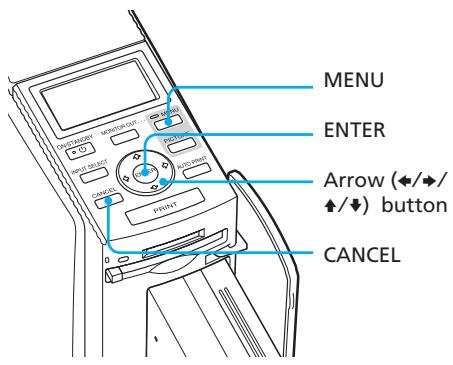
1 Press MENU.
The menu bar is displayed.
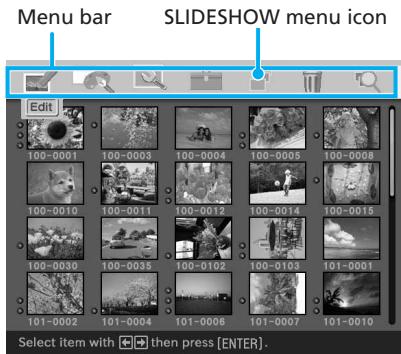
To exit the menu mode
Press MENU. The previous window is displayed.
2 Press the arrow (left/right) button to select (SLIDESHOW) and then press ENTER.
The SLIDESHOW menu is displayed.
Cursor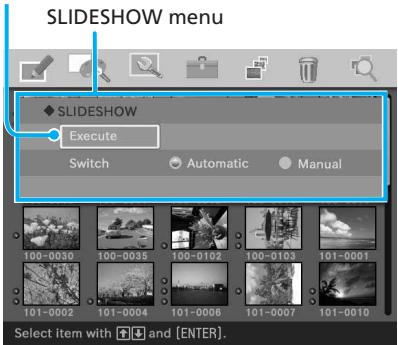
3 Press the arrow (up/down) button to select "Switch," press the arrow (up/down) button to select "Automatic" to switch images automatically, or "Manual" to switch them manually, and then press ENTER.
4 Press the arrow (left/right) button to select "Execute," then press ENTER.
- When "Automatic" is selected: The images in the "Memory Stick" or CompactFlash card are displayed automatically one after another.
- When "Manual" is selected: The image with the cursor in the image list is displayed. To switch images, press the arrow (left/right/up/down) button. The image to the left, right, above, or below the current image in the image list will be displayed.
To stop slideshow
Press CANCEL.
Notes
- Depending on the image, it may take time to be displayed.
- You cannot display the images that are not displayed as thumbnails because they are damaged or for some other reason.
Printing a displayed image
While playing the slideshow manually, you can print a displayed image.
1 Press PRINT.
The dialog box to specify the print quantity is displayed.
2 Set the print quantity.
- To increase the print quantity one by one, press ENTER repeatedly.
- To reduce the print quantity one by one, press CANCEL repeatedly.
- To reset the print quantity to one, press CANCEL for more than two seconds.
3 Press the arrow (left/right/up/down) button to select "OK" to start printing.
The image previewed is printed.
To stop printing
Press CANCEL. When you are printing multiple copies, the next printing after the one currently printing will be cancelled.
Deleting images
You can delete images in the "Memory Stick" or CompactFlash card. You can also format the "Memory Stick."
Notes
- During deleting or formatting, do not turn off the printer or remove the "Memory Stick" or CompactFlash card from the insertion slot. The "Memory Stick" or CompactFlash card may be damaged.
- An image, once deleted, will be lost forever. Before deleting an image, double-check that it is the right one.
- When formatting a "Memory Stick", all the files including the image files will be deleted.
- You cannot format a CompactFlash card.
Deleting selected images
You can select and delete images on a "Memory Stick" or CompactFlash card.
Buttons to be used in this section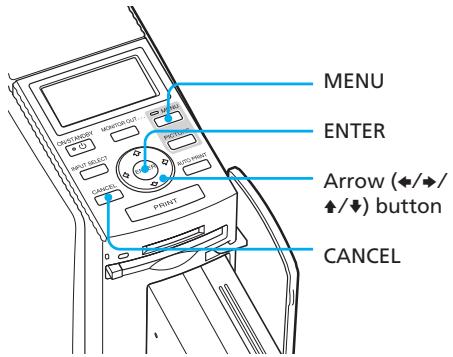
1 Press MENU.
The menu bar is displayed.
Menu bar DELETE/FORMAT menu icon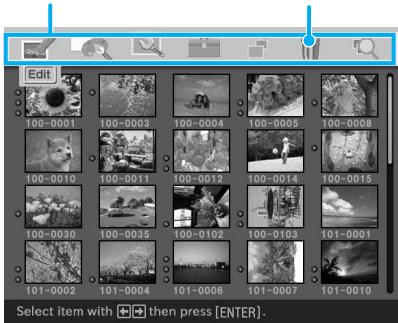
To exit the menu mode
Press MENU. The previous window is displayed.
2 Press the arrow (left/right) button to select (DELETE/FORMAT) and then press ENTER.
The DELETE/FORMAT menu is displayed.
Cursor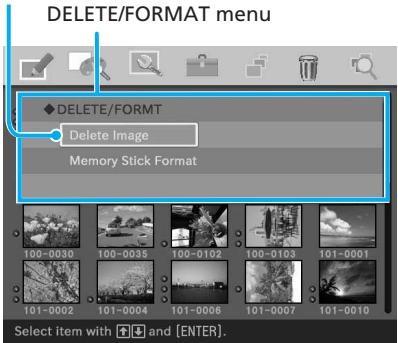
3 Press the arrow (up/down) button to select "Delete Image" and press ENTER.
The image list is displayed. A trash icon is displayed on the image selected with the cursor before you pressed MENU in step 1.
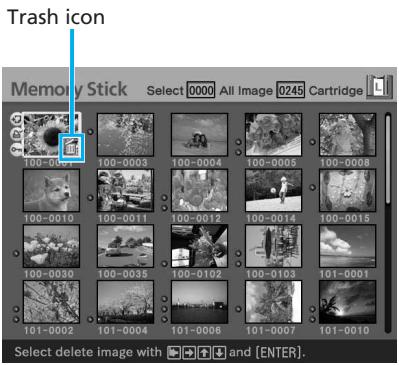
4 Press the arrow (left/right) button to move the trash icon to the image you want to delete, then press ENTER. 5 Press ENTER.
A confirmation dialog box is displayed.
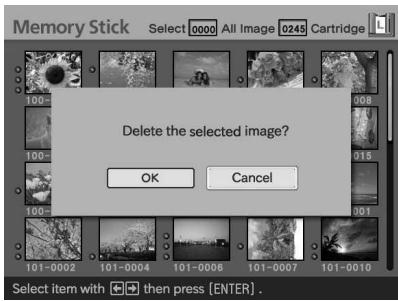
6 Press the arrow (left/right) button to select "OK" and press ENTER.
The selected image is deleted. To delete other images, repeat steps 4 through 6.
Notes
- When you delete an image with the associated file indication (·), the associated motion or e-mail file will be also deleted.
- You cannot delete the protected image with the protect indication (⊙).
Formatting a "Memory Stick"
You can format a "Memory Stick".
1 Press MENU.
The menu bar is displayed.
2 Press the arrow (left/right) button to select (DELETE/FORMAT) and then press ENTER.
The DELETE/FORMAT menu is displayed.
3 Press the arrow (up/down) button to select "Memory Stick Format" and press ENTER.
The confirmation dialog box is displayed.
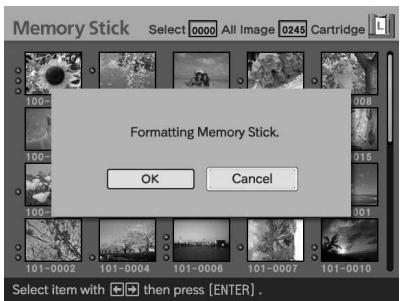
4 Press the arrow (left/right) button to select "OK" and press ENTER.
The "Memory Stick" is formatted.
Note
When you format a "Memory Stick", all the images inside are deleted.
Searching for an image
You can search a "Memory Stick" or CompactFlash card for an image by file number or date.
Buttons to be used in this section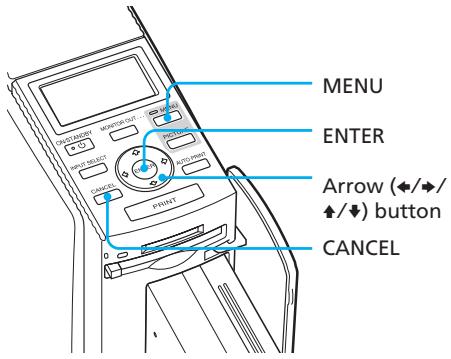
1 Press MENU.
The menu bar is displayed.
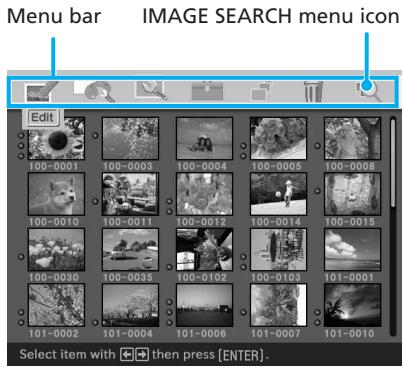
To exit the menu mode
Press MENU. The previous window is displayed.
Press the arrow (left/right) button to select (IMAGE SEARCH) and then press ENTER.
The IMAGE SEARCH menu is displayed.
You can search for an image by file number, date, or folder number.
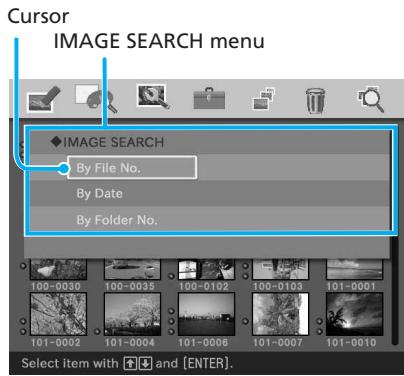
Press the arrow (up/down) button to select the search key and press ENTER. The dialog box used for specifying the criteria for searching is displayed. Press the arrow (left/right) button to select an item and press the arrow (left/right) button to specify numbers.
- When you select "By File No.":
Specify the starting and ending numbers of the files that you want to search for:
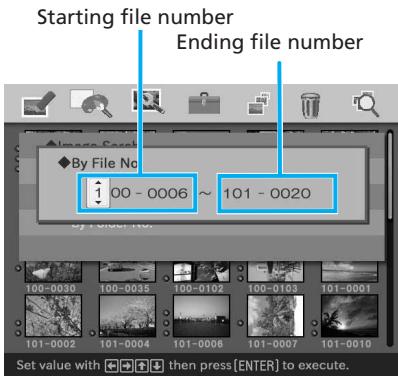
Tip
To search for a specific file, enter the same file number in both the boxes.
- When you select "By Date":
Specify the starting and ending dates of the files that you want to search for:
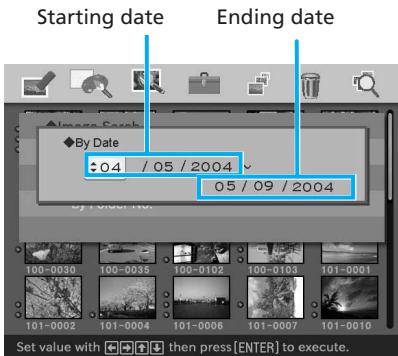
Tip
To search for images of a specific day, enter the same date in both the boxes.
- When you select "By Folder No."
Specify the folder number of the images you want to search for:
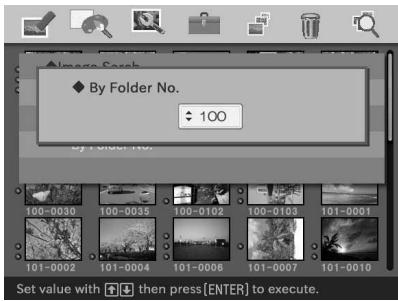
5 Press ENTER.
Searching starts. When the search is complete, the search results will be displayed.
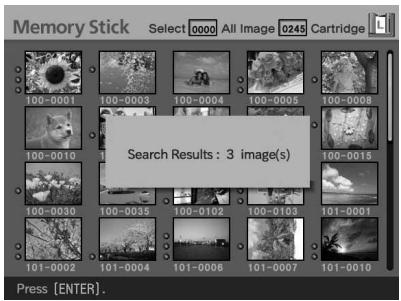
If no images have been found
"No images were found" will be displayed.
6 Press ENTER.
The image list is displayed.
- When you have selected "By File No." and "By Data," the images found are selected with an orange frame.
- When you have selected "By Folder No.", the first image in the selected folder is selected with the cursor.
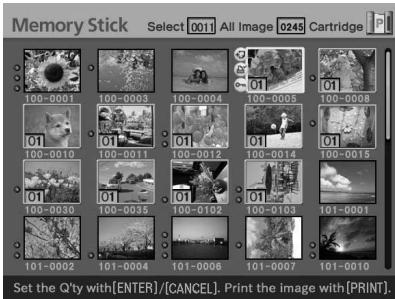
You can use the printer's LCD display to carry out the following printing operations:
- Printing a selected image (page 74) Specify the image number and print an image.
- AUTO printing (INDEX/DPOF/ALL) (page 76)
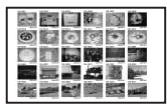
- Changing the print settings (page 79) (You need to connect the printer to a TV monitor to make settings.)
Image numbers
To print using the printer's LCD display, you need to specify the image number for each image. To find the image numbers, make an index print. Or display the image list on a TV monitor or check the image numbers with your digital camera.
The display of characters on the LCD
The following can be displayed on the printer's LCD.
(,), +, -, numbers 0 to 9, capital letters A to Z, _,
Other characters are displayed as "☑".
Connections
Connecting the AC power cord
After you have made connections (when necessary), connect the AC power cord to the AC outlet.
The ON/STANDBY indicator lights in red.
AC power cord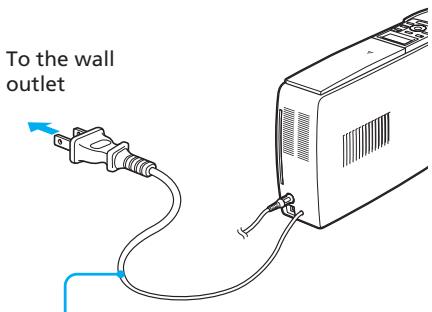
Note
The AC power cord in the above illustration is for 120V AC only. The plug shape of the AC power cord for 100 to 240V is different.
Inserting a memory card
Inserting a "Memory Stick"
To print an image stored on a "Memory Stick," insert it into the "Memory Stick" slot until it clicks into place.
For the varieties of "Memory Stick" that you can use with the printer, see page 127.
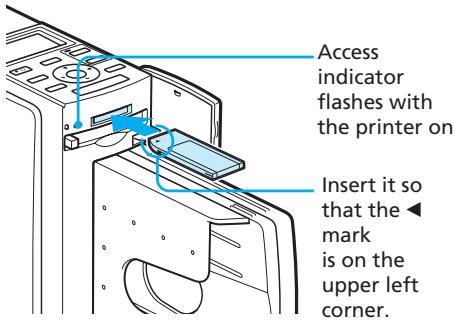
To eject a "Memory Stick"
Push the "Memory Stick" lightly into the insertion slot. After the "Memory Stick" pops back out, remove it slowly.
Notes
- When using a "Memory Stick Duo," be sure to use the Memory Stick Duo adaptor.
- Do not attempt to insert a "Memory Stick" forcibly into or out of the slot. If you do so, the "Memory Stick" or the printer may be damaged.
Inserting a CompactFlash card
To print an image stored on a
CompactFlash card, insert the
CompactFlash card into the
CompactFlash card slot until it clicks into place.
For the varieties of CompactFlash card that you can use with the printer, see page 130.
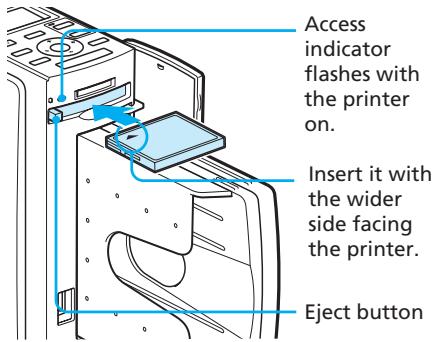
To eject a CompactFlash card
Press the CompactFlash card eject button. After the card pops out, remove it slowly.
Note
Do not attempt to insert a CompactFlash forcibly into or out of the slot. If you do so, the CompactFlash or the printer may be damaged.
On using the memory card
- To avoid potential loss of data, make a backup copy of the contents of the memory card. We cannot compensate for any damage to or loss of data.
- Check the memory card and insert it in the correct direction. If a memory card is forcibly inserted in the wrong direction, the memory card and its slot may be damaged.
Printing images
Printing a selected image
This section explains how to specify an image number and print the image.
1 Turn on the printer.
The ON/STANDBY indicator lights in green.
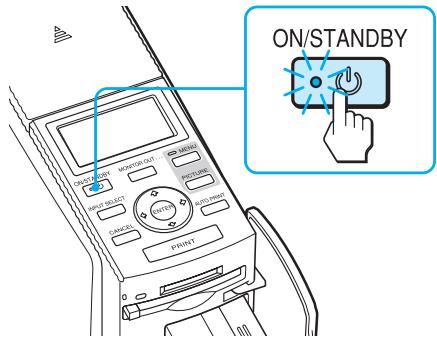
2 Press MONITOR OUT to turn off the MONITOR OUT indicator.
The LCD mode is selected.
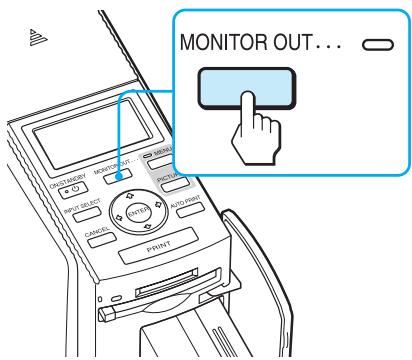
3 Press INPUT SELECT repeatedly to select the memory card containing the images that you want to print.
Display the desired memory card type on the LCD display ("Memory Stick" or "CompactFlash").
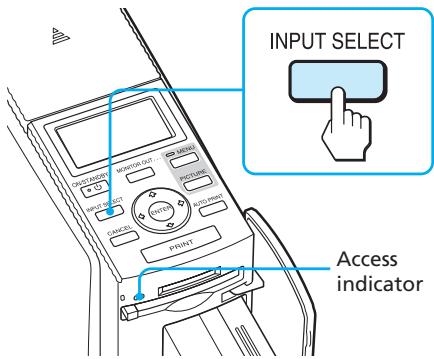
The access indicator flashes and the images are loaded into the printer.
The LCD display of the printer shows the current image number.
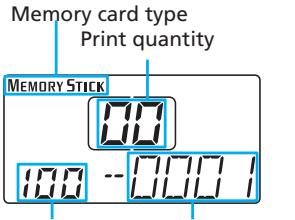
Folder name Image number
4 Press the arrow (up/down) button to select the folder (when multiple folders exist) and press the arrow (left/right) button to select the desired image number.
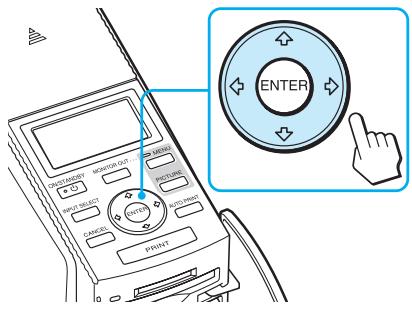
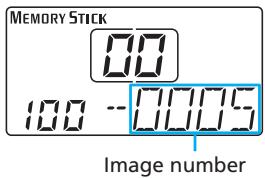
5 Press ENTER or CANCEL to set the print quantity.
- To increase the print quantity one by one, press ENTER.
- To decrease the print quantity one by one, press CANCEL.
- To cancel the selection, press CANCEL for more than two seconds.
You can set up to 30 copies of print quantity for an image.
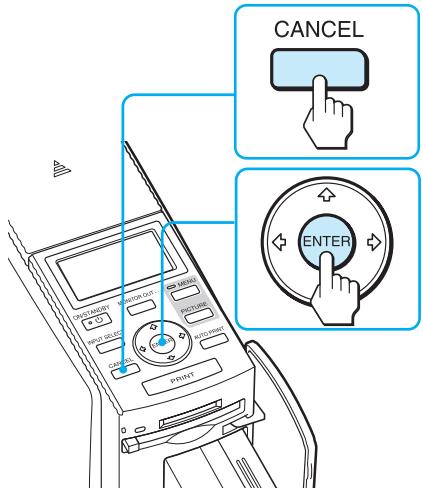
Print quantity increases or decreases.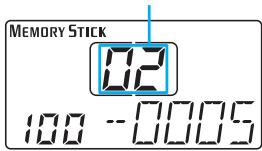
6 Press PRINT.
Printing starts. During printing, "PRINT" is displayed on the LCD display.
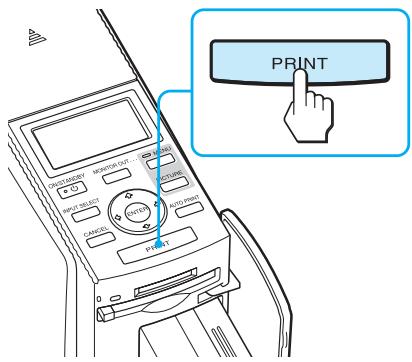
7 When printing is complete and the print paper automatically emerges, remove the printed paper from the paper tray.
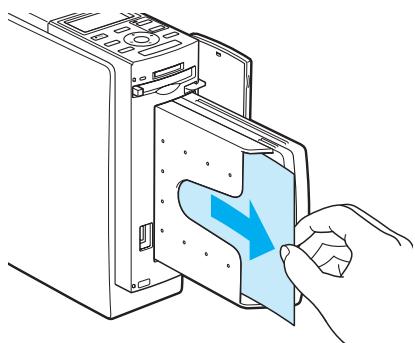
Notes
- Do not remove the memory card while the access indicator is flashing; the memory card or printer may be damaged.
- Never move or turn off the printer while it is printing; the print cartridge or paper may become stuck. If this happens, turn the printer off and then on, and resume printing from the beginning.
AUTO printing (INDEX/DPOF/ALL)
AUTO (automatic) printing allows you to print multiple images stored on the "Memory Stick" or a CompactFlash card at one time.
The printer provides the following three AUTO printing methods:
INDEX printing
You can print a list (index) of all the images contained in the "Memory Stick" or CompactFlash card in split panes, which allows you to check the contents of the memory card easily. The number of split panes on a sheet will be calculated automatically. Images are printed with their corresponding image numbers.
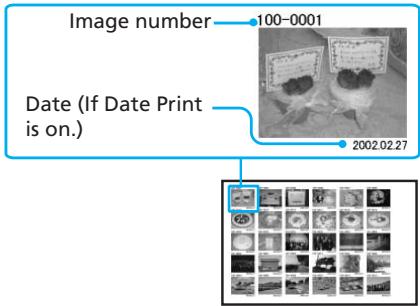
DPOF preset image printing
You can print all the DPOF (Digital Print Order Format) preset images. The images are printed with the preset number of copies in the order they were displayed.
- ALL images printing
You can print all the images stored in the "Memory Stick" or CompactFlash card at one time. The images are printed one by one in the order of their image numbers.
Notes
- For how to preset images for printing, see the manual of your digital camera.
- Some types of digital camera do not support the DPOF function, or the printer may not support some of the functions of the digital camera.
1 Turn on the printer.
The ON/STANDBY indicator of the printer lights in green.
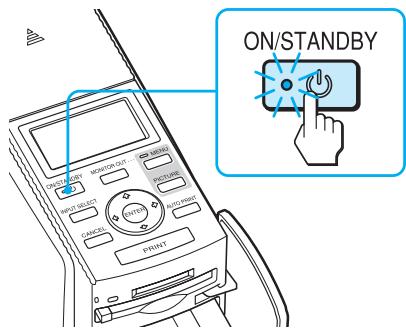
2 Press MONITOR OUT to turn off the MONITOR OUT indicator.
The LCD mode is selected.
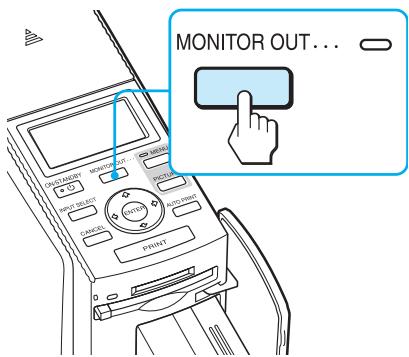
3 Press INPUT SELECT repeatedly to select the memory card containing the images that you want to print.
Display the desired memory card type on the LCD display ("Memory Stick" or "CompactFlash").
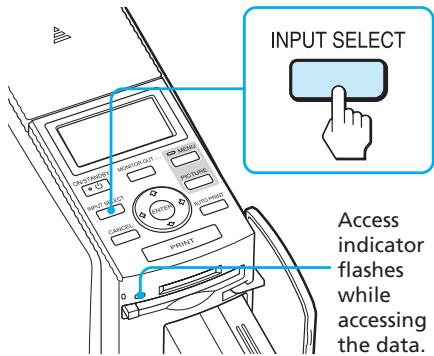
The memory card type
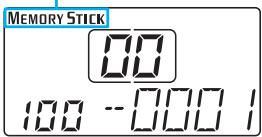
4 Press AUTO PRINT repeatedly to display "INDEX," "DPOF," or "ALL" on the LCD display.
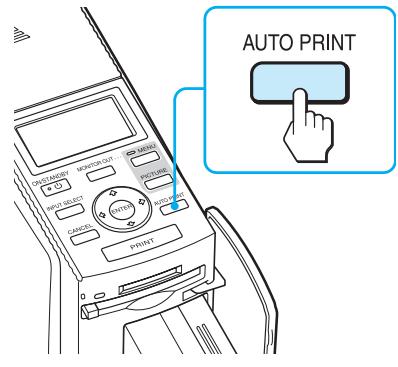
Folder name Image number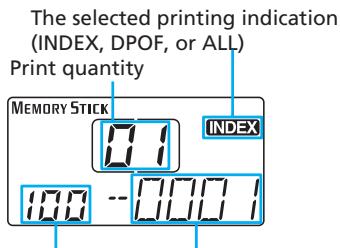
5 Press PRINT.
Printing starts. During printing, "PRINT" is displayed in the LCD display.
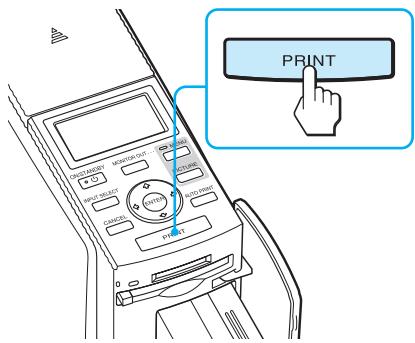
To stop printing
Press CANCEL. When you are printing multiple copies, the next printing after the one currently printing will be cancelled.
6 When printing is complete and the print paper automatically emerges, remove the printed paper from the paper tray.
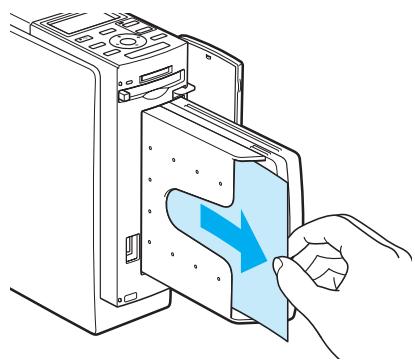
To resume the normal printing mode
Press AUTO PRINT repeatedly until either INDEX, DPOF, or ALL disappears from the LCD display.
Tips
- Even if the print cartridge or print paper runs out in the middle of printing, you can continue printing by replacing the print cartridge or inserting print paper.
- When the "Date Print" is set to "ON" with the menu, the recorded date (month, day, and year) is also printed (page 62).
Changing the print settings
By connecting your printer to a TV monitor, you can display SET UP and OPTION menus and change the print settings.
1 Connect the printer to a TV monitor (page 18). 2 Turn on the printer and TV monitor (page 20). 3 Make sure that the MONITOR OUT indicator lights (page 20). 4 Press MENU (page 60). 5 Press the arrow (left/right) button to select (SET UP) or (OPTION) and then press ENTER.
The SET UP (page 60) or OPTION (page 63) menu is displayed. The settings you make are effective when you print images in the LCD mode.
SET UP menu
| Auto Fine Print 3 | You can select or disable automatic picture adjustment for printing. (Photographical*/ Vivid/Off) |
| Exif Print | You can turn on or off the automatic adjustments of the images shot by an Exif Print-compliant digital camera to its optimum picture quality. (On*/Off) |
| Borders | You can select border or borderless prints. (Yes/No*) |
| Finish | You can select a glossy or an uneven finish. (Glossy*/Texture) |
| Date Print | You can select whether or not you print the shot date with an image. (On/Off*) |
| Color Setting | You can adjust the colors (R/G/B) and sharpness of a printed image. (R: 0/G:0/B:0/ Sharpness:0) |
- Factory settings
OPTION menu
| Listing Order | You can select the order of the images to be displayed. (Ascending*/Descending) |
| Beep | You can select whether or not operation and warning beeps sound. (On*/Off) |
- Factory settings
For the details on how to make settings, see pages 60 and 63.
You can connect a PictBridge-compliant digital camera and print an image directly from your digital camera.
- Printing images from the digital camera (this page)
- Changing the print settings (page 83) (You need to connect the printer to a TV monitor to make settings.)
How to attach the clamp filter
If the USB cable supplied with your PictBridge-compliant digital camera is not equipped with ferrite cores, be sure to attach the supplied clamp filter for noise prevention as illustrated below before using the unit. To conform to radiation standards, you must attach ferrite cores to one end of the USB cable. If no ferrite cores are attached, other devices may be affected by radiation noise.
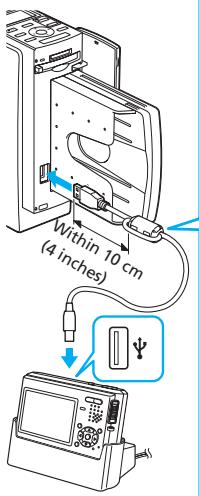
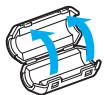
1 Release the lock of the clamp filter with a screwdriver or a similar tool.
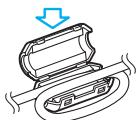
② Wind the cable into the clamp filter one time.
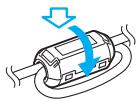
③ Close the clamp filter.
Attach the clamp filter as close to the plug as possible (within 10 cm (4 inches)) that is connected to the printer's USB connector.
Printing images from the digital camera
Follow the procedures below to set the printer to the PictBridge mode and print images directly from the digital camera.
1 Set your digital camera ready for printing with a PictBridge-compliant printer.
The settings and operations that are necessary before connection differ depending on the digital camera.
For details, see the operating instructions of the digital camera you use.
2 Connect the AC power cord of the printer to a wall outlet.
The ON/STANDBY indicator lights in red.
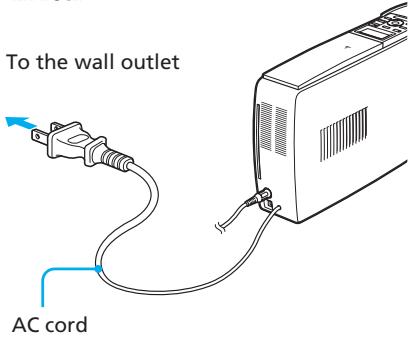
Note
The AC power cord in the above illustration is for 120 V AC only. The plug shape of the AC power cord for 100 to 240 V is different.
3 Turn on the printer.
The ON/STANDBY indicator of the printer lights in green.
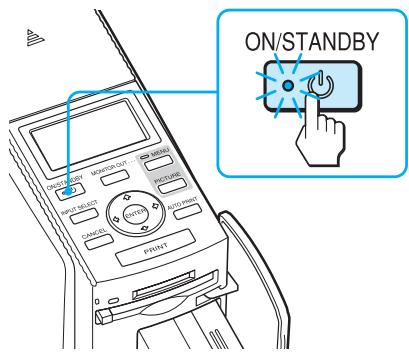
4 Connect a PictBridge-compliant digital camera to the printer.
Use the USB connecting cable supplied with the digital camera.
To the PictBridge connector (USB A-TYPE)
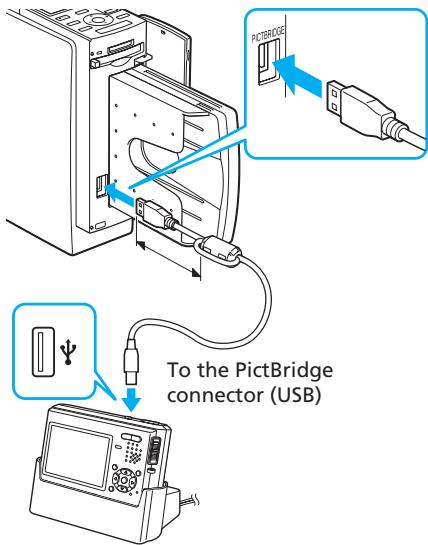
PictBridge-compliant digital camera
Notes
- The connector is designed for the PictBridge only. Never connect a device other than a PictBridge-compliant digital camera.
- The type of USB connecting cable you should use may differ depending on the digital camera. Use a USB connecting cable with an A-TYPE connector for the printer and an appropriate type for your digital camera.
- Use a commercially available USB cable shorter than 3 m in length.
The printer automatically enters the PictBridge mode. The "PictBridge" indication appears in the LCD display.
PictBridge
5 Operate the digital camera to print an image.
The printer supports the following prints:
- Single-image print.
- Index print (INDEX)
- All images print (ALL)
- Date print
- Border/borderless print
Tip
If you do not make settings for print quality with your digital camera, an image will be printed according to the print settings with the SET UP menu (page 60).
Note
- If you replace a print cartridge while the printer is connected to a digital camera, an image may not be printed properly. If this occurs, make the paper size setting of the digital camera again or disconnect and then connect the digital camera.
- When you select standard/printer setting option for the date print or border/borderless print, the date or border settings of the printer become effective.
On the "PictBridge" indication
The "PictBridge" indication on the LCD display shows the connection status between the printer and the digital camera as follows:
- When the indication lights: The connection between the printer and the digital camera is established.
- When the indication blinks: The connection between the printer and the digital camera is not established for the following reasons:
- The printer is not ready for the PictBridge mode since it is in the midst of printing, or it is in the Creative Print or Edit mode.
- The printer is establishing the connection. Please wait.
- The digital camera does not support the PictBridge feature.
Changing the print settings
By connecting your printer to a TV monitor, you can display the SET UP menu to change the print settings.
1 Connect the printer to a TV monitor (page 18). 2 Turn on the printer and TV monitor (page 20). 3 Make sure that the MONITOR OUT indicator lights (page 20). 4 Press MENU (page 60). 5 Press the arrow (left/right) button to select (SET UP) and then press ENTER.
The SET UP (page 60) menu is displayed. The settings you make are effective when you print images in the PictBridge mode.
SET UP menu
| Auto Fine Print 3 | You can select or disable automatic picture adjustment for printing. (Photographical*/ Vivid/Off) |
| Exif Print | You can turn on or off the automatic adjustments of the images shot by an Exif Print-compliant digital camera to its optimum picture quality. (On*/Off) |
| Borders | You can select border or borderless prints. (Yes/No*) |
| Finish | You can select a glossy or an uneven finish. (Glossy*/Texture) |
| Date Print | You can select whether or not you print the shot date with an image. (On/Off*) |
| Color Setting | You can adjust the colors (R/G/B) and sharpness of a printed image. (R: 0/G:0/B:0/ Sharpness:0) |
- Factory settings
For the details on how to make settings, see page 60.
To print from a PC connected to the printer, you need to install the supplied software (printer driver and PictureGear Studio) to your PC.
This section explains how to install the supplied software on your PC and how to use the supplied PictureGear Studio software to print an image.
Please also refer to the operating instructions of your PC.
On trademarks and copyrights of PictureGear Studio
- On copyrights of design materials
- The copyrights of the design materials contained in this software are owned by Sony Corporation or Sony Music Communications Corporation. Any commercial use is prohibited by the copyrights laws.
- Duplication of copyrighted materials, such as photographs, is prohibited except for private or domestic use.
- All other companies and product names mentioned herein may be the trademarks or registered trademarks of their respective companies. Furthermore, "TM" and "®" are not mentioned in each case in this manual.
Installing the software
System requirements
To use the supplied software, your PC must meet the following system requirements:
System requirements for the printer driver
OS: Microsoft Windows 98SE/Windows Me/Windows 2000 Professional/Windows XP Home Edition/Windows XP Professional, pre-installed. CPU: Pentium II 400MHz or faster is recommended. RAM: 64 MB or more is recommended. Hard disk space: 200 MB or more is recommended.
System requirements for PictureGear Studio
OS: Microsoft Windows 98SE/Windows Me/Windows 2000 Professional/Windows XP Home Edition/Windows XP Professional, preinstalled (IBM PC/AT compatible). (Windows 95, Windows 98 Gold Edition, Windows NT, and other versions (e.g., Server, Personal) of Windows 2000 are not supported.)
CPU: Pentium III 500MHz or faster (Pentium III 800MHz or faster is recommended.)
RAM: 128 MB or more (256 MB or more is recommended.)
Hard disk space: 200 MB or more (Depending on the Windows version you use, more space will be required. To handle image data, you will need additional hard disk space.)
Display: Screen area: 800 × 600 pixels or more. Colors: High Color (16-bit) or more.
On the supplied CD-ROM
The supplied CD-ROM contains the following software:
- Printer driver for DPP-EX50: The software describes the printer's requirements and enables printing from the computer. PictureGear Studio: Sony's original software application that allows you to handle still images—capturing, managing, processing, and printing.
Notes
- If a hub is used to connect the printer and your PC, or if two or more USB devices including other printers are connected to your PC, a trouble may occur. If this occurs, simplify the connections between your PC and the printer.
- You cannot operate the printer from another USB device being used simultaneously.
- Do not remove the USB cable from or connect it to the printer during data communication or printing. The printer may not work properly.
- The printer does not support system standby/hibernate mode of the computer. During printing, do not change your PC to system standby/hibernate mode.
- We cannot guarantee operations with all personal computers, even though they may meet or exceed the system requirements.
Installing the printer driver
1 Make sure that the printer is disconnected from the computer.
Note
If you connect the printer to your PC in this stage, either of the following dialog boxes are displayed:
- When using Windows 98SE/Me: Add New Hardware Wizard
- When using Windows 2000/XP: Found New Hardware Wizard
If this occurs, disconnect the printer from the PC and then click "Cancel" in the dialog box.
2 Turn on your computer and start Windows.
- When installing or uninstalling the software in Windows® 2000 Professional, log on to Windows as "Administrator" or "Power user".
- When installing or uninstalling the software with Windows® XP Professional/Home Edition, log on using a "Computer administrator" user account.
Notes
- Be sure to close all running programs before installing the software.
- The dialog boxes in this section are those in Windows XP Professional, unless otherwise specified. The installation procedures and the dialog boxes shown differ depending on the operating system.
3 Insert the supplied CD-ROM into the CD-ROM drive of your computer.
The setup starts automatically and the installation window is displayed.
Note
In case the installation window is not automatically displayed, double-click the "Setup.exe" of the CD-ROM.
4 Click "Installing Printer Driver".
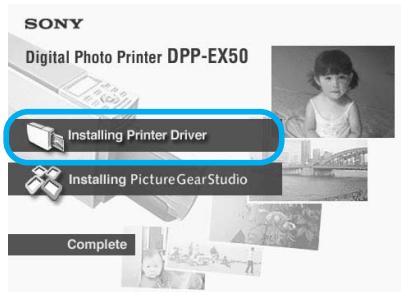
The "Sony DPP-EX50 - InstallShield Wizard" dialog box appears.
5 Click "Next".
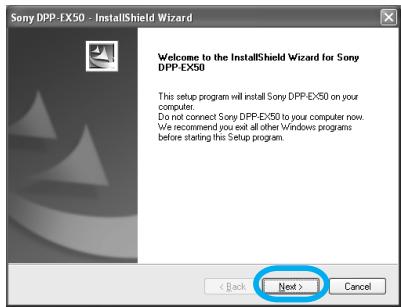
The license agreement dialog box is displayed.
6 Check "I accept the terms of the license agreement" and click "Next".
If you check "I do not accept the terms of the license agreement", you cannot proceed to the next step.
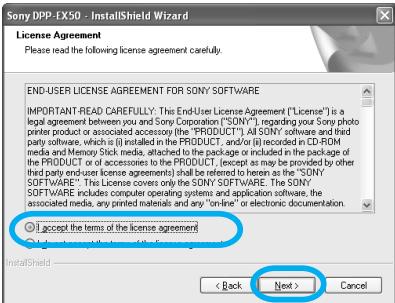
The "Ready to install the program" dialog box is displayed.
7 Click "Install".
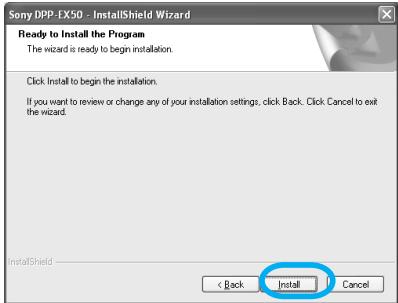
The "Printer connection" dialog box is displayed.
8 Connect the AC power cord of the printer to the AC outlet. The ON/STANDBY indicator lights in red.
AC power cord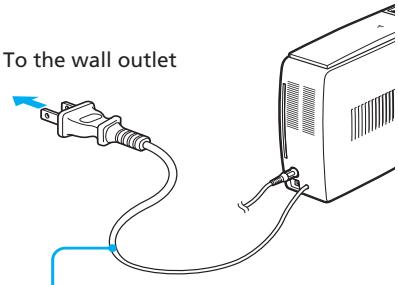
Note
The AC power cord in the above illustration is for 120 V AC only. The plug shape of the AC power cord for 100 to 240 V is different.
9 Turn on the printer.
The ON/STANDBY indicator lights in green.
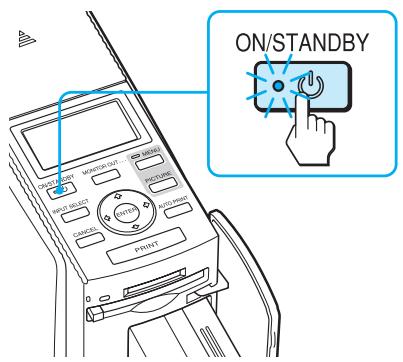
10 Click "Next".
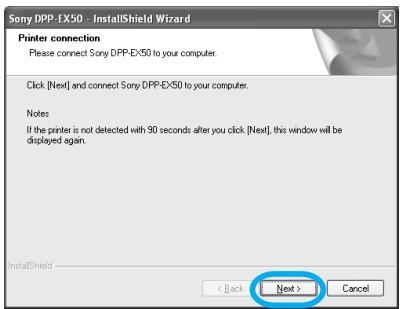
11 Connect the USB connectors of the printer and your computer.
Use a commercially available USB 2.0-compatible connecting cable.
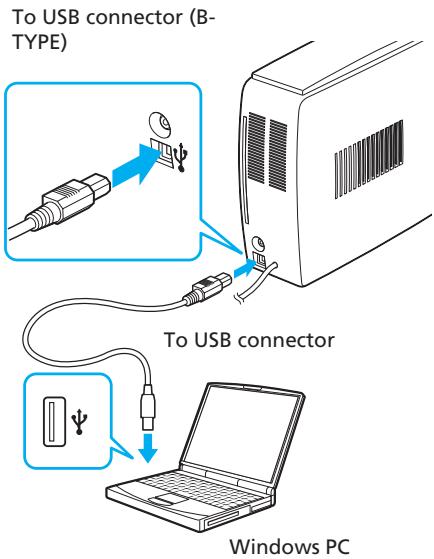
Note
Use a commercially available A-B TYPE USB-compatible connecting cable shorter than 3 m in length. The type of USB cable you should use may differ depending on the computer. For details, see the instructions manual of your computer.
When you connect a PC
The printer automatically enters the PC mode and the "PC" indication appears on the LCD display of the printer.
The printer setup will start automatically: the printer connection check, printer driver registration, and new hardware found messages will be displayed as the installation goes on.
When the printer setup is complete, the "Setup Complete" dialog box is displayed.
12 Click "Finish".
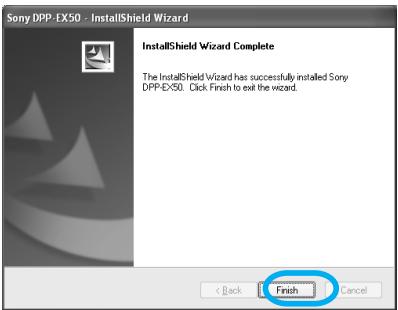
The installation of the printer driver is complete. When you are prompted to restart your computer, restart the computer.
13. To finish installation, click "Complete" and remove the CD-ROM from your computer and keep it for future use.
- To continue to install the PictureGear Studio software, click "Installing the PictureGear Studio" and follow the procedures on pages 92.
Notes
- If the printer driver CD-ROM is prompted during the installation, specify the following directory:
-When using the Windows 98SE/Me:
D\Driver\Win98.me
-When using the Windows 2000/XP:
D\Driver\Win2000.me
"D" stands for the CD-ROM driver of your PC and may differ depending on the system.
- The supplied CD-ROM will be required when you uninstall or re-install the printer driver. Keep it in good order for possible future use.
- If the installation fails, remove the printer from your computer, restart your computer, and then do the installation procedures from the step 3.
- After installation, the "Sony DPP-EX50" is not set as the default printer. Set the printer you use for each application.
- Before you use the printer, read the Readme file (the Readme folder of the CD-ROM → English folder → Readme.txt).
Checking the installation
Open the "Printers and Faxes" (Windows XP Home Edition/XP Professional only) or "Printers" from the "Control Panel". When the "Sony DPP-EX50" is displayed in the "Printers and Faxes" or "Printers" window, the printer driver has been successfully installed.
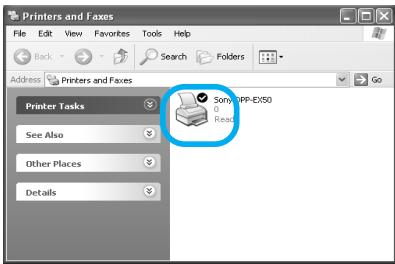
Uninstalling the printer driver
When the printer driver becomes unnecessary, remove it from your PC hard disk as follows:
1 Disconnect the USB cable from your printer and the computer. 2 Insert the supplied CD-ROM into the CD-ROM drive of your computer.
The setup starts automatically and the installation window is displayed.
Note
In case the installation window is not automatically displayed, double-click the "Setup.exe" of the CD-ROM.
3 Click "Installing Printer Driver".
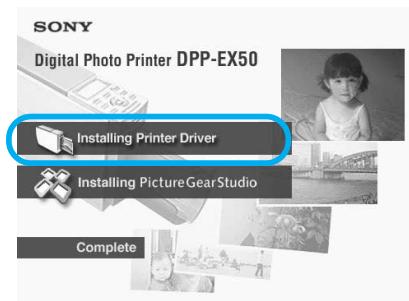
The "Sony DPP-EX50 - InstallShield Wizard" dialog box appears.
4 Click "Next".
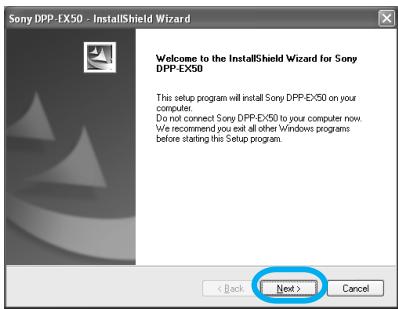
The license agreement dialog box is displayed.
5 Check "I accept the terms of the license agreement" and click "Next".
If you check "I do not accept the terms of the license agreement", you cannot proceed with uninstallation.
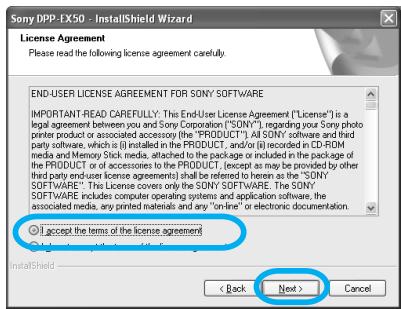
The dialog box used for confirming uninstallation is displayed.
6 Click "Yes".
Question
The earlier version of the printer driver was found. Would you like to delete it?
To upgrade the driver, click [Yes] to delete the earlier version of the driver, and then install the new driver after your computer has been restarted.
Restarting Windows
The dialog box used for restarting the computer is displayed.
7 Check "Yes, I want to restart the computer now". and click "OK".
To delete the previous version of the driver, you must restart your computer. After the computer is restarted, perform setup again.
Yes, I want to restart my computer now.
No. I will restart my computer later.
After the computer is restarted, the relevant files will be deleted and uninstallation is complete.
To check uninstallation
Select "Printers and Faxes" (Windows XP Home Edition/XP Professional only) or "Printers" from the "Control Panel" to check if the "DPP-EX50" is displayed. If not, the printer driver is successfully removed.
Installing the PictureGear Studio
Install PictureGear Studio on your computer.
1 Turn on your computer and start Windows.
- When installing or uninstalling the software in Windows® 2000 Professional, log on to Windows as "Administrator" or "Power user".
- When installing or uninstalling the software in Windows® XP Professional/Home Edition, log on with a user account that has "Computer administrator" privileges.
Notes
- Be sure to close all running programs before installing the software.
- The dialog boxes in this section are those of Windows XP Professional, unless otherwise specified. The installation procedures and dialog boxes shown may differ depending on the operating system.
2 Insert the supplied CD-ROM into your computer's CD-ROM drive.
The setup starts automatically and the installation window is displayed.
Notes
- If the installation window does not appear automatically, double-click "Setup.exe" on the CD-ROM.
- Depending on the PC system environment, Microsoft Data Access Components 2.7 and Jet 1.0 may need to be installed during PictureGear Studio installation. If so, the dialog box for installing these programs will appear automatically; follow the on-screen instructions to proceed.
3 Double-click "Installing PictureGear Studio".
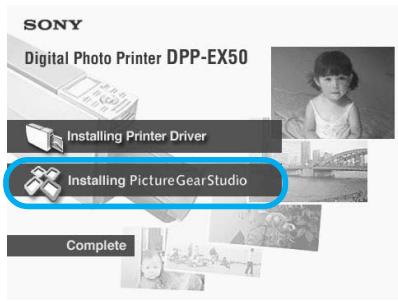
The "PictureGear Studio Setup" dialog box appears.
4 Click "Next".
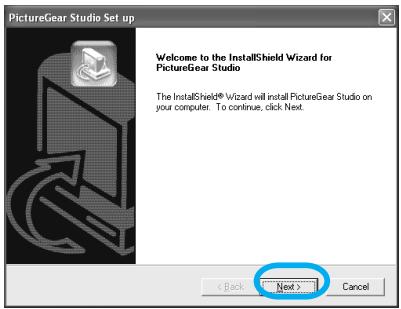
The dialog box to specify the destination folder is displayed.
5 Check the destination and then click "Next".
To specify a different destination folder, click "Browse".
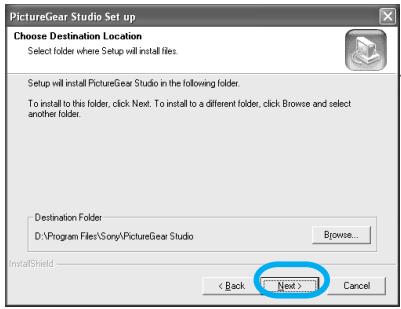
6 To register the Media Watcher, check "Register the PictureGear Studio Media Watcher in the startup folder." and then click "OK".
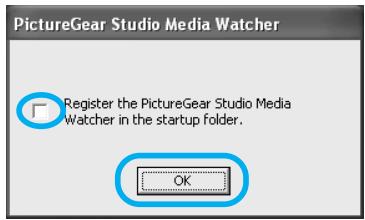
When the installation is completed, the installation complete dialog box is displayed.
What is "PictureGear Studio Media Watcher"?
The PictureGear Studio Media Watcher detects insertion of a device or medium storing photos when the PictureGear Studio is installed in an operating system other than the Windows XP.
You can also register the PictureGear Studio Media Watcher later with the following steps:
1 After you install the PictureGear Studio software, click "Start", "Programs", "PictureGear Studio", "Tools", and then "Media Watcher". The PictureGear Studio Media Watcher is started. 2 Click the PictureGear Studio Media Watcher icon on the taskbar with the right mouse button, and click "Settings" from the menu displayed. 3 Check "Starts the Media Watcher when you log on Windows".
7 To display the Readme file, check "View Readme" and then click "Finish".
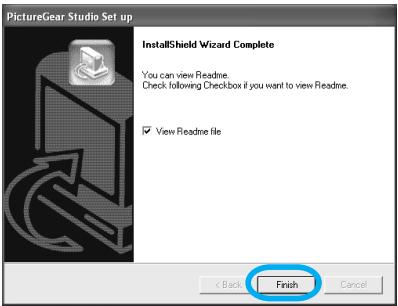
- When you check "View Readme", the Readme file is displayed. When you close the Readme file, the PictureGear Studio Setup dialog box is also closed.
- When you do not check "View Readme", the PictureGear Studio Setup dialog box is closed.
8 Remove the CD-ROM from your computer and keep it for future use.
Notes
- If the installation fails, do the installation procedures from step 2.
- The supplied CD-ROM will be required when you uninstall or re-install the PictureGear Studio. Keep it in good order for possible future use.
- The PictureGear Studio supplied with the DPP-EX50 has the following limitations:
- In PhotoCollection, you cannot select paper other than "Sony". - In PrintStudio, you cannot create or print "Label". - In PrintStudio, you cannot create or print a "Sticker, name card, or card". - In PrintStudio, you cannot print part of "Postcard" designs.
To delete the above limitations and upgrade the software to the version supplied with VAIO computer or CLIE handheld, execute the "Setup.exe" in the "pgs.add" folder.
Uninstalling the PictureGear Studio
When the software becomes unnecessary, remove it from your PC hard disk as follows:
1. Remove the USB cable between the printer and the PC. 2. Insert the supplied CD-ROM into the CD-ROM drive of your computer.
The setup starts automatically and the installation window is displayed.
Note
In case the installation window is not automatically displayed, double-click the "Setup.exe" of the CD-ROM.
3. Click "Installing PictureGear Studio".
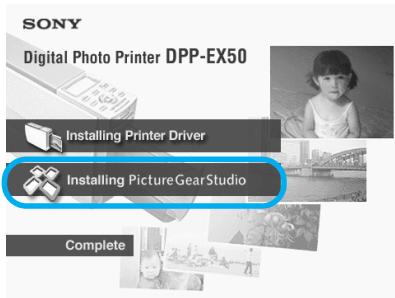
The dialog box used for confirming deletion is displayed.
4. Click "Yes".
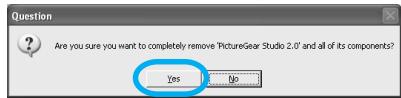
The deletion complete dialog box is displayed.
5. Click "Finish".
The relevant files are deleted.
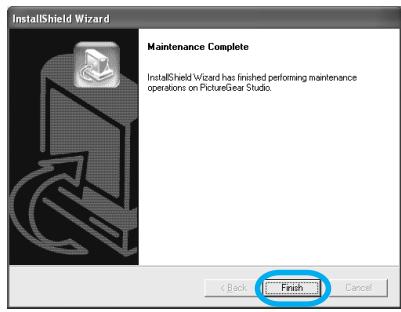
Printing photos from the PictureGear Studio
PictureGear Studio allows you to carry out a series of procedures for handling a still image—capturing, managing, processing, and outputting. You can use the software to print an image from your PC in the post card, 3.5 × 5 inch, or small size print paper.
1 Start the PictureGear Studio. The PictureGear Studio window is displayed. 2 Click "Photo Collection".
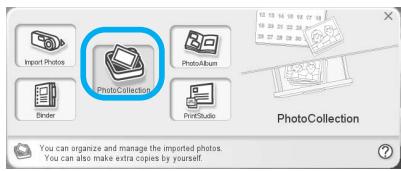
The "Photo Collection" window is displayed.
3 Click the desired photo category folder.
For explanations, "Sample" folder is selected in the following example.
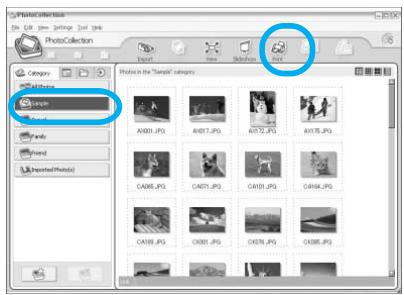
4 Click "Print".
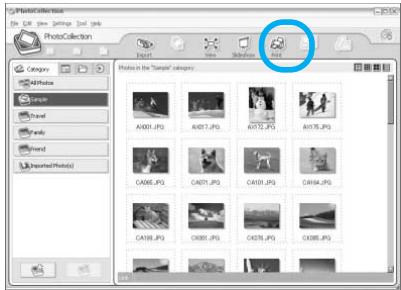
The Print dialog box is displayed.
5 Select the photos that you want to print, set the number of copies to be printed for each photo, and then click "Apply".
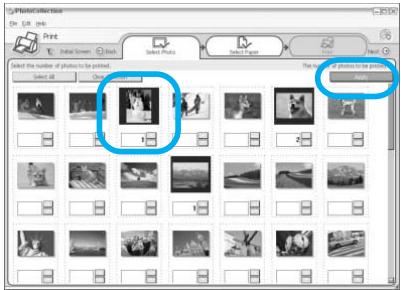
The print paper selection dialog box is displayed.
Note
Make sure to set the print quantity in this dialog box. Even if you set the number of copies in "Paper/Output" tab of the "Sony DPP-EX50 Properties" dialog box, the print quantity will not be reflected.
6 Click "Sony", and then select the desired paper size.
Select either of the following paper sizes for the DPP-EX series:
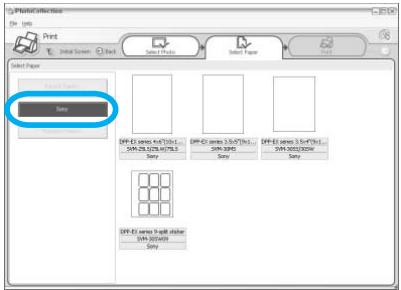
- DPP-EX series 4 x 6 inches (Postcard size) SVM-25LS/25LW/75LS DPP-EX series 3.5 x 5 inches SVM-30MS DPP-EX series 3.5 x 4 inches (Small size) SVM-30SS/30SW/30SW09
When you select the paper size, the print dialog box is displayed.
7 In the "Printer" drop-down list box, select "Sony DPP-EX50" and then click "Properties".
In the "Printer" drop-down list box, select the printer that you actually use.
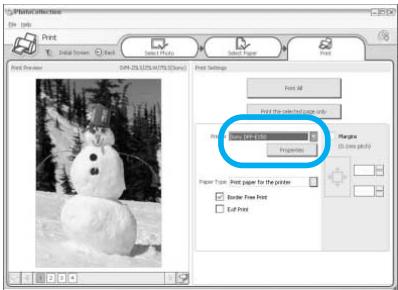
Items Functions
Print All All the photos selected in the "Select Photo" window will be printed.
Print the selected page only The image being displayed in the "Print Preview" will be printed.
Printer Select "Sony DPP-EX50".
Border Free Print
- When checked, an image will be printed without margins around it.
- When unchecked, an image will be printed with margins around it.
Note
You cannot check when using the Small size print paper.
Exif print
- When checked, an image shot with an Exif Print (Exif 2.2)-compliant digital camera will be adjusted and printed with its optimum picture quality.
Note
The image displayed on the monitor will not be adjusted.
- When unchecked, an image will be printed without adjustments.
Properties Specifies orientation, picture quality and other details.
Margins Click the arrows or enter the text boxes for the margins (in 0.1mm ) to fine adjust the image position.
Note
You cannot adjust the margins only when using the 9-split sticker print paper.
When you click "Properties", the document properties dialog box for the selected printer is displayed.
8 In the "Paper/Output" tab, specify the paper size.
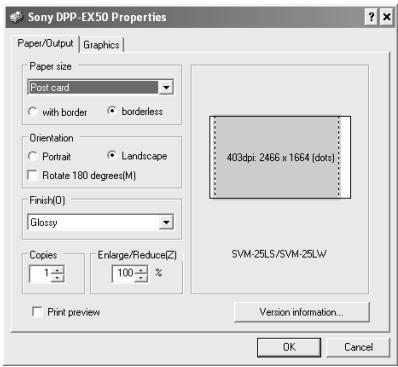
Items Functions
Paper size
From the drop-down list box, select the paper size you actually use for printing:
Post card - 3.5x5 inch - Small
Then check either of the following to specify the margins around the image:
- With border: an image is printed with borders around it.
- Borderless: an image is printed without borders around it.
Note
You cannot check when using the Small size print paper.
Orientation: Select the orientation of an image when printed:
- Portrait
- Landscape: Rotates 180 degrees
| Finish | Select the finish of the printed image: • Glossy • Texture |
| Copies | Specify the number of copies to be printed. Note Depending on the application you use, the print quantity setting of the application has priority over that specified here. |
| Enlarge/Reduce | Specify the percentage to enlarge or reduce the size of an image when printed. |
| Print preview | • When checked, a preview image will be displayed before printed. • When unchecked, no preview image will be displayed before printed. |
9 In the "Graphics" tab, set the color reproduction and picture quality.
| Color reproduction/Picture quality | |
| 01 | Setting |
| Exit/Print | Red-eye reduction |
| Print settings: | |
| B (red): | 0 |
| B (green): | 0 |
| B (blue): | 0 |
| Sharp: | 0 |
| Items | Functions |
| Color reproduction/Picture quality Select the setting from the drop-down list box: ·Off: An image will be printed without adjustment. ·Auto Fine Print 3:From the "Settings" drop-down list box, select either of the following correction method: - Photographical: An image will be adjusted automatically and printed with natural and beautiful pictures. (Recommended option) -Vivid: An image will be adjusted automatically and printed with more vivid pictures. (In this setting, a stronger sharpness correction is given, making pictures more vivid.) ·ICM (system): From the "Settings" drop-down list box, select either of the following correction method: - Graphics: when graphics or vivid colors are used. - Match: when you want to match colors. -Pictures: when a photograph or pictures are printed. Note | The ICM setting is valid only when you are using an ICM-compliant application. When printing from an application software that does not support the ICM system, an image may be printed with incorrect colors. |
Continued
Exif Print
Check it to adjust and print an image shot with an Exif Print (Exif 2.2)-compliant digital camera. The printer driver uses the color conversion and Exif shooting data to adjust the image. This option is effective only with PictureGear Studio.
Red-eye reduction
Check it to automatically reduce the red-eye phenomenon of the subject shot by using a flash light.
Notes
- When you check this option, make sure to select "Preview" to display the preview image before printing and check that the red-eye reduction has been correctly processed to the image.
- Red-eye phenomenon will be detected automatically, and it may not be corrected.
- Red-eye reduction is enabled only when you have installed the software from "Setup.exe" in the supplied CD-ROM. For the details, see the Readme.txt.
Print settings
Adjusts the color elements and sharpness.
R: Adjusts the red and blue elements. The higher you set the level, the more reddish the picture becomes as if it receives red light. The lower you set the level, the darker the picture becomes as if light blue is added. G: Adjusts the green and purple elements. The higher you set the level, the more greenish the picture becomes as if it receives green light. The lower you set the level, the darker the picture becomes as if red purple is added. B: Adjusts the blue and yellow elements. The higher you set the level, the more bluish the picture becomes as if it receives blue light. The lower you set the level, the darker the picture becomes as if yellow is added. Sharp (sharpness): The higher you set the sharpness level, the more distinct the outlines become.
10 Click "OK".
The print dialog box is displayed.
11 Click "Print All" or "Print the selected page only".
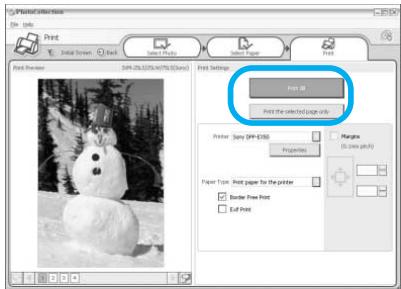
The confirmation dialog box for printing is displayed.
12 Make sure that the specified print paper and print cartridge are loaded and click "OK".
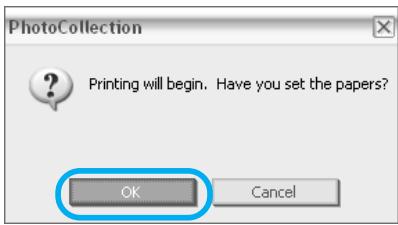
Printing starts.
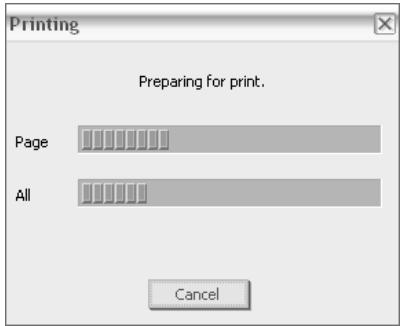
When "Print preview" is checked in step 8
The preview window is displayed. Check the adjustment results and then click "Print".
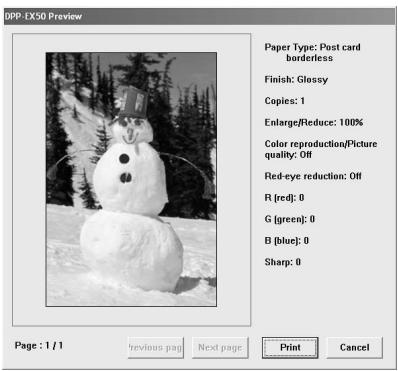
Printing resumes.
To stop printing
1 Open the "Print" dialog box from the desktop. 2 Click the document name that you want to cancel printing of and then click "Cancel" from the "Document" menu.
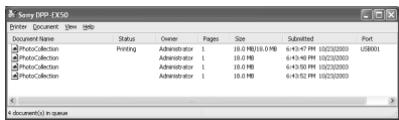
The dialog box used for confirming the deletion is displayed.
3 Click "Yes."
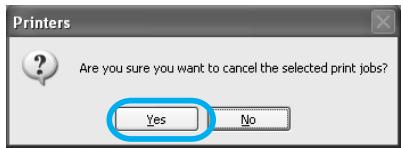
The printing job is canceled.
Note
Do not cancel the printing job in process, which may cause a paper jam.
Printing from other application software
You can use a commercially-available application software to print an image from the DPP-EX50. Select "DPP-EX50" in the print dialog box and select the print paper size in the page setup dialog box. For details in print settings, see steps 8 and 9 on pages 98 and 99.
On "Borderless" setting in the "Paper size" section
When using an application other than the PictureGear Studio, an image might be printed with borders even if you select borderless print in the "Paper size" section of the "Paper/Output" tab in the "Sony DPP-EX50 Properties" dialog box.
When you select the borderless print option, the printing range information for borderless print will be supplied to the application. Some applications, however, may arrange and print the image with borders within the specified range.
If this occurs, do either of the following to print an image without borders:
- When you can set print range with an application, set an image to be printed fully in the print range. For example, select "Full page photo print" or a similar option.
- Set a larger value in the "Enlarge/Reduce" text box in the "Paper/Output" tab of the "Sony DPP-EX50 Properties" dialog box.
In either case, make sure to display and check the preview image before printing.
Print quantity setting in the Properties dialog box
Depending on the application you use, the print quantity setting of the application may have priority over the setting specified in the printer driver dialog box.
Exif Print Settings in the "Graphics" tab
The Exif Print setting in the "Color reproduction/Picture quality" section supports PictureGear Studio only. If you use other applications to print an image with this option checked, the image may be printed with incorrect colors. If this occurs, remove the check.
If trouble occurs
If you run into any problems using the printer, use the following guidelines to solve the problem. If the problem persists, consult your Sony dealer.
Power
| Symptom | Check | Cause/Solutions |
| The ON/ SYANDBY button cannot be turned on. | ● Is the AC power cord properly connected? | → Connect the AC power cord to an AC outlet securely. (→ page 19) |
Displaying images (MONITOR OUT mode only)
| Symptom | Check | Cause/Solutions |
| The TV monitor displays no images. | ·Is“PictBridge”or“PC” displayed on the LCD display? | →Press INPUT SELECT to display“Memory Stick”or“CompactFlash”on the monitor.(▶page 21) |
| ·Is the LCD mode selected?(The MONITOR OUT indicator is off.) | →Press MONITOR OUT to turn on the MONITOR OUT indicator, so that the printer status will be displayed on the TV monitor.(▶page 20) | |
| ·Are any error messages displayed (cause/remedies) on the TV monitor? | →Follow the directions of the messages, if any, and try to solve the problem.(▶page 120) | |
| ·Is the memory card properly inserted? | →Insert a memory card properly.(▶pages 19, 20) | |
| ·Does the memory card contain images recorded with a digital camera or other device? | →Insert a memory card that contains the recorded images. | |
| “DEMO” is displayed on the TV monitor. | ·Did you press INPUT SELECT when no memory card is inserted? | →The images contained in the printer are displayed (demonstration mode). You can print these images or use them to create a print. To exit the demonstration mode, display the image list of the printer's built-in image, and then press INPUT SELECT again. |
| Some images in the image list are not displayed or not printed even if they are displayed. | ·Are thumbnail images displayed in the image list? | →If the image is displayed but cannot be printed, the file used for printing is damaged. →If there are no images stored in the “Memory Stick” or CompactFlash card, the no file message appears. →If an image is not compatible with DCF (Design rule for Camera File system), it may not be printed with the printer even if it is displayed on the PC monitor. |
| ·Does the mark displayed below appear in the image list? ?·Was the image created on your PC? | →If the mark shown on the left is displayed, the image may be a JPEG file created with your computer, or the thumbnail data is not contained. Select the mark and press PICTURE. If a preview image is displayed, you can print the image. If the same mark is displayed again, the image is of incompatible file format and you cannot print it with the printer. | |
| ·Does the mark displayed below appear in the image list? | →If the mark shown on the left is displayed, the image is of compatible file format but its thumbnail data or the data itself cannot be opened. Select the mark and press PICTURE. If a preview image is displayed, you can print the image. If the same mark is displayed again, you cannot print it with the printer. | |
| Some images in the image list are not displayed or not printed even if they are displayed. | ·Are there more than 9 999 images saved in the memory card? | →The printer can display, save, delete or handle up to 9 999 image files. If there are more than 9 999 images stored in a memory card, use the PC or PictBridge mode to display and handle the remaining images. |
| ·Did you name or rename an image file with your PC? | →When you name or rename an image file on your computer and its file name includes characters other than alphanumeric characters, the file name may not be displayed correctly or the image may not be displayed on the printer (read error). | |
| ·Did you specify the print quantity in the image list? | →Once you have selected images in the "Printing multiple images" procedures, you cannot print an image with which the cursor is just placed. Press ENTER to select it and specify the print quantity for the image. (→page 24) | |
| ·There are 8 or more hierarchies in the memory card. | →The printer cannot display the images saved in a folder of the 8th or higher hierarchy. | |
| The file name is not displayed correctly. | ·Did you change the file name of the image with your PC? | →When you name or rename an image file on your computer and its file name includes characters other than alphanumeric characters, the file name may not be displayed correctly. For a file created with a PC application, the first 8 characters of its file name will be displayed as the file name. |
| In the EDIT menu, there are blank areas at the top and bottom of the previewed image. | ·Is the previewed image extremely stretched vertically or horizontally? | →If an image is extremely stretched vertically or horizontally, blank areas may appear in the EDIT menu. →The standard aspect ratio of an image shot with a digital camera is 3:4. When an image is edited or printed in the postcard or 3.5 x 5 inch size, it is saved as a more horizontal print image and its top and bottom edges will be cut and displayed in black. |
| The “PictBridge” indication turns on even after INPUT SELECT is pressed to select “Memory Stick” or “CompactFlash” mode. | ·Is a PictBridge-compliant digital camera connected to the printer? | →As long as the PictBridge-compliant device is connected to your computer, the “PictBridge” indication remains. Disconnect the cable of the PictBridge-compliant device to turn off the indication. (→page 81) |
Printing
| Symptom | Check | Cause/Solutions |
| Paper does not feed. | ·Is the print paper properly set in the paper tray? | →If print paper is not properly loaded, the printer may develop trouble. Check the following: ·Is the correct set of print paper and print cartridge loaded? (→page 12) ·Does the arrow on the reverse side of the print paper point in the same direction as the arrow in the tray? (→page 16) ·Did you place print paper exceeding the limit in the paper tray? (→page 16) ·Does the spacer of the tray match the print paper? (→page 15) ·Did you riffle the print paper thoroughly? ·Did you bend or fold the print paper before printing? |
| Paper does not feed. | ·Are you using print paper that was not designed for the printer? | →Use print paper designed for the printer. If you use incompatible print paper, the printer may develop trouble. (→page 12) |
| ·Is the print paper jammed? | →When the printer cannot feed the print paper, the print paper error indicator (□) will turn on and an error message is displayed in the MONITOR OUT mode. Remove the paper tray and check paper jam. (→page 124) | |
| The print paper emerges partially during printing in process. | ·Is it in the middle of the printing process? | →The print paper may emerge partially during printing. Wait for the print paper to fully emerge before taking it out. |
Printed results
| Symptom | Check | Cause/Solutions |
| The printed pictures are inferior in quality. | Did you print preview image data? | Depending on the type of digital camera used, preview images may be displayed along with the primary images in the thumbnail list. The printed quality of the preview images will not be as good as the primary images. Note that if you delete the preview images, the data for the primary images may be damaged. |
| Did you print an image whose size (width or height) is smaller than 480 dots?Is the following mark displayed in the image list? | When the image is displayed as the mark shown on the left, it is a small image. The printing quality is rough due to this small image size. Change the image size setting of the digital camera you are using. | |
| The printed pictures are inferior in quality. | ·Did you use the EDIT menu to enlarge the image? | →An enlarged image, depending on its image size, will be printed with deteriorated picture quality. |
| ·Did you allow dust or finger prints to get on the printed surface? | →Do not touch the printing surface (the shiny-side with no imprint). Fingerprints on the printing surface may result in imperfect printing. | |
| ·Did you use used print paper? | →Do not print on used print paper. Printing an image twice on the same paper will not make the printed image thicker. | |
| ·Did you shoot an image in the RAW file format? | →When you shoot an image in the RAW file format, a highly-compressed JPEG file may be also recorded. As the printer does not support the RAW file format, it may use the JPEG file to print an image. A RAW file can be printed from a PC. For details, see the operating instructions of the digital camera you are using. What is a RAW file? A RAW file is an original image file format to save uncompressed, uncompressed still image data captured from a digital camera. For whether or not a digital camera can capture an image in the RAW file format, see the operating instructions of the digital camera. | |
| The printed pictures are inferior in quality. | ·Did you use an AdobeRGB-compliant digital camera, not compatible with the DCF 2.0, to shoot an image in the AdobeRGB mode? | →An AdobeRGB image file that supports the DCF 2.0 will undergo color corrections, but an AdobeRGB image file that does not support the DCF 2.0 will be printed in vague colors without color corrections. What is an AdobeRGB? An AdobeRGB is a color space that the Adobe System Incorporated employs and uses as the default setting for image processing software including the Adobe Photoshop. The AdobeRGB, an optional color space extended with the DCF 2.0, determines the color ranges widely used in printing industry. For whether or not a digital camera supports the AdobeRGB, see the operating instructions of the digital camera. |
| The picture quality and colors of the image previewed on the screen differs from those printed. | →Because of differences in the phosphor method or profiles of a TV monitor, please regard the image being displayed on the screen as just a reference. To adjust picture quality, do either of the following: - Menu - SET UP - Color Setting (→page 62) - Menu-EDIT-Adjust (→page 33) | |
| The printed image differs when an image is directly printed from the memory card inserted into the printer's slot and when it is printed via a PC. | →Because of the differences in the printer's internal processing and PC software processing, the printed images will be different. | |
| The date cannot be printed. | ·Is “Date Print” set to “On”? | →Set “Date Print” in the SET UP menu to “On”. (→page 62) |
| ·Does the image support DCF? | →The “Date Print” function of this unit supports an image that is compatible with the DCF standards. | |
| The date is printed unintentionally. | ·Is “Date Print” set to “Off”? | →Set “Date Print” in the SET UP menu to “On”. (→page 62) |
| ·Was the date saved with the image when it was shot with the digital camera? | →Change the camera settings. | |
| The image cannot be printed fully in the print range. | ·Did you set “Borders” in the SET UP menu to “Yes”? | →Set “Borders” to “No” by selecting Menu - SET UP - Borders. (→page 61) |
| ·Do you feed the print paper in the correct direction? | →Place the print paper in the direction of the arrow. (→page 16) | |
| ·Is the aspect ratio of the image correct? | →Depending on the type of digital camera used, the aspect ratio of the recorded image differs, so the image may not be printed covering the entire printable area. | |
| Even if I set “Borders” to “No”, the image is printed with borders on both sides. | ·Is the image edited and saved with “Borders” set to “Yes”? | →When you edit and save an image in the postcard or 3.5 x 5 inch size, it is saved as a print image including the blank areas. Even if you print it with “Borders” set to “No”, you cannot eliminate the borders on both sides of a print. To print without borders, edit and save an image with “Borders” set to “No”. (→page 61) |
| Only part of an image is printed. | ·Did you set “Borders” in the SET UP menu to “Yes”? | →Set “Borders” to “Yes” to print the whole area of an image. (→page 61) |
| The image is stretched horizontally when printed. | Did you rotate the image or add other process? | Depending on the type of digital camera used, the image may be stretched vertically if it has been rotated or processed using your digital camera. This is not because of trouble with the printer, but because the image was rewritten with your digital camera. |
| There are white lines or dots on the printed pictures. | The print head or paper path may be soiled. Use the supplied cleaning cartridge to clean the head and path. (→page 124) | |
| The picture is too bright, dark, reddish, yellowish, or greenish. | Adjust an image by selecting Menu - EDIT - Adjust. (→page 33) | |
| The eyes of the subject are red. | Adjust fro the red-eye phenomenon by selecting Menu - EDIT - Red-eye reduction. (→page 35) | |
| Red-eye reduction does not take effect. | Set the size of the adjustment frame to be two to seven times as large as the eye. (→page 35) | |
| Did you enlarge, reduce the size of, rotate, or move an image after the red-eye reduction? | Red-eye reduction may not work properly if other editorial operations such as enlarging, reducing the size of, rotating, or moving an image. Perform these editorial operations first and then perform red-eye reduction. |
Settings
| Symptom | Check | Cause/Solutions |
| The "Borders" "Yes/No" setting does not take effect. | ·Are you using the small size print paper? | →You cannot print on the small size print paper without borders. The "Borders" "Yes/No" setting takes effect only when you are using the postcard or 3.5 x 5 inch size print paper. (→page 61) |
| ·Are you operating the Creative Print menu? | →In the Creative Print menu, templates are used and you cannot select border/borderless prints. | |
| Operations are rejected with beeps. | →Beeps sound to notify you that the operation is invalid. |
Saving or deleting an image
| Symptom | Check | Cause/Solutions |
| You cannot save an image. | ·Is the memory card protected? | →Release the protection and try saving again. |
| ·Is the write-protect switch of the memory card in the LOCK position? | →Slide the write-protect switch to the write enable position. (→page 129) | |
| ·Is the memory card full? | →Delete unnecessary images (→page 67), or replace it with a new memory card with sufficient free memory space. Save the image again. | |
| You cannot delete an image. | ·Is the memory card protected? | →Release the protection with your digital camera. |
| ·Is the image DPOF-preset? | →Release the DPOF preset with your digital camera. | |
| ·Is the write-protect switch of the memory card in the LOCK position? | →Slide the write-protect switch to the write enable position. (→page 129) | |
| ·Are you using a “Memory Stick-ROM”? | →You cannot delete an image from or format a “Memory Stick-ROM”. | |
| An image was deleted accidentally. | →You cannot recover an image once it is deleted. | |
| I cannot format the “Memory Stick”. | ·Is the write-protect switch of the memory card is in the LOCK position? | →Slide the write-protect switch to the write enable position. (→page 129) |
| ·Is it a “Memory Stick-ROM”? | →You cannot delete an image from or format a “Memory Stick-ROM”. | |
| The “Memory Stick” was formatted accidentally. | →Once the “Memory Stick” is formatted, all the data is deleted and cannot be recovered. To prevent accidental format, set the write -protect switch to the LOCK position. (→page 129) |
Others
| Symptom | Check | Cause/Solutions |
| I cannot insert the print cartridge smoothly. | →If the print cartridge does not click into place, remove it and then re-insert it. Only when the ink ribbon is too slack to be loaded, wind the ink ribbon in the direction of the arrow to remove the slack. (→page 14) | |
| The print cartridge cannot be removed. | →Turn off the ON/STANDBY button and then turn it on. After the motor sound stops, try to remove the cartridge. If this does not solve the problem, contact Sony service facilities or your Sony dealer. | |
| The print paper jams. | ·Is the paper/cartridge error (□/◇) indicator lit or is an error message displayed in the MONITOR OUT mode? | →Paper is jammed. See “If paper jams” (→page 124) and remove jammed paper from the printer. If jammed paper cannot be removed, contact the Sony service facilities. |
| Printing stops midway. | ·Does the access indicator light in green? | →The data size of an image is large and it takes longer to process it for printing. As soon as the data processing finishes, the printer starts printing. |
| ·Is the paper error (□) indicator lit? | →Paper is jammed. See “If paper jams” (→page 124) and remove jammed paper from the printer. If jammed paper cannot be removed, contact the Sony service facilities. | |
| ·Is any indicator lit? | →If no indicator is lit, the thermal head may be overheated. Leave the printer until the head cools down and the printer resumes printing. |
Connecting with a digital camera
| Symptom | Check | Cause/Solutions |
| The PictBridge mark does not appear on the LCD display of the digital camera. | ·Is the digital camera connected correctly? | →Connect the cable correctly. |
| ·Is the ON/STANDBY button turned on? | →Turn on the ON/STANDBY button. | |
| ·Does the firmware of your digital camera support the printer? | →See the homepage for the digital camera you are using. | |
| ·Is the PictBridge mark on the LCD display of the printer flashing? | →The PictBridge mark is not displayed while the printer is in the EDIT, Creative Print, or other menu modes. Exit the menu and then connect the cable again. →If a USB mouse or other non-PictBridge-compliant device is connected, remove it and connect a PictBridge-compliant device. →Disconnect the digital camera and the printer and then connect them again. Or turn off and then on the printer and the digital camera. | |
| ·Is printing in process? | →Connect the cable again after printing is complete. | |
| I connect and disconnect the USB cable, but nothing happens. | ·Is the PictBridge mark on the LCD display flashing quickly? | →The printer has developed an over-current error. Unplug the AC power cord of the printer, plug it in again, and then press the ON/STANDBY button to recover from the error. |
| I cannot stop printing even if I pressed CANCEL. | →The next print from the one currently printed will be canceled. →Depending on the digital camera you use, you cannot cancel printing from the printer. Operate the digital camera to stop printing. Refer to the operating instructions of the digital camera. |
Connecting with a computer
| Symptom | Check | Cause/Solutions |
| The images of the memory card inserted in the printer are not displayed on the PC. | →The printer does not provide the function for viewing the memory card images from the printer. | |
| I lost the supplied CD-ROM and want to obtain a new one. | →Please download the printer driver from the Customer support home page (→page 132). Or contact your Sony dealer. | |
| The printer driver cannot be installed. | ·Are you sure that you have followed the installation procedures correctly? | →Follow the procedures in the operating instructions to install the driver (→page 87). If an error occurs, restart your computer and do the installation procedures again. |
| ·Is another application program running? | →Exit all applications and then install the driver again. | |
| ·Did you specify the CD-ROM as the installation CD-ROM correctly? | →Double-click My Computer, and then the CD-ROM icon in the open window. Follow the procedures in the operating instructions to install the driver. | |
| ·Is the USB driver installed? | →The USB driver may not be installed properly. Follow the operating instructions to install the USB driver again. | |
| ·Can you read the CD-ROM with Explorer? | →If there is an error with the CD-ROM, you may not be able to read it. If an error message is displayed on your PC, check the contents and remove the source of the problem. Then install the printer driver again. For details on the error contents, see the operating instructions of your PC. | |
| ·Is there an anti-virus program or other program running on the system? | →If there is an anti-virus program or other program running on the system, exit it and then start installing the driver. | |
| ·Did you log onto Windows XP/2000 Professional using an Administrator user account? | →To install the driver in Windows XP/2000 Professional, log onto Windows using an Administrator user account. | |
| The printer does not respond to the printing order from the PC. | →Check the printer status in the print monitor on the Windows desktop. If there is no trouble displayed, check the printer's indicators. If the printer shows trouble, do the following: - Turn off the ON/STANDBY button and then turn it on again. - Disconnect the power cable, wait for 5 to 10 seconds, and then connect the cable again. - Restart your computer. If these do not solve the problem, consult with your Sony dealer or service facilities. | |
| ·Is an error message displayed stating that an error was detected in output of documents via USB? | →Remove the USB cable and then connect it again. | |
| An image is printed with borders even if I set "Borders" to "No". | ·Are you using an application software other than PictureGear Studio? | →When using an application other than the PictureGear Studio, an image might be printed with borders even if you select borderless print. If this occurs, do either of the following to print an image without borders: - When you can set print range with an application, set an image to be printed fully in the print range even if it is printed over the range. - Set a larger value in the "Enlarge/Reduce" text box in the "Paper/Output" tab of the "Sony DPP-EX50 Properties" dialog box. (→page 99) |
| Colors are not reproduced correctly. | ·Is “Exif Print” checked in the “Graphics” tab of the “Sony DPP-EX50 Properties” dialog box? | →The Exif Print setting in the “Color reproduction/Picture quality” section supports the PictureGear Studio only. To print from other application, uncheck “Exif Print”. |
| ·Is “ICM” selected in the “Graphics” tab of the “Sony DPP-EX50 Properties” dialog box? | →The ICM setting may be valid only when you are using an ICM-compliant application. Check to see if the application software you are using supports ICM. | |
| Preview image does not reflect the print settings in the “Graphics” tab of the “Sony DPP-EX50 Properties” dialog box. | →The print settings adjusts the printer itself and cannot influence the preview image. | |
| Print quantity specified in the “Paper/Output” tab of the “Sony DPP-EX50 Properties” dialog box does not take effect. | ·Are you using PictureGear Studio? | →Set the print quantity in the “Print” dialog box of the PictureGear Studio. The print quantity setting in the “Paper/Output” tab of the printer driver does not take effect. →Depending on the application you use, the print quantity setting of the application you use may have priority over the setting specified in the printer driver dialog box. |
If an error message appears
In the MONITOR OUT mode, the following error messages may be displayed. Follow the solution described here to solve the problem.
Printer
| Error messages | Meaning/Solutions |
| A printer error has occurred. | →An error has occurred with the printer. Unplug the AC power cord of the printer, connect it again and then try operating again. If this occurs again, consult with your Sony dealer or Sony service facilities. |
Storage media
| Error messages | Meaning/Solutions |
| There is no Memory Stick inserted. | →The “Memory Stick” is not inserted. Insert it into the “Memory Stick” slot properly. (→pages 19, 73) |
| There is no CompactFlash card inserted. | →The CompactFlash is not inserted. Insert it into the CompactFlash slot properly. (→Pages 20, 73) |
| The Memory Stick is protected. | →A protected “Memory Stick” is inserted. To save or edit the images with the printer, cancel protection of the “Memory Stick”. |
| The Memory Stick is not compatible. | →A “Memory Stick” that the printer does not support is inserted. Use a “Memory Stick” compatible with the printer. (→Page 127) |
| No image file. | →There are no image files in the memory card that the printer can handle. Insert a “Memory Stick” or CompactFlash card that contains images that can be displayed with the printer. |
| No DPOF file. | →There are no DPOF-preset image files in the memory card. Specify the print (DPOF) mark with your camera. |
| Protected files cannot be deleted. | →To delete a protected image, cancel protection on your camera. |
| DPOF files cannot be deleted. | →To delete a DPOF-preset image, cancel the print (DPOF) mark on your camera. |
| Protected. Release the protect and try deleting again. | →The “Memory Stick” is write-protected. Release the write-protection. (→page 129) |
| Protected. Release the protect and try formatting again. | |
| Protected. Release the protect and try saving again. | |
| The Memory Stick is full. | →There is no free memory space in the “Memory Stick”. You cannot save additional images. Delete unnecessary images (→page 67) or replace the “Memory Stick” with a one having sufficient memory space. |
| The CompactFlash card is full. | →There is no free memory space in the CompactFlash card. You cannot save additional images. Delete unnecessary images (→page 67) or replace the CompactFlash card with a one having sufficient memory space. |
| An error detected in the Memory Stick. | →An error may have occurred. If these messages appear frequently, check the memory card status with another device. |
| Memory Stick read error | |
| Memory Stick write error | |
| Memory Stick format error | |
| An error detected in the compact flash card. | |
| CompactFlash card error | |
| Read error in the compact flash card | |
| Write error in the compact flash card | |
| Image data read error | |
| An error occurred during saving. | |
| Failed in saving. |
Print cartridge
| Error messages | Meaning/Solutions |
| No print cartridge inside.Set the print cartridge. Press [PRINT] again. | →The print cartridge is not inserted in the printer. Set the print cartridge into the printer. (→page 13)If “for ##std size” (########: Postcard, 3.5 x 5 inch, or Small) appears, set a print cartridge of the specified size. If “cleaning” is displayed, set the cleaning cartridge. (→page 124) |
| No print cartridge inside.Set the print cartridge for ##std size.Press [PRINT] again. | |
| Print cartridge finished.Set a new print cartridge. Press[PRINT] again. | →Replace it with a new print cartridge.If “for ##std size” (########: Postcard, 3.5 x 5 inch, or Small) appears, set a print cartridge of the specified size. (→page 13) |
| Print cartridge finished.Set the new print cartridge for ##std size. Press [PRINT] again. | |
| Wrong print cartridge.Set the print cartridge for ##std size.Press [PRINT] again. | →The print size you specified in the Creative Print menu does not match the print cartridge actually loaded in the printer. Set a print cartridge and print paper of the displayed size. (→pages 13, 15) |
Print paper
| Error messages | Meaning/Solutions |
| No print paper. Set the print paper. Press [PRINT] again. | →There is no print cartridge inserted in the printer. - The paper tray is not set in the printer. - The print paper is not set in the paper tray. - The print paper has run out. In either case, set the print paper in the tray. If “for ____# size” ( ____#: Postcard, 3.5 x 5 inch, or Small) appears, insert print paper of the specified size into the tray and set the paper tray into the printer. (→page 15) |
| No print paper. Set the print paper for ____# size. Press [PRINT] again. | |
| No cleaning sheet Set the cleaning sheet. Press [PRINT] again. | →There is no cleaning sheet in the paper tray. Insert cleaning sheet into the paper tray and set the paper tray into the printer. (→page 15) |
| Wrong print paper. Set the print paper for ____# size. Press [PRINT] again. | →The print paper and print cartridge do not match. Check the print cartridge size actually loaded in the printer and set the print paper for the identical size. (→page 15) |
| Paper jam Remove the print paper and try printing again. | →Paper jams. See “If paper jams” (→page 124) and remove jammed paper from the printer. If the jammed paper cannot be removed, contact the Sony service facilities. |
If paper jams
If the print paper jams, the paper/cartridge error indicator lights in the printer's LCD display, an error message is displayed in the MONITOR OUT mode and printing stops.
Unplug the AC power cord of the printer and remove the jammed paper from the paper outlet or take out the paper tray to remove the jammed paper.
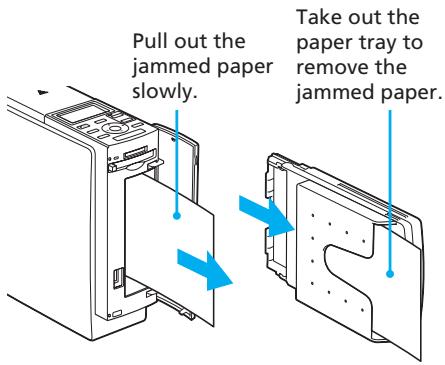
Note
If you cannot remove the jammed paper, contact your Sony dealer.
Cleaning the inside of the printer
If white lines or dots are printed on the pictures, use the cleaning cartridge supplied with the printer and the protective sheet supplied in the printing pack to clean inside the printer.
1 Open the cartridge compartment cover and remove the print cartridge (page 13). 2 Insert the supplied cleaning cartridge (white) into the printer and close the cartridge compartment cover.
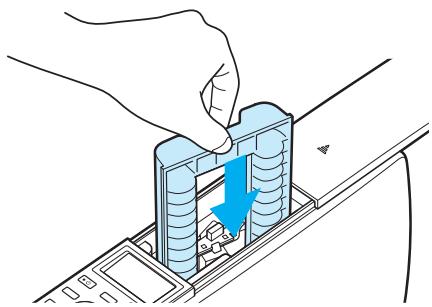
3 Remove the paper tray from the printer. If there is print paper in the tray, remove the print paper from the tray.
4 Adjust the spacer to feed the protective sheet you will use for cleaning. 5 Place the protective sheet contained in the printing pack in the paper tray.
Insert the protective sheet with the no-imprint side facing up and the arrow pointing in the same direction as the arrow in the tray. Insert the paper behind the spacer (toward the feeding direction).
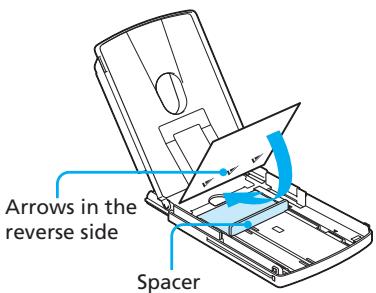
6 Set the paper tray into the printer and press PRINT. The cleaning cartridge and protective sheet will clean inside the printer. After the cleaning is finished, the protective sheet is automatically ejected. 7 Remove the cleaning cartridge and protective sheet from the printer.
Tips
- Keep the cleaning cartridge and protective sheet together for future cleaning.
- With a protective sheet, you can carry out cleaning for the maximum of about 20 times.
When cleaning ends
Set the print cartridge and print paper into the printer.
Notes
- Carry out cleaning only when there are white lines or dots on the print.
- When you can obtain proper printing performances, cleaning will not improve the printed picture quality.
- The maximum cleaning times that you can carry out is approximately 20. As the number of cleaning times increases, the cleaning loses its effect.
- Do not place the protective sheet on the print paper and carry out cleaning, which may cause paper jam or other troubles.
- If a cleaning does not improve printed picture quality, please carry out cleaning a couple of times.
Precautions
On safety
- Be careful not to set or drop any heavy objects on the power cord, or to damage the power cord in any way. Never operate this printer with a damaged power cord.
- Should any solid object or liquid fall into the cabinet, unplug the printer and have it checked by qualified personnel before operating it any further.
- Never disassemble the printer.
- To disconnect the power cord, pull it out by the plug. Never pull the power cord itself.
- When the printer is not going to be used for an extended period of time, disconnect the power cord from the wall outlet.
- Do not handle the printer roughly.
- To reduce the risk of electrical shock, always unplug the printer from the electrical outlet before cleaning and servicing the printer.
On installation
- Avoid placing the printer in a location subject to:
- vibration
- high humidity, excessive dust, direct sunlight, extremely high or low temperatures
- Do not use electrical equipment near the printer. The printer will not work properly in electromagnetic fields.
- Do not place heavy objects on the printer.
- Leave enough room around the printer so that the ventilation holes are not blocked. Blocking these holes may cause internal heat build-up.
On moisture condensation
If the printer is brought directly from a cold location to a warm location or placed in an extremely warm or humid room, moisture may condense inside the unit. In such cases the printer will probably not work properly and may even develop a fault if you persist in using it. If moisture condensation occurs, unplug the AC power cord of the printer and do not use the printer for at least one hour.
On transport
When you transport the printer, remove the print cartridge, paper tray, the memory card from the printer and put the printer and its peripherals in the original box with the protective packaging.
If you no longer have the original box and packing parts, use similar packing material so that the printer will not be damaged while being transported.
On cleaning
Clean the cabinet, panel and controls with a soft dry cloth, or a soft cloth lightly moistened with a mild detergent solution. Do not use any type of solvent, such as alcohol or benzine, which may damage the finish.
On restrictions on duplication
If duplicating documents with the printer, pay special attention to the following:
- Duplication of banknotes, coins, or securities is against the law.
- Duplication of blank certificates, licenses, passports, private securities, or unused postal stamps is also against the law.
- TV program, films, video tapes, others' portraits or other materials may be copyrighted. Unauthorized video printing of such materials may infringe the provisions of the copyright law.
About the "Memory Stick"
What is "Memory Stick"?
"Memory Stick" is small, light-weighted, and next-generation IC storage media with a larger capacity than a floppy disc. You can use the "Memory Stick" to exchange data among "Memory Stick" compatible devices. In addition, you can use the "Memory Stick" as a removable external storage device to save your data.
Types of "Memory Stick"
Following types of "Memory Stick" are available for versatile purposes.
- "Memory Stick": "Memory Stick" can store all types of data except for the one that requires the "MagicGate" copyright protection technology.
- "Memory Stick" (MagicGate/High-Speed Transfer Compatible): "Memory Stick" (MagicGate/High-Speed Transfer Compatible) employs "MagicGate" copyright protection technology and supports high-speed data transfer. It can be used with all the "Memory Stick"-compatible devices. (Data transfer speed depends on the "Memory Stick"-compatible device.)
- "Memory Stick" (with memory select function): "Memory Stick" (with memory select function) incorporates multiple 128MB memory units, which can be selected by a user via a mechanical switch on the reverse side of the media. Each memory unit can be used to categorize various types of data. You cannot select multiple memory units together or continuously.
- "MagicGate Memory Stick": "MagicGate Memory Stick" employs the "MagicGate" copyright protection technology.
- "Memory Stick PRO": "Memory Stick PRO" employs the "MagicGate" copyright protection technology and can be used only with "Memory Stick PRO" compliant devices.
- "Memory Stick-ROM": "Memory Stick-ROM" is the read-only "Memory Stick" storing the data. You cannot save or delete its data.
About "Memory Stick Duo"
"Memory Stick Duo" is smaller than the standard-sized "Memory Stick". When inserted into the Memory Stick Duo adaptor, the "Memory Stick Duo" is the same size as the standard-sized "Memory Stick", and can be used with "Memory Stick" compliant devices. - When using the "Memory Stick Duo" on the printer, make sure to insert the "Memory Stick Duo" into the Memory Stick Duo adaptor and then insert the adaptor containing the "Memory Stick Duo" into the printer.
- Before using the "Memory Stick Duo", check the correct direction to insert the "Memory Stick Duo". If you attempt to insert it in a wrong direction, the "Memory Stick Duo" and the printer may be damaged.
- Never insert the Memory Stick Duo adaptor that contains no "Memory Stick Duo" into a "Memory Stick"-compliant device. If you do, the device may be damaged.
Types of "Memory Stick" that the printer can use
With the printer, you can do the following operations for each type of "Memory Stick":
| Read | Write/Delete/Format | |
| "Memory Stick"/"Memory Stick"(with memory select function)/"Memory Stick Duo"*2 | OK | OK |
| "Memory Stick"(MagicGate/High-Speed Transfer Compatible)/"Memory Stick Duo"(MagicGate/High-Speed Transfer Compatible)*2 | OK*1+3 | OK*1*3 |
| "MagicGate Memory Stick"/"MagicGate Memory Stick Duo"*2 | OK*1 | OK*1 |
| "Memory Stick PRO"/"Memory Stick PRO Duo"*2 | OK*1 | OK*1 |
| "Memory Stick-ROM"/"Memory Stick ROM" | OK | NO |
1 The printer cannot read/write the data subject to "MagicGate" copyright protection. 2 Use the adaptor designed for the "Memory Stick Duo" you use. *3 It does not support parallel interface high-speed data transfer.
We cannot guarantee the operations of all the "Memory Stick" media.
On data read/write speed
The data read/write speed differs depending on the combination of the "Memory Stick" and the device you use.
What is "MagicGate"?
"MagicGate" is the copyright protection technology that works when both the "Memory Stick" and the device employ the technology. The "MagicGate"-compliant device and the "MagicGate Memory Stick" attest that each other supports the "MagicGate" technology and encode the data they exchange. The printer does not support the "MagicGate" standards and cannot read or write the data subject to the "MagicGate" copyright protection.
Notes on use
- When you slide the write protect switch to the write protect position, you cannot record, edit, or delete the data.
Place the label here.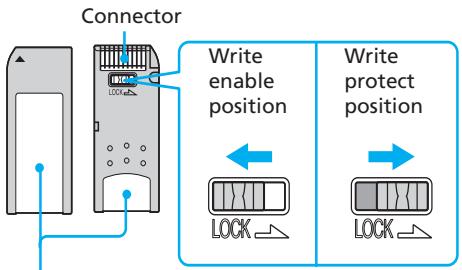
- When you slide the write protect switch of the "Memory Stick Duo", use a thin-pointed device.
- Avoid removing the "Memory Stick" from the printer while the printer is reading or writing data. Data may be damaged in such occasions:
- "Memory Stick" is removed or the ON/STANDBY button is turned off while the printer is reading or writing the "Memory Stick" data.
- "Memory Stick" is used in a location subject to electrostatic or electronic noises.
- We recommend that you save backup of the important data.
- Attach the label designed for the "Memory Stick" only to the place for the label.
- When attaching the label, attach it to the place specified for the label. Make sure that the label does not overlap.
- When storing and carrying the "Memory Stick", keep it in its original case to ensure protection of important data.
- Avoid touching the connector of the "Memory Stick" or contacting it with a metal object.
- Do not drop, bend, or submit the "Memory Stick" to external shock.
- Do not disassemble or modify the "Memory Stick".
- Avoid getting liquids on the "Memory Stick" or using it in areas subject to high humidity.
- Avoid using or storing the "Memory Stick" in a location subject to:
extremely high temperature such as the hot inside of a car or the outdoors exposed to direct sunlight, or a place near a heater.
direct sunlight - high humidity corrosive substances
- When formatting a "Memory Stick", use the format function of the printer or your digital camera. If you format a "Memory Stick" with your computer, images may not be displayed properly.
About the CompactFlash card
The printer can read and write a CompactFlash card (CF+ Type I/Type II flash memory cards with a power specification of 5V or 3.3/5V). By using a commercially available CompactFlash card adaptor, you can also use SD Memory Card, xD-Picture Card, and Smart Media cards.
Notes on use
- You cannot use CompactFlash cards with a power specification of 3V (3.3V) only. Do not insert other types of CompactFlash card into the printer's insertion slot. The printer may be damaged.
- Do not drop, bend, or submit the CompactFlash card to external shock.
- Do not disassemble or modify the CompactFlash card.
- Avoid getting liquids on the CompactFlash card or using them in areas subject to high humidity. Otherwise, data may be rendered unreadable.
- Avoid using or storing the CompactFlash card in a location subject to:
extremely high temperature such as the hot inside of a car or the outdoors exposed to a direct sunlight, or a place near a heater. direct sunlight - high humidity corrosive substances
- excessive dust
- electrostatic or electronic noises - magnetic fields
- When storing and carrying the CompactFlash card, keep it in its original case to ensure protection of important data.
- Avoid removing the CompactFlash card from the insertion slot or turning off the ON/STANDBY button while the printer is accessing the CompactFlash card. Otherwise, data may be rendered unreadable.
- When using an SD Memory Card, xD-Picture Card, or Smart Media card, use a commercially available CompactFlash card adaptor that is compatible with the card. Insert the card into the adaptor and then insert it into the printer. For how to install the card and adaptor, refer to the operating instructions of the CompactFlash card adaptor.
- Avoid inserting or removing the compact flash card or an SD Memory Card, xD-Picture Card, or Smart Media card into or out of the CompactFlash card adaptor while the CompactFlash card adaptor is inserted in the printer. The data may be rendered unreadable or erased.
Specifications
Printing method
Dye sublimation printing (Yellow/Magenta/Cyan 3 pass)
Resolution
403 (H) x 403 (V) dpi
Image processing per dot
256 levels (8 bits for each Yellow/Magenta/Cyan), approx. 16770000 colors
Printing size
Post Card (4 x 6 inch) size: 101.6 x 152.4 mm (maximum, borderless) 3.5 x 5 inch size: 89 x 127 mm (maximum, borderless) Small (3.5 x 4 inch) size: 71.7 x 95.5 mm (maximum)
Printing time (per sheet)
Post Card (4 x 6 inch) size: approx. 80 seconds 3.5 x 5 inch size: approx. 70 seconds Small (3.5 x 4 inch) size: approx. 55 seconds (excluding the time for data processing and data transferring from the computer, the "Memory Stick", or CompactFlash)
Input/Output connectors
USB connector (1) PictBridge connector (1) VIDEO OUT (output) connector (phono jack x 1) 1 Vp-p, 75 ohms (unbalanced), sync negative
Slot
"Memory Stick" insertion slot (1) CompactFlash card insertion slot (1)
Compatible image file formats*1
JPEG: DCF 2 1.0 compatible, Exif a 2.2 compatible, JFIF a
TIFF*4: Exif 2.2 compatible
BMP: 24bit Windows format
*a: Baseline JPEG with 4:4:4, 4:2:2, or 4:2:0 format.
*b:TIFF-RGB, non-compressed
Recording image format
DCF compatible: Exif 2.2, JPEG compatible
Maximum number of pixels to be handled
JPEG/BMP/Tiff: 6400 (H) x 4800 (V) dots
(The minimum number of pixels to be handled is 80 (H) x 60 (V) dots)
Maximum number of files to be handled
9,999 files for a "Memory Stick" or a CompactFlash card
Print cartridge/Print Paper
See "Preparing the printing pack (not supplied)" on page 12.
Power requirements
For USA and Canada: 120V AC, 50/60Hz, 1A
For other countries: 100-240V AC, 50/60Hz, 1.2-0.6A
Operating temperature
5°C to 35°C (41°F to 95°F)
Dimensions
Approx. 83 x 199 x 290 mm
(3 3/8 x 7 7/8 x 11 1/2 inches)
(w/h/d, excluding protruding parts)
(400 mm (15 3/4 inches) of depth when the paper tray is installed.)
Mass
Approx. 2.05 kg (4 lb 8 oz)
(excluding the 0.16 kg (6 oz) paper tray)
Supplied accessories
See "Checking the contents of the package" on page 11.
Design and specifications are subject to change without notice.
1: Some special file types are not compatible. 2: "DCF" stands for Design rule for Camera File system. 3: "Exif" is an image file format containing an image data added with its thumbnail data for viewing, shot date data and the shooting conditions data. 4: The printer functions may be limited for a TIFF file.
Customer support home page
The latest support information is available at the following homepage addresses:
For the customers in the U.S.A.: http://www.solny.com/SEL/service/conselec/
For the customers in Canada: http://www.sony.ca/service
For the customers in Europe: http://www.sonydigitallink.com/ index/index.asp
For the customers in Singapore: http://www.css.ap.sony.com
Printing range
Postcard size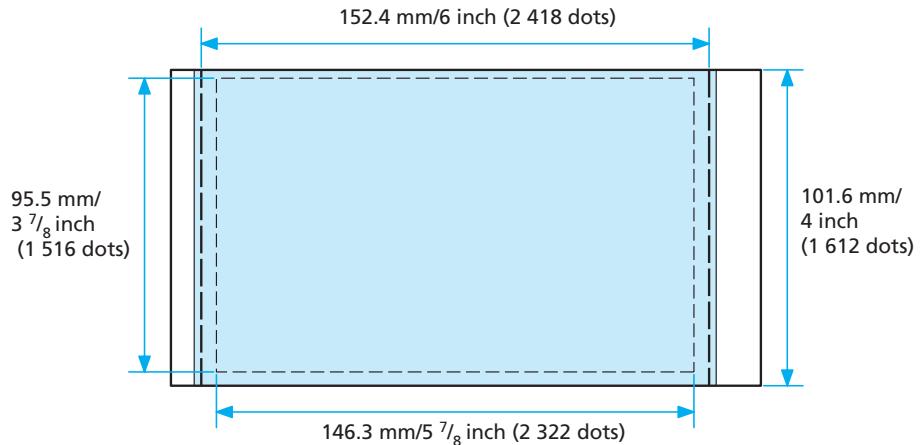
3.5 x 5 inch size Small size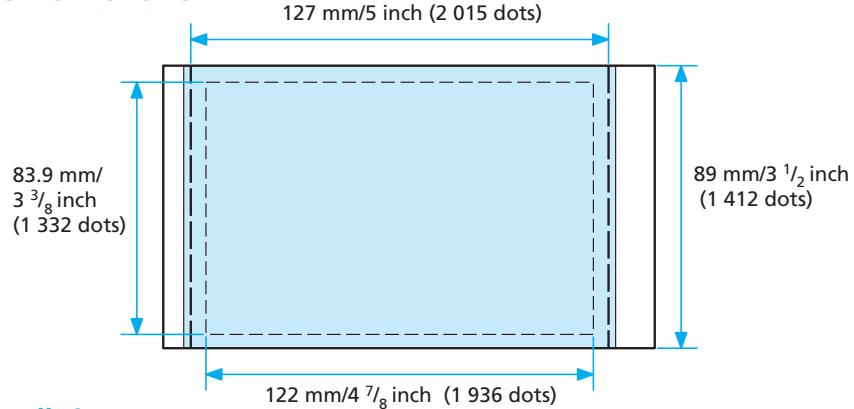
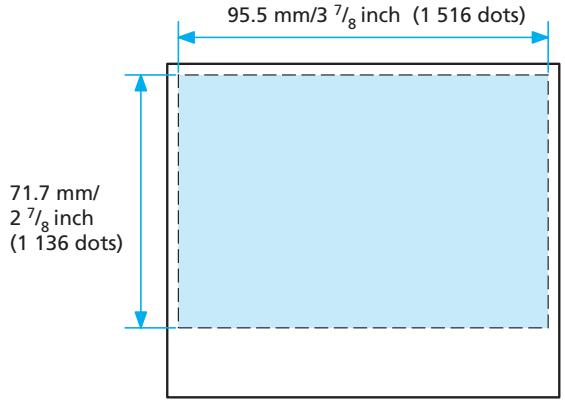
Border print range
Borderless print range

Perforations
Continued
The printing range differs for a border or a borderless print as shown in the illustrations on the previous page.
For a border print, the margin sizes differ depending on the aspect ratio of the image to be printed as follows. The illustrations of the previous page are those when an image with a 2:3 aspect ratio is printed.
Margin sizes
| Paper size\Aspect ratio of the image to be printed | 2:3 | 3:4 | 4:5 | |
| Postcard size | right/left: | 4.6 mm/3/16 inch | 12.6 mm/1/2 inch | 16.5 mm/21/32 inch |
| top/bottom: | 3.1 mm/1/8 inch | 3.1 mm/1/8 inch | 3.1 mm/1/8 inch | |
| 3.5 x 5 inch size | right/left: | 2.5 mm/1/8 inch | 7.6 mm/5/16 inch | 11.1 mm/7/16 inch |
| top/bottom: | 3.9 mm/5/32 inch | 2.5 mm/1/8 inch | 2.5 mm/1/8 inch | |
| Small size | right/left: | 3.1 mm/1/8 inch | 3.1 mm/1/8 inch | 6.1 mm/1/4 inch |
| top: | 8.8 mm/3/8 inch | 4.8 mm/7/32 inch | 4.8 mm/7/32 inch | |
| bottom: | 17.5 mm/23/32 inch | 13.5 mm/9/16 inch | 13.5 mm/9/16 inch | |
- The sizes in approximate values
Glossary
Auto Fine Print 3
The function automatically corrects the picture quality so that an image may be printed in more vivid, clear and beautiful pictures. It is especially effective for a darker image with low contrast. The pictures are corrected to reproduce natural skin colors, vivid tree leaf green, or clear sky blue.
DCF (Design rule for Camera File system)
The standard specified by JEIDA (Japan Electronic Industry Development Association) to maintain the file exchangeability and compatibilities between digital cameras and related products.
DPOF (Digital Print Order Format)
The format used to record the information necessary for automatically printing images shot by a digital camera at a printing shop or with a home-use printer. The printer supports DPOF printing and can automatically print the preset number of copies of the DPOF preset images.
Exif 2.2 (Exif Print)
Exif (Exchangeable image file format for digital cameras) Print is a global standard for digital photo printing. A digital camera supporting Exif Print stores the data relevant to the conditions of shooting as each shot is taken. The printer utilises the Exif Print data stored in each image file to ensure the printed result matches the original shot as closely as possible *1 .
*1 When the "Auto Fine Print 3" is enabled and an image (JPEG file) is shot by an Exif Print (Exif 2.2)-compliant digital camera, the image is automatically adjusted to its optimum picture quality and printed.
"Memory Stick"/CompactFlash card
Compact, light, removable storage media. For details see pages 127 to 131.
PictBridge
A standard specified by Camera & Imaging Products Association that allows you to connect PictBridge-complaint digital camera directly to the printer without a PC, enabling direct printing on the spot.
Thumbs nails
Miniature images for representing the original images that are stored in the image files taken by a digital camera. The printer uses thumbnails in the image list.
Lists of templates and patterns in Creative Print (MONITOR OUT mode only)
Free layout templates
Calendar patterns
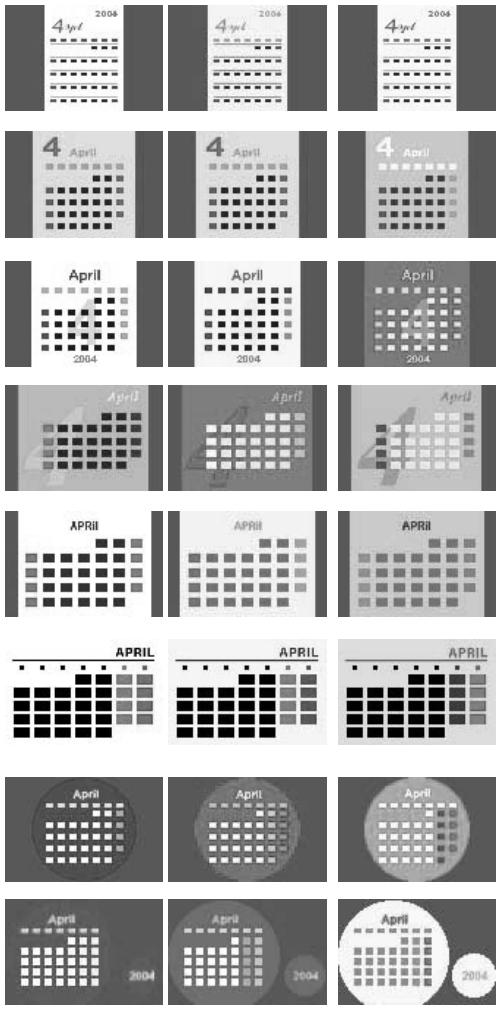
Frames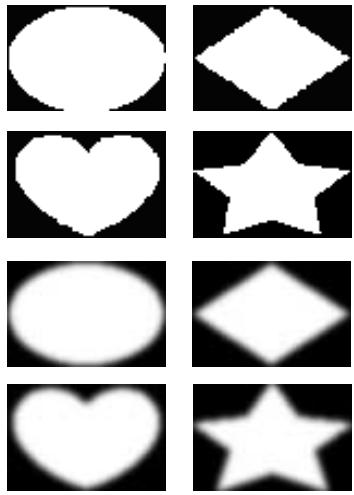
Stamps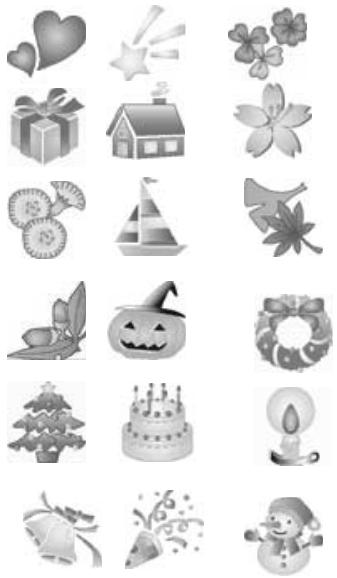
Calendar templates
Postcard size
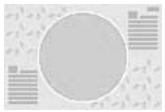
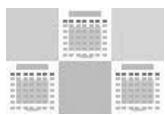
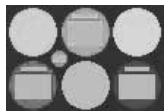
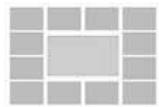
3.5 x 5 inch size
Small size
Card templates
Postcard size/3.5 x 5 inch size
Small size
Messages
Merry Christmas
Congratulations!
Thank You
Wedding Bells
Season's Greetings
Happy Birthday
Happy Halloween
Happy Birthday
Season's Greetings
Happy Birthday
For You
Merry Christmas
Congratulations!
Thank You
Happy Holidays
Congratulations!
Split-image templates
Postcard size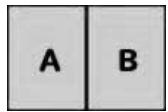
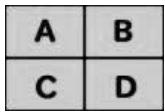
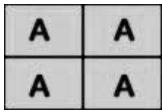
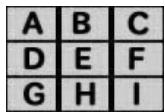
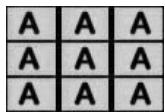
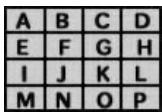
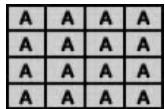
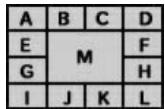
3.5 × 5 inch size
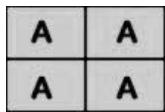
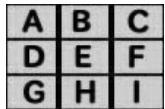
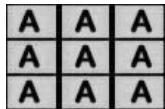
Small size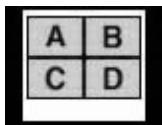
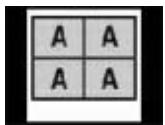
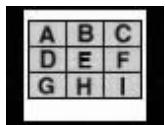
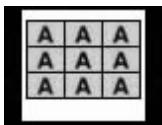
Frames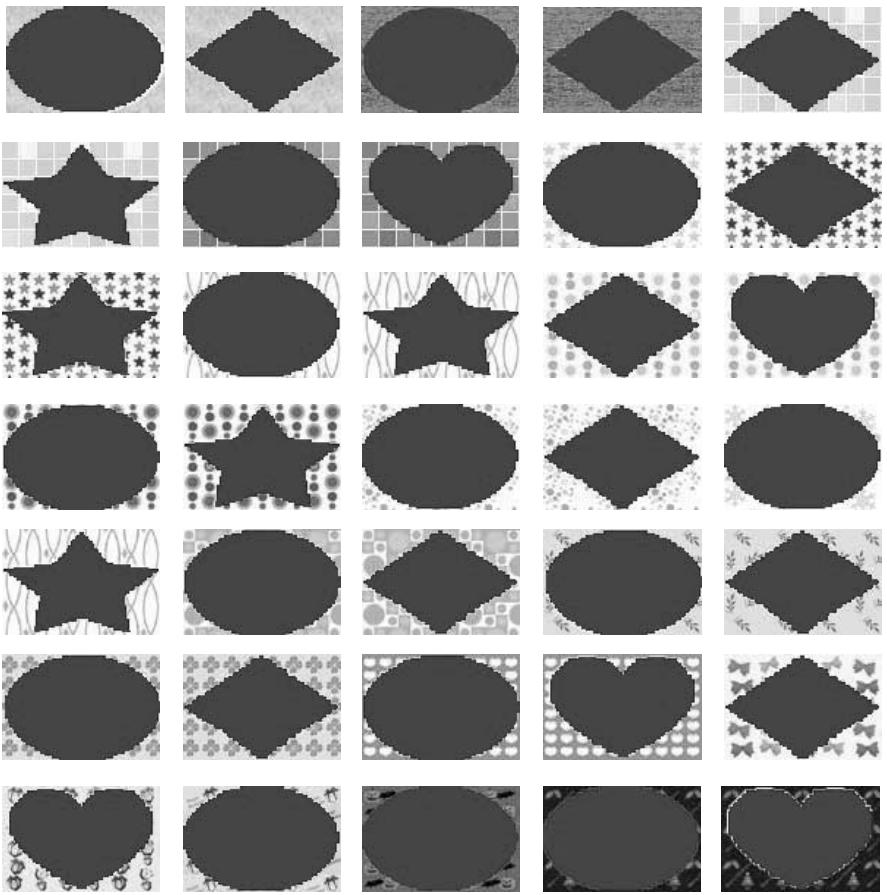
Identifying the parts
For details, see the pages indicated in the parentheses.
Printer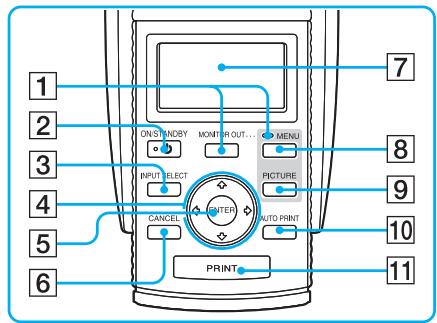
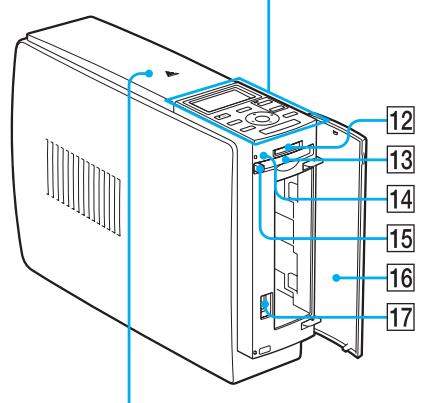
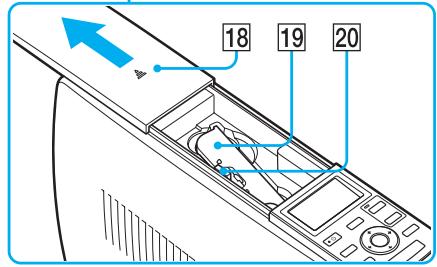
1 MONITOR OUT button (pages 20, 72) 2 ON/STANDBY button (pages 20, 74, 82, 89) 3 INPUT SELECT button (pages 21, 74) 4 Arrow (left/right/up/down) button 5 ENTER button 6 CANCEL button (page 25) 7 LCD display (page 72) 8 MENU button (pages 31, 43, 60) 9 PICTURE button (page 23) 10 AUTO PRINT button (pages 27, 78) Each time you press the button, INDEX, DPOF, ALL, and normal printing modes switch. 11 PRINT button (pages 22, 75) 12 "Memory Stick" insertion slot (pages 19, 73) 13 CompactFlash card insertion slot (pages 20, 73) 14 Access indicator (pages 21, 74) Lights or blinks when the printer accesses the data of the memory card. 15 CompactFlash card eject button (pages 20, 73) 16 Paper tray compartment cover (page 15) 17 PictBridge connector (page 82) Connect the PictBridge-compliant digital camera. 18 Cartridge compartment cover (page 13) 19 Print cartridge (pages 12, 13) (Not supplied) 20 Print cartridge eject lever (page 13)
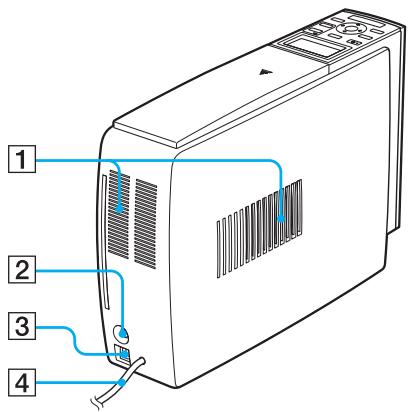
Paper tray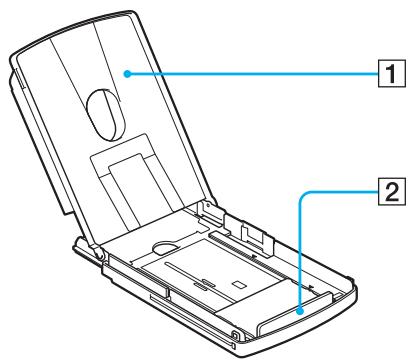
1 Ventilation holes VIDEO OUT (output) connector (page 18)
Connects to the video input of your TV monitor.
3 USB connector (pages 82, 89) Connects to the USB connector of your computer. 4 AC power cord
1 Cover (page 15) 2 Spacer (page 15)
Index
Symbols
3.5 x 5 inch size 12
A
Adding a special filter to an image 34
Adjusting an image 33
ALL 27, 76
Auto Fine Print 3 61
AUTO PRINT 27, 78
B
Beep 64
Border/borderless print 61
C
Calendar 50
Card 53
Cartridge compartment cover 13
Cleaning
Inside the printer 124
Outsides the printer 127
Color Setting 62, 100
CompactFlash card
Inserting/removing 20,73
Notes 130
Types 130
Connecting
Computer 89
PictBridge-compliant digital camera 82
To AC outlet
19,72,81,88
TV monitor 18
Creative Print 42
D
Date print 62
Deleting an image 67
Displaying
Image list 20
Preview image 23
DPOF 27, 76
E
Editing an image 30
Eject lever 13
Enlarging/reducing the image size 32
Error messages 120
Exif Print 9, 61
F
Features 9
Filter 34
Finish 61
Formatting "Memory
Formatting "Memory"
Stick" 69
Frame 44, 56
Free layout print 43
1
INDEX 27, 76
INPUT SELECT 21, 74
Inserting
Paper tray 17
Print cartridge 13
Print paper 15
Installing
Picture Gear Studio 92
Printer driver 87
System requirements
85
L
LCD mode 72
M
"Memory Stick"
Note on use 129
Write protect 129
Inserting/Removing 19, 73
Types 127
MENU 31,43,60
Messages
Adding to an image 54
Registering/ loading 39
Moisture condensation 126
MONITOR OUT button 20, 74
MONITOR OUT mode 6,18
Moving an image 32
0
ON/STANDBY
20,74,82,89
Operation flows 8
Operation modes 6
OPTION 63
Overview 6
P
Paper jams 124
Paper size 12
Paper tray 15, 140
PC mode 7,89
PictBridge 7, 10, 81, 135
PICTURE 23
Post card size 12
Print cartridge 12, 13
Print paper 12, 15
Print quantity 25
Print settings (SET UP) 60
Printer preferences (Options) 63
Printing
A selected image 22, 74
ALL images 27, 76
Calendar 50
Card 53
DPOF images 27, 76
Free layout print 43
From a PictBridge-compliant digital
camera 81
From your PC 96
Index images 27, 76
Multiple images 24
PC images 96
Split image 56
Printing pack 12
Printing range 133
Printing surface 15, 109
R
Red-eye reduction 35
Reset 41
Restrictions on duplication 127
Rotating an image 33
S
S
Saving an image 40, 58
Searching an image 69
SETUP 60
Slideshow 65
Small (3.5 x 4 inch) size 12
Spacer 15
Split images 56
Stamp 46
Superimposing characters 36
Supplied accessories 11
System requirements 85
T
Templates 136
Thumbnails 135
Transport 126
Troubleshooting 104
U
Uninstalling
Picture Gear Studio 95
Printer driver 91
USB connector 82, 89
V
VIDEO OUT connector 18
W
Wallpaper 44
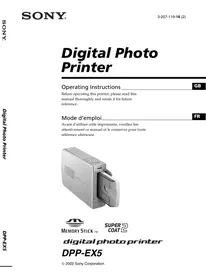
- DIGITAL PHOTO PRINTER
- WARNING
- CAUTION
- OWNER'S RECORD
- FOR THE CUSTOMERS IN THE U.S.A
- DECLARATION OF CONFORMITY
- BACKUP RECOMMENDATIONS
- INFORMATION
- ON TRADEMARKS AND COPYRIGHTS
- NOTICE FOR USERS
- USER REGISTRATION
- TABLE OF CONTENTS
- BEFORE YOU BEGIN
- PREPARATIONS
- PRINTING USING A TV MONITOR (MONITOR OUT MODE)
- PRINTING USING THE PRINTER'S LCD DISPLAY (LCD MODE)
- PRINTING FROM A PICTBRIDGE CAMERA (PICTBRIDGE MODE)
- PRINTING FROM A PC (PC MODE)
- TROUBLESHOOTING
- ADDITIONAL INFORMATION
- OVERVIEW
- WHAT YOU CAN DO WITH THIS PRINTER
- PRINTING USING A TV MONITOR (MONITOR OUT MODE) -> PAGE
- A VARIETY OF PRINTS YOU CAN MAKE
- PRINTING USING THE PRINTER'S LCD DISPLAY (LCD MODE) → PAGE
- PRINTS YOU CAN MAKE
- PRINTING FROM A PC
- OPERATION FLOWS
- FEATURES
- SUPREME PICTURE QUALITY FUNCTIONS ENABLING PHOTO-REALISTIC PRINTING
- HIGH PERFORMANCE HEAT-RESISTANT TECHNOLOGY FOR DYE SUBLIMATION PRINTING
- SUPER COAT
- AUTO FINE PRINT
- EXIF 2.2* (EXIF PRINT) SUPPORT (PAGE 61)
- EXIF PRINT
- RED-EYE REDUCTION AND OTHER ADJUSTMENTS (MONITOR OUT/PC MODES ONLY, PAGE 35)
- HIGH-SPEED CPU ENABLING QUICK ADJUSTMENT AND PRINTING
- D ANIMATION INTERFACE (MONITOR OUT MODE ONLY)
- PAPER TRAY ALLOWING BULK PRINTING OF 25/30 SHEETS (PAGE 15)
- A CHOICE OF PRINT SIZES (PAGE 12)
- BORDER OR BORDERLESS PRINTS (PAGE 61)
- A CHOICE OF PRINT FINISH (PAGE 61)
- A WIDE VARIETY OF IMAGE FILTERS (MONITOR OUT MODE ONLY, PAGE 34)
- SLIDESHOW FEATURE (MONITOR OUT MODE ONLY, PAGE 65)
- PICTBRIDGE-COMPLIANT** (PAGE 81) PICTBRIDGE
- WINDOWS PC SUPPORT WITH A CONVENIENT USB CONNECTION (PAGE 85)
- CHECKING THE CONTENTS OF THE PACKAGE
- PAPER TRAY (1)
- VIDEO CONNECTING CABLE (1)
- CD-ROM (1)
- CLEANING CARTRIDGE (1)
- CLAMP FILTER (1)
- PREPARING THE PRINTING PACK (NOT SUPPLIED)
- SIZES OF PRINT PAPER
- OPTIONAL PRINTING PACKS
- FOR POST CARD SIZE PRINTING
- SVM-25LS
- SVM-75LS
- FOR 3.5 X 5 INCH SIZE PRINTING
- SVM-30MS
- FOR SMALL SIZE PRINTING
- SVM-30SS
- NOTES
- LOADING THE PRINT CARTRIDGE
- SLIDE OPEN THE CARTRIDGE COMPARTMENT COVER
- INSERT THE PRINT CARTRIDGE
- CLOSE THE CARTRIDGE COMPARTMENT COVER
- REMOVING THE PRINT CARTRIDGE
- NOTES ON STORING THE PRINT CARTRIDGE
- INSERTING THE PRINT PAPER
- OPEN THE PAPER TRAY COVER
- ADJUST THE SPACER TO THE PAPER SIZE YOU WANT TO USE
- TO USE POST CARD SIZE PRINT PAPER
- TO USE 3.5 X 5 INCH SIZE PRINT PAPER
- TO USE SMALL SIZE PAPER
- NOTE
- SET THE PRINT PAPER INTO THE TRAY
- REMOVE THE PROTECTIVE SHEET
- CLOSE THE PAPER TRAY COVER
- PUSH AND OPEN THE PRINTER'S PAPER TRAY COMPARTMENT COVER
- INSERT THE PAPER TRAY INTO THE PRINTER
- NOTES ON STORING THE PRINT PAPER
- CONNECTIONS
- CONNECTING TO A TV MONITOR
- CONNECTING THE AC POWER CORD
- INSERTING A MEMORY CARD
- INSERTING A "MEMORY STICK
- TO EJECT A "MEMORY STICK
- INSERTING A COMPACTFLASH CARD
- TO EJECT A COMPACTFLASH CARD
- ON USING THE MEMORY CARD
- DISPLAYING THE IMAGES ON A TV MONITOR
- TURN ON THE PRINTER
- PRESS INPUT SELECT REPEATEDLY TO SELECT THE MEMORY CARD CONTAINING THE IMAGES THAT YOU WANT TO PRINT
- ON ASSOCIATED FILE/DPOF/PROTECT INDICATIONS
- TO DISPLAY ANOTHER PAGE
- DISPLAYING THE PRINTER IMAGES (DEMONSTRATION MODE)
- BASIC PRINTING OPERATIONS
- PRINTING A SELECTED IMAGE
- PRESS PRINT
- CHECKING THE PREVIEW IMAGE BEFORE PRINTING
- TO DISPLAY THE PREVIEW OF ANOTHER IMAGE
- TO PRINT THE PREVIEWED IMAGE
- TO CANCEL PRINT SETTING
- TO DISPLAY THE IMAGE LIST AGAIN
- PRINTING MULTIPLE IMAGES
- PRESS ENTER OR CANCEL TO SET THE PRINT QUANTITY
- REPEAT STEPS 1 AND 2 TO SELECT OTHER IMAGES AND SET PRINT QUANTITY FOR EACH OF THEM
- TO CANCEL THE SELECTION
- TO STOP PRINTING
- AUTO PRINTING (INDEX/DPOF/ALL)
- INDEX PRINTING
- DPOF PRESET IMAGE PRINTING
- ALL IMAGES PRINTING
- PRESS AUTO PRINT REPEATEDLY TO DISPLAY "INDEX," "DPOF," OR "ALL" ON THE TV MONITOR
- TO MAKE AN INDEX PRINT: INDEX
- TO PRINT DPOF-PRESET IMAGES: DPOF
- TO PRINT ALL THE IMAGES IN A MEMORY CARD: ALL
- TO CANCEL SELECTION (EXCEPT FOR THE DPOF PRINTING)
- TO RESUME THE NORMAL PRINTING MODE
- TIPS
- EDITING AN IMAGE
- DISPLAYING THE EDIT MENU
- PRESS MENU
- TO EXIT THE MENU MODE
- PRESS THE ARROW (LEFT/RIGHT) BUTTON TO SELECT (EDIT) AND THEN PRESS ENTER
- ENLARGING AND REDUCING THE SIZE OF AN IMAGE
- MOVING AN IMAGE
- PRESS ENTER
- ROTATING AN IMAGE
- ADJUSTING AN IMAGE
- ADDING A SPECIAL FILTER TO AN IMAGE
- REDUCING THE RED-EYE PHENOMENON
- TO MOVE THE ADJUSTMENT FRAME
- TO ADJUST THE SIZE OF THE ADJUSTMENT FRAME
- TIP
- PRESS THE ARROW (LEFT/RIGHT/UP/DOWN) BUTTON TO SELECT "EXECUTE" AND PRESS ENTER
- TO RESET THE ADJUSTMENT
- SUPERIMPOSING CHARACTERS
- SELECT A FONT
- SELECT A COLOR
- PRESS THE ARROW (LEFT / RIGHT / UP / DOWN) BUTTON TO SELECT THE DESIRED CHARACTER, THEN PRESS ENTER TO INPUT A CHARACTER
- TO CHANGE LINES
- TO INPUT A CAPITAL LETTER
- TO CORRECT CHARACTERS IN THE INPUT BOX
- TO INSERT A CHARACTER AMONG THE INPUT CHARACTERS
- AFTER YOU FINISH ENTERING THE REMAINING CHARACTERS, PRESS THE ARROW (LEFT/RIGHT/UP/DOWN) BUTTON TO SELECT "NEXT", AND THEN PRESS ENTER
- PRESS THE ARROW (LEFT/RIGHT/UP/DOWN) BUTTON TO SELECT THE DESIRED ADJUSTMENT TOOL, THEN PRESS ENTER TO ADJUST THE SIZE AND POSITION OF THE CHARACTERS. TO MAKE MULTIPLE ADJUSTMENTS, REPEAT THIS STEP
- PRESS THE ARROW (UP/DOWN) BUTTON TO SELECT "EXECUTE", THEN PRESS ENTER
- REGISTERING COMMONLY-USED CHARACTERS AS A MESSAGE
- TO LOAD A REGISTERED MESSAGE
- SAVING AND PRINTING THE EDITED IMAGE
- SAVING THE EDITED IMAGE
- SET DATE
- RESETTING THE EDITING
- PRINTING AN EDITED IMAGE
- DISPLAYING OTHER MENU WHILE EDITING AN IMAGE
- EXITING THE EDIT MENU
- MAKING VARIOUS PRINTS (CREATIVE PRINT)
- DISPLAYING THE CREATIVE PRINT MENU
- PRESS THE ARROW (LEFT/RIGHT) BUTTON TO SELECT (CREATIVE PRINT) AND THEN PRESS ENTER
- MAKING A CREATIVE PRINT
- MAKING A FREE LAYOUT PRINT
- CHECK THE PREVIEW, THEN SAVE AND PRINT YOUR CREATIVE PRINT
- ADDING YOUR FAVORITE EFFECTS TO THE PRINT
- ADDING A STAMP
- TO CANCEL THE OPERATION
- ADDING A MESSAGE
- ADDING A CALENDAR
- ITEM PROCEDURES
- START MONTH
- START DAY
- COLOR OF DAY
- MAKING A CALENDAR
- SET THE CALENDAR
- MAKING A CARD
- EACH TIME YOU PRESS ENTER, THE IMAGE BECOMES LARGER
- ENTER A MESSAGE
- ENTER CHARACTERS
- AFTER YOU ENTER AND ADJUST THE CHARACTERS, PRESS THE ARROW (↓/ ) BUTTON TO SELECT "EXECUTE", THEN PRESS ENTER
- MAKING SPLIT IMAGES
- SAVING AND PRINTING A CREATIVE PRINT IMAGE
- SAVING A CREATIVE PRINT
- SET THE PRINT QUANTITY
- PRESS THE ARROW BUTTON TO SELECT "OK" TO START PRINTING
- EXITING THE CREATIVE PRINT MENU
- CHANGING THE PRINT SETTINGS (SET UP)
- TO CANCEL SETTINGS
- CHANGING THE PRINTER PREFERENCES (OPTION)
- PRESS THE ARROW (LEFT/RIGHT) BUTTON TO SELECT (OPTION) AND THEN PRESS ENTER
- PRESS THE ARROW (UP/DOWN) BUTTON TO SELECT THE DESIRED SETTING ITEM, PRESS THE ARROW (UP/DOWN) BUTTON TO CHANGE THE OPTION, AND THEN PRESS ENTER
- VIEWING A SLIDESHOW
- TO STOP SLIDESHOW
- PRINTING A DISPLAYED IMAGE
- PRESS THE ARROW (LEFT/RIGHT/UP/DOWN) BUTTON TO SELECT "OK" TO START PRINTING
- DELETING IMAGES
- DELETING SELECTED IMAGES
- PRESS THE ARROW (LEFT/RIGHT) BUTTON TO SELECT (DELETE/FORMAT) AND THEN PRESS ENTER
- FORMATTING A "MEMORY STICK
- SEARCHING FOR AN IMAGE
- WHEN YOU SELECT "BY FOLDER NO
- IF NO IMAGES HAVE BEEN FOUND
- IMAGE NUMBERS
- THE DISPLAY OF CHARACTERS ON THE LCD
- PRINTING IMAGES
- PRESS MONITOR OUT TO TURN OFF THE MONITOR OUT INDICATOR
- CHANGING THE PRINT SETTINGS
- HOW TO ATTACH THE CLAMP FILTER
- PRINTING IMAGES FROM THE DIGITAL CAMERA
- CONNECT A PICTBRIDGE-COMPLIANT DIGITAL CAMERA TO THE PRINTER
- OPERATE THE DIGITAL CAMERA TO PRINT AN IMAGE
- ON THE "PICTBRIDGE" INDICATION
- ON TRADEMARKS AND COPYRIGHTS OF PICTUREGEAR STUDIO
- INSTALLING THE SOFTWARE
- SYSTEM REQUIREMENTS
- SYSTEM REQUIREMENTS FOR THE PRINTER DRIVER
- SYSTEM REQUIREMENTS FOR PICTUREGEAR STUDIO
- ON THE SUPPLIED CD-ROM
- INSTALLING THE PRINTER DRIVER
- MAKE SURE THAT THE PRINTER IS DISCONNECTED FROM THE COMPUTER
- TURN ON YOUR COMPUTER AND START WINDOWS
- INSERT THE SUPPLIED CD-ROM INTO THE CD-ROM DRIVE OF YOUR COMPUTER
- CLICK "INSTALLING PRINTER DRIVER
- CLICK "NEXT
- CHECK "I ACCEPT THE TERMS OF THE LICENSE AGREEMENT" AND CLICK "NEXT
- CLICK "INSTALL
- CONNECT THE AC POWER CORD OF THE PRINTER TO THE AC OUTLET. THE ON/STANDBY INDICATOR LIGHTS IN RED
- CONNECT THE USB CONNECTORS OF THE PRINTER AND YOUR COMPUTER
- WHEN YOU CONNECT A PC
- CLICK "FINISH
- TO FINISH INSTALLATION, CLICK "COMPLETE" AND REMOVE THE CD-ROM FROM YOUR COMPUTER AND KEEP IT FOR FUTURE USE
- CHECKING THE INSTALLATION
- UNINSTALLING THE PRINTER DRIVER
- CLICK "YES
- CHECK "YES, I WANT TO RESTART THE COMPUTER NOW". AND CLICK "OK
- TO CHECK UNINSTALLATION
- INSTALLING THE PICTUREGEAR STUDIO
- INSERT THE SUPPLIED CD-ROM INTO YOUR COMPUTER'S CD-ROM DRIVE
- DOUBLE-CLICK "INSTALLING PICTUREGEAR STUDIO
- CHECK THE DESTINATION AND THEN CLICK "NEXT
- TO REGISTER THE MEDIA WATCHER, CHECK "REGISTER THE PICTUREGEAR STUDIO MEDIA WATCHER IN THE STARTUP FOLDER." AND THEN CLICK "OK
- WHAT IS "PICTUREGEAR STUDIO MEDIA WATCHER
- TO DISPLAY THE README FILE, CHECK "VIEW README" AND THEN CLICK "FINISH
- REMOVE THE CD-ROM FROM YOUR COMPUTER AND KEEP IT FOR FUTURE USE
- UNINSTALLING THE PICTUREGEAR STUDIO
- PRINTING PHOTOS FROM THE PICTUREGEAR STUDIO
- CLICK "SONY", AND THEN SELECT THE DESIRED PAPER SIZE
- IN THE "PRINTER" DROP-DOWN LIST BOX, SELECT "SONY DPP-EX50" AND THEN CLICK "PROPERTIES
- ITEMS FUNCTIONS
- BORDER FREE PRINT
- PAPER SIZE
- RED-EYE REDUCTION
- PRINT SETTINGS
- CLICK "OK
- CLICK "PRINT ALL" OR "PRINT THE SELECTED PAGE ONLY
- MAKE SURE THAT THE SPECIFIED PRINT PAPER AND PRINT CARTRIDGE ARE LOADED AND CLICK "OK
- WHEN "PRINT PREVIEW" IS CHECKED IN STEP
- PRINTING FROM OTHER APPLICATION SOFTWARE
- ON "BORDERLESS" SETTING IN THE "PAPER SIZE" SECTION
- PRINT QUANTITY SETTING IN THE PROPERTIES DIALOG BOX
- EXIF PRINT SETTINGS IN THE "GRAPHICS" TAB
- IF TROUBLE OCCURS
- PRINTED RESULTS
- SETTINGS
- SAVING OR DELETING AN IMAGE
- IF AN ERROR MESSAGE APPEARS
- PRINT CARTRIDGE
- PRINT PAPER
- IF PAPER JAMS
- CLEANING THE INSIDE OF THE PRINTER
- WHEN CLEANING ENDS
- PRECAUTIONS
- ON SAFETY
- ON INSTALLATION
- ON MOISTURE CONDENSATION
- ON TRANSPORT
- ON CLEANING
- ON RESTRICTIONS ON DUPLICATION
- ABOUT THE "MEMORY STICK
- WHAT IS "MEMORY STICK
- TYPES OF "MEMORY STICK
- ABOUT "MEMORY STICK DUO
- TYPES OF "MEMORY STICK" THAT THE PRINTER CAN USE
- ON DATA READ/WRITE SPEED
- WHAT IS "MAGICGATE
- NOTES ON USE
- ABOUT THE COMPACTFLASH CARD
- SPECIFICATIONS
- PRINTING METHOD
- RESOLUTION
- IMAGE PROCESSING PER DOT
- PRINTING SIZE
- PRINTING TIME (PER SHEET)
- INPUT/OUTPUT CONNECTORS
- SLOT
- COMPATIBLE IMAGE FILE FORMATS
- RECORDING IMAGE FORMAT
- MAXIMUM NUMBER OF PIXELS TO BE HANDLED
- MAXIMUM NUMBER OF FILES TO BE HANDLED
- PRINT CARTRIDGE/PRINT PAPER
- POWER REQUIREMENTS
- OPERATING TEMPERATURE
- DIMENSIONS
- MASS
- SUPPLIED ACCESSORIES
- CUSTOMER SUPPORT HOME PAGE
- PRINTING RANGE
- GLOSSARY
- DCF (DESIGN RULE FOR CAMERA FILE SYSTEM)
- DPOF (DIGITAL PRINT ORDER FORMAT)
- EXIF 2.2 (EXIF PRINT)
- MEMORY STICK"/COMPACTFLASH CARD
- PICTBRIDGE
- THUMBS NAILS
- LISTS OF TEMPLATES AND PATTERNS IN CREATIVE PRINT (MONITOR OUT MODE ONLY)
- CALENDAR TEMPLATES
- CARD TEMPLATES
- MESSAGES
- SPLIT-IMAGE TEMPLATES
- IDENTIFYING THE PARTS
- INDEX
- SYMBOLS
- A
- B
- C
- D
- E
- L
- M
- P
- R
- S
- TEMPLATES
- U
- V
- W
Brand : SONY
Model : DPP-EX50
Category : Photo printer