
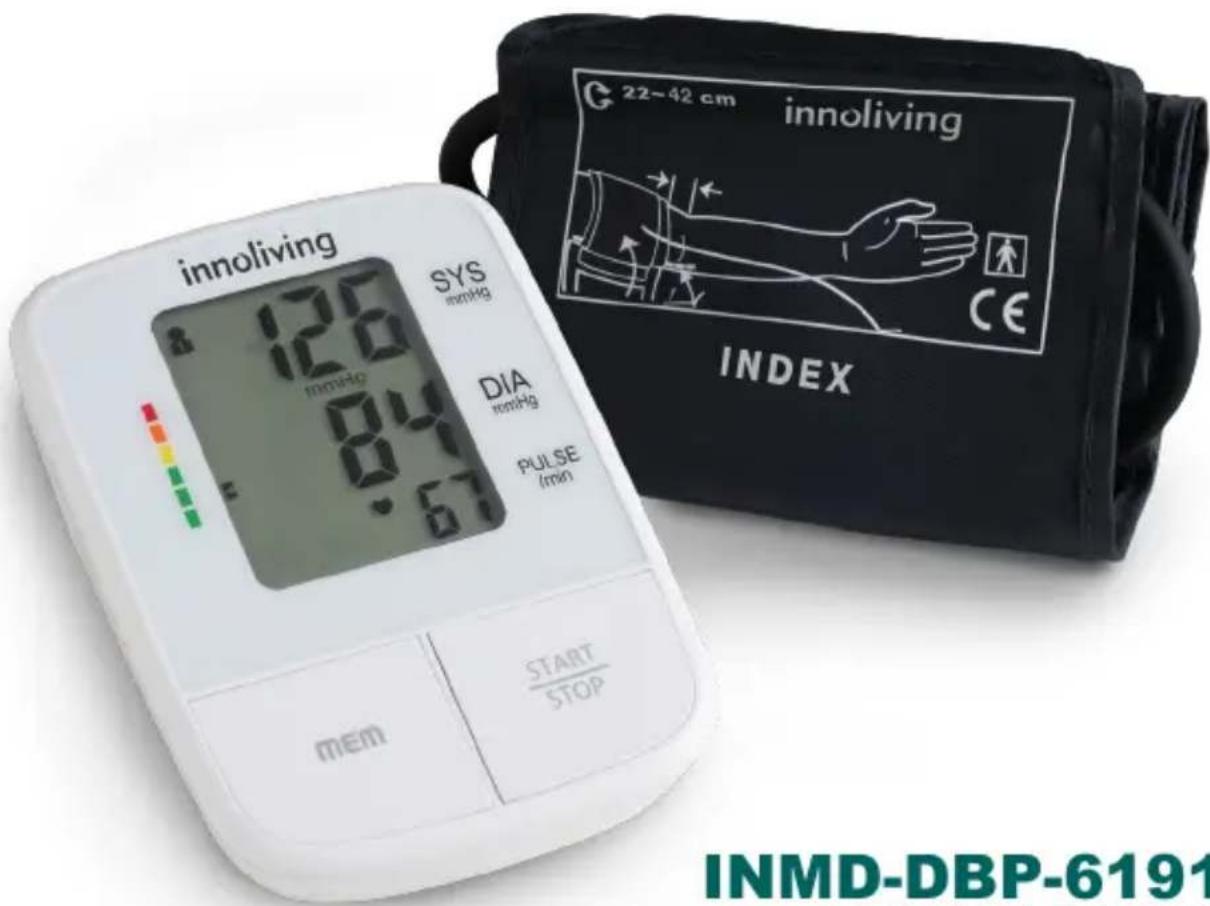
INMD-DBP-6191 - Blood pressure monitor Innoliving - Free user manual and instructions
Find the device manual for free INMD-DBP-6191 Innoliving in PDF.


| Product Type | Blood Pressure Monitor |
| Brand | Innoliving |
| Model | INMD-DBP-6191 |
| Display | LCD digital display |
| Measurement Method | Oscillometric |
| Measurement Range | Systolic: 60-260 mmHg, Diastolic: 40-200 mmHg, Pulse: 40-199 bpm |
| Accuracy | Blood pressure: ±3 mmHg, Pulse: ±5% |
| Cuff Size | 22-32 cm (standard arm) |
| Memory Storage | 2 x 90 readings (for 2 users) |
| Dimensions | Approx. 15.5 x 10.5 x 5.5 cm |
| Weight | Approx. 300 g (without batteries) |
| Power Supply | 4 x AA batteries (1.5V) or AC adapter (DC 6V, 600 mA) |
| Battery Life | Approx. 300 measurements with new batteries |
| Auto Shut-off | After 1 minute of inactivity |
| Main Functions | Blood pressure measurement, pulse rate, irregular heartbeat detection, WHO classification indicator |
| Operating Conditions | Temperature: 10°C-40°C, Humidity: 15%-90% RH |
| Storage Conditions | Temperature: -20°C-55°C, Humidity: 10%-95% RH |
| Maintenance & Cleaning | Wipe with a soft dry cloth; do not use solvents or immerse in water |
| Safety Features | CE medical device, not for self-diagnosis; consult physician for interpretation |
| Spare Parts & Repairability | Replacement cuffs available; no user-serviceable parts; contact support for repairs |
| Included Accessories | Arm cuff, instruction manual, batteries (if included) |
| General Information | Intended for home use by adults; not for continuous monitoring |
Frequently Asked Questions - INMD-DBP-6191 Innoliving
User questions about INMD-DBP-6191 Innoliving
0 question about this device. Answer the ones you know or ask your own.
Ask a new question about this device
Download the instructions for your Blood pressure monitor in PDF format for free! Find your manual INMD-DBP-6191 - Innoliving and take your electronic device back in hand. On this page are published all the documents necessary for the use of your device. INMD-DBP-6191 by Innoliving.
USER MANUAL INMD-DBP-6191 Innoliving
innoliving easy tech, easy life
MISURATORE DI PRESSIONE AUTOMATICO DA BRACCIO
UPPER ARM AUTOMATIC BLOOD PRESSURE MONITOR
MANUALE D'USO
USER MANUAL
MISURATORE DI PRESSIONE AUTOMATICO DA BRACCIO
I
natural_image
Technical line drawing of a mechanical component with mounting holes and a central housing (no text or symbols)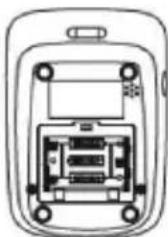
natural_image
Diagram of a mobile phone rear panel showing internal components (no text or labels)natural_image
Line drawing of a person sitting at a desk in a seated posture (no text or symbols)PREPARAZIONE DEL BRACCIALE
natural_image
Line drawing of a blood pressure meter device with control panel and cord (no text or symbols)I
natural_image
Line drawing of a human leg with a heart symbol placed between the feet, no text or labels presentnatural_image
Simple diagram with three horizontal oval shapes and a small figure at the top (no text or symbols)natural_image
Blank white image with a small dark square in the top-left corner (no text or symbols)natural_image
Three-step line drawings of a medical or diagnostic device with no visible text or symbols3 x 1,5V alkaline AAA batteries (included)
Modello / Model: LR03
Fabbricata da / Manufactured by:
DONG GUAN ANDALI ELECTRONIC CO., LTD.
No. 102. YUNHE East Ro3, South District, Dongguan City, China
Importata da / Imported by: Innoliving Spa
Via Merloni 2/B - 60131 Ancona, Italia
311100 Hangzhou, Zhejiang Province
PEOPLE'S REPUBLIC OF CHINA
Shanghai International Holding Corp. GmbH (Europe)
Eiffestraße 80, 20537 Hamburg, GERMANY

Innoliving Spa
Via Merloni, 2/B - 60131 Ancona - Italy
www.innoliving.it
UPPER AUTOMATIC ARM BLOOD PRESSURE MONITOR

Thank you for purchasing the INMD-DBP-6191 blood pressure monitor.
This manual is designed to help end users use the DBP-6191 blood pressure monitor safely and effectively. The device must be used in accordance with the instructions provided in this manual. It is important to read and fully understand all sections of the manual, especially the
IMPORTANT SAFETY INSTRUCTIONS
INTENDED USE
This medical device is intended for the non-invasive measurements of systolic and diastolic blood pressure and heart rate in adults and adolescents aged 12 years and older, using the oscillometric method. The device is not intended for use on infants and children. It is designed for home or clinical use. All functions can be safely operated, and values can be read on a single LCD DISPLAY. The measurement position is solely on the upper arm of adults. The patient is the intended operator.
Please read this manual carefully before using the product. It is recommended to keep this manual for future reference. For specific information regarding blood pressure, please CONSULT YOUR PHYSICIAN. To avoid risks and damages, follow all warnings. Use the device only as intended. Read all instructions before use.
CONTRAINDICATIONS
This product is not intended for use on infants or individuals who are unable to express their own intentions.
WARNINGS
- Don't mistake self-monitoring for self-diagnosis. Blood pressure readings should be only interpreted by a healthcare professional familiar with the patient's medical history.
- If test results consistently show abnormal readings,
contact your doctor. Avoid self-treating these symptoms without consulting a physician.
-
Consult your physician about the best time to measure blood pressure if you're taking medication. Never alter your prescription without consulting your doctor first.
-
Individuals with severe circulatory issues may experience discomfort. It's advisable to consult a doctor before using the device.
-
For those with irregular or unstable circulation due to conditions like diabetes, liver disease, or arteriosclerosis, blood pressure readings may vary between the arm and wrist. Nonetheless, monitoring both values is useful.
-
People with vascular constriction, liver disorders, diabetes, cardiac pacemakers, or a weak pulse, as well as pregnant women, should consult a physician before self-measuring blood pressure. Values may differ due to their condition.
-
Individuals with arrhythmias such as premature atrial or ventricular beats or atrial fibrillation should use this blood pressure monitor only under the guidance of their physician. Sometimes, the oscillometric method may not provide accurate readings.
-
Taking measurements too frequently may lead to patient injury by interfering with blood flow.
-
Avoid placing the cuff over any wounds to prevent further injury.
-
NEVER place the cuff on an arm being used for intravenous infusion or any other form of vascular access, therapy, or arteriovenous shunt (A-V). Inflating the cuff in such cases may temporarily restrict blood flow, potentially causing harm.
-
Avoid placing the cuff on the arm of a mastectomy site. If both breasts have been removed, used the arm on the less dominant side.
-
Inflating the cuff may temporarily disrupt the function of other monitoring devices being used simultaneously on the same arm.
-
Ensure that any tubing connected to the cuff is not compressed or bent, as this could interfere with blood flow and cause injury.
-
Make sure that using the device does not cause prolonged disruption to the patient's circulation.
-
The product is intended for its specific use only. Do not use it for any other purposes.
-
This product is not suitable for infants or individuals who are unable to communicate their needs.
-
Keeping the cuff inflated excessively for too long may result in bruising on the arm.
-
Do not attempt to dismantle or repair the unit
or cuff yourself. Only replace batteries when necessary, and do not modify the product without authorization from the manufacturer.
-
Always use the approved cuff provided with the product. Using other cuffs may result in inaccurate readings.
-
Ensure that the system is stored and used within the temperature and humidity ranges specified by the manufacturer to prevent inaccurate readings.
-
Avoid using the device near strong electric or electromagnetic fields generated by cell phones or other devices, as they may cause inaccurate readings, interference, or become sources of interference for the device. Do not use the device while transporting the patient outside of the healthcare facility to avoid existing sources of interference.
-
Do not mix new and old batteries in the device simultaneously.
-
Replace the batteries when the low battery indicator "☐" appears on the screen. Replace both batteries at the same time.
-
Use only the recommended type of batteries. Long-lasting alkaline batteries are recommended.
-
Remove the batteries from the device if it will not be used for more than 3 months.
-
Ensure correct battery polarity when inserting batteries into the device.
- Dispose of batteries properly in accordance with local laws and regulations.
- Use only a recommended Class II adapter with double insulation, compliant with EN 60601-1 and EN 60601-1-2 standards. Using an unauthorized adapter may result in fires and electric shocks
- Alert the operator that the instruction manual must be consulted.
- Essential performance
| Electrosurgical Interference Recovery | Refer to 202.6.2.101IEC 80601-2-30 |
| Manometer Error Limits Refer to 202.12.1.102IEC 80601-2-30 | |
| Reproducibility of Blood Pressure Determination | Refer to 201.12.1.107IEC 80601-2-30 |
- Avoid using this device next or stacked on top of other devices as it may result in improper operation. If such use is necessary, both this device and the other devices should be monitored to ensure they are operating normally.
- Portable RF communication equipment (including peripherals such as antenna cables and external antennas) should be used no closer than 30 cm from
any part of the blood pressure monitor, including cables specified by the MANUFACTURER. Otherwise, degradation of this device's performance may occur.
-
The software identifier refers to the software evaluation report, and the file code is JYRJ20101200.
-
Follow the instructions in this manual for proper placement of the cuff. Do not place the air tube around the neck: risk of suffocation!
-
The cuff and blood pressure monitor case have been tested for biocompatibility and do not contain allergenic or harmful materials. Please discontinue use in case of allergy during use.
-
This device should be cleaned following the instructions provided in this manual.
-
The device should be cleaned following the instructions provided in this manual.
-
Always check the device and cuff before use. Do not use the device or cuff if either is damaged, as this may cause injury.
-
If discomfort is experienced during a measurement or other issues arise, press the "START/STOP" button to immediately release air from the cuff. Loosen the cuff and remove it from the arm.
-
Do not use the product in oxygen-rich environment or in the presence of flammable agents.
PRODUCT'S DESRIPTION
Main unit
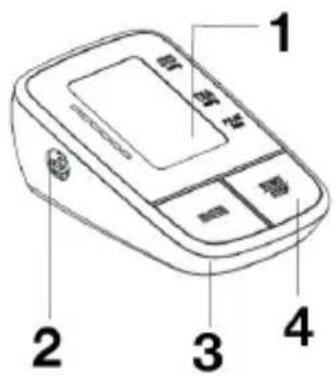
- LCD
- Cuff connection port
- "MEM" button
- "START/STOP" button
- USB Adapter jack
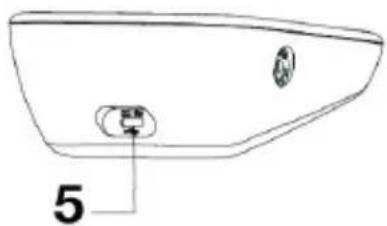
natural_image
Simple line drawing of a bowl with a small inset showing a device, labeled with the number 5 (no text or symbols on the diagram itself)Cuff
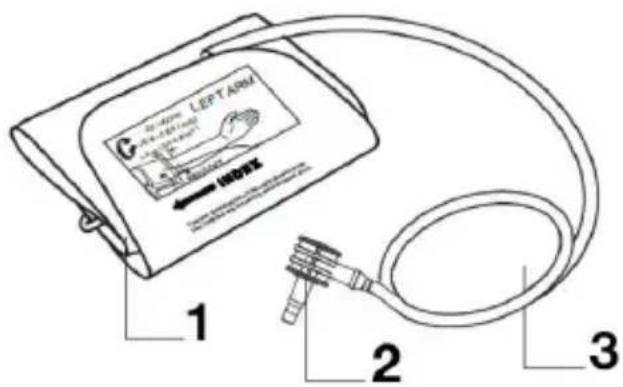
- Arm cuff
- Air plug
- Air tube
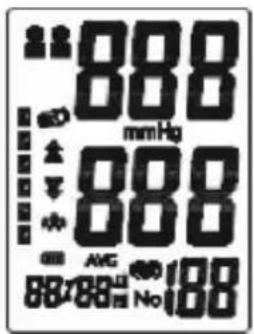
Display
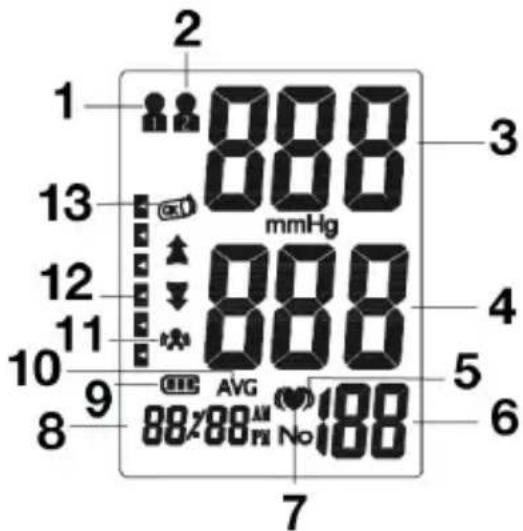
- Group 1
- Group 2
- Systolic blood pressure
- Diastolic blood pressure
- Irregular heartbeat indicator
- Pulse rate
- Heart rate indicator
- Time/Date
- Low battery indicator
- Last 3 tests average
- Arm shake indicator
- WHO blod pressure classification indicator
- cuff loose indicator
Package Contents:
- Main unit
- Cuff
- User manual
4.3 AAA batteries - Case
SYSTEM SETTINGS
With the device turned off, press and hold the "START/STOP" button for approximately 3 seconds to activate the system settings. The user group icon will flash.
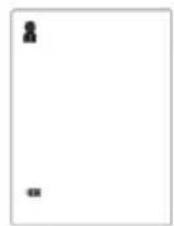
1. MEMORY GROUP SELECTION
In this mode, you can choose which user group (Group 1 or Group 2) to store the measurements you are about to perform. This allows two different users to save their individual results. Press the "MEM" button to select the desired user group. The results will be automatically stored in the selected group.
natural_image
Blank white image with two small black icons in the top-left corner (no text or symbols)
natural_image
Blank white image with two small black icons in the top-left corner (no text or symbols)2. TIME/DATE SETTING
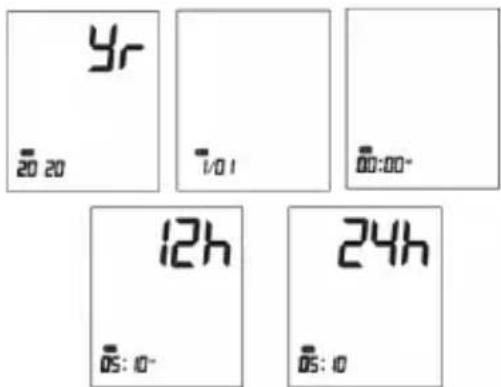
Press the "START/STOP" button again to enter the YEAR SETTING mode. The values can be adjusted using the "MEM" button.
Press the "START/STOP" button again to enter the MONTH/DAY SETTING mode. The values can be adjusted using the "MEM" button.
The user can continue by setting the day, hour, minutes, and 12/24-hour format in the same manner.
Each time the "START/STOP" button is pressed, the selection is locked, and the corresponding parameters can be set by adjusting the "MEM" button (month, day, hour, minute, 12/24-hour format).
3. TIME FORMAT SETTING
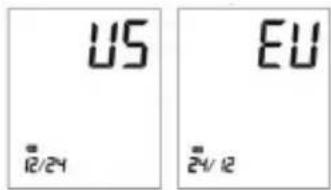
Press the "START/STOP" button again to enter the time format setting mode. Set the time format by adjusting the "MEM" button. "EU" stands for European Time, "US" stands for United States Time
4. SETTING SAVING
In any setting mode, press and hold the "START/STOP" button to turn off the unit. All information will be saved.
NOTE: If the unit is left on and unused for 3 minutes, it will automatically save all information and turn off.
USE THE DEVICE
CAUTIONS
- Sit in a quiet environment for at least 5 minutes before the test.
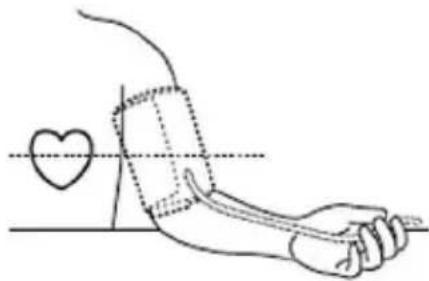
- Do not stand during the test. Sit in a relaxed position with the arm at heart level.
- Wait for 3 minutes or more before repeating the test.
- Avoid talking or moving body parts during the test.
- During the test, avoid strong electromagnetic interference such as and cell phones.
- Try to measure blood pressure at the same time every day to obtain consistent values.
- Test comparisons should only be made when the blood pressure monitor is used on the same arm, in the same position, and at the same time of day.
- This blood pressure monitor is not recommended for individuals with severe arrhythmia. Avoid eating, exercising, and bathing for 30 minutes before the test.
- Do not use this blood pressure monitor if the device is damaged.
BATTERY INSTALLATION
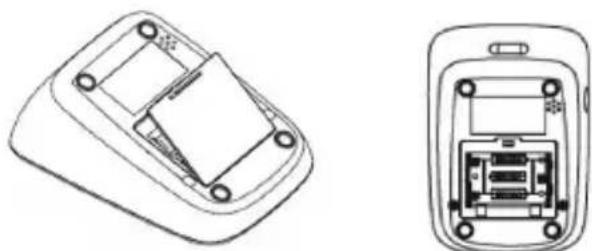
- Open the battery compartment cover on the back of the device.
- Place the 3 included AAA alkaline batteries into their designated slots, making sure to observe the indicated polarity.
- Close the battery compartment with the cover (see Figure A).
Figure A
natural_image
Technical line drawings of a device showing front and top views (no text or symbols)CORRECT POSTURE FOR MEASUREMENT
- For accurate measurement, remove any clothing or shirts from the arm area. Take off any garments that may constrict the upper arm.
- Rest for a few minutes before the test.
- Sit in a quiet place, preferably at a desk or table in an upright position with your back straight, your arm resting on a firm surface, and your feet flat on the ground without crossing them (refer to Figure B).
Figure B

natural_image
Line drawing of a person sitting at a desk in a seated posture (no text or symbols)PREPARATION OF CUFF
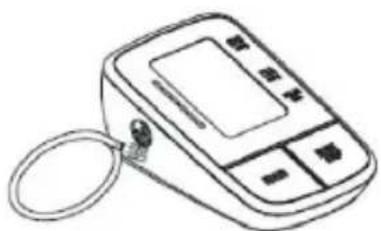
- Insert the air connector of the cuff into the left side of the main unit (refer to Figure C).
Figure C
natural_image
Line drawing of a blood pressure meter device with control panel and cord (no text or symbols)- Insert the cuff flap into the metal ring, approximately 5 centimeters, with the Velcro side facing outward.
- Slide the cuff onto the left arm and position it at heart level.
- Wrap the cuff so that the lower edge is positioned approximately 1-2 cm above the elbow joint.
Figure D
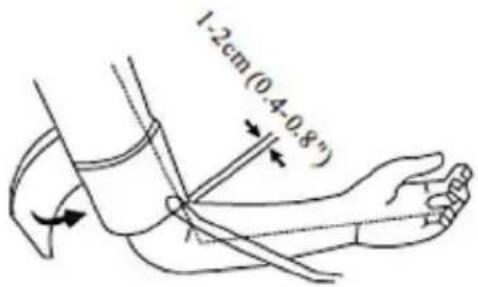
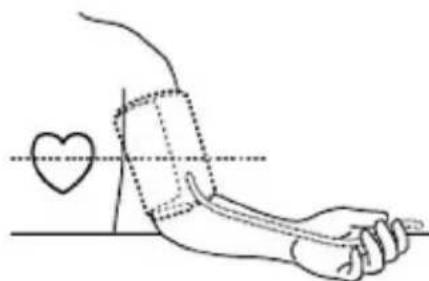
- Tighten the cuff around the arm so that the Velcro closure is secure. The cuff should not be too tight or too loose.
BLOOD PRESSURE MEASUREMENT
-
After preparing and wearing the cuff, before taking the measurement, take 3-5 deep breaths and relax. Avoid talking and moving your arms.
-
Press the "START/STOP" button to turn on the unit. The LCD screen will flash for a second as the unit performs a quick diagnosis. A prolonged beep will indicate when the unit is ready for the test.
NOTE: The unit will not operate if there is residual air from previous tests in the cuff. The LCD screen will flash the symbol “▼” until the pressure stabilizes.
- Once the cuff inflates, the air will gradually release, shown by the corresponding cuff pressure value. Simultaneously, the symbol “♥”, will flash on the screen, indicating heartbeat detection.
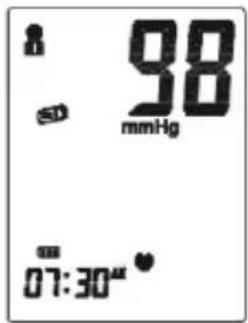
NOTE: Keep calm during the test. Refrain from speaking or moving during the test
CAUTION: If the cuff pressure becomes excessively uncomfortable during the test, press the "START/STOP" button to turn off the device. The cuff pressure will rapidly decrease once the unit is powered off.
- Four audible signals will indicate the end of the measurement. The screen will then display the systolic and diastolic blood pressure readings.
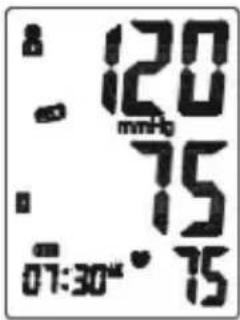
NOTE: Alongside the current blood pressure measurement, an indicator representing the corresponding WHO classification will be displayed. Refer to the
- If the monitor detects an irregular heartbeat two or more times during the measurement process, the irregular heartbeat symbol
" (♥) "will appear on the screen along with the measurement results. An irregular heartbeat is defined as a rhythm that is both 25% slower and 25% faster than the average rhythm detected during the measurement of systolic and diastolic blood pressure. Consult your physician if the irregular heartbeat symbol " (♥) " frequently appears with test results.
- Press the "START/STOP" button to turn off the device. Wait for 3 minutes or more before proceeding with another measurement. The device will automatically power off after 3 minutes of inactivity.
AVERAGE OF LAST 3 MEASUREMENTS
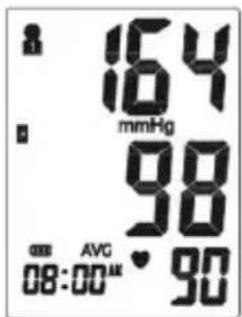
With the device powered off, press the "MEM" button to activate the screen. After the unit completes an automatic diagnosis, the screen will display the average of the last 3 measurements results. The "AVG" symbol will appear along with the corresponding indicator of the blood pressure classification according to the WHO. Memory check mode can be activated by pressing the "MEM" button. To review average results from other groups, select the desired group before entering memory mode. Refer to the <SYSTEM
SETTINGS> chapter for further details.
MEMORY DATA CHECK
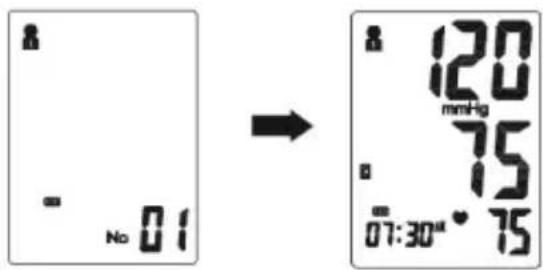
With the device powered off, you can check previous test results using the "MEM" button. Once the test results are accessed, press the "MEM" button to scroll through all stored test results. The LCD screen will display the last stored measurement as reading NO.01.
MEMORY DATA DELETION
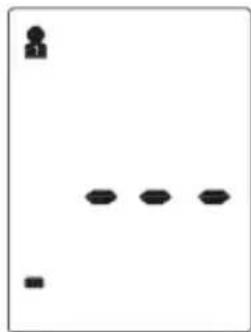
While in "MEMORY DATA CHECK" mode, you can delete the stored data for a selected user group. Hold down the "START/STOP" button for approximately 3 seconds to erase all data related to the chosen user group. Once deleted, the monitor will emit a beep to confirm successful deletion and the switch to test mode. Press the "START/STOP" button to turn off the unit.
natural_image
Simple diagram with three oval shapes and a small figure, no text or symbols presentNOTE: Once the memory is cleared, the deleted data cannot be recovered.
LOW BATTERY INDICATOR
When the battery is running low and unable to inflate the cuff for the test, you will hear 4 short warning beeps. Simultaneously, the “☐” symbol appears on the screen for about 5 seconds before shutting down. Replace the batteries. During battery replacement, there will be no data loss.

natural_image
Blank white image with a small black rounded rectangle in the bottom-left corner (no text or symbols)STATIC PRESSURE MEASUREMENT
With the device turned off, press and hold the "START/STOP" button, then install the batteries. Continue holding the "START/STOP" button until the LCD screen lights up completely, then release the button. When the two zeros appear on the LCD screen, the blood pressure monitor is in static state. The software version is displayed (the software version is "10" in the following image).
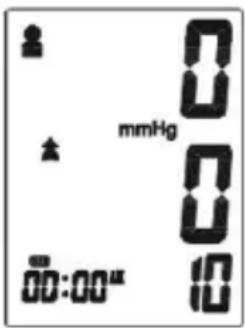
NOTE: Only service personnel are authorized to access this mode, which is not available during normal use.
CUFF LOOSE INDICATOR
During the measurement startup, the symbol “OK” will be displayed when the cuff is wrapped correctly. If the cuff is too loose, the symbol “O” will be displayed. In this case, ensure the cuff is properly worn and start the
measurement again.
ARM SHAKE INDICATOR
If there is arm movement during the measurement, the “ ” icon may flash. This indicates that the measurement results may be inaccurate, and the situation will be recorded at the end of the measurement as a reminder.
TROUBLESHOOTING
| ISSUE POSSIBLE | CAUSE RESOLUTION | |
| Abnormality in the device | The cuff is too tight or too loose; or the arm is tied incorrectly. | Ensure proper wrapping of the cuff. |
| Movement of the arm during measurement | Stay still, keep the arm steady, and do not move the device. | |
| Talking, being nervous, or emotional during measurement. | Take deep breaths instead of talking to calm the mood and relax the body. | |
| Incorrect measurements posture. | Adjust the posture, refer to the “CORRECT POSITION FOR MEASUREMENT” section. | |
| Interference during charging process or improper operations during measurement. | Refer to the user manual for instructions. |
The following table displays error messages that may occur during measurement, their potential causes, and troubleshooting methods. Please repeat the measurement using the correct method.
| Error display Cause Solution | ||
| Er1 Unable to detect diastolic and systolic pressure. | Fasten the cuff before proceeding with the measurement. | |
| Er2 Cuff too loose. Fasten the cuff before proceeding with the measurement. | ||
| Er3 Improper inflation. Measure again. If you cannot resolve the issue, contact customer service. | ||
| Er4 Pressure exceeds 300 mmHg. | Fasten the cuff before proceeding with the measurement. | |
| Er5 Pressure exceeds 15 mmHg for 3 minutes. | Check if the cuff and/or air tube are tangled or if the air tube connection is blocked. If the problem persists, contact customer service. | |
| Er6 Blood pressure measurements are outside the range. | Tighten the cuff and measure again. If you cannot resolve the issue, contact customer service. | |
| the batteries are empty Replace all four batteries or connect the power adapter (if available). | ||
NOTE: If you are unable to resolve the abnormal situation, you may consult authorized technical support. Disassembling and repairing without authorization is prohibited.
BLOOD PRESSURE INFORMATION
Blood pressure is the force of blood pushing against the walls of the arteries. It is usually measured in millimeters of mercury (mmHg). Systolic blood pressure is the maximum force exerted against the walls of blood vessels each time the heart beats. Diastolic blood pressure is the force exerted on blood vessels when the heart is at rest between beats.
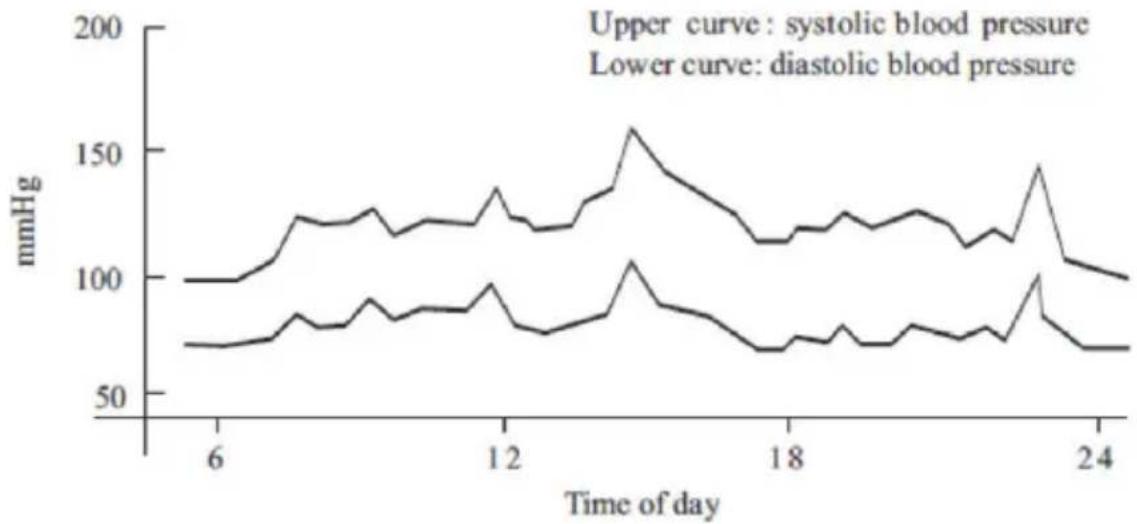
It is important to know that an individual's blood pressure changes frequently throughout the day and is subject to rapid fluctuations. Blood pressure values depend on many factors such as physical condition, emotional susceptibility, stress, diet, medication intake, alcohol, or tobacco use, etc. Additionally, blood pressure varies from person to person based on factors like age, gender, etc. Therefore, it is advisable to record daily measurements so that you can later
discuss with your doctor what your "normal blood pressure" is..
line
| Time of day | systolic blood pressure (mmHg) | diastolic blood pressure (mmHg) | | ----------- | ------------------------------ | ------------------------------- | | 6 | ~100 | ~70 | | 12 | ~130 | ~90 | | 18 | ~110 | ~70 | | 24 | ~100 | ~70 |WHO BLOOD PRESSURE CLASSIFICATION INDICATOR
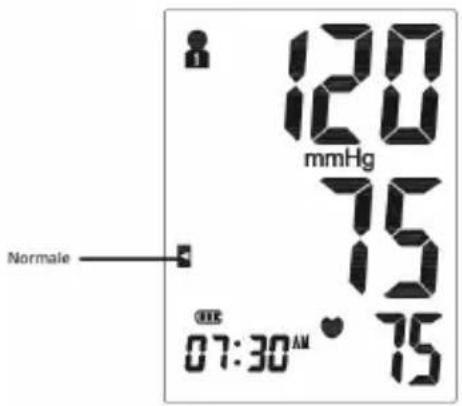
The blood pressure monitor is equipped with a classification indicator based on established guidelines from the World Health Organization. Each segment of the bar indicator corresponds to a blood pressure classification as follows:
| Severe hypertension | |
| Moderate hypertension | |
| Mild hypertension | |
| High-normal | |
| Normal | |
| Optimal |
MAINTENANCE, CLEANING AND STORAGE
Avoid dropping, banging, or throwing the device. Protect the device from possible impacts.
Protect from direct sunlight and humidity.
To clean the main unit, use a soft tissue and wipe gently with a mild detergent. Use a damp cloth to remove dirt and excess cleaner.
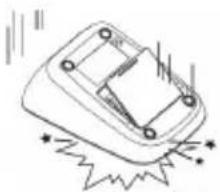
natural_image
Simple line drawing of a mechanical component with motion indicators (no text or symbols)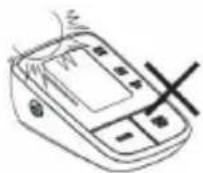
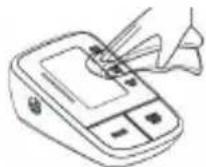
The cuff is a delicate component, handle it with care. Clean it with a soft damp cloth. Do not immerse the cuff in water! Do not wash or iron the cuff. Apply a small amount of isopropyl alcohol on a soft cloth to clean the cuff surface. Use a cloth dampened with water for cleaning. Let the cuff air dry naturally at room temperature. The cuff should be cleaned before use between different users.
Do not use petroleum, solvents, or similar diluents.
Remove the batteries from the device if it will be unused for an extended period.
Do not open or disassemble the device. If you cannot resolve the issue using the manual, please contact the authorized technical support service provided by the retailer. Do not attempt to repair the device without manufacturer authorization. Contact the service center for maintenance. WARNING: Do not attempt to modify the product without manufacturer authorization.
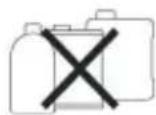
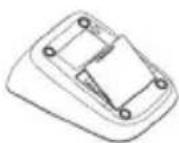
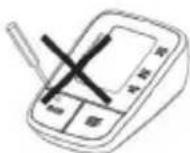
It is recommended to check the device performance every 2 years.
Expected lifetime: approximately 3 years considering 10 measurements per day.
TECHNICAL SPECIFICATIONS
| Product description Fully automatic | upper arm blood pressure monitor | |
| Model DBP-6191 | ||
| Display LCD display (dimensions: 46 mm X 62.1mm) | ||
| Measurement method Oscillometric | method | |
| Measurement range | Pressure From 0 mmHg to 299 mmHg | |
| Systolic pressure From 60 mmHg to 260 mmHg | ||
| Diastolic pressure From 40 mmHg to 200 mmHg | ||
| Heart rate 30 – 180 beats per minute | ||
| Measurement Accuracy | Pressure ±3 mmHg | |
| Heart rate ±5% | ||
| Inflation Automatic arm cuff inflation | ||
| Memory 150 measurements for 2 user groups (with date and time) | ||
| Function | Irregular heartbeat detection | |
| WHO classification indicator | ||
| Average value of last 3 measurements | ||
| Automatic shutdown | ||
| Low battery indication | ||
| Backlight display | ||
| Power supply 3 “AAA” alkaline batteries x 1,5V included or AC adaptor medical type (not included) | ||
| Battery life | About 2 months considering 3 tests per day | |
| Unit weight | Approximately 188g (excluding batteries) | |
| Unit dimensions | 136mm x 95,3mm x 57mm (L x W x H) | |
| Cuff circumference | 22 ~ 42 cm | |
| Operating environment | Temperature | 10°C ~ 40°C |
| Humidity | 15% ~ 93% RH | |
| Pressure | 800hPa ~ 1060hPa | |
| Storage environment | Temperature | -25°C ~ +55°C |
| Humidity | ≤ 93% RH | |
| Classification | Internal powered equipment. Applied part (cuff) type BF | |
| IP grade IP21, for indoor use only | ||
This blood pressure monitor complies with European regulations and bears the CE mark "CE 0123". This blood pressure monitor also complies primarily with the following standards (including but not limited to):
SAFETY REGULATIONS:
EN 60601-1 Medical electrical equipment - Part 1: General requirements for safety.
EMC REGULATION:
EN 60601-1-2 Medical electrical equipment - Part 1-2: General requirements for basic safety and essential performance - Collateral standard: Electromagnetic disturbances - Requirements and tests.
PERFORMANCE REGULATION:
IEC 81060-2-30 Medical electrical equipment - Part 2-30: Particular requirements for the basic safety and essential performance of automated non-invasive sphygmomanometers.
EN 1060-3 Non-invasive sphygmomanometers - Supplementary requirements for electromechanical blood pressure measuring systems.
EN 1060-4 Non-invasive sphygmomanometers - Test procedures to determine the overall accuracy of automated non-invasive sphygmomanometers.
ISO 81060-2 Non-invasive sphygmomanometers - Part 2: Clinical validation of automated measurement type
RATING LABEL
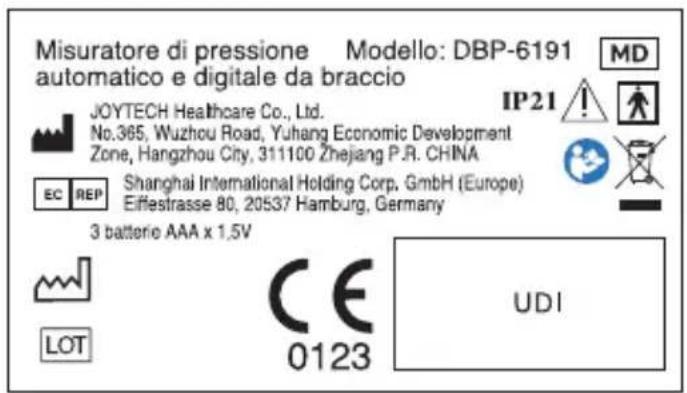
BATTERY INFORMATION
3 x 1,5V alkaline AAA batteries (included)
Modello / Model: LR03
Fabbricata da / Manufactured by:
DONG GUAN ANDALI ELECTRONIC CO., LTD.
No. 102, YUNHE East Ro3, South District, Dongguan City, China
Importata da / Imported by: Innoliving Spa
Via Merloni 2/B - 60131 Ancona, Italia
 | Caution |
 | Applied part type BF |
 | Refer to the instruction for use |
 | Serial number |
 0123 0123 | The product complies with the requirements of Regulation (EU) 2017/745 MDR on medical devices |
 | Manufacturer |
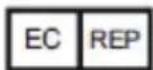
 | Authorized Representative in the European Union |
 | Importer |
 | Keep dry |
 | Keep out of direct sunlight |
 | Manufacturing date |
 | Medical device |
 | Protection grade |
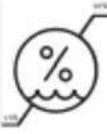 | Humidity range for transportation and storage |
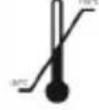 | Temperature range for transportation and storage |
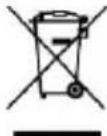 | INFORMATION TO USERS according to Legislative Decree No. 49 of March 14, 2014 “2012/19/UE Implementation of the Directive on Waste Electrical and Electronic Equipment (WEEE)”. The crossed-out dustbin symbol indicates that the product at the end of its life must be collected separately from other waste. The user should, therefore, take the equipment with the essential components at the end of its useful life to the separate collection center of electronic and electrical waste, or return it to the retailer when purchasing new equipment of equivalent type, in ratio of one to one, or one to zero for devices with larger side less than 25 CM. The separate collection for the decommissioned equipment for recycling, treatment and environmentally compatible disposal contributes to avoid possible negative effects on the environment and human health and promotes recycling of the materials. Improper disposal of the product by the user entails the application of administrative sanctions according to Legislative Decree No. 49 of 14 March 2014. |
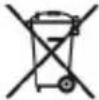 | The batteries used in this device must be disposed of in the special bins at the end of their life. Please inform yourself about the local rules on separate collection of batteries. The correct disposal of batteries helps preventing potentially negative consequences on the environment and human health. |
EMC GUIDE
The device satisfies the EMC requirements of the international standard IEC 60601-1-2. The requirements are satisfied under the conditions described in the table below. The device is an electrical medical product and is subject to special precautionary measures with regard to EMC which must be published in the
instructions for use. Portable and mobile HF communications equipment can affect the device. Use of the unit in conjunction with non-approved accessories can affect the device negatively and alter the electromagnetic compatibility. The device should not be used directly adjacent to or between other electrical equipment.
Table 1
| Guidance and declaration of manufacturer-electromagnetic emissions | ||
| The device is intended for use in the electromagnetic environment specified below. The customer or the user of the device should assure that it is used in such an environment. | ||
| Emissions test Compliance Electromagnetic environment - guidance | ||
| Radiated emission CISPR 11 Group 1 | class B The device uses | RF energy only for its internal function. Therefore, its emissions are very low and are not likely to cause any interference in nearby electronic equipment. |
| Conducted emission CISPR 11 Group | 1, class B The device is | suitable for use in all establishments, including domestic establishments and those directly connected to the public low-voltage power supply network that supplies buildings used for domestic purposes. |
| Harmonic emission IEC 61000-3-2 Class A | ||
| Voltage fluctuations/flicker emissions IEC 61000-3-3 | Complies | |
Table 2
| Guidance and declaration of manufacturer-electromagnetic immunity | |||
| The device is intended for use in the electromagnetic environment specified below.The customer or the user of the device should assure that it is used in such an environment. | |||
| Immunity test | IEC 60601 test level | Compliance level | Electromagnetic environment - guidance |
| Electrostatic discharge (ESD)IEC 61000-4-2 | ±8 kV contact±2 kV, ±4 kV,±8 kV, ±15 kV air | ±8 kV contact±2 kV, ±4 kV,±8 kV, ±15 kV air | Floors should be wood, concrete, or ceramic tile. If floors are covered with synthetic material, the relative humidity should be at least 30 %. |
| Electrostatic transient/ burstIEC 61000-4-4 | ±2 kV, 100kHz for AC power port | ±2 kV, 100kHz for AC power port | Mains power quality should be that of a typical commercial or hospital environment. |
| SurgeIEC 61000-4-5 | ±0.5 kV,±1 kV (differential mode) | ±0.5 kV,±1 kV (differential mode) | Mains power quality should be that of a typical commercial or hospital environment. |
| Voltage dips, short interruptions and voltage variations on power supply input linesIEC 61000-4-11 | 0% UT, 0.5 cycle at 0°, 45°, 90°,135°, 180°, 225°,270° and 315°0% UT, 1 cycle and 70% UT;25/30 single cycle phase: at 0°0% UT, 250/300 cycles | 0% UT, 0.5 cycles at 0°, 45°, 90°,135°, 180°, 225°,270° and 315°0% UT, 1 cycle and 70% UT,25/30 single cycle phase: at 0°0% UT, 250/300 cycles | Mains power quality should be that of a typical commercial or hospital environment. |
| Power frequency (50/60Hz) magnetic fieldIEC 61000-4-8 | 30 A/m; 50Hz or 60Hz | 30 A/m; 50Hz or 60Hz | Power frequency magnetic fields should be at levels characteristic of a typical location in a typical commercial or hospital environment. |
| Radiated RF EM fields. IEC 61000-4-3 | 3 V/m or 10 V/m80 MHz - 2.7 GHz80% AM at 1kHz | 3 V/m or 10 V/m80 MHz - 2.7 GHz80% AM at 1kHz | Portable and mobile RF communications equipment should be used no closer to any part of the device, including cables, than the recommended separation distance calculated from the equation applicable to the frequency of the transmitter. Recommended separation distance 80 MHz to 800 MHz 800 MHz to 2.7 Ghz where P is the maximum output power rating of the transmitter in watts (W) according to the transmitter manufacturer and d is the recommended separation distance in meters (m). Field strengths from fixed RF transmitters, as determined by an electromagnetic site survey, a should be less than the compliance level in each frequency range. Interference may occur in the vicinity of equipment marked with the following symbol |
| Conducted disturbances by RF fieldsIEC 61000-4-6 | 3Vin 0.15MHz-80MHz6 V in ISM and/or amateur radio bands between0.15 MHz and 80MHz 80%AM at1kHz | 3Vin 0.15MHz-80MHz6 V in ISM and/or amateur radio bands between0.15 MHz and 80MHz 80%AM at1kHz | Portable and mobile RF communications equipment should be used no closer to any part of the device, including cables, than the recommended separation distance calculated from the equation applicable to the frequency of the transmitter. Recommended separation distance 80 MHz to 800 MHz 800 MHz to 2.7 Ghz where P is the maximum output power rating of the transmitter in watts (W) according to the transmitter manufacturer and d is the recommended separation distance in meters (m).Field strengths from fixed RF transmitters, as determined by an electromagnetic site survey, a should be less than the compliance level in each frequency range. Interference may occur in the vicinity of equipment marked with the following symbol: |
Tabella 3
| Guidance and declaration of manufacturer-electromagnetic immunity | ||||||
| Nowadays, many RF wireless equipment has being used in various healthcare locations where medical equipment and/or systems are used. When they are used near medical equipment and/or systems, the medical equipment and/or systems' basic safety and essential performance may be affected. Arm-type Fully Automatic Digital Blood Pressure Monitor has been tested with the immunity test level in the below table and meet the related requirements of IEC 60601-1-2:2014. The customer and/or user should help keep a minimum distance between RF wireless communications equipment and this medical equipment and/or systems as recommended below. | ||||||
| Test frequency (MHz) | Band (MHz) | Service Maximum | Power (W) | Potenza massima (W) | Distance (m) | Immunity test level (V/m) |
| 385 380-390 | TETRA 400 Pulse Modulation 18Hz | 1,8 0,3 27 | ||||
| 450 430-470 | GMRS 460 FRS 460 | FM ± 5kHz deviation 1 kHz sine | 2 0,3 28 | |||
| 710 | 704-787 | LTE band 13, 17 | Pulse modulation 217Hz | 0,2 0,3 9745 | ||
| 780 | ||||||
| 810 | 800-960 | GSM 800/900, TETRA 800, iDEN 820, CDMA 850, LTE Band 5 | Pulse modulation 18Hz | 2 0,3 28 | ||
| 870 | ||||||
| 930 | ||||||
| 1720 | 1700-1990 | GSM 1800; CDMA 1900; GSM 1900; DECT; LTE Band 1, 3, 4, 25; UMTS | Pulse modulation 217Hz | 2 0,3 28 | ||
| 1845 | ||||||
| 1970 | ||||||
| 2450 2400-2570 | Bluetooth, WLAN, 802.11 b/g/n, RFID 2450, LTE Band 7 | Pulse modulation 217Hz | 2 0,3 28 | |||
| 5240 | 5100-5800 | WLAN 802.11 a/n | Pulse modulation 217Hz | 0,2 0,3 95500 | ||
| 5785 | ||||||
Tabella 4
| Recommended separation distances between portable and mobile RF communications equipment and the device | ||
| The device is intended for use in an electromagnetic environment in which radiated therefore disturbances are controlled. The customer or the user of the device can help prevent electromagnetic interference by maintaining a minimum distance between portable and mobile RF communications equipment (transmitters) and the device as recommended below, according to the maximum output power of the communications equipment. | ||
| Rated maximum output power of transmitter [W] | Separation distance according to frequency of transmitter [m]. | |
| 80 MHz to 800 MHz d = [ 3.5E_1 ] | 800 MHz to 2,7 GHz d = [ 7E_1 ] | |
| 0,01 0,12 0,23 | ||
| 0,1 0,38 0,73 | ||
| 1 1,2 2,3 | ||
| 10 3,8 7,3 | ||
| 100 12 23 | ||
| For transmitters rated at a maximum output power not listed above, the recommended separation distance d in meters (m) can be estimated using the equation applicable to the frequency of the transmitter, where P is the maximum output power rating of the transmitter in watts (W) according to the transmitter manufacturer.NOTE1 At 80 MHz and 800 MHz, the separation distance for the frequency range applies.NOTE2 These guidelines may not apply in all situations. Electromagnetic propagation is affected by absorption and reflection from structures, objects and people. | ||


JOYTECH Healthcare Co., Ltd.
No.365, Wuzhou Road
311100 Hangzhou, Zhejiang Province
PEOPLE'S REPUBLIC OF CHINA
Shanghai International Holding Corp. GmbH (Europe)
Eiffestraße 80, 20537 Hamburg, GERMANY
Innoliving Spa
Via Merloni, 2/B - 60131 Ancona - Italy
www.innoliving.it
innoliving easy tech, easy life
Innoliving Spa Via Merloni, 2/B 60131 Ancona Italy Tel 071.2133550 www.innoliving.it
MADE IN CHINA
CE 0123
- innoliving easy tech, easy life
- MISURATORE DI PRESSIONE AUTOMATICO DA BRACCIO
- UPPER ARM AUTOMATIC BLOOD PRESSURE MONITOR
- I
- PREPARAZIONE DEL BRACCIALE
- Innoliving Spa
- UPPER AUTOMATIC ARM BLOOD PRESSURE MONITOR
- IMPORTANT SAFETY INSTRUCTIONS
- INTENDED USE
- CONTRAINDICATIONS
- WARNINGS
- PRODUCT'S DESRIPTION
- Main unit
- Cuff
- Display
- Package Contents:
- SYSTEM SETTINGS
- MEMORY GROUP SELECTION
- TIME/DATE SETTING
- TIME FORMAT SETTING
- SETTING SAVING
- USE THE DEVICE
- CAUTIONS
- BATTERY INSTALLATION
- CORRECT POSTURE FOR MEASUREMENT
- PREPARATION OF CUFF
- BLOOD PRESSURE MEASUREMENT
- AVERAGE OF LAST 3 MEASUREMENTS
- MEMORY DATA CHECK
- MEMORY DATA DELETION
- LOW BATTERY INDICATOR
- STATIC PRESSURE MEASUREMENT
- CUFF LOOSE INDICATOR
- ARM SHAKE INDICATOR
- BLOOD PRESSURE INFORMATION
- WHO BLOOD PRESSURE CLASSIFICATION INDICATOR
- MAINTENANCE, CLEANING AND STORAGE
- SAFETY REGULATIONS:
- EMC REGULATION:
- PERFORMANCE REGULATION:
- RATING LABEL
- BATTERY INFORMATION
- EMC GUIDE
- JOYTECH Healthcare Co., Ltd.
Brand : Innoliving
Model : INMD-DBP-6191
Category : Blood pressure monitor