
BMP 150 - Manometer HYUNDAI - Free user manual and instructions
Find the device manual for free BMP 150 HYUNDAI in PDF.


| Product Type | Pressure Gauge (Manometer) |
| Brand | Hyundai |
| Model | BMP 150 |
| Measurement Range | 0 - 150 psi (or bar, not specified) |
| Accuracy | ±1.0% of full scale (typical for industrial gauges) |
| Connection Size | 1/4" NPT (common for manometers) |
| Dial Diameter | 4 inches (100 mm) |
| Case Material | Stainless Steel |
| Window Material | Polycarbonate or Glass |
| Operating Temperature | -40°C to 60°C |
| Dimensions | Approx. 100 mm diameter x 50 mm depth |
| Weight | Approx. 0.3 kg |
| Power Supply | None (mechanical gauge) |
| Display Type | Analog dial with pointer |
| Main Functions | Pressure measurement for gases and liquids |
| Cleaning | Wipe with a dry cloth; do not use solvents |
| Maintenance | Periodic calibration recommended |
| Safety Precautions | Do not exceed maximum pressure; avoid shock |
| Spare Parts | Contact Hyundai service center for replacement |
| Reparability | Serviceable by authorized technician |
| General Information | Industrial use; not for medical applications |
Frequently Asked Questions - BMP 150 HYUNDAI
User questions about BMP 150 HYUNDAI
0 question about this device. Answer the ones you know or ask your own.
Ask a new question about this device
Download the instructions for your Manometer in PDF format for free! Find your manual BMP 150 - HYUNDAI and take your electronic device back in hand. On this page are published all the documents necessary for the use of your device. BMP 150 by HYUNDAI.
USER MANUAL BMP 150 HYUNDAI

natural_image
Line drawing of a hand reaching toward a table with a heart symbol (no text or labels)Měření


natural_image
Row of grayscale cartoon-style icons showing various vehicle and equipment symbols (no text or labels)
natural_image
Line drawing of a hand reaching toward a table with a heart symbol above, no text or labels presentMarenie
1) Stlačte tlačidlo štart.
natural_image
Row of grayscale cartoon-style icons showing various vehicle and machinery components (no text or symbols)natural_image
Line drawing of a human arm with a heart symbol above it, resting on a table (no text or labels)Meranie

natural_image
Illustration of various toy car models and tools (no text or symbols)What is blood pressure 69
Blood pressure fluctuation 69
Health and blood pressure value 70
The hazard factors are as following 70
Abnormal unique figure display 71
Sensing principle 72
INSTALLATION
Install or replace the batteries 72 - 73
HOW TO MEASURE
Recommendations before measuring 74
How to place the cuff on the wrist 75
Begin to measure 76
Taking and storing a reading 77
Looking at the previous reading 77
AFTER USE
Care/Maintenance 78
Storage 78
ERROR MESSAGE & TROUBLESHOOTING
Error message 79
Troubleshooting 80
SPECIFICATIONS 81
NAME/FUNCTION OF THE COMPONENTS
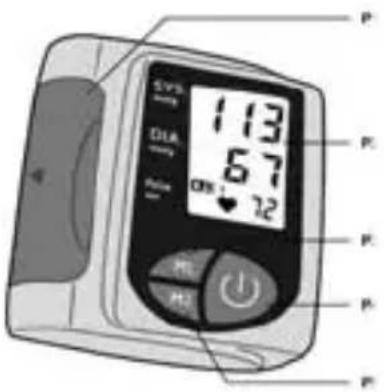
P1 Battery Cover
P2 LCD Display
P3 Memory/Recall Key 1
P4 On/Off Start Button
P5 Memory/Recall Key 2
DISPLAY EXPLANATIONS

P6 Systolic pressure
P7 Diastolic pressure
P8 Memory/Recall 2
P9 Pulse rate per minute
P10 Pulse mark (Normal sign
& Abnormal flash sign)
P11 Weak battery mark
SAFETY STATEMENTS
Cautions:
- This unit will not serve as a cure of any symptoms of your heart disease. The measuring data is only for reference. Always consult with the physician if any abnormal measurement results happen.
• Always to follow the procedures described in the manual when measuring. - Do not start the air pressure before the wrist cuff is wrapped around the wrist.
- Do not drop this unit or avoiding strong impact on it.
- Be sure to keep this manual well.
Precautions:
- Do not use the device with infants and persons who can not communicate, which cases may lead to serious accidents.
- Do not use the device for purposes other than measuring blood pressure.
- Do not use mobile phone or microwave oven near the device, which case may lead to reading error.
- Do not try to disassemble or modify the unit or wrist cuff, leading to permanent reading error.
Warnings:
- Remove the batteries for storage if the unit is not to be used for extended periods.
• Do not immerse the unit in the water.
• Store the unit at a dry and cool place within the storage environment.
• Leaving the batteries in the device for long periods without use may damage the main unit. Take care to observe the following points:
o Remove the batteries if not to use the device for a long period of time (over 3 months).
o Immediately replace dead batteries with new ones.
o Do not use weak battery and new one together.
o Be sure to follow the polarity direction to install the batteries.
o Do not use unspecified batteries leading to reading error.
• Do not stretch, bend and tug the wrist cuff. - Do not put the unit under direct sunlight, high-temperature, humid, dusty, and corrosive environment.
• Do not use benzenes, gasoline and alcohol agent to clean the device.
INTRODUCTION
What is Blood Pressure?
Blood is forced to flow in the blood vessel by the heart pumping constantly. The pressure that the blood exerted on the vessel wall is called blood pressure.

Blood pressures are different for different parts of the body. Blood pressure values depend mainly on the following factors:
heart beat pulse
vessel bounce coefficient
vessel circumference resistance
blood beat volume
blood viscosity.
When the heart contracts and blood is pushed to the arteries, the pressure rises (the systolic blood pressure).
The heart relaxes after contracting and the pressure falls (the diastolic blood pressure).
A) Pulmonary capillaries
B) Pulmonary vein
C) Aorta
D) Left atrium
E) Artery
F) Left ventricle
G) Artericles
H) Capillaries
I) Venules
J) Right ventricle
K) Ven
L) Right atrium
M) Vena cava
N) Pulmonary artery
Blood Pressure Fluctuation
Blood pressure is various in different parts of the body, through the whole daily life, and through our lifetime. Also there is a tendency to have higher blood pressure reading at the clinics than at home. This has to be understood when you use the blood pressure monitor. There are some factors that will lead to higher blood pressure value.
The factors are as following:
1) Time: higher value at nighttime and lower one in the morning.
2) Meal: higher value will show after finish eating food.
3) Exercise: the exercises, i.e., walking and jogging, will make systolic value increase gently, but severe exercise will make systolic value increase drastically.
4) Emotional effects and anxious conditions will raise the blood pressure.
5) Sudden change of the climate will raise blood pressure.
6) Aging will make systolic pressure rise.
7) Female may have more chance of higher blood pressure after the menopause.
8) Insomnia will make blood pressure rise.
9) Overdose alcoholic drink will make blood pressure rise.
10) Taking bath, urination, or bowel movements will also raise the blood pressure.
Health and Blood Pressure Value
Blood pressure value will increase drastically after middle age. Further causes are obesity, lack of exercise, and etc. Cholesterol (LDL) adhered to the blood vessels will make them lose their elasticity. With higher blood pressure, hardening of the arteries accelerates and the body becomes more susceptible to apoplexy, coronary infraction etc. That's why we need to know our blood pressure trend in order to see whether our body is healthy or not. The blood pressure fluctuates through our body constantly in our daily life and is an essential factor of our health control.
The hazard factors are as following:
1) Aging: The blood vessel loses its elasticity with age and the systolic pressure value will be higher than the young people.
2) Too much salty food: High salty food will lead to higher chance of high blood pressure.
3) Over fat: Fatty condition will increase the heart pump load and the blood pressure hence will be raised.
4) Lack of exercises: Adequate exercise will be helpful to the body blood circulation and the heart/pulmonary functions, hence increases the body calories consume and prevents the hardening of the arteries, and stabilizes the blood pressure.
Abnormal unique figure display
BP-510 features synchronized display of readings and figure is based on WHO Blood Pressure Classification Chart that provides the users with a fast and easy way to know the state of their health and blood pressure value.
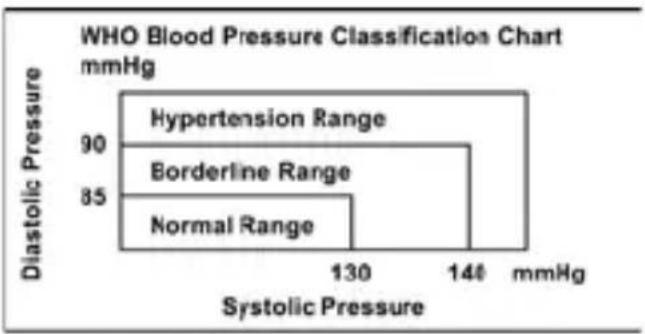
bar
WHO Blood Pressure Classification Chart | Systolic Pressure | Diastolic Pressure | Hypertension Range (mmHg) | | :--- | :--- | :--- | | 130 | 90 | | | 140 | 85 | | | 130 | 90 | Borderline Range | | 140 | 85 | Normal Range |Source from WHO (1999)
When the measuring result is abnormal, the heart will flash automatically.
| Figure Range Systolic Diastolic | |||
 | Hypertension > | 140 mmHg > 90 mmHg | |
| [TKCY] | High - Normal | 130 ~ 140 mmHg | 85 ~ 90 mmHg |
 | Normal < 129 | mmHg < 84 mmHg | |
 | Hypotension < 90 | mmHg < 50 mmHg | |
Sensing Principle
The oscillometry method is adopted clinically to measure the blood pressure recently. It is unnecessary to use the stethoscope, as in the traditional method, to detect the korotkov sound when measuring the systolic or diastolic pressure. The oscillometry method senses the vibrating signals via closed air pipe system and utilizes microcomputer to automatically sense the characteristics of the pulse signals. Through precise calculation, the reading shows the real blood pressure.
The systolic pressure is defined as the pressure when the cuff pressure oscillating amplitude begins to increase and the diastolic pressure as the pressure when the cuff pressure oscillating amplitude stops decreasing.
INSTALLATION
Install or Replace the Batteries
Installing

1) Pull to open the battery cover according to the arrow direction indicated.
2) Insert 2 AAA UM4 LR 03 1.5V alkaline batteries in the battery compartment according to the polarity symbol indicated.
3) Replace the battery cover.
Replacement

1) Once the batteries are removed or used up, the data will be cleared out.
2) For fresh good quality alkaline batteries, the device can make approximately 300 \~ 400 measurements under room temperature 22*C, inflation pressure 185 mmHg.
3) When weak battery symbol appears, please replace with two new batteries at the same time.
4) When you install or replace the batteries the device will automatically reset and display all symbols on the LCD for 0.5 seconds.
5) Please remove the batteries from the compartment if the device is not to be used for long periods (for example, 90 days).
HOW TO MEASURE
Recommendations Before Measuring
1) Please sit or lie down for at least 5 \~ 10 minutes before measuring.
2) Avoid meal, smoking, exercising, bathing, drinking Alcohol, caffeine, or tea before measuring.
3) Avoid urination or bowel movement before measuring.
4) Avoid measuring just arriving office or returning home.
5) Avoid measuring when you feel anxiety or are in tension.
6) In order to read the accurate value, please sit or lie down to measure. Rest your left arm on the table and use a cushion or pillow as bolster. With left palm face up and keep the cuff at the same height as your heart.
7) Keep calm and relax yourself, avoid talking when measuring.
8) When you retake a measurement, please take 5 \~ 10 minutes' break. The break can be longer if necessary, depending on the physiological condition of the individual.
9) Keep the records for your physician as reference.
10) Reminded that one measurement can't provide you with real blood pressure value, only with long-term record will reveal your real blood pressure.
11) Some diseases caused by blood vessel circulation problems, for example, diabetes, nephritis, blood vessel wall hardening or malfunction auxiliary circulation, may result in different blood pressure values. Please consult it with a physician.
NOTE:
The blood pressure fluctuating all the time depending on individual body condition, for example, the value will increase when you are taking exercise or in angry, and the value will decrease when you are sleeping or relaxed. These variations are normal.
How to Place the Cuff on the Wrist
1) Place your left arm on a table, with the palm face upward Put the cuff on the left wrist and fasten the Velcro strap The circumference of the wrist cuff is about 13.5 \~ 21.5 cm., and you can adjust it to be fitted snugly.
2) Note the distance between the edge of the wrist cuff and the hand is 0.5 -1.0 cm.
3) Relax your body. Don't bend your wrist!
4) If you can't wrap the cuff around your left wrist for some reasons, please do this for the right wrist.
5) Be aware of the posture and adjust the cuff height. The height of the cuff should be the same as your heart during measurement.
6) Please refer to the right pictures for the correct measurement posture.

natural_image
Line drawing of a human arm with a heart symbol above it, resting on a table (no text or labels)Begin to Measure


1) Push the start button.
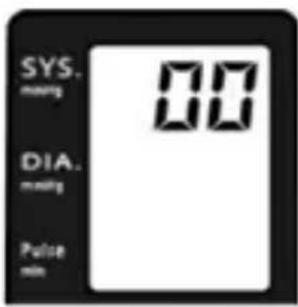
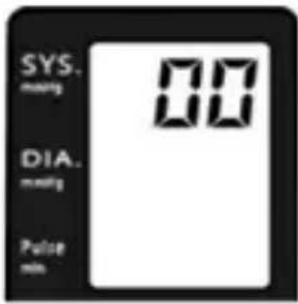
2) The LCD will display 00 digit. The „00“ will blink on the LCD.
3) About 1 -2 seconds later, the pressure will be reset, then the cuff begins to inflate and the pressure value will be displayed.
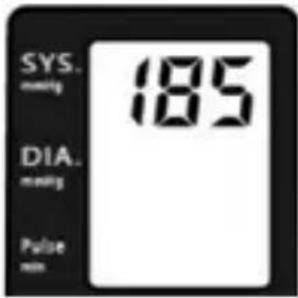
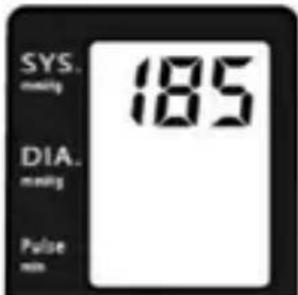
4) When the cuff pressure rises to 185 mmHg, the inflation movement stops and the indicated number drops down to start measuring.
5) Along with the measurement, the heart beat rate is also recorded and the heart sign will appear on the LCD.
6) The cuff pressure will increase automatically if not high enough.
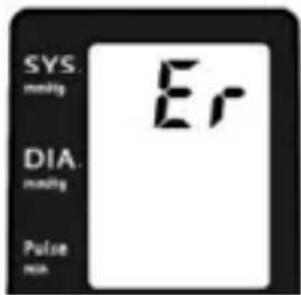
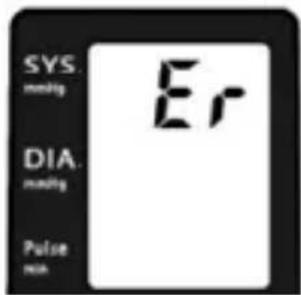
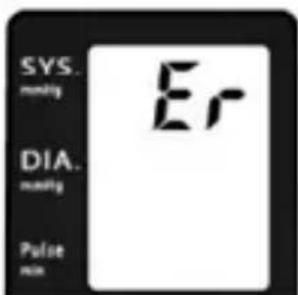
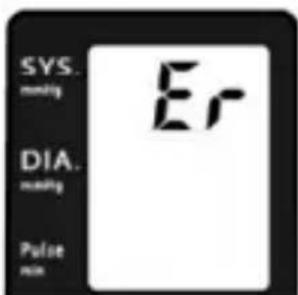
7) If the cuff pressure exceeds 300 mmHg, the „Er“ sign will appear and will shutdown. Then it will stop inflating and release the cuff pressure.
The cuff pressure will fall slowly during measuring.
Do not shake the wrist cuff or the monitor. Keep quiet.
Taking and Storing a Reading
1) After finishing measurement, values of systolic, diastolic, pulse rate will be displayed on the LCD as in the right diagram.
2) The results will be shown until the power on button is pushed again or it will switch off automatically 2 minutes later.
3) When the result was shown, press the „M1“ or „M2“ key. The recorded data will be saved in the data base.

Recommendation:
If measuring for the first time, please take 5-10 minutes rest before measuring. Keep the habit of measuring at regular time.
Looking at the Previous Reading
The device can store twin sets (total 100 readings) of recorded data, and each set data consists values of systolic, diastolic and pulse rate.

When power on botton is switched on, press M1 or M2 for 1 second to recall the database you need. If hold the button of M1 or M2, the value will increase in every 14 second and you can get the data faster.
When M1 is recalled, the LCD will appear 1. When M2 is recalled, the LCD will appear 2.
AFTER USE
Care/Maintenance

natural_image
Illustration of various mechanical components and tools (no text or symbols visible)1) Do not use petrol, thinner or similar solvent to clean the device.
2) Clean the device with a soft, dry cloth.
3) Dirt on the cuff can be removed with a damp cloth and soapsuds.
4) Do not dismantle the instrument or separate the cuff from the main or try to repair it by yourself.
5) Do not flush the device or cuff.
6) Do not expose the device to extreme temperature, humidity or direct sunlight.
7) Do not drop the instrument or treat it roughly. Avoid strong vibrations.
Storage
1) Always use the case provided to store or carry.
2) If the device is left unused for long periods, remove the batteries from the battery compartment.
ERROR MESSAGE (TROUBLESHOOTING)
Error Message
| Error Symptom Cause and Solution | ||
 | Inflation fault | 1) Cuff is not fastened well, please refasten it.2) Cuff is broken.3) Pump, venting or deflation valve fail,please refer to the distributor. |
 | Artificial interference and noise | 1) Move or talk during measurement.2) Posture, etc. was different for each measurement.3) User is too nervous.4) User has severe heart problem. |
 | Abnormal reading | |
 | Deflation too fast | 1) Deflation valve failure, and refer to the distributor.2) Cuff not fastened and re-fasten it. |
 | Over safety pressure | 1) Air pipe blocked.2) Inflation controller failure.3) Pressure sensor fault.4) Please measure it again, or consult with your distributor. |
 | Low battry | 1) Replace with two fresh batteries at the same time. |
Troubleshooting
| SYMPTOM CHECK POINT/CORRECTION | |
| Though the batteries are installed, there is no indication on the LCD or with wrong indication. | 1) Check the battery polarities.2) Remove the batteries and wait for one minute then install or replace batteries. |
| The inflation action cannot be done or the air pressure cannot rise. | 1) Check the cuff position and measure it again.2) Check the cuff connection to the main. |
| The weak battery sign appears on the LCD. | Replace the batteries. |
| The blood pressure cannot be taken, and the LCD displays error message or result. | 1) Re-fasten the cuff.2) Sit down and relax.3) Keep the cuff and heart at the same height during the measurement.4) Keep quiet during the measurement.If the patient has severe heart problem, then the blood pressure may not be read correctly. |
| Under normal measurement circumstances, the reading at home is different from that of the clinics, or each measurement has various reading. | 1) The variation is due to the different environments.2) The blood pressure changed with the physiological or psychological status of the body.Record everyday value trend and consult it with your physician. |
If you have done the above correction, the blood pressure still cannot be read. Then the device has to be sent to the distributor for repair. Do not try to dismantle the monitor by yourself.
Specifications
| Name and Model BPM 510 | Wrist Blood Pressure Monitor |
| Display LCD digital display | |
| Measuring method Oscillometry method | |
| Measuring range | Pressure: 0 - 280 mmHgPulse rate: 40 - 200 pulses/min |
| Accuracy | Pressure: ±3 mmHgPulse: ±5% of reading value |
| Memory capacity Twin Zones (2 X 50 memories) | |
| Pressure inflation | Automatic and fuzzy logic Al pump actuated device |
| Pressure deflation Automatický tlakový píst vyfukování | |
| Pressure release device | Automatic pressure deflation valve |
| Sensor Semiconductor pressure sensor | |
| Electric power | DC 3V (two LR03 „AAA“ alkaline batteries) |
| Operating temperature /humidity | 10 - 40°C (50 - 104°F) 30% - 85% R.V. |
| Storage temperature /humidity | -5 - 50°C (23 - 122°F) 15% - 90% R.V. |
| Weight (NETTO) Approx. 1 | 10 grams (without battery) |
| Wrist type Circumferenc 13,5 - 21,5 cm (5,3“ - 8,5“) | |
| Dimensions 67(W) x 73(H) x 70(D) mm | |
| Accessories Storage case, | instruction manual |
We reserve the right to change technical specifications.
REFERENCES
COUNCIL DIRECTIVE 93/42/EEC of 14. June 1993 concerning medical devices. EN 1060-1: 1996 Specification for non-invasive sphygmomanometrs Part 1: General requirements. EN 1060-3: 1997 Non-invasive sphygmomanometrs, Part 3: Supplementary requirements for electro-mechanical blood pressure measuring systems. IEC 60601-1: 1998 Medical electrical equipment, Part 1: General requirements for safety.

WARNING: Do not use this product near water, in wet areas to avoid fire or injury of electric current. Always turn off the product when you don't use it or before a revision. There aren't any parts in this appliance which are reparable by consumer. Always appeal to a qualified authorized
service. The product is under a dangerous attention.
Old electrical appliances, used batteries and accumulators disposal

Old electrical appliances, used batteries and accumulators disposal. This symbol appearing on the product, on the product accessories or on the product packing means that the product must not be disposed as household waste. When the product/ battery durability is over, please, deliver the product or battery (if it is enclosed) to the respective collection point, where the electrical appliances or batteries will be recycled. The places, where the used electrical appliances are collected, exist in the European Union and in other European countries as well. By proper disposal of the product you can prevent possible negative impact on environment and human health, which might otherwise occur as a consequence of improper manipulation with the product or battery/ accumulator. Recycling of materials contributes to protection of natural resources. Therefore, please, do not throw the old electrical appliances and batteries/ accumulators in the household waste. Information, where it is possible to leave the old electrical appliances for free, is provided at your local authority, at the store where you have bought the product. Information, where you can leave the batteries and accumulators for free, is provided to you at the store, at your local authority.
Poznámky / Notatka / Notes:
HYUNDAI
- Měření
- Marenie
- Meranie
- INSTALLATION
- HOW TO MEASURE
- AFTER USE
- ERROR MESSAGE & TROUBLESHOOTING
- NAME/FUNCTION OF THE COMPONENTS
- DISPLAY EXPLANATIONS
- SAFETY STATEMENTS
- Cautions:
- Precautions:
- Warnings:
- INTRODUCTION
- What is Blood Pressure?
- Blood Pressure Fluctuation
- The factors are as following:
- Health and Blood Pressure Value
- The hazard factors are as following:
- Abnormal unique figure display
- Sensing Principle
- Install or Replace the Batteries
- Recommendations Before Measuring
- NOTE:
- How to Place the Cuff on the Wrist
- Begin to Measure
- Taking and Storing a Reading
- Recommendation:
- Looking at the Previous Reading
- Care/Maintenance
- Storage
- ERROR MESSAGE (TROUBLESHOOTING)
- REFERENCES
- Old electrical appliances, used batteries and accumulators disposal
- HYUNDAI
Brand : HYUNDAI
Model : BMP 150
Category : Manometer