
Bones Vienna - Effektpedal für E-Gitarre Radial Engineering - Kostenlose Bedienungsanleitung
Finden Sie kostenlos die Bedienungsanleitung des Geräts Bones Vienna Radial Engineering als PDF.


| Produkttyp | Dual-Channel Analog-Chorus-Pedal |
| Stromversorgung | 9–12 V DC, 2,1 mm Barrel-Stecker, Mitte negativ, 100 mA |
| Eingang | 6,35 mm Klinkenbuchse |
| Ausgang | 6,35 mm Klinkenbuchse |
| Kanäle | Zwei unabhängige Chorus-Kanäle (A und B) |
| Regler | Rate und Depth pro Kanal, Turbo-Schalter |
| Fußschalter | Bypass (Ein/Aus) und Mode (Kanalwahl) |
| LED-Anzeigen | Status für Effekt aktiv (Bypass) und Kanal A |
| Turbo-Modus | Verändert Oszillatorform und Chorus-Intensität für extreme Effekte |
| Bypass-Typ | Gepufferter Bypass (aktiver Puffer, Class-A) |
| Bauweise | Analog mit Eimerkettenschaltung (Bucket Brigade) |
| Garantie | 3 Jahre übertragbar (begrenzt) |
| Gewicht | ca. 0,45 kg |
| Abmessungen | ca. 12 x 7 x 5 cm |
Häufig gestellte Fragen - Bones Vienna Radial Engineering
Benutzerfragen zu Bones Vienna Radial Engineering
0 Frage zu diesem Gerät. Beantworten Sie die, die Sie kennen, oder stellen Sie Ihre eigene.
Eine neue Frage zu diesem Gerät stellen
Laden Sie die Anleitung für Ihr Effektpedal für E-Gitarre kostenlos im PDF-Format! Finden Sie Ihr Handbuch Bones Vienna - Radial Engineering und nehmen Sie Ihr elektronisches Gerät wieder in die Hand. Auf dieser Seite sind alle Dokumente veröffentlicht, die für die Verwendung Ihres Geräts notwendig sind. Bones Vienna von der Marke Radial Engineering.
BEDIENUNGSANLEITUNG Bones Vienna Radial Engineering

CONGRATULATIONS on your purchase of the Bones Vienna Chorus. The Vienna is a high performance dual channel analog chorus pedal that employs an 'old school' analog bucket brigade processor to produce the warm and lush chorus effect of years gone by. The big difference is that unlike those noisy old analog chorus pedals that sound cool but are practically unusable, we have designed the Vienna so that it is quiet and hiss-free.
For maximum on-stage efficiency, the Vienna is equipped with two channels. These let you toggle between two separate chorusing effects and bypass mode. Each chorus channel features separate RATE and DEPTH controls that let you dial-in distinct chorusing settings. Using the MODE footswitch, you can quickly toggle between the two chorus channels to create effects such as a slow choral and fast Leslie. To add more spice, the Vienna is also equipped with TURBO. When engaged, 'turbo' changes the oscillator shape and chorus intensity to let you create more radical effects.
The Vienna chorus... just as fun as having an Austrian Choir plugged into you amp!
POWERING THE VIENNA CHORUS
The Vienna requires the same type of power supply as used by Boss™, MXR™ and other popular pedals. This is typically a wall-type external power adapter that produces 9 to 12 volts DC with a 2.1mm barrel jack wired center pin negative +Bones
pedals will draw a maximum of 100mA. Possible damage may occur if another type of power adapter is used. Consult your dealer for the best option to suit your pedal-board setup.
CONNECTIONS AND SETUP
Before you begin, turn your guitar amplifier OFF. Connect the power supply adaptor. The LEDs on the Vienna will illuminate when a footswitch is depressed indicating the pedal is powered up and ready for use. Set the TURBO switch to normal.
To start, place the pedal in bypass mode by depressing the BYPASS footswitch (LEDs off). Connect your guitar to the IN jack. Connect the OUT jack to your amplifier.
Always test your connections with your amp set at a low volume level. Turn your amp on. If no sound is heard, check the guitar and power connections. If all is OK, turn your amp up to a comfortable playing level.
Activate the pedal by depressing the BYPASS footswitch (LED on). Select channel-A with the MODE footswitch (LED on). Adjust the RATE and DEPTH controls as needed. Depress the MODE footswitch again and set up channel-B (LED off). At any time you can switch the pedal into TURBO mode.
The wonderful advantage you get when using the Vienna chorus is switching between two distinct chorus effects. Here are some suggestions for using the two chorus channels.
First, channel-A could be set with a slow RATE and lots of DEPTH to produce a thick and lush chorus. While channel-B could be set to the opposite, a fast RATE with just a little DEPTH to produce a subtle shimmer effect.
Another approach would use the same RATE setting on both channels but with different amounts of DEPTH. This would allow you to quickly toggle between a standard chorus effect and a more dramatic chorus with the footswitch. The TURBO switch may be engaged to increase the range of modulation between channels and even produce rotating speaker type effects.
Take your time, experiment and have fun.

Ch-A - slow, thick & lush chorus.
Ch-B - fast shimmer effect.

Ch-A - subtle chorus effect with moderate speed. Ch-B - more dramatic chorus with deeper modulation.


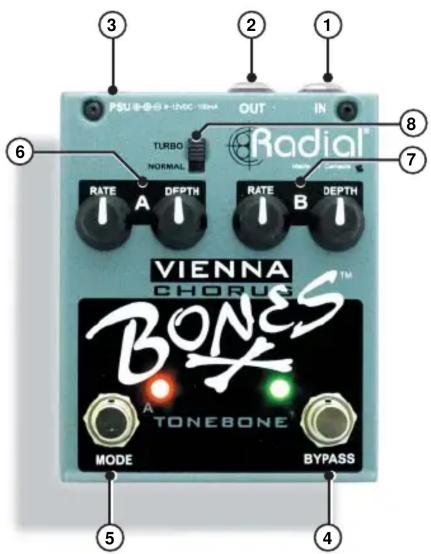
FEATURES AND FUNCTIONS
- IN: 1/4" input jack for your guitar.
- OUT: 1/4" output jack connection to your amp.
- PSU: Connection for 9-12 volt DC, center pin negative (⊕-⊖-⊖)
- BYPASS: Footswitch toggles between chorus effect and bypass. An on/off LED status indicator illuminates when the effect is active.
- MODE: Footswitch selects between chorus channels. An LED status indicator illuminates when channel-A is active.
- CHANNEL-A: RATE controls the speed of the modulation. DEPTH controls the amount of modulation.
- CHANNEL-B: A second set of RATE and DEPTH controls for channel-B work the same and allow the Vienna to produce two unique chorusing effects.
- TURBO SWITCH: Switches between normal and TURBO. TURBO dramatically intensifies the effect by increasing the depth of modulation.
FREQUENTLY ASKED QUESTIONS
Can I use any 9 volt adapter to power the Bones?
There are many adapters that can supply 9-12 volts DC but to be compatible the adapter must also have a 2.1mm barrel plug wired center pin negative. The Bones draw 100mA of current to operate. Your adapter can be rated higher, for example 500mA, but not lower.
I hear a high frequency “whine”. What causes this and how do I get rid of it?
Most likely this is caused by the power adapter you are using. Some switching type power adapters can make noise that bleeds into the guitar signal. If you encounter high frequency noise try a different adapter. We recommend standard linear adapters although we have successfully tested the Bones with both types.
Is the Vienna a true bypass pedal?
No. Bones pedals feature active buffering in bypass mode that lowers the output impedance allowing longer cables without noise or tone loss. This also enables us to employ EIS - Electronic Impulse Switching that eliminates certain problems with true bypass designs. True bypass switching can be noisy when switching pedals on and off producing pops and clicks. If used in conjunction with high-gain amps, that "pop" can become a loud "bang". The EIS switch is 100% noiseless.
Which is better, True Bypass or Buffered Bypass?
Buffers are a good thing to have in your signal chain. They regulate your signal and lower the output impedance to drive long cables and dirty (oxidized) jack contacts. However, buffers have received a bad reputation because some manufacturers design their buffer circuits to save money. That design strategy limits overall sound quality of the bypassed signal and has created a demand for a better system. The simplest alternative was to do away with the buffer and provide a hard-wired bypass via a mechanical switch and the term "true bypass" was born. But this arrangement has a downside too. Mechanical switches can make noise and are less reliable than electronic switching. The Bones are designed with a great sounding class-A buffer that emulates the input impedance of a typical tube amp. With a well designed buffer you get less noise and great tone.
Why can't the Vienna be powered by a battery?
It's because of the class-A topology. Class-A circuits sound best but are power hungry and will drain a battery in no time.
I use several pedals. Where's the best place to put the Vienna in my signal chain?
There are no rules but there are general guidelines when it comes to modulation pedals like chorus. Placing distortion pedals like the Bones Hollywood before a chorus, flanger or phaser will make their effects more prominent because of the increased harmonics the distortion adds. If you use time based effects like reverb or delay you can try placing the Vienna before them to produce “chorused” reverb and delay or after to “color” time based effect with chorus. Each method produces a slightly different outcome. Experiment and have fun.
RADIAL LIMITED THREE YEAR TRANSFERABLE WARRANTY
Radial Engineering Ltd. warrants this product to be free from defects in material and workmanship and will remedy any such defects free of charge according to the terms of this warranty. Radial Engineering will repair or replace at its option any defective component(s) of this product, excluding the finish, the footswitch (tubes and footswitches are warranted for 90 days) and wear and tear from normal use, for a period of three (3) years from the original date of purchase. In the event that a particular product is no longer available, Radial Engineering reserves the right to replace the product with a similar product of equal or greater value. In the unlikely event that a defect is uncovered, please call 1-800-942-1001 or email service@radialeng.com to obtain an RA number (Return Authorization number) before the 3 year warranty period expires. Once you have obtained an RA number you must return the product, freight prepaid, within fifteen (15) days after the date the RA number is issued. To make a request or claim under this limited warranty, the product must be returned prepaid in the original shipping container (or equivalent) to Radial Engineering or to an authorized repair centre and you must assume the risk of loss or damage. A copy of the original invoice showing date of purchase and the dealer name must accompany any request for work to be performed under this limited warranty. This limited warranty shall not apply if the product has been damaged due to abuse, misuse, misapplication, accident or as a result of service or modification by any other than an authorized repair centre.
THERE ARE NO EXPRESSED WARRANTIES OTHER THAN THOSE ON THE FACE HEREOF AND DESCRIBED ABOVE. NO WARRANTIES WHETHER EXPRESSED OR IMPLIED, INCLUDING BUT NOT LIMITED TO, ANY IMPLIED WARRANTIES OF MERCHANTABILITY OR FITNESS FOR A PARTICULAR PURPOSE SHALL EXTEND BEYOND THE RESPECTIVE WARRANTY PERIOD DESCRIBED ABOVE OF THREE YEARS. RADIAL ENGINEERING SHALL NOT BE RESPONSIBLE OR LIABLE FOR ANY SPECIAL, INCIDENTAL OR CONSEQUENTIAL DAMAGES OR LOSS ARISING FROM THE USE OF THIS PRODUCT. THIS WARRANTY GIVES YOU SPECIFIC LEGAL RIGHTS, AND YOU MAY ALSO HAVE OTHER RIGHTS, WHICH MAY VARY DEPENDING ON WHERE YOU LIVE AND WHERE THE PRODUCT WAS PURCHASED.
DECLARATION OF CONFORMITY
Radial Engineering Ltd. declares that this product conforms to the following specifications:
Safety: IEC 60065 (1998), EMC: EN 55013 (1990), EN 55020 (1991)
Supplementary information: The product herewith complies with the requirements of the Low Voltage Directive 72/23/EEC and the EMC Directive 89/336/EEC as amended by Directive 93/68/EEC.

Radial Engineering Ltd. • 1588 Kebet Way, Port Coquitlam, BC Canada V3C 5M5 Tel: 604-942-1001 • Fax: 604-942-1010 • email: info@radialeng.com
Radial Bones Vienna™ Chorus User Guide v1.0-Nov. 2009 • Part #: R870 1229 00 • © 2009 All rights reserved • Subject to change without notice.


- POWERING THE VIENNA CHORUS
- CONNECTIONS AND SETUP
- FEATURES AND FUNCTIONS
- FREQUENTLY ASKED QUESTIONS
- Can I use any 9 volt adapter to power the Bones?
- I hear a high frequency “whine”. What causes this and how do I get rid of it?
- Is the Vienna a true bypass pedal?
- Which is better, True Bypass or Buffered Bypass?
- Why can't the Vienna be powered by a battery?
- I use several pedals. Where's the best place to put the Vienna in my signal chain?
- RADIAL LIMITED THREE YEAR TRANSFERABLE WARRANTY
- DECLARATION OF CONFORMITY
Marke : Radial Engineering
Modell : Bones Vienna
Kategorie : Effektpedal für E-Gitarre