58160 - Fräsmaskin TORO - Gratis bruksanvisning och manual
Hitta enhetens manual gratis 58160 TORO i PDF-format.


Användarfrågor om 58160 TORO
0 fråga om denna apparat. Svara på dem du kan eller ställ din egen.
Ställ en ny fråga om denna apparat
Ladda ner instruktionerna för din Fräsmaskin i PDF-format gratis! Hitta din manual 58160 - TORO och ta tillbaka ditt elektroniska enhet i hand. På denna sida publiceras alla dokument som behövs för att använda din enhet. 58160 av märket TORO.
BRUKSANVISNING 58160 TORO
FORM NO. 3311-987

| MODEL NO. 58160 - 3000001 & UP | OPERATOR'SMANUAL |
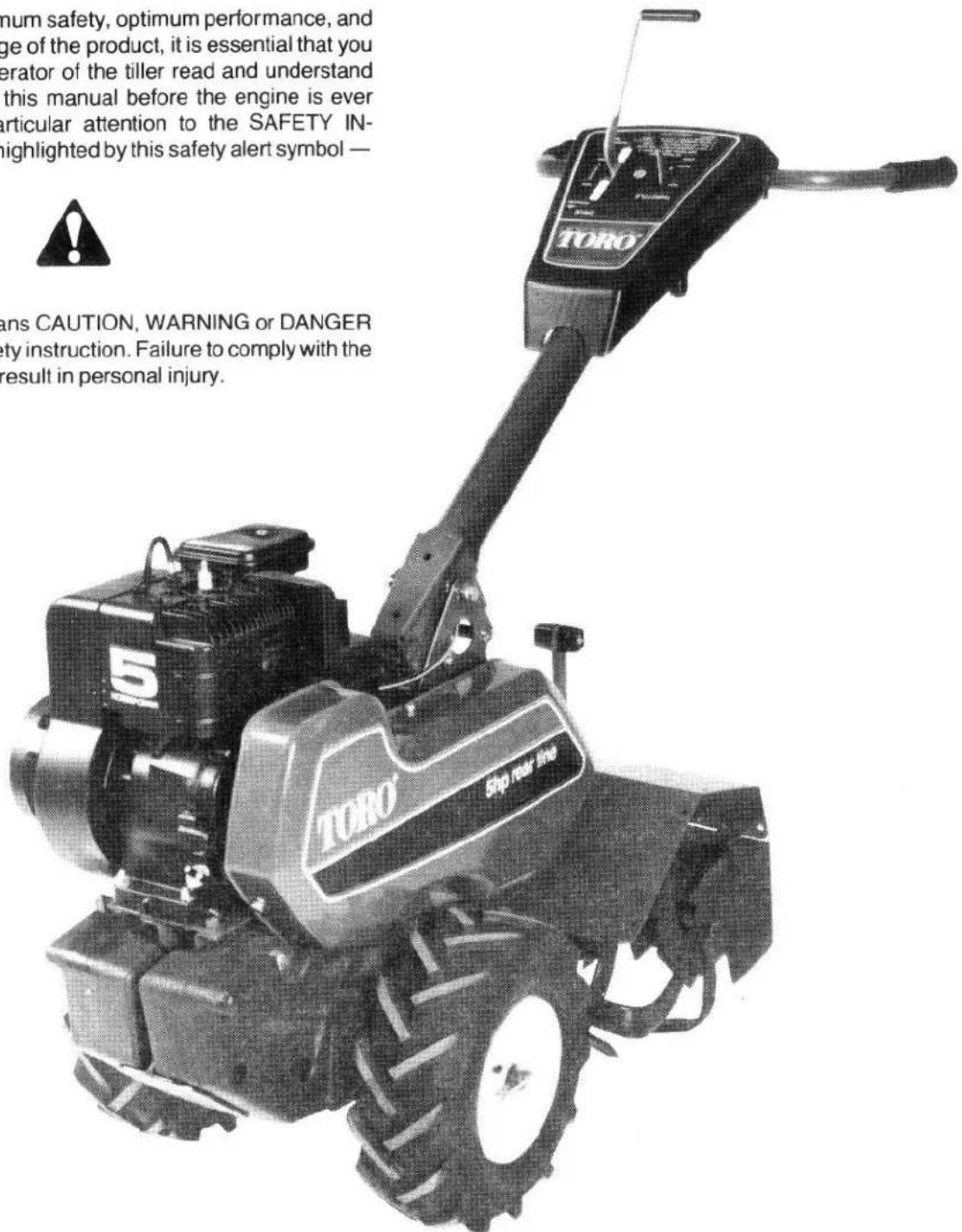
| 5 hp REAR TINE TILLERSWING HANDLE | |
To assure maximum safety, optimum performance, and to gain knowledge of the product, it is essential that you or any other operator of the tiller read and understand the contents of this manual before the engine is ever started. Pay particular attention to the SAFETY INSTRUCTIONS highlighted by this safety alert symbol —

The symbol means CAUTION, WARNING or DANGER — personal safety instruction. Failure to comply with the instruction may result in personal injury.
PRICE \$1.00
FOREWORD
The TORO Tiller has advanced concepts in engineering, design, and safety. If operated and maintained properly, the tiller will give long, dependable service.
Carefully read and follow the instructions in this Operator's Manual. The major sections of this manual are:
- Safety Instructions
- Before Operating
- Controls and Operating Instructions
- Maintenance
- Engine Operation and Maintenance
- Trouble Shooting
Note that safety, mechanical, and some general information in the manual is emphasized. The words CAUTION, WARNING, DANGER, IMPORTANT, and NOTE are used to classify the information. CAUTION, WARNING, and DANGER identify safety related information; and NOTE identifies general information worthy of special attention.
OPTIONAL SPARK ARRESTER
In some areas there are local, state or federal regulations requiring that a spark arrester be used on the engine of this tiller. If a spark arrester is required, order from your local Briggs & Stratton dealer.
Notice to customers in the State of California - The engine on this unit is NOT equipped with a spark arresting muffler.
WARNING
When tiller is used or operated on any California forest, brush or grass covered land, a working order spark arrester must be attached to muffler. If not, the operator is violating state law, Section 4442 Public Resources Code:
If help - concerning set-up, operation, maintenance, or safety - is ever needed, contact the local Authorized TORO Service Dealer or Distributor. Refer to the "Yellow Pages" for assistance. In addition to skilled service technicians, the dealer and distributor have other TORO products, as well as factory approved accessories and replacement parts. Keep your Toro Tiller all TORO. Buy genuine TORO replacement parts and accessories.
TABLE OF CONTENTS
Page
Safety Instructions 3
Before Operating 3
While Operating 3
Maintaining Tiller 3
Before Operating 4
Fill Crankcase With Oil 4
Fill Fuel Tank With Gasoline 4
Controls and Operating Instructions 4
Engine Throttle Control and Stop Lever ..... 4
Handle Control Lever 4
Clutch Control Lever 4
Depth Control Lever 5
"Free Wheel" Control 5
Operating Suggestions 5
Starting and Stopping Instructions 5
Tiller Maintenance 6
Adjustments:
Belt Adjustments 6
Handle Control Lever Adjustment 7
Clutch Control Lever Adjustment 7
Page
Lubrication:
Wheel Drive Case 8
Tine Drive Case 8
General 9
Belt Replacement 10
Storage 11
Engine Operating and Maintenance 12
Before Starting 12
Starting 13
Maintenance 13
Adjustments 15
General Information 15
Storage 15
Trouble Shooting 16
Identification and Ordering 20
The Toro Promise 20
SAFETY INSTRUCTIONS
This safety alert symbol means CAUTION, WARNING or DANGER - "personal safety instruction". Read and understand the instruction because it has to do with safety. Failure to comply with the instruction may result in personal injury.
The following "Instructions for Safe Tilling" are suggested by The Toro Company. Failure to operate the tiller in accordance with these Safety Instructions MAY RESULT IN PERSONAL INJURY.
BEFORE OPERATING
- Read and understand the contents of this manual before starting and operating the tiller. Become familiar with all controls and know how to stop tiller quickly. NEVER ALLOW CHILDREN TO OPERATE TILLER.
- Keep everyone, especially children and pets, away from the area of operation. Remove glass, metal objects, sticks, stones, wire and any other debris that might get caught in or possibly be thrown by the tines.
- Keep all shields and safety devices in place. If shield, safety device or decal is defective, repair or replace it before operation is commenced. Also tighten any loose nuts, bolts and screws.
- Wear long pants and substantial shoes while using the tiller. Do not operate tiller while barefoot, wearing sandals, tennis shoes, sneakers or shorts.
- Fill fuel tank with gasoline before starting the engine. Avoid spilling any gasoline. Since gasoline is highly flammable, handle it carefully.
A. Use an approved gasoline container.
B. Fill tiller fuel tank outdoors when engine is cool. Engine must not be running to prevent a potential hazard.
C. Wipe up any gasoline that may have spilled, and install gasoline container cap and tiller fuel tank cap before starting the engine.
WHILE OPERATING
-
Open doors if engine will be run in the garage because exhaust fumes are dangerous and could possibly be deadly. Do not run engine indoors.
-
Do not operate the tiller if someone is near the area to be tilled.
- Tilling the soil demands attention. Always maintain secure footing, balance and control.
- Till the soil when it is dry or moist because wet or sticky soil can cause mechanical damage.
- Keep face, hands, feet and any other part of the body or clothing away from concealed, moving or rotating parts such as the tines, belts and pulleys. Stay behind the handles and away from the tines while operating the tiller.
- Release clutch control, shut engine off and wait for all parts to stop before removing any obstruction from the tines. Use a stick to remove the obstruction.
- If a solid object is hit by the tines or tines get plugged, release clutch control and shut engine off. Remove high tension wire from spark plug; then check for possible damage, an obstruction or loose parts. Use a stick to remove any obstruction, and make all repairs before using the tiller again.
- Before leaving the operator's position - behind handles - release clutch control and shut engine off. Pull high tension wire off spark plug to prevent possibility of accidental starting.
- Do not touch the engine while it is running or soon after it is stopped because the engine may be hot enough to cause a burn.
MAINTAINING TILLER
- Before performing any maintenance or servicing the tiller, shut engine off and pull high tension wire off spark plug to prevent possibility of accidental starting.
- Perform only those maintenance instructions described in this manual. If major repairs are ever needed or assistance is desired, contact an Authorized TORO Service Dealer.
- Keep tiller in safe operating condition by having nuts, bolts and screws tight.
- To reduce potential fire hazard, make sure engine and tiller chassis is free of excessive grease, vegetation, dirt and other foreign matter.
- Do not overspeed the engine by changing governor settings. Recommended engine speed is 3600 rpm. To assure safety and accuracy, have an Authorized TORO Service Dealer check maximum engine speed (3600 rpm) with a tachometer.
BEFORE OPERATING
- IMPORTANT: FILL CRANKCASE WITH OIL.
Before starting the engine, refer to the engine instructions in the engine section. Be certain that the engine crankcase is filled with the proper type oil and that all engine service instructions have been followed completely (see page 12).
- Fill fuel tank with a clean, fresh, low-lead or leaded "regular" grade of automotive gasoline. Do not use "gasohol". Do not mix oil with gasoline.
- All nuts and bolts should be checked and tightened during the first two (2) hours of use. Periodic checks should be made thereafter.
- The tires are normally over-inflated for shipping. The recommended tire pressure is 20 lbs.
CONTROLS
ENGINE CHOKE
See engine section, page 13.
ENGINE REWIND STARTER
See engine section, page 13.
ENGINE THROTTLE CONTROL AND STOP LEVER
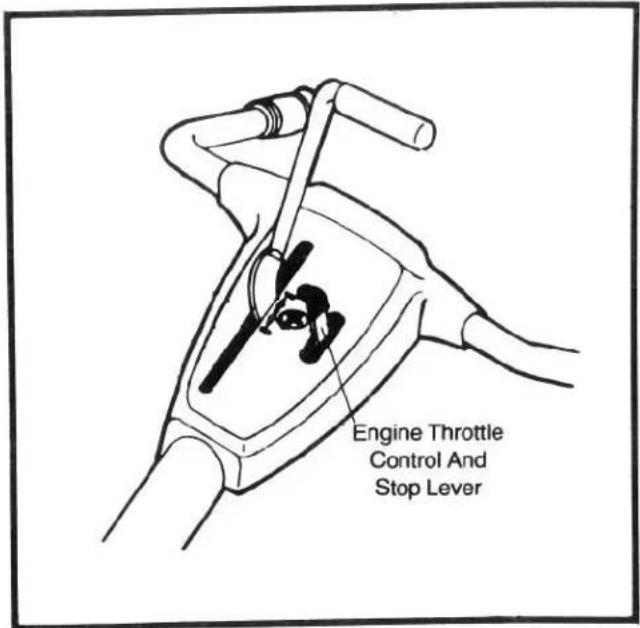
This control regulates the engine speed from idle to fast and also stops the engine. (See Fig. 1 for location of control.) To idle engine pull throttle control back. To increase speed push throttle control forward. To stop engine pull throttle control all the way back.
HANDLE BAR
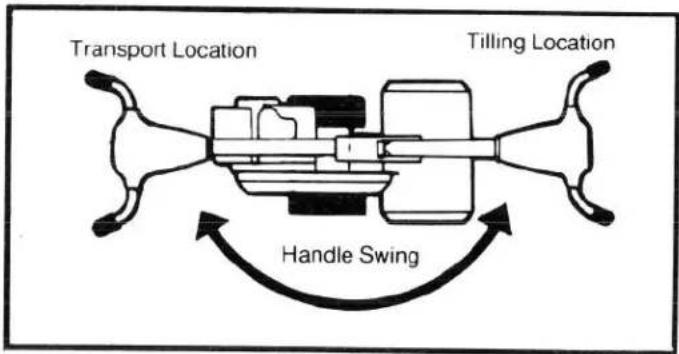
The handle bar has two operating locations (see Fig. 2). In the tilling location, the tines are immediately in front of the operator. In the transport location, the engine is immediately in front of the operator. Use the handle control lever to unlock the handle, then position the handle in the desired location.
HANDLE CONTROL LEVER
The handle control lever controls the handle swing location and the handle height. To swing the handle bar, pull back on the lever. Swing to either right or left to the desired position, then release the control lever and swing back and forth slightly until the handle latch engages. To adjust handle height, pull back on control lever without swinging handle. Move handle to desired height. Release lever and move handle up and down slightly until handle locks in the desired height position. NOTE: When pulling back on the handle control lever, the clutch control lever is automatically moved to the neutral position.
CLUTCH CONTROL LEVER
The clutch control lever is a single lever that engages and disengages drive to both the tines and the wheels.
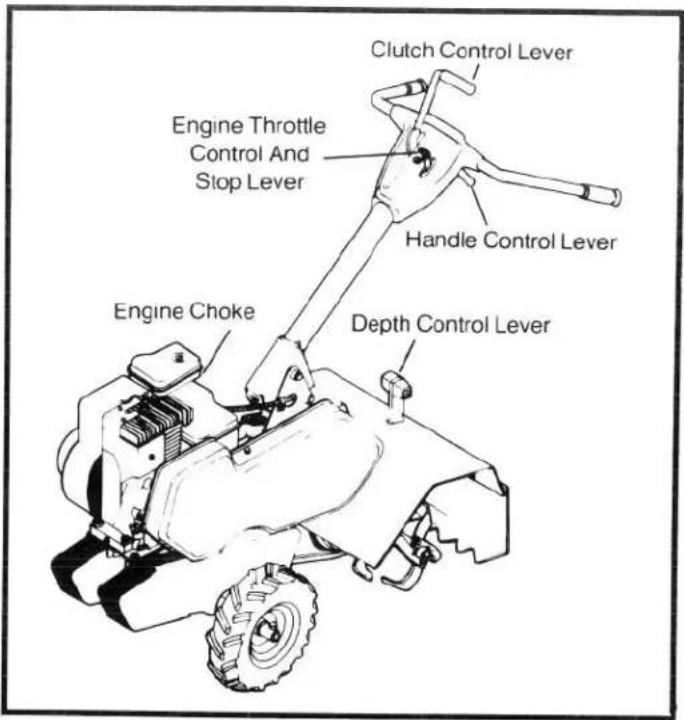
FIGURE 1
flowchart
graph TD
    A["Transport Location"] --> B["Tilling Location"]
    B --> C["Handle Swing"]
    C --> A
FIGURE 2
When the handle bar is in the tilling location, pushing forward on the control lever engages the drive to both the tines and the wheels at a tilling speed. CAUTION: Before pushing lever forward, be certain depth control setting is correct for soil conditions. (See "Depth Control Lever".)
Pulling back on clutch control lever from forward drive to neutral disengages the drive to the tines and wheels. Further pulling back on the lever engages the reverse drive to the wheels and the tiller moves backwards at transport speed. (Tines do not rotate in reverse.) When released, the control lever will return to neutral position.
When the handle bar is in transport location, the clutch control lever will only operate by pulling the lever back. This engages the drive to the wheels and the tiller moves forward at transport speed. When released, the control lever returns to neutral.
CONTROLS AND OPERATING INSTRUCTIONS
DEPTH CONTROL LEVER

CAUTION: Do not adjust tilling depth with the tines rotating. Place clutch control lever in the neutral position before making adjustments of depth control.
The depth control lever, Fig. 3, is the "key" to easy tilling operation. The exact setting of control will vary with soil conditions. To Operate: Push lever forward then lift or lower to desired position.
When starting a tilling operation, start with the depth control lever in the shallowest setting (Fig. 3). As you become acquainted with the soil, keep raising the control lever so that deeper tilling can be done.
"FREE WHEEL" CONTROL
This control enables you to push the tiller easily. To "Free Wheel", pull klik pin out of wheel hub and axle and insert pin into the outer hole of the axle. This permits the wheels to turn freely about the axle. NOTE: Be sure the klik pins are replaced through the wheel hubs and inner holes on axle before operating tiller, see Fig. 4.
OPERATING SUGGESTIONS
When you start to till in the garden, remember to take it easy. Do not try to take too deep a cut in a pass through sod or hard ground, or soil that has not been tilled for several months or years.
Do not lean on the handle bars because this takes weight off the front wheels, reduces traction, and causes the tines to attempt to propel the tiller instead of just digging.
There are several schools of thought as to the best method to till. It is suggested you try the various methods and select the one you are most comfortable with to get the results you desire.
A. On each succeeding pass, overlap one-half of the previous pass.
B. On the second pass, leave a 12 width untilled and till this width on the third pass. Repeat on the fourth pass, leaving a 12 width untilled and on the fifth pass, till the untilled strip.
C. Use A or B and repeat at 90 degrees.
Remember the key to easy tilling is the depth control setting. Do not try to take too deep a cut in harder soils.
STARTING THE TILLER
Now that you have located the controls and understand their operation and function, it is time to start your tiller.
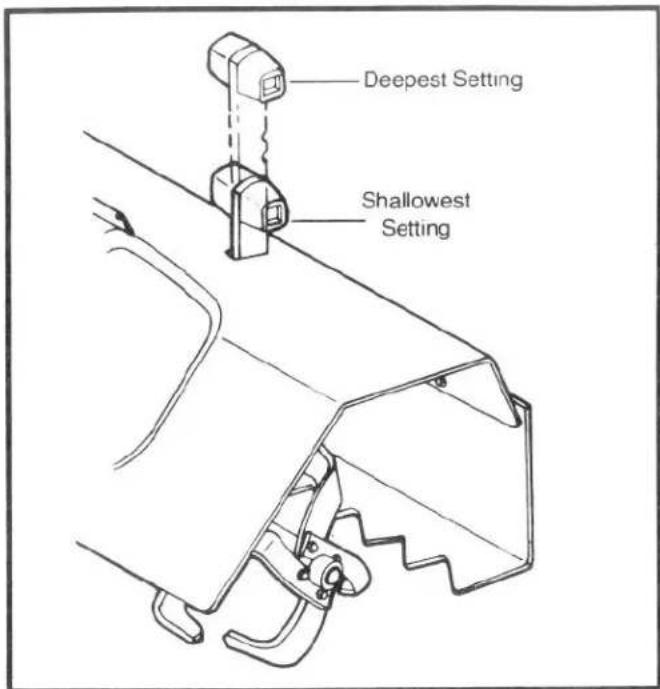
FIGURE 3
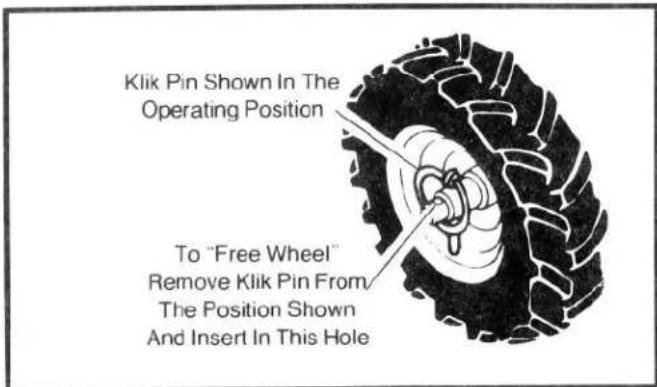
FIGURE 4
- Place clutch control lever in neutral.
- Push throttle control lever ahead to fast position.
- Adjust engine choke to proper position. (Refer to engine starting procedures in engine section, page 13.)
- Start engine by pulling starter cord.
To Stop Engine
- Place clutch control lever in neutral position.
- Pull throttle control and engine stop lever to the stop position.
MAINTENANCE
ADJUSTMENTS

CAUTION: Never attempt to make adjustments on the tiller while the engine is running. Always stop the engine and disconnect the wire from the spark plug before attempting to make adjustments.
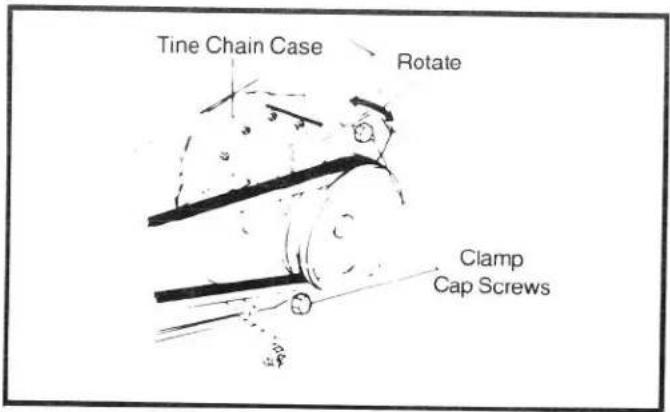
FIGURE 5A
BELT ADJUSTMENTS
TINE DRIVE BELT
The tine drive belt, which is the outer belt, is adjusted by loosening the clamp cap screws (Fig. 5A) and rotating the entire case and tine assembly. Rotate case forward to slacken belt and back to tighten belt. With the clutch control lever in the forward drive position, the distance between the inside of the belt should be approximately 34 inch as shown in Fig. 5B. Tighten the clamp bolts securely after adjustment. Place depth control in shallowest setting and start engine. With control lever in neutral position, tines should not rotate. If tines rotate, readjust to increase belt slack until tines do not drive in neutral.
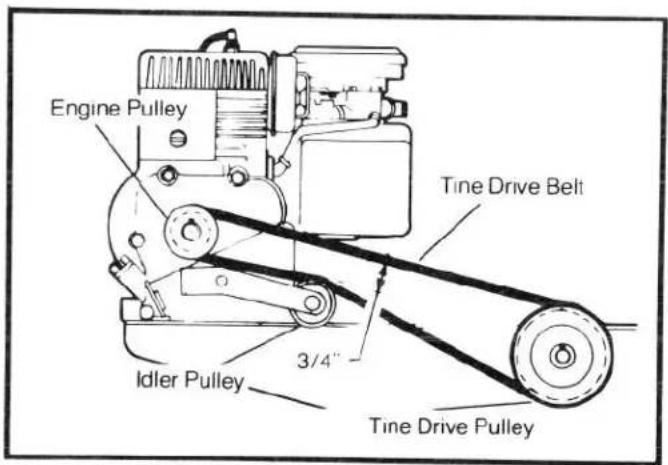
FIGURE 5B
WHEEL DRIVE BELT
The wheel drive belt, which is the inner belt, is adjusted by moving the right hand idler (Fig. 6). With the clutch control lever in the neutral position, the traction belt should have approximately 14 inch between the upper idler and the belt (Fig. 6). The adjustment idler should be positioned to obtain this 14 inch. Moving idler up will increase clearance and down will decrease clearance.
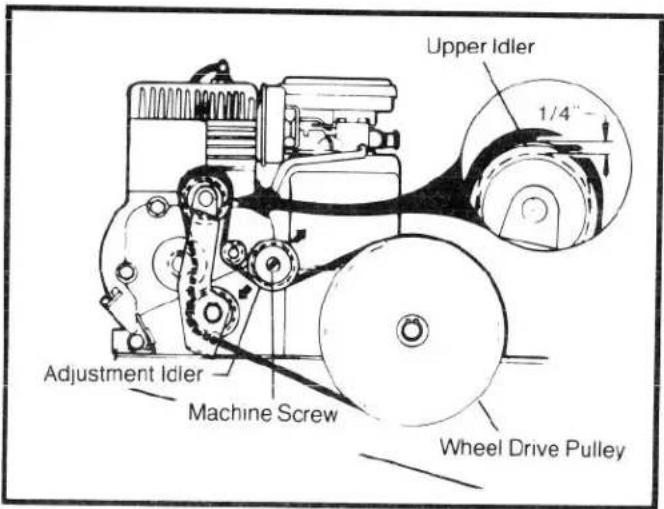
FIGURE 6
NOTE: The adjustment idler has four locations and is not slot mounted. The machine screw must be removed from the mounting frame when making this adjustment.
MAINTENANCE
HANDLE CONTROL LEVER ADJUSTMENT
The handle control adjustment (Fig. 7) has been set for proper operation and should not need to be adjusted. Should the handle control lever (Fig. 7) become loose after many hours of operation, tighten the adjustment nut only enough to eliminate any excess movement in the handle control lever.

CAUTION: Do not overtighten adjustment nut. This may result in failure of handle bar latch system to fully engage and hold handle in desired position.
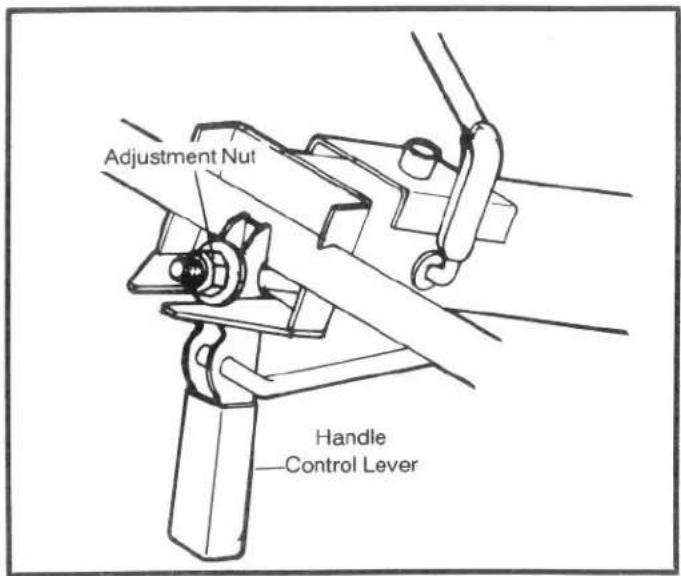
FIGURE 7
CLUTCH CONTROL LEVER ADJUSTMENT
The clutch control lever is pre-set for neutral shift position. An adjustment means is provided, however, to center the clutch control lever in the slot on the handle shroud should it become necessary due to wear. This adjustment is located at the handle pivot point (Fig. 8).
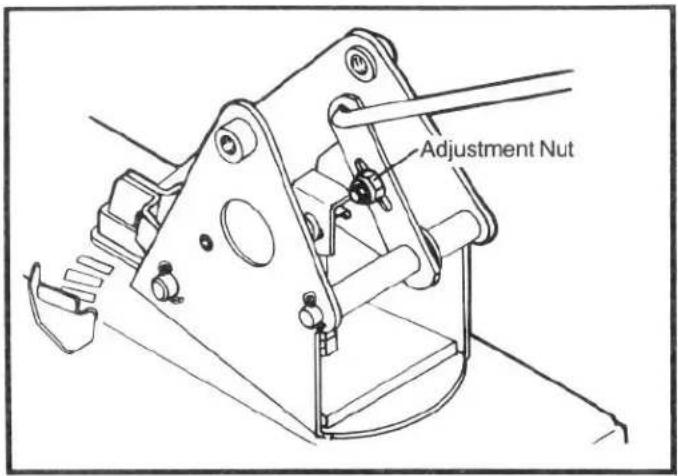
FIGURE 8
TO ADJUST:
- Place handle bar in tilling location and adjust handle bar to lowest position.
- Loosen the adjustment nut (Fig. 8).
- Move the clutch control lever on the handle bar until centered in the neutral area (Fig. 9).
- Retighten the adjustment nut (Fig. 8).
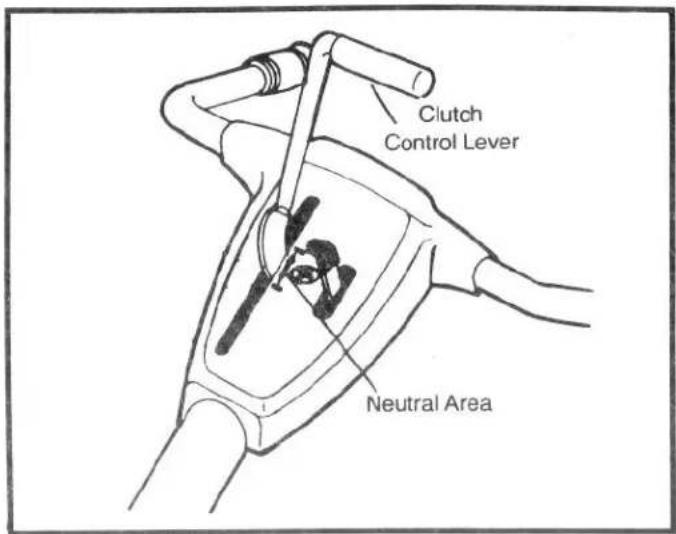
FIGURE 9
MAINTENANCE
LUBRICATION
The best assurance you have of getting the most dependable service from your tiller is to keep the unit clean, free of rust, and well lubricated. Check bolts often to be sure they are kept tight. When the tiller is not being used, it should be stored in a dry place out of the weather.
- Engine: Refer to Engine Operating and Maintenance Instructions for all engine lubrication requirements.
- Chain Case: Both the wheel drive and the tine drive cases are amply filled with lubricant and should not require additional lubrication. If a leak develops, add (EP) SAE 140 heavy duty oil as required to bring to proper level. Check oil level every 25 hours.
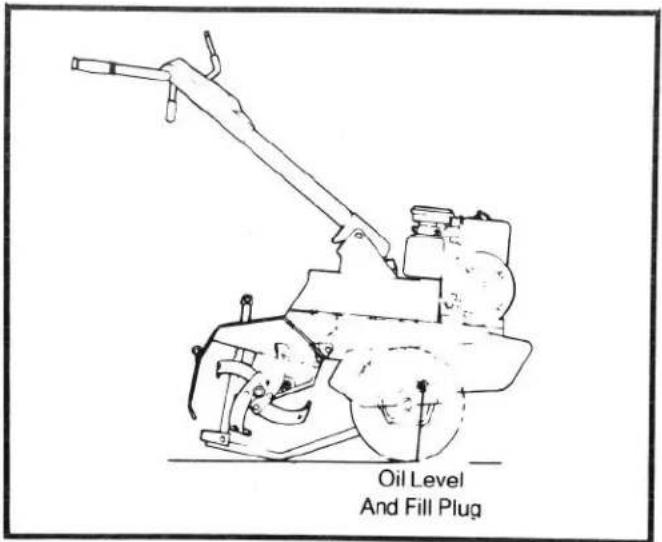
FIGURE 10
The following procedure should be followed to check lubricant level of cases. When checking cases, do not drain excess lubricant out of the cases.
WHEEL DRIVE CASE
To check the oil level of the wheel drive case, place the depth control lever down to the shallowest setting (Fig. 3). Remove the inspection plug on the right side of the wheel drive case (Fig. 10). Case has sufficient oil if oil is up to bottom of inspection plug hole. It may be more convenient to remove the right wheel when checking this level.
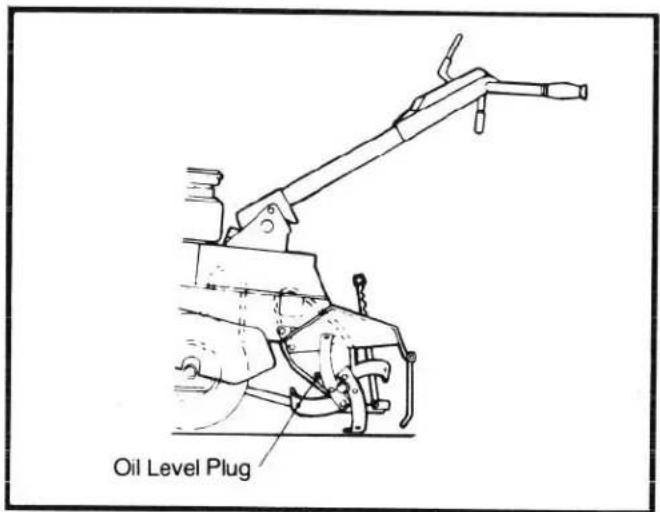
FIGURE 11A
TINE DRIVE CASE
To check the lubrication level of the tine drive case.
- Set depth control at the deepest setting (Fig. 3).
- Place tiller on a level surface so that the tines and the wheels are setting on the ground, Fig. 11B.
- Wipe dirt away from oil level plug and remove plug, Fig. 11A. Oil should be up to the bottom of hole.
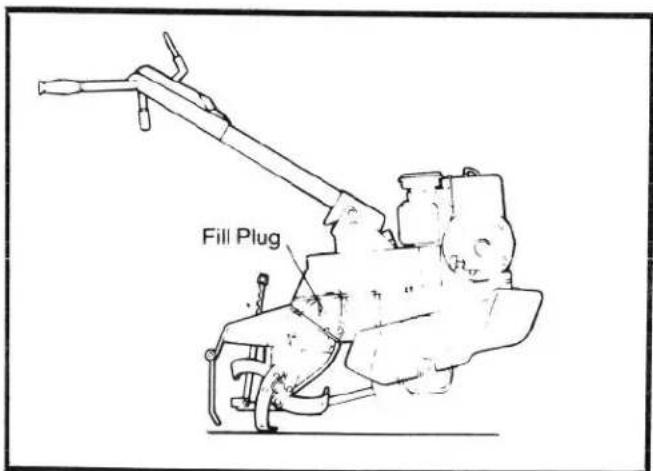
FIGURE 11B
MAINTENANCE
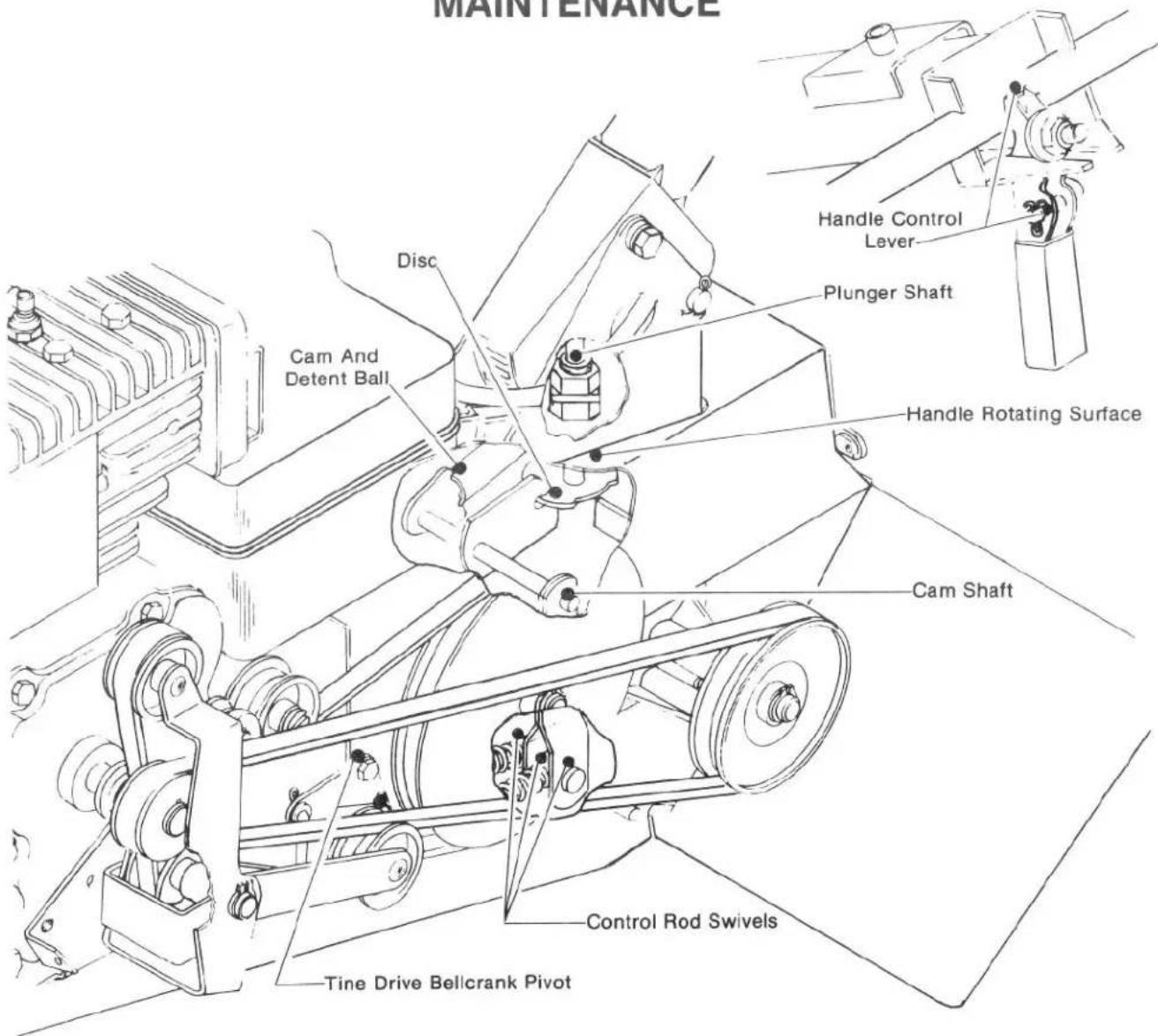
FIGURE 12
- If oil isn't up to bottom of hole, Fig. 11B, fill slowly with (EP) SAE 140 heavy-duty oil until proper level is reached. Replace oil level plug and oil fill plug. Wipe off excess oil.
To add lubricant to either chain case it is necessary to tip tiller on its left side to expose level plugs of each case. Add sufficient (EP) SAE 140 heavy-duty oil to bring to proper oil level.
General
The following points should be lubricated with engine oil every eight hours (see Fig. 12). Before oiling attempt to clean off area to be lubricated.
A. The handle plunger shaft and disc.
B. The control rod swivels.
C. The handle rotating surface.
D. Cam and detent ball and shaft.
E. Handle control lever.
F. Tine drive bellcrank pivot.
IMPORTANT! Apply oil and grease carefully and only where required. Oil or grease on drive belts or pulleys will cause slippage and loss of drive. Wipe up all spills or excess oil and grease completely.
MAINTENANCE
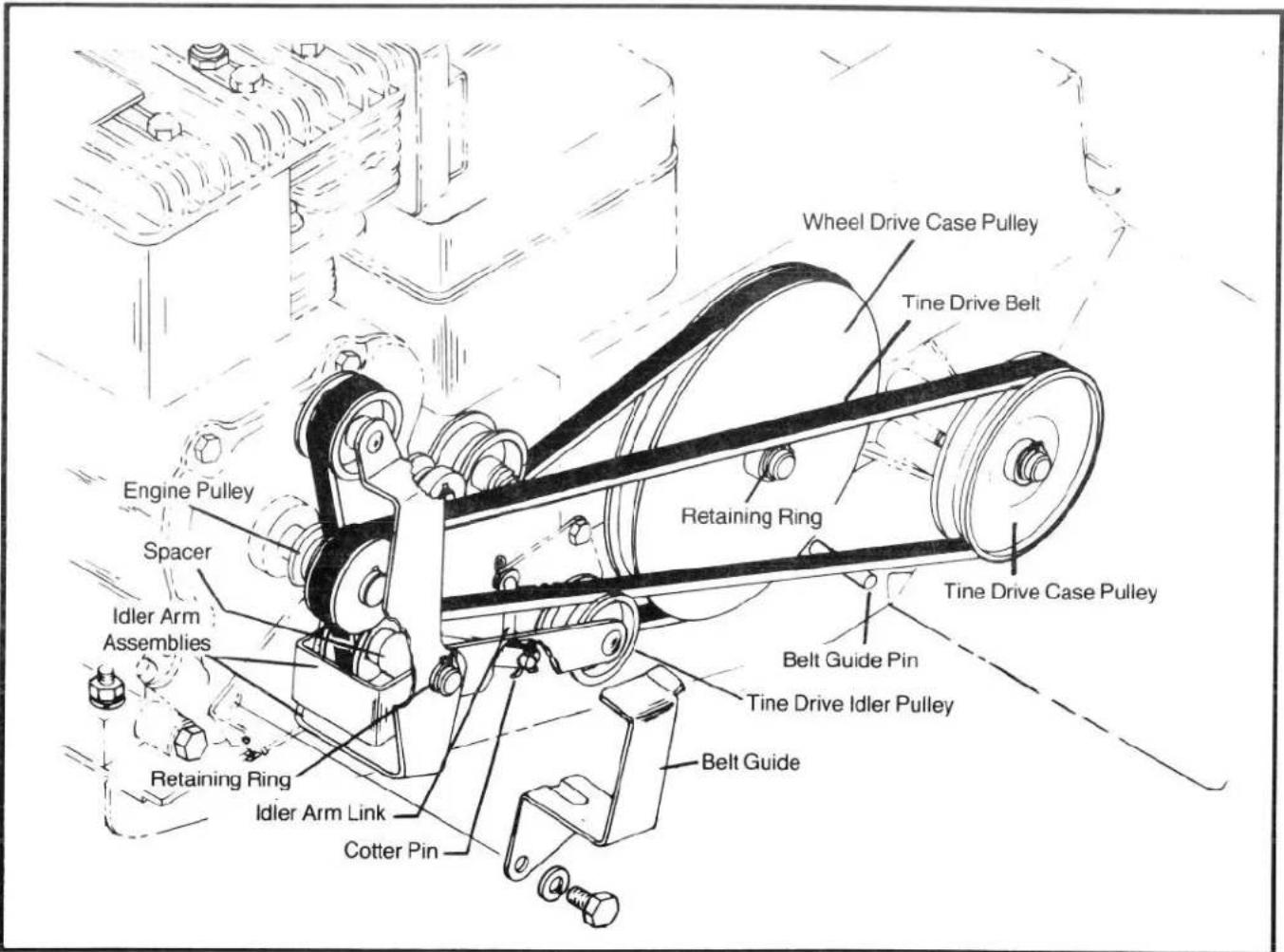
FIGURE 13
BELT REPLACEMENT
The belts on this tiller were specifically designed and engineered to provide long, trouble-free service. If belt replacement is required, order the belt required from your TORO dealer, to be sure you have a belt that will provide the life and service required.
TINE DRIVE BELT
- Place the clutch lever in the neutral position.
- Remove the belt guard.
- Remove the belt guide (Fig. 13).
- Slip the belt off the tine drive case pulley.
- Remove belt from the engine pulley and slip out between engine pulley and idler arm.
-
To replace belt, reverse above procedure. Be sure belt is on top of time drive idler pulley and the belt guide pin near the time drive case pulley (Fig. 13).
-
Readjust belt as outlined under belt adjustments.
- Replace belt guard.
WHEEL DRIVE BELT
- Remove the tine drive belt per instructions above.
- Remove the retaining ring in the idler arm shaft (Fig. 13).
- Remove the belt from the wheel drive case pulley.
- Remove wheel drive pulley by removing retaining ring and sliding pulley off shaft. (CAUTION: Do not loose woodruff key in drive pulley shaft.) (Fig. 13).
- Remove cotter pin from idler arm link (Fig. 13).
-
Slide idler arm assemblies out until the spacer can be slid out between the idler and idler arm. Remove belt. To replace belt, reverse above procedure. Be sure belt is turned inside out (wide side on pulleys) before installing in pulleys (Fig. 13).
-
Readjust belt as outlined under belt adjustments.
STORAGE
For short term storage, clean the tiller off and store in a dry place.
If tiller is not to be used for an extended period of time, service tiller completely and store it in a dry place.
- Refer to the engine section for engine storage instructions.
-
Drain gasoline from fuel tank.
-
Run engine until it stops.
- Cover exposed metal surfaces with a thin coat of engine oil.
- Lubricate per instructions on page 8.
- Before using the tiller again, check all lubrication points, fill fuel tank, and review the safety and operating instructions in this Operator's Manual and the Engine Manual.
ENGINE OPERATING AND MAINTENANCE INSTRUCTIONS
BEFORE STARTING
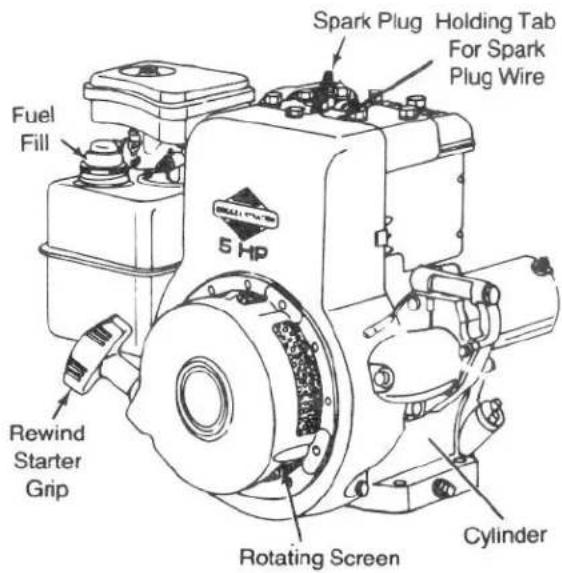
Use a high quality detergent oil classified "For Service SF, SE, SD or SC." Detergent oils keep the engine cleaner and retard the formation of gum and varnish deposits. Nothing should be added to the recommended oil.
RECOMMENDED SAE VISCOSITY GRADES
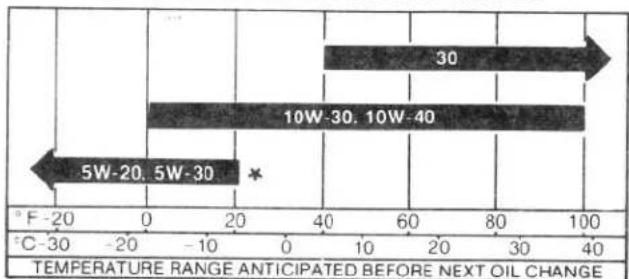
bar
| Temperature Range | Value | | :--- | :--- | | 5W-20 | 5W-30 | | 10W-30 | 10W-40 | | 30 | 30 |* If not available, a synthetic oil may be used having 5W-20, 5W-30 or 5W-40 viscosity.
TO FILL CRANKCASE WITH OIL
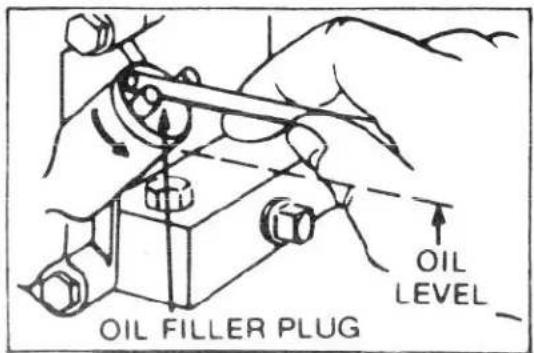
Place engine level. Clean area around oil fill before removing oil fill plug.
OIL FILL PLUG Remove oil fill plug. Fill crankcase to point of overflowing. POUR SLOWLY. Capacity approximately 1½ pints (0.59 liters). Replace oil fill plug.
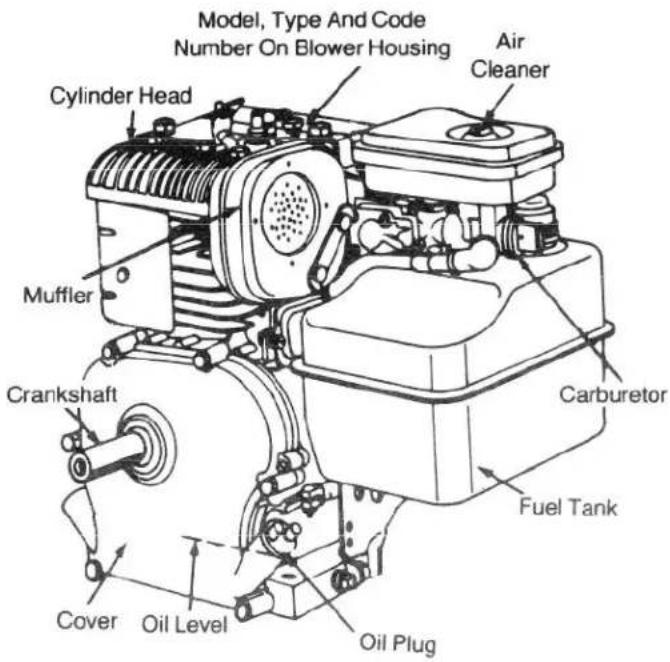
FILL FUEL TANK
Use clean, fresh, "regulargrade leaded, low-lead or lead-free" gasoline. DO NOT MIX OIL WITH GASOLINE.
NOTE: The use of "lead-free" gasoline produces fewer combustion deposits, but may shorten valve life if carburetor adjustment is too lean.
ENGINE OPERATING AND MAINTENANCE INSTRUCTIONS STARTING
Start, store and fuel engine in a level position.
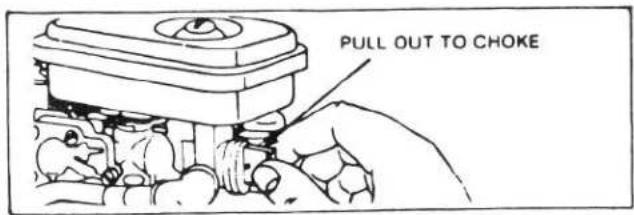
CHOKE ENGINE - Pull choke out as illustrated.
THROTTLE CONTROL: Move throttle control to FAST position.
CAUTION: DO NOT operate engine with lever in partial choke position. Excessive speeds may occur if engine is run (after warm up) with choke partially closed.
NOTE: A warm engine requires less choking than a cold engine.
NOTE: Engine may not start if controls on powered equipment do not close choke fully. See ADJUSTMENT section.
TO START ENGINE

DANGER: ALWAYS KEEP HANDS AND FEET CLEAR OF ROTATING MACHINERY.
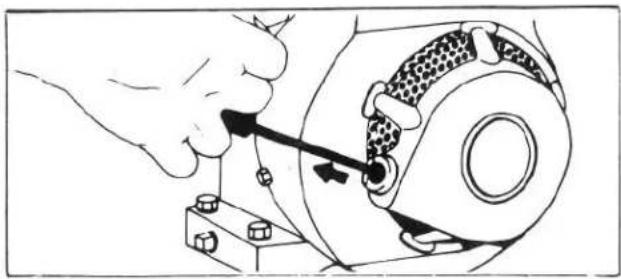
Rewind Starter. Grasp starter handle as illustrated and pull out cord rapidly to overcome compression and prevent kickback. Repeat if necessary with choke opened slightly. When engine starts, open choke gradually.
natural_image
Illustration of a hand using a tool to adjust or install a mechanical component, with no visible text or symbols.TO STOP ENGINE
Move throttle control lever to "STOP" position.
MAINTENANCE

WARNING: TO PREVENT ACCIDENTAL STARTING when servicing the engine or equipment, always remove the spark plug or wire from the spark plug and insert in v-notch.
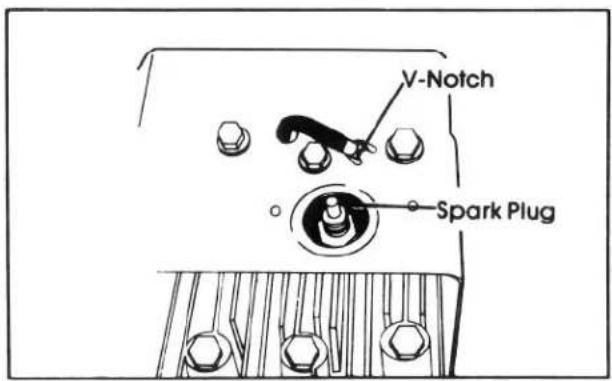
CHECK OIL LEVEL regularly - after each five hours of operation. BE SURE OIL LEVEL IS MAINTAINED.
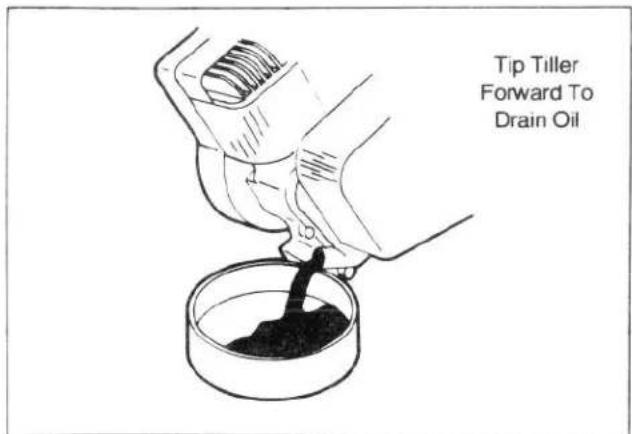
CHANGE OIL after first five hours of operation. Thereafter change every 25 hours of operation. Drain oil while engine is warm, as follows:
-
Clean area around oil fill plug.
-
Carefully tip tiller forward until it is resting on the counter weights.
(continued on next page)
ENGINE OPERATING AND MAINTENANCE INSTRUCTIONS
CHANGE OIL (continued)
- Place oil pan directly under opening; remove oil plug and allow oil to drain completely.
- Lower tiller to level position and refill with new oil of proper grade (see oil chart in BEFORE STARTING section).
- Wipe up any spilled or excess oil and replace oil fill plug.
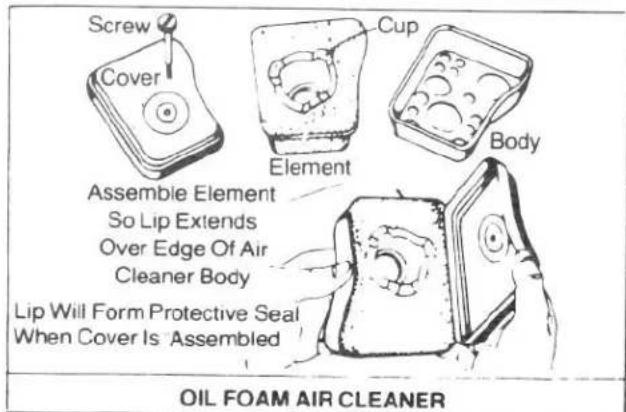
TO SERVICE AIR CLEANER "Oil Foam" Air Cleaner
Clean and re-oil foam element at three month intervals or every 25 hours, whichever occurs first.
NOTE: Service air cleaner more often under dusty conditions.
- Remove screw
- Remove air cleaner carefully to prevent dirt from entering carburetor.
- Take air cleaner apart and clean.
a. WASH foam element in kerosene or liquid detergent and water to remove dirt.
b. Wrap foam in cloth and squeeze dry.
c. Saturate foam with engine oil. Squeeze to remove excess oil.
- Reassemble parts and fasten to carburetor securely with screw.
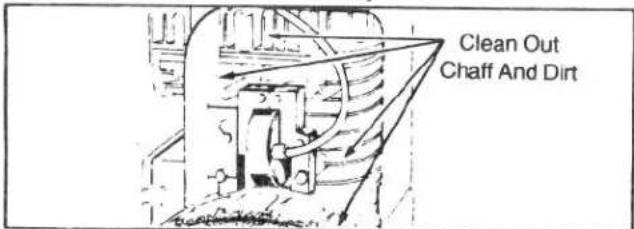
CLEAN COOLING SYSTEM - Grass, chaff or dirt may clog the rotating screen and the air cooling system, especially after prolonged service. Yearly or every 100 hours, whichever occurs first, remove the blower housing and clean the areas shown to avoid overspeeding, overheating and engine damage. Clean more often if necessary.
DANGER: Periodically clean muffler area to remove all grass, dirt and combustible debris.
SPARK PLUG - Clean and reset gap at .030" every 100 hours of operation.
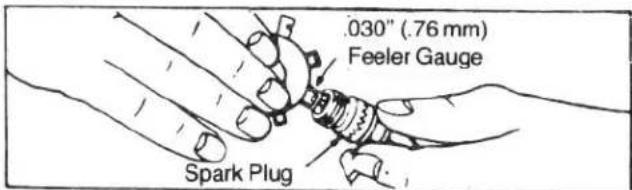
CAUTION: Do not blast clean spark plug. Spark plug should be cleaned by scraping or wire brushing and washing with a commercial solvent.
Sparking can occur if wire terminal does not fit firmly on spark plug, or if stop switch vibrates against spark plug. Reform terminal or repair switch if necessary.
REMOVE COMBUSTION DEPOSITS every 100-300 hours of operation. Remove cylinder head and cylinder head shield. Scrape and wire brush the combustion deposits from cylinder, cylinder head, top of piston and around valves. Use a soft brush to remove deposits. Re-assemble gasket, cylinder head and cylinder head shield. Turn screws down finger tight with the three longer screws around the exhaust valve, if so equipped. Torque cylinder head screws in a staggered sequence to 140 inch pounds (15.82 Nm).
SPARK ARRESTER EQUIPPED MUFFLER - If engine muffler is equipped with spark arrester screen assembly, remove every 50 hours for cleaning and inspection. Replace it damaged.
CLEAN ENGINE - Remove dirt and debris with a cloth or brush. Cleaning with a forceful spray of water is not recommended as water could contaminate the fuel system.
ENGINE OPERATING AND MAINTENANCE INSTRUCTIONS
ADJUSTMENTS
CARBURETOR ADJUSTMENTS
Minor carburetor adjustment may be required to compensate for differences in fuel, temperature, altitude or load.
NOTE: The air cleaner must be assembled to carburetor when running engine.
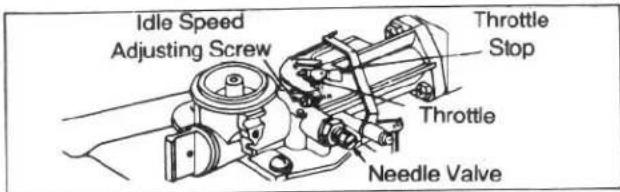
TO ADJUST CARBURETOR — Gently turn needle valve clockwise until it just closes. Valve may be damaged by turning it in too far.
Next, open the needle valve 1½ turns counterclockwise. This initial adjustment will permit the engine to be started and warmed up (approximately 5 minutes) prior to final adjustment.
FINAL ADJUSTMENT
Place speed control lever in "FAST" position. Turn needle valve in until engine slows (clockwise - lean mixture). Then turn it out past smooth operating point until engine runs unevenly (rich mixture). Now turn needle valve to the midpoint between rich and lean so the engine runs smoothly. Next, adjust idle RPM. Rotate throttle counterclockwise and hold against stop. Adjust idle speed adjusting screw to obtain 1750 RPM. Release throttle - engine should accelerate without hesitation or sputtering. If engine does not accelerate properly, the carburetor should be re-adjusted, usually to a slightly richer mixture.
CONTROL ADJUSTMENTS
Proper choke and speed control operation is dependent upon proper adjustment of speed controls on the powered equipment.
SPEED CONTROL ADJUSTMENT
The acceptable operating speed range is 1800 to 3600 RPM. Idle speed is 1750 RPM. DO NOT EXCEED 3600 RPM.
SPEED CONTROL
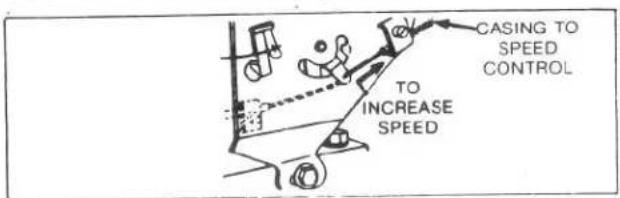
Controls on powered equipment should move governor speed control lever in direction illustrated to increase speed. Casing from speed controls may be connected to engine at points indicated. Wire travel is shown by arrows.
GENERAL INFORMATION
These engines are single-cylinder L-head, air-cooled type.
MODEL SERIES 130200 to 131299
| Bore | 2-9/16" (65.09 mm) |
| Stroke | 2-7/16" (61.91 mm) |
| Displacement | 12.57 cu. in. (206.0 cc) |
| Horsepower | 5.0 Max. @ 3600 RPM |
| Torque (Ft. Lbs.) | 7.66 Max. @ 3000 RPM |
The horsepower ratings listed are established in accordance with the Society of Automotive Engineers Test Code - J607. For practical operation, the horsepower should not exceed 85% of this rating. Engine power will decrease 3½% for each 1,000 feet (304.8 m) above sea level and 1% for each 10° above 60° F (16° C).
In some areas, local law requires the use of a resistor spark plug so as to suppress ignition signals. If an engine was originally equipped with a resistor spark plug, be sure to use the same type of spark plug for replacement.
TUNE-UP SPECIFICATIONS
| Spark Plug Type | Champion | Autolite | Robert Bosch |
| Short Plug | CJ-8 | 235 | WS9E |
| Long Plug | J-8 | 295 | -- |
| Resistor Short Plug | RCJ-8 | 245 | WSR9E |
| Resistor Long Plug | RJ-8 | 306 | -- |
| Spark Plug Gap | .030" (.76 mm) |
| Ignition Point Gap(Model 130200 Series Only) | .020" (.51 mm) |
| Intake Valve Clearance | .005" - .007" (.13 - .18 mm) |
| Exhaust Valve Clearance | .009" - .011" (.23 - .28 mm) |
STORAGE INSTRUCTIONS
Engines to be stored over 30 days should be completely drained of fuel to prevent gum deposits forming on essential carburetor parts, fuel filter and tank.
NOTE: The use of a fuel additive, such as STA-BIL, or an equivalent, will minimize the formation of fuel gum deposits during storage. Such an additive may be added to the gasoline in the fuel tank of the engine, or to the gasoline in a storage container.
a. All fuel should be removed from the tank. Run the engine until it stops from lack of fuel. The small amount of fuel that remains in the sump of the tank should be removed by absorbing it with a clean, dry cloth.
b. While engine is still warm, drain oil from crankcase. Refill with fresh oil.
c. Remove spark plug, pour approximately 12 ounce (15 cc) of engine oil into cylinder and crank slowly to distribute oil. Replace spark plug.
d. Clean dirt and chaff from cylinder, cylinder head fins, blower housing, rotating screen and muffler areas.
e. Store in a clean and dry area.
TROUBLE SHOOTING
| Problem | Possible Causes | Corrective Action |
| Engine does not start. | 1. Gas tank is empty.2. Choke arm not in FULL position.3. Spark plug loose.4. High tension wire loose or disconnected from spark plug.5. Spark plug gap is incorrect.6. Spark plug is defective.7. Faulty points or condenser. | 1. Fill fuel tank with gasoline: Refer to Fill Fuel Tank, page 12.2. Move choke to FULL CHOKE position: Refer to Starting and Stopping Instructions, page 13.3. Tighten spark plug to 15 ft.-lb. (20.4 Nm)4. Install high tension wire on spark plug.5. Set gap between electrodes at 0.030 of an inch (0.76 mm).6. Install new, correctly gapped plug: Refer to Tune-Up Specifications, page 15.7. Contact Authorized TORO Service Dealer. |
| Engine starts hard or loses power. | 1. Dirt, water, or stale fuel in gas tank.2. Vent hole in fuel tank cap is plugged.3. Air cleaner is dirty. | 1. Drain gas and clean fuel tank. Fill tank with clean, fresh gasoline: Refer to Fill Fuel Tank, page 12.2. Clean or replace fuel tank cap.3. Clean the air cleaner element: Refer to To Service Air Cleaner, page 14. |
| Engine operates erratically. | 1. Spark plug is defective.2. Spark plug is gapped incorrectly.3. Air cleaner is dirty. | 1. Install new, correctly gapped plug: Refer to Tune-Up Specifications, page 15.2. Set gap between electrodes at 0.030 of an inch (0.76 mm).3. Clean the air cleaner element: Refer to To Service Air Cleaner, page 14. |
TROUBLE SHOOTING
| Problem | Possible Causes | Corrective Action |
| Engine idles poorly. | 1. Air cleaner is dirty.2. Oil level in crankcase is low.3. Air slots in engine shroud are plugged.4. Cooling fins and air passages under engine blower housing are plugged.5. Improper idle adjustment. | 1. Clean the air cleaner element: Refer to To Service Air Cleaner, page 14.2. Add oil to crankcase: Refer to Fill Crankcase With Oil, page 12.3. Remove obstruction from slots.4. Remove obstruction from cooling fins and blower housing: Refer to Clean Cooling System, page 14.5. Adjust carburetor properly, page 15. |
| Engine misfires at high speed. | 1. Air gap between electrodes of spark plug is too close.2. Carburetor adjusted incorrectly. | 1. Set air gap at 0.030 of an inch (0.76 mm).2. Adjust carburetor: Refer to Carburetor Adjustments, page 15. |
| Engine overheats. | 1. Cooling air flow is restricted.2. Oil level in crankcase is low.3. Incorrect spark plug. | 1. Remove any obstruction from slots in shroud, blower housing, air passages and cooling fins on engine.2. Add oil to crankcase: Refer to Fill Crankcase With Oil, page 12.3. Install Champion RCJ8 spark plug that is gapped at 0.030 of an inch. |
| Tiller vibrates abnormally. | 1. Tine section is loose.2. Engine mounting bolts are loose.3. Improper carburetor adjustment.4. Air cleaner plugged. | 1. Secure tine section with clevis pin and hair pin cotter.2. Tighten engine mounting bolts.3. Adjust carburetor properly, page 15.4. Service air cleaner, page 14. |
| Tines do not rotate. | 1. Belt is broken.2. Belt is adjusted incorrectly. | 1. Contact Authorized TORO Service Dealer.2. Adjust drive clutch belt: Refer to Belt Adjustments, page 6. |
MAINTENANCE RECORD
| Date | Hours Used | Oil Change | Air Cleaner Service | Lubrication | Inspect Drive Belt | Winter Storage | Spring Service | Spark Plug | |
MAINTENANCE RECORD
| Date | Hours Used | Oil Change | Air Cleaner Service | Lubrication | Inspect Drive Belt | Winter Storage | Spring Service | Spark Plug | |
IDENTIFICATION AND ORDERING
MODEL AND SERIAL NUMBERS
The tiller has two identification numbers: a model number and a serial number. The two numbers are stamped on a decal which is on the back of the tiller above the tine shield.
Record the model and serial numbers below and keep this manual in a safe place for future reference.
Model No. ____
Serial No. ____
In any correspondence concerning the tiller, supply the model and serial numbers to assure that correct information and replacement parts are obtained.
To order replacement parts from an Authorized TORO Service Dealer, supply the following information:
-
Model and serial numbers of the tiller.
-
Part number, description, and quantity of part(s) desired.
NOTE: Do not order by reference number if a parts catalog is being used; use the PART NUMBER.
The Turn Promise
A ONE YEAR LIMITED WARRANTY
The Toro Company promises to repair any TORO Product if defective in materials or workmanship. The following time periods from the date of purchase apply:
Residential Product 1 Year
Residential Products Used Commercially . . . 45 Days
The costs of parts and labor are included, but the customer pays the transportation costs. Just return any residential product to an Authorized TORO Service Dealer or TORO Distributor.
Should you feel your TORO Product is defective and wish to rely on The Toro Promise, the following procedure is recommended:
- Contact any Authorized TORO Service Dealer, TORO Master Service Dealer, or TORO Distributor (the Yellow Pages of your telephone directory is a good reference source).
- He will either instruct you to return the product to him or recommend another Authorized TORO Service outlet which might be more convenient.
3 Bring the product along with your original sales slip, or other evidence of purchase date, to the service dealer. - The servicing dealer will inspect the unit, advise you whether the product is defective and, if so, make all repairs necessary to correct the defect without extra charge to you.
If for any reason you are dissatisfied with the dealer's analysis of the defect or the service performed, you may contact us.
Write
TORO Consumer Service Department
8111 Lyndale Avenue South
Minneapolis, Minnesota 55420
The above remedy of product defects through repair by an Authorized TORO Service Dealer is the purchaser's sole remedy for any defect
THERE IS NO OTHER EXPRESS WARRANTY ALL IMPLIED WARRANTIES OF MERCHANTABILITY AND
FITNESS FOR USE ARE LIMITED TO THE DURATION OF THE EXPRESS WARRANTY.
Some states do not allow limitations on how long an implied warranty lasts, so the above limitation may not apply to you.
This warranty applies only to parts or components which are defective and does not cover repairs necessary due to normal wear, misuse, accidents, or lack of proper maintenance. Regular, routine maintenance of the unit to keep it in proper operating condition is the responsibility of the owner.
All warranty repairs reimbursable under The Toro Promise must be performed by an Authorized TORO Service Dealer using Toro approved replacement parts.
Repairs or attempted repairs by anyone other than an Authorized TORO Service Account are not reimbursable under The Toro Promise. In addition, these unauthorized repair attempts may result in additional malfunctions, the correction of which is not covered by warranty.
THE TORO COMPANY IS NOT LIABLE FOR INDIRECT, INCIDENTAL OR CONSEQUENTIAL DAMAGES IN CONNECTION WITH THE USE OF THE PRODUCT INCLUDING ANY COST OR EXPENSE OF PROVIDING SUBSTITUTE EQUIPMENT OR SERVICE DURING PERIODS OF MALFUNCTION OR NON-USE.
Some states do not allow the exclusion or limitation of incidental or consequential damages, so the above limitation or exclusion may not apply to you.
This warranty gives you specific legal rights, and you may also have other rights which vary from state to state.
[Non-Text]