
KT16LAW40 - Frigider SIEMENS - Manual de utilizare gratuit
Găsiți gratuit manualul dispozitivului KT16LAW40 SIEMENS în format PDF.


Întrebările utilizatorilor despre KT16LAW40 SIEMENS
0 întrebare despre acest aparat. Răspundeți la cele pe care le cunoașteți sau puneți-vă propria.
Pune o întrebare nouă despre acest aparat
Descărcați instrucțiunile pentru Frigider în format PDF gratuit! Găsiți manualul dvs. KT16LAW40 - SIEMENS și luați din nou în mână dispozitivul dvs. electronic. Pe această pagină sunt publicate toate documentele necesare pentru utilizarea dispozitivului dvs. KT16LAW40 mărcii SIEMENS.
MANUAL DE UTILIZARE KT16LAW40 SIEMENS
natural_image
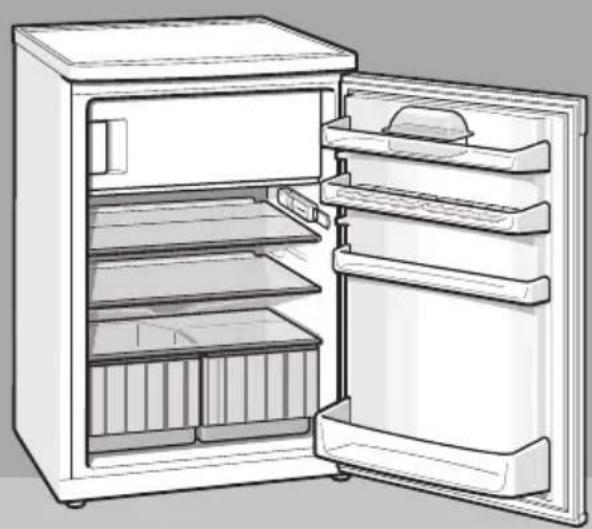
Line drawing of an open refrigerator with shelves and doors (no text or symbols)KT16L..
enInstructionforUse
en Index
Informationconcerningdisposal3......
Safetyandwarninginformation3......
Changingoverthedoorhinges6......
Installing appliance underworktop6.....
Connectingtheappliance7......
Gettingtoknowyourappliance7......
Fascia8......
Observingambienttemperature andventilation8
Switchingtheapplianceon 9
Settingthetemperature 9
Refrigerator compartment ..... 9
"super" cooling 9
Store food in the appliance ..... 10
Usable capacity .. 10
Interiorfittingsof refrigerator compartment 11
Sticker"OK" .... 11
The freezer compartment 11
Storingdeep-frozenfood andmakingice .... 12
Freezing fresh food 12
Freezing food 13
Super freezing 13
Thawing frozen food 14
Switchingoffanddisconnecting theappliance .... 14
Defrosting 14
Cleaning the appliance 15
Tips for saving energy 16
Operating noises 16
Eliminatingminorfaultsyourself ..... 17
Callingcustomerservicen 19......
Informationconcerning disposal

Disposalofpackaging
The packaging protects your appliance from damage during transit. All utilised materials are environmentally safe and recyclable. Please help us by disposing the packaging in an environmentally friendly manner.
Please ask your dealer or inquire at your local authority about current means of disposal.

Disposalofyourold oppliance
Old appliances are not worthless rubbish! Valuable raw materials can be reclaimed by recycling old appliances.
This appliance has been identified in accordance with the European directive 2002/96/EG on Waste Electrical and Electronic Equipment – WEEE.
The directive specifies the framework for an EU-wide valid return and recycling of old appliances.

Warning
Redundant appliances
- Pull out the mains plug.
- Cut off the power cord and discard with themainsplug.
Refrigerators contain refrigerant and gases in the insulation. Refrigerant and gases must be disposed of professionally. Ensure that tubing of the refrigerant circuit is not damaged prior to proper disposal.
Safetyandwarning information
BeforeyouswitchONthe appliance
Please read the operating and installation instructions carefully.
They contain important information on how to install, use and maintain the appliance.
Keep all documentation for subsequent use or for the next owner.
Technicalsafety
- This appliance contains a small quantity of environmentally-friendly but flammable R600a refrigerant. Ensure that the tubing of the refrigerant circuit is not damaged during transportation and installation. Leaking refrigerant may cause eye injuries or ignite.
Ifdamagehasoccurred
- Keep naked flames and/or ignition sources away from the appliance.
– Thoroughly ventilate the room for several minutes. - Switch off the appliance and pull out themainsplug.
- Notify customer service.
The more refrigerant an appliance contains, the larger the room must be. Leaking refrigerant can form a flammable gas-air mixture in rooms which are too small.
en
The room must be at least 1 m ^3 per8 g of refrigerant. The amount of refrigerant in your appliance is indicated on the rating plate inside the appliance.
- Only customer service may change the power cord and carry out any other repairs. Improper installations and repairs may put the user at considerable risk.
Importantinformationwhen usingtheappliance
- Never use electrical appliances inside the appliance (e.g. heater, electric ice maker, etc.). Riskofexplosion!
- Never use a steam cleaner to defrost or clean the appliance! The steam may penetrate electrical parts and cause a short-circuit. Riskofelectricshock!
- Do not use pointed or sharp-edged implements to remove frost or layers of ice. You could damage the refrigerant tubing. Leaking refrigerant may ignite or cause eye injuries.
- Do not store products which contain flammable propellants (e.g. spray cans) or explosive substances in the appliance. Riskofexplosion!
- Do not stand on or lean heavily against base of appliance, drawers or doors, etc.
- Before defrosting and cleaning the appliance, pull out the mains plug or switch off the fuse. Do not pull out the mains plug by tugging the cable.
- Bottles which contain a high percentage of a lcohol must be sealed and stored in an upright position.
- Keep plastic parts and the door seal free of oil and grease. Otherwise, parts and door seal will become porous.
- Never cover or block the ventilation openings for the appliance.
- People who have limited physical, sensory or mental abilities or inadequate knowledge must not use this appliance unless they are supervised or given meticulous instructions.
- Do not store bottled or canned drinks (especially carbonated drinks) in the freezer compartment. Bottles and cans willexplode!
- Do not put an ice lolly or ice cube directly from the freezer compartment into yourmouth. Risk of burns from very low temperatures!
- Never touch frozen food with wet hands. Your hands could freeze to the food!
- Do not scrape off hoarfrost or stuck frozen food with a knife or pointed object. You could damage the refrigerant tubing. Leaking refrigerant may ignite or cause eye injuries.
Childreninthehousehold
- Keep children away from packaging and its parts. Danger of suffocation from collapsible boxes and foil!
- Do not allow children to play with the appliance!
- If the app liance features a lock, keep the key out of the reach of children.
Generalregulations
The appliance is suitable
• for refrigerating and freezing food.
- formakingice.
The appliance is intended for domestic use only.
The appliance is suppressed according to EU Directive 2004/108/EC.
The refrigeration circuit has been checked for leaks.
This product complies with the relevant safety regulations for electrical appliances (EN 60335/2/24).
Installation
Installationlocation
Install the appliance in a dry, well ventilated room. The appliance should not be installed in direct sunlight or near a heat source such as a cooker, radiator, etc. If installation next to a heat source is unavoidable, use a suitable insulating plate.
Observe the following minimum distances toheatsources:
- 3 cm to electric or gas cookers.
- 30 cm to an oil or solid-fuel cooker.
If installing the appliance next to another refrigerator or freezer, there must be a minimum gap of 2 cm between the appliances in order to prevent condensation.
Aligningtheappliance
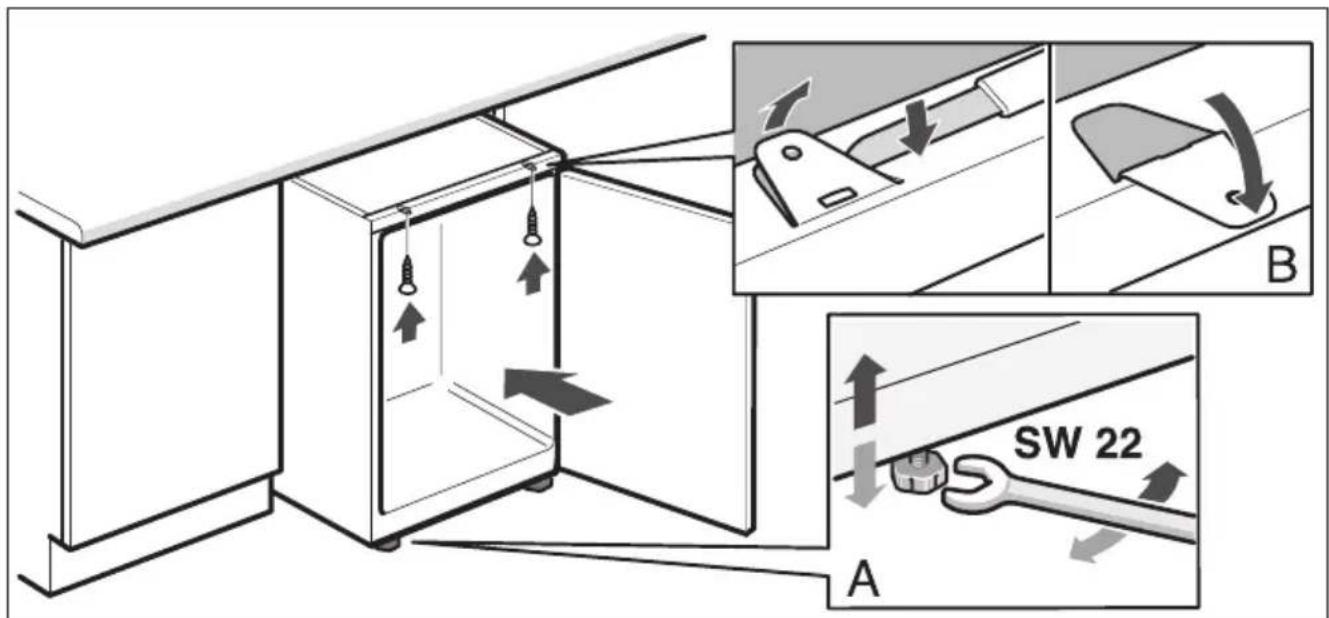
Fig. 2/A
The appliance must be level. If the floor is uneven, use the front height-adjustable feet.
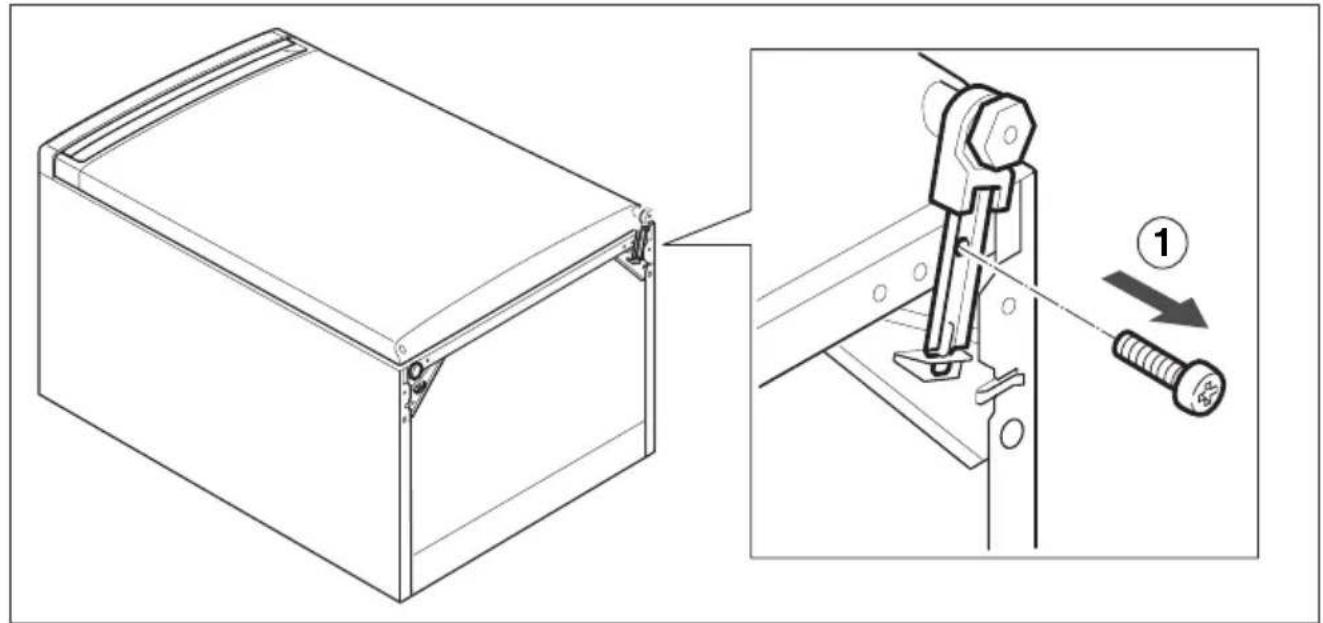
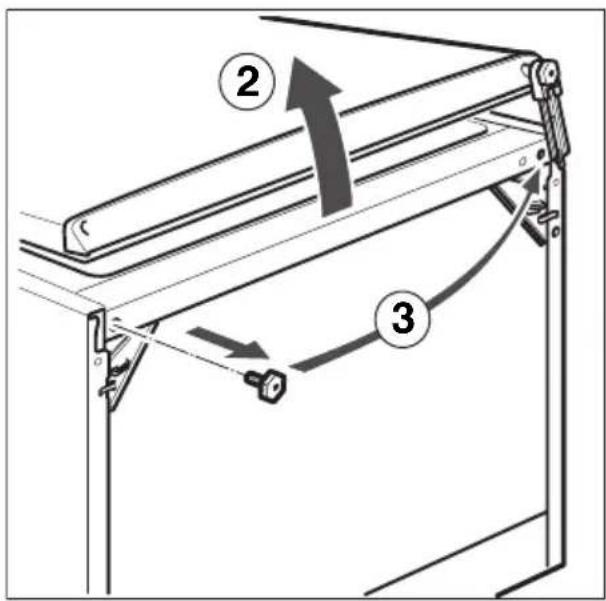
Changingoverthedoor hinges
⚠ Warning!
While changing over the door hinges, ensure that the appliance is not connected to the power supply. Pull out the mains plug beforehand. Tilt back the appliance (if required, place packaging material, etc. underneath).
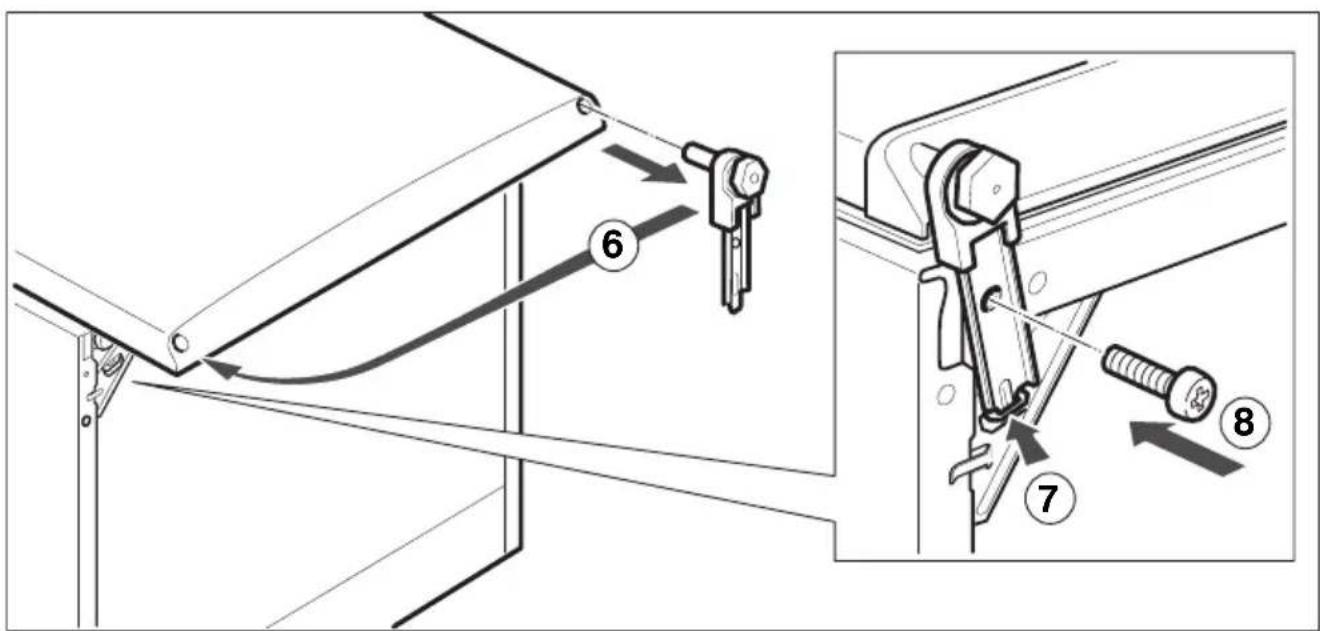
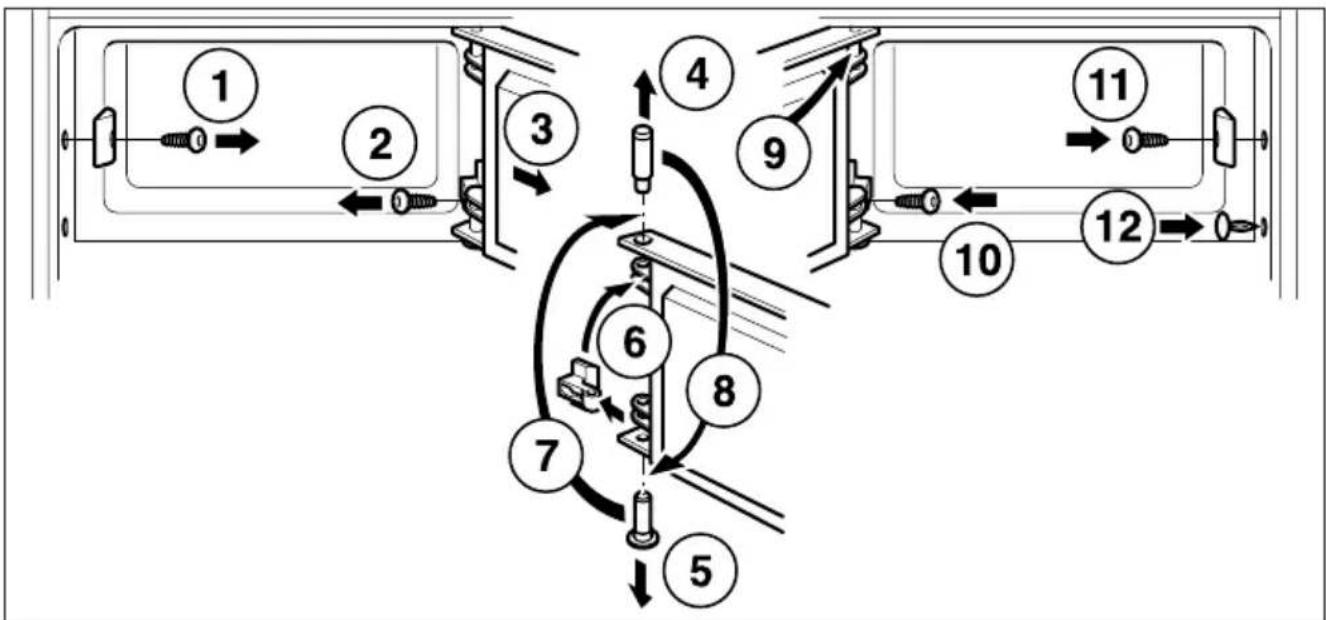
Appliancedoor
Fig. 3
The door hinges can be changed over if required by the installation location.
Installation in numerical sequence.
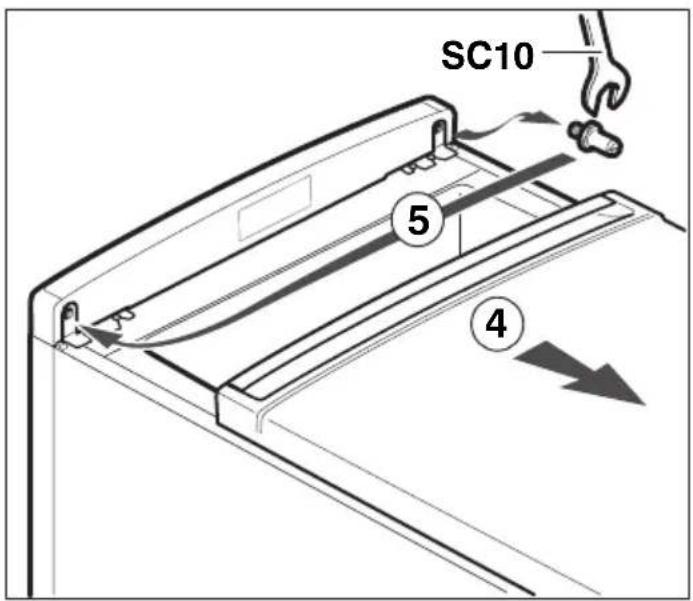
Freezercompartmentdoor
Fig. 4
Installation in numerical sequence.
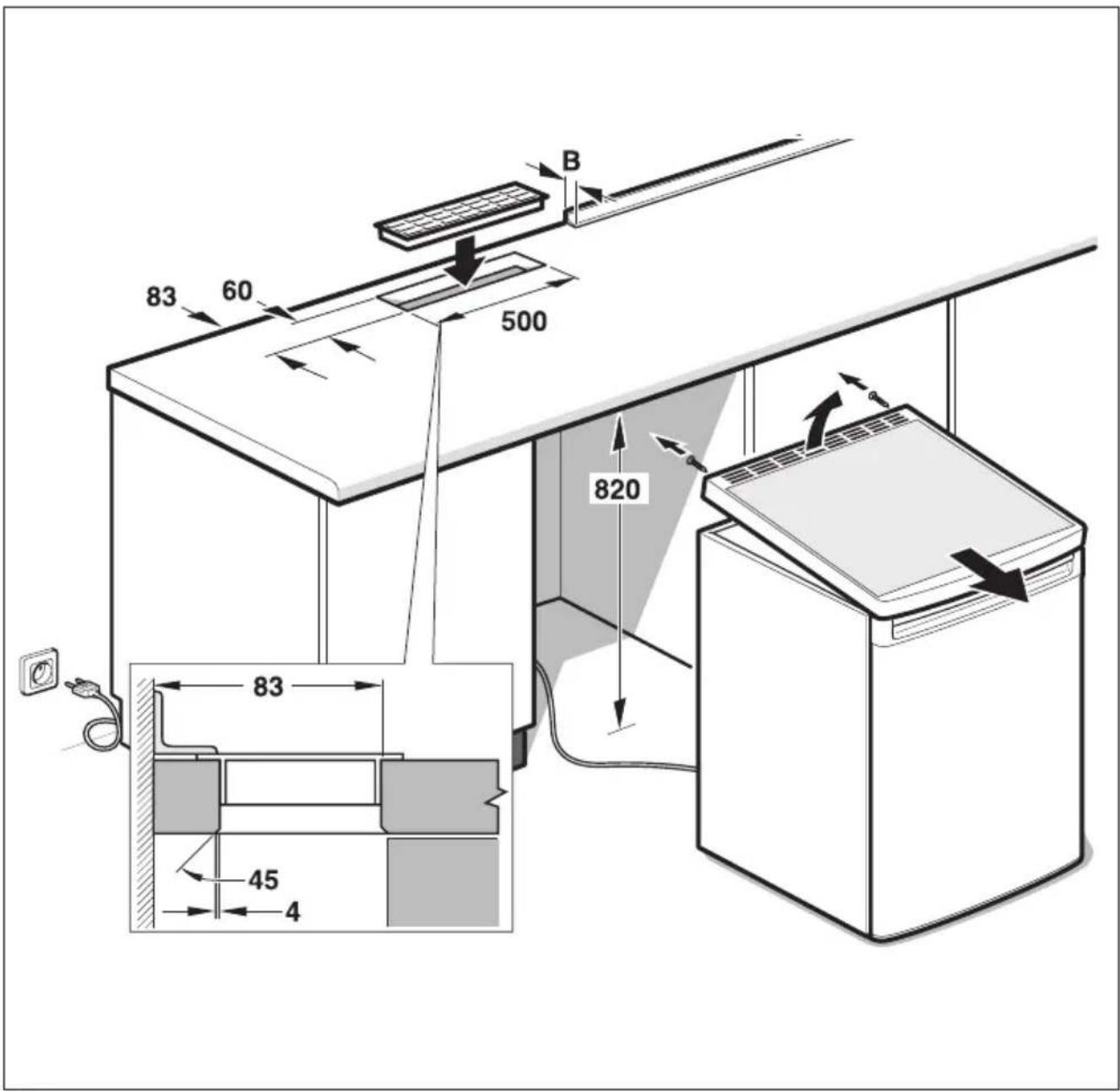
Installing appliance underworktop
After removing the worktop, the appliance can be installed under a worktop.
Fig. 1
Removingtheworktop
- Unscrew screws at the rear of the worktop.
- Lift worktop slightly and remove.
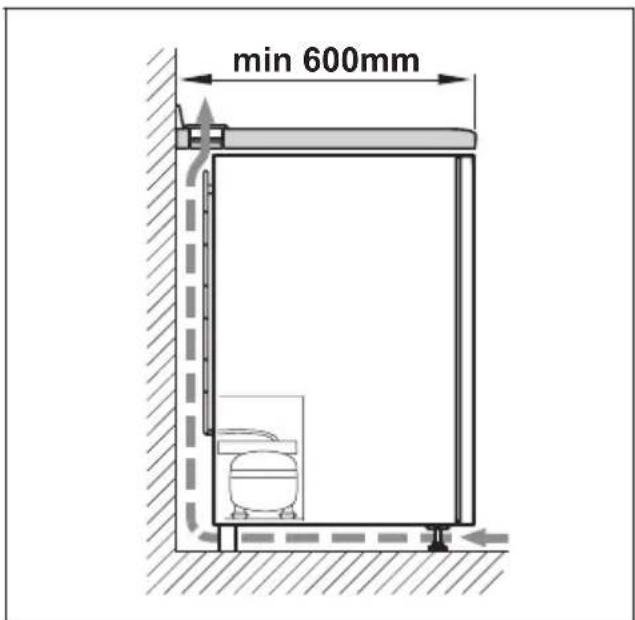
Applianceventilation
A ventilation cross-section of minimum 160 cm ^2 isnecessary for installation below a worktop. For this purpose, a vent measuring about 500 x 60 mm is required, which is available from DIY shops or specialist retailers.
- Mark the cut-out for the vent on the worktop centric to the appliance.
• Max. distance to wall 83 mm - Note width "B" of the wall connection rail!
- Saw out the cutout. Chamfer the underside by approx. 4 mm.
- Insert and attach the ventilation grille.
Note:
The vent is not required when the distance between the worktop and appliance is more than 5 cm.
Priortoinstallation
Before the appliance is pushed into the cavity, the tabs from the top cover strip must be bent upwards; the tabs should previously be lifted with a knife or similar.
Fig. 2/B
Applianceinstallationunderworktop
Insert the appliance into the cavity until the front edge of the appliance door is flush with the furniture doors of the adjacent cupboards.
Align the appliance with the height-adjustable feet until the upper edge of the appliance is situated on the worktop.
Adjust the height-adjustable feet with a wrench. Fig. 2/A
Fixingappliancetotheworktop
Secure the appliance to the worktop with standard chipboard screws.
Connecting the appliance
After installing the appliance, wait at least 1 hour until the appliance starts up. During transportation the oil in the compressor may have flowed into the refrigeration system.
Before switching on the appliance for the first time, clean the interior of the appliance (see chapter “Cleaning the appliance”).
The socket should be freely accessible. Connect the appliance only to 220–240 V/50 Hz alternating current via a correctly installed earthed socket. The socket must be fused with a 10 A to 16 A fuse.
If the appliance is to be operated in a non-European country, check whether the stated voltage and current type on the rating plate match the values of your mains supply match the values of the mains supply. The rating plate is situated in the bottom left-hand side of the appliance. The power cord may be replaced by a technician only.
Warning
Never connect the appliance to electronic energy saver plugs or to power inverters which convert the direct current to 230 V alternating current (e.g. solar equipment, power supplies on ships).
Gettingtoknowyour appliance
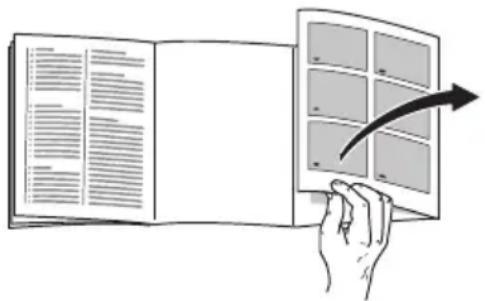
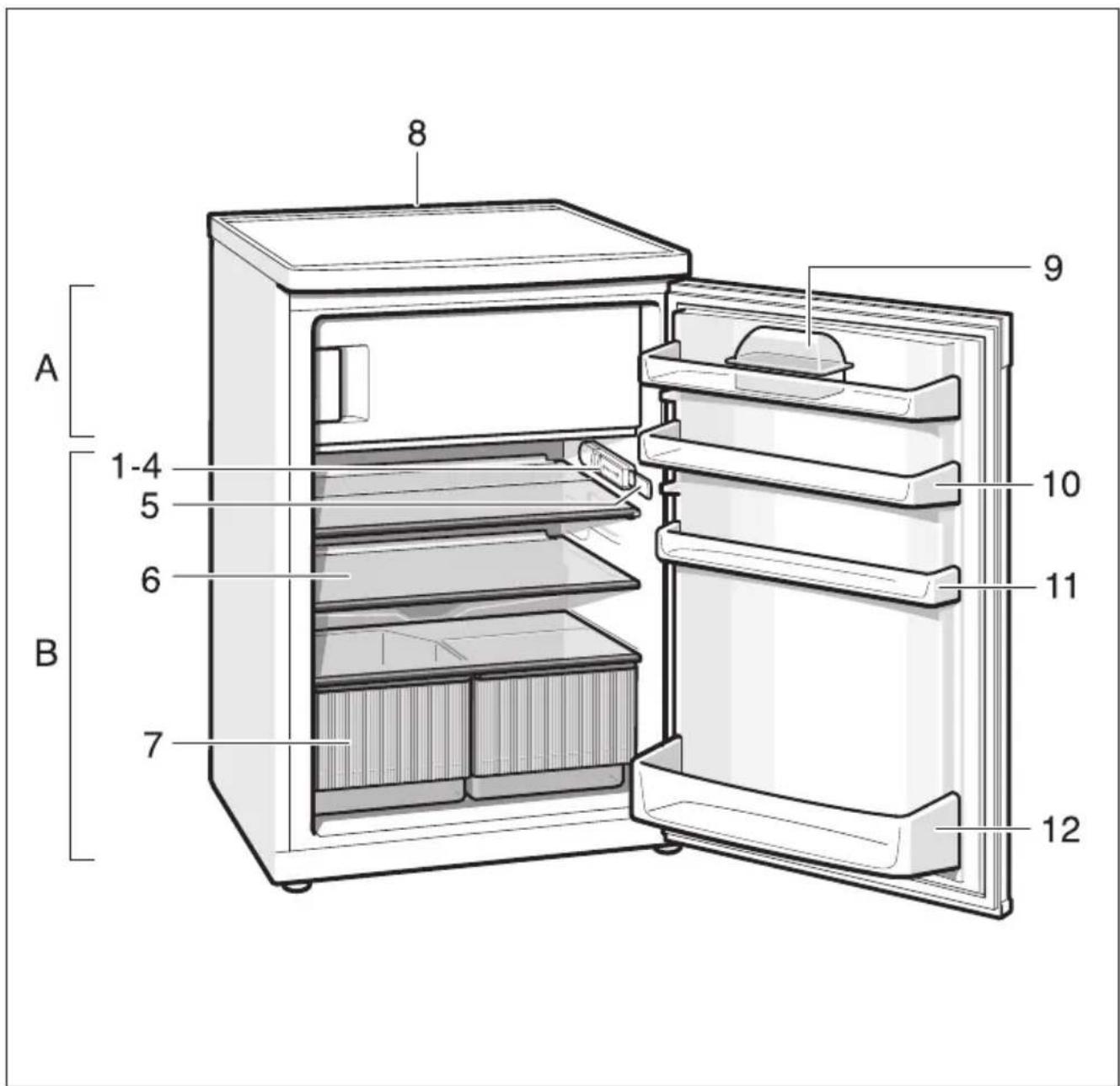
Please fold out the illustrated last page. These operating instructions apply to several models.
The diagrams may differ.
* notallmodels
Fig. 5
1-4 Fascia/Interiorlight
5Lightswitch
6Shelfintherefrigerator compartment
7Vegetablecontainer
8Ventilationopenings*
9Butterandcheesecompartment*
10Eggrack
11 Shelfortubesandsmalltins
12Trayforlargebottles
AFreezercompartment
BRefrigeratorcompartment
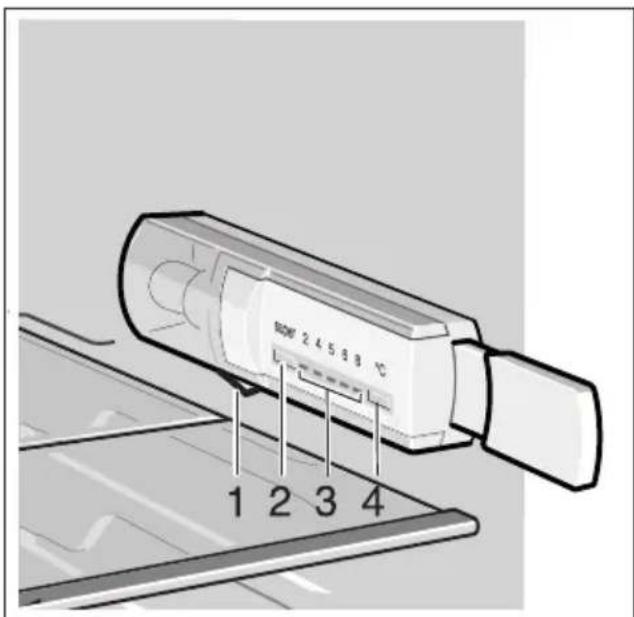
Fascia
Fig. 6
1 MainOn/Offswitch
Switches the whole appliance on and off.
2"super"button
Is used to switch on the super cooling (refrigerator compartment) or super freezing (freezer compartment) functions.
3Temperaturedisplayrefrigerator compartment
The numbers correspond to the set refrigerator compartment temperatures in ^ C.
4Refrigeratorcompartment temperatureselectionbutton
The button sets the temperature in the refrigerator compartment.
Observingambient temperatureand ventilation
The climate class can be found on the rating plate. It states the room temperature within which the appliance can be operated. The rating plate is located in the refrigerator compartment at the bottom left-hand side.
| Climateclass | Permittedambient temperature |
| SN+10°Cto32°C | |
| N+16°Cto32°C | |
| ST+16°Cto38°C | |
| T+16°Cto43°C |
Note
At room temperatures below +20 °C and when super freezing is on, the interior light may come on at a reduced luminosity when the door is almost closed (or when the light switch is depressed).
This is quite normal and can be ignored.
Ventilation
Fig. 7
The air on the rear panel of the appliance heats up. Conduction of the heated air must not be obstructed. Otherwise, the refrigeration unit must work harder. This increases power consumption. Therefore: Never cover or block ventilation openings!
Switchingthe applianceon
Switch on the appliance with the main switch. Fig. 6/1
The temperature display flashes, Fig. 6/3, until the appliance has reached the set temperature.
Interior light in refrigerator compartment is switched on when the door is open.
Settingthe temperature
Fig. 6
Freezercompartment
The temperature in the freezer compartment depends on the temperature in the refrigerator compartment. Colder set temperatures also cause colder freezer compartment temperatures.
Refrigeratorcompartment
(can be selected from +2 °C to +8 °C)
Keep pressing temperature selection button 4 until the required refrigerator compartment temperature is set. The value last selected is stored.
The set temperature is indicated on display 3.
We recommend a setting of +4 °C.
Perishable food should not be stored above+4 °C.
Refrigerator compartment
The temperature in the refrigerator compartment can be set from +2 °C to +8 °C.
The refrigerator compartment is the ideal storage location for ready meals, cakes and pastries, preserved food, condensed milk, hard cheese, fruit and vegetables sensitive to cold as well as tropical fruit.
"super" cooling
Super cooling cools the refrigerator compartment as cold as possible for approx. 6 hours. Then the temperature set before super cooling mode is automatically restored.
Switch on "super" cooling mode, e.g.:
- before placing large quantities of food in the refrigerator compartment.
• to cool drinks quickly.
Switchingonandoff
Fig. 6
Press "super" button 2.
The button is lit when "super" cooling is switchedon.
Storefoodinthe appliance
Notethechillzonesinthe refrigeratorcompartment!
The air circulation in the refrigerator compartment produce different refrigerant zones:
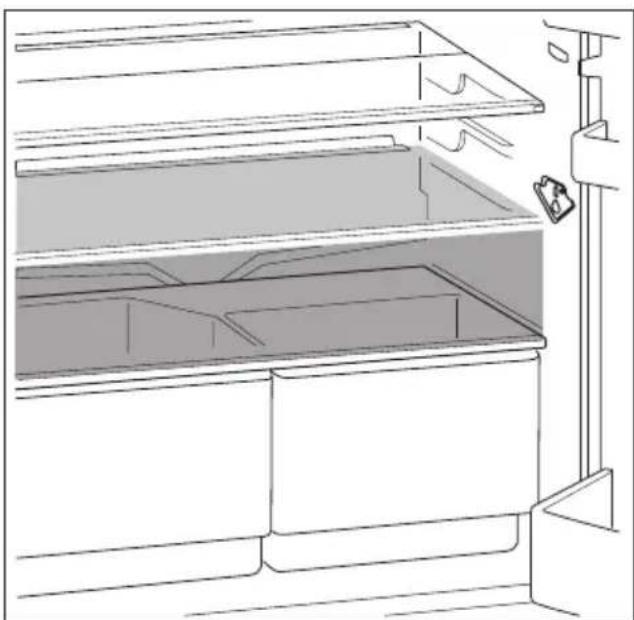
•Coldestzone
is between the arrow stamped on the side and the glass shelf situated below.
Fig. 8
Note: Store perishable food (e.g. fish, sausage, meat) in the coldest zones.
•Warmestzone
is at the very top of the door.
Note: Store e.g. cheese and butter in the warmest zone. When served, the cheese will not have lost its flavour and the butter will be easy to spread.
Notewhenloadingproducts
Wrap or cover food before placing in the appliance. This will retain the aroma, colour and freshness of the food.
In addition, flavours will not be transferred between foods and the plastic parts will not become discoloured.
Werecommendarrangingthefoodas follows:
- In the freezer compartment: frozen food, ice cubes, ice cream
- On the shelves in the refrigerator compartment (from top to bottom): cakes and pastries, ready meals, dairy products, meat and sausage
- In the vegetable container: vegetables, salad, fruit
- In the door (from top to bottom): butter, cheese, eggs, tubes, small bottles, large bottles, milk, juice cartons
Usablecapacity
Information on the usable capacity can be found inside your appliance on the rating plate.
Interiorfittings of refrigerator compartment
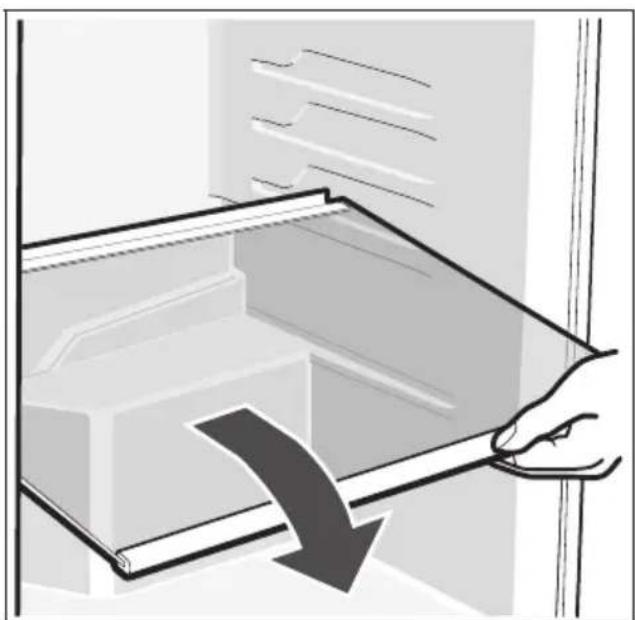
If required, you can vary the shelves inside the appliance: pull the shelf forwards, lower and swivel out to the side. Fig. 9
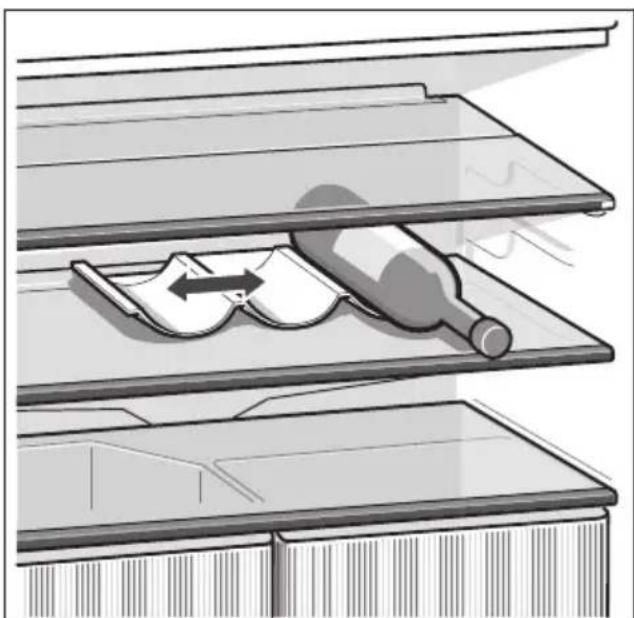
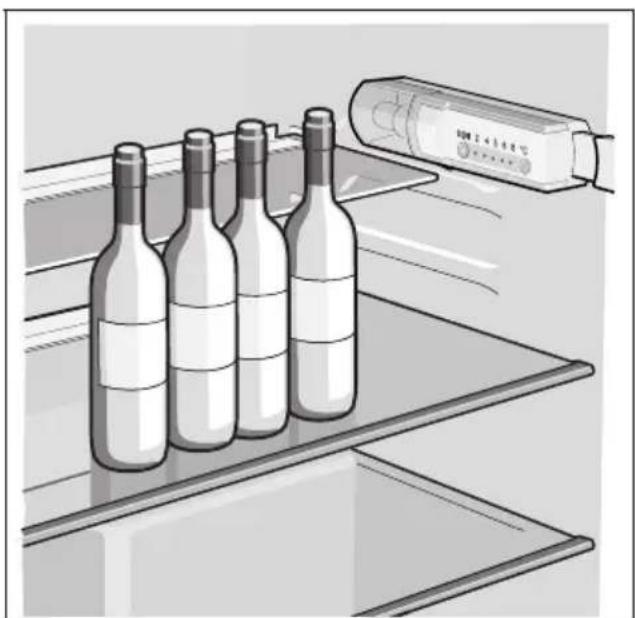
Bottleshelf
Fig. 10
Bottles can be stored securely on the bottle shelf. The holder can be adjusted.
Varioshelf
Fig. 11
The front half of the Vario shelf can be taken out. You can then place tall items (e.g. cans, bottles) on the shelf below.
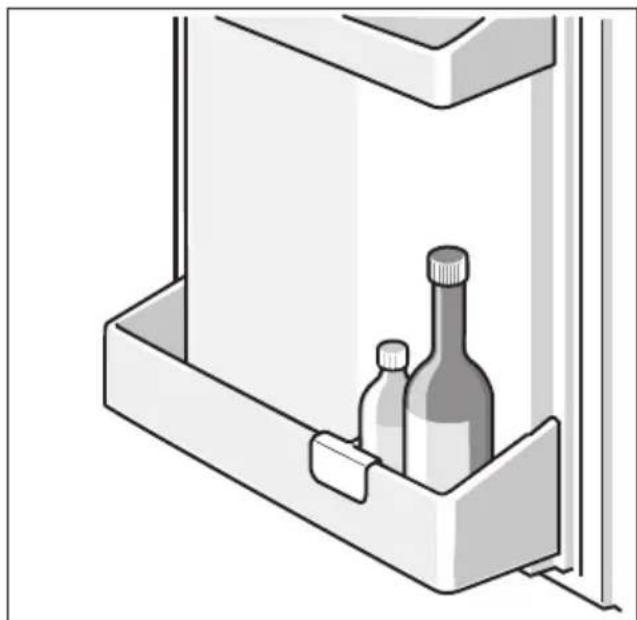
Bottleholder
Fig. 12
The bottle holder prevents bottles from falling over when the door is opened and closed.
Sticker"OK"
notallmodels
The “OK” temperature monitor can be used to determine temperatures below +4 °C. Gradually reduce the temperature if the sticker does not indicate “OK”.
Note
When the appliance is switched on, it may take 12 hours until the temperature is reached.


CorrectsettingTemperature too high, reduce temperature.
Thefreezer compartment
Usingthefreezer compartment
• To store deep-frozen food.
- To make ice cubes.
- For freezing small quantities of food.
Note
The freezer compartment door engages audibly.
Ensure that the freezer compartment door has been closed properly. If the door is open, the frozen food will thaw. The freezer compartment will become covered in thick ice. Also: waste of energy due to high power consumption!
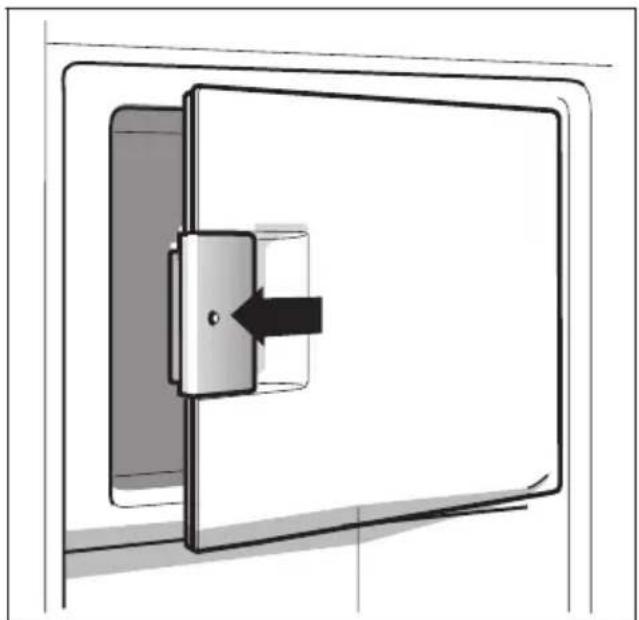
Doorclosedindicator
(notallmodels)
The door closed indicator, Fig. 13, signals that the freezer compartment door is closed properly.
- Red display: the freezer compartment doorisopen.
- Whited isplay: the freezer compartment doorisclosed.
Storingdeep-frozen foodandmakingice
When purchasing frozen food, observe the following:
- Check that the packaging is not damaged.
- Check the use-by date.
- The temperature of the supermarket freezer should be -18^ or lower. If not, the shelf life of the frozen food is reduced.
- Purchase deep-frozen food last. Wrap food in newspaper or place in a cool bag and take home.
- At home immediately place deep-frozen food in the freezer compartment. Close the freezer compartment door properly. Use the deep-frozen food before the sell-by date runs out.
- Do not refreeze thawed food. Exception: If the food has been used for a ready meal (boiling or frying), this ready meal can be refrozen.
Makingicecubes
Ice cube trays are available from specialist outlets.
Fill the ice cube tray 34 full of water and place in the freezer compartment. To loosen the ice cubes, twisttheicetray slightly or hold briefly under flowing water.
Freezingfreshfood
Freezingfoodyourself
If you are freezing food yourself, use only fresh, undamaged food.
The following foods aresuitable for freezing:
Meat and sausage products, poultry and game, fish, vegetables, herbs, fruit, cakes and pastries, pizza, ready meals, leftovers, egg yolk and egg-white.
The following foods are not suitable for freezing:
Eggs in shells, soured cream and mayonnaise, green salads, radishes and onions.
Blanchingvegetablesandfruit
To retain colour, flavour, aroma and vitamin C, vegetables and fruits should be blanched prior to freezing. Blanching is the brief immersion of vegetables and fruit in boiling water. Literature on freezing and blanching is available in bookshops.
Freezingfood
Freeze fresh, undamaged food only.
Keep food which is to be frozen away from food which is already frozen.
To prevent food from losing its flavour or drying out, place in airtight containers.
Max.freezingcapacity
Information about the max. freezing capacity within 24 hours can be found on the rating plate.
Packingfoodcorrectly:
- Place the food in the wrapping.
- Remove all the air.
- Seal the wrapping.
- Label the wrapping with the contents and date.
The following products are suitable for wrapping food:
Cling wrap, polyethylene blown film, aluminium foil and freezer tins. These products can be purchased from yourdealer.
The following products are not suitable for wrapping food:
Wrapping paper, greaseproof paper, cellophane, refuse bags and used shoppingbags.
The following products are suitable for sealing the wrapped food:
Rubber bands, plastic clips, string, cold-resistant adhesive tape or similar. Bags and polyethylene blown film can be sealed with a film sealer.
Shelflifeoffrozenfood
Depends on the type of food. At a mean temperature:
- Fish, sausage, ready meals and cakes and pastries: upto6months
- Cheese, poultry and meat: upto8months
•Ve getables and fruit: upto12months
Superfreezing
Food should be frozen solid as quickly as possible in order to retain vitamins, nutritional value, appearance and flavour.
To prevent an undesirable temperature rise when placing fresh food in the freezer compartment, switch on super freezing several hours beforehand.
Smaller quantities of food can be frozen without superfreezing.
Switchingonandoff
Fig. 6
Press "super" button 2.
If the super freezing has been switched on thebuttonislit.
Note
“Super freezing” may also slightly increase refrigeration of the refrigerator compartment.
Thawingfrozenfood
Depending on the type and application, select one of the following options:
- At room temperature.
- In the refrigerator.
- in an electric oven, with/without fan assistedhot-air.
- In the microwave.
Note
Do NOT refreeze food which is beginning to thaw or which has already thawed. Only ready meals (boiled or fried) may be refrozen.
No longer store the frozen produce for the max. storage period.
Switchingoffand disconnectingthe appliance
Switchingtheapplianceoff
Press main switch. Fig. 6/1 Refrigeration unit and interior light switch off.
Disconnecting the appliance
If you do not use the appliance for a prolonged period:
- Switch the appliance off.
- Pull out the mains plug or switch off the fuse.
- Cleaning the appliance.
- Leave the appliance door open.
Defrosting
Freezercompartment
The freezer compartment does not defrost automatically. A layer of hoarfrost in the freezer compartment will impair refrigeration of the frozen food and increase power consumption. Regularly defrost the freezer compartment.
Attention!
Do not scrape off hoarfrost or ice with a knife or pointed object. You could damage the refrigerant tubes. Leaking refrigerant may ignite or cause eye injuries.
Proceedasfollows
- Remove the frozen food and store temporarily in a cool location.
- Switch the appliance off.
- Pull out the mains plug or switch off the fuse.
- Leave the appliance to defrost.
- Wipe up the condensation and rub dry.
- Switch on the appliance again.
- Put the frozen food back in the freezer compartment.
Defrostingaids
You can accelerate the defrosting process by placing a pan of hot water in the freezer compartment. Place the pan on a heat-insulating base!
Warning!
Never use electrical appliances or naked flames to defrost the freezer compartment, e.g. heaters, steam cleaners, candles, kerosene lamps, etc.
Cautionwhenusingdefrostingsprays:
- Defrosting sprays may form explosive gases
- Defrosting sprays may contain solvents or propellants which attack plastic
- Defrosting sprays may be a health hazard
Follow the manufacturer's instructions.
Refrigeratorcompartment defrostsfullyautomatically
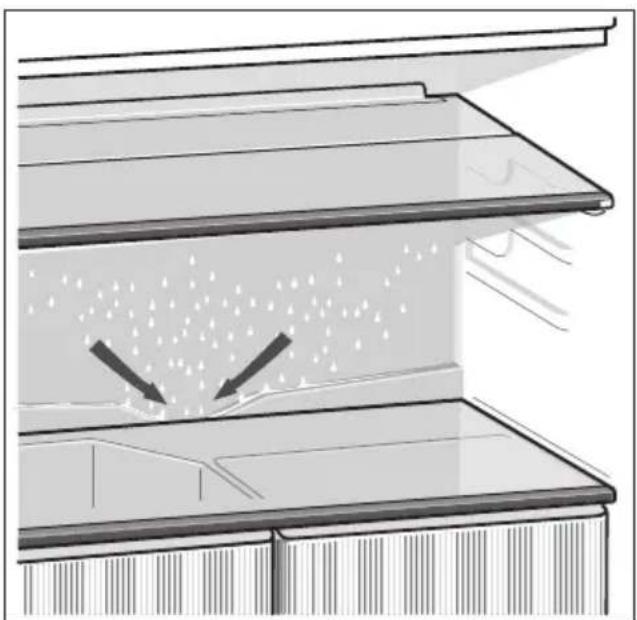
While the refrigeration unit is running, beads of condensation or hoarfrost form at the back of the refrigerator compartment. This is quite normal. It is not necessary to wipe off the condensation or frost. The rear panel defrosts automatically. The condensation runs into the condensation channel.
Fig. 14
The condensation runs down the condensation channels to the refrigerating unit where it evaporates.
Note: Keep the condensation channel and drain hole clean so that the condensation can drain.
Cleaningtheappliance
Proceedasfollows:
- Switch off the appliance, pull out the mains plug or switch off the fuse.
- Wipe the door seal with clear water only and then wipe dry thoroughly.
- Clean the appliance with lukewarm water and a little washing-up liquid. The rinsing water must not get into the temperature selector or light. Fig. 6
Note:
Regularly clean the condensation channel and drainage hole, Fig. 14, so that the condensation can flow out.
Clean the condensation channel with cotton buds, etc.
The rinsing water must not run through the drain hole into the evaporation pan.
Do not use abrasive or acidic cleaning agents and solvents.
- After cleaning: reconnect and switch ontheappliance.
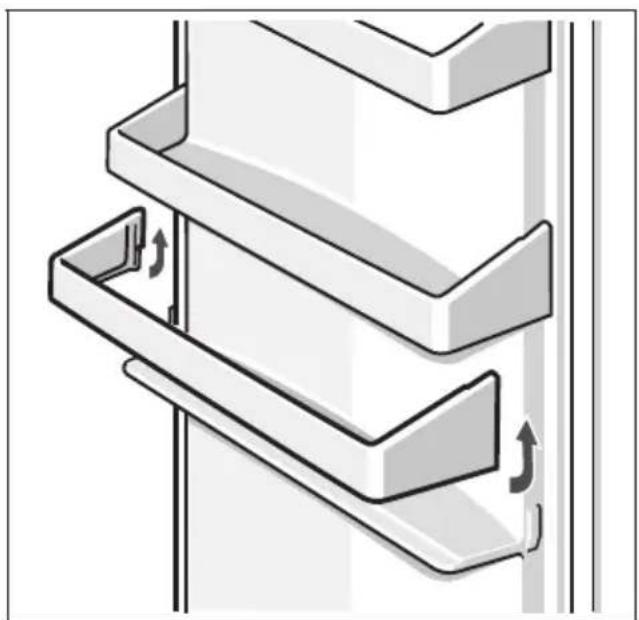
Door shelves can be removed for cleaning. Fig. 15
Warning:
Never clean the shelves or containers in the dishwasher. The parts may become deformed!
Tipsforsavingenergy
- Install the appliance in a dry, well ventilated room! but not in direct sunlight and not near a heat source (e.g. radiator, cooker, etc.). If required, use an insulating plate.
- Allow warm food and drinks to cool down before placing in the appliance!
- When thawing frozen products, place them in the refrigerator. The low temperature of the frozen products cools the food in the refrigerator.
- Open and close the door as briefly as possible.
- A layer of hoarfrost in the freezer compartment will impair refrigeration of the frozen food and increase power consumption. Defrost the appliance if frostforms!
- Ensure that the freezer compartment door has been closed properly.
- Occasionally clean the rear of the appliance with a vacuum cleaner or paint brush to prevent an increased power consumption.
Operatingnoises
Quitenormalnoises
Humming - refrigeration unit is running.
Bubbling, gurgling or whirring noises—refrigerant is flowing through the tubing.
Clicking – motor is switching on or off.
Preventingnoises
Theapplianceisnotlevel
Please align the appliance with a spirit level. Use the height-adjustable feet or place packing underneath them.
The appliance is not free-standing
Please move the appliance away from adjacent furniture or appliances.
Drawersorstorageareaswobbleor stick
Please check the removable parts and re-insert them if required.
Bottlesorreceptaclesaretouching eachother
Move the bottles or receptacles slightly away from each other.
Eliminatingminorfaultsyourself
Beforeyoucallcustomerservice:
Please check whether you can eliminate the fault yourself based on the following information.
Customer service will charge you for advice, even if the appliance is still under guarantee!
| Fault | PossiblecauseRemedialaction | |
| Temperaturediffers greatlyfromtheset value. | Insomecasesitisadequatetoswitchoffthe appliancefor5minutes.Ifthetemperatureistoohigh,waitafew hoursandcheckwhetherthetemperature hasapproachedthesetvalue.Ifthetemperatureistoolow,checkthe temperatureagainthenextday. | |
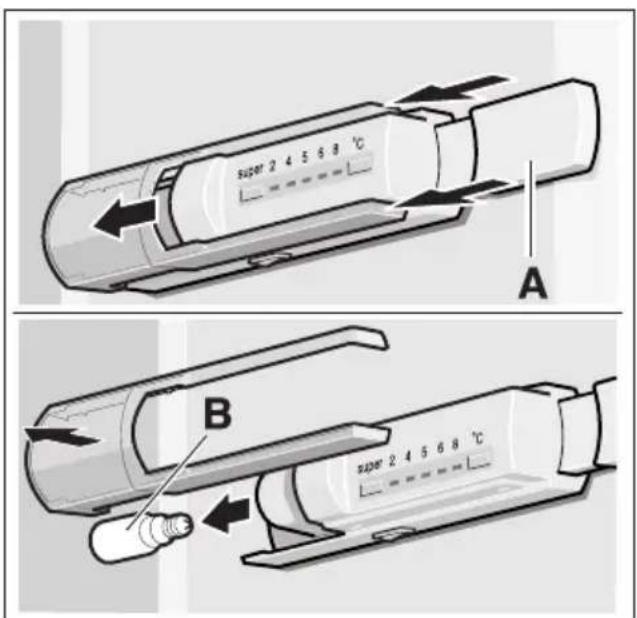
| Interiorlightdoesnot work. | The bulb is defective. | Replace bulb. Fig. 16/B1.Pulloutthemainsplugordisconnectthe fuse.2.Slidecovergrilleforwardsandremove.3.Changethebulb;replacementbulb, 220–240 Va.c.,E14lampholder,see defectivebulbforwattage.(Attention! Kryptonbulbavailablefromcustomer serviceonly.)InthecaseofhalogenlampsReplacementbulbareavailablefrom customerservice.Incandescentlight bulbs(max.25watts)canalsobeused. |
| Lightswitchisjammed. Fig. 16/A | Checkwhetheritcanbemoved. | |
| Thefrozenfoodisfrozen solid. | Loosenfrozenfoodwithabluntobject. Donotuseaknifeorpointedobject.You coulddamagetherefrigeranttubingorthe plasticsurface. | |
| Thereisathicklayer of frostinthefreezer compartment.Fault | Defrostingthefreezercompartment(see Defrosting).Alwaysensurethatthefreezer compartmentdoorisclosedproperly.Freezercompartmentdoormust“click”shut.RemedialactionPossiblecause | |
| Flooroftherefrigerator compartmentiswet. | Thecondensationoutletis blocked.Fig. 14 | Cleanthecondensationchannelandthe drainagepipe(see“Cleaningthe appliance”). |
| Thetemperatureinthe refrigerator compartmentistooocold. | Thefreezercompartment doorhasnotbeenclosed properly. | Closethefreezercompartmentdoor.Freezer compartmentdoormust“click”shut. |
| Temperaturehasbeenset toolow. | Increasethetemperature. | |
| Iflargequantitiesoffresh foodarebeingfrozen,the temperatureinthe refrigeratorcompartment dropstemporarily,asthe refrigerationunitrunsfora longtime. | Donotexceedmax.freezingcapacity. | |
| Therefrigerationunitis switchingonmore frequentlyandforlonger. | Appliancedooropened frequently. | Donotopenthedorunnecessarily. |
| Largequantitiesoffresh foodarebeingfrozen. | Donotexceedmax.freezingcapacity. | |
| Theventilationopenings havebeencovered. | Removeobstacles. | |
| Temperaturedisplay lampflashes.Fig. 6/3 | Appliancedooropened frequently. | Donotopenthedorunnecessarily. |
| Alotoffoodwasplacedin thefreezer. | ||
| Theventilationopenings havebeencovered. | Removeobstacles. | |
| Refrigeratorhasno coolingcapacity. | Theappliancemainswitch hasnotbeenswitchedon. | Presstheappliancemainswitch. |
| Powerfailure;thefusehas beenswitchedoff;the mainsplughasnotbeen insertedproperly. | Checkwhetherthepowerison,checkthe fuses. | |
| Theinteriorlightglows atareducedluminosity whenthedoorisalmost closed(orlightswitch depressed). | Ambienttemperatureis below20 °Corsuper freezinghasbeen switchedon.Notafault! | Theinteriorlightgoesoutagainatambient temperaturesabove20°Coraftersuper freezinghasbeenswitchedoff. |
Callingcustomer servicen
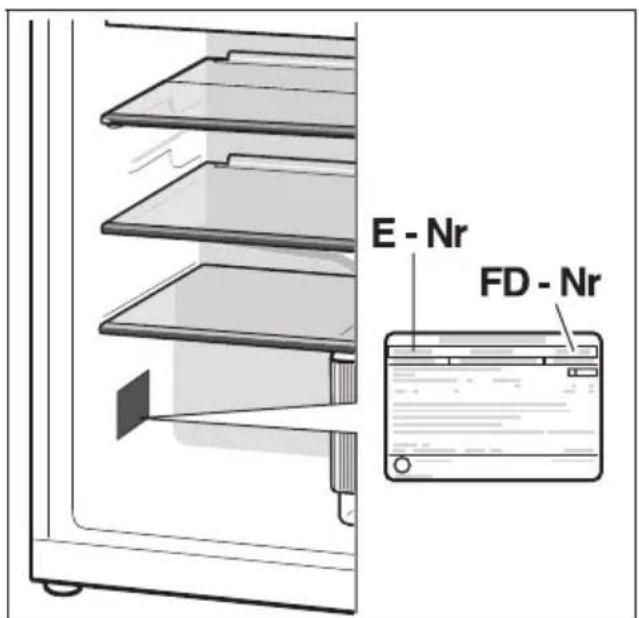
Your local customer service can be found in the telephone directory or in the customer-service index. Please provide customer service with the appliance product number (E-Nr.) and production number(FD).
These specifications can be found on the rating plate. Fig. 17
To prevent unnecessary call-outs, please assist customer service by quoting the product and production numbers. This will save you additional costs.
1
2
flowchart
graph TD
    A["1"] --> B["2"]
    B --> C["3"]
    C --> D["4"]
    D --> E["5"]
    E --> F["6"]
    F --> G["7"]
    G --> H["8"]
    H --> I["9"]
    I --> J["10"]
    J --> K["11"]
    K --> L["12"]
    L --> M["End"]
4
6
7
natural_image
Line drawing of a refrigerator interior showing storage compartments and door frame (no text or symbols)8
natural_image
Illustration of a hand inserting a card into a refrigerator (no text or symbols)9
natural_image
Illustration of a shelf with a bottle and eyeglasses on top, no text or symbols present10
natural_image
Illustration of a wine rack with four bottles and a refrigerant bottle on top (no text or symbols)11
natural_image
Illustration of a storage cabinet with two bottles on one side and a container with a handle (no text or symbols)12
natural_image
Diagram of a door with a double door and arrow indicating left side (no text or symbols)13
natural_image
Diagram of a multi-level storage or cleaning system with arrows indicating flow direction (no text or symbols)14
natural_image
Diagram of a multi-level mechanical or architectural component with directional arrows indicating movement or force (no text or symbols present)15
16
17
Siemens-Electrogeräte GmbH
Carl-Wery-Str. 34, 81739 München
©Siemens-ElectrogeräteGmbH.
www.siemens-homeappliances.com 9000 681 130 (9106)

- en Index
- Informationconcerning disposal
- Disposalofpackaging
- Disposalofyourold oppliance
- Warning
- Safetyandwarning information
- BeforeyouswitchONthe appliance
- Technicalsafety
- Ifdamagehasoccurred
- en
- Importantinformationwhen usingtheappliance
- Childreninthehousehold
- Generalregulations
- Installation
- Installationlocation
- Aligningtheappliance
- Fig. 2/A
- Changingoverthedoor hinges
- ⚠ Warning!
- Appliancedoor
- Fig. 3
- Freezercompartmentdoor
- Fig. 4
- Installing appliance underworktop
- Fig. 1
- Removingtheworktop
- Applianceventilation
- Note:
- Priortoinstallation
- Fig. 2/B
- Applianceinstallationunderworktop
- Fixingappliancetotheworktop
- Connecting the appliance
- Gettingtoknowyour appliance
- Fig. 5
- Fascia
- Fig. 6
- MainOn/Offswitch
- 2"super"button
- 3Temperaturedisplayrefrigerator compartment
- 4Refrigeratorcompartment temperatureselectionbutton
- Observingambient temperatureand ventilation
- Note
- Ventilation
- Fig. 7
- Switchingthe applianceon
- Settingthe temperature
- Freezercompartment
- Refrigeratorcompartment
- Refrigerator compartment
- "super" cooling
- Switchingonandoff
- Storefoodinthe appliance
- Notethechillzonesinthe refrigeratorcompartment!
- •Coldestzone
- Fig. 8
- •Warmestzone
- Notewhenloadingproducts
- Werecommendarrangingthefoodas follows:
- Usablecapacity
- Interiorfittings of refrigerator compartment
- Bottleshelf
- Fig. 10
- Varioshelf
- Fig. 11
- Bottleholder
- Fig. 12
- Sticker"OK"
- Thefreezer compartment
- Usingthefreezer compartment
- Doorclosedindicator
- Storingdeep-frozen foodandmakingice
- Makingicecubes
- Freezingfreshfood
- Freezingfoodyourself
- The following foods aresuitable for freezing:
- The following foods are not suitable for freezing:
- Blanchingvegetablesandfruit
- Freezingfood
- Max.freezingcapacity
- Packingfoodcorrectly:
- The following products are suitable for wrapping food:
- The following products are not suitable for wrapping food:
- The following products are suitable for sealing the wrapped food:
- Shelflifeoffrozenfood
- Superfreezing
- Thawingfrozenfood
- Switchingoffand disconnectingthe appliance
- Switchingtheapplianceoff
- Disconnecting the appliance
- Defrosting
- Attention!
- Proceedasfollows
- Defrostingaids
- Warning!
- Cautionwhenusingdefrostingsprays:
- Refrigeratorcompartment defrostsfullyautomatically
- Fig. 14
- Cleaningtheappliance
- Warning:
- Tipsforsavingenergy
- Operatingnoises
- Quitenormalnoises
- Preventingnoises
- Theapplianceisnotlevel
- The appliance is not free-standing
- Drawersorstorageareaswobbleor stick
- Bottlesorreceptaclesaretouching eachother
- Eliminatingminorfaultsyourself
- Beforeyoucallcustomerservice:
- Callingcustomer servicen
Marcă : SIEMENS
Model : KT16LAW40
Categorie : Frigider