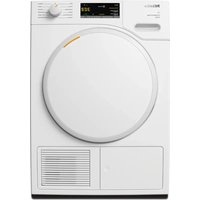
MODE D'EMPLOI T650C MIELE
Instructions d'utilisation pour sèche-linge à condensation T 650 C
Il est essentiel de lire ces instructions d'utilisation avant d'installer ou d'utiliser la machine afin d'éviter tout risque d'accident ou de dommage à la machine.
Sommaire
Guide de l'appareil.... 4
Protection de l'environnement 6
Avertissements et consignes de sécurité 7
Instructions brèves 10
Notes sur l'entretien du linge 11
Comment sécher correctement
Conseils pour économiser l'énergie 12
Mise en marche et chargement 12
Sélection d'un programme 13
Sélection d'options supplémentaires 13
Démarrage d'un programme 13
Après le séchage 14
Options supplémentaires 15
Tableau des programmes 16
Modification d'un programme 18
Verrouillage électronique du système 19
Fonctions programmables
Vue générale 20
Activation et mémorisation 21
Nettoyage et entretien
Nettoyage des filtres à peluches 22
Nettoyage du sèche-linge 22
Vidange du réservoir d'eau condensée 23
Nettoyage du bloc condenseur 24
Guide de résolution des problèmes
Que faire si... 26
Service après-vente
Réparations.... 30
Mises à jour futures.... 30
Installation
Installation 31
Sortie d'eau condensée externe 32
Branchement électrique 34
Données de consommation 35
Données techniques 36
Vue générale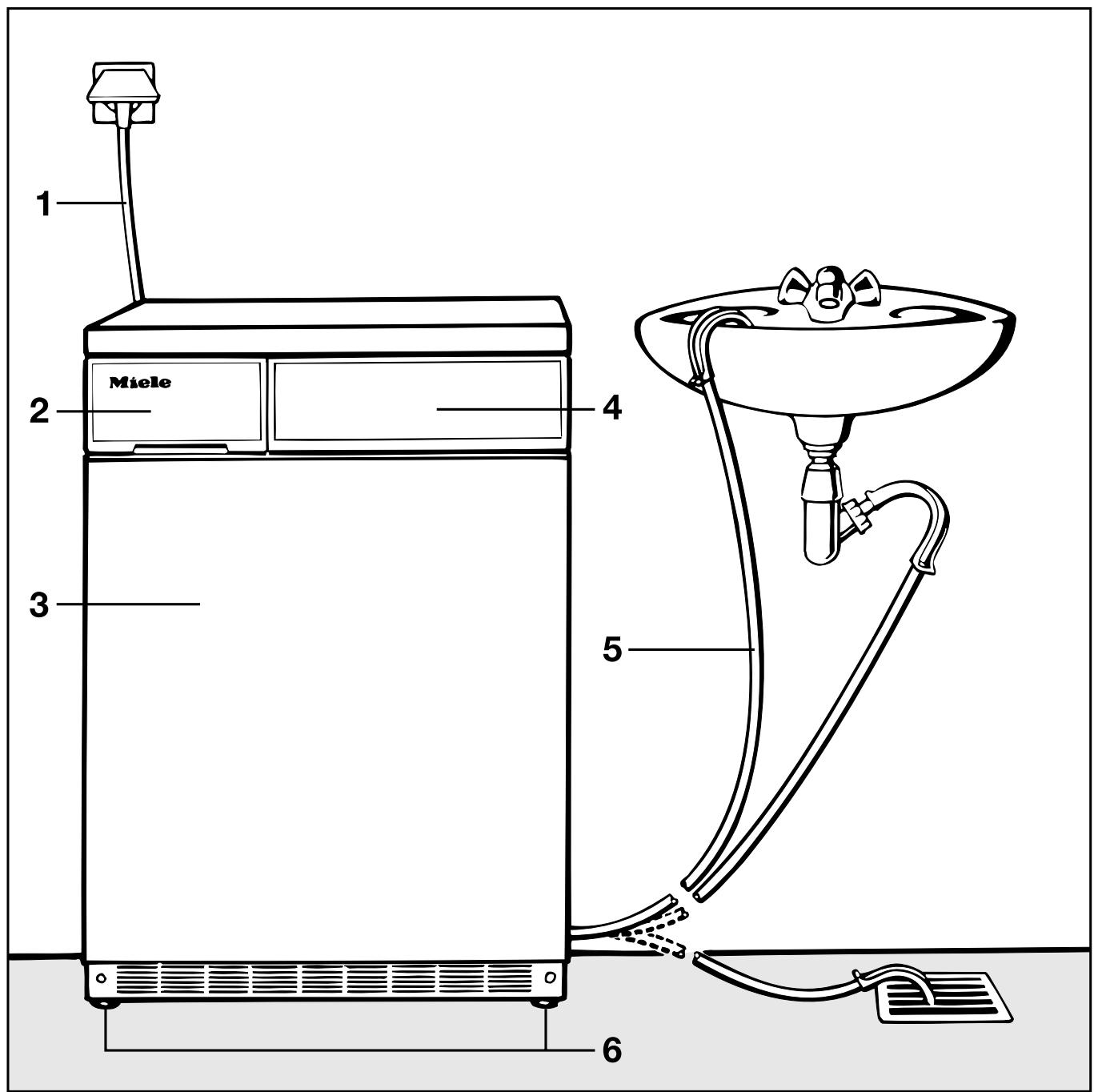
1 Câble d'alimentation pour le branchement électrique 2 Réservoir d'eau condensée 3 Porte 4 Panneau de commande 5 Tuyau d'évacuation de l'eau condensée (si installé) 6 Quatre pieds à vis réglables en hauteur
Panneau de commande
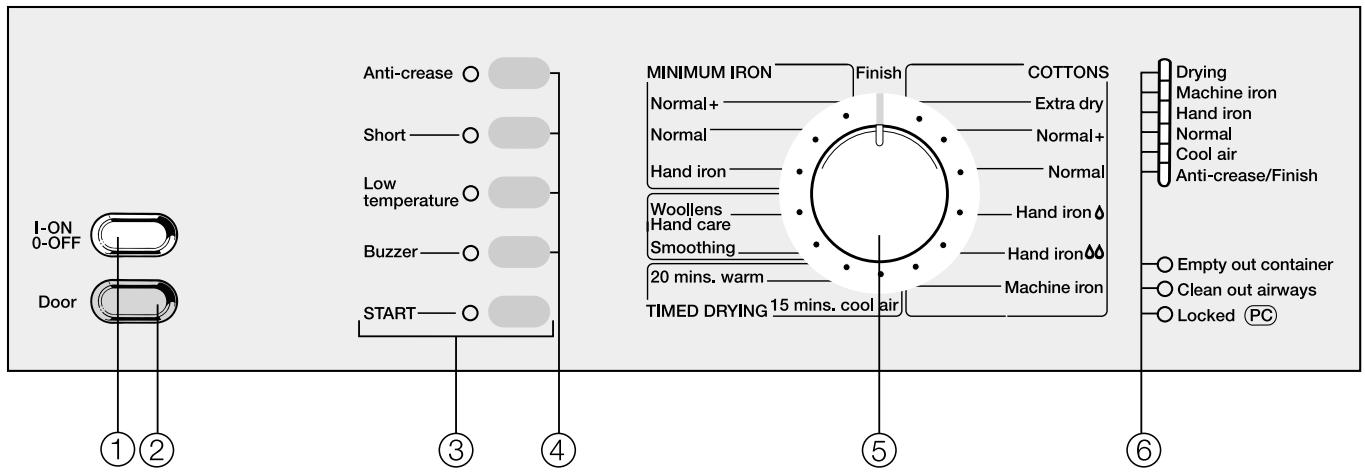
pour allumer et éteindre l'appareil. Lorsque la machine est allumée, l'éclairage du tambour s'allume à l'ouverture de la porte.
pour ouvrir la porte/annuler un programme. Ce bouton ne reste pas enfoncé.
démarre un programme de séchage.
Le voyant :
- clignote pour indiquer que le programme peut être démarré ;
- reste allumé une fois le programme commencé.
Voyants : allumé = option sélectionnée
éteint = option non sélectionnée
⑤ Sélecteur de programme
peut être tourné dans le sens horaire ou antihoraire.
L'anneau lumineux s'éteint dans les circonstances suivantes :
- si la machine a été allumée pendant plusieurs minutes sans qu'aucun programme n'ait été sélectionné ou démarré ; – une fois le programme terminé depuis plusieurs minutes.
⑥ Voyants de séquence et de contrôle
Veuillez consulter la section « Guide de dépannage » pour les voyants de contrôle.
Élimination de l'emballage
L'emballage de transport et de protection a été choisi parmi des matériaux respectueux de l'environnement pour leur élimination et peuvent normalement être recyclés. Plutôt que de jeter ces matériaux, veuillez les proposer au recyclage.
Élimination de votre ancienne machine/appareil
Les anciennes machines/appareils contiennent des matériaux recyclables. Veuillez contacter votre revendeur, votre centre de collecte des déchets local ou un ferrailleur pour connaître les programmes de recyclage possibles. Assurez-vous que la machine/appareil ne présente aucun danger pour les enfants pendant son stockage en vue de son élimination. Consultez les conseils appropriés dans les instructions « Avertissements et consignes de sécurité ».
Veuillez lire les instructions d'utilisation avant d'utiliser le sèche-linge pour la première fois. Elles contiennent des informations importantes concernant la sécurité, l'utilisation et l'entretien de la machine. Cela évitera tout risque d'accident et de dommage à la machine. Conservez ces instructions d'utilisation dans un endroit sûr et assurez-vous que les nouveaux utilisateurs en connaissent le contenu. Transmettez-les à tout futur propriétaire de la machine.
Utilisation correcte
Le sèche-linge est uniquement destiné au séchage de tissus lavés dans une solution aqueuse et marqués sur l'étiquette d'entretien du fabricant comme étant adaptés au séchage en tambour. Toute autre utilisation peut être dangereuse. Le fabricant n'est pas responsable des dommages résultant d'une utilisation ou d'une manipulation inappropriée. Ne laissez pas les jeunes enfants jouer avec la machine et ses commandes ou l'utiliser. Veuillez superviser son utilisation par les personnes âgées ou fragiles.
Sécurité technique
Vérifiez l'absence de dommages externes visibles avant l'installation.
N'installez pas et n'utilisez pas une machine ou un appareil endommagé.
Avant de brancher la machine, assurez-vous que les données de raccordement figurant sur la plaque signalétique (fusibles, tension et fréquence) correspondent à l'alimentation électrique du secteur. En cas de doute, consultez un électricien qualifié. La sécurité électrique de cette machine ne peut être garantie que si la continuité est complète entre l'appareil et un système de mise à la terre efficace conforme aux réglementations locales et nationales. Il est très important que cette exigence de sécurité de base soit régulièrement vérifiée par un électricien qualifié. Le fabricant ne peut être tenu responsable des conséquences d'un système de mise à la terre inadéquat. La machine est construite conformément aux exigences de sécurité en vigueur. Des réparations non autorisées pourraient entraîner des dangers imprévus pour l'utilisateur, dont le fabricant ne peut accepter la responsabilité. Les réparations ne doivent être effectuées que par un technicien agréé Miele. En cas de panne ou pour le nettoyage, la machine n'est complètement isolée de l'alimentation électrique que lorsque :
- la fiche est retirée, ou
- elle est éteinte au niveau du secteur, ou
- le fusible principal est retiré.
Pour des raisons de sécurité, n'utilisez pas de rallonge. Il y a un risque de surchauffe. - Les composants défectueux ne doivent être remplacés que par des pièces de rechange d'origine Miele. Ce n'est que lorsque ces pièces sont installées que les normes de sécurité de la machine peuvent être garanties.
Utilisation
N'installez pas la machine dans une pièce où la température peut descendre en dessous de zéro, car des températures inférieures à zéro pourraient endommager la machine.
De l'eau condensée gelée dans la pompe, le tuyau et le réservoir d'eau condensée peut également entraîner des dommages.
Si l'eau est évacuée à l'extérieur par le tuyau d'évacuation au lieu d'être recueillie dans le réservoir d'eau condensée, assurez-vous que le tuyau d'évacuation est solidement fixé si vous le suspendez dans un évier ou un bassin, afin d'éviter que le tuyau ne glisse et que l'eau ne cause des dommages.
L'eau condensée n'est pas de l'eau potable. Elle peut causer des problèmes de santé chez les personnes et les animaux. Fermez toujours la porte après utilisation pour éviter le danger de :
- quelqu'un s'appuyant sur la porte, ce qui pourrait faire basculer la machine ;
- des enfants grimpant dans la machine ou y cachant des objets.
Il y a un danger d'incendie avec les tissus qui :
- contiennent du caoutchouc, du caoutchouc mousse ou des matériaux similaires au caoutchouc ; – ont été traités avec des agents de nettoyage inflammables ;
- ont été éclaboussés de laque pour cheveux, de spray capillaire, de dissolvant de vernis à ongles ou de produits similaires ;
- également les articles rembourrés (par exemple, coussins, vestes) qui ont été endommagés, car le rembourrage pourrait tomber et prendre feu ;
- sont souillés de graisse ou d'huile.
Dans les pays où il y a des zones susceptibles d'être infestées par des cafards ou d'autres vermines, accordez une attention particulière à maintenir l'appareil et son environnement dans un état de propreté à tout moment. Tout dommage pouvant être causé par des cafards ou d'autres vermines ne sera pas couvert par la garantie de l'appareil.
Utilisation des accessoires
- Les pièces d'accessoires ne peuvent être montées que si elles sont expressément approuvées par Miele. Si d'autres pièces sont utilisées, les réclamations de garantie, de performance et de responsabilité du produit peuvent être invalidées.
Mise au rebut de votre ancienne machine
Avant de jeter une ancienne machine, débranchez-la et rendez la fiche inutilisable. Coupez le câble directement derrière l'appareil pour éviter toute mauvaise utilisation.
Description succincte
Les programmes sont sélectionnés en tournant le sélecteur de programme et peuvent être complétés en appuyant sur les boutons d'options supplémentaires.
Appuyez sur le bouton « DÉPART » pour démarrer un programme.
Les voyants du déroulement du programme (sur le côté droit du panneau de commande) indiquent l'étape en cours du programme.
Le système Sensitive ajuste automatiquement le séchage en fonction de la qualité de l'eau pour des résultats plus précis. Les commandes Novotronic mesurent et enregistrent la conductivité de l'eau et compensent les variations pour obtenir un taux d'humidité résiduel uniforme. L'inversion automatique du tambour le fait tourner dans les deux sens pour assouplir le linge et éviter un séchage inégal, garantissant ainsi de bons résultats.
Une fois le degré de séchage souhaité atteint, le linge est refroidi.
À la fin du programme, la phase de repassage facile commence. Le tambour tourne par intermittence pour réduire la formation de plis et de faux plis.
Les fonctions programmables permettent de sélectionner ou de désélectionner certaines options supplémentaires et d'introduire d'autres fonctions. Ces combinaisons peuvent être mémorisées dans la machine et rappelées.
Veuillez lire les sections « Avertissements et consignes de sécurité » et « Conseils d'entretien du linge ».
① Mise en marche de la machine et chargement du linge
■ Mettez la machine en marche en appuyant sur le bouton « I-Marche/0-Arrêt ». - Appuyez sur le bouton « Porte » pour ouvrir la porte. ■ Placez le linge sans le tasser dans le tambour. ■ Fermez la porte en la poussant doucement, sans la claquer. Ne poussez pas sur la porte pour la fermer.
② Sélection d'un programme
■ Tournez le sélecteur de programme sur le niveau de séchage souhaité.
③ Sélection d'options supplémentaires
■ Appuyez sur les boutons pour activer ou désactiver les options supplémentaires selon vos besoins.
4 Démarrage du programme
■ Appuyez sur le bouton « DÉPART ».
Avant le séchage, vérifiez le symbole de séchage sur l'étiquette d'entretien du textile.
Signification des symboles :
☐ = Séchage à température normale ☐ = Séchage à basse température
(appuyez également sur le bouton « Basse température »
si nécessaire) ☒ = Ne pas sécher au tambour ☐ = Peut être séché au tambour
Si aucun symbole n'est présent, séchez à vos risques et périls en suivant les principes suivants :
Les articles en coton et en repassage facile doivent être séchés avec le programme approprié (voir les tableaux de programmes).
Pour les tissus délicats, par exemple l'acrylique, sélectionnez « Repassage facile » et appuyez également sur le bouton « Basse température ».
Ne surchargez jamais le tambour. Respectez toujours les charges maximales recommandées indiquées dans le « Tableau des programmes ». Une surcharge peut provoquer une usure inutile du linge, donner un résultat de séchage décevant et augmenter le froissage.
Les tissus suivants ne doivent pas être séchés dans un sèche-linge :
- Laines et mélanges de laine
Ces tissus ont tendance à feutrer et à rétrécir. Ils peuvent toutefois être partiellement séchés avec le programme « Laine main ».
- Articles rembourrés*
L'intérieur en tissu fin a tendance à rétrécir, selon la qualité.
– Lin pur*
Ces articles ne doivent être séchés au sèche-linge que si le fabricant l'indique comme approprié sur l'étiquette d'entretien du textile, car la surface du tissu pourrait sinon « pelucher ».
* Les articles en lin et en duvet peuvent toutefois être partiellement séchés à l'aide du programme « Repassage facile ».
Remarques :
Certains matériaux tissés et tricotés en maille (par exemple les T-shirts, le jersey de coton) ont tendance à rétrécir, selon leur qualité, et ce phénomène est souvent aggravé par un séchage excessif. Lors de l'achat de vêtements tissés, il est conseillé de tenir compte de leurs propriétés de rétrécissement.
Le linge amidonné peut être séché au sèche-linge. Pour obtenir la finition habituelle, il faut utiliser le double de la quantité d'amidon.
Les tissus infroissables et les chemises ou chemisiers en coton 100 % ont tendance à se froisser davantage, surtout lorsque les charges sont plus importantes, en particulier lorsque le tissage est très fin. Réduisez la charge ou utilisez le programme spécial « Infroissable – Repassage à la main ». Si cela ne convient pas, utilisez le réglage « Repassage facile », puis suspendez les vêtements sur un cintre pour les faire sécher.
Les tissus neufs de couleur foncée doivent être séchés séparément des tissus de couleur claire pour éviter que les couleurs ne déteignent.
Conseils pour économiser l'énergie
■ Assurez-vous que votre linge a été soigneusement essoré à la vitesse d'essorage la plus élevée appropriée avant le séchage. L'essorage à 1600 tr/min, par exemple, permet d'économiser environ 30 % d'énergie et de temps par rapport à 800 tr/min. - Chargez la quantité de linge maximale selon le programme choisi (voir « Tableau des programmes ») pour un séchage le plus économique par rapport à la taille de la charge. Assurez-vous que le tambour n'est ni surchargé ni sous-chargé. ■ Dans la mesure du possible, triez les tissus selon :
- le type de fibre ou de tissage
- le degré de séchage requis
- la taille similaire des articles
- la teneur en humidité après essorage. Cela contribuera à un résultat de séchage uniforme. ■ Assurez-vous que la pièce est bien ventilée.
① Mise en marche et chargement
■ Fermez les housses de couette, etc. pour éviter que les petits articles ne s'y roulent à l'intérieur. ■ Fermez les fermetures à glissière et attachez les ceintures en tissu et les cordons de tablier. ■ Appuyez sur le bouton « I-On / 0-Off ». ■ Appuyez sur le bouton « Porte » et ouvrez la porte.
Assurez-vous qu'aucun distributeur de détergent ne se trouve parmi le linge, car il pourrait fondre et endommager la machine et le linge.
■ Chargez le linge très librement dans le tambour. Ne surchargez pas le tambour. Une surcharge peut provoquer une usure inutile du linge et donner un résultat de séchage décevant. ■ Fermez la porte avec une légère impulsion, mais ne la claquez pas. Ne poussez pas sur la porte pour la fermer.
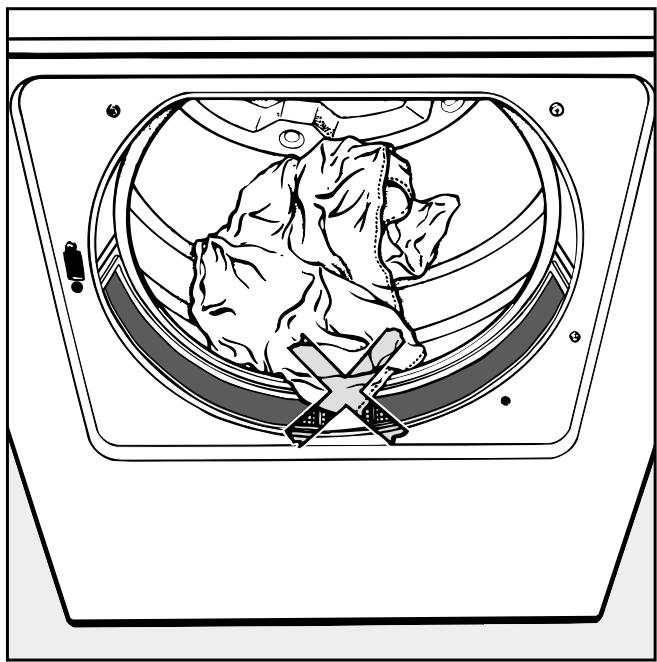
Important : veuillez vérifier que les articles de linge ne peuvent pas être coincés par la porte, car cela endommagerait le tissu.
② Sélection d'un programme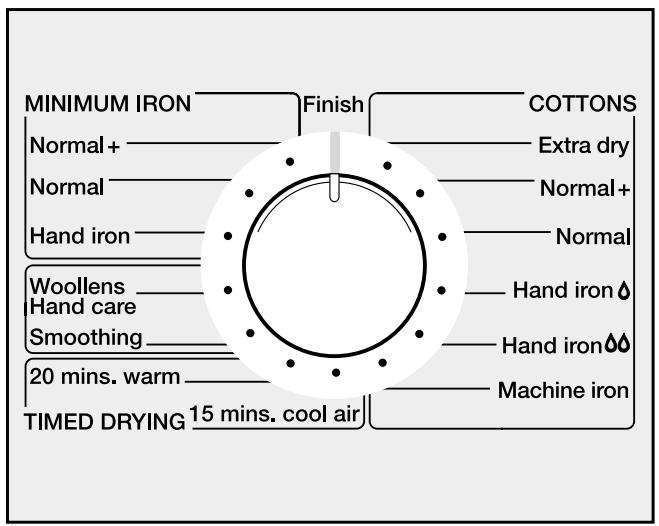
■ Tournez le sélecteur de programme sur le programme souhaité.
Voir le « Tableau des programmes » pour une description de chaque programme.
COTON ; REPASSAGE FACILE ; Laine, lavage à la main ; Lissage
La durée du programme est déterminée par l'électronique en fonction de chaque charge.
SÉCHAGE MINUTERIE :
La durée du programme est toujours la même.
③ Sélection d'options supplémentaires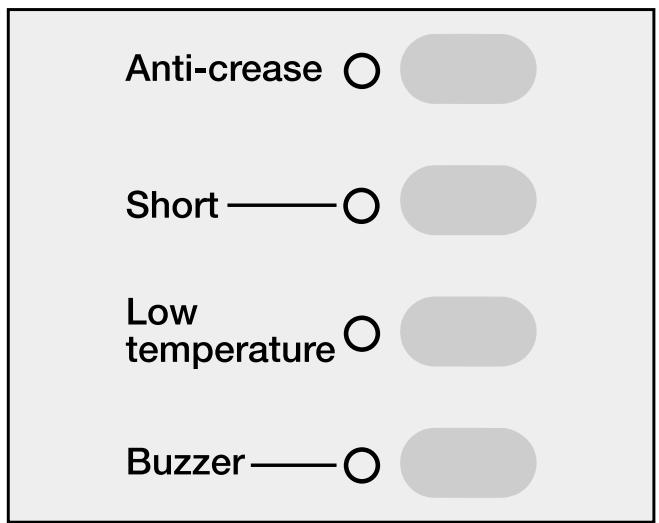
■ Les options supplémentaires peuvent être activées ou désactivées selon les besoins.
Voir la section « Options supplémentaires » pour une description de chaque option.
4 Démarrage d'un programme
■ Appuyez sur le bouton « DÉPART ».
L'affichage du stade de séchage sur le côté droit du bandeau indique le stade de séchage atteint par le programme.
La fonction mémoire :
Si la fonction mémoire a été activée, la machine rappelle automatiquement les options supplémentaires sélectionnées pour le dernier programme utilisé. Les voyants indiquent les options sélectionnées.
Pour plus de détails sur la fonction mémoire, veuillez consulter la section « Fonctions programmables ».
Voyant « Nettoyer les conduits d'air »
Ce voyant indique que le sèche-linge ne fonctionne pas de manière optimale ou économique.
Les causes de ce message de contrôle peuvent être :
- les filtres à peluches de la porte et les filtres secondaires de l'ouverture de la porte sont obstrués ;
- le condenseur est obstrué.
Le voyant « Nettoyer les conduits d'air » ne s'éteint qu'avant le début d'un programme si le sèche-linge a été éteint avec le bouton « I-On/0-Off ».
Après le séchage
Lorsque le programme de séchage est terminé, le voyant de la séquence « Anti-froissage / fin » s'allume.
- Appuyez sur le bouton « Porte » pour ouvrir la porte. ■ Retirez le linge. ■ Assurez-vous que le tambour est vide.
Si des articles sont laissés dans le sèche-linge, ils pourraient être endommagés par un séchage excessif lors de la prochaine utilisation.
■ Après chaque cycle, retirez les peluches de
- le filtre à peluches de la porte
- les filtres de l'ouverture de la porte (voir la section « Nettoyage et entretien »).
■ Videz le réservoir d'eau de condensation (s'il n'y a pas d'évacuation externe de l'eau). Voir la section « Nettoyage et entretien ».
Fermez la porte et éteignez la machine après chaque utilisation.
■ Appuyez sur le bouton « I-On / 0-Off » pour éteindre.
Anti-froissage
Court —— O
Basse température
Buzzer — O

■ Des options supplémentaires peuvent être activées ou désactivées en appuyant sur le bouton correspondant avant le début d'un programme.
Voyants :
- allumé = option supplémentaire activée
- éteint = option supplémentaire désactivée
Il n'est pas possible d'activer des options supplémentaires incompatibles avec le programme de séchage de base sélectionné. Le voyant s'éteint lorsque le bouton de l'option est relâché.
Si une combinaison inappropriée d'options est sélectionnée (par exemple « Court » et « Basse température »), seule l'option sélectionnée en dernier sera activée.
Anti-froissage
Une fois le programme terminé, le tambour tourne à intervalles réguliers pour éviter que le linge ne se froisse et ne se plie.
Court
La durée du programme est réduite.
- Pour sécher des tissus non délicats.
Basse température
La température de séchage est réduite.
- Pour les tissus délicats (symbole de séchage ☐), par exemple l'acrylique.
La durée du programme est augmentée.
Avertisseur sonore
Un signal sonore retentit à plusieurs reprises à la fin d'un programme pendant la phase d'anti-froissage.
Le volume de l'avertisseur sonore peut être réglé :
① Sélectionnez le programme. 2 Appuyez sur le bouton « Avertisseur sonore » (le voyant de l'avertisseur sonore s'allume) jusqu'à ce que le volume souhaité soit atteint. La tonalité de l'avertisseur sonore monte en même temps. 3 Relâchez le bouton « Avertisseur sonore » et démarrez le programme.
| Programme | Fabric type | maximum load (2) | Special notes |
| COTTONS |
| Extra dry | Multi-layered fabrics, not thoroughly dried with “Normal +” | 5 kg | Do not dry jersey wear in the Extra dry programme – tendency to shrink. |
| Normal + | Mixed load of cotton fabrics, eg towelling, jerseywear, ie single and multi-layered fabrics. | 5 kg | - |
| Normal(1) | Load of similar fabrics (jersey wear, flannelette sheets, towelling). | 5 kg | If fabrics are too damp, select “Normal +”. |
| Hand iron Δ | Cotton or linen fabrics (eg table linen, bedlinen, starched laundry etc) | 5 kg | - |
| Hand\ iron\ ΔΔ(1) | 5 kg | If laundry is still too damp for hand ironing, then select “Hand iron Δ ” in the future. |
| Machine iron | Cotton or linen fabrics, including starched laundry, for machine ironing | 5 kg | The laundry should be rolled up to prevent it from drying out until it can be ironed. |
| MINIMUM IRON |
| Normal+ | Minimum iron items which are made of synthetics or blended fabrics, (eg pullovers, dresses, trousers) which are not dried adequately in the “Normal” programme | 2.5 kg | Spin minimum iron fabrics for at least 30 seconds in the washing machine before drying |
| Normal(1) | Minimum iron shirts, Table cloths etc made of blended fabrics, (eg cotton/synthetics). | 2.5 kg |
| Hand iron | Minimum iron shirts, Table cloths etc made of blended fabrics, (eg cottons and synthetics), which are still to be hand ironed. | 2.5 kg | Spin minimum iron fabrics for at least 30 seconds in the washing machine before drying. For extra special care of delicate fabrics and to reduce creacing even more, reduce the load to 1 kg. |
(1) Remarque pour les instituts de test : ce sont les programmes qui doivent être testés conformément à la norme EN 61121/A11. (2) Poids du linge sec
| Programme | Fabric type | Maximum load (2) | Special notes |
| TIMED DRYING |
| Warm air | Individual items, (eg bathing costumes, bath towels, tea towels)Multi-layered fabrics whose layers have different drying characteristics. | 5 kg | - |
| Cool air | Items which are only to be aired | 5 kg | - |
| Special care programmes |
| Woollens hand care | Woollen fabrics | 1 kg | To refresh and fluff up woollen garments quickly.Remove garments immediately at the end of the programme.Do not repeat. Woollen fabrics are not dried completely by this programme. |
| Smoothing | Minimum iron items made of cotton, blended fabrics or synthetics | 2.5 kg | Smooths out creases caused during the spin cycle in the washing machine.Fabrics are not dried completely in this programme.Remove garments immediately at the end of the programme and hang on a line or coat hangers to dry. |
(2) Poids du linge sec
Une fois qu'un programme a démarré, aucune modification du programme ou des options supplémentaires ne sera acceptée.
Si le sélecteur de programme est tourné sur un autre programme après le début d'un programme, le voyant « Séchage » clignote. Le programme initialement sélectionné continue de fonctionner normalement. Le voyant s'éteint lorsque le sélecteur est ramené à sa position d'origine.
Pour annuler un programme
■ Ouvrez la porte ou éteignez la machine.
Pour sélectionner un autre programme
■ Tournez le sélecteur de programme sur « Arrêt ». - Le voyant « Anti-froissage/Arrêt » clignotera tout seul pour indiquer que le programme a été annulé. ■ Tournez le sélecteur de programme sur le niveau de séchage souhaité. ■ Activez ou désactivez les options supplémentaires selon vos besoins. ■ Appuyez sur le bouton « DÉPART ».
Pour ouvrir la porte pendant un programme afin d'ajouter ou de retirer des vêtements
Annulez le programme en :
- Appuyant sur le bouton « Porte » et ouvrant la porte.
- Les articles peuvent maintenant être ajoutés ou retirés à tout moment.
Redémarrez le programme en :
■ Fermant la porte. ■ Appuyant sur le bouton « DÉPART ». - Le programme redémarrera.
En cas de coupure de courant, les programmes de séchage minuté doivent être redémarrés une fois l'alimentation électrique rétablie.
La sécurité enfants empêche toute personne d'interférer avec le sèche-linge.
Pour activer la sécurité enfants
1 Assurez-vous que la porte est fermée et que le sélecteur de programme est tourné sur « Arrêt ». ② Allumez la machine. ③ Appuyez sur le bouton « Court » et maintenez-le enfoncé tout en effectuant les étapes ④ à ⑥. 4 Tournez lentement le sélecteur de programme dans le sens des aiguilles d'une montre, étape par étape, jusqu'à ce qu'il atteigne la position « COTON/Normal ». 5 Tournez lentement le sélecteur de programme dans le sens inverse des aiguilles d'une montre, étape par étape, jusqu'à ce qu'il atteigne la position « Arrêt ». 6 Tournez lentement le sélecteur de programme dans le sens inverse des aiguilles d'une montre, étape par étape, jusqu'à ce qu'il atteigne la position « FER À REPASSER MINIMUM/Repassage à la main ».
Le voyant « Verrouillé » s'allumera.
⑦ Relâchez le bouton « Court ».
La sécurité enfants est maintenant activée.
⑧ Éteignez la machine.
Pour désactiver le verrouillage du système
■ Répétez les étapes ①-⑦.
Le voyant « Verrouillé » s'éteindra après l'étape 6.
Vue générale
Les fonctions programmables peuvent être utilisées pour créer des programmes de séchage adaptés à vos besoins individuels. Elles resteront dans la mémoire de la machine jusqu'à leur annulation.
■ Une ou toutes les fonctions programmables peuvent être activées ou annulées. (Voir page suivante).
Fonction programmable « Correction du niveau de séchage »
Le système Sensitive vise à sécher en utilisant le moins d'énergie possible. Cependant, si vous souhaitez que le linge soit plus sec, il est possible de réduire le taux d'humidité final sur tous les programmes. (Il n'est pas possible de modifier un programme individuel.)
La machine est livrée avec cette fonction désactivée.
Fonction programmable « Mémoire »
Les options supplémentaires sélectionnées précédemment pour des programmes spécifiques sont stockées dans la mémoire de la machine.
La fonction programmable mémoire peut être utilisée pour activer ou désactiver la mémoire. La machine est livrée avec la fonction mémoire activée.
Activation et mémorisation
Les fonctions programmables sont activées à l'aide des boutons d'options supplémentaires en combinaisons spéciales avec le sélecteur de programme pour introduire des fonctionnalités supplémentaires non marquées sur le panneau de commande.
① Éteignez la machine et fermez la porte. Tournez le sélecteur de programme sur la position « Terminé ». 2 Appuyez simultanément sur les boutons « Basse température » et « Buzzer ». Maintenez-les enfoncés et ... 3 ... allumez la machine en appuyant sur le bouton « I-Marche/0-Arrêt ». 4 Relâchez tous les boutons. ⑤ Les voyants « Séchage » et « Air froid » clignoteront. 6 Tournez le sélecteur de programme sur l'une des positions suivantes : - COTONS, extra sec pour la fonction programmable « Correction du niveau de séchage » - COTONS, normal pour la fonction programmable « Mémoire »
7 Si le voyant « Machine iron » s'allume, la fonction choisie a été activée.
8 Chaque fonction programmable peut être activée ou désactivée en appuyant sur la touche « START » :
Voyant « Machine iron »
- allumé = fonction programmable activée
- éteint = fonction programmable désactivée.
⑨ Si vous souhaitez activer une autre fonction programmable, répétez les étapes ⑥ à ⑧. Sinon :
10 Pour mémoriser : tournez le sélecteur de programme sur « Terminer » et éteignez la machine en appuyant sur la touche « I-Marche/0-Arrêt ».
Pour désélectionner une fonction programmable
■ Effectuez les étapes 1 à 10.
Pour vérifier si une fonction programmable est activée :
■ Effectuez les étapes ① à ⑦. ■ Éteignez la machine.
Ceci termine la vérification.
Nettoyage des filtres à peluches
Les peluches créées par le processus de séchage sont recueillies dans les filtres à peluches situés dans la porte et l'ouverture de la porte.
■ Nettoyez les filtres après chaque programme pour réduire le temps de séchage et économiser de l'énergie.
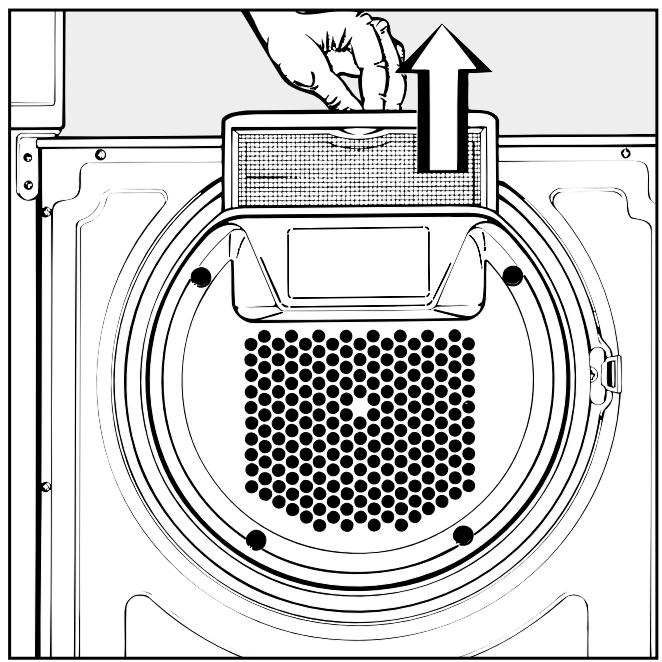
■ Ouvrez la porte. Saisissez le filtre par la poignée encastrée et tirez vers le haut pour le retirer. - Retirez les peluches :
- du filtre dans la porte
- des filtres dans l'ouverture de la porte
N'utilisez pas d'objets pointus ou tranchants. ■ Retirez les peluches de la partie creuse du support de porte par la fente large en bas. Une brosse de nettoyage est disponible en option auprès du service pièces détachées Miele. ■ Repoussez le filtre nettoyé dans le support de porte et fermez la porte.
Si les filtres sont très encrassés, ils peuvent être nettoyés sous l'eau chaude courante.
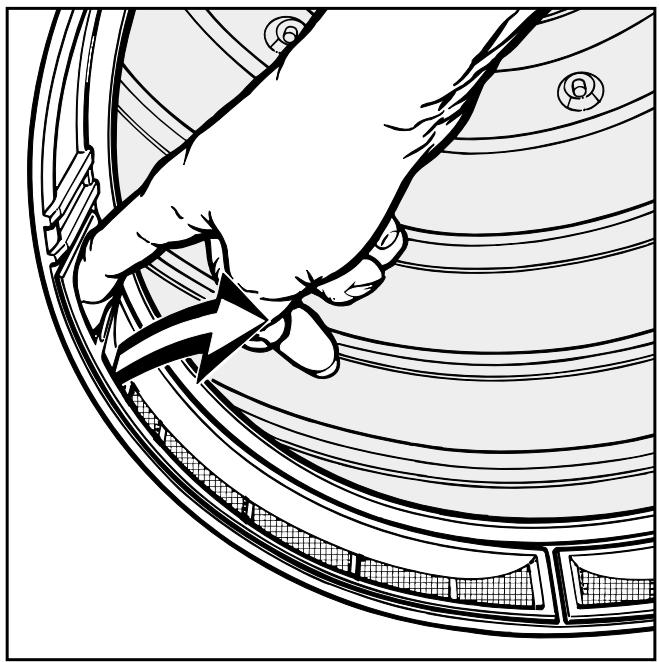
■ Ces filtres ne doivent être retirés que pour être nettoyés à l'eau. ■ Bien les sécher après rinçage et les remettre en place.
Nettoyage du sèche-linge
Débrancher l'appareil de l'alimentation électrique.
- Nettoyer ...
... le boîtier et le panneau de commande : avec un détergent doux ou de l'eau savonneuse ; ... le tambour et les autres pièces en acier inoxydable : avec un produit nettoyant spécial inox, en suivant les instructions du fabricant.
Ne jamais utiliser de substances abrasives, de tampons à récurer, de nettoyants pour vitres ou de nettoyants tout usage. Ils pourraient endommager les surfaces en plastique et d'autres pièces. Ne jamais passer la machine au jet d'eau.
■ Sécher toutes les pièces avec un chiffon doux.
Vidange du réservoir d'eau de condensation
Si le tuyau d'évacuation n'a pas été installé et raccordé, l'eau de condensation est recueillie dans le réservoir d'eau de condensation.
Le réservoir d'eau de condensation doit être vidé après chaque cycle de séchage, ou dès que le voyant « Vider le réservoir » s'allume.
Si...
. . . le réservoir d'eau de condensation est plein au démarrage d'un programme ou ... il se remplit pendant un cycle de séchage : - le voyant « Vider le réservoir » s'allume, - le buzzer retentit, - le programme s'arrête, - le linge est refroidi et le voyant « Air froid » s'allume.
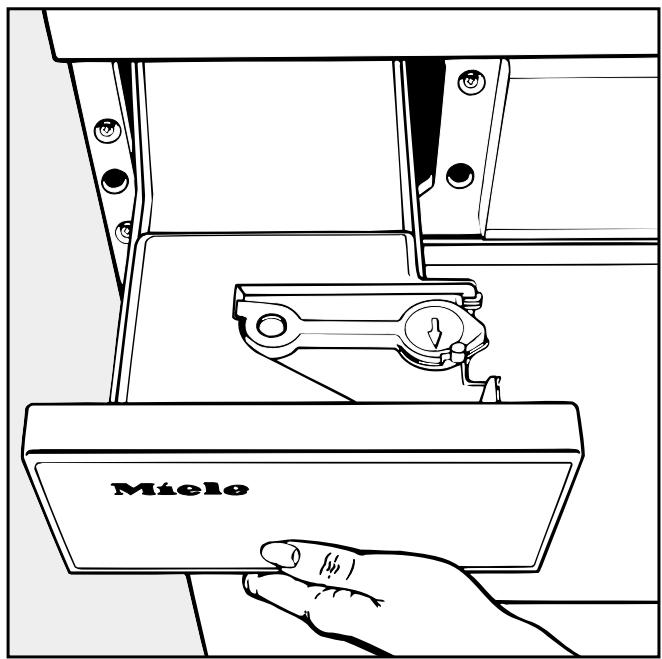
■ Sortir le réservoir de la machine en le saisissant fermement à deux mains.
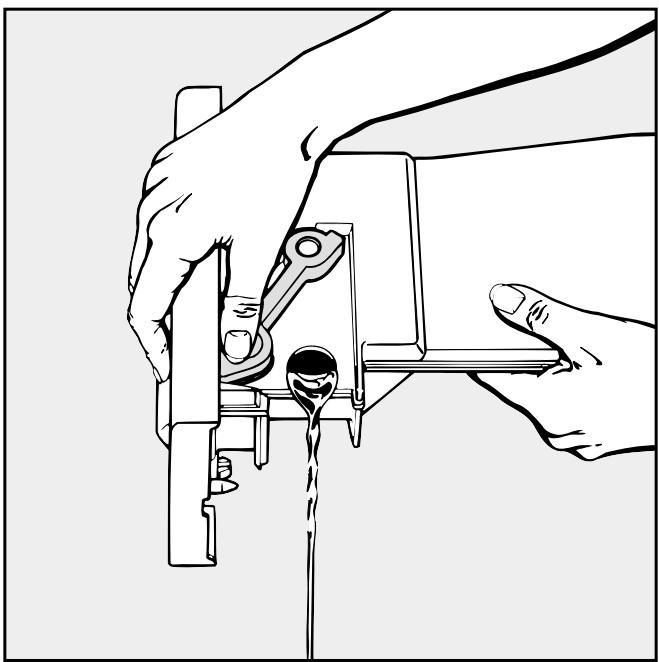
■ Faire glisser le couvercle et verser l'eau. ■ Repousser le réservoir dans la machine jusqu'à ce qu'il s'enclenche.
L'eau de condensation ne doit pas être bue. Elle pourrait entraîner des problèmes de santé pour les humains et les animaux.
L'eau condensée peut être utilisée pour un usage domestique, par exemple dans un fer à vapeur ou un humidificateur.
Remarque :
■ Pour éviter que des particules de peluche ne restent et n'endommagent l'appareil, passez l'eau condensée à travers un tamis fin ou un filtre en papier.
Nettoyage du condenseur
L'appareil doit être débranché de l'alimentation électrique avant le nettoyage.
Vérifiez le condenseur au moins deux fois par an et nettoyez-le si nécessaire. Si le sèche-linge est utilisé fréquemment, nettoyez le condenseur après environ 100 cycles de séchage.
■ Ouvrez la porte.
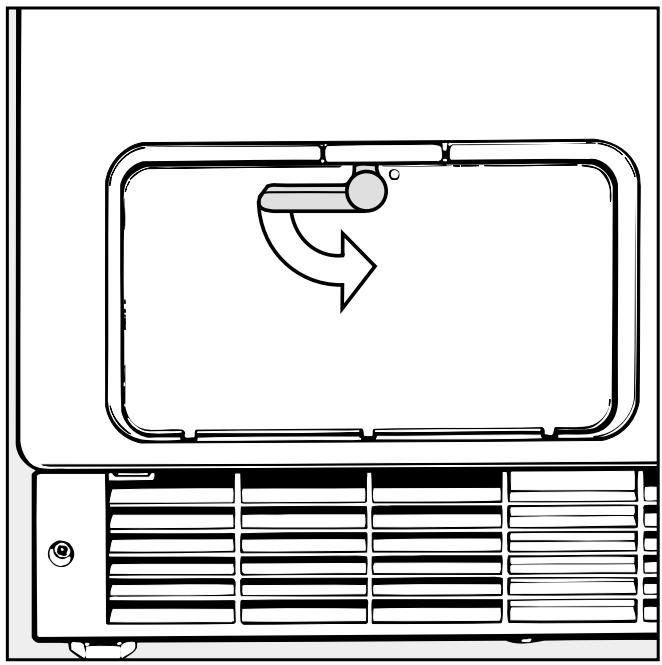
■ Tournez la serrure du couvercle vers le bas en position verticale.
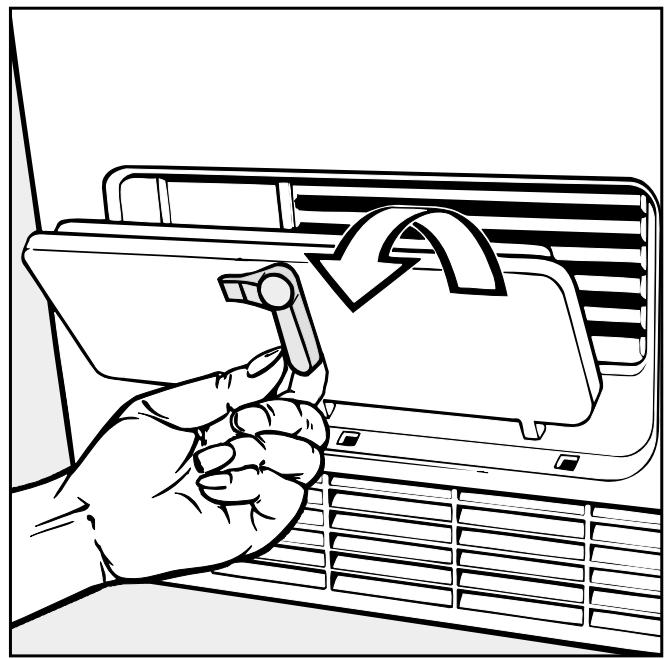
■ Retirez le couvercle.
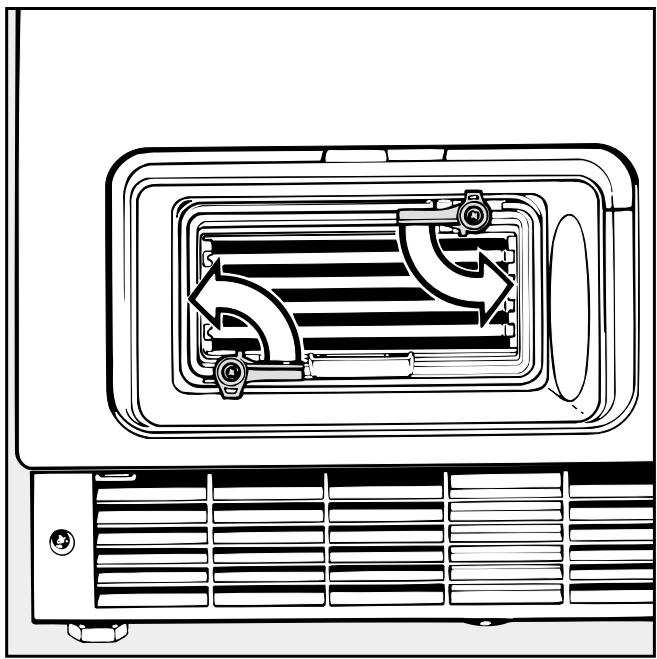
■ Tournez les deux leviers du condenseur en position verticale.
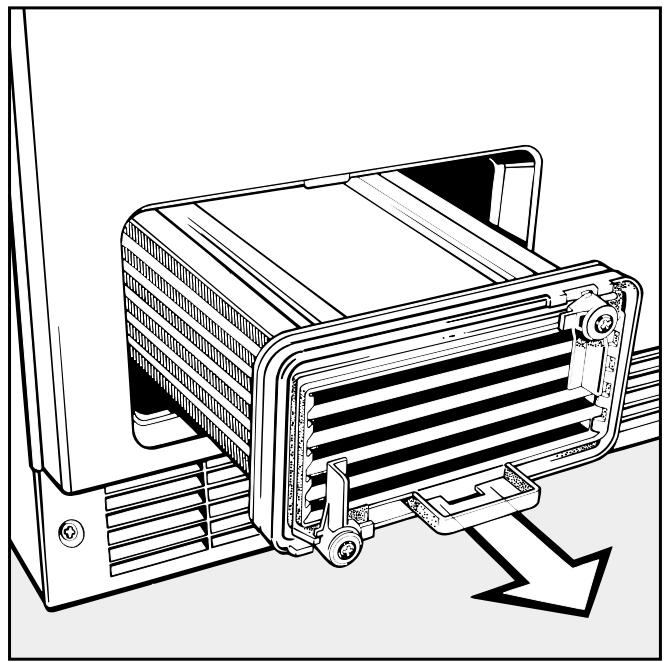
■ Sortez le condenseur.
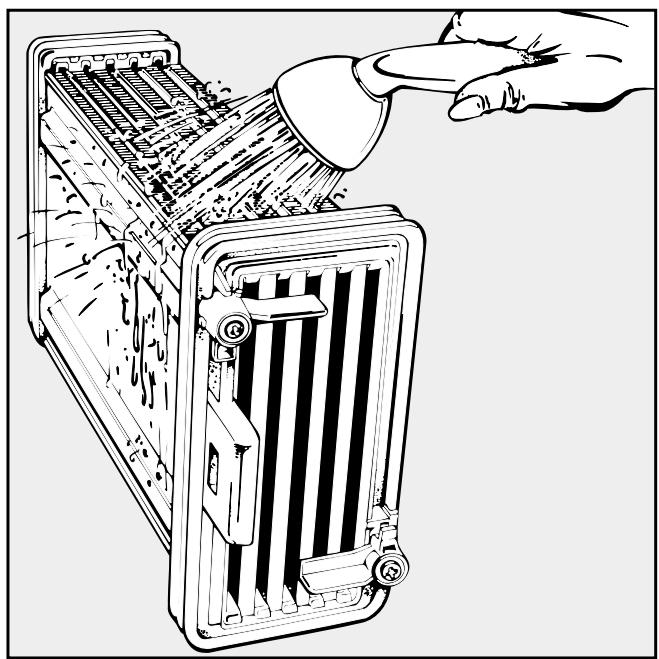
■ Nettoyez les deux côtés longs de l'unité. ■ Posez le condenseur debout sur une serviette jusqu'à ce qu'il soit bien sec. ■ Remettez le condenseur en place (voir illustration en haut à gauche). ■ Remettez les deux leviers du condenseur en position horizontale. Tirez vers l'avant sur l'unité pour vérifier qu'elle est bien en place. ■ Remettez le couvercle et vérifiez qu'il est également bien en place, sinon de l'eau pourrait fuir de la machine. ■ Fermez la porte.
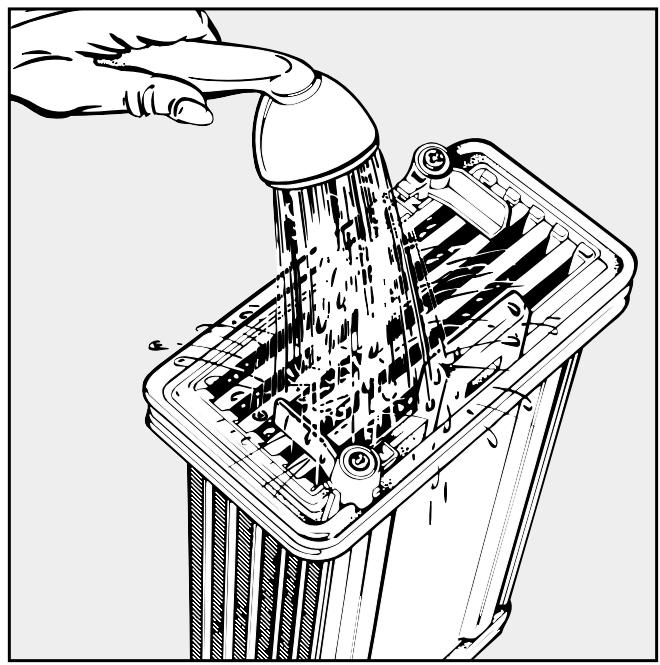
■ Nettoyez le condenseur aux deux extrémités (avant et arrière).
Essuyez les joints en caoutchouc aux deux extrémités doucement mais soigneusement.
Que faire si ...
Les appareils électriques ne doivent être réparés que par du personnel qualifié. Des machines mal réparées peuvent présenter un risque considérable pour l'utilisateur.
| What to do if . . . | Cause . . . | Remedy . . . |
| . . . the tumble dryer fails to start when switched on | This may be due to an incorrect selection procedure sequence when switching on the machine. | Repeat the switch-on procedure (see section on “Drying correctly”). Also check the following:– Is the machine plugged in at the mains switch?– Is the door closed properly?– Was the “”I-On/0-Off” button pushed in?– Was the “START” button pushed in?– Has the fuse or circuit breaker tripped? If so, contact the Miele Service Department. |
| . . . items made of synthetic fi-bres are charged with static electricity after drying | | Static charge can be reduced by adding a fabric conditioner for the final rinse in the washing machine. |
| . . . the laundry is not suf-ficiently dry | The load consists of different fabrics. | Select a more suitable drying programme next time. |
| . . . there is a build-up of fluff | Fluff is principally the result of friction when garments are being worn and washed. Machine drying hardly causes any fluff to form and, as has been established by research institutes, has no effect on the lifetime of fabric. |
| . . . drying process goes on too long. | Ventilation to and from the dryer is insufficient (eg in a small room). This could cause the room temperature to rise sharply. | Open a door or window while the machine is in operation for increased air flow. |
| The vent below the door is blocked. | Remove any objects that are blocking the vent below the door. |
| The dryer cannot blow air out correctly. | - Clean the fluff filters in the door and the door opening. - Clean the condenser unit. |
| The laundry was not sufficiently spun. | Spin the laundry in the washing machine at the highest possible spin speed. |
| . . . water droplets appear at the upper edge of the drum aperture. | A double filter system with dual insulation prevents fluff from being deposited in the condenser unit. This insulation can lead to a build-up of condensation. | Laundry being removed from the machine may come into contact with these water droplets, but they will dry off in a matter of minutes. |
| . . . water leaks from the machine after the condenser unit has been cleaned. | The condenser unit has not been correctly locked into place. | Ensure that the condenser unit and cover are firmly in position and lock into place again. |
| . . . the ring around the pro-gramme selector switch is not lit up. | This is not a fault. | See the section on “Guide to the appliance”. |
| . . . the interior drum lighting does not come on. | It only lights up when the machine is switched on. The bulb may be defective. | Change the bulb. See instructions at the end of this section. |
| . . . you need to open the door during a power cut. | | See instructions at the end of this section. |
| Check and indicator lights |
| What to do if . . . | Cause . . . | Remedy . . . |
| ... the “Locked” indicator light flashes when the machine is switched on. | The system lock is activated. The programme cannot be started. | See section “Electronic system lock”. |
| ... the “Locked” indicator light comes on during drying. | That is not a fault. | The light will go out at the end of the programme. |
| ... the “Drying” indicator light flashes. | The programme selector was moved after the beginning of the programme, but the programme will continue to run correctly. | Turn the programme selector back to its original position and the light will go out. |
| ... the “Anti-crease/Finish” light flashes. | There could be a fault. | — Switch the machine off and on again.— Select the programme and press “START”. |
| Cold surrounding temperatures below freezing are affecting the machine (frozen condensed water). | — Install the appliance in a warmer room. |
| If the light continues to flash there is a problem. Contact Miele Service Department. |
| ... the “Empty out container” light comes on. | The condensed water container is full. | Empty the container. Check that the condensed water container is correctly positioned. |
| ... the “Clean out airways” light comes on. | The fluff filters are blocked. | — Switch the dryer off with the "I-On/0-Off" button.— Clean the fluff filters after every use. (See "Cleaning and care"). |
| The condenser unit may be blocked because it has not been cleaned for a long time. | — Switch the dryer off with the "I-On/0-Off" button.— Please note that the condenser unit must be cleaned regularly (see "Cleaning and care"). |
| ... the programme is interrupted and the “Anti-crease/Finish” light comes on. | If there is no laundry in the drum when the programme is started, the electronics will register this and stop the programme. The programme will also be interrupted if the laundry placed in the drum is already dry. |
L'éclairage intérieur du tambour ne s'allume pas : changement de l'ampoule
■ Ouvrez la porte.
Avant de changer l'ampoule, débranchez la machine de l'alimentation électrique.
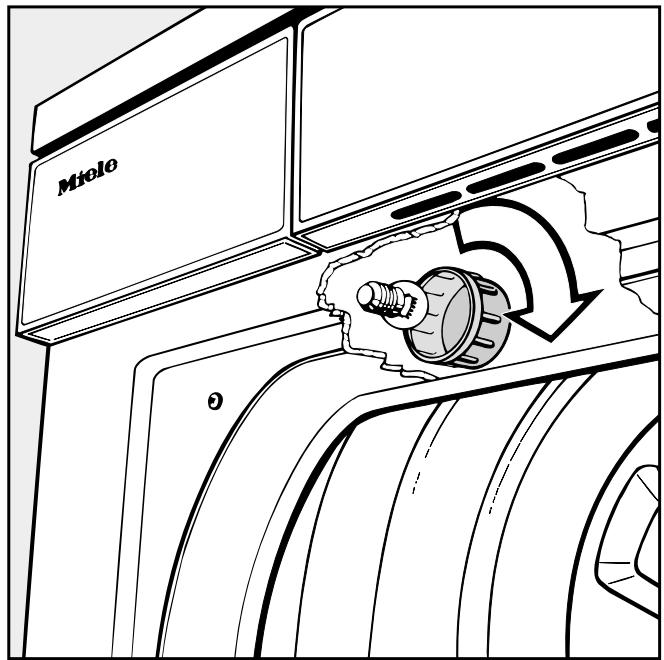
■ Dévissez le couvercle en plastique au-dessus de la porte à l'intérieur du tambour. ■ Remplacez l'ampoule.
L'ampoule ne doit pas dépasser la puissance maximale indiquée sur la plaque signalétique et le couvercle de l'éclairage.
■ Remettez le couvercle en plastique et revissez-le.
Le couvercle doit être fixé solidement, sinon l'humidité pourrait s'infiltrer et provoquer un court-circuit.
L'ampoule résistante à la chaleur doit être commandée uniquement auprès de votre revendeur Miele ou du service des pièces détachées Miele.
Ouverture de la porte en cas de panne de courant.
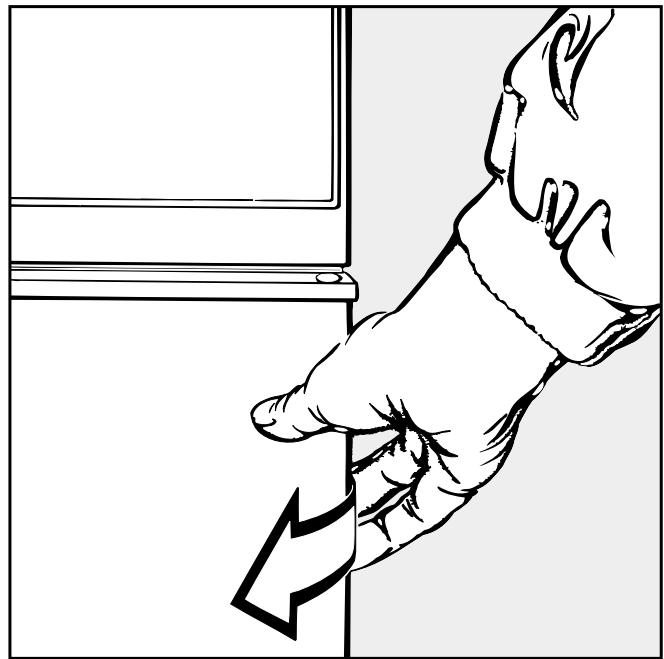
Réparations
En cas de panne que vous ne pouvez pas réparer vous-même, veuillez contacter :
- votre revendeur Miele
ou
- votre service après-vente Miele le plus proche (voir l'adresse au dos de la couverture).
Lorsque vous contactez le service après-vente, veuillez indiquer le modèle et le numéro de série de votre appareil, qui figurent tous deux sur la plaque signalétique située sous l'ouverture du tambour, à droite.
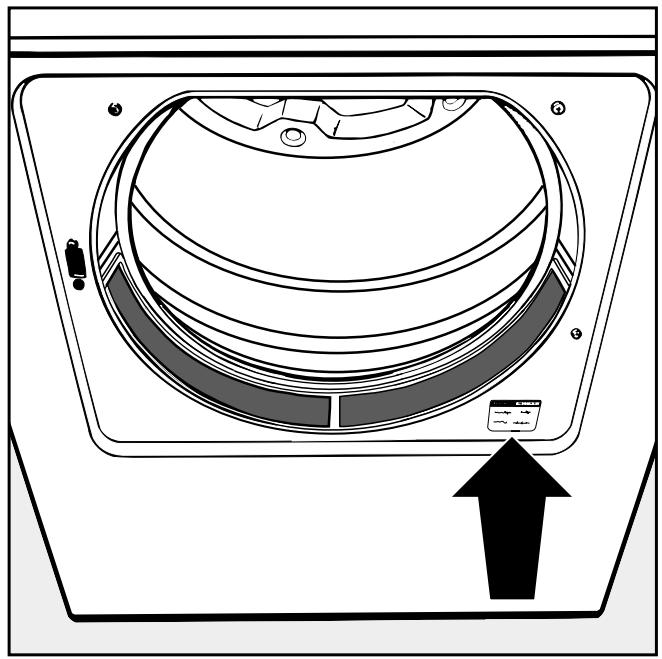
Veuillez noter que les appels téléphoniques peuvent être écoutés et enregistrés afin d'améliorer notre service.
Mises à jour futures
Le voyant ou témoin de contrôle marqué PC permet à un technicien de mettre à jour votre machine dans les années à venir.
Lorsque, par exemple, de nouveaux programmes sont développés ou de nouveaux tissus sont introduits, un technicien pourra modifier les cycles de programme existants en conséquence.
Miele fournira des informations lorsque de telles possibilités seront disponibles.
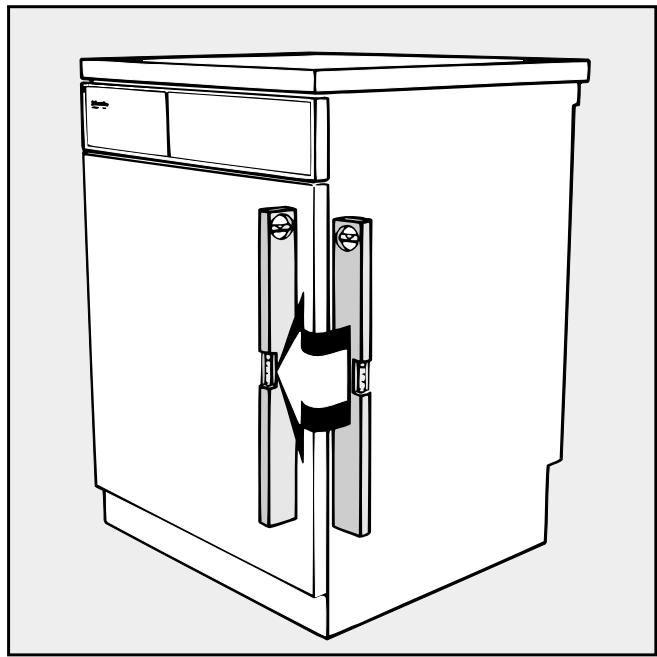
La machine doit être parfaitement de niveau pour garantir un fonctionnement sûr et correct. De légères différences n'ont toutefois pas d'effet néfaste sur le fonctionnement.
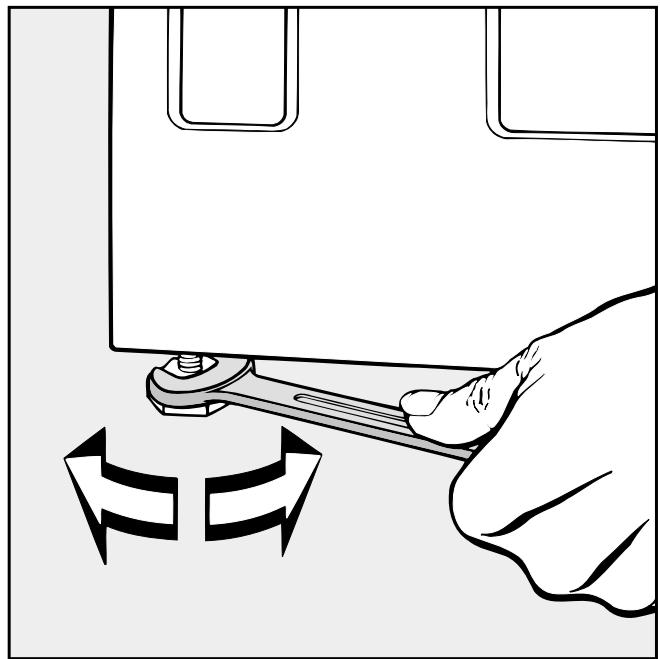
■ Les pieds à vis peuvent être réglés pour compenser toute irrégularité de la surface du sol.
Les fentes de ventilation situées sous la porte ne doivent en aucun cas être obstruées, car cela empêcherait une arrivée suffisante d'air froid.
Installation
Encastrement sous un plan de travail continu / dans une rangée d'éléments de cuisine
Un kit de conversion spécial* est nécessaire.
- Le couvercle de la machine est remplacé par une plaque de recouvrement qui doit être installée par une personne compétente et qualifiée pour garantir la sécurité électrique.
- Lors de l'installation sous un plan de travail d'une hauteur de travail de 900/910 mm, un kit d'espacement* est nécessaire.
En cas d'encastrement, les durées de fonctionnement peuvent être plus longues.
Le sèche-linge peut également être combiné avec une machine à laver Miele dans une colonne de lavage et séchage. Pour cela, le kit d'empilage approprié* correspondant à votre machine à laver est requis.
*Ces articles sont disponibles auprès de votre revendeur Miele.
(N.B. Si vous souhaitez glisser votre machine sous un plan de travail et que l'espace le permet sans retirer le couvercle, le kit de conversion n'est pas nécessaire. Sinon, le kit de conversion est indispensable).
Sortie d'eau condensée externe
L'eau condensée peut être évacuée directement si la machine est installée près d'un évier, d'une sortie d'évacuation, etc.
Un kit d'évacuation spécial est requis, disponible auprès du service pièces détachées Miele ou de votre revendeur Miele.
■ Détachez le collier de serrage du tuyau de la sortie d'évacuation à l'arrière de la machine.
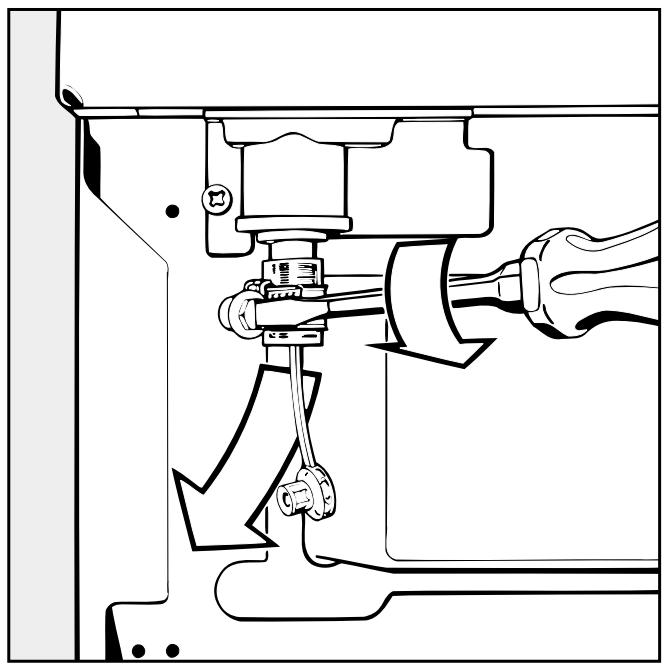
■ Retirez le bouchon en caoutchouc.
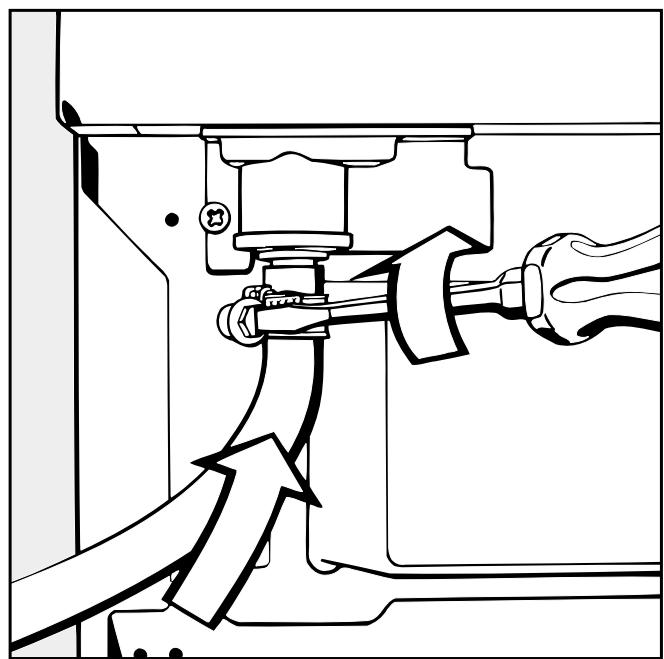
■ Poussez le tuyau d'évacuation sur la sortie d'évacuation.
Assurez-vous que le tuyau est fermement fixé avec le collier de serrage et qu'il n'est pas plié.
Longueur maximale du tuyau d'évacuation : 3,00 mètres
Hauteur de refoulement maximale : 1,00 mètre
Le sèche-linge est équipé d'un clapet anti-retour en standard pour empêcher l'eau de refluer dans la machine.
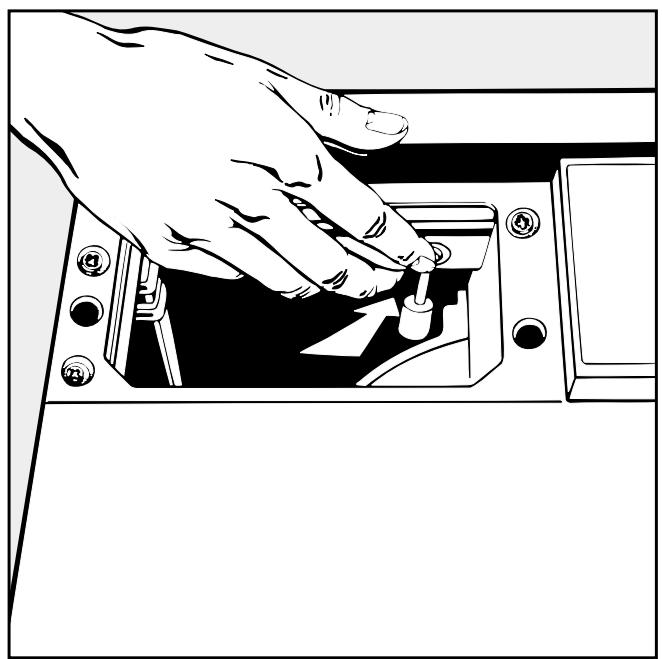
■ Fermez l'orifice d'entrée d'eau du réservoir d'eau condensée avec la partie inférieure du bouchon en caoutchouc. Le bouchon doit être orienté vers l'intérieur de la machine afin que le réservoir d'eau condensée puisse être inséré facilement.
Raccordement à la sortie d'évacuation du lavabo (si applicable)
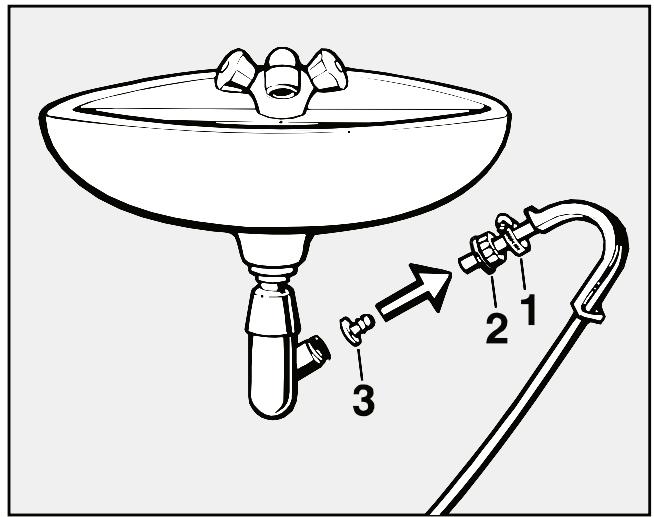
■ Poussez le collier de serrage (1) et le raccord à écrou moleté de la sortie d'évacuation du lavabo (2) sur le tuyau d'évacuation.
■ Poussez la douille d'adaptation (3) dans le tuyau.
■ Vissez le tuyau d'évacuation à la sortie d'évacuation avec le raccord à écrou moleté.
■ Serrez le collier de serrage près de l'écrou.
Branchement électrique R.-U.
Tout travail électrique doit être effectué uniquement par une personne compétente, conformément strictement aux réglementations de sécurité nationales et locales.
L'appareil est fourni avec un câble d'alimentation muni d'une fiche moulée pour une connexion à une alimentation secteur de 230-240 V. La tension, la charge nominale et le calibre du fusible sont indiqués sur la plaque signalétique. Veuillez vous assurer qu'ils correspondent à l'alimentation secteur du domicile.
La connexion doit être effectuée via une prise avec fusible et un interrupteur adapté, facilement accessible après l'installation. Pour une sécurité supplémentaire, il est conseillé d'installer un dispositif différentiel résiduel (DDR) avec un courant de déclenchement de 30 mA. Ne pas connecter via une rallonge.
Important
Les fils du câble d'alimentation sont colorés conformément au code suivant :
Vert/jaune = terre
Bleu = neutre
Brun = phase
S'il est nécessaire de changer la fiche, si les couleurs des fils du câble d'alimentation de cet appareil ne correspondent pas aux marques colorées identifiant les bornes de votre fiche, procédez comme suit :
Le fil de couleur verte et jaune doit être connecté à la borne de la fiche marquée de la lettre E ou du symbole de terre ±, ou de couleur verte, ou verte et jaune.
Le fil de couleur bleue doit être connecté à la borne de la fiche marquée de la lettre N ou de couleur noire.
Le fil de couleur marron doit être connecté à la borne de la prise marquée de la lettre L ou de couleur rouge.
AVERTISSEMENT : CET APPAREIL DOIT ÊTRE RELIÉ À LA TERRE
Assurez-vous que l'alimentation n'est pas rétablie sur l'appareil pendant que les travaux d'installation sont en cours.
Fiches non recâblables BS 1363
Si cette machine est équipée d'une fiche non recâblable, les informations suivantes s'appliquent :
Si les prises de courant ne sont pas adaptées à la fiche fournie avec le produit, celle-ci doit être coupée et une fiche appropriée doit être installée.
La fiche coupée du cordon souple doit être mise au rebut et ne doit en aucun cas être insérée dans une prise ailleurs dans la maison (risque de choc électrique).
Le couvercle du fusible doit être remis en place lors du remplacement du fusible. Si le couvercle du fusible est perdu, la fiche ne doit pas être utilisée jusqu'à ce qu'un remplacement approprié soit obtenu. La couleur du couvercle de remplacement correct est celle de l'insert coloré à la base de la fiche, ou la couleur qui est gravée en lettres sur la base de la fiche (selon le modèle de fiche installé).
Les fusibles de remplacement doivent être approuvés ASTA conformément à la norme BS 1362 et avoir le calibre correct. Les couvercles de fusible de remplacement peuvent être achetés auprès de votre fournisseur d'électricité local ou de votre agent de service.
| Programme | Cap- acitykg | Final spin speed (in a domestic washing machine)rpm | Electricity consump-tionkWh | Drying time incl. cooling down time Minutes |
| 10 A (2) | 16 A (2) |
| COTTONS |
| Extra dry | 5 | 1200 | 3.4 | 102 | 84 |
| 1400 | 3.3 | 99 | 81 |
| 1600 | 3.0 | 89 | 74 |
| Normal + | 5 | 1200 | 2.9 | 92 | 74 |
| 1400 | 2.75 | 88 | 71 |
| 1600 | 2.45 | 79 | 64 |
| Normal(1) | 5 | 800 (70 % residual moisture) | 3.5 | 109 | 88 |
| Normal | 5 | 1200 | 2.75 | 88 | 71 |
| 1400 | 2.6 | 85 | 68 |
| 1600 | 2.35 | 77 | 62 |
| Hand iron ΔΔ(1) | 5 | 800 (70 % residual moisture) | 2.85 | 91 | 74 |
| Hand iron ΔΔ | 5 | 1200 | 2.1 | 67 | 57 |
| 1400 | 1.95 | 66 | 54 |
| 1600 | 1.65 | 57 | 47 |
| Machine iron | 5 | 1200 | 1.7 | 58 | 47 |
| 1400 | 1.55 | 55 | 44 |
| 1600 | 1.25 | 47 | 38 |
| MINIMUM IRON |
| Normal(1) | 2.5 | 1000 (50 % residual moisture) | 1.3 | 52 | 44 |
| Hand iron | 2.5 | 1000 | 1.15 | 48 | 40 |
| Special care |
| Woollens, Hand care | 1 | - | 0.2 | 3 | 3 |
| Smoothing | 2.5 | - | 0.3 | 8 | 8 |
(1) Test de performance conformément à la norme EN 61121/A11. (2) Les temps de séchage peuvent varier légèrement. Pour le calibre du fusible, voir la plaque signalétique. Toutes les valeurs obtenues conformément à la norme de test EN 61121/A11.
Différents types de tissus, la charge et l'humidité résiduelle après essorage peuvent affecter les chiffres indiqués.
Hauteur ..... 850 mm (réglable +10/-5 mm)
Largeur 595 mm
Profondeur (incl. distance du mur) . . . 600 mm avec couvercle
560 mm sans couvercle
Poids 57 kg
Volume du tambour 103 l
Capacité maximale.... 5 kg de poids sec
Capacité du réservoir d'eau condensée .... environ 4 l
Hauteur de refoulement maximale.... 1 m
Longueur maximale du tuyau d'évacuation.... 3 m
Tension.... } voir plaque signalétique
Puissance nominale.....
Calibre du fusible....
Consommation électrique ..... voir section « Données de consommation »
Certificats d'essai attribués.... Suppression radio/TV, VDE
Irlande :
Miele Ireland Limited
Broomhill Business Complex, Broomhill Road, Dublin 24
Tél. (01) 46 10 710, Fax (01) 46 10 797
Royaume-Uni :
Miele Co. Ltd.
Fairacres, Marcham Road, Abingdon, Oxon, OX14 1TW
tél. Abingdon (01235) 554455 - fax (01235) 554477
Bureau de service, tél. Abingdon (01235) 554466
Internet : www.miele.co.uk
Droit de modification réservé/001
0600