XV-NP10S - Lecteur dvd JVC - Notice d'utilisation et mode d'emploi gratuit
Retrouvez gratuitement la notice de l'appareil XV-NP10S JVC au format PDF.


| Type de produit | Lecteur DVD |
| Caractéristiques techniques principales | Lecture de DVD, CD, et fichiers multimédias |
| Alimentation électrique | AC 100-240V, 50/60Hz |
| Dimensions approximatives | 430 mm x 40 mm x 250 mm |
| Poids | 1.5 kg |
| Compatibilités | Compatible avec les formats DVD-Video, DVD-R/RW, CD-DA, CD-R/RW |
| Fonctions principales | Lecture de disques, sortie audio numérique, fonction de lecture aléatoire |
| Entretien et nettoyage | Utiliser un chiffon doux pour nettoyer l'extérieur, éviter les produits abrasifs |
| Pièces détachées et réparabilité | Réparabilité limitée, pièces disponibles selon les distributeurs |
| Sécurité | Ne pas exposer à l'humidité, débrancher lors d'un orage |
| Informations générales utiles | Vérifier les mises à jour de firmware pour améliorer la compatibilité des formats |
FOIRE AUX QUESTIONS - XV-NP10S JVC
Questions des utilisateurs sur XV-NP10S JVC
0 question sur cet appareil. Repondez a celles que vous connaissez ou posez la votre.
Poser une nouvelle question sur cet appareil
Téléchargez la notice de votre Lecteur dvd au format PDF gratuitement ! Retrouvez votre notice XV-NP10S - JVC et reprennez votre appareil électronique en main. Sur cette page sont publiés tous les documents nécessaires à l'utilisation de votre appareil XV-NP10S de la marque JVC.
MODE D'EMPLOI XV-NP10S JVC
DVD PLAYER/MEMORY CARD READER
XV-NP10S

natural_image
Line drawing of a JVC air conditioner unit (no text or symbols)





Digital Direct Progressive Scan
MPEG) Multichannel
Region code of DVD VIDEO
This player can play back DVD VIDEO discs whose region code numbers include "2."
Examples of playable DVD VIDEO discs:




The player's region code is printed on the rear of the player.
Before operation
2
Preparations
5
Basic operations
12
Advanced operations
17
Audio/Video files playback
25
Changing the initial settings
30
Additional information
35
INSTRUCTIONS
IMPORTANT for the U.K.
DO NOT cut off the mains plug from this equipment. If the plug fitted is not suitable for the power points in your home or the cable is too short to reach a power point, then obtain an appropriate safety approved extension lead or consult your dealer.
BE SURE to replace the fuse only with an identical approved type, as originally fitted.
If nonetheless the mains plug is cut off ensure to remove the fuse and dispose of the plug immediately, to avoid a possible shock hazard by inadvertent connection to the mains supply. If this product is not supplied fitted with a mains plug then follow the instructions given below:
IMPORTANT.
DO NOT make any connection to the terminal which is marked with the letter E or by the safety earth symbol or coloured green or green-and-yellow.
The wires in the mains lead on this product are coloured in accordance with the following code:
Blue : Neutral
Brown : Live
As these colours may not correspond with the coloured markings identifying the terminals in your plug proceed as follows:
The wire which is coloured blue must be connected to the terminal which is marked with the letter N or coloured black. The wire which is coloured brown must be connected to the terminal which is marked with the letter L or coloured red.
IF IN DOUBT - CONSULT A COMPETENT ELECTRICIAN.
CAUTION
To reduce the risk of electrical shocks, fire, etc.:
-
Do not remove screws, covers or cabinet.
-
Do not expose this appliance to rain or moisture.
Caution — STANDBY/ON ⏻/| button!
Disconnect the mains plug to shut the power off completely (the STANDBY/ON lamp goes off).
The STANDBY/ON ⏻/I button in any position does not disconnect the mains line.
- When the unit is on standby, the STANDBY/ON lamp lights red.
- When the unit is turned on, the STANDBY/ON lamp lights green.
The power can be remote controlled.
CAUTION
- Do not block the ventilation openings or holes. (If the ventilation openings or holes are blocked by a newspaper or cloth, etc., the heat may not be able to get out).
- Do not place any naked flame sources, such as lighted candles, on the apparatus.
- When discarding batteries, environmental problems must be considered and local rules or laws governing the disposal of these batteries must be followed strictly.
- Do not expose this apparatus to rain, moisture, dripping or splashing and that no objects filled with liquids, such as vases, shall be placed on the apparatus.
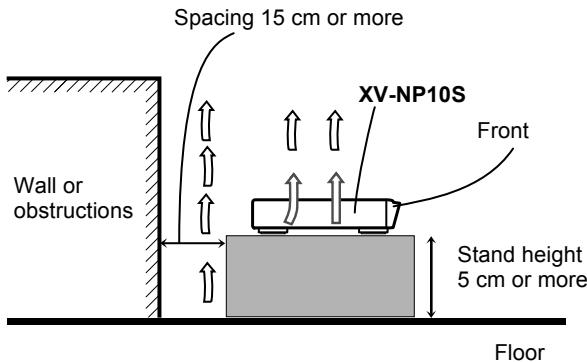
Caution: Proper Ventilation
To avoid risk of electric shock and fire and to protect from damage, locate the apparatus as follows:
Front: No obstructions and open spacing.
Sides: No obstructions in 3 cm from the sides.
Top: No obstructions in 5 cm from the top.
Back: No obstructions in 15 cm from the back
Bottom: No obstructions, place on the level surface.
text_image
Spacing 15 cm or more XV-NP10S Front Wall or obstructions Stand height 5 cm or more FloorIMPORTANT FOR LASER PRODUCTS
- CLASS 1 LASER PRODUCT
- CAUTION: Do not open the top cover. There are no user serviceable parts inside the Unit; leave all servicing to qualified service personnel.
- CAUTION: Visible and invisible laser radiation when open and interlock failed or defeated. Avoid direct exposure to beam.
- REPRODUCTION OF LABEL: CAUTION LABEL, PLACED INSIDE THE UNIT.
| CAUTION : Visible and invisible laser radiation when open interlock failed or defeated. AVOID DIRECT EXPOSURE TO BEAM. (e) | ADVARSEL : Synlig og usynlig laserstråling när maskinen är åben eller interlocken fejler. Undgå direkte ekspontering til stråling. (d) | VARNING : Synlig og osynlig laserstråling när den öppnas och spären är urkopplad. Betrakta el strålen. (s) | VARO : Avattaessa ja suojalukitus ohitetuna tai viallisera olet altiina näkyvälle ja näkyttmälläme lasersäteilylle. Valtä säteen kohdistumista suoraan itseesi. (i) |
Supplied accessories
Check that you have all the following accessories supplied to you. If anything is missing, consult your dealer immediately.
- Remote control unit (× 1)
• R6(SUM-3)/AA(15F) battery (× 2)
About this manual
- The display window information and OSD (On Screen Display) menu items are put in brackets [ ] in the operation procedures.
- Usable disc(s) for each operation/function is (are) referred to by the icons;

Precautions
Notes on the power cord
- When you are away on travel or otherwise for an extended period of time, remove the plug from the wall outlet. A small amount of power (1.1 W) is always consumed while the power cord is connected to the wall outlet.
- When unplugging the player from the wall outlet, always pull the plug, not the power cord.
- Do not handle the power cord with wet hands!
Avoid moisture, water and dust
- Do not place the player in moist or dusty places.
- If water gets inside the player, turn off the power and remove the plug from the wall outlet, then consult your dealer. Using the player in this state may cause a fire or electrical shock.
Avoid high temperatures
- Do not expose the player to direct sunlight or place it near a heating device.
Notes on installation
- Select a place which is level, dry and neither too hot nor too cold between 5^ and 35^ .
- Leave sufficient distance between the player and the TV.
- Do not install the player in a place subject to vibrations.
- Do not put heavy objects on the player.
To prevent malfunction of the player
- There are no user-serviceable parts inside. If anything goes wrong, unplug the power cord and consult your dealer.
- Do not insert any metallic objects, such as wires, hairpins, coins, etc. into the player.
- Do not block the vents. Blocking the vents may damage the player.
Notes on a memory card
- Make sure both the disc playback or memory card playback is stopped when inserting or removing the memory card.
- When playing back a disc, always remove a memory card and close the card door.
To clean the cabinet
- Use a soft cloth. Follow the relevant instructions on the use of chemically-coated cloths.
- Do not use benzene, thinner or other organic solvents and disinfectants. These may cause deformation or discoloring.
Table of contents
Before operation.... 2
About playable media....2
Care and handling of discs 2
Names of parts and controls....3
Preparations 5
Connections....5
Using the remote control unit....10
Basic operations 12
Turning on/off the player....12
Initial setup 12
Basic playback....13
Resuming playback 14
Various speed playback 15
Locating the beginning of a scene or song....16
Advanced operations.... 17
Playing from a specific position ....17
Changing the playback order....19
Repeat playback....20
Changing the language, sound and scene angle ....21
Special picture/sound effect ......22
Menu bar functions....23
Audio/Video files playback.... 25
Outline 25
Basic operations....26
Direct selection for JPEG files 27
Repeat playback....27
Slide show playback....28
Changing the picture of the opening display ....28
BGM slide show playback 29
Changing the initial settings 30
Selecting preferences....30
Limiting playback by children....33
Additional information.... 35
Troubleshooting....35
Specifications ...... 36
Appendix A: Digital output signal chart....37
Appendix B: Table of languages and their abbreviations .....37
Appendix C: Country/Area code list for Parental Lock......38
Appendix D: Glossary....39
About playable media
playable disc types
Discs with the following marks can be played back on the player.
DVD VIDEO

SVCD

Video CD
Video CD

Audio CD

The DVD Logo is a trademark.
The player can also play back the following discs:
- The finalized DVD-R and DVD-RW discs written in the DVD VIDEO format.
- The DivX file on the DVD-R and DVD-RW discs written in the UDF format.
- The finalized CD-R and CD-RW discs written in the SVCD, Video CD or Audio CD format.
- CD-R and CD-RW discs written in MP3/WMA/JPEG/MPEG-4/DivX in accordance with the "ISO 9660" format. (For details, see page 25.)
NOTE
If a disc gets dirty, scratched or warped, or due to the disc characteristics or recording conditions, it may take considerable time for the player to read the content, or the player may not be able to play back such discs.
The player can also play back audio signals recorded in MIX-MODE CD, CD-G, CD-EXTRA and CD TEXT.
Color system format
This player accommodates the PAL system, and also can play back discs recorded with NTSC system whose Region Code numbers include “2.”
Note that the NTSC video signal on a disc is converted to an PAL 60 signal and output. With some discs, the playback picture may become jagged.
Digital audio formats
The player supports the following digital audio formats (see page 39 "Glossary" for descriptions of each audio format):
Linear PCM, MPEG Multichannel, Dolby Digital, DTS (Digital Theater Systems)
NOTE
Depending on the player's [DIGITAL AUDIO OUTPUT] setting, digital audio signals may not be output as they are recorded on the disc. See “DIGITAL AUDIO OUTPUT” on page 32 for details.
Notes on discs
- With some DVD VIDEO discs, the player starts playback automatically after inserting the disc.
- The image may be sometimes poor or noisy due to defects in the disc itself.
- With some discs, operations described in this manual may not be possible.
Unplayable discs
The player does not play back discs listed below.
• DVD-RW discs written in the VR format
• DVD-ROM, DVD-RAM, DVD AUDIO, CD-ROM, PHOTO CD, SACD
In addition, the player does not play:
- Unfinalized discs.
- Discs of irregular shape or discs with tape, seals or paste on either the label side or playback side. Playing back these discs may damage the player.
playable memory cards
This player has two types of the exclusive insertion slot for the memory cards; one is the 5 in 1 slot for SD card (SD), MultiMediaCard (MMC), SmartMedia (SM), Memory Stick (MS), and xD-Picture Card (xD), the other for CompactFlash (CF). You can play back the following files written in memory cards:
• MP3, WMA, JPEG, MPEG-4 (Simple profile)
Requirements for memory cards
- Format: Fat 12/16
- Voltage type: 3.3 V
- Storage type: Up to 128 MB (256 MB type is also available for only SD, xD, and CF). 4 MB type is not available for MMC and xD.
- For CompactFlash: Type I
- Protection: Secure MMC and Magic Gate Memory Stick are not available.
- For Memory Stick: Memory Stick Pro and Memory Stick Duo are not available.
NOTES
- The playback order may differ from that of the other device such as a digital still/video camera.
- The memory cards initialized by PC are not available.
- The player may be unable to play back some CompactFlash which are available for the high speed reading/writing.
- The player may be unable to play back some memory cards due to their characteristics or recording conditions.
- Memory cards are precision instruments. DO NOT impact, bend, drop, or wet them.
SD, Secure SD, MultiMediaCard, SmartMedia, CompactFlash, Memory Stick, xD-Picture Card are trademarks of their respective product companies.
Notes on copyright
Check the copyright laws in your country before recording from DVD VIDEO, SVCD, Video CD, Audio CD, MP3, WMA, JPEG, MPEG-4, and DivX discs. Recording of copyrighted material may infringe copyright laws.
Care and handling of discs
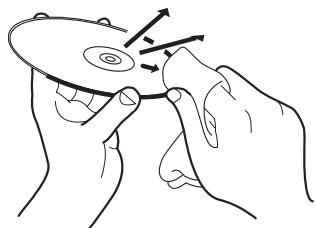
If a disc gets dirty, dusty, scratched or warped, playback sound and picture may be deteriorated. Take proper precautions when handling discs.
Handling
- Do not touch the surface of the disc.
- Do not damage, stick paper to, or use any adhesive on either the label side or playback side.
Storing discs
- Keep discs in their cases. If discs are piled on top of one another without their protective cases, they can be damaged.
- Do not put discs in a location where they may be exposed to direct sunlight, or where the humidity or temperature is high. Avoid leaving discs in a car!
Cleaning discs
- Wipe with a soft dry cloth, moving from the center outwards. If a disc is difficult to clean, wipe with a cloth moistened with water.
natural_image
Line drawing of two hands holding a circular object with arrows indicating motion or force (no text or symbols)- Never use record cleaners, petrol, alcohol or any anti-static agents.
Names of parts and controls
Front panel

text_image
JVC 1 2 3 4 5 6 7 8 9 10 11 12 13 AVOCARDInside of the card door (13).
text_image
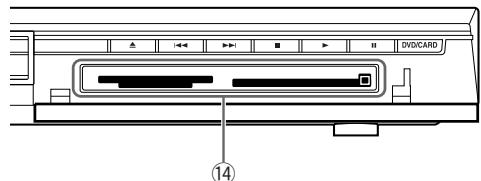
DVDCARD ⑭① ⏻/l button (12)
② STANDBY/ON indicator (12)
③ Disc tray (13)
④ ▲ (eject) button (13)
⑤ ◀◀ button (15, 16)
⑥ ▶▶▶I button (15, 16)
⑦ ■ (stop) button (14, 15, 17)
⑧ ▶ (play) button (13, 15)
⑨ II (pause) button (14, 15, 27)
⑩ DVD/CARD button (15, 26, 29)
⑪ Display window (see below)
⑫ Remote sensor (10)
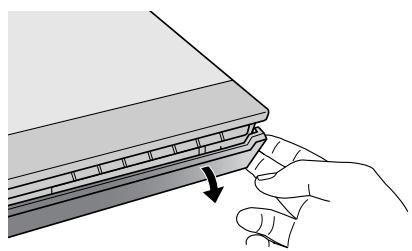
⑬ Card door (26)
⑭ Memory card slots (26)
How to open/close the card door
natural_image
Illustration of a hand inserting a component into a layered structure (no text or symbols)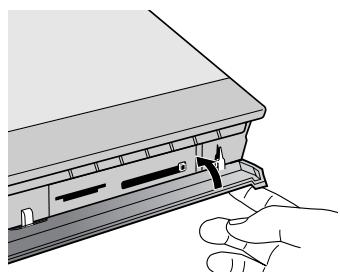
natural_image
Illustration of a hand inserting a device into a rack (no text or symbols visible)Display window
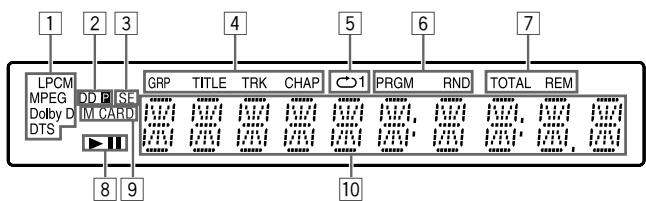
text_image
1 2 3 4 5 6 7 LPCM MPEG Dolby D DTS DD P SE M CARD GRP TITLE TRK CHAP 1 PRGM RND TOTAL REM 8 9 101 Audio format indicators
[LPCM] Turns on when linear PCM audio signals are output from the player, for example when playing back an Audio CD disc.
[MPEG] Turns on when MPEG signals are output from the player, for example when playing back a Video CD disc.
[Dolby D] Turns on when playing back a Dolby Digital sound source.
[DTS] Turns on when playing back a DTS-encoded digital sound source.
2 Progressive indicators
[P] Turns on while in the Progressive scanning mode.
[DDP] Turns on depending on the [PICTURE SOURCE] preference setting and the source type of the current DVD VIDEO disc (see page 8).
3 SE (Sound Effect) indicator
Turns on when the Sound Effect function takes effect.
4 Group/title/track/chapter indicators
Show what is indicated by the multi-information display during playback.
5 Repeat mode indicator
Turns on while in the repeat mode and shows the currently selected repeat mode.
6 Program/random indicators
Turn on while in the program playback mode or random playback mode respectively.
7 Total time/remaining time indicators
[TOTAL] Turns on when total elapsed time is indicated by the multi-information display.
[REM] Turns on when remaining playback time is indicated by the multi-information display.
8 ▶(play) / II(pause) indicators
Turn on while in playback or in pause respectively.
9 M (memory) CARD indicator
Turns on while accessing a memory card.
10 Multi-information window
Indicates various kinds of information by numbers and alphabets, such as the player's current status ("READING," "OPEN," etc.) or currently played DVD's title and chapter.
Remote control unit
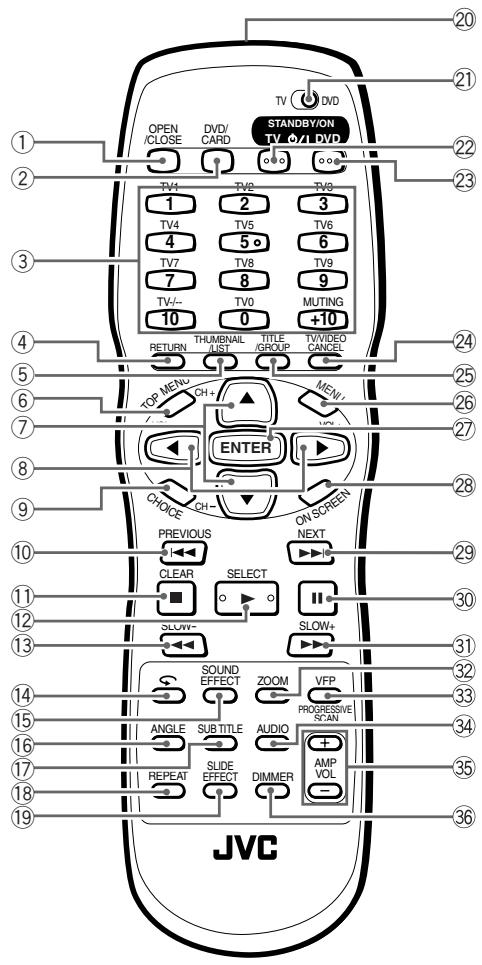
text_image
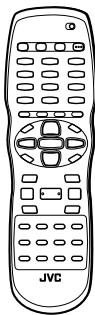
STANDBYON TV DVD OPEN /CLOSE DVD/ CARD TV4 TV2 TV9 1 2 3 TV4 TV5 TV6 4 5 6 TV7 TV8 TV9 7 8 9 TV- - TV0 MUTING 10 0 +10 RETURN THUMBINAL TITLE TV/VIDEO CANCEL TOP MENU CH+ MENS- ENTER ON SCREEN CHANGE CH- PREVIOUS NEXT CLEAR SELECT II SLOW+ SLOW+ SOUND ZOOM VFP EFFECT PROGRESSIVE ANGLE SUB TITLE AUDIO + SLIDE AMP VOL REPEAT DIMMER OFF JVC① OPEN/CLOSE button (13)
② DVD/CARD button (15, 26, 29)
③ Numeric buttons
④ RETURN button (17)
⑤ THUMBNAIL/LIST button (27)
⑥ TOP MENU button (17)
⑦ Cursor selection (▲ Up, ▼ Down) - CH (+/−) buttons
⑧ Cursor selection (◀ Left, ▶ Right) - VOL (+/−) buttons
⑨ CHOICE button (13, 28, 30)
⑩ ◀◀/PREVIOUS button (15, 16, 17, 19, 27, 29)
⑪ ■/CLEAR button (14, 19, 20, 27, 28)
⑫ ▶/SELECT button (13, 15, 17, 19, 27, 28)
⑬ ◀◀/SLOW- button (15, 27)
⑭ button (16)
⑮ SOUND EFFECT button (23)
⑯ ANGLE button (21)
⑰ SUBTITLE button (21)
⑱ REPEAT button (20, 27, 29)
⑲ SLIDE EFFECT button (28)
⑳ Infrared signal window (10)
② TV - DVD switch (11, 12, 17, 26, 28, 30)
② TV ⏻/I STANDBY/ON button (11)
②3 DVD ⏻/I STANDBY/ON button (12)
⑳ TV/VIDEO - CANCEL button (11, 19)
⑲ TITLE/GROUP button (17)
②6 MENU button (17)
⑳ ENTER button
⑳ ON SCREEN button (14, 18, 20, 23)
⑲▶▶/NEXT button (15, 16, 17, 19, 27, 29)
③0■ button (14, 15, 28)
③1▶▶/SLOW+ button (15, 27)
③2 ZOOM button (22, 27)
③3 VFP - PROGRESSIVE SCAN button (8, 22)
③4 AUDIO button (21)
③5 AMP VOL +/- buttons (11)
③6 DIMMER button (See below)
To change the brightness of the display window
Press DIMMER on the remote control unit.
You can select the brightness of the display window and the illumination on the front panel from three levels, or off. If the brightness is set to off, nothing will be shown on the display. In this case, the illumination on the front panel is also turned off.
Connections
Before using the player, connect the player to a TV and/or amplifier.
Before making connections
- Do not connect the AC power cord until all other connections have been made.
-
Connect VIDEO OUT of the player directly to the video input of your TV. Connecting VIDEO OUT of the player to a TV via a VCR may cause a monitor problem when playing back a copy-protected disc. You may also have a monitor problem when connecting the player to an integrated TV/Video system.
-
In the following description, “TV” may be substituted with “monitor” or “projector.”
- Terminal names used for other components may be different from those used in the following description.
Connecting to a TV
The following sections Ⓐ to Ⓓ describe TV connections where only a TV is connected to the player so that you will hear sound from the TV.
Ⓐ Connecting to a TV with the SCART connector
You can enjoy using the player by simply connecting it to your television set with a 21-pin SCART cable.
NOTES
- Do not connect multiple devices using multiple connectors.
- When you connect a SCART cable, do not connect any other cables to other video signal output jacks (VIDEO/S-VIDEO/COMPONENT VIDEO OUT). If you do so, you will not be able to obtain correct signals from the SCART connector of the player.
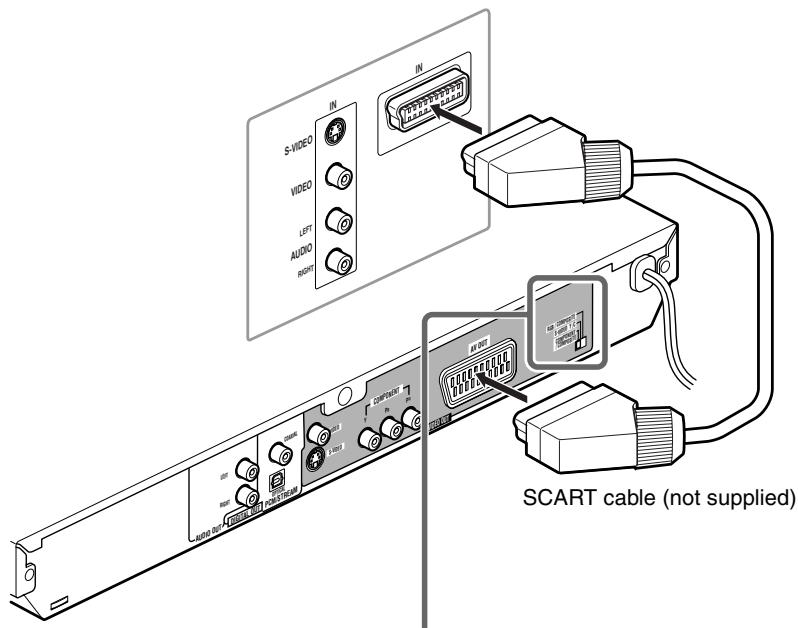
text_image
S-VIDEO IN VIDEO LEFT AUDIO RIGHT IN SCART cable (not supplied)Set the selector correctly according to your TV.
- If your TV only accommodates the composite video signal:
Set the selector to "COMPONENT/COMPOSITE" or "RGB/COMPOSITE."
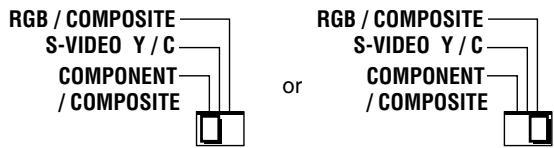
text_image
RGB / COMPOSITE S-VIDEO Y / C COMPONENT / COMPOSITE or RGB / COMPOSITE S-VIDEO Y / C COMPONENT / COMPOSITE- If your TV accommodates Y/C signals: Set the selector to "S-VIDEO Y/C."
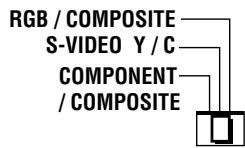
- If your TV accommodates RGB signals: Set the selector to "RGB/ COMPOSITE."
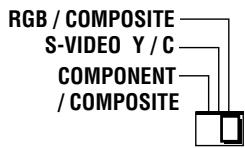
- If your TV accommodates both RGB and Y/C, set the selector to "RGB/COMPOSITE." Otherwise the picture cannot be displayed correctly.
⑧ Connecting to a conventional TV
If your TV has a monaural audio input instead of stereo, you need to use an optional audio cable which converts stereo audio output to monaural.
NOTES
- Do not connect multiple devices using multiple connectors.
- Do not connect cables to S-VIDEO jack and SCART connector. If you do so, you will not be able to obtain correct signals from the VIDEO (and COMPONENT VIDEO OUT) jacks.
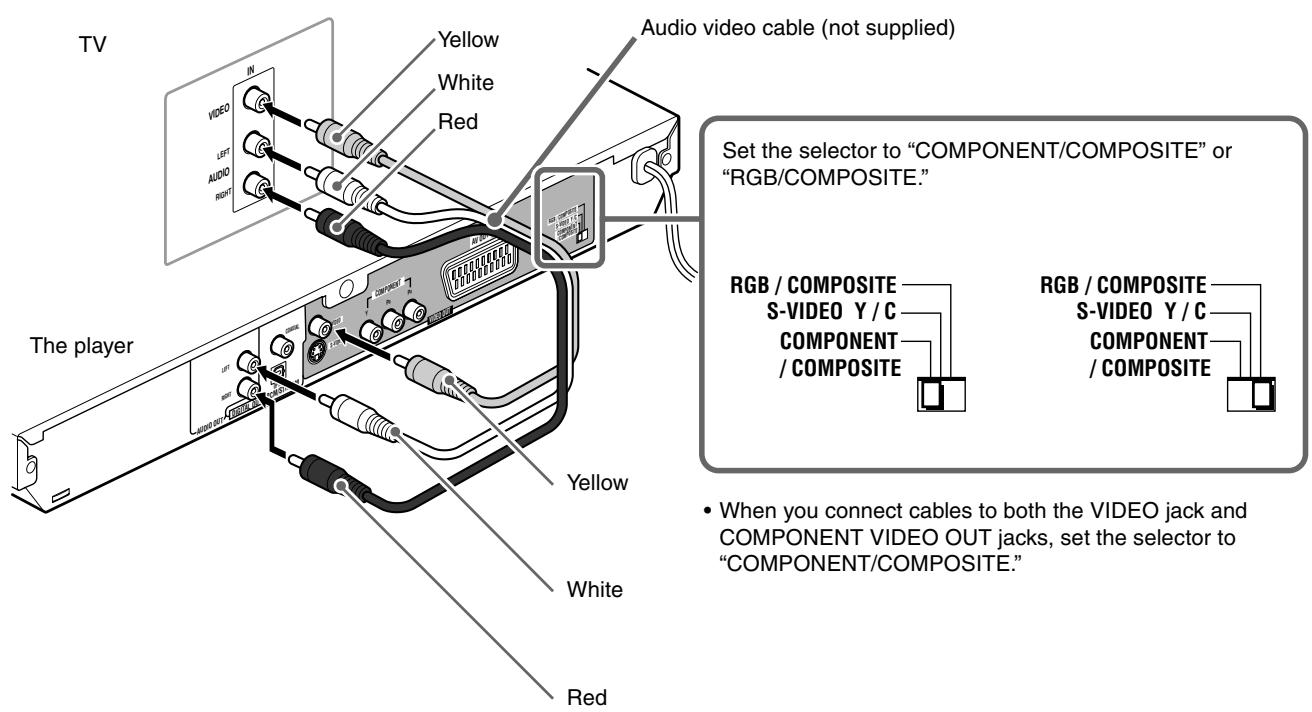
text_image
TV Yellow White Red Audio video cable (not supplied) The player Set the selector to "COMPONENT/COMPOSITE" or "RGB/COMPOSITE." RGB / COMPOSITE S-VIDEO Y/C COMPONENT / COMPOSITE RGB / COMPOSITE S-VIDEO Y/C COMPONENT / COMPOSITE When you connect cables to both the VIDEO jack and COMPONENT VIDEO OUT jacks, set the selector to "COMPONENT/COMPOSITE." Yellow White Red© Connecting to a TV with an S-video jack
If your TV has an S-VIDEO input, you can get better picture quality by connecting it with the S-VIDEO output of the player using an S-video cable instead of connecting the video input of the TV to the VIDEO jack of the player.
NOTES
- Do not connect multiple devices using multiple connectors.
- When using the S-VIDEO output jack, do not connect the COMPONENT VIDEO OUT jacks, VIDEO jack, and SCART cable on the player.
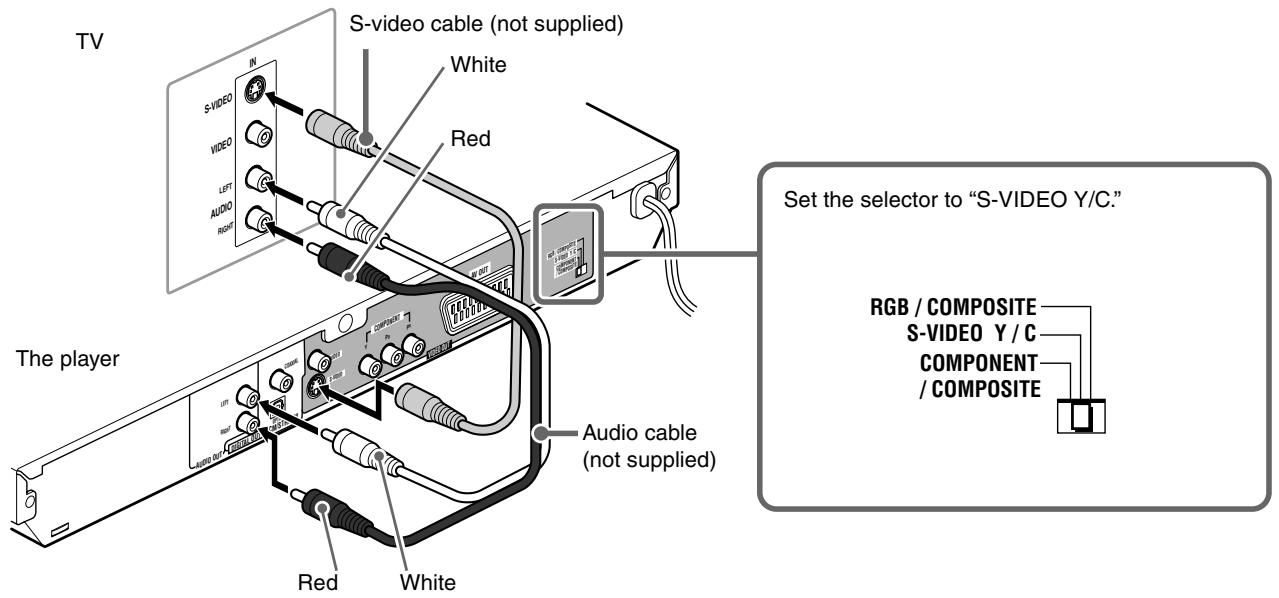
text_image
TV S-video cable (not supplied) White Red The player Audio cable (not supplied) Set the selector to "S-VIDEO Y/C." RGB / COMPOSITE S-VIDEO Y / C COMPONENT / COMPOSITE The player(D) Connecting to a TV with component jacks.
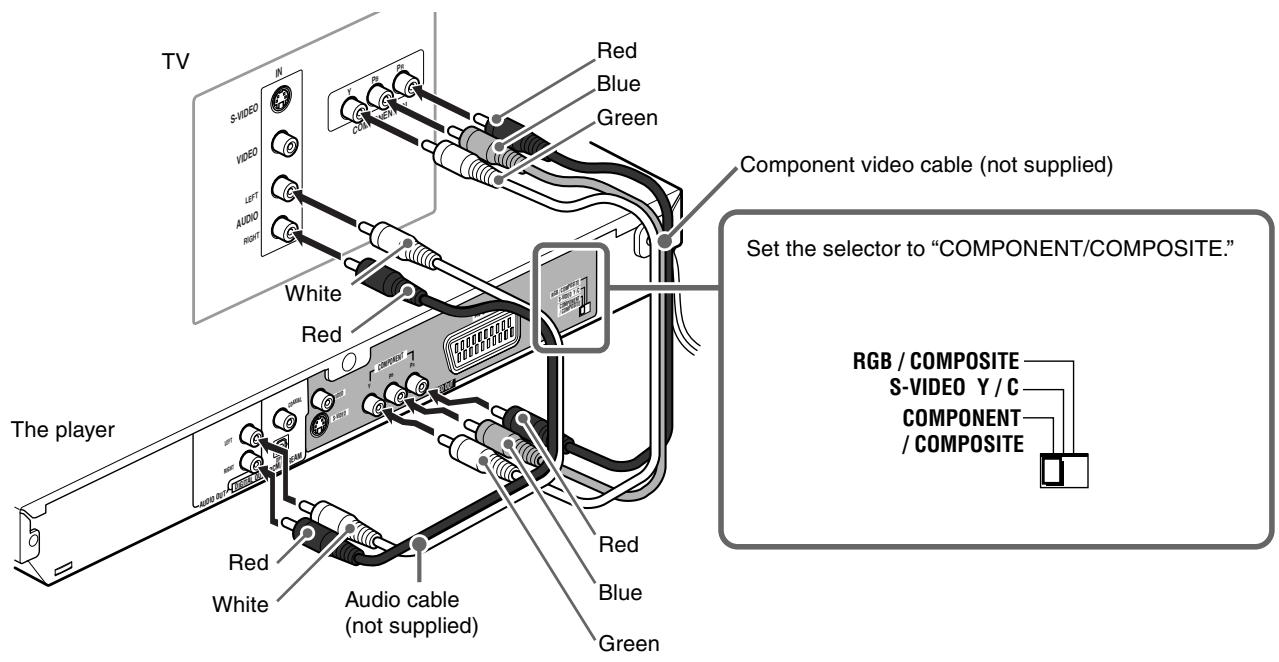
You can enjoy picture of high-fidelity color reproduction by connecting the COMPONENT VIDEO OUT jacks on the player to your TV.
NOTES
- Do not connect multiple devices using multiple connectors.
- Connect "Y" to "Y," "P_B" to "P_B" (C_B), "P_R" to "P_R" (C_R) correctly.
- Do not connect cables to S-VIDEO jack and SCART connector. If you do so, you will not be able to obtain correct signals from the COMPONENT VIDEO OUT jacks.
- If your TV has component video input jacks of BNC type, use an adapter which converts a pin jack to a BNC jack (not supplied).
Progressive scan video playback available
In the Progressive scanning mode, you can enjoy high quality picture with less flickers when the COMPONENT VIDEO OUT jacks are connected to a TV or monitor that supports the progressive video input.
HINT
Depending on the material source format, DVD VIDEO discs can be classified into two types; film source and video source (note that some DVD VIDEO discs contain both film source and video source).
When the player plays back a film source material, Progressive (uninterlaced) output signals are created using the original information. When a video source material is played back, the player interleaves lines between the interlaced lines on each to create the interpolated picture and outputs as the progressive signal.
text_image
TV S-VIDEO VIDEO LEFT AUDIO RIGHT Red Blue Green White Red The player Audio cable (not supplied) Red Blue Green Component video cable (not supplied) Set the selector to "COMPONENT/COMPOSITE." RGB / COMPOSITE S-VIDEO Y / C COMPONENT / COMPOSITEActivating the Progressive scanning mode using the remote control unit
When the player is turned on, press and hold down VFP - PROGRESSIVE SCAN for a few seconds.
The scanning mode switches between the Progressive scanning and Interlaced scanning modes.
When the scanning mode is set to the Progressive mode, the [P] indicator lights up in the display window. [DD] indicator also lights up when Progressive scanned signals on a DVD VIDEO disc are directly output as they are from the player.
Depending on the [PICTURE SOURCE] setting on the [PICTURE] preference display (see page 31) and whether the current DVD VIDEO disc is film-source or video-source, the progressive indicator lights, as shown in the table.
| Setting of [PICTURE SOURCE] | Source type of DVD VIDEO | |
| Film source | Video source | |
| AUTO | DDP | P |
| FILM | DDP | DDP |
| VIDEO (NORMAL)/(ACTIVE) | P | P |
* While stopped in the Progressive scanning mode, the [P] indicator is lit regardless of the [PICTURE SOURCE] selection.
NOTES
- The Progressive scanning mode works only when you connect the player's COMPONENT VIDEO OUT jacks to a progressive TV.
- There are some progressive TV and High-Definition TV sets that are not fully compatible with the player, resulting in the unnatural picture when playing back a DVD VIDEO disc in the Progressive scanning mode. In such a case, use the Interlaced scanning mode. To check the compatibility of your TV set, contact your local JVC customer service center.
- All JVC progressive TV and High-Definition TV sets are fully compatible with the player (Example: AV-61S902).
Connecting to optional audio equipment
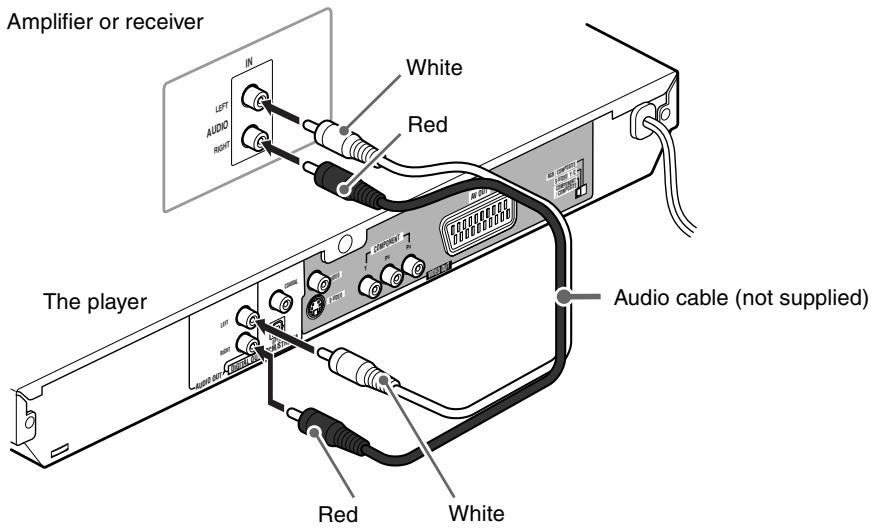
Connecting to a stereo audio amplifier/receiver
Connect the player's AUDIO OUT (LEFT/RIGHT) jacks to any line-level inputs (such as AUX, DVD, CD, etc.) of an audio amplifier or receiver.
text_image
Amplifier or receiver IN LEFT AUDIO RIGHT White Red The player Audio cable (not supplied) Red WhiteConnecting to a digital audio device for multichannel source
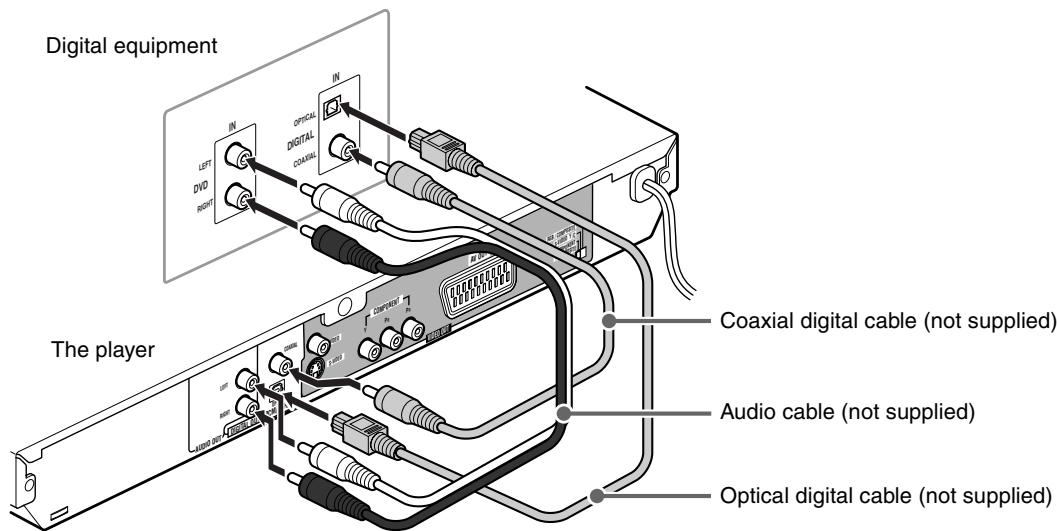
You can enjoy sound of enhanced quality by connecting the player's DIGITAL OUT (either OPTICAL or COAXIAL) jack to a digital input of an amplifier, etc., using an optical or coaxial digital cable. The digital audio signal on a disc will be transferred directly from the player. If the connected digital audio equipment is a Dolby Digital or DTS decoder or an amplifier with a built-in decoder, you can enjoy high-quality surround sound.
NOTES
- Connect the player and the digital audio device by using either an optical digital cable or a coaxial digital cable.
- It is not recommended to use the digital jacks for dubbing. When recording the sounds (DVD VIDEO, SVCD, Video CD or Audio CD) played back on the player, record them through the analog jacks.
- Depending on the disc, no signal may be output from the DIGITAL OUT. Make an analog connection in this case.
- Set [DIGITAL AUDIO OUTPUT] in the [AUDIO] preference display correctly according to the connected digital audio equipment. If setting made for [DIGITAL AUDIO OUTPUT] is incorrect, loud noise may be generated causing damage to the speakers (see page 32).
text_image
Digital equipment The player IN LEFT DVD RIGHT IN OPTICAL DIGITAL COAVAL Coaxial digital cable (not supplied) Audio cable (not supplied) Optical digital cable (not supplied)Connecting the power cord
When all the audio/video connections have been made, connect the AC power plug to the wall outlet. Make sure that the plugs are inserted firmly.
The STANDBY/ON indicator lights in red.

Warning
- Disconnect the power cord:
- if you are not going to use the player for a long time.
- before cleaning the player.
- before moving the player.
- Do not:
- connect or disconnect the power cord with wet hands.
- pull the power cord when disconnecting it, as this may damage the cord and cause fire, electric shock, or other accidents.

Caution
- Do not alter, twist or pull the power cord, or put anything heavy on it, which may cause fire, electric shock, or other accidents.
- If the cord is damaged, consult a dealer and have the power cord replaced with a new one.
Using the remote control unit
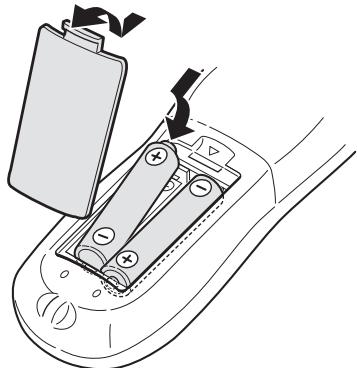
To install batteries
Open the compartment cover, and place the two supplied R6 (SUM-3)/AA(15F) batteries in the remote control unit according to the polarity markings (“+” and “−”) inside the compartment. Then replace the cover.
natural_image
Diagram of a car interior showing battery, switch, and battery holder (no text or labels)The batteries will last about six months with normal use. If the functions of the remote control unit become erratic, replace the batteries.
Precautions of the safe use of batteries
Observe the following precautions for the safe use of batteries. If they are used improperly their lives will be shortened, they may burst or their contents may leak.
- Remove the batteries from the remote control unit if it is not going to be used for a long period of time.
- Remove dead batteries and dispose of them properly.
- Never leave dead batteries lying around, take them apart, mix them with other refuse, or throw them into an incinerator.
- Never touch liquid that has leaked out of a battery.
- Do not mix new and old batteries, or batteries of different types, when replacing them.
Remote sensor
Point the top of the remote control unit toward the remote sensor as directly as possible. If you operate it from a diagonal position, the operating range (approx. 5 m) may be shorter.
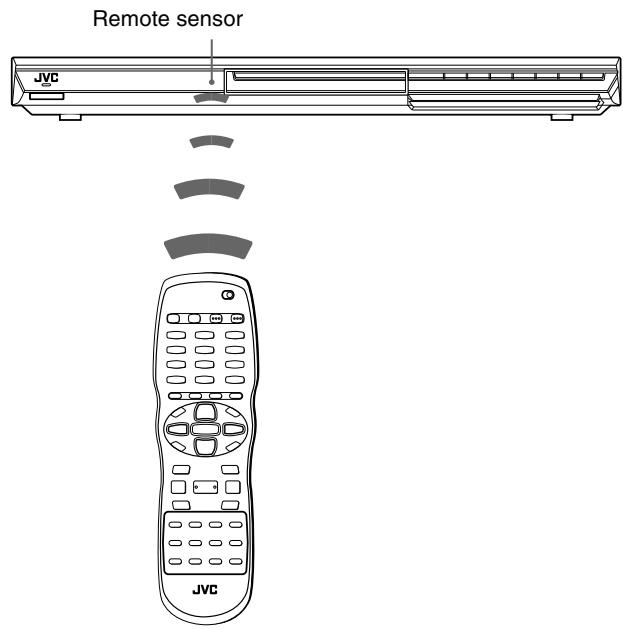
text_image
Remote sensor JVC JVC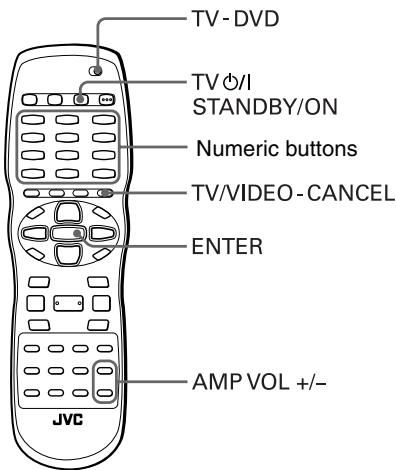
text_image
TV - DVD TV Ø/I STANDBY/ON Numeric buttons TV/VIDEO - CANCEL ENTER AMP VOL +/-To use the remote control unit for TV operation
Setting the remote control signal for operating your TV
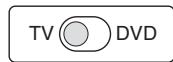
1 Set the TV - DVD switch to "TV."
2 While holding down TV/VIDEO - CANCEL, enter the manufacturer code of your TV listed below by using the numeric buttons (0 to 9), and then press ENTER.
Example:
To enter the manufacturer code "01": Press "0," "1," then ENTER.
Manufacturer code list
| Manufacturer | No. | Manufacturer | No. |
| AIWA | 36 | MIVAR | 29 |
| BEIJING | 22 | NEC | 20 |
| CCE | 02 | NOBLEX | 22 |
| CHANGHONG | 34 | NOKIA | 31 |
| DAEWOO | 17, 37 | PANASONIC | 04, 11 |
| FERGUSON | 27 | PEONY | 34, 38, 39 |
| FINLUX | 30 | PHILCO | 10, 17, 21 |
| FUNAI | 32 | PHILIPS | 02 |
| GRADIENTE | 15, 20 | RCA | 05 |
| GRUNDIG | 19 | SAMSUNG | 12, 33, 34, 35 |
| HITACHI | 10 | ||
| ITT | 28 | SANYO | 13, 16 |
| JINXING | 38 | SEARS | 13 |
| JVC | 01, 23, 24, 25 | SHARP | 06 |
| SONY | 07 | ||
| KONKA | 40 | TCL | 41 |
| LG (GOLDSTAR) | 18 | THOMSON | 26 |
| MAGNAVOX | 02 | TOSHIBA | 08, 14 |
| MITSUBISHI | 03 | ZENITH | 09 |
NOTE
These codes may not be compatible with TVs which are relatively old.
3 Release TV/VIDEO - CANCEL.
4 Try to operate the TV by pressing TV ⏻/I STANDBY/ON.
If your TV turns on or off, you have successfully set the control signal.
NOTES
- When you purchased the player the manufacturer code is set to "JVC" (01).
- If there is more than one code listed for the manufacturer of your TV, try them one by one until you succeed.
Operating the TV
Set the TV - DVD switch on the remote control unit to "TV."
The following buttons can be used for operating the TV.
 | Turns the TV on or off. |
 | Switches the TV input mode between TV and VIDEO. |
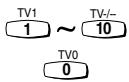 | Selects the TV channels directly.*For some TVs, pressing “+10” functions as the “100+,” while “10” functions as the ENTER button if your TV requires pressing the ENTER button after selecting a channel number. |
| [CKW8] | Mutes the TV sound. |
 | Changes the TV channels. |
 | Adjusts the TV sound volume. |
To control the volume of a JVC's amplifier or receiver
Pressing the AMP VOL + button raises the audio volume of a JVC's amplifier or receiver, while pressing the – button lowers the volume.
text_image
STANDBY/ON indicator JVC I OPEN/CLOSE DVD I/1 STANDBY/ON ENTER CHOICE ▲/▼/◄► ►/SELECT JVCNOTE
Make sure that the TV - DVD switch on the remote control unit is set to "DVD" when using the ▲/▼/◄/► and numeric buttons for controlling the player.
About invalid operation icon
When you press a button, and if the player does not accept its operation, ⊙ appears on your TV screen. Operations are occasionally unacceptable even if ⊙ is not displayed. Note that some operations may not be accepted. For example, some discs may not allow rapid advance/reverse or slow-motion playback.
Turning on/off the player
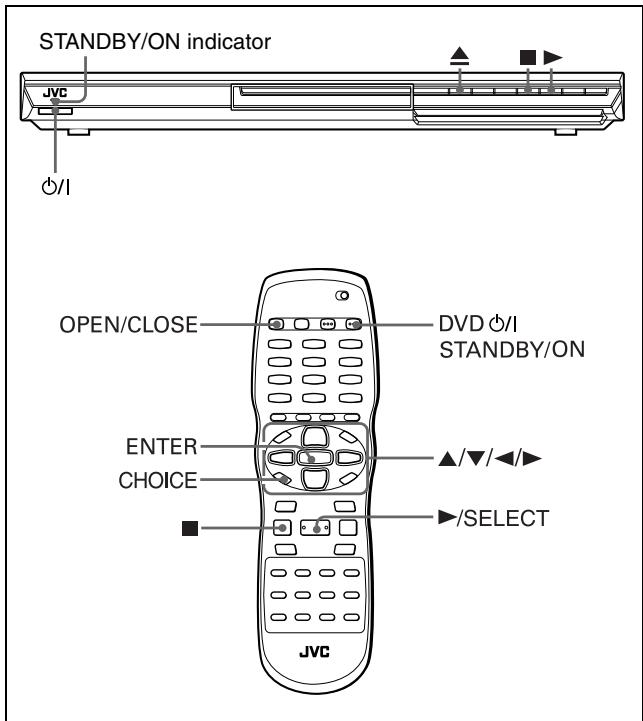
Press DVD ⏻/1 STANDBY/ON on the remote control unit or press ⏻/1 on the front panel.
The STANDBY/ON indicator on the front panel, which lights in red during standby, lights in green.
The left and right sides of the display window are illuminated.
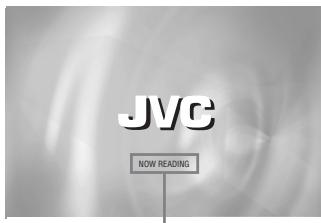
The opening display appears on the TV screen, and the following messages may appear at the bottom of the opening display.
text_image
JVC NOW READINGMessage area
- NOW READING (The player is reading the disc information.)
-
REGION CODE ERROR! (The region code of the DVD VIDEO disc does not match the player. The disc cannot be played back.)
-
CANNOT READ THIS DISC (The player cannot play back the disc.)
- OPEN (The disc tray is opening.)
- CLOSE (The disc tray is closing.)
- NO DISC (No disc is loaded.)
NOTES
- Even if you turn off the player, the player is not disconnected from the AC power source as long as it is connected to the wall outlet. This state is called standby mode. In this state, the player consumes a very small amount of power.
- You can change the picture of the opening display. (See page 28.)
Initial setup
When you turn on the player for the first time, the following message appears on the TV screen.
EXECUTE DVD PLAYER SETUP? - BASIC PICTURE/AUDIO SETTING
YES - PRESS ENTER NO - PRESS CANCEL
1 Press ENTER.
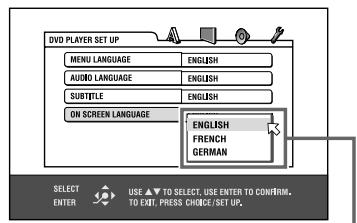
The first page of the DVD PLAYER SET UP display appears. The pull-down menu of the [ON SCREEN LANGUAGE] is already open.
text_image
DVD PLAYER SET UP MENU LANGUAGE ENGLISH AUDIO LANGUAGE ENGLISH SUBTITLE ENGLISH ON SCREEN LANGUAGE ENGLISH FRENCH GERMAN SELECT ENTER USE ▲▼ TO SELECT, USE ENTER TO CONFIRM. TO EXIT, PRESS CHOICE/SET UP.ON SCREEN LANGUAGE options
2 Press ▲/▼ to select the desired language.
You can select the on-screen language for the preference displays, etc. from among ENGLISH, FRENCH, and GERMAN.
3 Press ENTER.
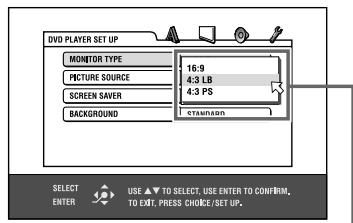
The second page is shown, in which the pull-down menu of the [MONITOR TYPE] is already open.
text_image
DVD PLAYER SET UP MONITOR TYPE 16:9 4:3 LB SCREEN SAVER 4:3 PS BACKGROUND STANDARD SELECT ENTER USE ▲▼ TO SELECT, USE ENTER TO CONFIRM, TO EXIT, PRESS CHOICE/SET UP.MONITOR TYPE options
4 Press ▲/▼ to select the desired monitor type.
For a normal (conventional) TV, select [4:3 LB] or [4:3 PS]. For a wide-screen TV, select [16:9]. (See page 31.)
5 Press ENTER.
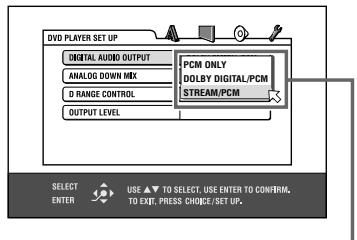
The third page is shown, in which the pull-down menu of the [DIGITAL AUDIO OUTPUT] is already open.
text_image
DVD PLAYER SET UP DIGITAL AUDIO OUTPUT ANALOG DOWN MIX D RANGE CONTROL OUTPUT LEVEL PCM ONLY DOLBY DIGITAL/PCM STREAM/PCM SELECT ENTER USE ▲▼ TO SELECT, USE ENTER TO CONFIRM. TO EXP. PRESS CHOICE/SET UP.DIGITAL AUDIO OUTPUT options
6 Press ▲/▼ to select a desired digital output signal type.
Set this item correctly when you connect the player to an external surround decoder or D/A converter. See “DIGITAL AUDIO OUTPUT” on page 32. (If you do not connect the player to such a device, you do not have to set this item.)
- When connecting to other digital device, select [PCM ONLY].
- When connecting to a Dolby Digital decoder, select [DOLBY DIGITAL/PCM].
- When connecting to a Dolby Digital decoder/DTS decoder/MPEG decoder, select [STREAM/PCM].
7 Press ENTER.
The TV screen returns to the opening display.
To bring up the DVD PLAYER SET UP display later
Press CHOICE for a few seconds until the DVD PLAYER SET UP display appears.
Basic playback


1 Press ▲ (or OPEN/CLOSE on the remote control unit) to open the disc tray.
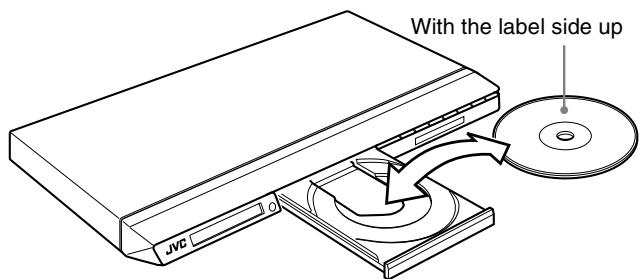
2 Place a disc in the disc tray.
text_image
With the label side up JVC- To insert an 8-cm disc, place it in the inner recess.
3 Press ▲ (or OPEN/CLOSE on the remote control unit) to close the disc tray.
4 Press ▶ on the player or ▶/SELECT on the remote control unit.
The player starts playback from the beginning.
- Depending on the disc, playback starts when you close the disc tray.
If a menu is shown on the TV screen
When inserting a DVD VIDEO, SVCD or Video CD disc, a menu may be shown on the TV screen. From the menu, you can select a desired item to be played back.
For DVD VIDEO
1 Press ▲/▼/◄/► to select a desired item.
2 Press ENTER.
The player starts playback of the selected item.
For SVCD/Video CD
Press the numeric buttons to select a desired item.
The player starts playback of the selected item.
NOTES
- Do not insert an unplayable disc. (See page 2.)
- When inserting a disc on the disc tray, be sure to position the disc inside the recess. Otherwise, the disc may be damaged when the disc tray is closed, or you may not be able to remove the disc from the player.
- If it takes time to read the loaded disc (“READING” appears on the display window), remove the disc by pressing OPEN/CLOSE on the remote control and check the disc.
text_image
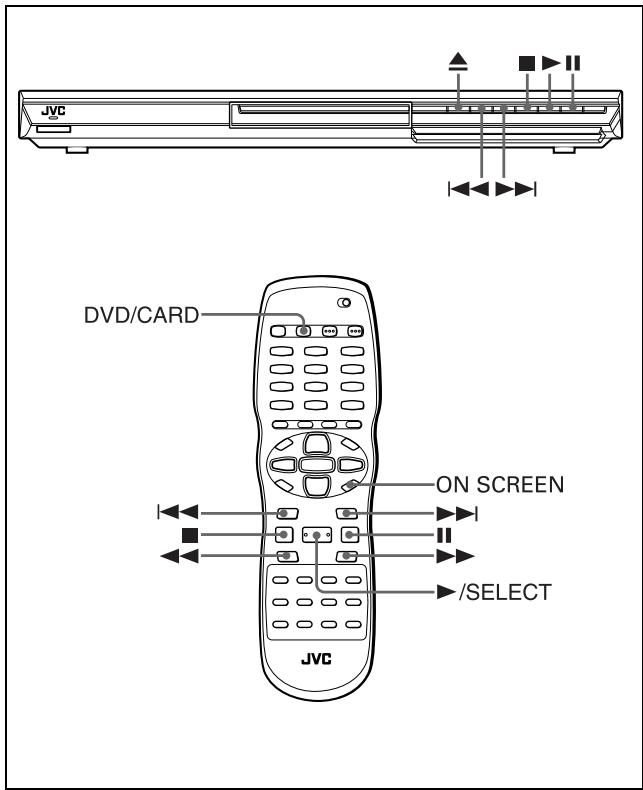
JVC DVD/CARD ON SCREEN /SELECT JVCTo check the playback status
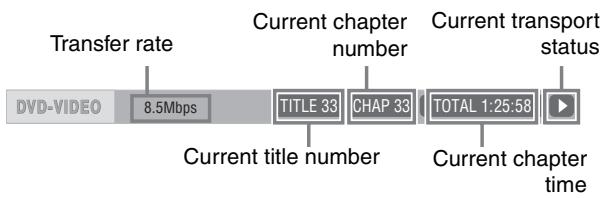
You can see the current selection number (the title/chapter number for DVD VIDEO or track number for SVCD/Video CD/Audio CD), time information (the track or chapter time while stopped, or elapsed track or chapter time during playback) and the transport status (stop, playback, pause, etc.) on the TV screen.
Press ON SCREEN.
Example: for DVD VIDEO
text_image
Transfer rate DVD-VIDEO 8.5Mbps Current chapter number TITLE 33 CHAP 33 TOTAL 1:25:58 Current transport status Current title number Current chapter timeNote that pressing ON SCREEN again brings up the menu bar under the status bar, from which you can access various functions. See page 23 for details about the menu bar.
To turn off the status bar
Press ON SCREEN repeatedly until the status bar goes off.
To stop playback completely
Press ■.
Hint
If you press ▲ during playback, the player stops playback and opens the disc tray.
To stop playback temporarily
Press II.
To resume playback, press ▶/SELECT. (See the following item.)
About On-screen guide icons
You may see the following icons displayed over the picture at the beginning of an operation.
They have the following meanings.
: Playback
II : Pause
/ : Fast playback with the speed indication
/ : Slow-motion playback with the speed indication
: A scene recorded from multiple angles (see page 21)
○: A scene recorded with multiple audio languages (see page 21)
: A scene recorded with multiple subtitle languages (see page 21)
You can change the setting so that the on-screen guide icons do not appear on the TV screen (see page 32).
Resuming playback

The player can memorize the position on a disc where you interrupt playback, and resume playback from that position later. There are three resume modes; ON, OFF and DISC RESUME. The mode is initially set to ON when you purchased the player.
- You can select the mode using the preference display (see page 32).
When the resume mode is "ON"
When you press ■, the player stops playback and memorizes the interrupted position. The TV screen shows "RESUME STOP" and [----RESUME] appears in the display window.
The memory of the interrupted position is not cleared if you turn off the player.
When you turn off the player after setting the resume function, simply press ▶/SELECT. The player is turned on, and playback starts from the interrupted position.
Note that the memory is cleared if you open the disc tray.
When the resume mode is "DISC RESUME"
When you press ■, the player stops playback and memorizes the interrupted position. The TV screen shows "RESUME STOP" and [----RESUME] appears in the display window.
The memory of the interrupted position is not cleared if you open the disc tray or turn off the player.
Hint
The player memorizes interrupted positions for the last 30 discs played. Storing a new interrupted position will erase the interrupted position stored for the first disc.
To clear the memory
Press ■ while the disc is stopped.
To resume playback
When the resume mode is "ON"
While the disc you interrupted playback is still on the disc tray, press ▶/SELECT.
The player resumes playback from the position where playback was interrupted. The TV screen shows “RESUME PLAY.”
To play back from the beginning
Press ■ before pressing ▶/SELECT to start playback.
When the resume mode is "DISC RESUME"
1 Press ▲ to insert a disc for which the player has stored an interrupted position.
The TV screen shows "RESUME STOP."
2 Press ▶/SELECT.
The TV screen shows “RESUME PLAY” and the player resumes playback from the position where playback was interrupted.
To play back from the beginning
After inserting the disc, press ■ before pressing ▶/SELECT to start playback.
When playing back a memory card
Pressing the DVD/CARD with a disc loaded clears the memory of the interrupted position.
To playback a memory card without clearing the memory of the interrupted position, do the following procedure.
1 Set the [RESUME] setting to [DISC RESUME].
2 Press ■.
3 Press ▲ to eject the disc.
4 Press DVD/CARD and start the memory card playback.
NOTES
- If you change the [RESUME] setting from [DISC RESUME] to [OFF] or [ON], you cannot resume playback of a disc whose "resuming" position is stored. However, when you again set [RESUME] to [DISC RESUME], you will then be able to resume playback of the disc.
- When you resume playback, set the [RESUME] setting to [DISC RESUME] before removing a loaded disc.
- If you interrupt the playback of a disc for which an interrupted position has already been stored, the memory will be updated with the new interrupted position.
- For a double-sided DVD VIDEO disc, the player regards each side as a different disc. Therefore, to resume playback of such a disc, the disc must be inserted with the same side down.
- When the player memorizes an interrupted point for a disc, it also memorizes Audio, Subtitle and Angle settings.
Various speed playback
To advance or reverse playback rapidly while monitoring

During playback, press ▶▶ or ◀◀ on the remote control unit.
You can select from 2 times (1.5 times for only the forward playback of DVD VIDEO), 5 times, 20 times and 60 times (for DVD VIDEO only) normal speed. Pressing ▶/SELECT returns the player to normal playback.
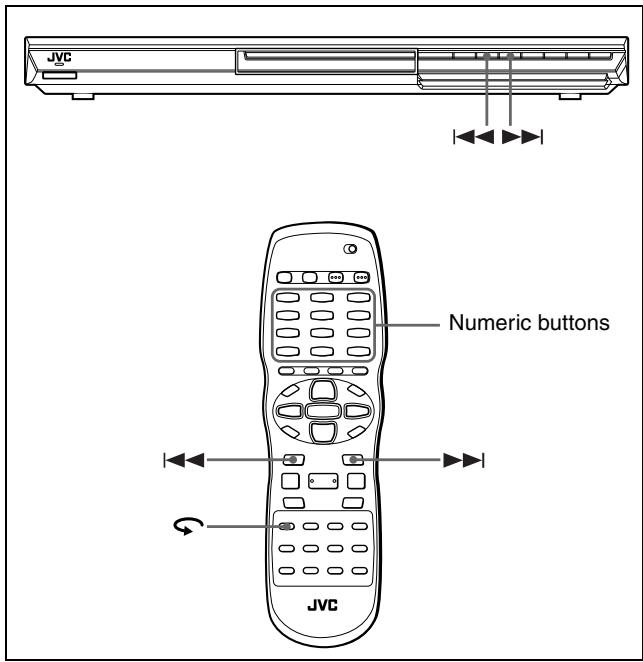
During playback, hold down ▶▶| or ◀◀.
Playback is advanced or reversed at 5 times normal speed.
NOTE
During rapid playback, the sound will be muted except when playing an audio CD, and when playing a DVD VIDEO at 1.5 times normal speed. For Audio CD, the sound will be heard intermittently.
x1.5 Quick Playback with sound

When you select 1.5 times normal speed playback, the disc is played back with sound.
- The subtitle does not go off.
- The sound may be heard intermittently.
- If the sound of a DVD VIDEO disc is recorded in Dolby Digital, MPEG Multichannel, or DTS format, stereo linear PCM signals are output. With some DVD VIDEO discs, the sound quality and volume may alter, or the sound may be out of tune.
- To switch from rapid reverse playback to x1.5 Quick Playback, first press ▶/SELECT, then press ▶▶ once.
To advance a still picture frame by frame

While paused, press II.
Each time you press Ⅱ, the still picture advances to the next frame.
Pressing ▶/SELECT returns to normal playback.
To play back in slow motion

You can select from 1/32 times, 1/16 times, 1/4 times and 1/2 times normal speed.
During playback, press II, then press ▶▶ (to play forward slow motion), or ◀◀ (to play reverse slow motion, for DVD VIDEO disc only).
Pressing ▶/SELECT returns to normal playback.
NOTE
During slow motion playback, the sound will be muted.
text_image
JVC Numeric buttons JVCTo replay the previous scenes (One touch replay function)

During DVD VIDEO playback, press ↻.
The playback position moves back 10 seconds before the current position.
NOTES
- This function works only within the same title, though it works between chapters.
- This function may not work with some DVD VIDEO discs.
Locating the beginning of a scene or song

For DVD VIDEO: During playback, you can skip a chapter or title, depending on the disc configuration.
For SVCD/Video CD: During playback without PBC function, you can skip a track.
For Audio CD: During playback or while in stop mode, you can skip a track.
To skip forward, press ▶▶.
To skip backward, press ◀◀ twice.
Using the numeric buttons
For DVD VIDEO/Audio CD: During playback or while in stop mode For SVCD/Video CD: During playback without PBC function or while in stop mode
Press the numeric buttons to specify the number.
To select 5: press 5.
To select 23: press +10, +10, then 3.
To select 40: press +10, +10, +10, then 10.
The player starts playback from the beginning of the selection.
NOTES
- Depending on the disc type and the player status, what is specified differs:
| Player status | Disc type | What is specified |
| While stopped | DVD VIDEO | title |
| SVCD/Video CD/Audio CD | track | |
| During playback | DVD VIDEO | chapter |
| SVCD/Video CD/Audio CD | track |
- During DVD VIDEO playback, if a menu is shown on the TV screen, the numeric buttons may be used for selecting an item in the menu.
About screen saver function
A television monitor may have an image burned into it if a static image is displayed for a long time. To prevent this, the player automatically activates the screen saver function if a static picture, such as an on-screen display or menu, is displayed for over 5 minutes.
When the screen saver function is activated, the TV screen gets darker.
Pressing any buttons will release the screen saver function. See "SCREEN SAVER" on page 31.
- The screen saver function does not work when playing back the following sources:
- JPEG/MPEG-4 (while in pause)
- Audio CD
text_image
Numeric buttons RETURN TOP MENU ▲/▼/◄► TITLE/GROUP MENU ENTER ►/SELECT JVCNOTE
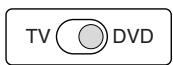
Make sure that the TV - DVD switch on the remote control unit is set to "DVD" when using the ▲/▼/◄/►, numeric and TV/VIDEO - CANCEL buttons for controlling the player.
Playing from a specific position
To locate a desired scene from the DVD menu

DVD VIDEO discs generally have their own menus which show the disc contents. These menus contain various items such as titles of movies, names of songs, or artist information, and display them on the TV screen. You can locate a desired scene using the DVD menu.
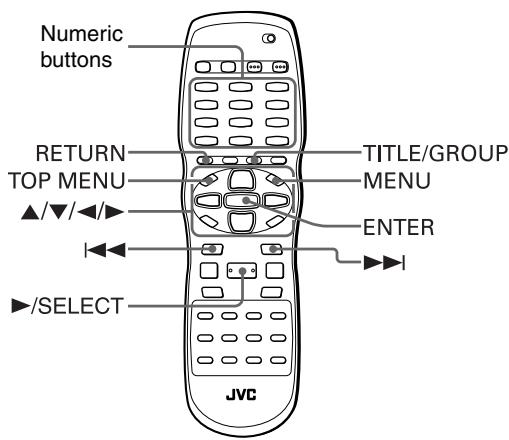
1 While a DVD VIDEO disc is inserted, press TOP MENU or MENU.
The menu appears on the TV screen.
2 Press ▲/▼/◄/► to select a desired item, then press ENTER.
The player starts playback of the selected item.
Hints
- Some DVD VIDEO discs may also have a different menu which appears when MENU is pressed.
- See the instructions of each DVD VIDEO disc for its particular menu.
- With some discs, you can select items by entering the corresponding number using the numeric buttons, which may cause the player to automatically start playback.
NOTE
The MENU button does not work while stopped.
To locate a desired scene from the menu of a SVCD/Video CD with PBC


Some SVCD/Video CD discs support the PBC function. PBC is an abbreviation of “Playback Control.” Some SVCD/Video CD discs recorded with PBC have their own menus, such as a list of the songs of the disc. You can locate a specific scene by using the PBC menu.
1 In stop mode, press ▶/SELECT.
A disc menu appears on the TV screen.
2 Press the numeric buttons to select the desired item.
To select 5: press 5.
To select 23: press +10, +10, then 3.
To select 40: press +10, +10, +10, then 10.
The player starts playback of the selected item.
To return to the menu, press RETURN.
Hint
If something like “NEXT” or “PREVIOUS” appears on the TV screen, pressing ▶▶ advances to the next page, and pressing ◀◀ returns to the previous page.
About PBC (Playback Control)
Some SVCD/Video CD discs support the PBC function. The PBC function allows you to enjoy menu-driven operation and high-resolution still images which have a resolution four times greater than moving pictures.
- To play a PBC-compatible SVCD/Video CD disc without activating the PBC function, press the numeric buttons instead of ▶/SELECT to start playback.
- To activate the PBC function again, press ■ to stop playback, then press ▶/SELECT.
To specify a desired title

1 During playback, press TITLE/GROUP.
[--] is shown in the title display area of the display window.
2 Press the numeric buttons to specify a title to be played.
To select 5: press 5.
To select 23: press +10, +10, then 3.
To select 40: press +10, +10, +10, then 10.
The player starts playback from the specified title.
NOTE
This function may not work with some DVD VIDEO discs.
text_image
Numeric buttons ▲/▼/◄► ENTER ►/SELECT TV/VIDEO-CANCEL ON SCREEN JVCTo locate a desired position in the current title or track (Time search)

You can play a disc from the desired position by specifying the time from the beginning of the current title (for DVD VIDEO) or the disc (for SVCD/Video CD/Audio CD).
For DVD VIDEO/Audio CD: During playback
For SVCD/Video CD: In any condition except SVCD/Video CD playback with PBC
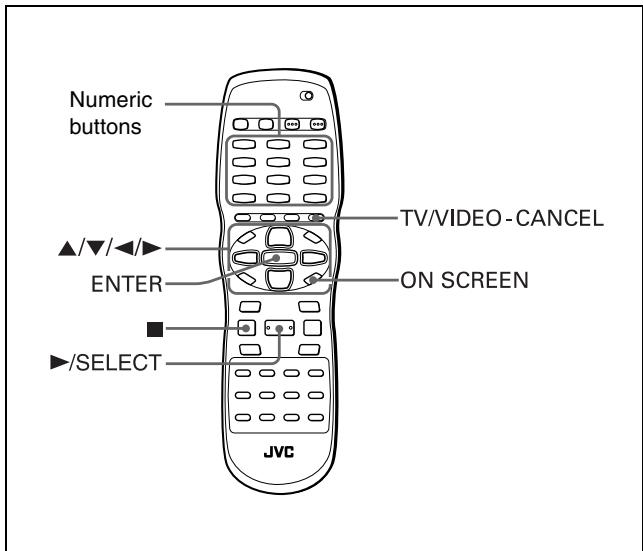
1 Press ON SCREEN twice.
The menu bar appears on the TV screen.
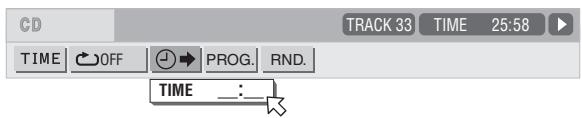
2 Press ◀/▶ to move ✉ to ⏱→, then press ENTER.
The pull-down menu for entering time appears.
Screen example for DVD VIDEO

text_image
DVD-VIDEO 8.5Mbps TITLE 33 CHAP 33 TOTAL 1:25:58 TIME OFF CHAP 1/3 1/5 1/3 TIME : : :Screen example for Audio CD
text_image
CD TIME OFF PROG. RND. TRACK 33 TIME 25:58 TIME :3 Press the numeric buttons (0 to 9) to enter the desired time.
The specified time is displayed in the pull-down menu.
Example (for DVD VIDEO)
To play back from 2(H):34(M):00(S)
Press 2, 3, then 4.
TIME 2:34:_
Example (for SVCD/Video CD/Audio CD)
To play back from 23(M):40(S)
Press 2, 3, then 4.
TIME 23:4_
You do not have to press "0" to enter the trailing zeros (for the last two digits in the example above).
To correct a mistake
Press repeatedly to move back to the digit where you entered a wrong number, and reenter the correct one.
4 Press ENTER.
The player starts playback from the specified time.
To dismiss the menu bar
Press ON SCREEN.
Hint
“10” and “+10” buttons are not used with this function.
NOTES
- Some DVD VIDEO discs do not contain time information, and the time search function cannot be used.
- The time search function cannot be used during program playback.
Changing the playback order
To play back in a specific order (Program play)

By programming tracks, you can play up to 99 tracks in any order. You may program the same track more than once.
1 In stop mode, press ON SCREEN twice.
The menu bar appears on the TV screen.
2 Press ◀/▶ to move 📋 to PROG. Screen example for Audio CD

text_image
CD TRACK 33 TIME 25:58 TIME OFF PROG. RND.3 Press ENTER.
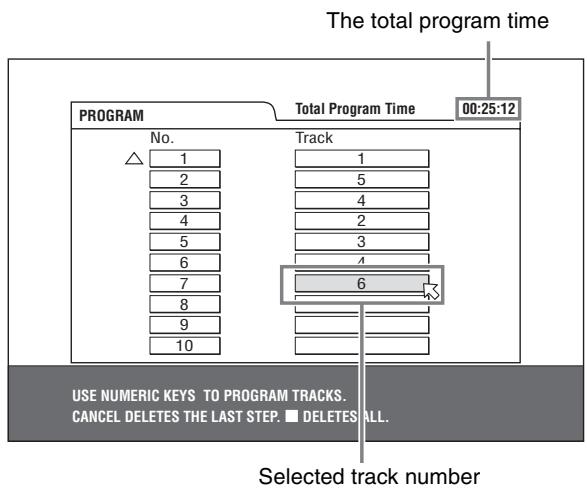
The program table appears.
The [PRGM] indicator lights up in the display window.
4 Press the numeric buttons to specify tracks in the desired order.
To select 5: press 5.
To select 23: press +10, +10, then 3.
To select 40: press +10, +10, +10, then 10.
text_image
The total program time PROGRAM Total Program Time 00:25:12 No. 1 2 3 4 5 6 7 8 9 10 Track 1 5 4 2 3 4 6 Selected track number USE NUMERIC KEYS TO PROGRAM TRACKS. CANCEL DELETES THE LAST STEP. □ DELETES ALL.To correct the program
Press ▲/▼ to move ☑ to the track to be corrected, then press TV/VIDEO - CANCEL. The track is erased and the subsequent programmed tracks move up.
Pressing ■ clears all the programmed tracks.
5 Press ▶/SELECT to start program playback.
With an Audio CD disc, the program table remains on the TV screen during program playback. (Pressing ON SCREEN brings up the status bar.)
When all of the programmed tracks have finished playback, the player stops and the program table appears again. Note that the program remains.
- During program playback, you cannot edit the program contents.
To check the program contents
During playback, press ■. Playback stops and the program table is shown.
When the player is playing back an Audio CD and the program table is not shown, you can bring up the table by carrying out steps 1 to 3.
During SVCD/Video CD playback, you can check the program contents via the menu bar.
To stop program playback
Press ■.
To clear the program
While stopped and the program table is shown, press ■.
To exit the program mode
After clearing the program, press ON SCREEN.
NOTES
- When the disc tray is opened or the player is turned off, the program is cleared.
- During Audio CD playback, you can select previous or next tracks by pressing ▶▶▶▶◀◀◀.
- During VCD/SVCD playback, you cannot search for the portion on the discs by pressing ▶▶/◀◀.
- During program playback, you can repeat playback.
To play back in random order (Random play)

1 In stop mode, press ON SCREEN twice.
The menu bar appears on the TV screen.
2 Press ◀/▶ to move 📋 to RND. Screen example for Audio CD

text_image
CD TRACK 33 TIME 25:58 TIME OFF PROG RND.3 Press ENTER.
The player starts random playback.
With an SVCD/Video CD disc, the menu bar is automatically dismissed.
During random playback, the [RND] indicator lights up in the display window.
After playing all tracks of the disc, the player stops the disc and exits the random playback mode.
To stop and quit random playback
Press ■. The player stops playback and exits the random playback mode.
NOTES
- During random playback, you can repeat playback.
- Random playback mode will be canceled in the following cases:
- When ejecting the loaded disc
- When the Control screen appears on the TV
- When turning off the power
text_image
▲/▼/◄► ENTER ON SCREEN ►/SELECT ANGLE REPEAT AUDIO SUBTITLE JVCRepeat playback
To repeat the current selection or all tracks

For DVD VIDEO: During playback
For SVCD/Video CD/Audio CD: In any condition except SVCD/Video CD playback with PBC
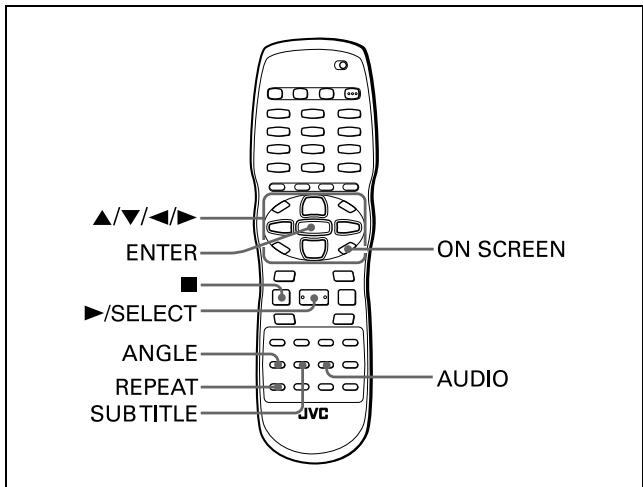
Press REPEAT.
If you press REPEAT in stop mode, press ▶/SELECT to start playback.
Each time you press REPEAT, the repeat mode cycles among All repeat, Repeat 1 and off.
The indication on the display window shows the selected repeat mode.
: Repeats the current title for DVD VIDEO or all tracks for SVCD/Video CD/Audio CD.
1: Repeats the current chapter for DVD VIDEO or the current track for SVCD/Video CD/Audio CD.
No indication: The repeat mode is off.
A window which indicates the current repeat mode will be displayed on the TV screen. The mode indication on the window is same as the one on the menu bar. (Repeat mode example on the TV screen)
CHAP
To stop repeat playback
Press ■.
When a DVD VIDEO disc is set, the unit stops playback and quits the repeat mode.
When an SVCD, Video CD or Audio CD disc is set, the unit stops playback but does not quit the repeat mode.
To quit repeat playback
Press REPEAT until the repeat mode indicator goes off in the display window.
Hint
When the program playback mode is active with an SVCD, Video CD or Audio CD, the repeat mode changes in the same manner.
Note, however, that in the “→” mode the player repeats all the programmed tracks instead of all tracks on the disc.
To repeat a desired part (A-B repeat playback)

First make sure:
- The player is in playback mode except SVCD/Video CD playback with PBC.
1 Press ON SCREEN twice.
The menu bar appears on the TV screen.
2 Press ◀/▶ to move ✉ to 📄, then press ENTER.
The pull-down menu for repeat mode selection appears.
3 Press ▲/▼ to select [A-B].
4 Press ENTER at the beginning of the part you want to repeat (point A).
The pull down menu disappears.
The repeat icon shows A-
5 Press ENTER at the end of the part you want to repeat (point B).
The repeat icon shows A-B
The player locates “A” and starts repeat playback between “A” and “B.”
The [→] indicator lights in the display window.
To quit A-B repeat playback
Press ◀/▶ to move ✉ to ⏻ A-B, and press ENTER. The A-B repeat mode turns off, then normal playback continues.
NOTES
- The A and B points must be set in the same title/chapter/track.
- When you press ■ twice during DVD VIDEO playback, A-B repeat is canceled.
Changing the language, sound and scene angle
To select the subtitle language (SUBTITLE)

Some DVD VIDEO and SVCD discs contain more than one subtitle language. You can choose a desired one from them.
Hint
At the beginning of the part where the subtitles are recorded, .... appears on the TV screen (except when the [ON SCREEN GUIDE] preference is set to [OFF]).
1 During playback, press SUBTITLE.
The subtitle selection window appears on the TV screen.
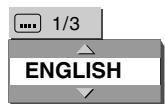
2 Press ▲/▼ or SUBTITLE to select the subtitle.
Each time you press ▲/▼ or SUBTITLE, the subtitle language changes.
3 Press ENTER.
Subtitles are displayed in the selected language. The subtitle selection window is dismissed.
NOTES
- An SVCD disc can have up to four subtitles. Pressing ▲/▼ cycles through those channels regardless of whether the subtitles are recorded or not.
- The subtitle selection window will automatically disappear if you do not change the subtitle for several seconds.
- For DVD VIDEO, the selected language may be abbreviated on the TV screen. See “Appendix B: Table of languages and their abbreviations” on page 37.
To change the audio language or sound (AUDIO)

The audio selection setting allows you to change the audio language of a movie.
Hint
At the beginning of the part where multiple audio tracks are recorded, appears on the TV screen (except when the [ON SCREEN GUIDE] preference is set to [OFF]).
1 During playback, press AUDIO.
The audio selection window appears on the TV screen.
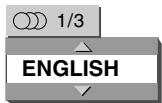
2 Press ▲/▼ or AUDIO to select the desired audio.
Each time you press ▲/▼ or AUDIO, the audio changes.
For DVD VIDEO (example)

For SVCD

For Video CD

3 Press ENTER.
You can hear the selected audio. The audio selection window is dismissed.
NOTES
- The audio selection window will automatically disappear if you do not change the audio for several seconds.
- For DVD VIDEO, the selected language may be abbreviated on the TV screen. See “Appendix B: Table of languages and their abbreviations” on page 37.
- Some discs may not allow this operation during playback.
To select a scene angle of DVD VIDEO (ANGLE)

You can enjoy a variety of scene angles if the DVD VIDEO disc contains “multi-angle” parts, where multiple cameras were used to shoot the same scene from different angles.
Hint
At the beginning of a "multi-angle" part, 🔊 appears on the TV screen (except when the [ON SCREEN GUIDE] preference is set to [OFF]).
1 During playback, press ANGLE.
The angle selection window appears on the TV screen.
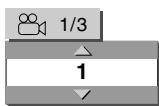
2 Press ▲/▼ or ANGLE to select the desired angle.
Each time you press ▲/▼ or ANGLE, the angle changes.
3 Press ENTER.
You can see the picture from the selected angle. The angle selection window is dismissed.
NOTE
The angle selection window will automatically disappear if you do not change the angle for several seconds.
text_image
▲/▼/◄► ENTER ON SCREEN SOUND EFFECT ZOOM VFP-PROGRESSIVE SCAN JVCSpecial picture/sound effect
To zoom in pictures


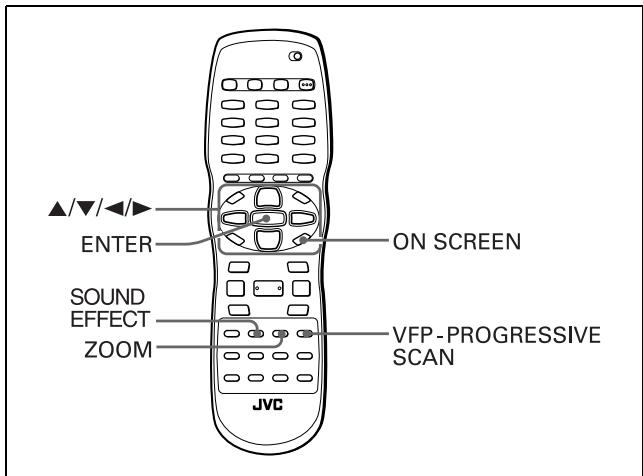
1 During playback or while paused, press ZOOM.
Pressing ZOOM causes the player to zoom in on the image. Each time you press ZOOM, the magnification is changed (1.5, 2 and 4 times).
2 Press ▲/▼/◄/► to move the zoomed position.
To return to the normal playback
Select the normal size by pressing ZOOM repeatedly.
NOTE
While zoomed, the picture may look coarse.
To adjust the picture character (VFP)


The VFP (Video Fine Processor) function allows you to adjust the picture character according to the type of programming, picture tone or personal preferences.
1 During playback, press VFP - PROGRESSIVE SCAN.
The VFP mode selection window appears on the TV screen.
- If you press the VFP-PROGRESSIVE button too long, the button works for changing the scanning mode (see page 8) instead of the VFP function.
2 Press ◀/▶ to select the desired preset.
Each time you press the button, the VFP mode changes as follows.
Set the video type most suitable to the current program or the room conditions.

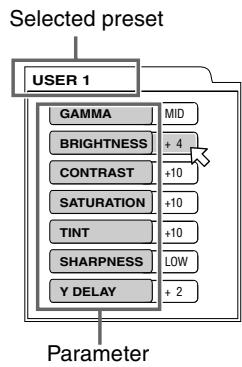
flowchart
graph TD
    A["Selected preset"] --> B["USER 1"]
    B --> C["GAMMA MID"]
    B --> D["BRIGHTNESS +4"]
    B --> E["CONTRAST +10"]
    B --> F["SATURATION +10"]
    B --> G["TINT +10"]
    B --> H["SHARPNESS LOW"]
    B --> I["Y DELAY +2"]
    J["Parameter"] --> B
[NORMAL]: for watching TV in a general room.
[CINEMA]: for watching a movie software in a room with suppressed light.
[USER 1] [USER 2]: you can adjust parameters that affect the picture character and store the settings as a user preset. See the next step.
3 To define a user setting, press ▲/▼ to select a parameter to be edited from the following.
• GAMMA
Adjust this if the neutral color is bright or dark. The brightness of dark and bright portion is maintained. Available range: LOW/MID/HIGH.
- BRIGHTNESS
Adjust this if the picture is bright or dark on the whole. Available range: -16 (darkest) to +16 (brightest).
- CONTRAST
Adjust this if the far and near position is unnatural. Available range: -12 to +12.
- SATURATION
Adjust this if the picture is whitish or blackish. Available range: -16 (blackest) to +16 (whitest).
• TINT
Adjust this if the appearance of flesh tone is unnatural. Available range: -16 to +16.
- SHARPNESS
Adjust this if the picture is indistinct. Available range: LOW/HIGH.
- Y DELAY
Adjust this if the picture looks separately/overlapped. Available range: -2 to +2.
4 Press ENTER.
A window for setting parameters appears.

5 Press ▲/▼ to adjust the level of the parameter.
The higher value enhances the effect for each item other than “GAMMA” and “SHARPNESS.”
6 Press ENTER.
Repeat steps 3 to 6 if you want to set other parameters.
To dismiss the VFP mode selection window
Press VFP - PROGRESSIVE SCAN.
NOTE
The window for VFP mode selection and parameter setting disappear if no operation is made for about 10 seconds.
To change sound field (SOUND EFFECT)

Using the Sound Effect function, you can change the sound field.
1 During playback, press SOUND EFFECT.
The Sound Effect indication appears on the TV screen.
2 Press SOUND EFFECT to select the desired mode.
Each time you press the button, the Sound Effect mode changes as follows:

flowchart
graph LR
    A["SOUND EFFECT:1"] --> B["SOUND EFFECT:2"]
    C["OFF"] <--_D["SOUND EFFECT:3"]
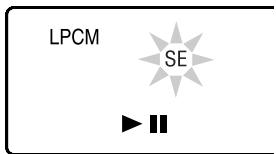
The [SE] indicator lights on the display window when the Sound Effect function takes effect.
text_image
LPCM SE ▶ II- As the value becomes bigger, the Sound Effect works stronger.
To deactivate the Sound Effect
Press SOUND EFFECT repeatedly until "OFF" appears on the TV screen.
NOTE
The Sound Effect indication disappears if no operation is made for about few seconds.
Menu bar functions
To bring up the menu bar
1 When a disc is inserted, press ON SCREEN.
A status bar for the type of disc inserted will appear on the TV screen.
See page 14 for details about the status bar.
2 Press ON SCREEN again.
A menu bar for the type of disc inserted will appear under the status bar.
(for DVD VIDEO)

text_image
DVD-VIDEO 8.5Mbps TITLE 33 CHAP 33 TOTAL 1:25:58 TIME OFF CHAP. 1/3 1/5 1/3(for SVCD)

text_image
SVCD TRACK 33 TIME 25:58 TIME OFF PROG. RND. ST1 -/4(for Video CD)

text_image
VCD TRACK 33 TIME 25:58 TIME OFF PROG. RND. ST(for Audio CD)

text_image
CD TRACK 33 TIME 25:58 TIME OFF PROG. RND.To dismiss the menu bar and status bar
Press ON SCREEN.
Basic operation procedure
1 Press ◀/▶ to select the icon you want to work with.
The selected icon is pointed by ☑.
2 Press ENTER.
With many icons, an appropriate pull-down window appears, however, there are some exceptions.
NOTES
- A mark or text on the menu icon for the function or mode currently selected is shown in green.
- Some functions are not available during playback. (You cannot move ☑ to the associated icon when it is not available.)
Menu bar functions for DVD VIDEO
TIME | Time mode selection
During playback, selects the time mode shown in the display window and in the status bar.
Press ENTER to select the time mode from the following.
• TOTAL: Current title elapsed time
• T.REM: Current title remaining time
• TIME: Current chapter elapsed time
- REM: Current chapter remaining time
Repeat mode (See also page 20)
Selects the repeat mode during playback.
- Open the pull-down window.
- Press ▲/▼ to select the repeat mode from the following.
• CHAPTER: Current chapter repeat
• TITLE: Current title repeat
- A-B: A-B repeat
• OFF: Repeat mode deactivated
- Press ENTER to make the selected repeat function active.
Time search (See also page 18)
Specifies a time from the beginning of the current title as the point from which to begin playback.
CHAP.→ Chapter search
During playback, specifies a desired chapter to be played back from.
- Open the pull-down window.
- Press numeric buttons (0 to 9) to enter a desired chapter number. (For example, to specify "10," press 1, then 0.)
- Press ENTER to begin playback from the specified chapter.
Audio selection (See also page 21)
During playback, selects the audio language or sound track.
- Open the pull-down window.
- Press ▲/▼ to select a desired audio language or sound track.
- Press ENTER to begin playback with the selected audio.
Subtitle selection (See also page 21)
During playback, selects the subtitle language.
- Open the pull-down window.
- Press ▲/▼ to select a desired subtitle language.
- Press ENTER to begin playback with the selected subtitle.
Angle selection (See also page 21)
During playback, selects a desired scene angle in a multi-angle part.
- Open the pull-down window.
- Press ▲/▼ to select a scene angle.
- Press ENTER to begin playback with the selected scene angle.
Menu bar functions for SVCD/Video CD/Audio CD
TIME | Time mode selection
Selects the time mode shown in the display window and in the status bar.
Press ENTER to select the time mode from the following.
• TIME: Current track elapsed time
- REM: Current track remaining time (while in stop mode, current track total time)
• TOTAL: Disc elapsed time
• T.REM: Disc remaining time (while in stop mode, disc total time)
Repeat mode (See also page 20)
Selects the repeat mode.
- Open the pull-down window.
- Press ▲/▼ to select the repeat mode from the following.
- TRACK: Current track repeat
- ALL: All track repeat
-
A-B: A-B repeat
• OFF: Repeat mode deactivated -
Press ENTER to make the selected repeat function active.
Time search (See also page 18)
Specifies a time from the beginning of the disc as the point from which to begin playback.
PROG. Program playback (See also page 19)
While stopped, specifies the playback order of tracks.
RND. Random playback (See also page 19)
While stopped, activates random playback.
Audio selection (See also page 21)
During SVCD/Video CD playback, selects the audio channel(s).
- Open the pull-down window.
- Press ▲/▼ to select a desired audio channel(s).
- Press ENTER to play back with the selected audio channel(s).
Subtitle selection (See also page 21)
During SVCD playback, selects the subtitle.
- Open the pull-down window.
- Press ▲/▼ to select a desired subtitle.
- Press ENTER to begin playback with the selected subtitle.
Outline
The player can play back MP3/WMA/JPEG/MPEG-4 (Simple profile) files on a personally recorded media as follows:
CD-R/RW, memory card, commercially available CD
The player can also play back MPEG-4 (Advanced simple profile) and DivX files recorded on CD-R/RW, DVD-R/-RW. Some DVD-R and DVD-RW discs mastered as multi border (multi-session) may not be compatible with the player.
You can select and play back files using the Control display on the TV screen.
- The player may be unable to play back the media due to the characteristics or recording conditions.
Precautions
About files and folders (groups) on the disc or the memory card
- Files are sometimes grouped into folders by genre, album, etc. In this manual, “group” is also referred to as “folder.”
- A folder which has one or more files is regarded as a group.
- The player can detect and play back the groups which are located up to the fifth layer.
- The files in the Control display are arranged by the alphabetical order of extensions as follows: "asf", "avi", "divx", "jpeg", "mp3", and "wma".
- Time required for reading the media contents may vary for different media, depending on the numbers of folders (groups) and files recorded, etc.
- Files which do not belong to any folder are grouped into “group 1.”
- The player recognizes up to 150 files per group, and up to 250 groups per disc/memory card. Files other than MP3/WMA/JPEG/MPEG-4/DivX files count in the 999 total.
Max. 250 groups per media
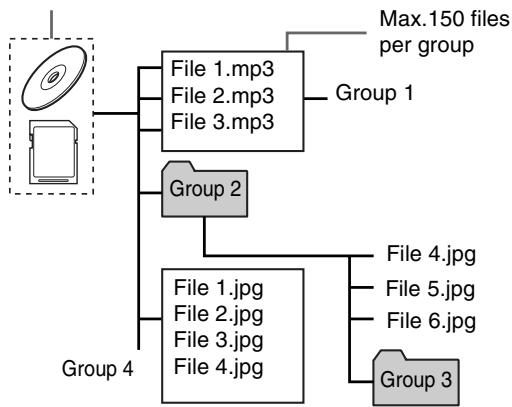
flowchart
graph TD
    A["Image"] --> B["File 1.mp3"]
    A --> C["File 2.mp3"]
    A --> D["File 3.mp3"]
    B --> E["Group 1"]
    C --> F["Group 2"]
    D --> G["Group 3"]
    F --> H["File 4.jpg"]
    F --> I["File 5.jpg"]
    F --> J["File 6.jpg"]
    G --> K["File 1.jpg"]
    G --> L["File 2.jpg"]
    G --> M["File 3.jpg"]
    G --> N["File 4.jpg"]
Notes for making your own disc
- Use "UDF format" as the disc format for DVD-R/-RW.
- Use "ISO 9660" as the disc format for CD-R/RW.
- The player does not support “packet writing” for CD-R/RW.
- The player supports discs recorded with up to five multiple sessions.
- Some disc may not play due to media characteristics or recording conditions.
Notes for making files/groups
- If a file name includes even one 2-byte character, the player may not show the file name correctly.
- The player supports up to 12 characters as the group/file names.
- The player can only recognize files with one of the following extensions, which can be in any combination of upper and lower case:
- For MP3 files, “.MP3”, “.mp3”.
- For WMA files, “.WMA”, “.wma”.
- For JPEG files, “.JPG”, “.JPEG”, “.jpg”, “.jpeg”.
- For MPEG-4 files, “.ASF”, “.asf”.
- For DivX files, “.DIVX”, “.DIV”, “.divx”, “.div” and “.AVI”, “.avi”.
- For MP3 files:
- It is recommended that you record your material at a 44.1 kHz sampling rate, using the 128 kbps data transfer rate.
- ID3 Tag is not available.
- MP3i and MP3 Pro are not available.
- For WMA files:
- WMA Tag is not available.
- Make sure that the copyright feature is set to off.
- We recommend you to record your material at a bit rate of 64 kbps or higher.
- The player supports WMA files recorded with a bit rate of 48 kbps or higher. The player cannot play back WMA files recorded with a bit rate under 48 kbps.
- For JPEG files:
- We recommend you to record your material at a 640 x 480 pixel resolution.
- This player supports the baseline JPEG format.
- The player does not support a baseline-formatted picture of more than 5120 x 3413 pixels. Make sure that the pictures pixel size is 5120 x 3413 pixels or less.
- This player cannot play back a progressive JPEG file of more than 2048 x 1536 pixels.
- For MPEG-4 files:
- The player supports the AVI files whose resolution is 640 x 480 pixels or less, and created using 4 Mbps ASP codec.
- The size of the playback screen will be the same size as it is recorded.
- Some recorded files may not be able to be played back depending on file characteristics, kind of digital still/video cameras, or recording conditions.
- The player can playback the following MPEG-4 files: MPEG-4 V2: Simple (single) stream MPEG-4 V3: Fully supported (MPEG-4 V1 file is not compatible.)
- For DivX files:
- The player supports DivX 5.x, 4.x and 3.11.
- The player supports the DivX files whose resolution is 720 x 480 pixels or less (30 fps), and 720 x 576 pixels or less (25 fps).
- Audio stream should conform to MPEG 1 Audio Layer-2 or MPEG Audio Layer-3 (MP3).
- The player does not support GMC (Global Motion Compression) and Q-Pel (Quarter Pixel).
- The file encoded in the interlaced scanning mode may not be played back correctly.
- The player has its own Registration Code for DivX playback. If necessary, you can confirm the Registration Code of your player using the OTHERS menu. (See page 32.)
Notes for inserting and removing memory cards
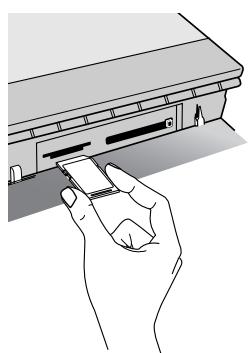
- Before you insert a memory card into a card slot, open the door on the front panel and make sure of the slot type and the direction of insertion as illustrated.
- Always use the single type of memory card at a time. When inserting the two or more types of memory card, “CHECK FOR CARD” appears on the TV screen.
- After inserting a memory card, close the door for playback. If the door is open, "CLOSE THE DOOR" appears on the TV screen and the player does not start the memory card playback.
- Stop both the memory card playback and the disc playback before inserting or removing memory card. When inserting or removing memory card during the disc playback, you cannot operate the player temporarily by static electricity and/or noise. In this case, disconnect the power plug and connect it again.
- When playing back a disc, always remove a memory card and close the card door.
- When playing back a disc, the electrostatic noise may restart the playback from the beginning.
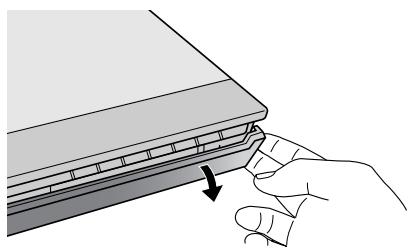
natural_image
Illustration of a hand inserting a component into a layered structure with a downward arrow (no text or symbols)Press here to remove the inserted CompactFlash with the player held.
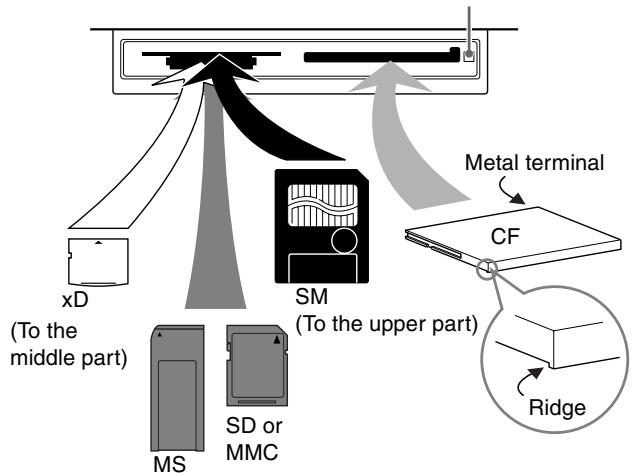
text_image
xD (To the middle part) MS SM (SO to the upper part) Metal terminal CF Ridge(To the lower part)
- When inserting or removing a memory card, hold the player firmly.
- When inserting an xD-Picture card, make sure that the front edge of the card is facing to the slot properly,
natural_image
Hand inserting a card into a device (no text or symbols visible)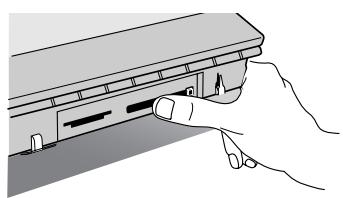
natural_image
Illustration of a hand pressing down on a device component (no text or symbols visible)- Make sure the disc playback is stopped when inserting or removing the memory card.
- When inserting or removing the memory card, pay attention not to push any button on the player accidentally.
text_image
DVD/CARD THUMBNAIL/ LIST ▲/▼/ ENTER REPEAT JVC //SELECT ZOOMNOTE
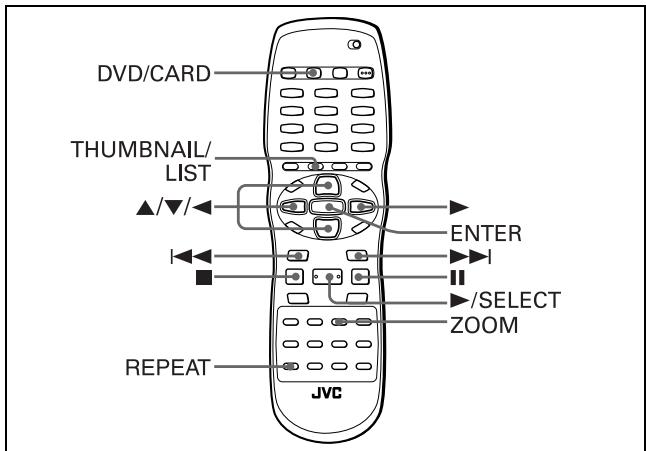
Make sure that the TV - DVD switch on the remote control unit is set to "DVD" when using the ▲/▼/◄/► and numeric buttons for controlling the player.
Basic operations
When you insert a disc or memory card with groups and files, the Control display that shows the contents of the medium automatically appears on the TV screen.
You can specify and play back the desired group/file from the Control display using the following procedure.
1 Make sure that the cursor bar is in the left (group) column on the Control display.
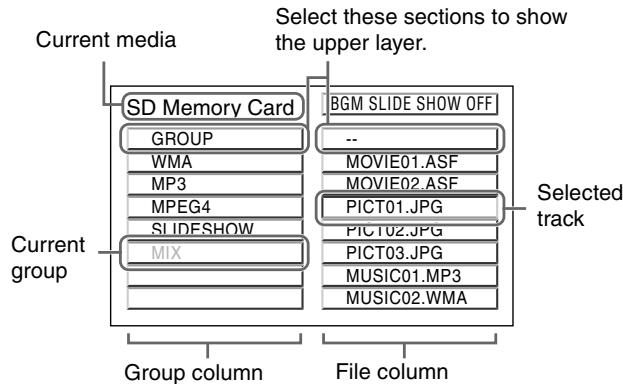
text_image
Current media Select these sections to show the upper layer. SD Memory Card GROUP WMA MP3 MPEG4 SLIDFSHOW MIX Current group Group column File column BGM SLIDE SHOW OFF -- MOVIE01.ASF MOVIE02.ASF PICT01.JPG PICT02.JPG PICT03.JPG MUSIC01.MP3 MUSIC02.WMA Selected track- If it is in the right column, press ◀ to move it to the left column.
- If you want to select the other medium while both a disc and memory cards are inserted, press DVD/CARD before starting playback. When the player accesses a memory card, the [M CARD] indicator lights on the display window.
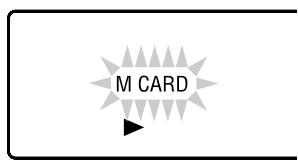
text_image
M CARD2 Press ▲/▼ to move the bar to a desired group, then press ENTER or ▶/SELECT.
- In the right column, files in the selected group are shown.
3 Press ▲/▼ to select the desired file, then press ENTER.
The selected file is played back.
- When you press ▶/SELECT, the continuous playback starts from the selected file. The playback stops after playing back of all files in the same group.
- You can also change the files on the list by pressing ◀◀◀/▶◀ or the numeric buttons.
To pause playback
Press II.
Pressing ▶/SELECT resumes normal playback.
To reverse or advance playback rapidly
Press ◀◀/▶▶ during playback of MP3/WMA/DivX.
- Each time you press ◀◀ or (▶▶), the player reverses (or advances) playback, rapidly changing the playback speed as follows:
- For MP3/WMA files
x2, x4, x6, and x8
- For DivX files
During rapid forward or reverse playback using ◀◀/▶▶, [◀◀1]/[▶▶1], [◀◀2]/[▶▶2], [◀◀3]/[▶▶3], or [◀◀4]/[▶▶4] appears on the TV screen. The higher the value is, the faster the playback speed is.
To zoom in a picture
Press ZOOM.
- Each time you press ZOOM, the magnification is changed— - 1.5, 2 times, and 4 times for JPEG files
- 2 times, and 4 times for MPEG-4 files
- 2 times for DivX files
- The four-time magnification may not work for some JPEG/MPEG-4 files according to their resolutions.
- Pressing ▲/▼/◄/► moves the zoomed position during playback of JPEG file.
To cancel the zoom function, select the normal size by pressing ZOOM repeatedly.
To rotate/reflect a still picture
While the still picture is played back:
- Pressing ▶ rotates the picture by 90^ clockwise.
- Pressing rotates the picture by 90^ counterclockwise.
- Pressing ▼ reflects the picture vertically.
- Pressing ▲ reflects the picture horizontally.
To stop playback
Press ■.
The Control display appears on the TV.
- Removing the memory card also stops playback.
NOTES
- Opening the card door or the disc tray stops playback.
- During slide show playback, you cannot rotate/reflect a picture.
- It may take time to show the Control display due to the layer configuration of the files and groups.
- The elapsed time may be incorrectly indicated on the display window due to the recording condition of the file.
- The display window cannot show the file number more than 100. When the files numbered over 100th are played back, the player re-counts file number again from 0.
- When the screen saver starts, the Control display disappears.
- The playback information appears on the TV as follows:
- [READING INDEX] means that the player is reading the information of the selected MPEG-4/DivX file.
-
[CODEC. NOT SUPPORTED] means that the player cannot play back the selected MPEG-4/DivX file.
-
[JPEG DATA ERROR] means that this player cannot play back the file.
- [JPEG DATA CORRUPTED] means that the file has error but the player can play back it.
- [OUT OF MEMORY] means that the pixel resolution of the JPEG file is too high. (See “Notes for making files/groups” on page 25.)
- [NEXT] means the player skips to the next file.
- [PREVIOUS] means the player skips to the previous file.
- [SELECT] means the file is selected on the thumbnail screen.
Direct selection for JPEG files
You can select a particular JPEG file from the thumbnail screen.
1 Press THUMBNAIL/LIST while a JPEG file is selected on the Control display.
The thumbnail screen appears on the TV. Up to nine thumbnails from the selected file at a time can be displayed on the screen.
- When selecting a group on the Control display, the thumbnail screen does not appear.
2 Press ▲/▼/◄/► to select the desired picture on the thumbnail screen, then press ENTER.
The desired picture is played back.
- You can change the thumbnails by pressing I◄◄/►►. All the JPEG files in the single group are displayed every nine thumbnails.
Repeat playback
During playback or while stopped, press REPEAT.
• Each time you press REPEAT while a file is selected, the repeat mode changes as follows:
| Control display | Display window | Function |
| REPEAT 1 | Repeats the current file. | |
| REPEAT GROUP | Repeats all files in the current group. | |
| REPEAT ALL | Repeats all files on the media. | |
| No indication | The repeat mode is off. | |
If you press REPEAT while stopped, you need to press ENTER or ▶/SELECT to start playback.
To stop repeat playback
Press ■.
Note that the repeat mode remains active.
To quit repeat playback
During playback, press REPEAT until no repeat icon is shown on the display window.
- While stopped, press REPEAT until the repeat mode indication on the Control display goes off.
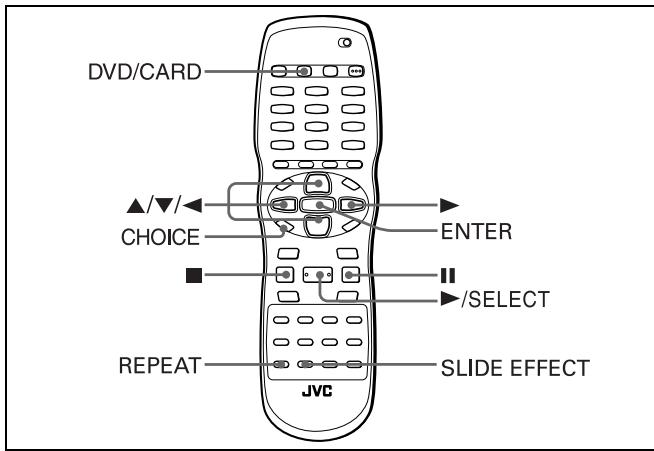
text_image
DVD/CARD ▲/▼/ CHOICE ENTER ■ /SELECT REPEAT SLIDE EFFECT JVCNOTE
Make sure that the TV - DVD switch on the remote control unit is set to "DVD" when using the ▲/▼/◄/► and numeric buttons for controlling the player.
Slide show playback
You can display files (still pictures) one after another automatically.
Press ▶/SELECT while a JPEG file is selected on the Control display.
The slide show starts from the beginning of the media.
- The display time varies in size of each file.
To change the effect on displaying images
You can select the effect of slide show.
Press SLIDE EFFECT.
"SLIDE EFFECT MODE :" and the current mode appear on the TV screen.
• Each time you press the button, the effect is changed as follows:
| Mode | Type of wipe |
| 1 | Scroll wipe 1: The next image slides in from top to bottom. |
| 2 | Scroll wipe 2: The next image slides in from bottom to top. |
| 3 | Shutter wipe 1: The next image slides in vertically from both sides to center. |
| 4 | Shutter wipe 2: The next image slides in vertically from center to both sides. |
| 5 | Blind wipe 1: The next image slides in vertically through 4 slits. |
| 6 | Slide wipe 1: The next image slides in from left to right. |
| 7 | Slide wipe 2: The next image slides in from right to left. |
| 8 | Door wipe 1: The next image slides in horizontally from both sides to center. |
| 9 | Door wipe 2: The next image slides in horizontally from center to both sides. |
| 10 | Window wipe: The next image slides in from each side to center. |
| 11 | Blind wipe 2: The next image slides in horizontally through 4 slits. |
| RANDOM | The player selects and applies the effect to each image randomly. |
| NONE | Cancels the effect. |
| Mode | Type of wipe |
| 1 | Scroll wipe 1: The next image slides in from top to bottom. |
| 2 | Scroll wipe 2: The next image slides in from bottom to top. |
| 3 | Shutter wipe 1: The next image slides in vertically from both sides to center. |
| 4 | Shutter wipe 2: The next image slides in vertically from center to both sides. |
| 5 | Blind wipe 1: The next image slides in vertically through 4 slits. |
| 6 | Slide wipe 1: The next image slides in from left to right. |
| 7 | Slide wipe 2: The next image slides in from right to left. |
| 8 | Door wipe 1: The next image slides in horizontally from both sides to center. |
| 9 | Door wipe 2: The next image slides in horizontally from center to both sides. |
| 10 | Window wipe: The next image slides in from each side to center. |
| 11 | Blind wipe 2: The next image slides in horizontally through 4 slits. |
| RANDOM | The player selects and applies the effect to each image randomly. |
| NONE | Cancels the effect. |
To stop slide show playback in the middle
Press ■.
The TV screen returns to the Control display.
- Pressing ▶/SELECT resumes slide show playback from the last picture displayed.
To keep showing the current picture
Press II.
- Pressing ▶/SELECT resumes slide show playback.
NOTES
- During slide show playback, you cannot use the thumbnail and rotate/reflect functions.
- During the slide show playback of progressive JPEG files, you cannot change the effect.
Changing the picture of the opening display
You can change and set the opening display to your favorite image. See page 32.
1 Play back a JPEG file to be displayed as the opening display.
When selecting a JPEG file from the thumbnail screen or the slide show playback, press Ⅱ to pause the slide show.
2 Press CHOICE and ◀/▶ to show PICTURE menu of the on-screen menu.
3 Press ▲/▼ to select [BACKGROUND], then press ENTER.
4 Press ▲/▼ to select [SAVE AS BACKGROUND], then press ENTER.
5 Press ▲/▼ to select [YES], then press ENTER.
The player starts reading the selected JPEG file, and the opening screen is changed after reading the file.
- The previous picture for the opening screen is overwritten by the newly saved file.
To dismiss the menu screen
Press CHOICE.
To resume the JVC's opening screen
Select [STANDARD] in step 4.
BGM slide show playback
During slide show playback of JPEG files on the memory card, you can play back Audio CDs or MP3 files as background music (BGM).
When you play back MP3 files as background music, make a group containing both JPEG files and MP3 files on the memory card.
- You cannot play Audio CDs with DTS or WMA as background music.
- BGM slide show is available for JPEG files on the single group.
- BGM slide show may not work correctly for the progressive JPEG format.
Slide show with Audio CD playback
1 Insert an Audio CD.
- When a memory card is playing back, playback will stop.
2 Insert a memory card containing JPEG files.
3 Close the door cover.
The Control display of the memory card appears on the TV.
- When the memory card containing JPEG files is already selected, press DVD/CARD.
- When the memory card has two or more groups containing JPEG files, select the JPEG file in the group.
4 Select "BGM SLIDE SHOW OFF" on the Control display by pressing ▲/▼/◄/►, then press ENTER to change to "BGM SLIDE SHOW ON."
- Each time you press ENTER, the playback mode alternates between "BGM SLIDE SHOW ON (BGM slide show playback)" and "BGM SLIDE SHOW OFF (normal playback)".
5 Select a JPEG file on the Control display, then press ▶/SELECT.
The first track on the Audio CD is played back and BGM slide show starts.
- During BGM slide show, you can select the track on the Audio CD by pressing ◀◀◀/▶▶ or numeric buttons.
- The playback of the Audio CD stops after all the JPEG files are played back.
- When a track on an Audio CD is played back, the time and track indication is not displayed on the window.
Slide show with MP3 playback
- Before starting the following procedure, remove the disc from the disc tray.
1 Insert a memory card containing a group with both JPEG files and MP3 files.
2 Close the door cover.
The Control display for the media appears on the TV.
3 Select "BGM SLIDE SHOW OFF" on the Control display by pressing ▲/▼/◄/►, then press ENTER to change to "BGM SLIDE SHOW ON."
- Each time you press ENTER, the playback mode alternates between “BGM SLIDE SHOW ON (BGM slide show playback)” and “BGM SLIDE SHOW OFF (normal playback)”.
4 Select JPEG file on the Control display, then press ▶ (SELECT).
The player plays back the MP3 file from the beginning in the group and BGM slide show starts.
- You can change the MP3 files by pressing ◀◀/▶▶I.
- You cannot select MP3 files on the other group.
- The playback of MP3 files stops after all the JPEG files are played back.
To repeat BGM slide show playback
Press REPEAT before BGM slide show playback.
• Each time you press REPEAT, the repeat mode changes as follows:
| Control display | Display window | Function |
| REPEAT 1 | Repeats the current JPEG file. | |
| REPEAT GROUP | Repeats all JPEG files in the current group. | |
| No indication | The repeat mode is off. | |
To stop BGM slide show playback in the middle
Press II.
JPEG playback pauses.
When you press Ⅱ again, BGM playback also pauses.
- Pressing ▶/SELECT or II resumes music slide show playback from the last picture displayed.
To stop BGM slide show playback
Press ■.
BGM slide show playback is canceled ("BGM SLIDE SHOW OFF" is displayed on the Control display).
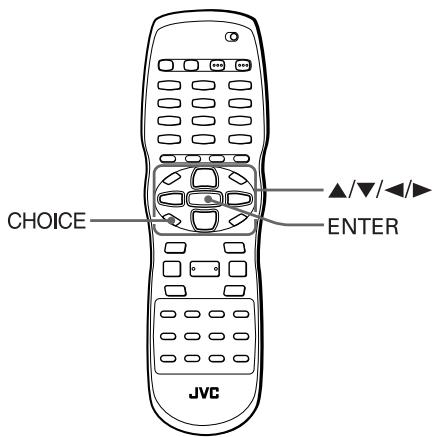
text_image
CHOICE ENTER JVCNOTE

Make sure that the TV - DVD switch on the remote control unit is set to "DVD" when using the ▲/▼/◄/► and numeric buttons for controlling the player.
Selecting preferences
This section refers to the settings which are already made when you purchase the player. Read this section when you want to connect this player to a wide-vision TV set, or when you want to otherwise change the settings according to your preferences and viewing environment.
About the Preference display
The Preference display consists of the LANGUAGE, PICTURE, AUDIO and OTHERS setting displays, each having setting items.
LANGUAGE
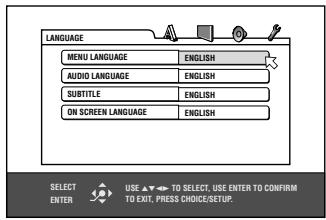
text_image
LANGUAGE MENU LANGUAGE ENGLISH AUDIO LANGUAGE ENGLISH SUBTITLE ENGLISH ON SCREEN LANGUAGE ENGLISH SELECT ENTER USE ⬆→ TO SELECT, USE ENTER TO CONFIRM TO EXIT. PRESS CHOICE/SETUP.PICTURE
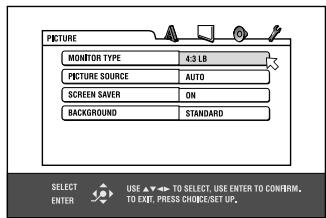
text_image
PICTURE MONITOR TYPE 4.3 LB PICTURE SOURCE AUTO SCREEN Saver ON BACKGROUND STANDARD SELECT TO SELECT, USE ENTER TO CONFIRM. TO EXIT, PRESS CHOICE/SET UP. SELECT ENTERAUDIO
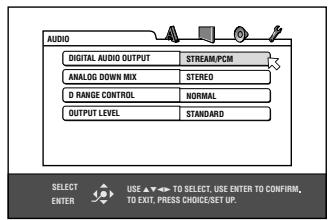
text_image
AUDIO DIGITAL AUDIO OUTPUT STREAM/PCM ANALOG DOWN MIX STEREO D RANGE CONTROL NORMAL OUTPUT LEVEL STANDARD SELECT ENTER USE ▲▲▼→ TO SELECT, USE ENTER TO CONFIRM, TO EXIT. PRESS CHOICE/SET UP.OTHERS
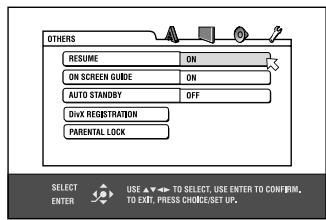
text_image
OTHERS RESUME ON ON SCREEN GUIDE ON AUTO STANDBY OFF DIVX REGISTRATION PARENTAL LOCK SELECT ENTER USE ▼→ TO SELECT USE ENTER TO CONFIRM. TO EXIT. PRESS CHOICE/SET UP.How to set preferences
1 Press CHOICE.
One of the preference on-screen displays appears on the TV screen.
You can see four icons at the top right of the on-screen display for the settings.
A: LANGUAGE menu
: PICTURE menu
: AUDIO menu
: OTHERS menu
2 Press ◀/▶ to select the appropriate icon.
The appropriate display appears on the TV screen.
3 Press ▲/▼ to move ☑ to select the item you want to edit.
The color of the selected item changes.
4 Press ENTER.
A pull-down menu appears over the selected item.
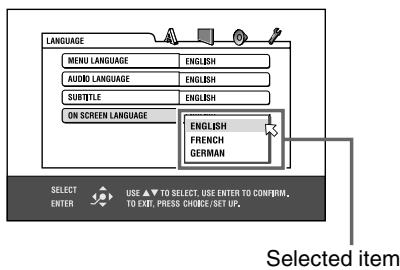
text_image
LANGUAGE MENU LANGUAGE ENGLISH AUDIO LANGUAGE ENGLISH SUBTITLE ENGLISH ON SCREEN LANGUAGE ENGLISH FRENCH GERMAN SELECT ENTER USE ▲ TO SELECT, USE ENTER TO CONFIRM, TO ENT, PRESS CHOCER/SET UP. Selected item5 Press ▲/▼ to select from the options then press ENTER.
The selected option is set.
- For details about each setting, see the following.
To dismiss a preference display
Press CHOICE.
NOTES
- Some items cannot be changed during disc playback.
- When a preference display is shown on a wide TV screen, the upper and lower parts of the preference display sometimes may be cut off. If this happens, adjust the picture size control of the TV.
- When a preference display is shown, you cannot start playing back a disc.
LANGUAGE menu
MENU LANGUAGE
You can select the default menu language to be displayed if it is contained on a DVD VIDEO disc.
Setting options
ENGLISH, SPANISH, FRENCH, CHINESE, GERMAN, ITALIAN, JAPANESE, language code from AA to ZU
- If the disc does not have a menu in the selected language, the disc's default language will be used.
- For details about language codes, see “Appendix B: Table of languages and their abbreviations” on page 37.
- You cannot change the setting during playback.
AUDIO LANGUAGE
You can select the default audio language to be played if it is contained on a DVD VIDEO disc.
Setting options
ENGLISH, SPANISH, FRENCH, CHINESE, GERMAN, ITALIAN, JAPANESE, language code from AA to ZU
- If the disc does not have the selected language, the disc's default language will be used.
- For details about language codes, see “Appendix B: Table of languages and their abbreviations” on page 37.
- You cannot change the setting during playback.
SUBTITLE
You can select the default subtitle language to be displayed if it is contained on a DVD VIDEO disc.
Setting options
OFF, ENGLISH, SPANISH, FRENCH, CHINESE, GERMAN, ITALIAN, JAPANESE, language code from AA to ZU
- If the disc does not have a subtitle in the selected language, the disc's default language will be used.
- For details about language codes, see “Appendix B: Table of languages and their abbreviations” on page 37.
- You cannot change the setting during playback.
ON SCREEN LANGUAGE
You can select the on-screen display language of the player.
Setting options
ENGLISH, FRENCH, GERMAN
- Some on-screen messages are shown in English regardless of the setting.
- You cannot change the on-screen language shown on the Control display.
PICTURE menu
MONITOR TYPE
You can select the monitor type to match your TV when you play back DVD VIDEO discs recorded for wide-screen televisions.
Setting options
16:9, 4:3 LB, 4:3 PS
[16:9] (Wide television screen): select when you connect the player to a wide-screen (16:9) TV.
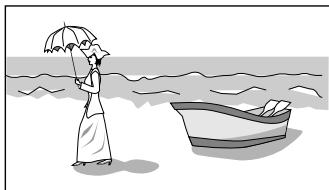
natural_image
Illustration of a person holding an umbrella standing by the sea with a small boat nearby (no text or symbols)[4:3 LB] (Letter Box conversion): select when you connect the player to a normal (4:3) TV. When playing back a DVD VIDEO disc recorded in wide picture format, the picture is shown with black bars at the top and bottom.
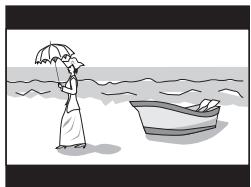
natural_image
Illustration of a person holding an umbrella standing by the sea next to a small boat (no text or symbols)[4:3 PS] (Pan Scan conversion): select when you connect the player to a normal (4:3) TV.
When playing back a DVD VIDEO disc recorded in wide picture format, the picture is zoomed to fill the screen vertically, and the left and right sides of the image are chopped off. Note, however, that the picture will be shown in the 4:3 LB mode even if you select the 4:3 PS mode depending on the disc.
![JVC XV-NP10S - [4:3 PS] (Pan Scan conversion): select when you connect the player to a normal (4:3) TV. - 1](/content/2025/01/82709/images/1475b8545a046e1ba2b9025558edc232b980778f56cc9d1008fdc59ba96055df.jpg)
natural_image
Illustration of a woman in traditional attire holding an umbrella near a small boat on water (no text or symbols)PICTURE SOURCE
This mode selects whether the content on the disc is processed by field (video source) or by frame (film source). You can obtain optimal picture quality according to the source type to be played back by selecting an appropriate option. This setting is available for both the interlaced mode and progressive scanning mode.
Setting options
VIDEO(NORMAL), VIDEO(ACTIVE), FILM, AUTO
[VIDEO(NORMAL)]: select when playing back a video source disc with relatively a few movements.
[VIDEO(ACTIVE)]: select when playing back a video source disc with relatively a lot of movements.
[FILM]: select when playing back a film source disc.
[AUTO]: select when playing back a disc containing both video and film source materials.
The player recognizes the picture type (film or video source) of the current disc according to the disc information. Normally, select this option.
SCREEN SAVER
You can set the screen saver function to ON or OFF. (See page 16.)
Setting options
ON, OFF
BACKGROUND
You can change and set the opening display to your favorite image using this menu.
Setting options
STANDARD, USER, SAVE AS BACKGROUND
[STANDARD]: select when you use the JVC original image as the opening display (initial setting).
[USER]: select when you use your favorite image as the opening display. This item will be taken effect after you register a new image in the next item.
[SAVE AS BACKGROUND]: select when you register a new image. To register a new image, see “Changing the picture of the opening display” on page 28.
AUDIO menu
DIGITAL AUDIO OUTPUT
To connect the player's digital output to an external device equipped with a digital input, this item must be set correctly. See “Appendix A: Digital output signal chart” on page 37 for details about the relation between the setting and output signals.
Setting options
PCM ONLY, DOLBY DIGITAL/PCM, STREAM/PCM
[PCM ONLY]: select when you connect the DIGITAL OUT jack of the player to the linear PCM digital input of other audio equipment.
[DOLBY DIGITAL/PCM]: select when you connect the digital input of a Dolby Digital decoder or an amplifier with a built-in Dolby Digital decoder. When this option is selected, playing back a disc recorded by the MPEG Multichannel format outputs a linear PCM digital signal.
[STREAM/PCM]: select when you connect the digital input of an amplifier with a built-in DTS, MPEG Multichannel or Dolby Digital decoder, or the stand-alone unit of such a decoder.
- With some DVD VIDEO discs that are not fully copy-protected, a 20 or 24 bit digital signal may be output.
- When playing a DVD VIDEO or Audio CD disc with DTS, use a DTS decoder to get correct signals from your speakers.
ANALOG DOWN MIX
To correctly play the audio on a DVD VIDEO disc recorded with surround multichannel audio, you must set this item properly according to your audio system configuration.
Setting options
DOLBY SURROUND, STEREO
[DOLBY SURROUND]: select when listening to multichannel surround audio with the player's analog AUDIO OUT terminals connected to a surround decoder.
[STEREO]: select when listening to conventional two-channel stereo audio with the player's AUDIO OUT terminals connected to a stereo amplifier/receiver or television set, or in case you want to record the audio from a DVD VIDEO disc to MiniDisc, cassette, etc.
D. RANGE CONTROL
This setting provides optimal audio quality from the analog AUDIO OUT terminals for listening to DVD VIDEO discs recorded in Dolby Digital format, at low or middle volume.
Setting options
WIDE RANGE, NORMAL, TV MODE
[WIDE RANGE]: when selected, audio is played back with the widest dynamic range so that you can enjoy powerful playback sound.
[NORMAL]: normally, select this option.
[TV MODE]: select if DVD VIDEO disc sound level is lower than TV program sound level. Thus you can hear sound at a lower volume clearly.
OUTPUT LEVEL
This setting allows you to attenuate the level of the signal output from the player's analog AUDIO OUT terminals.
Setting options
STANDARD, LOW
- If the sound output from the speaker is distorted, select [LOW].
OTHERS menu
RESUME
You can select the resume playback mode.
See pages 14 and 15 for details about the resume playback function.
Setting options
ON, OFF, DISC RESUME
[ON]: when selected, the player can resume playback of the disc from the position where playback was last interrupted, if the disc is still in the disc tray.
[OFF]: when selected, the resume function is deactivated.
[DISC RESUME]: when selected, the player can resume playback of the last 30 discs played. The player retains a memory of the interrupted positions of the last 30 discs played, even though they have been removed from the disc tray.
ON SCREEN GUIDE
The player can display “on-screen guide” icons or characters on the picture, which show what is happening to the disc or the player.
Example of "on-screen guide" icons: 📁, 🎟, ....
Setting options
ON, OFF
[ON]: when selected, the on-screen guide is activated.
AUTO STANDBY
When the player is stopped for more than 30 minutes or 60 minutes, the player enters standby mode automatically.
Setting options
60, 30, OFF
DivX REGISTRATION
The player has its own Registration Code for DivX playback. You can confirm the code of your player.
- Once you played back a disc created by using the Registration Code, the player's code is overwritten by a totally different new one for copyright protection purpose.
PARENTAL LOCK
When this option is selected, pressing ENTER on the remote control unit brings up the PARENTAL LOCK display shown below. This allows you to restrict children from playing DVD VIDEO discs.
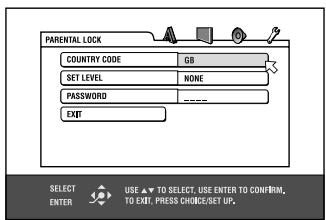
text_image
PARENTAL LOCK COUNTRY CODE GB SET LEVEL NONE PASSWORD **** EXIT SELECT ENTER USE ▲ TO SELECT. USE ENTER TO CONFIRM. TO EXIT. PRESS CHOICE SET UP.• See this page for details about the parental lock setting.
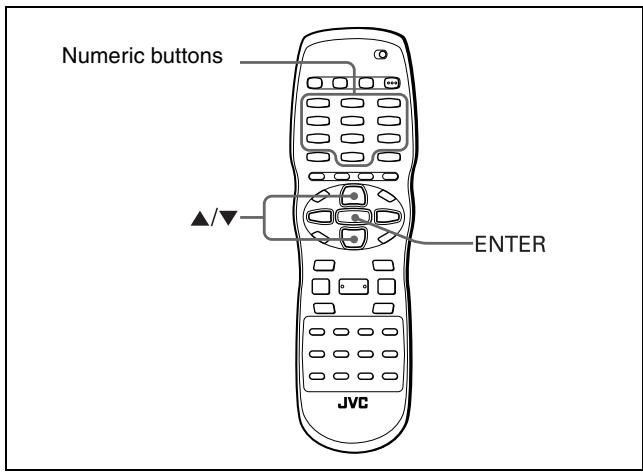
text_image
Numeric buttons ▲/▼ ENTER JVCLimiting playback by children
This function restricts playback of DVD VIDEO discs which contain violent (and other) scenes according to the level set by the user. For example, if a movie which includes violent scenes supports the parental lock feature, such scenes which you do not want to let children view can be cut or replaced with other scenes.
To set Parental Lock for the first time

1 Bring up the OTHERS menu.
2 Press ▲/▼ to move ☑ to select [PARENTAL LOCK] then press ENTER.
The Parental Lock on-screen display appears on the TV screen.
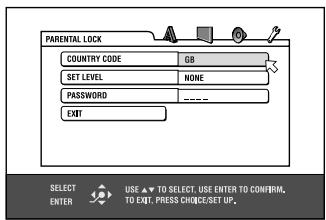
text_image
PARENTAL LOCK COUNTRY CODE GB SET LEVEL NONE PASSWORD ---- EXIT SELECT ENTER USE ▲ TO SELECT, USE ENTER TO CONFIRM, TO EXIT. PRESS CHOICE SET UP.3 While ☑ is pointing to [COUNTRY CODE], press ENTER to bring up the pull-down menu.
4 Press ▲/▼ to select the country code.
Select the code of the country whose standards were used to rate the DVD VIDEO disc content.
See “Appendix C: Country/Area code list for Parental Lock” on page 38.
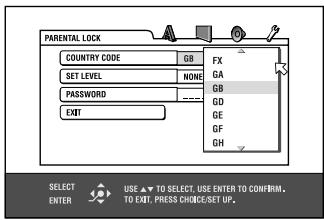
text_image
PARENTAL LOCK COUNTRY CODE GB SET LEVEL NONE PASSWORD EXIT FX GA GB GD GE GF GH SELECT ENTER USE ▼ TO SELECT USE ENTER TO CONFIRM. TO EXIT. PRESS CHOICE SET UP.5 Press ENTER.
moves to [SET LEVEL].
6 Press ENTER to bring up the pull-down menu.
In the pull-down menu, [NONE] and levels [8] to [1] are available.
[NONE] does not restrict playback. Level [1] is the strictest level. Discs rated higher than the selected level are restricted.
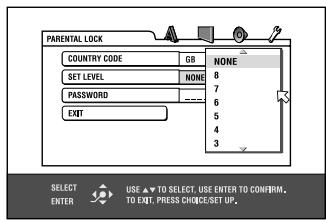
text_image
PARENTAL LOCK COUNTRY CODE GB NONE SET LEVEL NONE 8 PASSWORD --- 6 EXIT 5 SELECT TO SELECT. USE ENTER TO CONFIRM. TO EXIT. PRESS CHOSET UP.7 Press ▲/▼ to select a desired parental lock level, then press ENTER.
moves to [PASSWORD].
8 Press the numeric buttons (0 to 9) to enter a 4-digit password.
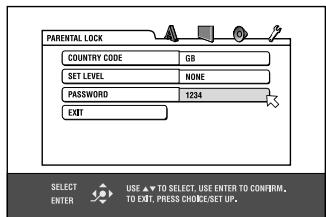
text_image
PARENTAL LOCK COUNTRY CODE GB SET LEVEL NONE PASSWORD 1234 EXIT SELECT ENTER USE ▲ TO SELECT: USE ENTER TO CONFIRM. TO EXIT. PRESS CHOICE SET UP.9 Press ENTER.
The parental lock feature is set.
moves to [EXIT]. Pressing ENTER again returns to the [OTHERS] menu of the preference display.
Hint
If you want to change the password at step 8, do it before pressing ENTER.
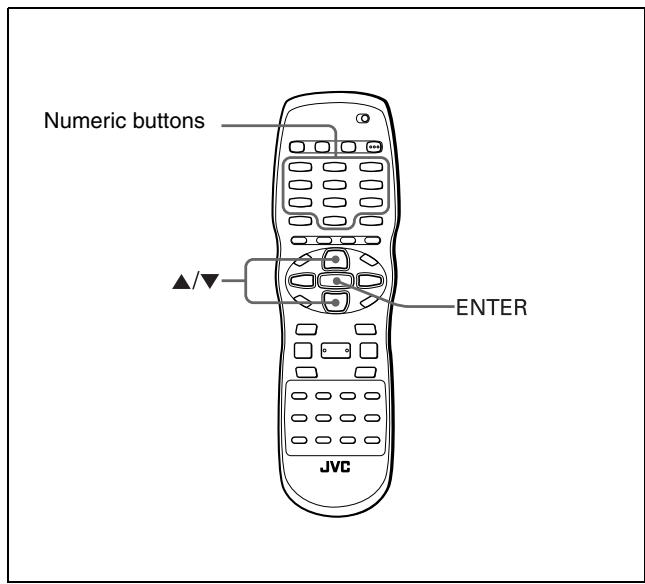
text_image
Numeric buttons ▲/▼ ENTER JVCTo change the settings
DVD VIDEO
You can change the parental lock settings later.
1 Bring up the OTHERS menu.
2 Press ▲/▼ to move ☑ to select [PARENTAL LOCK] and press ENTER.
The parental lock on-screen display appears on the TV screen.
3 While ☑ is pointing to [PASSWORD], press the numeric buttons to enter your current 4-digit password then press ENTER.
moves to [COUNTRY CODE] if you enter the correct password.
If you enter a wrong password, "WRONG! RETRY..." appears on the TV screen, and you cannot go to the next step. If you forget your password, enter "8888." The current password is deleted and you can set a new password.
4 To change the [COUNTRY CODE] or [SET LEVEL], press ENTER to bring up the associated pull-down menu when ☑ is pointing to the desired item.
5 Press ▲/▼ to select the desired option then press ENTER.
If you change the country code, you must reselect the parental lock level.
6 While ☑ is pointing to [PASSWORD], press the numeric buttons to enter a 4-digit password.
The password entered in this step becomes the new password. If you want to keep the same password as before, enter the same password.
7 Press ENTER.
moves to [EXIT]. Pressing ENTER again returns to the [OTHERS] menu of the preference display.
NOTE
If you enter the wrong password more than 3 times in step 3 above, ☑ moves to [EXIT] automatically and ▲/▼ do not work.
To temporarily release the Parental Lock
DVD VIDEO
If the parental level is set to a strict value, some discs may not play at all.
When you insert such a disc and try to play it, the following parental lock on-screen display appears on the TV screen, asking you whether you want the parental lock to be temporarily released or not.
1 Press ▲/▼ to move ☑ to [TEMPORARY RELEASE], then press ENTER.
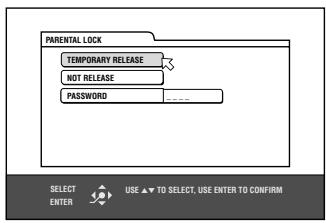
text_image
PARENTAL LOCK TEMPORARY RELEASE NOT RELEASE PASSWORD SELECT ENTER USE ▲ TO SELECT, USE ENTER TO CONFIRM2 Press the numeric buttons (0 to 9) to enter your 4-digit password.
The Parental Lock is released, and the player starts playback. If you enter a wrong password, "WRONG! RETRY..." appears on the TV screen. Enter the correct password.
NOTE
When you enter the wrong password 3 times at step 2 above, ☑ moves to [NOT RELEASE] automatically and ▲/▼ do not work.
Troubleshooting
Power
Power does not come on.
→ Power plug is not inserted securely. Plug in securely.
Operation
"REGION CODE ERROR!" is shown on the TV screen.
→ Region code of the inserted disc does not match the player. Check the region code of the disc printed on the disc jacket.
Operation is not possible.
→ Microcomputer malfunction due to lightning or static electricity. Turn off the power and unplug the power cord, then connect the power cord again.
→ Moisture condensation caused by a sudden change of temperature or humidity. Turn off the power, then turn it on a few hours later.
→ The disc does not allow the operation, or an unplayable disc is inserted. Check and replace the disc (see page 2).
[TRAY LOCK] is displayed on the display window and the disc tray does not open.
→ When you press ▲ while pressing down ■ on the player in standby mode, the tray lock function is activated. The disc tray cannot be opened or closed in this status. To release this status, press ▲ while pressing down ■ on the player in standby mode. ([LOCK OFF] is displayed on the display window.)
Picture
Picture is noisy.
The player is connected to a VCR directly and the copyguard function is activated. Connect the player so that the picture signal flows directly to the TV.
→ With some discs, the picture may be blurred when [PICTURE SOURCE] is set to [FILM] or [AUTO]. Set [PICTURE SOURCE] to [VIDEO(NORMAL)] or [VIDEO(ACTIVE)].
Correct picture cannot be obtained.
→ Connect only one type of cable to the jack(s) you want to use on this player, either the VIDEO jack, S-VIDEO jack, COMPONENT VIDEO OUT jacks or SCART connector. (Note that you can connect cables to the VIDEO jack and COMPONENT VIDEO OUT jacks at the same time.) If an S-VIDEO cable is connected to the S-VIDEO jack, the player is set to the S-VIDEO output mode automatically.
→ If your TV accommodates both RGB and Y/C for connecting with SCART cable, set the video signal selector to "RGB/COMPOSITE." Otherwise the picture cannot be displayed correctly.
No picture is displayed on the TV screen, or the picture is divided in two parts.
→ The Progressive scanning mode is activated. Change the scanning mode to the Interlaced scanning mode by pressing and holding down VFP - PROGRESSIVE SCAN for a few seconds.
Audio
DVD VIDEO disc playback sound level is lower than TV broadcast sound level.
→ Set the [D.RANGE CONTROL] preference to [TV MODE] (see page 32).
Analog audio output is distorted.
→ Set the [OUTPUT LEVEL] preference to [LOW] (see page 32).
MP3/WMA/JPEG/MPEG-4/DivX
No sound and/or no picture comes out.
→ MP3/WMA/MPEG-4 disc is recorded with the “packet writing (UDF format).” It cannot be played.
→ Check the files you want to play back.
Files (tracks) are not played in the recorded order.
→ This player plays the files in the alphabetic order. So, the playback order can vary.
WMA files cannot be played back.
→ The file is copy protected.
→ The file is recorded with a bit rate under 48 kbps. The player does not support such WMA files.
MPEG-4 files cannot be played back.
→ The format of the file is not asf.
DivX files are played back without sound.
→ This player can play back the MP3 sound for the audio part of the DivX files. Select the proper audio CODEC when making DivX files.
Specifications
Specifications and appearance are subject to change without prior notice.
General
| Readable discs | DVD VIDEO, DVD-R (Video format), DVD-RW (Video format), SVCD, Video CD, Audio CD (CD-DA), CD-R/RW (CD-DA, SVCD, Video CD, MP3/WMA format, JPEG, MPEG-4 (Advanced simple profile/Simple profile), DivX) |
| Readable cards | SD card, MultiMediaCard, Smart Media, CompactFlash, Memory Stick, xD-Picture card (MP3/WMA format, JPEG, MPEG-4 (Simple Profile)) |
| Video format | PAL, Interlaced scan/Progressive scan selectable |
Other
Power requirements
AC 230 V ∼ , 50 Hz
Power consumption
10 W (POWER ON), 1.1 W (STANDBY mode)
Mass 2.1 kg (4.7 lbs)
Dimensions (W × H × D)
435 mm × 47 mm × 259 mm
Video outputs
COMPONENT (pin jacks)
Y Output: 1.0 Vp-p (75 Ω)
P_B/P_R Output: 0.7 Vp-p (75 Ω)
VIDEO OUT (pin jack)1.0 Vp-p (75 Ω)
S-VIDEO OUT (S jack)
Y Output: 1.0 Vp-p (75 Ω)
C Output: 286 mVp-p (75 Ω)
RGB output 700 mVp-p (75 Ω)
Horizontal resolution
500 lines or more
Audio outputs
ANALOG OUT (pin jack)
2.0 Vrms (10 kΩ)
DIGITAL OUT (COAXIAL)
0.5 Vp-p (75 Ω termination)
DIGITAL OUT (OPTICAL)
-21 dBm to -15 dBm (peak)
Audio characteristics
Frequency response
CD (sampling frequency 44.1 kHz):
2 Hz to 20 kHz
DVD (sampling frequency 48 kHz):
2 Hz to 22 kHz
(4 Hz to 20 kHz for DTS and Dolby
Digital bitstream signals)
DVD (sampling frequency 96 kHz)
2 Hz to 44 kHz
Dynamic range 16 bit: More than 98 dB
20 bit/24 bit: More than 100 dB
Wow and flutter Unmeasurable (less than ± 0.002%)
Total harmonic distortion
less than 0.007%
- Manufactured under license from Dolby Laboratories. "Dolby" and the double-D symbol are trademarks of Dolby Laboratories.
- “DTS” and “DTS 2.0+ Digital Out” are trademarks of Digital Theater Systems, Inc.
- USE OF THIS PRODUCT IN ANY MANNER THAT COMPLIES WITH THE MPEG-4 VISUAL STANDARD IS PROHIBITED, EXCEPT FOR USE BY A CONSUMER ENGAGING IN PERSONAL AND NON-COMMERCIAL ACTIVITIES.
- "Official DivX Certified™ product"
"Plays DivX® 5, DivX® 4, DivX® 3, and DivX® VOD video content (in compliance with DivX Certified™ technical requirements)" "DivX, DivX Certified, and associated logos are trademarks of DivXNetworks, Inc. and are used under license."
- This product incorporates copyright protection technology that is protected by U.S. patents and other intellectual property rights. Use of this copyright protection technology must be authorized by Macrovision Corporation, and is intended for home and other limited viewing uses only unless otherwise authorized by Macrovision. Reverse engineering or disassembly is prohibited.
- “CONSUMERS SHOULD NOTE THAT NOT ALL HIGH DEFINITION TELEVISION SETS ARE FULLY COMPATIBLE WITH THIS PRODUCT AND MAY CAUSE ARTIFACTS TO BE DISPLAYED IN THE PICTURE. IN CASE OF 525 OR 625 PROGRESSIVE SCAN PICTURE PROBLEMS, IT IS RECOMMENDED THAT THE USER SWITCH THE CONNECTION TO THE ‘STANDARD DEFINITION’ OUTPUT. IF THERE ARE QUESTIONS REGARDING OUR TV SET COMPATIBILITY WITH THIS MODEL 525p AND 625p DVD PLAYER, PLEASE CONTACT OUR CUSTOMER SERVICE CENTER.”
Appendix A: Digital output signal chart
(for page 32)
| Source type | Output | ||
| PCM ONLY | DOLBY DIGITAL/PCM | STREAM/PCM | |
| DVD with 48 kHz, 16/20/24 bit linear PCM | 48 kHz, 16 bit, stereo linear PCM | ||
| DVD with 96 kHz, 16/22/24 bit linear PCM | |||
| DVD with DTS | 48 kHz, 16 bit, stereo linear PCM | DTS bitstream | |
| DVD with Dolby Digital | 48 kHz, 16 bit, stereo linear PCM | Dolby Digital bitstream | |
| DVD with MPEG Multichannel | 48 kHz, 16 bit, stereo linear PCM | MPEG bitstream | |
| SVCD/Video CD/Audio CD | 44.1 kHz, 16 bit, stereo linear PCM | ||
| Audio CD with DTS | 48 kHz, 16 bit, stereo linear PCM | DTS bitstream | |
| CD-R/RW or memory card recorded MP3/WMA, CD-R/RW or DVD-R/-RW recorded DivX | Linear PCM | ||
| CD-R/RW or memory card recorded MPEG-4 | Cannot be outputted | ||
Appendix B: Table of languages and their abbreviations
(for pages 21 and 31 )
| AA | Afar | FA | Persian | KM | Cambodian | OM | (Afan) Oromo | SU | Sundanese |
| AB | Abkhazian | FI | Finnish | KN | Kannada | OR | Oriya | SV | Swedish |
| AF | Afrikaans | FJ | Fiji | KO | Korean (KOR) | PA | Panjabi | SW | Swahili |
| AM | Ameharic | FO | Faroese | KS | Kashmiri | PL | Polish | TA | Tamil |
| AR | Arabic | FY | Frisian | KU | Kurdish | PS | Pashto, Pushto | TE | Telugu |
| AS | Assamese | GA | Irish | KY | Kirghiz | PT | Portuguese | TG | Tajik |
| AY | Aymara | GD | Scots Gaelic | LA | Latin | QU | Quechua | TH | Thai |
| AZ | Azerbaijani | GL | Galician | LN | Lingala | RM | Rhaeto-Romance | TI | Tigrinya |
| BA | Bashkir | GN | Guarani | LO | Laothian | RN | Kirundi | TK | Turkmen |
| BE | Byelorussian | GU | Gujarati | LT | Lithuanian | RO | Rumanian | TL | Tagalog |
| BG | Bulgarian | HA | Hausa | LV | Latvian, Lettish | RU | Russian | TN | Setswana |
| BH | Bihari | HI | Hindi | MG | Malagasy | RW | Kinyarwanda | TO | Tongan |
| BI | Bislama | HR | Croatian | MI | Maori | SA | Sanskrit | TR | Turkish |
| BN | Bengali, Bangla | HU | Hungarian | MK | Macedonian | SD | Sindhi | TS | Tsonga |
| BO | Tibetan | HY | Armenian | ML | Malayalam | SG | Sangho | TT | Tatar |
| BR | Breton | IA | Interlingua | MN | Mongolian | SH | Serbo-Croatian | TW | Twi |
| CA | Catalan | IE | Interlingue | MO | Moldavian | SI | Singhalese | UK | Ukrainian |
| CO | Corsican | IK | Inupiak | MR | Marathi | SK | Slovak | UR | Urdu |
| CS | Czech | IN | Indonesian | MS | Malay (MAY) | SL | Slovenian | UZ | Uzbek |
| CY | Welsh | IS | Icelandic | MT | Maltese | SM | Samoan | VI | Vietnamese |
| DA | Danish | IW | Hebrew | MY | Burmese | SN | Shona | VO | Volapuk |
| DZ | Bhutani | JI | Yiddish | NA | Nauru | SO | Somali | WO | Wolof |
| EL | Greek | JW | Javanese | NE | Nepali | SQ | Albanian | XH | Xhosa |
| EO | Esperanto | KA | Georgian | NL | Dutch | SR | Serbian | YO | Yoruba |
| ET | Estonian | KK | Kazakh | NO | Norwegian | SS | Siswati | ZU | Zulu |
| EU | Basque | KL | Greenlandic | OC | Occitan | ST | Sesotho |
Appendix C: Country/Area code list for Parental Lock
(for page 33)
| AD | Andorra | ER | Eritrea |
| AE | United Arab Emirates | ES | Spain |
| AF | Afghanistan | ET | Ethiopia |
| AG | Antigua and Barbuda | FI | Finland |
| AI | Anguilla | FJ | Fiji |
| AL | Albania | FK | Falkland Islands |
| AM | Armenia | FM | Micronesia (Federated States of) |
| AN | Netherlands Antilles | ||
| AO | Angola | FO | Faroe Islands |
| AQ | Antarctica | FR | France |
| AR | Argentina | FX | France, Metropolitan |
| AS | American Samoa | GA | Gabon |
| AT | Austria | GB | United Kingdom |
| AU | Australia | GD | Grenada |
| AW | Aruba | GE | Georgia |
| AZ | Azerbaijan | GF | French Guiana |
| BA | Bosnia and Herzegovina | GH | Ghana |
| BB | Barbados | GI | Gibraltar |
| BD | Bangladesh | GL | Greenland |
| BE | Belgium | GM | Gambia |
| BF | Burkina Faso | GN | Guinea |
| BG | Bulgaria | GP | Guadeloupe |
| BH | Bahrain | GQ | Equatorial Guinea |
| BI | Burundi | GR | Greece |
| BJ | Benin | GS | South Georgia and the South Sandwich |
| BM | Bermuda | ||
| BN | Brunei Darussalam | GT | Guatemala |
| BO | Bolivia | GU | Guam |
| BR | Brazil | GW | Guinea-Bissau |
| BS | Bahamas | GY | Guyana |
| BT | Bhutan | HK | Hong Kong |
| BV | Bouvet Island | HM | Heard Island and McDonald Islands |
| BW | Botswana | ||
| BY | Belarus | HN | Honduras |
| BZ | Belize | HR | Croatia |
| CA | Canada | HT | Haiti |
| CC | Cocos (Keeling) Islands | HU | Hungary |
| CF | Central African Republic | ID | Indonesia |
| CG | Congo | IE | Ireland |
| CH | Switzerland | IL | Israel |
| CI | Côte d'Ivoire | IN | India |
| CK | Cook Islands | IO | British Indian Ocean Territory |
| CL | Chile | IQ | Iraq |
| CM | Cameroon | IR | Iran (Islamic Republic of) |
| CN | China | IS | Iceland |
| CO | Colombia | IT | Italy |
| CR | Costa Rica | JM | Jamaica |
| CU | Cuba | JO | Jordan |
| CV | Cape Verde | JP | Japan |
| CX | Christmas Island | KE | Kenya |
| CY | Cyprus | KG | Kyrgyzstan |
| CZ | Czech Republic | KH | Cambodia |
| DE | Germany | KI | Kiribati |
| DJ | Djibouti | KM | Comoros |
| DK | Denmark | KN | Saint Kitts and Nevis |
| DM | Dominica | KP | Korea, Democratic People's Republic of |
| DO | Dominican Republic | ||
| DZ | Algeria | KR | Korea, Republic of |
| EC | Ecuador | KW | Kuwait |
| EE | Estonia | KY | Cayman Islands |
| EG | Egypt | KZ | Kazakhstan |
| EH | Western Sahara |
| LA | Lao People's Democratic Republic |
| LB | Lebanon |
| LC | Saint Lucia |
| LI | Liechtenstein |
| LK | Sri Lanka |
| LR | Liberia |
| LS | Lesotho |
| LT | Lithuania |
| LU | Luxembourg |
| LV | Latvia |
| LY | Libyan Arab Jamahiriya |
| MA | Morocco |
| MC | Monaco |
| MD | Moldova, Republic of |
| MG | Madagascar |
| MH | Marshall Islands |
| ML | Mali |
| MM | Myanmar |
| MN | Mongolia |
| MO | Macau |
| MP | Northern Mariana Islands |
| MQ | Martinique |
| MR | Mauritania |
| MS | Montserrat |
| MT | Malta |
| MU | Mauritius |
| MV | Maldives |
| MW | Malawi |
| MX | Mexico |
| MY | Malaysia |
| MZ | Mozambique |
| NA | Namibia |
| NC | New Caledonia |
| NE | Niger |
| NF | Norfolk Island |
| NG | Nigeria |
| NI | Nicaragua |
| NL | Netherlands |
| NO | Norway |
| NP | Nepal |
| NR | Nauru |
| NU | Niue |
| NZ | New Zealand |
| OM | Oman |
| PA | Panama |
| PE | Peru |
| PF | French Polynesia |
| PG | Papua New Guinea |
| PH | Philippines |
| PK | Pakistan |
| PL | Poland |
| PM | Saint Pierre and Miquelon |
| PN | Pitcairn |
| PR | Puerto Rico |
| PT | Portugal |
| PW | Palau |
| PY | Paraguay |
| QA | Qatar |
| RE | Réunion |
| RO | Romania |
| RU | Russian Federation |
| RW | Rwanda |
| SA | Saudi Arabia |
| SB | Solomon Islands |
| SC | Seychelles |
| SD | Sudan |
| SE | Sweden |
| SG | Singapore |
| SH | Saint Helena |
| SI | Slovenia |
| SJ | Svalbard and Jan Mayen |
| SK | Slovakia |
| SL | Sierra Leone |
| SM | San Marino |
| SN | Senegal |
| SO | Somalia |
| SR | Suriname |
| ST | Sao Tome and Principe |
| SV | El Salvador |
| SY | Syrian Arab Republic |
| SZ | Swaziland |
| TC | Turks and Caicos Islands |
| TD | Chad |
| TF | French Southern Territories |
| TG | Togo |
| TH | Thailand |
| TJ | Tajikistan |
| TK | Tokelau |
| TM | Turkmenistan |
| TN | Tunisia |
| TO | Tonga |
| TP | East Timor |
| TR | Turkey |
| TT | Trinidad and Tobago |
| TV | Tuvalu |
| TW | Taiwan |
| TZ | Tanzania, United Republic of |
| UA | Ukraine |
| UG | Uganda |
| UM | United States Minor Outlying Islands |
| US | United States |
| UY | Uruguay |
| UZ | Uzbekistan |
| VA | Vatican City State (Holy See) |
| VC | Saint Vincent and the Grenadines |
| VE | Venezuela |
| VG | Virgin Islands (British) |
| VI | Virgin Islands (U.S.) |
| VN | Vietnam |
| VU | Vanuatu |
| WF | Wallis and Futuna Islands |
| WS | Samoa |
| YE | Yemen |
| YT | Mayotte |
| YU | Yugoslavia |
| ZA | South Africa |
| ZM | Zambia |
| ZR | Zaire |
| ZW | Zimbabwe |
Appendix D: Glossary
ASF
ASF is an abbreviation of “Advanced Streaming Format,” and is a data compression format for streaming developed by Microsoft Corporation. ASF can contain the various data types such as audio, video, and text.
Aspect ratio
A ratio which defines the shape of the rectangular picture in a TV. It is the width of the picture relative to the height. A conventional TV picture is 4:3 in aspect ratio.
Bitstream
The digital form of multichannel audio data (e.g., 5.1-channel) before it is decoded into its various channels.
Chapter/title
Chapter is the smallest division and title is the largest division on DVD VIDEO. A chapter is a division of a title and similar to a track for Video CD or Audio CD.
Component video
Video signals with three channels of separate information that makes up the picture. There are some types of component video, such as R/G/B and Y/C_B(P_B)/C_R(P_R) .
Composite video
A single video signal commonly used in most consumer video products that contains all luminance, color, and synchronization information.
DivX
One of the encoding methods for making MPEG-4 files.
Dolby Digital (AC3)
A six-channel system consisting of left, center, right, left rear, right rear and LFE (Low-Frequency Effect channel, for use with a sub-woofer) channels. All processing is done in the digital domain. Not all Dolby Digital discs contain six (5.1) channels of information.
Dolby Surround/Dolby Pro Logic
Dolby Surround records four channels of front and rear audio in two channels in a way that allows a decoder to recover the original four channels for playback. Because the audio is recorded in two channels, it can be played back naturally by a two-channel stereo system.
Dolby Pro Logic introduces directional circuits in decoder-side processing (increasing the level of specific channels and lowering the level of silent channels) for greater spatial perspective, and adds a center speaker used primarily for dialog. The result is enhanced channel separation.
Down-mix
Internal stereo mix of multichannel surround audio by a DVD player. The down-mix signals are output from stereo output connectors.
DTS
A Digital Surround audio encoding format configured with six (5.1) channels, similar to Dolby Digital. It requires a decoder, either in the player or in an external receiver. DTS stands for Digital Theater Systems.
Not all DTS discs contain six (5.1) channels of information.
Dynamic range
The difference between the loudest and softest sounds.
Interlaced scanning
In a conventional video system, a picture is shown on the display monitor in between lines of two halves. The Interlaced scanning system places lines of the second half of the picture in-between lines of the first half of the picture.
JPEG
A popular file format for still image compression and storage. JPEG stands for Joint Photographic Experts Group.
There are three sub-types of the JPEG format as follows.
- baseline JPEG: used for digital cameras, the web, etc.
• progressive JPEG: used for the web - lossless JPEG: an old type, rarely used now
Linear PCM audio
PCM stands for “pulse code modulation.” Linear PCM is the usual method for digitally encoding audio without compression, and is used for the audio tracks on DVD VIDEO discs, Audio CDs, etc.
MP3
MP3 is an audio data compression format, which stands for MPEG-1 Audio Layer 3. Using MP3, you can achieve a data reduction of about 1:10.
MPEG-4
MPEG-4 is an audio/video data compression format, which is highly efficient and more stable than MPEG-1 and MPEG-2.
MPEG Multichannel
This feature expands the 5.1 channel audio format recorded on the disc to a 7.1 channel format. The further expansion of the 5.1 channel audio makes it easy for you to reproduce the movie theater experience in your own home.
NTSC (National television system committee)
A black and white and color television system format used in the U.S.A., Canada, Mexico and Japan.
PAL (Phase Alternation by Line)
A color television system format used extensively in Western Europe.
PBC
PBC stands for “Playback control” and is a method of controlling disc play for Video CDs (VCD). You are able to interact with the disc through menus.
Progressive scanning
Progressive scanning displays all the horizontal lines of a picture at one time, as a single frame. A progressive scanning DVD player converts the interlaced video from DVD into progressive format for connection to a progressive display. It dramatically increases the vertical resolution.
S-video
A video signal which improves picture quality over standard composite connections. Used on Super VHS, DVD, high end TV monitors, etc.
Track
The smallest division on SVCD, Video CD and Audio CD discs.
WMA
WMA is an abbreviation of “Windows Media Audio,” and is an audio data compression format developed by Microsoft Corporation. Sound quality of data compressed using WMA is the same as that of MP3, though the WMA file size is smaller than that of MP3.
SAFETY INSTRUCTIONS
"SOME DOS AND DON'TS ON THE SAFE USE OF EQUIPMENT"
This equipment has been designed and manufactured to meet international safety standards but, like any electrical equipment, care must be taken if you are to obtain the best results and safety is to be assured.
Do read the operating instructions before you attempt to use the equipment.
Do ensure that all electrical connections (including the mains plug, extension leads and interconnections between pieces of equipment) are properly made and in accordance with the manufacturer's instructions. Switch off and withdraw the mains plug when making or changing connections.
Do consult your dealer if you are ever in doubt about the installation, operation or safety of your equipment.
Do be careful with glass panels or doors on equipment.
DON'T continue to operate the equipment if you are in any doubt about it working normally, or if it is damaged in any way-switch off, withdraw the mains plug and consult your dealer.
DON'T remove any fixed cover as this may expose dangerous voltages.
DON'T leave equipment switched on when it is unattended unless it is specifically stated that it is designed for unattended operation or has a standby mode.
Switch off using the switch on the equipment and make sure that your family know how to do this.
Special arrangements may need to be made for infirm or handicapped people.
DON'T use equipment such as personal stereos or radios so that you are distracted from the requirements of traffic safety. It is illegal to watch television whilst driving.
DON'T listen to headphones at high volume as such use can permanently damage your hearing.
DON'T obstruct the ventilation of the equipment, for example with curtains or soft furnishings.
Overheating will cause damage and shorten the life of the equipment.
DON'T use makeshift stands and NEVER fix legs with wood screws — to ensure complete safety always fit the manufacturer's approved stand or legs with the fixings provided according to the instructions.
DON'T allow electrical equipment to be exposed to rain or moisture.
ABOVE ALL
—NEVER let anyone, especially children, push anything into holes, slots or any other opening in the case -this could result in a fatal electrical shock.;
—NEVER guess or take chances with electrical equipment of any kind -it is better to be safe than sorry!

text_image
JVCVICTOR COMPANY OF JAPAN, LIMITED