
VVX 340 - Fer à repasser vapeur DELONGHI - Notice d'utilisation et mode d'emploi gratuit
Retrouvez gratuitement la notice de l'appareil VVX 340 DELONGHI au format PDF.


| Type de produit | Fer à repasser vapeur avec générateur de vapeur |
| Marque | De'Longhi |
| Modèle | VVX 340 |
| Tension d'alimentation | 220-240 V ~ 50 Hz (estimation) |
| Puissance nominale | Non spécifié dans la notice |
| Capacité du réservoir d'eau | Environ 1,2 L (estimation) |
| Fonctions | Repassage vapeur, repassage à sec, jet de vapeur continu (sur certains modèles) |
| Réglage thermostat | Oui, avec voyant de température |
| Voyants lumineux | Voyant « fer à température » et voyant « vapeur prête » |
| Sécurité | Arrêt automatique en cas de surchauffe (thermistance), ne pas ouvrir le bouchon sous pression |
| Entretien de la semelle | Nettoyer avec un chiffon humide quand le fer est froid. Ne pas utiliser de produits détartrants. |
| Utilisation de l'eau | Eau du robinet ; en cas d'eau très dure (>27°F), mélanger 50% d'eau distillée |
| Interdictions | Ne pas utiliser de produits chimiques, parfums, détartrants ; ne pas immerger dans l'eau |
| Réparabilité | Utiliser exclusivement des pièces détachées d'origine et contacter un centre de service agréé |
| Usage prévu | Domestique uniquement |
| Disposition en fin de vie | Ne pas jeter avec les déchets ménagers ; suivre la directive DEEE (2002/96/CE) |
FOIRE AUX QUESTIONS - VVX 340 DELONGHI
Questions des utilisateurs sur VVX 340 DELONGHI
0 question sur cet appareil. Repondez a celles que vous connaissez ou posez la votre.
Poser une nouvelle question sur cet appareil
Téléchargez la notice de votre Fer à repasser vapeur au format PDF gratuitement ! Retrouvez votre notice VVX 340 - DELONGHI et reprennez votre appareil électronique en main. Sur cette page sont publiés tous les documents nécessaires à l'utilisation de votre appareil VVX 340 de la marque DELONGHI.
MODE D'EMPLOI VVX 340 DELONGHI
IMPORTANT
Read this manual thoroughly before using the appliance.
This will ensure optimum results and maximum safety. Save these instructions for future reference.
IMPORTANT SAFEGUARDS
Read the following instructions carefully.
- Before using the appliance, check that the mains supply voltage corresponds to the voltage indicated on the rating plate.
- Connect the appliance to an efficiently earthed power supply and sockets with a minimum current rating of 10 A only.
- If the socket and power cable plug are incompatible, the socket should be changed by a qualified professional only.
- The safety of this appliance is guaranteed only if correctly connected to an efficient earth system as specified by current electrical safety standards and regulations.
- The manufacturer cannot be considered responsible for damage caused by the absence of an earth connection on the power supply line. If in doubt, consult a qualified professional.
- Do not leave the iron unattended when plugged in.
- Never leave the appliance filled with water in a room where it will be subject to a temperature below or equal to 0°C.
- After removing the packing, make sure the appliance is not damaged. If in doubt, do not use the appliance and contact a qualified professional.
- Do not leave packaging (plastic bags, polystyrene foam, etc) within reach of children as it could be dangerous.
- Adapters, multiple sockets and/or extensions should not be used. If their use is necessary, only adapters, multiple sockets and extensions complying with current safety standards and regulations should be used, taking care not to exceed the power limit indicated on the adapter.
• This appliance is intended for household use only.
Any other use is considered improper and thus dangerous.
- Noises could occur when the steam generator is heating up or cooling down. This is due to normal expansion of the stainless steel it is made from.
- The manufacturer is not liable for damage caused by inappropriate, incorrect or irresponsible use or for damage resulting from repairs carried out by unqualified personnel.
- If the cap or hydraulic and electric safety system are damaged, have the components replaced with original spare parts by a qualified professional.
- To repair or if the power cable is damaged and requires replacement, contact your local dealer or an authorised Customer Service Centre in order to avoid compromising the efficiency of your appliance and maintain the validity of the guarantee. For the same reasons, you are always recommended to use original spare parts.
- DO NOT OPEN THE CAP WHILE USING THE APPLIANCE OR BEFORE THE WATER IS COMPLETELY USED UP.
This occurs when steam is no longer discharged by the iron. To add water, unplug and wait about 15 minutes to avoid sudden temperature changes.
Place a cloth over the cap and unscrew slowly to allow residual steam to escape gradually.
- Use the iron rest provided ONLY. If it is damaged, use an original replacement only.
The use of all electrical appliances implies the observance of some fundamental rules.
IN PARTICULAR:
- Never touch the appliance with wet or damp hands or feet. Never immerse the appliance in water.
• Never use the appliance in bathrooms. - Never pull the power cable or the appliance with wet or damp hands or feet.
- Never let children or unfit persons use the appliance without supervision.
- Never leave the appliance plugged in as it could be a safety hazard.
- Before cleaning or servicing, disconnect the appliance by unplugging from the mains.
- In the event of malfunction or faulty operation, switch off and do not attempt to repair.
For all repairs contact a Customer Service Centre appointed by the manufacturer only and ask for original spare parts.
Failure to respect the above could reduce the safety of the appliance.
- When the appliance is to be discarded, after unplugging from the mains, the cable should be cut to make the appliance unusable.
- If the power cable is damaged, it must be replaced by the manufacturer, an authorised service centre or a qualified electrician in order to eliminate all risk.
• Never fill the appliance under running water. - All contact between the hot base and cables must be rigorously avoided.
- If the safety thermistor is activated, the appliance switches off automatically.
Before re-use, it must be serviced by a qualified professional.
- Do not direct the steam jet toward people as this could be dangerous.
- Do not use the iron on excessively damp clothes.
• After ironing, allow the iron to cool before putting away.
• Never use mixtures of stain removers or similar.
• Unplug the appliance when not in use.
Do not leave plugged in unnecessarily.
• During use, the steam generator should not be moved.
- If the ironing system is dropped causing visible damage to the appliance (steam generator or iron), do not use. Take to an authorised service centre.
- Never unscrew the steam generator cap while the appliance is plugged into the mains.
- The steam generator should be placed on a flat surface extremely resistant to high temperatures.
• The ironing system must be used on a stable ironing board
- Never mix the water in the steam generator with stain removers, additives or perfumed oils.
This reduces the safety of the appliance and irreparably damages the steam generator which would have to be replaced.
This appliance complies with directive 89/336/EEC on radio interference suppression.
DESCRIPTION
1) Steam button lock (certain models only)
2) Steam discharge button
2A)Steam discharge trigger (certain models only)
2B) Steam discharge wheel with top and bottom activation and end lock for continuous delivery (certain models only).
3) Iron thermostat knob
4) "Iron at temperature" indicator light
5) Steam generator cap
6) Iron rest
7) Funnel
8) "Steam ready" indicator light
9) Steam regulation knob (certain models only)
10) "Iron on" button and light (certain models only)
11) "Steam generator on" button and light (certain models only)
12) ON/OFF button (certain models only)
USEFUL TIPS
- The original appearance and softness of fabrics such as velvet or wool, or gloves, bags etc. can be restored by passing the iron a short distance away with the steam jet in operation.
- To remove the marks left by furniture and restore carpets to new, allow the steam to penetrate into the flattened pile and brush lightly.
- Do not rest or use the iron on zips, hooks, rings etc to avoid scratching the plate.
- Keep the surface of the plate clean. To clean, when cold, wipe the surface with a damp cloth. The iron must never be treated with descaling products.
- After use, always wait for the iron to cool down before putting away.
• Store the iron in a dry place. - After ironing, the water remaining in the steam generator need not be drained.
However, the appliance should be drained of water if left unused for long periods.
- Separate clothes according to the recommended ironing temperature and begin ironing with items requiring the lowest temperatures.
- Silk may be dry-pressed on the reverse.
- Wool, cotton and fine linen can either be steam-ironed on the reverse or on the right side, interposing a thin cloth between the iron and the fabric to avoid "shine".
Starched fabrics require greater moisture.
Iron whites and light colours on the right side and dark colours on the reverse. Embroidery should also be ironed on the reverse to make it stand out.
- Linen can be steam-ironed with abundant steam. Iron dark colours on the reverse to avoid "shine".
Iron lapels on the right side to make them stand out. - Each time the iron is used (including for the first time) or if you have not used the steam for several minutes, press the steam button several times away from the ironing board.
This will eliminate cold water from the steam circuit. - During use, the iron can be rested in a "vertical" position (fig. 1). However, make sure the surface is even to avoid the iron falling over.
INSTRUCTIONS
STEAM IRONING
Before steam ironing, make sure the fabric is suitable for this kind of ironing. The machine works with normal tap water. In case of very hard water (hardness above 27^ F) we suggest using 50% distilled water diluted with tap water. Never use distilled water alone. Never use chemical substances or detergents (eg perfumed water, essences, descaling solutions, etc).
Filling the steam generator and connecting to the mains
Make sure the power cable is unplugged from the mains socket.
Unscrew the steam generator cap (5) and fill the tank with water using the funnel (7).
In versions fitted with a cap lock device, the cap cannot be unscrewed while the steam generator is still under pressure.
Screw up the cap (5) fully and plug the iron into the mains socket.
Important: never unscrew the cap (5) with the boiler under pressure.
Operation
Steam generator with separate switches:
press the ☐ switch (11) to turn power to the steam generator on. The "steam generator on" light on the switch comes on together with the 🧑 "steam ready" light (8).
Press the 📋 button (10) to turn power to the iron on.
The "iron on" light on the switch comes on together with the "iron at temperature" light on the iron (4).
Certain models are fitted with a steam regulation knob (9) enabling the quantity of steam to be increased or decreased.
NB: When you turn the iron on, you are recommended to turn the steam regulation knob to the maximum steam position.
Steam generator with single switch: premere press the Ⓐ ON/OFF switch (12) to turn power to the steam generator and iron on.
The "steam ready" light (8) and the "iron at temperature" light (4) on the iron come on.
Operation (all models):
NB: When used for the first time, the appliance may give off smoke and an odour for several minutes. This is caused by heating and subsequent drying of the sealers used in assembling the steam generator and iron. The room should be ventilated.
Position the thermostat regulation knob (9) in the area indicated in the figure according to the type of fabric to be ironed (fig. 3).
Wait for the "steam ready" (8) and "iron at temperature" (4) lights to go out before starting to iron.
NB: both indicator lights will go on and off during ironing, according to the temperature reached by the steam generator and iron.
This is part of normal operation and is not a cause for concern.
Steam discharge in models with professional iron
To obtain steam, press the steam button (2) located on the iron.
NB: If your iron has both the button (2) and trigger (2A), you can choose to use either the top button or the bottom trigger as you prefer.
In certain models with professional iron, a slide (1) allows a continuous output of steam to be obtained by keeping the steam button pressed down mechanically, avoiding the need to do so manually. To use, simply press the button (2) and slide the lock backwards.
To release the button, slide the lock forwards.
IMPORTANT: the tube connecting the iron to the steam generator may become hot.
Steam discharge in models with domestic iron
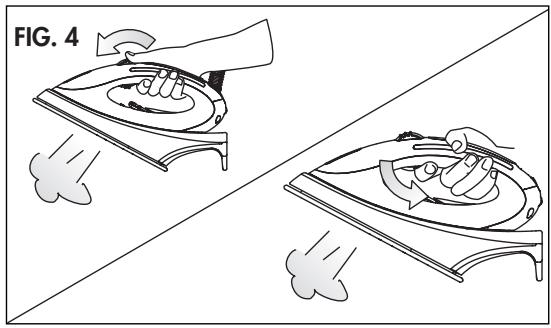
To obtain steam discharge, rotate the wheel (2B) forwards. The wheel can be rotated from the bottom of the handgrip (fig. 4).
To obtain continuous steam rotate the wheel forwards until it locks into place.
IMPORTANT: the tube connecting the iron to the steam generator may become hot.
TOPPING UP THE STEAM GENERATOR WITH WATER
When the water in the steam generator has run out, no more steam is given off.
To refill, proceed as follows:
Steam generator with separate switches:
Turn the steam generator off using the ☐ button (11). Vent any steam left using the button (2) or (2A) on the handle of the iron. Turn the iron off using the ☐ switch (10).
Steam generator with single switch:
Vent any steam left using the button (2) or (2A) on the handle of the iron.
Turn the appliance off using the Ⓘ switch (12).
Procedures common to all models:
Unplug from the mains socket.
Wait a few minutes for the iron to cool down.
Unscrew the cap slowly and fill as described in the paragraph "filling the steam generator".
DRY IRONING
Plug the appliance into the mains.
Steam generator with separate switches:
Press the 📄 switch (10) to turn power to the iron on. The light on the button comes on together with the "iron at temperature" light (4).
Position the thermostat regulation knob (3), according to the type of fabric to be ironed (fig. 3).
Steam generator with single switch:
press the Ⓐ switch (12) to turn power to the appliance on: the "steam ready" (4) and "iron at temperature" (8) lights come on.
Position the thermostat regulation knob (3), according to the type of fabric to be ironed (fig. 3).
When dry ironing, do not use the steam control (2).
NB: When the iron has reached the selected temperature, the indicator light (4) goes out. When the steam generator has reached maximum temperature, the indicator light (8) goes out.
IMPORTANT INFORMATION FOR CORRECT DISPOSAL OF THE PRODUCT IN ACCORDANCE WITH EC DIRECTIVE 2002/96/EC.
natural_image
Simple line drawing of a trash bin with two crossed lines indicating no waste or prohibition (no text or symbols)At the end of its working life, the product must not be disposed of as urban waste.
It must be taken to a special local authority differentiated waste collection centre or to a dealer providing this service.
Disposing of a household appliance separately avoids possible negative consequences for the environment
and health deriving from inappropriate disposal and enables the constituent materials to be recovered to obtain significant savings in energy and resources. As a reminder of the need to dispose of household appliances separately, the product is marked with a crossed-out wheeled dustbin.
Subject to changes
- IMPORTANT
- IMPORTANT SAFEGUARDS
- Read the following instructions carefully.
- IN PARTICULAR:
- DESCRIPTION
- USEFUL TIPS
- INSTRUCTIONS
- STEAM IRONING
- Filling the steam generator and connecting to the mains
- Operation
- Steam generator with separate switches:
- Operation (all models):
- Steam discharge in models with professional iron
- Steam discharge in models with domestic iron
- TOPPING UP THE STEAM GENERATOR WITH WATER
- Steam generator with single switch:
- Procedures common to all models:
- DRY IRONING
- IMPORTANT INFORMATION FOR CORRECT DISPOSAL OF THE PRODUCT IN ACCORDANCE WITH EC DIRECTIVE 2002/96/EC.
Marque : DELONGHI
Modèle : VVX 340
Catégorie : Fer à repasser vapeur