
EC 145 - Machine à café DELONGHI - Notice d'utilisation et mode d'emploi gratuit
Retrouvez gratuitement la notice de l'appareil EC 145 DELONGHI au format PDF.


| Type de produit | Machine à espresso |
| Marque | DELONGHI |
| Modèle | EC 145 |
| Alimentation | 220-240 V ~ 50/60 Hz, 10 A minimum |
| Type de café | Café moulu |
| Filtres inclus | 1 tasse et 2 tasses |
| Fonctions principales | Préparation espresso, cappuccino, production d'eau chaude |
| Capacité du réservoir d'eau | Environ 1 L (non spécifié précisément) |
| Préchauffage | Recommandé 15-30 minutes ou méthode rapide |
| Sécurité | Ne pas immerger, débrancher avant nettoyage, utiliser sur une surface stable |
| Entretien | Nettoyage régulier du filtre, détartrage tous les 200 cafés, nettoyage buse vapeur après usage |
| Détartrage recommandé | Acide citrique ou produit spécifique pour machines espresso |
| Garantie | Valable sous réserve d'entretien et détartrage réguliers |
| Réparabilité | Contacter un centre de service agréé pour les réparations |
| Pièces détachées | Utiliser des pièces d'origine uniquement |
FOIRE AUX QUESTIONS - EC 145 DELONGHI
Questions des utilisateurs sur EC 145 DELONGHI
0 question sur cet appareil. Repondez a celles que vous connaissez ou posez la votre.
Poser une nouvelle question sur cet appareil
Téléchargez la notice de votre Machine à café au format PDF gratuitement ! Retrouvez votre notice EC 145 - DELONGHI et reprennez votre appareil électronique en main. Sur cette page sont publiés tous les documents nécessaires à l'utilisation de votre appareil EC 145 de la marque DELONGHI.
MODE D'EMPLOI EC 145 DELONGHI
GB
Read this manual thoroughly before installing and using the appliance.
This is the only way to ensure best results and maximum safety for the user.
DESCRIPTION OF THE APPLIANCE
(see figure on pag. 3).
The terminology below will be used repeatedly on the following pages.
1 Filter holder for ground coffee
2 Large filter for 2 cups ground coffee
3 Small filter for 1 cup ground coffee
4 Steam knob
5 Presser
6 Cup tray
7 Power cable
8 Temperature OK light (coffee/hot water or steam)
9 light (apppliance on)
10 Function selector knob
11 position to run off coffee/hot water
12 Off position
13 Steam position
14 Coffee measure
15 Boiler outlet
16 Steam/hot water tube
17 Cappuccino maker
18 Water tank
19 Water tank lid
SAFETYWARNINGS
- This appliance is designed to "make espresso coffee" and "heat drinks". Use with care to avoid scalds from the water and steam jets or through incorrect use.
- This appliance is intended for domestic use only. Any other use is considered improper and thus dangerous.
- The manufacturer cannot be held responsible for any damage caused through incorrect, wrong or unreasonable use.
- When using the appliance, do not touch the hot surfaces. Use the knobs or handles only.
- Do not touch the appliance with wet or damp hands or feet.
- Do not allow children or unfit persons to use the appliance unsupervised.
- Never allow children to play with the appliance.
- In the event of malfunction or faulty operation, switch off and unplug from the mains.
If it requires repair, contact an authorised service centre only and ask for original spare parts to be used.
Failure to respect the above could reduce the safety of the appliance.
IMPORTANT INFORMATION FOR CORRECT DISPOSAL OF THE PRODUCT IN ACCORDANCE WITH EC DIRECTIVE 2002/96/EC.
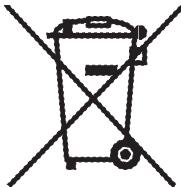
At the end of its working life, the product must not be disposed of as urban waste. It must be taken to a special local authority differentiated waste collection centre or to a dealer providing this service.
Disposing of a household appliance separately avoids possible negative consequences for the environment and
health deriving from inappropriate disposal and enables the constituent materials to be recovered to obtain significant savings in energy and resources. As a reminder of the need to dispose of household appliances separately, the product is marked with a crossed-out wheeled dustbin.
INSTALLATION
- After removing the packaging, make sure the product is complete and undamaged. If in doubt, do not use the appliance and contact a qualified professional.
- The packing elements (plastic bags, polystyrene foam, etc.) should be kept out of reach of children as they are a safety hazard.
- Place the appliance on a work surface far away from water taps, basins and sources of heat.
- After positioning the appliance on the work top, leave a space of at least 5cm between the surfaces of the appliance and the side and rear walls and at least 20cm above the coffee maker.
- Never install the appliance in environments where the temperature may reach 0^ or lower (the appliance may be damaged if the water freezes).
- Check that the voltage of the mains power supply corresponds to the value indicated on the appliance rating plate.
Connect the appliance to an efficiently earthed socket with a minimum current rating of 10 A only. The manufacturer may not be considered liable for possible incidents caused by the failure to adequately earth the mains.
- If the plug fitted to the appliance does not match the power socket, have the socket replaced with a suitable type by a qualified professional.
- The power cable on this appliance must not be replaced by the user as this operation requires the use of special tools. If the cable is damaged or requires replacing, contact an authorised service centre only to avoid all risks.
HOW TO MAKE ESPRESSO COFFEE FILLING THE WATER TANK
- Open the water tank lid (fig. 1) and then take out the tank by pulling upwards (fig. 2).
- Fill the tank with fresh clean water taking care not to exceed the MAX level (fig. 3). Replace the tank, pressing lightly to open the valve located on the bottom of the tank.
- More simply, the tank can also be filled without removing it, pouring the water directly from a jug.
IMPORTANT: It is normal for there to be water in the space under the tank. This should therefore be dried regularly with a clean sponge.
NB: Never use the appliance without water in the tank and always remember to top up when the level drops to a couple of centimetres from the bottom.
PREHEATING THE COFFEE UNIT
To obtain espresso coffee at the right temperature, the coffee machine must be preheated. Turn the selector knob to the W -position (fig. 4) at least 15 to 30 minutes before making the coffee, making sure the filter holder is attached to the appliance (check that the steam knob is closed).
To attach the filter holder, position it under the boiler outlet with the handle towards the left (see fig. 5), push it upwards and at the same time rotate the handle towards the right. Rotate firmly.
Wait for half an hour, then make the coffee as described in the following chapter.
Alternatively, preheating can be achieved more rapidly proceeding as follows:
- Turn the appliance on by rotating the selector knob to the M -position (fig. 4) and attach the filter holder to the appliance without adding ground coffee.
- Place a cup under the filter holder. Use the same cup as will be used to prepare the coffee in order to preheat it.
3.Wait for the OK indicator light to come on (fig. 6), then immediately rotate the selector knob to the position (fig. 7), run the water off until the OK indicator light goes out, then interrupt delivery by rotating the selector knob to the W position (fig. 6). - Empty the cup. Wait until the OK indicator light comes on again then repeat the same operation.
HOW TO PREPARE ESPRESSO COFFEE USING THE FILTER HOLDER FOR GROUND COFFEE
- After preheating the appliance as described above, place the ground coffee filter in the filter holder, making sure the projection is correctly inserted in the slot as shown in fig. 8.
Use the smaller filter to make one coffee or the larger filter to make two coffees.
- To make a single coffee only, place one level measure of ground coffee, about 7 grams, in the filter (fig. 9). To prepare two coffees, place two loosely filled measures of ground coffee (about 6 + 6g ) in the filter. Fill the filter a little at a time to prevent the ground coffee from overflowing.
IMPORTANT: for correct operation, before adding the ground coffee to the filter holder, clean the filter from residues of ground coffee from the previous infusion.
3.Distribute the ground coffee evenly and press lightly with the pressing pad (fig. 10). NB: Correct pressing of the ground coffee is essential to obtain a good espresso. If pressing is excessive, coffee delivery will be slow and the froth will be dark. If pressing is too light, coffee delivery will be too rapid and the froth will be skimpy and light coloured.
4. Remove any excess coffee from the rim of the filter holder and attach the filter holder to the appliance. Rotate firmly (fig. 5) to avoid leaks of water.
5. Place the cup or cups (ideally preheated by rinsing with a little hot water) under the filter holder spouts (fig. 11).
6.Make sure the OK light (fig. 6) is on (if off, wait until it comes on), then turn the knob to the position (fig.7) until the required quantity is obtained. To interrupt, place the selector back in the W position (fig.5). (You should not delivery coffee for more than one minute at a time).
7.To remove the filter holder, rotate the handle from right to left.
IMPORTANT: to avoid splashes, never remove the filter holder while the appliance is delivering coffee.
8.To eliminate the used coffee grounds, block the filter in place using the lever incorporated in the handle and empty the coffee by turning the filter holder upside down and tapping (fig. 12).
9. To turn the appliance off, rotate the selector knob to the "O" position (fig. 13).
IMPORTANT: the first time the appliance is used, all accessories and the internal circuits must be washed through by making at least five coffees without using ground coffee.
HOW TO MAKE CAPPUCCINO COFFEE
1.Prepare the espresso coffees as described in the previous paragraphs, using sufficiently large cups.
2. Rotate the selector knob to the position (fig. 14) and wait until the OK light comes on (fig. 6). This indicates that the boiler has reached the ideal temperature for steam production.
3. In the meantime, fill a recipient with about 100 grams of milk for each cappuccino to be prepared. The milk must be at refrigerator temperature (not hot!). In choosing the size of the recipient, bear in mind that the milk doubles or triples in volume.
NB: YOU ARE RECOMMENDED TO USE SEMISKIMMED MILK AT REFRIGERATOR TEMPERATURE.
-
Place the recipient containing the milk under the cappuccino maker (fig. 15).
-
Immerse the cappuccino maker in the milk for about 5 mm and rotate the steam knob anticlockwise (fig. 16) (rotating the knob more or less varies the quantity of steam discharged by the cappuccino maker). The milk now starts to increase in volume and take on a creamy appearance.
-
When the milk has doubled in volume, immerse the cappuccino maker deeply and continue heating the milk (fig. 17). When the required temperature is reached (the ideal is 60^ ), interrupt steam delivery by rotating the steam knob clockwise and placing the selector in the "O" position (fig. 13).
-
Pour the frothed milk into the cups containing the espresso coffee prepared previously. The cappuccino is ready. Sweeten to taste and if desired, sprinkle the froth with a little cocoa powder.
NB: to make coffee again after the milk has been frothed, cool down the boiler first or the coffee will be burnt. To cool, place a container under the boiler outlet, turn the selector to the "coffee" position and run off the water until the OK light goes out. Turn the selector back to the W -position and make the coffee as described above.
IMPORTANT: always clean the cappuccino maker after use. Proceed as follows:
- Discharge a little steam for a few seconds by rotating the steam knob (fig. 16).
-
Wait several minutes for the steam tube to cool down. Unscrew the cappuccino maker by rotating clockwise (fig. 18) and wash thoroughly with warm water.
3.Make sure the three holes in the cappuccino maker shown in fig. 19 are not blocked. If necessary, clean with a pin. -
Clean the steam tube, taking care to avoid burns.
5.Screw the cappuccino maker back in place.
HOT WATER PRODUCTION
- Turn the appliance on by rotating the selector knob to the 一 position (fig. 4).
- Place a recipient under the cappuccino maker.
- When the OK indicator light comes on, turn the selector knob to the position (fig. 8) and at the same time, rotate the steam knob anticlockwise (fig. 18). Hot water is delivered from the cappuccino maker.
- To interrupt delivery of hot water, rotate the steam knob clockwise and position the selector knob to "O" (fig. 14) (You should not delivery hot water for more than one minute at a time).
CLEANING AND MAINTENANCE OF THE FILTER
- Before performing any cleaning operations, leave the appliance to cool down and unplug from the mains socket.
- Do not use solvents or abrasive cleaning products to clean the appliance. A soft, damp cloth is sufficient.
- Remove the drip tray, empty and wash frequently.
- Clean the water tank regularly.
- From time to time, make sure the holes in the espresso coffee filter are not blocked. If necessary, clean with a pin (see fig. 20).
CLEANING THE BOILER OUTLET
About every 300 coffees, the espresso boiler outlet must be cleaned as follows:
- Make sure the appliance is not hot and that it is unplugged from the mains.
- Using a screwdriver, unscrew the screw fixing the espresso boiler outlet filter (fig. 21).
- Clean the outlet filter thoroughly in hot water using a brush.
Make sure the holes are not blocked. If necessary, clean with a pin (fig. 20).
Failure to clean as described above invalidates the guarantee.
IMPORTANT: during cleaning, never immerse the coffee machine in water. It is an electrical appliance.
DESCALING
You are recommended to descale the coffee machine about every 200 coffees.
You should use a commercially available product specifically for descending espresso coffee machines.
If such a product is not available, proceed as follows.
1. Fill the tank with half a litre of water.
2. Dissolve 2 spoonfuls (about 30 grams) of citric acid (obtainable from chemist's).
3. Rotate the selector knob to the -W position and wait until the OK indicator light comes on.
4.Make sure the filter holder is not attached and position a recipient under the boiler outlet.
5. Rotate the selector knob to the position (fig. 8) and run off half the solution in the tank.
Then interrupt the flow by rotating the selector to the "O" position (fig. 14).
6. Leave the solution to work for about 15 minutes, then run off the rest of the water in the tank.
7. To eliminate residues of solution and scale, rinse the tank well, fill with clean water and replace in position.
8. Rotate the selector knob to the position and run off the water until the tank is completely empty;
9. Rotate the selector knob to the position and repeat operations 7 and 8 again.
Repair of damage to the coffee machine caused by scale is not covered by the guarantee unless descaling is performed regularly as described above.
| PROBLEM | POSSIBLE CAUSES | SOLUTION |
| No espresso coffee is delivered | ·No water in the tank ·The holes in the filter holder spouts are blocked. ·The espresso boiler outlet is blocked. ·The filter is blocked ·The tank is incorrectly inserted and the valve on the bottom is not open. | ·Fill the tank with water. ·Clean the spout holes ·Clean as described in the chapter "Cleaning the boiler outlet". ·Clean as described in the section "Cleaning the filter". ·Press the tank down lightly to open the valve on the bottom. |
| The espresso coffee drips from the edges of the filter holder rather than the holes | ·The filter holder is inserted incorrectly. ·The espresso boiler gasket has lost elasticity. ·The holes in the filter holder spouts are blocked. | ·Attach the filter holder correctly and rotate firmly as far as it will go. ·Have the espresso boiler gasket replaced at a service centre. ·Clean the spout holes |
| The espresso coffee is cold | ·The espresso OK indicator light was not on when the coffee switch was pressed. ·No preheating performed ·The cups were not preheated | ·Wait until the espresso OK indicator light comes on. ·Preheat as described in the paragraph "Preheating the espresso coffee unit". ·Preheat the cups. |
| The pump is excessively noisy | ·The water tank is empty. ·The tank is incorrectly inserted and the valve on the bottom is not open. | ·Refill the tank. ·Press the tank down lightly to open the valve on the bottom. |
| The coffee froth is too light (delivered from the spout too fast) | ·The ground coffee is not pressed down firmly enough. ·There is not enough ground coffee. ·The ground coffee is too coarse ·Incorrect type of ground coffee. | ·Press the ground coffee down more firmly (fig. 6). ·Increase the quantity of ground coffee. ·Use ground coffee for espresso coffee machines only. ·Change the type of ground coffee. |
| The coffee froth is too dark (delivered from the spout too slowly) | ·The ground coffee is pressed down too firmly. ·There is too much ground coffee. ·The espresso boiler outlet is blocked. ·The filter is blocked ·The ground coffee is too fine. ·The coffee is damp or ground too fine. ·Incorrect type of ground coffee. | ·Press the coffee down less firmly (fig. 6). ·Reduce the quantity of ground coffee. ·Clean as described in the chapter "Cleaning the espresso boiler outlet". ·Clean as described in the section "Cleaning the filter". ·Use ground coffee for espresso coffee machines only. ·Use only ground coffee for espresso coffee machines. Make sure it is not damp. ·Change the type of ground coffee. |
| No milk froth is formed when making cappuccino | ·Milk not cold enough. ·Cappuccino maker dirty. | ·Always use semi-skimmed milk at refrigerator temperature. ·Thoroughly clean the holes in the cappuccino maker in particular those indicated in figure 19. |