
AVH-X7500BT - Autoradio PIONEER - Notice d'utilisation et mode d'emploi gratuit
Retrouvez gratuitement la notice de l'appareil AVH-X7500BT PIONEER au format PDF.


| Type de produit | Autoradio multimédia avec écran tactile |
| Marque | Pioneer |
| Modèle | AVH-X7500BT |
| Dimensions du châssis (DIN) | 180 mm x 50 mm x 160 mm (L x H x P) |
| Dimensions du châssis (D) | 178 mm x 50 mm x 165 mm (L x H x P) |
| Poids | 2,0 kg |
| Alimentation | 14,4 V CC (10,8 V à 15,1 V autorisée) |
| Écran | 7 pouces TFT tactile, 1 152 000 pixels, format 16:9 |
| Puissance audio maximale | 4 x 50 W |
| Puissance audio continue | 4 x 22 W (4 Ω, 5% DHT) |
| Lecteur DVD | Région 2, compatible DVD-Vidéo, VCD, CD, CD-R/RW, DVD-R/RW |
| Formats audio supportés | MP3, WMA, AAC, WAV |
| Formats vidéo supportés | DivX, MPEG-1, MPEG-2, MPEG-4 |
| Bluetooth | Version 3.0 certifiée, profils HFP, A2DP, AVRCP, PBAP |
| Tuner FM | 87,5 MHz à 108,0 MHz |
| Tuners MW/LW | MW : 531-1602 kHz, LW : 153-281 kHz |
| Connectivité | USB (1 A), entrée AUX, entrée AV, sortie vidéo arrière, entrée caméra de recul |
| Fonctions principales | AppRadio Mode, MIXTRAX, reconnaissance vocale (iPhone), égaliseur 8 bandes, téléphone mains libres, streaming audio Bluetooth |
| Sécurité | Détection de frein à main pour certaines fonctions, panneau avant amovible (antivol) |
| Entretien et nettoyage | Utiliser un chiffon doux et sec ; ne pas utiliser de produits chimiques agressifs |
| Pièces détachées et réparabilité | Service après-vente Pioneer ; consulter un concessionnaire agréé pour les réparations |
FOIRE AUX QUESTIONS - AVH-X7500BT PIONEER
Questions des utilisateurs sur AVH-X7500BT PIONEER
0 question sur cet appareil. Repondez a celles que vous connaissez ou posez la votre.
Poser une nouvelle question sur cet appareil
Téléchargez la notice de votre Autoradio au format PDF gratuitement ! Retrouvez votre notice AVH-X7500BT - PIONEER et reprennez votre appareil électronique en main. Sur cette page sont publiés tous les documents nécessaires à l'utilisation de votre appareil AVH-X7500BT de la marque PIONEER.
MODE D'EMPLOI AVH-X7500BT PIONEER
Owner's Manual
AVH-X7500BT
Visit www.pioneer.co.uk (or www.pioneer.eu) to register your product.
DIVX™

VIDEO

DOLBY
DIGITAL
Contents
Thank you for purchasing this PIONEER product.
To ensure proper use, please read through this manual before using this product. It is especially important that you read and observe WARNINGS and CAUTIONS in this manual. Please keep the manual in a safe and accessible place for future reference.
Precautions 3
IMPORTANT SAFEGUARDS .... 3
To ensure safe driving 4
- When using a display connected to rear monitor output .... 4
- When using the rear view camera ...... 4
To avoid battery exhaustion 4
Before you start 5
About this unit 5
DVD video disc region numbers 5
About this manual 5
If you experience problems 5
Protecting your unit from theft 6
- Removing the front panel 6
- Re-attaching the front panel 6
Demo mode 6
What's what 7
Head unit 7
Home display 7
Turning the source ON/OFF 8
Selecting a source 8
Adjusting the volume 8
Optional remote control 8
Common operations 9
Common operations for menu settings/lists 9
Operating the scroll icon and the scrubber bar 9
Activating the touch panel keys 9
- Touch panel keys 9
Using the rear view 10
- Using the rear view key to display the rear view 10
Using the rear monitor 10
Using sound retriever 10
Changing the wide-screen mode 10
Basic operations ...... 11
Opening and closing the LCD panel ..... 11
- Setting the automatic open function 11
- Turning the LCD panel horizontally 12
Adjusting the LCD panel slide position 12
Adjusting the LCD panel angle 12
Ejecting a disc 13
Setting the clock 13
Tuner 13
Tuner operations 13
- Touch panel keys 13
- Basic operations ...... 14
Storing and recalling stations 14
Displaying radio text 14
Storing and recalling radio text 14
Storing the strongest stations 14
Tuning in to strong signals 15
Using iTunes tagging 15
- Storing the tag information to this unit 15
- Storing the tagged information to your iPod 15
Receiving traffic announcements ...... 15
Receiving alarm broadcasts interrupting regular broadcasts .... 15
Using PTY functions 15
- Searching for an RDS station by PTY information 16
- Using news program interruption ..... 16
- PTY list 16
Setting the FM tuning step 16
RDS setting 16
- Limiting stations to regional programming 16
- Selecting alternative frequencies ..... 16
Switching Auto PI Seek 17
Switching the sound quality of the FM tuner 17
Disc (CD/DVD) 17
Introducing movie operations 17
- Touch panel keys 17
- Basic operations ...... 18
Sound playback operations 19
- Touch panel keys 19
Switching the media file type 19
Operating the DVD menu 19
- Using the arrow keys ...... 19
Random play (shuffle) 20
Repeating playback 20
Searching for the part you want to play 20
Selecting audio output 21
PBC playback 21
Selecting tracks from the track title list 21
Selecting files from the file name list ..... 21
Playing DivX® VOD content 21
iPod 22
iPod control 22
- For iPod with lightning connector users 22
Moving images operations ...... 23
- Touch panel keys 23
- Basic operations ...... 23
Sound playback operations 23
- Touch panel keys 24
Using this unit's iPod function from your iPod 24
Shuffle play 24
Repeating playback 25
Playing videos from your iPod 25
Browsing for a video/music on the iPod 25
- Searching for a video/music by category 25
- Searching the list by alphabet ...... 25
Changing audiobook speed 26
Displaying lists related to the song currently playing (link search) 26
AppRadio Mode 26
AppRadio Mode operation 26
- iPhone compatibility 27
Starting procedure 27
Setting the Keyboard 27
Setting the App sound mixing 28
USB 28
Sound playback operations 28
- Touch panel keys 28
- Basic operations ...... 29
Music browse mode 29
Switching the media file type 29
Random play (shuffle) 29
Repeating playback 29
Selecting files from the file name list ..... 29
Displaying lists related to the song currently playing (link search) 29
Bluetooth Audio 30
Sound playback operations 30
- Touch panel keys 30
Setting up for Bluetooth audio 30
Random play (shuffle) 30
Repeating playback 30
Using MIXTRAX 31
MIXTRAX operation 31
MIXTRAX EZ operation 31
Starting MIXTRAX EZ operation 31
Setting MIXTRAX mode 31
Setting the effect 31
- Fixed sounds ...... 31
- Sound effects ...... 31
- Setting sounds and sound effects as presets using the preset key ...... 32
- Registering sounds and sound effects as presets 32
Bluetooth telephone 32
Bluetooth telephone operations 32
- Touch panel keys 32
- Text information 33
- Setting up for hands-free phoning 33
Calling a number in the phone book ...... 33
Selecting a number by alphabet search mode 34
Inverting names in phone book 34
Using the missed, received and dialed call lists 34
Setting automatic answering 35
Adjusting the other party's listening volume 35
Switching the ring tone 35
Using the preset dial lists 35
Making a call by entering phone number 35
Setting the private mode 36
Voice control 36
Settings 36
Menu operations 36
- Touch panel keys 36
Audio adjustments 37
Using fader/balance adjustment 37
Using balance adjustment 37
Using the equalizer 37
● Recalling equalizer curves 37
- Adjusting the 8-band graphic equalizer .... 37
Using the auto-equalizer 38
Using sonic center control 38
Adjusting loudness 38
Using subwoofer output 38
Boosting the bass 38
Using the high pass filter 39
Adjusting source levels 39
Setting up the video player 39
Setting the subtitle language 39
- When you select Others 39
Setting the audio language 39
Setting the menu language 40
Setting the multi-angle DVD display ..... 40
Setting the aspect ratio 40
Setting parental lock 40
- Setting the code number and level 40
- Changing the level 41
- If you forget your code number ...... 41
Setting the DivX subtitle file 41
Displaying the DivX® VOD registration code 42
- Displaying the deregistration code 42
Automatic playback of DVDs 42
System settings 42
Switching the auxiliary setting 42
Setting AV input 42
Setting the RGB Input 42
Setting the App sound mixing 43
Setting MIXTRAX mode 43
Changing the picture adjustment 43
Selecting the system language 43
Setting Demo Mode 44
Switching sound muting/attenuation ..... 44
Setting the rear output and subwoofer controller 44
Using the keyboard 44
Contents
Setting the ever scroll 45
Setting the Bluetooth audio 45
Clearing Bluetooth memory 45
Updating Bluetooth connection software 45
Displaying the Bluetooth system version 45
Setting the automatic open function ..... 45
Setting the safe mode 46
Setting the rear view camera (back up camera) 46
Auto EQ (auto-equalizing) 46
- Before operating the auto EQ function 46
● Performing auto EQ 47
Selecting the video format 48
Setting the video signal 48
Favorite menu 48
Using the Favorite menu 48
Bluetooth connection menu 49
Bluetooth connection menu operations 49
● Pairing from this unit 49
- Connecting to a Bluetooth device automatically 49
- Switching visible unit 50
- Entering PIN code for Bluetooth wireless connection .... 50
- Displaying Bluetooth Device address 50
Theme menu 50
Selecting the illumination color 50
- Direct selection from preset illumination colors .... 50
- Customizing the illumination color .... 50
Selecting the OSD (on-screen display) color 51
Selecting the background display 51
Other functions 51
Adjusting the response positions of the touch panels (Touch Panel Calibration) 51
Using an AUX source 52
- About AUX connection methods ..... 52
- Mini pin plug cable (AUX) 52
Resetting the microprocessor 52
Additional information 52
Troubleshooting 52
Error messages 54
Understanding auto EQ error messages 56
Understanding messages 56
Indicator list 57
Handling guidelines 59
Audio compatibility (USB) 61
Compressed audio compatibility (disc, USB) 61
iPod compatibility 62
About iTunes tagging 63
Sequence of audio files 63
- Example of a hierarchy 63
Using the display correctly 64
● Handling the display 64
- Liquid crystal display (LCD) screen 64
- LED (light-emitting diode) backlight .... 64
- Keeping the display in good condition 64
Bluetooth profiles 64
Copyright and trademark 65
Language code chart for DVD 67
To users of the iPhone 5 and the iPod touch 5th generation .... 68
Specifications 68
Precautions
IMPORTANT SAFEGUARDS
Please read all of these instructions regarding your display and retain them for future reference.
- Do not install the display where it may (i) obstruct the driver's vision, (ii) impair the performance of any of the vehicle's operating systems or safety features, including air bags, hazard lamp buttons or (iii) impair the driver's ability to safely operate the vehicle.
- Do not operate this display if doing so in any way will divert your attention from the safe operation of your vehicle. Always observe safe driving rules and follow all existing traffic regulations. If you experience difficulty in operating the system or reading the display, park your vehicle in a safe location and make necessary adjustments.
- Please remember to wear your seat belt at all times while operating your vehicle. If you are ever in an accident, your injuries can be considerably more severe if your seat belt is not properly buckled.
- Never use headphones while driving.
- To promote safety, certain functions are disabled unless the parking brake is on, and the vehicle is not in motion.
- Never set the volume of your display so high that you cannot hear outside traffic and emergency vehicles.
WARNING
Do not attempt to install or service this product by yourself. Installation or servicing of this product by persons without training and experience in electronic equipment and automotive accessories may be dangerous and could expose you to the risk of electric shock, injury or other hazards.
Precautions
To ensure safe driving
⚠ WARNING
- LIGHT GREEN LEAD AT POWER CONNECTOR IS DESIGNED TO DETECT PARKED STATUS AND MUST BE CONNECTED TO THE POWER SUPPLY SIDE OF THE PARKING BRAKE SWITCH. IMPROPER CONNECTION OR USE OF THIS LEAD MAY VIOLATE APPLICABLE LAW AND MAY RESULT IN SERIOUS INJURY OR DAMAGE.
- To avoid the risk of damage and injury and the potential violation of applicable laws, this unit is not for use with a video screen that is visible to the driver.
- To avoid the risk of accident and the potential violation of applicable laws, no viewing of front seat video should ever occur while the vehicle is being driven.
- In some countries or states the viewing of images on a display inside a vehicle even by persons other than the driver may be illegal. Where such regulations apply, they must be obeyed and this unit's video features should not be used.
When you attempt to watch a video image while driving, the warning "Viewing of front seat video source while driving is strictly prohibited." will appear on the front display.
To watch a video image on the front display, park your vehicle in a safe place and apply the parking brake.
When using a display connected to rear monitor output
The rear monitor output on this unit (V OUT) is used to connect a rear display that allows passengers in the rear seats to watch videos.
⚠ WARNING
NEVER install the rear display in a location where the driver can watch videos while driving.
When using the rear view camera
With an optional rear view camera, this unit can be used as an aid to keep an eye on trailers, or when backing into a tight parking spot.
⚠ WARNING
• SCREEN IMAGE MAY APPEAR REVERSED.
- USE INPUT ONLY FOR REVERSE OR MIRROR IMAGE REAR VIEW CAMERA. OTHER USE MAY RESULT IN INJURY OR DAMAGE.
CAUTION
- The rear view camera function is to be used as an aid to keep an eye on trailers, or while backing up. Do not use for entertainment purposes.
- Please note that the edges of the rear view camera images may differ slightly according to whether full screen images are displayed when backing up, and whether the images are used for checking the rear when the vehicle is moving forward.
To avoid battery exhaustion
Keep the vehicle engine running when using this unit to avoid draining the battery power.
- When no power is supplied to this unit, such as when the vehicle battery is being replaced, the microcomputer of this unit returns to its initial condition. We recommend that you transcribe the audio adjustment data.
⚠ WARNING
Do not use with vehicles that do not feature an ACC position.
Before you start

If you want to dispose this product, do not mix it with general household waste. There is a separate collection system for used electronic products in accordance with legislation that requires proper treatment, recovery and recycling.
Private households in the member states of the EU, in Switzerland and Norway may return their used electronic products free of charge to designated collection facilities or to a retailer (if you purchase a similar new one).
For countries not mentioned above, please contact your local authorities for the correct method of disposal.
By doing so you will ensure that your disposed product undergoes the necessary treatment, recovery and recycling and thus prevent potential negative effects on the environment and human health.
About this unit
The tuner frequencies on this unit are allocated for use in Western Europe, Asia, the Middle East, Africa and Oceania. Use in other areas may result in poor reception. The RDS (radio data system) function only works in areas that broadcast RDS signals for FM stations.
CAUTION
This product is a class 1 laser product classified under the Safety of laser products, IEC 60825-1:2007, and contains a class 1M laser module. To ensure continued safety, do not remove any covers or attempt to gain access to the inside of the product. Refer all servicing to qualified personnel.
CLASS 1 LASER PRODUCT
CAUTION—CLASS 1M VISIBLE AND INVISIBLE LASER RADIATION WHEN OPEN, DO NOT VIEW DIRECTLY WITH OPTICAL INSTRUMENTS.
CAUTION
- Do not allow this unit to come into contact with liquids. Electrical shock could result. Also, damage to this unit, smoke, and overheating could result from contact with liquids.
- The Pioneer CarStereo-Pass is for use only in Germany.
• Always keep the volume low enough to hear outside sounds. - Avoid exposure to moisture.
- If the battery is disconnected or discharged, any preset memory will be erased.
DVD video disc region numbers
Only DVD video discs with compatible region numbers can be played on this player. You can find the region number of the player on the bottom of this unit and in this manual (refer to "Specifications" on page 68).
About this manual
- This unit features a number of sophisticated functions to ensure superior reception and operation. All the functions have been designed for the easiest possible use, but many are not self-explanatory. This operation manual will help you benefit fully from this unit's potential and to maximize your listening enjoyment.
- This manual uses diagrams of actual screens to describe operations. However, the screens on some units may not match those shown in this manual depending on the model used.
- In the following instructions, USB memory sticks and USB audio players are collectively referred to as "USB storage device".
- In this manual, iPod and iPhone will be referred to as "iPod".
If you experience problems
Should this product fail to operate properly, please contact your dealer or nearest authorized Pioneer Service Station.
Before you start
Protecting your unit from theft
The front panel can be detached to deter theft.
Important
- Handle the front panel with care when removing or attaching it.
- Avoid subjecting the front panel to excessive shock.
- Keep the front panel out of direct sunlight and high temperatures.
- If removed, replace the front panel on the unit before starting up your vehicle.
- To avoid damaging the device or vehicle interior, remove any cables and devices attached to the front panel before detaching it.
Removing the front panel
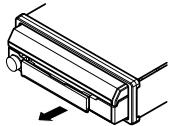
- Pinch the top and bottom of its right side and pull the front panel out.
Take care not pinch it too tightly or to drop it, and also avoid contact with water or other fluids to prevent permanent damage.
natural_image
Technical line drawing of a mechanical component with no visible text or symbolsRe-attaching the front panel
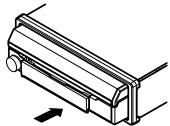
- Slide the front panel to the left.
The front panel and the head unit are connected on the left side. Make sure that the front panel has been properly connected to the head unit.
natural_image
Technical line drawing of a mechanical component with no visible text or symbols- Press the right side of the front panel until it is firmly seated.
If you can't attach the front panel to the head unit successfully, try again. Forcing the front panel into place may result in damage.
Demo mode
The feature demo automatically starts when you select Off for the source and continues while the ignition switch is set to ACC or ON. To cancel the feature demo, press and hold MUTE. Press and hold MUTE again to restart. Operating the feature demo while the car engine is turned off it may drain the battery power.
Important
The red lead (ACC) of this unit should be connected to the ignition on/off function.
Failure to do so may result in battery drain.
What's what
Head unit
text_image
Diagram of a computer monitor with labeled ports and indicators for data input, display, and control buttons.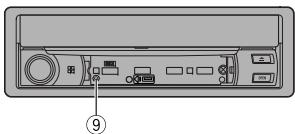
text_image
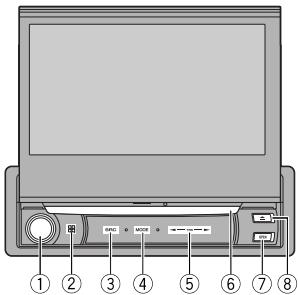
Diagram of a CD-ROM drive showing rear panel, front panel, and control buttons with labeled component 9① VOLUME/MUTE
Turn VOLUME to adjust the volume.
Press to mute. Press again to unmute.
② Home button
Displaying the home display.
The display returns to the Launcher screen while a 3rd-party application is being used in AppRadio Mode.
Double-clicking the icon on the Launcher screen returns the display to the home display.
③ SRC/OFF
④ MODE
Turning the information display off.
⑤ ◀/▶ (TRK)
⑥ Disc loading slot
⑦ OPEN/CLOSE
⑧ ▲ (eject)
⑨ RESET
For details refer to "Resetting the microprocessor" on page 52.
CAUTION
Do not use unauthorized products.
Notes
- When an iPhone is connected, press and hold the home button to activate the voice control.
- When the navigation system is connected, press MODE to switch to the navigation display. Press and hold MODE to turn the display off.
- Press MODE again to turn the display on.
-
For details on how to operate a navigation system from this unit, refer to its operation manual.
-
When an iPhone that is running an application that supports AppRadio Mode is connected, press MODE to switch to the application display. You can use the application by touching the display.
- About the way to connect the USB storage device to this unit, refer to installation manual.
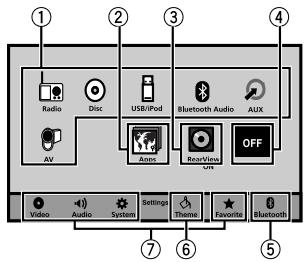
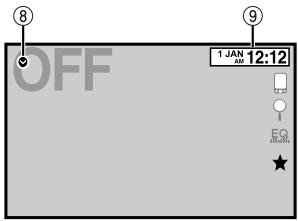
Home display
Home display
text_image
① Radio Disc USB/iPod Bluetooth Audio AUX AV Anim Rear/Vire ON OFF Video Audio System Settings Thermal Favorites Bluetooth ⑦ ⑥Source off display
text_image
OFF 1 JAN AM 12:12 EQ ★Source on display
text_image
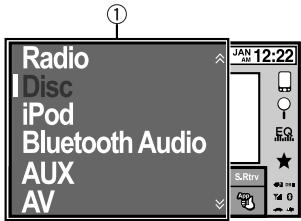
Radio I Disc iPod Bluetooth Audio AUX AV① Source icon
Selecting a favorite source.
When the source icon is not displayed, it can be displayed by pressing the home key or touching ⬇.
② Apps key
Switching to AppRadio Mode.
③ Rear view key
Displaying the rear view image.
For details refer to "Using the rear view" on page 10.
④ Source off key
Turning the source off.
⑤ Bluetooth key
Displaying the Bluetooth connection menu.
What's what
⑥ Theme key
Displaying the Theme menu.
⑦ Menu icon
Displaying the menu.
⑧ Source key
Displaying the source menu.
⑨ Clock key
Switching to clock adjustment display.
Turning the source ON/OFF
Turning the source on using the buttons
- Press SRC/OFF to turn the source on.
Turning the source off using the buttons
- Press and hold SRC/OFF until the source turns off.
Selecting a source
Available source modes
- Radio – Radio tuner
- Disc – Built-in DVD and CD player
- USB/iPod – USB/iPod
- Bluetooth Audio – Built-in Bluetooth audio
- AUX – AUX
- AV – AV input
Selecting a source
- Using SRC/OFF
Press SRC/OFF.
- Using the touch panel keys on the home display
Touch the source icon and then touch the desired source name.
- When the source icon is not displayed, it can be displayed by touching the screen.
- While operating the menu, you cannot select a source by touching the source icon.
Notes
- The USB/iPod icon will change as follows:
- USB is displayed when a USB storage device is connected to USB input.
- iPod is displayed when an iPod is connected to USB input.
- USB/iPod is displayed when no device is connected.
- iPod is not displayed when RGB Input is set to iPhone (VGA adapter). Refer to "Setting the RGB Input" on page 42.
Adjusting the volume
- Turn VOLUME to adjust the volume.
Optional remote control
The remote control CD-R33 is sold separately.
For details concerning operations, see the remote control manual.
Common operations
Common operations for menu settings/lists

Starting the Bluetooth telephone menu.
For details refer to "Bluetooth telephone" on page 32.

Displaying the list menu.
Starting the search function.

Displaying the EQ (Audio function menu).

Displaying the Favorite menu.
Operating the scroll icon and the scrubber bar
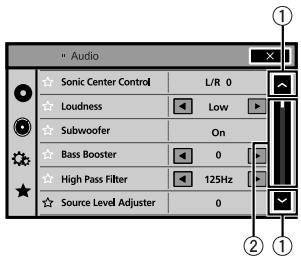
text_image
" Audio Sonic Center Control L/R 0 Loudness Low Subwoofer On Bass Booster 0 High Pass Filter 125Hz Source Level Adjuster 0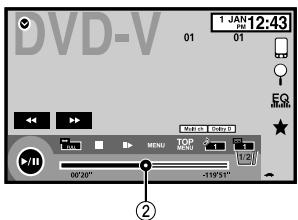
text_image
DVD-V 01 1 JAN 12:43 01 EQ MUSIC 00'20" -119'51" ②① Scroll icon
Appears when selectable items are hidden.
② Scrubber bar
Appears when items cannot be displayed on a single page only.
Viewing the hidden items
- Touch the scroll icon or drag the scrubber bar to view any hidden items.
- Also, you can drag the list to view any hidden items.
Specifying the playback point
- Drag the scrubber bar on the screen.
(Not available when the scrubber bar is grayed out.)
Activating the touch panel keys
Touch panel keys
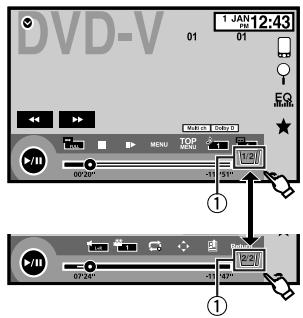
text_image
DVD-V 01 1 JAN 12:43 01 EQ ① ① 07:24 -5° -5° 09:20 MENU TOP HOLD 1/2 ② ②① Tab key
Switching the touch panel keys on the display.
Common operations
Using the rear view
A rear view camera sold separately is required for using the rear view mode. The below functions are available.
- Rear view camera
This unit can be setup to display the rear view image automatically when you move the shift lever to the REVERSE (R) position. - Camera for rear view mode
The rear view can be turned on to display at all times.
The rear view camera needs to be set to a setting other than Off to turn on rear view mode.
For details about the settings, refer to "Setting the rear view camera (back up camera)" on page 46.
Using the rear view key to display the rear view

Displaying the rear view image by turning the rear view image on. When the rear view image is displayed, you can switch to the source display by touching the display. You can operate from the source display temporarily at this time. If you do not perform any operations within a few seconds, the display will return to the rear view image. To turn off the rear view image, press the home button to return to the home display and then press this key again.
Using the rear monitor
Connecting a rear monitor, sold separately, to this unit allows images and videos to be viewed from the rear seats.
Notes
- You cannot use touch panel keys and operation screens from the rear monitor.
- Images and video will continue to be displayed whether the vehicle is in motion or stopped.
Using sound retriever
S.Rtrv
Automatically enhances compressed audio and restores rich sound.

Notes
- This function is enabled for playback on the sources listed below.
- CD-DA
– MP3/WMA/AAC/WAV files on USB storage devices - MP3/WMA/AAC files on CD media
- iPod
- The sound retriever setting is turned off when the MIXTRAX function is used in USB source mode.
Changing the wide-screen mode

Selecting the appropriate screen ratio for the playback video
- Display the screen mode.
- Touch the desired wide mode setting.
Full (full screen)
The 4:3 picture is enlarged in the horizontal direction only, granting viewers a 4:3 TV picture (normal picture) without any omissions.
Zoom (zoom)
The 4:3 picture is enlarged in the same proportion both vertically and horizontally; ideal for a cinema sized picture (wide screen picture).
Normal (normal)
The 4:3 picture is displayed as is, granting viewers no sense of disparity as the proportions are the same as that of the normal picture.
Common operations
Notes
- You cannot operate this function while driving.
- Different settings can be stored for each video source.
- When a video is viewed in a wide screen mode that does not match its original aspect ratio, it may appear different.
- Remember that using the wide mode feature of this system for commercial or public viewing purposes may constitute an infringement on the author's rights protected by the Copyright Law.
- The video image will appear coarser when viewed in Zoom mode.
- This function is enabled for playback on the sources listed below.
- Disc: DVD-V, Video-CD, DivX, MPEG-1, MPEG-2, MPEG-4
- iPod: Video
- AV: A/V data
- AUX: A/V data
Basic operations
Opening and closing the LCD panel
The LCD panel will open or close automatically when the ignition switch is turned on or off. You can turn off the automatic close/open function.
- Do not close the LCD panel by force with your hands. That will cause a malfunction.
- The automatic close/open function will operate the display as follows.
- When the ignition switch is turned OFF while the LCD panel is opened, the LCD panel will close after six seconds.
- When the ignition switch is turned ON again (or turned to ACC), the LCD panel will open automatically.
- Removing or attaching the front panel will automatically close or open the LCD panel. (Refer to "Protecting your unit from theft" on page 6.)
- When the ignition switch is turned OFF after the LCD panel has been closed, turning the ignition switch ON again (or turning it to ACC) will not open the LCD panel. In this case, press OPEN/CLOSE to open the LCD panel.
- When closing the LCD panel, check to make sure that it has closed completely. If the LCD panel has stopped halfway, leaving it like this could result in damage.
CAUTION
Keep hands and fingers clear of the unit when opening, closing, or adjusting the LCD panel. Be especially cautious of children's hands and fingers.
- Press OPEN/CLOSE to open the LCD panel.
- To close the LCD panel, press OPEN/CLOSE again.
Setting the automatic open function
To prevent the display from hitting the shift lever of an automatic vehicle when it is in the P (park) position, or when you do not wish the display to open/close automatically, you can set the automatic open function to manual mode.
- Press the home button to switch to the home display.
- Touch the system key to open the system menu.
- Touch Auto Flap to select whether to open/close the display automatically or manually.
Each time you touch Auto Flap the setting switches between: - On – The LCD panel will open or close automatically when the ignition switch is turned on or off.
- Off – You have to press OPEN/CLOSE to open/close the LCD panel.
Basic operations
Turning the LCD panel horizontally
When the LCD panel is upright and hinders the operation of the air conditioner, the panel can be turned horizontally temporarily.
- Press and hold OPEN/CLOSE to display the flap menu.
- Touch the flip down temporarily key to flip the LCD panel down to the horizontal position.

Flips the LCD panel down to the horizontal position temporarily.
- To return to the original position, press and hold OPEN/CLOSE.
- The LCD panel returns to the original position automatically, indicated with a beeping sound 10 seconds after operation.
Adjusting the LCD panel slide position
You can adjust the LCD panel slide position so that the panel is set back or forward.
- Press and hold OPEN/CLOSE to display the flap menu.
- Touch the slide back key or slide front key to move the LCD panel back and forth.

The LCD panel slides to the back.

The LCD panel slides to the front.
Adjusting the LCD panel angle
Important
- If you can hear the LCD panel knocking against your vehicle's console or dashboard, touch the flip down temporarily key from the flap menu to temporarily level the LCD panel.
- When adjusting the LCD panel angle, be sure to adjust from the flap menu. Forcibly adjusting the LCD panel by hand may damage it.
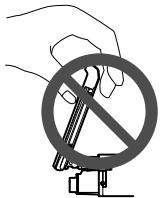
natural_image
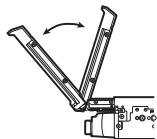
Hand holding a circular no-smoking sign with a diagonal line, no text or symbols present- Press and hold OPEN/CLOSE to display the flap menu.
- Touch the tilt down key or tilt up key to adjust the LCD panel to an easily viewable angle.
natural_image
Mechanical assembly diagram showing a lever mechanism with rotating arm (no text or symbols)
Laying the panel down.

Returning the panel to the upright position.
- As the set angle is saved, the LCD panel will automatically be adjusted to the same position the next time the LCD panel is opened.
Basic operations
Ejecting a disc
- Press to eject a disc.
Setting the clock
- Touch the Clock key.
The Clock Adjustment screen appears.
For details refer to "Home display" on page 7.
- Select the item to set.
- Touch ▲ or ▼ to set the correct date and time.
Tuner
Tuner operations
Touch panel keys
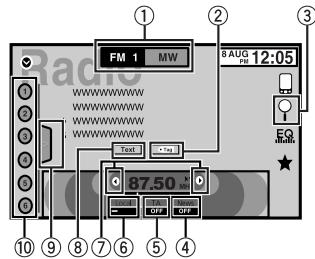
text_image
FM 1 MW 8AUG PM 12:05 Test 87.50 OFF OFF ① ② ③ ④ ⑤ ⑥ ⑦ ⑧ ⑨ ⑩ EQU① Band key
Selecting a band (FM1, FM2 or FM3) by touching the left icon. Switching to the MW/LW band by touching the right icon.
The icon for the selected band is highlighted.
② Tag key
Saving song information (tag) from the broadcasting station to your iPod.
③ Search key
Displaying the PTY information.
④ News key
Turning news program interruption on or off.
⑤ TA key
Turning TA (traffic announcement standby) on or off.
⑥ Local key
Setting the local seek level.
⑦ Tuning key
Tuning up or down manually.
Touch and hold down for more than two seconds to skip stations. Seek tuning starts as soon as you release. Touch again to cancel seek tuning.
⑧ Text key
Displaying radio text.
Storing and recalling radio text.
⑨ List key
Displaying the preset channel list.
⑩ Preset channel key
Selecting a preset channel.
Tuner
Basic operations
Switching preset channels using the buttons
- Press ◀ or ▶ (TRK).
Seek tuning using the buttons
- Press and hold ◀ or ▶ (TRK).
Notes
- Listening MW/LW radio while an iPod is charged from this unit may generate noise. In this case, disconnect the iPod from this unit.
- Touch panel keys not listed under “Tuner operations” on page 13 may appear on the display. Refer to “Indicator list” on page 57.
Storing and recalling stations
You can easily store up to six stations for each band as presets.
- Display the preset screen.
Refer to "Tuner operations" on page 13.
The preset screen appears in the display.
- Touch and hold down one of the preset channel keys to store the selected frequency to the memory.
The selected radio station frequency has been stored in the memory.
- Touch the appropriate preset channel key to select the desired station.
Displaying radio text
(Only available on FM stations)
Radio text data transmitted by RDS stations, such as station information, the name of the currently broadcast song and the name of the artist, can be displayed on this tuner.
- When no radio text is received, No Text appears in the display.
Storing and recalling radio text
You can store data from up to six radio text transmissions to the Memo1 to Memo6 keys.
- Display the radio text you want to store in the memory.
Refer to "Tuner operations" on page 13.
- Touch and hold one of the keys to store the selected radio text.
The memory number is displayed and the selected radio text will be stored in the memory.
The next time you press the same key in radio text display the stored text will be recalled from the memory.
Storing the strongest stations
BSM (best stations memory) automatically stores the six strongest stations in the order of their signal strength.
Storing broadcast frequencies with BSM may replace broadcast frequencies you have saved using the preset channel keys.
- Display the preset screen.
Refer to "Tuner operations" on page 13.
The preset screen appears in the display.
- Touch BSM to turn BSM on.
The six strongest broadcast frequencies will be stored under preset channel keys in order of their signal strength.
- To cancel the storage process, touch Cancel.
Tuner
Tuning in to strong signals
Local seek tuning allows you to tune in to only those radio stations with sufficiently strong signals for good reception.


The more ■ there are on the screen, the fewer the stations that can be selected. Only stations with the strongest signals in your local area can be selected.
If there are fewer ■, this unit will be able to receive broadcasts from weaker stations.
Using iTunes tagging
Note
- For more details about iTunes tagging, refer to "About iTunes tagging" on page 63.
Storing the tag information to this unit
- Tune in to the broadcast station.
- Store the tag information to this unit.
Refer to "Tuner operations" on page 13.
You can store the information if the Tag indicator is displayed while the desired song is being broadcast.
- While storing the tag data on this unit, Tag flashes.
- The tag information for up to 50 songs can be stored on this unit.
-
Depending on the timing of when the tag information is stored, the tag information for the song played before or after the currently playing song may also be stored.
-
When completed, ▶ Tag indicator turns off and ♪ indicator is displayed.
Storing the tagged information to your iPod
- Connect your iPod.
When your iPod is connected to this unit, your iPod starts storing the tagged information automatically.
- When completed, Ⓞ indicator turns off and the tagged information is stored on your iPod.
Receiving traffic announcements
(Only available on FM stations)
Regardless of the source you are listening to, you can receive traffic announcements automatically with TA (traffic announcement standby).
- Tune in to a TP or enhanced other network's TP station.
indicator lights up.
- Turn Traffic announcement on.
Refer to "Tuner operations" on page 13.
- If the TA function is turned on when you are not tuned in to a TP or enhanced other network's TP station, the 📄 indicator lights up dimly.
- Turn VOLUME to adjust the TA volume when a traffic announcement begins.
The newly set volume is stored in the memory and will be recalled for subsequent traffic announcements.
- Turn off the announcement while a traffic announcement is being received.
Refer to "Tuner operations" on page 13.
The tuner returns to the original source but remains in the TA function standby mode until the icon is touched again.
Receiving alarm broadcasts interrupting regular broadcasts
(Only available on FM stations)
You can choose to receive the alarm broadcast automatically regardless of the source being listened to.
Reception of the previous program resumes once the alarm broadcast ends.
Using PTY functions
(Only available on FM stations)
You can tune in to a station using PTY (program type) information.
Tuner
Searching for an RDS station by PTY information
You can search for general types of broadcasting programs, such as those listed in the following section. Refer to "PTY list" on this page.
- Touch the search key.
- Touch ∧ or ∨ to select a program type.
There are four program types:
News&Info – Popular – Classics – Others
- Touch Start to begin the search.
The unit searches for a station broadcasting that type of program. When a station is found, its program service name is displayed.
PTY (program type) information is listed in the following section. Refer to "PTY list" on this page.
- To cancel the search, touch Cancel.
- The program of some stations may differ from that indicated by the transmitted PTY.
- If no station is broadcasting the type of program you searched for, Not Found is displayed for about two seconds and then the tuner returns to the original station.
Using news program interruption
When a news program is broadcast from a PTY code news station, the unit can switch from any station to the news broadcast station. When the news program ends, reception of the previous program resumes.
PTY list
| News&Info (news and information) | News (News), Affairs (Current affairs), Info (Information), Sport (Sports), Weather (Weather), Finance (Finance) |
| Popular (popular) | Pop Mus (Popular music), Rock Mus (Rock music), Easy Mus (Easy listening), Oth Mus (Other music), Jazz (Jazz), Country (Country music), Nat Mus (National music), Oldies (Oldies music), Folk Mus (Folk music) |
| Classics (classics) | L.Class (Light classical), Classic (Classical) |
| Others (others) | Educate (Education), Drama (Drama), Culture (Culture), Science (Science), Varied (Varied), Children (Children's), Social (Social affairs), Religion (Religion), Phone In (Phone in), Touring (Travel), Leisure (Leisure), Document (Documentaries) |
Setting the FM tuning step
The tuning step remains at 50 kHz during manual tuning.
- Press the home button to switch to the home display.
- Touch the system key to open the system menu.
- Touch FM Step on the system menu to select the FM tuning step.
Touching FM Step will switch the FM tuning step between 50 kHz and 100 kHz. The selected FM tuning step will appear.
RDS setting
(Only available on FM stations)
Limiting stations to regional programming
When AF is used, the regional function limits the selection of stations to those broadcasting regional programs.
- Press the home button to switch to the home display.
- Touch the system key to open the system menu.
- Touch RDS Setup on the system menu.
- Touch Regional on the menu to turn the regional function on.
- To turn the regional function off, touch Regional again.
Selecting alternative frequencies
When the tuner cannot get a good reception, the unit automatically searches for a different station in the same network.
- Press the home button to switch to the home display.
- Touch the system key to open the system menu.
- Touch RDS Setup on the system menu.
- Touch Alternative FREQ to turn AF on.
- To turn AF off, touch Alternative FREQ again.
Notes
• Sound may be temporarily interrupted by another program during an AF frequency search.
- The AF feature can be set for FM1, FM2, and FM3.
Tuner
Switching Auto PI Seek
The unit can automatically search for a different station with the same programming, even during preset recall.
- Press the home button to switch to the home display.
- Touch the system key to open the system menu.
- Touch Auto PI on the system menu to turn Auto PI Seek on.
- To turn Auto PI Seek off, touch Auto PI again.
Switching the sound quality of the FM tuner
(Only available on FM stations)
You can select the sound quality from the settings according to the circumstances of use.
- Press the home button to switch to the home display.
- Touch the system key to open the system menu.
- Touch Tuner Sound on the system menu to select desired setting.
- Stable – Switch to settings that prioritize noise prevention.
- Standard – Switch to the standard settings.
- Hi-Fi – Switch to settings that give priority to the sound quality.
Disc (CD/DVD)
Introducing movie operations
You can use this unit to view DVD/DVD-R/DVD-RW/CD/CD-R/CD-RW movie files.
Touch panel keys
DVD video
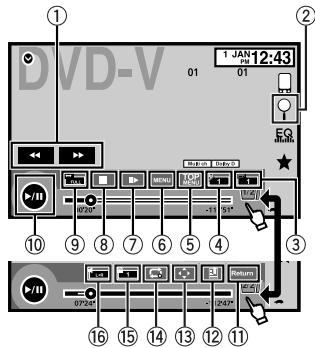
text_image
DVD-V 01 1 JAN 12:43 01 I CC 10 9 8 7 6 5 4 3 16 15 14 13 12 11 12:43Video CD
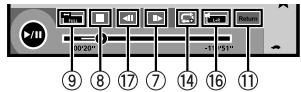
text_image
00'20" -11 51" ⑨ ⑧ ⑰ ⑦ ⑭ ⑯ ⑮ ⑯When playing a disc containing a mixture of various media file types
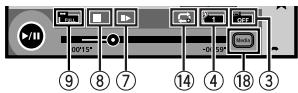
text_image
00'15" -0 59" ⑨ ⑧ ⑦ ⑭ ④ ③ ① ⑧ ⑤① Fast forward key/Reverse key
Fast forwarding or reversing
Touch to change the fast forward and reverse speed.
② Search key
Starting the search function.
③ Switch subtitle language key
With DVDs/DivX files featuring multi-subtitle recordings, you can switch between subtitle languages during playback.
④ Switch audio language key
With DVDs/DivX files that provides audio playback in different languages and different audio systems (Dolbyå Digital, DTS, etc.), you can switch between languages/audio systems during playback.
Depending on the setting, the video may not be played back with the audio system used to record the DVD.
⑤ TOP MENU key
Returning to the top menu during DVD playback.
Disc (CD/DVD)
⑥ MENU key
Displaying the DVD menu during DVD playback.
⑦ Slow-motion playback key
Moving the selection ahead one frame at a time during playback.
Touch and hold down the key for more than two seconds to slow down playback speed.
Touching the key increases the playback speed over four incremental settings during slow motion playback from DVD video/Video CD.
⑧ Stop key
Stopping playback.
If you resume playback, playback will start from the point where you stopped. Touch the key again to stop playback completely.
⑨ Screen mode key
Changing the screen mode.
Refer to "Changing the wide-screen mode" on page 10.
⑩ Pause and play key
Pausing playback.
Returning to normal playback during paused, slow motion, or frame-by-frame playback.
⑪ Return key
Returning to the specified scene to which the DVD currently being played has been preprogrammed to return.
This function cannot be used if a specified scene has not been preprogrammed on the DVD disc.
⑫ Bookmark key
During playback, touch the point at which you want to resume playback the next time the disc is loaded.
- You can set one bookmark per DVD video. You can set up to five bookmarks total.
- To clear the bookmark on a disc, touch and hold the key during playback.
- The oldest bookmark is replaced by the new one.
⑬ Arrow key
Displaying arrow keys to operate the DVD menu.
⑭ Repeat key
Selecting the repeat range.
⑮ Viewing angle key
With DVDs featuring multi-angle (scenes shot from multiple angles) recordings, you can switch among viewing angles during playback.
⑯ Audio output key
Switching the audio output, when playing video discs recorded with LPCM audio.
⑰ Slow key
Speeding down the playback speed in four steps, during slow motion playback on DVD video/Video CD.
- There is no sound during slow motion playback.
- Images during slow motion playback may be unclear for some discs.
- Reverse slow motion playback is not available.
⑱ Media key
Switching between media file types to play on DVD/CD.
Basic operations
Playing back videos
- Insert the disc into the disc loading slot with the label side up.
Playback will automatically start.
- If you are playing a DVD or Video CD, a menu may appear. Refer to “Operating the DVD menu” on page 19 and “PBC playback” on page 21.
- When the automatic playback function is on, the unit will skip the DVD menu and automatically start playback from the first chapter of the first title. Refer to “Automatic playback of DVDs” on page 42.
- When the source icon is not displayed, it can be displayed by touching the screen.
- If a message is displayed after loading a disc containing DivX VOD content, touch PLAY.
Refer to "Playing DivX® VOD content" on page 21.
Ejecting a disc
- Refer to "Ejecting a disc" on page 13.
Selecting a chapter using the buttons
- Press ◀ or ▶ (TRK).
Fast forwarding or reversing using the buttons
- Press and hold ◀ or ▶ (TRK).
- Fast forward/fast reverse may not always be possible on some discs. In such cases, normal playback will automatically resume.
- The fast forward/fast reverse speed depends on the length of time you press and hold down ◀ or ▶ (TRK). This function is not available for Video CD.
Notes
- This DVD player can play back a DivX file recorded on CD-R/RW, DVD-R/RW, or MPEG-1/MPEG-2/MPEG-4. (Please see the following section for files that can be played back. Refer to "DivX video files" on page 61.)
- Do not insert anything other than a DVD-R/RW or CD-R/RW into the disc loading slot.
- Some operations may not be available while watching a media due to the programming of the disc. In such cases, the icon appears on the screen.
- There may be touch panel keys not listed under “Introducing movie operations” on page 17 that appear on the screen.
Refer to "Indicator list" on page 57.
Disc (CD/DVD)
- With some DVDs, switching between languages/audio systems may only be possible using a menu display.
- You can also switch between languages/audio systems using Video Setup menu. For details, refer to "Setting the audio language" on page 39.
- This unit will return to normal playback if you change the audio language during fast forward/fast reverse, pause or slow motion playback.
- With some DVDs, switching between subtitle languages may only be possible using a menu display.
- You can also switch between subtitle languages using Video Setup menu. For details, refer to "Setting the subtitle language" on page 39.
- This unit will return to normal playback if you change the subtitle language during fast forward/fast reverse, pause or slow motion playback.
- During playback of a scene shot from multiple angles, the angle icon is displayed. Use the Video Setup menu to turn the angle icon display on or off. For details, refer to "Setting the multi-angle DVD display" on page 40.
- You will return to normal playback if you change the viewing angle during fast forward/fast reverse, pause or slow motion playback.
Sound playback operations
You can use this unit to listen to DVD-R/DVD-RW/CD/CD-R/CD-RW sound files.
Touch panel keys
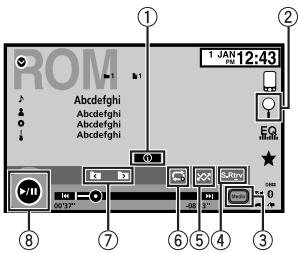
text_image
ROM 1 JAN 12:43 Abcdefghi Abcdefghi Abcdefghi Abcdefghi 1 2 3 4 5 6 7 8 9 10 11 12 13 14 15 16 17 18 19 20 21 22 23 24 25 26 27 28 29 30 31 32 33 34 35 36 37 38 39 40 41 42 43 44 45 46 47 48 49 50 51 52 53 54 55 56 57 58 59 60 61 62 63 64 65 66 67 68 69 70 71 72 73 74 75 76 77 78 79 80① Information key
Switching the text information to display on this unit when playing MP3/WMA/AAC files.
② Search key
Displaying a list of track titles/file names to select songs on a CD.
Displaying the file name list to select the files.
③ Media key
Switching between media file types on a DVD or CD.
④ Sound retriever key
Refer to "Using sound retriever" on page 10.
⑤ Random key
Playing songs in random order.
⑥ Repeat key
Selecting the repeat range.
⑦ Previous folder key/Next folder key Selecting a folder.
⑧ Pause and play key
Pausing and starting playback.
Switching the media file type
When playing a digital media containing a mixture of various media file types, such as DivX, MPEG-1, MPEG-2, MPEG-4 and MP3, you can switch between media file types to play.
- Touch Media to switch media file types.
CD (audio data (CD-DA)) – Music/ROM (compressed audio) – Video (DivX, MPEG-1, MPEG-2, MPEG-4 video files)
Note
- Audio data (CD-DA) files on DVD-R/RW/ROM cannot be played back on this unit.
Operating the DVD menu
(Function for DVD video)
Some DVDs allow you to make a selection from the disc contents using a menu.
Using the arrow keys
- Display arrow keys to operate the DVD menu.
- Select the desired menu item.

Returning to the normal DVD video display. Returning to the normal DVD video display.

Displaying arrow keys.
Disc (CD/DVD)
text_image
^ < ✓ >Selecting the desired menu item.

Starting playback from the selected menu item.

Operating the DVD menu by directly touching the menu item.

Back to previous display.
- When operating the DVD menu by directly touching the menu item, touch the icon to operate.
- Ways to display the menu will differ depending on the disc.
- Depending on the contents of the DVD disc, this function may not work properly. In such cases, use the touch panel keys to operate the DVD menu.
Random play (shuffle)
- Touch the random key.
- On – Play back files in random order within the repeat range, Folder and Disc.
- Off – Cancel random play.
Repeating playback
- Touch the repeat key.
- Disc – Play through the current disc
- Chapter – Repeat the current chapter
- Title – Repeat the current title
-
Track – Repeat the current track
-
File – Repeat the current file
- Folder – Repeat the current folder
- One – Repeat just the current video/song
Notes
- This function cannot be operated during Video CD playback featuring PBC (playback control).
- If you perform chapter search, fast forward/reverse, frame-by-frame playback or slow motion playback, the repeat play will stop.
- When playing discs with compressed audio and audio data (CD-DA), playback is repeated within the type of data currently playing even if Disc is selected.
- If you select another folder during repeat play, the repeat play range changes to Disc.
- If you perform track search or fast forward/reverse during File, the repeat play range changes to Folder.
- If you perform title/chapter search or fast forward/reverse during Chapter, the repeat play is set to off automatically.
- If you perform track search or fast forward/reverse during Track, the repeat play range changes to Disc.
- When Folder is selected, it is not possible to play back a subfolder of that folder.
Searching for the part you want to play
You can use the search function to find the part you want to play.
For DVD videos, you can select Title (title), Chapter (chapter) or 10key (numeric keypad).
For video CDs, you can select Track (track) or 10key (numeric keypad).
- Chapter search is not available when disc playback is stopped.
-
This function cannot be operated during Video CD playback featuring PBC (playback control).
-
Start the search function.
Refer to "Introducing movie operations" on page 17.
- Touch the desired search option (e.g., Chapter).
- Touch 0 to 9 to input the desired number.
- To cancel the entered numbers, touch C.
- Start playback from the selected part.

Registering the numbers and starting playback.
Note
- With discs featuring a menu, you can also use the DVD menu to make your selection. Refer to “Introducing movie operations” on page 17.
Disc (CD/DVD)
Selecting audio output
When playing DVD video discs recorded with LPCM audio, you can switch the audio output.
When playing video CDs, you can switch between stereo and monaural audio output.
- This function is not available when disc playback is stopped.
- Touch the audio output key to switch audio output types.
- L+R – Left and right
- Left - Left
- Right – Right
- Mix – Mixing left and right
Note
- You may not be able to select or use this function depending on the disc and the playback location.
PBC playback
(Function for Video CDs)
During playback of Video CDs featuring PBC (playback control), PBC On is displayed.
- Start the search function.
Refer to "Introducing movie operations" on page 17. - Touch 10 key to display the numeric keypad.
- Touch 0 to 9 corresponding to a menu number.
- Start playback from the selected part.

Registering the numbers and starting playback.
Notes
- You can display the menu by touching Return during PBC playback. For details, refer to the instructions provided with the disc.
- PBC playback of a Video CD cannot be canceled.
- During playback of Video CDs featuring PBC (playback control), you cannot select the repeat play range or use the search function.
Selecting tracks from the track title list
You can select tracks to playback using the track title list which is a list of the tracks recorded on a disc.
- Display the track title list.
Refer to "Sound playback operations" on page 19.
- Touch your favorite track title.
Playback begins.
Selecting files from the file name list
(Function for compressed audio/DivX/MPEG-1/MPEG-2/MPEG-4)
File name list is a list of file names (or folder names) from which you can select a file (or folder) to play back.
- Touch the search key to display the file (or folder) name list.
-
Touch your favorite file (or folder) name.
-
When you have selected a folder, a list of the names of the files (or the folders) in it can be viewed. Repeat this operation to select the desired file name.
- If folder 1 (ROOT) contains no files, playback starts from folder 2.
Note
- If part of the recorded information does not display, a scroll key appears on the right side of list. Touch the scroll key to scroll.
Playing DivX® VOD content
Some DivX video on demand (VOD) content may only be playable a fixed number of times. When you load a disc containing this type of content, the number of times it has been played will be shown on-screen. You can then decide whether or not to play the disc.
- For DivX VOD content without this restriction, you can load the disc into your player and play the content as often as you like, with no message displayed.
- You can confirm the number of times that the content can be played by checking the message, This DivX rental has used □□ out of ○○ views.
Disc (CD/DVD)
Important
- In order to play DivX VOD contents on this unit, you first need to register the unit with your DivX VOD contents provider. For details on your registration code, refer to "Displaying the DivX® VOD registration code" on page 42.
- DivX VOD content is protected by a DRM (Digital Rights Management) system. This restricts playback of content to specific, registered devices.
- If a message is displayed after loading a disc containing DivX VOD content, touch PLAY.
Playback of the DivX VOD content will start.
- To skip to the next file, touch NEXT.
- If you do not want to play the DivX VOD content, touch STOP.
iPod
iPod control
This manual applies to the following iPod models.
iPod with 30-pin connector
- iPod touch 4th generation
- iPod touch 3rd generation
- iPod touch 2nd generation
- iPod touch 1st generation
- iPod classic 160GB
- iPod classic 120GB
- iPod classic
- iPod with video
- iPod nano 6th generation
-
iPod nano 5th generation
-
iPod nano 4th generation
- iPod nano 3rd generation
- iPod nano 2nd generation
- iPod nano 1st generation
- iPhone 4S
- iPhone 4
- iPhone 3GS
- iPhone 3G
- iPhone
iPod with lightning connector
- iPod touch 5th generation
- iPod nano 7th generation
- iPhone 5
For iPod with lightning connector users
- Use the Lightning to USB Cable (Supplied with iPod/iPhone) when you use this function.
- For more details, refer to the installation manual.
- Functions related to iPod movie files are not available.
- If AppRadio Mode is used, the functions in this section cannot be used.
- Refer to "AppRadio Mode operation" on page 26.
iPod
Moving images operations
For iPod with 30-pin connector users
You can use the unit to view iPod movie files.
- Depending on your iPod, there may not be any output unless you use CD-IU201S/CD-IU201V (sold separately). Be sure to use CD-IU201S/CD-IU201V to connect your iPod.
For iPod with lightning connector users
• This function is not available.
Touch panel keys
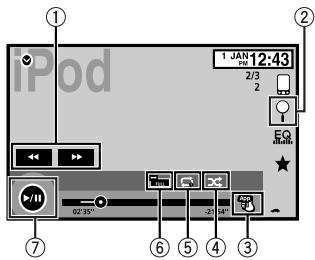
text_image
iPod 1 JAN 12:43 2/3 2 E0 Full 62'35" -21 14" ⑦ ② ⑥ ⑤ ④ ③① Fast forward key/Reverse key
Fast forwarding or reversing Touch to change the fast forward and reverse speed.
② Search key
Displaying iPod menus.
③ iPod control mode key
Conducting operation from your iPod and listening to it using your car's speakers.
④ Shuffle key
Playing the video on your iPod in a random order.
⑤ Repeat key
Selecting the repeat range.
⑥ Screen mode key
Changing the screen mode.
Refer to “Changing the wide-screen mode” on page 10.
⑦ Pause and play key
Pausing playback.
Returning to normal playback during paused, slow motion, or frame-by-frame playback.
Basic operations
Playing back videos
- Touch the search key to pull up the iPod menus.
- Select a movie to play.
Refer to "Playing videos from your iPod" on page 25.
- When the source icon is not displayed, it can be displayed by touching the screen.
- Disconnect headphones from the iPod before connecting it to this unit.
- Depending on the iPod model and the amount of data stored in the iPod, it may take some time for playback to begin.
- Use the touch panel keys to select the iPod after connecting it to this unit.
- No Device is displayed when disconnecting the iPod.
Fast forwarding or reversing using the buttons
- Press and hold ◀ or ▶ (TRK).
Notes
- To ensure proper operation, connect the dock connector cable from the iPod directly to this unit.
- While the iPod is connected to this unit, the iPod cannot be turned on or off.
- Touch panel keys not listed under “Moving images operations” on page 23 may appear on the display.
Refer to "Indicator list" on page 57.
Sound playback operations
You can use the unit to listen iPod sound files.
Note
- The play time may not display correctly.
Touch panel keys
iPod audio (Control Audio)
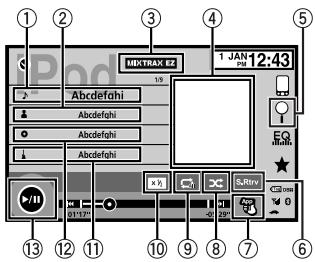
text_image
1 2 3 4 5 MEX-TRAX E2 1 JAN PS 12:43 19 Abcdefahi Abcdeffhi Abcdeffhi Abcdeffhi 13 12 11 10 9 8 7 6 S.Rtvi 0 0 0 0 0 0 0 0 0 0 0 0 0 0 0 0 0 0 0 0 0 0 0 0 0 0 0 0 0 0 0 0 0 0 0 0 0 0 0 0 0 0 0 0 0 0 0 0 0 0 13 12 11 10 9 8 7 6iPod audio (App Mode)
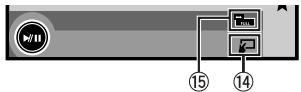
text_image
Diagram showing a device interface with labeled ports and numbered indicators (15 and 14)① Song title
Displaying the Songs list on the iPod.
② Artist name
Displaying the Artists list on the iPod.
③ MIXTRAX EZ key
Starting MIXTRAX EZ.
Refer to "MIXTRAX EZ operation" on page 31.
④ Artwork
Starting link search on your iPod when you touch the artwork display.
⑤ Search key
Displaying iPod menus.
⑥ Sound retriever key
Refer to "Using sound retriever" on page 10.
⑦ iPod control mode key
Conducting operation from your iPod and listening to it using your car's speakers.
⑧ Shuffle key
Playing songs on the iPod in random order.
⑨ Repeat key
Selecting the repeat range.
⑩ Change speed key
Changing the speed of audiobook playback on the iPod.
⑪ Genre
Displaying the Genres list on the iPod.
⑫ Album title
Displaying the Albums list on the iPod.
⑬ Pause and play key
Pausing and starting playback.
⑭ Unit operation key
Performing operations from this unit and listening to the music on your iPod using your car's speakers.
⑮ Screen mode key
Changing the screen mode.
Using this unit's iPod function from your iPod
You can listen to sound from applications on your iPod using the car's speakers when App Mode is selected.
This function is not compatible with the following iPod models.
- iPod nano 1st generation
- iPod with video
Notes
• Video-related functions are not available to iPod with lightning connector users.
- While this function is in use, the iPod will not turn off even if the ignition key is turned off. Operate the iPod to turn off the power.
- Switch the control mode to App Mode.
Refer to "Moving images operations" on page 23.
Refer to "Sound playback operations" on page 23.
- Operate the connected iPod to select a video/song and play.
Notes
-
The following functions are still accessible from the unit even if the control mode is set to App Mode.
• However, the operation will depend on your applications. -
Playing/pausing
– Fast forwarding/reversing - Tracking up/down
– Moving to a chapter up/down
- App Mode is compatible with the following iPod models.
- iPod touch 4th generation
- iPod touch 3rd generation
- iPod touch 2nd generation
- iPod touch 1st generation
- iPod classic 160GB
- iPod classic 120GB
- iPod classic
– iPod nano 6th generation -
iPod nano 5th generation
-
iPod nano 4th generation
- iPod nano 3rd generation
– iPod nano 2nd generation - iPhone 4S
- iPhone 4
- iPhone 3GS
- iPhone 3G
- iPhone
Shuffle play
- Touch the shuffle key.
- Songs – Play back videos/songs in the selected list in random order.
- Albums – Play back videos/songs from a randomly selected album in order.
- Off – Turn off shuffle play.
iPod
Repeating playback
- Touch the repeat key.
• One – Repeat just the current video/song
- All – Repeat all videos/songs in the selected list on the iPod
Playing videos from your iPod
Videos can be played on this unit if an iPod with video capabilities is connected.
- This unit can play back “Movies”, “Music videos”, “Video Podcast” and “TV show” which are downloaded from the iTunes store.
Note
- This function is not available to iPod with lightning connector users.
1. Touch Search to display iPod menus.
Refer to "Moving images operations" on page 23.
2. Switch to iPod video mode.
- If you want to switch to iPod video mode, touch the icon.

Switching to iPod video mode.
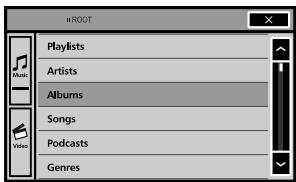
text_image
aROOT Playlists Artists Albums Songs Podcasts Genres3. Play the video from the iPod.
- If you want to switch to iPod music mode, touch the icon.

Switching to iPod music mode.
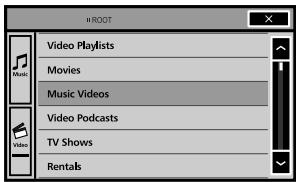
text_image
#ROOT Video Playlists Movies Music Videos Video Podcasts TV Shows RentalsBrowsing for a video/music on the iPod
To make operating and searching easy, operations to control an iPod with this unit are designed to be as similar to the iPod as possible.
Note
• Video-related functions are not available to iPod with lightning connector users.
Searching for a video/music by category
1. Touch the search key to pull up the iPod menus.
Refer to "Sound playback operations" on page 23.
2. Touch one of the categories in which you want to search for a video/music.
• Video Playlists (video playlists)
- Albums (albums)
- Movies (movies)
- Songs (songs)
• Music Videos (music videos)
- Podcasts (podcasts)
• Video Podcasts (video podcasts)
- Genres (genres)
• TV Shows (TV shows)
• Composers (composers)
- Playlists (playlists)
• Audiobooks (audiobooks)
- Artists (artists)
3. Touch the title of the list that you want to play.
Repeat this operation until you find the desired video/music.
Notes
- Depending on the generation or version of the iPod, some functions may not be available.
- You can play playlists created with the MusicSphere application. The application will be available on our website.
- Playlists that you created with the MusicSphere application are displayed in abbreviated form.
Searching the list by alphabet
1. Select a category.
Refer to "Searching for a video/music by category" on page 25.
2. Switch to alphabet search mode.

Switching to alphabet search mode.
iPod
Alphabet search mode is displayed.
- Touch the first letter of the title of the video/song you are looking for.
While searching, touch panel key operation is not available.
- To refine the search with a different letter, touch Cancel.
- Touch the title of the list that you want to play.
Repeat this operation until you find the desired song/video.
Changing audiobook speed
- Touch the change speed key to change the speed.

Playback at a speed faster than normal

Playback at normal speed

Playback at a speed slower than normal
Displaying lists related to the song currently playing (link search)
Touch the artwork to open a list of the names of songs on the album currently playing. Touch the name of the song you want to play to start playing that song.
Note
- If part of the recorded information does not display, a scroll key appears on the right side of list. Touch the scroll key to scroll.
AppRadio Mode
AppRadio Mode operation
This system can switch to the AppRadio Mode, which you can display and operate the application for iPhone on the screen.
In AppRadio Mode, you can operate applications with finger gestures such as tapping, dragging, scrolling or flicking on the screen of the system.
Install the AppRadio app on your iPhone.
WARNING
Certain uses of a smartphone may not be legal while driving in your jurisdiction, so you must be aware of and obey any such restrictions.
If in doubt as to a particular function, only perform it while the car is parked.
No feature should be used unless it is safe to do so under the driving conditions you are experiencing.
CAUTION
While driving, you cannot enter text on your iPod.
- Pioneer is not liable for any issues that may arise from incorrect or flawed app-based content.
- The content and functionality of the supported applications are the responsibility of the App providers.
- In AppRadio Mode, functionality through the product is limited while driving, with available functions determined by the App providers.
- Availability of AppRadio Mode functionality is determined by the App provider, and not determined by Pioneer.
- AppRadio Mode allows access to applications other than those listed (subject to limitations while driving), but the extent to which content can be used is determined by the App providers.
Important
- The only port that supports AppRadio Mode is USB input.
- When listening to music and sounds from application simultaneously, see the following section. Refer to “Setting the App sound mixing” on page 28.
Notes
- Applications operable by switching this system to AppRadio Mode are only those available for AppRadio Mode.
- Please check applications supported AppRadio Mode at http://www.pioneer.eu/AppRadioMode
AppRadio Mode
iPhone compatibility
AppRadio Mode is compatible with the following iPod models.
- iPod touch 5th generation
- iPod touch 4th generation
- iPhone 5
- iPhone 4S
- iPhone 4
Starting procedure
- Install the AppRadio app on your iPhone.
- After configuring RGB Input, connect the iPhone to this unit.
■ For iPod with lightning connector users
- Set RGB Input to iPhone (VGA adapter).
- Use the CD-IV202AV (sold separately) and Lightning to VGA adapter (Apple Inc. products) (sold separately) when you use this function.
- For more details, refer to the installation manual.
- A Bluetooth connection is required for iPod with lightning connector. Refer to "Bluetooth connection menu" on page 49.
■ For iPod with 30-pin connector users
- Set RGB Input to iPhone (CD-IU201S).
- Use the CD-IU201S (sold separately) when you use this function.
- For more details, refer to the installation manual.
3. Start an application available for AppRadio Mode from the iPhone.
An image of the application is displayed on the screen of this system.
- You can start an application available for AppRadio Mode also from a launcher application.
4. Press MODE.
- Press the home button to switch to the home display and then touch the Apps key to start the launcher application.
5. Operate the application.
Setting the Keyboard
CAUTION
For your safety, the keyboard functionality is only available when the vehicle is stopped and the parking brake is engaged.
Depending on the application, you can input text on the display. In order to input text correctly using keyboard which appears on this unit, you need to set the language setting in this function.
When the AppRadio Mode is used, the language setting for the keyboard set for the function and the language setting for the iPhone keyboard need to be the same.
- Keyboard is available only in AppRadio Mode.
When you tap a text input area of an application for iPhone, a keyboard will be displayed on-screen. You can input the desired text directly from this system. -
The language preference for the keyboard of this system should be same as the setting on your iPhone.
If the settings for this product and the iPhone are different, you may not be able to enter characters properly. -
Press the home button twice to switch from the AppRadio Mode display to the home display.
- Touch the system key to open the system menu.
- Touch Keyboard on the System menu to select desired language.
- Touch < or > to select a desired language.
French (French) – German (German) – Greek (Greek) – Russian (Russian) – English (US English) – English (UK) (UK English) – Dutch (Dutch) – Italian (Italian) – Norwegian (Norwegian) – Swedish (Swedish) – Finnish (Finnish) – Spanish (Spanish) – Portuguese (Portuguese) - Tap the text input area on the application screen of the iPhone.
Touch ↓ to hide the keyboard.
AppRadio Mode
Setting the App sound mixing
You cannot turn on or off Mixing when this unit is playing a song of iPod.
The sound of application during AppRadio Mode can be adjusted.
Enable this setting when you want to mix the App sound with the sound from a built-in source (such as the radio). The volume of the App sound can be selected from three levels.
This function is not available when RGB Input is set to iPhone (VGA adapter).
Refer to "Setting the RGB Input" on page 42.
- Press the home button twice to switch from the AppRadio Mode display to the home display.
- Touch the system key to open the system menu.
- Touch App sound mixing on the System menu to select desired setting.
OFF (off) - Low (low) - Mid (mid) - High (high)
USB
Sound playback operations
You can use this unit to listen to USB audio files.
Notes
- The play time may not display correctly.
- When playing back files recorded as VBR (variable bit rate) files, the play time will not be correctly displayed if fast forward or reverse operations are used.
- To ensure proper operation, connect the dock connector cable from the iPod directly to this unit.
- While the iPod is connected to this unit, the iPod cannot be turned on or off.
- If the characters recorded on the disc are not compatible with this unit, those characters will not be displayed.
- Text information may not be correctly displayed depending on the recorded environment.
- Disconnect the USB portable audio player/USB memory when you are done using it.
- When you select Speana on "Selecting the background display" on page 51, the artwork is not displayed.
Touch panel keys
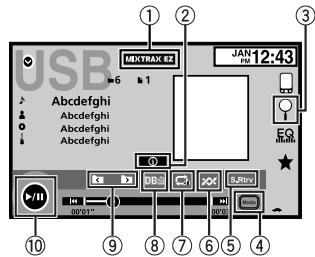
text_image
USB 1 2 3 6 1 JAN-4 PS 1:2:43 Abcdefghi Abcdefghi Abcdefghi Abcdefghi 0 10 9 8 7 6 5 4 0/0/0/1 0/0/0/1 0/0/0/1 0/0/0/1 0/0/0/1 0/0/0/1 0/0/0/1 0/0/0/1 0/0/0/1① MIXTRAX EZ key
Starting MIXTRAX EZ.
② Information key
Switching the text information to display on this unit when playing MP3/WMA/AAC/WAV files.
③ Search key
Displaying the file name list to select the files.
④ Media key
Switching between media file types to play on USB.
⑤ Sound retriever key
Refer to "Using sound retriever" on page 10.
⑥ Random key
Playing songs in random order.
USB
⑦ Repeat key
Selecting the repeat range.
⑧ DB key
Creating a database that enables searches by artist name, genre, and other options.
Refer to "Music browse mode" on page 29.
⑨ Previous folder key/Next folder key Selecting a folder.
⑩ Pause and play key Pausing and starting playback.
Basic operations
Playing back tracks
- Connect the USB device.
Playback will automatically start.
When the source icon is not displayed, it can be displayed by touching the screen.
Fast forwarding or reversing using the buttons
- Press and hold ◀ or ▶ (TRK).
Music browse mode
(Function for USB)
This unit creates an index in order to facilitate browsing for a song. You can search by the categories such as albums and artists.
CAUTION
- This function is not available when the USB storage device is locked.
- This function is not available when the free space of USB storage device is less than 5 MB.
-
While this unit creates an index, do not turn the unit off. It may cause loss of data on your USB storage device.
-
Touch DB to create a database in Music browse mode.
Refer to "Sound playback operations" on page 28.
- When "Save the Database to memory?" is displayed, touch "Yes".
Saving of the database is completed. If you do not save it, touch "No".
When the saving is completed, "Completed saving Database to memory." appears.
Music browse mode will start.
- Display a list and touch the tag key.
- Select a file.
Switching the media file type
- Touch Media to switch between media file types.
Random play (shuffle)
- Touch the random key.
- On – Play back files in random order within the repeat range, Folder and Media.
- Off – Cancel random play.
Repeating playback
- Touch the repeat key.
- File – Repeat the current file
- Folder – Repeat the current folder
- All – Repeat all files
- When Folder is selected, it is not possible to play back a subfolder of that folder.
- If you select USB source, the repeat play range changes to All.
Selecting files from the file name list
(Function for compressed audio)
Operation is the same as that for Disc.
Refer to "Selecting files from the file name list" on page 21.
Displaying lists related to the song currently playing (link search)
Touch the artwork to open a list of the names of songs on the album currently playing. Touch the name of the song you want to play to start playing that song.
Notes
- If part of the recorded information does not display, a scroll key appears on the right side of list. Touch the scroll key to scroll.
- This function is available for USB devices in Music browse mode.
Bluetooth Audio
Sound playback operations
You can use this unit to listen to Bluetooth audio files.
Notes
- Depending on the Bluetooth audio player connected to this unit, the available operations will be limited to the following two levels:
- A2DP profile (Advanced Audio Distribution Profile): You can only playback songs on your audio player.
- AVRCP profile (Audio/Video Remote Control Profile): You can perform playback, pause playback, select songs, etc.
- As there is a wide variety of Bluetooth audio players available on the market, operations available with specific models may vary extensively. When attempting to run a Bluetooth audio player using this unit, refer to the instruction manual that came with the player as well as to this manual for assistance.
- As the signal from your cellular phone may cause noise, avoid using it when you are listening to songs on your Bluetooth audio player.
- The sound from a Bluetooth audio player connected to this unit will be muted while a call is in progress on a cellular phone connected to this unit via Bluetooth wireless technology.
- The play time may not display correctly.
- Depending on the type of Bluetooth audio player you have connected to this unit, operation and information display may not be available for some functions.
Touch panel keys
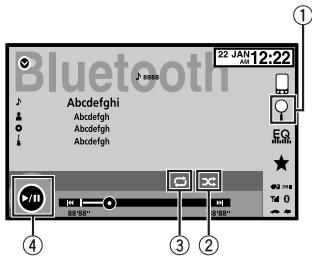
text_image
Bluetooth Abdefghi Abdefgh Abdefgh Abdefgh Abdefgh ① 22 JAN-12:22 ② ③ ④① Search key
Displaying the file name list to select the files.
② Random key
Playing songs in random order.
③ Repeat key
Selecting the repeat range.
④ Pause and play key
Pausing and starting playback.
Setting up for Bluetooth audio
Before you can use the Bluetooth audio function you must establish a Bluetooth wireless connection between the unit and your Bluetooth audio player.
Connection
First, you need to connect a Bluetooth audio to this unit.
For detailed instructions on connecting your Bluetooth audio to this unit via Bluetooth wireless technology, refer to "Bluetooth connection menu" on page 49.
Notes
- When playing back files recorded as VBR (variable bit rate) files, the play time will not be correctly displayed if fast forward or reverse operations are used.
- To ensure proper operation, connect the dock connector cable from the iPod directly to this unit.
- While the iPod is connected to this unit, the iPod cannot be turned on or off.
- If the characters recorded on the disc are not compatible with this unit, those characters will not be displayed.
- Text information may not be correctly displayed depending on the recorded environment.
Random play (shuffle)
- Touch the random key.
- On – Play back files in random order.
- Off – Cancel random play.
Repeating playback
- Touch the repeat key.
• One – Repeat the current song only
- All – Repeat all songs
Using MIXTRAX
MIXTRAX operation
MIXTRAX is original technology for creating non-stop mixes of selections from your audio library, complete with DJ effects that make them sound as if a DJ is right there with you playing the music.
MIXTRAX EZ operation
You can use this unit to play iPod/USB audio files.
MIXTRAX EZ is used to add a variety of sound effects between songs for arranging the pauses between songs. It allows you to enjoy listening to music non-stop.
- This function is only available when a file on a USB storage device or a song on an iPod is being played.
- This function is not available when the control mode is set to App Mode.
- Depending on the file/song, sound effects may not be available.
- Depending on the file/song, non-stop playback may not be available.
Starting MIXTRAX EZ operation
- Touch MIXTRAX EZ.
Setting MIXTRAX mode
Turn on this function to play back audio files using MIXTRAX.
- Press the home button to switch to the home display.
- Touch the system key to open the system menu.
- Touch MIXTRAX Setup on the system menu.
MIXTRAX setting items are displayed.
-
Short Playback Mode – When turned on, select an audio track playback length. When this mode is turned off, the audio track will play all the way to the end. 60s (60 sec.) – 90s (90 sec.) – 120s (120 sec.) – 150s (150 sec.) – 180s (180 sec.) – Random (random) – Off (off)
When Random is selected, the playback time varies between 60 s, 90 s, 120 s, 150 s, and 180 s selected at random when the playback song changes. -
Display Effect – When Display Effect is set to Disp&Key, the artwork display and keys can be moved according to the music type.
Disp&Key (display and key) – Key (key) – OFF (off)
- Cut-In Effect – When Cut-In Effect is set to on, sound effects will play between tracks.
- Effect Setting – Use Effect Setting to set up the sound effect you want to insert between tracks.
- Flash Pattern – Use Flash Pattern to select the flash color pattern that can flash when the MIXTRAX is turned on.
Random 1 – Sound 1 – Sound 2 – Sound 3 – Sound 4 – Sound 5 – Sound 6 – Random 2 – L-Pass 1 – L-Pass 2 – L-Pass 3 – L-Pass 4 – L-Pass 5 – L-Pass 6 – Random 3
Setting the effect
You can change the settings for fixed sounds and sound effects.
There are six different fixed sounds available that can be inserted for playback between tracks.
The sound effects are used as effects to signal the end of a song being played and the beginning of the next song in series.
The fixed sounds and sound effects are set as combinations as MIXTRAX sounds.
Fixed sounds
- Phaser – A fixed sound that sounds like surging waves.
- Roll – A fixed sound that repeats playback of a certain sound.
- Turntable1 – A fixed sound that mimics DJ scratching.
- Flanger1 – A rushing sound that mimics that rising and falling sounds of a jet engine.
- Reverb – A fixed sound effect that creates a reverberation effect.
- Echo – A fixed sound effect that creates an echoing effect.
Sound effects
- Cross Fade – A sound effect that creates a fade in and fade out effect between songs.
- Flanger – A rushing sound that mimics that rising and falling sounds of a jet engine.
- Echo – A sound effect that creates an echoing effect.
- Loop – A sound effect that repeats playback of one section of a song track.
Using MIXTRAX
Setting sounds and sound effects as presets using the preset key
The Standard and Simple sound effects are set already as default presets.
- Touch Standard or Simple to check the settings.
The registered preset sound effect for the key that was touched is set as a preset.
Registering sounds and sound effects as presets
Registers a desired combination of sounds and sound effects to Custom.
Touch Custom to easily set the desired sound or sound effect.
- Touch Custom.
- Add a check mark to the desired sound effect by touching the option.
The marked sound effect is registered as a preset in Custom.
Notes
- If a sound effect is touched in the selection screen for Standard or Simple, the Custom screen is automatically displayed and the sound effect is registered to Custom.
- You can listen to fixed sounds to hear examples by touching the speaker icon.
Bluetooth telephone
Bluetooth telephone operations
You can use Bluetooth telephone.
Important
- Leaving the unit on standby to connect to your phone via Bluetooth while the engine is not running can drain the battery.
- Advanced operations that require attention such as dialing numbers on the monitor, etc., are prohibited while driving. Park your vehicle in a safe place when using these advanced operations.
- Bluetooth connection menu cannot be selected while driving.
- Operations available may be limited depending on the cellular phone connected to this unit.
- Be sure to park your vehicle in a safe place and apply the parking brake when performing this operation.
- If you are unable to complete the connection using this unit, use the device to connect to the unit.
- If you connect more than one device at a time, connected device may not operate properly. Connecting one device at a time is recommended.
Touch panel keys
Telephone standby display
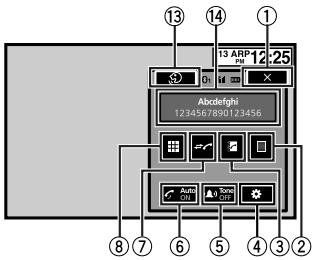
text_image
13 14 1 13 ARP 12:25 Abcefghi 1234567890123456 ⑧⑦⑥⑤④③②When switching to the entering phone number mode
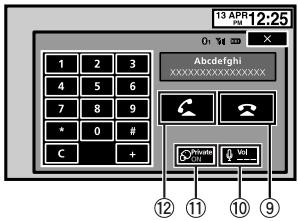
text_image
13 APR 12:25 0: 46 1 2 3 7 8 9 * 0 # C + Abcdefghi XXXXXXXXXXXXXX Private ON Vol ⑫ ⑪ ⑩ ⑨① Close key
Display is closed.
② Preset dial key
Displaying the preset dial screen.
③ Phone book key
Switching to the phone book mode.
④ Setting key
Displaying the Bluetooth connection menu.
Bluetooth telephone
⑤ Tone key
Turning the ring tone for incoming calls on or off.
⑥ Auto-answer key
Turning automatic answering on or off.
⑦ History key
Switching to the missed, received and dialed call lists.
⑧ Key pad key
Switching the mode to enter the phone number directly.
⑨ On-hook key
Ending a call.
Rejecting an incoming call.
Canceling call waiting.
Notes
- Private mode can only be operated while you are talking on the phone.
• To end the call, both you and the other caller must hang up your phones.
- Touch panel keys not listed under “Bluetooth telephone operations” on page 32 may appear on the display.
Refer to "Indicator list" on page 57.
Text information
⑭ Incoming call notice
Indicates that an incoming call has been received and has not been checked yet.
- Not displayed for calls made when your cellular phone is disconnected from this unit.
⑩ Volume key
Adjusting the other party's listening volume.
⑪ Private mode key
Turning private mode on or off.
⑫ Off-hook key
Accepting an incoming call.
Making a phone call, when selecting a phone number.
Switching between callers on hold.
⑬ Voice control key
Setting up for hands-free phoning
Before you can use the hands-free phoning function you must set up the unit for use with your cellular phone. This entails establishing a Bluetooth wireless connection between this unit and your phone, registering your phone with this unit, and adjusting the volume level.
- Connection
First, you need to connect a Bluetooth telephone to this unit.
For detailed instructions on connecting your phone to this unit via Bluetooth wireless technology, refer to "Pairing from this unit" on page 49.
- Volume adjustment
Adjust the earpiece volume of your cellular phone to your preference. The unit will record the adjusted volume level as the default setting.
Notes
- The volume of the caller's voice and ring tone may vary depending on the type of cellular phone.
- If there is a large volume difference between the ring tone and caller's voice, the overall volume level may become unstable.
- Make sure to adjust the volume to a proper level before disconnecting the cellular phone from the unit. If the volume is muted (zero level) on your cellular phone, the volume level of your cellular phone remains muted even after the cellular phone is disconnected.
Calling a number in the phone book
The contacts on your phone will normally be transferred automatically when the phone is connected. If it is not, use your phone menu to transfer the contacts. The visibility of this unit should be on when you use the phone menu. Refer to “Switching visible unit” on page 50.
After finding the number you want to call in the phone book, you can select the entry and make the call.
- Touch the phone book key to switch to the phone book mode.
- Select the phone number list.
The detailed phone number list of the selected entry is displayed.
-
Select the phone number.
-
If you want to store the phone number, touch and hold the list.
- Touch the off-hook key to make the call.
- Touch the on-hook key to end the call.
Bluetooth telephone
Selecting a number by alphabet search mode
If a lot of numbers are registered in the phone book, you can search for the phone number by alphabet search mode.
- Touch the phone book key to switch to the phone book mode.
- Touch ABC to switch to alphabet search mode.
- Touch the first letter of the entry you are looking for.
The Phone Book entries starting with that letter (e.g. "Ben", "Brian" and "Burt" when "B" is selected) will be displayed.
- If you want to change the character to Russian, touch the icon. To return to English, touch the icon again.
АБВ
Changing the character to Russian.
- The order of the first name and last name may be different from that of the cellular phone.
-
Touch the list to display the phone number list of the selected entry.
-
If several phone numbers are included in an entry, select one by touching the list.
- If you want to switch to the call history list, touch the icon.

Switching to the call history list.
- Touch the off-hook key to make the call.
- Touch the on-hook key to end the call.
Inverting names in phone book
When your cellular phone is connected to this unit, the first and last names of your contacts may be registered to the phone book in reverse order. You can use this function to change the order back.
(Inverting the names in the phone book)
- Touch the phone book key to switch to the phone book mode.
- Invert names in phone books.

Inverting names in phone books.
- "Would you like to invert all names" appears. Touch Yes to continue.
While the names are inverted, Ⓞ is displayed.
- If the inversion fails, "Invert Name Error" appears. In such cases, try again from the beginning.
Note
- Inverting the names of your contacts from this unit does not affect the data on your Bluetooth device.
Using the missed, received and dialed call lists
The 80 most recent calls dialed, received, and missed are stored in the memory. You can browse them and call numbers from these lists.
- Touch the history key to display the call history list.
- Select Missed Calls, Dialled Calls or Received Calls Calls.

Displaying the received call list.

Displaying the dialed call list.

Displaying the missed call list.
Bluetooth telephone
- Touch the list number to select a phone number.
Name and phone number are displayed in the detailed list.
- If you want to store the phone number, touch and hold the list.
- Touch the off-hook key to make the call.
- Touch the on-hook key to end the call.
Setting automatic answering
If this function is on, this unit automatically answers all incoming calls.
- Touch the auto-answer key to turn automatic answering on or off.
Adjusting the other party's listening volume
To maintain the good sound quality, this unit can adjust the other party's listening volume. If the volume is not loud enough for the other party, use this function.
- Touch the volume key to select Far-End VOL.
1 - 2 - 3
- This function can be performed even while talking on the phone.
- Settings can be stored for each device.
Switching the ring tone
You can select whether or not to use this unit's ring tone. If this function is set to on, the ring tone for this unit will sound.
- Connect your cellular phone to this unit.
- Touch the tone key to turn the ring tone on or off.
Using the preset dial lists
You can easily store up to six phone numbers as presets.
- Touch the preset dial key to display the preset screen.
- Touch one of the phone numbers to select.
- If you want to delete a preset phone number, touch and hold the phone number you wish to delete.
- Touch the off-hook key to make the call.
- Touch the on-hook key to end the call.
Making a call by entering phone number
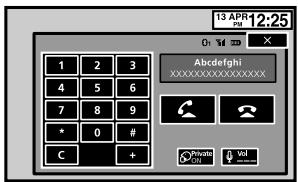
text_image
13 APR 12:25 0: 14 1 2 3 4 5 6 7 8 9 * 0 # C + Abdefghi XXXXXXXXXXXXXX Phone OK Vol CancelImportant
Be sure to park your vehicle in a safe place and apply the parking brake when performing this operation.
- Touch the key pad key to start entering the phone number.
- Touch the number icons to input the numbers.
- Up to 32 digits can be entered.
- Touch the off-hook key to make the call.
- Touch the on-hook key to end the call.
Note
- Entering phone number mode cannot be operated unless a Bluetooth telephone is connected to this unit.
Bluetooth telephone
Setting the private mode
During a conversation, you can switch to private mode (talk directly on your cellular phone).
- Touch the private mode key to turn private mode on or off.
Voice control
If your cellular phone is equipped with the voice control feature, you can use voice commands to make calls, for example.
- Operation varies depending on the type of cellular phone. Refer to the instruction manual that came with your cellular phone for detailed instructions.
- For details on cellular phone models that are compatible with this feature, refer to the information on our website.
1. Touch the voice control key.
The display switches to the voice control screen.
You can also switch to the voice control screen by pressing and holding down the home button while the source is on.
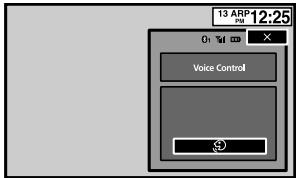
text_image
13 ARP 12:25 0: 44 Voice Control2. Start voice control.

Indicates that continuous calls can be made uninterrupted.

Indicates that the display is closed.
Notes
- In order for your voice commands to be recognized and interpreted correctly, ensure that conditions are suitable for recognition.
- Please note that wind blowing through the vehicle windows and noise coming from outside the vehicle can interfere with voice command operation.
- For optimum pick-up, the microphone should be placed directly in front of the driver at a suitable distance.
- Speaking too soon after the start of the command may cause voice recognition to fail.
- Speak slowly, deliberately, and clearly.
Settings
Menu operations
Touch panel keys
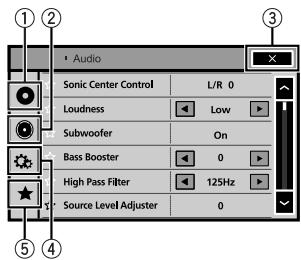
text_image
Audio Sonic Center Control L/R 0 Loudness Low Subwoofer On Bass Booster 0 High Pass Filter 125Hz Source Level Adjuster 0① Video setup key
Refer to "Setting up the video player" on page 39.
② Audio function key
Refer to "Audio adjustments" on page 37.
③ Close key
Returning to the current source display.
④ System key
Refer to "System settings" on page 42.
⑤ Favorite key
You can choose menus within each menu (Audio function menu, etc.) and register them to this favorite menu.
Refer to "Favorite menu" on page 48.
Notes
- You can display the Video Setup menu when a Disc source is selected.
- If you start the Video Setup menu, playback is stopped.
- You cannot display the Audio function menu when the mute function is on.
1. Press the home button to switch to the home display.
2. Touch any of the following touch panel keys to select the menu to be adjusted.

Audio adjustments
Using fader/balance adjustment
Fader/Balance displays when Rear Speaker is set to Full on the System Menu. You can change the fader/balance setting to provide an ideal listening environment for all of the occupied seats.
- Press the home button to switch to the home display.
- Touch the audio function key to open the audio menu.
- Touch Fader/Balance on the audio function menu.
- Touch ∧ or ∨ to adjust the front/rear speaker balance.
Range: F 15 L/R 0 to R 15 L/R 0
- Select F/R 0 L/R 0 when only using two speakers.
- Touch < or > to adjust the left/right speaker balance.
Range: F/R 0 L 15 to F/R 0 R 15
Note
- You can also set the fader/balance by dragging the dot on the displayed table.
Using balance adjustment
Balance displays when Rear Speaker is set to Subwoofer on the System Menu. This setting will allow you to adjust the balance between right/left sound output.
- Press the home button to switch to the home display.
- Touch the audio function key to open the audio menu.
- Touch Balance on the audio function menu.
- Touch < or > to adjust the left/right speaker balance.
Range: L 15 to R 15
Note
- You can also set the balance by dragging the dot on the displayed table.
Using the equalizer
You can adjust the equalization to match the car's interior acoustic characteristics as desired.
Recalling equalizer curves
There are seven stored equalizer curves which you can easily recall at any time. Here is a list of the equalizer curves.
| Display | Equalizer curve |
| S.Bass | Super bass |
| Powerful | Powerful |
| Natural | Natural |
| Vocal | Vocal |
| Flat | Flat |
| Custom1 | Custom 1 |
| Custom2 | Custom 2 |
- The equalizer curves for Custom1 and Custom2 can be adjusted.
- You cannot select Custom1 and Custom2 when using the auto-equalizer.
-
When Flat, no changes are made to the sound. You can check the effects of the equalizer curves by switching alternatively between Flat and another equalizer curve.
-
Press the home button to switch to the home display.
- Touch the audio function key to open the audio menu.
- Touch Graphic EQ on the audio function menu.
- You cannot select or adjust the equalizer curves of Custom1 and Custom2 when using the auto-equalizer.
- Touch the desired setting.
S.Bass – Powerful – Natural – Vocal – Flat – Custom1 – Custom2
Adjusting the 8-band graphic equalizer
You can adjust the level of each band for the equalizer curves.
- A separate Custom1 curve can be created for each source. If you make adjustments when a curve other than Custom2 is selected, the equalizer curve settings will be stored in Custom1.
- A Custom2 curve that is common for all sources can be created. If you make adjustments when the Custom2 curve is selected, the Custom2 curve will be updated.
Audio adjustments
- Press the home button to switch to the home display.
- Touch the audio function key to open the audio menu.
- Touch Graphic EQ on the audio function menu.
- Touch the desired setting.
S.Bass – Powerful – Natural – Vocal – Flat – Custom1 – Custom2 - Touch the table to adjust the level of the equalizer band.
Range: +12dB to -12dB
Using the auto-equalizer
The auto-equalizer is an equalizer curve created by auto EQ (refer to “Auto EQ (auto-equalizing)” on page 46).
You can turn the auto-equalizer on or off.
If you connect an optional microphone to this unit, you can use this function.
- Press the home button to switch to the home display.
- Touch the audio function key to open the audio menu.
- Touch Auto EQ to turn the auto-equalizer on or off.
- You cannot use this function if auto EQ has not been carried out.
Using sonic center control
Sound that is suited for the listening position can easily be created with this function.
- Press the home button to switch to the home display.
- Touch the audio function key to open the audio menu.
- Touch Sonic Center Control on the audio function menu.
- Touch < or > to select a listening position.
Range: Left 7 to Right 7
Adjusting loudness
Loudness compensates for deficiencies in the low-frequency and high-frequency ranges at low volume.
- Press the home button to switch to the home display.
- Touch the audio function key to open the audio menu.
- Touch ◀ or ▶ to select a desired level for loudness.
Off (off) – Low (low) – Mid (mid) – High (high)
Using subwoofer output
This unit is equipped with a subwoofer output which can be turned on or off.
- The cut-off frequency and output level can be adjusted when the subwoofer output is on.
- Press the home button to switch to the home display.
- Touch the audio function key to open the audio menu.
- Touch Subwoofer on the audio function menu.
- Touch On or Off next to Subwoofer to turn the subwoofer output on or off.
- Touch Normal or Reverse next to Phase to select the phase of subwoofer output.
- Touch ◀ or ▶ next to Level to adjust the output level of the subwoofer.
Range: +6 to -24 - Touch ◀ or ▶ next to Frequency to select the cut-off frequency.
50Hz – 63Hz – 80Hz – 100Hz – 125Hz
Only frequencies lower than those in the selected range are outputted from the subwoofer.
Boosting the bass
You can boost the bass level.
- Press the home button to switch to the home display.
- Touch the audio function key to open the audio menu.
- Touch ◀ or ▶ to select a desired level.
Range: 0 to +6
Audio adjustments
Using the high pass filter
When you do not want low sounds from the subwoofer output frequency range to play from the front or rear speakers, turn on the HPF (high pass filter). Only frequencies higher than those in the selected range are output from the front or rear speakers.
- Press the home button to switch to the home display.
- Touch the audio function key to open the audio menu.
- Touch ◀ or ▶ next to the frequency to select cut-off frequency.
Off (off) - 50Hz - 63Hz - 80Hz - 100Hz - 125Hz
Only frequencies higher than those in the selected range are output from the front or rear speakers.
Adjusting source levels
With SLA (source level adjustment), the volume levels of each source can be adjusted to prevent significant differences between sources.
- Settings are based on the FM volume level, which remains unchanged.
- Press the home button to switch to the home display.
- Touch the audio function key to open the audio menu.
- Compare the FM volume level with the level of the source you wish to adjust.
- Touch Source Level Adjuster on the audio function menu.
- Touch ∧ or ∨ to adjust the source volume.
Range: +4 to -4
Notes
- Source Level Adjuster is not available when FM is selected as the source.
- The MW/LW volume level can also be adjusted with this function.
- Video CD, CD, compressed audio, DivX, MPEG-1, MPEG-2 and MPEG-4 are automatically set to the same source level adjustment volume.
Setting up the video player
Setting the subtitle language
You can set a desired subtitle language. When available, the subtitles will be displayed in the selected language.
- Press the home button to switch to the home display.
- Touch the video setup key to open the video setup menu.
-
Touch Subtitle Language on the Video Setup menu.
A subtitle language menu is displayed. -
Touch the desired language.
The subtitle language is set.
- If you have selected Others, refer to "When you select Others" on this page.
Notes
- If the selected language is not available, the language specified on the disc is displayed.
- You can also switch the subtitle language by touching the switch subtitle languages key during playback.
- The setting made here will not be affected even if the subtitle language is switched during playback using the switch subtitle languages key.
When you select Others
A language code input display is shown when Others is selected. Refer to “Language code chart for DVD” on page 67.
- Touch 0 to 9 to input the language code.
- To cancel the entered numbers, touch C.
- To register the code, touch the following touch panel key.

Registering the code.
Setting the audio language
You can set the preferred audio language.
- Press the home button to switch to the home display.
- Touch the video setup key to open the video setup menu.
- Touch Audio Language on the Video Setup menu.
An audio language menu is displayed.
Setting up the video player
4. Touch the desired language.
The audio language is set.
- If you have selected Others, refer to "When you select Others" on page 39.
Notes
- If the selected language is not available, the language specified on the disc is used.
- You can also switch the audio language by touching the switch audio languages key during playback.
- The setting made here will not be affected even if the audio language is switched during playback using the switch audio languages key.
Setting the menu language
You can set the preferred language in which the menus recorded on a disc are displayed.
- Press the home button to switch to the home display.
- Touch the video setup key to open the video setup menu.
-
Touch Menu Language on the Video Setup menu.
A menu language menu is displayed. -
Touch the desired language.
The menu language is set.
- If you have selected Others, refer to "When you select Others" on page 39.
Note
- If the selected language is not available, the language specified on the disc is displayed.
Setting the multi-angle DVD display
The angle icon can be set so it appears on scenes where the angle can be switched.
- Press the home button to switch to the home display.
- Touch the video setup key to open the video setup menu.
- Touch Multi Angle on the Video Setup menu to turn angle icon display on or off.
Setting the aspect ratio
There are two kinds of display: a wide screen display that has a width-to-height ratio (TV aspect ratio) of 16:9, and regular display that has a TV aspect of 4:3. Be sure to select the correct TV aspect for the display connected to V OUT.
- When using regular display, select either Letter Box or Pan Scan. Selecting 16:9 may result in an unnatural picture.
-
If you select the TV aspect ratio, the unit's display will change to the same setting.
-
Press the home button to switch to the home display.
- Touch the video setup key to open the video setup menu.
- Touch TV Aspect on the Video Setup menu to select the TV aspect ratio.
Touch TV Aspect repeatedly until the desired aspect ratio appears. - 16:9 – Wide screen picture (16:9) is displayed as is (initial setting)
- Letter Box – The picture is the shape of a letterbox with black bands on the top and bottom of the screen
- Pan Scan – The picture is cut short on the right and left sides of the screen
Notes
- When playing discs that do not specify Pan Scan, the disc is played back in Letter Box display even if you select the Pan Scan setting. Confirm whether the disc package bears the 16:9 LB mark.
- The TV aspect ratio cannot be changed for some discs. For details, refer to the disc's instructions.
Setting parental lock
Some DVD video discs let you use parental lock to restrict children from viewing violent and adult-oriented scenes. You can set parental lock to the desired level.
- When you have a parental lock level set and play a disc featuring parental lock, code number input indications may be displayed. In such cases, playback will begin when the correct code number is entered.
Setting the code number and level
A code number must be registered in order to play back discs with parental lock.
- Press the home button to switch to the home display.
- Touch the video setup key to open the video setup menu.
- Touch Parental on the Video Setup menu.
Setting up the video player
4. Touch 0 to 9 to input a four digit code number.
- To cancel the entered numbers, touch C.
- To register the code, touch the following touch panel key.

Registering the code.
The code number is set, and the level can now be set.
5. Touch 1 to 8 to select the desired level.
6. Touch Enter.
The parental lock level is set.
- 8 – Playback of the entire disc is possible (initial setting)
- 7 to 2 – Playback of discs for children and non-adult-oriented discs is possible
- 1 – Playback of discs for children only is possible
Notes
• We recommend to keep a record of your code number in case you forget it.
- The parental lock level is stored on the disc. Look for the level indication written on the disc package, included literature or on the disc itself. Parental lock of this unit is not possible if a parental lock level is not stored on the disc.
- With some discs, the parental lock may be active only for certain levels of scenes. The playback of those scenes will be skipped. For details, refer to the instruction manual that came with the disc.
Changing the level
You can change the set parental lock level.
- Press the home button to switch to the home display.
- Touch the video setup key to open the video setup menu.
- Touch Parental on the Video Setup menu.
- Touch 0 to 9 to input the registered code number.
- Registering the code.

Registering the code.
This sets the code number, and the level can now be changed.
- If you enter an incorrect code number, the Ⓧ icon is displayed. Touch C and enter the correct code number.
- If you forget your code number, refer to "If you forget your code number" on this page.
6. Touch 1 to 8 to select the desired level.
7. Touch Enter.
The new parental lock level is set.
If you forget your code number
- Press RESET.
Setting the DivX subtitle file
You can select whether or not to display DivX external subtitles.
- The DivX subtitles will be displayed even when Custom is selected if no DivX external subtitle files exist.
- Press the home button to switch to the home display.
- Touch the video setup key to open the video setup menu.
- Touch DivX® Subtitle on the Video Setup menu to select the desired subtitle setting.
- Original – Display the DivX subtitles
- Custom – Display the DivX external subtitles
Notes
- Up to 42 characters can be displayed on one line. If more than 42 characters are set, the line breaks and the characters are displayed on the next line.
- Up to 126 characters can be displayed on one screen. If more than 126 characters are set, the excess characters will not be displayed.
Setting up the video player
Displaying the DivX ^® VOD registration code
In order to play DivX VOD (video on demand) contents on this unit, the unit must first be registered with a DivX VOD contents provider. For registration, generate a DivX VOD registration code and submit it to your provider.
- Keep a record of the code as you will need it when you register your unit to the DivX VOD provider.
- Press the home button to switch to the home display.
- Touch the video setup key to open the video setup menu.
- Touch DivX ^® VOD on the Video Setup menu.
Registration Code and Deregistration Code appear.
- Touch Registration Code.
Your registration code is displayed.
Displaying the deregistration code
If your device is already registered, deregister it by entering the deregistration code.
- Press the home button to switch to the home display.
- Touch the video setup key to open the video setup menu.
- Touch DivX ^® VOD on the Video Setup menu.
- Touch Deregistration Code.
- To cancel deregistration, touch Cancel.
- Touch OK.
The deregistration is complete.
Automatic playback of DVDs
When a DVD disc with a DVD menu is inserted, this unit will cancel the menu automatically and start playback from the first chapter of the first title.
- Some DVDs may not operate properly. If this function is not fully operable, turn this function off and start playback.
- Press the home button to switch to the home display.
- Touch the video setup key to open the video setup menu.
- Touch DVD Auto Play to turn automatic playback on.
- To turn automatic playback off, touch DVD Auto Play again.
System settings
Switching the auxiliary setting
Activate this setting when using an auxiliary device connected to this unit.
- Press the home button to switch to the home display.
- Touch the system key to open the system menu.
- Touch AUX Input on the system menu to turn AUX Input on or off.
Setting AV input
Activate this setting when using an external video component connected to this unit.
- Press the home button to switch to the home display.
- Touch the system key to open the system menu.
- Touch AV Input on the system menu to turn AV Input on or off.
Setting the RGB Input
Settings are required according to the connected device.
RGB Input can be set when all of the following conditions are met.
- The iPhone is not connected to RGB input.
-
No Bluetooth connection.
• The source is turned off. -
Turn the source off.
Refer to "Turning the source ON/OFF" on page 8.
- Press the home button to switch to the home display.
- Touch the system key to open the system menu.
- Touch RGB Input on the system menu to select the RGB input.
-
Touch the desired setting.
-
iPhone (CD-IU201S) – iPod with 30-pin connector
- iPhone (VGA adapter) – iPod with lightning connector
- NAVI – Navigation system
System settings
Setting the App sound mixing
Refer to "Setting the App sound mixing" on page 28.
Setting MIXTRAX mode
Refer to "Setting MIXTRAX mode" on page 31.
Changing the picture adjustment
You can adjust the Brightness (brightness), Contrast (contrast), Color (color), Hue (hue), Dimmer (dimmer), and Temperature (temperature) for each source and rear view camera.
- You cannot adjust Color or Hue for the audio source.
- Press the home button to switch to the home display.
- Touch the system key to open the system menu.
- If you are adjusting the Picture Adjustment, select the unit.
NAVI
Completing Picture Adjustment for the Navigation system when the RGB input setting is set to NAVI.
Apps
Completing Picture Adjustment for the AppRadio Mode when the RGB input setting is set to iPhone (CD-IU201S) or iPhone (VGA adapter).
Rear View
Adjusting the Picture Adjustment for the rear view camera.
Source
Adjusting the Picture Adjustment for the source.
- Touch any of the following touch panel keys to select the function to be adjusted.
Picture Adjustment items are displayed.
- Brightness – Adjusts the black intensity
-
Contrast – Adjusts the contrast
• Color – Adjusts the color saturation -
Hue – Adjusts the tone of color (red or green is emphasized)
- Dimmer – Adjusts the brightness of the display
- Temperature – Adjusts the color temperature, resulting in a better white balance
- You can adjust Hue only when the color system is set to NTSC.
-
With some rear view cameras, picture adjustment may not be possible.
-
Touch ◀ or ▶ to adjust the selected item.
Each time you touch ◀ or ▶, the level of the selected item increases or decreases.
- Dimmer can be adjusted from +1 to +48.
• Temperature can be adjusted from +3 to -3.
Notes
- You cannot operate this function while driving.
- Different Brightness/Contrast/Dimmer settings can be set for when the illumination switch is on and when it is off.
Selecting the system language
The system language can be selected.
If text information such as the title name, artist name or a comment is embedded in a European language, they can also be displayed on this unit.
- The language can be changed for the following:
- Audio menu
- System menu
- Video Setup menu
- Bluetooth menu
– Language for cautions
Some operations on this unit are prohibited from use while driving or require careful attention when operated. In such cases, a caution will appear on the display. You can change the language for caution messages with this setting. - If the embedded language and the selected language setting are not the same, text information may not display properly.
-
Some characters may not be displayed properly.
-
Press the home button to switch to the home display.
- Touch the system key to open the system menu.
- Touch System Language on the system menu to select the desired language.
System settings
4. Touch the desired language.
English (English) – Português (Portuguese) – Español (Spanish) – Français (French) – Deutsch (German) – Русский (Russian) – Italiano (Italian) – Nederlands (Netherland) – Türkçe (Turkish)
- If a language other than Russian is selected, English is used for the following items.
- On-screen display
– Multi language setting for DivX
Setting Demo Mode
Once Demo Mode is turned on, the Demo screen appears.
Refer to "Demo mode" on page 6.
- Press the home button to switch to the home display.
- Touch the system key to open the system menu.
- Touch Demo mode on the system menu to turn Demo mode on or off.
- On – The Demo screen appears.
- Off – The Demo screen does not appear.
Switching sound muting/attenuation
Sound from this system is automatically muted or attenuated when a signal from equipment with a mute function is received.
- Sound from this system returns to normal when the muting or attenuation is canceled.
- Press the home button to switch to the home display.
- Touch the system key to open the system menu.
- Touch Mute/ATT until the desired setting appears.
Touch Mute/ATT until the desired setting appears in the display.
- Mute – Muting
- ATT -20dB – Attenuation (ATT -20dB has a stronger effect than ATT -10dB)
- ATT -10dB – Attenuation
- Off – Turns the sound muting/attenuation off
Notes
- When Mute is displayed, the sound is turned off and no audio adjustments can be made.
- When ATT is displayed, the sound is attenuated and only the volume can be adjusted. (No other audio adjustments can be made.)
- Operation returns to normal when the phone connection is ended.
Setting the rear output and subwoofer controller
This unit's rear output (rear speaker leads output and RCA rear output) can be used for full-range speaker (Full) or subwoofer (Subwoofer) connection. If you switch the rear output setting to Subwoofer, you can connect a rear speaker lead directly to a subwoofer without using an auxiliary amp.
Initially, the unit is set for a rear full-range speaker connection (Full).
- Turn the source off.
Refer to "Turning the source ON/OFF" on page 8.
- Press the home button to switch to the home display.
- Touch the system key to open the system menu.
-
Touch Rear Speaker on the system menu to switch the subwoofer output or full-range speaker.
-
When no subwoofer is connected to the rear output, select Full (full-range speaker).
- When a subwoofer is connected to the rear output, select Subwoofer (subwoofer).
Notes
- Even if you change this setting, there will be no output unless you turn the subwoofer output on (refer to "Using subwoofer output" on page 38).
- Both rear speaker lead outputs and RCA rear output are switched simultaneously in this setting.
Using the keyboard
Keyboard is available only in AppRadio Mode.
Refer to "Setting the Keyboard" on page 27.
System settings
Setting the ever scroll
When ever scroll is set to On, recorded text information scrolls continuously in the display. Set to Off if you prefer the information to scroll just once.
- Press the home button to switch to the home display.
- Touch the system key to open the system menu.
- Touch Ever Scroll on the system menu to turn ever scroll on or off.
Setting the Bluetooth audio
You need to activate the Bluetooth Audio source in order to use a Bluetooth audio player.
- Press the home button to switch to the home display.
- Touch the system key to open the system menu.
- Touch Bluetooth Audio on the system menu to turn Bluetooth audio on or off.
Clearing Bluetooth memory
Important
Never turn the unit off while the Bluetooth memory is being cleared.
- Turn the source off.
Refer to "Turning the source ON/OFF" on page 8. - Press the home button to switch to the home display.
- Touch the system key to open the system menu.
- Touch Bluetooth Memory Clear on the system menu.
- Touch Clear.
After selecting a desired item, a confirmation display appears. Touch OK to delete the memory.
- If you do not want to clear the memory, touch Cancel.
Updating Bluetooth connection software
This function is used to update this unit with the latest Bluetooth software. For about Bluetooth software and updating, refer to our website.
Important
Never turn the unit off and never disconnect the phone while the software is being updated.
- Turn the source off.
Refer to "Turning the source ON/OFF" on page 8. - Press the home button to switch to the home display.
- Touch the system key to open the system menu.
- Touch BT Software Update.
- Touch Start to display the data transfer mode.
- Follow the on-screen instructions to finish updating the Bluetooth software.
Displaying the Bluetooth system version
If this unit fails to operate properly, you may need to consult your dealer for repair. In such cases, you may be asked to specify the system version. Perform the following procedure to check the version on this unit.
- Turn the source off.
Refer to "Turning the source ON/OFF" on page 8. - Press the home button to switch to the home display.
- Touch the system key to open the system menu.
- Touch Bluetooth Version Information to display to the version of the Bluetooth module of this unit.
Setting the automatic open function
Refer to "Setting the automatic open function" on page 11.
System settings
Setting the safe mode
This setting restricts your operation for Bluetooth device while driving. If this mode is set to on, the following operations are not possible.
- Use of the keyboard function in AppRadio Mode
- Calling using entering phone number mode
- All operations in the Bluetooth connection menu
CAUTION
For your safety, safe mode must always be set "On" while driving.
- Press the home button to switch to the home display.
- Touch the system key to open the system menu.
- Touch Safe Mode on the system menu to turn Bluetooth safe mode on or off.
Setting the rear view camera (back up camera)
CAUTION
Pioneer recommends the use of a camera which outputs mirror-reversed images. Otherwise, the screen image will appear reversed.
This unit features a function that automatically switches to the rear view camera video (REAR VIEW CAMERA IN) when a rear view camera is installed on your car and the shift lever is moved to the REVERSE (R) position. (For more details, consult your dealer.)
You can also switch the rear view image by pressing the touch panel key.
For details refer to "Using the rear view" on page 10.
- After you set up the rear view camera setting, move the shift lever to REVERSE (R) and confirm that the rear view camera video is shown on the display.
- Change this setting if the display switches to the rear view camera video by error while you are driving forward.
- To stop watching the rear view camera video and return to the source display, press and hold MUTE.
-
Touch the RearView icon to display the rear view camera image while driving. Touch the source icon again to turn the rear view camera off. For details, refer to "Selecting a source" on page 8.
-
Press the home button to switch to the home display.
- Touch the system key to open the system menu.
- Touch Camera Polarity on the system menu to select the appropriate setting.
- Battery – When the polarity of the connected lead is positive while the shift lever is in REVERSE (R) position
- Ground – When the polarity of the connected lead is negative while the shift lever is in REVERSE (R) position
- Off – When a rear view camera is not connected to this unit
- The rear view key setting also turns off on the home display screen.
Auto EQ (auto-equalizing)
The auto-equalizer automatically measures the car's interior acoustic characteristics, and then creates an auto-equalizer curve based on that information.
- To perform this function, dedicated microphone (e.g. CD-MC20) is required.
WARNING
As a loud tone (noise) may be emitted from the speakers when measuring the car's interior acoustic characteristics, never perform auto TA or auto EQ while driving.
CAUTION
- Thoroughly check the conditions before performing auto EQ as the speakers may be damaged if these functions are performed when:
- The speakers are incorrectly connected. (For example, when a rear speaker is connected as a subwoofer output.)
- A speaker is connected to a power amp delivering output higher than the speaker's maximum input power capability.
- If the microphone is placed in an unsuitable position the measurement tone may become loud and measurement may take a long time, resulting in battery drainage. Be sure to place the microphone in the specified location.
Before operating the auto EQ function
- Carry out auto EQ in as quiet a place as possible, with the car engine and air conditioning switched off. Also cut power to car phones or portable telephones in the car, or remove them from the car before carrying out auto EQ. Sounds other than the measurement tone (surrounding sounds, engine sound, telephones ringing etc.) may prevent correct measurement of the car interior acoustic characteristics.
System settings
- Be sure to carry out auto EQ using the optional microphone. Using another microphone may prevent measurement, or result in incorrect measurement of the car interior acoustic characteristics.
- In order to perform auto EQ, the front speaker must be connected.
- When this unit is connected to a power amp with input level control, auto EQ may not be possible if the power amp's input level is set below the standard level.
- When this unit is connected to a power amp with an LPF, turn this LPF off before performing auto EQ. Also set the cut-off frequency for the built-in LPF of an active subwoofer to the highest frequency.
- The distance has been calculated by computer to be the optimum delay to give accurate results for the circumstances, so please continue to use this value.
- The reflected sound within the car is strong and delays occur.
- The LPF on active subwoofers or external amps delay the lower sounds.
• Auto EQ changes the audio settings as follows:
- The fader/balance settings return to the center position. (Refer to "Using fader/balance adjustment" on page 37.)
- The equalizer curve switches to Flat. (Refer to "Recalling equalizer curves" on page 37.)
- The front, center and rear speakers will automatically be adjusted to a high pass filter setting.
- Previous settings for auto EQ will be overwritten.
- Connect a microphone extension cable (sold separately) to the AUX input in advance.
Performing auto EQ
- Stop the car in a place that is quiet, close all the doors, windows and sun roof, and then turn the engine off.
If the engine is left running, engine noise may prevent correct auto EQ.
- Fix the optional microphone in the center of the headrest of the driver's seat, facing forward.
The auto EQ may differ depending on where you place the microphone. If desired, place the microphone on the front passenger seat to carry out auto EQ.
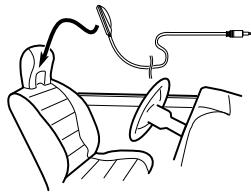
natural_image
Line drawing of a car interior showing steering wheel, dashboard, and attached cable (no text or symbols)- Turn the ignition switch to ON or ACC.
If the car's air conditioner or heater is turned on, turn it off. Noise from the fan in the air conditioner or heater may prevent correct auto EQ.
- Press the home button to switch to the home display.
- Touch the system key to open the system menu.
- Touch Auto EQ Measurement to enter auto EQ measurement mode.
- Plug the microphone into the AUX input jack on this unit.
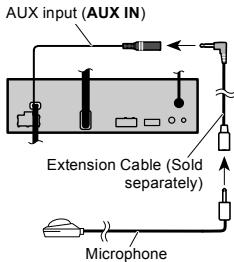
text_image
AUX input (AUX IN) Extension Cable (Sold separately) Microphone- Touch Start to start auto EQ.
- When the 10-second countdown starts, get out of the car and close the door within 10 seconds.
A measurement tone (noise) is emitted from the speakers, and auto EQ measurement begins.
When auto EQ is completed, The measurement has finished. Please disconnect the microphone and then push HOME key. is displayed.
When the car's interior acoustic characteristics cannot be measured correctly, an error message will be displayed. (Refer to “Understanding auto EQ error messages” on page 56.)
- It takes about nine minutes for auto EQ measurement to be completed when all the speakers are connected.
-
To stop auto EQ, touch Stop.
-
Store the microphone carefully in the glove compartment or another safe place.
If the microphone is subjected to direct sunlight for an extended period, high temperatures may cause distortion, color change or malfunction.
System settings
Selecting the video format
You can switch the video output format of V OUT between NTSC and PAL.
- Press the home button to switch to the home display.
- Touch the system key to open the system menu.
- Touch Video Output Format on the system menu to select the video output format.
NTSC – PAL
Note
- You can switch the video output format only for the source from this unit.
Setting the video signal
When you connect this unit to an AV equipment to this unit, select the suitable video signal setting.
- As this function is initially set to Auto, the unit will automatically adjust the video signal setting.
-
You can operate this function only for the video signal input into the AV input.
-
Press the home button to switch to the home display.
- Touch the system key to open the system menu.
- Touch Video Signal Setting on the function menu.
Video Signal Setting items are displayed.
- AV – Adjusts the AV video signal
- AUX – Adjusts the AUX video signal
-
Camera – Adjusts the rear view camera video signal
-
Touch ◀ or ▶ to select the desired video signal appears.
Auto – PAL – NTSC – PAL-M – PAL-N – SECAM
Favorite menu
Using the Favorite menu
- Display menu columns to register.
Refer to "Menu operations" on page 36.
- You can customize menus except Video Setup menu.
- Touch the star icon in the menu column for the desired menu to register the menu.
The star icon for the selected menu is filled in.
- To cancel the registration, touch the star icon in the menu column again.
- Display the favorite menu and choose a registered menu.
Refer to "Menu operations" on page 36.
Note
- You can register up to 12 columns.
Bluetooth connection menu
Bluetooth connection menu operations
If you are using a cellular phone that can be connected via Bluetooth wireless technology, we recommend that you use your phone to search for this unit and establish a connection between it and your phone. The PIN code is set to 0000 as default. The product name for this unit will display on your phone as the device name. For details, refer to “Entering PIN code for Bluetooth wireless connection” on page 50. For further details concerning the procedures for establishing Bluetooth wireless connections, refer to the instruction manual for the phone.
Pairing from this unit
- Press the home button to switch to the home display.
- Touch the Bluetooth key to open the Bluetooth connection menu.
- Touch Connection to select a device.
- Start to search.

Starting to search.
While searching, is displayed and when available devices are found, the device names or Bluetooth device addresses (if names cannot be obtained) are displayed.
- If you want to switch between the device names and Bluetooth device addresses, touch the icon.

Switching between the device names and Bluetooth device addresses.
- To cancel searching, touch Stop.
- If three devices are already paired, Memory Full is displayed and pairing cannot be performed. In such cases, delete a paired device first. Refer to this page.
- If no device can be found, Not Found is displayed. In such cases, check the status of the Bluetooth device and search again.
5. Touch a device name to select the device you want to connect to.
While connecting, Pairing is displayed. If the connection is established, Paired is displayed.
- If your device support SSP (Secure Simple Pairing), six-digit number appears on the display of this unit. Once the connection is established, this number disappears.
- If the connection fails, Error is displayed. In such cases, try again from the beginning.
- The PIN code is set to 0000 as the default, but can be changed. Refer to “Entering PIN code for Bluetooth wireless connection” on page 50.
- Once the connection is established, the device name is displayed. Touch the device name to disconnect.
- If you want to delete a paired Bluetooth telephone, display Delete OK?. Touch Yes to delete the device.

Deleting a paired device.
- Never turn the unit off while the paired Bluetooth telephone is being deleted.
Connecting to a Bluetooth device automatically
If this function is set to on, a connection between your Bluetooth device and this unit will take place automatically as soon as the two devices are less than a few meters apart.
Initially, this function is set to on.
- Press the home button to switch to the home display.
- Touch the Bluetooth key to open the Bluetooth connection menu.
- Touch Auto Connect to turn automatic connection on.
If your Bluetooth device is ready for a Bluetooth wireless connection, a connection to this unit will automatically be established. - To turn automatic connection off, touch Auto Connect again.
If connection fails, "Auto connection failed. Retry?" appears. Touch Yes to reconnect. - Once you turn your vehicle's ACC switch on again, a connection is established automatically.
Bluetooth connection menu
Switching visible unit
This function sets whether or not to make this unit visible to the other device. Initially, this function is set to on.
- Press the home button to switch to the home display.
- Touch the Bluetooth key to open the Bluetooth connection menu.
- Touch Visibility to select visibility off.
- To turn visibility on, touch Visibility again.
Entering PIN code for Bluetooth wireless connection
To connect your Bluetooth device to this unit via Bluetooth wireless technology, you need to enter a PIN code on your Bluetooth device to verify the connection. The default code is 0000, but you can change it with this function.
- Press the home button to switch to the home display.
- Touch the Bluetooth key to open the Bluetooth connection menu.
- Touch PIN Code Input to select PIN Code Input.
- Touch 0 to 9 to input pin code.
- After inputting PIN code (up to 8 digits), store in this unit.

Storing the PIN code in this unit.
Displaying Bluetooth Device address
This unit displays its Bluetooth device address.
- Press the home button to switch to the home display.
- Touch the Bluetooth key to open the Bluetooth connection menu.
- Touch Device Information to display device information. The Bluetooth device address is displayed.
Theme menu
Selecting the illumination color
This unit is equipped with multiple-color illumination.
Direct selection from preset illumination colors
You can select an illumination color from the color list.
- Press the home button to switch to the home display.
- Touch the theme key to open the theme settings.
- Touch Illumination and then touch a color on the list.
Customizing the illumination color
- Press the home button to switch to the home display.
- Touch the theme key to open the theme settings.
- Touch Illumination and then touch Custom.
- Display the customizing menu.

Displaying the customizing menu.
- Touch the color bar to customize the color.
- Touch ◀ or ▶ to fine-tune the color.
- Touch and hold the icon to store the customized color in the memory.

Storing the customized color in the memory.
The customized color has been stored in the memory. The set color will be recalled from the memory the next time you touch the same icon.
Theme menu
Selecting the OSD (on-screen display) color
The OSD color can be changed.
- Press the home button to switch to the home display.
- Touch the theme key to open the theme settings.
- Touch Screen.
- Touch one of the colors on the list.
Selecting the background display
You can switch the background that is displayed when listening to a source.
- Press the home button to switch to the home display.
- Touch the theme key to open the theme settings.
- Touch Background.
- Touch the desired setting.
- You can view the hidden settings by flicking the display.
Other functions
Adjusting the response positions of the touch panels (Touch Panel Calibration)
If you feel that the touch panel keys on the screen deviate from the actual positions that respond to your touch, adjust the response positions of the touch panel. There are two adjustment methods: four-point adjustment, in which you touch four corners of the screen; and 16-point adjustment, in which you make fine-adjustments on the entire screen.
- Park your car in a safe place and use this function. Do not operate it while driving.
- Touch the screen gently for adjustment. Forcefully pressing the touch panel may damage the touch panel. Do not use a sharp pointed tool such as a ballpoint pen or mechanical pen. Doing so may damage the screen.
-
If the touch panel cannot be adjusted properly, consult your local Pioneer dealer.
-
Turn the source off.
Refer to "Turning the source ON/OFF" on page 8.
- Press and hold the home button to start Touch Panel Calibration.
The four-point touch panel adjustment screen appears. When two-point appears at once, touch both.
- Touch each of the arrows on the four corners of the screen.
- To cancel the adjustment, press and hold the home button.
- Press the home button to complete four-point adjustment.
Data for the adjusted position is saved.
- Do not turn off the engine while the data is being saved.
- Press the home button to proceed to 16-point adjustment.
The 16-point touch panel adjustment screen appears.
- To cancel the adjustment, press and hold the home button.
- Gently touch the center of the + mark displayed on the screen.
After you touch all the marks, the data for the adjusted position is saved.
- Do not turn off the engine while the data is being saved.
- Press and hold the home button to complete the adjustment.
Other functions
Using an AUX source
An auxiliary device or portable device sold separately can be connected to this unit.
About AUX connection methods
You can connect auxiliary devices to this unit.
Mini pin plug cable (AUX)
When connecting an auxiliary device using a mini plug cable
iPods and portable audio/video players can be connected to this unit via mini plug cable.
- If an iPod with video capabilities is connected to this unit via 3.5 mm plug (four pole) cable (such as the CD-V150M), you can enjoy the video contents of the connected iPod.
- A portable audio/video player can be connected by using a 3.5 mm plug (four pole) with an RCA cable (sold separately). However, depending on the cable, a reverse connection between the red (right side audio) cable and yellow (video) cable may be required in order for the sound and video image to be reproduced correctly.
- Insert the stereo mini plug into the AUX input jack on this unit.
For more details, refer to the installation manual.
Resetting the microprocessor
By pressing RESET, you can reset the microprocessor to its initial settings without changing the bookmark information.
The microprocessor must be reset in the following situations:
- Before using this unit for the first time after installation
- If the unit fails to operate properly
-
When strange or incorrect messages appear on the display
-
Turn the ignition switch OFF.
- Press RESET with a pen tip or other pointed instrument.
Refer to "What's what" on page 7.
Notes
- Switch your engine ON or set the ignition switch to ACC ON before pressing RESET in the following situations:
– After completing connections
– When erasing all stored settings
- When resetting the unit to its initial (factory) settings
Additional information
Troubleshooting
Common
| Symptom | Cause | Action (Reference page) |
| The power will not turn on. The unit will not operate. | Leads and connectors are incorrectly connected. | Confirm once more that all connections are correct. |
| The fuse is blown. | Rectify the cause and then replace the fuse. Be sure to install a fuse with the same rating. | |
| Noise and/or other factors are causing the built-in microprocessor to operate incorrectly. | Press RESET. (Page 52) | |
| Operation with the remote control is not possible. The unit does not operate correctly even when the appropriate remote control buttons are pressed. | Battery power is low. | Load a new battery. |
| Some operations are prohibited with certain discs. | Try operating with another disc. | |
| Playback is not possible. | The disc is dirty. | Clean the disc. |
| The type of disc loaded cannot be played on this unit. | Check the disc type. | |
| The disc loaded is not compatible with this video system. | Change the disc to one that is compatible with your video system. | |
| There is no sound. The volume level will not rise. | Cables are not connected correctly. | Connect the cables correctly. |
| The unit is performing still, slow motion or frame-by-frame playback. | There is no sound during still, slow motion or frame-by-frame playback. | |
| There is no image displayed. | The parking brake cable is not connected. | Connect the parking brake cable, and apply the parking brake. |
| The parking brake is not applied. | Connect the parking brake cable, and apply the parking brake. | |
| The icon is displayed, and operation is not possible. | The operation is prohibited for the disc. | This operation is not possible. |
| The operation is not compatible with the configuration of the disc. | This operation is not possible. |
Additional information
Common
| Symptom | Cause | Action (Reference page) |
| The image displayed stops (pauses) and the unit cannot be operated. | The data could no longer be read during playback. | Stop playback once, and start playback again. |
| There is no sound. The volume level is low. | The volume level is low. | Adjust the volume level. |
| The attenuator is on. | Turn the attenuator off. | |
| The sound and video skip. | The unit is not firmly secured. | Firmly secure the unit. |
| File size and transmission rate are above recommended rates. | Create a DivX file that is within the recommended size and transmission rate. | |
| The aspect ratio is incorrect and the image is stretched. | The aspect ratio setting is incorrect for the display. | Select the appropriate setting for your display. (Page 40) |
| The motor sounds when the ignition switch is turned ON (or is turned to ACC). | The unit is confirming whether or not a disc is loaded. | This is a normal operation. |
| Nothing is displayed. The touch panel keys cannot be used. | The rear view camera is not connected. | Connect a rear view camera. |
| Camera Polarity is at incorrect setting. | Press the home button to return to the source display and then select the correct setting for Camera Polarity. (Page 46) | |
| No xxxx appears when a display is changed (No Title, for example). | There is no embedded text information. | Switch the display or play another track/file. |
| Subfolders cannot be played back. | Folder repeat play has been selected. | Select the repeat range again. |
| The repeat range changes automatically. | Another folder was selected during repeat play. | Select the repeat range again. |
| Track search or fast forward/ reverse was performed during file repeat play. | Select the repeat range again. |
DVD
| Symptom | Cause | Action (Reference page) |
| Playback is not possible. | The loaded disc has a different region number from this unit. | Replace the disc with one featuring the same region number as this unit. |
| A parental lock message is displayed and playback is not possible. | Parental lock is activated. | Turn parental lock off or change the level. (Page 40) |
| Parental lock cannot be canceled. | The code number is incorrect. | Enter the correct code number. (Page 40) |
| You have forgotten your code number. | Press RESET. (Page 52) | |
| Dialog language (and subtitle language) cannot be switched. | The DVD being played does not feature multiple language recordings. | The language cannot be switched if they are not recorded on the disc. |
| You can only switch between items indicated in the disc menu. | Switch the language using the disc menu. | |
| No subtitles are displayed. | The DVD being played does not feature subtitles. | Subtitles are not displayed if they are not recorded on the disc. |
| You can only switch between items indicated in the disc menu. | Switch the language using the disc menu. | |
| Playback is not performed with the audio language and subtitle language settings selected in Video Setup menu. | The DVD being played does not feature dialog or subtitles in the selected language. | The language cannot be switched if the selected language is not recorded on the disc. |
| The viewing angle cannot be switched. | The DVD being played does not feature scenes shot from multiple angles. | The viewing angle cannot be switched if the DVD does not feature scenes recorded from multiple angles. |
| You are trying to switch to multi-angle viewing for a scene that was not recorded from multiple angles. | Switch between multiple angles when watching scenes recorded from multiple angles. | |
| The image is extremely unclear/distorted and dark during playback. | Some discs feature a signal to prohibit copying. | Since this unit is compatible with the analog copy generation management system, when playing a disc that has a signal prohibiting copying, horizontal stripes or other imperfections may appear when viewed on some displays. This is not a malfunction. |
Additional information
Video CD
| Symptom | Cause | Action |
| The PBC ( playback control) menu cannot be called up. | The Video CD being played does not feature PBC. | This operation is not available for Video CDs that do not feature PBC. |
| Repeat play and track/time search are not possible. | The Video CD being played features PBC. | This operation is not available for Video CDs that feature PBC. |
iPod
| Symptom | Cause | Action |
| The iPod does not operate correctly. | The cables are incorrectly connected. | Disconnect the cable from the iPod. Once the iPod's main menu is displayed, reconnect the iPod and reset it. |
| The iPod version is old. | Update the iPod version. | |
| Sound from the iPod cannot be heard. | The audio output direction may switch automatically when the Bluetooth and USB connections are used at the same time. | Use the iPod to change the audio output direction. |
Bluetooth audio/telephone
| Symptom | Cause | Action |
| The sound from the Bluetooth audio source is not played back. | There is a call in progress on a Bluetooth connected cellular phone. | The sound will be played back when the call is terminated. |
| A Bluetooth connected cellular phone is currently being operated. | Do not use the cellular phone at this time. | |
| A call was made with a Bluetooth connected cellular phone and then immediately terminated. As a result, communication between this unit and the cellular phone was not terminated properly. | Reconnect the Bluetooth connection between this unit and the cellular phone. |
Error messages
When you contact your dealer or your nearest Pioneer Service Center, be sure to note the error message.
Common
| Message | Cause | Action |
| AMP Error | This unit fails to operate or the speaker connection is incorrect; the protective circuit is activated. | Check the speaker connection. If the message fails to disappear even after the engine is switched off/on, contact your dealer or an authorized Pioneer Service Station for assistance. |
Tuner
| Message | Cause | Action |
| No Data Provided | This unit cannot receive artist name/song title information. | Move to the desirable location with good reception. |
| No Data | This unit cannot receive program service name information. | Move to the desirable location with good reception. |
DVD
| Message | Cause | Action (Reference page) |
| Different Region Disc | The disc does not have the same region number as this unit. | Replace the DVD with one bearing the correct region number. |
| Error-02-XX/FF-FF | The disc is dirty. | Clean the disc. |
| The disc is scratched. | Replace the disc. | |
| The disc is loaded upside down. | Check that the disc is loaded correctly. | |
| There is an electrical or mechanical error. | Press RESET. (Page 52) | |
| Unplayable Disc | This type of disc cannot be played on this unit. | Replace the disc with one that can be played on this unit. |
| The inserted disc does not contain any playable files. | Replace the disc. | |
| Protect | All the files on the inserted disc are embedded with DRM. | Replace the disc. |
| Skipped | The inserted disc contains DRM protected files. | The protected files are skipped. |
Additional information
DVD
| Message | Cause | Action (Reference page) |
| TEMP | The temperature of the unit is outside the normal operating range. | Wait until the unit returns to a temperature within the normal operating limits. |
| This DivX rental has expired. | The inserted disc contains expired DivX VOD content. | Select a file that can be played. |
| Video resolution not supported | The inserted disc contains a high definition DivX/MPEG-1/ MPEG-2/MPEG-4 file. | Select a file that can be played. |
| It is not possible to write it in the flash. | This unit's flash memory used as the temporary storage area is full. | Select a file that can be played. |
| Your device is not authorized to play this DivX protected video. | This unit's DivX registration code has not been authorized by the DivX VOD contents provider. | Register this unit to the DivX VOD contents provider. |
| Unplayable File | This type of file cannot be played on this unit. | Select a file that can be played. |
| Format Read | Sometimes there is a delay between the start of playback and when you start to hear any sound. | Wait until the message disappears and you hear sound. |
| Video frame rate not supported | DivX file's frame rate is more than 30 fps. | Select a file that can be played. |
| Audio Format not supported | This type of file is not supported on this unit. | Select a file that can be played. |
External storage device (USB)
| Message | Cause | Action |
| Unplayable File | This type of file cannot be played on this unit. | Select a file that can be played. |
| There are no songs. | Transfer the audio files to the USB portable audio player/USB memory and connect. | |
| Security for the connected USB memory is enabled. | Follow the USB memory instructions to disable security. | |
| Format Read | Sometimes there is a delay between the start of playback and when you start to hear any sound. | Wait until the message disappears and you hear sound. |
| Message | Cause | Action |
| Protect | All the files on the connected USB storage device are embedded with DRM. | Replace the USB storage device. |
| Skipped | The connected USB storage device contains DRM protected files. | The protected files are skipped. |
| Incompatible USB | The connected USB device is not supported by this unit. | Connect a USB portable audio player or USB memory that is USB Mass Storage Class compliant. |
| The USB device is not formatted with FAT12, FAT16 or FAT32. | The connected USB device should be formatted with FAT12, FAT16 or FAT32. | |
| Check USB | The USB connector or USB cable has short-circuited. | Check that the USB connector or USB cable is not caught in something or damaged. |
| The connected USB storage device consumes more than maximum allowable current. | Disconnect the USB portable audio player/USB memory and do not use it. Turn the ignition switch to OFF, then to ACC or ON and then connect a compliant USB portable audio player/USB memory. | |
| Error-02-9X/-DX | Communication failed. | Perform one of the following operations.- Turn the ignition switch OFF and back ON.- Disconnect the USB portable audio player/USB memory.- Change to a different source. Then, return to the USB portable audio player/USB memory. |
| It is not possible to write it in the flash. | This unit's flash memory used as the temporary storage area is full. | Select a file that can be played. |
| Format Read | Sometimes there is a delay between the start of playback and when you start to hear any sound. | Wait until the message disappears and you hear sound. |
| Audio Format not supported | This type of file is not supported on this unit. | Select a file that can be played. |
Additional information
iPod
| Message | Cause | Action |
| Format Read | Sometimes there is a delay between the start of playback and when you start to hear any sound. | Wait until the message disappears and you hear sound. |
| Error-02-6X/-9X/-DX | Communication failed. | Disconnect the cable from the iPod. Once the iPod's main menu is displayed, reconnect the iPod and reset it. |
| iPod failure. | Disconnect the cable from the iPod. Once the iPod's main menu is displayed, reconnect the iPod and reset it. | |
| Error-02-67 | The iPod firmware version is old. | Update the iPod version. |
| Stop | There are no songs. | Transfer songs to the iPod. |
| There are no songs in the current list. | Select a list that contains songs. | |
| Not Found | No related songs. | Transfer songs to the iPod. |
iTunes tagging
| Message | Cause | Action |
| iPod full. Tags not transferred. | Memory used for tag information on the iPod is full. | Sync the iPod with iTunes and clean up the tagged playlist. |
| Memory full. Tags not stored. Connect iPod. | This unit's flash memory used as the temporary storage area is full. | The tag information on this unit is transferred to the iPod automatically when an iPod is connected. |
| Tag transfer failed. Reconnect your iPod. | This unit's tag information cannot transfer to the iPod. | Check the iPod and try again. |
| Tag store failed. | Tag information cannot be stored in this unit. | Try again. |
| Error-8D | Built-in FLASH ROM encountered an error. | Turn the ignition OFF or ON. |
| Already stored | This tag information is already stored in memory. | Tag information can only be saved once for any given song. Tag information cannot be saved for the same song more than once. |
Bluetooth
| Message | Cause | Action |
| Error-10 | The power failed for the Bluetooth module of this unit. | Turn the ignition switch OFF and then to ACC or ON. If the error message is still displayed after performing the above action, please contact your dealer or an authorized Pioneer Service Station. |
Understanding auto EQ error messages
When correct measurement of the car's interior acoustic characteristics is not possible using auto EQ, an error message may appear on the display. In such cases, refer to the table below to see what the problem is and how it may be corrected. After checking, try again.
| Message | Cause | Action |
| Please connect the microphone for measurement. When finished, please push HOME key. | The microphone is not connected. | Plug the optional microphone securely into the jack. |
| Error. Please check xxxx speaker. | The microphone cannot pick up the measuring tone of a speaker. | Confirm that the speakers are connected correctly.Correct the input level setting of the power amp connected to the speakers.Plug the microphone securely into the jack. |
| Error. Please check noise. | The surrounding noise level is too high. | Stop your car in a place that is quiet, and switch off the engine, air conditioner and heater.Set the microphone correctly. |
| Error. Please check battery. | Power is not being supplied from the battery to this unit. | Connect the battery correctly.Check the battery voltage. |
Understanding messages
| Message | Translation |
| Screen image may appear reversed. | Pioneer recommends the use of a camera which outputs mirror-reversed images. Otherwise, the screen image will appear reversed. |
Additional information
Indicator list
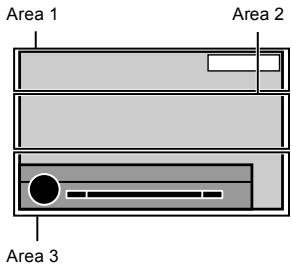
text_image
Area 1 Area 2 Area 3Area 1
Indicates that the volume is adjusted.
Indicates that the mute function is on.
Indicates that the sound is attenuated.
Area 2
Shows when downloadable song information (tag) from a radio station is received.
Shows when song information (tag) from a radio station is being saved to this unit.
Indicates that the digital format is Dolby Digital.
Area 2

Indicates that the digital format is MPEG Audio.

Indicates that the digital format is Linear PCM.

Indicates the sampling frequency.

Indicates that the digital format is DTS.

Indicates the audio channel.


Indicates that a disc with PBC On is being played.
- Indicates that a cellular phone is connected.
- Indicates that an incoming call has been received and has not been checked yet.
Indicates the battery strength of the cellular phone.
- The level shown on the indicator may differ from the actual battery strength.
- If the battery strength is not available, nothing is displayed in the battery strength indicator area.
Additional information
Area 2

Indicates that the connected Bluetooth device only supports Bluetooth telephone.

Indicates that the connected Bluetooth device only supports Bluetooth audio.

Show the album title when receiving the tag information.
Shows the album title of the song currently being played for MP3/WMA/AAC/WAV files.

Shows the song title when receiving the tag information.
Shows the song title of the song currently being played for MP3/WMA/AAC/WAV files.

Shows the comment currently being played.

Shows the station name currently tuned in to.

Shows the artist name when receiving the tag information.
Shows the artist name of the artist currently being played for MP3/WMA/AAC/WAV files.

Shows cellular phone information.

Shows general phone information.

Shows home phone information.

Shows office phone information.
Area 2

Shows other phone information.

Shows the folder name of the folder containing the MP3/WMA/AAC/WAV file currently being played.

Shows the file name of the MP3/WMA/AAC/WAV file currently being played.

Shows the preset number of the station currently being tuned in to.

Shows the title number currently being played.

Shows the chapter number currently being played.

Shows the genre of the track/song currently being played.
Area 3

Shows when radio signal is received.

Indicates that the selected frequency is being broadcast in stereo.

Touch to turn BSM on.
Additional information
Area 3

Indicates that Auto EQ is on.

Shows when this unit has the song information (tag).

Indicates that the unit is currently processing an operation such as search.

Shows when creating the database in Music browse mode.

Shows when saving the database in Music browse mode.

Indicates the signal strength of the cellular phone.

Indicates that a Bluetooth telephone is connected.

Indicates that TA (traffic announcement standby) is on.

Indicates that the news program interruption is on.
Handling guidelines
Discs and player
- Use discs featuring any of the following logos.


- Use 12-cm discs. Do not use 8-cm discs or an adapter for 8-cm discs.
- Use only conventional, fully circular discs. Do not use shaped discs.

- Do not insert anything other than a DVD-R/RW or CD-R/RW into the disc loading slot.
- Do not use cracked, chipped, warped, or otherwise damaged discs as they may damage the player.
- Unfinalized CD-R/RW discs cannot be played back.
- Do not touch the recorded surface of the discs.
- Store discs in their cases when not in use.
- Do not attach labels, write on or apply chemicals to the surface of the discs.
- To clean a disc, wipe the disc with a soft cloth outward from the center.
- Condensation may temporarily impair the player's performance. Let it rest for about one hour to adjust to a warmer temperature. Also, wipe any damp discs off with a soft cloth.
- Playback of discs may not be possible because of disc characteristics, disc format, recorded application, playback environment, storage conditions, and so on.
- Road shocks may interrupt disc playback.
- Certain functions may not be available for some DVD video discs.
- It may not be possible to play back some DVD video discs.
- It is not possible to play back DVD-RAM discs.
- This unit is not compatible with discs recorded in AVCHD (Advanced Video Codec High Definition) format. Do not insert AVCHD discs as you may not be able to eject the disc.
Additional information
- When using discs that can be printed on label surfaces, check the instructions and the warnings of the discs. Depending on the discs, inserting and ejecting may not be possible. Using such discs may result in damage to this equipment.
- Do not attach commercially available labels or other materials to the discs.
– The discs may warp making the disc unplayable. - The labels may come off during playback and prevent ejection of the discs, which may result in damage to the equipment.
External storage device (USB)
- Depending on the external storage device (USB), the following problems may occur.
– Operations may vary.
– The storage device may not be recognized.
– Files may not be played back properly.
USB storage device
- Connections via USB hub are not supported.
- Do not connect anything other than a USB storage device.
- Firmly secure the USB storage device when driving. Do not let the USB storage device fall onto the floor, where it may become jammed under the brake or accelerator pedal.
- Depending on the USB storage device, the device may cause noise to occur in the radio.
• Copyright protected files that are stored in the USB devices cannot be played back. - You cannot connect a USB portable audio player/USB memory to this unit via USB hub.
- Partitioned USB memory is not compatible with this unit.
- Depending on the kind of USB portable audio player/USB memory you use, the device may not be recognized or audio files may not be played back properly.
- Do not leave the USB portable audio player/USB memory in direct sunlight for extended amounts of time. Doing so may cause the device to malfunction from the extreme rise in temperature.
iPod
- To ensure proper operation, connect the dock connector cable from the iPod directly to this unit.
-
Firmly secure the iPod when driving. Do not let the iPod fall onto the floor, where it may become jammed under the brake or accelerator pedal.
-
About iPod settings
- When an iPod is connected, this unit changes the EQ (equalizer) setting of the iPod to off in order to optimize the acoustics. When you disconnect the iPod, the EQ returns to the original setting.
- You cannot set Repeat to off on the iPod when using this unit. Repeat is automatically changed to All when the iPod is connected to this unit.
- Incompatible text saved on the iPod will not be displayed by the unit.
DVD-R/RW discs
Unfinalized DVD-R/RW discs which have been recorded in the Video format (video mode) cannot be played back.
Playback of DVD-R/RW discs may not be possible, due to disc characteristics, scratches or dirt on the disc, or dirt, condensation, etc. on the lens of this unit.
Depending on the application settings and the environment, playback of discs recorded on a computer may not be possible. (For details, contact the manufacturer of the application.)
CD-R/RW discs
When CD-R/RW discs are used, playback is possible only for discs which have been finalized.
Playback of CD-R/RW discs recorded on a music CD recorder or a computer may not be possible due to disc characteristics, scratches or dirt on the disc, or dirt, condensation, etc., on the lens of this unit.
Depending on the application settings and the environment, playback of discs recorded on a computer may not be possible. (For details, contact the manufacturer of the application.)
Playback of CD-R/RW discs may become impossible in case of direct exposure to sunlight, high temperatures, or the storage conditions in the vehicle.
Titles and other text information recorded on a CD-R/RW disc may not be displayed by this unit (in the case of audio data (CD-DA)).
Additional information
DualDiscs
DualDiscs are two-sided discs that have a recordable CD for audio on one side and a recordable DVD for video on the other.
Playback of the DVD side is possible with this unit. However, since the CD side of DualDiscs is not physically compatible with the general CD standard, it may not be possible to play the CD side with this unit.
Frequent loading and ejecting of a DualDisc may result in scratches on the disc. Serious scratches can lead to playback problems on this unit. In some cases, a DualDisc may become stuck in the disc loading slot and will not eject. To prevent this, we recommend you refrain from using DualDisc with this unit.
Please refer to the information from the disc manufacturer for more detailed information about DualDiscs.
DivX video files
- Depending on the composition of the file information, such as the number of audio streams or file size, there may be a slight delay when playing back discs.
- Some special operations may be prohibited due to the composition of the DivX files.
- Only DivX files downloaded from a DivX partner site are guarantee for proper operation. Unauthorized DivX files may not operate properly.
- DRM rental files cannot be operated until playback is started.
- Recommended file size: 2 GB or less with a transmission rate of 2 Mbps or less.
- The ID code of this unit must be registered to a DivX VOD provider in order to playback DivX VOD files. For information on ID codes, refer to “Displaying the DivX® VOD registration code” on page 42.
- For more details about DivX, visit the following site: http://www.divx.com/
MPEG-1/MPEG-2/MPEG-4 video files
- Elapsed playback time may not be displayed correctly.
Audio compatibility (USB)
WAV
- File extension: .wav
• Quantization bits: 8 and 16 (LPCM), 4 (MS ADPCM) - Sampling frequency: 16 kHz to 48 kHz (LPCM), 22.05 kHz and 44.1 kHz (MS ADPCM)
Compressed audio compatibility (disc, USB)
WMA
- File extension: .wma
- Bit rate: 48 kbps to 320 kbps (CBR), VBR
• Sampling frequency: 32 kHz to 48 kHz - Windows Media™ Audio Professional, Lossless, Voice/DRM Stream/Stream with video: Not compatible
MP3
- File extension: .mp3
- Bit rate: 8 kbps to 320 kbps (CBR), VBR
- Sampling frequency: 8 kHz to 48 kHz (32 kHz, 44.1 kHz, 48 kHz for emphasis)
- Compatible ID3 tag version: 1.0, 1.1, 2.2, 2.3, 2.4 (ID3 tag Version 2.x is given priority over Version 1.x.)
• M3u playlist: Not compatible - MP3i (MP3 interactive), mp3 PRO: Not compatible
AAC
- Compatible format: AAC encoded by iTunes
- File extension: .m4a
• Sampling frequency: 11.025 kHz to 48 kHz - Bit rate: 16 kbps to 320 kbps
• Apple Lossless: Not compatible - AAC file bought from the iTunes Store (.m4p file extension): Not compatible
DivX compatibility (disc)
- Compatible format: DivX video format implemented in relation to DivX standards
- File extensions: .avi or .divx
• DivX Ultra format: Not compatible
• DivX HD format: Not compatible
• DivX files without video data: Not compatible
• DivX plus: Not compatible - Compatible audio codec: MP2, MP3, Dolby Digital
- LPCM: Compatible
Additional information
- Bit rate: 8 kbps to 320 kbps (CBR), VBR
• Sampling frequency: 8 kHz to 48 kHz - Compatible external subtitle file extension: .srt
MPEG-1/MPEG-2/MPEG-4 video (disc)
- File extensions: .mpg or .mpeg (MPEG-1/MPEG-2), .avi (MPEG-4)
- Compatible audio codec: MP2 (MPEG-1/MPEG-2), MP2, MP3, Dolby Digital (MPEG-4)
• H.264 (MPEG-4AVC): Compatible - LPCM: Not compatible
- Bit rate: 8 kbps to 320 kbps (CBR), VBR
• Sampling frequency: 8 kHz to 48 kHz
Supplemental information
- Some characters in a file name (including the file extension) or a folder name may not be displayed.
- This unit may not work properly depending on the application used to encode WMA files.
- There may be a slight delay at the start of playback of audio files embedded with image data or audio files stored on a USB storage device that has numerous folder hierarchies.
Disc (CD/DVD)
- Playable folders: up to 99 for CD-R/RW
- Playable folders: up to 700 for DVD-R/RW
- Playable files: up to 999 for CD-R/RW
- Playable files: up to 3 500 for DVD-R/RW
- File system: ISO 9660 Level 1 and 2, Romeo, Joliet, UDF 1.02 (DVD-R/RW)
- Multi-session playback: Compatible
- Packet write data transfer: Not compatible
- Regardless of the length of blank sections between the songs from the original recording, compressed audio discs play with a short pause between songs.
External storage device (USB)
- Playable folders: up to 1 500
- Playable files: up to 15 000
-
Playback of copyright-protected files: Not compatible
-
Partitioned external storage device (USB): Only the first playable partition can be played.
- There is no compatibility for Multi Media Cards (MMC).
CAUTION
- Pioneer accepts no responsibility for data lost on the USB memory/USB portable audio player even if that data is lost while using this unit.
- Pioneer cannot guarantee compatibility with all USB mass storage devices and assumes no responsibility for any loss of data on media players, smart phones, or other devices while using this product.
- Do not leave the discs/external storage device (USB) or iPod in places with high temperatures.
iPod compatibility
This unit supports only the following iPod models. Supported iPod software versions are shown below. Older versions may not be supported.
Made for
- iPod touch 5th generation (software version 6.0.1)
- iPod touch 4th generation (software version 5.1.1)
- iPod touch 3rd generation (software version 5.1.1)
- iPod touch 2nd generation (software version 4.2.1)
- iPod touch 1st generation (software version 3.1.3)
- iPod classic 160GB (software version 2.0.4)
- iPod classic 120GB (software version 2.0.1)
- iPod classic (software version 1.1.2)
- iPod with video (software version 1.3)
- iPod nano 7th generation (software version 1.0.1)
- iPod nano 6th generation (software version 1.2)
- iPod nano 5th generation (software version 1.0.2)
- iPod nano 4th generation (software version 1.0.4)
- iPod nano 3rd generation (software version 1.1.3)
- iPod nano 2nd generation (software version 1.1.3)
- iPod nano 1st generation (software version 1.3.1)
– iPhone 5 (software version 6.0.1)
Additional information
– iPhone 4S (software version 5.1.1)
- iPhone 4 (software version 5.1.1)
– iPhone 3GS (software version 5.1.1)
– iPhone 3G (software version 4.2.1)
– iPhone (software version 3.1.3)
- Depending on the generation or version of the iPod, some functions may not be available.
- Operations may vary depending on the software version of iPod.
- About the file/format compatibility, refer to the iPod manuals.
• Audiobook, Podcast: Compatible
CAUTION
Pioneer accepts no responsibility for data lost on the iPod, even if that data is lost while this unit is used.
About iTunes tagging
This function can be performed with the following iPod models.
- iPod touch 4th generation
- iPod touch 3rd generation
- iPod touch 2nd generation
- iPod touch 1st generation
- iPod classic 160GB
- iPod classic 120GB
- iPod classic
- iPod with video
-
iPod nano 6th generation
-
iPod nano 5th generation
- iPod nano 4th generation
- iPod nano 3rd generation
- iPhone 4S
- iPhone 4
- iPhone 3GS
- iPhone 3G
- iPhone
The song information (tag) can be saved from the broadcasting station to your iPod. The songs will show up in a playlist called "Tagged playlist" in iTunes the next time you sync your iPod. Then you can directly buy the songs you want from the iTunes Store.
The tagged songs and the song that you can buy from the iTunes Store may be different. Make sure to confirm the song before you make the purchase.
If you cannot use this function normally, update your iPod firmware.
Sequence of audio files
The user cannot assign folder numbers and specify playback sequences with this unit.
Example of a hierarchy
: Folder
♪ : Compressed audio file
01 to 05: Folder number
① to ⑥: Playback sequence
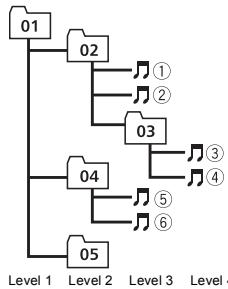
flowchart
graph TD
    A["01"] --> B["02"]
    B --> C["①"]
    B --> D["②"]
    B --> E["03"]
    E --> F["③"]
    E --> G["④"]
    H["04"] --> I["⑤"]
    H --> J["⑥"]
    K["05"] --> L["⑦"]
    style A fill:#f9f,stroke:#333
    style K fill:#f9f,stroke:#333
    style B fill:#ccf,stroke:#333
    style E fill:#ccf,stroke:#333
    style H fill:#ccf,stroke:#333
    style L fill:#ccf,stroke:#333
Disc
Folder selection sequence or other operation may differ depending on the encoding or writing software.
External storage device (USB)
The playback sequence is the same as the recorded sequence in the external storage device (USB).
To specify the playback sequence, the following method is recommended.
1 Create a file name that includes numbers that specify the playback sequence (e.g., 001xxx.mp3 and 099yyy.mp3).
2 Put those files into a folder.
3 Save the folder that contains the files to the external storage device (USB).
However, depending on the system environment, you may not be able to specify the playback sequence.
For USB portable audio players, the sequence is different and depends on the player.
Using the display correctly
CAUTION
- If liquid or foreign matter should get inside this unit, turn off the power immediately and consult your dealer or the nearest authorized PIONEER Service Station. Do not use the unit in this condition because doing so may result in fire, electric shock, or other failure.
- If you notice smoke, a strange noise or smell, or any other abnormal signs from the display, turn off the power immediately and consult your dealer or the nearest authorized PIONEER Service Station. Using this unit in this condition may result in permanent damage to the system.
- Do not disassemble or modify this unit, as there are high-voltage components inside which may cause electric shock. Be sure to consult your dealer or the nearest authorized PIONEER Service Station for internal inspection, adjustments, or repairs.
Handling the display
- Never touch the screen with anything besides your finger when operating the touch panel function. The screen can scratch easily.
- When the display is subjected to direct sunlight for a long period of time, it will become very hot resulting in possible damage to the LCD screen. You should avoid exposing the display unit to direct sunlight as much as possible.
- The display should be used within the temperature range of -10^ to +60^ .
- At temperatures higher or lower than this operating temperature range, the display may not operate normally.
- The LCD screen is exposed in order to increase its visibility within the vehicle. Do not press it strongly on it as this may damage it.
- Do not push the LCD screen forcefully as this may scratch it.
Liquid crystal display (LCD) screen
- Heat from the heater may damage the LCD screen, and cool air from the cooler may cause moisture to form inside the display resulting in possible damage.
- Small black dots or white dots (bright dots) may appear on the LCD screen. These are due to the characteristics of the LCD screen and do not indicate a malfunction.
- When using a cellular phone, keep the antenna away from the display to prevent disruption of the video image by the appearance of spots, colored stripes, etc.
LED (light-emitting diode) backlight
- At low temperatures, using the LED backlight may increase image lag and degrade the image quality due to the characteristics of the LCD screen. Image quality will improve with an increase in temperature.
- To protect the LED backlight, the display will darken in the following environments:
– In the direct sunlight - Near the heater vent
- The product lifetime of the LED backlight is more than 10 000 hours. However, it may decrease if used in high temperatures.
- If the LED backlight reaches the end of its product lifetime, the screen will become dark and the image will no longer be projected. In such cases, please consult your dealer or the nearest authorized PIONEER Service Station.
Keeping the display in good condition
- When removing dust from the screen or cleaning the display, first turn the system power off, then wipe with a soft dry cloth.
- When wiping the screen, take care not to scratch the surface. Do not use harsh or abrasive chemical cleaners.
Bluetooth profiles
In order to use Bluetooth wireless technology, devices must be able to interpret certain profiles. This unit is compatible with the following profiles.
• GAP (Generic Access Profile)
• SDP (Service Discovery Protocol)
- OPP (Object Push Profile)
• HFP (Hands Free Profile)
• HSP (Head Set Profile)
• PBAP (Phone Book Access Profile)
• A2DP (Advanced Audio Distribution Profile)
• AVRCP (Audio/Video Remote Control Profile) 1.3
Additional information
Copyright and trademark
This item incorporates copy protection technology that is protected by U.S. patents and other intellectual property rights of Rovi Corporation. Reverse engineering and disassembly are prohibited.
Bluetooth
The Bluetooth ^® word mark and logos are registered trademarks owned by Bluetooth SIG, Inc. and any use of such marks by PIONEER CORPORATION is under license. Other trademarks and trade names are those of their respective owners.
DVD video
is a trademark of DVD Format/Logo Licensing Corporation.
iTunes
Apple and iTunes are trademarks of Apple Inc., registered in the U.S. and other countries.
MP3
Supply of this product only conveys a license for private, non-commercial use and does not convey a license nor imply any right to use this product in any commercial (i.e. revenue-generating) real time broadcasting (terrestrial, satellite, cable and/or any other media), broadcasting/streaming via internet, intranets and/or other networks or in other electronic content distribution systems, such as pay-audio or audio-on-demand applications. An independent license for such use is required. For details, please visit http://www.mp3licensing.com.
WMA
Windows Media is either a registered trademark or trademark of Microsoft Corporation in the United States and/or other countries.
This product includes technology owned by Microsoft Corporation and cannot be used or distributed without a license from Microsoft Licensing, Inc.
iPod & iPhone
iPhone, iPod, iPod classic, iPod nano, and iPod touch are trademarks of Apple Inc., registered in the U.S. and other countries.
Lightning is a trademark of Apple Inc.
“Made for iPod” and “Made for iPhone” mean that an electronic accessory has been designed to connect specifically to iPod or iPhone, respectively, and has been certified by the developer to meet Apple performance standards. Apple is not responsible for the operation of this device or its compliance with safety and regulatory standards. Please note that the use of this accessory with iPod or iPhone may affect wireless performance.
Dolby Digital
Manufactured under license from Dolby Laboratories. Dolby and the double-D symbol are trademarks of Dolby Laboratories.
DivX
DivXâ, DivX Certified ^® and associated logos are trademarks of Rovi Corporation or its subsidiaries and are used under license.
ABOUT DIVX VIDEO: DivX ^® is a digital video format created by DivX, LLC, a subsidiary of Rovi Corporation. This is an official DivX Certified ^® device that plays DivX video. Visit divx.com for more information and software tools to convert your files into DivX videos.
ABOUT DIVX VIDEO-ON-DEMAND: This DivX Certified ^® device must be registered in order to play purchased DivX Video-on-Demand (VOD) movies. To obtain your registration code, locate the DivX VOD section in “Displaying the DivX ^® VOD registration code” on page 42. Go to vod.divx.com for more information on how to complete your registration.
MIXTRAX
MIXTRAX is a trademark of the PIONEER CORPORATION.
Additional information
libpng
Please be aware in advance that Pioneer will not respond to questions concerning the contents of the source code.
This licence was originally written in English and translated here only to help the reader understand its content. Therefore, please note that translated licence is NOT legally identified with the original English text.
This copy of the libpng notices is provided for your convenience. In case of any discrepancy between this copy and the notices in the file png.h that is included in the libpng distribution, the latter shall prevail.
COPYRIGHT NOTICE, DISCLAIMER, and LICENSE:
If you modify libpng you may insert additional notices immediately following this sentence.
This code is released under the libpng license.
libpng versions 1.2.6, August 15, 2004, through 1.5.0, January 6, 2011, are Copyright (c) 2004, 2006-2010 Glenn Randers-Pehrson, and are distributed according to the same disclaimer and license as libpng-1.2.5 with the following individual added to the list of Contributing Authors
Cosmin Truta
libpng versions 1.0.7, July 1, 2000, through 1.2.5 - October 3, 2002, are Copyright (c) 2000-2002 Glenn Randers-Pehrson, and are distributed according to the same disclaimer and license as libpng-1.0.6 with the following individuals added to the list of Contributing Authors
Simon-Pierre Cadieux
Eric S. Raymond
Gilles Vollant
and with the following additions to the disclaimer:
There is no warranty against interference with your enjoyment of the library or against infringement. There is no warranty that our efforts or the library will fulfill any of your particular purposes or needs. This library is provided with all faults, and the entire risk of satisfactory quality, performance, accuracy, and effort is with the user.
libpng versions 0.97, January 1998, through 1.0.6, March 20, 2000, are Copyright (c) 1998, 1999 Glenn Randers-Pehrson, and are distributed according to the same disclaimer and license as libpng-0.96, with the following individuals added to the list of Contributing Authors:
Tom Lane
Glenn Randers-Pehrson
Willem van Schaik
libpng versions 0.89, June 1996, through 0.96, May 1997, are Copyright (c) 1996, 1997 Andreas Dilger Distributed according to the same disclaimer and license as libpng-0.88, with the following individuals added to the list of Contributing Authors:
John Bowler
Kevin Bracey
Sam Bushell
Magnus Holmgren
Greg Roelofs
Tom Tanner
libpng versions 0.5, May 1995, through 0.88, January 1996, are Copyright (c) 1995, 1996 Guy Eric Schalnat, Group 42, Inc.
For the purposes of this copyright and license, "Contributing Authors" is defined as the following set of individuals:
Andreas Dilger
Dave Martindale
Guy Eric Schalnat
Paul Schmidt
Tim Wegner
The PNG Reference Library is supplied "AS IS". The Contributing Authors and Group 42, Inc. disclaim all warranties, expressed or implied, including, without limitation, the warranties of merchantability and of fitness for any purpose. The Contributing Authors and Group 42, Inc. assume no liability for direct, indirect, incidental, special, exemplary, or consequential damages, which may result from the use of the PNG Reference Library, even if advised of the possibility of such damage.
Additional information
Permission is hereby granted to use, copy, modify, and distribute this source code, or portions hereof, for any purpose, without fee, subject to the following restrictions:
- The origin of this source code must not be misrepresented.
- Altered versions must be plainly marked as such and must not be misrepresented as being the original source.
- This Copyright notice may not be removed or altered from any source or altered source distribution.
The Contributing Authors and Group 42, Inc. specifically permit, without fee, and encourage the use of this source code as a component to supporting the PNG file format in commercial products. If you use this source code in a product, acknowledgment is not required but would be appreciated.
A "png_get_copyright" function is available, for convenient use in "about" boxes and the like:
printf("%s", png_get_copyright(NULL));
Also, the PNG logo (in PNG format, of course) is supplied in the files "pngbar.png" and "pngbar.jpg (88x31) and "pngnow.png" (98x31).
Libpng is OSI Certified Open Source Software. OSI Certified Open Source is a certification mark of the Open Source Initiative.
Glenn Randers-Pehrson
glennrp at users.sourceforge.net
January 6, 2011
Language code chart for DVD
| Language (code), input code | ||||
| Japanese (ja), 1001 | Dzongkha (dz), 0426 | Kurdish (ku), 1121 | Kinyarwanda (rw), 1823 | |
| English (en), 0514 | Ewe (ee), 0505 | Komi (kv), 1122 | Sanskrit (sa), 1901 | |
| French (fr), 0618 | Esperanto (eo), 0515 | Comish (kw), 1123 | Sardinian (sc), 1903 | |
| Spanish (es), 0519 | Estonian (et), 0520 | Kirghiz, Kyrgyz (ky), 1125 | Sindhi (sd), 1904 | |
| German (de), 0405 | Basque (eu), 0521 | Latin (la), 1201 | Northern Sami (se), 1905 | |
| Italian (it), 0920 | Persian (fa), 0601 | Luxembourgish (lb), 1202 | Sangho (sg), 1907 | |
| Chinese (zh), 2608 | Fulah (ff), 0606 | Ganda (lg), 1207 | Sinhala (si), 1909 | |
| Dutch, Flemish (nl), 1412 | Finnish (fi), 0609 | Limburgan (li), 1209 | Slovak (sk), 1911 | |
| Portuguese (pt), 1620 | Fijian (fj), 0610 | Lingala (ln), 1214 | Slovenian (sl), 1912 | |
| Swedish (sv), 1922 | Faroese (fo), 0615 | Lao (lo), 1215 | Samoan (sm), 1913 | |
| Russian (ru), 1821 | Western Frisian (fy), 0625 | Lithuanian (lt), 1220 | Shona (sn), 1914 | |
| Korean (ko), 1115 | Irish (ga), 0701 | Luba-Katanga (lu), 1221 | Somali (so), 1915 | |
| Greek (el), 0512 | Gaelic (gd), 0704 | Latvian (lv), 1222 | Albanian (sq), 1917 | |
| Afar (aa), 0101 | Galician (gl), 0712 | Malagasy (mg), 1307 | Serbian (sr), 1918 | |
| Abkhazian (ab), 0102 | Guarani (gn), 0714 | Marshallese (mh), 1308 | Swati (ss), 1919 | |
| Avestan (ae), 0105 | Gujarati (gu), 0721 | Maori (mi), 1309 | Sotho, Southern (st), 1920 | |
| Afrikaans (af), 0106 | Manx (gv), 0722 | Macedonian (mk), 1311 | Sundanese (su), 1921 | |
| Akan (ak), 0111 | Hausa (ha), 0801 | Malayalam (ml), 1312 | Swahili (sw), 1923 | |
| Amharic (am), 0113 | Hebrew (he), 0805 | Mongolian (mn), 1314 | Tamil (ta), 2001 | |
| Aragonese (an), 0114 | Hindi (hi), 0809 | Marathi (mr), 1318 | Telugu (te), 2005 | |
| Arabic (ar), 0118 | Hiri Motu (ho), 0815 | Malay (ms), 1319 | Tajik (tg), 2007 | |
| Assamese (as), 0119 | Croatian (hr), 0818 | Maltese (mt), 1320 | Thai (th), 2008 | |
| Avaric (av), 0122 | Haitian (ht), 0820 | Burmese (my), 1325 | Tigrinya (ti), 2009 | |
| Aymara (ay), 0125 | Hungarian (hu), 0821 | Nauru (na), 1401 | Turkmen (tk), 2011 | |
| Azerbaijani (az), 0126 | Armenian (hy), 0825 | Bokmal (nb), 1402 | Tagalog (tl), 2012 | |
| Bashkir (ba), 0201 | Herero (hz), 0826 | Ndebele, North (nd), 1404 | Tswana (tn), 2014 | |
| Belarusian (be), 0205 | Interlingua (ia), 0901 | Nepali (ne), 1405 | Tonga (to), 2015 | |
| Bulgarian (bg), 0207 | Indonesian (id), 0904 | Ndonga (ng), 1407 | Turkish (tr), 2018 | |
| Bihari (bh), 0208 | Interlingue (ie), 0905 | Nynorsk (nn), 1414 | Tsonga (ts), 2019 | |
| Bislama (bi), 0209 | Igbo (ig), 0907 | Norwegian (no), 1415 | Tatar (tt), 2020 | |
| Bambara (bm), 0213 | Sichuan Yi (ii), 0909 | Ndebele, South (nr), 1418 | Twi (tw), 2023 | |
| Bengali (bn), 0214 | Inupiaq (ik), 0911 | Navajo, Navaho (nv), 1422 | Tahitian (ty), 2025 | |
| Tibetan (bo), 0215 | Ido (io), 0915 | Chichewa (ny), 1425 | Uighur, Uyghur (ug), 2107 | |
| Breton (br), 0218 | Icelandic (is), 0919 | Occitan (oc), 1503 | Ukrainian (uk), 2111 | |
| Bosnian (bs), 0219 | Inuktitut (iu), 0921 | Ojibwa (oj), 1510 | Urdu (ur), 2118 | |
| Catalan (ca), 0301 | Javanese (jv), 1022 | Oromo (om), 1513 | Uzbek (uz), 2126 | |
| Chechen (ce), 0305 | Georgian (ka), 1101 | Oriya (or), 1518 | Venda (ve), 2205 | |
| Chamorro (ch), 0308 | Kongo (kg), 1107 | Ossetian (os), 1519 | Vietnamese (vi), 2209 | |
| Corsican (co), 0315 | Kikuyu, Gikuyu (ki), 1109 | Panjabi, Punjabi (pa), 1601 | Volapük (vo), 2215 | |
| Cree (cr), 0318 | Kuanyama (kj), 1110 | Pali (pi), 1609 | Walloon (wa), 2301 | |
| Czech (cs), 0319 | Kazakh (kk), 1111 | Polish (pl), 1612 | Wolof (wo), 2315 | |
| Church Slavic (cu), 0321 | Kalaallisut (kl), 1112 | Pashto, Pushto (ps), 1619 | Xhosa (xh), 2408 | |
| Chuvash (cv), 0322 | Central Khmer (km), 1113 | Quechua (qu), 1721 | Yiddish (yi), 2509 | |
| Welsh (cy), 0325 | Kannada (kn), 1114 | Romansh (rm), 1813 | Yoruba (yo), 2515 | |
| Danish (da), 0401 | Kanuri (kr), 1118 | Rundi (rn), 1814 | Zhuang, Chuang (za), 2601 | |
| Divehi (dv), 0422 | Kashmiri (ks), 1119 | Romanian (ro), 1815 | Zulu (zu), 2621 | |
To users of the iPhone 5 and the iPod touch 5th generation
For users of the iPhone 5 or the iPod touch 5th generation, a firmware update is required to perform the operations described in the “Starting procedure” section under the “AppRadio Mode” in this Manual.
Refer to the following website for the the firmware update.
http://www.pioneer.eu/eur/body.html
The firmware update is not required for the following users:
- Users who need only the operations described in the "iPod" section of the Manual
- Users of the iPhone 4, iPhone 4S, or the iPod touch 4th generation who need the operations described in the “AppRadio Mode” section of the Manual
Specifications
General
| Power source ...... 14.4 V DC(10.8 V to 15.1 V allowable) |
| Grounding system ...... Negative type |
| Maximum current consumption ...... 10.0 A |
| Dimensions (W × H × D): |
| DIN |
| Chassis ...... 180 mm × 50 mm × 160 mm |
| Nose ...... 188 mm × 58 mm × 32 mm |
| D |
| Chassis ...... 178 mm × 50 mm × 165 mm |
| Nose ...... 170 mm × 46 mm × 27 mm |
| Weight ...... 2.0 kg |
Display
| Screen size/aspect ratio .... 7.00 inch wide/16:9(effective display area:154.1 mm × 85.9 mm) | |
| Pixels ...... 1 152 000 (2 400 × 480) | |
| Display method ...... TFT active matrix,driving type | |
| Color system ...... NTSC/PAL/PAL-M/PAL-N/SECAM compatible | |
| Durable temperature range(power off) ...... -20 °C to +80 °C |
Audio
| Maximum power output | 50 W × 4 |
| 70 W × 1/2 Ω (for subwoofer) | |
| Continuous power output | 22 W × 4(50 Hz to 15 000 Hz,5 % THD, 4 Ω load,both channels driven) |
| Load impedance | 4 Ω (4 Ω to 8 Ω (2 Ω for 1 ch) allowable) |
| Preout maximum output level | 4.0 V |
| Equalizer (8-Band Graphic Equalizer): | |
| Frequency | 40 Hz/80 Hz/200 Hz/400 Hz/1 kHz/2.5 kHz/8 kHz/10 kHz |
| Gain | ± 12 dB |
| HPF: | |
| Frequency | 50 Hz/63 Hz/80 Hz/100 Hz/125 Hz |
| Slope | -12 dB/oct |
| Subwoofer (mono): | |
| Frequency | 50 Hz/63 Hz/80 Hz/100 Hz/125 Hz |
| Slope | -18 dB/oct |
| Gain | +6 dB to -24 dB |
| Phase | Normal/Reverse |
| Bass boost: | |
| Gain | +12 dB to 0 dB |
DVD Player
| System ...... DVD video, Video CD, CD, WMA, MP3, AAC, DivX, JPEG, MPEG player |
| Usable discs ...... DVD video, Video CD, CD, CD-R/RW, DVD-R/RW/R DL |
| Region number ...... 2 |
| Frequency response ...... 5 Hz to 44 000 Hz(with DVD, at sampling frequency 96 kHz) |
| Signal-to-noise ratio ...... 96 dB (1 kHz)(IEC-A network) (RCA level) |
| Output level:Video ...... 1.0 Vp-p/75 Ω (±0.2 V) |
| Number of channels ...... 2 (stereo) |
| MP3 decoding format ...... MPEG-1 & 2Audio Layer 3 |
| WMA decoding format ...... Ver. 7, 7.1, 8, 9, 10, 11, 12 (2 ch audio)(Windows Media Player) |
| AAC decoding format ...... MPEG-4 AAC(iTunes encoded only) (.m4a)(Ver. 10.6 and earlier) |
| DivX decoding format ...... Home TheaterVer. 3, 4, 5.2, 6(Except ultra and HD) (.avi, .divx) |
| MPEG video decoding format ...... MPEG1, MPEG2, MPEG4 |
USB
| USB standard specification | USB 1.1, USB 2.0 full speed |
| USB 2.0 high speed (For audio files) | |
| Maximum current supply | 1.0 A |
| USB Class | MSC (Mass Storage Class) |
| File system | FAT16, FAT32 |
| MP3 decoding format ...... | MPEG-1 & 2 Audio Layer 3 |
| WMA decoding format ...... | Ver. 7, 7.1, 8, 9, 10, 11, 12 (2 ch audio) (Windows Media Player) |
| AAC decoding format ...... | MPEG-4 AAC (iTunes encoded only) (Ver. 10.6 and earlier) |
WAV:
| WAV signal format ...... Linear PCM,MS ADPCM (.wav) |
| Sampling Frequency ...... Linear PCM:16 kHz, 22.05 kHz, 24 kHz,32 kHz, 44.1 kHz, 48 kHz |
| MS ADPCM: 22.05 kHz, 44.1 kHz |
FM tuner
| Frequency range ...... 87.5 MHz to 108.0 MHz |
| Usable sensitivity ...... 9 dBf (0.8 μV/75 Ω, mono, S/N: 30 dB) |
| Signal-to-noise ratio ..... 72 dB (IEC-A network) |
MW tuner
| Frequency range | 531 kHz to 1 602 kHz(9 kHz) |
| Usable sensitivity | 25 μV (S/N: 20 dB) |
| Signal-to-noise ratio | 62 dB (IEC-A network) |
LW tuner
| Frequency range | 153 kHz to 281 kHz |
| Usable sensitivity | 28 μV (S/N: 20 dB) |
| Signal-to-noise ratio | 62 dB (IEC-A network) |
Bluetooth
| Version | Bluetooth 3.0 certified |
| Output power | +4 dBm Maximum(Power class 2) |
Note
- Specifications and the design are subject to modifications without notice.
http://www.pioneer.eu
Visit www.pioneer.co.uk (or www.pioneer.eu) to register your product.
PIONEER CORPORATION
1-1, Shin-ogura, Saiwai-ku, Kawasaki-shi,
Kanagawa 212-0031, JAPAN
Корпорация Пайонир
1-1, Син-Огура, Сайвай-ку, г. Кавасаки, префектура Канагава,
212-0031, Япония
Импортер ООО "ПИОНЕР РУС"
125040, Россия, г. Москва, ул. Правды, д.26
Тел.: +7(495) 956-89-01
PIONEER ELECTRONICS (USA) INC.
P.O. Box 1540, Long Beach, California 90801-1540, U.S.A.
TEL: (800) 421-1404
PIONEER EUROPE NV
Haven 1087, Keetberglaan 1, B-9120 Melsele, Belgium/Belgique
TEL: (0) 3/570.05.11
PIONEER ELECTRONICS ASIACENTRE PTE. LTD.
253 Alexandra Road, #04-01, Singapore 159936
TEL: 65-6472-7555
PIONEER ELECTRONICS AUSTRALIA PTY. LTD.
5 Arco Lane, Heatherton, Victoria, 3202 Australia
TEL: (03) 9586-6300
PIONEER ELECTRONICS OF CANADA, INC.
340 Ferrier Street, Unit 2, Markham, Ontario L3R 2Z5, Canada
TEL: 1-877-283-5901
TEL: 905-479-4411
PIONEER ELECTRONICS DE MEXICO, S.A. de C.V.
Blvd. Manuel Avila Camacho 138 10 piso
Col. Lomas de Chapultepec, Mexico, D.F. 11000
TEL: 55-9178-4270
先鋒股份有限公司
台北市內湖區瑞光路407號8樓
電話:(02) 2657-3588
先鋒電子(香港)有限公司
香港九龍長沙灣道909號5樓
電話:(0852) 2848-6488