
WTA4000 - Sèche-linge BOSCH - Notice d'utilisation et mode d'emploi gratuit
Retrouvez gratuitement la notice de l'appareil WTA4000 BOSCH au format PDF.


| Intitulé | Description |
|---|---|
| Type de produit | Sèche-linge à condensation |
| Capacité de chargement | 7 kg |
| Dimensions approximatives | 84,2 cm (H) x 59,8 cm (L) x 56,8 cm (P) |
| Poids | 37 kg |
| Alimentation électrique | 230 V |
| Puissance | 2 200 W |
| Classe énergétique | B |
| Fonctions principales | Programmes de séchage variés, séchage délicat, départ différé |
| Entretien et nettoyage | Nettoyage régulier du filtre à peluches et du réservoir d'eau |
| Pièces détachées et réparabilité | Disponibilité de pièces de rechange via le service après-vente Bosch |
| Sécurité | Protection contre la surchauffe, verrouillage de sécurité |
| Compatibilités | Compatible avec des prises standard de 230 V |
| Informations générales | Idéal pour les petits foyers, fonctionnement silencieux |
FOIRE AUX QUESTIONS - WTA4000 BOSCH
Questions des utilisateurs sur WTA4000 BOSCH
0 question sur cet appareil. Repondez a celles que vous connaissez ou posez la votre.
Poser une nouvelle question sur cet appareil
Téléchargez la notice de votre Sèche-linge au format PDF gratuitement ! Retrouvez votre notice WTA4000 - BOSCH et reprennez votre appareil électronique en main. Sur cette page sont publiés tous les documents nécessaires à l'utilisation de votre appareil WTA4000 de la marque BOSCH.
MODE D'EMPLOI WTA4000 BOSCH
natural_image
Close-up of a textured shirt collar with visible stitching and stitching details (no text or symbols)Dryer
natural_image
Line drawing of a washing machine with control panel and rotary buttons (no text or symbols)en Installation and instruction manual

Household Appliances
Table of contents
Instruction manual
Your new dryer 4
Notes on disposal 5
Disposing of packaging 5
Disposing of old dryers....5
Safety notes....6
Using the dryer correctly 6
Before using the dryer 6
Observe when drying....7
Observe at the end of the program .... 7
Notes on protecting the dryer 7
Environmental protection/notes on economy ..... 8
Drying in an economical and environmentally-aware manner 8
Dryer description....9
Brief instructions....9
Door operation....9
Installing the dryer 10
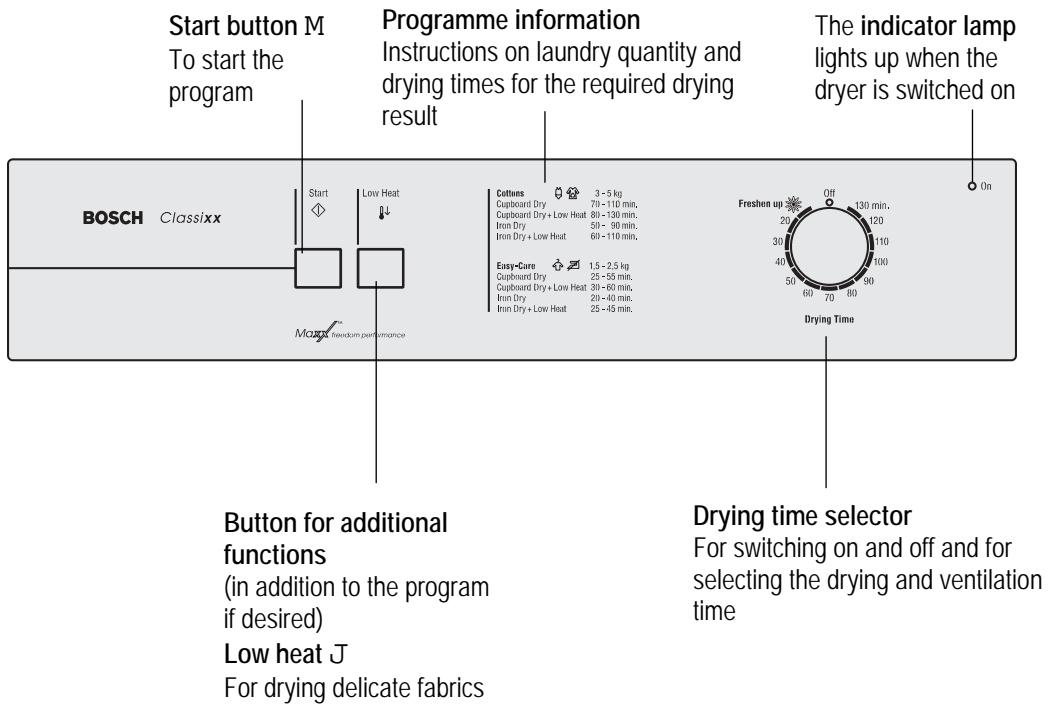
Control panel 11
Notes on laundry.... 12
Labelling of fabrics.... 12
Tips on drying 13
First use....14
Drying 14
Selecting a program 15
Selecting.... 15
Programme information/table 16
Additional function 16
Low heat button J.... 16
Cleaning and care.... 17
Cleaning the dryer 17
Fluff filter.... 17
Troubleshooting.... 18
After-sales service 20
Technical data 21
Setting up and connecting 22
Safety notes.... 22
Setting up the dryer 23
Washer-dryer stack connection set 24
Assembling the exhaust air hose .... 24
Electrical connection.... 25
Your new dryer
With the purchase of your new dryer, you have chosen a modern, high-quality domestic appliance.
A distinctive feature of your dryer is its low energy consumption.
Every dryer which leaves our factory is carefully checked to ensure that it functions correctly and is in perfect condition. Our after-sales service is available should you have any questions, particularly on how to set up your dryer.
You will find further information and a selection of our products on our website:
http://www.bosch-hausgeraete.de
Read and observe this instruction manual and all other accompanying information for your dryer.
Keep all the documents in a safe place for future reference or to pass on to the next owner.
Notes on disposal
Disposing of packaging
Risk of suffocation
There is a risk of suffocation from the cardboard box and plastic film.
Do not allow children to play with the packaging.
All our packaging materials are environmentally friendly and recyclable. Please dispose of the packaging in an environmentally-responsible manner.
Any retailer or your local authority will be able to advise you on the disposal methods currently available.
Disposing of old dryers
Danger of death
Danger of death from electrical voltage or suffocation.
Your old dryer:
☐ Disconnect it from the mains.
☐ Cut through the mains cable and discard along with the plug.
☐ Break the door lock. This prevents children from locking themselves in the dryer.
Environmentally-friendly disposal conserves valuable raw materials.
Any retailer or your local authority will be able to advise you on the disposal methods currently available.
This appliance is marked according to the European directive 2002/96/EC on Waste Electrical and Electronic Equipment (WEEE). This guideline is the frame of a European-wide validity of return and recycling on Waste Electrical and Electronic Equipment.
Safety notes
Using the dryer correctly
☐ Only for domestic use.
☐ Only for drying fabrics which have been washed in water.
☐ Do not leave children unsupervised near the dryer –

Risk of explosion/fire
Solvent danger.
Do not use the dryer if:
☐ the laundry has been treated with a solvent or has been colour-treated (e.g. stain remover, petroleum ether).
Dust danger.
Do not use the dryer if:
☐ the laundry contains dust, e.g. coal dust or flour
☐ the laundry contains foam/rubber
☐ the laundry contains traces of hairspray, nail varnish remover or similar substances.
Before using the dryer
☐ Install the dryer in accordance with the installation instructions (see page 22).
☐ Do not connect the dryer if it has visible signs of damage. If in doubt, contact a specialist retailer.

Risk of explosion/fire
Do not discharge exhaust air through an outlet pipe used for waste gas from appliances which burn gas or fuels.
Observe when drying
☐ Do not leave children unsupervised near the dryer.
- Keep pets away from the dryer.
☐ Remove all objects from pockets. Look out for lighters in particular –

Risk of explosion.
Observe at the end of the program
☐ Switch off the dryer when the program has ended.
Notes on protecting the dryer
☐ Do not climb onto the dryer.
☐ Do not lean or sit on the door –

Risk of tipping
☐ Do not use any protruding components to lift the dryer.

Risk of breakage and injury
☐ Do not use detergent boosters containing solvents or dirt and stain removers in the dryer. These substances may damage the dryer.
☐ Empty the dryer completely when it is to be transported or stored.

Do not set up the dryer in a room susceptible to frost.
Environmental protection/notes on economy
Drying in an economical and environmentally-aware manner
☐ Spin the laundry thoroughly before drying.
Spin the laundry thoroughly in the washing machine before drying. The higher the spin speed, the shorter the drying time and the lower the energy consumption. You should also spin easy-care laundry.
☐ Fill to full capacity
Fill the dryer to its maximum recommended capacities. Do not exceed the capacities:
White and coloureds max. 5.0 kg
Easy-care fabrics max. 2.5 kg
☐ Ensure sufficient room ventilation
Open a window or door while drying laundry.
☐ Clean the fluff filter
Clean the filter after each drying cycle (see page 17).
☐ Do not obstruct the cooling air supply
Do not position or affix anything over the cool air inlet on the rear of the dryer.
Dryer description
Brief instructions
Before drying
Open the door.
☐ Place the laundry in the drum.
□ Close the door.
☐ Select the drying time you require using the drying time selector (see programme information on the dryer fascia).
☐ Set additional functions if required (see page 16).
☐ Press Start button M.
Adding laundry
☐ Open the door.
The drying cycle is halted.
☐ Add or remove laundry.
☐ Close the door.
☐ If necessary, select another time using the drying time selector (see programme information on the dryer fascia).
☐ Press Start button M.
After drying
Open the door.
□ Remove the laundry.
☐ Turn the drying time selector to Off m.
☐ Clean the fluff filter (see page 17).
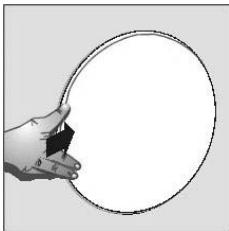
☐ Press the door to open.
☐ Close the door (you will hear a clicking noise).
Door operation
natural_image
Hand holding a circular object with a black clip, no visible text or symbolsInstalling the dryer
text_image
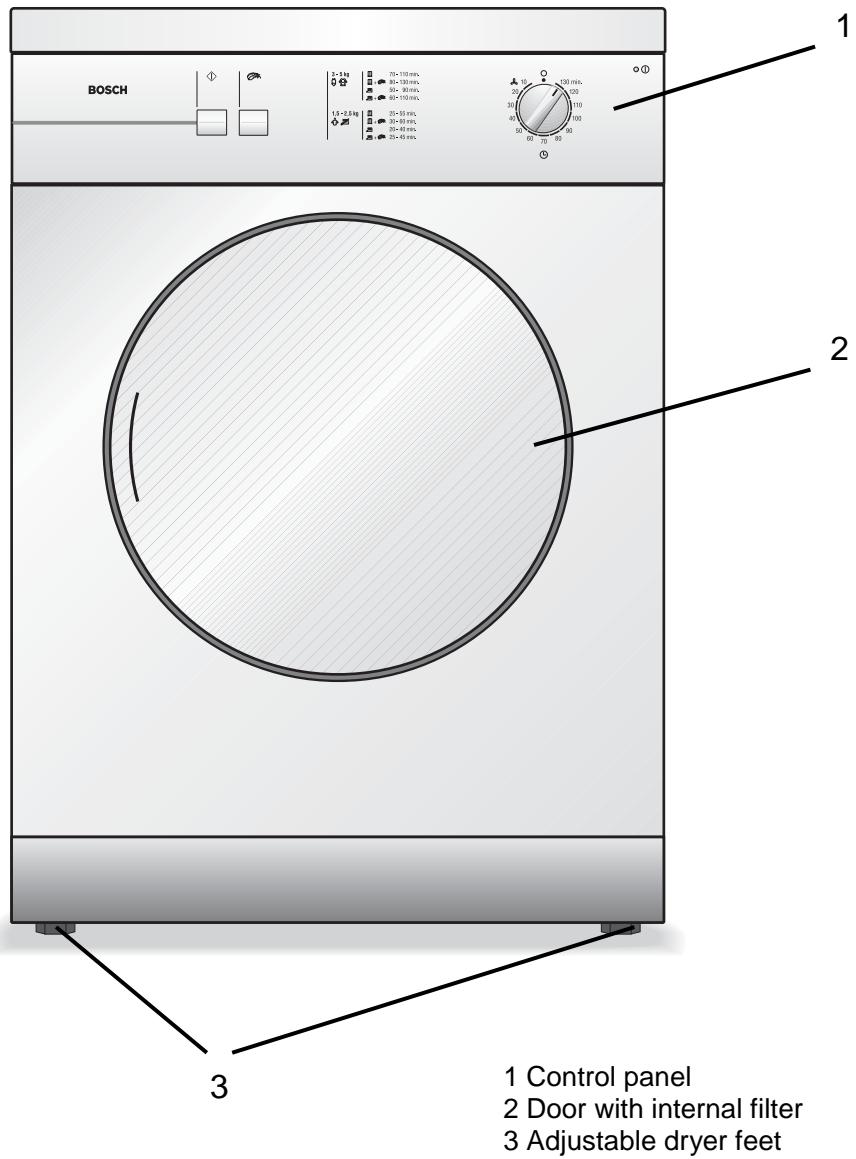
BOSCH 1 2 3 1 Control panel 2 Door with internal filter 3 Adjustable dryer feetControl panel
text_image
Start button M To start the program Programme information Instructions on laundry quantity and drying times for the required drying result The indicator lamp lights up when the dryer is switched on BOSCH Classixx Start Low Heat Cottons 3 - 5 kg Cupboard Dry 70 - 110 min, Cupboard Dry + Low Heat 80 - 130 min, Iron Dry 50 - 90 min, Iron Dry + Low Heat 60 - 110 min, Easy-Care 1.5 - 2.5 kg Cupboard Dry 25 - 55 mle. Cupboard Dry + Low Heat 30 - 60 mle, Iron Dry 20 - 40 min, Iron Dry + Low Heat 25 - 45 min. Drying Time Button for additional functions (in addition to the program if desired) Low heat J For drying delicate fabrics Drying time selector For switching on and off and for selecting the drying and ventilation timeNotes on laundry
Labelling of fabrics
Check the following fabric symbols:
| DRYING | |
 | Can be dried in a tumble-dryer |
 | Wring out and hang on a washing line to dry |
| [T5ST] | Do not wring, hang out wet to dry |
 | Wring out, lay on a flat surface to dry |
 | Do not dry in a tumble-dryer |
 | Dry at normal temperatures |
 | Dry at low temperatures |
Do not tumble-dry the following fabrics:
☐ Airtight fabrics (e.g. rubber-coated fabrics).
☐ Delicate materials (silk, curtains made from synthetic material) – they may crease
☐ Dripping-wet laundry – high energy consumption
☐ Wool or fabrics containing wool.
□ Observe the manufacturer's instructions.
Tips on drying
Important for all drying cycles:
☐ To obtain a uniform drying result: sort the laundry by fabric type and drying program.
Fasten zips, hooks and eyes. Tie loose belts, apron strings etc, together.
☐ Do not over-dry easy-care laundry: Risk of creasing. Allow laundry to finish drying in the air.
☐ Do not over-dry laundry.
☐ Do not iron laundry immediately after drying. Leave laundry folded up for a short while. This helps the residual moisture to distribute evenly.
First use
Drying
radar
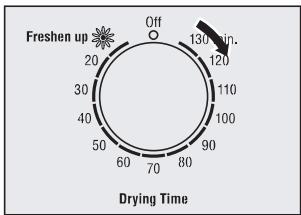
| Drying Time (min.) | Value | |---|---| | 0 | Off | | 130 | 130 | | 120 | 120 | | 110 | 110 | | 100 | 100 | | 90 | 90 | | 80 | 80 | | 70 | 70 | | 60 | 60 | | 50 | 50 | | 40 | 40 | | 30 | 30 | | 20 | 20 | | Freshen up | Off |Please read this instruction manual before using the dryer for the first time:
- Open the door.
- Place the laundry into the empty drum.
i Ensure that the drum contains only laundry.
- Close the door.
- Read the programme information – read off the required drying time and
- Set the drying time selector accordingly.
- Set additional functions if required (see page 16).
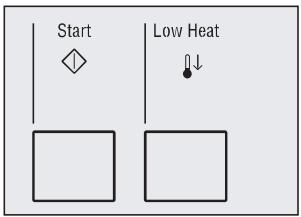
- Press Start button M.
Note
You can interrupt the drying program by opening the door.
□ Close the door.
☐ Press Start button M.
It is possible to change the drying time during drying.
- Turn the Drying time selector to "Off" m (to clear the drying time).
- Select the new drying time using the drying time selector.
- Press Start button M.
Selecting a program
Selecting
Your dryer offers different drying times and the additional Low heat J function (see page 16).
Our drying programs are designed to protect your laundry with minimum energy consumption. Due to residual heat after drying, your laundry feels damper than it really is.
If the dryness of the laundry is not sufficient after cooling down, use a longer drying time or continue drying.
The following table gives drying times for 5 kg of laundry at different spin speeds for the Cupboard dry programme.
| Type of washing | Drying temperature | Additional function | Spin speed | |
| Low heat | 1200 rpm | 800 rpm | ||
| Drying time (min) W | ||||
| Cottons + linens 5 kg | Cupboard dry | - | 70 | 110 |
| Cupboard dry + Low heat | * | 80 | 130 | |
| Iron dry | - | 50 | 90 | |
| Iron dry + Low heat | * | 60 | 110 | |
| Easy-care 2.5 kg | 1000 rpm | 800 rpm | ||
| Cupboard dry | - | 25 | 55 | |
| Cupboard dry + Low heat | * | 30 | 60 | |
| Iron dry | - | 20 | 40 | |
| Iron dry + Low heat | * | 25 | 45 | |
| Cool air S | Max. 10 | |||
Deviations from the specified values may occur due to differences in the composition of the laundry, the quantity of laundry, power fluctuations and the room temperature and humidity.
Programme information/table
Cottons + linens 3 - 5 kg
| Cupboard dry | 70 - 110 min |
| Cupboard dry + Low heat | 80 - 130 min |
| Iron dry | 50 - 90 min |
| Iron dry + Low heat | 60 - 110 min |
Easy-care 1.5 - 2.5 kg
| Cupboard dry | 25 - 55 min |
| Cupboard dry + Low heat | 30 - 60 min |
| Iron dry | 20 - 40 min |
| Iron dry + Low heat | 25 - 45 min |
Additional function
Low heat button J
flowchart
graph TD
    A["Start"] --> B["Box"]
    C["Low Heat"] --> D["Box"]
    style A fill:#fff,stroke:#000
    style C fill:#fff,stroke:#000
    style D fill:#fff,stroke:#000
Press the Low heat button J for temperature sensitive fabrics (e.g. acrylics).
Observe the fabric care instructions

The temperature is reduced.

The function remains active until the button is pressed again.
Cleaning and care
Cleaning the dryer
Risk of explosion
There is a risk of explosion from solvents.
Never use solvents for cleaning.
The dryer may be damaged if it is not cleaned correctly. Do not spray the dryer with a water jet. Do not use abrasive agents or general-purpose cleaners.
☐ Clean the housing and the control panel with a mild detergent and a soft cloth.
Fluff filter
natural_image
Diagram of a mechanical or electrical component with a textured square and directional arrow, no visible text or symbolsClean the fluff filter after each drying cycle.
Bobbling (fluff) occurs when fabrics become worn. These bobbles come off during the drying cycle and collect in the fluff filter.
A clogged filter results in longer drying times and higher energy consumption.
- Open the door.
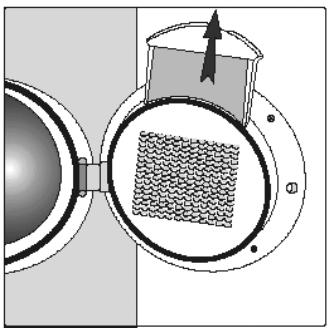
- Pull the filter out towards the top.
- Remove the fluff (by drawing your hand across the filter).
- Replace the filter (it can only be inserted one way round).
- Close the door.
Troubleshooting...
| Troubleshooting... | Cause | Solution |
| The "on" indicator lamp does not light up. | The dryer is not plugged in. | Plug in the dryer. |
| No drying time has been set. | Select the drying time you require using the drying time selector. | |
| The household fuse has tripped. | Reset/replace the fuse. | |
| The dryer does not start. | Start button M has not been pressed. | Press the button. |
| No drying time has been set. | Select the drying time you require using the drying time selector | |
| The door is not shut. | Close the door. | |
| The ambient temperature is below 5°C. | Increase the room temperature. | |
| The humidity in the room has increased significantly. | The room is not sufficiently ventilated. | Ensure sufficient ventilation. |
| The door opens by itself. | The locking pins are not engaged. | Push the door closed until you hear the locking pins click into place. |
| Drying is not satisfactory or the drying time is too long. | The filter is blocked. | Clean the filter (page 17). |
| Drying is not satisfactory | Ambient temperature is above 30°C. | Make sure that there is sufficient ventilation. |
| The wrong drying time has been set. | Set the drying time using the programme information (from page 16). | |
| Power cut for more than two hours. | Restart the program by pressing the Start button again. | |
| The laundry feels damper than it really is. | Reset the drying time if the laundry has not been dried sufficiently after cooling down. | |
| Laundry is not dried evenly | There was- too much laundry- only large items of laundry- items of laundry with different fibre constructions | Dry- small amounts of laundry- large and small items together- items according to their fibre construction. |
| Condensation in the exhaust air hose. | The exhaust air hose is too long. | Arrange the dryer so that the exhaust air hose is no more than 2 m long. |

Danger, electrical current
Repairs must only be carried out by the aftersales service or an authorised expert.
If you cannot rectify a fault yourself or a repair is necessary:
☐ Set the drying time selector to Off.
☐ Remove the plug from the socket.
☐ Contact the aftersales service (see page 20).
After-sales service
Before you contact the after-sales service, please check that you cannot rectify the malfunction yourself.
(see page 18 onwards)
If you contact the after-sales service, even within the warranty period, you will be liable for labour costs.
Please inform the aftersales service of the product number (E-Nr.) and the manufacture number (FD) of the appliance.
You will find this information in the thick edged area of the rating plate on the door frame (visible when the door is open).
E-Nr. ____ FD ____
Product number Manufacture number
Note the numbers for your appliance here.
Please help us to avoid unnecessary journeys by quoting the product and manufacture numbers. This will also save you the related additional costs.
Further information can be found on our website: http://www.bosch-hausgeraete.de
or
at our aftersales service centres.
You can still use our after-sales service even after your warranty has expired if no other repair workshops are available to you.
Technical data
| Size | Load |
| Height | 85 cm (adjustable) |
| Width | 60 cm |
| Depth | 59 cm |
| Weight | approximately 45 kg |
| Nominal capacity | 5 kg |
| A.C. voltage, connected load, fuse | see the rating plate |
| Consumption rates | Spin speed in rpm(residual moisture) | Energy consumption inkWh | |
| Cottons + linens 5 kg | |||
| Cupboard dry | 800 | (approx. 70%) | 3.35 |
| 1,000 | (approx. 62%) | 3.00 | |
| 1,200 | (approx. 55%) | 2.70 | |
| 1,400 | (approx. 50%) | 2.35 | |
| 1,600 | (approx. 47%) | 2.30 | |
The information shown represents average values under standard conditions only. Deviations of up to 10% are possible.
Setting up and connecting
Safety notes

Risk of injury
The dryer is very heavy.
Do not attempt to lift it on your own.
Do not lift the dryer by any of the protruding parts (e.g. the door) – they may break off.

Risk of tripping
There is a risk of tripping due to cables or hoses hanging down.
Secure loose cables or hoses.
Check the dryer for damage caused during transportation. Do not connect the dryer if it has visible signs of damage. If in doubt, contact a specialist retailer.
Empty the dryer completely before transporting.
Setting up the dryer

Never place the appliance behind a lockable door, a sliding door or a door with the hinge on the opposing side to the appliance.

Position the appliance so that the door of the tumble dryer can be opened unimpeded.

That exhaust air must not be discharged into a flue which is used for exhausting fumes from appliances burning gas or other fuels.
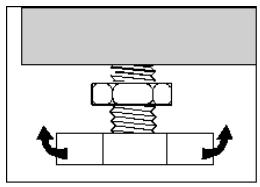
☐ The dryer must be positioned so it is level on the floor. Use a spirit level to ensure that this is the case. The height of the feet can be adjusted. If necessary, use these to line the dryer up, as described below:
☐ Loosen the counter nuts.
☐ Turn the feet so that they compensate for the height of the machine.
☐ Retighten the counter nuts.
natural_image
Mechanical assembly diagram showing a spring-loaded component with rotational arrows (no text or labels)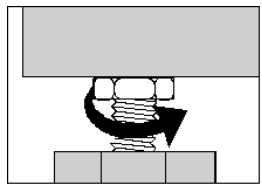
natural_image
Mechanical assembly diagram showing a bolt pressing into a spring (no text or symbols)☐ Do not trap the mains cable between the dryer and the wall.
☐ Leave a minimum distance of 10 cm between the ventilation support and the wall.

Make sure that there is easy access at all times to the earth contact socket.

The dryer cannot be assembled and disassembled.
Washer-dryer stack connection set
Order no.: WTZ 1250
Assembling the exhaust air hose
Exhaust air hose:
Order no.: WTZ 1130
☐ The dryer can be placed on top of a Bosch washing machine of the same dimensions to save space.
Risk of injury
☐ For reasons of safety, the dryer must be installed by an expert. Always use a connection set to secure the dryer to the washing machine.
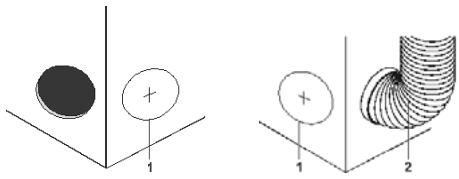
☐ There are exhaust air outlets in the left side wall and the rear panel of the dryer.
☐ Select the most suitable exhaust air outlet after installing the dryer.
☐ Turn the exhaust air hose (see Special accessories) or the adapter directly to the required exhaust air outlet. Turn the hose or adapter clockwise to do so.
☐ Seal off the other exhaust air outlet with the plastic cover.
natural_image
Two diagrams showing a black circle and a coiled tube with plus signs, labeled 1 and 2 (no text or symbols beyond labels)1 Plastic cover
2 Exhaust air hose
☐ Place the end of the exhaust air hose in the open air without bending it. The exhaust air hose should only be positioned horizontally or vertically and never left to sag.
☐ The exhaust air hose should not be more than 2m long.
☐ Position the exhaust air hose so that there is no counter pressure (e.g. from wind) on the exhaust outlet.
Electrical connection
☐ Only connect the dryer to an earth contact socket installed in accordance with regulations.
☐ Make sure that the voltage details on the rating plate (visible when the door is open) correspond with the mains voltage where the appliance is set up. The connected load and the fuse or LS machine are also specified on the rating plate.
☐ Make sure that the plug and the socket match, the cross section of the cable is sufficient and the earthing system has been installed in accordance with regulations.
☐ Do not use multiple plugs/couplings or an extension cable.
☐ Only pull the mains plug out of the socket using the grip on the plug. Do not use wet hands to connect the appliance to the mains.
☐ Only have the mains cable replaced by the after-sales service.
☐ If the power cable for the dryer is damaged, have it replaced by the manufacturer or its after-sales service.