MODE D'EMPLOI DIN36430 BEKO
Lave-vaisselle
Manuel d'utilisation
FR
Veuillez lire ce manuel d'utilisation en premier !
Cher client,
Nous espérons que vous obtiendrez les meilleurs résultats de votre produit, fabriqué avec une haute qualité et une technologie de pointe. Par conséquent, veuillez lire attentivement l'intégralité de ce manuel d'utilisation et tous les autres documents d'accompagnement avant d'utiliser le produit, et conservez-le comme référence pour une utilisation future. Si vous remettez le produit à quelqu'un d'autre, transmettez également le manuel d'utilisation. Suivez tous les avertissements et informations contenus dans le manuel. N'oubliez pas que ce manuel d'utilisation s'applique également à plusieurs autres modèles. Les différences entre les modèles seront identifiées dans le manuel.
Explication des symboles
Tout au long de ce manuel d'utilisation, les symboles suivants sont utilisés :

Informations importantes ou conseils utiles concernant l'utilisation.

Avertissement pour les situations dangereuses concernant la vie et les biens.

Avertissement pour choc électrique.

Les matériaux d'emballage du produit sont fabriqués à partir de matériaux recyclables conformément à nos réglementations nationales en matière d'environnement.
Ne jetez pas les matériaux d'emballage avec les déchets domestiques ou autres. Déposez-les aux points de collecte des matériaux d'emballage désignés par les autorités locales.

Ce produit a été fabriqué en utilisant la dernière technologie dans des conditions respectueuses de l'environnement.
Lave-vaisselle
Manuel de l'utilisateur
FR
Veuillez lire ce manuel de l'utilisateur en premier !
Cher client,
Nous espérons que vous obtiendrez les meilleurs résultats de votre produit, qui a été fabriqué avec une haute qualité et une technologie de pointe. Par conséquent, veuillez lire attentivement l'intégralité de ce manuel de l'utilisateur et tous les autres documents d'accompagnement avant d'utiliser le produit, et conservez-le comme référence pour une utilisation future. Si vous transmettez le produit à quelqu'un d'autre, remettez également le manuel de l'utilisateur. Suivez tous les avertissements et informations contenus dans le manuel de l'utilisateur. N'oubliez pas que ce manuel de l'utilisateur s'applique également à plusieurs autres modèles. Les différences entre les modèles seront identifiées dans le manuel.
Explication des symboles
Tout au long de ce manuel de l'utilisateur, les symboles suivants sont utilisés :

Informations importantes ou conseils utiles concernant l'utilisation.

Avertissement pour les situations dangereuses concernant la vie et les biens.

Avertissement pour choc électrique.

Les matériaux d'emballage du produit sont fabriqués à partir de matériaux recyclables conformément à nos réglementations nationales en matière d'environnement.
Ne jetez pas les matériaux d'emballage avec les déchets ménagers ou autres. Déposez-les aux points de collecte des matériaux d'emballage désignés par les autorités locales.
1 CONSIGNES DE SÉCURITÉ ET ENVIRONNEMENT 4
Sécurité générale 4
Utilisation prévue. 4
Sécurité des enfants. 5
Élimination des matériaux d'emballage .......5
Transport du produit............5
Conformité à la directive DEEE et élimination du produit usagé............6
Conformité à la directive RoHS......6
Informations sur l'emballage 6
2 LAVE-VAISSELLE 7
Vue d'ensemble 7
Système de séchage par ventilateur. 8
Spécifications techniques.8
3 INSTALLATION 9
Emplacement d'installation approprié ....9
Raccordement à l'alimentation en eau. 9
Raccordement à l'évacuation 10
Réglage des pieds. 10
Aquasafe+ 11
Branchement électrique. 11
Première utilisation. 11
4 PRÉPARATION 12
Conseils pour économiser l'énergie. 12
Système d'adoucissement de l'eau 12
Réglage du système d'adoucissement de l'eau 12
Ajout de sel 14
Détergent. 15
Détergents en tablettes. 16
Produit de rinçage 17
Articles non adaptés au lavage en lave-vaisselle. 18
Placement de la vaisselle dans le lave-vaisselle. 18
Panier à couverts 20
Panier à couverts 20
Pics du panier inférieur rabattables. 21
Pics du panier inférieur rabattables. 21
Supports de lavage pour plateaux 22
Accessoire SoftTouch 22
Porte-verres du panier inférieur 22
Support multifonction / réglable en hauteur du panier inférieur 23
Fil pour bouteilles du panier inférieur 24
Support réglable en hauteur du panier supérieur 24
Support multifonction du panier supérieur 24
Réglage de la hauteur du panier supérieur 25
Pics rabattables du panier supérieur 26
Réglage de la hauteur avec panier vide 26
Panier à couverts suspendu 27
Panier à couverts suspendu 27
5 UTILISATION DE L'APPAREIL 28
Touches 29
Touches de fonction 29
Préparation de la machine 29
Sélection du programme 29
Fonctions auxiliaires 31
Programmation du temps de lavage 32
Démarrage du programme 33
Annulation du programme 33
Réglage de la quantité de produit de rinçage... 34
Indicateur de sel (S) 34
Indicateur de produit de rinçage (34)
Fin du programme 34
Avertissement de coupure d'eau 34
Avertissement de débordement 35
InnerClean 35
6 MAINTENANCE ET
NETTOYAGE 36
Nettoyage de la surface extérieure du produit 36
Nettoyage de l'intérieur de la machine 36
Nettoyage des filtres 36
Nettoyage du filtre du tuyau 37
Nettoyage des turbines 38
Turbine inférieure 38
Turbine supérieure 38
7 DÉPANNAGE 39
1 Consignes de sécurité et environnement
Cette section contient des consignes de sécurité qui vous aideront à vous protéger contre les risques de blessures ou de dommages matériels. Le non-respect de ces consignes annulera toutes les garanties.
Sécurité générale
- Ne placez jamais le produit sur un sol recouvert de moquette ; sinon, le manque de circulation d'air sous le produit provoquera une surchauffe des composants électriques. Cela entraînera des problèmes avec votre produit.
- Ne faites pas fonctionner le produit si le câble d'alimentation ou la fiche est endommagé ! Appelez le service après-vente agréé.
- Branchez le produit sur une prise mise à la terre protégée par un fusible conforme aux valeurs du tableau « Caractéristiques techniques ». Ne négligez pas de faire réaliser l'installation de mise à la terre par un électricien qualifié. Notre société décline toute responsabilité pour les dommages qui surviendraient si le produit est utilisé sans mise à la terre conformément aux réglementations locales.
- Les tuyaux d'alimentation en eau et de vidange doivent être solidement fixés et rester en bon état.
- Débranchez le produit lorsqu'il n'est pas utilisé.
- Ne lavez jamais le produit en versant ou en projetant de l'eau dessus ! Il y a un risque de choc électrique !
- Ne touchez jamais la fiche avec des mains mouillées ! Ne débranchez jamais en tirant sur le câble, tirez toujours en saisissant la fiche.
- Le produit doit être débranché pendant les procédures d'installation, d'entretien, de nettoyage et de réparation.
- Faites toujours effectuer les procédures d'installation et de réparation par le service après-vente agréé. Le fabricant ne pourra être tenu responsable des dommages pouvant résulter de procédures effectuées par des personnes non autorisées.
- N'utilisez jamais de solvants chimiques dans le produit. Ils présentent un risque d'explosion.
- Lorsque vous tirez complètement les paniers supérieur et inférieur, la porte du produit supportera tout le poids des paniers. Ne posez pas d'autres charges sur la porte ; sinon, le produit pourrait basculer.
- Ne laissez jamais la porte du produit ouverte en dehors des procédures de chargement et de déchargement.
- N'ouvrez pas la porte du produit lorsqu'il fonctionne, sauf si nécessaire. Soyez prudent face à la bouffée de vapeur chaude lorsque vous devez ouvrir la porte.
Utilisation prévue
Ce produit a été conçu pour un usage domestique. Il doit être utilisé uniquement pour la vaisselle de type domestique.
- Cet appareil est destiné à être utilisé dans des applications domestiques et similaires, telles que :
- les coins cuisine du personnel dans les magasins, les bureaux et autres environnements de travail ;
- les maisons de campagne ;
- par les clients des hôtels, motels et autres environnements de type résidentiel ;
- les environnements de type chambre d'hôtes. Seuls des détergents, des produits de rinçage et des additifs adaptés au lave-vaisselle doivent être utilisés.
- Le fabricant décline toute responsabilité en cas d'utilisation incorrecte ou de transport inapproprié.
- La durée de vie de votre produit est de 10 ans. Pendant cette période, des pièces de rechange d'origine seront disponibles pour assurer le bon fonctionnement de l'appareil.
- Cet appareil peut être utilisé par des enfants âgés de 8 ans et plus et par des personnes ayant des capacités physiques, sensorielles ou mentales réduites ou manquant d'expérience et de connaissances, à condition qu'ils soient supervisés ou qu'ils aient reçu des instructions concernant l'utilisation de l'appareil en toute sécurité et qu'ils comprennent les risques encourus. Les enfants ne doivent pas jouer avec l'appareil. Le nettoyage et l'entretien ne doivent pas être effectués par des enfants sans surveillance.
Sécurité des enfants
- Les produits électriques sont dangereux pour les enfants. Tenez les enfants éloignés du produit lorsqu'il est en cours d'utilisation. Ne les laissez pas manipuler le produit.
- N'oubliez pas de fermer la porte du produit lorsque vous quittez la pièce où il se trouve.
- Rangez tous les détergents et additifs dans un endroit sûr, hors de portée des enfants.
Élimination des matériaux d'emballage
Les matériaux d'emballage sont dangereux pour les enfants. Conservez les matériaux d'emballage dans un endroit sûr, hors de portée des enfants. Les matériaux d'emballage du produit sont fabriqués à partir de matériaux recyclables. Éliminez-les correctement et triez-les conformément aux instructions de recyclage des déchets. Ne les jetez pas avec les déchets ménagers ordinaires.
Transport du produit

Si vous devez déplacer le produit, faites-le en position verticale et tenez-le par l'arrière. L'incliner vers l'avant peut mouiller et endommager les pièces électroniques.
- Débranchez le produit avant de le transporter.
- Retirez les raccordements d'évacuation et d'alimentation en eau.
- Videz complètement l'eau restante dans le produit.
Conformité à la directive DEEE et élimination du produit en fin de vie
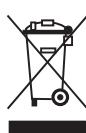
Ce produit est conforme à la directive DEEE de l'UE
(2012/19/UE). Ce produit porte un symbole de classification
pour les déchets d'équipements électriques et électroniques (DEEE).
Ce produit a été fabriqué avec des pièces et des matériaux de haute qualité qui peuvent être réutilisés et sont adaptés au recyclage. Ne jetez pas le produit en fin de vie avec les déchets ménagers ou autres. Déposez-le dans un centre de collecte pour le recyclage des équipements électriques et électroniques. Consultez les autorités locales pour connaître ces centres de collecte.
Conformité à la directive RoHS
Le produit que vous avez acheté est conforme à la directive RoHS de l'UE (2011/65/UE). Il ne contient pas de substances nocives et interdites spécifiées dans la directive.
Les matériaux d'emballage du produit sont fabriqués à partir de matériaux recyclables conformément à nos réglementations nationales sur l'environnement. Ne jetez pas les matériaux d'emballage avec les déchets ménagers ou autres. Déposez-les aux points de collecte des matériaux d'emballage désignés par les autorités locales.
2 Lave-vaisselle
Aperçu

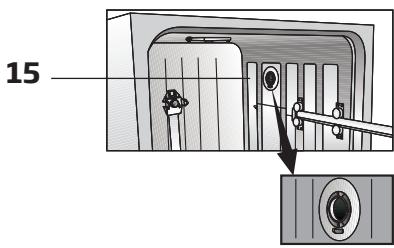
- Panier supérieur
- Bras d'aspersion supérieur
- Bras d'aspersion inférieur
- Panier à couverts
- Porte
- Étiquette signalétique
- Panneau de commande
- Distributeur de détergent
- Panier inférieur
- Filtres
- Couvercle du réservoir de sel
- Rail du panier supérieur
- Panier à couverts supérieur (selon modèle)
- Plan de travail (selon modèle)
- Système de séchage par ventilation (selon modèle)
Caractéristiques techniques
Conformité CE aux normes et données d'essai / Déclaration de conformité CE. Ce produit est conforme aux directives européennes suivantes ; les étapes de développement, de production et de vente de ce produit respectent les règles de sécurité incluses dans toutes les réglementations de la Communauté européenne applicables.
2014/35/UE, 2014/30/UE, 93/68/CEE, IEC 60436/DIN 44990, EN 50242
| Power input | 220-240 V, 50 Hz (see rating label) |
| Total power consumption | 1800-2100 W (see rating label) |
| Heater power consumption | 1800 W (see rating label) |
| Total current (depends on the model) | 10 A (see rating label) |
| Drain pump power consumption | 30 W (see rating label) |
| Water pressure | 0.3 -10 bar (= 3 - 100 N/cm² = 0.01-1.0 Mpa) |
| i | Technical specifications may be changed without prior notice to improve the quality of the product. |
| i | Figures in this manual are schematic and may not match the product exactly. |
| i | Values stated on the markings of the product or in the printed documents accompanying the product are obtained in the laboratory on basis of the relevant standards. Depending on operational and environmental conditions of the product, these values may vary. |
Système de séchage par ventilation
(selon le modèle)
Le système de séchage par ventilation assure un séchage efficace de votre vaisselle.
Il est normal d'entendre un son différent de celui du cycle de lavage pendant le fonctionnement du ventilateur.
Note pour les instituts de test :
Les données requises pour les tests de performance seront fournies sur demande. Les demandes peuvent être envoyées par e-mail à l'adresse suivante :
dishwasher@standardloading.com
N'oubliez pas de fournir le code, le numéro de stock et le numéro de série du produit à tester dans votre e-mail de demande, ainsi que vos coordonnées. Le code, le numéro de stock et le numéro de série du produit se trouvent sur la plaque signalétique fixée sur la paroi latérale de la porte.
3 Installation
Reportez-vous au service après-vente agréé le plus proche pour l'installation de votre produit. Pour préparer le produit à l'utilisation, assurez-vous que les systèmes d'alimentation électrique, d'arrivée d'eau et d'évacuation des eaux usées sont appropriés avant d'appeler le service après-vente agréé. S'ils ne le sont pas, faites appel à un technicien qualifié et à un plombier pour effectuer les aménagements nécessaires.
| i | Preparation of the location and electrical, tap water and waste water installations at the place of installation is under customer's responsibility. |
| 4 | Installation and electrical connections must be carried out by the Authorised Service Agent. Manufacturer shall not be held responsible for damages arising from processes carried out by unauthorised persons. |
| ! | Prior to installation, visually check if the product has any defects on it. If so, do not have it installed. Damaged products cause risks for your safety. |
| i | Make sure that the water inlet and discharge hoses are not folded, pinched or crushed while pushing the product into its place after installation or cleaning procedures. |
Lors de l'installation du produit, veillez à ne pas endommager le sol, les murs, les tuyaux, etc. Ne soulevez pas le produit par sa porte ou son panneau pour le déplacer.
Emplacement d'installation approprié
- Placez le produit sur un sol solide et plat ayant une capacité de charge suffisante ! Le produit doit être installé sur une surface plane afin que la porte puisse se fermer confortablement et en toute sécurité.
- N'installez pas le produit dans des endroits où la température peut descendre en dessous de 0 °C.
- Placez le produit à au moins 1 cm des bords des autres meubles.
- Placez le produit sur un sol rigide. Ne le placez pas sur un tapis à poils longs ou des surfaces similaires.
Ne placez pas le produit sur le câble d'alimentation.
Assurez-vous de choisir un emplacement qui vous permettra de charger et décharger la vaisselle rapidement et confortablement. Installez le produit dans un endroit proche du robinet et de l'évacuation. Choisissez l'emplacement en tenant compte du fait qu'il ne sera pas modifié après les branchements.
Raccordement de l'alimentation en eau

Nous recommandons de fixer un filtre sur l'entrée d'eau de la maison/appartement pour protéger la machine des dommages pouvant résulter des impuretés (sable, saleté, rouille, etc.) provenant du réseau d'eau urbain ou de votre propre système d'eau, et pour éviter les désagréments tels que le jaunissement ou l'accumulation de boue en fin de lavage.
Température de l'eau autorisée : jusqu'à 25 °C
Le lave-vaisselle ne doit pas être raccordé à des dispositifs d'eau chaude ouverts ou à des chauffe-eau instantanés.
- N'utilisez pas de tuyau d'arrivée d'eau ancien ou usagé sur le nouveau produit. Utilisez le nouveau tuyau d'arrivée d'eau fourni avec le produit.
- Connectez le tuyau d'arrivée d'eau directement au robinet. La pression du robinet doit être comprise entre 0,3 et 10 bars. Si la pression de l'eau dépasse 10 bars, un réducteur de pression doit être installé entre les deux.
- Ouvrez complètement les robinets après les branchements pour vérifier les fuites d'eau.

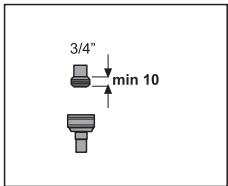
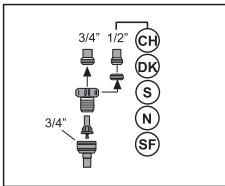
Utilisez un raccord à visser pour connecter le tuyau d'arrivée d'eau à un robinet avec un filetage externe de 3/4 de pouce. Si nécessaire, utilisez un filtre pour filtrer les dépôts des canalisations.

Pour votre sécurité, fermez complètement le robinet d'arrivée d'eau après la fin du programme de lavage.
Raccordement à l'évacuation
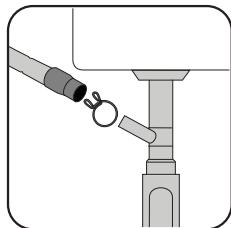
Le tuyau d'évacuation de l'eau peut être directement raccordé au trou d'évacuation ou à la canalisation du lavabo. La longueur de ce raccordement doit être d'au moins 50 cm et d'au plus 100 cm à partir du sol. Un tuyau d'évacuation de plus de 4 mètres provoque un lavage sale.
Fixez le tuyau d'évacuation de l'eau au tuyau d'évacuation sans le plier. Fixez fermement le tuyau d'évacuation de l'eau au tuyau d'évacuation afin d'éviter tout déplacement du tuyau d'évacuation de l'eau pendant le fonctionnement du produit.
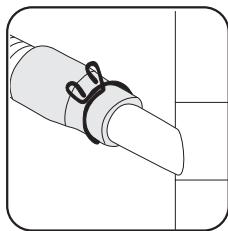
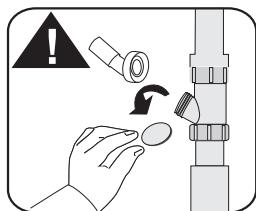
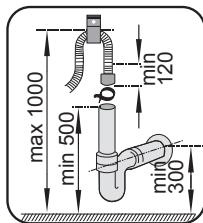

Le tuyau d'évacuation doit être raccordé au réseau d'assainissement et ne doit pas être raccordé à une eau de surface.
Réglage des pieds
Si la porte du produit ne se ferme pas correctement ou si le produit oscille lorsque vous le poussez légèrement, vous devez régler les pieds du produit. Réglez les pieds du produit comme illustré dans le manuel d'installation fourni avec le produit.
Aquasafe+
(selon le modèle)
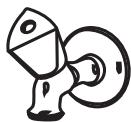
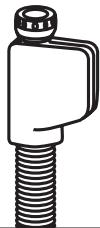
Le système Aquasafe+ protège contre les fuites d'eau qui peuvent se produire à l'entrée du tuyau. Le contact de l'eau avec le boîtier de vanne du système doit être évité pour éviter d'endommager le système électrique. Si le système Aquasafe+ est endommagé, débranchez le produit et appelez le service après-vente agréé.

Comme l'ensemble de tuyaux contient des connexions et des assemblages électriques, ne raccourcissez jamais et n'allongez jamais le tuyau avec des tuyaux de rallonge.
Connexion électrique
Connectez le produit à une prise mise à la terre protégée par un fusible conforme aux valeurs du tableau "Caractéristiques techniques". Notre société ne sera pas responsable des dommages qui surviendront si le produit est utilisé sans mise à la terre conformément aux réglementations locales.
- La connexion doit être conforme aux réglementations nationales. La fiche du câble d'alimentation doit être facilement accessible après l'installation.
Débranchez le produit après la fin du programme de lavage.
- La tension et la protection par fusible ou disjoncteur autorisée sont spécifiées dans la section "Caractéristiques techniques". Si la valeur du courant du fusible ou du disjoncteur dans la maison est inférieure à 16 ampères, faites installer un fusible de 16 ampères par un électricien qualifié. La tension spécifiée doit être égale à votre tension secteur.
- Ne faites pas de connexions via des rallonges ou des multiprises.

Les câbles d'alimentation endommagés doivent être remplacés par le service après-vente agréé.

Si votre lave-vaisselle est équipé d'un éclairage intérieur, l'ampoule ne doit être remplacée que par le service après-vente agréé en cas de panne.

Si le produit présente une panne, il ne doit pas être utilisé tant qu'il n'a pas été réparé par le service après-vente agréé ! Il y a un risque de choc électrique !
Première utilisation
Avant de commencer à utiliser le produit, assurez-vous que toutes les préparations sont faites conformément aux instructions des sections « Consignes de sécurité importantes » et « Installation ».
- Pour préparer le produit à la vaisselle, effectuez la première opération avec le programme le plus court et du détergent, la machine étant vide. Lors de la première utilisation, remplissez le réservoir de sel avec 1 litre d'eau avant de le remplir de sel.

Il peut rester une petite quantité d'eau dans le produit après les tests de contrôle qualité en usine. Cela ne nuit pas au produit.
4 Préparation
Conseils pour économiser l'énergie
Les informations suivantes vous aideront à utiliser le produit de manière écologique et économe en énergie.
Essuyez les gros restes d'aliments sur la vaisselle avant de la placer dans le produit.
Faites fonctionner le produit après l'avoir complètement rempli.
Lors du choix d'un programme, consultez le tableau « Données du programme et valeurs de consommation moyennes ».
Ne mettez pas plus de détergent que ce qui est suggéré sur l'emballage du détergent.
Système d'adoucissement de l'eau
Le produit est équipé d'un système d'adoucissement de l'eau qui réduit la dureté de l'eau entrante. Ce système adoucit l'eau d'alimentation à un niveau qui permettra de laver la vaisselle avec la qualité requise.

La dureté de l'eau du réseau doit être adoucie si elle dépasse 7 °dH. Sinon, les ions de dureté s'accumuleront sur la vaisselle lavée et pourraient affecter les performances de lavage, de rinçage et de séchage de la machine.
Réglage du système d'adoucissement de l'eau
Les performances de nettoyage, de rinçage et de séchage de votre lave-vaisselle augmenteront si le système d'adoucissement de l'eau est réglé correctement.
Réglez le nouveau niveau de dureté de l'eau conformément aux instructions sur le niveau de dureté de l'eau dans ce livret.
Utilisez la bandelette de test fournie avec le produit selon les étapes ci-dessous pour déterminer le niveau de dureté de votre eau d'alimentation.
| a
Remove the test strip from the packet. | b
Turn on the tap and let the water run for about a minute. | c
Hold the test strip in the water for about a second. | d
Remove the test strip from the water and shake it. | e
Wait for 1 minute. | f
The test strip shows you the hardness level. |
Après avoir déterminé le niveau de dureté de l'eau d'alimentation :
- Allumez la machine, appuyez simultanément sur les touches Départ différé et P+ / P. Après l'affichage du compte à rebours (3, 2, 1), maintenez les touches enfoncées pendant un moment.
- Appuyez sur la touche P+ / P pour activer la position (r..).
- À l'aide de la touche Départ différé, réglez le niveau de dureté de l'eau en fonction de la dureté de l'eau d'alimentation. Voir le tableau de réglage du niveau de dureté de l'eau pour le réglage correct.
- Appuyez sur la touche Marche / Arrêt pour enregistrer le réglage.
Tableau de réglage du niveau de dureté de l'eau
| Hardness Level | English Water Hardness °dE | German Water Hardness °dH | French Water Hardness °dF | Water Hardness Level Indicator |
| 0th Level | 0-5 | 0-4 | 0-8 | Press the Time Delay key to switch the water hardness level to position 1. (r1) |
| 1st Level | 6-9 | 5-7 | 9-13 |
| 2nd Level | 10-15 | 8-12 | 14-22 | Press the Time Delay key to switch the water hardness level to position 2. (r2) |
| 3rd Level | 16-19 | 13-15 | 23-27 | Press the Time Delay key to switch the water hardness level to position 3. (r3) |
| 4th Level | 20-24 | 16-19 | 28-34 | Press the Time Delay key to switch the water hardness level to position 4. (r4) |
| 5th Level | 25-62 | 20-50 | 35-90 | Press the Time Delay key to switch the water hardness level to position 5. (r5) |
Effectuez le même réglage de dureté que celui effectué sur le panneau de commande également avec l'interrupteur de réglage de régénération. Par exemple, si vous avez réglé le panneau de commande sur le « 3e niveau », réglez également l'interrupteur de réglage de régénération sur le 3e niveau.
| Regeneration Adjustment Switch | 0th Level | 1st Level | 2nd Level | 3rd Level | 4th Level | 5th Level |
| 1 | 1 | 2 | 3 | 4 | 5 | |
Si le niveau de dureté de l'eau d'alimentation est supérieur à 90 °dF ou si vous utilisez de l'eau de puits, il est recommandé d'utiliser des dispositifs de purification de l'eau et des filtres spéciaux. Si le niveau de dureté de l'eau d'alimentation est inférieur à 13 °dF, il n'est pas nécessaire d'utiliser du sel dans votre lave-vaisselle. Dans ce cas, le témoin d'absence de sel (s'il existe) s'allume en continu sur le panneau de votre machine. Si le réglage du niveau de dureté de l'eau est réglé sur le niveau 1, le témoin d'absence de sel s'allumera en continu bien qu'il ne soit pas nécessaire d'utiliser du sel. Si vous utilisez du sel dans ces conditions, le sel ne sera pas consommé et le témoin de sel ne s'allumera pas.

Si vous déménagez, il est nécessaire de réajuster le niveau de dureté de l'eau de votre machine en tenant compte des informations données ci-dessus, selon le niveau de dureté de l'eau d'alimentation de votre nouveau lieu de résidence. Votre machine affichera le niveau de dureté de l'eau le plus récemment réglé.
Ajout de sel
Le système d'adoucissement de l'eau doit être régénéré pour que le produit fonctionne avec les mêmes performances en continu. Le sel pour lave-vaisselle est utilisé à cette fin.

Utilisez uniquement des sels adoucissants spéciaux produits spécialement pour les lave-vaisselle dans votre machine.

Il est recommandé d'utiliser des sels adoucissants sous forme de granulés ou de poudre dans le système d'adoucissement de l'eau. N'utilisez pas de sels qui ne se dissolvent pas complètement dans l'eau, comme le sel de table ou le sel gemme. Sinon, les performances du système pourraient se détériorer avec le temps.

Le réservoir de sel se remplira d'eau lorsque vous démarrerez le produit. Pour cette raison, ajoutez du sel avant de faire fonctionner la machine.
- Tout d'abord, retirez le panier inférieur pour ajouter du sel adoucissant.
- Tournez le couvercle du réservoir de sel dans le sens inverse des aiguilles d'une montre pour l'ouvrir (A, B).
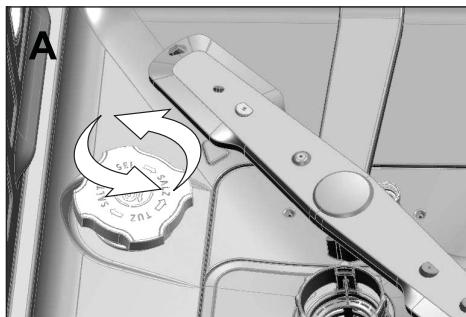
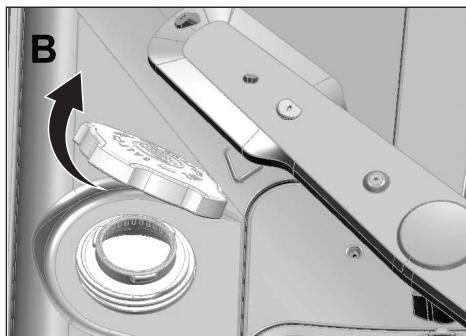
- Ajoutez 1 litre d'eau dans le réservoir de sel de votre machine uniquement lors de la première utilisation (C).
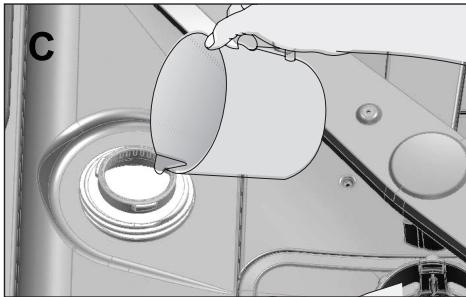
- Remplissez le réservoir de sel avec du sel à l'aide de l'entonnoir à sel (D). Pour accélérer le taux de dissolution du sel dans l'eau, remuez-le avec une cuillère.
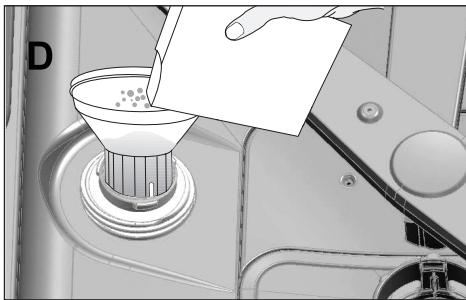

Vous pouvez mettre environ 2 kg de sel adoucissant dans le réservoir de sel.
- Replacez le couvercle et serrez-le lorsque le réservoir est plein.

Vous devez ajouter du sel juste avant de démarrer la machine. Ainsi, l'eau salée qui déborde sera évacuée immédiatement, évitant tout risque de corrosion dans la machine. Si vous ne lancez pas un lavage immédiatement, faites fonctionner votre machine à vide avec le programme le plus court.

Étant donné que les différentes marques de sel sur le marché ont des tailles de particules différentes et que la dureté de l'eau peut varier, la dissolution du sel dans l'eau peut prendre quelques heures. Par conséquent, l'indicateur de sel reste allumé pendant un certain temps après l'ajout de sel dans la machine.
Détergent
Vous pouvez utiliser des détergents en poudre, liquides/gels ou en tablettes dans la machine.

Utilisez uniquement dans la machine des détergents spécialement conçus pour les lave-vaisselle. Nous vous recommandons de ne pas utiliser de détergents contenant du chlore et des phosphates, car ils sont nocifs pour l'environnement.
Ajout du détergent

Respectez les avertissements figurant sur l'emballage du détergent pour obtenir de meilleurs résultats de lavage et de séchage. Contactez le fabricant du détergent pour toute question supplémentaire.

Ne mettez pas de solvants dans le distributeur de détergent. Risque d'explosion !
Mettez le détergent dans le distributeur juste avant de faire fonctionner la machine, comme illustré ci-dessous.
- Poussez le loquet vers la droite pour ouvrir le couvercle du distributeur de détergent (A).
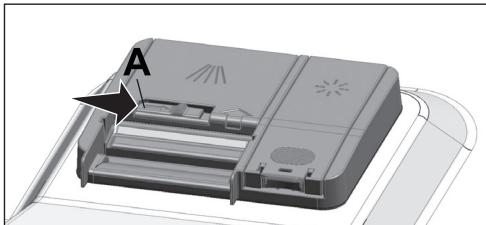
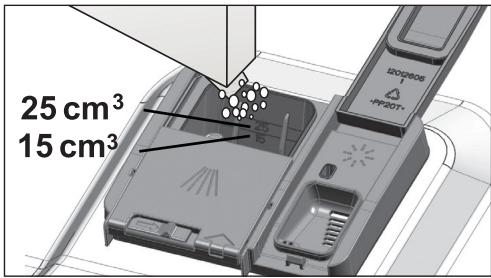
- Mettez la quantité recommandée de détergent en poudre, liquide/gel ou en tablettes dans le réservoir.

À l'intérieur du distributeur de détergent, il y a des repères de niveau qui vous aident à utiliser la quantité appropriée de détergent en poudre. Lorsqu'il est plein, le distributeur contient 45 cm³ de détergent. Remplissez le détergent jusqu'aux repères de niveau de 15 cm³ ou 25 cm³ dans le distributeur, selon le chargement de la machine et/ou le degré de salissure de la vaisselle. Une tablette suffit si vous utilisez des tablettes de détergent.
- Poussez le couvercle du distributeur de détergent pour le fermer. Un « clic » se fera entendre lorsque le couvercle est fermé.
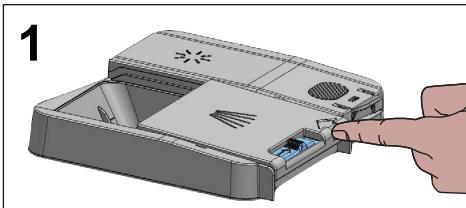
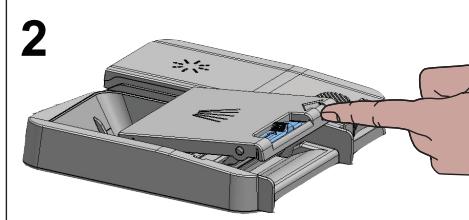
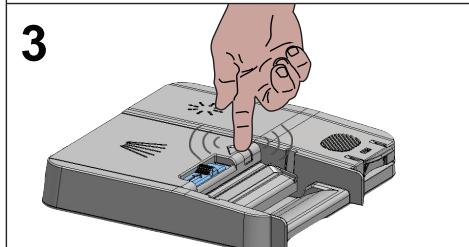

Utilisez du détergent en poudre ou liquide/gel dans les programmes courts sans prélavage, car la solubilité des tablettes de détergent varie en fonction de la température et du temps.
Tablettes de détergent
En plus des tablettes de détergent conventionnelles, il existe également des tablettes de détergent commercialisées qui ont un effet de sel régénérant et/ou de produit de rinçage. Certains types de ces détergents contiennent des composants spéciaux tels que des protecteurs de verre et d'acier inoxydable. Ces tablettes montrent leurs effets jusqu'à un certain niveau de dureté de l'eau (21°dH). Le sel régénérant
et le produit de rinçage doivent également être utilisés avec le détergent si le niveau de dureté de l'eau est supérieur au niveau mentionné.

Les meilleures performances de lavage dans les lave-vaisselle sont obtenues en utilisant séparément le détergent, le produit de rinçage et le sel régénérant.
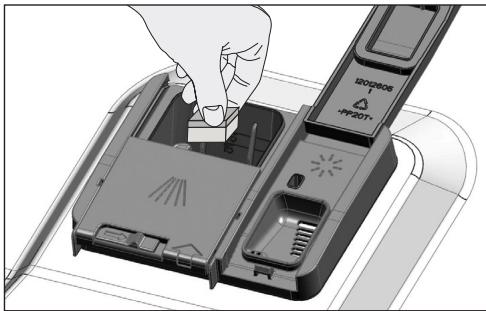

Respectez les instructions du fabricant du détergent sur l'emballage lors de l'utilisation de pastilles de détergent.

Contactez le fabricant du détergent si votre vaisselle est mouillée et/ou si vous remarquez des taches de calcaire, en particulier sur les verres, après la fin du programme de lavage lors de l'utilisation d'une pastille de détergent.
Lors du passage de la pastille de détergent à la poudre :
- Assurez-vous que les réservoirs de sel et de liquide de rinçage sont pleins.
- Réglez la dureté de l'eau au niveau le plus élevé et effectuez un cycle à vide.
- Après le cycle de lavage à vide, consultez le manuel d'utilisation et réglez à nouveau le niveau de dureté de l'eau en fonction de l'alimentation en eau.
- Effectuez les réglages appropriés du liquide de rinçage.
Liquide de rinçage

Le liquide de rinçage utilisé dans les lave-vaisselle est une combinaison spéciale qui vise à améliorer l'efficacité du séchage et à prévenir les taches d'eau ou de calcaire sur la vaisselle. Pour cette raison, il faut veiller à ce que le réservoir de liquide de rinçage soit rempli et à utiliser uniquement des liquides de rinçage spécialement conçus pour les lave-vaisselle.
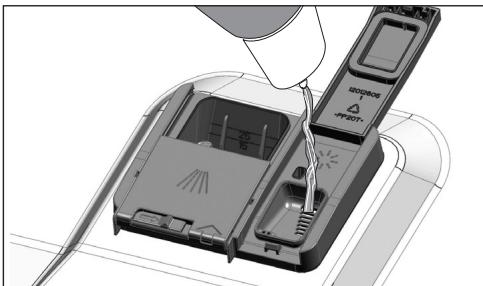
- Ouvrez le couvercle du réservoir de liquide de rinçage à l'aide du loquet.
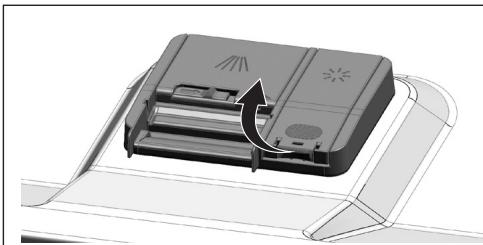
- Remplissez le réservoir jusqu'au niveau "MAX".
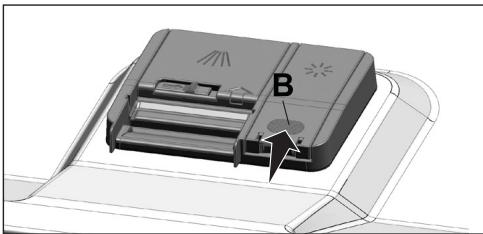
- Appuyez légèrement sur le point (B) du couvercle du réservoir pour le fermer.
- Si des taches apparaissent sur la vaisselle après le lavage, le niveau doit être augmenté ; si une trace bleue apparaît après un essuyage à la main, il doit être diminué. Ce réglage est par défaut en position 3 en usine.
| i | The rinse aid adjustment is described under "Adjusting the amount of rinse aid" in the section for operating the machine. |
| i | Wipe clean any spilled rinse aid outside the reservoir. Rinse aid that spilled accidentally will cause foaming and it will eventually decrease washing performance. |
Articles non adaptés au lavage en lave-vaisselle
- Ne lavez jamais dans votre lave-vaisselle de la vaisselle souillée par de la cendre de cigarette, des restes de bougie, du cirage, des colorants, des produits chimiques, etc.
- Ne lavez pas en lave-vaisselle les couverts et les couverts à manche en bois ou en os, les pièces collées ou les pièces qui ne résistent pas à la chaleur, ainsi que les récipients en cuivre et en étain.

Les impressions décoratives de la porcelaine, ainsi que les articles en aluminium et en argent, peuvent se décolorer ou se ternir après le lavage en lave-vaisselle, tout comme lors du lavage à la main. Certains types de verre délicats et certains cristaux peuvent devenir ternes avec le temps. Nous vous recommandons vivement de vérifier si la vaisselle que vous allez acheter convient au lavage, en particulier en lave-vaisselle.
Placer la vaisselle dans le lave-vaisselle
Vous pouvez utiliser votre lave-vaisselle de manière optimale en ce qui concerne la consommation d'énergie et les performances de lavage et de séchage uniquement si vous placez la vaisselle de manière ordonnée.
- Essuyez les gros restes d'aliments (os, graines, etc.) sur la vaisselle avant de la placer dans le lave-vaisselle.
- Placez les pièces fines et étroites dans les sections centrales des paniers si possible.
- Placez les articles très sales et plus grands dans le panier inférieur et les articles plus petits, délicats et légers dans le panier supérieur.
- Placez les récipients creux tels que les bols, les verres et les casseroles à l'envers dans le lave-vaisselle. Ainsi, l'accumulation d'eau dans les creux profonds est évitée.

Pour éviter d'éventuelles blessures, placez toujours les articles pointus et tranchants tels que la fourchette de service, le couteau à pain, etc. à l'envers, de sorte que leurs extrémités pointues soient orientées vers le bas ou qu'ils soient placés horizontalement dans le panier.
Déchargez d'abord la vaisselle du panier inférieur, puis celle du panier supérieur.
Suggestions pour charger le lave-vaisselle
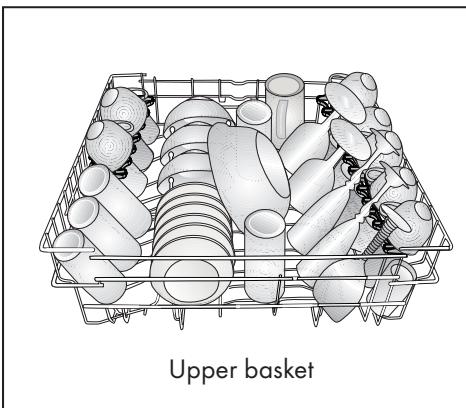
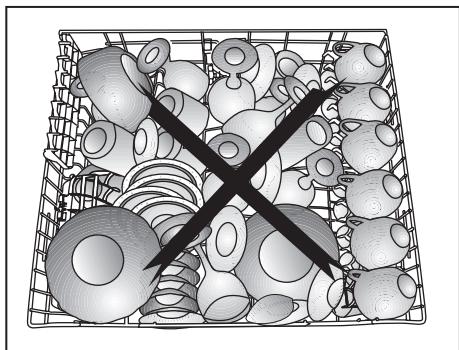
Chargement incorrect de la vaisselle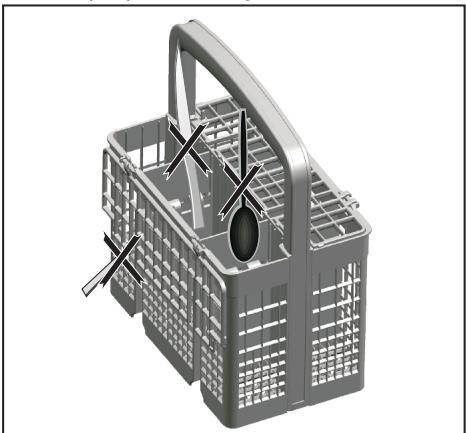
Chargement incorrect de la vaisselle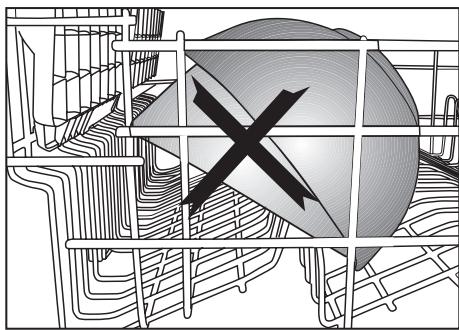
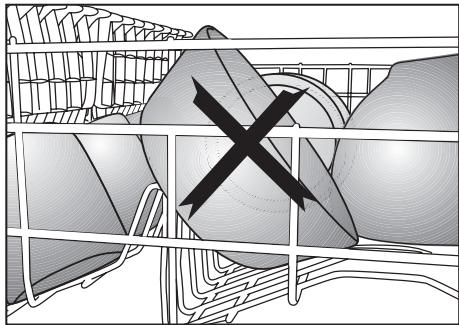
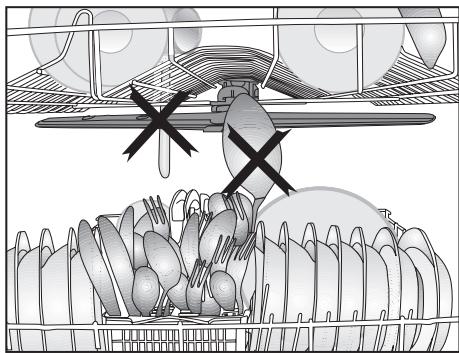
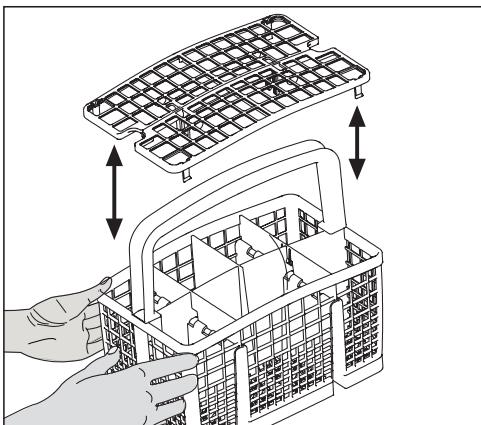
Panier à couverts
(selon le modèle)
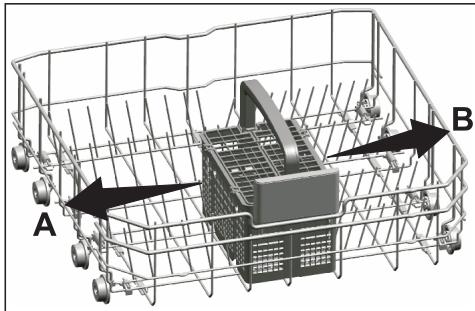
Le panier à couverts est conçu pour laver efficacement votre vaisselle telle que couteaux, fourchettes, cuillères, etc.
Comme le panier à couverts peut être déplacé (A, B), vous pouvez créer plus d'espace pour placer votre vaisselle dans le panier inférieur et libérer de l'espace pour vos plats de différentes tailles.
Panier à couverts
(selon le modèle)
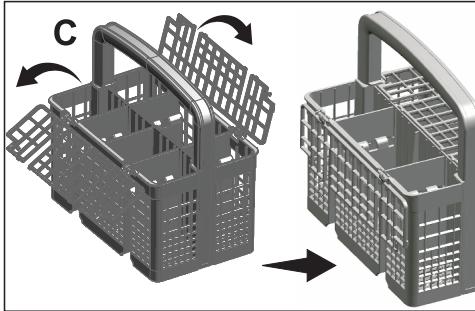
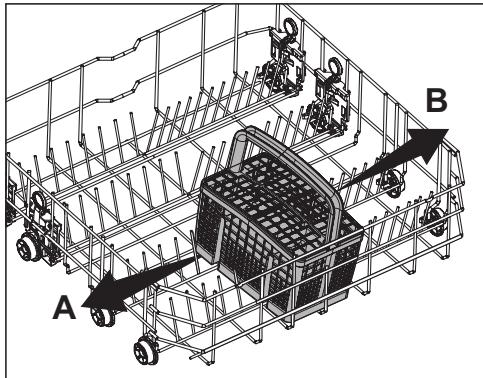
Le panier à couverts est conçu pour laver efficacement votre vaisselle telle que couteaux, fourchettes, cuillères, etc.
Comme le panier à couverts peut être déplacé (A, B), vous pouvez créer plus d'espace pour placer votre vaisselle dans le panier inférieur et libérer de l'espace pour vos plats de différentes tailles.
Pics rabattables du panier inférieur
(selon le modèle)
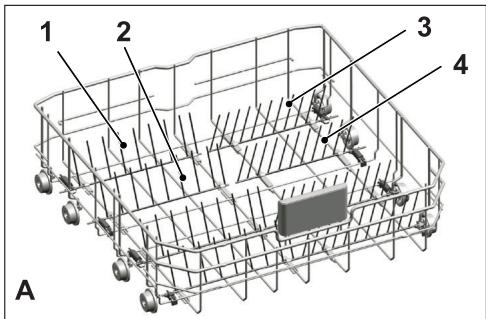
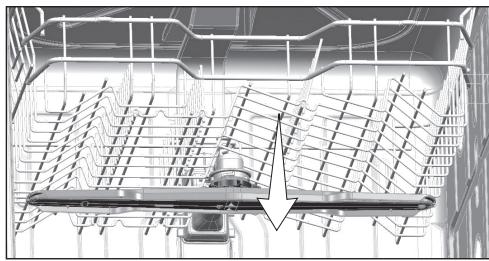
Des pics rabattables (A) situés dans le panier inférieur de la machine sont conçus pour faciliter le placement de grandes pièces telles que casseroles, bols, etc. Vous pouvez créer des espaces plus grands en rabattant chaque pic individuellement ou tous à la fois.
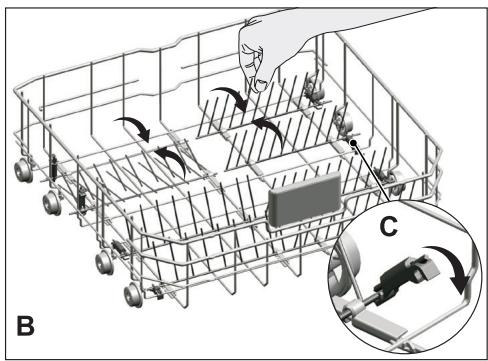
Pour mettre les pics rabattables en position horizontale, saisissez les pics par le milieu et poussez-les dans le sens des flèches (B). Pour les remettre en position verticale, il suffit de les soulever. Les pics rabattables se réenclencheront dans le loquet (C).

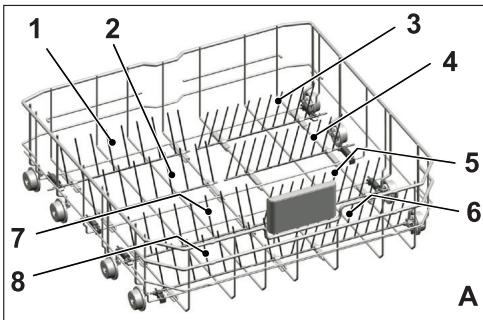
Mettre les pics en position horizontale en les tenant par les extrémités peut les faire plier. Par conséquent, il convient de les mettre en position horizontale ou verticale en les tenant par leur tige et en poussant dans le sens de la flèche.
Pics rabattables du panier inférieur
(selon le modèle)
Des pics rabattables (A) situés dans le panier inférieur de la machine sont conçus pour faciliter le placement de grandes pièces telles que casseroles, bols, etc. Vous pouvez créer des espaces plus grands en rabattant chaque pic individuellement ou tous à la fois.
Pour mettre les pics rabattables en position horizontale, saisissez les pics par le milieu et poussez-les dans le sens des flèches (B). Pour les remettre en position verticale, il suffit de les soulever. Les pics rabattables se réenclencheront dans le loquet (C).
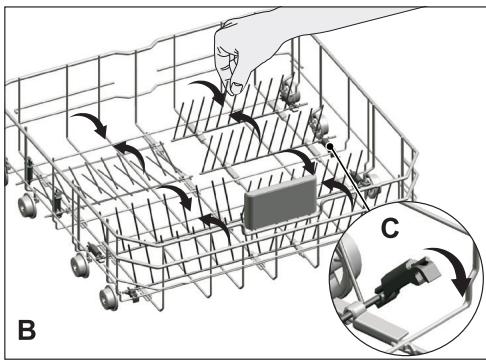

Pour amener les dents en position horizontale, ne les tenez pas par les pointes, car elles pourraient se plier. Il est donc conseillé de les amener en position horizontale ou verticale en les tenant par leur tige et en les poussant dans le sens de la flèche.
Supports de lavage pour plateaux
(selon le modèle)
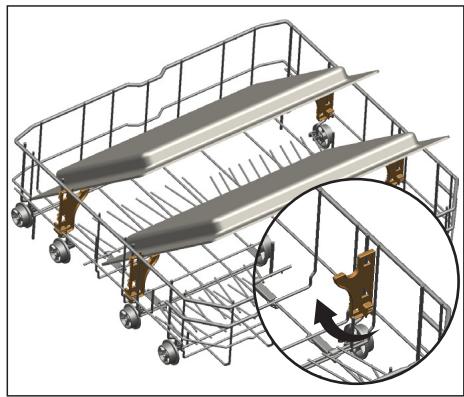
Utilisez les supports pour laver les plateaux dans le panier inférieur.
Voir la section Fonctions auxiliaires pour la sélection du programme et de la fonction appropriés.
Accessoire SoftTouch
(selon le modèle)
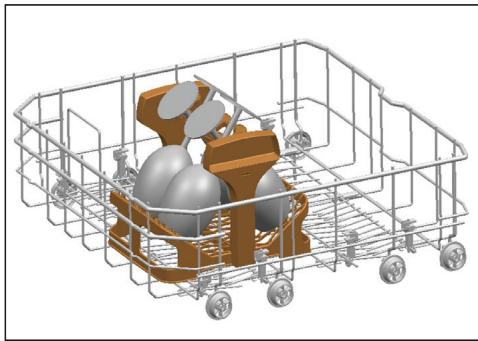
L'accessoire SoftTouch, situé dans le panier inférieur de votre appareil, permet un lavage en toute sécurité de vos verres fragiles.
Porte-verres du panier inférieur
(selon le modèle)
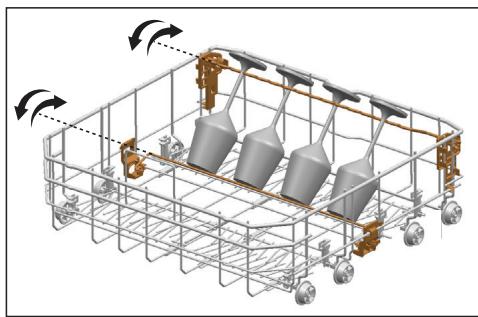
Le porte-verres du panier inférieur, situé dans le panier inférieur de votre appareil, permet un lavage en toute sécurité de vos verres surdimensionnés et hauts.
Support polyvalent / réglable en hauteur du panier inférieur
(selon le modèle)
Cet accessoire, situé dans le panier inférieur de votre appareil, vous permet de laver facilement des pièces telles que des verres supplémentaires, des louches longues et des couteaux à pain.
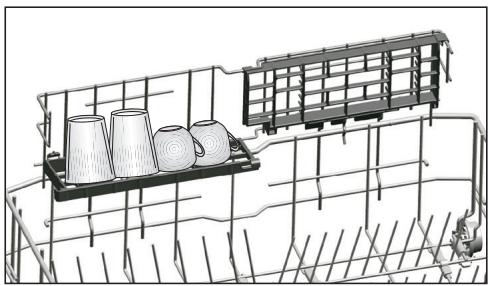
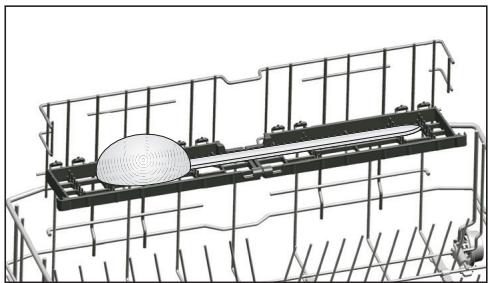
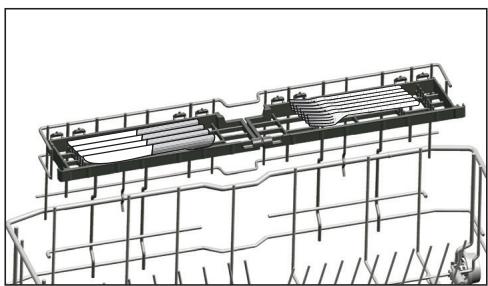

Vous pouvez utiliser les supports selon vos besoins en les déplaçant vers la position basse ou haute, ou les fermer pour créer un espace plus large dans votre panier inférieur.

Assurez-vous que la turbine ne touche pas la vaisselle placée sur les paniers.
Pour fermer les paniers :
- Pliez le panier (A).
- Faites glisser le panier vers le haut (B).
- Mettez le panier en position verticale (C).
- Faites glisser le panier vers le bas et verrouillez-le avec les ergots (D).
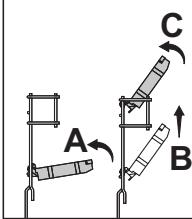
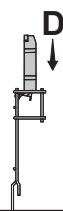
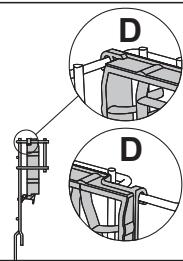

Vous pouvez ouvrir les paniers en suivant le même processus dans l'ordre inverse.
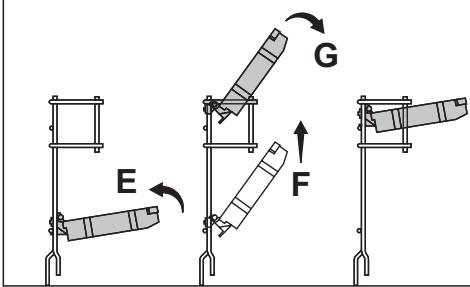
Pour régler la hauteur des paniers :
- Pliez le panier (E).
- Faites glisser le panier vers le haut (F).
- Ouvrez le panier au niveau souhaité (G).
Fil à bouteilles du panier inférieur
(selon le modèle)
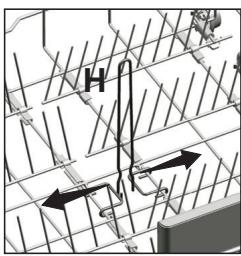
Le fil à bouteilles est conçu pour faciliter le lavage des pièces longues à large ouverture. Vous pouvez retirer le fil à bouteilles du panier lorsqu'il n'est pas utilisé en le tirant des deux côtés (H).

Panier supérieur à hauteur réglable
(selon le modèle)
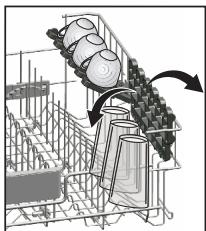
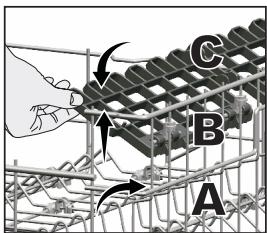
Utilisez les parties inférieure et supérieure des paniers à hauteur réglable dans le panier supérieur de la machine en les faisant glisser vers le bas ou vers le haut selon la hauteur des verres, tasses, etc. (A, B, C).
Support polyvalent du panier supérieur
(selon le modèle)
Cet accessoire situé dans le panier supérieur de votre machine vous permet de laver facilement des pièces telles que des louches extra longues et des couteaux à pain.
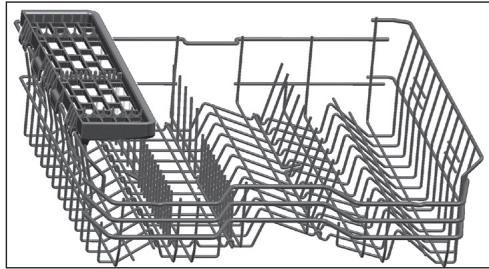
Vous pouvez soulever le support polyvalent du panier supérieur pour le retirer si vous ne souhaitez pas l'utiliser.
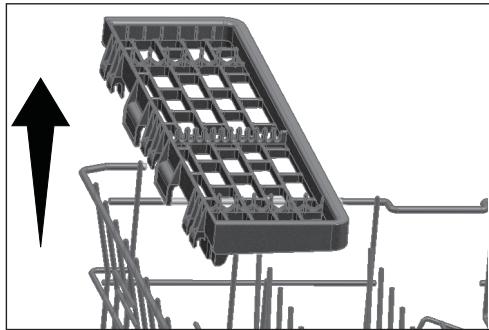
Si vous souhaitez réutiliser le support polyvalent du panier supérieur, vous pouvez facilement le fixer sur la partie latérale de votre panier supérieur.
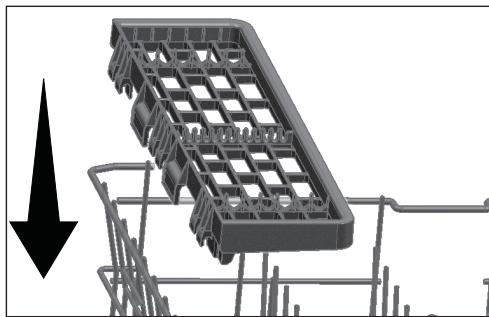
Réglage de la hauteur du panier supérieur
(selon le modèle)
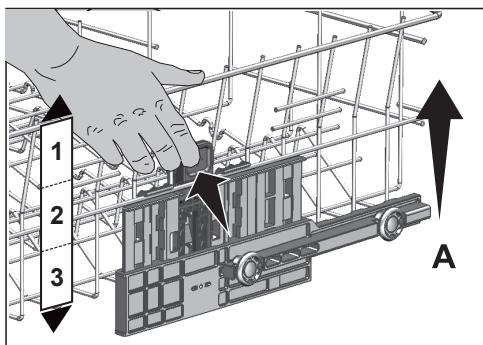
Le mécanisme de réglage de la hauteur du panier supérieur a été conçu pour vous permettre de créer de grands espaces dans les parties inférieure ou supérieure de votre machine en fonction de vos besoins, en réglant la hauteur vers le haut ou vers le bas, que votre panier soit vide ou chargé.
Grâce à ce mécanisme, vous pouvez utiliser votre panier dans trois positions différentes : basse, moyenne et haute (1, 2, 3).
- Pour remonter votre panier, tenez les fils du panier supérieur avec les deux mains pendant que le panier est en position la plus basse et tirez-les vers le haut (A).
- Vous entendrez un « clic » provenant des mécanismes droit et gauche, indiquant que le panier a atteint le niveau suivant. Relâchez le panier.
Répétez le processus si la hauteur n'est pas suffisante.
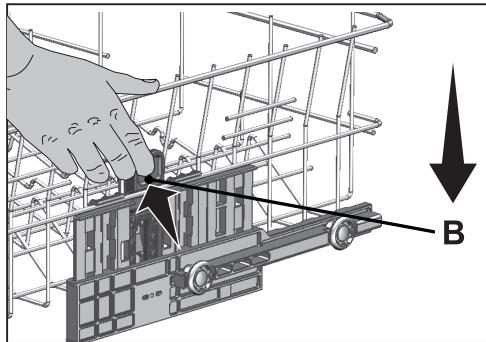
Pour abaisser le panier, lorsqu'il est en position la plus haute ;
- Tenez les fils du panier supérieur avec les deux mains, soulevez légèrement le panier et poussez simultanément les loquets illustrés sur la figure (B) pour les libérer.
- Abaissez le panier de sa position actuelle à la position inférieure.
- Relâchez le panier après qu'il a atteint un niveau inférieur.
Répétez le processus si la hauteur n'est pas suffisante.

Le mécanisme de mouvement peut ne pas fonctionner correctement si le panier supérieur est surchargé ou si la répartition du poids n'est pas équilibrée. Dans des conditions plus lourdes, il y a un risque de chute d'un niveau.

Assurez-vous que le mécanisme de réglage a les mêmes positions sur les côtés droit et gauche du panier supérieur.
Fils repliables du panier supérieur
(selon le modèle)
Vous pouvez utiliser les fils repliables lorsque vous avez besoin de plus d'espace pour votre vaisselle dans le panier supérieur de votre appareil.
Pour mettre les fils repliables en position horizontale, saisissez le fil par le milieu et poussez-le dans le sens de la flèche sur la figure. Placez vos grands plats dans l'espace créé. Pour remettre les fils en position verticale, soulevez-les simplement.
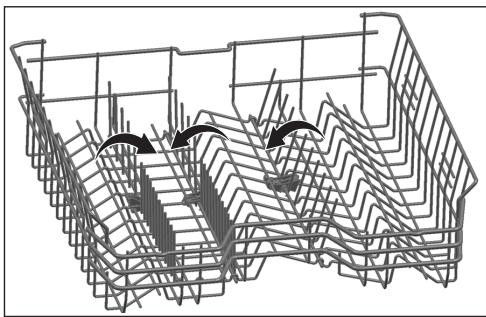

Mettre les fils en position horizontale en les tenant par les extrémités peut les faire plier. Par conséquent, tenez les fils par leur base lorsque vous les mettez en position horizontale ou verticale.
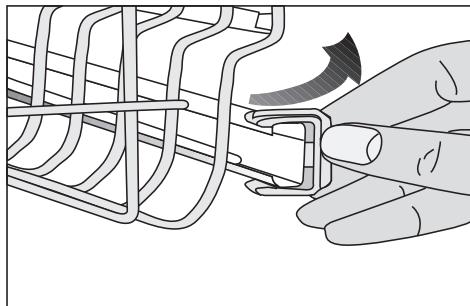
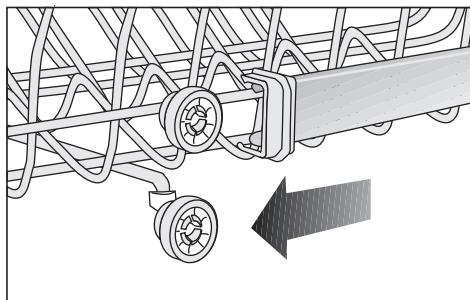
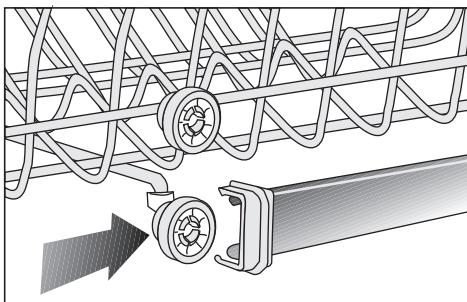
Réglage de la hauteur avec panier vide
(selon le modèle)
Sur ce modèle, le réglage de la hauteur du panier supérieur peut être modifié à l'aide des roulettes montées à deux hauteurs différentes.
Libérez les loquets sur les rails droit et gauche du panier supérieur en les poussant vers l'extérieur.
Retirez complètement le panier.
Replacez le panier dans les rails à la hauteur souhaitée.
Repoussez les loquets dans la bonne position.
Panier à couverts supérieur
(selon le modèle)
Le panier à couverts supérieur est conçu pour laver vos couverts tels que fourchettes, cuillères, etc., en les plaçant entre les barres du panier.
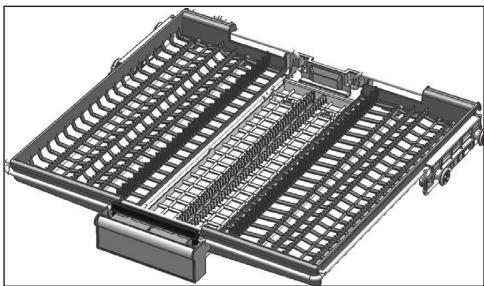
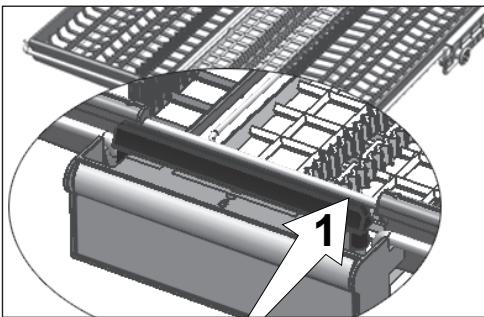
Sur les modèles avec fonction de mouvement partiel, pousser la barre (1) sur la poignée permet au plateau central du panier de descendre en position basse et le système se déverrouille. Ainsi, les plateaux latéraux droit et gauche peuvent être utilisés comme éléments mobiles.
L'espace libéré par les plateaux latéraux permet de charger de longs articles dans le panier supérieur.
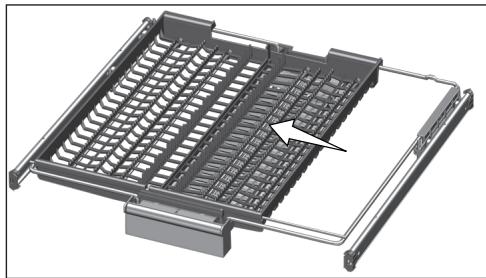
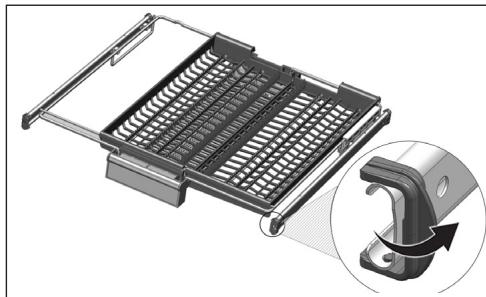
Lorsque le plateau central est en position basse, vous pouvez charger des articles longs/élevés tels que des tasses à café, des louches, etc. sur le plateau. Lorsque les plateaux latéraux s'appuient sur les deux parois latérales, la poignée peut être tirée pour permettre au plateau central de monter et au système de se verrouiller.
Panier à couverts supérieur
(selon le modèle)
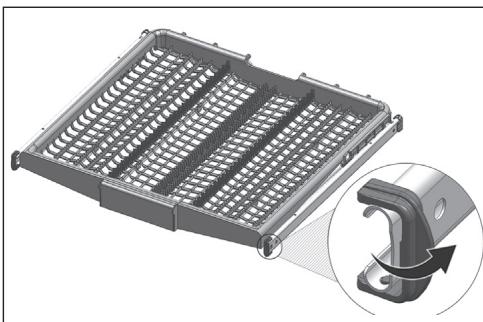
Le panier à couverts supérieur est conçu pour laver vos couverts tels que fourchettes, cuillères, etc., en les plaçant entre les barres du panier.
5 Utilisation du produit
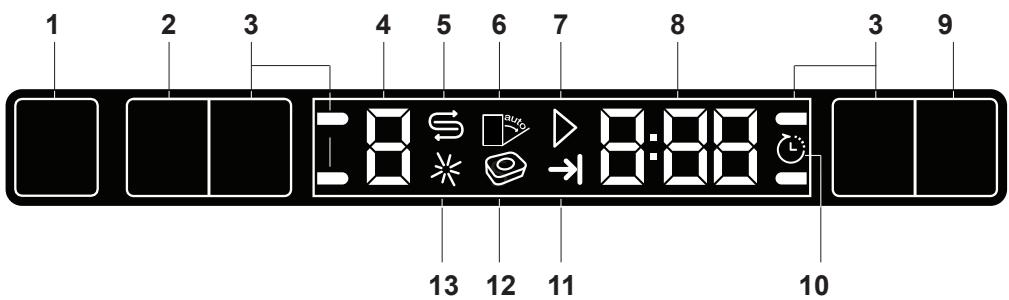
- Touche Marche/Arrêt
- Touche Sélection de programme / Annulation de programme (3 secondes)
- Touches de fonction
F1 Fonction demi-charge, F2 Fonction Fast+, F3 Fonction SteamGloss, F4 Fonction AquaIntense
- Voyant de programme
- Voyant de sel
- Non utilisé
- Voyant Départ / Annulation
- Voyant Départ différé / Durée du programme
- Touche Départ différé
- Voyant Départ différé
- Voyant Fin de programme
- Non utilisé
- Voyant de liquide de rinçage
Touches
Touche Marche / Arrêt
Lorsque vous appuyez sur la touche Marche / Arrêt, les voyants s'allument sur l'afficheur en position MARCHE. Les voyants s'éteignent en position ARRÊT.
Touche Sélection de programme / Annulation de programme
Appuyez sur cette touche jusqu'à ce que le programme souhaité apparaisse dans l'indicateur de programme.
Pour annuler le programme en cours, ouvrez la porte de l'appareil. Appuyez sur les touches Sélection de programme / Annulation de programme et maintenez-les enfoncées pendant 3 secondes. Après le compte à rebours 3 - 2 - 1, 0:01 s'affiche, fermez la porte de l'appareil et attendez la fin du processus de vidange. La vidange est terminée en 2 minutes et la machine émet un avertissement sonore lorsqu'elle est terminée.
Touches de fonction
Si vous appuyez sur l'une des touches de fonction pendant la sélection du programme ou la sélection du délai, un signal sonore de confirmation se fait entendre, à condition que la fonction correspondante soit prise en charge par le programme sélectionné. La fonction est considérée comme sélectionnée lorsque le voyant de la fonction sélectionnée est allumé. Pour annuler la fonction sélectionnée, maintenez la touche de fonction enfoncée jusqu'à ce que le voyant de la fonction disparaisse.
Préparation de la machine
- Ouvrez la porte du lave-vaisselle.
- Placez la vaisselle conformément aux instructions du manuel d'utilisation.
- Assurez-vous que les bras d'aspersion supérieur et inférieur tournent librement.
- Mettez une quantité adéquate de détergent dans le distributeur de détergent.
Sélection du programme
- Appuyez sur le bouton Marche/Arrêt pour allumer votre machine.
- Vérifiez les indicateurs de sel et de liquide de rinçage et ajoutez du sel et/ou du liquide de rinçage si nécessaire.
- Reportez-vous au tableau « Données des programmes et valeurs de consommation moyennes » pour déterminer un programme de lavage adapté à votre vaisselle.
- Le programme sélectionné démarrera lorsque vous fermerez la porte de votre machine.
| Programme Table |
| Programme number | 0 | 1 | 2 | 3 | 4 | 5 | 6 | 7 | 8 |
| Programme name | InnerClean | Eco* | Auto | AquaFlex | Intensive | Quick&Shine | GlassCare | Mini 30 | Prewash |
| Cleaning temperature | - | 50 °C | 40-65 °C | - | 70 °C | 60 °C | 40 °C | 35 °C | - |
| Degree of Soiling | This programme is recommended to be operated on every 1-2 months for machine cleaning and necessary hygiene. The programme should be operated while the machine is empty. In order to achieve an efficient result use together with special machine cleaning agents | Most economical washing programme for the medium soiled daily dishes that are kept waiting. | Determines the soiling degree of the dishes and sets the temperature and amount of the washing water as well as the washing time automatically. Suitable for all types of dishes. | It is the most suitable washing programme for daily mixed dishes including plastic items. While delicate glass items are washed in the upper basket, pans and trays can be washed in the lower basket. | Suitable for heavily soiled dishes, pots and pans. | Daily washing programme for normally soiled dishes in the fastest way. | Special programme for gentle cleaning of delicate glassware. | Suitable for lightly soiled daily dishes that are scraped or pre-cleaned. | Suitable for removing the remnants on the soiled dishes that will be kept waiting in the machine for a few days, and thus, for preventing the bad odour buildup. |
| - | Medium | Medium to high | Medium | High | Medium | Low | Low | - |
| Prewash | - | + | + | + | + | - | + | - | + |
| Wash | - | + | + | + | + | + | + | + | - |
| Dry | - | + | + | + | + | + | + | - | - |
| Duration (min) | 75 | 220 | 110-178 | 203 | 170 | 58 | 120 | 30 | 15 |
| Water (l) | 15,2 | 9,5 | 9,4-12,4 | 19 | 16,8 | 10,6 | 13,6 | 10,8 | 4 |
| Energy (kWh) | 0,70 | 0,93 | 0,90-1,45 | 1,53 | 1,51 | 1,18 | 1,20 | 0,80 | - |
| The consumption values shown in the table were determined under standard conditions. Differences may therefore occur under practical conditions. * Reference programme for testing institutes. The tests in accordance with EN 50242 must be carried out with a full water softener salt dispenser and a full rinse aid reservoir, and using the test programme. |
Fonctions auxiliaires
Les programmes de lavage de votre lave-vaisselle sont conçus pour obtenir le meilleur effet de nettoyage, en tenant compte du type de salissure, du degré de salissure et des propriétés de la vaisselle à laver.
Les fonctions auxiliaires vous permettent d'économiser du temps, de l'eau et de l'énergie.

Les fonctions auxiliaires peuvent modifier la durée du programme.

Les fonctions auxiliaires ne conviennent pas à tous les programmes de lavage. L'indicateur de la fonction auxiliaire qui n'est pas compatible avec le programme ne sera pas actif.
Fonction Demi-charge
Elle permet de faire fonctionner la machine sans la charger complètement.
- Chargez votre vaisselle dans la machine comme vous le souhaitez.
- Allumez la machine avec la touche Marche/Arrêt.
- Sélectionnez le programme souhaité et appuyez sur la touche Demi-charge. L'indicateur Demi-charge s'allumera sur l'écran dans l'indicateur Fonction sélectionnée.
- Fermez la porte de la machine pour démarrer le programme.

Avec la fonction Demi-charge, vous pouvez économiser à la fois de l'eau et de l'énergie tout en utilisant les paniers inférieur et supérieur de la machine.
Fonction Fast+
Elle raccourcit la durée du cycle de lavage sélectionné et diminue la consommation d'eau en permettant un lavage sous pression plus élevée.
Fonction SteamGloss
Il offre des performances de séchage supérieures.
Fonction AqualIntense
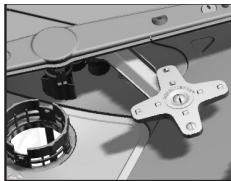
La turbine Aqualintense située sous la turbine inférieure aide à laver vos vaisselles très sales placées du côté droit du
panier inférieur. Pour de meilleurs résultats, placez la vaisselle la plus sale à l'avant droit.

Ne tentez pas de retirer la turbine Aqualintense !
Fonction Auto Tablet
Auto Tablet est une fonction qui détecte automatiquement l'utilisation de détergents en tablettes combinés.

Les performances de séchage de ce type de détergents sont améliorées en ajustant la température et la durée en conséquence.
Grâce à cette fonction, il n'est pas nécessaire d'appuyer sur un bouton en cas d'utilisation de détergent en tablette.
La fonction peut être activée si une détection automatique est souhaitée.
Pour activer / désactiver :
- Après avoir allumé la machine, appuyez simultanément sur les touches Time Delay et P. Maintenez-les enfoncées jusqu'à ce que le compte à rebours 3, 2, 1 soit terminé sur l'affichage.
- Appuyez sur la touche P pour activer l'option a:. La fonction de détection automatique du détergent est désactivée à l'option "a:0" et activée à l'option "a:1". Réglez l'option souhaitée en appuyant sur la touche Time Delay.
- Éteignez la machine avec la touche On/Off pour enregistrer les modifications.
Éclairage intérieur
(Selon le modèle) Certains modèles disposent d'un éclairage intérieur pour illuminer l'intérieur lorsque la porte est ouverte.
Modification du réglage de l'éclairage intérieur
- Après avoir allumé la machine, appuyez simultanément sur les touches Départ différé et P+. Continuez à appuyer jusqu'à ce que le compte à rebours 3, 2, 1 soit terminé sur l'affichage.
- Appuyez sur la touche P+ pour activer l'option L:. L'éclairage intérieur est éteint avec l'option "L:0" et allumé avec l'option "L:1". Réglez l'option souhaitée avec la touche Départ différé.
- Éteignez la machine avec la touche Marche/Arrêt pour enregistrer les modifications.
Éclairage au sol - Avertissement pour indiquer que la machine est en phase de lavage
(Selon le modèle) Votre machine projette une lumière au sol pendant le processus de lavage. Cette lumière s'éteint une fois le processus de lavage terminé.

L'éclairage au sol s'active automatiquement au démarrage du programme de lavage et reste allumé jusqu'à la fin du programme.

L'éclairage au sol ne peut pas être annulé par l'utilisateur.
Modification du volume du signal sonore d'avertissement
- Après avoir allumé la machine, appuyez simultanément sur les touches Départ différé et P/P+. Maintenez-les enfoncées jusqu'à ce que le compte à rebours 3, 2, 1 soit terminé sur l'affichage.
- Appuyez sur la touche P/P+ pour activer la position S:.
- Chaque pression sur la touche Départ différé modifie le volume du signal sonore comme suit : "S:0" désactivé, "S:1" moyen et "S:2" élevé.
- Éteignez la machine avec la touche Marche/Arrêt pour enregistrer les modifications.

Le réglage d'usine de votre machine est "S:2".
Programmation de l'heure de lavage
Départ différé
Si un tarif d'électricité économique est appliqué dans votre région, vous pouvez utiliser la fonction Départ différé pour laver votre vaisselle aux heures appropriées.
Vous pouvez retarder le démarrage du programme sélectionné jusqu'à 24 heures.
- Appuyez sur la touche de fonction Départ différé après avoir sélectionné le programme de lavage et les autres fonctions auxiliaires.
- Une fois que vous appuyez sur la touche Départ différé, la ligne d'affichage des informations affichera "0:30" et l'indicateur de Départ différé commencera à clignoter.
- Réglez l'heure souhaitée en appuyant sur la touche Départ différé. Le temps augmentera par incréments de 30 minutes jusqu'à 6 heures, puis par incréments d'1 heure jusqu'à 24 heures à chaque pression sur la touche.
- Fermez la porte de votre appareil après avoir réglé le départ différé. Une fois le temps de retard écoulé, le programme sélectionné démarrera automatiquement.
Modification des réglages pendant que la fonction Départ différé est active
Lorsque la fonction Départ différé est activée, vous ne pouvez pas modifier le programme de lavage, les fonctions auxiliaires ou la durée du délai.

Le programme et les fonctions auxiliaires ne peuvent pas être réglés/modifiés après le démarrage du programme.
Pour annuler la fonction Départ différé
Ouvrez la porte de l'appareil. Appuyez sur les touches Sélection de programme / Annulation de programme et maintenez-les enfoncées pendant 3 secondes. Après le compte à rebours 3 - 2 - 1, 0:01 s'affiche, fermez la porte de l'appareil et attendez la fin du processus de vidange. La vidange est terminée en 2 minutes et l'appareil émet un avertissement sonore lorsqu'elle est terminée.

Vous pouvez sélectionner et démarrer un nouveau programme après l'annulation de la fonction Départ différé.

La fonction Départ différé ne peut pas être réglée après le démarrage du programme.
Démarrage du programme
Fermez la porte de votre appareil pour le démarrer après avoir sélectionné le programme et les fonctions auxiliaires.

Votre appareil adoucit l'eau en fonction du niveau de dureté de l'eau d'alimentation. La durée du lavage peut varier pendant le déroulement du programme selon la température ambiante de l'endroit où l'appareil est installé, la température de l'eau d'alimentation et la quantité de vaisselle.

Veillez à ne pas ouvrir la porte de l'appareil pendant son fonctionnement. Une bouffée de vapeur peut s'échapper lors de l'ouverture de la porte ; soyez prudent.

L'appareil restera silencieux en mode pause pendant un certain temps afin d'évacuer complètement l'eau de l'appareil et de la vaisselle et de nettoyer l'adoucisseur d'eau, puis il reprendra son fonctionnement en mode séchage.
Annulation du programme
Ouvrez la porte de l'appareil, appuyez sur les touches Sélection de programme / Annulation de programme et maintenez-les enfoncées pendant 3 secondes. Après le compte à rebours 3 - 2 - 1, 0:01 s'affiche, fermez la porte de l'appareil et attendez la fin de la vidange. La vidange se termine en 2 minutes et l'appareil émet un avertissement sonore lorsqu'elle est terminée.

Selon l'étape du programme annulé, il peut rester des résidus de détergent ou de liquide de rinçage dans l'appareil et/ou sur la vaisselle.
Témoin de sel (S)
Vérifiez le témoin de sel sur l'écran pour savoir si la quantité de sel régénérant dans le lave-vaisselle est suffisante. Vous devez remplir le réservoir de sel dès que le témoin de sel apparaît sur l'écran de votre appareil.

Le réglage du niveau de dureté de l'eau est expliqué dans la section Système d'adoucissement de l'eau.
Témoin de liquide de rinçage (※)
Vérifiez le témoin de liquide de rinçage sur l'écran pour savoir si la quantité de liquide de rinçage dans le lave-vaisselle est suffisante. Vous devez remplir le réservoir de liquide de rinçage dès que le témoin de liquide de rinçage apparaît sur l'écran de votre appareil.
Réglage de la quantité de produit de rinçage
- Après avoir allumé la machine, appuyez simultanément sur les touches Départ différé et P+. Après le compte à rebours (3, 2, 1) affiché, maintenez les touches enfoncées pendant un moment.
- Appuyez sur P+ pour vous déplacer vers la position (P) sur l'écran.
- Réglez le niveau approprié avec la touche Départ différé.
- Appuyez sur la touche Marche/Arrêt pour enregistrer le réglage.
Aucun produit de rinçage n'est distribué en position P:0.
1 dose de produit de rinçage est distribuée en position P:1. 2 doses de produit de rinçage sont distribuées en position P:2. 3 doses de produit de rinçage sont distribuées en position P:3. 4 doses de produit de rinçage sont distribuées en position P:4.
Fin de programme

Lorsque le programme sélectionné se termine, un signal sonore vous avertit d'éteindre votre machine. Ce signal sonore vous avertit à intervalles réguliers avant qu'elle ne s'éteigne.
Le voyant de fin de programme s'allume lorsque le programme de lavage est terminé.
- Ouvrez la porte de la machine.
- Appuyez sur la touche Marche/Arrêt pour éteindre votre machine.
- Fermez le robinet.
- Débranchez la machine de la prise.

Pour économiser l'énergie, la machine s'éteint automatiquement après la fin du programme ou si le programme n'est pas démarré.

Laissez la vaisselle dans la machine pendant environ 15 minutes après le lavage pour qu'elle refroidisse. La vaisselle sèchera plus rapidement si vous laissez la porte de la machine entrouverte pendant cette période. Ce processus augmentera l'efficacité de séchage de votre machine.
Avertissement de coupure d'eau
Si l'alimentation en eau est coupée ou si le robinet d'arrivée d'eau est fermé, la machine ne peut pas prendre d'eau et l'icône E:02 clignote sur l'indicateur de programme. Tant que le problème persiste, le programme de lavage est en pause et la machine vérifie régulièrement l'arrivée d'eau ; lorsque l'eau est rétablie, l'icône E:02 disparaît après un certain temps et le programme de lavage reprend.
Avertissement de débordement
Si la machine absorbe trop d'eau ou s'il y a une fuite au niveau d'un composant, la machine le détecte et l'icône E:01 clignote sur l'indicateur de programme. Tant que le débordement continue, l'algorithme de sécurité est actif et tente d'évacuer l'eau. Si le débordement s'arrête et que la sécurité est assurée, l'icône E:01 disparaît. Si E:01 ne disparaît pas, il y a un défaut permanent. Dans ce cas, contactez le service après-vente agréé.
Nettoyage interne
Ce programme est recommandé tous les 1 à 2 mois pour le nettoyage de la machine et l'hygiène nécessaire. Le programme doit être exécuté lorsque la machine est vide.
Pour un résultat efficace, il est recommandé d'utiliser des agents de nettoyage spéciaux pour machine.

N'utilisez pas ce programme pour nettoyer la vaisselle. Comme il fonctionne à des températures élevées, il est nocif pour la vaisselle.
La durée de vie du produit s'allonge et les problèmes fréquents diminuent s'il est nettoyé à intervalles réguliers.

Débranchez le produit et fermez le robinet avant d'effectuer toute opération de nettoyage.

N'utilisez pas de substances abrasives pour le nettoyage.

Nettoyez le filtre et les turbines au moins une fois par semaine pour que la machine fonctionne efficacement.
Nettoyage de la surface extérieure du produit
Essuyez la surface extérieure et les joints de porte du produit avec un chiffon doux et un produit de nettoyage doux. Essuyez le "panneau de commande" uniquement avec un chiffon légèrement humide.
Nettoyage de l'intérieur de la machine
Nettoyez l'intérieur de la machine et le réservoir en lançant un programme avec ou sans détergent selon le degré d'encrassement. - Si de l'eau est restée dans la machine, vidangez l'eau en suivant les procédures décrites dans la rubrique "Annulation d'un programme". Si l'eau ne peut pas être évacuée, retirez les filtres comme indiqué dans la section "Nettoyage des filtres" et vérifiez s'il y a des dépôts résiduels accumulés au fond de la machine, bloquant le passage de l'eau. Nettoyez si nécessaire.
Nettoyage des filtres
Nettoyez les filtres au moins une fois par semaine pour que la machine fonctionne efficacement. Vérifiez si des résidus alimentaires sont restés sur les filtres. S'il y a des résidus alimentaires sur les filtres, retirez-les et nettoyez-les bien sous l'eau courante.
- Tournez l'ensemble micro-filtre (1) et filtre grossier (2) dans le sens inverse des aiguilles d'une montre et retirez-le de son logement.
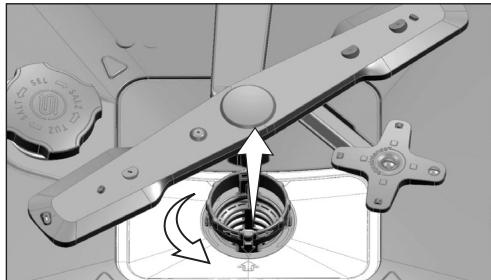
- Retirez le filtre métallique/plastique (3) de son logement.
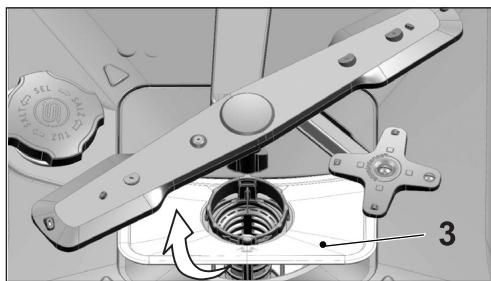
- Appuyez sur les deux ergots du filtre grossier vers l'intérieur et séparez le filtre grossier de l'ensemble.
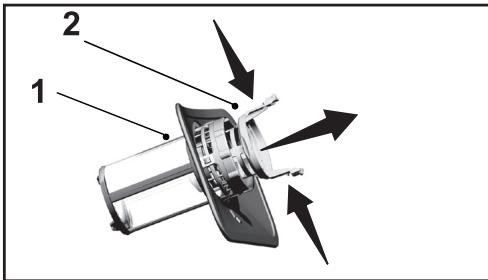
- Nettoyez les trois filtres sous l'eau du robinet à l'aide d'une brosse.
- Placez le filtre métallique/plastique.
- Placez le filtre grossier dans le micro-filtre. Assurez-vous qu'il est correctement en place. Tournez le filtre grossier dans le sens des aiguilles d'une montre jusqu'à ce qu'un déclic se fasse entendre.

N'utilisez pas le lave-vaisselle sans filtre.

Un placement incorrect des filtres réduira l'efficacité du lavage.
Nettoyage du filtre du tuyau d'arrivée d'eau
Les dommages sur la machine qui peuvent être causés par des impuretés provenant de l'eau du réseau ou de votre propre installation (comme le sable, la saleté, la rouille, etc.) peuvent être évités grâce au filtre fixé au tuyau d'arrivée d'eau. Vérifiez régulièrement le filtre et le tuyau et nettoyez-les si nécessaire.
- Fermez le robinet et retirez le tuyau.
- Après avoir retiré le filtre, nettoyez-le sous l'eau courante du robinet.
- Replacez le filtre nettoyé à sa place dans le tuyau.
- Installez le tuyau sur le robinet.
(selon le modèle)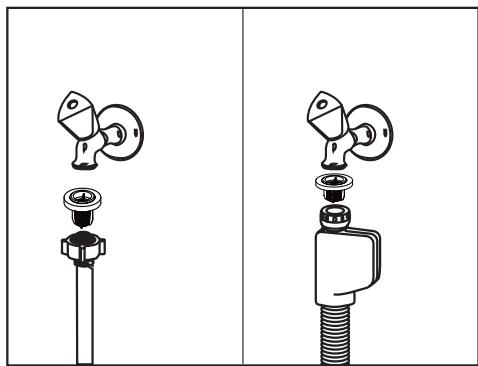
Nettoyage des turbines
Nettoyez les turbines au moins une fois par semaine pour que la machine fonctionne efficacement.
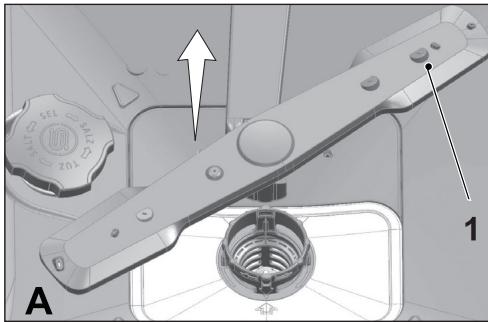
Turbine inférieure
Vérifiez si les trous de la turbine inférieure (1) sont obstrués. S'ils sont obstrués, retirez et nettoyez la turbine. Vous pouvez tirer la turbine inférieure vers le haut pour la retirer.
Turbine supérieure
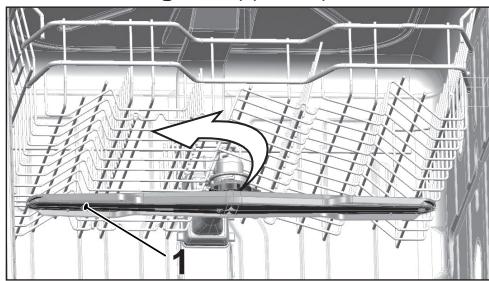
Vérifiez si les trous de la turbine supérieure (1) sont obstrués. S'ils sont obstrués, retirez et nettoyez la turbine. Tournez son écrou vers la gauche pour retirer la turbine supérieure. Assurez-vous que l'écrou est bien serré lors de l'installation de la turbine supérieure.
7 Dépannage
La machine ne démarre pas.
- Le câble d'alimentation est débranché. >> Vérifiez que le câble d'alimentation est branché.
- Le fusible a sauté. >> Vérifiez les fusibles de votre maison. L'eau est coupée. >> Assurez-vous que le robinet d'arrivée d'eau est ouvert.
- La porte de la machine est ouverte. >> Assurez-vous d'avoir fermé la porte de la machine.
- Le bouton Marche/Arrêt n'est pas enfoncé. >> Assurez-vous d'avoir allumé la machine en appuyant sur le bouton Marche/Arrêt.
La vaisselle n'est pas bien lavée
- La vaisselle n'est pas placée correctement dans la machine. >> Chargez la vaisselle comme décrit dans le manuel d'utilisation.
- Le programme sélectionné ne convient pas. >> Sélectionnez un programme avec une température et une durée de cycle plus élevées.
- Les bras de lavage sont bloqués. >> Avant de démarrer le programme, tournez les bras de lavage inférieur et supérieur à la main pour vous assurer qu'ils tournent librement.
- Les trous des bras de lavage sont bouchés. >> Les trous des bras de lavage inférieur et supérieur peuvent être obstrués par des restes d'aliments tels que des pépins de citron. Nettoyez régulièrement les bras de lavage comme illustré dans la section "Nettoyage et entretien".
- Les filtres sont obstrués. >> Vérifiez que le système de filtration est propre. Nettoyez régulièrement le système de filtration comme illustré dans la section "Nettoyage et entretien".
- Les filtres sont installés incorrectement. >> Vérifiez le système de filtration et assurez-vous qu'il est installé correctement.
- Les paniers sont surchargés. >> Ne surchargez pas les paniers au-delà de leur capacité.
- Le détergent est stocké dans des conditions inappropriées. >> Si vous utilisez du détergent en poudre, ne stockez pas l'emballage dans des endroits humides. Gardez-le dans un récipient fermé si possible. Pour faciliter le stockage, nous vous recommandons d'utiliser des tablettes de détergent.
- Le détergent est insuffisant. >> Si vous utilisez du détergent en poudre, ajustez la quantité de détergent en fonction du degré de salissure de votre vaisselle et/ou des définitions du programme. Nous vous recommandons d'utiliser des tablettes de détergent pour des résultats optimaux.
- Le liquide de rinçage est insuffisant. >> Vérifiez l'indicateur de liquide de rinçage et ajoutez-en si nécessaire. Augmentez le réglage du liquide de rinçage s'il y a une quantité suffisante dans la machine.
- Le couvercle du distributeur de détergent est resté ouvert. >> Assurez-vous que le couvercle du distributeur de détergent est bien fermé après avoir ajouté le détergent.
La vaisselle n'est pas sèche à la fin du cycle
- La vaisselle n'est pas placée correctement dans la machine. >> Placez votre vaisselle de manière à ce qu'aucune eau ne s'accumule dedans.
- Le produit de rinçage n'est pas suffisant. >> Vérifiez l'indicateur de produit de rinçage et ajoutez-en si nécessaire. Augmentez le réglage du produit de rinçage s'il y en a assez dans la machine.
- La machine est déchargée juste après la fin du programme. >> Ne déchargez pas votre machine immédiatement après la fin du lavage. Ouvrez légèrement la porte et attendez un moment que la vapeur s'échappe. Déchargez les plats après qu'ils aient refroidi à une température touchable. Commencez le déchargement par le panier inférieur. Ainsi, on évite que l'eau restée sur une pièce du panier supérieur tombe sur les pièces du panier inférieur.
- Le programme sélectionné est inadapté. >> Étant donné que la température de rinçage est basse pour les programmes de courte durée, la performance de séchage sera également faible. Sélectionnez des programmes de plus longue durée pour une meilleure performance de séchage.
- La qualité de surface des ustensiles de cuisine est détériorée. >> La performance de lavage souhaitée ne peut pas être obtenue sur des ustensiles de cuisine dont les surfaces sont détériorées, et il n'est pas recommandé de les utiliser pour des raisons d'hygiène. De plus, l'eau ne peut pas s'écouler facilement sur les surfaces détériorées. Il n'est pas recommandé de laver de tels ustensiles de cuisine au lave-vaisselle.

Il est normal que des problèmes de séchage se produisent avec les ustensiles de cuisine en téflon. Cela est lié à la structure du téflon. Étant donné que les tensions de surface du téflon et de l'eau sont différentes, les gouttelettes d'eau resteront sous forme de perles sur la surface du téflon.
Des taches de thé, de café ou de rouge à lèvres restent sur les plats.
- Le programme sélectionné est inadapté. >> Sélectionnez un programme avec une température et un temps de cycle plus élevés.
- La qualité de surface des ustensiles de cuisine est détériorée. >> Les taches de thé et de café ou d'autres taches de colorant peuvent ne pas être nettoyées au lave-vaisselle lorsqu'elles ont pénétré dans les surfaces détériorées. La performance de lavage souhaitée ne peut pas être obtenue sur des ustensiles de cuisine dont les surfaces sont détériorées, et il n'est pas recommandé de les utiliser pour des raisons d'hygiène. Il n'est pas recommandé de laver de tels ustensiles de cuisine au lave-vaisselle.
- Le détergent est stocké dans des conditions inadaptées. >> Si vous utilisez du détergent en poudre, ne stockez pas l'emballage dans des endroits humides. Gardez-le dans un récipient fermé si possible. Pour faciliter le stockage, nous vous recommandons d'utiliser des détergents en tablettes.
Des traces de calcaire restent sur les plats et la verrerie prend un aspect laiteux.
- Le produit de rinçage ne suffit pas. >> Vérifiez l'indicateur de produit de rinçage et ajoutez-en si nécessaire. Augmentez le réglage du produit de rinçage s'il y en a assez dans la machine. Le réglage de la dureté de l'eau est bas ou le niveau de sel est insuffisant. >> Mesurez correctement la dureté de l'eau d'alimentation et vérifiez le réglage de la dureté de l'eau. Il y a une fuite de sel. >>> Faites attention à ne pas renverser de sel autour de l'orifice de remplissage du sel lors de l'ajout de sel. Assurez-vous que le couvercle du réservoir de sel est bien fermé après avoir terminé
le processus de remplissage. Lancez le programme de prélavage pour éliminer le sel renversé à l'intérieur de la machine. Comme les granules de sel qui resteront sous le couvercle se dissoudront pendant le prélavage, ce qui peut desserrer le couvercle, vérifiez à nouveau le couvercle à la fin du programme.
Il y a une odeur différente dans la machine

Une nouvelle machine a une odeur particulière. Elle disparaîtra après quelques lavages.
- Les filtres sont obstrués. >>> Vérifiez si le système de filtration est propre. Nettoyez régulièrement le système de filtration comme illustré dans la section « Nettoyage et entretien ».
- De la vaisselle sale est conservée dans le lave-vaisselle pendant 2 à 3 jours. >> Si vous ne démarrez pas la machine immédiatement après y avoir placé la vaisselle, retirez les résidus alimentaires et lancez le programme de prélavage sans détergent tous les 2 jours. Dans de tels cas, ne fermez pas complètement la porte de la machine pour éviter l'accumulation d'odeurs. Vous pouvez également utiliser des désodorisants ou des nettoyants pour machine disponibles dans le commerce.
Rouille, décoloration ou détérioration de surface sur la vaisselle
- Il y a une fuite de sel. >> Le sel peut provoquer une détérioration et une oxydation des surfaces métalliques. Faites attention à ne pas renverser de sel autour de l'orifice de remplissage du sel lors de l'ajout de sel. Assurez-vous que le couvercle du réservoir de sel est bien fermé après avoir terminé le processus de remplissage. Lancez le programme de prélavage pour éliminer le sel renversé à l'intérieur de la machine. Comme les granules de sel qui resteront sous le couvercle se dissoudront pendant le prélavage, ce qui peut desserrer le couvercle, vérifiez à nouveau le couvercle à la fin du programme.
- Des restes d'aliments salés sont restés sur la vaisselle pendant longtemps. >> Si des couverts souillés par de tels aliments doivent rester dans la machine, la saleté doit être éliminée par un prélavage ou la vaisselle doit être lavée sans attendre.
- L'installation électrique n'est pas mise à la terre. >> Vérifiez si votre machine est connectée à la ligne de mise à la terre réelle. Sinon, l'électricité statique créée dans le produit provoque des arcs sur les surfaces des objets métalliques, créant des pores, retirant la couche protectrice de la surface et provoquant une décoloration.
- Des nettoyants intensifs tels que les décolorants sont utilisés. >> La protection des surfaces métalliques peut être endommagée et perdre son efficacité avec le temps au contact de nettoyants comme l'eau de Javel. Ne lavez pas votre vaisselle avec de l'eau de Javel. Les articles métalliques, en particulier les couteaux, sont utilisés à d'autres fins que celles prévues. >> La protection des bords des couteaux peut être endommagée lorsqu'ils sont utilisés pour ouvrir des boîtes de conserve. N'utilisez pas les ustensiles de cuisine en métal à d'autres fins que celles prévues.
- Les couverts sont en acier inoxydable de qualité inférieure. >> La corrosion de ces articles est inévitable ; ils ne doivent pas être lavés au lave-vaisselle.
- Des ustensiles de cuisine déjà corrodés sont lavés au lave-vaisselle. >> La rouille d'un article corrodé peut se propager à d'autres surfaces en acier inoxydable et provoquer leur corrosion. Ces articles ne doivent pas être lavés au lave-vaisselle.
Du détergent reste dans le distributeur de détergent.
- Le distributeur de détergent était humide lors de l'ajout du détergent. >> Assurez-vous que le distributeur de détergent est bien séché avant de le remplir de détergent.
- Le détergent est ajouté bien avant le processus de lavage. >>> Veillez à ajouter le détergent peu de temps avant le démarrage du lavage.
- L'ouverture du couvercle du distributeur de détergent est bloquée pendant le lavage. >> Placez la vaisselle de manière à ne pas empêcher l'ouverture du couvercle du distributeur de détergent ni l'arrivée d'eau dans la machine par les turbines.
- Le détergent est stocké dans des conditions inappropriées. >> Si vous utilisez du détergent en poudre, ne stockez pas l'emballage dans des endroits humides. Conservez-le dans un récipient fermé si possible. Pour faciliter le stockage, nous vous recommandons d'utiliser des tablettes de détergent.
- Les trous des turbines sont obstrués. >> Les trous des turbines inférieures et supérieures peuvent être obstrués par des restes de nourriture tels que des pépins de citron. Nettoyez régulièrement les turbines comme illustré dans la section "Nettoyage et entretien".
Les décorations et ornements sur les ustensiles de cuisine s'effacent.

Les verres décorés et les porcelaines décorées à lustre ne conviennent pas au lavage au lave-vaisselle. Les fabricants de certains articles en verre et en porcelaine ne recommandent pas non plus de laver ces ustensiles de cuisine au lave-vaisselle.
La vaisselle est rayée.

Les ustensiles de cuisine contenant de l'aluminium ou fabriqués en aluminium ne doivent pas être lavés au lave-vaisselle.
Présence de fuite de sel. >>>> Veillez à ne pas renverser de sel autour de l'orifice de remplissage de sel lors de l'ajout de sel. Le sel renversé peut provoquer des rayures. Assurez-vous que le couvercle du réservoir de sel est bien fermé après avoir terminé le remplissage. Lancez un programme de prélavage pour éliminer le sel renversé à l'intérieur de la machine. Comme les granulés de sel qui resteront sous le couvercle se dissoudront pendant le prélavage, ce qui peut desserrer le couvercle, vérifiez à nouveau le couvercle à la fin du programme. - Le réglage de la dureté de l'eau est faible ou le niveau de sel est insuffisant >> Mesurez correctement la dureté de l'eau d'alimentation et vérifiez le réglage de la dureté de l'eau. - La vaisselle n'est pas placée de manière ordonnée dans la machine. >> Lorsque vous placez les verres et autres articles en verre dans le panier, inclinez-les non pas contre d'autres articles mais contre les bords ou les supports du panier ou les picots de support en verre. Le choc des verres entre eux ou contre d'autres articles dû à l'impact de l'eau pendant le lavage peut provoquer des cassures ou des rayures sur leurs surfaces.
Une trace persiste sur les verres, ressemblant à une tache de lait, qui ne peut pas être enlevée en essuyant à la main. Une apparence bleuâtre / irisé apparaît lorsque le verre est exposé à la lumière.
- Utilisation excessive de produit de rinçage. > Réduisez le réglage du produit de rinçage. Nettoyez le produit de rinçage renversé lors de l'ajout de produit de rinçage.
- De la corrosion s'est produite sur le verre en raison de l'eau douce. >> Mesurez correctement la dureté de l'eau d'alimentation et vérifiez le réglage de la dureté de l'eau. Si votre eau d'alimentation est douce (<5 dH), n'utilisez pas de sel. Choisissez des programmes qui lavent à des températures plus élevées (par exemple 60-65°C). Vous pouvez également utiliser des détergents protecteurs pour verre disponibles dans le commerce.
- La vaisselle est lavée à la main avec un détergent à vaisselle manuel mais n'est pas rincée avant de la placer dans la machine. >> Les détergents à vaisselle manuels ne contiennent pas d'antimousse. Il n'est pas nécessaire de laver la vaisselle à la main avant de la placer dans la machine. Enlever les saletés grossières sur la vaisselle sous l'eau du robinet, avec un papier absorbant ou une fourchette sera suffisant.
- Du produit de rinçage a été renversé dans la machine lors de l'ajout de produit de rinçage. >> Veillez à ce que le produit de rinçage ne soit pas renversé dans la machine lors du remplissage. Nettoyez tout produit de rinçage renversé à l'aide d'un papier absorbant / d'une serviette.
- Le couvercle du réservoir de produit de rinçage est laissé ouvert. >> Assurez-vous que le couvercle du réservoir de produit de rinçage est fermé après avoir ajouté du produit de rinçage.
Les ustensiles de cuisine sont cassés.
- La vaisselle n'est pas placée de manière ordonnée dans la machine. >>> Chargez la vaisselle comme décrit dans le manuel d'utilisation.
- Les paniers sont surchargés. >> Ne surchargez pas les paniers au-delà de leur capacité.
De l'eau reste dans le lave-vaisselle à la fin du programme.
- Les filtres sont obstrués. >> Vérifiez si le système de filtration est propre. Nettoyez régulièrement le système de filtration comme illustré dans la section "Nettoyage et entretien".
- Le tuyau d'évacuation est obstrué / bloqué. >> Vérifiez le tuyau d'évacuation. Si nécessaire, retirez le tuyau d'évacuation, débouchez-le et insérez-le comme illustré dans le manuel d'utilisation.

Si vous ne parvenez pas à résoudre le problème malgré les instructions de cette section, consultez votre revendeur ou le service après-vente agréé. N'essayez jamais de réparer vous-même un produit défectueux.