
GLIDE 2 S RUNNING - URBAN GLIDE 2 RUNNING - URBAN GLIDE 2 S RUNNING - Poussette de course THULE - Notice d'utilisation et mode d'emploi gratuit
Retrouvez gratuitement la notice de l'appareil GLIDE 2 S RUNNING - URBAN GLIDE 2 RUNNING - URBAN GLIDE 2 S RUNNING THULE au format PDF.


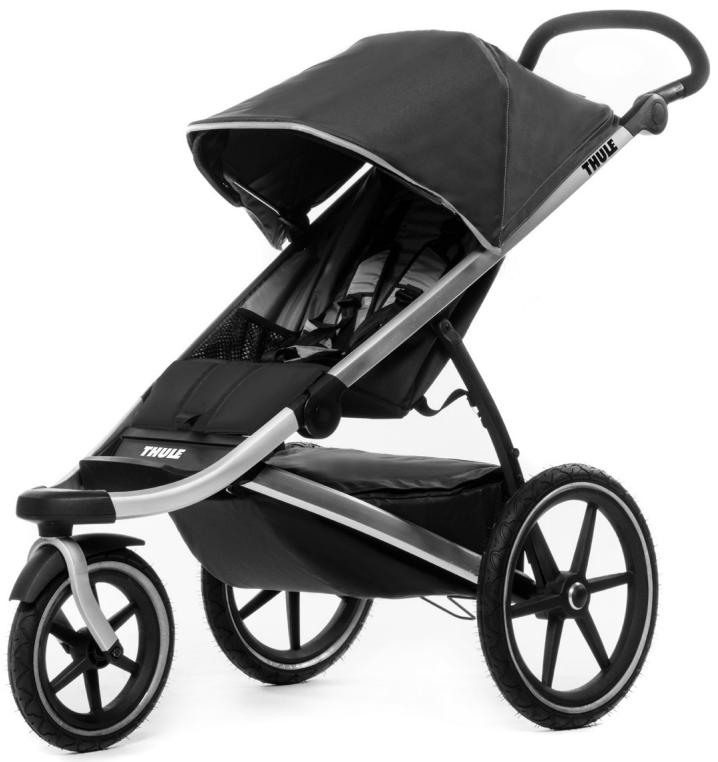
| Type de produit | Poussette de course |
| Marque | Thule |
| Modèle | Urban Glide 2 S Running / Urban Glide 2 Running |
| Nombre d'enfants | 1 |
| Capacité de charge maximale (enfant + bagages) | 34 kg (75 lbs) |
| Poids de la poussette | 10,5 kg (23 lbs) |
| Dimensions pliée | 87,5 x 53 x 35 cm (34,5 x 21 x 14 po) |
| Largeur de passage de porte | 65 cm (25,5 po) |
| Largeur d'épaules | 34 cm (13,5 po) |
| Hauteur d'assise | 53 cm (21 po) |
| Inclinaison du dossier | Jusqu'à 165° |
| Roue avant | 12 pouces (pivotante ou verrouillable pour la course) |
| Roues arrière | 16 pouces |
| Pression des pneus recommandée | 20 à 25 psi (1,4 à 1,7 bar) |
| Système de freinage | Frein de stationnement à pédale rouge |
| Harnais de sécurité | Harnais 5 points avec réglage en hauteur des sangles d'épaules |
| Sangle de poignet de sécurité | Incluse |
| Capote | Extensible avec fenêtre d'aération |
| Rangements | Grand filet dorsal (1,4 kg max), petits filets avant (0,5 kg max), grand compartiment sous l'assise (4,5 kg max) |
| Accessoires compatibles | Adaptateur siège auto, plateau-repas, console, porte-gourde, porte-gobelet, sac de couchage, support bébé, housse de pluie, housse moustiquaire |
| Entretien et nettoyage | Nettoyer à l'eau tiède et au savon doux ; ne pas utiliser de solvants ; huiler les essieux ; inspection annuelle recommandée |
| Réparabilité | Pièces détachées disponibles auprès des revendeurs agréés Thule ; révisions recommandées chez un professionnel |
| Utilisation recommandée | Marche et course (roue avant verrouillée pour la course) sur trottoirs et chemins lisses |
| Âge minimum | 6 mois (sans accessoire) ; dès la naissance avec accessoire Thule adapté |
FOIRE AUX QUESTIONS - GLIDE 2 S RUNNING - URBAN GLIDE 2 RUNNING - URBAN GLIDE 2 S RUNNING THULE
Questions des utilisateurs sur GLIDE 2 S RUNNING - URBAN GLIDE 2 RUNNING - URBAN GLIDE 2 S RUNNING THULE
0 question sur cet appareil. Repondez a celles que vous connaissez ou posez la votre.
Poser une nouvelle question sur cet appareil
Téléchargez la notice de votre Poussette de course au format PDF gratuitement ! Retrouvez votre notice GLIDE 2 S RUNNING - URBAN GLIDE 2 RUNNING - URBAN GLIDE 2 S RUNNING - THULE et reprennez votre appareil électronique en main. Sur cette page sont publiés tous les documents nécessaires à l'utilisation de votre appareil GLIDE 2 S RUNNING - URBAN GLIDE 2 RUNNING - URBAN GLIDE 2 S RUNNING de la marque THULE.
MODE D'EMPLOI GLIDE 2 S RUNNING - URBAN GLIDE 2 RUNNING - URBAN GLIDE 2 S RUNNING THULE
Thule Urban Glide
> Instructions
CONTENTS
1 INTRODUCTION
1.1 Manual Intended Use 04
1.2 Carrier Intended Use 04
1.3 Specifications 04
2 SAFETY
2.1 Symbols and Instructions 05
2.2 General Safety Instructions 05
3 GETTING STARTED
3.1 Included Components 07
3.2 Unfolding the Carrier 08
3.3 Folding the Carrier 09
3.4 Installing the Wheels 10
3.5 Removing the Wheels 10
3.6 Adjusting the front wheel 10
3.7 Aligning the front wheel for jogging 10
3.8 Adjusting the Handlebar 12
3.9 Adjusting the Reclining Seat 13
4 USE & FEATURES
4.1 Setting the Parking Brake 14
4.2 Child Placement and Seatbelt 15
4.3 Using the Safety Wrist Strap 16
4.4 Using the Canopy 16
4.5 Storage 17
5 ADDITIONAL INFORMATION
5.1 Accessories 18
5.2 Service and Care 18
5.3 Storage 19
5.4 Wear and Tear 19
1 INTRODUCTION
Thank you for choosing a Thule Urban Glide. Your new carrier offers quality, safety features and comfort.
PLEASE NOTE:
Thule Child Transport Systems Ltd. retains all rights to this Owner's Manual. No text, details, or illustrations from this manual may be reproduced, distributed, or become the subject of unauthorized use for commercial purposes, nor may they be made available to others. The manual for using this carrier may be downloaded from www.thule.com. Great care has been taken in assembling this manual. Nevertheless, should you discover any errors, we would be grateful if you could bring them to our attention.
1.1 MANUAL INTENDED USE
Who is this manual intended for?
This manual is intended for the purchaser and user of the carrier, who is also responsible for keeping it in proper condition, carrying out maintenance as prescribed and performing repairs.
1.2 CARRIER INTENDED USE
Use as intended
The carrier is intended for use within the performance ranges specified for the carrying of children in daylight hours, on sidewalks and smooth paths. Luggage may also be carried in the storage bags intended for that purpose, provided the children in the carrier are not put at risk.
If the child carrier is used in conditions of poor visibility, at dusk or in the hours of darkness, it is highly recommended to be fitted with a safety approved working light set. As part of the recommended use, you should also follow this Owner's Manual and comply with the prescribed maintenance requirements.
Use not recommended
Any use that goes beyond the above is not recommended. Use not recommended is primarily the conveying of people together with animals, use of this carrier on rough off-road terrain, use for commercial purposes, overloading, excessive speed and improper repair of defects or modifications. The manufacturer is not liable for damages arising from use that is not recommended – this is at the risk of the user.
1.3 SPECIFICATIONS
| Glide | |
| Children | 1 |
| Weight Capacity | 34kgs /75lbs |
| Weight | 10.5kgs / 23lbs |
| Shoulder Width | 34cm / 13.5in |
| Sitting Height | 53cm / 21in |
| Door Pass Through | 65cm / 25.5in |
| Folded | 87.5x53x35cm / 34.5x21x14in |
| Front Wheel Size | 12in |
| Rear Wheel Size | 16in |
| Seat Recline | 165° |
2 SAFETY
The safe use of this child carrier is vital to the enjoyment of it. For that reason it is extremely important that you familiarize yourself with the safety instructions in this manual and follow them whenever you use this child carrier.
2.1 SYMBOLS AND INSTRUCTIONS
This owner's manual uses warnings and notices throughout to emphasize safety and optimal use information.

WARNING
Warnings provide instructions critical to the safe use and operation of this Thule child carrier. Failure to follow these instructions could result in an accident, potentially causing serious injury or death to you and/or your passenger(s).
NOTICE
Notices provide additional instructions to make using the product easier.
2.2 GENERAL SAFETY INSTRUCTIONS
- Important - Keep these instructions for future reference.
- Your child's safety may be affected if you do not follow these instructions.
- Never leave a child unattended in this child carrier.
- Put on the park brake whenever you park this child carrier.
- Do not carry extra children or bags on this child carrier.
- This child carrier will become unstable if the manufacturer's recommended load is exceeded.
- Do not use with children who exceed the weight limitations.
- The user of this child carrier must be aware of exposure hazards such as wind chill and heat exhaustion, either by less active children in prolonged exposure in colder temperatures, or by extended periods in warmer temperatures without adequate ventilation or hydration.
-
Do not allow any of the children's body, clothing, shoe laces, or toys to come into contact with moving parts.
-
Care must be taken when folding and unfolding this child carrier to prevent finger entrapment. Ensure children are clear of any moving parts, otherwise they may be injured.
- Do not install a car seat or any other seating device not approved by Thule Child Transport Systems Ltd. on this child carrier.
- Only use Thule Child Transport Systems Ltd. approved rack products otherwise this child carrier will become unstable if any other parcel bag or rack is used.
- Do not use any accessory products which are not approved by Thule Child Transport Systems Ltd.
- Do not use any cleaning solvents on this child carrier, clean only with mild soap and water.
- Make no modifications to this child carrier.
- Do not use this child carrier around or near an open fire or exposed flame.
- Do not operate a Thule child carrier without reading and understanding this manual

WARNING
Do not let your child play with this product.
This product is not suitable for running or skating.
When used for running ensure front wheel is locked in jogging mode.
3
GETTING STARTED
3.1 INCLUDED COMPONENTS
Verify that your carrier was packaged with the following items:
- Carrier with front wheel installed
2 rear wheels
NOTICE
Store your carrier and its components in a safe dry place so that when they are needed, they are in the best possible condition.
3.2 UNFOLDING THE CARRIER
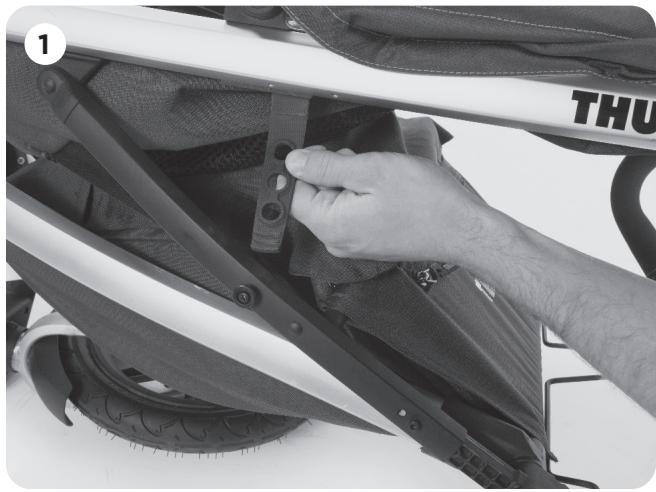
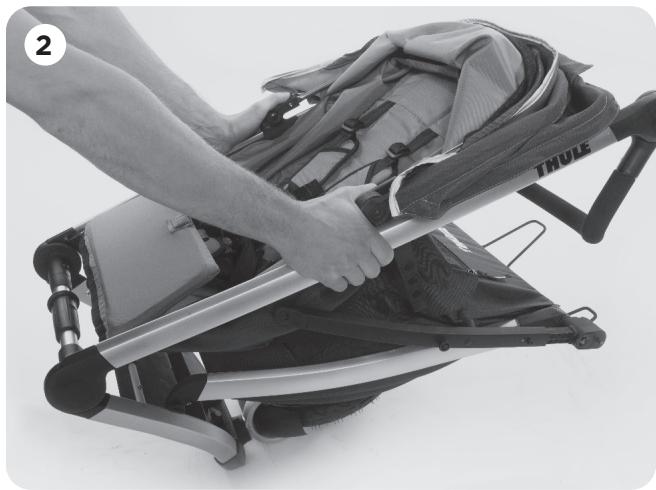
A. Undo the fold locking strap. (See image 1)
B. Pull the up the upper frame of the carrier. (See image 2)
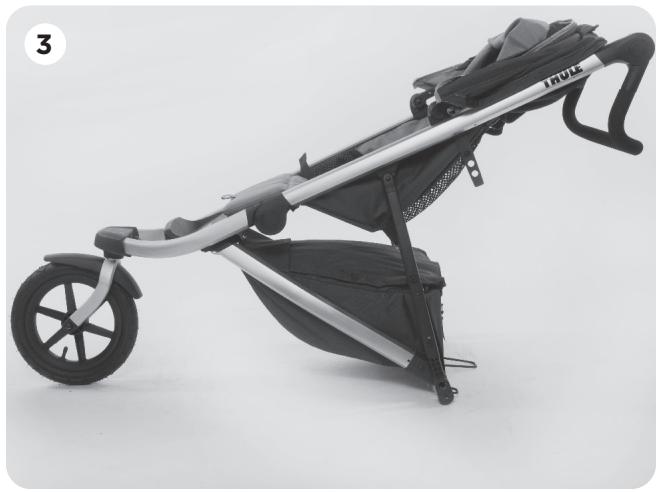
C. Push the front wheel of the carrier upwards until it clicks in place. (See image 3)

WARNING
Ensure that all the locking devices are engaged before use.
3.3 FOLDING THE CARRIER
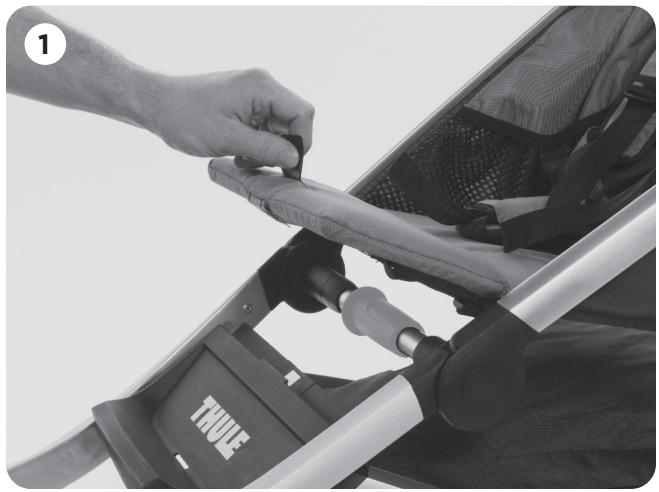
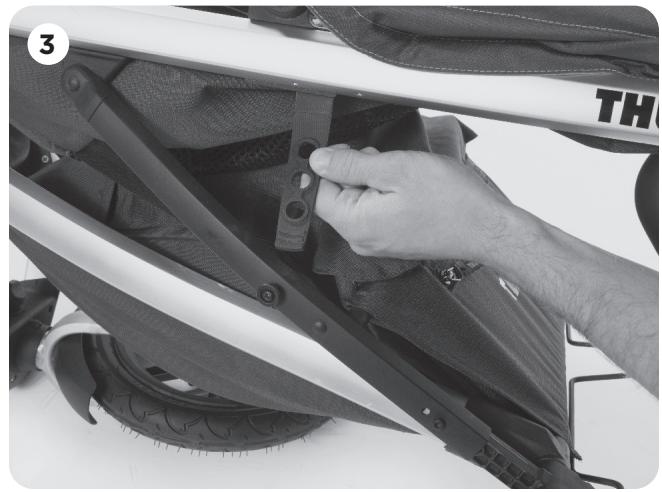
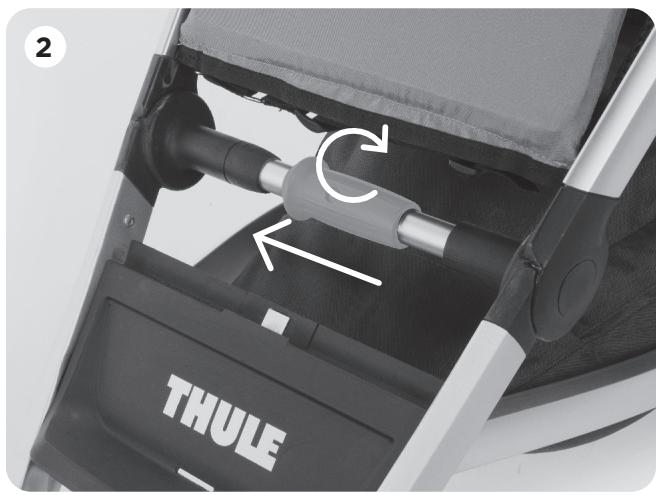
A. Open the front cover. (See image 1)
B. Slide then rotate the folding handle until the frame collapses. (See image 2)
C. Attach the locking strap. (See image 3)

WARNING
Care must be taken when folding and unfolding this child carrier to prevent finger entrapment. Ensure children are clear of any moving parts, otherwise they may be injured. To avoid injury ensure that your child is kept away when unfolding and folding this product.
3.4 INSTALLING THE WHEELS
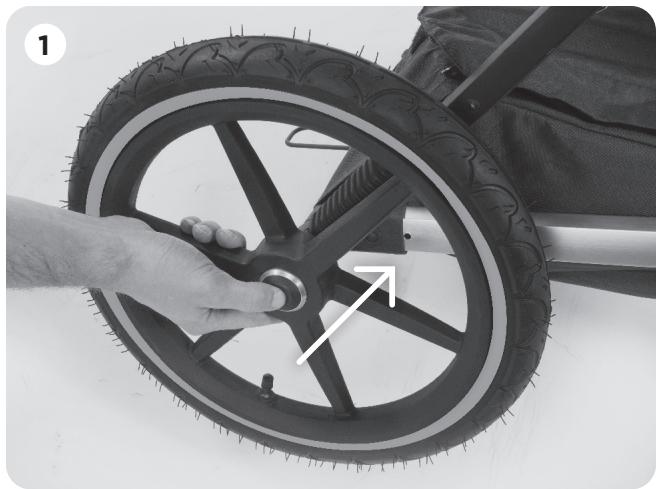
A. Press and hold the wheel release button on the wheel. (See image 1)
B. Insert the wheel axle into the carrier axle.
C. Release the wheel release button.
D. Press the wheel fully into the carrier axle.
E. Verify that the wheel is securely attached to the carrier by giving it a sharp pull.
F. Repeat for the other wheel.
G. Using a tire pressure gauge check the air pressure in each tire. The minimum recommended tire pressure is 20 psi (1.4 bar) and the maximum is 25 psi (1.7 bar). If air pressure is too low in either one of the tires, fill them up using a bicycle tire pump.
3.5 REMOVING THE WHEELS
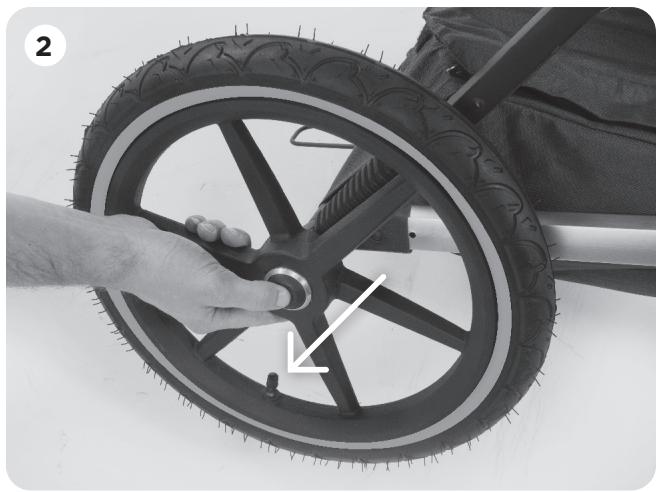
A. Press and hold the wheel release button on a wheel. (See image 2)
B. Pull the wheel out of the carrier axle.
C. Repeat for the other wheel.

WARNING
Before each journey make sure that both of the wheels are securely locked in the carrier axle.
3.6 ADJUSTING THE FRONT WHEEL
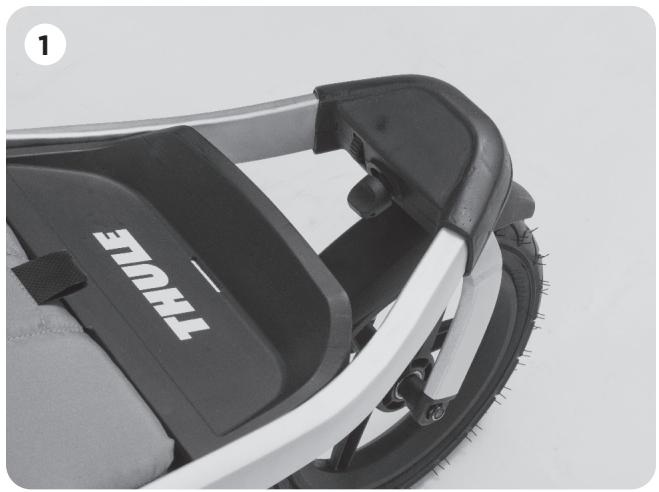
A. Strolling - pivoting front wheel. (See image 1)
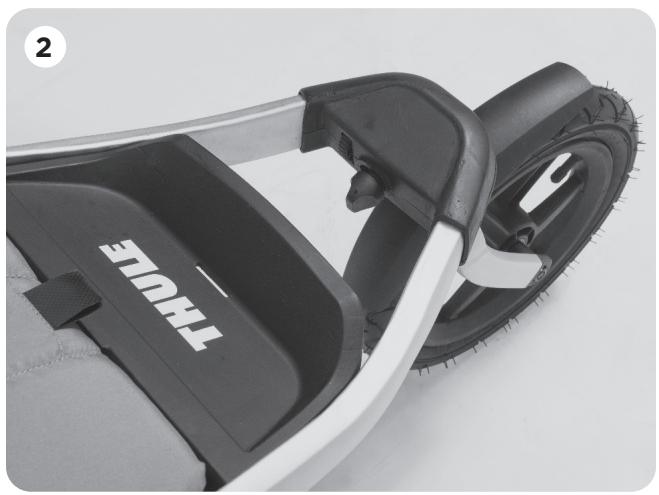
B. Running - locks the front wheel either forward or backwards. (See image 2)
3.7 ALIGNING THE FRONT WHEEL FOR JOGGING
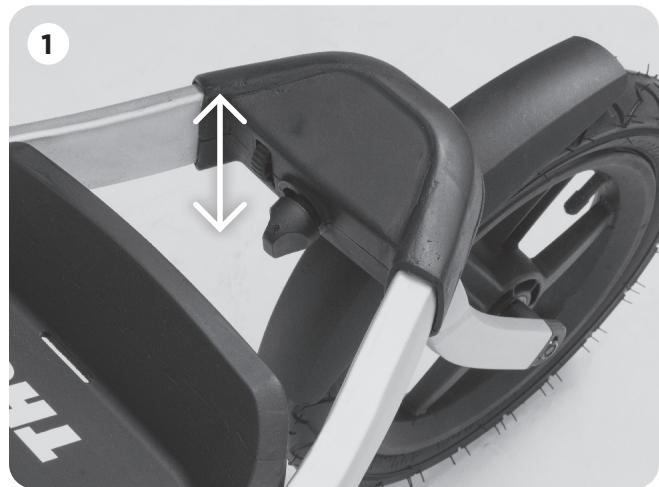

Make the carrier track more to the left. (See image 1)
Make carrier track more to the right. (See image 1)
3.8 ADJUSTING THE HANDLEBAR
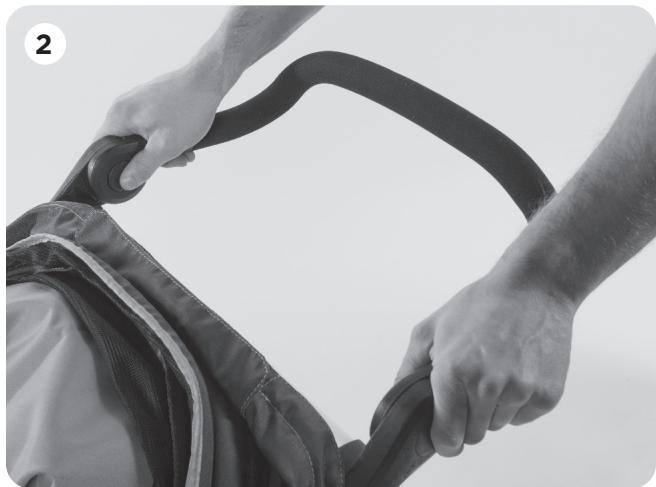
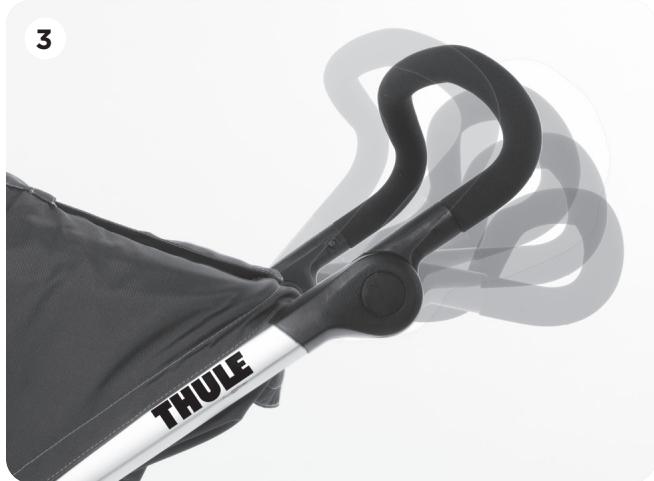
A. Press the release buttons. (See image 2)
B. Rotate the handlebar into a comfortable position. (See image 3)
3.9 ADJUSTING THE RECLINING SEAT
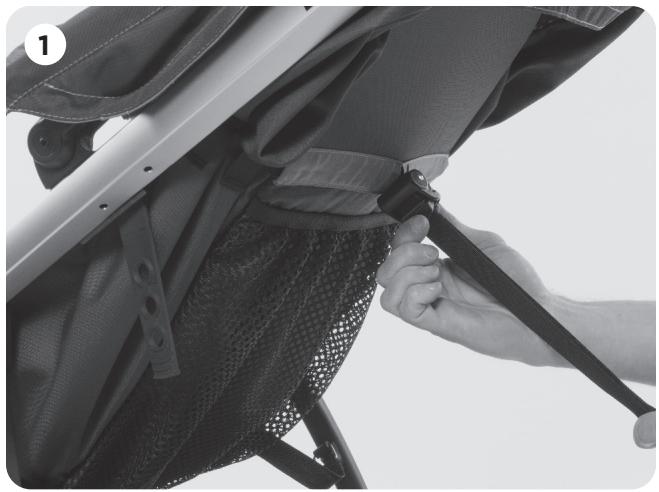
A. Engage the parking brake.
B. Squeeze the adjustment clamp. (See image 1)
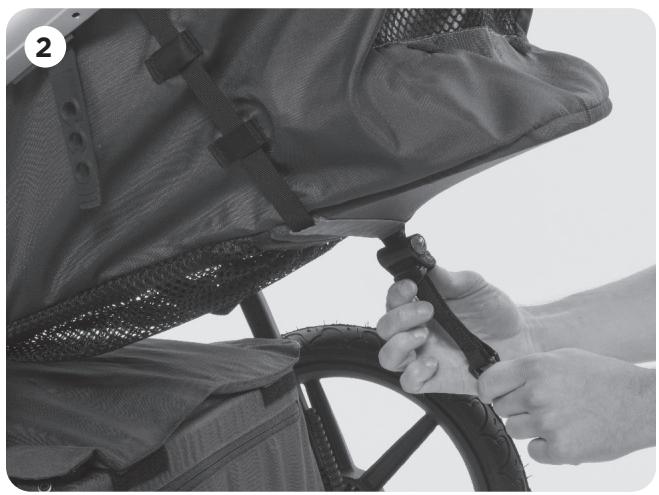
C. Move the adjustment clamp at the back of the seat either up or down along the strap to adjust how much the seat reclines. (See image 2)
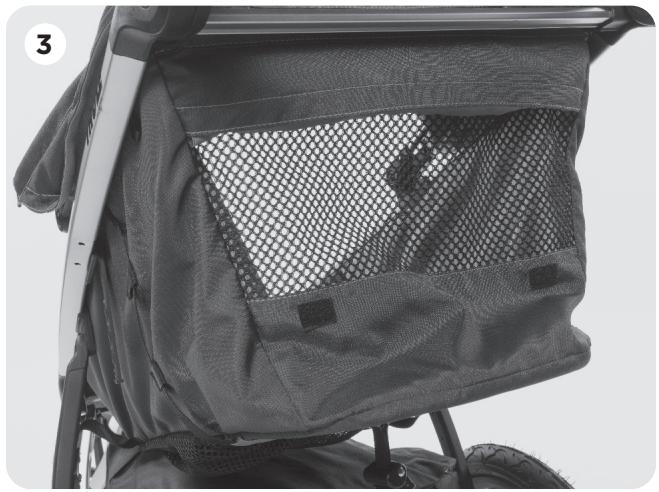
D. Opening the venting: With the seat reclined open the vent at the back and roll it into the pocket at the top. (See image 3)
4
USE & FEATURES
4.1 SETTING THE PARKING BRAKE
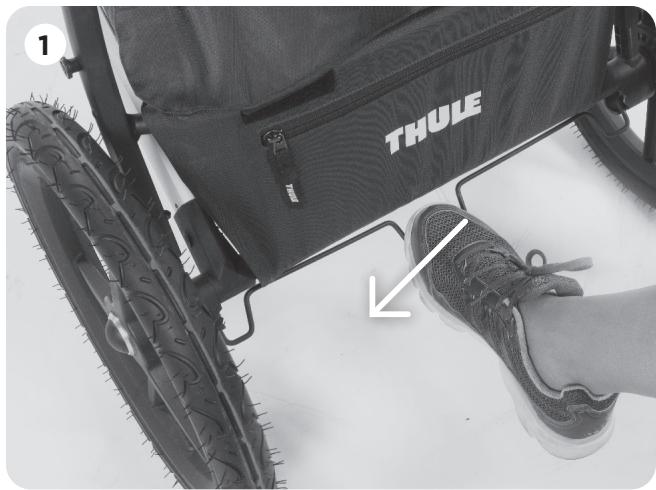
A. Push down on the red foot pedal to engage the parking brake. (See image 1)
B. After engaging the brake always verify that the parking brake is working – the carrier should not roll forwards or backwards.
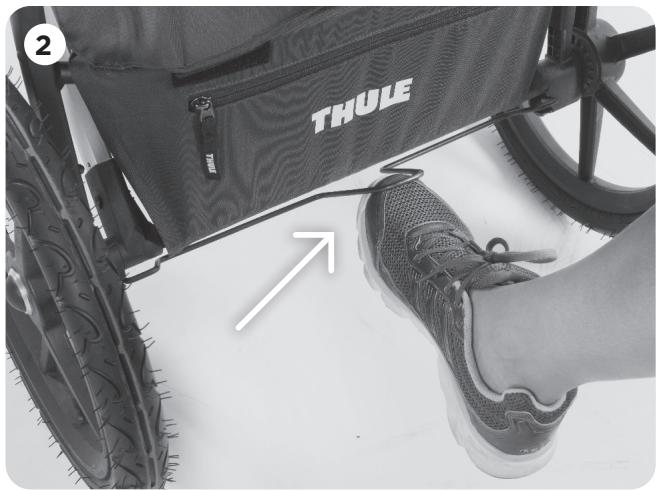
C. Pull up on the red foot pedal to release the parking brake. (See image 2)

WARNING
Never leave your child unattended in this Thule child carrier.
The parking brake should always be engaged during the loading and unloading of children.
NOTICE
No adjustments of the parking brake are required.
4.2 CHILD PLACEMENT AND SEATBELT
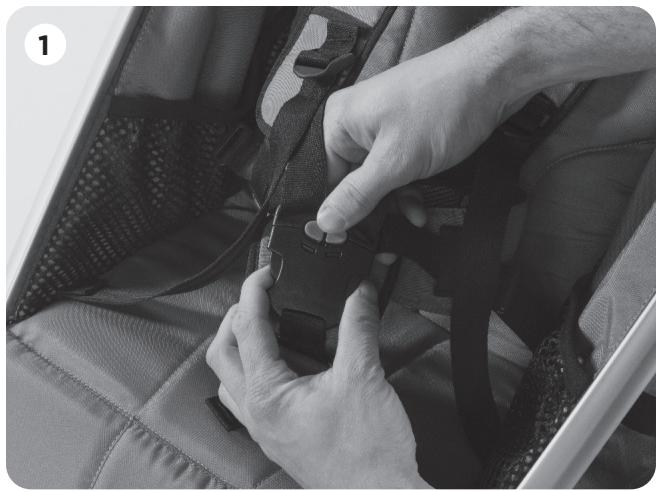
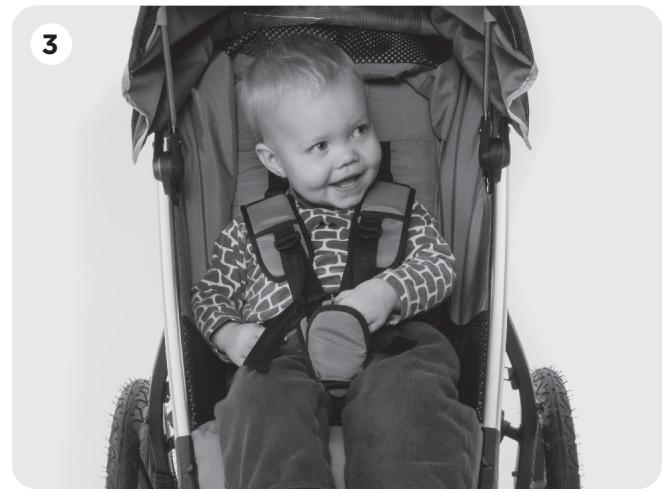
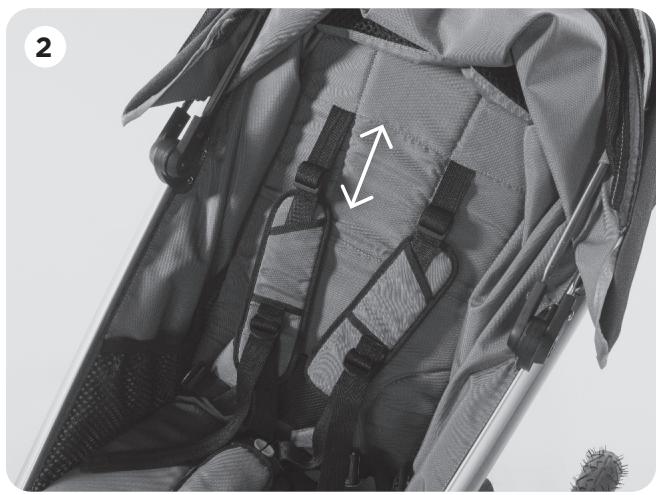
WARNING
This seat unit is not suitable for children under 6 months. For younger children a Thule infant accessory must be used.
Always use the restraint system.
Check that the pram body or seat unit or car seat attachment devices are correctly engaged before use.
A. Engage the parking brake.
B. Loosen all of the belt adjustments.
C. Undo the crotch strap buckle on the shoulder harness by pressing the red release buttons and squeezing the sides of the buckle. (See image 1)
D. Seat your child(ren).
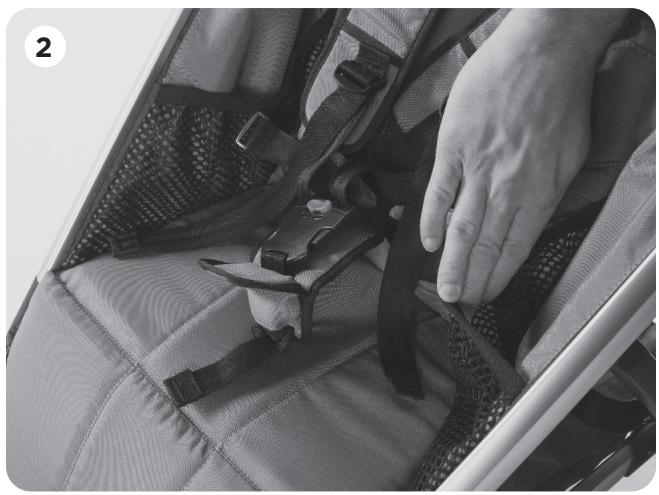
E. Slide the shoulder belt height adjustment located on the vertical web straps, in the seat back, to the same height as your child(ren)'s shoulders. (See image 2)
F. Lift up the crotch strap and insert the two shoulder strap buckles into the crotch buckle.
G. Snugly tighten the two shoulder straps by pulling downward on the shoulder strap loose ends. Ensure that there is no looseness in the harness system at the child's waist and shoulders. Ensure the shoulder pads are positioned on top of the child's shoulders and next to their neck. (See image 3)
4.3 USING THE SAFETY WRIST STRAP
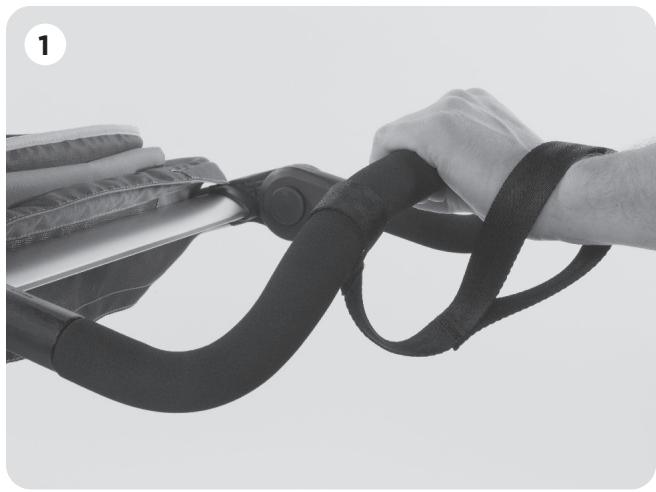
A. Loop the free end of the safety wrist strap around your wrist to prevent the child carrier from becoming separated from you. (See image 1)
4.4 USING THE CANOPY
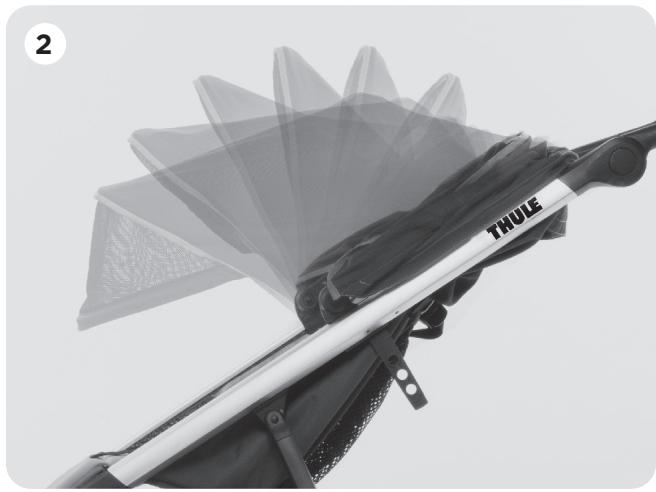
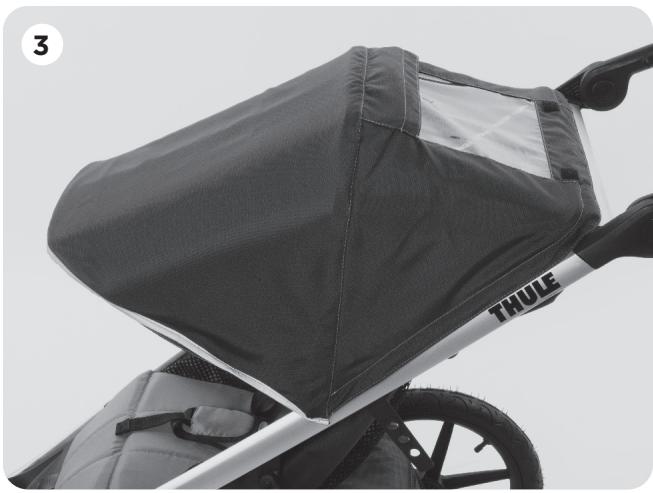
A. To shade inside the carrier; pull the canopy down. (See image 2)
B. To open the top window; release the Velcro attachment and roll up the shade into the pocket at top. (See image 3)
4.5 STORAGE
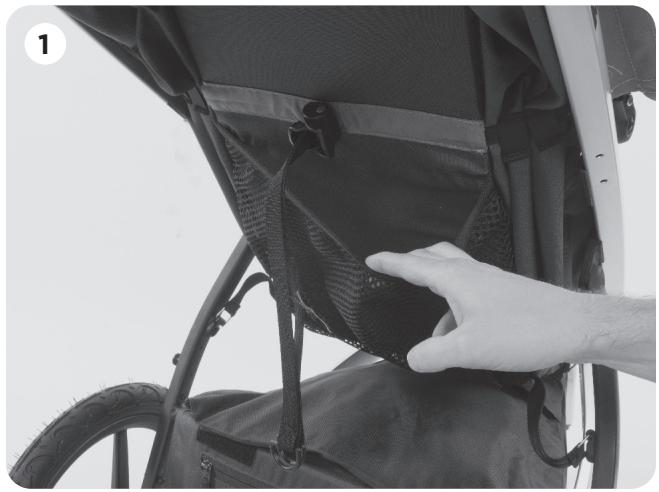
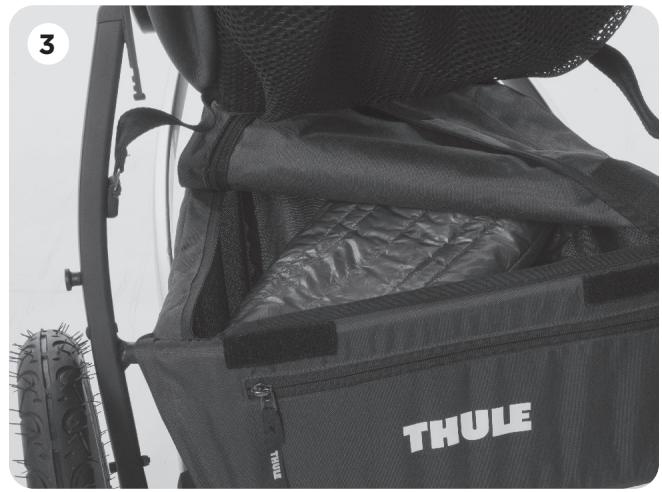
A. Your carrier is equipped with the following storage compartments:
One large mesh pocket on the upper back. (See image 1)
- Two small mesh pockets inside the carrier at the front. (See image 2)
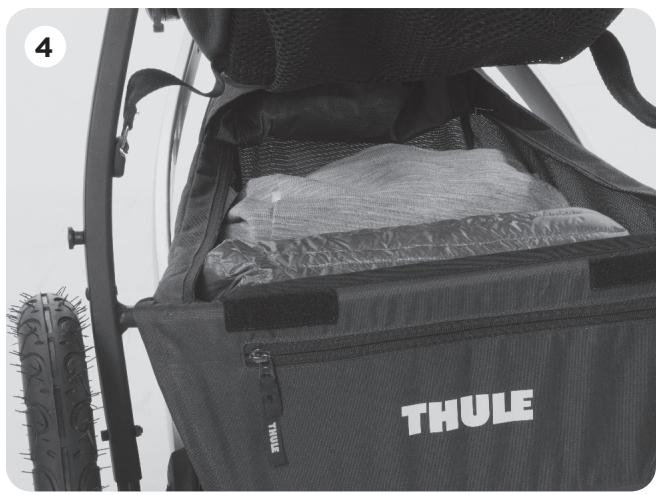
- One large storage compartment underneath the seat (See image 3). To keep the compartment open unzip the cover and store the cover in the pocket at front. (See image 4)

WARNING
Max cargo weight in the cargo tray is 4.5 kg (10 pounds)
Max cargo weight in the back mesh pocket is 1.4 kg (3 pounds)
Max weight in the side mesh pocket is 0.5kg (1 pounds)
5
ADDITIONAL
INFORMATION
5.1 ACCESSORIES
There are numerous accessories that are compatible with your Thule child carrier.
Thule Infant Car Seat Adapter
Thule Snack Tray
Thule Console
Thule Hydration Cage
Thule Cup Holder
Thule Bunting Bag
Thule Baby Supporter
Thule Rain Cover
Thule Mesh Cover
Contact your local dealer or visit our website: www.thule.com for more information.
5.2 SERVICE AND CARE
Regularly inspect your Thule child carrier and accessories for damage and signs of wear.
Metal Components
Check for any dents or cracks. Do not use the child carrier if any metal components are cracked or damaged.
Fasteners
Regularly examine the child carrier to see if any of the fasteners are bent, broken, missing or loose. Tighten any loose fasteners and replace any damaged or missing fasteners.
Fabric
Examine the fabric regularly for tears, worn spots or any other signs of damage.
Wheels
Clean the wheel axles and apply grease or oil to all exposed moving parts. Have the wheels inspected and serviced at least once a year. It is highly recommended that you take your child carrier into an authorized service provider once a year to keep it in the best possible condition. Regularly clean the child carrier with warm water and a mild soapy solution. Never use harsh cleansers or solvents.

WARNING
The proper service and care of this Thule child carrier affects the performance and safety of it.
5.3 STORAGE
Store your child carrier and accessories in a dry area out of direct sunlight. If possible, hang the child carrier up off of the ground. Before storing your child carrier, it should be dry to prevent the growth of mold or bacteria.
5.4 WEAR AND TEAR
This child carrier is very durable and allows you to transport your child(ren) for long periods of time. It is subject to wear and tear over time depending on several factors.
Use and Milage
The more often this Thule child carrier is used and the farther it goes the more it will wear.
Service and Care
Keeping this Thule child carrier clean and well maintained is an important factor in keeping it in good condition.
Storage
Storing this Thule child carrier properly will reduce the amount of wear, especially to the fabric.
Type of Use
Hard cornering, fast acceleration and braking all contribute to premature wear of various components especially brakes and tires.
Weather
Various weather conditions affect individual components differently. Direct sunlight prematurely wears the fabric and rubber wheels. Salt in the air or on the road affects the wheel rims and fabric floor. Dirt and mud can get into moving parts and contribute to wear as well. Premature wear of a component is not necessarily signs of a defective product. The way this child carrier is used and cared for will greatly affect how quickly it wears.