
LIQUID JADE - Téléphone mobile ACER - Notice d'utilisation et mode d'emploi gratuit
Retrouvez gratuitement la notice de l'appareil LIQUID JADE ACER au format PDF.

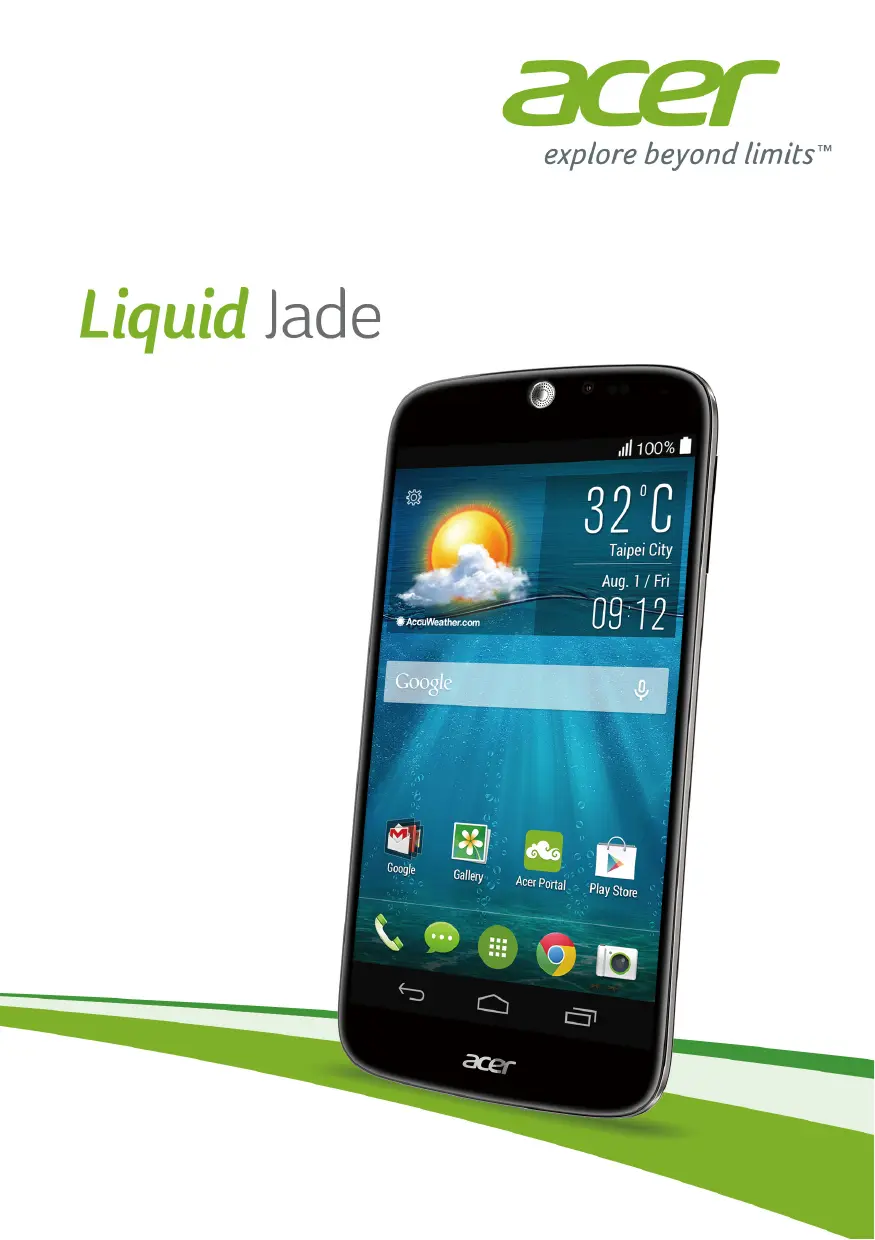

| Type de produit | Téléphone mobile (smartphone) |
| Marque | Acer |
| Modèle | Liquid Jade |
| Système d'exploitation | Android |
| Écran | Écran tactile capacitif TFT LCD 5 pouces, résolution 1280 x 720 |
| Processeur | Quad-core 1,3 GHz |
| Mémoire RAM | 1 Go ou 2 Go selon modèle |
| Stockage interne | 8 Go ou 16 Go selon modèle |
| Appareil photo arrière | 13 mégapixels avec autofocus et flash LED |
| Appareil photo avant | 2 mégapixels, focale fixe |
| Batterie | Lithium-ion 2100 mAh, non amovible |
| Dimensions | Hauteur : 140,5 mm, Largeur : 69 mm, Épaisseur : 7,5 mm |
| Poids | 125 g (avec batterie) |
| Connectivité | Bluetooth 4.0, Wi-Fi 802.11b/g/n, GPS, HSPA+/GPRS/EDGE, GSM quadribande, UMTS |
| Cartes SIM | Dual SIM (nano SIM) selon modèle |
| Stockage extensible | microSD jusqu'à 32 Go |
| Connecteurs | Micro USB (charge et données), prise casque 3,5 mm |
| Radio FM | Oui, nécessite un casque comme antenne |
| Capteurs | Lumière ambiante, proximité |
| Entretien et nettoyage | Utiliser un chiffon doux et humide. Ne pas exposer à l'eau ni à l'humidité. Ne pas utiliser d'objets tranchants sur l'écran. |
| Sécurité | Éteindre l'appareil dans les zones réglementées (avions, hôpitaux, stations-service). Éviter les températures extrêmes. Protéger l'ouïe en baissant le volume. |
| Pièces détachées et réparabilité | Batterie non amovible. Carte mémoire microSD remplaçable. Connecteur micro USB standard. |
| Garantie | Enregistrement via Acer ID pour le service de garantie |
FOIRE AUX QUESTIONS - LIQUID JADE ACER
Questions des utilisateurs sur LIQUID JADE ACER
0 question sur cet appareil. Repondez a celles que vous connaissez ou posez la votre.
Poser une nouvelle question sur cet appareil
Téléchargez la notice de votre Téléphone mobile au format PDF gratuitement ! Retrouvez votre notice LIQUID JADE - ACER et reprennez votre appareil électronique en main. Sur cette page sont publiés tous les documents nécessaires à l'utilisation de votre appareil LIQUID JADE de la marque ACER.
MODE D'EMPLOI LIQUID JADE ACER
Liquid Jade
Sign up for an Acer ID and enjoy great benefits
Open the Acer Portal app from the Start screen to sign up for an Acer ID or sign in if you already have an Acer ID.
There are three great reasons for you to get an Acer ID:
- Build Your Own Cloud with Acer BYOC.
- Get the latest offers and product information.
- Register your device for warranty service.
For more information, please visit the AcerCloud website:
www.acer.com/byoc-start

Important
This manual contains proprietary information that is protected by copyright laws. The information contained in this manual is subject to change without notice. Images provided herein are for reference only and may contain information or features that do not apply to your computer. Acer Group shall not be liable for technical or editorial errors or omissions contained in this manual.
TABLE OF CONTENTS
Setting up 5
Unpacking your smartphone. 5
Getting to know your smartphone. 5
Views 5
Charging the battery 6
Installing a SIM or microSD card 7
SIM card lock. 9
Using your smartphone 10
Turning on for the first time. 10
Sign in to or create a Google account... 10
Entering your PIN 10
Activating a new SIM card 10
Locking your smartphone 10
Waking your smartphone 11
Navigating through menus and options. 11
Using the touchscreen. 12
Onscreen keyboards 12
Changing the text input method 12
Swype 13
Google keyboard 14
Predictive text 15
The Home screen 16
Change your Home screen interface 16
Search. 17
The extended Home screen. 18
Personalizing the Home screen 18
The Apps menu 21
Notification and status area 21
Multitasking 22
Managing contacts 23
Managing your contacts 23
Adding a contact 23
Making calls 25
Before making a call 25
Making a call. 26
Dialing a number from Call History 26
Viewing missed calls. 27
Making a call to one of your contacts. 27
Dialing an international number 27
Direct dial widget 28
The voice call screen 28
Answering or declining a call 29
Conference calls 30
31
Creating a new message 31
Replying to a message 32
Multimedia messages. 33
Receiving multimedia messages 33
Going online 34
Browsing the internet. 34
Using the browser 34
Setting up Email 35
Google services 35
Setting up your Google email 36
Voice search 36
PlayStore 37
Google Hangouts 38
Maps, Navigation, Places and Latitude .... 39
Using the Camera 40
Camera/camcorder icons and indicators 40
Mode selector 42
Settings 43
Taking a photo 44
Taking a panoramic photo 45
Shooting a video 45
Supported formats 46
Viewing photos and videos 46
Geotagging 46
Advanced settings 47
Putting your smartphone in Airplane
mode 47
Turning Airplane mode on or off 47
Restarting your phone 48
Adjusting settings 49
Activating or deactivating connections..... 49
Phone network settings 51
Phone settings 52
Sound 53
Audio profiles 53
Display 54
Setting the date and time. 54
Setting alarms. 54
Changing language and text options 55
Connecting to a PC. 55
Synchronization 55
FM radio. 56
Applications (apps) 57
Closing an app 57
Uninstalling an app 57
Restoring to factory settings 57
Accessories and tips 59
Using the headset. 59
Using a Bluetooth headset. 59
Creating a new access point. 59
Inserting a microSD card 60
Managing your SIM cards 61
SIM Management 61
Appendix 64
FAQ and troubleshooting 64
Other sources of help 66
Warnings and precautions 67
Medical devices 68
Vehicles 69
Potentially explosive environments 69
Emergency calls. 70
Taking care of your smartphone 70
Specifications 72
Performance 72
Display 72
Multimedia 72
USB connector. 72
Connectivity 73
Camera 73
Expansion 73
Battery 73
Dimensions 74
End User License Agreement 75
SETTING UP
Unpacking your smartphone
Your new smartphone comes packed in a protective box. Carefully unpack the box and remove the contents. If any of the following items is missing or damaged, contact your dealer immediately:
- Your new Acer smartphone
- Quick Guide
USB cable - AC adapter
- Headset

Note
In-box content varies depending on country and region.
Getting to know your smartphone
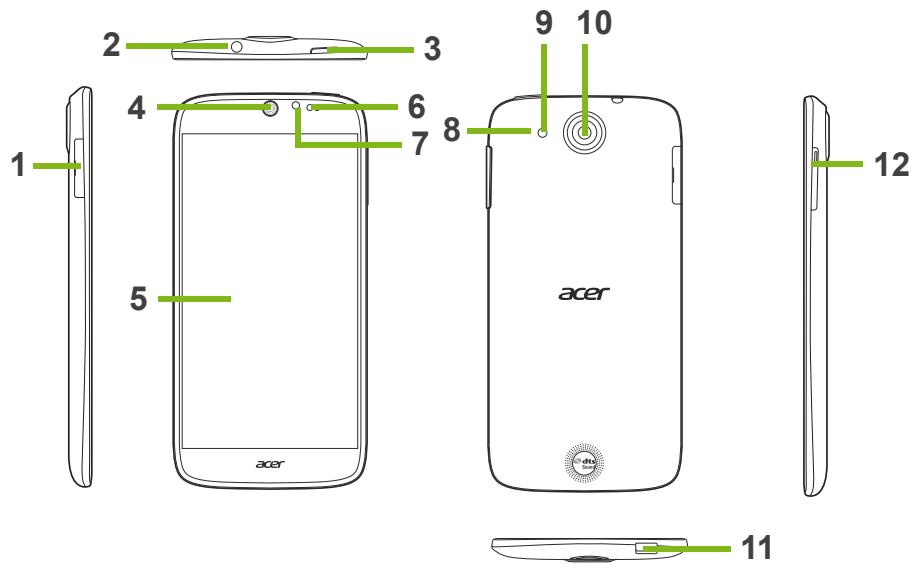
Views
| No. | Item | Description |
| 1 | microSD card / SIM card tray | Accepts a microSD card and one or two SIM cards (depends on model purchased). Note: The microSD card replaces a SIM card in models that support two SIMs. |
| 2 | 3.5 mm headphone jack | Connects to stereo headphones. |
| 3 | Power button | Press to turn the screen on/off or enter sleep mode; press and hold to turn the smartphone on or off. |
| 4 | Phone speaker | Emits audio from your smartphone; suitable for holding to your ear. |
| 5 | Touchscreen | Touchscreen to display data, phone content and enter information. |
| 6 | Ambient light and proximity sensors | |
| 7 | Front camera | Front-facing camera suitable for video chats and self-portraits. |
| 8 | Microphone | Internal microphone. |
| 9 | Flash | LED flash for taking photos in low-light environments. |
| 10 | Camera | A camera for taking high-resolution images. |
| 11 | Micro USB connector | Connects to a USB cable/charger. |
| 12 | Volume up/down button | Increases or decreases the phone volume. |
Charging the battery
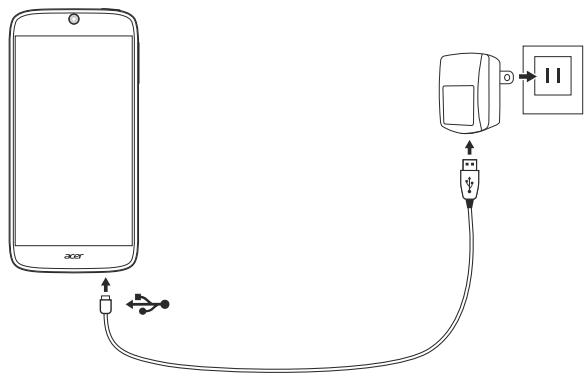
For initial use, you need to charge your smartphone for eight hours. After that you can recharge the battery as needed.
Connect the AC adapter cord to the micro USB connector on your smartphone.
Installing a SIM or microSD card

Note
The information in this UM may vary according to the number of SIMs you are using.
To take full advantage of your smartphone's telephony capabilities, you must install a SIM card.
Your new phone has multiple SIM card holders; install any combination of SIM cards.
Additionally, you may wish to increase your smartphone's storage by inserting a microSD card into the labeled slot.
- Turn off the phone by pressing and holding the power button.
2.Pull out the SIM / microSD card carrier.
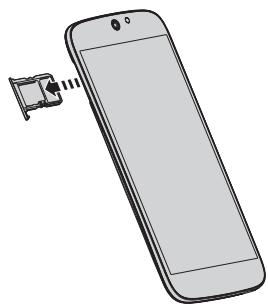
3.Insert the SIM and/or microSD card as shown.

Note
Your phone can accept one nano SIM and one microSD card, OR two nano SIMs. Take care not to damage your cards when you reinsert the carrier. Specifications vary depending on model purchased.
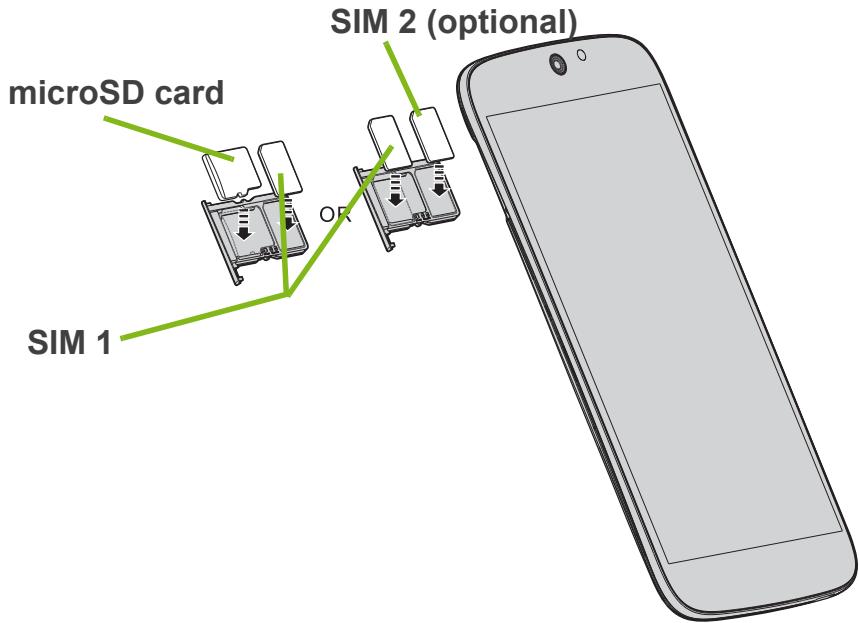
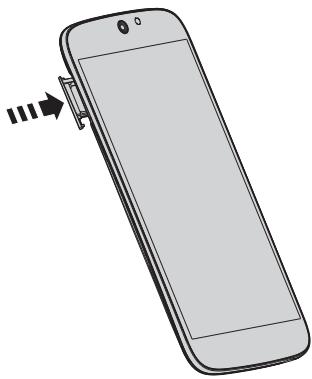
- Insert the carrier, taking care to ensure that the card(s) remain correctly seated in the carrier.
SIM card lock
Your smartphone may come with a SIM card lock, i.e., you will only be able to use the SIM card provided by your network operator.
To cancel the SIM lock, contact your network provider.
USING YOUR SMARTPHONE
Turning on for the first time
To turn on your smartphone for the first time, press and hold the power button until the screen turns on. You will then be asked to configure some settings before you can use your smartphone.
Follow the onscreen instructions to complete setup.
Sign in to or create a Google account
If you have Internet access, your smartphone allows you to synchronize information with a Google account.
You may create or sign in to an existing Google account, which will be used to synchronize your contact list, email, calendar and other information. Open the Apps menu and then tap Settings > Add account. Tap the type of account you want to add (e.g. Google). You will need internet access to complete the synchronization process. You can create and easily access multiple Google accounts.
Entering your PIN
When you install a SIM card for the first time, you may need to enter a PIN using the onscreen number pad.

Important
Depending on your settings, you may be required to enter your PIN each time you switch on the phone function.
Activating a new SIM card
If you are using your SIM card for the first time, it may require activation. Contact your network operator for details on how to do this.
Locking your smartphone
If you will not use your smartphone for a while, briefly press the power button to lock access. This saves power and ensures your
smartphone does not unintentionally use any services. Your smartphone will lock automatically if it is not used for one minute.
Waking your smartphone
If the screen is off and the smartphone does not react to any taps on the screen or front panel button, then it has been locked and is in sleep mode.
Press the power button to wake your smartphone. Unlock your smartphone by sliding your finger from one side of the screen to the other (it works both ways).
For additional security, you may set an unlock pattern, a set of dots that must be touched in the correct order to access the phone. Open the Apps menu and then tap Settings > Security > Screen
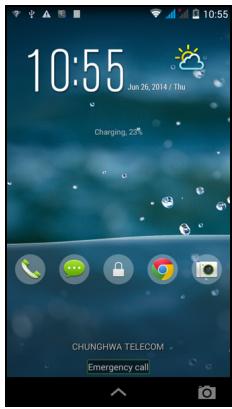
lock. If you forget your unlock pattern, please refer to Unlock pattern on page 66.
You may also directly enter the lock screen apps. Tap and hold the lock screen icon, move your finer slightly in any direction, and release. The phone unlocks and opens that app.
Navigating through menus and options
To navigate through menus and options, there are three buttons beneath the screen.
Back
Tap this button to go to the previous page, or to go up one level in a menu.
Home
Tap this button to go directly to the Home screen. Tap and hold this button to open Search.
Menu
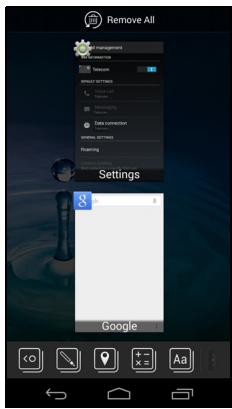
Tap this button to see recently opened apps. Tap an app to open it. At the bottom of the Menu screen are Acer Float apps. Tap a Float app to open the app in its own window while keeping what you were doing visible. You can customize which apps appear. Swipe to the right in the Acer Float apps bar and tap the gear icon. Choose from float Browser, Buttons, Calculator, Camera, Maps, Notes, Stopwatch, and Text.
Tap and hold the Menu button to open a menu of actions that are valid for the current app or screen. Tap anywhere on the screen to return to the Home screen. See Multitasking on page 22.
Using the touchscreen
Your smartphone uses a touchscreen for selecting items and entering information. Use your finger to tap the screen.
Tap: Touch the screen once to open items and select options.
Drag: Hold your finger on the screen and drag across the screen to select text and images.
Tap and hold: Tap and hold an item to see a list of actions available for that item. On the pop-up menu that appears, tap the action you want to perform.
Scroll: To scroll up or down the screen, simply drag your finger up or down the screen in the direction that you want to scroll.
Onscreen keyboards

Note
The keyboard layout varies slightly, depending on the application and information that is required.
Your new phone has the Swype keyboard set as the default for entering text. See Swype on page 13.
Changing the text input method
To change the input method:
-
Open the Apps menu.
-
Tap Settings > Language & input > Default.
- Tap your preferred input method(s) from the list (if only one method is selected, all options will be grayed out).
- Uncheck the method(s) you do not wish to use.
- Tap Default to set one method as your default.
Swype
Swype is a fast way to enter text. It allows you to type with one continuous motion across the screen keyboard; you create a word by drawing through letters.
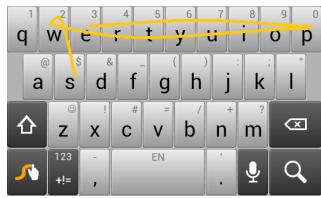
Put your finger on the first letter of the word and draw a path from letter to letter, lifting up only after the last letter. Swype will insert spaces where necessary.
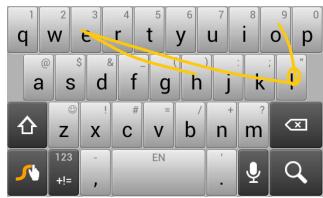
Swype will usually add a double letter in a word when needed, but you can help Swype recognize you want a double letter by scribbling slightly or making a loop on the
letter. For example, to get the "ll" in "hello", scribble (or make a loop) on the "l" key.
When there are multiple suggestions for the word you want to enter, Swype displays a Word Choice List. To accept the default word in the Word Choice List, just keep Swyping. Otherwise, scroll through the list by dragging your finger, and tap the word you want.
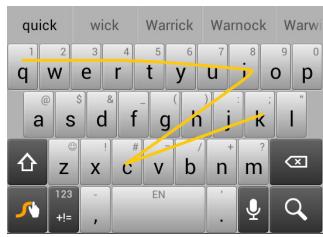
Press and hold the Swype key to access settings, features, updates, preferences, and help.

Tap the +! = button to see numbers and special characters; tap the page (shift) key to see even more.
Additional keys vary depending on the type of text you enter, e.g. a key to add a smiley is available when typing a text message. Like other keys, tap and hold for additional options.
To change the input method, open the Notification area (see Notification and status area on page 21) and tap Choose input method.
Text assistance
The Swype keyboard has various features that assist you to enter correct text. In the Application menu, tap Settings > Language & input and then tap the Settings button to the right of Swype. You can also tap and hold the Swype key. From here you can enable or disable the following:
| Function | Description |
| How to Swype | Learn how to use the Swype keyboard. |
| Gestures | Use how to use Swype gestures. |
| Preferences | Change your text input preferences. |
| Language Options | Set the language used by the keyboard. |
| Swype Connect | Add contact names and words used in posts to your personal dictionary. Change data settings. |
| Personalization | Change keyboard theme, edit your personal dictionary and personalize your experience by signing in to Facebook, Twitter or Gmail to populate your dictionary. |
| Updates | Check for app and dictionary updates. |
Google keyboard
This is a standard onscreen QWERTY keyboard that allows you to enter text. Tap and hold a key with numbers at the top to select alternative characters, such as letters with accents.
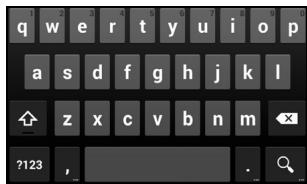
Tap the ?123 button to see numbers and special characters, and then tap the < key to see even more.
You can choose another input language by tapping and holding the forward slash key. Alternatively, you can open the Apps menu and then tap Settings > Language & input. Then tap the Settings button
next to Google keyboard > Input languages. The keyboard layout changes according to the selected language.
After setting up more than one language, the world button appears next to the space bar. Tap this button to quickly toggle between multiple input languages.

Text assistance
The Google keyboard has various features that assist you to enter correct text. In the Apps menu, tap Settings > Language & input. Then tap the Settings button next to Google keyboard. From here you can enable or disable several keyboard-related settings.
Predictive text
Google keyboard provides predictive text input for the browser. As you tap the letters of a word, a selection of words are displayed above the keyboard that continue the sequence of letters tapped, or are a close match allowing for errors. The word list changes after every key press. If the word you need is displayed, you can tap on it to insert it into your text.
The Home screen
The Home screen gives you quick access to information and simple controls with widgets or shortcuts. These display information such as the time and weather, or provide additional controls and direct access to apps and other frequently used features of your smartphone.
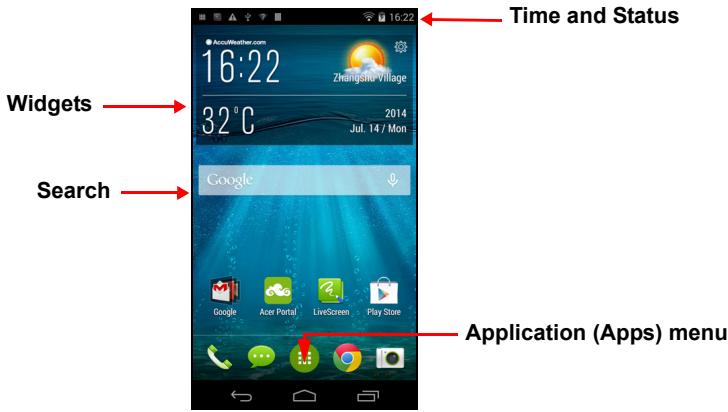
At the bottom of the screen is the application dock which displays default apps. Tap an icon to open the app. Tap the Apps menu icon in the middle of the application dock to view your apps. To change apps, see Changing application dock icons on page 20.
Change your Home screen interface
Your new smartphone offers a Quick Mode user interface that provides three customized layout options that are designed for specific groups of users.
Standard Mode
Provides easy-to-understand icons for commonly used functions on the phone and three themes to choose from.
Easy Mode
Provides large icons for commonly used functions and two themes to choose from. This mode is ideal for older users and users who have reduced vision and/or mobility.
Basic Mode
This provides photo-based dialing and messaging options that are ideally suited to younger and/or inexperienced smartphone users.
Turning Quick Mode on
To turn Quick Mode on:
- Open the Apps menu > Quick Mode.
- Select the mode you would like to use, then tap Next.
- Choose whether you would like to add more content or not.
- Choose your theme, and set the widgets.
Set a passcode for Quick Mode
Once you have activated Quick Mode you have the option of setting a passcode to prevent unauthorized changes.
- Swipe down from the top of the screen to open the Notification area.
- Tap the Settings icon in the lower right-hand corner of the screen.
- Enter the passcode twice and tap OK.
Turning Quick Mode off
To turn Quick Mode off:
- Swipe down from the top of the screen to open the Notification area.
- Tap the Settings icon in the lower right-hand corner of the screen.
- Set a passcode if you have not previously set one.
- Tap OK.
- Tap the Settings icon in the lower right-hand corner of the screen.
- Tap Exit Quick Mode.
Search
To search for apps, files or for information on the Internet, tap the Google icon.

Simply enter the text you want to find and tap or tap one of the suggestions, apps or files shown in the list.
In order to search or browse the Internet, you must be connected to a cellular data (if available) or wireless network. See Going online on page 34.
Voice search
If voice search is available, tap the microphone and speak your search request. See Voice search on page 36.

The extended Home screen
The Home screen extends to either side of the screen, giving you more room to add icons, widgets or features. To view the extended screen, slide your finger to the left or right.
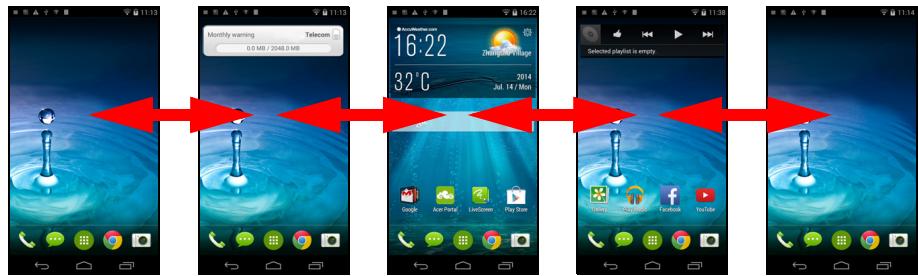
Personalizing the Home screen
You may personalize your Home screen by adding or removing app shortcuts or widgets, and by changing the wallpaper.
Adding and removing shortcuts and widgets
To add shortcuts or widgets, tap the Apps menu icon in the bottom-center of the Home screen.
Tap Apps to see a list of shortcuts to apps you can drag to a Home screen.
Tap Widgets to see small apps and links (such as custom shortcuts, contacts or bookmarks) that you can add to a Home screen. Widgets are small apps that display constantly-updated information or quick shortcuts to apps or special functions.
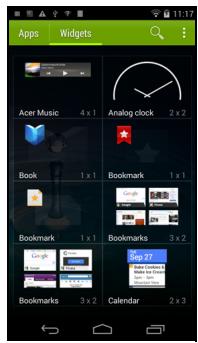
To move an app or widget to the Home screen, tap and hold an item until it is selected. The Home screen will open. Drag the item to any free area on the screen. To view information about the app or widget, drag it to the icon at the top of the screen.
To move the item to a different Home screen, drag it to the side of the screen, the Home screen will switch to the screen in that direction. Release the item when it is positioned correctly.
To remove a shortcut or widget from the Home screen, tap and drag it to Remove at the top of the screen.
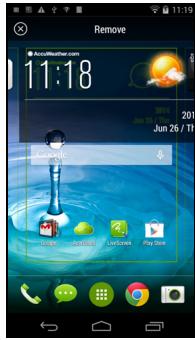
Resizing widgets
Some widgets can be resized. As soon as you place a widget on the Home screen, you can resize it by dragging the corners.
To resize a widget that is already on the Home screen, tap and hold the widget. Once the Remove icon appears, release the widget. If the widget is resizing, you will be able to drag the sides of the widget to resize it.
Adding or removing folders
You can also add folders to your Home screen. To create a new folder drag and drop an app icon onto another app icon in the Home screen.
This will create anUnnamed Folder. Tap the folder icon and then tap the name of the folder to rename it.
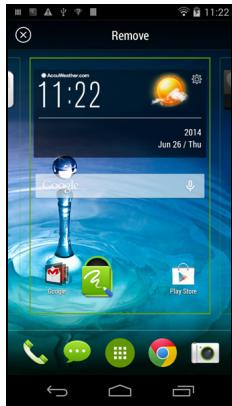
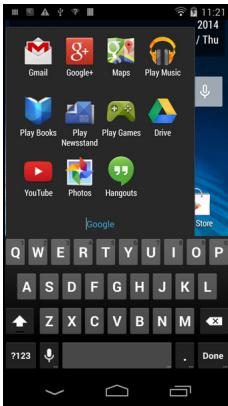
To delete an app shortcut from a folder, tap on the folder icon to display the apps inside and then tap and hold the app icon that you want to remove. Drag and drop the icon on Remove that will appear at the top of the screen.
To delete a folder, tap and hold on the folder and then drag and drop the folder on Remove that will appear at the top of the screen.
Changing application dock icons
You can set icons for installed apps in the application dock. Open the Apps menu and find the app you want to add. Tap and hold the icon, then drag it to any open position in the dock. Dragging the new app to an existing dock icon will create a folder for both icons.
To remove an icon from the dock, tap and hold the icon to select it. Either drag the icon to a different location outside the dock or to Remove at the top of the screen.
Changing the wallpaper
In the Apps menu, tap Settings > Display > Wallpaper. Choose from images stored in the Gallery, Live Wallpapers (featuring animated or interactive backgrounds), Photos, Video Wallpaper (enabling you to use videos as your background), or Wallpapers.
The Apps menu
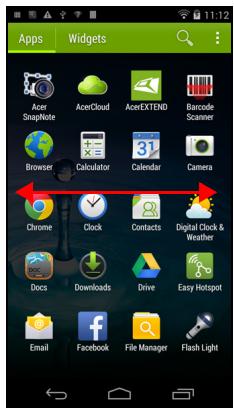
To access the Apps menu, on the Home screen tap in the center of the dock.
Apps are displayed in alphabetical order. Swipe the page to the left or right to see more apps. When you are on the last page of apps, swipe to the left to see widgets available on your tablet, or tap Widgets at the top of the page.
To quickly jump to apps or widgets, tap Apps or Widgets at the top of the Apps menu.
Notification and status area
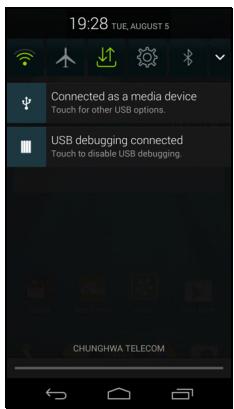
Notification and status icons are shown at the top of the screen. The top-right area displays a variety of status information, such as Wi-Fi connectivity, signal strength, battery status, and time. The top-left area displays event icons, such as a new message.
- Dual-SIM models:

- Single-SIM models:

Drag the Notification area down the screen to view more information about new events and access Quick Settings.
Multitasking
You can have multiple apps open at the same time. To open a new app, tap the home button to return to the Home screen, then start the new app. Tap the Menu button to quickly navigate back and forth between previously-opened apps.

Note
To prolong battery life, it is better to close an app when you've finished using it. Do this by either pressing the Back key or the Menu button and selecting Exit (if available).
MANAGING CONTACTS
Managing your contacts
Your smartphone features an address book that allows you to save contacts to either the internal memory or onto your SIM card.
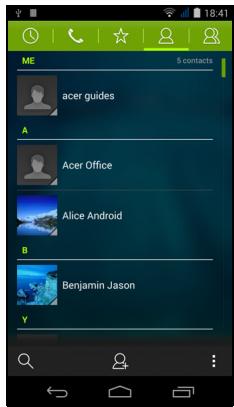
Tap the Contacts app from the Apps menu or tap All contacts from the Dialer to view your contacts.
If you don't have any contacts stored on your phone, you can import your Google account contacts, add a new contact or import contacts from your SIM or SD card. Open the People app from the Apps menu and then tap to add a contact, to search for a contact, or tap the Menu button to open the menu.
Adding a contact
Tap to add a new contact. You may also scan a person's profile barcode to add the person to your contact list or group.
To create a contact, first choose where you want to store the contact's information. You will then be asked to enter the contact's information, such as name, address, and phone number.
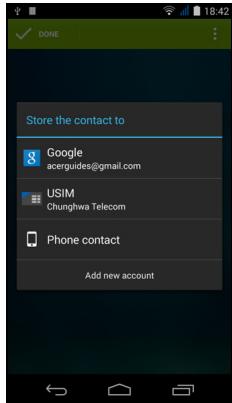
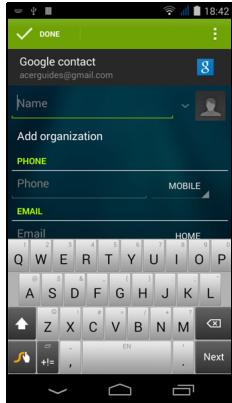
You may scroll down the page and tap Add another field to add things such as:
IM addresses.
- Add any personal notes about the contact.
- Phonetic name
- Link a website
To assign an image to your contact, tap the silhouette and select whether to take a photo or select an image from your smartphone's picture gallery.
When done, click Done at the top of the screen.
Tapping on the contacts name will bring up their profile. Tap while viewing a contact's profile to edit, share, delete, or print the contact. You may also set a ringtone for the contact, block incomign calls from this contact, or place the contact on your Home screen.
You may also create a contact from an already dialed or received number, see Saving a dialed number to contacts on page 30.
MAKING CALLS
This chapter shows you how to make phone calls, and the various options available to you during your call.
Before making a call
Check that the phone function is on before you make a call. You can confirm the phone status from the Notification area.

Note
Status and notification icon colors may vary. You will see an indicator icon for each SIM card inserted.
| Icon | Description |
| Connected to the network: You may make a call. | |
| Airplane mode: Wireless connectivity disconnected (Wi-Fi, Bluetooth, 2G and 3G). Please disable airplane mode before trying to make a call. |
Making a call

Note
If you have multiple SIMs inserted in the phone, you will be asked which SIM to use before the call is connected. To select a SIM, just tap the name of the carrier.
1.From the Home screen tap Phone to open the onscreen number pad.
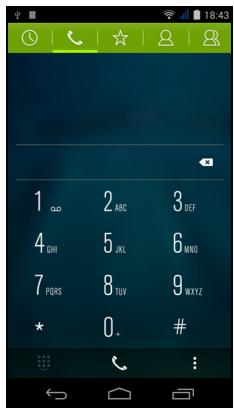
- Enter the number you wish to dial.
- Tap to make the call.
- To end the call, tap
If the contact you need is displayed, simply tap the contact name to make a call.
Dialing a number from Call History
Your call history can be viewed by tapping the Call History button. It displays recent received, dialed, and missed calls.
Tap the phone icon to radial. To view call details and other options, tap the number or contact's name.
Viewing missed calls
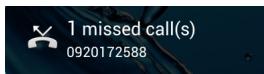
Missed call notifications are displayed in the following three areas:
-
The Notification area with the missed call icon. Open the Notification area and tap the missed call notification to display the missed call details.
-
By the Phone icon (the number in the box is the number of missed calls). Tap Phone from either the Home screen or the Apps menu to directly display the missed call details.
-
On your phone's lock screen. Tap the notification and slide to the left or right to display the missed call details.
Making a call to one of your contacts
Calling a contact from the Contacts tab
-
Tap the All contacts to view your contacts.
-
Tap on a contact to call them.
Calling a contact from the Contacts app
-
Tap the People icon the Apps menu to view your contacts.
-
Tap on a contact to open their profile.
-
Tap on the contact's phone number to call them.
Dialing an international number
When dialing international numbers, there is no need to enter the international direct dialing prefix ('00' etc.) before the country code.
Simply tap and hold 0+ on the onscreen number pad until + appears onscreen.

Important
International call rates can vary greatly depending on the country you are calling and your network provider. We suggest you check all call rates with your network provider, to avoid excessive phone bills. If you are using your smartphone abroad, roaming charges will apply. Consult your network provider for roaming rates specific to the country you are visiting before you leave.
Direct dial widget
You may add a direct dial widget for a contact on your Home screen. Open the Apps menu, then tap the Widgets tab. Tap and hold Direct dial and you will be able to place the widget on your Home screen. Once placed, you will be able to select a contact to associate with that particular widget on your Home screen.
The voice call screen
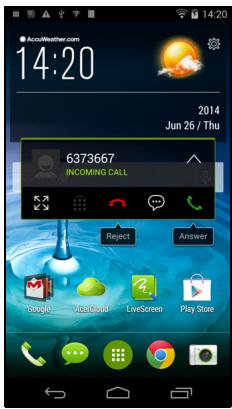
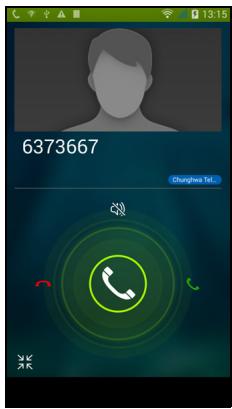
You can minimize the call window to appear as a movable dialog instead of a whole screen by tapping the icon. You can even set this "floating" dialog box as the default voice call screen. To do so, open the Notification area and tap the down arrow to display more Quick Settings options(see Notification and status area on
page 21). Tap the Float caller button to activate (green means Float caller is "ON").
Answering or declining a call
When you have an incoming call, the number will be shown on the screen. To accept or decline the call, tap the appropriate icon and slide your finger across the screen.
Ending a call
To end a call, tap from the voice call screen.
Voice call options
| Icon | Description |
| Place the call on hold. | |
| Mute a call. | |
| Speakerphone. | |
| Access the keypad while a call is in progress. | |
| Two options: • Add a second call • Record the conversation. |
Saving a dialed number to contacts
You can save a number you have dialed to your contacts for future use.
1.From the Call History , tap the number and then tap Add to contacts
2. Tap Create new contact and enter the information. See Adding a contact on page 23.
Conference calls
If you have one call on hold and another on line, you can combine both calls to create a conference call.
After the first call is established, tap to add a second call. Tap to start the conference call.
MESSAGE
This chapter shows you how to set up and use the Phone messages, Social messages and Social events functions of your smartphone.
All SMS and MMS messages are accessed via Messaging. Messaging automatically arranges received and sent messages into threads.
To access Messaging, open the Apps menu and tap Messaging on the Home screen.

Note
If you have multiple SIMs inserted in the phone, you will be asked which SIM to use before the message is sent. To select a SIM, just tap the name of the carrier.
Creating a new message
You can use your phone to compose text (SMS) and multimedia (MMS) messages.
Tap to compose a new message.
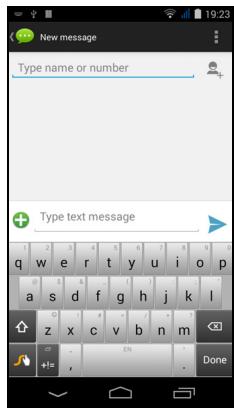
Tap to add contacts from your contacts list (People), or tap the Type name or number field to enter the recipient's phone number or name directly. Suggested contacts will be displayed in a drop-down list below the text field. To select a suggested contact, tap the contact's name.
Enter your message in the text box labeled Type text message.

Note
Text messages may be up to 160 characters long. If your message is longer than 160 characters, it will be sent as multiple linked messages. Most phones will automatically join the linked messages to present the recipient with a single long message, however, some older phones do not have this ability.
Tap the Menu button to see what options are available when creating a new message. The options change depending on the status of the message.
| Option | Description |
| Insert quick text | Insert pre-defined text content. |
| Insert contact | Add a contact to the recipients list. |
| Add subject | Add a subject to the message. |
| Discard | Discard the message. |
Replying to a message
When a new text message arrives a message icon appears in the Notification area and the message icon at the bottom of the phone displays the number of unread text messages.
Tap Messaging from the Apps menu to view the message list or open the Notification area to see a summary of the message. Tap the summary to open the message list.
To reply to an SMS or MMS message, open the message from the message list. Enter your text in the text box labeled Type text message. Tap the Menu button to see available options.
| Option | Description |
| Select message | Select multiple messages. |
| Insert quick text | Insert pre-defined text content. |
| Insert contact | Add a contact to the recipients list. |
| Add subject | Add a subject to the message. |
| Add to contacts | Add the other contact to your contacts list. |
| Chat settings | Modify various messaging settings. |
Multimedia messages
Multimedia messages are similar to text messages but also allow you to attach files such as pictures, audio or video clips. Each message can be up to 300kB in size.

Note
You need to set up an MMS profile before you can send MMS messages. Normally, your smartphone will set up the profile for you based on information retrieved from your provider.
Ask your network provider for the necessary information if you need to manually set up the MMS profile.
Receiving multimedia messages
When a new multimedia message arrives, a message icon appears at the top of the screen and a notification message is displayed.
- The notification message displays a summary of the message. Tap View to view a summary of the message.
- Tap Download to download the message content. Downloads can take a long time, depending on your connection quality. If you reply or open another app, the download will be stopped.

Important
You may be charged to download message content, especially if you are roaming. Please contact your provider if you have any questions.
- Tap the message to view the content.
- To reply to the message, enter your text in the text box labeled Type message and tap the Send icon. Simple text replies will be sent as SMS messages. If you wish to attach a file, tap . You will be presented with a menu of options.
- When you have finished composing the message, tap the Menu button and tap Send.
GOING ONLINE
Browsing the internet
In order to browse the internet with your smartphone, you must be connected to a data or wireless network.
Using the browser
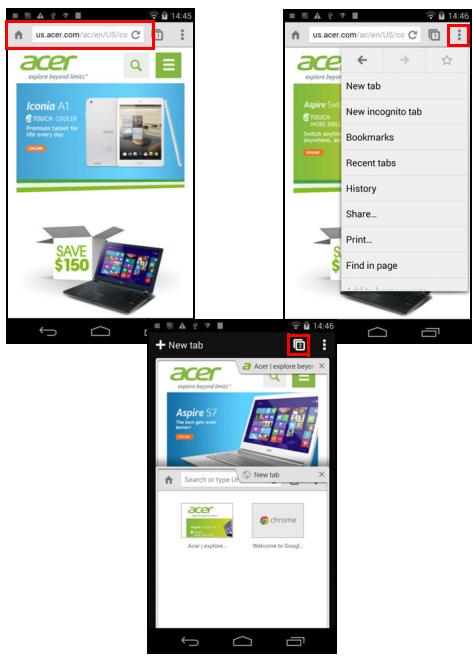
To start browsing, open the Apps menu and tap the Chrome or Browser icon.

Note
Reference images use the Chrome browser.
To open a new website, tap the address box at the top of the page. Enter the address using the keyboard and tap Go. You can zoom in or out of pages by pinching or reverse pinching.
To navigate forward and backward in your browser's history, view your bookmarks, adjust browser settings, and perform other tasks, tap the Menu button.
Chrome enables you to open multiple pages. Tap at the top of any webpage to display all of your open tabs (tap again to close). Tap a tab from the list to open it. To open a new tab, tap New tab. The number in the icon represents the number of open tabs.
Setting up Email
Your smartphone enables you to access your email. Most popular ISPs can be set up in two steps. In the Apps menu tap Email to start setting up your email account.
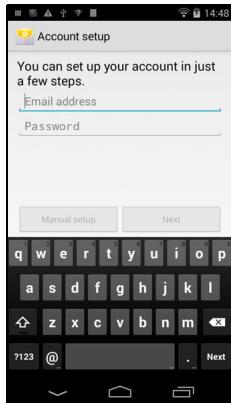
If necessary, enter your email address and tap Manual setup to enter the parameters manually. Tap Next to finish the setup process.
Google services

Note
Apps may not be available in all countries and regions.
You must activate a Google account before using Google services. The first time you access Google services, you must read and accept the Terms of Service.
Setting up your Google email
1.Make sure your smartphone is connected to a data or Wi-Fi connection.
2.From the Apps menu tapGmail.
If you did not enter your Gmail account address and password when you first started your phone, follow the onscreen instructions.
Composing an email
1.Make sure your smartphone is connected to a data or Wi-Fi connection.
2.From the Apps menu tapGmail.
3. Tap
4. Enter the recipient's email address, the subject and message.
5. When you are finished composing your message, tap
Voice search
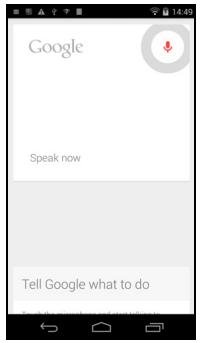
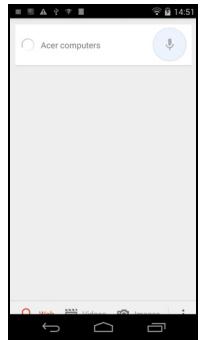
With voice actions, you can send text messages, place calls, send emails, find directions of establishments, automatically call establishments, search the internet and even send a note to yourself using your voice. Tap Voice Search from the Apps menu, or tap the microphone icon on the Home screen.
Play Store

Important
For connection issues with Play Store, see FAQ and troubleshooting on page 64
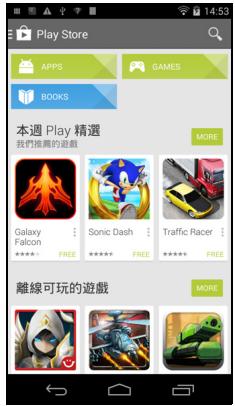
Tap Play Store from the Apps menu to open the Google Play. Here you can obtain a variety of add-on programs and apps to enhance the functionality of your smartphone.
The contents and design of Google Play varies by region. For example, in some regions, you can also browse for and purchase movies, books, magazines, or music. Updates may add new categories or change how to navigate Google Play at any time.
You can browse the store by category or tap the search icon to search for a specific app.
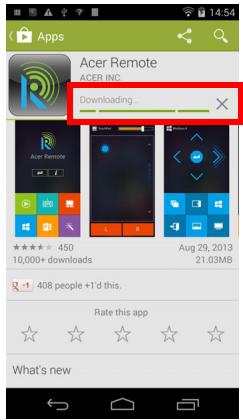
Once you have selected an app, tap the Install button to download and install the app. You will be told which services the app requires access in order to function correctly (e.g. contact information, wireless access, GPS). If none of these services seem unusual, tap Accept & download to proceed with the installation.
You may keep track of the download progress from both the app's page and the notification area.
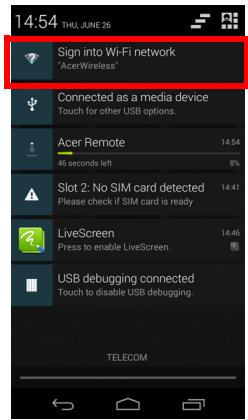

Important
Some apps may require payment before you can download them. You will need to have a Google Wallet account in order to pay for these apps, or a credit card number associated with your Google account.
Using downloaded apps
Once you've downloaded and installed an app, you may find it in the Apps or Widgets sections of the Apps menu.
Certain apps provide both an App and widget, or only provide a widget (with no app icon). See Personalizing the Home screen on page 18.
Uninstalling downloaded apps
Once you've downloaded and installed an app, you may uninstall the app by opening the Apps menu and tapping Settings > Apps. In the downloaded tab, select the the app you wish to uninstall and tap Uninstall. Deleting an app icon from the Home screen only deletes the shortcut.
Google Hangouts
Tap Hangouts from the Apps menu to open Google Hangouts. Here you can see a list of your contacts connected to Google Hangouts
services. Tap on a contact to open a chat session. After you have connected, you can open a video chat session.
Maps, Navigation, Places and Latitude
Get easy-to-follow directions using Google Maps, view real-time traffic condition and navigate by using spoken, turn-by-turn driving instructions. Also, view where your friends are, places of interest, and local businesses.

Note
Maps does not have information about every location. Some locations may not have all zoom levels.
Using the map
Tap the Maps icon in the Apps menu. Drag the map with your finger to move the map around.
To zoom in or out:
- Double tap a location on the map to zoom in on the location, and tap once to zoom out, or
- Touch an area with two fingers at once and spread them apart to zoom in, and pinch them together to zoom out.
USING THE CAMERA
Your smartphone features two digital cameras mounted on the front and on the rear. This section will take you through all the steps in taking photos and videos with your smartphone.
To activate the camera, open the Apps menu and tap Camera.
Camera/camcorder icons and indicators
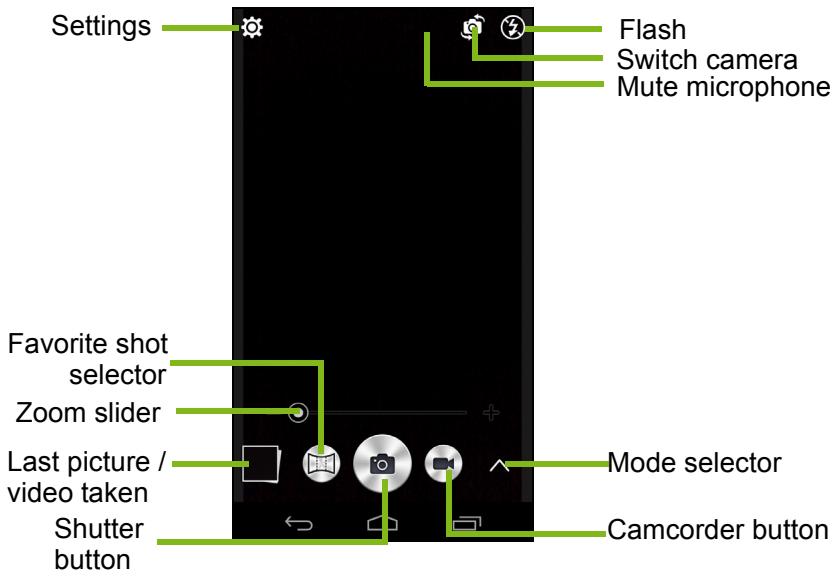
The camera window provides multiple controls on the image screen. Tap the area of the image you want to be the point of focus for the auto-focus lens (only available on the rear camera). Zoom in or zoom out using the zoom slider.
Tap the Shutter button or press the volume key to take a picture. Tap the thumbnail in the bottom-right corner to open the gallery. Tap the flash button to cycle the settings between off, automatic, and on.
Tap the Camcorder button and the camcorder immediately begins filming. While filming, you are unable to access camera/camcorder settings; however, you can still take pictures.
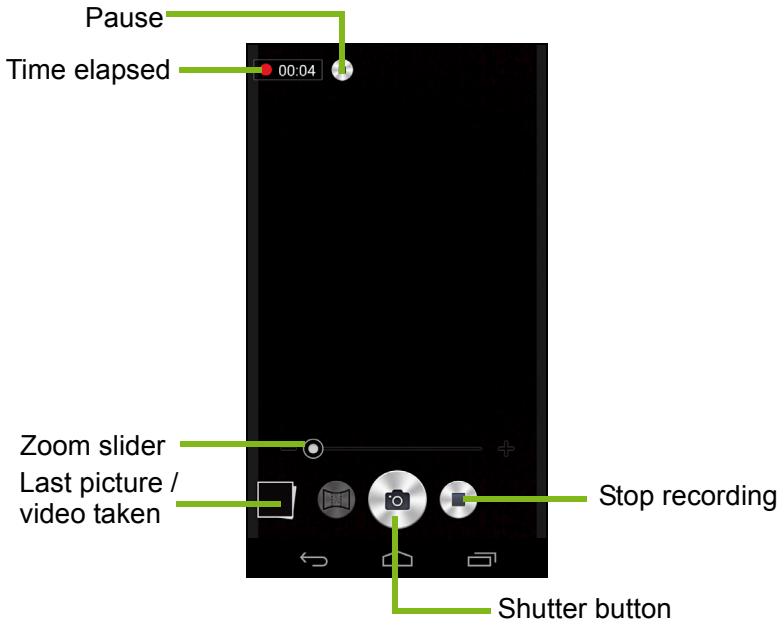
Tap the Pause button to temporarily stop recording and tap it again to restart recording. Tap the red Stop recording button to stop filming.
Mode selector
Tap the Mode selector icon to open the list of modes you can choose from. Tap the icons along the top to select different items.
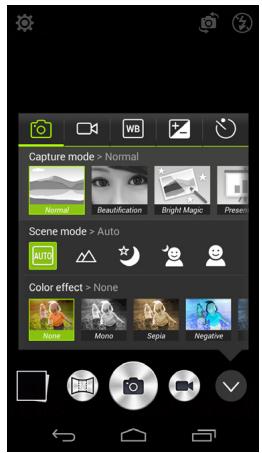
Camera
Capture mode: Select a capture mode.
| Normal | Multi angle view |
| Beautification | ASD |
| Bright Magic | Smile Shutter |
| Presentation | AEB |
| HDR | Live Photo |
| Panorama | Best Shot |
| Color effect: Applies a color effect to the image. | |
| None | Negative |
| Mono | Aqua |
| Sepia | |
| Scene mode: Adjust photo parameters for a particular environment. | |
| Auto | Night portrait |
| Landscape | Portrait |
| Night | |
Camcorder
Record mode: Select from Normal or Time lapse.
White balance
Compensate for different lighting environments.
| Auto | Cloudy |
| Incandescent | Twilight |
| Daylight | Shade |
| Fluorescent | Warm fluorescent |
Image properties
Adjust the Sharpness, Hue, Saturation, Brightness, and Contrast.
Self-timer
Set the delay before the shutter is activated.
Settings
Tap the Settings icon to open the settings menu; scroll up or down the list to view more settings
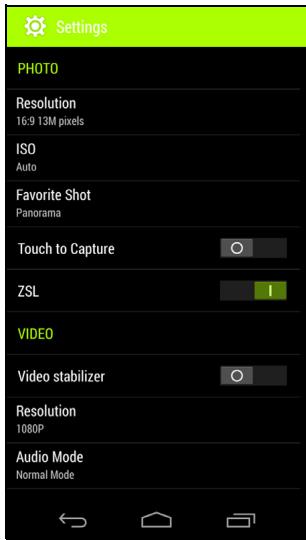
Photo
You may adjust the following:
- Resolution: Set the picture resolution.
- Set a mode as your Favorite Shot.
- Turn Touch to Capture on or off: If enabled, the camera will focus on the spot where you tap and automatically take the photo.
- Turn ZSL (zero shutter lag) on or off: If enabled, the camera takes the photo immediately when you tap the shutter button.
Video
You may adjust the following:
- Turn Video stabilizer on or off.
- Set the Resolution.
- Set the Audio mode.
Other

Note
Some of the following settings are not available for the front camera.
You may adjust the following:
- Turn GPS Location info on or off: Stores GPS information in the image information.
- Grid: Turn the composition grid on or off.
- Storage: Choose between Internal storage and SD card.
- Reset to default.
Taking a photo
- Ensure you have adjusted the settings described above.
- Frame your subject and steady your smartphone.
- Zoom in or out as needed.
- Tap the Shutter button to take a picture.
Taking a panoramic photo
Panoramic mode allows you to take a series of up to nine photos that the camera app will 'stitch' together to make a single extended image.
- To take a panoramic photo, select Panorama mode.
- Align the camera to take a photo of one end of the panoramic scene (the furthest left, right, top or bottom).
-
Press the camera button to take the first image; then slowly and smoothly turn the camera to the other end of the image.
-
Two lines display on the screen: a flashing white line and a solid blue line. As you move the camea, align the blue line to the unmoving white line.

Note
If your photo needs fewer than nine images, tap the tick icon to stop the selection process and process the captured images.
Panoramic images work best with static outdoor scenes. Objects too close to the camera or large straight edges may confuse the detection process.
The camera app will process the images and save a single extended image to your smartphone's gallery.
Shooting a video
- Frame your subject and steady your smartphone and zoom in or out as needed.
- Tap the Camcorder button to start taking a video. The icon will turn red to indicate that recording is in progress. Tap the icon again to stop recording.
Supported formats

Note
To see supported image, video, and audio formats, see Multimedia on page 72.
Viewing photos and videos
After you have taken your photo or video, it is automatically saved. Once you have taken a photo or video, you can view it in Gallery by tapping the thumbnail in the corner of the image screen. Alternatively, open the Apps menu and tap Gallery. From Gallery you can share the file directly using various services. Services vary depending on the file type.
You may also edit individual photos you have taken by tapping the pencil icon in the lower left-hand corner of the screen.
Geotagging
Geotagging allows you to store the location where a photo or video was taken right in the photo or video itself.
For the geotag to display, pictures must be taken with GPS location info turned on.
ADVANCED SETTINGS
Putting your smartphone in Airplane mode
You can enable Airplane mode (also known as flight mode) to turn off telephone and Bluetooth functions and use your smartphone as a handheld device during a flight. Check with your airline to make sure this is permitted onboard.
Switch your smartphone off during takeoff and landing as it may interfere with aircraft electronic systems.
Turning Airplane mode on or off
- Open the Notification area and tap the grid icon in the upper right-hand corner.
- Tap
AIRPLANE MODE
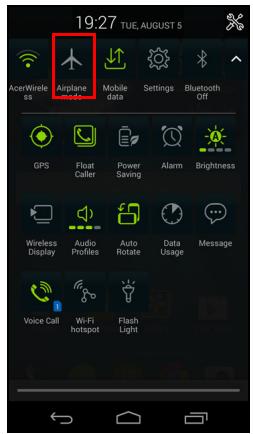
-OR-
- Press and hold the power button until you get the phone options menu.
- Tap Airplane mode to switch it ON or OFF.

Note
When Airplane mode is active, the icon will be displayed in the Notification area.
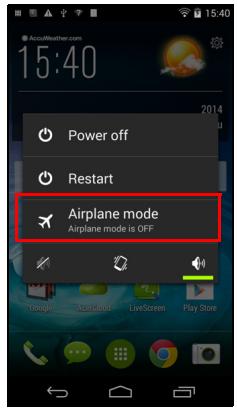
Restarting your phone
You can restart (reboot) your phone if you find apps are not responding.
- Press and hold the power button until you get the phone options menu.
- Tap Restart.
Adjusting settings
Activating or deactivating connections
Open the Apps menu and tap Settings to manage your connection settings.
| Item | Description |
| SIM management | Set a default SIM for particular functions (such as voice calling or messaging), turn the data connection on or off, set roaming preferences and associate contacts with a SIM. |
| Wi-Fi | Turn the Wi-Fi function on or off. |
| Bluetooth | Turn the Bluetooth function on or off. |
| Data usage | View an estimate of the mobile data used for each SIM. |
| Call Settings | Change Voice Call settings. Change Internet Call settings. Adjust Other settings. Turn Float Caller on or off. Set Proximity Sensor. Turn Flip Mute on or off. |
| More... | Access additional connection settings:Airplane mode: Disable all wirelessconnections so you can safely use this deviceonboard an aircraft.Default SMS app: Choose which app servesas the default SMS app.Tethering & portable hotspot: Share yourphone's mobile data connection via USB or asa portable Wi-Fi hotspot. VPN: Set up and manage Virtual PrivateNetworks.Mobile networks: Set your options forconnecting to mobile networks.USB Internet: Share your computer's internetconnection via a USB cable. See Internetsharing on page 51. |
If your phone is in Airplane mode, the option to turn Bluetooth on will be disabled. Please refer to Putting your smartphone in Airplane mode on page 47 for instructions on turning Airplane mode on or off.
Adjusting Bluetooth settings
You can use Bluetooth to exchange information between your smartphone and other mobile devices.
Bluetooth connections
For all Bluetooth settings, open the Apps menu and tap Settings > Bluetooth. Here you can switch Bluetooth on or off, set a device name and discoverability. Tap SEARCH FOR DEVICES to scan for available devices.
To connect to a device, tap the device in the list of available devices. You may be asked to enter a PIN on both devices to establish the connection.
To simply turn on or off Bluetooth, open the Notification area and tap the Bluetooth button.
Internet sharing
Tethering via USB
If you wish to share your mobile internet connection with a computer, you can connect your phone to a PC using the supplied USB cable.
- Plug the USB sync cable into the micro USB connector on your smartphone.
- Plug the USB client connector into an available USB port on your computer.
3.Push the Menu button and then tap Settings > More.. > USB Internet.
Wi-Fi hotspot
You can turn your smartphone into a portable Wi-Fi hotspot to share your mobile internet connection with up to 8 clients.
- Push the Menu button and then tap Settings > More... > Tethering & portable hotspot. Turn Wi-Fi hotspot ON. Tap Wi-Fi hotspot > Set up Wi-Fi hotspot.
- Set the Network SSID and adjust security between None and WPA2 PSK. Tap Save to finish.

Note
When your smartphone is serving as a Wi-Fi hotspot, you can't use your phone's apps to access the internet via its Wi-Fi connection.
Phone network settings
In the Apps menu tap Settings > More... > Mobile networks to adjust your network settings. You can turn data connection on or off when roaming, choose a preferred network mode, specify a network operator and define access point names.
Selecting a network
Your phone will automatically detect your carrier/network settings when you insert a new SIM card. However, you may prefer to manually select a network. This may be a good idea when roaming.

Note
When you are traveling, manually selecting a network may help to reduce your roaming charges. Check with your home service provider for the network offering the most competitive rates at your destination.
- Open the Apps menu and tap Settings > More... > Mobile networks > Network operators > Select Manually.
- Your phone will search for available networks.
- Select your preferred network from the list generated. You phone will attempt to register on the selected network.
- Tap Select automatically to connect to the available network with the strongest signal. This may lead to your phone jumping between networks when you move around.

Note
Contact your service provider should you have any problems obtaining voice mail and the text message service center numbers.
Data usage control settings
Data usage controls let you monitor total usage by network type and app and then set limits if needed.
Ensure Wi-Fi or mobile data is enabled before setting a limit. Access data usage settings from the Apps menu by tapping Settings > Data usage.
Phone settings
Many phone settings are automatically configured by your smartphone when you insert a SIM card. The device will communicate with your provider and automatically obtain all necessary settings, such as network name, voice mail and text message center numbers.
You can also view and modify these settings manually through the Call settings screen.
From the Apps menu, tap Settings, then tap More... under WIRELESS & NETWORKS, then tap Call settings.
Sound
To adjust your phone's sound settings, in the Apps menu tap Settings > Sound.
| Item | Description |
| Vibrate | Vibrates the device for incoming calls. |
| Volumes | Adjust the Ringtone, Notifications, and Alarm volumes. |
| Phone ringtone | Sets your default voice calls ringtone. |
| Default notification | Set your phone's default notification sound. |
| Dial pad touch tones | Play tones when using dial pad. |
| Touch sounds | Play sounds when touching certain UI elements. |
| Screen lock sound | Play sound when locking and unlocking the screen. |
| Vibrate on touch | Vibrate when pressing soft keys and on certain UI interactions. |
Adjusting the volume
Adjust the volume of your phone using the volume button on the side of the phone. Alternatively, you can set the Ringtone, Notifications, and Alarms volume by opening the Apps menu and tapping Settings > Sound > Volumes.
Audio profiles
To adjust your phone's sound settings, in the Apps menu tap Settings > Audio profiles. Choose from General, Silent, Meeting, or Outdoor.
Display
To adjust your phone's display settings, in the Apps menu tap Settings > Display.
| Item | Description |
| Theme | Change the Home screen's theme. |
| Brightness | Adjust screen brightness. |
| Auto-rotate screen | Enable rotation of the screen when device is tilted. |
| Sleep | Adjust the delay before the screen automatically turns off. |
| Daydream | Controls what happens when the phone is docked and/or sleeping. |
| Font size | Change the default font size for the UI. |
| Wireless Display | Mirrors your phone's display on a compatible monitor or display.Pairing your phone to the display is required before use and may require a dongle. See the instructions that came with your display or dongle to pair. |
Setting the date and time
To set the date and time, open the Apps menu and tap Settings > Date & time.
If you travel frequently or live in an area that uses daylight saving time, activate Automatic date & time > Use network-provided time from this menu. This will enable your smartphone to set the date and time based on information it receives from the network.
Setting alarms
There are two predefined alarms on your phone by default. Tap Clock in the Apps menu, and then tap to edit alarm settings. You may:
- Turn the alarm on or off.
- Set the alarm time.
-
Set which days to repeat the alarm.
-
Set a ringtone.
- Enable or disable vibrate.
- Give it a label.
Changing language and text options
Set your location and language input preferences by opening the Apps menu and going to Settings > Language & input.
Connecting to a PC
If you wish to transfer information between your device and your computer (either the microSD card in your device or the device's internal memory), you can connect your device to a PC using the supplied USB cable.
- Plug the USB sync cable into the micro USB connector on your phone.
- Plug the USB client connector into an available USB port on your computer.
- Open the notification area and tap Connected as a media device to choose whether to connect as a Media device (MTP) (the default option) or Camera (PTP).
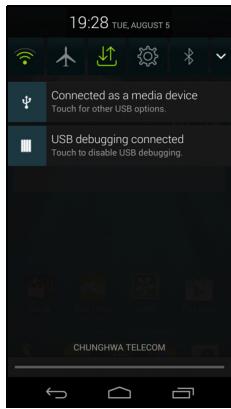
Your device will now be available as a drive in your computer's file explorer.

Note
After turning on USB storage, you will not be able to access the files in the microSD card or apps such as Gallery or Music.
Synchronization
You can sync your calendar, email and contacts on your phone and never worry about losing them again. Sync in real time or adjust it as you please. In the Apps menu, tap Settings. Under ACCOUNTS, tap
the appropriate account and again under ACCOUNTS tap that account's email address to access the synchronization settings.
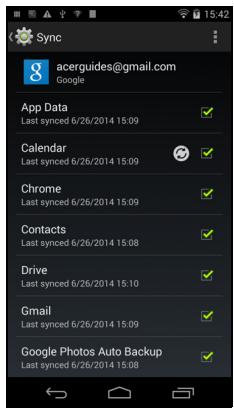
To add a new account, tap Add account. Select the type of account and then follow the onscreen instructions.
Google Sync
In Google, you can set synchronization for Google services. In your Google account's synchronization settings menu, tap the checkmark next to the item you would like to have auto-sync. Tap again to uncheck any for manual synchronization.
To manually synchronize an item, make sure the item is checked, tap the Menu button and then tap Sync now.

Note
You need a Google account to sync your calendar and appointments.
FM radio
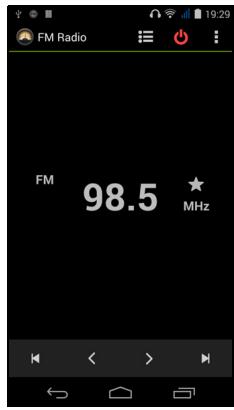
The FM radio allows you to listen to your favorite stations while on the move. Headphones must be inserted to the 3.5mm jack as the cable functions as an antenna.
You can access the radio by tapping FM Radio from the Apps menu.
Tap the back icon to turn the radio off.
Applications (apps)
Closing an app
To close an active app, in the Apps menu tap Settings > Apps. Swipe over to the Running tab, then tap the program you wish to close. Select Stop to close the program.
Uninstalling an app
You can remove programs installed on your smartphone to free up extra storage memory.
- In the Apps menu tap Settings > Apps.
- Swipe over to the Downloaded tab.
- Find the app in the list and tap on it.
- Tap the Uninstall button and then tap OK.

Important
You should only remove programs if you are familiar with the Android operating system.
Restoring to factory settings
You may perform a clean boot to restore your smartphone to the factory settings. Before performing a clean boot, ensure that your
smartphone is not locked. Press any key or tap the screen to see if the phone responds.

Important
You should only perform a clean boot when all other options have failed to restore your smartphone to an operational state.
This will erase all your personal information, any contacts stored on your phone and any programs you installed.
If your phone is responding to screen input, then open Settings from the Apps menu. Tap Backup & reset > Factory data reset > Reset phone and then Erase everything to format your phone.
ACCESSORIES AND TIPS
This chapter shows you how to use accessories with your smartphone, as well as provide useful tips for when you are using your smartphone.
Using the headset
Your smartphone is compatible with headsets with built-in microphone for handsfree use when making calls.
To use the headset, plug it into the 3.5 mm headphone jack at the top of the phone.
When the headset is plugged in, all audio is routed to the headset, and the speakers are turned off.
- To answer an incoming call, press the button on the microphone.
- Adjust the volume using the volume up/down button on the smartphone.
- End the call by pressing the button again.
Using a Bluetooth headset
Your smartphone's Bluetooth functions make it fully compatible with all Bluetooth headsets. This allows you to use the unit handsfree when making calls, without the inconvenience of wires.
Creating a new access point
When you need to add another GPRS/3G/EDGE connection on your phone, obtain the access point name and settings (including username and password if required) from your wireless service provider.
- Open the Apps menu and tap Settings > More... > Mobile networks > Access Point Names, and select an operator.
- Tap the Menu button and then tap New APN.
-
Enter the APN settings. Tap an item to adjust it.
-
When you have finished tap the Menu button and then tap Save.

Important
Some providers and countries do not allow the use of a smartphone as a modem over HSDPA. Please check with your provider before attempting to do so.
Inserting a microSD card
Your smartphone features a memory expansion slot that accepts a microSD card to expand memory and storage capacity.
Please refer to Installing a SIM or microSD card on page 7 for instructions on installing a microSD card.
MANAGING YOUR SIM CARDS

Note
This chapter is for models with more than one SIM card.
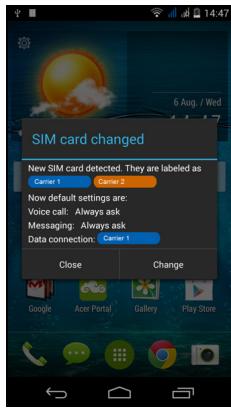
If your phone detects a new SIM card, you will be asked to confirm the preferred SIM to use for each action.
It indicates the following information:
-
The color used for each SIM card and its network name.
-
The preferred SIM for outgoing calls.
- The preferred SIM for sending messages.
- The preferred SIM for 3G data.
Tap Change to edit these settings from the SIM Management screen. You can also access the
SIM Management functions by opening the Apps menu and tapping Settings > SIM management.
SIM Management
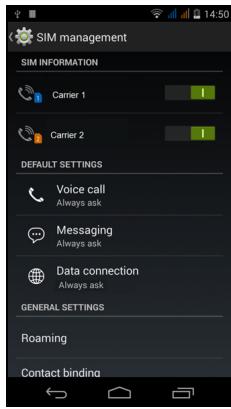
Open the Apps menu and tap Settings > SIM management. From this screen, you can:
- Enable or disable each SIM.
- Configure each SIM's name, phone number, display numbers, and assign a color to each SIM (allowing you to quickly and easily recognize which SIM is active).
- Set the default SIM for voice calls, messaging, data connection, and 3G service.
- General settings for each SIM.
Selecting which SIM to use when making a call
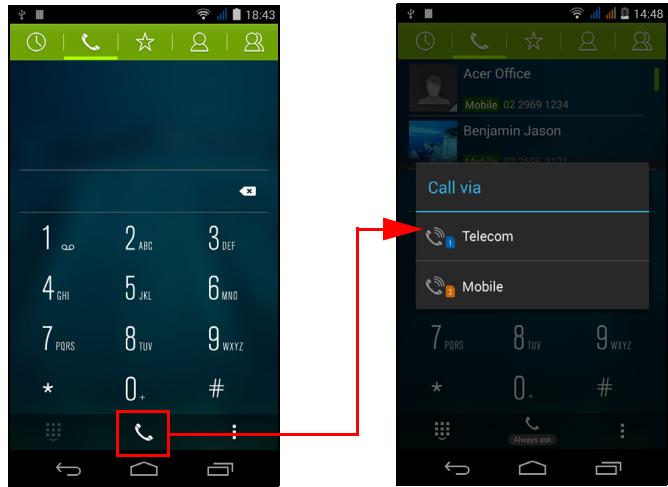
If you have set Voice call to Always ask, you will be asked which SIM to use each time you make call. Enter the number, then tap . A dialog opens; tap the SIM to use and the call will be connected.
Selecting which SIM to use when sending a text message
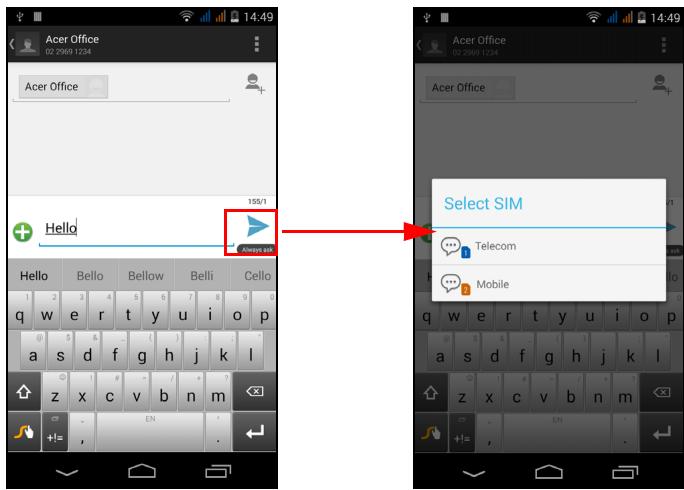
If you have set Messaging to Always ask, you will be asked which SIM to use each time you send a text message. Enter the message and recipient information, then tap Send. A dialog opens; tap the SIM to use and the message will be sent.
Identifying calls
Whenever you receive a call, the caller's number will be shown using the color defined for the SIM that the call is being received on. You will also be shown the name of the SIM receiving the call.
In the call log, the name of the SIM will be shown beneath the number of the call -- whether the call was missed, answered or was an outgoing call -- in the color you defined for that SIM.
Limitations when using multiple SIMs
| When a SIM is: | Other SIM cannot: |
| In a call | Dial out |
| Ringing | Receive a call ( caller will get a "number not available" message) |
| Sending or receiving a message | Send or receive a message |
| Using a data connection | Use a data connection |

Note
If you are using data on one SIM and you make or receive a call, or send or receive a text message on another SIM, the first SIM's data connection will be temporarily halted.
APPENDIX
FAQ and troubleshooting
This section lists frequently asked questions that may arise during the use of your smartphone, and gives easy answers and solutions to these questions.
| Aspect | Question | Suggestions |
| Audio | Why is there no sound coming from the device? | If the headset is plugged into the device, the speaker is automatically shut off. Disconnect the headset. Check that the device volume setting is not muted. Check that the volume control is not at its lowest setting. |
| Multimedia files | Why can’t I view my picture files? | You may be trying to view an image that is not supported. See Multimedia on page 72. |
| Why can’t I view my video files? | You may be trying to view a video that is not supported. See Multimedia on page 72. | |
| Why can’t I play my music files? | You may be trying to play a file that is not supported. See Multimedia on page 72. | |
| Google Play Store | Why can’t I connect to the Play Store? | 1. First check that you have a Wi-Fi or data connection (some Wi-Fi "hotspots" require you to log in before accessing the internet) and then try again. 2. If you still cannot connect, try adjusting your date/time settings. Open the Apps menu and tap Settings > Date & time > Automatic date & time set to off. 3. Manually adjust the time and then try to reconnect to the Play Store. |
| System information and performance | How do I check the OS version of my device? | Tap Settings > About phone to check the OS version (Build number) and other hardware and software information. |
| Power | I can’t turn on the device. | The battery power may be depleted. Recharge the device. See Charging the battery on page 6 for more information. |
| RAM / ROM | How do I check the RAM and ROM memory status? | To check the ROM status, tap Settings > Storage. To check RAM status, tap Settings > APPS > RUNNING. |
| Internal storage | My device’s available internal storage is full or almost full. | Uninstall apps to increase available storage. See Uninstalling an app on page 57. |
| Unlock pattern | I forgot my unlock pattern. | After a certain number of wrong entries, you will be presented with an option to reset your pattern. Tap Forgot pattern? and enter your Google account username and password. You must have an active Google account on the smartphone. Alternatively, you restore your smartphone to factory settings. See Restoring to factory settings on page 57. |
| Heat | The phone heats up when charging or making long duration calls. | It is normal for the phone to heat up when charging. When charging is complete, it will return to its normal temperature. It is also normal for the phone to heat up during long periods of use, such as watching a video or a long phone conversation. |
Other sources of help
| For information on | Refer to ... |
| Up-to-date information regarding your smartphone | www.acer.com mobile.acer.com |
| Service enquiries | www.acer.com/support |
WARNING AND PRECAUTIONS
- Do not use this product near water.
- Do not place this product on an unstable cart, stand or table. If the product falls, it could be seriously damaged.
- Slots and openings are provided for ventilation to ensure reliable operation of the product and to protect it from overheating. These openings must not be blocked or covered. The openings should never be blocked by placing the product on a bed, sofa, rug or other similar surface. This product should never be placed near or over a radiator or heat register, or in a built-in installation unless proper ventilation is provided.
- Never push objects of any kind into this product through cabinet slots as they may touch dangerous voltage points or short-out parts that could result in a fire or electric shock. Never spill liquid of any kind onto or into the product.
- To avoid damage of internal components and to prevent battery leakage, do not place the product on a vibrating surface.
- Never use this product when engaging in sporting activities, exercising, or in any vibrating environment which may cause a short circuit or damage, and even a risk of explosion from the battery pack.
Protecting your hearing
To protect your hearing, follow these instructions.
- Increase the volume gradually until you can hear clearly and comfortably.
- Do not increase the volume level after your ears have adjusted.
- Do not listen to music at high volumes for extended periods.
- Do not increase the volume to block out noisy surroundings.
- Decrease the volume if you can't hear people speaking near you.
Additional safety information
Your device and its enhancements may contain small parts. Keep them out of the reach of small children.
Operating environment

Important
For safety reasons, turn off all wireless or radio transmitting devices when using your smartphone device under the following conditions. These devices may include, but are not limited to: wireless LAN (WLAN), Bluetooth and/or 3G.
Remember to follow any special regulations in force in any area, and always switch off your device when its use is prohibited or when it may cause interference or danger. Use the device only in its normal operating positions. To successfully transmit data files or messages, this device requires a good quality connection to the network. In some cases, transmission of data files or messages may be delayed until such a connection is available. Ensure that the above separation distance instructions are followed until the transmission is completed. Parts of the device are magnetic. Metallic materials may be attracted to the device, and persons with hearing aids should not hold the device to the ear with the hearing aid. Do not place credit cards or other magnetic storage media near the device, because information stored on them may be erased.
Medical devices
Operation of any radio transmitting equipment, including wireless phones, may interfere with the functionality of inadequately protected medical devices. Consult a physician or the manufacturer of the medical device to determine if they are adequately shielded from external RF energy or if you have any questions. Switch off your device in health care facilities when any regulations posted in these areas instruct you to do so. Hospitals or health care facilities may be using equipment that could be sensitive to external RF transmissions.
Pacemakers. Pacemaker manufacturers recommend that a minimum separation of 15.3~cm (6") be maintained between wireless devices and a pacemaker to avoid potential interference with the pacemaker. These recommendations are consistent with the independent research by and recommendations of Wireless Technology Research. Persons with pacemakers should do the following:
-
Always keep the device more than 15.3 ~cm (6") from the pacemaker.
-
Not carry the device near your pacemaker when the device is switched on. If you suspect interference, switch off your device, and move it.
Hearing aids. Some digital wireless devices may interfere with some hearing aids. If interference occurs, consult your service provider.
Vehicles
RF signals may affect improperly installed or inadequately shielded electronic systems in motor vehicles such as electronic fuel injection systems, electronic anti-skid (anti-lock) braking systems, electronic speed control systems, and air bag systems. For more information, check with the manufacturer, or its representative, of your vehicle or any equipment that has been added. Only qualified personnel should service the device, or install the device in a vehicle. Faulty installation or service may be dangerous and may invalidate any warranty that may apply to the device. Check regularly that all wireless equipment in your vehicle is mounted and operating properly. Do not store or carry flammable liquids, gases, or explosive materials in the same compartment as the device, its parts, or enhancements. For vehicles equipped with an air bag, remember that air bags inflate with great force. Do not place objects, including installed or portable wireless equipment in the area over the air bag or in the air bag deployment area. If in-vehicle wireless equipment is improperly installed, and the air bag inflates, serious injury could result. Using your device while flying in aircraft is prohibited. Switch off your device before boarding an aircraft. The use of wireless teledevices in an aircraft may be dangerous to the operation of the aircraft, disrupt the wireless telephone network, and may be illegal.
Potentially explosive environments
Switch off your device when in any area with a potentially explosive atmosphere and obey all signs and instructions. Potentially explosive atmospheres include areas where you would normally be advised to turn off your vehicle engine. Sparks in such areas could cause an explosion or fire resulting in bodily injury or even death. Switch off the device at refueling points such as near gas pumps at service stations. Observe restrictions on the use of radio equipment in fuel depots,
storage, and distribution areas; chemical plants; or where blasting operations are in progress. Areas with a potentially explosive atmospheres are often, but not always, clearly marked. They include below deck on boats, chemical transfer or storage facilities, vehicles using liquefied petroleum gas (such as propane or butane), and areas where the air contains chemicals or particles such as grain, dust or metal powders.
Follow any restrictions. Do not use the device where blasting is in progress.
Emergency calls

Important
Wireless phones, including this device, operate using radio signals, wireless networks, landline networks, and user-programmed functions. Because of this, connections in all conditions cannot be guaranteed. You should never rely solely on any wireless device for essential communications like medical emergencies.
If certain features are in use, you may first need to turn those features off before you can make an emergency call. Consult this guide or your service provider for more information.
When making an emergency call, give all the necessary information as accurately as possible. Your wireless device may be the only means of communication at the scene of an accident. Do not end the call until given permission to do so.
Taking care of your smartphone
- DO take care not to scratch the screen of your smartphone. Keep the screen clean. When working with your smartphone, use your finger or fingernail. Never use an actual pen or pencil or other sharp object on the screen surface.
-
DO NOT expose your smartphone to rain or moisture. Do not let water enter the circuitry through the front panel buttons or expansion slots. In general, treat your smartphone as you would a mobile phone or other small electronic device.
-
DO be careful not to drop your smartphone or subject it to any strong impact. Do not place your smartphone in your back pocket.
- DO NOT expose your smartphone to extreme temperatures. For example, do not leave your smartphone on the dashboard of a car on a hot day or when temperatures are below freezing point. Also, keep it away from heaters and other sources of heat.
- DO NOT use or store your smartphone in any location that is dusty, damp or wet.
- DO use a soft, damp cloth to clean your smartphone. If the surface of the screen becomes soiled, clean it with a soft cloth moistened with diluted window-cleaning solution.
- DO NOT press down on the screen with force, otherwise you may crack the screen.
Specifications

Note
Specifications may vary depending on region and configuration.
Performance
1.3 GHz quad-core processor
- System memory:
- 1 GB or 2 GB of RAM (depending on model)
- 8 GB or 16 GB of ROM (depending on model)
Android operating system
Display
- 5" TFT LCD, capacitive touchscreen
1280 x 720 resolution
Multimedia
Formats supported:
| Type | Formats |
| Image | JPEG, GIF, PNG, BMP |
| Audio playback | MP3, AMR, AAC LC, AAC+, eAAC+, Vorbis, FLAC, MIDI, WAVE |
| Ringtone | MP3, AMR, AAC LC, AAC+, eAAC+, Vorbis, FLAC, MIDI, WAVE |
| Video recording | H.263, H.264, MPEG4 |
| Video playback | H.263, H.264, MPEG4, VP8 |
USB connector
- Micro USB connector
- USB client
DC power-in (5 V, 2 A)
Connectivity
- Bluetooth 4.0
- IEEE 802.11b/g/n
-
- GSM 850 / 900 / 1800 / 1900 MHz
UMTS 900 / 2100 MHz
HSPA+ / GPRS / EDGE
GPS
- GSM 850 / 900 / 1800 / 1900 MHz
-
Frequencies depend on model.
Camera
13 MP rear camera
- Auto-focus
- LED flash
2 MP front camera
Fixed focus
Expansion
- microSD memory card slot (up to 32 GB)
Battery
- 2100 mAh Lithium-ion battery (not user-replaceable)

Note
Length of battery operation will depend on power consumption which is based on system resource use. For example, constantly using the backlight or using power-demanding apps will shorten battery life between charges.
Dimensions
| Height | 140.5 mm |
| Width | 69 mm |
| Thickness | 7.5 mm |
| Weight | 125 g (with battery) |
END USER LICENSE AGREEMENT
IMPORTANT-READ CAREFULLY: THIS END USER LICENSE AGREEMENT ("AGREEMENT") IS A LEGAL AGREEMENT BETWEEN YOU (EITHER AN INDIVIDUAL OR A SINGLE ENTITY), AND ACER INC. INCLUDING ITS SUBSIDIARIES ("ACER") FOR THE SOFTWARE (WHETHER PROVIDED BY ACER OR BY ACER'S LICENSORS OR SUPPLIERS) THAT ACCOMPANIES THIS AGREEMENT, INCLUDING ANY ASSOCIATED MEDIA, PRINTED MATERIALS AND RELATED USER ELECTRONIC DOCUMENTATION WHICH MAY BE BRANDED "ACER" ("SOFTWARE"). AGREEMENTS RELATING TO ANY OTHER PRODUCT OR TOPIC ARE NEITHER INTENDED NOR SHOULD THEY BE IMPLIED. BY INSTALLING THE ACCOMPANYING SOFTWARE OR ANY PORTION THEREOF, YOU AGREE TO BE BOUND BY THE TERMS AND CONDITIONS OF THIS AGREEMENT. IF YOU DO NOT AGREE TO ALL OF THE TERMS AND CONDITIONS OF THIS AGREEMENT, DO NOT CONTINUE THE INSTALLATION PROCESS AND IMMEDIATELY DELETE ALL INSTALLED FILES, IF ANY, OF THE ACCOMPANYING SOFTWARE FROM YOUR PHONE.
IF YOU DO NOT HAVE A VALIDLY-Licensed COPY OF THE APPLICABLE SOFTWARE, YOU ARE NOT AUTHORIZED TO INSTALL, COPY OR OTHERWISE USE THE SOFTWARE, AND HAVE NO RIGHTS UNDER THIS AGREEMENT.
The Software is protected by U.S. and international copyright laws and conventions as well as other intellectual property laws and treaties. The Software is licensed, not sold.
GRANT OF LICENSE
Acer grants to you the following non-exclusive and non-transferable rights with respect to the Software. Under this Agreement, you may:
- Install and use the Software only on a single designated phone. A separate license is required for each phone on which the Software will be used;
- Make one copy of the Software solely for backup or archival purposes;
- Make one hardcopy of any electronic documents included in the Software, provided that you receive the documents electronically.
RESTRICTIONS
You may NOT:
- Use or copy the Software except as provided in this Agreement;
- Rent or lease the Software to any third party;
- Modify, adapt, or translate the Software in whole or in part;
- Reverse engineer, decompile, or disassemble the Software or create derivative works based upon the Software;
- Merge the Software with any other program or modify the Software, except for your personal use; and
- Sublicense or otherwise make the Software available to third parties, except that you may, after prior written notification to Acer, transfer the Software as a whole to a third party so long as you do not retain any copies of the Software and such third party accepts the terms of this Agreement.
- Transfer your rights under this Agreement to any third parties.
- Export the Software in contravention of applicable export laws and regulations, or (i) sell, export, re-export, transfer, divert, disclose technical data, or dispose of, any Software to any prohibited person, entity, or destination including, without limitation, Cuba, Iran, North Korea,
Sudan and Syria; or (ii) use any Software for any use prohibited by the laws or regulations of the United States.
SUPPORT SERVICES
Acer is not obligated to provide technical or other support for the Software.
ACER LIVE UPDATE
Certain of the software contains elements that enable the use of the Acer Live Update service, which allows for updates for such software to be automatically downloaded and installed on your phone. By installing the software, you hereby agree and consent that Acer (or its licensors) may automatically check the version of such software that you are using on your phone and may provide upgrades to such software that may be automatically downloaded on to your phone.
OWNERSHIP AND COPYRIGHT
Title, ownership rights and intellectual property rights in and to the Software and all copies thereof shall remain with Acer or Acer's licensors or suppliers (as applicable). You do not have or shall not gain any proprietary interest in the Software (including any modifications or copies made by or for you) or any related intellectual property rights. Title and related rights in the content accessed through the Software is the property of the applicable content owner and may be protected by applicable law. This license gives you no rights to such contents. You hereby agree
- Not to remove any copyright or other proprietary notices from the Software;
- To reproduce all such notices on any authorized copies you make; and
- To use best efforts to prevent any unauthorized copying of the Software.
TRADEMARKS
This Agreement does not grant to you any rights in connection with any trademarks or service marks of Acer or of Acer's licensors or suppliers.
DISCLAIMER OF WARRANTYES
TO THE MAXIMUM EXTENT PERMITTED BY APPLICABLE LAW, ACER, ITS SUPPLIERS, AND ITS LICENSORS, PROVIDE THE SOFTWARE "AS IS" AND WITH ALL FAULTS, AND HEREBY DISCLAIM ALL OTHER WARRANTYES AND CONDITIONS, EITHER EXPRESS, IMPLIED OR STATUTORY, INCLUDING, BUT NOT LIMITED TO, ANY IMPLIED WARRANTYES, DUTIES OR CONDITIONS OF MERCHANTABILITY, OF FITNESS FOR A PARTICULAR PURPOSE, OF ACCURACY OR COMPLETENESS OF RESPONSES, OF RESULTS, OF WORKMANLIKE EFFORT, OF LACK OF VIRUSES, AND OF LACK OF NEGLIGENCE, ALL WITH REGARD TO THE SOFTWARE AND THE PROVISION OF OR FAILURE TO PROVIDE SUPPORT SERVICES. ALSO, THERE IS NO WARRANTY OR CONDITION OF TITLE, QUIET ENJOYMENT, QUIET POSSESSION, CORRESPONDENCE TO DESCRIPTION OR NONINFRINGEMENT WITH REARGD TO THE SOFTWARE.
EXCLUSION OF INCIDENTAL, CONSEQUENTIAL AND CERTAIN OTHER DAMAGES
TO THE MAXIMUM EXTENT PERMITTED BY APPLICABLE LAW, IN NO EVENT SHALL ACER, ACER'S SUPPLIERS, OR ACER'S LICENSORS, BE LIABLE FOR ANY SPECIAL, INCIDENTAL, INDIRECT, PUNITIVE, OR CONSEQUENTIAL DAMAGES WHATSOEVER (INCLUDING, BUT NOT LIMITED TO, DAMAGES FOR LOSS OF PROFITS OR CONFIDENTIAL OR OTHER INFORMATION, FOR BUSINESS INTERRUsION, FOR PERSONAL INJURY, FOR LOSS OF PRIVACY, FOR FAILURE TO MEET ANY DUTY INCLUDING OF GOOD FAITH OR OF REASONABLE CARE, FOR NEGLIGENCE, AND FOR ANY OTHER PECUNIARY OR OTHER LOSS WHATSOEVER) ARISING OUT OF OR IN ANY WAY RELATED TO THE USE OF OR INABILITY TO USE THE SOFTWARE, THE PROVISION OF OR FAILURE TO PROVIDE SUPPORT SERVICES, OR OTHERWISE UNDER OR IN CONNECTION WITH ANY PROVISION OF THIS AGREEMENT, EVEN IN THE EVENT OF THE FAULT, TORT (INCLUDING
NEGLIGENCE), STRICT LIABILITY, BREACH OF CONTRACT OR BREACH OF WARRANTY OF ACER OR ITS SUPPLIERS OR LICENSORS, AND EVEN IF ACER AND ITS SUPPLIERS AND LICENSORS HAVE BEEN ADVISED OF THE POSSIBILITY OF SUCH DAMAGES.
LIMITATION OF LIABILITY AND REMEDIES
NOTWITHSTANDING ANY DAMAGES THAT YOU MIGHT INCUR FOR ANY REASON WHATSOEVER (INCLUDING, WITHOUT LIMITATION, ALL DAMAGES REFERENCED ABOVE AND ALL DIRECT OR GENERAL DAMAGES), THE ENTIRE LIABILITY OF ACER, ITS SUPPLIERS, AND ITS LICENSORS, UNDER ANY PROVISION OF THIS AGREEMENT, AND YOUR EXCLUSIVE REMEDY FOR ALL OF THE FOREGOING, SHALL BE LIMITED TO THE AGGREGATE AMOUNT PAID BY YOU FOR THE SOFTWARE. THE FOREGOING LIMITATIONS, EXCLUSIONS AND DISCLAIMERS (INCLUDING DISCLAIMER OF WARRANTYES AND EXCLUSION OF INCIDENTAL, CONSEQUENTIAL AND CERTAIN OTHER DAMAGES ABOVE) SHALL APPLY TO THE MAXIMUM EXTENT PERMITTED BY APPLICABLE LAW, EVEN IF ANY REMEDY FAILS ITS ESSENTIAL PURPOSE; PROVIDED, HOWEVER, THAT BECAUSE SOME JURISDICTIONS DO NOT ALLOW THE EXCLUSION OR LIMITATION OR LIABILITY FOR CONSEQUENTIAL OR INCIDENTAL DAMAGES, THE ABOVE LIMITATION MAY NOT APPLY TO YOU.
TERMINATION
Without prejudice to any other rights, Acer may immediately terminate this Agreement without notice if you fail to comply with any terms and conditions of this Agreement.
In such event, you must:
- Cease all use of the Software;
- Destroy or return to Acer the original and all copies of the Software; and
- Delete the Software from all phones on which it was resident.
All disclaimers of warranties and limitation of liability set forth in this Agreement shall survive termination of this Agreement.
GENERAL
This Agreement represents the complete agreement between you and Acer relating to this license for the Software and supersedes all prior agreements, communications, proposals and representations between the parties and prevails over any conflicting or additional terms of any quote, order, acknowledgement or similar communication. This Agreement may only be modified by a written document signed by both parties. If any provision of this Agreement is held by a court of competent jurisdiction to be contrary to law that provision will be enforced to the maximum extent permissible and the remaining provisions of this Agreement will remain in full force and effect.
ADDITIONAL PROVISIONS APPLICABLE TO THIRD PARTY SOFTWARE AND SERVICES
Software provided hereunder by Acer's licensors or suppliers ("Third Party Software") is made available to you for your personal, non-commercial use only. You may not use the Third Party Software in any manner that could damage, disable, overburden, or impair the services provided by Acer's licensors or suppliers hereunder ("Third Party Services"). Furthermore, you may not use the Third Party Software in any manner that could interfere with any other party's use and enjoyment of the Third Party Services, or the services and products of Acer's licensors' or suppliers' third party licensors. Your use of the Third Party Software and Third Party Services is also subject to additional terms and conditions and policies which can be accessed through our global website.
Privacy policy
During registration you will be asked to submit some information to Acer. Please refer to Acer's privacy policy at www.acer.com or your local Acer website.
TRADEMARK INFORMATION
DTS Premium Sound


Premium Sound
For DTS patents, see http://patents.dts.com. Manufactured under license from DTS Licensing Limited. DTS, the Symbol, & DTS and the Symbol together are registered trademarks, and DTS Studio Sound is a trademark of DTS, Inc. © DTS, Inc. All Rights Reserved.
- Liquid Jade
- Sign up for an Acer ID and enjoy great benefits
- There are three great reasons for you to get an Acer ID:
- Important
- TABLE OF CONTENTS
- Setting up 5
- Using your smartphone 10
- Managing contacts 23
- Making calls 25
- 31
- Going online 34
- Using the Camera 40
- Advanced settings 47
- Accessories and tips 59
- Managing your SIM cards 61
- Appendix 64
- Warnings and precautions 67
- Emergency calls. 70
- Taking care of your smartphone 70
- Specifications 72
- End User License Agreement 75
- SETTING UP
- Unpacking your smartphone
- Note
- Getting to know your smartphone
- Charging the battery
- Installing a SIM or microSD card
- SIM card lock
- USING YOUR SMARTPHONE
- Turning on for the first time
- Sign in to or create a Google account
- Entering your PIN
- Activating a new SIM card
- Locking your smartphone
- Waking your smartphone
- Navigating through menus and options
- Back
- Home
- Menu
- Using the touchscreen
- Onscreen keyboards
- Changing the text input method
- Swype
- Text assistance
- Google keyboard
- Predictive text
- The Home screen
- Change your Home screen interface
- Standard Mode
- Easy Mode
- Basic Mode
- Turning Quick Mode on
- Set a passcode for Quick Mode
- Turning Quick Mode off
- Search
- Voice search
- The extended Home screen
- Personalizing the Home screen
- Adding and removing shortcuts and widgets
- Resizing widgets
- Adding or removing folders
- Changing application dock icons
- Changing the wallpaper
- The Apps menu
- Notification and status area
- Multitasking
- MANAGING CONTACTS
- Managing your contacts
- Adding a contact
- MAKING CALLS
- Before making a call
- Making a call
- Dialing a number from Call History
- Viewing missed calls
- Making a call to one of your contacts
- Dialing an international number
- Direct dial widget
- The voice call screen
- Answering or declining a call
- Ending a call
- Voice call options
- Saving a dialed number to contacts
- Conference calls
- MESSAGE
- Creating a new message
- Replying to a message
- Multimedia messages
- Receiving multimedia messages
- GOING ONLINE
- Browsing the internet
- Using the browser
- Setting up Email
- Google services
- Setting up your Google email
- Composing an email
- Play Store
- For connection issues with Play Store, see FAQ and troubleshooting on page 64
- Using downloaded apps
- Uninstalling downloaded apps
- Google Hangouts
- Maps, Navigation, Places and Latitude
- Using the map
- USING THE CAMERA
- Camera/camcorder icons and indicators
- Mode selector
- Camera
- Camcorder
- White balance
- Image properties
- Self-timer
- Settings
- Photo
- Video
- Other
- Taking a photo
- Taking a panoramic photo
- Shooting a video
- Supported formats
- Viewing photos and videos
- Geotagging
- ADVANCED SETTINGS
- Putting your smartphone in Airplane mode
- Turning Airplane mode on or off
- Restarting your phone
- Adjusting settings
- Activating or deactivating connections
- Adjusting Bluetooth settings
- Bluetooth connections
- Internet sharing
- Tethering via USB
- Wi-Fi hotspot
- Phone network settings
- Selecting a network
- Data usage control settings
- Phone settings
- Sound
- Adjusting the volume
- Audio profiles
- Display
- Setting the date and time
- Setting alarms
- Changing language and text options
- Connecting to a PC
- Synchronization
- Google Sync
- FM radio
- Applications (apps)
- Closing an app
- Uninstalling an app
- Restoring to factory settings
- ACCESSORIES AND TIPS
- Using the headset
- Using a Bluetooth headset
- Creating a new access point
- Inserting a microSD card
- MANAGING YOUR SIM CARDS
- SIM Management
- Selecting which SIM to use when making a call
- Selecting which SIM to use when sending a text message
- Identifying calls
- APPENDIX
- FAQ and troubleshooting
- WARNING AND PRECAUTIONS
- Protecting your hearing
- Additional safety information
- Operating environment
- Medical devices
- Vehicles
- Potentially explosive environments
- Emergency calls
- Taking care of your smartphone
- Specifications
- Performance
- Multimedia
- USB connector
- Connectivity
- Expansion
- Battery
- END USER LICENSE AGREEMENT
- GRANT OF LICENSE
- RESTRICTIONS
- SUPPORT SERVICES
- ACER LIVE UPDATE
- OWNERSHIP AND COPYRIGHT
- TRADEMARKS
- DISCLAIMER OF WARRANTYES
- TERMINATION
- GENERAL
- ADDITIONAL PROVISIONS APPLICABLE TO THIRD PARTY SOFTWARE AND SERVICES
- Privacy policy
- TRADEMARK INFORMATION
- DTS Premium Sound
- Premium Sound
Marque : ACER
Modèle : LIQUID JADE
Catégorie : Téléphone mobile