
CF320D - Réfrigérateur CASTOR - Notice d'utilisation et mode d'emploi gratuit
Retrouvez gratuitement la notice de l'appareil CF320D CASTOR au format PDF.


| Type d'appareil | Réfrigérateur avec congélateur |
| Installation | Pose libre |
| Espacement arrière | Recommandé pour ventilation |
| Emplacement | Intérieur, pièce bien ventilée |
| Nettoyage intérieur | Facile, avec produits non abrasifs |
| Connexion électrique | 230 V, prise standard |
| Réversibilité de la porte | Oui, possible |
| Régulation de la température | Thermostat réglable |
| Congélation des aliments frais | Oui, compartiment congélateur |
| Réfrigération des aliments | Compartiment principal |
| Dégivrage | Manuel ou automatique |
| Bac à glaçons | Inclus |
| Éclairage intérieur | Oui, ampoule LED |
| Entretien | Nettoyage régulier recommandé |
| Pièces détachées | Disponibles |
FOIRE AUX QUESTIONS - CF320D CASTOR
Questions des utilisateurs sur CF320D CASTOR
0 question sur cet appareil. Repondez a celles que vous connaissez ou posez la votre.
Poser une nouvelle question sur cet appareil
Téléchargez la notice de votre Réfrigérateur au format PDF gratuitement ! Retrouvez votre notice CF320D - CASTOR et reprennez votre appareil électronique en main. Sur cette page sont publiés tous les documents nécessaires à l'utilisation de votre appareil CF320D de la marque CASTOR.
MODE D'EMPLOI CF320D CASTOR
CONTENTS
Warnings page 3
Installation page 4
Rear spacers page 4
Location page 4
Cleaning the appliance's interior page 4
Power connection page 4
Door reversibility page 5
Use of the refrigerator/freezer
Operation - Temperature regulation page 6
Freezing of fresh foods and storing of frozen foods page 6
page 6
Defrosting page 7
Ice cube trays page 7
Maintenance page 8
Internal light page 8
Servicing and Spare Parts
It is most important that this instruction book should be retained with the appliance for future reference. Should the appliance be sold or transferred to another owner, or should you move house and leave the appliance, always ensure that the book is supplied with the appliance in order that the new owner can be acquainted with the functioning of the appliance and the relevant warnings.
These warnings are provided in the interest of safety. You must read them carefully before installing or using the appliance.
- This appliance is designed to be operated by adults. Children should not be allowed to tamper with the controls or play with the appliance.
- Any electrical work required to install this appliance should be carried out by a qualified electrician or competent person.
This appliance should be serviced by an authorized Service Centre, and only genuine spare parts should be used.
It is dangerous to alter the specifications or modify this appliance in any way. - Care must be taken to ensure that the appliance does not stand on the electrical supply cable.
- The domestic refrigerators and freezers are designed to be used specifically for the storage of edible food-stuffs only.
- Frozen food must not be re-frozen once it has been thawed out.
Manufacturers' storage recommendations should be strictly adhered to. Refer to relevant instructions. - There are working parts in this appliance which heat up. Always ensure that there is adequate ventilation as a failure to do this will result in component failure and possible food loss. See installation instructions.
-
Parts which heat up should not be exposed. Wherever possible the back of the appliance should be against a wall.
Before any cleaning or maintenance work is carried out, be sure to switch off and unplug the appliance.
If the appliance is transported horizontally, it is possible that the oil contained in the compressor flows in the refrigerant circuit. It is advisable to wait at least two hours before connecting the appliance to allow the oil to flow back in the compressor. -
The inner lining of the appliance consists of channels through which the refrigerant passes. If these should be punctured this would damage the appliance beyond repair and cause food loss. DO NOT USE SHARP INSTRUMENTS to scrape off frost or ice. Frost may be removed by using the scraper provided. Under no circumstances should solid ice be forced off the liner. Solid ice should be allowed to thaw when defrosting the appliance. See defrost instructions.
- Do not place carbonated or fizzy drinks in the freezer as it creates pressure on the container, which may cause it to explode, resulting in damage to the appliance.
This appliance is heavy. Care should be taken when moving it.
Ice lollies can cause frost burns if consumed straight from the appliance. - Under no circumstances should you attempt to repair the appliance yourself. Repairs carried out by inexperienced persons may cause injury or more serious malfunctioning. Refer to your local Service Centre, and always insist on genuine spare parts.
- This appliance does not contain gasses which could damage the ozone layer, in either its refrigerant circuit or insulation materials; it must nevertheless be disposed off in a proper manner, in accordance with regulations for protection of the environment.
If this appliance featuring magnetic door seals is to replace an older appliance having a spring lock on the door or lid, be sure to make that spring lock unusable before you discard the old appliance. This will prevent it from becoming a death-trap for a child.
Rear spacers
In the plastic envelope containing the Operation Instructions are also included two wall spacers to be fitted into the special openings provided on the back of the appliance.
Push-fit the spacers into the openings, making sure that arrow «A» is positioned as per Fig. 1 and then turn the spacers through 45^ until they lock in (arrow in vertical position).
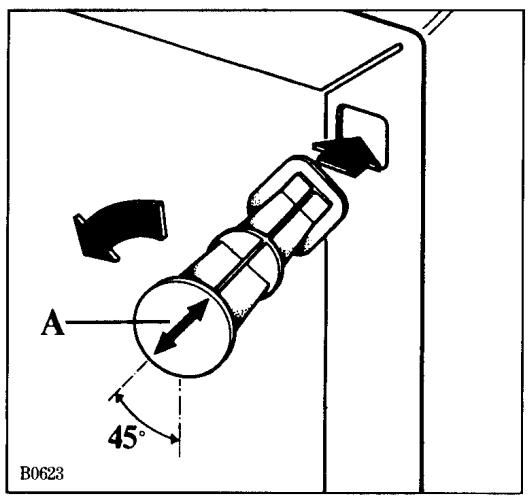
Fig. 1
Location
Place the appliance as far away as possible from sources of heat, e.g. radiators, heaters, direct sunlight, etc..
The best results are achieved with a room temperature ranging from +18^ to +43^ .
Make sure that there is nothing at the back, at the top and at the bottom of the appliance to obstruct air circulation.
For a more efficient operation of the appliance the minimum distance between the top of the appliance and other overhanging kitchen furniture, if any, should be at least 100mm (Fig. 2-A).
The best solution is shown in Fig. 2-B (without overhanging kitchen furniture).
One or more adjustable feet mounted on the base of the appliance make it possible to set it perfectly level.
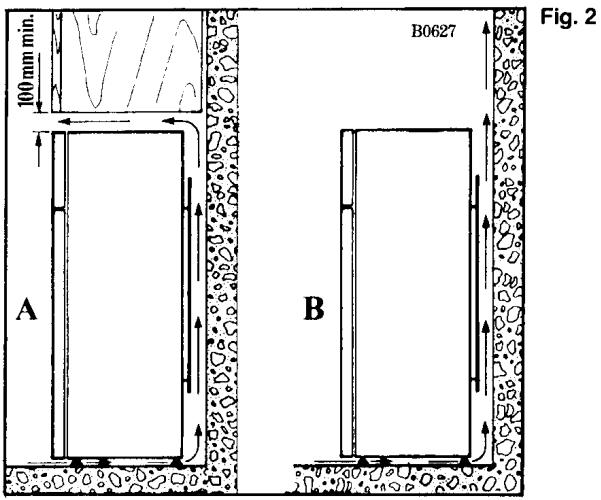
Cleaning the appliance's interior
Before using the appliance for the first time, wash all internal parts with lukewarm water and neutral soap so as to remove the typical «new» smell and then dry thoroughly.
Do not use detergents or abrasive powders as these will damage the finish.
Power connection
Before plugging in the appliance to the mains socket, check that the voltage and frequency indicated on the appliance's rating plate are the same as those provided by your home power supply.
A 6% fluctuation above or below rated voltage is acceptable.
For operation at different voltages, a suitable transformer should be used.
The appliance MUST be connected to an efficient earth or ground tap.
The supply-lead plug in fact incorporates a special earth or ground contact for this purpose. If by any chance the sockets of your domestic wiring system are not earthed, the appliance must be connected to a separate earth or ground wire by a qualified electrician, in accordance with existing safety regulations.
The manufacturer declines to accept any liability if this accident-prevention procedure is not followed.
Door reversibility (Fig. 3)
remove the ventilation grid «2»; to do this, loose the frontal screws and pull it downward sliding it from the central stop runners;
remove the lower hinge 1
remove the pin «C» from the opening «A» and refit it in the opening «B»;
remove the door stop hinge «D» and refit it on the opposite side;
■ slide the lower door out of the centre hinge;
remove the centre hinge «4» and the upper hinge 3 and refit them on the opposite side;
■ refit the lower door and hinge «1» on the opposite side;
■ refit the ventilation grid upside-down;
remove the handles «5» and «6» and refit them on the opposite side.
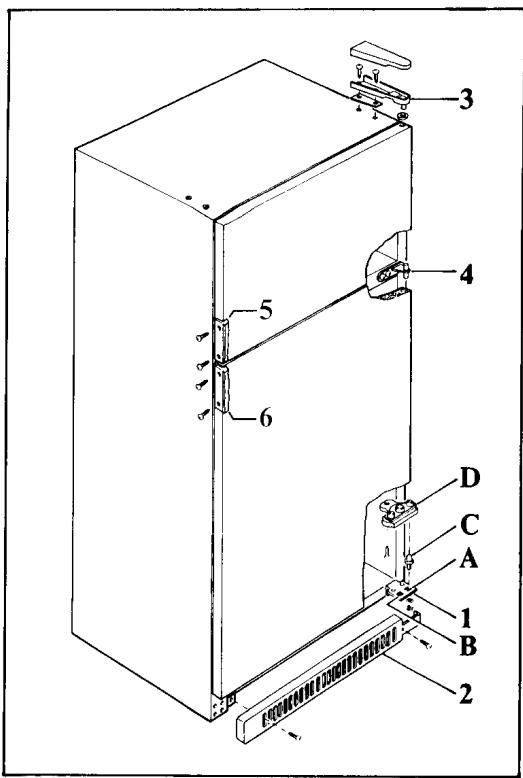
Fig. 3
Operation - Temperature regulation
Insert the plug into the wall socket. Open the refrigerator door and turn the thermostat knob, to be found on the upper right side of the inner liner, clockwise, beyond the «O» position (STOP), to start the appliance.
Temperature adjustment is obtained by turning the thermostat knob to the required setting. A medium setting is generally the most suitable.
However, the exact setting should be chosen keeping in mind that the temperature inside the refrigerator depends on a number of factors, such as:
room temperature, how often the doors are opened, the quantity of food stored in the refrigerator and the location of the appliance.
Turn the knob to higher settings to obtain a lower refrigeration temperature or to lower settings to increase the refrigeration temperature.
Freezing of fresh foods and storing of frozen foods
The four-star compartment is suitable for long term storage of commercially frozen food and for freezing fresh food.
Do not store products for longer than the time specified by the food manufacturer.
Under normal circumstances, to freeze fresh foods it is not necessary to change the setting of the thermostat knob with respect to the normal running position. However, for a quick freezing operation, turn the thermostat knob to the coldest setting; but remember that, in this condition, the refrigerating compartment temperature might drop below 0^ . If this occurs reset the thermostat knob to a warmer setting.
To help you get the best out of the freezing process, here are a few hints:
Store the foods to be frozen on the grid in the freezing compartment.
The maximum amount of food which is freezable in 24 hours is shown also on the rating plate.
Split foods into small portions to speed up freezing and to avoid having to thaw more food than you require.
Wrap the foods in foil or polythene film, ensuring that the wrapping adheres closely to the food and is well sealed.
It is advisable to keep tab of the freezing times by indicating the date of freezing on each package.
On the inner freezer door you will find schematic drawings of foods and animals indicating maximum storage time (in months) possible from the time of freezing.
The foods for freezing should not be placed in contact with already frozen foods. This will avoid the temperature of already frozen foods from rising.
Important
Never put fizzy drinks in the freezer as they might well burst.
Ice lollies should not be eaten straight out of the freezer as they might cause cold burns.
Remember that, once thawed, frozen food deteriorates rapidly.
If there is a power failure when food is in the freezer, do not open the door of the freezing compartment.
The frozen food will not be affected if the power cut is of short duration (an increase in temperature of the frozen food may shorten the period of their safe storage), otherwise it is recommended that the food should be used within a very short time.
Refrigeration of foods
To achieve the best results with the refrigerator compartment, you should follow one or two very simple rules:
Do not put warm foods or evaporating liquids in the refrigerator.
Cover or wrap foods (particularly if they have a strong smell or contain aromatic herbs).
Do not cover the shelves (grids) with paper or plastic since this blocks circulation of air in the compartment.
For a correct use of the compartment we suggest:
Raw meat: wrap in polythene bags and place on top of the salad crisper. Only store in this way for one or two days at most.
Fruit & Vegetables: these should be washed and placed in the bottom salad crisper.
Butter & cheese: these should be placed in special airtight containers or wrapped in aluminium foil or polythene bags to exclude as much air as possible.
Milk bottles: these should have a cap; store them in the bottle rack on the door.
The inside walls of the refrigerator are equipped with a series of runners so that the shelves (grids) can be positioned as desired (Fig. 4).
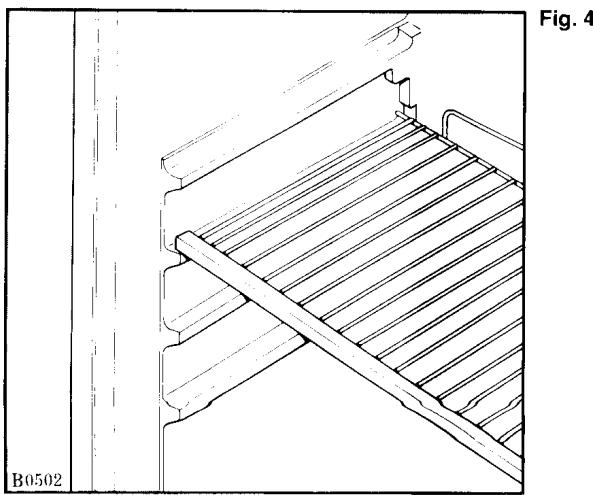
Defrosting
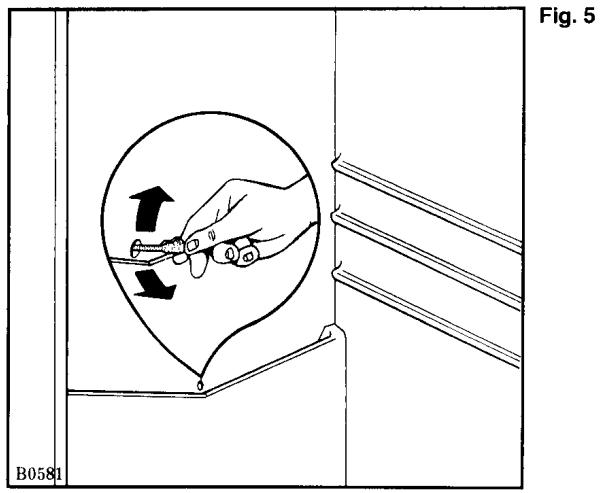
Frost is automatically eliminated from the evaporator of the refrigerator compartment every time the motor compressor stops, during normal use. The defrost water drains out through a trough (Fig. 5) into a special container on the back of the appliance where it evaporates.
The freezer compartment, however, will become progressively covered with frost. This should be removed with the special plastic scraper provided, whenever the thickness of the frost exceeds 4mm .
During this operation it is not necessary to switch off the power or to remove the foods from the compartment.
If a thick layer of ice is formed it will be necessary to carry out complete defrosting.
It is advisable to carry out this operation when the appliance is empty.
To carry out complete defrosting of the freezer compartment proceed as follows:
remove the frozen foods and wrap them in several sheets of newspaper and then keep them in a cool place;
set the thermostat knob to «O» or unplug the appliance from the mains socket;
leave the door open.
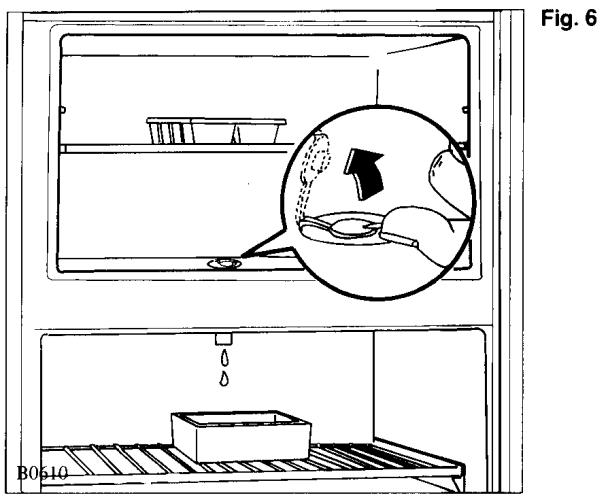
To collect the defrost water place a basin on the first shelf of the refrigerator compartment underneath the drainage hole and lift the plug (Fig. 6); after complete defrosting dry thoroughly the refrigerator compartment an refit the plug.
Reconnect the appliance to the power supply or turn the thermostat knob to the desired setting. After two or three hours the appliance will be ready for the storage of frozen food.
We particularly recommend that you periodically clean the defrost-water drainage outlet, located in the centre of the drainage groove in the refrigerator compartment (Fig. 5). Use the special cleaner provided, which you will find already inserted into the discharge hole.
Important:
Remember that an increase of the surface temperature of already-frozen foods may significantly decrease the duration of their conservation.
Never use metal objects to scrape away the accumulated frost since you may damage the cooling circuit.
Ice cube trays
The refrigerator is provided with two ice cube trays.
These trays should be filled with drinking water and then placed in the freezer compartment.
Do not use metal tools to remove the trays when they are stuck-frozen inside the compartment.
Before carrying out any operation, unplug the appliance.
Wash the interior with lukewarm water and sodium bicarbonate, and the cabinet exterior with a silicone wax spray; clean the condenser and the motor compressor with a brush or a vacuum cleaner.
During periods when the appliance is not used, you should take the following precautions:
remove the plug from the wall socket;
remove all food from the appliance;
defrost and clean the interior and all accessories;
leave the door slightly open, thus letting air circulate and preventing the formation of unpleasant smells.
It is important to clean the defrost water discharge hole periodically (Fig. 5).
Internal light (Fig. 7)
The light in the refrigerator compartment is easy to get at through the opening in the light holder.
If the light does not turn on when the door is opened, make sure it is properly fitted; if the malfunction continues, replace the bulb. The rating is shown on the light bulb cover.

SERVICING AND SPARE PARTS
If the appliance is not working
If the appliance is not functioning properly check that: the plug is firmly inserted in the wall socket and the mains power switch is on;
there is no power failure;
the thermostat knob is in the right position.
Furthermore:
if the appliance seems too noisy check that the sides are not touching furniture that can transmit or amplify a noise or a vibration. Also, check that the refrigerant unit does not vibrate.
If there is water on the fridge bottom, make sure the defrost water discharge hole is not clogged (Fig. 5).
If your appliance is still not working properly after making the above checks, contact your local dealer or the nearest service center.
To obtain fast service, it is essential that when you apply for it you specify the model and serial number of your appliance which can be found on the warranty certificate or on the rating plate.