
PS 30 - Détecteurs de matériaux HILTI - Notice d'utilisation et mode d'emploi gratuit
Retrouvez gratuitement la notice de l'appareil PS 30 HILTI au format PDF.

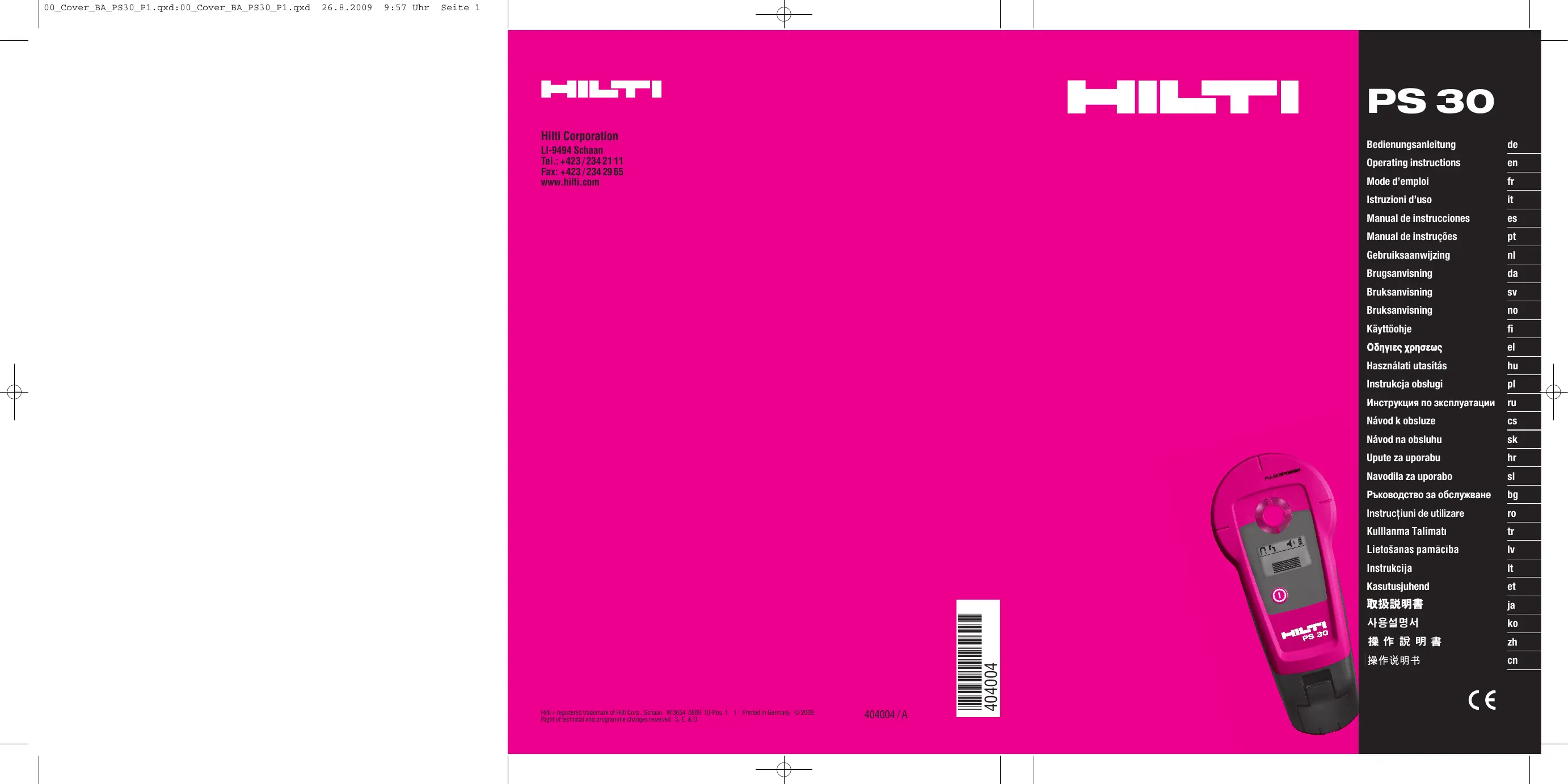

| Type de produit | Détecteur de métaux ferreux et non ferreux |
| Marque | HILTI |
| Modèle | PS 30 |
| Dimensions (L x l x H) | 237 mm x 104 mm x 47 mm |
| Poids (avec piles) | 420 g |
| Alimentation | 4 piles alcalines LR03 (AAA) 1,5 V |
| Autonomie | 10 h à 20 °C |
| Plage de détection (ferreux) | 5 à 120 mm (pour Ø > 8 mm) |
| Plage de détection (non ferreux) | 5 à 80 mm (pour Ø ≥ 10 mm, épaisseur paroi ≥ 2 mm) |
| Précision de localisation | ±10 mm |
| Température de fonctionnement | -15 à +50 °C |
| Température de stockage | -25 à +63 °C |
| Indice de protection | IP54 (protection contre poussière et projections d'eau) |
| Arrêt automatique | 5 minutes |
| Affichage | Écran avec rétroéclairage automatique |
| Signal sonore | Oui, commutable |
| Contenu de la livraison | Outil, dragonne, pochette souple, mode d'emploi, certificat constructeur, 4 piles, 2 marqueurs |
| Entretien et nettoyage | Nettoyer avec un chiffon doux, éventuellement humidifié d'alcool ou d'eau |
| Sécurité | Ne pas utiliser à proximité de stimulateurs cardiaques, éviter les interférences électromagnétiques |
| Pièces détachées et réparabilité | Piles remplaçables par l'utilisateur ; réparation par le service HILTI |
| Garantie constructeur | Réparation ou remplacement gratuit des pièces défectueuses pendant la durée de vie de l'outil |
FOIRE AUX QUESTIONS - PS 30 HILTI
Questions des utilisateurs sur PS 30 HILTI
0 question sur cet appareil. Repondez a celles que vous connaissez ou posez la votre.
Poser une nouvelle question sur cet appareil
Téléchargez la notice de votre Détecteurs de matériaux au format PDF gratuitement ! Retrouvez votre notice PS 30 - HILTI et reprennez votre appareil électronique en main. Sur cette page sont publiés tous les documents nécessaires à l'utilisation de votre appareil PS 30 de la marque HILTI.
MODE D'EMPLOI PS 30 HILTI
HILT
HILTI
Hilti Corporation
LI-9494 Schaan
Tel.: +423/234 21 11
Fax: +423/234 2965
www.hilti.com
Hilli = registered trademark of Hilli Corp., Schaan W3654 0809 10-Pos. 1 1 Printed in Germany © 2009 Right of technical and programme changes reserved S. E. & O.
404004/A
404004

PS 30
Bedienungsanleitung
de
Operating instructions
en
Mode d'emploi
fr
Istruzioni d'uso
it
Manual de instrucciones
es
Manual de instruções
pt
Gebruksaanwijzing
nl
Brugsanvising
da
Bruksanvising
SV
Bruksanvisning
no
Käytööhje
fi
Obnyiesxnpaaes
el
Hasznalatiutasitas
hu
Instrukcja oblsugi
pl
Hnctpykni no 3Kcnnyataaun
ru
Nakov K obsluze
CS
Návod na obsluhu
sk
Upute za uporabu
hr
Navodila za uporabo
sl
PbKOoDCTBO 3a 06cJyXbaHe
bq
Instructiuni de'utilizare
ro
Kullanma Talimati
tr
Lietosanas pamaciba
IV
Instrukcija
It
Kasutusjuhend
et
取説説書
ja
音歌
ko
操作說明書
zh
操作说明书
cn
C E


ORIGINAL OPERATING INSTRUCTIONS
PS 30 ferrodetector
It is essential that the operating instructions are read before the tool is operated for the first time.
Always keep these operating instructions together with the tool.
Ensure that the operating instructions are with the tool when it is given to other persons.
| Contents | Page |
| 1. General information | 11 |
| 2. Description | 12 |
| 3. Technical data | 14 |
| 4. Safety instructions | 14 |
| 5. Before use | 16 |
| 6. Operation | 16 |
| 7. Care and maintenance | 17 |
| 8. Troubleshooting | 18 |
| 9. FCC statement (applicable in US) / ICES statement (applicable in Canada) | 19 |
| 10. Disposal | 19 |
| 11. Manufacturer's warranty | 19 |
| 12. EC declaration of conformity | 20 |
These numbers refer to the corresponding illustrations. The illustrations can be found on the fold-out cover pages. Keep these pages open while studying the operating instructions.
In these operating instructions, the designation "the tool" always refers to the PS 30 Ferrodetector.
Parts, operating controls and indicators 1
① On/off button
② Display
③ Status LEDs (red / green)
④ Marking opening
⑤ Battery compartment
1. General information
1.1 Safety notices and their meaning
DANGER
Draws attention to imminent danger that could lead to serious bodily injury or fatality.
WARNING
Draws attention to a potentially dangerous situation that could lead to serious personal injury or fatality.
CAUTION
Draws attention to a potentially dangerous situation that could lead to slight personal injury or damage to the equipment or other property.
NOTE
Draws attention to an instruction or other useful information.
1.2 Explanation of the pictograms and other information
Warning signs

General warning
Symbols

Read the operating instructions before use.

Return waste material for recycling.
Location of identification data on the tool
The type designation and serial number can be found on the type identification plate on the tool. Make a note of this data in your operating instructions and always refer to it when making an enquiry to your Hilti representative or service department.
Type:
Serial no.:
2.Description
2.1 Use of the product as directed
The Hitti PS 30 Ferrodetector is designed to detect ferrous metals (steel rebars) and non-ferrous metals (copper and aluminium).
The tool is not suitable for locating tensioning cables.
The tool and its ancillary equipment may present hazards when used incorrectly by untrained personnel or when used not as directed.
Observe the information printed in the operating instructions concerning operation, care and maintenance.
Take the influences of the surrounding area into account. Do not use the appliance where there is a risk of fire or explosion.
Modification of the tool is not permissible.
2.2 Display
The settings and tool status are shown in the display.
2.3 Display illumination
The display illumination switches on automatically in conditions of low ambient light.
2.4 Display

1 Status area
2 Detection area
Shows the two areas of the display.
2.5 Status indicator
Status area

1 Ferrous metal object
2 Non-ferrous metal object
3 Audible signal off
4 Battery status
Shows which status is active
2.6 Symbols in the display
Audible signal
active (left)

inactive(right)
2.7Warnings and error symbols in the display
Error message
Contact Hilti service

Temperature warning
Inadmissible operating range

Electromagnetic interference
Too much interference from the surroundings

Calibration warning
Calibration is required

2.8 Battery condition indicator
| Number of segments shown | Charge status in % |
| 3 | = 100 % capacity |
| 2 | = 80 % capacity |
| 1 | = 50 % capacity |
| 0 | = 20 % capacity |
| Battery symbol blinks | = fully discharged |
2.9 Items supplied
1 Tool
1 Hand strap
1 Soft pouch
1 Operating instructions
1 Manufacturer's certificate
4 Batteries
2 Markers
3. Technical data
Right of technical changes reserved.
NOTE
All values apply to individual rod-like metal objects positioned at right angles to the direction of movement of the detector and when the surface of the concrete is flat and smooth with no external interference factors. Detection range and accuracy is reduced when measurements are taken on brickwork.
PS 30
| Detection range for locating ferrous metals | >Ø 8 mm (≥ # 3): 5...120 mm (1/4 in ... 43/4 in) Ø 6...8 mm: 5...100 mm (1/4 in ...4 in) |
| Detection range for locating non-ferrous metals (copper and aluminium pipes) | Diameter at least 10 mm (1/2 in), Pipe wall thickness at least 2 mm (3/32 in): 5...80 mm (1/4 in ... 31/8 in) |
| Localization accuracy | ±10 mm (± 1/2 in) |
| Minimum distance between objects | Depth range 5...55 mm (1/4 ...21/8 in): 35 mm (13/8 in) Depth range >55 mm (21/8 in): Distance / depth factor >1.5 |
| Power source | 4x1.5V (AAA) LR03 alkaline batteries |
| Battery life at 20 °C | 10 h |
| Operating temperature range | -15...+50°C (5° F to 122°F) |
| Automatic cut-out | 5 min |
| Storage temperature range (dry) | -25...+63°C (-13°F to 145°F) |
| Relative air humidity | 95% |
| Protection class | IP 54 (protection against dust and water spray) |
| Weight (including batteries) | 420 g (0.99 lb) |
| Dimensions (L x W x H) | 237 mm x 104 mm x 47 mm (9.4 in x 4 in x 2 in) |
4. Safety instructions
In addition to the information relevant to safety given in each of the sections of these operating instructions, the following points must be strictly observed at all times.
The tool is designed to detect ferrous metals (steel rebars) and non-ferrous metals (copper, aluminium) in concrete, brick, drywall and under plaster surfaces in accordance with the information provided in the technical data section.
4.1 Basic information concerning safety
a) Do not render safety devices ineffective and do not remove information and warning notices.
b) Keep children away from the tool.
c) Check that the tool functions correctly each time before use.
d) Check the display after switching the tool on. The display should show all symbols within 1 second.
e) Check to ensure that the tool is able to calibrate itself after switching on.
f) Operation of the tool in the proximity of pregnant women is not permissible.
g) Rapidly changing detection conditions may lead to inaccurate readings.
h) Use the tool only within its specified limits. Do not use the tool on materials containing tensioning cables or stainless steel objects.
i) Do not use the tool in the proximity of medical instruments and appliances.
j) Do not drill at positions where the tool has located an object.
k) The warnings shown in the display must always be observed.
1) Do not use the tool in the proximity of electromagnetic interference (e.g. electric breakers in operation).
m) Take the influences of the surrounding area into account. Do not use the tool where there is a risk of fire or explosion.
n) Make sure that the display area can be easily read (e.g. do not touch the display area with the fingers, keep the display area clean).
o) Do not use the tool if it is defective.
p) Always keep the detection area clean.
q) The accuracy of the tool is influenced by the base material. If the tool is unable to calibrate itself correctly, scanning errors may result.
r) When the tool is unable to calibrate itself automatically, a warning appears in the display.
s) Use of the tool in the proximity of persons with a cardiac pacemaker is not permissible.
4.2 Proper organization of the workplace
a) Avoid unfavorable body positions when working on ladders or scaffolding. Make sure you work from a safe stance and stay in balance at all times.
b) When the tool is brought into a warm environment from very cold conditions, or vice-versa, allow it to become acclimatized before use.
c) Use the tool only within its specified limits.
d) Observe the accident prevention regulations applicable in your country.
4.3 Electromagnetic compatibility
Although the tool complies with the strict requirements of the applicable directives, Hilti cannot entirely rule out the possibility of the tool being subject to interference caused by powerful electromagnetic radiation, leading to incorrect operation. Check the accuracy of the tool by taking measurements by other means when working under such conditions or if you
are unsure. Likewise, Hilti cannot rule out the possibility of interference with other devices (e.g. aircraft navigation equipment). The tool complies with the requirements of class A; The possibility of interference occurring in a domestic environment cannot be excluded.
4.4 General safety instructions
a) Check the condition of the tool before use. If the tool is found to be damaged, have it repaired at a Hilti service center.
b) The user must check the accuracy of the tool after it has been dropped or subjected to other mechanical stresses.
c) Although the tool is designed for the harsh conditions of jobsite use, as with other measuring instruments it should be treated with care.
d) Although the tool is protected to prevent entry of dampness, it should be wiped dry each time before being put away in its transport container.
e) Check to ensure that all symbols are visible when the tool is switched on.
f) Check the accuracy of the tool before using it for detection or measurement.
4.5 Electrical safety
a) Keep the batteries out of reach of children.
b) Do not allow the batteries to overheat and do not expose them to fire. The batteries may explode or release toxic substances.
c) Do not charge the batteries.
d) Do not solder the batteries into the tool.
e) Do not discharge the batteries by short-circuiting. This may cause them to overheat and present a risk of personal injury (burns).
f) Do not attempt to open the batteries and do not subject them to excessive mechanical stress.
4.6 Transport
Always remove the batteries before shipping the tool.
5.Before use

en
5.1 Inserting the batteries 2
CAUTION
Do not use damaged batteries.
CAUTION
Always replace the complete set of batteries.
DANGER
Do not mix old and new batteries. Do not mix batteries of different makes or types.
- Open the battery compartment.
- Remove the batteries from the packaging and insert them in the tool.
NOTE Take care to observe correct polarity (see symbols in battery compartment).
- Check to ensure that the battery compartment cover is closed correctly.
5.2 Checking the tool
- Check to ensure that the sensor area is not damp. If necessary, use a cloth to dry the sensor area.
- For accurate results, allow the tool to acclimatize itself to the ambient conditions before switching it on if it has previously been exposed to extreme temperature fluctuations.
5.3 Switching the tool on / off
- Switch the tool on by pressing the on/off button.
- When the tool is already switched on, press the on/off button: The tool switches off.
NOTE If the tool is not used or an error message is displayed, it switches itself off automatically after five minutes. The tool switches itself off when the batteries are discharged.
5.4 Switching the audible signal on / off
- Press the on/off button for 5 seconds.
The audible signal menu is displayed. If the audible signal is already activated it can be deactivated by pressing the on/off button again. - To switch the tool off, press the on/off button for 5 seconds.
- Switch the tool on.
The new settings are shown in the display and the tool is ready for use.
6. Operation

6.1 Preparing the tool for use
CAUTION
Always drill at a safe distance from objects you have detected.
-
Before switching the tool on, check that it is not in contact with anything and is clear of the working surface or metal objects.
-
Switch the tool on by pressing the on/off button. All symbols are shown in the display within 1 second.
After carrying out a brief self-test, the tool begins to calibrate itself automatically. The status LEDs light green as soon as this has been completed.
While the tool is calibrating itself, hold it in the air at least 30~cm (12 in) away from any metal objects and away from the surface on which you are working.
6.2 Working with the tool
Check that the tool makes full contact with the surface you wish to scan.
Use the tool only on smooth surfaces.
Bring the tool slowly and carefully into contact with the surface to be scanned.
Do not move the tool at a speed greater than 20~cm / s (9 in/s).
6.2.1 Sweep scan method

In order to achieve best results, the tool should be used with a sweeping motion (extended horizontal and vertical, back and forward movements over the object). The series of illustrations shows the sweep scan technique in use.
6.3 Locating objects

-
Switch the tool on and hold it at least 30~cm (12 in) away from any metal objects and away from the surface on which you are working.
-
Carefully bring the tool into contact with the surface to be scanned and then begin to move it sideways.
When the tool approaches a ferrous metal object (a rebar), the "ferrous metal" symbol begins to blink, the status LEDs light red and the amplitude of the signal strength indicator rises and reaches its maximum when the tool is positioned over the center of the object. If the tool is moved further until it is past the ferrous metal, the status LEDs light green and the signal strength indicator shows a decreasing value. To obtain an exact indication of the position of the rebar, the tool must be moved back in the opposite direction until the status LEDs again light red and the signal strength indicator shows the maximum value. Use the marking pen supplied to mark the position of the ferrous metal object through the marking opening in the tool. If the loudspeaker has been activated, a constant audible signal is emitted so long as the tool is positioned over the ferrous metal object.
When the tool approaches a non-ferrous metal object (copper, aluminium), the "non-ferrous metal" symbol begins to blink, the status LEDs light red and the amplitude of the signal strength indicator rises and reaches its maximum when the tool is positioned over the center of the object. If the tool is moved further until it is past the non-ferrous metal object, the status LEDs light green and the signal strength indicator shows a decreasing value. To obtain an exact indication of the position of the rebar, the tool must be moved back in the opposite direction until the status LEDs again light red and the signal strength indicator shows the maximum value. Use the marking pen supplied to mark the position of the non-ferrous metal object through the marking opening in the tool. If the loudspeaker has been activated, a constant audible signal is emitted so long as the tool is positioned over the non-ferrous metal object.
7. Care and maintenance
7.1 Cleaning and drying
- Use only a clean, soft cloth for cleaning. If necessary, moisten the cloth slightly with pure alcohol or a little water.
NOTE Do not use any other liquids as these may damage the plastic components.
- The temperature limits for storage of your equipment must be observed, especially in winter / summer.
7.2 Storage
Remove the tool from its case if it has become wet. The tool, its carrying case and accessories should be cleaned and dried (at maximum 40^ / 104^ ). Repack the equipment only once it is completely dry. Check the accuracy of the equipment before it is used after a long period of storage or transportation. Remove the batteries from the tool before storing it for a long period. Leaking batteries may damage the tool.
7.3 Transport
Use the Hilti toolbox or packaging of equivalent quality for transporting or shipping your equipment. Store the tool safely.
CAUTION
Always remove the batteries before shipping the tool.
7.4 Hilti calibration service
We recommend that the tool is checked by the Hilti calibration service at regular intervals in order to verify its reliability in accordance with standards and legal requirements.
Use can be made of the Hilti calibration service at any time, but checking at least once a year is recommended.
The calibration service provides confirmation that the tool is in conformance, on the day it is tested, with the specifications given in the operating instructions.
The tool will be readjusted if deviations from the manufacturer's specification are found. After checking and adjustment, a calibration sticker applied to the tool and a calibration certificate provide written verification that the tool operates in accordance with the manufacturer's specification.
Calibration certificates are always required by companies certified according to ISO 900x.
Your local Hilti Center or representative will be pleased to provide further information.
- Troubleshooting
| Fault | Possible cause | Remedy |
| The tool can't be switched on. | The battery is exhausted. | Replace the battery. |
| The battery is inserted the wrong way round (incorrect polarity). | Insert the battery correctly. | |
| The battery compartment is not closed. | Close the battery compartment. | |
| The tool can't calibrate itself. | The tool is too close to metal objects. | Switch the tool off and then hold it at least 30 cm (12 in) away from any metal objects and away from the surface on which you are working before switching it on again. |
| The tool displays an electromagnetic interference warning. | The tool is too close to a source of electromagnetic interference. | Keep the tool away from electromagnetic interference. |
| The tool displays a temperature warning. | The temperature is too high or too low. | Observe the operating temperature range (technical data). |
9. FCC statement (applicable in US) / ICES statement (applicable in Canada)
This device complies with section 15 of the FCC standards and fulfills the IC requirements in accordance with ICES-003 for class B.
Operation is subject to the following two conditions:
- This device may not cause interference not in compliance with the standards.
- This device must accept any interference received, including interference that may cause undesired operation.
NOTE
Changes or modifications not expressly approved by Hilti could void the user's authority to operate the equipment.

10. Disposal

Most of the materials from which Hilti tools or appliances are manufactured can be recycled. The materials must be correctly separated before they can be recycled. In many countries, Hilti has already made arrangements for taking back old tools or appliances for recycling. Ask Hilti Customer Service or your Hilti representative for further information.

For EC countries only
Disposal of electric appliances together with household waste is not permissible.
In observance of European Directives 2002/96/EC and 2006/66/EC on waste electrical and electronic equipment and its implementation in accordance with national law, electric tools and batteries that have reached the end of their life must be collected separately and returned to an environmentally compatible recycling facility.
11. Manufacturer's warranty
Hilti warrants that the tool supplied is free of defects in material and workmanship. This warranty is valid so long as the tool is operated and handled correctly, cleaned and serviced properly and in accordance with the Hilti Operating Instructions, and the technical system is maintained. This means that only original Hilti consumables, components and spare parts may be used in the tool.
This warranty provides the free-of-charge repair or replacement of defective parts only over the entire lifespan of the tool. Parts requiring repair or replace
ment as a result of normal wear and tear are not covered by this warranty.
Additional claims are excluded, unless stringent national rules prohibit such exclusion. In particular, Hilti is not obligated for direct, indirect, incidental or consequential damages, losses or expenses in connection with, or by reason of, the use of, or inability to use the tool for any purpose. Implied warranties of merchantability or fitness for a particular purpose are specifically excluded.
For repair or replacement, send the tool or related parts immediately upon discovery of the defect to the address of the local Hilti marketing organization provided.
This constitutes Hilti's entire obligation with regard to warranty and supersedes all prior or contemporaneous comments and oral or written agreements concerning warranties.
en
- EC declaration of conformity
| Designation: | Ferrodetector |
| Type: | PS 30 |
| Year of design: | 2009 |
We declare, on our sole responsibility, that this product complies with the following directives and standards: 2004/108/EC, 2006/95/EC, EN 61000-6-2, EN 61000-6-3, EN 61326.
Hilti Corporation

Bodo Baur
Quality Manager
BA Electric Tools & Accessories
06 2009

Tassilo Deinzer
Head BU Measuring Systems
BU Measuring Systems
06 2009
- HILT
- HILTI
- PS 30
- ORIGINAL OPERATING INSTRUCTIONS
- PS 30 ferrodetector
- Parts, operating controls and indicators 1
- General information
- Safety notices and their meaning
- DANGER
- WARNING
- CAUTION
- NOTE
- Explanation of the pictograms and other information
- Warning signs
- Symbols
- Location of identification data on the tool
- 2.Description
- Use of the product as directed
- Display
- Display illumination
- Display
- Status indicator
- Status area
- Symbols in the display
- 2.7Warnings and error symbols in the display
- Battery condition indicator
- Items supplied
- Technical data
- Safety instructions
- Basic information concerning safety
- Proper organization of the workplace
- Electromagnetic compatibility
- General safety instructions
- Electrical safety
- Transport
- 5.Before use
- en
- Inserting the batteries 2
- Checking the tool
- Switching the tool on / off
- Switching the audible signal on / off
- Operation
- Preparing the tool for use
- Working with the tool
- Sweep scan method
- Locating objects
- Care and maintenance
- Cleaning and drying
- Storage
- Transport
- Hilti calibration service
- FCC statement (applicable in US) / ICES statement (applicable in Canada)
- Disposal
- Manufacturer's warranty
- Hilti Corporation
Marque : HILTI
Modèle : PS 30
Catégorie : Détecteurs de matériaux