990 SUPERMOTO T - Moto KTM - Notice d'utilisation et mode d'emploi gratuit
Retrouvez gratuitement la notice de l'appareil 990 SUPERMOTO T KTM au format PDF.

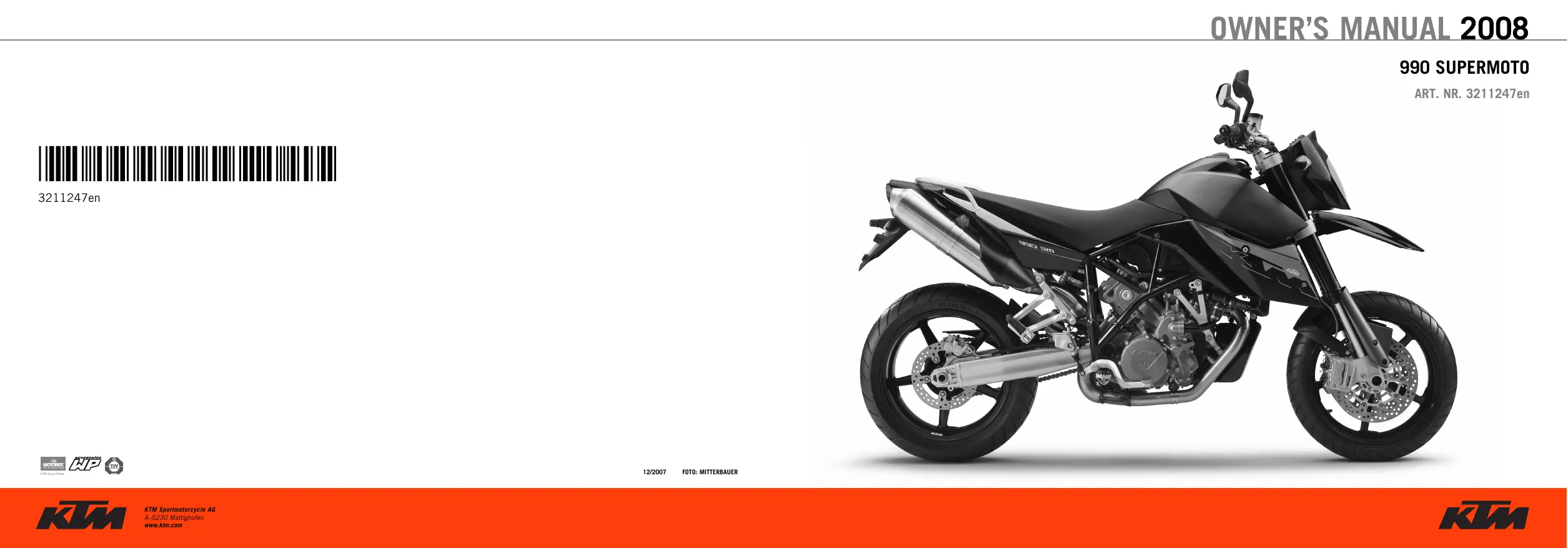

| Caractéristiques | Détails |
|---|---|
| Type de produit | Moto Supermoto |
| Motorisation | Moteur bicylindre en V, 75° |
| Cylindrée | 999 cm³ |
| Puissance maximale | 98 ch (72 kW) à 8 000 tr/min |
| Couple maximal | 100 Nm à 6 500 tr/min |
| Transmission | 6 vitesses |
| Poids à vide | 192 kg |
| Hauteur de selle | 890 mm |
| Capacité du réservoir | 12 litres |
| Consommation de carburant | Environ 6,5 L/100 km |
| Freins avant | Disques de 320 mm avec étriers radiaux |
| Freins arrière | Disque de 240 mm |
| Suspension avant | Fourche inversée WP de 48 mm |
| Suspension arrière | Amortisseur WP avec réglage de précharge |
| Éclairage | Phare avant à LED |
| Équipements de sécurité | ABS, contrôle de traction |
| Entretien et nettoyage | Changement d'huile tous les 10 000 km, vérification des freins et des pneus régulièrement |
| Pièces détachées et réparabilité | Disponibilité des pièces chez les concessionnaires KTM |
| Garantie | 2 ans, kilométrage illimité |
FOIRE AUX QUESTIONS - 990 SUPERMOTO T KTM
Questions des utilisateurs sur 990 SUPERMOTO T KTM
0 question sur cet appareil. Repondez a celles que vous connaissez ou posez la votre.
Poser une nouvelle question sur cet appareil
Téléchargez la notice de votre Moto au format PDF gratuitement ! Retrouvez votre notice 990 SUPERMOTO T - KTM et reprennez votre appareil électronique en main. Sur cette page sont publiés tous les documents nécessaires à l'utilisation de votre appareil 990 SUPERMOTO T de la marque KTM.
MODE D'EMPLOI 990 SUPERMOTO T KTM
990 SUPERMOTO
ART. NR. 3211247en
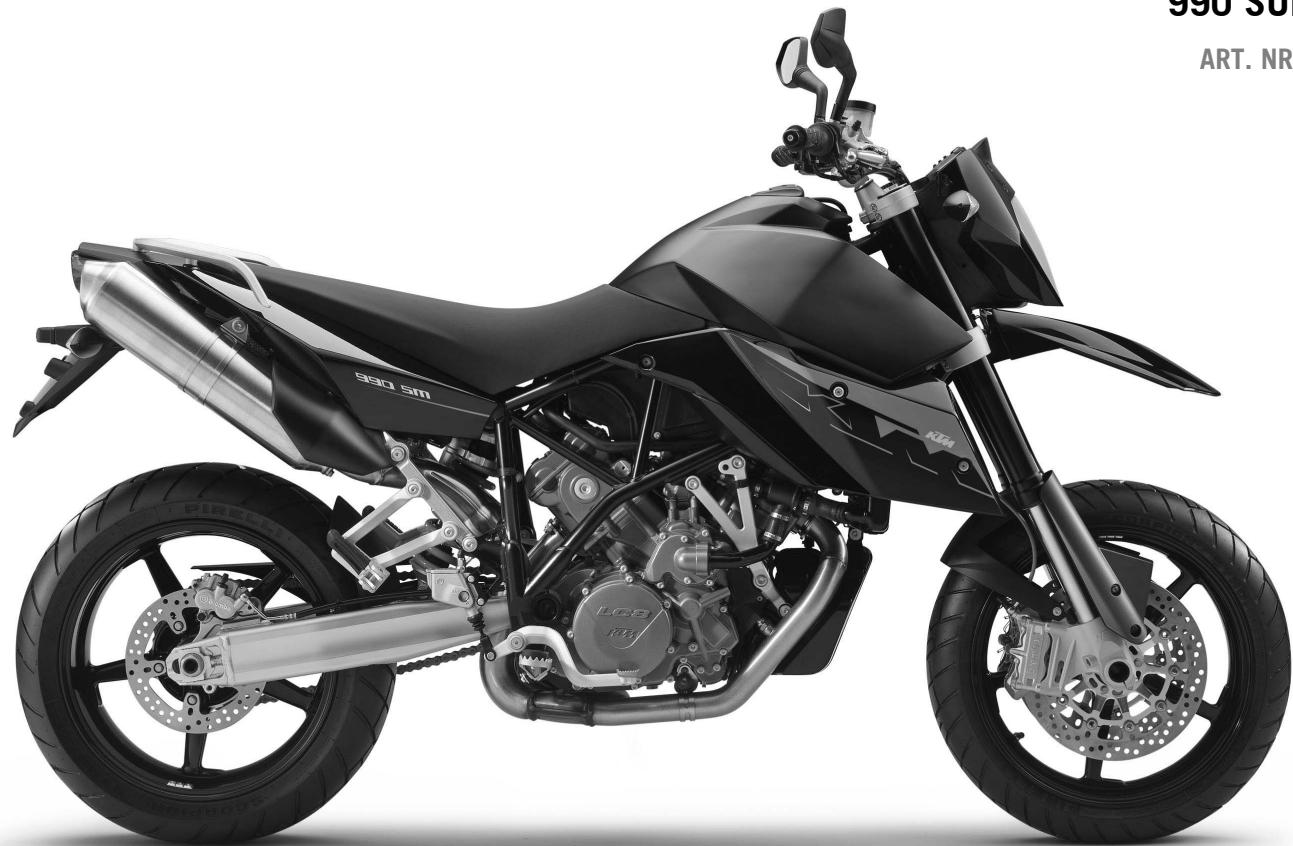
We would like to congratulate you on your purchase of a KTM motorcycle. You are now the owner of a state-of-the-art sport motorcycle that guarantees to bring you lots of fun and enjoyment, provided that you clean and maintain it appropriately. Please insert the serial numbers of your motorcycle in the boxes below:
Frame number
Engine number
Key number
Stamp of dealer
All information contained is without obligation. KTM-Sportmotorcycle AG particularly reserves the right to modify any equipment, technical specifications, prices, colors, shapes, materials, services, service work, constructions, equipment and the like so as to adapt them to local conditions or to cancel any of the above items, all without previous announcement and without giving reasons. KTM may stop manufacturing certain models without previous notice. KTM shall not be held liable for any deviations of availability and/or ability to deliver, illustrations, descriptions, printing and/or other errors. The illustrated models partly contain extra equipment, which is not applied to standard models.
© 2007 by KTM-SPORTMOTORCYCLE AG, Mattighofen AUSTRIA; All rights reserved; Reprint, also in extracts, with written allowance of KTM-SPORTMOTORCYCLE AG, Mattighofen only.
COMSUMER INFORMATION FOR AUSTRALIA ONLY Tampering with noise control system prohibited Owners are warned that the law may prohibit:
(a) The removal or rendering inoperative by any person other than for purposes of maintenance, repair or replacement, of any device or element of design incorporated into any new vehicle for the purpose of noise control prior to its sale or delivery to the ultimate purchaser or while it is in use; and
(b) the use of the vehicle after such device or element of design has been removed or rendered inoperative by any person.

In accordance with the international quality management ISO 9001 standard, KTM uses quality assurance processes that lead to the highest possible product quality.
INTENDED PURPOSE
The 990 Supermoto is designed and constructed for normal use on public roads but not for use on race courses or offroad terrain.
OWNER'S MANUAL
Carefully read the entire Owner's Manual before you start riding your motorcycle, even if this will take a little time. It contains useful tips and information on the best way to handle the motorcycle and how to protect yourself from injuries. The Manual also contains important information on service and maintenance. In your own interest, pay particular attention to the information marked as follows:
WARNING
- Ignoring these instructions, can endanger your body and your life.
CAUTION
- Ignoring these instructions could cause damage to parts of your motorcycle or that the motor-cycle is not road-safe anymore.
The Owner's Manual corresponded to the latest information available for this model series at the time it was printed. Minor deviations resulting from enhancements to the motorcycle design cannot be entirely precluded. The Owner's Manual is an integral part of the motorcycle and must be handed over to the new owner when the motorcycle is sold.
SERVICE
Observance of the service, maintenance and operating instructions for the engine and chassis specified in the Owner's Manual is a prerequisite for faultless operation and the avoidance of premature wear. Please observe the prescribed breaking-in periods, inspection intervals and service intervals. Strict observance will significantly prolong the service life of your motorcycle.
Use of the motorcycle under extreme conditions, e.g. on extremely muddy and wet terrain, can lead to higher than average wear on components such as the drive train or the brakes. In this case it may become necessary to service or replace wear parts before the service limit specified in the maintenance schedule has been reached.
WARRANTY
The service work specified in the „Lubrication and Maintenance Schedule“ must be performed by an authorized KTM workshop. This is the only place that has the qualified technicians and the special tools required for the 990 Supermoto. Be sure to have the workshop verify all service work carried out in the service manual to avoid losing your right to claim under the warranty.
The warranty or guarantee shall become void for damage and consequential damage caused by manipulations or conversions to the motorcycle.
AUTOMOTIVE FLUIDS
The fuels, lubricants and liquids specified in the Owner's Manual or automotive fluids with equivalent specifications must be used in accordance with the maintenance schedule.
SPARE PARTS, ACCESSORIES
For your own safety, only use spare parts and accessories approved by KTM. KTM shall not assume any liability for other products or consequential damage resulting from the use of such products.
ENVIRONMENT
Motorcycle driving is a wonderful sport and we hope that you will be able to enjoy it to the full. It may, however, involve potential problems for the environment or lead to conflicts with others. These problems or conflicts can be avoided if the motorcycle is used responsibly. To safeguard the future of motorcycle sports, make sure that you use the motorcycle in accordance with the law, show that you are environmentally conscious and respect the rights of others.
Enjoy driving your motorcycle!
KTM SPORTMOTORCYCLE AG
5230 MATTIGHOFEN, AUSTRIA
INTRODUCTION 1
IMPORTANT INFORMATION 2
SERIAL NUMBER LOCATIONS 6
Chassis number, Type label 6
Engine number, engine type 6
OPERATION INSTRUMENTS 7
Clutch lever 7
Hand brake lever 7
Combined instrument 8
Function buttons on combined instrument 8
Combined instrument display 8
Cooling liquid temperature display 12
Tachometer 12
Indicator lamps 13
Ignition lock 14
Immobilizer 14
Securing vehicle after losing key 15
Reordering and programming keys 15
Combination switch 16
Emergency OFF tip switch, starter tip switch 17
Fillercap 17
Fuel taps 17
Fillercap 17
Grips 18
Seat lock, removing the seat 18
Tool set 19
Helmet lock 19
Shift lever 19
Side stand 20
Foot brake pedal 20
Footrests 20
Compression damping of fork 21
Rebound damping of fork 21
Spring preload of the fork 21
Damping action during compression of shock absorber 22
Rebound damping of shock absorber 22
GENERAL TIPS AND WARNINGS FOR STARTING
THE MOTORCYCLE 23
Instructions for initial operation 23
Running in the LC8 engine 23
Accessories and payload 24
DRIVING INSTRUCTIONS 25
Check the following before each start 25
Starting the engine 27
Starting off 28
Shifting/Riding 28
Braking 29
Stopping and parking 30
Fuel 31
PERIODIC MAINTENANCE SCHEDULE 32
MAINTENANCE WORK ON CHASSIS AND ENGINE . . . . . .36
Adjusting the fork and shock absorber 37
Adjusting compression damping of fork 37
Adjusting rebound damping of fork 38
Adjusting the spring preload on the fork 38
Compression damping of shock absorber 39
Rebound damping of shock absorber 40
Breathing the fork legs 40
Checking the chain tension 41
Correcting the chain tension 41
Chain maintenance 42
Checking the chain for wear 42
General information on KTM disk brakes 43
Changing the basic position of the handbrake lever . . . . . .45
Checking the front brake fluid level 45
Checking the front brake pads 46
Checking rear brake fluid level 47
Checking the rear brake pads 47
Dismounting and remounting the front wheel 48
Dismounting and mounting the rear wheel 50
Tires, air pressure 52
Battery 53
Charging the battery 54
Jump start 54
Main fuse 55
Fuses for individual power consumers 56
Replacing the headlight lamp 57
Adjusting the headlight range 58
Replacing the flasher bulbs 58
Replacing the brake light and taillight bulbs 59
Cooling system 60
Checking the cooling liquid level in the compensating tank . .62
Checking the cooling liquid level in the radiator 62
Bleeding the cooling system 63
Changing the original position of the clutch lever 64
Checking the oil level of the hydraulic clutch 64
Engine oil 66
Checking the engine oil level 66
Refilling engine oil 67
Changing the engine oil and the oil filter,
cleaning the oil screen 67
TROUBLESHOOTING 70
Indicator lamp blink code FI 73
Indicator lamp blink code immobilizer 75
CLEANING 76
CONSERVATION FOR WINTER OPERATION 77
STORAGE 78
TECHNICAL SPECIFICATIONS - CHASSIS .79
TECHNICAL SPECIFICATIONS - ENGINE 84
Engine oil .84
HEAD WORD INDEX .85
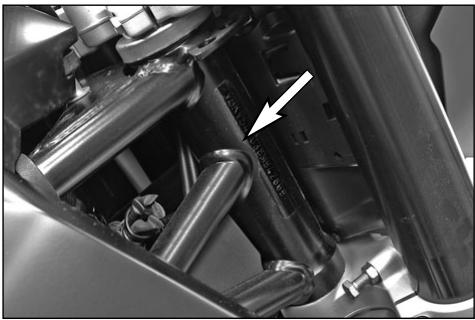
Chassis number, Type label
The chassis number is stamped on the right side of the steering head tube. Enter this number in the field on page no 1.
The type label is located next to the chassis number.
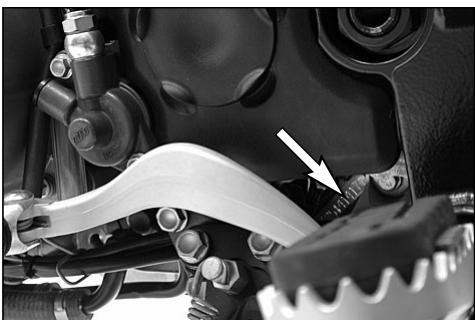
Engine number, engine type
The engine number and the engine type are stamped into the left side of the engine below the engine sprocket. Enter this number on page 1.
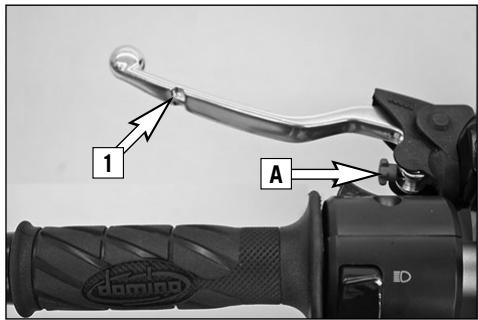
Clutch lever
The clutch lever [1] is fitted on the left hand side of the handle bar. The adjusting screw [A] is used to change the original position of the clutch lever (see maintenance work on chassis and engine).
The clutch is hydraulically actuated and adjusts itself automatically.
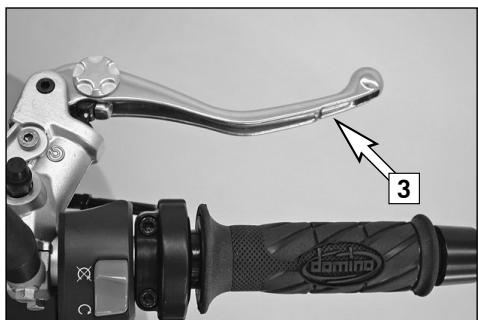
Hand brake lever
The hand brake lever [3] is mounted on the right side of the handlebar. The basic position of the handbrake lever can be changed in 5 steps (see Maintenance work on chassis and engine).
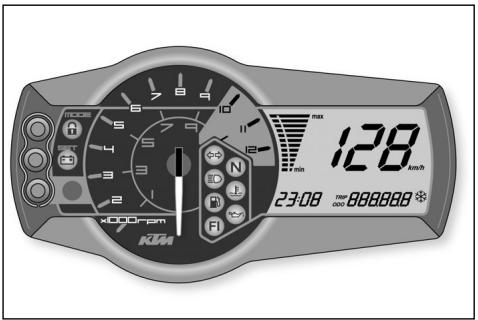
Combined instrument
The combined instrument is divided into 4 parts.
Function buttons: to select the display modes and basic settings in the display
Tachometer: displays the engine speed
Indicator lamps: provide additional information on the motorcycle operating condition
Display: shows the speed, cooling liquid temperature, time, ambient temperature, distance traveled (ODO), trip master 1 (TRIP 1), trip master 2 (TRIP 2), distance traveled since the reserve warning lamp went on (TRIP F)
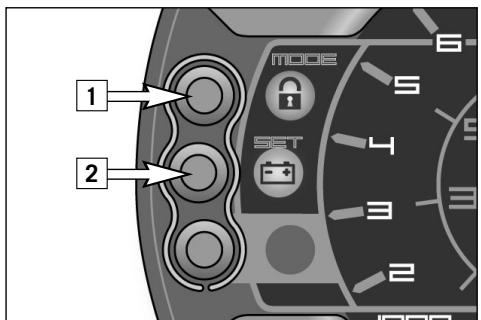
Function buttons on combined instrument
MODE [1]
Briefly press the MODE button to go to the next display mode. The available display modes are ambient temperature, distance traveled (ODO), trip master 1 (TRIP 1) and trip master 2 (TRIP 2).
The speed, cooling liquid temperature and time are always displayed.
SET [2]
Press the SET button to reset trip master 1 or 2 to 0.
The 3rd button is not programmed.
![KTM 990 SUPERMOTO T - SET [2] - 1](/content/2025/01/148128/images/bf95fc6e1002da95f547fdf0816de6920d4a4f5f5e8cb3bc2efa6497c7657c92.jpg)
Combined instrument display
TEST
When you switch on the ignition, all of the display elements will light up for 1 second for the function test.
LENGTH
The display will change for 1 second to display the circumference of the front wheel in millimeters. 1870mm corresponds to a 17^ front wheel.
Then the display will change back to the mode that was activated when the ignition was switched off.
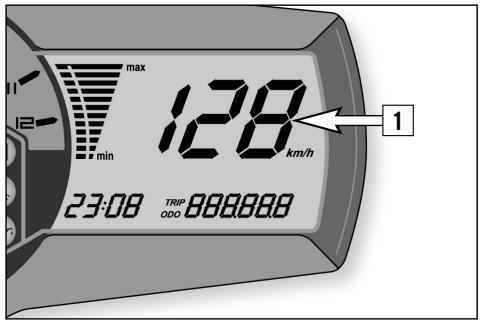
SPEED [1]
The speed can be displayed in kilometers per hour (km/h) or miles per hour (mph).
CHANGING THE SPEED DISPLAY FROM KM/H - MPH or MPH - KM/H
Switch on the ignition and press the MODE button more than 10 seconds in the ODO mode.
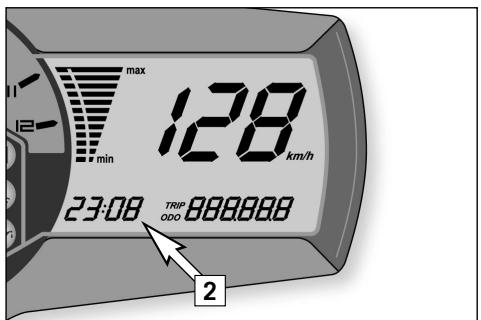
CLOCK [2]
The dots between the hours and minutes will blink in the CLOCK display.
The clock must be set if the battery was disconnected or if the fuse ACC1/CLOCK was blown.
SETTING THE CLOCK
Switch on the ignition and select the ODO mode. Press and hold the MODE button while you press the SET button more than 1 second. The time will start to blink.
Use the MODE button to set the hours. Use the SET button to set the minutes.
Then press the MODE and SET buttons simultaneously.
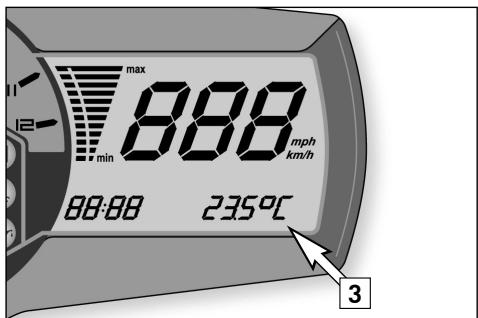
AMBIENT TEMPERATURE [3]
The ambient temperature can be displayed in Celsius (^) or Fahrenheit (^) .
CHANGING THE AMBIENT TEMPERATURE DISPLAY FROM ℃ - ℉ or ℉ - ℃
Switch on the ignition and press the MODE button more than 10 seconds in the ambient temperature mode.
Press the MODE button to go to the next display mode.
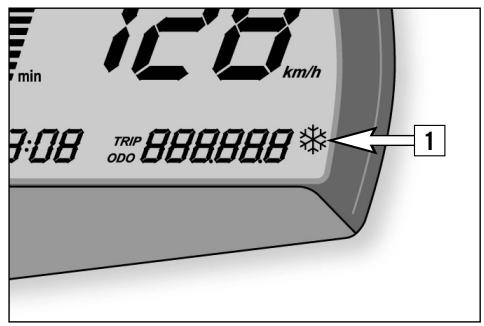
FROST WARNING [1]
The frost symbol will start to blink regardless of the mode if the ambient temperature drops below 3^ (37.5°F).
![KTM 990 SUPERMOTO T - FROST WARNING [1] - 1](/content/2025/01/148128/images/70ac8246cb63db916effcc189c91ac91580e06dd4f5a9c0ff65303da50de0ec3.jpg)
ODO [2]
Displays the total kilometers or miles traveled.
This figure will not be cleared if the battery is disconnected.
![KTM 990 SUPERMOTO T - ODO [2] - 1](/content/2025/01/148128/images/b5d5ce0f2c5b142625f89a871c3121754a30d6cad7bc1e4a8e3e5c418c7bae94.jpg)
TRIP 1 [1]
The trip meter 1 is always active and counts up to 999.9. It is used to measure the length of the trip or the distance between 2 refueling stops.
TO RESET TRIP 1
To reset the trip meter 1 to zero, switch on the ignition, select the TRIP 1 display mode and press the SET button more than 2 seconds.
Press the MODE button to go to the next display mode.
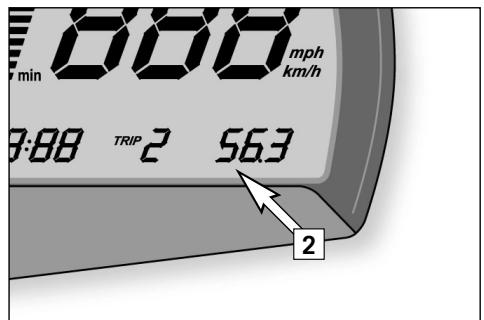
TRIP 2 [2]
The trip meter 2 is always active and counts up to 999.9. It is used just like TRIP 1.
TO RESET TRIP 2
To reset the trip meter 2 to zero, switch on the ignition, select the TRIP 2 display mode and press the SET button more than 2 seconds.
Press the MODE button to go to the next display mode.
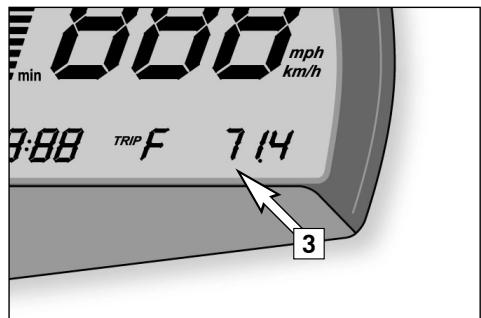
TRIP F [3]
When the fuel level reaches the reserve mark, the display will automatically switch to TRIP F and begin to count (no matter which display mode was active before). At the same time, the fuel warning lamp will light up. You will still have enough reserve fuel for at least 30 kilometers.
After refueling, it will take approx. 3 minutes for the fuel lamp to go out, TRIP F to automatically reset to 0 and to return to the previous display mode.
NOTE:
Press the SET button for 2 seconds to switch off the fuel warning lamp.
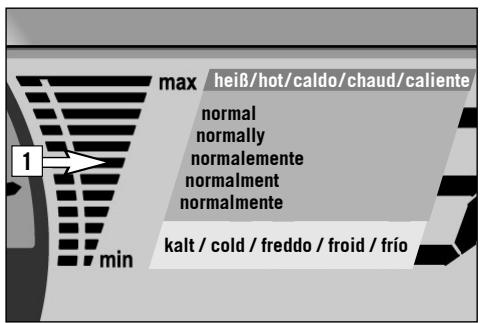
Cooling liquid temperature display
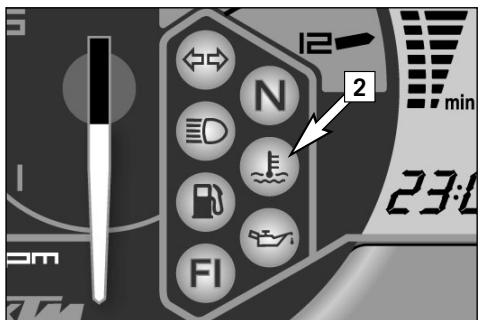
The temperature display [1] is shown in 12 bars. The more bars that light up, the hotter the cooling liquid. When the upper bar lights up 120^ ( 248^ ), all of the bars will start to blink and the red warning lamp [2] will light up.
WARNING
Possible causes for an increase in temperature, causing the red warning light for the cooling liquid temperature to light up:
- Driving too slowly and driving with a heavy load at high air temperatures
- Not enough cooling liquid in the system
- The ventilator on the left radiator is not running
- Improper use of the clutch when driving slowly
Tachometer
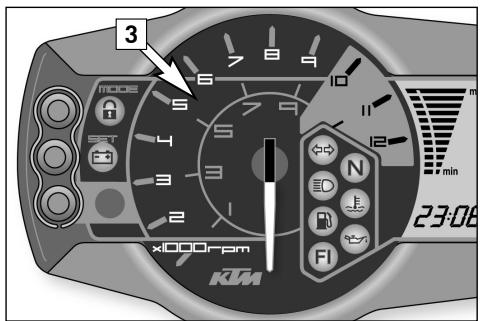
The tachometer [3] shows the engine speed in revolutions per minute. Do not run the engine beyond the orange mark at 9500 rpm.
The speed limiter will set in at 9600 rpm, drastically reducing the engine power above this rotational speed.
Indicator lamps

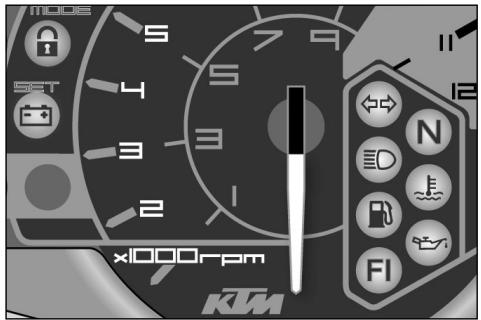
The green indicator lamp will blink in the blinker rhythm when the blinker is switched on.
NOTE: The indicator lamp will blink slower when a blinker is broken.

The green indicator lamp will light up when the gearbox is in an idling position.

The blue indicator lamp will light up when the high beams are switched on.

The red warning light will light up when the cooling liquid has reached a temperature of approx. 120^ (248°F).

The orange warning lamp will light up when the fuel level has reached the reserve mark. At the same time the display will automatically change to TRIP F (see TRIP F).

The red warning lamp lights up when the ignition is switched on but the engine is not running. When the engine is started, the warning lamp will go out as soon as the oil pressure is high enough

The orange warning lamp (fuel injection) briefly lights up when the ignition is switched on. It will go out when the gasoline pressure is high enough.
If this warning lamp lights up while driving, a component in the injection system is defective. The error can be identified by means of a blink code (see Trouble shooting).

The red warning lamp will light up if the voltage in the on-board electrics drops below 10 volts. Immediately drive to the nearest authorized KTM workshop and have the electrical system checked.

The red indicator lamp lights up briefly when the ignition is switched on and indicates that the immobilizer has been deactivated. When the ignition is switched off, the indicator lamp begins blinking after one minute with a 15-second interval to indicate that the immobilizer is activated. If the indicator lamp blinks rapidly, the system has detected a fault in the immobilizer. The fault can be identified by means of a blinking code (refer to Troubleshooting).
Ignition lock
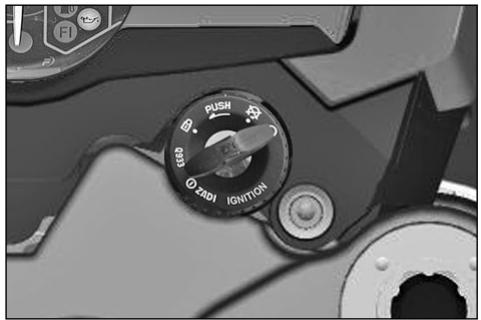
The ignition lock has 3 switching positions.

Ignition off, (engine can't be started)

Ignition on, light on, (engine can be started)

Ignition off, handlebar blocked
To switch the ignition to position turn the ignition key to position and firmly press it into the lock. Turn the handlebar to the left, then turn the ignition key to the left. The ignition key can be withdrawn in position and .
NOTE:
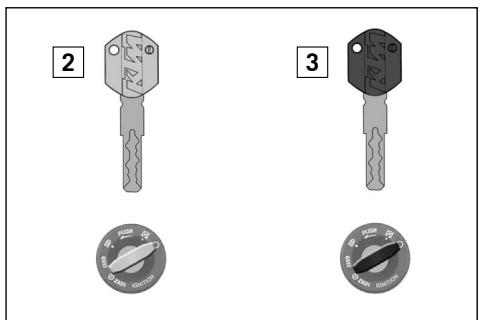
Only the black ignition keys may be used (primary key or reserve key). The vehicle cannot be started with the orange master key - it can only be used for programming the immobilizer. Always keep the orange master key and the keycode card in a safe place!
Immobilizer
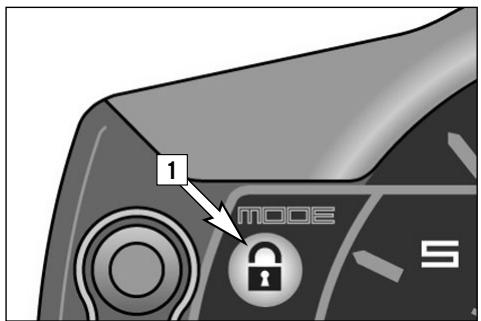
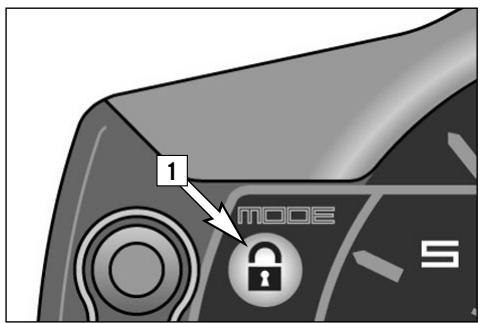
The immobilizer secures the vehicle against unauthorized use. When the ignition is switched off and the key is removed, the red indicator lamp [1] begins blinking after one minute with a 15-second interval to indicate that the immobilizer is activated. The starter, fuel supply and ignition system are now locked.
Securing vehicle after losing key
A lost key can be blocked for this vehicle.
LOSS OF PRIMARY KEY, RESERVE KEY AVAILABLE
- Switch on the ignition using the orange master key [2]. The red indicator lamp [1] lights up. Switch off the ignition.
- Switch on the ignition with the black reserve key [3]. The red indicator lamp [1] goes out for 0.5 seconds and then lights up again. Switch off the ignition.
- Switch on the ignition again with the orange master key [2]. The red indicator lamp [1] goes off for 3 seconds and then blinks according to the number of functioning keys including the master key – in this case, twice. Switch off the ignition.
The lost key is now blocked. The reserve key remains functional.
LOSS OF BOTH KEYS
- Switch on the ignition using the orange master key [2]. The red indicator lamp [1] lights up. Switch off the ignition.
- Switch the ignition on and off again using the orange master key [2].
All keys for this vehicle are now blocked.
Reordering and programming keys
Every key that is to be used with this vehicle must be programmed first to be functional.
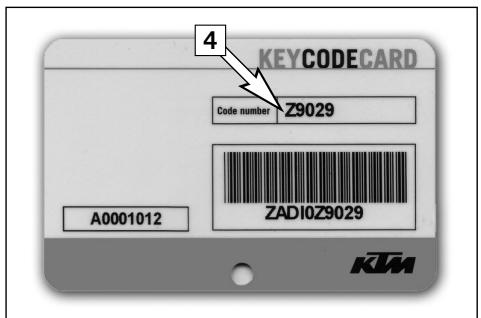
- Reorder key. The key number [4] is located on the key code card.
- Switch on the ignition using the orange master key [2]. The red indicator lamp [1] lights up. Switch off the ignition.
- Switch on the ignition with the black key [3]. The red indicator lamp [1] goes out for 0.5 seconds and then lights up again. Switch off the ignition.
- Repeat this procedure with each additional key.
- Switch on the ignition again with the orange master key [2]. The red indicator lamp [1] goes off for 3 seconds and then blinks according to the number of functioning keys including the master key. Switch off the ignition.
NOTE:
A total of 4 keys can be programmed per vehicle.
Combination switch
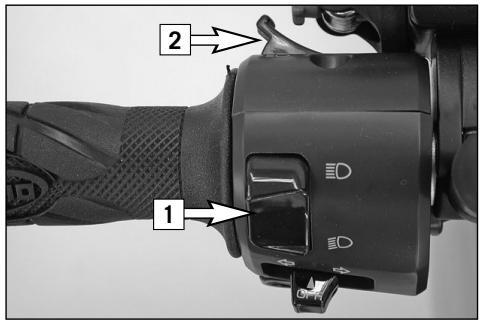
The rocker switch LIGHTS [1] actuates the high beam or low beam.
D High-beam light
D Low-beam light
The light signal (high beam) is actuated with button [2].
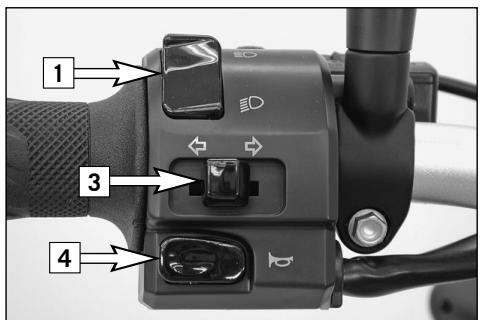
The indicator switch [3] returns to central position after actuation. Press flasher switch towards switch housing to switch off the flasher.
The horn is sounded with button [4].
Emergency OFF tip switch, starter tip switch
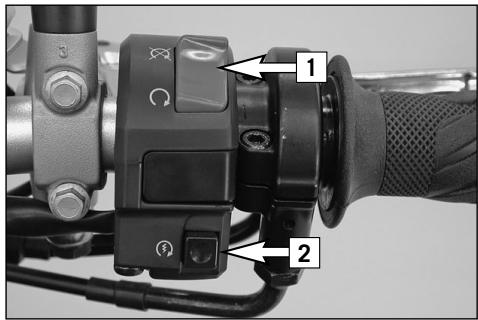
The emergency off switch [1] is provided for emergency situations and should not be used to switch off the engine.
The engine is ready for operation in position (ignition circuit and starter circuit are switched on).
The engine cannot be started in position (ignition circuit and starter circuit are interrupted).

Use the starter tip switch [2] to operate the electric starter.
Fillercap
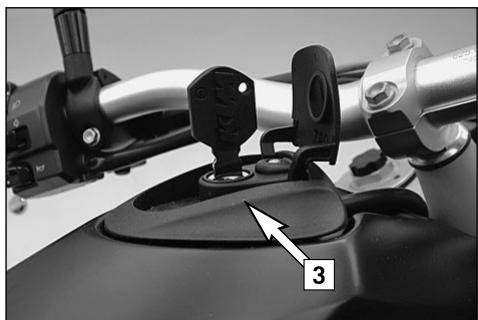
The filler cap [3] can be locked and is provided with a fuel evaporation control system. To open the cap insert the ignition key, turn it 90^ counterclockwise, then lift off the filler cap.
To close the tank insert the filler cap, turn the ignition key 90^ clockwise and take out the key.
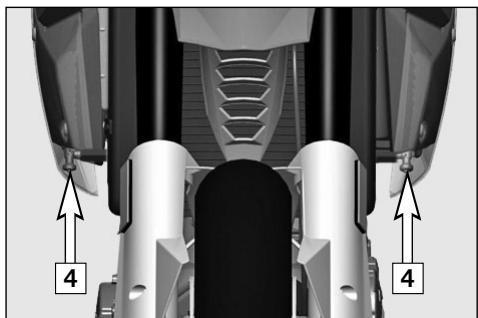
Fuel taps
Both fuel taps [4] must be open when the motorcycle is running. The level in the fuel tanks is equalized by means of a connecting hose.
Only close the fuel taps to remove the tank.
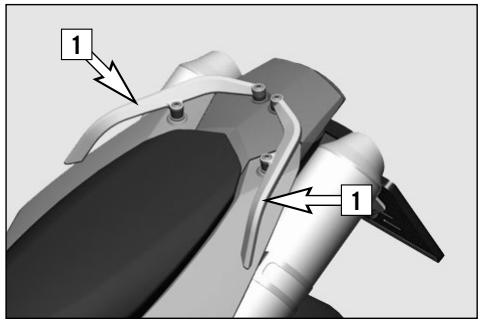
Grips
The grips [1] are used to maneuver the motorcycle. If carrying a passenger, the passenger can hold on to the grip during the ride.
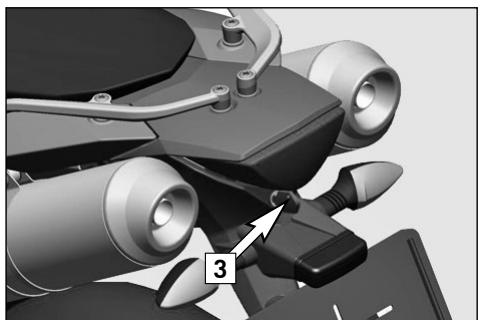
Seat lock, removing the seat
The seat lock [3] can be locked with the ignition key.
To remove the seat, insert the ignition key and turn 45^ in a counterclockwise direction. Lift the seat in the back, pull back and lift off.
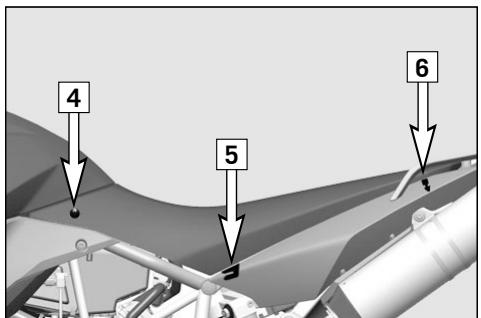
To mount, attach the seat to the two oval head screws [4], lower the rear and push forward at the same time. Both noses [5] should fit into the frame. Insert the catch bolts [6] in the lock housing and push the seat down in the back until you hear the catch bolts snap into place.
Check whether the seat is correctly mounted.
WARNING
If not correctly mounted, the seat can slip while you are driving and cause you to lose control of your motorcycle.
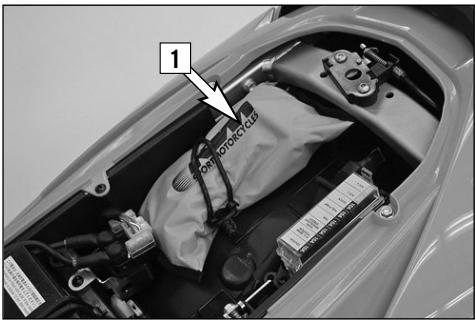
Tool set
The tool set [1] is located in the storage compartment under the seat.
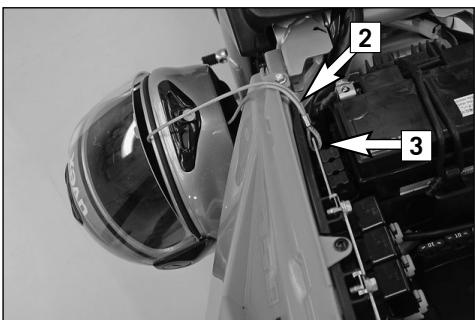
Helmet lock
The steel rope [2] in the tool bag can be used to secure a helmet.
To secure, remove the seat, run the rope through the helmet, attach both ends to the hook [3] and mount the seat.
WARNING
The helmet lock is provided to secure the helmet to the motorcycle when parked. Do not attach the helmet or other objects to the steel rope while driving. You can easily lose control of the motorcycle.

Shift lever
The shift lever is mounted on the left side of the engine. The position of the gears is shown in the illustration. Neutral, or the idle speed, is located between first and second gear.
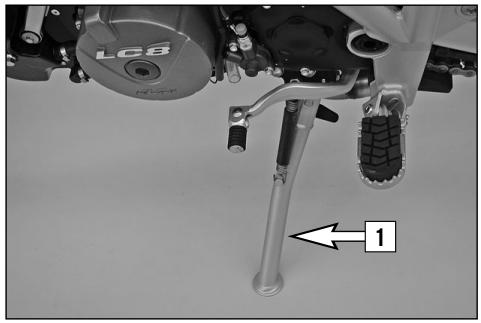
Side stand
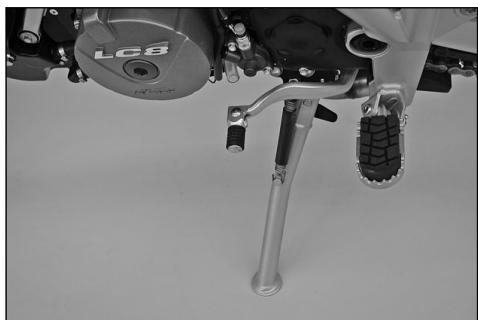
Fold the side stand [1] forward to the stop with your foot and put the weight of the motorcycle on the stand. Make sure it is standing securely on a firm surface. The side stand is linked to the safety start system; follow the driving instructions.
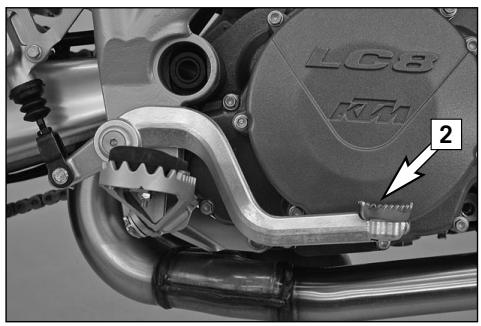
Foot brake pedal
The foot brake pedal [2] is located in front of the right footrest. Its basic position can be adjusted to your seat position (see maintenance work).
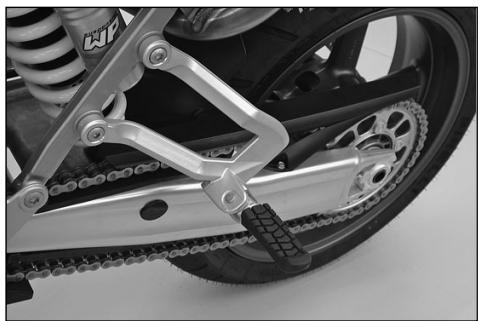
Footrests
The passenger footrests [3] fold up.
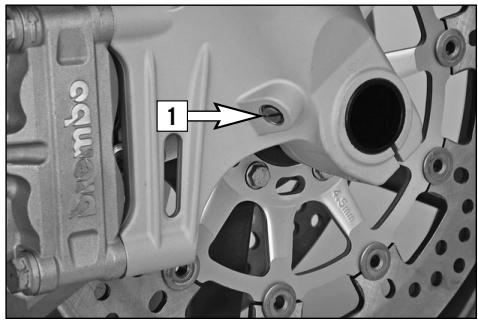
Compression damping of fork
The fork's damping action during compression travel (compression damping) can be adjusted. This allows you adjust the damping behavior to match your driving style and the payload. The adjusting screws [1] are located on the fork leg axle passage. More information is provided in the chapter "Adjusting the fork and shock absorber."

Rebound damping of fork
The fork's damping action during rebound travel (rebound damping) can also be adjusted. This allows you adjust the damping behavior to match your driving style and the payload. The adjusting screws [2] are located on the upper end of the fork legs. More information is provided in the chapter "Adjusting the fork and shock absorber."
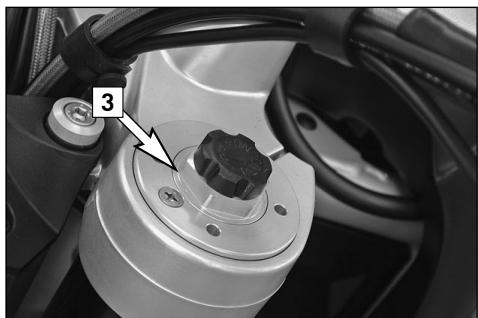
Spring preload of the fork
The fork's preload can be adjusted by means of the adjusting screws [3]. More information is provided in the chapter "Adjusting the fork and shock absorber."
Damping action during compression of shock absorber
The shock absorber's damping action during compression travel (compression damping) can be adjusted. This allows you to adjust the shock absorber's damping behavior to match your driving style and the payload.
The damping rate can be adjusted in the low and high-speed range (Dual Compression Control). The designation low and high-speed refers to the movement of the shock absorber and not to the motorcycle's driving speed.
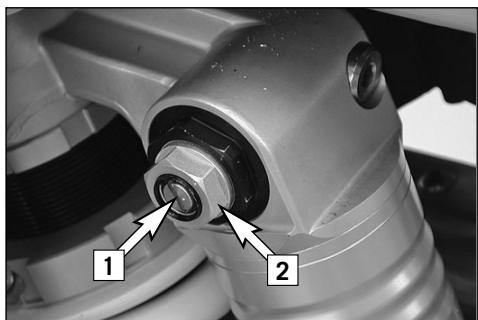
The adjusting screw [1] for the low-speed range can be adjusted with a screwdriver.
The adjusting screw [2] for the high-speed range can be adjusted with a 17 mm socket wrench.
More information is provided in the chapter "Adjusting the fork and shock absorber."
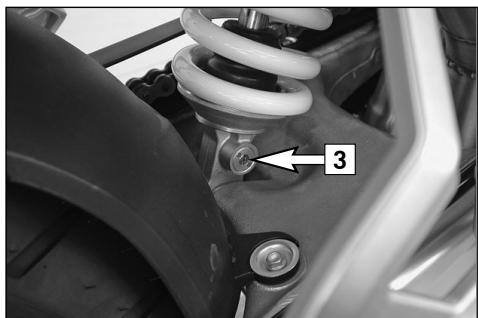
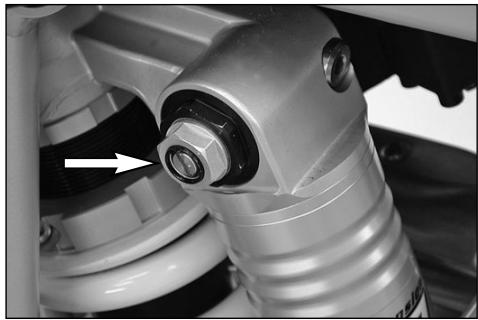
Rebound damping of shock absorber
The shock absorber's damping action during rebound travel (rebound damping) can also be adjusted. This allows you to adjust the damping behavior to match your driving style and the payload.
The adjusting screw [3] is located on the bottom of the shock absorber.
More information is provided in the chapter "Adjusting the fork and shock absorber."
Instructions for initial operation
- Make sure the work for the „pre-delivery inspection“ was performed by your authorized KTM workshop. The DELIVERY CERTIFICATE and SERVICE MANUAL will be handed over when you pick up your vehicle.
- Read these operating instructions carefully before your first ride.
- Enter the chassis, engine and key numbers on page 1.
- Familiarize yourself with the operating elements.
- Adjust the hand brake lever and foot brake lever to your most comfortable position.
- This motorcycle is equipped with a three-way catalytic converter. Leaded fuel will destroy the catalytic converters. Please use unleaded fuel only.
Get used to handling the motorcycle on an empty parking lot, before starting on a longer drive. Also try to drive as slowly as possible and in standing position, to improve your feeling for the vehicle.
Hold the handlebars with both hands and leave your feet on the foot rests while driving. - Remove your foot from the foot brake lever when you are not braking. If the foot brake lever is not released the brake pads rub continuously and the braking system is overheated.
- Do not make any alterations to the motorcycle and always use ORIGINAL KTM SPARE PARTS. Spare parts from other
manufacturers can impair the safety of the motorcycle.
- New wheels have a smooth surface, which means that they must be run in to achieve full grip. For this purpose, ride the motorcycle carefully at moderate speed during the first 200 kilometers (125 miles) with new tires, tilting the vehicle at different angles so that all sections are properly roughened. Tires will not display their full grip characteristics until they are properly run in.
Motorcycles are sensitive to changes in the weight distribution. Read the section on "Accessories and payload" when carrying luggage. - Pay attention to running-in procedure.
Running in the LC8 engine
Even finely machined surfaces of engine parts have rougher surfaces than parts that slide on each other for a long time. Therefore, every engine must be run in. For this reason, do not demand maximum performance from the engine for the first 1000 kilometers (620 miles). The vehicle must be run in at low, changing performance level for the first 1000 km (620 miles). The maximum number of revolutions per minute must not go exceed 6500 rpm. Once you have run your engine in for 1000km you may push it to its 9500 rpm limit, i.e. up to the orange zone indicated in the tachometer. Exceeding the above listed rotations as well as pushing high rpm
when the engine is cold will have an adverse effect on the life of your engine.

WARNING
- Wear suitable clothing when driving a motorcycle. Clever KTM drivers always wear a helmet, boots, gloves and a jacket, regardless of whether driving all day or just for a short trip. The protective clothing should be brightly colored so that other vehicle can see you as early as possible. Your passenger will also need suitable protective clothing.
- Do not drive after having consumed alcohol.
- Drive at a moderate speed for the first few kilometers of each trip to allow the tires to reach the necessary operating temperature. Maximum road grip is assured when the tires are warm.
- The front and rear wheel are allowed to be fitted only with tires that have the same profile type.
ACHTUNG
- New tires have a smooth surface, which means that they must be run in to achieve full grip. For this purpose, ride the motorcycle carefully at moderate speed during the first 200 kilometers with new tires, tilting the vehicle at different angles so that all sections are properly roughened. Tires will not display their full grip characteristics until they are properly run in.
- The tires must be designed for a speed of over 240 KPH (speed symbol ZR) and must be released by KTM.
- Wheels with a different rim diameter or other rim width may not be mounted otherwise the vehicle handling will no longer be safe.
- Observe the traffic regulations, drive defensively and trying to look ahead as far as possible so that any hazards can be recognized as early as possible.
- The faster you drive, the more sensitive your motorcycle will be to crosswind and changing road conditions. Your motorcycle can easily go out of control at high speeds.
- Choose your driving speed according to the conditions and your driving skills.
- Drive carefully on unknown roads
- Renew the vigor on your helmet on time so as to ensure optimum vision in any situation. When light shines directly on scratched visor, the operator will be blinded.
- A passenger may only ride on the motor
cycle if passenger footrests are mounted.
- Never leave your motorcycle without supervision if the engine is running.
Accessories and payload
Accessory parts and baggage can significantly decrease a motorcycle's driving stability. Please observe the following warnings.
WARNING
- Never drive faster than 130 kph (80 mph) if you have mounted accessory parts on your motorcycle. Accessory parts can significantly impair the motorcycle's handling, especially in the maximum speed range.
- Never drive faster than 130 kph (80 mph) if your motorcycle is loaded with cases or other baggage. They will impair the motorcycle's handling at higher speeds and can easily cause it to go out of control.
- If you have cases mounted, do not exceed the manufacturer's recommended maximum payload.
- Fasten the baggage close to the center of the motorcycle and distribute the weight evenly on the front and rear wheels and on the left and right.
- Baggage must be securely and adequately fastenend; loose baggage will significantly impair driving safety.
- A high payload will change the motorcycle's handling and considerably increase
the braking distance; adapt your driving speed accordingly.
- Never exceed the maximum permissible laden weight and the axle weights. The maximum permissible laden weight is made up of the following components:
Motorcycle ready for operation and tank full
- Luggage
- Driver and passenger with protective clothing and helmet

Check the following before each start
When you start, the motorcycle must be in perfect mechanical condition. For safety reasons, you should make a habit of performing an overall check of your motorcycle before each start.
The following checks should be performed:
1 FUEL
Check the fuel quantity in the tanks.
2 CHAIN
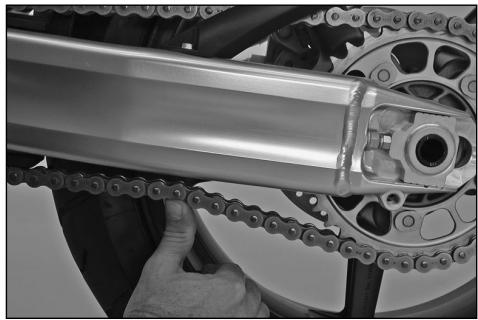
Check the tension and condition of the chain.
A loose chain can fall off the sprockets and a worn-out chain can tear. In both cases this can damage other motorcycle components and cause the motorcycle to go out of control. A chain that is too tight or not greased will cause unnecessary wear to the chain and sprockets.
3 TIRES
Check for damaged tires. Tires showing cuts or dents must be replaced. The tread depth must comply with the legal regulations. Also check the air pressure. Insufficient tread and incorrect air pressure deteriorate the driving performance.
4 BRAKES
Check correct functioning of the braking system. Check for sufficient brake fluid in the reservoir. The reservoirs have been designed in such a way that brake fluid does not need to be refilled even when the brake pads are worn. If the level of brake fluid falls below the minimum value, this indicates a leak in the braking system or completely worn out brake pads. Arrange for the braking system to be checked by a KTM specialist, as complete failure of the braking system can be avoided.
Also check the state of the brake hose and the thickness of the brake linings.
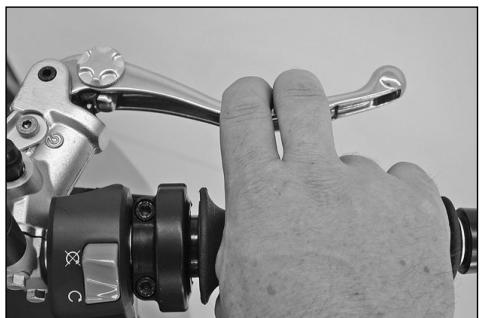
Check free travel at hand brake lever and foot brake lever.

5 CABLES Check the throttle cable for correct adjustment and smooth operation.
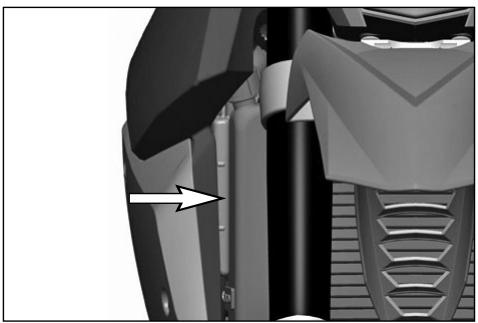
6 COOLING FLUID Check the level of cooling fluid when the engine is cold.
7 ELECTRICAL SYSTEM Start the engine and check the headlight, tail lamp, brake light, turn signals, indicator lamps, horn and emergency-off switch for proper functioning.
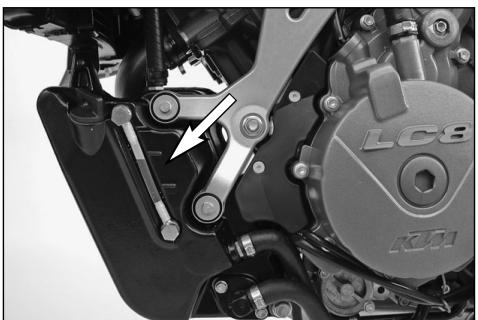
8 CHECK OIL LEVEL Insufficient oil results in premature wear and consequently to engine damage.
9 BAGGAGE, PAYLOAD Never exceed the maximum total weight (400 kg, 883 lbs) and the motorcycle's wheel loads. The maximum total weight is comprised of: - the motorcycle in a running condition and refueled (205 kg, 452 lbs) - the baggage and accessories - the driver and passenger with protective gear and helmet Adjust the tire inflation pressure as well as the preload and damping properties of the fork and shock absorber to the total weight. Make sure your luggage is correctly fastened before you drive off.
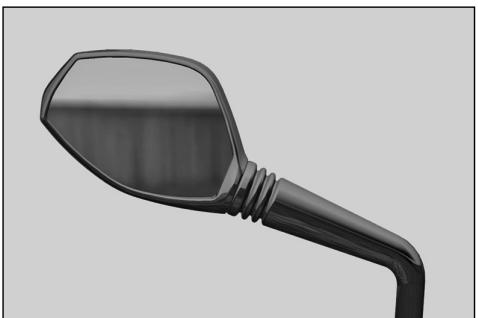
10 REAR MIRROR Sit on the motorcycle and check the adjustment of the rear mirror.

Starting the engine
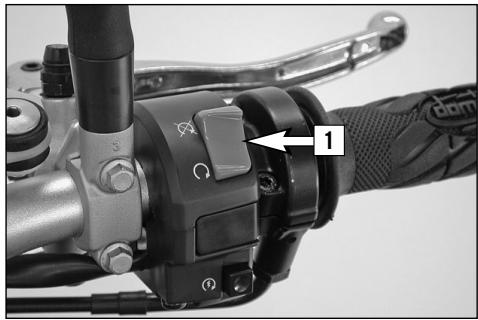
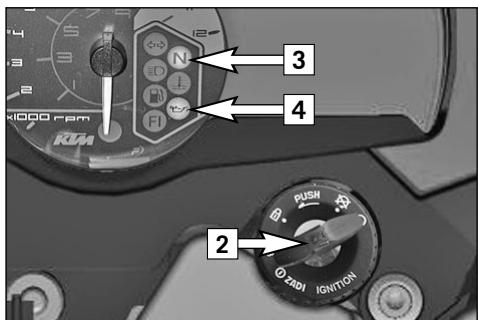
1 Switch on emergency OFF switch [1].
2 Switch on ignition (turn ignition key [2] into position ).
NOTE:
You will hear the operation of the fuel pump for approx. 2 seconds after switching on the ignition. During this time, the FI and immobilizer indicator lamps light up and the vehicle cannot be started.
3 Switch transmission to idle (green indicator lamp N [3] lights up).
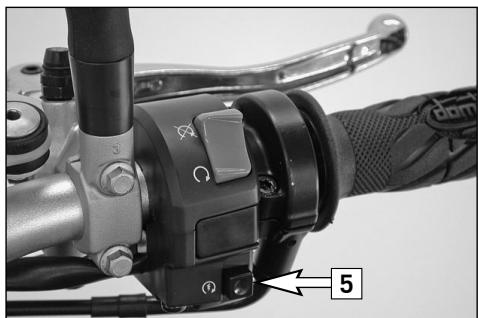
4 Do not accelerate; operate starter button [5].
NOTE:
If you accelerate during the starting process you will hear a loud, metallic sound caused by the torque limiter. The torque limiter protects the components in the starter drive from being damaged.
5 The oil pressure warning lamp [4] should go out as soon as the engine is running.
6 Take the load off the side stand and fold the side stand all the way up.

WARNING
- Do not start the engine and allow it to idle in a closed room. Exhaust fumes are poisonous and can cause loss of consciousness and death. Always provide adequate ventilation while the engine is running.
- Never operate the motorcycle with a run-down battery or without the battery. This can damage the electronic components or safety equipment in either case and the motorcycle will no longer be roadworthy.

CAUTION
- If you accelerate while starting, the engine management will not inject any fuel and the engine will not start. Do not accelerate while starting!
- If the oil pressure warning lamp does not go out as soon as the engine is running, immediately switch off the engine. If the engine is not switched off, engine damage will occur within a short period of time. Check the engine oil level or contact a ktm workshop.
- Maximum period for continuous starting: 5 seconds. Wait at least 5 seconds before trying again.
- Don't ride your motorcycle with full load and don't rev engine when cold. Because the piston is warming up faster than the water cooled cylinder, it can cause engine damage. Always let the engine warm up before and refrain from driving with full load until the engine is warm.

IF THE ENGINE IS DOES NOT CRANK WHEN YOU ACTUATE THE STARTER TIP SWITCH:
- whether you accelerated while starting
- the transmission is switched to idle
- check if the emergency OFF switch is on
- check if the ignition is on
-
whether the immobilizer indicator lamp blinks
-
if yes, check Troubleshooting - Blink codes table
-
the headlight is on
-
if this is not the case, the battery is discharged
- if the lights are on, proceed as described in the „Trouble-shooting“ section or contact a KTM dealer.
IF THE ENGINE CRANKS BUT DOES NOT START, WHEN YOU ACTUATE THE STARTER TIP SWITCH:
- whether you accelerated while starting
-
whether the FI indicator lamp is blinking
-
if yes, check Troubleshooting - Blink codes table
-
Check if sufficient fuel is in the tank
-
If this is not the case, refill the tank
- if sufficient fuel is in the tank, proceed as described in the „Troubleshooting" section or contact a KTM dealer.
NOTE:
This motorcycle is equipped with a safety starting system. The engine can only be started
if the transmission is in neutral or the clutch lever is pulled. If the side stand is folded down, the engine can only be started if the transmission is in neutral or the clutch lever is pulled. The engine will stall if a gear is engaged and the clutch lever is released with the side stand folded down.
Starting off
Pull the clutch lever and engage 1st gear. Slowly release the clutch lever while you gently accelerate.

WARNING
Do not attach a helmet or other objects to the helmet lock rope while driving. You can easily lose control of the motorcycle.
Shifting/Riding
You are now in first gear, referred to as the drive or uphill gear. Depending on the conditions (traffic, road gradient, etc.), you can shift to a higher gear. Close throttle, at the same time pull clutch lever and shift to the next higher gear. Let clutch lever go again and carefully open throttle. Do not shift gears and accelerate carefully in curves.
Only accelerate to the extent that road and weather conditions allow. Be especially careful when you accelerate in curves. Abrupt opening of the throttle can cause the motorcycle to go out of control and also increases fuel consumption.
By shifting down, use the brakes if necessary and close throttle at the same time. Pull clutch lever and shift down to the next gear. Let clutch lever go slowly and open throttle or shift down again.
If the engine is killed f.ex. at a crossing, simply pull the clutch lever and start. It is not necessary to switch the gear to NEUTRAL.
Stop immediately if the FI indicator lamp lights up while driving. The FI indicator lamp will start blinking as soon as the transmission is in neutral. The rhythm of the blinking lamp will let you determine the two-digit „blink code“, e.g.:
Blink code 34: F1 blinks 3x long, 4x short, pause,
Blink code 06: F1 blinks 6x short, pause The blink code will indicate which component is defective (see Troubleshooting). This makes it possible to pinpoint the defect if a diagnostic tool is unavailable.

WARNING
- Avoid abrupt load changes while riding around bends and on wet or slippery ground. Otherwise you might easily lose control over your motorcycle.
WARNING
While riding your motorcycle, never switch the ignition lock to positions and .
- Do not try to change the settings of the combined instrument while driving. Your attention will be distracted from the traffic and this may cause you to lose control of your motorcycle.
- The frost symbol * in the combined instrument will start to blink on icy roads. Adapt your speed to the road and weather conditions.
- The passenger must hold on to the driver or the holding strap on the seat while riding and keep his/her feet on the passenger footrests.
- Regularly make sure that the baggage and cases are tightly fastened.
- After falling with the motorcycle, check all functions thoroughly before starting up operations again.
- A bent handlebar must always be replaced. Never try to straighten the handlebar because this will cause it to lose its stability.
CAUTION
High rpm rates when the engine is cold have an adverse effect on the life of your engine. We recommend you run the engine in a moderate rpm range for a few miles giving it a chance to warm up. After that no further precautions in this respect need be taken. The engine has reached operating temperature as soon as the 4th
bar on the temperature indicator lights up.
- If the red oil pressure warning lamp lights up while driving, the oil pressure is too low to adequately lubricate the engine. Stop immediately and switch off the engine. if you continue to drive, engine damage will occur within a short period of time. Check the engine oil level or contact an authorized KTM workshop.
- Never have the throttle wide open when changing down to a lower gear. The engine will overspeed, damaging the valves. In addition, the rear wheel blocks so that the motorcycle can easily get out of control.
- Never use your motorcycle without an air filter. Otherwise dust and dirt may enter the engine and cause increased wear.
- Stop immediately if a perceptible power loss occurs while driving due to a defective ignition caused by a cylinder misfiring or breaking down. If the unburned fuel/air mixture reaches the catalytic converter, it will ignite and the resulting heat will destroy the catalytic converter and the adjoining components.
- The red coolant warning lamp lights up when the coolant temperature has reached 120^ (248°F).
Possible causes for the increase in temperature:
- low driving velocity and high load situation in high air temperatures
level of coolant in the system is insufficient -
fan at radiator is not running
-
improper use of the clutch while driving at low velocities
Let the engine cool down. Meanwhile, check whether any cooling liquid is leaking out of the motorcycle. Check the cooling liquid level in the radiator (not only in the compensating tank). - CAUTION SCALDING HAZARD! Do not drive on, until there is sufficient liquid in the coling system.
- In the event that, while riding on your motorcycle, you notice any unusual operation-related noise, stop immediately, turn the engine off, and contact an authorized KTM dealer.
Braking
Close throttle and apply the hand and foot brakes at the same time. Carefully apply the brakes on sandy, wet or slippery surfaces. Always brake with feeling, blocking wheels can cause you to skid or fall. Also change down to lower gears depending on your speed. Always finish braking before you enter a curve.
When driving downhill, use the braking effect of the engine. Change down one or two gears but do not overspeed the engine. In this way, you will not need to brake so much and the brakes will not overheat.
WARNING
- In the rain, or after the motorcycle has been washed, braking action may be delayed due to wet brake discs. First, the brakes must be braked dry.
WARNING
- On salt-sprayed or dirty roads brake action may be delayed as well. First, the brakes must be braked clean.
-
Remember that the stopping distance will be longer if you are carrying a passenger or baggage.
-
When you brake, the brake discs, brake pads, brake caliper and brake fluid heat up. The hotter these parts get, the weaker the braking effect. In extreme cases, the entire braking system can fail.
- If the resistance in the hand brake lever or foot brake pedal feels „spongy“ (too much play), this is an indication that
something is wrong with the brake system. Don't ride your motorcycle anymore without first having the brake system looked over by a KTM dealer.
Stopping and parking
Apply the brakes fully and put the engine into neutral. To stop the engine, switch off the ignition. Fold the side stand forward to the stop with your foot, put the weight of the motorcycle on the stand and park the bike on a firm surface. Lock the motorcycle.
WARNING
- always park your motorbike on a solid and horizontal surface.
- Never leave your motorcycle without supervision as long as the engine is running.
Motorcycle engines produce a great amount of heat while running. The engine radiators, exhaust, exhaust system, brake discs, and shock absorbers can become very hot. Do not touch any of these parts after operating the motorcycle, and take care to park it where pedestrians are not likely to touch it and get burned - Never park your motorcycle in places where there exist fire hazards due to dry grass or other easily flammable materials.
CAUTION
- Always take out the ignition key when parking your motorcycle so that it cannot be used by unauthorized persons.
- The side stand is dimensioned for the weight of the motorcycle only. Sitting on the motorcycle will increase the weight on the side stand. The side stand or engine case can be damaged and the motorcycle can tip over.

Fuel
In the condition at delivery, the LC8 engine requires unleaded fuel with at least RON 95 (USA = Premium PON 91, see technical specifications - engine).
After refueling, it will take approx. 3 minutes for the fuel warning lamp to switch off and for TRIP F to automatically reset to 0 and return to the previous display mode.
NOTE:
Press the SET key for 2 seconds to immediately turn off the fuel warning lamp.
CAUTION
This motorcycle is equipped with a catalytic converter that will be destroyed if you use leaded fuel. Always use unleaded fuel.
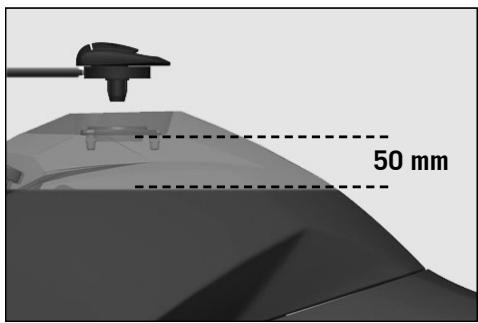
Fuel expands when its temperature rises. Therefore do not fill the tank to the top (see fig.).
WARNING
Gasoline is highly flammable and poisonous. Extreme caution should be used when handling gasoline. Do not refuel the motorcycle near open flames or burning cigarettes. Always switch off the engine before refuelling. Be careful not to spill gasoline on the engine or exhaust pipe while the engine is hot. Wipe up spills promptly. If gasoline is swallowed or splashed in the eyes, seek a doctor's advice immediately.
| 990 SUPERMOTO 2008 A clean motorcycle can be checked more quickly which saves money! | 1st Service after 1000 km | every 7500 km or once a year | every 15000 km or every 2 years | |
| ENGINE | Change engine oil and oil filter | ● | ● | ● |
| Clean oil screens of engine and oil tank | ● | ● | ● | |
| Clean magnetic drain plugs of engine and oil tank | ● | ● | ● | |
| Check oil lines for damage and kink-less arrangement | ● | ● | ● | |
| Renew spark plugs | ● | |||
| Check and adjust valve clearance | ● | ● | ||
| Check engine fastening bolts for tight fit | ● | ● | ● | |
| Check all engine bolts accessible from the outside for tight fit | ● | ● | ● | |
| Check clutch linings | ● | |||
| Check clutch pressure booster system | ● | |||
| Clean the oil jet for the clutch lubrication | ● | ● | ||
| FUEL INJECTION | Check rubber boots for cracks or leaks | ● | ● | |
| Check fault memory with the KTM diagnosis tool | ● | ● | ● | |
| Perform a status check of neutral, clutch, 2nd/3rd gear and side stand switch using the KTM diagnosis tool | ● | ● | ● | |
| Make sure the fuel hose, hoses on the vacuum sensors, SAS hoses and vent hoses are run correctly and check for damage | ● | ● | ● | |
| Replace the O-ring on the fuel hose connection and check for leaks | ● | ● | ● | |
| Check the wiring harness on the throttle body for proper installation and damage | ● | ● | ||
| ADD-ON-PARTS | Check cooling system for leaks and antifreeze protection | ● | ● | ● |
| Check radiator fan for proper operation | ● | ● | ● | |
| Check the exhaust system for leaks and correct suspension and the clamps for a tight fit | ● | ● | ● | |
| ADD-ON-PARTS | Replace the graphite gasket in the rear exhaust manifold slide | ● | ||
| Check actuating cables for damage, smooth operation, and kink-less arrange-ment,adjust and lubricate | ● | ● | ● | |
| Check the oil level in the hydraulic clutch reservoir | ● | ● | ||
| Check air filter, renew if necessary, clean air filter box | ● | |||
| Check cables for damage and kink-less arrangement | ● | ● | ● | |
| Check headlamp adjustment | ● | ● | ● | |
| Check electrical system for function (low/high beams, stop light, turn indica-tors,headlamp, flasher, tell-tale lamps, speedometer illumination, horn, side-stand switch, clutch switch, emergency-off switch) | ● | ● | ● | |
| Make sure all bolts and nuts are tight | ● | ● | ● | |
| BRAKES | Check brake fluid level, lining thickness, and brake discs | ● | ● | ● |
| Change brake fluid | ● | |||
| Check brake lines for damage and leaks | ● | ● | ● | |
| Check/adjust smooth operation, free travel of handbrake/footbrake levers | ● | ● | ● | |
| Check bolts of brake system for tight fit | ● | ● | ● | |
| CHASSIS | Check shock absorber and fork for leaks and proper operation | ● | ● | ● |
| Clean fork dust sleeves | ● | ● | ||
| Bleed fork legs | ● | ● | ● | |
| Check swinging-fork pivot | ● | ● | ● | |
| Check/adjust steering-head bearing | ● | ● | ● | |
| Check all chassis bolts for tight fit (fork plates, fork leg, axle nuts/bolts, swinging-fork pivot, reversing lever, shock absorber) | ● | ● | ● | |
| WHEELS | Check rim joint | ● | ● | ● |
| Check tire condition and inflation pressure | ● | ● | ● | |
| Check chain, sprockets and chain guides for wear, force fit and tension | ● | ● | ● | |
| Check bolts on pinion and chain sprocket for locking devices and a tight fit | ● | ● | ● | |
| Lubricate chain | ● | ● | ● | |
| Check wheel bearings and jerk damper for play | ● | ● | ||
IF MOTORCYCLE IS USED FOR COMPETITION 7500 KM SERVICE SHOULD BE CARRIED OUT AFTER EVERY RACE!
Service intervals should never be exceeded by more than 500~km .
Maintenance work performed by an authorized KTM workshop is not a substitute for care and maintenance by the driver!
| 990 SUPERMOTO 2008 ADDITIONAL SERVICE WORK TO BE PERFORMED UNDER A SEPARATE ORDER | ||
| at least once a year | every 15000 km or every 2 years | |
| Perform complete fork maintenance | ● | |
| Perform complete shock absorber maintenance | ● | |
| Clean and lubricate steering-head bearing and sealing elements | ● | |
| Treat the electrical contacts and switches with contact spray | ● | |
| Treat battery connections with contact grease | ● | |
| Change coolant fluid | ● | |
| 990 SUPERMOTO 2008VITAL CHECKS AND CARE PROCEDURES TO CONDUCTED BY THE OWNER OR THE MECHANIC | |||
| before each start | after every cleaning | every 1000 km | |
| Check oil level | ● | ||
| Check brake fluid level | ● | ||
| Check brake pads for wear | ● | ||
| Check lighting system for proper operation | ● | ||
| Check horn for proper operation | ● | ||
| Lubricate actuating cables and nipples | ● | ||
| Bleed fork legs | ● | ||
| Clean chain | ● | ||
| Lubricate chain | ● | ● | |
| Check chain tension | ● | ||
| Check tire pressure and wear | ● | ||
| Check coolant level | ● | ||
| Check fuel lines for leaks | ● | ||
| Check all control elements for smooth running | ● | ||
| Grease the hand brake lever and clutch lever | ● | ||
| Check brake performance | ● | ● | |
| Treat exposed metal components (except for the braking and exhaust system) with wax-based anti-corrosion agents | ● | ||
| Treat ignition/steering lock and light switch with contact spray | ● | ||
CAUTION
- Do not clean the motorcycle with a power washer otherwise water will get into the bearings, electric socket connectors, etc.
- Use special KTM screws with the correct thread length to fasten the spoiler to the tank. Mounting other screws or longer screws could puncture the tank and cause fuel to leak out.
If you disconnect socket connectors with self-locking nuts, replace them before remounting. If no new self-locking nuts are available, apply Loctite 243 to the thread of the old nuts. If the thread is damaged, replace the screws and nuts. - Do not use toothed disks or split washers for the engine fastening bolts since they will work their way into the frame components and become loose. Always use self-locking nuts.
- Let the motorcycle cool down before servicing to avoid being burned.
- Properly dispose of oils grease, filters, fuel, cleansers, etc. Observe the regulations effective in your country.
- Never pour used oil in the sewer or dispose of it outdoors. 1 liter of used oil will pollute 1,000,000 liters of water.
| 990 Supermoto 2008 | FORK | SHOCK | |||||
| SETTING | Compression | Rebound | Spring preload (turns) | Compression Low Speed | Compression High Speed | Rebound | Spring preload (mm) |
| Comfort | 20 | 22 | 7 | 20 | 2.5 | 20 | 11 |
| Basic Setting | 15 | 17 | 5 | 15 | 2 | 15 | 11 |
| Sport | 10 | 12 | 5 | 10 | 1 | 10 | 11 |
| Max. payload | 15 | 17 | 5 | 15 | 2 | 15 | 11 |
Adjusting the fork and shock absorber
There are a number of ways to adjust the fork and shock absorber to match the chassis to your driving style and the payload.
We have provided a table with pragmatical values to help you tune up your motorcycle. These tune-up specifications are reference values only and should serve as a basis for your personal chassis and suspension tuning. Do not make arbitrary changes to the settings (maximum ± 40% ) since this may impair the handling characteristics (particularly in the high-speed range).
Make sure both fork legs are equally adjusted.
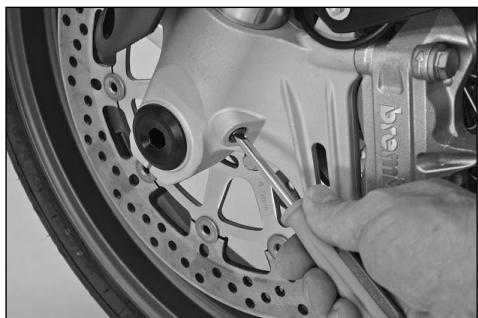
Adjusting compression damping of fork
Hydraulic compression damping determines the reaction when the fork is compressed. Turn the adjusting screws clockwise to increase damping, turn it counterclockwise to reduce damping during compression. Make the same damping rate adjustment to both fork legs.
STANDARD ADJUSTMENT
- Turn adjusting screw clockwise as far as it will go.
- Turn 15 clicks in a counterclockwise direction.
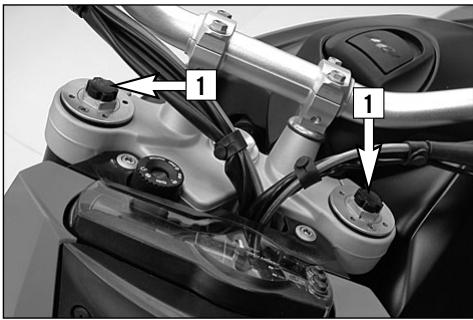
Adjusting rebound damping of fork
Hydraulic rebound damping determines the reaction when the fork is rebound. By turning the adjusting screw [1] (REB), the degree of damping of the rebound can be adjusted. Turn the knob clockwise to increase damping, turn it counterclockwise to reduce damping during rebounding. Make the same damping rate adjustment to both fork legs.
STANDARD ADJUSTMENT
- Turn adjusting screw clockwise as far as it will go.
- Turn 17 clicks in a counterclockwise direction.
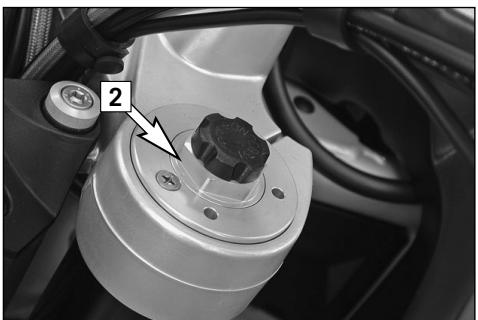
Adjusting the spring preload on the fork
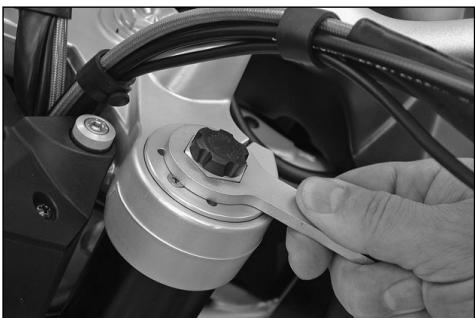
The fork spring preload can be adjusted by turning the adjusting screws [2] (wrench size 24mm ± 5 mm (0,2 in).
Turning in a clockwise direction will increase the preload, turning in a counterclockwise direction will decrease the preload. 1 turn will change the preload by 1mm .
Changing the preload will not affect the rebound damping adjustment, although adjusting screw [1] will turn at the same time. Make the same spring preload adjustments to both fork legs.
Generally, if the preload is higher, the rebound damping should also be set higher.
STANDARD ADJUSTMENT:
- Turn adjusting screw counterclockwise as far as it will go.
- Turn 5 turns in a clockwise direction.
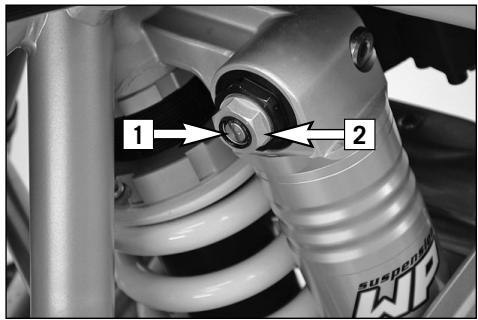
Compression damping of shock absorber
The shock absorber can synchronize the compression damping in the low and high-speed range separately (Dual Compression Control).
Low and high speed refers to the movement of the shock absorber during compression and not to the speed of the motorcycle.
The low and high-speed technology overlaps.
The low-speed setting is primarily for slow to normal shock absorber compression rates.
The high-speed setting is effective at fast compression rates.
Turning in a clockwise direction will increase the damping, turning counterclockwise will decrease the damping.
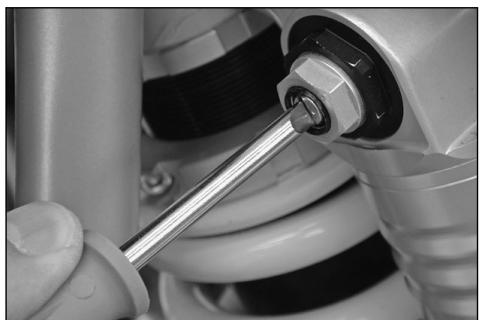
STANDARD ADJUSTMENT LOW-SPEED:
- Turn adjusting screw [1] clockwise as far as it will go.
- Turn 15 clicks in a counterclockwise direction.
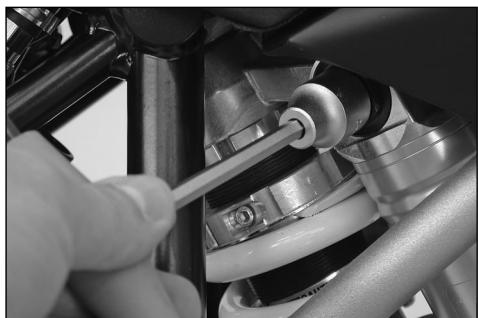
STANDARD ADJUSTMENT HIGH-SPEED:
- Turn adjusting screw [2] (wrench size 17 mm) clockwise as far as it will go.
- Turn 2 turns in a counterclockwise direction.
WARNING
The damping unit of the shock absorber is filled with high-compression nitrogen. Never try to take the shock absorber apart or to do any maintenance work yourself. Severe injuries could be the result.
Never unscrew the black screw connection (24mm).
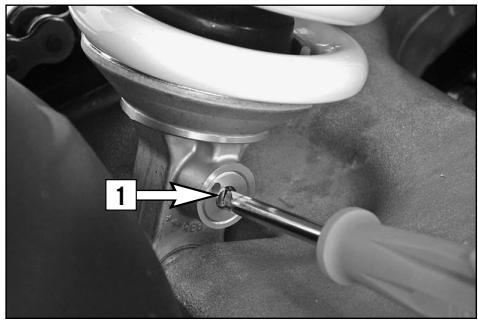
Rebound damping of shock absorber
By using the adjusting screw [1], the degree of damping of the rebound can be adjusted. Turn the knob in a clockwise direction to increase damping, turn it in a counterclockwise direction to reduce damping during rebounding.
STANDARD ADJUSTMENT:
- Turn adjusting screw clockwise as far as it will go.
- Turn 15 clicks in a counterclockwise direction.
WARNING
The damping unit of the shock absorber is filled with high-compression nitrogen. Never try to take the shock absorber apart or to do any maintenance work yourself. Severe injuries could be the result.
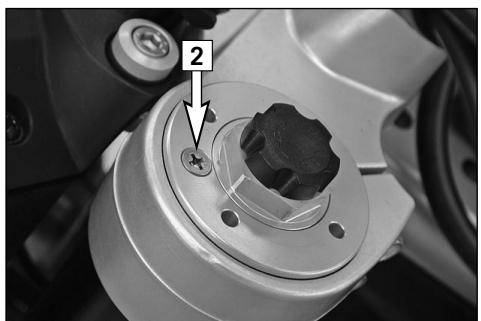
Breathing the fork legs
Breath the fork legs regularly (see Maintenance Schedule).
To breath, place the motorcycle on the side stand and briefly remove the bleeder screws [2] to allow any overpressure to escape from the fork.
CAUTION
Excessive pressure in the interior of the fork can cause leaks in the fork. If your fork is leaking, it is recommended to open the breather plugs before having the seals replaced.
Checking the chain tension
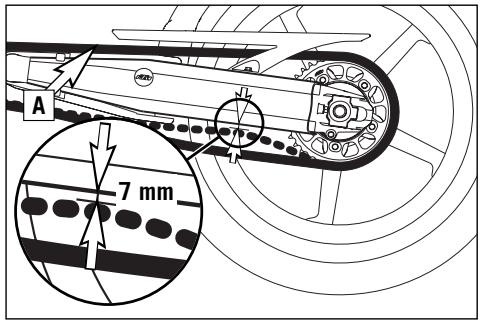
Place the motorcycle on the side stand. Switch the transmission to neutral and push the chain up. The distance between the chain and the swing arm should be 7mm (0.3 in) when the upper part of the chain [A] is tensioned (see drawing). Correct the chain tension if necessary.
WARNING
- If chain tension is too great, parts within the secondary power transmission (chain, chain sprockets, transmission and rear wheel bearings) will be subjected to unnecessary stress, resulting in premature wear and even chain breakage.
- Too much slack in the chain, on the other hand, can result in the chain jumping off the chain wheels. If this happens, the chain could also block the rear wheel or damage the engine.
- In either case the operator is likely to lose control of the motorcycle.
Correcting the chain tension
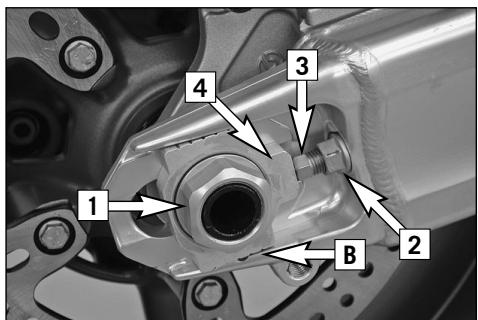
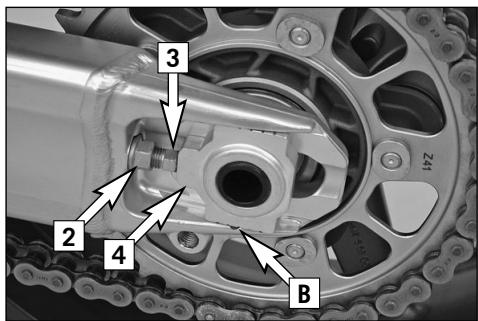
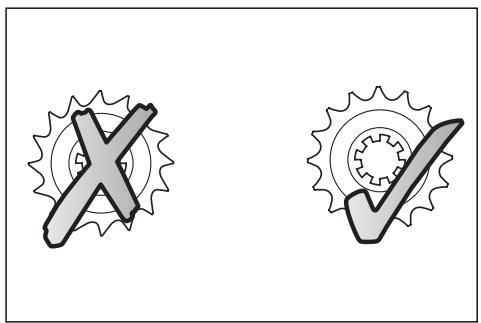
Loosen the collar nut [1], loosen the counternuts [2] and turn the left and right adjustment screws [3] the same distance. Tighten the counternuts [2].
To make sure the rear wheel is aligned, the marks on the chain tensioners must be in the same position on the left and right in relation to the reference marks [B]. Before tightening the wheel spindle make sure the chain tensioner [4] rests against the adjustment screws and the rear wheel is aligned with the front wheel.
Tighten the collar nut [1] to 90 Nm.
WARNING
If you don't happen to have a torque wrench at hand, make sure you have the tightening torque corrected by a KTM dealer as soon as possible. A loose wheel spindle can cause the motorcycle's handling performance to become instable and cause it to crash.
NOTE:
The large adjusting range of the chain adjusters (32mm) allows you to use different secondary ratios in combination with the same chain length. The chain adjusters [4] can be rotated by 180^ .
Chain maintenance
Maintenance of the X-ring chain is reduced to a minimum. Rinse off any heavy dirt with plenty of water. Residual used grease must be removed prior to lubrication (Motorex Chain Clean 611). After drying, use a chain spray specially designed for X-ring chains (Motorex Chainlube 622 Strong).
WARNING
- No lubrication is allowed to reach the rear tire or the brake disk, eitherwise the road adherence and the rear wheel braking effects would be strongly reduced and the motorcycle could easily get out of control.
- The chain does not have a chain joint for safety reasons. Always have the chain replaced in an authorized KTM workshop where the service technicians have the required riveting tool.
- Never mount a normal chain joint.
Also check sprockets and chain guides for wear, and replace if necessary.
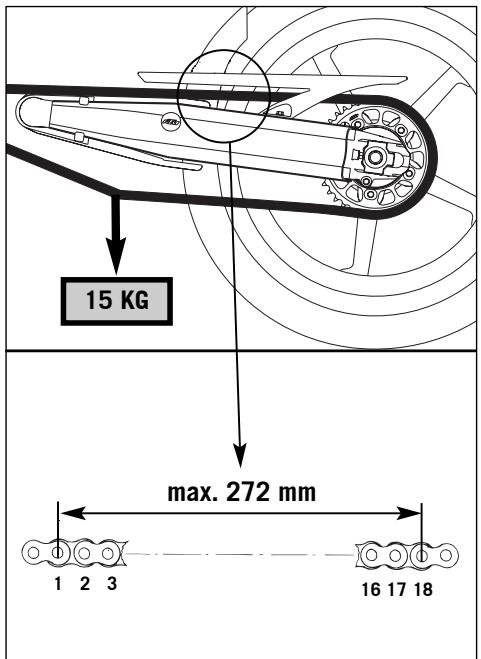
Checking the chain for wear
To check the chain for wear proceed as follows:
Switch the transmission to idle and put a load of approx. 15 kilograms (33 lbs) on the lower part of the chain (see illustration). Now measure the distance between 18 chain rollers on the upper part of the chain. The chain needs to be replaced when the distance is 272mm (10.70 in). Since chains do not always wear evenly, repeat the measurement at different parts of the chain.
Replace the chain if any X-rings are missing.
NOTE:
If you mount a new chain, the sprockets should also be replaced. New chains wear faster if used on old used sprockets.
General information on KTM disk brakes
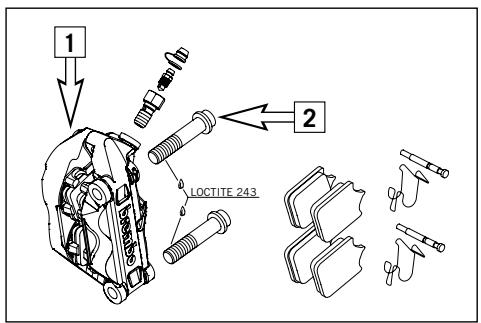
BRAKE CALIPERS:
The front brake calipers [1] have 4 brake pistons and are radially bolted to the fork legs. The front brake disks are designed as "floating" brake disks, i.e. they are not firmly connected to the front wheel.
The lateral balance ensures that the brake pads always have the best possible contact to the brake disk. Apply Loctite 243 to the screws [2] on the brake caliper support and tighten to 45Nm .
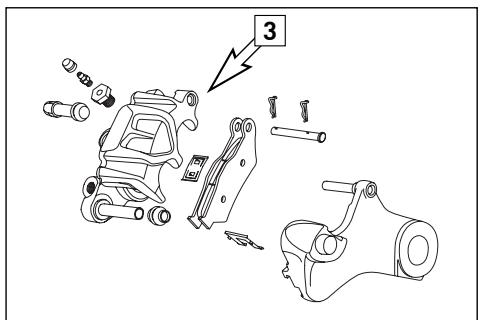
The rear brake caliper [3] has 2 brake pistons and is designed as a "floating brake caliper, i.e. it is not firmly connected to the brake caliper support. The lateral balance ensures that the brake pads always have the best possible contact to the brake disk.
WARNING
For safety reasons, always have maintenance work and repairs to the brake system performed by an authorized KTM workshop.
BRAKE PADS:
Your motorcycle is equipped with sintered brake pads in the front and rear and homologated accordingly. They guarantee maximum braking performance.
Front brake pads: Toshiba TT 2172 HH
Rear brake pads: Toshiba TT 2701 HH
WARNING
Brake pads available in the accessory trade are often not authorized for operation of your KTM motorcycle in road traffic. The brake pads design and friction factor and therefore the braking power can deviate significantly from original KTM brake pads. If you use different brake pads than those provided with the original equipment, it cannot be warranted that they are authorized for use in road traffic. Your motorcycle will not longer comply with the regulations authorizing the use of vehicles for road traffic and the warranty will be void.
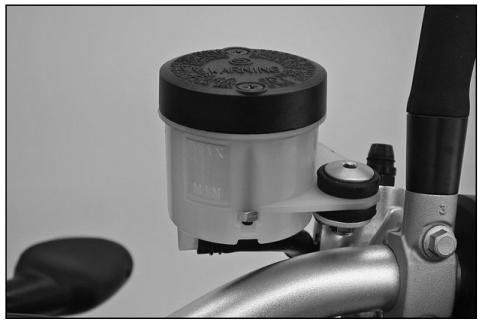
BRAKE FLUID RESERVOIRS:
The brake fluid reservoirs on the front and rear wheel brakes have been designed in such a way that even if the brake pads are worn it is not necessary to top up the brake fluid. There is no reason to remove the reservoir cap under normal conditions. If the brake fluid level drops below the minimum either the brake system has a leak or the brake pads are completely worn down. In this case, consult an authorized KTM dealer immediately.
BRAKE FLUID:
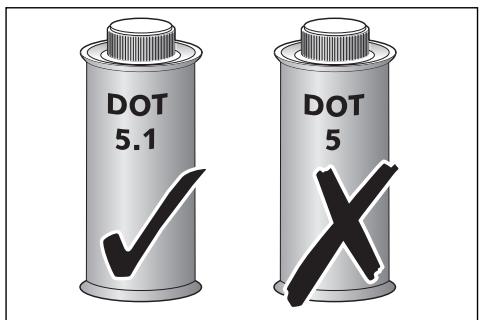
We recommend that you use Motorex DOT 5.1 brake fluid when you refill or change the brake fluid. DOT 5.1 brake fluid has a wet boiling point of 180^ / 356^ ( 25^ / 45^ higher than DOT 4) and is safer for high performance applications. Brake fluid DOT 5.1 is a polyethylene glycol based fluid, amber-colored and can be mixed with DOT 4 brake fluid. Do not, in any event, use DOT 5 brake fluid. It is based on silicone oil and is dyed purple. KTM motorcycle gaskets and brake hoses are not designed for DOT 5 brake fluid.
Brake fluid is exposed to a high thermal load and absorbs moisture from the air, which lowers the boiling point. The brake fluid should therefore be changed at the prescribed intervals.
WARNING
Have the brake fluid for the front and rear brake changed at an authorized KTM workshop every 2 years.
BRAKE DISCS:
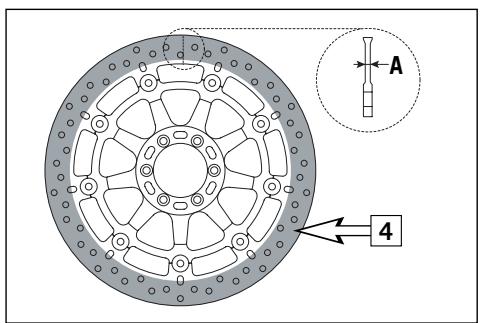
Wear reduces the thickness of the brake disc in the area of contact [4] with the brake pads. The brake disk should not be thinner than 4.5mm (0.18 in) at the weakest point [A]. Check the wear at several points.
WARNING
Brake disks that are less than 4.5mm (0.18 in) thick are a safety hazard. Have worn brake disks replaced immediately.
Changing the basic position of the handbrake lever
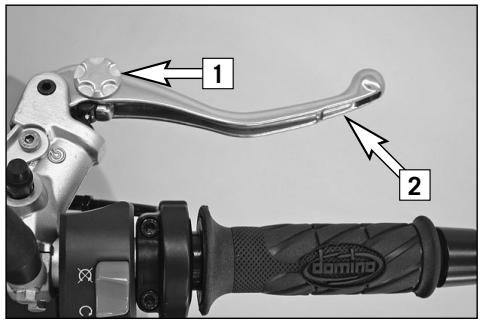
The adjusting screw [1] allows you to change the basic position of the handbrake lever [2]. Press the handbrake lever's outer end forward, and, at the same time, turn the adjusting screw.
Checking the front brake fluid level
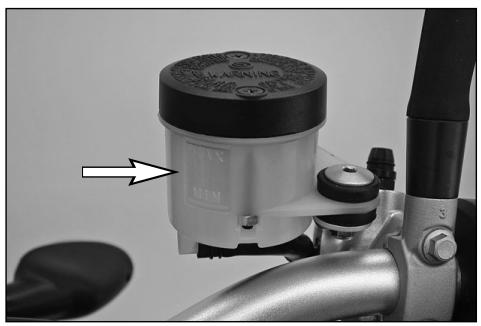
The brake fluid reservoir for the front brake is located on the right side of the handlebar and has a "MIN" and a "MAX" mark. The brake fluid level may not fall below the "MIN" mark when the vehicle is parked in a vertical position.
WARNING
- If the brake fluid level drops below the minimum either the brake system has a leak or the brake pads are completely worn down. In this case, consult an authorized KTM dealer immediately.
- Have the brake fluid changed at an authorized KTM workshop every 2 years.
Checking the front brake pads
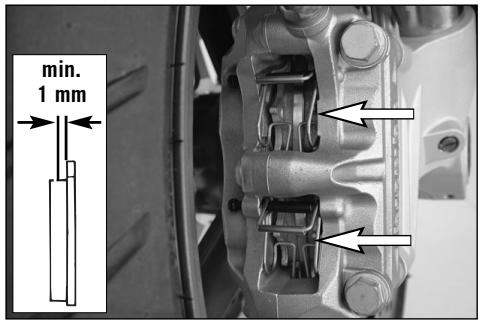
The brake pads can be seen from the rear. The linings must be at least 1 mm (0.04 in) thick.
WARNING
At their most worn point brake pad linings should not be thinner than 1mm , otherwise they could lead to brake failure. For your own safety don't put off having your brake pads changed.
CAUTION
If the brake pads are replaced too late when the lining is partly or completely worn off, the steel parts on the brake pads will grind against the brake disks. This significantly decreases the braking effect and destroys the brake disks.
Checking rear brake fluid level
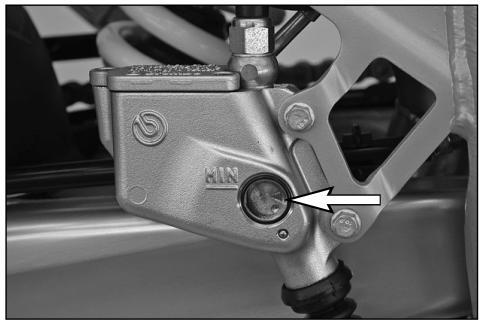
The brake fluid reservoir for the rear disk brake is combined with the foot brake cylinder and has an inspection window. The brake fluid level should not drop below the "MIN" mark when the motorcycle is in a vertical position.
WARNING
- If the brake fluid level drops below the minimum either the brake system has a leak or the brake pads are completely worn down. In this case, consult an authorized KTM dealer immediately.
- Have the brake fluid changed at an authorized KTM workshop every 2 years.
Checking the rear brake pads
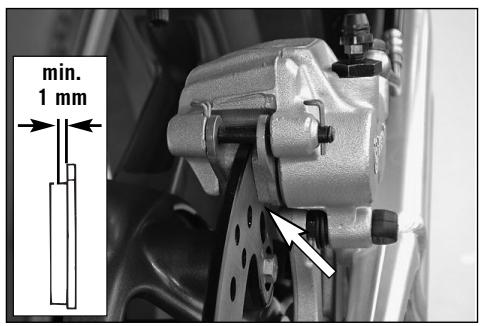
The brake pads can be inspected from the rear. The thickness of the linings may not be less than 1 mm (0.04 in).
WARNING
At their most worn point brake pad linings should not be thinner than 1 mm, otherwise they could lead to brake failure. For your own safety don't put off having your brake pads changed.
CAUTION
If the brake pads are replaced too late so that the lining is partly or entirely worn away, the steel components of the brake pad will rub against the brake disc, imparing the braking effect and destroying the brake disc.
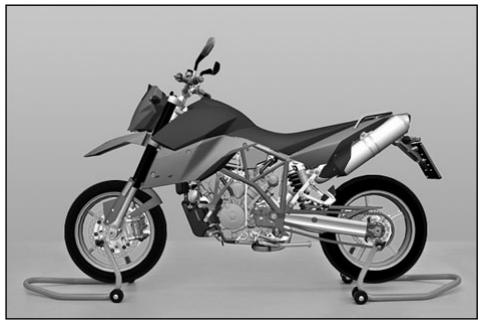
Dismounting and remounting the front wheel
Special stands are required to dismount the wheels to make sure the motorcycle is securely fixed. The front stand only adequately fixes the motorcycle together with the rear stand. The stands shown in the illustration can be found in the KTM Power Parts catalog.
First mount the rear, then the front stand. Make sure the stands rest on solid ground and are correctly mounted. The front wheel should not touch the ground.
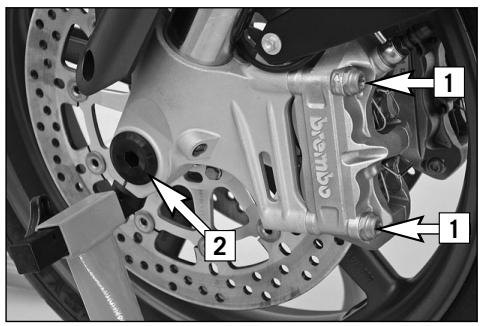
Remove the screws [1] from the left and right brake calipers and carefully pull the brake calipers off the brake disks towards the back.
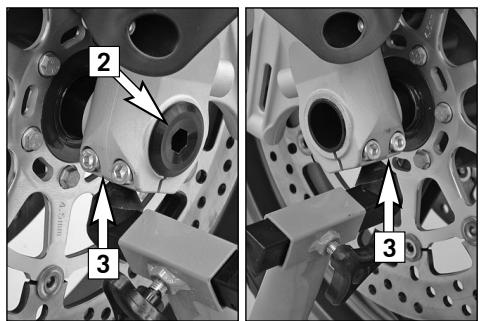
Loosen the collar screw [2] and the clamping screws [3] on both fork leg axle passages. Unscrew the collar screw approx 8 turns, press on the collar screw with your hand to push the wheel spindle out of the fork leg axle passage and remove the collar screw. Hold the front wheel while you pull out the wheel spindle. Lift the front wheel off the fork.
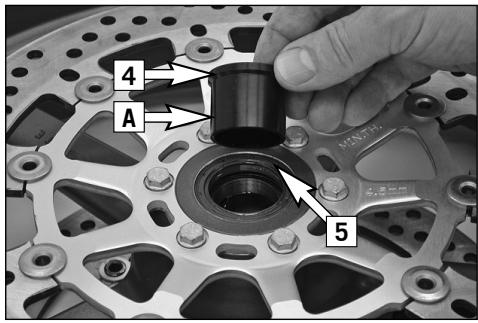
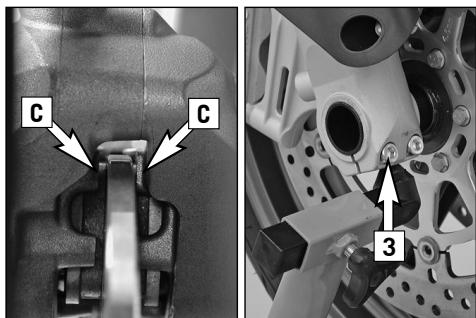
Take the left [4] and right distance bushing out of the shaft seal rings.
CAUTION
- Do not operate the hand brake when the front wheel has been dismounted.
- Be careful not to damage the brake disks when you lay the front wheel down.
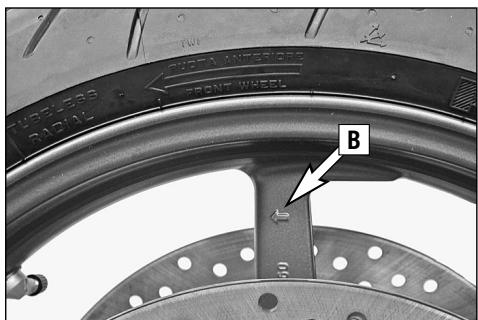
Before you remount the front wheel, clean and grease the shaft seal rings [5] and the bearing surface [A] of the distance bushings and mount the distance bushings (wide distance bushing in the left shaft seal ring). When mounting the distance bushing, be careful not to press the sealing lips towards the inside. position the front wheel according to the running direction shown by the arrows [B] on the rim.
To mount, lift the front wheel in the fork and mount the wheel spindle and collar screw [2]. Tighten the collar screw to 60 Nm. Position the brake calipers and make sure the brake pads are correctly positioned. Apply Loctite 243 to the screws [1], mount the screws and tighten to 45 Nm.
Take the motorcycle off the front stand, actuate the front wheel brake and vigorously compress the fork several times to align the fork legs.
Before you tighten the clamp screws [3] check whether the right brake disk [C] runs in the center of the brake caliper. Move the right fork leg to the side if necessary, then tighten the clamp screws on both fork leg axle passages to 15 Nm. Actuate the hand brake until you feel the pressure point and check whether the front wheel can easily be turned. Remove the rear stand.
WARNING
- If you do not have a torque wrench to mount the wheel, have the torques corrected by an authorized KTM workshop as soon as possible. A loose wheel spindle can cause the motorcycle's handling performance to become instable and cause it to crash.
- After mounting the front wheel, keep operating the hand brake until the pressure point returns.
- Always keep the brake disks free from oil and grease, otherwise the braking effect will be significantly reduced.
Dismounting and mounting the rear wheel
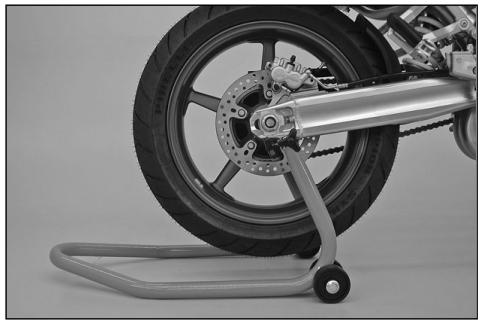
Special stands are required to dismount the wheels to make sure the motorcycle is securely fixed. The stands shown in the illustration can be found in the KTM Power Parts catalog.
Mount the rear stand. Make sure the stand rests on solid ground and is correctly mounted. The rear wheel should not touch the ground
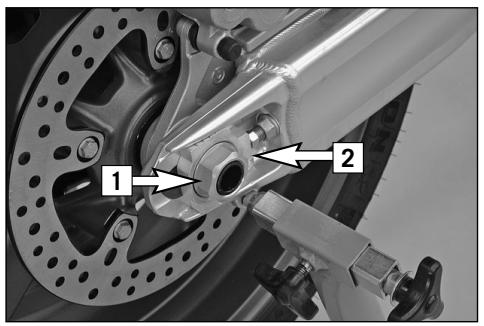
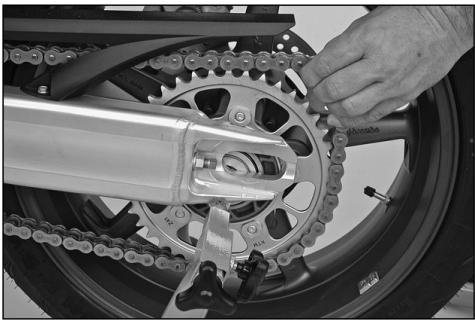
Unscrew the collar nut [1], remove the chain tensioner [2], hold the rear wheel while you pull out the wheel spindle [3]. Push the rear wheel forward as far as possible and remove the chain from the rear sprocket. Carefully take the rear wheel off the swing arm.
CAUTION
- Do not operate the rear brake when the rear wheel has been dismounted.
- Always place the wheel on the ground with the brake disc pointing upwards. Otherwise the brake disc may be damaged.
- If the axle is dismounted, clean the thread of the wheel spindle and collar nut thoroughly and apply a new coat of grease (Motorex Long Term 2000) to prevent the thread from jamming.
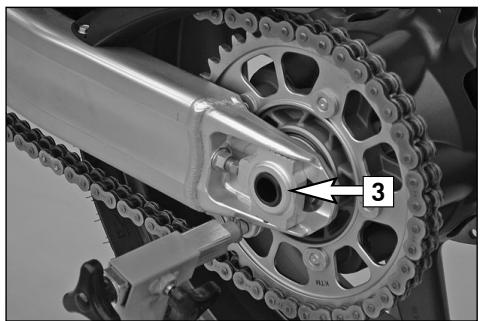

Before remounting the rear wheel, clean and grease the bearing surface of the bushings [4] and the shaft seal ring [5].
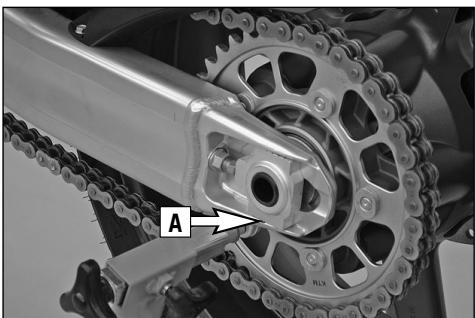
The rear wheel is remounted in the reverse order. Make sure the chain tensioners [2] are mounted in the same way on the left and right. The marks on the chain tensioners must be in the same position on the left and right in relation to the reference marks [A]. Before you tighten the collar nut to 90Nm , press the rear wheel towards the front to allow the chain tensioner to rest against the clamping screws.
WARNING
- If you don't happen to have a torque wrench at hand, make sure you have the tightening torque corrected by a KTM dealer as soon as possible. A loose wheel spindle can cause the motorcycle's handling performance to become instable and cause it to crash.
- After mounting the rear wheel, keep operating the footbrake until the pressure point returns.
- It is very important to keep the brake disk free from oil and grease, otherwise the braking effect would be strongly reduced.
| TIRES - AIR PRESSURE | ||
| 990 Supermoto | front | rear |
| Road, rider only | 2.2 bar | 2.2 bar |
| 31 psi | 31 psi | |
| Road, with passenger | 2.4 bar | 2.5 bar |
| 34 psi | 36 psi | |
| maximum payload | 2.4 bar | 2.5 bar |
| 34 psi | 36 psi | |
Tires, air pressure
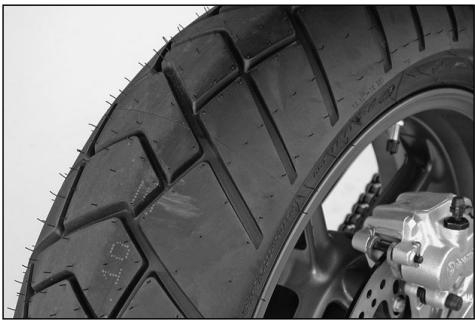
Tire type, tire condition, and how much air pressure the tires have in them affect the way your motorcycle rides, and they must therefore be checked whenever you're getting ready to go anywhere on your motorcycle.
WARNING
For driving safety and maximum handling, only use tires authorized by KTM (tire releases are available on the Internet at www.ktm.com) corresponding to the "ZR" speed index (over 240 KPH). Other tires can have a negative effect on the motorcycle's handling (e.g. can cause it to "wobble" at higher speeds).
- Tire type and size can be found in the technical specifications and in the homologation certificate.
- Tire condition has to be checked every time you want to ride your motorcycle. Before leaving check for punctures and nails or other sharp objects that might have become embedded in the tire.
- Refer to the specific regulations in your country for minimum tire tread requirements. We recommend replacing tires at the latest when the tread is down to 2mm (0.08 in).
- Tire pressure should be checked regularly on a „cold“ tire. Adapt the air pressure to the motorcycle's total weight. Proper pressure ensures optimum driving comfort and extends the life of your tires.
WARNING
- Do not mount tires which have not been approved by KTM. Other tires could have adverse effects on the way your motorcycle rides.
- Use tires of the same brand and type for the front and rear wheels.
- For your own safety replace damaged tires immediately.
- Worn tires can have a negative effect on how your motorcycle performs, especially on wet surfaces.
- If air pressure is too low, abnormal wear and overheating of the tire can result
- New wheels have a smooth surface, which means that they must be run in to achieve full grip. For this purpose, ride the motorcycle carefully at moderate speed during the first 200 kilometers (125 miles) with new tires, tilting the vehicle at different angles so that all sections are properly roughened. Tires will not display their full grip characteristics until they are properly run in.
- For reasons of safety, it is recommended to exchange the valve insert whenever a new tire is mounted.
Battery
The battery is located under the seat and is maintenance-free.
Maintenance-free means you will not need to check the acid level. Clean the battery terminals regularly and grease with acid-free grease if necessary. The charge condition and type of charge are very important for the battery's service life.
WARNING
Never operate the motorcycle with a run-down battery or without the battery. This can damage the electronic components or safety equipment in either case and the motorcycle will no longer be roadworthy.
DISmountING AND MOUNTING THE BATTERY:
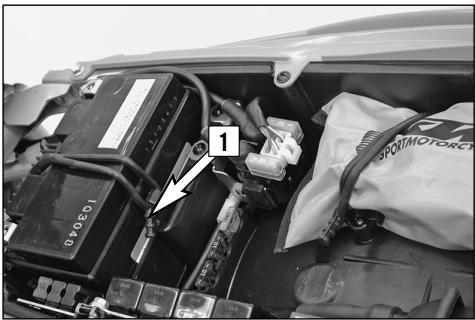
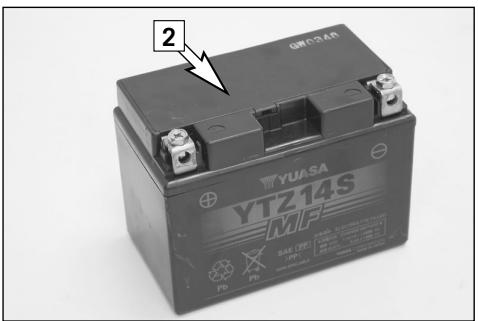
Detach the rubber band [1]. First disconnect the negative pole, then the positive pole from the battery.Install the battery with the terminals facing the front (see illustration). Connect the minus pole to the battery last.
WARNING
- If electrolyte (sulphuric acid) leaks from the battery, proceed with great care. The electrolyte can cause severe burns.
- In the case of skin contact rinse thoroughly with water.
- In the case of contact with the eyes, thoroughly rinse eyes with water for at least 15 minutes. Immediately consult a doctor.
- The battery is a closed model but can nevertheless emit explosive gases. Avoid sparks and open fire near the battery.
- Defective batteries must be stored out of the reach of children. Ensure proper disposal of discarded batteries.
CAUTION
Never remove the closing cover [2] otherwise the battery will be damaged.
STORAGE:
If the motorcycle is being immobilized for longer periods of time, remove and charge the battery. Storage temperature 0 - 35^ (32 - 95^ ), avoid direct sunlight.
Charge the battery every 3 months.

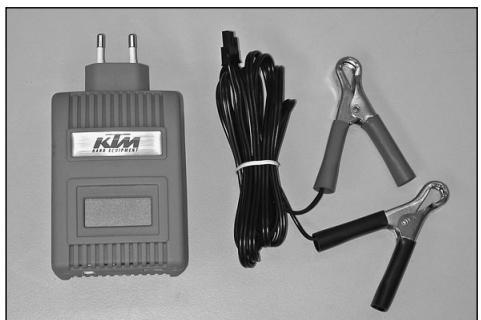
Charging the battery
The battery discharges every day, even if it is not used.
Always disconnect the battery when charging. Charge the battery as described in the instructions [1] on the battery housing. Do not exceed the amperage and charging time. Quick charging at a high amperage has an adverse effect on the service life.
To charge the battery while mounted, always use the KTM battery charger (Item no. 58429074000) to ensure that the electric system is not damaged by excess voltage. Always remove the battery if using other battery chargers! You can also use this charging device to test the off-load voltage and startability of the battery and generator. It is impossible to overcharge the battery with this device.
Charge the battery immediately if it is empty when you start the motorcycle. If left to stand in an uncharged condition for a longer period of time, the battery will run down and sulfateize, destroying the battery.
Recharge the battery every 3 months if it is being stored for a longer period of time.
CAUTION
- Never remove the closure since it will be damaged.
- To avoid damage to the on-board electronic system, always disconnect the minus pole before you charge the battery.
- To charge, connect the battery to the battery charger before you switch on the battery charger. When the battery is charged, switch off the battery charger before you disconnect the battery.
- Provide adequate ventilation when charging the battery in a closed room; the battery emits explosive gases when charging.
- Electrolytes will escape through the safety valves if the battery is charged too long or at an excessive voltage or amperage. This will reduce battery capacity.
- Try to avoid quick charges.
Jump start
Jump starts are not recommended since they can damage the motorcycle's electronic system.
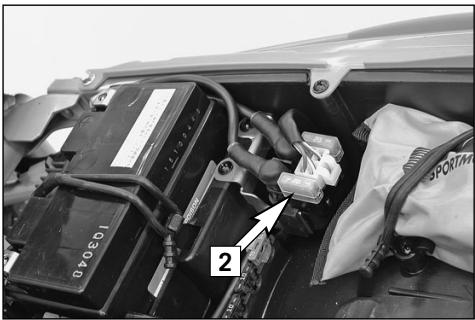
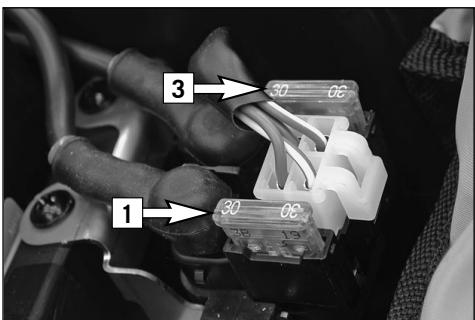
Main fuse
The main fuse [1] protects all power-consuming units on the motorcycle. It is located below the seat at the starter relay.
For access to the fuse, remove the cover [2]. The capacity of the fuse is 30 A. A spare fuse [3] can be found under the other cover. When using the spare fuse, remember to replace it as soon as possible so that a spare fuse is always at hand. Replace a blown fuse only with an equivalent one. If a new fuse that has just been set in gets blown again, you are strongly advised to have it inspected by a KTM dealer. The fuse capacity is 30 Ampere.
CAUTION
- Under no circumstances is a stronger fuse allowed to be set in or a fuse allowed to be „repaired“. An inexpert treatment could damage the whole electrical installation!
- Contact a specialized KTM dealer, should defects of the electric system occur more frequently.
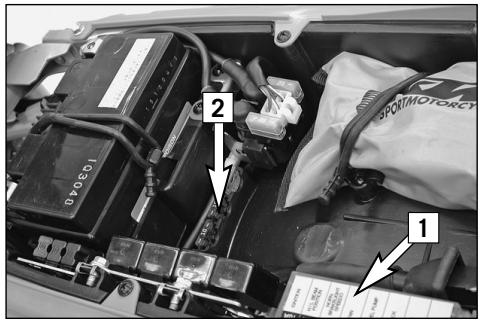
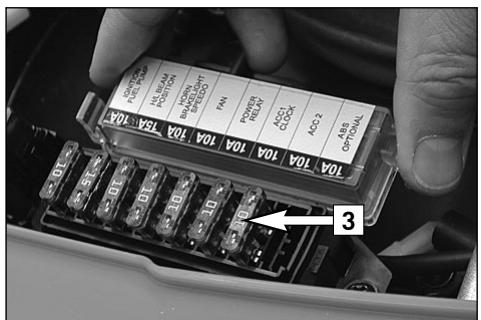
Fuses for individual power consumers
A fuse box is mounted under the seat containing additional fuses that protect the individual electric power consumers.
The power consumers and the corresponding capacities are listed on the cover of the fuse box [1]. Spare fuses 10 and 15 ampere [2] are located in the storage compartment.
Replace a blown fuse only with an equivalent one. If a new fuse that has just been set in gets blown again, you are strongly advised to have it inspected by a KTM dealer.
CAUTION
Under no circumstances is a stronger fuse allowed to be set in or a fuse allowed to be "repaired". An inexpert treatment could damage the whole electrical installation!
Fuses ACC1/CLOCK and ACC 2 [3] are designed for accessories with a maximum power consumption of 10 amperes each.
Sockets to connect the accessories are located under the headlight mask. For more information, contact an authorized KTM workshop.
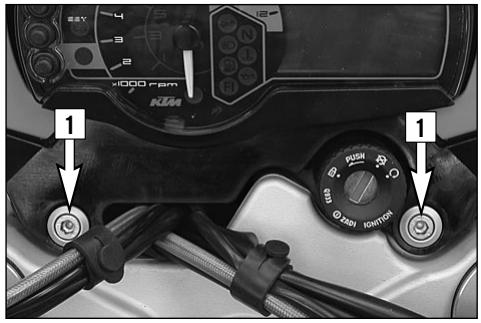
Replacing the headlight lamp
Remove the screws [1], tilt the headlight mask up towards the front and detach at the bottom.
CAUTION
Never touch the glass of the bulb with your fingers. The glass of the bulb must remain absolutely free from grease. Heat will otherwise cause the grease to evaporate and settle down on the reflector.
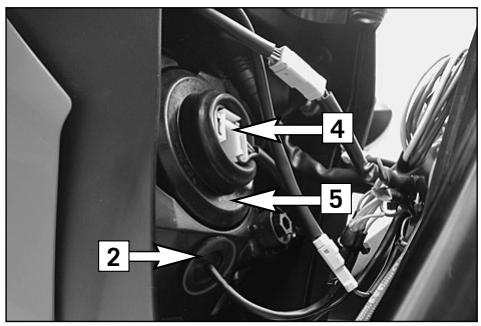
PARKING LIGHT BULB:
Remove the rubber grommet [2], pull the bulb socket [3] out of the reflector and pull the bulb out of the bulb socket.
Proceed in the reverse order to mount a new bulb.
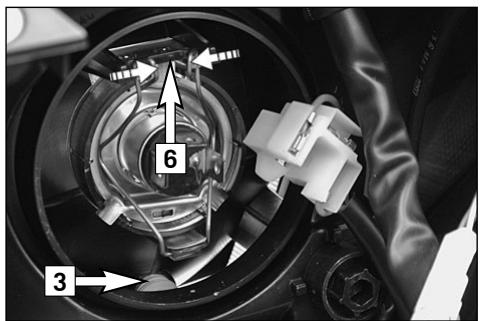
HEADLIGHT BULB:
Pull off the connector [4] and remove the rubber cap [5]. Push together the top of the holding spring [6] and detach it. Remove the bulb.
Proceed in the reverse order to mount a new bulb.
Attach the headlight mask at the bottom, mount the screw and tighten to 10 Nm.
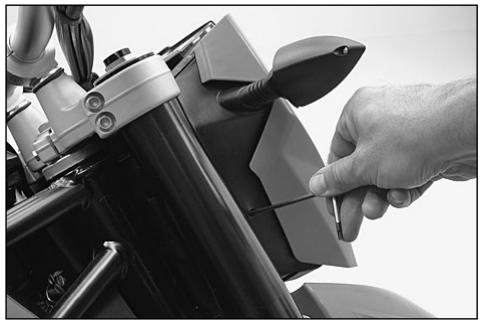
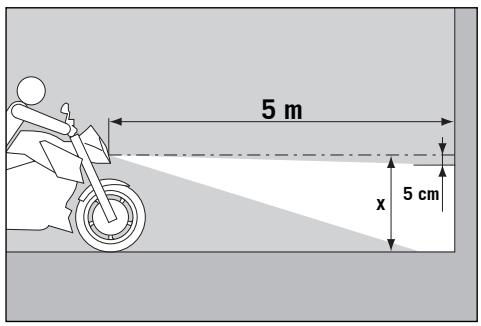
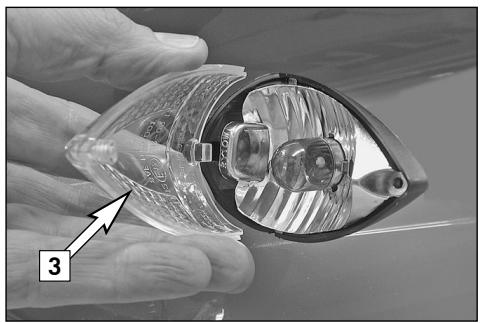
Adjusting the headlight range
The payload can make it necessary to correct the headlight range.
The beam width of the head light can be adjusted using a TORX® key T 20 (tool set). Turn clockwise to increase the beam width and counterclockwise to reduce the beam width.
TO CHECK:
Determine the distance from the ground to the center of the headlight when your motorcycle is loaded and ready for the trip (baggage, driver, passenger). Make a mark on a light wall behind a level surface at a height corresponding to the center of the headlight. Position your motorcycle loaded ready for the trip 5 meters (16,4 ft) away from the wall and switch on the low beam. The light/dark cut-off line should be 5cm (2 in) under the mark (see drawing).
Replacing the flasher bulbs
Remove the screw on the back of the turn signal, carefully fold the lens [3] towards the motorcycle and remove.
Slightly depress the bulb, turn it approx. 30^ counterclockwise and pull it out of the socket.
Proceed in the reverse order to mount a new bulb.
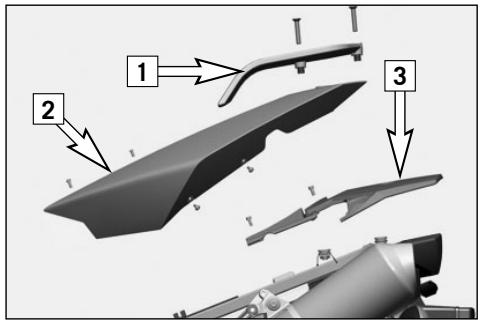
Replacing the brake light and taillight bulbs
Remove the seat. Remove the screws from the handrails [1], rear side parts [2] and rear top part [3] and remove the parts.
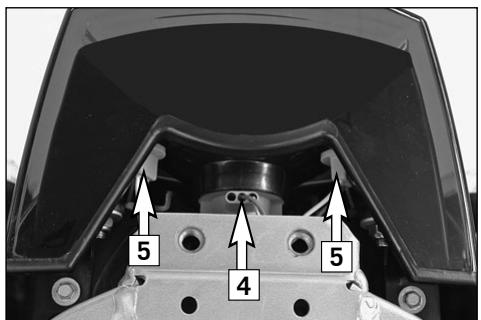
BULB FOR BRAKE LIGHT:
Turn the bulb socket [4] approx. 30^ in a counterclockwise direction and pull it out of the taillight housing. Slightly press in the bulb, turn approx. 30^ in a counterclockwise direction and remove it from the socket.
Proceed in the reverse order to mount a new bulb.
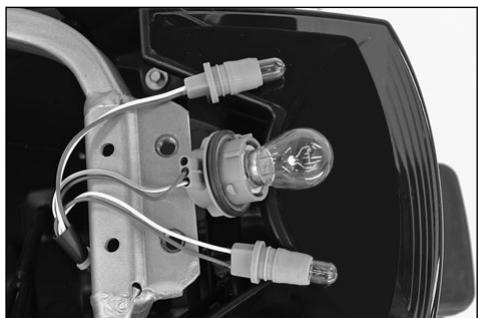
BULBS FOR THE TAILLIGHT:
Remove the bulb socket [5] from the housing and pull the bulb out of the socket. Insert a new bulb and press the bulb socket all the way into the taillight housing.
Mount the rear side parts and tighten the screws. Mount the rear top part and tighten the screws. Mount the handrails and tighten the screws to 25 Nm. Mount the seat.
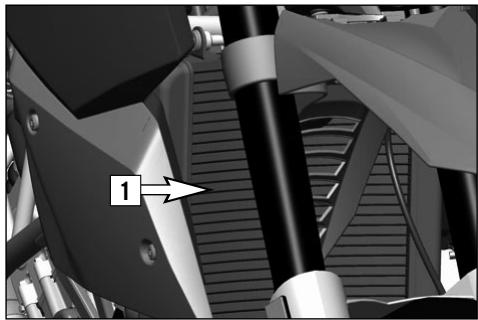
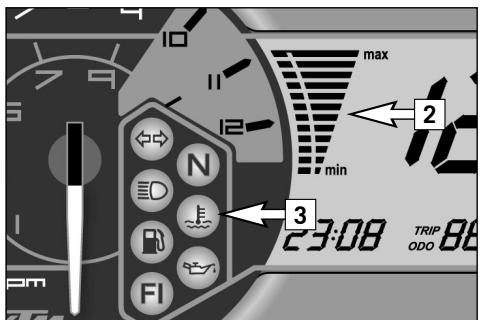
Cooling system
The water pump in the engine ensures a forced circulation of the cooling liquid. When the engine is cold, the cooling liquid only circulates in the cylinders and cylinder heads. The thermostat will open when the engine reaches approx. 75^ (167°F) and the cooling liquid will also be pumped through the aluminum radiator [1].
Cooling is by means of the air stream. The lower the speed, the lower the cooling effect. Soiled cooling fins also impair the cooling effect.
If, for example, slow urban traffic or waiting at a traffic light cause little or no air to stream through the radiator, the temperature of the cooling liquid will rise. The radiator fan switches on when the cooling liquid reaches a temperature of 98^ (208^) . Additional air is blown through the radiator to prevent the cooling system from overheating.
CAUTION
The temperature indicator [2] will begin to blink and the red cooling liquid temperature warning lamp [3] will light up when the cooling liquid reaches approx. 120^ (248^) , having exceeded the normal operating temperature. Possible causes:
- Slow riding with large loads at a higher air temperature:
If possible increase your running speed, so that more air can blow through the radiators. Should the warning light still be on off after 1500 meters (1 mile), stop immediately, switch off the engine and look for other possible causes. - The cooling fan on the radiator is not working:
The cooling fan must be running, when the cooling liquid temperature is 120^ (248^) and the ignition is on. If the fan is not working, and there appears to be sufficient cooling liquid, the only thing you can do is to drive on to your nearest authorized KTM workshop at the least possible engine load. - Too little cooling liquid in the system:
Check whether any cooling liquid is leaking out (also on the bottom of the motorcycle). Let the engine cool down and check the cooling liquid level in the radiator (see chapter Checking the cooling liquid level in the radiator). Only continue to drive if there is enough cooling liquid in the system. Contact an authorized KTM workshop to have the error eliminated. You will damage the engine if you continue to drive when the cooling liquid temperature warning lamp is on.
- Excessive use of the clutch at slow speed.
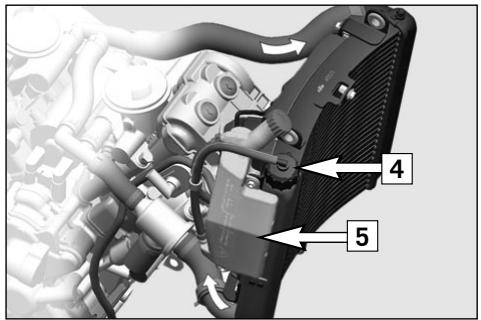
A mixture of 50% antifreeze and 50% distilled water is used as the cooling liquid. However, the anti-freeze protection must be at least -25^ (-13^) . Aside from antifreezing protection, this mixture also provides great corrosion protection which is why it must not be replaced by pure water.
CAUTION
- For the cooling system, use only high-grade antifreeze (Motorex Anti-Freeze). Using low-grade antifreeze agents, can cause corrosion and coolant foaming.
- More antifreeze must be added if you plan to travel to a region where temperatures are expected to drop below -25^ (-13°F).
Pressure induced by heating of the cooling liquid in the cooling system is controlled by a valve in the radiator cap [4]; a water temperature rising up to 125^ ( 257^ ) is admissible, without fear of problems.
Any excess cooling liquid caused by thermal expansion is conducted to the compensating tank [5]. It will be sucked back in as soon as the temperature in the cooling system drops.
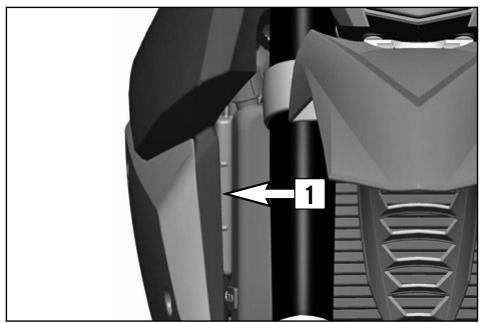
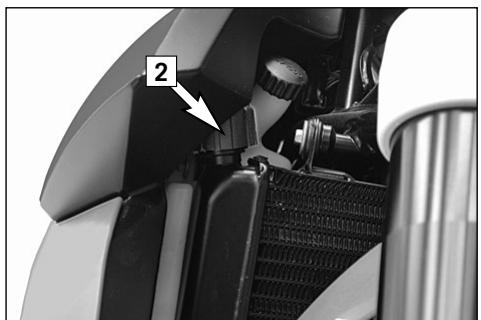
Checking the cooling liquid level in the compensating tank
Check the level of the cooling liquid when the engine is cold. It should fall between the MIN and MAX marks on the compensating tank [1].
Add cooling liquid (see above for mixture ratio) if the cooling liquid level drops below the MIN mark.
If you need to add cooling liquid quite often, the cooling system may leak. If the compensating tank is empty, also check the cooling liquid level in the radiator. Have the cooling system checked by an authorized KTM workshop.
Checking the cooling liquid level in the radiator
Hold the radiator cap [2] with a cloth, carefully turn in a counterclockwise direction and remove. The radiator should be completely filled with cooling liquid; no air should be in the radiator.
If any cooling liquid is missing, the cooling system is probably leaking. Have the cooling system checked at an authorized KTM workshop.
WARNING
If possible, check the cooling liquid level when the engine is cold. If you need to remove the radiator cap when the engine is hot, hold the cap with a cloth and open slowly, allowing any excess pressure to escape (danger of scalding).
CAUTION
- If more than 1 liter of cooling liquid needs to be added, you will need to bleed the cooling system.
- Only continue to drive if there is enough cooling liquid in the system. Contact an authorized KTM workshop to have the error eliminated. You will damage the engine if you continue to drive when the cooling liquid temperature warning lamp is on.
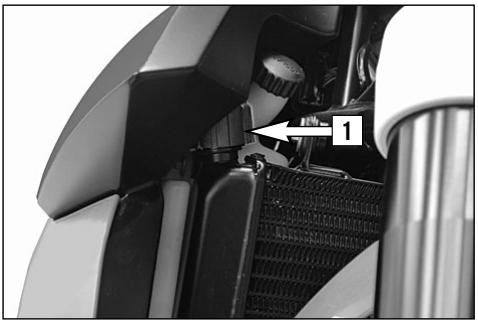
Bleeding the cooling system
To completely bleed the cooling system, the motorcycle must be raised approx. 50~cm (20 in) in the front.
Remove the radiator cap [1] and bleeder screw [2].
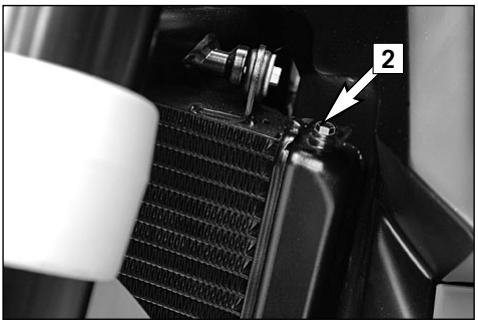
Add cooling liquid until it runs out of the vent holes without bubbles and immediately mount the screw to prevent air from entering the radiator.
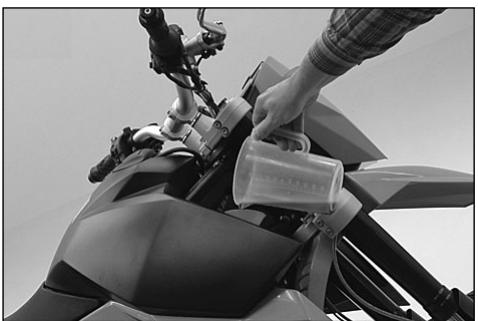
Completely fill the radiator with cooling liquid. Mount the radiator cap and move the motorcycle into a horizontal position again. Fill the compensating tank with cooling liquid until it reaches a level between the MIN and MAX mark. Close the compensating tank.
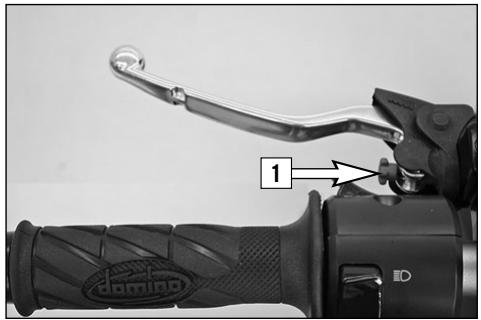
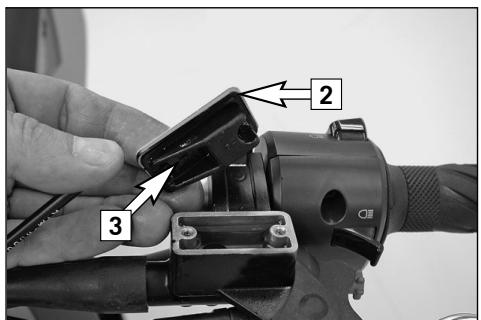
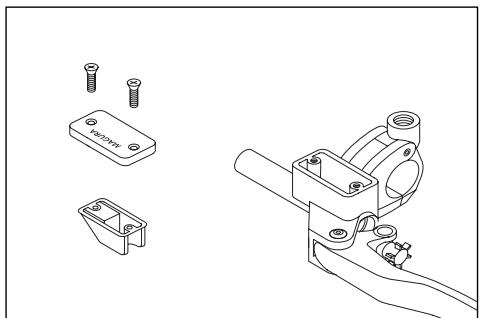
Changing the original position of the clutch lever
The adjusting screw [1] can be used for individual adjustment of the original position of the clutch lever, thus allowing adjustment to an optimal position for every hand size.
Turning the adjusting screw in a clockwise direction will move the clutch lever away from the handlebar. Turning the adjusting screw in a counterclockwise direction will move the clutch lever closer to the handlebar.
CAUTION
Adjustment of the clutch lever position is only possible within certain limits. Only turn the adjusting screw manually and never apply excessive force.
Checking the oil level of the hydraulic clutch
To check the oil level in the master cylinder of the clutch remove the cover. For this purpose, remove screws and cover [2] together with the rubber boot [3]. The oil level in the horizontal-standing master cylinder should be 4mm below the upper edge.
If necessary, add SAE 10 biodegradable hydraulic oil (Motorex clutch fluid 75), available from your authorized KTM workshop.
CAUTION
KTM uses biodegradable, hydraulic mineral oil to actuate the hydraulic clutch. Do not mix this oil with any other hydraulic oil. Always use original KTM hydraulic oil (available from your authorized KTM workshop) to make sure your clutch operates smoothly. Never refill with brake fluid.
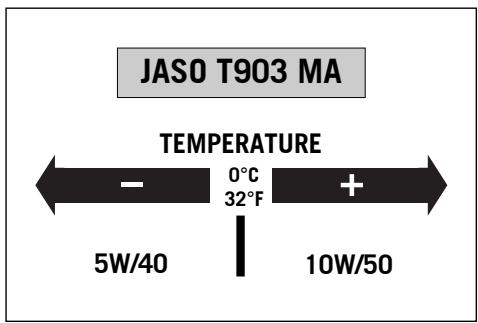
Engine oil
Automobile engine oil used to be used for four-stroke motorcycles before there were separate motorcycle specifications. Different technical developments made it necessary to have a separate specification for four-stroke motorcycles - the JASO T903 MA standard. Whereas car engines require long changing intervals, motorcycle engines require a higher power output at higher speeds. Most motorcycle engines also use the same oil to lubricate the transmission and the clutch. The JASO MA standard responds to these special requirements. Only use fully synthetic engine oils that meet the JASO MA quality requirements (see information on the can).
KTM recommends Motorex Power Synt 4T in the 10W/50 viscosity (for temperatures over 0^ , 32^ ) or 5W/40 (for temperatures under 0^ , 32^ ).
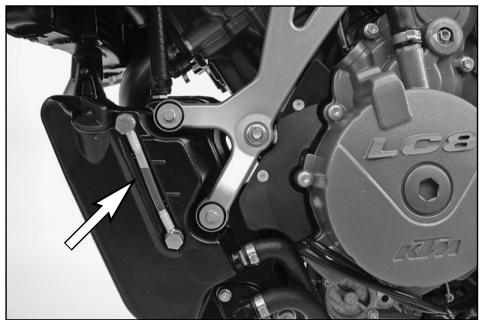
Checking the engine oil level
Check the engine oil level when the engine is warm (at least 4 bars on the temperature indicator light up). Allow the warm engine to run idle for approx. 1 minute and place the motorcycle on a level surface (not on the side stand).
Switch off the engine and wait 20 seconds to allow the oil level in the inspection glass to adjust to the oil level in the oil tank. The oil level should be between the MIN and MAX marks, add engine oil if necessary.
CAUTION
Always check the oil level when the engine is warm. A cold engine can distort the measuring results. Engine oil expands when heated, increasing the oil level.
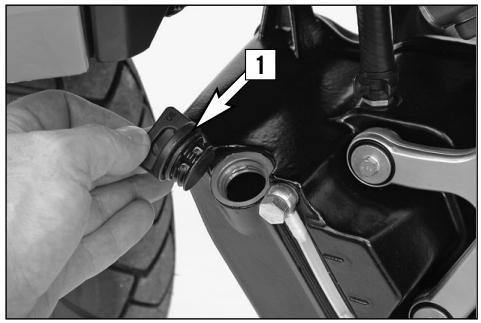
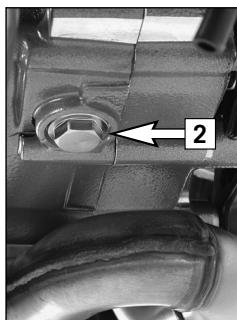
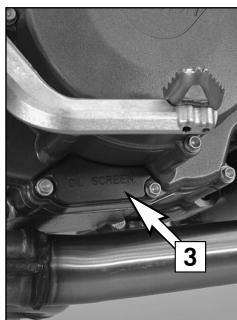
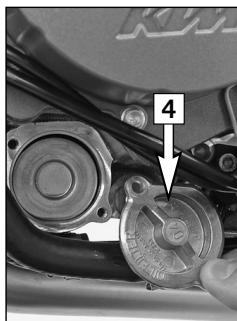
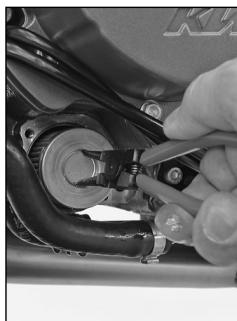
Refilling engine oil
Unscrew the plug [1] and refill engine oil. Wait 20 seconds and check the oil level again. The quantity of oil between the MIN and MAX marks is 0.6 liter. Mount the plug and check the engine for leaks.
CAUTION
- Insufficient amounts of or low-grade engine oil lead to premature wear in the engine.
- Do not overfill the engine case.
- Do not underfill the engine case.
Changing the engine oil and the oil filter, cleaning the oil screen
CAUTION
You may only change the engine oil yourself after the warranty period has expired. The warranty will become void if you change the oil yourself during the warranty period.
NOTE: The LC8 engine has a dry-sump lubrication system. The engine oil is pumped from the oil sump in the engine case to the oil tank. The engine oil must also be drained from the oil tank during an oil change. Since many parts must be demounted for an oil change, we recommend having the engine oil changed by an authorized KTM workshop.
During the guaranty period, the oil change must be performed by an authorized KTM mechanic. Otherwise, the guarantee will become void.
The engine oil change is to be carried out when the engine is still warm.
WARNING
An engine having been run warm, and the engine oil in it is very hot – do not burn yourself.
Park the motorcycle on an even surface in an upright position. Place a vessel under the engine to catch the used oil and remove the oil drain plug [2]. Take off the cover [3] and pull the oil sieve out of the engine case with a pair of pliers.
Remove the oil filter cover [4] and pull the oil filter out of the engine case with circlip pliers (upside-down).
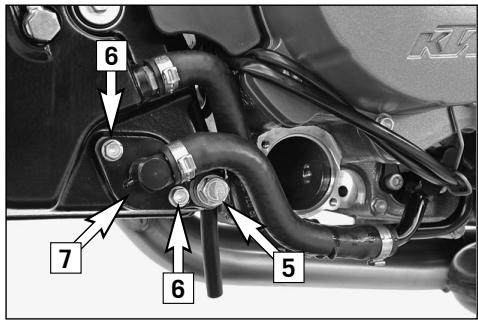
Remove the drain plug [5] from the oil tank and allow the oil to drain into a vessel. Remove the screws [6] and tilt the connector [7] to the side.
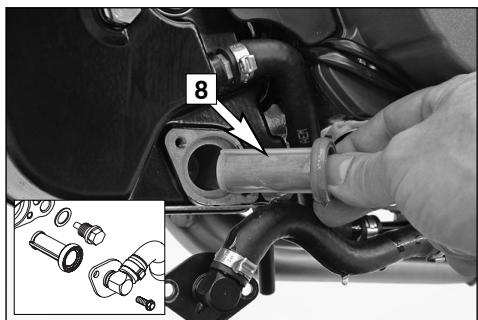
Carefully pull the oil screen [8] out of the oil tank.
Thoroughly clean the drain plugs, the cover and both oil screens. Clean all rubber seal rings and check for damage. Replace if necessary.
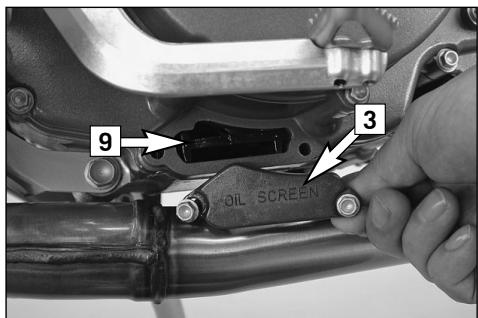
Mount the oil drain plug on the engine with a new seal ring and tighten to 20Nm
Slide the oil screen [9] into the guides in the oil pump housing with the TOP mark facing up. Make sure the form ring is in place and mount the cap [3]. Tighten the screws to 10 Nm.
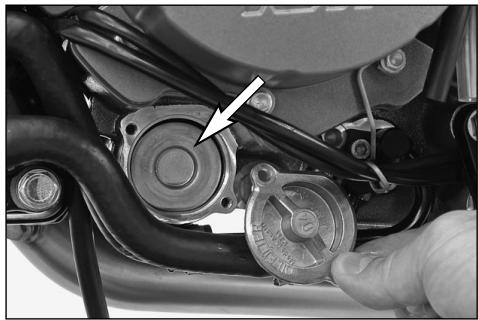
Insert a new oil filter in the engine case, grease the O-ring and mount the oil filter cover together with the O-ring. Tighten the screws to 6 Nm.
CAUTION
Only use original KTM oil filters. The engine can be damaged if other filters are used.
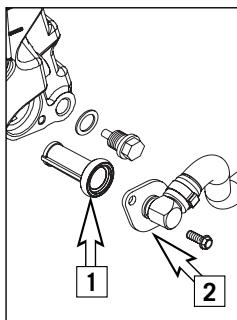
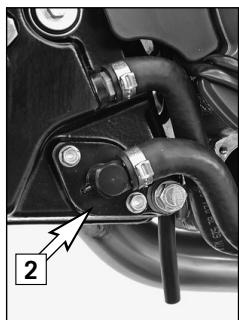
Mount the oil drain plug on the oil tank with a new seal ring and tighten to 20Nm
Grease the seal ring [1] and carefully slide the oil screen in the oil tank. Position the connector [2], mount the screws and tighten to 10 Nm.
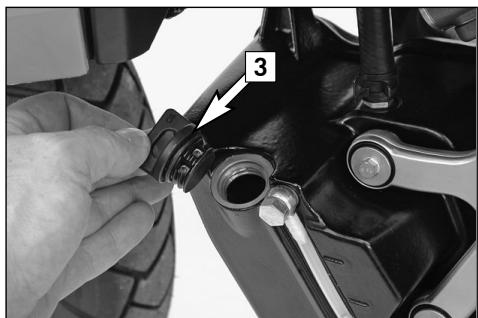
Unscrew the plug [3]. Add 2.5 liters (0.7 USgal) of fully synthetic engine oil according to the JASO MA Norm (e.g. Motorex Power Synt 4T) and remount the plug. Start the engine and allow to run warm in neutral until 4 bars on the temperature indicator light up. Switch off the engine and check the engine oil level (see Checking the engine oil level).
Check the engine and the oil tank for oil leakage.
If you let the specified maintenance work on your motorcycle be carried out, disturbances can hardly be expected. Should an error occur nevertheless, we advise you to use the trouble shooting chart in order to find the cause of error. We would like to point out that many operations cannot be performed by oneself. In case of uncertainty, please contact an authorized KTM workshop.
| TROUBLE | CAUSE | REMEDY |
| Engine does not start when the starter button is actuated | Operating error | Turn on the ignition, switch the gear to neutral and switch the emergency OFF switch on, do not accelerate while starting the engine |
| Discharged battery | Recharge the battery and investigate the causes for discharging; contact an authorized KTM workshop | |
| Blown fuse | Replace fuse IGNITION/FUEL PUMP | |
| Blown main fuse | Remove the seat and replace the main fuse in the starter relay | |
| Defect ignition lock or emergency OFF switch | Check ignition lock and emergency OFF switch, contact an authorized KTM workshop | |
| Defect safe-starting system | Contact an authorized KTM workshop. | |
| No functional key | Program key (refer to Reordering and programming keys) | |
| The engine cranks only with pulled clutch lever | A gear is engaged | Shift the transmission to neutral |
| A gear is engaged and the side stand is still folded down | Shift the transmission to neutral | |
| Defect safe-starting system | Contact an authorized KTM workshop | |
| Engine cranks with gear engaged | Defect safe-starting system | Contact an authorized KTM workshop |
| Engine cranks but doesn't start | Operating error | Pay attention to starting off information (see driving instruc-tions) |
| Blown fuse for the fuel pump | Replace fuse IGNITION/FUEL PUMP | |
| The plug and socket connector on the wiring harness is oxidized | Remove the panel and fuel tank, clean the plug and socket connector and spray with contact spray | |
| Error in the injection system | Contact an authorized KTM workshop | |
| Engine will not reach full power | Air filter/fuel filter heavily soiled | Have the air filter/fuel filter replaced at an authorized KTM workshop |
| Error in the injection system | Contact an authorized KTM workshop | |
| Engine overheats | Insufficient cooling liquid | Refill cooling liquid (see maintenance work), check cooling system for leaks |
| Radiator fins are extremely dirty | Clean radiator with water jet | |
| Foam forms in cooling system | Replace cooling liquid, use antifreezer with brand name | |
| Radiator hose is kinked or damaged | Run the radiator hose correctly or replace | |
| Thermostat defective | Have the thermostat checked (opening temperature 75°C, 167°F) or replaced; contact an authorized KTM workshop | |
| Blown fan fuse | Replace fuse FAN | |
| Engine overheats | Defect fan or thermoswitch for fan | Contact an authorized KTM workshop. |
| FI lamp is blinking / lights up | Error in the injection system | Contact an authorized KTM workshop |
| Immobilizer indicator lamp lit con- tinuously | Ignition key was locked due to incorrect use of masterkey | Program key (refer to Reordering and programming keys) |
| Immobilizer indicator lamp blinks quickly | Error in immobilizer | Identify the error from its blink code and remove it or con- tact an authorized KTM workshop |
| Engine stalls while driving | No fuel | Refuel |
| Fuse for fuel pump has blown | Replace fuse IGNITION/FUEL PUMP | |
| High oil consumption | Engine oil level too high | Check engine oil level when the engine is warm; correct if necessary |
| Engine oil too thin (viscosity) | Use thicker engine oil; see chapter „Engine oil“ | |
| Headlight and position light fail | Blown fuse | Replace fuse H/L BEAM POSITION. |
| Flasher lights, brake light, horn and combined instrument fail | Blown fuse | Replace fuse HORN BRAKELIGHT SPEEDO. |
| Time is not displayed or not cor- rectly displayed | Blown fuse, thus no continuous power supply | Replace fuse ACC1/CLOCK |
| The battery is discharged | The ignition (power consumer) hasn't been switched off | Recharge the battery according to the relevant instructions |
| The battery isn't charged by the generator because | Voltage regulator and generator should be checked by an authorized KTM workshop | |
| No values are visible in the com- bined instrument display | Blown fuse | Replace fuse HORN BRAKELIGHT SPEEDDO |
| The speed indication on the com- bined instrument is not working | Defective sensor cable or oxidized socket connector | Check the pickup cable for damage, remove the headlight mask and check the cable connectors, contact an authorized KTM workshop |
FI Indicator lamp blink code FI
The blink code (FI indicator lamp) indicates which component is affected by an error. This allows the error to be identified if no diagnosis tool is available. The rhythm of the blinking lamp will let you determine the two-digit „blink code“,
e.g.: Blink code 34: F1 blinks 3x long, 4x short, pause, Blink code 06: F1 blinks 6x short, pause
| BLINK CODE | SIGNAL / COMPONENT | ERROR DESCRIPTION |
| 02 | Pulse generator | Malfunction |
| 06 | Throttle sensor | Output signal too low /high |
| 07 | Sensor for 2nd throttle valve | Output signal too low /high |
| 09 | Intake manifold air pressure for sensor rear cylinder | Output signal too low /high |
| 11 | Intake manifold air pressure sensor for front cylinder | Output signal too low /high |
| 12 | Coolant temperature sensor | Output signal too low /high |
The blink code (FI indicator lamp) indicates which component is affected by an error. This allows the error to be identified if no diagnosis tool is available. The rhythm of the blinking lamp will let you determine the two-digit „blink code“,
e.g.: Blink code 34: F1 blinks 3x long, 4x short, pause, Blink code 06: F1 blinks 6x short, pause
| BLINK CODE | SIGNAL / COMPONENT | ERROR DESCRIPTION |
| 13 | Air temperature sensor | Output signal too low /high |
| 14 | Ambient air pressure sensor | Output signal too low /high |
| 15 | Tilt angle sensor | Output signal too low /high |
| 17 | Lambda probe for rear cylinder | Malfunction |
| 18 | Lambda probe for front cylinder | Malfunction |
| 24 | Control unit voltage supply | Malfunction |
| 25 | Side stand switch | Short circuit to ground |
| 33 | Injection nozzle for rear cylinder | Malfunction |
| 34 | Injection nozzle for front cylinder | Malfunction |
| 37 | Ignition coil for rear cylinder | Malfunction |
| 38 | Injection coil for front | Malfunction |
| 41 | Fuel pump relay | Short circuit to ground / positive |
| 45 | Lambda probe heater for rear cylinder | Short circuit to ground / positive |
| 46 | Lambda probe heater for front cylinder | Short circuit to ground / positive |
| 49 | Idle control motor | Malfunction |
| 50 | Stepper motor for 2nd throttle valve | Malfunction |
| 53 | Purge valve for carbon canister | Short circuit to ground / positive |
| 54 | Secondary air valve | Short circuit to ground / positive or interruption |
| 68 | Vacuum hose for rear cylinder is defective | Malfunction |
| 69 | Vacuum hose for front cylinder is defective | Malfunction |
| 91 | CAN bus communication | Malfunction |

Indicator lamp blink code immobilizer
The blink code (immobilizer indicator lamp) specifies the module affected. From the blink rhythm, you can identify a two-digit number, the so-called blink code.
E.g. blink code 15: lamp blinks 1x short, 1 second pause, 5x short. Other blink codes following a 3 second pause.
| BLINKCODE | ERROR DESCRIPTION |
| 12 | Key not programmed |
| 13 | Antenna not connected |
| 14 | No response from key |
| 15 | Communication with key is working, but Key Code is unknown |
| 16 | Key encryption is not ok |
| 21 | Immocan not coded, VIN number not yet transferred |
| 31 | No request for encryption from KEIHIN ECU |
| 32 | Handshake with KEIHIN ECU failed, CAN Bus Error |
| 60 | EEPROM Error |
Regular cleansing and paintwork care is part of the maintenance work and helps to maintain the value of your motorcycle.
CAUTION
Never clean your motorcycle with a high-pressed cleaner or a high-pressed water jet. The water could otherwise run into the electrical components, connectors, sheathed cables, bearings, carburetor etc. and cause disturbances or lead to a premature destruction of these parts.
- Before you wash your motorcycle, close the muffler openings.
- Use warm water with a commercial detergent and sponge. Coarse dirt can be removed with a soft water jet. Areas that are heavily soiled can be sprayed with a motorcycle cleaner (e.g. Motorex 900) and cleaned with a brush.
After the motorcycle has been rinsed with a soft water jet, it should be dried by air pressure and a cloth. Then take a short drive until the engine has reached the working temperature and also use the brakes. Due to the heat, the water also evaporates at the unapproachable parts of the engine and the brakes. - Slide back the protective covers on the handlebar-mounted instruments so that any water that may have seeped into this part of the motorcycle is allowed to evaporate.
After the motorcycle has cooled down, oil or lubricate all of the friction bearings and bearing positions and treat the chain with chain spray. Treat all bare areas (except brake disks) with a corrosion inhibitor (e.g. Motorex Protect & Shine). - The exhaust pipes and mufflers are made of stainless steel and should be treated with a suitable care product.
- To prevent the electric system from malfunctioning, treat the ignition lock, emergency off switch, combination switch and connectors with contact spray.
Treat all painted parts with a mild paint care product (e.g. Motorex Moto Polish or Clean & Polish).
In the event that the motorcycle is also used in winter and on roads where one has to expect salt spraying, you will have to take precautions against the aggressive road salt.
- clean motorcycle thoroughly and let it dry
- treat engine, swing arm, and all other bare parts (except for brake discs) with a wax-based anti-corrosion agent.
WARNING
Keep anti-corrosion agent from getting into contact with the brake discs, for otherwise this will significantly reduce the braking power.
CAUTION
After rides on salted roads, clean motorcycle thoroughly with cold water and let it dry well!
Should you desire to make a pause over a longer space of time, please observe the following instructions:
- Drive the tank empty to be able to fill up with fresh fuel when starting the motorcycle up again.
- Clean motorcycle thoroughly (see chapter: CLEANING)
- Change engine oil and oil filter (old engine oil contains aggressive contaminations).
- Check antifreeze and amount of cooling liquid.
- Correct tire pressure.
- Disassemble and charge battery (see chapter: BATTERY).
- Jack up the motorcycle if possible so the wheels do not touch the ground.
- The storage place should be dry and not subject to excessive temperature fluctuations.
- Cover the motorcycle with an air permeated tarpaulin or blanket. Do not use non air permeable materials as a possible humidity might not be able to escape and could cause corrosion.
CAUTION
It would be very bad to let the engine run for a short time during the storage period. The engine would not get warmed up enough and the thus developed steam would condense during the combustion process and cause the valves and exhaust to rust.
RE-INITIATION AFTER TIME OF STORAGE
- Mount the charged battery (pay attention to polarity) and set the clock.
- Fill up tank with fresh fuel.
- Check motorcycle as before each start (see driving instructions).
- Take a short, careful test ride first.
NOTE: Before you put your motorcycle away for the winter, you have to check all parts for their function and wear. Should any service jobs, repairs, or any refitting be necessary, you should have them carried out during the off-season (lower workload a mechanics' shops). This way, you can avoid the long waiting times at your mechanic at the beginning of the next biking season.
| CHASSIS | 990 SUPERMOTO 2008 |
| Frame | tubular chrome-molybdenum-steel space frame |
| Fork | WP Suspension – Up Side Down fork 4860 ROMA |
| Wheel travel front | 200 mm (7.9 in) |
| Rear suspension | WP Suspension - Progressive Damping System shock absorber 4618 BAVP |
| Wheel travel rear | 210 mm (8.3 in) |
| Front brake | disk brake, 2 floating perforated brake disks Ø 305 mm (12 in), brake calipers radially bolted |
| Rear brake | disk brake, perforated brake disk Ø 240 mm (9.4 in), floating brake caliper |
| Authorized front tires * | PIRELLI Scorpion Sync 120/70 ZR17 M/C 58W |
| Air pressure front | road, driver only. .2.2 bar (31 psi) road, with passenger / maximum payload .2.4 bar (34 psi) |
| Authorized rear tires * | PIRELLI Scorpion Sync 180/55 ZR17 M/C 73W |
| Air pressure rear | road, driver only. .2.2 bar (31 psi) road, with passenger / maximum payload .2.5 bar (36 psi) |
| Fuel tank capacity | 19 liters / 5 USgal, 3.7 liters / 0.9 USgal reserve |
| Gear ratio – rear wheel | 17:41 |
| Chain | 5/8 x 5/16" X-ring |
| Lighting | headlight .H4 12V 60/55W (socket P43t) position light front .12V 5W (socket W2,1x9,5d) indicator lamps .LED position light rear .12V WR5W (socket W2,1x9,5d) stoplight .12V PR21W (socket BAW15s) licenses plate illumination .12V 5W (socket W2,1x9,5d) flasher .12V RY10W (socket BAU15s) |
- further tire releases are available on the Internet at www.ktm.com
| CHASSIS | 990 SUPERMOTO 2008 |
| Battery | 12V 11.2 Ah maintenance-free |
| Steering head angle | 65.1° |
| Wheel base | 1510 ± 10 mm (59.4 in) |
| Seat height, unloaded | 875 mm (34.4 in) |
| Ground clearance, unloaded | 195 mm (7.7 in) |
| Dry weight | 191 kg (421.6 lbs) |
| Max. axle load, front | 190 kg (419.4 lbs) |
| Max. axle load, rear | 250 kg (552 lbs) |
| Payload | 195 kg (430.5 lbs) |
| Max. total weight | 400 kg (883 lbs) |
| 990 Supermoto 2008 | FORK | SHOCK | |||||
| SETTING | Compression | Rebound | Spring preload (turns) | Compression Low Speed | Compression High Speed | Rebound | Spring preload (mm) |
| Comfort | 20 | 22 | 7 | 20 | 2.5 | 20 | 11 |
| Basic Setting | 15 | 17 | 5 | 15 | 2 | 15 | 11 |
| Sport | 10 | 12 | 5 | 10 | 1 | 10 | 11 |
| Max. payload | 15 | 17 | 5 | 15 | 2 | 15 | 11 |
| FORK | 990 SUPERMOTO 2008 |
| Type | 14187D20 WP Suspension |
| Spring | 6.2-450 |
| Spring preload | 5 mm (0.2 in) |
| Air chamber lenght | 110 mm (4.3 in) |
| Fork oil | SAE 5 (WP 4860.0401) |
| SHOCK ABSORBER | 990 SUPERMOTO 2008 |
| Type | 15187D15 WP Suspension |
| Spring | 130-215 |
| Spring preload | 11 mm (0.43 in) |
| TIGHTENING TORQUES - CHASSIS 990 SUPERMOTO 2008 | ||
| Collar bolt on front wheel spindle | M24x1.5 | 60 Nm |
| Collar nut wheel spindle rear | M25x1.5 | 90 Nm |
| AH bolt shock absorber top/bottom | M14x1.5 | 80 Nm |
| Collar nut for swing arm bolt | M19x1.5 | 130 Nm |
| AH bolts on subframe | M10x1.25 | Loctite 243 + 45 Nm |
| AH bolts on back of footrest support | M8 | Loctite 243 + 25 Nm |
| Engine carrier bolts | M10 | 45 Nm |
| HH clamp bolts on top triple clamp | M8 | 20 Nm |
| HH clamp bolts on bottom triple clamp | M8 | 20 Nm |
| HH screw for steering head | M20x1.5 | 12 Nm |
| HH clamp bolts on fork leg axle passages | M8 | 15 Nm |
| Collar bolts for handlebar clamps | M8 | 20 Nm |
| AH bolt for handlebar mount | M10 | 20 Nm |
| HH clamp bolts for steering stem | M8 | 20 Nm |
| Collar bolt front/rear brake disk | M8x1.25 | Loctite 243 + 30 Nm |
| HH bolts on front brake caliper | M10x1.25 | Loctite 243 + 45 Nm |
| HH bolts on handbrake cylinder | M6 | 10 Nm |
| HH bolts on footbrake cylinder | M6 | Loctite 243 + 10 Nm |
| AH bearing bolt for foot brake pedal | M8 | Loctite 243 + 25 Nm |
| HH bolts on foot brake pedal surface | M5 | Loctite 243 + 6 Nm |
| AH bolts for side stand bracket - engine | M10 | Loctite 243 + 45 Nm |
| HH bolts for side stand fixture - side stand bracket | M10 | Loctite 243 + 45 Nm |
| HH bolts for side stand mounting | M10 | Loctite 243 + 35 Nm |
| HH bolt for spring rest on side stand | M8 | Loctite 243 + 25 Nm |
TIGHTENING TORQUES - CHASSIS 990 SUPERMOTO 2008
| HH bolt for side stand switch | M4 | Loctite 243 + 2 Nm |
| Drain plug on oil tank | M12x1,5 | 25 Nm |
| Exhaust nuts on manifold | M8 | evenly, do not bend sheet metal |
| Exhaust clamp | M8 | 8 Nm |
| Exhaust clamp for ball joint | M8 | 35 Nm |
| HH bolts on exhaust suspension | M6 | Loctite 243 + 12 Nm |
| HH bolt on fuel level indicator | M5 | 3 Nm |
| HH bolts fuel taps | M6 | 6 Nm |
| Jerk damper bolt rear wheel | M10x1,25 | Loctite 243 + 50 Nm |
| Chainguard | M5 | 5 Nm |
| Chain sliding guard | M6 | Loctite 243 + 6 Nm |
| Taillight | M6 | 8 Nm |
| Other bolts on chassis | M6 | 10 Nm |
| M8 | 25 Nm | |
| M10 | 45 Nm | |
| Other collar nuts on chassis | M6 | 15 Nm |
| M8 | 30 Nm | |
| M10 | 50 Nm | |
| ENGINE | 990 LC8 2008 | |
| Design | liquid-cooled, 2-cylinder 4-stroke engine with 75° V arrangement with balancer shaft and electric starter | |
| Displacement | 999 ccm | |
| Bore / Stroke | 101/62.4 mm | |
| Compression ratio | 11.5:1 | |
| Fuel | unleaded fuel with at least RON 95 (USA: Premium PON 91*) | |
| Valve timing | 4 valves controlled over bucket tappet and 2 camshafts, camshaft drive with gears/chain | |
| Valve diameter | intake: 38 mm exhaust: 33 mm | |
| Valve clearance, cold | intake: 0.10 - 0.15 mm exhaust: 0.25 - 0.30 mm | |
| Crankcase bearing | friction bearings (2 main bearings / 1 supporting bearing) | |
| Conrod bearing | friction bearing | |
| Piston pin bearing | dual-fuel bearing | |
| Piston | light alloy – forged | |
| Piston rings | 1 compression ring, 1 taper face ring, 1 single-piece oil scraper ring with spiral-type expander | |
| Engine lubrication | dry sump with 2 trochoidal pumps (pressure pump and suction pump) | |
| Engine oil | SAE 5W/40, 10W/50 (Motorex Power Synt 4T) # | |
| Quantity of engine oil | approx. 3.0 liters /(0.8 USgal) during oil/filter change | |
| Primary drive | straight-toothed spur wheels 35 : 67 | |
| Clutch | multi-disc clutch in oil bath, hydraulically operated | |
| Transmission | 6-speed claw shifted | |
| Gear ratio | 1st gear 12:35 2nd gear 15:32 3rd gear 18:30 4th gear 20:27 5th gear 24:27 6th gear 27:26 | |
| Mixture preparation | EFI (electronic fuel injection) | |
| Ignition system | breakerless transistorized electronic ignition system with digital ignition advance | |
| Ignition timing | Map-controlled via TPS | |
| Generator | 12V 450W at 6000 rpm | |
| Spark plug | NGK DCPR 8 E | |
| Electrode distance | 0.8 mm | |
| Cooling system | liquid cooled, permanent circulation of cooling liquid through water pump | |
| Cooling liquid | 2.1 liters (0.55 USgal), 50% antifreeze, 50% distilled water, at least -25°C | |
| Starting aid | electric starter |
JASO T903 MA
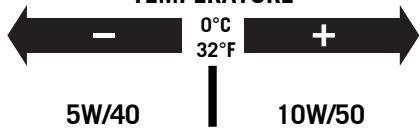
TEMPERATURE
Engine oil
Only use fully synthetic engine oils that meet the JASO MA quality requirements (see information on the can).
KTM recommends Motorex Power Synt 4T in the 10W/50 viscosity (for temperatures over 0^ , 32^ ) or 5W/40 (for temperatures under 0^ , 32^ ).
Accessories and payload 24
Adjusting compression damping of fork 37
Adjusting rebound damping of fork 38
Adjusting the fork and shock absorber 37
Adjusting the headlight range 58
Adjusting the spring preload on the fork 38
Battery 53
Bleeding the cooling system 63
Braking. 29
Breathing the fork legs 40
Chain maintenance 42
Changing the basic position of the handbrake lever . . . . . . .45
Changing the engine oil and the oil filter, cleaning the oil screen 67
Changing the original position of the clutch lever 64
Charging the battery 54
Chassis number, Type label 6
Check the following before each start 25
Checking rear brake fluid level 47
Checking the chain for wear 42
Checking the chain tension 41
Checking the cooling liquid level in the compensating tank . .62
Checking the cooling liquid level in the radiator 62
Checking the engine oil level 66
Checking the front brake fluid level 45
Checking the front brake pads. 46
Checking the oil level of the hydraulic clutch 64
Checking the rear brake pads 47
Cleaning 76
Clutch lever 7
Combination switch 16
Combined instrument 8
Combined instrument display 8
Compression damping of fork 21
Compression damping of shock absorber 39
Conservation for winter operation 77
Cooling liquid temperature display 12
Cooling system 60
Correcting the chain tension 41
Damping action during compression of shock absorber 22
Dismounting and mounting the rear wheel 50
Dismounting and remounting the front wheel 48
Driving instructions 25
Emergency OFF tip switch, starter tip switch 17
Engine number, engine type 6
Engine oil .84
Engine oil 66
Fillercap 17
Foot brake pedal 20
Footrests 20
Fuel 31
Fuel taps 17
Function buttons on combined instrument 8
Fuses for individual power consumers 56
General information on KTM disk brakes 43
General tips and warnings for starting the motorcycle 23
Grips 18
Hand brake lever 7
Helmet lock 19
Ignition lock 14
Immobilizer 14
Important information 2
Index 4
Indicator lamp blink code immobilizer 75
Indicator lamp blink code F1 73
Indicator lamps 13
Instructions for initial operation 23
Introduction 1
Jump start 54
Main fuse 55
Maintenance work on chassis and engine 36
Operation instruments 7
Periodic maintenance schedule 32
Rebound damping of fork 21
Rebound damping of shock absorber 40
Rebound damping of shock absorber 22
Refilling engine oil 67
Reordering and programming keys 15
Replacing the brake light and taillight bulbs 59
Replacing the flasher bulbs 58
Replacing the headlight lamp 57
Running in the LC8 engine 23
Seat lock, removing the seat 18
Securing vehicle after losing key 15
Serial number locations 6
Shift lever 19
Shifting/Riding 28
Side stand 20
Spring preload of the fork 21
Starting off 28
Starting the engine 27
Stopping and parking 30
Storage 78
Tachometer 12
Technical specifications - chassis 79
Technical specifications - engine 83
Tires, air pressure 52
Tool set 19
Troubleshooting 70

3211247en