
MAGENTIS - Berline KIA - Notice d'utilisation et mode d'emploi gratuit
Retrouvez gratuitement la notice de l'appareil MAGENTIS KIA au format PDF.

| Type de produit | Berline 4 portes |
| Marque | KIA |
| Modèle | MAGENTIS |
| Dimensions (L x l x H) | 4745 x 1815 x 1420 mm |
| Empattement | 2700 mm |
| Poids à vide (approx.) | 1475-1495 kg selon motorisation |
| Moteurs disponibles | 2.4L 4 cylindres (2351 cm³) ou 2.5L V6 (2493 cm³) |
| Transmission | Manuelle 5 vitesses ou automatique 4 vitesses |
| Capacité du réservoir | 65 litres |
| Alimentation | Essence sans plomb |
| Sécurité active | ABS (optionnel), freins à disque avant, tambours arrière (selon version) |
| Sécurité passive | Airbags conducteur et passager avant, prétensionneurs de ceinture, ceintures 3 points à tous les sièges |
| Équipements intérieurs | Sièges avant réglables, appuie-têtes réglables, banquette arrière rabattable 1/3 - 2/3 |
| Climatisation | Manuelle ou automatique selon version |
| Toit ouvrant | Électrique (selon version) |
| Entretien | Vidange tous les 10 000 km ou 1 an, contrôles réguliers des niveaux et des freins |
| Pneus d'origine | P195/70R14 ou P205/60R15 |
| Garantie | Voir carnet de garantie KIA |
FOIRE AUX QUESTIONS - MAGENTIS KIA
Questions des utilisateurs sur MAGENTIS KIA
0 question sur cet appareil. Repondez a celles que vous connaissez ou posez la votre.
Poser une nouvelle question sur cet appareil
Téléchargez la notice de votre Berline au format PDF gratuitement ! Retrouvez votre notice MAGENTIS - KIA et reprennez votre appareil électronique en main. Sur cette page sont publiés tous les documents nécessaires à l'utilisation de votre appareil MAGENTIS de la marque KIA.
MODE D'EMPLOI MAGENTIS KIA
Magentis
OWNER'S MANUAL
Now that you are the owner of a Kia vehicle, you'll probably be asked a lot of questions about your vehicle and the company like "What is a Kia?", "Who is Kia?", "What does 'Kia' mean?".
Here are some answers. First, Kia is the oldest car company in Korea. It's a company that has thousands of employees focused on building high-quality vehicles at affordable prices because the employees own a significant percentage of the company.
The first syllable, Ki, in the word "Kia" means "to arise from to the world" or "to come up out of to the world." The second syllable, a, means "Asia." So, the word Kia, means "to arise from" or "to come up out of Asia to the world."
Enjoy your vehicle!
FOREWORD
Thank you for choosing a Kia vehicle.
When you require service, remember that your authorized Kia dealer knows your vehicle best. Your dealer has factory-trained technicians, recommended special tools, genuine Kia replacement parts, and is dedicated to your complete satisfaction.
Because subsequent owners require this important information as well, this publication should remain with the vehicle if it is sold.
This manual covers all MAGENTIS models and will familiarize you with operation, maintenance and safety information about your new vehicle. It is supplemented by a Warranty Information Booklet that provides important information on all warranties regarding your vehicle. We urge you to read these publications carefully and follow the recommendations to help assure enjoyable and safe operation of your new vehicle.
Kia offers a great variety of options, components and features for its various models.
Therefore, the equipment described in this manual, along with the various illustrations, may not all be applicable to your particular vehicle. The information and specifications included in this manual were accurate at the time of printing.
Kia Motors reserves the right to discontinue or change specifications or design at any time without notice and without incurring any obligation. If you have questions, always check with your Kia Dealer.
We assure you of our continuing interest in your motoring pleasure and satisfaction in your Kia vehicle.
©2000 Kia Motors Corp.
All rights reserved. Reproduction by any means, electronic or mechanical, including photocopying, recording, or by any information storage and retrieval system or translation in whole or part is not permitted without written authorization from Kia Motors Corporation.
Printed in Korea
Z CAUTION:
Severe engine and transaxle damage may result from the use of poor quality fuels and lubricants that do not meet Kia specification. You must always use high quality fuels and lubricants that meet the specifications listed on page 7-38 in the Maintenance section and page 5-2 in the Driving tips section of the Owner's Manual.
Introduction
Your Vehicle at a Glance Section 2
Knowing Your Vehicle
Driving Your Vehicle -Section 4
Driving Tips -Section 5
In Case of an Emergency Section 6
Maintenance Section 7
Specifications Section 8
Index
How To Use This Manual 1-2
Vehicle Break-In Process 1-3
HOW TO USE THIS MANUAL
We want to help you get the greatest possible driving pleasure from your vehicle. Your Owner's Manual can assist you in many ways. We strongly urge you to review the entire manual. However, in order to prevent death or injuries, at the very least, you must review the WARNING and CAUTION sections spread throughout the manual, which are easily recognized by their special markings indicated below.
Illustrations complement the words in this manual to help explain the best way to enjoy your vehicle. By reading your manual, you can find out about features, important safety information, and driving under various road conditions.
The layout of the manual is provided in the Table of Contents.
Index: A good place to start is the index; it has an alphabetical listing of all
information in your manual.
Sections: This manual has eight sections plus an index. Each begins with a brief list of contents so you can tell at a glance if that section has the information you want.
You'll find various WARNINGs, CAUTIONs, and NOTICEs in this manual. These WARNINGs, CAUTIONs and NOTICEs were prepared to enhance your personal safety and continued satisfaction with your Kia vehicle. You should carefully read and follow ALL procedures and recommendations provided in these WARNINGs, CAUTIONs and NOTICEs.
WARNING:
A WARNING indicates a situation in which serious bodily injury or death could result if the warning is ignored.
CAUTION:
A CAUTION indicates a situation in which personal injury, perhaps severe, could result if the caution is ignored.
*NOTICE:
A NOTICE indicates a situation in which damage to your vehicle could result if the notice is ignored.
VEHICLE BREAK-IN PROCESS
No special break-in period is needed. By following a few simple precautions for the first 600 miles (1,000km) you may add to the performance, economy and life of your vehicle.
- Do not race the engine.
- Do not maintain a single speed for long periods of time, either fast or slow. Varying engine speeds are beneficial for proper engine break-in.
- Avoid hard stops, except in emergencies, to allow the brakes to seat properly.
- Avoid full-throttle starts.
Interior and Exterior Overview 2-2
Instrument Panel Overview 2-3
INTERIOR AND EXTERIOR OVERVIEW
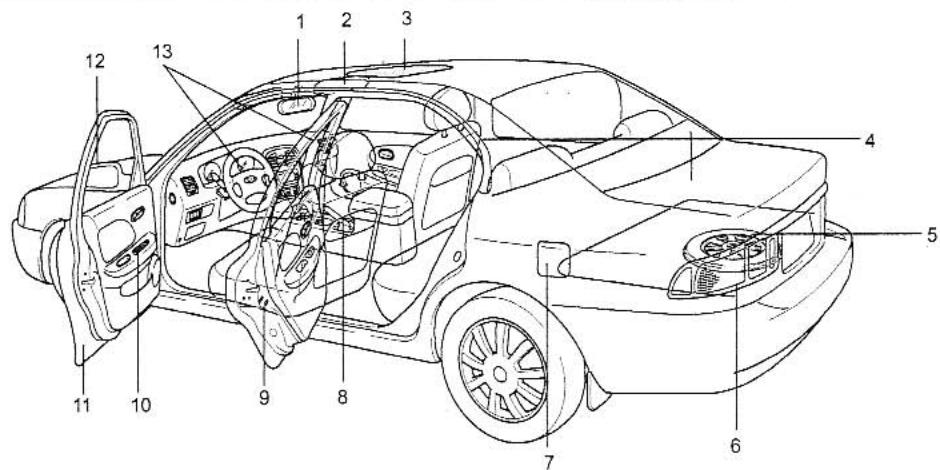
1MS102001
- Rearview mirror
- Sunvisor
- Sunroof (If Equipped)
-
Seat
-
Spare tire
- Lights
- Fuel filler lid
- Parking brake
-
Rear door child safety lock
-
Power window switches
- Door
- Outside rearview mirror
- Air bags
INSTRUMENT PANEL OVERVIEW
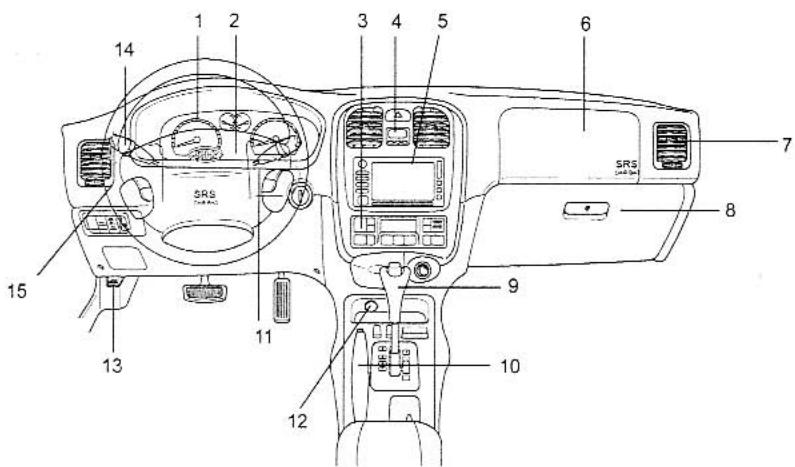
1M$102002
- Instrument cluster
- Air bag
- Climate control
- Clock
-
Radio (Optional)
-
Air bag
- Vent
- Glove box
- Shift lever (Automatic)
-
Parking brake
-
Wiper/Washer
- Power outlet
- Hood release
- Light control/Turn signals
- Steering wheel
Keys 3-3
Keyless entry system 3-4
Theft-alarm system 3-5
Door Locks 3-7
Windows 3-10
3-13
Safety Belts 3-22
Air Bag 3-39
Trunk Lid 3-49
Hood 3-51
Fuel Filler Door 3-53
3-55
Mirrors 3-55
Interior Lights 3-58
Cup Holders and Console Storage Compartment 3-59
Sunglass Holder 3-60
Coin Holder 3-60
Sunroof 3-61
Antenna 3-64
Luggage Net 3-65
KEYS
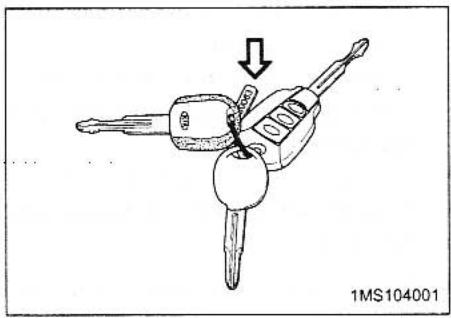
The key number is stamped into the plate attached to the key set. If you should lose your keys, this number will enable an Authorized Kia Dealer to duplicate the keys easily. Remove the plate and store it in a safe place. Also, record the number and keep it in a safe and handy place, but not in the vehicle.
Your vehicle has two master keys and a sub key. The master key will open all locks on your vehicle.
The sub key will only function in the ignition and the door locks.
WARNING - IGNITION KEY
Leaving children unattended in a vehicle with the ignition key is dangerous even if the key is not in the ignition. Children copy adults and they could place the key in the ignition. The ignition key would enable children to operate power windows or other controls, or even make the vehicle move which could result in serious bodily injury or even death. Never leave the keys in your vehicle with unsupervised children.
Leaving your sub key with a parking attendant will ensure that your vehicle's
trunk, trunk lid release, glove box compartment and rear trunk access may not be unlocked in your absence.
KEYLESS ENTRY SYSTEM (IF EQUIPPED)
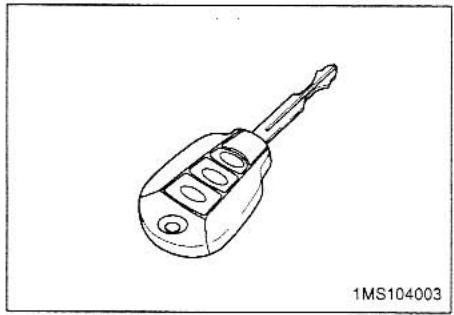
You can also lock or unlock the door and open the trunk from the outside with the transmitter.
To lock the door, depress this button. (Hazard warning light is turned on and turned off for about 1second)
To unlock the door, depress this button. (Hazard warning light flickers for two times)
To open the trunk, depress this button.
*NOTICE:
The transmitter will not work under the following conditions:
- Ignition key is in the ignition key hole.
- The battery of transmitter is discharged.
The operational distance(5m) is exceeded.
The transmitter may not operate
when the weather is very cold or when there are other vehicles or objects around the vehicle.
When the transmitter does not work correctly, open and close the door with the ignition key.
If you have a problem with the transmitter, contact an Authorized Kia Dealer.
- If you lock the door with the transmitter, be sure to unlock the door with the transmitter.
When you unlock the door or the trunk with the ignition key, the theft-alarm system is operated. But the alarm will be released if the ignition key is in "ON" position for 30 seconds or more.
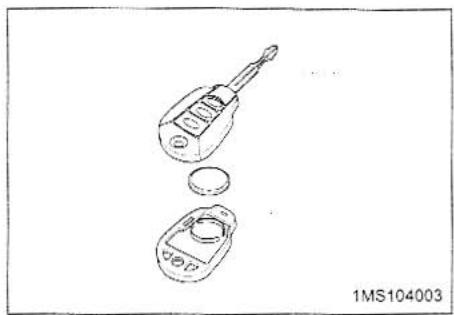
BATTERY REPLACEMENT.
The transmitter uses a 3-Volt, lithium-type battery. The battery will normally last for several years. If it ever needs replacement, use the following procedure:
- Using a screwdriver, loosen the screw on the back of the transmitter and pry the back off with a thin tool.
- Remove the battery from the back.
- Insert a new battery, making sure the "Plus (+) side faces down, and reassemble the transmitter.
CAUTION:
Using an incorrect battery can cause the transmitter to malfunction. Make sure the replacement battery has the same specification as the battery it replaces.
THEFT - ALARM SYSTEM (IF EQUIPPED)
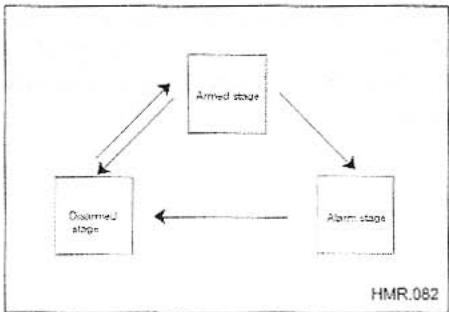
ARMED STAGE
The system is armed as described below.
After all vehicle doors such as the engine hood, trunk and passenger doors are closed, when the transmitter
"Lock" button is pressed, the doors are locked and the vehicle's hazard warning light blinks once. (At this time, the alarm does not sound.)
Alarm stage
The alarm will be activated as described below under the armed stage
The door is opened without using the key or the transmitter.
The trunk lid is opened without using the key.
The engine hood is opened. The alarm siren will come ON for 30 seconds and then shut OFF for 10 seconds, repeating this cycle two more times. The engine will not start during the alarm stage.
Disarmed stage
The alarm will be released as described below
- When the " " button in the transmitter is depressed.
- When the ignition key is in the "ON" position for 30 seconds or more.
CAUTION:
If the ignition key is in the ignition keyhole, the transmitter will not operate. Avoid trying to start the engine with the alarm activated. If you lock the door with transmitter, be sure to unlock the door with transmitter. When you unlock the door or the trunk with the ignition key, the theft-alarm system is operated. But, the alarm will be released if the ignition key is in "ON" position for 30 seconds or more.
DOOR LOCKS MANUAL DOOR LOCKS OPERATING DOOR LOCKS - WITH KEY
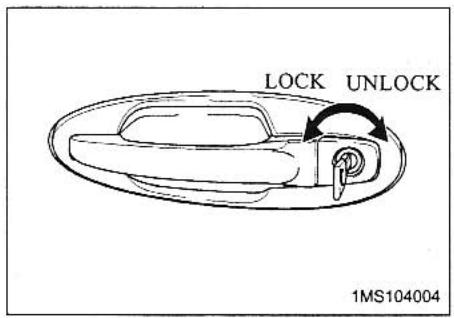
Both front doors can be locked and unlocked with the key.
- Turn the key to the left to lock and to the right to unlock the door.
Once a door is unlocked, it may be opened by pulling the door handle.
OPERATING DOOR LOCKS- WITHOUT KEY
To lock a door without the key, push the inside door lock button to the "LOCK" position and close the door.
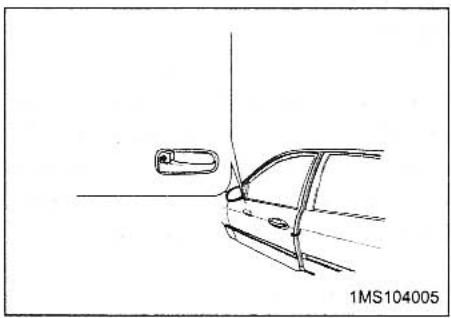
*NOTICE:
Always remove the ignition key, engage the parking brake, close all windows and lock all doors when leaving your vehicle unattended.
OPERATING DOOR LOCKS FROM INSIDE THE VEHICLE
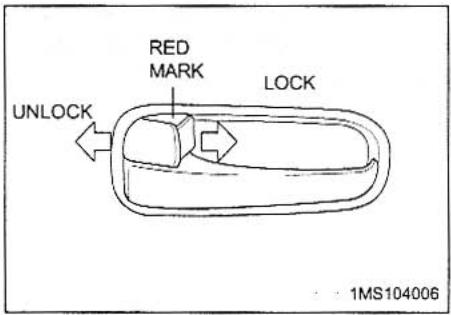
- To lock a door, push the door lock button to the "LOCK" position.
- To unlock a door, push the door lock button to the "UNLOCK" position.
To open a door, pull the door handle towards the middle of your vehicle.
The door ajar warning light will illuminate if a door is not fully closed. Close the door completely and the light will go out.
WARNING:
Never leave children or animals unattended in the vehicle. An enclosed vehicle can become extremely hot and depleted of oxygen, causing death or severe injury to children or to animals who cannot escape the vehicle.
CAUTION:
The doors should always be fully closed and locked while the vehicle is in motion to prevent accidental opening of the doors. Locked doors will also discourage potential intruders when the vehicle stops or slows.
*NOTICE:
When the door is locked, the red mark on the switch is not visible.
REAR DOOR CHILD SAFETY LOCK
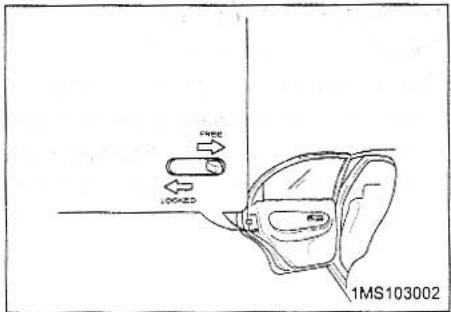
The child safety lock is provided to help prevent children from accidentally opening the rear doors from inside the vehicle.
-
To lock a rear door so that it cannot be opened from the inside, push the child safety lock located on the rear edge of the door to the "LOCK" position (toward front of vehicle) before closing the door.
-
To open a rear door while the child safety lock is engaged, push the door lock knob to the "FREE" position (toward rear of vehicle) then pull the outside door handle.
WARNING - REAR DOOR LOCKS
If children accidentally open the rear doors while the vehicle is in motion, they could fall out and be seriously or fatally injured. To prevent children from opening the rear doors from the inside, the rear door safety locks should be used whenever children are in the vehicle.
WINDOWS
POWERWINDOWS
The ignition switch must be in the ON position for power windows to operate. Each door has a power window switch that controls the door's window.
However, the driver has a power window lock switch which can cancel the operation of the three passenger window switches.
*NOTICE:
To prevent the power window fuse from malfunctioning and the power window system from being damaged, do not open or close more than two windows at the same time.
DRIVER'S DOOR POWER WINDOW CONTROLS
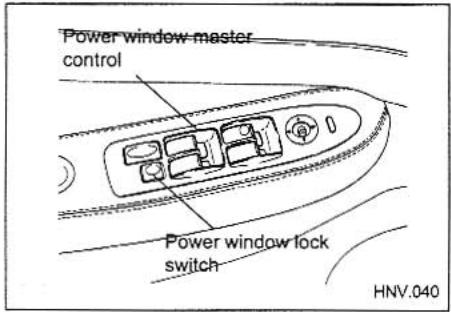
All windows can be opened or closed using the power window master control on the driver's door. To open a window, press down on the corresponding power window switch. To close a window, pull up on the corresponding power window switch.
DRIVER'S WINDOW AUTOMATIC-DOWN WINDOW SWITCH
The driver's window has an "Automatic-Down" feature. To activate the expressdown feature, momentarily depress the front of the switch to the second detent position. To cancel this feature, pull up on the front of the switch and then release it.
DRIVER'S POWER WINDOW SWITCH
The driver's power window switch provides two (2) separate window-down functions.
- Depressing the driver's power window switch completely, automatically lowers (Automatic-Down) the driver's window. To cancel this function, pull up on the front of the switch and release it.
- Depressing the driver's power window switch partially (to the first detent) provides precise control of the window-down position.
To raise/close the driver's window, pull up on the power window switch.
POWER WINDOW TIMER (IF EQUIPPED)
The power windows can be operated for 30 seconds after the ignition key is turned to the ACC or LOCK position.
However while the front doors are opened, the power windows cannot be operated.
POWER WINDOW LOCK SWITCH FEATURE
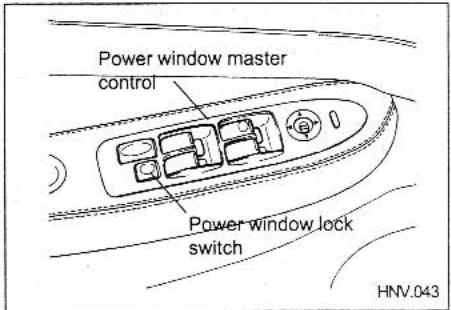
The driver can disable the power window switches on all passenger doors by depressing the power window lock switch located on the driver's door to ON. When the power window lock switch is ON, only the driver's master control can operate the windows.
WARNING - PASSENGERS
- Keep the power window lock switch on the driver's door in the ON (depressed) position except when someone is operating a passenger door window.
Serious injury can result from unintentional window operation, especially to children.
Always double check to make sure all arms, hands, and other obstructions are safely out of the way before closing a window.
*NOTICE:
If you experience buffeting and pulsation (wind shock) with either side window open, you should open the opposite window slightly to reduce the condition.
PASSenger Door Power Window Controls
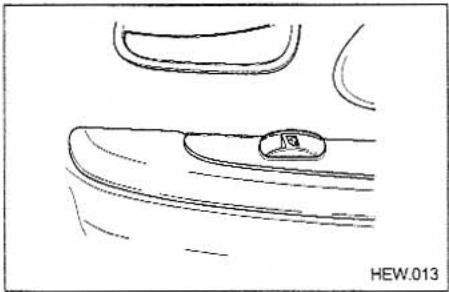
To open a window, press the front portion of the switch down. To close a window, pull the front portion of the switch up.
WARNING - PASSENGERS
Do not allow children to play with the power windows. They may seriously injure themselves or others.
SEATS
WARNING - DRIVERS
- Never adjust the driver's seat or seatback when the vehicle is moving. Doing so could cause loss of control, and serious personal injury or death.
- Do not allow packages or other objects to interfere with the normal position of a seatback. These objects may prevent the seatback from locking, which could result in serious injury or death in the event of a sudden stop or collision.
Always drive and ride with your seatback upright and the lap portion of the safety belt snug and low across the hips.
Children can be killed or injured by the passenger air bag. The back seat is the safest place for children 12 and under. Make sure all children use seat belts or child seats.
FRONTSEATADJUSTMENT MOVING THE FRONT SEAT FORWARD AND BACKWARD
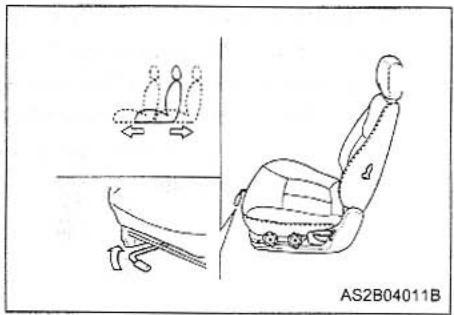
To move the seat forward or backward;
- Pull the seat slide adjustment lever under the front edge of the seat cushion up and hold it.
- Slide the seat to the position you desire.
- Release the lever and make sure the seat is locked in place.
CAUTION:
Do not place anything under the front seats. Loose objects might interfere with the seat slide mechanism or possibly roll out from under the seat and interfere with the operation of the brake, clutch or accelerator foot pedals.
ADJUSTING THE FRONT SEATBACK RECLINER
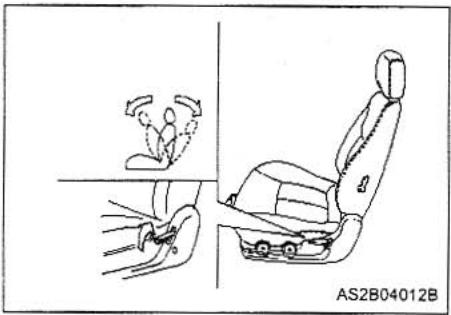
To recline the seatback;
- Lean forward slightly and lift up on the seatback recline lever located on the outside of the seat, toward the rear.
- Lean back on the seat and adjust the back of the seat to the position you desire.
- Release the lever and make sure the seatback is locked in place. (The lever MUST return to its original position for the seatback to lock.)
WARNING -
PASSENGERS
To reduce the risk of sliding under the lap portion of the lap/shoulder belt, and potentially suffering serious personal injury or death in the event of a collision, do not use the front seatback in a reclined position while the vehicle is in motion. If a seat is reclined, the occupant's hip could slide under or out of the lap portion of the lap/shoulder belt during a collision. If that occurs, the occupant may no longer be properly restrained, and the safety belt could apply restraint forces to the unprotected abdomen resulting in serious personal injury or death.
Therefore, keep the seatbacks in a comfortably upright position whenever the vehicle is in motion.
ADJUSTING THE HEIGHT OF DRIVER'S SEAT CUSHION
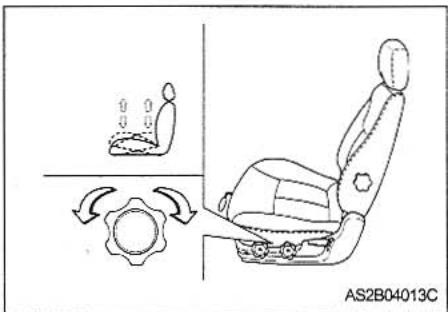
To change the height (front portion) of the seat cushion, rotate the knob located on the outside of the seat cushion.
- To lower the seat cushion, rotate the knob toward the front of the vehicle.
- To raise the seat cushion, rotate the knob toward the rear of the vehicle.
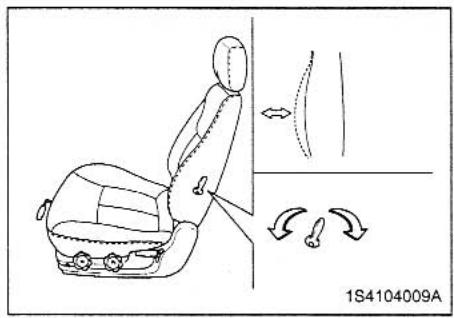
LUMBAR SUPPORT
You can adjust the lumbar support by moving the lever on the side of the driver's seatback. Pivoting the lever toward the front of the vehicle increases the lumbar support. Pivoting the lever toward the rear of the vehicle decreases the lumbar support.
POWER DRIVER'S SEAT (IF EQUIPPED)
The driver's seat can be adjusted appropriately by using the control knob on the left side of the seat. Before driving, adjust the seat to the proper position so as to easily control the steering wheel, pedals and switches on the instrument panel.
CAUTION:
Do not operate two knobs at the same time.
WARNING:
- Never attempt to adjust the seat while the vehicle is moving. This could result in loss of control, and an accident causing death, serious injury, or property damage.
- Do not sit or lean unnecessarily close to the airbag to get better protection during its deployment in case of an accidents.
- Sit at least 10 inches (250 mm) away from the steering wheel while driving the vehicle to avoid injury during air bag deployment in an accident.
ADJUSTING SEAT FORWARD AND REARWARD
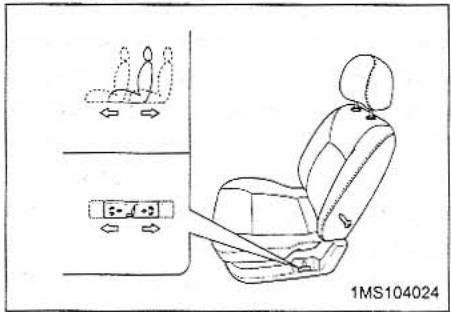
Pull the control knob forward or backward to move the seat forward or backward to the desired position. Release the knob and then the seat will lock at that position.
- Reclining Control Knob
- Sliding and Height Adjusting Control Knob
WARNING:
To ensure the seat is locked securely, attempt to move the seat forward or backward without using the control knob.
SEAT CUSHION HEIGHT ADJUSTMENT
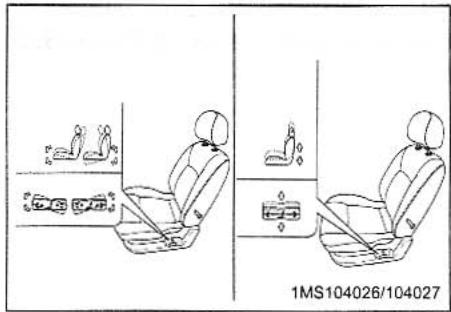
Move the front portion of the control knob up or down to raise or lower the front part of the seat cushion. Move the rear portion of the control knob up or down to raise or lower the rear part of the seat cushion.
ADJUSTING SEATBACK ANGLE
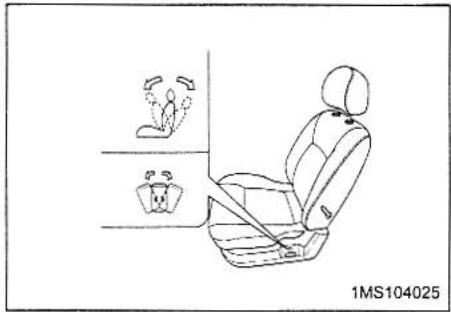
Rotate the upper portion of the control knob forward or backward to recline the seatback to the desired position. Release the control knob and then the seatback will lock in that position.
WARNING:
To minimize the risk of personal injury in the event of a collision or a sudden stop, both the driver's and passenger's seatback should remain in an upright position while the car is in motion. The protection provided by the seat belts and airbags may be reduced significantly when the seatbacks are reclined. There is a greater risk that the seat occupants will slide under the belt resulting in serious injury if a crash occurs when the seatbacks are reclined. The seat belt cannot provide full protection to an occupant if the seat back is reclined.
HEATING THE FRONT SEATS (OPTIONAL)
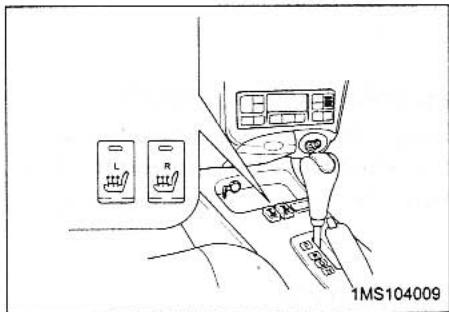
The front seats are electrically heated when the ignition switch is ON and the corresponding heater switch, shown in the illustration, is depressed. When depressed, a thermostat regulates seat temperature individually. To deactivate the front seat heating system, depress the corresponding heater switch again.
ADJUSTABLE HEADREST (IF EQUIPPED)
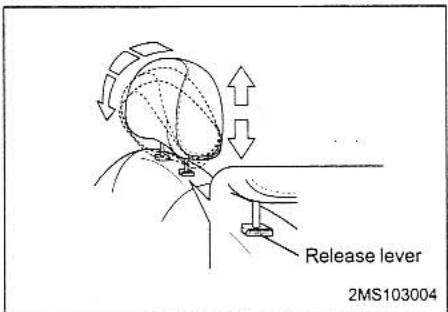
To raise the headrest, simply pull it up to the desired position. To lower the headrest, press the release lever on the left side grommet, while pushing the headrest down to the desired position. To remove the headrest, raise it as far as it can go then press the release lever while pulling upward.
The headrest may be adjusted forward to three positions by pulling if forward. To adjust the headrest backwards, pull it forward and release it.(If Equipped)
WARNING- HEADRESTS
To reduce the risk of head and neck injuries, do not operate the vehicle with the headrest removed or improperly positioned.
- Do not attempt to adjust the headrest while driving.
- Adjust the top of the headrest so that it is even with the top of your ears in order to reduce the chance of injury in the event of a collision.
WARNING:
To drive properly, adjust the driver's seat and its headrest before starting. After doing so, you should adjust the day/night rearview mirror and the outside rearview mirror.
SPLIT FOLDING REAR SEAT
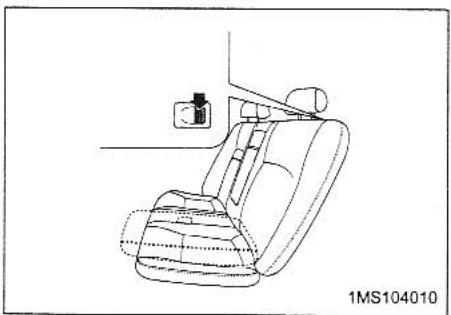
The rear seatbacks fold forward to provide additional cargo space and to provide a access to the trunk area.
To fold the rear seatback(s) down, press the unlock button located in the top of the seatbacks, then fold the seatback forward and down.
To raise the seatback, lift and push it firmly until it clicks into place.
- When you return the seatback to its upright position, reposition the rear safety belts so that they can be used by rear seat passengers.
WARNING-CARGO
Cargo should always be secured to prevent it from shifting and causing injury to the vehicle occupants.
Z CAUTION:
Do not remove the floor carpet in your vehicle, emission controls cause high exhaust temperatures under the floor.
*NOTICE:
When returning the rear seatbacks to the upright position, remember to return the rear shoulder belts to their proper position. Routing the safety belt webbing through the rear safety belt guides will help keep the belts from being trapped behind or under the seats.
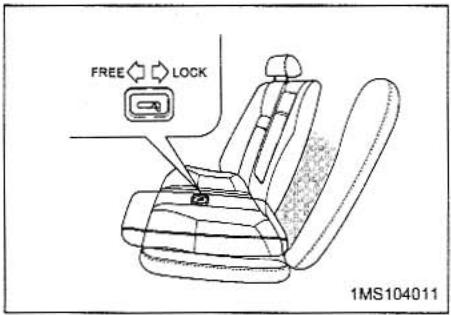
REAR SEATBACK LOCK
The rear seatback lock lever (located on the backside of the rear seatback) is always in the "LOCK" position when the seatbacks are secured upright. To fold the rear seatback down, the lock lever must be moved to the "FREE" position. The lock feature was designed to provide protection from unauthorized entry into the trunk.
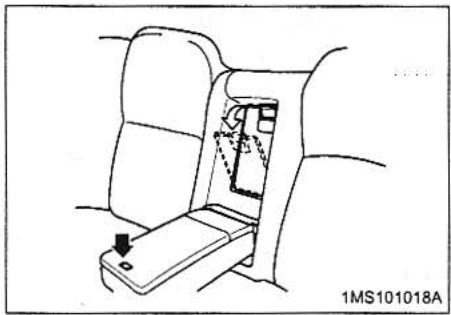
REAR SEAT ARMREST
This armrest is located in the center of the rear seatback.
Open the armrest cover by pressing its release button, A cup holder and stowage compartment are inside the armrest.
SAFETY BELTS PRE-TENSIONER SEAT BELT
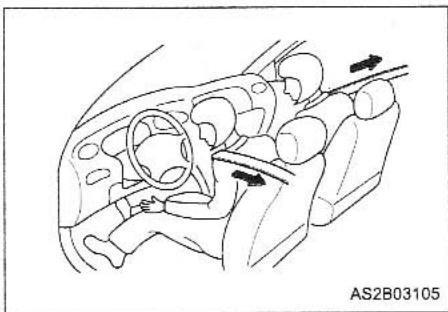
Your vehicle is equipped with driver's and front passenger's pre-tensioner seat belts. The purpose of the pre-tensioner is to make sure that the seat belts fit tightly against the occupant's body in certain frontal collisions.
The pre-tensioner seat belts can be activated alone or, with the airg, where the frontal collision is severe enough.
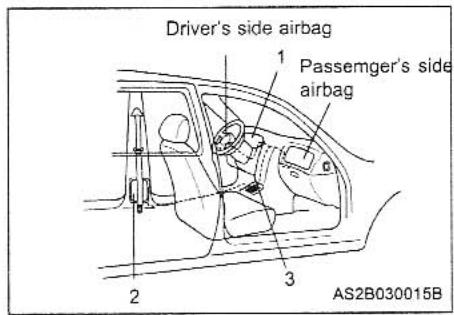
The pretensioner seat belt operates in the same way as an Emergency Locking Retractor (ELR) type of seat belt. When the vehicle stops suddenly, or if the occupant tries to lean forward too quickly, the seat belt retractor will lock into position. However, in certain frontal collisions, the pretensioner will activate and pull the seat belt into tighter contact against the occupant's body.
The seat belt pre-tensioner system consists mainly of the following components.
Their locations are shown in the illustration.
- SRS airbag warning light.
- Seatbelt pre-tensioner assembly.
- SRS control module.
WARNING:
To obtain maximum benefit from a pre-tensioner seat belt:
- The seat belt must be worn correctly
- The seat belt must be adjusted to the correct position.
*NOTICE:
- Both the driver's and front passenger's pre-tensioner seat belts will be activated in certain frontal collisions. The pre-tensioner seat belts can be activated alone or, where the frontal collision is severe enough, with the airbags. The pretensioners will be activated under these conditions even if the seat belts are not being worn at the time of the collision.
- When the pre-tensioner seat belts are activated, a loud noise may be heard and fine dust, which may appear to be smoke, may be visible in the passenger compartment. This dust is not hazardous.
- Although it is harmless, the fine dust may cause skin irritation and should not be breathed for prolonged periods. Wash your hands and face thoroughly after an accident in which
the pretensioner seat belts were activated.
CAUTION:
Because the sensor that activates the SRS airbag is connected with pretensioner seat belt, the SRS airbag warning light on the instrument panel will blink for approximately 6 seconds after the ignition key has turned to the "ON" or "ACC" positions. After the six second period, the air bag warning light will turn off.
- Please have the SRS airbag system and the pre-tensioner system inspected by an authorized Kia dealer if the following conditions occur:
-
The SRS warning light does not illuminate when the ignition switch is turned to "ON" or "ACC".
-
When the ignition switch is turned to "ON" or "ACC" the SRS warning light stays lit after blinking for approximately 6 second.
- The SRS warning light illuminates while the vehicle is being driven.
WARNING:
- Pre-tensioners are designed to operate only one time. After activation, pretensioner seat belts must be replaced. All seat belts, of any type, should always be replaced after they have been worn during a collision.
(Continued)
(Continued)
- The Pre-tensioner seat belt assembly mechanisms become hot during activation. Do not touch the pre-tensioner seat belt assemblies for several minutes after they have been activated.
- Do not attempt to inspect or replace the pre-tensioner seat belts yourself. This must be done by an Autorized Kia Dealer.
- Do not strike the pre-tensioner seat belt assemblies.
- Do not attempt to service or repair the pre-tensioner seat belt system in any manner.
- Improper handling of the pretensioner seat belt assemblies, and failure to heed the warnings to not strike, modify, inspect, replace, service or
repair the pretensioner seat beltassemblies may lead to improper operation or inadvertent activation and serious injury.
Always wear the seat belts when driving or riding in a motor vehicle.
SAFETY BELT RESTRAINT SYSTEM
WARNING:
The driver and all passengers should always use the safety belts provided in order to minimize the risk of severe bodily injury.
We strongly recommend that the driver and all passengers be properly restrained at all times by using the safety belts provided with the vehicle. Proper use of the safety belts decreases the risk of severe injury or death in accidents or sudden stops.
Safety belts provide the best restraint when:
The seatback is upright
The occupant is sitting upright (not slouched)
The lap belt portion of the safety belt is snug and low on the hips
- The shoulder belt portion of the safety belt is snug against the chest
The knees are straight forward To help you remember to fasten your safety belt, a warning light will flash and a chime will sound.
See safety belt warning on page 4-21
All seats have lap/shoulder belts.
The center rear seat has a lap/shoulder belt.
Inertial locks in the safety belt retractors allow all of the lap/shoulder safety belts to remain unlocked during normal vehicle operation. This allows the occupants some freedom of movement and increased comfort while using the safety belts. If a
force is applied to the vehicle, such as a strong stop, a sharp turn, or a collision, the safety belt retractors will automatically lock the safety belts.
Since the inertial locks do not require a collision in order to lock up, you may become aware of the safety belts locking while braking or going around sharp corners.
The center rear seat safety belt does not have an inertial lock so it is always in a locked condition.
Whenever possible, use the center rear seat position to install your child restraint. The center rear seat is the best position to install your child restraint.
WARNING-TWISTED SAFETY BELTS
Never drive or ride with a twisted or jammed safety belt. If you cannot untwist or unjam the safety belt, see your Kia dealer or the nearest qualified technician immediately.
WARNING - SAFETY BELT USAGE
Each seating position in your vehicle has a specific safety belt assembly which includes a buckle and tongue that are designed to be used together. 1) Use the shoulder belt on the outside shoulder only. Never wear the shoulder belt under the arm. 2) Never swing the safety belt around your neck to fit over the inside shoulder. 3) Never use a single belt for more than one person.
WARNING - SAFETY BELT CARE
- Safety belts should be inspected periodically for excessive wear or damage. Pull out each belt fully and look for excessive fraying, cuts, burns or other damage. Make sure that the lap/shoulder belts return smoothly and easily into the retractor. Check the latches to make sure they latch and release without interference or delay. Any belt not in good condition or in good working order should be promptly replaced.
CAUTION - DAMAGE TO SAFETY BELTS
Never close the doors on any part of the lap or shoulder belt. It can damage the safety belt or buckle which could increase the risk of injury in case of an accident.
RESTRAINT OF PREGNANT WOMEN
Pregnant women should wear lap/ shoulder belt assemblies whenever possible according to specific recommendations by their doctors. The lap portion of the belt should be worn AS SNUGLY AND LOW AS POSSIBLE.
WARNING - PREGNANT WOMEN
Pregnant women must never place the lap portion of the safety belt over the area of the abdomen where the fetus is located or above the abdomen.
RESTRAINT OF INFANTS AND SMALL CHILDREN
Small children and infants should be restrained by an approved child-restraint system to help protect them while riding in a vehicle.
Never allow a child to stand or kneel on the seat of a moving vehicle. Never allow a safety belt to be placed around both a child and an adult or around two children at the same time.
Children can be killed or injured by the passenger air bag. The back seat is the safest place for children 12 and under.
WARNING - CHILDREN ON LAPS
Never hold a child on your lap or in your arms in a moving vehicle.
Even a very strong person cannot hold onto a child in the event of even a minor collision.
Many companies manufacture child restraint systems (often called child seats) for infants and small children. An acceptable child restraint system must always satisfy the Safety Standards of your country. Make sure that any child-restraint system you use in your vehicle is labeled as complying with those safety standards.
The child-restraint system should be chosen to fit both the size of the child and the size of the vehicle seat. Be sure to follow any instructions provided by the child-restraint system manufacturer when installing the child-restraint system.
CAUTION - HOT METAL PARTS
Safety belts and seats can become hot in a vehicle that has been closed during warm/hot weather; they could burn a child. Check seat covers and buckles before you place a child anywhere near them.
RESTRAINT OF LARGE CHILDREN
As children grow, they may need to use new child-restraint systems, including larger child seats or booster seats, which are appropriate for their increased size. A child who has outgrown available childrestraint systems should use the belts provided in the vehicle. When seated in the rear outboard seats, the child should be restrained by the lap/shoulder belt. If the shoulder belt portion slightly
touched the child's neck or face, try placing the child closer to the center of the vehicle. If the shoulder belt still touches their face or neck they may need to be returned to a child restraint system.
In addition, after-market devices are available from independent manufacturers which help pull the shoulder belt down and away from the child's face or neck.
WARNING-SHOULDER BELTS ONSMALL CHILDREN
- Never allow a shoulder belt to be in contact with a child's neck or face while the vehicle is in motion.
If safety belts are not properly worn and adjusted, the risk of death or serious injury to such a child is high.
WARNING - CHILD RESTRAINTS
- All child restraint systems are designed to be secured in vehicle seats by lap belts or the lap-belt portion of a lap/shoulder belt.
Children will be endangered in a crash if their child restraint systems are not properly secured by the safety belts in the vehicle.
- According to accident statistics, children are safer when properly restrained in the rear seatin positions rather than the front seating positions.
- When a child restraint system is not secured by a safety belt, store it in the trunk so that it will not be thrown forward in the
(Continued)
(continued)
event of a sudden stop or accident.
PLACEMENT OF A CHILDRESTRAINT SYSTEM
We recommend that, whenever possible, you put the child-restraint system in the center position of the rear seat and secure it to the vehicle with the lap/shoulder belt. If the center rear seat is not available, or you are using more than one child restraint system in the vehicle at the same time, the front passenger safety belt and rear outboard safety belts have been designed to allow a child-restraint system to be used in these positions.
INSTALLING A CHILD-RESTRAINT SYSTEM IN THE FRONT SEAT AND REAR OUTBOARD SEATS

WARNING - RESTRAINT INSTRUCTIONS
Failure to observe this manual's instructions regarding child restraint systems and the instru-cions provided with the child restraint system could increase the chance and/or severity of injury in an accident.
For safety reasons, we recommend that the child-restraint system be used in the center rear seat. If the center rear seat is unavailable, a rear-facing child restraint may be installed in the rear outboard seat.
WARNING-CHILD RESTRAINT PLACEMENT
- NEVER use a rear-facing child restraint in the front passenger seat. A child in a rear-facing child restraint installed in the front passenger seat can be severely or fatally injured by an air bag which could impact the child restraint with great force when the air bag inflates.
(Continued)
(Continued)
If the rear seats are unavailable, a forward-facing child restraint may be installed in the front passenger seat, but you should ALWAYS move the front passenger seat all the way rearward on its seat track in order to place the child as far from the air bag as possible.
INSTALLING A CHILD RESTRAINT IN THE REAR CENTER SEAT
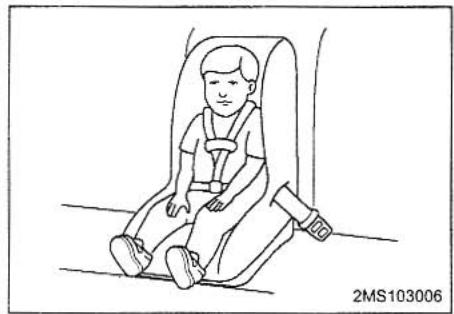
To install a child restraint in the rear center seat, do the following:
- Place the child-restraint in the desired position. Route the lap/shoulder belt through the restraint according to the seat manufacturer's instructions.
-
Insert the tongue plate into the buckle.
-
Adjust the lap/ shoulder safety belt for a snug hold on the child restraint by pulling on the loose end of the belt.
CHILE RESTRAINT ANCHORAGE FITTING
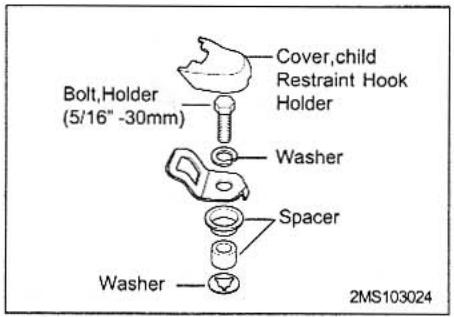
Your vehicle is equipped with an anchor for securing the tether strap of a child restraint system (child seat).
The anchor fitting package consists as above illustration.
CHILD RESTRAINT ANCHORAGE POSITION
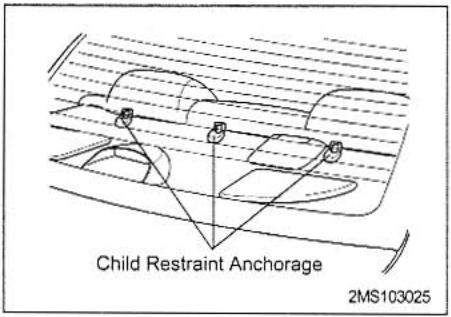
The child restraint anchor fittings are installed on the package tray behind the rear seat.
WARNING - CHILD RESTRAINT ANCHOR FITTING
- Infants and small children should be restrained at all times in an approved child restraint designed for your vehicle.
-
Child restraint anchorage is designed to withstand only those loads imposed by correctly fitted child restraints. Under no circumstances are they to be used for adult seat belts or harnesses or for attaching other items or equipment to the vehicle.
-
Check that the child restraint system is secured by pushing and pulling it in different directions. Incorrectly fitted child restraint may swing, twist, tip or come away causing death or injury.
PLACEMENT OF A CHILD RESTRAINT SYSTEM
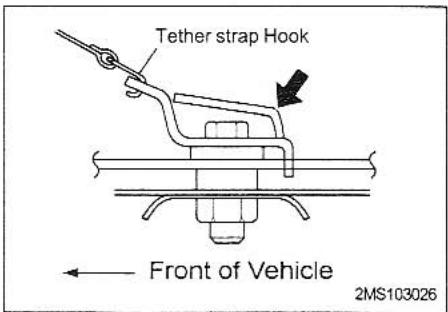
To install the child restraint on the rear seat, use the anchorage fitting located on the package tray behind the rear seat.
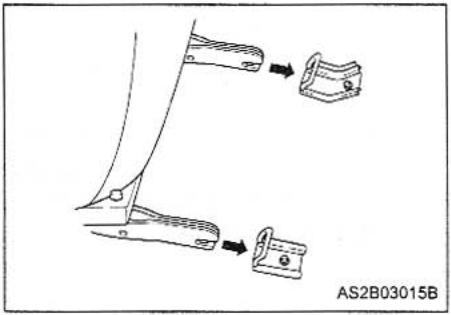
CHILD RESTRAINT LOWER ANCHOR STRIKER POSITION.
The child lower anhor striker is located between rear seat and seatback.
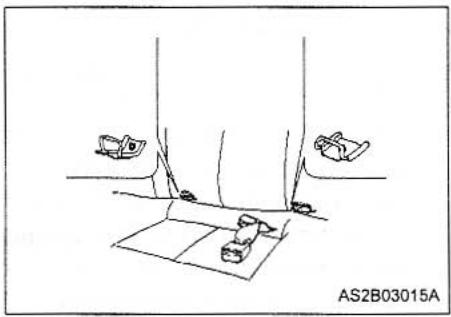
To install the child restraint to the child lower anchor striker, insert the child restraint latch into the child lower anchor striker. Listen for the audible "Click" sound.
SAFETY BELT WARNING LIGHT AND CHIME
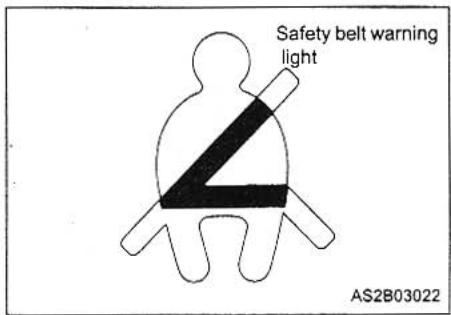
If the driver's lap/shoulder belt is not fastened when the key is turned ON, the safety belt warning chime sounds for approximately six seconds and the safety belt warning light flashes for approximately six seconds.
FRONT LAP/SHOULDER BELT
TO FASTEN THE FRONT LAP/SHOULDER BELT:
- Grasp the buckle and tongue plate.
- Slowly pull the lap/shoulder belt out from the retractor.
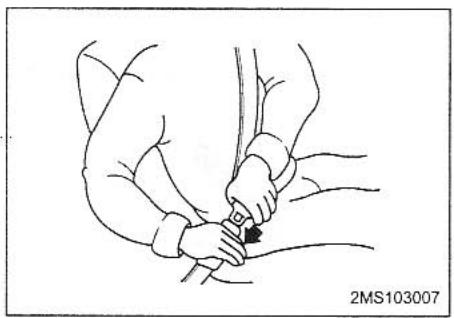
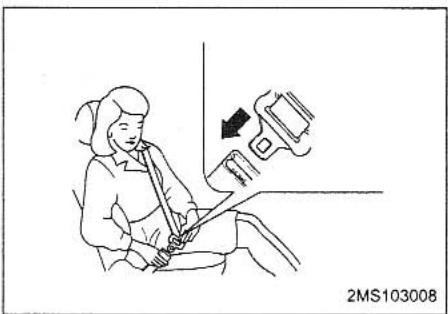
- Insert the tongue plate into the open end of the buckle until an audible "Click" is heard, indicating the belt is locked in the buckle.
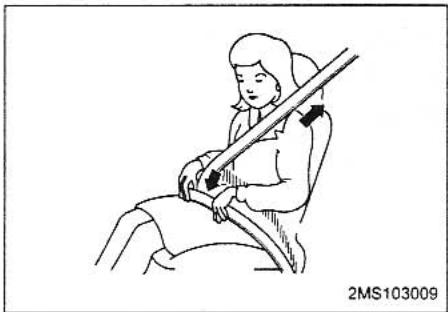
- Position the lap portion of the belt across your lap as LOW ON THE HIPS as possible to reduce the risk of sliding under it during an accident. Adjust the belt to a SNUG FIT by pulling up on the shoulder portion of the safety belt. The belt retractor applies tension to the belt in order to take up excess webbing automatically and to maintain tension on the belt. For maximum safety, do not put any excess slack into the safety belt.
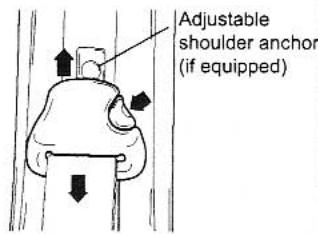
HEW.029
- You can adjust the height of the shoulder anchor to one of the four positions. Adjust the shoulder anchor position to your size.
To raise the anchor position, push the knob and push the anchor up. To lower the anchor position, push the knob and slide the anchor down.
After adjustment, make sure the anchor is locked in position.
WARNING-FRONT SAFETY BELTS
- The front seatbacks should always remain in a comfortable, upright position while the vehicle is in motion. The safety belt system will provide the most protection with the seatbacks in an upright position.
Never wear the shoulder portion of the safety belt under the outside arm or behind the back.
- Never wear the shoulder portion of the safety belt across the neck or face.
-
Wear the lap portion of the safety belt as low on the hips as possible. Be sure the lap belt fits snugly around the hips. Never wear the lap belt over your waist.
-
Never drive or ride with a twisted or jammed safety belt. If you cannot untwist or unjam the safety belt, see the nearest Kia dealer or qualified technician immediately.
- Never use a single belt to restrain more than one person at a time.
Failure to follow these warnings will increase the risk and severity of injury in an accident.
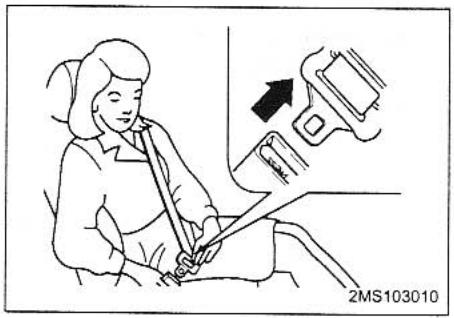
TO UNFASTEN THE FRONT LAP/SHOULDER BELT:
Press the release button on the buckle.
REAR LAP/SHOULDER BELT(REAR CENTER SEAT)
TO FASTEN THE REAR LAP/ SHOULDER BELTS
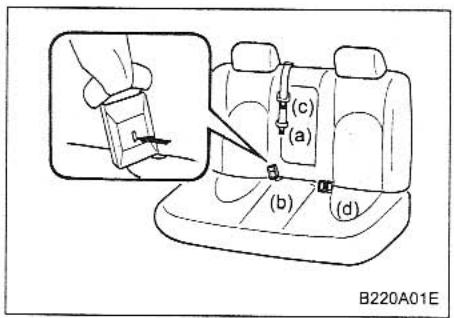
-
Before fastening the rear seat center belt, confirm that tongue plate (a) and buckle (b) are locked.
-
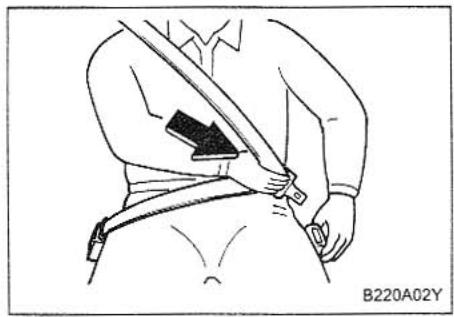
After confirming that (a) and (b) are in the locked condition, pull the seat belt out of the retractor and insert the tongue plate (c) into the open end of buckle (d).
There will be an audible "click" when the tab locks in the buckle. The seat belt automatically adjusts to the proper length only after the lap belt is adjusted manually so that it fits snugly around your hips, if you lean forward in a slow, easy motion, the belt will extend and let you move around. If there is a sudden stop or impact, the belt will lock into position. It will also lock if you try to lean forward too quickly.
WARNING:
- When using the rear seat center belt, you must lock all tongue plates and buckles. If any tongue plate or buckle is not locked, it will increase the chance of injury in the event of collision.
-
Never unlock the tongue plate (a) and buckle (b) unless the rear seatbacks are down or if the rear seat blet is damaged by other objects.
-
Lock the tongue plate (a) and buckle (b) immediately after folding the rear seatbacks up.
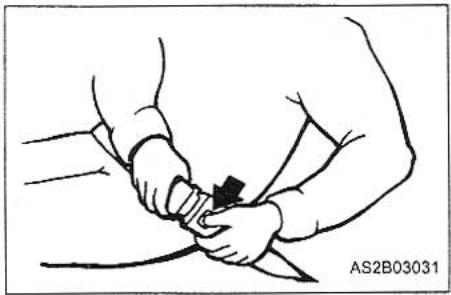
TO UNFASTEN THE REAR LAP / SHOULDER BELT:
Press the release button on buckle. To disconnect the tongue plate(a) from the buckle(b), insert a sharp-ended tool into the groove located on the buckle(b).
PROPER USE AND CARE OF THE SAFETY BELT SYSTEM
To ensure that the safety belts provide the maximum protection, please follow these instructions:
Use the belts at all times - even on short trips.
If the safety belt is twisted, straighten it prior to use.
- Keep sharp edges and damaging objects away from the belts.
Periodically inspect belt webbing, anchors, buckles, and all other parts for signs of wear and damage.
Replace damaged, excessively worn or questionable parts immediately.
To clean the belt webbing, use any mild soap solution recommended for cleaning upholstery or carpets. Follow the instructions provided with the soap.
- Do not bleach or dye the webbing because this may weaken the webbing fibers and allow them to fail when loaded in a collision.
- Do not make modifications or additions to the safety belt.
After wearing a safety belt, make sure it fully retracts to the stowed position. Do not allow the belt to get caught in the door when you close it.
AIR BAG -SUPPLEMENTAL RESTRAINT SYSTEM
What Your Air Bag System Does Your vehicle is equipped with a dual Supplemental Restraint System (SRS), which includes an air bag for the driver and another air bag for the front passenger.
WHAT YOUR AIR BAG SYSTEM DOES NOT DO
The air bag system is designed to supplement or add to the protection provided to properly BELTED occupants in moderate to severe frontal collisions. It is not a substitute for the driver's or front passenger's safety belt and it does not provide restraint to the lower body.
WHY DIDN'T MY AIR BAG GO OFF IN A COLLISION?
There are many types of accidents in which the air bag would not be expected to provide additional protection. These include side or rear impacts, rollovers, and second or third impacts in multiple-impact accidents as well as low speed impacts. Remember: air bags are only designed to inflate when the impact would throw the occupant into the air bags -generally from a little to the left to a little to the right of straight ahead. In other words, just because your vehicle is damaged end
even if it is totally unusable, don't be surprised that the airbag(s) did not inflate.
THE IMPORTANCE OF USING SAFETY BELTS
There are four very important reasons to use safety belts even with an air bag system, they:
- Help keep you in the proper position (away from the air bag) when it inflates.
- Reduce the risk of harm in rollover, side or rear impact collisions, because an air bag is not designed to inflate in such situations.
- Reduce the risk of harm in frontal collisions that are not severe enough to activate the supplemental restraint system.
- Reduce the risk of being thrown from your vehicle.
WARNING - AIR BAGS & SAFETY BELTS
Even in vehicles with air bags, you and your passengers must always wear the safety belts
provided in order to minimize the risk and severity of injury in the event of a collision or rollover.
Always wear your safety belt. It can help keep you away from the air bags during heavy braking just before a collision.
Air bags are designed to inflate only in severe frontal collisions and will generally not provide protection in side or rear impacts, rollovers or less severe frontal collisions. They will also not provide protection from later impacts in a multi-impact collision.
If your vehicle has been subjected to flood conditions (e.g. soaked carpeting/standing water on the floor of the vehicle, etc.) or if your vehicle has become flood damaged in any way, do not attempt to start the vehicle or put the key in the ignition before disconnecting the battery. This may cause air bag deployment, which could result in serious personal injury or death. Have the vehicle towed to an authorized Kia dealer for inspection and necessary repairs.
AIR BAG SYSTEM COMPONENTS
The main components of your vehicle's SRS are:
One air bag in the steering wheel for the driver, and another in the dashboard for the front passenger.
- A diagnostic system that continually monitors system operation.
An indicator light to warn you of a possible problem with the system.
Emergency power backup in case your car's electrical system is disconnected in a crash.
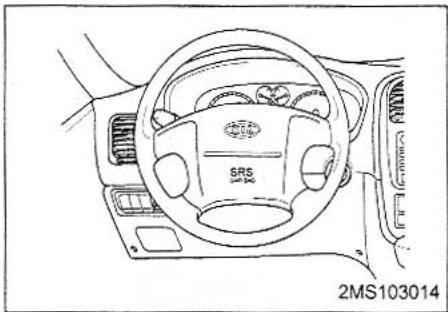
To indicate that your vehicle is equipped with air bags, the air bag covers on the steering wheel and on the dashboard are marked with "SRS AIR BAG."
HOW THE AIR BAG SYSTEM WORKS
The driver's air bag is stored in the center of the steering wheel. The passenger side air bag is stored in the front instrument panel above the glove box.
If you ever have a severe frontal collision, your air bags will instantly inflate to help protect you from serious physical injury.
There is no single vehicle speed at which the air bags will inflate. Generally, air bags are designed to inflate in severe frontal collisions. The air bag Supplemental Restraint System (SRS) reacts to the severity of a collision and its direction. These two factors determine whether the sensors send out an electronic deployment or inflation signal. Whether the air bags will inflate depends on a number of factors including vehicle speed, angle of impact and the density and stiffness of the vehicles or objects that your vehicle hits in the collision.
The air bags will completely inflate and deflate in less than 1/10 of one second.
The speed of inflation and deflation protects the driver's ability to operate the vehicle. This is important in crashes where a vehicle continues to move after an impact and the driver still has some control of the vehicle's steering, braking, throttle and/or transmission systems.
It is virtually impossible for you to see the air bags inflate during an accident. It is mush more likely that you will simply see the deflated air bags hanging out of their storage compartments after the collision.
In order to help provide protection in a severe collision, the air bags must inflate rapidly. However, that speed also causes the air bags to expand with a great deal of force. The speed of this inflation has been determined by the Canadian Motor Vehicle Safety Standards (CMVSS) to reduce the likelihood of serious or life-threatening
injuries and is thus a mandatory part of air bag design.
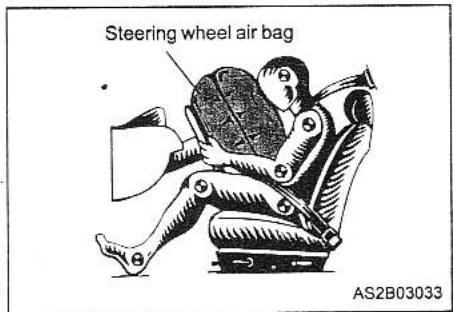
Thus, air bag inflation could also cause injuries which normally can include facial abrasions, bruises and broken bones. However, there are even circumstances under which contact with the steering wheel air bag can cause fatal injuries, especially if the occupant is posited excessively close to the steering wheel.
YOU MUST ALWAYS SIT AS FAR BACKFROM THE STEERING WHEEL AIRBAG AS POSSIBLE, WHILE STILL MAINTAINING A COMFORTABLE
SEATING POSITION FOR GOOD VEHICLE CONTROL, IN ORDER TO REDUCE THE RISK OF INJURY OR DEATH IN A COLLISION.
WARNING-AIR BAG INJURIES
- Sit as far back from the steering wheel as possible without interfering with your control of the vehicle.
Positioning yourself too close to the steering wheel can result in serious or even fatal injuries if the air bag deploys.
- Never place objects over the air bag storage compartments or between the air bags and yourself. Due to the speed and force of the air bag inflation, such objects could hit your body at high speed and cause severe bodily injury and even death.
NOISE AND SMOKE
When the air bags inflate, they make a loud noise and they leave smoke and powder in the air inside of the vehicle. This is normal and is a result of the ignition of the air bag inflator.
After the air bags inflate, you may feel substantial discomfort in breathing due both to the contact by your chest with both the safety belt and the air bag, as well as from breathing the smoke and powder.
We strongly urge you to open your doors and/or windows as promptly as possible after impact in order to reduce discomfort and prevent prolonged exposure to the smoke and powder.
WARNING - HOT METAL PARTS
- When the air bags deploy, the air bag inflators in the steering wheel and/or in the dashboard are very hot. To prevent injury, do not touch the air bag storage area's internal components immediately after an air bag has inflated.
THE IMPORTANCE OF THE PASSENGER BEING PROPERLY SEATED
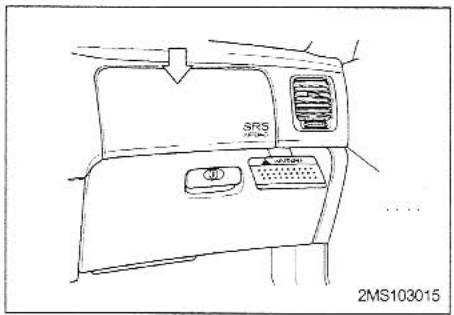
The front seat passenger's air bag is much larger than the driver's air bag and inflates with considerably more force. It can seriously hurt or kill a passenger who is not in the proper position and wearing the safety belt properly. The front passenger should always move their seat as far back as practical and sit well back in the seat. It is essential that the front passenger always wear their safety belt,
even when mounting in a parking lot or up a drive way into a garage.
The reason for this is that in most frontal impacts there is substantial pre-impact braking which tends to throw the occupants forward. If the right front passenger is not using their safety belt, they will be directly in front of or even touching the air bag storage compartment when inflation occurs. In that situation, death or severe injury is possible.
WARNING - RIGHT FRONT SEAT
Pre-impact braking could throw an unbelted passenger toward or onto the air bag storage compartment. Upon impact in a collision, the air bag would rapidly inflate and possibly severely injure or kill that occupant who failed to wear their safety belt.
Because of the air bag, you must NEVER INSTALL A REAR-FACING CHILD RESTRAINT SYSTEM IN THE FRONT PASSENGERSEAT.
There is a very significant risk of serious or fatal injuries to a child in a rear-facing child restraint if the right front passenger air bag inflates. We also strongly recommend that you do not put a front-facing child restraint system in the front passenger seat. If a front-facing child restraint system must be used in the front passenger seat, the vehicle seat should
be moved as far back as possible. If the passenger's air bag inflates, it could seriously or fatally hurt a child who is not in the proper position or properly restrained.
WARNING-FRONT PASSENGERS
NEVER use a rear-facing child restraint in the front seat. In the front seat, a rear-facing child restraint would be positioned too close to where the air bags are stored and in the event an air bag deploys, the air bag would impact the rear-facing child restraint and cause serious injuries or death.
- Failure to observe the instructions provided with the child restraint system could
increase the risk and/or severity of injury in an accident.
PASSenger PRESENCE DETECTION
The passenger presence detection system detects the presence of a passenger in the front seat. If no passenger is recognized on the front passenger seat, the deployment of the front passenger and/or side airbag will be prevented. This system is designed to prevent the replacement of airbag components that deploy needlessly in an accident.
WARNING:
The passenger presence Detection system is NOT intended to prevent airbag deployment while a child is in the front passenger's seat. It is intended ONLY as a means to reduce unnecessary collision damage repair expense by preventing airbag and seat belt pretensioner deployment when the right front passenger seat is unoccupied. Deployment is still possible if only a few pounds are placed upon the seat. Therefore, children must not be transported in the front seat. All children must be seated in the rear seat and properly restrained with the vehicle's restraint system or a child restraint system appropriate for the child's size and weight.
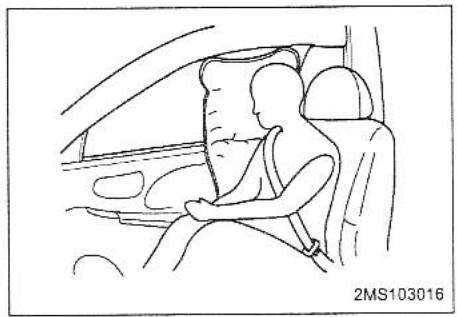
SIDE AIRBAG (IF EQUIPPED)
Your vehicle is equipped with a side airbag in each front seat. The purpose of the airbag is to provide the vehicle's driver and/or the front passenger with additional protection other than that offered by the seatbelt alone. The side impact airbags are designed to deploy only during certain side-impact collisions, depending on the crash severity, angle, speed and point of impact. The air bags are not designed to deploy in all side impact situations.
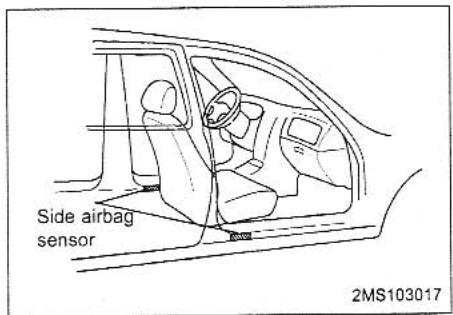
WARNING:
-
For best protection from the side airbag system and to avoid being injured by the deploying side airbag, both front seat occupants should sit in an upright position with the seat belt properly fastened. The driver's hands should be placed on the steering wheel at the 9:00 and 3:00 o'clock positions. The passenger's arms and hands should be placed in their laps.
-
Do not use any accessory seat covers.
Use of seat covers could reduce the effectiveness of the system. - Do not install any accessories on the side or near the side airbag.
- Do not use excessive force on the side of the seat.
- Do not place any objects over the airbag or between the airbag and yourself.
- Do not place any objects (an umbrella, bag, etc.) between the front door and the front seat. Such objects may become dangerous projectiles and cause injury if the side air bag inflates.
- To prevent unexpected deployment of the side air bag that may result in personal injury, avoid impact to the side airbag
sensor when the ignition key is "ON".
AIR BAG WARNING LIGHT
The purpose of the air bag warning light in your instrument panel is to alert you of a potential problem with your Air Bag - Supplemental Restraint System (SRS). Have the system checked if:
The light does not illuminate when you turn the ignition ON.
The light stays ON after the engine starts.
The light comes ON or flashes while you are driving.
AIR BAG WARNING LIGHT
AIR BAG
AS2B03035
SUPPLEMENTAL RESTRAINT SYSTEM SERVICE
Your Supplemental Restraint System is virtually maintenance-free. There are no parts which you can service.
You must have the system serviced under the following circumstances:
- If an air bag ever inflates, the air bag must be replaced. Do not try to remove or discard the air bag by yourself. This must be done by an authorized Kia dealer or a qualified service technician.
If the air bag warning indicator light alerts you of a problem, have the air bag system checked as soon as possible. Otherwise, your air bag might not inflate when you need it.
WARNING-SRS MODIFICATIONS
- Do not modify your steering wheel or any other part of the Supplemental Restraint System. Modification could make the system ineffective.
- Do not work on the system's components or wiring. This could cause the air bags to inflate inadvertently, possibly seriously injuring someone. Working on the system could also disable the system so that the air bags do not deploy in a collision.
TRUNKLID
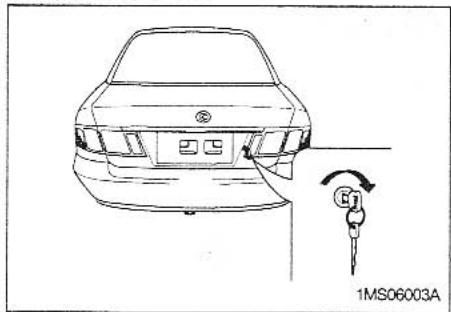
To open the trunk, insert the key into the lock and turn it clockwise until an audible "click" is heard.
To close the trunk, use both hands to push the trunk lid down until the lock "snaps" shut.
- Do not slam the trunk lid.
Pull up on the trunk lid to make sure it is securely latched.
To prevent premature wear or damage to the trunk lid lift cylinders and attaching hardware, the trunk lid must be fully closed before you drive your vehicle.
WARNING-EXHAUST FUMES
If you drive with the trunk lid open, you will draw dangerous exhaust fumes into your vehicle.
If you must drive with the trunk lid open, keep the air vents open so that additional outside air comes into the vehicle.
EMERGENCY TRUNK SAFETY RELEASE (IF EQUIPPED)
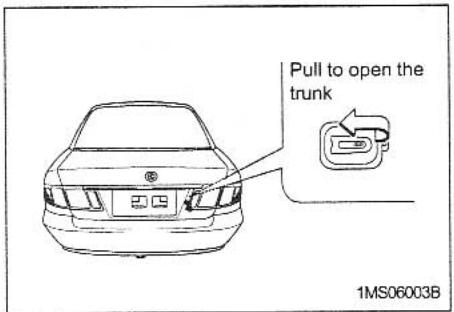
Your vehicle is equipped with an emergency trunk release cable located inside the trunk. When pulled, this cable will release the trunk latch mechanism and open the trunk.
WARNING:
No one should be allowed to occupy the trunk of the vehicle at any time. If the trunk is partially or totally closed and the person is unable to get out, severe injury or death could occur due to lack of ventilation, fumes and rapid heat build-up, or because of exposure due to cold weather conditions. The trunk is also a highly dangerous location in the event of a crash because it is not a protected occupant space. In fact, it is part of the vehicle's crush zone.
REMOTE TRUNK LID RELEASE
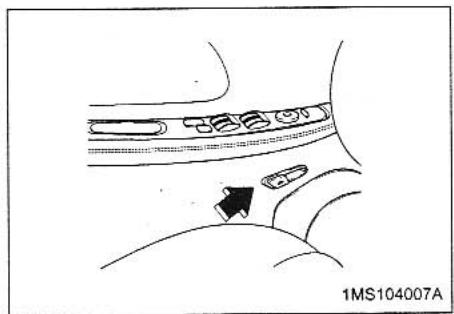
To open the trunk, press the release switch.
TRUNK LID KNOB LOCK
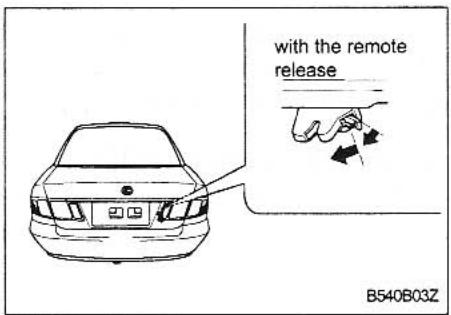
The trunk lid lock knob (located near the latch) is in the "LOCK" position when the trunk lid is closed, it will not be possible to open the trunk lid by using the remote release. In this instance, use the master key to unlock and open the trunk lid. To allow the trunk lid to be opened with the remote release, push the trunk lid lock knob down, then to the opposite direction of the "LOCK" position.
*NOTICE:
If a person is locked in the trunk by choice, by accident or by another person, the trunk lid can be opened by pushing the lid lock knob down.
While unattended, vehicles should be locked and the keys kept out of the reach of children. Children should be taught about the dangers of playing in a vehicle trunk.
HOOD OPENING THE HOOD
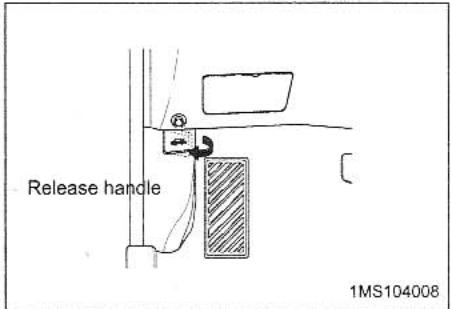
- Inside the vehicle, pull the hood release handle located at the bottom left corner of the instrument panel.
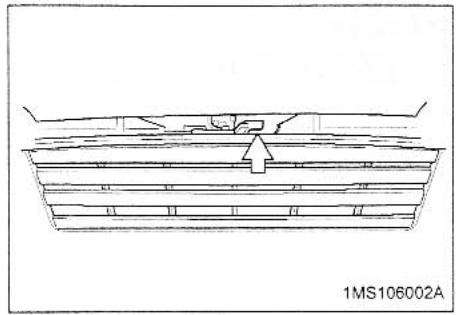
- Go to the front of the vehicle, raise the hood until the secondary latch catches then all the secondary latch up (located under the hood at the center of the grille).
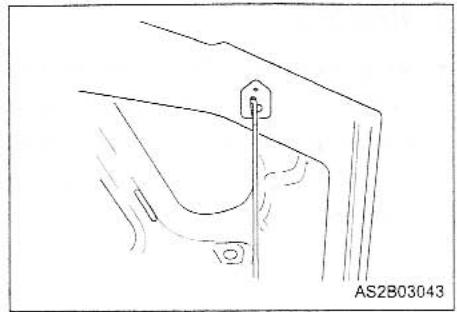
- Lift the hood and hold it open with the prop rod by inserting the free end of the rod into the slot.
CAUTION:
Before closing the hood, make sure that all parts and tools have been removed from the engine area and that everyone is clear of the hood opening.
CLOSING THE HOOD
Before closing the hood, secure the prop rod in its retainer to prevent it from rattling.
- Check the underhood area to make certain all filler caps are in place and that all loose items have been removed.
- Close the hood firmly so that it latches securely. Do not slam it shut.
FUEL FILLER DOOR REMOTE FUEL FILLER DOOR RELEASE
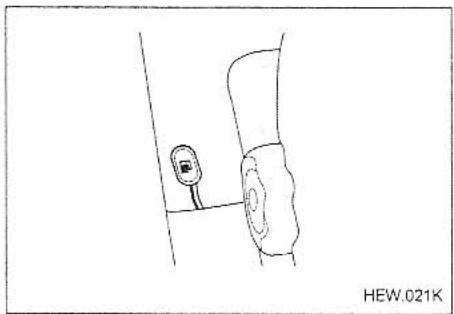
Pull up on the release lever (located on the floor) at the left front corner of the driver's seat to open the filler door.
WARNING - FUEL FILLING
-
Fuel may be under pressure. Always remove the fuel cap carefully and slowly. If the cap is venting fuel or if a hissing sound is heard, wait until the condition stops before completely removing the cap. If these precautions are not followed, fuel may spray out and cause serious personal injury.
-
Fuel vapor is extremely hazardous and can explode. When refueling, always stop the engine and never allow sparks or open flames near the filler neck. Always extinguish cigarettes and other smoking materials before refueling.
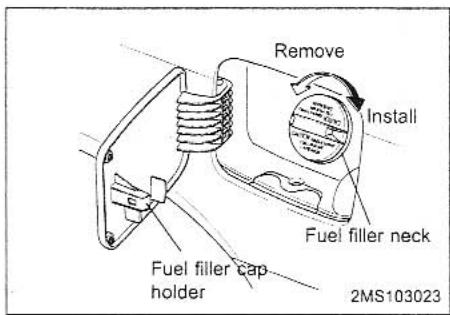
To remove the cap, turn it counterclockwise.
- To install the cap, turn it clock wise until it "clicks."
This indicates that the cap is securely tightened.
*NOTICE:
A loose fuel filler cap may cause the OBD-II Malfunction Indicator Light light in the instrument panel to illuminate unnecessarily. Always ensure that the fuel filler cap is tight.
The fuel filler neck is designed to prevent filling the fuel tank with anything but unleaded fuel.
*NOTICE:
If the fuel filler cap requires replacement, use only a genuine Kia cap or the equivalent specified for your vehicle. An incorrect fuel filler cap can result in a serious malfunction of the fuel system or emission control system. Correct replacement caps are available at Authorized Kia Dealers.
If the fuel filler lid will not open in cold weather because the area around it is frozen, push or lightly tap the lid.
*NOTICE:
Do not spill fuel on the exterior surfaces of the vehicle. Any type of fuel on painted surfaces may damage the paint and creates a fire hazard.
STEERING WHEEL HORN
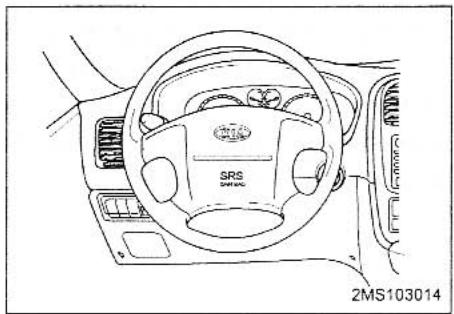
To sound the horn, press the horn symbol on your steering wheel.
MIRRORS OUTSIDE REARVIEW MIRROR
Your vehicle is equipped with both left-hand and right-hand outside rearview mirrors. The mirrors can either be adjusted remotely with the control levers or remote switch, depending on the type your vehicle has. The mirror heads can be folded rearward to prevent damage when using an automatic car wash or passing another vehicle in a narrow street.
CAUTION:
The right outside rearview mirror is convex. Objects seen in the mirror are closer than they appear.
- When changing lanes, use your interior rearview mirror or direct observation to determine the actual distance of following vehicles behind you.
*NOTICE:
Do not scrape ice off the mirror face; this may damage the surface of the glass. If ice should restrict movement of the mirror, do not force the mirror to adjust it.
To remove ice, use a de-icer spray, or a sponge or soft cloth with very warm water.
OUTSIDE REARVIEW MIRROR
ELECTRIC REMOTE CONTROL
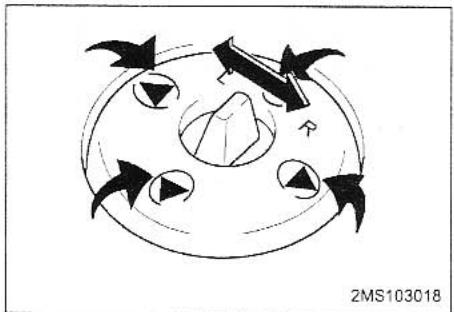
This switch, located on the armrest of the driver's door, controls the adjustments for both right and left outside mirrors. To adjust the position of either mirror:
-
Move the selector switch to the right or left to activate the adjusting mechanism for the corresponding mirror.
-
Adjust the mirror angle by depressing the mirror adjustment control switch in the desired direction.
*NOTICE:
The mirrors stop moving when they reach the maximum adjusting angles, but the motor continues to operate while the switch is depressed. Do not depress the switch longer than necessary or the motor may be damaged.
OUTSIDE REARVIEW MIRROR HEATER (IF EQUIPPED)
The outside rearview mirror heater is actuated in conjunction with the rear window defroster. To heat the outside rearview mirror glass, push the switch for the rear window defroster.
The rearview mirror glass will be heated for defrosting or defogging and will give you improved rear vision in inclement weather conditions. Push the switch again to turn the heater off.
The outside rearview mirror heater automatically turns itself off after 20 minutes.
DAY/NIGHT REARVIEW MIRROR
Adjust the rearview mirror to center on the view through the rear window. Make this adjustment before you start driving and while the day/night lever is in the day position.
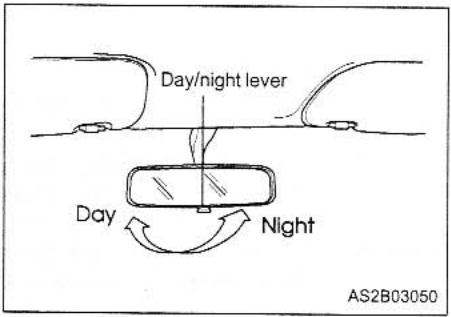
Pull the day/night lever toward you to reduce glare from the headlights of vehicles behind you during night driving. Remember that you lose some rearview clarity in the night position.
Z CAUTION:
Do not allow objects in the rear seat to interfere with your line of vision through the rear window.
INTERIOR LIGHTS DOME LIGHT
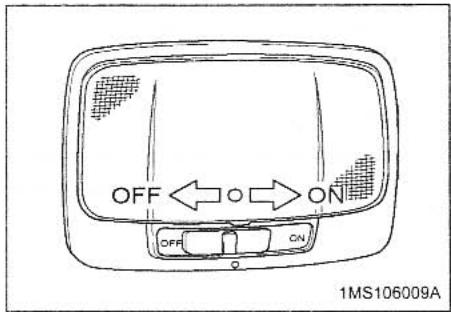
The dome light switch, located in the light assembly, has three positions: OFF- The light stays OFF even when a door is open.
The light turns ON or OFF when a door is opened or closed.
ON - The light turns ON and stays ON even when the doors are all closed.
MAP LIGHT (WITH SUNROOF ONLY)
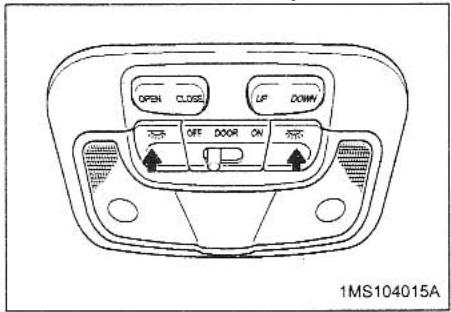
This light switch has three positions:
OFF - The light stays OFF even when a door is open.
-DOOR - The driver's side light turns ON when the door opens and light turns OFF when the door closes.
- ON - The light turns ON and stays ON position even when the doors are all closed.
The lights are switched ON or OFF by pressing the corresponding switches.
MAP LIGHT (WITH SUN GLASSES)
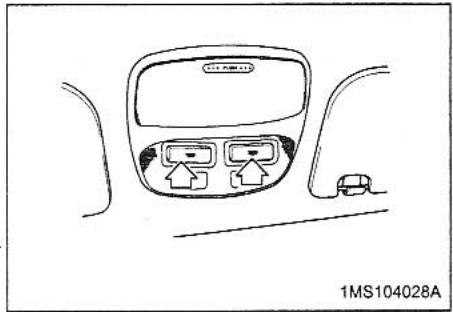
The lights are switched ON or OFF by pressing the corresponding switches.
FRONT DOOR EDGE WARNING LIGHT (IF EQUIPPED)
A red light comes on when the front door is opened. The purpose of this light is to assist when you get in or out and also to warn passing vehicles.
CUP HOLDERS AND CONSOLE STORAGE COMPARTMENT
The cup holders and console storage compartment are located in the center console.
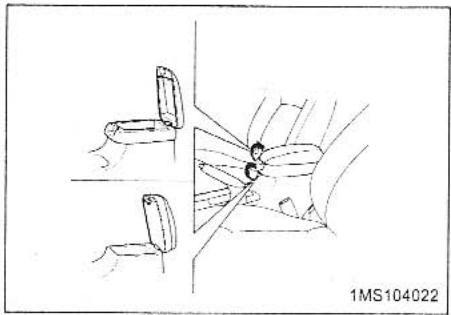
CONSOLE STORAGE COMPARTMENT ARMREST TYPE (If Equipped)
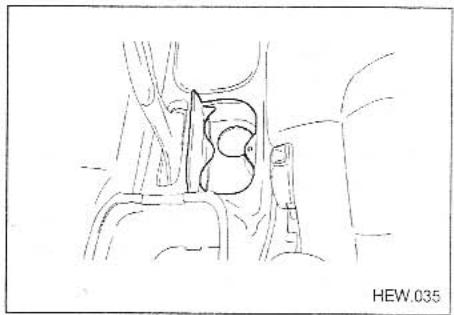
CUP HOLDERS
The cup holder is located on the main console for holding cups or cans. The cup holder can be opened by pressing. The cover will slowly open.
CAUTION:
Place the cup holder in its closed position while not in use.

WARNING
- Do not place uncovered cups of hot liquid in the cup holder while the vehicle is in motion. If the hot liquid spills, you could be burned and lose control of the vehicle.
To reduce the risk of personal injury in the event of a sudden stop or collision, donot place bottles, drinking glasses, cans, etc., in the cup holder while the vehicle is in motion.
SUNGLASS HOLDER (IF EQUIPPED)
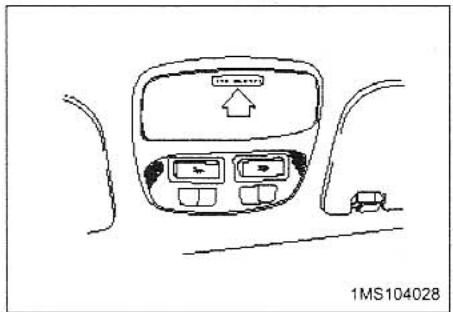
At the overhead console a compartment is provided for the storage of a sunglasses. Press the cover latch to open the compartment. The cover will slowly be in an open position.
COIN HOLDER
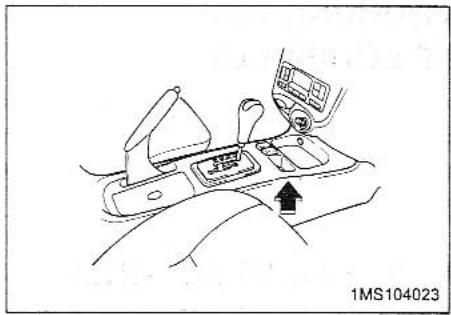
Located in the center console compartment are coin holder slots. Do not use the coin slots as an ashtray.
SUNROOF (IFEQUIPPED)
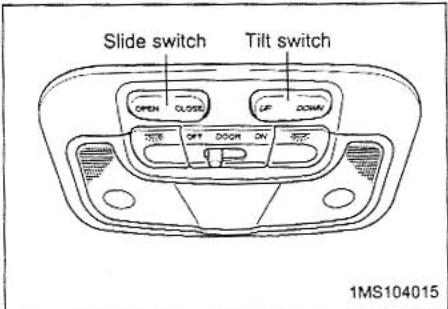
Your sunroof can be opened or closed electrically when the ignition switch is in the "ON" position. You can slide or tilt the sunroof by depressing the corresponding switch located on the dome light assembly.
To tilt the sunroof, depress the "TILT" button (up) located on the dome light assembly. To close it, depress the "TILT" button (DOWN) again.
To slide open the sunroof, depress the "SLIDE" button (OPEN) located on the dome light assembly. Press and hold the button and then release the button when the sunroof reaches the desired position. To close the sunroof, depress the "SLIDE" button (CLOSE) and hold it until it is closed completely.
Asunroof that is slid open cannot be tilted from that position, and a sunroof that is tilted cannot be slid open from that position. Close the sunroof first before changing from a slid to a tilt position and vice versa.
*NOTICE:
The sunroof is made to slide together with sun shade. Do not try to close the sun shade while the sunroof is open.
- Release the switch button as soon as the sunroof is fully opened or closed. If kept on, the sunroof may be damaged.
While the vehicle is unattended, make sure that the sunroof is fully closed.
WARNING:
Never stick your head, arms, etc. out of the sliding sunroof.
*NOTICE:
Periodically remove any dirt that may have accumulated on the guide rail.
- Should the sliding sunroof malfunction, it can be opened or closed manually with the hexa-head wrench furnished in the glove compartment.
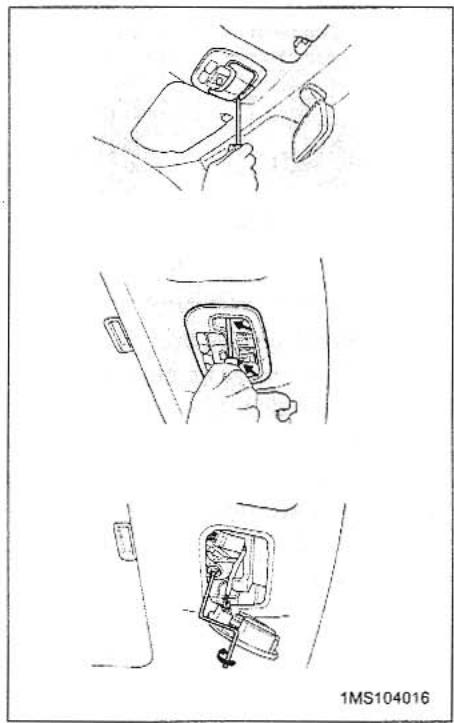
MANUAL OPERATION
If the sunroof does not electrically operate
- Remove the retangular plastic lens in the front of the roof panel.
- Turn the cross bolt with a phillips screw driver counterclockwise to remove the front dome light assembly.
- Insert the hexagonal head wrench provided with the vehicle into the socket. This wrench can be found in the glove box.
- Turn the wrench clockwise to open or counterclockwise to close.
Z CAUTION:
If you try to open the sunroof when the temperature is below freezing-point or when the sunroof is covered with snow or ice the glass pane or the sunroof motor could be damaged.
RESETTING THE SUNROOF
When your battery happens to be disconnected or you use the hexagonal head wrench to operate the sunroof, you have to re-set your sunroof motor as follows:
- Turn the ignition key to the ON position.
Pull the sunroof fuse out from the main fuse box in engine compartment and reinstall it.
Depress the front portion of sunroof switch and hold it during 5 seconds.
SUNSHADE (IF EQUIPPED)
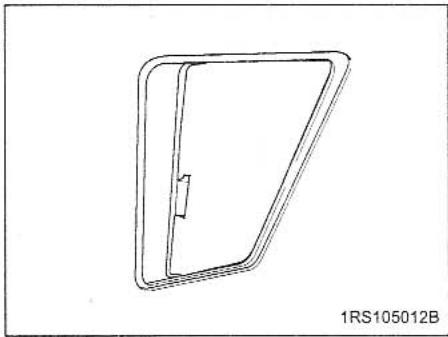
The sunshade can be opened with the glass panel automatically when the glass panel is slid. To close the sunshade you have to do so manually.
ANTENNA MANUAL ANTENNA (IF EQUIPPED)
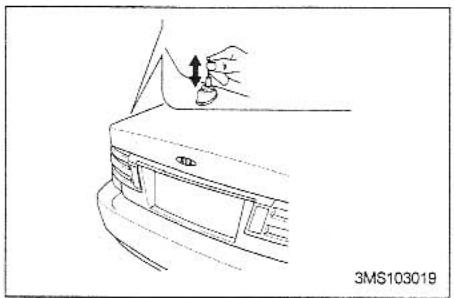
Your car uses a manual stainless steel antenna to receive both AM and FM broadcast signals. Pull up the antenna using your fingers, as shown in the drawing.
*NOTICE:
Before entering an automatic car wash or a place with a low height clearance, be sure that the antenna is fully retracted.
POWER ANTENNA (IF EQUIPPED)
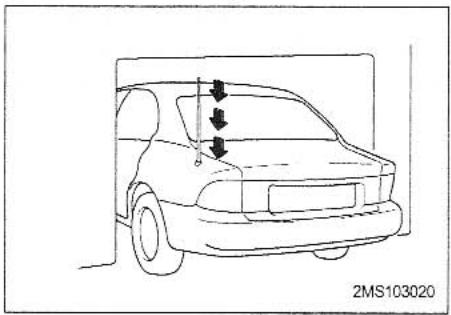
The antenna will automatically be extended when the radio power switch is turned "ON" while the ignition key is either in the "ON" or "ACC" position. The antenna will automatically be retracted and stored when either the radio power switch is turned "OFF" or the ignition key is set to the "LOCK" position.
*NOTICE:
Before turning on the radio, make sure that no one is near the antenna.
- Before entering an automatic car wash or a place with a low height clearance, be sure that the antenna is retracted and stored.
- If the antenna is dirty, be sure to clean it in order to avoid an operation malfunction.
Luggage NET (IF EQUIPPED)
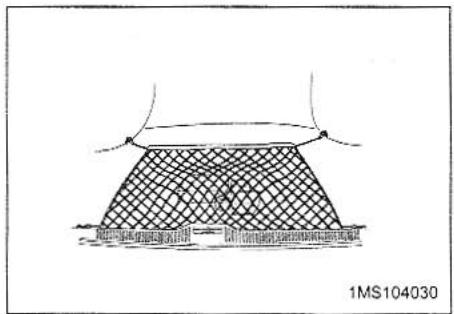
CARGO NET
When you drive with cargo loaded in the trunk room, it can be recured with the luggage net as shown in the illustration.
Z CAUTION:
Do not overload the luggage net with bulky or numerous items, Securing fragile items with the luggage net while driving is not recommended.
Ignition Switch 4-2
Starting the Engine 4-4
Manual Transaxle 4-6
Automatic Transaxle 4-7
Brake System 4-12
Power Steering 4-17
Tilt Steering 4-17
Instrument Cluster 4-18
Gauges 4-19
Warnings and Indicators 4-20
Lightings 4-25
Daytime running lights (DRL) 4-27
Front fog light switch (If Equipped) 4-27
Wipers and Washers 4-28
Rear Window Defroster 4-30
Interior Features 4-30
Cruise Control (If Equipped) 4-35
Climate Control System 4-38
Automatic Heating and Cooling Control System 4-42
IGNITION SWITCH ILLUMINATED IGNITION SWITCH
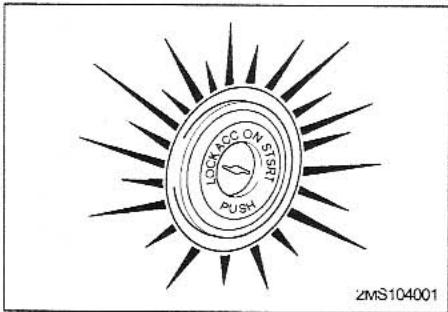
Whenever a door is opened, the ignition switch will be illuminated for your convenience, provided the ignition switch is not in the "ON" position. The light will go off approximately 10 seconds after closing the door or when the ignition switch is turned on.
IGNITION SWITCH AND ANTITHEFT STEERING COLUMN LOCK
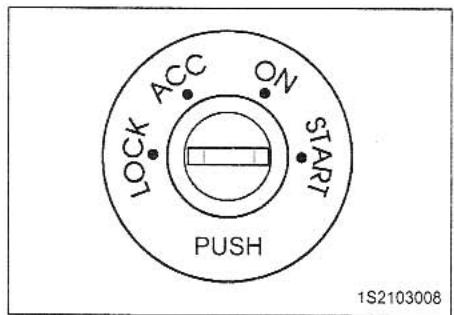
IGNITION SWITCH POSITION LOCK
The steering wheel is locked to protect against theft. The ignition key can be removed only in the LOCK position. For vehicles equipped with an automatic transaxle, it also locks the gear shift lever in the P (Park) position.
ACC (ACCESSION)
Turning the ignition switch to this position unlocks the steering wheel and will allow some of your vehicle's electrical accessories such as the radio to operate when the engine is OFF.
ON
Turning the ignition switch to this position allows you to test your vehicle's warning lights (except the brake system warning light) to make sure they work before you start the engine. The ignition key returns to the ON position once the engine is started and remains in this position while the engine is running. Do not leave the ignition switch in the ON position for extended periods with the engine OFF because the battery will discharge.
START
Turn the ignition key to the START position to start the engine. The engine will crank until you release the key, then it returns to the ON position. Also, the brake warning indicator illuminates to check the bulb in this position. Difficulty in turning the ignition key to the START position can be caused by pressure on the switch from the steering column. To allow the ignition key to turn, move the steering wheel right or left to release the tension and then turn the key.
念 NOTICE:
For safety, the engine will not start if the clutch pedal is not depressed fully on manual transaxle equipped models.
WARNING
- Never turn the ignition switch to LOCK or ACC while the vehicle is moving. This could result in loss of directional control and braking function, which could cause an immediate accident.
- Never reach for the ignition switch, or any other controls, through the steering wheel while the vehicle is in motion. Failure to observe this warning can result in loss of vehicle steering and braking control, which may result in an accident.
AUTOMATIC TRANSAXLE
When turning the ignition switch to the LOCK position, the shift lever must be in the P (Park) position.
MANUAL TRANSAXLE
When turning the ignition switch to the LOCK position, push the key inward at the ACC position and turn the key toward the LOCK position.
STARTING THE ENGINE
- Make sure the parking brake is applied.
- Manual Transaxle - Depress the clutch pedal fully and shift the transaxle into NEUTRAL. Keep the clutch pedal depressed while cranking the engine.
(For safety, the engine will not start if the clutch pedal is not depressed fully on manual transaxle equipped models.)
Automatic Transaxle - Place the transaxle shift lever in P (Park).
Depress the brake pedal fully.
You can also start the engine if the shift lever is in the N (Neutral) position.
3. Turn the ignition switch to START and hold it until the engine starts (a maximum of 10 seconds), then release the key.
In extremely cold weather, below 0°F (minus 18°C ), or after the vehicle has not been operated for several days, let it warm up without depressing the accelerator.
Whether the engine is cold or warm, it should be started without depressing the accelerator.
CAUTION
If the engine stalls while you are in motion, do not attempt to move the shift lever to P (Park).
If it is safe to do so considering traffic and road conditions, you may put the shift lever in the N (Neutral) position while still moving and turn the ignition switch to the START position in an attempt to restart the engine.
If the engine fails to start using this procedure, attempt the following. The engine fails to start when the engine is cold (engine coolant temperature is below 32°F / 0°C ):
A no start condition may be caused by an engine that has become flooded (has excessive fuel in the cylinders). If this is the case, follow the starting procedure below.
- Make sure the parking brake is applied.
- Manual Transaxle - Depress the clutch pedal fully and shift the transaxle into N (Neutral). Keep the clutch pedal depressed while cranking the engine.
Automatic Transaxle - Place the transaxle shift lever in P (Park) or N (Neutral). Depress the brake pedal fully.
- Depress the accelerator fully and hold it.
- While holding the accelerator fully depressed, turn the ignition switch to the START position and hold it (a maximum of 10 seconds) to discharge the excess fuel.
If the engine starts, the engine speed will increase suddenly; immediately
release the ignition key and the accelerator.
If the engine has not yet started, release the accelerator after cranking the engine.
- Without depressing the accelerator, crank the engine until it starts (a maximum of 10 seconds).
If the engine fails to start when the engine is warm:
If the engine is unusually difficult to restart when it is warm (fails to start after repeated attempts without depressing the accelerator):
-
Make sure the parking brake is applied.
-
Manual Transaxle - Depress the clutch pedal fully and shift the transaxle into N (Neutral). Keep the clutch pedal depressed while cranking the engine.
Automatic Transaxle - Place the transaxle shift lever in P (Park) or N (Neutral).Depress the brake pedal fully.
-
While depressing the accelerator pedal about halfway down, turn the ignition switch to the START position and hold it (a maximum of 10 seconds).
-
After the engine has started, let it idle for about 10 seconds before driving.
*NOTICE:
Do not engage the starter for more than 10 seconds. If the engine stalls or fails to start, wait 5 to 10 seconds before re-engaging the starter. Excessive or improper use of the starter may damage it.
In some models, the starter may not operate if:
- In an automatic transaxle, the shift lever is NOT in P (Park) or N (Neutral).
- In a manual transaxle, the clutch pedal is not fully depressed.
Excessive engine noise (from valve tappets) may occur if the engine has not been operated for an extended period. The noise should stop after the engine has reached normal operating temperature.
If the noise does not stop, have the vehicle
inspected by an Authorized Kia Dealer.
MANUAL TRANSAXLE
MANUAL TRANSAXLE OPERATION
The shift pattern is conventional for five forward gears, as shown below.
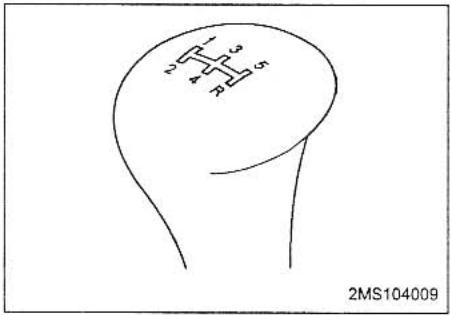
Press the clutch pedal down fully while shifting, then release it slowly.
A special safety feature prevents inadvertent shifting from 5 (Fifth) to R (Reverse). The gearshift lever must be returned to the Neutral position before shifting into R (Reverse).
*NOTICE
Make sure the vehicle is completely stopped before shifting into R (Reverse).
*NOTICE
To avoid premature clutch wear and damage, do not drive with your foot resting on the clutch pedal. Also, don't use the clutch to hold the vehicle stopped on an upgrade (while waiting for a traffic light, etc).
WARNING - MANUAL TRANSAXLE
- Before leaving the driver's seat, always set the parking brake fully and shut the engine OFF, then make sure the transaxle is shifted into 1st gear.
Unexpected and sudden vehicle movement can occur if these precautions are not followed in the order identified.
AUTOMATIC TRANSAXLE OPERATION
A Type (If Equipped)
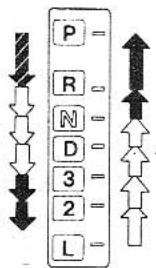
B Type (If Equipped)
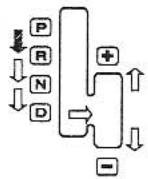
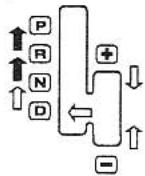
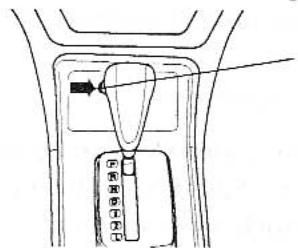
Lock release button prevents shift lever movement without first depressing the button.
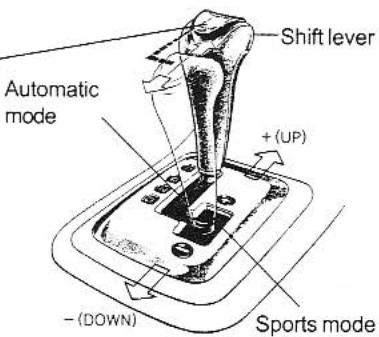

Depress the brake pedal and push the button when shifting.

The lock release button must be depressed while moving the shift lever.

The shift lever can be moved without depressing the lock release button.
AUTOMATIC TRANSAXLE OPERATION
All normal forward driving is done with the shift lever in the D (Drive) position. To move the shift lever from the P (Park) position, the ignition switch must be in the ON position, the brake pedal must be depressed, and the lock release button must be depressed.
For smooth operation, depress the brake pedal when shifting from N (Neutral) to a forward or Reverse gear.
CAUTION:
- Do not accelerate the engine in R (Reverse) or any of the forward positions with the brakes on.
-
When stopped on an upgrade, do not hold the vehicle stationary with engine power. Use the service brake or the parking brake.
-
Do not shift from N (Neutral) or P (Park) into L, 2 (2nd), 3(3rd), D (Drive) or R (Reverse) when the engine is above idle speed.
WARNING - AUTOMATIC TRANSAXLE
- Before leaving the driver's seat, always make sure the shift lever is in the P (park) position; then set the parking brake fully and shut the engine off. Unexpected and sudden vehicle movement can occur if these precautions are not followed in the order identified.
NORMAL OPERATION P(Park)
This position locks the transaxle and prevents the front wheels from rotating. Always come to a complete stop before shifting into this position.
WARNING:
Shifting into P (Park) while the vehicle is in motion will cause the front wheels to lock and you will lose driving control of the vehicle.
*NOTICE:
The transaxle may be damaged if you shift into P (Park) while the vehicle is in motion.
WARNING:
- Do not use the P (Park) position in place of the parking brake when leaving the vehicle. Always make sure the shift lever is latched in the P (Park) position so that it cannot be moved unless the lock release button is pushed in AND the parking brake is fully set.
- Turn the ignition switch OFF whenever you leave the vehicle unattended. Never leave the vehicle unattended while the engine is running. Unexpected and sudden vehicle movement may occur if these precautions are not taken.
- Never leave a child unattended in a vehicle.
R (Reverse)
Use this position to drive the vehicle backward.
CAUTION:
Always come to a complete stop before shifting into or out of R (Reverse). You may damage the transaxle if you shift into R while the vehicle is in motion, except as explained in "Rocking the Vehicle."
N (Neutral)
In this position, the wheels and transaxle are not locked. The vehicle will roll freely even on the slightest incline unless the parking brake or service brakes are applied.
D (Drive)
- Only "A" Type
This is the normal forward driving position. The transaxle will automatically shift through a four-gear sequence, providing the best fuel economy and power.
Never downshift manually to "2" position or "L" position when vehicle speed is more than 60mph(96km/h)
- Only "B" Type
This is the normal forward driving position. The transaxle will automatically shift through a four-gear sequence, providing the best fuel economy and power.
3(3rd):only"A"Type
Move shift lever to this position for towing a trailer during hill climbing.
This position also provides engine braking when going down hills.
2 (2nd):only“A”Type
Move shift lever to this position for driving in heavy, slow-moving traffic or when climbing hills. This position also provides engine braking when going down hills and helps reduce wheel spin on slippery surfaces.
L (LOW):only“A”Type
Move the shift lever to this position in hard pulling situations and for climbing or descending steep grades.
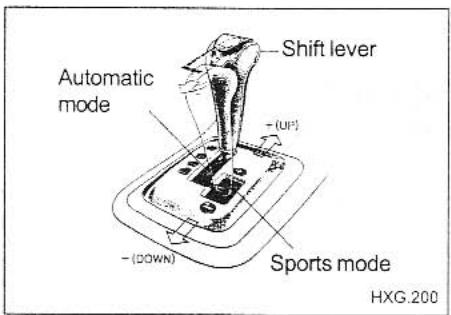
SPORTS MODE :Only "B"type
Whether the vehicle is stationary or in motion, sports mode is selected by pushing the shift lever from the "D" position into the manual gate. To return to "D" range operation, push the selector lever back into the main gate.
In sports mode, moving the shift lever backwards and forwards can make gearshifts rapidly. In contrast to a manual transaxle, the sports mode allows gearshifts with the shift pedal depressed.
Up(+) :Push the lever forward once to shift up one gear.
Down(-): Pull the lever backwards once to shift down one gear.
*NOTICE:
In sports mode, only the four forward gears can be selected. To reverse or park the vehicle, move the shift lever to the "R" or "P" position as required.
- In sports mode, downward shifts are made automatically when the vehicle slows down. When the vehicle stops, 1st gear is automatically selected.
In sports mode, shift points are varied to upward shifts automatically when the engine rpm approaches red zone.
To maintain the required levels of vehicle performance and safety, the system may not execute certain gear shifts when the shift lever is operated.
- When driving on a slippery road, push the shift lever forward into the + (up) position. This causes the transaxle to shift into the 2nd gear which is better for smooth driving on a slippery road. Push the shift lever to the - (down) side to shift back to the 1st gear.
*NOTICE:
- For smooth and safe operation, depress the brake pedal when shifting from "Neutral" position or "Park" position to a forward or reverse gear.
- The ignition key must be in the "ON" position and the brake pedal fully depressed in order to move the shift lever from the "P"(Park) position to any of the other positions.
It is always possible to shift from "R", "N", "D" position to the "P" position.
But before shifting to "P" make sure the vehicle is fully stopped to avoid transaxle damage.
CAUTION:
- Shift into the "R" and "P" position only when the vehicle has completely stopped.
- Do not accelerate the engine in reverse or any of the forward positions with the brakes applied.
Always apply the footbrake when shifting from "P" or "N", to "R" or "D" position. - Do not use the "P" (Park) position in place of the parking brake. Always set the parking brake, shift the transaxle into "P" (Park) position and turn off the ignition when you leave the vehicle, even momentarily. Never leave the vehicle unattended while the engine is running.
- Check the automatic transaxle fluid level regularly, and add fluid as necessary.
MOVING UP A STEEP GRADE FROM A STANDING START
To move up a steep grade from a standing start, depress the brake pedal, shift the shift lever to D (Drive), 2 (2nd), or 1 (1st). Select the appropriate gear depending on load weight and steepness of the grade, and release the parking brake. Depress the accelerator gradually while releasing the service brakes.
BRAKE SYSTEM POWER BRAKES
Your vehicle has power-assisted brakes that adjust automatically through normal usage.
In the event that brake system power assist is lost because of a stalled engine or some other reason, you can still stop your vehicle by applying greater force to the brake pedal than you normally would. The stopping distance, however, will be longer than usual.
When the engine is not running, the reserve brake power is partially depleted each time the brake pedal is depressed. Do not pump the brake pedal when the power assist has been interrupted, except when necessary to maintain steering control on slippery surfaces.
ANTI LOCK BRAKES (ABS) (IF EQUIPPED)
The anti-lock brake system is designed to prevent lock-up of the wheels during sudden braking or braking on slippery surfaces. Compared to a conventional brake system, the anti-lock brake system provides greater steering control during braking in such situations.
WARNING-ABS BRAKES
- The anti-lock brake system (ABS) cannot compensate for bad road conditions, for unsafe or reckless driving or for bad judgement.
The ABS is designed to improve maximum braking effectiveness on typical highways and roads in good condition.
(Continued)
(Continued)
On road surfaces which are in poor condition, the ABS may actually reduce braking effectiveness.
Always operate your vehicle at reasonable speeds that are safe for weather and traffic conditions.
During normal driving conditions, the anti-lock brake system operates the same as a conventional brake system. When the anti-lock brake system is engaged due to imminent loss of traction, a pulsation of the brake pedal will result and you may hear or feel "chattering". This is a normal condition and indicates the system is functioning properly.
When driving a vehicle equipped with anti-lock brakes, adjust your driving according to the road and traffic conditions and keep the following in mind.
- Do not pump the brakes as you would when driving a vehicle not equipped with an anti-lock brake system (ABS). In order for the ABS to function normally, press the brake pedal firmly, without pumping the pedal.
- Even with the anti-lock brake system, your vehicle still requires a sufficient stopping distance. Always maintain a safe distance from the vehicle in front of you.
Always slow down when cornering. The anti-lock brake system cannot prevent accidents resulting from excessive speeds. - On loose or uneven road surfaces, operation of the anti-lock brake system may result in a longer stopping distance than for vehicles equipped with a conventional brake system.
- Avoid high speeds on wet roads. The anti-lock brake system cannot eliminate the risk of hydroplaning.
If the anti-lock brake system should fail, the brake system will function as a conventional brake system. Have your vehicle checked by an Authorized Kia Dealer or other competent repair shop as soon as possible.
*NOTICE:
- If the ABS warning light is on and stays on, you may have a problem with the ABS system. In this case, however, your regular brakes will work normally.
The ABS warning light will stay on for 2-3 seconds after the ignition "ON". During that time, the ABS will go through self-diagnosis and the light will go OFF if everything is normal. If the light stays on you may have a problem with your ABS.
(Continued)
(Continued)
Contact an Authorized Kia Dealer for service as soon as possible.
*NOTICE:
- If the battery is discharged and the engine is jump started, the ABS warning light may come on. This condition occurs because of a discharged battery and not because there is an anti-lock brake system malfunction.
- Have the battery recharged before driving the vehicle.
IN THE EVENT OF BRAKE FAILURE
If the service brakes should fail to operate while the vehicle is in motion, you can make an emergency stop with the parking brake. The stopping distance, however, will be much greater than normal.
WARNING-PARKING BRAKE Pulling on the parking brake while the vehicle is moving at normal speed can cause a sudden loss of control of the vehicle. If you must use the parking brake to stop the vehicle, use great caution in applying the brake.
WARNING:
- Do not drive with your foot resting on the brake pedal. This will create abnormally high brake temperatures, excessive brake lining and pad wear, and
increased stopping distances.
- When descending a long or steep hill, shift to a lower gear and avoid continuous application of the brakes.
Continuous brake application will cause the brakes to overheat and could result in a temporary loss of braking performance.
- Wet brakes may result in the vehicle not slowing down at the usual rate and/or pulling to one side when the brakes are applied. Applying the brakes lightly will indicate whether they have been affected in this way. Always test your brakes in this fashion after driving through deep water.
(Continued)
(Continued)
To dry the brakes, apply them lightly while maintaining a safe forward speed until brake performance returns to normal.
DISC BRAKE WEAR INDICATORS
Your vehicle has front disc brakes. When your front brake pads are worn and it's time for new pads, you will hear a high-pitched warning sound from your front brakes. You may hear this sound intermittently or constantly.
WARNING-BRAKE WEAR
This brake-wear warning sound means your vehicle needs service. If you ignore this audible warning, you will eventually lose braking performance, which could lead to a serious accident.
*NOTICE:
To avoid costly brake repairs, do not continue to drive with worn brake pads.
Some driving conditions or climates may cause a brake squeal when you first apply, or lightly apply, the brakes. This is normal and does not indicate a problem with your brakes.
REAR DRUM BRAKES (IF EQUIPPED)
Your rear drum brakes don't have wear indicators. Have the rear brake linings inspected if you hear a rear brake rubbing noise. Also, have your rear brakes inspected each time you change or rotate your tires and when you have the front brakes replaced.
CAUTION:
Always replace brake linings or front pads as complete front or rear axle sets.
PARKING BRAKE
- To set the parking brake, pull the parking brake handle fully and firmly upward while applying the service brake.
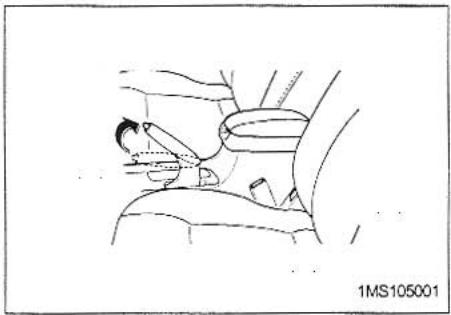
CAUTION:
Driving with the parking brake on will cause excessive wear of the brake linings and pads.
To release the parking brake, pull the handle up slightly and push the button. Then lower the handle to the released position while holding the button in.
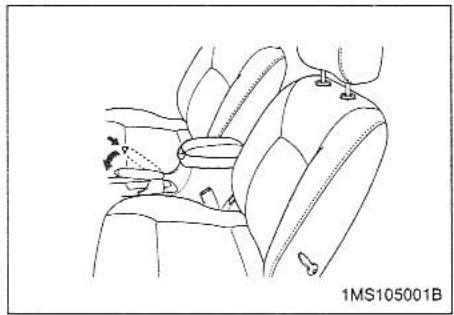
CAUTION:
When stopped, do not use the gearshift lever in place of the parking brake. Always set the parking brake fully AND make sure the gearshift lever is securely positioned in P (Park) with an automatic transaxle or in 1st (First) or R (Reverse) gear with a manual transaxle.
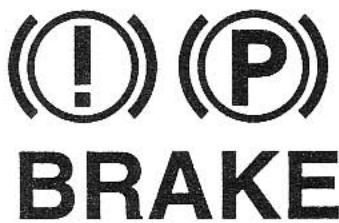
AS2B04009
Check the brake warning light each time you start the engine. The light is located in the instrument panel. This warning light will be illuminated when the engine is running and the parking brake is set. Before driving, be sure the parking brake is fully released and the brake warning light is off.
If the brake warning light remains on after the parking brake is released, there may be a malfunction in the brake system. Immediate attention is necessary. If at all possible, cease driving the vehicle immediately. If that is not possible, use extreme caution in operating the vehicle and only drive it until you reach the first safe location or a repair shop.
POWER STEERING
Power steering uses energy from the engine to assist you in steering the vehicle. If the engine is off or if the power steering system becomes inoperative, the vehicle may still be steered, but it will require increased steering effort. Should you notice any change in the effort required to steer during normal vehicle operation, have the power steering system checked by an Authorized Kia Dealer.
*NOTICE:
Never hold the steering wheel against a stop (extreme right or left turn) for more than five seconds with the engine running. Holding the steering wheel for more than five seconds in either position may cause damage to the power steering pump.
If the power steering drive belt breaks or if the power steering pump malfunctions, the steering effort will become greatly increased.
TILT STEERING
A tilt steering wheel allows you to adjust the steering wheel before you drive. You can also raise it to the highest level to give your legs more room when you exit and enter the vehicle.
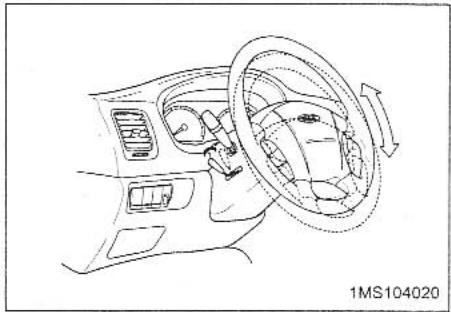
To tilt the wheel, hold the steering wheel and pull the lock release lever. Move the steering wheel to a comfortable level.
INSTRUMENT CLUSTER
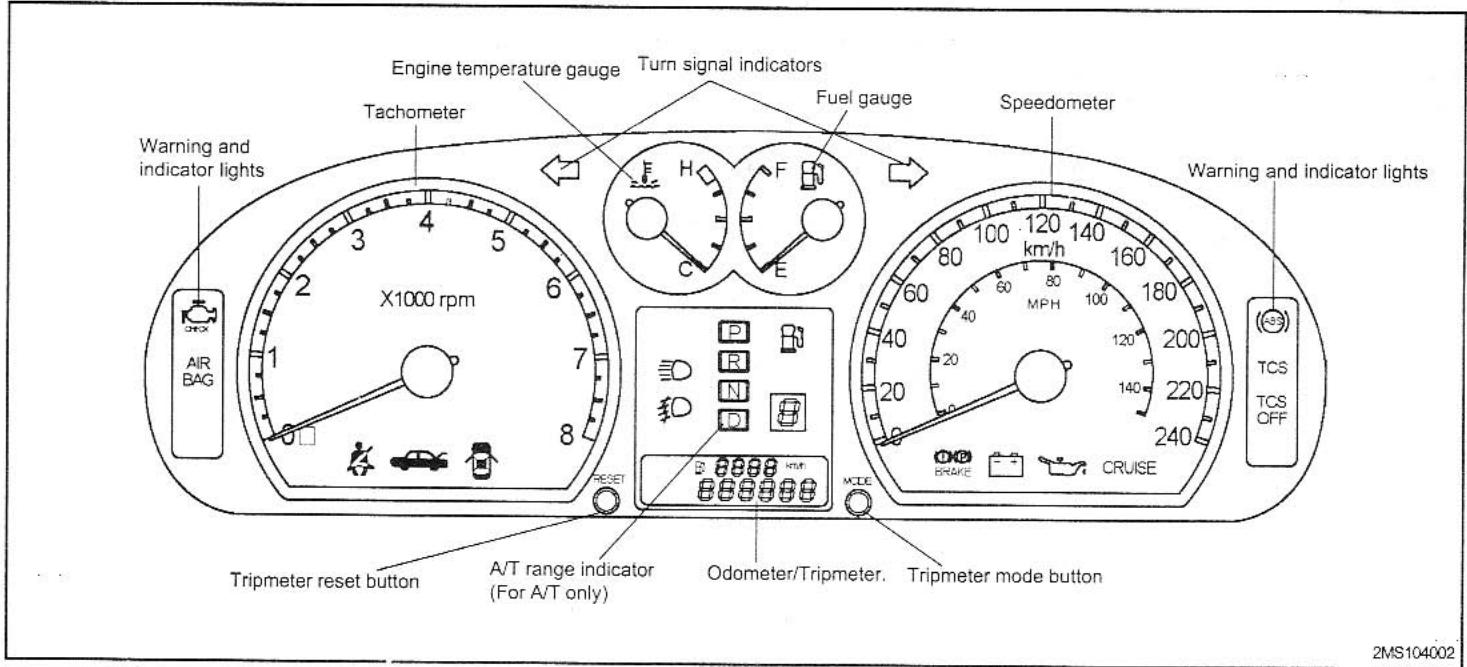
A/T: Automatic Transaxle
GAUGES SPEEDOMETER
The speedometer indicates the forward speed of the vehicle.
ODOMETER/TRIPMETER
You can choose the odometer, tripmeter A and tripmeter B by pressing the mode selection button.
ODOMETER
The odometer indicates the total distance the vehicle has been driven.
TRIPMETER
TRIP A: Tripmeter A
TRIP B: Tripmeter B
The tripmeter indicates the distance of individual trips selected by the driver. Tripmeter A and B can be reset to zero by pressing the reset button for one second or more, and then releasing.
*NOTICE:
Do not operate the engine within the tachometer's RED ZONE. This may cause severe engine damage.
TACHOMETER
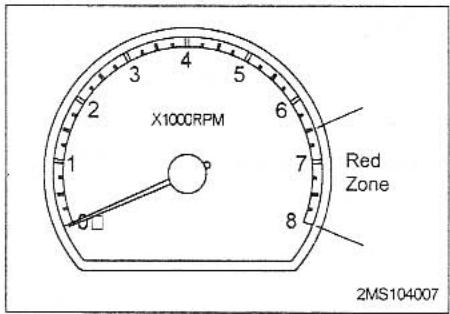
The tachometer indicates the approximate number of engine revolutions per minute (rpm).
Use the tachometer to select the correct shift points and prevent lugging the engine and/or over-revving it.
The tachometer pointer may move slightly when the ignition switch is in the ACC or ON position with the engine OFF. This movement is normal and will not affect the accuracy of the tachometer once the engine is running.
FUEL GAUGE
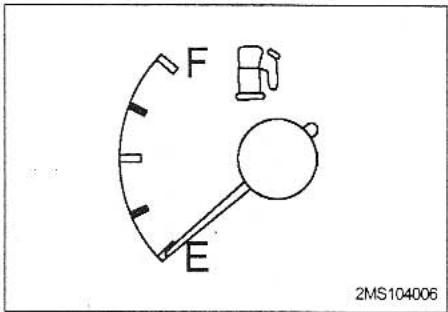
The fuel gauge indicates the approximate amount of fuel remaining in the fuel tank.
Fuel tank capacity: 65L (17 us gal.)
The fuel gauge is supplemented by a low fuel warning light located in the instrument panel.
ENGINE TEMPERATURE GAUGE
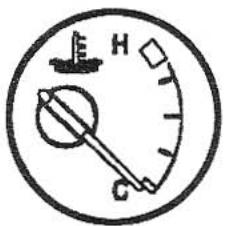
ABCD
This gauge shows the temperature of the engine coolant when the ignition switch is ON.
If the gauge pointer moves beyond the normal range area toward the H position, it indicates overheating that may damage the engine.
Do not continue driving with an overheated engine. If your vehicle overheats, refer to "Overheating" in the Index.
WARNING AND INDICATORS WARNING LIGHTS/ AUDIBLE INDICATORS CHECKING OPERATION
All the warning lights, except the brake warning light, are checked by turning the ignition switch ON (you do not need to start the engine). Any light that does not come ON should be checked by an Authorized Kia Dealer.
If the brake system warning light does not come ON when the ignition switch is in the START position, have the system checked by an Authorized Kia Dealer. After starting the engine, check to make sure that all warning lights are OFF. If any are still ON, this indicates a situation that needs attention. When releasing the parking brake, the brake system warning light should go OFF.
PARKING BRAKE AND BRAKE FLUID WARNING (1) (P)
PARKING BRAKE WARNING
This light comes ON when the parking brake is applied with the ignition switch in the START or ON position. The warning light should go OFF when the parking brake is released.
LOW BRAKE FLUID LEVELWARNING
If the warning light remains ON when the parking brake is released, it may indicate that the brake fluid level in the reservoir is low.
If the warning light remains ON:
- Drive to the nearest safe location and carefully stop your vehicle.
- With the engine stopped, check the brake fluid level immediately and add fluid as required.
All brake components should also be checked immediately for fluid leaks.
- If leaks are found, if the warning light remains ON, or if the brakes do not operate properly, do not drive the vehicle. Have it towed to an Authorized Kia Dealer or other competent repair shop for a brake system inspection and necessary repairs.
WARNING-BRAKEWARNING LIGHTS
Driving the vehicle with a warning light ON is dangerous. If the brake warning light remains ON, have the brakes checked and repaired immediately.
To check bulb operation, the warning light illuminates when the ignition switch is in the ON position.
SAFETY BELT WARNING

As a reminder to the driver and passenger, this warning light will Flash and the chime sounds for approximately 6 seconds. If the system does not operate as described, see an Authorized Kia Dealer or other competent repair shop for assistance.
AIR BAG WARNING AIR BAG
This warning light will remain ON for approximately 6 seconds each time you turn the ignition switch ON. If the system does not operate as described or if the light comes on while the vehicle is being driven, see an Authorized Kia Dealer or other competent repair shop for immediate assistance.
CHARGING SYSTEMWARNING

This warning light indicates a malfunction of either the generator or electrical charging system.
IF THE WARNING LIGHT ILLUMINATES WHILE DRIVING:
- Drive to the nearest safe location and carefully stop your vehicle.
- With the engine OFF, check the generator drive belt for looseness or breakage.
- If the belt is adjusted properly, a problem exists somewhere in the electrical charging system. Have an Authorized Kia Dealer or other competent repair shop locate and correct the problem as soon as possible.
*NOTICE:
Do not drive the vehicle with a loose or broken generator belt; the engine could be damaged by overheating because this belt also drives the water pump.
ENGINE OIL PRESSUREWARNING
This warning light indicates the engine oil pressure is low.
If the warning light illuminates while driving:
- Drive safely to the side of the road and stop.
- With the engine OFF, check the engine oil level. If the level is low, add oil as required.
If the warning light remains ON after adding oil or if oil is not available, call an Authorized Kia Dealer or other competent repair shop.
*NOTICE:
If the engine is not stopped as soon as possible, severe engine damage could result.
LOW FUEL LEVEL WARNING
This warning light indicates the fuel tank is near empty. The warning light will come on when the fuel level has dropped to about 8.5 L (2.2 US gal.).
Refuel as soon as possible.
MALFUNCTION INDICATOR LIGHT
This indicator light is part of the On Board Diagnostic System which moni-tors various emission control system. If this light illuminates while driving, it indicates that a potential problem has been detected somewhere in the emission control systems.
Generally, your vehicle will continue to be driveable and will not need towing, but have the system checked by an
Authorized Kia Dealer or other competent repair shop as soon as possible.
CAUTION:
Prolonged driving with the On Board Diagnostic System Malfunction Indicator Light ( ) illuminated may cause damage to the emission control systems which could effect driveability and/or fuel economy.
- If the On Board Diagnostic System Malfunction Indicator Light (O) begins to flash ON and OFF, potential catalytic converter damage is possible which could result in loss of engine power. Have the On Board Di-gnostic System inspected as soon as possible by an Authorized Kia Dealer or other competent repair shop.
*NOTICE:
A loose fuel filler cap may cause the On Board Diagnostic System Malfunction Indicator Light in the instrument panel to illuminate unnecessarily. Always ensure that the fuel filler cap is tight.
KEY REMINDER WARNING CHIME
If the driver's door is opened and the ignition key is left in the ignition switch, the key reminder warning chime will sound. This is to remind you to remove your keys from the ignition before you lock the vehicle.
HEADLIGHT HIGH BEAM INDICATOR
This indicator illuminates when the headlights are on and in the high beam position or when the turn signal lever is pulled into the Flash-to-Pass position.
DOOR AJAR WARNING

This warning light comes on when a door is not closed securely with the ignition switch in any position.
ANTI-LOCK BRAKE SYSTEM (ABS) WARNING LIGHT (IF EQUIPPED) (ABS)
This light illuminates when you start the engine. The light will go off if the ABS is operating normally. Also, this light comes on if the key is turned to ON, and then goes off in 2-3 seconds if the system is operating normally. If this warning light illuminates while the vehicle is being driven, have the vehicle checked by an Authorized Kia Dealer or other competent repair shop as soon as possible.
REARWINDOWDEFROSTER INDICATOR
This light comes on when the rear defroster is on.
FRONT FOG INDICATOR (IF EQUIPPED)
This light comes on when the fog lights are ON.
CRUISE INDICATOR (IF EQUIPPED) CRUISE
The cruise indicator light in the instrument cluster is illuminated only when the vehicle cruising speed has been set using the control switch. The indicator light does not illuminate when the main cruise control switch is activated.
TRACTION CONTROL INDICATOR LIGHTS(IF EQUIPPED) TCS OFF TCS
The traction control indicators change operation according to the ignition switch position and whether or not the system is in operation.
They will illuminate when the ignition key is turned to the "ON" position, but should go out after three seconds. If the TCS-OFF indicator blinks or stays on, take your car to your Authorized Kia Dealer and have the system checked.
TRUNK LID OPEN WARNING LIGHT

This light remains on unless the trunk lid is completely closed.
INSTRUMENT PANEL LIGHT CONTROL
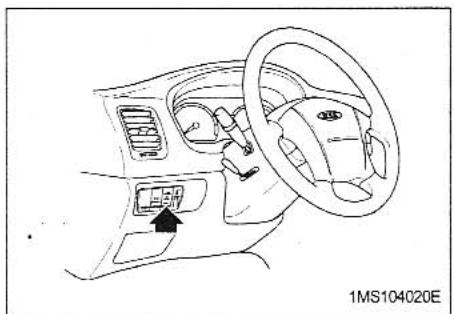
The instrument panel lights can be made brighter or dimmer by turning the instrument panel light control knob.
LIGHTING
※ NOTICE-BATTERYSAVER FUNCTION
This function operates in order to prevent the battery from being discharged by turning off the small light (except
headlights) automatically when the driver removes the ignition key and opens the driver-side door.
- By applying this function, the tail light will be turned off automatically if the ignition key is removed. Therefore, to keep the tail light on when the ignition key is removed,
1) Open the driver-side door.
2) Turn the multi function switch off and on again.
LIGHTING CONTROL
To turn the lights on, twist the knob on the end of the control lever located on the steering column to the left of the steering wheel.
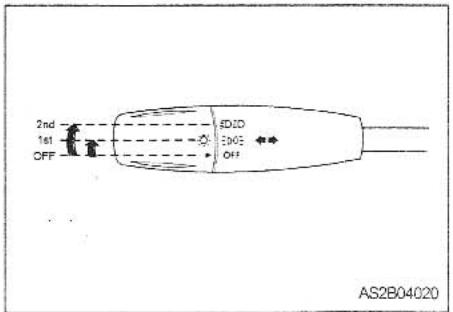
FIRST POSITION
Tail, position, parking, license, side marker lights and instrument panel lights ON.
SECOND POSITION
Head, tail, parking, license, side marker lights and instrument panel lights ON.
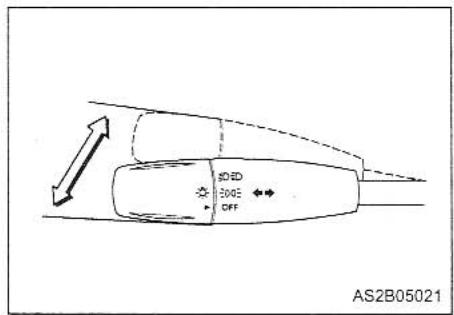
For high beam headlights, push the lever away from you. Pull it back for low beams.
The high-beam indicator will illuminate when the headlight high beams are switched ON.
To prevent the battery from being discharged, do not leave the lights on for a prolonged time while the engine is not running.
FLASHING HEADLIGHTS
To flash the headlights, pull the lever toward you. It will return to the normal position when released. The headlight switch does not need to be ON to use this flashing feature.
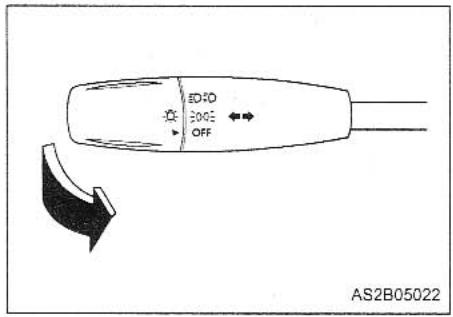
TURN SIGNALS
The same lever that controls the headlights also controls the turn signals. The ignition switch must be ON for the turn signals to function. Move the lever up or down to activate the turn signals. The turn signals will self-cancel after a turn is completed. If the indicator continues to flash after a turn, manually return the lever to the OFF (middle) position.
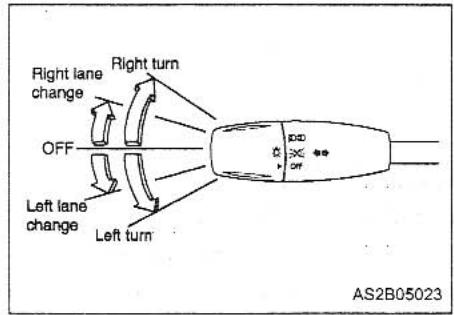
LANE CHANGE SIGNALS
To signal a lane change, move the turn signal lever slightly and hold it in position. The lever will return to the OFF(middle) position when released. Green arrow indicators on the instrument panel indicate which turn signal is operating. If an indicator stays ON and does not flash or if it flashes abnormally, one or more of the turn signal bulbs may be burned out and will require replacement.
DAYTIME RUNNING LIGHTS (DRL)
Daytime Running Lights (DRL) can make it easier for others to see the front of your vehicle during the day. DRL can be helpful in many different driving conditions, but they can be especially helpful in the short periods after dawn and before sunset. The DRL system will make your low-beam headlights turn OFF when:
The headlight switch is ON
The parking brake is engaged
The taillights switch is ON.
FRONT FOG LIGHT SWITCH (IF EQUIPPED)
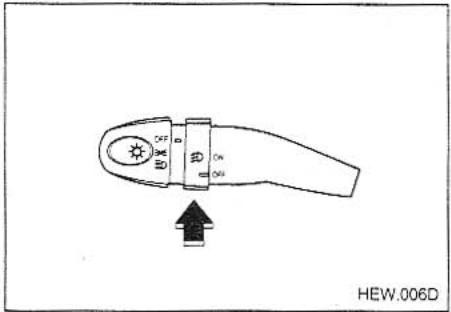
To turn on the front fog lights, place the switch in the "ON" position. They will come on when the headlight switch is in the first or second position.
WIPERS AND WASHERS WINDSHIELD WIPERS
The ignition switch must be ON.
To turn the wipers ON, pull the windshield
wiper control lever down.
INT-Intermittent wiper operation.
LO-Normal wiper speed
HI-Fast wiper speed
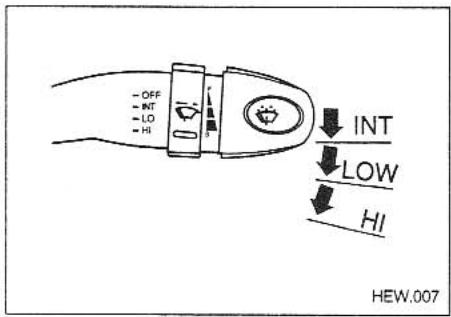
VARIABLE-SPEED INTERMITTENT WIPERS (IF EQUIPPED)
Set the knob to the INT position and choose the desired speed of the wipers by turning the ring.
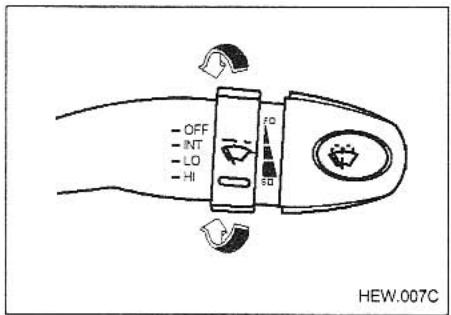
ONE-TOUCH WIPERS
For a single wiping cycle, push the operation switch with the lever in the OFF position.
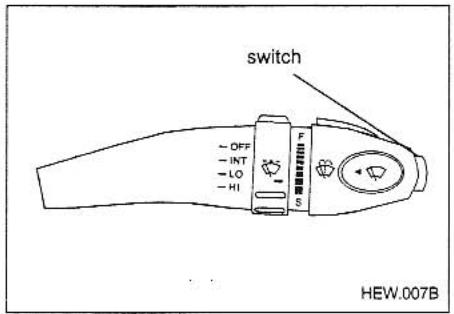
*NOTICE:
- To prevent possible damage to the wipers or windshield, do not operate the wipers when the windshield is dry.
To prevent damage to the wiper blades, do not use gasoline, kerosene, paint thinner, or other solvents on or near them. - To prevent damage to the wiper arms and other components, do not attempt to move the wipers manually.

Windshield Washer
To use the windshield washer, pull the lever toward the steering wheel. If the washer does not work, check the washer fluid level. If the fluid level is not sufficient, add an appropriate, non-abrasive, windshield washer fluid to the washer reservoir. The reservoir filler neck is located in the front of the engine compartment, on the passenger's side.
CAUTION:
Do not use the washer in freezing temperatures without first warming the windshield in advance with the defrosters; the washer solution could freeze on contact with the windshield and obscure your vision.
*NOTICE:
To prevent possible damage to the washer pump, do not operate the washer when the fluid reservoir is empty.
REAR WINDOW DEFROSTER
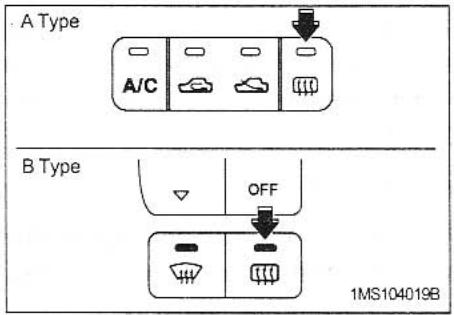
The defroster heats the window to remove frost, fog and thin ice from the interior and exterior of the rear window. The ignition switch must be on for the defroster to operate.
To activate the rear window defroster, press the rear window defroster button located in the air conditioning panel. The instrument panel rear window defroster indicator illuminates when the defroster is ON.
The rear window defroster automatically turns OFF after 20 minutes or when the ignition switch is turned OFF. To turn off the defroster, press the rear window defroster button again. If there is heavy accumulation of snow on the rear window, brush it off before operating the rear defroster.
*NOTICE:
To prevent damage to the conductors bonded to the inside surface of the rear window, never use sharp instruments or window cleaners containing abrasives to clean the window.
*NOTICE:
To prevent the battery from being discharged, operate the defroster only while the engine is running.
INTERIOR FEATURES DIGITAL CLOCK
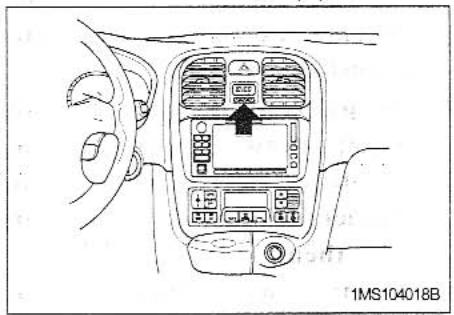
When the ignition switch is in the ON position, the clock buttons operate as follows:
RESET:
To clear away minutes, press the "R" button with your finger, a pencil or similar object. When you release the button, the clock will be set precisely on the hour.
For example, if the "R" button is pressed while the time is between 9:01 and 9:29, the display will be reset to 9:00
9:01-9:29 = 9:00
9:30-9:59 = 10:00
HOUR:
Pressing the "H" button with your finger, a pencil or similar object will advance the time displayed by one hour.
MINUTE:
Pressing the "M" button with your finger, a pencil or similar object will advance the time displayed by one minute.
POWER OUTLET
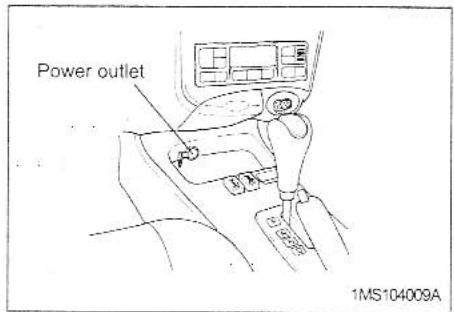
Open the power outlet cover on the rear quarter trim and, with the engine running, insert the mating connector from the electrical appliance. Make sure the electrical appliance draws less than 10 amperes at 12 volts.
CAUTION:
Use the electrical power outlet with the engine running.
- If you have to use electrical accessories that draw higher power (vacuum cleaners, lights, coolers, etc.), use the power outlet intermittently and with caution.
If electrical accessories are plugged into the power outlet for long periods with engine off, the vehicle battery will discahrge and battery life will be shortened.
- Close the power outlet cover when not in use.
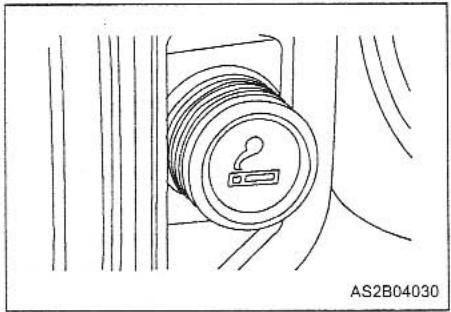
CIGARETTE LIGHTER
To operate the cigarette lighter, press it in and release it. When it is heated, it automatically pops out and is ready for use. If the engine is not running, the ignition switch must be in the ACC position for the lighter to operate.
*NOTICE:
- Do not hold the lighter in because it will overheat.
Only a genuine Kia lighter or equivalent should be used in the cigarette lighter socket. The use of plug-in accessories (shavers, hand-held vacuums and coffee pots, for example) may damage the socket or cause electrical failure.
If the lighter does not pop out within 30 seconds, remove it to prevent overheating.
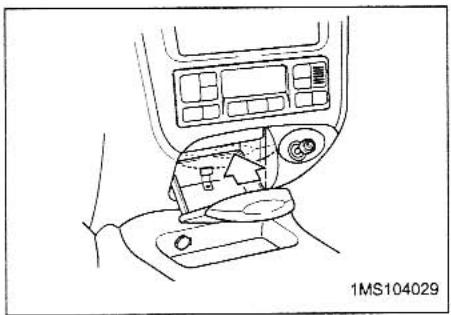
ASHTRAYS FRONT ASHTRAY
The front ashtray may be opened by pushing and releasing the ashtray at its top edge. To clean the ashtray, the metal ash receptacle should be removed. Push the metal ash receptacle down and forward in the ashtray, and it can then be lifted out. To reinstall it, place it in the proper position and press it down and forward to reengage the ash receptacle rear lip in the ashtray. The ashtray light will only illuminate when the exterior vehicle lights are switched on.
WARNING-ASHTRAYUSE
- Do not use the vehicle's asht-rays as waste receptacles.
- Putting lit cigarettes or matches in an ashtray with other combustible materials may cause a fire.
REAR ASHTRY
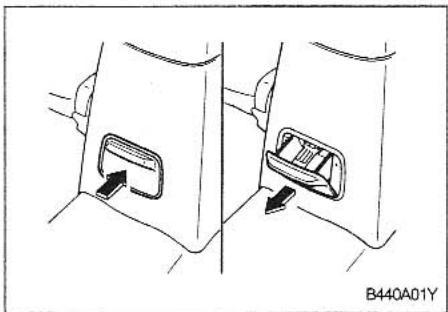
The rear ashtray may be opened by pulling it out by its top edge. To remove the ashtray to empty or clean it, lift it up slightly and pull it all the way out.
GLOVEBOX
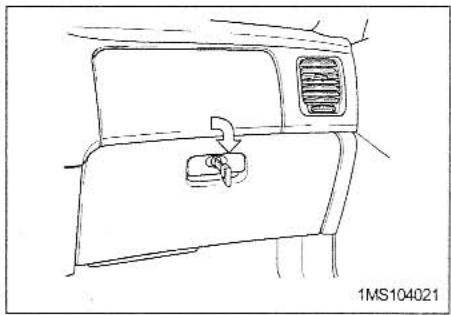
The glove box door can be locked(and unlocked) with the key(if equipped).
CAUTION:
To reduce the risk of injury in the event of an accident or sudden stop, always keep the glove box door closed while driving.
SUNVISORS
To use a sunvisor, pull it downward. To use a sunvisor for a side window, pull it downward, unsnap it from the bracket and swing it to the side.
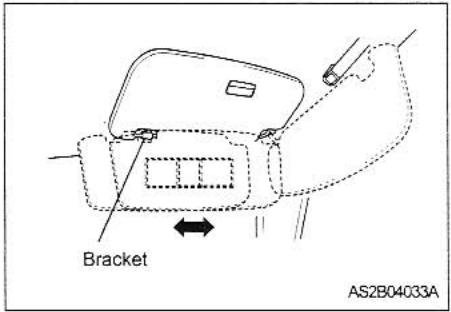
Vanity Mirror (IF EQUIPPED)
To use the vanity mirror, rotate the sunvisor downward.
Pull up the vanity mirror cover, the lamp turms on automatically.
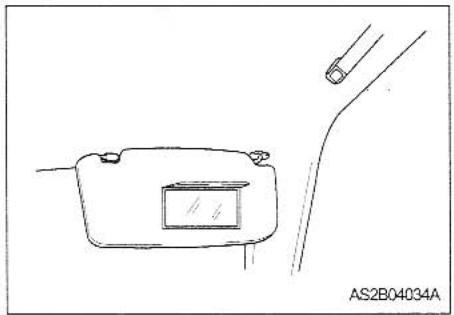
CRUISE CONTROL (IF EQUIPPED)
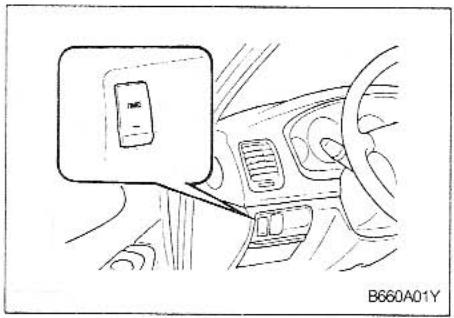
The cruise control system provides automatic speed control for your comfort when driving on freeways, tollroads, or other noncongested highways. This system is designed to function above approximately 25mph (40km / h)
TO SET THE CRUISE
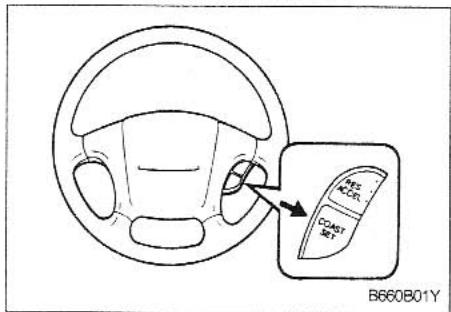
- Push in the cruise control main switch. This turns the system on.
- Accelerate to the desired cruising speed above 25mph (40km / h)
- Push the "COAST/SET" control switch and release it. The "CRUISE" indicator light in the instrument cluster will illuminate after you have set the vehicle to the desired speed.
-
Remove your foot from the accelerator pedal and the desired speed will automatically be maintained.
-
To increase speed, temporarily depress the accelerator pedal enough for the vehicle to exceed the preset speed. When you remove your foot from the accelerator pedal, the vehicle will return to the speed you have set.
TO CANCEL THE CRUISESPEED
DO ONE OF THE FOLLOWINGS:
Depress the brake pedal.
Depress the clutch pedal (Manual transaxle).
- Shift the shift lever to the "N" position (Automatic transaxle).
Decrease the vehicle speed 12mph (20km / h) lower than memorized speed.
Decrease the vehicle speed to less than approximately 25mph (40km / h)
- Release the main switch.
TO RESUME THE PRESET SPEED
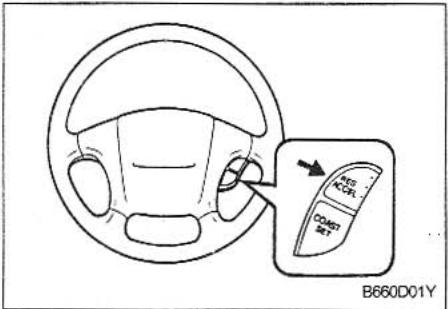
The vehicle will automatically resume the speed set prior to cancellation when you push the control switch "RESUME (ACCEL)" and release, providing the vehicle speed is above 25mph(40km / h)
TO RESET AT A FASTER SPEED
- Push the control switch "RESUME (ACCEL)" and hold it.
- Accelerate to desired speed and release the control switch. While the control switch is held, the vehicle will gradually gain speed.
TO RESET AT A SLOWER SPEED
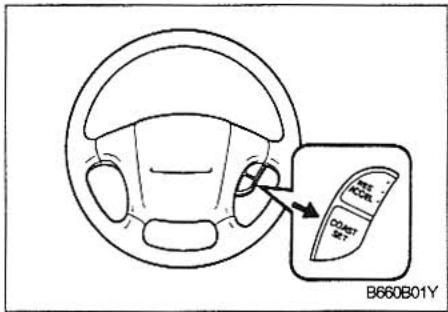
- Push the control button "SET (COAST)" and hold it. While the control switch is pushed, the vehicle speed will gradually decrease.
- When the desired speed is obtained, release the control button.
*NOTICE:
- Keep the main switch off when not using the cruise control.
- Do not use the cruise control when it may not be safe to keep the car at a constant speed, for instance, driving in heavy or varying traffic, or on slippery (rainy, icy or snow-covered) or winding roads or over 6% uphill or down-hill roads.
- Pay particular attention to the driving conditions whenever using the cruise control system.
During cruise-speed driving with a manual transaxle vehicle, do not shift into neutral without depressing the clutch pedal, since the engine will be overrevved. If this happens,
depress the clutch pedal or release the main switch.
During normal cruise control operation, when the set button is activated or reactivated after applying the brakes, the cruise control will energize after approximately 3 seconds. This delay is normal.
CLIMATE CONTROL SYSTEM CONTROLS
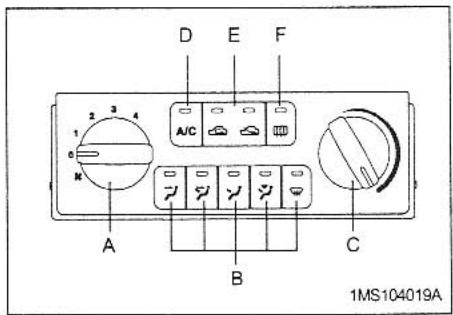
A: Fan speed control knob
B: Mode selection
C: Temperature control knob
D: Air conditioning switch
E: Air intake control switch
F: Rear window defroster switch
FAN SPEED CONTROL KNOB
The fan speed control knob (A) is the knob closest to the driver. Four (4) adjustable fan speeds are provided which increase as the number increases. The ignition switch must be in the ON position for fan operation.
OFF - Fan off
1 Low speed
2 Medium speed
3 High speed
4 Maximum speed
MODE SELECTION
It controls the direction of air flow through the ventilation system.
FACE POSITION

Air flow is directed toward the upper body and face through all four (4) center instrument panel ventilation outlets. Additionally, each outlet can be adjusted to direct the air discharged from the outlet.
Warm, cool, or fresh air is directed through the vents.
FACE-FLOOR POSITION Air flow is directed toward the face and the floor. The air to the floor is warmer than to the face (except when the temperature lever is set to the extreme cold position).
FLOOR POSITION
Most of the air flow is directed to the floor, with a small amount being directed to the windshield and side window defrosters.
FLOOR-DEFROST

POSITION
Most of the air flow is directed to the floor and the windshield with a small amount directed to the side window defrosters.
DEFROST POSITION
Most of the air flow is directed to the windshield with a small amount of air directed to the side window defrosters. When you select ( ) Floor - Defrost or ( ) Defrost position, the system automatically turns on the air-conditioning system (if equipped).
TEMPERATURE CONTROL KNOB
The temperature control knob (C) is the round knob closest to the passenger side of the ventilation control panel. To change the air temperature in the passenger compartment, turn the knob either clockwise for warm to hot air or counterclockwise for cooler air.
AIR INTAKE CONTROL
SWITCH


This is used to select fresh outside air or recirculation inside air.
RECIRCULATED AIR
POSITION


When the air intake control switch is depressed (switch indicator illuminates), almost all outside air flow into the vehicle is shut off and air inside the vehicle is recirculated.
This position can be used temporarily for maximum heating or cooling (if equipped with air conditioning) and to help prevent undesirable outside air flow into the vehicle.
WARNING:
-
Continued climate control system operation in the recirculated air position may allow humidity to increase inside the vehicle which may fog the glass and obscure visibility.
-
Don't sleep in a Vehicle with the air conditioning system on. This could cause serious harm or death to passengers due to the depletion of oxygen and lowering of body temperature.
OUTSIDE(FRESH) AIR
POSITION


When the air intake control switch is depressed (switch indicator illuminates) air enters the ventilation system from outside the vehicle. Use this position for normal ventilation and heating.
AIR CONDITIONING SWITCH (IF EQUIPPED)
Depress the switch to turn the air conditioning system on. An indicator light in the switch will illuminate when the fan switch is ON indicating air conditioning system operation. Depress the switch again to turn the air conditioning system OFF.
SYSTEM OPERATION
VENTILATION
- Set the mode selection switch to the position.
- Set the air intake control switch to the outside air position.
- Set the temperature control knob to the desired position.
- Set the fan speed control knob to the desired speed.
HEATING
- Set the mode selection switch to the position
- Set the air intake control switch to the recirculated air position.
ZCAUTION:
Continued climate control system operation in the recirculated air position may allow humidity to increase inside the vehicle which may fog the glass and obscure visibility.
- Set the temperature control knob to the desired position.
- Set the fan speed control knob to the desired speed.
- If dehumidified heating is desired, turn the air conditioning system (if equipped) ON.
- If cool air is desired at face level for bi-level operation, set the mode selection switch to the position.
If the windshield fogs up, set the mode selection switch to the position.
WINDSHIELD DEFROSTING AND DEFOGGING
- Set the mode selection switch to the position.
- When you select ( ) Defrost position, the system automatically turns on the A/C (If Equipped).
- Set the temperature control knob to the desired position.
-
Set the fan speed control knob to the desired speed.
For maximum defrosting, set the temperaure control knob to the extreme right/hot position and the fan speed control knob to the highest speed.
Before driving, clear all snow and ice from the windshield, rear window, outside rear view mirrors, and all side windows. -
Clear all snow and ice from the hood and the air inlet in the cowl grille to improve heater and defroster efficiency and to reduce the probability of fogging on the inside the windshield.
AUTOMATIC HEATING AND COOLING CONTROL SYSTEM (IF EQUIPPED)
Your vehicle is equipped with an automatic heating and cooling control system controlled by simply setting the desired temperature.
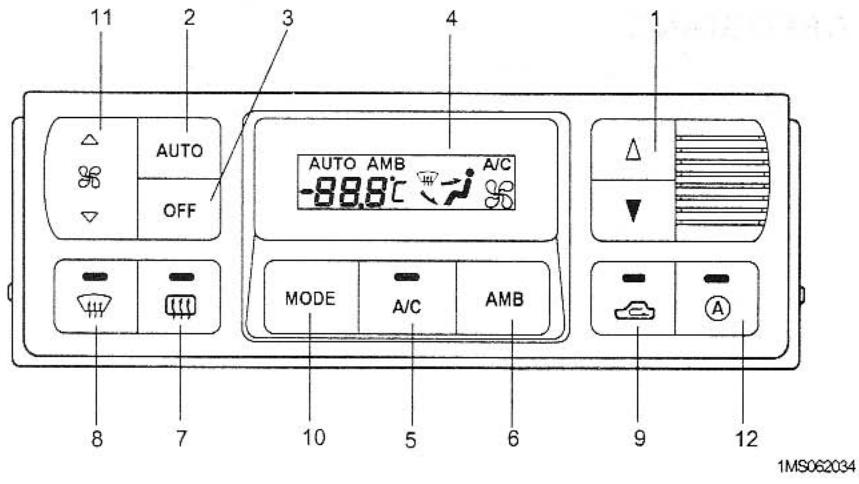
HEATING AND COOLING CONTROLS
- Temperature Control swith.
- AUTO (Automatic Control) Switch
- OFF Switch
- Indicator Light
-
Air Conditioning Switch
-
Ambient Switch
- Rear Window Defroster Switch
- Defroster Switch
- Air Intake Control Switch
- Air Flow Control Switch (Mode switch)
- Fan Speed Control Switch
- Air quality control system (If equipped)
AUTOMATIC OPERATION (IF EQUIPPED)
The FATC (Full Automatic Temperature Control) system automatically controls the heating and cooling. To activate it:
- Push the "AUTO" switch. The indicator light will come on confirming that the Face, Floor and/or Bi-Level modes as well as the blower speed and air conditioner will be controlled automatically.
- Press the "temperature control" switch to set the desired temperature. The temperature will increase to the maximum 32°C (89.6°F) by pressing the red button. Each time the red button is depressed, the set temperature will increase by 0.5°C (2°F) .
The temperature will decrease to the minimum 17°C (62.6°F) by pressing
the blue button. Each time the blue button is depressed, the set temperature will decrease by 0.5°C (2°F)
*NOTICE:
To switch from a Celsius (°C) to Fahrenheit (°F) readout and vice versa, depress and hold the AMB button down for three seconds.
AMBIENT SWITCH
Pressing the AMB button displays the ambient temperature on the LCD.
MANUAL OPERATION
The heating and cooling system can be controlled manually if the "AUTO" button is not selected. In the manual state, the system works sequentially according to the order of buttons selected.
System function not manually selected will be controlled automatically.
Press the "AUTO" button in order to convert to automatic control of the system.
FANSPEEDCONTROL
The fan speed can be set to the desired speed by pressing the appropriate fan speed control button. The higher the fan speed is, the more air is delivered. Pressing the "OFF" button turns off the fan.
AIR INTAKE CONTROL
This is used to select the recirculation of inside air.
RECIRCULATED AIR POSITION
When the air intake control switch is depressed (Switch indicator illuminates), almost all outside air flow into the vehicle is shut off and air inside the vehicle is recirculated.
This position can be used temporarily for maximum heating or cooling (if equipped with air conditioning) and to help prevent undesirable outside air flow into the vehicle.
Outside (Fresh)Air Position
When the air intake control switch is not illuminated, air enters the ventilation system from outside the vehicle. Use this position for normal ventilation and heating.
HEATING AND COOLING SYSTEM OFF
Press the "OFF" button to stop the operation of the heating and cooling system.
AIR FLOW CONTROL (MODE SWITCH)
This is used to direct the flow of air. Air can be directed to the floor, dashboard outlets, or windshield. Five symbols are used to represent Face,
Face-Floor, Floor,Floor-Defrost and Defrost air position.
FACE POSITIO

Air flow is directed toward the upper body and face through all four (4) center instrument panel ventilation outlets. Additionally, each outlet can be adjusted to direct the air discharged from the outlet.
Warm,cool, or fresh air is directed through the vents.
FACE-FLOOR POSITION

Air flow is directed toward the face and the floor. The air to the floor is warmer than to the face (except when the temperature lever is set to the extreme cold position).
FLOOR POSITION

Most of the air flow is directed to the floor, with a small amount being directed to the windshield and side window defrosters.
FLOOR-DEFROST POSITION

Most of the air flow is directed to the floor and the windshield with a small amount directed to the side window defrosters.
DEFROST POSITION Most of the air flow is directed to the windshield with a small amount of air directed to the side window defrosters. When you select ( ) Floor - Defrost or ( ) Defrost position, the system automatically turns on the air-conditioning system.
AIR CONDITIONING (OPTIONAL)
All Kia Air Conditioning Systems are filled with environmentally friendly R134a refrigerant which is not damaging to the ozone layer.
- Start the engine. Depress the air conditioning switch.
- Set the mode selection switch to the face position.
- Set the air intake control switch to the outside air or the recirculated air position (switch indicator ON).
- Set the temperature control knob (or switch) to the desired position.
- Set the fan speed control knob(or switch) to the desired speed.
-
Adjust the fan speed control knob (or switch) and temperature control knob to maintain maximum comfort.
-
If warmer air is desired at floor level for bi-level operation, set the mode selection switch to the position and adjust the temperature control knob (or switch) to maintain maximum comfort.
- When maximum cooling is desired, set the temperature control knob (or switch) to the extreme left position and set the air intake control switch to the recirculated air position (switch indicator ON), then set the fan speed control knob to the highest speed.
*NOTICE:
When using the air conditioning system with high outside air temperatures, monitor the temperature gauge closely while driving up long hills or in heavy traffic. Air conditioning system operation may cause engine overheating. Continue to use the blower fan but turn the air conditioning system off if the temperature gauge indicates engine overheating.
AIR CONDITIONING SYSTEM OPERATING TIPS:
If the vehicle has been parked in direct sunlight during hot weather, open the windows for a short time to let hot air inside the vehicle escape.
- To help reduce moisture on the inside of windows on rainy, humid days, decrease the humidity inside the vehicle by operating the air conditioning system.
During air conditioning system operation, you may occasionally notice a slight change in engine speed at idle as the A/C compressor cycles ON. This is a normal system operating characteristic.
Use the air conditioning system every month if only for a few minutes.
After air conditioning system use, you may notice clear water dripping
(or even puddling) on the ground under the passenger side of the vehicle. This is a normal system operating characteristic.
The air conditioning system includes a function that will automatically turn the A/C compressor OFF if engine coolant temperature approaches an overheating level. A/C compressor operation will resume once engine coolant temperature returns to the "normal" range. Also, the A/C compressor is automatically turned off for a few seconds when the accelerator is fully depressed.
- When operating the air conditioning system use the outside (fresh) air position.
- Operating the air conditioning system in the recirculated air position does provide maximum cooling, however, continual operation in this mode may cause the air inside the vehicle to become stale.
REAR HEATER DUCT (IF EQUIPPED)
Whenever the ventilation controls are in the face-floor or floor position, air is directed to the rear seat passenger floor area.
AIR QUALITY CONTROL SYSTEM (IF EQUIPPED)
The air inflow from the outside of the vehicle can be automatically controlled. Press the (A) button to activate the "Air Quality Control System". To deactivate the system, press the (A) button or air intake control button or set modes selection knob to (H) position.
CAUTION:
Prolonged driving with "Air Quality Control System" ON will cause frosting inside the vehicle.
To defrost the vehicle, set the mode selection knob to (
Defrost position or the air intake button to the outside position.
- The air quality control sensor is located at the side of the radiator. Be careful to avoid damaging the sensor.
Fuel Requirements 5-2
Emission Control System 5-3
Before Driving 5-4
Suggestions for Economical Operation 5-5
Special Driving Conditions 5-7
Trailer Towing 5-11
Overloading 5-11
Label Information 5-11
FUEL REQUIREMENTS
Your new Kia Vehicle must use only UNLEADED FUEL having an octane rating of 87 or higher. Your new Kia is designed to obtain maximum performance with unleaded fuel. Unleaded fuel will minimize exhaust emissions and spark plug fouling.
念 NOTICE:
NEVER USE LEADED FUEL. The use of leaded fuel is detrimental to the catalytic converter. Never add any fuel system cleaning agents to the fuel tank other than what Kia has specified or the equivalent. (Consult an Authorized Kia Dealer for details.)
Leaded fuel will damage the engine control system's oxygen sensor and affect the emission control system.
GASOLINE CONTAINING ALCOHOL AND METHANOL
Ethanol (also known as grain alcohol) is a mixture of ethanol and gasoline marketed as gasohol. Do not use gasohol containing more than 10% ethanol. Methanol (also known as wood alcohol) is a mixture of gasoline and methanol marketed as gasohol. Do not use gasoline or gasohol containing methanol. Either of these fuels may cause driveability problems and damage to the fuel system.
Discontinue using gasohol of any kind if driveability problems occur.
Vehicle damage or driveability problems may not be covered by the manufacturer's warranty if they result from the use of:
Gasohol containing more than 10% ethanol,
Gasoline or gasohol containing methanol, or
- Leaded fuel or leaded gasohol
*NOTICE:
Never use gashol which contains methanol. Discontinue use of any gashohol product which impairs driveability.
EMISSION CONTROL SYSTEM
The vehicle emission control system is covered by a written limited warranty. Please see the warranty information contained in the Warranty and consumer Information Manual in your vehicle.
VEHICLE MODIFICATIONS
This vehicle should not be modified. Modification of your Kia could affect its performance, safety or durability and may even violate governmental safety and emissions regulations.
In addition, damage or performance problems resulting from any modification may not be covered under warranty.
ENGINE EXHAUST GAS PRECAUTIONS (CARBON MONOXIDE)
Engine exhaust gases contain carbon monoxide. Though colorless and odorless, it is dangerous and could be lethal, if inhaled.
- Carbon monoxide can be present with other exhaust fumes.
Therefore, if you smell exhaust fumes of any kind inside your vehicle, have it inspected and repaired immediately by an Authorized Kia Dealer. If at all possible, do not drive with exhaust fumes present. If you must, do so only with all windows fully open. Have your vehicle checked and repaired immediately.
- Do not operate the engine in confined or closed areas (such as garages) any more than what is necessary to move the vehicle in or out of the area.
- When the vehicle is stopped in an
open area for more than a short time with the engine running, adjust the ventilation system to draw outside air into the vehicle.
Turn the engine off if you smell any exhaust fumes.
- Never sit in a parked or stopped vehicle for an extended time with the engine running.
OPERATING PRECAUTIONS FOR CATALYTIC CONVERTERS
Your vehicle is equipped with a catalytic converter emission control device. Therefore, the following precautions must be observed:
- Use only UNLEADED FUEL.
- Do not park the vehicle over or near flammable objects, such as dry grass, paper, leaves, etc. Under certain conditions, they could be ignited by a hot exhaust system.
- Do not operate the vehicle when
there are signs of engine malfunction, such as misfire or a noticeable loss of performance.
- Do not misuse or abuse the engine. Examples of misuse are coasting with the ignition off and descending steep grades in gear with the ignition off.
- Do not operate the engine at high idle speed for extended periods (5 minutes or more).
- Do not modify or tamper with any part of the engine or emission control system. All inspections and adjustments must be made by a qualified technician.
Failure to observe the above precautions could result in damage to the catalytic converter and to your vehicle and could void your warranties.
BEFORE DRIVING
Before entering vehicle:
- Be sure that all windows, outside mirror(s), and outside lights are clean.
- Check the condition of the tires.
- Check under the vehicle for any signs of leaks.
- Be sure there are no obstacles behind you if you intend to back up.
NECESSARY INSPECTIONS
Fluid levels, such as engine oil, engine coolant, brake/clutch fluid, and washer fluid should be checked on a regular basis, with the exact interval depending on the fluid. Further details are provided in Maintenance, Section 7.
BEFORE STARTING
- Close and lock all doors.
- Position the seat so that all controls are easily reached.
- Adjust the inside and outside rearview mirrors.
- Be sure that all lights work.
- Check all gauges.
- Check the operation of warning lights when the ignition switch is turned to the ON position.
- Release the parking brake and make sure the brake warning light goes out.
For safe operation, be sure you are familiar with your vehicle and its equipment.
DRUNK DRIVING
Drinking and driving is dangerous. Drunk driving is the number one contributor to the highway death toll each year. Alcohol impairs a driver's judgment, vision and muscular coordination. Even a small amount of alcohol will affect a driver's reflexes, perceptions and judgment.
Please don't drink and drive, or ride with a driver who has been drinking. Choose a designated driver if you're with a group, or if you're alone, call a cab.
DRUGS AND DRIVING
Driving while under the influence of drugs is as dangerous or more dangerous than driving under the influence of alcohol, depending on the drug(s) used and the quantity consumed. Don't take drugs and drive.
If you are taking a prescription medicine, check with your doctor or pharmacist regarding whether you may operate a motor vehicle.
SUGGESTIONS FOR ECONOMICAL OPERATION
Your vehicle's fuel economy is mainly dependent on your style of driving, how you drive, where you drive and when you drive.
Each of these factors has an effect on how many miles (kilometers) you can get from a gallon (liter) of fuel. To operate your vehicle as economically as possible, use the following driving suggestions to help save money in both fuel and repairs:
- Avoid lengthy warm-up idling. Once the engine is running smoothly, begin driving. Remember, though, that on cold days, engine warm-up may take a little longer.
- Save fuel by accelerating slowly after stopping.
- Keep the engine in tune and follow the recommended periodic maintenance schedule.
This will increase the life of all parts and lower your operating costs.
- Do not use the air conditioner unnecessarily.
- Slow down when driving on rough roads.
- For longer tire life and better fuel economy, always keep the tires inflated to the recommended pressures.
- Maintain a safe distance from other vehicles to avoid sudden stops. This will reduce wear on brake linings and pads and save fuel because extra fuel is required to accelerate back to driving speed.
- Do not carry unnecessary weight in the vehicle.
- Do not rest your foot on the brake pedal while driving. This can cause needless wear, possible damage to the brakes, and poor fuel economy.
- Improper wheel alignment causes the tires to roll at excessive angles, which
results in faster tire wear. It takes more power to overcome this improper alignment, which wastes fuel.
- Open windows at high speeds can reduce fuel economy.
Crosswinds and headwinds reduce fuel economy. To help offset some of this loss, slow down when driving in these conditions.
Keeping a vehicle in good operating condition is important both for economy and safety.
Therefore, have an Authorized Kia Dealer perform scheduled inspections and maintenance.
WARNING-ENGINE OFF MOTION
Never turn the engine OFF to coast down hills or anytime the vehicle is in motion. The power steering and power brakes will not function without the engine running. Instead, downshift to any appropriate gear for engine braking effect.
SPECIAL DRIVING CONDITIONS HAZARDOUS DRIVING
When hazardous driving is encountered because of water, snow, ice, mud, sand, or similar hazard, follow these suggestions:
Drive cautiously and allow extra distance for braking.
- Avoid sudden movements in braking or steering.
- When braking in vehicles without anti-lock brakes, depress the brake pedal with a controlled up-and-down motion until the vehicle is stopped.
- When starting from a stop in snow, mud, or sand, use second gear and accelerate slowly to avoid spinning the front wheels. Low gear may be used, if necessary.
Use sand, rock salt, tire chains, or other non-slip material under the front wheels to provide traction when stalled on ice, snow, or mud.
WARNING-DOWNSHIFTING Downshifting into first gear with a manual transaxle or into low with an automatic transaxle while driving on slippery surfaces can cause an accident. The sudden change in tire speed could cause the tires to skid. Be careful when downshifting on slippery surfaces.
ROCKING THE VEHICLE
If it is necessary to rock the vehicle to free it from snow, sand, or mud, move the shift lever of an automatic transaxle from D (Drive) to R (Reverse) in a repeat pattern while depressing the accelerator gently. With a manual transaxle, move the shift lever back and forth from 1 (First) to R (Reverse).
Do not race the engine. If you are still stuck after a couple minutes of rocking, have the vehicle pulled out by a tow vehicle to avoid engine overheating and possible damage to the transaxle.
念 NOTICE:
Prolonged rocking may cause engine overheating, transaxle damage or failure, and tire damage.
WARNING - SPINNING TIRES
Do not spin the wheels especially at speeds more than 35 mph (56 km/h). Spinning the wheels at high speeds when the vehicle is stationary could cause a tire to overheat, explode and injure bystanders.
DRIVING AT NIGHT
Because night driving presents many more hazards than driving in the daylight, here are some important tips to remember:
Slow down and keep more distance between you and other vehicles as it may be more difficult to see at night, especially in rural areas where there may not be any street lights.
- Adjust your mirrors to reduce the glare from other driver's headlights.
- Keep your headlights clean and properly aimed. Dirty or misaimed headlights will make it much more difficult to see at night.
- Avoid staring directly at the headlights of oncoming vehicles. You could be temporarily blinded and it will take several seconds for your eyes to readjust to the darkness.
DRIVING IN THE RAIN
Rain and wet roads can make driving dangerous, especially if you're not prepared for the slick pavement. Here are a few things to consider when driving in the rain:
- Be sure your windshield wipers are in good condition.
- A heavy rainfall will make it harder to see and will increase the distance needed to stop your vehicle, so slow down.
If your tires aren't in good condition, making a quick stop on wet pavement can cause a skid and possibly lead to an accident. Be sure your tires and windshield wipers are in good shape. - Turn on your headlights to make it easier for others to see you.
- Driving too fast through large puddles can affect your brakes. If you must go through puddles, try to drive through them slowly.
If you believe you may have gotten your brakes wet, apply them lightly while driving until normal braking operation returns.
WINTER DRIVING
We recommend that you carry emergency equipment. Some things you might include are tire chains, a window scraper, windshield de-icer, a bag of sand or salt, flares, a small shovel and jumper cables.
Make sure you have sufficient ethylene glycol coolant in the radiator.
- Check the battery condition and cables. Cold temperatures reduce the capacity of any battery, so it must be in top shape to provide enough winter starting power.
Make sure the engine oil viscosity is suitable for cold weather.
- Check the ignition system for loose connections and damage.
Use antifreeze-formulated windshield washer fluid and make sure you have sufficient fluid for your trip. (Do not use engine coolant antifreeze.)
- Do not use the parking brake if it might freeze. This is most likely to happen after driving in slushy or wet conditions and temperatures drop into the freezing range. When parking, shift to P (Park) with automatic transaxle, or to 1 (First) or R (Reverse) with a manual transaxle and block the rear wheels.
SNOW TIRES
When snow tires are used, select the size and construction specified on the Tire Pressure Label. It is strongly recommended that snow tires be used on all four wheels, or poor handling may result. Snow tires should not be operated at speeds exceeding 75mph (120 km / h ). These tires should be inflated 4 psi (28kPa,0.3kg / cm3) above the rec
ommended pressures shown on the Tire Specification/Pressure Label, but inflation should never exceed the maximum cold-tire pressure shown on the tire sidewalls.
WARNING-SNOW TIRE SIZE
Snow tires should be equivalent in size and type to the vehicle's standard tires. Otherwise, the safety and handling of your vehicle may be adversely affected.
Do not install studded tires without first checking local, provincial and municipal regulations for possible restrictions against their use.
TIRE CHAINS
Tire Chain Selection
Regulations regarding the use of tire chains vary according to location or type of road, so always check them before installing chains.
Use only SAE Class "S" tire chains. Chains must be the proper size for the vehicle, as recommended by the chain manufacturer.
CHAIN INSTALLATION
When installing chains on your tires, carefully follow the instructions of the chain manufacturer.
The chain bands will scratch the wheel covers. Remove the covers before installing the chains.
WARNING-TIRE CHAINS
The use of chains may adversely affect vehicle handling.
- Do not exceed 30 mph (50 km/h) or the chain manufacturer's recommended speed limit, whichever is lower.
- Drive carefully and avoid bumps, holes, sharp turns and other road hazards, which may cause the vehicle to bounce.
- Avoid sharp turns or locked wheel braking.
- Do not attempt to use a tire chain on the temporary spare tire because it may impair vehicle handling and result in damage to the vehicle and the tire.
Install the chains on the front tires as tightly as possible. The use of chains on the rear tires is not recommended. Retighten the chains after driving 0.5-1.0 km (1/4-1/2 mile).
Driving in Flooded Areas
Avoid driving through flooded areas unless you are sure the water is no higher than the bottom of the wheel rims. Drive through any water slowly. Allow adequate stopping distance because brake performance may be affected.
After driving through water, dry the brakes by gently applying them several times while the vehicle is moving slowly.
TRAILER TOWING
We do not recommend using this vehicle for trailer towing.
OVERLOADING
CAUTION:
The gross axle weight rating (GAWR) and the gross vehicle weight rating (GVWR) for your vehicle are on the manufacturer's label attached to the driver's door or are listed in the "Specifications" section of this Owner's Manual. Exceeding these ratings can cause an accident or vehicle damage. You can calculate the weight of your load by weighing the items (or people) before putting them in the vehicle. Be careful not to overload your vehicle.
LABEL INFORMATION
There are several important labels and identification numbers located on your vehicle. The label locations are identified in the following illustrations.
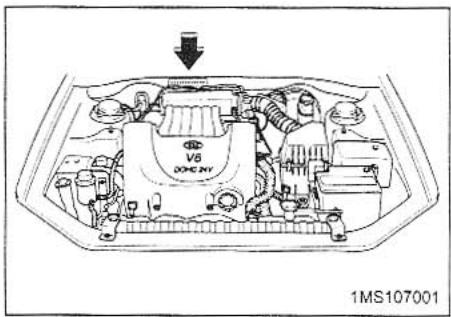
VEHICLE IDENTIFICATION NUMBER (VIN)
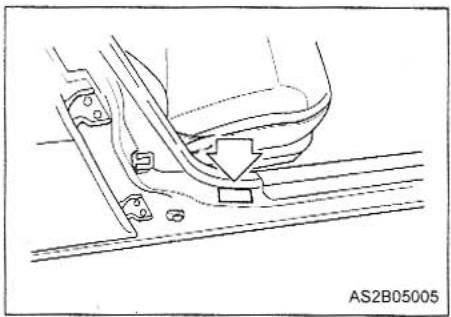
Tire Specification/Pressure Label
Vehicle Emission Control Information and Vacuum Hose Routing Diagram
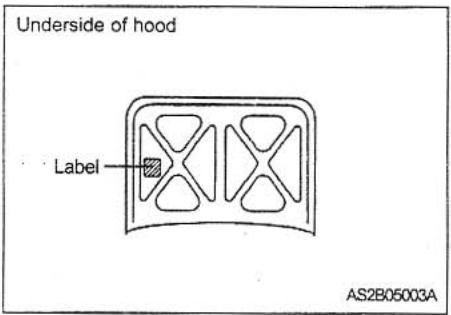
Road Warning 6-2
Overheating 6-2
Emergency Starting 6-3
Electrical Circuit Protection 6-7
Towing 6-14
If You Have a Flat Tire 6-16
ROAD WARNING
HAZARDWARNINGFLASHER
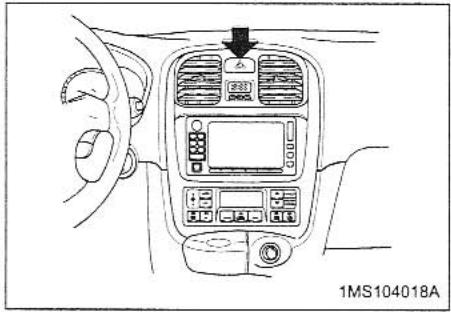
The hazard warning flasher serves as a warning to other drivers to exercise extreme caution when approaching, overtaking, or passing your vehicle. It should be used whenever emergency repairs are being made or when the vehicle is stopped near the edge of a roadway.
Depress the flasher switch with the ignition switch in any position. All turn signal lights will flash simultaneously.
The hazard warning flasher will operate whether your vehicle is running or not.
The turn signals do not operate when the hazard flasher is on.
- Care must be taken when using the hazard warning flasher while the vehicle is being towed. Local regulations may prohibit using it in this manner.
OVERHEATING
If your temperature gauge indicates overheating, if you experience a loss of power, or if you hear a loud knocking or pinging noise, the engine has probably overheated. You should follow these procedures if you experience any of these symptoms.
- Turn the hazard warning flasher ON, then drive to the nearest safe location and stop your vehicle; set the automatic transaxle in P (Park), or shift the manual transaxle to neutral and apply the parking brake.
- Make sure the air conditioner is off.
- If coolant or steam is boiling out of the radiator, stop the engine, then turn the ignition switch to the ON position. Do not restart the engine. The radiator cooling fan will automatically operate with the ignition switch in the ON position. If the cooling fan does not operate,
call an Authorized Kia Dealer or other competent repair shop for assistance.
If coolant is not boiling out, allow the engine to idle and open the hood to permit the engine to cool gradually. If the temperature does not go down with the engine idling, stop the engine and allow sufficient time for it to cool.
- The coolant level should then be checked. If the level in the reservoir is low, look for leaks at the radiator hoses and connections, heater hoses and connections, radiator, and water pump. If you find a major leak or another problem that may have caused the engine to overheat, do not operate the engine until the problem has been corrected. Call an Authorized Kia Dealer or other competent repair shop for assistance. If you do not find a leak or other
problem, carefully add coolant to the reservoir.
WARNING - REMOVING RADIATOR CAP
Do not remove the radiator cap when the engine and radiator are hot. Scalding hot coolant and steam may blow out under pressure. This could cause serious injury.
If the engine frequently overheats, have the cooling system checked and repaired.
EMERGENCY STARTING JUMP STARTING
Jump starting can be dangerous if done incorrectly. Therefore, to avoid harm to yourself or damage to your vehicle or battery, follow the jump starting procedures on the next page. If in doubt, we strongly recommend that you have a competent technician or towing service jump start your vehicle.
*NOTICE:
Use only a 12volt jumper system. You can damage a 12volt starting motor, ignition system, and other electrical parts by using a 24-volt power supply (two 12-volt batteries in series or a 24-volt motor generator set).
WARNING-BATTERY
- Keep all flames or sparks away from the battery. The battery produces hydrogen gas which may explode if exposed to flame or sparks.
- Do not attempt to jump start vehicle if the discharged battery is frozen or if the electrolyte level is low; the battery may rupture or explode.
JUMP STARTING PROCEDURE
- Make sure the booster battery is 12 volts and that its negative terminal is grounded.
- Check the electrolyte level of each of the battery cells.
- If the booster battery is in another vehicle, do not allow the vehicles to touch.
Connecting Jumper cables
Connect cables in numerical order and disconnect in reverse order.
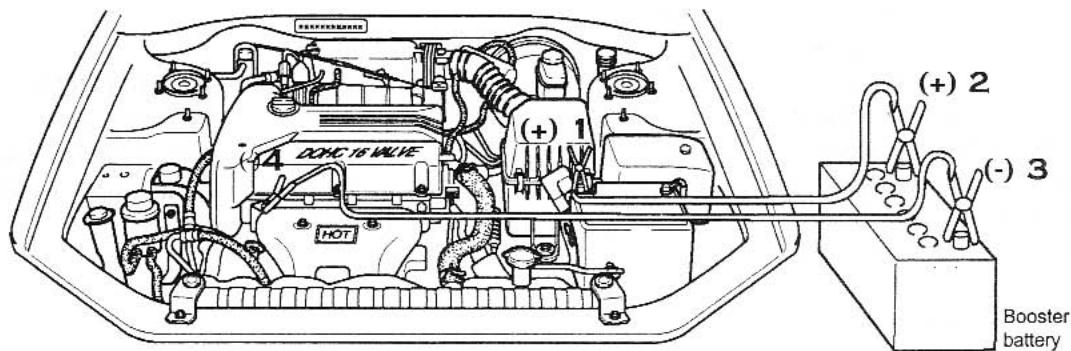
1MS106001
- Turn off all unnecessary electrical loads.
- Connect the jumper cables in the exact sequence shown in the illustration on the previous page. First, connect one end of a jumper cable to the positive terminal (+) of the discharged battery ① , then the other end of the same cable to the positive terminal (+) on the booster battery, ② . Next, connect one end of the other jumper cable to the negative terminal (-) of the booster battery ③ , then the other end to a solid, stationary, metallic point (for example, the engine lifting bracket) ④ away from the battery. Do not connect the jumper cable to or near any part that moves when the engine is crankled. Do not connect the jumper cable from the negative terminal (-) of the booster battery to the negative terminal (-) of the discharged battery. Do not
allow the jumper cables to contact anything except the correct battery terminals or the correct ground. Do not lean over the battery when making connections.
- Start the engine of the vehicle with the booster battery and run it at 2,000 rpm. Then, start the engine of the vehicle with the discharged battery.
If the cause of your battery discharging is not apparent (for example, having left the lights on accidentally), you should have your vehicle checked by an Authorized Kia Dealer.
PUSH-STARTING
A vehicle equipped with an automatic transaxle cannot be started by pushing. A vehicle equipped with a manual transaxle should not be push-started because it could damage the emission control system. Follow the directions for jump starting.
Z CAUTION:
Never tow a vehicle to start it. A sudden surge forward when the engine starts could cause a collision with the tow vehicle.
ELECTRICAL CIRCUIT PROTECTION FUSES
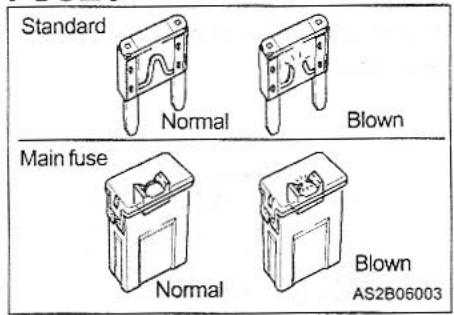
A vehicle's electrical system is protected from electrical overload damage by fuses. This vehicle has two fuse panels, one located in the driver's side kick panel, the other in the engine compartment near the battery. A fuse panel chart is provided later in this section.
If any of your vehicle's lights, accessories, or controls do not work, check the appropriate circuit fuse. If a fuse has blown, the element inside the fuse will be melted. Always replace a blown fuse with one of the same rating. If the replacement fuse blows out, this indicates an electrical problem. Avoid using the system involved and immediately consult an Authorized Kia Dealer.
Two kinds of fuses are used: standard for lower amperage rating, and main for higher amperage ratings.
FUSE REPLACEMENT
WARNING-FUSE REPLACEMENT
- Never replace a fuse with anything but another fuse of the same type and rating.
- A higher capacity fuse could cause damage and possibly a fire.
- Never install a wire in place of the proper fuse - even as a temporary repair. It may cause extensive wiring damage and possibly a fire.
- Do not use a screwdriver or any other metal object to remove fuses because it may cause a short circuit and damage the system.
If the electrical system does not work, first check the driver's side fuse panel.
- Turn the ignition switch and all other switches off.
- Pull the suspected fuse straight out. Use the removal tool provided on the main fuse box in the engine compartment. Refer to the fuse panel chart on the fuse panel cover to identify the likely problem fuse or electrical circuit.
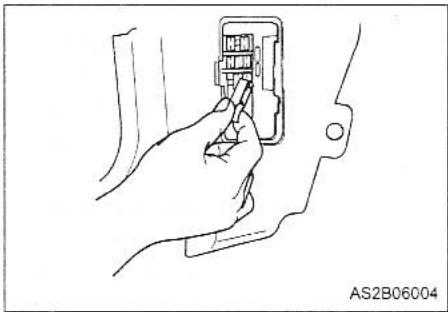
-
Check the removed fuse; replace if it is blown. Four (4) sparefuses are provided in the engine compartment fuse panel cover.
-
Push in a new fuse of the same rating, and make sure it fits tightly in the clips.
If it fits loosely, consult an Authorized Kia Dealer.
If you do not have a spare, use a fuse of the same rating from a circuit you may not need for operating the vehicle, such as the radio or clock (Room) fuse. If the headlights or other electrical components do not work and the fuses are OK, check the fuse box in the engine compartment. If a fuse is blown, it must be replaced.
- Turn the ignition switch and all other switches OFF.
- Remove the fuse box cover by turning the plastic knob located in the cover counterclockwise until the cover can be removed.
- Check the fuses. If one is blown, replace it with a new one of the same rating.
CAUTION:
After checking the fuse box in the engine compartment, please securely install the fuse box cover. If not, some electrical failures may occur causing from the water.
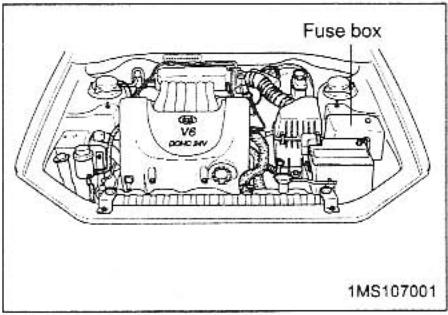
FUSE PANEL
DESCRIPTION
DRIVER'S SIDE KICK PANEL
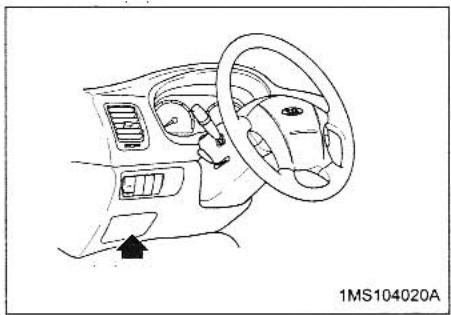
| 10A RR HTC IND | 10A HAZARD | 15A RR FOG | 10A A/CON | 10A ETACS | 15A DR LOCK |
| 30A P/SEAT | 15A T/LID OPEN | 15A STOP LP | 10A H/LP | 10A A/BAG IND | 10A T/SIG |
| 10A A/CON SW | 15A ACC SOCKET | 15A SHTR | 15A A/BAG | 10A BUP | 10A CLUSTER |
| 10A START | 15A SP 1 | 15A SP 2 | 15A SP 3 | 15A SP 4 | 10A D/CLOCK |
| 10A TAIL (LH) | 10A AUDIO | 20A WIFER | SHUNT | 10A ROCM LP | |
| 10A TAIL (RH) | 15A CLIGHTER | 10A EPS | |||
| USE THE DESIGNATED FUSE ONLY. | |||||
B990B02Y
IN CASE OF EMERGENCY
| DESCRIPTION | FUSE RATING | PROTECTED COMPARTIMENTS |
| RR HTD IND | 10A | Rear window defroster, Outside rear view mirror heater |
| HAZARD | 10A | Hazard light, Turn signal lights |
| RR FOG | 15A | Rear fog light |
| A/CON | 10A | Air conditioning system |
| ETACS | 10A | ETACS, Keyless entry system, Door lock system |
| DR LOCK | 15A | Power door lock |
| P/SEAT | 30A | Power seat |
| T/LID OPEN | 15A | Remote trunk lid |
| STOP LP | 15A | Stop lights |
| H/LP | 10A | Head light |
| A/BAG IND | 10A | Air-bag |
| T/SIG | 10A | Turn signal lights |
| A/CON SW | 10A | Air conditioning system |
| ACC SOCKET | 15A | Power outlet |
| S/HTR | 15A | Seat heater |
| A/BAG | 15A | Air-bag |
| B/UP | 10A | Backup lights |
| CLUSTER | 10A | Cluster |
| START | 10A | Engine switch |
| SP1 | 15A | Spare fuse |
| SP2 | 15A | Spare fuse |
| SP3 | 15A | Spare fuse |
| SP4 | 15A | Spare fuse |
| D/CLOCK | 10A | Digital clock |
| TAIL(LH) | 10A | Position lights, License plate lights, Tail lights |
| AUDIO | 10A | Audio |
| WIPER | 20A | Wiper |
| ROOM LP | 10A | Dome lights, Front door edge warning lights |
| TAIL(RH) | 10A | Position lights, License plate lights, Tail lights |
| C/LIGHTER | 15A | Cigar lighter |
| EPS | 10A |
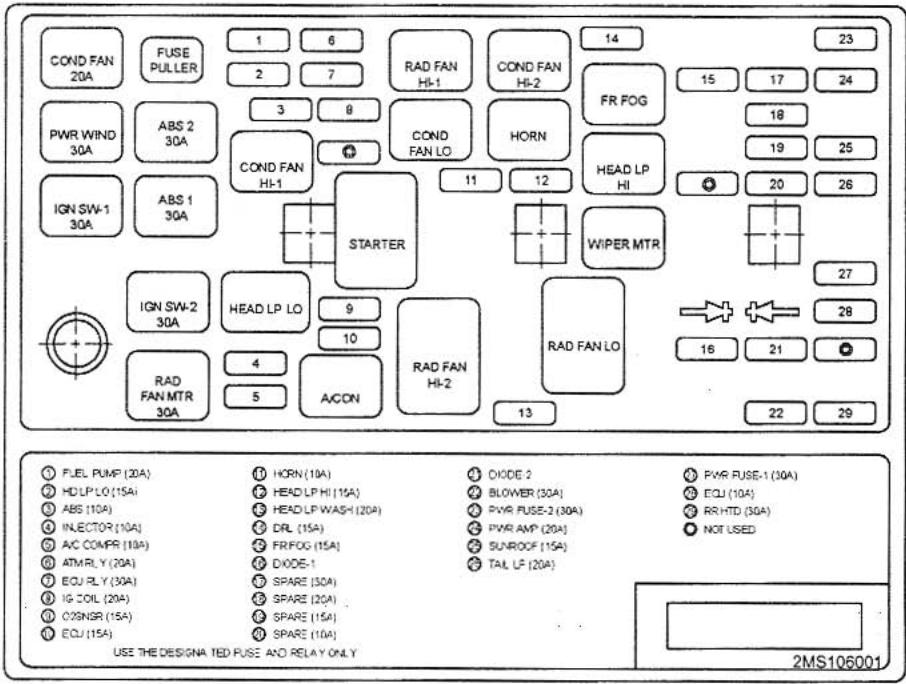
ENGINE COMPARTMENT.
| DESCRIPTION | FUSE RATING | PROTECTED COMPARTIMENTS |
| COND FAN | 20A | Condenser fan |
| PWR WIND | 30A | Power window |
| ABS 2 | 30A | ABS |
| IGN SW-1 | 30A | Ignition switch |
| ABS 1 | 30A | ABS |
| IGN SW-2 | 30A | Ignition switch |
| RAD FAN MTR | 30A | Radiator fan motor |
| FUEL PUMP | 20A | Fuel pump |
| HD LP LO | 15A | Headlights (LO) |
| ABS | 10A | ABS |
| INJECTOR | 10A | Injector |
| A/C COMPR | 10A | Air-con compressor |
| ATMRLY | 20A | ATM Relay |
| ECU RLY | 30A | Engine control unit relay |
| IG COIL | 20A | Ignition coil |
| O2 SNSR | 15A | Oxygen sensor |
| ECU | 15A | Engine control unit |
| HORN | 10A | Horn |
| HEAD LP HI | 15A | Headlights (HI) |
| HEAD LP WASH | 20A | - |
| DRL | 15A | DRL |
| FR FOG | 15A | Front fog lights |
| DIODE-1 | - | Diode 1 |
| SPARE | 30A | Spare fuse |
| SPARE | 20A | Spare fuse |
| SPARE | 15A | Spare fuse |
| SPARE | 10A | Spare fuse |
| DIODE-2 | - | Diode 2 |
| BLOWER | 30A | Blower |
| PWR FUSE-2 | 30A | Power fuse 2 |
| PWR AMP | 20A | Power amp |
| SUNROOF | 15A | Sunroof |
| TAIL LP | 20A | Tail lights |
| PWR FUSE-1 | 30A | Power fuse 1 |
| ECU | 10A | ECU |
| RR HTD | 30A | Rear window defroter |
TOWING
If emergency towing is necessary, we recommend having it done by an Authorized Kia Dealer or a competent tow-truck service. Proper lifting and towing procedures are necessary to prevent damage to the vehicle. State and local laws applicable to towing vehicles must be followed.
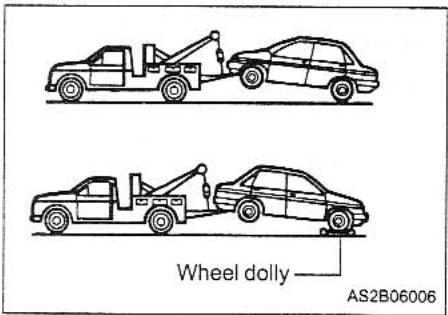
As a general rule, towed vehicles should be pulled with the driving wheels off the ground. If excessive damage or other conditions prevent towing the vehicle with the driving wheels off the ground, use wheel dollies.
With either an automatic or manual transaxle:
- Set the ignition switch in the ACC position;
- Place the shift lever in N (Neutral);
- Release the parking brake.
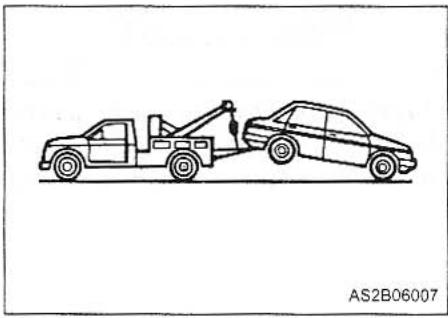
念 NOTICE:
Do not tow the vehicle backward with the front wheels on the ground. This may cause internal damage to the transaxle.
*NOTICE:
Do not tow with sling-type equipment. Use wheel lift or flatbed equipment.
CAUTION:
Do not use the hooks under the front or rear of the vehicle for towing purposes. These hooks are designed ONLY for transport tie-down. If the tie-down hooks are used for towing, the front/rear bumper will be damaged and the vehicle may break free from the tow vehicle.
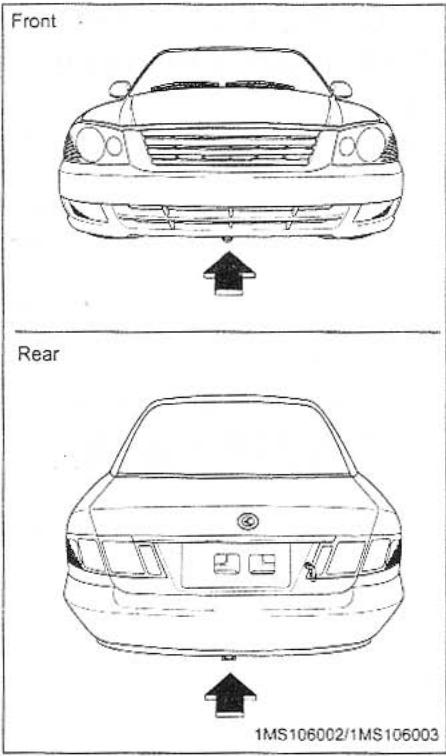
Tie-Down Hooks (for flatbed towing)
IF YOU HAVE A FLAT TIRE STORING THE SPARE TIRE, JACK AND TOOLS
The spare tire, tool bag, jack and jack handle are stored in the trunk compartment. Move the carpeting out of the way to reach this equipment.
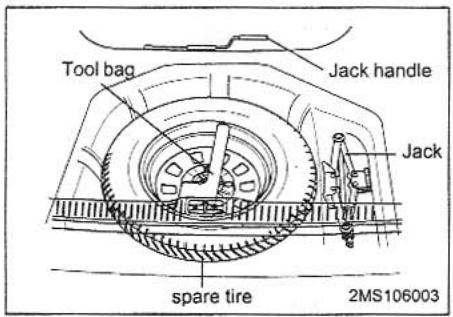
TO REMOVE THE JACK:
Turn the jack socket counterclockwise.
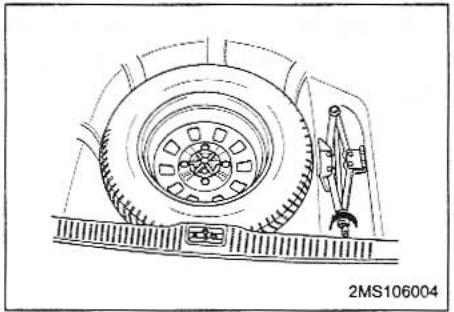
TO REMOVE SPARE TIRE:
Tun the tire hold-down wing bolt counterclockwise.
Store the tire in the reverse order of removal.
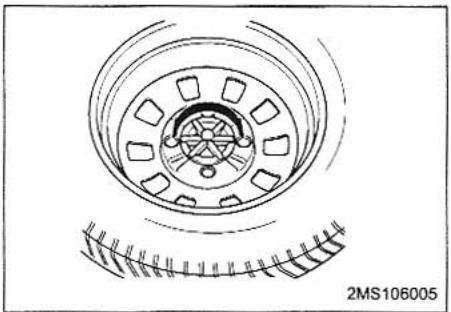
To prevent the jack, jack handle, and tool bag from "rattling" while the vehicl is in motion, store them properly.
IMPORTANT-USE OF COMPACT SPARE TIRE
Your vehicle is equipped with a compact spare tire.
This compact spare tire takes up less space than a regular-size tire. This tire is smaller than a conventional tire and is designed for temporary use only.
Z CAUTION:
You should drive carefully when the compact spare is in use. The compact spare should be replaced by the proper conventional tire and rim at the first opportunity.
The operation of this vehicle is not recommended with more than one compact spare tire in use at the same time.
CAUTION:
This spare tire should be used only for VERY short distances. Compact spares should NEVER be used for long drives or extended distances.
The compact spare should be inflated to 412kPa (60 psi).
*NOTICE:
Check the inflation pressure after installing the spare tire. Adjust to the specified pressure, as necessary.
When using a compact spare tire, observe the following precautions:
Under no circumstances should you exceed 80km / h (50 mph); a higher speed could damage the tire.
- Ensure that you drive slowly enough for the road conditions to avoid all hazards. Any road hazard, such as a pothole or debris, could seriously damage the compact spare.
Any continuous road use of this tire could result in tire failure, loss of vehicle control, and possible personal injury.
Do not exceed the vehicle's maximum load rating or the load-carrying capacity shown on the sidewall of the compact spare tire.
- Avoid driving over obstacles. The compact spare tire diameter is smaller than the diameter of a conventional tire and reduces the ground clearance approximately 25mm (1in.), which could result in damage to the vehicle.
- Do not take this vehicle through an automatic car wash with the compact spare tire installed.
- Do not use tire chains on this tire. Because of the smaller size, a tire chain will not fit properly. This could damage the vehicle and result in loss of the chain.
- This tire should not be installed on the front axle if the vehicle must be driven in snow or on ice.
- Do not use the compact spare tire on any other vehicle because this tire has been designed especially for your vehicle.
The compact spare's tread life is shorter than a regular tire. Inspect your compact spare tire regularly and replace worn compact spare tires with the same size and design, mounted on the same wheel.
CHANGING TIRES
JACKING INSTRUCTIONS
The jack is provided for emergency tire changing only. Follow jacking instructions to reduce the possibility of personal injury.

WARNING - CHANGING TIRES
- Never attempt vehicle repairs or a tire change in the traffic lanes of a public road or highway. Always move the vehicle completely off the road and onto the shoulder before trying to change a tire. If you cannot find a firm, level place off the road, call a towing service company for assistance.
-
Do not exceed the maximum permissible load of the jack: 1,320 lbs. (600 kg).
-
Be sure to use the correct front or rear jacking positions on the vehicle; never use the bumpers or any other part of the vehicle for jack support.
- Never allow any portion of your body to get beneath the vehicle while using the jack.
- Do not start or run the engine while the vehicle is supported by the jack.
TIRE REPLACEMENT
- Park on a level surface and set the parking brake firmly.
- Set the automatic transaxle in P (Park), or shift the manual transaxle into R (Reverse).
- Activate the hazard warning flasher.
- Remove the wheel lug nut wrench, jack, jack handle, and spare tire from the vehicle.
- Block both the front and rear of the wheel that is diagonally opposite the jack position.
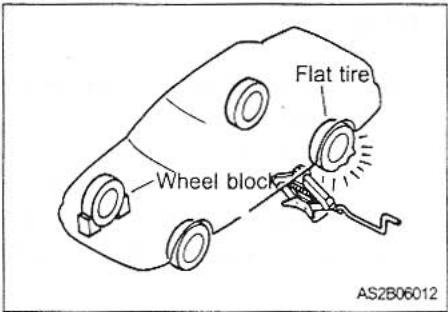
WARNING - CHANGING A FRONT TIRE
When one front wheel is lifted off the ground, neither the automatic transaxle P (Park) position nor the manual transaxle R (Reverse) position will prevent the vehicle from moving and possibly slipping off the jack, even if these positions are properly engaged.
To prevent vehicle movements while changing a tire, always set the parking brake fully, and always block the wheel diagonally opposite the wheel being changed.
- For models with alloy wheels, remove the center cap.
- Loosen the four lug nuts counterclockwise one turn each, but do not remove any nut until the tire has been raised off the ground.
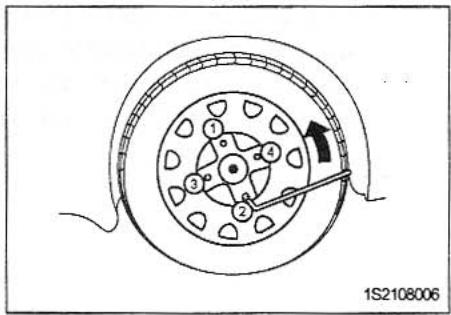
- Place the jack at the front or rear jacking position closest to the tire you are changing. Place the jack under the side sill at the designated location.
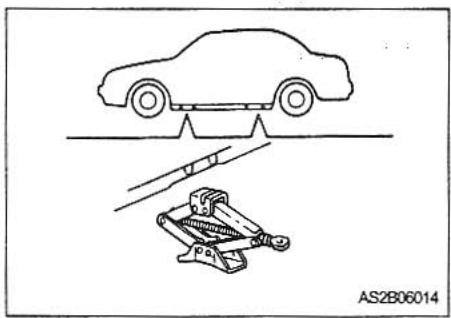
WARNING-JACK LOCATION
To reduce the possibility of injury, be sure to use only the jack provided with the vehicle and in the correct jack position; never use any other part of the vehicle for jack support.
- Insert the jack handle into the jack and turn it clockwise, raising the vehicle until the tire just clears the ground, approximately 1.2 in. (30 mm). Before removing the lug nuts, make sure the vehicle is stable and that there is no chance for it to slip or move.
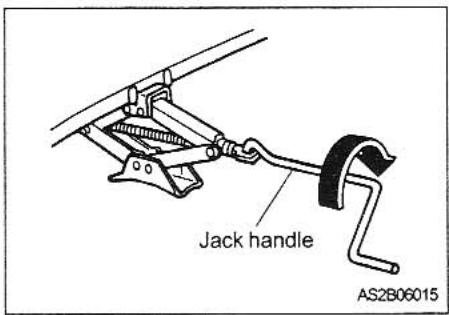
- Remove the lug nuts by turning them counterclockwise, then remove the wheel.
- Mount the spare tire into position and tighten the nuts by hand. Install the lug nuts with the beveled edge inward.
- Turn the jack handle counterclockwise and lower the vehicle until it touches the ground. Tighten the lug nuts firmly in an "X" pattern.
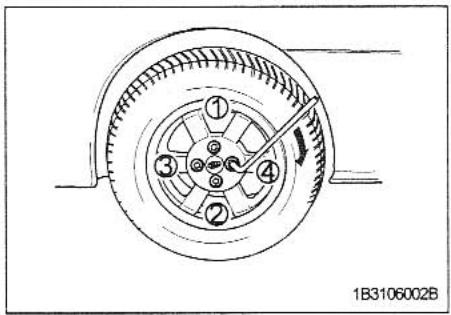
Once the lug nuts have been tightened, lower the vehicle fully to the ground and continue to tighten the lug nuts until they are completely secured.
If you are unsure of the tightness of the wheel lug nuts, have them checked at the nearest service station. The specified tightening torque is 76 ft. lb. (103 N·m).
CAUTION:
Your vehicle has metric threads on the wheel studs and nuts. During wheel removal, make certain that the same nuts removed are reinstalled - or, if replaced, that nuts with metric threads and the same configuration are used. Installation of a non-metric thread nut on a metric stud or vice-versa will not secure the wheel to the hub properly and will damage the stud so that it must be replaced. Note that most U.S. lug nuts do not have metric threads. Be sure to use extreme care in checking for thread style before installing aftermarket lug nuts or wheels. If in doubt, consult an Authorized Kia Dealer. Damaged studs may result in wheel loss and personal injury.
WARNING-WHEEL STUDS
If the studs are damaged, they may lose their ability to retain the wheel. This could lead to the loss of the wheel and a collision.
*NOTICE:
Check the inflation pressures as soon as possible after installing the spare tire. Adjust it to the specified pressure, if necessary. Standard Tire:206 kPa(30 psi) Compact Spare Tire : 412 kPa (60 psi)
To prevent the jack, jack handle, wheel lug nut, wrench and spare tire from rattling while the vehicle is in motion, store them properly.
MAINTENANCE
Maintenance Services 7-2
Maintenance Schedule 7-4
Owner Maintenance 7-10
Engine Compartment 7-12
Engine Oil and Oil Filter 7-14
Engine Cooling System 7-16
Brakes and Clutch 7-18
Parking Brake 7-19
Power Steering 7-19
Automatic Transaxle 7-20
Lubricants and Fluids 7-22
Air Cleaner 7-22
Wiper Blades 7-23
Battery 7-24
Tires and Wheels 7-26
Bulb Replacement 7-33
Lubricant Specifications 7-37
Exterior Care 7-39
Interior Care 7-41
MAINTENANCE SERVICES
You should exercise the utmost care to prevent damage to your vehicle and/or injury to yourself whenever performing any maintenance or inspection procedures.
Should you have any doubts concerning the inspection or servicing of your vehicle, we strongly recommend that you have a reliable and qualified service shop perform this work, preferably an Authorized Kia Dealer.
An Authorized Kia Dealer has factory-trained technicians and genuine Kia parts to service your vehicle properly. For expert advice and quality service, see an Authorized Kia Dealer.
Inadequate, incomplete or insufficient servicing may result in operational problems with your vehicle that could lead to vehicle damage, an accident or personal injury.
OWNER'S RESPONSIBILITY
MAINTENANCE SERVICE AND RECORD RETENTION ARE THE OWNER'S RESPONSIBILITY.
You should retain documents to show that proper maintenance has been performed on your vehicle in accordance with the scheduled maintenance service charts shown on the following pages. You need this information to be able to establish your compliance with the servicing and maintenance requirements of your Kia warranties.
Detailed warranty information is provided in your Warranty Information Manual. Repairs and adjustments required as a result of improper maintenance or a lack of required maintenance are not covered.
We recommend that such maintenance be performed by an Authorized Kia Dealer using genuine Kia parts. However, such maintenance may be performed by any
competent automotive repair establishment using automotive parts equivalent to those with which your vehicle or engine was originally equipped. Whenever we recommend that you have service or maintenance performed by an Authorized Kia Dealer, you may have a competent automotive repair establishment using proper parts perform that work as well.
SCHEDUED
MAINTENANCE SERVICE
Follow Schedule 1-Normal Maintenance if the vehicle is usually operated where none of the following conditions apply. If any of the following conditions apply, follow Schedule 2-Severe Maintenance.
- Repeated short distance driving.
- Driving in dusty conditions.
- Driving with an extensive use of brakes.
- Driving in areas where salt or other corrosive materials are being used.
- Driving on rough or muddy roads.
- Extended periods of idling or low-speed operation.
- Driving for a prolonged period in cold temperatures and/or extremely humid climates.
After 48 months or 48,000 miles (80 000 km) continue to follow the prescribed maintenance intervals.
SCHEDULE 1-NORMAL MAINTENANCE
| MAINTENANCE INTERVALS MAINTENANCE ITEM | Number of months or kilometers(Miles), whichever comes first | |||||||||
| Months | 6 | 12 | 18 | 24 | 30 | 36 | 42 | 48 | ||
| x 1,000 | Km | 12 | 24 | 36 | 48 | 60 | 72 | 84 | 96 | |
| (Miles) | (7.5) | (15) | (22.5) | (30) | (37.5) | (45) | (52.5) | (60) | ||
| Drive belts | I | I | ||||||||
| Engine oil | R | R | R | R | R | R | R | R | ||
| Engine oil filter | R | R | R | R | R | R | R | R | ||
| Manual transmission oil | I | I | I | I | I | I | I | R | ||
| Automatic transmission fluid | I | I | I | I | I | R | I | R | ||
| Engine timing belt | Replace every 96,000 km(60,000 miles) | |||||||||
| Air cleaner element | R | R | ||||||||
| Spark plugs | R | R | ||||||||
I: Inspect and, if necessary, adjust, correct, clean or replace.
R: Replace or change.
(1) This maintenance is recommended by Kia, However, it is not necessary for emission warranty coverage or manufacturer recall liability.
*1) Replace every 96,000 km (60,000 miles): Only V6 2500cc engine
SCHEDULE 1-NORMAL MAINTENANCE(CONT.)
| MANNAGEMENT INTERVALS MANNAGEMENT ITEM | Number of months or kilometer(Miles), whichever comes first | |||||||||
| Months | 6 | 12 | 18 | 24 | 30 | 36 | 42 | 48 | ||
| x 1,000 | Km | 12 | 24 | 36 | 48 | 60 | 72 | 84 | 96 | |
| (Miles) | (7.5) | (15) | (22.5) | (30) | (37.5) | (45) | (52.5) | (60) | ||
| Cooling system | I | I | ||||||||
| Engine coolant | R | R | ||||||||
| Idle speed | I(1) | I | ||||||||
| fuel filter | R | |||||||||
| Fuel tank, cap, lines and hoses | I(1) | I | ||||||||
| Hose and tube for emission | I(I) | |||||||||
| I(I) | ||||||||||
I: Inspect and, if necessary, adjust, correct, clean or replace.
R: Replace or change.
(1) This maintenance is recommended by Kia. However, it is not necessary for emission warranty coverage or manufacturer recall liability.
SCHEDULE 1-NORMAL MAINTENANCE(CONT.)
| MAINTENANCE INTERVALS MAINTENANCE ITEM | Number of months or kilometer(Miles), whichever comes first | ||||||||
| Months | 6 | 12 | 18 | 24 | 30 | 36 | 42 | ||
| x 1,000 | Km | 12 | 24 | 36 | 48 | 60 | 72 | 84 | |
| (Miles) | (7.5) | (15) | (22.5) | (30) | (37.5) | (45) | (52.5) | ||
| Brake lines and connections | I | I | |||||||
| Drum brakes | I | I | |||||||
| Disc brakes | I | I | |||||||
| Steering operation and linkage | I | I | |||||||
| Front suspension ball joints | I | I | |||||||
| Driveshaft dust boots | I | I | |||||||
| Chassis/body nuts and bolts | I | I | |||||||
| Exhaust system heat shield | I | I | |||||||
| All locks and hinges | L | L | L | L | L | L | L | ||
| Air conditioner refrigerant(if equipped) | Inspect refrigerant amount annually | ||||||||
| Air conditioner compressor (if equipped) | Inspect operation annually | ||||||||
I:Inspect and, if necessary, adjust, correct, clean or replace.
L: Lubricate.
SCHEDULE 2-SEVERE MAINTENANCE
| MAINTENANCE INTERVALS MAINTENANCE ITEM | Number of months or kilometer(Miles), whichever comes first | |||||||||||||
| Months | 3 | 6 | 9 | 12 | 15 | 18 | 21 | 24 | 27 | 30 | 33 | 36 | ||
| x 1,000 | Km (Miles) | 8 | 16 | 24 | 32 | 40 | 48 | 56 | 64 | 72 | 80 | 88 | 96 | |
| (5) | (10) | (15) | (20) | (25) | (30) | (35) | (40) | (45) | (50) | (55) | (60) | |||
| Drive belts | J | I | ||||||||||||
| Engine oil | R | R | R | R | R | R | R | R | R | R | R | R | ||
| Engine oil filter | R | R | R | R | R | R | R | R | R | R | R | R | ||
| Manual transmission oil | I | I | I | I | I | I | I | I | I | I | I | R | ||
| Automatic transmission fluid | I | I | I | I | I | I | I | I | I | I | R | I | ||
| Engine timing belt | Replace every 96,000km (60,000 miles) | |||||||||||||
| Air cleaner element | I (1&2) | R | I (1&2) | R | ||||||||||
| Spark plugs | R | R | ||||||||||||
| Cooling system | I | I | ||||||||||||
| Engine coolant | R | R | ||||||||||||
I: Inspect and, if necessary, adjust, correct, clean or replace.
R: Replace or change.
(1) This maintenance is recommended by Kia. However, it is not necessary for emission warranty coverage or manufacturer recall liability.
(2) Inspect, and if necessary, replace.
SCHEDULE 2-SEVERE MAINTENANCE(CONT.)
| MANTENANCE INTERVALS MANTENANCE ITEM | Number of months or kilometers(Miles), whichever comes first | |||||||||||||
| Months | 3 | 6 | 9 | 12 | 15 | 18 | 21 | 24 | 27 | 30 | 33 | 36 | ||
| x 1,000 | Km | 8 | 16 | 24 | 32 | 40 | 48 | 56 | 64 | 72 | 80 | 88 | 96 | |
| (Miles) | (5) | (10) | (15) | (20) | (25) | (30) | (35) | (40) | (45) | (50) | (55) | (60) | ||
| Idle speed | I(1) | I | ||||||||||||
| Fuel filter | R | |||||||||||||
| Fuel tank, cap, lines and hoses | I(1) | I | ||||||||||||
I: Inspect and, if necessary, adjust, correct, clean or replace.
R: Replace or change.
(1) This maintenance is recommended by Kia. However, it is not necessary for emission warranty coverage or manufacturer recall liability.
SCHEDULE 2-SEVERE MAINTENANCE(CONT.)
| MANTENANCE INTERVALS MANTENANCE ITEM | Number of months or kilometer(Miles), whichever comes first | |||||||||||||
| Months | 3 | 6 | 9 | 12 | 15 | 18 | 21 | 24 | 27 | 30 | 33 | 36 | ||
| x 1,000 | Km (Miles) | 8 | 16 | 24 | 32 | 40 | 48 | 56 | 64 | 72 | 80 | 88 | 96 | |
| (5) | (10) | (15) | (20) | (25) | (30) | (35) | (40) | (45) | (50) | (55) | (60) | |||
| Brake lines and connections | I | I | ||||||||||||
| Drum brakes | I | I | ||||||||||||
| Disc brakes | I | I | I | I | ||||||||||
| Steering operation and linkage | I | I | ||||||||||||
| Front suspension ball joints | I | I | ||||||||||||
| Driveshaft dust boots | I | I | ||||||||||||
| Chassis/body nuts and bolts | I | I | I | I | ||||||||||
| Exhaust system heat shield | I | I | ||||||||||||
| All locks and hinges | L | L | L | L | L | L | L | L | L | L | L | L | ||
| Air conditioner refrigerant (ifequipped) | Inspect refrigerant amount annually | |||||||||||||
| Air conditioner compressor (ifequipped) | Inspect operation annually | |||||||||||||
I: Inspect and, if necessary, adjust, correct, clean or replace.
L: Lubricate.
OWNER MAINTENANCE
OWNER MAINTENANCE SCHEDULE
The owner or a qualified service technician should perform these vehicle inspections at the indicated intervals to ensure safe and dependable operation. Bring any problem to the attention of an Authorized Kia Dealer or qualified service technician as soon as possible.
WHEN REFUELING, CHECK:
Engine oil level
- Engine coolant level
- Brake and clutch fluid level
- Washer fluid level
CAUTION:
Be careful when checking your engine coolant level. The engine compartment will be hot and you could be burned.
AT LEAST MONTHLY
- Tire inflation pressures
EVERY 6 MONTHS, CHECK:
Power steering fluid level
Automatic transaxle fluid level You can do the following scheduled maintenance items if you have some mechanical ability, a few basic tools and if you closely follow the directions in this manual.
OWNER MAINTENANCE PRECAUTIONS
Improper or incomplete service may result in problems. This section gives instructions only for the maintenance items that are easy to perform.
WARNING - MAINTENANCE WORK
Performing maintenance work on a vehicle can be dangerous. You can be seriously injured while performing some maintenance procedures. If you lack sufficient knowledge, experience or the proper tools and equipment to do the work, have it done by a qualified technician.
As explained earlier in this section, several procedures can be done only by a qualified service technician with special tools.
Improper owner maintenance during the warranty period may affect warranty coverage. For details, read the separate Kia Warranty Information Booklet provided with the vehicle. If you're unsure about any servicing or maintenance procedure, have it done by an Authorized Kia Dealer.
WARNING - LOOSECLOTHING/ JEWELRY
Working under the hood with the engine running is dangerous. It is even more dangerous when you wear jewelry, long hair or loose clothing. These can become entangled in moving parts and result in injury. Therefore, if you must run the engine while working under the hood, make certain that you pull hair back, remove all jewelry (especially rings, bracelets, watches, and necklaces) and all neckties, scarves, and similar loose clothing before getting near the engine or cooling fans.
WARNING - ENGINE COOLING FANS
Because your engine cooling fans are electrically controlled, they will run if the ignition switch is on, even if the engine is not running. This could cause serious injury. To prevent this, be sure the ignition is off, unless you must run the engine while performing maintenance or an inspection.
ENGINECOMPARTMENT
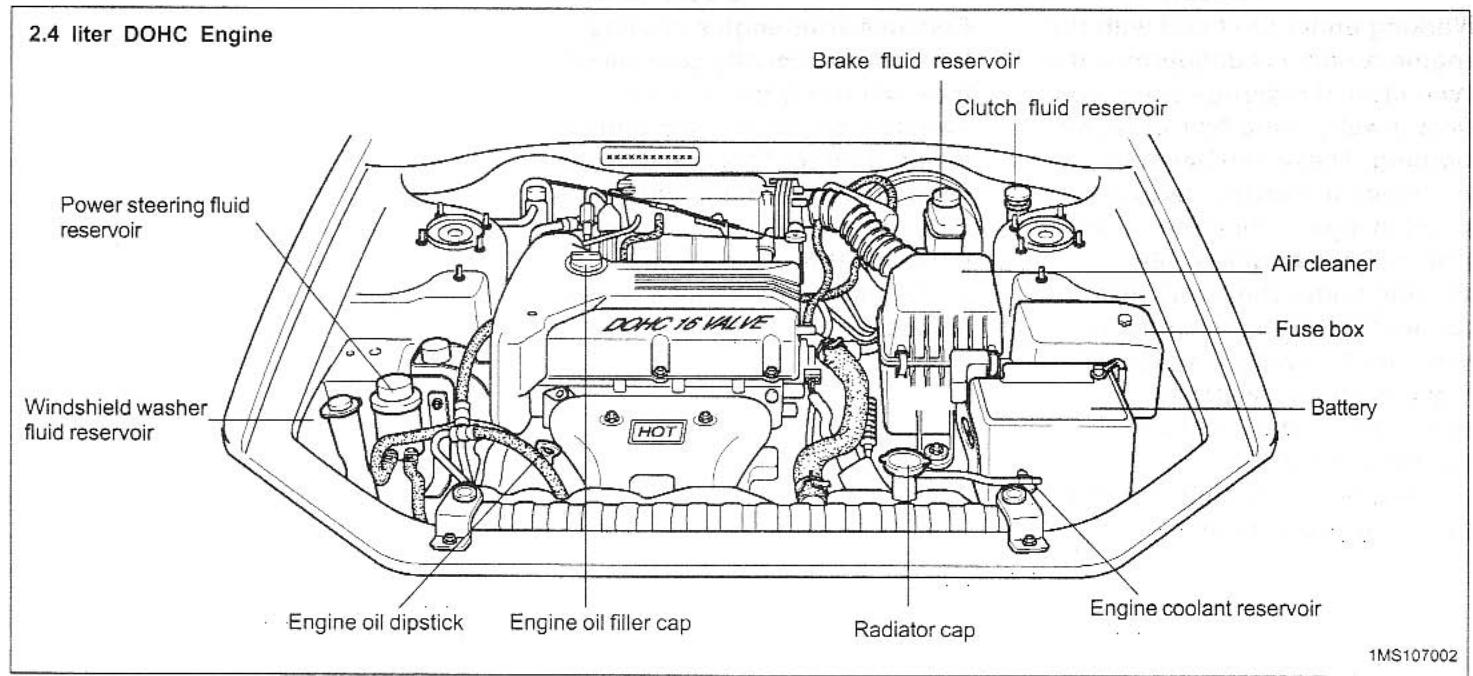
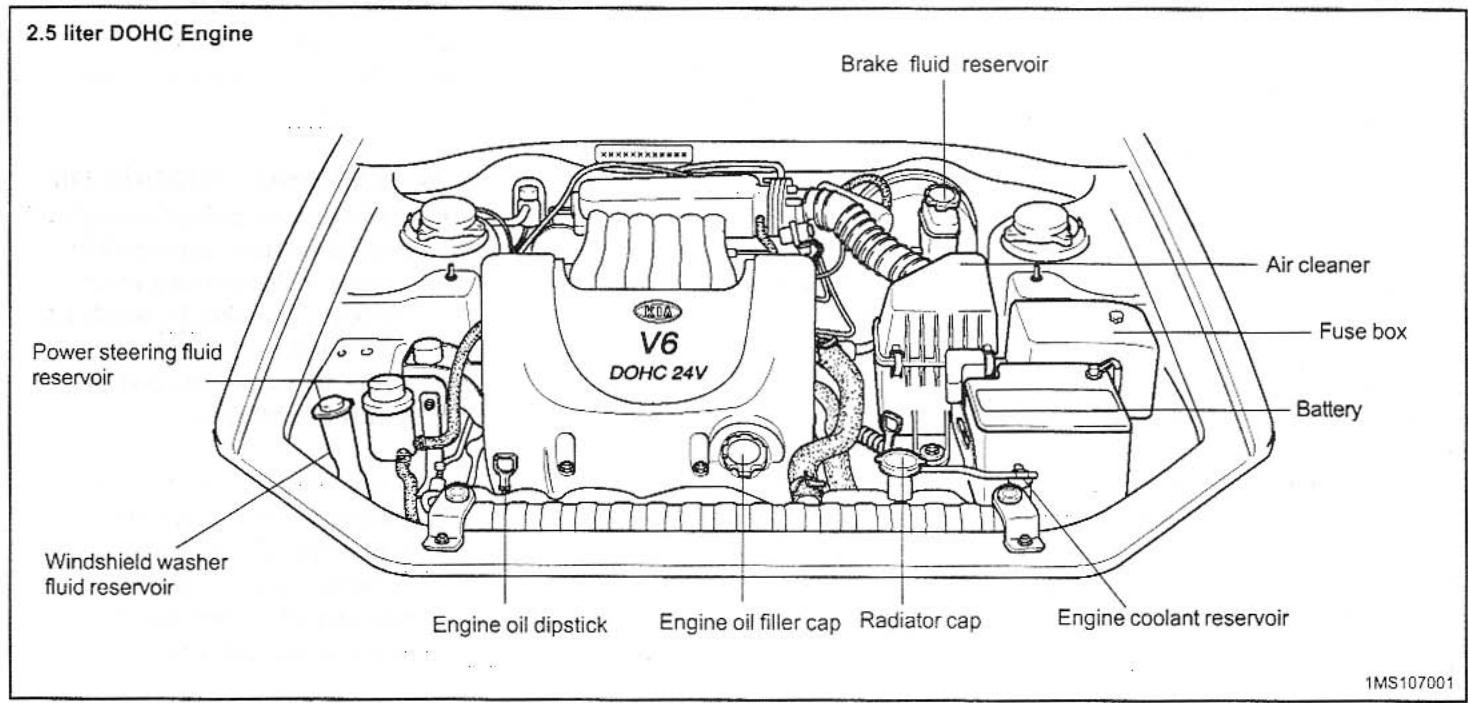
ENGINE OIL AND OIL FILTER
Checking the Engine Oil Level
- Be sure the vehicle is on level ground.
- Start the engine and allow it to reach normal operating temperature.
- Turn the engine off and wait a few minutes for the oil to return to the oil pan.
- Pull out the dipstick, wipe it clean, and re-insert it fully.
- Pull the dipstick out again and check the level. The level should be between F and L.
If it is near or at L, add enough oil to bring the level to F. Do not overfill. The distance between L and F on the dipstick represents 0.85 US qt. (0.7 liter). Use only the specified engine oil.
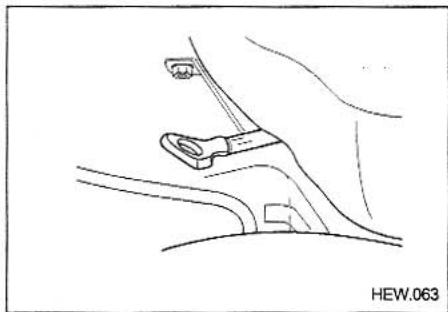
(Refer to "Recommended Lubricants" in the Index.)
CHANGING THE ENGINE OIL AND FILTER
Change engine oil and filter according to the Scheduled Maintenance earlier in this section.
WARNING - ENGINE OIL
- Continuous contact with USED engine oil has caused skin cancer in laboratory mice. Protect your skin by washing with soap and water.
-
Keep all engine oil out of the reach of children.
-
Warm the engine up for a few minutes and then turn it off. Remove the oil filler cap.
- Drain the oil into a suitable container after removing the oil filler cap and drain plug.
CAUTION:
Both the oil and engine are hot. Do not burn yourself.
- Remove the engine oil filter with an oil filter wrench.
*NOTICE:
When installing the replacement oil filter, do not allow the oil filter gasket to remain on the oil filter mounting surface. This will cause oil leakage and engine damage. Remove the old gasket completely so that a new gasket will properly seat and seal.
- Use a clean rag to clean the oil filter mounting surface on the engine.
-
Apply a small amount of engine oil to the new oil filter O-ring seal.
-
Install the oil filter and tighten it. (Refer to the oil filter caution label for tightening instructions.)
- Replace the drain plug tightly after the oil has thoroughly drained.
- Refill the engine with new oil to the F mark on the dipstick. Do not overfill.
- Re-install the oil filler cap securely.
- Start the engine and inspect around the oil filter seal for leaks. Stop the engine. Check the oil level and fill to the F mark, if necessary.
OIL CAPACITY
2400cc Engine
- Without filter change : 4.0 liters
- With filter change : 4.3 liters
2500cc Engine
- Without filter change : 4.2 liters
- With filter change : 4.5 liters
Use only the specified engine oil. (Refer to "Recommended Lubricants" in the Index.)
*NOTICE:
- Follow these instructions carefully. An improper oil filter installation can cause oil leakage and engine damage.
- Although oil filters may have the same external appearance, their internal designs differ significantly. These filters are not interchangeable. To avoid potential engine damage, use only the specified filter. Consult an Authorized Kia Dealer.
ENGINE COOLING SYSTEM
The cooling system is a high-pressure type with a reservoir and is filled with year-round antifreeze coolant at the factory.
Check the antifreeze protection and coolant level at least once a year, at the beginning of the winter season, and before traveling to a colder climate.
CHECKING THE COOLANT LEVEL
WARNING - REMOVING RADIATOR CAP
-
Never attempt to remove the radiator cap while the engine is operating. Doing so might lead to cooling system and/or engine damage and could result in serious personal injury from escaping hot coolant or steam.
-
Turn the engine off and wait until it has cooled. Even then, use extreme care when removing the radiator cap. Wrap a thick towel around it, and turn it counterclockwise slowly to the first stop. Step back while the pressure is released from the cooling system. When you are sure all the pressure has been released, press down on the cap, using a thick towel, and continue turning counterclockwise to remove it.
- Even if the engine is not operating, do not remove the radiator cap or the drain plug while the engine and radiator are hot. Hot coolant and steam may still blow out under pressure, causing serious injury.
Check the condition and connections of all cooling system hoses and heater hoses. Replace any swollen or deteriorated hoses.
The coolant level should be full in the radiator and between F (Full) and L (Low) on the coolant reservoir tank when the engine is cool.
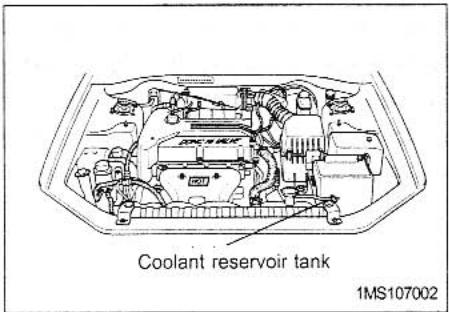
If the coolant level is low, add enough specified coolant to provide protection against freezing and corrosion and to bring the level to F in the coolant reservoir. Do not overfill. If frequent additions are required, see an Authorized Kia Dealer for a cooling system inspection.
CHANGING COOLANT
Change coolant according to the Scheduled Maintenance.
Use only soft (de-mineralized) water in the coolant mixture.
The engine in your vehicle has aluminum engine parts and must be protected by an ethylene glycol-based coolant to prevent corrosion and freezing.
DO NOT USE alcohol or methanol coolant and do not mix them with the specified coolant.
Do not use a solution that contains more than 60 percent coolant, which would reduce the effectiveness of the solution. For mixture percent-tages, refer to the following table.
| PROTECTION | Mixture Percentage (volume) | |
| Coolant Solution | Water | |
| Above 3°F (-16°C) | 35 | 65 |
| Above -15°F (-26°C) | 45 | 55 |
| Above -40°F (-40°C) | 55 | 45 |
- Turn the radiator cap counterclockwise and remove it.
- Loosen the radiator drain plug and drain the coolant into a suitable container.
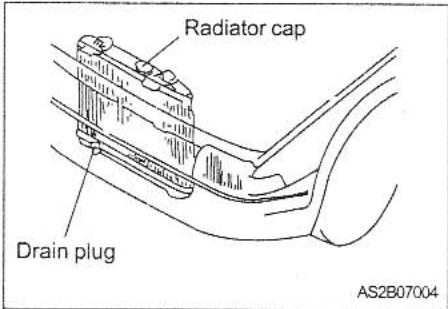
- With the drain plug loose, flush the system with running water.
- Drain the system completely and retighten the drain plug. Add the necessary amount of ethylene glycol based coolant and water to provide the required protection against freezing and corrosion.
In extremely cold climates, add the necessary amount of ethylene glycol-based coolant in accordance with the instructions of the coolant manufacturer.
- Run the engine at idle with the radiator cap off. Slowly add additional coolant if necessary.
- At this point, wait until the engine reaches normal operating temperature. Depress the accelerator two or three times; then add coolant if required. Be careful not to burn yourself.
- Install the radiator cap. Inspect all connections for leaks and recheck the coolant level in the reservoir. Recheck again after a few days of driving and add coolant as necessary.
BRAKES AND CLUTCH CHECKING BRAKE/CLUTCH FLUID LEVEL
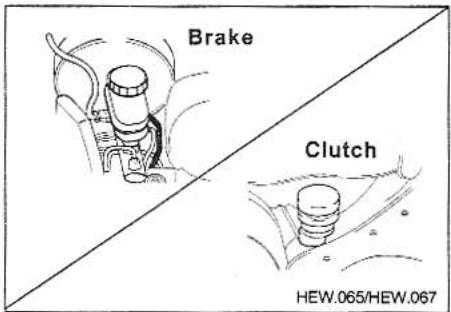
Brake Fluid Reservoir
Before adding fluid, thoroughly clean the area around the reservoir cap to prevent brake fluid contamination. If you add brake/clutch fluid, fill the brake/clutch fluid reservoir to the MAX line. The brake/clutch fluid level will drop with accumulated mileage. This is
a normal condition associated with brake/clutch lining wear.
Check the fluid level in the reservoir periodically; it should be between MAX and MIN on the side of the reservoir.
If the fluid level is excessively low, have the brake/clutch system checked by an Authorized Kia Dealer.
Use only the specified brake/clutch fluid. (Refer to "Recommended Lubricants" later in this section.)
Do not mix different types of fluid.
*NOTICE:
In the event the brake/clutch system requires frequent additions of fluid, the vehicle should be inspected by an Authorized Kia Dealer.
PARKING BRAKE CHECKING THE PARKING BRAKE
Check the stroke of the parking brake by counting the number of clicks' heard while fully applying it from the released position. Also, the parking brake alone should securely hold the vehicle on a fairly steep grade.
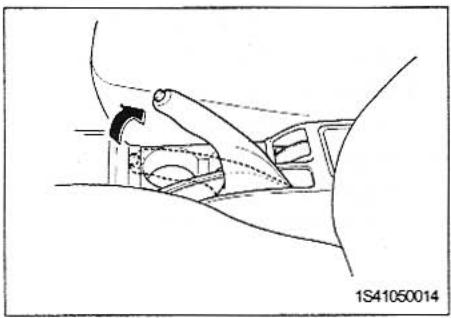
If the number of "clicks" is more or less than specified, have the parking brake adjusted by an Authorized Kia Dealer.
Stroke:
5-9 "clicks" at a force of 22 lbs. (98N).
POWER STEERING CHECKING THE POWER STEERING FLUID LEVEL
The power steering fluid level should be checked periodically.
With the engine off and the vehicle on level ground, check the fluid level in the power steering reservoir; it should be between the MAX and MIN reservoir indicators.
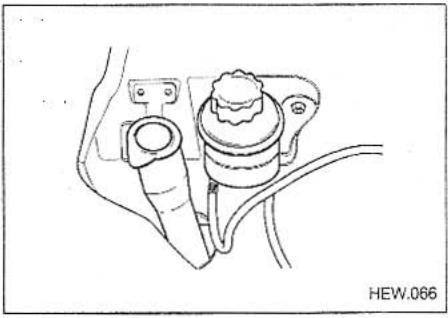
Before adding power steering fluid, thoroughly clean the area around the reservoir cap to prevent power steering fluid contamination.
If the level is low, add fluid to the MAX level.
In the event the power steering system requires frequent addition of fluid, the vehicle should be inspected by an Authorized Kia Dealer.
*NOTICE:
To avoid damage to the power steering pump, do not operate the vehicle for prolonged periods with low power steering fluid level.
Use only the specified power steering fluid. (Refer to "Recommended Lubricants" later in this section.)
AUTOMATIC TRANSAXLE CHECKING THE AUTOMATIC TRANSAXLE FLUID LEVEL
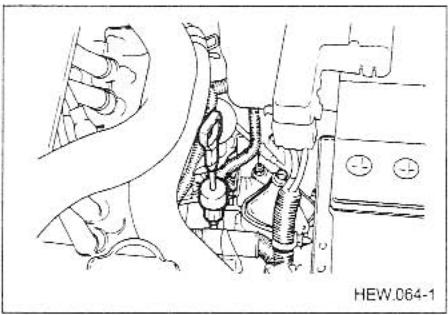
The automatic transaxle fluid level should be checked regularly. Take the following precautions to measure the fluid level properly.
The volume of the transaxle fluid changes with temperature. For that reason, it is best to check the level after having driven the vehicle for 30 minutes. If necessary, however, the fluid can also be checked when the vehicle has not been driven.
CAUTION:
- Low fluid level causes transaxle slippage. Overfilling can cause foaming, loss of fluid, and transaxle malfunction.
The use of a non-specified fluid could result in transaxle malfunction and failure.
WARNING-PARKING BRAKE
To avoid sudden movement of the vehicle, set the parking brake and depress the brake pedal while shifting the shift lever.
- Park the vehicle on level ground and set the parking brake firmly.
- Allow the engine to idle for about 2 minutes, then depress the brake pedal. Move the shift lever slowly through all ranges then set it in the P (Park) position.
- With the engine still idling, pull the dipstick out, wipe it clean, and reinsert it fully.
- Pull the dipstick out again. The fluid level is checked as follows:
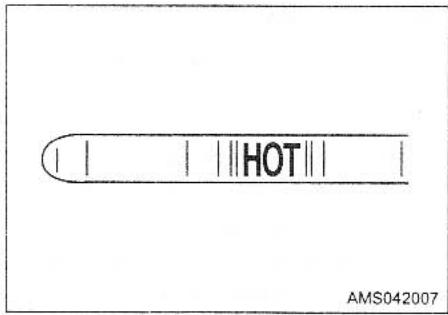
USING THE HOT FLUID SCALE:
If the vehicle has been driven and the fluid is warmed to the normal operating temperature of approximately 158 176°F (70 - 80°C) ,the fluid level should be within "HOT" range.
- Use the cold scale as a rough reference only.
If the outside temperature is lower than 68°F (20°C) start the engine and measure the fluid level after letting the engine reach operating
temperature.
- If the vehicle has been driven for an extended period at high speeds or in city traffic in hot weather, it is usually best to measure the fluid level after stopping the engine and allowing the fluid to cool for 30 minutes.
When inserting the dipstick, be sure to insert it completely. When adding fluid, measure frequently with the dipstick to make sure the fluid level does not go above the Full position. Do not overfill.
Use only the specified automatic transaxle fluid. (Refer to "Recommended Lubricants" in the Index.)
LUBRICANTS AND FLUIDS
CHECKING THE WASHER FLUID LEVEL
Check the fluid level in the washer fluid reservoir and add fluid if necessary. Plain water may be used if washer fluid is not available. However, use windshield washer solvent with antifreeze characteristics in cold climates to prevent freezing.
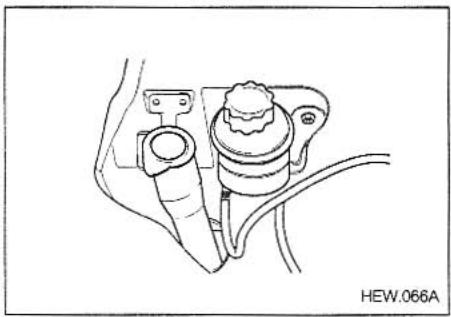
CAUTION:
- Do not use radiator coolant or antifreeze in the washer fluid reservoir.
- Radiator coolant can severely obscure visibility when sprayed on the windshield and may cause loss of vehicle control or damage to paint and body trim.
BODY LUBRICATION
All moving points of the body, such as doors, hood hinges and locks, should be lubricated each time the engine oil is changed.
Use a non-freezing lubricant on locks during cold weather.
Make sure the engine hood secondary latch keeps the hood from opening when the primary latch is released.
AIR CLEANER ELEMENT REPLACEMENT
A paper air cleaner filter is used. It must be replaced when necessary, and should not be cleaned and reused.
- Remove the four (4) air cleaner cover attaching clips.
- Wipe the inside of the air cleaner housing with a clean, damp cloth.
- Replace the air cleaner element.
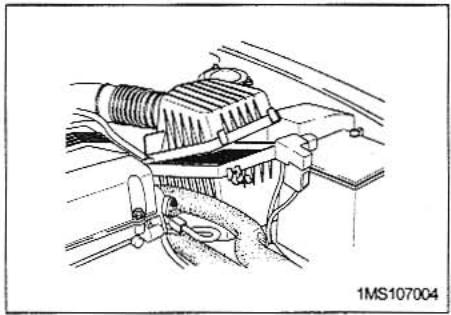
- Re-install in the reverse order of removal.
Replace the element according to the Scheduled Maintenance.
If the vehicle is operated in extremely dusty or sandy areas, replace the element more often than at the usual recommended intervals.
Z CAUTION:
- Do not drive with the air cleaner removed; this will result in excessive engine wear.
- Driving without an air cleaner encourages backfiring, which could cause a fire in the engine compartment.
WIPER BLADES
WIPER BLADE MAINTENANCE
*NOTICE:
Commercial hot waxes applied by automatic car washes have been known to make the windshield difficult to clean.
Contamination of either the windshield or the wiper blades with foreign matter can reduce the effectiveness of the windshield wipers. Common sources of contamination are insects, tree sap, and hot wax treatments used by some commercial car washes. If the blades are not wiping properly, clean both the window and the blades with a good cleaner or mild detergent, and thoroughly rinse with clear water.
*NOTICE:
To prevent damage to the wiper blades, do not use gasoline, kerosene, paint thinner, or other solvents on or near them.
WINDSHIELD WIPER BLADE REPLACEMENT
When the wipers no longer clean adequately, the wiper blades may be worn or cracked, requiring replacement.
*NOTICE:
To prevent damage to the wiper arms or other components, do not attempt to move the wipers manually.
- Raise the wiper arm and turn the wiper blade assembly to expose the plastic locking clip. Compress the clip and slide the blade assembly toward the windshield, then slide it off the arm.
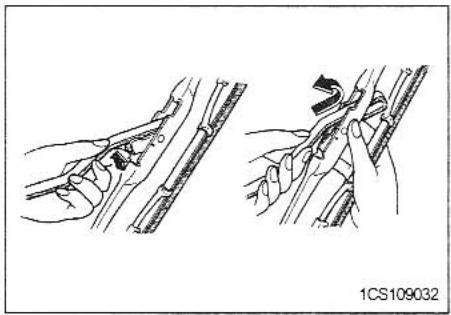
*NOTICE:
Do not allow the wiper arm to fall against the windshield.
- Firmly grasp the end of the rubber blade and pull until the tabs are free of the metal support.
- Remove the metal retainers from the rubber blade and install them in the new rubber blade.
念 NOTICE:
Do not bend the metal retainers.
- Carefully insert a new rubber blade and re-install the blade assembly in the reverse order of removal.
Install the blade with the tabs facing towards the bottom of the wiper arm.
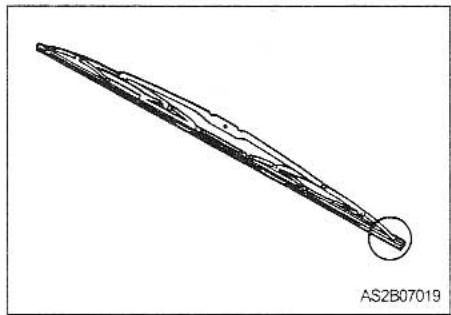
BATTERY

WARNING - BATTERY DANGERS
- Keep lighted cigarettes and all other flames or sparks away from the battery. Hydrogen, which is a highly combustible gas, is always present in battery cells and may explode if ignited.
- Keep batteries out of the reach of children; batteries contain highly corrosive SULFURIC ACID. Do not allow battery acid to contact your skin, eyes, clothing or paint finish.
If any electrolyte gets into your eyes, flush your eyes with clean water for at least 15 minutes and get immediate medical attention. If possible, continue
to apply water with a sponge or cloth until medical attention is received.
If electrolyte gets on your skin, thoroughly wash the contacted area. If you feel a pain or a burning sensation, get medical attention immediately.
- When charging a battery or working near a battery, wear eye protection.
Always provide ventilation when working in an enclosed space.
- When lifting a plastic-cased battery, excessive pressure on the case may cause battery acid to spew through the vent caps, resulting in personal injury. Lift with a battery carrier or with your hands on opposite corners. Never attempt to charge a battery when the battery cables are connected.
BATTERY MAINTENANCE
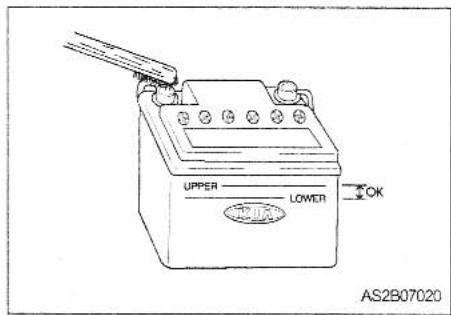
For best battery service:
- Keep the battery securely mounted.
- Keep the battery top clean and dry.
- Keep the terminals and connections clean, tight, and coated with petroleum jelly or terminal grease.
- Immediately rinse any spilled electrolyte from the battery with a solution of water and baking soda.
- If the vehicle is not going to be used for an extended period of time, disconnect the battery cables.
BATTERY RECHARGING
Your vehicle has a maintenance-free, calcium-based battery.
- If the battery becomes discharged in a short time (headlights or interior lights were left on while the vehicle was not in use), recharge it by slow (trickle) charging for 10 hours.
If the battery gradually discharges because of high electric load while the vehicle is being used, recharge it at 20-30A for two hours.
WARNING - RECHARGING BATTERY
When recharging the battery, observe the following precautions:
- The battery must be removed from the vehicle and placed in an area with good ventilation.
- Do not allow cigarettes, sparks, or flame near the battery. (Continued)
(Continued)
(Continued)
- Watch the battery during charging, and stop or reduce the charging rate if the battery cells begin gassing (boiling) violently or if the temperature of the electrolyte of any cell exceeds 120°F (49°C) .
- Wear eye protection when checking the battery during charging.
-
Disconnect the battery charger in the following order.
-
Turn off the battery charger main switch.
- Unhook the negative clamp from the negative battery terminal.
- Unhook the positive clamp from the positive battery terminal.
*NOTICE:
- Before performing battery maintenance or recharging, turn OFF all accessories and stop the engine.
- When remounted battery, disconnect the negative (-) battery cable first. When reinstalling the battery, reconnect the negative (-) battery cable last.
TIRES AND WHEELS TIRE CARE
For proper maintenance, safety, and maximum fuel economy, you must always maintain recommended tire inflation pressures and stay within the load limits and weight distribution recommended for your vehicle.
INFLATION PRESSURES
Check all tire pressures (including the spare) monthly when the tires are cold. "Cold tires" means the car has not been driven for at least three hours or driven less than one mile (1.6km) Recommended pressures must be maintained to ensure ride quality, vehicle handling, and minimum tire wear.
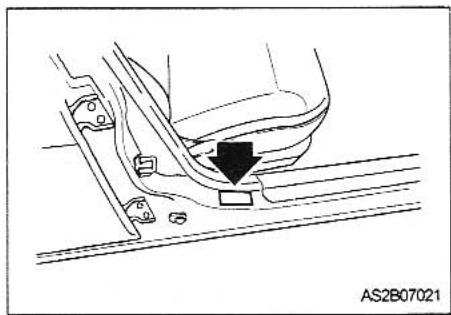
All specifications (sizes and pressures) can be found on a label attached to the front passenger door sill. The correct tire pressure is 206kPa 30 psi).The compact spare should be at 412kPa 60 psi
*NOTICE:
- Warm tires normally exceed recommended cold tire pressures by 28 to 41kPa(4 to 6 psi). Do not release air from warm tires to adjust the pressure. The tires will become underinflated when cold.
Underinflation results in excessive wear, poor andling, reduced fuel economy, and the possibility of blowouts from overheated tires. Also, low tire pressure can cause poor sealing of the tire bead. If the tire pressure is excessively low, wheel deformation and/or tire separation are possible. Keep tire pressures at the proper levels. If a tire frequently needs refilling, have it checked by an Authorized Kia Dealer or a tire shop.
Overinflation produces a harsh ride, handling problems, excessive wear at the center of the tire tread, and a greater possibility of damage from road hazards.

WARNING - TIRE
INFLATION
Overinflation or underinflation can reduce tire life, adversely affect vehicle handling, and lead to sudden tire failure. This could result in loss of vehicle control.
TIRE ROTATION
To equalize tread wear, it is recommended that the tires be rotated every 12,000km (7,500 miles) or sooner if irregular wear develops.
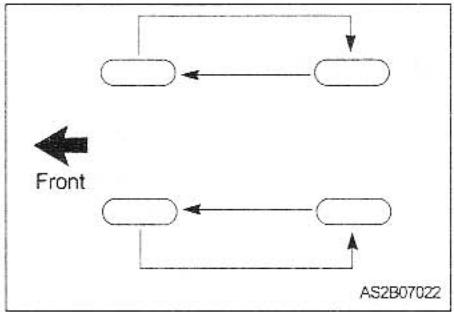
During tire rotation, check the tires for correct balance.
Check for uneven wear and damage. Abnormal wear is usually caused by incorrect tire pressure, improper wheel alignment, an out-of-balance condition, severe braking or severe cornering.
Look for bumps or bulges in the tread or side of tire. Replace the tire if you find either of these conditions. Also, replace the tire if you can see fabric or cord. After rotation, be sure to bring the front and rear tire pressures to specification and check lug nut tightness.
Disc brake pads should be inspected for wear whenever tires are rotated.
念 NOTICE:
Rotate radial tires that have an asymmetric tread pattern from front to rear only and not from right to left.
TIRE REPLACEMENT
If the tire is worn evenly, a tread wear indicator will appear as a solid band, 12.7mm wide (1/2 inch) across the tread. This shows there is less than 1.6mm (1/16 inch) of tread remaining on the tire. Replace the tire when this happens. Do not wait for this band to appear across the entire tread before replacing the tire.
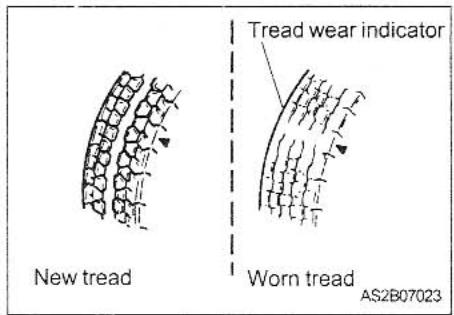
COMPACT SPARE TIRE REPLACEMENT
A compact spare tire has a shorter tread life than a regular size tire. Replace it when you can see the tread wear indicator bars on the tire. The replacement compact spare tire should be the same size and design tire as the one provided with your new Kia and should be mounted on the same compact spare tire wheel. The compact spare tire is not designed to be mounted on a regular size wheel, and the compact spare tire wheel is not designed for mounting a regular size tire.
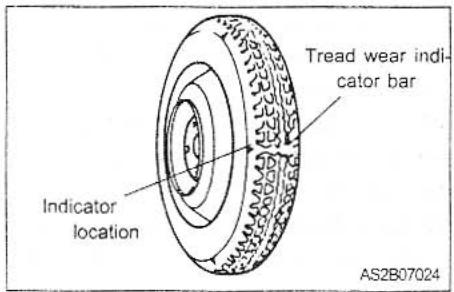
WHEEL ALIGNMENT AND TIRE BALANCE
In addition to proper tire inflation, correct wheel alignment helps to minimize tire wear. Your vehicle's alignment should be checked every 12 months or 24,000km (15,000 miles). Your tires were properly balanced at the factory, but they may need to be rebalanced before they wear out. If you notice a consistent vibration when driving, have your Kia Dealer inspect your tires. A tire should always be rebalanced if it has been removed from the wheel.
*NOTICE:
Improper wheel weights can damage your vehicle's aluminum wheels. Use only approved wheel weights.
*NOTICE:
-
When replacing tires, never mix radial, bias-belted, and biastype tires. All four tires should be of the same size, design and construction. Use only the tire sizes listed on the Tire Label attached to the passenger's door. Make sure that all tires and wheels are the same size and have the same load-carrying capacity. Use only tire and wheel combinations recommended on the Tire Label or by an Authorized Kia Dealer. Failure to follow these precautions can adversely affect the safety and handling of your vehicle.
-
The use of any other tire size or type may seriously affect ride, handling, ground clearance, tire clearance, and speedometer alibration.
- Driving on worn-out tires is very hazardous and will reduce braking effectiveness, steering accuracy, and traction.
- It is best to replace all four tires on your vehicle at the same time. If that is not possible, then replace the two front or two rear tires as a pair.
Replacing just one tire can seriously affect vehicle handling.
TIRE SIZE DESIGNATION
A tire's sidewall is marked with a tire size designation. You will need this information when selecting replacement tires for your car. The following explains what the letters and numbers in the tire size designation mean.
Example tire size designation : P185/65R1481H
P- Applicable vehicle type (tires marked with the prefix "P" are intended for use on passenger cars; however, not all tires have this marking).
185-Tire width in millimeters.
65- Aspect Ratio. The tire's section height as a percentage of tire width.
R-Tire construction code (radial).
14-Rim diameter in inches.
81- Load Index: A numerical code associated with the maximum load the tire can carry.
H-Speed Rating symbol. See the speed rating chart in this section for additional
information.
WHEEL SIZE DESIGNATION
Wheels are also marked with important information that you need if you ever need to replace one. The following explains what the letters and numbers in the wheel size designation mean.
Example wheel size designation: 14X5J
14-Rim diameter in inches.
5-Rim width in inches.
J-Rim contour designation.
TIRE SPEED RATINGS
The following chart below shows many of the different speed ratings currently used for passenger car tires. The speed rating symbol is part of the tire size designation on the sidewall of the tire. This symbol corresponds to that tire's designed maximum safe operating speed.
| Speed Rating Symbol | Maximum Speed |
| S | 180 km/h(112mph) |
| T | 190 km/h(118mph) |
| H | 210 km/h(130mph) |
| V | 240 km/h(149mph) |
| Z | Above 240km/h(149mph) |
UNIFORM TIRE QUALITY GRADING
The following information relates to the tire grading system developed by the Canadian Motor Vehicle Safety Standard (CMVSS) for grading tires by tread wear, traction and temperature performance.
These temperature grades are molded on the sidewalls of passenger vehicle tires. Tires available as standard or optional equipment on Kia vehicles may vary with respect to grade.
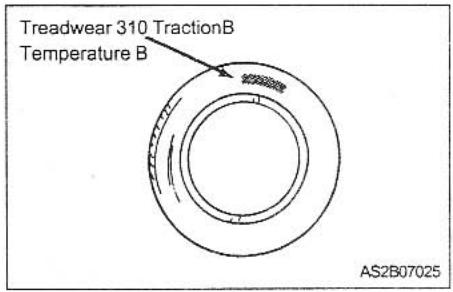
TREAD WEAR
The tread wear grade is a comparative rating based on the wear rate of the tire when tested under controlled conditions on a specified government test course. For example, a tire graded 150 would wear one-and-a-half times as well on the government course as a tire graded 100. The relative performance of tires depends upon the actual conditions of their use. Variations in driving habits, service practices and differences in road characteristics and climate may significantly affect performance.
TRACTION-A,B AND C
The traction grades, from highest to lowest, are A, B and C, and they represent the tire's ability to stop on wet pavement as measured under controlled conditions on specified government test surfaces of asphalt and concrete. A tire marked C may have poor traction performance.
TEMPERATURE-A,B AND C
The temperature grades are A (the highest), B and C, representing the tire's resistance to generate heat and to dissipate heat when tested under controlled conditions on a specified indoor laboratory test wheel. Sustained high temperatures can cause the material of the tire to degenerate and reduce tire life, and excessive temperature can lead to sudden tire failure. Grade C corresponds to a level of performance that all passenger vehicle tires must meet under the Canadian Motor Vehicle Safety Standard No. 109: Grades A and B represent higher levels of performance on the laboratory test wheel than the maximum required by law
WARNING-TIRE
TEMPERATURE
- The temperature grade for a tire is established for a tire that is properly inflated and not overloaded. Excessive speed, underinflation, or excessive loading, either separately or in combination, can cause heat build-up and possible sudden tire failure. This can cause loss of vehicle control and death or personal injury.
WHEEL REPLACEMENT
When replacing the metal wheels for any reason, make sure the new wheels are equivalent to the original factory units in diameter, rim width and offset.
CAUTION:
A wheel that is not the correct size may adversely affect wheel and bearing life, braking and stopping abilities, handling characteristics, ground clearance, body-to-tire clearance, snow chain clearance, speedometer calibration, headlight aim and bumper height.
BULB REPLACEMENT HEADLIGHT BULB REPLACEMENT
WARNING - HALOGEN BULBS
- Wear eye protection when changing a bulb. Allow the bulb to cool before handling it.
- Halogen bulbs contain pressurized gas. If broken, a halogen bulb will explode and will produce flying pieces of glass.
Always handle halogen bulbs carefully to avoid scratches and abrasions. If the bulbs are lit, avoid contact with liquids. Never touch the glass with bare hands. Residual oil may cause the bulb to overheat and burst when lit. A bulb should
be operated only when installed in the headlight assembly.
If a bulb becomes damaged or cracked, replace it immediately and carefully dispose it.
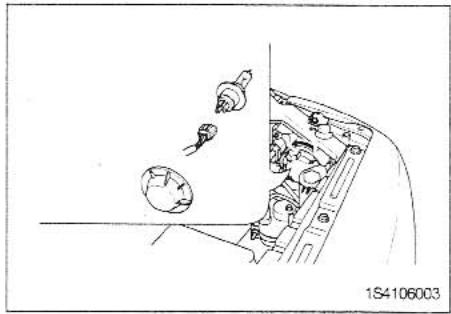
- Remove the headlight bulb cover by turning it counterclockwise.
- Disconnect the headlight bulb electrical connector.
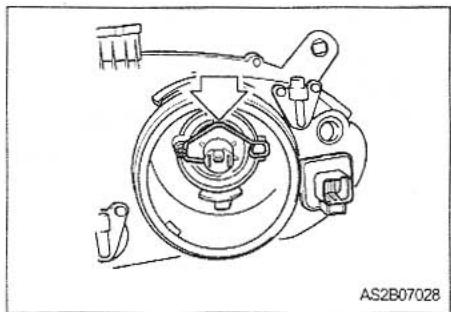
- Unsnap the headlight bulb retaining wire.
- Remove the bulb from the three (3) slots on the headlight assembly.
- Install a new headlight bulb in the three (3) slots on the headlight assembly and snap the headlight bulb retaining wire into position.
- Connect the headlight bulb electrical connector.
- Install the headlight bulb cover by turning it clockwise.
FRONT TURN SIGNAL/POSITION LIGHT BULB REPLACEMENT
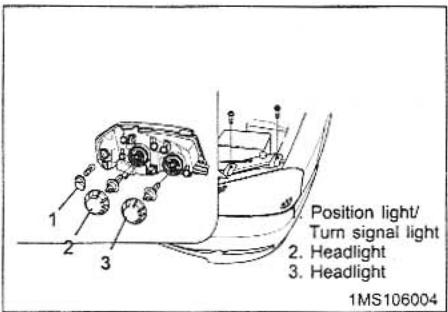
- Remove the bolts from the headlight assembly.
- Remove the dust cover.
- Disconnect the light connector.
- Remove the light bulb.
- Insert a new bulb and then connect the light connecot.
- Install the dust cover and then reinstall the headlight assembly.
FRONT FOG LIGHT REPLACEMENT (IF EQUIPPED)
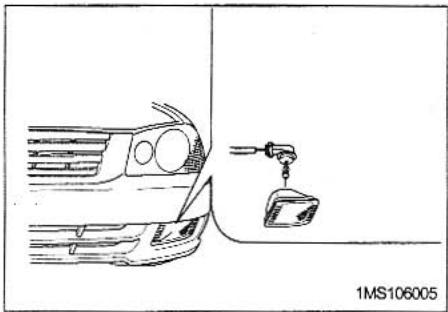
- Turn the bulb socket counterclockwise and remove the bulb socket.
- Insert a new bulb in socket.
- Install the bulb socket.
REAR COMBINATION LIGHT BULB REPLACEMENT
- Using a cross-tip screwdriver, remove the cover.
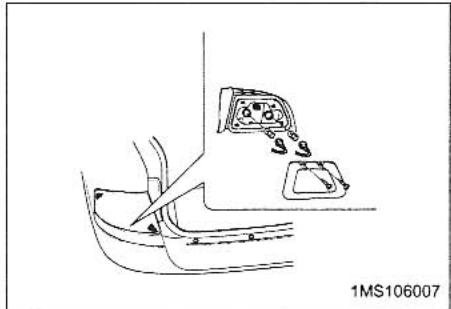
- Turn the bulb socket counterclockwise and remove it from the housing.
- Push the bulb in, then rotate it one-quarter turn counterclockwise and remove the bulb from the socket.
- Insert a new bulb in the socket, then push the bulb in and rotate it one
quarter turn clockwise to lock the bulb in place.
- Re-install the bulb socket into the rear combination light assembly and rotate it one-quarter turn clockwise to lock the socket in place.
- Re-install the cover.
DOME LIGHT BULB REPLACEMENT
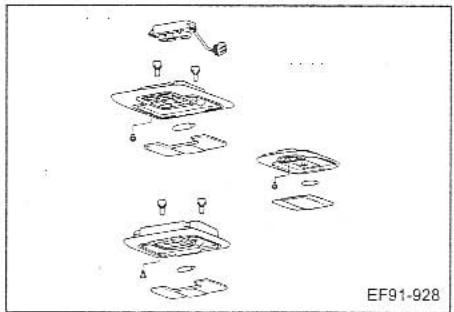
- Using a flat-blade screwdriver, gently pry the lens from the dome light housing.
- Carefully pull the bulb out of the socket.
- Insert a new bulb in the socket.
- Align the lens tabs with the dome light housing notches and snap the lens into place.
LICENSE PLATE LIGHT BULB REPLACEMENT
- Using a Phillips screwdriver, remove the two (2) lens mounting screws and the lens.
- Rotate socket one-quarter turn counterclockwise and carefully pull the socket from the housing.
- Carefully pull the bulb out of the socket.
- Insert a new bulb in the socket.
5.Carefully insert the socket into the housing and rotate it one-quarter
turn clockwise.
- Re-install the lens and the two (2) mounting screws.
CENTER HIGH-MOUNTED STOPLIGHT BULB REPLACEMENT
- Remove the cover and turn the bulb socket counterclockwise and remove it from the housing.
- Push the bulb in, then rotate it one-quarter turn counterclockwise and remove the bulb from the socket.
- Insert a new bulb in the socket, then push the bulb in and rotate it one- quarter turn counterclockwise
and remove the bulb from the socket.
- Re-install the bulb socket into the cover and rotate it one-quarter turn clockwise to lock the socket in place.
- Re-install the cover.
TRUNK ROOM LIGHT BULB REPLACEMENT (IF EQUIPPED)
- Remove the trunk room lamp cover using flat blade screw driver.
- After replacement of bulb, install the cover.
LUBRICANT SPECIFICATIONS RECOMMENDED LUBRICANTS
To help achieve proper engine and powertrain performance and durability, use only lubricants of the proper quality. The correct lubricants also help promote engine efficiency which results in improved fuel economy.
Engine oils labeled Energy Conserving Oil are now available. Along with other additional benefits, they contribute to fuel economy by reducing the amount of fuel necessary to overcome engine friction. Often, these improvements are difficult to measure in everyday driving, but in a year's time they can offer significant cost and energy savings.
These lubricants and fluids are recommended for use in your vehicle.
| Lubricant | Classification |
| Engine oil* | API Service SG or SH Energy conserving-II(SAE 10W-40) |
| Manual transaxle oil* | API Service GL-4 (SAE 75W-90) |
| Automatic trasaxle fluid | SK ATF SP-III or Diamond ATF SP-III |
| Power steering fluid | PSG-3 |
| Brake/clutch fluid | SAEJ1703 or FMVSS116 DOT-3 DOT-4 |
1) Refer to the recommended SAE viscosity numbers on the this page.
| Temperature Range for SAE Viscosity Numbers | ||||||||||
| Temperature °C (°F) | -50 | -40 | -30 | -20 | -10 | 0 | 10 | 20 | 30 | 40 |
| -58 | -40 | -22 | -4 | 14 | 32 | 50 | 68 | 86 | 104 | |
| Engine Oil | 10W-30 | |||||||||
| 10W-40 | 10W-50 | |||||||||
| Synthetic 10W-40* | ||||||||||
- Recommended for the Canadian climate.
*NOTICE:
To ensure optimum vehicle performance in the Canadian climate, high performance synthetic oils are the recommended lubricants for the engine and manual transaxle (if equipped). The operating ranges for both regular and synthetic engine oil are shown on the this page.
RECOMMENDED SAE VISCOSITY NUMBER
*NOTICE:
Always be sure to clean the area around any filler plug, drain plug, or dipstick before checking or draining any lubricant. This is especially important in dusty or sandy areas and when the vehicle is used on unpaved roads. Cleaning the plug and dipstick areas will prevent dirt and grit from entering the engine and other mechanisms that could be damaged.
Engine oil viscosity (thickness) has an effect on fuel economy and cold weather operation (starting and oil flow). Lower viscosity engine oils can provide better fuel economy and cold weather performance, however, higher viscosity engine oils are required for satisfactory
lubrication in hot weather. Using oils of any viscosity other than those recommended could result in engine damage.
When choosing an oil, consider the range of temperature your vehicle will be operated in before the next oil change. Then select the recommended oil viscosity from the chart.
EXTERIOR CARE EXTERIOR GENERAL CAUTION
It is very important to follow the manufacturer's directions when using any chemical cleaner or polish. Read all warning and caution statements that appear on the label.
FINISH MAINTENANCE WASHING
To help protect your vehicle's finish from rust and deterioration, wash it thoroughly
and frequently at least once a month with special attention to the removal of any accumulation of salt, dirt, mud, or other foreign materials. Make sure the drain holes in the lower edges of the doors and rocker panels are kept clear and clean. Insects, tar, tree sap, bird droppings, industrial fallout and similar deposits can damage your vehicle's finish if not removed immediately.
Even prompt washing with plain water may not completely remove all these deposits. A mild soap, safe for use on painted surfaces, can be used.
*NOTICE:
Do not use strong soap, chemical detergents or hot water, and do not wash the vehicle in direct sunlight or when the body of the vehicle is warm.
After washing, rinse the vehicle thoroughly with lukewarm or cold
water. Do not allow soap to dry on the finish.
CAUTION:
After washing the vehicle, test the brakes while driving slowly to see if they have been affected by water. If braking performance is impaired, dry the brakes by applying them lightly while maintaining a slow forward speed.
WAXING
Wax the vehicle when water will no longer bead on the paint.
Always wash and dry the vehicle before waxing. Use a good quality liquid or paste wax, and follow the manufacturer's instructions. Wax all metal trim as well, to protect it and to maintain its luster.
Removing oil, tar, and similar materials with a spot remover will usually strip the wax from the finish. Be sure to re-wax these areas even if the rest of the vehicle
does not yet need waxing.
*NOTICE:
Wiping dust or dirt off the body with a dry cloth will scratch the finish.
- Do not use steel wool, abrasive cleaners, or strong detergents containing highly alkaline or caustic agents on chrome-plated or anodized aluminum parts. This may result in damage to the protective coating and cause discoloration or paint deterioration.
FINISH DAMAGE REPAIR
Deep scratches or stone chips in the painted surface must be repaired promptly. Exposed metal will quickly rust and may develop into a major repair expense.
*NOTICE:
If your vehicle is damaged and requires any metal repair or replacement, be sure the body shop applies anti-corrosion materials to the parts repaired or replaced.
BRIGHT-METAL MAINTENANCE
To remove road tar and insects, use a tar remover, not a scraper or other sharp object.
- To protect the surfaces of bright-metal parts from corrosion, apply a coating of wax or chrome preservative and rub to a high luster.
During winter weather or in coastal areas, cover the bright metal parts with a heavier coating of wax or preservative. If
necessary, coat the parts with noncorrosive petroleum jelly or other protective compound.
UNDERBODY
MAINTENANCE
Corrosive materials used for ice and snow removal or dust control may collect on the underbody. If these materials are not removed, accelerated rusting can occur on underbody parts, such as the fuel lines, frame, floor pan and exhaust system, even though they have been treated with rust protection.
Thoroughly flush the vehicle underbody and wheel openings with lukewarm or cold water once a month and especially at the end of each winter. Pay special attention to these areas because it is difficult to see all the mud and dirt. The lower edges of doors, rocker panels, and frame members have drain holes that should not be allowed to clog with dirt;
trapped water in these areas can cause rusting. It will do more harm than good to wet down the road grime without removing it.
Z CAUTION:
After washing the vehicle, test the brakes while driving slowly to see if they have been affected by water.
ALUMINUM WHEEL MAINTENANCE
The aluminum wheels are coated with a clear protective finish.
- Do not use any abrasive cleaner, polishing compound, solvent, or wire brushes on aluminum wheels. They may scratch or damage the finish.
Use only a mild soap or neutral detergent, and rinse thoroughly with water. Also, be sure to clean the wheels after driving on salted roads. This helps prevent corrosion. - Avoid washing the wheels with high-speed car wash brushes.
INTERIOR CARE INTERIOR GENERAL PRECAUTIONS
Prevent caustic solutions such as perfume and cosmetic oil from contacting the dashboard; they may cause damage or discoloration. If they do contact the dashboard, wipe them off immediately.
UPHOLSTERY AND INTERIOR TRIM CLEANING
VINYL
First, remove dust and loose dirt from vinyl with a whisk broom or vacuum cleaner. Then, clean vinyl surfaces with a vinyl cleaner.
FABRIC
First, remove dust and loose dirt from fabric with a whisk broom or vacuum cleaner. Then, clean with a mild soap
solution recommended for upholstery or carpets. Remove fresh spots immediately with a fabric spot cleaner. If freshspot do not receive immediate attention, the fabric may be stained and its color can be affected. Also, its fire-resistant properties may be reduced if the material is not properly maintained.
CAUTION:
Using anything but recommended cleaners and procedures may affect the fabric's appearance and fire-resistant properties.
LAP/SHOULDER BELT WEBBING CLEANING
Clean the belt webbing with any mild soap solution recommended for cleaning upholstery or carpet. Follow the instructions provided with the soap. Do not bleach or re-dye the webbing because this may weaken it.
INTERIOR WINDOW GLASS CLEANING
If the interior glass surfaces of the vehicle become fogged (that is, covered with an oily, greasy or waxy film), they should be cleaned with glass cleaner. Follow the directions on the glass cleaner container.
*NOTICE:
Do not scrape or scratch the inside of the rear window. This could damage the rear window defroster grid.
HEADLIGHT AIMING ADJUSTMENT
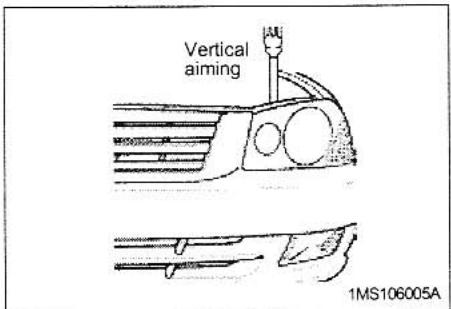
Before performing aiming adjustment, make sure of the following.
- Keep all tires inflated to the correct pressure.
- Place the vehicle on level ground and press the front bumper & rear bumper down several times.
-
See that the vehicle is unloaded (except for full levels of coolant, engine oil and fuel, and spare tire, jack, and tools). Have the driver or equivalent weight in driver's seat.
-
Clean the headlight lens and turn on the headlight (Low beam).
- Open the hood.
- Draw the vertical line (through the center of each headlight) and the horizontal line (through the center of each headlight) on the aiming screen.
1) Horizontal line dimension from ground: 628mm (24.72 in)
2) Distance between each vertical line: 1,306 mm (49.17 in)
And then, draw the parallel line at 30 mm (1.18 in) place under the horizontal line.
- Adjust each cut-off line of the low beam to the parallel line with a Phillips screwdriver VERTICAL AIMING.
ADJUSTMENT AFTER HEADLIGHT ASSEMBLY REPLACEMENT
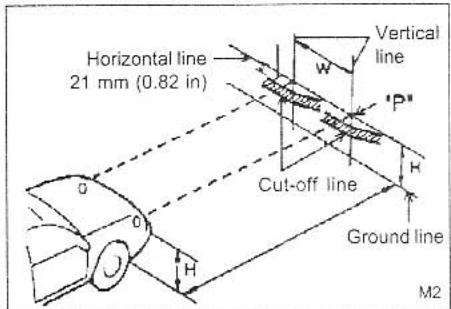
If the vehicle has had front body repair and the headlight assembly has been replaced, the headlight aiming should be checked using the aiming screen as shown in the illustration. Turn on the headlight switch. (Low Beam Position)
-
Adjust headlights so that main axis of light is parallel to center line of the body and is aligned with point "P" shown in the illustration.
-
Dotted lines in the illustration show center of headlights.
“H”;
Horizontal center line of headlights from ground: 628mm (24.72 in)
“W”;
Distance between each headlight center: 1,306mm (49.17 in)
“L”;
Distance between the headlights and the wall that the lights are tested against: 3,000mm (118.11 in)
SPECIFICATIONS
Specifications 8-2
SPECIFICATIONS
The specifications given here are for general information only. Please check with an Authorized Kia Dealer for more precise and more up-to-date information.
DIMENSIONS
Unit:mm(in)
WEIGHTS
| Item | 4 Door Sedan |
| Overall length | 4745(186.8) |
| Overall width | 1815(71.4) |
| Overall height | 1420(55.9) |
| Front tread | 1540(60.6) |
| Rear tread1 | 530(60.2) |
| wheelbase | 2700(106.3) |
| Item | 4 Door Sedan | |||
| Engine | 2400cc | 2500cc | ||
| Axle | MT | AT | MT | AT |
| Curb Weight | 3245(1475) | 3278(1490) | 3246(1480) | 3289(1495) |
| GVWR | 4114(1870) | 4147(1885) | 4048(1840) | 4081(1855) |
GVWR: Gross Vehicle Weight Rating
AIR CONDITIONER
| Refrigerant complies with SAEJ639 | R134A |
| Maximum operating charge | 680±25g(23~25oz) |
LIGHTBULBS
| Light Bulb | Wattage | |
| Front | Headlights | 55 |
| Turn signal/Position lights | 28/8 | |
| Fog lights(if equipped) | 27 | |
| Side mark lights (*if equipped) | 5 | |
| Rear | Stop and tail lights | 27/8 |
| Turn signal lights | 27 | |
| Backup lights | 27 | |
| High mounted stop lights | 27 | |
| License plate lights | 5 | |
| Interior | Interior lights | 5 |
| Luggage compartment light(If equipped) | 5 |
TIRES
| Size | |||
| Tire | P195/70R14 | P205/60R15 | *T120/70D15 or T125/70 R15 |
| Pressure | Inflation Pressure KPa(kg/cm2,psi) | ||
| 206(2.1, 30) | 206(2.1, 30) | 412(4.2, 60) | |
- Spare tire(Temporary Spare)
FUSES
Please refer to "Fuses" in the Index
GEAR RATIO
| Item | M/T | A/T | ||
| 2400cc | 2500cc | 2400cc | 2500cc | |
| 1st | 3.455 | ← | 2.842 | ← |
| 2nd | 1.947 | ← | 1.529 | ← |
| 3rd | 1.296 | ← | 1.000 | ← |
| 4th | 0.943 | ← | 0.712 | ← |
| 5th | 0.775 | ← | - | - |
| Reverse | 3.455 | ← | 2.480 | ← |
ENGINE
| Item | 2400cc | 2500cc |
| Bore*stroke(mm) | 86.5×100 | 84×75 |
| Displacement(cc) | 2351 | 2493 |
| Compression Ration | 10±0.2 | 10±0.2 |
| Firing order | 1-3-4-2 | 1-2-3-4-5-6 |
| Idle speed(rpm) | 800±100 | 700±100 |
ELECTRICAL SYSTEM
| Item | 2400cc | 2500cc | |
| Battery | MF55AH or MF68AH | ||
| Alternator | 13.5V-95A | ||
| Starter | M/T | 12V-1.2Kw | |
| A/T | 12V-1.2Kw | ||
| Spark plug | Gap(mm) | 1.0~1.1 | 1.0~1.1 |
| Type | PGR5C-11 or RN10PYP4 | PFRR5N-11 | |
CAPACITIES
(Unit: Liter)
| Item | 2400cc | 2500cc | |
| Engine Oil | 4.3 | 4.5 | |
| Coolant | 7.3 | 8.6 | |
| Transaxle Oil | M/T | 2.1 | 2.1 |
| A/T | 7.8 | 7.8 | |
| Fuel tank | 65 | ||
Adjustable headrest (If equipped) 3-19
Adjusting seat forward and rearward 3-17
Adjusting seatback angle 3-18
Adjusting the front scatback recliner 3-14
Adjusting the height of driver's seat cushion 3-15
Air bag system components 3-41
Air bag warning 4-21
Air bag warning light 3-48
Air bag-supplemental restraint system 3-39
Air cleaner 7-22
Air conditioncr 8-2
Air conditioning (optional) 4-45
Air conditioning switch (If equipped) 4-40
Air conditioning system operating tips: 4-46
Air flow control (mode switch) 4-44
Air intake control 4-44
Air intake control switch 4-39
Air quality control system (If equipped) 4-47
Ambient switch 4-43
Antenna 3-64
Anti lock brakes (ABS) (If equipped) 4-12
Anti-lock brake system(ABS) warning light (If equipped) 4-24
Ashtrays 4-32
Automatic heating and cooling control system (If equipped).... 4-42
Automatic operation (If equipped) 4-43
Automatic transaxle 4-7,7-19
Automatic transaxle operation 4-7
Battery 7-24
Battery maintenance 7-25
Battery recharging 7-25
Battery saver function 4-25
Before driving 5-4
Before starting 5-4
Body lubrication 7-22
Brake system 4-12
Brakes and clutch 7-18
Bright metal maintenance 7-40
Bulb replacement 7-33
Capacities 8-4
Cargo net (If equipped) 3-65
Center high mounted stoplight bulb replacement 7-36
Chain installation 5-10
Changing coolant 7-17
Changing the engine oil and filter 7-14
Changing tires 6-19
Charging system warning 4-22
Checking brake/clutch fluid level 7-20
Checking the automatic transaxle 7-19
Checking the parking brake 7-19
Checking the power steering fluid level 7-19
Checking the washer fluid level 7-22
Child restraint anchorage fitting 3-31
Child restraint anchorage position 3-31
Child restraint lower anchor striker position 3-33
Cigarette lighter 4-32
Climate control system controls 4-38
Closing the hood 3-52
Compact spare tire replacement 7-29
Coin holder 3-60
Cruise control (If equipped) 4-35
Cruise indicator (If equipped) 4-24
Cup holders and console storage compartment 3-59
Day/night rearview mirror 3-57
Daytime running lights (DRL) 4-27
Digital clock 4-30
Dimensions 8-2
Disc brake wear indicators 4-15
Dome light 3-58
Dome light bulb replacement 7-35
Door ajar warning 4-23
Door locks 3-7
Driver's door power window controls 3-10
Driver's side kick panel 6-9
Driver's window automatic-down window switch 3-10
Driving at night 5-8
Driving in the rain 5-8
Drugs abd driving 5-5
Drunk driving 5-5
Electrical circuit protection 6-7
Electrical system 8-4
Element replacement 7-22
Emergency starting 6-3
Emergency trunk safety release (If equipped) 3-50
Emission control system (If equipped) 5-3
Engine 8-4
Engine compartment 7-12
Engine compartment panel 6-12
Engine cooling system 7-16
Engine oil and oil filter. 7-14
Engine exhaust gas precautions (carbon monoxide) 5-3
Engine oil pressure warning 4-22
Engine Temperature gauge 4-20
Fan speed control 4-43
Fan speed control knob 4-38
Finish damage repair 7-40
Finish maintenance washing 7-39
Flashing headlights 4-26
Fluid level 7-19
Front ashtray 4-32
Front door edge warning light (If equipped) 3-59
Front fog indicator (If equipped) 4-24
Front fog light replacement (If equipped) 7-34
Front fog light switch (If equipped) 4-27
Front lap/shoulder belt 3-34
Front seat adjustment.. 3-14
Front turn signal / position light bulb replacement 7-34
Fuel filler door 3-53
Fuel gauge 4-19
Fuel requirements 5-2
Fuse panel description 6-9
Fuse replacement 6-7
Fuses 6-7,8-3
Gasoline containing alcohol and methanol 5-2
Gear ratio 8-3
Glovecx 4-33
Guages 4-19
Hazard warning flasher 6-2
Hazardous driving. 5-7
Headlight bulb replacement 7-33
Headlight high beam indicator 4-23
Heating and cooling controls 4-42
Heating and cooling system off 4-44
Heating the front seats (If equipped) 3-19
Hood 3-51
Horn (with air bag) 3-55
How the air bag system works. 3-41
How to use this manual 1-2
If you have a flat tire storing the spare tire, jack and tools 6-16
Ignition switch 4-2
Ignition switch and antitheft steering column lock 4-2
Ignition switch position 4-2
Illuminated ignition switch 4-2
In the event of brake failure 4-14
Inflation pressures 7-26
Installing a child restraint system in the front seat and rear outboard seats 3-29
Installing a child restraint in the rear center seat 3-30
INDEX
Instrument cluster 4-18
Instrument panel light control (Rheostat) 4-25
Instrument panel overview 2-3
Interior and exterior overview 2-2
Interior features 4-30
Interior lights 3-58
Jacking instructions 6-17
Jump starting 6-3
Jump starting procedure 6-4
Key reminder warning chime 4-23
Keyless entry system (If equipped) 3-4
Keys 3-3
Label information 5-11
Lane change signals 4-27
License plate light bulb replacement 7-36
Light bulbs 8-3
Lighting 4-25
Lighting control 4-25
Lighting control-first position 4-27
Lighting control-second position 4-28
Low fuel level warning 4-22
Lubicants and fluids 7-22
Lubricant specifications 7-37
Luggage net (If equipped) 3-65
Lumbar support 3-16
Maintenance schedule 7-4
Maintenance services 7-2
Malfunction indicator light 4-22
Manual antenna (If equipped) 3-64
Manual door locks 3-7
Manual operation 4-43
Manual transaxle 4-6
Map light 3-58
Mirrors 3-55
Mode selection 4-41
Moving the front seat forward and backward 3-16
Moving up a steep grade from a standing start 4-12
Necessary inspections 5-4
Noise and smoke 3-43
Normal operation 4-8
Odometer 4-19
Oil capacity. 7-15
One-touch wipers 4-28
Opening the hood 3-51
Operating door locks from inside the vehicle 3-8
Operating precautions for catalytic converters (If equipped) .... 5-3
Outside (fresh) air position 4-40
Outside rearview mirror 3-55
Outside rearview mirror heater (If equipped) 3-57
Outside rearview mirror-Electric remote control (If equipped) .. 3-56
Overheating 6-2
Overloading 5-11
Owner maintenance 7-10
Owner maintenance precautions 7-10
Owner maintenance schedule 7-10
Owner's responsibility 7-2
Parking brake 4-15,7-19
Parking brake fluid warning 4-22
Passenger door power window controls 3-13
Passenger presence detection 3-45
Placement of a child restraint system 3-29,3-32
Power antenna (If equipped) 3-64
Power brake 4-12
Power driver's seat (If equipped) 3-16
Power outlet (If equipped) 4-31
Power steering 4-17,7-19
Power window lock switch feature 3-11
Power windows 3-10
Power wandow timer (If equipped) 3-11
Pre-tensioner seat belt 3-22
Proper use and care of the safety belt system 3-38
Push-starting 6-6
Rear ashtray 4-33
Rear combination light bulb replacement 7-35
Rear door child safety lock 3-9
Rear drum brakes (If equipped) 4-15
Rear heater duct (If equipped) 4-47
Rear lap/shoulder belt (rear center seat) 3-36
Rear seat armrest (If equipped) 3-21
Rear seatback lock 3-21
Rear window defroster 4-30
Rear window defroster indicator 4-24
Recirculated air position. 4-39,4-44
Recommended lubricants 7-37
Recommended SAE viscosity number 7-38
Remote fuel filler door release 3-53
INDEX
Remote trunk lid release 3-50
Resetting the sunroof 3-63
Restraint of infants and small children 3-27
Restraint of large children 3-28
Restraint of pregnant women 3-26
Road warning 6-2
Rocking the vehicle 5-7
Safety belt. 3-22
Safety belt restraint system 3-24
Safety belt warning 4-21
Safety belt warning light and chime 3-33
Scheduled maintenance service 7-3
Seat cushion height adjustment 3-18
Seats 3-13
Side air bag (If equipped) 3-46
Snow tires 5-9
Special driving conditions 5-7
Speedometer 4-19
Split folding rear seat 3-20
Sports mode 4-10
Starting the engine 4-4
Steering wheel 3-55
Suggestions for economical operation 5-5
Sunglass holder (If equipped) 3-60
Sunroof (If equipped) 3-61
Sunroof-manual operation 3-62
Sunshade (If equipped) 3-63
Sunvisors 4-34
Supplemental restraint system service 3-48
System operation 4-40
System operation-Ventilation 4-43
Tachometer 4-19
Temperature control knob 4-39
The importance of the passenger being properly seated 3-44
The importance of using safety belts 3-40
Theft alarm system (If equipped) 3-5
Tilt steering 4-17
Tire chains 5-10
Tire replacement 6-19,7-28
Tire rotation 7-28
Tires 8-3
Tires and wheels 7-26
To cancel the cruise speed 4-35
To fasten the front lap/shoulder belt 3-34
To fasten the rear lap/shoulder belts 3-37
To remove spare tire: 6-16
To remove the jack: 6-16
To reset at a faster speed 4-36
To reset at a slower speed 4-36
To resume the preset speed 4-36
To set the cruise 4-35
To unfasten the front lap/shoulder belt 3-36
To unfasten the rear lap/shoulder belt 3-37
Towing 6-14
Traction control indicator lights (If equipped) 4-24
Tralrer towing 5-11
Tripmeter 4-19
Trunk lid 3-49
Trunk lid knob lock 3-51
Trunk lid open warning light 4-24
Trunk room light bulb replacement 7-37
Turn signals 4-26
Underbody maintenance 7-40
Using the hot fluid scale 7-21
Vanity mirror (If equipped) 4-34
Variable-speed intermittent wipers (If equipped) 4-28
Vehicle break-in process 1-3
Vehicle identification number (VIN) 5-11
Vehicle modifications 5-3
Warning lights/audible indicators 4-20
Warning-battery 6-4
Warnings and indicators 4-20
Washing 7-39
Waxing 7-39
Weights 8-2
Wheel alignment and tire balance 7-29
Wheel replacement 7-33
Windows 3-10
Windshield defrosting and defogging 4-41
Windshield washer 4-28
Windshield wipers 4-28
Winter driving 5-9
Wiper and washers 4-28
Wiper blade maintenance 7-22
Wiper blade replacement 7-23
Wiper blades 7-23
- MAGENTIS
- FOREWORD
- Z CAUTION
- HOW TO USE THIS MANUAL
- WARNING
- CAUTION
- NOTICE
- VEHICLE BREAK-IN PROCESS
- INTERIOR AND EXTERIOR OVERVIEW
- INSTRUMENT PANEL OVERVIEW
- KEYS
- WARNING - IGNITION KEY
- KEYLESS ENTRY SYSTEM (IF EQUIPPED)
- BATTERY REPLACEMENT
- THEFT - ALARM SYSTEM (IF EQUIPPED)
- ARMED STAGE
- ALARM STAGE
- DISARMED STAGE
- DOOR LOCKS MANUAL DOOR LOCKS OPERATING DOOR LOCKS - WITH KEY
- OPERATING DOOR LOCKS- WITHOUT KEY
- OPERATING DOOR LOCKS FROM INSIDE THE VEHICLE
- REAR DOOR CHILD SAFETY LOCK
- WARNING - REAR DOOR LOCKS
- WINDOWS
- POWERWINDOWS
- DRIVER'S DOOR POWER WINDOW CONTROLS
- DRIVER'S WINDOW AUTOMATIC-DOWN WINDOW SWITCH
- DRIVER'S POWER WINDOW SWITCH
- POWER WINDOW TIMER (IF EQUIPPED)
- POWER WINDOW LOCK SWITCH FEATURE
- WARNING - PASSENGERS
- PASSENGER DOOR POWER WINDOW CONTROLS
- SEATS
- WARNING - DRIVERS
- FRONTSEATADJUSTMENT MOVING THE FRONT SEAT FORWARD AND BACKWARD
- ADJUSTING THE FRONT SEATBACK RECLINER
- PASSENGERS
- ADJUSTING THE HEIGHT OF DRIVER'S SEAT CUSHION
- POWER DRIVER'S SEAT (IF EQUIPPED)
- ADJUSTING SEAT FORWARD AND REARWARD
- SEAT CUSHION HEIGHT ADJUSTMENT
- ADJUSTING SEATBACK ANGLE
- HEATING THE FRONT SEATS (OPTIONAL)
- ADJUSTABLE HEADREST (IF EQUIPPED)
- WARNING- HEADRESTS
- SPLIT FOLDING REAR SEAT
- WARNING-CARGO
- SAFETY BELTS PRE-TENSIONER SEAT BELT
- (CONTINUED)
- SAFETY BELT RESTRAINT SYSTEM
- WARNING-TWISTED SAFETY BELTS
- WARNING - SAFETY BELT USAGE
- WARNING - SAFETY BELT CARE
- CAUTION - DAMAGE TO SAFETY BELTS
- RESTRAINT OF PREGNANT WOMEN
- WARNING - PREGNANT WOMEN
- RESTRAINT OF INFANTS AND SMALL CHILDREN
- WARNING - CHILDREN ON LAPS
- CAUTION - HOT METAL PARTS
- RESTRAINT OF LARGE CHILDREN
- WARNING-SHOULDER BELTS ONSMALL CHILDREN
- WARNING - CHILD RESTRAINTS
- PLACEMENT OF A CHILDRESTRAINT SYSTEM
- INSTALLING A CHILD-RESTRAINT SYSTEM IN THE FRONT SEAT AND REAR OUTBOARD SEATS
- WARNING - RESTRAINT INSTRUCTIONS
- WARNING-CHILD RESTRAINT PLACEMENT
- INSTALLING A CHILD RESTRAINT IN THE REAR CENTER SEAT
- CHILE RESTRAINT ANCHORAGE FITTING
- CHILD RESTRAINT ANCHORAGE POSITION
- WARNING - CHILD RESTRAINT ANCHOR FITTING
- PLACEMENT OF A CHILD RESTRAINT SYSTEM
- CHILD RESTRAINT LOWER ANCHOR STRIKER POSITION
- SAFETY BELT WARNING LIGHT AND CHIME
- FRONT LAP/SHOULDER BELT
- TO FASTEN THE FRONT LAP/SHOULDER BELT
- WARNING-FRONT SAFETY BELTS
- TO UNFASTEN THE FRONT LAP/SHOULDER BELT
- REAR LAP/SHOULDER BELT(REAR CENTER SEAT)
- PROPER USE AND CARE OF THE SAFETY BELT SYSTEM
- AIR BAG -SUPPLEMENTAL RESTRAINT SYSTEM
- WHAT YOUR AIR BAG SYSTEM DOES NOT DO
- WHY DIDN'T MY AIR BAG GO OFF IN A COLLISION
- THE IMPORTANCE OF USING SAFETY BELTS
- WARNING - AIR BAGS & SAFETY BELTS
- AIR BAG SYSTEM COMPONENTS
- HOW THE AIR BAG SYSTEM WORKS
- WARNING-AIR BAG INJURIES
- NOISE AND SMOKE
- WARNING - HOT METAL PARTS
- THE IMPORTANCE OF THE PASSENGER BEING PROPERLY SEATED
- WARNING - RIGHT FRONT SEAT
- WARNING-FRONT PASSENGERS
- PASSENGER PRESENCE DETECTION
- AIR BAG WARNING LIGHT
- SUPPLEMENTAL RESTRAINT SYSTEM SERVICE
- WARNING-SRS MODIFICATIONS
- TRUNKLID
- WARNING-EXHAUST FUMES
- EMERGENCY TRUNK SAFETY RELEASE (IF EQUIPPED)
- REMOTE TRUNK LID RELEASE
- TRUNK LID KNOB LOCK
- HOOD OPENING THE HOOD
- CLOSING THE HOOD
- FUEL FILLER DOOR REMOTE FUEL FILLER DOOR RELEASE
- WARNING - FUEL FILLING
- STEERING WHEEL HORN
- MIRRORS OUTSIDE REARVIEW MIRROR
- OUTSIDE REARVIEW MIRROR
- ELECTRIC REMOTE CONTROL
- OUTSIDE REARVIEW MIRROR HEATER (IF EQUIPPED)
- DAY/NIGHT REARVIEW MIRROR
- INTERIOR LIGHTS DOME LIGHT
- MAP LIGHT (WITH SUNROOF ONLY)
- MAP LIGHT (WITH SUN GLASSES)
- FRONT DOOR EDGE WARNING LIGHT (IF EQUIPPED)
- CUP HOLDERS AND CONSOLE STORAGE COMPARTMENT
- SUNGLASS HOLDER (IF EQUIPPED)
- COIN HOLDER
- SUNROOF (IFEQUIPPED)
- RESETTING THE SUNROOF
- SUNSHADE (IF EQUIPPED)
- ANTENNA MANUAL ANTENNA (IF EQUIPPED)
- POWER ANTENNA (IF EQUIPPED)
- LUGGAGE NET (IF EQUIPPED)
- CARGO NET
- IGNITION SWITCH ILLUMINATED IGNITION SWITCH
- IGNITION SWITCH AND ANTITHEFT STEERING COLUMN LOCK
- IGNITION SWITCH POSITION LOCK
- ACC (ACCESSION)
- ON
- START
- 念 NOTICE
- AUTOMATIC TRANSAXLE
- MANUAL TRANSAXLE
- STARTING THE ENGINE
- MANUAL TRANSAXLE OPERATION
- WARNING - MANUAL TRANSAXLE
- AUTOMATIC TRANSAXLE OPERATION
- WARNING - AUTOMATIC TRANSAXLE
- NORMAL OPERATION P(PARK)
- R (REVERSE)
- N (NEUTRAL)
- D (DRIVE)
- ONLY "B" TYPE
- 3(3RD):ONLY"A"TYPE
- 2 (2ND):ONLY“A”TYPE
- L (LOW):ONLY“A”TYPE
- MOVING UP A STEEP GRADE FROM A STANDING START
- BRAKE SYSTEM POWER BRAKES
- ANTI LOCK BRAKES (ABS) (IF EQUIPPED)
- WARNING-ABS BRAKES
- IN THE EVENT OF BRAKE FAILURE
- DISC BRAKE WEAR INDICATORS
- WARNING-BRAKE WEAR
- REAR DRUM BRAKES (IF EQUIPPED)
- PARKING BRAKE
- POWER STEERING
- TILT STEERING
- GAUGES SPEEDOMETER
- ODOMETER/TRIPMETER
- ODOMETER
- TRIPMETER
- TACHOMETER
- FUEL GAUGE
- ENGINE TEMPERATURE GAUGE
- WARNING AND INDICATORS WARNING LIGHTS/ AUDIBLE INDICATORS CHECKING OPERATION
- PARKING BRAKE AND BRAKE FLUID WARNING (1) (P)
- PARKING BRAKE WARNING
- LOW BRAKE FLUID LEVELWARNING
- WARNING-BRAKEWARNING LIGHTS
- SAFETY BELT WARNING
- AIR BAG WARNING AIR BAG
- CHARGING SYSTEMWARNING
- IF THE WARNING LIGHT ILLUMINATES WHILE DRIVING
- ENGINE OIL PRESSUREWARNING
- LOW FUEL LEVEL WARNING
- MALFUNCTION INDICATOR LIGHT
- KEY REMINDER WARNING CHIME
- HEADLIGHT HIGH BEAM INDICATOR
- DOOR AJAR WARNING
- ANTI-LOCK BRAKE SYSTEM (ABS) WARNING LIGHT (IF EQUIPPED) (ABS)
- REARWINDOWDEFROSTER INDICATOR
- FRONT FOG INDICATOR (IF EQUIPPED)
- CRUISE INDICATOR (IF EQUIPPED) CRUISE
- TRACTION CONTROL INDICATOR LIGHTS(IF EQUIPPED) TCS OFF TCS
- TRUNK LID OPEN WARNING LIGHT
- INSTRUMENT PANEL LIGHT CONTROL
- LIGHTING
- ※ NOTICE-BATTERYSAVER FUNCTION
- LIGHTING CONTROL
- FIRST POSITION
- SECOND POSITION
- FLASHING HEADLIGHTS
- TURN SIGNALS
- LANE CHANGE SIGNALS
- DAYTIME RUNNING LIGHTS (DRL)
- FRONT FOG LIGHT SWITCH (IF EQUIPPED)
- WIPERS AND WASHERS WINDSHIELD WIPERS
- VARIABLE-SPEED INTERMITTENT WIPERS (IF EQUIPPED)
- ONE-TOUCH WIPERS
- REAR WINDOW DEFROSTER
- INTERIOR FEATURES DIGITAL CLOCK
- RESET
- HOUR
- MINUTE
- POWER OUTLET
- WARNING-ASHTRAYUSE
- REAR ASHTRY
- GLOVEBOX
- SUNVISORS
- VANITY MIRROR (IF EQUIPPED)
- CRUISE CONTROL (IF EQUIPPED)
- TO SET THE CRUISE
- TO CANCEL THE CRUISESPEED
- DO ONE OF THE FOLLOWINGS
- TO RESUME THE PRESET SPEED
- TO RESET AT A FASTER SPEED
- TO RESET AT A SLOWER SPEED
- CLIMATE CONTROL SYSTEM CONTROLS
- FAN SPEED CONTROL KNOB
- MODE SELECTION
- FACE POSITION
- FLOOR POSITION
- FLOOR-DEFROST
- POSITION
- DEFROST POSITION
- TEMPERATURE CONTROL KNOB
- AIR INTAKE CONTROL
- SWITCH
- RECIRCULATED AIR
- OUTSIDE(FRESH) AIR
- AIR CONDITIONING SWITCH (IF EQUIPPED)
- SYSTEM OPERATION
- VENTILATION
- HEATING
- ZCAUTION
- WINDSHIELD DEFROSTING AND DEFOGGING
- AUTOMATIC HEATING AND COOLING CONTROL SYSTEM (IF EQUIPPED)
- AUTOMATIC OPERATION (IF EQUIPPED)
- AMBIENT SWITCH
- MANUAL OPERATION
- FANSPEEDCONTROL
- RECIRCULATED AIR POSITION
- OUTSIDE (FRESH)AIR POSITION
- HEATING AND COOLING SYSTEM OFF
- AIR FLOW CONTROL (MODE SWITCH)
- FACE POSITIO
- FACE-FLOOR POSITION
- FLOOR-DEFROST POSITION
- AIR CONDITIONING (OPTIONAL)
- AIR CONDITIONING SYSTEM OPERATING TIPS
- REAR HEATER DUCT (IF EQUIPPED)
- AIR QUALITY CONTROL SYSTEM (IF EQUIPPED)
- FUEL REQUIREMENTS
- GASOLINE CONTAINING ALCOHOL AND METHANOL
- EMISSION CONTROL SYSTEM
- VEHICLE MODIFICATIONS
- ENGINE EXHAUST GAS PRECAUTIONS (CARBON MONOXIDE)
- OPERATING PRECAUTIONS FOR CATALYTIC CONVERTERS
- BEFORE DRIVING
- NECESSARY INSPECTIONS
- BEFORE STARTING
- DRUNK DRIVING
- DRUGS AND DRIVING
- SUGGESTIONS FOR ECONOMICAL OPERATION
- WARNING-ENGINE OFF MOTION
- SPECIAL DRIVING CONDITIONS HAZARDOUS DRIVING
- ROCKING THE VEHICLE
- WARNING - SPINNING TIRES
- DRIVING AT NIGHT
- DRIVING IN THE RAIN
- WINTER DRIVING
- SNOW TIRES
- WARNING-SNOW TIRE SIZE
- TIRE CHAINS
- TIRE CHAIN SELECTION
- CHAIN INSTALLATION
- WARNING-TIRE CHAINS
- DRIVING IN FLOODED AREAS
- TRAILER TOWING
- OVERLOADING
- LABEL INFORMATION
- ROAD WARNING
- HAZARDWARNINGFLASHER
- OVERHEATING
- WARNING - REMOVING RADIATOR CAP
- EMERGENCY STARTING JUMP STARTING
- WARNING-BATTERY
- JUMP STARTING PROCEDURE
- CONNECTING JUMPER CABLES
- PUSH-STARTING
- ELECTRICAL CIRCUIT PROTECTION FUSES
- FUSE REPLACEMENT
- WARNING-FUSE REPLACEMENT
- FUSE PANEL
- DESCRIPTION
- IN CASE OF EMERGENCY
- TOWING
- IF YOU HAVE A FLAT TIRE STORING THE SPARE TIRE, JACK AND TOOLS
- TO REMOVE THE JACK
- TO REMOVE SPARE TIRE
- IMPORTANT-USE OF COMPACT SPARE TIRE
- CHANGING TIRES
- JACKING INSTRUCTIONS
- WARNING - CHANGING TIRES
- TIRE REPLACEMENT
- WARNING - CHANGING A FRONT TIRE
- WARNING-JACK LOCATION
- WARNING-WHEEL STUDS
- MAINTENANCE
- MAINTENANCE SERVICES
- OWNER'S RESPONSIBILITY
- MAINTENANCE SERVICE AND RECORD RETENTION ARE THE OWNER'S RESPONSIBILITY
- SCHEDUED
- MAINTENANCE SERVICE
- SCHEDULE 1-NORMAL MAINTENANCE(CONT.)
- SCHEDULE 2-SEVERE MAINTENANCE
- OWNER MAINTENANCE
- OWNER MAINTENANCE SCHEDULE
- WHEN REFUELING, CHECK
- AT LEAST MONTHLY
- EVERY 6 MONTHS, CHECK
- OWNER MAINTENANCE PRECAUTIONS
- WARNING - MAINTENANCE WORK
- WARNING - LOOSECLOTHING/ JEWELRY
- WARNING - ENGINE COOLING FANS
- ENGINECOMPARTMENT
- ENGINE OIL AND OIL FILTER
- CHANGING THE ENGINE OIL AND FILTER
- WARNING - ENGINE OIL
- OIL CAPACITY
- ENGINE COOLING SYSTEM
- CHECKING THE COOLANT LEVEL
- CHANGING COOLANT
- BRAKES AND CLUTCH CHECKING BRAKE/CLUTCH FLUID LEVEL
- BRAKE FLUID RESERVOIR
- PARKING BRAKE CHECKING THE PARKING BRAKE
- STROKE
- POWER STEERING CHECKING THE POWER STEERING FLUID LEVEL
- AUTOMATIC TRANSAXLE CHECKING THE AUTOMATIC TRANSAXLE FLUID LEVEL
- WARNING-PARKING BRAKE
- USING THE HOT FLUID SCALE
- LUBRICANTS AND FLUIDS
- CHECKING THE WASHER FLUID LEVEL
- BODY LUBRICATION
- AIR CLEANER ELEMENT REPLACEMENT
- WIPER BLADES
- WIPER BLADE MAINTENANCE
- WINDSHIELD WIPER BLADE REPLACEMENT
- BATTERY
- WARNING - BATTERY DANGERS
- BATTERY MAINTENANCE
- BATTERY RECHARGING
- WARNING - RECHARGING BATTERY
- TIRES AND WHEELS TIRE CARE
- INFLATION PRESSURES
- WARNING - TIRE
- INFLATION
- TIRE ROTATION
- COMPACT SPARE TIRE REPLACEMENT
- WHEEL ALIGNMENT AND TIRE BALANCE
- TIRE SIZE DESIGNATION
- WHEEL SIZE DESIGNATION
- TIRE SPEED RATINGS
- UNIFORM TIRE QUALITY GRADING
- TREAD WEAR
- TRACTION-A,B AND C
- TEMPERATURE-A,B AND C
- WARNING-TIRE
- TEMPERATURE
- WHEEL REPLACEMENT
- BULB REPLACEMENT HEADLIGHT BULB REPLACEMENT
- WARNING - HALOGEN BULBS
- FRONT TURN SIGNAL/POSITION LIGHT BULB REPLACEMENT
- FRONT FOG LIGHT REPLACEMENT (IF EQUIPPED)
- REAR COMBINATION LIGHT BULB REPLACEMENT
- DOME LIGHT BULB REPLACEMENT
- LICENSE PLATE LIGHT BULB REPLACEMENT
- CENTER HIGH-MOUNTED STOPLIGHT BULB REPLACEMENT
- TRUNK ROOM LIGHT BULB REPLACEMENT (IF EQUIPPED)
- LUBRICANT SPECIFICATIONS RECOMMENDED LUBRICANTS
- RECOMMENDED SAE VISCOSITY NUMBER
- EXTERIOR CARE EXTERIOR GENERAL CAUTION
- FINISH MAINTENANCE WASHING
- WAXING
- FINISH DAMAGE REPAIR
- BRIGHT-METAL MAINTENANCE
- UNDERBODY
- ALUMINUM WHEEL MAINTENANCE
- INTERIOR CARE INTERIOR GENERAL PRECAUTIONS
- UPHOLSTERY AND INTERIOR TRIM CLEANING
- VINYL
- FABRIC
- LAP/SHOULDER BELT WEBBING CLEANING
- INTERIOR WINDOW GLASS CLEANING
- HEADLIGHT AIMING ADJUSTMENT
- ADJUSTMENT AFTER HEADLIGHT ASSEMBLY REPLACEMENT
- SPECIFICATIONS
- FUSES
- INDEX
Marque : KIA
Modèle : MAGENTIS
Catégorie : Berline