PEGASO 650 STRADA-TRAIL - Moto APRILIA - Notice d'utilisation et mode d'emploi gratuit
Retrouvez gratuitement la notice de l'appareil PEGASO 650 STRADA-TRAIL APRILIA au format PDF.


| Type de produit | Moto tout-terrain/trail |
| Marque | APRILIA |
| Modèle | PEGASO 650 STRADA-TRAIL |
| Dimensions (L x l x h) Strada | 2173 x 810 x 1150 mm |
| Dimensions (L x l x h) Trail | 2232 x 820 x 1180 mm |
| Poids à sec Strada | 179 kg |
| Poids à sec Trail | 183 kg |
| Charge maximale autorisée | 210 kg (conducteur + passager + bagages + fluides) |
| Type de moteur | Monocylindre 4 temps, 4 soupapes, arbre à cames en tête simple |
| Cylindrée | 660 cm³ |
| Alimentation | Injection électronique |
| Carburant | Essence sans plomb, min. indice d'octane 95 (RON) et 85 (MON) |
| Capacité du réservoir (réserve incluse) | 15 ± 0,5 L |
| Transmission | 5 vitesses mécaniques, commande au pied gauche |
| Frein avant | Disque simple Ø 320 mm (Strada) / 300 mm (Trail), transmission hydraulique |
| Frein arrière | Disque Ø 240 mm, transmission hydraulique |
| Suspension avant | Fourche télescopique inversée Ø 45 mm, débattement 140 mm (Strada) / 170 mm (Trail) |
| Suspension arrière | Bras oscillant et mono-amortisseur hydraulique réglable, débattement 130 mm (Strada) / 170 mm (Trail) |
| Pneu avant Strada | 110/70 ZR 17 54 W |
| Pneu avant Trail | 100/90 M/C 19 57H |
| Pneu arrière Strada | 160/60 ZR 17 69W |
| Pneu arrière Trail | 130/80 M/C R 17 65H |
| Batterie | 12 V – 12 Ah |
| Huile moteur recommandée | AGIP TEC 4T SAE 15W-50 |
| Liquide de frein recommandé | AGIP BRAKE 5.1, DOT 4 (compatible DOT 5) |
FOIRE AUX QUESTIONS - PEGASO 650 STRADA-TRAIL APRILIA
Questions des utilisateurs sur PEGASO 650 STRADA-TRAIL APRILIA
0 question sur cet appareil. Repondez a celles que vous connaissez ou posez la votre.
Poser une nouvelle question sur cet appareil
Téléchargez la notice de votre Moto au format PDF gratuitement ! Retrouvez votre notice PEGASO 650 STRADA-TRAIL - APRILIA et reprennez votre appareil électronique en main. Sur cette page sont publiés tous les documents nécessaires à l'utilisation de votre appareil PEGASO 650 STRADA-TRAIL de la marque APRILIA.
MODE D'EMPLOI PEGASO 650 STRADA-TRAIL APRILIA


aprilia part# 8104936
use+maintenancebook
SAFETYWARNINGS
The following precautionary warnings are used throughout this manual in order to convey the following messages:
Safety warning. When you find this symbol on the vehicle or in the manual, be careful to the potential risk of personal injury. Non-compliance with the indications given in the messages preceded by this symbol may result in grave risks for your and other people's safety and for the vehicle!
First edition: September 2005
Reprint:
Produced and printed by:
VALLEY FORGE DECA
Ravenna, Modena, Torino
DECA S.r.l.
Sede Legale ed Amministrativa
Via Vincenzo Giardini, 11
48022 Lugo (RA) - Italia
Tel. +39 - 0545 216611
Fax +39-0545 216610
E-mail: deca@vftis.spx.com
www.vftis.com
on behalf of:
Piaggio & C. S.p.A.
via G. Galilei, 1 - 30033 Noale (VE) - Italia
Tel. +39-041 58 29 111
Fax +39-041 44 10 54
www.aprilia.com
WARNING
Indicates a potential hazard which may result in serious injury or even death.
CAUTION
Indicates a potential hazard which may result in minor personal injury or damage to the vehicle.
NOTE The word "NOTE" in this manual precedes important information or instructions.
TECHNICAL INFORMATION
The operations preceded by this symbol must be repeated also on the opposite side of the vehicle.
If not expressly indicated otherwise, for the reassembly of the units repeat the disassembly operations in reverse order.
The terms "right" and "left" are referred to the rider seated on the vehicle in the normal riding position.
WARNING - PRECAUTIONS - GENERAL ADVICE
Before starting the engine, carefully read this manual and in particular the section "SAFE DRIVE".
Your and other people's safety depends not only on your quickness of reflexes and on your agility, but also on what you know about the vehicle, on its efficiency and on your knowledge of the basic information for "SAFE DRIVE". Therefore, get a thorough knowledge of the vehicle, in such a way as to be able to ride in the traffic safely.
NOTE Keep a stock of one bulb per type with the vehicle (see technical data).
NOTE This manual must be considered as an integral part of the vehicle and must always accompany it, even in case of resale.
aprilia has carried out this manual with the maximum attention, in order to supply the user with correct and updated information. However, since aprilia constantly improves the design of its products, there may be slight discrepancies between the characteristics of your vehicle and those described in this manual. For any clarification concerning the information contained in this manual, do not hesitate to contact an aprilia Authorised Dealer.
For inspections and repair operations not expressly described in this publication, for the purchase of aprilia genuine spare parts, accessories and other products, as well as for specific advice, contact exclusively aprilia Authorised Dealers and Service Centres, which guarantee prompt and accurate assistance.
Thank you for choosing aprilia. We wish you a nice ride.
All rights as to electronic storage, reproduction and total or partial adaptation, with any means, are reserved for all Countries.
NOTE In some countries the antipollution and noise regulations in force require periodical inspections.
The user of the vehicle in these countries must:
- contact an aprilia Authorised Dealer to have the non-homologated components replaced with others homologated for use in the country in question;
- carry out the required periodical inspections.
NOTE Soon after purchasing the vehicle, write down the identification data indicated on the SPARE PARTS IDENTIFICATION LABEL in the table here below. This label is positioned on the left side of the seat support; to read it, it is necessary to remove the seat, see page 27 (UNLOCKING/LOCKING THE SEAT).
| I | UK | A | P | SF | B | D | F | E | GR |
| NL | CH | DK | J | SGP | SLO | IL | ROK | MAL | RCH |
| HR | AUS | USA | BR | RSA | NZ | CDN |
These data indicate:
- YEAR = year of manufacture (Y, 1, 2, ...);
- I.M. = modification code (A, B, C, ...);
- COUNTRY CODES = homologation country (I, UK, A, ...).
and are to be supplied to the aprilia Authorised Dealer as reference data for the purchase of spare parts or specific accessories of the model you have acquired.
In this manual the various versions are indicated by the following symbols:
OPT optional
VERSION:
Italy SGP Singapore
UK United Kingdom
Austria
P Portugal
SF Finland
B Belgium
Germany
France
E Spain
Greece
NL Holland
Switzerland
DK Denmark
Japan
TABLE OF CONTENTS
SAFETYWARNINGS 2
TECHNICAL INFORMATION 2
WARNING - PRECAUTIONS - GENERAL ADVICE 2
SAFE DRIVE BASIC SAFETY RULES 6
CLOTHING 8
ACCESSIONS 8
LOAD 9
ARRANGEMENT OF THE MAIN ELEMENTS 10
ARRANGEMENT OF THE
INSTRUMENTS/CONTROLS 14
INSTRUMENTS AND INDICATORS. 15
INSTRUMENTS AND INDICATORS
TABLE. 16
MULTIFUNCTION COMPUTER 18
MENU 19
SERVICEINTERVAL 24
ALARM DISPLAY 24
MAIN INDEPENDENT CONTROLS. 25
CONTROLS ON LEFT HANDLEBAR 25
CONTROLS ON THE RIGHT PART OF
THE HANDLEBAR 25
IGNITION SWITCH 26
STEERING LOCK 27
AUXILIARY EQUIPMENT 27
UNLOCKING/LOCKING THE SEAT 27
GLOVECOMPARTMENT 28
TOOL KIT COMPARTMENT 28
SPECIAL TOOLS OPT 29
ACCESSIONS OPT 30
MAINCOMPONENTS 31
FUEL 31
BRAKE FLUID - recommendations. 33
DISC BRAKES 34
FRONT BRAKE 35
REAR BRAKE 37
COOLANT 38
TYRES 40
ENGINE OIL 41
CLUTCH 42
ADJUSTING THE REAR BRAKE
CONTROL LEVER CLEARANCE 43
EXHAUST SILENCERS 43
EXHAUST SILENCERS 44
INSTRUCTIONS FOR USE 44
GETTING ON AND OFF THE VEHICLE 44
PRELIMINARY CHECKING OPERATIONS 46
PRELIMINARY CHECKING OPERATIONS 47
STARTING 48
MOVING OFF AND RIDING 50
RUNNING-IN 53
STOPPING 54
PARKING 54
POSITIONING THE VEHICLE ON
THE STAND. 55
SUGGESTIONS TO PREVENT THEFT 56
MAINTENANCE 57
REGULAR SERVICE INTERVALS CHART. 58
IDENTIFICATION DATA 60
JOINTS WITH CLICK CLAMPS AND WITH SCREW
CLAMPS 60
CHECKING THE ENGINE OIL LEVEL AND
TOPPING UP 61
FRONT WHEEL 62
REAR WHEEL 64
POSITIONING THE VEHICLE ON
THE REAR SUPPORT STAND OPT 67
POSITIONING THE VEHICLE ON
THE FRONT SUPPORT STAND OPT 67
DRIVE CHAIN 68
REMOVING THE OIL SUMP GUARD 70
REMOVING THE DRIVE CHAIN GUARDS...... 70
REAR SUSPENSION 70
CHECKING THE BRAKE PAD WEAR. 72
IDLINGADJUSTMENT 73
ADJUSTING THE ACCELERATOR
CONTROL. 74
SPARK PLUG 75
BATTERY 77
CHECKING AND CLEANING THE TERMINALS 78
REMOVING THE BATTERY 79
CHARGING THE BATTERY 80
INSTALLING THE BATTERY 80
LONG INACTIVITY OF THE BATTERY 81
CHECKING THE SWITCHES 81
CHANGING THE FUSES 82
ADJUSTING THE VERTICAL
HEADLIGHT BEAM 83
INSTRUMENT PANEL LIGHTING 83
BULBS 84
CHANGING THE HEADLIGHT BULBS 84
CHANGING THE NUMBER PLATE BULB 86
TRANSPORT 86
CLEANING 86
LONG PERIODS OF INACTIVITY 88
TECHNICAL DATA 90
LUBRICANT CHART. 93
WIRING DIAGRAM - Pegaso 650 I.E. 94
WIRING DIAGRAM KEY - Pegaso 650 I.E. 95
Authorised Dealers and Service Centres 96

safe drive
SAFE DRIVE BASIC SAFETY RULES
To ride the vehicle it is necessary to be in possession of all the requirements prescribed by law (driving licence, minimum age, psychophysical ability, insurance, state taxes, vehicle registration, number plate, etc.).
Gradually get to know the vehicle by driving it first in areas with low traffic and/or private areas.
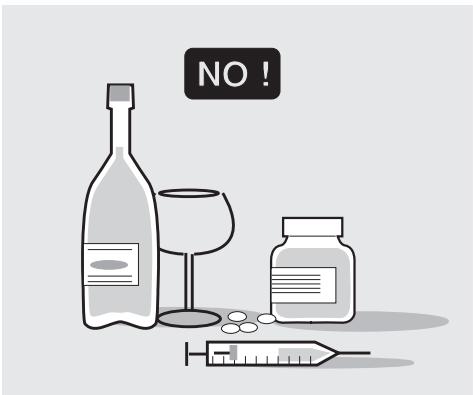
The use of medicines, alcohol and drugs or psychotropic substances notably increases the risk of accidents.
Be sure that you are in good psychophysical conditions and fit for riding and pay particular attention to physical weariness and drowsiness.
Most road accidents are caused by the rider's lack of experience.
NEVER lend the vehicle to beginners and, in any case, make sure that the rider has all the requirements for driving.
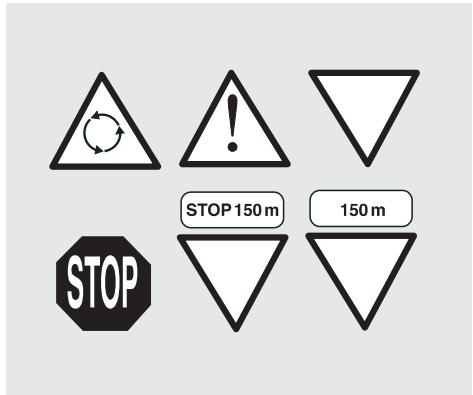
Rigourously observe all road signs and national and local road regulations.
Avoid abrupt movements that can be dangerous for yourself and other people (for example: wheeling, speeding, etc.); and give due consideration to the road surface, visibility and other driving conditions.
Avoid obstacles that could damage the vehicle or make you lose control.
Avoid riding in the slipstream created by preceding vehicles in order to increase your speed.
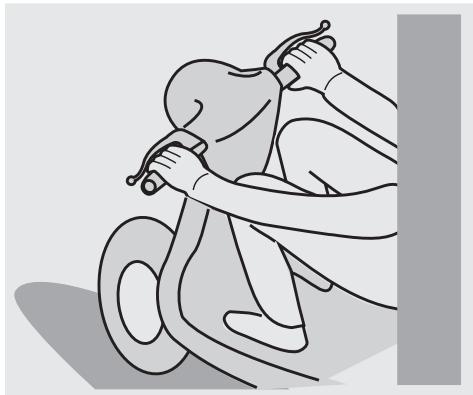
WARNING
Always ride with both hands on the handlebars and both feet on the footrests (or on the rider's footboards), in the correct driving posture.
Avoid standing up or stretching your limbs while driving.
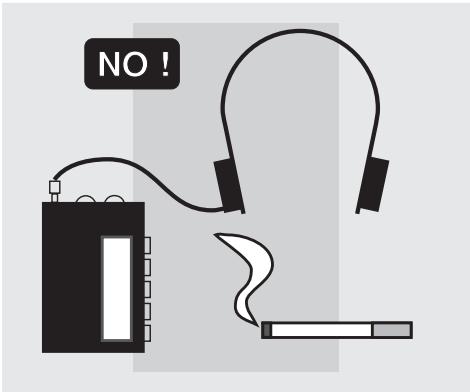
The rider should pay attention and avoid distractions caused by people, things and movements (never smoke, eat, drink, read, etc.) while driving.
Use only the vehicle's specific fuels and lubricants indicated in the "LUBRICANT CHART"; check all oil, fuel and coolant levels regularly.
If the vehicle has been involved in an accident, make sure that no damage has occurred to the control levers, pipes, wires, braking system and vital parts.
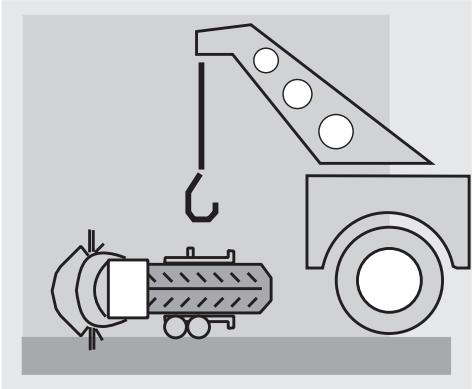
If necessary, have the vehicle inspected by an aprilia Authorised Dealer who should carefully check the frame, handlebars, suspensions, safety parts and all the devices that you cannot check by yourself.
Always remember to report any malfunction to the technicians to help them in their work.
Never use the vehicle when the amount of damage it has suffered endangers your safety.
Never change the position, inclination or colour of: number plate, direction indicators, lights and horns.
Any modification of the vehicle will result in the invalidity of the guarantee.
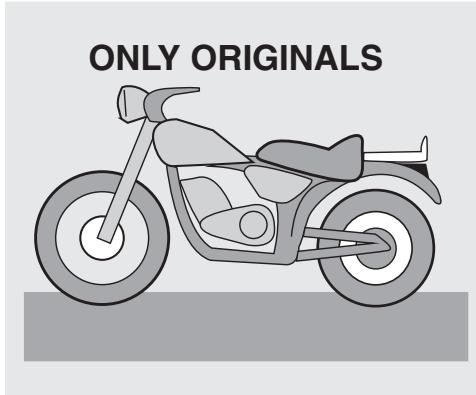
Any modification of the vehicle and/or the removal of original components can compromise vehicle performance levels and safety or even make it illegal to ride.
We recommend respecting all regulations and national and local provisions regarding the equipment of the vehicle.
In particular, avoid all modifications that increase the vehicle's performance levels or alter its original characteristics.
Never race with other vehicles.
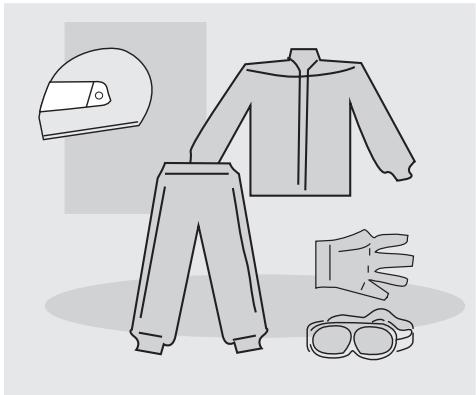
CLOTHING
Before starting, always wear a correctly fastened crash helmet. Make sure that it is homologated, in good condition, of the right size and that the visor is clean.
Wear protective clothing, preferably in light and/or reflecting colours. In this way you will make yourself more visible to the other riders, thus notably reducing the risk of being knocked down, and you will be more protected in case of fall.
This clothing should be very tight-fitting and fastened at the wrists and ankles; strings, belts and ties should not be hanging loose; prevent these and other objects from interfering with driving by getting entangled with moving parts or driving mechanisms.
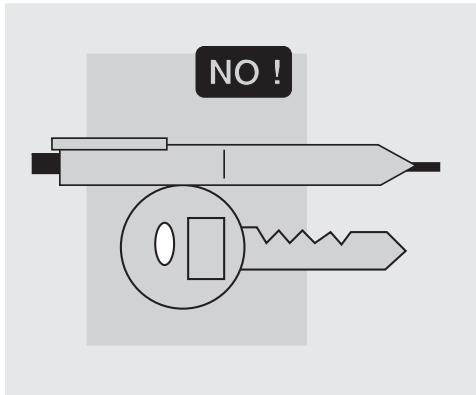
Do not keep objects that can be dangerous in case of fall, for example pointed objects like keys, pens, glass vials etc. in your pockets (the same recommendations also apply to a possible passenger).
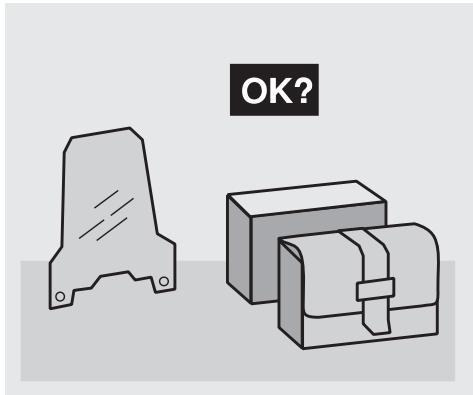
ACCESSORIES
The owner of the vehicle is responsible for the choice, installation and use of any accessory.
Avoid installing accessories that cover horns or lights or that could impair their functions, limit the suspension stroke and the steering angle, hamper the operation of the controls and reduce the ground clearance and the angle of inclination in turns.
Avoid using accessories that hamper access to the controls, since this can prolong reaction times during an emergency.
Big fairings and windshields installed on the vehicle may produce aerodynamic forces that affect the stability of the vehicle, especially when riding at high speed.

Make sure that the equipment is well fastened to the vehicle and not dangerous during driving.
Do not install electrical devices and do not modify those already existing to avoid electrical overloads, because the vehicle could suddenly stop or there could be a dangerous current shortage in the horn and in the lights.
aprilia recommends the use of genuine accessories (aprilia genuine accessories).
LOAD
Be careful and moderate when loading your luggage. Keep any luggage loaded as close as possible to the centre of gravity of the vehicle and evenly distribute the load on both sides, in order to reduce unbalance to the minimum. Furthermore, make sure that the load is firmly secured to the vehicle, especially during long trips.
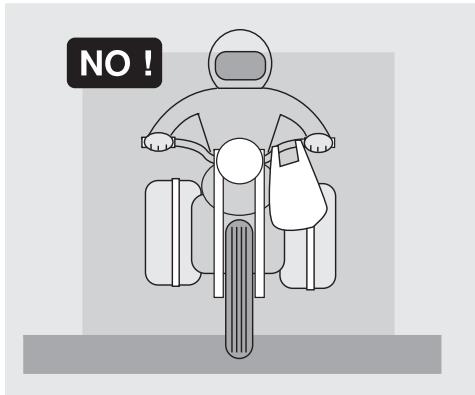
Avoid hanging bulky, heavy and/or dangerous objects on the handlebars, mudguards and forks, because the vehicle might respond more slowly in turns and its manoeuvrability could be unavoidably impaired.
Do not place bags that are too bulky on the vehicle sides and do not ride with the crash helmet hanging on one side, because they could hit people or obstacles, making you lose control of the vehicle.
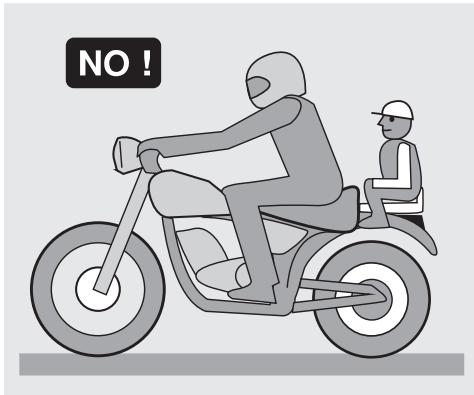
Do not carry any bag if it is not tightly secured to the vehicle.
Do not carry bags which protrude too much from the luggage-rack or which cover the lights, horn or indicators.
Do not carry animals or children on the glove compartment or on the luggage rack.
Do not exceed the maximum load allowed for each bag.
When the vehicle is overloaded, its stability and its manoeuvrability can be compromised.
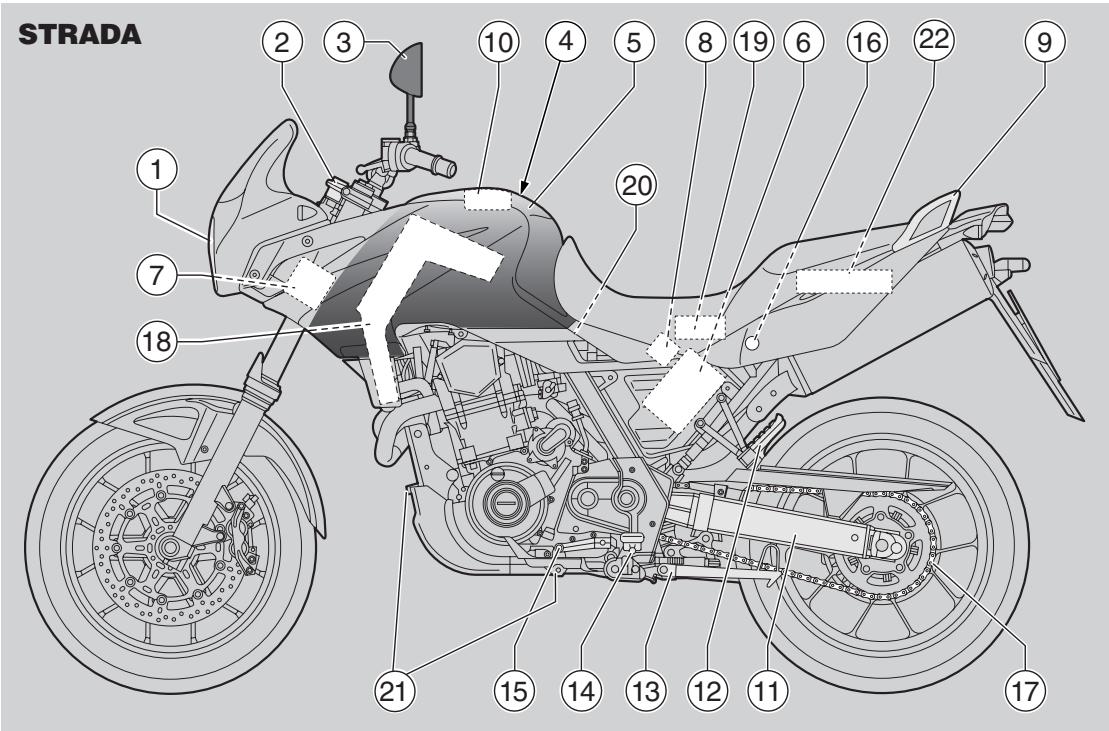
KEY
1) Headlight
2) Ignition switch/steering lock
3) Left rear-view mirror
4) Fuel tank filler cap
5) Fuel tank
6) Battery
7) Electronic control unit
8) Fuse carrier
9) Passenger grab rail
10) Glove compartment
11)Swinging arm
12) Passenger left footrest (snapping, closed/open)
13) Side stand
14) Rider left footrest
15) Gear shift lever
16) Seat lock
17) Drive chain
18) Engine oil tank
19) Tool kit
20) Idle speed adjuster
21) Oil drain plugs
22) Underseat compartment
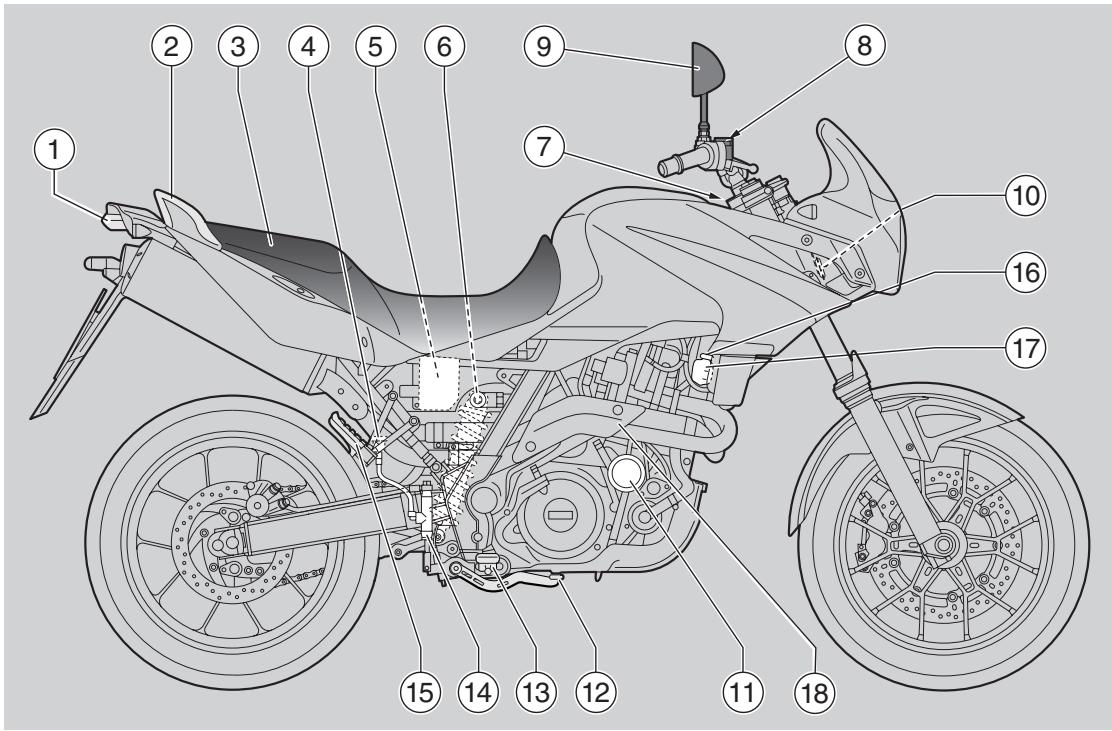
KEY
1) Tail light
2) Passenger grab rail
3) Seat
4) Rear brake fluid tank
5) Air filter
6) Rear shock absorber
7) Engine oil level plug-dipstick
8) Front brake fluid tank
9) Right rear-view mirror
10) Horn
11) Engine oil filter
12) Rear brake control lever
13) Rider right footrest
14) Rear brake master cylinder
15) Passenger right footrest (snapping, closed/open)
16) Coolant expansion tank cap
17) Coolant expansion tank
18) CO sensor plug
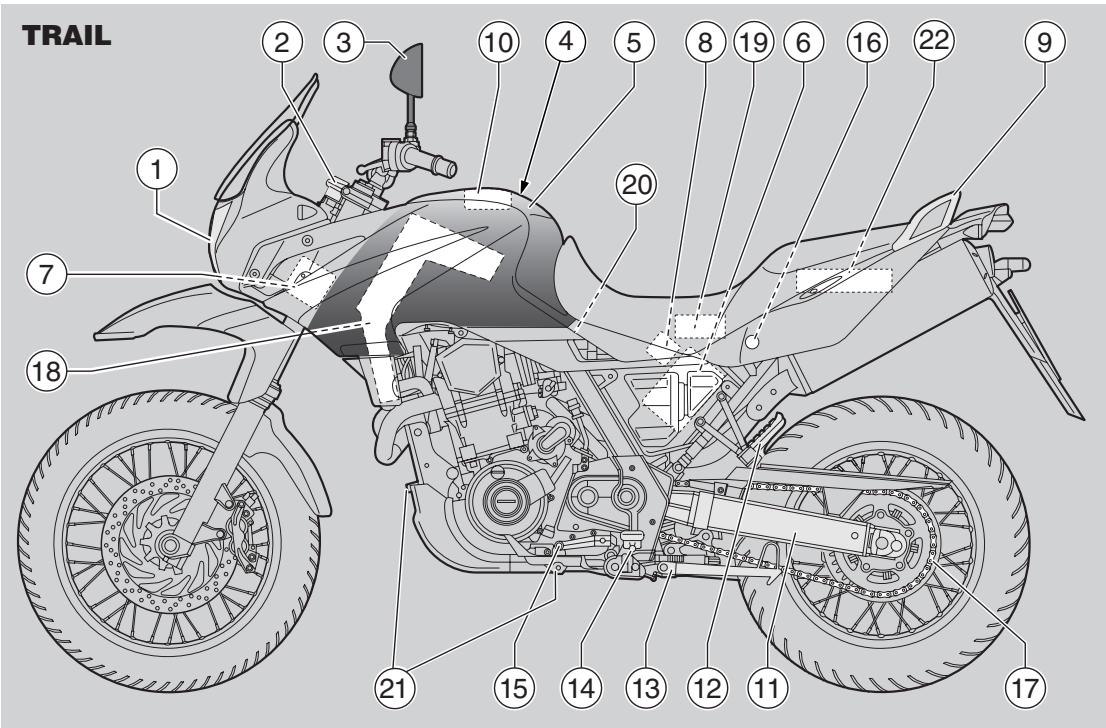
KEY
1) Headlight
2) Ignition switch/steering lock
3) Left rear-view mirror
4) Fuel tank filler cap
5) Fuel tank
6) Battery
7) Electronic control unit
8) Fuse carrier
9) Passenger grab rail
10) Glove compartment
11)Swinging arm
12) Passenger left footrest (snapping, closed/open)
13) Side stand
14) Rider left footrest
15) Gear shift lever
16) Seat lock
17) Drive chain
18) Engine oil tank
19) Tool kit
20) Idle speed adjuster
21) Oil drain plugs
22) Underseat compartment

KEY
1) Tail light
2) Passenger grab rail
3) Seat
4) Rear brake fluid tank
5) Air filter
6) Rear shock absorber
7) Engine oil level plug-dipstick
8) Front brake fluid tank
9) Right rear-view mirror
10) Horn
11) Engine oil filter
12) Rear brake control lever
13) Rider right footrest
14) Rear brake master cylinder
15) Passenger right footrest (snapping, closed/open)
16) Coolant expansion tank cap
17) Coolant expansion tank
18) CO sensor plug
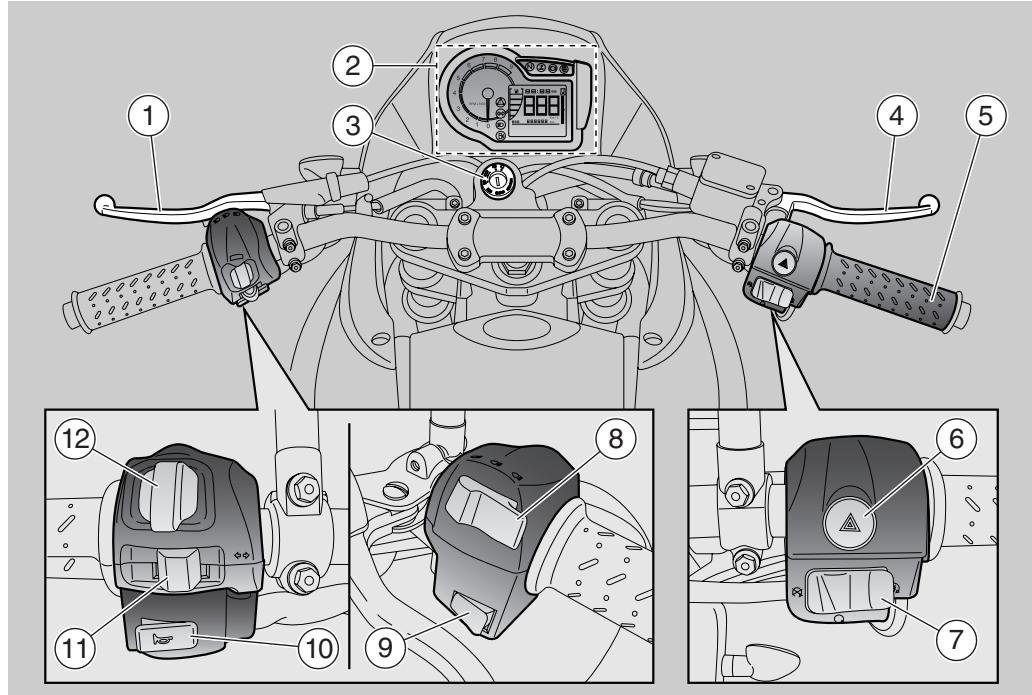
KEY
1) Clutch lever
2) Instruments and indicators
3) Ignition switch/steering lock (一 - 一 -)
4) Front brake lever
5) Throttle grip
6) Emergency flasher button (△)
7) Engine start-stop switch (※ - ○) - (※)
8) Dimmer switch (D-D)
9) Fuel filler cap cover release switch
10) Horn push button (
11) Direction indicator switch ( )
12) MODE switch
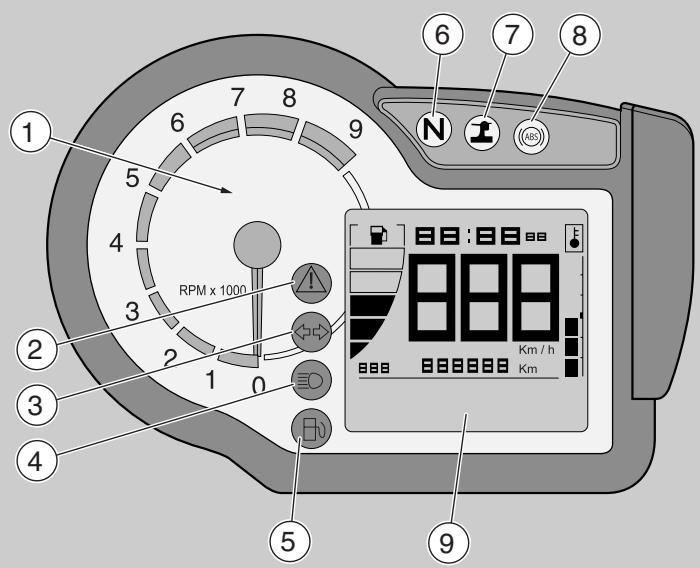
KEY
1) Revolution counter
2) Red alarm light: vehicle maintenance ()
3) Green direction indicator warning light ( )
4) Blue high beam warning light (E0D)
5) Orange low fuel warning light (R)
6) Green neutral indicator warning light ()
7) Yellow side stand light ()
8) Orange ABS light ( (空) ) (only for vehicles equipped with ABS)
9) Multifunction digital display.
INSTRUMENTS AND INDICATORS TABLE
When the ignition key is turned to "O" with the engine stopped, all warning lights, except "Heated handgrips" light, come on for a LED check-up and go out after three seconds. If one or more warning lights do not come on at this stage, contact a aprilia Authorised Dealer.
| Description | Function | |
| Multifunction digital display | Speedometer (km/h - MPH) | Displays current, average or maximum riding speed (in kilometres or miles) depending on presetting, see page 18 (MULTIFUNCTION COMPUTER). |
| Odometer (KM - Mi) | Displays partial or total Km/miles run, see page 18 (MULTIFUNCTION COMPUTER). | |
| Coolant temperature (°C/°F) | Displays engine coolant temperature, see page 18 (MULTIFUNCTION COMPUTER). ▲ CAUTION Do not leave the ignition switch on “⊗”, since the cooling fans would stop regardless of the coolant temperature and in this case the temperature would increase even further. If the pointer gets near the danger area, stop the engine, turn the key to “○” and wait until the cooling fan is disconnected. Now turn the key to “⊗” and check coolant level, see page 38 (COOLANT). Contact an aprilia Authorised Dealer. ▲ CAUTION If the maximum allowed temperature is exceeded (118 °C - 244 °F), the engine may be seriously damaged. | |
| Fuel level (STRADA version only) | Displays fuel quantity in the tank, see page 18 (MULTIFUNCTION COMPUTER). | |
| Clock | Displays time (hour and minutes) as preset, see page 18 (MULTIFUNCTION COMPUTER). | |
| Battery voltage V BATT | Displays the battery voltage in Volts, see page 18 (MULTIFUNCTION COMPUTER). | |
| Lap timer | Displays the different lap times, as preset, see page 18 (MULTIFUNCTION COMPUTER). | |
| Diagnosis | In case a serious failure is detected, one that might jeopardise the vehicle or the rider's safety, the panel will show an icon indicating the failure cause (such as: oil pressure ≦, maintenance intervals ≦). ▲ CAUTION If the wording "△ SERVICE" appears during normal engine operation, it means that the ECU or the instrument panel have detected a failure. In many cases the engine keeps running with limited performance; contact an aprilia Authorised Dealer immediately. | |
| Revolution counter rpm | Indicates the number of revolutions of the engine per minute. ▲ CAUTION Never exceed the engine max. speed rate, see page 53 (RUNNING-IN). | |
| Description | Function | |
| Error warning light | It comes on to signal a fault in case of: oil pressure alarm, overtemperature alarm, problems with the injection system or when maximum rpm are exceeded. It flashes when engine is off to indicate that the antitheft system is active. It comes on flashing if the maximum rpm are exceeded. CAUTION If the light remains on after the engine start or comes on during the normal operation of the engine, together with one of the two symbols on the display: “EFI”, “\(\text{空}\)”, this means that a fault of the injection system was detected (EFI), or low engine oil pressure (\(\text{空}\)) was detected. In this case, stop the engine immediately and contact an aprilia Authorised Dealer. | |
| Direction indicator warning light | Blinks when the direction indicators are on. | |
| High beam warning light | Comes on when the high beam bulbs are on or when the headlight signaller is operated. | |
| Low fuel warning light | It comes on when the quantity of fuel left in the tank is approx. 3 l. In this case, top up as soon as possible, see page 31 (FUEL). Refuel with ignition key in stop position in order to get a correct indication of the light. | |
| Neutral indicator warning light | Comes on when the gear is in neutral. | |
| Side stand down light | Turns on when the side stand is down. | |
| ABS light (if ABS is fitted) (only for vehicles equipped with ABS) | It comes on in case of ABS failure. | |
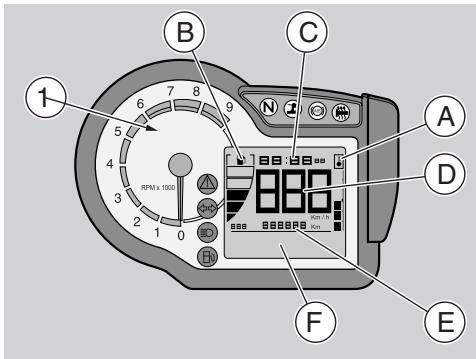
MULTIFUNCTION COMPUTER
When you turn the ignition key to "O", the following instrument panel lights will turn on for 2 seconds:
- The "PEGASO 650 STRADA-TRAIL" logo
- All lights, except "Heated handgrips light"
- Backlighting
Rev counter index (1) moves to maximum value, as set by the user.
During the initial check-up, all instruments will briefly show the current values of the corresponding parameters.
The display shows the following standard settings:
A) coolant temperature;
B) fuel quantity (STRADA version only);
C) clock;
D) speedometer;
E) odometer;
F) on-board computer and accessories functions.
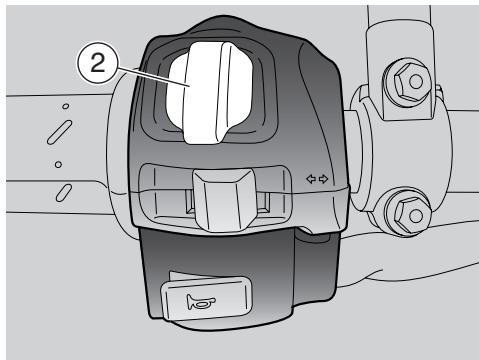
MODE selector (2) features three positions: a left one to decrease values and scroll the drop-down menus, a right one to increase values and scroll the drop-down menus in the other direction, and a centre one to confirm values by pressing the button.
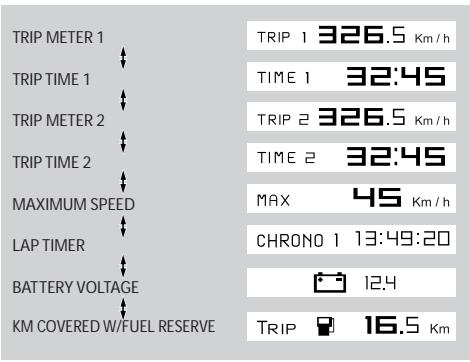
Turn selector (2) to display on the LCD the pages indicating in zone (F) the following quantities:
A) TRIP METER 1
B) TRIP TIME 1
C) TRIP METER 2
D) TRIP TIME 2
E) MAXIMUM SPEED
F) LAP TIMER
G) BATTERY VOLTAGE
H) KM COVERED W/FUEL RESERVE (distance covered on fuel reserve for trips longer than 2km ).
Trip meter 1 and 2 can be reset: press selector (2) for a certain time in the centre position to reset all quantities concerning the active trip meter.
After the distance covered on fuel reserve (KM COVERED W/FUEL RESERVE), the display shows the MENU page, but only if vehicle is not moving.
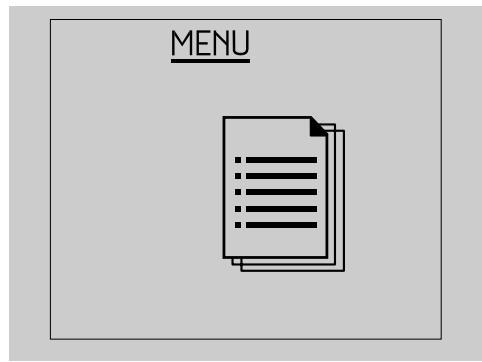
MENU
If vehicle is stopped, it is possible to gain access to the configuration menu from the MENU page by pressing the MODE selector in the centre position; while if vehicle is moving, go back to the TRIP METER 1 page.
Configuration menu options are:
EXIT
SETTINGS
LAP TIMER
DIAGNOSTICS
LANGUAGE
Settings
When the SETTINGS function is selected the following options are displayed:
EXIT
TIME SETTINGS
GEAR SHIFT INDICATOR
BACK LIGHTING
CHANGE THE CODE
CODE RECOVERY
UNLOCK SAFETY LOCKS
Once the operation is over, the instrument panel goes back to main menu.
TIME SETTINGS
This mode allows you to set the clock. The main page with "CLOCK SETTING" is displayed.
As soon as you enter this mode, indication of minutes disappears and only hours are displayed. Hour value is increased every time the MODE selector is pressed to the right, once the value reaches 12 it goes back to 0. In the same way, hour value decreases every time the MODE selector is pressed to the left, once the value reaches zero, it goes to 12 when the MODE selector is again pressed to the left..
A Confirmation signal stores the set value and lets you go on to minutes setting.
As soon as you enter this mode, indication of hours disappears and only minutes are displayed. Minute value increases every time the MODE selector is pressed to the right, once the value reaches 59, it goes back when the MODE selector is again pressed to the right. In the same way, value decreases every time the MODE selector is pressed to the left, once the value reaches zero, it goes to 59 when the MODE selector is again pressed to the left.
A Confirmation signal stores the set value and lets you quit clock setting mode.
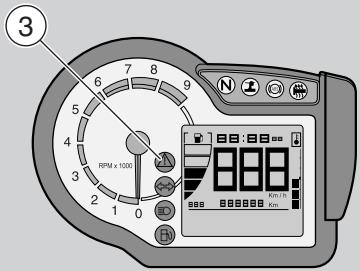
GEAR SHIFT THRESHOLD
This function allows you to set the value for the Gear shift indicator threshold. The main page with "GEAR SHIFT THRESHOLD" message is displayed.
Threshold value is increased by 100 RPM every time the MODE selector is pressed to the right, vice versa, threshold value is decreased by 100 RPM every time the MODE selector is pressed to the left.
If the upper or lower limit is reached and you further press the selector, nothing will happen.
Press the MODE selector to the centre position to end the operation and store the set value, the index goes back to zero and the instrument panel goes back to configuration menu page.
When battery is connected for the first time, the instrument panel sets to running-in rpm value, the next time battery is connected it sets to last set value.
RUNNING-IN RPM: 5000
MINIMUM RPM: 4000
MAXIMUM RPM: 8000
When the set threshold is exceeded, the alarm light (3) on the instrument panel flashes until the value goes below the threshold.
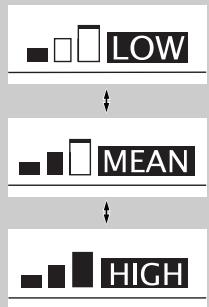
BACK LIGHTING
This function allows you to set backlighting: three levels are available. Every time the MODE selector is pressed to the right or to the left, the following icons are displayed:
LOW
MEAN
HIGH
Press the MODE selector to the centre position to set the instrument panel back to SETTINGS MENU.
CHANGE THE CODE
This function is used when the old code is available and is to be changed.
Within this function, the following message is displayed:
"INSERT THE OLD CODE"
As soon as the old code is acknowledged, the new code is requested; the following message is displayed:
"INSERT THE NEW CODE"
Once the operation is over, the display goes back to DIAGNOSIS menu. If you entered with the code, this operation will not be allowed.
Once the operation is over, the instrument panel goes back to SETTINGS menu.
CODE RECOVERY
This function is used when the old code is not available and you need to change it. In this case it is necessary to insert at least two keys in the ignition switch. The first key is already inserted, a second key is requested with the message:
"INSERT THE 2nd KEY"
The instrument panel remains on in between these two keys; if the second key is not inserted within 20 seconds the operation is aborted. When the second key is acknowledged, the new code is requested with the message:
"INSERT THE NEW CODE"
Once the operation is over, the display goes back to DIAGNOSIS menu. If you entered with the code, this operation will not be allowed.
Once the operation is over, the instrument panel goes back to SETTINGS menu.
UNLOCK SAFETY LOCKS
In case of failure to the stand sensor, the neutral and clutch switch, use function "UNLOCK SAFETY LOCKS" to disable the safety logic to be able to start the engine.
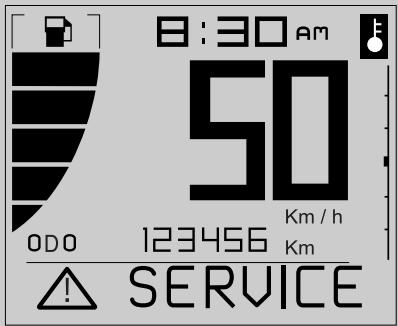
The display will show "SERVICE".
The safety logic is re-enabled when turning the key off.
WARNING
This function should be used only in an emergency.
Lap timer
When the LAP TIMER function is selected the following options are displayed:
EXIT
VIEW TIMES
DELETE TIMES
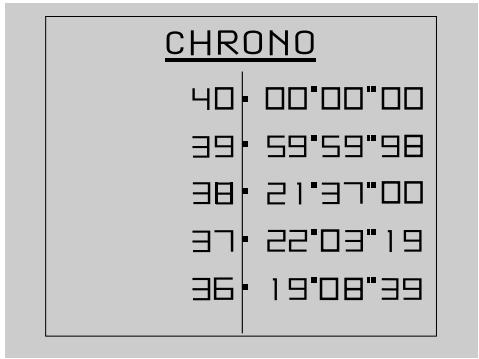
VIEW TIMES
This function also displays the acquired lap times. Briefly press the MODE selector to the right and to the left to scroll the time pages, press it for a certain time to set the display back to the LAP TIMER menu. If the battery is disconnected, stored times are lost.
DELETE TIMES
This function deletes the acquired lap times. Deletion should be confirmed. Once the operation is over, the display goes back to LAP TIMER menu.
Lap time operation
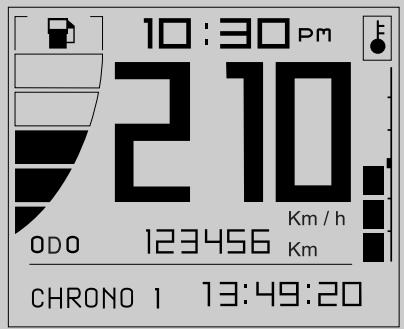
To use the lap timer, set the display to the main page indicating CHRONO, and then wait to start the lap timer.
Briefly press the MODE selector to the centre position, the lap timer starts recording. Press again the MODE selector to the centre position before 10 seconds have elapsed from timer start, time measurement is cancelled and a new one is started. Press again the MODE selector to the centre position after 10 seconds have elapsed from timer start, time measurement is interrupted and a new one is started. Press the MODE selector for a certain time to the centre position to interrupt lap time set.
Once 40 lap times have been recorded, acquisition ends and "FULL" is displayed: stop the vehicle to read recorded lap times, see page 54 (STOPPING), enter VIEW TIMES option in the LAP TIMER menu.
A new timer session can be started only if all previously recorded lap times are deleted: enter the DELETE TIMES function in the LAP TIMER menu.
Diagnosis
This menu interfaces with the systems fitted to the motorcycle to carry out diagnosis. To enable the menu, a password is needed that is available only to aprilia service centres.
Language
This menu allows you to choose the user's interface language.
ITALIANO
ENGLISH
FRANCAIS
DEUTSCH
ESPAGNOL
SERVICE INTERVAL
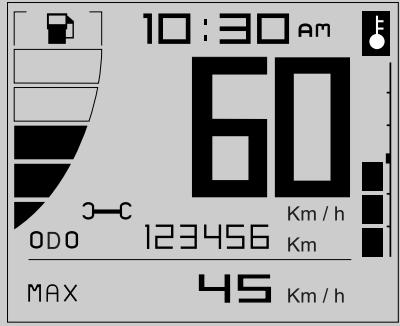
When the scheduled service intervals are reached, an icon is displayed (symbol of a spanner).
OVERTEMPERATURE
ECU ERRORS, INSTRUMENT PANEL ERRORS
LEFT DIRECTION INDICATOR FAULT
RIGHT DIRECTION INDICATOR FAULT
ECU DISCONNECTED

△ SERVICE



ALARM DISPLAY
In case a serious failure is detected, one that might jeopardise the vehicle or the rider's safety, the display will show an icon indicating the failure cause, in the area where the odometer usually is.
Alarms are divided in two groups depending on their priority:
High priority: overtemperature, ECU errors, Instrument panel errors;
Low priority: Direction indicators.
Direction indicators fault is indicated only when all indicator leads are faulty.
Should there be many alarms with same priority level, the relevant icons are displayed alternatively.
High priority alarms do not allow you to display low priority ones.
If the alarm light and the SERVICE icon briefly come on it does not mean that there is a failure.
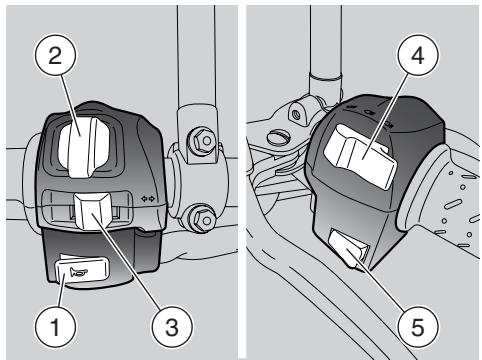
CONTROLS ON LEFT HANDLEBAR
NOTE The electrical parts work only when the ignition switch is in position "O".
1) HORN BUTTON (
The horn is activated when the push button is pressed.
2) DIRECTION INDICATOR SWITCH (艹 艹)
Move the switch to the left to indicate the turn to the left; move the switch to the right to indicate the turn to the right.
Press the switch to turn off the direction indicator.
3) MODE BUTTON
Move the MODE joystick to the left/right or press it to scroll UP/DOWN and select the multifunction display pages.
4) DIMMER SWITCH (D - D)
When it is in position "D" the parking lights, the instrument panel light and the low beam are always on.
When it is in left position "D", the high beam comes on.
When it is in right position "E", the passing is activated, to be used in case of danger or emergency.
5) FUEL TANK CAP COVER RELEASE BUTTON
Press it to open the cover on fuel tank to gain access to the fuel filler.
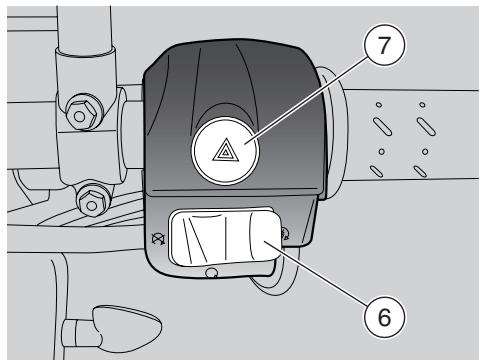
CONTROLS ON THE RIGHT PART OF THE HANDLEBAR
NOTE The electrical parts work only when the ignition switch is in position "O".
6) ENGINE START / STOP SWITCH
$$ (\bigcirc - \bigcirc) = (\bigcirc) $$
Set the switch to and press it in position 3 to start the engine: the starter motor cranks the engine. For the starting procedure, see page 48 (STARTING).
When set to the engine stops.
WARNING
Do not set the switch to 忍 while riding.
CAUTION
With the engine stopped and the switch in position "O", the battery may run flat.
When the vehicle has come to rest, after stopping the engine, leave the switch to position 忍
7) EMERGENCY FLASHER BUTTON (△)
Press the button to activate all direction indicators.
Can be enabled or disabled only with ignition switch to "O". When activated, the direction indicators stay active even when removing the key. To disable it, set ignition switch back to "O".

IGNITION SWITCH
The ignition switch (1) is positioned on the upper plate of the steering column.
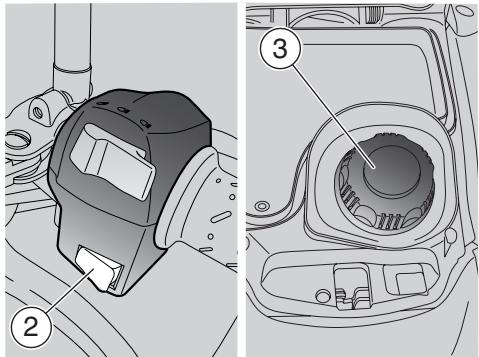
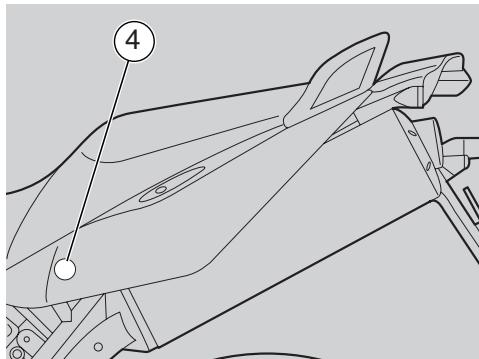
NOTE The key operates the ignition switch/steering lock, the fuel filler cap cover (3) release button (2) and the seat lock (4).
Two keys are supplied together with the vehicle (one spare key).
NOTE Do not keep the spare key on the vehicle.
| Position | Function | Key removal |
| Steering lock | The steering is locked. It is not possible to start the engine. | It is possible to remove the key. |
| The engine cannot be started. | It is possible to remove the key. | |
| The engine can be started. | It is not possible to remove the key. |

STEERING LOCK
WARNING
Never turn the key to position "B" in running conditions, in order to avoid losing control of the vehicle.
OPERATION
To lock the steering:
Completely turn the handlebar to the right or to the left.
Turn the key (1) to position "S".
Press the key (1) and rotate it to position "H".
Withdraw the key (1).
AUXILIARY EQUIPMENT
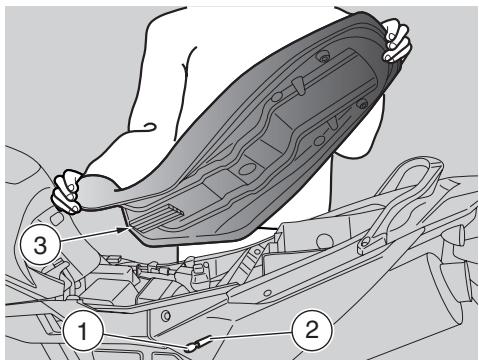
UNLOCKING/LOCKING THE SEAT
Position the vehicle on the stand, see page 55 (POSITIONING THE VEHICLE ON THE STAND).
Insert the key (1) in the seat lock (2).
Turn the key (1) clockwise and raise and remove the seat.
To lock the seat:
Position the flaps (3) in the seat, lower and press the seat, making the lock snap.
WARNING
Before leaving, make sure that the seat is properly locked.
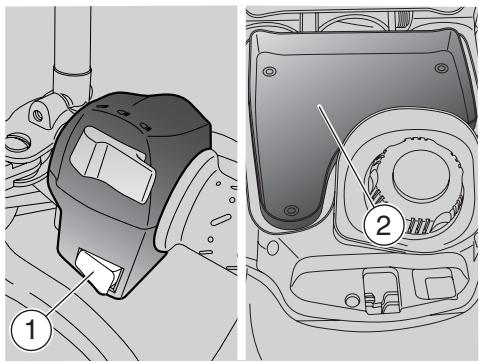
GLOVE COMPARTMENT
To gain access to the glove compartment (2):
Set the ignition switch to "O" and press the fuel filler cap cover release button (1).
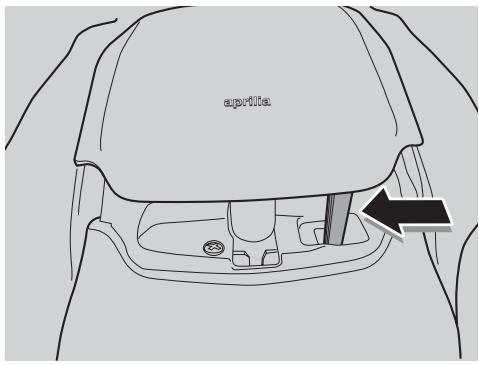
Move the red safety hook to the left to release it.
TOOL KIT COMPARTMENT
To gain access to the tool kit compartment:
Remove the seat, see page 27 (UNLOCKING/LOCKING THE SEAT)
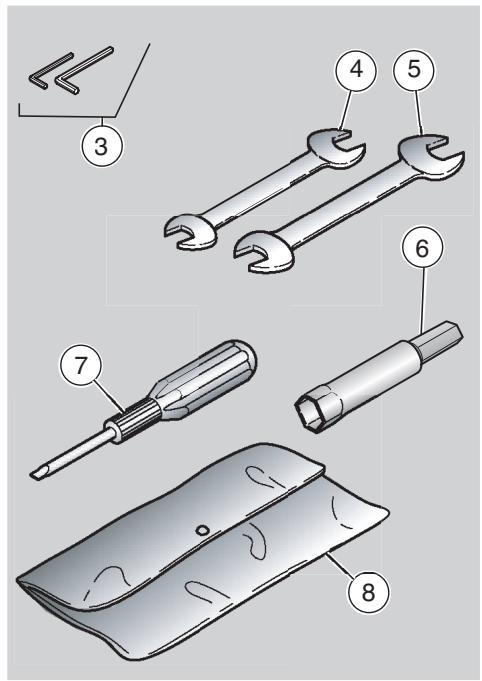
The tool kit includes:
- 3, 4 mm bent hexagon spanners (3);
- 8 - 10 mm double fork spanner (4);
- 11 - 13 mm double fork spanner (5);
- 16 mm socket spanner for spark plug (6);
- double-ended, cross-/cut-headed screwdriver (7);
- tool case (8);
- 13mm combined wrench.
Maximum allowed weight: 1.5kg

SPECIAL TOOLS OPT
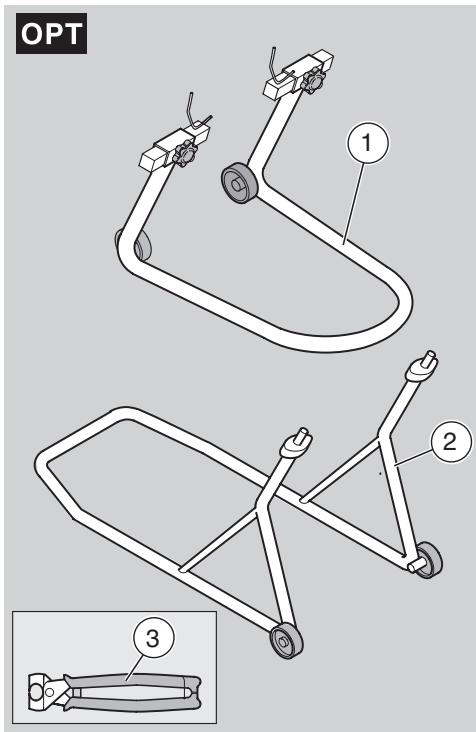
To perform some specific operations, it is advisable to use the following special tools (to be requested to an aprilia Authorised Dealer):
| Tool | Operations |
| Rear support stand (1), see page 67 (POSITIONING THE VEHICLE ON THE REAR SUPPORT STAND OPT). | Rear wheel disassembly. Drive chain adjustment. |
| Front support stand (2), see page 67 (POSITIONING THE VEHICLE ON THE FRONT SUPPORT STAND OPT). | Front wheel disassembly. |
| Click clamp (3) installation pliers, see page 60 (CLICK CLAMPS). | Click clamp installation. |
ACCESSORIES OPT
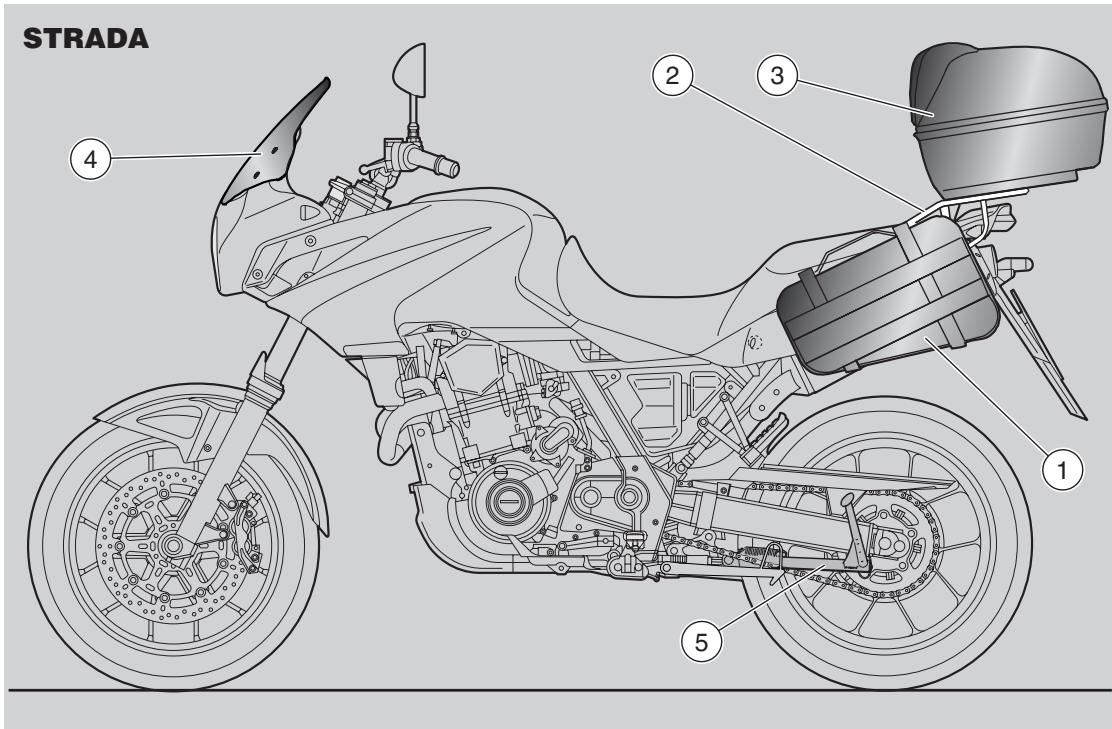
The vehicle may be equipped with the following accessories that also fit TRAIL model (to be requested to the aprilia Authorised Dealer):
- Set of semirigid cases and fasteners (1)
- Dedicated luggage rack (2)
- 28 lt. Top case (3)
-
45 lt. Top case (3)
-
Windshield adjustable in two positions using screws (4)
- Centre stand kit (5).
Tank cover
Tank bag (is secured to the vehicle and fastens to tank cover) - Raised seat
- Adjustable front brake lever

FUEL
WARNING
The fuel used for internal combustion engines is extremely inflammable and in particular conditions it can become explosive.
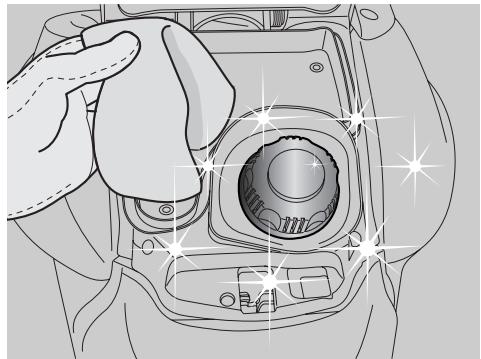
It is important to carry out the refuelling and the maintenance operations in a well-ventilated area, with the engine off. Do not smoke while refuelling or near fuel vapours, in any case avoid any contact with naked flames, sparks and any other heat source to prevent the fuel from catching fire or from exploding.
WARNING
Further, prevent fuel from flowing out of the fuel filler, as it could catch fire when getting in contact with the red-hot surfaces of the engine.
In case some fuel has accidentally been spilt, make sure that the area has completely dried and before starting the vehicle verify that there is no fuel inside the fuel filler neck.
Since fuel expands under the heat of the sun and due to the effects of sun radiation, never fill the tank to the brim.

WARNING
Screw the plug up carefully after refuelling. Avoid any contact of the fuel with the skin and the inhalation of vapours; do not swallow fuel or pour it from a receptacle into another by means of a tube.
DO NOT DISPOSE OF FUEL IN THE ENVIRONMENT.
KEEP AWAY FROM CHILDREN.
Use only unleaded fuel, in conformity with the DIN 51 607 standard, min. O.N. 95 (RON) and 85 (MON)
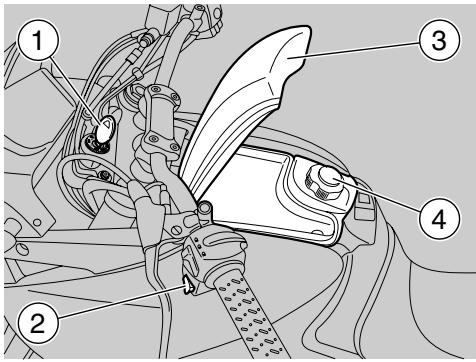
To refuel, proceed as follows:
Insert the key (1) in the ignition switch and set it to "O".
Press the fuel filler cap cover release button (2).
Move the red safety hook to the left to release it.
Lift the cover (3).
Unscrew the filler plug (4).
FUEL TANK CAPACITY (reserve included): 15 ± 0.5 l
TANK RESERVE: approx. 3 l
CAUTION
Slight overpressure of the fuel tank. When opening the fuel filler cap, you might feel it breathes. Securely hold the cap until pressure is completely bled.
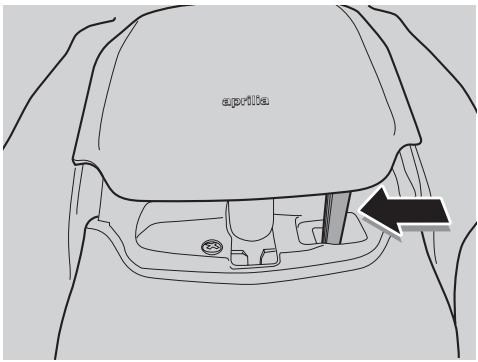
CAUTION
Do not put additives or other substances into the fuel.
If you use a funnel or other similar items, make sure that they are perfectly clean.
WARNING
Do not fill the tank completely; the maximum fuel level must remain below the lower edge of the filler neck (see figure).
CAUTION
During the refilling operations, be careful to avoid damaging the inner parts of the tank with the fuel pump.
Refuel.
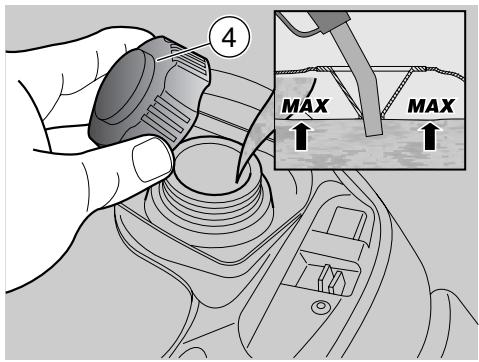
After refuelling:
Screw the filler plug (4).
WARNING
Make sure that the cap is properly closed.
Close the cover (3).
Remove the key from ignition switch.
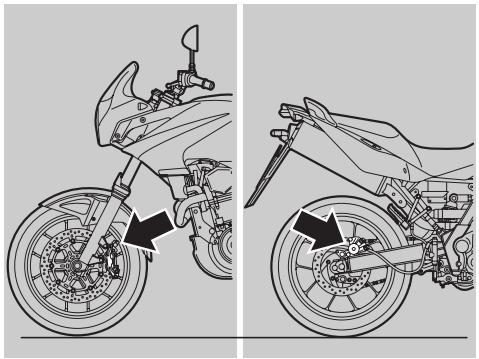
BRAKE FLUID - recommendations
NOTE This vehicle is provided with front and rear disc brakes, with separate hydraulic circuits.
The following information refers to a single braking system, but is valid for both.
WARNING
Sudden changes in brake lever play or a spongy feel of the lever may indicate problems with the hydraulic system. If in doubt about the braking efficiency of your bike or if you are not able to perform routine checks, contact your aprilia Authorised Dealer.

WARNING
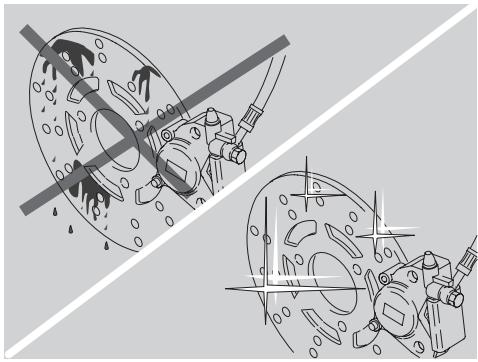
Make sure that the brake discs are neither oily nor greasy, especially after maintenance or checking operations.
Check that the brake lines are neither twisted nor worn out.
Prevent water or dust from accidentally getting into the circuit.
In case maintenance operations are to be performed on the hydraulic circuit, it is advisable to use latex gloves.
If the brake fluid gets in contact with the skin or the eyes, it can cause serious irritations.

WARNING
Carefully wash the parts of your body that get in contact with the fluid. Consult a doctor or an oculist if the fluid gets in contact with your eyes.
DO NOT DISPOSE OF THE FLUID IN THE ENVIRONMENT.
KEEP AWAY FROM CHILDREN.
CAUTION
When using the brake fluid, take care not to spill it on the plastic or painted parts, since it can damage them.
DISC BRAKES
WARNING
The brakes are the parts that most ensure your safety and for this reason they must always be perfectly working; check them before every trip.
A dirty disc soils the pads, with consequent reduction of the braking efficiency.
Dirty pads must be replaced, while dirty discs must be cleaned with a high-quality degreaser.
The brake fluid must be changed every two years by an aprilia Authorised Dealer.
Use brake fluid of the type specified in the lubricant chart, see page 93 (LUBRICANT CHART).
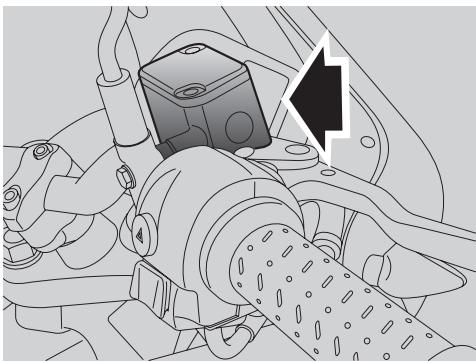
NOTE This vehicle is provided with disc brakes with two -front and rear- braking systems having separate hydraulic circuits.
The front braking system is with single disc (left side).
The rear brake uses a single disc (fitted to the right side of the wheel).
The following information refers to a single braking system, but is valid for both.
When the disc pads wear out, the level of the fluid decreases to automatically compensate for their wear.
The front brake fluid tank is positioned on the right handlebar, near the front brake lever coupling.
The rear brake reservoir is positioned on the right side of the vehicle, near the rear brake control lever.
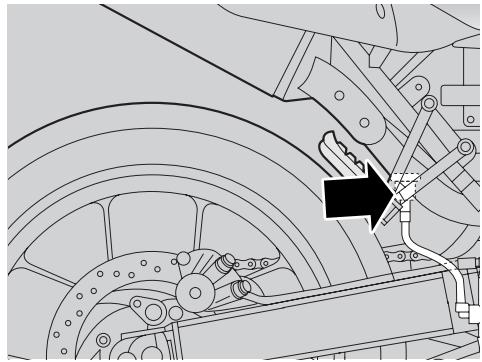
NOTE Carry out the maintenance operations halving the intervals indicated, if the vehicle is used in rainy or dusty areas or on uneven surfaces.
Have the brake discs checked by an aprilia Authorised Dealer after the first 1000 km (625 mi) and successively every 10000 km (6250 mi).
Before departure, check the brake fluid level in the reservoirs, see page 72 (CHECKING THE BRAKE PAD WEAR), page 35 (FRONT BRAKE), and the wear of the pads, see page 37 (REAR BRAKE).
Have the brake fluid changed every two years by an aprilia Authorised Dealer.
WARNING
Do not use the vehicle if the braking system leaks fluid.
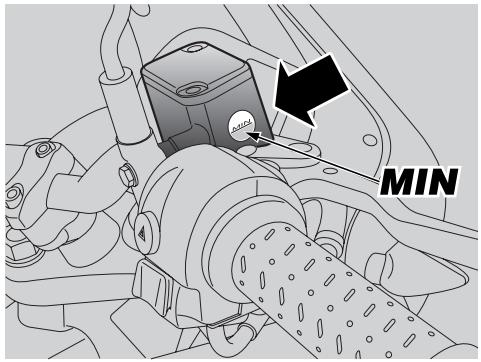
FRONT BRAKE
CHECK
Keep the vehicle in vertical position and turn the handlebar, so that the fluid contained in the tank is parallel to the brake fluid tank cover.
Make sure that the fluid level exceeds the "MIN" mark.
MIN= minimum level
If the fluid does not reach at least the "MIN" mark:
CAUTION
When the disc pads wear out, the level of the fluid decreases progressively to compensate for their wear.
Check the brake pad wear, see page 72 (CHECKING THE BRAKE PAD WEAR) and the disc wear.
If the pads and/or the disc do not need replacing, provide for topping up.
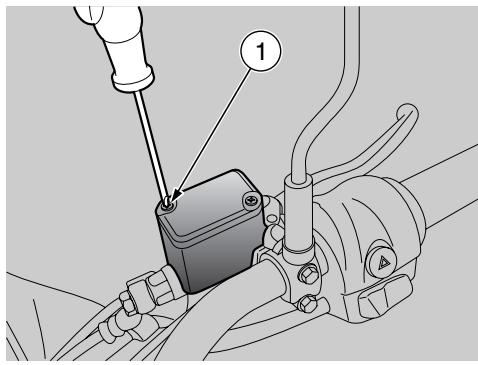
TOPPING UP
Carefully read page 33 (BRAKE FLUID - recommendations).
CAUTION
The brake fluid may flow out of the tank. Do not operate the front brake lever if the screws (1) and (2) are loose or, most important, if the brake fluid tank cover has been removed.
CAUTION
Position a cloth under the brake reservoir, in case some fluid should be spilled.
Keep the vehicle in vertical position and turn the handlebar, so that the fluid contained in the tank is parallel to the brake fluid tank cover.
Unscrew the screw (1), using a short, Phillips screwdriver.
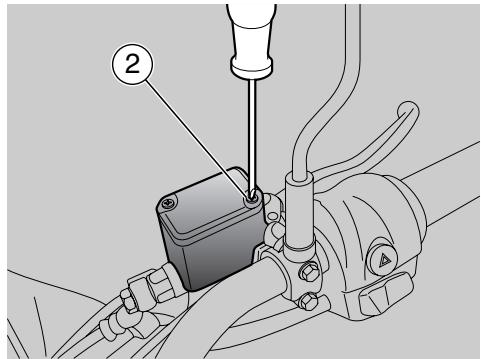
Unscrew the screw (2).
WARNING
Avoid any prolonged exposure of the brake fluid to the air.
The brake fluid is hygroscopic and when in contact with the air it absorbs its humidity.
Leave the brake fluid tank open ONLY for the time necessary for topping up.
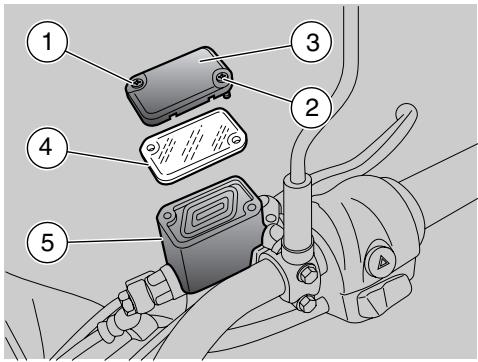
Lift and remove the cover (3) with screws (1) and (2) and protection (4).
Remove the gasket (5).
CAUTION
In order not to spill the brake fluid while topping up, do not shake the vehicle.
Do not put additives or other substances into the fluid.
If you use a funnel or other similar items, make sure that they are perfectly clean.
NOTE In order to reach the "MAX" level, top up until covering the glass (6) completely, with the brake fluid reservoir rim parallel to the ground.
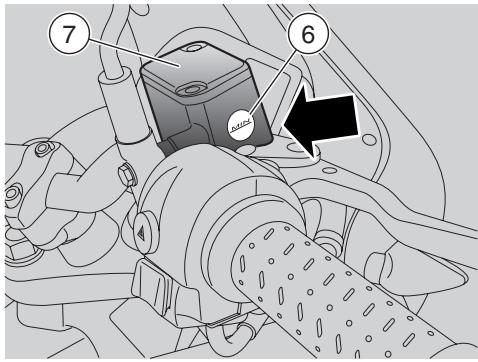
Top up the reservoir (7) by adding brake fluid, see page 93 (LUBRICANT CHART), until reaching the correct level.
CAUTION
Do not exceed the "MAX" level while topping up.
It is advisable to top up until reaching the "MAX" level only with new pads.
Do not reach the "MAX" level with worn out pads, since this will cause a fluid outflow when the pads are changed.
Put back the gasket (5) in its seat correctly.
Reposition protection (4) with cover (3).
Screw and tighten the screw (2).
Screw and tighten the screw (1).
WARNING
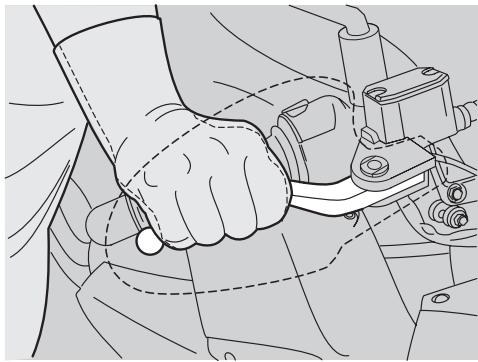
Check the braking efficiency.
In case of excessive stroke of the brake lever or reduced efficiency of the braking system, contact an aprilia Authorised Dealer, since it may be necessary to bleed the system.

REAR BRAKE
CHECK
Keep the vehicle in vertical position.
Make sure that the fluid level exceeds the "MIN" mark.
MIN= minimum level
MAX= maximum level
If the fluid does not reach at least the "MIN" mark:
CAUTION
When the disc pads wear out, the level of the fluid decreases progressively to compensate for their wear.
Check the brake pad wear, see page 72 (CHECKING THE BRAKE PAD WEAR) and the disc wear.
If the pads and/or the disc do not need replacing, provide for topping up.
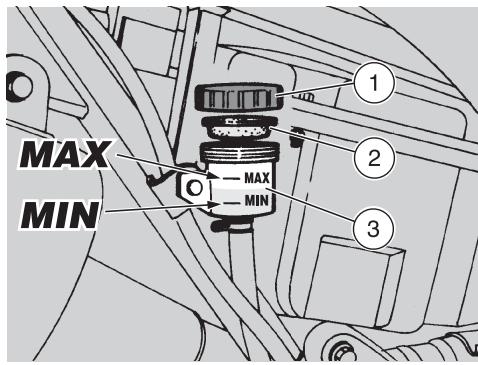
TOPPING UP
Carefully read page 33 (BRAKE FLUID - recommendations).
CAUTION
The brake fluid may flow out of the tank. Do not pull the rear brake lever if the brake fluid tank cover has been removed.
WARNING
Avoid any prolonged exposure of the brake fluid to the air.
The brake fluid is hygroscopic and when in contact with the air it absorbs its humidity.
Leave the brake fluid tank open ONLY for the time necessary for topping up.
Unscrew and remove the plug (1).
Remove the gasket (2).
CAUTION
In order not to spill the brake fluid while topping up, keep the fluid in the tank parallel to the tank rim (in horizontal position).
Do not put additives or other substances into the fluid.
If you use a funnel or other similar items, make sure that they are perfectly clean.
Fill the tank (3) with brake fluid, see page 93 (LUBRICANT CHART), until reaching the correct level between the "MIN" and "MAX" marks.
CAUTION
It is advisable to top up until reaching the "MAX" level only with new pads.
Do not reach the "MAX" level with worn out pads, since this will cause a fluid outflow when the pads are changed.
Check the braking efficiency.
In case of excessive stroke of the brake lever or reduced efficiency of the braking system, contact an aprilia Authorised Dealer, since it may be necessary to bleed the system.
COOLANT
CAUTION
Do not use the vehicle if the coolant is below the minimum prescribed level "MIN".
NOTE Carry out the maintenance operations halving the intervals indicated, if the vehicle is used in rainy or dusty areas or on uneven surfaces.
Before departure, check the coolant level, see page 39 (CHECKING AND TOPPING UP); have the coolant changed every two years: for this operation, contact an aprilia Authorised Dealer.
WARNING
Coolant is toxic when ingested. Contact with eyes or skin may cause irritation.
n the event of contact with eyes or skin, rinse repeatedly with abundant water and seek medical advice. In the event of ingestion, induce vomiting, rinse mouth and throat with abundant water and seek medical advice immediately.
KEEP AWAY FROM CHILDREN.
DO NOT DISPOSE OF THE FLUID IN THE ENVIRONMENT.
WARNING
Be careful not to spill the coolant on the red-hot parts of the engine: it may catch fire and send out invisible flames.
In case any maintenance operation should be required, it is advisable to use latex gloves.
CAUTION
Have the pads changed by your aprilia Authorised Dealer.
The coolant is composed of 50% water and 50% antifreeze.
This mixture is ideal for most operating temperatures and ensures good protection against corrosion.
It is advisable to keep the same mixture also in the hot season, since in this way losses due to evaporation are reduced and it is not necessary to top up very frequently.
The mineral salt deposits left in the radiator by evaporated water are thus reduced and the efficiency of the cooling system remains unchanged.
If the outdoor temperature is below 0^ , check the cooling circuit frequently and if necessary increase the antifreeze concentration (up to maximum 60% ).
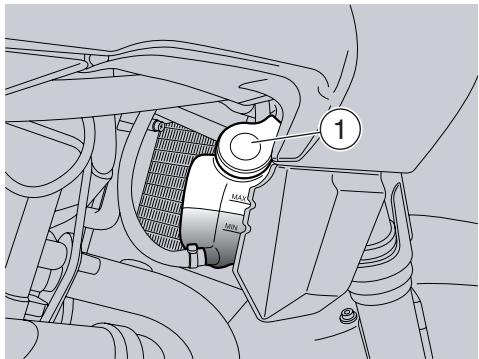
For the cooling solution use distilled water, in order not to damage the engine.
WARNING
Do not remove the expansion tank plug (1) when the engine is hot, since the coolant might be hot.
If it gets in contact with the skin or with clothes it may cause severe burns and/or damage.
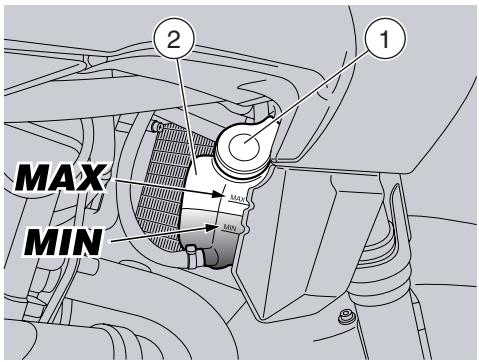
CHECKING AND TOPPING UP
WARNING
Check the coolant level and top up the expansion tank with cold engine.
Stop the engine and wait until it has cooled down.
Keep the vehicle in vertical position, with the two wheels resting on the ground.
Make sure that the level of the fluid contained in the expansion tank (2) is included between the "MAX COLD LEVEL" and "MIN".
MAX COLD LEVEL= maximum level
MIN= minimum level
If not, proceed as follows:
Unscrew and remove the filling cap (1).

WARNING
Coolant is toxic when ingested. Contact with eyes or skin may cause irritation. Do not use your fingers or any other object to check if there is enough coolant.
CAUTION
Do not put additives or other substances into the fluid.
If you use a funnel or other similar items, make sure that they are perfectly clean.
Top up the expansion tank by adding coolant, see page 93 (LUBRICANT CHART), until this almost reaches the "MAX" level. Do not exceed this level, otherwise the fluid will flow out while the engine is running.
Put back the filling cap (1).
CAUTION
In case of excessive consumption of coolant and in case the tank remains empty, make sure that there are no leaks in the circuit. Have it repaired by an aprilia Authorised Dealer.
TYRES
STRADA model is equipped with tubeless tires; TRAIL model is provided with tires with tube.
NOTE Carry out the maintenance operations halving the intervals indicated, if the vehicle is used in rainy or dusty areas or on uneven surfaces.

WARNING
Check the inflation pressure at room temperature every two weeks.
Check the conditions of the tyres and the inflation pressure at room temperature every 1000km (625 mi), see page 90 (TECHNICAL DATA).

WARNING
Periodically check the tyre inflation pressure at room temperature, see page 90 (TECHNICAL DATA).
If the tyres are hot, the measurement is not correct.
Carry out the measurement especially before and after long rides.
If the inflation pressure is too high, the ground unevenness cannot be dampened and is therefore transmitted to the handlebar, thus compromising the driving comfort and reducing the road holding during turns.
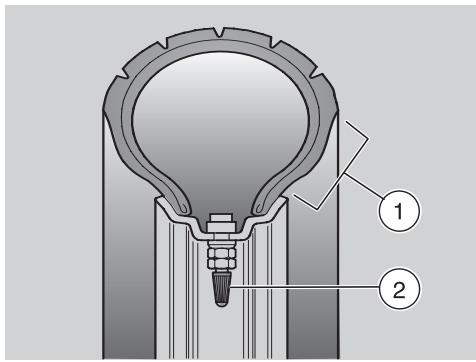
If, on the contrary, the inflation pressure is too low, the tyre sides (1) are under greater stress and the tyre itself may slip on the rim or it may become loose, with consequent loss of control of the vehicle.
In case of sudden braking the tyres could even come off the rims.
Further, the vehicle could skid while turning.

WARNING
Check the surface and the wear of the tyres, since tyres in bad conditions can impair both the grip and the vehicle handling.
Some types of tyres homologated for this vehicle are provided with wear indicators.
There are several kinds of wear indicators. For more information on how to check the wear, contact your Dealer.
Visually check if the tyres are worn and in this case have them changed.
Change the tyre when it is worn out or in case of puncture on the tread side, if the puncture is larger than 5mm
After repairing a tyre, have the wheels balanced.

WARNING
The tyres must be replaced with other tyres of the type and model recommended by the manufacturer, see page 90 (TECHNICAL DATA); the use of tyres different from those prescribed may adversely affect the manoeuvrability of the vehicle.
Do not install tyres with air tube on rims for tubeless tyres and vice versa.
Make sure that the inflation valves (2) always have their sealing caps on, to prevent the tyres from suddenly going flat.
Change, repair, maintenance and balancing operations are very important and therefore they must be performed by qualified technicians with appropriate tools.
WARNING
For this reason, it is advisable to have the above mentioned operations carried out by an aprilia Authorised Dealer or by a qualified tyre repairer.
If the tyres are new, they may still be covered with a slippery film: ride carefully for the first miles. Do not oil the tyres with unsuitable fluids. If the tyres are old, even if not completely worn out, they may become hard and may not ensure good road holding. In this case, replace them.
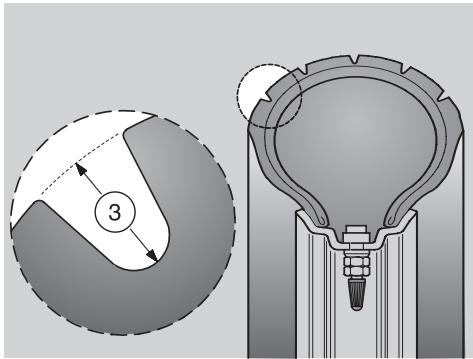
MINIMUM TREAD DEPTH LIMIT (3):
front and rear 2mm and in any case not less than prescribed by the regulations in force in the country where the vehicle is used.
ENGINE OIL
WARNING
Engine oil may cause serious damage to the skin if handled daily and for long periods.
Wash your hands carefully after use.
KEEP AWAY FROM CHILDREN.
DO NOT DISPOSE OF THE OIL IN THE ENVIRONMENT.
Put it in a sealed container and take it to the filling station where you usually buy it or to an oil salvage centre.
In case any maintenance operation should be required, it is advisable to use latex gloves.
CAUTION
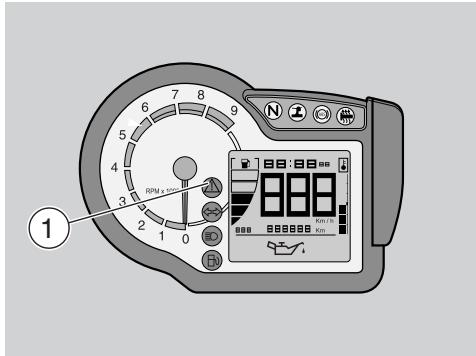
If the alarm light (1) on the instrument panel and the engine oil pressure icon on the display come on during engine normal operation, it means that the engine oil pressure in the circuit is low.
In this case, check the engine oil level, see page 61 (CHECKING THE ENGINE OIL LEVEL AND TOPPING UP); if the level is not correct, stop the engine immediately and contact an aprilia Authorised Dealer.
CAUTION
Proceed with care.
Do not spill the oil!
Take care not to smear any component, the area in which you are working and the surrounding area. Carefully remove any trace of oil.
In case of leakage or malfunctions, contact an aprilia Authorised Dealer.
Periodically check the engine oil level, see page 61 (CHECKING THE ENGINE OIL LEVEL AND TOPPING UP).
For the engine oil change, see page 58 (REGULAR SERVICE INTERVALS CHART).
NOTE Use high-quality 15W - 50 oil, see page 93 (LUBRICANT CHART).
CLUTCH
ADJUSTING THE CLUTCH
Adjust the clutch after the first 1000km (625 mi) and successively every 10000 km (6250 mi) and when the engine stops or the vehicle (with pulled clutch lever and gears on) tends to move forward, or if the clutch slips, causing a delay in the acceleration with respect to the engine rpm.
For the adjustment, proceed as follows:
Position the vehicle on the stand, see page 55 (POSITIONING THE VEHICLE ON THE STAND).
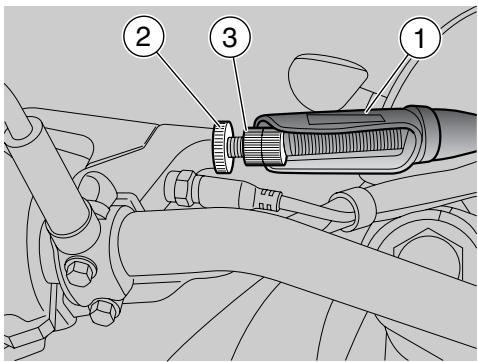
Withdraw the protection element (1).
Loosen the lock nut (2).
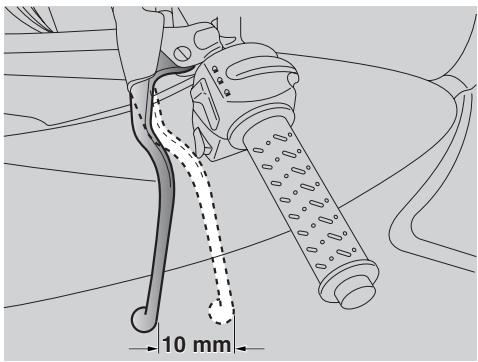
Rotate the adjuster (3), until the idle stroke of the clutch lever is about 10 mm.
Tighten the lock nut (2) and check the adjustment again.
Start the engine, see page 48 (STARTING).
Pull the clutch control lever completely and engage the 1st gear.
Make sure that the engine does not stop, that the vehicle does not tend to move forward, or that the clutch does not slip during the acceleration phase or while the vehicle is running.

WARNING
If it is not possible to obtain a correct adjustment or if the clutch does not operate properly, contact your aprilia Authorised Dealer.
CAUTION
Make sure that the clutch control cable is intact: the inner cable and outer sheath must not be worn or flattened at any point.
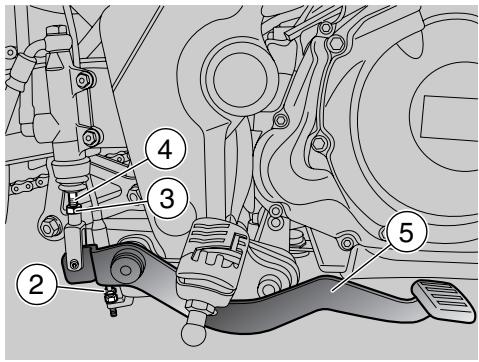
ADJUSTING THE REAR BRAKE CONTROL LEVER CLEARANCE
The brake control lever is positioned ergonomically during the assembly of the vehicle.
If necessary, it is possible to adjust the brake control lever clearance:
Screw the brake adjuster (2) completely.
Screw the lock nut (3) completely on the master cylinder control rod (4).
Screw the master cylinder control rod (4) completely, then unscrew it by giving 3-4 turns.
Unscrew the brake adjuster (2) until the brake lever reaches the desired height.
Unscrew the master cylinder control rod (4) and bring it in contact with the master cylinder piston.
Screw the rod in order to ensure a minimum clearance of 0.5 - 1 ~mm between the master cylinder control rod (4) and the master cylinder piston.
CAUTION
Make sure that there is a certain idle stroke in the movement of the lever (5), to prevent the brake from remaining applied and the consequent untimely wear of the braking elements.
Lever (5) idle stroke: 4 mm (measured at the lever end).
Lock the master cylinder control rod (4) by means of the lock nut (3).
CAUTION
After the adjustment, make sure that the wheel rotates freely with released brake.
Check the braking efficiency. If necessary, contact your aprilia Authorised Dealer.
EXHAUST SILENCERS
NOTE The following information refers to a single exhaust silencer, but is valid for both.
WARNING
Avoid parking the vehicle catalytic version near dry brush wood or in places easily accessible to children, as the catalytic silencer becomes extremely hot during use; be very careful and avoid any kind of contact until it has completely cooled down.
The catalytic vehicle is fitted with a silencer with metal catalytic converter of the "platinum-rhodium" two-way type.
This device provides for the oxidation of the CO (carbon monoxide) and of the HC (unburned hydrocarbons) contained in the exhaust gases, changing them into carbon dioxide and steam, respectively.
CAUTION
Do not use leaded fuel, since it seriously damages the catalytic converter.
EXHAUST SILENCERS
WARNING
Tampering with the noise control system is prohibited.
Owners are warned that the law may prohibit:
- the removal or rendering inoperative by any person, other than for purposes of maintenance, repair or replacement, of any device or element of design incorporated into any new vehicle – for the purpose of noise control – prior to its sale or delivery to the ultimate purchaser or while it is in use;
- the use of the vehicle after such device or element of design has been removed or rendered inoperative by any person.
Check the exhaust silencer and the silencer pipes, making sure that there are neither signs of rust, nor holes and that the exhaust system works effectively.
If the noise produced by the exhaust system increases, immediately contact your aprilia Authorised Dealer.
INSTRUCTIONS FOR USE
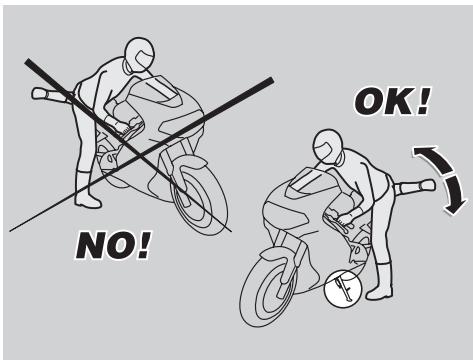
GETTING ON AND OFF THE VEHICLE
The instructions below must be followed with the maximum care in order to avoid any injury to persons and damage to property and to the vehicle, caused by the falling of the rider or the passenger from the vehicle and/or the falling or overturning of the vehicle itself.
WARNING
Risk of falling and overturning. Proceed with care.
When getting on and off the vehicle, make sure nothing can impair your movements. Also, your hands should be free (replace any objects, such as your helmet, gloves or dangling glasses before mounting or dismounting).
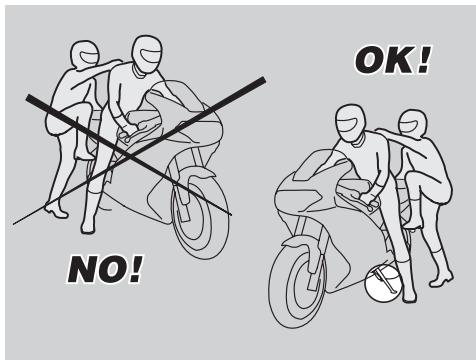
The vehicle is provided with two stands: centre stand and side stand.
CAUTION
Do not start the engine with the vehicle positioned on the centre stand. Engaging the gears may make you lose control of the vehicle.
Do not get on or let the passenger get on the vehicle if this is positioned on the centre stand.
It is forbidden to position the vehicle on the centre stand while seated astride the vehicle in riding position.
Get on and off the vehicle only from the left side and always with extended side stand.
CAUTION
Do not apply the load of your weight or of the passenger's weight onto the side stand.
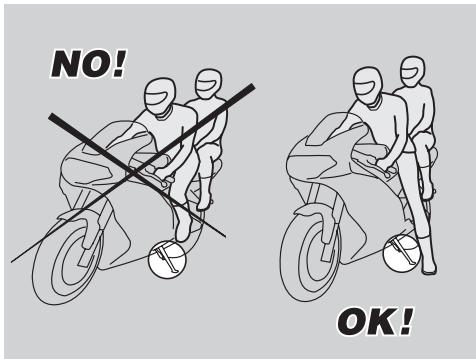
The stand has been designed to support the weight of the vehicle and a minimum load, without the rider and the passenger.
The purpose of placing the vehicle on the side stand before mounting is to keep the vehicle from falling or overturning. This does not mean that the side stand should be used to support the weight of rider and passenger.
While getting on and off, the weight of the vehicle may make you lose balance, and the vehicle may fall or overturn.
NOTE The rider must always be the first person to get on the vehicle and the last to get off and it is the rider who controls the balance and stability of the vehicle when the passenger gets on and off.
When getting on and off the vehicle, the passenger must make careful movements, in order to maintain the balance of the vehicle and the rider.
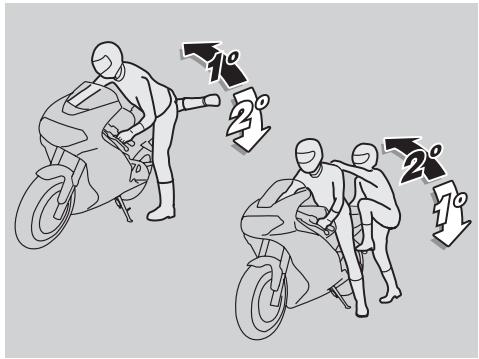
NOTE The rider is responsible for instructing the passenger on how to safely get on and off the vehicle.
The vehicle is equipped with special passenger footrests to make it easier to get on and off the vehicle. The passenger must always use the left footrest to get on and off the vehicle.
Neither get off, nor try to get off the vehicle by jumping or stretching your leg down to the ground. In both cases this would compromise the stability and balance of the vehicle.
NOTE Bags or objects strapped to the rear of the vehicle can represent an obstacle while getting on and off.
In any case, perform a controlled movement with your right leg, which must avoid striking and safely pass the rear part of the fairing or the luggage without creating unbalance.
GETTING ON THE VEHICLE
Grasp the handlebar correctly and get on the vehicle without loading your weight onto the side stand.
NOTE If it is impossible for you to place both feet on the ground, place the right foot on the ground (in case of unbalance, the left side of the vehicle is prevented from falling over by the side stand) and keep the left foot ready to rest on the ground.
Place both feet on the ground and straighten the vehicle into riding position while keeping it in balance.
NOTE The rider must not extract or attempt to extract the passenger footrest while seated astride the vehicle, because this might compromise the stability and balance of the vehicle.
Have the passenger extract the two passenger footrests.
Instruct the passenger on how to safely get on the vehicle.
Kick the side stand completely back using your left foot.
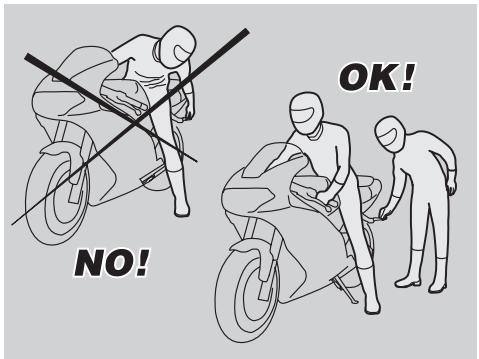
GETTING OFF THE VEHICLE
Choose a suitable parking area, see page 54 (PARKING).
Stop the vehicle, see page 54 (STOPPING).
WARNING
Make sure that the parking surface is free from obstacles, firm and flat.
With the left shoe heel, extend the side stand completely by acting on the appropriate lever.
NOTE If it is impossible for you to place both feet on the ground, place the right foot on the ground (in case of unbalance, the left side of the vehicle is prevented from falling over by the side stand) and keep the left foot ready to rest on the ground.
Place both feet on the ground, keeping the vehicle in balance in riding position.
Instruct the passenger how to safely get off the vehicle.
CAUTION
Risk of falling and overturning.
Make sure that the passenger has got off the vehicle.
Do not load your weight onto the side stand.
Incline the vehicle until the stand rests on the ground.
Grasp the handlebar correctly and get off the vehicle.
Rotate the handlebar completely leftwards.
Lift the passenger footrests.
CAUTION
Make sure that the vehicle is stable.
PRELIMINARY CHECKING OPERATIONS
WARNING
Before departure, always carry out a preliminary checking of the vehicle to make sure that it functions correctly and safely, see the table (PRELIMINARY CHECKING OPERATIONS).
Failure to comply with these checking operations can cause severe personal injuries or damages to the vehicle.
Do not hesitate to consult your aprilia Authorised Dealer in case there is something you do not understand about the operation of some controls or in case you suspect or discover some failures.
It does not take long to carry out a check-up and this operation ensures you much more safety.
PRELIMINARY CHECKING OPERATIONS
| Component | Check | Page |
| Front and rear disc brakes | Check the operation, the idle stroke of the control levers, the fluid level and make sure there are no leaks. Check the wear of the pads. If necessary, top up the fluid tank. | 33 (BRAKE FLUID - recommendations), 34 (DISC BRAKES), 35 (FRONT BRAKE), 37 (REAR BRAKE), 72 (CHECKING THE BRAKE PAD WEAR) |
| Throttle | Make sure that it works smoothly and that it is possible to open and close it completely, in all steering positions. If necessary, adjust and/or lubricate it. | 74 (ADJUSTING THE ACCELERATOR CONTROL) |
| Engine oil | Check and/or top up if necessary. | 41 (ENGINE OIL), 61 (CHECKING THE ENGINE OIL LEVEL AND TOPPING UP) |
| Wheel/tyres | Check the tyre surface, the inflation pressure, wear and tear and any damage. Remove any foreign matter that may be stuck in the tread grooves. | 40 (TYRES) |
| Brake levers | Make sure that they work smoothly. Lubricate the articulations and adjust the stroke if necessary. | 43 (ADJUSTING THE REAR BRAKE CONTROL LEVER CLEARANCE) |
| Clutch | The idle stroke at the end of the clutch lever must be approximately 10 mm; the clutch must work without jerking and/or slipping. | 42 (CLUTCH) |
| Steering | Make sure that the steering rotates smoothly, without any clearance or looseness. | - |
| Side stand and centre stand OPT (supplied as standard equipment in the countries where required) | Make sure that it operates correctly. Make sure that when the stand is let up or down there is no friction and that the spring tension brings it back to its normal position. If necessary, lubricate joints and articulations. Make sure that the safety switch operates correctly. | 81 (CHECKING THE SWITCHES) |
| Fastening elements | Make sure that the fastening elements are not loose. If necessary, adjust or tighten them. | - |
| Drive chain | Check the slack. | 68 (DRIVE CHAIN) |
| Fuel tank | Check the fuel level and top up, if necessary. Check the circuit for leaks. Make sure that the fuel cap is correctly closed. | 31 (FUEL) |
| Coolant | The coolant level in the expansion tank must be included between "MAX COLD LEVEL" and "MIN" marks. | 38 (COOLANT), 39 (CHECKING AND TOPPING UP) |
| Engine start stop switch (○ - ○ - ○) | Make sure that it operates correctly. | 25 [ENGINE START / STOP SWITCH (○ - ○ - ○)] |
| Lights, warning lights LED, horn, rear brake light switch end electric devices | Check horn and indicators for proper operation. Change bulbs or fix a failure, if necessary. | 77 (BATTERY) - 86 (CHANGING THE NUMBER PLATE BULB) |

STARTING
WARNING
Do not position any object inside the front fairing (between the handlebar and the instrument panel), in order not to hinder the rotation of the handlebar and visibility toward the instrument panel.
NOTE Before starting the engine, carefully read chapter "safe drive", see page 5 (SAFE DRIVE).
WARNING
Exhaust emissions contain carbon oxide, which is a poisonous gas and extremely harmful if inhaled.
Avoid starting the engine in closed or badly-ventilated rooms.
Failure to heed this warning may cause loss of consciousness or even lead to death by asphyxia.
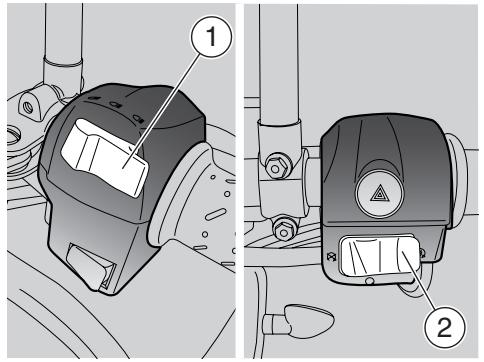
NOTE With the side stand down, the engine can be started only if the gearbox is in neutral; in this case, if you try to engage the gears, the engine stops.
With the side stand up, it is possible to start the engine either in neutral gear or with engaged gears and pulled in clutch lever.
Get on the vehicle in riding position, see page 44 (GETTING ON AND OFF THE VEHICLE).
Make sure that the stand is completely up.
Make sure that the dimmer switch (1) is in position “D”.
Move the engine start-stop switch (2) to position "O".
Turn the key (3) and move the ignition switch to position "O".
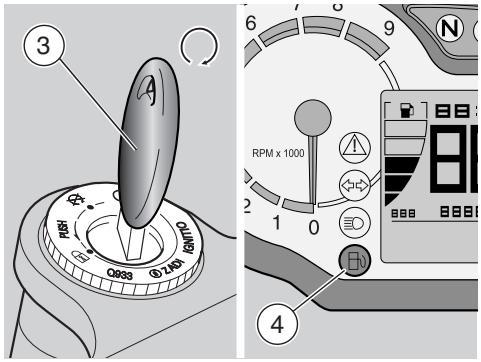
Now all lights on the instrument panel turn on and immediately off.
The fuel pump will pressurise the fuel supply circuit, sending out a hum for about three seconds.
CAUTION
If the low fuel warning light "B" (4) on the instrument panel comes on, provide for topping up as soon as possible, see page 31 (FUEL).
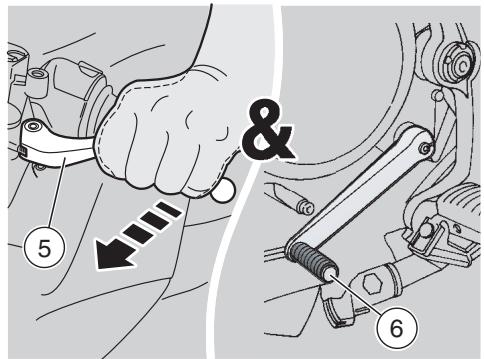
Operate the front brake lever completely.
Pull the clutch lever (5) completely and shift the gearbox lever (6) into neutral [green warning light "N" (7) on].
CAUTION
To avoid excessive drainage of the battery, do not keep the start-stop push button pressed to “(3)” for more than fifteen seconds.
If the engine does not start in this lapse of time, wait ten seconds and press the start-stop push button again to "③".
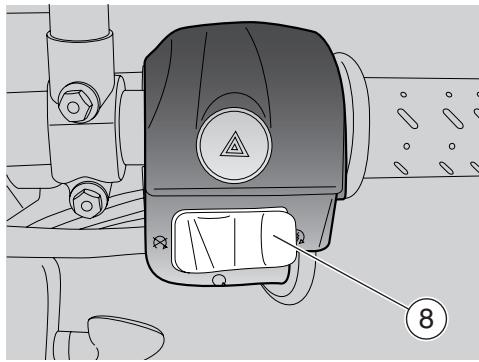
Press the start-stop push button (8) to "5" without accelerating and release it as soon as the engine starts.
CAUTION
Avoid pressing the start-stop push button (8) to “ () ” when the engine is running, since you may damage the starter.
If the engine oil pressure light (9) stays on after the engine is running or comes on during normal engine operation, and at the same time even the symbol on the display is on, it means that engine oil pressure in the circuit is low.
In this case, stop the engine immediately and contact an aprilia Authorised Dealer.
Keep at least one brake lever pulled and do not accelerate until you start.
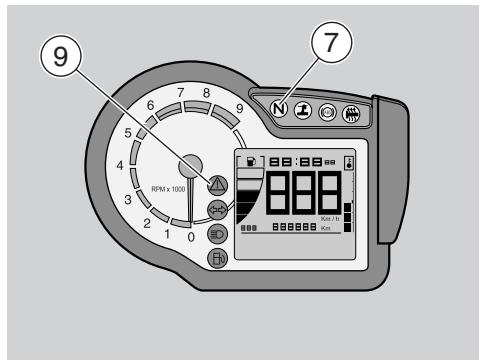
CAUTION
Never leave abruptly with cold engine.
To reduce the emission of polluting substances and the consumption of fuel, warm the engine up by proceeding at low speed for the first miles.
CAUTION
If the light (9) stays on or comes on during normal engine operation, and at the same time even the symbol "EFI" on the display is on, it means that the control unit has detected a failure.
In many cases the engine keeps running with limited performance; immediately contact an aprilia Authorised Dealer.
MOVING OFF AND RIDING
WARNING
Do not position any object inside the front fairing (between the handlebar and the instrument panel), in order not to hinder the rotation of the handlebar and visibility toward the instrument panel.
NOTE Before moving off, carefully read the "safe drive" chapter, see page 5 (SAFE DRIVE).
CAUTION
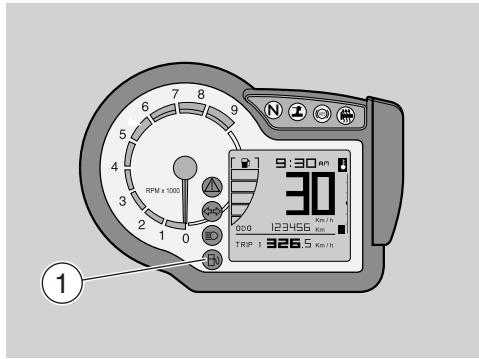
If the low fuel warning light "F" (1) positioned on the instrument panel comes on while the vehicle is running, this means that 5 of fuel are still available in the tank.
Provide for topping up as soon as possible, see page 31 (FUEL).
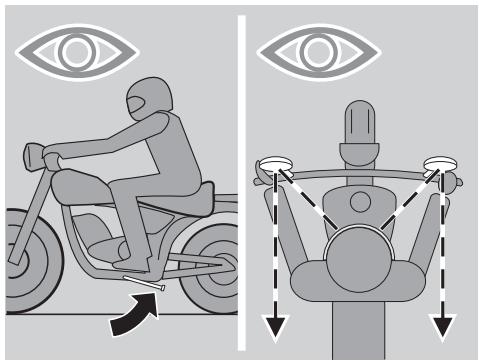
WARNING
If you ride without passenger, make sure that the passenger footrests are folded.
While riding, keep your hands on the grips and your feet on the footrests.
NEVER RIDE IN ANY POSITION OTHER THAN THOSE INDICATED.
WARNING
If you ride with a passenger, instruct him/her so that he/she does not create problems during manoeuvres.
Before leaving, make sure that the stand is completely up.
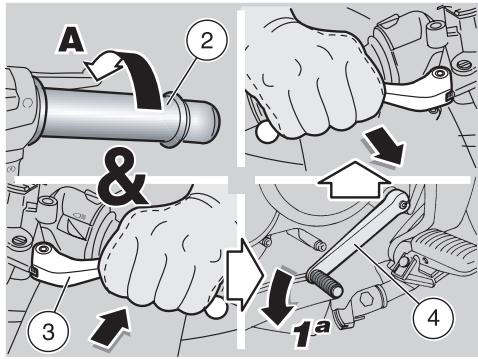
To leave:
Start the engine, see page 48 (STARTING).
Adjust the inclination of the rear-view mirrors correctly.
CAUTION
With the vehicle at rest, try to get acquainted with the use of the rear-view mirrors. The reflecting surface is convex, therefore the objects seem to be farther away than they actually are. These mirrors offer a "wide-angle" view. It may take some time to learn to accurately judge the distance of traffic behind.
With released throttle grip (2) (Pos.A) and engine idling, pull the clutch lever (3) completely.
Engage the first gear, by pushing the gear lever (4) downwards.
Release the brake lever (pulled on the starting).
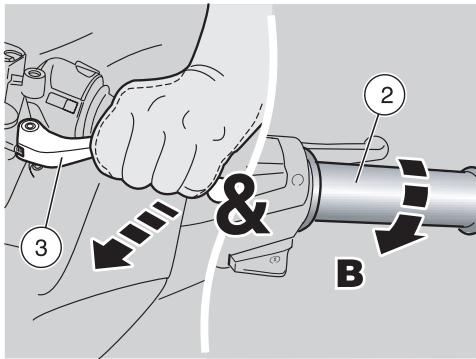
WARNING
On departure, the abrupt release of the clutch lever may cause the engine to stall or the vehicle to jerk forward.
Never accelerate abruptly or excessively when releasing the clutch lever, in order to prevent the clutch from "slipping" (slow release) or the front wheel from raising "rearing up" (quick release).
Slowly release the clutch lever (3) and at the same time accelerate by slightly turning the throttle grip (2) (Pos.B).
The vehicle will start moving.
Ride at reduced speed for the first miles, in order to warm the engine up.
CAUTION
Never exceed the recommended rpm, see page 53 (RUNNING-IN).
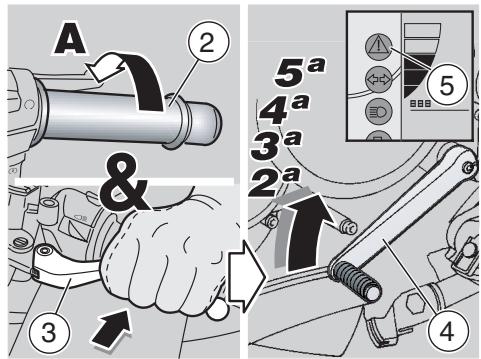
Increase the speed by gradually rotating the throttle grip (2) (Pos.B), without exceeding the recommended rpm, see page 53 (RUNNING-IN).
To engage the second gear:
CAUTION
Proceed quickly.
Never ride the vehicle at too low rpm.
Release the throttle grip (2) (Pos.A), pull the clutch lever (3) and lift the gear shift lever (4). Release the clutch lever (3) and accelerate.
Repeat the last two operations and shift up.
CAUTION
If the light (5) stays on or comes on during normal engine operation, and at the same time even the symbol on the display is on, it means that engine oil pressure in the circuit is low.
In this case, stop the engine immediately and contact an aprilia Authorised Dealer.
The downshifting should be carried out in the following situations:
When riding downhill or when braking, in order to increase the braking action by using the compression of the engine.
When riding uphill, if the gear engaged is not suitable to the speed (high gear, moderate speed) and the engine rpm decreases.
CAUTION
Shift the gears one by one; the simultaneous downshifting of more than one gear may make you exceed the maximum rpm (redline).
Before and during the downshifting, release the throttle grip and decelerate, in order to avoid the "redline".
Maximum set rpm are indicated by a light (5) that flashes.
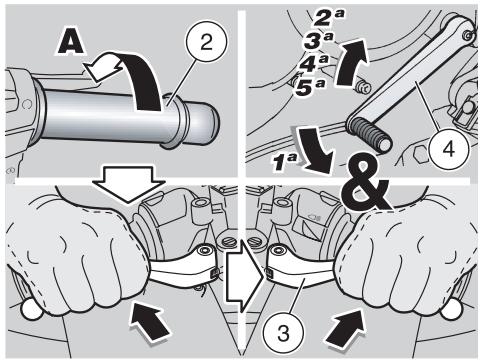
To shift down, proceed as follows:
Release the throttle grip (2) (Pos.A).
If necessary, pull the brake levers moderately and decrease the speed of the vehicle.
Pull the clutch lever (3) and lower the gear shift lever (4) to shift down.
If the brake levers are pulled, release them.
Release the clutch lever and accelerate moderately.
CAUTION
If the display shows error message " 其 ", it means that coolant temperature is over 118^ stop the vehicle and let the engine idle for approximately two minutes, thus permitting the regular circulation of the coolant in the system; at this point, position the engine start-stop switch on "其" and check the coolant level,
see page 38 (COOLANT).
If the situation on the instrument panel remains the same after the coolant level has been checked, do not start the vehicle and contact an aprilia Authorised Dealer.
Do not position the ignition key on "×", since the cooling fan would stop independently of the coolant temperature and in this case the temperature would increase even further.
If the error message " SERVICE" appears on the display during normal engine operation, it means that the ECU has detected a failure.
In many cases the engine keeps running with limited performance; immediately contact an aprilia Authorised Dealer.
To avoid the overheating of the clutch, keep the engine running with vehicle at rest, engaged gears and pulled clutch lever for the shortest time possible.
WARNING
Avoid opening and closing the throttle repeatedly and continuously, so that you do not accidentally lose control of the vehicle. If you have to brake, close the throttle and put on both brakes in order to obtain uniform deceleration, properly exerting pressure on the braking parts.
Using one brake only reduces braking force significantly and may lock a wheel resulting in loss of grip.
If you stop uphill, decelerate completely and use the brakes only to keep the vehicle steady.
The use of the engine to keep the vehicle steady may cause the overheating of the clutch.
When approaching a bend, slow down or brake in good time. Take the bend at moderate, steady speed or accelerate slightly. Late braking may put the vehicle into a skid.
If the brakes are operated continuously on downhill stretches, the friction surfaces may overheat, thus reducing the braking efficiency. Exploit the engine compression and shift down by putting on both brakes intermittently.
Never ride downhill with the engine off!
When visibility is insufficient, switch on the low beam even during the day, in order to make your vehicle more visible. In case of wet ground or scarce wheel grip (snow, ice, mud, etc.), ride slowly, avoiding sudden braking or manoeuvres that could make you lose grip and fall down.

WARNING
Pay the utmost attention to any obstacle or variation of the ground.
Uneven road surfaces, rails, inspection covers, painted signals, construction site metal covers become slippery in rainy weather and must be negotiated carefully, smoothly and keeping the vehicle upright.
Always signal your intention to change lanes or direction in good time using the direction indicators. Avoid sudden manoeuvres.
Switch off the direction indicators immediately after changing direction.
Be very careful when overtaking or being overtaken.
When it rains, large vehicles lift surface water, which affects visibility. In addition, the slip stream may make you lose control of the vehicle.
RUNNING-IN
The running-in of the engine is essential to ensure its life and correct operation.
If possible, ride on hilly roads and/or roads with many bends, so that the engine, the suspensions and the brakes undergo a more effective running-in.
During running-in, change speed.
In this way the components are first "loaded" and then "relieved" and the engine parts can thus cool down.
Even if it is important to stress the engine components during running-in, take care not to exceed.
NOTE Only after the first 2000 km (1250 mi) of running-in you can expect the best performance levels from the vehicle.
Keep to the following indications:
Do not open the throttle completely if the speed is low, both during and after running-in.
During the first 500~km (312 mi) put on the brakes with caution, avoiding sharp and prolonged braking. This ensures a correct bedding-in of the pads on the brake disc.
During the first 500km (312 mi) never exceed 4000 rpm.
When the total number of km covered by the vehicle is included between 500 km (312 mi) and 1000 km (625 mi), never exceed 5000 rpm.

WARNING
After the first 1000 km (625 mi), have an aprilia Authorised Dealer carry out the checks indicated in the column "After running-in" of the regular service intervals chart, see page 58 (REGULAR SERVICE INTERVALS CHART), in order to avoid hurting yourself or other people and/or damaging the vehicle.
Between the first 1000 (625 mi) and 2000~km (1250 mi) ride more briskly, change speed and use the maximum acceleration only for a few seconds, in order to ensure better coupling of the components); never exceed 5500 rpm (see table).
After the first 2000~km (1250 mi) you can gradually expect better performance from the engine.
| Engine maximum rpm recommended | |
| Mileage km (mi) | rpm |
| 0 – 500 (0 – 312) | 4000 |
| 500 – 1000 (312 – 625) | 5000 |
| 1000 – 2000 (625 – 1250) | 5500 |
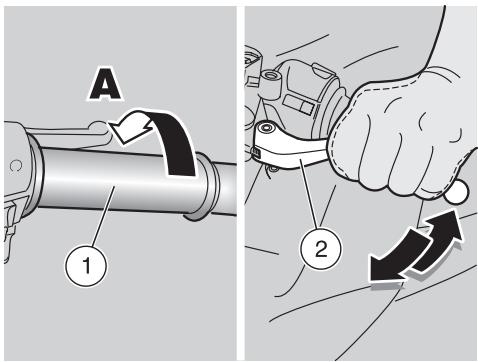
STOPPING
WARNING
If possible, avoid stopping abruptly, slowing down suddenly and limit braking.
Release the throttle grip (1) (Pos.A), gradually put on the brakes and at the same time shift down in order to decrease the speed, see page 50 (MOVING OFF AND RIDING).
Once the speed has decreased, before stopping the vehicle:
Pull the clutch lever (2) in order to prevent the engine from stalling.
When the vehicle has come to rest:
Shift the gear lever to neutral (green warning light "N" on).
Release the clutch lever (2).
In case of a brief stop, keep at least one brake on.
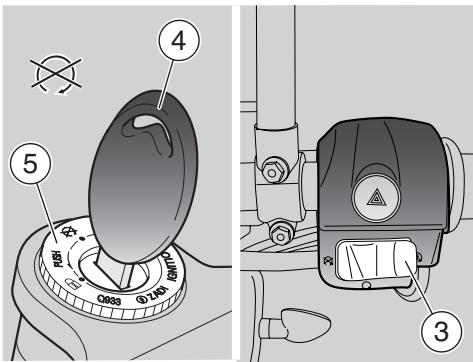
PARKING
It is very important to choose a suitable parking area, respecting the road signs and the indications given below.
WARNING
Park the vehicle on firm and flat ground, to prevent it from falling down.
Neither lean the vehicle against walls, nor lay it on the ground.
Make sure that the vehicle and especially its red-hot parts do not represent a danger for persons and children. Do not leave the vehicle unattended when the engine is on or the key is inserted into the ignition switch.
Stay away from the cooling fans even when they are not operating. They might switch on unexpectedly and your clothing or hair might be caught in the fans.
WARNING
The fall or excessive inclination of the vehicle may cause the fuel to flow out of the tank.
The fuel used for internal combustion engines is extremely inflammable and in particular conditions it can become explosive.
CAUTION
Do not apply the load of your weight or of the passenger's weight onto the side stand.
To park the vehicle:
Choose a suitable parking area.
Stop the vehicle, see page 54 (STOPPING).
Move the engine start-stop switch (3) to position
Rotate the key (4) and move the ignition switch (5) to position "X".
WARNING
When getting on or off the vehicle, keep to the instructions given, see page 44 (GETTING ON AND OFF THE VEHICLE).
Following the indications, wait until the passenger has got off the vehicle before dismounting.
Lock the steering, see page 27 (STEERING LOCK) and extract the key.
WARNING
Make sure that the vehicle is stable.
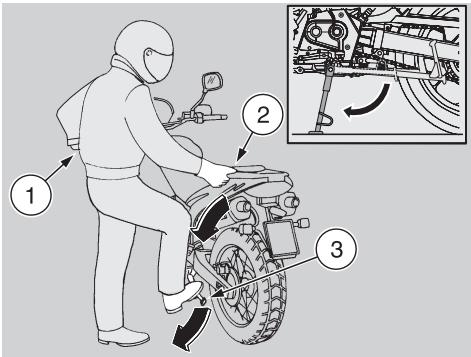
POSITIONING THE VEHICLE ON THE STAND
SIDE STAND
To place the vehicle on the side stand while seated astride the vehicle, see page 44 (GETTING ON AND OFF THE VEHICLE).
If any manoeuvre (for example, moving the vehicle) required the lifting of the stand, to place the vehicle on the stand again, proceed as follows:
WARNING
Make sure that the parking surface is free from obstacles, firm and flat.
Choose a suitable parking area, see page 54 (PARKING).
Grasp the left grip (1) and the handle (2).
Press the side stand with your right foot and extend it completely (3).
Incline the vehicle until the stand rests on the ground.
Steer the handlebar completely leftwards.
WARNING
Make sure that the vehicle is stable.
CENTRE STAND (supplied as standard equipment in the countries where required).
WARNING
It is forbidden to position the vehicle on the centre stand while seated astride the vehicle in riding position.
WARNING
Make sure that the parking surface is free from obstacles, firm and flat.
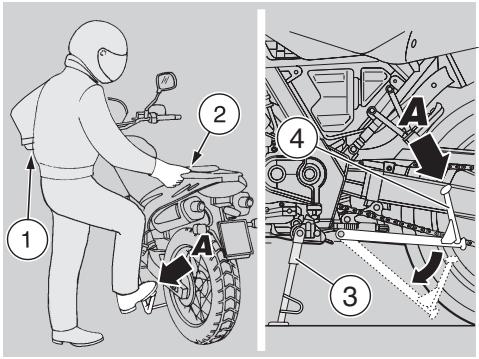
Choose a suitable parking area, see page 54 (PARKING).
Grasp the left grip (1) and the handle (2).
CAUTION
The lowering of the side stand is suggested, for safety reasons, in order to prevent the vehicle from falling down or overturning in case of unbalance.
NOTE Do not let the side stand touch the ground. Keep the vehicle in vertical position.
Press the side stand with your right foot and extend it completely (3).
Push down the lever (4) (Pos.A) of the centre stand and make it rest on the ground.
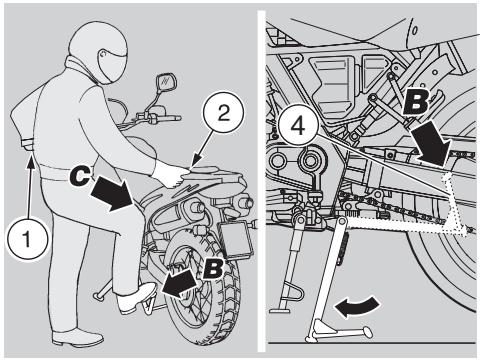
CAUTION
Proceed with care.
The positioning of the vehicle on the centre stand may be difficult, since the vehicle is very heavy. Release the grip (1) and the handle (2) only after positioning the vehicle on the stand.
Load your weight on the lever (4) (Pos.B) of the centre stand and at the same time move your centre of gravity towards the rear part of the vehicle (Pos.C).
WARNING
Make sure that the vehicle is stable.
Let the side stand up.
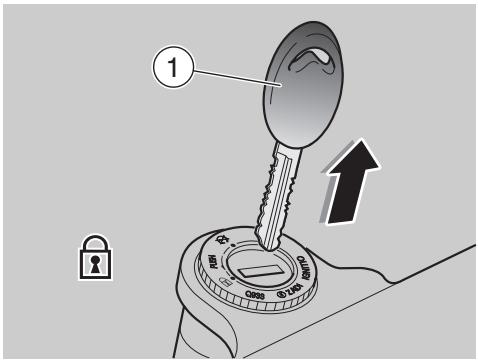
SUGGESTIONS TO PREVENT THEFT
CAUTION
Do not use any "brake lock" devices. Failure to heed this warning can seriously damage the braking system and lead to an accident thus provoking serious injuries or death.
NEVER leave the ignition key (1) inserted and always use the steering lock "O".
Park the vehicle in a safe place, possibly in a garage or a protected place.
When possible, use an additional antitheft device.
Make sure that all documents are in order and the road tax has been paid.
Write down your personal data and telephone number in this page, to facilitate the identification of the owner in case of finding after theft.
SURNAME:
NAME:
ADDRESS:
TELEPHONE NO:
NOTE Very often stolen vehicles are identified thanks to the data written in the use/maintenance manual.

Carefully read page 2 (SAFETY WARNINGS), (TECHNICAL INFORMATION) and (WARNINGS - PRECAUTIONS - GENERAL ADVICE).
WARNING
Risk of fire.
Keep fuel and other flammable substances away from the electrical components.
Before beginning any maintenance operation or any inspection of the vehicle, stop the engine, extract the key from the ignition switch, wait until the engine and the exhaust system have cooled down and if possible lift the vehicle by means of the proper equipment, on firm and flat ground.

WARNING
Before proceeding, make sure that the room in which you are working is properly ventilated.
Keep away from the red-hot parts of the engine and of the exhaust system, in order to avoid burns.
Do not hold any mechanical piece or other parts of the vehicle with your mouth: the components are not edible and some of them are harmful or even toxic.
CAUTION
If not expressly indicated otherwise, for the reassembly of the units repeat the disassembly operations in reverse order.
In case any maintenance operation should be required, it is advisable to use latex gloves.
Routine maintenance operations can usually be carried out by the user, but sometimes specific tools and specific technical skills may be required.
In case periodic maintenance operations, assistance or technical advice are needed, contact an aprilia Authorised Dealer, who will ensure you prompt and accurate servicing.
Ask your aprilia Authorised Dealer to test the vehicle on the road after a repair or periodic maintenance operation.
In any case, personally carry out the "Preliminary checking operations" after any maintenance operation, see page 47 (PRELIMINARY CHECKING OPERATIONS).
REGULAR SERVICE INTERVALS CHART
OPERATIONS TO BE CARRIED OUT BY THE aprilia Authorised Dealer (WHICH CAN BE CARRIED OUT EVEN BY THE USER).
Key
① = check and clean, adjust, lubricate or change, if necessary;
② = clean;
③ = change;
④ = adjust.
NOTE Carry out the maintenance operations halving the intervals indicated, if the vehicle is used in rainy or dusty areas or on uneven surfaces.
(^*) = Check every two weeks or according to the intervals indicated.
(^**) = OPT provided as standard equipment in the countries where required).
CO = carbon monoxide.
| Component | After running-in [1000 km (625 mi)] | Every 10000 km (6250 mi) or 12 months | Every 20000 km (12500 mi) or 24 months |
| Battery - Clamp tightening | ① | ① | - |
| Spark plug | - | ① | ③ |
| Fork | ① | - | ① |
| Light operation/direction | - | ① | - |
| Light system | ① | ① | - |
| Safety switches | |||
| Brake fluid | ① | ① | - |
| Coolant | - | - | ① |
| Side panniers coupling pins (**) | - | ① | - |
| Tyres | every 1000 km (625 mi): ① | ||
| Tyre pressure (*) | every 1000 km (625 mi): ④ | ||
| Engine idling rpm and CO | ④ | ④ | - |
| Securing locks for the side panniers and the top case (**) | - | ① | - |
| Warning light | at every start: ① | ||
| Cush drive dampers and sliding roll | upon each final transmission change : ③ | ||
| Drive chain tension and lubrication | every 500 km (375 mi): ① | ||
| Brake pad wear | ① | before every trip and every 2000 km (1250 mi): ① | |
| Flexible coupling wear and flexible coupling unit slack | - | - | ① |
Have the final drive checked (rear, front sprockets and chain) every 5000km (3125 mi) by a aprilia Authorised Dealer.
OPERATIONS TO BE CARRIED OUT BY THE aprilia Authorised Dealer
Key
① = check and clean, adjust, lubricate or change, if necessary;
② = clean;
③ = change;
④ = adjust.
NOTE Carry out the maintenance operations halving the intervals indicated, if the vehicle is used in rainy or dusty areas or on uneven surfaces.
CO = carbon monoxide.
| Component | After running-in [1000 km (625 mi)] | Every 10000 km (6250 mi) or 12 months | Every 20000 km (12500 mi) or 24 months |
| Rear shock absorber | - | - | ① |
| Battery - Clamp tightening | ① | - | - |
| Carburation, CO adjustment | ① | ① | - |
| Timing chain | - | ① | - |
| Transmission cables and controls | ① | ① | - |
| Wheel centring | - | ① | - |
| Rear suspension linkage bearings | - | - | ① |
| Steering bearings and steering clearance | ① | ① | - |
| Wheel bearings | - | ① | - |
| Brake discs | ① | ① | - |
| Fuel pump filter | - | - | ① |
| Air filter | - | ① | ③ |
| Engine oil filter | ③ | ③ | - |
| Engine oil filter (on oil tank) | ② | - | ② |
| General running of the vehicle | ① | ① | - |
| Clutch clearance | ④ | ④ | - |
| Adjusting the valve clearance | ④ | - | ④ |
| Braking systems | ① | ① | - |
| Cooling system | - | ① | - |
| Brake fluid | every 2 years: ③ | ||
| Coolant | |||
| Fork oil | - | - | ③ |
| Engine oil | ③ | ③ (*) | - |
| Fork oil seals | after the first 30000 km (18750 mi) and successively every 20000 km (12500 mi): ③ | ||
| Brake pads | if worn: ③ | ||
| Wheel/Tyres | ① | ① | - |
| Nut, bolt, screw tightening | - | ||
| Suspensions and track alignment | ① | - | ① |
| Spoke tension | ① | ① | - |
| Final transmission (chain, rear sprocket and front sprocket) | every 5000 km (3125 mi): ① | ||
| Fuel pipes | - | ① | every 4 years: ③ |
| Clutch wear | - | ① | - |
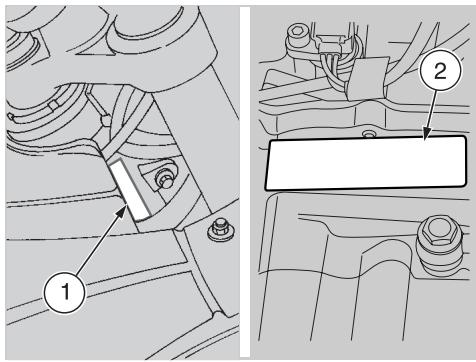
IDENTIFICATION DATA
It is a good rule to write down the frame and engine numbers in the space provided in this manual.
The frame number can be used for the purchase of spare parts.
NOTE Do not alter the identification numbers if you do not want to incur in severe penal and administrative sanctions. In particular, the alteration of the frame number results in the immediate invalidity of the warranty.
FRAME NUMBER
The frame number (1) is stamped on the right side of the steering column.
Frame no.
ENGINE NUMBER
The engine number (2) is stamped on the rear part, near the front sprocket.
Engine no.
JOINTS WITH CLICK CLAMPS AND WITH SCREW CLAMPS
CAUTION
Remove ONLY the clamps indicated in the maintenance procedures.
This text is not to be intended as an authorisation to arbitrarily remove the clamps present on the vehicle.
WARNING
Before removing a clamp, make sure that the removal does not involve any fluid leakage; if so, provide for preventing such leakage and protect the components positioned near the joint.
CLICK CLAMPS
For the removal it is sufficient to use simple pliers, while for the installation it is necessary to use a special tool (see below).
Before removing a clamp, prepare the material necessary for the correct reassembly.
NOTE Have the appropriate special tool at hand:
-clamp installation pliers, see page 29 (SPECIAL TOOLS OPT).
CAUTION
Upon installation, replace the click clamp that has been removed with a new one having the same dimensions, to be requested to an aprilia Authorised Dealer.
Do not attempt to reinstall the removed click clamp.
Do not replace the removed click clamp with a screw clamp or with other types of clamp.
CAUTION
Proceed with care, in order not to damage the joint components.
Work with the pliers on the head of the click clamp, forcing until you release it.
SCREW CLAMPS
For the removal and installation it is sufficient to use a simple screwdriver.
CAUTION
Check the conditions of the clamp and if necessary replace it with a new one of the same type and dimensions, to be requested to an aprilia Authorised Dealer.
When fastening the clamp, make sure that the joint is sufficiently stable.
CHECKING THE ENGINE OIL LEVEL AND TOPPING UP
Carefully read page 57 (MAINTENANCE) and page 41 (ENGINE OIL).
Periodically check the engine oil level, change the oil after the first 1000 km (625 mi) and successively every 10000 km (6250 mi) or 12 months. Have the oil changed by your aprilia Authorised Dealer.
For the check, proceed as follows:
NOTE To warm the engine and have the engine oil reach the operating temperature, do not let the engine idle with the vehicle at rest. According to the correct procedure, it is advisable to carry out the check after a trip or after covering approximately 15 km (10 mi) on a road outside town (this is sufficient for the engine oil to reach the operating temperature).
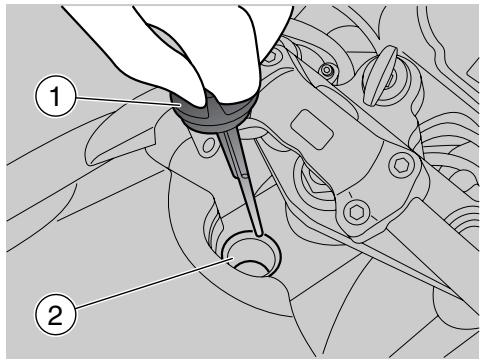
Stop the engine, see page 54 (STOPPING).
Keep the vehicle in vertical position, with the two wheels resting on the ground.
Insert the plug-dipstick (1) completely in the filler (2), without screwing it.
Extract the plug-dipstick (1) again and read the oil level on the dipstick:
MAX = maximum level
MIN = minimum level.
The difference between "MAX" and "MIN" amounts to approximately 300 cu. cm.
The level is correct when the oil almost reaches the "MAX" mark.
CAUTION
Never exceed the "MAX" mark, nor let the oil get below the "MIN" mark, in order to avoid serious damage to the engine.
If necessary, top up the engine oil by proceeding as follows:
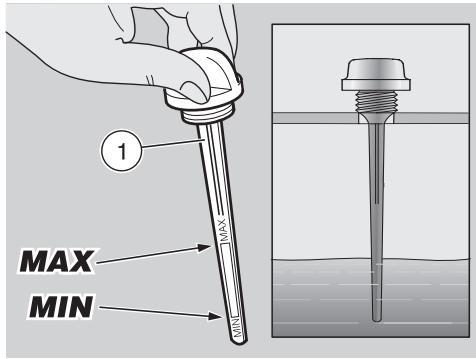
CAUTION
Do not put additives or other substances into the oil.
If you use a funnel or other similar items, make sure that they are perfectly clean.
NOTE Use high-quality 15W - 50 oil, see page 93 (LUBRICANT CHART).
After extracting the plug-dipstick (1), top up the tank through the filler (2) until reaching the correct level, see page 93 (LUBRICANT CHART).
FRONT WHEEL
CAUTION
The disassembly and reassembly of the front wheel may be difficult for unskilled operators.
If necessary, contact your aprilia Authorised Dealer.
If you want to perform these operations personally, keep to the following instructions.
Carefully read page 57 (MAINTENANCE).
While disassembling and reassembling the wheel, be careful not to damage the brake lines, the disc and the pads.
WARNING
Riding with damaged rims may be dangerous for the rider, other persons and the vehicle.
Check the conditions of the wheel rim and have it changed if damaged.
CAUTION
Remove and refit the wheel only if you have a torque wrench available that could ensure correct tightening torques.
NOTE Weight without rider: 180kg
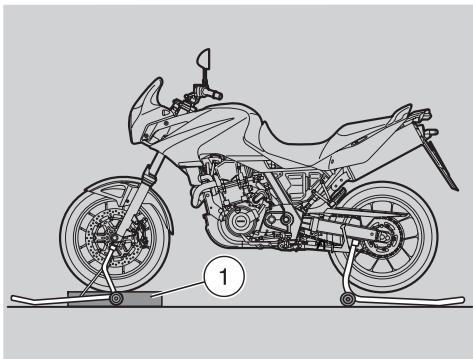
DISASSEMBLY
Position the vehicle on the appropriate front support stand, see page 67 (POSITIONING THE VEHICLE ON THE FRONT SUPPORT STAND OPT).
Put a support (1) under the tyre, in such a way as to keep the wheel in its position after loosening it.
CAUTION
Make sure that the vehicle is stable.
Loosen the retaining screws (2) and remove the brake calliper.
CAUTION
Do not touch the front brake calliper.
Unscrew the wheel shaft nut (3).
Partially loosen the clamp screws (4) on either side of the wheel shaft (5).
Unscrew the wheel shaft (5) completely.
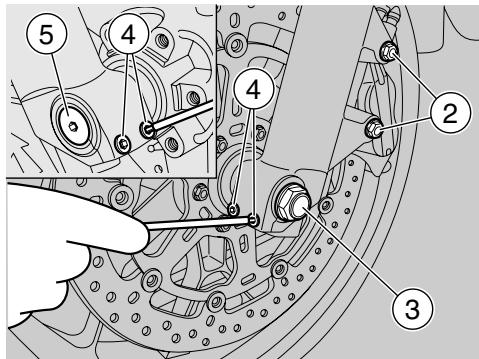
NOTE To facilitate the extraction of the wheel shaft, slightly raise the wheel.
Support the front wheel and manually withdraw the wheel shaft (5).
Collect the spacers on either side of the wheel.
Remove the wheel by withdrawing it from the front.
CAUTION
Never pull the front brake lever after removing the wheel, otherwise the calliper pistons may come out of their seats, thus causing the outflow of the brake fluid. In this case consult your aprilia Authorised Dealer, who will carry out the proper maintenance operation.
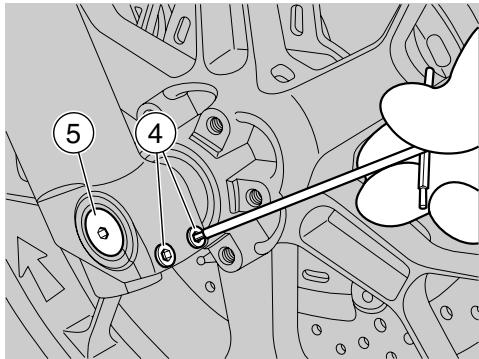
REASSEMBLY
Smear a layer of grease all along the wheel shaft (5), see page 93 (LUBRICANT CHART).
CAUTION
While reassembling the wheel, be careful not to damage the brake pipes, discs and pads.
Position the wheel between the fork legs on the support (1).
CAUTION
Proceed with care while inserting the disc in the brake calliper.
WARNING
Danger of injury. Do not insert your fingers to align the holes.
Move the wheel until its central hole and the holes on the fork are aligned.
Set one of the two spacers between wheel hub and fork right leg.
Position the other spacer between the wheel hub and the fork left leg.
Push the wheel shaft (5) fully home from the right side.
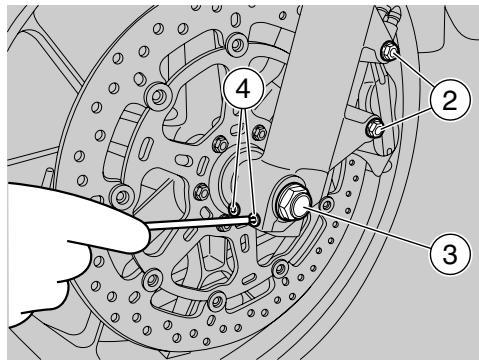
Tighten the wheel shaft clamp bolts to the right (4).
Tighten the wheel shaft nut (3).
Tighten the wheel shaft clamp bolts to the left (6).
Loosen the wheel shaft clamp bolts to the right (4).
Press on the front end to settle the fork legs.
Tighten the wheel shaft clamp bolts to the right (4).
Wheel nut tightening torque (3): 80 Nm (8 kgm).
Remove the support (1) that upon disassembly was put under the tyre.
Refit the brake calliper and tighten the retaining screws (2).
Brake calliper screws (2) tightening torque: 50 Nm (5 kgm).
WARNING
Due to the weight and dimensions of the vehicle, the following operation must be performed by two persons.
NOTE Weight without rider: 180kg
Remove the front support stand, see page 67 (POSITIONING THE VEHICLE ON THE FRONT SUPPORT STAND OPT).
Remove the rear support stand, see page 67 (POSITIONING THE VEHICLE ON THE REAR SUPPORT STAND OPT).
With pulled front brake lever, press the handlebar repeatedly, thrusting the fork downwards. In this way the fork legs will settle properly.
Position the vehicle on the stand, see page 55 (POSITIONING THE VEHICLE ON THE STAND).
Tighten the wheel shaft clamp bolts (4) on either side.
Wheel shaft clamp screws tightening torque (4): 12 Nm (1.2 kgm).
Make sure that the following components are not dirty:
- tyre;
- wheel;
- brake disc.
WARNING
After reassembly, pull the front brake lever repeatedly and check the correct functioning of the braking system.
Have the tightening torques, centring and balancing of the wheel checked by an aprilia Authorised Dealer, in order to avoid accidents that may be harmful for you and/or other people.
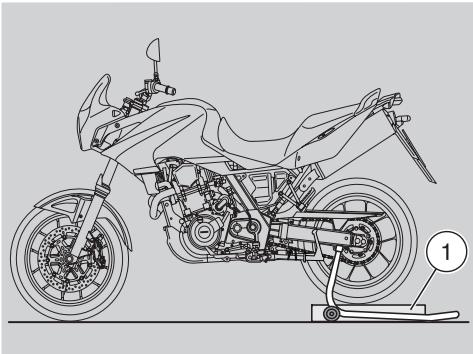
REAR WHEEL
CAUTION
The disassembly and reassembly of the rear wheel may be difficult for unskilled operators.
If necessary, contact your aprilia Authorised Dealer.
If you want to perform these operations personally, keep to the following instructions.
Carefully read page 57 (MAINTENANCE).
WARNING
Before carrying out the following operations, let the engine and the silencer cool down until they reach room temperature, in order to avoid burns.
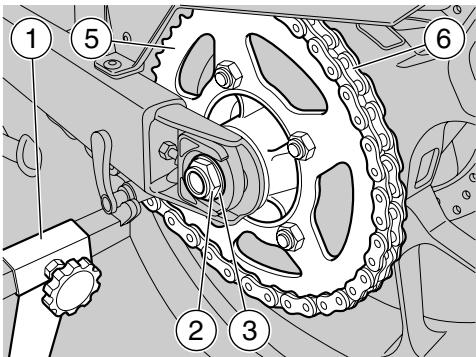
WARNING
Riding with damaged rims may be dangerous for the rider, other persons and the vehicle.
Check the conditions of the wheel rim and have it changed if damaged.
DISASSEMBLY
Position the vehicle on the appropriate rear support stand, see page 67 (POSITIONING THE VEHICLE ON THE REAR SUPPORT STAND OPT).
Put a support (1) under the tyre, in such a way as to keep the wheel in its position after loosening it.
Unscrew and remove the nut (2) and retrieve the washer (3).
Wheel nut (2) tightening torque: 100 Nm (10 kgm).
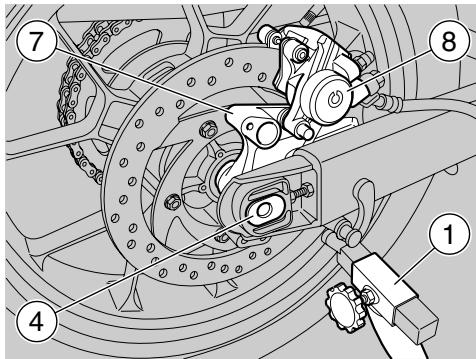
NOTE To facilitate the extraction of the wheel shaft, slightly raise the wheel.
Withdraw the wheel shaft (4) from the right side.
NOTE Slide the drive chain (5) off the sprocket (6).
Make the wheel advance and release the drive chain (5) from the rear sprocket (6).
Withdraw the wheel from the swinging arm from behind, carefully withdrawing the disc from the brake calliper.
Remove the support plate (7) together with brake calliper (8).
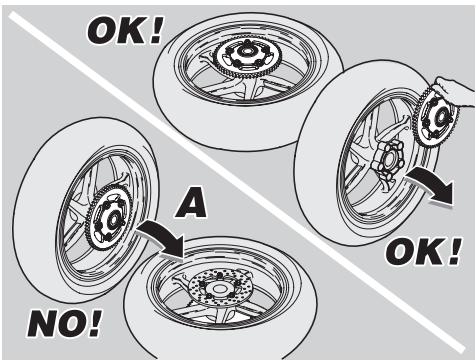
CAUTION
Do not operate the rear brake lever after removing the wheel, since the pistons may go out of their seats and cause brake fluid leakage. In this case consult an aprilia Authorised Dealer, who will carry out the proper maintenance operation.
Proceed with care. If the final drive assembly (9) is mounted to the flexible coupling holder (10), do not turn the rear wheel over or place it horizontally lying on the rear chain sprocket (A) side, or the final drive assembly will come off and the sprocket (6) might damage.
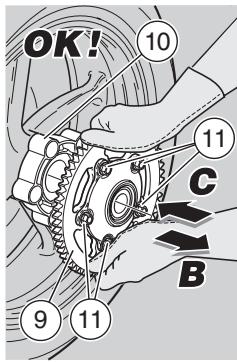
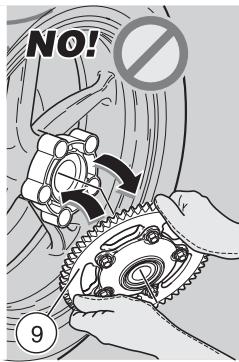
NOTE The removal of the final drive unit is not necessary if the wheel is in the normal running position (vertical) or in horizontal position with the rear sprocket facing upwards and in both cases secured against overturning.
NOTE Do not disturb the five nuts (11). The whole final drive unit must be withdrawn from the flexible coupling holder.
Using both hands work (B) on sprocket (6) outer diameter and slide out the final transmission assembly (9), hold it parallel to the wheel shaft.
Remove the five flexible couplings from the flexible coupling holder (10).
NOTE Check the conditions of the five flexible couplings; if they are damaged or excessively worn, change them, see page. 58 (REGULAR SERVICE INTERVALS CHART).
REASSEMBLY
NOTE Insert the final transmission unit, parallel to the wheel axis, introducing the drive pins in the relevant seats, between a flexible coupling and the other.
Position the five flexible couplings in the relevant seats in the flexible coupling holder (10).
Using both hands work (C) on sprocket (6) outer diameter and slide in the final transmission assembly (9) inside holder (10).
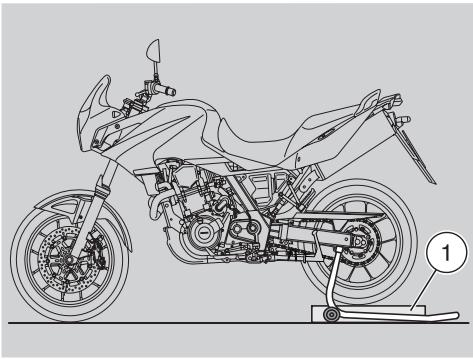
CAUTION
Before proceeding with the reassembly, make sure that support plate (8) of the brake calliper (9) is positioned correctly; the plate slot must be inserted in the appropriate stop pin in the inner part of the swinging arm right section.
Insert the disc in the brake calliper carefully.
Position the wheel between the swinging arm sections on the support (1).
WARNING
Do not insert your fingers between the chain and the rear sprocket.
Make the wheel advance and position the drive chain (5) on the rear sprocket (6).
Uniformly apply a moderate quantity of grease on the wheel shaft (4), see page 93 (LUBRICANT CHART).
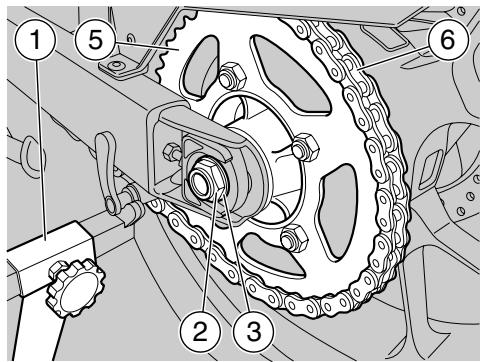
WARNING
Danger of injury. Do not insert your fingers to align the holes.
Move the wheel backwards, until its central hole and the holes on the swinging arm are aligned.
Rotate the support plate (8), complete with brake calliper (9) and with fulcrum on the stop pin, until it is aligned with the holes.
Introduce the wheel shaft (4) completely from the left side.
NOTE Make sure that the wheel shaft (4) is completely inserted.
Position the washer (3) and tighten the wheel nut (2) manually.
Lock the rotation of the wheel shaft (4) with the appropriate wrench and tighten the nut (2).
Wheel nut tightening torque (2): 100 Nm (10 kgm).
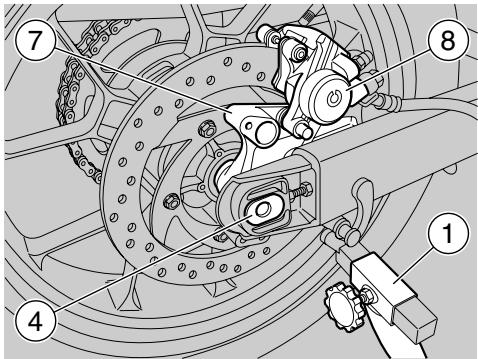
Make sure that the following components are not dirty:
- tyre;
- wheel;
- brake disc.
CAUTION
After reassembly, pull the rear brake lever repeatedly and check the correct braking system operation.
Have the tightening torques, centring and balancing of the wheel checked by an aprilia Authorised Dealer, in order to avoid accidents that may be harmful for you and/or other people.
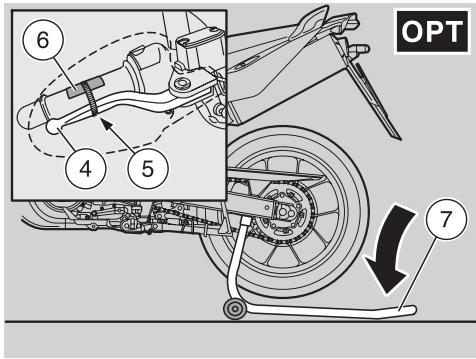
POSITIONING THE VEHICLE ON THE REAR SUPPORT STAND OPT
Pull the front brake lever (4) completely, then put a small piece of cardboard (5) on the grip and keep the front brake lever pulled by holding it against the grip by means of a plastic band (6).
WARNING
Raise the vehicle by means of the two swinging arm sections only.
Insert the stand from the rear side of the vehicle and position it so that the two support pins (3) hook to the swinging arm pins.
NOTE Have someone help you keep the vehicle in vertical position with the two wheels on the ground.
Rest one foot on the rear part of the stand (7).
Push the stand (7) downwards until it reaches the end of its stroke (see figure).
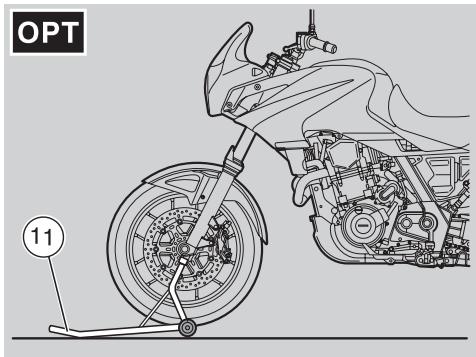
POSITIONING THE VEHICLE ON THE FRONT SUPPORT STAND OPT
NOTE To position the vehicle on the front support stand it is necessary to use the appropriate rear support stand OPT.
Position the vehicle on the appropriate rear support stand OPT, page 67 (POSITIONING THE VEHICLE ON THE REAR SUPPORT STAND OPT).
Insert the two ends of the stand (9) in the two holes (10) positioned on the lower ends of the front fork.
Rest one foot on the front part of the stand (11).
Push the stand (11) downwards until it reaches the end of its stroke (see figure).
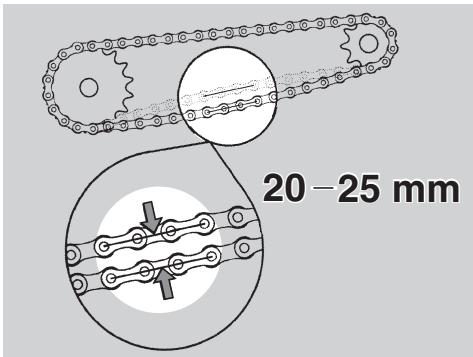
DRIVE CHAIN
Carefully read page 57 (MAINTENANCE).
The vehicle is equipped with an endless chain, in which a ring link joint is not used.
CAUTION
An excessive slackening of the chain may cause noise or make the chain rattle, with consequent wear of the shoe and of the chain guide plate.
Periodically check the slack and adjust it if necessary, see page 68 (ADJUSTMENT).
To change the chain, contact an aprilia Authorised Dealer, who will ensure you prompt and accurate servicing.
Incorrect maintenance may cause the untimely wear of the chain and/or damages to the front sprocket and/or the rear sprocket.
CAUTION
Carry out the maintenance operations more frequently if you use the vehicle in difficult conditions or on dusty and/or muddy roads.
CHECKING THE SLACK
To check the slack, proceed as follows:
Stop the engine, see page 54 (STOPPING).
Position the vehicle on the appropriate rear support stand, see page 67 (POSITIONING THE VEHICLE ON THE REAR SUPPORT STAND OPT).
Position the gear shift lever in neutral.
Make sure that the vertical oscillation, in an intermediate point between front sprocket and rear sprocket in the lower part of the chain, is included between 20-25 mm.
Rotate the wheel manually, in such a way as to check the vertical oscillation of the chain even in other positions; the slack must be constant in all the wheel rotation phases.
CAUTION
If in some positions the slack is higher than in others, this means that there are crushed or seized links; in this case, contact an aprilia Authorised Dealer. To prevent the risk of seizures, lubricate the chain frequently, see page 69 (CLEANING AND LUBRICATION).
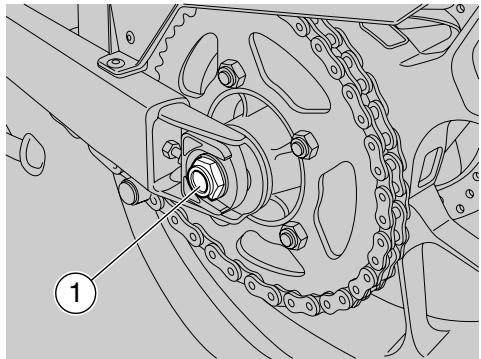
If the slack is the same in all positions, but higher than 25 mm or lower than 20 mm, adjust it, see page 68 (ADJUSTMENT).
ADJUSTMENT
If after the check it is necessary to adjust the chain tension, slacken the chain to increase the slack, tighten the chain to decrease it.
Position the vehicle on the appropriate rear support stand, see page 67 (POSITIONING THE VEHICLE ON THE REAR SUPPORT STAND OPT).
Loosen the nut (1).
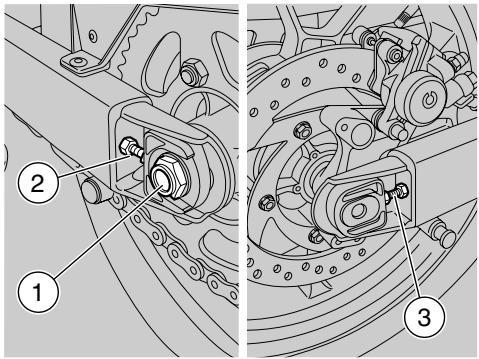
NOTE To centre the wheel there are reference numbers connected to the adjusters (2) and (3) located on swingarm sections.
Act on the left (2) and right (3) adjusters and adjust the chain slack, making sure, on both sides of the vehicle, that the same reference marks can be seen.
Tighten the nut (1).
Wheel nut tightening torque (1): 100 Nm (10 kgm).
Check the chain slack, see page 68 (CHECKING THE SLACK).
CHECKING THE DRIVING CHAIN, THE FRONT AND REAR SPROCKET WEAR
Further, check the chain and sprockets and make sure that they do not present:
- damaged rollers;
- loose pins;
- dry, rusty, crushed or seized links;
excessive wear; - missing O-rings;
- sprocket or teeth excessively worn or damaged.
CAUTION
If the chain rollers are damaged, the pins are loose and/or the O-rings are damaged or missing, it is necessary to change the whole chain unit (both sprockets and chain).
CAUTION
Lubricate the chain frequently, especially if there are dry or rusty parts. The crushed or seized links must be lubricated and made work again.
If this is not possible, contact an aprilia Authorised Dealer, who will provide for changing the chain.
Check the wear of the swinging arm protection shoe.
Check the chain slider for wear. Change it, if necessary.
CLEANING AND LUBRICATION
CAUTION
The drive chain is provided with O-rings in-between the links, in order to keep the grease inside them.
Carry out the adjustment, lubrication, cleaning and change of the chain with great care.
Never wash the chain with water jets, steam jets, high-pressure water jets and highly inflammable solvents.
Wash the chain with naphtha or kerosene. If it tends to rust quickly, intensify the maintenance intervals.
Lubricate the chain every 500km (312 mi) or whenever necessary.
After washing the chain and letting it dry, lubricate it with spray grease for chains provided with sealing rings, see page 93 (LUBRICANT CHART).
CAUTION
The lubricants for chains available on the market may contain substances that are dangerous for the rubber sealing rings of the chain.
NOTE Do not use the vehicle soon after lubricating the chain, since due to the centrifugal force the lubricant would be sprayed outwards and dirty the surrounding areas.
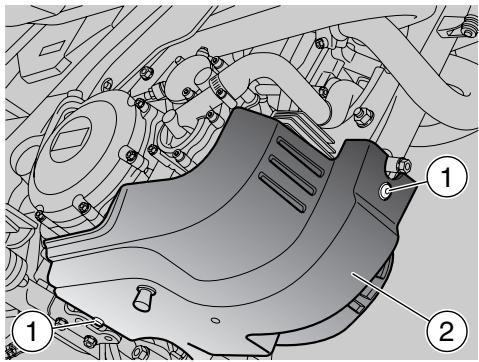
REMOVING THE OIL SUMP GUARD
Carefully read page 57 (MAINTENANCE).
WARNING
Wait until the engine and the exhaust silencer have completely cooled down.
Position the vehicle on the stand, see page 55 (POSITIONING THE VEHICLE ON THE STAND).
Unscrew and remove the two screws (1).
CAUTION
Handle the plastic and painted components with care to avoid scraping or damaging them.
Remove the oil sump guard (2).
NOTE If the deadening material inside the oil sump guard (2) is deteriorated, contact an aprilia Authorised Dealer to have it changed.
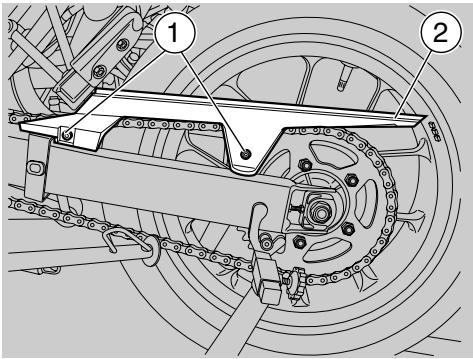
REMOVING THE DRIVE CHAIN GUARDS
Carefully read 57 (MAINTENANCE).
Position the vehicle on the stand, see page 55 (POSITIONING THE VEHICLE ON THE STAND).
Unscrew and remove the two screws (1).
From the opposite side, unscrew and remove the screw (2).
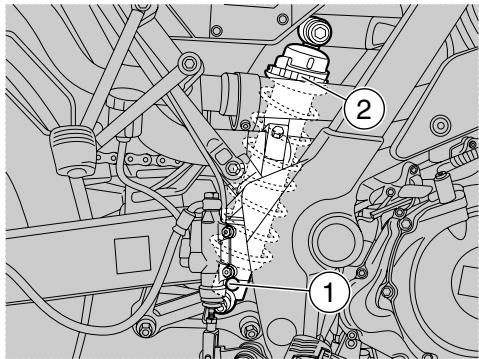
REAR SUSPENSION
The rear suspension consists of a springshock absorber unit, fixed to the frame by means of a uni-ball and to the swinging arm by means of lever systems.
For the setting of the vehicle track alignment, the shock absorber is provided:
with a screw adjuster (1) for the adjustment of the hydraulic rebound damping;
with an adjuster ring nut (2) for the adjustment of the spring preload.
ADJUSTING THE REAR SHOCK ABSORBER
Check and if necessary adjust the rear shock absorber every 20000 km (12500 mi).
The standard setting of the rear shock absorber is adjusted so that it is suitable for most driving conditions.
The standard adjustment, set by the manufacturer, is suitable for a rider weighing approximately 70kg .
If your weight and needs are different, for example in case of ride with passenger and full load, it is advisable to contact an aprilia Authorised Dealer.
According to the conditions of use of the vehicle, it is possible to adjust the hydraulic rebound damping by adjusting the screw (1); for the adjustment, keep to the following indications:
Uneven or irregular road surface - HARD adjustment:
Turn the screw (1) to the right (clockwise).
Normal or regular road surface - SOFT adjustment:
Turn the screw (1) to the left (anticlockwise).
CAUTION
Adjust the spring preload and the hydraulic rebound damping according to the conditions of use of the vehicle.
When the spring preload is increased, it is necessary to increase also the hydraulic rebound damping with extended shock absorber, in order to avoid sudden jerks while riding.
If necessary, contact an aprilia Authorised Dealer.
Test the vehicle repeatedly on the road, until obtaining the optimal adjustment.
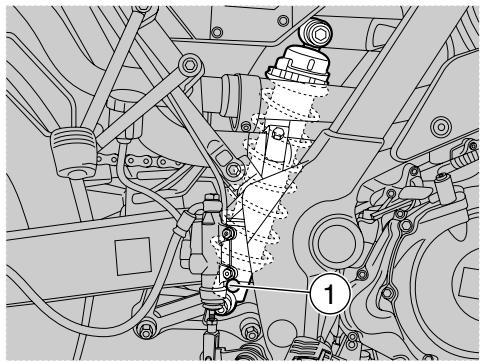
REAR SHOCK ABSORBER ADJUSTMENT TABLE
| Rear shock absorber | Shock absorber preload (notches from fully unloaded) | Hydraulic damping (clicks from fully closed/ turns) | Front/rear tyre pressure (STRADA version) | Front/rear tyre pressure (TRAIL version) |
| Rider only (SOFT setting) | 3 | 13 (1 turn) | 1.8/2.0 | 1.9/2.1 |
| Rider + Luggage or Rider + Passenger (MEDIUM setting) | 9 | 5 (1/2 turn) | 1.9/2.2 | 1.9/2.3 |
| Rider + Passenger + Luggage (HARD setting) | 9 | 3 (1/4 turn) | 1.9/2.2 | 1.9/2.3 |
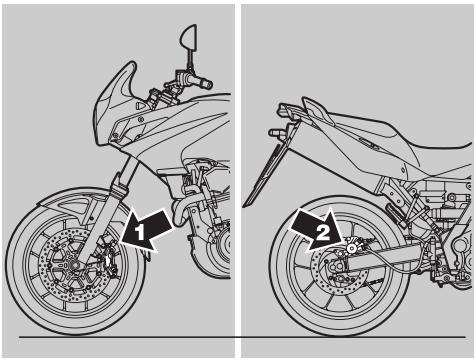
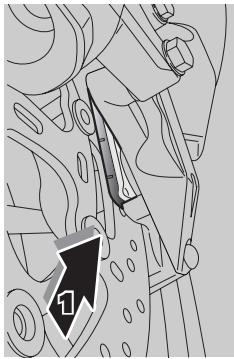
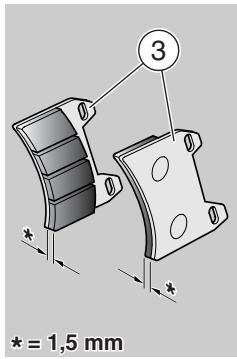
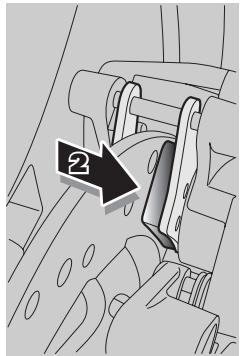
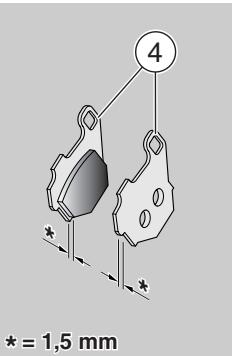
CHECKING THE BRAKE PAD WEAR
Carefully read page 33 (BRAKE FLUID recommendations), page 34 (DISC BRAKES) and page 57 (MAINTENANCE).
NOTE The following information refers to a single braking system, but are valid for both.
Check the brake pad wear after the first 1000km (625 mi) and successively every 2000 km (1250 mi) and before every trip.
The wear of the disc brake pads depends on the use, on the kind of ride and on the road.
WARNING
Check the wear of the brake pads, especially before every trip.
To carry out a rapid checking of the wear of the pads, proceed as follows:
Position the vehicle on the stand, see page 55 (POSITIONING THE VEHICLE ON THE STAND).
Carry out a visual check between the disc and the pads, proceeding:
from below, on the front part, for the front brake calliper (1);
from above, on the rear part, for the rear brake callipers (2).
CAUTION
The excessive wear of the friction material would cause the contact of the pad metal support with the disc, with consequent metallic noise and production of sparks from the calliper; braking efficiency, safety and soundness of the disc would thus be negatively affected.
If the thickness of the friction material [even of one front (3) or rear pad (4) only] has reduced to about 1.5mm (or even if only one of the wear indicators is not visible any longer):
- for the front brake calliper have both front brake calliper pads changed.
- for the rear brake calliper, have both pads of the calliper changed.
WARNING
Have the pads changed by an aprilia Authorised Dealer.
IDLING ADJUSTMENT
Carefully read page 57 (MAINTENANCE).
NOTE Should the normal operating temperature not be reached, there might be a failure in the engine idling speed. This is normal, since the engine idling rpm go back to regular values when the engine reaches the normal running temperature.
To check the engine idling rpm correctly, proceed as follows:
Ride for a few miles until reaching the normal operating temperature, see page 16 (Coolant temperature indicator "")
Position the gear shift lever in neutral (green warning light "N" on).
Check the engine idling rpm on the revolution counter.
The engine idling speed must be about 1500 ± 100 rpm.
If the engine idling rpm are within the values indicated, do not modify them in any way.
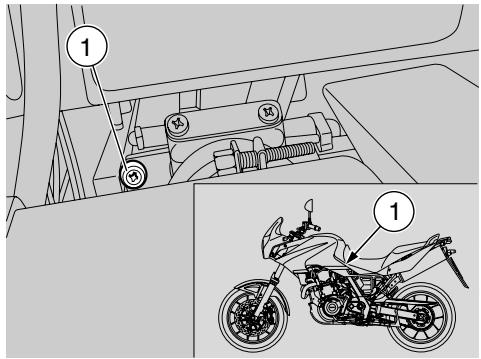
CAUTION
In case of erratic engine idling rpm, contact exclusively an aprilia Authorised Dealer.
An excessive increase in the engine idling rpm may cause faults in the operation of the engine and damage the engine itself and other components.
It is advisable to change the setting only when it is really necessary (if, when the throttle grip is released, the engine stalls or keeps running at higher rpm than prescribed) and it is impossible to reach an aprilia Authorised Dealer.
Only when really necessary:
CAUTION
Risk of burns.
Some parts of the vehicle are extremely hot (for example, the exhaust pipe and, to a lesser extent, the exhaust pipe guard).
Wear safety gloves to protect yourself from hot parts of the vehicle.
Proceed with care and do not touch the exhaust pipe guard for any reason whatsoever.
Remove the seat, see page 27 (UNLOCKING/LOCKING THE SEAT).
Turn the adjusting screw (1).
- BY SCREWING IT (clockwise), you increase the rpm;
- BY UNSCREWING IT (anticlockwise), you decrease the rpm;
Twist the throttle grip, accelerating and decelerating a few times to make sure that it operates correctly and to check if the idling speed is constant.
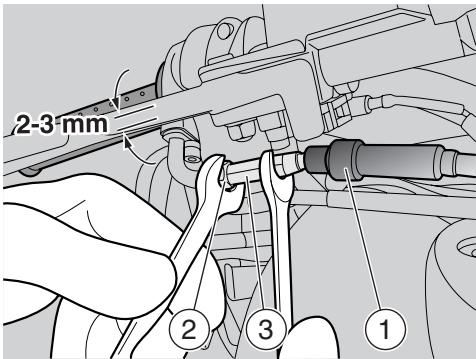
After the adjustment, tighten the lock nut (2) and check the idle stroke again.
Put back the protection element (1).
CAUTION
After the adjustment, make sure that the rotation of the handlebar does not modify the engine idling rpm and that the throttle grip returns smoothly and automatically to its original position after being released.
ADJUSTING THE ACCELERATOR CONTROL
Carefully read page 57 (MAINTENANCE).
Have the accelerator control cables checked by an aprilia Authorised Dealer after the first 1000km (625 mi) and successively every 10000 km (6250 mi).
The idle stroke of the throttle grip must be 2-3 mm, measured on the edge of the grip itself.
If not, proceed as follows:
Position the vehicle on the stand, see page 55 (POSITIONING THE VEHICLE ON THE STAND).
Withdraw the protection element (1).
Loosen the lock nut (2).
Rotate the adjuster (3) in such a way as to restore the prescribed value.
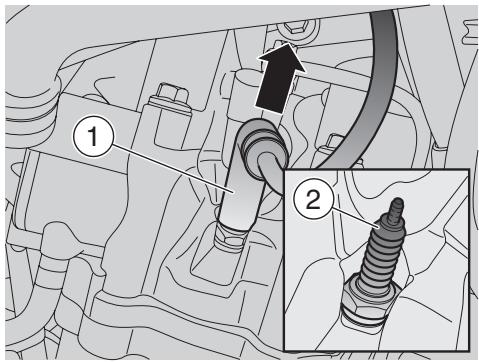
SPARK PLUG
Carefully read page 57 (MAINTENANCE).
Check the spark plug every 10000 km (6250 mi), change them every 20000 km (12500 mi).
Periodically remove the spark plug and clean it carefully, removing carbon deposits; change it if necessary.
To reach the spark plug:
WARNING
Before carrying out the following operations, let the engine and the silencer cool down until they reach room temperature, in order to avoid burns.
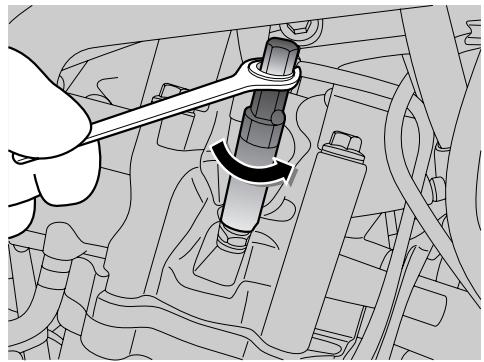
For the removal, proceed as follows:
Remove the cap (1) of the spark plug (2).
Remove any trace of dirt from the spark plug base.
Introduce the special spanner provided in the tool kit on the spark plug.
Unscrew the spark plug and extract it from its seat, taking care to prevent dust or other substances from getting inside the cylinder.

For the check and cleaning:
Key:
centre electrode (3);
- insulating (4);
side electrode (5).
Make sure that there are neither carbon deposits, nor corrosion marks on the electrodes and on the insulating material; if necessary, blow with compressed air to clean them.
If the spark plug has crackings on the insulating material, corroded electrodes, excessive deposits or the tip (6) of the central electrode (3) is rounded, it must be changed.
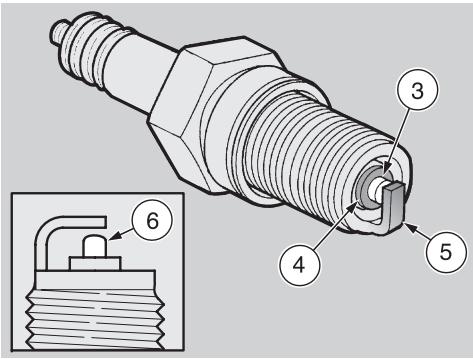
CAUTION
When changing the spark plug, check the thread pitch and length.
If the threaded part is too short, the carbon deposits will accumulate on the thread seat, and therefore the engine may be damaged during the installation of the right spark plug.
Use the recommended type of spark plugs only, see page 90 (TECHNICAL DATA), in order not to compromise the life and performance of the engine.
Check the spark plug gap with a thickness gauge. The spark plug gap must be 0.7 - 0.8 mm; if necessary, adjust it, bending the centre electrode (6) with care.
Make sure that the washer (7) is in good conditions.
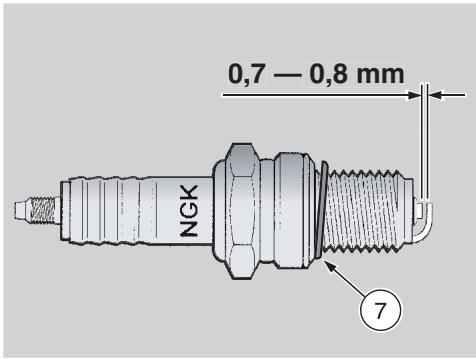
For the installation:
With the washer on (7), screw the spark plug by hand in order not to damage the thread.
Tighten the spark plug by means of the spanner you will find in the tool kit, giving it half a turn to compress the washer.
Spark plug tightening torque: 20 Nm (2.0 kgm).
CAUTION
The spark plug must be well tightened, otherwise the engine may overheat and be seriously damaged.
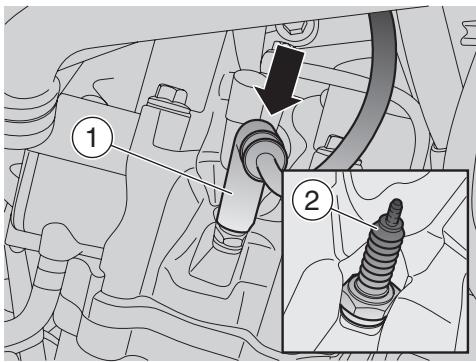
CAUTION
Make sure that the cap (1) is correctly connected to the spark plug (2). Due to the vibrations of the engine, the incorrect position would cause the disconnection of the spark plug cap, with serious damage to the engine.
Correctly insert the cap (1) in the spark plug (2), until you hear the click.

BATTERY
Carefully read page 57 (MAINTENANCE).
WARNING
Risk of fire.
Keep fuel and other flammable substances away from the electrical components.
The battery gives off explosive gases; keep it away from flames, sparks, cigarettes and any other source of heat.
During the recharging or the use, make sure that the room is properly ventilated and avoid inhaling the gases released during the recharging.
KEEP AWAY FROM CHILDREN.

CAUTION
Never invert the connection of the battery cables.
Connect and disconnect the battery with the ignition switch in position "O", otherwise some components may be damaged.
Connect first the positive cable (+) and then the negative cable (-) .
Disconnect following the reverse order.
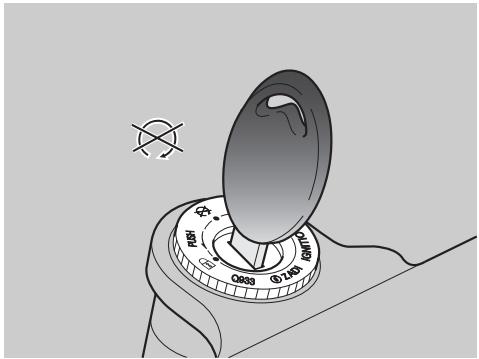
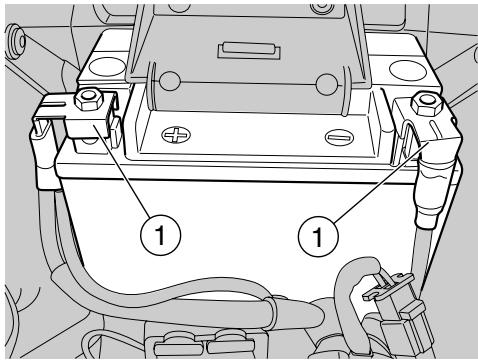
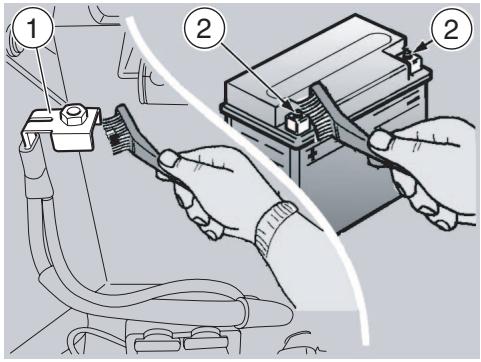
CHECKING AND CLEANING THE TERMINALS
Carefully read page 77 (BATTERY).
Make sure that the ignition switch is in position "X".
Remove the seat, see page 27 (UNLOCKING/LOCKING THE SEAT)
Make sure that the cable terminals (1) and the battery terminals (2) are:
- in good conditions (and not corroded or covered with deposits);
covered with neutral grease or Vaseline.
If necessary, proceed as follows:
Remove the battery, see page 79 (REMOVING THE BATTERY).
Brush the cable terminals (1) and the battery terminals (2) with a wire brush, in order to eliminate any trace of corrosion.
Install the battery, see page 80 (INSTALLING THE BATTERY).
Refit the seat, see page 27 (UNLOCKING/LOCKING THE SEAT).
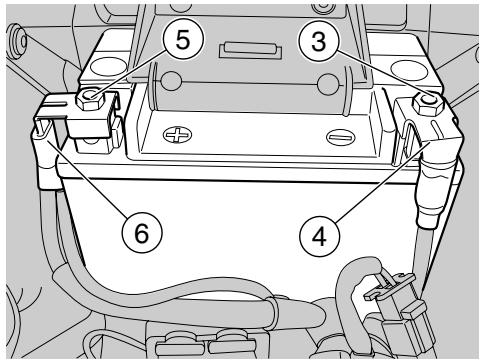
REMOVING THE BATTERY
Carefully read page 77 (BATTERY).
Make sure that the ignition switch is in position "X".
Remove the seat, see page 27 (UNLOCKING/LOCKING THE SEAT)
Release and remove the screws (1).
Remove the battery cover (2).
Unscrew and remove the screw (3) on the negative terminal (-) .
Move the negative cable (4) aside.
Unscrew and remove the screw (5) on the positive terminal (+) .
Move aside the positive cable (6).
Slide out fuse carrier (7) and starter relay (8) from the relevant seats and move them aside.
CAUTION
Do not force the electric cables.
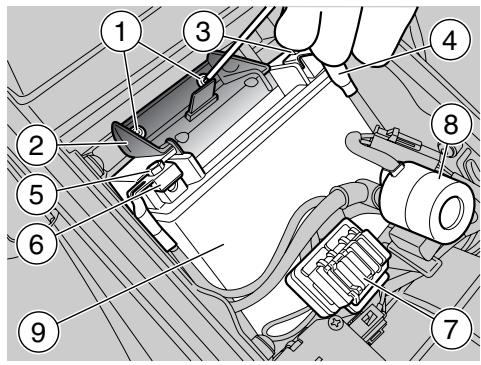
Grasp the battery (9) firmly and remove it from its compartment, by bending it towards the outside and lifting it.
WARNING
Once it has been removed, the battery must be stored in a safe place and kept away from children.
Position the battery on a flat surface, in a cool and dry place.
Refit the seat, see page 27 (UNLOCKING/LOCKING THE SEAT)

WARNING
Upon reassembly, connect first the positive cable (+) and then the negative cable (-) .
NOTE For the installation of the battery, see page 80 (INSTALLING THE BATTERY).

CHARGING THE BATTERY
Carefully read page 77 (BATTERY).
Remove the battery, see page 79 (REMOVING THE BATTERY).
Prepare a suitable battery charger, specific for MF batteries.
Set the charger for the desired type of recharge.
NOTE A recharge with an amperage equal to 1/10th of the battery capacity is recommended.
Connect the battery with a battery charger.
WARNING
During the recharging or the use, make sure that the room is properly ventilated and avoid inhaling the gases released during the recharging.
Switch on the battery charger.
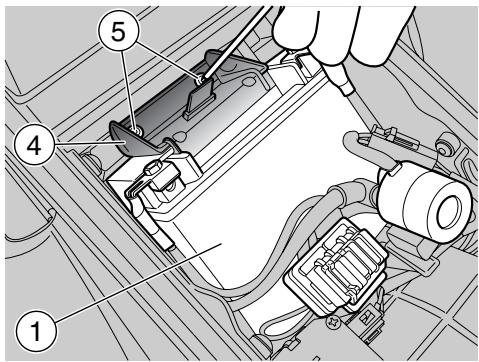
WARNING
Reassemble the battery only 5/10 minutes after disconnecting the recharge apparatus, since the battery continues to produce gas for a short lapse of time.
INSTALLING THE BATTERY
Carefully read page 77 (BATTERY).
Make sure that the ignition switch is in position "O".
Remove the seat, see page 27 (UNLOCKING/LOCKING THE SEAT)
NOTE The battery (1) must be positioned in its compartment with the terminals directed towards the outside part of the vehicle.
Put the battery (1) in its compartment.
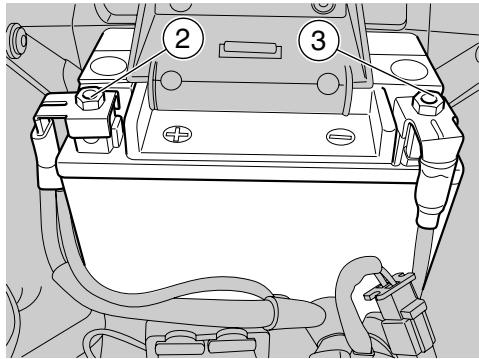
WARNING
Upon reassembly, connect first the positive cable (+) and then the negative cable (-) .
Connect the positive terminal (+) by means of the screw (2).
Connect the negative terminal (-) by means of the screw (3).
CAUTION
Upon reassembly always connect the battery breather pipe, to prevent the sulphuric acid vapours from corroding the electric system, painted parts, rubber elements or gaskets when they exit the breather pipe itself.
Put back the battery cover (4).
Position and tighten the screws (5).
Refit the seat, see page 27 (UNLOCKING/LOCKING THE SEAT)

LONG INACTIVITY OF THE BATTERY
If the vehicle remains unused for more than fifteen days, it is necessary to recharge the battery, in order to prevent its sulphation, see page 80 (CHARGING THE BATTERY).
Remove the battery, see page 79 (REMOVING THE BATTERY) and put it in a cool and dry place.
It is important to check the charge periodically (about once a month), during the winter or when the vehicle remains unused, in order to prevent the deterioration of the battery.
Recharge it completely with a trickle charge, see p 80 (CHARGING THE BATTERY).
If the battery remains on the vehicle, disconnect the cables from the terminals.
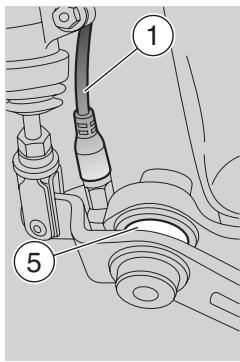
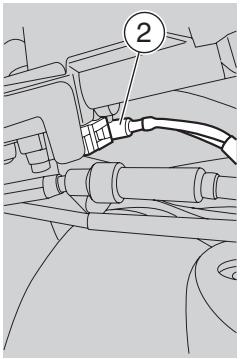
CHECKING THE SWITCHES
Carefully read page 57 (MAINTENANCE).
The vehicle is provided with four switches:
1) Stoplight switch on the rear brake control lever;
2) Stoplight switch on the front brake control lever;
3) Safety switch on the side stand;
4) Switch on the clutch control lever.
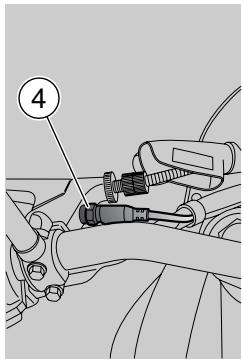
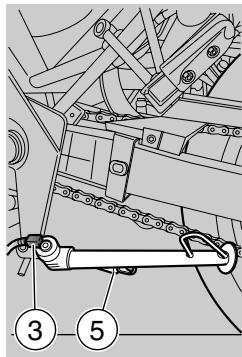
Make sure that there are no dirt or mud deposits on the switch; the pin must be able to move without interference, returning automatically to its initial position.
Make sure that the cables are connected correctly.
Check the spring (5): it must not be damaged, worn or weakened.
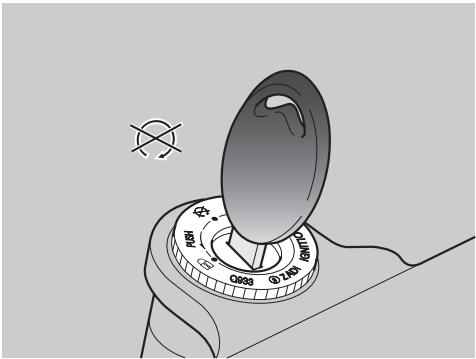
CHANGING THE FUSES
Carefully read page 57 (MAINTENANCE).
CAUTION
Do not repair faulty fuses.
Never use fuses different from the recommended ones.
The use of unsuitable fuses may cause damages to the electric system or, in case of short circuit, even a fire.
NOTE If a fuse blows frequently, there probably is a short circuit or an overload in the electric system.
In this case it is advisable to contact an aprilia Authorised Dealer.
If an electric component does not work or works irregularly, or if the vehicle fails to start, it is necessary to check the fuses.
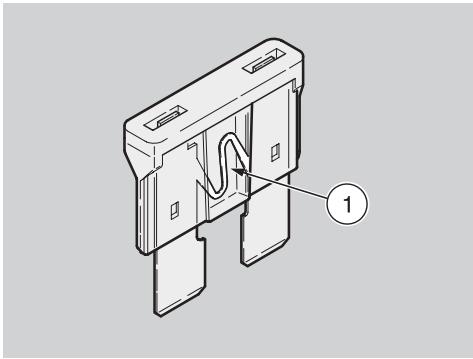
For the check, proceed as follows:
Turn the ignition switch to position "×", to avoid any accidental short circuit.
Remove the seat, see page 27 (UNLOCKING/LOCKING THE SEAT).
Extract the fuses one by one and check if the filament (1) is broken.
Before replacing a fuse, try to find out the cause of the trouble, if possible.
Replace the damaged fuse with a new one having the same amperage.
NOTE If you use one of the spare fuses, put a new fuse in the proper seat.
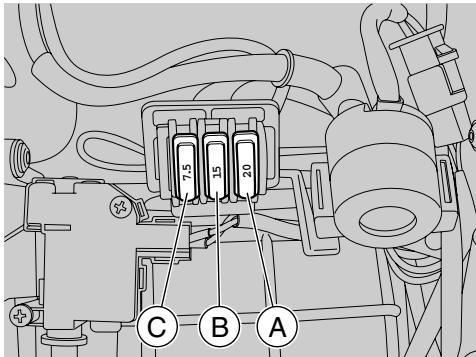
ARRANGEMENT OF THE FUSES
A) Fuse 20 A (yellow) - From battery to: ignition switch, voltage regulator, electric cooling fan.
B) Fuse 15 A (light blue) - From ignition switch to: all light loads.
C) Fuse 7.5 A (red) - From ignition switch to: ignition, starting safety logic.
NOTE Three fuses are spare fuses.
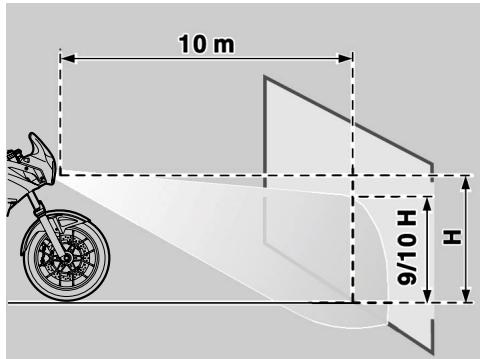
ADJUSTING THE VERTICAL HEADLIGHT BEAM
NOTE To check the direction of the headlight beam, specific procedures must be adopted, in accordance with the regulations in force in the country where the vehicle is used.
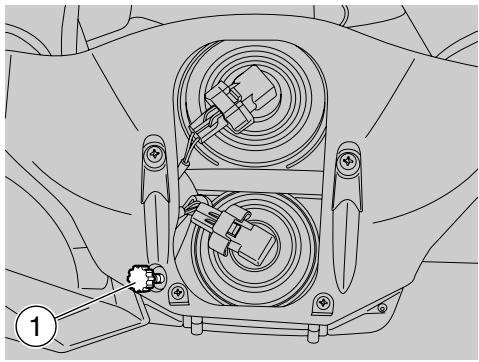
To adjust the headlight beam:
Position the vehicle on the stand, see page 55 (POSITIONING THE VEHICLE ON THE STAND).
Working from the bottom of the headlight fairing, turn knob (1).
BY ROTATING IT CLOCKWISE, you set the beam upwards.
BY ROTATING IT ANTICLOCKWISE, you set the beam downwards.
After the adjustment:

WARNING
Make sure that the vertical adjustment of the headlight beam is correct.
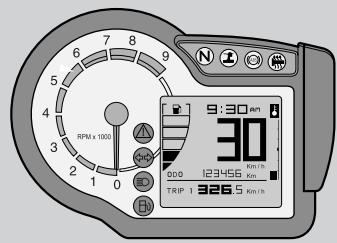
INSTRUMENT PANEL LIGHTING
If you need assistance or technical advice, contact an aprilia Authorised Dealer, who can ensure you prompt and accurate servicing.
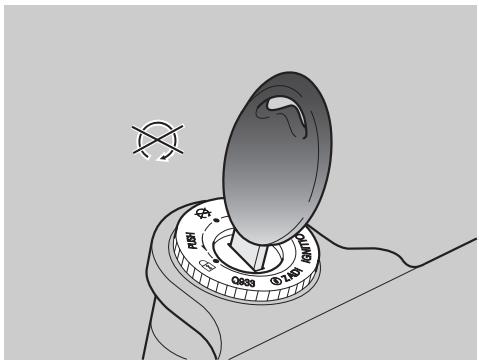
BULBS
Carefully read page 57
(MAINTENANCE).
WARNING
Risk of fire.
Keep fuel and other flammable substances away from the electrical components.
CAUTION
Before changing a bulb, move the ignition switch to position "×" and wait a few minutes, so that the bulb cools down.
Change the bulb wearing clean gloves or using a clean and dry cloth.
Do not leave fingerprints on the bulb, since these may cause its overheating and consequent breakage.

If you touch the bulb with bare hands, remove any fingerprint with alcohol, in order to avoid any damage.
DO NOT FORCE THE ELECTRIC CABLES.
NOTE Before changing a bulb, check the fuses, see page 82 (CHANGING THE FUSES).
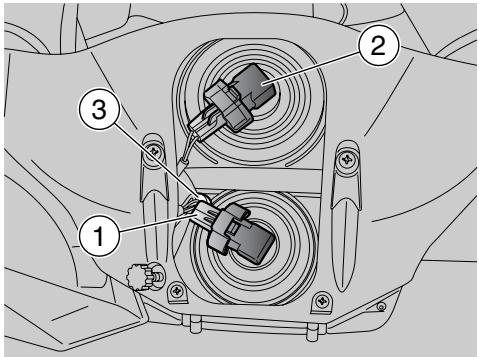
CHANGING THE HEADLIGHT BULBS
Carefully read page 84 (BULBS).
The headlight contains:
one high beam bulb (1) (lower);
one parking light bulb (2) (left side, centre).
one low beam bulb (3) (upper);
To change, proceed as follows:
Position the vehicle on the stand, see page 55 (POSITIONING THE VEHICLE ON THE STAND).
NOTE Proceed on the side of the bulb to be changed.
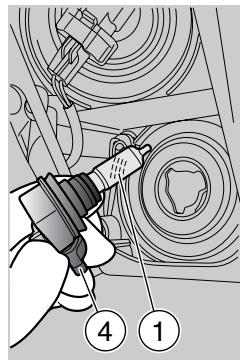
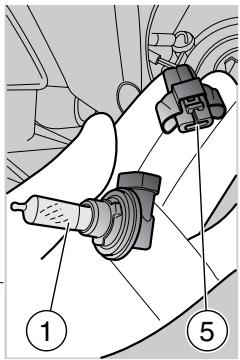
HIGH BEAM BULB
Turn the high beam unit counter clockwise (4).
Grasp the electric terminal (5), pull it and disconnect it from the bulb (1).
Withdraw the bulb (1) and replace it with a new one of the same type.
NOTE Insert the bulb in the bulb holder, making the relevant positioning seats coincide.
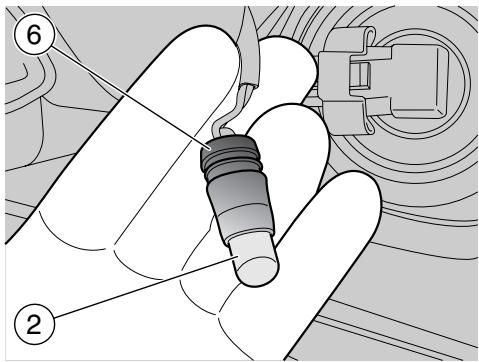
PARKING LIGHT BULB
CAUTION
To extract the bulb holder, do not pull the electric wires.
Grasp the parking light bulb holder (6) and pull to extract.
Withdraw the bulb (2) and replace it with one of the same type.
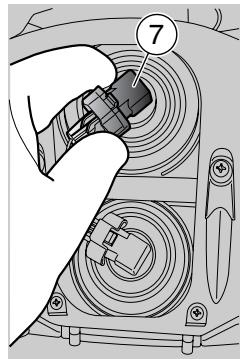
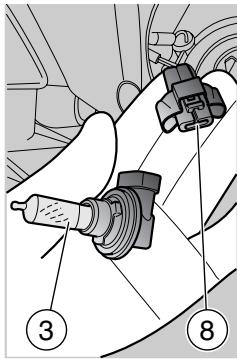
LOW BEAM BULB
Turn the low beam unit counter clockwise (7).
Grasp the electric terminal (8), pull it and disconnect it from the bulb (3).
Withdraw the bulb (3) and replace it with a new one of the same type.
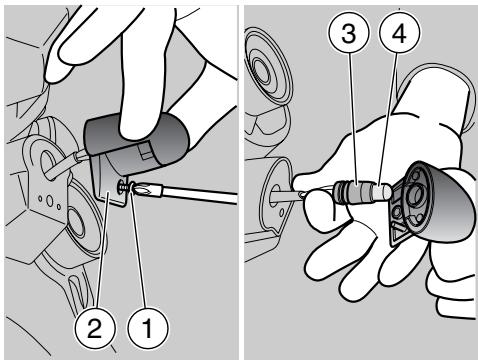
CHANGING THE NUMBER PLATE BULB
Carefully read page 84 (BULBS).
To change, proceed as follows:
Position the vehicle on the stand, see page 55 (POSITIONING THE VEHICLE ON THE STAND).
Unscrew and remove the screw (1).
Remove the light unit (2).
CAUTION
Do not pull the electric wires to extract the bulb holder.
Grasp the bulb holder (3), pull it and remove it from its seat.
Withdraw the bulb (4) and replace it with a new one of the same type.
TRANSPORT
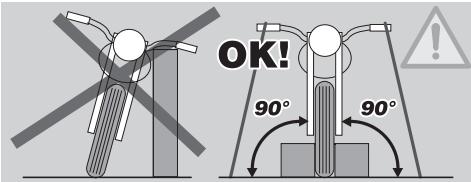
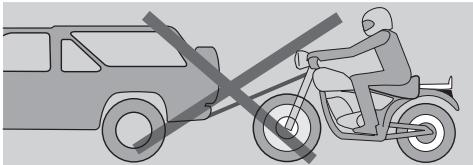
NOTE During transport, the vehicle must be kept in vertical position, it must be firmly anchored and the 1st gear must be engaged, in order to avoid any leak of fuel, oil, coolant.
CAUTION
In case of failure, do not tow the vehicle, but ask for assistance.
CLEANING
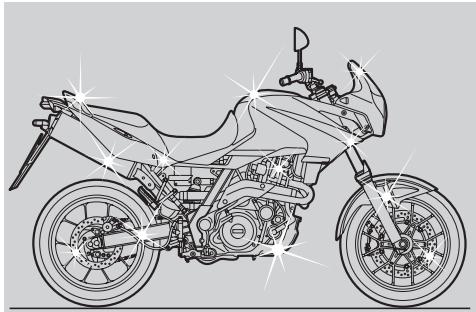
Clean the vehicle frequently if it is used in particular areas or conditions, such as:
- Polluted areas (cities and industrial areas).
- Areas characterised by a high percentage of salinity and humidity (sea areas, hot and humid climates).
- Particular conditions (use of salt and anti-ice chemical products on the roads during the winter).
- Avoid leaving deposits of industrial and polluting powders, tar spots, dead insects, bird droppings, etc. on the body.
- Avoid parking the vehicle under trees, since in some seasons residues, resins, fruits or leaves fall down, which contain substances that may damage the paint.
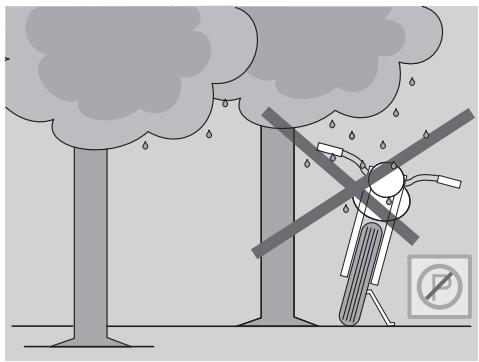
WARNING
After the vehicle has been washed, its braking functions could be temporarily impaired because of water on the braking surfaces.
Calculate long braking distances to avoid accidents.
Brake repeatedly to restore normal conditions.
Carry out the preliminary checking operations, see page 47 (PRELIMINARY CHECKING OPERATIONS).

To remove dirt and mud from the painted surfaces use a low-pressure water jet, carefully wet the dirty parts, remove mud and filth with a soft car sponge impregnated with a lot of water and shampoo (2 - 4% parts of shampoo in water).
Then rinse with plenty of water and dry with chamois leather.
To clean the outer parts of the engine use a degreaser, brushes and wipers.

CAUTION
To clean the lights, use a sponge soaked with water and a mild detergent, rubbing the surfaces delicately and rinsing frequently with plenty of water.
Polish with silicone wax only after having carefully washed the vehicle.
Do not use polishing paste on matt paints.
Do not wash the vehicle under the sun, especially during the summer, when the body is still warm, since if the shampoo dries before being rinsed away, it can damage the paint.
Do not use fluids at a temperature exceeding 40^ to clean the plastic components of the vehicle.

CAUTION
Do not aim high-pressure water or air jets or steam jets on to the following components: wheel hubs, controls on the right and left side of the handlebar, bearings, brake master cylinders, instruments and indicators, exhaust pipes, glove/tool kit compartment, ignition switch/steering lock, radiator wings, fuel cap, lights and electric connections.
Do not use alcohol, fuel or solvents to clean the rubber and plastic parts and the seat: use only water and mild soap.
WARNING
Do not apply protection waxes onto the seat, in order not to make it too slippery.

LONG PERIODS OF INACTIVITY
After a long period of inactivity of the vehicle some precautions are necessary to avoid any problem.
Further, it is important to carry out the necessary repairs and a general check up before the period of inactivity, since you could forget to carry them out later.
Proceed as follows:
Remove the battery, see page 79 (REMOVING THE BATTERY) and page 81 (LONG INACTIVITY OF THE BATTERY).
Wash and dry the vehicle, see page 86 (CLEANING).
Polish the painted surfaces with wax.
Inflate the tyres, see page 40 (TYRES).
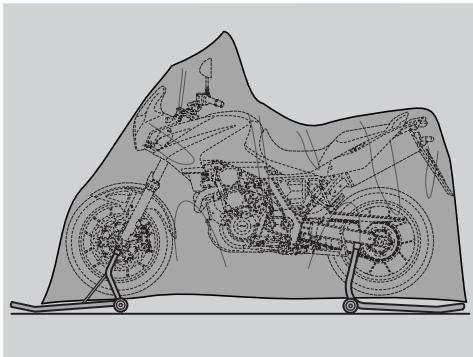
Place the vehicle in an unheated, nothumid room, away from sunlight, with minimum temperature variations.
NOTE Position the vehicle on the front OPT and rear OPT support stands, so that both tyre are raised from the ground.
Set the vehicle on the relevant front support stand, see 67 (POSITIONING THE VEHICLE ON THE FRONT SUPPORT STAND OPT).
Put a plastic bag on each exhaust tailpipe and bind it around it, in order to prevent moisture from getting into the tailpipe.
Cover the vehicle avoiding the use of plastic or waterproof materials.

AFTER A PERIOD OF INACTIVITY
NOTE Withdraw the plastic bags from the exhaust tailpipes.
Uncover and clean the vehicle, see page 86 (CLEANING).
Check the charge of the battery, see page 80 (CHARGING THE BATTERY) and install it, see page 80 (INSTALLING THE BATTERY).
Refill the fuel tank, see page 31 (FUEL).
Carry out the preliminary checking operations, see page 47 (PRELIMINARY CHECKING OPERATIONS).
WARNING
Have a test ride at moderate speed in a low-traffic area.
| TECHNICAL DATA | ||
| DIMENSIONS | Max. length Strada / Trail | 2173 mm/2232 mm |
| Max. width Strada / Trail | 810 mm/820 mm | |
| Max. height (front fairing included) | 1150 mm/1180 mm | |
| Strada / Trail | ||
| Seat height Strada / Trail | 780 mm/810 mm | |
| Wheelbase Strada / Trail | 1490 mm/1510 mm | |
| Minimum ground clearance Strada / Trail | 200 mm/230 mm | |
| Dry weight Strada / Trail | 179 kg / 183 kg | |
| ENGINE | Model | MY660 |
| Type | one-cylinder, 4-stroke with 4 valves, single overhead camshaft | |
| Number of cylinders | 1 | |
| Total displacement | 660 cu. cm | |
| Bore/stroke | 100 mm/84 mm | |
| Compression ratio | 10 ± 0.5: 1 | |
| Starting | electric | |
| Engine idling rpm | 1500 ± 100 rpm | |
| Clutch | multi plate in oil bath, with control on the left side of the handlebar | |
| Lubrication system | dry pan with separate oil tank | |
| Air filter | with dry filter cartridge | |
| Cooling | liquid-cooled | |
| TRANSMISSION | Type | mechanical, 5 gears with foot control on the left side of the engine |
| CAPACITY | Fuel (reserve included) | 15±0.5 l |
| Fuel reserve | approx. 3 l | |
| Engine oil | oil change 2500 cu. cm - oil and oil filter change 2700 cu. cm | |
| Strada fork fluid | 105 mm of air (per leg, measured without spring and compressed rod) | |
| Trail fork fluid | 570 cm³ per leg | |
| Coolant | 1.2 l (50% water + 50% antifreeze with ethylene glycol) | |
| Seats | 2 | |
| Vehicle max. load | 210 kg (rider + passenger + luggage + fluids) | |
| GEAR RATIOS | Ratio Primary Secondary | Final ratio Total ratio | |||
| 1st 36/75 = 1 : 2.083 | Secondary 12/30 = 1 : 2.500 | 15/44 = 1 : 2.933 | 15.278 | ||
| 2nd | 16/26 = 1 : 1.625 | 9.930 | |||
| 3rd | 20/23 = 1 : 1.150 | 7.028 | |||
| 4th | 22/20 = 1 : 0.909 | 5.556 | |||
| 5th | 26/20 = 1 : 0.769 | 4.700 | |||
| DRIVE CHAIN | Type | endless (with no connection link) with sealed links | |||
| FUEL FEED | Type | electronic injection | |||
| SYSTEM | Throttle | Ø 45.5 mm | |||
| FUEL SUPPLY | Fuel | Unleaded fuel according to the DIN 51 607 standard, min. O.N. 95 (RON) and 85 (MON) | |||
| FRAME | Type | with steel composite structure with seat support that can be removed | |||
| SUSPENSIONS | Front | upside-down telescopic adjustable fork with hydraulic operation, rod Ø 45 mm | |||
| Stroke Strada / Trail | 140 mm/170 mm | ||||
| Rear | swinging arm and hydraulic adjustable monoshock | ||||
| Wheel travel Strada / Trail | 130 mm/170 mm | ||||
| BRAKES | Front Strada / Trail | disc brake - Ø 320 mm / 300 mm – with hydraulic transmission | |||
| Rear | disc brake - Ø 240 mm – with hydraulic transmission | ||||
| WHEEL RIMS | Type Strada / Trail | light alloy / spokes | |||
| Front Strada / Trail | 3.5 x 17" / 2.15 x 19" | ||||
| Rear Strada / Trail | 4.5 x 17" / 3.00 x 17" | ||||
| TYRES | FRONT Strada | 110/70 ZR 17 54 W | |||
| alternative Strada | 110/70 R 17 54H – 120/65 ZR 17 56W – 120/65 R 17 56H | ||||
| FRONT Trail | 100/90 M/C 19 57H | ||||
| Inflation pressure - solo rider Strada / Trail | 1.8 / 1.9 | ||||
| Inflation pressure rider with passenger Strada / Trail | 1.9 / 1.9 | ||||
| TYRES | REAR Strada | 160/60 ZR 17 69W |
| alternative Strada | 160/60 R 17 69H – 150/60 ZR 17 66W – 150/60 R 17 66H | |
| REAR Trail | 130/80 M/C R 17 65H | |
| alternative Trail | 140/80 M/C R 17 69H | |
| Inflation pressure - solo rider Strada / Trail | 2.0 / 2.1 | |
| Inflation pressure rider with passenger Strada / Trail | 2.2 / 2.3 | |
| IGNITION | Type | DENSO - inductive ignition system |
| SPARK PLUGS | Standard | NGK CR7E |
| Spark plug gap | 0.7 – 0.8 mm | |
| Resistance | 5 kΩ | |
| ELECTRIC SYSTEM | Battery | 12 V – 12 Ah |
| Fuses | 7.5 A – 15 A – 20 A | |
| Generator (with permanent magnet) | 12 V – 290 W | |
| BULBS | Low beam | 12 V – 55 W |
| High beam | 12 V – 60 W | |
| Front parking light | 12 V – 5 W | |
| Direction indicators | with micro bulbs (unreplaceable) | |
| Rear parking lights/Stoplight | Led | |
| Number plate light | 12 V – 5 W | |
| Revolution counter | Led | |
| WARNING LIGHTS | Neutral | Led |
| Direction indicators | Led | |
| Fuel reserve | Led | |
| High beam | Led | |
| Alarm | Led | |
| Side stand | Led | |
| ABS | Led | |
| Heated handgrips | Led |
LUBRICANT CHART
(Recommended) Engine oil: Aglip TEC 4T SAE 15W - 50.
As an alternative to recommended oils, top brand oils meeting or exceeding CCMC G-4 A.P.I. SG specifications can be used.
(Recommended) Fork oil: Agip 5W or Agip 20W.
When you wish to obtain an intermediate response between those offered by Agip 5W and Agip 20W oils, you may mix the different products as follows:
SAE 10W = Agip 5W 67% of volume + Agip 20W 33% of volume.
SAE 15W = Agip 5W 33% of volume + Agip 20W 67% of volume.
Bearings and other lubrication points (recommended): Agil Grease 30.
As an alternative to recommended grease, use top brand rolling bearing grease that will resist a temperature range of -30^ + 140^ , with dripping point 150^ - 230^ , high corrosion protection, good resistance to water and oxidisation.
Battery lead protection: Neutral grease or Vaseline.
Spray grease for chains (recommended): Aglip CHAIN LUBE.
WARNING
Use new brake fluid only. Do not mix different makes or types of oil without having checked bases compatibility.
(Recommended) brake fluid: Aglip BRAKE 5.1, DOT 4 (compatible DOT 5).
WARNING
Use only nitrite-free antifreeze and anticorrosive, ensuring protection at -35^ at least.
(Recommended) Coolant: Aglip COOL.
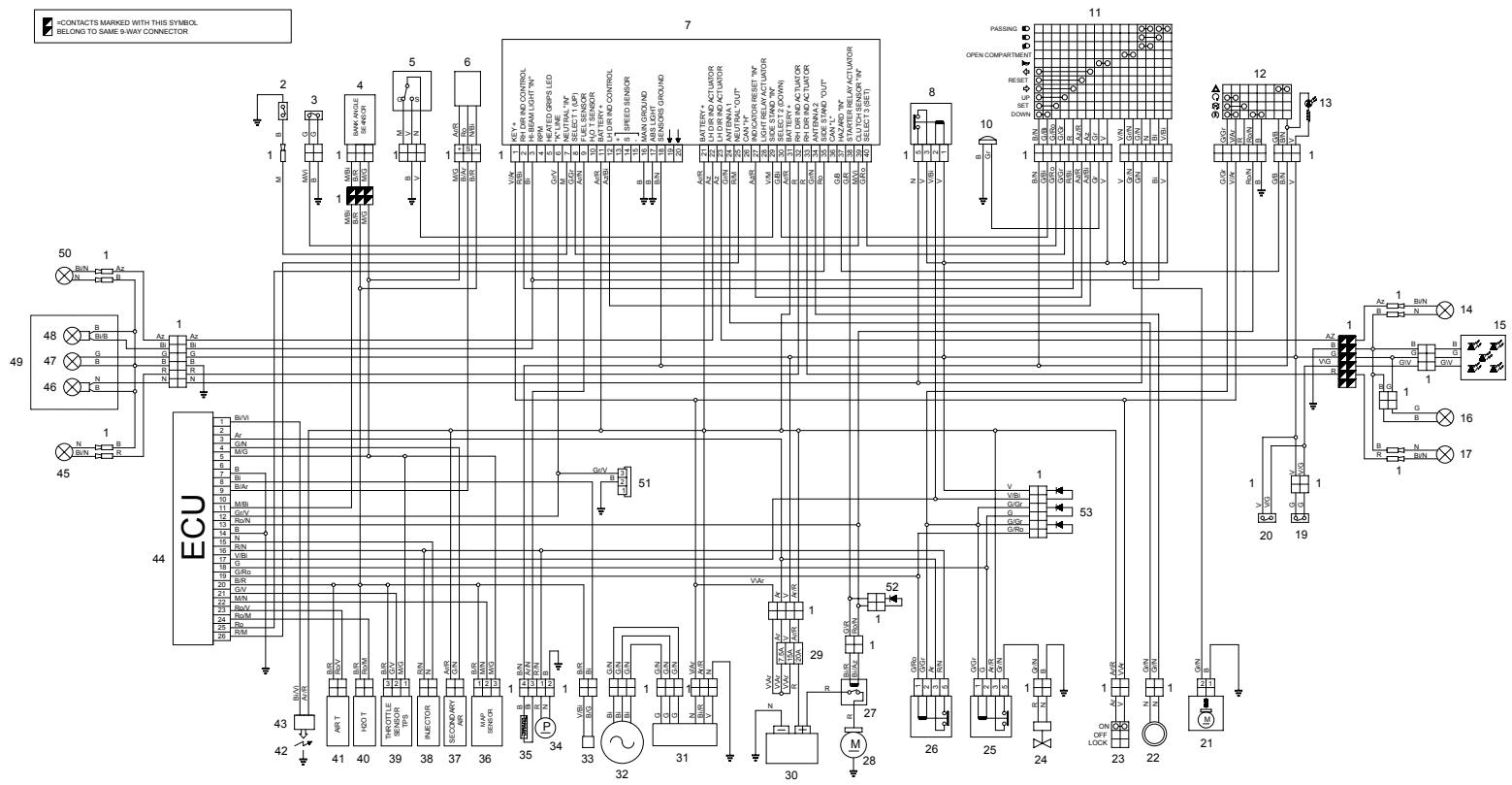
WIRING DIAGRAM KEY - Pegaso 650 I.E.
1) Multiple connectors
2) Neutral switch
3) Clutch switch
4) Bank angle sensor
5) Side stand switch
6) Speed sensor
7) Instrument panel
8) Light relay
9) ----
10) Warning horn
11) Left dimmer switch
12) Right dimmer switch
13) HAZARD button back lighting
14) Rear left direction indicator
15) Tail light
16) Number plate light
17) Rear right direction indicator
18) ---
19) Rear stoplight switch
20) Front stoplight switch
21) Electric lock
22) Immobilizer antenna
23) Key-operated switch
24) Fan
25) Fan relay
26) Injection relay
27) Starter relay
28) Starter motor
29) Fuses
30) Battery
31) Voltage regulator
32) Generator
33) Pick up
34) Fuel pump
35) Fuel level sensor
36) Map sensor
37) Secondary air
38)Injector
39) Throttle Position Sensor (TPS)
40) Water temperature sensor
41) Air temperature sensor
42) Spark plug
43) Coil
44) ECU
45) Front right direction indicator
46) Low beam bulb
47) Parking light bulb
48) High beam bulb
49) Headlight
50) Front left direction indicator
51) Self-diagnosis connector
52) Diode
53) Diode module
CABLE COLOURS
Ar Orange
Az Light blue
B Blue
Bi White
G Yellow
Gr Grey
M Brown
N Black
Red
Ro Pink
V Green
Vi Violet
THE VALUE OF SERVICE
aprilia
Thanks to ongoing technical updates and product-specific technical training, aprilia Authorised Network engineers are familiar with every detail of this vehicle and have the special equipment required for correct maintenance and repair.
A vehicle kept in sleek running order is a reliable vehicle. Pre-ride checks, proper maintenance at the recommended intervals and using aprilia Genuine Parts only are key factors!
To find contact information of the Authorised Dealer and/or Service Centre nearest you, please consult the Yellow Pages or the map provided at our web site :
www.aprilia.com
When you demand aprilia Genuine Parts, you are purchasing products that have been developed and tested as early as the vehicle design stage. aprilia Genuine Parts systematically undergo strict quality control procedures to ensure total reliability and long service life.
Piaggio & C. S.p.A. wishes to thank its customers for the purchase of this vehicle.
- Do not dispose of oil, fuel, polluting substances and components in the environment.
- Do not keep the engine running if it is not necessary.
- Avoid disturbing noises.
- Respect nature.
- SAFETYWARNINGS
- DECA S.r.l.
- WARNING
- CAUTION
- TECHNICAL INFORMATION
- WARNING - PRECAUTIONS - GENERAL ADVICE
- OPT optional
- VERSION:
- TABLE OF CONTENTS
- SAFE DRIVE BASIC SAFETY RULES
- CLOTHING
- ACCESSORIES
- LOAD
- KEY
- INSTRUMENTS AND INDICATORS TABLE
- MULTIFUNCTION COMPUTER
- MENU
- Settings
- TIME SETTINGS
- GEAR SHIFT THRESHOLD
- BACK LIGHTING
- CHANGE THE CODE
- CODE RECOVERY
- UNLOCK SAFETY LOCKS
- Lap timer
- VIEW TIMES
- DELETE TIMES
- Lap time operation
- Diagnosis
- Language
- SERVICE INTERVAL
- ALARM DISPLAY
- CONTROLS ON LEFT HANDLEBAR
- CONTROLS ON THE RIGHT PART OF THE HANDLEBAR
- IGNITION SWITCH
- STEERING LOCK
- OPERATION
- To lock the steering:
- AUXILIARY EQUIPMENT
- UNLOCKING/LOCKING THE SEAT
- To lock the seat:
- GLOVE COMPARTMENT
- TOOL KIT COMPARTMENT
- The tool kit includes:
- SPECIAL TOOLS OPT
- ACCESSORIES OPT
- FUEL
- DO NOT DISPOSE OF FUEL IN THE ENVIRONMENT.
- KEEP AWAY FROM CHILDREN.
- To refuel, proceed as follows:
- After refuelling:
- BRAKE FLUID - recommendations
- FRONT BRAKE
- CHECK
- TOPPING UP
- REAR BRAKE
- COOLANT
- TYRES
- MINIMUM TREAD DEPTH LIMIT (3):
- ENGINE OIL
- CLUTCH
- ADJUSTING THE CLUTCH
- For the adjustment, proceed as follows:
- ADJUSTING THE REAR BRAKE CONTROL LEVER CLEARANCE
- EXHAUST SILENCERS
- INSTRUCTIONS FOR USE
- GETTING ON AND OFF THE VEHICLE
- GETTING ON THE VEHICLE
- GETTING OFF THE VEHICLE
- PRELIMINARY CHECKING OPERATIONS
- STARTING
- MOVING OFF AND RIDING
- To leave:
- To shift down, proceed as follows:
- RUNNING-IN
- Keep to the following indications:
- STOPPING
- PARKING
- POSITIONING THE VEHICLE ON THE STAND
- SIDE STAND
- SUGGESTIONS TO PREVENT THEFT
- REGULAR SERVICE INTERVALS CHART
- OPERATIONS TO BE CARRIED OUT BY THE aprilia Authorised Dealer
- IDENTIFICATION DATA
- FRAME NUMBER
- ENGINE NUMBER
- JOINTS WITH CLICK CLAMPS AND WITH SCREW CLAMPS
- CLICK CLAMPS
- SCREW CLAMPS
- CHECKING THE ENGINE OIL LEVEL AND TOPPING UP
- Carefully read page 57 (MAINTENANCE) and page 41 (ENGINE OIL).
- For the check, proceed as follows:
- FRONT WHEEL
- DISASSEMBLY
- REASSEMBLY
- REAR WHEEL
- POSITIONING THE VEHICLE ON THE REAR SUPPORT STAND OPT
- POSITIONING THE VEHICLE ON THE FRONT SUPPORT STAND OPT
- DRIVE CHAIN
- CHECKING THE SLACK
- ADJUSTMENT
- CHECKING THE DRIVING CHAIN, THE FRONT AND REAR SPROCKET WEAR
- CLEANING AND LUBRICATION
- REAR SUSPENSION
- ADJUSTING THE REAR SHOCK ABSORBER
- Uneven or irregular road surface - HARD adjustment:
- Normal or regular road surface - SOFT adjustment:
- CHECKING THE BRAKE PAD WEAR
- IDLING ADJUSTMENT
- To check the engine idling rpm correctly, proceed as follows:
- ADJUSTING THE ACCELERATOR CONTROL
- If not, proceed as follows:
- SPARK PLUG
- To reach the spark plug:
- For the removal, proceed as follows:
- For the check and cleaning:
- Key:
- For the installation:
- BATTERY
- CHECKING AND CLEANING THE TERMINALS
- REMOVING THE BATTERY
- Carefully read page 77 (BATTERY).
- Do not force the electric cables.
- Once it has been removed, the battery must be stored in a safe place and kept away from children.
- CHARGING THE BATTERY
- INSTALLING THE BATTERY
- LONG INACTIVITY OF THE BATTERY
- CHECKING THE SWITCHES
- CHANGING THE FUSES
- ARRANGEMENT OF THE FUSES
- ADJUSTING THE VERTICAL HEADLIGHT BEAM
- To adjust the headlight beam:
- INSTRUMENT PANEL LIGHTING
- BULBS
- CHANGING THE HEADLIGHT BULBS
- The headlight contains:
- To change, proceed as follows:
- HIGH BEAM BULB
- PARKING LIGHT BULB
- LOW BEAM BULB
- CHANGING THE NUMBER PLATE BULB
- TRANSPORT
- CLEANING
- LONG PERIODS OF INACTIVITY
- Proceed as follows:
- AFTER A PERIOD OF INACTIVITY
- LUBRICANT CHART
- WIRING DIAGRAM KEY - Pegaso 650 I.E.
- CABLE COLOURS
- THE VALUE OF SERVICE
- aprilia
- www.aprilia.com
Marque : APRILIA
Modèle : PEGASO 650 STRADA-TRAIL
Catégorie : Moto