
FK-118 - Imprimante KONICA MINOLTA - Notice d'utilisation et mode d'emploi gratuit
Retrouvez gratuitement la notice de l'appareil FK-118 KONICA MINOLTA au format PDF.


| Type de produit | Kit fax (unité fax) pour imprimante multifonction |
| Marque compatible | Konica Minolta 7216 / 7220 |
| Norme de communication | G3 |
| Méthodes de numérotation | Numérotation directe, abrégée (27 touches), rapide (200 numéros), groupe, programme, répertoire, chaîne, rappel |
| Résolutions fax | Standard (STD), Fine, Super Fine (S/F), Demi-teinte (H/T) |
| Types de transmission | Mémoire, directe, manuelle, différée, multiposte, boîte aux lettres, relais, polling |
| Types de réception | Manuelle, mémoire, boîte aux lettres, polling |
| Capacité mémoire standard | Jusqu'à 280 pages A4 en mémoire |
| Capacité mémoire max. (option) | Jusqu'à 1024 pages A4 avec extension mémoire |
| Formats de papier pris en charge | A5, B5, A4, B4, A3 (métrique) ; Invoice, Letter, Legal, Ledger (pouces) |
| Alimentation | Via l'imprimante hôte (non spécifiée séparément) |
| Consommation énergétique | Conforme ENERGY STAR® (mode basse consommation automatique) |
| Connecteurs téléphoniques | 1 x prise ligne (LINE), 1 x prise téléphone externe (TEL) |
| Affichage | Écran ACL (affichage des menus, messages d'erreur, état) |
| Clavier | Pavé numérique 0-9, touches de fonction, touches de mode (Copie, Fax, Scan) |
| Numérotation abrégée | 27 touches directes programmables, 200 numéros rapides |
| Numérotation de groupe | Oui (programmable sur touches directes) |
| Fonctions avancées | Boîte aux lettres (F code), relais, diffusion, transmission différée |
| Rapports et listes | Rapport d'activité, résultat d'envoi/réception, liste des touches, etc. |
| Entretien et nettoyage | Nettoyer la vitre d'exposition avec un chiffon doux et sec ; ne pas utiliser de produits inflammables à proximité |
| Sécurité | Ne pas modifier l'appareil ; utiliser uniquement le cordon d'alimentation fourni ; débrancher en cas d'anomalie |
| Conditions d'utilisation | Éviter la lumière directe du soleil, l'humidité, la poussière, les vibrations ; bien ventiler la pièce |
| Pays de fabrication | Non spécifié (fabriqué par Konica Minolta) |
| Poids | Variable selon l'imprimante hôte |
FOIRE AUX QUESTIONS - FK-118 KONICA MINOLTA
Questions des utilisateurs sur FK-118 KONICA MINOLTA
0 question sur cet appareil. Repondez a celles que vous connaissez ou posez la votre.
Poser une nouvelle question sur cet appareil
Téléchargez la notice de votre Imprimante au format PDF gratuitement ! Retrouvez votre notice FK-118 - KONICA MINOLTA et reprennez votre appareil électronique en main. Sur cette page sont publiés tous les documents nécessaires à l'utilisation de votre appareil FK-118 de la marque KONICA MINOLTA.
MODE D'EMPLOI FK-118 KONICA MINOLTA
7216/7220 Fax Unit (FK-118)
User Manual
Contents
1 Introduction
1.1 User Manuals....1-1
1.2 Introduction....1-1
We Want You to Be a Satisfied Customer....1-1
1.3 Explanation of Manual Conventions 1-2
1.4 Energy Star® 1-3
What is an ENERGY STAR® Product? 1-3
1.5 Safety Information....1-4
Warning and Precaution Symbols 1-4
Meaning of Symbols....1-4
WARNING 1-5
CAUTION 1-6
Precautions for Routine Use....1-7
Miscellaneous....1-8
User Instructions – CE Marking....1-8
Notice for Ni-MH Batteries....1-8
2 Precautions
2.1 Part Names and Their Functions....2-1
Main Unit 2-1
2.2 Names of Control Panel Parts and Their Functions ......2-2
Control Panel Parts and Their Functions....2-2
2.3 Display Indications 2-7
2.4 Entering Text 2-9
Changing Input Mode 2-9
Inputting Example....2-10
3 Faxing
3.1 Dialing 3-1
To fax by entering the fax number directly using the
10-Key Pad....3-2
To fax using one-touch dialing....3-3
To fax using speed dialing....3-4
To fax using group dialing 3-5
To fax using chain dial....3-6
To fax using program dialing....3-7
To fax using the phone book.... 3-8
To search the phone book 3-9
To redial the last recipient called 3-11
3.2 Transmission Settings 3-12
Adjusting the Fax Resolution 3-12
To specify the resolution 3-13
3.3 Basic Faxing 3-14
To fax using the Automatic Document Feeder.... 3-14
To fax documents positioned on the Original Glass 3-16
If the Memory Becomes Full While Scanning Fax
Documents 3-17
3.4 Confirmation Mode.... 3-18
Checking the Machine's Counters 3-18
To check the counters.... 3-19
Checking Transmission Results.... 3-20
To check the transmission result 3-20
Outputting a report/list.... 3-21
To output a report/list 3-22
Transmission Result Report.... 3-23
Reception Result Report.... 3-23
Activity Report.... 3-24
Memory Data List.... 3-24
Memory Image Print.... 3-24
List of One-Touch Dial Keys 3-25
List of Speed Dial Numbers 3-25
Key Setting List 3-25
Relay Box List 3-25
Machine Status List.... 3-25
Configuration Page 3-26
PCL Font List 3-26
4 Fax Transmission/Reception Methods
4.1 Transmission Methods 4-1
Memory Transmission.... 4-1
To specify Memory TX 4-2
Direct Transmission 4-3
Manual Transmission 4-3
To send a fax manually....4-4
Batch Transmission 4-4
To fax using batch transmission 4-5
Broadcast Transmission 4-5
To fax using broadcast transmission 4-6
Timer Transmission 4-8
To fax using timer transmission 4-8
Mailbox Transmission....4-10
To fax using mailbox transmission 4-10
Relay Initiation Transmission....4-12
To fax using relay initiation transmission....4-12
Relay Broadcast Transmission....4-14
Polling Transmission 4-15
To set up polling transmission....4-15
To delete a document from the polling transmission setup....4-17
Canceling (Deleting) a Document Queued in the Memory for Transmission....4-18
To cancel a queued document 4-18
4.2 Reception Methods....4-20
Manual Reception....4-20
To receive a fax manually....4-20
Memory Reception 4-21
Mailbox Reception 4-21
To retrieve a document from a mailbox....4-21
Polling Reception....4-22
To receive a fax using polling reception 4-22
Using F codes....4-24
Using Mailboxes 4-25
Specifying F codes 4-26
When sending faxes....4-26
Programming F codes 4-26
5 Using the Utility Mode
5.1 Utility Mode....5-1
5.2 Specifying the Machine Settings....5-2
Selecting the "MACHINE SETTING" menu 5-3
Specifying the Setting for "BUZZER VOLUME"......5-4
Specifying the Setting for "INITIAL MODE" 5-4
5.3 Setting Up the Paper Sources
("PAPER SOURCE SETUP" Menu)....5-5
5.4 Specifying Administrative Settings
("ADMIN. MANAGEMENT" Menu)......5-6
To select the "ADMIN. MANAGEMENT" menu 5-7
To set the "REMOTE MONITOR" function 5-8
6 Using the Utility Mode (Fax)
6.1 Setting Up the Fax Registration 6-1
Selecting the "FAX REGISTRATION" menu 6-2
Setting Up One-Touch Dialing ("ONE-TOUCH DIAL" function) 6-3
To program a one-touch dial key 6-3
To change/delete a programmed one-touch dial key...... 6-5
Specifying the Setting for "SPEED DIAL" 6-7
To program a speed dial number 6-7
To change/delete a programmed speed dial number 6-9
Specifying the Setting for "GROUP DIAL" 6-11
To program a group of fax numbers 6-11
To change/delete a programmed group of fax numbers...... 6-13
Specifying the Setting for "PROGRAM DIAL" 6-15
To set program dialing 6-15
To change/delete a programmed broadcast transmission...... 6-17
To change/delete a programmed timer transmission...... 6-19
To change/delete a programmed mailbox transmission ...... 6-21
To change/delete a programmed polling reception.... 6-23
To change/delete a programmed relay initiation transmission....6-25
Specifying the Setting for "BATCH TX" 6-27
To set batch transmitting....6-27
To change the batch transmission setting 6-29
To delete the batch transmission setting 6-30
Specifying the Setting for "MAILBOX" 6-30
To register a mailbox 6-31
To delete a mailbox....6-32
Setting Up Relay Boxes ("RELAY BOX" function) 6-33
To program the relay box....6-33
To delete the relay box 6-35
6.2 Setting Up the Transmission.... 6-36
Selecting the "TX OPERATION" menu 6-37
Specifying the Setting for "SCAN CONTRAST" 6-37
Specifying the Setting for "RESOLUTION" 6-38
Specifying the Setting for "DEFAULT TX" 6-39
Specifying the Setting for "HEADER" 6-39
6.3 Setting Up the Reception.... 6-40
Selecting the "RX OPERATION" menu.... 6-42
Specifying the Setting for "MEMORY RX MODE"...... 6-43
To cancel memory reception.... 6-44
Specifying the Setting for "NO. of RINGS" 6-45
Specifying the Setting for "REDUCTION RX" 6-45
Specifying the Setting for "RX PRINT" 6-46
Specifying the Setting for "RX MODE" 6-46
Specifying the Setting for "FORWARD"......6-47
Specifying the Setting for "FOOTER" 6-48
Specifying the Setting for "SELECT TRAY"......6-48
Specifying the Setting for "CLOSED NETWORK"......6-49
6.4 Settings Up the Communication....6-50
Specifying the Setting for "TONE/PULSE" 6-51
To specify the telephone dialing system....6-51
Specifying the Setting for "LINE MONITOR" 6-52
Specifying the Setting for "PSTN/PBX" 6-53
To specify the telephone wiring system....6-53
6.5 Setting Up the Report Output 6-54
Selecting the "REPORTING" menu....6-55
Specifying the Setting for "ACTIVITY REPORT"......6-55
Specifying the Setting for "RESERV.REPORT" 6-56
Specifying the Setting for "TX RESULT REPORT" 6-56
Specifying the Setting for "RX RESULT REPORT" 6-57
6.6 Specifying Initial User Data....6-58
Selecting the "INITIAL USER DATA" menu....6-58
Specifying the Setting for "DATE&TIME"......6-59
Specifying the Setting for "USER FAX NO." 6-60
Specifying the Setting for "USER NAME"......6-61
PageScope Light Settings Page....6-62
7 Appendix
7.1 Main Error Messages and Their Remedies....7-1
7.2 When Faxing Is Not Performed Correctly....7-3
Faxes Cannot Be Sent 7-3
Faxes Cannot Be Received....7-4
Calls Cannot Be Sent 7-5
7.3 Glossary....7-6
Terms and Definitions....7-6
7.4 PageScope Light....7-8
What is PageScope Light? 7-8
System Requirements 7-9
Accessing PageScope Light....7-9
Using PageScope Light....7-10
About the Screen Layout....7-10
Logging In as an Administrator....7-11
Logging In to Administrator Mode....7-11
8 Index
1 Introduction
1.1 User Manuals
The User Manual for this machine is divided into two parts: the Konica Minolta 7216/7220 User Manual and the Fax Kit (FK-118) User Manual.
Read the necessary description according to the required use.
The Fax Kit (FK-118) User Manual contains precautions on the use of this machine. Be sure to read this manual before using the machine.
After reading the User Manual, be sure to store it in a safe place for future reference.
● Konica Minolta 7216/7220 User Manual
☐ This manual contains details on the basic operation of this machine, precautions on its use, and operating procedures for the various copy functions.
Before using the various copy functions, read the Konica Minolta 7216/7220 User Manual.
● Fax Kit (FK-118) User Manual
- This manual contains details on the operating procedures for the various fax functions.
Before using the various fax functions, read the Fax Kit (FK-118) User Manual.
1.2 Introduction
We Want You to Be a Satisfied Customer
Thank you for choosing this machine.
This User Manual describes the functions, operating procedures, precautions, and basic troubleshooting for this machine. Before using the machine, be sure to read the User Manual thoroughly in order to ensure that you use it efficiently. After you have gone through the manual, store it in the holder on the machine and keep it handy at all times.
Note that some of the illustrations of the machine used in the User Manual may be different from what you actually see on your machine.
1.3 Explanation of Manual Conventions
The marks and text formats used in this manual are described below.

WARNING
Failure to observe instructions highlighted in this manner may result in fatal or critical injuries.
→ Observe all warnings in order to ensure safe use of this machine.

CAUTION
Failure to observe instructions highlighted in this manner may result in serious injuries or property damage.
→ Observe all cautions in order to ensure safe use of this machine.

Note\*
(*May also appear as "Important" or "Tip")
Text highlighted in this manner contains useful information and tips to ensure safe use of the machine.
1 The number 1 as formatted here indicates the first step of a sequence of actions.
2 Subsequent numbers as formatted here indicate subsequent steps of a sequence of actions.
? Text formatted in this style provides additional assistance.
→ Text formatted in this style describes the action that will ensure the desired results are achieved.
An illustration inserted here shows what operations must be performed.
[Copy] key
The names of keys on the control panel are written as shown above.
1.4 Energy Star®

As an ENERGY STAR ^® Partner, we have determined that this machine meets the ENERGY STAR ^® Guidelines for energy efficiency.
What is an ENERGY STAR® Product?
An ENERGY STAR ^® product has a special feature that allows it to automatically switch to a “low-power mode” after a period of inactivity. An ENERGY STAR ^® product uses energy more efficiently, saves you money on utility bills and helps protect the environment.
1.5 Safety Information
This section contains detailed instructions on the operation and maintenance of this machine. To achieve optimum utility of this device, all operators should carefully read and follow the instructions in this manual. Please keep this manual in a handy place near the machine.
Please read the next section before using this device. It contains important information related to user safety and preventing equipment problems.
Make sure you observe all of the precautions listed in this manual.
* Ver06
Please note that some parts of the contents of this section may not correspond with the purchased product.
Warning and Precaution Symbols
 WARNING: WARNING: | Ignoring this warning could cause serious injury or even death. |
 CAUTION: CAUTION: | Ignoring this caution could cause injury or damage to property. |
Meaning of Symbols

A triangle indicates a danger against which you should take precaution.

This symbol warns against cause burns.

A diagonal line indicates a prohibited course of action.

This symbol warns against dismantling the device.

A black circle indicates an imperative course of action.

This symbol indicates you must unplug the device.

WARNING
 | Do not modify this product, as a fire, electrical shock, or breakdown could result. If the product employs a laser, the laser beam source could cause blindness.Do not attempt to remove the covers and panels which have been fixed to the product. Some products have a high-voltage part or a laser beam source inside that could cause an electrical shock or blindness. |
 | Use only the power cord supplied in the package. If a power cord is not supplied, only use the power cord and plug that is specified in POWER CORD INSTRUCTION. Failure to use this cord could result in a fire or electrical shock.Use the power cord supplied in the package only for this machine and NEVER use it for any other product. Failure to observe this precaution could result in a fire or electrical shock.Use only the specified power source voltage. Failure to do that could result in a fire or electrical shock.Do not use a multiple outlet adapter to connect any other appliances or machines. Use of a power outlet for more than the marked current value could result in a fire or electrical shock. |
 | Do not unplug and plug in the power cord with a wet hand, as an electrical shock could result. |
 | Plug the power cord all the way into the power outlet. Failure to do this could result in a fire or electrical shock. |
 | Do not scratch, abrade, place a heavy object on, heat, twist, bend, pull on, or damage the power cord. Use of a damaged power cord (exposed core wire, broken wire, etc.) could result in a fire or breakdown.Should any of these conditions be found, immediately turn OFF the power switch, unplug the power cord from the power outlet, and then call your authorized service representative.Do not use an extension cord, in principle. Use of an extension cord could cause a fire or electrical shock. Contact your authorized service representative if an extension cord is required. |
 | Do not place a flower vase or other container that contains water, or metal clips or other small metallic objects on this product. Spilled water or metallic objects dropped inside the product could result in a fire, electrical shock, or breakdown.Should a piece of metal, water, or any other similar foreign matter get inside the product, immediately turn OFF the power switch, unplug the power cord from the power outlet, and then call your authorized service representative. |
 | Do not keep using this product, if this product becomes inordinately hot or emits smoke, or unusual odor or noise. Immediately turn OFF the power switch, unplug the power cord from the power outlet, and then call your authorized service representative. If you keep on using it as is, a fire or electrical shock could result.Do not keep using this product, if this product has been dropped or its cover damaged. Immediately turn OFF the power switch, unplug the power cord from the power outlet, and then call your authorized service representative. If you keep on using it as is, a fire or electrical shock could result. |
 | Do not throw the toner cartridge or toner into an open flame. The hot toner may scatter and cause burns or other damage. |

Connect the power cord to an electrical outlet that is equipped with a grounding terminal.
CAUTION
 | Do not use flammable sprays, liquids, or gases near this product, as a fire could result.Do not leave a toner unit or drum unit in a place within easy reach of children.Licking or ingesting any of these things could injure your health.Do not let any object plug the ventilation holes of this product. Heat could accumulate inside the product, resulting in a fire or malfunction.Do not install this product at a site that is exposed to direct sunlight, or near an air conditioner or heating apparatus. The resultant temperature changes inside the product could cause a malfunction, fire, or electrical shock.Do not place the product in a dusty place, or a site exposed to soot or steam, near a kitchen table, bath, or a humidifier. A fire, electrical shock, or breakdown could result.Do not place this product on an unstable or tilted bench, or in a location subject to a lot of vibration and shock. It could drop or fall, causing personal injury or mechanical breakdown.After installing this product, mount it on a secure base. If the unit moves or falls, it may cause personal injury.Do not store toner units and PC drum units near a floppy disk or watch that are susceptible to magnetism. They could cause these products to malfunction. |
 | The inside of this product has areas subject to high temperature, which may cause burns. When checking the inside of the unit for malfunctions such as a paper misfeed, do not touch the locations (around the fusing unit, etc.) which are indicated by a “CAUTION HOT” caution label. |
 | Do not place any objects around the power plug as the power plug may be difficult to pull out when an emergency occurs. |
 | The socket-outlet shall be installed near the machine and shall be easily accessible as the power plug may be difficult to pull out when an emergency occurs. |
 | Always use this product in a well ventilated location. Operating the product in a poorly ventilated room for an extended period of time could injure your health. Ventilate the room at regular intervals.Whenever moving this product, be sure to disconnect the power cord and other cables. Failure to do this could damage the cord or cable, resulting in a fire, electrical shock, or breakdown.When moving this product, always hold it by the locations specified in the User manual or other documents. If the unit falls it may cause severe personal injury. The product may also be damaged or malfunction.Remove the power plug from the outlet more than one time a year and clean the area between the plug terminals. Dust that accumulates between the plug terminals may cause a fire.When unplugging the power cord, be sure to hold onto the plug. Pulling on the power cord could damage the cord, resulting in a fire or electrical shock. |
Precautions for Routine Use
 | Do not store toner units, PC drum units, and other supplies and consumables in a place subject to direct sunlight and high temperature and humidity, as poor image quality and malfunction could result.Do not attempt to replace the toner unit and PC drum unit in a place exposed to direct sunlight. If the PC drum is exposed to intense light, poor image quality could result.Do not unpack a toner unit or PC drum unit until the very time of use. Do not leave an unpacked unit standing. Install it immediately or poor image quality could result.Do not keep toner units and PC drum units in an upright position or upside down, as poor image quality could result.Do not throw or drop a toner unit or PC drum unit as poor image quality could result.Do not use this product in an area where ammonia or other gases or chemicals are present. Failure to do so may shorten the service life of the product, cause damage or decrease performance.Do not use this product in an environment with a temperature outside the range specified in the User manual, as a breakdown or malfunction could result.Do not attempt to feed stapled paper, carbon paper or aluminum foil through this product, as a malfunction or fire could result. |
 | Do not touch or scratch the surface of the toner unit developing roller and the PC drum, as poor image quality could result. |
 | Use the supplies and consumables recommended by the dealer. Use of any supply or consumable not recommended could result in poor image quality and breakdown. |
Miscellaneous

- Do not rest your weight on the control panel, as a malfunction could result.
- Normal international communications may at times not be possible depending on line conditions.
- If tap or well water is used in a humidifier, impurities in the water are discharged into the air and may be deposited inside the printer, resulting in poor image quality. It is recommended that pure water that does not contain any impurities be used in the humidifier.
- Ni-MH (Nickel Metal Hydride) Batteries are installed inside machine as back up memory batteries. Please dispose according to local, state and federal regulations.
The Facsimile has been approved in accordance with Council Decision 1999/5/EC for pan-European single terminal connection to the public switched telephone network (PSTN).
However, due to differences between the individual PSTNs provided in different countries, the approval does not, of itself, give an unconditional assurance of successful operation on every PSTN network terminal point.
In the event of problems, you should contact your equipment supplier in the first instance.
NOTE
The manufacturer should ensure that the vender and user of equipment is clearly informed of the above information by means of packaging and/or user manuals or other forms of user instructions.
This product is approved for DTMF dialing only. When directly connected to the public switched telephone network (PSTN mode) pulse dialing can not be used. (Pulse dialing may only be used when this product is connected to a PABX.)
User Instructions – CE Marking

Notice for Ni-MH Batteries
Ni-MH (Nickel Metal Hydride) Batteries are installed inside machine as back up memory batteries. Please dispose according to local, state and federal regulations.
2 Precautions
2.1 Part Names and Their Functions
Main Unit
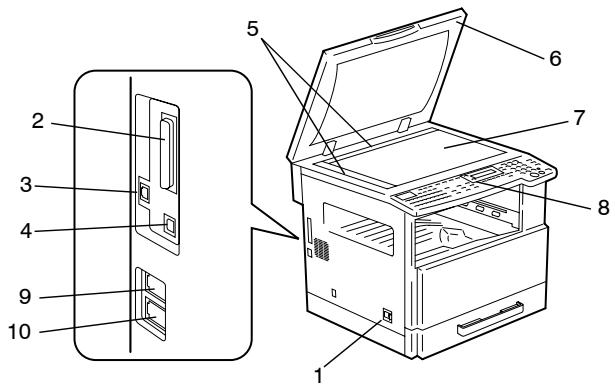
| No. | Part Name | Description |
| 1 | Power Switch | Used to turn the machine on and off. |
| 2 | Parallel Interface Connector | Used for connecting a parallel cable from the computer. |
| 3 | RJ45 Connector for Networking | Used for connecting the network cable when this machine is used for Internet faxing and network scanning. |
| 4 | Printer USB Connector | Used for connecting a USB cable from the computer. |
| 5 | Document Scales | Used to align the document. |
| 6 | Original Cover (optional) | Presses down on the document positioned on the Original Glass. |
| 7 | Original Glass | When manually feeding a document, position it on the Original Glass so that it can be scanned.Position the document face down on the glass. |
| 8 | Control Panel | Used to start copying or to make various settings. |
| 9 | Telephone Line Connector (LINE) | User for connecting the telephone cord from the wall jack. |
| 10 | External Telephone Connector (TEL) | Used for connecting the cord from the telephone. |
* For details on parts other than those described above, refer to the Konica Minolta 7216/7220 User Manual.
2.2 Names of Control Panel Parts and Their Functions
Control Panel Parts and Their Functions
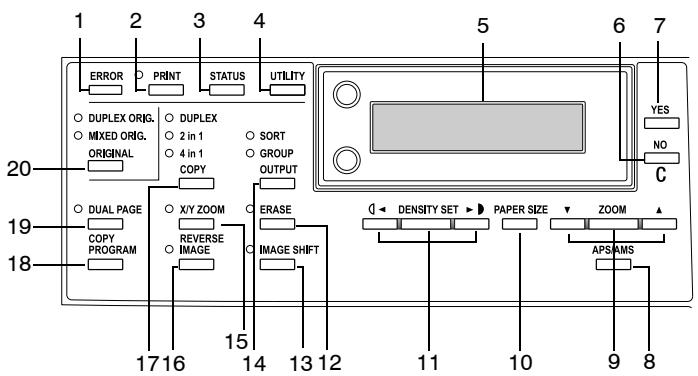
| No. | Part Name | Function |
| 1 | “ERROR” indicator | Flashes when an error has occurred. |
| 2 | [PRINT] key/indicator | Lights up while data is being printed from the computer and flashes while data is being sent.For details, refer to the Printer Controller User Manual. |
| 3 | [STATUS] key | Used to view the transmission results or the counters, or to print a transmission result report. |
| 4 | [UTILITY] key | Used to enter Utility mode and display the first Utility mode screen.MACHINE SETTING, PAPER SOURCE SETUP, USER MANAGEMENT, ADMIN. MANAGEMENT, COPY SETTING 1 & 2, FAX REGISTRATION, TX OPERATION, RX OPERATION, COMM. SETTING, REPORTING, INITIAL USER DATA, NETWORK SETTING (with the Network Interface Card), E-MAIL SETTING 1 & 2 (with the Network Interface Card), SCAN SETTING (with the Network Interface Card) |
| 5 | Display | Displays setting menus, error messages, and specified settings such as the number of copies and the zoom ratio. |
| 6 | [NO/C] key | Erases the entered numbers and letters.Returns to the previous screen. |
| 7 | [YES] key | Confirms the current setting. |
| 8 | [APS/AMS] key | Used to select between the APS or the AMS function. |
| 9 | [ZOOM] key,[▲] and [▼] keys | Used to select a preset enlargement or reduction ratio.With each press, a zoom ratio between × 0.50 and × 2.00 is selected in 0.01 increments.Used to specify the selection above or below in setting screens and menus. |
| 10 | [PAPER SIZE] key | Used to select the size of the paper to be printed on. |
| 11 | [DENSITY SET] key,[◀] and [▶] keys | Used to specify the scanning density of copies.Used to specify the selection at the left or right in setting screens. |
| 12 | [ERASE] key | Used to select the area of the document that is erased. |
| 13 | [IMAGE SHIFT] key | Press to select the “Image Shift” function. |
| 14 | [OUTPUT] key | Used to select a copy “Output” function. |
| 15 | [X/Y ZOOM] key | Used to specify different scaling proportions for the vertical and horizontal directions. |
| 16 | [REVERSE IMAGE] key | Press to make copies with the dark- and light-colored areas of the document inverted. |
| 17 | [COPY] key | Used to select the “2 in 1”, “4 in 1” or “Duplex” Copy settings. |
| 18 | [COPY PROGRAM] key | Copy programs can be stored.Stored copy programs can be selected and recalled. |
| 19 | [DUAL PAGE] key | Used to select the “Dual Page” function. |
| 20 | [ORIGINAL] key | Used to select between the “Duplex Orig.” function and the “Mixed Orig.” function.If the FAX key was pressed, the “MIXED ORIG.” indicator lights up.The “Duplex Orig.” function can be selected only when the Duplexing Document Feeder is installed. |
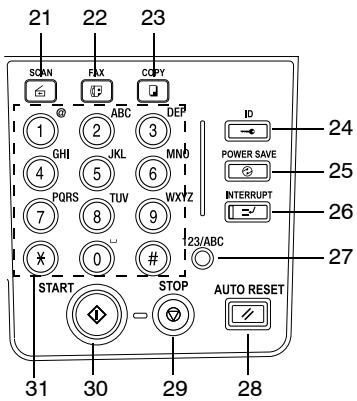
| No. | Part Name | Function |
| 21 | SCAN key | Press to enter Scan mode. The indicator lights up in green to indicate that the machine is in Scan mode. (Available only when the Network Interface Card KN-419 and the Internet Fax & Network Scan Kit IF-118 are installed.) |
| 22 | FAX key | Press to enter Fax mode. The indicator lights up in green to indicate that the machine is in Fax mode. |
| 23 | COPY key | Press to enter Copy mode. The indicator lights up in green to indicate that the machine is in Copy mode. |
| 24 | ID key | Used with user management. |
| 25 | POWER SAVE key | Press to enter Power Save mode. |
| 26 | INTERRUPT key | Press to enter Interrupt mode. The indicator lights up in green to indicate that the machine is in Interrupt mode. Press again to cancel Interrupt mode and return to the mode before Interrupt mode was entered. If the INTERRUPT key is pressed while a received fax document is being printed, printing stops. Press the INTERRUPT key again to continue printing the received fax document. |
| 27 | [123/ABC] key | Press to switch the input mode between numbers and letters. |
| 28 | AUTO RESET key | • Cancels all copy functions and returns them to their default settings.• Cancels all fax functions and returns them to their default settings.• Deletes all queued jobs. |
| 29 | STOP key | • Stops the multi-page copy operation.• Stops the fax transmission or reception. |
| 30 | START key | Starts copying.Starts a fax transmission.Queues a copy job if pressed while the machine is warming up.The indicator lights up in green to indicate that the machine is ready to start copying, or it lights up in orange to indicate that the machine is not ready to start copying. |
| 31 | 10-Key Pad | Used to specify the number of copies.Used to enter setting values.Used to enter fax number.Used to enter speed dial number.In Fax mode, use the [¥] key for tone transmissions (with pulse dialing) and use the [#] key for accessing an outside line. |
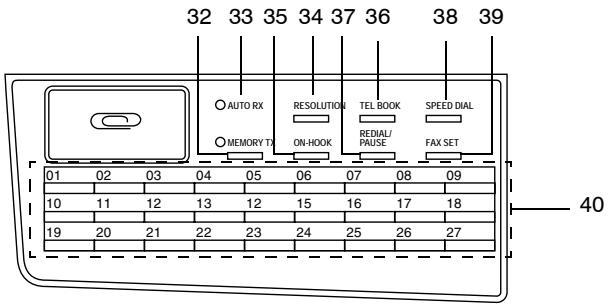
| No. | Part Name | Function |
| 32 | “MEMORY TX” indicator | Lights up when the memory transmission function is selected. |
| 33 | “AUTO RX” indicator | Lights up when the automatic reception function is selected. |
| 34 | [RESOLUTION] key | Used to select the image quality (transmission resolution). |
| 35 | [ON-HOOK] key | Press to answer the call. Press again to hang up. |
| 36 | [TEL BOOK] key | Used to display the information programmed for one-touch dialing, group dialing and speed dialing. |
| 37 | [REDIAL/PAUSE] key | Redials the last number called.While dialing, used to generate a pause when transferring from an internal to an external line or receiving information services. |
| 38 | [SPEED DIAL] key | Used to dial previously programmed fax numbers represented by 3-digit numbers. |
| 39 | [FAX SET] key | Used to select a function.BROADCAST (broadcast transmission), TIMER TX (timer transmission), MAILBOX TX (mailbox transmission), PRINT MAILBOX RX (retrieve mailbox faxes), POLLING TX (polling transmission), POLLING RX (polling reception), RELAY INITIATE (relay initiation transmission), CANCEL RESERV. (cancel queued job), TX MODE (transmission mode), INTERNET FAX RX (with the Internet Fax & Network Scan Kit installed)Refer to “Fax Transmission/Reception Methods” on page 4-1. |
| 40 | One-touch key | Used to dial previously programmed fax numbers.Use keys [01] through [27] for programming one-touch dial keys and group dialing.Use keys [24] through [27] for setting program dialing. |
2.3 Display Indications
In Fax mode:
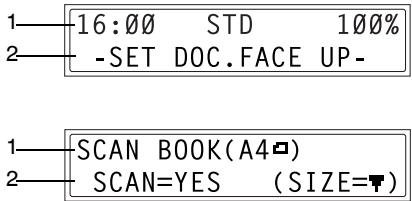
| No. | Display Indication | Description |
| 1 | Mode or function name | Indicates the currently selected mode or function settings.Displays the current menu, function or settings.Error messages are displayed when errors occur.The current date and remaining memory is displayed during standby. |
| 2 | Messages | Displays messages such as operating instructions. |
Symbol list:
| Symbol | Description | |
 | Dialing | A fax number is being dialed. |
 | Ringing | The machine is being called. |
 | Sending | The document is being sent. |
 | Receiving | A document is being received. |
| [7ZB7] | In standby for timer transmission | A document is queued for timer transmission. |
| [SCKS] | In standby for polling transmission | A document is queued for polling transmission. |
| [Σ48X] | In standby for mailbox reception | A document is queued for mailbox reception. |
| [78A4] | In standby for memory reception or polling reception | A document is queued for memory reception or polling reception. |
2.4 Entering Text
When specifying the user name or programming one-touch dial keys with the recipient name, letters, accented characters, numbers and symbols can be entered.
Key operation:
● 10-Key Pad: Used to enter numbers, letters, and symbols.
List of characters available with each key of the 10-Key Pad:
| 10-Key Pad | Available characters* | Available characters with the metric model |
| 1 | . (period) @_ (underscore) - (hyphen) 1 | |
| 2 | ABC2abc | ÄäÅåÆæåÇç |
| 3 | DEF3def | Ééè |
| 4 | GHI4ghi | iîî |
| 5 | JKL5jkl | |
| 6 | MNO6mno | ÑñÖöØò |
| 7 | PQRS7pqrs | β |
| 8 | TUV8tuv | Üüùú |
| 9 | WXYZ9wxyz | |
| 0 | (space) 0 | |
| ¥ | +&/ ¥ =!?()%[ ]^“{}]^$,;;<>"¿£ | |
| # | # |
Changing Input Mode
Each press of the [123/ABC] key switches the input mode between numbers and letters.
[1]: Numbers can be typed in.
[A]: Letters can be typed in.
Inputting Example
To enter the name "NJ Office"
* The cursor () flashes alternately with the character at its current location.
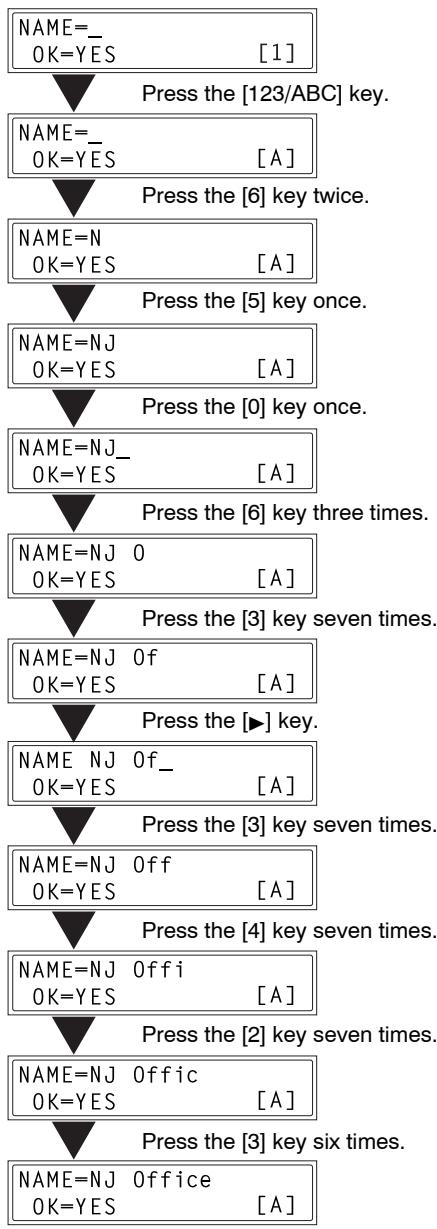
flowchart
graph TD
    A["NAME=_OK=YES"] --> B["Press the [123/ABC"] key.]
    B --> C["NAME=_OK=YES"]
    C --> D["Press the [6"] key twice.]
    D --> E["NAME=NOK=YES"]
    E --> F["Press the [5"] key once.]
    F --> G["NAME=NJ_OK=YES"]
    G --> H["Press the [0"] key once.]
    H --> I["NAME=NJ_OK=YES"]
    I --> J["Press the [6"] key three times.]
    J --> K["NAME=NJ 0OK=YES"]
    K --> L["Press the [3"] key seven times.]
    L --> M["NAME=NJ 0fOK=YES"]
    M --> N["Press the [▶"] key.]
    N --> O["NAME NJ 0f_OK=YES"]
    O --> P["Press the [3"] key seven times.]
    P --> Q["NAME=NJ OffOK=YES"]
    Q --> R["Press the [4"] key seven times.]
    R --> S["NAME=NJ OffiOK=YES"]
    S --> T["Press the [2"] key seven times.]
    T --> U["NAME=NJ OfficOK=YES"]
    U --> V["Press the [3"] key six times.]
    V --> W["NAME=NJ OfficeOK=YES"]
Correcting text and input precautions
● To erase all entered text, hold down the [NO] key.
- To delete only part of the entered text, use the [◀] and [▶] keys to move the cursor (_) to the character that you wish to delete, and then press the [NO] key.
- To change an entered character, use the [◀] and [▶] keys to move the cursor (_) below the character that you wish to change, and then enter the new character. (The character at the cursor's position is replaced with the new character.)
- If the same 10-Key Pad is needed to enter two characters in a row, press the [▶] key after selecting the first character. (Refer to the above example.)
● To cancel entering text, press the [AUTO RESET] key.
3 Faxing
This machine is a G3 fax. Faxes can only be sent or received with this machine if the recipient's or sender's machine complies with the G3 standard.
3.1 Dialing
The recipient's fax number can be dialed using any of the seven different dialing methods described below.
The procedures described below assume that the fax is being sent using the Automatic Document Feeder.

Using Direct Dialing to communicate with overseas destinations:
If the country code and destination number are entered after the international code, you may hear a busy tone during dialing and transmission may not be possible. In such cases, press the [REDIAL/PAUSE] key twice after entering the international code to insert an approx. 6-second pause, and then enter the rest of the number. If this still fails to connect the call, perform manual transmission (p. 4-3).
To fax by entering the fax number directly using the 10-Key Pad
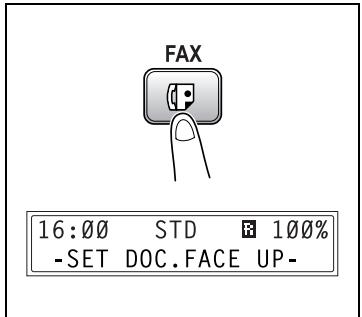
1 Press the [FAX] key to enter Fax mode.
2 Load the document into the Automatic Document Feeder.
3 If necessary, change the "Resolution" setting (p. 3-13).
4 Using the 10-Key Pad, enter the fax number of the recipient.
☐ F codes (SUB and SID) can also be entered. Refer to “Using F codes” on page 4-24.
![☎=0123456_ SUB=▼ [1]](/content/2025/01/139714/images/6349e0d7ba7c8e5c8f1011b3a4d3ed68c6b25409e183ddf7864ad54e1ee620de.jpg)
☐ For details on entering text, refer to "Entering Text" on page 2-9 ? Have you entered the number correctly?
→ The fax number can contain a maximum of 30 digits.
→ The keys that can be used to enter the fax number are: the number keys (0 through 9), *, #, Space, and Pause.
→ If the [REDIAL/PAUSE] key is pressed while entering the fax number, a 3-second pause is added. A pause appears as "P" in the display.
→ If the machine is connected to a PBX line and the outside line access number has been specified in the communication settings (p. 6-53), enter “#” to dial the outside line access number automatically.
5 Press the [START] key to begin scanning and sending the fax.
To fax using one-touch dialing
If one-touch dial keys have already been programmed with fax numbers, the fax number of a recipient can be specified by pressing just the corresponding one-touch dial key.
For details on programming the one-touch dial keys, refer to "Setting Up One-Touch Dialing ("ONE-TOUCH DIAL" function)" on page 6-3.
1 Press the [FAX] key to enter Fax mode.
2 Load the document into the Automatic Document Feeder.
For details on placing the document on the Original Glass, refer to "To fax documents positioned on the Original Glass" on page 3-16.
3 If necessary, change the "Resolution" setting (p. 3-13).
4 Press the one-touch dial key ([01] through [27]) programmed with the fax number that you wish to send the fax to.
| 01 | 02 | 03 | 04 | 05 | 06 | 07 | 08 | 09 |
| 10 | 11 | 12 | 13 | 14 | 15 | 16 | 17 | 18 |
| 19 | 20 | 21 | 22 | 23 | 24 | 25 | 26 | 27 |

Tip
If the wrong one-touch dial key has been pressed, press the [NO] key.
5 Press the [START] key.
The machine automatically starts scanning the document and sending the fax.

Tip
To stop the fax transmission, press the [STOP] key, and then press the [YES] key when the next screen appears.
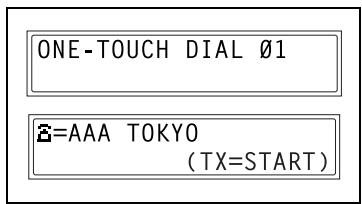
ONE-TOUCH DIAL ∅1
☑=AAA TOKYO (TX=START)
TX CANCEL? YES / CONTINUE=NO
To fax using speed dialing
If speed dial numbers have already been programmed, the fax number of a recipient can be specified quickly by entering the corresponding speed dial number.
For details on programming speed dial numbers, refer to "Specifying the Setting for "SPEED DIAL" on page 6-7.
1 Press the [FAX] key to enter Fax mode.
2 Load the document into the Automatic Document Feeder.
For details on placing the document on the Original Glass, refer to "To fax documents positioned on the Original Glass" on page 3-16.
3 If necessary, change the "Resolution" setting (p. 3-13).
4 Press the [SPEED DIAL] key, and then use the 10-Key Pad to enter the 3-digit speed dial number.

Tip
If the wrong speed dial number has been pressed, press the [AUTO RESET] key.
5 Press the [START] key.
The machine automatically starts scanning the document and sending the fax.
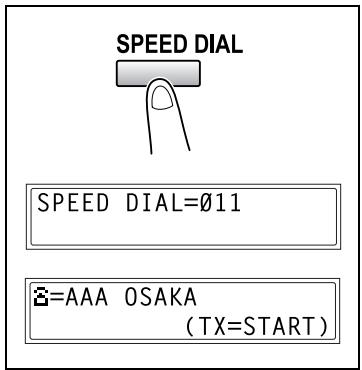

Tip
To stop the fax transmission, press the [STOP] key, and then press the [YES] key when the next screen appears.
To fax using group dialing
If one-touch dial keys have already been programmed with a group of fax numbers, the fax numbers of all recipients in the group can be specified by pressing just the corresponding one-touch dial key.
For details on programming one-touch dial keys with a group of fax numbers, refer to "Specifying the Setting for "GROUP DIAL" on page 6-11.
1 Press the [FAX] key to enter Fax mode.
2 Load the document into the Automatic Document Feeder.
For details on placing the document on the Original Glass, refer to "To fax documents positioned on the Original Glass" on page 3-16.
3 If necessary, change the "Resolution" setting (p. 3-13).
4 Press the one-touch dial key ([01] through [27]) programmed with the group of fax numbers that you wish to send the fax to.

Tip
If the wrong one-touch dial key has been pressed, press the [NO] key.
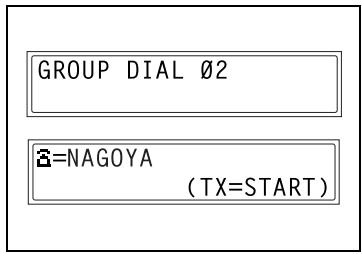
5 Press the [START] key.
The machine automatically starts scanning the document and sending the fax.
natural_image
Simple line drawing of a finger pressing a circular button with an eye symbol (no text or labels)
Tip
To stop the fax transmission, press the [STOP] key, and then press the [YES] key in the next screen that appears.
To fax using chain dial
Faxes can be sent to recipients that are specified using any combination of one-touch dial keys, speed dial numbers, direct input using the 10-Key Pad, and the [Redial] key.
As an example, the following procedure describes how to specify recipients using one-touch keys, then using the 10-Key Pad.
1 Press the [ON-HOOK] key.
2 Press the desired one-touch key, and then press the [START] key.
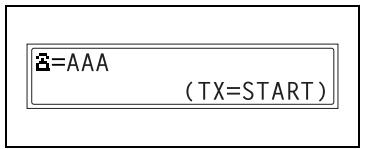
3 After the message "SET DOC. FACE UP" appears, use the 10-Key Pad to enter the recipient's fax number.
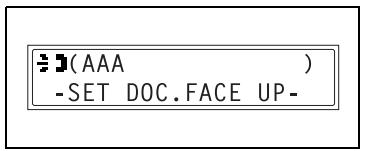
4 After the message "SET DOC. FACE UP" appears, load the document into the Automatic Document Feeder.

5 Press the [START] key.

Tip
To stop the fax transmission, press the [STOP] key, and then press the [YES] key in the next screen that appears.
To fax using program dialing
If one-touch dial keys have already been programmed with fax numbers and a transmission/reception function (such as timer transmission or polling reception), that function can be carried out by pressing just the corresponding one-touch dial key.
For details on setting program dialing, refer to "Specifying the Setting for "PROGRAM DIAL" on page 6-15.
1 Press the [FAX] key to enter Fax mode.
2 Load the document into the Automatic Document Feeder.
- For details on placing the document on the Original Glass, refer to "To fax documents positioned on the Original Glass" on page 3-16. - This step is not necessary with polling reception.
3 If necessary, change the "Resolution" setting (p. 3-13).
- This step is not necessary with polling reception.
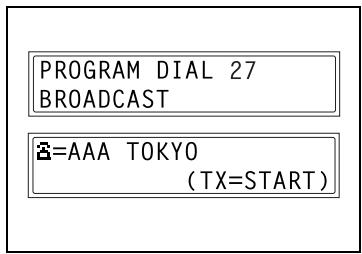
4 Press the one-touch dial key ([24] through [27]) programmed with the desired function.

Tip
If the wrong one-touch dial key has been pressed, press the [NO] key.
PROGRAM DIAL 27 BROADCAST
☎=AAA TOKYO (TX=START)
5 Press the [START] key.
The programmed function automatically begins.

Tip
To stop the fax transmission, press the [STOP] key, and then press the [YES] key in the next screen that ap
To cancel a timer transmission, select "CANCEL RESERV." from the "FUNCTION" menu (p. 4-18).
natural_image
Simple line drawing of a finger pressing a circular button with a diamond symbol (no text or labels)To fax using the phone book
The phone book contains all programmed one-touch dialing and speed dialing numbers, allowing you to search for and select the recipient that you wish to send the fax to.
1 Press the [FAX] key to enter Fax mode.
2 Load the document into the Automatic Document Feeder.
For details on placing the document on the Original Glass, refer to "To fax documents positioned on the Original Glass" on page 3-16.
3 If necessary, change the "Resolution" setting (p. 3-13).
4 Press the [TEL BOOK] key.
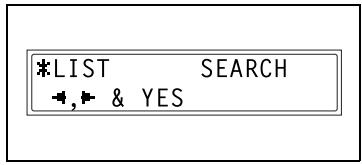
5 Using the [◀] and [▶] keys, select either "LIST" or "SEARCH", and then press the [YES] key.
○ If "LIST" was selected: The list of programmed one-touch dialing and speed dialing numbers is displayed. Using the [▲] and [▼] keys, select the desired recipient.
If "SEARCH" was selected:
A screen appears, allowing you to enter the text to be searched for. Search for the desired recipient by entering part (or all) of the name programmed. For details on performing the search, refer to "To search the phone book" on page 3-9.
6 Press the [START] key.
The machine automatically starts scanning the document and sending the fax.
![*LIST SEARCH -, & YES *AAA NEW YORK OK=START SEARCH->>AAA_ OK=YES [A]](/content/2025/01/139714/images/db8a89829477d0a6b3b0d7ffbd07e0e03ce02efc027afbb9018ff6ab4230dac7.jpg)
To search the phone book
1 Press the [TEL BOOK] key.
2 Using the [◀] and [▶] keys, select "SEARCH", and then press the [YES] key.
A screen appears, allowing you to enter the text to be searched for.
3 Using the 10-Key Pad, enter the first few characters of the name programmed for the desired recipient.
![SEARCH->>AAA_ OK=YES [A]](/content/2025/01/139714/images/faa437668051e1497caabc00074a355eceb327d5d53d571694f7af1d918fc37e.jpg)
Enter the name programmed in the one-touch dial key or the speed dial number. (For details on entering text, refer to "Entering Text" on page 2-9.)
○ Text up to 10 characters long can be entered.
4 Press the [YES] key.
The number of names beginning with the text entered in step 3 is displayed.
To select a recipient from the displayed search results, skip to step 7.
Are there no one-touch dialing or speed dialing numbers with names beginning with the entered text?
→ After “(0)” is displayed, the screen allowing you to enter the search text appears.
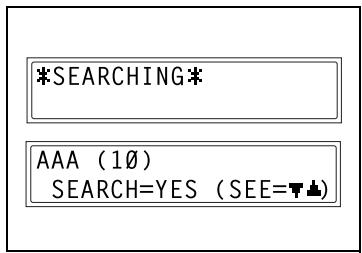
5 To narrow down the search results even further, press the [YES] key, and then enter more search text.
![SEARCH->>AAA NEW_ OK=YES [A]](/content/2025/01/139714/images/d73b2f56187c5e739880e829d88344b261a1e3f21e9fce5516e448b58cf1c1c4.jpg)
6 Press the [YES] key.
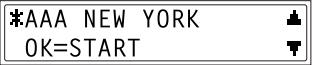
7 Using the [▲] and [▼] keys, select the desired recipient.
☐ If the desired recipient name does not appear in the search results, press the [NO] key twice to return to the screen allowing
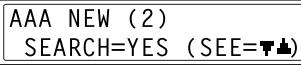
you to enter the search text, and then try searching for different text.

Tip
The search results appear in the order that they have been programmed as one-touch dial keys or speed dial numbers.
8 Press the [START] key to begin scanning and sending the fax.
To redial the last recipient called
1 Press the [FAX] key to enter Fax mode.
2 Load the document into the Automatic Document Feeder.
3 If necessary, change the "Resolution" setting (p. 3-13).
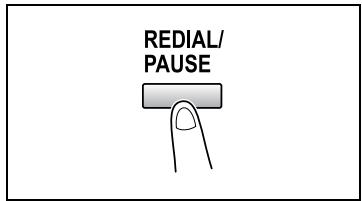
4 Press the [REDIAL/PAUSE] key. The fax number of the last recipient called is displayed.
5 Press the [START] key.
The machine automatically starts scanning the document and sending the fax.
3.2 Transmission Settings
Adjusting the Fax Resolution
Selecting one of the following resolutions to match the type of document to be faxed (documents containing a lot of small print, detailed illustrations or photos) will produce a sharper result.
| Document type | Resolution setting |
| Documents with normal print | STD (Standard) |
| Documents containing small print, such as newspapers | Fine, S/F (Super Fine) |
| Documents containing detailed illustrations | |
| Documents containing text and objects with varying shades, such as photos | H/T + STD (Half Tone + Standard), H/T + Fine (Half Tone + Fine) |
| Documents containing objects with varying shades, such as photos | H/T + Fine (Half Tone + Fine), H/T + S-FINE (Half Tone + Super Fine) |
To specify the resolution
1 Position the document to be faxed.
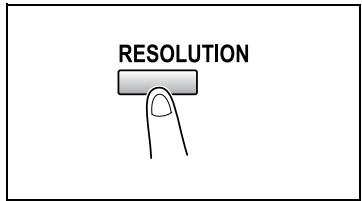
2 Press the [RESOLUTION] key on the control panel to select the resolution mode.
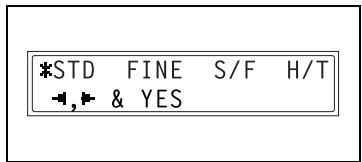
3 Using the [◀] and [▶] keys, select the fax resolution, and then press the [YES] key.
○ If “H/T” (Half Tone) was selected, select “STD”, “FINE” or “S/F” in the next screen.

Note
Depending on the recipient's fax machine, faxes sent with the Super Fine or Super Fine + Half Tone setting may not be sent as specified, and instead are sent with the Fine or Half Tone setting.
If the Half Tone or Super Fine + Half Tone setting is specified, the fax may be sent with a decreased resolution depending on the quality of the recipient's fax machine or whether the document size is larger than the paper loaded in the recipient's fax machine.
3.3 Basic Faxing
To fax using the Automatic Document Feeder
1 Press the [FAX] key.
The machine enters Fax mode, and the fax screen appears.
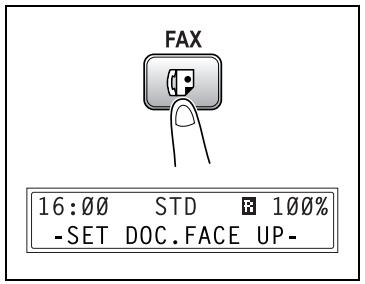
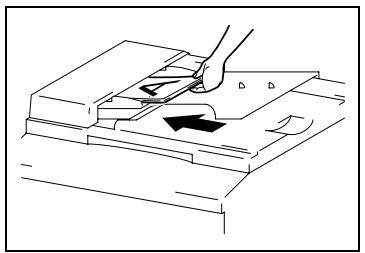
2 Load the document to be faxed into the Automatic Document Feeder.
○ Adjust the Document Guide Plates to fit the size of the document.
○ Load the document face up.

natural_image
Diagram of a hand using a tool to press or install a component on a base, with no visible text or symbols.Tip
If a double-sided document is loaded into the Duplexing Document Feeder (Option for the Konica Minolta 7220 only), press the [ORIGINAL] key until the "Duplex Orig." function is selected.
3 If necessary, change the "Resolution" setting (p. 3-13).
4 Using the 10-Key Pad, enter the fax number of the recipient.
☐ The fax number of a previously programmed recipient can also be specified. Refer to “Dialing” on page 3-1.
![a=1_ SUB=▼ [1]](/content/2025/01/139714/images/e30a11f04f014cd66b7a5ea3bd787e6fa5a17556e0d3e59492ffdd2bc97f8e30.jpg)
5 Press the [START] key to begin scanning and sending the fax.
To stop the transmission, press the [STOP] key, and then press the [YES] key in the next screen that appears.
Once transmission is finished, a beep is sounded.
If the fax could not be sent, the transmission result report is printed (p. 6-56).
![KONICA MINOLTA FK-118 - Press the [START] key to begin scanning and sending the fax. - 1](/content/2025/01/139714/images/d2950fe5d532954880cd4f0d37f667f96c03bef26ce538ffc6858e9f6de31eda.jpg)
Tip
In no received documents or polling transmission documents are saved in the memory, up to 280 A4 (Letter)-size document pages can be scanned and stored in the memory at one time. However, if the optional expansion memory is installed, up to 1024 scanned pages can be stored.

To cancel the transmission:
If you wish to cancel a scanned document queued for transmission or a fax waiting to be redialed, select "CANCEL RESERV." from the "FUNCTION" menu (p. 4-18).

Tip
While faxing, if the recipient's fax machine is busy or does not answer for any other reason, such as a transmission error, the fax is not sent correctly, the transmission result report is printed.
To fax documents positioned on the Original Glass
1 Press the [FAX] key.
The machine enters Fax mode, and the fax screen appears.
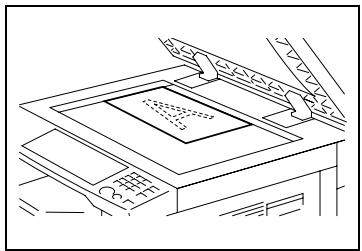
2 Lift open the Automatic Document Feeder, and then position the document to be faxed on the Original Glass.
○ Position the document face down.
○ Align the document on the scales above and to the left of the Original Glass.
natural_image
Line drawing of a mechanical assembly or printing process with no visible text or symbols3 If necessary, change the "Resolution" setting (p. 3-13).
4 Using the 10-Key Pad, enter the fax number of the recipient.
☐ The fax number of a previously programmed recipient can also be specified. Refer to “Dialing” on page 3-1.
![≡=1_ SUB=▼ [1]](/content/2025/01/139714/images/beabfef00049c442b66e937dc3008200e5460ea7e3fa5116263c64e15c484bd7.jpg)
5 Press the [START] key.
![KONICA MINOLTA FK-118 - Press the [START] key. - 1](/content/2025/01/139714/images/fd2203a9477021a79032fa2b93befcd25970e1bc7a3934f97a04ba1daa2111cc.jpg)
Note
To specify a scanning area other than the size of the loaded document or if the document size cannot be detected automatically, press the [▼] key.
In the next screen that appears, select "MANUAL", and then press the [YES] key.

Then, select the desired paper size, and then press the [YES] key.
6 Press the [YES] key.
The document is scanned.
![KONICA MINOLTA FK-118 - Press the [YES] key. - 1](/content/2025/01/139714/images/8fac0f27d89bd9013a70fa5ff449282a6deed99003cb8421bbd8f634b4208324.jpg)
Note
To scan the next document page, press the [YES] key, and then position the next document page.
7 Press the [START] key.
To stop the transmission, press the [STOP] key, and then press the [YES] key in the next screen that appears.
Once transmission is finished, a beep is sounded. If the fax could not be sent, the transmission result report is printed (p. 6-56).
If the Memory Becomes Full While Scanning Fax Documents
With a queued transmission (a fax transmission requested while another fax transmission job is being performed) or timer transmission, if the memory becomes full while scanning the document, a message appears, allowing you to select whether to send just the scanned pages or cancel the transmission. If the transmission is canceled, the data for the scanned pages is deleted. After the other fax transmission or reception is finished, check the amount of memory available, and then try sending the fax again.
If the memory becomes full, all pages that have been scanned are erased.
3.4 Confirmation Mode
Checking the Machine's Counters
The number of operations performed since this machine was installed can be checked using the functions available when the [STATUS] key is pressed.
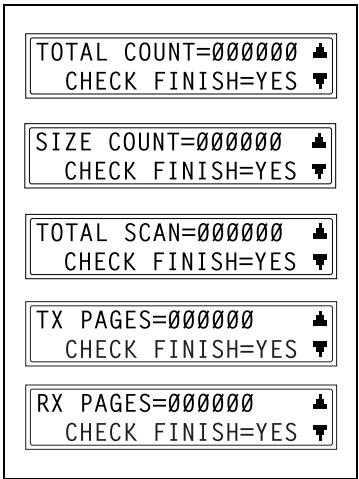
Items that can be checked with machine counter menu:
| MACHINE COUNTER | Description |
| TOTAL COUNT | This count shows the total number of prints made since this machine was installed. |
| SIZE COUNT | This count shows the total number of prints made for the specified paper size. (The paper size that is counted should be set by the service representative.) |
| TOTAL SCAN | This count shows the total number of scans made, excluding copies, since this machine was installed. |
| TX PAGES | This count shows the total number of pages faxed since this machine was installed. |
| RX PAGES | This count shows the total number of fax pages received since this machine was installed. |
To check the counters
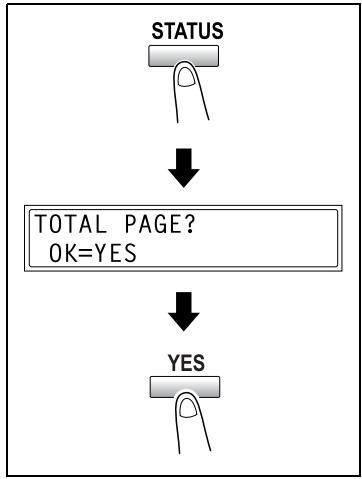
1 Press the [STATUS] key, and then press the [YES] key.
The machine counter menu appears.
flowchart
graph TD
    A["STATUS"] --> B["TOTAL PAGE? OK=YES"]
    B --> C["YES"]
2 Using the [▲] and [▼] keys, select the counter that you wish to check.
3 Press the [YES] key.
The “TOTAL PAGE” appears.
4 Press the [NO] key.
The main screen appears.
Checking Transmission Results
The transmission result information for a maximum of 60 sent and received documents is saved.
To check the transmission result
1 Press the [STATUS] key twice. The “TX/RX RESULT” appears.
2 Press the [YES] key.
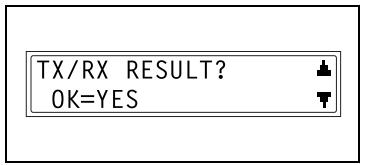
3 Using the [▲] and [▼] keys, display the desired transmission results to check them.
In the transmission result screen, "TX" indicates sent faxes, and "RX" indicates received ones.
○ If the [NO] key is pressed twice while the transmission results are displayed, the main screen
To print the transmission result report, press the [START] key. After the transmission result report is printed, the main screen appears.
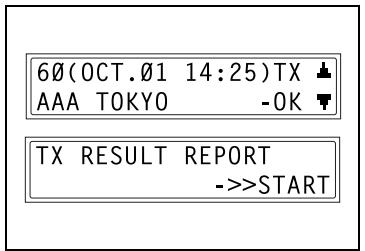
Outputting a report/list
The various reports and lists of programmed settings can be printed using the functions available when the [STATUS] key is pressed.

Tip
Paper of the following sizes can be used to output the reports.
However, when printing on A5 C, B5 C, or Invoice (8-1/2 × 5-1/2) C paper, the report may be divided among several sheets of paper.
Metric: A5 C, B5 C, A4 L/C, B4 L, A3 L
Inch: Invoice (8-1/2 × 5-1/2) C, Letter L/C, Legal (8-1/2 × 14) L, Ledger (11 × 17) L
To output a report/list
1 Press the [STATUS] key three times.
The "PRINT REPORT" appears.
2 Press the [YES] key.
A menu appears, showing the reports and lists that can be printed.
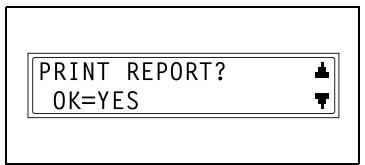
3 Using the [▲] and [▼] keys, select the report/list that you wish to print, and then press the [YES] key.
After the specified report/list is printed, the main screen appears again.
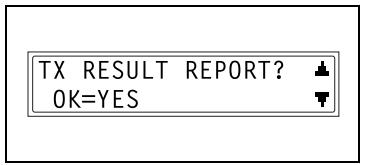

Tip
The reception/transmission result reports can be checked on screen. For details on viewing the transmission result, refer to “To check the transmission result” on page 3-20.
The following reports and lists can be printed.
Transmission Result Report
The document number, recipient name, date sent, starting time of transmission, number of document pages, time required, mode, and transmission result are printed.
| Session | Function | No. | Destination Station | Date | Time | Page | Duration | Mode | Result |
| 0001 | TX | 001 | AAA NEWYOR 012345678 | APR.19 | 18:00 | 010 | 00:02'21" | G3 | NG |
| NG PAGE:1.3.5.7 | |||||||||
Reception Result Report
The document number, caller name, date received, starting time of reception, number of pages received, time required, mode, and reception result are printed.
| Session | Function | No. | Destination Station | Date | Time | Page | Duration | Mode | Result |
| 0001 | RX | 001 | Aaa Tokyo 098765432 | Apr.19 | 18:00 | 001 | 00:02'21" | ECM | NG |
| 0021:error During Rx | |||||||||
Activity Report
The operation number, document number, date of operation, starting time of transmission/reception, type of operation (transmission or reception), recipient/caller name, number of pages sent/received, mode, and transmission/reception result are printed.
The machine can also be set to print this report automatically after every 60 transmissions/receptions.
| No. | Session | Date | Time | Tx/rx | Destination Station | Page | Duration | Mode | Result |
| 01 | 0001 | Apr.19 | 16:32 | TX--- | Aaa Newyork 012345678 | 006 | 00:01'16" | ECM | OK |
| 02 | 0002 | Apr.19 | 18:00 | ---RX | Aaa Tokyo 098765432 | 001 | 00:02'21" | ECM | NG |
| 03 | 0002 | Apr.19 | 18:00 | ---RX | Aaa Tokyo 098765432 | 012 | 00:02'48" | ECM | OK |
| 04 | 0003 | Apr.19 | 19:12 | TX--- | Head Office 024682468 | 001 | 00:00'56" | ECM | OK |
Memory Data List
This is a list of documents stored in the memory and waiting to be sent, and documents specified for timer transmission, batch transmission or polling reception.
The document number, type of operation being performed, time, recipient/ caller name, and number of document pages are printed.
Memory Image Print
A reduced image of the first page of the document stored in the memory and waiting to be sent in addition to the document number, type of operation being performed, recipient/caller name, date, time, and number of document pages are printed.
List of One-Touch Dial Keys
The recipients programmed in the one-touch dial keys are printed in numerical order of the keys.
| Ot-no. | Destination Station | Destination Number | Detail | Set Date | |
| Ot-01 | Aaa Newyork | 012345678 | 33.6 | Jan.20.2001 | |
| Ot-02 | Aaa Tokyo | 098765432 | 14.4 | Jan.20.2001 | |
| Ot-03 | Head Office | 024682468 | 16:00 | 33.6 | Feb.12.2001 |
| Ot-04 | Nj Office | 0p02345678Sub:#1234 | 14.4 | Feb.12.2001 | |
List of Speed Dial Numbers
The recipients programmed for the speed dial numbers are printed in numerical order.
| Sp-no. | Destination Station | Destination Number | Detail | Set Date | |
| Sp-001 | Amsterdam Office | 0p09876543 | 33.6 | Jan.20.2001 | |
| Sp-002 | Korea Office | 0p01357913 | 14.4 | Jan.20.2001 | |
| Sp-003 | Abcdef | 024682468 | 33.6 | Feb.12.2001 | |
| Sp-004 | Post Office | 0224466880 Sub:#5678 | 14.4 | Feb.12.2001 | |
Key Setting List
The group dialing and program dialing settings specified for one-touch dial keys are printed in numerical order of the keys.
Relay Box List
The status and settings for the 10 relay boxes can be printed and checked.
Machine Status List
The current machine settings are printed.
Configuration Page
The list of the printer settings is printed.
PCL Font List
This function is only available when the Printer Controller (optional) is installed.
The PCL font list is printed.
4 Fax Transmission/Reception Methods
4.1 Transmission Methods
Memory Transmission
With memory transmission, the document is scanned, then stored in the memory for transmission (queued transmission).
Memory transmission is selected as the default transmission mode.
For details on sending faxes through memory transmission, refer to "Basic Faxing" on page 3-14.
To specify Memory TX
1 Press the [FAX] key.
The machine enters Fax mode, and the fax screen appears.
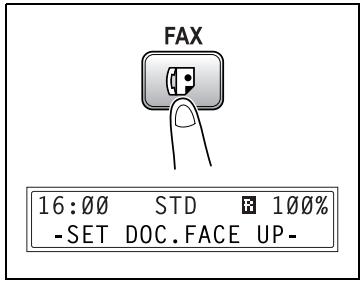
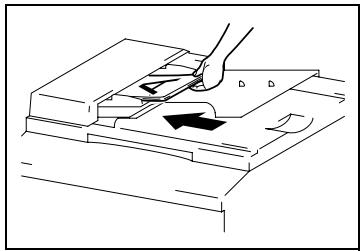
2 Load the document to be faxed into the Automatic Document Feeder.
○ Adjust the Document Guide Plates to fit the size of the document.
○ Load the document face up.
natural_image
Line drawing of a hand pressing down on a mechanical component with arrows indicating motion (no text or symbols)3 If necessary, change the "Resolution" setting (p. 3-13).
4 Using the 10-Key Pad, enter the fax number of the recipient.
☐ The fax number of a previously programmed recipient can also be specified. Refer to "Dialing" on page 3-1.
![a=1_ SUB=▼ [1]](/content/2025/01/139714/images/3d68590d47998299f07d1ec75cbba684ab8efa6775c4a34b092e4ce7914faffc.jpg)
5 Press the [MEMORY TX] key, and then check that the MEMORY TX lamp lights up.
![KONICA MINOLTA FK-118 - Press the [MEMORY TX] key, and then check that the MEMORY TX lamp lights up. - 1](/content/2025/01/139714/images/3e302055902ff0b5f50bb3d2cb944ec7013634aa183e2644f75f5dc074832f43.jpg)
MEMORY TX
![KONICA MINOLTA FK-118 - Press the [MEMORY TX] key, and then check that the MEMORY TX lamp lights up. - 2](/content/2025/01/139714/images/c061b9ac345cc5f345aa25e7403d89071d934158a68a4183c2abbd103d2a5e8d.jpg)
Note
If the MEMORY TX lamp is not lit, the direct transmission is selected.
6 Press the [START] key to begin scanning and sending the fax.
To stop the transmission, press the [STOP] key, and then press the [YES] key in the next screen that appears.
Once transmission is finished, a beep is sounded.
If the fax could not be sent, the transmission result report is printed (p. 6-56).
Direct Transmission
If the MEMORY TX lamp is not lit, the direct transmission is selected. One page of the document at a time can be scanned, according to the transmission status. This ensures that even documents with many pages can be sent.

...
Note
When faxing using direct transmission, the document should be loaded into the Automatic Document Feeder. Transmission is not possible by positioning the document on the Original Glass.
If direct transmission is specified while a fax is being sent or received, the transmission will be queued.
With direct transmission, multiple recipients cannot be specified.
Direct transmission and timer transmission cannot be performed at the same time.
Manual Transmission
If the machine is connected to a telephone and the same line is used for phoning and faxing, the document can simply be sent after talking with the recipient over the phone.
This is useful, for example, if you wish to tell the recipient that you are sending a fax.

...
Note
If the recipient's fax machine is set to receive faxes automatically (automatic reception), a beep is sounded without the recipient answering the phone; however, at that time, the telephone cannot be used for talking.
If the fax is to be sent after talking on the telephone, use the Automatic Document Feeder.
Manual transmission is possible if a telephone (either purchased or rented) is connected to the TEL port of this machine.

...
Tip
Even when pulse dialing is being used, entering “*” produces signals for tone dialing.
To send a fax manually
1 Load the document into the Automatic Document Feeder.
2 If necessary, change the "Resolution" setting (p. 3-13).
3 Pick up the telephone receiver.
○ Check that the dial tone can be heard.
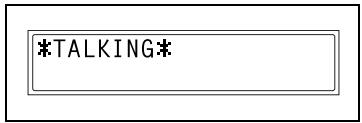
4 Specify the fax number of the recipient.
○ Use the telephone to dial the fax number.
☐ The fax number of the recipient can also specified using the keys in the control panel of this machine (p. 3-1).
5 After finishing talking on the phone, the recipient should press the necessary key to start receiving the fax.
Once the recipient's fax machine is ready, a beep is sounded.
6 Press the [START] key to begin scanning and sending the fax.
7 Replace the telephone receiver.
To stop the transmission, press the [STOP] key, and then press the [YES] key in the next screen that appears.
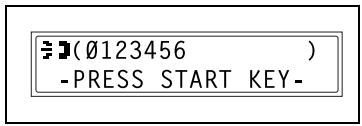

Tip
If the [ON-HOOK] key is pressed instead of picking up the telephone receiver, the speaker can be used for manual transmission in the same way as described above.
Batch Transmission
Multiple documents can be stored in the memory and faxed together at a specified time. In order to use this function, the corresponding Utility mode function must first be used to program a one-touch dial key with the batch transmission settings (transmission time) (p. 6-27).
To fax using batch transmission
1 Load the document into the Automatic Document Feeder.
2 If necessary, change the "Resolution" setting (p. 3-13).
3 Press the one-touch dial key programmed with the desired batch transmission settings.
4 Press the [START] key. The fax is sent at the specified time.

Tip
To cancel a batch transmission, select "CANCEL RESERV." from the "FUNCTION" menu (p. 4-18).
Broadcast Transmission
The same document can be sent to multiple recipients at one time.
The recipients can be specified by using the one-touch dial keys, the speed dial numbers or group dialing, by selecting from the phone book, or by entering the fax number using the 10-Key Pad.

Note
A maximum of 243 recipients can be selected at one time. If recipients are selected by using one-touch dial keys, a maximum of 27 recipients can be specified. If recipients are selected by using speed dial numbers, a maximum of 200 recipients can be specified.
A maximum of 16 recipients can be specified by entering the fax number using the 10-Key Pad.

Tip
With the result report printed after the transmission is finished, you can check whether the fax was sent to all recipients.
To fax using broadcast transmission
1 Position the document to be faxed.
2 If necessary, change the "Resolution" setting (p. 3-13).
3 Press the [FAX SET] key.
4 Press the [1] key from the 10-Key Pad.
or
Press the [FAX SET] key once to select “BROADCAST”, and then press the [YES] key.
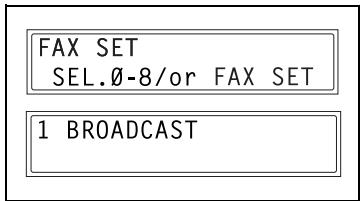
5 Specify the fax number of the recipient.
Repeat the appropriate operations described below until all recipients have been specified.
○ When using the one-touch dial keys:
Press the one-touch dial key programmed with the desired fax number.
Press the [YES] key, and then specify the next recipient.
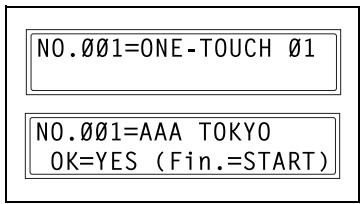
○ When using the speed dial numbers:
Press the [SPEED DIAL] key, and then use the 10-Key Pad to enter the 3-digit speed dial number programmed with the desired fax number.
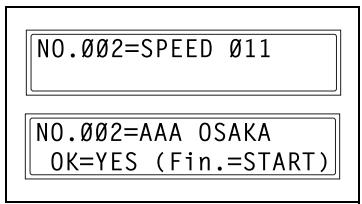
Press the [YES] key, and then specify the next recipient.
○ When using group dialing:
Press the one-touch dial key programmed with the desired group of fax numbers.
Press the [YES] key, and then specify the next recipient.
○ When selecting from the phone book:
Press the [TEL BOOK] key, and then select either “LIST” or “SEARCH” to select the desired fax number. (Refer to “To fax using the phone book” on page 3-8.)
Press the [YES] key, and then specify the next recipient.
When entering the number using the 10-Key Pad: Enter the fax number of the recipient.
Press the [YES] key, and then specify the next recipient.
$$ \begin{array}{l} \text {NO.003 = 0123456_} \ \text {OK = YES} \quad (\text {SUB = T}) \end{array} $$
- For details on entering text, refer to “Entering Text” on page 2-9.
6 Press the [START] key.
A message appears, allowing you to select whether or not to check the recipients.
7 To check the recipients, press the [YES] key.
○ If you do not wish to check the recipients, skip to step 9.
$$ \begin{array}{l} \text { CHECK DESTINATIONS? } \ \text { OK = YES } \quad (\text { TX = START }) \end{array} $$
8 The recipients specified in step 5 are displayed in the order that they were selected.
Check the recipient, and then press the [YES] key.
○ To delete the displayed recipient, press the [NO] key.
After all recipients have been checked, "Fin.=START" appears in the display.
$$ \begin{array}{l l} \text {NO.001 = AAA} & \text {TOKYO} \ \text {OK = YES} & (\text {DEL = NO}) \end{array} $$
$$ * N O. 0 0 1 \text { DELETED* } $$
$$ \begin{array}{l} \text {NO.005 = _} \ \text {Fin. = START} \end{array} \tag {1} $$
9 Press the [START] key to begin scanning and sending the fax.

Note
To stop the fax transmission, press the [STOP] key, and then press the [YES] key when the next screen appears. If this is done, all selected recipients are cleared. To stop a timer transmission, press the [FAX SET] key to select “CANCEL RESERV.”, and then perform the appropriate procedure (p. 4-18).
Timer Transmission
A document can be scanned and stored in the memory to be sent at a specified time. This function is convenient for sending documents with a large number of pages at discounted calling times.

Note
The time is set for a 24-hour period.
If the machine is not programmed with the current time (p. 6-59), the fax cannot be sent at the specified time.
A timer transmission cannot be performed at the same time as a direct transmission.

Tip
Timer transmission can be combined with broadcast transmission, mailbox transmission, polling reception, or relay initiation transmission.
To fax using timer transmission
1 Position the document to be faxed.
2 If necessary, change the "Resolution" setting (p. 3-13).
3 Press the [FAX SET] key.
4 Press the [2] key from the 10-Key Pad.
or
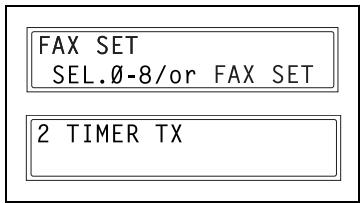
Press the [FAX SET] key twice to select "TIMER TX", and then press the [YES] key.
A screen appears, allowing you to specify the transmission time.
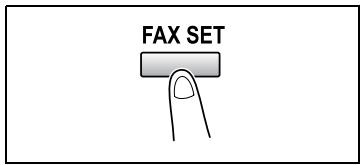
5 Using the 10-Key Pad, enter the desired transmission time, and then press the [YES] key.
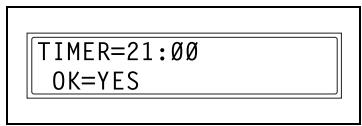
☐ If you wish to correct the time, press the [NO] key, and then enter the correct time.
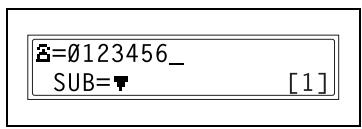
6 Specify the fax number of the recipient.
○ Refer to "Dialing" on page 3-1.
7 Press the [START] key.
The machine scans the document, then enters transmission standby mode.

Note
To stop a timer transmission, press the [FAX SET] key to select "CANCEL RESERV.", and then perform the appropriate procedure.
Mailbox Transmission
The fax can be sent to a recipient's mailbox.
This is perfect for sending an important document to a specific person.

Note
Mailbox transmission is compatible with F code transmission.
Machines compatible with F codes can be specified as recipients for mailbox transmission.
To fax using mailbox transmission
1 Position the document to be faxed.
3 Press the [FAX SET] key.
2 If necessary, change the "Resolution" setting (p. 3-13).
4 Press the [3] key from the 10-Key Pad.
or
Press the [FAX SET] key three times to select "MAILBOX TX", and then press the [YES] key.
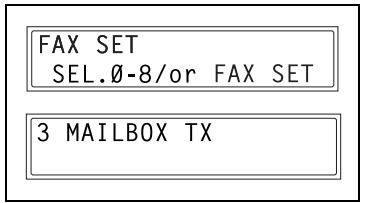
5 Specify the recipient, and then press the [YES] key.
○ Refer to "Dialing" on page 3-1.
A screen appears, allowing you to specify the mailbox ID.
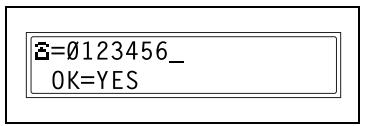
6 Using the 10-Key Pad, enter the mailbox ID of the recipient.
- Enter the mailbox ID (SUB) (20 digits or less) registered for the recipient.
MAILBOX ID=1234
OK=YES
☐ The only characters that can be used in the mailbox ID are 0 through 9, *, and #.
☐ If the recipient is specified using a one-touch dial key or a speed dial number also programmed with a SUB, the SUB is displayed as the mailbox ID. If necessary, change the mailbox ID.
☐ If you wish to correct the mailbox ID, press the [NO] key, and then enter the new number.

Note
The same ID cannot be used as the relay box ID and mailbox ID.
7 Press the [YES] key.
8 Using the 10-Key Pad, enter the password.
- Enter the password (20 digits or less) if a password has been set for the recipient's mailbox.
PASSWORD=5678
(TX=START)
The only characters that can be used in the password are 0 through 9, *, and #.
☐ If you wish to correct the password, press the [NO] key, and then enter the new number.
9 Press the [START] key to begin scanning and sending the fax.

Note
The recipient's machine and mailbox settings must be specified.
In order for the recipient to check fax documents, the mailbox ID is needed.
Relay Initiation Transmission
Documents can be sent from this machine (transmitting station) to another fax machine (acting as a relay station), which then sends the documents to multiple recipients (receiving stations). By relaying the documents through a fax machine closer to the remote recipients, the transmission time and cost for the transmitting station are reduced.
In order to fax using relay initiation transmission, a relay box must first be programmed at the relay station.

Note
Relay initiation transmission is compatible with F code transmission. Only machines that are compatible with relay broadcast transmission should be specified as relay stations. This machine can be specified as a relay station.
Relay initiation transmission and mailbox transmission cannot be performed at the same time.
In order to fax using relay initiation transmission, a relay box ID must first be programmed at the relay station (p. 6-25).
To fax using relay initiation transmission
1 Position the document to be faxed.
2 If necessary, change the "Resolution" setting (p. 3-13).
3 Press the [FAX SET] key.
4 Press the [7] key from the 10-Key Pad.
or
Press the [FAX SET] key seven times to select “RELAY INITIATE”, and then press the [YES] key.
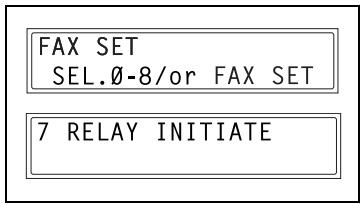
5 Specify the relay station, and then press the [YES] key.
- Refer to "Dialing" on page 3-1. A screen appears, allowing you to specify the relay box ID.
$$ \begin{array}{c} \text { ☒ } = \emptyset 1 2 3 4 5 6 _ \ 0 K = Y E S \end{array} $$
6 Using the 10-Key Pad, enter the relay box ID.
- Enter the relay box ID (20 digits or less) programmed at the relay station.
$$ \begin{array}{l} \text { RELAY BOX ID = 1234_ } \ \text { OK = YES } \end{array} $$
☐ The only characters that can be used in the mailbox ID are 0 through 9, *, and #.
☐ If you wish to correct the ID, press the [NO] key, and then enter the new number.
7 Press the [YES] key.
A screen appears, allowing you to specify the password.
8 Using the 10-Key Pad, enter the password.
$$ \begin{array}{l} \text {PASSWORD = 5678} \ \text {(TX = START)} \end{array} $$
- Enter the password (20 digits or less) if a password has been set at the relay station.
The only characters that can be used in the password are 0 through 9, *, and #.
☐ If you wish to correct the password, press the [NO] key, and then enter the new number.
9 Press the [START] key to begin scanning and sending the fax.
Relay Broadcast Transmission
If this machine is specified as a relay station, it can receive documents sent from another fax machine (transmitting station), then send the documents to multiple recipients (receiving stations).
In order to fax using relay broadcast transmission, a relay box must first be programmed. A maximum of 10 relay boxes can be programmed. For details on programming a relay box, refer to "Setting Up Relay Boxes ("RELAY BOX" function)" on page 6-33.

Note
Relay broadcast transmission is compatible with F code transmission. In order for the machine to function as a relay station, a 4-digit relay box ID must first be programmed (p. 6-33).
In order to fax using relay broadcast transmission, the receiving stations (final recipients) must be programmed in a relay box (p. 6-33). The document is printed at the receiving stations.

Note
The same ID cannot be used as the relay box ID and mailbox ID.
A maximum of 50 recipients can be specified using one-touch dial keys, speed dial numbers and group dialing.
Polling Transmission
Documents scanned and saved in the memory can be retrieved by the recipient.

Note
Polling transmission is compatible with F code transmission.
A maximum number of 30 documents can be saved in the memory.
If the memory is full, polling transmission cannot be set.
With polling transmission, the recipient incurs the cost of the call.
To set up polling transmission
1 Position the document to be faxed.
2 If necessary, change the "Resolution" setting (p. 3-13).
3 Press the [FAX SET] key.
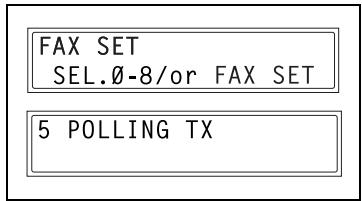
4 Press the [5] key from the 10-Key Pad.
or
Press the [FAX SET] key five times to select "POLLING TX", and then press the [YES] key.
5 Using the [◀] and [▶] keys, select either "SINGLE" or "MULTI", and then press the [YES] key.
To allow only one polling transmission request, then delete the document from the memory, select "SINGLE".
To allow multiple polling transmission requests, select "MULTI". The document is stored in the memory until it has been deleted.
6 Using the 10-Key Pad, enter the 4-digit polling ID, and then press the [YES] key.
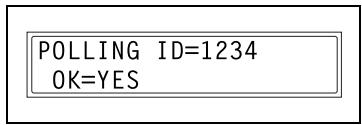
○ If you do not wish to set a polling ID, skip to step 8.
- The polling ID can be set to any number between 0000 and 9999.
☐ If there is only one polling transmission document, it is not necessary to specify a polling ID and password.
To correct the ID, press the [NO] key, and then enter the new number.
7 Using the 10-Key Pad, enter the 4-digit password.
○ If you do not wish to set a password, continue with step 8.
- The password can be set to any number between 0000 and 9999.
To correct the password, press the [NO] key, and then enter the new number.
8 Press the [START] key.
The machine scans the document, then enters standby mode.
![KONICA MINOLTA FK-118 - Press the [START] key. - 1](/content/2025/01/139714/images/074377d2dd89197728dce0c0bc656266cc167b5332c0f8099a689fcf250b9fc8.jpg)
Note
To stop the fax transmission, press the [STOP] key, and then press the [YES] key when the next screen appears.
To stop a polling transmission, press the [FAX SET] key to select "CANCEL RESERV.", and then perform the appropriate procedure (p. 4-18).
$$ \begin{array}{c} \text {PASSWORD = 5678} \ (\text {TX = START}) \end{array} $$
To delete a document from the polling transmission setup
1 Press the [FAX SET] key.

2 Press the [5] key from the 10-Key Pad.
or
Press the [FAX SET] key five times to select "POLLING TX", and then press the [YES] key.
FAX SET
SEL.∅-8/or FAX SET
5 POLLING TX
If polling transmission has been set, a screen appears, allowing you to specify the polling ID.
3 Using the [◀] and [▶] keys, select either "SINGLE" or "MULTI", and then press the [YES] key.
*SINGLE
MULTI
-, & YES
To allow only one polling transmission request, then delete the document from the memory, select "SINGLE".
To allow multiple polling transmission requests, select "MULTI". The document is stored in the memory until it has been deleted.
4 Using the 10-Key Pad, enter the polling ID, and then press the [YES] key.
POLLING ID=1234
OK=YES
5 Press the [NO] key to delete from the memory the document set for polling transmission.
REGISTERED!
KEEP?
KEEP=YES
(DEL=NO)
- To keep the polling transmission setting, press the [YES] key.
POLL TX DOC. DELETED
6 Press the [NO] key twice to return to the main screen.
Canceling (Deleting) a Document Queued in the Memory for Transmission
Of the documents stored in the memory and waiting to be sent, a specific document can be selected and deleted.
To cancel a queued document
1 Press the [FAX SET] key.
2 Press the [8] key from the 10-Key Pad.
or
Press the [FAX SET] key eight times to select "CANCEL RESERV.", and then press the [YES] key.
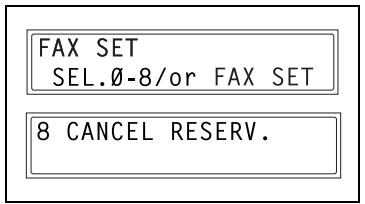
The details (specified transmission time/type of transmission) of the jobs queued in the memory are displayed.
? What appears in the display for a polling transmission job?
→ The polling transmission ID appears.
? Have no jobs been queued in the memory?
→ The message “NONE” appears.
3 Using the [▲] and [▼] keys, select the job to be deleted.
○ The following types of job are displayed.
MEMORY: Memory
transmission
B-CAST: Broadcast
transmission
TIMER: Timer transmission
M.B.TX: Mailbox transmission
POLL-TX: Polling transmission
POLL-RX: Polling reception
RELAY: Relay initiation transmission
FORWARD: Fax forwarding
![Ø1 [13:25] TIMER DEL=YES (CONF.=▶) Ø2 [ : ] MEMORY DEL=YES (CONF.=▶)](/content/2025/01/139714/images/d52ec119180b3f1edac87b9f07fea58165e283a0a949a1cf8954a385241ddb64.jpg)
To check the recipient of the currently displayed transmission job, press the [▶] key. After checking, press the [YES] key to return to the previous screen.
4 Press the [YES] key to delete the displayed job.
"FUNCTION" menu appears in the display.
![*02 [ : ] MEMORY CANCELED*](/content/2025/01/139714/images/ca981b62eeb5d17865a9a726e65531520b6f106f58170d9438779d53fe109379.jpg)
5 To delete another queued job, repeat steps 2 and 4.
☐ If you are finished deleting jobs, press the [NO] key to return to the main screen.
4.2 Reception Methods

Tip
Paper of the following sizes can be used to print fax documents.
Metric: A5 C, B5 C, A4 L/C, B4 L, A3 L
Inch: Invoice (8-1/2 × 5-1/2) C, Letter L/C, Legal (8-1/2 × 14) L, Ledger (11 × 17) L
Manual Reception
This machine normally receives faxes automatically. However, if a telephone is connected and the same line is used for phoning and faxing, the document can simply be received after talking with the caller over the phone.

Note
Manual reception is possible if a telephone is connected to the TEL port of this machine.
To receive faxes manually, use the corresponding Utility mode function to select the manual reception mode (p. 6-43).
To receive a fax manually
1 After the telephone rings, pick up the receiver to talk with the caller.
2 After talking and the caller's fax machine sounds long beeps, press the [START] key.
The machine starts receiving the fax.
? Were the long beeps not sounded by the caller's fax machine?
If the caller's fax machine is set to send automatically, the long beeps may not be sounded.
3 If the telephone receiver is replaced, the fax reception is finished and the machine sounds a beep.
Memory Reception
This machine automatically prints faxes that it has received. However, when receiving confidential faxes, the received document can be stored in the memory and printed at a specified time or when memory reception is turned off.
Memory reception is set using the corresponding Utility mode function. For details on changing the setting, refer to "Specifying the Setting for "MEMORY RX MODE" on page 6-43.
Mailbox Reception
If mailbox numbers and F codes (mailbox IDs and passwords) have already been programmed on this machine, this function can be used to receive only those faxes with an identical mailbox ID and password specified by the caller.
Since the received fax can only be retrieved after entering the corresponding mailbox ID, confidential faxes can safely be sent and received.
For details on programming the mailboxes, refer to "Specifying the Setting for "MAILBOX"'' on page 6-30.
To retrieve a document from a mailbox
1 Press the [FAX SET] key.
2 Press the [4] key from the 10-Key Pad.
or
Press the [FAX SET] key four times to select "PRINT MAILBOX RX", and then press the [YES] key.
A screen appears, allowing you to enter the mailbox ID.
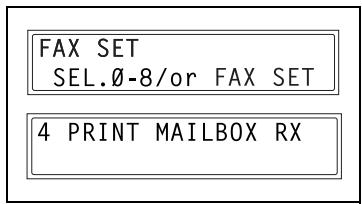
3 Using the 10-Key Pad, enter the 4-digit mailbox ID, and then press the [YES] key.
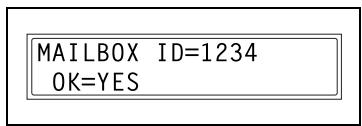
☐ If you wish to correct the ID, press the [NO] key, and then enter the new number.
Polling Reception
Using polling reception, documents set up in other fax machines can be received.

Note
Polling reception is compatible with F code transmission.
A maximum of 243 recipients can be selected at one time. If recipients are selected by using one-touch dial keys, a maximum of 27 recipients can be specified. If recipients are selected by using speed dial numbers, a maximum of 200 recipients can be specified. If fax numbers are being typed in, a maximum of 16 can be specified.
To receive a fax using polling reception
1 Press the [FAX SET] key.
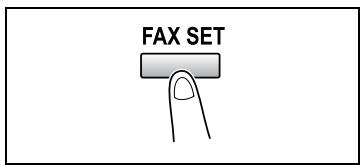
2 Press the [6] key from the 10-Key Pad.
or
Press the [FAX SET] key six times to select "POLLING RX", and then press the [YES] key.
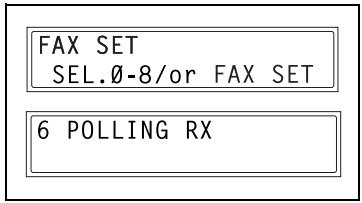
3 Specify the fax number to be called.
○ Refer to step 5 of "To fax using broadcast transmission" on page 4-6.
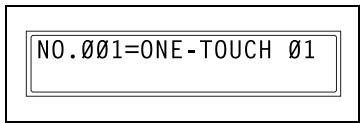
4 To enter the polling ID and password, press the [▼] key.
☐ If there is no need to enter a polling ID and password, press the [YES] key and skip to step 7.
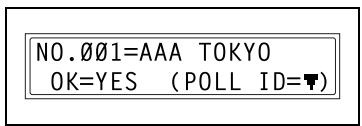
5 Using the 10-Key Pad, enter the polling ID (20 digits or less), and then press the [YES] key.
$$ \begin{array}{c} \text {POLLING ID = 1111_} \ \text {OK = YES} \end{array} $$
To correct the ID, press the [NO] key, and then enter the new number.
6 Using the 10-Key Pad, enter the password (20 digits or less), and then press the [YES] key.
$$ \begin{array}{l} \text { PASSWORD } = 2 2 2 2 \ \text { OK } = \text { YES } \end{array} $$
To correct the password, press the [NO] key, and then enter the new number.
7 To specify multiple fax numbers, repeat steps 3 through 6.
$$ \begin{array}{l} \text {NO.002 =} \ \text {(Fin. = START)} \end{array} $$
○ If you do not wish to specify other fax numbers, continue with step 8.
8 Press the [START] key.
A message appears, allowing you to select whether or not to check the fax numbers to be called.
9 To check the numbers to be called, press the [YES] key.
$$ \begin{array}{l} \text { CHECK DESTINATIONS? } \ \text { OK = YES } \quad (\text { RX = START }) \end{array} $$
○ If you do not wish to check the numbers to be called, skip to step 11.
10 The fax numbers specified in step 3 are displayed in the order that they were selected.
Check the fax numbers, and then press the [YES] key.
$$ \begin{array}{l l} \text {NO.001 = AAA} & \text {TOKYO} \ \text {OK = YES} & (\text {DEL = NO}) \end{array} $$
$$ * N O. 0 0 1 \text { DELETED* } $$
- To delete the displayed fax number, press the [NO] key.
○ After all fax numbers have been checked, "Fin.=START" appears in the display.
$$ \begin{array}{l} \text {NO.002 =} \ \text {(Fin. = START)} \end{array} $$
11 Press the [START] key.
Using F codes
This machine is compatible F code transmissions.
F codes are mailbox functions, such as “SUB” (sub-addresses), “SEP” (selective polling), “SID” and “PWD” (passwords), regulated by the G3 standards of the ITU-T (International Telecommunication Union). Mailbox transmission and reception is possible only with similar machines compatible with F code transmission. Using the 10-Key Pad, the following F codes can be set, depending on the use.
F codes
- SUB: Specify when transmitting while using F codes.
- SID: Specify when limiting the recipient/caller with a password.
- SEP: Specify when calling another fax machine to receive a document set up in it (polling reception).

Note
The F code function is only available with fax machines that have this function as well. Ask your partner, if their machine can process F code transmissions.
If one-touch dial keys or speed dial numbers are programmed with F codes (SUB and SID), the appropriate F code can quickly be transmitted to the recipient/caller.
Using Mailboxes
Specifying mailboxes:
Mailboxes can be used if they are set up using the corresponding Utility mode function. Refer to "Mailbox Reception" on page 4-21.
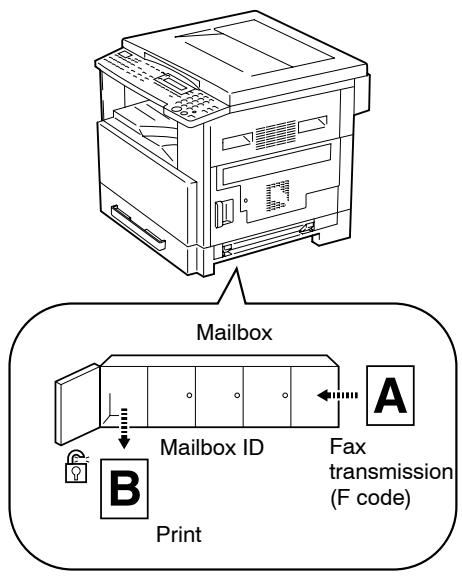
flowchart
graph TD
    A["Mailbox"] --> B["Print"]
    B --> C["Mailbox ID"]
    C --> D["F transmission (F code)"]
    style A fill:#f9f,stroke:#333
    style B fill:#ccf,stroke:#333
    style C fill:#cfc,stroke:#333
    style D fill:#fcc,stroke:#333
F code mailbox transmission/reception:
A maximum of 5 mailboxes can be set up. Since a mailbox ID is required in order to retrieve documents received in the different mailboxes, confidential faxes can safely be sent and received. Refer to "Specifying the Setting for "MAILBOX" on page 6-30.
If one-touch dial keys or speed dial numbers are programmed with F codes, the appropriate F code can quickly be transmitted. Refer to "Mailbox Transmission" on page 4-10.
Specifying F codes
When sending faxes
F codes can be specified when the 10-Key Pad is being used to enter the fax number of a recipient while sending a fax.
1 Using the 10-Key Pad, enter the fax number of the recipient.
![≡0123456_ SUB=▼ [1]](/content/2025/01/139714/images/e57e0e9fce0f0a5cf97920c6f2c7fead8462936e1cef7c07ec25b30597e2facd.jpg)
2 Press the [▼] key, and then use the 10-Key Pad to enter the SUB.
○ A number up to 20 digits long can be entered for the SUB.
○ To enter an SID, continue with step 3.
To correct the SUB, hold down the [NO] key to erase the existing number, and then enter the new number.
○ If an SID will not be entered, continue with step 4.
3 Press the [▼] key, and then use the 10-Key Pad to enter the SID.
○ A number up to 20 digits long can be entered for the SID.
To correct the SID, hold down the [NO] key to erase the existing number, and then enter the new number.
4 Press the [START] key to begin scanning and sending the fax.
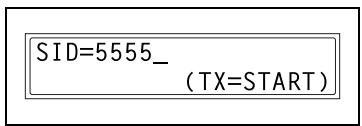
Programming F codes
F codes can be specified when programming one-touch dial keys or speed dial numbers.
For details on programming F codes, refer to "Setting Up the Fax Registration" on page 6-1 in "6 Using the Utility Mode (Fax)".
5 Using the Utility Mode
5.1 Utility Mode
There are sixteen menus in the Utility mode.
| No. | Name | Description |
| 1 | MACHINE SETTING | Used to specify settings for the machine's operating environment.* |
| 2 | PAPER SOURCE SETUP | Used to specify the size and type of paper loaded in Tray1. In addition, auto tray switching can be enabled for each tray. |
| 3 | USER MANAGEMENT | For details on this menu, refer to the Konica Minolta 7216/7220 User Manual. |
| 4 | ADMIN. MANAGEMENT | |
| 5 | COPY SETTING 1 | |
| 6 | COPY SETTING 2 | |
| 7 | FAX REGISTRATION | Used to specify the default setting for each fax function. |
| 8 | TX OPERATION | Used to specify the default setting for TX operation. |
| 9 | RX OPERATION | Used to specify the default setting for RX operation. |
| 10 | COMM. SETTING | Used to specify the default setting for communicating environment. |
| 11 | REPORTING | Used to specify the default setting for each report function. |
| 12 | INITIAL USER DATA | Used to specify setting for the initializing user data. |
| 13 | NETWORK SETTING | Available only if the optional Network Interface Card KN-419 is installed. For details, refer to the User Manual for the Network Interface Card (KN-419). |
| 14 | E-MAIL SETTING1 | Available only if the optional Internet Fax & Network Scan Kit IF-118 is installed. For details, refer to the User Manual for the Internet Fax & Network Scan Kit (IF-118). |
| 15 | E-MAIL SETTING2 | |
| 16 | SCAN SETTING |
* Only the description for specifying settings for the fax functions is described here. For details on the settings, refer to the Konica Minolta 7216/7220 User Manual.

...
Note
Depending on the installed options and specified installation region, some Utility mode functions cannot be set.
5.2 Specifying the Machine Settings
From the “MACHINE SETTING” menu, various settings for the machine’s operating environment can be specified. Refer to the following table for details on each function.
| No. | Name | Description |
| 1 | AUTO PANEL RESET | This function can be used to set the length of time until the auto panel reset operation is performed after copying or the last operation is finished. When the auto panel reset operation is performed, the Copy mode screen is automatically displayed.In Fax mode, the auto panel reset operation is performed after 1 minute has elapsed, regardless of the setting specified for this function.The manufacturer's default setting is 1 min. |
| 2 | ENERGY SAVE MODE | For details on this menu, refer to the Konica Minolta 7216/7220 User Manual. |
| 3 | AUTO SHUT OFF | |
| 4 | DENSITY (ADF) | |
| 5 | DENSITY (BOOK) | |
| 6 | PRINT DENSITY | The density for printing copies, computer printouts or faxes can be set to one of five settings.For details on this menu, refer to the Konica Minolta 7216/7220 User Manual. |
| 7 | LCD CONTRAST | For details on this menu, refer to the Konica Minolta 7216/7220 User Manual. |
| 8 | LANGUAGE | |
| 9 | BUZZER VOLUME | This function can be used to set the volume of alarms and the beep sounded when a key is pressed.The manufacturer's default setting is “LOW”. |
| 0 | INITIAL MODE | This function can be used to set the mode (Copy mode or Fax mode) that the machine starts up in or returns to after the Control Panel is reset.The manufacturer's default setting is “COPY”. |
Selecting the "MACHINE SETTING" menu
1 Press the [UTILITY] key.
"MACHINE SETTING" appears.
2 From the 10-Key Pad, press the key ([1] through [0]) for the MACHINE SETTING function that you wish to set.
○ The MACHINE SETTING functions are as follows:
1 AUTO PANEL RESET
2 ENERGY SAVE MODE
3 AUTO SHUT OFF
4 DENSITY (ADF)
5 DENSITY (BOOK)
6 PRINT DENSITY
7 LCD CONTRAST
8 LANGUAGE
9 BUZZER VOLUME
0 INITIAL MODE

...
Tip
To quit changing the machine settings, press the [No] key. "STOP SETTING?" appears. Press the [YES] key to quit changing the settings.
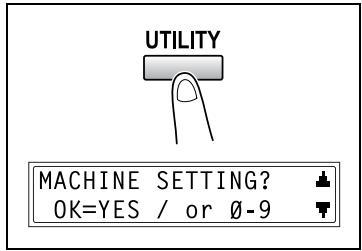
Specifying the Setting for "BUZZER VOLUME"
1 Select the "BUZZER VOLUME".
○ Refer to "Selecting the "MACHINE SETTING" menu" on page 5-3.
2 Press the [◀] and [▶] keys to set the buzzer volume to "HIGH", "LOW" or "OFF".
3 Press the [YES] key.
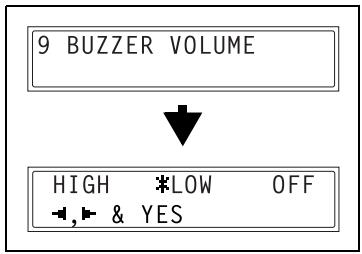
Specifying the Setting for "INITIAL MODE"
1 Select the "INITIAL MODE".
○ Refer to "Selecting the "MACHINE SETTING" menu" on page 5-3.
2 Press the [◀] and [▶] keys to select either "COPY" or "FAX".
3 Press the [YES] key.
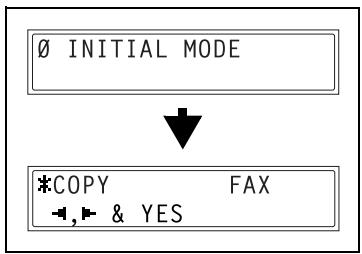
flowchart
graph TD
    A["∅ INITIAL MODE"] --> B["*COPY FAX\n-, ▶ & YES"]
5.3 Setting Up the Paper Sources (“PAPER SOURCE SETUP” Menu)
From the “PAPER SOURCE SETUP” menu, the various settings for the paper trays can be changed.
"PAPER SOURCE SETUP" menu:
| No. | PAPER SOURCE SETUP | Description |
| 1 | INCH/METRIC | This function can be used to set the size measurement system for the paper loaded in each tray. It can be used to select whether paper measured in centimeters (“METRIC”), such as A4 and B5 sizes, or paper measured in inches (“INCH”), such as Letter size, is loaded. If no particular setting is selected, the paper size is detected automatically.*If “METRIC” is selected for a paper tray on a model set to use inch measurements, paper loaded into that tray cannot be used in Fax mode.If “INCH” is selected for a paper tray on a model set to use metric measurements, paper loaded into that tray cannot be used in Fax mode.For metric area:The manufacturer’s default setting is “METRIC”.For inch area:The manufacturer’s default setting is “INCH”. |
| 2 | TRAY1 PAPER | This function can be used to set the type of paper (“PLAIN”, “OHP”, “CARD” or “ENVELOPE”) loaded into the Tray1, and the size of the paper (“AUTO” or “SIZE INPUT”). If the paper size is set to “SIZE INPUT”, type in the paper size.*If a setting other than “PLAIN” or “AUTO” is selected, paper loaded into Tray1 cannot be used in Fax mode.The manufacturer’s default settings are “PLAIN” and “AUTO”. |
| 3 | PAPER TYPE | For details on this menu, refer to the Konica Minolta 7216/7220 User Manual. |
* For details on the settings, refer to the Konica Minolta 7216/7220 User Manual.
5.4 Specifying Administrative Settings (“ADMIN. MANAGEMENT” Menu)
From the “ADMIN. MANAGEMENT” menu, various functions for controlling the use of the machine can be set. In order to set an “ADMIN. MANAGEMENT” function, the administrator access number must be entered.
"ADMIN. MANAGEMENT" menu:
| No. | ADMIN. MANAGEMENT | Description |
| 1 | AUTO SHUT OFF | This function can be used to set whether or not the auto power-off function is performed.*On a machine equipped with the fax option, the manufacturer's default setting is “ENABLE”. |
| 2 | COPY TRACK | A maximum of 20 accounts can be specified in order to control the use of the machine.*Turn on/off user management.Register account access numbers.Change/delete account access numbers.Display/clear the total count for a specific account.Clear the total counts for all accounts. |
| 3 | REMOTE MONITOR | This function can be used to set whether or not the machine can be accessed and the status of the machine can be checked from the service center.The manufacturer's default setting is “LIMITED”.For details, consult with the service representative. |
* For details on the settings, refer to the Konica Minolta 7216/7220 User Manual.

Note
The registering and setup of the administrator access number should be performed by the service representative. For details, contact the service representative.
The administrator of this machine should be sure not to lose the administrator access number.
To select the "ADMIN. MANAGEMENT" menu
1 Press the [UTILITY] key.
"MACHINE SETTING?" appears.
2 Press the [▼] key three times to select "ADMIN. MANAGEMENT?".
3 From the 10-Key Pad, press the key ([1] through [3]) for the "ADMIN. MANAGEMENT" function that you wish to set.
- The “ADMIN. MANAGEMENT” functions are as follows:
1 AUTO SHUT OFF
2 COPY TRACK
3 REMOTE MONITOR
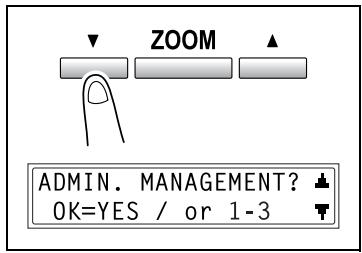
4 Using the 10-Key Pad, enter the 6-digit administrator access number, and then press the [YES] key.
To correct the administrator access number, press the [No] key, and then enter the new number.
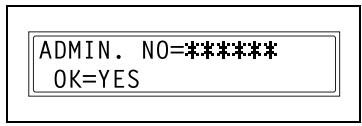

Tip
If, at any time, you wish to quit setting an "ADMIN. MANAGEMENT" function, press the [No] key. When the message "STOP SETTING?" appears, press the [YES] key to quit.
To set the “REMOTE MONITOR” function
1 Select the "ADMIN.
MANAGEMENT" menu.
○ Refer to "To select the "ADMIN. MANAGEMENT" menu" on page 5-7.
ADMIN. MANAGEMENT?
OK=YES / or 1-3
2 Press the [3] key from the 10-Key
Pad to select "REMOTE MONITOR".
○ Using the 10-Key Pad, enter the
6-digit administrator access number, and then press the [YES] key.
3 REMOTE MONITOR
3 Using the [◀] and [▶] keys, select
"LIMITED", "FULL" or "OFF", and then press the [YES] key.
☐ If “LIMITED” or “OFF” was selected, the “ADMIN. MANAGEMENT” menu appears again.
☐ If "FULL" was selected, a screen appears, allowing you to enter the password.
4 Using the 10-Key Pad, enter the 4-
digit password, and then press the [YES] key.
○ To correct the password, press
the [No] key, and then enter the new number.
The “ADMIN. MANAGEMENT” menu appears again.
*LIMITED FULL OFF
-, & YES
PASSWORD=2222
OK=YES
6 Using the Utility Mode (Fax)
6.1 Setting Up the Fax Registration
From the “FAX REGISTRATION” menu, various settings can be specified in order to take advantage of this machine’s many fax functions.
| No. | FAX REGISTRATION | Characteristic/Description |
| 1 | ONE-TOUCH DIAL | This function can be used to program one-touch dial keys with fax numbers, allowing the recipient to be specified easily and accurately without the need to manually enter the number using the 10-Key Pad.A maximum of 27 settings can be programmed. This dialing method is convenient for programming numbers where faxes are frequently sent to. |
| 2 | SPEED DIAL | This function can be used to program speed dial numbers with fax numbers, allowing the recipient to be specified easily and accurately without the need to manually enter the number using the 10-Key Pad.A maximum of 200 fax numbers can be programmed. |
| 3 | GROUP DIAL | This function can be used to program a single one-touch dial key with a maximum of 50 different fax numbers as one group. Programming a one-touch dial key with a group of fax numbers is convenient when documents are frequently sent to a set group of multiple recipients. |
| 4 | PROGRAM DIAL | This function can be used to program one-touch dial keys with fax numbers and a transmission/reception function (such as timer transmission or polling reception), allowing that function to be carried out by pressing just the corresponding one-touch dial key. |
| 5 | BATCH TX | This function can be used to specify the batch transmission setting (transmission time) for a one-touch dial key programmed with recipient fax numbers, so multiple documents can be stored in the memory and sent out together at the specified time. |
| 6 | MAILBOX | This function can be used to specify mailbox IDs in order to receive faxes with mailbox reception only if the mailbox ID sent by the caller matches the mailbox ID set on this machine. |
| 7 | RELAY BOX | This function can be used to program the relay boxes in order for this machine (acting as a relay station) to receive a document from another fax machine (transmitting station), then transmit the document to multiple recipients (receiving stations). |
* By installing the optional Network Interface Card, settings can also be specified from the network tool PageScope Light. (p. 6-62)
Selecting the "FAX REGISTRATION" menu
1 Press the [UTILITY] key seven times.
"FAX REGISTRATION" appears.
2 From the 10-Key Pad, press the key ([1] through [7]) for the "FAX REGISTRATION" function that you wish to set.
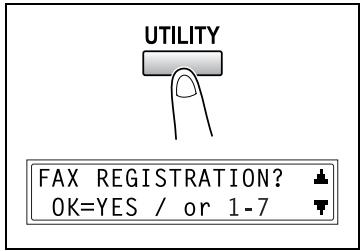
- The “FAX REGISTRATION” functions are as follows:
1 ONE-TOUCH DIAL
2 SPEED DIAL
3 GROUP DIAL
4 PROGRAM DIAL
5 BATCH TX
6 MAILBOX
7 RELAY BOX

Tip
If, at any time, you wish to quit programming, changing or deleting a "FAX REGISTRATION" function, press the [NO] key. When the message "STOP REGISTRATION?" appears, press the [YES] key to quit.
Setting Up One-Touch Dialing ("ONE-TOUCH DIAL" function)
If the one-touch dial keys are programmed with fax numbers, the recipient can be specified easily and accurately without the need to manually enter the number using the 10-Key Pad.
A maximum of 27 settings can be programmed.
To program a one-touch dial key
1 Select the "FAX REGISTRATION".
○ Refer to "Selecting the "FAX REGISTRATION" menu" on page 6-2.
2 Press the [1] key from the 10-Key Pad to select "ONE-TOUCH DIAL".
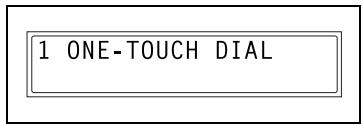
3 Press the one-touch dial key that you wish to program.
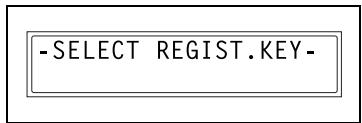
4 Enter the name of the programmed number.
![NAME=AAA TOKYO_ OK=YES [A]](/content/2025/01/139714/images/c3abc6092a00f69664a0aa7eb2ed38995e6b151cc4f0f21bc95d2212a653c21a.jpg)
- For details on entering text, refer to "Entering Text" on page 2-9.
○ Text up to 20 characters long can be entered for the name.
5 Press the [YES] key.
6 Using the 10-Key Pad, enter the fax number of the recipient.
![=0123456_ SUB=▼ [1]](/content/2025/01/139714/images/02f309460355bad855a887e72f2c96e29efdaaeef98128937d39563463aa240f.jpg)
○ The fax number can contain a maximum of 30 digits.
For details on the characters that can be entered. Refer to “To fax by entering the fax number directly using the 10-Key Pad” on page 3-2.
○ To enter a SUB, continue with step 7.
☐ If a SUB will not be entered, press the [YES] key after entering the fax number, and then skip to step 9.
☐ If you wish to change the fax number, press the [NO] key, and then enter the correct number.
☐ For details on F codes (SUB and SID), refer to “Using F codes” on page 4-24.
7 Press the [▼] key, and then use the 10-Key Pad to enter the SUB.
○ A number up to 20 digits long can be entered for the SUB.
○ To enter an SID, continue with step 8.
To correct the SUB, hold down the [NO] key to erase the existing number, and then enter the new number.
○ If an SID will not be entered, skip to step 9.
$$ \begin{array}{l l} \text {SUB = 1234_} \ \text {OK = YES} & (\text {SID = \text {T}}) \end{array} $$
8 Press the [▼] key, and then use the 10-Key Pad to enter the SID.
○ A number up to 20 digits long can be entered for the SID.
To correct the SID, hold down the [NO] key to erase the existing number, and then enter the new number.
$$ \begin{array}{c} \text {SID = 5678_} \ \text {OK = YES} \end{array} $$
9 Press the [YES] key.
10 Using the [◀] and [▶] keys, select the desired modem speed.
11 Press the [YES] key.
The settings are registered. To program another one-touch dial key, repeat steps 3 through 11.
12 Press the [NO] key to finish programming.
The "FAX REGISTRATION" menu appears again.
SET MODEM SPEED
$$ \begin{array}{c c c} \text {*33.6} & 1 4. 4 & 9. 6 \ \text {-}, \text {+} & \text { & YES} \end{array} $$
- SELECT REGIST.KEY- (COMPLETE=NO)
To change/delete a programmed one-touch dial key
1 Select the "FAX REGISTRATION".
○ Refer to "Selecting the "FAX REGISTRATION" menu" on page 6-2.
2 Press the [1] key from the 10-Key Pad to select "ONE-TOUCH DIAL".
1 ONE-TOUCH DIAL
3 Press the one-touch dial key that you wish to change or delete.
- SELECT REGIST.KEY-
4 Press the [NO] key.
If a one-touch dial key programmed with a group of fax numbers or a transmission/reception function is pressed, the message shown at the right appears. To delete the programmed settings, press the [NO] key. The "FAX REGISTRATION" menu appears again.
REGISTERED! KEEP? OK=YES(EDIT/DEL=NO)
REGISTERED! GROUP KEEP=YES (DEL=NO)
REGISTERED! PROGRAM KEEP=YES (DEL=NO)
To change the group dialing or program dialing settings, refer to page 6-11 and page 6-15.
5 Using the [◀] and [▶] keys, select either "EDIT" or "DELETE", and then press the [YES] key.
*EDIT DELETE -, & YES
○ If "EDIT" was selected, the name is displayed. (Continue with step 6.)
☐ If “DELETE” was selected, the settings programmed for the one-touch dial key are deleted and the “SELECT REGIST.KEY” screen appears again.
If you try to change the settings for a one-touch dial number used in group dialing or program dialing, a confirmation message appears, asking whether or not to change the corresponding settings programmed in group dialing or program dialing. If the [YES] key is pressed, the corresponding settings programmed in group dialing or program dialing are changed.
If the [NO] key is pressed, the corresponding settings programmed in group dialing or program dialing are deleted.
☐ If a one-touch dial number used in group dialing or program dialing is deleted, it is also deleted from the corresponding group dialing or program dialing.
6 Change the name, fax number, F codes (SUB and SID) and modem speed as desired.
![NAME=AAA TOKYO_ OK=YES [1]](/content/2025/01/139714/images/5000663611aafffbceba099b891b8f12a9afbd07b78214a377233b1f28319694.jpg)
- For details on changing the fax number, refer to "Entering Text" on page 2-9.
☐ For details on changing the F codes (SUB and SID) or modem speed, refer to page 6-3.
7 When you are finished making changes, press the [YES] key.
To change the settings of another one-touch dial key, repeat steps 3 through 7.
8 Press the [NO] key to return to the "FAX REGISTRATION" menu.
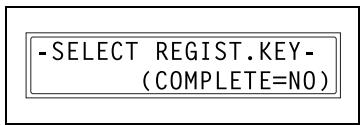

Tip
If "Batch TX" is specified for a one-touch dial key that is changed, the batch transmission time setting is cancelled. Specify the batch transmission settings again.
Specifying the Setting for "SPEED DIAL"
If speed dial numbers are programmed with fax numbers, the recipient can be specified easily and accurately without the need to manually enter the number using the 10-Key Pad.
A maximum of 200 fax numbers (001 to 200) can be programmed.
To program a speed dial number
1 Select the "FAX REGISTRATION".
○ Refer to "Selecting the "FAX REGISTRATION" menu" on page 6-2.
2 Press the [2] key from the 10-Key Pad to select "SPEED DIAL".
2 SPEED DIAL
3 Using the 10-Key Pad, enter the 3-digit speed dial number (ex. 011) that you wish to program.
SPEED DIAL=011
4 Enter the name of the programmed number.
NAME=AAA OSAKA_ OK=YES [A]
- For details on entering text, refer to "Entering Text" on page 2-9.
○ Text up to 20 characters long can be entered for the name.
5 Press the [YES] key.
6 Using the 10-Key Pad, enter the fax number of the recipient.
♂ = 124578_ OK=YES [1]
○ The fax number can contain a maximum of 30 digits.
For details on the characters that can be entered. Refer to “To fax by entering the fax number directly using the 10-Key Pad” on page 3-2.
○ To enter a SUB, continue with step 7.
☐ If a SUB will not be entered, press the [YES] key after entering the fax number, and then skip to step 9.
☐ If you wish to change the fax number, press the [NO] key, and then enter the correct number.
☐ For details on F codes (SUB and SID), refer to “Using F codes” on page 4-24.
7 Press the [▼] key, and then use the 10-Key Pad to enter the SUB.
○ A number up to 20 digits long can be entered for the SUB.
○ To enter an SID, continue with step 8.
To correct the SUB, hold down the [NO] key to erase the existing number, and then enter the new number.
○ If an SID will not be entered, skip to step 9.
8 Press the [▼] key, and then use the 10-Key Pad to enter the SID.
○ A number up to 20 digits long can be entered for the SID.
To correct the SID, hold down the [NO] key to erase the existing number, and then enter the new number.
$$ \begin{array}{l l} \text {SUB = 1234_} \ \text {OK = YES} & (\text {SID = \text {T}}) \end{array} $$
$$ \begin{array}{c} \text {SID = 5678_} \ \text {OK = YES} \end{array} $$
9 Press the [YES] key.
10 Using the [◀] and [▶] keys, select the desired modem speed.
11 Press the [YES] key.
The settings are registered. To program another speed dial number, repeat steps 3 through 11.
12 Press the [NO] key to finish programming.
The "FAX REGISTRATION" menu appears again.
SET MODEM SPEED
$$ \begin{array}{c c c} \text {*33.6} & 1 4. 4 & 9. 6 \ \text {- -, - } & \& Y E S \end{array} $$
$$ \begin{array}{c} \text {SPEED DIAL = _} \ \text {(COMPLETE = NO)} \end{array} $$
To change/delete a programmed speed dial number
1 Select the "FAX REGISTRATION".
○ Refer to "Selecting the "FAX REGISTRATION" menu" on page 6-2.
2 Press the [2] key from the 10-Key Pad to select "SPEED DIAL".
2 SPEED DIAL
3 Using the 10-Key Pad, enter the speed dial number that you wish to change or delete.
SPEED DIAL=011
4 Press the [NO] key.
REGISTERED! KEEP?
OK=YES(EDIT/DEL=NO)
5 Using the [◀] and [▶] keys, select either "EDIT" or "DELETE", and then press the [YES] key.
*EDIT DELETE
-, & YES
○ If "EDIT" was selected, the name is displayed. (Continue with step 6.)
☐ If “DELETE” was selected, the settings programmed for the speed dial number are deleted and the speed dial input screen appears again.
☐ If you try to change the settings for a speed dial number used in group dialing or program dialing, a confirmation message appears, asking whether or not to change the corresponding settings programmed in group dialing or program dialing. If the [YES] key is pressed, the corresponding settings programmed in group dialing or program dialing are changed. If the [NO] key is pressed, the corresponding settings programmed in group dialing or program dialing are deleted.
☐ If a speed dial number used in group dialing or program dialing is deleted, it is also deleted from the corresponding group dialing or program dialing.
6 Change the fax number, F codes (SUB and SID), and modem speed as desired.
NAME=AAA OSAKA_
OK=YES [1]
- For details on making changes, refer to "Entering Text" on page 2-9.
☐ For details on changing the F codes (SUB and SID) or modem speed, refer to page 6-3.
7 When you are finished making changes, press the [YES] key.
To change the settings of another speed dial number, repeat steps 3 through 7.
8 Press the [NO] key to return to the "FAX REGISTRATION" menu.
SPEED DIAL=_
(COMPLETE=NO)
Specifying the Setting for "GROUP DIAL"
A single one-touch dial key can be programmed with a maximum of 50 different fax numbers as one group. Programming a one-touch dial key with a group of fax numbers is convenient when documents are frequently sent to a set group of multiple recipients.
To program a group of fax numbers
1 Select the "FAX REGISTRATION".
○ Refer to “Selecting the “FAX REGISTRATION” menu” on page 6-2.
2 Press the [3] key from the 10-Key Pad to select "GROUP DIAL".
3 GROUP DIAL
3 Press the one-touch dial key that you wish to program.
- SELECT REGIST.KEY-
4 Enter the name of the group, and then press the [YES] key.
- For details on entering text, refer to "Entering Text" on page 2-9.
GROUP NAME=1 [1]
○ Text up to 20 characters long can be entered for the name.
5 By using the one-touch dial keys or the speed dial numbers, specify the recipients.
NO.∅∅1=ONE-TOUCH ∅1
? Do you wish to cancel the current selection?
→ Press the [NO] key, and then specify the correct recipient.
6 Press the [YES] key, and then specify another recipient.
NO.001=GROUP 1 OK=YES (Fin.=START)
○ Repeat steps 5 and 6 until all recipients have been specified.
○ A maximum of 50 different fax numbers can be specified as one group.
With group dialing, a one-touch dial key programmed with a group can be specified. In that case, the number of fax numbers programmed in the specified one-touch dial key (group dial key) is added.
7 When you are finished specifying recipients, press the [START] key.
The settings are registered.
To program another group, repeat steps 3 through 7.
NO.005=_ (Fin.=START)
8 Press the [NO] key to finish programming.
The "FAX REGISTRATION" menu appears again.
- SELECT REGIST.KEY-
(COMPLETE=NO)
To change/delete a programmed group of fax numbers
1 Select the "FAX REGISTRATION".
○ Refer to "Selecting the "FAX REGISTRATION" menu" on page 6-2.
2 Press the [3] key from the 10-Key Pad to select "GROUP DIAL".
3 GROUP DIAL
3 Press the one-touch dial key that you wish to change or delete.
- SELECT REGIST.KEY-
4 Press the [NO] key.
REGISTERED! KEEP?
OK=YES(EDIT/DEL=NO)
5 Using the [◀] and [▶] keys, select either "EDIT" or "DELETE", and then press the [YES] key.
*EDIT DELETE
-, & YES
○ If “EDIT” was selected, the group name is displayed. (Continue with step 6.)
☐ If “DELETE” was selected, the group dialing settings are deleted and the “SELECT REGIST.KEY” screen appears again.
6 If you wish to change the name of the group, enter the new name, and then press the [YES] key.
GROUP NAME=AAA TOKYO
OK=YES [1]
- For details on making changes, refer to "Entering Text" on page 2-9.
The one-touch dial names are displayed in the order that they were specified.
7 To delete the displayed recipient, press the [NO] key.
To keep the displayed fax number, press the [YES] key.
NO.001=AAA TOKYO
OK=YES (DEL=NO)
The next one-touch dial name is displayed.
8 When you are finished making changes, press the [START] key.
To change the settings of another group of fax numbers, repeat steps 3 through 8.
NO.005=_ (Fin.=START)
9 Press the [NO] key to return to the "FAX REGISTRATION" menu.
- SELECT REGIST.KEY-
(COMPLETE=NO)
Specifying the Setting for "PROGRAM DIAL"
If one-touch dial keys have been programmed with fax numbers and a transmission/reception function, that function can be carried out by pressing just the corresponding one-touch dial key.
Transmission/reception functions that can be programmed:
● Broadcast transmission
- Timer transmission
- Mailbox transmission
- Polling reception
● Relay initiation transmission
To set program dialing
1 Select the "FAX REGISTRATION".
○ Refer to “Selecting the “FAX REGISTRATION” menu” on page 6-2.
2 Press the [4] key from the 10-Key Pad to select "PROGRAM DIAL".
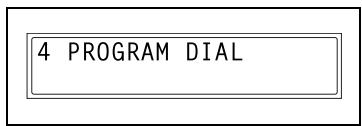
3 Press the one-touch dial key ([24] through [27]) programmed with the desired function.
4 From the 10-Key Pad, press the key ([1] through [3], [6] or [7]) for the desired function.
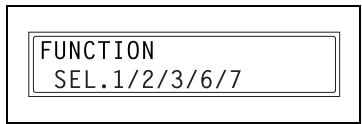
○ Functions that can be selected:
1 BROADCAST
2 TIMER TX
3 MAILBOX TX
6 POLLING RX
7 RELAY INITIATE
5 Follow the instructions for the selected function.
- “To fax using broadcast transmission” on page 4-6
- “To fax using timer transmission” on page 4-8
- “To fax using mailbox transmission” on page 4-10
- “To receive a fax using polling reception” on page 4-22
- “To fax using relay initiation transmission” on page 4-12
The settings are registered.
6 To specify other program dialing settings, repeat steps 3 through 5.
7 Press the [NO] key to finish programming.
The "FAX REGISTRATION" menu appears again.
- SELECT REGIST.KEY-
(COMPLETE=NO)
To change/delete a programmed broadcast transmission
1 Select the "FAX REGISTRATION".
○ Refer to "Selecting the "FAX REGISTRATION" menu" on page 6-2.
2 Press the [4] key from the 10-Key Pad to select "PROGRAM DIAL".
4 PROGRAM DIAL
3 Press the one-touch dial key ([24] through [27]) programmed with the broadcast transmission that you wish to change or delete.
- SELECT REGIST.KEY-
4 Press the [NO] key.
REGISTERED! KEEP?
OK=YES(EDIT/DEL=NO)
5 Using the [◀] and [▶] keys, select either "EDIT" or "DELETE", and then press the [YES] key.
*EDIT DELETE
-, & YES
☐ If “EDIT” was selected, the specified recipients are displayed in order. (Continue with step 6.)
☐ If "DELETE" was selected, the program dialing settings are deleted and the "SELECT REGIST. KEY" appears again.
6 To delete the displayed recipient, press the [NO] key.
To keep the displayed recipient, press the [YES] key.
NO.001=AAA TOKYO
OK=YES (DEL=NO)
The next recipient is displayed.
7 When you are finished making changes, press the [START] key.
NO.005=_
Fin.=START [1]
- Other program dialing settings can be programmed or changed.
8 Press the [NO] key to return to the "FAX REGISTRATION" menu.
- SELECT REGIST.KEY-
(COMPLETE=NO)
To change/delete a programmed timer transmission
1 Select the "FAX REGISTRATION".
○ Refer to “Selecting the “FAX REGISTRATION” menu” on page 6-2.
2 Press the [4] key from the 10-Key Pad to select "PROGRAM DIAL".
4 PROGRAM DIAL
3 Press the one-touch dial key ([24] through [27]) programmed with the timer transmission that you wish to change or delete.
- SELECT REGIST.KEY-
4 Press the [NO] key.
REGISTERED! KEEP?
OK=YES(EDIT/DEL=NO)
5 Using the [◀] and [▶] keys, select either "EDIT" or "DELETE", and then press the [YES] key.
*EDIT DELETE
-, & YES
☐ If “EDIT” was selected, the programmed transmission time is displayed. (Continue with step 6.)
☐ If "DELETE" was selected, the program dialing settings are deleted and the "SELECT REGIST.KEY" screen appears again.
6 To change the transmission time, press the [NO] key, and then use the 10-Key Pad to enter the correct time.
TIMER=21:00
OK=YES (DEL=NO)
If you do not wish to change the transmission time, press the [YES] key.
The recipient is displayed.
7 To change the recipient, press the [NO] key, and then by using the one-touch dial keys or the speed dial numbers, or by entering the fax number using the 10-Key Pad, specify a different recipient.
$$ \begin{array}{r l} \text { = } & 0 1 2 3 4 5 6 \ & O K = Y E S \quad (D E L = N O) \end{array} $$
○ Change the F codes (SUB and SID) as desired.
8 Press the [YES] key.
- Other program dialing settings can be changed.
9 Press the [NO] key to return to the "FAX REGISTRATION" menu.
$$ \boxed {- \text { SELECT REGIST.KEY- } \quad (\text { COMPLETE } = \text { NO })} $$
To change/delete a programmed mailbox transmission
1 Select the "FAX REGISTRATION" menu.
○ Refer to "Selecting the "FAX REGISTRATION" menu" on page 6-2.
2 Press the [4] key from the 10-Key Pad to select "PROGRAM DIAL".
4 PROGRAM DIAL
3 Press the one-touch dial key ([24] through [27]) programmed with the mailbox transmission that you wish to change or delete.
- SELECT REGIST.KEY-
4 Press the [NO] key.
REGISTERED! KEEP?
OK=YES(EDIT/DEL=NO)
5 Using the [◀] and [▶] keys, select either "EDIT" or "DELETE", and then press the [YES] key.
*EDIT DELETE
-, & YES
○ If "EDIT" was selected, the specified recipient is displayed. (Continue with step 6.)
☐ If "DELETE" was selected, the program dialing settings are deleted and the "SELECT REGIST.KEY" screen appears again.
6 To change the recipient, press the [NO] key, and then by using the one-touch dial keys or the speed dial numbers, or by entering the fax number using the 10-Key Pad, specify a different recipient.
☎=0123456
OK=YES (DEL=NO)
7 Press the [YES] key.
The mailbox ID is displayed.
8 To change the mailbox ID, press the [NO] key, and then use the 10-Key Pad to enter the new ID.
MAILBOX ID=1234
OK=YES (DEL=NO)
9 Press the [YES] key.
The password is displayed.
10 To change the password, press the [NO] key, and then use the 10-Key Pad to enter the new password.
PASSWORD=5678
OK=YES (DEL=NO)
11 Press the [YES] key.
Other program dialing settings can be changed.
12 Press the [NO] key to return to the "FAX REGISTRATION" menu.
- SELECT REGIST.KEY-
(COMPLETE=NO)
To change/delete a programmed polling reception
1 Select the "FAX REGISTRATION".
○ Refer to "Selecting the "FAX REGISTRATION" menu" on page 6-2.
2 Press the [4] key from the 10-Key Pad to select "PROGRAM DIAL".
4 PROGRAM DIAL
3 Press the one-touch dial key ([24] through [27]) programmed with the polling reception that you wish to change or delete.
- SELECT REGIST.KEY-
4 Press the [NO] key.
REGISTERED! KEEP?
OK=YES(EDIT/DEL=NO)
5 Using the [◀] and [▶] keys, select either "EDIT" or "DELETE", and then press the [YES] key.
*EDIT DELETE
-, & YES
☐ If “EDIT” was selected, the specified recipients are displayed in order. (Continue with step 6.)
☐ If "DELETE" was selected, the program dialing settings are deleted and the "SELECT REGIST.KEY" screen appears again.
6 To delete the displayed recipient, press the [NO] key.
To keep the displayed recipient, press the [YES] key.
NO.001=AAA TOKYO
OK=YES (DEL=NO)
To add a recipient, in the screen containing "Fin.=START", specify a recipient using the one-touch dial keys or the speed dial numbers, or by entering a fax number using the 10-Key Pad.
The next recipient is displayed.
7 When you are finished making changes, press the [START] key.
Other program dialing settings can be changed.
NO.005=_ (Fin.=START)
8 Press the [NO] key to return to the "FAX REGISTRATION" menu.
- SELECT REGIST.KEY-
(COMPLETE=NO)
To change/delete a programmed relay initiation transmission
1 Select the "FAX REGISTRATION".
○ Refer to "Selecting the "FAX REGISTRATION" menu" on page 6-2.
2 Press the [4] key from the 10-Key Pad to select "PROGRAM DIAL".
4 PROGRAM DIAL
3 Press the one-touch dial key ([24] through [27]) programmed with the relay initiation transmission that you wish to change or delete.
- SELECT REGIST.KEY-
4 Press the [NO] key.
REGISTERED! KEEP?
OK=YES(EDIT/DEL=NO)
5 Using the [◀] and [▶] keys, select either "EDIT" or "DELETE", and then press the [YES] key.
*EDIT DELETE
-, & YES
○ If "EDIT" was selected, the specified recipient is displayed. (Continue with step 6.)
☐ If “DELETE” was selected, the program dialing settings are deleted and the “SELECT REGIST.KEY” screen appears again.
6 To change the recipient, press the [NO] key, and then by using the one-touch dial keys or the speed dial numbers, or by entering the fax number using the 10-Key Pad, specify a different recipient.
☎=0123456
OK=YES (DEL=NO)
7 Press the [YES] key.
The relay box ID is displayed.
8 To change the relay box ID, press the [NO] key, and then use the 10-Key Pad to enter the new ID.
RELAY BOX ID=1234
OK=YES (DEL=NO)
9 Press the [YES] key.
The password is displayed.
10 To change the password, press the [NO] key, and then use the 10-Key Pad to enter the new password.
PASSWORD=5678
OK=YES (DEL=NO)
11 Press the [YES] key.
Other program dialing settings can be changed.
12 Press the [NO] key to return to the "FAX REGISTRATION" menu.
- SELECT REGIST.KEY-
(COMPLETE=NO)
Specifying the Setting for "BATCH TX"
If the batch transmission setting (transmission time) is specified for a one-touch dial key programmed with recipient fax numbers, multiple documents can be stored in the memory and sent out together at the specified time.

...
Note
The one-touch dial key must first be programmed with the fax number of the recipient for the batch transmission.
To set batch transmitting
1 Select the "FAX REGISTRATION".
○ Refer to “Selecting the “FAX REGISTRATION” menu” on page 6-2.
2 Press the [5] key from the 10-Key Pad to select "BATCH TX".
5 BATCH TX
3 Press the one-touch dial key programmed with the recipient that you wish to send the batch transmission fax to.
- SELECT REGIST.KEY-
A screen appears, allowing you to specify the transmission time.
? Was the one-touch dial key that was pressed one programmed for group dialing, program dialing, or not registered fax number, or not programmed at all?
→ An error message appears.
REGISTERED! GROUP
REGISTERED! PROGRAM
*NOT REGISTERED!*
*NOT FAX NO.*
4 Using the 10-Key Pad, enter the desired transmission time, and then press the [YES] key.
TX TIME=15:30
OK=YES
5 Press the [NO] key to return to the "FAX REGISTRATION" menu.
- SELECT REGIST.KEY-
(COMPLETE=NO)
To change the batch transmission setting
1 Select the "FAX REGISTRATION".
○ Refer to "Selecting the "FAX REGISTRATION" menu" on page 6-2.
2 Press the [5] key from the 10-Key Pad to select "BATCH TX".
5 BATCH TX
3 Press the one-touch dial key programmed with the batch transmission setting that you wish to change.
- SELECT REGIST.KEY-
4 Press the [NO] key, and then use the 10-Key Pad to enter the new transmission time.
TX TIME=15:30
OK=YES (DEL=NO)
5 When you are finished making changes, press the [YES] key.
TX TIME=06:30
OK=YES (DEL=NO)
6 Press the [NO] key to return to the "FAX REGISTRATION" menu.
- SELECT REGIST.KEY- (COMPLETE=NO)
To delete the batch transmission setting
1 Select the "FAX REGISTRATION".
○ Refer to “Selecting the “FAX REGISTRATION” menu” on page 6-2.
2 Press the [5] key from the 10-Key Pad to select "BATCH TX".
5 BATCH TX
3 Press the one-touch dial key programmed with the batch transmission setting that you wish to delete.
-SELECT REGIST.KEY-
4 Press the [NO] key.
A confirmation message appears, asking whether or not to delete the batch transmission setting.
TX TIME=15:30 OK=YES (DEL=NO)
5 Press the [YES] key.
The "SELECT REGIST.KEY" screen appears again.
TX TIME= : DELETE BATCH=YES
Specifying the Setting for "MAILBOX"
Mailbox IDs must first be specified in order to receive faxes with mailbox reception only if the mailbox ID sent by the caller matches the mailbox ID set on this machine.

Note
A mailbox ID cannot be the same as a relay box ID.
To register a mailbox
1 Select the "FAX REGISTRATION".
○ Refer to “Selecting the “FAX REGISTRATION” menu” on page 6-2.
2 Press the [6] key from the 10-Key Pad to select "MAILBOX".
6 MAILBOX
3 Using the 10-Key Pad, enter the mailbox number.
○ The mailbox number can be set to any number between 1 and 5.
MAILBOX NO.=SELECT 1-5
4 Using the 10-Key Pad, enter the 4-digit mailbox ID, and then press the [YES] key.
MAILBOX 5 ID=1234 OK=YES
○ The mailbox ID can be set to any number between 0000 and 9999.
☐ If you wish to change the mailbox ID, press the [NO] key, and then enter the new number.
5 Using the 10-Key Pad, enter the 4-digit password, and then press the [YES] key.
PASSWORD=5678 OK=YES
○ The password can be set to any number between 0000 and 9999.
☐ If you wish to change the password, press the [NO] key, and then enter the new password.
○ If no password is to be specified, press the [YES] key without entering anything.
The “FAX REGISTRATION” menu appears again.
To delete a mailbox
1 Select the "FAX REGISTRATION".
○ Refer to “Selecting the “FAX REGISTRATION” menu” on page 6-2.
2 Press the [6] key from the 10-Key Pad to select "MAILBOX".
6 MAILBOX
3 Using the 10-Key Pad, enter the number of the mailbox that you wish to delete.
MAILBOX NO.= SELECT 1-5
4 Press the [NO] key.
A screen appears, allowing you to enter the mailbox ID.
REGISTERED! KEEP? KEEP=YES (DEL=NO)
5 Using the 10-Key Pad, enter the 4-digit mailbox ID, and then press the [YES] key.
OLD M-BOX5 ID=1234 OK=YES
☐ If you wish to change the ID, press the [NO] key, and then enter the new number.
The specified mailbox is deleted.
6 Press the [AUTO RESET] key.
The main screen appears again.
MAILBOX NO.=SELECT 1-5
Setting Up Relay Boxes ("RELAY BOX" function)
A relay box ID must first be set in order for this machine (acting as a relay station) to receive a document from another fax machine (transmitting station), then transmit the document to multiple recipients (receiving stations).

...
Note
A relay box ID cannot be the same as a mailbox ID.
This machine (acting as a relay station) can be set to send back a relay result report. The fax number of the recipient of the report (either the transmitting station or any other recipient) can specified using the one-touch dial keys, a speed dial number or the 10-Key Pad. If the recipient is to be specified using a one-touch dial key or a speed dial number, before using this function, be sure that the one-touch dial key or speed dial number is programmed with the fax number of the report recipient.
To program the relay box
1 Select the "FAX REGISTRATION" menu.
○ Refer to "Selecting the "FAX REGISTRATION" menu" on page 6-2.
FAX REGISTRATION?
OK=YES / or 1-7


2 Press the [7] key from the 10-Key Pad to select "RELAY BOX".
7 RELAY BOX
3 Using the 10-Key Pad, enter the relay box number.
- The relay box number can be set to any number between 0 and 9.
RELAY BOX NO.=5
SELECT ∅-9
4 Using the 10-Key Pad, enter the 4-digit relay box ID, and then press the [YES] key.
RELAY BOX 5 ID=1234
OK=YES
○ The relay box ID can be set to any number between 0000 and 9999.
☐ If you wish to change the relay box ID, press the [NO] key, and then enter the new number.
5 Using the 10-Key Pad, enter the 4-digit password, and then press the [YES] key.
$$ \text { PASSWORD } = 5 6 7 8 $$
$$ 0 K = Y E S $$
○ The password can be set to any number between 0000 and 9999.
☐ If you wish to change the password, press the [NO] key, and then enter the new password.
☐ If no password is to be specified, press the [YES] key without entering anything.
6 To send back a relay result report, specify the recipient using either a one-touch dial key or speed dial number programmed with the recipient's fax number, and then press the [YES] key.
$$ \text { REPORT } = \text { SPEED } \quad \emptyset \emptyset 1 $$
$$ \text { REPORT } = \text { AAA OSAKA } $$
$$ 0 K = Y E S $$
A screen appears, allowing you to specify the receiving stations.
7 Using the one-touch dial keys or the speed dial numbers, or by entering the fax number using the 10-Key Pad, specify a receiving station, and then press the [YES] key.
$$ \text { NO. } \emptyset \emptyset 1 = \text { ONE - TOUCH } \emptyset 1 $$
$$ \text { NO. } \emptyset \emptyset 1 = \text { AAA TOKYO } $$
$$ 0 K = Y E S (F i n. = S T A R T) $$
A maximum of 50 recipients can be specified as receiving stations. Repeat this step until all desired receiving stations are specified.
- To delete the currently selected recipient, press the [NO] key.
8 When you are finished specifying all receiving stations, press the [START] key.
$$ \boxed { \begin{array}{l} \text {NO.005 = _ (Fin. = START)} \end{array} } $$
The "FAX REGISTRATION" menu appears again.
To delete the relay box
1 Select the "FAX REGISTRATION" menu.
○ Refer to "Selecting the "FAX REGISTRATION" menu" on page 6-2.
FAX REGISTRATION? OK=YES / or 1-7
2 Press the [7] key from the 10-Key Pad to select "RELAY BOX".
7 RELAY BOX
3 Using the 10-Key Pad, enter the number of the relay box that you wish to delete.
RELAY BOX NO.=5 SELECT ∅-9
4 Press the [NO] key.
The specified relay box is deleted. To delete another relay box, repeat steps 3 and 4.
REGISTERED! KEEP? KEEP=YES (DEL=NO)
5 Press the [AUTO RESET] key. The main screen appears again.
RELAY BOX NO.=_ SELECT ∅-9
6.2 Setting Up the Transmission
From the "TX OPERATION" menu, various functions for sending faxes can be set.
| No. | TX OPERATION | Characteristic/Description |
| 1 | SCANCONTRAST | This function can be used to set the default scanning contrast level to one of five settings between “LIGHT” and “DARK”. For dark-colored paper (media), select a setting towards “LIGHT”. For faint or colored text, select a setting toward “DARK”. |
| 2 | RESOLUTION | This function can be used to set the default scanning resolution (image quality) to one of the following: “Standard”, “Fine”, “Super Fine”, “Half Tone + Standard”, “Half Tone + Fine” or “Half Tone + Super Fine”.• The manufacturer’s default setting is “Standard”. |
| 3 | DEFAULT TX | This function can be used to set the default transmission mode to “MEM.TX” or “ADF TX”.MEM. TX: memory transmissionADF TX: direct transmission• The manufacturer’s default setting is “MEM.TX”. |
| 4 | HEADER | This function can be used to set the default setting (“ON” or “OFF”) for adding the header (date sent, sender’s name and fax number, etc.) when sending faxes.• The manufacturer’s default setting is “ON”. |
* By installing the optional Network Interface Card, settings can also be specified from the network tool PageScope Light. (p. 6-62)
Selecting the "TX OPERATION" menu
1 Press the [UTILITY] key eight times. "TX OPERATION" appears.
2 From the 10-Key Pad, press the key ([1] through [4]) for the "TX OPERATION" function that you wish to set.
○ The “TX OPERATION” functions are as follows:
1 SCAN CONTRAST
2 RESOLUTION
3 DEFAULT TX
4 HEADER
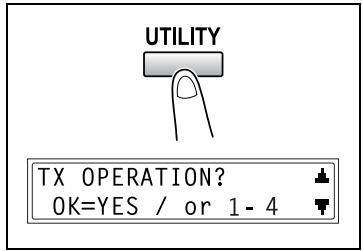

Tip
If, at any time, you wish to quit setting a "TX OPERATION" function, press the [NO] key. When the message "STOP SETTING?" appears, press the [YES] key to quit.
Specifying the Setting for "SCAN CONTRAST"
1 Select the "TX OPERATION".
○ Refer to "Selecting the "TX OPERATION" menu" on page 6-37.
2 Press the [1] key from the 10-Key Pad to select "SCAN CONTRAST".
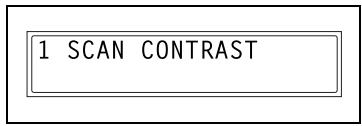
3 Using the [◀] and [▶] keys, select one of the five settings between "LIGHT" and "DARK", and then press the [YES] key.
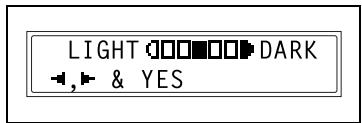
The "TX OPERATION" menu appears again.
Specifying the Setting for "RESOLUTION"
1 Select the "TX OPERATION".
○ Refer to "Selecting the "TX OPERATION" menu" on page 6-37.
2 Press the [2] key from the 10-Key Pad to select "RESOLUTION".
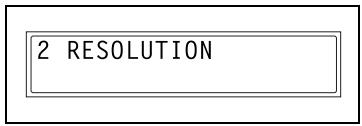
3 Using the [◀] and [▶] keys, select the desired resolution setting, and then press the [YES] key.
○ The resolution settings appear as follows.
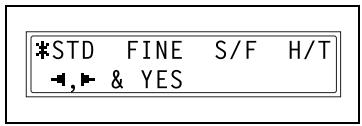
STD: Standard
FINE: Fine
S/F: Super Fine
H/T: Half Tone
If “H/T” was selected, a screen appears, allowing you to make a detailed setting. (Continue with step 4.) If any setting other than “H/T” was selected, the “TX OPERATION” menu appears again.
4 Using the [◀] and [▶] keys, select the desired halftone setting, and then press the [YES] key.
○ The halftone settings appear as follows.
STD: Standard
FINE: Fine
S/F: Super Fine
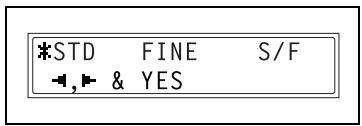
The "TX OPERATION" menu appears again.
Specifying the Setting for "DEFAULT TX"
1 Select the "TX OPERATION".
○ Refer to "Selecting the "TX OPERATION" menu" on page 6-37.
2 Press the [3] key from the 10-Key Pad to select "DEFAULT TX".
3 DEFAULT TX
3 Using the [◀] and [▶] keys, select either "MEM.TX" or "ADF TX", and then press the [YES] key.
The "TX OPERATION" menu appears again.
*MEM.TX ADF TX
-, & YES
Specifying the Setting for "HEADER"
1 Select the "TX OPERATION".
○ Refer to "Selecting the "TX OPERATION" menu" on page 6-37.
2 Press the [4] key from the 10-Key Pad to select "HEADER".
4 HEADER
3 Using the [◀] and [▶] keys, select either "ON" or "OFF", and then press the [YES] key.
The "TX OPERATION" menu appears again.
ON *OFF
-, & YES
6.3 Setting Up the Reception
From the “RX OPERATION” menu, various functions for receiving faxes can be set.
* By installing the optional Network Interface Card, settings can also be specified from the network tool PageScope Light. (p. 6-62)
| No. | RX OPERATION | Characteristic/Description |
| 1 | MEMORY RX MODE | This function can be used to set whether to allow (“ON”) memory reception or not (“OFF”). In cases when confidential faxes are being received, the received document can be stored in the memory and printed at a specified time or when memory reception is set to “OFF”.A password can be set to specify the starting time or ending time of memory reception, or to cancel the function.The set starting time and ending time are valid every day until memory reception is turned off.• The manufacturer’s default setting is “OFF”. |
| 2 | NO. of RINGS | This function can be used to set the number of rings between 1 and 16 until the call is answered. |
| 3 | REDUCTION RX | This function can be used to set whether documents longer than the paper are printed reduced (“ON”), split (“OFF”), or discarded (“CUT”).However, when sending a document more than 24 mm longer than the paper, “CUT” is not available. (In this case, the document is split.)• The manufacturer’s default setting is “ON”. |
| 4 | RX PRINT | This function can be used to set whether the fax is only printed after all document pages have been received (“MEMORY RX”) or printing begins as soon as the first page of the document is received (“PRINT RX”).• The manufacturer’s default setting is “MEMORY RX”. |
| 5 | RX MODE | This function can be used to set the reception mode to automatic reception (“AUTO RX”) or manual reception (“MANUAL RX”).Automatic reception: Automatically begins receiving after the set number of rings.Manual reception: Does not automatically receive the fax.Reception begins after making a connection by picking up the telephone receiver or pressing the [ON-HOOK] key, then pressing the [START] key.• The manufacturer’s default setting is “AUTO RX”. |
| 6 | FORWARD | This function can be used to set whether or not the received document is forwarded.Forward (“ON”): The received document is forwarded to the specified fax number or e-mail address.Forward and print (“ON(PRINT)”: The received document is printed by this machine at the same time that it is forwarded to the specified fax number or e-mail address.Do not forward (“OFF”): The document is not forwarded.• The manufacturer’s default setting is “OFF”.* In order to forward the document to an e-mail address, the optional Internet Fax & Network scan kit is required. |
| 7 | FOOTER | This function can be used to set whether or not the reception information (date received, number of pages, etc.) is printed at the bottom of each received document.• The manufacturer’s default setting is “OFF”. |
| 8 | SELECT TRAY | This function can be used to select which paper tray can be used to supply paper when printing received documents or transmission reports. (A paper tray that cannot be used for supplying paper can also be specified.) |
| 9 | CLOSED NETWORK | This function can be used to set whether or not the fax is received if the sender's fax number does not match the fax number programmed in one of this machine's one-touch dial keys or speed dial numbers.The manufacturer's default setting is “OFF”. |
Selecting the "RX OPERATION" menu
1 Press the [UTILITY] key nine times. "RX OPERATION" appears.
2 From the 10-Key Pad, press the key ([1] through [9]) for the "RX OPERATION" function that you wish to set.
○ The "RX OPERATION" functions are as follows:
1 MEMORY RX MODE
2 NO. of RINGS
3 REDUCTION RX
4 RX PRINT
5 RX MODE
6 FORWARD
7 FOOTER
8 SELECT TRAY
9 CLOSED NETWORK
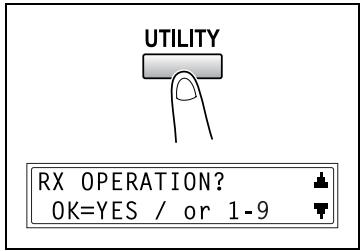

Tip
If, at any time, you wish to quit setting/changing an “RX OPERATION” function, press the [NO] key. When the message “STOP SETTING?” appears, press the [YES] key to quit.
To exit the "RX OPERATION" menu, press the [AUTO RESET] key. The main screen appears again.
Specifying the Setting for "MEMORY RX MODE"
1 Select the "RX OPERATION".
○ Refer to "Selecting the "RX OPERATION" menu" on page 6-42.
2 Press the [1] key from the 10-Key Pad to select "MEMORY RX MODE".
1 MEMORY RX MODE
3 Using the [◀] and [▶] keys, select "ON", and then press the [YES] key.
*ON OFF -, & YES
4 Using the 10-Key Pad, enter the time for memory reception to begin, and then press the [YES] key.
ON TIME=20:00 OK=YES
To specify that memory reception stays on from the time that it is set to "ON" until it is manually canceled, press the [YES] key without entering a start time. (Skip to step 6.)
5 Using the 10-Key Pad, enter the time for memory reception to end, and then press the [YES] key.
OFF TIME=09:00 OK=YES
6 Using the 10-Key Pad, enter the 4-digit password used to cancel memory reception, and then press the [YES] key.
PASSWORD=5678 OK=YES
○ If no password is to be specified, press the [YES] key without entering anything.
The "RX OPERATION" menu appears again.
To cancel memory reception
Memory reception is automatically canceled at the specified ending time, and the received documents are printed. If no ending time has been set or if you wish to cancel memory reception before the ending time, follow the procedure described below.
1 Select the "RX OPERATION".
○ Refer to "Selecting the "RX OPERATION" menu" on page 6-42.
2 Press the [1] key from the 10-Key Pad to select "MEMORY RX MODE".
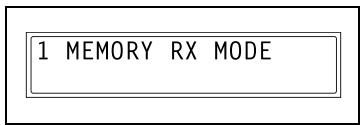
3 Using the [◀] and [▶] keys, select "OFF", and then press the [YES] key.
○ If a password was specified, continue with step 4.
☐ If a password was not specified, all received documents stored in the memory are printed, and the "RX OPERATION" menu appears again.
4 Using the 10-Key Pad, enter the 4-digit password, and then press the [YES] key.
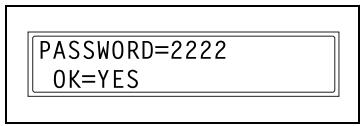
All received documents stored in the memory are printed, and the "RX OPERATION" menu appears again.
Specifying the Setting for "NO. of RINGS"
1 Select the "RX OPERATION".
○ Refer to "Selecting the "RX OPERATION" menu" on page 6-42.
2 Press the [2] key from the 10-Key Pad to select "NO. of RINGS".
2 NO. of RINGS
3 Using the 10-Key Pad, enter the desired number of rings, and then press the [YES] key.
NO.of RINGS= 2(1-16) OK=YES
○ The number of rings can be set between 1 and 16.
The "RX OPERATION" menu appears again.
Specifying the Setting for "REDUCTION RX"
1 Select the "RX OPERATION".
○ Refer to "Selecting the "RX OPERATION" menu" on page 6-42.
2 Press the [3] key from the 10-Key Pad to select "REDUCTION RX".
3 REDUCTION RX
3 Using the [◀] and [▶] keys, select "ON" (print the document reduced), "OFF" (split the printout) or "CUT" (discard any excess), and then press the [YES] key.
*ON OFF CUT
-, & YES
The "RX OPERATION" menu appears again.
Specifying the Setting for "RX PRINT"
1 Select the "RX OPERATION".
○ Refer to "Selecting the "RX OPERATION" menu" on page 6-42.
2 Press the [4] key from the 10-Key Pad to select "RX PRINT".
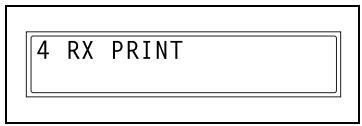
3 Using the [◀] and [▶] keys, select either "MEMORY RX" or "PRINT RX", and then press the [YES] key.
The "RX OPERATION" menu appears again.
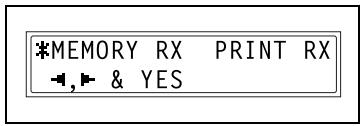
Specifying the Setting for "RX MODE"
1 Select the "RX OPERATION".
○ Refer to "Selecting the "RX OPERATION" menu" on page 6-42.
2 Press the [5] key from the 10-Key Pad to select "RX MODE".
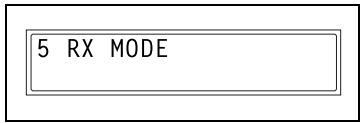
3 Using the [◀] and [▶] keys, select either "AUTO RX" or "MANUAL RX", and then press the [YES] key.
The "RX OPERATION" menu appears again.
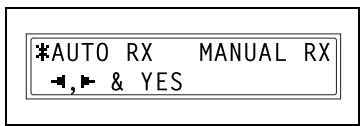
Specifying the Setting for "FORWARD"
1 Select the "RX OPERATION".
○ Refer to "Selecting the "RX OPERATION" menu" on page 6-42.
2 Press the [6] key from the 10-Key Pad to select "FORWARD".
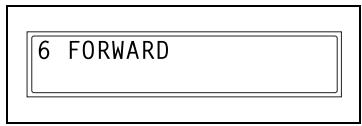
3 Using the [◀] and [▶] keys, select "ON", "ON(PRINT)" or "OFF", and then press the [YES] key.
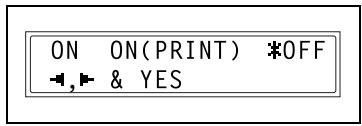
If "ON" or "ON(PRINT)" was selected, a screen appears, allowing you to specify the forwarding location. (Continue with step 4.)
- If "OFF" was selected, the "RX OPERATION" menu appears again.
4 Using the one-touch dial keys or the speed dial numbers, or by entering the fax number using the 10-Key Pad, specify a fax number, and then press the [YES] key.
![≡0123456_ SUB=▼ [1]](/content/2025/01/139714/images/88644bf5b4ea3cf2330048d716f6b10164fd8a29e9c19d32681ebfbfda7bafea.jpg)
The "RX OPERATION" menu appears again.

Tip
An e-mail address can be specified as a forwarding location only when the optional Internet Fax & Network Scan Kit is installed.
For details, refer to the User Manual for the Internet Fax & Network Scan Kit (IF-118).
Specifying the Setting for "FOOTER"
1 Select the "RX OPERATION".
○ Refer to "Selecting the "RX OPERATION" menu" on page 6-42.
2 Press the [7] key from the 10-Key Pad to select "FOOTER".
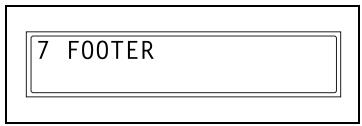
3 Using the [◀] and [▶] keys, select either "ON" or "OFF", and then press the [YES] key.
The "RX OPERATION" menu appears again.
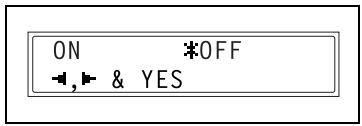
Specifying the Setting for "SELECT TRAY"
1 Select the "RX OPERATION".
○ Refer to "Selecting the "RX OPERATION" menu" on page 6-42.
2 Press the [8] key from the 10-Key Pad to select "SELECT TRAY".
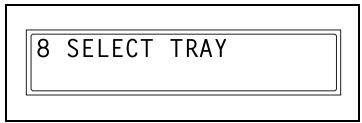
3 Using the [▲] and [▼] keys, select a paper tray, and then press the [YES] key.
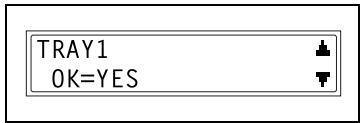
4 Using the [◀] and [▶] keys, select either "DISABLE" or "ENABLE", and then press the [YES] key.
The "RX OPERATION" menu appears again.
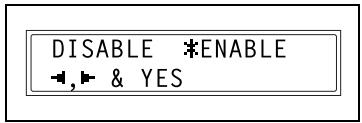
Specifying the Setting for "CLOSED NETWORK"
1 Select the "RX OPERATION".
○ Refer to "Selecting the "RX OPERATION" menu" on page 6-42.
2 Press the [9] key from the 10-Key Pad to select "CLOSED NETWORK".
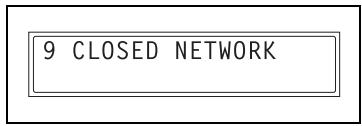
3 Using the [◀] and [▶] keys, select either "ON" or "OFF", and then press the [YES] key.
The "RX OPERATION" menu appears again.
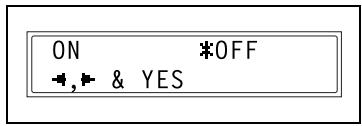
6.4 Settings Up the Communication
From the “COMM.SETTING” menu, various functions are available for specifying communication settings.
| No. | COMM.SETTING | Characteristic/Description |
| 1 | TONE/PULSE | This function can be used to specify the dialing system. If this function is not correctly set to the type of dialing system used, faxes cannot be sent. Select the correct setting after checking which type of dialing system is used by your telephone line. |
| 2 | LINE MONITOR | This function can be used to set the volume when monitoring communication to “HIGH”, “LOW” or “OFF”.• The manufacturer’s default setting is “LOW”. |
| 3 | PSTN/PBX | This function can be used to set whether the connected telephone wiring is a public switched telephone network (PSTN) or a private branch exchange (PBX). For a PBX system, the outside line access number (or extension number) must be specified. |
* By installing the optional Network Interface Card, settings can also be specified from the network tool PageScope Light. (p. 6-62)
Specifying the Setting for "TONE/PULSE"
There are two types of telephone dialing systems: tone dialing (PB) and pulse dialing (DP10pps or DP20pps). Faxes cannot be sent if this machine is not set to the system used by your telephone line. Select the correct setting after checking which type of dialing system is used.
To specify the telephone dialing system
1 Press the [UTILITY] key ten times. "COMM. SETTING" appears.
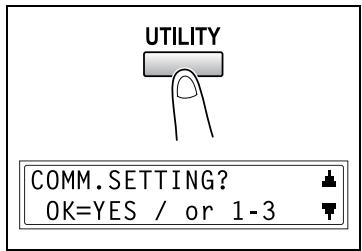
2 Press the [1] key from the 10-Key Pad to select "TONE/PULSE".
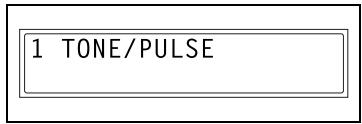
3 Using the [◀] and [▶] keys, select either "TONE" (for tone dialing) or "PULSE" (for pulse dialing), and then press the [YES] key.
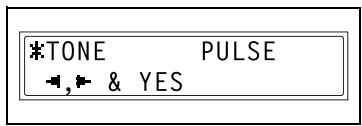
4 If "PULSE" was selected, select either "10pps" or "20pps", and then press the [YES] key.
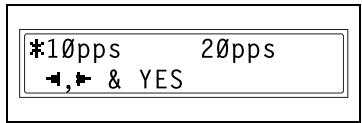
The “COMM.SETTING” menu appears again.
Specifying the Setting for "LINE MONITOR"
1 Press the [UTILITY] key ten times. "COMM. SETTING" appears.
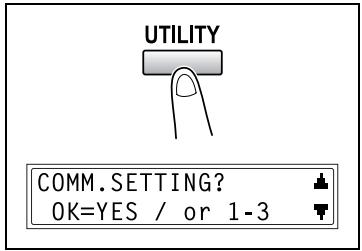
2 Press the [2] key from the 10-Key Pad to select "LINE MONITOR".
3 Using the [◀] and [▶] keys, select "HIGH", "LOW" or "OFF", and then press the [YES] key.
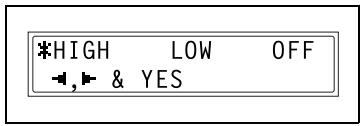
The "COMM.SETTING" menu appears again.
Specifying the Setting for "PSTN/PBX"
The connected wiring system can be set to either PSTN (Public Switched Telephone Network) or PBX (Private Branch Exchange).
For a PBX system, the outside line access number (or extension number) must be specified. The outside line access number (or extension number) is programmed in the [#] key.
To specify the telephone wiring system
1 Press the [UTILITY] key ten times. "COMM. SETTING" appears.
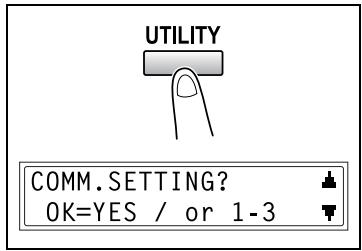
2 Press the [3] key from the 10-Key Pad to select "PSTN/PBX".
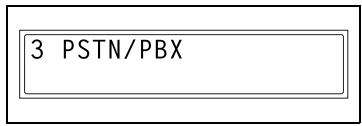
3 Using the [◀] and [▶] keys, select either "PSTN" (Public Switched Telephone Network) or "PBX" (Private Branch Exchange), and then press the [YES] key.
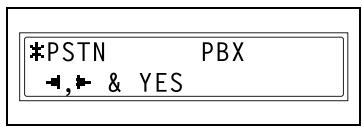
4 If "PBX" was selected, use the 10-Key Pad to enter the number that should be dialed to access the outside line, and then press the [YES] key.
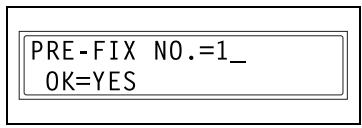
The "COMM.SETTING" menu appears again.
6.5 Setting Up the Report Output
From the “REPORTING” menu, various functions are available for specifying which reports are automatically printed.
| No. | REPORTING | Characteristic/Description |
| 1 | ACTIVITY REPORT | Every 60 transmissions/receptions, a report can be printed to show the results of the transmissions/receptions. This function can be used to set whether the report is printed automatically when the 60th transmission/reception is reached.The manufacturer's default setting is “ON”. |
| 2 | RESERV.REPORT | If multiple recipients are specified for transmission, such as with broadcast transmission and polling reception, a report can be printed to show specified settings. This function can be used to set whether this report is printed automatically.The manufacturer's default setting is “OFF”. |
| 3 | TX RESULT REPORT | This function can be used to set whether the report showing the result of a transmission is printed automatically after the transmission is finished.The manufacturer's default setting is “OFF”. |
| 4 | RX RESULT REPORT | This function can be used to set whether the report showing the result of a reception is printed automatically after mailbox reception is finished. (If regular reception is not finished normally, a report will always be printed, regardless of the selected setting.)The manufacturer's default setting is “OFF”. |
* By installing the optional Network Interface Card, settings can also be specified from the network tool PageScope Light. (p. 6-62)
Selecting the "REPORTING" menu
1 Press the [UTILITY] key eleven times.
"REPORTING" appears.
2 From the 10-Key Pad, press the key ([1] through [4]) for the "REPORTING" function that you wish to set.
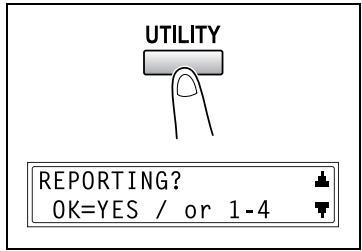
- The “REPORTING” functions are as follows:
1 ACTIVITY REPORT
2 RESERV.REPORT
3 TX RESULT REPORT
4 RX RESULT REPORT

Tip
If, at any time, you wish to quit setting/changing a “REPORTING” function, press the [NO] key. When the message “STOP SETTING?” appears, press the [YES] key to quit.
To exit the "REPORTING" menu, press the [AUTO RESET] key. The main screen appears again.
Specifying the Setting for "ACTIVITY REPORT"
1 Select the "REPORTING".
○ Refer to "Selecting the "REPORTING" menu" on page 6-55.
2 Press the [1] key from the 10-Key Pad to select "ACTIVITY REPORT".
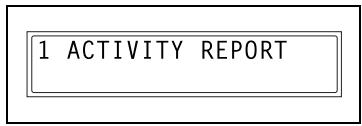
3 Using the [◀] and [▶] keys, select either "ON" or "OFF", and then press the [YES] key.
The “REPORTING” menu appears again.
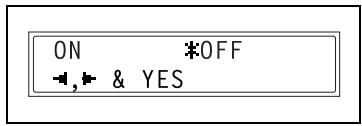
Specifying the Setting for "RESERV.REPORT"
1 Select the "REPORTING".
○ Refer to "Selecting the "REPORTING" menu" on page 6-55.
2 Press the [2] key from the 10-Key Pad to select "RESERV.REPORT".
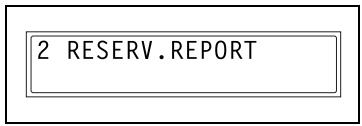
3 Using the [◀] and [▶] keys, select either "ON" or "OFF", and then press the [YES] key.
The "REPORTING" menu appears again.
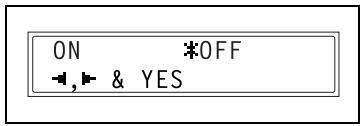
Specifying the Setting for "TX RESULT REPORT"
1 Select the "REPORTING".
○ Refer to "Selecting the "REPORTING" menu" on page 6-55.
2 Press the [3] key from the 10-Key Pad to select "TX RESULT REPORT".
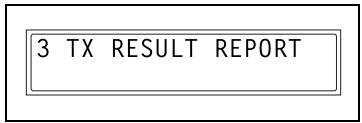
3 Using the [◀] and [▶] keys, select either "ON" or "OFF", and then press the [YES] key.
The "REPORTING" menu appears again.
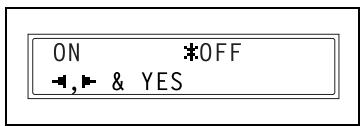
Specifying the Setting for "RX RESULT REPORT"
1 Select the "REPORTING".
○ Refer to "Selecting the "REPORTING" menu" on page 6-55.
2 Press the [4] key from the 10-Key Pad to select "RX RESULT REPORT".
4 RX RESULT REPORT
3 Using the [◀] and [▶] keys, select either "ON" or "OFF", and then press the [YES] key.
The "REPORTING" menu appears again.
ON *OFF -, & YES
6.6 Specifying Initial User Data
Various settings for the machine's user data can be specified.
Refer to the following table for details on each function.
| No. | Name | Description |
| 1 | DATE&TIME | The date and time for the machine can be specified. |
| 2* | USER FAX NO. | The fax number for the machine can be specified. |
| 3* | USER NAME | The fax name for the machine can be specified. |
* By installing the optional Network Interface Card, settings can also be specified from the network tool PageScope Light. (p. 6-62)
Selecting the "INITIAL USER DATA" menu
1 Press the [UTILITY] key twelve times.
"INITIAL USER DATA" appears.
2 From the 10-Key Pad, press the key ([1] through [3]) for the INITIAL USER DATA function that you wish to set.
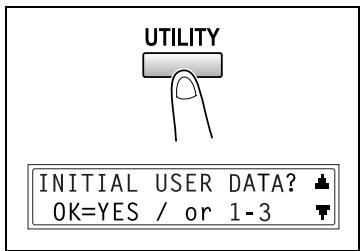
- The INITIAL USER DATA functions are as follows:
1 DATE&TIME
2 USER FAX NO.
3 USER NAME

Tip
To quit changing initial user data settings, press the [NO] key. "STOP SETTING?" appears. Press the [YES] key to quit changing the settings.
Specifying the Setting for "DATE&TIME"
1 Select the "INITIAL USER DATA".
○ Refer to "Selecting the "INITIAL USER DATA" menu" on page 6-58.
2 Press the [1] key from the 10-Key Pad to select "DATE&TIME".
1 DATE&TIME
3 Using the 10-Key Pad, enter the current time and date.
- Enter the settings in the following order: hours, minutes, year, month, and day.
14:00 '04 01 14 SET HOUR (OK=YES)
4 Press the [YES] key to display the time zone setting. Press the [▲] and [▼] keys to select the appropriate time zone.

Note
The time zone setting is available only if the Internet Fax & Network Scan Kit (IF-118) is installed.
5 Press the [YES] key.
Specifying the Setting for "USER FAX NO."
1 Select the "INITIAL USER DATA".
○ Refer to "Selecting the "INITIAL USER DATA" menu" on page 6-58.
2 Press the [2] key from the 10-Key Pad to select "USER FAX NO.".
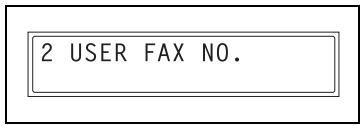
3 Using the 10-Key Pad, enter the fax number.
4 Press the [YES] key.
![8=_ OK=YES [1]](/content/2025/01/139714/images/88dac0da8632a22dcd8e65739a8e67820d478544f8a154eaef7b315adc2e09e3.jpg)
Specifying the Setting for "USER NAME"
1 Select the "INITIAL USER DATA".
○ Refer to "Selecting the "INITIAL USER DATA" menu" on page 6-58.
2 Press the [3] key from the 10-Key Pad to select "USER NAME".
3 USER NAME
3 Using the 10-Key Pad, enter the user name for the machine.
☐ Each press of the [123/ABC] key switches the input mode between numbers and letters. [1]: Numbers can be typed in. [A]: Letters can be typed in.
4 Press the [YES] key.
![123/ABC NAME=_ OK=YES [A] ① ② ③ ④ ⑤ ⑥ ⑦ ⑧ ⑨ * 0 #](/content/2025/01/139714/images/629f11318ee1ab56a6d6a197fd7db9cbdf07d82d4d367d1b3b6e7fd799d712dc.jpg)
PageScope Light Settings Page
The various fax settings can also be checked or changed if you log into PageScope Light in Admin. Mode.
Refer to "PageScope Light" on page 7-8.
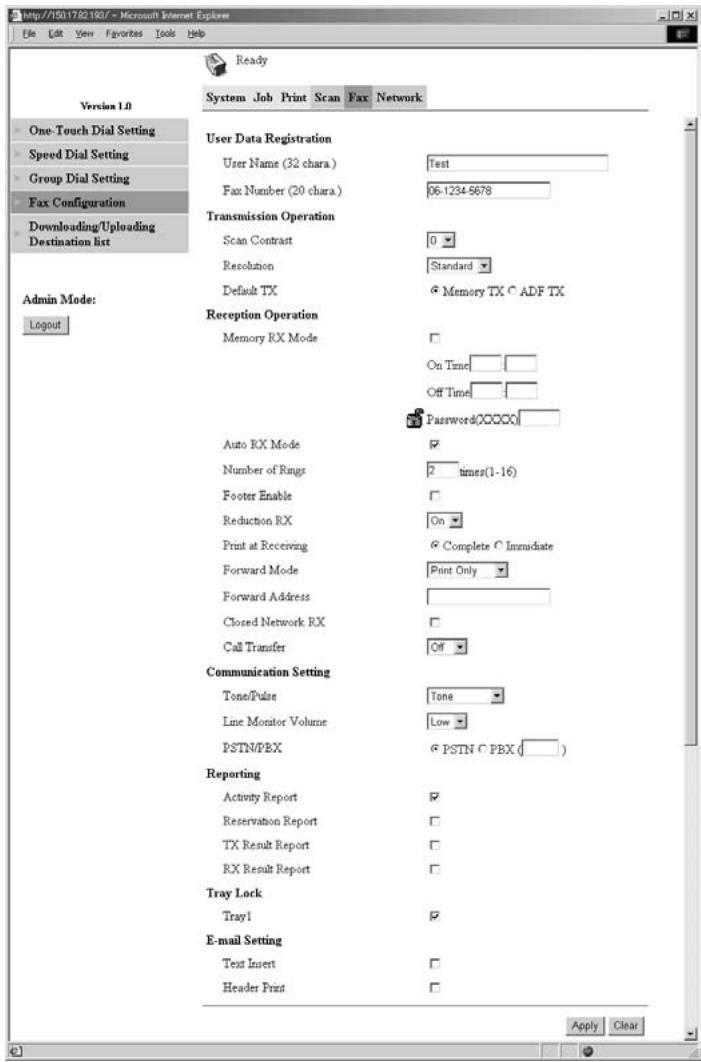
7 Appendix
7.1 Main Error Messages and Their Remedies
| Message | Cause | Remedy |
| LINE PROBLEM(Flashing alternately)CHECK LINE | The telephone dialing system or telephone wiring system are not set correctly.The telephone cable is not attached correctly. | Check the telephone dialing system or telephone wiring system and use the appropriate Utility mode function to make the correct settings.Correctly connect the telephone cable. |
| *COMM.ERROR*(######) | Communication is not possible because of some problem in the machine.Communication is not possible because of a problem with the recipient/ caller's fax machine. | Check the transmission results. |
| *REDIAL ALL FAILED* | All redial attempts failed because either the recipient's line is busy or there was no answer. | Check the condition of the recipient's line, and then try sending the fax again. |
| *MEM.FULL/TX CANCEL* | While sending a fax, the size of the data for the scanned image has exceeded the capacity of the memory. | Retrieve all received faxes stored in the memory.Send the fax by direct transmission. |
| *MEM.FULL/RX CANCEL* | While receiving a fax, the size of the data for the scanned image has exceeded the capacity of the memory. | Retrieve all received faxes stored in the memory. |
| HANG UP THE PHONE | The receiver of the connected telephone is lifted. | Replace the receiver of the connected telephone on the hook. |
| TEXT ×1.00 1([A]) #XXX: Fax Err | A fax error occurred while an operation was being performed in Copy mode. | Press the [FAX] key to check the error condition, and take appropriate measures. |
| TEXT ×1.00 1([A]) #XXX: Comm.Err | A fax transmission error occurred while an operation was being performed in Copy mode. | Press the [FAX] key to check the error condition, and take appropriate measures. |
| *PLEASE WAIT!* ADMINISTERED BY PC | This machine is accessing LSD, RSD or the Admin. Mode of PageScope Light. | Log off from PageScope Light.Exit LSD.If no operation is performed for 600 seconds, the main screen appears. |
7.2 When Faxing Is Not Performed Correctly
Faxes Cannot Be Sent
| Symptom | Possible Cause | Remedy |
| The document cannot be scanned. | The document is too thick. | Position the document on the Original Glass to send it. (p. 3-16) |
| The document is too thin or too small. | Position the document on the Original Glass to send it. (p. 3-16) | |
| The Original Glass is dirty. | Wipe the glass with a soft, dry cloth. | |
| The document was scanned at an angle. | The document is not positioned correctly. | Adjust the Document Guide Plates for the size of the document. (p. 3-14) |
| The fax received by the recipient is not clear. | The document is not positioned correctly. | Position the document correctly. (p. 3-16) |
| The Original Glass is dirty. | Wipe the glass with a soft, dry cloth. | |
| The text in the document is too faint. | Adjust the scanning contrast. (p. 6-37) | |
| There is a problem with the telephone connection or with the recipient's fax machine. | Check that this machine can make clean copies. If it can, try sending the fax again. | |
| The fax received by the recipient is blank. | The document was sent with the front side facing down (while using the Automatic Document Feeder). | Load the document with the front side facing up, and then try sending the fax again. (p. 3-14) |
| Faxes cannot be sent automatically. | The fax number is wrong. | Check the fax number. |
| A number specifically for telephone calls is being dialed. | Check the number. | |
| There is a problem with the recipient's fax machine (it is out of paper, it is not set to receive faxes automatically, it is turned off, etc.). | Contact the recipient. |
Faxes Cannot Be Received
| Symptom | Possible Cause | Remedy |
| The received fax is not clear. | Paper that does not meet specifications has been used. | Use paper that meets specifications. |
| The paper is damp. | Replace the paper. | |
| The toner is empty. | Replace the toner bottle with a new one. | |
| There is a problem with the telephone connection or with the caller's fax machine. | Check that the machine can make clean copies. If it can, have the caller send the fax again. | |
| The received fax is blank. | The toner is empty. | Replace the toner bottle with a new one. |
| The caller sent the back of the fax pages. | Contact the caller. | |
| Faxes cannot be received automatically. | The machine is set to receive faxes manually. | Set the machine to automatic reception. (p. 4-20) |
| The memory is full. | Load paper if it is empty, and then print the faxes stored in the memory. | |
| Some error occurred. | Follow the instructions in any messages that appear on the display. | |
| Black streaks appear through the copy. | There is a problem with the telephone connection or with the caller's fax machine. | Check that the machine can make clean copies. If it can, have the caller send the fax again. |
Calls Cannot Be Sent
| Symptom | Possible Cause | Remedy |
| Nothing can be heard from the connected telephone. | The cord from the telephone is not connected correctly to the main unit. | Correctly connect the telephone cord to the main unit. |
| The telephone cord from the wall jack is not connected correctly to the main unit. | Correctly connect the telephone cord from the wall jack to the main unit. | |
| Transmitting. | Check again after the transmission is finished. | |
| After dialing, the ringing cannot be heard. | The telephone dialing system is not set correctly. | Correctly set the telephone dialing system. (p. 6-51) |
| After the [ON-HOOK] key is pressed, it is difficult to hear the recipient/caller's voice. | The monitoring volume is too low. | Increase the monitoring volume. (p. 6-52) |
| The ringing of the telephone is too low (loud). | The ringer volume of the connected telephone is set too low (loud). | Adjust the ringer volume of the connected telephone. |
7.3 Glossary
Terms and Definitions
| Term | Definition |
| Automatic redialing | If a call cannot be completed, for example if the recipient's machine is busy, the recipient is automatically called again. If a document queued in the memory to be sent contains multiple pages, until the time for redialing has been reached, it is advanced in the queue and sent. |
| Book document | A bound document such as a book or catalog. |
| F codes | F codes are mailbox functions, such as “SUB” (sub-addresses), “SEP” (selective polling), “SID” and “PWD” (passwords), regulated by the G3 standards of the ITU-T (International Telecommunication Union). Mailbox transmission/reception and relay initiation transmission are possible only with similar machines compatible with F code transmission. |
| G3 communication | Communications in conformance with the G3 standard (an international standard for facsimile communications); fax communications via an analog line (general subscriber line). |
| Internet fax | Faxes can be transmitted via the Internet or an Intranet instead of through telephone lines.Instead of a fax number, the recipient's e-mail address is specified and the scanned image (TIFF format) can be sent as an e-mail message to a computer or Internet fax. In addition, e-mail messages from computers can be received as images. |
| General subscriber line | Analog telephone lines (public network) |
| JBIG coding method | New method of data compression/decompression, standardized by the Joint Bi-level Image Expert Working Group, a subcommittee of the International Telecommunications Union (ITU-T). Effective for transferring large amounts of data or high-resolution image data such as halftones. |
| Manual reception | Receiving a fax document after talking on the telephone. |
| Manual transmission | Sending a fax document after talking on the telephone. |
| Memory | Stores fax and copy image data. By installing expansion memory, much more image data can be stored in the memory. |
| Memory reception | When paper runs out or a paper misfeed occurs while receiving a fax, the data is automatically stored in the memory and printed out later.Even if the paper runs out during the night or when the user is away, the fax document can still be received. |
| Network scanner | This is a function that allows scanned images to be sent to a computer via a network. They can also be sent as e-mail messages or uploaded to FTP servers. |
| On-hook dialing | Dials without the hand set picked up. Press the [ON-HOOK] key to use this function. |
| PBX | Abbreviation for private branch exchangeExchange equipment installed in a company or a plant to connect a number of telephone sets with multiple station lines in order to enable unrestricted communications between the telephone sets. |
| Protocols | The necessary rules for communication |
| Touch-tone signals | A signal used on the telephone line; used when calling on a push-button line or using push-button services.By pressing the [ × ] key in the 10-Key Pad, touch-tone signals are used, even if a dial phone line is connected. |
7.4 PageScope Light
What is PageScope Light?
PageScope Light is a device control utility program provided by the HTTP server built into the Network Interface Card. This utility can be used with a Web browser as an interface for remotely controlling the machine and Network Interface Card.
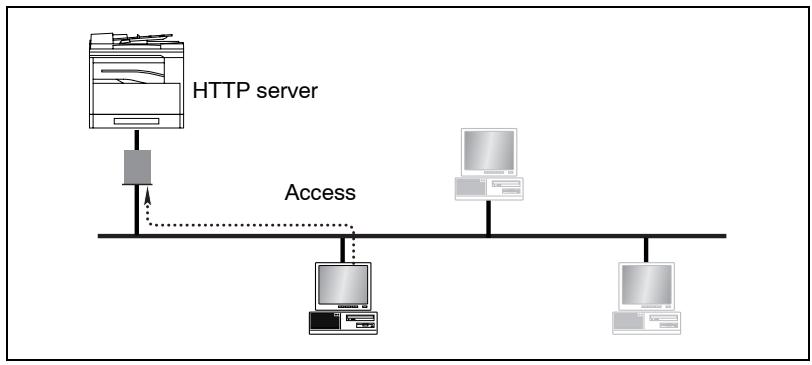
flowchart
graph TD
    A["HTTP server"] --> B["Access"]
    B --> C["Computer 1"]
    B --> D["Computer 2"]
    B --> E["Computer 3"]
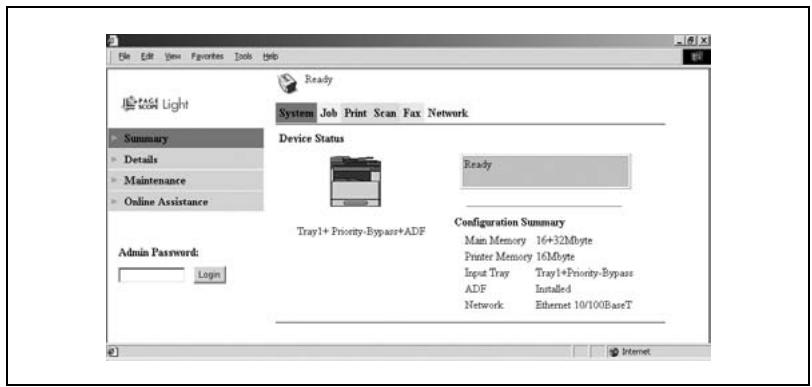
Here are some examples of the types of tasks that can be performed with PageScope Light.
- Change Settings
Change network settings
Change Fax settings
● Remote Status Monitoring
Check the details of machine trays, information about consumables, or the total number of prints
Check the status of jobs that are being printed, or held in the print queue (Jobs can also be deleted if you have logged in to the Administrator mode.)
System Requirements
PageScope Light can be used in the following system environments.
| OS | Windows 95 (OSR 2.5), Windows 98, Windows 98 SE, Windows ME, Windows NT 4.0, Windows 2000, or Windows XP |
| Browser | Microsoft Internet Explorer 4.0 or laterNetscape Navigator 4 or later |
Accessing PageScope Light
PageScope Light is accessed directly using a Web browser.
1 Start up your Web browser.
2 Enter the IP address of the machine into the URL box, and then press the [Enter] key.
http://
☐ (Example) If the machine IP address is 192.168.0.10, enter: http://192.168.0.10/
3 The PageScope Light screen appears.

...
Note
In order to access PageScope Light, an IP address must be assigned to the machine.
Using PageScope Light
PageScope Light is used in the same way as other Internet Web pages. Click on links in the page to jump to that page, and use the [Back] and [Next] buttons to navigate through pages that have already been loaded.
About the Screen Layout
The following screen appears when you access PageScope Light.

Note
Screen images used in this manual may differ from the actual screen display. They are also subject to change without notice.
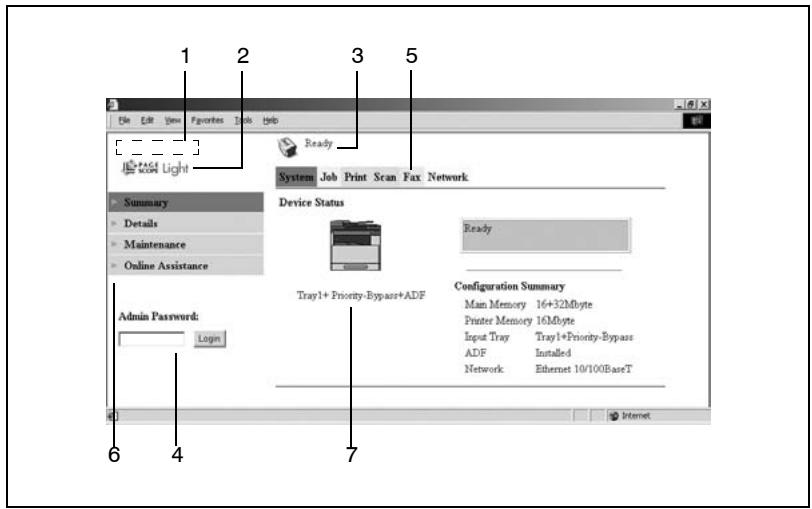
| 1 | Logo | Click on this to jump to the manufacturer's Web site. |
| 2 | Logo | Click on this to jump to the PageScope Web site. |
| 3 | Status display | Displays the current status of the machine. |
| 4 | Administrator password | Enter the administrator password to log in to the Administrator mode. |
| 5 | Tabs | These are used to select the various categories of settings. |
| 6 | Menu | This is used to select various setting items or display information. |
| 7 | Information/settings display | Displays the details for the item selected from the menu. |
Logging In as an Administrator
Some of the settings available in PageScope Light can only be changed by an administrator. These settings are only displayed when you log in to the Administrator mode.
Logging In to Administrator Mode
1 Enter the administrator password in the "Admin Password:" box at the left of the screen.
2 Click the [Login] button to log in to the Administrator mode.
3 To log out again, click the [Logout] button.

Note
The default password for Administrator mode is "sysadm". Be sure to change the administrator password before using Administrator mode.

Note
The machine cannot be used while you are logged into PageScope Light with Administrator mode.
8 Index
A
Activity report 6-55
Administrative settings 5-6
B
Batch transmission 4-4
Setup 6-27
Broadcast transmission 4-5
C
Canceling queued document 4-18
Communication settings
Monitoring volume 6-52
Control panel 2-2
D
Dialing 3-1
Direct transmission 4-3
E
Error messages 7-1
F
F codes 4-24
Fax resolution 3-12
Fax transmission
Basic faxing ....3-14
Dialing 3-1
Loading documents into the Automatic Document Feeder .....3-14
Positioning documents on the Original Glass 3-16
G
Glossary 7-6
Group dialing 3-5
Setup 6-11
M
Machine settings 5-2
Mailbox reception 4-21
Mailbox setup 6-30
Mailbox transmission 4-10
Main unit 2-1
Manual reception 4-20
Manual transmission 4-3
Memory full 3-17
Memory reception 4-21
O
One-touch dialing 3-3
Setup 6-3
P
PageScope Light 7-8
Paper source Setup 5-5
Phone book 3-8
Polling reception 4-22
Polling transmission 4-15
Program dialing 3-7
Setup 6-15
Programming fax settings 6-1
Q
Queued jobs report 6-56
R
Reception result report 6-57
Reception settings
Footer printing 6-48
Forwarding setup 6-47
Memory reception mode 6-43
Number of rings 6-45
Printing mode 6-46
Reception mode 6-46
Reduced printing 6-45
Tray selection 6-48
Relay box setup 6-33
Relay broadcast transmission 4-14
Relay initiation transmission 4-12
Remote monitor 5-8
S
Speed dialing 3-4
Setup 6-7
T
Timer transmission 4-8
Total count 3-18
Transmission result report 6-56
Transmission results ....3-20
Transmission settings
Default transmission mode 6-39
Resolution 6-38
Scanning contrast 6-37
U
Utility mode 5-1
- 7216/7220 Fax Unit (FK-118)
- User Manual
- Contents
- Introduction
- Precautions
- Faxing
- Transmission Settings 3-12
- Basic Faxing 3-14
- Confirmation Mode.... 3-18
- Fax Transmission/Reception Methods
- Transmission Methods 4-1
- Reception Methods....4-20
- Using the Utility Mode
- Using the Utility Mode (Fax)
- Setting Up the Fax Registration 6-1
- Setting Up the Transmission.... 6-36
- Setting Up the Reception.... 6-40
- Settings Up the Communication....6-50
- Setting Up the Report Output 6-54
- Specifying Initial User Data....6-58
- Appendix
- Main Error Messages and Their Remedies....7-1
- When Faxing Is Not Performed Correctly....7-3
- Glossary....7-6
- PageScope Light....7-8
- Index
- User Manuals
- Introduction
- We Want You to Be a Satisfied Customer
- Explanation of Manual Conventions
- WARNING
- CAUTION
- Note\*
- Energy Star®
- What is an ENERGY STAR® Product?
- Safety Information
- Warning and Precaution Symbols
- Meaning of Symbols
- Precautions for Routine Use
- Miscellaneous
- NOTE
- User Instructions – CE Marking
- Notice for Ni-MH Batteries
- Part Names and Their Functions
- Names of Control Panel Parts and Their Functions
- Control Panel Parts and Their Functions
- Display Indications
- Entering Text
- Changing Input Mode
- Inputting Example
- Dialing
- Using Direct Dialing to communicate with overseas destinations:
- To fax by entering the fax number directly using the 10-Key Pad
- To fax using one-touch dialing
- Tip
- To fax using speed dialing
- To fax using group dialing
- To fax using chain dial
- To fax using program dialing
- To fax using the phone book
- To search the phone book
- To redial the last recipient called
- Transmission Settings
- Adjusting the Fax Resolution
- To specify the resolution
- Basic Faxing
- To fax using the Automatic Document Feeder
- Press the [FAX] key.
- Load the document to be faxed into the Automatic Document Feeder.
- If necessary, change the "Resolution" setting (p. 3-13).
- Using the 10-Key Pad, enter the fax number of the recipient.
- Press the [START] key to begin scanning and sending the fax.
- To cancel the transmission:
- To fax documents positioned on the Original Glass
- Lift open the Automatic Document Feeder, and then position the document to be faxed on the Original Glass.
- Press the [START] key.
- Press the [YES] key.
- Press the [START] key.
- If the Memory Becomes Full While Scanning Fax Documents
- Confirmation Mode
- Checking the Machine's Counters
- To check the counters
- Checking Transmission Results
- To check the transmission result
- Outputting a report/list
- To output a report/list
- Transmission Result Report
- Reception Result Report
- Activity Report
- Memory Data List
- Memory Image Print
- List of One-Touch Dial Keys
- List of Speed Dial Numbers
- Key Setting List
- Relay Box List
- Machine Status List
- Configuration Page
- PCL Font List
- Transmission Methods
- Memory Transmission
- To specify Memory TX
- Press the [MEMORY TX] key, and then check that the MEMORY TX lamp lights up.
- Press the [START] key to begin scanning and sending the fax.
- Direct Transmission
- Manual Transmission
- To send a fax manually
- Batch Transmission
- To fax using batch transmission
- Broadcast Transmission
- To fax using broadcast transmission
- or
- Timer Transmission
- To fax using timer transmission
- Mailbox Transmission
- To fax using mailbox transmission
- Relay Initiation Transmission
- To fax using relay initiation transmission
- Relay Broadcast Transmission
- Polling Transmission
- To set up polling transmission
- Using the 10-Key Pad, enter the 4-digit password.
- Press the [START] key.
- To delete a document from the polling transmission setup
- Canceling (Deleting) a Document Queued in the Memory for Transmission
- To cancel a queued document
- Reception Methods
- Manual Reception
- To receive a fax manually
- Memory Reception
- Mailbox Reception
- To retrieve a document from a mailbox
- Polling Reception
- To receive a fax using polling reception
- Using F codes
- F codes
- Using Mailboxes
- Specifying F codes
- When sending faxes
- Programming F codes
- Utility Mode
- Specifying the Machine Settings
- Selecting the "MACHINE SETTING" menu
- Specifying the Setting for "BUZZER VOLUME"
- Specifying the Setting for "INITIAL MODE"
- Setting Up the Paper Sources (“PAPER SOURCE SETUP” Menu)
- Specifying Administrative Settings (“ADMIN. MANAGEMENT” Menu)
- To select the "ADMIN. MANAGEMENT" menu
- To set the “REMOTE MONITOR” function
- Select the "ADMIN.
- Press the [3] key from the 10-Key
- Using the [◀] and [▶] keys, select
- Using the 10-Key Pad, enter the 4-
- Setting Up the Fax Registration
- Selecting the "FAX REGISTRATION" menu
- Setting Up One-Touch Dialing ("ONE-TOUCH DIAL" function)
- To program a one-touch dial key
- To change/delete a programmed one-touch dial key
- Specifying the Setting for "SPEED DIAL"
- To program a speed dial number
- Press the [▼] key, and then use the 10-Key Pad to enter the SUB.
- Press the [▼] key, and then use the 10-Key Pad to enter the SID.
- Press the [YES] key.
- Using the [◀] and [▶] keys, select the desired modem speed.
- Press the [YES] key.
- Press the [NO] key to finish programming.
- To change/delete a programmed speed dial number
- Specifying the Setting for "GROUP DIAL"
- To program a group of fax numbers
- To change/delete a programmed group of fax numbers
- Specifying the Setting for "PROGRAM DIAL"
- To set program dialing
- To change/delete a programmed broadcast transmission
- To change/delete a programmed timer transmission
- To change/delete a programmed mailbox transmission
- To change/delete a programmed polling reception
- To change/delete a programmed relay initiation transmission
- Specifying the Setting for "BATCH TX"
- To set batch transmitting
- To change the batch transmission setting
- To delete the batch transmission setting
- Specifying the Setting for "MAILBOX"
- To register a mailbox
- To delete a mailbox
- Setting Up Relay Boxes ("RELAY BOX" function)
- To program the relay box
- To delete the relay box
- Setting Up the Transmission
- Selecting the "TX OPERATION" menu
- Specifying the Setting for "SCAN CONTRAST"
- Specifying the Setting for "RESOLUTION"
- Specifying the Setting for "DEFAULT TX"
- Specifying the Setting for "HEADER"
- Setting Up the Reception
- Selecting the "RX OPERATION" menu
- Specifying the Setting for "MEMORY RX MODE"
- To cancel memory reception
- Specifying the Setting for "NO. of RINGS"
- Specifying the Setting for "REDUCTION RX"
- Specifying the Setting for "RX PRINT"
- Specifying the Setting for "RX MODE"
- Specifying the Setting for "FORWARD"
- Specifying the Setting for "FOOTER"
- Specifying the Setting for "SELECT TRAY"
- Specifying the Setting for "CLOSED NETWORK"
- Settings Up the Communication
- Specifying the Setting for "TONE/PULSE"
- To specify the telephone dialing system
- Specifying the Setting for "LINE MONITOR"
- Specifying the Setting for "PSTN/PBX"
- To specify the telephone wiring system
- Setting Up the Report Output
- Selecting the "REPORTING" menu
- Specifying the Setting for "ACTIVITY REPORT"
- Specifying the Setting for "RESERV.REPORT"
- Specifying the Setting for "TX RESULT REPORT"
- Specifying the Setting for "RX RESULT REPORT"
- Specifying Initial User Data
- Selecting the "INITIAL USER DATA" menu
- Specifying the Setting for "DATE&TIME"
- Specifying the Setting for "USER FAX NO."
- Specifying the Setting for "USER NAME"
- PageScope Light Settings Page
- Main Error Messages and Their Remedies
- When Faxing Is Not Performed Correctly
- Glossary
- PageScope Light
- What is PageScope Light?
- System Requirements
- Accessing PageScope Light
- Using PageScope Light
- About the Screen Layout
- Logging In as an Administrator
- Logging In to Administrator Mode
- A
- B
- C
- D
- E
- F
- G
- M
- O
- P
- Q
- R
- S
- T
- U
Marque : KONICA MINOLTA
Modèle : FK-118
Catégorie : Imprimante