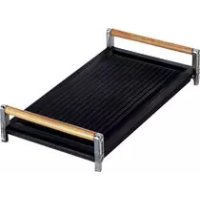
GKOC64NLK - Plaque de cuisson SMEG - Notice d'utilisation et mode d'emploi gratuit
Retrouvez gratuitement la notice de l'appareil GKOC64NLK SMEG au format PDF.


| Type de produit | Table de cuisson à gaz |
| Nombre de foyers | 4 foyers |
| Type de gaz | Gaz naturel et GPL |
| Dimensions approximatives | 600 x 510 mm |
| Poids | 10 kg |
| Matériau de la surface | Verre trempé |
| Couleur | Noir |
| Type de commandes | Commandes rotatives |
| Fonctions principales | Réglage de la puissance, allumage automatique |
| Entretien et nettoyage | Surface en verre facile à nettoyer, grilles en fonte |
| Pièces détachées et réparabilité | Disponibilité de pièces de rechange, facilité de réparation |
| Normes de sécurité | Système de sécurité anti-fuite de gaz |
| Garantie | 2 ans |
| Informations générales | Compatible avec les cuisines modernes, design élégant |
FOIRE AUX QUESTIONS - GKOC64NLK SMEG
Questions des utilisateurs sur GKOC64NLK SMEG
0 question sur cet appareil. Repondez a celles que vous connaissez ou posez la votre.
Poser une nouvelle question sur cet appareil
Téléchargez la notice de votre Plaque de cuisson au format PDF gratuitement ! Retrouvez votre notice GKOC64NLK - SMEG et reprennez votre appareil électronique en main. Sur cette page sont publiés tous les documents nécessaires à l'utilisation de votre appareil GKOC64NLK de la marque SMEG.
MODE D'EMPLOI GKOC64NLK SMEG
Contents
1 Instructions 30
1.1 General safety instructions 30
1.2 Manufacturer liability 33
1.3 Appliance purpose 33
1.4 Identification plate 33
1.5 This user manual 33
1.6 Disposal 34
1.7 How to read the user manual 35
2 Description 36
2.1 General Description 36
2.2 Symbols 36
2.3 Available accessories 37
3 Use 38
3.1 Instructions 38
3.2 First use 38
3.3 Using the hob 39
4 Cleaning and maintenance 41
4.1 Instructions 41
4.2 Cleaning the appliance 41
5 Installation 43
5.1 Safety instructions 43
5.2 Positioning in the counter top 43
5.3 Mounting 47
5.4 Gas connection 48
5.5 Adaptation to different types of gas 51
5.6 Electrical connection 54
These instructions apply only for the destination countries listed on the appliance's data plate. This is a class 3 built in hob.
We advise you to read this manual carefully, which contains all the instructions for maintaining the appliance's aesthetic and functional qualities.
For further information on the product: www.smeg.com
1 Instructions
1.1 General safety instructions
Risk of personal injury
- During use the appliance and its accessible parts become very hot. Never touch the heating elements during use.
- Never try to put out a fire or flames with water: Turn off the appliance and smother the flames with a fire blanket or other appropriate cover.
- This appliance may be used by children aged at least 8 and by people of reduced physical, sensory or mental capacity, or lacking in experience in the use of electrical appliances, provided that they are supervised or instructed by adults who are responsible for their safety.
- Children must not play with the appliance.
- Keep children under the age of eight at a safe distance unless they are constantly supervised.
-
Keep children under the age of 8 away from the appliance when it is in use.
-
Cleaning and maintenance must not be carried out by unsupervised children.
- Make sure that the flame-spreader crowns are correctly positioned in their housings with their respective burner caps.
- Be aware of how rapidly the cooking zones heat up. Do not place empty pans on the heat. Danger of overheating.
- Fats and oils can catch fire if they overheat. Do not leave the appliance unattended while preparing foods containing oils or fats. If fats or oils catch fire, never put water on them. Place the lid on the pan and turn off the relevant cooking zone.
- The cooking process must always be monitored. A short cooking process must be continuously monitored.
- Do not place metal objects, such as dishes or cutlery, on the hob surface during use as they may overheat.
-
Do not insert pointed metal objects (cutlery or utensils) into the slots in the appliance.
-
Do not use aerosols in the vicinity of this appliance whilst it is in use.
- Switch off the appliance immediately after use.
- Do not modify this appliance.
- Do not try to repair the appliance yourself or without the intervention of a qualified technician.
- Do not pull the cable to remove the plug.
- If the power supply cable is damaged, contact technical support immediately and they will replace it.
Risk of damaging the appliance
- Do not seat on the appliance.
- Do not use steam jets to clean the appliance.
- Do not obstruct ventilation openings and heat dispersal slots.
- Never leave the appliance unattended during cooking operations where fats or oils could be released, as these could then heat up and catch fire. Be very careful.
-
Never leave objects on the cooking surface.
-
Do not use the appliance to heat rooms for any reason.
- Do not spray any spray products near the oven.
- Do not use plastic cookware or containers when cooking food.
- Cooking vessels or griddle plates should be placed inside the perimeter of the hob.
- All pans must have smooth, flat bottoms.
- If any liquid does boil over or spill, remove the excess from the hob.
Take care not to spill acid substances such as lemon juice or vinegar on the hob. - Do not put empty pans or frying pans on switched on cooking zones.
- Do not use rough or abrasive materials or sharp metal scrapers.
-
Do not use cleaning products containing chlorine, ammonia or bleach on parts made of steel or that have metallic surface finishes (e.g. anodizing, nickel- or chromium-plating).
-
Do not wash removable parts such as the hob grids, flame-spreader crowns and burner caps in the dishwasher.
Installation
- This appliance must not be installed in a boat or caravan.
- The appliance must not be installed on a pedestal.
- Position the appliance into the cabinet cut-out with the help of a second person.
- To avoid potential overheating, the appliance must not be installed behind a decorative door or a panel.
- Always use any necessary/ required personal protective equipment (PPE) before performing any work on the appliance (installation, maintenance, positioning or movement).
- Before performing any work on the appliance, switch off the power supply.
-
Have qualified personnel carry out installation and assistance interventions according to the standards in force.
-
Have the gas connection performed by authorised technical personnel. Installation with a hose must be carried out so that the length of the piping does not exceed 2 metres when fully extended for steel hoses.
- The hoses should not come into contact with moving parts and should not be crushed in any way.
- If required, use a pressure regulator that complies with current regulations.
After carrying out any operation, check that the tightening torque of gas connections is between 10 Nm and 15 Nm. - At the end of the installation, check for any leaks with a soapy solution, never with a flame.
- Have the electrical connection performed by authorised technical personnel.
- The appliance must be connected to earth in compliance with electrical system safety standards.
-
Use cables withstanding a temperature of at least 90^ C .
-
The tightening torque of the screws of the terminal supply wires must be 1.5 - 2 Nm .
- If it is necessary to replace the power cable, this must only be performed by a qualified technician.
For this appliance
- Do not obstruct ventilation openings and heat dispersal slots.
- Do not insert pointed metal objects (cutlery or utensils) into the slots in the appliance.
- Do not use the appliance to heat rooms for any reason.
- The appliance is not designed to operate with external timers or with remote-control systems.
1.2 Manufacturer liability
The manufacturer declines all liability for damage to persons or property caused by:
- Use of the appliance other than the one envisaged,
- Failure to comply with the instructions in the user manual;
- Tampering with any part of the appliance,
- The use of non-original spare parts.
1.3 Appliance purpose
This appliance is intended for cooking food in the home environment. Every other use is considered improper.
1.4 Identification plate
The identification plate bears the technical data, serial number and brand name of the appliance. Do not remove the identification plate for any reason.
1.5 This user manual
This user manual is an integral part of the appliance and must therefore be kept in its entirety and within the user's reach for the whole working life of the appliance.
Read this user manual carefully before using the appliance.
Instructions
1.6 Disposal

This appliance must be disposed of separately from other waste (Directives 2002/95/EC, 2002/
96/EC, 2003/108/EC). The appliance does not contain substances in quantities sufficient to be considered hazardous to health and the environment, in accordance with current European directives. To dispose of the appliance:
- Cut the power supply cable and remove it along with the plug.

Power voltage Danger of electrocution
- Disconnect the mains power supply.
-
Unplug the appliance.
-
Deliver the appliance to the appropriate recycling centre for electrical and electronic equipment waste, or return it to the retailer when purchasing an equivalent product, on a one for one basis.
Our appliances are packaged in non-polluting and recyclable materials.
- Deliver the packing materials to the appropriate recycling centre.

Plastic packaging Danger of suffocation
- Do not leave the packaging or any part of it unattended.
- Do not let children play with the plastic bags.
1.7 How to read the user manual
This user manual uses the following reading conventions:
Instructions

General information on this user manual, on safety and final disposal.
Description

Description of the appliance and its accessories.
Use

Information on the use of the appliance and its accessories, cooking advice.
Cleaning and maintenance

Information for proper cleaning and maintenance of the appliance.
Installation

Information for the qualified technician: Installation, operation and inspection.

Safety instructions

Information

Advice
-
Sequence of instructions for use.
-
Standalone instruction.
2 Description
2.1 General Description

- Control panel
- Auxiliary Burner (AUX)
- Reduced Rapid Burner (RR)
- Ultra-rapid triple crown burner (UR3)
- Right grid
6.Left grid
2.2 Symbols
Cooking zones

Front

Rear

Centre right

Centre left
Burner knobs
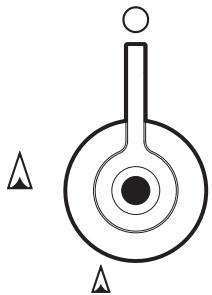
For lighting and adjusting the hob burners.
Press and turn the knobs anti-clockwise to in order to light the relative burners. Turn the
knobs to the zone between the maximum
and minimum A setting to adjust the flame.
Return the knobs to the position O to turn off the burners.
2.3 Available accessories
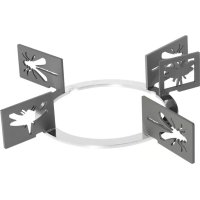
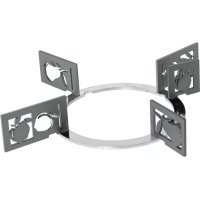
Raised pan support
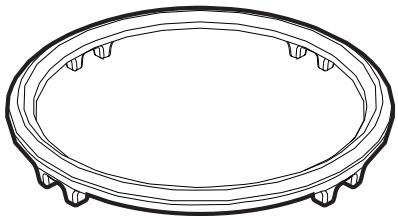
To prevent damage to the worktop, a raised pan support is available to place under pans having a diameter greater than those indicated in the "Cookware diameters" table in section 3.3 "Using the hob".
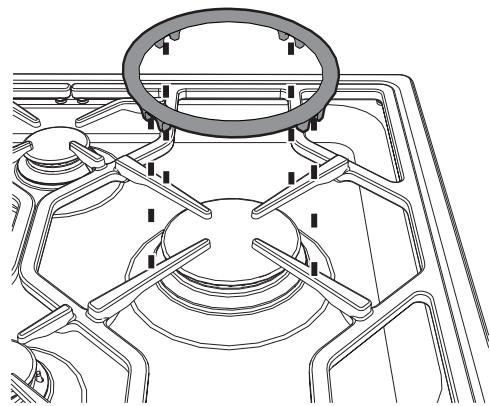
The support must be placed on the hob grid as shown in the figure above.
In any case, pans with a diameter greater than 28~cm must only be used on the Ultra-rapid burner (UR3).
This pan support can also be used with woks.
3 Use
3.1 Instructions

Improper use Danger of burns
- Make sure that the flame-spreader crowns are correctly positioned in their housings with their respective burner caps.
- Oils and fats could catch fire if overheated. Be very careful.
- Do not leave the appliance unattended during cooking operations where fats or oils could be released.
- Do not spray any spray products near the appliance.
- Do not touch the appliance's heating elements when it is in operation. Leave them to cool before cleaning.
- Keep children under the age of 8 away from the appliance when it is in use.

Improper use Risk of damage to surfaces
- Do not use aluminium foil to cover the burners or hob body.
- Cookware should be placed inside the perimeter of the hob.
- All pans must have smooth, flat bottoms.
- If any liquid does boil over or spill, remove the excess from the hob.
3.2 First use
- Remove any protective film from the outside or inside of the appliance, including accessories.
- Remove any labels (apart from the technical data plate) from accessories.
- Remove and wash all the appliance accessories (see 4 Cleaning and maintenance).
3.3 Using the hob
All the appliance's control and monitoring devices are located together on the front panel. The appliance is equipped with an electronic ignition device. Simply press the knob and turn it anti-clockwise to the maximum flame symbol, until the burner ignites. If the burner does not light in the first 15 seconds, turn the knob to and wait 60 seconds before trying again. After lighting, keep the knob pressed in for a few seconds to allow the thermocouple to heat up. The burner may go out when the knob is released: In this case, the thermocouple has not heated up sufficiently. Wait a few moments and repeat the operation. Keep the knob pressed in longer.

In case of an accidental switching off, a safety device will be tripped, cutting off the gas supply, even if the gas cock is open. Return the knob to O and wait at least 60 seconds before lighting it again.
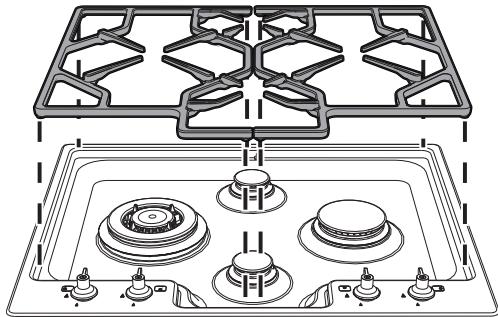
Positioning the pan stands
The grids are supplied assembled on the hob. To position the grids correctly, follow the instructions shown in figure.
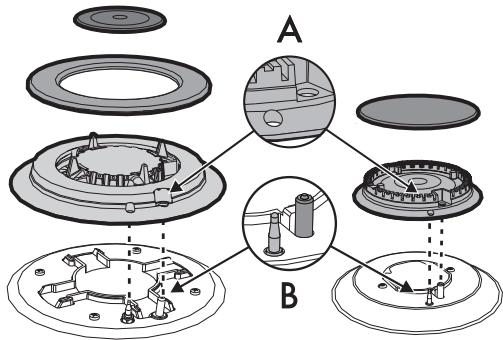
Correct positioning of the flame-spreader crowns and burner caps
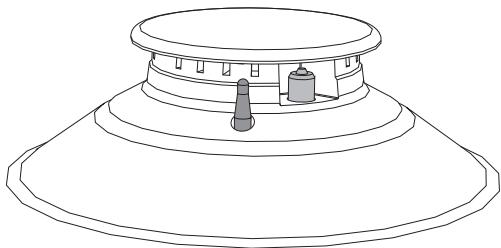
Before lighting the hob burners, check that the flame-spreader crowns are correctly in place with their respective burner caps, making sure that the holes (A) of the burners are aligned with the igniters and thermocouples (B).
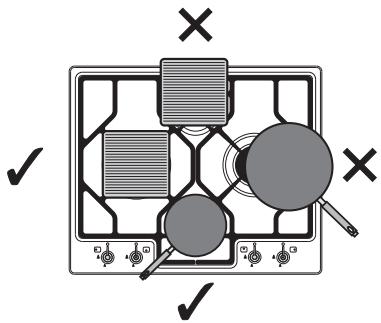
Practical tips for using the hob
For better burner efficiency and to minimise gas consumption, use pans with lids and of suitable size for the burner, so that the flames do not reach up the sides of the pan. Once the contents come to the boil, turn down the flame far enough to ensure that the liquid does not boil over.

Cookware diameters:
AUX: 12 - 16 cm.
RR:18-24cm.
- UR3: 22 - 26 cm.
Cookware diameters with raised pan support:
AUX: 16 - 26 cm.
RR:24-28 cm.
- UR3: 26 - 34 cm.
To prevent burns or damage to the hob or the counter top during cooking, all pans or griddles must be placed inside the perimeter of the hob.

Always check that the knobs are in the O (off) position when you have finished using the appliance.
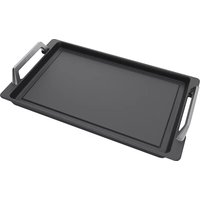
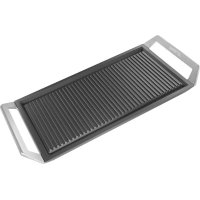
Limitations on griddle use
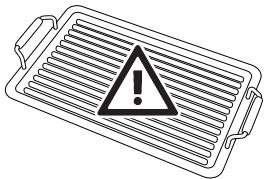
A few precautions are necessary if you wish to use a griddle:
- Griddles must never protrude beyond the edge of the hob.
- Teflon-coated aluminium griddles should be pre-heated empty for a maximum of 5 minutes in order to avoid damaging the appliance and the Teflon coating. After pre-heating, place the foodstuffs on the griddle to cook them; do not exceed 40 minutes of total use for the griddle.
- Do not use griddles or plates to cook or heat food on the ultra-rapid burner (UR3).
- If one of the burners close to the wooden rear wall is an ultra-rapid burner (UR3), leave a gap of at least 160mm between this wall and the edge of the griddle.
- Make sure that the burner flame does not extend beyond the edge of the griddle.
- Leave a gap of at least 160mm between the edge of the griddle and the side wall.
- Do not place the griddle over more than one burner at the same time.
- Never use the griddle for more than 40 minutes.
4 Cleaning and maintenance
4.1 Instructions

Improper use
Risk of damage to surfaces
- Do not use steam jets to clean the appliance.
- Do not use cleaning products containing chlorine, ammonia or bleach on parts made of steel or that have metallic surface finishes (e.g. anodizing, nickel- or chromium-plating).
- Do not use rough or abrasive materials or sharp metal scrapers.
- Do not wash removable parts such as the hob grids, flame-spreader crowns and burner caps in the dishwasher.
4.2 Cleaning the appliance
To keep the surfaces in good condition, they should be cleaned regularly after use. Let them cool first.
Ordinary daily cleaning
Always and only use specific products that do not contain abrasives or chlorine-based acids.
Pour the product onto a damp cloth and wipe the surface, rinse thoroughly and dry with a soft cloth or a microfibre cloth.
Food stains or residues
Do not use steel sponges and sharp scrapers as they will damage the surface. Use normal, non-abrasive products and a wooden or plastic tool, if necessary. Rinse thoroughly and dry with a soft cloth or a microfibre cloth.
Cooking hob grids
Remove the grids and clean them in lukewarm water and non-abrasive detergent. Make sure to remove any encrustations. Dry them thoroughly and return them to the hob.

The continuous contact between the grids and the flame can cause modifications to the enamel over time in those parts exposed to heat. This is a completely natural phenomenon which has no effect on the operation of this component.
Flame-spreader crowns and burner caps
For easier cleaning, the flame-spreader crowns and the burner caps can be removed. Wash them in hot water and non-abrasive detergent. Carefully remove any encrustation, then wait until they are perfectly dry. Replace the flame-spreader crowns, making sure that they are correctly positioned in their housings with their respective burner caps.
Knobs

Do not use aggressive products containing alcohol or products for cleaning steel and glass when cleaning the knobs, as these products could cause permanent damage.
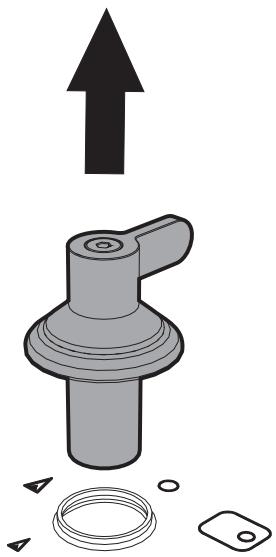
The knobs should be cleaned with a soft cloth dampened with warm water, then dried carefully. They can easily be removed by pulling them upwards.
Igniters and thermocouples
For correct operation the igniters and thermocouples must always be perfectly clean. Check them frequently and clean them with a damp cloth if necessary. Remove any dry residues with a wooden toothpick or a needle.

After cleaning, dry the appliance thoroughly to prevent water or detergent drips from interfering with its operation or creating unsightly marks.
5 Installation
5.1 Safety instructions

Heat production during appliance operation Risk of fire
- Check that the carcase material is heat resistant.
- Check that the carcase has the required openings.
Veneers, adhesives or plastic coatings on adjacent furniture should be temperature-resistant (>90^) , otherwise they might warp over time.

The minimum clearance between a ventilation hood and the cooking surface must be at least the distance indicated in the ventilation hood installation instructions.
The minimum clearances must also be respected for the edges of the hob on the back as indicated in the mounting illustrations.
5.2 Positioning in the counter top

The following operation requires building and/or carpentry work and must therefore be carried out by a competent tradesman.
Installation can be carried out on various materials such as masonry, metal, solid wood or plastic laminated wood as long as they are heat resistant (>90^)
Fixing to the support structure: traditional built-in model
Create an opening in the worktop of the piece of furniture following the dimensions indicated.
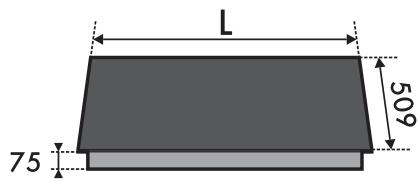
| L (mm) | X (mm) | Y (mm) |
| 617 | 592 | 488 |
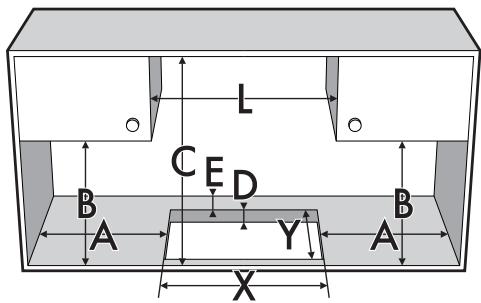
| A (mm) | B (mm) | C (mm) | D (mm) | E (mm) |
| min 150 | min 460 | min 750 | 20 - 50 | min 50 |
Installation
To prevent liquids leaking between the frame of the hob and the worktop, carefully position the insulating seal provided before assembling.
- Refer to the dimensions indicated in the figure, bearing in mind that the long front and rear sides must be flush with the hole.
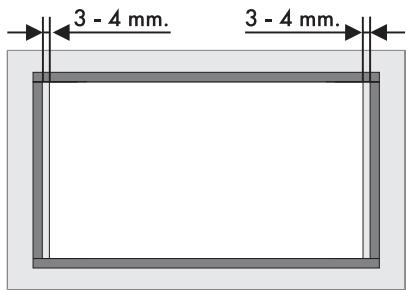
- Press lightly to make the seal stick to the edge around the hole in the worktop. The front and rear sides of the seal must be flush with the hole.

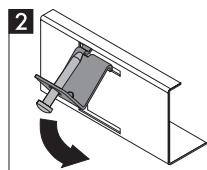
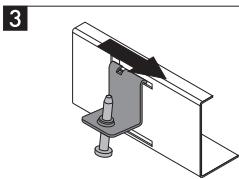
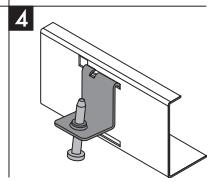
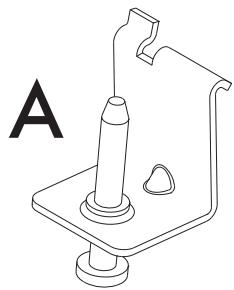
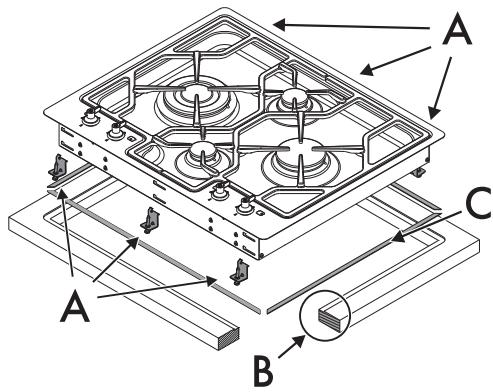
- Place the hob on the insulating seal and fix it to the supporting structure using the screws and fastening brackets supplied (A) so that the hob is perfectly level.
- Carefully trim the surplus away from the edge of the seal (B).
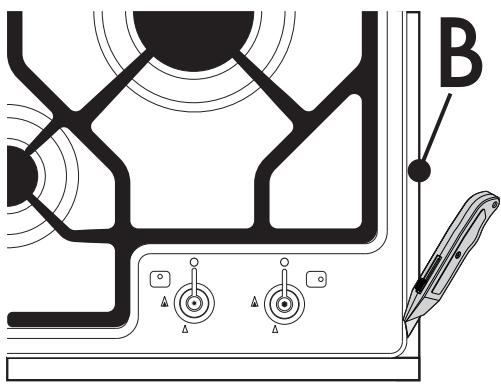

The brackets should be positioned only after having placed the hob on the seal.
Fixing to the support structure: flush built-in model
Make a hole in the worktop of the piece of furniture having the dimensions indicated.
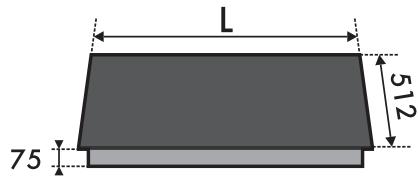
| L (mm) | X (mm) | Y (mm) |
| 620 | 592 | 488 |
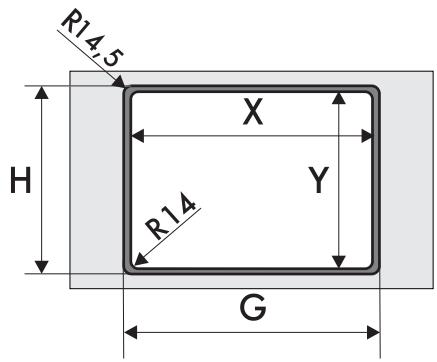
| L (mm) | X (mm) | Y (mm) | G (mm) | H (mm) |
| 620 | 592 | 488 | 621 | 513 |
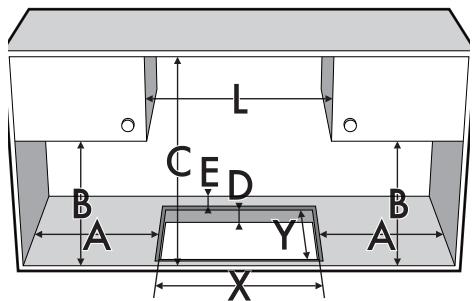
| A (mm) | B (mm) | C (mm) | D (mm) | E (mm) |
| min 150 | min 460 | min 750 | 20 - 40 | min 50 |
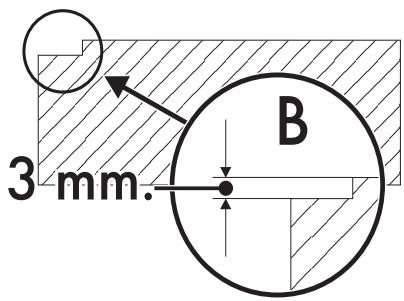
This built-in model requires a 3mm deep recess to be cut in the worktop (detail "B" in the figure above).
Before positioning the appliance, the insulating seal (C), provided, should be applied to the recess that has been made.
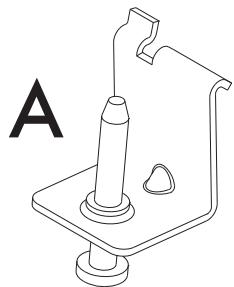
Once this has been done, fix the appliance into position using the special brackets provided (A) so that it is perfectly level, following the instructions in the figure.
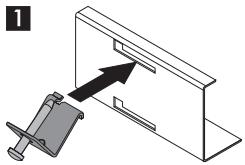
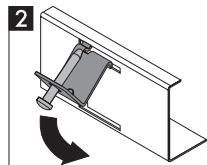
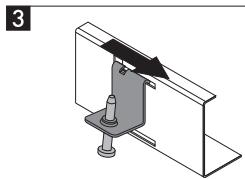
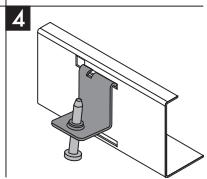

The brackets should be positioned only after having placed the hob on the seal.

- If possible, do not use silicone to fix the hob as this would make it impossible to remove the hob without damaging it.
- If a laminated worktop is used, it is recommended to apply a waterproofing primer to the recess.
Dimensions: Location of gas and electrical connections (measurements in mm)
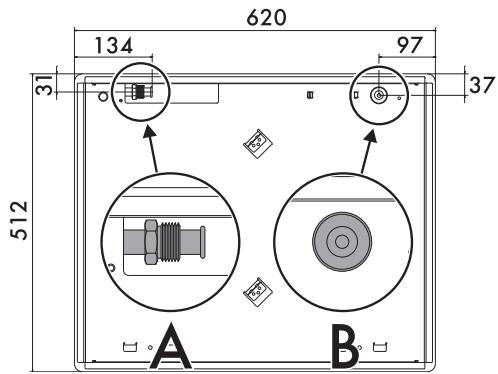
View from underneath
A Gas hose connection
B Electrical connection
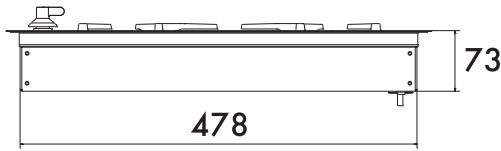
View from the right
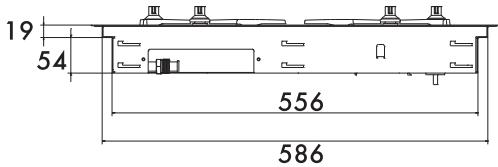
View from the back
5.3 Mounting
Over built-in oven unit
The clearance between the hob and the kitchen furniture or other installed appliances must be enough to ensure sufficient ventilation and air discharge.
If installed above an oven, a space must be left between the bottom of the hob and the top of the appliance installed below.
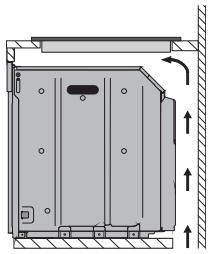
Opens on bottom
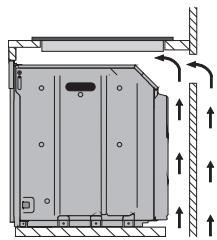
Opens on bottom and back

If installed on top of an oven, the latter must be equipped with a cooling fan.
Over empty kitchen unit or drawers
If there are other pieces of furniture (side walls, drawers, etc.), dishwashers or fridges under the hob, a double-layer wooden base must be installed at least 10mm from the bottom of the hob to prevent accidental contact. It must only be possible to remove the double-layer base using suitable equipment.
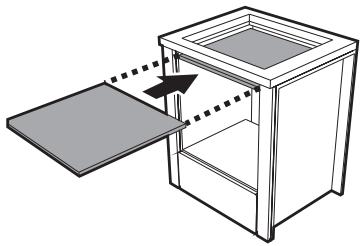
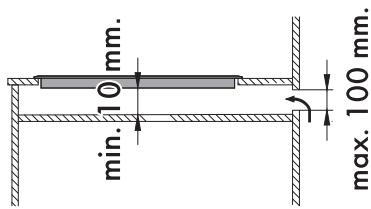
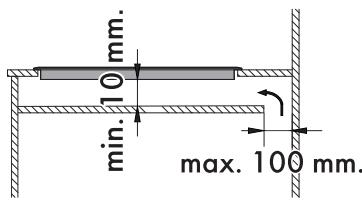
Opens on bottom
Opens on back

Failure to install the double-layer wooden base exposes the user to possible accidental contact with sharp or hot parts.
5.4 Gas connection

Gas leak Danger of explosion
After carrying out any operation, check that the tightening torque of gas connections is between 10Nm and 15Nm .
- If required, use a pressure regulator that complies with current regulations.
- At the end of the installation, check for any leaks with a soapy solution, never with a flame.
- The hoses should not come into contact with moving parts and should not be crushed in any way.
General information
Connection to the gas supply network can be made using a steel hose or a continuous wall steel hose with a conical fitting in compliance with the provisions set out in the applicable standard.
For supplying it with other types of gas, see chapter "5.5 Adaptation to different types of gas". The gas inlet connection is threaded 12 external gas (ISO 228-1).
Connection with a steel hose
Make the connection to the gas mains using a continuous wall steel hose whose specifications comply with the applicable standard.
Carefully screw the connector 3 to the gas connector 1 of the appliance, placing the seal 2 between them.
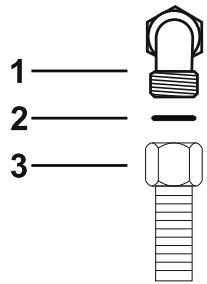
Connection with a steel hose with conical fitting
Make the connection to the gas mains using a continuous wall steel hose whose specifications comply with the applicable standard.
Carefully screw the hose connector 3 to the appliance's gas connector 1 (12'' thread ISO 228-1), placing the supplied seal 2 between them. Apply insulating material to the thread of connector 3, then tighten the steel hose 4 to the connector 3.
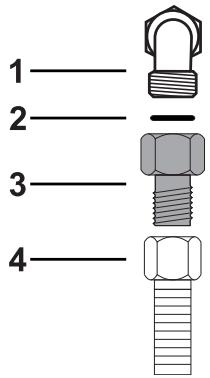
Connection to LPG
Use a pressure regulator and make the connection on the gas cylinder, following all applicable standards and regulations.
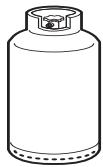
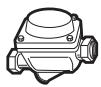
The supply pressure must comply with the values indicated in the table in "Burner and nozzle characteristics tables".
Room ventilation
The appliance should be installed in rooms that have a permanent air supply in accordance with the standards in force. The room where the appliance is installed must have enough air flow for the regular combustion of gas and the necessary air change in the room itself. The air vents, protected by grilles, must be the right size to comply with current regulations and positioned so that no part of them is obstructed, not even partially.
The room must be kept adequately ventilated in order to eliminate the heat and humidity produced by cooking: In particular, after prolonged use, you are recommended to open a window or to increase the speed of any fans.
Extraction of the combustion products
The combustion products may be extracted by means of hoods connected to a natural draught chimney whose efficiency is certain or via forced extraction. An efficient extraction system requires precision planning by a specialist qualified in this area and must comply with the positions and clearances indicated by the applicable standards.
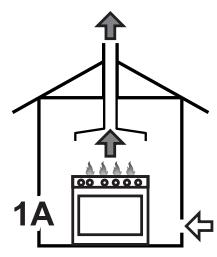
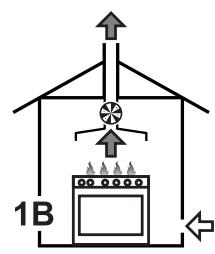
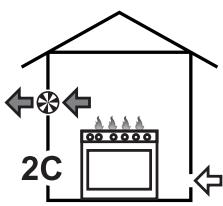
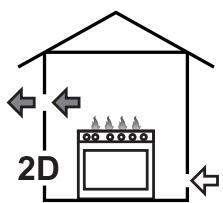
When the job is complete, the installer must issue a certificate of conformity.
1 Extraction using a hood
2 Extraction without a hood
A Single natural draught chimney
B Single chimney with extractor fan
C Directly outdoors with wall- or window-mounted extractor fan
D Directly outdoors through wall

Air

Combustion products

Extractor fan
5.5 Adaptation to different types of gas
In case of operation with other types of gas, the burner nozzles must be changed and the minimum flame adjusted on the gas cocks.
Replacing the nozzles
- Remove the grids from the hob.
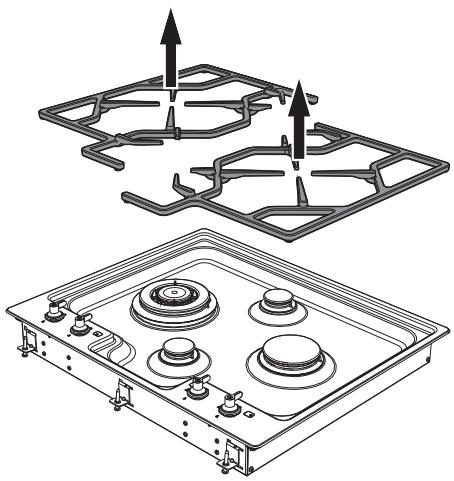
- Remove the flame-spreader crowns and relative burner caps.
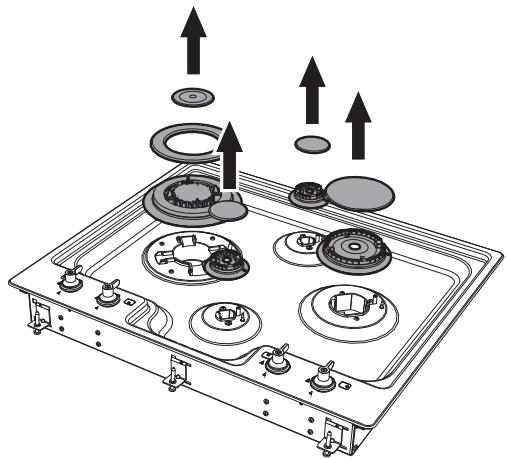
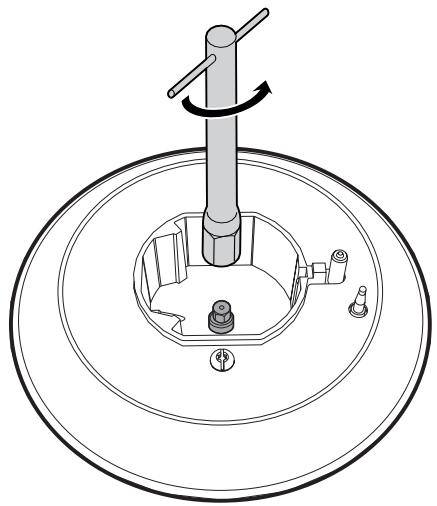
- Unscrew the burner nozzles using a 7 mm socket wrench and replace them according to the type of gas to be used (see the "Burner and nozzle characteristics table").
- Replace the burners in their respective housings.

The nozzle tightening torque must be no more than 3Nm
Adjusting the minimum setting for natural or town gas
- Light the burner and turn it to the minimum position.
- Remove the knobs by pulling them upwards.
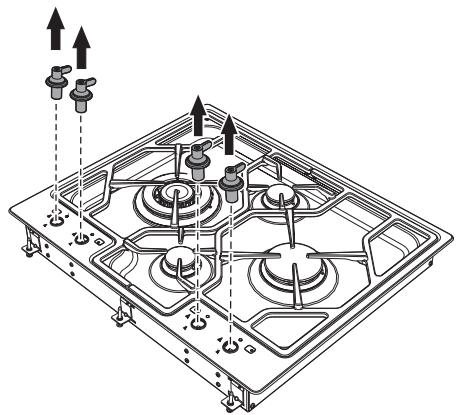
- Turn the adjustment screw on the side of the valve stem until a steady minimum flame is obtained.
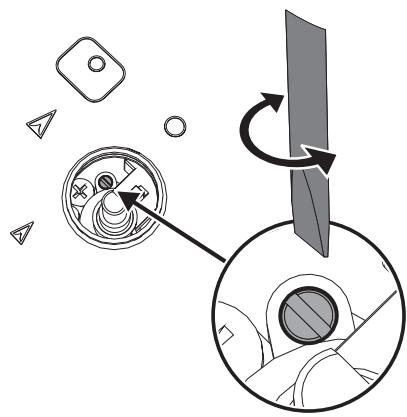
-
Refit the knob and verify that the burner flame is stable.
-
Turn the knob rapidly from the maximum to the minimum setting: The flame should not go out. Repeat the operation for all gas cocks
Adjusting the minimum setting for LPG
Tighten the screw located at the side of the valve stem clockwise all the way.

Following adjustment to a gas other than the one originally set in the factory, replace the gas setting label on the appliance with the one corresponding to the new gas. The label is inserted inside the nozzle pack (where present).
Lubricating the gas cocks
Over time the gas cocks may become difficult to turn and get blocked. Clean them internally and replace the lubrication grease.

Lubrication of the gas cocks should be performed by a specialised technician.
Burner and nozzle characteristics tables
| Natural Gas G20 - 20 mbar | AUX | RR | UR3 |
| Rated heating capacity (kW) | 1.05 | 2.5 | 3.9 |
| Nozzle diameter (1/100 mm) | 72 | 108 | 135 |
| Reduced flow rate (W) | 400 | 800 | 1600 |
| Pre-chamber (printed on nozzle) | X | Y | K |
| Natural Gas G25 - 25 mbar / G25.3 - 25 mbar | AUX | RR | UR3 |
| Rated heating capacity (kW) | 1.05 | 2.5 | 3.9 |
| Nozzle diameter (1/100 mm) | 72 | 115 | 145 |
| Reduced flow rate (W) | 400 | 800 | 1600 |
| Pre-chamber (printed on nozzle) | F1 | F3 | F3 |
| LPG G30/31 - 30/30 mbar | AUX | RR | UR3 |
| Rated heating capacity (kW) | 1.05 | 2.5 | 3.9 |
| Nozzle diameter (1/100 mm) | 50 | 79 | 100 |
| Reduced flow rate (W) | 400 | 500 | 1600 |
| Pre-chamber (printed on nozzle) | - | H8 | - |
| Rated flow rate G30 (g/h) | 76 | 182 | 284 |
| Rated flow rate G31 (g/h) | 75 | 179 | 279 |
The nozzles not provided are available at Authorised Service Centres.

Appliance set for:
G+ Groningen Group K gas
G25 (2L) - 25 mbar
G25.3 (2K) - 25 mbar
5.6 Electrical connection

Power voltage Danger of electrocution
- Have the electrical connection performed by authorised technical personnel.
- Use personal protective equipment.
- The appliance must be connected to earth in compliance with electrical system safety standards.
- Disconnect the mains power supply.
- Do not pull the cable to remove the plug.
- Use cables withstanding a temperature of at least 90^ .
- The tightening torque of the screws of the terminal supply wires must be 1.5 - 2 Nm.
General information
Check the grid characteristics against the data indicated on the plate.
The identification plate bearing the technical data, serial number and brand name is visibly positioned on the appliance. Do not remove this plate for any reason. Perform the ground connection using a wire that is 20mm longer than the other wires.

Pass the power supply cable through the back of the unit, taking care that it does not touch the bottom casing of the hob or the oven (if any) installed underneath it.
The appliance can work in the following modes:
220-240 V 1N~
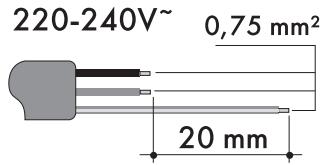
Use a 3 × 0.75 mm^2 three-core cable.

The values indicated refer to the cross-section of the internal conductor.
Fixed connection
Fit the power line with an omnipolar circuit breaker with contact separation equal to or greater than 3mm in compliance with installation regulations.
The circuit breaker should be located near the appliance and in an easily reachable position.
Connection with plug and socket
Make sure that the plug and socket are of the same type.
Avoid using adapters and shunts as these could cause overheating and a risk of burns.