
MultiLife SCB2105NB - Chargeur de piles PHILIPS - Notice d'utilisation et mode d'emploi gratuit
Retrouvez gratuitement la notice de l'appareil MultiLife SCB2105NB PHILIPS au format PDF.


| Type de produit | Chargeur de piles intelligente |
| Marque | Philips |
| Modèle | MultiLife SCB2105NB |
| Dimensions (L x l x h) | Environ 10 x 6 x 3 cm |
| Poids | Environ 100 g |
| Alimentation | Secteur 100-240 V, 50/60 Hz |
| Sortie | DC 2.8V, 400 mA (typique par slot) |
| Types de piles compatibles | AA et AAA rechargeables Ni-MH |
| Nombre de slots | 4 |
| Charge indépendante | Oui, chaque slot géré individuellement |
| Protection contre les surcharges | Oui, arrêt automatique |
| Détection de mauvaises piles | Oui, détection de piles non rechargeables ou défectueuses |
| Indicateur LED | Oui, pour chaque slot (charge/inversion, fin de charge, défaut) |
| Protection contre les courts-circuits | Oui |
| Protection contre l'inversion de polarité | Oui |
| Entretien et nettoyage | Débrancher l'appareil, nettoyer avec un chiffon sec et doux |
| Sécurité | Ne pas exposer à l'humidité ou à des températures extrêmes |
| Pièces détachées | Câble d'alimentation fourni |
| Réparabilité | Non réparable par l'utilisateur, contacter un centre agréé |
| Informations générales | Chargeur compact, idéal pour usage domestique |
FOIRE AUX QUESTIONS - MultiLife SCB2105NB PHILIPS
Questions des utilisateurs sur MultiLife SCB2105NB PHILIPS
0 question sur cet appareil. Repondez a celles que vous connaissez ou posez la votre.
Poser une nouvelle question sur cet appareil
Téléchargez la notice de votre Chargeur de piles au format PDF gratuitement ! Retrouvez votre notice MultiLife SCB2105NB - PHILIPS et reprennez votre appareil électronique en main. Sur cette page sont publiés tous les documents nécessaires à l'utilisation de votre appareil MultiLife SCB2105NB de la marque PHILIPS.
MODE D'EMPLOI MultiLife SCB2105NB PHILIPS
SCB2105NB
EN User Manual
FR Manuel d'utilisation
ES Guía de usuario
DE Bedienungsanleitung
NL Gebruikershandleiding
IT Manuale d'uso
PT Manual do utilizador
GR Odnyós xpíns
TR Kullanım kılavuzu
DK Brugervejledning
sv Använderhandbok
FI Käyttöohje
PL Instrukcja obsługi
cs Uživatelská příručka
SK Návod na použitie
HU Felhasználói kézikönyv
RU Руководство по эксплуатации

natural_image
Open laboratory equipment case with two internal compartments (no visible text or symbols)PHILIPS


natural_image
Diagram of an open electrical fuse with a plug inserted, showing internal components and wiring (no text or labels)| Battery charging times: | ||
| Battery size | Battery capacity (mAh) | Approx. charging time |
| AA Ni-MH | 2600 mAh | 12 1⁄2 hrs |
| AA Ni-MH | 2300 mAh | 10 3⁄4 hrs |
| AA Ni-MH | 1800 mAh | 8 1⁄2 hrs |
| AA Ni-MH | 1300 mAh | 6 1⁄4 hrs |
| AAA Ni-MH | 700 mAh | 8 1⁄2 hrs |
| 9VNi-MH | 170 mAh | 13 hrs |
| C Ni-MH | 2200 mAh | 9 3⁄4 hrs |
| D Ni-MH | 4800 mAh | 21 1⁄4 hrs |
| AA Ni-Cd | 600 mAh | 7 3⁄4 hrs |
| AA Ni-Cd | 800 mAh | 10 1⁄2 hrs |
| AA Ni-Cd | 1000 mAh | 13 1⁄2 hrs |
CE0682①
Specifications are subject to change without notice.
Trademarks are the property of Koninklijke Philips Electronics N.V. or their respective owners. 2008 © Koninklijke Philips Electronics N.V. All rights reserved.
www.philips.com
Additional information (including warranty conditions) available at our website:
www.philips.com/support
Specifications subject to change without notice. All dimensions shown are approximate.
SCB2105NB Universal Charger EN
Important Safety Instructions:
Save these instructions - this manual contains important safety and operating instructions for this charger. Before using your charger read all instructions and cautionary markings on the charger, the batteries to be charged and the products that use the batteries.
Warning:
- Use to charge Ni-MH and Ni-Cd batteries only. Do not charge Alkaline, Zinc Carbon, Lithium or any other type of battery not specified on the charger. Other types of batteries might burst or leak causing personal injury.
- For proper battery insertion, please observe pole indications (+/-). See fig.A.
- Do not dispose of in fire, short circuit or open.
- Charge new batteries before using.
- Never alter the AC cord or plug.
- Do not operate the charger if it has been subjected to shock or if it is damaged.
- Do not disassemble the charger.
• To avoid risk of electric shock, unplug the charger from the electrical outlet before cleaning or when not in use.
- This battery charger is for indoor use only. Do not expose the charger to rain or excessive moisture. Keep the charger away from dust and dirt, which can cause premature wear of parts or harm its normal operation.
- Never use the charger as a power source for any electrical equipment. - Do not incinerate, disassemble or short circuit batteries since they may burst or release toxic materials.
- This charger is not intended for use by young children or infirm persons without supervision.
• To reduce the risk of damage to the AC plug and cord, disconnect the charger by pulling the plug and not the cord.
- Do not operate the charger if cord or plug is damaged.
- Do not charge AAA and AA batteries in the same slot.
- Charge Ni-Cd and Ni-MH batteries separately.
• Do not charge damaged or leaking batteries.
Care:
- Wipe the charger with a damp cloth occasionally without harsh chemicals, cleaning solvents or strong detergents.
- Charger and batteries must be disposed of separately. Inform yourself about the separate collection system for electrical and electronic products.
Operating Instructions
General charging guidelines
- At the same time you can charge 2 or 4 AA, AAA, C or D batteries or 2.9V batteries.
- You can charge NiCd or NiMH batteries. Set the Ni-Cd / Ni-MH switch in the correct position (Ni-Cd or Ni-MH). See fig. B.
- Make sure batteries in each pair of slots (1/2 and/or 3/4) are identical (same capacity, size and chemistry type).
• To keep your batteries in the best condition, you have to limit the charging time according to the charging table. See fig. D. You can limit the charging time by disconnecting the plug from the outlet and remove the batteries.
• For long battery life, only charge empty batteries.
- When charging, ambient temperature should be between 0°C and 40°C (32°F and 104°F).
Note: It is normal for the unit and the batteries to become warm while charging.
Charging batteries
1 Lift up the charger cover and insert batteries into the battery charger. See fig.A.
2 Set the Ni-Cd / Ni-MH switch in the correct position (Ni-Cd or Ni-MH). See fig. B.
3 Connect the plug into a household electric outlet. See fig. B.
The CHARGE LED(s) light(s) up red indicating that charging is in progress.
If the batteries are not installed correctly,
the CHARGE LED(s) will not light and the charger will not start charging.
When the batteries (AAAA, C or D) are fully charged, the CHARGE LED(s) go(es) out and the charger switches off.
When charging 9V batteries the CHARGE LED(s) will remain lit until the charging is stopped manually. See fig. C.
Make sure not to exceed the charging time for 9V batteries. See fig. D.
3 When you are going to use the batteries, disconnect the plug from the outlet and remove the batteries. See fig. C. Always unplug between charges!
Battery charging times: See fig. D.
Visit our website at: www.philips.com
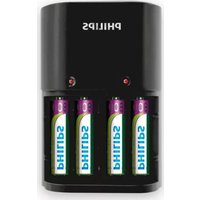


Marque : PHILIPS
Modèle : MultiLife SCB2105NB
Catégorie : Chargeur de piles