
DW7 57 FI - Lave-vaisselle TEKA - Notice d'utilisation et mode d'emploi gratuit
Retrouvez gratuitement la notice de l'appareil DW7 57 FI TEKA au format PDF.


| Type de produit | Lave-vaisselle encastrable |
| Marque | Teka |
| Modèle | DW7 57 FI |
| Capacité | 12 couverts |
| Dimensions (L x P x H) | 600 x 600 x 850 mm |
| Poids net | 40 kg |
| Alimentation électrique | 220-240 V, 50 Hz |
| Courant nominal | 10 A |
| Puissance totale | 2000 W |
| Consommation d'eau par cycle | 13 L |
| Niveau sonore | 47 dB(A) |
| Programmes de lavage | 5 (Intensif, Éco, Rapide, Normal, Verre) |
| Fonctions | Adoucisseur d'eau, distributeur de produit de rinçage, départ différé |
| Sécurité | Aquastop, sécurité enfants, arrêt de sécurité |
| Matériau de la cuve | Acier inoxydable |
| Type de séchage | Condensation |
| Classe énergétique | A+ |
| Consommation annuelle d'énergie | 295 kWh |
| Consommation annuelle d'eau | 3080 L |
| Pièces détachées | Disponibles |
| Garantie | 2 ans |
FOIRE AUX QUESTIONS - DW7 57 FI TEKA
Questions des utilisateurs sur DW7 57 FI TEKA
0 question sur cet appareil. Repondez a celles que vous connaissez ou posez la votre.
Poser une nouvelle question sur cet appareil
Téléchargez la notice de votre Lave-vaisselle au format PDF gratuitement ! Retrouvez votre notice DW7 57 FI - TEKA et reprennez votre appareil électronique en main. Sur cette page sont publiés tous les documents nécessaires à l'utilisation de votre appareil DW7 57 FI de la marque TEKA.
MODE D'EMPLOI DW7 57 FI TEKA
Instructions d'installation et d'entretien du lave-vaisselle
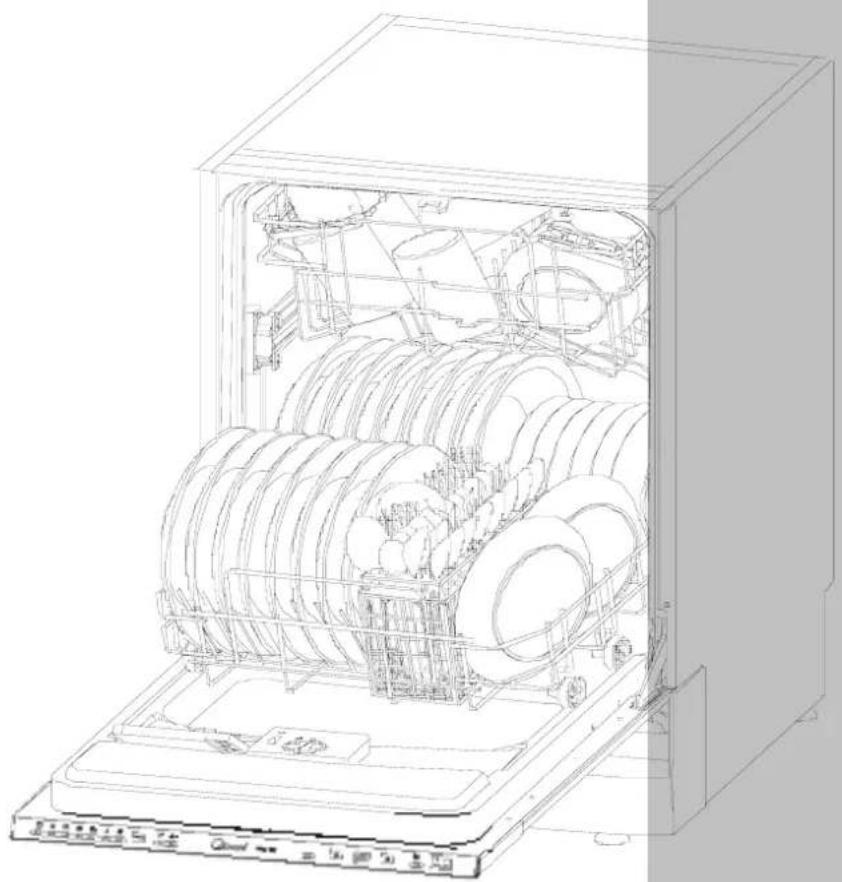
Sommaire
Chapitre I Installation----1
1.1 Consignes de sécurité 1 1.2 Instructions d'installation 2
Chapitre II Entretien 3
2.1 Avant-propos----3 2.2 Dépannage---- 3 2.3 Remarque----6
Chapitre I Installation
1.1 Consignes de sécurité
Après déballage, vérifiez que l'appareil n'est pas endommagé.
Le lave-vaisselle est destiné à laver la vaisselle par des adultes.
Lors de l'utilisation du lave-vaisselle, certaines règles de base doivent être respectées :
1) Ne pas utiliser de rallonge ni d'adaptateur.
2) Le cordon d'alimentation ne doit être ni trop long ni emmêlé.
3) Coupez l'alimentation avant toute réparation du lave-vaisselle.
Les enfants doivent être tenus à l'écart du détergent et du lave-vaisselle ouvert.
Le lave-vaisselle ne doit pas être installé dans un endroit non abrité ou exposé à la pluie ou à d'autres conditions naturelles.
Ne touchez jamais l'élément chauffant pendant ou immédiatement après l'utilisation.
Ne vous appuyez pas sur le lave-vaisselle et ne vous asseyez pas dessus lorsqu'il est ouvert, sinon il pourrait basculer. Si le lave-vaisselle fonctionne mal, coupez l'arrivée d'eau et l'alimentation électrique avant de lire les instructions du chapitre II. Si vous ne pouvez pas résoudre les problèmes vous-même, contactez les techniciens professionnels.
Le lave-vaisselle ne doit pas être réparé par du personnel non professionnel avec des pièces de rechange non d'origine. Il est recommandé que si le lave-vaisselle n'est pas utilisé pendant une longue période, vous coupiez l'arrivée d'eau, retiriez la fiche et laissiez la porte du lave-vaisselle entrouverte.
1.2 Instructions d'installation
Déballage
1) En retirant les accessoires d'emballage, veuillez noter que le sac en plastique doit être hors de portée des enfants. 2) Ouvrez la porte du lave-vaisselle pour vérifier que les paniers sont placés correctement (les fabricants peuvent fixer les paniers de manière simple pour des raisons de sécurité).
Emplacement du lave-vaisselle
1) Le lave-vaisselle doit être éloigné des sources de chaleur et ne doit pas être exposé au soleil pour éviter que son revêtement ne se décolore ou ne s'écaille. 2) L'arrière du lave-vaisselle doit reposer contre le mur derrière lui et les côtés, le long des armoires ou du mur adjacents. Le tuyau d'alimentation en eau et le tuyau de vidange du lave-vaisselle peuvent être positionnés à droite ou à gauche pour faciliter une installation correcte. 3) Le lave-vaisselle doit être encastré dans l'armoire et fixé à l'armoire à l'aide de deux vis.
Étapes d'installation
1) Installez le panneau esthétique sur la porte extérieure du lave-vaisselle. 2) Ajustez la tension du ressort de la porte. 3) Mettez le lave-vaisselle de niveau et touchez l'armoire en ajustant individuellement les quatre pieds de mise à niveau. 4) Connectez les tuyaux d'arrivée et de vidange, et le cordon d'alimentation. 5) Poussez le lave-vaisselle dans l'armoire. 6) Fixez le lave-vaisselle dans l'armoire à l'aide de deux vis à tête fraisée.
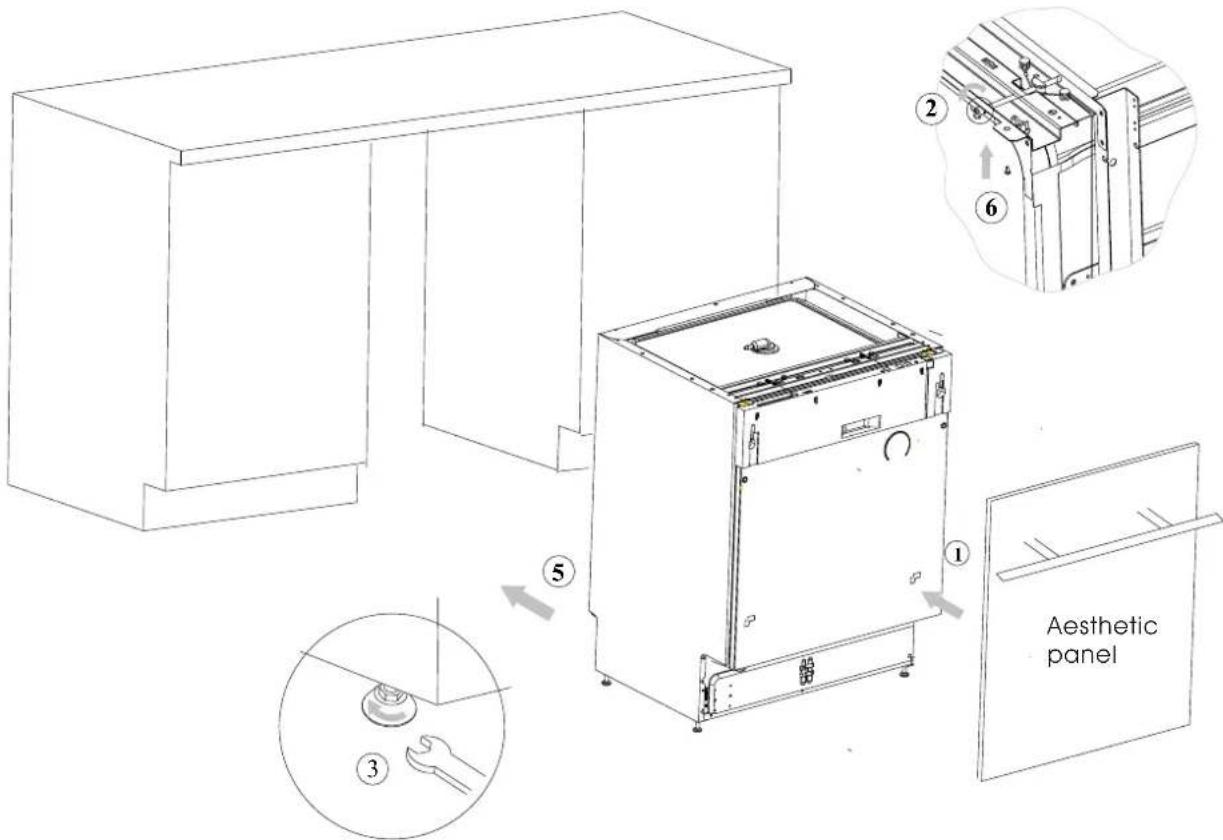
Étapes d'installation
Pour plus de détails sur l'installation, veuillez consulter le manuel d'installation que nous avons édité.
2.1 Avant-propos
Avant toute intervention de réparation, vous devez vérifier :
a) Vérifier que le lave-vaisselle est correctement installé conformément au manuel d'installation. b) Vérifier si les composants endommagés ont été réparés ou non. c) Vérifier que le tuyau de remplissage et le tuyau de vidange sont correctement installés. d) Vérifier que le lave-vaisselle est de niveau. e) Vérifier qu'il y a du sel dans l'adoucisseur d'eau. f) Vérifier qu'il y a du produit de rinçage dans le distributeur.
La carte de circuit imprimé est le centre de tout le système de contrôle du lave-vaisselle. Lorsque le lave-vaisselle lave la vaisselle, toutes les informations parviennent au circuit, puis le circuit transmet diverses instructions à chaque partie du lave-vaisselle pour le faire fonctionner. Le lave-vaisselle fonctionne selon un programme prédéfini. Si vous connaissez le programme et la structure du lave-vaisselle, vous trouverez facilement toutes sortes de pannes.
2.2 Dépannage
| Questions put forward by users | By misusage of users | The problems of the dishwasher itself |
| The dishwasher does not start | * Something wrong with the socket* No water (the water valve is closed)* Improper electrical connection* The door is not properly closed* Incorrect position of charging hose | * Power cord* "ON/OFF" switch* Door switch* Water inlet valve* Pressure switch* Aqua-stop switch |
| Water floods in the dishwasher | * Air leakage of the chamber* The hose of pressure switch* Pressure switch* Water inlet valve | |
| The dishwasher does not heat | * Malfunction of heating element* The circuit is not properly contacted* Malfunction of the thermocouple | |
| No water comes into the dishwasher | * Water supply is cut off* The filter of the water inlet valve is clogged. | * Connection to the inlet valve is broken or damaged.* Electrical connection is cut off.* Pressure switch* Aqua-stop switch* The softener is blocked. |
| The dishes are not clean enough after washing | * The filter is clogged.* Unqualified detergent or the dosage in the container is not correct.* No salt in the softener* No rinse agent* Incorrect loading of dishes *Something wrong with the drain pipe in the home | * Flow and pressure of washing pump* Detergent is not released from dispenser* Heating element is not working* The nozzle is blocked by food particles* No water coming into the dishwasher* The dispenser malfunctions* Sth wrong with the pressure switch and the charging water is not enough |
| The dishwasher couldn't wash properly | * Wrong loading position of the dishes. | * Short circuit of startup capacitance* Washing motor is blocked or burnt* Pressure switch* Malfunction of the circuit board |
| The dishes are wet | * The customer chose the program without drying performance | *Thermocouple doesn't work properly* Heating element is malfunctions* Something is wrong with the circuit board |
| The dishes are not completely dried | * Incorrect loading of the dishes* Earlier opening of the door* No rinse agent or the dosage is not enough* Incorrect selecting the program | * The passage of the breather is blocked* The drain pump does not drain out water* Detergent is not released from the dispenser |
| Too much noise | * Incorrect loading of dishes | * Noise from washing pump* Noise from drain pump* Noise from water inlet valve* Noise from breather |
| Feeling like to be electrically shocked by the dishwasher | * The electrical wire in the house is not earthed. | * Connection of the terminal box* Grounding of the heating element* Circuit and its components |
| Water leakage and flood of the dishwasher | * Too much detergent* Using the detergent with foam, which is not the one intended for using with dishwasher | * Pressure switch* Door gasket* Water leakage of pipes, gaskets and bolts* Drain hose* Washing pump* Softener valve* Softener* Breather |
| Odd smell in the dishwasher | * Food particles on the tub bottom* Food particles on the heating element* Plastic dishes used in the dishwasher | * The water temperature is too high when drying (overheating)* Thermocouple doesn't work properly |
| Long time for a washing cycle | * Inlet pressure is too low* Incorrect location of charging and drain hoses or they are bent* The filter of inlet valve is blocked | * The drain hose is crimped or bent* Malfunction of the drain pump* Infill of the inlet valve is blocked* Clog of the softener* Malfunction of the thermocouple |
| The detergent could not be released from the dispenser | * Bad quality of the detergent* The detergent is damped into blocks* Wrong location of the dishes | * The plug of detergent container could not be opened.* No action of the solenoid valve of electric feeding dispenser.* Malfunction of the electric circuit* Malfunction of the thermocouple |
| Dishwasher stops when cycling | * Electric circuit* Door switch* Pressure switch* The circuit board* Power switch | |
| Dishes are damaged or glassware is broken | * The dishes are not suitable for washing in the dishwasher* The dishes are overturned* The washing temperature is not suitable for glassware | * Basket is damaged* Malfunction of the thermocouple |
| The dishwasher does not drain | * Block of drain hose | * Malfunction of drain pump* Improper connection of electric circuit* Malfunction of the thermocouple |
| Lime deposits form on the dishes | * Too much detergent | * Reduce the dosage |
| The dishes look greasy and a blue film forms on them sometimes | * Too much rinse agent | * Reduce the dosage |
| Dirty spots on the surface of the dishwasher | * The detergent sticks to the damp surface | * Use the detergent according to the user's manual* The detergent should not be spilled on the surface of the dishwasher |
| Strange color of the surface of the washed dishes | * The salt is not intended to use in the dishwasher. | * The influence of salt on the resin |
2.3 Remarques
- Selon les exigences du programme, lorsque le lave-vaisselle est chauffé à une certaine température, la carte de circuit imprimé coupe l'alimentation électrique de l'élément chauffant.
- Dispositif anti-débordement : démarre la pompe de vidange et arrête le fonctionnement du lave-vaisselle.
- Le thermostat à 90 °C est fermé dans des conditions normales. Lorsque le lave-vaisselle est chauffé à une certaine température, le thermostat s'ouvre pour couper l'alimentation électrique des éléments chauffants.
- Si la vanne d'entrée a fonctionné pendant quatre minutes sans que le pressostat ne se déclenche, le lave-vaisselle coupe toutes les charges, l'alarme sonore retentit pendant trente secondes et l'écran affiche « E1 ». Après l'alarme, le lave-vaisselle fait une pause de trois minutes, puis vidange l'eau pendant soixante secondes.
- Si la pompe de vidange a fonctionné pendant quatre minutes sans que le pressostat ne se réinitialise, le lave-vaisselle coupe toutes les charges, l'alarme sonore retentit pendant trente secondes et l'écran affiche « E2 ». Après l'alarme, le lave-vaisselle fait une pause de trois minutes, puis vidange l'eau pendant soixante secondes.
- Si l'élément chauffant a chauffé pendant trente minutes sans que le thermocouple n'ait agi, le lave-vaisselle coupera toutes les charges, l'alarme sonnera pendant trente secondes et l'écran affichera « E3 ». Après l'alarme, le lave-vaisselle fera une pause de trois minutes, puis vidangera l'eau pendant soixante secondes.
- Si le micro-interrupteur a été actionné pendant plus de deux minutes, le lave-vaisselle coupera toutes les charges, l'alarme sonnera pendant trente secondes et l'écran affichera « E4 ». Après l'alarme, le lave-vaisselle fera une pause de trois minutes, puis vidangera l'eau pendant soixante secondes.
- Si le thermocouple a été vérifié pour un circuit ouvert, le lave-vaisselle coupera toutes les charges, l'alarme sonnera pendant trente secondes et l'écran affichera « E6 ». Après l'alarme, le lave-vaisselle fera une pause de trois minutes, puis vidangera l'eau pendant soixante secondes.
- Si le thermocouple a été vérifié pour un court-circuit, le lave-vaisselle coupera toutes les charges, l'alarme sonnera pendant trente secondes et l'écran affichera « E7 ». Après l'alarme, le lave-vaisselle fera une pause de trois minutes, puis vidangera l'eau pendant soixante secondes.

Marque : TEKA
Modèle : DW7 57 FI
Catégorie : Lave-vaisselle