
R1801M - Outil électrique de bricolage RYOBI - Notice d'utilisation et mode d'emploi gratuit
Retrouvez gratuitement la notice de l'appareil R1801M RYOBI au format PDF.


| Type de produit | Défonceuse |
| Marque | RYOBI |
| Modèle | R1801M |
| Profondeur de coupe | 0 - 38 mm (0 - 1,5 po) |
| Diamètre de pince | 6 mm (1/4 po) |
| Puissance maximale | 1,5 cv |
| Ampérage nominal | 8,5 A |
| Tension d'alimentation | 120 V, 60 Hz, CA seulement |
| Vitesse à vide | 25 000 tr/min |
| Longueur du câble d'alimentation | 3 m (10 pi) |
| Poids net | 3,2 kg (7 lb) |
| Double isolation | Oui |
| Type d'interrupteur | Interrupteur à bascule |
| Verrouillage de broche | Oui |
| Bague de réglage de profondeur | Oui, avec indicateur |
| Bras de verrouillage | Oui |
| Base incluse | Base fixe R181FB |
| Écran anti-copeaux | Oui |
| Conception ergonomique | Oui |
| Alimentation | Secteur, 120 V CA |
| Entretien recommandé | Nettoyage régulier avec chiffon sec ; lubrification non nécessaire (roulements graissés à vie) |
| Sécurité | Double isolation, arrêt par interrupteur marche/arrêt |
| Pièces détachées | Disponibles via centre de service agréé Ryobi |
| Réparabilité | Réparation par personnel qualifié uniquement |
FOIRE AUX QUESTIONS - R1801M RYOBI
Questions des utilisateurs sur R1801M RYOBI
0 question sur cet appareil. Repondez a celles que vous connaissez ou posez la votre.
Poser une nouvelle question sur cet appareil
Téléchargez la notice de votre Outil électrique de bricolage au format PDF gratuitement ! Retrouvez votre notice R1801M - RYOBI et reprennez votre appareil électronique en main. Sur cette page sont publiés tous les documents nécessaires à l'utilisation de votre appareil R1801M de la marque RYOBI.
MODE D'EMPLOI R1801M RYOBI
OPERATOR'S MANUAL
R1801M ROUTER
With R181FB Fixed Base
Double Insulated
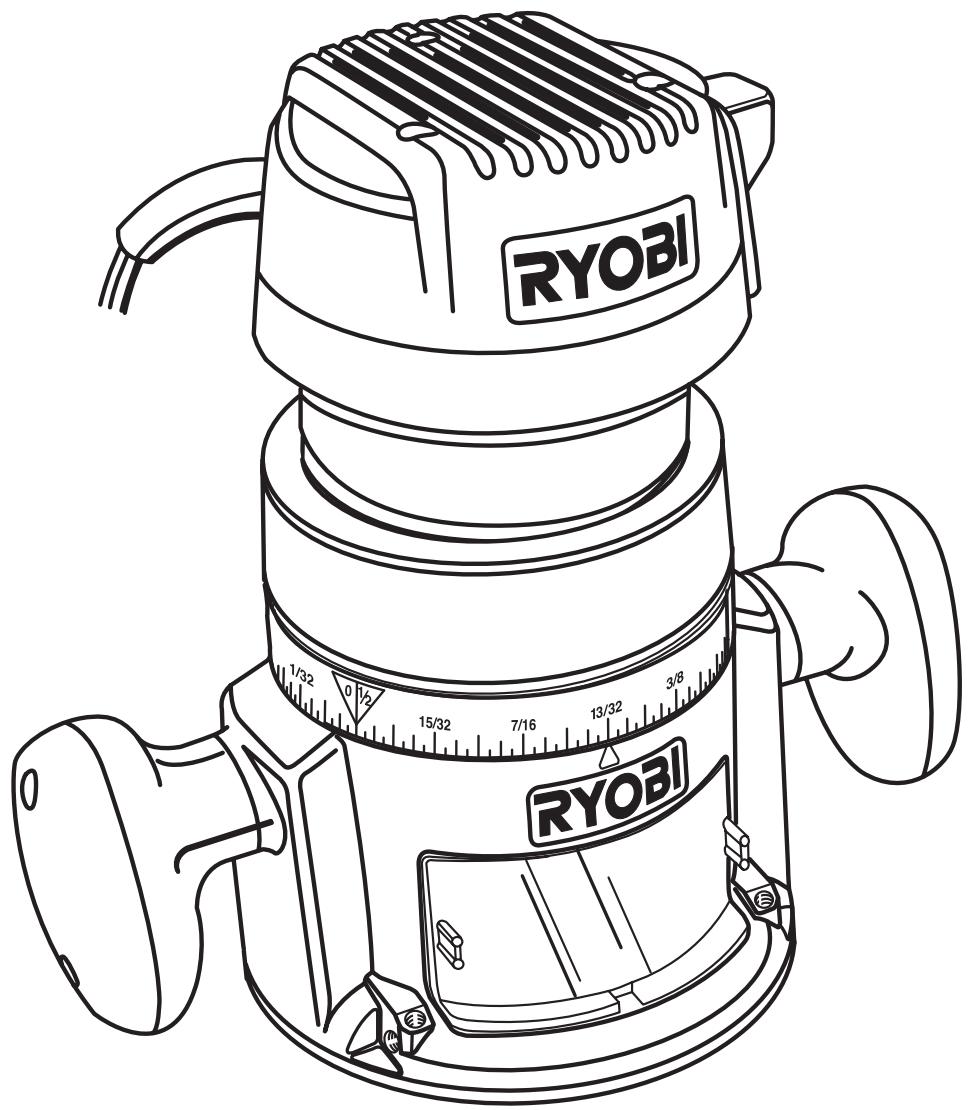
Your new router has been engineered and manufactured to our Ryobi's high standard for dependability, ease of operation, and operator safety. When properly cared for, the router will give you years of rugged, trouble-free performance.

WARNING:
To reduce the risk of injury, the user must read and understand the operator's manual before using this product.
Thank you for buying a Ryobi product.
TABLE OF CONTENTS
Introduction 2
General Safety Rules 3-4
■ Specific Safety Rules 4
Symbols 5
Electrical 6
Features 7-8
Unpacking 8
Operation 9-17
■ Maintenance 18
■ Accessories 18
Parts, Ordering, and Service 20
INTRODUCTION
Your router has many features for making the use of this product more pleasant and enjoyable. Safety, performance, and dependability have been given top priority in the design of this tool making it easy to maintain and operate.

WARNING:
Do not attempt to use this product until you thoroughly read and completely understand the operator's manual. Pay close attention to the safety rules, including Dangers,Warnings, and Cautions. If you use your product properly and only as intended, you will enjoy years of safe, reliable service.

Look for this symbol to point out important safety precautions. It means attention!!! Your safety is involved.

WARNING:
The operation of any tool can result in foreign objects being thrown into your eyes, which can result in severe eye damage. Before beginning operation, always wear safety goggles or safety glasses with side shields and a full face shield when needed. We recommend Wide Vision Safety Mask for use over eyeglasses or standard safety glasses with side shields. Always wear eye protection which is marked to comply with ANSI Z87.1.
GENERAL SAFETY RULES

WARNING:
Read and understand all instructions. Failure to follow all instructions listed below, may result in electric shock, fire and/or serious personal injury.
SAVE THESE INSTRUCTIONS
WORK AREA
- Keep your work area clean and well lit. Cluttered benches and dark areas invite accidents.
- Do not operate power tools in explosive atmospheres, such as in the presence of flammable liquids, gases, or dust. Power tools create sparks which may ignite the dust or fumes.
- Keep bystanders, children, and visitors away while operating a power tool. Distractions can cause you to lose control.
ELECTRICAL SAFETY
Double insulated tools are equipped with a polarized plug (one blade is wider than the other). This plug will fit in a polarized outlet only one way. If the plug does not fit fully in the outlet, reverse the plug. If it still does not fit, contact a qualified electrician to install a polarized outlet. Do not change the plug in any way. Double insulation eliminates the need for the three-wire grounded power cord and grounded power supply system.
Avoid body contact with grounded surfaces such as pipes, radiators, ranges, and refrigerators. There is an increased risk of electric shock if your body is grounded.
- Don't expose power tools to rain or wet conditions. Water entering a power tool will increase the risk of electric shock.
- Do not abuse the cord. Never use the cord to carry the tools or pull the plug from an outlet. Keep cord away from heat, oil, sharp edges, or moving parts. Replace damaged cords immediately. Damaged cords increase the risk of electric shock.
When operating a power tool outside, use an outdoor extension cord marked "W-A" or "W". These cords are rated for outdoor use and reduce the risk of electric shock.
PERSONAL SAFETY
- Stay alert, watch what you are doing and use common sense when operating a power tool. Do not use tool while tired or under the influence of drugs, alcohol, or medication. A moment of inattention while operating power tools may result in serious personal injury.
- Dress properly. Do not wear loose clothing or jewelry. Contain long hair. Keep your hair, clothing, and gloves away from moving parts. Loose clothes, jewelry, or long hair can be caught in moving parts.
Avoid accidental starting. Be sure switch is off before plugging in. Carrying tools with your finger on the switch or plugging in tools that have the switch on, invites accidents.
■ Remove adjusting keys or wrenches before turning the tool on. A wrench or a key that is left attached to a rotating part of the tool may result in personal injury.
- Do not overreach. Keep proper footing and balance at all times. Proper footing and balance enables better control of the tool in unexpected situations.
Use safety equipment. Always wear eye protection. Dust mask, non-skid safety shoes, hard hat, or hearing protection must be used for appropriate conditions.
- Do not use on a ladder or unstable support. Stable footing on a solid surface enables better control of the tool in unexpected situations.
- Do not wear loose clothing or jewelry. Contain long hair. Loose clothes, jewelry, or long hair can be drawn into air vents.
TOOL USE AND CARE
Use clamps or other practical way to secure and support the workpiece to a stable platform. Holding the work by hand or against your body is unstable and may lead to loss of control.
- Do not force tool. Use the correct tool for your application. The correct tool will do the job better and safer at the rate for which it is designed.
- Do not use tool if switch does not turn it on or off. Any tool that cannot be controlled with the switch is dangerous and must be repaired.
- Disconnect the plug from power source before making any adjustments, changing accessories, or storing the tool. Such preventive safety measures reduce the risk of starting the tool accidentally.
Store idle tools out of the reach of children and other untrained persons. Tools are dangerous in the hands of untrained users.
- Maintain tools with care. Keep cutting tools sharp and clean. Properly maintained tools with sharp cutting edges are less likely to bind and are easier to control.
Check for misalignment or binding of moving parts, breakage of parts, and any other condition that may affect the tool's operation. If damaged, have the tool serviced before using. Many accidents are caused by poorly maintained tools.
Use only accessories that are recommended by the manufacturer for your model. Accessories that may be suitable for one tool, may become hazardous when used on another tool.
- Keep the tool and its handle dry, clean and free from oil and grease. Always use a clean cloth when cleaning. Never use brake fluids, gasoline, petroleum-based products, or any strong solvents to clean your tool. Following this rule will reduce the risk of loss of control and deterioration of the enclosure plastic.
GENERAL SAFETY RULES
SERVICE
Tool service must be performed only by qualified repair personnel. Service or maintenance performed by unqualified personnel could result in a risk of injury.
■ When servicing a tool, use only identical replacement parts. Follow instructions in the Maintenance section of this manual. Use of unauthorized parts or failure to follow Maintenance Instructions may create a risk of electric shock or injury.
SPECIFIC SAFETY RULES
Hold tool by insulated gripping surfaces when performing an operation where the cutting tools may contact hidden wiring or its cord. Contact with a "live" wire will make exposed metal parts of the tool "live" and shock the operator.
ADDITIONAL RULES FOR SAFE OPERATION
■ Know your power tool. Read operator's manual carefully. Learn its applications and limitations, as well as the specific potential hazards related to this tool. Following this rule will reduce the risk of electric shock, fire, or serious injury.
Always wear safety glasses. Everyday eyeglasses have only impact-resistant lenses; they are NOT safety glasses. Following this rule will reduce the risk of serious personal injury.
- Protect your lungs. Wear a face or dust mask if the operation is dusty. Following this rule will reduce the risk of serious personal injury.
Protect your hearing. Wear hearing protection during extended periods of operation. Following this rule will reduce the risk of serious personal injury.
■ Inspect tool cords periodically and, if damaged, have repaired at your nearest authorized service center. Constantly stay aware of cord location. Following this rule will reduce the risk of electric shock or fire.
- Check damaged parts. Before further use of the tool, a guard or other part that is damaged should be carefully checked to determine that it will operate properly and perform its intended function. Check for alignment of moving parts, binding of moving parts, breakage of parts, mounting, and any other conditions that may affect its operation. A guard or other part that is damaged should be properly repaired or replaced by an authorized service center. Following this rule will reduce the risk of shock, fire, or serious injury.
- Do not abuse cord. Never carry the tool by the cord or yank it to disconnect it from the receptacle. Keep cord away from heat, oil, and sharp edges. Following this rule will reduce the risk of electric shock or fire.
Make sure your extension cord is in good condition. When using an extension cord, be sure to use one heavy enough to carry the current your product will draw. A wire gage size (A.W.G.) of at least 14 is recommended for an extension cord 50 feet or less in length. A cord exceeding 50 feet is not recommended. If in doubt, use the next heavier gage. The smaller the gage number, the heavier the cord. An undersized cord will cause a drop in line voltage resulting in loss of power and overheating.
■ Inspect for and remove all nails from lumber before routing. Following this rule will reduce the risk of serious personal injury.
Drugs, alcohol, medication. Do not operate tool while under the influence of drugs, alcohol, or any medication. Following this rule will reduce the risk of electric shock, fire, or serious personal injury.
Save these instructions. Refer to them frequently and use them to instruct others who may use this tool. If you loan someone this tool, loan them these instructions also.

WARNING:
Some dust created by power sanding, sawing, grinding, drilling, and other construction activities contains chemicals known to cause cancer, birth defects or other reproductive harm. Some examples of these chemicals are:
- lead from lead-based paints,
crystalline silica from bricks and cement and other masonry products, and
arsenic and chromium from chemically-treated lumber.
Your risk from these exposures varies, depending on how often you do this type of work. To reduce your exposure to these chemicals: work in a well ventilated area, and work with approved safety equipment, such as those dust masks that are specially designed to filter out microscopic particles.
SYMBOLS
| Important: Some of the following symbols may be used on your tool. Please study them and learn their meaning. Proper interpretation of these symbols will allow you to operate the tool better and safer. SYMBOL NAME DESIGNATION/EXPLANATION | ||
| V | Volts | Voltage |
| A | Amperes | Current |
| Hz | Hertz | Frequency (cycles per second) |
| W | Watt | Power |
| min | Minutes | Time |
| ~ | Alternating Current | Type of current |
| n0 | No Load Speed | Rotational speed, at no load |
| 回 | Class II Construction | Double-insulated construction |
| .../min | Per Minute | Revolutions, strokes, surface speed, orbits, etc. per minute |
| Safety Alert | Precautions that involve your safety | |
| Wear Eye Protection | Always wear safety goggles or safety glasses with side shields and full face shield when operating this product | |
| Wet Conditions Alert | Do not expose to rain or use in damp locations | |
| The purpose of safety symbols is to attract your attention to possible dangers. The safety symbols, and the explanations with them, deserve your careful attention and understanding. The safety warnings do not by themselves eliminate any danger. The instructions or warnings they give are not substitutes for proper accident prevention measures. | |
| DANGER: Indicates an imminently hazardous situation which, if not avoided, will result in death or serious injury. | |
| WARNING: Indicates a potentially hazardous situation which, if not avoided, could result in death or serious injury. | |
| CAUTION: Indicates a potentially hazardous situation which, if not avoided, may result in minor or moderate injury. It may also be used to alert against unsafe practices that may cause property damage. | |
| IMPORTANT: Advises you of information or instructions vital to the operation or maintenance of the equipment. | |
| NOTE: Advises you of additional information concerning the operation or maintenance of the equipment. |
ELECTRICAL
DOUBLE INSULATION
Double insulation is a concept in safety in electric power tools, which eliminates the need for the usual three-wire grounded power cord. All exposed metal parts are isolated from the internal metal motor components with protecting insulation. Double insulated tools do not need to be grounded.
Important: Servicing of a tool with double insulation requires extreme care and knowledge of the system and should be performed only by a qualified service technician. For service, we suggest you return the tool to your nearest authorized service center for repair. When servicing, use only identical Ryobi replacement parts.

WARNING:
The double insulated system is intended to protect the user from shock resulting from a break in the tool's internal wiring. Observe all normal safety precautions related to avoiding electrical shock.
ELECTRICAL CONNECTION
The router has a precision built electric motor. It should be connected to a power supply that is 120 volts, 60Hz , AC only (normal household current). Do not operate this tool on direct current (DC). A substantial voltage drop will cause a loss of power and the motor will overheat. If your tool does not operate when plugged into an outlet, double-check the power supply.
EXTENSION CORDS
When using a power tool at a considerable distance from a power source, be sure to use an extension cord that has the capacity to handle the current the tool will draw. An undersized cord will cause a drop in line voltage, resulting in overheating and loss of power. Use the chart to determine the minimum wire size required in an extension cord. Only round jacketed cords listed by Underwriter's Laboratories (UL) should be used.
When working outdoors with a tool, use an extension cord that is designed for outside use. This type of cord is designated with "WA" on the cord's jacket.
Before using any extension cord, inspect it for loose or exposed wires and cut or worn insulation.
| **Ampere rating (on tool faceplate) | ||||||
| 0-2.0 | 2.1-3.4 | 3.5-5.0 | 5.1-7.0 | 7.1-12.0 | 12.1-16.0 | |
| Cord Length | Wire Size (A.W.G.) | |||||
| 25' | 16 | 16 | 16 | 16 | 14 | 14 |
| 50' | 16 | 16 | 16 | 14 | 14 | 12 |
| 100' | 16 | 16 | 14 | 12 | 10 | — |
**Used on 12 gauge - 20 amp circuit.

WARNING:
Keep the extension cord clear of the working area. Position the cord so that it will not get caught on lumber, tools or other obstructions while you are working with a power tool. Failure to do so can result in serious personal injury.

WARNING:
Check extension cords before each use. If damaged replace them immediately. Never use tool with a damaged cord with this tool. Touching the damaged area could cause serious injury due to electrical shock.
FEATURES
SPECIFICATIONS
Depth of Cut. 0 - 1-1/2 in. (0 - 38 mm)
Collet 1/4 in. (6 mm)
Peak Horsepower 1-1/2
Ampere 8.5Amps
Input 120 Volts, 60 Hz, AC only
No Load Speed 25,000/min
Power Cord 10 ft. (3 m)
Net Weight 7 lbs. (3.2 kg.)
Before using this tool, familiarize yourself with all operating features and safety requirements. However, do not let familiarity with the tool make you careless.
This new router is equipped with the following features. See Figure 1.
MOTOR
The router kit has a powerful 8.5 amp motor with sufficient power to handle tough routing jobs. It delivers 1-1/2 peak horsepower for heavy duty performance.
SWITCH
The router has a conveniently located rocker switch.
SPINDLE LOCK
The spindle lock secures the spindle so that you only need one wrench to loosen the collet nut and change cutters.
DEPTH ADJUSTING RING
The depth adjusting ring allows you to adjust the depth of cut.
LOCKING ARM
The locking arm secures the motor housing in the base.
CHIP SHIELD
A plastic chip shield on the base of the router provides protection against flying dust and chips.
ERGONOMIC DESIGN
The design of this tool provides for easy handling. It is designed for comfort and ease of grasp when operating in different positions and at different angles.
ELECTRICAL CONNECTION
Your router has a precision built electric motor. It should be connected to a power supply that is 120 volts, 60 Hz, AC only (normal household current). Do not operate this tool on direct current (DC). A substantial voltage drop will cause a loss of power and overheating. If your tool does not operate when plugged into an outlet, double-check the power supply.
DOUBLE INSULATION
Double insulation is a concept in safety in electric power tools, which eliminates the need for the usual three-wire grounded power cord. All exposed metal parts are isolated from the internal metal motor components with protecting insulation. Double insulated tools do not need to be grounded.
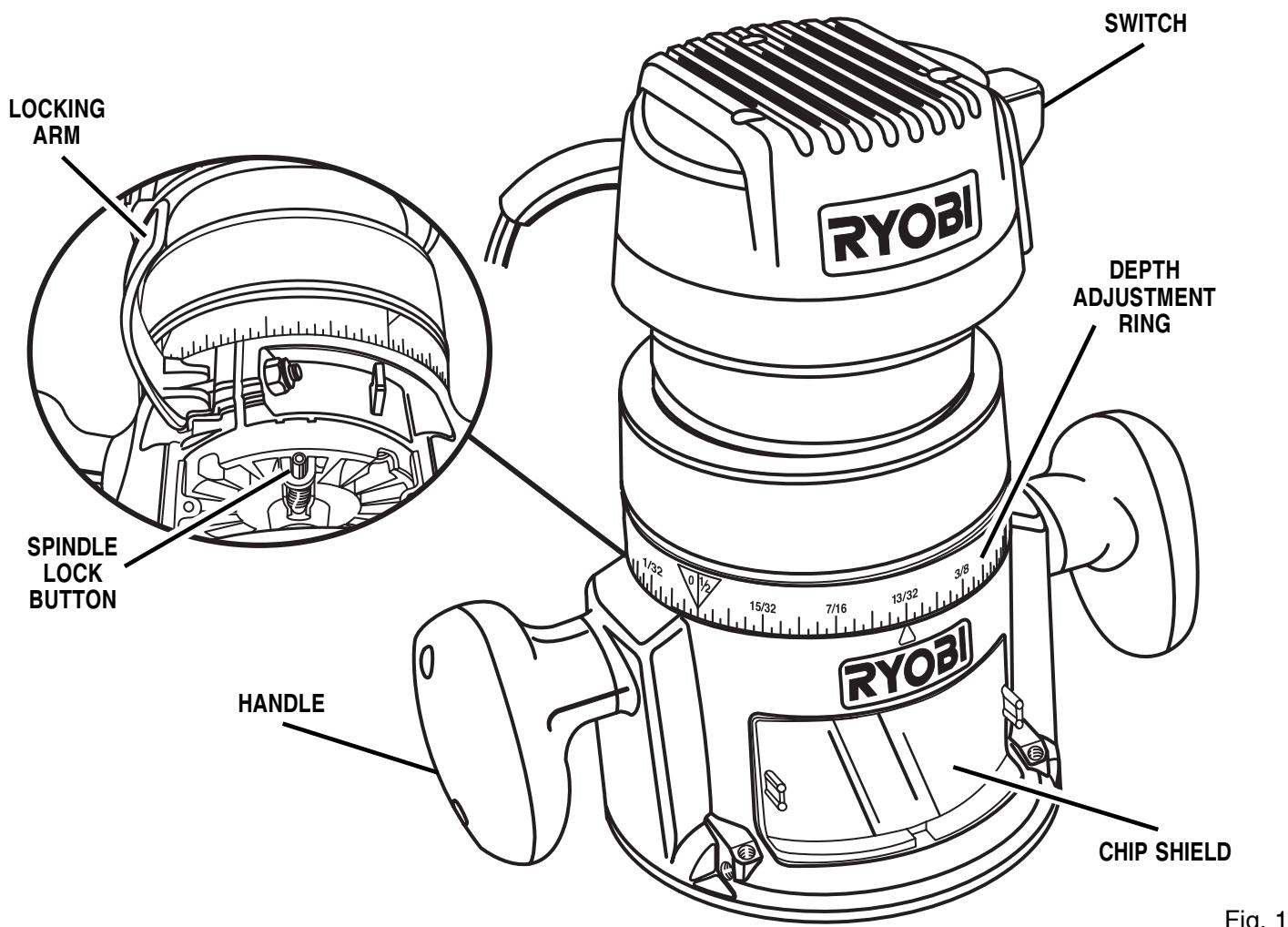
Fig. 1
UNPACKING
INSTRUCTIONS
When unpacking the tool:
Carefully remove the tool and accessories from the box.
Make sure that all items listed in the packing list are included.
Inspect the tool carefully to make sure no breakage or damage occurred during shipping.
- Do not discard the packing material until you have carefully inspected and satisfactorily operated the tool.
If any parts are damaged or missing, please call 1-800-525-2579 for assistance.
PACKING LIST
Router
Router Base
Collet Wrench
Tool Bag

WARNING:
If any parts are missing do not operate the tool until the missing parts are replaced. Failure to do so could result in possible serious personal injury.

WARNING:
The tool should never be connected to a power supply when you are assembling parts, making adjustments, cleaning, performing maintenance, or when the tool is not in use. Disconnecting the tool will prevent accidental starting that could cause injury.
OPERATION

WARNING:
Exercise caution when using this tool. Careless actions, for even a fraction of a second, can result in serious personal injury.
You may use the router for the purposes listed below:
■ Routing Grooves, shaping edges, etc. in wood.
Chamfering, rabbeting, dadoing, and dovetailing in wood.
■ Routing edges on plastic laminates.

WARNING:
Always wear safety goggles or safety glasses with side shields when using your router. Failure to do so could result in dust, shavings, chips, loose particles, or foreign objects being thrown in your eyes resulting in possible serious injury. If the operation is dusty, also wear a face or dust mask.
TURNING THE ROUTER ON/OFF
See Figure 2.
To turn on the router: Toggle the switch to the I position.
To turn off the router: Toggle the switch to the O position.
OPERATING THE ROUTER
See Figure 3.
Follow these steps to operate the router.
- Unplug the router.

WARNING:
Failure to unplug the tool could result in accidental starting causing serious injury.
- Securely tighten the cutter in the collet nut. Refer to "Removing/Inserting Cutters" later in this manual.
- Set the desired depth of cut. Refer to "Adjusting Depth of Cut" later in this manual.
- Secure the workpiece.
- Plug the router into a power source.
- Hold the router firmly with both hands.
- Turn on the router and let the motor build to its full speed.
- Feed the cutter slowly into the workpiece.
NOTE: Do not let the cutter contact the workpiece before starting the router and allowing it to develop full speed.
- Turn off the router upon completion of cut, and let the motor come to a complete stop before removing the router from the workpiece.
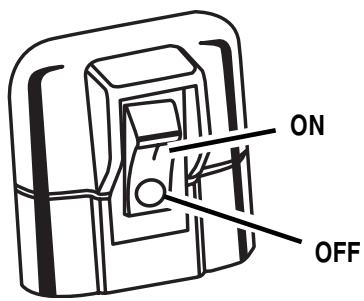
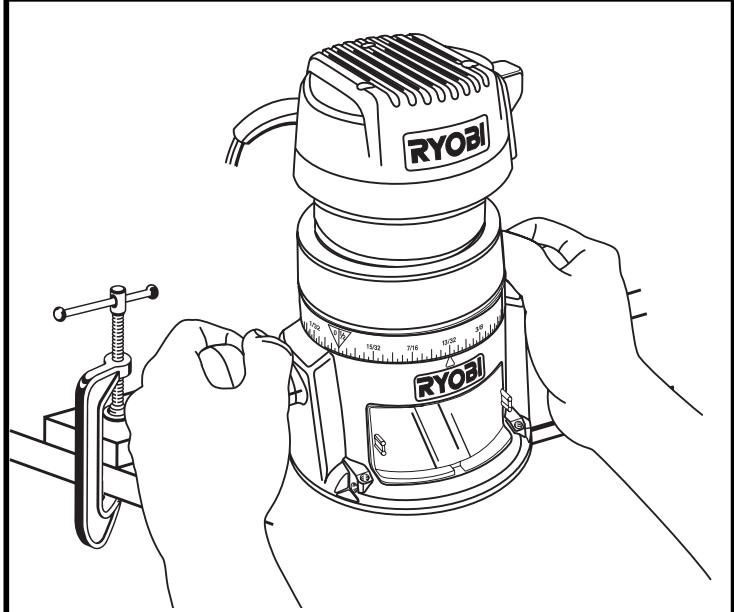
Fig. 2
Fig. 3

WARNING:
Never place the router down on a work surface before the cutter stops.

WARNING:
Never connect the router to power supply when you are assembling parts, making adjustments, installing or removing cutters, or when not in use. Disconnecting the router prevents accidental starting that could cause serious injury.
REMOVING AND INSTALLING THE ROUTER BASE
TO REMOVE THE ROUTER BASE
See Figure 4.
- Unplug the router.

WARNING:
Failure to unplug the tool could result in accidental starting causing serious injury.
- Place the router upside down with the Ryobi label away from you.
- Loosen the locking arm on the base.
- Depress and hold the spindle lock button on the motor.
- Turn the collet nut until the hole in the collet aligns with the spindle lock button.
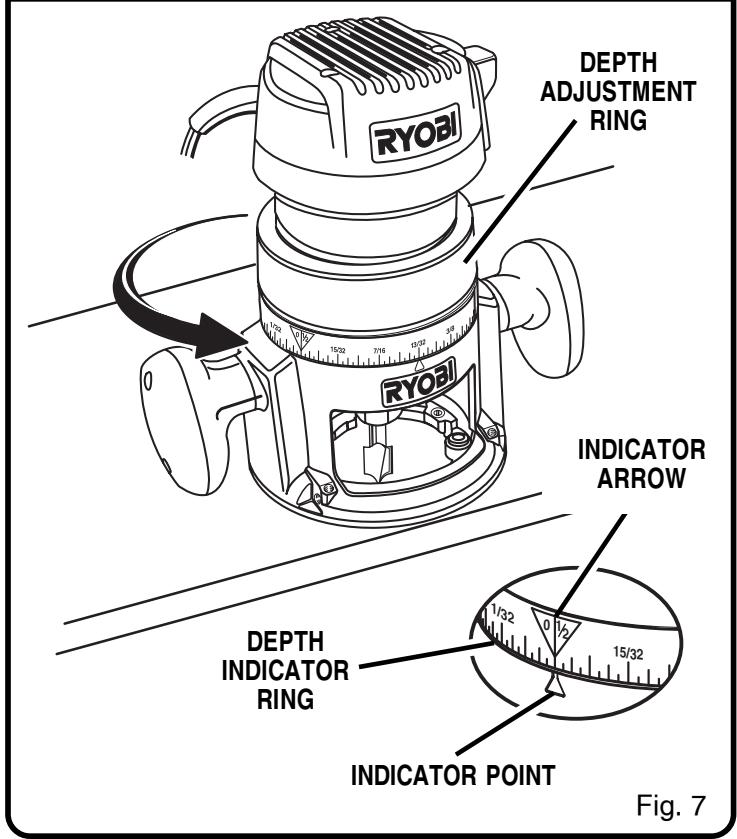
- Turn the depth adjusting ring counterclockwise until the motor is to its highest position.
- Align the indicator arrow on the depth adjustment ring with the indicator point on the base.
- Pull the base until it dislodges from the motor housing.
TO INSTALL THE ROUTER BASE
- Unplug the router.
- Place the fixed base on a flat surface.
- Loosen the locking arm.
- Align the indicator arrow on the depth adjustment ring with the indicator point on the base.
- Align the spindle lock button with the groove in the base.
- Depress and hold the spindle lock button on the motor.
- Slide the motor housing into the base.
- Turn the depth adjusting ring counterclockwise until the spindle lock snaps out as it clears the rear window, just below the locking arm.
- Tighten the locking arm.
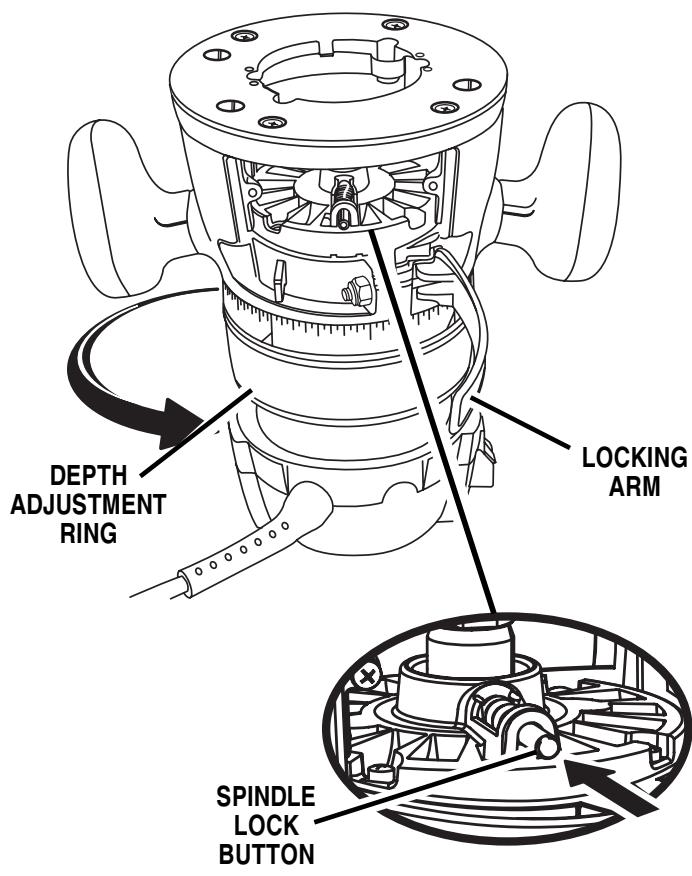
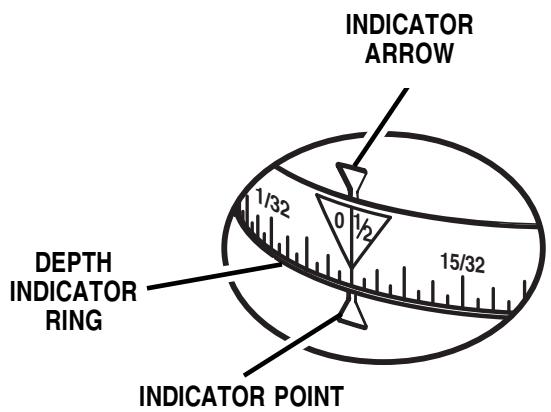
Fig. 4
REMOVING/INSERTING CUTTERS
See Figure 5.
Follow these steps to remove or insert cutters.
- Unplug the router.

WARNING:
Failure to unplug the tool could result in accidental starting causing serious injury.

CAUTION:
To prevent damage to the spindle or spindle lock, always allow the motor to come to a complete stop before engaging the spindle lock.
- Place the router upside down on a workbench in order to gain easy access to collet nut.
- Depress the spindle lock button.
- Loosen the collet nut by turning it counterclockwise with the wrench provided.

WARNING:
If you are changing a cutter immediately after use, be careful not to touch the cutter or collet with your hands or fingers. They will get burned because of the heat buildup from cutting. Always use the wrench provided.
- Choose one of these options:
To remove the cutter:
Remove the cutter from the collet.
To insert the cutter:
a) Insert the shank of the cutter until the shank bottoms out, then pull it out 1/16 in. (1.6 mm) to allow for expansion when the bit gets hot.
b) Tighten the collet nut securely by turning it clockwise with the wrench provided.
c) Release the spindle lock button.
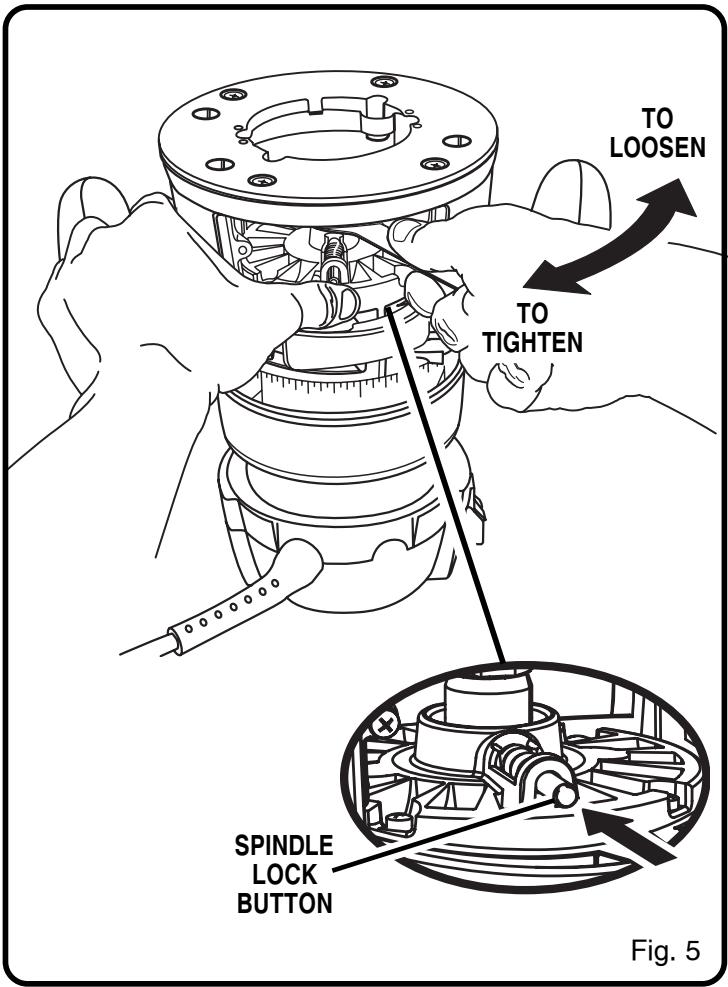
Fig. 5

WARNING:
If the collet nut is not securely tightened, the cutter may detach during use causing serious personal injury.

WARNING:
Do not use cutters with undersized shanks. Undersized shanks will not tighten properly and could be thrown from the tool causing injury.

WARNING:
Do not use cutters that are larger in diameter than the opening in router subbase. Use of such cutters will come in contact with the router subbase and damage both the cutter and router. The use of larger cutters could also cause possible loss of control or create other hazardous conditions that could result in serious personal injury or death.
OPERATION
ADJUSTING DEPTH OF CUT
Proper depth of cut depends on several factors: the peak horsepower of the router motor, the type of cutter, and the type of wood. A lightweight, low horsepower router is designed for making shallow cuts. A router with a high horsepower rating can safely cut deeper. Small cutters, such as veining bits with 1/16 in. (1.6 mm) cutting diameters, are designed to remove only small amounts of wood. Large cutters, such as straight-flute bits, are made to remove larger amounts of wood. You can make deeper cuts in soft woods, such as white pine, than in hardwoods, like oak or maple.
Based on these considerations, choose a depth of cut that will not place excessive strain on the router motor. If you find that extra force is needed or that the motor speed slows down considerably, turn off the router and reduce the depth of cut. Then, make the cut in two or more passes.
When routing a groove that is too deep to safely cut in one pass, it is best to make the cut in several passes. We recommend that cuts be made at a depth not exceeding 1/8 in. (3.2 mm) and that several passes be made to reach deeper cuts.
Adjusting the depth of cut for the plunge router is different from adjusting the depth of cut for the fixed router.
TO ADJUST DEPTH OF CUT FOR FIXED ROUTERS
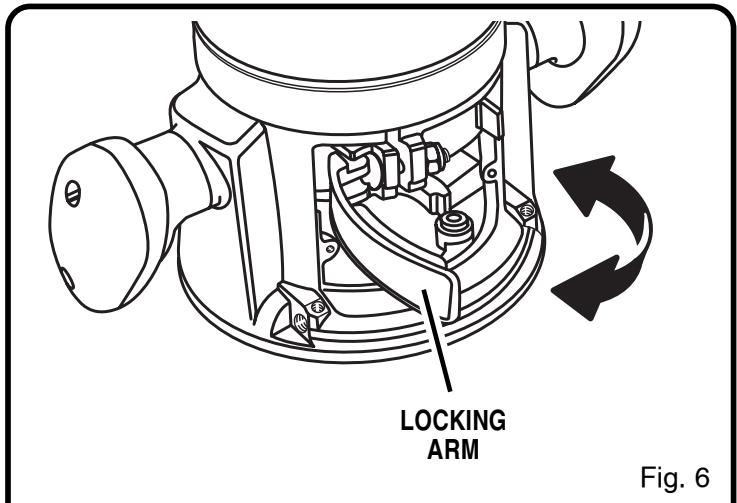
See Figures 6 and 7.
Follow these steps to adjust depth of cut for fixed routers.
- Unplug the router.

WARNING:
Failure to unplug the tool could result in accidental starting causing serious injury.
- Place the router on a flat surface.
- Loosen the locking arm.
- Turn the depth adjusting ring counterclockwise until the tip of the cutter touches the flat surface.
- Turn the depth indicator ring until the zero lines up with the indicator point on the base.
- Position the router so that the cutter can extend below the subbase for desired depth of cut.
- Turn the depth adjusting ring to obtain the desired depth of cut.
- Tighten the locking arm securely.
NOTE: To adjust the depth of cut when the router is mounted to a router table, turn the depth adjustment ring until the cutter reaches the desired depth of cut.
FEEDING THE ROUTER
The "secret" of professional routing and edge shaping lies in making a careful set-up for the cut and in selecting the proper rate of feed.
DIRECTION (EXTERNAL)
See Figure 8.
When routing, the cutter rotates clockwise. Therefore, you should feed the router into the workpiece from left to right. When you feed the router from left to right, the rotation of the cutter pulls the router against the workpiece. If you feed the router in the opposite direction, the rotational forces of the spinning bit tend to throw the router away from the workpiece. This action could cause you to lose control of the router.
The router motor and bit revolve in a clockwise direction. This gives the tool a slight tendency to twist in a counterclockwise direction, especially when the motor revs up.
Because of the extremely high speed of bit rotation during a proper feeding operation, there is very little kickback to contend with under normal conditions. However, if the bit strikes a knot, hard grain, foreign object, etc. that affects the normal progress of the cutting action, there will be a slight kickback. This kickback is sufficient to spoil the trueness of your cut if you are not prepared. Such a kickback is always in the direction opposite to the direction of bit rotation.
To guard against such a kickback, plan your setup and direction of feed so that you will always be thrusting the tool—to hold it against whatever you are using to guide the cut—in the same direction that the leading edge of the bit is moving. In short, the thrust should be in a direction that keeps the sharp edges of the bit continuously biting straight into new (uncut) wood.
DIRECTION (INTERNAL)
See Figure 9.
Whenever you are routing a groove, your travel should be in a direction that places whatever guide you are using at the right-hand side. That is, when the guide is positioned as shown in the first part of the figure, tool travel should be from left to right and counterclockwise around curves. When the guide is positioned as shown in the second part of the figure, tool travel should be right to left and clockwise around curves. If there is a choice, the first setup is generally the easiest to use. In either case, the sideways thrust you use is against the guide.
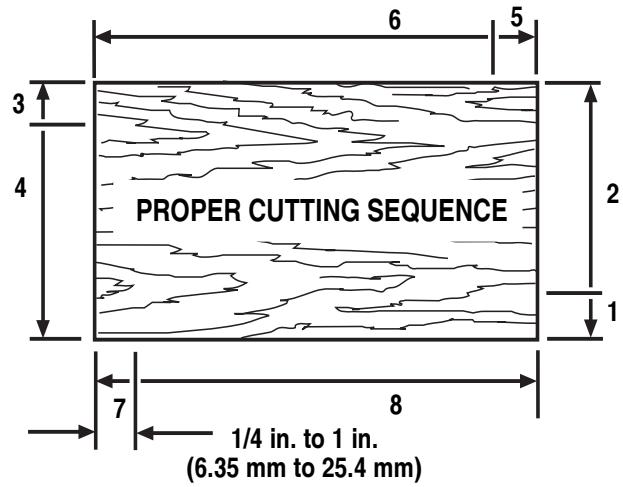
Fig. 8
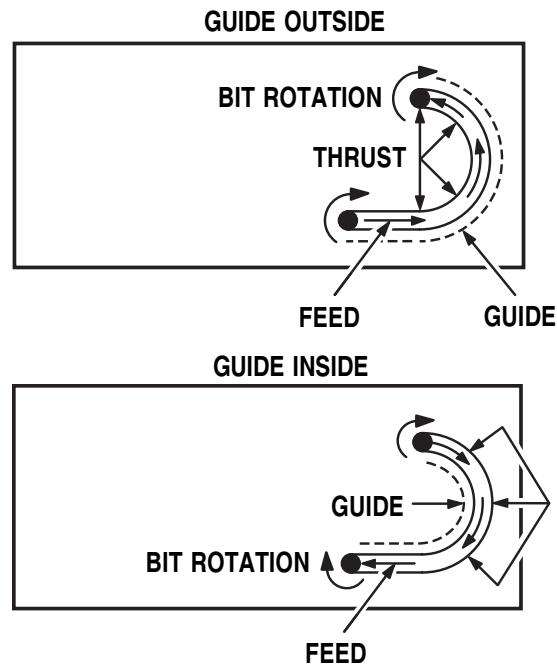
Fig. 9
RATE OF FEED
The proper rate of feed depends on several factors: the hardness and moisture content of the wood, the depth of cut, and the cutting diameter of the bit. When cutting shallow grooves in soft woods such as pine, a faster rate of feed can be used. When making deep cuts in hardwoods such as oak, a slower rate of feed should be used.
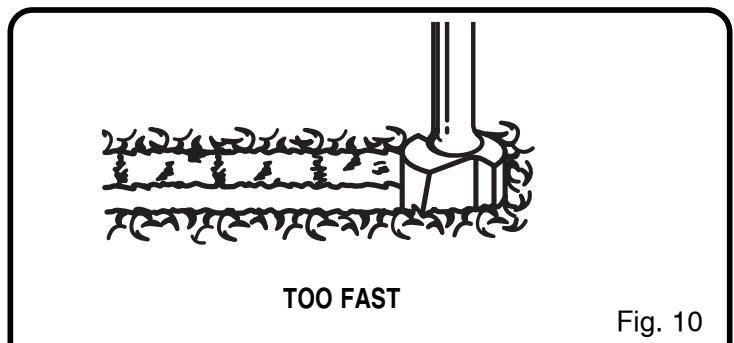
The best rate of feed is one that does not slow down the router motor more than one-third of its no-load speed. If the router is fed too fast, it will take large chips out of the wood and leave gouge marks. If the router is fed too slow, it will scorch or burn the wood.
Feeding Too Fast
See Figure 10.
Clean, smooth routing and edge shaping can be done only when the bit is revolving at a relatively high speed and is taking very small bites to produce tiny, cleanly severed chips. If your router is forced to move forward too fast, the RPM of the bit becomes slower than normal in relation to its forward movement. As a result, the bit must take bigger bites as it revolves. "Bigger bites" mean bigger chips, and a rougher finish. Bigger chips also require more power, which could result in the router motor becoming overloaded.
Under extreme force-feeding conditions the relative RPM of the bit can become so slow—and the bites it has to take so large — that chips will be partially knocked off (rather than fully cut off), resulting in splintering and gouging of the workpiece.
Your router is an extremely high-speed tool (25,000 RPM no-load speed), and will make clean, smooth cuts if allowed to run freely without the overload of a forced (too fast) feed. Three things that cause "force feeding" are bit size, depth-of-cut, and workpiece characteristics. The larger the bit or the deeper the cut, the more slowly the router should be advanced. If the wood is very hard, knotty, gummy or damp, the operation must be slowed still more.
You can always detect "force feeding" by the sound of the motor. Its high-pitched whine will sound lower and stronger as it loses speed. Also, the strain of holding the tool will be noticeably increased.
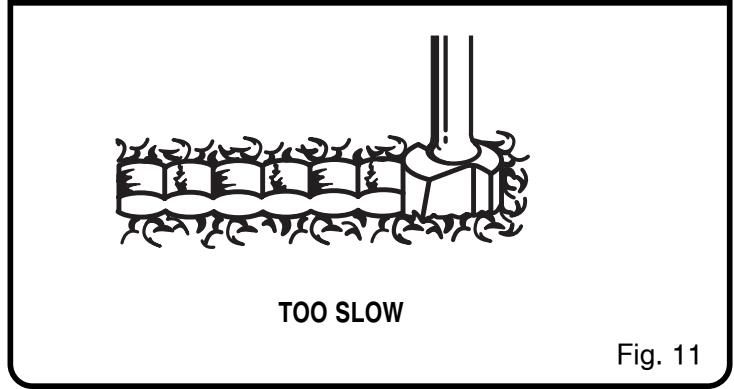
Feeding Too Slow
See Figure 11.
It is also possible to spoil a cut by moving the router forward too slowly. When it is advanced into the work too slowly, a revolving bit does not dig into new wood fast enough to take a bite; instead, it simply scrapes away sawdust-like particles. Scraping produces heat, which can glaze, burn, or mar the cut and in extreme cases, can even overheat the bit so as to destroy its hardness.
In addition, it is more difficult to control a router when the bit is scraping instead of cutting. With practically no load on the motor the bit will be revolving at close to top RPM, and will have a much greater than normal tendency to bounce off the sides of the cut (especially if the wood has a pronounced grain with hard and soft areas). As a result, the cut produced may have rippled, instead of straight sides.
"Too-slow feeding" can also cause your router to take off in a wrong direction from the intended line of cut. Always grasp and hold your router firmly with both hands when routing.
You can detect "too-slow feeding" by the runaway, high-pitched sound of the motor; or by feeling the "wiggle" of the bit in the cut.
DETERMINING DEPTH OF CUT
See Figure 12.
As previously mentioned, the depth of cut is important because it affects the rate of feed that, in turn, affects the quality of the cut (and, also, the possibility of damage to your router motor and bit). A deep cut requires a slower feed than a shallow one, and a too deep cut will cause you to slow the feed so much that the bit is no longer cutting, it is scraping, instead.
Making a deep cut is never advisable. The smaller bits — especially those only 1/16 inch (1.6 mm) in diameter — are easily broken off when subjected to too much side thrust. A large enough bit may not be broken, but if the cut is too deep a rough cut will result — and it may be very difficult to guide and control the bit as desired. For these reasons, we recommend that you do not exceed 1/8 in. depth of cut in a single pass, regardless of the bit size or the softness or condition of the workpiece.
To make deeper cuts it is therefore necessary to make as many successive passes as required, lowering the bit 1/8 in. for each new pass. In order to save time, do all the cutting necessary at one depth setting, before lowering the bit for the next pass. This will also assure a uniform depth when the final pass is completed.
ROUTING
Your router is a versatile tool and can be used for many different applications. You may rout grooves, carve designs using a template, carve designs by freehand, taper table and chair legs, mortise door jambs, or create joints.
ROUTING GROOVES
See Figure 13.
When routing across the face of boards, set router at desired depth of cut, place the edge of router base against workpiece, and turn on the router. Slowly feed the cutter into the workpiece along desired line of cut.

WARNING:
If desired depth of cut is greater than can be safely cut in one pass, make cuts in two or more passes.
When routing straight cuts across stock, clamp a straight edge to the workpiece to use as a guide. Position the straightedge parallel to the line of cut and offset the distance between the cutting edge of the cutter and the edge of the router base. Hold the router base against the straightedge and rout the groove.
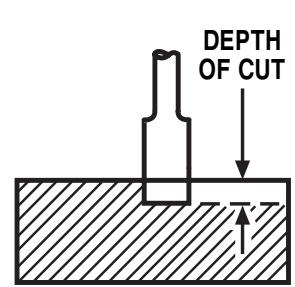
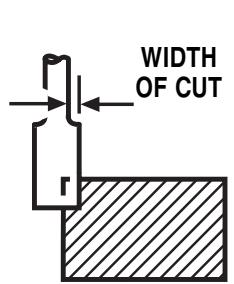
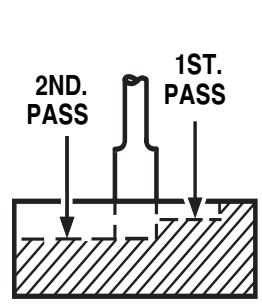
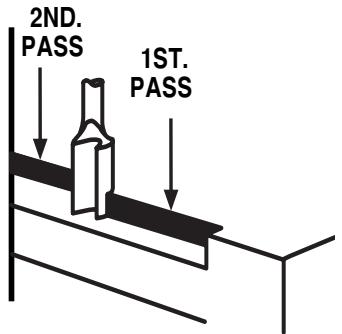
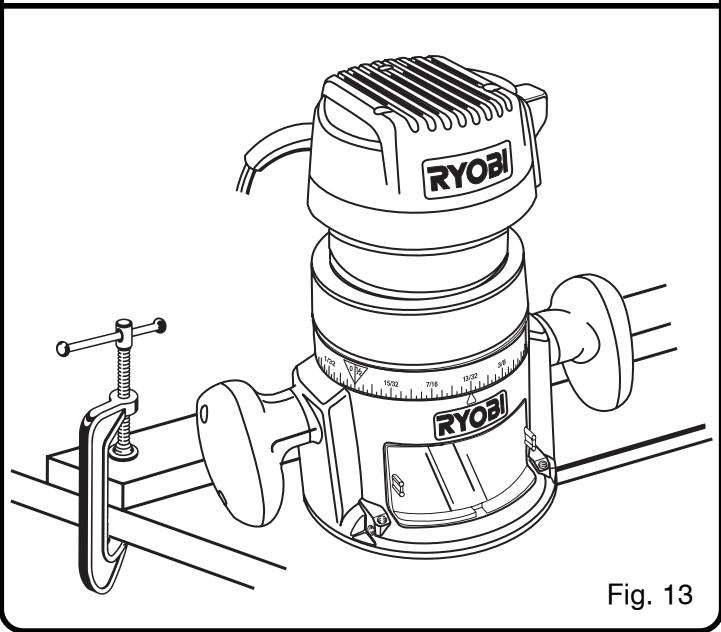
Fig. 12
OPERATION
When routing a groove wider than the diameter of the cutter, clamp a straightedge on both sides of the cutlines. Position both guides parallel to the desired line of cut and spaced equal distances from the desired edges of the groove. Rout along one guide; then, reverse direction and rout along the other guide. Clean out any remaining waste in the center of the groove freehand.
ROUTING BY FREEHAND
See Figure 14.
When used freehand, your router becomes a flexible and versatile tool. This flexibility makes it possible to easily rout signs, relief sculptures, etc.
There are two basic techniques for freehand routing:
■ Routing letters, grooves, and patterns into wood.
- Routing out the background, leaving the letters or pattern raised above the surface.
When freehand routing, we suggest the following:
Draw or layout the pattern on workpiece.
Choose the appropriate cutter.
NOTE: A core box or V-groove bit is often used for routing letters and engraving objects. Straight bits and ball mills are often used to make relief carvings. Veining bits are used to carve small, intricate details.
- Rout the pattern in two or more passes. Make the first pass at 25% of the desired depth of cut. This will provide better control as well as being a guide for the next pass.
NOTE: Do not rout deeper than 1/8 in. per pass.

WARNING:
Do not use large router bits for freehand routing. Use of large router bits when freehand routing could cause loss of control or create other hazardous conditions that could cause possible serious personal injury. When using a router table, large router bits should be used for edging only. Do not use router bits that are larger in diameter than the opening in router subbase for any purpose.
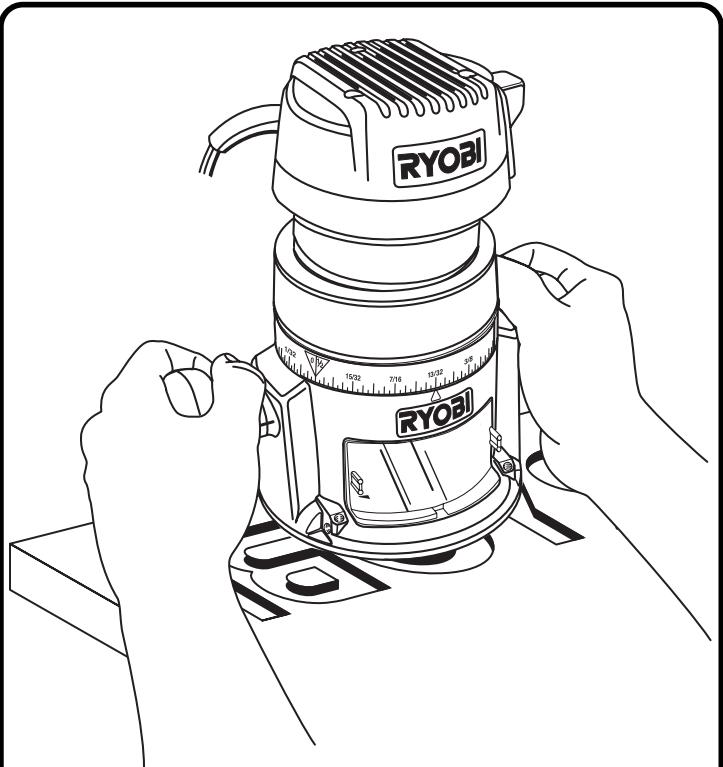
Fig. 14
EDGING WITH PILOTS
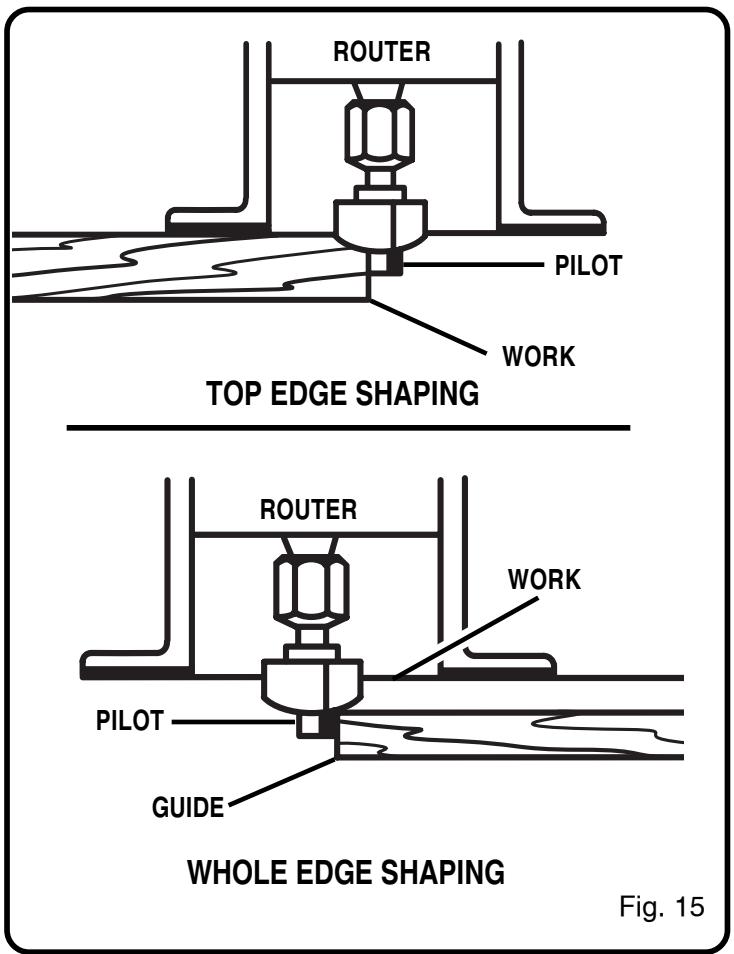
See Figure 15.
You can cut rabbets and molded edges using piloted cutters. The pilot, which extends below the cutter, allows the cutter to turn while the pilot follows the edge of the workpiece. Some pilots are solid extensions of the cutter. Others are ball bearing guides that are fastened to the end of the cutter.
Arbor-type bits with pilots are excellent for quick, easy edge shaping. They follow workpiece edges that are either straight or curved. The pilot prevents the bit from making too deep a cut. Holding the pilot firmly in contact with the workpiece edge throughout the cut prevents the cut from becoming too shallow.
Whenever the workpiece thickness together with the desired depth of cut (as adjusted by router depth setting) are such that only the top part of the edge is to be shaped (leaving at least a 1/16 inch [1.6 mm] thick uncut portion at bottom), the pilot can ride against the uncut portion, which serves to guide it. However, if the workpiece is too thin or the bit is set so low that there will be no uncut edge to ride the pilot against, an extra board must be placed under the workpiece to act as a guide. This guide board must have exactly the same contour — straight or curved — as the workpiece edge. If the guide is positioned so that its edge is flush with the workpiece edge, the bit will make a full cut (in as far as the bit radius). On the other hand, if the guide is positioned as shown (out from the workpiece edge), the bit will make less than a full cut — which will alter the shape of the finished edge.
NOTE: When edge shaping with guides, you can use any of the piloted bits without a pilot. The size (diameter) of the pilot determines the maximum cut width that you can make with the pilot against the workpiece edge. The small pilot exposes all of the bit; the large one reduces this amount by 1/16 inch (1.6 mm).
When routing all edges of a panel or board, rout the end grain first. Any splintering that occurs at the corners will then be removed when routing the sides. Start each side 1/4 in. (6.35 mm) away from the end. Feed the cutter into the wood until the pilot contacts the uncut edge. Then, slowly back the router to shape the corner. Next, move the router forward to shape the rest of the edge. Be careful to keep the pilot pressed against the uncut edge. Repeat this procedure on each side of the panel. Figure 20 shows the proper sequence of cuts to make when edge routing four sides of a panel.
MAINTENANCE

WARNING:
When servicing use only identical Ryobi replacement parts. Use of any other parts may create a hazard or cause product damage.
GENERAL
Avoid using solvents when cleaning plastic parts. Most plastics are susceptible to damage from various types of commercial solvents and may be damaged by their use. Use clean cloths to remove dirt, carbon dust, etc.

WARNING:
Do not at any time let brake fluids, gasoline, petroleum-based products, penetrating oils, etc. come in contact with plastic parts. They contain chemicals that can damage, weaken, or destroy plastic.
Electric tools used on fiberglass material, wallboard, spackling compounds, or plaster are subject to accelerated wear and possible premature failure, as the fiberglass chips and grindings are highly abrasive to bearings, brushes, commutators, etc. Consequently, we do not recommend that this tool be used for extended work on these types of materials. If, however, you do work with any of these materials, it is extremely important that you clean the tool frequently by blowing it with an air jet.

WARNING:
Always wear safety goggles or safety glasses with side shields during power tool operation or when blowing dust. If operation is dusty, also wear a dust mask.
LUBRICATION
All of the bearings in this tool are lubricated with a sufficient amount of high grade lubricant for the life of the unit under normal operating conditions. Therefore, no further lubrication is required.
CUTTERS
Get faster and more accurate cutting results by keeping cutters clean and sharp. Remove all accumulated pitch and gum from cutters after each use.
When sharpening cutters, sharpen only the inside of the cutting edge. Never grind the outside diameter. Be sure when sharpening the end of a cutter to grind the clearance angle the same as originally ground.
COLLET
Dust and chips may collect on the collet from time to time, making it necessary to clean the collet. To do so, remove the collet assembly and wipe it with a clean dry rag. Clean the taper in the shaft in the same manner. Never immerse the collet or end of the shaft in a solvent or in water. Before replacing the collet assembly, put a drop of SAE30 motor oil on the inside of the nut, on the threads of the shaft, and on the taper in the shaft. Replace the collet assembly onto the shaft by hand only. Never tighten the collet nut without a bit in the collet. This action could permanently damage the collet.
ACCESSIONS
The following recommended accessories are currently available.
ACCESSIONS
Template 4070177
Edge Guide 6090080

WARNING:
The use of attachments or accessories not listed could be hazardous.
NOTES
- SERVICE
Now that you have purchased your tool, should a need ever exist for repair parts or service, simply contact your nearest Ryobi Authorized Service Center. Be sure to provide all pertinent facts when you call or visit. Please call 1-800-525-2579 for your nearest Ryobi Authorized Service Center. You can also check our Web site at www.ryobitools.com for a complete list of Authorized Service Centers.
- MODEL NO. AND SERIAL NO.
The model number of this tool will be found on a plate attached to the motor housing. Please record the model number and serial number in the space provided below.
HOW TO ORDER REPAIR PARTS
WHEN ORDERING REPAIR PARTS,
ALWAYS GIVE THE FOLLOWING INFORMATION:
- MODEL NUMBER
R1801M
- SERIAL NUMBER
- OPERATOR'S MANUAL
- R1801M ROUTER
- WARNING:
- TABLE OF CONTENTS
- INTRODUCTION
- GENERAL SAFETY RULES
- SAVE THESE INSTRUCTIONS
- WORK AREA
- ELECTRICAL SAFETY
- PERSONAL SAFETY
- TOOL USE AND CARE
- SERVICE
- SPECIFIC SAFETY RULES
- ADDITIONAL RULES FOR SAFE OPERATION
- SYMBOLS
- ELECTRICAL
- DOUBLE INSULATION
- ELECTRICAL CONNECTION
- EXTENSION CORDS
- FEATURES
- SPECIFICATIONS
- MOTOR
- SWITCH
- SPINDLE LOCK
- DEPTH ADJUSTING RING
- LOCKING ARM
- CHIP SHIELD
- ERGONOMIC DESIGN
- UNPACKING
- INSTRUCTIONS
- PACKING LIST
- OPERATION
- TURNING THE ROUTER ON/OFF
- OPERATING THE ROUTER
- REMOVING AND INSTALLING THE ROUTER BASE
- TO REMOVE THE ROUTER BASE
- TO INSTALL THE ROUTER BASE
- REMOVING/INSERTING CUTTERS
- CAUTION:
- ADJUSTING DEPTH OF CUT
- TO ADJUST DEPTH OF CUT FOR FIXED ROUTERS
- FEEDING THE ROUTER
- DIRECTION (EXTERNAL)
- See Figure 8.
- DIRECTION (INTERNAL)
- See Figure 9.
- RATE OF FEED
- DETERMINING DEPTH OF CUT
- ROUTING
- ROUTING GROOVES
- ROUTING BY FREEHAND
- EDGING WITH PILOTS
- MAINTENANCE
- GENERAL
- LUBRICATION
- CUTTERS
- COLLET
- ACCESSIONS
- NOTES
- - SERVICE
- - MODEL NO. AND SERIAL NO.
- HOW TO ORDER REPAIR PARTS
Marque : RYOBI
Modèle : R1801M
Catégorie : Outil électrique de bricolage