
AG450 - Outils de jardinage RYOBI - Notice d'utilisation et mode d'emploi gratuit
Retrouvez gratuitement la notice de l'appareil AG450 RYOBI au format PDF.


| Type de produit | Meuleuse d'angle |
| Marque | RYOBI |
| Modèle | AG450 |
| Capacité de la meule | 115 mm (4-1/2 pouces) |
| Vitesse à vide | 11 000 tr/min |
| Tension nominale | 120 V ~ 60 Hz |
| Courant nominal | 5,5 A |
| Poids net | 2,1 kg (4,6 lb) |
| Double isolation | Oui |
| Protection de meule | Incluse, obligatoire |
| Poignée latérale | Incluse |
| Accessoires fournis | Meule de tronçonnage (1), Brosse métallique (1), Disque abrasif (1), Clé |
| Alimentation | Secteur, 120 V ~ 60 Hz, AC uniquement |
| Puissance absorbée | 660 W (estimé) |
| Utilisations recommandées | Meulage, tronçonnage, brossage |
| Entretien et nettoyage | Débrancher avant nettoyage ; utiliser un chiffon sec ; ne pas utiliser de solvants |
| Sécurité | Porter des lunettes de protection, des gants, un masque anti-poussière ; utiliser le capot de protection |
| Réparabilité | Confier à un centre de service agréé RYOBI ; utiliser des pièces de rechange d'origine |
| Garantie | Consulter la carte de garantie fournie |
| Niveau sonore (estimé) | 91 dB(A) (valeur indicative) |
| Vibrations (estimées) | 6,5 m/s² (valeur indicative) |
FOIRE AUX QUESTIONS - AG450 RYOBI
Questions des utilisateurs sur AG450 RYOBI
0 question sur cet appareil. Repondez a celles que vous connaissez ou posez la votre.
Poser une nouvelle question sur cet appareil
Téléchargez la notice de votre Outils de jardinage au format PDF gratuitement ! Retrouvez votre notice AG450 - RYOBI et reprennez votre appareil électronique en main. Sur cette page sont publiés tous les documents nécessaires à l'utilisation de votre appareil AG450 de la marque RYOBI.
MODE D'EMPLOI AG450 RYOBI
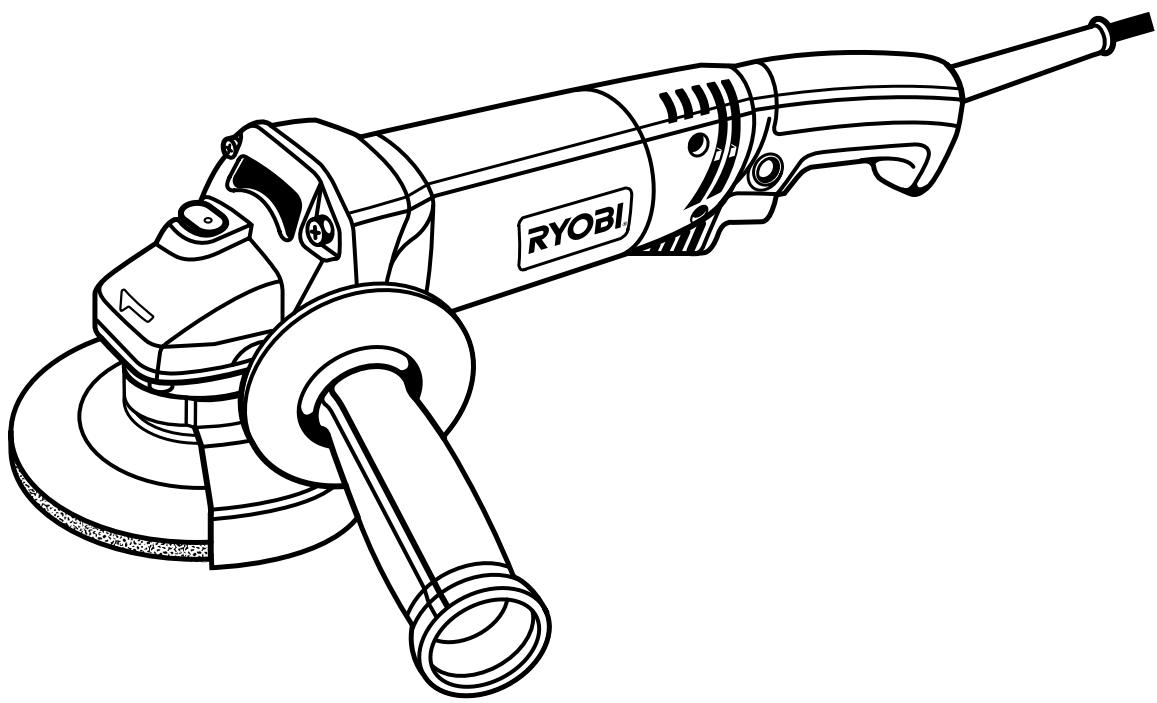
| SPECIFICATIONS: | |
| Grinding Wheel Capacity | 4-1/2 in. (115 mm) |
| Rating | 120 volts, 60Hz, AC only |
| No Load Speed | 11,000 RPM |
| Amperes | 5.5 Amperes |
| Net Weight | 4.6 lbs. (2.1 kg.) |
THANK YOU FOR BUYING A RYOBI ANGLE GRINDER.
Your new angle grinder has been engineered and manufactured to Ryobi's high standard for dependability, ease of operation, and operator safety. Properly cared for, it will give you years of rugged, trouble-free performance.

CAUTION: Carefully read through this entire operator's manual before using your new angle grinder.
Pay close attention to the Rules for Safe Operation,Warnings,and Cautions.If you use your grinder properly and only for what it is intended,you will enjoy years of safe,reliable service.
Please fill out and return the Warranty Registration Card so that we can be of future service to you.
Thank you again for buying Ryobi tools.
TABLE OF CONTENTS
Product Specifications 1
Table of Contents and Typical Application 2
Rules for Safe Operation 3-6
Symbols 6
■ Electrical and Unpacking 7
Features 8
Assembly 8-9
Adjustments 10
Operation 10-12
■ Maintenance 12-13
Parts Ordering / Service 14
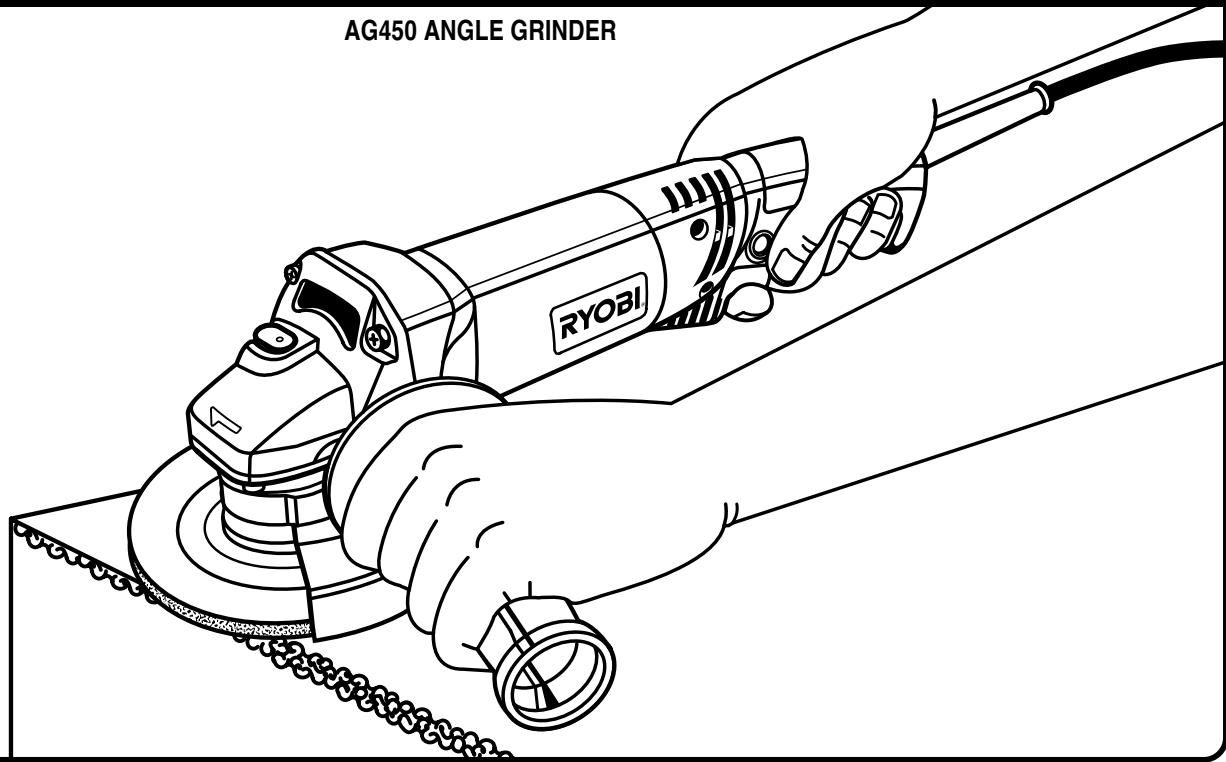
TYPICAL APPLICATION
AG450 ANGLE GRINDER

WARNING:
Always use the guard that accompanied the grinder. Comply with mounting and use instructions and warnings found in the manual for the grinder and ANSI B7.1. Failure to heed these warnings can result in wheel breakage and serious personal injury. For more information on ANSI Standards, contact the American National Standards Institute, Inc., 11 West 42nd Street, 13th Floor, New York, NY 10036.
RULES FOR SAFE OPERATION
| The purpose of safety symbols is to attract your attention to possible dangers. The safety symbols, and the explanations with them, deserve your careful attention and understanding. The safety warnings do not by themselves eliminate any danger. The instructions or warnings they give are not substitutes for proper accident prevention measures. | |
| SYMBOL | MEANING |
| SAFETY ALERT SYMBOL: Indicates danger, warning, or caution. May be used in conjunction with other symbols or pictographs. | |
| DANGER: Failure to obey a safety warning will result in serious injury to yourself or to others. Always follow the safety precautions to reduce the risk of fire, electric shock and personal injury. | |
| WARNING: Failure to obey a safety warning can result in serious injury to yourself or to others. Always follow the safety precautions to reduce the risk of fire, electric shock and personal injury. | |
| CAUTION: Failure to obey a safety warning may result in property damage or personal injury to yourself or to others. Always follow the safety precautions to reduce the risk of fire, electric shock and personal injury. | |
| NOTE: | Advises you of information or instructions vital to the operation or maintenance of the equipment. |
DOUBLE INSULATION
Your power tool is double insulated. This means you are separated from the tool's electrical system by two complete sets of electrical insulation. This extra layer of insulation is intended to protect the user from electrical shock due to a break in the wiring insulation. All exposed metal parts are isolated from the internal metal motor components with protecting insulation. Double insulated tools do not need to be grounded.

WARNING:
The double insulated system is intended to protect the user from shock resulting from a break in the tool's internal wiring. Observe all normal safety precautions related to avoiding electrical shock.
IMPORTANT
Servicing of a tool with double insulation requires extreme care and knowledge of the system and should be performed only by a qualified service technician. For service we suggest you return the tool to your nearest RYOBI AUTHORIZATION SERVICE CENTER for repair. When servicing use only identical Ryobi replacement parts.

WARNING:
Do not attempt to operate this tool until you have read thoroughly and understand completely all instructions, safety rules, etc. contained in this manual. Failure to comply can result in accidents involving fire, electric shock, or serious personal injury. Save operator's manual and review frequently for continuing safe operation, and instructing others who may use this tool.

WARNING:

The operation of any angle grinder can result in foreign objects being thrown into your eyes, which can result in severe eye damage. Before beginning power tool operation, always wear safety goggles or safety glasses with side shields and a full face shield when needed. We recommend Wide Vision Safety Mask for use over eyeglasses or standard safety glasses with side shields. Always wear eye protection which is marked to comply with ANSI Z87.1.
RULES FOR SAFE OPERATION

WARNING:
Read and understand all instructions. Failure to follow all instructions listed below, may result in electric shock, fire and/or serious personal injury.
SAVE THESE INSTRUCTIONS
Work Area
- Keep your work area clean and well lit. Cluttered benches and dark areas invite accidents.
- Do not operate power tools in explosive atmospheres, such as in the presence of flammable liquids, gases, or dust. Power tools create sparks which may ignite the dust or fumes.
- Keep bystanders, children, and visitors away while operating a power tool. Distractions can cause you to lose control.
Electrical Safety
- Double insulated tools are equipped with a polarized plug (one blade is wider than the other). This plug will fit in a polarized outlet only one way. If the plug does not fit fully in the outlet, reverse the plug. If it still does not fit, contact a qualified electrician to install a polarized outlet. Do not change the plug in any way. Double insulation eliminates the need for the three wire grounded power cord and grounded power supply system.
- Avoid body contact with grounded surfaces such as pipes, radiators, ranges and refrigerators. There is an increased risk of electric shock if your body is grounded.
- Don't expose power tools to rain or wet conditions. Water entering a power tool will increase the risk of electric shock.
- Do not abuse the cord. Never use the cord to carry the tools or pull the plug from an outlet. Keep cord away from heat, oil, sharp edges or moving parts. Replace damaged cords immediately. Damaged cords increase the risk of electric shock.
- When operating a power tool outside, use an outdoor extension cord marked "W-A" or "W". These cords are rated for outdoor use and reduce the risk of electric shock.
Personal Safety
- Stay alert, watch what you are doing and use common sense when operating a power tool. Do not use tool while tired or under the influence of drugs, alcohol, or medication. A moment of
inattention while operating power tools may result in serious personal injury.
- Dress properly. Do not wear loose clothing or jewelry. Contain long hair. Keep your hair, clothing, and gloves away from moving parts. Loose clothes, jewelry, or long hair can be caught in moving parts.
- Avoid accidental starting. Be sure switch is off before plugging in. Carrying tools with your finger on the switch or plugging in tools that have the switch on invites accidents.
- Remove adjusting keys or wrenches before turning the tool on. A wrench or a key that is left attached to a rotating part of the tool may result in personal injury.
- Do not overreach. Keep proper footing and balance at all times. Proper footing and balance enables better control of the tool in unexpected situations.
Use safety equipment. Always wear eye protection. Dust mask, non-skid safety shoes, hard hat, or hearing protection must be used for appropriate conditions.
Tool Use and Care
Use clamps or other practical way to secure and support the workpiece to a stable platform. Holding the work by hand or against your body is unstable and may lead to loss of control.
- Do not force tool. Use the correct tool for your application. The correct tool will do the job better and safer at the rate for which it is designed.
- Do not use tool if switch does not turn it on or off. Any tool that cannot be controlled with the switch is dangerous and must be repaired.
- Disconnect the plug from the power source before making any adjustments, changing accessories, or storing the tool. Such preventive safety measures reduce risk of starting the tool accidentally.
- Store idle tools out of reach of children and other untrained persons. Tools are dangerous in the hands of untrained users.
- Maintain tools with care. Keep cutting tools sharp and clean. Properly maintained tools with sharp cutting edges are less likely to bind and are easier to control.
- Check for misalignment or binding of moving parts, breakage of parts, and any other condition that may affect the tool's operation. If damaged, have the tool serviced before using. Many accidents are caused by poorly maintained tools.
RULES FOR SAFE OPERATION
Use only accessories that are recommended by the manufacturer for your model. Accessories that may be suitable for one tool, may become hazardous when used on another tool.
Service
Tool service must be performed only by qualified repair personnel. Service or maintenance performed by unqualified personnel could result in a risk of injury.
- When servicing a tool, use only identical replacement parts. Follow instructions in the Maintenance section of this manual. Use of unauthorized parts or failure to follow Maintenance Instructions may create a risk of electric shock or injury.
Specific Safety Rules for Grinders
Always use proper guard with grinding wheel. A guard protects operator from broken wheel fragments.
- Accessories must be rated for at least the speed recommended on the tool warning label. Wheels and other accessories running over rated speed can fly apart and cause injury.
Hold tool by insulated gripping surfaces when performing an operation where the tool may contact hidden wiring or its own cord. Contact with a "live" wire will make exposed metal parts of the tool "live" and shock the operator.
Grinding wheel and guard must be securely attached as described in this operating manual before connecting the grinder to a power source.
Grinding wheels must be stored in a dry place.
Before attaching the grinding wheel, inspect it for visible defects. If cracked, chipped, or warped, do not install it.
- Do not overtighten the clamp nut on the grinding wheel. Excessive tightening can cause the wheel to crack during operation
Make sure that the guard is in good condition and securely installed before operating grinder.
- Do not clamp the grinder in a vise or use as a fixed grinder.
- Never turn on the grinder with the grinding wheel or any rotating parts touching the workpiece.
Use only grinding wheels in compliance with ANSI standard B7.1 and rated greater than 11,000 RPM.
- Do not use the grinder if the disc flange or clamp nut is missing or if the spindle is bent.
Always hold the grinder securely with two hands while working and at all times when it is running.
- Never cover the air vents in the motor housing with your hands while operating the grinder.
Hold the tool away from your body while it is running. Keep your hands away from the abrasive attachments.
Dust and waste materials should not be allowed to build up in the workshop. Hot metal sparks could start a fire.
- Do not enlarge or alter the center hole of the grinding wheel as this could result in breaking it.
Use only the normal grinder surface. Never use the side or upper surfaces for cutting. - Keep the tool and its handle dry, clean, and free from oil and grease. Always use a clean cloth when cleaning. Never use brake fluids, gasoline, petroleum-based products, or any strong solvents to clean your tool.
Additional Rules for Safe Operation
■ Know your power tool. Read operator's manual carefully. Learn its applications and limitations as well as the specific potential hazards related to this tool. Following this rule will reduce the risk of electric shock, fire, or serious injury.
Always wear safety glasses with side shields. Everyday eyeglasses have only impact resistant lenses; they are NOT safety glasses.
- Protect your lungs. Wear a face or dust mask if the operation is dusty.
- Protect your hearing. Wear hearing protection during extended periods of operation.
■ Inspect tool cords periodically and if damaged, have repaired at your nearest authorized service center. Stay constantly aware of cord location.
- Check damaged parts. Before further use of the tool, a guard or other part that is damaged should be carefully checked to determine that it will operate properly and perform its intended function. Check for alignment of moving parts, binding of moving parts, breakage of parts, mounting, and any other conditions that may affect its operation. A guard or other part that is damaged should be properly repaired or replaced by an authorized service center. Following this rule will reduce the risk of electric shock, fire, or serious injury.
- Do not abuse cord. Never carry tool by cord or yank it to disconnect from receptacle. Keep cord from heat, oil and sharp edges. Following this rule will reduce the risk of electric shock or fire.
Make sure your extension cord is in good condition. When using an extension cord, be sure to use one heavy enough to carry the current your product will draw. A wire gage size (A.W.G.) of at least 16 is recommended for an extension cord 100 feet or less in length. A cord exceeding 100 feet is not recommended. If in doubt, use the next heavier gage. The smaller the gage number, the heavier the cord. An undersized cord will cause a drop in line voltage resulting in loss of power and overheating.
■ Inspect for and remove all foreign objects from workpiece before grinding. Following this rule will reduce the risk of serious personal injury.
RULES FOR SAFE OPERATION
- Drugs, Alcohol, Medication. Do not operate tool while under the influence of drugs, alcohol, or any medication. Following this rule will reduce the risk of electric shock, fire, or serious injury.
- Keep hands away from grinding area. Following this rule will reduce the risk of serious personal injury.

WARNING:
Run wire brush at operating speed for at least one minute before applying to workpiece. Never stand in line with the brush. Always use guard on grinder with wire wheel brush accessory. Failure to heed this warning can result in serious personal injury.
- Save these instructions. Refer to them frequently and use them to instruct others who may use this tool. If you loan someone this tool, loan them these instructions also.

WARNING:
Some dust created by power sanding, sawing, grinding, drilling, and other construction activities contains chemicals known to cause cancer, birth defects or other reproductive harm. Some examples of these chemicals are:
- lead from lead-based paints,
crystalline silica from bricks and cement and other masonry products, and - arsenic and chromium from chemically-treated lumber.
Your risk from these exposures varies, depending on how often you do this type of work. To reduce your exposure to these chemicals: work in a well ventilated area, and work with approved safety equipment, such as those dust masks that are specially designed to filter out microscopic particles.
SAVE THESE INSTRUCTIONS
SYMBOLS
Important: Some of the following symbols may be used on your tool. Please study them and learn their meaning. Proper interpretation of these symbols will allow you to operate the tool better and safer.
SYMBOL
NAME
DESIGNATION/EXPLANATION
| V | Volts | Voltage |
| A | Amperes | Current |
| Hz | Hertz | Frequency (cycles per second) |
| W | Watt | Power |
| min | Minutes | Time |
| ~ | Alternating Current | Type or a characteristic of current |
| n0 | No Load Speed | Rotational speed, at no load |
| □ | Class II Construction | Designates Double Insulated Construction tools |
| .../min | Revolutions or Reciprocation Per Minute | Revolutions, strokes, surface speed, orbits etc. per minute |
| Safety Alert Symbol | Indicates danger, warning or caution. It means attention!!! Your safety is involved. |
ELECTRICAL
EXTENSION CORDS
When using a power tool at a considerable distance from the power source, use an extension cord heavy enough to carry the current that the tool will draw. An undersized extension cord will cause a drop in line voltage, resulting in a loss of power and causing the motor to overheat. Use the chart provided below to determine the minimum wire size required in an extension cord. Only round jacketed cords listed by Underwriter's Laboratories (UL) should be used.
Length of Extension Cord Wire Size (A.W.G.)
| Up to 25 | 16 |
| 26 to 50 | 14 |
| 51 to 100 | 12 |
When working with the tool outdoors, use an extension cord that is designed for outside use. This is indicated by the letters WA on the cord's jacket.
Before using an extension cord, inspect it for loose or exposed wires and cut or worn insulation.
ELECTRICAL CONNECTION
Your grinder has a precision built electric motor. It should be connected to a power supply that is 120 volts, 60Hz, AC only (normal household current). Do not operate this tool on direct current (DC). A substantial voltage drop will cause a loss of power and the motor will overheat. If your tool does not operate when plugged into an outlet, double-check the power supply.

CAUTION:
Keep the cord away from the work area and position the cord so that it will not be caught on materials or other objects during grinding.
UNPACKING
With the exception of the side handle and accessory wheels, your angle grinder has been shipped completely assembled.
- Carefully remove the grinder and accessories from the box. Make sure that all items listed in the packing list are included.
■ Inspect grinder carefully to make sure no breakage or damage has occurred during shipping.
If any parts are damaged or missing, call 1-800-525-2579 to obtain replacement parts before attempting to operate grinder. - Do not discard the packing material until you have carefully inspected and satisfactorily operated grinder.
PACKING LIST
Angle Grinding with Guard
Carrying Case
Grinding Wheel (1)
Wire Wheel Brush (1)
Abrasive Mop Disc (1)
Side Handle
Wrench
Operator's Manual
Warranty Registration Card

WARNING:
If any parts are missing, do not operate your grinder until the missing parts are replaced. Failure to do so could result in possible serious personal injury.
- THANK YOU FOR BUYING A RYOBI ANGLE GRINDER.
- TABLE OF CONTENTS
- TYPICAL APPLICATION
- WARNING:
- RULES FOR SAFE OPERATION
- DOUBLE INSULATION
- IMPORTANT
- SAVE THESE INSTRUCTIONS
- Work Area
- Electrical Safety
- Personal Safety
- Tool Use and Care
- Service
- Specific Safety Rules for Grinders
- Additional Rules for Safe Operation
- SYMBOLS
- ELECTRICAL
- EXTENSION CORDS
- ELECTRICAL CONNECTION
- CAUTION:
- UNPACKING
- PACKING LIST
Marque : RYOBI
Modèle : AG450
Catégorie : Outils de jardinage