E4001-7-M - Four encastrable AEG-ELECTROLUX - Notice d'utilisation et mode d'emploi gratuit
Retrouvez gratuitement la notice de l'appareil E4001-7-M AEG-ELECTROLUX au format PDF.


| Type d'appareil | Four encastrable |
| Mode de cuisson | Non précisé |
| Capacité | Non précisé |
| Puissance | Non précisé |
| Type d'énergie | Électrique |
| Nombre de fonctions | Non précisé |
| Type de commande | Non précisé |
| Type de porte | Non précisé |
| Type de nettoyage | Non précisé |
| Dimensions (HxLxP) | Non précisé |
| Poids | Non précisé |
| Accessoires inclus | Non précisé |
| Sécurité enfant | Non précisé |
| Affichage | Non précisé |
| Garantie | Non précisé |
FOIRE AUX QUESTIONS - E4001-7-M AEG-ELECTROLUX
Questions des utilisateurs sur E4001-7-M AEG-ELECTROLUX
0 question sur cet appareil. Repondez a celles que vous connaissez ou posez la votre.
Poser une nouvelle question sur cet appareil
Téléchargez la notice de votre Four encastrable au format PDF gratuitement ! Retrouvez votre notice E4001-7-M - AEG-ELECTROLUX et reprennez votre appareil électronique en main. Sur cette page sont publiés tous les documents nécessaires à l'utilisation de votre appareil E4001-7-M de la marque AEG-ELECTROLUX.
MODE D'EMPLOI E4001-7-M AEG-ELECTROLUX
E4001-7
User manual
Built-under oven
Thank you for choosing one of our high-quality products.
To ensure optimal and regular performance of your appliance please read this instruction manual carefully. It will enable you to navigate all processes perfectly and most efficiently. To refer to this manual any time you need to, we recommend you to keep it in a safe place. And please pass it to any future owner of the appliance.
We wish you much joy with your new appliance.
Contents
| Safety information | 2 |
| Safety for children and incompetent persons | 2 |
| Installation safety measures | 2 |
| Electrical safety | 3 |
| Operation safety measures | 3 |
| Product description | 4 |
| General overview | 4 |
| Oven accessories | 4 |
| Oven steam outlet | 5 |
| Before first use | 5 |
| Initial Cleaning | 5 |
| Daily use | 5 |
| Switching the Oven On and Off | 5 |
| Cooling fan | 5 |
| Cooking zones | 5 |
| Heat settings | 5 |
| Oven Functions | 6 |
| Inserting the Oven Accessories | 6 |
| Inserting/Removing the Fat Filter | 7 |
| Helpful hints and tips | 8 |
| Inner side of door | 8 |
| Baking | 8 |
| Roasting | 13 |
| Grilling | 15 |
| Preserving | 16 |
| Drying | 17 |
| Defrosting | 17 |
| Care and cleaning | 18 |
| Oven Ceiling | 19 |
| Shelf Support Rails | 19 |
| Oven lamp | 20 |
| Oven door and glass panels | 20 |
| What to do if... | 22 |
| Disposal | 22 |
| Service and spare parts | 23 |
Subject to change without notice

Safety information
Safety for children and incompetent persons
- People (including children) who, because of their physical, sensory or mental capabilities or their inexperience of ignorance are not able to use the appliance safely, should not use this appliance without supervision or instruction by a responsible person.
- Switch on the child lock when there are children. The child lock makes sure that children do not accidentally switch on the appliance.
Installation safety measures
- Let a registered electrician do the installation of the appliance. If you do not contact a registered electrician, the guarantee becomes invalid if there is damage.
- For safety on installation, refer to "Installation"
Electrical safety
- Let a registered electrician do the electrical connection of the appliance.
- For safety on installation, refer to "installation".
Risk of fire
- Open the door carefully. The use of ingredients with alcohol can cause a mixture of alcohol and air. There is risk of fire.
- Do not let sparks or open flames come near the appliance when you open the door. There is risk of fire.
- Do not keep flammable materials in the appliance. There is risk of fire.
Operation safety measures

Discoloration of the oven enamel does not effect the performance of the appliance. The guarantee does not become invalid.
- Only use the appliance to cook, roast and bake food
- When you connect electrical appliances to mains sockets, do not let cables touch or come near the hot oven door.
- The inner side of the appliance becomes hot during use. There is risk of burns.
- Do not cover the appliance with aluminium foil to prevent damage to the oven enamel.
- Do not put baking trays, pots, etc. on the oven floor to prevent damage to the oven enamel.
- Never put hot water directly into the appliance to prevent damage to or discoloration of the oven enamel.
- User a deep baking tray for very moist cakes. If not, fruit juices can cause stains that can be permanent.
- Do not apply pressure on an open appliance door.
- Be careful when you remove or install the glass panels.
- Do not keep moist food in the appliance to prevent damage to the oven enamel.
- After you switch off the cooling fan, do not keep uncovered food in the appliance. Moisture can condense in the appliance or on the glass doors.
Care and cleaning
- Before maintenance, switch off the appliance and make sure that the appliance is cool.
- Do not clean the appliance with a steam cleaner or a high-pressure cleaner.
- Do not clean the glass oven door with abrasive fluids or metal scrapers, which could cause scratches on the surface. The glass could break and shatter
Product description
General overview
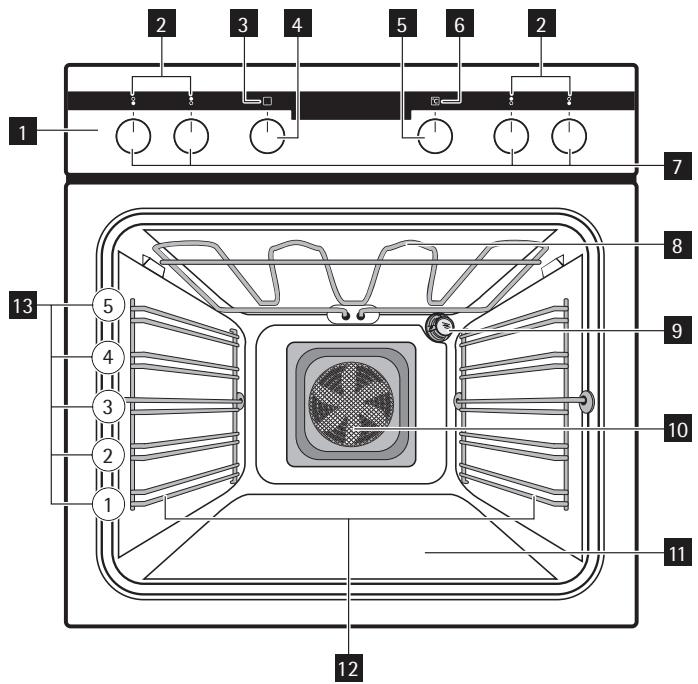
1 Control panel
2 Cooking zone indicators
3 Power indicator
4 Control knob for oven functions
5 Control knob for temperature
6 Power indicator
7 Control knobs for cooking zones
8 Heating element
9 Oven lamp
10 Fan and fat filter
11 Bottom heat
12 Oven shelf runners, removable
13 Shelf positions
Oven accessories
- Oven shelf
For cookware, cake tins, roasts.
- Flat baking tray
For cakes and biscuits.
- Deep roasting pan
To bake and roast or as pan to collect fat.
Oven steam outlet
The steam from the oven gets out through the outlet in the back left corner of the cooking surface (see the Description of the appliance in hob user manual).
Before first use
Initial Cleaning
- Remove all parts from the appliance.
- Clean the appliance before first use.

CAUTION!
Do not use abrasive cleaning agents! This can damage the surface. Refer to chapter "Care and Cleaning".
Daily use

To use the oven, push the retractable knob. The knob then comes out.
Switching the Oven On and Off
- Turn the oven functions control knob to an oven function.
- Turn the temperature control knob to a temperature.
The power indicator comes on while the oven is in operation.
The temperature indicator comes on while the oven temperature increases.
- To switch off the oven, turn the oven functions control knob and the temperature control knob to the Off position.
Cooling fan
When the appliance operates, the cooling fan switches on automatically to keep the surfaces of the appliance cool. If you switch off the appliance, the cooling fan continues to operate until the appliance cools down.
Cooking zones

With the control knobs for cooking zones you operate the hob that you installed with the oven. For more information about the hob, refer to the hob user manual.
Heat settings

Cooking zone indicators (refer to "General overview") show which zone you set.
| Control knob | Function |
| XXX | Keep warm setting |
| 1-9 | Heat settings (1 = lowest heat setting; 9 = highest heat setting) |
- Turn the control knob to a necessary heat setting.
- To complete the cooking process, turn the control knob to the "0" position.
Automatic heat-up function

This information is applicable only if you install the hob with Automatic heat up function!
The automatic heat-up function heats the cooking zone with full power for some time.
- To switch on the function, turn the control knob clockwise as far as possible (pass the highest heat setting).
- To continue the cooking process, turn the control knob to the necessary heat setting.
- To complete the cooking process, turn the control knob to the "0" position.
Oven Functions
| Oven function | Application | |
| - | Light | Use this function to light up the oven interior. |
| - | TRUE FAN | To bake maximum on three oven levels at the same time. Decrease the oven temperatures (20-40 °C) compared with Conventional. And to dry food. |
| - | FAN BAKING | To bake on one oven level food with a more intensive browning and a crispy base. Decrease the oven tempera-tures (20-40 °C) compared with Conventional |
| - | CONVENTIONAL | To bake and roast on one oven level. |
| - | BASE HEAT | To bake cakes with crispy or crusty bases and to preserve food |
| * | DEFROST | To defrost frozen food. |
| ** | SINGLE GRILL | To grill flat food in the middle of the grill and to toast. |
| *** | DUAL GRILL | To grill flat food in large quantities and to toast. |
| ** | ROTOTHERM | To roast larger joints of meat or poultry on one level. Also to gratinate and brown. |
Inserting the Oven Accessories
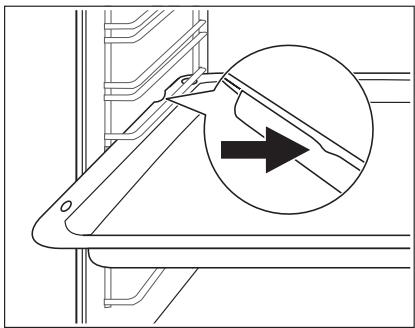
Put in the slide-in accessories so that the double side edges are at the back of the oven and point down to the bottom. Push the slide-in accessories between the guide-bars of one of the oven levels.

The deep roasting pan and the oven shelf have double side edges. These edges and the shape of the guide-bars causes the anti-tilt safety for the oven accessories.
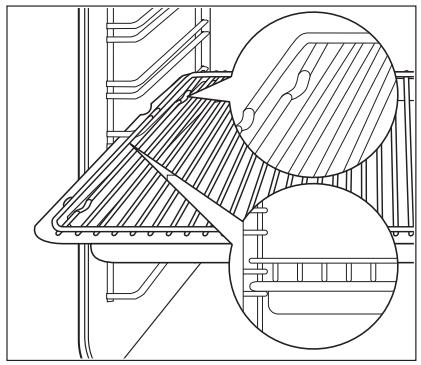
Inserting the oven shelf and deep roasting pan together
Put the oven shelf on the deep roasting pan. Push the deep roasting pan between the guide-bars of one of the oven levels.
Inserting/Removing the Fat Filter
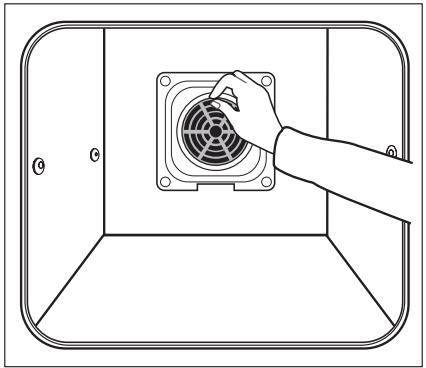
Only use the fat filter when roasting to protect the rear heating elements from fat splashes.
Inserting the fat filter
Hold the fat filter by the tab and insert the two mounts downwards into the opening on the rear wall of the oven (fan opening).
Removing the fat filter
Hold the fat filter by the tab, unhook it and lift out.
Helpful hints and tips
Examples of cooking applications
The data in the table is for guidance only.
| Heat setting | Use to: | Time | Hints |
| 1 | Keep cooked foods warm | as required | Cover |
| 1-2 | Hollandaise sauce, melt: butter, choco- late, gelatine | 5-25 min | Mix occasionally |
| 1-2 | Solidify: fluffy omelettes, baked eggs | 10-40 min | Cook with a lid on |
| 2-3 | Simmer rice and milkbased dishes, heat- ing up ready-cooked meals | 25-50 min | Add at least twice as much liquid as rice, stir milk dishes part way through |
| 3-4 | Steam vegetables, fish, meat | 20-45 min | Add a few tablespoons of liquid |
| 4-5 | Steam potatoes | 20-60 min | Use max. 1/4 l water for 750 g of po-tatoes |
| 4-5 | Cook larger quantities of food, stews and soups | 60-150 min | Up to 3 l liquid plus ingredients |
| 6-7 | Gentle fry: escalope, veal cordon bleu, cutlets, rissoles, sausages, liver, roux, eggs, pancakes, doughnuts | as required | Turn halfway through |
| 7-8 | Heavy fry, hash browns, loin steaks, steaks | 5-15 min | Turn halfway through |
| 9 | Boil large quantities of water, cook pasta, sear meat (goulash, pot roast), deep fry chips | ||
Inner side of door
On the inner side of the oven door you can find:
the numbers of the shelf levels
- information about the oven functions, recommended shelf levels and temperatures for typical dishes.

The temperature and baking times in the tables are guidelines only. They depend on the recipes, quality and quantity of the ingredients used.
Baking
General instructions
- Your new oven may bake or roast differently to the appliance you had before. Adapt your usual settings (temperature, cooking times) and shelf levels to the values in the tables.
- With longer baking times, the oven can be switched off about 10 minutes before the end of baking time, to use the residual heat.
When you use frozen food, the trays in the oven can twist during baking. When the trays get cold again, the distortion will be gone.
How to use the Baking Tables
- We recommend to use the lower temperature the first time.
- If you cannot find the settings for a special recipe, look for the one that is almost the same.
- Baking time can be extended by 10-15 minutes, if you bake cakes on more than one level.
- Cakes and pastries at different heights do not always brown equally at first. If this occurs, do not change the temperature setting. The differences equalize during the baking procedure.
Baking on one oven level - Baking in tins
| Type of baking | Oven function | Level | Temperature (℃) | Time (h:min) | |
| Ring cake or brioche | ◇ | TRUE FAN | 1 | 150 - 160 | 0:50 - 1:10 |
| Madeira cake/Fruit cakes | ◇ | TRUE FAN | 1 | 140 - 160 | 1:10 - 1:30 |
| Sponge cake | ◇ | TRUE FAN | 1 | 140 | 0:25 - 0:40 |
| Sponge cake | - | CONVENTIONAL | 1 | 160 | 0:25 - 0:40 |
| Flan base - short pa-stry 1) | ◇ | TRUE FAN | 3 | 170-180 | 0:10 - 0:25 |
| Flan base - sponge mixture | ◇ | TRUE FAN | 3 | 150 - 170 | 0:20 - 0:25 |
| Apple pie | - | CONVENTIONAL | 1 | 170 - 190 | 0:50 - 1:00 |
| Apple pie (2 tins, Ø 20 cm, diagonally off set) | ◇ | TRUE FAN | 1 | 160 | 1:10 - 1:30 |
| Apple pie (2 tins, Ø 20 cm, diagonally off set) | - | CONVENTIONAL | 1 | 180 | 1:10 - 1:30 |
1) Pre-heat oven
Baking on one oven level - Cakes/pastries/breads on baking trays
| Type of baking | Oven function | Level | Temperature (°C) | Time (h:min) | |
| Plaited bread/bread crown | — | CONVENTIONAL | 3 | 170 - 190 | 0:30 - 0:40 |
| Christmas stolen1) | — | CONVENTIONAL | 3 | 160 - 180 | 0:40 - 1:00 |
| Bread ( rye bread) | — | CONVENTIONAL | 1 | ||
| - first of all1) | 230 | 0:25 | |||
| - then | 160 - 180 | 0:30 - 1:00 | |||
| Cream puffs/eclairs1) | — | CONVENTIONAL | 3 | 160 - 170 | 0:15 - 0:30 |
| Swiss roll1) | — | CONVENTIONAL | 3 | 180 - 200 | 0:10 - 0:20 |
| Cake with crumble topping (dry) | — | TRUE FAN | 3 | 150 - 160 | 0:20 - 0:40 |
| Buttered almond cake/sugar cakes1) | — | CONVENTIONAL | 3 | 190 - 210 | 0:15 - 0:30 |
| Fruit flans (made with yeast dough / sponge mixture)2) | — | TRUE FAN | 3 | 150 | 0:35 - 0:50 |
| Fruit flans (made with yeast dough / sponge mixture)2) | — | CONVENTIONAL | 3 | 170 | 0:35 - 0:50 |
| Fruit flans made with short pastry | — | TRUE FAN | 3 | 160 - 170 | 0:40 - 1:20 |
| Yeast cakes with deli-cate toppings (e.g. quark, cream, cus-tard)1) | — | CONVENTIONAL | 3 | 160 - 180 | 0:40 - 1:20 |
| Unleavened bread | — | TRUE FAN | 1 | 200 - 200 | 0:08 - 0:15 |
1) Pre-heat oven
2) Use the deep roasting pan
Baking on one oven level - Biscuits
| Type of baking | Oven function | Level | Temperature (°C) | Time (h:min) | |
| Short pastry biscuits | ☆ | TRUE FAN | 3 | 150 - 160 | 0:06 - 0:20 |
| Viennese whirls | ☆ | TRUE FAN | 3 | 140 | 0:20 - 0:30 |
| Viennese whirls 1) | - | CONVENTIONAL | 3 | 160 | 0:20 - 0:30 |
| Biscuits made with sponge mixture | ☆ | TRUE FAN | 3 | 150 - 160 | 0:15 - 0:20 |
| Pastries made with egg white, meringues | ☆ | TRUE FAN | 3 | 80 - 100 | 2:00 - 2:30 |
| Macaroons | ☆ | TRUE FAN | 3 | 100 - 120 | 0:30 - 0:60 |
| Biscuits made with yeast dough | ☆ | TRUE FAN | 3 | 150 - 160 | 0:20 - 0:40 |
| Puff pastries1) | ☆ | TRUE FAN | 3 | 170 - 180 | 0:20 - 0:30 |
| Rolls1) | ☆ | TRUE FAN | 3 | 160 | 0:20 - 0:35 |
| Rolls1) | - | CONVENTIONAL | 3 | 180 | 0:20 - 0:35 |
| Type of baking | Oven function | Level | Temperature (℃) | Time (h:min) | |
| Small cakes (20 per tray)1) | ◇ | TRUE FAN | 3 | 140 | 0:20 - 0:30 |
| Small cakes (20 per tray)1) | 二 | CONVENTIONAL | 3 | 170 | 0:20 - 0:30 |
1) Pre-heat oven
Baking on more than one level - Cakes/pastries/breads on baking trays
| Type of baking | True fan 2 levels | True fan 3 levels | Temperature (°C) | Time (h:min) |
| Cream puffs / Eclairs1) | 1 / 4 | --- | 160 - 180 | 0:35 - 0:60 |
| Dry streusel cake | 1 / 3 | --- | 140 - 160 | 0:30 - 0:60 |
1) Pre-heat oven
Baking on more than one level - Biscuits/small cakes/pastries/rolls
| Type of baking | True fan 2 levels | True fan 3 levels | Temperature (℃) | Time (h:min) |
| Short pastry biscuits | 1 / 3 | 1 / 3 /5 | 150 - 160 | 0:15 - 0:35 |
| Viennese whirls | 1 / 3 | 1 / 3 /5 | 140 | 0:20 - 0:60 |
| Biscuits made with sponge mixture | 1 / 3 | --- | 160 - 170 | 0:25 - 0:40 |
| Biscuits made with egg white, meringues | 1 / 3 | --- | 80 - 100 | 2:10 - 2:50 |
| Macaroons | 1 / 3 | --- | 100 - 120 | 0:40 - 1:20 |
| Biscuits made with yeast dough | 1 / 3 | --- | 160 - 170 | 0:30 - 0:60 |
| Puff pastries¹) | 1 / 3 | --- | 170 - 180 | 0:30 - 0:50 |
| Rolls | 1 /4 | --- | 160 | 0:30 - 0:45 |
| Small cakes (20 per tray)¹) | 1 /4 | --- | 140 | 0:25 - 0:40 |
1) Pre-heat oven
Tips on baking
| Baking results | Possible cause | Remedy |
| The cake is not browned sufficiently below | Incorrect oven level | Put the cake on a lower oven level |
| The cake sinks (be-comes soggy, lumpy, streaky) | Oven temperature too high | Use a lower setting |
| The cake sinks (be-comes soggy, lumpy, streaky) | Baking time is too short | Set a longer baking time Do not set higher temperatures to de-crease baking times |
| The cake sinks (be-comes soggy, lumpy, streaky) | Too much liquid in the mix-ture | Use less liquid. Look at the mixing times, specially when you use mixing machines |
| Cake is too dry | Oven temperature too low | Set a higher oven temperature |
| Cake is too dry | Baking time too long | Set a shorter baking time |
| Cake does not brown equally | Oven temperature too high and baking time too short | Set a lower oven temperature and a longer baking time |
| Cake does not brown equally | No equal mixture | Put the mixture equally on the baking tray |
| Cake does not cook in the baking time set | Temperature too low | Use a slightly higher oven temperature setting |
Fan baking table

To see which oven function you must use please refer to the oven functions list in Daily use chapter.
| Type of baking | Shelf level | Temperature °C | Time (Mins) |
| Pizza (thin crust) 1) | 1 | 180 - 200 | 20 - 30 |
| Pizza (with a lot of top-ping) | 1 | 180 - 200 | 20 - 30 |
| Tarts | 1 | 180 - 200 | 45 - 60 |
| Spinach flan | 1 | 160 - 180 | 45 - 60 |
| Quiche Lorraine | 1 | 170 - 190 | 40 - 50 |
| Curd Cheese Cake, round | 1 | 140 - 160 | 60 - 90 |
| Curd Cheese Cake on tray | 1 | 140 - 160 | 50 - 60 |
| Apple cake, covered | 1 | 150 - 170 | 50 - 70 |
| Vegetable pie | 1 | 160 - 180 | 50 - 60 |
| Unleavened bread 1) | 1 | 250 - 270 | 10 - 20 |
| Puff pastry flan 1) | 1 | 160 - 180 | 40 - 50 |
| Flammekuchen (Pizza-like dish from Alsace) 1) | 1 | 250 - 270 | 12 - 20 |
| Piroggen (Russian version of calzone) 1) | 1 | 180 - 200 | 15 - 25 |
1) Pre-heat the oven
Table for Bakes and Gratin
| Dish | Oven function | Shelf level | Temperature °C | Time Hr : Min | |
| Pasta bake | — | CONVENTIONALI | 1 | 180-200 | 0:45-1:00 |
| Lasagne | — | CONVENTIONALI | 1 | 180-200 | 0:25-0:40 |
| Vegetables au gratin1) | × | ROTOTHERM | 1 | 160-170 | 0:15-0:30 |
| Baguettes topped with melted cheese1) | × | ROTOTHERM | 1 | 160-170 | 0:15-0:30 |
| Sweet bakes | — | CONVENTIONALI | 1 | 180-200 | 0:40-0:60 |
| Fish bakes | — | CONVENTIONALI | 1 | 180-200 | 0:30-1:00 |
| Stuffed vegetables | × | ROTOTHERM | 1 | 160-170 | 0:30-1:00 |
1) preheat the oven
Ready meals
| Food to be cooked | Oven function | Shelf level | Temperature °C | Time | |
| Chips1) | X | ROTITHERM | 3 | 200-220 | refer to instruc-tions of the manufacturer |
1) Comment: Turn chips 2 or 3 times during cooking
Roasting

Set in the fat filter when you roast!
Roasting dishes
- Use heat-resistant ovenware to roast (please read the instructions of the manufacturer).
- Large roasting joints can be roasted directly in the deep roasting pan or on the oven shelf above the deep roasting pan. (If present)
- Roast lean meats in a roasting tin with a lid. This well keep the meat more succulent.
- All types of meat, that can be browned or have crackling, can be roasted in the roasting tin without the lid.

The data in the table is for guidance only.
Tips on using the roasting table.
- Roast meat and fish that weighs more than 1kg .
- Put some water in the roasting tray to prevent meat juices or fat from burning to the pan.
- Turn the meat if it is necessary (after 1/2 - 2/3 of the cooking time).
- For better results, baste large pieces of meat and poultry with the cooking juices several times during the cooking time.
- Stop the oven approximately 10 minutes before the end of roasting time to use the residual heat.
Beef
| Type of meat | Quantity | Oven function | Shelf level | Tempera-ture °C | Time (h:min) | |
| Port roast | 1 - 1,5 kg | — | CONVEN-TIONAL | 1 | 200 - 250 | 2:00 - 2:30 |
| Roast beef or fillet | for each cm of thickness | |||||
| - rare1) | for each cm of thickness | × | ROTITHERM | 1 | 190 - 200 | 0:05 - 0:06 |
| - medium | for each cm of thickness | × | ROTITHERM | 1 | 180 - 190 | 0:06 - 0:08 |
| - well done | for each cm of thickness | × | ROTITHERM | 1 | 170 - 180 | 0:08 - 0:10 |
1) preheat the oven
Pork
| Type of meat | Quantity | Oven function | Shelf level | Tempera-ture °C | Time (h:min) | |
| Shoulder, neck, ham joint | 1 - 1.5 kg | X | ROTOTHERM | 1 | 160 - 180 | 1:30 - 2:00 |
| Chop, spare rib | 1 - 1.5 kg | X | ROTOTHERM | 1 | 170 - 180 | 1:00 - 1:30 |
| Meat loaf | 750 g - 1 kg | X | ROTOTHERM | 1 | 160 - 170 | 0:45 - 1:00 |
| Porknuckle (precooked) | 750 g - 1 kg | X | ROTOTHERM | 1 | 150 - 170 | 1:30 - 2:00 |
Veal
| Type of meat | Quantity | Oven function | Shelf level | Temperature °C | Time (h:min) | |
| Roast Veal | 1 kg | X | ROTOTHERM | 1 | 160 - 180 | 1:30 - 2:00 |
| Knuckle of veal | 1,5 -2 kg | X | ROTOTHERM | 1 | 160 - 180 | 2:00 - 2:30 |
Lamb
| Type of meat | Quantity | Oven function | Shelf level | Temperature °C | Time (h:min) | |
| Leg of lamb, roast lamb | 1 - 1,5 kg | X | ROTITHERM | 1 | 150 - 170 | 1:15 - 2:00 |
| Saddle of lamb | 1 - 1,5 kg | X | ROTITHERM | 1 | 160 - 180 | 1:00 - 1:30 |
Game
| Type of meat | Quantity | Oven function | Shelf level | Tempera-ture °C | Time (h:min) | |
| Saddle of hare, leg of hare1) | up to 1 kg | = | CONVEN-TIONAL | 3 | 220 - 250 | 0:25 - 0:40 |
| Saddle of venison | 1,5 - 2 kg | — | CONVEN-TIONAL | 1 | 210 - 220 | 1:15 - 1:45 |
| Haunch of venison | 1,5 - 2 kg | — | CONVEN-TIONAL | 1 | 200 - 210 | 1:30 - 2:15 |
1) preheat the oven
Poultry
| Type of meat | Quantity | Oven function | Shelf level | Tempera-ture °C | Time (h:min) | |
| Poultry portions | 200 – 250 g each | X | ROTITHERM | 1 | 200 – 220 | 0:35 – 0:50 |
| Half chicken | 400 – 500 g each | X | ROTITHERM | 1 | 190 – 210 | 0:35 – 0:50 |
| chicken, pouard | 1 – 1,5 kg | X | ROTITHERM | 1 | 190 – 210 | 0:45 – 1:15 |
| Duck | 1.5 – 2 kg | X | ROTITHERM | 1 | 180 – 200 | 1:15 – 1:45 |
| Goose | 3.5 – 5 kg | X | ROTITHERM | 1 | 160 – 180 | 2:30 – 3:30 |
| Turkey | 2.5 – 3.5 kg | X | ROTITHERM | 1 | 160 – 180 | 1:45 – 2:30 |
| Turkey | 4 – 6 kg | X | ROTITHERM | 1 | 140 – 160 | 2:30 – 4:00 |
Fish (steamed)
| Type of meat | Quantity | Oven function | Shelf level | Tempera-ture °C | Time (h:min) | |
| Whole fish | 1 - 1,5 kg | — | CONVEN-TIONAL | 1 | 210 - 220 | 0:45 - 1:15 |
Grilling
Always use the grilling function with maximum temperature setting

Always grill with the oven door closed.

Always pre-heat the empty oven with the grill functions for 5 minutes.
- Set the shelf in the shelf level as recommended in the grilling table.
- Always set the pan to collect the fat into the first shelf level.
- Grill only flat pieces of meat or fish.

To see which oven function you must use please refer to the oven functions list in Daily use chapter.
| Food to grill | Shelf level | Time | |
| 1st side | 2nd side | ||
| Burgers | 4 | 8 - 10 mins. | 6 - 8 mins. |
| Pork fillet | 4 | 10 - 12 mins. | 6 - 10 mins. |
| Sausages | 4 | 8 - 10 mins. | 6 - 8 mins. |
| Filet steaks, veal steaks | 4 | 6 - 7 mins | 5 - 6 mins. |
| Filet of beef, roast beef ( approximately 1 kg) | 3 | 10 - 12 mins. | 10 - 12 mins. |
| Toast 1) | 3 | 4 - 6 mins. | 3 - 5 mins. |
| Toast with topping | 3 | 6 - 8 mins. | -------- |
1) Do not pre-heat
Preserving
- Only use usual preserving jars of the same dimension.
- Do not use jars with twist-off or bayonet type lids and metal tins.
- Use the first shelf level from the bottom.
- Use the baking tray. You can put six 1-litre jars maximum on it.
- Fill all the jars to the same level and close them correctly.
- Put the jars on the shelf, make sure that they do not touch each other.
- Fill approximately 1/2 litre of water into the flat baking tray to have sufficient moisture in the oven.
- When the liquid lightly starts to bubble in the first jars (after about 35-60 minutes with 1 litre jars), switch off the oven or decrease the temperature to 100^ (see table).

To see which oven function you must use please refer to the oven functions list in Daily use chapter.
Soft fruit
| Preserve | Temperature in ℃ | Time until simmer- ing in mins. | Continue to cook at 100℃ in mins. |
| Strawberries, blueberries, rasp- berries, ripe gooseberries | 160 - 170 | 35 - 45 | --- |
| Unripe gooseberries | 160 - 170 | 35 - 45 | 10 - 15 |
Stone fruit
| Preserve | Temperature in ℃ | Time until simmer- ing in mins. | Continue to cook at 100℃ in mins. |
| Pears, quinces, plums | 160 – 170 | 35 – 45 | 10 – 15 |
Vegetables
| Preserve | Temperature in ℃ | Time until simmer-ing in mins. | Continue to cook at 100℃ in mins. |
| Carrots1) | 160 - 170 | 50 - 60 | 5 - 10 |
| Cucumbers | 160 - 170 | 50 - 60 | --- |
| Mixed pickles | 160 – 170 | 50 – 60 | 15 |
| Kohlrabi, peas, asparagus | 160 – 170 | 50 – 60 | 15 – 20 |
1) Leave standing in oven when switched off
Drying
- Cover the oven shelves with baking parchment.

To see which oven function you must use please refer to the oven functions list in Daily use chapter.
Vegetables
| Food to be dried | Temperature in °C | Shelf level | Time in hours (Guide-line) | |
| 1 level | 2 levels | |||
| Beans | 60 - 70 | 3 | 1 / 4 | 6 - 8 |
| Peppers (strips) | 60 - 70 | 3 | 1 / 4 | 5 - 6 |
| Vegetables for soup | 60 - 70 | 3 | 1 / 4 | 5 - 6 |
| Mushrooms | 50 - 70 | 3 | 1 / 4 | 6 - 8 |
| Herbs | 40 - 50 | 3 | 1 / 4 | 2 - 3 |
Fruit
| Food to be dried | Temperature in ℃ | Shelf level | Time in hours (Guide-line) | |
| 1 level | 2 levels | |||
| Plums | 60 - 70 | 3 | 1 / 4 | 8 - 10 |
| Apricots | 60 - 70 | 3 | 1 / 4 | 8 - 10 |
| Apple slices | 60 - 70 | 3 | 1 / 4 | 6 - 8 |
| Pears | 60 - 70 | 3 | 1 / 4 | 6 - 9 |
Defrosting
- Put the food out of the packaging and set it on a plate on the oven shelf.
- Do not cover with a plate or bowl. This can extend the time to defrost very much.
- Put the oven shelf in the first shelf level from the bottom.

To see which oven function you must use please refer to the oven functions list in Daily use chapter.
| Dish | Defrosting time (mins) | Further defrosting time (mins) | Comments |
| Chicken, 1000 g | 100-140 | 20-30 | Place the chicken on an upturned saucer placed on a large plate. Turn halfway through |
| Meat, 1000 g | 100-140 | 20-30 | Turn halfway through |
| Meat, 500 g | 90-120 | 20-30 | Turn halfway through |
| Trout, 150g | 25-35 | 10-15 | -------- |
| Strawberries, 300g | 30-40 | 10-20 | -------- |
| Butter, 250g | 30-40 | 10-15 | -------- |
| Cream, 2 x 200g | 80-100 | 10-15 | Cream can also be whipped when still slightly frozen in places |
| Gateau, 1400g | 60 | 60 | -------- |
Care and cleaning
WARNING!
Before you clean the appliance, switch it off. Make sure that the appliance is cold.
WARNING!
Do not clean the appliance with steam cleaners or high-pressure cleaners.
CAUTION!
Do not use corrosive or scouring cleaning agents, sharp objects, stain removers or abrasive sponges.
WARNING!
Do not clean the glass door with abrasive cleaning agents or metal scraper. Heat resistant surface of the inner glass can damage.
CAUTION!
If you use an oven spray, follow the instructions from the manufacturer.
- Clean the front of the appliance with a soft cloth with warm water and cleaning agent.
- To clean metal surfaces use a usual cleaning agent
- Clean the oven interior after each use. Thus you can remove dirt more easily and it does not burn on.
- Clean stubborn dirt with a special oven cleaner.
- Clean all oven accessories (with a soft cloth with warm water and cleaning agent) after each use and let them dry.
- If you have nonstick accessories, do not clean them using an aggressive agents, sharp edged objects or dishwasher. It can destroy nonstick coating!
Oven Ceiling
You can fold down the heating element on the oven ceiling to clean the oven ceiling easily.
WARNING!
Before you fold down the heating element switch off the appliance. Make sure that the appliance is cold.
There is a risk of burns!
Folding down the heating element
- Remove the shelf support rails.
- Hold the heating element with the two hands at the front
- Pull it forwards against the spring pressure and out along the support on both sides.
- The heating element folds down. The oven ceiling is ready to clean
Installing the heating element
- Install the heating element in opposite sequence.
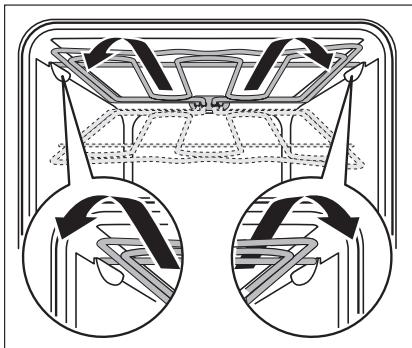

Install the heating element correctly on the two sides above the support on the inner wall of the oven.
- Insert shelf support rails.
Shelf Support Rails
Removing the shelf support rails
- Pull the front of the shelf support rail away from the side wall.
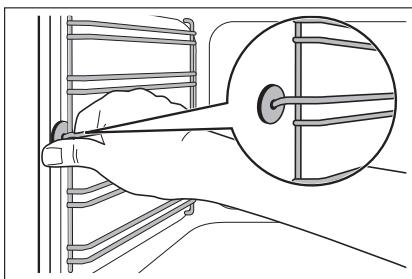
- Pull the rear shelf support rail away from the side wall and remove it.
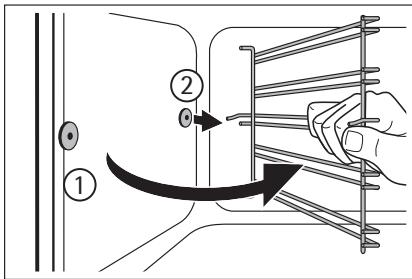
Installing the shelf support rails
Install the shelf support rails in opposite sequence.

Important! The rounded ends of the shelf support rails must point to the front!
Oven lamp

WARNING!
There is a danger of electrical shock!
Before you change the oven lamp:
- Switch off the oven.
- Remove the fuses in the fuse box or switch off the circuit breaker.

Put a cloth on the bottom of the oven for protection of the oven light and glass cover.
Replacing the oven light bulb/cleaning the glass cover
- Turn the glass cover anti-clockwise to remove it.
- Clean the glass cover.
- Replace the oven light bulb with applicable 300^ heat-resistant oven light bulb.
- Install the glass cover.
Oven door and glass panels
To clean the oven door remove it.

CAUTION!
Be careful when you remove the door from the appliance. The door is heavy!
Removing the oven door
- Open the oven door as far as it goes.
- Lift up clamping levers (A) on the two door hinges fully.
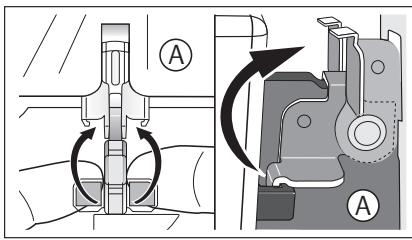
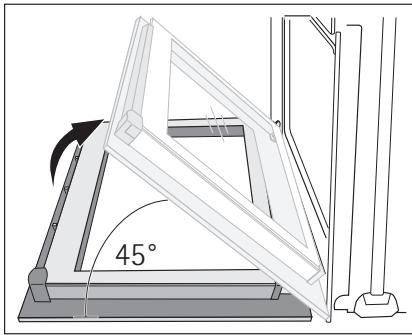
- Close the oven door until the first position (angle approximately 45^ ).
- Hold of the oven door with one hand on each side and pull it away from the oven at an upwards angle.
- Now you can remove the inner glass panels and clean them.
To install the door follow the procedure in reverse.
CAUTION!
Be careful with the glass, it can break.
The oven door has 2, 3 or 4 panels of glass (depends on the model)
Put the oven door with the outer side down on a soft and level surface to prevent scratches
Removing and cleaning the door glasses
- Hold the door trim (B) on the top edge of the door at the two sides and push in- wards to release the clip seal.
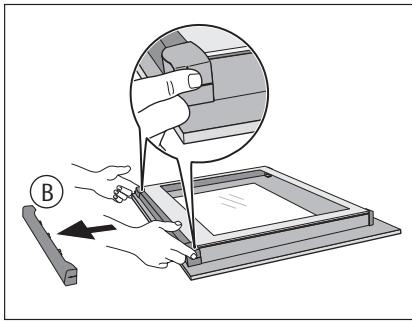
- Pull the door trim to the front to remove it.
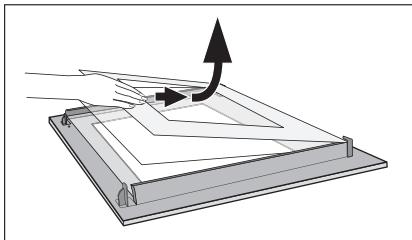
- Hold the door glass panels on their top edge one by one and pull them upwards out of the guide
- Clean the door glass panels.
To install panels follow the procedure in reverse. Insert the smaller panel first, then the larger.
What to do if...
| Problem | Possible cause | Remedy |
| The cooking zones do not operate | Consult the operating instructions for the built-in cooking surface | |
| The oven does not heat up | The oven is not switched on | Switch on the oven |
| The oven does not heat up | The necessary settings are not set | Control the settings |
| The oven does not heat up | The fuse in the fuse box is released | Control the fuse. If the fuse is released more than one time, refer to a qualified electrician. |
| The oven lamp does not operate | The oven lamp is defective | Replace the oven lamp |
If you can not find a solution to the problem, refer to your dealer or the Service Force Centre.

WARNING!
Let a qualified electrician or competent person do repairs to the appliance.

If you do not operate the appliance correctly, the visit from the Service Force Centre or dealer will not be free of charge, even during the warranty period.

Hints for appliances with metal fronts:
If you open the door during or immediately after the baking or roasting procedure, steam can show on the glass.
Disposal
The symbol on the product or on its packaging indicates that this product may not be treated as household waste. Instead it should be taken to the appropriate collection point for the recycling of electrical and electronic equipment. By ensuring this product is disposed of correctly, you will help prevent potential negative consequences for the environment and human health, which could otherwise be caused by inappropriate waste handling of this product. For more detailed information about recycling of this product, please contact your local council, your household waste disposal service or the shop where you purchased the product.

Packaging material
The packaging material is environmentally-friendly and recyclable. Plastic parts are marked with international abbreviations such as PE, PS, etc. Dispose of the packaging material in the containers provided for this purpose at your local waste management facility.

WARNING!
Your appliance should be made inoperable before it is disposed of, so that it does not constitute a danger.
To do this, take the mains plug from the socket and remove the mains cable from the appliance.
Service and spare parts
If there is a fault, first try to find a solution to the problem yourself. Refer to "What to do if..."
If you cannot find a solution to the problem yourself, contact your dealer or the Service Force Centre.
These data are necessary to help you quickly and correctly.
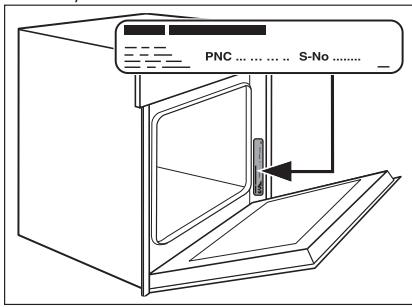
For these data, refer to the rating plate. Write them here:
- Model description
- Product number ("PNC")
- Serial number ("S No.")
- Type of fault
- Error messages
Use the original spare parts only. They are available at Service Center and authorized spare parts shops.