IXUS 980 IS - Fotoaparat CANON - Besplatni korisnički priručnik
Pronađite besplatno priručnik za uređaj IXUS 980 IS CANON u PDF formatu.


Pitanja korisnika o IXUS 980 IS CANON
0 pitanje o ovom uređaju. Odgovorite na one koje znate ili postavite svoje.
Postavi novo pitanje o ovom uređaju
Preuzmite upute za vaš Fotoaparat u PDF formatu besplatno! Pronađite svoj priručnik IXUS 980 IS - CANON i uzmite svoju elektroničku napravu natrag u ruke. Na ovoj stranici objavljeni su svi dokumenti potrebni za korištenje vaše naprave. IXUS 980 IS marke CANON.
KORISNIČKI PRIRUČNIK IXUS 980 IS CANON
DIGITAL IXUS 980 IS
Camera User Guide
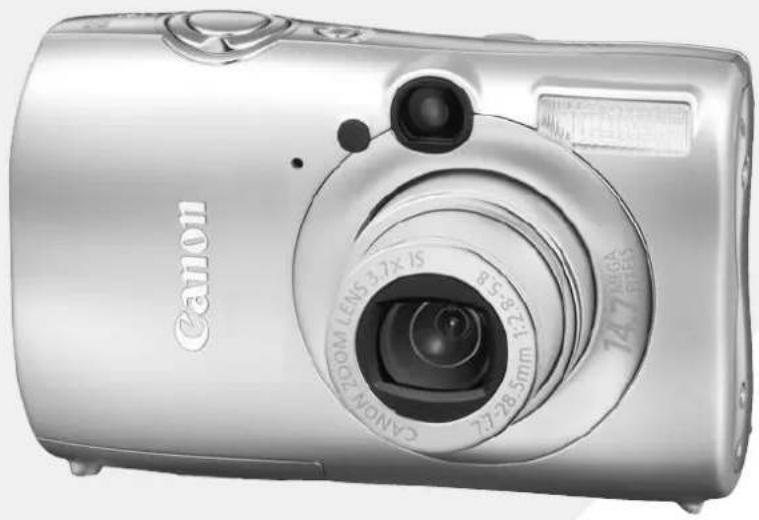
natural_image
Silver Canon digital camera with visible lens and aperture settings (no text or symbols on body)Checking the Package Contents
Check if the following items are included in your camera package. If anything is missing, contact the retailer where you purchased the camera.
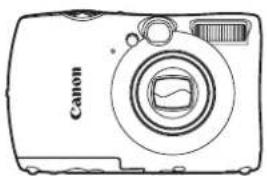
natural_image
Line drawing of a Canon digital camera with no text or symbols on the bodyCamera
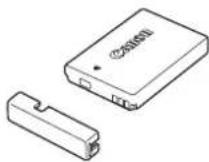
Battery Pack NB-5L (with Terminal Cover)
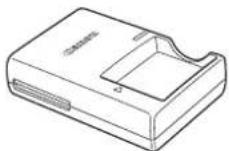
Battery Charger
CB-2LX/CB-2LXE
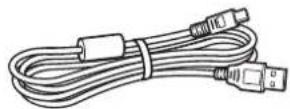
Interface Cable
IFC-400PCU
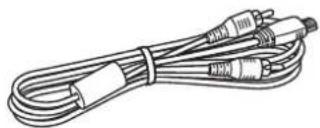
natural_image
Line drawing of a multi-up cable with connectors and connectors (no text or symbols)AV Cable AVC-DC400
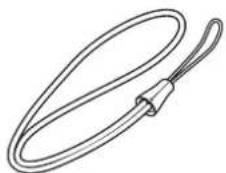
Wrist Strap
WS-DC7
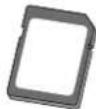
Memory Card (32 MB)
Canon Digital Camera
Solution Disk
Warranty System
Booklet

Getting Started Guide
Canon Digital Camera Manuals Disk

- You can use the included memory card to try out your new camera and take some test shots.
- Adobe Reader is required to view the PDF manuals. Microsoft Word Viewer 2003 can be installed to view Word manuals (Middle East only). If this software is not installed on your computer, access the following web site to download the software:
http://www.adobe.com (in the case of PDF)
http://www.microsoft.com/downloads/ (in the case of Word format)
Read This First
Test Shots
Take some initial test shots and play them back to make sure the images were recorded correctly. Please note that Canon Inc., its subsidiaries and affiliates, and its distributors are not liable for any consequential damages arising from any malfunction of a camera or accessory, including memory cards, that results in the failure of an image to be recorded or to be recorded in a way that is machine readable.
Warning Against Copyright Infringement
The images recorded with this camera are intended for personal use. Do not record images that infringe upon copyright laws without the prior permission of the copyright holder. Please be advised that in certain cases the copying of images from performances, exhibitions, or commercial properties by means of a camera or other device may contravene copyright or other legal rights even if the image was shot for personal use.
Warranty Limitations
For information on your camera's warranty, please refer to the Canon Warranty System Booklet supplied with your camera.
For Canon Customer Support contacts, please see the Warranty System Booklet.
LCD Monitor
The LCD monitor is produced with extremely high-precision manufacturing techniques. More than 99.99% of the pixels operate to specification, but occasionally non-performing pixels may appear as bright or dark dots. The camera is not damaged. This also has no effect on the recorded image.
Camera Body Temperature
Please take care when operating the camera for an extended period as the camera body may become warm. The camera is not damaged.
Memory Cards
This camera can use various types of memory cards. These are collectively referred to as memory cards in this guide.
What Do You Want to Do?
Shoot
● Shoot, leaving it to the camera to make settings ..... 21
Shoot various scenes 54 – 56
- Take good shots of people

Portraits (p. 54)
With nightscapes (p. 54)
Kids and pets (p. 54)

At the beach (p. 55)

With snowscapes (p. 55)
- Take good landscapes

Foliage (p. 55)
Sunsets (p. 55)
- Shoot various other scenes

Indoors (p. 55)

Fireworks (p. 56)

Aquarium (p. 56)

Under water (p. 56)

Low light (p. 56)
- Focus on faces 21, 62, 82, 86
- Shoot in places where I cannot use the flash (turn off the flash) 57
● Shoot pictures with me in them too (self-timer)....61, 62
Insert the date and time into my shots 60
Take close-up pictures of subjects (macro shooting) ..... 63
Take close up pictures of subjects using the zoom (digital macro shooting). 64
Take sepia toned or black and white pictures....73
- Change the size of picture I want to take (recording pixels)....68
Take pictures continuously 72
● Shoot without camera shake (image stabilization) ..... 145
● Shoot without camera shake even in low light conditions (High ISO speed) 56, 70
Take pictures using the viewfinder....76
Take pictures of moving subjects using the viewfinder. ..... 79
Continuously focus on subjects that move (Servo AF) ..... 84
- Adjust dark subjects and shoot (i-Contrast) ..... 91
View
Look at my pictures....24
● Automatically play back pictures (slideshow) ..... 107
Look at pictures on a TV 112
- Quickly search pictures.... 104, 105
Erase pictures 25, 113
- Protect pictures from accidental erasure.... 117
Shoot/View Movies
Shoot movies 28
View movies 30
- Easily print pictures....26
Save
Save images to a computer 31, 128
Other
Turn off sound....47
Use the camera abroad. 13, 139
Table of Contents
Chapters 1 – 3 explain the basic operations and frequently used functions of this camera. Chapters 4 and on explain the advanced functions, letting you learn further as you read each chapter.
Checking the Package Contents .....2
Read This First 3
What Do You Want to Do?......4
LCD Monitor Precautions......8
Safety Precautions....9
1 Getting Started .... 11
Charging the Battery....12
Inserting the Battery and Memory Card....14
Setting the Date and Time......17
Setting the Display Language......19
Pressing the Shutter Button....20
Taking Pictures 21
Viewing Images 24
Erasing Images 25
Printing Images....26
Shooting Movies 28
Viewing Movies....30
Downloading Images to a Computer....31
Accessories 36
Separately Sold Accessories ....38
2 Learning More......39
Components Guide......40
Information Displayed on the Screen 42
Indicators 44
FUNC. Menu – Basic Operations ....45
MENU MENU - Basic Operations ..46
Changing the Sound Settings ..... 47
Changing the Screen Brightness .... 48
Returning the Camera to Default Settings 49
Formatting Memory Cards .... 50
Power Saving Function
(Auto Power Down)....51
Changing the Image Display Time .. 52
Clock Functions....52
3 Shooting Special Scenes and Using Common Functions.... 53
SCN Shooting Various Scenes ..... 54
Turning the Flash Off....57
Zooming in More Closely on Subjects (Digital Zoom)....58
Inserting the Date and Time...... 60
Using the Self-Timer 61
Using the Face Self-Timer...... 62
Shooting Close-ups (Macro)...... 63
Zooming In on Close Subjects (Digital Macro)....64
4 Making Settings for the Images You Want...... 65
P Shooting in Program AE ...... 66
Turning the Flash On....67
▲ Shooting Far Away Subjects (Infinity) 67
Changing the Recording Pixels (Image Size)....68
Changing the Image Quality (Compression Ratio).... 68
ISO Changing the ISO Speed...... 70
Adjusting the Tone (White Balance) 71
Adjusting the Brightness (Exposure Compensation)....72
Continuous Shooting 72
Changing the Tone of an Image (My Colors) 73
Shooting Using the Two Second Self-Timer 74
Customizing the Self-Timer ..... 75
Shooting Using the Viewfinder ..... 76
Shooting Using a TV 76
Shoot While Checking the Histogram....77
Changing the Composition to Shoot (Focus Lock)....78
Shooting with 📄 (Quick Shot)..... 79
5 Using Advanced Shooting Functions .... 81
Changing the AF Frame Mode...... 82
Shooting With Magnified Focus Display 83
AFL Shooting with AF Lock 84
Shooting with Servo AF 84
MF Manual Focus.... 85
Selecting the Person to Focus On (Face Select).... 86
Changing the Metering Mode...... 87
AEL Shooting with AE Lock.... 87
FEL Shooting with FE Lock 88
Flash Exposure Compensation .. 88
M Setting the Shutter Speed and Aperture Value.... 89
Setting the Flash Output....90
C1 Adjusting Dark Subjects and Shooting (i-Contrast) 91
◎ Red-Eye Correction 92
Changing the Color and Shooting ... 93
☐ Shooting Stitch Assist Images....96
6 Using Various Functions for Shooting Movies....97
Changing the Movie Mode ..... 98
Changing the Image Quality......98
AE Lock/Exposure Shift......99
Other Shooting Functions.... 100
Playback Functions 100
% Editing 101
7 Using Various Playback and Other Functions .... 103
Search Images by Sets of 9 (Index Display)....104
Searching for Images Using the Jump Display....105
Viewing Slideshows ...... 107
Checking the Focus or People's Expressions (Focus Check) ..... 110
Q Magnifying Images ..... 111
Changing Image Transitions..... 111
Viewing Images on a TV 112
Erasing All Images....113
Protecting Images....117
Organizing Images by Category (My Category).... 119
Rotating Images....120
Resizing Images 121
Trimming 122
Table of Contents
Adding Effects With the My Colors Function....123
C1 Adjusting Dark Subjects (i-Contrast)....124
Correcting Red-Eye Effect......125
Attaching Sound Memos....127 Transferring Images to a
Computer....128
Designating Images for Transfer (DPOF) 129
Print List (DPOF) 131
Designating Images for Printing (DPOF) 132
Sound-Only Recording (Sound Recorder)....135
8 Customizing the Camera ..137
Changing Functions....138
Changing Shooting Functions ..... 142 Changing Playback Functions..... 146
Changing the Start-up Image or Sound (My Camera Settings)...... 147
9 Useful Information for Using the Camera 149
Using Household Power.... 150
Using a Supplementary Flash ..... 150
You Think There is a Problem...... 151
List of Messages That Appear on the Screen.... 154
Functions Available in Each Shooting Mode .... 156
Menus 158
Handling Precautions 162
Specifications 163
Index 166
LCD Monitor Precautions
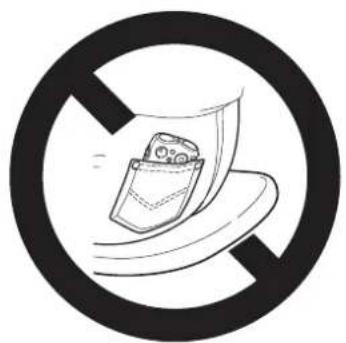
- Do not sit in a chair with the camera in your pocket.
Doing so may cause malfunction or damage the LCD monitor. - When putting the camera in your bag, ensure that hard objects do not come into contact with the LCD monitor.
If this occurs, it may cause malfunction or damage the LCD monitor. - Do not attach accessories to the strap.
Doing so may cause malfunction or damage the LCD monitor.
natural_image
Black and white pictogram showing a bandaged object inside a circle with a diagonal line (no text or symbols)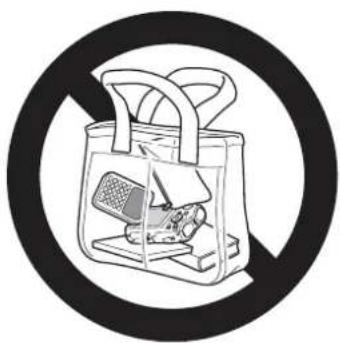
natural_image
Illustration of a shopping bag with cut-out items inside, enclosed in a black circle (no text or symbols)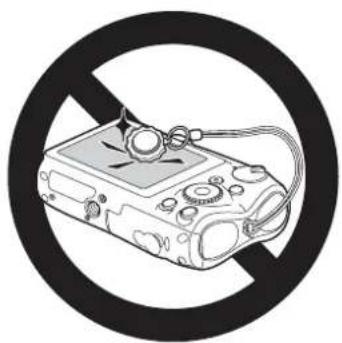
natural_image
Black and white prohibition symbol with a stylized device inside a circle (no text or symbols)Safety Precautions
- Before using the camera, please ensure that you read the safety precautions described below and in the "Safety Precautions" section. Always ensure that the camera is operated correctly.
- The safety precautions noted on the following pages are intended to prevent injuries to yourself and other persons, or damage to the equipment.
- Be sure to also check the guides included with any separately sold accessories you use.

Warnings Denotes the possibility of serious injury or death.

Cautions Denotes the possibility of injury or damage to the equipment.
Warnings
Camera
- Do not look through the camera viewfinder at bright light sources (the sun, etc.).
This may damage eyesight. - Store this equipment out of the reach of children and infants.
Strap: Putting the strap around a child's neck could result in asphyxiation.
Memory card, day/date battery: Dangerous if accidentally swallowed. If this occurs, contact a doctor immediately. - Do not trigger the flash in close proximity to human eyes.
Exposure to the intense light produced by the flash may damage eyesight. In particular, remain at least one meter (39 inches) away from infants when using the flash. - Do not attempt to disassemble or alter any part of the equipment that is not expressly described in this guide.
- To avoid the risk of injury, do not touch the interior of the camera if it has been dropped or otherwise damaged.
- Stop operating the camera immediately if it emits smoke, a strange smell, or otherwise behaves abnormally.
- Do not allow liquids or foreign objects to enter the camera.
This could result in fire or electrical shock.
If liquid or foreign objects come into contact with the camera interior, immediately turn the camera power off and remove the battery. - Do not use organic solvents such as alcohol, benzine, or thinner to clean the equipment.
• Use only recommended power sources.
Battery, Battery Charger
• Use only recommended batteries.
- Do not place the battery near or in direct flame.
- Do not let the battery come into contact with water (e.g. sea water) or other liquids.
- Do not attempt to disassemble, alter or apply heat to the battery.
- Avoid dropping or subjecting the battery to severe impacts.
This may cause explosions or leaks, resulting in fire, injury and damage to the surroundings. In the event that a battery leaks and the eyes, mouth, skin or clothing contacts these substances, immediately flush with water and seek medical assistance. If the battery charger becomes wet, unplug it from the outlet and consult your camera distributor or the closest Canon Customer Support Help Desk.
- Unplug the battery charger from the power outlet after recharging is complete, or when you are not using it.
- Do not place anything, such as cloth on top of the battery charger while it is charging.
Leaving the unit plugged in for a long period of time may cause it to overheat and distort, resulting in fire.
• Use only the specified battery charger to charge the battery.
- Do not cut, damage, alter or place heavy items on the power cord.
- Unplug the power cord periodically and wipe away any dust and dirt that has collected on the plug, the exterior of the power outlet, and the surrounding area.
- Do not handle the power cord with wet hands.
This could result in fire or electrical shock.
• Before you discard batteries, cover the terminals with tape or other insulators.
Contacting other metal materials in waste containers may lead to fire or explosions.

Cautions
- Do not aim the camera at bright light sources (the sun, etc.).
Doing so may cause malfunction or damage the image sensor (CCD).
- Be careful not to bang the camera or subject it to strong impacts or shocks when hanging it by the strap.
- Be careful not to bump or push strongly on the lens.
This could lead to injury or damage the camera.
- When using the camera on a beach or at a windy location, be careful not to allow dust or sand to enter the camera.
This may cause the camera to malfunction.
- Do not use the equipment in a manner that exceeds the rated capacity of the electrical outlet or wiring accessories. Do not use if the power cord or plug are damaged, or if not fully plugged into the outlet.
-
Avoid using, placing or storing the camera in the following places.
-
Places subject to strong sunlight.
- Places subject to temperatures above 40° C (104° F).
- Humid or dusty areas.
These could cause leakage, overheating or explosion, resulting in fire, burns or other injuries. High temperatures may also cause deformation of the casing.
- Do not allow dirt or metal objects (such as pins or keys) to contact the charger terminals or plug.
This could result in fire, electrical shock or other damage.
- Do not use the flash with dirt, dust or other items stuck to the surface, or when covering the flash with your fingers or clothing.
This may cause the camera to malfunction.
Getting Started
This chapter explains preparations before shooting, how to shoot in AUTO mode, and then how to view, erase and print the images you take. The latter part of this chapter explains how to shoot and view movies, and how to download images to a computer.
Attaching the Strap/Holding the Camera
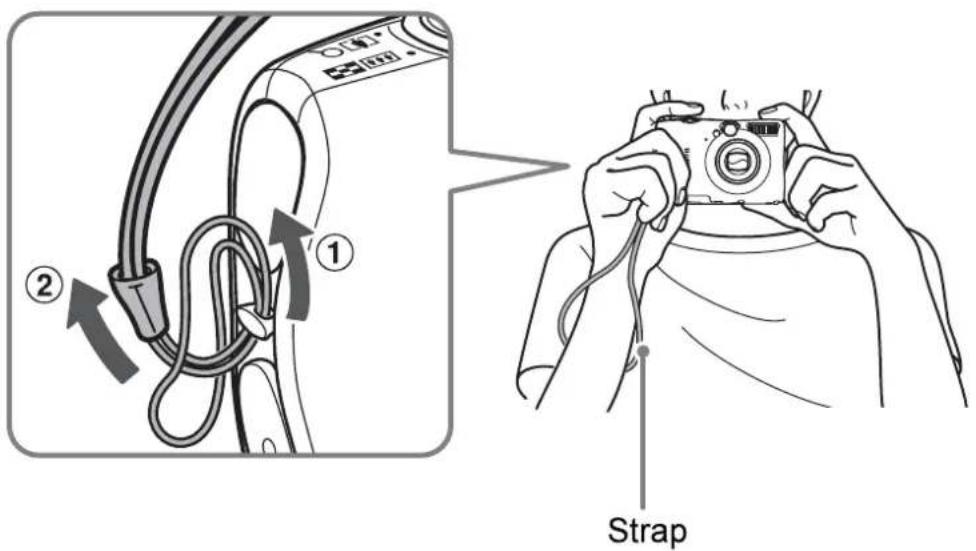
- Attach the included strap and place it around your wrist to avoid dropping the camera during use.
- Keep your arms tight against your body while holding the camera firmly by the sides. Be sure that your fingers do not block the flash.
Charging the Battery
Use the included charger to charge the battery.
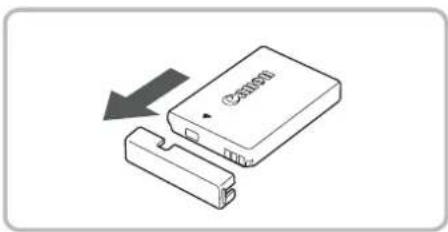
natural_image
Diagram showing a device with an arrow pointing to its internal components (no text or symbols present)1 Remove the cover.
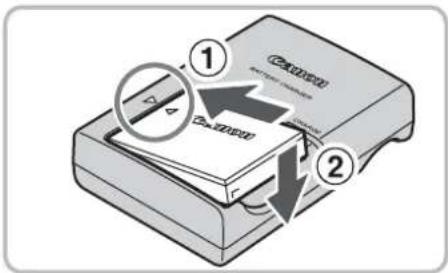
2 Insert the battery.
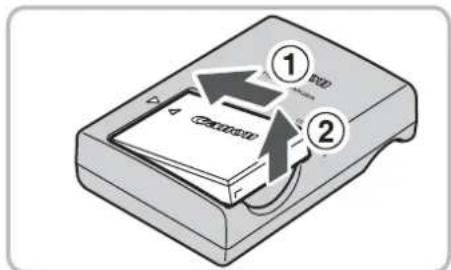
- Align the ▲ marks on the battery and charger, then insert the battery by sliding it in ① and down ②.
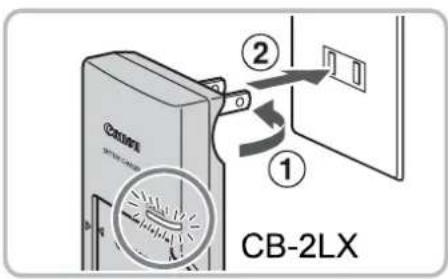
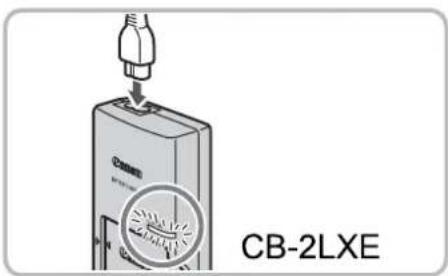
3 Charge the battery.
- Flip out the plug ① and plug it into a power outlet ② (for CB-2LX).
- Plug the power cord into the charger, then plug the other end into a power outlet (for CB-2LXE).
The charge lamp lights red, and charging starts.
The charge lamp will light green when charging has finished. Charging takes approx. 2 hours and 5 minutes.
4 Remove the battery.
● Unplug the battery charger from the power outlet, then remove the battery by sliding it in ① and up ②.

To protect the battery and prolong its life, do not charge it for longer than 24 hours continuously.
Approximate Number of Shots That Can Be Taken
| Number of shots | LCD monitor on.* | 280 |
| LCD monitor off. | 700 | |
| Playback Time (Hours) | 6 | |
* The number of shots that can be taken is based on the Camera & Imaging Products Association (CIPA) measurement standard.
- Depending on the shooting conditions, the number of shots that can be taken may be less.
Battery Charge Indicator
An icon or message will appear on the screen (p. 42) indicating the battery's charge state.
| Display | Summary |
| Good. | |
| Slightly depleted, but sufficient. | |
| Nearly depleted. | |
| “Change the battery pack.” | Depleted. Recharge the battery. |

Using the battery and charger effectively
- Charge the battery on the day, or the day before, it will be used. Charged batteries continue to discharge naturally even if they are not used.
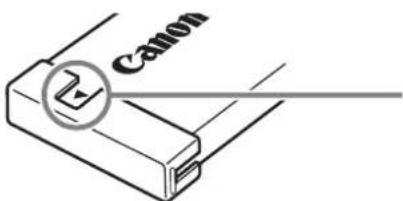
Attach the cover to a charged battery so that the ▲ mark is visible.
- How to store the battery for long periods. Deplete and remove the battery from the camera. Attach the terminal cover and store the battery. Storing a battery without depleting it for long periods of time (about one year) may shorten its life span or affect its performance.
- The battery charger can also be used when abroad. The charger can be used in regions that have 100 – 240 V (50/60 Hz) AC power. If the plug does not fit the outlet, use a commercially available plug adapter. Do not use devices such as electrical transformers for foreign travel because they will cause malfunctions.
- If the battery is quickly depleted even after charging, it has reached the end of its life span. Purchase a new battery.
Inserting the Battery and Memory Card
Insert the included battery and memory card into the camera.
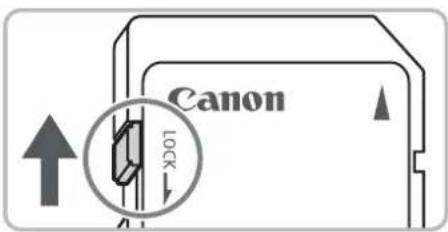
1 Check the card's write-protect tab.
- If the memory card has a write-protect tab, you will not be able to take images if the tab is in the locked position. Slide the tab up until you hear a click.
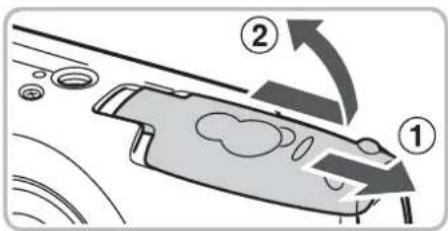
2 Open the cover.
- Slide the cover ①, and open it ②.
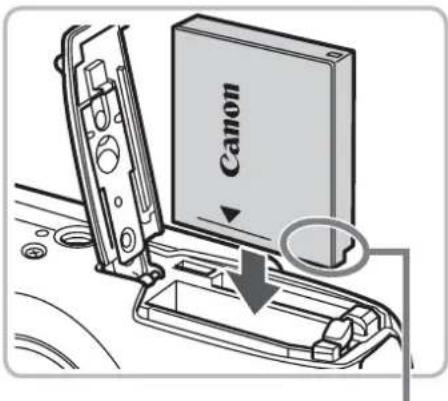
Terminals
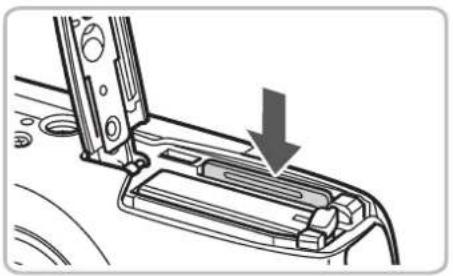
3 Insert the battery.
- Insert the battery as shown until it locks into place with a click. - Be sure to insert the battery in the correct direction or it will not properly lock into place.
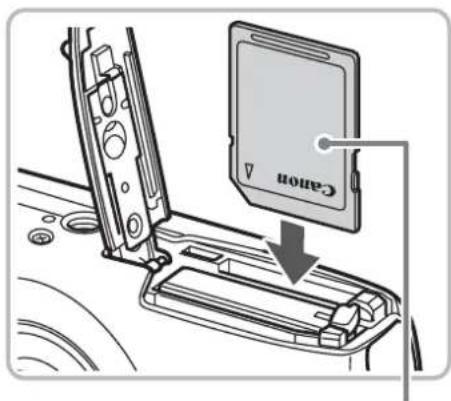
Label
4 Insert the memory card.
- Insert the memory card as shown until it locks into place with a click. - Inserting the card in the wrong direction could damage the camera. Be sure the card is oriented correctly.
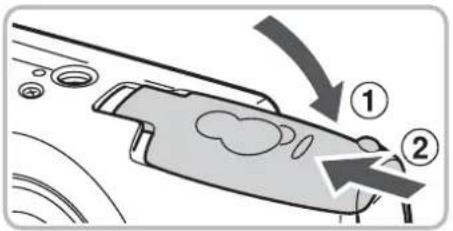
5 Close the cover.
- Close the cover ①, and slide it ② until it locks into place with a click.
Removing the Battery and Memory Card
natural_image
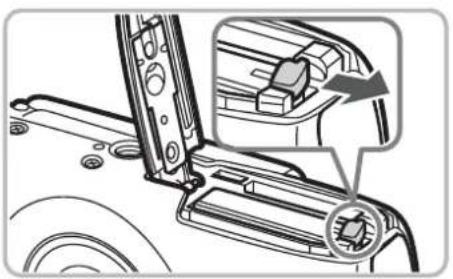
Mechanical assembly diagram showing a bracket with mounting holes and a close-up inset of a component (no text or symbols visible)1 Remove the battery.
- Open the cover and press the battery lock in the direction of the arrow. ▶ The battery will pop up.
natural_image
Mechanical component diagram showing a bracket with an arrow indicating direction (no text or symbols)2 Remove the memory card.
- Push the memory card in until you hear a click, then slowly release it. - The memory card will pop up.
Approximate Number of Shots per Memory Card
| Memory Card | 32 MB (Supplied) | 2 GB | 8 GB |
| Number of shots | 7 | 516 | 2063 |
- Values are based on a camera at default settings.
- The number of shots that can be taken will vary depending on camera settings, the subject and the memory card used.

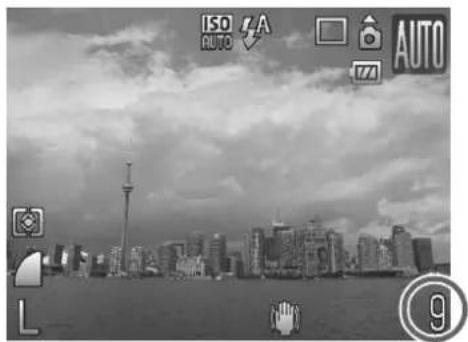
Can you check the number of shots that can be taken?
You can check the number of shots that can be taken when the camera is in a Shooting Mode (p. 21).
natural_image
Black-and-white cityscape photo with a prominent tower and skyline, no visible text or symbols on the main scene.Number of shots that can be taken
Compatible Memory Cards
- SD memory cards
SDHC memory cards
• MultiMediaCards
• MMCplus memory cards
• HC MMCplus memory cards

What is the write-protect tab?
SD and SDHC memory cards have a write-protect tab. If this tab is in the locked position, [Card Locked!] will appear on the screen and you will not be able to take or erase images.
Setting the Date and Time
The Date/Time settings menu will appear the first time the camera is turned on. Since the date and time recorded into your images are based on these settings, be sure to make them.
natural_image
Diagram showing a downward arrow pointing to a circular object with 'NO' label, surrounded by concentric circles (no text or symbols beyond basic labels)1 Turn on the camera.
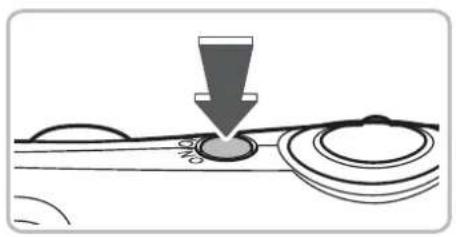
- Press the power button.
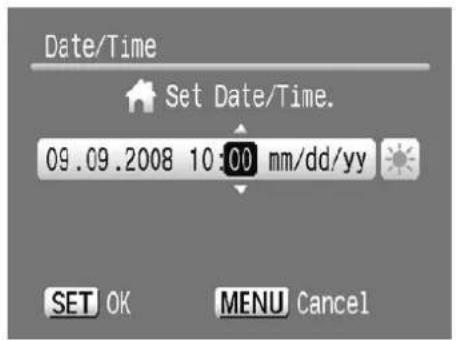
The Date/Time settings menu will appear.
2 Set the date and time.
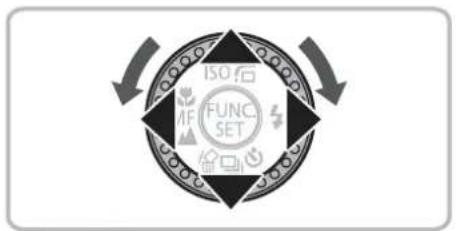
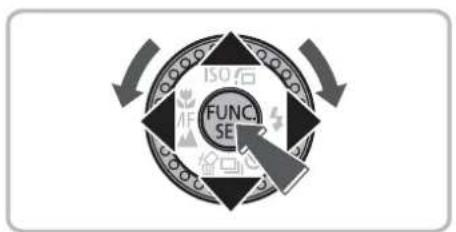
- Press the ◀▶ buttons to select an option.
- Press the ▲▼ buttons or turn the Ⓞ dial to set a value.
flowchart
graph TD
    A["ISO/FUNC/SET Symbol"] --> B["Downward Arrow"]
    B --> C["Upward Arrow"]
    C --> D["Downward Arrow"]
3 Make the setting.
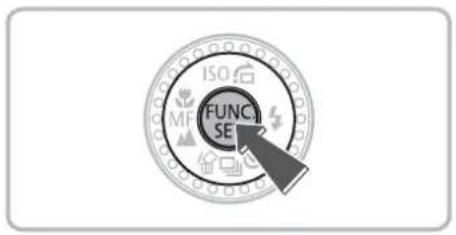
- Press the Ⓗ function. SET button.
Once the date and time have been set, the Date/Time settings menu will close. - Pressing the power button will turn off the camera.

Reappearing Date/Time settings menu
Set the correct date and time. If you have not set the date and time, the Date/Time settings menu will appear each time you turn on the camera.

Daylight saving time settings
In Step 2, if you select ⚙️ and press the ▲▼ buttons, or turn the Ⓞ dial, and set ⚙️, daylight saving time (plus 1 hour) will be set.
Changing the Date and Time
You can change the current date and time settings.
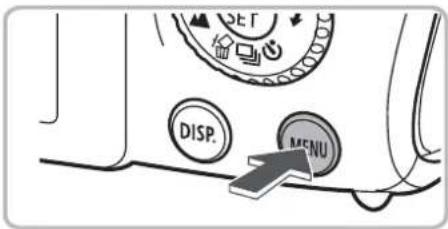
Display the menus.
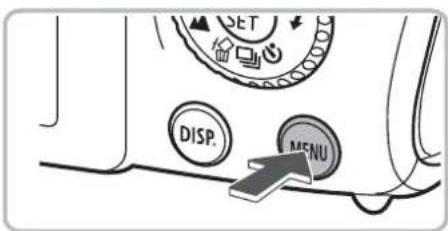
- Press the MENU button.
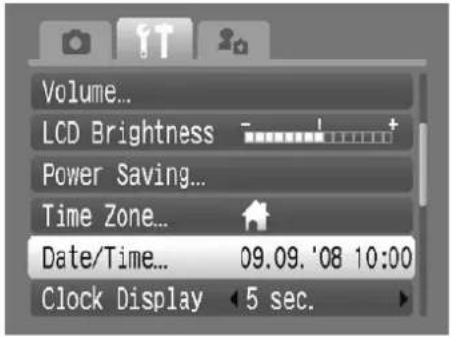
Select [Date/Time] in the ƒ tab.
- Press the ◀▶ buttons to select the 🎨 tab.
- Press the ▲▼ buttons or turn the Ⓞ dial to select [Date/Time], then press the Ⓗ function SET button.
![CANON IXUS 980 IS - Select [Date/Time] in the ƒ tab. - 1](/content/2026/05/1103579/images/0e13d694860d9bda0d59cd573577741a07f8270f0453427a2f9c1713bf218af2.jpg)
flowchart
graph TD
    A["FUNC SE"] --> B["ISO"]
    B --> C["ME"]
    C --> D["SEM"]
    D --> E["SEM"]
    E --> F["SEM"]
    F --> G["SEM"]
    G --> H["SEM"]
    H --> I["SEM"]
    I --> J["SEM"]
    J --> K["SEM"]
    K --> L["SEM"]
    L --> M["SEM"]
    M --> N["SEM"]
    N --> O["SEM"]
    O --> P["SEM"]
    P --> Q["SEM"]
    Q --> R["SEM"]
    R --> S["SEM"]
    S --> T["SEM"]
    T --> U["SEM"]
    U --> V["SEM"]
    V --> W["SEM"]
    W --> X["SEM"]
    X --> Y["SEM"]
    Y --> Z["SEM"]
Change the date and time.
- Follow Steps 2 and 3 on p. 17 to make the setting.
- Pressing the MENU button will close the menu.

Date/Time battery
- The camera has a built-in date/time battery (backup battery) that allows the date/time settings to be retained about three weeks after the battery pack has been removed.
- By inserting a charged battery or connecting an AC adapter kit (sold separately) (p. 38), the date/time battery can be charged in about 4 hours even if the camera is not turned on.
- If the date/time battery is depleted, the Date/Time menu will appear when you turn the camera on. Follow the steps on p. 17 to set the date and time.
Setting the Display Language
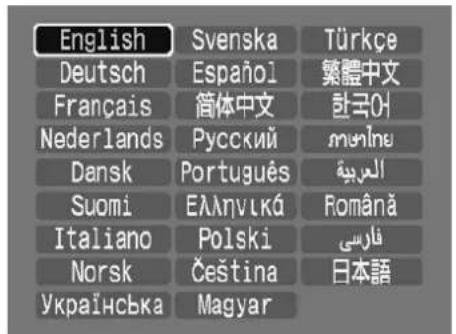
You can change the language displayed in the LCD monitor menus and messages.
flowchart
graph TD
    A["ISQ"] --> B["AF"]
    B --> C["FUNC SE"]
    C --> D["Output"]
    style A fill:#f9f,stroke:#333
    style B fill:#ccf,stroke:#333
    style C fill:#cfc,stroke:#333
    style D fill:#fcc,stroke:#333
1 Display the language setting menu.
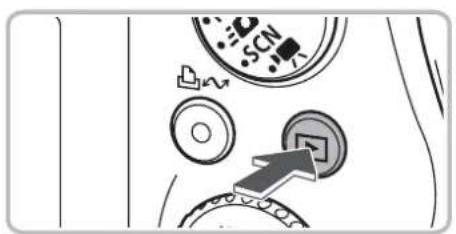
- Press the ▶ button.
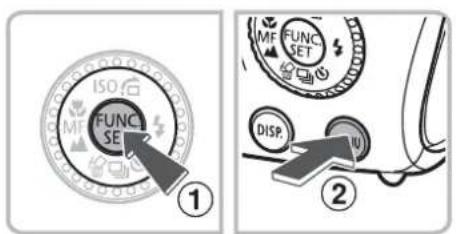
- Press and hold the Ⓗ function SET button ①, then immediately press the MENU button ②.
2 Set the display language.
- Press the ▲▼◀▶ buttons or turn the dial to select a language, then press the Ⓗ️ button.

The displayed language will change.

What if the clock appears when the FUNC SET button is pressed?
The clock (p. 52) will display if the time from when you press the Ⓗ button to when you press the MENU button in Step 1 is too long. If the clock appears, press the Ⓗ button to remove the clock and perform Step 1 again.

You can also change the display language by pressing the MENU button, selecting the ƒ tab, then selecting the [Language] menu item.
Pressing the Shutter Button
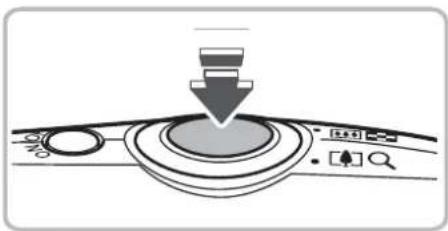
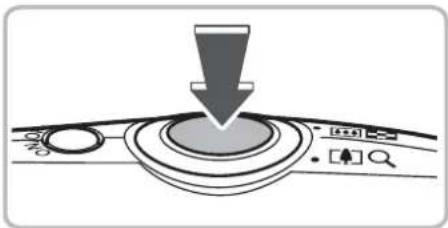
The shutter button has two stops. To take images that are in focus, be sure to first press the shutter button lightly (halfway) to focus, then take the shot.
natural_image
Diagram of a camera control panel with a downward arrow and control buttons (no text or symbols)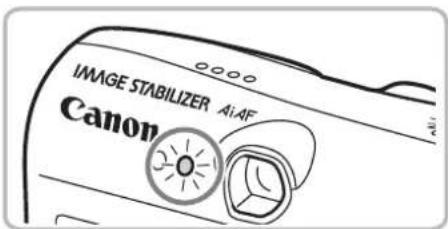
natural_image
Diagram of a control panel with a downward arrow and circular dial indicator (no text or symbols)1 Press halfway (lightly to the first stop).
The camera focuses and automatically makes necessary settings for shooting, such as adjusting brightness and color. When the camera focuses, it will beep twice and the indicator will light green.
2 Press fully (to the second stop).
The camera plays the shutter sound and takes the shot.
Since the shot is being taken while the shutter sound plays, be careful not to move the camera.

Does the length of the shutter sound change?
- Since the time required to shoot differs depending on the scene you want to shoot, the length of the shutter sound may change.
- If the camera or subject move while the shutter sound is playing, the recorded image may be blurry.

If you just press the shutter button fully without pausing halfway, the images you take may not be in focus.
Taking Pictures
The camera can automatically make all settings so that you can take images just by pressing the shutter button.
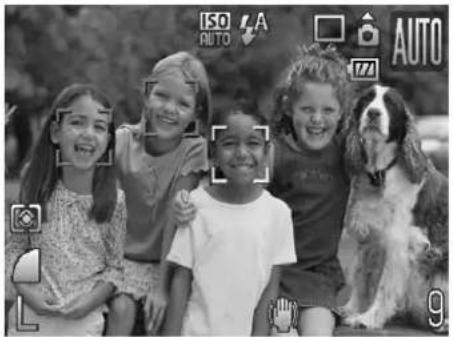
Also, when taking pictures of people, the face will be automatically detected and focused (p. 82), and the color and the brightness will adjust to the optimum levels.
natural_image
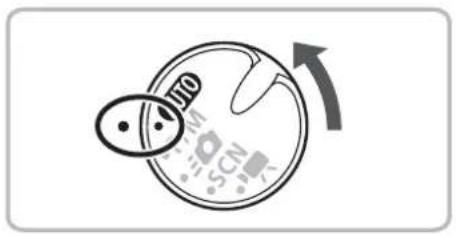
Simple line drawing of a turtle inside a circular frame with an arrow indicating rotation (no text or symbols)1 Set the AUTO mode.
Set the mode dial to AUTO.
natural_image
Black-and-white photo of four smiling children and a dog, with camera mode icons overlaid (no readable text or symbols)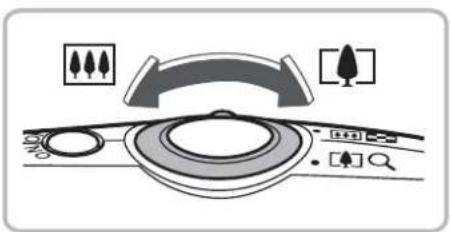
natural_image
Diagram of a car dashboard with steering wheel, gear shift, and tree symbols (no text or labels)2 Compose the shot of your subject.
- Moving the zoom lever towards 🏠 will zoom in on your subject making it appear larger. Moving the lever towards 🏠 will zoom out from your subject making it appear smaller.
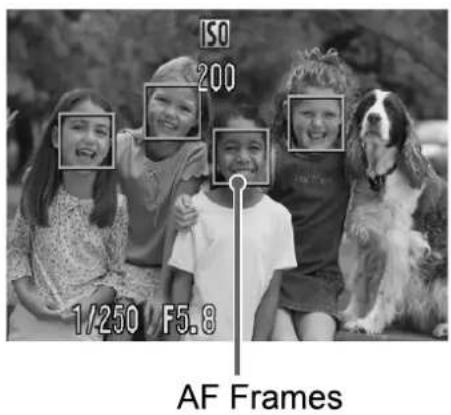
When faces are detected, a white frame appears on the face the camera judges to be the main subject, while gray frames appear on other detected faces.
Taking Pictures
natural_image
Diagram of a camera control panel with a downward arrow and adjustment knobs (no text or symbols)3 Focus.
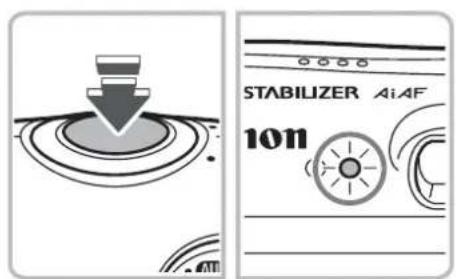
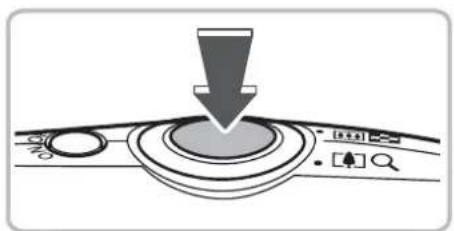
- Press the shutter button halfway to focus.
When the camera focuses, it will beep twice and the indicator will light green (orange when the flash will fire).
A green frame will appear where the camera focused.
Several AF frames will appear when the camera focuses on more than one point.
4 Shoot.
- Press the shutter button fully. The camera will play the shutter sound and shoot.
The flash will automatically fire in low light conditions.
The indicator will blink green while the image is recorded to the memory card.
The image will appear on the screen for about two seconds.
Even when an image is displayed, you can take a second picture by pressing the shutter button.

What if...
• Nothing displays when the camera is turned on?
Press the DISP. button to turn on the LCD monitor.
• The camera does not play any sounds?
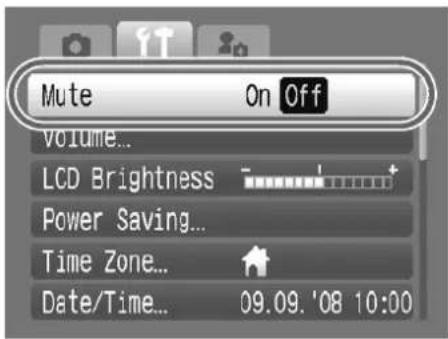
Pressing the DISP. button while turning on the camera power will turn off all sounds except for warning sounds. To turn on sound, press the MENU button, select the ƒ tab, and then select the [Mute]. Use the ◀▶ buttons to select [Off].
• The image comes out dark even if the flash fired when shooting?
Subject is too far away for the flash to reach. Shoot within the effective flash range of approximately 50 cm – 4.6 m (1.6 – 15 ft.) at maximum wide angle, and approximately 50 cm – 2.4 m (1.6 – 7.9 ft.) at maximum telephoto.
- The indicator blinks yellow, and the camera beeps once when the shutter button is pressed halfway?
The subject is too close. Back up approximately 50 cm, press the shutter button halfway, and shoot when the indicator is not blinking yellow.
• The lamp lights when the shutter button is pressed halfway.
To reduce red-eye and to assist in focusing, the lamp may light when shooting in dark areas (pp. 142 – 143).
- appears on the screen and the shot cannot be taken even though the shutter button was pressed fully.
The flash is charging. Keep the shutter button pressed fully, after a while the indicator will light orange and the camera will take the shot.
Viewing Images
You can view the images you have taken on the screen.
1 Set the playback mode.
- Press the ▶ button.
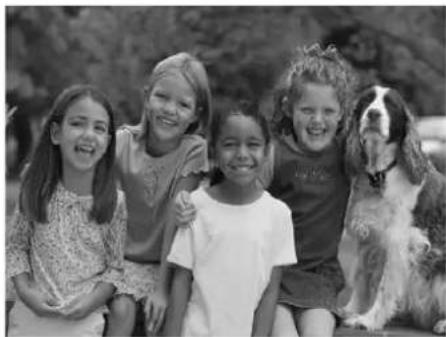
The last image you took will appear.
natural_image
Black-and-white photo of four smiling children and a dog outdoors (no text or symbols visible)2 Select an image.
- Pressing the ◀ button will cycle through the images in the reverse order they were taken.
- Pressing the ▶ button will cycle through the images in the order they were taken.
The images change more quickly if you keep the ◀▶ buttons pressed, but they will appear coarse.
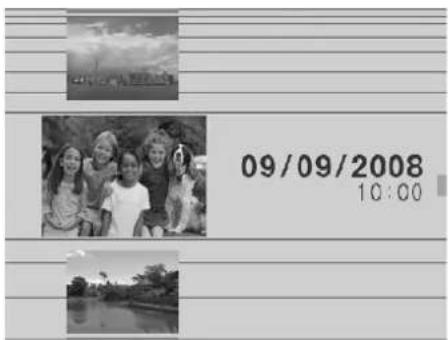
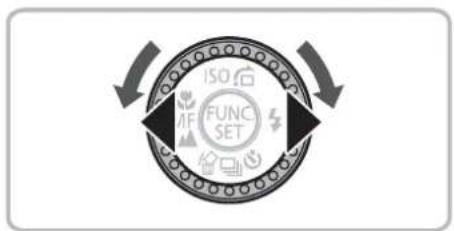
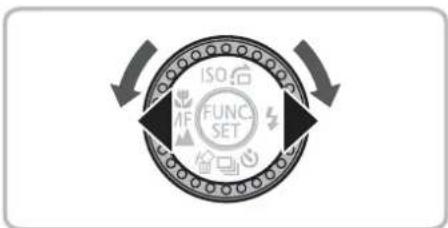
The screen on the left will appear when you turn the Ⓞ dial. Turning it counter-clockwise displays images in the reverse order they were taken, while turning it clockwise displays images in the order they were taken.
The central image will be displayed full-size when you stop turning the ☐ dial. - Pressing the ▶ button while the lens is extended will return you to the shooting screen.
- When approximately 1 minute elapses, the lens will retract. If you press the ▶ button with the lens retracted, the power will turn off.
flowchart
graph TD
    A["ISO"] --> B["FUNC SET"]
    B --> C["Output"]
    style A fill:#f9f,stroke:#333
    style B fill:#ccf,stroke:#333
    style C fill:#cfc,stroke:#333

Switching to and from playback mode
Pressing the ▶ button while the camera is off, turns the camera on in playback mode. Pressing it again turns the camera off. Pressing the shutter button halfway while in playback mode will bring you to the shooting screen.
Erasing Images
You can select and erase images one at a time. Please note that erased images cannot be recovered. Exercise adequate caution before erasing an image.
1 Set the playback mode.
- Press the ▶ button.
natural_image
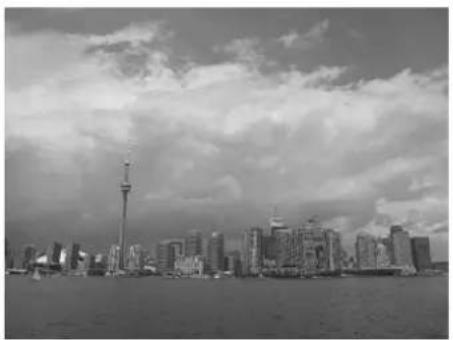
Black-and-white cityscape featuring a prominent tower and modern skyscrapers along the waterfront under a cloudy sky (no visible text or signage)2 Select an image to erase.
- Press the ◀▶ buttons or turn the Ⓞ dial to display an image to erase.
flowchart
graph TD
    A["ISO"] --> B["FUNC SET"]
    B --> C["Output"]
    style A fill:#f9f,stroke:#333
    style B fill:#ccf,stroke:#333
    style C fill:#cfc,stroke:#333
3 Erase the image.
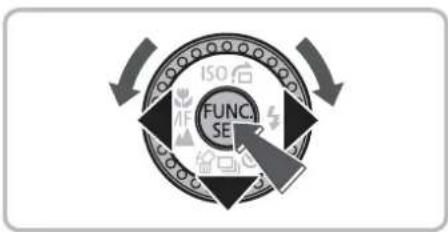
- Press the ▼ button.
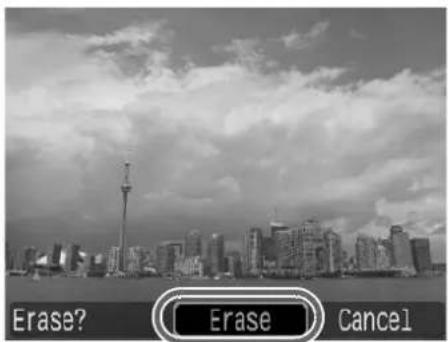
[Erase] appears. - Press the ◀▶ buttons or turn the Ⓞ dial to select [Erase], then press the FUNC.SET button.
The displayed image will be erased.
To exit instead of erasing, press the buttons or turn the ⏻ dial to select [Cancel], then press the FUNC.SET button.
flowchart
graph TD
    A["Start"] --> B{Decision}
    B --> C["Process Step"]
    C --> D["Function SE"]
    D --> E["End"]
Printing Images
You can easily print the images you have taken if you connect the camera to a PictBridge compliant printer (sold separately).
Items to Prepare
• Camera and PictBridge compliant printer (sold separately)
• Interface cable supplied with the camera (p. 2)
natural_image
Illustration of a USB connector with an icon and arrow pointing to a device (no text or symbols)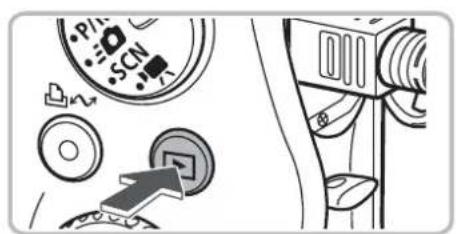
natural_image
Black-and-white photo of four smiling children sitting together with a dog, no visible text or symbolsTurn off the camera and printer.
2 Connect the camera to the printer.
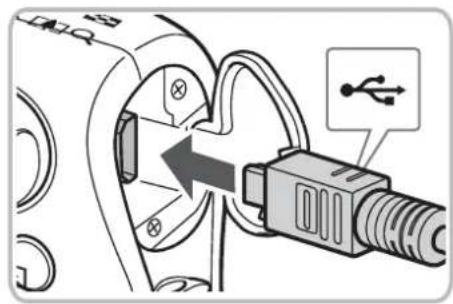
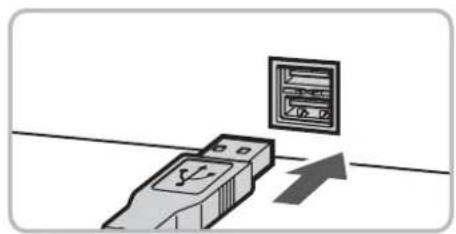
- Open the cover, and insert the small end of the plug firmly into the camera terminal in the direction shown.
Insert the cable's larger plug into the printer. For connection details, refer to the user guide provided with the printer.
3 Turn on the printer.
4 Press the ▶ button and turn on the camera.
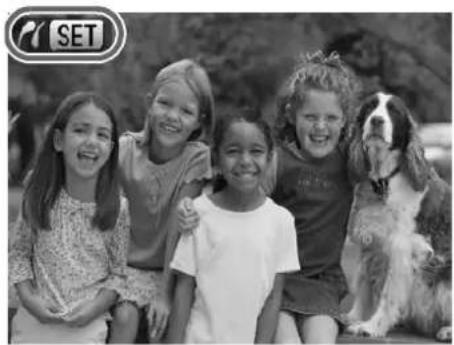
SET will appear on the screen, and the
button will light blue.
flowchart
graph TD
    A["FUNC SET"] --> B["ISO"]
    B --> C["Feedback Loop"]
    C --> A
5 Select an image to print.
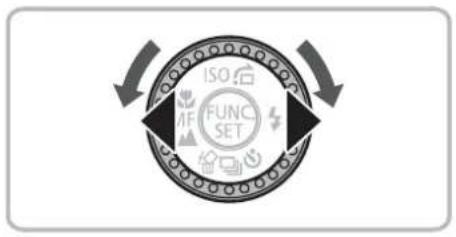
- Press the ◀▶ buttons or turn the Ⓞ dial to select an image.
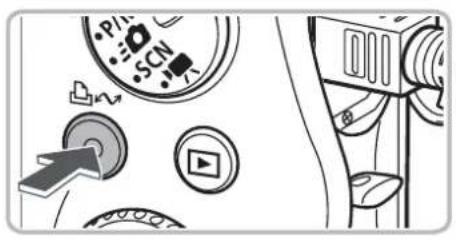
6 Print images.
- Press the ↻ button.
▶ Printing will start and the 📁 button will blink blue. - If you want to print additional images, repeat Steps 5 and 6 after printing has completed.
After printing has completed, turn off the camera and printer, and unplug the interface cable.

Refer to the Direct Print User Guide for details on printing, including printing with direct print compatible printers.
Canon-Brand PictBridge Compliant Printers (Sold Separately)
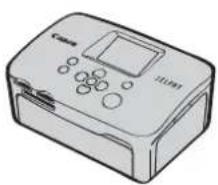
By connecting your camera to one of the Canon-brand PictBridge compliant printers below, you can print your images without having to use a computer.
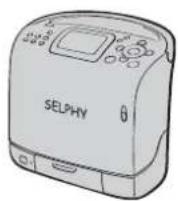
Compact Photo Printers (SELPHY Series)
natural_image
Line drawing of a portable electronic device with control panel and display (no text or symbols)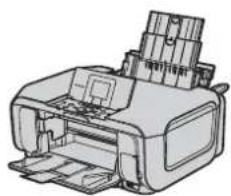
natural_image
Line drawing of a printer with paper feed and paper holder (no text or symbols)Inkjet Printers
For more information, visit your nearest Canon retailer.
Shooting Movies
The camera can automatically make all settings so that you can shoot movies just by pressing the shutter button.
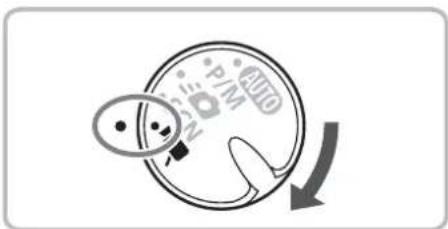
1 Set the mode.
Set the mode dial to ▶.
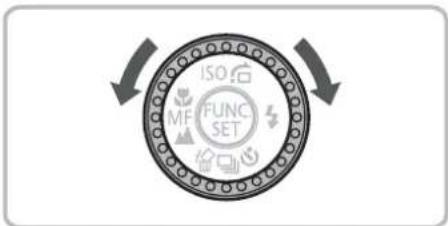
2 Set the mode.
Turn the Ⓞ dial to set the mode to 📋.
flowchart
graph TD
    A["ISO"] --> B["MF"]
    B --> C["FUNC SET"]
    C --> D["Output"]
    style A fill:#f9f,stroke:#333
    style B fill:#ccf,stroke:#333
    style C fill:#cfc,stroke:#333
    style D fill:#fcc,stroke:#333
natural_image
Diagram of a car dashboard with steering wheel, dashboard display, and tree icons (no text or labels)3 Compose the shot of your subject.
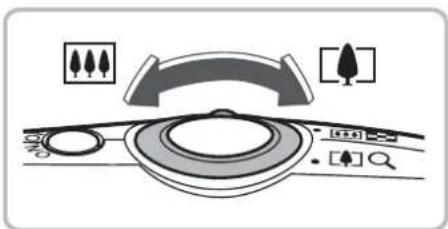
- Moving the zoom lever towards [▲] will zoom in on your subject making it appear larger. Moving the lever towards [▲●●] will zoom out from your subject making it appear smaller.
4 Focus.
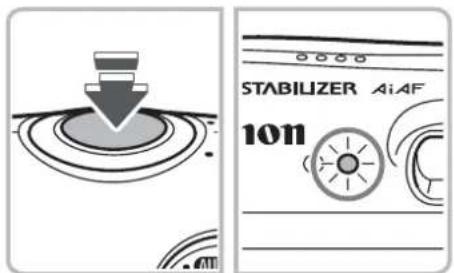
- Press the shutter button halfway to focus.
When the camera focuses, it will beep twice and the indicator will light green.
natural_image
Diagram showing a downward arrow pointing to a circular target or dial, with control buttons and a magnifying glass (no text or symbols)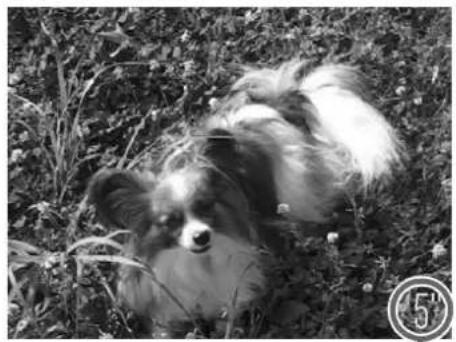
natural_image
Black-and-white photo of a small dog lying on grass with flowers, no visible text or symbolsElapsed Time
natural_image
Simple line drawing of a car's wheel and dashboard components (no text or symbols)Microphone
natural_image
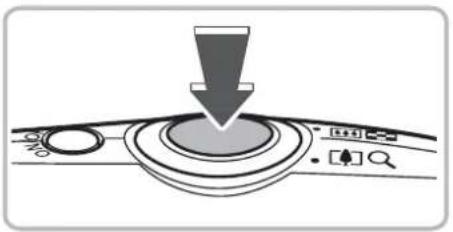
Diagram of a control panel with a downward arrow and circular buttons, no text or symbols presentShoot.
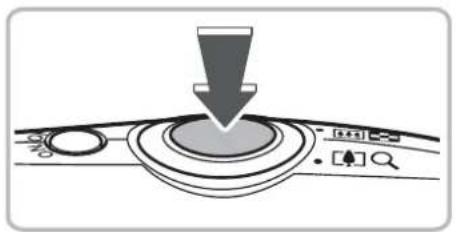
- Press the shutter button fully.
The camera will start shooting the movie, and [● Rec.] and the elapsed time will appear on the screen.
Once shooting begins, take your finger off the shutter button. -
If you change the composition of your shot during shooting, the focus will stay the same, but the brightness, and tone will automatically adjust.
-
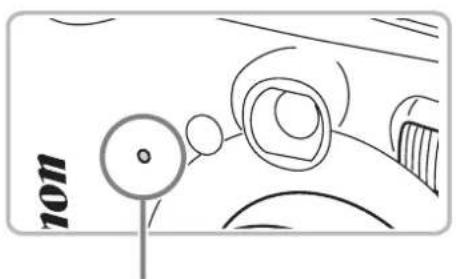
Do not touch the microphone while shooting.
- Do not press any buttons other than the shutter button. The sound that buttons make will be recorded in the movie.
Stop shooting.
- Press the shutter button fully again. The camera will beep once and stop shooting the movie.
The indicator will blink green, and the movie will record to the memory card.
▶ Shooting will automatically stop when the memory card fills.
Estimated Shooting Times
| Memory Card | 32 MB (Supplied) | 2 GB | 8 GB |
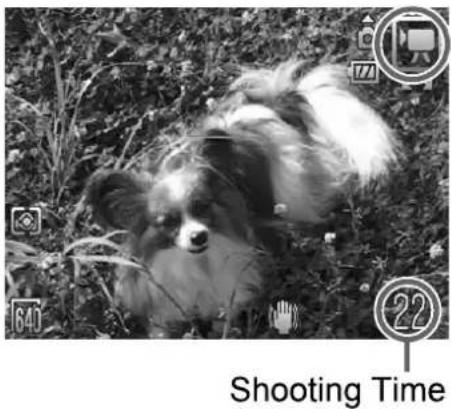
| Shooting Time | 22 sec. | 23 min. 49 sec. | 1 hr. 35 min. 11 sec. |
- Shooting times are based on a camera at default settings.
- Shooting time can be checked on the screen in Step 2.
- Max. clip length is approx. 1 hour. Recording also stops when the file size reaches 4 GB.
Viewing Movies
You can view the movies you have shot on the screen.
natural_image
Diagram showing mechanical components and a directional arrow, no text or symbols present1 Set the playback mode.
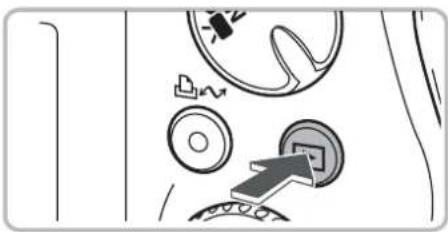
- Press the ▶ button.
The last movie you shot will appear.
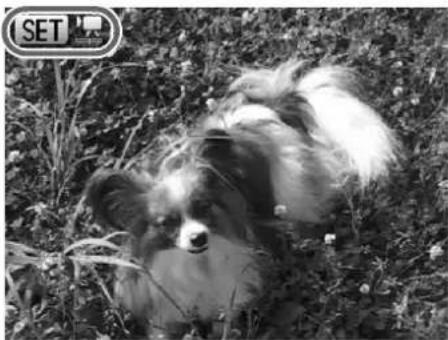
SET appears on movies.
natural_image
Black-and-white photo of a small dog lying on grass, no visible text or symbols2 Select a movie.
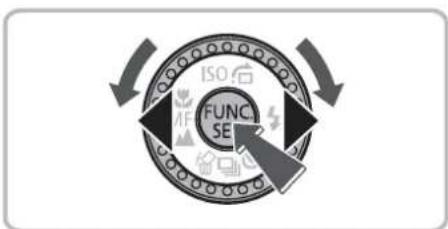
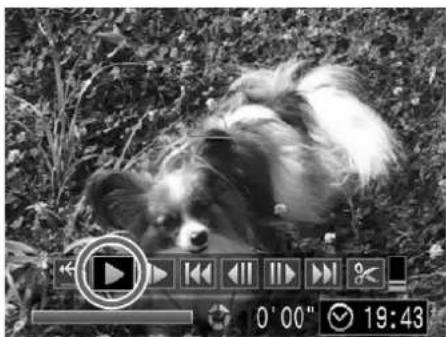
- Press the ◀▶ buttons or turn the ⏻ dial to select a movie, then press the Ⓗ FUNC. SET button.
The movie control panel will appear on the screen.
flowchart
graph TD
    A["FUNC SE"] --> B["ISO"]
    B --> C["Process Step"]
    C --> D["End"]
3 Play the movie.
natural_image
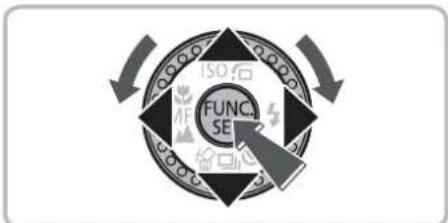
Black-and-white photo of a small dog resting in grass near flowers, with a play button and playback controls visible (no readable text or symbols)- Press the ◀▶ buttons or turn the Ⓞ dial to select ▶, then press the Ⓗ func. SET button.
The movie will play. - You can pause/resume the movie by pressing the FUNC SET button again.
- Press the ▲▼ buttons to adjust the volume.
flowchart
graph TD
    A["ISO"] --> B["FUNC SE"]
    B --> C["→"]
    C --> D["←"]
    D --> A

When watching a movie on a computer, frames may drop, it may not play smoothly, and the audio may stop suddenly depending on the computer's capabilities.

For more information on the movie control panel, refer to p. 101.
Downloading Images to a Computer
You can use the included software to download the images you have taken to a computer.
Items to Prepare
• Camera and computer
- Canon Digital Camera Solution Disk supplied with the camera (p. 2)
• Interface cable supplied with the camera (p. 2)
System Requirements
Windows
| OS | Windows Vista (including Service Pack 1) Windows XP Service Pack 2 | |
| Computer model | The above OS should be pre-installed on computers with built-in USB ports. | |
| CPU | Viewing images | Windows Vista: Pentium 1.3 GHz or higher Windows XP: Pentium 500 MHz or higher |
| Viewing movies | Core2 Duo 1.66 GHz or higher | |
| RAM | Viewing images | Windows Vista: 512 MB or more Windows XP: 256 MB or more |
| Viewing movies | 1 GB or more | |
| Interface | USB | |
| Free Hard Disk Space | Canon Utilities | ZoomBrowser EX: 200 MB or more PhotoStitch: 40 MB or more |
| Display | 1,024 x 768 pixels/High Color (16 bit) or better | |
Macintosh
| OS | Mac OS X (v10.4 – v10.5) | |
| Computer model | The above OS should be pre-installed on computers with built-in USB ports. | |
| CPU | Viewing images | PowerPC G4/G5 or Intel Processor |
| Viewing movies | Core Duo 1.66 GHz or higher | |
| RAM | Viewing images | Mac OS X (v10.5): 512 MB or moreMac OS X (v10.4): 256 MB or more |
| Viewing movies | 1 GB or more | |
| Interface | USB | |
| Free Hard Disk Space | Canon Utilities | ImageBrowser: 300 MB or morePhotoStitch: 50 MB or more |
| Display | 1,024 x 768 pixels/32,000 Colors or better | |
Preparations
Windows XP and Mac OS X (v10.4) are used for these explanations.
1 Install the software.
Windows
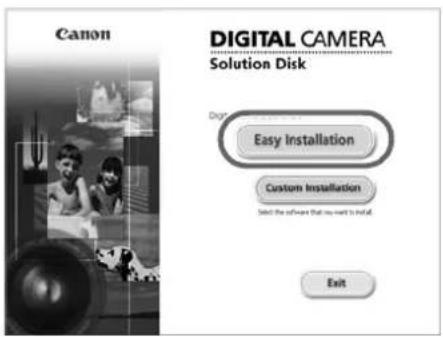
① Place the Canon Digital Camera Solution Disk in the computer’s CD-ROM drive.
② Click [Easy Installation].
- Follow the onscreen instructions to proceed with the installation.
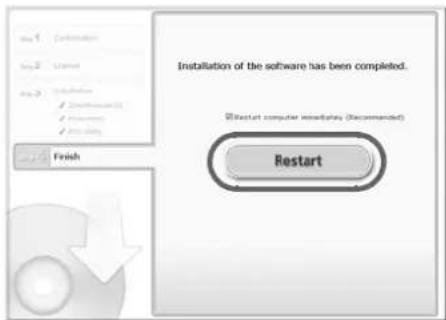
③ When the install finishes, click [Restart] or [Finish].
④ Remove the CD-ROM.
- Remove the CD-ROM when your normal desktop screen appears.
Macintosh
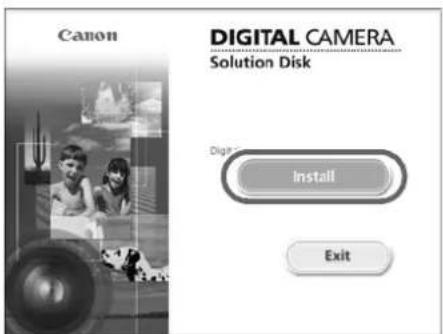
- Place the Canon Digital Camera Solution Disk in the computer's CD-ROM drive.
The installer panel appears when you double-click the 🔊 icon in the CD-ROM window. - Click [Install], and follow the onscreen instructions to proceed with the installation.
natural_image
Diagram showing a device with three circular components and a separate electrical panel with a USB symbol, no text or labels present.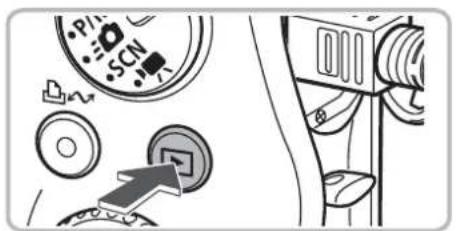
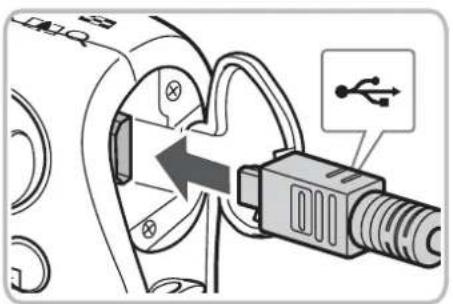
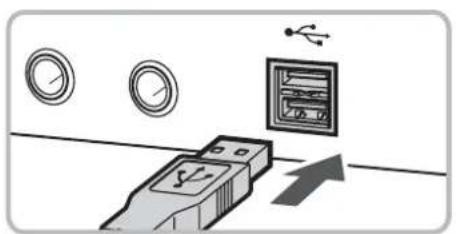
2 Connect the camera to the computer.
● Make sure the camera is turned off before connecting.
- Open the cover, and insert the small end of the plug firmly into the camera terminal in the direction as shown.
Insert the cable's larger plug into the computer's USB port. For connection details, refer to the user guide provided with the computer.
3 Establish a connection between the camera and computer.
- Press the ▶ button and turn on the camera.
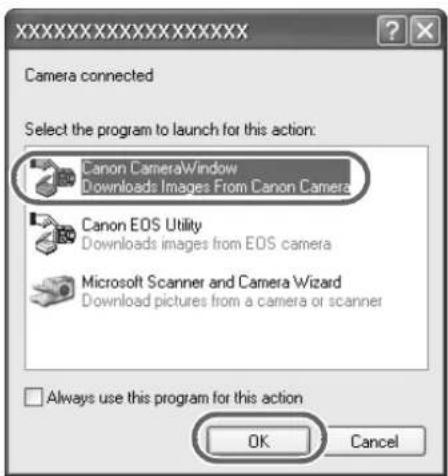
4 Open CameraWindow.
Windows
- Select [Canon CameraWindow] and click [OK].
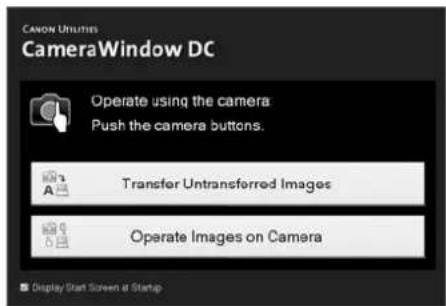
▶ CameraWindow will appear. - If CameraWindow does not appear, click the [Start] menu and select [All Programs] or [Programs], followed by [Canon Utilities] ▶ [CameraWindow] ▶ [CameraWindow] ▶ [CameraWindow].
The Direct Transfer menu appears on the camera's screen, and the ↻ button will light blue.
Macintosh
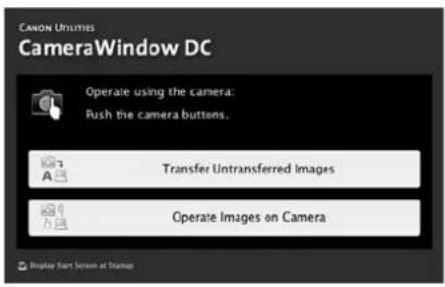
▶ CameraWindow will appear when you establish a connection between the camera and computer.
- If CameraWindow does not appear, click the [CameraWindow] icon on the Dock (the bar which appears at the bottom of the desktop).
The Direct Transfer menu appears on the camera's screen, and the ↻ button will light blue.

You cannot shoot while the Direct Transfer menu displays.
Downloading Images with a Computer
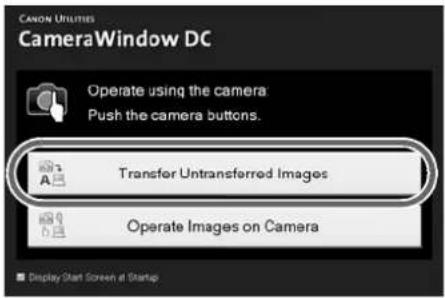
- Click [Transfer Untransferred Images].
All images not previously downloaded will be downloaded to the computer.
After the download finishes, turn off the camera and unplug the cable.
For further operations, refer to the Software Starter Guide.
Downloading Images with the Camera
Direct Transfer

All Images...

New Images...

DPOF Trans. Images...

Select & Transfer...

Wallpaper...
1 Select [New Images].
- Press the ▲▼ buttons or turn the Ⓞ dial to select [New Images].
- If the screen on the left is not showing, press the MENU button.
![CANON IXUS 980 IS - Select [New Images]. - 1](/content/2026/05/1103579/images/c046aca7d6b59dcbb3111a78fe805280befb5d65e1a14741465fa02bf387ee5c.jpg)
flowchart
graph TD
    A["ISO"] --> B["MF"]
    B --> C["FUNC SET"]
    C --> D["Output"]
    style A fill:#f9f,stroke:#333
    style B fill:#ccf,stroke:#333
    style C fill:#cfc,stroke:#333
    style D fill:#fcc,stroke:#333
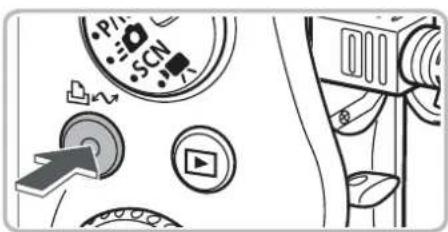
2 Download images.
- Press the ↻ button.
All images that have not already been transferred to the computer are transferred.
● After transferring finishes, turn off the camera and unplug the cable.
For further operations, refer to the Software Starter Guide.

Downloaded images will be sorted by date and saved in separate folders in the "My Pictures" folder for Windows or the "Picture" folder for Macintosh.
Accessories
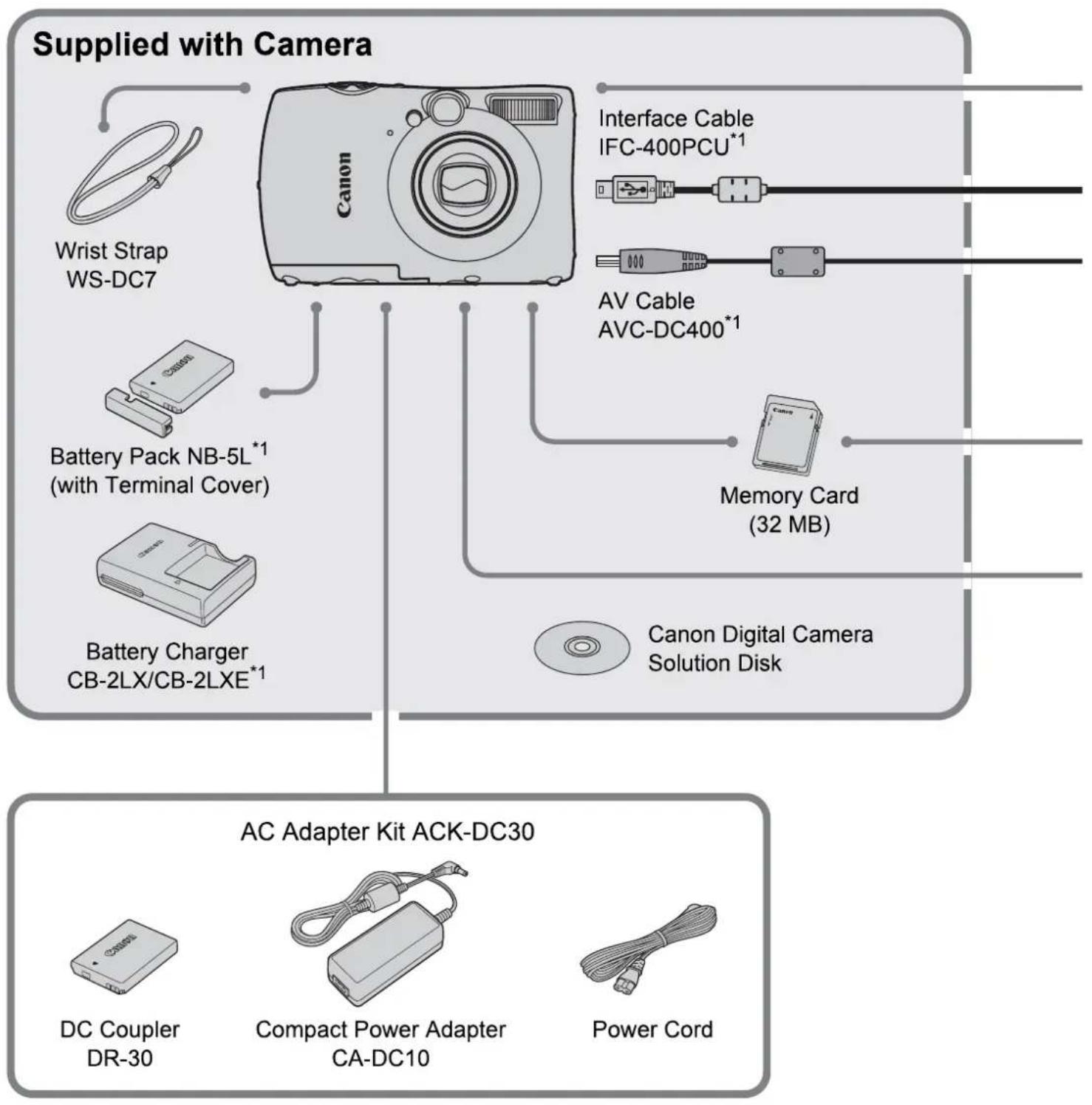
flowchart
graph TD
    A["Supplied with Camera"] --> B["Wrist Strap WS-DC7"]
    A --> C["Battery Pack NB-5L*1 (with Terminal Cover)"]
    A --> D["Battery Charger CB-2LX/CB-2LXE*1"]
    A --> E["Interface Cable IFC-400PCU*1"]
    A --> F["AV Cable AVC-DC400*1"]
    A --> G["Memory Card (32 MB)"]
    A --> H["Canon Digital Camera Solution Disk"]
    I["AC Adapter Kit ACK-DC30"] --> J["DC Coupler DR-30"]
    I --> K["Compact Power Adapter CA-DC10"]
    I --> L["Power Cord"]
*1 Also available for purchase separately.
*2 See the user guide supplied with the printer for more information on the printer and interface cables.
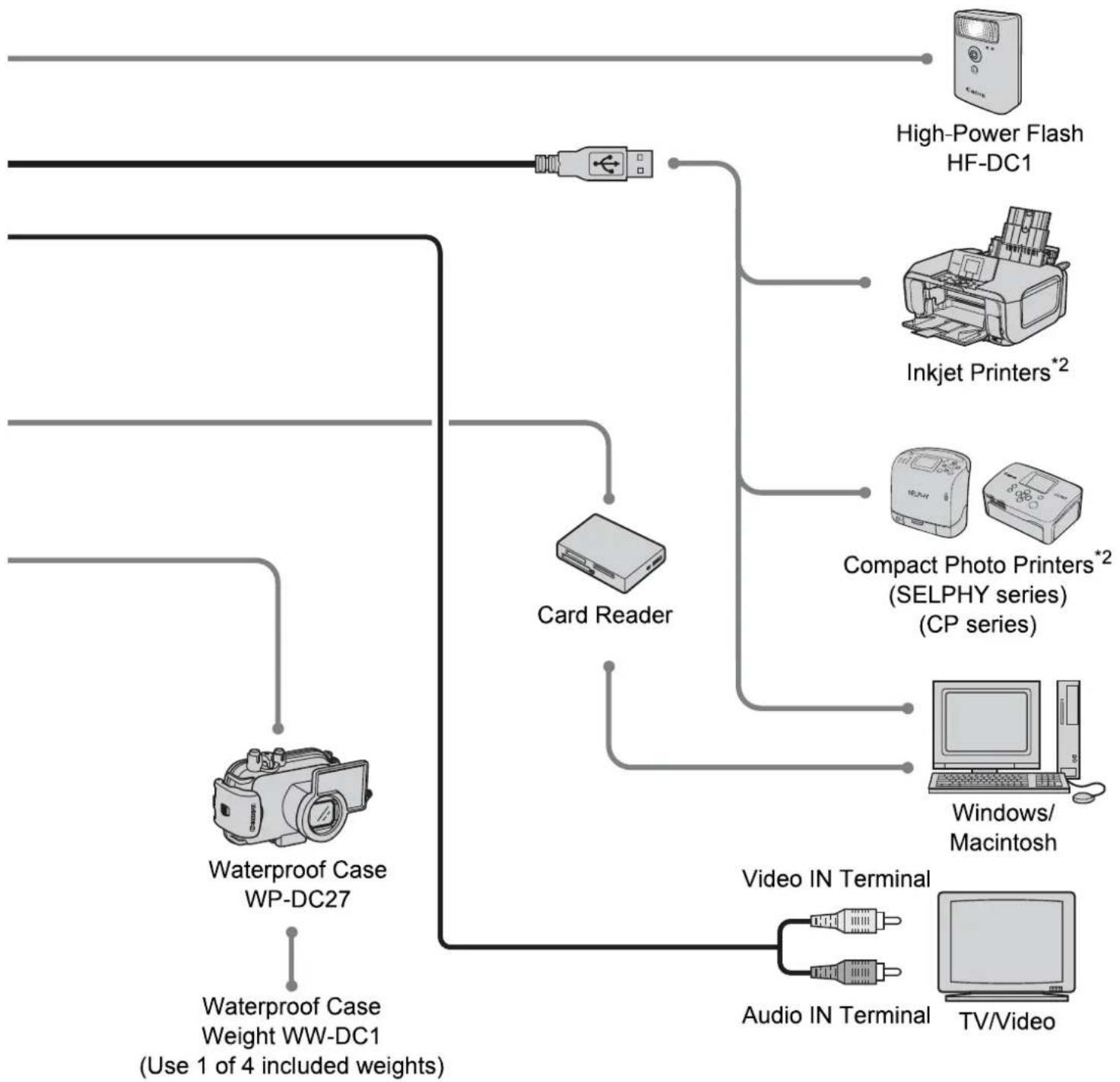
flowchart
graph TD
    A["Waterproof Case WP-DC27"] --> B["Card Reader"]
    A --> C["High-Power Flash HF-DC1"]
    A --> D["Inkjet Printers*2"]
    A --> E["Compact Photo Printers*2 (SELPHY series) (CP series)"]
    A --> F["Video IN Terminal"]
    A --> G["Audio IN Terminal"]
    A --> H["TV/Video"]
    B --> I["Waterproof Case Weight WW-DC1 (Use 1 of 4 included weights)"]
Use of genuine Canon accessories is recommended.
This product is designed to achieve excellent performance when used with genuine Canon accessories. Canon shall not be liable for any damage to this product and/or accidents such as fire, etc., caused by the malfunction of non-genuine Canon accessories (e.g., a leakage and/or explosion of a battery pack). Please note that this warranty does not apply to repairs arising out of the malfunction of non-genuine Canon accessories, although you may request such repairs on a chargeable basis.
Separately Sold Accessories
The following camera accessories are sold separately.
Some accessories are not sold in some regions, or may no longer be available.
Power Supplies
• AC Adapter Kit ACK-DC30
This kit lets you power the camera using household power. Recommended for powering the camera for an extended period of time or when connecting to a computer. Cannot be used to charge the battery inside the camera.
• Battery Charger CB-2LX/CB-2LXE
An adapter for charging Battery Pack NB-5L.
- Battery Pack NB-5L
Rechargeable lithium-ion battery.
Other Accessories
• Waterproof Case WP-DC27
Installing the camera into this waterproof case lets you take underwater shots at depths down to 40 meters (130 feet), or take worry-free pictures in the rain, at the beach, or on the ski slopes.
• High-Power Flash HF-DC1
This attachable supplementary flash can illuminate subjects that are too distant for the light from the built-in flash to reach.
Learning More
This chapter explains the parts of the camera and what displays on the screen, as well as, basic operations.
Conventions Used in this Guide
- Icons are used in the text to represent the camera buttons and dials.
• Language that displays on the screen appears inside []. - The directional buttons, control dial, and FUNC./SET button are represented by the following icons.
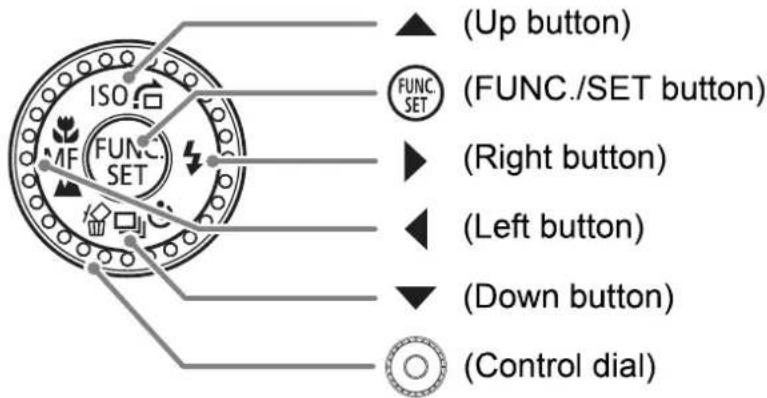
- ?: Troubleshooting tips.
- ⚫ : Hints for getting more out of your camera.
- ⚠️: Things you should be careful about.
• : Supplemental information.
(p. xx): Reference pages. "xx" stands for page number.
• This chapter assumes all functions are at their default settings.
Components Guide
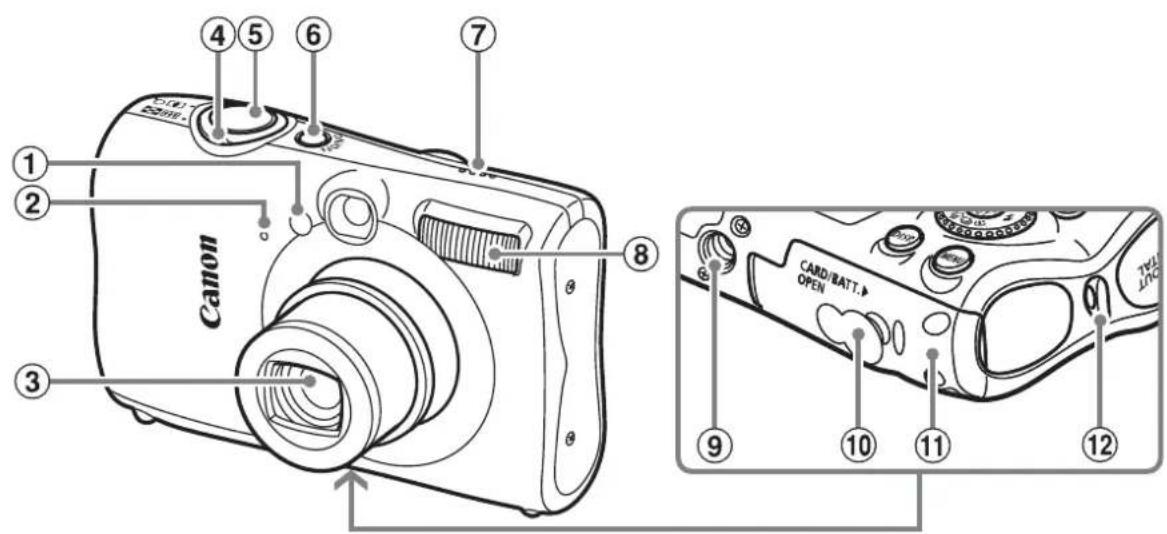
① Lamp (AF Assist Beam (p. 143) / Red-Eye Reduction Lamp (p. 142) / Self-Timer Lamp (p. 62))
② Microphone (p. 29)
③ Lens
④ Zoom Lever
Shooting: [▲] (Telephoto) / [▲▲] (Wide Angle) (p. 21)
Playback: Q (Magnify) / ☐ (Index) (p. 104)
⑤ Shutter Button (p. 20)
⑥ Power Button
⑦ Speaker
⑧ Flash (pp. 57, 67)
⑨ Tripod Socket
⑩ DC Coupler Terminal Cover (p. 150)
⑪ Memory Card / Battery Cover (p. 14)
⑫ Strap Mount (p. 11)
Mode Dial
Use the mode dial to change shooting modes.
Auto Mode
You can shoot, leaving it to the camera to make settings automatically (p. 21).
Program AE/Manual Mode
You can shoot in various different ways, using all of the camera's settings (pp. 65, 81).
Quick Shot
You can take pictures using the viewfinder without missing a single shot (p. 79).
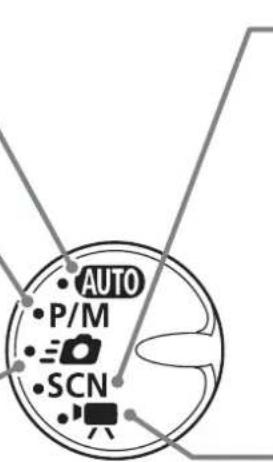
Special Scene Mode
The camera can automatically make all settings appropriate for the scene so that you can take images just by pressing the shutter button (p. 54).
Movie Mode
For shooting movies (pp. 28, 97).
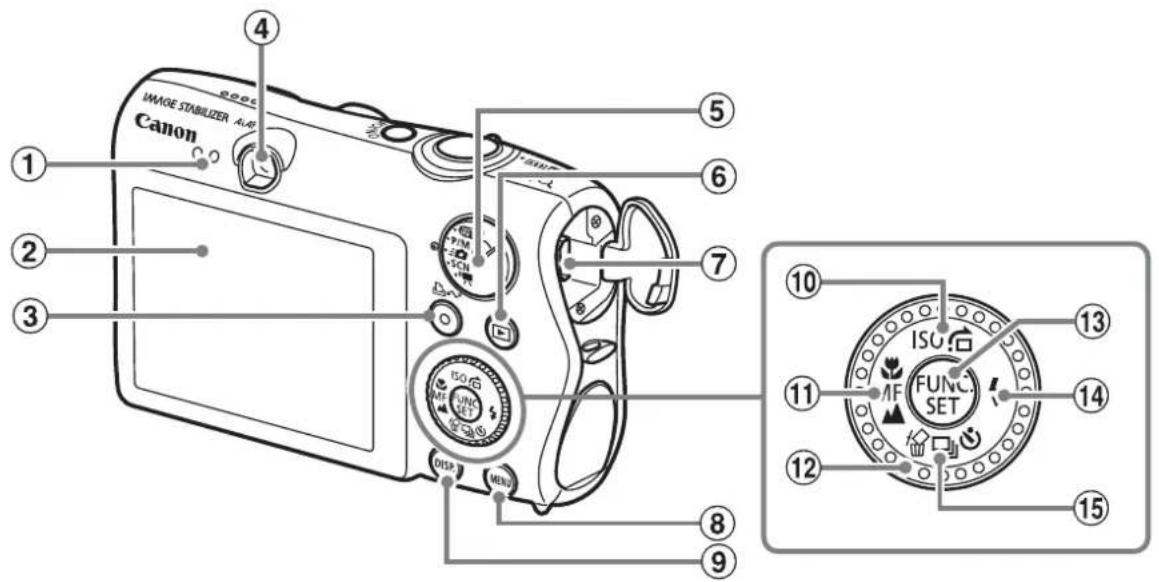
① Indicators (p. 44)
② Screen (LCD Monitor) (p. 42)
③ ↙ (Print/Share) Button (pp. 26, 145)
④ Viewfinder (pp. 76, 79)
⑤ Mode Dial
⑥ ▶ (Playback) Button (pp. 24, 146)
⑦ A/V OUT (Audio/Video Output) and DIGITAL Terminal
⑧ MENU Button (p. 46)
⑨ DISP. (Display) Button (pp. 42, 43)
⑩ ISO Speed (p. 70) / ☑ (Jump) (p. 105) / ▲ Button
⑪ (Macro) (p. 63) / ▲ (Infinity) (p. 67) / MF (Manual Focus) (p. 85) / ◀ Button
⑫ Control Dial
⑬ FUNC./SET (Function/Set) Button (p. 45)
⑭ ↘ (Flash) (pp. 57, 67) / ▶ Button
⑮ (Continuous Shooting) (p. 72) / ⚙ (Self-Timer) (pp. 61, 62) / ⏱ (1 Delete Image) (p. 25) / ▼ Button
Control Dial
When 📋 appears on the screen, you can select modes by turning the control dial.
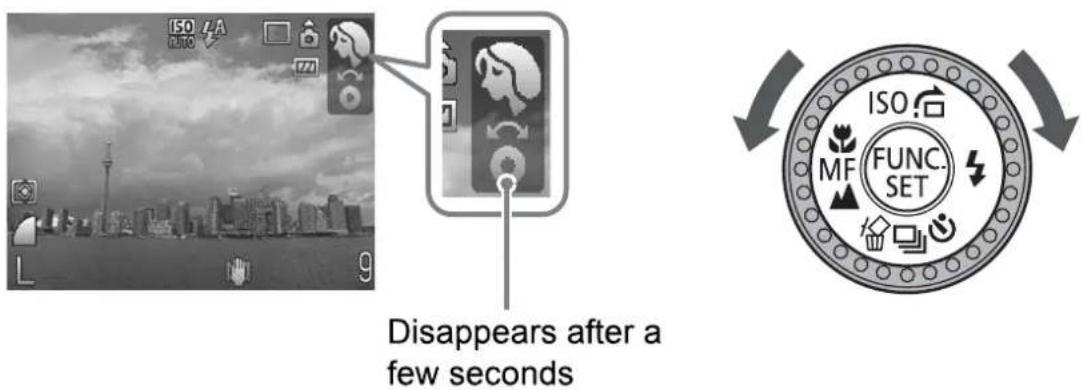
Even when doesn't appear, the dial will work in the same way as the directional keys (p. 39).
Information Displayed on the Screen
Shooting (Information Display)
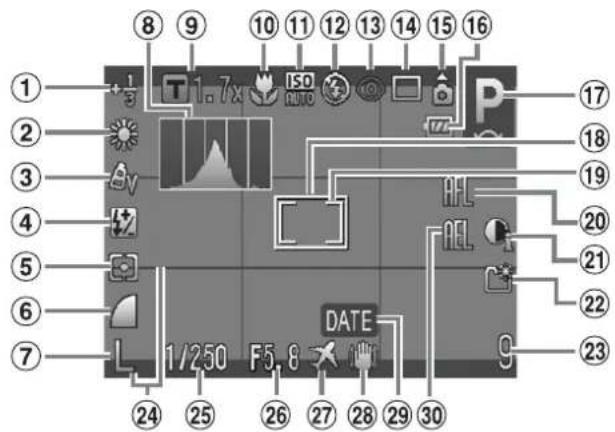
① Exposure Compensation (p. 72)
② White Balance (p. 71)
③ My Colors (p. 73)
④ Flash Exposure Compensation/Flash Output (pp. 88, 90)
⑤ Metering Modes (p. 87)
⑥ Image Quality (Compression) (p. 68)
⑦ Recording Pixels (p. 68)
⑧ Histogram (p. 44)
⑨ Digital Zoom Magnification (p. 58) / Digital Tele-Converter (p. 59)
⑩ Macro (p. 63) / Infinity (p. 67) / Manual Focus (p. 85)
⑪ ISO Speed (p. 70)
⑫ Flash Mode (pp. 57, 67)
⑬ Red-Eye Correction (p. 92)
⑭ Drive Mode (pp. 61, 62, 72, 75)
⑮ Camera Orientation*
⑯ Battery Charge Indicator (p. 13)
⑰ Shooting Mode
⑱ AF Frame (p. 22)
⑲ Spot AE Point Frame (p. 87)
⑳ AF Lock (p. 84)
②1 i-Contrast (p. 91)
②2 Create Folder (p. 140)
②3 Recordable Shots (Stills) (p. 16) / Remaining Time (Movies) (p. 29)
⑳ Disp. Overlay (p. 144)
⑲ Shutter Speed (p. 89)
②6 Aperture Value (p. 89)
⑳ Time Zone (p. 139)
⑳ Image Stabilizer (p. 145)
⑲ Date Taken/Recorded (p. 60)
③0 AE Lock (pp. 87, 99) / FE Lock (p. 88)
* 🖱️ : Standard, 🔒️ : Right side down, 🔔️ : Left side down
When shooting, the camera detects if it is held vertically or horizontally, and adjusts settings accordingly for the best shot. It also detects orientation during playback, so you can hold the camera in either orientation and it will automatically rotate images for correct viewing.
This function may not operate correctly when the camera is pointed straight up or down.
Switching the Display
You can change the display using the DISP. button.
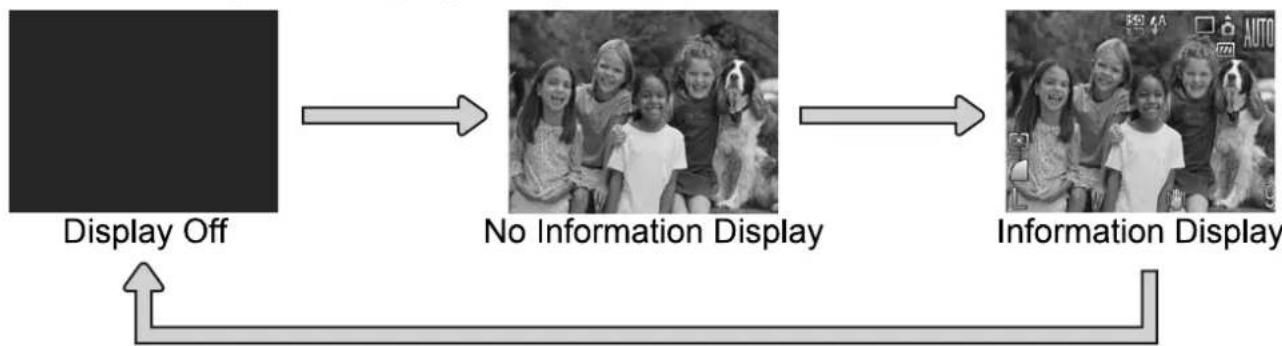
flowchart
graph LR
    A["Display Off"] --> B["No Information Display"]
    B --> C["Information Display"]
    C --> A
Playback (Detailed Information Display)
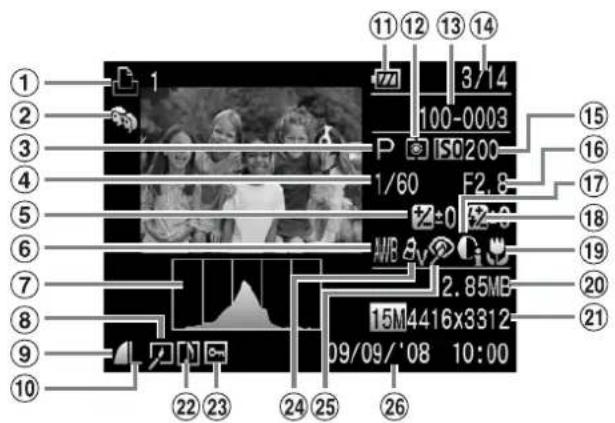
① Print List (p. 131)
② My Category (p. 119)
③ Shooting Mode
④ Shutter Speed (p. 89)
⑤ Exposure Compensation (p. 72)
⑥ White Balance (p. 71)
⑦ Histogram (p. 44)
⑧ Image Editing (pp. 120 – 126)
⑨ Image Quality (Compression) (p. 68) / MOV (Movies) (p. 98)
⑩ Recording Pixels (p. 68)
⑪ Battery Charge Indicator (p. 13)
⑫ Metering Modes (p. 87)
⑬ Folder Number – File Number (p. 140)
⑭ Displayed image number / Total number of images
⑮ ISO Speed (p. 70)
⑯ Aperture Value (p. 89) / Image Quality (Movies) (p. 98)
⑰ i-Contrast (p. 124)
⑱ Flash Exposure Compensation/Flash Output (pp. 88, 90)
⑲ Macro / Infinity / Manual Focus (pp. 63, 67, 85)
⑳ File Size (pp. 68, 98)
②1 Recording Pixels (p. 68) / Elapsed Time (Movies) (p. 99)
⑳ Sound Memo (p. 127)
②3 Protect (p. 117)
⑳ My Colors (p. 73)
⑳ Red-Eye Correction (p. 125)
②6 Shooting Date and Time (p. 60)
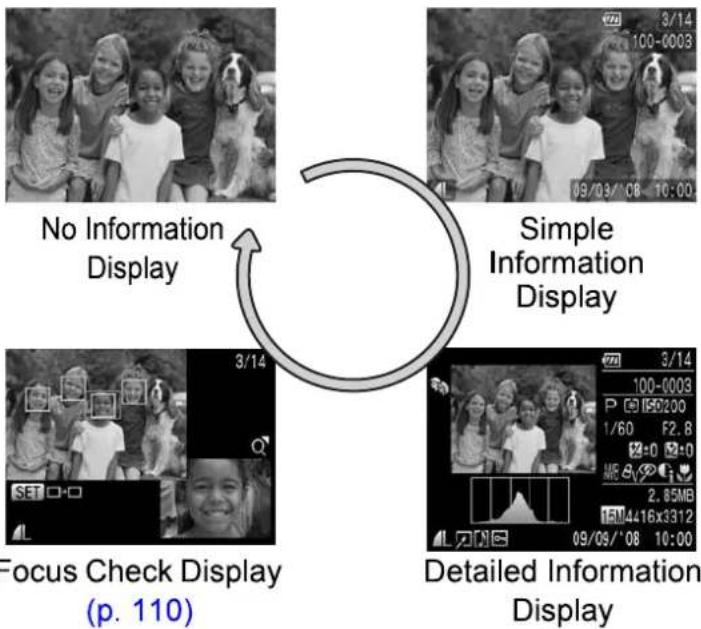
Switching the Display
You can change the display using the DISP. button.
Display for Shooting in Dark Conditions during Shooting
The display automatically brightens when shooting in dark conditions, allowing you to check the composition (Night Display function). However, the brightness of the image on the screen, and the brightness of the actual image recorded may be different. Noise may appear and the movement of the subject on the screen may appear somewhat jagged. This has no effect on the recorded image.
Overexposure Warning during Playback
In “Detailed Information Display” (p. 43), overexposed areas of the image flash on the screen.
Histogram
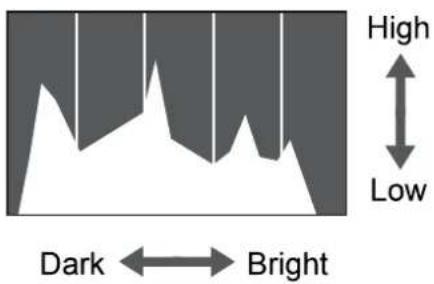
The graph that appears in “Detailed Information Display” (p. 43), and “Shoot While Checking the Histogram” (p. 77) is called the histogram. The histogram shows the distribution and amount of brightness of an image. When the graph approaches the right side, the image is bright, but when it approaches the left side, the image is dark, and in this way you can check the exposure.
Indicators
The indicators on the back of the camera (p. 41) will light or blink under the following conditions.
| Colors | Status | Operation Status |
| Green | Lights | Shooting preparation complete (p. 21) / Display Off (p. 138) |
| Blinks | Recording/reading/transmitting image data (p. 21) | |
| Orange | Lights | Shooting preparation complete (flash on) (p. 21) |
| Blinks | Camera shake warning (p. 57) | |
| Yellow | Lights | ( p. 63)/▲ (p. 67)/AFL (p. 84)/MF (p. 85) |
| Blinks | Focusing difficulty (p. 23) |

When the indicator blinks green, data is being recorded to/read from the memory card or various information is being transmitted. Do not turn off the power, open the memory card slot/battery cover, shake or jolt the camera. These actions may corrupt the image data, or cause the camera or memory card to malfunction.
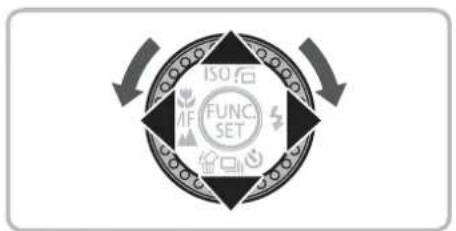
Commonly used shooting functions can be set with the FUNC. menu. The menu and menu items differ depending on the Shooting mode (p. 156).
1 Press the FUNC. SET button.
The FUNC. menu will appear.
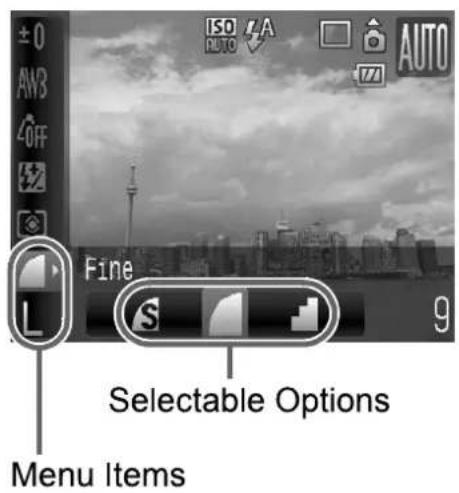
2 Select a menu item.
▶ Press the ▲▼ buttons to select a menu item.
3 Select an option.
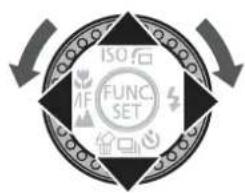
- Press the ◀▶ buttons or turn the Ⓞ dial to select an option.
- For options that display DISP., settings can also be made by pressing the DISP. button.
flowchart
graph TD
    A["ISU 60"] --> B["FUNC SET"]
    B --> C["Return Arrow"]
    C --> D["Return Arrow"]
    D --> E["Return Arrow"]
flowchart
graph TD
    A["ISO 60"] --> B["FUNC SET"]
    B --> C["Outer Ring"]
    C --> D["Inner Ring"]
    D --> E["Outer Ring"]
    E --> F["Outer Ring"]
    F --> G["Outer Ring"]
    G --> H["Outer Ring"]
    H --> I["Outer Ring"]
    I --> J["Outer Ring"]
    J --> K["Outer Ring"]
    K --> L["Outer Ring"]
    L --> M["Outer Ring"]
    M --> N["Outer Ring"]
    N --> O["Outer Ring"]
4 Press the FUNC. SET button.
The setting will be made and you will return to the standard shooting screen.
The setting you made will be displayed on the screen.

MENU MENU - Basic Operations
Various functions can be set from the menus. The menu items are organized under tabs, such as for shooting (☐) and playback (▶). The menu items differ depending on the mode (pp. 158 – 161).
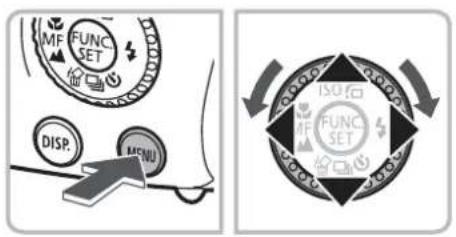
Press the MENU button.
Select a tab.
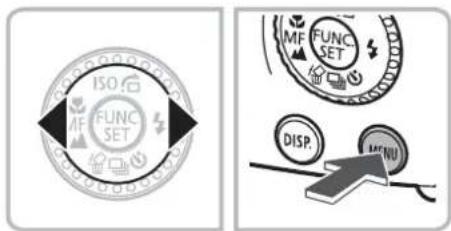
- Press the ◀▶ buttons, or move the zoom lever (p. 40) left or right to select a tab (category).
3 Select a menu item.
- Press the ▲▼ buttons or turn the Ⓞ dial to select a menu item. - Some settings can only be set after switching the screen using the FUNC SET button.
flowchart
graph TD
    A["FUNC SE"] --> B["ISO"]
    B --> C["Process Step"]
    C --> D["End"]
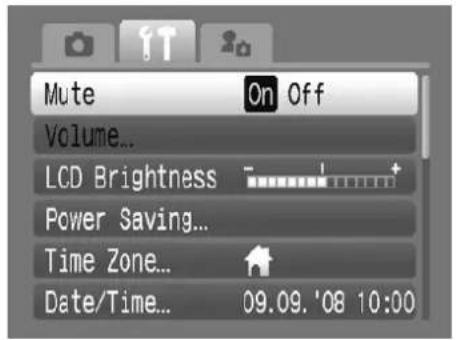
Select an option.
- Press the ◀▶ buttons to select an option.
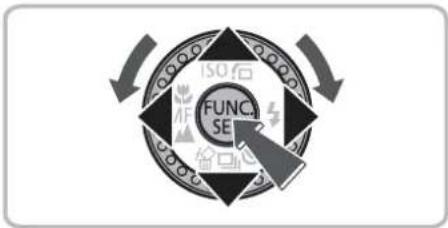
5 Press the MENU button.
The setting will be made and you will return to the standard shooting screen.
Changing the Sound Settings
You can silence the sounds of the camera buttons or adjust the volume of the camera sounds.
Muting Sounds
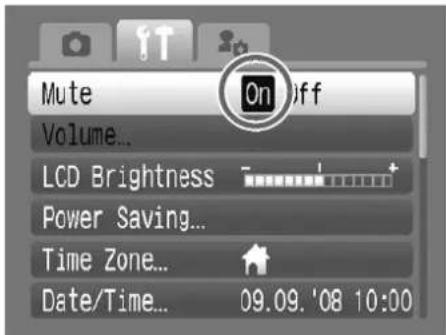
- Press the MENU button and select the tab, then select [Mute] and use the ◀▶ buttons to select [On].
flowchart
graph TD
    A["MF FUNC SET"] --> B["DISP. MCMU"]
    B --> C["ISU FC FUNC SET"]
    C --> D["Interconnection"]
    D --> E["Output"]
Adjusting the Volume
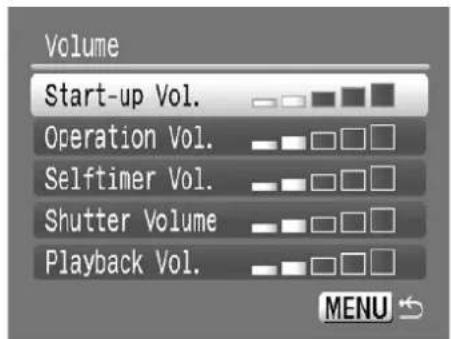
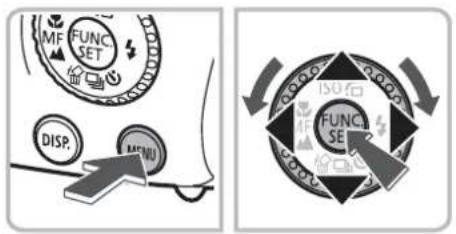
- Press the MENU button and select the tab, then select [Volume] and press the . button.
- Press the ▲▼ buttons to select an item, then use the ◀▶ buttons or turn the Ⓞ dial to adjust the volume.
flowchart
graph TD
    A["MF"] --> B["FUNC SET"]
    B --> C["DISP."]
    C --> D["MNU"]
    D --> E["Central Circle with FC"]
    E --> F["ISC"]
    E --> G["FUNC SE"]
    G --> H["Arrow to Center"]
Changing the Screen Brightness
The screen brightness can be changed in two ways.
With the Menu
flowchart
graph TD
    A["MF"] --> B["FUNC SET"]
    B --> C["MENU"]
    C --> D["DISP."]
    D --> E["FUNC SE"]
    E --> F["ISU"]
    style A fill:#f9f,stroke:#333
    style B fill:#ccf,stroke:#333
    style C fill:#cfc,stroke:#333
    style D fill:#fcc,stroke:#333
    style E fill:#cff,stroke:#333
    style F fill:#ffc,stroke:#333
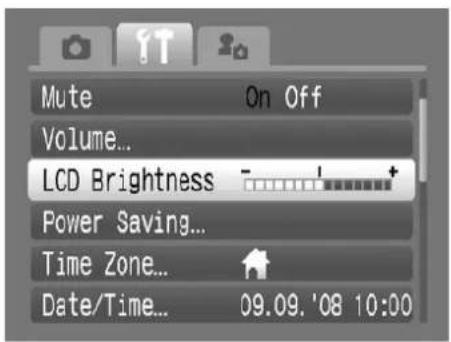
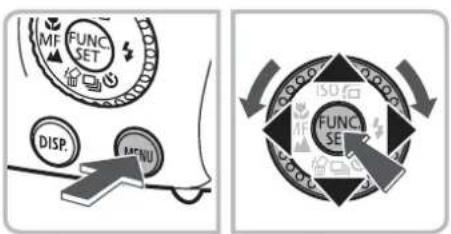
- Press the MENU button, select the 🎨 tab, select [LCD Brightness] and then press the Ⓗ function SET button.
- Press the ◀▶ buttons or turn the Ⓞ dial to change the brightness.
- Press the MENU button again to complete the setting.
With the DISP. Button
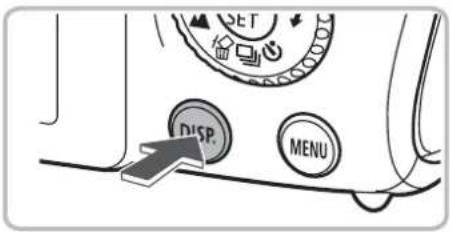
- Press the DISP. button for more than one second.
The screen increases to maximum brightness regardless of the setting in the Ġ tab. - Pressing the DISP. button again for more than one second will return the screen to its previous setting.

- The next time you turn on the camera, the screen will be at the brightness setting selected in the 🎨 tab.
- You cannot change the brightness of the screen even if you press the DISP. button if you have already set the brightness to its highest setting in the 🎨 tab.
Returning the Camera to Default Settings
When you have mistakenly made a setting, you can reset the camera to the default settings.
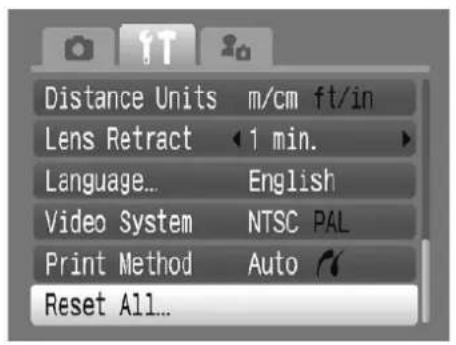
1 Select [Reset All].
- Press the MENU button and select the tab, then select [Reset All] and press the button.
![CANON IXUS 980 IS - Select [Reset All]. - 1](/content/2026/05/1103579/images/c9331129057fa1d1a76e0665e01f065056c9dc36729f5a8fc26096804103e887.jpg)
flowchart
graph TD
    A["MF"] --> B["FUNC SET"]
    B --> C["DISP."]
    C --> D["MENU"]
    D --> E["Central Circle"]
    E --> F["FUNC SET"]
    F --> G["ISP."]
    G --> H["Arrow to Center"]
    style A fill:#f9f,stroke:#333
    style B fill:#ccf,stroke:#333
    style C fill:#cfc,stroke:#333
    style D fill:#fcc,stroke:#333
    style E fill:#cff,stroke:#333
    style F fill:#ffc,stroke:#333
    style G fill:#cfc,stroke:#333
    style H fill:#fcc,stroke:#333
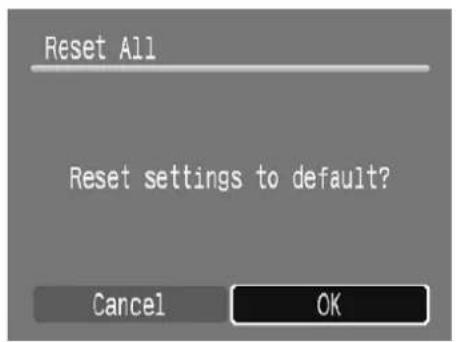
2 Reset the settings.
- Press the ◀▶ buttons or turn the Ⓞ dial to select [OK], then press the Ⓗ function button. - The camera will reset to the default settings.

Are there functions that cannot be reset?
- The [Date/Time] (p. 17) in the tab, [Language] (p. 19), [Video System] (p. 112), [Time Zone] (p. 139).
• The sounds or images registered to the 📷 tab (p. 147).
• The saved data for custom white balance (p. 71). - Colors that were selected in Color Accent (p. 93) or Color Swap (p. 94).
Formatting Memory Cards
You should use this camera to format a new memory card, or a memory card that has been used with other devices, before using it. Formatting (initializing) a memory card erases all data on the memory card. As you cannot retrieve the erased data, exercise adequate caution before formatting the memory card.
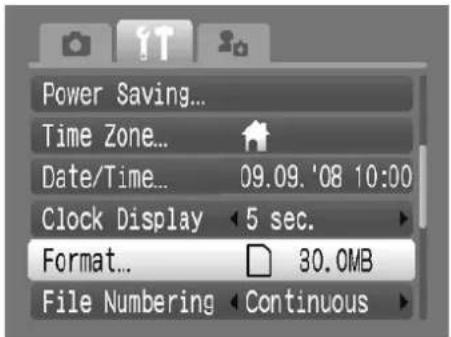
1 Select [Format].
- Press the MENU button and select the tab, then select [Format] and press the button.
![CANON IXUS 980 IS - Select [Format]. - 1](/content/2026/05/1103579/images/322aafe061a89c3a8447a52d578ef935c74550b76402dfda49a2e745c39acc9f.jpg)
flowchart
graph TD
    A["MF"] --> B["FUNC SET"]
    B --> C["DISP."]
    C --> D["FUNC SE"]
    D --> E["ISU"]
    E --> F["IF"]
    F --> G["→"]
    style A fill:#f9f,stroke:#333
    style B fill:#ccf,stroke:#333
    style C fill:#cfc,stroke:#333
    style D fill:#fcc,stroke:#333
    style E fill:#ffc,stroke:#333
    style F fill:#cfc,stroke:#333
    style G fill:#fcc,stroke:#333
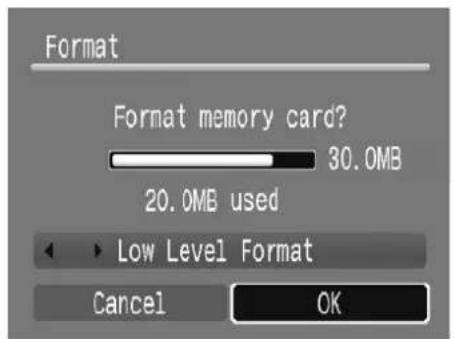
2 Format the memory card.
- Press the ◀▶ buttons or turn the ⏻ dial to select [OK], then press the FUNC SET button.
The memory card will be formatted.
When formatting has finished, the screen will return to the menu display.
Low Level Format
Perform low level formatting when you think that the recording/reading speed of a memory card has dropped.
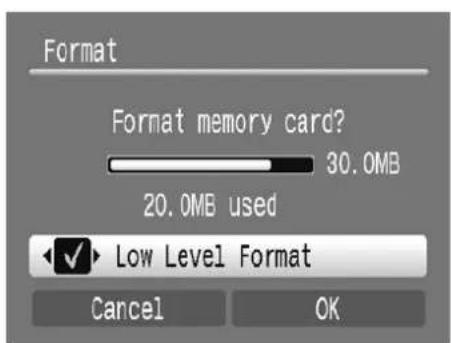
- In Step 2 above, use the ▲▼ buttons to select [Low Level Format], then use the ◀▶ buttons or turn the Ⓞ dial to display √.
- Press the ▲▼◀▶ buttons to select [OK], then press the ⬤️ button. ▶ Low level formatting starts.

About formatting
• The supplied memory card has already been formatted.
- When the [Memory card error] message appears, or when the camera does not work correctly, formatting the memory card may solve the problem. Copy the images from the memory card to a computer or other device before formatting.

- Formatting or erasing data on a memory card merely changes the file management information on the card and does not ensure its contents are completely deleted. Be careful when transferring or disposing of a memory card. When disposing of a memory card, take precautions such as physically destroying the card to prevent personal information leaks.
- When audio (p. 135) is recorded to the memory card, 📋 will display in the right hand corner of the screen in Step 2. Formatting the card will delete audio as well.

- The total capacity of the memory card displayed in the formatting screen may be less than indicated on the memory card.
- Low level formatting may take longer than standard formatting, since all recorded data are erased.
- You can stop a low level format of a memory card by selecting [Stop]. You can still use a memory card without problem when formatting is halted, but its data will be erased.
Power Saving Function (Auto Power Down)
To save battery power, the camera shuts down automatically when it is not operated for a certain time.
Power Saving during Shooting
About 1 minute after the camera is not operated, the monitor will turn off. After about 3 more minutes, the lens will retract and the power turns off. When the monitor has turned off but the lens has not retracted yet, pressing the shutter button halfway (p. 20) turns on the monitor and shooting can be continued.
Power Saving during Playback
About 5 minutes after the camera is not operated, the monitor shuts down and the power turns off.

- You can adjust the time before the monitor turns off (p. 138).
- You can turn off the Power Saving Function (p. 138).
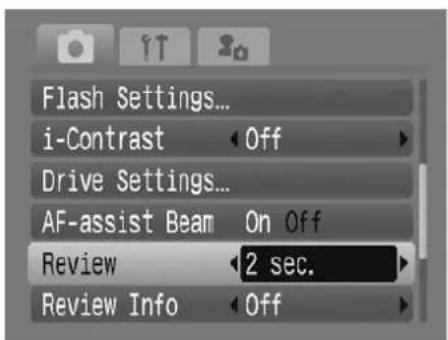
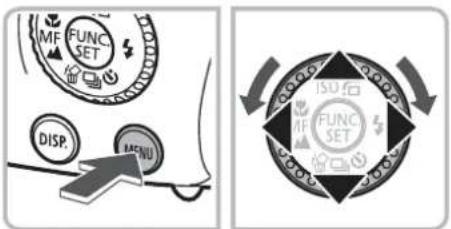
Changing the Image Display Time
Images display for approximately 2 seconds after being shot. You can change the length of time the images display.
flowchart
graph TD
    A["MF FUNC SET"] --> B["DISP."]
    B --> C["MACNU"]
    C --> D["ISO FUNC SET"]
    style A fill:#f9f,stroke:#333
    style D fill:#bbf,stroke:#333
Select [Review].
- Press the MENU button and select the tab, then use the ◀▶ buttons to select the display time.
In the playback mode (p. 24) press the shutter button halfway, and when the camera changes to shooting mode, press the MENU button.
Clock Functions
You can check the current time.
- Press the Ⓗ button until the clock screen on the left appears.
The current time will display for approximately five seconds.
If you change the camera's orientation, press the ◀▶ buttons or turn the Ⓞ dial, you can change the color displayed. - Push the FUNC. SET button to cancel the clock display.

Changing the display time
Press the MENU button, select the 🎨 tab, and then select the [Clock Display] menu item. Use the ◀▶ buttons to select a time.

Press and hold the ⓕ FUNC SET button, then press the power button to display the clock.
3
Shooting Special Scenes and Using Common Functions
This chapter explains how to shoot different scenes using the mode dial, as well as how to use other common functions, such as the flash and the self-timer.
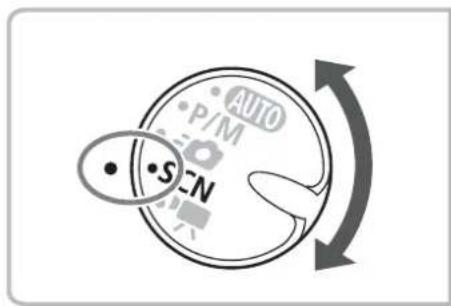
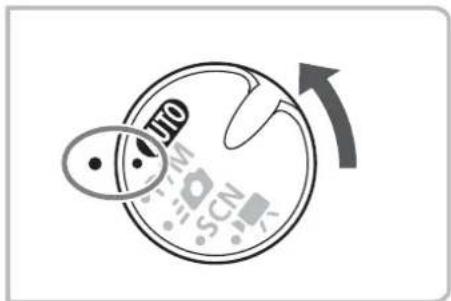
- When you select a mode in SCN mode that matches the scene you want to take, the camera will automatically make any necessary settings. Afterwards, you only need to press the shutter button to take the best shots for the scene.
- This chapter assumes that the mode dial is set to SCN or that AUTO mode is set.
- “SCN Shooting Various Scenes” (pp. 54 – 56) and “Zooming In on Close Subjects (Digital Macro)” (p. 64) can only be used in SCN mode.
SCN Shooting Various Scenes
The camera will make the necessary settings for the scene you wish to shoot when you select a matching mode.
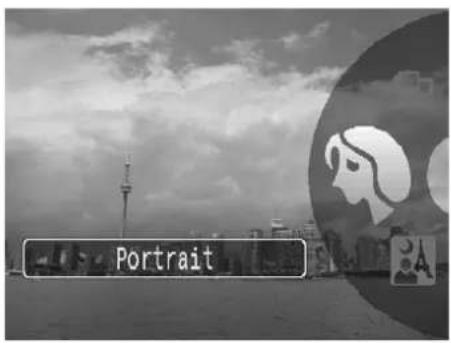
1 Set the mode dial to SCN (p. 40).
2 Turn the Ⓞ dial to the desired mode.
3 Shoot.
flowchart
graph TD
    A["MF"] --> B["FUNC"]
    B --> C["SET"]
    C --> D["ISO"]
natural_image
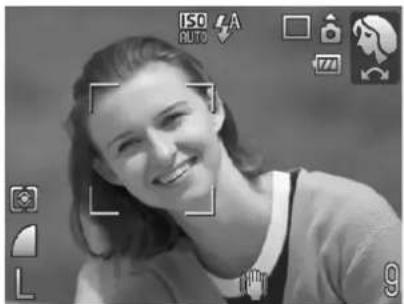
Black-and-white portrait of a smiling woman with camera interface overlays (no readable text or symbols)Take portraits (Portrait)
● Produces a soft effect when photographing people.
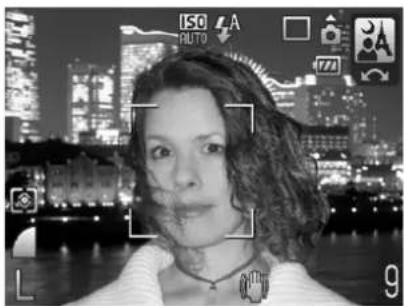
Take snapshots at night (Night Snapshot)
Lets you take beautiful snapshots of people against city nightscapes or night backgrounds.
If you hold the camera firmly, you can take pictures with reduced camera shake, even without a tripod.
natural_image
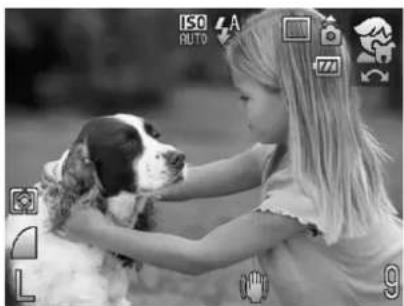
Black-and-white photo of a young girl gently holding a dog, with camera icons and UI elements in the corner (no readable text or symbols on main subjects)Take shots of kids and pets (Kids&Pets)
Lets you capture subjects that move around, such as children and pets, without missing photo opportunities.
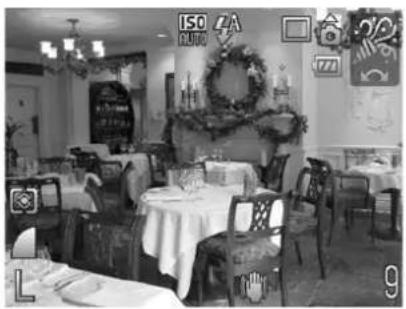
natural_image
Interior view of a restaurant with tables, chairs, and decorative wall art (no visible text or symbols)
natural_image
Black-and-white beach scene with palm tree silhouette, sunset over water, and camera control icons (no readable text or symbols)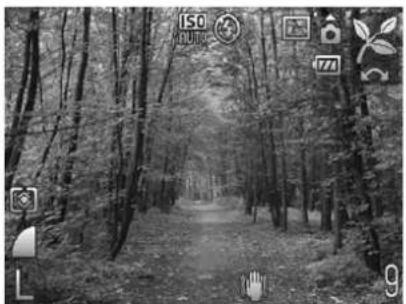
natural_image
Black-and-white photo of a forest path leading to trees, with no visible text or symbols.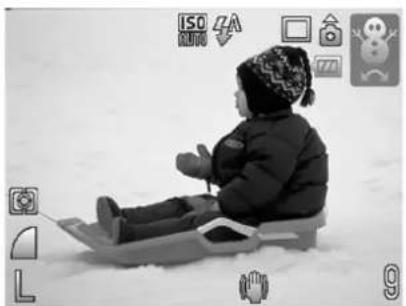
natural_image
Child sledding on a sled in snowy terrain, surrounded by camera icons and symbols (no readable text or labels)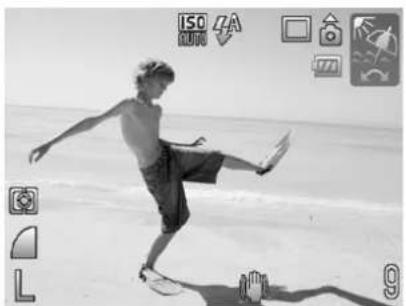
natural_image
Black-and-white photo of a person kicking a skateboard on a beach, with no visible text or symbols.Take indoor shots (Indoor)
Lets you shoot indoors with natural colors.
Shoot sunsets (Sunset)
- Lets you take shots of sunsets in vivid colors.
Take shots of foliage (Foliage)
Lets you shoot trees and leaves such as new growth, autumn leaves or blossoms in vivid colors.
Take shots of people and snow (Snow)
Lets you take shots of properly lit people against snowy backgrounds with natural colors.
Take shots of people at the beach (Beach)
- Lets you take shots of properly lit people near water or sand where reflected sunlight is strong.

In FA, or 🚗, images may appear rough because the ISO speed (p. 70) is increased to match the shooting conditions.
natural_image
Black and white photo of a fireworks display with no visible text or symbols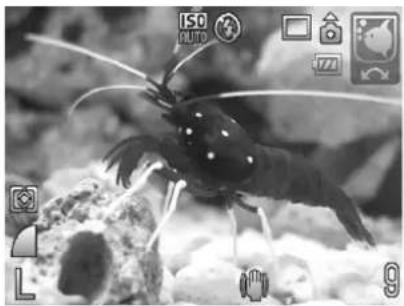
natural_image
Black-and-white photo of a shrimp on rocky ground with camera interface icons (no readable text or symbols)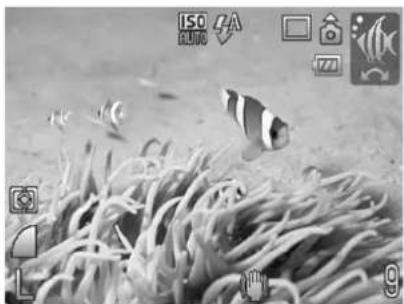
natural_image
Black-and-white underwater photo of a fish swimming among seaweed, with no visible text or symbols.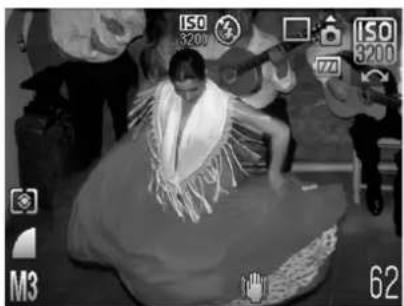
natural_image
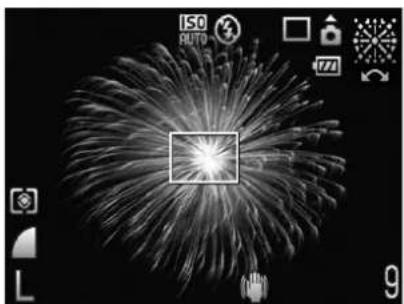
Black-and-white photo of a person in a dress with camera and exposure lens overlays (no readable text or symbols)Take shots of fireworks (Fireworks)
- Lets you take shots of fireworks in vivid colors.
Take shots of aquatic life in an aquarium (Aquarium)
- Lets you shoot aquatic life in indoor aquariums with natural colors.
Shoot underwater (Underwater)
- Let's you shoot underwater with Waterproof Case WP-DC27 (sold separately).
ISO 3200 Shoot using high ISO speed (ISO3200)
Sets the ISO speed to 3200, and lets you shoot without camera shake or subject blurring even in low light conditions.
Recording pixels are set to M3 (1600 x 1200 pixels) (p. 68).

- In ☑, attach the camera to a tripod so that the camera does not move and blur the image. Additionally, you are recommended to set [IS Mode] to [Off] (p. 145).
- In 📄 or 🏠, images may appear rough because the ISO speed (p. 70) is increased to match the shooting conditions.
• In ISO 3200, images may appear rough.

Turning the Flash Off
You can turn the flash off when shooting.
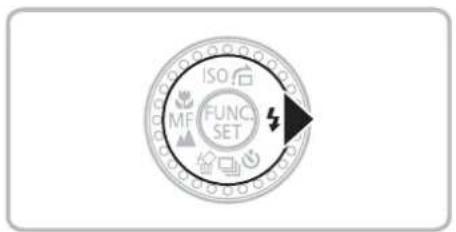
1 Press the ▶ button.
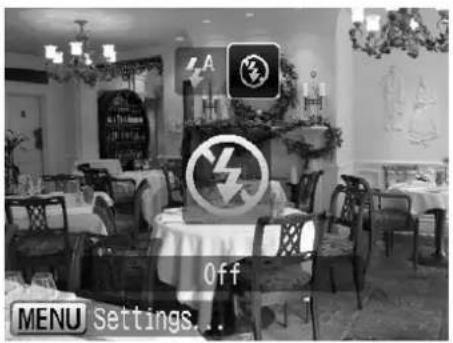
2 Select ↙.
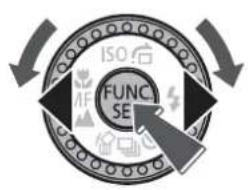
- Press the ◀▶ buttons or turn the Ⓞ dial to select ⏻, then press the Ⓗ️ button.
Once set, Ⓜ will appear on the screen.
After shooting, the camera will return to ⬆ ^A .
flowchart
graph TD
    A["FUNC SE"] --> B["ISO"]
    A --> C["AF"]
    A --> D["Data Transfer Icon"]
    style A fill:#f9f,stroke:#333
    style B fill:#ccf,stroke:#333
    style C fill:#cfc,stroke:#333
    style D fill:#fcc,stroke:#333

What if the indicator blinks orange and a flashing appears?
When you press the shutter button halfway in low light conditions where camera shake is likely, the indicator will blink orange and a flashing 📋 will appear on the screen. Attach the camera to a tripod so that the camera does not move.

Cannot be set when the shooting mode is set to ☐ or ISO 3200 (p. 56).
[+] Zooming in More Closely on Subjects (Digital Zoom)
You can use the digital zoom to zoom up to a maximum of 15x and capture subjects that are too far away for the optical zoom (p. 21) to enlarge. The images may appear rough, however, depending on the recording pixel setting (p. 68) and the zoom factor used.
![CANON IXUS 980 IS - [+] Zooming in More Closely on Subjects (Digital Zoom) - 1](/content/2026/05/1103579/images/879ea09d809eb169cd7a80ad84f9425c371fe5a23c1156af32d80540d9d54d43.jpg)
natural_image
Diagram of a car dashboard with control panel and directional arrows (no text or symbols)1 Move the zoom lever toward [▲].
Hold the lever until zooming stops.
If you release the zoom lever, the largest possible zoom factor without image deterioration, and *I* will appear.
![CANON IXUS 980 IS - Move the zoom lever toward [▲]. - 1](/content/2026/05/1103579/images/c6cabbe2f2fb552159a0844c22e6bf16374d5a38c2dabd72b7ec751ea8dd2afb.jpg)
natural_image
Black-and-white photo of a bird perched on a branch with flowers and a 3.7x speed indicator (no readable text or symbols)2 Move it toward [▲] again.
The subject will enlarge even more with the digital zoom, and the zoom factor will appear in blue.
Zones Where Images Deteriorate
| Recording Pixels | Optical Zoom | Digital Zoom |
| L | 3.7x → | |
| M1 | 3.7x → | 4.7x → |
| M2 | 3.7x → | 6.3x → |
| M3 | 3.7x → | 10x → |
| S | 3.7x → | 15x → |
![CANON IXUS 980 IS - Move it toward [▲] again. - 1](/content/2026/05/1103579/images/b5d2c76bba3b161f5556a67276992f3235ed95bed80247d33dddd6360bd4427e.jpg)
![CANON IXUS 980 IS - Move it toward [▲] again. - 2](/content/2026/05/1103579/images/3c8ef1a7340acd74d8c90a13a5f9632f62edfdf7c491c0388818f85d403c5f8e.jpg)
: No image deterioration (zoom factor appears white)
![CANON IXUS 980 IS - Move it toward [▲] again. - 3](/content/2026/05/1103579/images/5cc54688557f109b548f6e140a0f709bdba03f3137641f5875baa9579aedf12e.jpg)
: Image deterioration (zoom factor appears blue)
![CANON IXUS 980 IS - Move it toward [▲] again. - 4](/content/2026/05/1103579/images/c022445715107239730d0767c103be9206679be47583a6208a5bdcb0030db6dc.jpg)
When the zoom temporarily stops
If you keep holding the zoom lever, the zoom will temporarily stop at the point where the zoom factor is at its maximum without image deterioration. In L this is at 3.7x, in M1 at 4.7x, in M2 at 6.3x, and in M3 at 10x, but in S it will zoom up to 15x without pausing.

Turning off the digital zoom
To turn off the digital zoom, press the MENU button, select the ☐ tab, and then select the [Digital Zoom] menu item and [Off] option.

The focal length when using digital zoom is 36 - 532 mm (35mm film equivalent).
Digital Tele-Converter
The focal length of the lens can be increased by an equivalent of 1.7x and 2.2x. This enables a faster shutter speed and less chance of camera shake than just using zoom (including digital zoom) at the same zoom factor. The images may appear rough, however, depending on the combination of recording pixel (p. 68) and digital tele-converter settings used.
flowchart
graph TD
    A["ISO"] --> B["IF"]
    B --> C["FUNC"]
    C --> D["SET"]
    D --> A
    style A fill:#f9f,stroke:#333
    style B fill:#ccf,stroke:#333
    style C fill:#cfc,stroke:#333
    style D fill:#fcc,stroke:#333
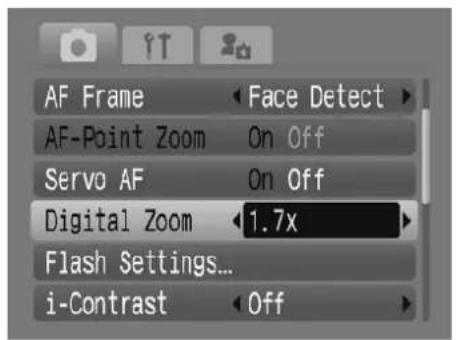
- Press the MENU button and select the tab, then select [Digital Zoom] and use the ◀▶ buttons to select [1.7x] or [2.2x].
- Pressing the MENU button will return you to the shooting screen.
The view will be enlarged, T and the zoom factor will display on the screen.
To return to standard digital zoom, select [Standard] in [Digital Zoom].
Combinations that Cause Image Deterioration
• Using [1.7x] at a recording pixel setting of L or M1 will cause image deterioration (T and the zoom factor will display in blue).
• Using [2.2x] at a recording pixel setting of L, M1 or M2 will cause image deterioration (T and the zoom factor will display in blue).

- The respective focal lengths when using [1.7x] and [2.2x] are 61.2 – 226.1 mm and 79.2 – 292.6 mm (35mm film equivalent).
- The digital tele-converter cannot be used together with the digital zoom.
Inserting the Date and Time
You can insert the date and time an image was shot in the lower right corner. Once inserted, however, they cannot be deleted. Be sure to check beforehand that the date and time are correctly set (p. 17).
flowchart
graph TD
    A["MF FUNC SET"] --> B["DISP."]
    B --> C["MCNU"]
    C --> D["ISU"]
    D --> E["TF FUNC SET"]
    style A fill:#f9f,stroke:#333
    style B fill:#ccf,stroke:#333
    style C fill:#cfc,stroke:#333
    style D fill:#fcc,stroke:#333
    style E fill:#cff,stroke:#333
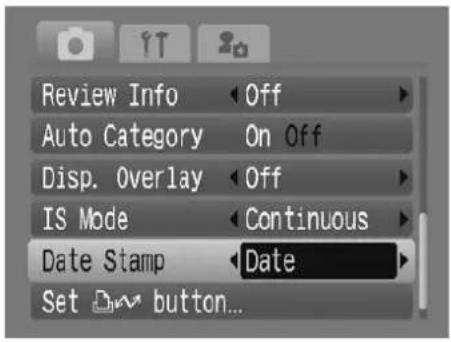
1 Select [Date Stamp].
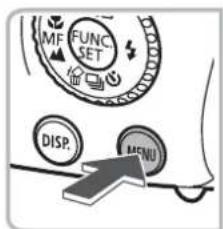
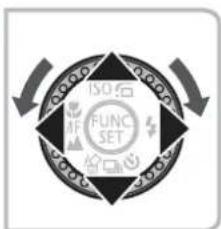
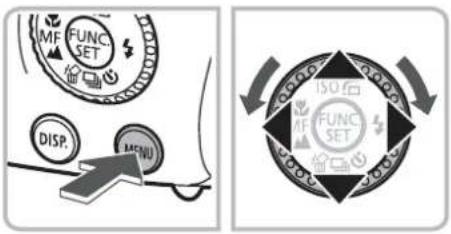
- Press the MENU button and select the tab, then select [Date Stamp] and use the ◀ buttons to select [Date] or [Date & Time].
- Press the MENU button again to make the setting.
[DATE] will appear on the screen. - If [DATE] does not appear, press the DISP. button, and set the screen display to "Information Display" (p. 42).
![CANON IXUS 980 IS - Select [Date Stamp]. - 1](/content/2026/05/1103579/images/9eb66290254cbf348453a571d93e152b6fe0170bc1b99ec75a62e8fafc03462e.jpg)
natural_image
Black-and-white landscape photo of a lakeside garden with palm trees, a thatched-roof pavilion, and a circular timestamp (no readable text or symbols)2 Shoot.
You can insert the date and time an image was shot in the lower right corner.
- When returning to the original setting, select [Off] in Step 1.

Inserting and printing the date and time in images which do not have an embedded date and time
• Use the DPOF print settings (p. 132) to print.
• Use the included software to print.
Refer to the Software Starter Guide for details.
- Connect the camera to a printer to print.
Refer to the Direct Print User Guide for details.

Using the Self-Timer
When the person shooting wishes to join in a group photo, the self-timer can be used to shoot. Approximately 10 seconds after the shutter button is pressed, the camera will take the photo.
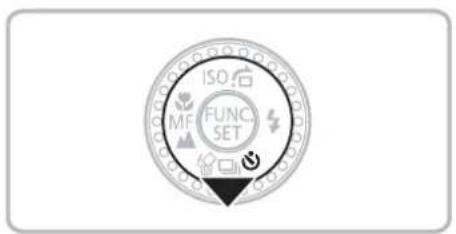
1 Press the ▼ button.
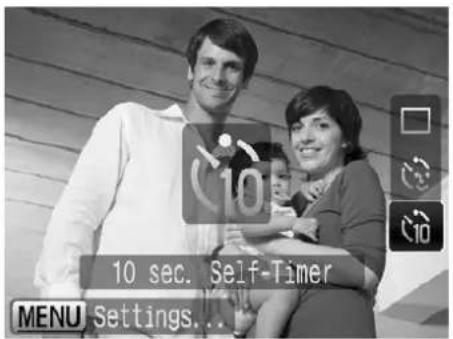
2 Select 10.
- Press the ▲▼ buttons or turn the Ⓞ dial to select ⏻, then press the Ⓗ function SET button.
Once set, 10 will appear.
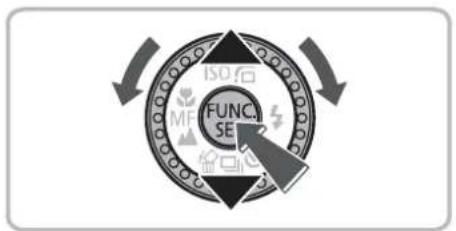
natural_image
Diagram showing a downward arrow pointing to a circular target or dial, with control buttons and a magnifying glass (no text or symbols)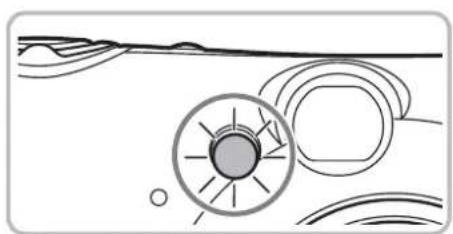
natural_image
Simple line drawing of a sunburst over water with circular patterns and a small circle (no text or symbols)3 Shoot.
- Press the shutter button halfway to focus on the subject, then press fully.
When the self-timer starts, the lamp blinks and the self-timer sound plays.
▶ Two seconds before the shutter releases, the lamp and sound speed up (the lamp remains lit when the flash will fire). - To return to the original setting, select □ in Step 2.

You can change the delay time and number of shots taken (p. 75).

Using the Face Self-Timer
Once you compose the shot, such as for a group photo, and press the shutter button, the camera will take three shots in a row two seconds after it detects your face (p. 82) when you enter the scene.
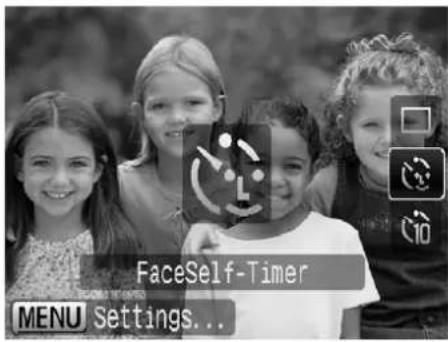
1 Select
- Follow Step 2 on p. 61 and select 📋.
2 Compose the scene and press the shutter button halfway.
Make sure a green frame appears on the face of the main subject, and white frames appear on other faces.
natural_image
Diagram of a control panel with a downward arrow and circular dial indicator (no text or symbols)3 Press the shutter button fully.
The camera will enter shooting stand-by, and [Look straight at camera to start count down] will appear on the screen.
The lamp blinks and the self-timer sound plays.
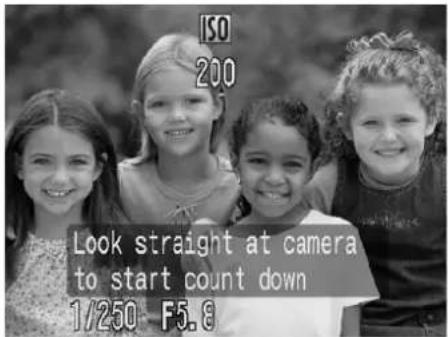
4 Join the subjects and look at the camera.
When the camera detects a new face, the lamp and sound speed up (the lamp remains lit when the flash will fire), and two seconds later the shutter releases.
The second and third shots will continue to be taken.
To return to the original setting, select □ in Step 2 on p. 61.

What if a face is not detected?
Even if your face is not detected after joining the subjects, the shutter will release approximately 30 seconds later.

Changing the number of shots
For the screen in Step 1, press the MENU button and select [FaceSelf-Timer] in the [Drive Settings] screen, then press the ◀ button to change the number of shots.

Shooting Close-ups (Macro)
You can shoot an object at a close distance or even shoot extreme close-ups of it. The possible shooting range is approximately 5 – 50 cm (2.0 in. – 1.6 ft.) from the end of the lens when the zoom lever is moved to the maximum wide angle, and approximately 40 – 50 cm (1.3 – 1.6 ft.) when the zoom lever is moved to the maximum telephoto side.
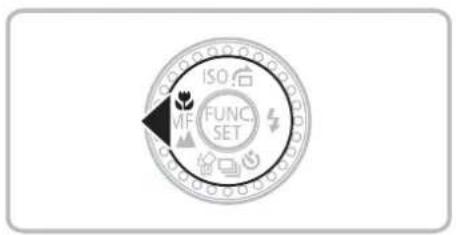
1 Press the ◀ button.
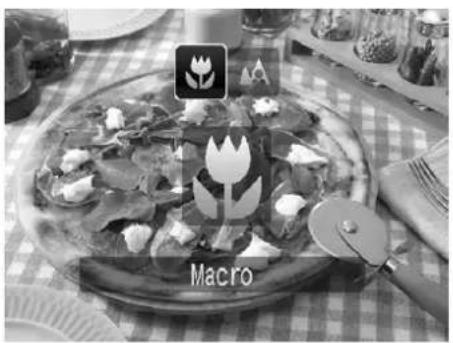
natural_image
Black-and-white photo of a plate with salad and flower design, labeled 'Macro' (no readable text beyond label)2 Select 🎨.
- Press the ◀▶ buttons or turn the Ⓞ dial to select 🔊, then press the FUNC SET button.
Once set, 🎨 will appear.
To return to the original setting, select ▲.
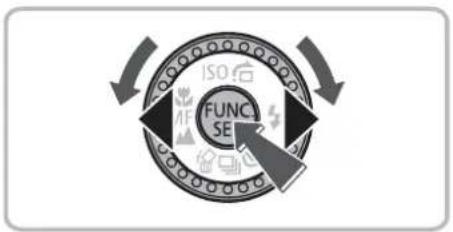
flowchart
graph TD
    A["FUNCTION SE"] --> B["ISO"]
    style A fill:#f9f,stroke:#333
    style B fill:#bbf,stroke:#333

Using 📊2
You are recommended to attach the camera to a tripod and shoot in Ⓞ2, so that the camera does not move and blur the image (p. 74).

The edges of the image may darken if the flash fires.

Cannot be set when the shooting mode is set to ⚙ (p. 54), ⚙ (p. 55) or ⚗ (p. 56).
Zooming In on Close Subjects (Digital Macro)
You can zoom in on subjects and take pictures while close to them. The possible shooting range is approximately 5 – 50 cm (2.0 in. – 1.6 ft.) (when moving the zoom lever to the maximum wide angle side as on p. 63) from the end of the lens, however, you can shoot zooming in even closer to the subject using the digital zoom.
Using the digital zoom may cause images to come out rough depending on the recorded pixels (p. 68).
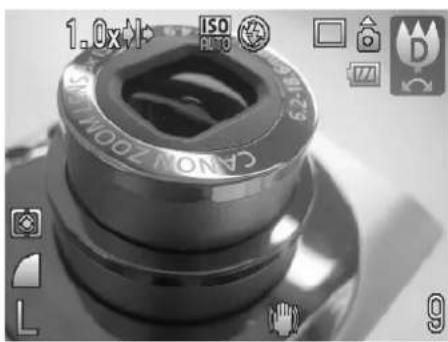
natural_image
Close-up of a Canon ZOOM lens with camera mode and adjustment icons (no readable text or symbols)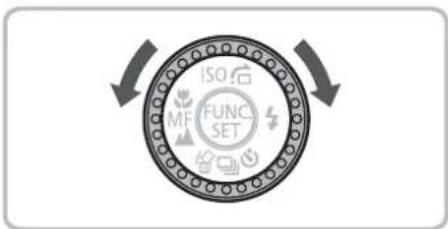
1 Set the mode dial to SCN (p. 40).
2 Turn the Ⓞ dial to Ⓟ.
The optical zoom will lock at the maximum wide angle.
3 Use the zoom lever to compose the shot.
The camera will zoom in, and the zoom factor will appear.
Zones Where Images Deteriorate
• No image deterioration (zoom factor appears white)
• Image deterioration (zoom factor appears blue)

Using 2
You are recommended to attach the camera to a tripod and shoot in Ⓗ2, so that the camera does not move and blur the image (p. 74).
Making Settings for the Images You Want
In this chapter you will learn how to use the various functions in P mode, and methods of shooting in → mode to progressively advance your shooting skills.
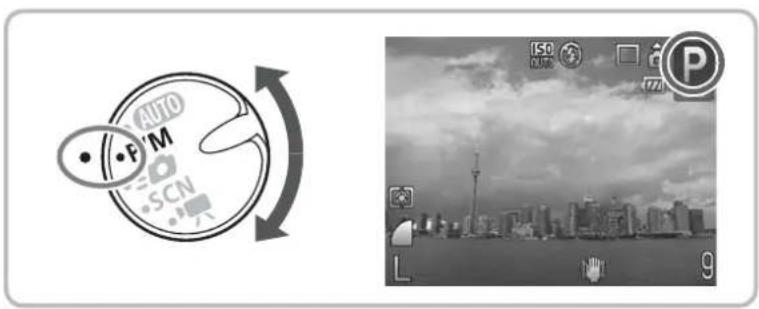
It is assumed that the mode dial is set to P / M , and that the camera is in P mode.
• P/M is an abbreviation for Program AE, and Manual.
- In "Shooting with 8 (Quick Shot)" (p. 79), it is assumed that the mode dial is set to 📄.
- Before attempting to shoot using a function explained in this chapter in modes other than P mode, check if the function is available in those modes (pp. 156 – 159)
P Shooting in Program AE
You can set various functions as you like for shooting.
AE stands for Auto Exposure.
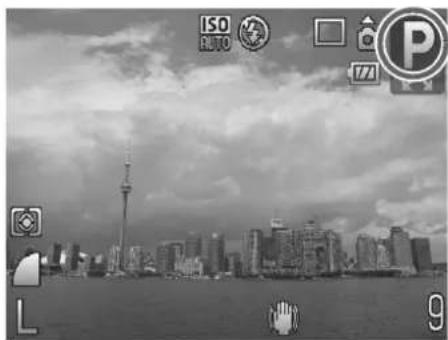
natural_image
Black-and-white cityscape photo featuring a prominent tower and modern skyscrapers under cloudy skies, with camera icons and location markers visible (no readable text or symbols)1 Set the mode dial to P/M (p. 40).
2 Turn the Ⓞ dial to P.
3 Make settings according to purpose (pp. 67 - 75).
4 Shoot.
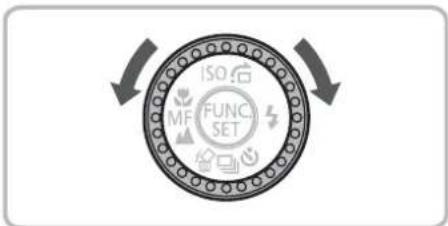
flowchart
graph TD
    A["ISO"] --> B["MF"]
    B --> C["FUNC SET"]
    C --> D["Output"]
    style A fill:#f9f,stroke:#333
    style B fill:#ccf,stroke:#333
    style C fill:#cfc,stroke:#333
    style D fill:#fcc,stroke:#333

What if shutter speed and aperture value are displayed in red?
If a correct exposure cannot be obtained when pressing the shutter button halfway, shutter speed and aperture value are shown in red. Try the following settings to obtain the correct exposure.
- Turn on the flash (p. 67)
- Select a higher ISO speed (p. 70)

Turning the Flash On
You can make the flash fire every time you shoot. The area that is possible to shoot with a flash when the zoom lever is moved to 🐘, and the maximum wide angle is reached is approximately 50 cm – 4.6 m (1.6 – 15 ft.), and approximately 50 cm – 2.4 m (1.6 – 7.9 ft.) when the maximum telephoto level is reached.
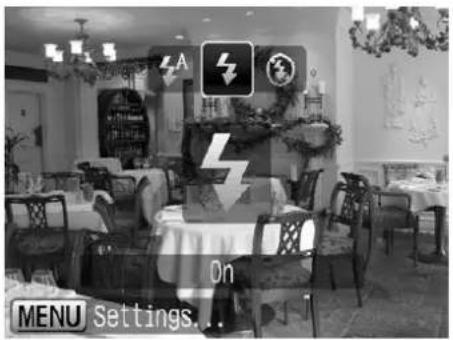
Select ↘.
After pressing the ▶ button, press the ◀▶ buttons or turn the ⏻ dial to select ↓, then press the Ⓗ️ button.
Once set, ↓ will appear.

Shooting Far Away Subjects (Infinity)
You can shoot landscapes and far away subjects. The focusing range is 3 m (9.8 ft.) and greater from the camera.
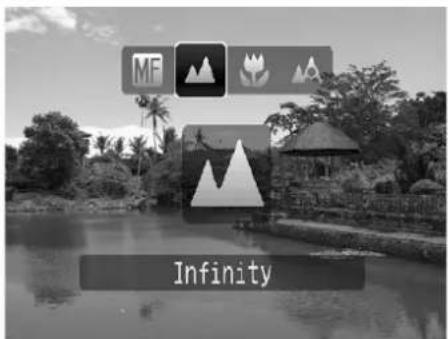
Select ▲.
After pressing the ◀ button, press the ◀▶ buttons or turn the Ⓞ dial to select ▲, then press the Ⓗ️ button.
Once set, ▲ will appear.
Changing the Recording Pixels (Image Size)
You can select from six types.
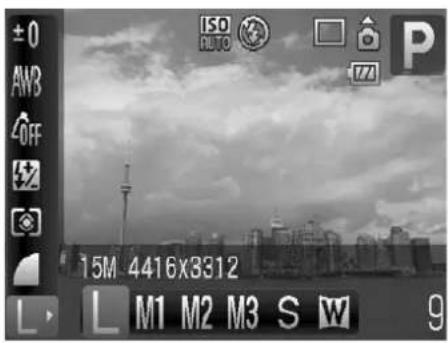
1 Select the recording pixels.
- Press the Ⓗ button, then select L in the FUNC. menu.
2 Select an option.
- Press the ◀▶ buttons or turn the Ⓞ dial to select an option, then press the Ⓗ function SET button.
The setting you made will be displayed on the screen.

If you select W, you cannot use the Digital Zoom (p. 58) or Digital Tele-Converter (p. 59).
Changing the Image Quality (Compression Ratio)
You can select from three levels of image quality. They are, in order of highest to lowest: ⚫ (Superfine), ⏻ (Fine), ⏱ (Normal).
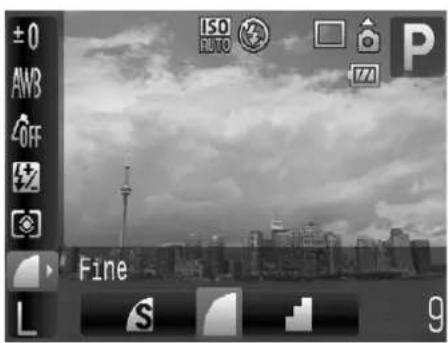
1 Select the image quality.
- Press the FUNC.SET button, then select in the FUNC. menu.
2 Select an option.
- Press the ◀▶ buttons or turn the ⏻ dial to select an option, then press the Ⓗ function SET button.
The setting you made will be displayed on the screen.
Approximate Values for Recording Pixels and Image Quality
| Recording Pixels | Image Quality | Single Image Data Size (Approx. KB) | Recordable Images/Memory Card | ||
| 32 MB (Supplied) | 2 GB | 8 GB | |||
| L (Large)15 M*/4416 x 3312 | 6348 | 4 | 306 | 1227 | |
| 3759 | 7 | 516 | 2063 | ||
| 1797 | 16 | 1059 | 4234 | ||
| M1 (Medium 1)9 M/3456 x 2592 | 3888 | 7 | 499 | 1996 | |
| 2302 | 12 | 841 | 3364 | ||
| 1100 | 26 | 1707 | 6822 | ||
| M2 (Medium 2)5 M/2592 x 1944 | 2503 | 11 | 767 | 3069 | |
| 1395 | 20 | 1365 | 5457 | ||
| 695 | 41 | 2672 | 10679 | ||
| M3 (Medium 3)2 M/1600 x 1200 | 1002 | 29 | 1862 | 7442 | |
| 558 | 52 | 3235 | 12927 | ||
| 278 | 99 | 6146 | 24562 | ||
| S (Small)0.3 M/640 x 480 | 249 | 111 | 6830 | 27291 | |
| 150 | 171 | 10245 | 40937 | ||
| 84 | 270 | 15368 | 61406 | ||
| W (Widescreen)4416 x 2480 | 4753 | 5 | 409 | 1637 | |
| 2814 | 10 | 690 | 2759 | ||
| 1345 | 21 | 1396 | 5581 | ||
- The values in the table are according to guidelines set by Canon. The values may change depending on the subject, memory card, and camera settings.
* The value has been rounded up to two significant figures (CIPA guideline standard).
Approximate Values for Paper Size
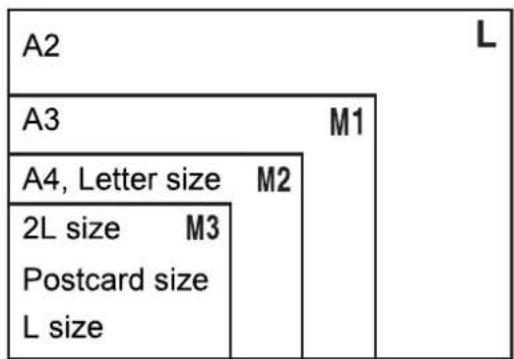
- S Suitable for sending images as e-mail attachments.
- For printing on wide size paper.
ISO Changing the ISO Speed

Select an option.
After pressing the ▲ button, press the ▲▼ buttons or turn the Ⓞ dial to select an ISO speed, then press the FUNC SET button.
Once set, the ISO speed will appear on the screen.
Approximate Values for ISO Speed
| ISO AUTO | Automatically sets the ISO speed for shooting mode and shooting conditions. | |
| ISO HI | Automatically sets the optimal speed for the shooting mode, shooting conditions and subject or camera motion.Depending on the scene, the speed may be set higher than in ISO Auto, resulting in less subject blur and camera shake. | |
| ISO 80 ISO 100 ISO 200 | Low↑High | Fine weather condition, outdoor shooting. |
| ISO 400 ISO 800 | Cloudy, Twilight | |
| ISO 1600 | Night view, Dark indoor | |

Changing the ISO speed
• Lowering the ISO speed results in crisper images.
- Raising the ISO speed results in a faster shutter speed, reducing camera shake and letting the flash reach greater distances to the subject. The images, however, will appear rough.

- When the camera is set to ISO or ISO, you can press the shutter button halfway to display the automatically set ISO speed.
• In ISO, images may appear rough. - With ISO3200, you can set an even faster speed (p. 56).
Adjusting the Tone (White Balance)
The white balance (WB) function adjusts the optimal white balance for natural looking colors.
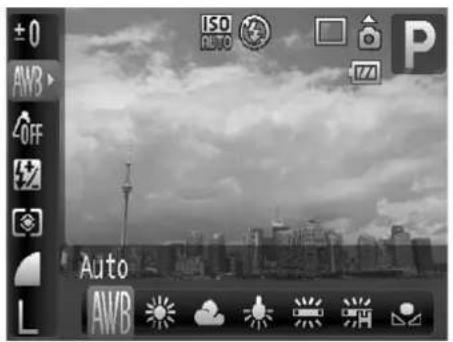
1 Select the white balance.
- Press the Ⓗ button, then select AWB in the FUNC. menu.
2 Select an option.
- Press the ◀▶ buttons or turn the Ⓞ dial to select an option, then press the Ⓗ FUNC SET button.
| AWB | Auto | Automatically sets the optimal white balance for the shooting conditions. |
| Day Light | Fine weather condition, outdoor shooting. | |
| Cloudy | Cloudy, shady, twilight conditions | |
| Tungsten | Tungsten, bulb-type (3-wavelength) fluorescent. | |
| Fluorescent | Warm-white fluorescent, cool-white fluorescent, warm-white-type (3-wavelength) fluorescent. | |
| Fluorescent H | Daylight fluorescent, daylight-type (3-wavelength) fluorescent. | |
| Custom | Manually sets the custom white balance. |

Custom White Balance
You can adjust the white balance to the light source at the shooting location and shoot with the appropriate color. Make sure that you set the white balance under the light source of the shooting scene.
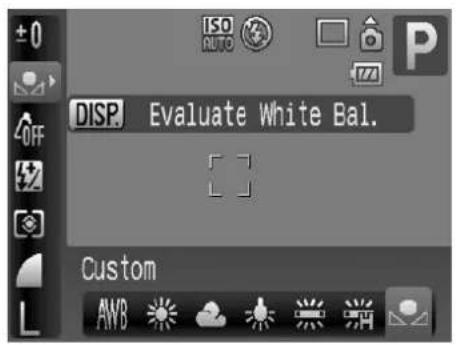
In Step 2 above, select
Make sure the entire screen is filled with the white subject, then press the DISP. button.
The tint on the screen will change when the white balance data is set.
Adjusting the Brightness (Exposure Compensation)
You can adjust the standard exposure set by the camera in 1/3-stop increments in the range of -2 to +2.
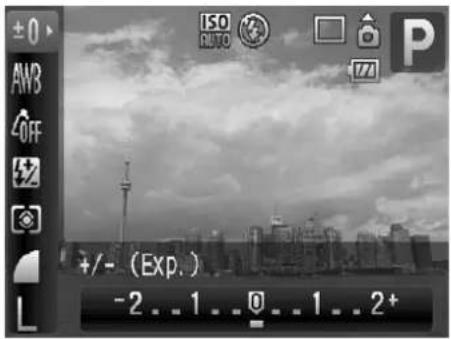
1 Select the exposure compensation.
- Press the Ⓗ function SET button, then select ±0.
2 Adjust the brightness.
While watching the screen, press the ◀▶ buttons or turn the Ⓞ dial to adjust the brightness and press the FUNC SET button.
After the picture has been taken, return the setting to 0 (zero).

Continuous Shooting
You can shoot continuously (about 1.3 images/second).
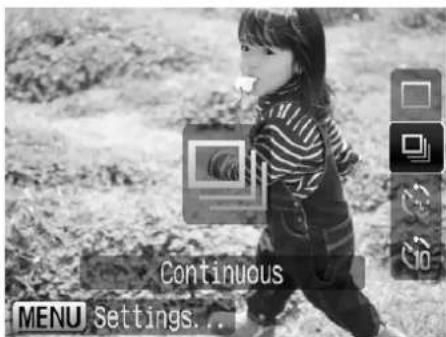
1 Select the drive mode.
After pressing the ▼ button, press the
▲▼ buttons or turn the ○ dial to select □, then press the FUNC SET button.
2 Shoot.
As long as you hold the shutter button down, the camera will shoot successive images.

- As the number of images increases, the shooting intervals may take longer.
- If the flash fires, shooting intervals may take longer.
Changing the Tone of an Image (My Colors)
You can change the tone of an image into sepia or black and white when shooting.
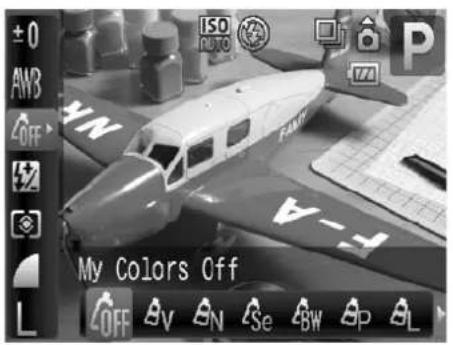
1 Select My Colors.
- Press the FUNC SET button, then select OFF in the FUNC. menu.
2 Select an option.
- Press the ◀▶ buttons or turn the Ⓞ dial to select an option, then press the Ⓗ FUNC SET button.
The setting you made will be displayed on the screen.
| OFF | My Colors Off | — |
| _V | Vivid | Emphasizes the contrast and color saturation for a vivid impression. |
| _N | Neutral | Tones down the contrast and color saturation for neutral hues. |
| _Se | Sepia | Sepia tones. |
| _W | B/W | Black and white. |
| _P | Positive Film | Like the Vivid Red, Vivid Green or Vivid Blue effects, produces intense natural appearing colors like those obtained with positive film. |
| _L | Lighter Skin Tone | Makes skin tones lighter. |
| _D | Darker Skin Tone | Makes skin tones darker. |
| _B | Vivid Blue | Emphasizes blue tints. Makes the sky, ocean and other blue subjects more vivid. |
| _G | Vivid Green | Emphasizes green tints. Makes mountains, foliage and other green subjects more vivid. |
| _R | Vivid Red | Emphasizes red tints. Makes red subjects more vivid. |
| _C | Custom Color | (p. 74) |

- In se and BW , white balance cannot be set (p. 71)
- In L and D , colors other than people's skin color may change. You may not obtain the expected results depending on the skin color.

Custom Color
The contrast, sharpness, color saturation, red, green, blue, and skin tones in an image can be chosen and set from 5 different levels.
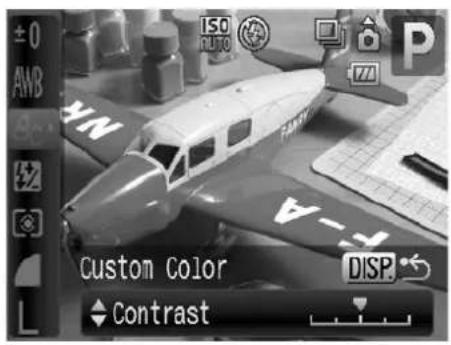
- Follow Step 2 on p. 73 and select _ , then press the DISP. button.
- Press the ▲▼ buttons to select an option, then use the ◀▶ buttons or turn the Ⓞ dial to select a value.
The more to the right, the stronger/deeper the effect gets, the more to the left, the weaker/lighter the effect gets. - Press the DISP. button to make the setting.

Shooting Using the Two Second Self-Timer
You can set the self-timer to an approximate two second delay.
1 Display the [Drive Settings] screen.
● After pressing the ▼ button, immediately press the MENU button.
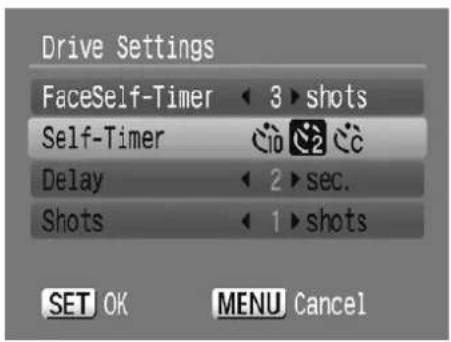
2 Select Ⓤ2.
- Press the ▲▼ buttons or turn the Ⓞ dial to select [Self-Timer].
- Press the ◀▶ buttons to select ⏻2, then press the ⒽFUNC.SET button.
- Select the Ⓤ2 in Steps 1 and 2 on p. 61.
You can set the time delay (0 – 30 seconds) and the number of shots (1 – 10 shots).
1 Display the [Drive Settings] screen.
● After pressing the ▼ button, immediately press the MENU button.
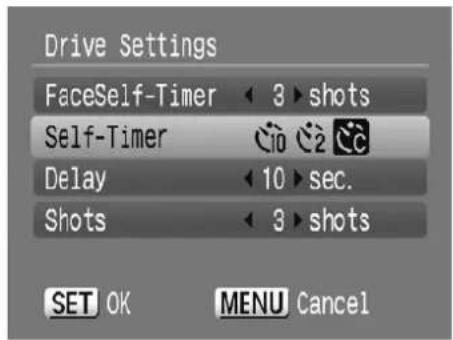
2 Select ⓒ.
- Press the ▲▼ buttons or turn the Ⓞ dial to select [Self-Timer], then use the ◀▶ buttons to select ⬇.
3 Make the settings.
- Press the ▲▼ buttons, or turn the dial to select [Delay] or [Shots].
- Press the ◀▶ buttons to select a value, then press the Ⓗ️ button.
- Select the Ⓞ in Steps 1 and 2 on p. 61.


What if the number of shots is set to more than 2 shots?
- Exposure and white balance settings are fixed to the first shot.
- When you set the time delay for more than 2 seconds, the self-timer lamp and sound speed up 2 seconds before the shutter releases (when the flash will fire, the lamp will light).

- If the flash fires, the shooting interval may take longer.
- If you set a high number of shots, the shooting interval may take longer.
- If the memory card becomes full, shooting stops automatically.
Shooting Using the Viewfinder
If you want to save battery power, you can use the viewfinder for shooting, instead of the screen (p. 13). Operations for shooting are the same as when using the screen.
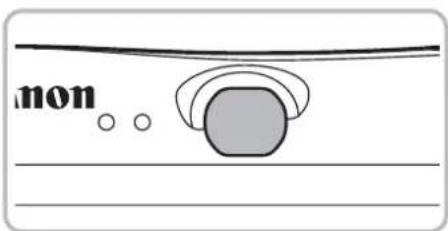
1 Turn off the screen (p. 42).
- Press the DISP. button to turn off the screen.
2 Compose the scene and shoot.
- Use the viewfinder to compose the scene and shoot.

The area in the viewfinder and the area in the image taken may differ slightly.
Shooting Using a TV
You can use a TV to display the camera screen.
- Connect the camera to a TV as described in "Viewing Images on a TV" (p. 112).
- Operations for shooting are the same as when using the camera's monitor.
Shoot While Checking the Histogram
You can shoot while checking the brightness distribution of your composition in the histogram (p. 44) (real time histogram).
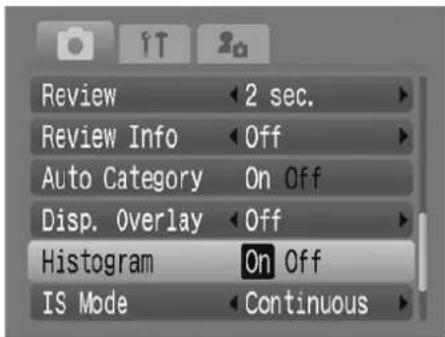
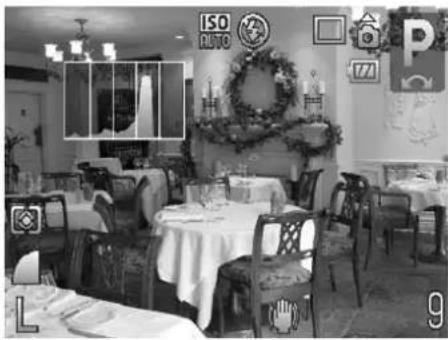
natural_image
Interior of a restaurant with tables, chairs, and decorative wall art (no visible text or symbols)1 Set the display to [Information Display] (p. 42).
2 Select [Histogram].
- Press the MENU button, and select [Histogram] from the 📄 tab, and press the ◀▶ buttons to select [On].
The histogram will appear and the brightness distribution in the composition will display in real time.
Changing the Composition to Shoot (Focus Lock)
While you press the shutter button halfway, the focus and exposure are fixed. You can now recompose and shoot. This is called Focus Lock.
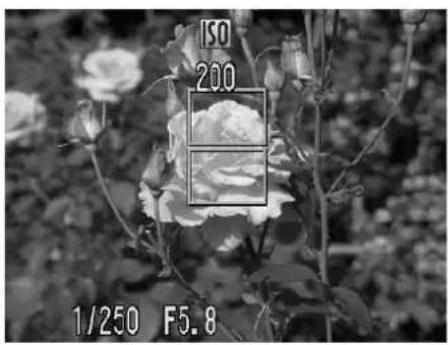
natural_image
Black-and-white photo of a blooming rose with visible flowers and foliage, no text or symbols present.1 Focus.
- Center the subject you want to shoot, and press the shutter button halfway.
- Confirm that the AF Frame on the subject is green.
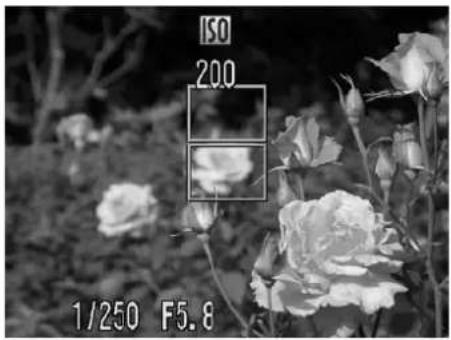
natural_image
Black-and-white photo of roses in a garden setting, no visible text or symbols on the main subject2 Recompose.
- Hold the shutter button pressed halfway and recompose the scene.
3 Shoot.
- Press the shutter button fully.
Shooting with ≈ (Quick Shot)
Shoot using the viewfinder (p. 76). Since you can keep the focus and exposure adjusted, even without pressing the shutter button halfway, you can capture moving subjects without missing a shot.
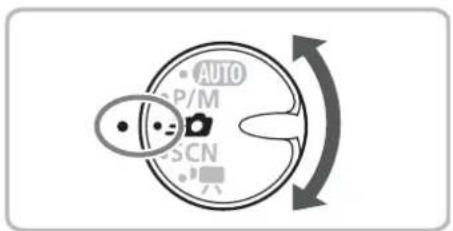
1 Set the ≡ mode.
- Set the mode dial to 📄.
The display will switch to the screen in Step 2.
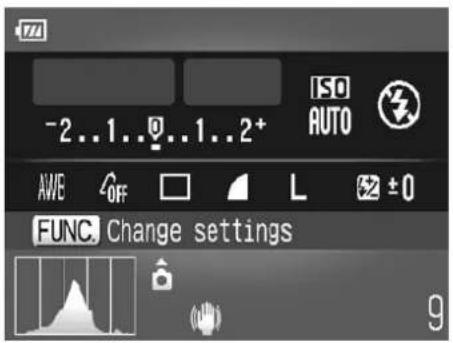
2 Make the setting.
After pressing the FUNC SET button, press the ▲▼◀▶ buttons and select a menu item.
- Turn the ○ dial to select an option, and press the ● button.
- If you press the DISP. button, the display will turn off. If you press it again, the display will turn back on.
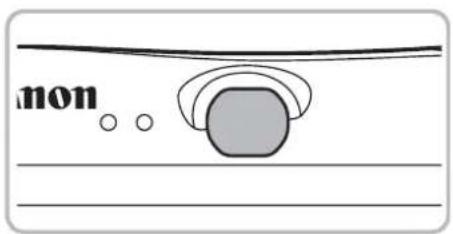
3 Adjust the focus and exposure.
Make sure that the subject is within the viewfinder.
When a person's face is detected, the focus and exposure will continue to be adjusted.
When no faces are detected, the focus and exposure will continue to adjust on the subject toward the center of the viewfinder.
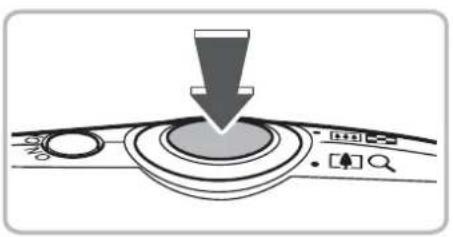
natural_image
Diagram showing a directional arrow pointing downward over a circular control dial with control buttons (no text or symbols)4 Shoot.
- If you have a photo opportunity, quickly press the shutter button all the way after pressing halfway.
The image shot will display on the screen.
Estimated number of shots in 📞
In ☐, since the focus and exposure are constantly being adjusted, the battery will be depleted quicker than usual. Approximately 180 shots are possible while shooting in this mode.

The area in the viewfinder and the area in the image taken may differ slightly.

- If you press the shutter button halfway, the focus will lock (p. 78).
- You cannot shoot with the screen turned on.
Settings Screen
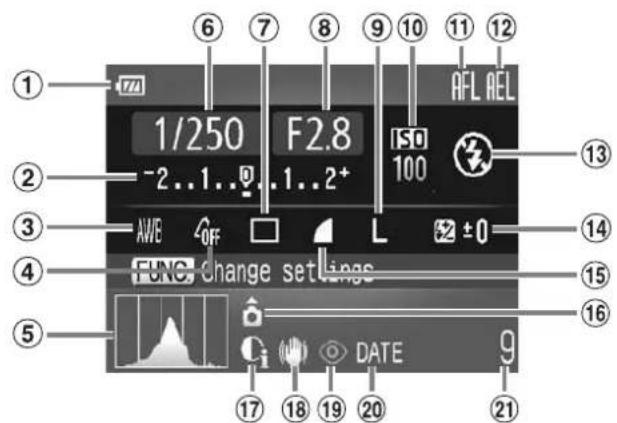
① Battery Charge Indicator (p. 13)
② Exposure Compensation (p. 72)
③ White Balance (p. 71)
④ My Colors (p. 73)
⑤ Histogram (p. 44)
⑥ Shutter Speed (p. 89)
⑦ Drive Mode (pp. 61, 62, 72, 75)
⑧ Aperture Value (p. 89)
⑨ Recording Pixels (p. 68)
⑩ ISO Speed (p. 70)
⑪ AF Lock (p. 84)
⑫ AE Lock (pp. 87, 99) / FE Lock (p. 88)
⑬ Flash Mode (pp. 57, 67)
⑭ Flash Exposure Compensation (p. 88)
⑮ Image Quality (Compression) (p. 68)
⑯ Camera Orientation (p. 42)
⑰ i-Contrast (p. 91)
⑱ Image Stabilizer (p. 145)
⑲ Red-Eye Correction (p. 92)
⑳ Shooting Date and Time (p. 60)
②1 Recordable Shots (p. 16)

You cannot use menu items other than those that display on the settings screen, or functions that appear when you press the MENU button (p. 158).
Using Advanced Shooting Functions
This chapter serves as the advanced version of Chapter 4 and explains how to use advanced functions to capture images in exactly the way you want.
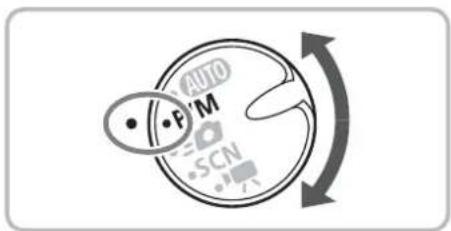
- If the mode dial is set to P/M then it is assumed that the camera is in P mode.
- “Shoot using the M shutter speed and the aperture value”, “Setting the flash output” (pp. 89 – 90) are explained assuming that the mode dial is set to P/M, and the camera is in M mode.
- Setting the mode dial to SCN, and selecting “Changing the Color and Shooting” (p. 93), “☐ Shooting Stitch Assist Images” (p. 96), and various other modes are explained.
- Before attempting to shoot using a function explained in this chapter in modes other than P mode, check if the function is available in those modes (pp. 156 – 159).
Changing the AF Frame Mode
You can change the AF (Auto Focus) frame mode to match the scene you want to shoot.
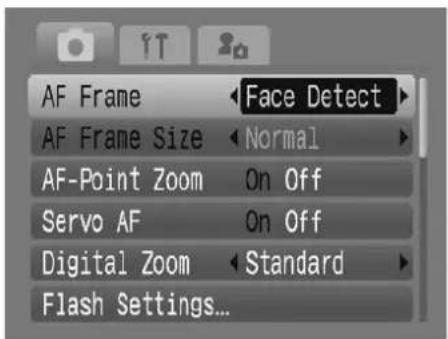
Select [AF Frame].
- Press the MENU button and select the tab, then select the [AF Frame], then press the ◀▶ buttons to select an option.
Face Detect
- Recognizes people's faces and focuses, adjusts exposure (evaluative metering only (p. 87)) and white balance (AWB only (p. 71)) for shooting.
- When the camera is pointed at subjects, a white frame appears on the face the camera judges to be the main subject, and gray frames (max. 2) will appear on other faces. When the shutter button is pressed halfway, up to 9 green frames will appear on faces the camera focuses on.

- If a face is not detected and only gray frames (no white frame) appear, the setting will change to [AiAF].
• Examples of faces that cannot be detected: - Subjects that are far away or extremely close.
- Subjects that are dark or light.
- Faces turned to the side or at a diagonal, or faces with a portion hidden.
• The camera may mistakenly identify non-human subjects as a face. - If the camera cannot focus when you press the shutter button halfway, the AF frame will not appear.
- When the display is off (p. 42), settings cannot be made.
AiAF
The camera automatically selects among 9 AF frames to focus with.

If the camera cannot focus when you press the shutter button halfway, the AF frame will not appear.
Center
The AF frame will be fixed to the center. This is effective for focusing on a specific point.

You can reduce the AF frame size
Press the MENU button, select the ☐ tab, then select the [AF Frame Size] menu item and [Small] option.

If the camera cannot focus when you press the shutter button halfway, the AF frame will turn yellow.
Shooting With Magnified Focus Display
If you press the shutter button halfway using [Face Detect] or [Center] while in AF frame mode, the AF frame will magnify and check the focus.
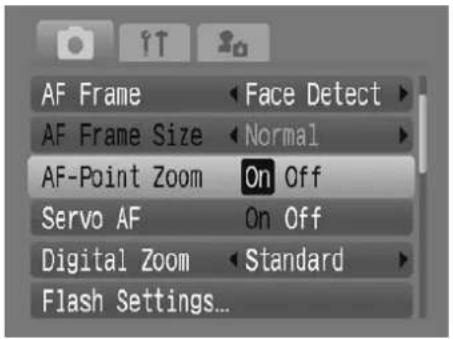
1 Set the AF frame mode to [Face Detect] or [Center] (p. 82).
2 Select [AF-Point Zoom].
- Press the MENU button and select [AF-Point Zoom] on the 📷 tab, use the ◀ buttons to select [On].
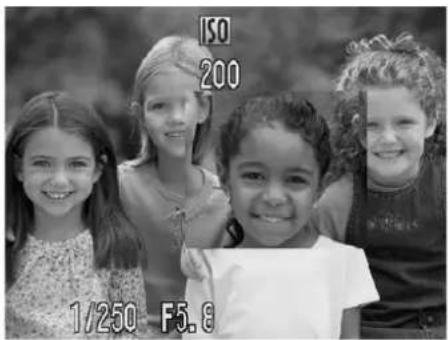
3 Focus.
In [Face Detect], the face selected as the main subject will appear magnified.
In [Center], the center AF frame will appear magnified.

What if the display does not magnify?
When in [Face Detect] if a face cannot be detected, when a face is too big in relation to the screen (p. 82), or when in [Center] and the camera doesn't focus, the display will not appear magnified.

When using Digital Zoom (p. 58), Digital Tele-Converter (p. 59), or when connected to a TV (p. 76), the magnified display will not appear.
AFL Shooting with AF Lock
The focus can be locked. After locking the focus, even when releasing your finger from the shutter button the focal area will not change.
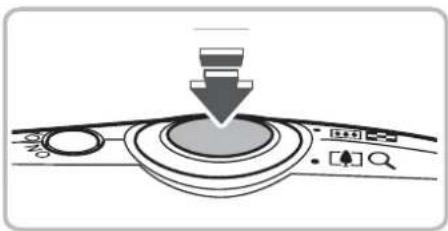
natural_image
Diagram of a camera control panel with a downward arrow and control buttons (no text or symbols)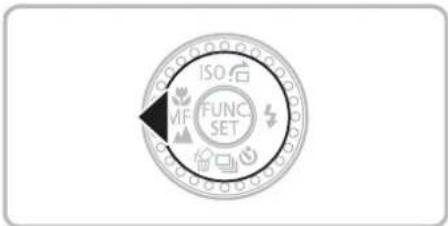
1 Focus.
- Keep the shutter button pressed halfway and press the ◀ button.
● The focus is locked, then AFL is displayed on the screen. - If you release your finger from the shutter button, and press the ◀ button once more, AFL will disappear, and the focus will unlock.
2 Compose the scene and shoot.
Shooting with Servo AF
While the shutter button is pressed halfway, the focus will continue to adjust, allowing you to take pictures of moving subjects without missing a shot.
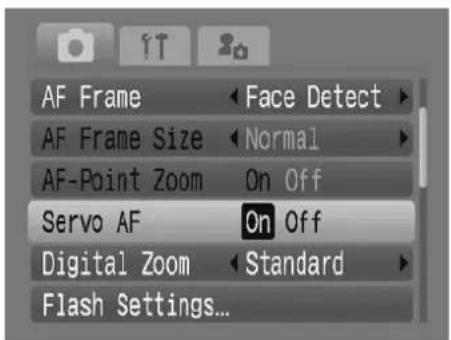
1 Set the AF frame mode to [Face Detect] or [Center] (p. 82).
2 Select [Servo AF].
- Press the MENU button and select [Servo AF] on the 📷 tab, and use the ◀▶ buttons to select [On].
3 Focus.
While the shutter button is pressed halfway, the focus will continue to adjust. In [Face Detect] it will focus on people's faces, in [Center] on the spot where the blue frame appears.

• Depending on the scene, the camera may not focus.
- You cannot shoot with the AF lock.
- You cannot set the Servo AF if you have set the [AF-Point Zoom] in the tab to [On].
MF Manual Focus
When not using the auto focus, if you press the shutter button halfway after roughly focusing manually, you can fine tune the focus.
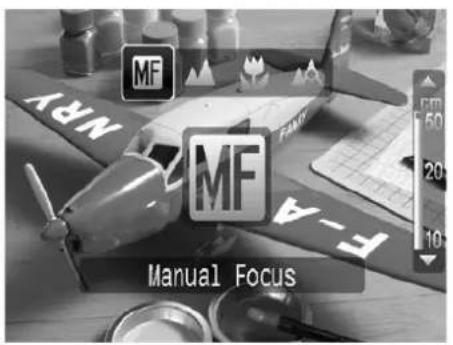
1 Press the ◀ button.
2 Select MF.
- Press the ◀▶ buttons, or turn the Ⓞ dial, select MF and quickly press the ▲ or ▼ buttons.
- MF will appear, and the center AF frame will display magnified.
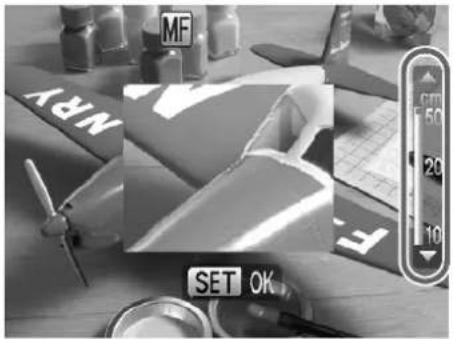
natural_image
Black-and-white photo of an airplane on a plane with overlaid camera and control panel (no readable text or symbols)3 Focusing roughly.
Using the bar that shows the distance display and AF point zoom as a guide, press the ▲▼ buttons, or turn the Ⓞ dial while looking at the magnified display, adjust the focus roughly and press the Ⓗ FUNC. SET button.
4 Fine tuning the focus.
- If you press the shutter button halfway, you can fine tune the focus.

Changing the distance display units
Press the MENU button, and select the desired units from [Distance Units] in the ƒ tab.

- In order to focus accurately, you are recommended to fix the camera to a tripod.
- Magnified display cannot be used with the digital zoom (p. 58), the digital tele-converter (p. 59) or when connected to a TV (p. 76), however the focus can be adjusted.
- When turning off the magnified display in the center of the screen, press the MENU button, and select [Off] from the 📷 tab in [MF-Point Zoom].

Selecting the Person to Focus On ace Select)
You can designate which face to focus on out of a group of people, and follow that face with in a certain area.
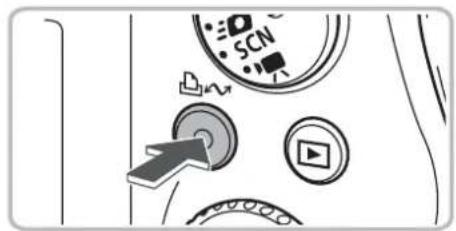
Frame
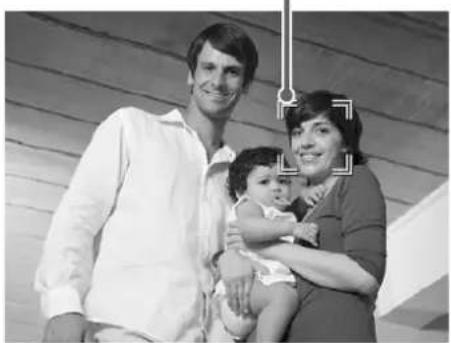
natural_image
Black-and-white family portrait of a man, woman, and child (no text or symbols visible)Register 📋 to the 🔊 ∼ button (p. 145).
2 Press the ↻ button.
You can follow the face detected as the main subject within a certain area even when it moves if a frame _1 appears.
3 Select the face to focus on.
- If you press the 📁 button, the frame will move to another face that the camera has detected. - When the frame has made a full circuit of all detected faces, you will be returned to the AF frame mode screen.
4 Shoot.
The frame around the face indicated in Step 3 will focus.

What if doesn't appear?
If a face is not detected, a frame will not appear.

Confirming the number of detected faces
Keeping the 🔊 button pressed will display the number of faces detected by the camera (35 at the most) (green: main subject's face, white: detected face).

You cannot use the Digital Zoom (p. 58) or the Digital Tele-Converter (p. 59).
Changing the Metering Mode
You can change the metering mode (brightness measuring function) to match the scene you want to shoot.
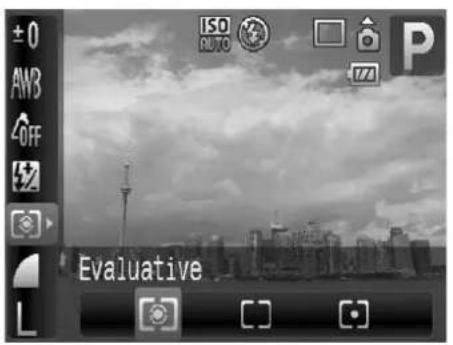
1 Select the metering mode.
- Press the Ⓗ button, then select Ⓞ in the FUNC. menu.
2 Select an option.
- Press the ◀▶ buttons or turn the Ⓞ dial to select an option, then press the Ⓗ function SET button. - The setting will be displayed on the screen.
| Evaluative | Suitable for standard shooting conditions, including back lit shots. Automatically adjusts the exposure so that the subject is always properly lit for the shooting conditions. |
| Center Weighted Avg. | Averages the light metered from the entire frame, but gives greater weight to the center. |
| Spot | Only meters within the [ ] (Spot AE Point frame) that appears at the center of the screen. |
AEL Shooting with AE Lock
When you will take several shots with the same exposure, you can set the exposure and focus separately using AE lock. AE stands for "Auto Exposure".
natural_image
Diagram of a control panel with a downward arrow and circular dial (no text or symbols)1 Set the exposure.
- Point the camera toward the subject for which you wish to set the exposure, and while pressing the shutter button halfway, press the ▲ button. - When AEL appears, the exposure will be set. - If you release your finger from the shutter button, and press the ▲ button once more, AEL will disappear, and the AE will unlock.
2 Compose the scene and shoot.
FEL Shooting with FE Lock
Just like with AE lock (p. 87), you can lock the exposure for shooting with the flash with FE lock. FE stands for "Flash Exposure".
1 Select ↘ (p. 67).
natural_image
Diagram of a control panel with a downward arrow and circular dial indicator (no text or symbols)2 Set the exposure.
- Point the camera toward the subject for which you wish to set the exposure, and while pressing the shutter button halfway, press the ▲ button.
The flash will fire and when FEL appears, the exposure will be set. - If you release your finger from the shutter button, and press the ▲ button once more, FEL will disappear, and the FE will unlock.
3 Compose the scene and shoot.
Flash Exposure Compensation
Just like with exposure compensation (p. 72), you can adjust the exposure ± 2 stops in 1/3-stop increments when using the flash.
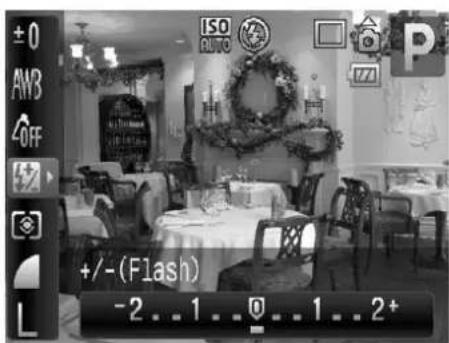
1 Select flash exposure compensation.
- Press the ⓕ. button, then select ⌘ in the FUNC. menu.
2 Set the exposure compensation.
- Press the ◀▶ buttons or turn the Ⓞ dial to set the compensation level, and press the Ⓗ button.
After shooting, return the setting to Ⓞ (zero).

You can also set the flash exposure compensation by pressing the MENU button, and selecting [Flash Settings] from the ☐ tab, and using the ◀▶ buttons.
M Setting the Shutter Speed and Aperture Value
You can set both the shutter speed and aperture value to achieve the exposure you want. M stands for "Manual".
1 Set the camera to M.
- Set the mode dial to P/M, and turn the dial to select M.

2 Select Tv Av.
- Press the FUNC.SET button, and select Tv Av in the FUNC. menu.
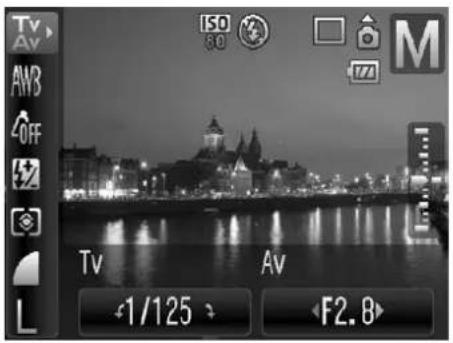
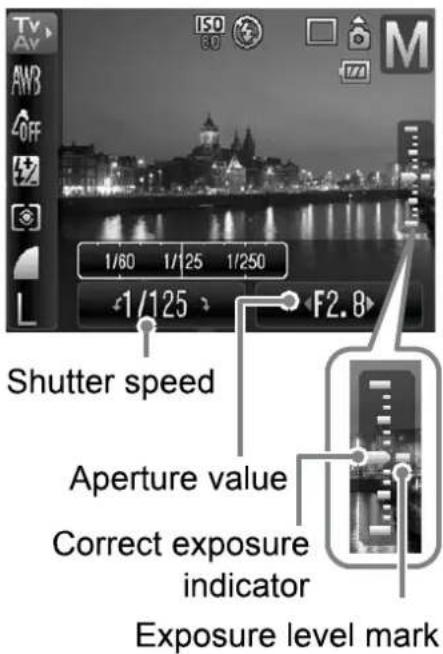
3 Make the setting.
Turn the ○ dial to select a shutter speed (Tv), then press the ◀▶ buttons to set the aperture value (Av), and press the Ⓗ️ button.
The set values will synchronize, the exposure level mark will move, and you can check how far off the exposure is from the correct level.
- If the difference from the correct level is more than ± 2 , the exposure level mark will turn red. Pressing the shutter button halfway will cause [+2] or [-2] to display in red in the upper left corner of the screen.

When attaching the camera to a tripod for taking shots with long exposure times, you are recommended to set [IS Mode] to [Off] (p. 145).

• The correct exposure is determined by the selected metering mode (p. 87).
- If you use the zoom, or change the composition after making the setting, the exposure level mark may move.
- The brightness of the screen will change depending on the shutter speed, and aperture value settings. However, the brightness of the screen will not change if the flash is set to ↗.
Available Shutter Speeds
15", 13", 10", 8", 6", 5", 4", 3"2, 2"5, 2", 1"6, 1"3, 1", 0"8, 0"6, 0"5, 0"4, 0"3, 1/4, 1/5, 1/6, 1/8, 1/10, 1/13, 1/15, 1/20, 1/25, 1/30, 1/40, 1/50, 1/60, 1/80, 1/100, 1/125, 1/160, 1/200, 1/250, 1/320, 1/400, 1/500, 1/640, 1/800, 1/1000, 1/1250, 1/1600
• 1/160 indicates 1/160 second, 0"3 indicates 0.3 second and 2" indicates 2 seconds.
- The fastest shutter speed when using the flash is 1/500 second. The camera automatically resets the shutter speed to 1/500 second if a faster speed is selected.
Available Aperture Values
F2.8, F3.2, F3.5, F4.0, F4.5, F5.0, F5.8, F8.0, F9.0, F10, F11, F13, F14, F16
- Depending on the zoom position, some aperture values may not be available.
Setting the Flash Output
You can select 3 levels of flash output in M mode.
1 Set the camera to M (p. 89).
2 Set the camera to ↘ (p. 67).
3 Set the flash output.
- Press the ⬤️ button, and select ✪ from the FUNC. menu.
4 Select the flash output.
- Press the ◀▶ buttons, or turn the Ⓞ dial, to select the flash output, and press the Ⓗ button.
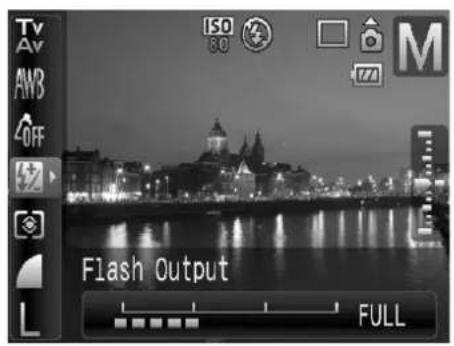

You can also set the flash output by pressing the MENU button and selecting [Flash Settings] from the ☐ tab. Then press the FUNC SET button, select [Flash Output] and press the ◀▶ buttons to make the setting.
Ci Adjusting Dark Subjects and Shooting (i-Contrast)
When people's faces, or the subject is dark, you can take shots where the dark portions are detected and automatically brightened.
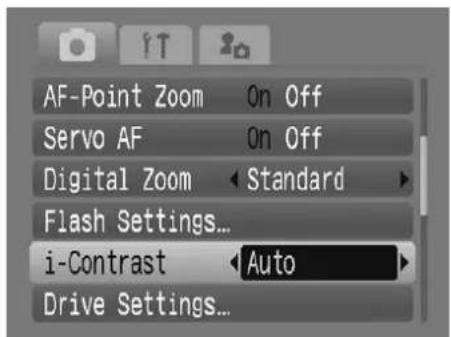
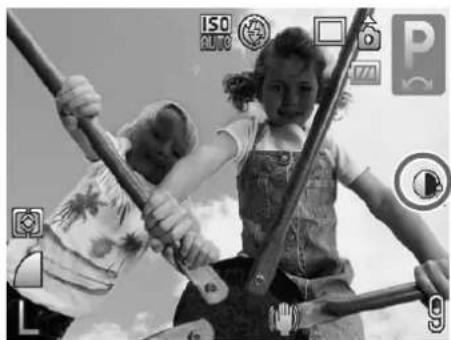
natural_image
Black-and-white photo of two girls holding poles, with camera and parking icon buttons in the corner (no readable text or symbols)Select [i-Contrast].
- Press the MENU button, and select [i-Contrast] from the 📄 tab, and use the ◀▶ buttons to select [Auto].
▶ C_i will appear on the screen. - If C_i does not appear, press the DISP. button, and switch the screen to Information Display (p. 42).
![CANON IXUS 980 IS - Select [i-Contrast]. - 1](/content/2026/05/1103579/images/9378c6c210041d5abb33dd1dacccf287797169daec7a4b32cc5082b10de15c90.jpg)
Depending on the scene, the image may become rough, or not be adjusted correctly.
![CANON IXUS 980 IS - Select [i-Contrast]. - 2](/content/2026/05/1103579/images/8f43646fb52ad1c20505e66251ff511def6d97b5e900c2023994ef84276fd0dc.jpg)
You can correct images taken (p. 124).
![CANON IXUS 980 IS - Select [i-Contrast]. - 3](/content/2026/05/1103579/images/51ac9584f6e97862e5c7a8ff9aff2aa16a917c66bd93ab2f29ae9c0954342f7e.jpg)
Red-Eye Correction
You can automatically correct images taken with the flash where eyes appear red.
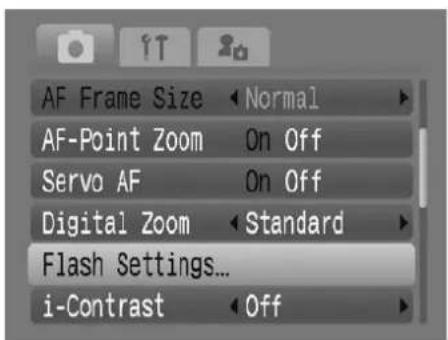
1 Select [Flash Settings].
- Press the MENU button, and select [Flash Settings] from the 📷 tab and press the Ⓗ function SET button.
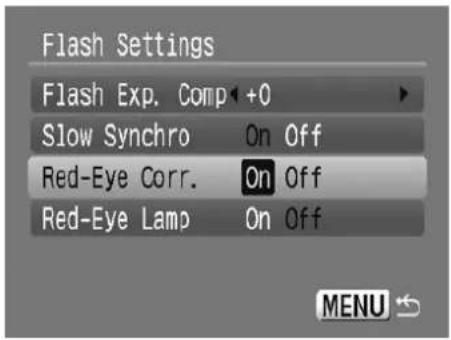
2 Make the setting.
- Press the ▲▼ buttons or turn the Ⓞ dial to select [Red-Eye Corr.] then press the ◀▶ buttons to select [On].
will appear on the screen (p. 42). - If Ⓞ does not appear, press the DISP. button, and switch the screen to Information Display (p. 42).

Red-eye correction may be applied to other red parts than red eyes. For example, when red make-up has been used around eyes.

• You can correct images taken (p. 125).
- If you press the ▶ button as shown on the screen in Step 2, and then press the MENU button the Flash Settings screen will display.
Changing the Color and Shooting
You can change the look of an image when shooting. However, depending on the scene, the image may become rough, or the colors may not come out as expected. We recommend saving the original image as well as the new one (p. 95).

Color Accent
You can take shots where only a single chosen color from within the screen remains, and the rest of the shot changes to black and white.
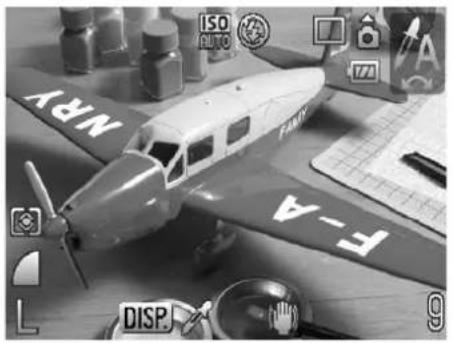
natural_image
Black-and-white photo of a small propeller airplane with visible branding and camera interface icons (no readable text or symbols)1 Select ♦A.
- Set the mode dial to SCN, turn the dial and select ⏻A.
2 Press the DISP. button.
- The unchanged image, and the Color Accent image will both display. - The color for default settings is green.
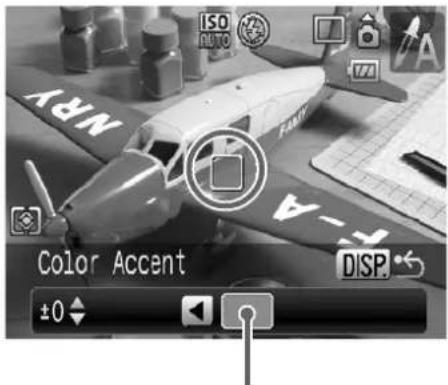
Recorded color
3 Indicate the color.
- Position the center frame so it is filled with the the color you want, and press the ◀ button. - The color indicated will be recorded.
4 Indicated the area to be colored.
- Press the ▲▼ buttons or turn the Ⓞ dial, and change the area you want to color.
- When you want only the color that you have chosen to remain, increase the value of -. When you want to colors to remain that are close to the color you have chosen, increase the value of +.
- Pressing the DISP. button will make the setting, and will return to the shooting screen.

- Using the flash may cause the image to come out different than expected.
• Even if you turn off the power, the recorded color will be saved.
s Color Swap
You can take shots changing the color of an item in the image to another color. You can only record one other color.
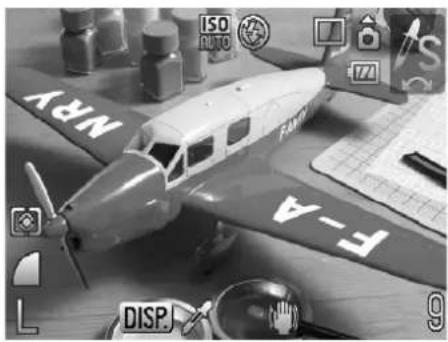
natural_image
Black-and-white photo of a small propeller airplane with visible branding and camera interface elements (no readable text or symbols)Select /s.
- Set the mode dial to SCN, turn the dial and select ♩s.

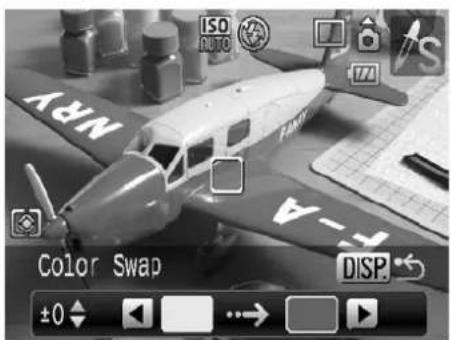
Press the DISP. button.
- The unchanged image and the Color Swap image will both display.
- The default settings are to change the green to gray.
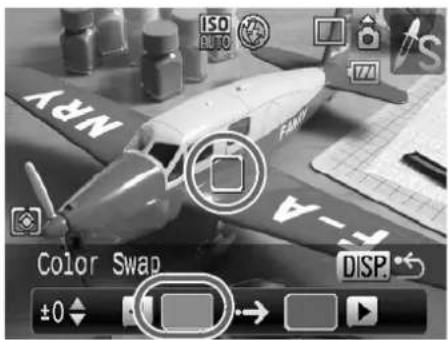
Indicate the color before changing the image.
- Position the center frame so it is filled with the color you want, and press the ◀ button.
The color indicated will be recorded.
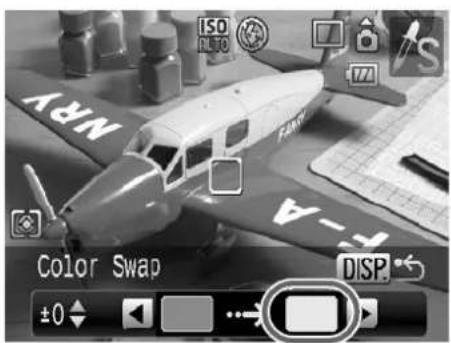
Indicate the desired color to change the image to.
- Position the center frame so it is filled with the color you want, and press the button.
The color indicated will be recorded.
5 Indicate the area to be colored in the changed image.
- Press the ▲▼ buttons or turn the Ⓞ dial, and you can change the area to be colored.
- When you want only the color that you have chosen to remain, increase the value of -. When you want to colors to remain that are close to the color you have chosen, increase the value of +.
- Pressing the DISP. button will make the setting, and will return to the shooting screen.

- Using the flash may cause the image to come out different than expected.
• Even if you turn off the power, the recorded color and area will be saved. - Depending on the scene, the image may come out rough.
Saving the Original Image
The original image will be saved separately at the same time as the changed image.
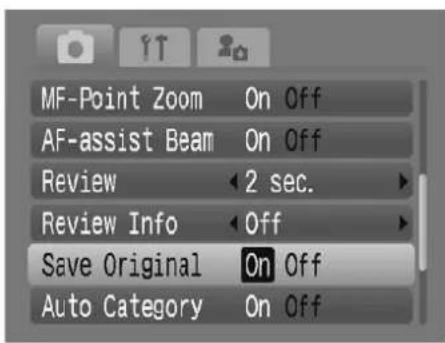
Select [Save Original].
- Press the MENU button and select [Save Original] on the 📷 tab, use the ◀▶ buttons to select [On].
![CANON IXUS 980 IS - Select [Save Original]. - 1](/content/2026/05/1103579/images/76ddbb1cd64187cfddedec93b4be332f511726f2c6a0f79ce165d0fc278b73f0.jpg)
The changed image will display directly after shooting. If you delete the image at this time, please take extra care as the changed image will be deleted along with the original.
![CANON IXUS 980 IS - Select [Save Original]. - 2](/content/2026/05/1103579/images/e3812e1309f917a223f75c7a5fa402b15ada9ef0fe8f3364b19b52d17e952491.jpg)
- Both images will be recorded with serial numbers.
- Since two images will be made with one shot, the possible shots will be about half the amount as usual.
![CANON IXUS 980 IS - Select [Save Original]. - 3](/content/2026/05/1103579/images/21df3fc5081609425c234102fdceb3cce74e30a1969b99a9ffd589dcd5f6bbf8.jpg)
Shooting Stitch Assist Images
Large subjects can be split into several shots that can later be merged together using the included software on a computer to create a panoramic image.
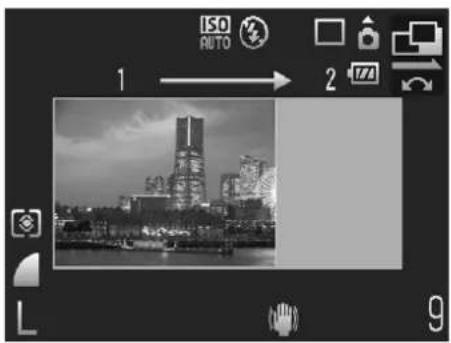
natural_image
Black-and-white cityscape at dusk with illuminated skyscrapers and waterfront, captured via ISO AUTO camera interface (no readable text or symbols)Select or.
- Set the mode dial to SCN, turn the dial and select ☐ or ☐.

Take the first shot.
The exposure and white balance will be set with the first shot.
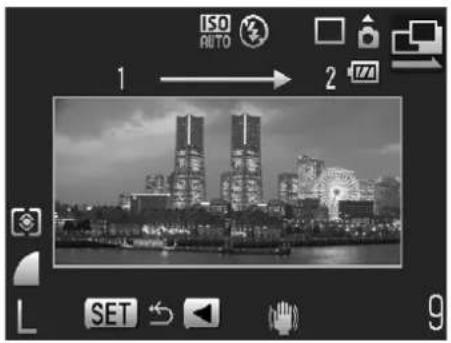
natural_image
Black-and-white cityscape at dusk with illuminated skyscrapers and waterfront, captured via camera interface (no readable text or symbols)Take the second shot.
- Overlap part of the first shot when taking the second shot.
Minor discrepancies in the overlapping portions will be corrected when the images are merged. - You can repeat the procedure for the second shot to take up to 26 shots.
- When you have finished taking shots, proceed to Step 4.
4 Finish shooting.
- Press the Ⓗ function. SET button.
5 Merge the images with a computer.
For details on how to merge the images, refer to the Software Starter Guide.
natural_image
Black-and-white panoramic cityscape featuring illuminated skyscrapers and riverfront buildings under cloudy sky (no visible text or signage)
This function is not available when shooting while displaying on a television (p. 76).
Using Various Functions for Shooting Movies
This chapter serves as the advanced version of Chapter 1's “Shooting Movies” and “Viewing Movies” and explains how to use advanced functions to shoot and view movies.
This chapter assumes that the mode dial is set to ☐.
- In this chapter, pictures that are taken as explained in Chapters 3 – 5, will be called still images.
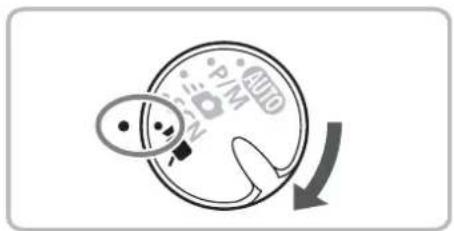
Changing the Movie Mode
You can select from three modes.
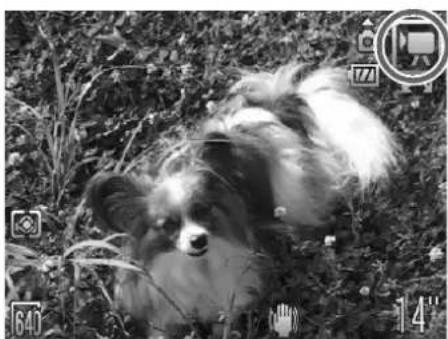
natural_image
Black-and-white photo of a small dog lying on grass, no visible text or symbols1 Set the mode dial to 📁. 2 Select a movie mode.
Turn the Ⓞ dial to select a mode.
| Standard | Normal mode. |
| Color Accent | These shooting modes let you change all colors except the designated color to black and white, or exchange the designated color for another color, when shooting. See “Changing the Color and Shooting” (p. 93) for details. |
| Color Swap |
In and , depending on the scene, the shot may not come out as planned.
Changing the Image Quality
You can select from two settings.
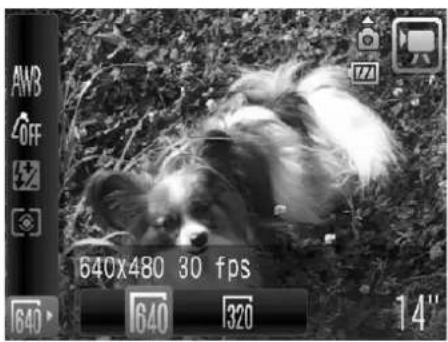
natural_image
Black-and-white photo of a fluffy dog resting on grass, captured in an outdoor setting with camera interface overlays (no readable text or symbols)1 Select the image quality.
- Press the FUNC.SET button, then select 640 in the FUNC. menu.
2 Select an option.
- Press the ◀▶ buttons or turn the Ⓞ dial to select an option, then press the Ⓗ function SET button.
The setting you made will be displayed on the screen.
Image Quality Table
| Image Quality(Recording Pixels/Frame Rate) | Content |
| 640 640 x 480 pixels, 30 frames/sec. | This setting will produce standard movies. |
| 320 320 x 240 pixels, 30 frames/sec. | Since the number of the recording pixels is smaller, the image quality will be lower than with 640 , but you can record three times the length. |
Estimated Shooting Time
| Image Quality (Frame Rate) | Shooting Time | ||
| 32 MB (Supplied) | 2 GB | 8 GB | |
| 640 | 22 sec. | 23 min. 49 sec. | 1 hr. 35 min. 11 sec. |
| 320 | 1 min. 12 sec. | 1 hr. 13 min. 10 sec. | 4 hrs. 52 min. 24 sec. |
- Based on Canon's testing standards.
• Max. clip length is approx. 1 hour.
Recording also stops when the file size reaches 4 GB.
- Depending on the memory card, recording may stop even if the max. clip length has not been reached. Use of SD Speed Class 4 or higher memory cards is recommended.
AE Lock/Exposure Shift
In ☐ you can set the exposure, or change it in 1/3 steps within a range of ±2.
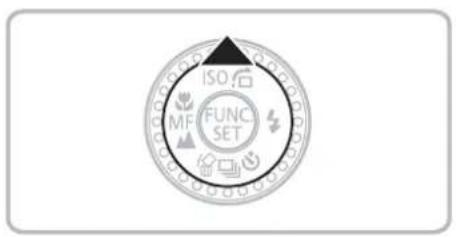
1 Focus.
2 Set the exposure.
- Press the ▲ button to lock the exposure, the exposure shift bar appears.
- Press the ▲ button again to release the lock.
3 Change the exposure.
While watching the screen, press the ◀▶ buttons or turn the Ⓞ dial to adjust the brightness.
4 Shoot.
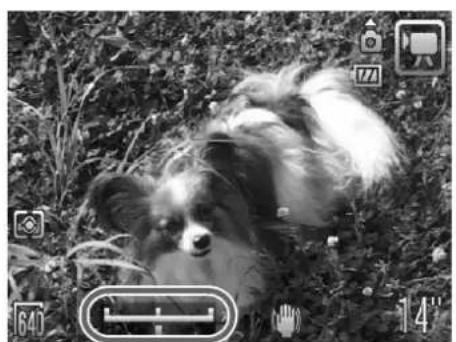
natural_image
Black-and-white photo of a small dog resting in grass, no visible text or symbolsOther Shooting Functions
For mode, the following functions can be used in the same way as for still images. For A and S modes, the functions with an * attached can be used in the same way as for still images. See the referred pages for details.
- Zooming in More Closely on Subjects (Digital Zoom) (p. 58)
You can use the digital zoom, but the optical zoom cannot be used.
If you want to shoot at the maximum magnification, you should adjust the optical zoom to the maximal factor before shooting.
The sound from the zoom will be recorded.
• 10 Using the Self-Timer (p. 61)*
• Shooting Close-ups (Macro) (p. 63)*
• ▲ Shooting Far Away Subjects (Infinity) (p. 67)*
• Adjusting the Tone (White Balance) (p. 71)
• Changing the Tone of an Image (My Colors) (p. 73)
• Shooting Using the Two Second Self-Timer (p. 74)*
• Shooting Using a TV (p. 76)*
Use the TV controls to adjust the sound volume.
• AFL Shooting with AF Lock (p. 84)
• MF Manual Focus (p. 85)*
• Turning off the AF Assist Beam (p. 143)*
• Displaying the Overlay (p. 144)*
[3:2 Guide] is not available.
- Changing the IS-Mode Settings (p. 145)*
You can switch between [Continuous] and [Off].
- Registering Functions to the 📄→ Button (p. 145)*
Playback Functions
The following functions can be used in the same way as for still images. For more information on each function, proceed to the referred pages.
• Erasing Images (p. 25)
• Search Images by Sets of 9 (Index Display) (p. 104)
- Searching for Images Using the Jump Display (p. 105)
• Viewing Slideshows (p. 107)
• Changing Image Transitions (p. 111)
• Viewing Images on a TV (p. 112)
• Erasing All Images (p. 113)
• Protecting Images (p. 117)
Organizing Images by Category (My Category) (p. 119)
• Rotating Images (p. 120)
• Transferring Images to a Computer (p. 128)
- Designating Images for Transfer (DPOF) (p. 129)
Summary for "Viewing Movies" (p. 30)
| Exit | |
| Playback | |
| Slow Motion Playback (you can use the ◀▶ buttons to adjust the speed. Sound will not play back.) | |
| Display the first frame | |
| Previous frame (Rewind if you hold down the FUNC SET button.) | |
| Next frame (Fast forward if you hold down the FUNC SET button.) | |
| Display the last frame | |
| Edit | |
| Displays when connected to a PictBridge compliant printer (p. 26). Refer to the Direct Print User Guide for details. |

Editing
You can trim the beginnings and ends of recorded movies in one-second increments.
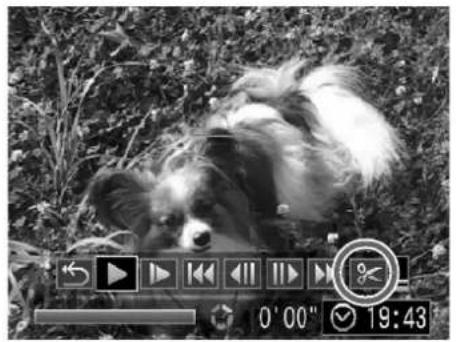
natural_image
Black-and-white photo of a small dog lying on grass, with a play button and playback controls visible (no readable text or symbols)Movie Editing Panel
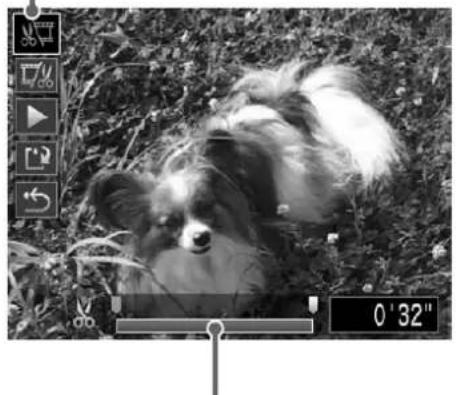
natural_image
Black-and-white photo of a fluffy dog resting on grass, with no visible text or symbols in the main scene.Movie Editing Bar
1 Select %.
- Follow Step 3 on p. 30, select % and press the FUNC SET button.
The movie editing panel and the movie editing bar will display.
2 Set the editing range.
- Press the ▲▼ buttons and select 🎨 or 📋.
- Press the ◀▶ buttons or turn the Ⓞ dial to move ↓, ✉ will display at each one-second interval. If you select ⏻, you can trim the beginning of the movie from ✉. If you select 70%, you can trim the end of the movie from ✉.
Even if you move ↓ to a point other than a ✕ point, only the portion from the nearest ✕ to the left will be trimmed when ✕ is selected. Only the portion from the nearest ✕ to the right will be trimmed when ✕ is selected.
The section in light blue designated with will be the section of the movie that will remain after editing.
3 Check the edited movie.
- Press the ▲▼ buttons to select ▶, then press the Ⓗ function button. The edited movie will play.
To edit the movie again, repeat Step 2.
To cancel editing, press the ▲▼ buttons, and select ⚙, then after pressing Ⓗ️ button, press the ◀▶ buttons or turn the Ⓞ dial to select [OK], then press the Ⓗ️ button.
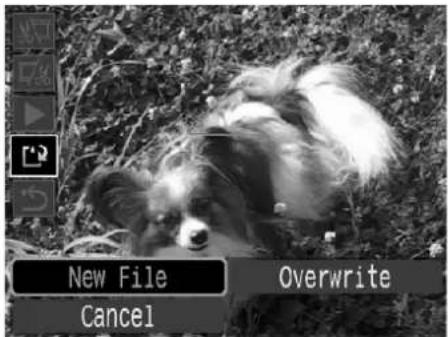
4 Save the edited movie.
- Press the ▲▼ buttons to select [ ], then press the Ⓗ️ button.
- Press the ◀▶ buttons or turn the Ⓞ dial to select [New File], then press the Ⓗ FUNC. SET button.
The movie will be saved as a new file.

- When [Overwrite] in Step 4 is selected, the unedited movie is overwritten with the edited movie, erasing the original movie.
- When there is not enough space left on the memory card, only [Overwrite] can be selected.
- If the battery is depleted partway through editing, the edited movie clips may not be saved. When editing movies, you should use a fully charged battery or the separately sold AC adapter kit (sold separately) (p. 38).
7
Using Various Playback and Other Functions
The first part of this chapter explains various ways to play back and edit images. The latter part of this chapter explains how to download images to a computer, and how to specify images for printing.
It is assumed that the ▶ button, has been pressed, and the camera is in playback mode (p. 24).

- Images that have been edited on a computer, had their file name changed, or have been taken on a different camera, may not be possible to play back or edit.
- The edit function (pp. 120 – 127) cannot be used if the memory card does not have free space available.
Search Images by Sets of 9 (Index Display)
Displaying 9 images at a time lets you quickly find the image you want.
natural_image
Diagram of a car dashboard with steering wheel, navigation controls, and a checkered flag (no text or symbols)1 Move the zoom lever toward ☐.
Images will display in an index. The selected image will have a green frame and be enlarged.
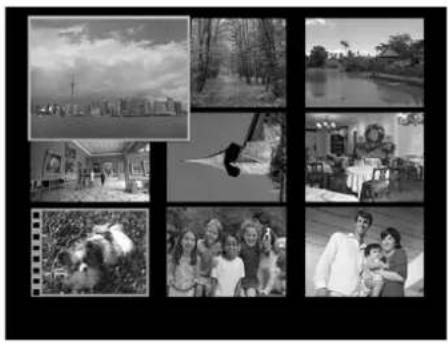
natural_image
Collage of black-and-white photos showing scenes including a landscape, water, indoor living room, and family group (no visible text or symbols)2 Select an image.
- Press the ▲▼◀▶ buttons or turn the dial and select the image.
- Moving the zoom lever toward Q, will display the selected image.

Searching 9 Images at a Time
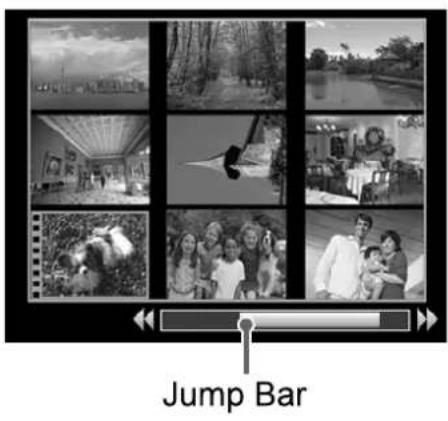
1 Move the zoom lever toward ☐.
Images will display in an index.
2 Move the zoom lever toward again.
The jump bar appears.
3 Press the ◀▶ buttons to change the displayed images.
- Press the ◀▶ buttons or turn the Ⓞ dial to switch between displays of 9 images.
- Moving the zoom lever toward Q will return to the index display.

Holding the ⬆ button and pressing the ◀ buttons will jump to the first or last set of images.

Searching for Images Using the Jump splay
When there are many images on the memory card, you can search them by a specified method or image unit.
Select a Jump Method
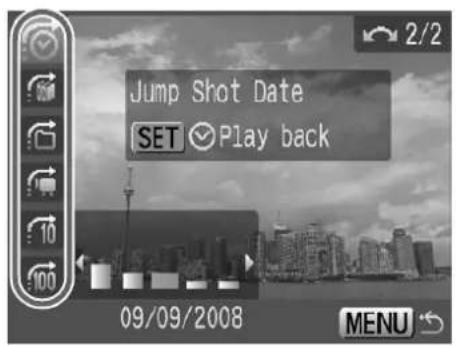
- In Single Image Playback, press the ▲ button.
- Press the ▲▼ buttons and select a jump method.
- If you press the DISP. button, you can switch between on and off for the information display.
| Jump Shot Date | Jumps to the first image of each shooting date. | |
| Jump to My Category | Displays the first picture in each category (p. 119). | |
| Jump to Folder | Jumps to the first image of each folder. | |
| Jump to Movie | Jumps to a movie. | |
| Jump 10 Images | Jumps over 10 images at a time. | |
| Jump 100 Images | Jumps over 100 images at a time. |
Search by


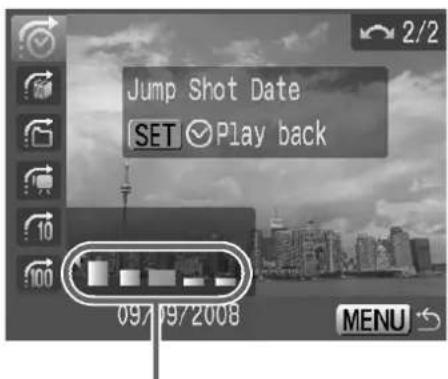
Target Filters
1 Select a target filter.
Use the ◀▶ buttons to select a filter (excluding 📄).
- If you turn the Ⓞ dial, images within the target (in 📋, movies only) will appear.
- Pressing the MENU button will return you to single image display.
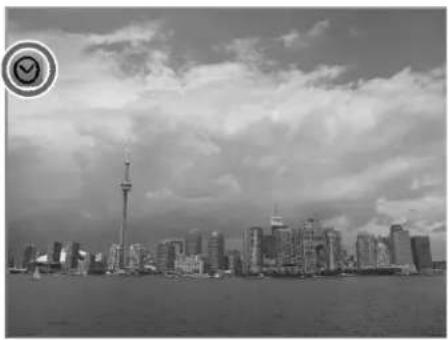
natural_image
Black-and-white cityscape featuring a prominent tower and modern skyscrapers along the waterfront under cloudy skies (no visible text or signage)2 Viewing images using filter playback.
- If you press the Ⓕ function SET button, filter playback will start, √ and a blue frame will appear.
- If you press the ◀▶ buttons or turn the ○ dial, the target images selected in Step 1 will display.
- If you press the ▲ button, it will cancel the filter playback.
Jump by :10 and :100 Images
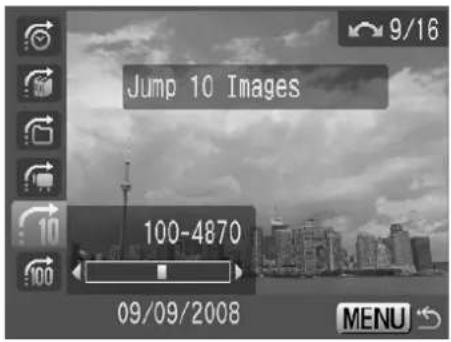
- If you press the ◀▶ buttons, you will jump to and display the image that is the selected number of images away.
- If you turn the Ⓞ dial, you can switch images singly.
- Pressing the MENU button will return you to single image display.
? What if you can't select a target?
When you chose 📋 in Step 1 on p. 105, if there are no images sorted into categories, you can only select 🔊. Also, when there are only images with the same date in ⏻, and only 1 folder has been created in 🔔, you can only select 1 target.

Filter playback
Even in filter playback (Step 2), you can view filtered images with “Search Images by Sets of 9 (Index Display)” (p. 104), “Viewing Slideshows” (p. 107), and “Magnifying Images” (p. 111). However, if you change the category (p. 119), or edit an image and save it as a new image (p. 121), [Display all images] will display, and filter playback will cancel.
You can automatically playback images and movies recorded to a memory card. Each image displays for approximately 3 seconds.
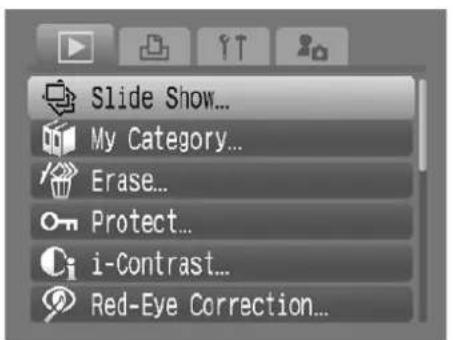
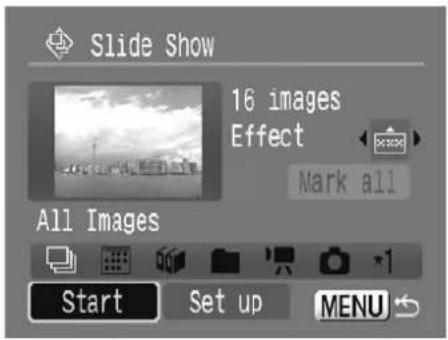
1 Select [Slide Show].
- Press the MENU button and select the ▶ tab, then select [Slide Show] and press the Ⓗ function SET button.
2 Select [Start].
- Press the ◀▶ buttons or turn the Ⓞ dial to select [Start], then press the Ⓗ func SET button.
A few seconds after [Loading image...] displays, the slideshow will start. - You can pause/restart a slideshow by pressing the Ⓗ function SET button again.
- Press the MENU button to stop the slideshow.
![CANON IXUS 980 IS - Select [Start]. - 1](/content/2026/05/1103579/images/127b18d6ecdca2c470ae747637c8bce819d06e931f73e745387a94f3411b52ba.jpg)
- If you press the ◀▶ buttons or turn the Ⓞ dial during playback the image will switch, if you press and hold down the ◀▶ buttons you can fast-forward through images.
• Power saving function does not work during slideshows (p. 51).
Changing Settings
You can change the time that images are displayed, and set the slide show to repeat.
1 Select [Set up].
- Follow Step 2 above, select [Set up] and press the Ⓗ function. SET button.
2 Make the setting.
- Press the ▲▼ buttons and select an item, then press the ◀▶ buttons, or turn the Ⓞ dial and make the setting.
- Pressing the MENU button will return you to the slide show screen.
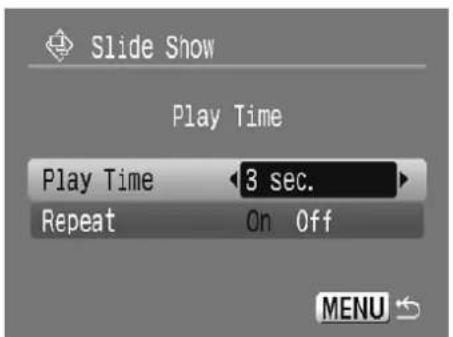
Selecting Images for Playback
Select the Classification
You can select images by classification, group them together and play them back.
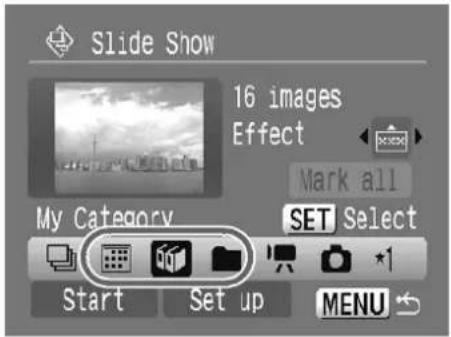
1 Select , or .
- Follow Step 2 on p. 107, press the ▲▼◀▶ buttons or turn the Ⓞ dial to select 📁, 📋, or ■ and press the Ⓗ️ button.
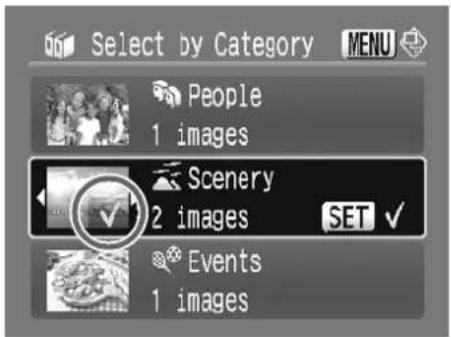
2 Select a menu item.
- Press the ▲▼ buttons or turn the Ⓞ dial, select the items to set and press the FUNC SET button.
- If you press the ◀▶ buttons, you can make the images in the items display.
Once set, √ will appear on the screen. - If you press the Ⓗ button once more, selection will cancel.
- Playback will occur in the order the images were chosen.
- Press the MENU button to complete the setting.
- Follow Step 2 on p. 107 to play back images.
Single Image Selection
You can select the images you want to play one by one, sort them into custom 1 to 3 and play them back.
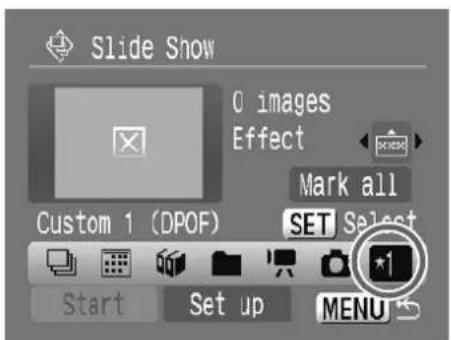
1 Select \*1 .
- Follow Step 2 on p. 107, press the ▲▼◀▶ buttons or turn the Ⓞ dial to select *1 , and press the FUNC SET button.
At first, only *1 will display. When you set *1, *2 will be come selectable. When you set *2, *3 will be come selectable.
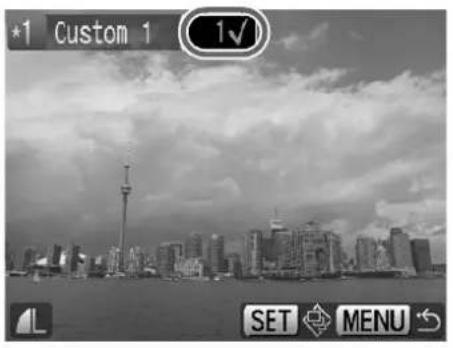
natural_image
Black-and-white cityscape photo featuring a prominent tower and skyline, with no visible text or symbols.2 Select an image.
- Press the ◀▶ buttons or turn the ⏻ dial, select the image and press the Ⓗ function SET button.
Once set, √ and the selected order number will appear on the screen. - If you press the Ⓗ button once more, selection will cancel.
- When selecting multiple images, repeat the operation above (maximum of 998 images).
- Playback will occur in the order the images were chosen.
- Press the MENU button to complete the setting.
- Follow Step 2 on p. 107 to play back images.
Select All Images
You can collect all of the images and designate them as custom 1 to 3.
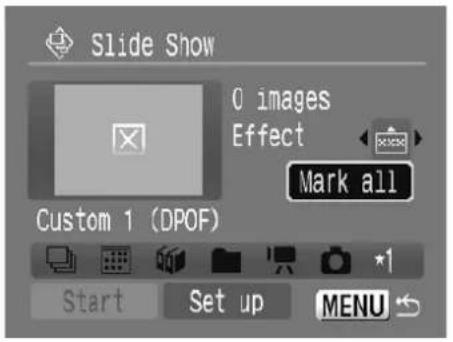
1 Select [Mark all].
- Follow Step 2 on p. 107, and after selecting 1 , press the ▲▼ buttons, select [Mark all] and press the Ⓗ FUNC SET button.
2 Select.
- Press the ▲▼ buttons, select [Mark all] and press the Ⓗ️ button.
- Press the ◀▶ buttons, select [OK] and press the ⬤️ button.
- To cancel [Mark all], select [Reset] from the above step.
Changing the Effect
You can select an effect to use when switching images.
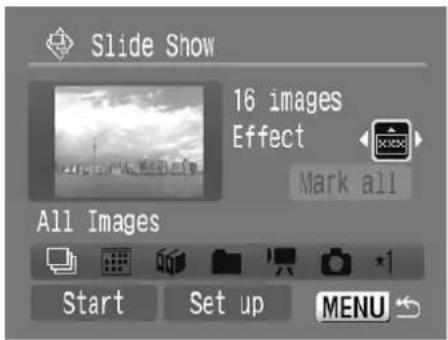
- Press the ▲▼ buttons, and select 📄 and press the ◀▶ buttons or turn the Ⓞ dial to select an item.
When you select an item, an image with the effect you selected will appear. - will display without an effect.
Play the images following the operations in Step 2 on p. 107.
Checking the Focus or People's Expressions (Focus Check)
The location of the AF frame when focused for a shot, or the shot of a detected face can be magnified.
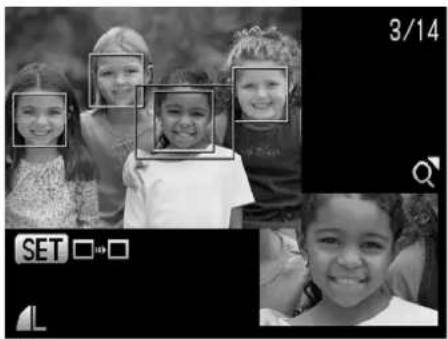
natural_image
Black-and-white collage of children holding a photo frame, with no visible text or symbols in the main subjects.1 Press the DISP. button, and switch to the focus check display (p. 43).
A white frame will appear where you focused the AF frame upon shooting, or on a face.
A gray frame will appear on a face detected during playback.
The place where the orange frame appears will magnify.
2 Change the place to be magnified.
- Pressing the Ⓗ button will move you to a different white frame.
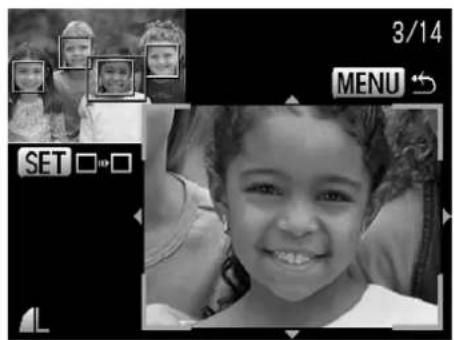
3 Change the magnification rate or location.
- Move the zoom lever toward Q once.
- If you press the ▲▼◀▶ buttons, the location of the display will move.
If you move the zoom lever toward Q, the image will magnify, if you move it toward □, it will reduce in size. - Pressing the MENU button will return you to Step 2.

Magnifying Images
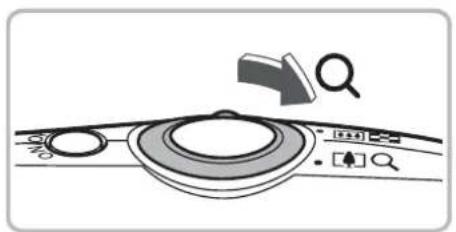
natural_image
Diagram of a control panel with a magnifying glass icon and directional arrows, no text or symbols present.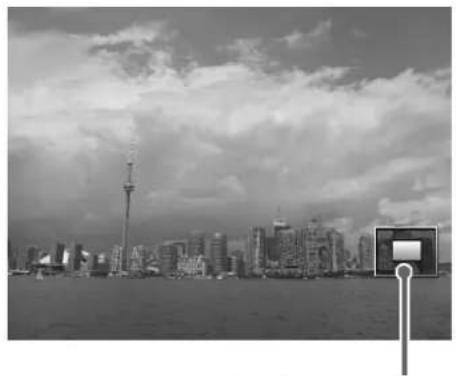
natural_image
Black-and-white cityscape featuring a prominent tower and modern skyscrapers along the waterfront under a cloudy sky (no visible text or signage)Approximate Location of Displayed Area
Move the zoom lever toward Q.
The enlarged display will appear, and if you continue to hold the zoom lever the image will magnify up to a maximum factor of approximately 10x.
- If you press the ▲▼◀▶ buttons, you can move the location of the displayed area.
- Move the zoom lever toward ☐ to reduce the magnification or return to Single Image Playback.
If you turn the Ⓞ dial, you can switch images while they are still enlarged.

Changing Image Transitions
You can select from three transition effects when switching between movies or images in single image playback.
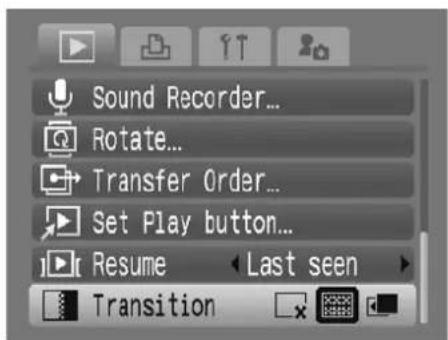
Select [Transition].
- Press the MENU button and select the ▶ tab, then select [Transition] and use the ◀ buttons to select the desired transition.
▶ Press the MENU button to make the setting.
| Immediately switches between images without transition effect. | |
| The next images will gradually appear. | |
| Switches between images by sliding them left or right when the ◀▶ buttons are pressed. |
Viewing Images on a TV
Using the supplied AV cable, you can connect the camera to a TV to view images or movies you have shot.
Items to Prepare
- Camera and TV
• AV cable supplied with the camera (p. 2)
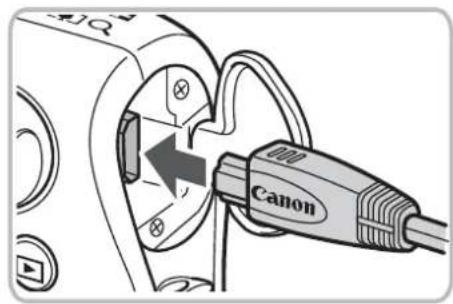
natural_image
Close-up of a Canon cable connector with a lightning bolt symbol (no text or labels visible)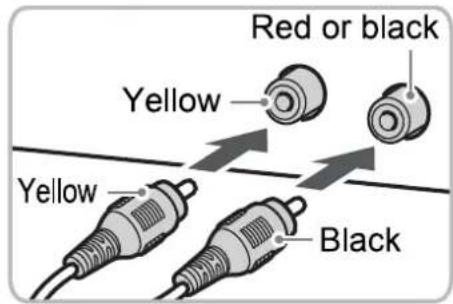
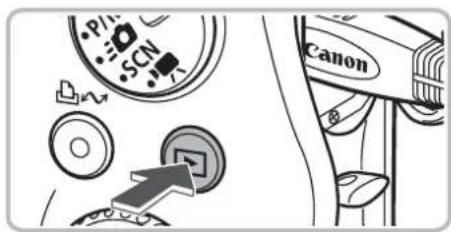
Turn off the camera and TV.
Connect the camera to the TV.
Open the camera's terminal cover and fully insert the plug of the supplied AV cable into the camera's A/V OUT terminal.
- Insert the cable plug fully into the video input terminals as shown in the illustration.
3 Turn on the TV and switch it to the input that the cable is connected to.
4 Press the camera's ▶ button and turn on the power.
The image will appear on the TV (nothing will appear on the monitor of the camera).
After you finish viewing, turn off the camera and TV, and unplug the AV cable.

What if the images don't properly display on the TV?
If the camera's video output system (NTSC/PAL) does not match the TV's, images will not display correctly. Press the MENU button, and use the [Video System] menu item on the 🎩 tab to switch to the correct video system.
You can select images or movies and erase them in groups. Since erased images or movies cannot be recovered, exercise adequate caution before erasing. However, protected images and movies (p. 117) cannot be erased.
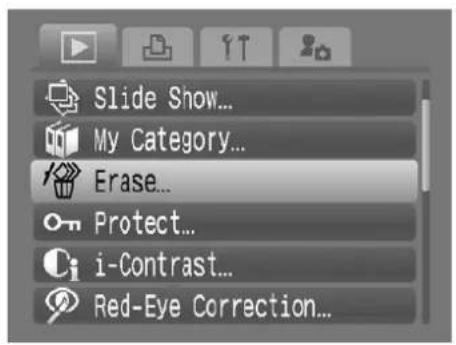
1 Select [Erase].
- Press the MENU button, and select [Erase] on the ▶ tab, and press the Ⓗ FUNC SET button.
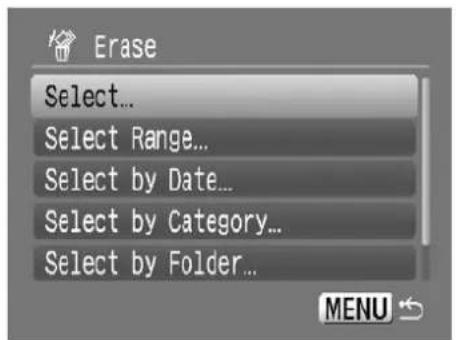
2 Select a selection method.
- Press the ▲▼ buttons or turn the Ⓞ dial, select a selection method, and press the Ⓗ function button. - To stop erasing and return to the menu screen, press the MENU button.
Designating Images Individually
1 Select [Select].
- Follow Step 2 above to select [Select] and press the FUNC SET button.
![CANON IXUS 980 IS - Select [Select]. - 1](/content/2026/05/1103579/images/864a6682477f5877c16c7c6e09440fa9e94fc1e02c4338e6e5282ee1fb9a68df.jpg)
natural_image
Black-and-white cityscape photo featuring a prominent tower and skyline under cloudy sky (no visible text or symbols)2 Select images.
- Press the ◀▶ buttons or turn the Ⓞ dial, select the image and press the Ⓗ️ button. - Once set, ✓ will appear on the screen. - Pressing the Ⓗ️ button once more will cancel selection, and ✓ will disappear. - When selecting multiple images, repeat the above operation.
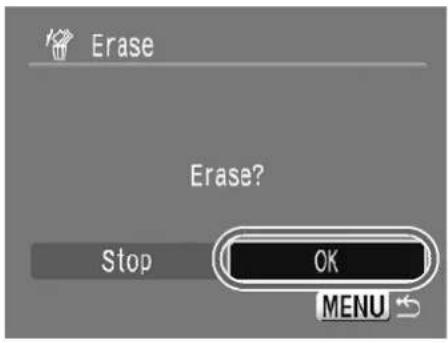
3 Press the MENU button.
4 Erase.
- Press the ◀▶ buttons or turn the ⏻ dial, select [OK] and press the Ⓗ function SET button.
Select Range
1 Select [Select Range].
- Follow Step 2 on p. 113 to select [Select Range] and press the FUNC SET button.
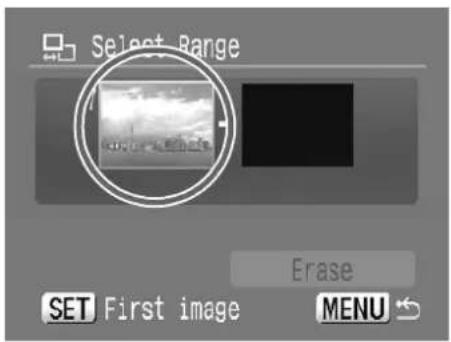
2 Select the starting image.
- Press the ⬆ button. - Press the ◀ buttons or turn the ⭕ dial, select the image and press the ⬆ button.
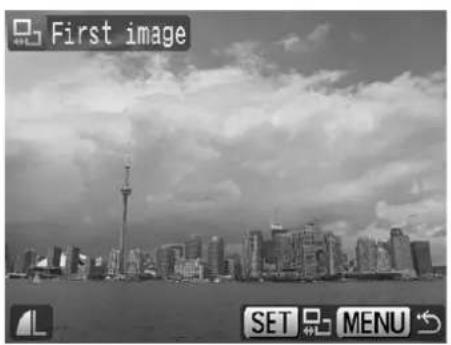
natural_image
Black-and-white cityscape photo featuring a prominent tower and modern skyscrapers under a cloudy sky (no visible text or symbols)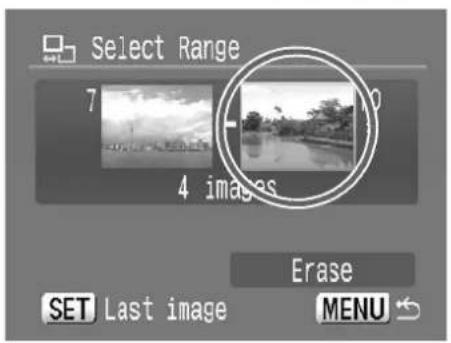
3 Select the ending image.
- Press the ▶ button, select [Last image] and press the Ⓗ️ button. - You cannot select images before the first image. - Press the ◀▶ buttons, or turn the Ⓞ dial to select an image, and press the Ⓗ️ button.
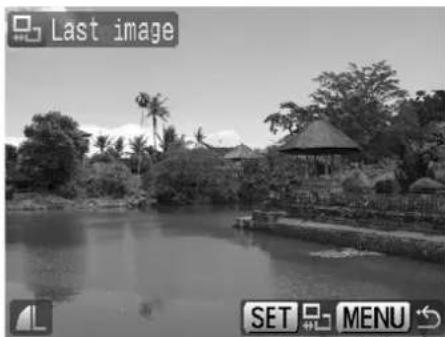
natural_image
Black-and-white landscape photo showing a calm lake with palm trees, a thatched-roof structure, and distant mountains (no text or symbols visible)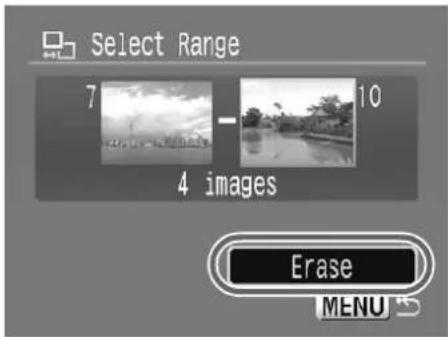
4 Erase.
- Press the ▼ button to select [Erase] then press the Ⓗ function SET button.

Select images with the Ⓞ dial
Follow Steps 2 and 3 in the above screen, turn the Ⓞ dial, and you can select the first and last images.
Select by Category
1 Select [Select by Date], [Select by Category] or [Select by Folder].
- Follow Step 2 on p. 113 to select a category, and press the Ⓗ️ button.
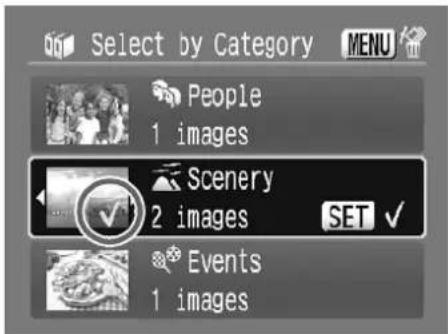
2 Select a menu item.
- Press the ▲▼ buttons or turn the Ⓞ dial, select the items to set and press the Ⓗ function SET button.
- If you press the ◀▶ buttons, you can display the images within the items.
Once set, √ will appear on the screen. - Pressing the Ⓗ button once more will cancel selection, and √ will disappear.
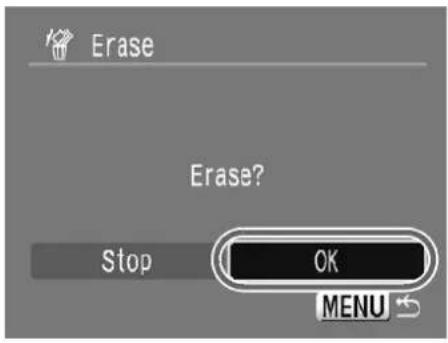
3 Press the MENU button.
4 Erase.
- Press the ◀▶ buttons or turn the ⏻ dial, select [OK] and press the Ⓗ function SET button.

What if you cannot select [Select by Category]?
If there are no images that have been sorted into categories (p. 119), you will not be able to select [Select by Category] in Step 2.
Select All Images
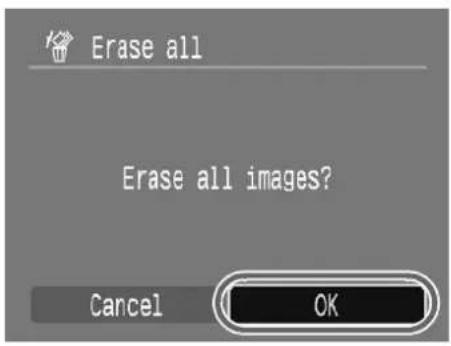
1 Select [All Images].
- Follow Step 2 on p. 113 to select [All Images] and press the FUNC SET button.
2 Erase.
- Press the ◀▶ buttons or turn the Ⓞ dial, select [OK] and press the Ⓗ function SET button.
On Protecting Images
You can protect important images and movies so that they cannot be erased by the camera (pp. 25, 113).
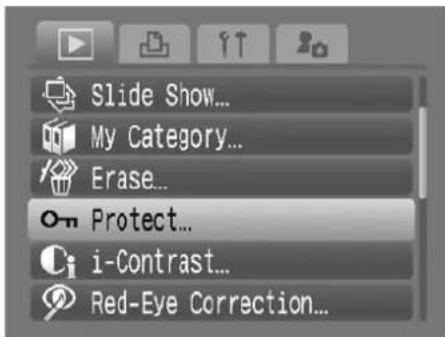
1 Select [Protect].
- Press the MENU button and select the tab, then select [Protect] and press the button.
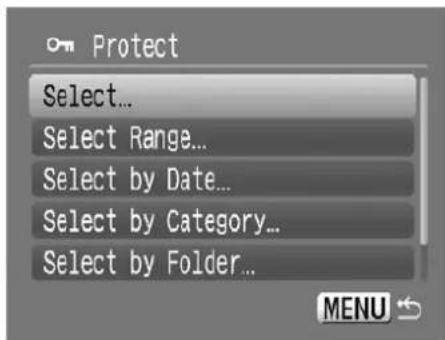
2 Select a selection method.
- Press the ▲▼ buttons or turn the Ⓞ dial, select a selection method, and press the Ⓗ function SET button. - To cancel, or return to the menu screen, press the MENU button.

If you format the memory card (p. 50), protected images will also be erased.

Protected images cannot be erased with the camera's erase function. To erase an image, cancel protection first.
Designating Images Individually
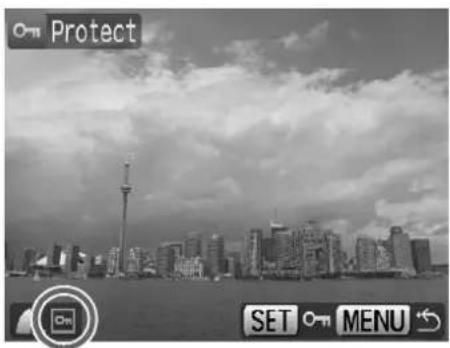
Select [Order].
- Follow Step 2 above to select [Select], and press the Ⓗ FUNC. SET button.
- Follow Step 2 on p. 113 to select an image.
Once set, ☐ will appear on the screen. - Pressing the Ⓗ button once more will cancel selection, and Ⓞ will disappear.
- When selecting multiple images, repeat the above operation.
Select Range
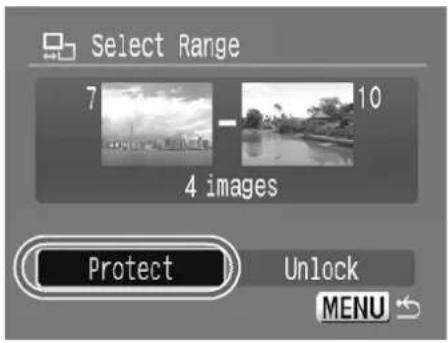
1 Select [Select Range].
- Follow Step 2 on p. 117 to select [Select Range], and press the FUNC SET button.
- Follow Steps 2 and 3 on p. 114 to select images.
2 Protect images.
- Press the ▼ button, select [Protect] and press the Ⓗ function SET button.
Select by Category
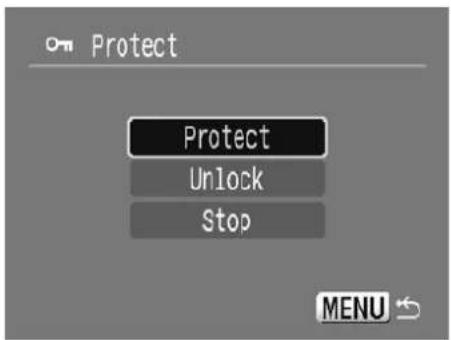
1 Select [Select by Date], [Select by Category] or [Select by Folder].
- Follow Step 2 on p. 117 to select the type, and press the Ⓗ function SET button.
- Follow Steps 2 and 3 on pp. 115 – 116 to select images.
2 Protect images.
- Press the ▲▼ buttons or turn the Ⓞ dial, select [Protect] and press the FUNC SET button.
Select All Images
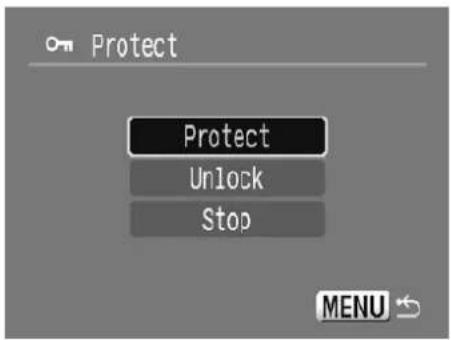
1 Select [All Images].
- Follow Step 2 on p. 117 to select [All Images] and press the FUNC SET button.
2 Protect images.
- Press the ▲▼ buttons or turn the Ⓞ dial, select [Protect] and press the Ⓗ function SET button.

You can unlock groups of protected images if you select [Unlock] in Step 2, while in [Select Range], [Select by Category], or [All Images].

Organizing Images by Category (y Category)
You can categorize images and movies. You can also use the categorized images in the following functions.
- Jump Display (p. 105), Slide Show (p. 107), Erase All (p. 113), Protect (p. 117), Print Settings (DPOF) (p. 132)
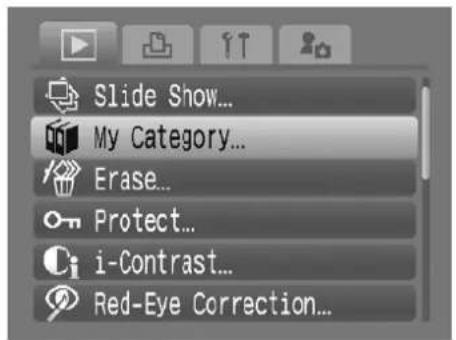
1 Select [My Category].
- Press the MENU button, and select [My Category] on the ▶ tab, and press the Ⓗ FUNC SET button.
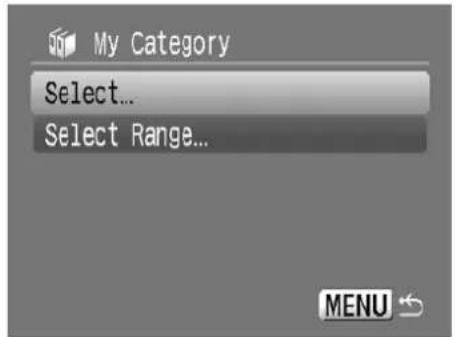
2 Select a selection method.
- Press the ▲▼ buttons or turn the Ⓞ dial, select a selection method, and press the Ⓗ button.
- To cancel, or return to the menu screen, press the MENU button.

Images taken with [Auto Category] set to [On] will be automatically assigned to a particular category (p. 144).
Designating Images Individually
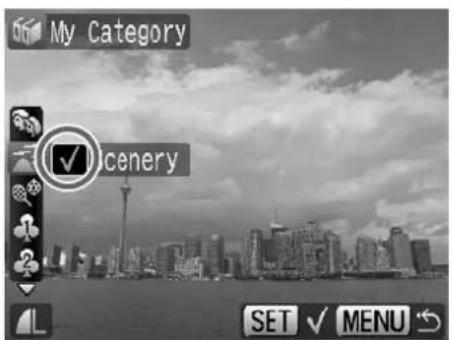
Select [Order].
- Follow Step 2 above to select [Select], and press the Ⓗ FUNC. SET button.
- Follow Step 2 on p. 113 to select images.
- Press the ▲▼ buttons, select a category and press the Ⓗ FUNC. SET button.
Once set, √ will appear on the screen. - Pressing the Ⓗ button once more will cancel selection, and √ will disappear.
- When selecting multiple images, repeat the above operation.
Select Range
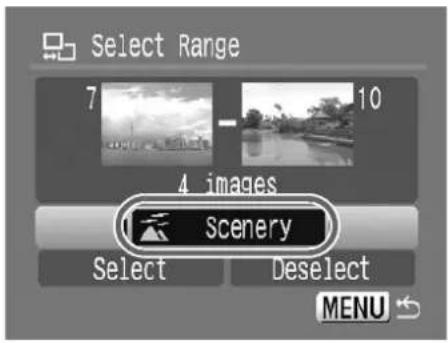
1 Select [Select Range].
- Follow Step 2 on p. 119 to select [Select Range] and press the FUNC SET button.
- Follow Steps 2 and 3 on p. 114 to select images.
- Press the ▼ button, select the item and press the ◀ buttons, or turn the Ⓞ dial, and select a type.
2 Make the setting.
- Press the ▼ button to select [Select] then press the FUNC.SET button.

If you select [Deselect] in Step 2, you can deselect all of the images in the [Select Range] category.

Rotating Images
You can change the orientation of an image and save it.
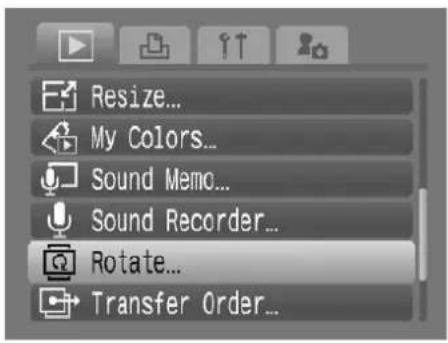
1 Select [Rotate].
- Press the MENU button and select the tab, then select [Rotate] and press the button.
![CANON IXUS 980 IS - Select [Rotate]. - 1](/content/2026/05/1103579/images/763da86051b6cbfe4db4d960be7c75126c581f1dc66e87985544d74cd7b0a1a4.jpg)
natural_image
Black-and-white photo of a historic church spire with a pointed spire, no visible text or symbols2 Rotate the image.
- Press the ◀▶ buttons or turn the Ⓞ dial to select an image to rotate.
Cycle through the 90°/270°/original orientations with each press of the FUNC SET button. - Pressing the MENU button will return you to the menu screen.

Resizing Images
You can resize images that were taken at a high recording pixel setting to a lower pixel setting, and save the resized image as a separate file.
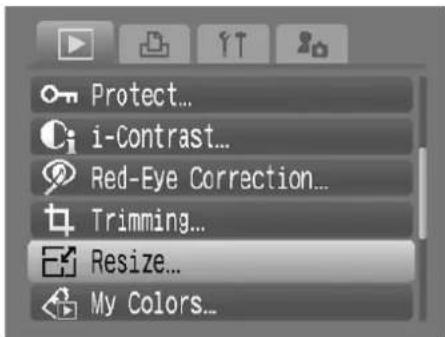
1 Select [Resize].
- Press the MENU button and select the tab, then select [Resize] and press the button.
2 Select an image.
- Press the ◀▶ buttons or turn the Ⓞ dial, select the image and press the Ⓗ function SET button.
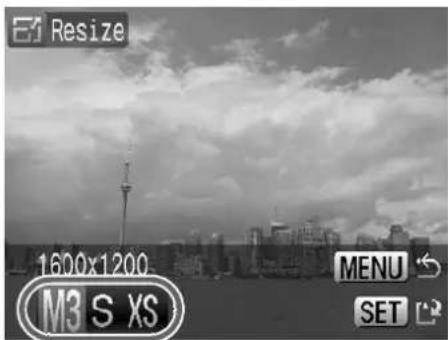
3 Select an image size.
- Press the ◀▶ buttons or turn the ⏻ dial to select an option, then press the Ⓗ FUNC SET button.
The [Save new image?] screen will appear.
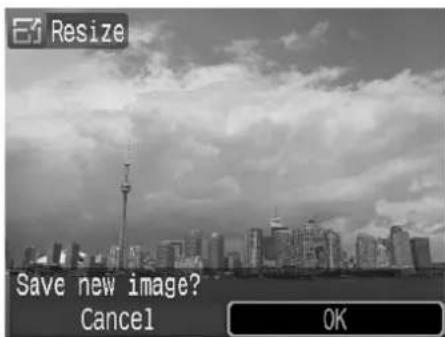
4 Save the new image.
- Press the ◀▶ buttons or turn the Ⓞ dial to select [OK], then press the FUNC SET button. - The image will be saved as a new file.
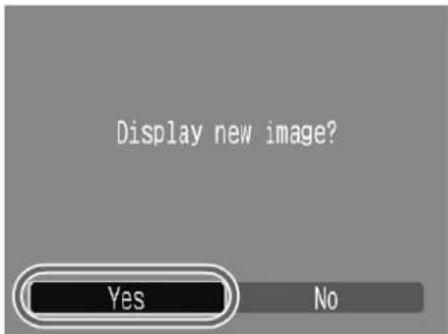
5 Display the new image.
- When you press the MENU button, the [Display new image?] screen will appear. If you press the ◀▶ buttons, or turn the ○ dial to select [Yes] and press the Ⓐ function SET button, the saved image will display.

- You cannot resize an image to a larger size.
- You cannot resize images taken with W and XS to a smaller size.
You can trim a required portion of a recorded image and save it as new image file.
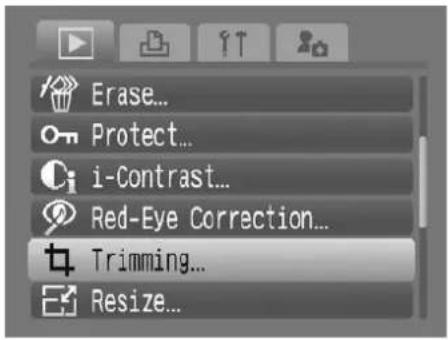
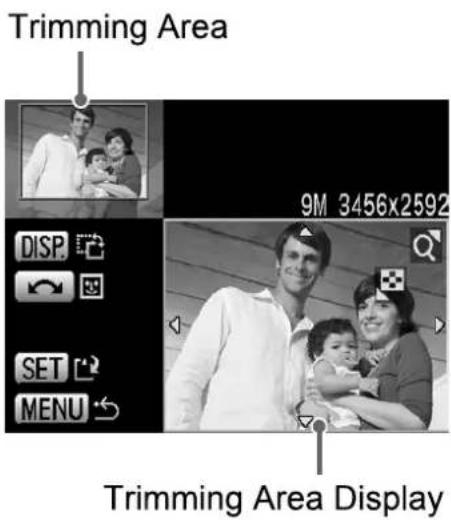
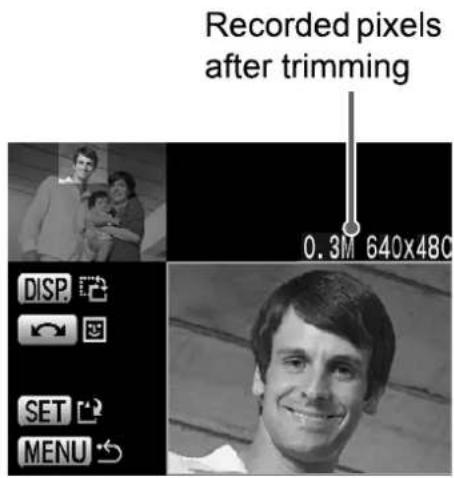
1 Select [Trimming].
- Press the MENU button, and select [Trimming] on the ▶ tab, and press the FUNC. SET button.
2 Select an image.
- Press the ◀▶ buttons or turn the Ⓞ dial, select the image and press the FUNC SET button.
3 Adjust the trimming area.
A green frame will appear around the portion of the image to be trimmed.
The original image will display in the upper left, and the image after trimming will display in the lower right.
- If you move the zoom lever to the left or right, you can change the size of the frame.
- If you press the ▲▼◀▶ buttons, you can move the frame.
- If you press the DISP. button, you can change the size of the frame.
In an image with a detected face, a gray frame will appear around faces located in the upper left of the frame, and the frame can be used for trimming. You can switch between frames by turning the Ⓞ dial.
- Press the Ⓕ FUNC. SET button.
4 Save as a new image and display.
- Perform the operations in Steps 4 and 5 on p. 121.

• W, S, and XS images cannot be trimmed.
- The width and height ratio of an image that can be changed is fixed at 4:3 (for a vertical image 3:4).
- The number of recorded pixels of an image that has been trimmed will be smaller than the image before trimming.

Adding Effects With the My Colors function
You can change the color of an image and save it as a separate image. Refer to p. 73 for details on each menu item.
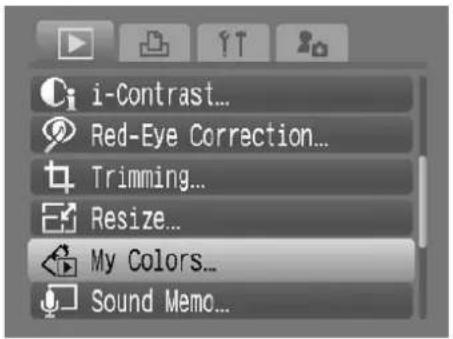
1 Select [My Colors].
- Press the MENU button, and select [My Colors] on the ▶ tab, and press the Ⓗ FUNC SET button.
2 Select an image.
- Press the ◀▶ buttons or turn the Ⓞ dial, select the image and press the FUNC SET button.
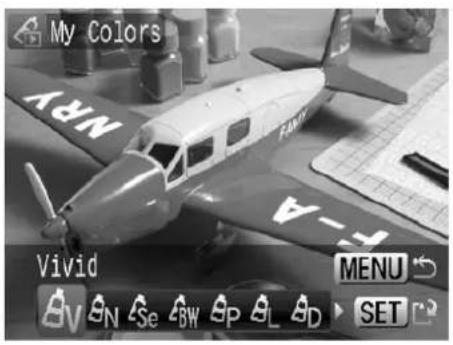
3 Select a menu item.
- Press the ◀▶ buttons or turn the Ⓞ dial to select an option, then press the Ⓗ function SET button.
After selecting the menu item, you can enlarge or reduce the image by following the operations in "Q Magnifying Images" (p. 111).
- If you press the FUNC SET button during magnified display, you can switch to the original image before the color was changed. Pressing the MENU button will return you to the menu screen.
4 Save as a new image and display.
- Perform the operations in Steps 4 and 5 on p. 121.

- If you repeatedly change the color of an image, the quality will gradually deteriorate, and you may not get the image you want.
- The color of images taken with My Colors (p. 73) may differ from true color.
Ci Adjusting Dark Subjects (i-Contrast)
Detects dark sections on subjects or in people's faces in images, corrects the brightness, and saves it as a separate file. You can select 4 levels of correction: [Auto], [Low], [Medium], [High].
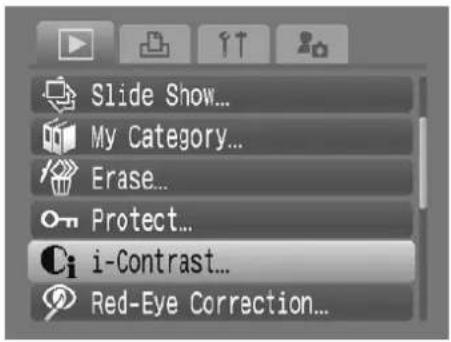
1 Select [i-Contrast].
- Press the MENU button, and select [i-Contrast] on the ▶ tab, and press the Ⓗ FUNC SET button.
2 Select an image.
- Press the ◀▶ buttons or turn the Ⓞ dial, select the image and press the Ⓗ function SET button.
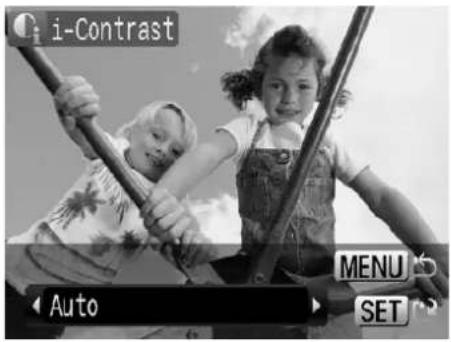
3 Select a menu item.
- Press the ◀▶ buttons or turn the Ⓞ dial to select an option, then press the Ⓗ function SET button.
4 Save as a new image and display.
- Perform the operations in Steps 4 and 5 on p. 121.

What if the image wasn't corrected by [Auto] as you planned?
Select [Low], [Medium], or [High] and adjust the image.
![CANON IXUS 980 IS - What if the image wasn't corrected by [Auto] as you planned? - 1](/content/2026/05/1103579/images/eda86d6a48952a6ff4b2eabba32aea09b6d2c7e0af256707a77f4cccc9b390ba.jpg)
- Depending on the image, it may become rough, or not be adjusted correctly.
• Repeatedly adjusting the same image may cause the quality to deteriorate.
![CANON IXUS 980 IS - What if the image wasn't corrected by [Auto] as you planned? - 2](/content/2026/05/1103579/images/fa311eff10b5275a0e63825f5cadd1a00d1a5fa87241728baec7da3f1423faef.jpg)
Correcting Red-Eye Effect
You can automatically correct images with red-eye and save those images as new files.

1 Select [Red-Eye Correction].
- Press the MENU button and select the ▶ tab, then select [Red-Eye Correction] and press the Ⓗ function SET button.
The [Red-Eye Correction] screen will appear.
2 Select an image.
- Press the ◀▶ buttons or turn the Ⓞ dial to select an image to correct, then press the Ⓗ button.
A frame will appear around the red-eye portion detected by the camera, and [Start] will appear. - You can enlarge or shrink the image using the operation in “Q Magnifying Images” (p. 111).
3 Correct the image.
- Press the ▲▼◀▶ buttons or turn the dial to select [Start], then press the ⒽFUNC.SET button.
The image will correct, and [New File] will appear. - You can enlarge or shrink the image using the operation in “Q Magnifying Images” (p. 111).
4 Save as a new image and display.
- Press the ▲▼◀▶ buttons, or turn the dial to select [New File], and press the button.
The image will be saved as a new file. Perform the operation in Step 5 on p. 121.
The image will be saved as a new file. - Perform the operation in Step 5 on p. 121.
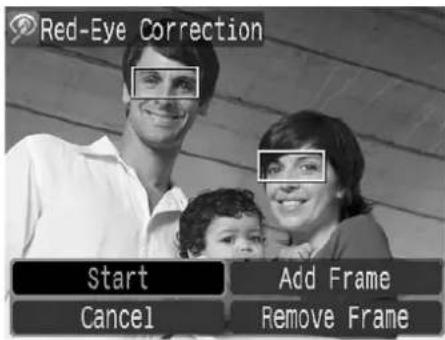
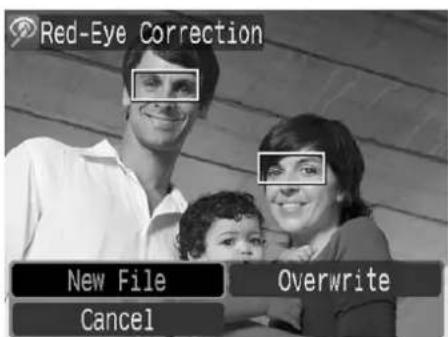
Manual Correction
When the camera cannot automatically detect and correct red-eye, correct it manually.
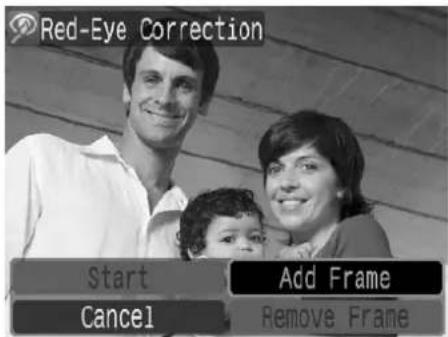
1 Add a correction frame.
In Step 3 on p. 125, select [Add Frame] and then press the FUNC SET button.
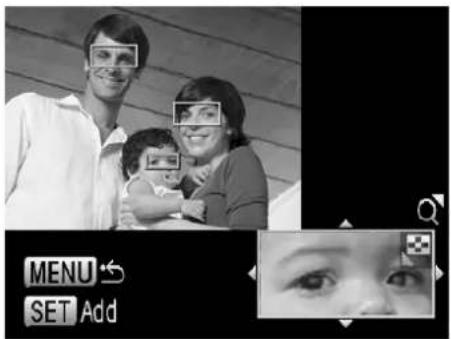
2 Set the position and size.
- Press the ▲▼◀▶ buttons to move the correction frame (green) to the red-eye section, move the zoom lever to adjust the frame size so that it surrounds only the red-eye section.
The area inside the frame will appear enlarged in the lower right of the screen. - If you press the FUNC SET button, the first frame (white) will be fixed, and a new correction frame will appear.
- You can add up to 35 correction frames.
- When you have set the frame positions and sizes, press the MENU button, then follow Steps 3 and 4 on p. 125.
Removing Frames
- To remove a frame, in Step 3 on p. 125, select [Remove Frame] and then press the ⓕ FUNC SET button.
- Press the ◀▶ buttons or turn the Ⓞ dial to select a frame (green), then press the Ⓗ function SET button.

- When [Overwrite] in Step 4 on p. 125 is selected, the uncorrected image is overwritten with the corrected data, erasing the original image.
- Some images may not be properly corrected.
• Repeatedly correcting the same image may cause the quality to deteriorate. - Protected images cannot be overwritten.

Attaching Sound Memos
You can record and attach a sound memo (WAVE format) to an image. The attached sound memo can be up to approximately 1 minute long.
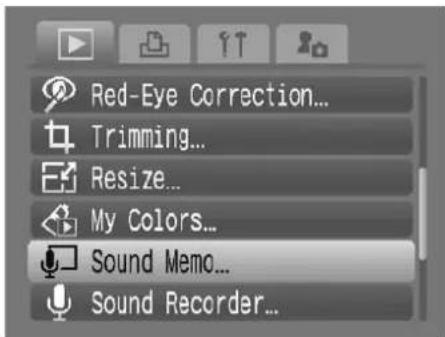
1 Select [Sound Memo].
- Press the MENU button and select the ▶ tab, then select [Sound Memo] and press the Ⓗ function SET button.
2 Select an image.
- Press the ◀▶ buttons or turn the Ⓞ dial to select an image, then press the Ⓗ function SET button. - The sound memo control panel will appear on the screen.
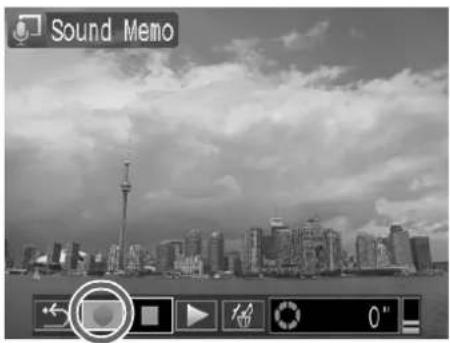
3 Record the memo.
- Press the ◀▶ buttons or turn the Ⓞ dial to select ●, then press the FUNC.SET button. - You can pause/restart recording by pressing the FUNC.SET button.
Sound Memo Operation Panel
Press the ◀▶ buttons, or turn the Ⓞ dial to select, then press the Ⓗ️ button.
| Exit | Starts recording | ||
| Pause (recording or playback) | Play | ||
| Press the ◀▶ buttons or turn the ○ dial to select [Erase], then press the ● function button to erase the sound memo. | |||
- You can adjust the volume during playback with the ▲▼ buttons.
- Select ⬆ and press the ⓕNC SET button, then press the MENU button to return to the menu screen.

- The sound attached to an image can also be played with the supplied software.
• Sound memos cannot be erased from protected images.
Transferring Images to a Computer
"Downloading Images with the Camera" (p. 35) in Chapter 1 explained how to transfer images using [New Images]. This section will explain other ways to transfer images. These designation methods comply with the DPOF (Digital Print Order Format) standards.
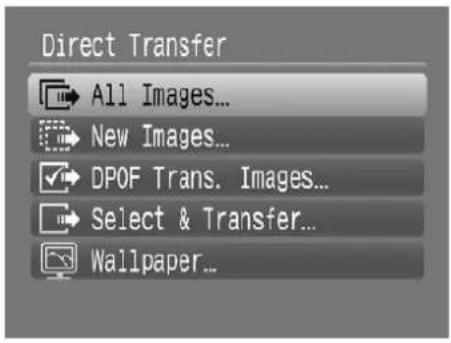
1 Select a menu item.
- Select the menu item in the Step 1 operation in “Downloading Images with the Camera” (p. 35).
2 Transfer the images.
- Press the ↻ button.
Images matching the selected option will be transferred.
The camera returns to the [Direct Transfer] menu once transferring is complete.
Direct Transfer Options
| All Images | Transfers all images from the memory card. | |
| New Images | (p. 35) | |
| DPOF Trans. Images | Transfers all images designated for transfer at once (p. 129). | |
| Select & Transfer | Select and transfer images one at a time.Press the ◀▶ buttons or turn the ○ dial to select an image, then press the □ ∽ button to transfer the image. | |
| Wallpaper | Select and transfer an image to use as your computer desktop's background (wallpaper).Press the ◀▶ buttons or turn the ○ dial to select an image, then press the □ ∽ button to transfer the image. |

Designating Images for Transfer (DPOF)
You can select individual images you want to transfer to a computer. These designation methods comply with the DPOF (Digital Print Order Format) standards.
Designating Images Individually
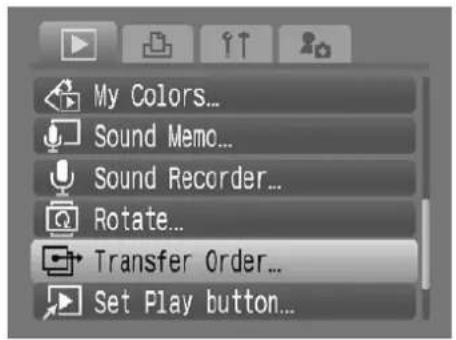
1 Select [Transfer Order].
- Press the MENU button and select the ▶ tab, then select [Transfer Order] and press the Ⓗ button.
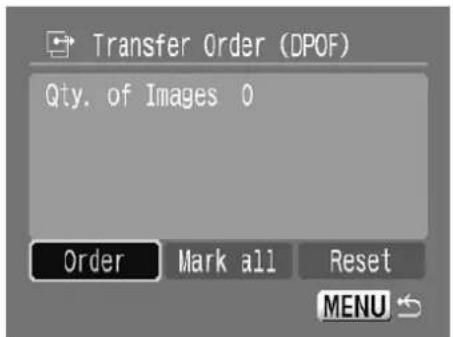
2 Select [Order].
- Press the ◀▶ buttons or turn the Ⓞ dial to select [Order], then press the Ⓗ. SET button.
3 Select an image.
- Press the ◀▶ buttons or turn the Ⓞ dial to select an image.
- Press the Ⓗ button to designate the image. √ appears in the top left of the screen.
- Press the Ⓗ button again to cancel designation. ✓ will disappear.
- When selecting multiple images, repeat the step above (maximum of 998 images).
- Pressing the MENU button twice will save the settings to the memory card and return you to the menu screen.
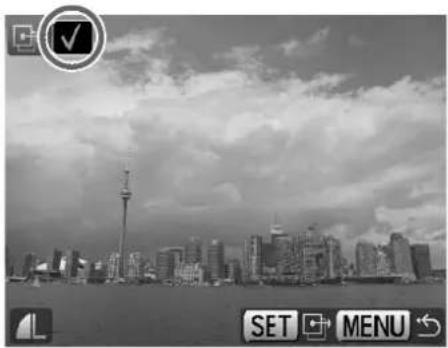
natural_image
Black-and-white cityscape with a prominent tower and skyline under cloudy skies (no visible text or symbols)Select All Images
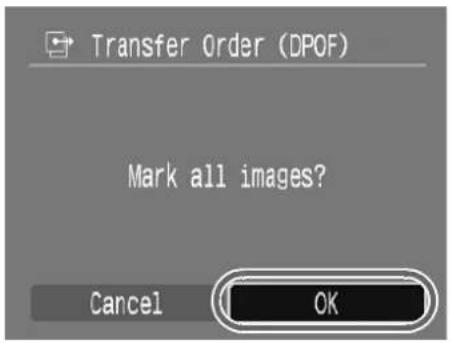
- When you select [Mark all] in Step 2 on p. 129, the screen shown left will appear.
- If you select [OK] and press the Ⓗ️ button, all images will be designated together.
- If you press the MENU button, the selected contents will be saved, and you will return to the menu.
Canceling All Selections
On the screen in Step 2 on p. 129, if you select [Reset] and press the Ⓗ️ button, then press the ◀▶ buttons or turn the Ⓞ dial to select [OK] and press the Ⓗ️ button, all marks will be cleared.

⚠ may display when using a memory card with transfer settings set by a different DPOF-compliant camera. These settings will be overwritten by those set by your camera.
Print List (DPOF)
Directly after shooting, or while in playback, by pressing the 🔊 button you can add images to the print list (DPOF). You can print from a print list simply by connecting your camera and printer. These designation methods comply with the DPOF (Digital Print Order Format) standards.
Add Images to the Print List
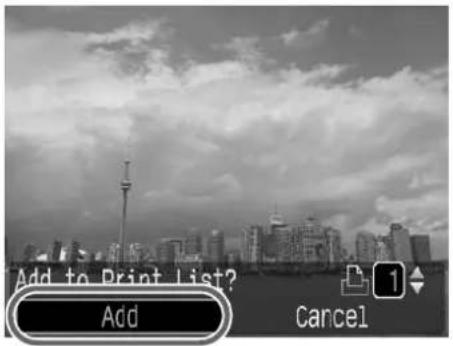
1 Select an image.
- Press the ◀▶ buttons or turn the Ⓞ dial and select the image.
2 Press the ↻ button (videos will be excluded).
3 Print list.
- Press the ▲▼ buttons and select the number of prints, press the ◀▶ buttons or turn the Ⓞ dial, select [Add] and press the Ⓗ️ button.
To cancel adding images, press the 📄 button again, press the ◀ buttons, or turn the ⏻ dial, select [Remove] and press the Ⓗ function SET button.
Examples are given using Canon SELPHY ES series, and SELPHY CP series printers. Please also refer to the Direct Print User Guide.
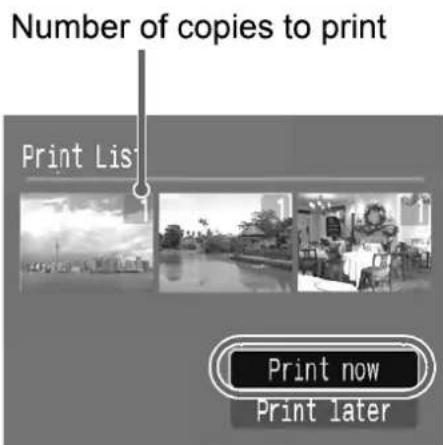
1 Connect the camera to the printer (p. 26).
2 Print.
- Press the ▲▼ buttons, select [Print now] and press the Ⓗ️ button. ▶ Printing will start. - If you stop the printer during printing and start again, it will start from the next print.
Designating Images for Printing (DPOF)
You can make print settings to images on a memory card (up to 998 images), such as which images to print and how many prints to make. You can then print all the selected images at once or take the memory card to a photo developer to order prints. Refer to the Direct Print User Guide for details on how to print the selected images. These designation methods comply with the DPOF (Digital Print Order Format) standards.
Print Settings
You can make settings for the print type, date and file number. These settings apply to all images selected for printing.
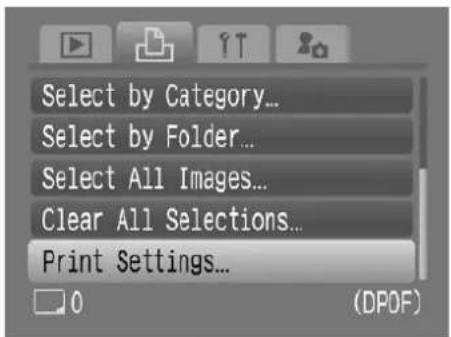
1 Select [Print Settings].
- Press the MENU button and select the tab, then select [Print Settings] and press the FUNC SET button.
2 Make the settings.
- Press the ▲▼ buttons to select a menu item, then press the ◀▶ buttons or turn the Ⓞ dial to select an option.
▶ Pressing the MENU button will make the settings and return you to the menu screen.
| Print Type | ☐ | Standard | Prints one image per page. |
| ☒ | Index | Prints several reduced size images per page. | |
| ☐☒ | Both | Prints both standard and index formats. | |
| Date | On | Prints date from shooting information. | |
| Off | - | ||
| File No. | On | Prints file number. | |
| Off | - | ||
| Clear DPOF data | On | After printing, all images selected for printing will be removed. | |
| Off | - | ||

- Depending on the printer or photo developer, print settings may not be reflected.
- may display when using a memory card with print settings set by a different DPOF-compliant camera. These settings will be overwritten by those set by your camera.
- Some printers may print the date twice on these images if [Date] is also set to [On].

- When set to [Index], [Date] and [File No.] cannot be set to [On] at the same time.
- The date will be printed in the style set in [Date/Time] in ⌘ (p. 17).
Selecting the Number of Copies
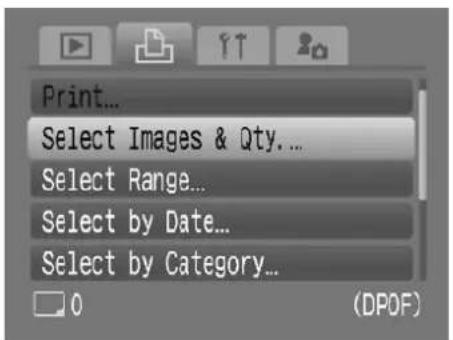
1 Select [Select Images & Qty.].
- Press the MENU button and select the tab, then select [Select Images & Qty.] and press the FUNC.SET button.
2 Select an image.
- Press the ◀▶ buttons or turn the Ⓞ dial to select an image to set, then press the Ⓗ function SET button.
You will be able to set the number of print copies. - If you select [Index], √ appears on the screen.
- Press the Ⓗ button again to cancel designation. √ will disappear.
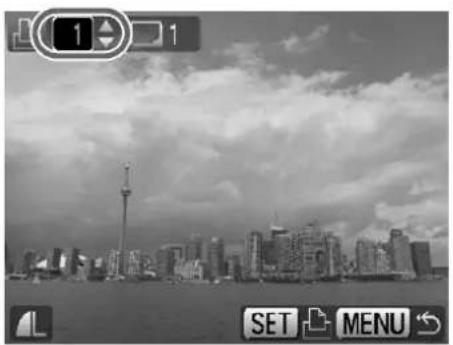
natural_image
Black-and-white cityscape photo with a prominent tower and skyline under cloudy sky (no visible text or symbols)3 Set the number of prints.
- Press the ▲▼ buttons or turn the Ⓞ dial to set the number of prints (maximum 99).
- Repeat Steps 2 and 3 to set other images and the number of prints.
For [Index], you cannot set the number of prints. Only select images with the operation in Step 2.
▶ Pressing the MENU button will make the settings and return you to the menu screen.
Select Range
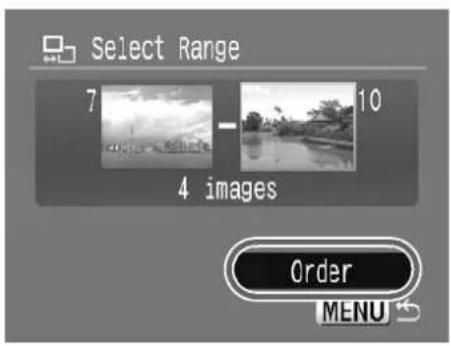
1 Select [Select Range].
- Select [Select Range] in Step 1 on p. 133, and press the Ⓗ function SET button.
Make selections by following the operations in Steps 2 and 3 on p. 114.
2 Make print settings.
- Press the ▲▼ buttons, select [Order] and press the Ⓗ️ button.
Select by Category
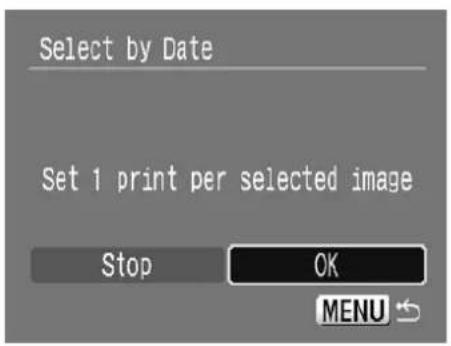
1 Select [Select by Date], [Select by Category] or [Select by Folder].
- Follow Step 1 on p. 133 to select a type, and press the Ⓗ function SET button.
- Follow Steps 2 and 3 on pp. 115 – 116 to select images.
2 Make print settings.
- Press the ◀▶ buttons or turn the Ⓞ dial, select [OK] and press the FUNC SET button.
Set All Images to Print Once
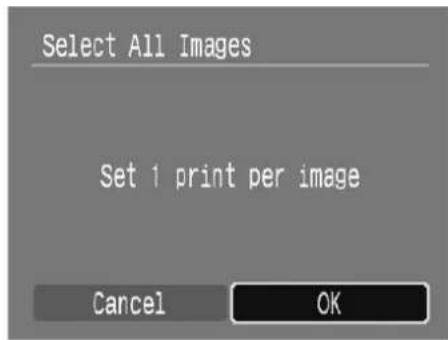
1 Select [Select All Images].
- Select [Select All Images] from the screen in Step 1 on p. 133 and press the FUNC SET button.
2 Make print settings.
- Press the ◀▶ buttons or turn the Ⓞ dial, select [OK] and press the FUNC.SET button.
Canceling All Selections
After selecting [Clear All Selections] and pressing the Ⓞ button in Step 1 on p. 133, press the ◀▶ buttons or turn the ⏻ dial to select [OK] and press the Ⓗ button to cancel all selections.

Sound-Only Recording (Sound Recorder)
You can continuously record voice only, without images, up to a maximum length of 2 hours.
You can select 3 levels of sound quality. They are, in order of highest to lowest: [44.100kHz], [22.050kHz], [11.025kHz].
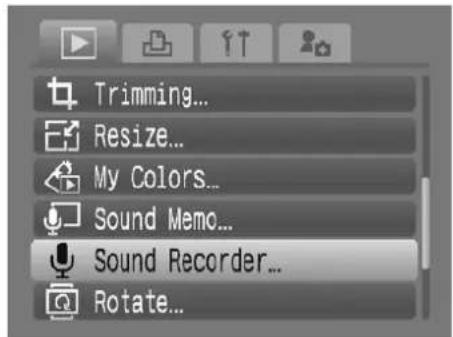
1 Select [Sound Recorder].
- Press the MENU button, and select [Sound Recorder] from the ▶ tab and press the Ⓗ function SET button.
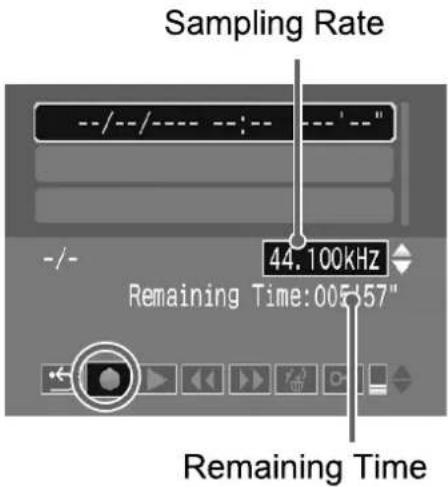
Changing the sound quality.
- Press the ▲▼ buttons, and select the sound quality.
Record.
- Press the ◀▶ buttons or turn the Ⓞ dial to select ●, then press the Ⓗ function SET button.
Recording will start, and the recording time will appear. - If you press the Ⓗ function SET button, recording will stop.
Sound Memo Operation Panel
Press the ◀▶ buttons, or turn the Ⓞ dial to select the menu item and press the Ⓗ function SET button.
| Exit | |
| Starts recording. | |
| Stops recording or playback. | |
| Press the ▲▼ buttons to select Voice Recorder, and if you press the FUNC SET button, it will play back. | |
| If you continuously press the FUNC SET button, it will rewind (audio will not play). | |
| If you continuously press the FUNC SET button, it will fast-forward (audio will not play). | |
| If you press the ◀▶ buttons or turn the ○ dial and select [Erase], then press the FUNC SET button, audio will erase. If you press the FUNC SET button in [Erase All] and then press the ◀▶ buttons or turn the ○ dial to select [OK] and press the FUNC SET button, all audio will be erased. | |
| Press the FUNC SET button to protect audio. | |
| Press the ▲▼ buttons to adjust the playback volume. |
Approximate Size for Sound Quality and Recording Time
| Sound quality | Size of voice recording | 32 MB (Supplied) | 2 GB | 8 GB |
| 11.025 kHz | 22 KB/sec. | 23 min. 28 sec. | 25 hrs. 22 min. 35 sec. | 101 hrs. 23 min. 47 sec. |
| 22.050 kHz | 44 KB/sec. | 11 min. 44 sec. | 12 hrs. 41 min. 18 sec. | 50 hrs. 41 min. 53 sec. |
| 44.100 kHz | 88 KB/sec. | 5 min. 52 sec. | 6 hrs. 20 min. 39 sec. | 25 hrs. 20 min. 57 sec. |

When the memory card becomes full, recording will automatically stop.
8
Customizing the Camera
You can customize various functions to suit your shooting preferences. The first part of this chapter explains convenient commonly used functions. The latter part explains how to change shooting and playback settings to suit your goals.
natural_image
Black-and-white photo of a person looking at a small model airplane, no visible text or symbolsChanging Functions
You can customize convenient commonly used functions from the tab (p. 46).
Turning off the Power Saving Function
You can set the power saving function (p. 51) to [Off]. However, setting it to [On] is recommended to save battery power.
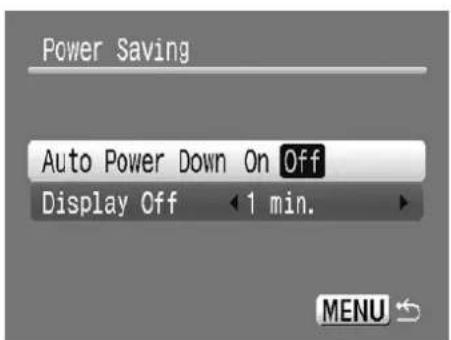
- Select [Power Saving], then press the Ⓗ button.
- Press the ▲▼ buttons to select [Auto Power Down], then use the ◀▶ buttons or turn the ○ dial to select [Off].
- If you set the Power Saving function to [Off], be careful not to forget to turn off the camera after use.
Power Saving during Shooting
You can adjust the time before the monitor automatically turns off (p. 51).
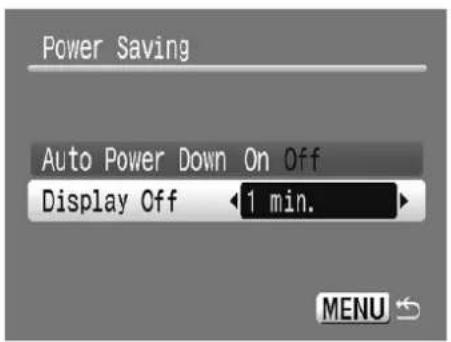
- Select [Power Saving], then press the Ⓗ button.
- Press the ▲▼ buttons to select [Display Off], then use the ◀▶ buttons or turn the Ⓞ dial to select a time.
In order to save battery power, it is recommended to select less than [1min.].
Using the World Clock
When traveling abroad, you can record images with local dates and times simply by switching the time zone setting if you pre-register the destination time zones. You can enjoy the convenience of not having to switch the Date/Time settings.
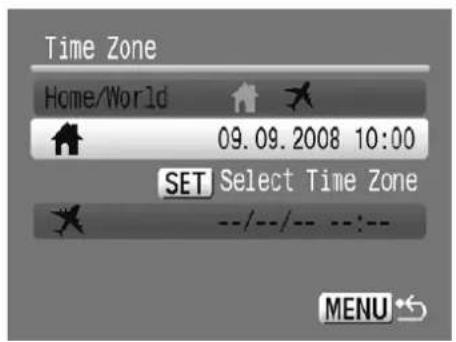
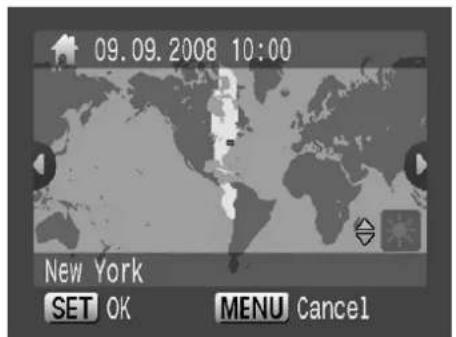
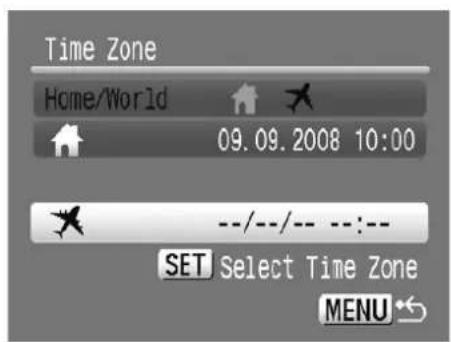
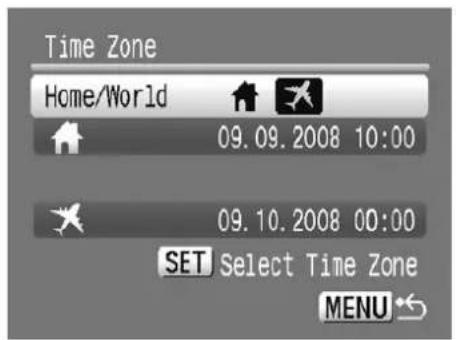
1 Set the home time zone.
- Select [Time Zone] and press the button.
- When setting this for the first time, confirm the information that displays on the screen at the left, and press the FUNC.SET button.
- Press the ◀▶ buttons or turn the Ⓞ dial to select the home time zone, then press the Ⓗ function button. To set daylight saving time (adds 1 hour), press the ▲▼ buttons to select ✿️.
2 Set the world time zone.
- Press the ▲▼ buttons to select ✗, then press the Ⓗ️ button.
- Press the ◀▶ buttons or turn the Ⓞ dial to select the destination time zone, then press the Ⓗ️ button.
- You can set daylight saving time just as in Step 1.
3 Select the world time zone.
- Press the ▲▼ buttons and select [Home/World].
- Press the ◀▶ buttons or turn the Ⓞ dial to select ✗, then press the MENU button.
- will appear in the [Time Zone] or shooting screen (p. 42).

In ✗, if you change the date or time (p. 17), your home time and date will automatically change.
Changing the File Number Assignment
Images you shoot are automatically assigned file numbers, in the order they were taken, from 0001 – 9999, and saved to folders of up to 2000 images. You can change the file number assignment.
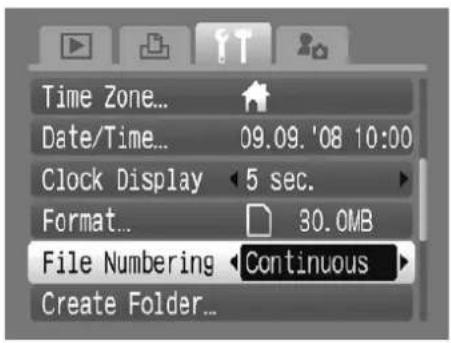
- Select [File Numbering], then press the ◀▶ buttons to select an option.
[Continuous]: Even if you shoot using a new memory card, the file numbers are assigned consecutively until an image with the number 9999 is taken/saved.
● [Auto Reset]: If you replace the memory card with a new one, file numbering begins with 0001 again.

- For either setting [Continuous] or [Auto Reset], if you use a memory card already containing images, the newly assigned file numbers may continue the existing numbering. If you want to start over with file number 0001, format the memory card before use (p. 50).
- Refer to the Software Starter Guide for information regarding folder structure or image type.
Creating a Folder
You can create new folders to save your images to.
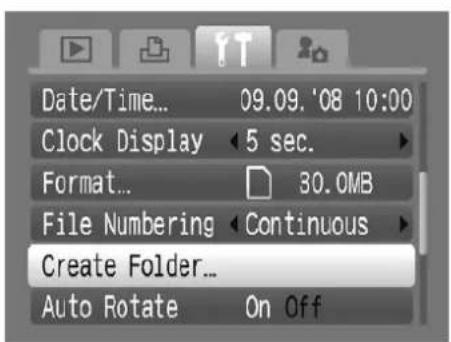
- Select [Create Folder], then press the button.
- Select [Create New Folder], then press the ◀▶ buttons or turn the Ⓞ dial to select √.
- will display on the screen (p. 42) when shooting, and shots will be recorded into a new folder.
Creating Folders by Day and Time
You can set a day and time for folder creation.
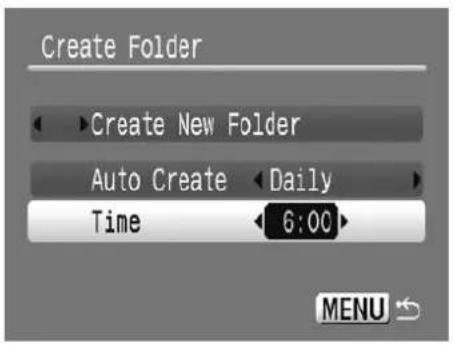
- Select [Create Folder], then press the button.
- Select [Auto Create], then press the ◀▶ buttons or turn the Ⓞ dial to select an interval.
- Select [Time], then press the ◀▶ buttons or turn the Ⓞ dial to set a time.
The new folder will be created on the set day and time. Images shot after the creation date are saved to the new folder.
Turning off Auto Rotate
When you play back images on the camera or a computer, images shot in vertical orientation automatically rotate and display vertically. You can turn off this function.
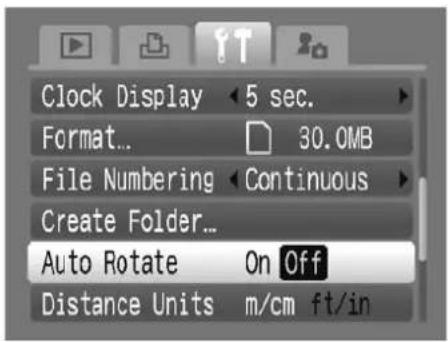
- Select [Auto Rotate], then press the ◀▶ buttons to select [Off].
Changing the Lens Retract Time
For safety reasons, The lens retracts about 1 minute after pressing the ▶ button when in a shooting mode (p. 24). You can set the retract time to [0 sec.].
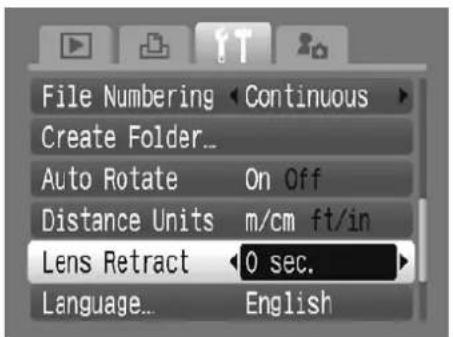
- Select [Lens Retract], then press the ◀▶ buttons to select [0 sec.].
Changing Shooting Functions
If you set the mode dial to P/M and then to P mode, you can change the settings on the ☐ tab (p. 46).

Before attempting to shoot using a function explained in this chapter in modes other than P mode, check if the function is available in those modes (pp. 158 – 159).
Using the Slow Synchro
You can use this to shoot people and main subjects at the appropriate exposure, and the shutter speed is lowered so that both the subject and the background appear at the proper brightness.
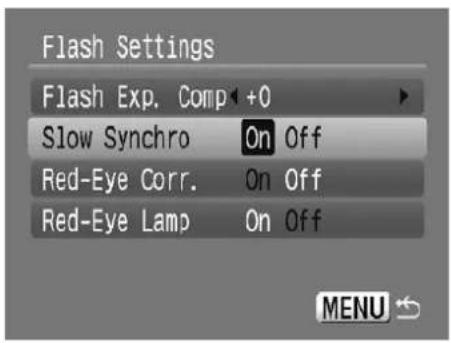
- Select [Flash Settings], then press the button.
- Press the ▲▼ buttons or turn the Ⓞ dial to select [Slow Synchro], then press the ◀▶ buttons to select [On].

- Attach a tripod to the camera, as the shutter speed is slow. You are recommended to shoot with the [IS Mode] set to [Off] (p. 145).
- Even if the flash fires, ensure that the subject does not move until the shutter sound ends.
Turning off the Red-Eye Reduction Function
The red-eye reduction lamp lights in order to reduce the red-eye effect that occurs when shooting in dark conditions using the flash. You can turn off this function.
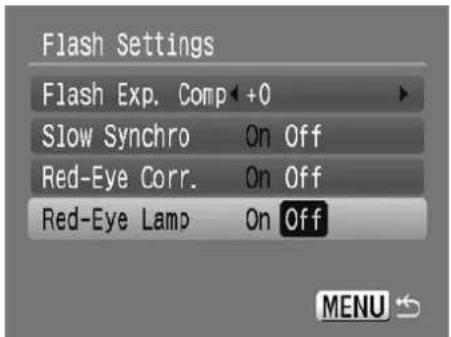
- Select [Flash Settings], then press the Ⓗ button.
- Press the ▲▼ buttons or turn the Ⓞ dial to select [Red-Eye Lamp], then press the ◀▶ buttons to select [Off].
Turning off the AF Assist Beam
When the camera cannot focus when you press the shutter button halfway, the lamp will automatically light to assist focusing. You can turn off the lamp.
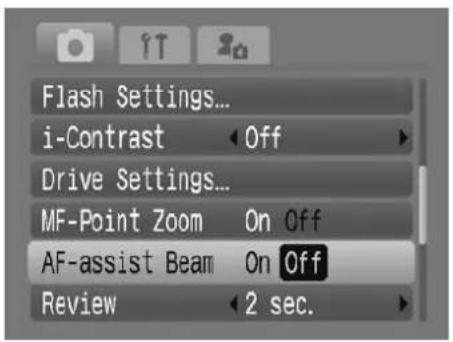
- Select [AF-assist Beam], then press the ◀▶ buttons to select [Off].
Displaying Image Information Right After Shooting
You can change the image display that appears after shooting.
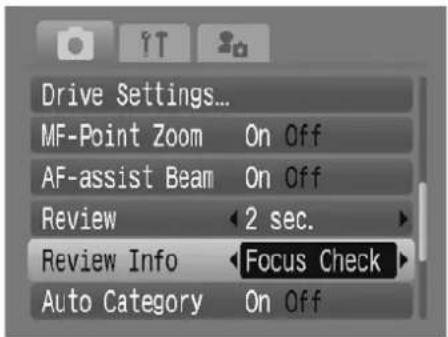
- Select [Review Info], then press the ◀▶ buttons to select an option.
[Detailed]: Displays detailed information (p. 43).
[Focus Check]: The area inside the AF frame displays enlarged, allowing you to check the focus. The procedure is the same as in "Checking the Focus or People's Expressions (Focus Check)" (p. 110).
Categorizing Images Automatically
Images can be automatically categorized (p. 119) when shooting.
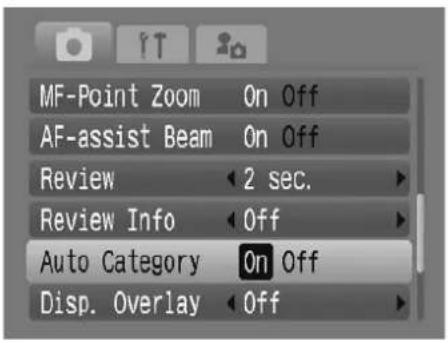
- Select [Auto Category], then press the ◀▶ buttons to select [On].
● For images shot in 🎥, 🎥 or 🎥 mode, or images with faces detected when [AF Frame] is set to [Face Detect].
: For images shot in 🍒 or 🍐 mode.
: For images shot in 🎨, 🔊, 🔒, 🔔, or 🎩 mode.

Movies cannot be automatically categorized, but can be categorized using My Category (p. 119).
Displaying the Overlay
You can display gridlines for vertical and horizontal guidance, or 3:2 guide to confirm the printable area for L size or postcard size prints.
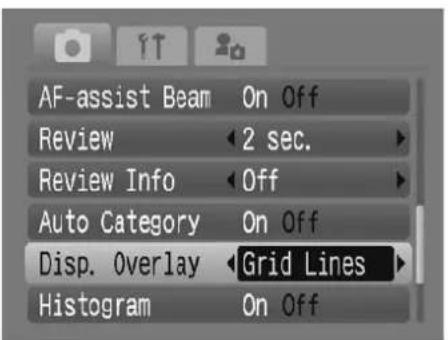
- Select [Disp. Overlay], then press the ◀▶ buttons to select an option.
- [Grid Lines]: A grid overlays the display.
[3:2 Guide]: The areas outside the 3:2 range are grayed out. This area will not print when printing on paper with a 3:2 aspect ratio.

- In W mode, you cannot set [3:2 Guide] or [Both].
- Grid Lines will not be recorded on the image.
- The gray areas displayed with [3:2 Guide] are the areas that will not be printed. The actual image recorded will include the portion in the gray areas.
Changing the IS-Mode Settings
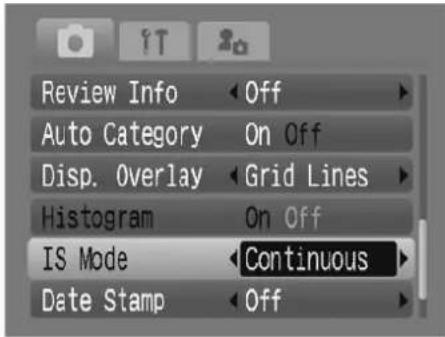
- Select [IS Mode], then press the ◀▶ buttons to select an option.
[Continuous]: The image stabilization is always on. You can confirm the result directly on the display, which makes it easier to check the composition or focus of the subject.
● [Shoot Only]: The image stabilization is only on in the moment of shooting.
[Panning]: The image stabilization only works for the effect of up and down motion. This option is recommended for shooting objects moving horizontally.

- If camera shake is too strong, fix the camera to a tripod. However, it is recommended to set IS Mode to [Off] when the camera is fixed to a tripod.
- When using [Panning], hold the camera horizontally. Image stabilization does not work when the camera is held vertically.
Registering Functions to the 📄 Button
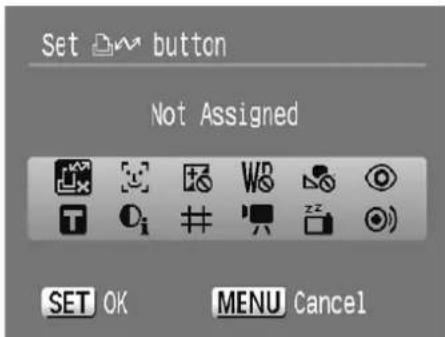
- Select [Set ↻ button], then press the Ⓗ️ button.
- Press the ▲▼◀▶ buttons or turn the Ⓞ dial to select the functions to register, then press the Ⓗ function button.
- Pressing the 📁 button will call up the registered function.

- Press _x^ if you want to cancel a function.
- When this Ⓧ symbol is shown on the bottom right of an icon, the function cannot be used in the current shooting mode or function setting.
- In □, each press of the □ ∼ button records white balance data (p. 71), and the white balance settings also change to □.
- In Ⓞ), each time you press the 📁 ∼ button, the shutter sound's 🎥3 clip (p. 147) in the 🔒 tab will play. Use this when you want to draw the attention of the subject before shooting.
Changing Playback Functions
You can make settings in the ▶ tab by pressing the ▶ button (p. 46).
Registering Functions to the ▶ Button
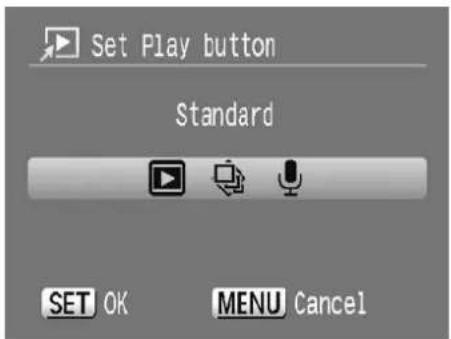
- Select [Set Play button] and press the Ⓗ
- Press the ◀▶ buttons or turn the Ⓞ dial to select an option, then press the Ⓗ function SET button.
- Pressing the ▶ button in Playback mode will call up the registered function.

- Selecting ▶ (Standard) will let you switch between turning the camera off and Playback mode, or between Shooting and Playback modes (p. 24).
- If you select ⚙ or 🔔, you cannot turn the camera off with the ▶ button.
- Slideshows cannot be started during index playback.
Selecting the Image that Resumes in Playback
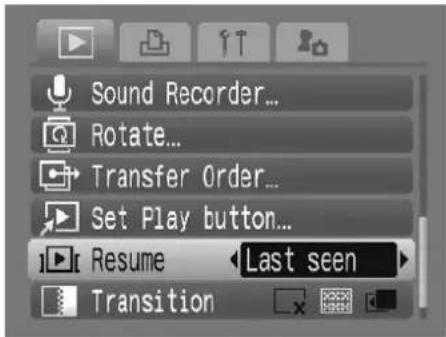
- Select [Resume], then press the ◀▶ buttons to select an option.
[Last shot]: Resumes with the most recently shot image.
[Last seen]: Resumes with image last viewed.
Changing the Start-up Image or Sound (My Camera Settings)
You can set images you have taken as the start-up image that displays when the camera is turned on, or record sounds for each of the cameras operations with the 🔒 menu.
Change
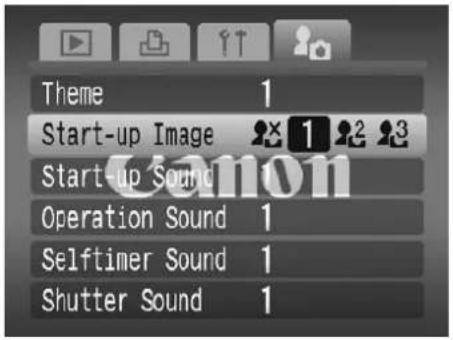
- Press the ▲▼ buttons or turn the Ⓞ dial to select an option.
- Press the ◀▶ buttons to select a setting.
- Press the MENU button to complete the setting.
- Select [Theme] to set all the items to the same number setting.
Register
When you press the ▶ button and set the camera to playback mode, you can register sounds and images.
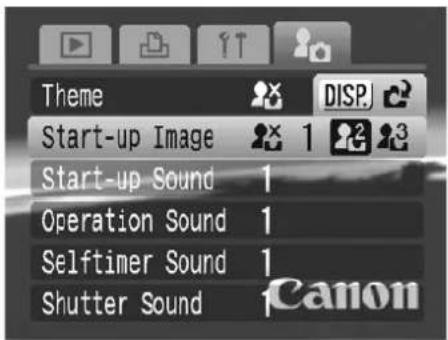
- Press the ◀▶ buttons to select 🎥2 or 🎥3, then press the DISP. button.
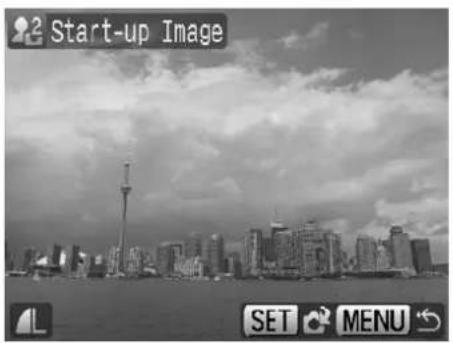
- Start-up Image: Press the ◀▶ buttons or turn the Ⓞ dial to select an image, then press the ⏚ function SET button.
- Press the ◀▶ buttons or turn the Ⓞ dial to select [OK], then press the Ⓗ function SET button to complete registration.
Changing the Start-up Image or Sound (My Camera Settings)
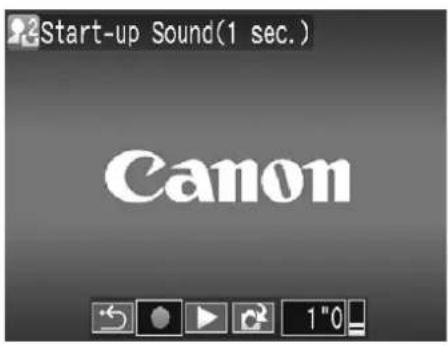
- Sounds: Press the ◀▶ buttons or turn the ○
dial to select ●, then press the Ⓗ️ button to record.
After recording, press the ◀▶ buttons or turn the Ⓞ dial to select 📋, then press the Ⓗ️ button. - Press the ◀▶ buttons or turn the Ⓞ dial to select [OK], then press the Ⓗ function SET button to complete registration.

Register images or sounds saved on a computer
You can register images or sounds to the camera using the included software (ZoomBrowser/ImageBrowser). Refer to the Software Starter Guide for details.

Any previously registered image or sound will be overwritten when registering a new image and sound (p. 147).

Use the supplied software (ZoomBrowser EX/ImageBrowser) to restore the default My Camera settings to the camera. Refer to the Software Starter Guide for details.
Useful Information for Using the Camera
This chapter introduces camera accessories and contains lists of functions. The index also appears at the end.
natural_image
Black-and-white photo of two children sitting on a decorative bench, smiling and holding flowers (no text or symbols visible)Using Household Power
If you use AC Adapter Kit ACK-DC30 (sold separately), you can use the camera without worrying about how much charge is left in the battery.
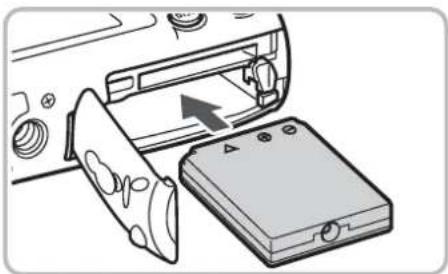
natural_image
Diagram of a device with a door panel and battery, showing internal components (no text or symbols)1 Insert the coupler.
- Open the cover (p. 14) and insert the coupler as shown until it locks into place with a click.
- Close the cover (p. 14).
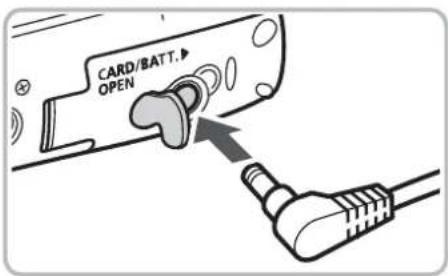
2 Plug the cord into the camera.
- Open the cover and fully insert the plug into the coupler.
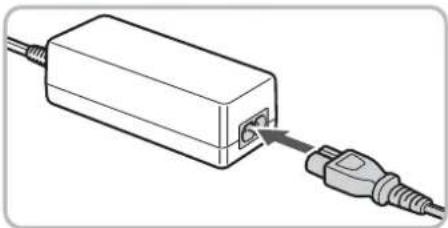
natural_image
Diagram of a device with an attached plug and cable, showing no text or symbols3 Connect the power cord.
- Connect the power cord to the compact power adapter, then plug the other end into a power outlet.
- You can turn the camera on to use it.
After you finish, turn off the camera and unplug the power cord from the power outlet.

Do not unplug the power cord with the camera turned on. This could erase images you have taken or damage the camera.
Using a Supplementary Flash
High-Power Flash HF-DC1 (sold separately) is used to supplement the camera's built-in flash when the subject is too far away for proper illumination. For details on attaching and using the High-Power Flash, refer to the user guide provided with the flash.

When can you not use the HF-DC1?
When in M mode (p. 89)
You Think There is a Problem
If you think there is a problem with the camera, first check the following. If the items below do not solve your problem, contact a Canon Customer Support Help Desk as listed in your Warranty System Booklet.
Power
You pressed the power button, but nothing happened.
- Confirm that the battery/batteries is properly inserted (p. 14).
- Confirm that the memory card/battery cover is securely closed (p. 14).
- If the battery terminals are dirty, battery performance will decrease. Clean the terminals with a cotton swab and re-insert the battery/batteries several times.
Battery/batteries is consumed quickly.
- Battery performance decreases at low temperatures. Warm the battery/batteries, such as by placing them in your pocket with the terminal cover on.
Lens will not retract.
- Do not open the memory card/battery cover while the power is on. After closing the memory card/battery cover, turn the power on then back off (p. 15).
TV output
Image is distorted or not showing on TV (p. 112).
Shooting
Cannot shoot.
- Set the mode dial to AUTO (p. 40).
- When in playback (p. 24), press the shutter button halfway (p. 20).
Screen doesn't display.
- Press the DISP. button (p. 42).
Camera screen is black at start-up.
- Images that have been edited on a computer, have had their name changed, or have been taken with another camera may not display correctly when set in the My Camera function (p. 147).
Screen does not display properly in dark places (p. 44).
Screen does not display properly while shooting.
Please note, the following issues will not be recorded in still images, but will be recorded in movies.
- When the camera is subjected to powerful light sources, the display may darken.
• Under fluorescent lighting, the screen may flicker. - When shooting bright light sources, a bar of light (purplish red) may appear on the screen.
appears on the screen and the shot cannot be taken even though the shutter button was pressed fully (p. 23).
appears when the shutter button was pressed halfway (p. 57).
- Set the [IS mode] to [On] (p. 145).
- Set the flash to ↓ (p. 67).
- Increase the ISO speed (p. 70).
Image is blurred.
- Shoot the subject within the focusing distance (p. 163).
- Set the [AF-assist beam] to [On] (p. 143).
- Confirm that functions which you do not intend to use (macro, etc.) are not set.
- Shoot using the focus lock, AF lock or manual focus (pp. 78, 84, 85).
Even when you press the shutter button halfway, the frame does not appear, and the camera does not focus.
- If you center on the light and dark contrasting area of the subject and push the shutter button halfway, or repeatedly push the shutter button halfway, the frame will appear and the camera will focus.
Subject is too dark.
- Set the flash to ↓ (p. 67).
- Adjust the brightness with exposure compensation (p. 72).
• Use the AE lock, or spot metering to shoot (p. 87).
Subject is too bright (overexposed).
- Set the flash to Ⓧ (p. 57).
- Adjust the brightness with exposure compensation (p. 72).
• Use the AE lock, or spot metering to shoot (p. 87).
• The subject is too bright due to ambient lighting.
Image is dark even though the flash fired (p. 23).
- Increase the ISO speed (p. 70).
Image taken using the flash is too bright (overexposed).
- Shoot within an appropriate distance for flash photography (p. 67).
- Set the flash to ⓣ (p. 57).
White dots appear on the image when shooting with the flash.
• Light from the flash has reflected off dust particles or other objects in the air.
Image appears rough or grainy.
- Shoot with the ISO speed on a lower setting (p. 70).
- Depending on the shooting mode, when shooting in a high ISO speed the image may appear rough or grainy (pp. 55, 56).
Eyes appear red (p. 92).
- Set the [Red-Eye Lamp] to [On] (p. 142). When shooting with the flash, the lamp (on the front of the camera) lights (p. 40), and for approximately 1 second while the camera is reducing red-eye, it is not possible to shoot. It is more effective if the subject is looking directly at the lamp. Even better results can be obtained by increasing the lighting in indoor settings or approaching closer to the subject.
Recording images to the memory card takes a long time, or continuous shooting slows down.
• Format the memory card in the camera (p. 50).
When you can't make settings for shooting functions or FUNC. menu
- The items in which settings can be made differ depending on the shooting mode. Check the Menu lists (pp. 156 – 159).
Shooting movies
Correct shooting time does not display, or stops.
- Format the memory card in the camera, or use a memory card capable of recording at high speeds. Even when the shooting time does not display properly, the video recorded will be the length that it was actually shot (p. 29).
“!” displayed on the LCD monitor, and shooting ended automatically.
Camera's internal memory was insufficient. Try one of the following.
- Format the memory card in the camera (p. 50).
• Lower the recorded pixels (p. 99).
• Use a memory card capable of recording at high speeds.
Playback
Cannot play back images or movies.
- If the file name or folder structure is changed on a computer, you may not be able to play back images or movies. Refer to the Software Starter Guide for information regarding folder structure or file names.
Playback stops, or audio cuts out.
• Use a card that has been formatted on this camera (p. 50).
- If you copy a movie to a memory card that reads slowly, playback may interrupt momentarily.
List of Messages That Appear on the Screen
If error messages appear on the LCD monitor, try one of the following solutions.
No memory card
- The memory card is not installed in the correct direction. Install the memory card in the correct direction (p. 14).
Card locked!
- The SD memory card or SDHC memory card's write protect tab is set to "Lock". Unlock the write protect tab (p. 16).
Cannot record!
- You attempted to shoot an image without the a memory card, or with a memory card installed incorrectly. Install the memory card in the correct direction when shooting (p. 14).
• You cannot attach sound memos to movies (p. 127).
Memory card error (p. 51)
- If this error message appears even when using the supplied memory card, contact your Canon Customer Support Help Desk as there may be a problem with the camera.
Memory card full
- There is not enough free space on the memory card to shoot (pp. 21, 53, 65, 81) or edit images (pp. 120 – 127). Erase the images (pp. 25, 113) to open space for new images, or insert an empty memory card (p. 14).
Change the battery (p. 14)
No image
• There are no images recorded on the memory that can be displayed.
Protected! (p. 117)
Unidentified Image/Incompatible JPEG/Image too large./RAW
• Unsupported images or data, or corrupted image data cannot be displayed.
- Images manipulated on a computer, that have had their file name changed, or have been taken with a different camera may not display.
Cannot magnify!/Cannot rotate/Cannot modify image/Cannot register this image!/Cannot assign to category/Unselectable image.
- Incompatible images cannot be magnified (p. 111), rotated (p. 120), edited (pp. 120 – 127), registered to the start-up screen (p. 147), categorized (p. 119), or added to a print list (p. 132).
- Images manipulated on a computer, that have had their file name changed, or have been taken with a different camera may not be magnified, rotated, edited, registered to the start-up screen, categorized, or added to a print list.
• Movies cannot be magnified (p. 111), edited (pp. 120 – 127), or registered to the start-up screen (p. 147).
Cannot select!
- When selecting the selection range (pp. 114, 118, 120), you tried to select a starting image that was after the last image or you tried to select an ending image that was before the starting image.
• You tried to select more than 501 images (pp. 114, 118, 120).
Cannot transfer!
- You cannot send incompatible images by direct transfer or images with corrupted data even if they are selected.
- You cannot send a movie as a background image on your PC even if it is selected (p. 128).
Too many marks
- You selected more than 998 images to send in print settings. Select less than 998 images (p. 132).
Cannot complete!
- Print settings or transfer settings could not be saved correctly. Reduce the number of settings and try again (pp. 129, 132).
Naming error!
- The file name could not be created because there is an image with the same name as the folder that the camera is attempting to create, or the highest possible file number has already been reached (p. 140). In the ⚪† menu, change [File Numbering] to [Auto reset] (p. 140) or format the memory card (p. 50).
Incompatible WAVE
- Since the data type of the existing sound memo is incorrect, no new sound memo can be added or played back (p. 127).
Communication error
- Images could not be transferred to the computer due to the large amount of images (approx. 1000) stored on the memory card (p. 31). Use a commercially available USB card reader to download the images.
Lens error, restart camera
- A lens error was detected. Press the power button to turn the camera off and back on (p. 40). If this error message continues to display, contact your Canon Customer Support Help Desk as there may be a problem with the lens.
- This error can occur if you hold the lens while it is in motion or when using it in a location with excessive dust or sand in the air.
Exx (xx: number)
- A camera error was detected. Press the power button to turn the camera off and back on (p. 40).
- If an error code displays directly after taking a picture, the shot may not have been recorded. Check image in playback mode.
- If this error code reappears, note the number and contact your Canon Customer Support Help Desk as there may be a problem with the camera.
Functions Available in Each Shooting Mode
| Function\Shooting modes | AUTO | P/M | = | ||||
| P | M | # | FA | ||||
| Flash (pp. 57, 67) | A | ○ | ○ | — | ○ | ○ | ○ |
| ↓ | — | ○ | ○ | ○ | ○ | ○ | |
| 3 | ○ | ○ | ○ | ○ | ○ | ○ | |
| Focusing Zone (pp. 63, 67, 85) | A | ○ | ○ | ○ | ○ | ○ | ○ |
| ↓ | ○ | ○ | ○ | — | ○ | ○ | |
| ▲ | — | ○ | ○ | — | ○ | ○ | |
| MF | — | ○ | ○ | — | ○ | ○ | |
| ISO Speed (p. 70) | ISO AUTO | ○ | ○ | — | ○ | ○ | ○ |
| ISO HI | ○ | ○ | — | ○ | — | — | |
| ISO ISO ISO ISO ISO ISO ISO ISO 80 100 200 400 800 1600 | — | ○ | ○ | ○ | — | — | |
| Drive Mode (pp. 61, 62, 72, 74, 75) | □ | ○ | ○ | ○ | ○ | ○ | ○ |
| ☐ | — | ○ | ○ | ○ | ○ | ○ | |
| ☐ | ○ | ○ | ○ | — | ○ | ○ | |
| ☐ ☐ | ○ | ○ | ○ | ○ | ○ | ○ | |
| ☐ ☐ | ○ | ○ | ○ | ○ | ○ | ○ | |
| AF Lock (p. 84) | — | ○ | ○ | ○ | — | — | |
| AE Lock (p. 87)/FE Lock (p. 88) | — | ○ | — | ○ | — | — | |
| TV Display (p. 76) | ○ | ○ | ○ | — | ○ | ○ | |
| Face Selection (p. 86) | ○ | ○ | ○ | — | ○ | ○ | |
| Information Display (p. 42) | On | ○ | ○ | ○ | *3 | ○ | ○ |
| Off | ○ | ○ | ○ | ○ | ○ | ||
| No Display | ○ | ○ | ○ | ○ | ○ | ||
| Function menu | |||||||
| Exposure Compensation (p. 72)/Exposure Shift (p. 99) | — | ○ | — | ○ | ○ | ○ | |
| White Balance (p. 71) | AWB | ○ | ○ | ○ | ○ | ○ | ○ |
| — | ○ | ○ | ○ | — | — | ||
| My Colors (p. 73) | OFF AV BN Se BW BP AL AD BB BG BR BC | — | ○ | ○ | ○ | — | — |
| Flash Exposure Compensation (p. 88) | — | ○ | — | ○ | — | — | |
| Flash Output (p. 90) / Tv/Av Settings (p. 89) | — | — | ○ | — | — | — | |
| Metering System (p. 87) | ○ | ○ | ○ | ○ | ○ | ○ | |
| [ ] [●] | — | ○ | ○ | — | — | — | |
| Image Quality (Compression Ratio) (p. 68) | ○ | ○ | ○ | ○ | ○ | ○ | |
| Recording Pixels (pp. 68, 98) | L M1 M2 M3 S W | ○ | ○ | ○ | ○ | ○ | ○ |
| 640 320 | — | — | — | — | — | — | |
*1 ISO3200 (p. 56) is set by default. *2 Only AE lock available. *3 Quick Shot screen displayed.
| SCN | ||||||||||||||
| ISO3200 | A/S | |||||||||||||
| ○ | ○ | ○ | ○ | ○ | ○ | — | — | ○ | — | — | ○ | — | — | — |
| ○ | ○ | ○ | ○ | ○ | ○ | — | ○ | ○ | — | — | ○ | ○ | — | — |
| ○ | ○ | ○ | ○ | ○ | ○ | ○ | ○ | ○ | ○ | ○ | ○ | ○ | — | — |
| ○ | ○ | ○ | ○ | ○ | ○ | ○ | ○ | ○ | ○ | — | ○ | ○ | ○ | ○ |
| — | ○ | — | ○ | ○ | ○ | — | ○ | ○ | ○ | ○ | ○ | ○ | ○ | ○ |
| — | ○ | — | ○ | ○ | ○ | — | ○ | ○ | ○ | — | ○ | ○ | ○ | ○ |
| ○ | ○ | ○ | ○ | ○ | ○ | — | ○ | ○ | ○ | — | ○ | — | ○ | ○ |
| ○ | ○ | ○ | ○ | ○ | ○ | ○ | ○ | ○ | *1 | ○ | ○ | ○ | ○ | ○ |
| — | — | — | — | — | — | — | — | — | ○ | — | — | — | — | |
| — | — | — | — | — | — | — | — | — | ○ | — | — | — | — | |
| ○ | ○ | ○ | ○ | ○ | ○ | ○ | ○ | ○ | ○ | ○ | ○ | ○ | — | — |
| ○ | ○ | ○ | ○ | ○ | ○ | ○ | ○ | ○ | ○ | ○ | — | — | — | — |
| ○ | ○ | ○ | ○ | ○ | ○ | — | ○ | ○ | ○ | ○ | — | — | — | — |
| ○ | ○ | ○ | ○ | ○ | ○ | ○ | ○ | ○ | ○ | ○ | ○ | ○ | ○ | ○ |
| ○ | ○ | ○ | ○ | ○ | ○ | ○ | ○ | ○ | ○ | ○ | — | — | — | — |
| — | — | — | — | — | — | — | — | — | — | ○ | — | — | ○ | — |
| — | — | — | — | — | — | — | — | — | — | ○ | — | — | *2 | — |
| ○ | ○ | ○ | ○ | ○ | ○ | ○ | ○ | ○ | ○ | ○ | ○ | — | ○ | ○ |
| ○ | ○ | ○ | ○ | ○ | ○ | — | ○ | ○ | ○ | ○ | ○ | — | — | — |
| ○ | ○ | ○ | ○ | ○ | ○ | ○ | ○ | ○ | ○ | ○ | ○ | ○ | ○ | ○ |
| ○ | ○ | ○ | ○ | ○ | ○ | ○ | ○ | ○ | ○ | ○ | — | — | ○ | — |
| ○ | ○ | ○ | ○ | ○ | ○ | ○ | ○ | ○ | ○ | — | — | — | — | — |
| Function menu | ||||||||||||||
| ○ | ○ | ○ | ○ | ○ | ○ | ○ | ○ | ○ | — | ○ | — | ○ | ○ | — |
| ○ | ○ | ○ | ○ | ○ | ○ | ○ | ○ | ○ | ○ | ○ | ○ | ○ | ○ | ○ |
| — | — | — | — | — | — | — | — | — | — | ○ | — | ○ | ○ | — |
| — | — | — | — | — | — | — | — | — | — | ○ | — | ○ | ○ | — |
| — | — | — | — | — | — | — | — | — | — | — | — | — | — | — |
| — | — | — | — | — | — | — | — | — | — | — | — | — | — | — |
| ○ | ○ | ○ | ○ | ○ | ○ | ○ | ○ | ○ | ○ | ○ | ○ | ○ | ○ | ○ |
| — | — | — | — | — | — | — | — | — | — | ○ | — | — | — | — |
| ○ | ○ | ○ | ○ | ○ | ○ | ○ | ○ | ○ | ○ | ○ | ○ | ○ | — | — |
| ○ | ○ | ○ | ○ | ○ | ○ | ○ | ○ | ○ | *4 | *5 | ○ | *5 | — | — |
| — | — | — | — | — | — | — | — | — | — | — | — | — | ○ | ○ |
*4 M3 is set by default. *5 W is not available.
○ Selectable — Not selectable

Shooting Menu
| Function\Shooting modes | AUTO | P/M | =0 | ||||
| P | M | # | A | ||||
| AF Frame (p. 82) | Face Detect | ○ | ○ | ○ | ○ | ○ | ○ |
| AiAF | ○ | ○ | ○ | — | ○ | ○ | |
| Center | ○ | ○ | ○ | — | ○ | ○ | |
| AF Frame Size (p. 82) | Normal/Small | — | ○ | ○ | — | — | — |
| AF-Point Zoom (p. 83) | On/Off | ○ | ○ | ○ | — | ○ | ○ |
| Servo AF (p. 84) | On/Off | ○ | ○ | ○ | — | ○ | ○ |
| Digital Zoom (p. 58) | Standard/Off | ○ | ○ | ○ | — | ○ | ○ |
| Digital Tele-converter (1.7x/2.2x) | ○ | ○ | ○ | — | ○ | ○ | |
| Flash Settings (pp. 92, 142) | Slow Synchro On/Off | — | ○ | *1 | ○ | — | *1 |
| Red-Eye Corr. On/Off | ○ | ○ | ○ | ○ | ○ | ○ | |
| Red-Eye Lamp On/Off | ○ | ○ | ○ | ○ | ○ | ○ | |
| Flash Exposure Compensation | — | ○ | — | ○ | — | — | |
| Flash Output Maximum/Medium/Minimum | — | — | ○ | — | — | — | |
| i-Contrast (p. 91) | Off/Auto | ○ | ○ | ○ | ○ | — | — |
| Drive Settings (pp. 62, 74, 75) | Face Self-Timer 1 – 10 shots | ○ | ○ | ○ | — | ○ | ○ |
| Self-Timer 10 sec./2 sec. | ○ | ○ | ○ | ○ | ○ | ○ | |
| Custom*3 | ○ | ○ | ○ | ○ | ○ | ○ | |
| MF Magnified Display (p. 85) | On/Off | — | ○ | ○ | — | ○ | ○ |
| AF-assist Beam (p. 143) | On/Off | ○ | ○ | ○ | ○ | ○ | ○ |
| Review (p. 52) | Off/2 – 10 sec./Hold | ○ | ○ | ○ | ○ | ○ | ○ |
| Review Info (p. 143) | Off/Detailed/Focus Check | ○ | ○ | ○ | ○ | ○ | ○ |
| Save Original (p. 95) | On/Off | — | — | — | — | — | — |
| Auto Category (p. 144) | On/Off | ○ | ○ | ○ | ○ | ○ | ○ |
| Disp. Overlay (p. 144) | Off/Grid Lines | ○ | ○ | ○ | — | ○ | ○ |
| 3:2 Guide/Both | ○ | ○ | ○ | — | ○ | ○ | |
| Histogram | On/Off | — | ○ | ○ | *1 | — | — |
| IS Mode (p. 145) | Continuous/Off | ○ | ○ | ○ | ○ | ○ | ○ |
| Shoot Only/Panning | ○ | ○ | ○ | ○ | ○ | ○ | |
| Date Stamp (p. 60) | Off/Date/Date & Time | ○ | ○ | ○ | ○ | ○ | ○ |
| Set button (p. 145) | ○ | ○ | ○ | ○ | ○ | ○ | |
*1 Always [On].
*2 Available when ↓ is selected.
*3 Possible settings: 0 – 30 seconds in [Delay], and 1 – 10 shots in [Shots].
| SCN | [IMAGE] | |||||||||||||
| ISO3200 | A S | A S | ||||||||||||
| ○ | ○ | ○ | ○ | ○ | ○ | — | ○ | ○ | ○ | ○ | ○ | — | — | — |
| ○ | ○ | ○ | ○ | ○ | ○ | — | ○ | ○ | ○ | ○ | ○ | — | ○ | ○ |
| ○ | ○ | ○ | ○ | ○ | ○ | ○ | ○ | ○ | ○ | ○ | ○ | ○ | — | — |
| — | — | — | — | — | — | — | — | — | — | — | — | — | — | — |
| ○ | ○ | ○ | ○ | ○ | ○ | ○ | ○ | ○ | ○ | — | ○ | — | — | — |
| ○ | ○ | ○ | ○ | ○ | ○ | — | ○ | ○ | ○ | ○ | ○ | ○ | *1 | *1 |
| ○ | ○ | ○ | ○ | ○ | ○ | ○ | ○ | ○ | — | *1 | — | — | ○ | — |
| ○ | ○ | ○ | ○ | ○ | ○ | ○ | ○ | ○ | — | — | — | — | — | — |
| — | — | *1 | — | — | — | — | — | — | — | — | — | ○ | — | — |
| ○ | ○ | ○ | ○ | ○ | ○ | — | ○ | ○ | — | — | — | — | — | — |
| ○ | ○ | ○ | ○ | ○ | ○ | — | ○ | ○ | — | — | ○ | ○ | — | — |
| — | — | — | — | — | — | — | — | — | — | — | — | — | — | — |
| — | — | — | — | — | — | — | — | — | — | — | — | — | — | — |
| — | — | — | — | — | — | — | — | — | — | — | — | — | — | — |
| ○ | ○ | ○ | ○ | ○ | ○ | — | ○ | ○ | ○ | ○ | — | — | — | — |
| ○ | ○ | ○ | ○ | ○ | ○ | ○ | ○ | ○ | ○ | ○ | ○ | ○ | ○ | ○ |
| ○ | ○ | ○ | ○ | ○ | ○ | ○ | ○ | ○ | ○ | ○ | — | — | — | — |
| ○ | ○ | ○ | ○ | ○ | ○ | — | ○ | ○ | ○ | — | ○ | — | — | — |
| ○ | ○ | ○ | ○ | ○ | ○ | — | *2 | ○ | ○ | ○ | ○ | ○ | ○ | ○ |
| ○ | ○ | ○ | ○ | ○ | ○ | ○ | ○ | ○ | ○ | ○ | ○ | ○ | — | — |
| ○ | ○ | ○ | ○ | ○ | ○ | ○ | ○ | ○ | ○ | ○ | ○ | — | — | — |
| — | — | — | — | — | — | — | — | — | — | — | ○ | — | — | — |
| ○ | ○ | ○ | ○ | ○ | ○ | ○ | ○ | ○ | ○ | ○ | ○ | ○ | ○ | ○ |
| ○ | ○ | ○ | ○ | ○ | ○ | ○ | ○ | ○ | ○ | ○ | ○ | — | ○ | ○ |
| ○ | ○ | ○ | ○ | ○ | ○ | ○ | ○ | ○ | ○ | ○ | ○ | — | — | — |
| — | — | — | — | — | — | — | — | — | — | — | — | — | — | — |
| ○ | ○ | ○ | ○ | ○ | ○ | ○ | ○ | ○ | ○ | ○ | ○ | ○ | ○ | ○ |
| ○ | ○ | ○ | ○ | ○ | ○ | ○ | ○ | ○ | ○ | ○ | ○ | ○ | — | — |
| ○ | ○ | ○ | ○ | ○ | ○ | ○ | ○ | ○ | — | ○ | ○ | — | — | — |
| ○ | ○ | ○ | ○ | ○ | ○ | ○ | ○ | ○ | ○ | ○ | ○ | ○ | ○ | ○ |
○ Selectable — Not selectable
Setting Menu
| Item | Options/Summary | Ref. Page |
| Mute | On/Off* | p. 47 |
| Volume | Set all operation sounds (5 levels). | p. 47 |
| LCD Brightness | Set within a range of ±7. | p. 48 |
| Power Saving | Auto Power Down: On*/OffDisplay Off: 10 – 30 sec./1* – 3 min. | p. 138 |
| Time Zone | Home/World | p. 139 |
| Date/Time | Date and time settings | p. 17 |
| Clock Display | 0 – 5* – 10 – 30 sec./1 – 3 min. | p. 52 |
| Format | Formats card, erasing all data | p. 50 |
| File Numbering | Continuous*/Auto Reset | p. 140 |
| Create Folder | Create New Folder/Auto Create | pp. 140, 141 |
| Auto Rotate | On*/Off | p. 141 |
| Distance Units | m/cm*/ft/in | p. 85 |
| Lens Retract | 1 min.*/0 sec. | p. 141 |
| Language | Select displayed language. | p. 19 |
| Video System | NTSC/PAL | p. 112 |
| Print Method | Auto*/ | — |
| Reset All | Returns camera to default settings. | p. 49 |
* Default setting

About Print Method setting
There is usually no need to change the setting, but select when you print an image recorded in the W (Widescreen) mode at the full page setting for wide paper using a Canon SELPHY CP750/CP740/CP730/CP720/CP710/CP510/CP520/CP530 Compact Photo Printer. Since this setting is saved even when the power is turned off, ensure that you return the setting to [Auto] to print other image sizes. (However, it cannot be changed while the printer is connected.)
Playback Menu
| Item | Options/Summary | Ref. Page |
| Slide Show | Automatic playback of still images and movies. | p. 107 |
| My Category | Categorizes images. | p. 119 |
| Erase | Erases images. | p. 113 |
| Protect | Protects images. | p. 117 |
| i-Contrast | Corrects dark portions of images. | p. 124 |
| Red-Eye Correction | Corrects red-eye portion of images. | p. 125 |
| Trimming | Trims portions of images. | p. 122 |
| Resize | Resizes and saves images. | p. 121 |
| My Colors | Adjusts colors in images. | p. 123 |
| Sound Memo | Records and attaches sound to images. | p. 127 |
| Sound Recorder | Records audio. | p. 135 |
| Rotate | Rotates images. | p. 120 |
| Transfer Order | Sets images for download to a computer. | p. 129 |
| Set Play button | Registers functions to the ▶ button. | p. 146 |
| Resume | Last seen*/Last shot | p. 146 |
| Transition | p. 111 |
* Default setting

Print Menu
| Item | Options/Summary | Ref. Page |
| Displays printing screen. | p. 26 | |
| Select Images & Qty. | Selects individual images for printing. | p. 133 |
| Select Range | Selects starting and ending images for printing. | p. 134 |
| Select by Date | Selects images for printing by date. | |
| Select by Category | Selects images for printing by category. | |
| Select by Folder | Selects images for printing by folder. | |
| Select All Images | Selects all images for printing. | p. 135 |
| Clear All Selections | Cancels all settings for printing. | p. 135 |
| Print Settings | Sets the printing style. | p. 132 |

My Camera Menu
| Item | Options/Summary | Ref. Page |
| Theme | Common themes settings. | p. 147 |
| Start-up Image | Selecting the start-up screen when the power is turned on. | |
| Start-up Sound | Selecting the start-up sound when the power is turned on. | |
| Operation Sounds | Selecting operation sounds (excluding the shutter button). | |
| Self-timer Sound | Selecting the self-timer sound. | |
| Shutter Sound | Selecting the shutter sound. |
Handling Precautions
Equipment
- This camera is a high-precision electronic device. Do not drop it or subject it to strong impact.
- Never place the camera close to magnets or motors that generate strong electromagnetic fields. Exposure to strong magnetic fields may cause malfunctions or corrupt image data.
- If water droplets have fallen or dirt is stuck on the camera or LCD monitor, wipe with a dry soft cloth or eyeglass wiper. Do not rub or apply force.
- Never use cleaners including organic solvents to wipe the camera or LCD monitor.
- Use a commercially available blower brush to remove dust from the lens. For stubborn dirt contact the closest Canon Customer Support Help Desk as listed in your Warranty System Booklet.
- When you move the camera rapidly from cold to hot temperatures, condensation may form on the internal or external surfaces of the camera. To avoid condensation, put the camera in an airtight, resalable plastic bag and let it adjust to temperature changes slowly before removing it from the bag.
- When condensation has formed, stop using the camera immediately. Continued use may damage the camera. Remove the battery/batteries and memory card, and wait until the moisture has completely evaporated before resuming use.
Memory Cards
- A memory card is a high-precision electronic device. Do not bend, apply force or subject to strong impact. Doing so may corrupt image data recorded on the memory card.
- Do not spill liquids on the memory card. Do not touch the memory card's terminals with your hands or metallic objects.
- Do not store memory cards near a TV, speakers or other devices that generate magnetism or static electricity. Doing so may corrupt image data recorded on the memory card.
- Do not store memory cards in hot, humid or dusty locations.
Specifications
| Camera Effective Pixels. . . . . . . . . . . . . . . . . . . . . . . . . . . . . . . . . . . . . . . . . . . . . . . . . . . . . . . . . . . . . . . . . . . . . . . . . . . . . . . . . . . . . . . . . . . . . . . . . . . . . ..Approx. 14.7 million | |
| Image Sensor . . . . . . . . . . . . . . . . . . . . . . . . . . . . . . . . . . . . . . . . . . . . . . . . . . . . . . . . . . . . . . . . . . . . . . . . . . . . . . . . . . . . . . . . . . . . . . . . . . . Approx. 15 million) | |
| Lens . . . . . . . . . . . . . . . . . . . . . . . . . . . . . . . . . . . . . . . . . . . . . . . . . . . . . . . . . . . . . . . . . . . . . . . . . . . . . . . . . . . . . . . . . . . . . . . . . . . 35mm film equivalent: 36 (W) - 133 (T) mm f/2.8 (W) - f/5.8 (T) | |
| Digital Zoom. . . . . . . . . . . . . . . . . . . . . . . . . . . . . . . . . . . . . . . . . . . . . . . . . . . . . . . . . . . . . . . . . . . . . . . . . . . . . . . . . . . . . . . . . . . . . . . . . . . Approx 4.0x (Up to approx. 15x in combination with the optical zoom) | |
| Optical Viewfinder . . . . . . . . . . . . . . . . . . . . . . . . . . . . . . . . . . . . . . . . . . . . . . . . . . . . . . . . . . . . . . . . . Real-image zoom viewfinder | |
| LCD Monitor. . . . . . . . . . . . . . . . . . . . . . . . . . . . . . . . . . . . . . . . . . . . . . . . . . . . . 2.5-inch type TFT LCD color monitor Approx. 230,000 dots, Viewfinder coverage 100% | |
| AF Frame Mode. . . . . . . . . . . . . . . . . . . . . . . . . . . . . . . . . . . . . . . . . . . . . . . . . . . . . . . . . . . . . . . . Face Detect/AiAF (9 points)/Center | |
| Servo AF . . . . . . . . . . . . . . . . . . . . . . . . . . . . . . . . . . . . . On/Off | |
| Focusing Range (from end of lens). Normal: 50 cm (1.6 ft.) - infinity Macro: 5 - 50 cm (2.0 in. - 1.6 ft.) (W)/ 40 - 50 cm (1.3 - 1.6 ft.) (T) Infinity: 3 m (9.8 ft.) - infinity Digital Macro: 5 - 50 cm (2.0 in. - 1.6 ft.) Kids&Pets: 1 m (3.3 ft.) - infinity Manual focus shooting: 5 cm - infinity (2.0 in. - infinity) (W)/40 cm - infinity (1.3 ft. - infinity) (T) | |
| Shutter . . . . . . . . . . . . . . . . Mechanical shutter and electronic shutter | |
| Shutter Speed . . . . . . . . . . . . . . 1/60 - 1/1600 sec. 15 - 1/1600 sec. (Total shutter speed range) | |
| Image Stabilization . . . . . . . . . . . . . Lens-shift type | |
| Metering Type . . . . . . . . . . . Evaluative, Center-weighted average or Spot | |
| Exposure Compensation . . . ±2 stops in 1/3-stop increments | |
| ISO speed (Standard Output Sensitivity, Recommended Exposure Index) | |
| White Balance . . . Auto, High ISO Auto, ISO 80/100/200/400/800/1600 | |
| Built-in Flash Auto, On, Off * Red-eye reduction/Red-eye correction/ Slow Synchro settings available/Flash Exposure compensation (1/3 steps)/Flash output (3 levels)/FE Lock available | |
| Built-in Flash Range 50 cm - 4.6 m (1.6 - 15 ft.) (W)/ 50 cm - 2.4 m (1.6 - 7.9 ft.) (T) | |
| Shooting Modes Auto Mode: Auto P/M Mode: Program AE/Manual Quick shot mode Special scene mode: Portrait, Night Snapshot, Kids&Pets, Indoor, Sunset, Foliage, Snow, Beach, Fireworks, Aquarium, Underwater, ISO3200, Digital Macro, Color Accent, Color Swap, Stitch Assist |
Specifications
| Movie Mode: Standard, Color Accent, Color Swap | |
| Continuous Shooting | Approx. 1.3 images/sec. |
| Self-timer | Face Self-Timer, Approx. 10-sec./Approx. 2-sec.delay, Custom Timer |
| i-Contrast | Auto/Off |
| Recording Media | SD memory card, SDHC memory card,MultiMediaCard, MMCplus memory card,HC MMCplus memory card |
| File Format | Design rule for camera file system and DPOF compliant |
| Data Type | Still images: Exif 2.2 (JPEG)Movies: MOV (Image data: H.264, Audio data: Linear PCM) (Mono)Voice Memo, Sound Recorder: WAVE (Mono) |
| Compression | Superfine, Fine, Normal |
| Number of Recording Pixels(Still images) | Large: 4416 x 3312 pixelsMedium 1: 3456 x 2592 pixelsMedium 2: 2592 x 1944 pixelsMedium 3: 1600 x 1200 pixelsSmall: 640 x 480 pixelsWidescreen: 4416 x 2480 pixels |
| (Movies) | 640 x 480 pixels (30 frames/sec.)320 x 240 pixels (30 frames/sec.) |
| Number of Possible shots | LCD monitor on: approx. 280 images (CIPA Standard compliant).LCD monitor off: approx. 700 images. |
| Audio | Quantization: 16 bitSampling RateVoice Memo: 11.025 kHzMovies: 44.100 kHzSound Recorder: 11.025 kHz/22.050 kHz/44.100 kHz |
| Playback Function | Single Image Playback, Video Playback,Magnified Focus, Index Playback, Magnified Playback, Jump, Slide Show |
| Editing Function | Erase, Protect, My Category, Resize, My Colors,i-Contrast, Trimming, Rotate, Red-Eye Correction, Voice Memo, Sound Recorder |
| Direct Print Type | PictBridge, Canon Direct Print, Bubble Jet Direct capable |
| Interface | Hi-Speed USB (Dedicated connector (female) with unified type of digital, audio and video*)* mini-B compatibleVideo/Audio output (NTSC and PAL capable,mono audio) |
Communication Settings ....MTP, PTP
Power. Battery Pack NB-5L (rechargeable lithium-ion battery) AC adapter kit ACK-DC30
Operating Temperatures .....0 - 40° C (32 - 104° F)
Operating Humidity 10 - 90%
Dimensions (excluding protrusions). .96.7 x 62.2 x 27.9 mm (3.81 x 2.45 x 1.10 in.)
Weight (camera body only) .....Approx. 160 g (5.64 oz.)
Battery Pack NB-5L
Type....Rechargeable lithium-ion battery
Voltage....3.7 V DC
Capacity....1120 mAh
Charging cycles....Approx. 300 times
Operating temperature....0 - 40° C (32 - 104° F)
Dimensions 32.0 x 44.9 x 7.9 mm (1.26 x 1.77 x 0.31 in.)
Weight .....Approx. 25 g (0.88 oz.)
Battery Charger CB-2LX/CB-2LXE
Rated input ....100 – 240 V AC (50/60 Hz), 0.085 A (100 V) – 0.05 A (240 V)
Rated output 4.2 V DC, 0.7 A
Charge time....Approx. 2 hours 5 min.
Operating temperature. . . . . . . . . . . 0 - 40° C (32 - 104° F)
Dimensions 57.5 x 81.6 x 21.0 mm (2.26 x 3.21 x 0.83 in.)
Weight ....Approx. 65 g (2.29 oz.) (CB-2LX) Approx. 59 g (2.08 oz.) (CB-2LXE) (excluding power cord)
• All data is based on tests by Canon.
• The finished product, or exterior may differ from this report.
Index
Numerics
3:2 Guide 144
A
AC Adapter Kit.... 38, 150
Accessories 36
AE Lock 87
AF → Auto Focus
AF Frame 22
AF Lock 84
AiAF 82
Aquarium (Scene Mode) 56
Audio 47
AV Cable 2,112
B
Battery
Battery Charger.... 2, 12, 38
Charge Indicator 13
Date/Time Battery 18
Power Saving.... 51
Recharge 12
Battery Charger 12
Beach (Scene Mode).... 55
Black and White Images.... 73
C
Camera Shake 57,145
Canon Digital Camera Solution Disk .... 2, 31
Clock Function.... 52
Color Accent (Scene Mode).... 93, 98
Color Swap (Scene Mode) 94, 98
Components Guide 40
Compression → Image Quality
Continuous Shooting 72
Control Dial.... 39, 41
D
Date and Time
Adding to Image 60
Changing.... 18
Date/Time Battery 18
Settings 17
Date and Time → Date/Time
Default Settings 49
Deleting → Erasing
Digital Macro (Scene Mode) 64
Digital Tele-Converter 59
Digital Zoom 58
Direct Print 27
Display Language.... 19
Display Overlay 144
DPOF 129, 131, 132
E
Editing
i-Contrast 124
My Colors 123
Red-Eye Correction 125
Resizing (Making Images Smaller) ..... 121
Rotating Images 120
Trimming 122
Enlarged Display 111
Equipment
Default Settings.... 49
Holding the Camera 11
Erase All 113
Erasing All Images 113
Erasing Images 25
Error Messages 154
Exposure
AE Lock 87
Correction 72
FE Lock 88
F
Face Detect 82
Face Selection 86
Face Self-Timer 62
Factory Settings → Default Settings
FE Lock 88
File Number 140
Fireworks (Scene Mode) 56
Flash
Off 57
On 67
Supplementary Flash 38, 150
Focus
AF Frame 22
AF Frame Mode 82
AF Lock 84
AF-Point Zoom 83
Face Selection 86
Manual Focus.... 85
Servo AF 84
Focus Check.... 110
Focus Lock 78
Format → Memory Card, Formatting
Formatting (Memory Card) 50
FUNC. Menu
Basic Operations.... 45
List 156
G
Green Leaves/Autumn Foliage (Scene Mode) 55
Grid Lines 144
H
High Speed (ISO) 56,70
High-Power Flash 38, 150
Histogram 44
Household Power 150
|
i-Contrast 91, 124
Image Quality (Compression Ratio) 68
Images
Display Time 52
Editing → Editing
Erasing Images 25
Playback → View
Protect.... 117
Indoor (Scene Mode).... 55
Infinity 67
Interface Cable 2, 26, 31
ISO Speed 70
ISO3200 (Scene Mode).... 56
K
Kids&Pets (Scene Mode) 54
L
Lamp.... 40, 61, 142, 143
LCD monitor → Screen
M
Manual 85
Manual Exposure.... 89
Manual Focus 85
Memory Cards 14, 16
Available Shots 16
Formatting 50
Menu
Basic Operations.... 46
List.... 158
Metering Mode.... 87
MMCplus/HC MMCplus Memory Card ..... 16
Mode Dial 40
Movies
Editing 101
Image Quality (Frame Rate).... 99
Mode 98
Recording Pixels 99
Shooting Time 29, 99
Viewing (Playback).... 30
MultiMediaCard → Memory Card
My Camera 147
My Category 119
My Colors 73,123
N
Night Snapshot (Scene Mode) 54
Number of Shots.... 13, 62
P
Panoramic Photos 96
PictBridge 26
Playback → View
Playback Button.... 24, 146
Playback With Transition Effects.... 111
Portrait (Scene Mode) 54
Postcard Size 69
Power → Battery
Power Button 40
Power Saving 51
Print Settings (DPOF).... 131
Index
Print/Share Button 26,145
Printer 26,27
Printing 26
Program AE 66
Protect 117
R
Recording Pixels (Image Size) 68
Red-Eye
Auto Correction 92
Correction 125
Reduction 142
Resizing (Making Images Smaller)...... 121
Rotating Images 120
S
SCN (Scene Mode) 54
Screen
Display Language 19
Information Displayed 42
Menu Operations 45, 46
Switching the Display.... 42, 43
SD/SDHC Memory Card 16
Self-Timer
10 second Self-Timer 61
Changing Delay and
Number of Shots 75
Face Self-Timer 62
Shoot 62
Two Second Self-Timer 74
Sepia Tones 73
Servo AF 84
Shooting Date and Time → Date/Time
Shooting Using a TV 76
Shooting With Macro 63
Shutter Button 20
Slide Show 107
Snow (Scene Mode).... 55
Software
Canon Digital Camera Solution Disk... 2, 31
Transferring Images to a Computer ..... 31
Sound Memos 127
Sound Recorder 135
Stitch Assist (Scene Mode) 96
Strap 2,11
Sunset (Scene Mode).... 55
Supplementary Flash 38, 150
T
Terminal 26,112
Tone (White Balance).... 71
Transferring Images to a Computer.... 31, 128
Trimming 122
U
Underwater (Scene Mode) 56
V
Video → Movies
Viewfinder 76
Viewing (Playback)
Enlarged Display 111
Index Display 104
Single Image Playback 24
Slide Show 107
Viewing Images on a TV 112
Viewing Images on a TV 112
W
Waterproof Case 38
White Balance 71
Wide (Recording Pixels).... 68, 69
World Clock 139
Wrist Strap → Strap
Y
You Think There is a Problem...... 151
Z
Zoom 21, 28, 58
Trademark Acknowledgments
• The SDHC logo is a trademark.
Disclaimer
- While every effort has been made to ensure that the information contained in this guide is accurate and complete, no liability can be accepted for any errors or omissions.
- Canon reserves the right to change the specifications of the hardware and software described herein at anytime without prior notice.
- No part of this guide may be reproduced, transmitted, transcribed, stored in a retrieval system, or translated into any language in any form, by any means, without the prior written permission of Canon.
- Canon makes no warranties for damages resulting from corrupted or lost data due to a mistaken operation or malfunction of the camera, the software, SD memory cards (SD cards), personal computers, peripheral devices, or use of non-Canon SD cards.