WF-6090DW - Pisač EPSON - Besplatni korisnički priručnik
Pronađite besplatno priručnik za uređaj WF-6090DW EPSON u PDF formatu.


Pitanja korisnika o WF-6090DW EPSON
0 pitanje o ovom uređaju. Odgovorite na one koje znate ili postavite svoje.
Postavi novo pitanje o ovom uređaju
Preuzmite upute za vaš Pisač u PDF formatu besplatno! Pronađite svoj priručnik WF-6090DW - EPSON i uzmite svoju elektroničku napravu natrag u ruke. Na ovoj stranici objavljeni su svi dokumenti potrebni za korištenje vaše naprave. WF-6090DW marke EPSON.
KORISNIČKI PRIRUČNIK WF-6090DW EPSON
User's Guide
Copyright
Copyright
No part of this publication may be reproduced, stored in a retrieval system, or transmitted in any form or by any means, electronic, mechanical, photocopying, recording, or otherwise, without the prior written permission of Seiko Epson Corporation. No patent liability is assumed with respect to the use of the information contained herein. Neither is any liability assumed for damages resulting from the use of the information herein. The information contained herein is designed only for use with this Epson product. Epson is not responsible for any use of this information as applied to other products.
Neither Seiko Epson Corporation nor its affiliates shall be liable to the purchaser of this product or third parties for damages, losses, costs, or expenses incurred by the purchaser or third parties as a result of accident, misuse, or abuse of this product or unauthorized modifications, repairs, or alterations to this product, or (excluding the U.S.) failure to strictly comply with Seiko Epson Corporation's operating and maintenance instructions.
Seiko Epson Corporation and its affiliates shall not be liable for any damages or problems arising from the use of any options or any consumable products other than those designated as Original Epson Products or Epson Approved Products by Seiko Epson Corporation.
Seiko Epson Corporation shall not be held liable for any damage resulting from electromagnetic interference that occurs from the use of any interface cables other than those designated as Epson Approved Products by Seiko Epson Corporation.
© 2015 Seiko Epson Corporation. All rights reserved.
The contents of this manual and the specifications of this product are subject to change without notice.
Trademarks
Trademarks
☐ EPSON® is a registered trademark, and EPSON EXCEED YOUR VISION or EXCEED YOUR VISION is a trademark of Seiko Epson Corporation.
□ Microsoft®, Windows®, and Windows Vista® are registered trademarks of Microsoft Corporation.
□ Apple, Macintosh, Mac OS, OS X, Bonjour, Safari, iPad, iPhone, iPod touch, and iTunes are trademarks of Apple Inc., registered in the U.S. and other countries. AirPrint and the AirPrint logo are trademarks of Apple Inc.
☐ Google Cloud Print™, Chrome™, Chrome OS™, and Android™ are trademarks of Google Inc.
□ Adobe, Adobe Reader, Acrobat, and Photoshop are trademarks of Adobe systems Incorporated, which may be registered in certain jurisdictions.
☐ Monotype is a trademark of Monotype Imaging, Inc. registered in the United States Patent and Trademark Office and may be registered in certain jurisdictions.
☐ Albertus, Arial, and Times New Roman are trademarks of The Monotype Corporation.
☐ ITC Avant Garde, ITC Bookman, ITC Zapf-Chancery, and ITC Zapf Dingbats are trademarks of International Typeface Corporation registered in the United States Patent and Trademark Office and may be registered in certain jurisdictions.
Clarendon, Helvetica, New Century Schoolbook, Palatino, Times and Univers are registered trademarks of Heidelberger Druckmaschinen AG, which may be registered in certain jurisdictions, exclusively licensed through Linotype Library GmbH, a wholly owned subsidiary of Heidelberger Druckmaschinen AG.
□ Wingdings is a registered trademark of Microsoft Corporation in the United States and other countries.
□ Antique Olive is a registered trademark of Marcel Olive and may be registered in certain jurisdictions.
□ Marigold is a trademark of AlphaOmega Typography.
Coronet is a registered trademark of Ludlow Type Foundry.
☐ PCL is the registered trademark of Hewlett-Packard Company.
□ Getopt
Copyright © 1987, 1993, 1994 The Regents of the University of California. All rights reserved.
Redistribution and use in source and binary forms, with or without modification, are permitted provided that the following conditions are met:
- Redistributions of source code must retain the above copyright notice, this list of conditions and the following disclaimer.
- Redistributions in binary form must reproduce the above copyright notice, this list of conditions and the following disclaimer in the documentation and/or other materials provided with the distribution.
- Neither the name of the University nor the names of its contributors may be used to endorse or promote products derived from this software without specific prior written permission.
THIS SOFTWARE IS PROVIDED BY THE REGENTS AND CONTRIBUTORS "AS IS" AND ANY EXPRESS OR IMPLIED WARRANTIES, INCLUDING, BUT NOT LIMITED TO, THE IMPLIED WARRANTIES OF MERCHANTABILITY AND FITNESS FOR A PARTICULAR PURPOSE ARE DISCLAIMED. IN NO EVENT SHALL THE REGENTS OR CONTRIBUTORS BE LIABLE FOR ANY DIRECT, INDIRECT, INCIDENTAL, SPECIAL, EXEMPLARY, OR CONSEQUENTIAL DAMAGES (INCLUDING, BUT NOT LIMITED TO, PROCUREMENT OF SUBSTITUTE GOODS OR SERVICES; LOSS OF USE, DATA, OR PROFITS; OR BUSINESS INTERRUPTION) HOWEVER CAUSED AND ON ANY THEORY OF LIABILITY, WHETHER IN CONTRACT, STRICT LIABILITY, OR TORT (INCLUDING NEGLIGENCE OR OTHERWISE) ARISING IN ANY WAY OUT OF THE USE OF THIS SOFTWARE, EVEN IF ADVISED OF THE POSSIBILITY OF SUCH DAMAGE.
Trademarks
□ Arcfour
This code illustrates a sample implementation of the Arcfour algorithm.
Copyright © April 29, 1997 Kalle Kaukonen. All Rights Reserved.
Redistribution and use in source and binary forms, with or without modification, are permitted provided that this copyright notice and disclaimer are retained.
THIS SOFTWARE IS PROVIDED BY KALLE KAUKONEN AND CONTRIBUTORS "AS IS" AND ANY EXPRESS OR IMPLIED WARRANTIES, INCLUDING, BUT NOT LIMITED TO, THE IMPLIED WARRANTIES OF MERCHANTABILITY AND FITNESS FOR A PARTICULAR PURPOSE ARE DISCLAIMED. IN NO EVENT SHALL KALLE KAUKONEN OR CONTRIBUTORS BE LIABLE FOR ANY DIRECT, INDIRECT, INCIDENTAL, SPECIAL, EXEMPLARY, OR CONSEQUENTIAL DAMAGES (INCLUDING, BUT NOT LIMITED TO, PROCUREMENT OF SUBSTITUTE GOODS OR SERVICES; LOSS OF USE, DATA, OR PROFITS; OR BUSINESS INTERRUPTION) HOWEVER CAUSED AND ON ANY THEORY OF LIABILITY, WHETHER IN CONTRACT, STRICT LIABILITY, OR TORT (INCLUDING NEGLIGENCE OR OTHERWISE) ARISING IN ANY WAY OUT OF THE USE OF THIS SOFTWARE, EVEN IF ADVISED OF THE POSSIBILITY OF SUCH DAMAGE.
□ microSDHC Logo is a trademark of SD-3C, LLC.
Note: microSDHC is built into the product and cannot be removed.

Intel® is a registered trademark of Intel Corporation.
☐ General Notice: Other product names used herein are for identification purposes only and may be trademarks of their respective owners. Epson disclaims any and all rights in those marks.
Contents
Copyright
Trademarks
About This Manual
Introduction of Manuals. 8
Marks and Symbols....8
Descriptions Used in this Manual....8
Operating System References....9
Important Instructions
Safety Instructions....10
Printer Advisories and Warnings....11
Advisories and Warnings for Setting Up/ Using the Printer. 11
Advisories and Warnings for Using the Printer with a Wireless Connection....12
Advisories and Warnings for Using the LCD Screen. 12
Protecting Your Personal Information. . . . . . . . . . 12
Administrator Settings
Locking the Printer Settings Using an Administrator's Password. 13
Unlocking the Printer Settings....13
Printer Basics
Part Names and Functions....14
Control Panel. 17
Buttons and Lights....17
Icons Displayed on the LCD Screen. . . . . . . . . . . 18
Menu Options....18
Menu. 18
Loading Paper
Paper Handling Precautions....26
Available Paper and Capacities....27
List of Paper Types....29
Loading Paper in the Paper Cassette. 30
Loading Paper in the Rear Paper Feed. . . . . . . . . . 32
Loading Paper in the Front Paper Feed Slot. . . . . . 34
Printing
Printing from a Computer. 36
Printing Basics - Windows.... 36
Printing Basics - Mac OS X. 37
Printing on 2-Sides....40
Printing Several Pages on One Sheet. 42
Printing to Fit the Paper Size. 43
Printing Multiple Files Together (for Windows Only). 44
Printing One Image on Multiple Sheets to Create a Poster (for Windows Only).... 45 Printing Using Advanced Features.... 51
Printing Using a PostScript Printer Driver. . . . . . . 53
Printing Using a PostScript Printer Driver - Windows. 53
Printing Using a PostScript Printer Driver - Mac OS X. 55
Setting Items for the PostScript Printer Driver...58
Printing from Smart Devices. 58
Using Epson iPrint. 58
Using AirPrint. 61
Canceling Printing. 61
Canceling Printing - Printer Button....61
Canceling Printing - Windows. 62
Canceling Printing - Mac OS X. 62
Replacing Ink Cartridges and Other Consumables
Checking the Status of the Remaining Ink and the Maintenance Box. 63
Checking the Status of the Remaining Ink and the Maintenance Box - Control Panel. . . . . 63
Checking the Status of the Remaining Ink and the Maintenance Box - Windows. . . . . . . . 63
Checking the Status of the Remaining Ink and the Maintenance Box - Mac OS X. . . . . . . . 63
Ink Cartridge Codes....64
Ink Cartridge Handling Precautions. 64
Replacing Ink Cartridges. 65
Maintenance Box Code. 67
Maintenance Box Handling Precautions. 67
Replacing a Maintenance Box. 67
Maintenance Rollers Codes. 69
Replacing Maintenance Rollers in Paper Cassette 1. 69
Contents
Replacing Maintenance Rollers in Paper Cassette 2 to 3. 73
Temporarily Printing with Black Ink. 76 Temporarily Printing with Black Ink - Windows. 77 Temporarily Printing with Black Ink - Mac OS X. 78
Conserving Black Ink when the Black Ink Is Low (for Windows Only). 78
Improving Print Quality
Checking and Cleaning the Print Head. 80 Checking and Cleaning the Print Head - Control Panel. 80 Checking and Cleaning the Print Head - Windows. 81 Checking and Cleaning the Print Head - Mac OS X. 81
Aligning the Print Head. 82
Improving Horizontal Streaks. 83
Cleaning the Paper Path. 83
Applications and Network Service Information
Epson Connect Service....85 Web Config....85 Running Web Config on a Web Browser....85 Running Web Config on Windows....86 Running Web Config on Mac OS X....86
Necessary Applications. 87
Windows Printer Driver. 87
Mac OS X Printer Driver. 88
E-Web Print (for Windows Only). 89
EPSON Software Updater. 89
EpsonNet Config. 90
Uninstalling Applications....90 Uninstalling Applications - Windows....90 Uninstalling Applications - Mac OS X....91
Installing Applications....92 Installing a PostScript Printer Driver....92 Installing the Epson Universal Printer Driver (for Windows Only)....95
Updating Applications and Firmware. 95
Solving Problems
Checking the Printer Status. 97 Checking Messages on the LCD Screen. 97 Checking the Printer Status - Windows. 98
Paper Does Not Feed Correctly. 104
Power and Control Panel Problems. 105
Power Does Not Turn On. 105
Power Does Not Turn Off. 105
LCD Screen Gets Dark. 105
Printer Does Not Print. 105
Printout Problems. 106
Other Printing Problems....109
Printing Is Too Slow....109
Printing Slows Down Dramatically During
Continuous Printing....109
PostScript Printer Driver Problems....110
Printer Does Not Print While Using
PostScript Printer Driver....110
Printer Does Not Print Correctly While
Using PostScript Printer Driver....110
Print Quality Is Poor While Using PostScript
Printer Driver....110
Printing Is Too Slow While Using PostScript
Printer Driver....110
Other Problems. 110
Slight Electric Shock when Touching the Printer. 110
Operation Sounds Are Loud. 111
Forgot Your Password. 111
Application Is Blocked by a Firewall (for Windows Only). 111
Checking Printer Status - Mac OS X. 98
Removing Jammed Paper....98
Removing Jammed Paper from the Front Cover (A). 99
Removing Jammed Paper from the Rear Paper Feed (B1)....100
Removing Jammed Paper from the Front Paper Feed Slot (B2)....100
Removing Jammed Paper from the Paper
Cassette (C1/C2/C3). 101
Removing Jammed Paper from Rear Cover 1 (D1) and Rear Cover 2 (D2). 102
Removing Jammed Paper from the Rear Cover (E)....103
Print Quality Is Poor. 106
The Position, Size, or Margins of the Printout Are Incorrect. 107
Paper Is Smeared or Scuffed. 108
Printed Characters Are Incorrect or Garbled. . . 108
The Printed Image Is Inverted....108
The Printout Problem Could Not be Cleared. . . 109
Contents
Appendix
Technical Specifications. 112
Printer Specifications....112
Interface Specifications....113
Wi-Fi Specifications. 113
Ethernet Specifications. 113
Security Protocol....113
Supported Third Party Services. 114
Dimensions. 114
Electrical Specifications. 114
Environmental Specifications....115
System Requirements....115
Font Information....116
Available Fonts for PostScript. 116
Available Fonts for PCL....117
List of Symbol Sets....119
Regulatory Information. 124
Standards and Approvals. 124
German Blue Angel. 125
Restrictions on Copying....125
Saving Power....125
Saving Power - Control Panel. 125
Transporting the Printer....126
Installing the Optional Units. 127
Optional Paper Cassette Unit Code. . . . . . . . . 127
Installing the Optional Paper Cassette Units. . . 127
Where to Get Help. 132
Technical Support Web Site. . . . . . . . . . . . . . . . . . . . . 132
Contacting Epson Support. 133
About This Manual
About This Manual
Introduction of Manuals
The latest versions of the following manuals are available from the Epson support website.
http://www.epson.eu/Support (Europe)
http://support.epson.net/ (outside Europe)
☐ Important Safety Instructions (paper manual)
Provides you with instructions to ensure the safe use of this printer. This manual may not be included depending on model and region.
□ Start Here (paper manual)
Provides you with information on setting up the printer and installing the software.
□ User's Guide (PDF manual)
This manual. Provides overall information and instructions on using the printer, and on solving problems.
☐ Network Guide (PDF manual)
Provides information on network settings and solving problems when using the printer on a network.
☐ Administrator's Guide (PDF manual)
Provides network administrators with information on management and printer settings.
As well as the manuals above, check the various types of help information available from the Epson applications.
Marks and Symbols

Caution:
Instructions that must be followed carefully to avoid bodily injury.

Important:
Instructions that must be observed to avoid damage to your equipment.
Note:
Provides complementary and reference information.

Related Information
Links to related sections.
Descriptions Used in this Manual
☐ Screenshots of the printer driver screens are from Windows 8.1 or Mac OS X v10.10.x. The content displayed on the screens varies depending on the model and situation.
About This Manual
□ Illustrations of the printer used in this manual are examples only. Although there may be slight differences depending on the model, the method of operation is the same.
☐ Some of the menu items on the LCD screen vary depending on the model and settings.
Operating System References
Windows
In this manual, terms such as "Windows 8.1", "Windows 8", "Windows 7", "Windows Vista", "Windows XP", "Windows Server 2012 R2", "Windows Server 2012", "Windows Server 2008 R2", "Windows Server 2008", "Windows Server 2003 R2", and "Windows Server 2003" refer to the following operating systems. Additionally, "Windows" is used to refer to all versions.
□ Microsoft® Windows® 8.1 operating system
☐ Microsoft® Windows® 8 operating system
□ Microsoft® Windows® 7 operating system
□ Microsoft® Windows Vista® operating system
□ Microsoft® Windows® XP operating system
□ Microsoft® Windows® XP Professional x64 Edition operating system
□ Microsoft® Windows Server® 2012 R2 operating system
□ Microsoft® Windows Server® 2012 operating system
□ Microsoft® Windows Server® 2008 R2 operating system
□ Microsoft® Windows Server® 2008 operating system
□ Microsoft® Windows Server® 2003 R2 operating system
□ Microsoft® Windows Server® 2003 operating system
Mac OS X
In this manual, "Mac OS X v10.10.x" refers to OS X Yosemite, "Mac OS X v10.9.x" refers to OS X Mavericks, and "Mac OS X v10.8.x" refers to OS X Mountain Lion. Additionally, "Mac OS X" is used to refer to "Mac OS X v10.10.x", "Mac OS X v10.9.x", "Mac OS X v10.8.x", "Mac OS X v10.7.x", and "Mac OS X v10.6.8".
Important Instructions
Important Instructions
Safety Instructions
Read and follow these instructions to ensure safe use of this printer. Make sure you keep this manual for future reference. Also, be sure to follow all warnings and instructions marked on the printer.
☐ Use only the power cord supplied with the printer and do not use the cord with any other equipment. Use of other cords with this printer or the use of the supplied power cord with other equipment may result in fire or electric shock.
☐ Be sure your AC power cord meets the relevant local safety standard.
☐ Never disassemble, modify, or attempt to repair the power cord, plug, printer unit, or options by yourself, except as specifically explained in the printer's manuals.
☐ Unplug the printer and refer servicing to qualified service personnel under the following conditions:
The power cord or plug is damaged; liquid has entered the printer; the printer has been dropped or the casing damaged; the printer does not operate normally or exhibits a distinct change in performance. Do not adjust controls that are not covered by the operating instructions.
Place the printer near a wall outlet where the plug can be easily unplugged.
☐ Do not place or store the printer outdoors, near excessive dirt or dust, water, heat sources, or in locations subject to shocks, vibrations, high temperature or humidity.
☐ Take care not to spill liquid on the printer and not to handle the printer with wet hands.
- Keep the printer at least 22 cm away from cardiac pacemakers. Radio waves from this printer may adversely affect the operation of cardiac pacemakers.
☐ If the LCD screen is damaged, contact your dealer. If the liquid crystal solution gets on your hands, wash them thoroughly with soap and water. If the liquid crystal solution gets into your eyes, flush them immediately with water. If discomfort or vision problems remain after a thorough flushing, see a doctor immediately.
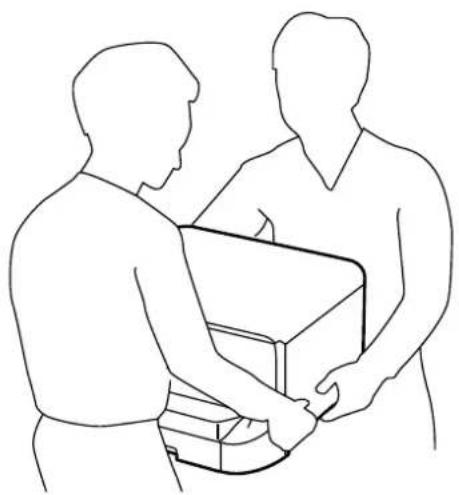
☐ The printer is heavy and should not be lifted or carried by less than two people. When lifting the printer, two or more people should assume the correct positions as shown below.
natural_image
Line drawing of two people exchanging a box together (no text or symbols)Important Instructions
☐ Be careful when you handle used ink cartridges, as there may be some ink around the ink supply port.
☐ If ink gets on your skin, wash the area thoroughly with soap and water.
☐ If ink gets into your eyes, flush them immediately with water. If discomfort or vision problems continue after a thorough flushing, see a doctor immediately.
☐ If ink gets into your mouth, see a doctor right away.
☐ Do not disassemble the ink cartridge and the maintenance box; otherwise ink may get into your eyes or on your skin.
☐ Do not shake ink cartridges too vigorously; otherwise ink may leak from the cartridge.
☐ Keep ink cartridges and maintenance box out of the reach of children.
Printer Advisories and Warnings
Read and follow these instructions to avoid damaging the printer or your property. Make sure you keep this manual for future reference.
Advisories and Warnings for Setting Up/Using the Printer
☐ Do not block or cover the vents and openings in the printer.
☐ Use only the type of power source indicated on the printer's label.
☐ Avoid using outlets on the same circuit as photocopiers or air control systems that regularly switch on and off.
☐ Avoid electrical outlets controlled by wall switches or automatic timers.
- Keep the entire computer system away from potential sources of electromagnetic interference, such as loudspeakers or the base units of cordless telephones.
☐ The power-supply cords should be placed to avoid abrasions, cuts, fraying, crimping, and kinking. Do not place objects on top of the power-supply cords and do not allow the power-supply cords to be stepped on or run over. Be particularly careful to keep all the power-supply cords straight at the ends and the points where they enter and leave the transformer.
☐ If you use an extension cord with the printer, make sure that the total ampere rating of the devices plugged into the extension cord does not exceed the cord's ampere rating. Also, make sure that the total ampere rating of all devices plugged into the wall outlet does not exceed the wall outlet's ampere rating.
☐ If you plan to use the printer in Germany, the building installation must be protected by a 10 or 16 amp circuit breaker to provide adequate short-circuit protection and over-current protection for the printer.
☐ When connecting the printer to a computer or other device with a cable, ensure the correct orientation of the connectors. Each connector has only one correct orientation. Inserting a connector in the wrong orientation may damage both devices connected by the cable.
Place the printer on a flat, stable surface that extends beyond the base of the printer in all directions. The printer will not operate properly if it is tilted at an angle.
☐ When storing or transporting the printer, avoid tilting it, placing it vertically, or turning it upside down; otherwise ink may leak.
☐ Leave enough space in front of the printer for the paper to be fully ejected.
☐ Avoid places subject to rapid changes in temperature and humidity. Also, keep the printer away from direct sunlight, strong light, or heat sources.
☐ Do not insert objects through the slots in the printer.
Important Instructions
☐ Do not put your hand inside the printer during printing.
☐ Do not touch the white flat cable inside the printer.
☐ Do not use aerosol products that contain flammable gases inside or around the printer. Doing so may cause fire.
☐ Do not move the print head by hand; otherwise, you may damage the printer.
□ Always turn the printer off using the ⏻ button. Do not unplug the printer or turn off the power at the outlet until the ⏻ light stops flashing.
Before transporting the printer, make sure that the print head is in the home (far right) position and the ink cartridges are in place.
☐ If you are not going to use the printer for a long period, be sure to unplug the power cord from the electrical outlet.
Advisories and Warnings for Using the Printer with a Wireless Connection
☐ Radio waves from this printer may negatively affect the operation of medical electronic equipment, causing them to malfunction. When using this printer inside medical facilities or near medical equipment, follow directions from the authorized personnel representing the medical facilities, and follow all posted warnings and directions on the medical equipment.
☐ Radio waves from this printer may negatively affect the operation of automatically controlled devices such as automatic doors or fire alarms, and could lead to accidents due to malfunction. When using this printer near automatically controlled devices, follow all posted warnings and directions on these devices.
Advisories and Warnings for Using the LCD Screen
☐ The LCD screen may contain a few small bright or dark spots, and because of its features it may have an uneven brightness. These are normal and do not indicate that it is damaged in any way.
☐ Only use a dry, soft cloth for cleaning. Do not use liquid or chemical cleaners.
☐ The exterior cover of the LCD screen could break if it receives a heavy impact. Contact your dealer if the screen's surface chips or cracks, and do not touch or attempt to remove the broken pieces.
Protecting Your Personal Information
When you give the printer to someone else or dispose of it, erase all the personal information stored in the printer's memory by selecting Menu > System Administration > Restore Default Settings > Clear All Data and Settings on the control panel.
Administrator Settings
Administrator Settings
Locking the Printer Settings Using an Administrator's Password
You can set an administrator's password to lock the printer settings so that they cannot be changed by other users. You can lock the following settings.
System Administration
You cannot change settings without entering the password. This password is also required when you make settings using Web Config or EpsonNet Config.

Important:
Do not forget the password. If you forget the password, contact Epson support.
- Enter Menu from the home screen.
- Select Admin Settings > Admin Password.
- Select Register, and then enter a password.
- Enter the password again.
- Select Lock Setting, and then enable it.
Unlocking the Printer Settings
- Enter Menu from the home screen.
- Select Admin Settings.
- Enter the administrator's password.
- Select Lock Setting, and then disable it.
Printer Basics
Part Names and Functions
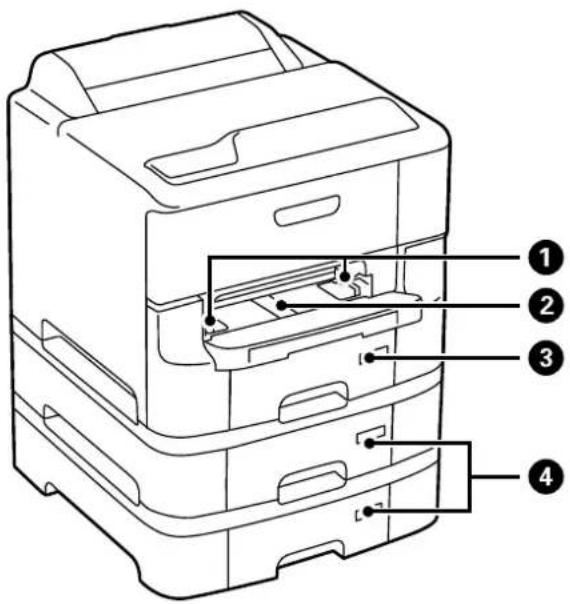
| 1 | Edge guides | Feeds the paper straight into the printer. Slide to the edges of the paper. |
| 2 | Front paper feed slot (B2) | Load one sheet of paper at a time by hand. |
| 3 | Paper cassette 1 (C1) | Loads paper. |
| 4 | Paper cassette 2 to 3 (C2 to C3) | Optional paper cassette units. Loads paper. |
Printer Basics
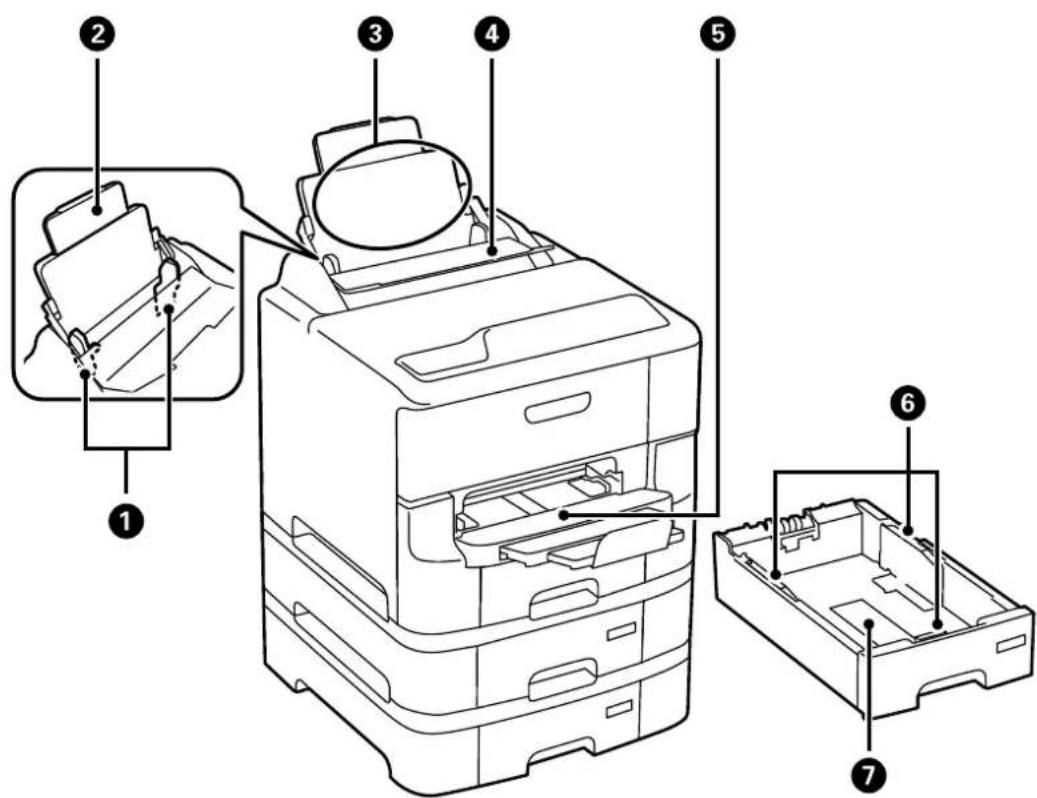
| 1 | Edge guides | Feeds the paper straight into the printer. Slide to the edges of the paper. |
| 2 | Paper support | Supports loaded paper. |
| 3 | Rear paper feed (B1) | Loads paper. |
| 4 | Feeder guard | Prevents foreign substance from entering the printer. Usually keep this guard closed. |
| 5 | Output tray | Holds the ejected paper. |
| 6 | Edge guides | Feeds the paper straight into the printer. Slide to the edges of the paper. |
| 7 | Paper cassette | Loads paper. |
Printer Basics
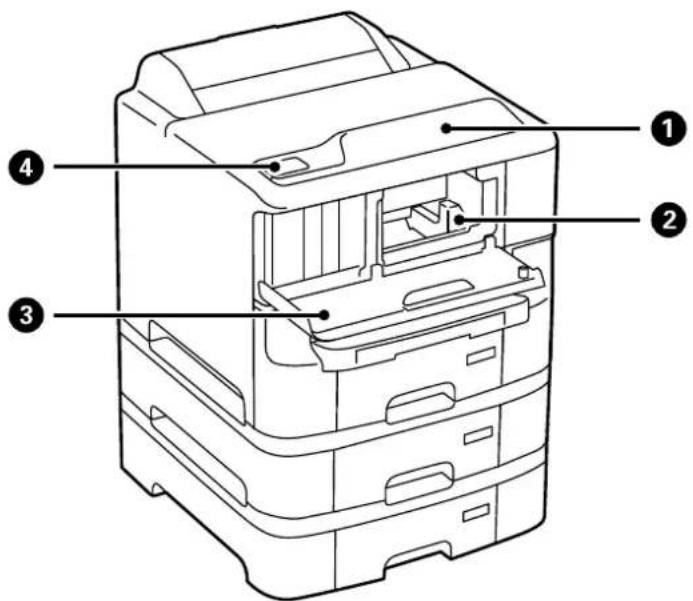
| 1 | Control panel | Operates the printer. |
| 2 | Print head | Fires ink. |
| 3 | Front cover (A) | Open when replacing an ink cartridge and removing jammed paper inside the printer. |
| 4 | NFC tag | Pass a smart device over this tag to print from the smart device directly. |
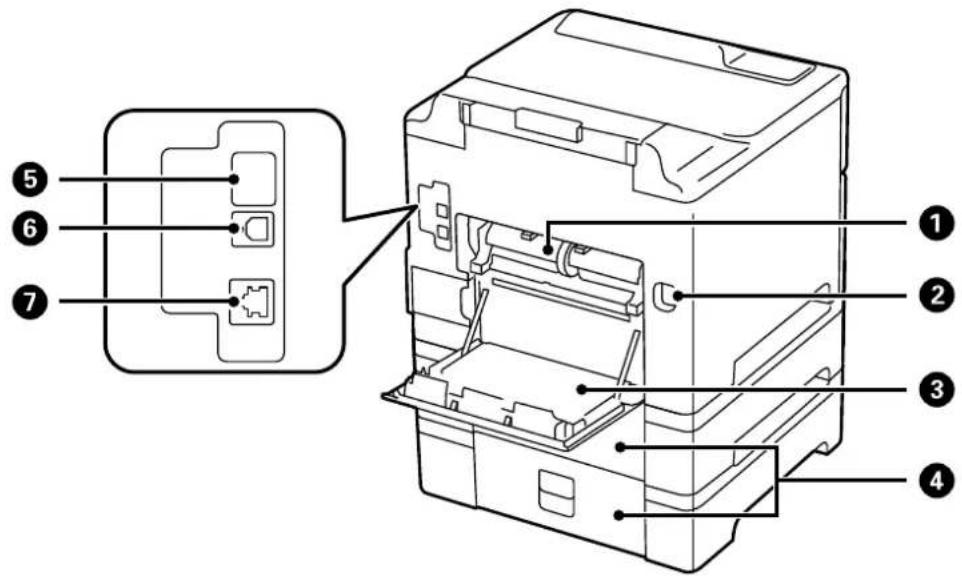
| 1 | Rear cover 2 (D2) | Remove when replacing maintenance rollers or removing jammed paper. |
| 2 | AC inlet | Connects the power cord. |
Printer Basics
| 3 | Rear cover 1 (D1) | Open when replacing the maintenance rollers or removing jammed paper. |
| 4 | Rear cover (E) | Covers for the optional paper cassette units. Open when replacing the maintenance rollers or removing jammed paper. |
| 5 | Service USB port | USB port for future use.Do not remove the sticker. |
| 6 | USB port | Connects a USB cable. |
| 7 | LAN port | Connects a LAN cable. |
Control Panel
Buttons and Lights
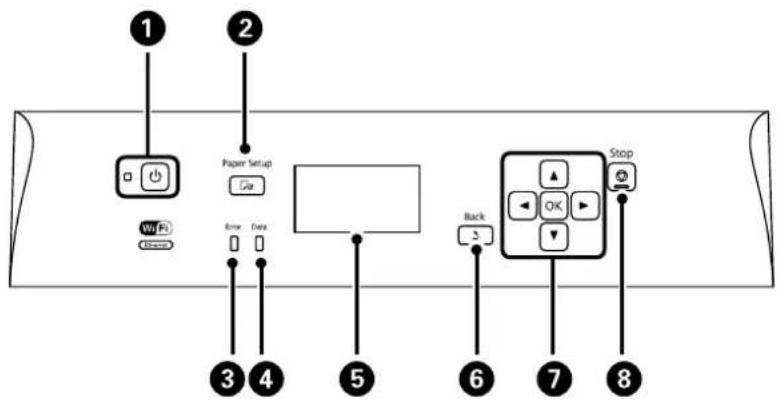
| 1 | Turns the printer on or off. | |
| Unplug the power cord when the power light is off. | ||
| 2 | Div | Displays the Paper Setup screen. You can select the paper size and paper type settings for each paper source. |
| 3 | Error | Flashes or turns on when an error occurs. |
| 4 | Data | Flashes while the printer is processing data. |
| Turns on when there are queued jobs. | ||
| 5 | - | Displays menus and messages. |
| 6 | Returns to the previous screen. | |
| 7 | ◀,▲,▶,▼,OK | Press ◀,▲,▶, and ▼ to select menus. Press OK to confirm your selection or run the selected feature. |
| When entering characters, press ◀,▲,▶, and ▼ to select characters. | ||
| 8 | ▽ | Stops the current operation. |
| When entering characters, press this button to change the character type. |
Printer Basics
Icons Displayed on the LCD Screen
The following icons are displayed on the LCD screen depending on the printer's status.
 | Turns on while the printer is connected to a wired (Ethernet) network. |
 | Turns on when the wired (Ethernet) network is disabled and an Ethernet cable is not connected. |
 | Turns on while the printer is connected to a wireless (Wi-Fi) network. The number of bars indicates the signal strength of the connection. The more bars there are, the stronger the connection. |
 | Indicates a problem with the printer's wireless (Wi-Fi) network connection, or that the printer is searching for a wireless (Wi-Fi) network connection. |
 | Indicates that the printer is connected to a wireless (Wi-Fi) network in Ad Hoc mode. |
 | Indicates that the printer is connected to a wireless (Wi-Fi) network in Wi-Fi Direct mode. |
 | Indicates that the printer is connected to a wireless (Wi-Fi) network in Simple AP mode. |
 | Turns on when Eco Mode is enabled. |
Menu Options
Menu
| Menu | Settings and Explanations |
| Ink Levels | Displays the approximate levels of the ink and the maintenance box.When an ! icon is displayed, the ink is running low or the maintenance box is nearly full.When a X icon is displayed, the ink is expended or the maintenance box is full. |
Printer Basics
| Menu | Settings and Explanations | |
| Maintenance | Print Head Nozzle Check | Prints a pattern to check if the print head nozzles are clogged. |
| Print Head Cleaning | Cleans clogged nozzles in the print head. | |
| Print Head Alignment | Adjusts the print head to improve print quality.Run Ruled Line Alignment if text and lines are misaligned.Run Vertical Alignment if your printouts look blurry.Run Horizontal Alignment if your printouts contain horizontal banding at regular intervals. | |
| Improve Horizontal StreaksThick Paper | Use this feature if your printouts contain horizontal banding after trying Print Head Cleaning and Horizontal Alignment.This feature provides more accurate adjustment than Horizontal Alignment.Reduces ink smearing when printing. Enable this feature only when you see ink smearing on your printouts because it may lower the printing speed. | |
| Paper Guide Cleaning | Use this feature to feed paper for cleaning when there are ink stains on the internal rollers. | |
| Remove PaperMaintenance Roller Information | Use this feature if there are still some torn pieces of paper inside the printer even after removing jammed paper.Displays the status of the maintenance rollers for the paper cassette in the Maintenance Roller Status.After replacing maintenance rollers, select Reset Maintenance Roller Counter to reset the counter for the paper cassette in which you replaced the maintenance rollers. | |
| Paper Setup | Select the paper size and paper type you loaded in the paper source. | |
| Print Status Sheet | Configuration Status Sheet | Prints an information sheet showing the current printer status and settings. |
| Supply Status Sheet | Prints an information sheet showing the status of consumables. | |
| Usage History Sheet | Prints an information sheet showing the usage history of the printer. | |
| Network Status | PS3 Font ListWired LAN/Wi-Fi Status | Prints a list of fonts that are available for a PostScript printer.Displays the current network settings. |
| Wi-Fi Direct Status | Displays the current Wi-Fi Direct settings. | |
| Epson Connect Status | Displays whether or not the printer is registered and connected to Epson Connect or Google Cloud Print service.See the Epson Connect portal website for more details.https://www.epsonconnect.com/http://www.epsonconnect.eu (Europe only) | |
| Google Cloud Print StatusPrint Status Sheet | ||
Printer Basics
| Menu | Settings and Explanations | |
| Confidential Job | Displays a list of jobs that have passwords. To print a job, select the job and enter the password. | |
| Admin Settings | These menus allow an administrator to register an administrator password to protect the printer settings from being changed by other users. | |
| Admin Password | Set, change, or reset the administrator password.If you forget the password, contact Epson support. | |
| Lock Setting | You need to enter an administrator password when you enter the System Administration settings. | |
| System Administration | See the pages that describe these features for more details. | |
Related Information
→ "System Administration" on page 20
System Administration
Select Menu on the home screen, and then select System Administration.
Printer Basics
| Menu | Settings and Explanations | ||
| Printer Settings | Paper Source Settings | Rear Paper Feed Priority | Feeds paper from the rear paper feed on a priority basis. |
| A4/Letter Auto Switching | Feeds paper from the paper source set as A4 size when there is no paper source set as Letter, or feeds from the paper source set as Letter size when there is no paper source set as A4. | ||
| Auto Select Settings | Specify which paper source to feed from. When there are multiple paper sources available, paper is fed from the paper source with paper settings that match the print job. | ||
| Error Notice | Displays an error message when the paper size or type settings in Paper Setup and the print settings do not match. | ||
| USB I/F Timeout Setting | Specify the length of time in seconds that must elapse before ending USB communication with a computer after the printer receives a print job from a PostScript printer driver or PCL printer driver. If the job ending is not clearly defined from a PostScript printer driver or PCL printer driver, it can cause endless USB communication. When this occurs, the printer ends communication after the specified time has elapsed. Enter 0 (zero) if you do not want to end communication. | ||
| Printing Language | Select the printing language for the USB interface or the network interface. | ||
| Auto Error Solver | Select an action to perform when a 2-sided printing error or a memory full error occurs.☐ 2-sided printing errorEnabled: If a 2-sided job is sent when there is no paper available that supports 2-sided printing, the printer displays an error message, and then automatically prints on only one side of the paper.Disabled: The printer displays an error message and cancels printing.☐ Memory full errorEnabled: If the printer's memory becomes full while printing, the printer displays an error message, and then prints only the part of the data that the printer could process.Disabled: The printer displays an error message and cancels printing. | ||
| PC Connection via USB | Select whether the printer allows an access from USB connected computer. Disable this function to restrict printing and scanning that was not sent through a network connection. | ||
| Paper Feed Assist Mode | Prevents multiple sheets of paper from feeding through paper cassette 1 at the same time, but the printing speed is slower. | ||
Printer Basics
| Menu | Settings and Explanations | ||
| Common Settings | Sleep Timer | Select the time period before the printer enters sleep mode (energy saving mode) when no operations are performed.The LCD screen turns black when the set time passes. | |
| Power Off Timer | You can adjust the time before power management is applied. Any increase will affect the product's energy efficiency. Please consider the environment before making any change. | ||
| LCD Contrast | Adjust the brightness of the LCD screen. | ||
| Network Settings | Date/Time Settings | Date/TimeDaylight Saving TimeTime Difference | Enter the current date and time.Select to set summer time.Enter the time difference between your local time and UTC (Coordinated Universal Time). |
| Language | Select the display language. | ||
| Scroll Speed | Select the scroll speed of the LCD screen. | ||
| Network Status | Displays or prints the network settings and connection status. | ||
| Wi-Fi Setup | Wi-Fi Setup Wizard | See the Network Guide for more details. | |
| Push Button Setup (WPS)PIN Code Setup (WPS)Wi-Fi Auto Connect | |||
| Disable Wi-Fi | You may be able to resolve network problems by disabling the Wi-Fi settings or making the Wi-Fi settings again. See the Network Guide for more details. | ||
| Wi-Fi Direct Setup | See the Network Guide for more details. | ||
| Connection Check | Checks the status of the network connection and prints the network connection check report. If there are any problems with the connection, see the check report to solve the problem. | ||
| Advanced Setup | See the Network Guide for more details. | ||
| Epson Connect Services | You can suspend or resume the Epson Connect or Google Could Print service, or cancel using the services (restore the default settings). | ||
| Google Cloud Print Services | See the Epson Connect portal website for more details.https://www.epsonconnect.com/http://www.epsonconnect.eu (Europe only) | ||
Printer Basics
| Menu | Settings and Explanations | |
| Universal Print Settings | These print settings are applied when printing from an external device without using the printer driver, or when printing from a PostScript printer driver or PCL printer driver. | |
| Top Offset | Adjust the top or left margin of the paper. | |
| Left Offset | ||
| Top Offset in Back | Adjust the top margin or left margin for the back of the page when performing 2-sided printing. | |
| Left Offset in Back | ||
| Check Paper Width | Checks the paper width before the printer starts printing. This prevents printing beyond the edges of the paper when the paper size setting is not correct, but the printing time may be little longer. | |
| Dry Time | Select the drying time when performing 2-sided printing. | |
| Skip Blank Page | Skips blank pages in the print data automatically. | |
| PDL Print Configuration | See the list of menus in PDL Print Configuration. | |
| Security Settings | Delete All Confidential Jobs | Deletes all saved confidential jobs. |
| Eco Mode | The following Eco mode settings are available. When these settings are disabled, the settings made in Common Settings are applied. | |
| Sleep Timer | Select the time period before the printer enters sleep mode (energy saving mode) when no operations are performed.The LCD screen turns black when the set time passes. | |
| Clear Internal Memory Data | Power Off Timer | Select the time period before the printer turns off automatically. |
| Deletes the print settings for a PostScript printer driver and a PCL printer driver.Select Clear All to delete all of the data for a PostScript printer driver and a PCL printer driver that is saved in the printer's memory. | ||
| Restore Default Settings | Resets the selected settings to their defaults. | |
Related Information
→ "PDL Print Configuration" on page 23
PDL Print Configuration
Select Menu > System Administration > Universal Print Settings > PDL Print Configuration from the home screen.
Printer Basics
| Menu | Settings and Explanations | |
| Common Settings | Paper Size | Select the paper size. |
| Paper Type | Select the paper type. | |
| Orientation | Select the printing direction. | |
| Quality | Select the print quality. | |
| Ink Save Mode | Conserves ink by reducing the print density. | |
| Print Order | Last Page on Top: Prints from the first page of a file.First Page on Top: Prints from the last page of a file. | |
| Number of Copies | Set the number of copies. | |
| Binding Margin | Select the binding position. | |
| Auto Paper Ejection | Ejects paper automatically when printing is stopped during a print job. | |
| PCL Menu | 2-Sided Printing | Performs 2-sided printing. |
| Font Source | Resident: Select to use a preinstalled font on the printer.Download: Select to use a font you have downloaded. | |
| Font Number | Select the default font number for the default font source. The available number varies depending on the settings you made. | |
| Pitch | Set the default font pitch if the font is scalable and of fixed-pitch. You can select from 0.44 to 99.99 cpi (characters per inch), in 0.01 increments.This item may not appear depending on the font source or font number settings. | |
| Height | Set the default font height if the font is scalable and proportional. You can select from 4.00 to 999.75 points, in 0.25 increments.This item may not appear depending on the font source or font number settings. | |
| Symbol Set | Select the default symbol set. If the font that you selected in the font source and the font number setting is not available in the new symbol set setting, the font source and the font number settings are automatically replaced with the default value, IBM-US. | |
| Form | Set the number of lines for the selected paper size and orientation. This also causes a line spacing (VMI) change, and the new VMI value is stored in the printer. This means that later changes in the page size or orientation settings cause changes in the Form value based on the stored VMI. | |
| CR Function | Select the line feed command when printing with a driver from a specific operating system. | |
| LF Function | ||
| Paper Source Assign | Set the assignment for the paper source select command. When 4 selected, the commands are set as compatible with the HP LaserJet 4. When 4K is selected, the commands are set as compatible with the HP LaserJet 4000, 5000, and 8000. When 5S is selected, the commands are set as compatible with the HP LaserJet 5S. | |
Printer Basics
| Menu | Settings and Explanations | |
| PS3 Menu | Error Sheet | Prints a sheet showing the error status when any PostScript errors occur while printing and any errors occur while printing a PDF file. |
| Coloration | Select the color mode for PostScript printing. | |
| Binary | Enable this feature when printing data that contains binary images. This settings is only available when the printer is connected to the network.The application may send the binary data even if the printer driver setting is set to ASCII, but you can print the data when this feature is enabled. | |
| PDF Page Size | Select the paper size when printing a PDF file. IfAutois selected, the paper size is determined based on the size of the first page that is printed. | |
Loading Paper
Loading Paper
Paper Handling Precautions
☐ Read the instruction sheets supplied with the paper.
☐ Fan and align the edges of the paper before loading. Do not fan or curl photo paper. Doing so may damage the printable side.
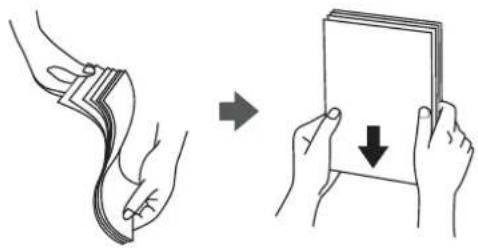
☐ If the paper is curled, flatten it or curl it slightly in the opposite direction before loading. Printing on curled paper may cause paper jams and smears on the printout.

☐ Do not use paper that is wavy, torn, cut, folded, damp, too thick, too thin, or paper that has stickers stuck to it. Using these types of paper causes paper jams and smears on the printout.
☐ Make sure you are using long-grain paper. If you are not sure what type of paper you are using, check the paper packaging or contact the manufacturer to confirm the paper specifications.
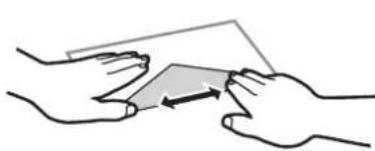
☐ Fan and align the edges of the envelopes before loading. When the stacked envelopes are puffed up with air, press them down to flatten them before loading.
natural_image
Illustration of two hands exchanging a document with a gray arrow indicating motion (no text or symbols)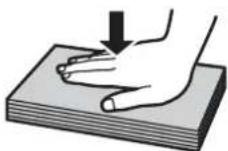
☐ Do not use envelopes that are curled or folded. Using these envelopes causes paper jams and smears on the printout.
☐ Do not use envelopes with adhesive surfaces on the flaps or window envelopes.
☐ Avoid using envelopes that are too thin, as they may curl during printing.
Related Information
→ "Printer Specifications" on page 112
Available Paper and Capacities
Epson recommends using genuine Epson paper to ensure high-quality printouts.
Genuine Epson Paper
Note:
Genuine Epson paper is not available when printing with the Epson universal printer driver.
| Media Name | Size | Loading Capacity (Sheets) | 2-Sided Printing | |||
| Paper Cassette 1 | Paper Cassette 2 to 3 | Rear Paper Feed | Front Paper Feed Slot | |||
| Epson Bright White Ink Jet Paper | A4 | 400 | 400 | 50 | 1 | Auto, Manual* |
| Epson Ultra Glossy Photo Paper | A4, 13×18 cm (5×7 in.), 10×15 cm (4×6 in.) | - | - | 20 | - | - |
| Epson Premium Glossy Photo Paper | A4, 13×20 cm (5×8 in.), 13×18 cm (5×7 in.), 16:9 wide size (102×181 mm), 10×15 cm (4×6 in.) | - | - | 20 | - | - |
| Epson Premium Semigloss Photo Paper | A4, 10×15 cm (4×6 in.) | - | - | 20 | - | - |
| Epson Photo Paper Glossy | A4, 13×18 cm (5×7 in.), 10×15 cm (4×6 in.) | - | - | 20 | - | - |
| Epson Matte Paper-Heavyweight | A4 | - | - | 20 | - | - |
| Epson Photo Quality Ink Jet Paper | A4 | - | - | 70 | - | - |
* Only use the rear paper feed to print 2-sided print jobs manually. You can load up to 30 sheets for paper with one side already printed.
Note:
☐ The availability of paper varies by location. For the latest information on paper available in your area, contact Epson support.
☐ When printing on genuine Epson paper at a user defined size, only Standard or Normal print quality settings are available. Although some printer drivers allow you to select a better print quality, the printouts are printed using Standard or Normal.
Loading Paper
Commercially Available Paper
| Media Name | Size | Loading Capacity (Sheets or Envelopes) | 2-Sided Printing | |||
| Paper Cassette 1 | Paper Cassette 2 to 3 | Rear Paper Feed | Front Paper Feed Slot | |||
| Plain paperCopy paperLetterheadRecycled paperColor paperPreprinted paper | Legal, Letter,A4, B5, A5 | Up to the line under the▼symbol inside the edge guide. | 80 | 1 | Auto,Manual*1*2 | |
| B6, A6, Executive | Up to the line under the▼symbol inside the edge guide. | - | 80 | 1 | Manual*1*2 | |
| Half Letter | - | - | 80 | 1 | ||
| Plain paperCopy paperLetterheadRecycled paperColor paperPreprinted paper | User Defined (mm) | - | - | 1 | - | Manual |
| 55×127 to 105×148,215.9×355.6 to 215.9×1200 | ||||||
| User Defined (mm) | - | - | 80 | 1 | Manual*1*2 | |
| 105×148 to 148×210 | ||||||
| User Defined (mm) | - | - | 80 | 1 | Auto,Manual*1*2 | |
| 148×210 to 215.9×355.6 | ||||||
| Thick paperEnvelope | Letter, A4, B5, A5 | - | - | 10 | - | Manual*3 |
| Envelope #10,Envelope DL,Envelope C6 | - | - | 10 | - | - | |
| Envelope C4 | - | - | 1 | - | - | |
*1 Only use the rear paper feed to print 2-sided print jobs manually.
*2 You can load up to 30 sheets for paper with one side already printed.
*3 You can load up to 5 sheets for paper with one side already printed.
Related Information
→ "Part Names and Functions" on page 14
→ "Technical Support Web Site" on page 132
Loading Paper
List of Paper Types
To obtain optimum printing results, select the paper type that suits the paper.
| Media Name | Media Type | |||
| Control Panel | Printer Driver | PostScript Printer Driver | Epson Universal Printer Driver | |
| Copy paper, Plain paperEpson Bright White Ink Jet Paper | plain papers | plain papers | Plain | Plain |
| LetterheadRecycled paper | LetterheadRecycled | LetterheadRecycled | LetterheadRecycled | LetterheadRecycled |
| Color paper | Color | Color | Color | Color |
| Preprinted paperEpson Ultra Glossy Photo Paper | PreprintedUltra Glossy | PreprintedEpson Ultra Glossy | PreprintedEpson Ultra Glossy | Preprinted-- |
| Epson Premium Glossy Photo Paper | Prem. Glossy | Epson Premium Glossy | Epson Premium Glossy | - |
| Epson Premium Semigloss Photo Paper | Prem. Semigloss | Epson Premium Semigloss | Epson Premium Semigloss | - |
| Epson Photo Paper GlossyEpson Matte Paper-HeavyweightEpson Photo Quality Ink Jet Paper | GlossyMatte | Photo Paper GlossyEpson Matte | Photo Paper GlossyEpson Matte | -------- |
| Thick paperEnvelope | Thick-PaperEnvelope | Thick-PaperEnvelope | ThickEnvelope | ThickEnvelope |
Loading Paper in the Paper Cassette
- Check that the printer is not operating, and then pull out the paper cassette.
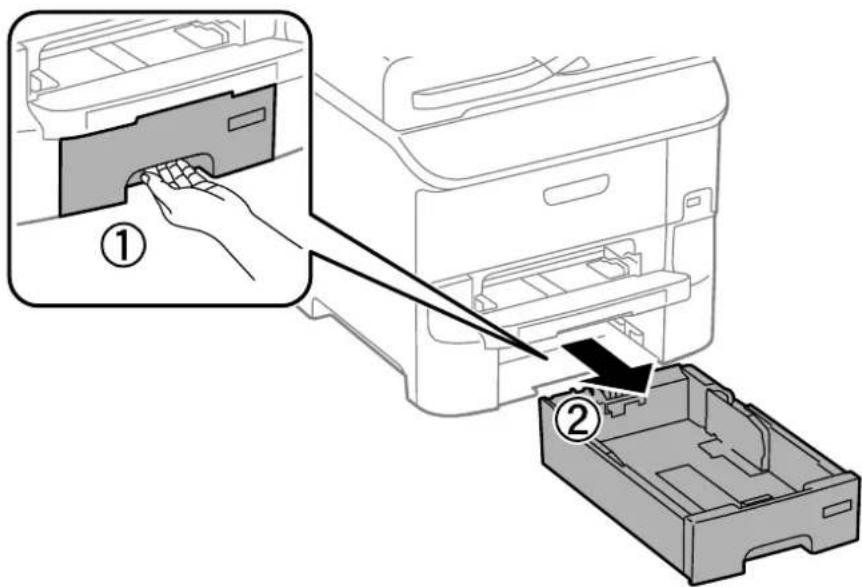
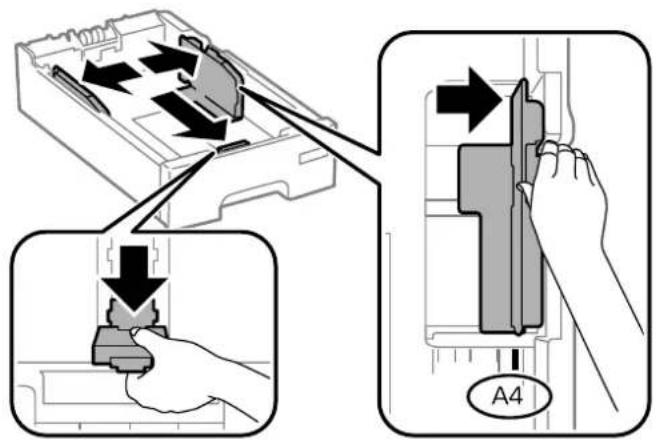
- Slide the front edge guide to its maximum position, and then slide the side edge guides to adjust to the paper size you want to use.
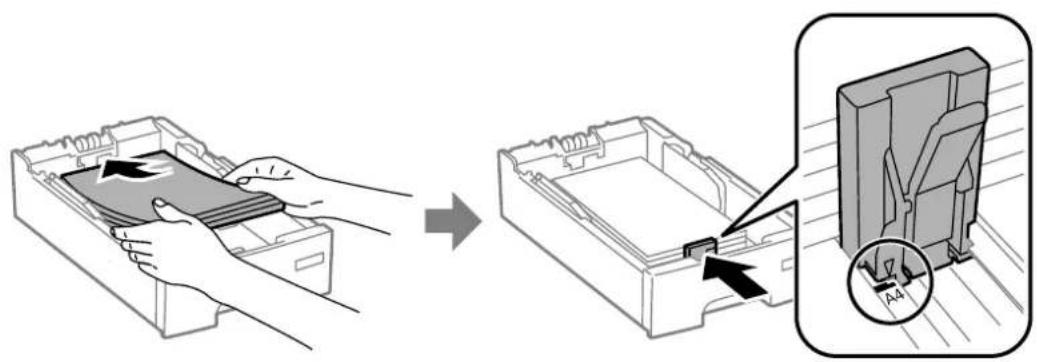
- Load paper with the printable side facing down, and then slide the front edge guide to the edge of the paper.
Loading Paper

Important:
Do not load more than the maximum number of sheets specified for the paper. For plain paper, do not load above the line indicated by the ▼ symbol on the edge guide.
- Check that the paper size label matches the size of the paper loaded in the paper cassette. If it does not match, remove the holder and change the paper size indicated on the label.
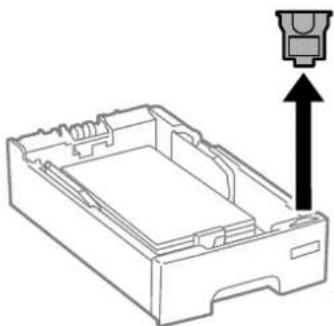
natural_image
Technical line drawing of a mechanical housing with an upward arrow indicating assembly or force (no text or symbols present)-
Insert the paper cassette all the way.
-
On the control panel, set the size and type of the paper you loaded in the paper cassette.
Note:
You can also display the paper size and paper type settings screen by selecting Menu > Paper Setup.
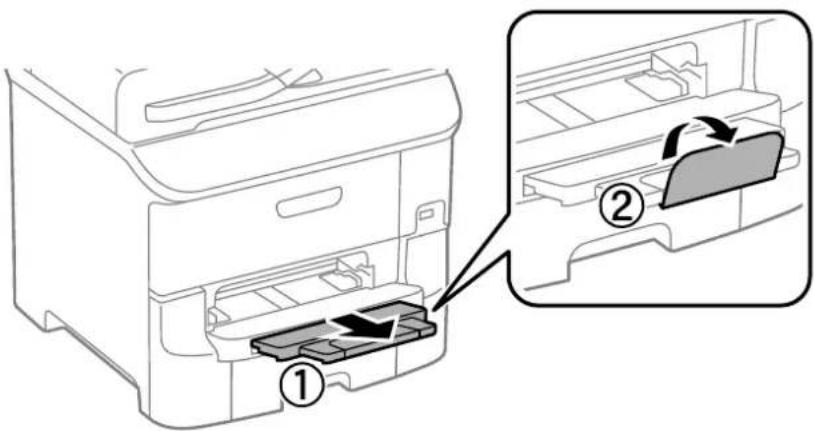
- Slide out the output tray.
Related Information
→ "Paper Handling Precautions" on page 26
→ "Available Paper and Capacities" on page 27
Loading Paper in the Rear Paper Feed
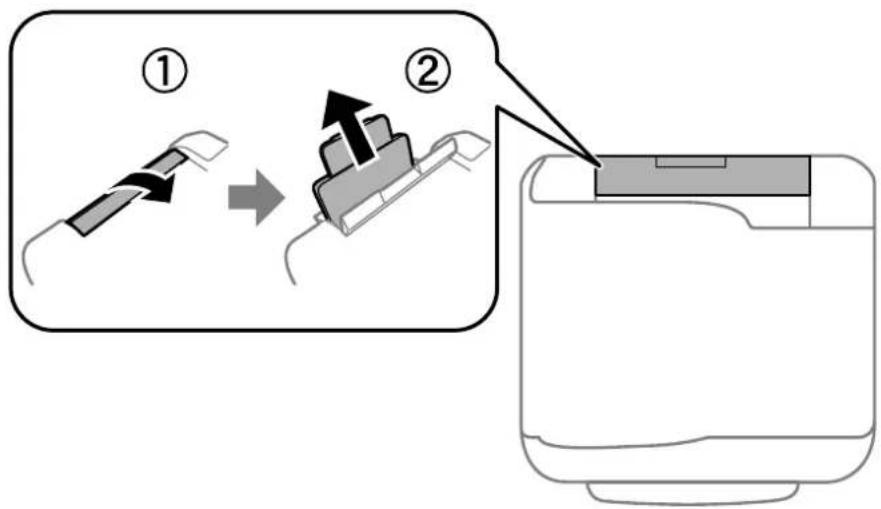
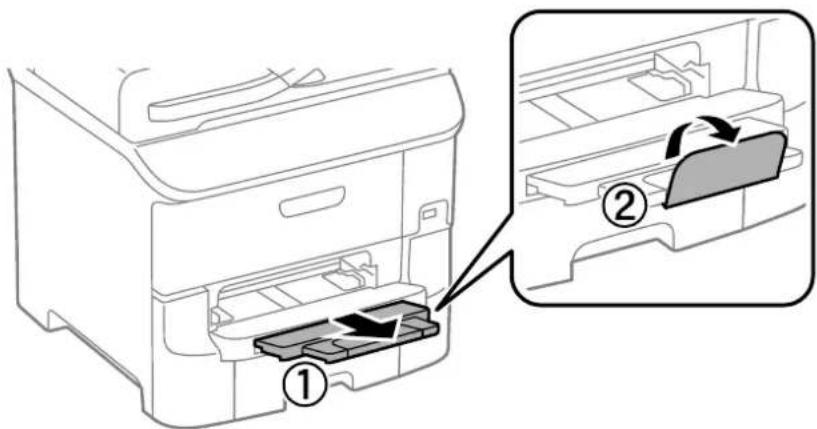
- Open the feeder guard and pull out the paper support.
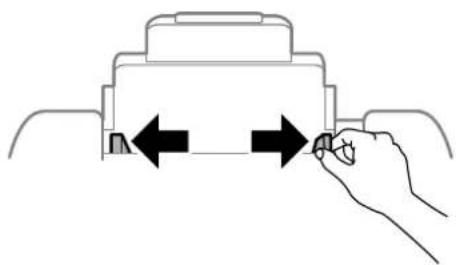
- Slide the edge guides.
natural_image
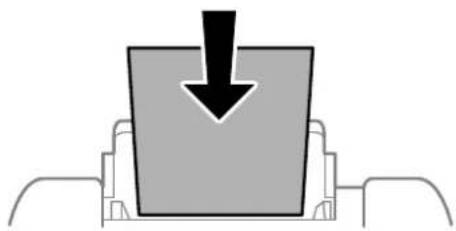
Line drawing of a hand pressing down on a mechanical component with two arrows indicating left and right motion (no text or symbols)- Load paper at the center of the rear paper feed with the printable side facing up.
natural_image
Diagram showing a downward arrow pointing to a gray rectangular object, with no text or symbols present.
Important:
☐ Do not load more than the maximum number of sheets specified for the paper. For plain paper, do not load above the line just under the ▼ symbol inside the edge guide.
☐ Load paper short edge first. However, when you have set the long edge as the width of the user defined size, load paper long edge first.
Loading Paper
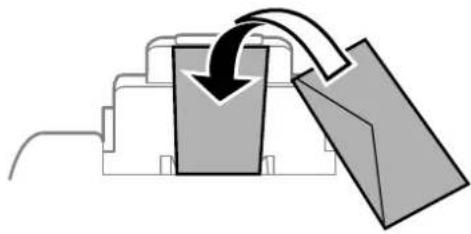
□ Envelopes
natural_image
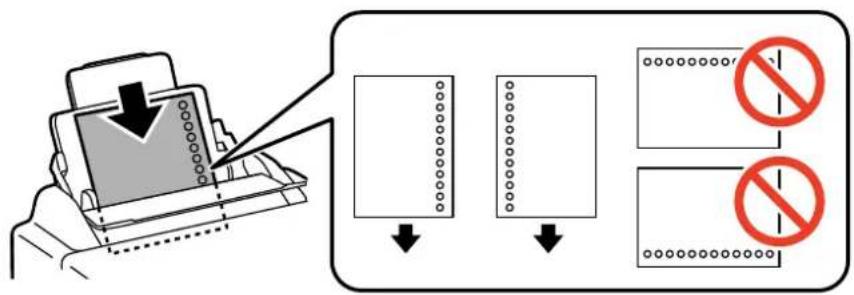
Diagram showing a mechanical or electrical component with a black arrow indicating direction, no text or symbols present□ Pre-punched paper
Note:
You can use pre-punched paper under the following conditions. Automatic 2-sided printing is not available for pre-punched paper.
□ Loading capacity: One sheet
□ Available size: A4, B5, A5, A6, B6, Letter, Legal
☐ Binding holes: Do not load paper with the binding holes at the top or the bottom.
Adjust the print position of your file to avoid printing over the holes.
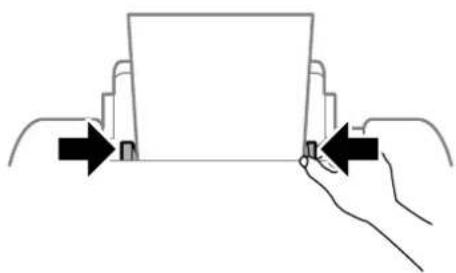
- Slide the edge guides to the edges of the paper.
natural_image
Line drawing of a hand holding a document with arrows indicating left and right motion (no text or symbols)- On the control panel, set the size and type of the paper you loaded in the rear paper feed.
Note:
You can also display the paper size and paper type settings screen by selecting Menu > Paper Setup.
Loading Paper
6. Slide out the output tray.
Note:
Return the remaining paper to its package. If you leave it in the printer, the paper may curl or the print quality may decline.
Related Information
→ "Paper Handling Precautions" on page 26
→ "Available Paper and Capacities" on page 27
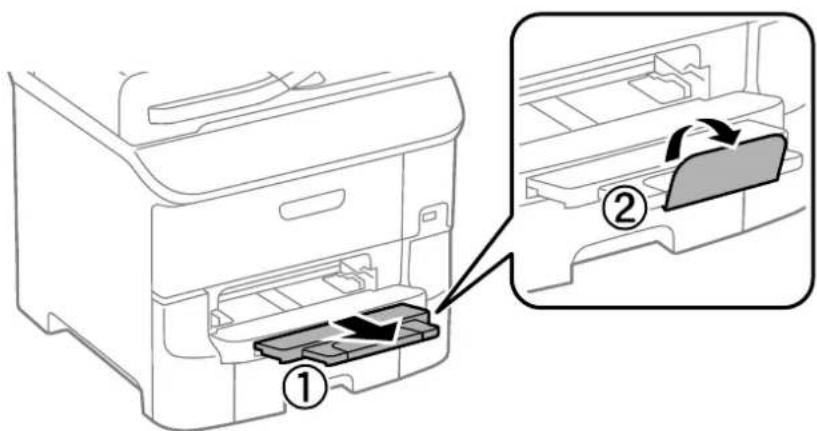
Loading Paper in the Front Paper Feed Slot
You can only load one sheet of paper in the front paper feed slot. Because the front paper feed slot also serves the output tray, you cannot load paper during printing.

Important:
You can load paper with a thickness of 0.08 to 0.11 mm in the front paper feed slot. However, even if the thickness is within this range, some papers may not be fed correctly depending on their hardness.
1. Slide out the output tray.
User's Guide
Loading Paper
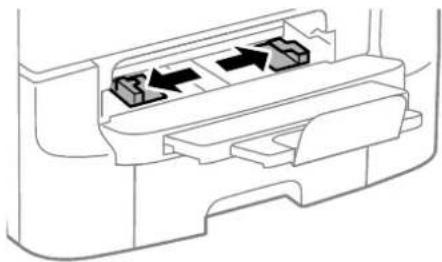
- Slide the edge guides to adjust to the paper size you want to use.
natural_image
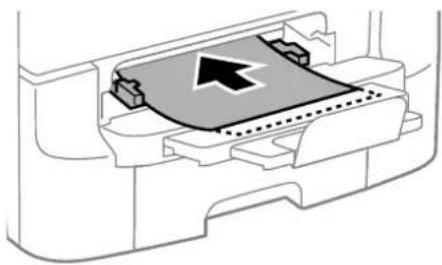
Diagram of a mechanical component with two internal slots and directional arrows indicating flow or movement (no text or symbols)- Insert the paper with the printable side facing down until the printer partially pulls in the paper.
natural_image
Cross-sectional diagram of a mechanical component with internal structure and no visible text or symbols
Important:
☐ Load paper short edge first. However, when you have set the long edge as the width of the user defined size, load paper long edge first.
☐ Keep the paper straight to prevent it from being fed askew.
Note:
If the printer does not pull in the paper, load it again.
Related Information
→ "Paper Handling Precautions" on page 26
→ "Available Paper and Capacities" on page 27
Printing
Printing from a Computer
If you cannot change some of the printer driver settings, they may have been restricted by the administrator.
Contact your printer administrator for assistance.
Printing Basics - Windows
Note:
☐ See the online help for explanations of the setting items. Right-click an item, and then click Help.
☐ Operations may differ depending on the application. See the application's help for details.
- Load paper in the printer.
- Open the file you want to print.
- Select Print or Print Setup from the File menu.
- Select your printer.
- Select Preferences or Properties to access the printer driver window.
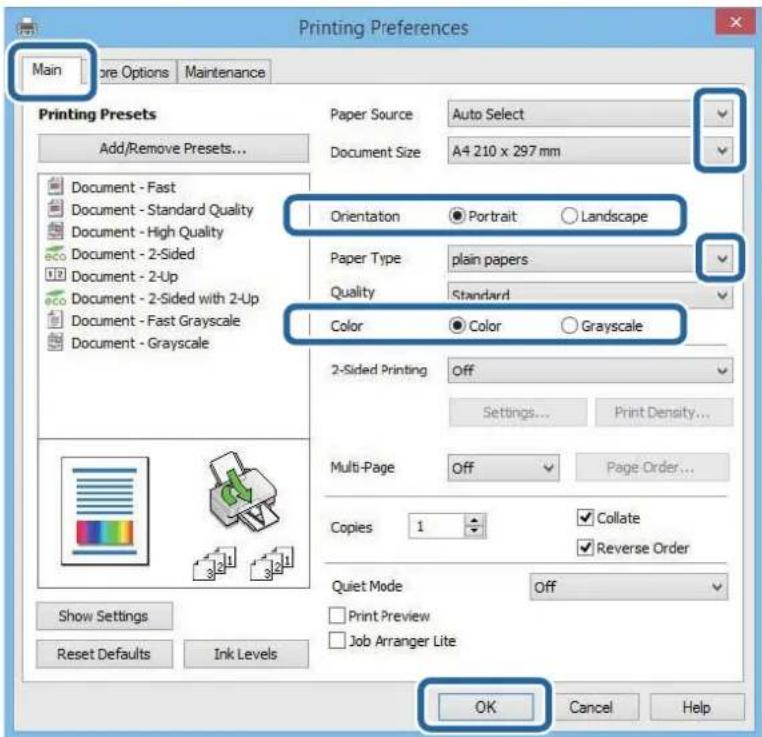
- Make the following settings.
☐ Paper Source: Select the paper source in which you loaded the paper.
☐ Document Size: Select the paper size you loaded in the printer.
Printing
☐ Orientation: Select the orientation you set in the application.
☐ Paper Type: Select the type of paper you loaded.
☐ Color: Select Grayscale when you want to print in black or shades of gray.
Note:
☐ If you are printing high-density data on plain paper, letterhead, or preprinted paper, select Standard-Vivid as the Quality setting to make your printout vivid.
☐ When printing on envelopes, select Landscape as the Orientation setting.
-
Click OK to close the printer driver window.
-
Click Print.
Related Information
→ "Available Paper and Capacities" on page 27
→ "Loading Paper in the Paper Cassette" on page 30
→ "Loading Paper in the Rear Paper Feed" on page 32
→ "Loading Paper in the Front Paper Feed Slot" on page 34
→ "List of Paper Types" on page 29
Printing Basics - Mac OS X
Note:
Operations differ depending on the application. See the application's help for details.
- Load paper in the printer.
- Open the file you want to print.
Printing
- Select Print from the File menu or another command to access the print dialog.
If necessary, click Show Details or ▼ to expand the print window.
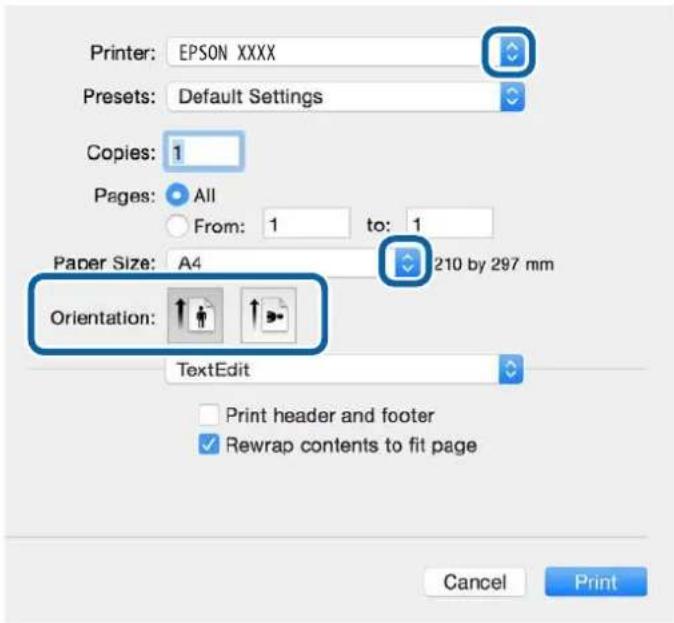
- Make the following settings.
☐ Printer: Select your printer.
☐ Presets: Select when you want to use the registered settings.
☐ Paper Size: Select the paper size you loaded in the printer.
☐ Orientation: Select the orientation you set in the application.
Note:
When printing on envelopes, select landscape orientation.
Printing
5. Select Print Settings from the pop-up menu.
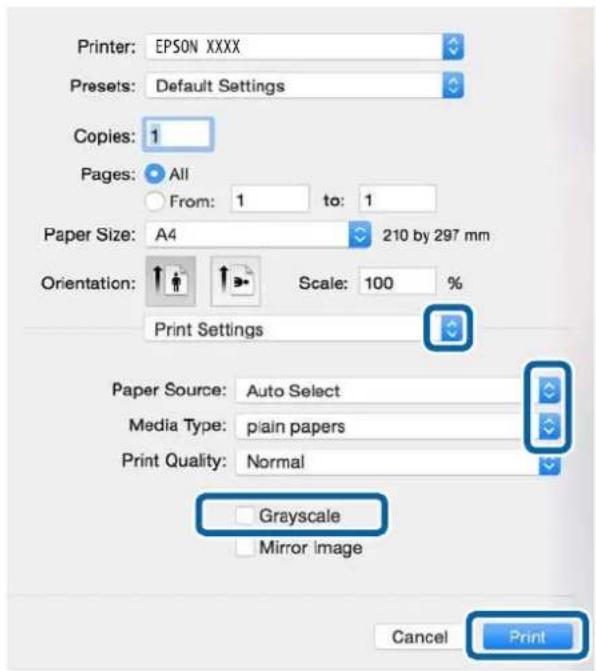
Note:
On Mac OS X v10.8.x or later, if the Print Settings menu is not displayed, the Epson printer driver has not been installed correctly.
Select System Preferences from the menu > Printers & Scanners (or Print & Scan, Print & Fax), remove the printer, and then add the printer again. See the following to add a printer.
http://epson.sn
6. Make the following settings.
☐ Paper Source: Select the paper source in which you loaded the paper.
☐ Media Type: Select the type of paper you loaded.
☐ Grayscale: Select to print in black or shades of gray.
Note:
If you are printing high-density data on plain paper, letterhead, or preprinted paper, select Normal-Vivid as the Print Quality setting to make your printout vivid.
7. Click Print.
Related Information
→ "Available Paper and Capacities" on page 27
→ "Loading Paper in the Paper Cassette" on page 30
→ "Loading Paper in the Rear Paper Feed" on page 32
→ "Loading Paper in the Front Paper Feed Slot" on page 34
→ "List of Paper Types" on page 29
Printing
Printing on 2-Sides
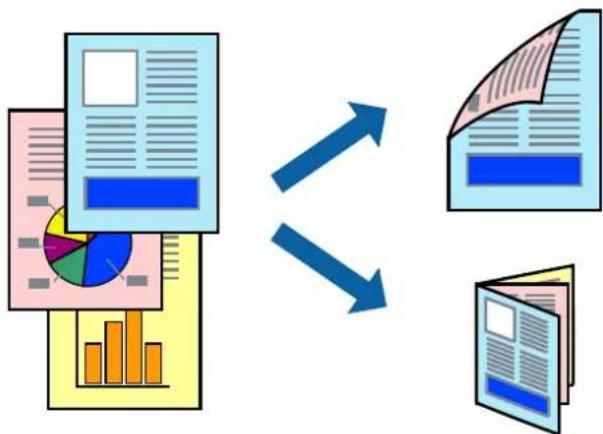
You can use either of the following methods to print on both sides of the paper.
□ Automatic 2-sided printing
☐ Manual 2-sided printing (for Windows only)
When the printer has finished printing the first side, flip the paper over to print on the other side.
You can also print a booklet that can be created by folding the printout. (For Windows only)
flowchart
graph TD
    A["Document Submission"] --> B["Document Paper"]
    A --> C["Document Output"]
    D["Document Paper"] --> E["Document Paper"]
    D --> F["Document Output"]
Note:
☐ If you do not use paper that is suitable for 2-sided printing, the print quality may decline and paper jams may occur.
☐ Depending on the paper and the data, ink may bleed through to the other side of the paper.
Related Information
→ "Available Paper and Capacities" on page 27
Printing on 2-Sides - Windows
Note:
☐ Manual 2-sided printing is available when EPSON Status Monitor 3 is enabled. If EPSON Status Monitor 3 is disabled, access the printer driver, click Extended Settings on the Maintenance tab, and then select Enable EPSON Status Monitor 3.
☐ Manual 2-sided printing may not be available when the printer is accessed over a network or is used as a shared printer.
-
Load paper in the printer.
-
Open the file you want to print.
-
Access the printer driver window.
-
Select Auto (Long-edge binding), Auto (Short-edge binding), Manual (Long-edge binding), or Manual (Short-edge binding) from 2-Sided Printing on the Main tab.
-
Click Settings, make the appropriate settings, and then click OK.
Note:
To print a folded booklet, select Booklet.
Printing
- Click Print Density, select the document type from Select Document Type, and then click OK.
The printer driver automatically sets the Adjustments options for that document type.
Note:
☐ Printing may be slow depending on the combination of options selected for Select Document Type in the Print Density Adjustment window and for Quality on the Main tab.
☐ For manual 2-sided printing, the Print Density Adjustment setting is not available.
-
Set the other items on the Main and More Options tabs as necessary, and then click OK.
-
Click Print.
For manual 2-sided printing, when the first side has finished printing, a pop-up window is displayed on the computer. Follow the on-screen instructions.
Related Information
→ "Loading Paper in the Paper Cassette" on page 30
→ "Loading Paper in the Rear Paper Feed" on page 32
→ "Loading Paper in the Front Paper Feed Slot" on page 34
→ "Printing Basics - Windows" on page 36
Printing on 2-Sides - Mac OS X
- Load paper in the printer.
- Open the file you want to print.
- Access the print dialog.
- Select Two-sided Printing Settings from the pop-up menu.
- Select the bindings and Document Type.
Note:
☐ Printing may be slow depending on the Document Type setting.
☐ If you are printing high-density data such as photos or graphs, select Text & Graphics or Text & Photos as the Document Type setting. If scuffing occurs or the image bleeds through to the reverse side, adjust the print density and ink drying time by clicking the arrow mark next to Adjustments.
-
Set the other items as necessary.
-
Click Print.
Related Information
→ "Loading Paper in the Paper Cassette" on page 30
→ "Loading Paper in the Rear Paper Feed" on page 32
→ "Loading Paper in the Front Paper Feed Slot" on page 34
→ "Printing Basics - Mac OS X" on page 37
Printing
Printing Several Pages on One Sheet
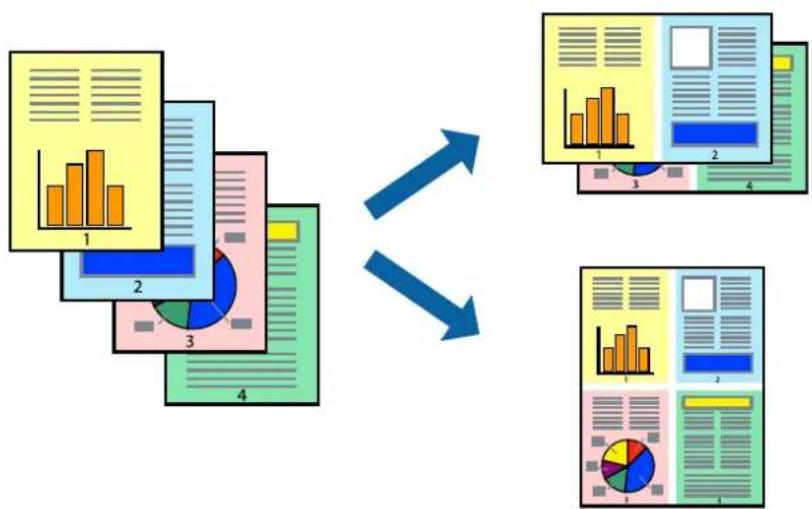
You can print two or four pages of data on a single sheet of paper.
flowchart
graph TD
    A["Input Data"] --> B["Processing Step 1"]
    B --> C["Processing Step 2"]
    C --> D["Output Format 1"]
    C --> E["Output Format 2"]
    D --> F["Final Output Format 3"]
    E --> G["Final Output Format 4"]
Printing Several Pages on One Sheet - Windows
- Load paper in the printer.
- Open the file you want to print.
- Access the printer driver window.
- Select 2-Up or 4-Up as the Multi-Page setting on the Main tab.
- Click Page Order, make the appropriate settings, and then click OK to close the window.
- Set the other items on the Main and More Options tabs as necessary, and then click OK.
- Click Print.
Related Information
→ "Loading Paper in the Paper Cassette" on page 30
→ "Loading Paper in the Rear Paper Feed" on page 32
→ "Loading Paper in the Front Paper Feed Slot" on page 34
→ "Printing Basics - Windows" on page 36
Printing Several Pages on One Sheet - Mac OS X
- Load paper in the printer.
- Open the file you want to print.
- Access the print dialog.
- Select Layout from the pop-up menu.
Printing
- Set the number of pages in Pages per Sheet, the Layout Direction (page order), and Border.
- Set the other items as necessary.
- Click Print.
Related Information
→ "Loading Paper in the Paper Cassette" on page 30
→ "Loading Paper in the Rear Paper Feed" on page 32
→ "Loading Paper in the Front Paper Feed Slot" on page 34
→ "Printing Basics - Mac OS X" on page 37
Printing to Fit the Paper Size
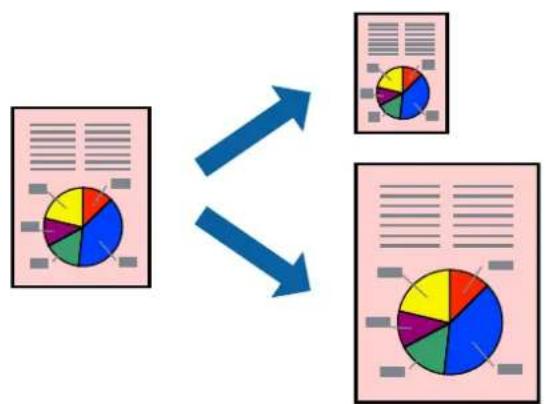
You can print to fit the paper size you loaded in the printer.
flowchart
graph TD
    A["Document 1"] --> B["Document 2"]
    A --> C["Document 3"]
    B --> D["Document 4"]
    C --> D
    style A fill:#f9f,stroke:#333
    style B fill:#bbf,stroke:#333
    style C fill:#bfb,stroke:#333
Printing to Fit the Paper Size - Windows
- Load paper in the printer.
- Open the file you want to print.
- Access the printer driver window.
- Make the following settings on the More Options tab.
☐ Document Size: Select the paper size you set in the application.
☐ Output Paper: Select the paper size you loaded in the printer.
Fit to Page is selected automatically.
Note:
If you want to print a reduced image at the center of the page, select Center.
- Set the other items on the Main and More Options tabs as necessary, and then click OK.
- Click Print.
Printing
Related Information
→ "Loading Paper in the Paper Cassette" on page 30
→ "Loading Paper in the Rear Paper Feed" on page 32
→ "Loading Paper in the Front Paper Feed Slot" on page 34
→ "Printing Basics - Windows" on page 36
Printing to Fit the Paper Size - Mac OS X
- Load paper in the printer.
- Open the file you want to print.
- Access the print dialog.
- Select the size of the paper you set in the application as the Paper Size setting.
- Select Paper Handling from the pop-up menu.
- Select Scale to fit paper size.
- Select the paper size you loaded in the printer as the Destination Paper Size setting.
- Set the other items as necessary.
- Click Print.
Related Information
→ "Loading Paper in the Paper Cassette" on page 30
→ "Loading Paper in the Rear Paper Feed" on page 32
→ "Loading Paper in the Front Paper Feed Slot" on page 34
→ "Printing Basics - Mac OS X" on page 37
Printing Multiple Files Together (for Windows Only)
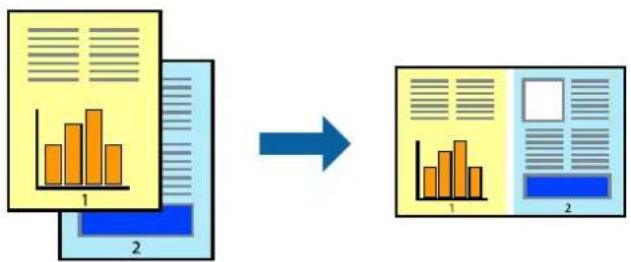
Job Arranger Lite allows you to combine several files created by different applications and print them as a single print job. You can specify the print settings for combined files, such as layout, print order, and orientation.
flowchart
graph LR
    A["Document with charts and blue blocks"] --> B["Output chart with orange bars and blue boxes"]
Note:
To open a Print Project saved in Job Arranger Lite, click Job Arranger Lite on the printer driver's Maintenance tab. Next, select Open from the File menu to select the file. The extension of the saved files is "ecl".
Printing
- Load paper in the printer.
- Open the file you want to print.
- Access the printer driver window.
- Select Job Arranger Lite on the Main tab.
-
Click OK to close the printer driver window.
-
Click Print.
The Job Arranger Lite window is displayed and the print job is added to the Print Project.
- With the Job Arranger Lite window opened, open the file that you want to combine with the current file, and then repeat steps 3 to 6.
Note:
If you close the Job Arranger Lite window, the unsaved Print Project is deleted. To print later, select Save from the File menu.
-
Select the Layout and Edit menus in Job Arranger Lite to edit the Print Project as necessary.
-
Select Print from the File menu.
Related Information
→ "Loading Paper in the Paper Cassette" on page 30
→ "Loading Paper in the Rear Paper Feed" on page 32
→ "Loading Paper in the Front Paper Feed Slot" on page 34
→ "Printing Basics - Windows" on page 36
Printing One Image on Multiple Sheets to Create a Poster (for Windows Only)
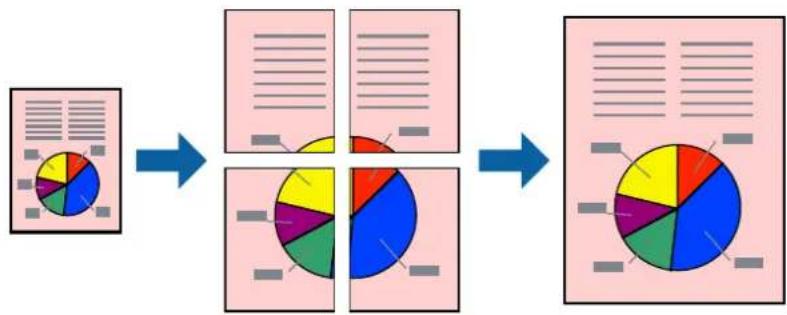
This feature allows you to print one image on multiple sheets of paper. You can create a larger poster by taping them together.
flowchart
graph LR
    A["Document Image"] --> B["Representation"]
    B --> C["Text Blocks"]
    C --> D["Output Text Blocks"]
- Load paper in the printer.
- Open the file you want to print.
- Access the printer driver window.
Printing
- Select 2x1 Poster, 2x2 Poster, 3x3 Poster, or 4x4 Poster from Multi-Page on the Main tab.
- Click Settings, make the appropriate settings, and then click OK.
- Set the other items on the Main and More Options tabs as necessary, and then click OK.
- Click Print.
Related Information
→ "Loading Paper in the Paper Cassette" on page 30
→ "Loading Paper in the Rear Paper Feed" on page 32
→ "Loading Paper in the Front Paper Feed Slot" on page 34
→ "Printing Basics - Windows" on page 36
Making Posters Using Overlapping Alignment Marks
Here is an example of how to make a poster when 2x2 Poster is selected, and Overlapping Alignment Marks is selected in Print Cutting Guides.
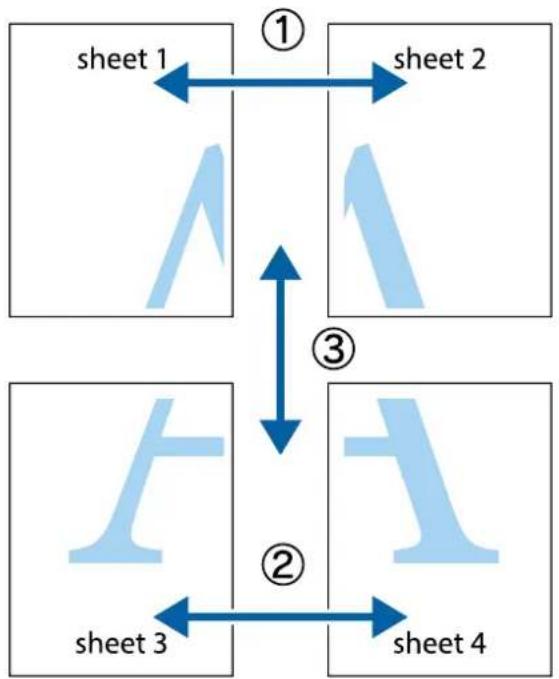
flowchart
graph TD
    A["① sheet 1"] --> B["② sheet 3"]
    C["③ sheet 2"] --> D["② sheet 4"]
    E["④ sheet 1"] --> F["③ sheet 3"]
    G["⑤ sheet 2"] --> H["③ sheet 4"]
Printing
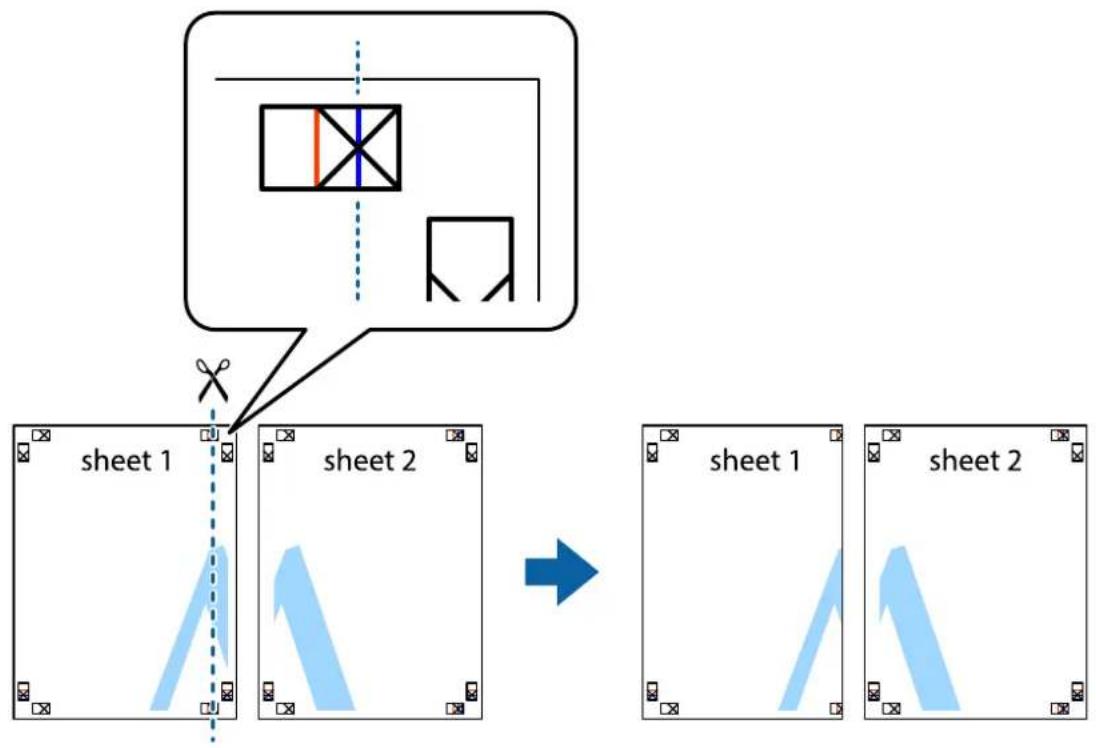
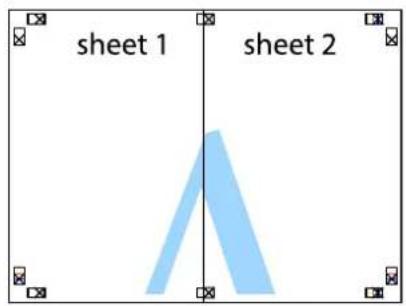
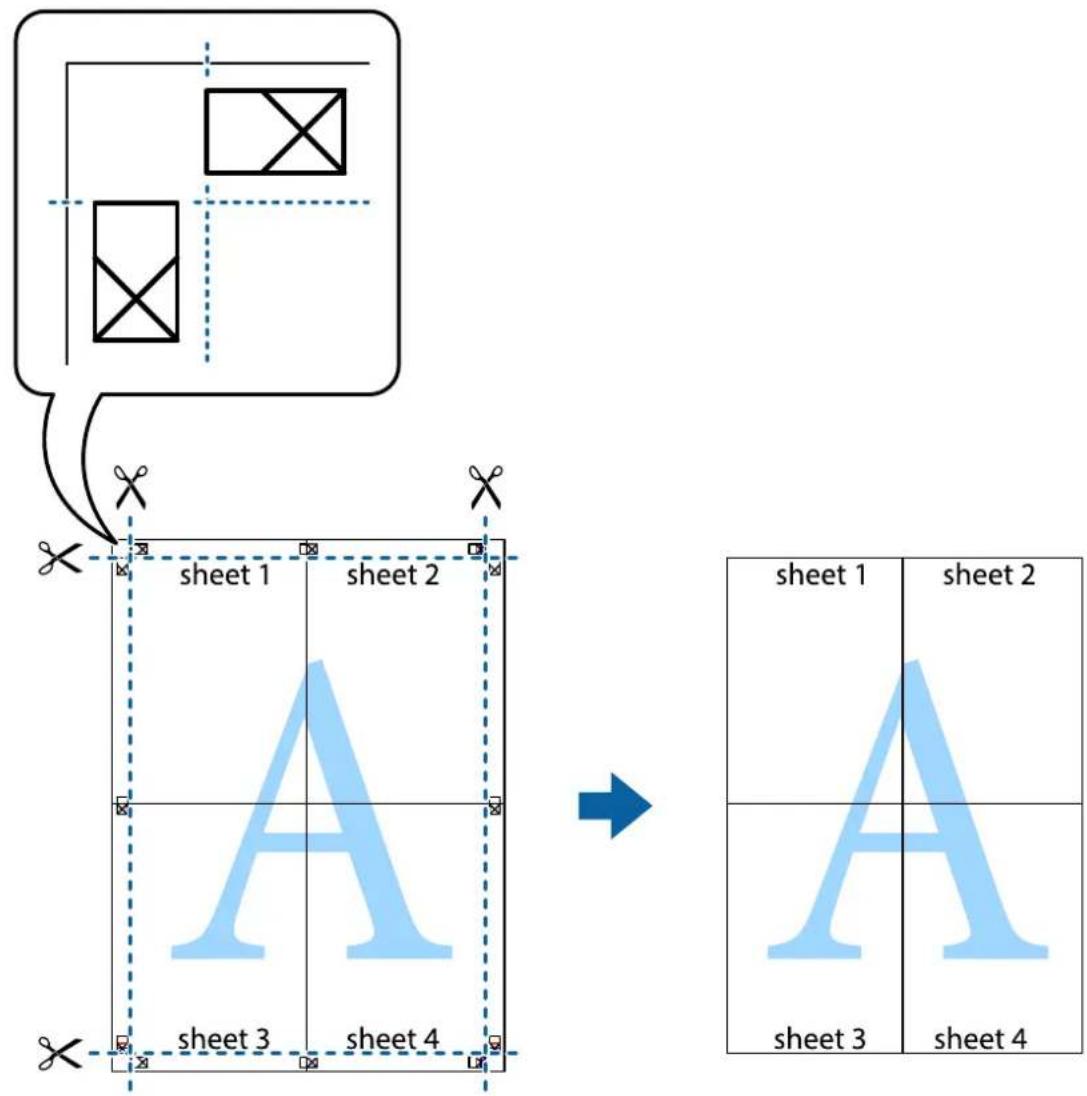
- Prepare Sheet 1 and Sheet 2. Cut off the margins of Sheet 1 along the vertical blue line through the center of the top and bottom cross marks.
flowchart
graph TD
    A_sheet1["sheet 1"] --> B sheet2 sheet2 sheet2
    style A fill:#f9f,stroke:#333
    style B fill:#bbf,stroke:#333
    subgraph A
        C["Diagram: Cutting scissors"]
        D["Diagram: Vertical lines within rectangle"]
        E["Diagram: Vertical line within rectangle"]
    end
    subgraph B
        F["Arrow pointing right"]
    end
    subgraph C
        G["Arrow pointing left"]
    end
    subgraph D
        H["Arrow pointing left"]
    end
    subgraph E
        I["Arrow pointing right"]
    end
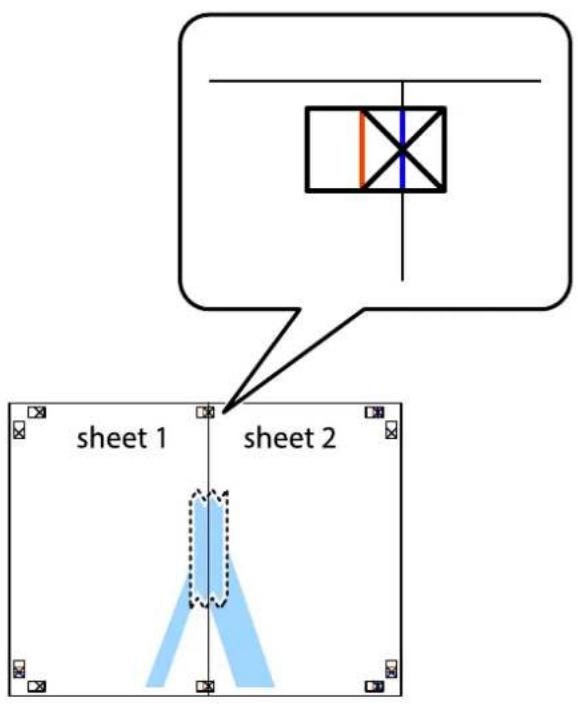
- Place the edge of Sheet 1 on top of Sheet 2 and align the cross marks, then temporarily tape the two sheets together from the back.
Printing
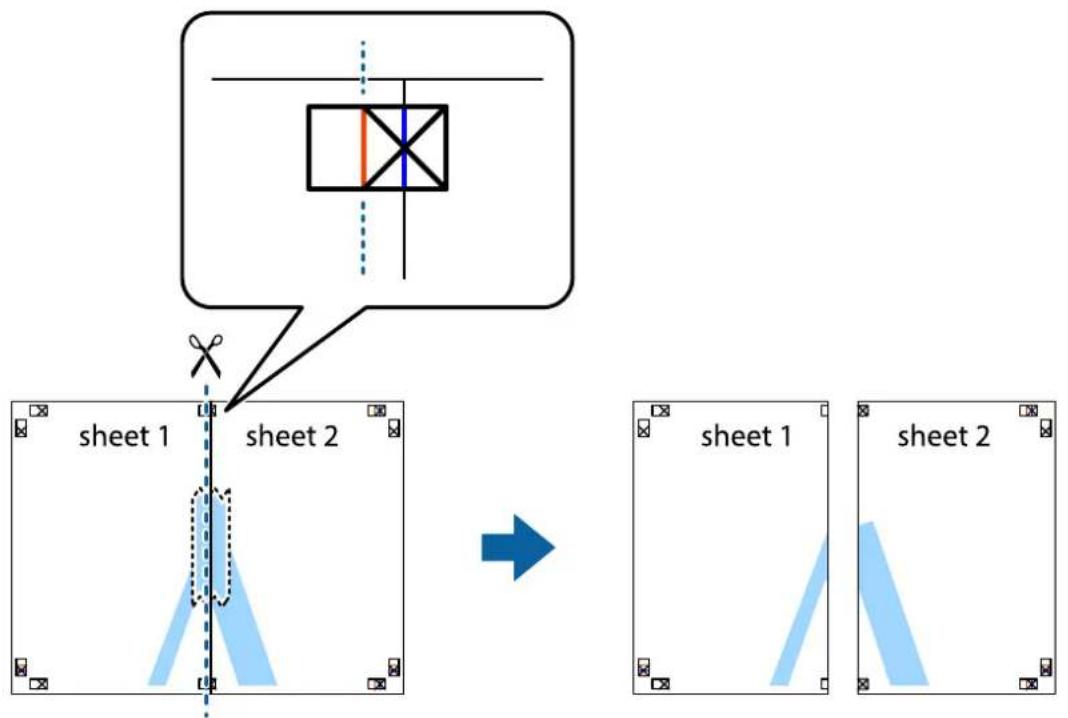
- Cut the taped sheets in two along the vertical red line through the alignment markers (this time, the line to the left of the cross marks).
flowchart
graph TD
    A["Speech Bubble"] --> B["Arrow"]
    B --> C sheet1 sheet2
- Tape the sheets together from the back.
- Repeat steps 1 to 4 to tape Sheet 3 and Sheet 4 together.
Printing
- Cut off the margins of Sheet 1 and Sheet 2 along the horizontal blue line through the center of the left and right side cross marks.
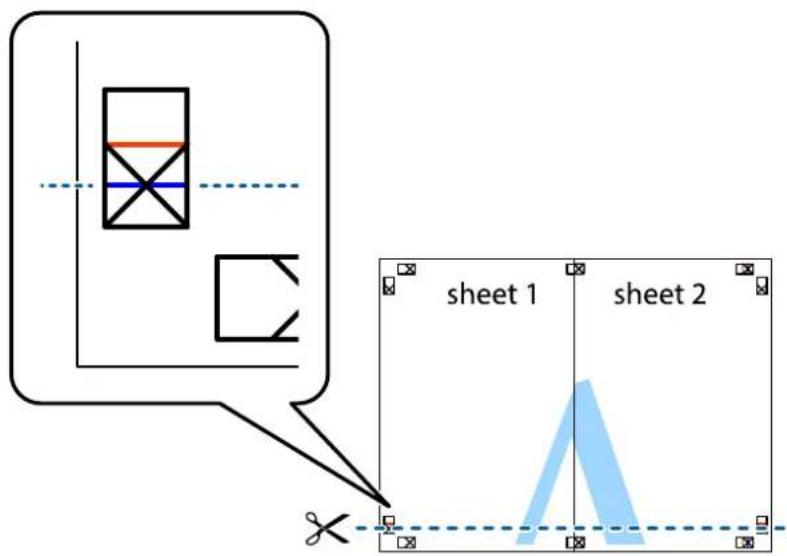
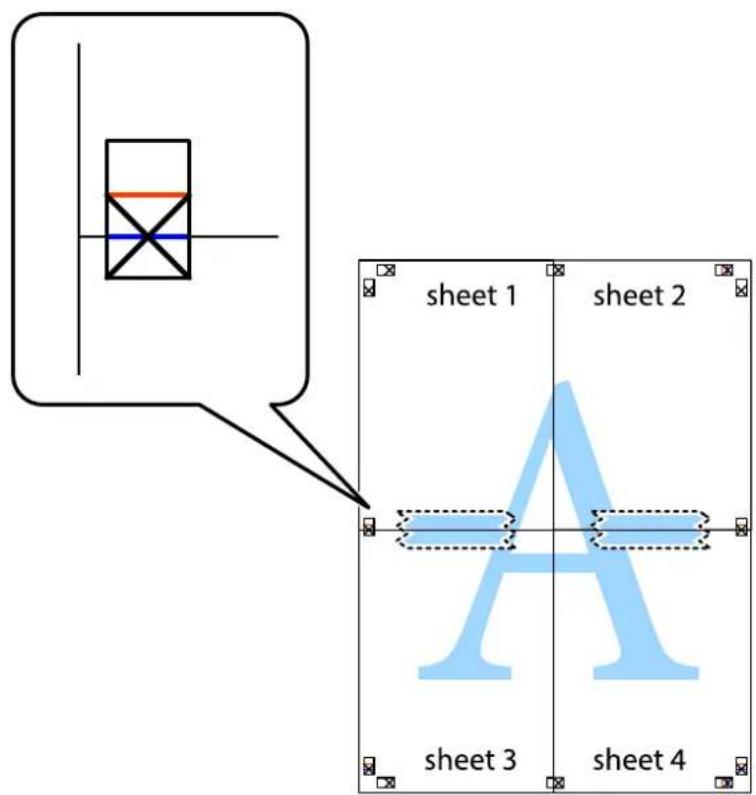
- Place the edge of Sheet 1 and Sheet 2 on top of Sheet 3 and Sheet 4 and align the cross marks, and then temporarily tape them together from the back.
Printing
- Cut the taped sheets in two along the horizontal red line through the alignment markers (this time, the line above the cross marks).
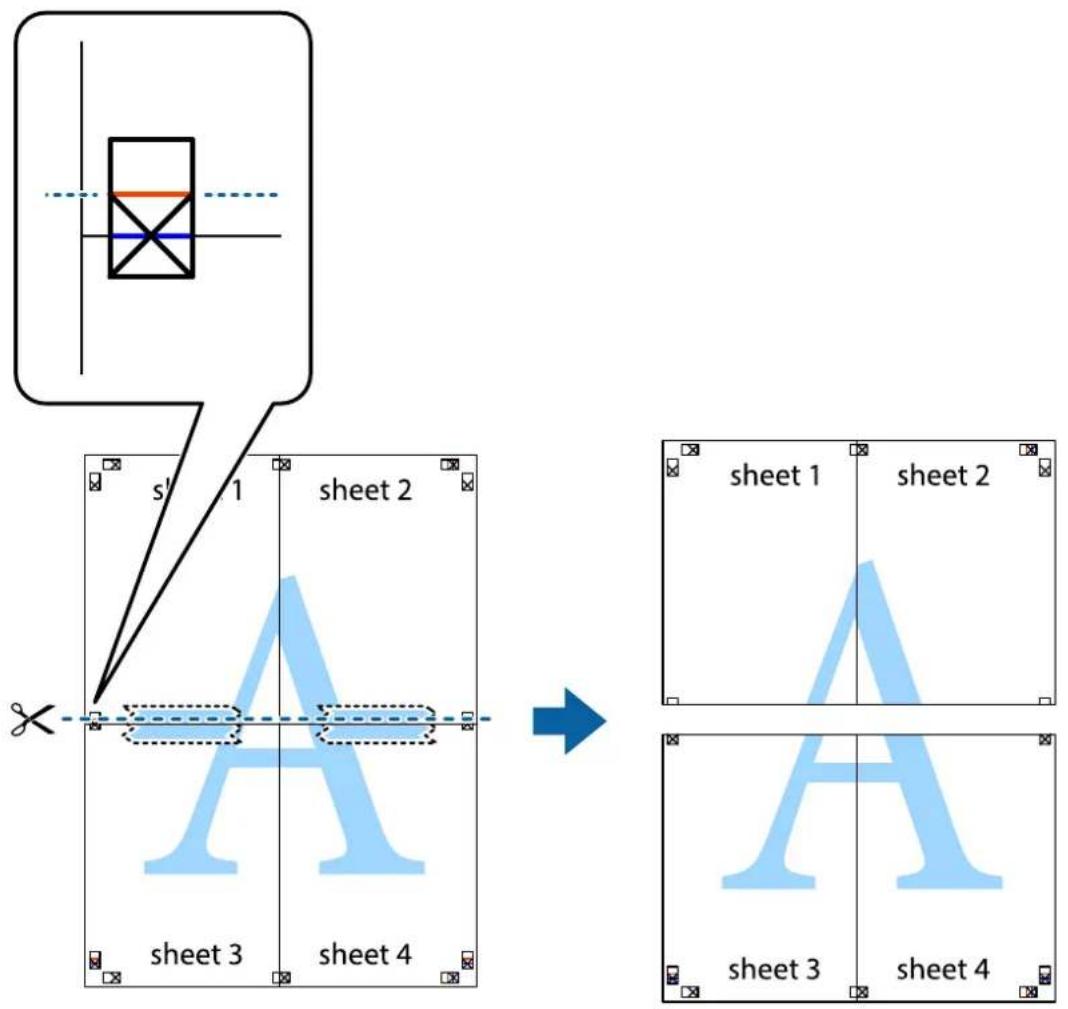
- Tape the sheets together from the back.
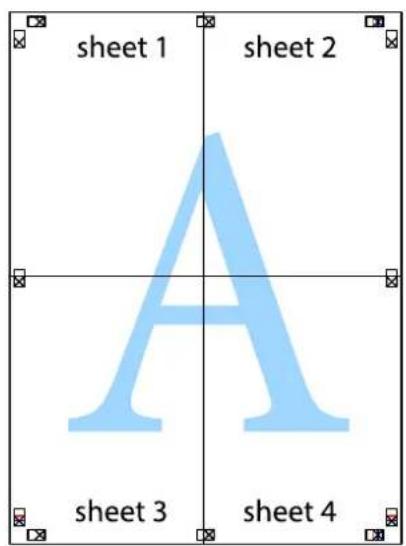
Printing
- Cut off the remaining margins along the outer guide.
Printing Using Advanced Features
This section introduces a variety of additional layout and printing features available on the printer driver.
Related Information
→ "Windows Printer Driver" on page 87
→ "Mac OS X Printer Driver" on page 88
Adding a Printing Preset to Print Easily
If you create your own preset of frequently used print settings on the printer driver, you can print easily by selecting the preset from the list.
User's Guide
Printing
Windows
To add your own preset, set items such as the Document Size and Paper Type on the Main or More Options tab, and then click Add/Remove Presets in Printing Presets.
Note:
To delete an added preset, click Add/Remove Presets, select the preset name you want to delete from the list, and then delete it.
Mac OS X
Access the print dialog. To add your own preset, set items such as the Paper Size and Media Type, and then save the current settings as the preset in the Presets setting.
Note:
To delete an added preset, click Presets > Show Presets, select the preset name you want to delete from the list, and then delete it.
Printing a Reduced or Enlarged Document
You can reduce or enlarge the size of a document by a specific percentage.
Windows
Set the Document Size on the More Options tab. Select Reduce/Enlarge Document, Zoom to, and then enter a percentage.
Mac OS X
Select Page Setup from the File menu. Select the settings for Format For and Paper Size, and then enter a percentage in Scale. Close the window, and then print following the basic printing instructions.
Adjusting the Print Color
You can adjust the colors used in the print job.
PhotoEnhance produces sharper images and more vivid colors by automatically adjusting the contrast, saturation, and brightness of the original image data.
Note:
☐ These adjustments are not applied to the original data.
☐ PhotoEnhance adjusts the color by analyzing the location of the subject. Therefore, if you have changed the location of the subject by reducing, enlarging, cropping, or rotating the image, the color may change unexpectedly. If the image is out of focus, the tone may be unnatural. If the color is changed or becomes unnatural, print in a mode other than PhotoEnhance.
Windows
Select the method of color correction from Color Correction on the More Options tab.
If you select Automatic, the colors are automatically adjusted to match the paper type and print quality settings. If you select Custom and click Advanced, you can make your own settings.
Mac OS X
Access the print dialog. Select Color Matching from the pop-up menu, and then select EPSON Color Controls. Select Color Options from the pop-up menu, and then select one of the available options. Click the arrow next to Advanced Settings and make the appropriate settings.
Printing
Printing an Anti-Copy Pattern (for Windows Only)
You can print documents with invisible letters such as "Copy". These letters appear when the document is photocopied so that the copies can be distinguished from the original. You can also add your own anti-copy pattern.
Note:
This feature is only available when the following settings are selected.
□ Paper Type: plain papers
Quality: Standard
☐ Auto 2-sided printing: Disabled
☐ Color Correction: Automatic
☐ Short Grain Paper: Disabled
Click Watermark Features on the More Options tab, and then select an anti-copy pattern. Click Settings to change details such as the size and density.
Printing a Watermark (for Windows Only)
You can print a watermark such as "Confidential" on your printouts. You can also add your own watermark.
Click Watermark Features on the More Options tab, and then select a watermark. Click Settings to change details such as the density and position of the watermark.
Printing a Header and Footer (for Windows Only)
You can print information such as a user name and printing date as headers or footers.
Click Watermark Features in the More Options tab, and then select Header/Footer. Click Settings and select necessary items from the drop-down list.
Setting a Password for a Print Job (for Windows Only)
You can set a password for a print job to prevent printing until the password is entered on the printer's control panel.
Select Confidential Job on the More Options tab, and then enter a password.
To print the job, enter Menu from the printer's home screen, and then select Confidential Job. Select the job and enter the password.
Printing Using a PostScript Printer Driver
Printing Using a PostScript Printer Driver - Windows
- Load paper in the printer.
- Open the file you want to print.
- Access the PostScript printer driver window.
Printing
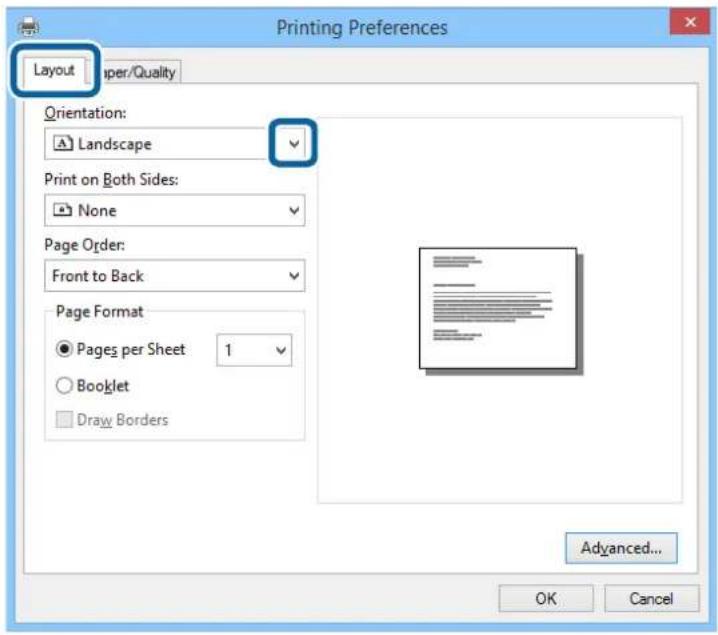
- Select the orientation you set in the application as the Orientation on the Layout tab.
- Make the following settings on the Paper/Quality tab.
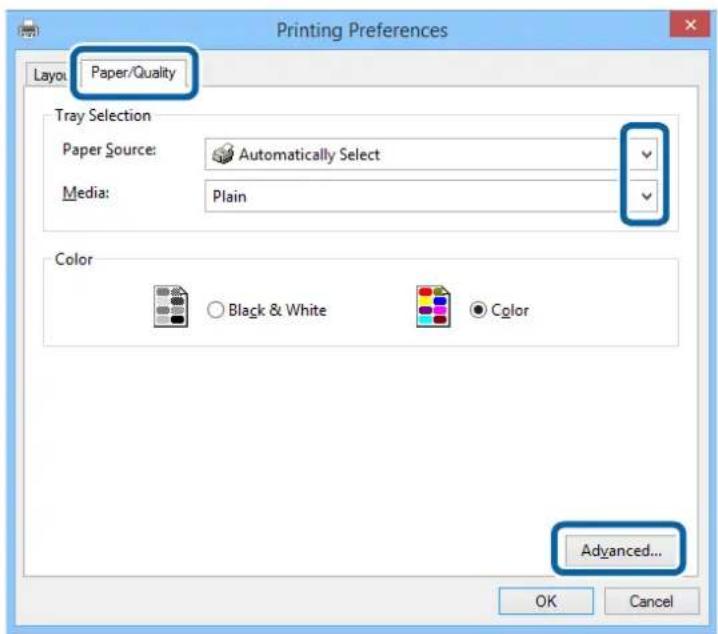
☐ Paper Source: Select the paper source in which you loaded the paper.
☐ Media: Select the type of paper you loaded.
Printing
- Click Advanced, make the following settings, and then click OK.
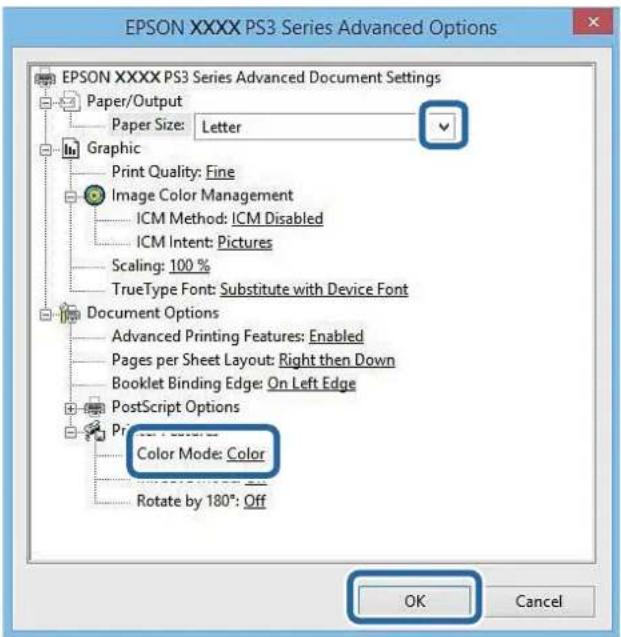
☐ Paper Size: Select the paper size you loaded in the printer.
☐ Color Mode: Select to print in full color or monochrome.
- Click OK.
- Click Print.
Printing Using a PostScript Printer Driver - Mac OS X
- Load paper in the printer.
- Open the file you want to print.
Printing
3. Access the print dialog.
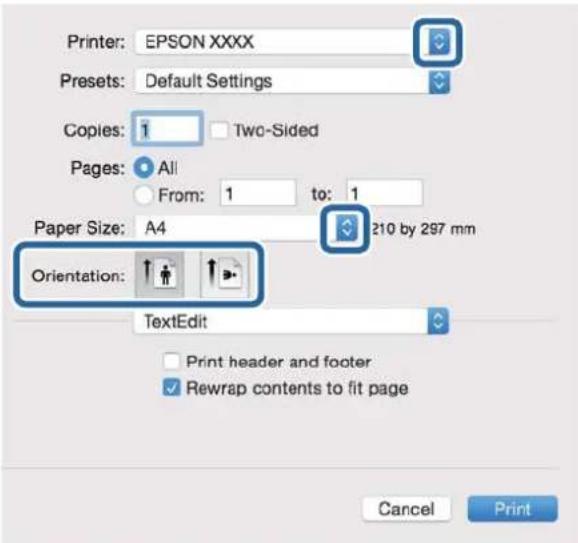
4. Make the following settings.
☐ Printer: Select your printer.
☐ Paper Size: Select the paper size you loaded in the printer.
☐ Orientation: Select the orientation you set in the application.
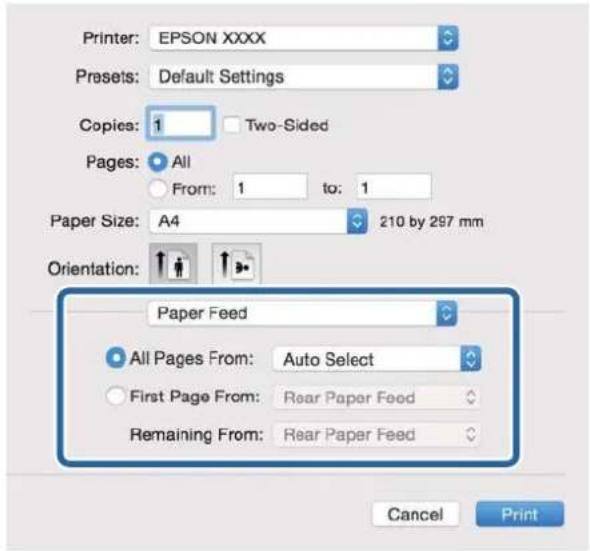
5. Select Paper Feed from the pop-up menu, and then select the paper source in which you loaded the paper.
Printing
- Select Printer Features from the pop-up menu, select Quality as the Feature Sets setting, and then select the type of paper you loaded as the MediaType setting.
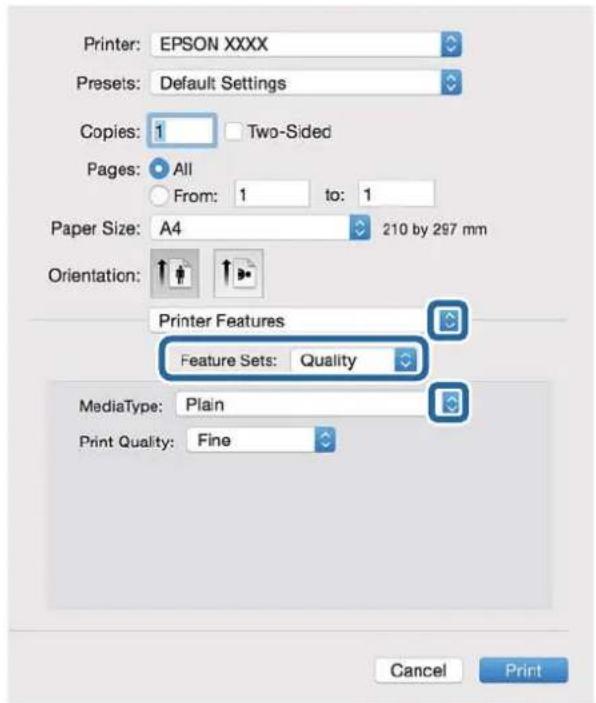
- Select Color as the Feature Sets setting, and then select the setting for Color Mode.
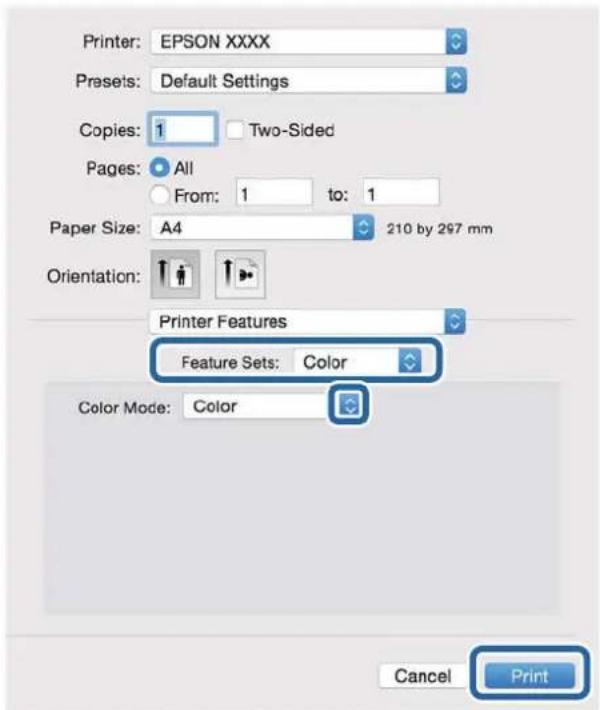
- Click Print.
Printing
Setting Items for the PostScript Printer Driver
Note:
The availability of these settings varies by model.
| Color Mode | Select whether to print in color or in monochrome. |
| Ink Save Mode | Conserves ink by reducing the print density. |
| Rotate by 180° | Rotates the data 180 degrees before printing. |
Printing from Smart Devices
Using Epson iPrint
Epson iPrint is an application that allows you to print photos, documents, and Web pages from a smart device such as a smartphone or tablet. You can use either local print, printing from a smart device that is connected to the same wireless network as your printer, or remote print, printing externally over the internet. To use remote print, register your printer in the Epson Connect service.
natural_image
Illustration of a printer with a printed image, labeled 'EPSON' below (no other text or symbols)You can install Epson iPrint on your smart device from the following URL or QR code.
http://ipr.to/c

Using Epson iPrint
Start Epson iPrint from your smart device and select the item you want to use from the home screen.
Printing
The following screens are subject to change without notice.
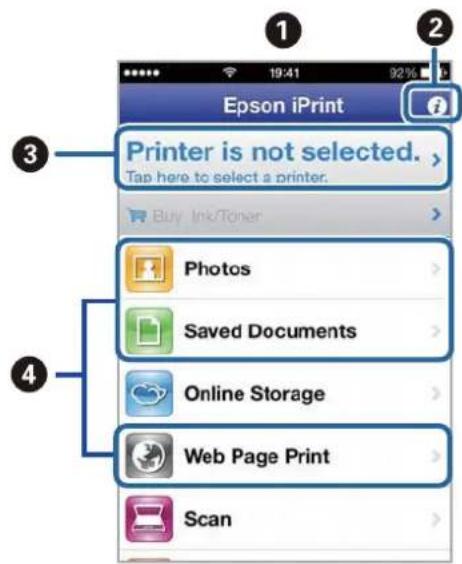
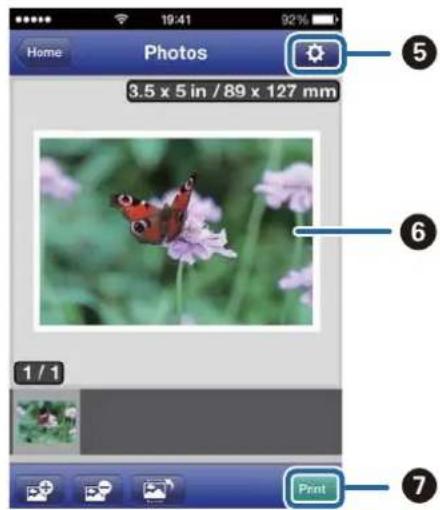
| 1 | Home screen displayed when the application is started. |
| 2 | Displays information on how to setup the printer and a FAQ. |
| 3 | Displays the screen where you can select the printer and make printer settings. Once you have selected the printer, you do not need to select it again from the next time. |
| 4 | Select what you want to print such as photos, documents, and web pages. |
| 5 | Displays the screen to make print settings such as paper size and paper type. |
| 6 | Displays photos and documents you selected. |
| 7 | Starts printing. |
Note:
To print from the document menu using iPhone, iPad, and iPod touch running iOS, start Epson iPrint after transferring the document you want to print using the file sharing function in iTunes.
Related Information
→ "Epson Connect Service" on page 85
Printing by Touching Smart Devices to the NFC Tag
Even if the printer and your smart device are not connected, you can connect them automatically and print by touching the NFC antenna of a smart device running Android 4.0 or later and that supports NFC (Near Filed Communication) to the printer's NFC tag.
The location of the NFC antenna varies depending on the smart device. See the documentation provided with your smart device for more details.
Printing

Important:
☐ Make sure that Wi-Fi Direct Simple AP mode is running. See the Network Guide for more details.
☐ Make sure that Epson iPrint is installed on your smart device. If not, touch the NFC tag antenna of the smart device to the printer's NFC tag and install it.
Note:
☐ If the printer does not communicate with the smart device even after touching it to the tag, try adjusting the position of the smart device and touch it to the tag again.
☐ If there are obstacles such as metal between the printer's NFC tag and the NFC antenna of the smart device, the printer may not be able to communicate with the smart device.
☐ This feature uses Wi-Fi Direct Simple AP mode to connect to the printer. You can connect up to four devices to the printer at the same time. See the Network Guide for more details.
☐ If you have changed the password for the Wi-Fi Direct Simple AP mode, you cannot use this feature. Restore the initial password to use this feature.
-
Load paper in the printer.
-
Touch the NFC antenna of your smart device to the printer's NFC tag.
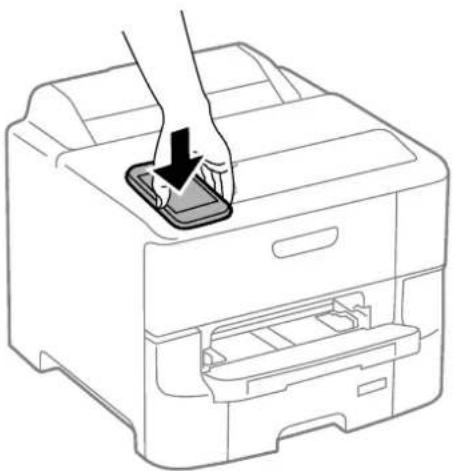
natural_image
Line drawing of a printer with a hand inserting a button into the top panel (no text or symbols)Epson iPrint starts.
- On the Epson iPrint home screen, touch the NFC antenna of your smart device to the printer's NFC tag again. The printer and the smart device are connected.
- Display the image you want to print.
- Touch the NFC antenna of your smart device to the printer's NFC tag again. Printing starts.
Related Information
→ "Loading Paper in the Paper Cassette" on page 30
→ "Loading Paper in the Rear Paper Feed" on page 32
→ "Loading Paper in the Front Paper Feed Slot" on page 34
Printing
Using AirPrint
AirPrint allows you to wirelessly print to your AirPrint-enabled printer from your iOS device using the latest version of iOS and from your Mac OS X v10.7.x or later.
Note:
See the AirPrint page of the Apple website for more details.
-
Load paper in the printer.
-
Connect your device to the same wireless network that your printer is using.
-
Print from your device to your printer.
Related Information
→ "Loading Paper in the Paper Cassette" on page 30
→ "Loading Paper in the Rear Paper Feed" on page 32
→ "Loading Paper in the Front Paper Feed Slot" on page 34
→ "System Administration" on page 20
Canceling Printing
Note:
☐ In Windows, you cannot cancel a print job from the computer once it has been completely sent to the printer. In this case, cancel the print job by using the printer's control panel.
☐ When printing several pages from Mac OS X, you cannot cancel all of the jobs by using the control panel. In this case, cancel the print job from the computer.
☐ If you have sent a print job from Mac OS X v10.6.8 through the network, you may not be able to cancel printing from the computer. In this case, cancel the print job by using the printer's control panel. You need to change settings in Web Config to cancel printing from the computer. See the Network Guide for more details.
Canceling Printing - Printer Button
Press the Ⓤ button to cancel the print job in progress.
Printing
Canceling Printing - Windows
- Access the printer driver window.
- Select the Maintenance tab.
- Click Print Queue.
- Right-click on the job you want to cancel and then select Cancel.
Related Information
→ "Windows Printer Driver" on page 87
Canceling Printing - Mac OS X
- Click the printer icon in the Dock.
- Select the job you want to cancel.
- Cancel the job.
☐ Mac OS X v10.8.x or later Click ✗ next to the progress meter.
☐ Mac OS X v10.6.8 to v10.7.x Click Delete.
Replacing Ink Cartridges and Other Consumables
Checking the Status of the Remaining Ink and the Maintenance Box
You can check the approximate ink levels and the approximate service life of the maintenance box from the control panel or the computer.
Checking the Status of the Remaining Ink and the Maintenance Box - Control Panel
- Enter Menu from the home screen.
- Select Ink Levels.
Note:
The indicator on the far right indicates the available space in the maintenance box.
Checking the Status of the Remaining Ink and the Maintenance Box - Windows
- Access the printer driver window.
- Click EPSON Status Monitor 3 on the Maintenance tab, and then click Details.
Note:
If EPSON Status Monitor 3 is disabled, click Extended Settings on the Maintenance tab, and then select Enable EPSON Status Monitor 3.
Related Information
→ "Windows Printer Driver" on page 87
Checking the Status of the Remaining Ink and the Maintenance Box - Mac OS X
- Select System Preferences from the menu > Printers & Scanners (or Print & Scan, Print & Fax), and then select the printer.
- Click Options & Supplies > Utility > Open Printer Utility.
- Click EPSON Status Monitor.
Replacing Ink Cartridges and Other Consumables
Ink Cartridge Codes
Epson recommends the use of genuine Epson ink cartridges. Epson cannot guarantee the quality or reliability of non-genuine ink. The use of non-genuine ink may cause damage that is not covered by Epson's warranties, and under certain circumstances, may cause erratic printer behavior. Information about non-genuine ink levels may not be displayed.
The following are the codes for genuine Epson ink cartridges.
| Product | Black | Cyan | Magenta | Yellow |
| WF-6090 | T9081 | T9082 | T9083 | T9084 |
| T9071 | T9072 | T9073 | T9074 | |
| WF-6091 | T7521 | T7522 | T7523 | T7524 |
Note:
☐ Not all cartridges are available in all regions.
☐ For users in Europe, visit the following website for information on Epson's ink cartridge yields. http://www.epson.eu/pageyield
Ink Cartridge Handling Precautions
Read the following instructions before replacing ink cartridges.
Handling precautions
☐ Store ink cartridges at normal room temperature and keep them away from direct sunlight.
☐ Epson recommends using the ink cartridge before the date printed on the package.
☐ For best results, use up ink cartridge within six months of installation.
☐ After bringing an ink cartridge inside from a cold storage site, allow it to warm up at room temperature for at least three hours before using it.
☐ Do not touch the sections shown in the illustration. Doing so may prevent normal operation and printing.
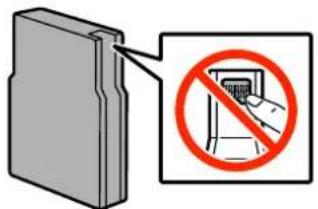
☐ Install all ink cartridges; otherwise you cannot print.
☐ Do not move the print head by hand; otherwise, you may damage the printer.
☐ Do not turn off the printer during ink charging. If the ink charging is incomplete, you may not be able to print.
☐ Do not leave the printer with the ink cartridges removed; otherwise, ink remaining in the print head nozzles may dry out and you may not be able to print.
Replacing Ink Cartridges and Other Consumables
☐ If you need to remove an ink cartridge temporarily, make sure you protect the ink supply area from dirt and dust. Store the ink cartridge in the same environment as the printer. Because the ink supply port is equipped with a valve designed to contain the release of excess ink, there is no need to supply your own covers or plugs.
☐ Removed ink cartridges may have ink around the ink supply port, so be careful not to get any ink on the surrounding area when removing the cartridges.
☐ This printer uses ink cartridges equipped with a green chip that monitors information such as the amount of remaining ink for each cartridge. This means that even if the cartridge is removed from the printer before it is expended, you can still use the cartridge after reinserting it back into the printer.
☐ To ensure you receive premium print quality and to help protect your print head, a variable ink safety reserve remains in the cartridge when your printer indicates to replace the cartridge. The yields quoted for you do not include this reserve.
☐ Although the ink cartridges may contain recycled materials, this does not affect printer function or performance.
☐ Specifications and appearance of the ink cartridge are subject to change without prior notice for improvement.
☐ Do not disassemble or remodel the ink cartridge, otherwise you may not be able to print normally.
☐ Do not drop or knock it against hard objects; otherwise, the ink may leak.
☐ You cannot use the cartridges that came with the printer for the replacement.
☐ Quoted yields may vary depending on the images that you are printing, the paper type that you are using, the frequency of your prints and environmental conditions such as temperature.
Consumption of Ink
☐ To maintain optimum print head performance, some ink is consumed from all cartridges not only during printing but also during maintenance operations such as print head cleaning.
☐ When printing in monochrome or grayscale, color inks instead of black ink may be used depending on the paper type or print quality settings. This is because a mixture of color inks is used to create black.
☐ The ink in the ink cartridges supplied with your printer is partly used during initial setup. In order to produce high quality printouts, the print head in your printer will be fully charged with ink. This one-off process consumes a quantity of ink and therefore these cartridges may print fewer pages compared to subsequent ink cartridges.
Replacing Ink Cartridges
- Open the front cover.
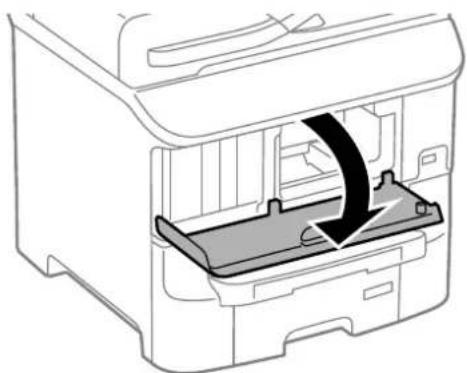
natural_image
Diagram of a printer internal structure showing a paper holder with a black arrow indicating the loading direction (no text or symbols present)User's Guide
Replacing Ink Cartridges and Other Consumables
- Push the ink cartridge that you want to replace.
The ink cartridge will pop out slightly.
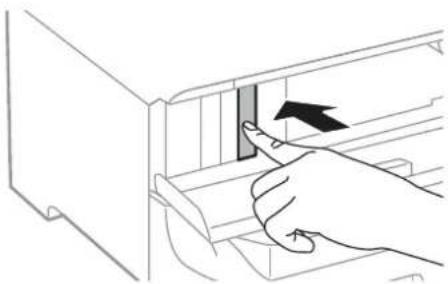
natural_image
Line drawing of a hand inserting a component into a file drawer (no text or symbols)- Remove the ink cartridge from the printer.
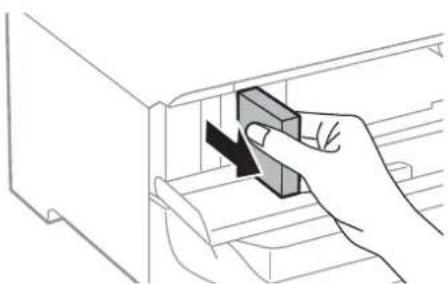
natural_image
Line drawing of a hand inserting a rectangular object into a file drawer (no text or symbols)- Remove the new ink cartridge from its package.
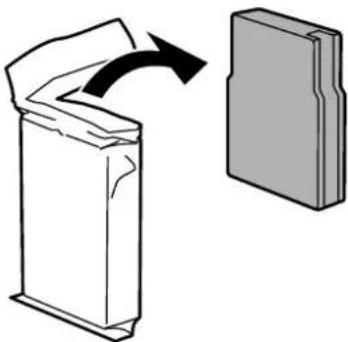
natural_image
Diagram showing a folded paper or plastic sheet being rotated by an arrow, next to a 3D block (no text or symbols)
Important:
Do not touch the sections shown in the illustration. Doing so may prevent normal operation and printing.
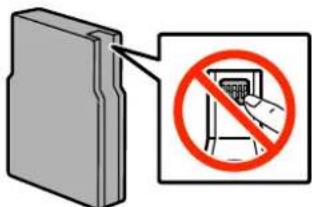
Replacing Ink Cartridges and Other Consumables
- Shake the ink cartridge horizontally for 5 seconds, moving it back and forth about 10 cm 15 times.
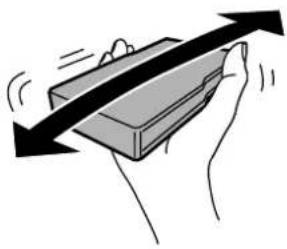
natural_image
Illustration of a hand holding a rectangular object with an upward arrow, indicating motion or force (no text or symbols)- Insert the cartridge into the printer until it clicks.
Note:
If Cartridge Check is displayed on the control panel, press the OK button to check if the cartridges are installed correctly.
- Close the front cover.
Related Information
→ "Ink Cartridge Codes" on page 64
→ "Ink Cartridge Handling Precautions" on page 64
Maintenance Box Code
Epson recommends the use of a genuine Epson maintenance box.
The following is the code for the genuine Epson maintenance box.
T6712
Maintenance Box Handling Precautions
Read the following instructions before replacing the maintenance box.
☐ Do not touch the green chip on the side of the maintenance box. Doing so may prevent normal operation and printing.
☐ Do not remove the film on the top of the box; otherwise ink may leak.
☐ Do not tilt the used maintenance box until after it is sealed in the plastic bag; otherwise ink may leak.
□ Keep the maintenance box out of direct sunlight.
☐ Do not replace the maintenance box during printing; otherwise, ink may leak.
☐ Do not reuse a maintenance box which has been removed and left detached for a long period. Ink inside the box will have solidified and no more ink can be absorbed.
Replacing a Maintenance Box
In some print cycles a very small amount of surplus ink may be collected in the maintenance box. To prevent ink leakage from the maintenance box, the printer is designed to stop printing when the absorbing capacity of the
Replacing Ink Cartridges and Other Consumables
maintenance box has reached its limit. Whether and how often this is required will vary according to the number of pages you print, the type of material that you print and the number of cleaning cycles that the printer performs. Replace the maintenance box when you are promoted to do so. The Epson Status Monitor, your LCD, or lights on the control panel will advise you when this part needs replacing. The need for replacement of the box does not mean that your printer has ceased to operate in accordance with its specifications. The Epson warranty does not cover the cost of this replacement. It is a user-serviceable part.
- Remove the new maintenance box from its package.

Important:
☐ Do not touch the green chip on the side of the maintenance box. Doing so may prevent normal operation and printing.
☐ Do not remove the film on the top of the box; otherwise ink may leak.
Note:
A transparent bag for the used maintenance box is provided with the new maintenance box.
- Open rear cover 1.
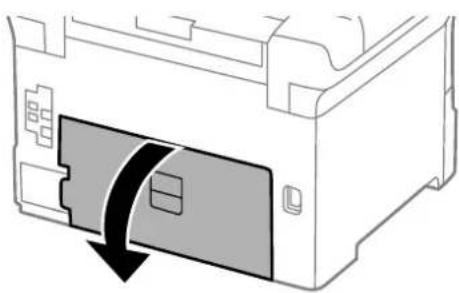
natural_image
Diagram of a computer case with a black arrow indicating a download or transfer process (no text or symbols present)- Remove the used maintenance box.
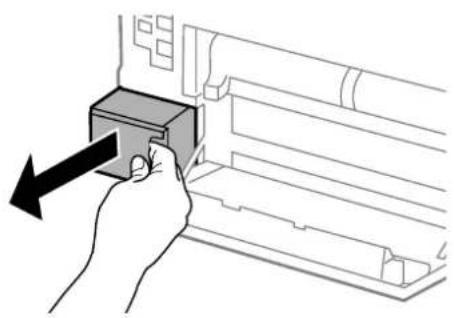
natural_image
Hand inserting a component into a device panel (no text or symbols visible)- Put the used maintenance box in the transparent bag that came with the new maintenance box and seal the bag shut.
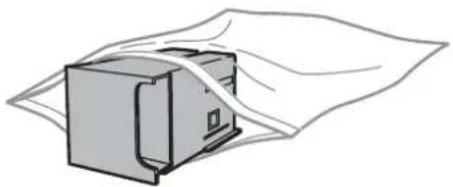
natural_image
Illustration of a toaster oven with a cloth partially covering its lid (no text or symbols)Replacing Ink Cartridges and Other Consumables

Important:
☐ Do not remove the film on the top of the maintenance box.
☐ Do not tilt the used maintenance box until after it is sealed in the plastic bag; otherwise ink may leak.
- Insert the new maintenance box all the way into the printer.
- Close rear cover 1.
Related Information
→ "Maintenance Box Code" on page 67
→ "Maintenance Box Handling Precautions" on page 67
Maintenance Rollers Codes
Epson recommends the use of genuine Epson maintenance rollers.
The following are the codes.
Maintenance rollers of paper cassette 1: S210046
Maintenance rollers of paper cassette 2 to 3: S210047
Replacing Maintenance Rollers in Paper Cassette 1
There are two places for replacing the maintenance rollers: on the back of the printer (two rollers) and on the paper cassette (one roller).
- Remove the new maintenance rollers from their package.

Important:
☐ The maintenance rollers for the paper cassette 1 and paper cassette 2 to 3 are different. Check the direction of the arrow at the center of the maintenance rollers, and make sure the maintenance rollers are the ones for paper cassette 1. If you attach the wrong rollers, the printer may not feed the paper.
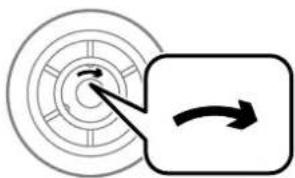
natural_image
Diagram showing concentric circles with a pointer and a curved arrow inside a rounded rectangle (no text or symbols)☐ Be careful not to stain the surface of the maintenance rollers. If dust collects on the surface of the maintenance rollers, clean the rollers by using a soft and dry cloth.
- Turn off the printer by pressing the ⏻ button, and then unplug the power cord.
User's Guide
Replacing Ink Cartridges and Other Consumables
- Pull out paper cassette 1.
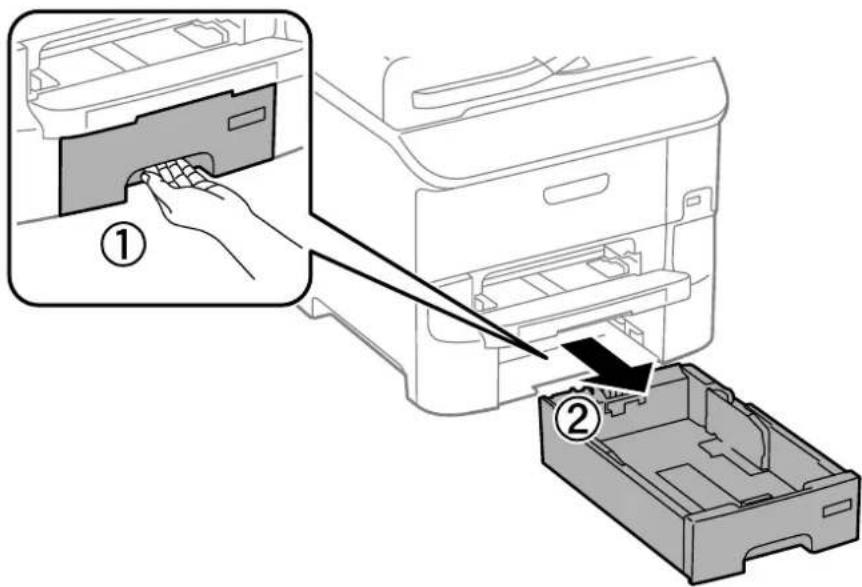
- Turn the printer around, and open rear cover 1.
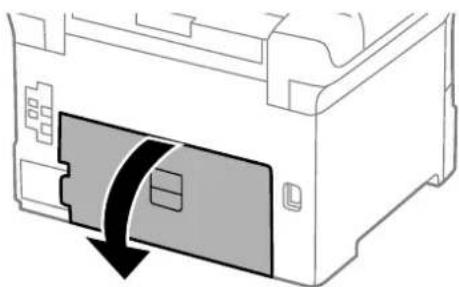
natural_image
Diagram of a computer case with a black arrow indicating a download or transfer process (no text or symbols present)- Pull out rear cover 2.
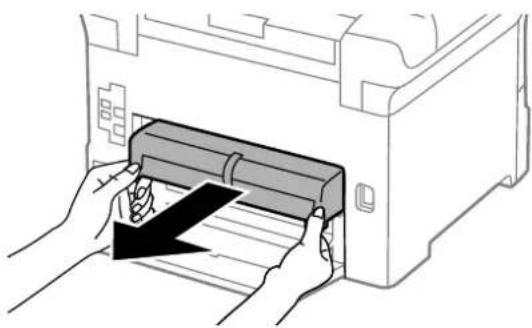
natural_image
Illustration of hands inserting a printer into a machine (no text or symbols visible)User's Guide
Replacing Ink Cartridges and Other Consumables
- Remove the cover inside the back of the printer.
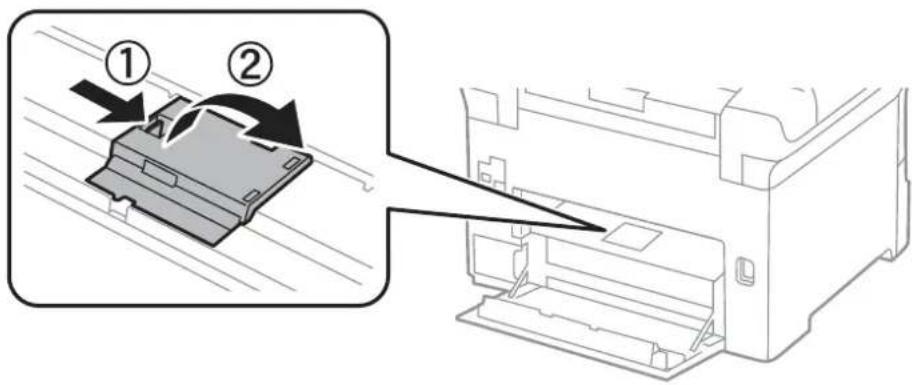
- Slide out the two used maintenance rollers, and remove them.
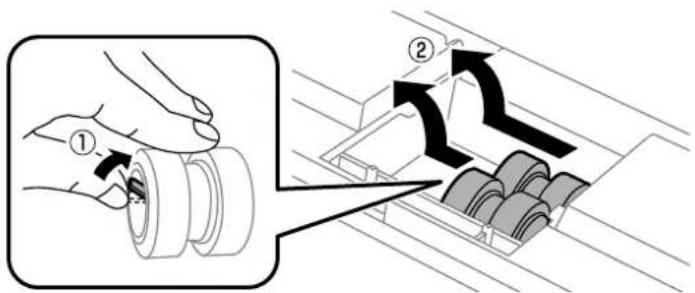
- Insert two new maintenance rollers until they click into place.
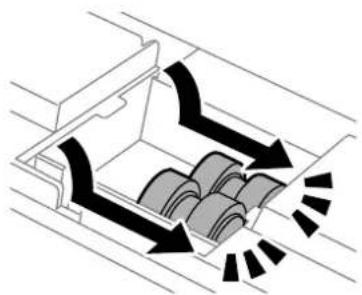
natural_image
Diagram of a refrigerator interior with airflow arrows indicating movement (no text or symbols)Note:
Insert the maintenance rollers by rolling them so that you can insert them smoothly.
- Reattach the cover inside the back of the printer.
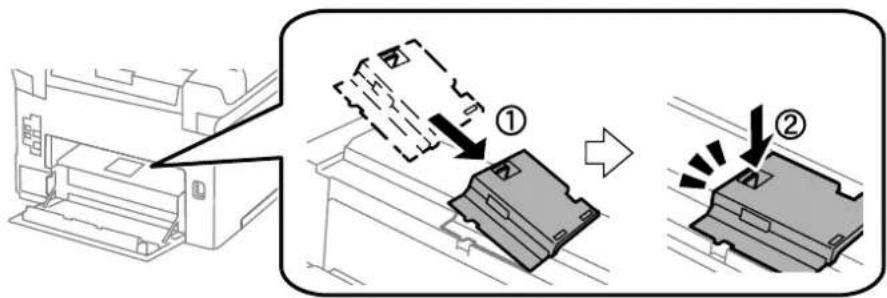
User's Guide
Replacing Ink Cartridges and Other Consumables
- Hold up the maintenance roller for the paper cassette by rolling it up, and then remove it.
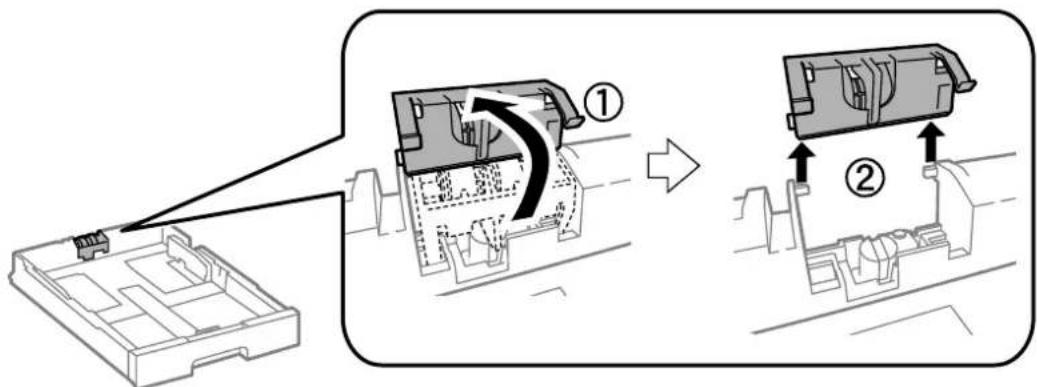
- Install the new maintenance roller in the paper cassette.
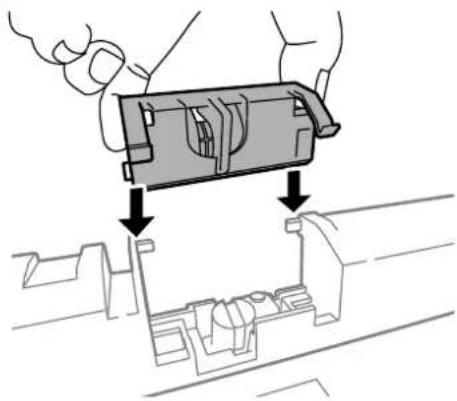
natural_image
Mechanical assembly diagram showing hand positioning and alignment of a component (no text or symbols)- Hold down the maintenance roller firmly.
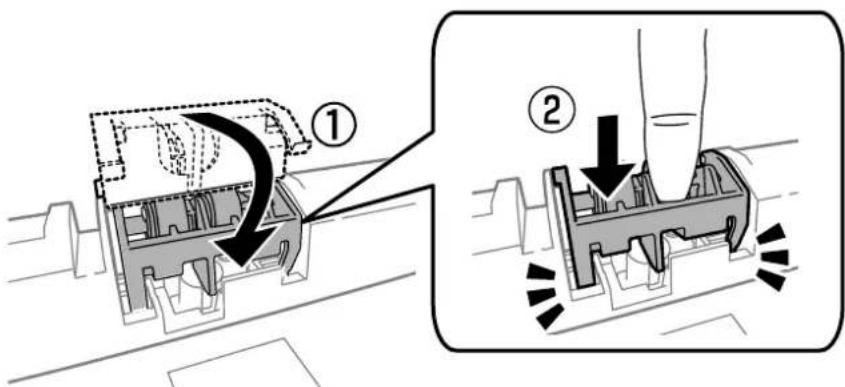
-
Insert rear cover 2, close rear cover 1, and then insert the paper cassette.
-
Turn on the printer, select Menu>Maintenance>Maintenance Roller Information>Reset Maintenance Roller Counter, and then select the paper cassette in which you replaced the maintenance rollers.
Related Information
→ "Maintenance Rollers Codes" on page 69
Replacing Maintenance Rollers in Paper Cassette 2 to 3
There are two places for replacing the maintenance rollers: on the back of the printer (two rollers) and on the paper cassette (one roller).
- Remove the new maintenance rollers from their package.

Important:
☐ The maintenance rollers for the paper cassette 1 and paper cassette 2 to 3 are different. Check the direction of arrow on the center of the maintenance rollers, and make sure the maintenance rollers are the ones for paper cassette 2 to 3. If you attach the wrong rollers, the printer may not feed the paper.
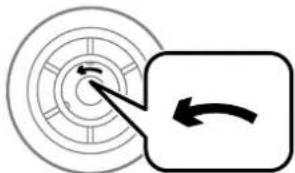
natural_image
Diagram showing a circular target with radial arrows pointing to a rectangular button (no text or symbols)☐ Be careful not to stain the surface of the maintenance rollers. If the dust collects on the surface of the maintenance rollers, clean the rollers by using a soft and dry cloth.
-
Turn off the printer by pressing the ⏻ button, and then unplug the power cord.
-
Pull out the paper cassette for which you want to replace the rollers.
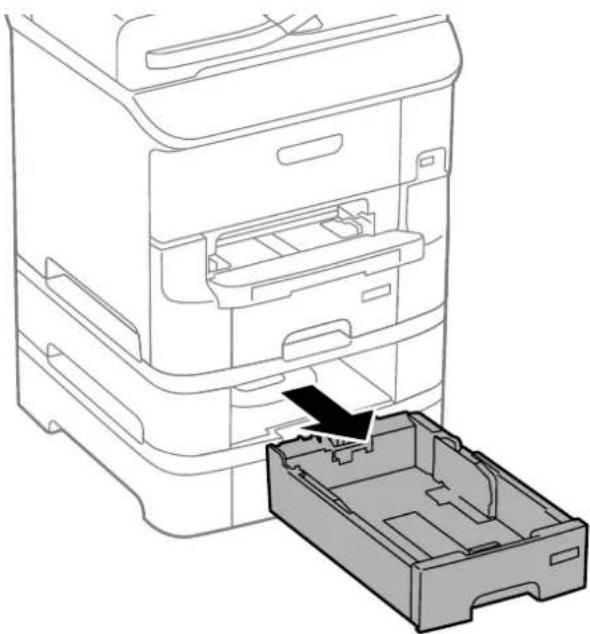
natural_image
Technical line drawing of a printer internal structure with an open plastic case (no text or symbols)User's Guide
Replacing Ink Cartridges and Other Consumables
- Turn the printer around, and then open the printer's rear cover.
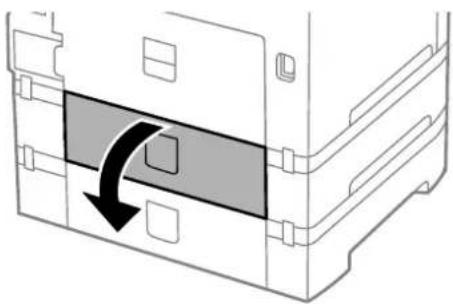
natural_image
Diagram of a device's internal structure with a black arrow indicating rotation or movement (no text or symbols present)- Remove the screws by a screwdriver and remove the cover on the rear of inside the printer.
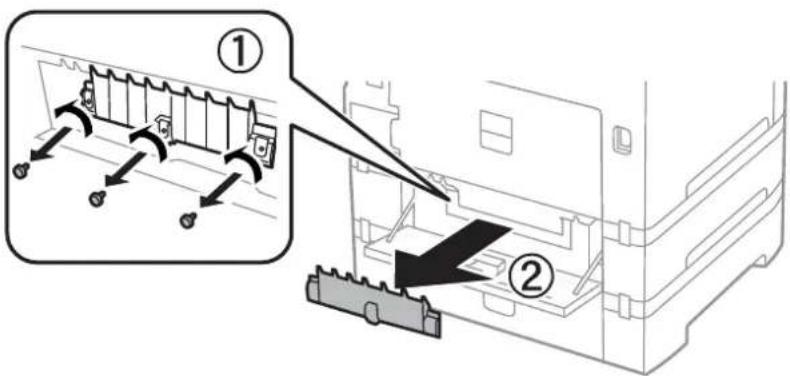
- Slide out two used maintenance rollers, and remove both of them.
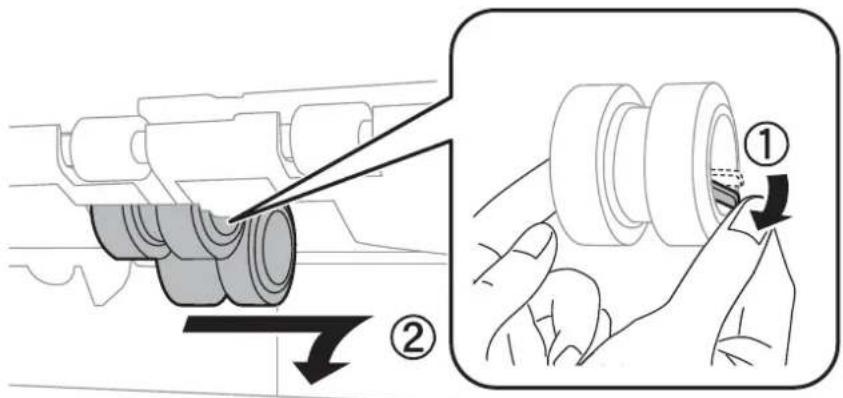
- Insert two new maintenance rollers until they click into place.
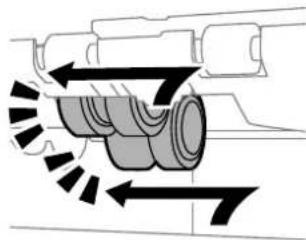
natural_image
Mechanical assembly diagram showing gear and shaft components with motion arrows (no text or labels)User's Guide
Replacing Ink Cartridges and Other Consumables
Note:
Insert the maintenance rollers by rolling them so that you can insert them smoothly.
- Hold up the maintenance roller for the paper cassette by rolling it up, and then remove it.
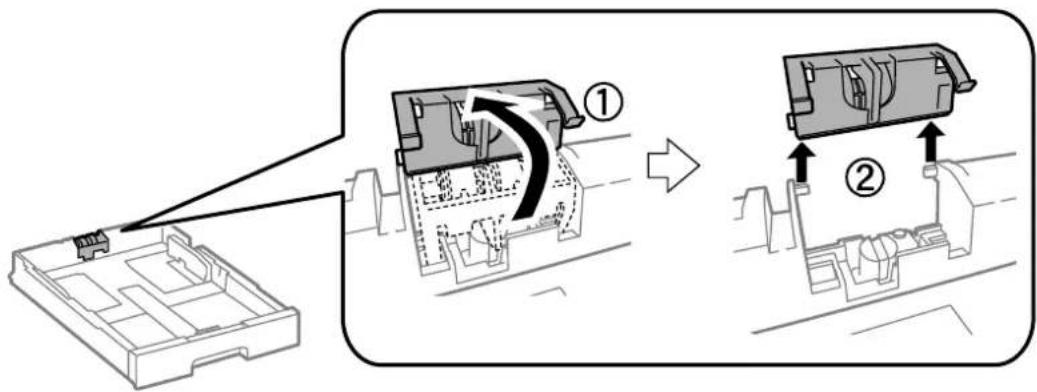
- Install the new maintenance roller in the paper cassette.
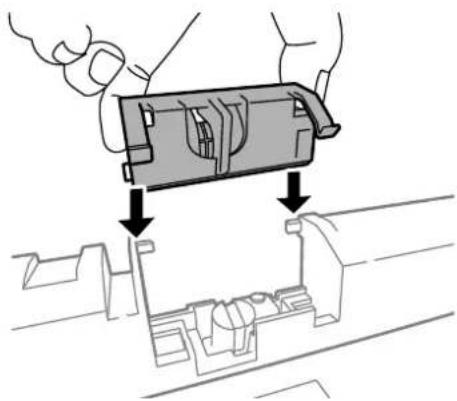
natural_image
Technical line drawing showing hands assembling a mechanical component with arrows indicating assembly (no text or symbols)- Hold down the maintenance roller firmly.
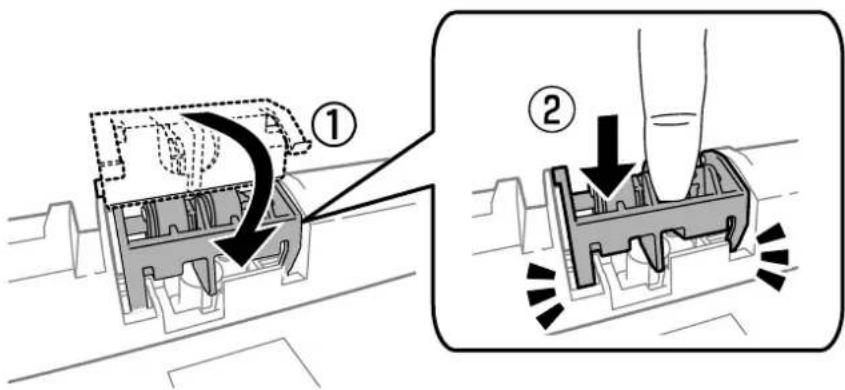
-
Fasten the screws to attach the cover back on, and close the rear cover.
-
Insert the paper cassette.
-
Turn on the printer, select Menu > Maintenance > Maintenance Roller Information > Reset Maintenance Roller Counter, and then select the paper cassette in which you replaced the maintenance rollers.
Replacing Ink Cartridges and Other Consumables
Related Information
→ "Maintenance Rollers Codes" on page 69
Temporarily Printing with Black Ink
When color ink is expended and black ink still remains, you can use the following settings to continue printing for a short time using only black ink.
☐ Type of paper: plain papers, Envelope
□ Color: Grayscale
☐ EPSON Status Monitor 3: Enabled (for Windows only)
Because this feature is only available for approximately five days, replace the expended ink cartridge as soon as possible.
Note:
☐ If EPSON Status Monitor 3 is disabled, access the printer driver, click Extended Settings on the Maintenance tab, and then select Enable EPSON Status Monitor 3.
☐ The available period varies depending on the usage conditions.
Replacing Ink Cartridges and Other Consumables
Temporarily Printing with Black Ink - Windows
- When the following window is displayed, cancel printing.
EPSON Status Monitor 3 : EPSON XXXXXX
Color cartridge(s) need to be replaced. Black printing is temporarily available.
Epson recommends the genuine Epson cartridges listed above. Click [Replace Cartridge] for ink cartridge replacement instructions or click [Close] to see Status Monitor.
You can cancel the job and reprint in black ink using the following settings:
- Paper Type: plain papers or Envelope
- Color: Grayscale
If [Cancel] is not displayed, cancel the print job from the control panel on the product.
You can temporarily continue printing. To print with other settings, replace the expended cartridge(s).
Replace Cartridge...
Cancel
Close
EPSON Status Monitor 3
The settings you selected are not available. Black printing is temporarily available using the following settings:
- Paper Type: plain papers or Envelope
- Color: Grayscale
To print with other settings, please replace the expended cartridge(s).
Cancel Print
Note:
If you cannot cancel printing from the computer, cancel using the printer's control panel.
-
Access the printer driver window.
-
Select plain papers or Envelope as the Paper Type setting on the Main tab.
-
Select Grayscale.
-
Set the other items on the Main and More Options tabs as necessary, and then click OK.
-
Click Print.
-
Click Print in Black in the window displayed.
Replacing Ink Cartridges and Other Consumables
Related Information
→ "Loading Paper in the Paper Cassette" on page 30
→ "Loading Paper in the Rear Paper Feed" on page 32
→ "Loading Paper in the Front Paper Feed Slot" on page 34
→ "Printing Basics - Windows" on page 36
Temporarily Printing with Black Ink - Mac OS X
Note:
To use this feature through a network, connect with Bonjour.
- Click the printer icon in the Dock.
- Cancel the job.
Note:
If you cannot cancel printing from the computer, cancel using the printer's control panel. - Select System Preferences from the menu > Printers & Scanners (or Print & Scan, Print & Fax), and then select the printer. Click Options & Supplies > Options (or Driver).
- Select On as the Permit temporary black printing setting.
- Access the print dialog.
- Select Print Settings from the pop-up menu.
- Select plain papers or Envelope as the Media Type setting.
- Select Grayscale.
- Set the other items as necessary.
- Click Print.
Related Information
→ "Canceling Printing - Mac OS X" on page 62
→ "Loading Paper in the Paper Cassette" on page 30
→ "Loading Paper in the Rear Paper Feed" on page 32
→ "Loading Paper in the Front Paper Feed Slot" on page 34
→ "Printing Basics - Mac OS X" on page 37
Conserving Black Ink when the Black Ink Is Low (for Windows Only)
When black ink is running low and there is enough color ink remaining, you can use a mixture of color inks to create black. You can continue printing while preparing a replacement black ink cartridge.
This feature is only available when you select the following settings in the printer driver.
Replacing Ink Cartridges and Other Consumables
□ Paper Type: plain papers
□ Quality: Standard
☐ EPSON Status Monitor 3: Enabled
Note:
☐ If EPSON Status Monitor 3 is disabled, access the printer driver, click Extended Settings on the Maintenance tab, and then select Enable EPSON Status Monitor 3.
☐ Composite black looks slightly different from pure black. In addition, the print speed is reduced.
☐ To maintain the quality of the print head, black ink is also consumed.
EPSON Status Monitor 3
Black ink is low. You can extend black ink cartridge life by printing with a mixture of other colors to create composite black. Do you want to do this for the current print job?
Yes
No
Disable this feature
| Options | Description |
| Yes | Select to use a mixture of color inks to create black. This window is displayed the next time you print a similar job. |
| No | Select to continue using the remaining black ink. This window is displayed the next time you print a similar job. |
| Disable this feature | Select to continue using the remaining black ink. This window is not displayed until you replace the black ink cartridge and it runs low again. |
Improving Print Quality
Improving Print Quality
Checking and Cleaning the Print Head
If the nozzles are clogged, the printouts become faint, there is visible banding, or unexpected colors appear. When print quality has declined, use the nozzle check feature and check if the nozzles are clogged. If the nozzles are clogged, clean the print head. You can perform a nozzle check and head cleaning from the control panel or the computer.

Important:
Do not open the front cover or turn off the printer during head cleaning. If the head cleaning is incomplete, you may not be able to print.
Note:
☐ Because print head cleaning uses some ink, clean the print head only if quality declines.
☐ When ink is low, you may not be able to clean the print head. Replace the ink cartridge first.
☐ If print quality has not improved after repeating nozzle check and head cleaning about four times, wait for at least six hours without printing, and then run the nozzle check again and repeat the head cleaning if necessary. We recommend to turn off the printer. If print quality has still not improved, contact Epson support.
☐ To prevent the print head from drying out, always turn the printer off by pressing the ⏻ button.
☐ To keep the print head operating at its best, we recommend printing a few pages on a regular basis.
Checking and Cleaning the Print Head - Control Panel
- Load A4-size plain paper in the printer.
- Enter Menu from the home screen.
- Select Maintenance > Print Head Nozzle Check.
- Follow the on-screen instructions to print the nozzle check pattern.
Note:
The test pattern may vary by model.
- Compare the printed check pattern with the sample shown below.
☐ All lines are printed: The print head nozzles are not clogged. Close the nozzle check feature.
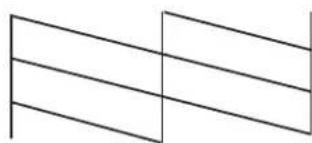
natural_image
Pure geometric lines forming a parallelogram with no text, numbers, or symbolsUser's Guide
Improving Print Quality
☐ There are broken lines or missing segments: The print head nozzles may be clogged. Go to the next step.
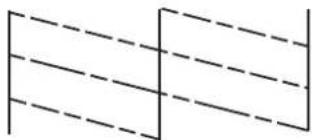
natural_image
Pure geometric lines forming a grid-like pattern without any text, numbers, or symbols- Follow the on-screen instructions to clean the print head.
- When cleaning is finished, print the nozzle check pattern again. Repeat cleaning and printing the pattern until all lines are printed completely.
Related Information
→ "Loading Paper in the Paper Cassette" on page 30
→ "Loading Paper in the Rear Paper Feed" on page 32
Checking and Cleaning the Print Head - Windows
- Load A4-size plain paper in the printer.
- Access the printer driver window.
- Click Nozzle Check on the Maintenance tab.
- Follow the on-screen instructions.
Related Information
→ "Loading Paper in the Paper Cassette" on page 30
→ "Loading Paper in the Rear Paper Feed" on page 32
→ "Windows Printer Driver" on page 87
Checking and Cleaning the Print Head - Mac OS X
- Load A4-size plain paper in the printer.
- Select System Preferences from the menu > Printers & Scanners (or Print & Scan, Print & Fax), and then select the printer.
- Click Options & Supplies > Utility > Open Printer Utility.
- Click Nozzle Check.
- Follow the on-screen instructions.
Related Information
→ "Loading Paper in the Paper Cassette" on page 30
Improving Print Quality
→ "Loading Paper in the Rear Paper Feed" on page 32
Aligning the Print Head
If you notice a misalignment of vertical lines or blurred images, align the print head.
-
Load A4-size plain paper in the printer.
-
Enter Menu from the home screen.
-
Select Maintenance > Print Head Alignment.
-
Select one of the alignment menus and follow the on-screen instructions to print a pattern for alignment.
☐ Ruled Line Alignment: Select this if vertical lines look misaligned.
☐ Vertical Alignment: Select this if your printouts look blurry.
☐ Horizontal Alignment: Select this if you see horizontal banding at regular intervals.
- Follow the on-screen instructions to align the print head.
Note:
The alignment patterns may be slightly different from the actual ones, but the procedures are the same.
☐ Ruled Line Alignment: Find and enter the number for the pattern that has the least misaligned vertical line.
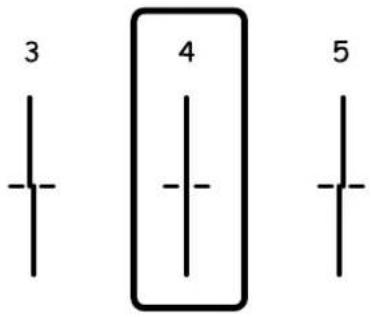
☐ Vertical Alignment: Find and enter the number for the most solid pattern in each group.
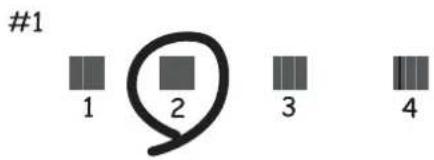
Improving Print Quality
☐ Horizontal Alignment: Find and enter the number for the least separated or overlapping pattern in each group.
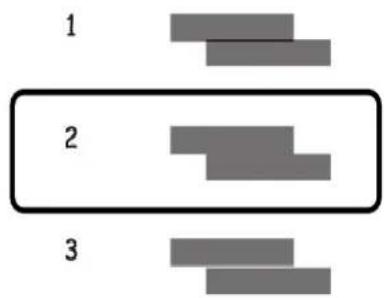
Related Information
→ "Loading Paper in the Paper Cassette" on page 30
→ "Loading Paper in the Rear Paper Feed" on page 32
Improving Horizontal Streaks
If your printouts contain horizontal banding or streaks after trying Print Head Cleaning and Horizontal Alignment, finely tune the horizontal alignment.
- Enter Menu from the home screen.
- Select Maintenance > Improve Horizontal Streaks.
- Follow the on-screen instructions to perform horizontal alignment.
Cleaning the Paper Path
When the printouts are smeared or scuffed, clean the roller inside.

Important:
Do not use tissue paper to clean the inside of the printer. The print head nozzles may be clogged with lint.
- Make sure there is no dust or stains on the scanner glass and the document cover.
- Load A4-size plain paper in the paper source that you want to clean.
- Enter Menu from the home screen.
- Select Maintenance > Paper Guide Cleaning.
- Select the paper source, and then follow the on-screen instructions to clean the paper path.
User's Guide
Improving Print Quality
- Repeat this procedure until the paper is not smeared with ink. If the printouts are still smeared or scuffed, clean the other paper sources.
Note:
If the rear paper feed has a paper feed problem and if you have a cleaning sheet that came with Epson genuine paper, you may be able to solve the paper feed problem by using the cleaning sheet instead of using A4-size plain paper. When using the cleaning sheet, load the sheet in the rear paper feed following the instructions that came with the sheet. If a paper setup screen is displayed, leave the paper settings as they are.
Related Information
→ "Loading Paper in the Rear Paper Feed" on page 32
Applications and Network Service Information
Applications and Network Service Information
Epson Connect Service
By using Epson Connect service available on the Internet, you can print from your smartphone, tablet PC, or laptop, anytime and practically anywhere.
The features available on the Internet are as follows.
| Email Print | Epson iPrint remote print | Scan to Cloud | Remote Print Driver |
| √ | √ | - | √ |
See the Epson Connect portal website for details.
https://www.epsonconnect.com/
http://www.epsonconnect.eu (Europe only)
Web Config
Web Config is an application that runs on a Web browser, such as Internet Explorer and Chrome, from a computer or smart device. You can confirm the printer status or change the network service and printer settings. To use Web Config, connect the computer or device to the same network as the printer.
Note:
The following browsers are supported.
| OS | Browser |
| Windows XP or later | Internet Explorer 8 or later, Firefox*, Chrome* |
| Mac OS X v10.5.8 or later | Safari*, Firefox*, Chrome* |
| iOS* | Safari* |
| Android 2.3 or later | Default browser |
| Chrome OS* | Default browser |
* Use the latest version.
Running Web Config on a Web Browser
1. Check the printer's IP address.
Select Menu > Network Status > Wired LAN/Wi-Fi Status from the home screen, and then check the printer's IP address.
Applications and Network Service Information
- Launch a Web browser from a computer or smart device, and then enter the printer's IP address.
Format:
IPv4: http://the printer's IP address/
IPv6: http://[the printer's IP address]/
Examples:
IPv4: http://192.168.100.201/
IPv6: http://[2001:db8::1000:1]/
Note:
Using the smart device, you can also run Web Config from the maintenance screen of Epson iPrint.
Related Information
→ "Using Epson iPrint" on page 58
Running Web Config on Windows
When connecting a computer to the printer using WSD, follow the steps below to run Web Config.
- Access the devices and printers screen in Windows.
☐ Windows 8.1/Windows 8/Windows Server 2012 R2/Windows Server 2012
Select Desktop > Settings > Control Panel > View devices and printers in Hardware and Sound (or Hardware).
Windows 7/Windows Server 2008 R2
Click the start button, and select Control Panel > View devices and printers in Hardware and Sound.
Windows Vista/Windows Server 2008
Click the start button, and select Control Panel > Printers in Hardware and Sound.
-
Right-click on your printer and select Properties.
-
Select the Web Service tab and click the URL.
Running Web Config on Mac OS X
- Select System Preferences from the menu > Printers & Scanners (or Print & Scan, Print & Fax), and then select the printer.
- Click Options & Supplies> Show Printer Webpage.