
Portico 543 - Processor Rupert Neve Designs - Free user manual and instructions
Find the device manual for free Portico 543 Rupert Neve Designs in PDF.


| Product Type | Compressor / Limiter |
| Brand | Rupert Neve Designs |
| Model | Portico 543 |
| Form Factor | 1U, 19-inch rackmount |
| Depth | 8.5 inches (216 mm) |
| Weight | 5.5 lbs (2.5 kg) |
| Power Supply | Internal, 100-240 VAC, 50/60 Hz |
| Power Consumption | 20 W |
| Frequency Response | 10 Hz – 40 kHz (+0, -0.5 dB) |
| Maximum Input Level | +26 dBu |
| Maximum Output Level | +26 dBu |
| Compression Ratio | Variable, 1.5:1 to 20:1 |
| Threshold Range | -40 dBu to +20 dBu |
| Attack Time | 0.1 ms to 80 ms |
| Release Time | 0.1 s to 3 s |
| Make-up Gain | 0 dB to +20 dB |
| Sidechain | Internal and external key input |
| Connectors | XLR and 1/4" TRS balanced |
| Construction | Steel chassis, aluminum front panel |
| Cooling | Passive (fanless) |
| Operating Temperature | 0°C to 40°C |
| Maintenance | Wipe with dry cloth; do not use solvents or abrasives |
| Safety | Operate only with grounded AC outlet; avoid moisture and dust |
| Spare Parts & Repairability | Contact authorized service center for genuine parts |
| General Information | Professional-grade analog compressor with custom input/output transformers and high headroom |
Frequently Asked Questions - Portico 543 Rupert Neve Designs
User questions about Portico 543 Rupert Neve Designs
0 question about this device. Answer the ones you know or ask your own.
Ask a new question about this device
Download the instructions for your Processor in PDF format for free! Find your manual Portico 543 - Rupert Neve Designs and take your electronic device back in hand. On this page are published all the documents necessary for the use of your device. Portico 543 by Rupert Neve Designs.
USER MANUAL Portico 543 Rupert Neve Designs
500 Series Compressor-Limiter
By:
RUPERT NEVE DESIGNS


Serial #: □□□□□□□
Operations Manual
Portico 543: 500 Series Compressor-Limiter
Thank you for your purchase of the 543: 500 Series Compressor-Limiter. Everyone at Rupert Neve Designs hope you enjoy using this tool as much as we have enjoyed designing and building it. Please take note of the following list of safety concerns and power requirements before the use of this or any Portico Series product.
Safety
It's usual to provide a list of "do's and don'ts" under this heading but mostly these amount to common sense issues. However here are some reminders:
Don't operate your Portico™ module in or around water! Electronic equipment and liquids are not good friends. If any liquid is spilled such as soda, coffee, alcoholic or other drink, the sugars and acids will have a very detrimental effect. Sugar crystals act like little rectifiers and can produce noise (crackles, etc.). SWITCH OFF IMMEDIATELY because once current starts to flow, the mixture hardens, can get very hot (burnt toffee!) and cause permanent and costly damage. Please contact support as soon as possible at support@rupertneve.com for resolution.
Don't be tempted to operate a Portico module with the cover removed. The cover provides magnetic screening from hum and R.F. stray fields.
Power Requirements
Each Portico 543 is fitted for use with standard 500 Series Rack Mounts and requires 110-125 mAmps @+/- 16V
Portico 543: Block Diagram
![graph LR INPUT --> A["Amplifier"] A --> B["Amplifier"] B --> C["Quantum"] C --> D["Quantum VCA"] D --> E["Quantum VCA"] E --> F["Quantum VCA"] F --> G["Quantum VCA"] G --> H["Quantum VCA"] H --> I["Quantum VCA"] I --> J["Quantum VCA"] J --> K["Quantum VCA"] K --> L["Quantum VCA"] L --> M["Quantum VC…](/content/2026/05/993677/images/652bedef24f0741e4da79b9cd8f4ff8c006a93fa1c377305c9917233ed102d46.jpg)
Portico 543: Front Panel

Portico 543: Back Panel

THE NEED FOR DYNAMIC CONTROL OF SOUND LEVELS
The dynamic range of sounds we hear around us in normal life greatly exceeds the capability of our best recording and processing equipment - but even if this were not so, the scale of dynamic range must be accommodated to the venue in which it is to be reproduced. For example, actual volume levels of the dance hall would be deafening in a students bedroom. In the same way, late night listening in a quiet living room demands careful adjustment of dynamic range. In the constantly changing background noise of a car, drama dialog does not work without constant attention to the level control. In the field of communications, it is often necessary to ensure that the best possible signal-to-noise ratio is obtained, in the interest of intelligibility, within the limited performance of, say, a reporter's recording device.
Digital recorders are unforgiving when overloaded. Overload can be avoided with careful use of high ratio compression - on the verge of limiting - with careful choice of time constants. A recording that still sounds "loud" can be produced without non-musical harmonic distortion. A compressor-limiter is one of the most powerful, yet subjective items in the sound engineer's armory. Compression should never be obvious to the listener and this needs intuitive and effective controls on the part of the designer together with considerable skill on the part of the sound engineer.
A NOTE ON DISTORTION
The human hearing system is a remarkably complex mechanism and we seem to be learning more details about its workings all the time. For example, Oohashi demonstrated that arbitrarily filtering out ultrasonic information that is generally considered above our hearing range had a measurable effect on listener's electroencephalo-grams. Kunchur describes several demonstrations that have shown that our hearing is capable of approximately twice the timing resolution than a limit of 20 kHz might imply (F=1/T or T=1/F). His peer reviewed papers demonstrated that we can hear timing resolution at approximately with 5 microsecond resolution (20 kHz implies a 9 microsecond temporal resolution, while a CD at 44.1k sample rate has a best-case temporal resolution of 23 microseconds).
It is also well understood that we can perceive steady tones even when buried under 20 to 30 dB of noise. And we know that most gain stages exhibit rising distortion at higher frequencies, including more IM distortion. One common IM test is to mix 19 kHz and 20 kHz sine waves, send them through a device and then measure how much 1 kHz is generated (20-19=1). All this hints at the importance of maintaining a sufficient bandwidth with minimal phase shift, while at the same time minimizing high frequency artifacts and distortions. All of the above and our experience listening and designing suggest that there are many subtle aspects to hearing that are beyond the realm of simple traditional measurement characterizations.
The way in which an analog amplifier handles very small signals is as important as the way it behaves at high levels. For low distortion, an analog amplifier must have a linear transfer characteristic, in other words, the output signal must be an exact replica of the input signal, differing only in magnitude. The magnitude can be controlled by a gain control or fader (consisting of a high quality variable resistor that, by definition, has a linear transfer characteristic.) A dynamics controller - i.e. a compressor, limiter or expander - is a gain control that can adjust gain of the amplifier very rapidly in response to the fluctuating audio signal, ideally without introducing significant distortion, i.e. it must have a linear transfer characteristic. But, by definition, rapidly changing gain means that a signal “starting out” to be linear and, therefore without distortion, gets changed on the way to produce a different amplitude.
Inevitably our data bank of “natural” sound is built up on the basis of our personal experience and this must surely emphasize the importance of listening to “natural” sound, and high quality musical instruments within acoustic environments that is subjectively pleasing so as to develop keen awareness that will contribute to a reliable data bank. Humans who have not experienced enough “natural” sound may well have a flawed data bank! Quality recording equipment should be capable of retaining “natural” sound and this is indeed the traditional measuring stick. And “creative” musical equipment should provide the tools to manipulate the sound to enhance the emotional appeal of the music without destroying it. Memory and knowledge of real acoustic and musical events may be the biggest tool and advantage any recording engineer may possess.
One needs to be very careful when one hears traces of distortion prior to recording because some flavors of distortion that might seem acceptable (or even stylish) initially, may later prove to cause irreparable damage to parts of the sound (for example, “warm lows” but “harsh sibilance”) or in louder or quieter sections of the recording. Experience shows that mic preamps and basic console routing paths should offer supreme fidelity otherwise the engineer has little control or choice of recorded “color” and little recourse to undo after the fact. Devices or circuits that can easily be bypassed are usually better choices when “color” is a consideration and this particularly is an area where one might consider comparing several such devices. Beware that usually deviations from linearity carry at least as much long-term penalty as initial appeal, and that one should always be listening critically when recording and generally “playing it safe” when introducing effects that cannot be removed.
- Tsutomu Oohashi, Emi Nishina, Norie Kawai, Yoshitaka Fuwamoto, and Hishi Imai. National Institute of Multimedia Education, Tokyo. "High Frequency Sound Above the Audible Range, Affects Brain Electric Activity and Sound Perception" Paper read at 91st. Convention of the A.E.S. October 1991. Section 7. (1), Conclusion.
- Miland Kunchur, Depart of Physics and Astronomy, University of South Carolina. "Temporal resolution of hearing probed by bandwidth restriction", M. N. Kunchur, Acta Acustica united with Acustica 94, 594–603 (2008) (http://www.physics.sc.edu/kunchur/Acoustics-papers.htm)
- Miland Kunchur, Depart of Physics and Astronomy, University of South Carolina. Probing the temporal resolution and bandwidth of human hearing, M. N. Kunchur, Proc. of Meetings on Acoustics (POMA) 2, 050006 (2008)
543 DESCRIPTION
The Portico 543 Mono Compressor delivers the unobtrusive, musical-sounding dynamic control and brick-wall limiting made famous in the Portico 5043 to the 500 series format. The 543 features a fully controllable compressor-limiter with feed-forward / feedback modes, Peak / RMS detection and a built in side chain high pass filter. With an unrivaled heritage and a tremendous feature set, the 543 yields a combination of rich warmth, flexibility and precision that allows it to be used effectively on virtually any source material.
A part of the audio signal is rectified and smoothed to produce a suitable control voltage for the V.C.A. which has to respond very quickly and have low distortion. If the response is too fast, low frequency signals will themselves, be “gain controlled”! If the response is too slow, the signal will overshoot and the first few cycles will not get compressed. The speed and accuracy of the response, known as the “attack”, and the time frame that gain remains under the initial control, known as “release” or “recovery”, play a large part in the way a compressor sounds.
The Portico ™ 543 makes use of a very accurate, low noise, low distortion V.C.A. having, essentially, no
"signature" of its own. This leaves the designer free to use amplifier and transformer combinations that are well proven and produce the desired sonic quality.
All Portico™ modules use input and output transformers and almost entirely discrete component amplifiers to produce the musical "signature" for which they are known. These are factors that enable the Portico™ 543 to work unobtrusively within the context of a very high quality audio chain.
If the V.C.A. Control voltage is taken from the 543 input, (i.e. before the V.C.A.) the V.C.A. "knows" right away that a gain change is required and there is almost immediate response. This is known, logically, as a "Feed-Forward" compressor. If the V.C.A. control voltage is taken from the 543 output, (i.e. after the V.C.A.) it cannot act immediately on the V.C.A. because it has already been modified by settings of the V.C.A. and circuits through which it has passed. This is known as a "Feed-Back" compressor. The two compression characteristics are quite different, there is more "overshoot" and both the attack and recovery ramps are changed, providing the user with powerful choices. A choice between "Feed-Forward" and "Feed-Back" circuitry is provided. Almost all Mr. Rupert Neve's earlier designs were "Feed-Back". They were more musical and sweeter than with "Feed-Forward" designs.
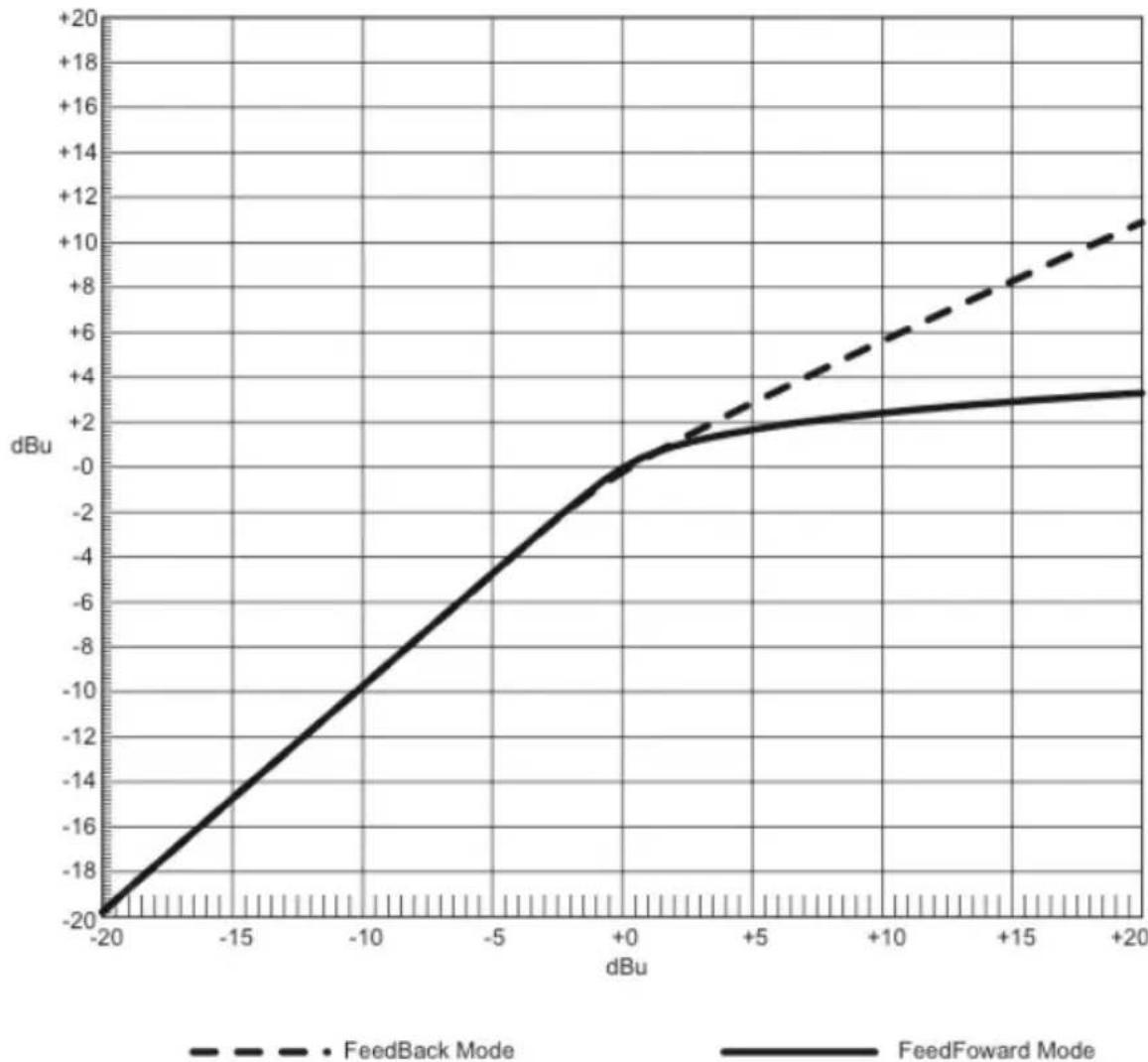
The way in which these modes change the dynamic performance can be seen in the above graph - but the more interesting effects are noted by listening - "Feed-Back" produces a sweeter, warmer sound but is not as accurate if you need to protect a transmitter, for example.
543 FEATURES
THRESHOLD
Sets level where the compressor may begin to react from -30 dB to +20 dB. Minimal or no compression is with this control fully clockwise and it gets more sensitive and tends to cause more gain reduction as the knob is rotated counter-clockwise (which may be counter-intuitive to some).
RATIO
Sets the "slope" of the compression from 1.1:1 (minimal) to 40:1 (Limit). For example if this knob is set for 3:1 then if the signal goes 15 dB over the threshold then it attenuates 10 dB and allows the output to rise 5 dB. In general, low ratios can not damage the music as much as high ratios but high ratios may be more useful to minimize clipping and OL lights in the recorder.
Excuse the front panel jump and digression, but it is appropriate to mention the GAIN REDUCTION and OUTPUT meters now because so many of us learned to set up compressors by watching the all-important GR meter. When setting the Threshold and Ratio it does help to use the meters however, as always, we should rely on our ears and ye olde "COMP IN" (Bypass Button) most of all. One might try to interpret the OUTPUT meter as one exercises ye olde "COMP IN" button too, as this might be more appropriate to your goals than a target of X dB or number of LEDs of compression. Is the goal to make great sounds or to blink LEDs half way down the meter because you read it somewhere?
COMP IN
The compressor section is engaged with this button in. This may be the most useful control on the compressor because it is there for “confidence checks”. In particular, exercise it in both the quietest and the loudest sections of the song. Watch out for the compressor exaggerating noise and room sound in the quiet sections and chopping off transients and consonants in the loud sections, either of which suggest maybe too much compressor “action”. Conversely, losing quiet phrases or inadvertent clipping might suggest that a little more compression is warranted keeping in mind that you can always do a bit more in the mix but un-doing over-compression is not fun and often not even possible.
FF/FB
These are two very different compressor modes, FEED BACK and FEED FORWARD. Vintage compressors almost always were FEED BACK designs which means they looked at the output after the VCA (Voltage Controlled Amplifier) or gain changing element and used that signal to control the attenuation. FEED FORWARD compressors became popular in the 80's and read the signal before the VCA and through more elaborate electronics to control the attenuation because this has some advantages in regards to the ratio and control timing. Perhaps a more useful generalization is that the FB mode (button in) tends to sound smoother and often more natural and tends to be quicker to set up. The FF mode can be more useful for shaping the envelope of the sound and introducing more bounce and pumping in time with the song, when that is the goal. FF compressors were often used on 80's dance tracks. Some engineers prefer FB with lower ratios and FF with higher ratios.
GAIN
Often referred to as Make Up Gain. Considering the compressor's VCA is generally being forced to attenuate louder signals some method of returning the average level to a volume comparable with the compressor bypassed is desirable. The GAIN control is mostly used for this purpose especially for those of us that depend on comparing compression to bypass. GAIN is often pushed for even more level than "bypass" because it is understood that the compressor should be providing some effective headroom (besides "louder is better" being the oldest trick in the book).
ATTACK
This sets how quickly the compressor reacts and starts attenuating. If set fast (20mS) the compressor should react to very quick transients like the initial stick hit of a snare drum and can attenuate the "hit" so the "note" of the drum seems relatively emphasized. If set slower, the compressor will tend to ignore the fastest transients and react more to the drum resonance and attenuate the "note" of the drum so that the hit seems more emphasized. Similarly, on a mixed track, if a compressor is set too fast, it will tend to remove drums, which may help to explain why mastering engineers tend to use medium to slow attack times and lower ratios.
RELEASE
This sets how fast the compressor returns back to zero after attenuating. Typically engineers have used quite slow releases when the need is to minimize any obvious compressor action or gains changing. For modern pop music quite often the goal is to have the compressor change gains approximately in time with the music and the RELEASE control setting becomes important for this. On the other hand, many of us were trained to avoid having compressors “pump” and sound like they are breathing. Another (maybe too) common use of compressors is to maximize the apparent volume and for this one generally wants very fast release settings so that after reducing peaks the compressor returns to maximum levels as quickly as possible. And by “as possible” there is a practical matter regarding the tendency of compressor/limiters to introduce a nasty form of distortion called “modulation distortion” when they are set for a combination of fast attacks, fast releases and high ratios.
RMS/PEAK
This changes the compressor from essentially responding to the RMS level of the audio to also responding to the PEAK level. RMS (root mean squared) circuits are considered to better mimic the way the ears perceive apparent loudness, while Peak circuits tend to directly respond to the waveform voltage which may be more of a concern for prevention of clipping and maximizing levels. In this case, pushing FAST uses a combination of both methods to get the best of both worlds and avoidance of the drawbacks of each method on its own.
Do we recommend any particular compressor settings for particular instruments? No, but we will recommend that you not depend on hear-say settings and that you always listen carefully to the levels and mix values as you tweak. You can generally regard a compressor as a semi-automatic volume control and be aware of the kinds of artifacts that you would get moving a fader quickly. You can also listen for changes in tone that are probably due to altering the relative strength of transient hits and plosives that often contain more high mid and highs.
Side Chain HPF
This routes a high pass filter set to 250 Hz into the circuit that the compressor uses to determine level, commonly referred to as “the side-chain”. Note that the rest of the circuit and output will not have those lows filtered out. This function tends to be very useful because typical sounds often have more energy
in the low octaves and can cause excessive compression. Our ears may tend to associate loudness with mids or high mids for some sounds and one may be wanting the compressor to regulate and smooth perceived loudness. Removing some amount of low frequencies that the compressor “sees” can help especially if one is compressing deeply (-8 dB or more)
Link
With most new 500 series racks, an internal link buss is provided, allowing two or more 543's to link their VCA's when the link switch is toggled. In this configuration, the same link buss is shared by all of the modules in the rack, so it is not possible to use more than one pair of 543's (or other compressors using the link buss) in the same rack concurrently.
When link buss is not provided or it is not possible to use it (check with the rack manufacturer if uncertain), a jumper wire can be used to connect adjacent 543 modules. We have provided a 2 pin connector on the back of the 543 for a jumper cable which can directly connect the link buss on the modules. Both pins carry the link signal so that single wire jumpers can be used to link multiple modules in a daisy chain fashion.
If you need to purchase one or more jumper wires, please contact info@rupertneve.com
SPECIFICATIONS
Gain Range:
Continuously variable from -6 dB to +20 dB.
Threshold Range:
Continuously variable from -30 dB to +20 dB.
Ratio Range:
Continuously variable from 1.1:1 to Limit (40:1).
Attack Range:
Continuously variable from 20mS to 75mS
Release Range:
Continuously variable from 100mS to 2.5 Seconds..
Total Harmonic Distortion and Noise:
9@1kHz, 0dBu output level, no load.
Main Output, compressor bypassed
9Better than 0.002%
9@ 20dBu better than 0.0015%
Main output, compressor engaged
9Better than 0.075%
Noise:
9Measured at Main Output, un-weighted, 22Hz-22kHz, Terminated 50 Ohms.
9With Gain at Unity, Compressor disengaged
9better than -98dBu
9With Gain at Unity, Compressor engaged:
9better than -93dBu
Frequency Response:
9Main Output, Unity Gain
9@ 150 kHz -3 dB.
Crosstalk:
Measured channel to channel
9Better than -90 dB @ 15kHz.
Meters:
9Monitors INPUT LEVEL and GAIN REDUCTION
Line Input Impedance
910,000 Ohms
Maximum Output Level:
9 21dBu from 20Hz to 40kHz
Power requirements:
9Supplied by 500 series rack with 110-125 mA @ +/- 16V
PRODUCT WARRANTY
Rupert Neve Designs warrants this product to be free from defects in materials and workmanship for a period of one (1) year from date of purchase, and agrees to remedy any defect identified within such one year period by, at our option, repairing or replacing the product.
LIMITATIONS AND EXCLUSIONS
This warranty, and any other express or implied warranty, does not apply to any product which has been improperly installed, subjected to usage for which the product was not designed, misused or abused, damaged during shipping, damaged by any dry cell battery, or which has been altered or modified in any way. This warranty is extended to the original end user purchaser only. A purchase receipt or other satisfactory proof of date of original purchase is required before any warranty service will be performed. THIS EXPRESS, LIMITED WARRANTY IS IN LIEU OF ALL OTHER WARRANTIES, EXPRESS OR IMPLIED, TO THE EXTEND ALLOWED UNDER APPLICABLE STATE LAW. IN NO EVENT SHALL RUPERT NEVE DESIGNS BE LIABLE FOR ANY SPECIAL, INCIDENTAL, OR CONSEQUENTIAL DAMAGES RESULTING FROM THE USE OF THIS PRODUCT. Some states do not allow the exclusion or limitation of consequential damages or limitations on how long an implied warranty lasts, so this exclusion may not apply to you.
WARRANTY SERVICE
If you suspect a defect in this product, please call us at 512-847-3013 or email us at support@rupertneve.com to discuss the suggested defect (it is possible that a suspected defect could be due to improper usage) and to obtain a return authorization number. It shall be your responsibility to pay for shipping the product to us, and, if the product is determined to be defective, our responsibility to pay for shipping the product back to you.
R _ i
Rupert Neve Designs
PO Box 1969
Wimberley TX 78676
www.rupertneve.com
tel: +1 512-847-3013 9
fax: +1 512-847-8869
Portico 543 Manual Rev B2
p/n 775-00010

- OPERATIONS MANUAL
- PORTICO 543: 500 SERIES COMPRESSOR-LIMITER
- SAFETY
- POWER REQUIREMENTS
- PORTICO 543: FRONT PANEL
- THE NEED FOR DYNAMIC CONTROL OF SOUND LEVELS
- A NOTE ON DISTORTION
- 543 DESCRIPTION
- 543 FEATURES
- THRESHOLD
- RATIO
- COMP IN
- FF/FB
- GAIN
- ATTACK
- RELEASE
- RMS/PEAK
- SIDE CHAIN HPF
- LINK
- SPECIFICATIONS
- GAIN RANGE
- THRESHOLD RANGE
- RATIO RANGE
- ATTACK RANGE
- RELEASE RANGE
- TOTAL HARMONIC DISTORTION AND NOISE
- NOISE
- FREQUENCY RESPONSE
- CROSSTALK
- METERS
- LINE INPUT IMPEDANCE
- MAXIMUM OUTPUT LEVEL
- PRODUCT WARRANTY
- LIMITATIONS AND EXCLUSIONS
- WARRANTY SERVICE
- RUPERT NEVE DESIGNS
Brand : Rupert Neve Designs
Model : Portico 543
Category : Processor