MM92 - Uncategorized Maruyama - Free user manual and instructions
Find the device manual for free MM92 Maruyama in PDF.


| Product Type | Backpack Mist Blower |
| Brand | Maruyama |
| Model | MM92 |
| Dimensions (L x W x H) | 375 x 480 x 635 mm (14.8 x 18.9 x 25.0 in) |
| Dry Weight | 11.7 kg (25.8 lbs) |
| Engine Type | 2-Stroke Air-cooled CE800 (EPA compliant) |
| Engine Displacement | 79.2 mL |
| Ignition System | Electric solid state |
| Carburetor Type | All position diaphragm |
| Fuel Tank Capacity | 0.53 gal (2.0 L) |
| Recommended Fuel | Unleaded gasoline (85+ octane) mixed with oil at 50:1 ratio |
| Recommended Oil | Maruyama 50:1 2-stroke oil or quality 2-stroke oil for air-cooled engines |
| Discharge Volume Settings | 0 (off), 1 (1.8 L/min), 2 (2.5 L/min), 3 (3.1 L/min), 4 (3.7 L/min) |
| Chemical Tank | Integrated tank with mist dial adjustment |
| Starting Method | Recoil starter with choke and throttle control |
| Stopping Method | Stop button (hold until engine stops) |
| Idle Speed Adjustment | User-adjustable; carburetor adjustments by dealer only |
| Safety Features | Warning labels, throttle interlock, no spark while servicing (remove plug cap) |
| Required Protective Gear | Hat, safety glasses, ear plugs, long pants, long-sleeved shirt, substantial footwear |
| Air Filter Maintenance | Clean each use or more often in dust; replace every 100 hours |
| Spark Plug Gap | 0.024-0.028 in (0.6-0.7 mm) |
| Assembly Required | Yes; flexible pipe, bent pipe, straight pipe, clamps, mist hose |
| Warranty Note | Use correct fuel/oil ratio to avoid voiding warranty |
Frequently Asked Questions - MM92 Maruyama
User questions about MM92 Maruyama
0 question about this device. Answer the ones you know or ask your own.
Ask a new question about this device
Download the instructions for your Uncategorized in PDF format for free! Find your manual MM92 - Maruyama and take your electronic device back in hand. On this page are published all the documents necessary for the use of your device. MM92 by Maruyama.
USER MANUAL MM92 Maruyama
natural_image
Technical line drawing of a mechanical device with internal components (no text or symbols)TABLE OF CONTENTS
| FOREWORD | 1 | OPERATING INSTRUCTIONS | 6 |
| Warning label | 1 | MAINTENANCE | 8 |
| ASSEMBLY INSTRUCTIONS | 3 | STORAGE | 10 |
| BEFORE OPERATION | 4 | SPECIFICATIONS | 11 |
FOREWORD
This Owner's/Operator's Manual is designed to familiarize the operator with the various features and component parts of the equipment and to assist you with the assembly, operation and maintenance of your new Mister.
It is essential that any operator of this Mister product reads and understands the contents of this manual before using the Mister.
Important safety instructions will be identified by the following safety symbol:

Failure to comply with the instructions in this manual may result in serious injury or death.
For additional assistance, contact any local authorized Maruyama dealer or Maruyama U.S., Inc., 4770 Mercantile Drive, Suite100, Fort Worth, TX 76137 U.S.A.
MANUAL SAFETY SYMBOLS
Throughout this manual and on the product itself, you will find safety alerts and helpful, information message preceded by symbols or key words. The following is an explanation of those symbols and key words and what they mean to you.

This symbol accompanied by the words WARNING and DANGER calls attention to an act or condition that can lead to serious personal injury to operator and bystanders.

Warning label
· Always remove dirt or mud to make the indications legible.
- The following alarm labels are attached.

Read Owner's/Operator's Manual thoroughly.
Make sure you read the Owner's/Operator's Manual thoroughly prior to use.

Prohibition of fire
Don't put a naked flame close to a place where supplying fuel or doing maintenance.

Wear protective gear.
Wear protectors such as hat, safety glasses, ear plugs during work.

Cautions for exhaust gas.
Take care not to breathe in exhaust gas from the engine.

Cautions for high temperatures
Muffler of engine, fin of cylinder, etc. are at high temperatures. Don't touch them.
WARNING
-
Read and understand this Owner's/Operator's Manual before using the this product. Be thoroughly familiar with the proper use of the this product.
-
Never allow children to operate this product. It is not a toy. Never allow adults to operate the unit without first reading the Owner's / Operator's Manual.
-
Become familiar with the controls and know how to stop the engine quickly.
-
Always use eye protection and hearing protection.
-
Keep the area of operation clear of all persons, particularly small children and pets.
-
Do not point the pipe in the direction of people or pets.
-
Never operate a product when you are fatigued, sickness, intoxicated, and pregnant.
-
Never operate a product without proper guards or other protective safety devices in place.
-
Dress properly; do not wear loose clothing or jewelry that can be caught in moving parts. Always wear substantial footwear, long pant, and long sleeved shirt.
-
Gasoline is highly flammable; handle it carefully.
A. Do not smoke while handling gasoline.
B. Use an approved fuel container for storing the gasoline/oil mixture.
C. Do not fill the fuel tank when the engine is hot or running
D. Fill the fuel tank outdoors and only up to one-half inch from the top of the tank. Do not fill the filler neck.
E. Wipe away any spilled gasoline before starting the engine.
- Always be sure of your footing; keep a firm hold of the blower pipes, and walk, never run while operating a mist blower.
- Use the correct accessories. Do not use the product for any job except that for which it is intended.
- Keep all fasteners tight and be sure the Mist Blower is in safe working condition. Follow the maintenance instructions provided on page 8 - 10 of this manual.
- Do not put hands or feet near or under the rotating parts. Keep clear at all times.
- If this product should start to vibrate abnormally, stop the engine immediately and check for the cause. Vibration is generally a warning of trouble.
- Avoid using this product near rocks, gravel, stones and similar matter in order to avoid dangerous flying debris.
- Use this product only in daylight or good artificial light.
- Do not allow bystanders in work area.
- Do not operate without guard(s) in place.
- Do not operate in unventilated area.
- To reduce the risk of injury associated with the inhalation of dust, use a face filter mask in dusty conditions.
- To reduce the risk of injury associated with contacting rotating part, stop the engine before installing or removing attachments.
- To reduce the risk of fire and burn injury: -Move at least 10ft (3m) away from the fueling point before starting engine. -Always store gasoline in approved container.
Operating techniques
A. Operate power equipment only at reasonable hours - not early in the morning or late at night when people might be disturbed. Comply with times listed in local ordinances. Usual recommendations are 9:00 am. to 5:00 p.m., Monday through Saturday.
B. To reduce noise levels, limit the number of pieces of equipment used at any one time.
C. To reduce noise levels, operate this product at the lowest possible throttle speed to do the job.
D. Check your equipment before operation, especially the muffler, air intakes, and air filters.
E. Use rakes and brooms to loosen debris before blowing.
F. In dusty conditions, slightly dampen surfaces when water is available.
G. Conserve water by using this product instead of hoses for many lawn and garden applications, including areas such as gutters, screens, patios, grills, porches, and gardens.
H. Watch out for children, pets, open windows, or freshly washed cars, and blow debris safely away.
- Use the full blower nozzle extension so the air stream can work close to the ground.
J. After using this product and other equipment, CLEAN UP! Dispose of debris in trash receptacles.
ASSEMBLY INSTRUCTIONS
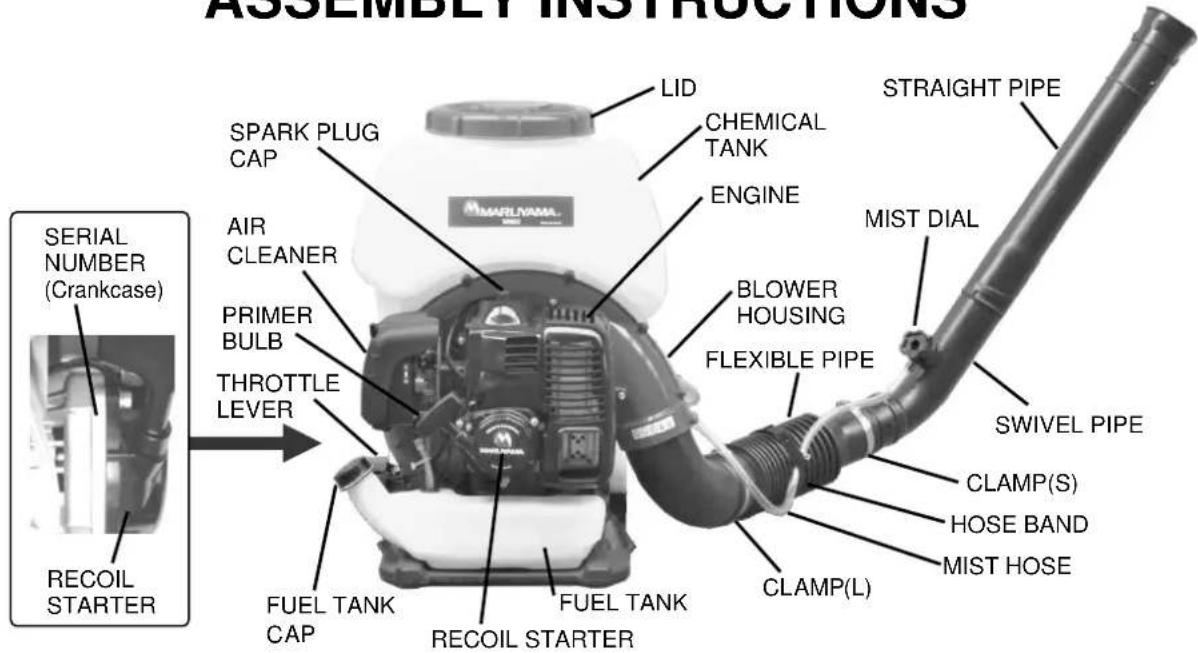
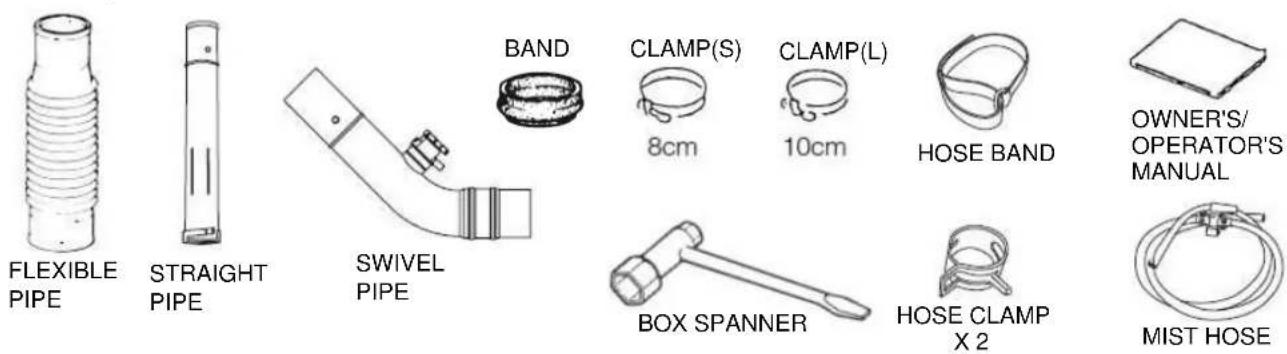
STEP #1) Locate and identify all the components (see sketch).
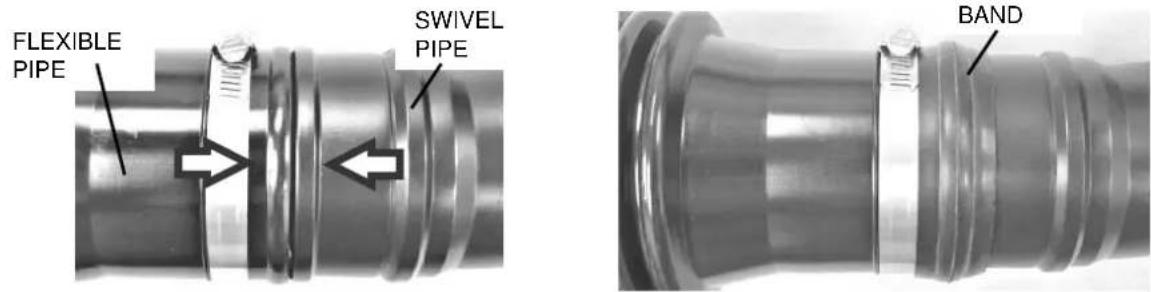
STEP #2) With a flat head screwdriver, use a CLAMP(L) to connect the FLEXIBLE PIPE to the BENT PIPE.
Next, using a CLAMP(S), insert the swivel pipe completely into the flexible pipe. Tighten with screwdriver. Then put the band on the seams.
STEP #3) Assemble the STRAIGHT PIPE to the swivel pipe (see sketch).
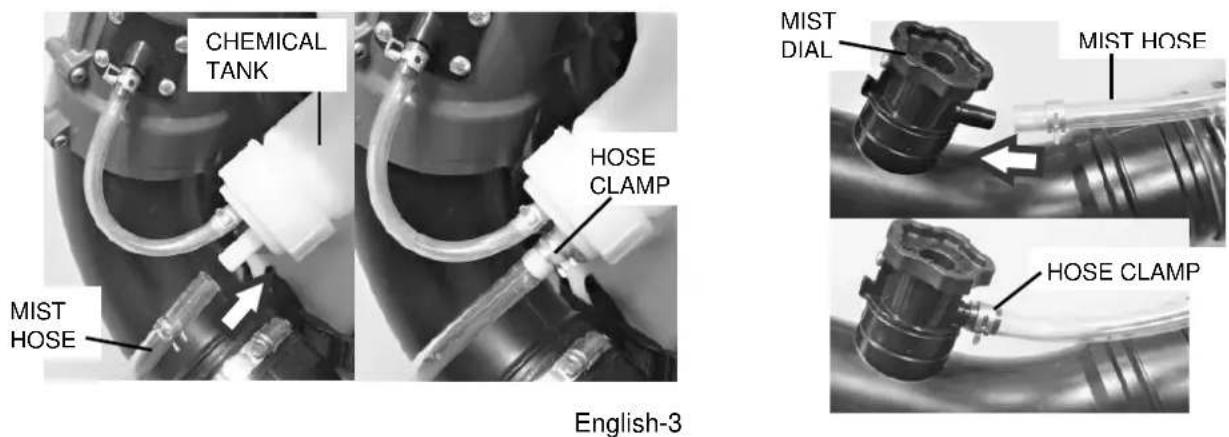
STEP #4) Connect the Mist hose to the Mist Dial and Chemical tank. (see sketch)
BEFORE OPERATION
Be sure the Mister is correctly assembled and all fasteners and fittings are properly secured.
THROTTLE LEVER
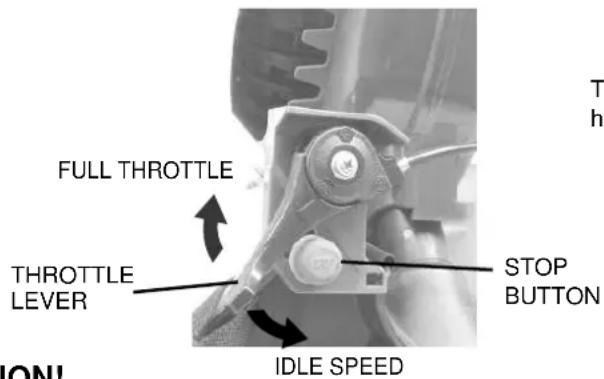
The lowest position of lever is "IDLE" setting, and the highest position is the "FULL THROTTLE" setting.
CAUTION!
1.Shutting Engine Off
Before shutting the engine off, allow it to idle for a short while.
- Never stop the engine by closing the choke.
- Never stop the engine during operation while running above idle speed.
2. Transporting and Storage
- Shut off the engine and allow it to cool before transporting or storing the unit.
- Do not put the unit on dry grass or near any flammable object unless the engine is cold or cooled down.
Chemicals
- Read the labels of chemicals to be used carefully and understand the method of use and cautions.
Use the chemicals directly after opening the package. Chemicals left for a long time after the package is open may cause poor discharging due to moisture absorption. - Mistaking the discharge quantity re category of chemicals may cause damage.
- Do not leave the chemicals in the chemical tank for a long time. The machine might malfunction.
- Store chemicals in a safe place, and be careful not to break open their containers during transportation.
- Treat chemical containers to ensure safety.
- Dispose the used chemical or fertilizer bags in a manner that will not cause injury.
- Pay attention to the handling of chemicals and fertilizer. If a chemical enters into eye or mouth, wash it off with water immediately. If you feel ill, see a doctor immediately.
- According to wind direction, change the discharging method to protect workers and houses. When discharging chemicals, work from upwind to downwind. Also give consideration to prevent chemicals from drifting or scattering on crops, enclosures, fish-breeding ponds, and houses nearby.
- When preparing chemicals, prepare the necessary amount only in accordance with the established spraying plan. If too much chemicals are left over, action is difficult.
RECOMMENDED FUEL TYPE
Use clean, fresh lead-free gasoline, including oxygenated or reformulated gasoline, with an octane rating of 85 or higher. To ensure freshness, purchase only the quantity of gasoline that can be used in 30 days. Use of lead-free gasoline results in fewer combustion chamber deposits and longer spark plug life. Use of premium grade fuel is not necessary or recommended.
CAUTION!
IMPORTANT: Never use methanol, gasoline containing methanol, gasohol containing more than 10% ethanol, premium gasoline, or white gas because engine fuel system damage could result.
Do not use fuel additives other than those manufactured for fuel stabilization during storage such as MARUYAMA's stabilizer/conditioner or a similar product.
MARUYAMA's stabilizer/conditioner is a petroleum distillate based conditioner/stabilizer.
MARUYAMA does not recommend stabilizers with an alcohol base such as ethanol, methanol or isopropyl. Additives should not be used to try to enhance the power or performance of machine.
FUEL: MIXING GASOLINE AND OIL
CAUTION! The engine used on this Mist blower is of a 2-stroke design. The internal moving parts of the engine, i.e., crankshaft bearings, piston pin bearings and piston to cylinder wall contact surfaces, require oil mixed with the gasoline for lubrication. Failure to add oil to the gasoline or failure to mix oil with the gasoline at the appropriate ratio will cause major engine damage which will void your warranty. For your fuel premix, only use Maruyama 50:1 2-Stroke Oil or quality oil designed for 2-stroke air-cooled engine.

WARNING

Gasoline is extremely flammable and can be explosive under certain conditions.
Turn the engine switch OFF. Do not smoke. Make sure the area is well ventilated and free from any source of flame of sparks: this includes any appliance with a pilot light.
FUEL MIXTURE: When using genuine Maruyama 50:1 2-Stroke Oil, or a quality oil designed for 2- stroke air-cooled engines, oil ratio is 50 parts gasoline to 1 part oil or 50:1.
CAUTION! If Maruyama brand oil is not used, never use a mixing ratio less than 50:1 regardless of the oil package mixing instructions.
Ratios less the 50:1, (for example, 60:1, 80:1, 100:1), reduce the amount of lubrication to the internal moving parts of the engine and can cause damage.
| Gasoline | 50:1 two-stroke oil |
| 1 gallon | 2.6 oz. |
| 2 gallons | 5.1 oz. |
| 5 gallons | 12.8 oz. |
| 1 liter | 20mL |
| 5 liters | 100mL |
MIXING INSTRUCTIONS: Always mix fuel and oil in a clean container approved for gasoline. Mark the container to identify it as fuel mix for the Mist Blower. Use regular unleaded gasoline and fill the container with half the required amount of gasoline. Pour the correct amount of oil into the container then add the remaining amount of gasoline. Close the container tightly and shake it momentarily to evenly mix the oil and the gasoline before filling the fuel tank on the Mist Blower.
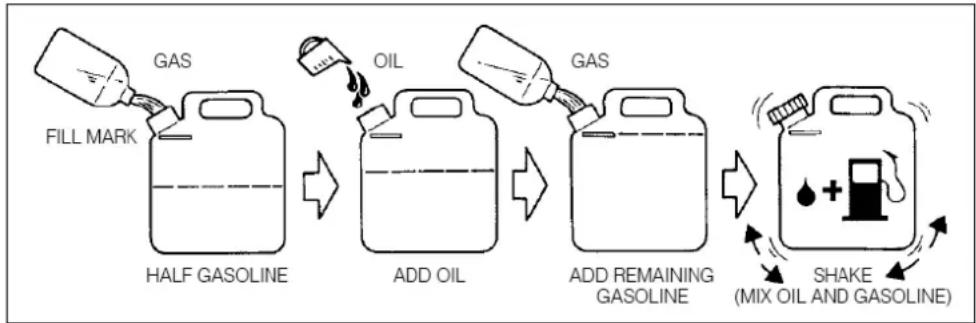
flowchart
graph LR
    A["FILL MARK"] --> B["GAS"]
    B --> C["OIL"]
    C --> D["ADD OIL"]
    D --> E["GAS"]
    E --> F["ADD REMAINING GASOLINE"]
    F --> G["SHAKE (MIX OIL AND GASOLINE)"]
When refilling the Mist Blower fuel tank, clean around the fuel tank cap to prevent dirt and debris for entering the tank during cap removal. Always shake the premix fuel container momentarily before filling the fuel tank.
Always use a spout or funnel when fueling to reduce fuel spillage. Only fill the tank to within 1/2 inch from the top of the tank. Avoid filing to the top of the tank filler neck.
NOTE:
- Never mix gasoline and oil directly in the Mist Blower fuel tank.
CAUTION!
- Do not use National Marine Manufacturer's Association (NMMA) or BIA certified oils. This type or 2-stroke engine oil does not have the proper additives for air-cooled, 2-stroke engines and can cause engine damage.
- Do not use automotive motor oil. This type of oil does not have the proper additives for air-cooled, 2-stroke engines and can cause engine damage.
OPERATING INSTRUCTIONS
STARTING PROCEDURE
STEP #1)
Move the "MIST DIAL" to the "0" position.
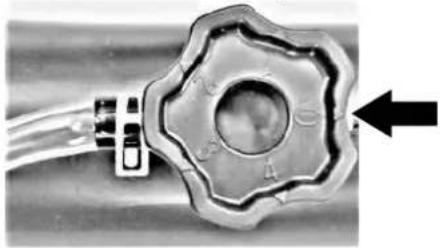
natural_image
Close-up of a metallic mechanical component with a circular hole and arrow indicator (no readable text or symbols)STEP #2)
Pour chemical into the chemical tank.
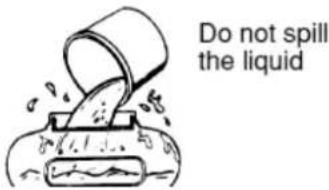
STEP #3)
Close the lib tightly.
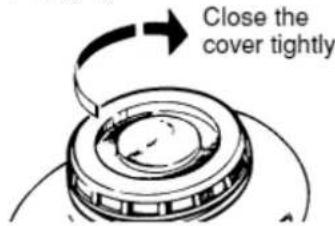
STEP #4)
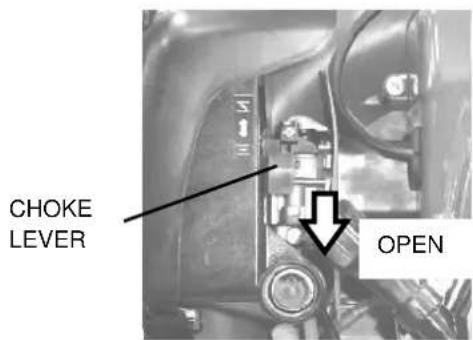
Move the "CHOKE LEVER" fully upward to the closed position. If the engine is already warm, only a partial or open (no choke) choke setting may be required.
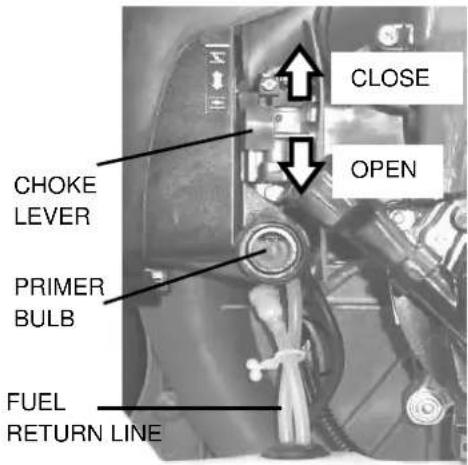
STEP #5)
Move the "CHOKE LEVER" fully upward to the closed position. If the engine is already warm, only a partial or open (no choke) choke setting may be required.
STEP #6)
Set the THROTTLE LEVER at 1/2 speed.
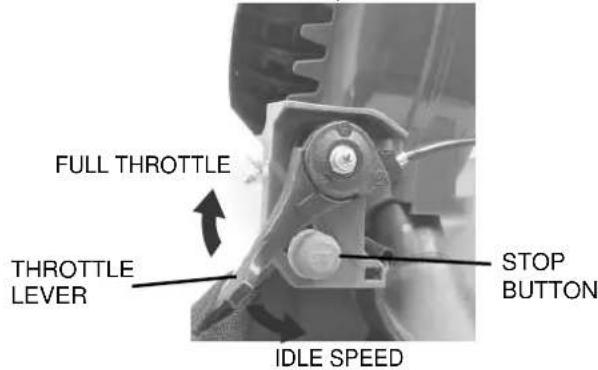
STEP #7)
Press down the "LID" and hold the "FRAME" with your right foot gently.
Pull the "STARTER GRIP" briskly to start the engine.
NOTE: Only short pulls are necessary. Never pull the starter cord to its fullest extension. Never let go of the starter grip until it is at the fully returned position.
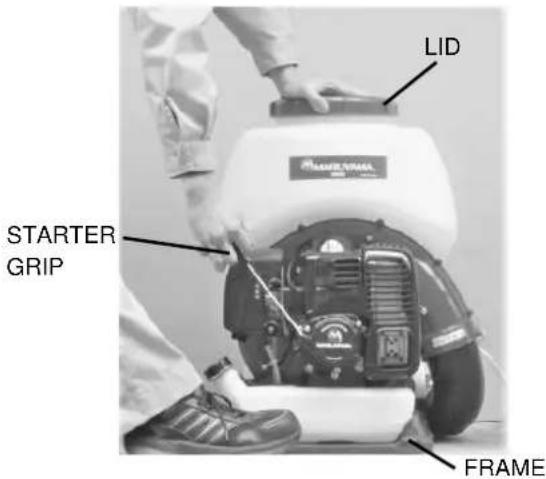
STEP #8)
Warming up the engine.
When the engine has started, slowly move the "CHOKE LEVER" fully downward to the open position.
Allow the engine to "WARM-UP" at less than 1/2 speed.
If a MARUYAMA engine fails to start after following the above procedures, contact an authorized MARUYAMA dealer.
OPERATION
When the engine has warmed-up, the mist blower can be positioned on the back of the operator.
When the mist blower is positioned and ready for operation, adjust the throttle to a speed required to accomplish the task.

CAUTION
- Avoid using too dense hydrate solution.
- Avoid using highly flammable solutions such as gasoline.

WARNING
- Never operate a mist blower when you are fatigued.
- Never operate a mist blower without proper guards or other protective safety devices in place.

WARNING
To prevent overheating and engine seizure, cooling air comes from the intake grille of the fan housing and is pushed by the blower fan through an opening in the fan housing over the cylinder fin area, taking away combustion heat. The grille and cylinder fins must be kept clean of grass, dust and any debris. Engine failure due to lack of this "Normal Maintenance" is not covered by warranty.
Adjustment of discharging volume
- Coincide the number on the dial of volume switch with the market.
- Discharging volume will increase accordingly as the number increases.
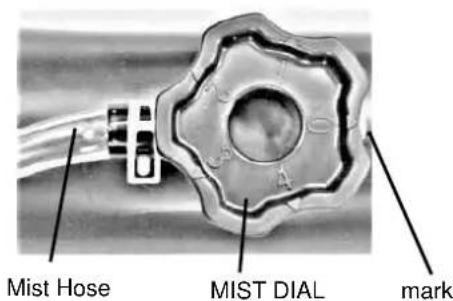
Discharging volume
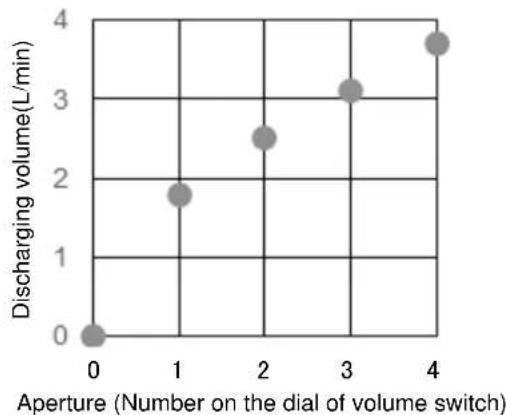
scatter
| Aperture (Number on the dial of volume switch) | Discharging volume (L/min) | | ---------------------------------------------- | -------------------------- | | 0 | 0 | | 1 | 1.8 | | 2 | 2.5 | | 3 | 3.1 | | 4 | 3.7 |STOPPING THE ENGINE
Move the "dial" to the "0" position, and stop spraying.
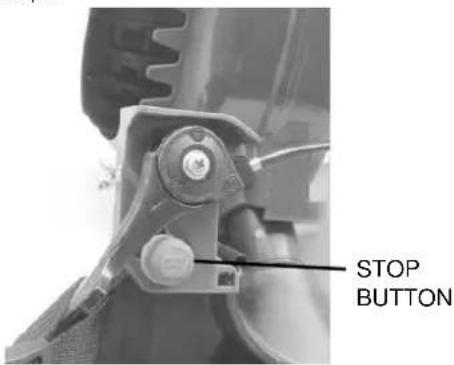
Always run the engine at idle speed for a few minutes to allow cooling before stopping. To stop the engine, press and hold the STOP BUTTON until engine completely stops.
CLEANING THE PRODUCTS
Remove Mist hose from MIST DIAL, and discharge chemical from chemical tank. After recovering the remnant chemical, clean the inside chemical tank using clean water.
ADJUSTMENT
IDLING SPEED ADJUSTMENT
- Idle speed is the only available adjustment.
- Do not tamper with the carburetor setting to increase the maximum engine speed.
- If adjustment is needed, have it performed by your authorized MARUYAMA service dealer.
Carburetor adjustments are made at the factory and are not adjustable without disassembling the carburetor.
MAINTENANCE
Before each use, the mist blower should be inspected for proper assembly and fitness of all components. All fasteners should be checked for correct tightness. Always inspect for fuel leaks.

WARNING
Do not attempt to start or operate a mist blower Blower with a fuel leak.
Maintenance Period

WARNING

Always remove the spark plug cap from spark plug when servicing the engine to prevent accidental starting.
| Maintenance Daily | Every 20 hours | Every 50 hours | Every 100 hours | ||
| Check and replenish fuel | ● | ||||
| Check for fuel leakage | ● | ||||
| Check bolts, nuts and screws for tightness or missing | ● | ||||
| Check engine idle speed adjustment | ● | ||||
| ■ | Clean air filter element | ● | |||
| Check spark plug | ● | ||||
| ■ | Check and clean fuel filter | ● | |||
| ■ | Remove dust and dirt from air intake guard | ● | |||
| Tighten bolts and nuts | ● | ||||
| Clean spark plug and adjust electrode gap | ● | ||||
| ■ | Remove dust and dirt from cylinder fins | ● | |||
| ● | Remove carbon deposits in exhaust port | ● | |||
| Replace air filter | ● | ||||
| Replace fuel filter | ● | ||||
| Replace spark plug | ● | ||||
| ● | Remove carbon deposits on piston head and combustion chamber | ● | |||
| ● | Check the sliding portion of crankshaft, connecting rod etc. | ● | |||
| Replace fuel tube, fuel tank cap gasket It is recommended to replace every 3 years | |||||
●: Service to be performed by an authorized Maruyama engine dealer.
■: Service more frequently under dusty conditions.
Note:
The service intervals indicated are to be used as a guide.
Service to be performed more frequently as necessary depending on operating condition.
Use Maruyama standard 50:1 2-stroke engine oil.
AIR FILTER
Maintenance Interval
- The air filter should be cleaned and inspected each time the mist blower is used, or more often when working in extremely dusty conditions.
- Replace after every 100 hours of operation.
Air Filter Cleaning
Move the choke lever to the closed (⊥) position.
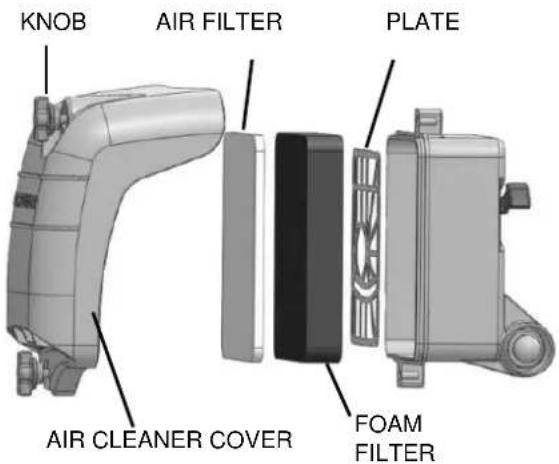
- Loosen the knob and remove the air cleaner cover.
- Remove the FOAM FILTER and AIR FILTER from the air cleaner body.
- Clean the filter.
· FOAM FILTER
Clean FOAM FILTER by gently tapping or cleaning with a suitable solvent the filter. Then completely dry before using again.
· AIR FILTER
Clean AIR FILTER by gently tapping.
Replace filter if it is damaged or very dirty.
- Reassemble components in reverse order.
- Reinstall the air cleaner cover and tighten the knob.
FUEL FILTER
Maintenance Interval
- The fuel filter should be cleaned and inspected for damage after each 20 hours of operation.
- The fuel filter should be replaced after every 100 hours of operation.
Fuel Filter Replacement
The fuel filter is attached to the end of the fuel pick-up hose inside the fuel tank.
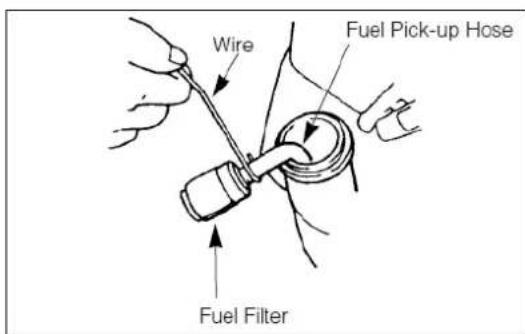
To replace the fuel filter:
- Make sure the fuel tank is empty.
- Remove the fuel cap.
- Using a wire hook, gently pull the fuel filter out through the fuel filler opening.
- Grasp the fuel hose next to the fuel filter fitting and remove the filter, but do not release the hose.
- While still holding on to the fuel hose, attach the new fuel filter.
- Drop the new fuel filter back into the fuel tank.
- Make sure that the fuel filter is not stuck in a corner of the tank, and that the fuel hose is not doubled over (kinked) before refueling.
SPARK PLUG
Maintenance Interval
- The spark plug should be removed from the engine and checked after each 20 hours of operation.
- Replace the spark plug after every 100 hours of operation.
Spark Plug Maintenance
- With the engine at ambient (room) temperature, twist the high tension lead boot on the spark plug back and forth a couple of times to loosen the boot, then pull the boot off of the spark plug.
- Remove the spark plug.
- Clean the electrodes with a stiff brush.
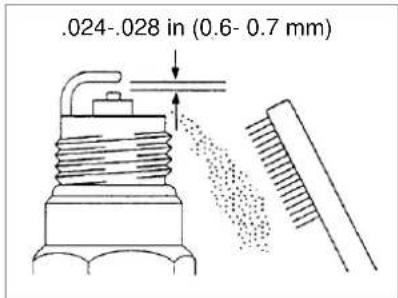
- Adjust the electrode air gap to .024-.028 in (0.6- 0.7 mm).
- Replace the spark plug if it is oil-fouled, damaged, or if the electrodes are worn down.
- Do not over tighten the spark plug when installing. The tightening torque is 95-148 in. lbs. (10.7-16.6 N·m).
COOLING FINS
Maintenance Interval
The cylinder cooling fins should be cleaned after every 50 hours of operation, or once a week, whichever comes first. Air must flow freely around and through the cylinder cooling fins to prevent engine overheating. Leaves, grass, dirt and debris buildup on the fins will increase the operating temperature of the engine, which can reduce engine performance and shorten engine life.
Cooling Fin Cleaning
-
With the engine at ambient (room) temperature, remove the four screws retaining the top cover, then remove the top cover.
-
Clean all dirt and debris from the cooling fins and from around the cylinder base.
-
Reinstall the top cover and tighten the knob. Be sure to attach the grommet.
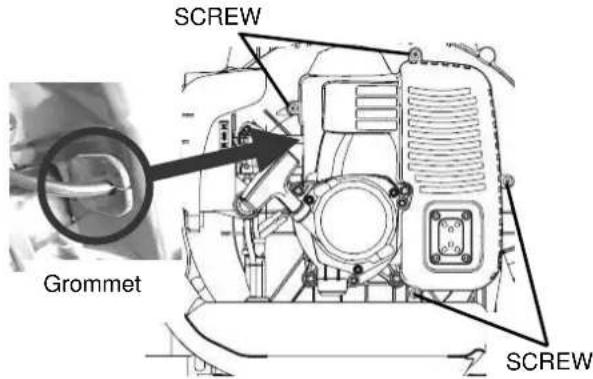
MUFFLER AND EXHAUST PORTS
Maintenance Interval
The muffler should be inspected and cleaned after each 50 hours of use.
Muffler Maintenance
The muffler should be removed and serviced after each one fifty (50) hours of use. At the same time, the exhaust ports should be cleaned and inspected. An AUTHORIZED MARUYAMA DEALER should be contacted for this service.
GENERAL CLEANING AND TIGHTENING

WARNING

POTENTIAL HAZARD
- When engine is running, fan is rotating and other parts are moving.
WHAT CAN HAPPEN
- Contact with rotating fan or other moving parts could cause serious personal injury or death.
HOW TO AVOID THE HAZARD
• Always turn off your Backpack Blower before you clean or perform any maintenance on it.
The MARUYAMA Backpack Blower will provide maximum performance for many hours, if it is maintained properly. Good maintenance includes regular checking of all fasteners for correct tightness, and cleaning the entire machine. Contact an authorized MARUYAMA dealer for additional maintenance suggestions.
STORAGE
For long-term storage of the mist blower, first perform all regular maintenance procedures and needed repairs. Empty the fuel tank. Disconnect the fuel supply line from the carburetor and depress the primer bulb until fuel stops discharging from the fuel-return line.
Start the engine and allow it to run until it stops. Pull the starter cord a few times to remove any excess fuel from the engine. Remove the spark plug and insert a small amount of oil into the cylinder. Slowly pull the starter cord and bring the piston to a position closest to the spark plug hole. Re-install the spark plug. Apply a thin coating of oil to all the metal surfaces and store the mist blower in a dry place.
SPECIFICATIONS
| Models MM92-V | |
| Dimensions L x W x H 375 x 480 x | 635 mm (14.8 x 18.9 x 25.0 in.) |
| Dry Weight 11.7 kg (25.8 lbs) | |
| Engine Type Maruyama/2-Stroke Air cooled CE800 for EPA | |
| Displacement 79.2 mL | |
| Ignition System Electric solid state | |
| Carburetor All position diaphragm | |
| Fuel Tank Capacity 0.53gal (2.0 L) | |
| Fuel Mixture | 50:1Using MARUYAMA 50:1 2-stroke Engine Oil or any quality 2-stroke engine oil designed for use in air-cooled, high performance 2-stroke engines. |
INDICE
natural_image
Close-up of a metallic mechanical component with a central hole and threaded end, showing no visible text or symbols.PASO 2)
- TABLE OF CONTENTS
- FOREWORD
- MANUAL SAFETY SYMBOLS
- Warning label
- Read Owner's/Operator's Manual thoroughly.
- Prohibition of fire
- Wear protective gear.
- Cautions for exhaust gas.
- Cautions for high temperatures
- WARNING
- Operating techniques
- BEFORE OPERATION
- THROTTLE LEVER
- CAUTION!
- 1.Shutting Engine Off
- Transporting and Storage
- Chemicals
- RECOMMENDED FUEL TYPE
- FUEL: MIXING GASOLINE AND OIL
- NOTE:
- OPERATING INSTRUCTIONS
- STARTING PROCEDURE
- OPERATION
- CAUTION
- Adjustment of discharging volume
- STOPPING THE ENGINE
- CLEANING THE PRODUCTS
- ADJUSTMENT
- IDLING SPEED ADJUSTMENT
- MAINTENANCE
- Maintenance Period
- AIR FILTER
- Maintenance Interval
- Air Filter Cleaning
- FUEL FILTER
- Fuel Filter Replacement
- SPARK PLUG
- Spark Plug Maintenance
- COOLING FINS
- Cooling Fin Cleaning
- MUFFLER AND EXHAUST PORTS
- Muffler Maintenance
- GENERAL CLEANING AND TIGHTENING
- POTENTIAL HAZARD
- WHAT CAN HAPPEN
- HOW TO AVOID THE HAZARD
- STORAGE
- SPECIFICATIONS
- INDICE
- PASO 2)
Brand : Maruyama
Model : MM92
Category : Uncategorized