
HT-DS1000 - Audio System SAMSUNG - Free user manual and instructions
Find the device manual for free HT-DS1000 SAMSUNG in PDF.


User questions about HT-DS1000 SAMSUNG
0 question about this device. Answer the ones you know or ask your own.
Ask a new question about this device
Download the instructions for your Audio System in PDF format for free! Find your manual HT-DS1000 - SAMSUNG and take your electronic device back in hand. On this page are published all the documents necessary for the use of your device. HT-DS1000 by SAMSUNG.
USER MANUAL HT-DS1000 SAMSUNG
CLASS 1 LASER PRODUCT
KLASSE 1 LASER PRODUKT
LUOKAN 1 LASER LAITE
KCLASS 1 LASER APPARAT
PRODUCTO LASER CLASE 1
CLASS 1 LASER PRODUCT
This Compact Disc player is classified as a CLASS 1 LASER product.
Use of controls, adjustments or performance of procedures other than those specified herein may result in hazardous radiation exposure.
CAUTION-INVISIBLE LASER RADIATION WHEN OPEN AND INTERLOCKS DEFEATED, AVOID EXPOSURE TO BEAM.

This symbol indicates that dangerous voltage which can cause electric shock is present inside this unit.

This symbol alerts you to important operating and maintenance instructions accompanying the unit.
WARNING: To reduce the risk of fire or electric shock, do not expose this appliance to rain or moisture.
CAUTION: TO PREVENT ELECTRIC SHOCK, MATCH WIDE BLADE OF PLUG TO WIDE SLOT, FULLY INSERT.
Wiring the Main Power Supply Plug(UK Only)
IMPORTANT NOTICE
The main lead on this equipment is supplied with a moulded plug incorporating a fuse. The value of the fuse is indicated on the pin face of the plug and if it requires replacing, a fuse approved to BS1362 of the same rating must be used.
Never use the plug with the fuse cover removed. If the cover is detachable and a replacement is required, it must be of the same colour as the fuse fitted in the plug. Replacement covers are available from your dealer.
If the fitted plug is not suitable for the power points in your house or the cable is not long enough to reach a power point, you should obtain a suitable safety approved extension lead or consult your dealer for assistance.
However, if there is no alternative to cutting off the plug, remove the fuse and then safely dispose of the plug. Do not connect the plug to a main socket as there is a risk of shock hazard from the bared flexible cord.
Never attempt to insert bare wires directly into a main socket. A plug and fuse must be used at all times.
IMPORTANT
The wires in the main lead are coloured in accordance with the following code:--
BLUE = NEUTRAL
BROWN = LIVE
As these colours may not correspond to the coloured markings identifying the terminals in your plug, proceed as follows:-
The wire coloured BLUE must be connected to the terminal marked with the letter N or coloured BLUE or BLACK. The wire coloured BROWN must be connected to the terminal marked with the letter L or coloured BROWN or RED.
WARNING: DO NOT CONNECT EITHER WIRE TO THE EARTH TERMINAL WHICH IS MARKED WITH THE LETTER E OR BY THE EARTH SYMBOL 1一 , OR COLOURED GREEN OR GREEN AND YELLOW.
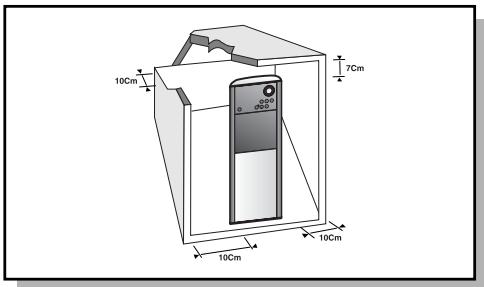
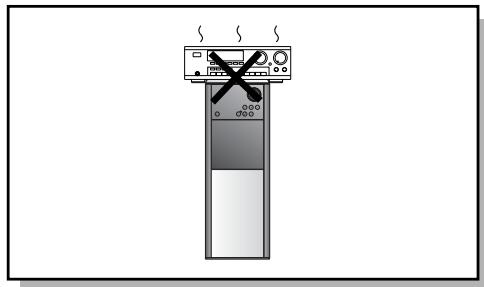
Ensure that the AC power supply in your house complies with the identification sticker located on the back of your player. Install your player horizontally, on a suitable base (furniture), with enough space around it for ventilation (3~4inches). Make sure the ventilation slots are not covered. Do not stack anything on top of the player. Do not place the player on amplifiers or other equipment which may become hot. Before moving the player, ensure the disc tray is empty. This player is designed for continuous use. Switching off the DVD player to the stand-by mode does not disconnect the electrical supply. In order to disconnect the player completely from the power supply, remove the main plug from the wall outlet, especially when left unused for a long period of time.
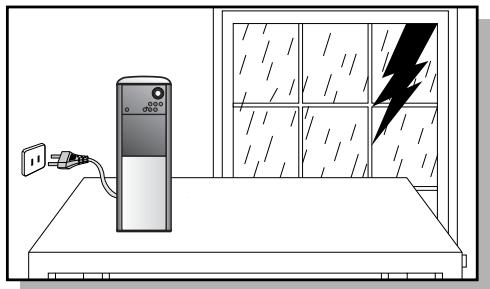
During thunderstorms, disconnect AC main plug from the wall outlet.
Voltage peaks due to lightning could damage the unit.
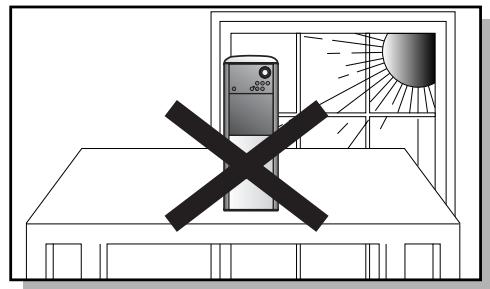
Do not expose the unit to direct sunlight or other heat sources.
This could lead to overheating and malfunction of the unit.
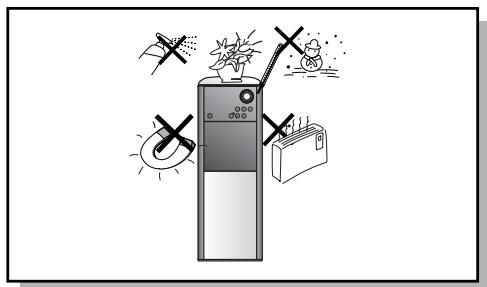
Protect the player from moisture (i.e. vases), and excess heat (e.g. fireplace) or equipment creating strong magnetic or electric fields (i.e. speakers...). Disconnect the power cable from the AC supply if the player malfunctions. Your player is not intended for industrial use.
Use of this product is for personal use only.
Condensation may occur if your player or disc have been stored in cold temperatures.
If transporting the player during the winter, wait approximately 2 hours until the unit has reached room temperature before using.
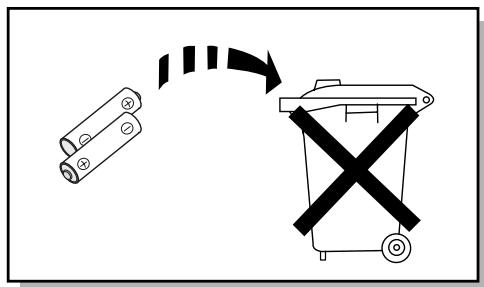
The battery used with this product contain chemicals that are harmful to the environment.
Do not dispose of batteries in the general household trash.
Multi-DiscPlayback&FMTuner
The HT-DS1000/HT-DS1100 combines the convenience of multi-disc playback capability, including DVD-AUDIO, DVD-VIDEO, VCD, CD, MP3-CD, WMA-CD, DivX, CD-R/RW, and DVD-R/RW, with a sophisticated FM tuner, all in a single player.
DVD-Audio compatible
Experience the super high-quality audio performance of DVD-Audio. The on-board 24-bit/192kHz DAC enables this player to deliver exceptional sound quality in terms of dynamic range, low-level resolution and high-frequency detail.
Soft Touch Function Selection
The buttons on the front panel of the main unit are touch sensitive and easy to use.
Super Digital Sound Master
Equipped with a new digital audio technology (Auto Sound Calibration, Magic Sound Field, and Magic Headphone) developed in cooperation with DiMagic Co., Ltd. in Japan, you'll enjoy a more lively and sensitive sound.

Logo Sound
When you turn on the power, a 'sound logo' will be heard.
TV Screen Saver Function
The HT-DS1000/HT-DS1100 automatically brightens and darkens the brightness of the TV screen after 3 minutes in the stop mode.
The HT-DS1000/HT-DS1100 automatically switches itself into the power saving mode after 20 minutes in the screen saver mode.
AV SYNC Function
Video may lag behind the audio if the unit is connected to a digital TV.
To compensate for this, you can adjust the audio delay time to sync up with the video.
HDMI
HDMI transmits DVD video and audio signals simultaneously, and provides a clearer picture.
PREPARATION
SafetyWarnings. 1
Precautions 2
Features 3
Notes on Discs. 5
Description 7
CONNECTIONS
Installing DVD player 13
Connecting the Speakers 14
Connecting the Video Out to TV. 17
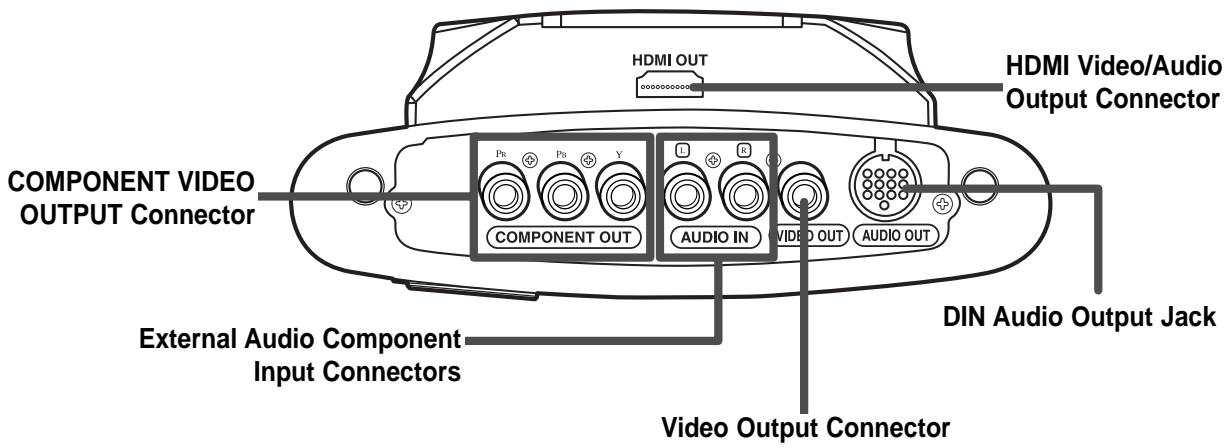
Connecting External Components 21
Connecting the FM Antenna 23
Before Using Your DVD Player 24
OPERATION
DiscPlayback 25
MP3-CDPlayback 27
JPEG DiscPlayback 28
DivX Playback 29
Displaying Disc Information 31
Checking the Remaining Time 32
Fast/SlowPlayback 33
Skipping Scenes/Songs 34
RepeatPlayback 35
A-B Repeat Playback 37
Angle Function 38
Zoom Function 39
Bonus Group / Navigating Pages 40
Selecting Audio/Subtitle Language 41
Moving Directly to a Scene/Song 42
Using Disc Menu 43
Using the Title Menu 44
SETUP
Setting the Language 45
Setting TV Screen type 47
Setting Parental Controls (Rating Level) 49
Setting the Password 51
Setting the Wallpaper 53
DVDPlaybackMode. 55
Setting the Speaker Mode 57
Setting the Test Tone 58
Setting the Delay Time 59
Setting the Audio Quality 61
Setting the DRC (Dynamic Range Compression) 63
AV SYNC Setup 64
Dolby Pro Logic II Mode 65
Dolby Pro Logic II Effect 66
Auto Sound Calibration Setup 67
Live Surround Mode 69
RADIO OPERATION
Listening to Radio 71
Preseting Stations 72
About RDS broadcasting 73
MISCELLANEOUS
Convenient Functions 75
Operating a TV with the Remote Control 77
Before Calling for Service 79
Cautions on Handling and Storing Discs 81
Specifications 82
Notes on Terminology 83
Memo 84

DVD (Digital Versatile Disc) offers fantastic audio and video, thanks to Dolby Digital surround sound and MPEG-2 video compression technology. Now you can enjoy these realistic effects in the home, as if you were in a movie theater or concert hall.


DVD players and the discs are coded by region. These regional codes must match in order for the disc to play. If the codes do not match, the disc will not play.
The Region Number for this player is given on the rear panel of the player. (Your DVD player will only play DVDs that are labeled with identical region codes.)

Playable Discs
| Disc Type | Mark (Logo) | Recorded Signals | Disc Size | Max. Playing Time |
| DVD-AUDIO | AUDIO /VIDEO | Audio + Video | 12cm | Approx. 240 min. (single-sided) |
| DVD-VIDEO | Approx. 480 min. (double-sided) | |||
| 8cm | Approx. 80 min. (single-sided) | |||
| Approx. 160 min. (double-sided) | ||||
| VIDEO-CD | COMPACT | Audio + Video | 12cm | 74 min. |
| 8cm | 20 min. | |||
| AUDIO-CD | COMPACT | Audio | 12cm | 74 min. |
| 8cm | 20 min. |

Do not use the following types of disc!
- LD, CD-G, CD-I, CD-ROM and DVD-ROM cannot be played on this player.
If such discs are played, a "WRONG DISC FORMAT" message appears on the TV screen.
DVD discs purchased abroad may not play on this player.
If such discs are played, a "WRONG REGION CODE" message appears on the TV screen.
Copy Protection
- Many DVD discs are encoded with copy protection. Because of this, you should only connect your DVD player directly to your TV, not to a VCR. Connecting to a VCR results in a distorted picture from copy-protected DVD discs.
- This product incorporates copyright protection technology that is protected by methods claims of certain U.S. patents and other intellectual property rights owned by Macrovision Corporation and other rights owners. Use of this copyright protection technology must be authorized by Macrovision Corporation, and is intended for home and other limited viewing uses only unless otherwise authorized by Macrovision Corporation. Reverse engineering or disassembly is prohibited.
Disc Recording Format
CD-R/RW Discs
- Depending on the disc recording device (CD-Recorder or PC) and the condition of the disc, some CD-R discs may not be playable.
- Use a 650MB/74 minute CD-R. Avoid CD-R media, as they may not be playable.
- If possible, do not use CD-RW (Rewritable) media, as they may not be playable.
- Only CD-Rs that are properly "closed" can be fully played. If the session is closed but the disc is left open, you may not be able to fully play the disc.
CD-R/RW MP3 Discs
- Only CD-R discs with MP3 files in ISO 9660 or Joliet format can be played.
- MP3 file names should be 8 characters or less in length and contain no blank spaces or special characters (. / = +) .
- Use discs recorded with a compression/decompression data rate greater than 128Kbps.
- Only files with the ".mp3" and ".MP3" extensions can be played.
- Only a consecutively written Multisession disc can be played. If there is a blank segment in the Multisession disc, the disc can be played only up to the blank segment.
- If the disc is not closed, it will take longer to begin playback and not all of the recorded files may be played.
- For files encoded in Variable Bit Rate (VBR) format, i.e. files encoded in both low bit rate and high bit rate (e.g., 32Kbps ~ 320Kbps), the sound may skip during playback.
- If more than 500 tracks are recorded on a single CD, a maximum of 500 tracks can be played.
- If more than 300 folders are recorded on a single CD, a maximum of 300 folders can be played.
CD-R/RW JPEG Discs
- Only files with the ".jpeg" and ".JPEG" extensions can be played.
- If the disc is not closed, it will take longer to start playing and not all of the recorded files may be played.
- Only CD-R discs with JPEG files in ISO 9660 or Joliet format can be played.
- JPEG file names should be 8 characters or less in length and contain no blank spaces or special characters (. / = +) .
- Only a consecutively written multisession disc can be played. If there is a blank segment in the multisession disc, the disc can be played only up to the blank segment.
- A maximum of 9,999 images can be stored on a single CD.
- When playing a Kodak/Fuji Picture CD, only the JPEG files in the picture folder can be played.
- Picture discs other than Kodak/Fuji Picture CDs may take longer to start playing or may not play at all.
—Front Panel—
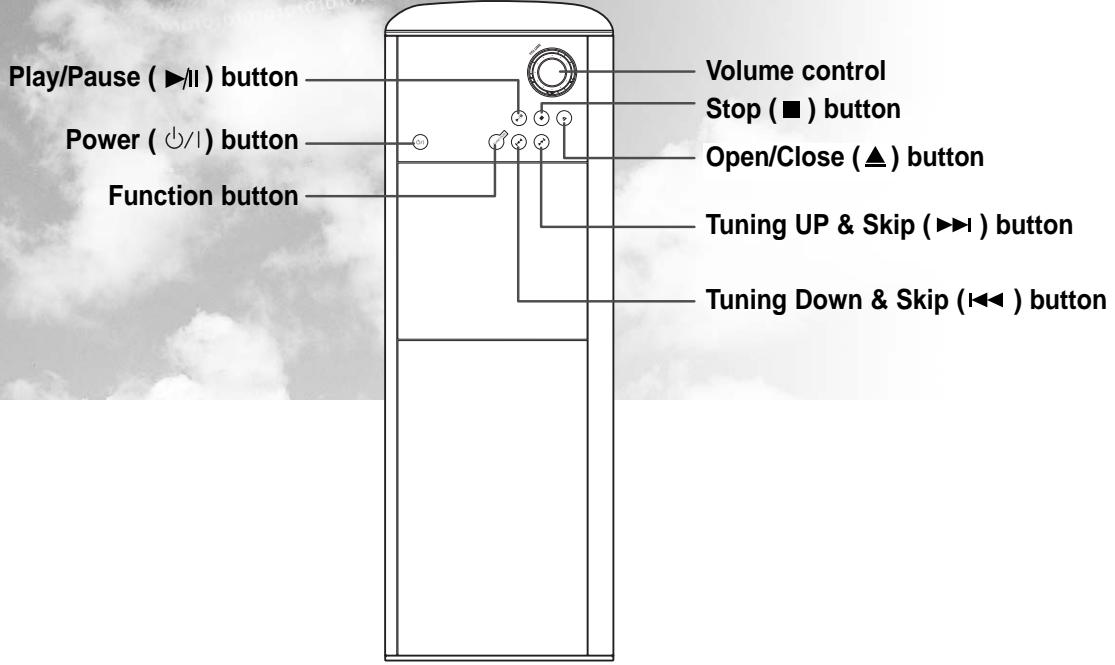
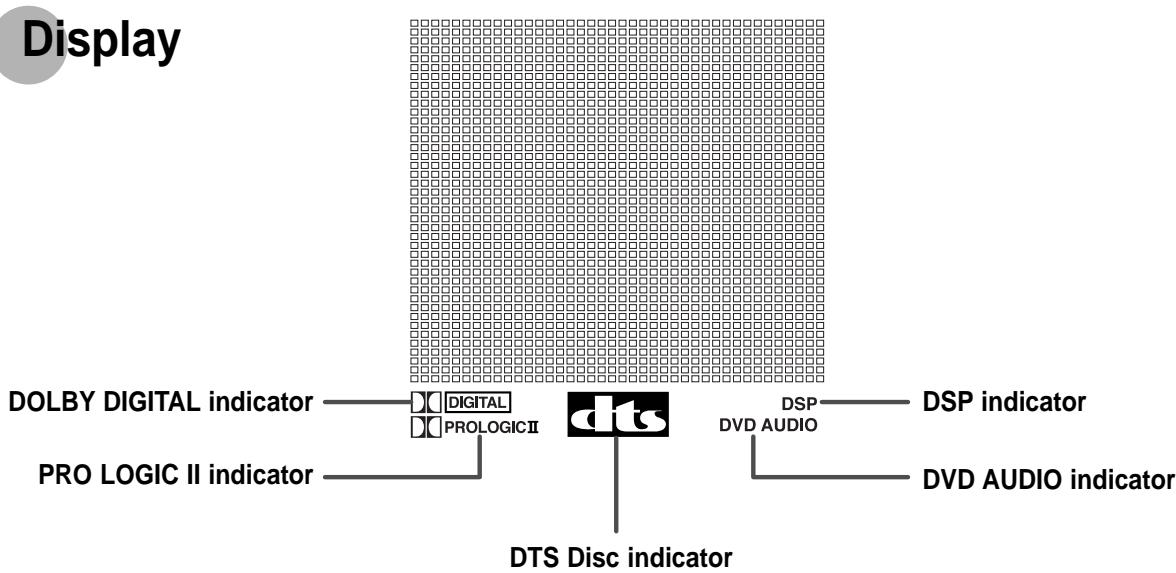
Display
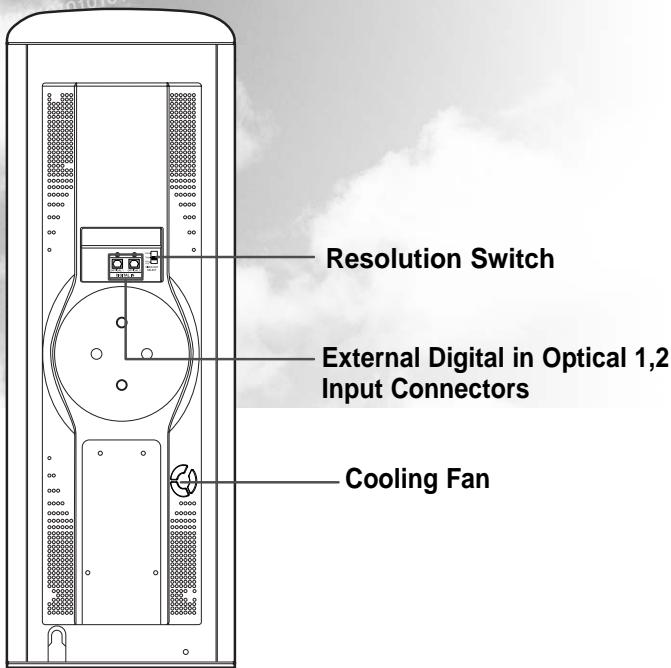
—Rear Panel—
Accessories
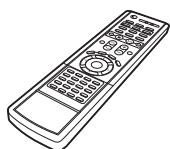
Remote Control
Video Cable
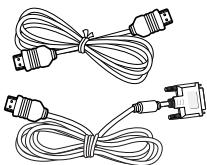
HDMI Cable HMI/DVI Cable
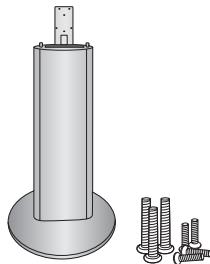
Vertical StandScrew Large : 3EAScrew Small : 4EA
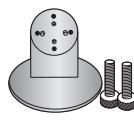
Horizontal Stand Screw Large:2EA
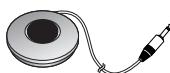
Auto Sound Calibration Microphone
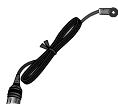
FM Antenna
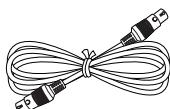
DIN Audio Connection Cable
User's Manual
Top
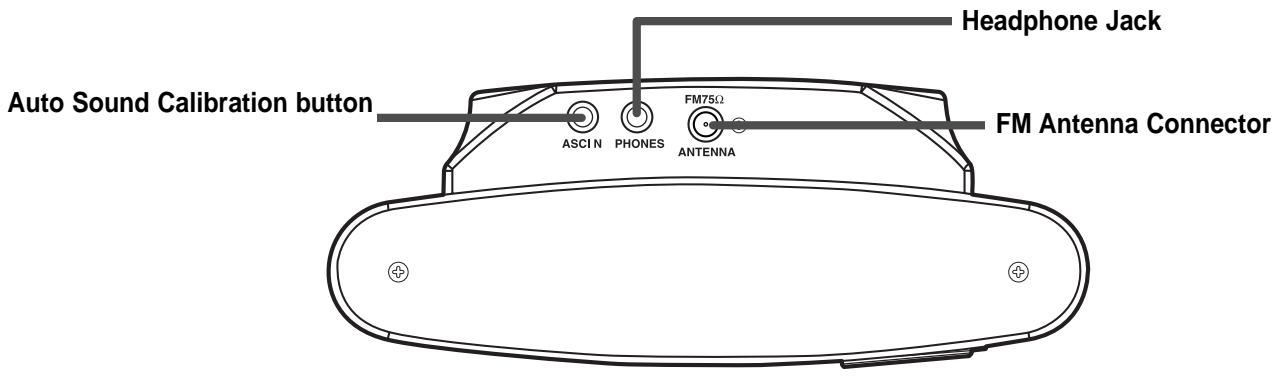
Bottom
Subwoofer
SWS1000T (Subwoofer of HT-DS1000)
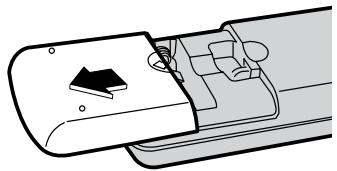
1 Remove the battery cover on the back of the remote by pressing down and sliding the cover in the direction of the arrow.
2 Insert two 1.5V AAA batteries, paying attention to the correct polarities (+ and -).
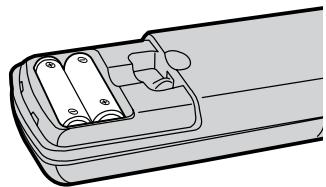
3 Replace the battery cover.
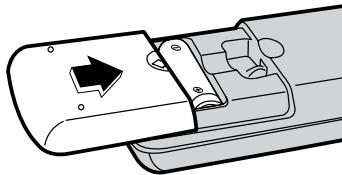
Caution
Follow these precautions to avoid leaking or cracking batteries:
- Place batteries in the remote control so they match the polarity: (+) to (+) and (-) to (-) .
- Use the correct type of batteries. Batteries that look similar may differ in voltage.
- Always replace both batteries at the same time.
- Do not expose batteries to heat or flame.
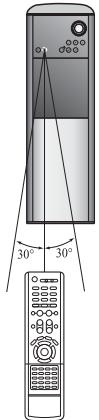
Range of Operation of the Remote Control
The remote control can be used up to approximately 23 feet/7 meters in a straight line. It can also be operated at a horizontal angle of up to 30^ from the remote control sensor.
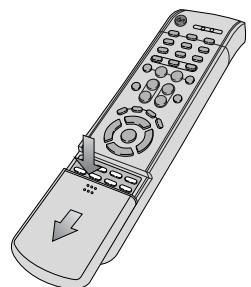
To open the remote control cover, push the top of the cover, then slide downward.
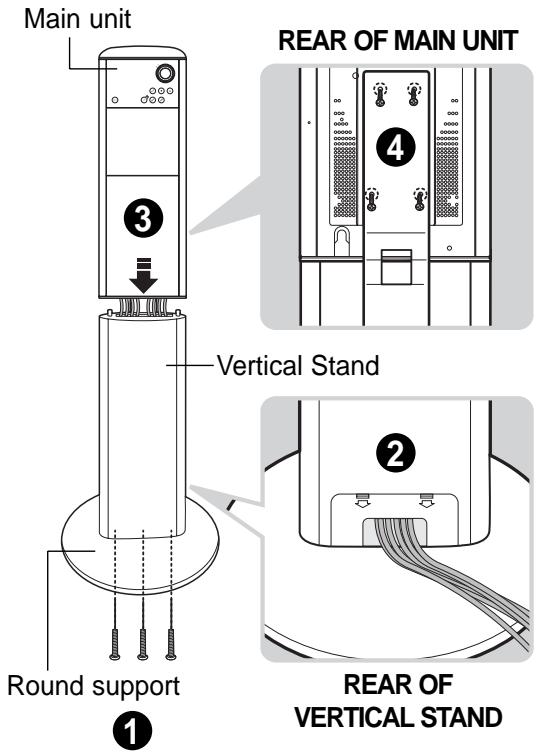
Vertical Stand (supplied)
Fix the round support and Vertical Stand with screws 3EA.
2 Open the cover on the rear of Vertical Stand and connect the Audio/Video cable into the Vertical Stand. (See pages 19~24 for how to connect the cable.)
3 Locate the two indentations on the bottom of the Main unit. Slide the Main unit onto the two matching dowels on Vertical Stand.
Fix the Vertical Stand and the main unit with screws 4EA.
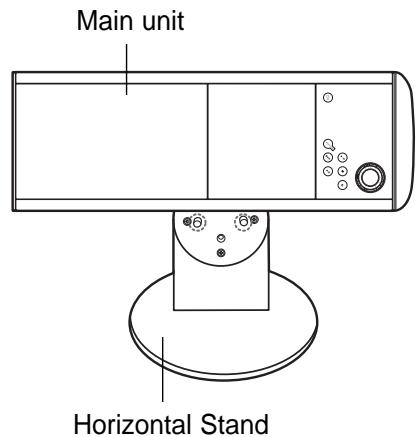
Horizontal Stand (supplied)
1 Locate the two indentations on the side of the main unit and slide onto the two matching dowels on Horizontal Stand.
Fix the Horizontal Stand and the main unit with screws 2EA.
Connecting the Speakers
Before moving or installing the product, be sure to turn off the power and disconnect the power cord.
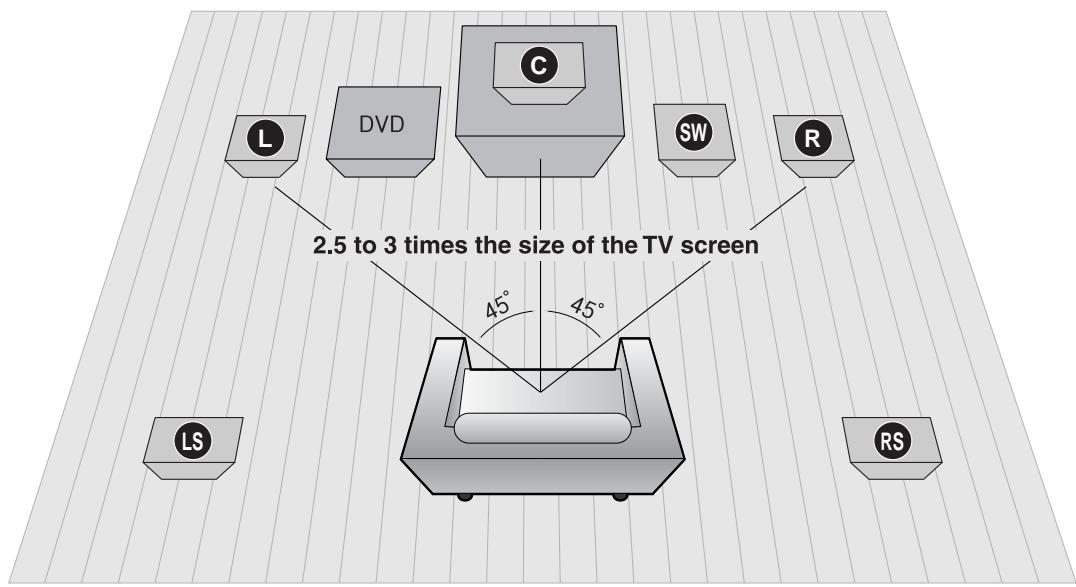
Position of the DVD Player
- Place it on a stand or cabinet shelf, or under the TV stand.
Front Speakers L R
- Place these speakers in front of your listening position, facing inwards (about 45^ ) toward you.
- Place the speakers so that their tweeters will be at the same height as your ear.
- Align the front face of the front speakers with the front face of the center speaker or place them slightly in front of the center speakers.
Center Speaker C
- It is best to install it at the same height as the front speakers.
- You can also install it directly over or under the TV.
Selecting the Listening Position
The listening position should be located about 2.5 to 3 times the distance of the TV's screen size away from the TV. Example: For 32^ TVs 2~2.4m (6~8 feet)
For 55" TVs 3.5~4m (11~13 feet)
Rear Speakers LS RS
- Place these speakers behind your listening position.
- If there isn't enough room, place these speakers to face each other.
- Place them about 60 to 90cm (2 to 3feet) above your ear, facing slightly downward.
Unlike the front and center speakers, the rear speakers are used to handle mainly sound effects and sound will not come from them all the time.
Subwoofer SW
- The position of the subwoofer is not so critical. Place it anywhere you like.
Usually, it is placed by a corner near the front speakers.

HT-DS1000
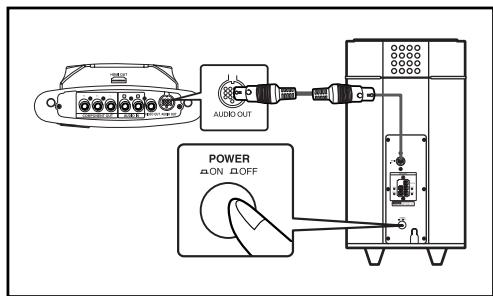
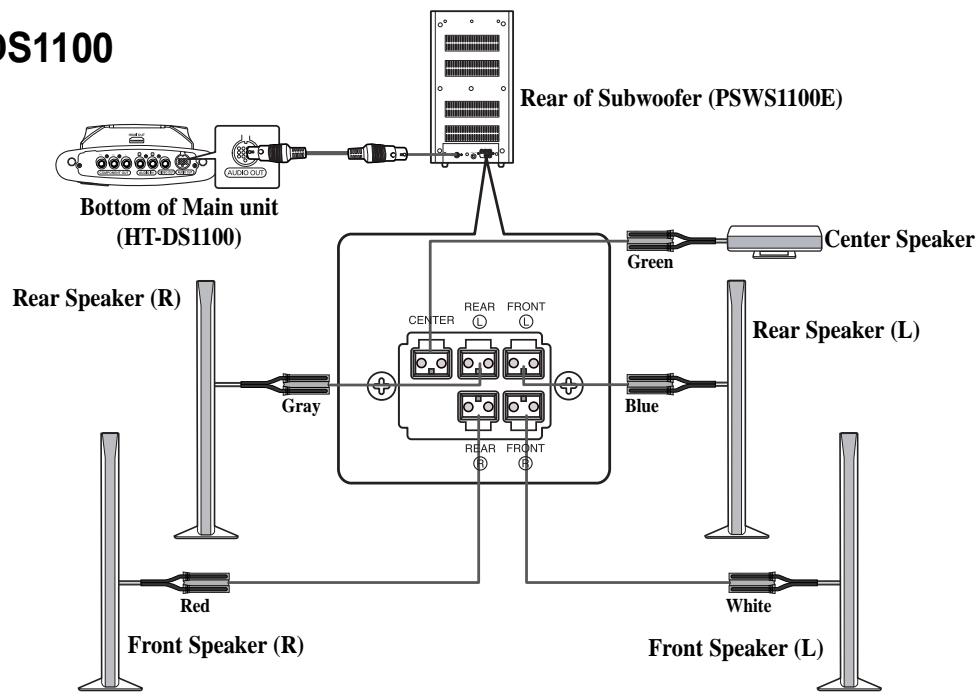
Connecting Main Unit to Subwoofer
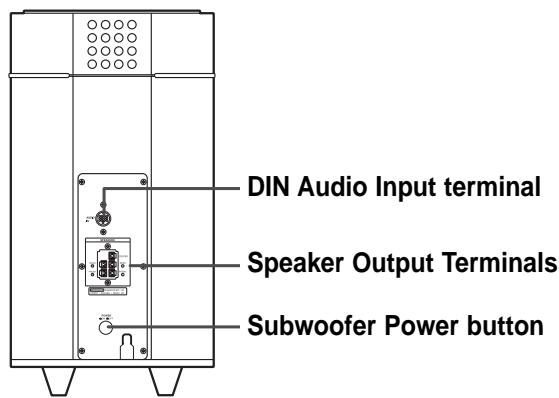
1 Use the supplied DIN audio connection cable to connect DIN Audio Out on the main unit to DIN Audio Input on the subwoofer.
2 Press the subwoofer power button on the subwoofer to turn on the power.
Subwoofer Function
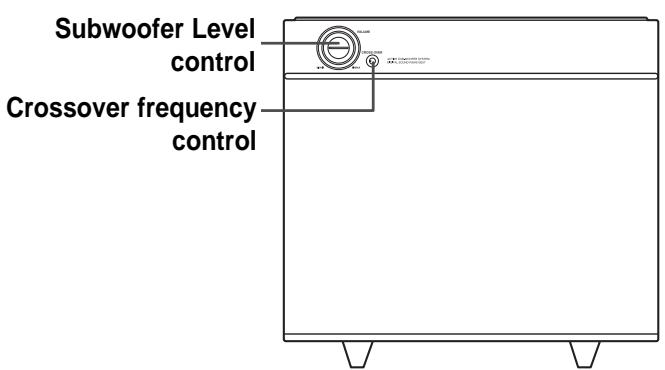
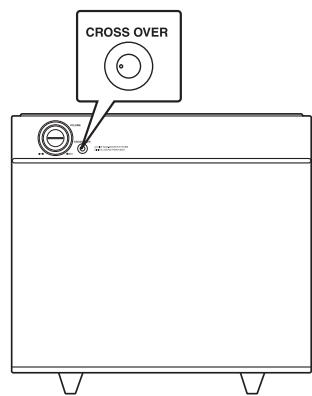
Subwoofer: The subwoofer is active, with a built-in a 150W amplifier, and outputs rich bass through 8 inch speaker units. You can listen to the optimal LFE (bass) by using the subwoofer-only volume control and the variable crossover control.
- The control is calibrated from -6dB (minimum) to +6dB (maximum).
Crossover: The Crossover sets the cutoff frequency for the subwoofer. Set the Crossover control for the best bass response in your room.
- You can adjust the bass or treble output from the front, rear, center speakers and the subwoofer.
- To the left increases the bass and to the right, treble.
HT-DS1100
Connecting the Speakers
1 Press down the terminal tab on the back of the speaker.
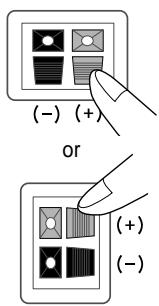
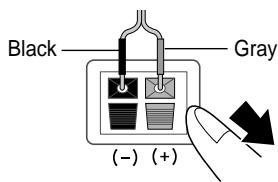
2 Insert the black wire into the black terminal (-) and the gray wire into the gray (+) terminal, and then release the tab.
3 Connect the correct color speaker cable to the same color speaker output terminal on the rear of the subwoofer, according to the polarity markings (+/-) .
Example: Connect the green center speaker cable to the green center speaker output terminal on the rear of the subwoofer according to the polarity markings (+ / - )
Caution
- Do not let children play with or near the speakers. They could get hurt if a speaker falls.
- When connecting the speaker wires to the speakers, make sure that the polarity (+ / -) is correct.
- Never touch the speaker terminal while the power is on. Doing so may result in a risk of electric shock.
Note
- If you place a speaker near your TV set, screen color may be distorted because of the magnetic field generated by the speaker. If this occurs, place the speaker away from your TV set.
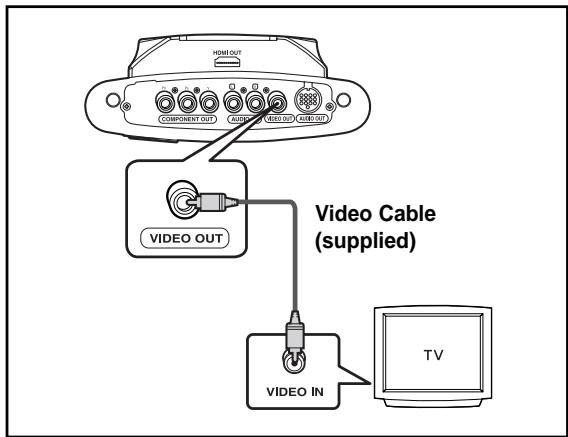
Method1
When you connect to Video Out
Good Quality
1 Connect the Video Out to the Video In on the TV.
2 Set the Video Input source on your TV to the corresponding Video output on your Home Theater.
Method 2
When you connect to Component Out Better Quality
Connect if the TV component input supports the resolution of over 576p(480p).
1 Connect the component output (PR, P_B,Y) to the component input on the TV (PR,P_B,Y)
- Be sure to make the correct connections between the when you connect the component output jacks to the TV. If these are connected wrong, the screen may show red or blue, or there may be no screen at all.
2 Set the Video Input source on your TV to the corresponding Component output on your Home Theater.
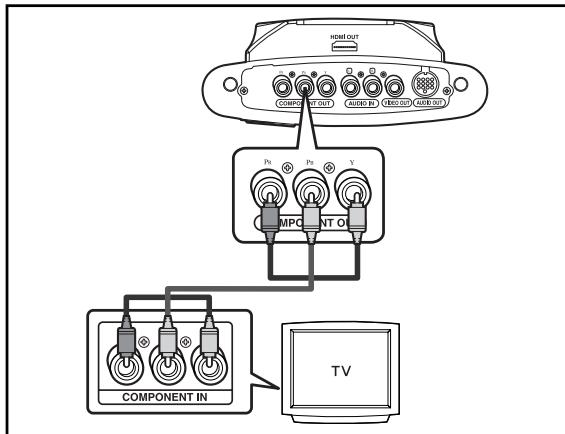
The Component input may be marked 'DVD input' depending on the TV.
Note
- If the TV only supports a resolution of 576i(480i), the screen may be divided into 2 screens, or display nothing.
Method 3
When you connect to HDMI Out
Best Quality
Connect if the TV has an HDMI (or DVI) In jack.
1 Connect the HDMI Out to the HDMI (or DVI) Input on the TV.
2 Set the Video Input source on your TV to the corresponding HDMI output on your Home Theater.
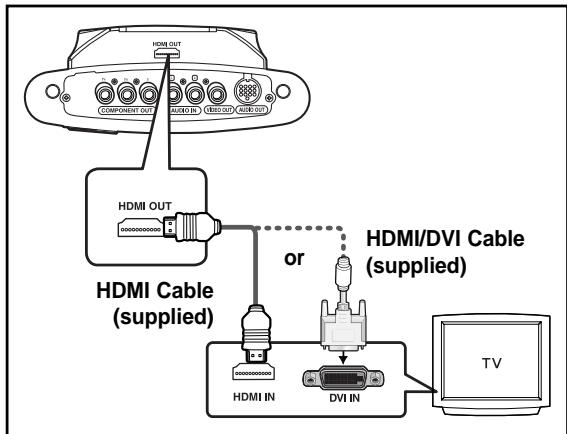
What is HDMI (High Definition Multimedia Interface)?
This device transmits DVD video and audio signals digitally without the process of converting to analog. You can get sharper digital pictures by connecting the video to the TV using an HDMI connection cable.
Note
- If you connect the HDMI and Component outputs (PR,PB,Y) at the same time, the Component output resolution changes automatically to the designated HDMI resolution.
Example: If the TV connected to HDMI can only support up to 576p(480p), the HDMI and Component outputs are all converted to 576p(480p), even if you select the resolution switch to 1080i. - Since this product has an embedded Video Upscaler function with Faroudja DCDi technology, it can enhance a 576i(480i) DVD resolution output to 576p(480p)/720p/1080i.
- You do not have to make separate adjustments, since the Home Theater and TV will be automatically adjust themselves to the optimal resolution and aspect ratio if connected to HDMI. (If the TV is an HDTV and has an HDMI Input jack, output is automatically converted to the resolution of 1080i.)
- Audio will not be output if decoder is not embedded in TV during 5.1 channel disk playback.
- Component output will give video in '576p(480p)' mode only during DVD disc playback applied with Macrovision.
- Macrovision processes scramble on analog output to prevent illegal recording. Accordingly, if you are using HDMI only, it can output 576p(480p)/720P/1080i, but is limited to 576p(480p) only if you are using component.
- When both HDMI connector and COMPONENT connector are connected, COMPONENT video is not displayed.
- See your TV owner's manual for more information on how to select the TV's Video Input source.
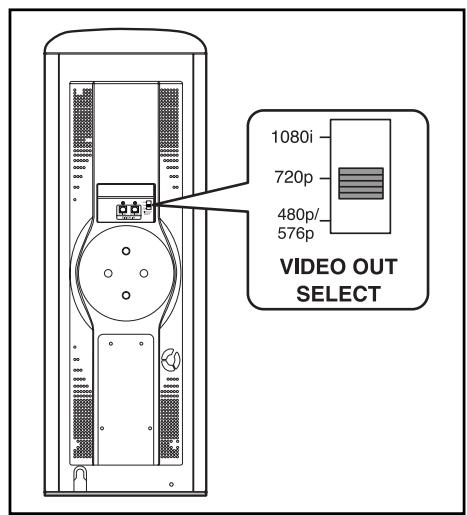
Selecting Resolution
You can adjust the resolution switch to set the HDMI and component (PR, PB, Y) output resolution to 576p(480p)/720p/1080i.
Example: If the TV supports resolution up to 576p(480p)
1 Set the resolution switch to 576p(480p).
- A 576p(480p) video signal is output through the HDMI and component outputs (PR,PB,Y)
Caution
- If you connect the HDMI and Component outputs (P,P,Y) at the same time, Component output resolution changes automatically to the designated HDMI resolution.
Note
- If copy protection is in place, output resolution is automatically converted to 576p(480p) when you play the DVD, even if you set the resolution to 720p or 1080i.
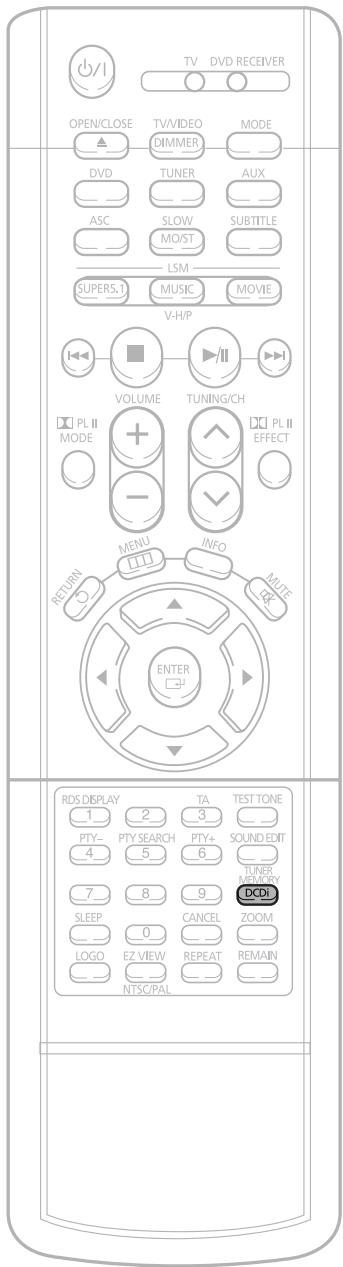
DCDi (Directional Correlational Deinterlacing) Function
Converts the interlace signal to progressive to prevent flickering and to remove distortion or noise on the edge of screen.
Press and hold DCDi button on the remote control for over 3 seconds.
- Each time the button is pressed, the selection alternates between DCDi ON and DCDi OFF.
Connecting an External Digital Component
Example: Digital signal components such as a Settop Box or CD Recorder.
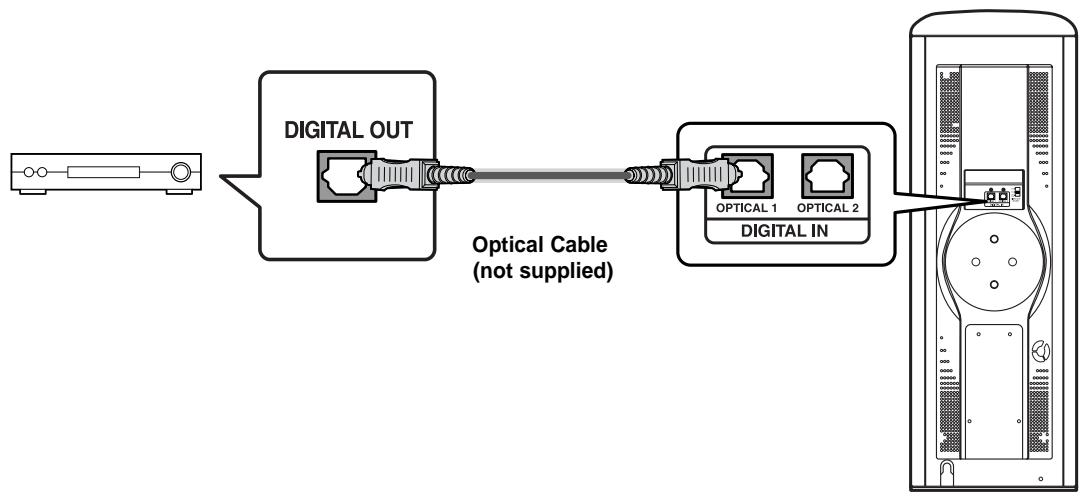
1 Connect the Digital In 1 or 2 (OPTICAL) on the main unit to the Digital Output on the external digital component.
2 Press AUX on the remote control to select 'D.IN 1 or D.IN 2'.
Each time the button is pressed, the selection changes as follows: D.IN 1 D.IN 2 AUX.
- You can also use the FUNCTION button on the main unit.
The mode switches as follows: DVD/CD D.IN 1 D.IN 2 AUX FM.
Cooling Fan
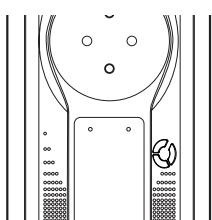
The cooling fan dissipates the heat generated inside the unit so that the unit can be operated normally. The cooling fan is activated automatically to supply cool air to the unit.
Please observe the following cautions for your safety.
- Make sure the unit is well-ventilated. If the unit has poor ventilation, the temperature inside the unit could rise and may damage it.
- Do not obstruct the cooling fan or ventilation holes. (If the cooling fan or ventilation holes are covered with a newspaper or cloth, heat may build up inside the unit and fire may result.)
Connecting an External Analog Component
Example: Analog signal components such as a VCR or TV.
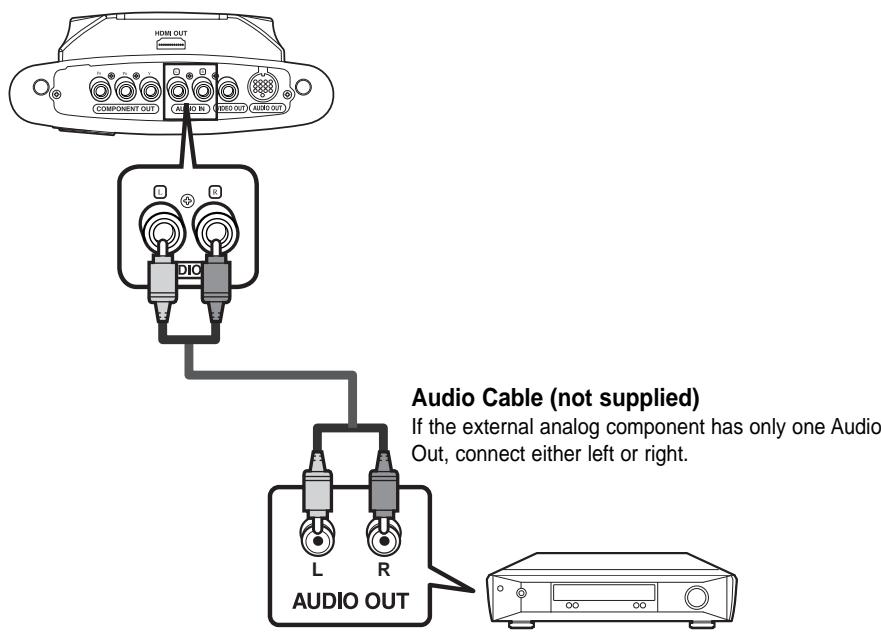
1 Connect Audio In on the main unit to Audio Out on the external analog component.
- Be sure to match connector colors.
2 Press AUX on the remote control to select AUX.
Each time the button is pressed, the selection changes as follows: D.IN 1 D.IN 2 AUX.
- You can also use the FUNCTION button on the main unit. The mode switches as follows: DVD/CD D.IN 1 D.IN 2 AUX FM.
Note
- To listen TV sound in 5.1 channel sound through the main unit, connect the Audio In on the main unit to the Audio Output on the TV.
- You can connect Video Output jack on the VCR to the TV, and connect Audio Output jack on the VCR to this product.
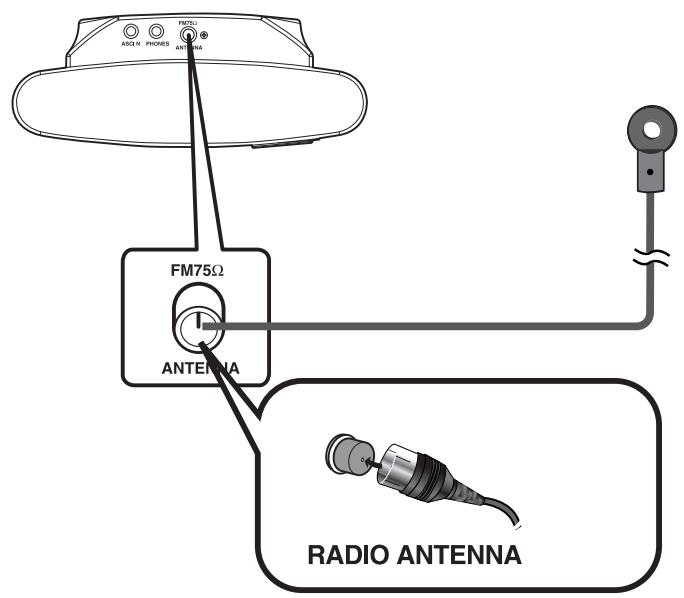
FM antenna connection
1 Connect the FM antenna supplied to the FM 75Ω COAXIAL terminal as a temporary measure.
2 Slowly move the antenna wire around until you find a location where reception is good, then fasten it to a wall or other rigid surface.
Selecting the Video Format
Press and hold NTSC/PAL button on the remote controller for over 5 seconds while the power is turned off.
- "NTSC" or "PAL" will appear in the display.
At this time, press the NTSC/PAL button shortly to select between "NTSC" and "PAL".
Each country has a different video format standard. - For normal playback, the video format of the disc must be the same as the video format of your TV.
Before Using Your DVD Player
Your DVD player is capable of playing DVD, VCD, CD, MP3 and JPEG discs. Depending on the disc you are using, these instructions may vary slightly. Read the instructions carefully before using.
Plug the power cord into the AC power supply.
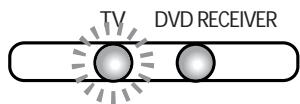
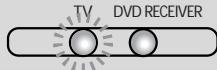
Press the MODE button so that the TV indicator on the remote control flashes.
3 Press the POWER button to turn on the TV.

4 Press TVVIDEO button to select VIDEO mode.
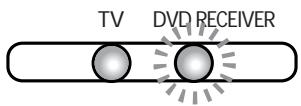
Press the MODE button so that the DVD RECEIVER indicator on the remote control flashes.
6 Press DVD button to select DVD/CD mode.
To Operate the TV and DVD Player with a Single Remote Control
Press MODE button.
Each time the button is pressed, the TV indicator (red) and the DVD Receiver indicator (green) will flash alternately.
- You can operate the TV while the TV indicator is flashing and the DVD player while the DVD indicator is flashing.
- Buttons Enabled for TV Operation: POWER, CHANNEL, VOLUME, TV/VIDEO and Numeric (0-9) buttons.
- By default, the remote control is set to work with Samsung TVs.
See page 77 for more information on the operation of the remote control.
Note
- If you move the product during playback, the disc may be damaged.
- If you push the disc window up or down by hand, it may cause a breakdown.
- Do not let children insert their fingers into the unit.
1 Press OPEN/CLOSE button to open the disc tray.
2 Insert the disc so that the printed side faces up.
3 Press OPEN/CLOSE button to close the disc window.
- The disc plays automatically when the disc window is closed.
- The disc menu may appear differently depending on the disc.
DVD
VCD
CD
- Playback starts automatically.
Note
- Depending on the content of the disc, the initial screen may appear different.
To stop playback, press STOP during playback.
- If pressed once, "PRESS PLAY" is displayed and the stop position will be stored in memory. If PLAY/PAUSE (▶II) button or ENTER button is pressed, playback resumes from the stop position. (This function works only with DVDs.)
- If pressed twice, "STOP" is displayed, and if PLAY/PAUSE (▶/II) button is pressed, playback starts from the beginning.
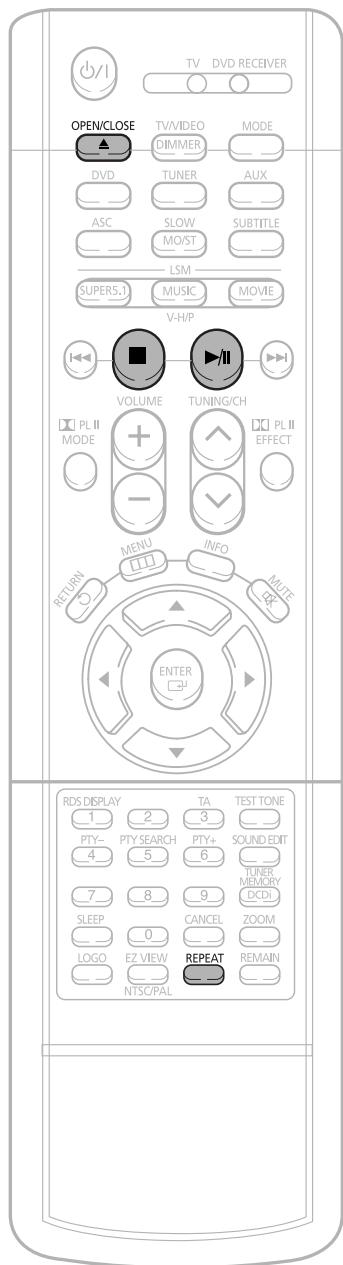
To temporarily pause playback,
press PLAY/PAUSE during playback.
- To resume playback, press PLAY/PAUSE (▶/II)
button again.
Disc terminology
Groups and tracks (DVD-AUDIO)
- DVD-audios is divided into several large sections called "groups" and smaller sections called "tracks". Numbers are allotted to these sections. These numbers are called "group numbers" and "track numbers".

Titles and chapters (DVD-VIDEO)
- DVD-videos is divided into several large sections called "titles" and smaller sections called "chapters". Numbers are allotted to these sections. These numbers are called "title numbers" and "chapter numbers".
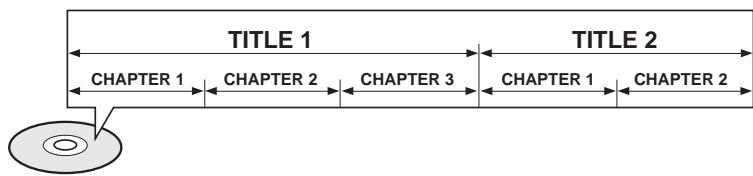
Tracks (Video and music CDs)
- Video and music CDs are divided into sections called "tracks". Numbers are allotted to these sections. These numbers are called "track numbers".

Note
- In this manual, the instructions marked with "DVD ( DVD)" are applicable to DVD-VIDEO, DVD-AUDIO, and DVD-R/RW discs. Where a particular DVD type is mentioned, it is indicated separately.
- Depending on the content of the disc, the initial screen may appear different.
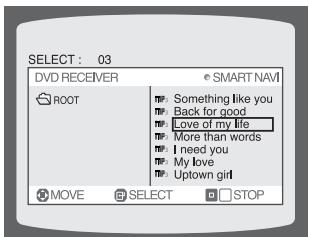
Press the OPEN/CLOSE button to open the disc tray, and then load the MP3 disc.
- The MP3 menu screen will appear and playback will start.
Depending on the MP3 disc, the appearance of the menu may be different.
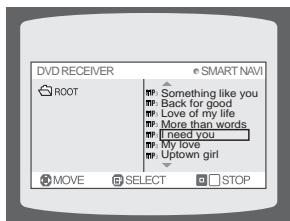
In Stop mode, use to select the album, and then press the ENTER button.
To change the album, use to select another album in Stop mode, and then press the ENTER button.
- To select another album and track, repeat Steps 2 and 3 above.
4 Press the STOP button to stop playback.
Note
- Depending on the recording mode, some MP3-CDs may not play.
- Table of contents of a MP3-CD varies depending on the MP3 track format recorded on the disc.
JPEG DiscPlayback
Images captured with a digital camera or camcorder, or JPEG files on a PC can be stored on a CD and then played back with this unit.
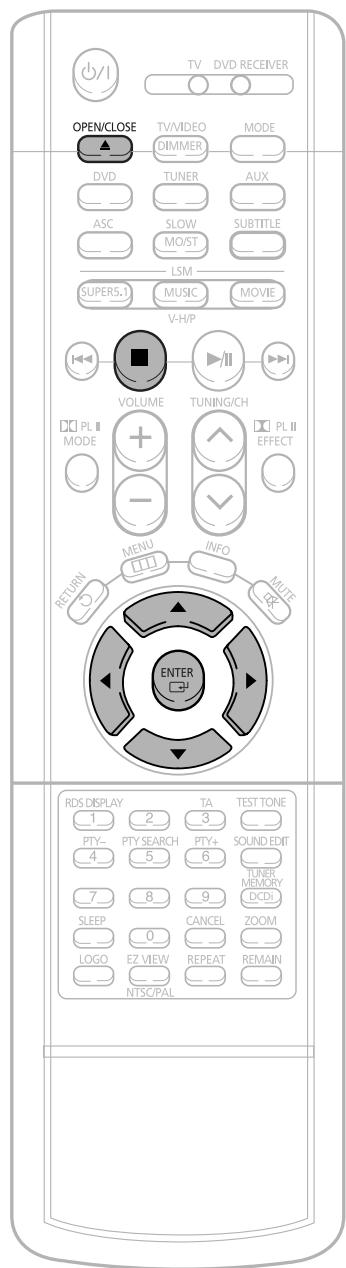
Press the OPEN/CLOSE button to open the disc windows, and then load the JPEG disc.
- Playback will start automatically and each image will show for 5 seconds before moving to the next image.
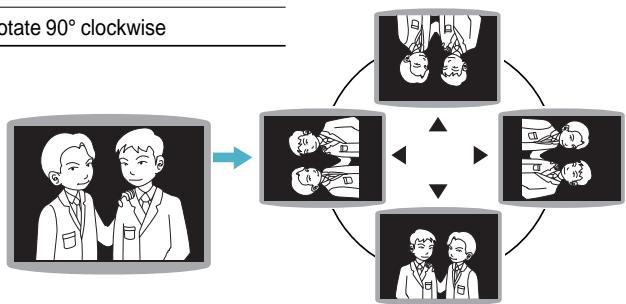
To rotate the image
During playback, press
Rotate vertically
Rotate horizontally

Skip Forward/Back
During playback, press the button.
- Go to the next file whenever you press▶▶I button, if there are over 2 files in the disk.
- Go to the previous file whenever you press 14 button, if there are over 2 files in the disk.

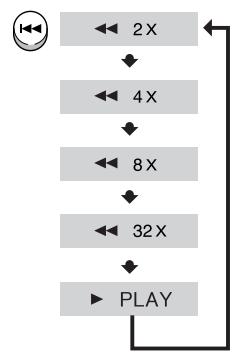
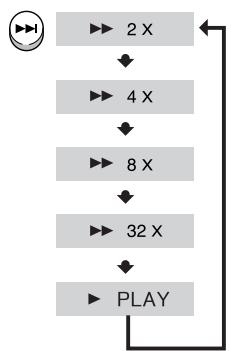
Fast playback
Press and hold 1 button.
Each time the button is held down during playback, the playback speed changes as follows:

Zoom Function
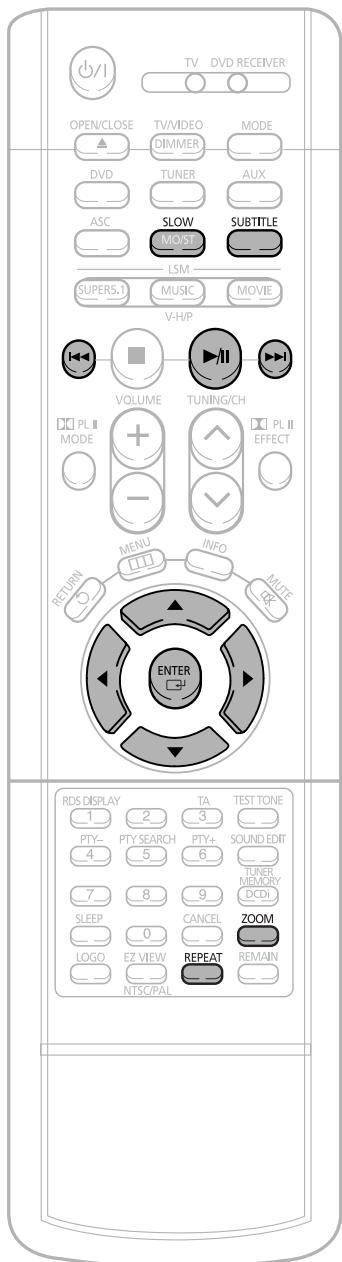
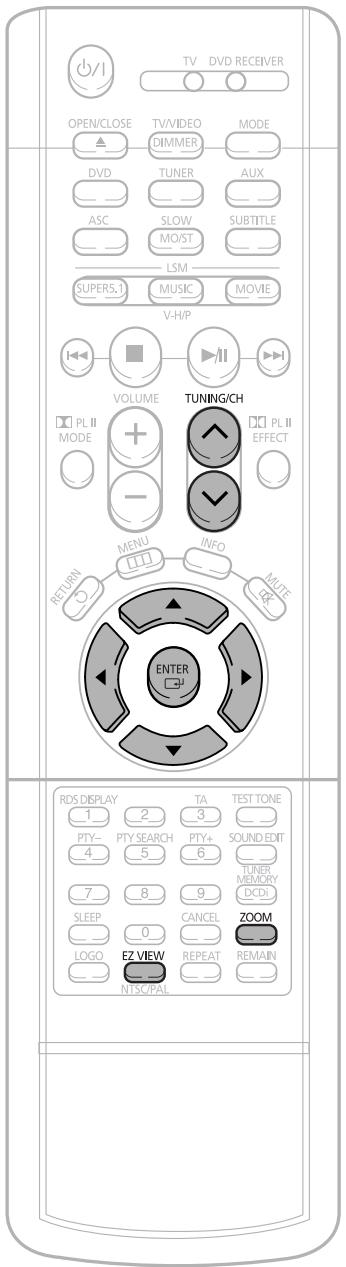
1 Press ZOOM button.
Each time you press the button, your selection will toggle between "ZOOM X2" and "ZOOM OFF".
Press Cursor▲,▼, <,▶ buttons to move to the area you want to enlarge.
During playback, press the , button.
- Go to the screen about 5 minutes after whenever you press▶ button.
- Go to the screen about 5 minutes earlier whenever you press button.

Subtitle Display
Press the SUBTITLE button.
- Each time you press the button, your selection will toggle between "SUBTITLE ON" (1/1, 1/2 ...) and "SUBTITLE OFF".
- If the disc has only one subtitle file, it will be played automatically.
If the disc has more than one subtitle file
If the disc has more than one subtitle file, the default subtitle may not match the movie and you will have select your subtitle language as follows:
1 In Stop mode, press the , , , button, select the desired subtitle ( ) from the TV screen, and then press the ENTER button.
2 When you select the desired DivX file from the TV screen, the movie will be played normally.
DivX Feature Table
Avi files are used to contain the audio and video data; these must be stored on CD in the ISO 9660 format.
DivX Supported
| SPEC | ||
| VIDEO Compatibility | DivX3.11 | Up to the latest VERSION |
| WMV | WMV V1/V2/V3/V7 | |
| Screen Size | 720~576 | |
| AUDIO Compatibility | MP3 | CBR : 80kbps~320kbps |
| AC3 | CBR : 128kbps~384kbps | |
| WMA | CBR : 56kbps~160kbps |
MPEGs containing DivX can be divided into Video and Audio.
- Video compatibility : All versions of DivX later than 3.11 (including the latest 5.1) are supported. In addition, XviD is supported. For WMV, V1, V2, V3, and V7 formats are possible.
- Audio compatibility: MP3s encoded at bitrates from 80kbps to 320kbps, AC3s from 128kbps to 384kbps, and WMAs from 56kbps to 160kbps are supported.
- In addition, for subtitles, this unit will support Text format (SMI).
Note
- When playing the DivX disk, you can play the file with extension of AVI only.
- Among the available DivX audio formats, DTS Audio is not supported.
- WMV V8 is not supported for WMV files.
- When burning a subtitle file to a CD-ROM with your PC, be sure to burn it as an SMI file.
DivX Disc does not playing when its sampling frequency is lower than 32kHz - Some of the discs recorded in DivX or XviD depending on the way of recording could be played back not correctly or couldn't be played back at all.
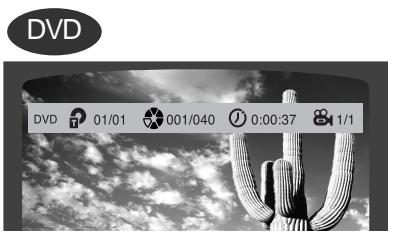
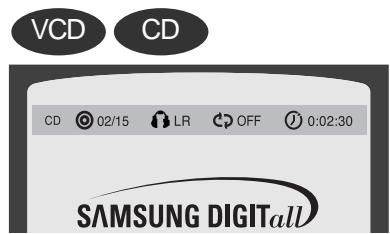
Press INFO button.
Each time the button is pressed, the display changes as follows:
0
0
Display disappears
Note
Depending on the disc, the disc information display may appear different.
Depending on the disc, you can also select DTS, DOLBY DIGITAL, or PRO LOGIC.
Display disappears
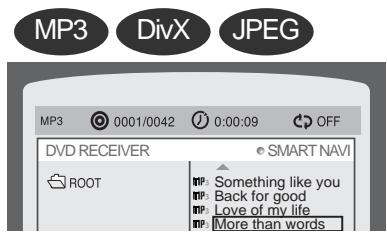
Display disappears
- appears on the TV screen!
If this symbol appears on the TV screen while buttons are being operated, that operation is not possible with the disc currently being played.
- What is a Group?
A movie contained in a DVD-AUDIO disc.
- What is a Title?
A movie contained in a DVD-VIDEO disc.
- What is a Chapter?
Each title on a DVD disc is divided into several smaller sections called "chapters".
- What is a Track (File)?
A section of video or a music file recorded on a DVD-AUDIO, CD, or MP3-CD.
Screen Display
DVD
DVD display

DivX display

CHAPTER display

REPEAT PLAYBACK display

LR STEREO (L/R) display
VCD
VCD display

DVD-AUDIO display

TRACK (FILE) display

AUDIO LANGUAGE display

DOLBY DIGITAL display
CD
CD display

TITLE display

ELAPSED TIME display

SUBTITLE display

ANGLE display
MP3
MP3 CD display

GROUP display
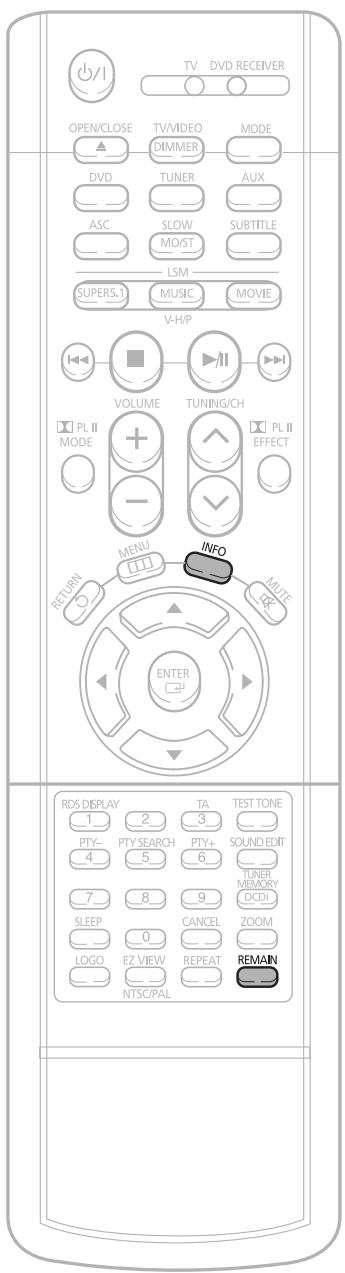
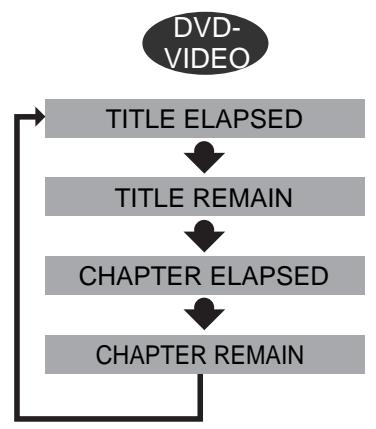
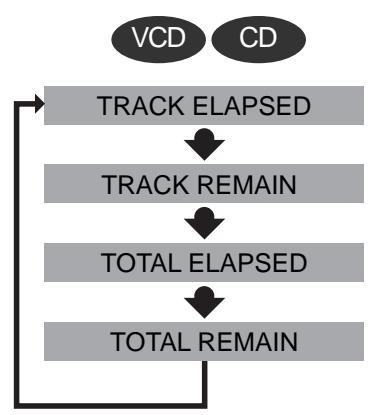
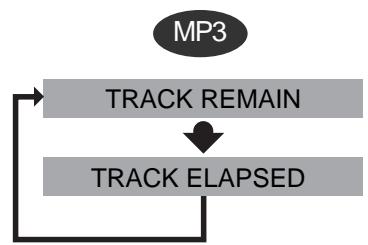
Press the REMAIN button.
- For checking the total and remaining time of a title or chapter being played.
Each time the REMAIN button is pressed


FastPlayback
DVD
VCD
CD
MP3
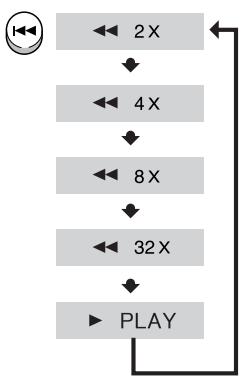
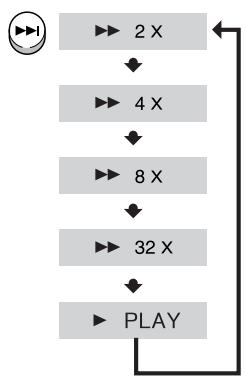
Press and hold
Each time the button is held down during playback, the playback speed changes as follows:

SlowPlayback
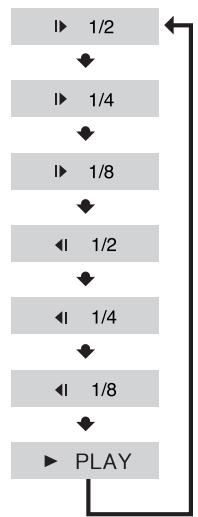
Press SLOW button.
Each time the button is pressed during playback, the playback speed changes as follows:
DVD
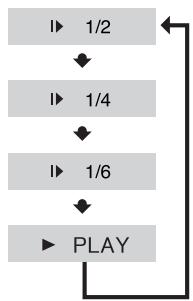
VCD
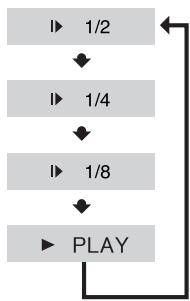
DivX
Note
- Reverse slow playback does not work with VCD and DivX.
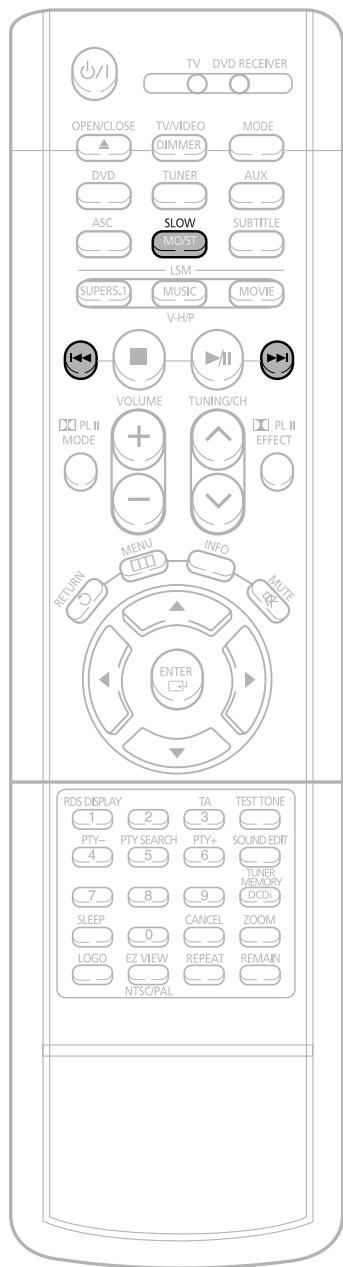
DVD VCD MP3
Briefly press
- Each time the button is pressed briefly during playback, the previous or next chapter, track, or directory (file) will be played.
DVD
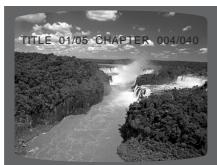
VCD


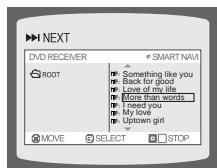
MP3

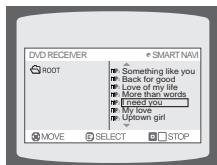

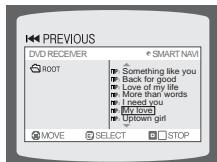
- When watching a VCD with a track longer than 15 minutes, each time is pressed, playback will skip back or forward 5 minutes.
Note
- During fast playback of a CD or MP3-CD, sound is heard only at 2x speed, and not at 4x, 8x, and 32x speeds.
- No sound is heard during slow playback and step motion playback.
DVD
VCD
CD
MP3
JPEG
Press REPEAT button.
- Each time the button is pressed during playback, the repeat playback mode changes as follows:
REPEAT: CHAPTER

DVDVIDEO
REPEAT : TITLE

REPEAT:OFF
REPEAT: RANDOM

JPEG
REPEAT:TRACK

REPEAT:DIR

REPEAT : DISC

REPEAT:OFF

REPEAT:TRACK

REPEAT:GROUP

REPEAT:OFF


REPEAT:TRACK

REPEAT : DISC

REPEAT : OFF


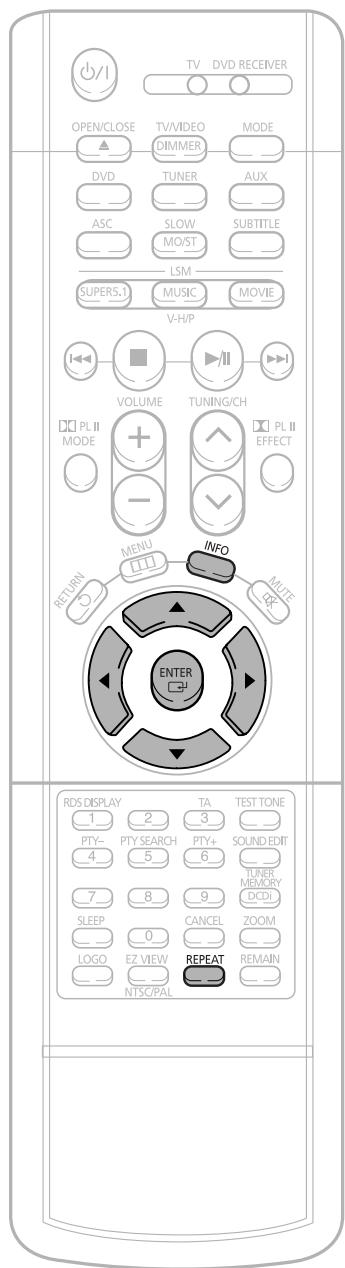
To Select a Repeat Playback Mode in the Disc Information Screen
1 Press INFO button twice.
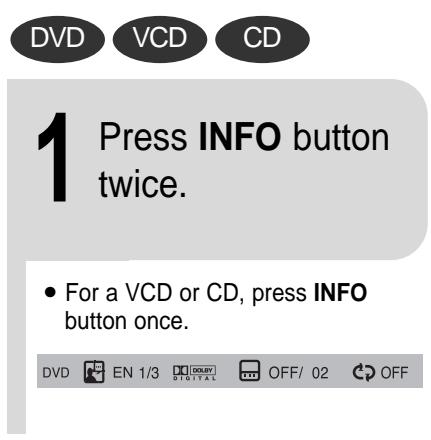
2 Press Cursor button to move to REPEAT PLAYBACK( ) display.
3 Press Cursor button to select the desired Repeat Playback mode.
4 Press ENTER button.
- For MP3 and JPEG discs, you cannot select Repeat Play from the information display screen.
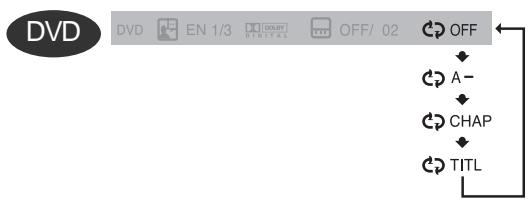

RepeatPlaybackOptions
- CHAPTER : Repeatedly plays the selected chapter.
- TITLE: Repeatedly plays the selected title.
- GROUP: Repeatedly plays the selected group.
- RANDOM: Plays tracks in random order. (A track that has already been played may be played again.)
- TRACK: Repeatedly plays the selected track.
DIR: Repeatedly plays all tracks in the selected folder. - DISC: Repeatedly plays the entire disc.
- OFF: Cancels Repeat Playback.
Note
- Repeat playback operation is not possible with version 2.0 VCD discs if PBC is turned on. To use Repeat Playback on a VCD with PBC, you should set the PBC to OFF in the disc menu. (See page 43.)
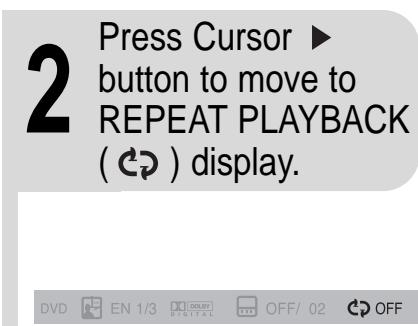
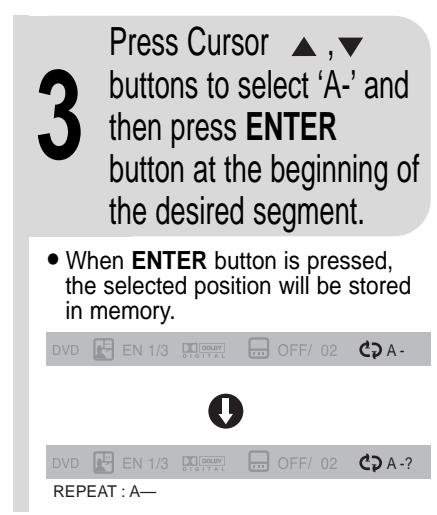
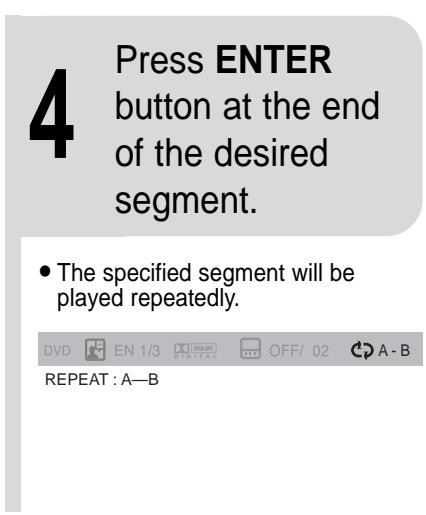
To return to normal playback, press Cursor , buttons to select OFF.
Note
- The A-B Repeat function will not work on an MP3 or JPEG disc.

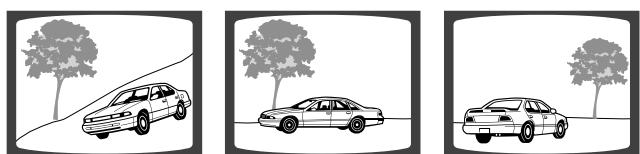
Angle Function
This function allows you to view the same scene in different angles.
DVD
1 Press INFO button.
DVD 01/01 001/040 0:00:37 1/3
Press Cursor button to move to ANGLE ( ) display.
DVD 01/01 001/040 0:00:37 1/3
3 Press Cursor , or numeric buttons to select the desired angle.
Each time the button is pressed, the angle changes as follows:
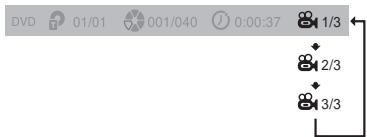
Note
- The Angle function works only with discs on which multiple angles have been recorded.

Zoom (Screen Enlarge) Function
DVD
VCD
1 Press ZOOM button.
Press Cursor , 2, buttons to move to the area you want to enlarge.
3 Press ENTER button.
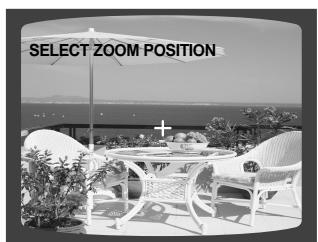
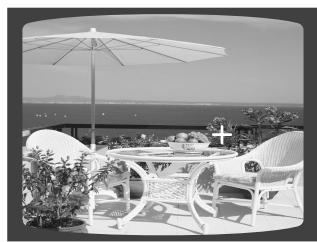
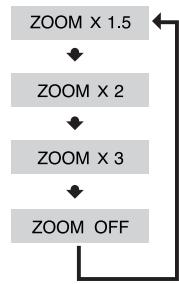
Each time the button is pressed, the zoom level changes as follows:

Aspect Ratio
DVD
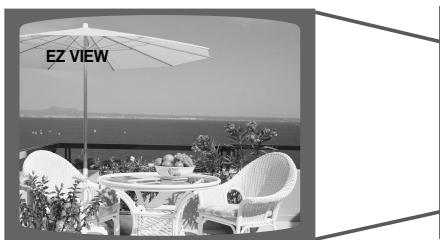
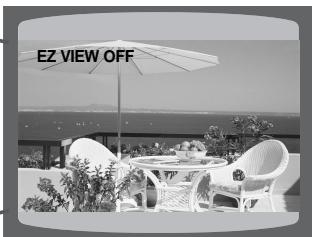
Press EZ VIEW button.
- Each time the button is pressed, the zoom function will switch between On and Off.
- When a movie is played in Widescreen format, black bars at the top and bottom of the TV screen can be removed by pressing the EZ VIEW button.
Note
- This function will not work if the DVD is recorded with multi-camera angle format.
- Black bars may not disappear because some DVD discs have a built-in horizontal to vertical ratio.

Bonus Group
DVD-AUDIO
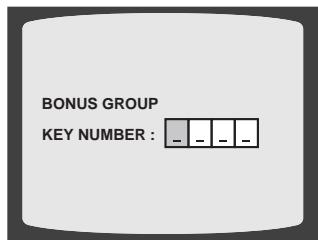
Some DVD-Audio discs have an extra 'bonus' group that requires a 4-digit key number to access. See the disc packaging for details and the-key number.
When you play a DVD-Audio disc that has a bonus group, the key number input screen appears automatically.
Note
- If you eject the disc, switch the power off, or unplug the player, you will need to re-enter the key number.

Navigating Pages
DVD-AUDIO
During playback, press the the remote control.

button on
- You can select the desired image from a DVD-Audio disc containing still images.
- With some discs, you may not be able to select images depending on how the disc was manufactured.

Audio Language Selection Function
DVD
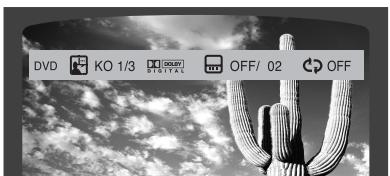
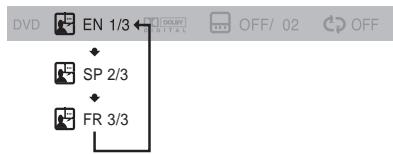
Press INFO button twice.
Press Cursor , buttons or numeric buttons to select the desired audio language.
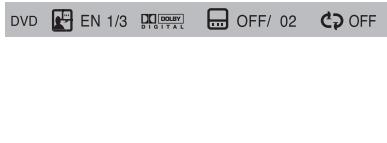
Depending on the number of languages on a DVD disc, a different audio language (ENGLISH, SPANISH, FRENCH, etc.) is selected each time the button is pressed.

Subtitle Language Selection Function
DVD
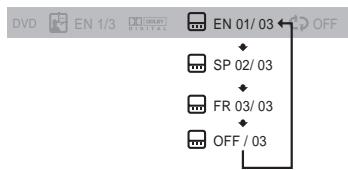
Press INFO button twice.
Press Cursor button to move to SUBTITLE ( l ) display.
DVD EN 1/3 OFF/02
DVD EN 1/3 OFF/02
Press Cursor button or numeric buttons to select the desired subtitle.
Note
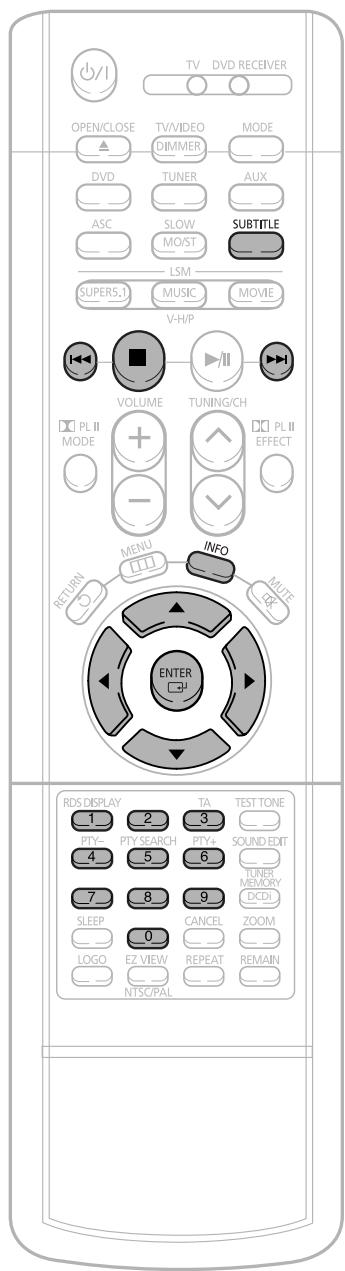
- You can use the SUBTITLE button on the remote control to select a subtitle language.
Depending on the disc, the Subtitle and Audio Language functions may not work.
DVD
VCD
CD
1 Press INFO button.
DVD 01/05 001/040 ① 0:00:37 1/1
Moving to a Title/Track
2
Press Cursor , buttons or numeric buttons to select the desired title/track and then press ENTER button.
DVD 03/05 001/002 ① 0:00:01 1/1
Moving to a Chapter
3
Press Cursor , buttons to move to Chapter ( ) display.
DVD 01/05 001/040 0:00:01 1/1
Moving to a Chapter
4
Press Cursor , buttons or numeric buttons to select the desired chapter and then press ENTER button.
DVD 01/05 025/040 0:00:01 81/1
Moving to a Specific Time
5
Press Cursor, buttons to move to time display.
DVD 01/05 025/040 1:17:30 1/1
Moving to a Specific Time
Press the numeric buttons to select the desired time and then press ENTER button.
DVD 01/05 028/040 1:30:00 1/1
MP3
JPEG
Press the numeric buttons.
- The selected file will be played.
- An MP3 or JPEG disc cannot be moved from the disc information screen.
- When playing an MP3 or JPEG disc, you cannot use , to move a folder. To move a folder, press (Stop) and then press , .
Note
- You can press on the remote control to move directly to the desired title, chapter, or track.
Depending on the disc, you may not be able to move to the selected title or time.
DVD
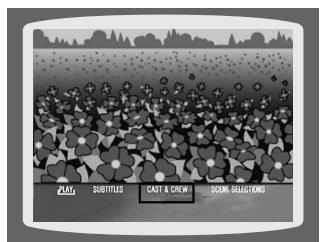
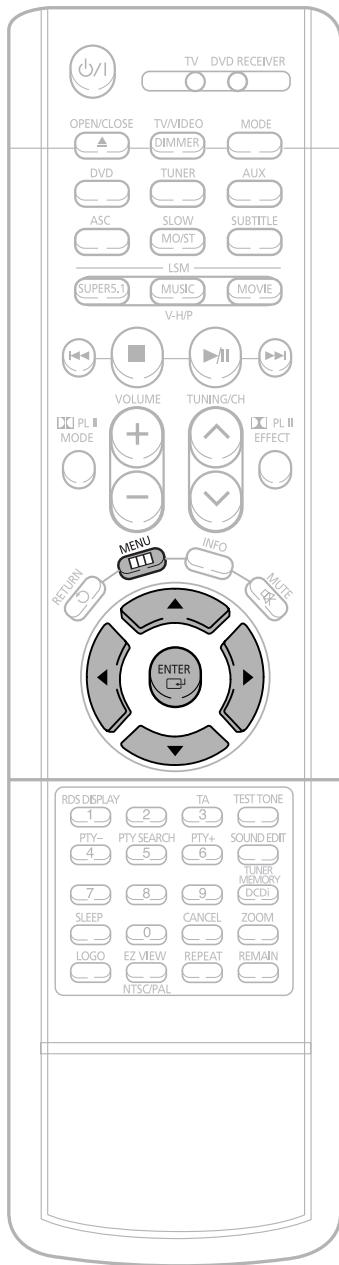
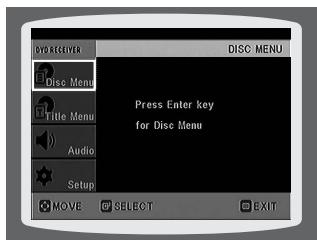
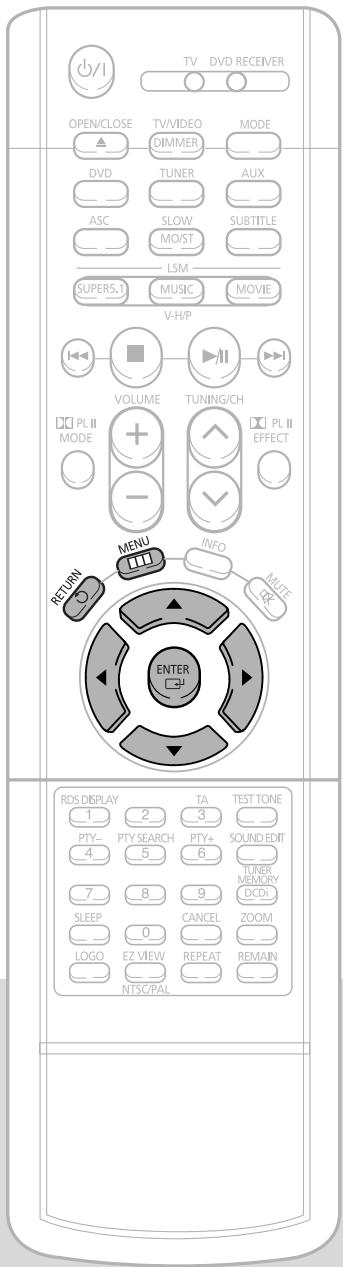
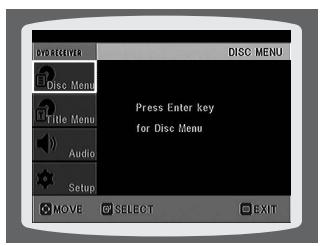
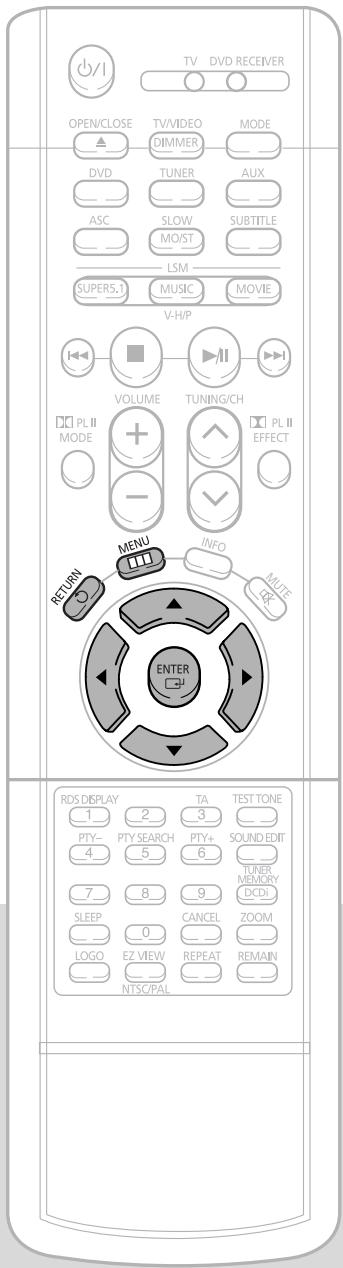
1 In Stop mode, press MENU button.
- When playing a VCD (version 2.), this toggles between PBC ON and OFF.
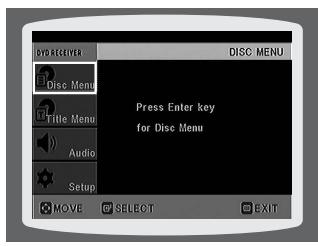
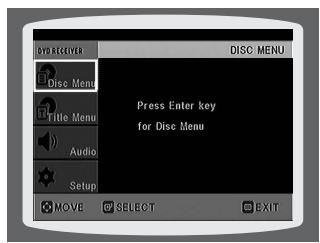
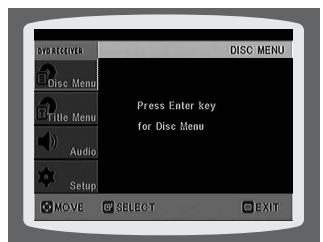
Press Cursor , 2 buttons to move to 'DISC MENU' and then press ENTER button.
- When you select the disc menu that is not supported by the disc, the "This menu is not supported" message appears on the screen.
Press Ctrl+Alt+Backspace to select the desired item.
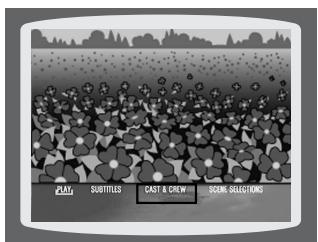
4 Press ENTER button.
Note
PBC (Playback Control) Function
Press the MENU button while VCD 2.0 version disk is played.
Each time you press the button, "PBC ON" and "PBC OFF" will be repetitively selected in the TV screen.
- PBC ON: This VCD disc is version 2.0. The disc is played back according to the menu screen.
Some functions may be disabled. When some functions are disabled, select "PBC OFF" to enable them. - PBC OFF: This VCD disc is version 1.1. The disc is played back in the same way as with a music CD.
Using the Title Menu
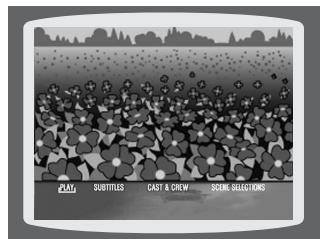
For DVDs containing multiple titles, you can view the title of each movie.
Depending on the disc, this function may either not work at all or may work differently.
DVD
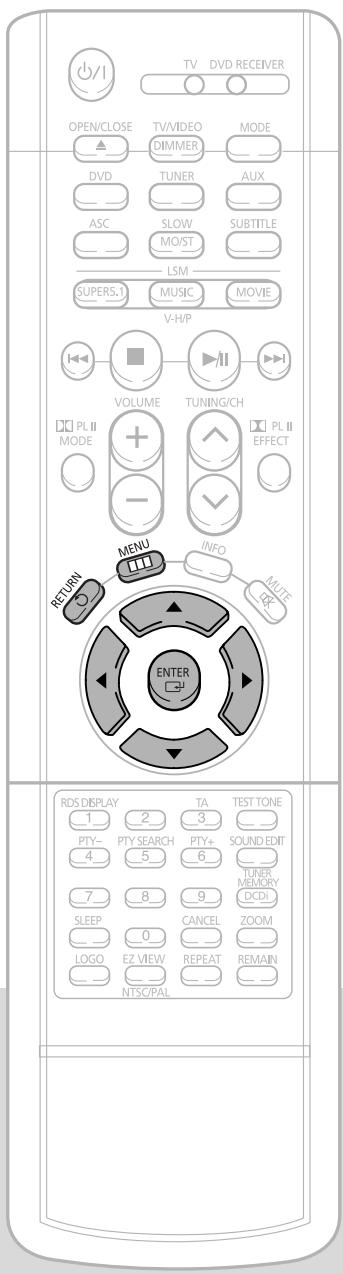
1 In Stop mode, press MENU button.
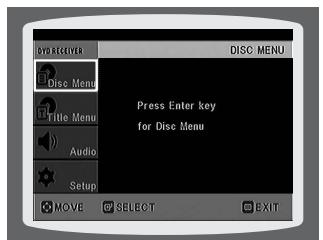
Press Cursor▲,▼ button to move to 'Title Menu'.
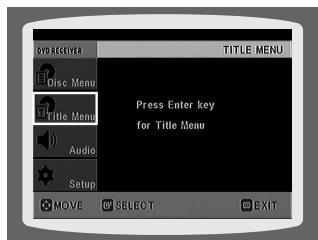
3 Press ENTER button.
- The title menu appears.
Press MENU button to exit the setup screen.
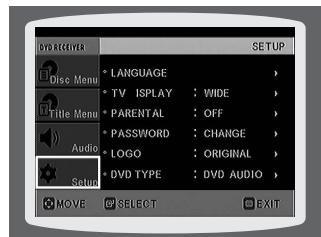
1 In Stop mode, press MENU button.
2
Press Cursor button to move to 'Setup' and then press ENTER button.
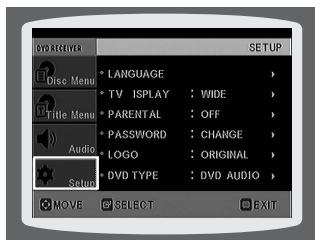
Press RETURN button to return to the previous level.
Press MENU button to exit the setup screen.
3 Press ENTER button.
4 button to select the desired item and then press ENTER button.
5 button to select the desired language and then press ENTER button.
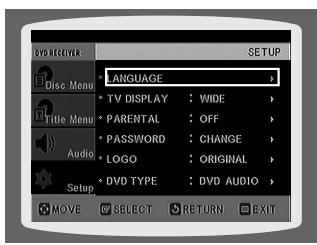
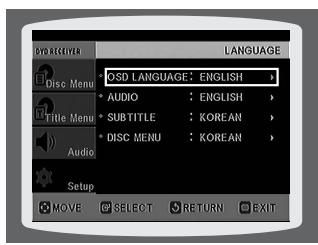
- Once the setup is complete, if the language was set to English, OSD will be displayed in English.
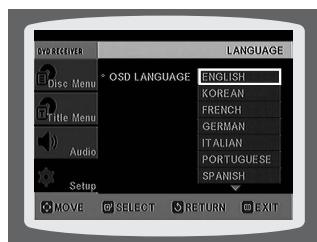
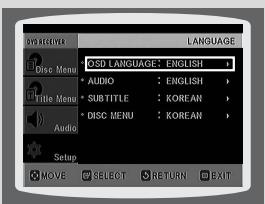
Selecting the OSD Language
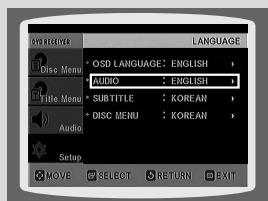
Selecting the Audio Language (recorded on the disc)
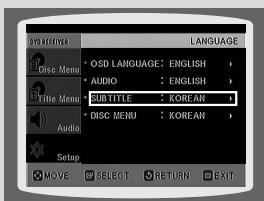
Selecting the Subtitle Language (recorded on the disc)
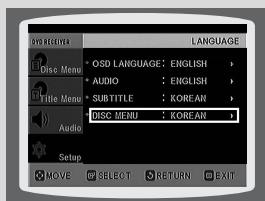
Selecting the Menu Language (recorded on the disc)
- If the language you selected is not recorded on the disc, menu language will not change even if you set it to your desired language.
Setting TV Screen type
Depending on your TV type (Wide Screen TV or conventional 4:3 TV), you can select the TV's aspect ratio.
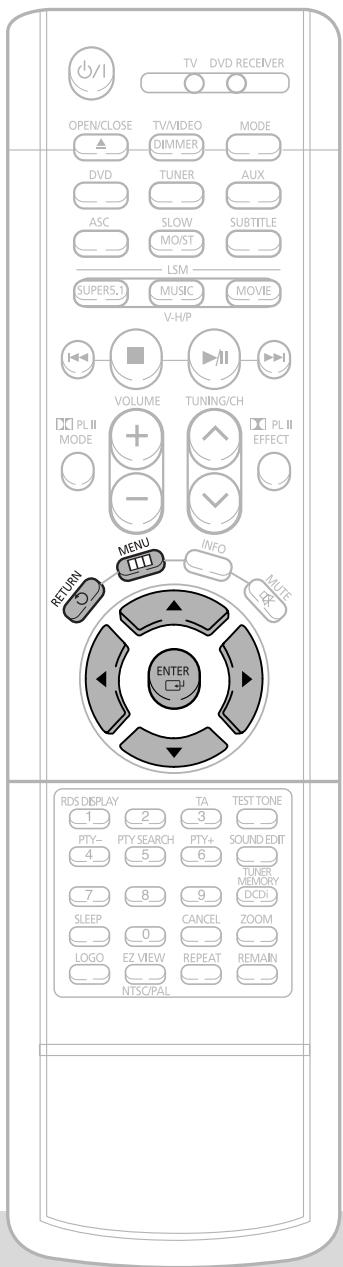
1 In Stop mode, press MENU button.
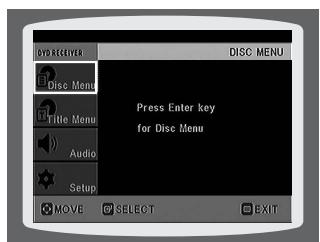
2 button to move to 'Setup' and then press ENTER button.
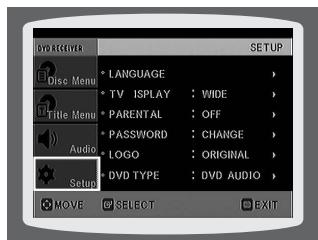
Press Cursor button to move to 'TV DISPLAY' and then press ENTER button.
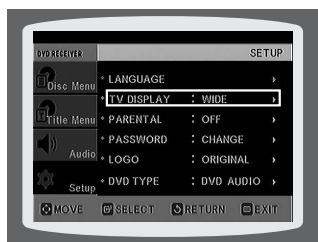
Press Cursor , button to select the desired item and then press ENTER button.
- Once the setup is complete, you will be taken to the previous screen.
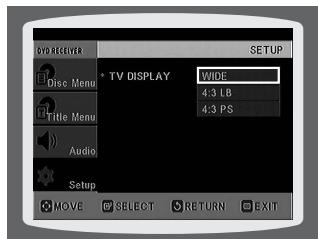
Press RETURN button to return to the previous level.
Press MENU button to exit the setup screen.
Adjusting the TV Aspect Ratio (Screen Size)
The horizontal to vertical screen size ratio of conventional TVs is 4:3, while that of wide screen and high definition TVs is 16:9. This ratio is called the aspect ratio. When playing DVDs recorded in different screen sizes, you should adjust the aspect ratio to fit your TV or monitor.
For a standard TV, select either "4:3LB" or "4:3PS" option according to personal preference. Select "16:9" if you have a wide screen TV.
WIDE
: Select this to view a 16:9 picture in the full-screen mode on your wide screen TV.
- You can enjoy the wide screen aspect.
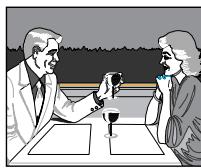
4:3LB (4:3 Letterbox)
: Select this to play a 16:9 picture in the letter box mode on a conventional TV.
- Black bars will appear at the top and bottom of the screen.
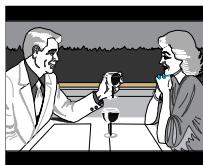
4:3PS (4:3 Pan&Scan)
: Select this to play a 16:9 picture in the pan & scan mode on a conventional TV.
- You can see the central portion of the screen only (with the sides of the 16:9 picture cut off).
Note
- If a DVD is in the 4:3 ratio, you cannot view it in wide screen.
- Since DVD discs are recorded in various image formats, they will look different depending on the software, the type of TV, and the TV aspect ratio setting.
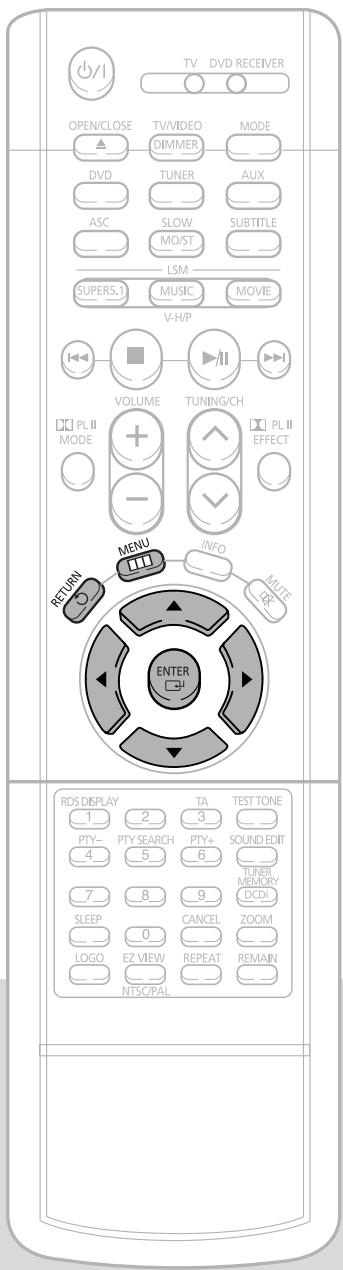
1 In Stop mode, press MENU button.
2
Press Cursor button to move to 'Setup' and then press ENTER button.
3
Press Cursor button to move to 'PARENTAL' and then press ENTER button.
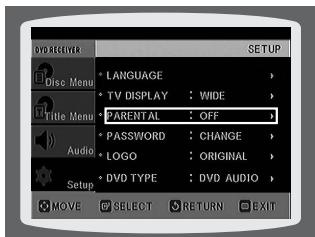
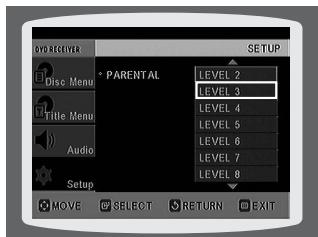
Press Cursor , button to select the desired rating level and then press ENTER button.
- If you have selected Level 6, you cannot view DVDs with Level 7 or higher.
- The higher the level, the closer the content is to violent or adult material.
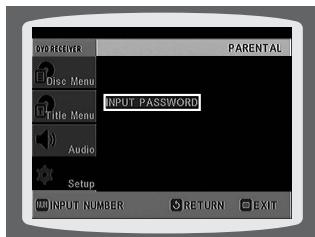
5 Enter the password and then press ENTER button.
- The password is set to "7890" by default.
- Once the setup is complete, you will be taken to the previous screen.
Note
- This function works only if a DVD disc contains the rating level information.
Press RETURN button to return to the previous level.
Press MENU button to exit the setup screen.
1 Press MENU button.
Press Cursor button to move to 'Setup' and then press ENTER button.
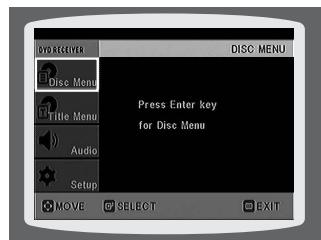
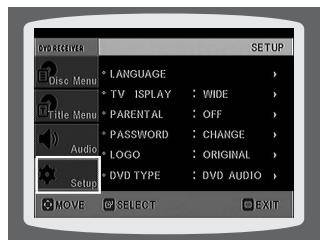
Note
- The password is set to "7890" by default.
3
Press Cursor button to move to 'password' and then press ENTER button.
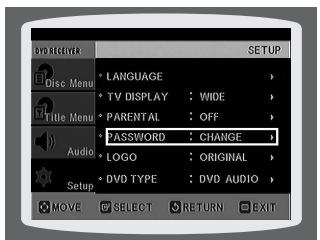
4 Press ENTER button.
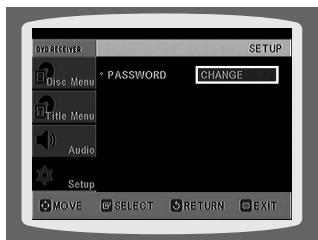
5 Enter the password and then press ENTER button.
- Enter the old password, a new password, and confirm new password.
- The setting is complete.
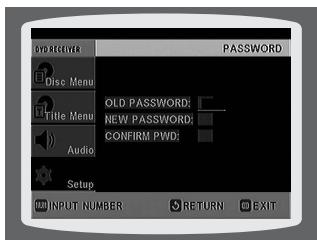
Press RETURN button to return to the previous level.
Press MENU button to exit the setup screen.

Setting the Wallpaper
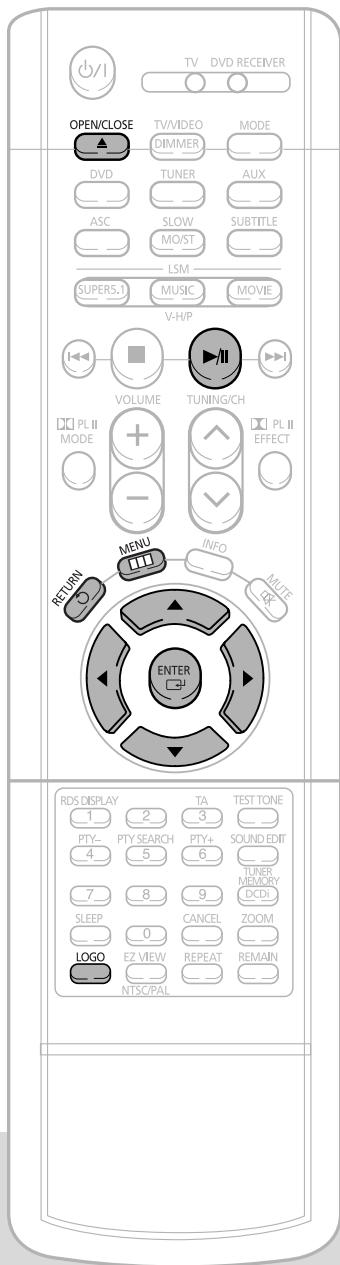
1 During playback, press PLAY/PAUSE button when an image you like appears.
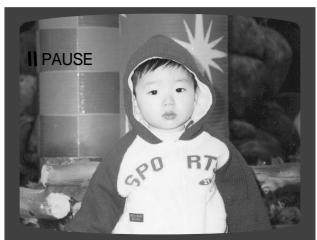
The power will turn off and then back on and the disc tray will open automatically.
- The selected wallpaper will be displayed.
Press LOGO button.
- "COPY LOGO DATA" will be displayed on the TV screen.
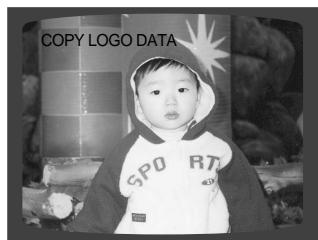
4 Press OPEN/ CLOSE to close the disc tray.
- You can repeat Steps 1 and 2 to set up to 3 wallpapers.
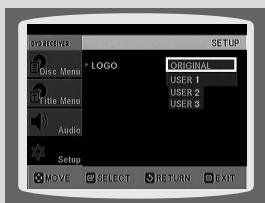
Select this to set the Samsung Logo image as your wallpaper.
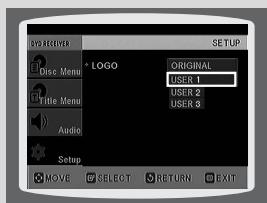
Select this to set the desired image as your wallpaper.

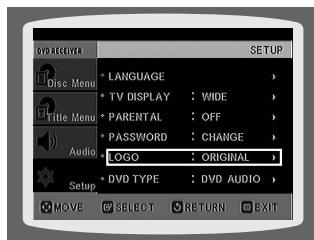
To Change the Wallpaper
1 In Stop mode, press MENU button.
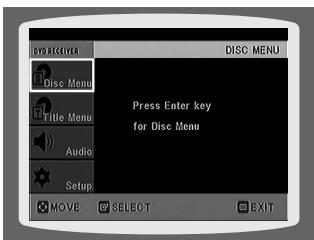
Press Cursor button to move to 'Setup' and then press ENTER button.
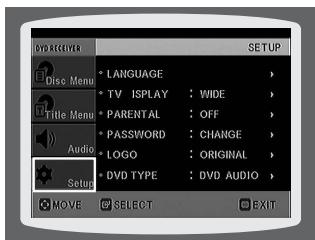
3
Press Cursor button to move to 'LOGO' and then press ENTER button.
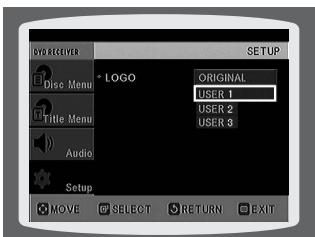
4
Press to select the desired 'USER', and then press ENTER.
5
Press MENU button to exit the setup screen.
Press RETURN button to return to the previous level.
Press MENU button to exit the setup screen.
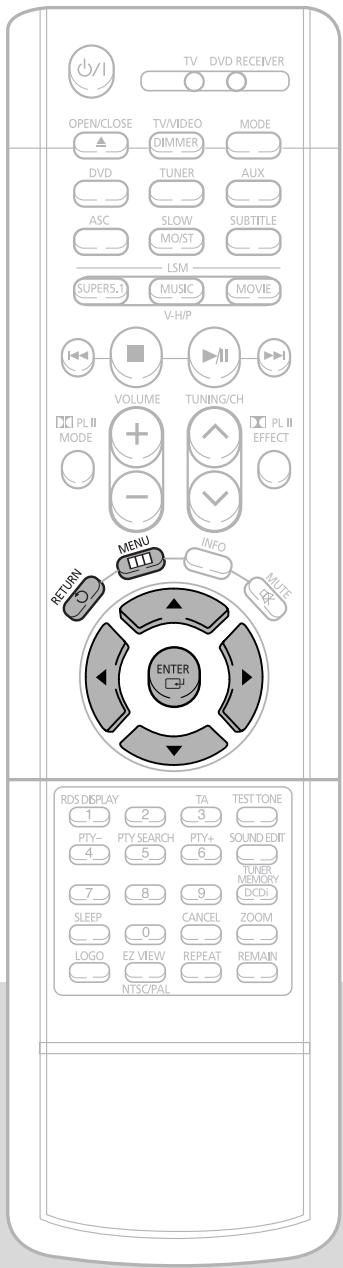
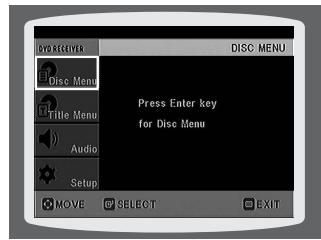
Press the MENU button while the disc tray is open.
2
Press Cursor button to move to 'Setup' and then press ENTER button.
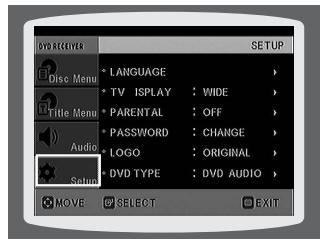
Note
DVD Play mode is set to DVD Audio as factory default setting.
3
Press Cursor button to move to 'DVD TYPE' and then press ENTER button.
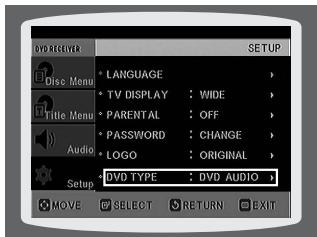
Press Cursor , button to move to DVDVIDEO' and then press ENTER button.
- Set steps 1 ~ 4 again if you want to switch to DVD AUDIO Play mode.
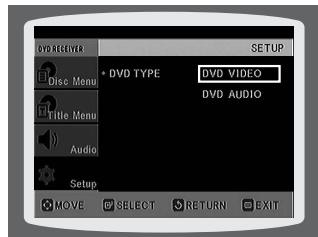
When Selecting DVD Play Mode:
DVDVIDEO: set to play the DVD video contents contained in DVD audio disc.
DVD AUDIO: set to play the default DVD audio.
Press RETURN button to return to the previous level.
Press MENU button to exit the setup screen.
Setting the Speaker Mode
Signal outputs and frequency responses from the speakers will automatically be adjusted according to your speaker configuration and whether certain speakers are used or not.
1 In Stop mode, press MENU button.
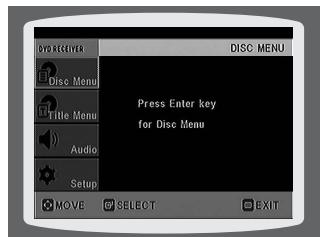
Press Cursor button to move to 'Audio' and then press ENTER button.
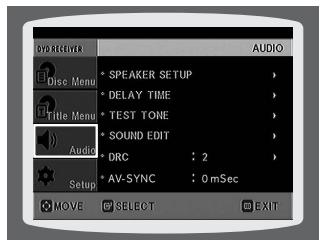
3 In the Speaker Setup, press the ENTER button again.
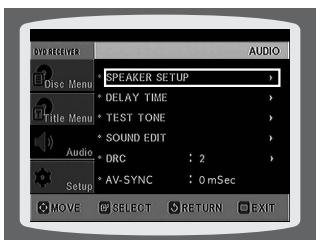
4 , buttons to move to the desired speaker and then press ENTER button.
- For C, LS, and RS, each time the button is pressed, the mode switches alternately as follows: SMALL NONE.
- For L and R, the mode is set to SMALL.
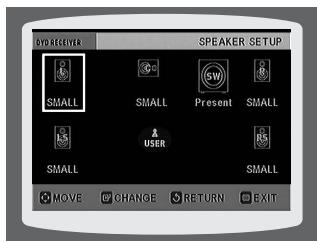
SMALL: Select this when using the speakers.
NONE: Select this when no speakers are installed.
Note
- Depending on PRO LOGIC and STEREO, the speaker mode may vary.
1 In Stop mode, press MENU button.
2 button to move to 'Audio' and then press ENTER button.
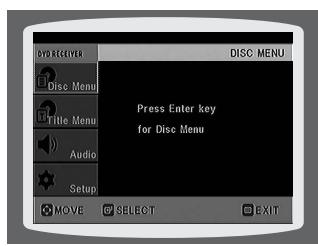
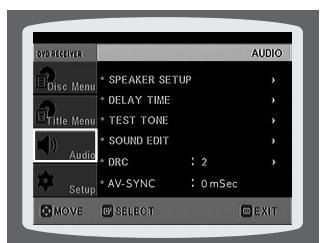
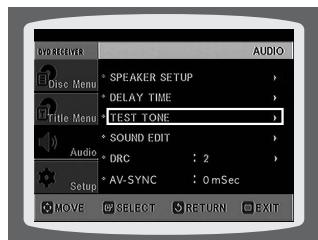
3 Press Cursor button to move to 'TEST TONE' and then press ENTER button.
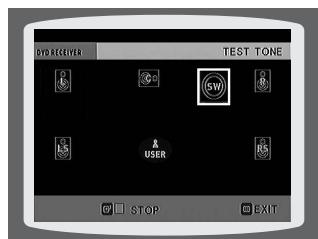
- The test tone will be sent to L C R RS LS SW in that order. If the ENTER button is pressed again at this time, the test tone will stop.
Press RETURN button to return to the previous level.
Press MENU button to exit the setup screen.
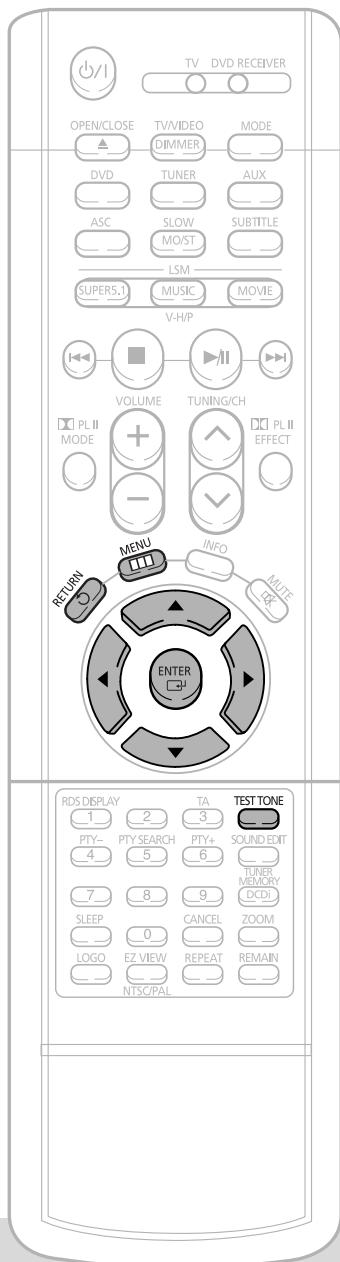
Alternate method: press the TEST TONE button on the remote.
L: Front Speaker (L)
C: Center Speaker
SW: Subwoofer
R: Front Speaker (R)
LS: Rear Speaker (L)
RS: Rear Speaker (R)
Press TEST TONE button.
- Test tone will be produced as follows: When playing a DVD or CD, this will work only in Stop mode.
- Use this function to check that each speaker is correctly connected and that there is no problem.
To end the test tone, press TEST TONE button again.
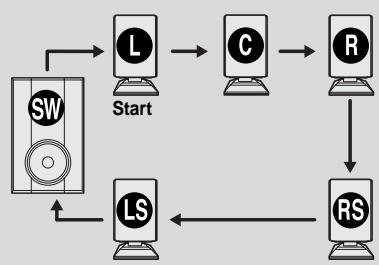
Multi-Channel Pro Logic Mode
Setting the Delay Time
If the speakers cannot be placed at equal distances from the listening position, you can adjust the delay time of the audio signals from the center and rear speakers.
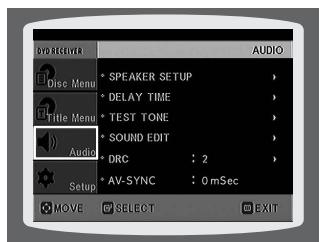
1 In Stop mode, press MENU button.
Press Cursor button to move to 'Audio' and then press ENTER button.
Setting up the Speaker Delay Time
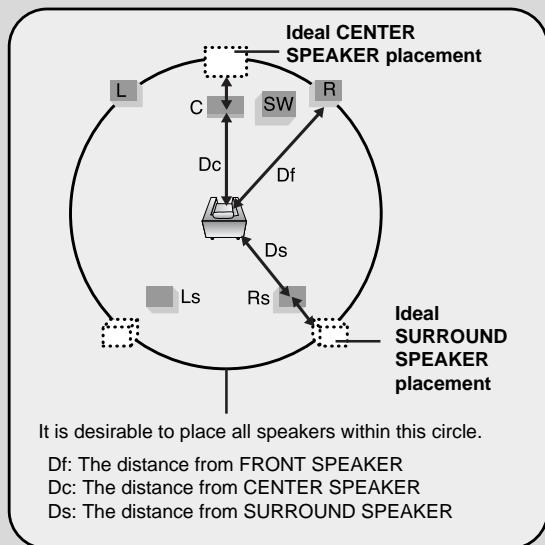
When 5.1CH Surround Sound is played, you can enjoy the best sound if the distance between you and each speaker is the same. Since the sounds arrive at the listening position at different times depending on the placement of speakers, you can adjust this difference by adding a delay effect to the sound of the Center Speaker and Surround Speakers.
Note
- With PL (Dolby Pro Logic II), the delay time may be different for each mode.
- With AC-3 and DTS, the delay time can be set between 00 and 15mSEC.
3
Press Cursor button to move to 'DELAY TIME' and then press ENTER button.
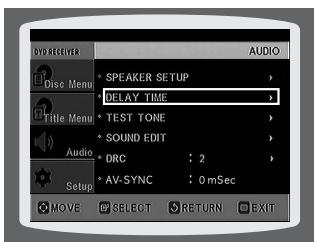
Press Cursor , 4 , buttons to move to the desired speaker and then press ENTER button.
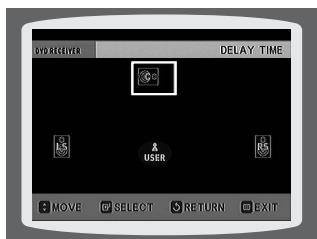
Press Cursor , to set the Delay time.
- You can set the delay time for C between 00 and 05mSEC and for LS and RS between 00 and 15mSEC.
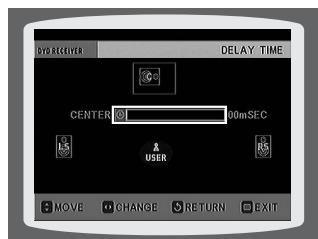
- Setting CENTER SPEAKER
If the distance of Dc is equal to or longer than the distance of Df in the figure, set the mode as 0ms. Otherwise, change the setting according to the table.
| Distance between Df and Dc | Delay Time |
| 0.00 m | 0 ms |
| 0.34 m | 1 ms |
| 0.68 m | 2 ms |
| 1.02 m | 3 ms |
| 1.36 m | 4 ms |
| 1.70 m | 5 ms |
- Setting REAR (SURROUND) SPEAKERS
If the distance of Df is equal to the distance of Ds in the figure, set the mode as 0ms. Otherwise, change the setting according to the table.
| Distance between Df and Ds | Delay Time |
| 0.00 m | 0 ms |
| 1.02 m | 3 ms |
| 2.04 m | 6 ms |
| 3.06 m | 9 ms |
| 4.08 m | 12 ms |
| 5.10 m | 15 ms |
Setting the Audio Quality
You can adjust the balance and level for each speaker.
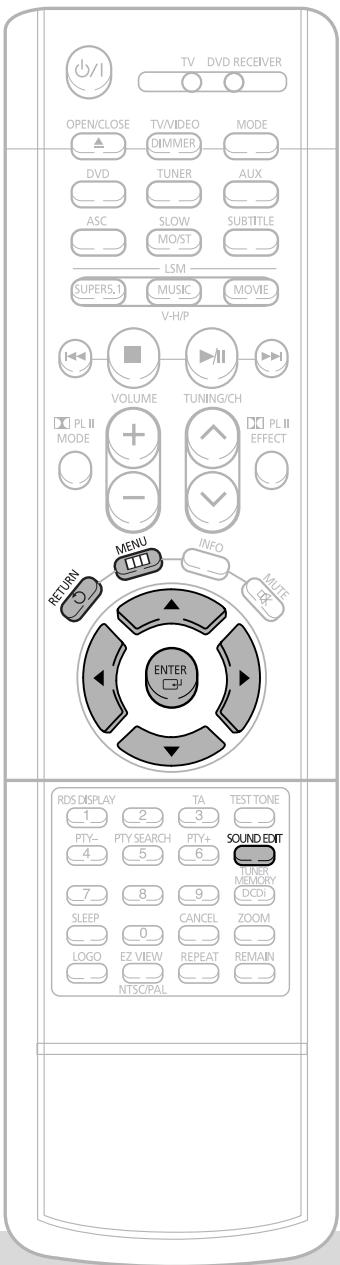
Method 1 When adjusting the audio quality using the setup screen
1 In Stop mode, press MENU button.
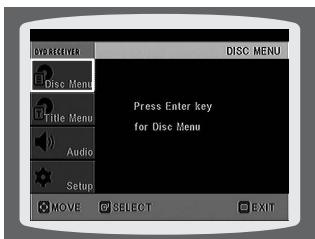
Press Cursor button to move to 'Audio' and then press ENTER button.
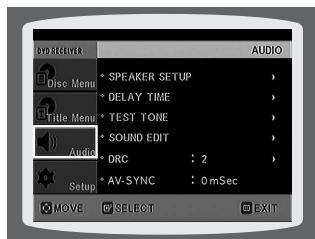
Press Cursor button to move to 'SOUND EDIT' and then press ENTER button.
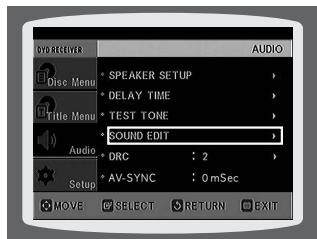
Press Cursor , buttons to select and adjust the desired item. Press the , buttons to adjust the settings.
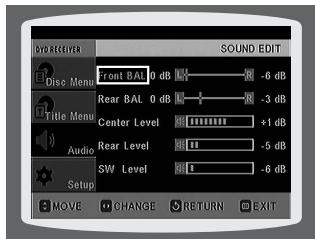
Press RETURN button to return to the previous level.
Press MENU button to exit the setup screen.
Method 2 When manually adjusting with the SOUND EDIT button
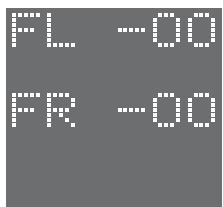
Adjusting Front Speaker Balance
1
Press SOUND
EDIT button and then press Cursor
A, ▶.
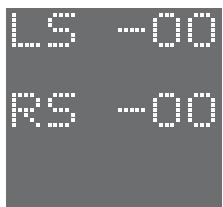
Adjusting Rear Speaker Balance
2
Press SOUND
EDIT button and then press Cursor
A,
Adjusting Center Speaker Level
3
Press SOUND
EDIT button and then press Cursor
A, ▶.
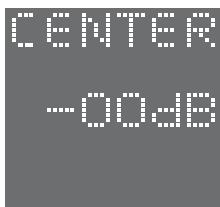
Adjusting Rear Speaker Level
4
Press SOUND
EDIT button and then press Cursor
,
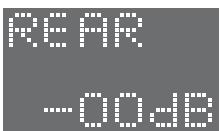
Note
- The adjustments will appear on the main unit, not on your TV screen.
Adjusting Front/Rear Speaker Balance
- You can select between 00 and -06 and OFF.
- The volume decreases as you move closer to -6 .
Adjusting Center/Rear/Subwoofer Speaker Level
- You can adjust volume level from -6dB to +6dB.
- The sound gets louder as you move closer to +6dB and quieter as you get closer to -6dB.
1 In Stop mode, press MENU button.
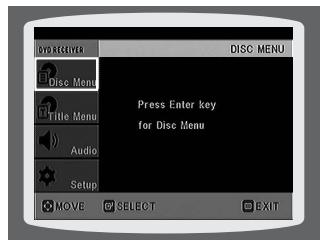
Press Cursor button to move to 'Audio' and then press ENTER button.
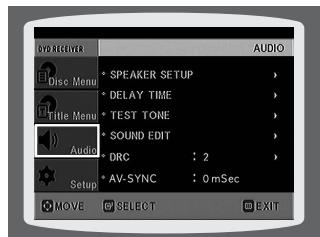
Press Cursor button to move to 'DRC' and then press ENTER button.
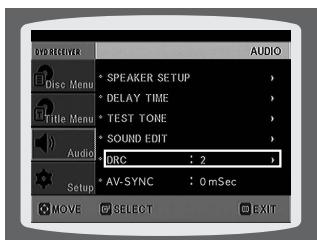
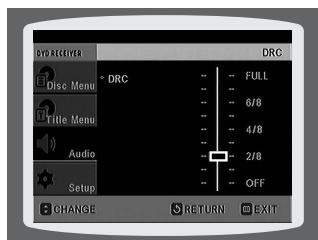
4 Press Cursor ▲,▼ to adjust the 'DRC'.
- Pressing the Cursor button increases the compression, and pressing the Cursor reduces it.
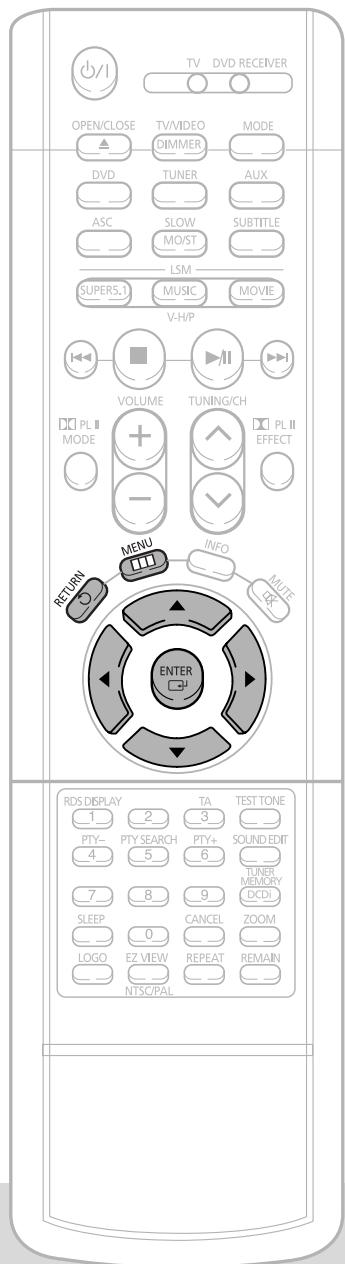
Press RETURN button to return to the previous level.
Press MENU button to exit the setup screen.
AV SYNC Setup
Video may lag behind the audio if the unit is connected to a digital TV. If this occurs, adjust the audio delay time to sync up with the video.
1 Press the MENU button.
- Setup menu appears.
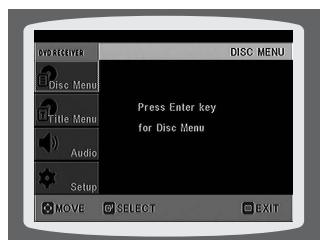
Press Cursor , buttons to move to Audio' and then press ENTER button.
- 'Audio' menu appears.
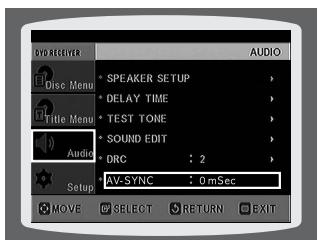
Press Cursor , buttons to move to 'AV-SYNC' and then press ENTER button.
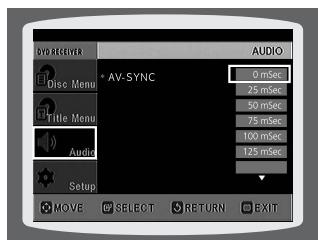
- AV-SYNC screen appears.
Press Cursor , buttons to select the Delay Time of AV-SYNC and then press the ENTER button.
- You can set the audio delay time between 0 ms and 300 ms. Set it for the best sync up with audio.
Press RETURN button to return to the previous level.
Press MENU button to exit the setup screen.
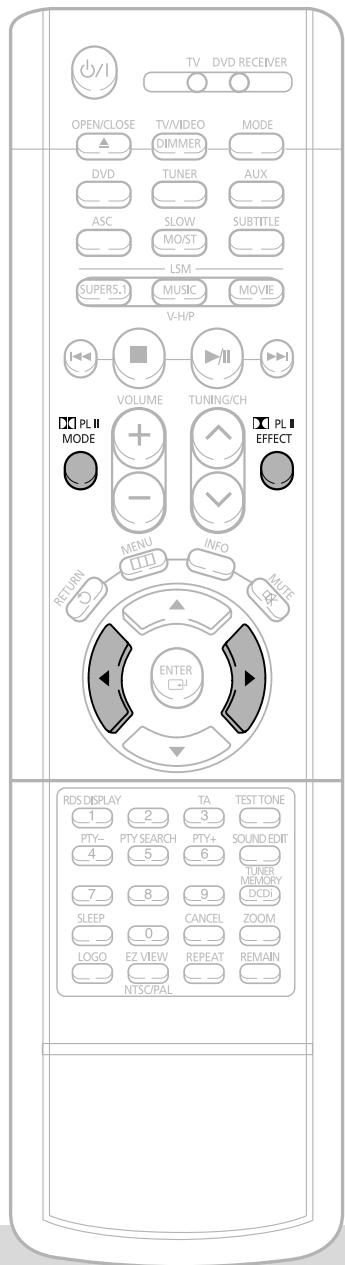
Press PL II MODE button.
Each time the button is pressed, the mode changes as follows.
PRO LOGIC II
- MUSIC: When listening to music, you can experience sound effects as if you are listening to the actual performance.
- CINEMA : Adds realism to the movie soundtrack.
- PRO LOGIC: You will experience a realistic multi-channel effect, as if using five speakers, while using just the front left and right speakers.
- MATRIX: You will hear 5.1 channel surround sound.
- STEREO : Select this to listen to sounds from the front left and right speakers and the subwoofer only.
Note
- When selecting Pro Logic II mode, connect your external device to the AUDIO INPUT jacks (L and R) on the player. If you connect to only one of the inputs (L or R), you cannot listen to 5.1 channel surround sound.
Press PL II MODE button to select 'MUSIC' mode.
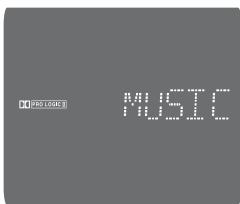
Press PL II EFFECT button and then press Cursor , buttons to select the mode.
- You can select either 0 or 1.
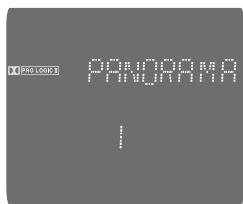
Press PL II EFFECT button and then press Cursor , buttons to select the mode.
- You can select between 0 and 7.
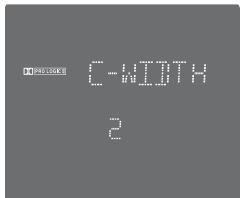
4 Press PL II EFFECT button and then press Cursor , buttons to select the mode.
- You can select between 0 and 6.
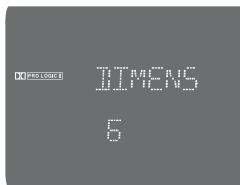
Note
-
When playing a DVD disc encoded with two or more channels, multi-channel mode will be selected automatically and DIDL (Dolby Pro Logic II) button does not work.
-
PANORAMA: This mode extends the front stereo image to include the surround speakers for an exciting "wraparound" effect with side wall imaging.
- CENTER WIDTH: Sound is output to the center speaker only. The front left and right speakers produce phantom sound.
- DIMENSION: Incrementally adjusts the sound field (DSP) from the front or rear.
Auto Sound Calibration Setup
- This function is available only for DVD/CD playback.
Auto Sound Calibration
By setting the auto sound calibration function just once when you relocate or install the unit, you can have the unit automatically recognize the distance between speakers, levels between channels, and frequency characteristics to create 5.1-channel sound field optimized for the listener's environment.
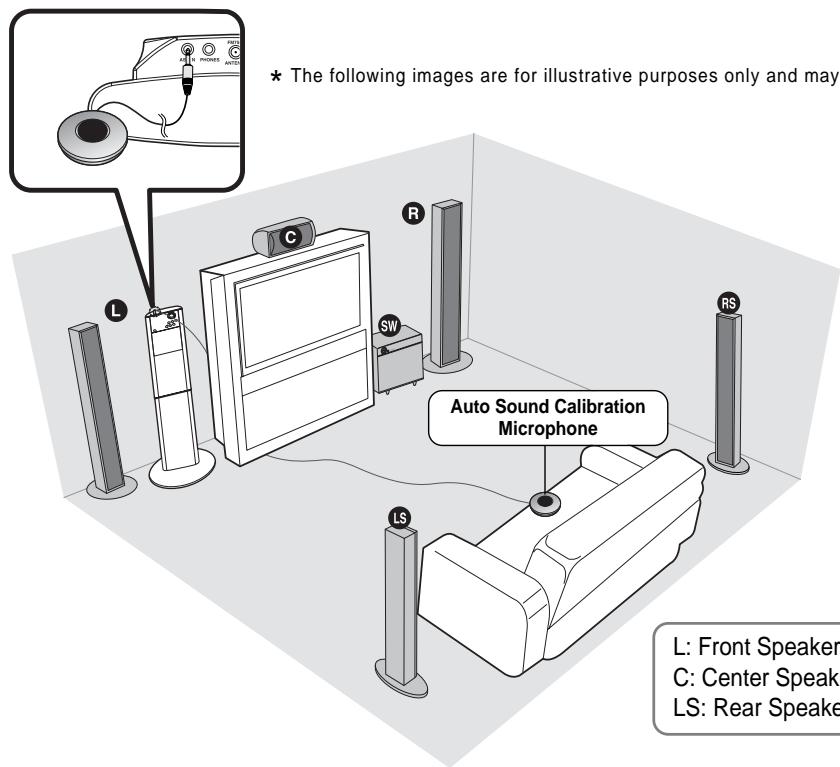
L: Front Speaker (L)
C: Center Speaker
LS: Rear Speaker (L)
R: Front Speaker (R)
SW: Subwoofer
RS: Rear Speaker (R)
Note
- If you purchased the unit for the first time or initialized it, pressing the Auto Sound Calibration button without connecting the auto sound calibration microphone will display the message "PLEASE SET ASC FUNCTION FIRST" in the display.
- Because the volume level of the tone is fixed during the auto sound calibration setup, you cannot adjust the volume using the volume control buttons.
- If the auto sound microphone is disconnected during the auto sound calibration setup, the setup will be cancelled.
To Turn the Sound Logo On/Off
When you turn on the power, the unit produces a sound logo after the disc is read to notify that the unit is optimized for playback.
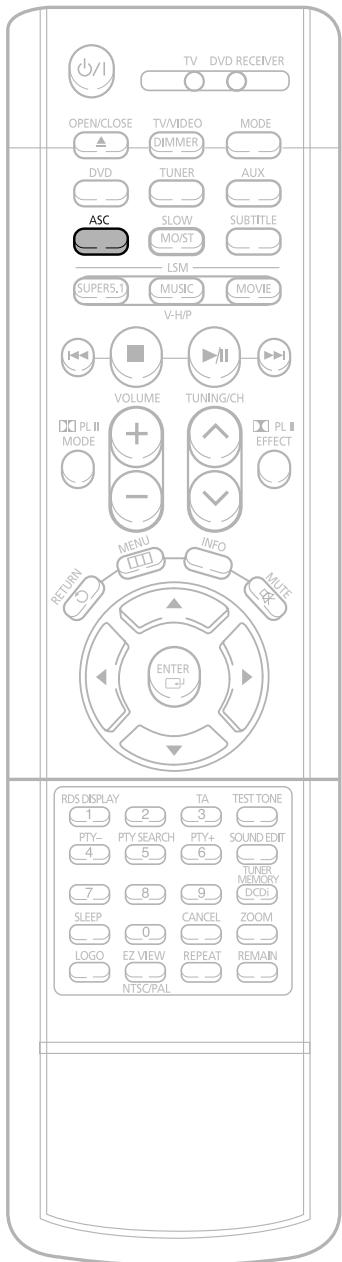
1 Press and hold ASC button.
- "S.LOGO ON" or "S.LOGO OFF" appears in the display.
2 Briefly press ASC button.
Each time the button is pressed, the selection alternates between S.LOGO ON and S.LOGO OFF.
- If you select "S.LOGO ON", a sound logo will be output when the disc reading is finished after power-on. If you select "S.LOGO OFF", no sound logo will be output.
To Verify the Auto Sound Calibration
1 Press and hold ASC button twice.
- "ASC CHECK" appears in the display.
2 Briefly press ASC button.
- Distance and level values specified for each channel will appear in the display.
1 Plug the auto sound calibration microphone into the auto sound calibration input jack.
2 Place the auto sound calibration microphone at the listener's position.
3 Adjust the volume control on the main unit as follows:
- If the distance between the listener and the speaker is over 5m : Set the main unit's volume to over 25.
- If the distance between the listener and the speaker is 3 to 5m : Set the main unit's volume to 25.
- If the distance between the listener and the speaker is below 3m : Set the main unit's volume to 15.
4 Press ASC button. The tone will be output twice, in C, G, A, D, E, F, I, K
- The tone will be output twice, in the given order (L C R RS LS SW) , and 5.1-channel sound field is optimized automatically.
- The auto sound calibration setup takes about 2 minutes to complete.
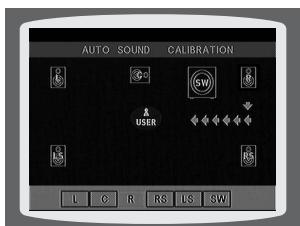
A tone is output.
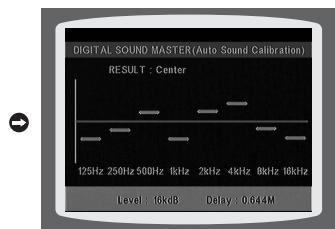
A result for each speaker is displayed.
A bell sounds and the setup finishes.
When the message "REMOVE MIC" appears in the display, unplug the auto sound calibration microphone.
To cancel the auto sound calibration setup, press ASC button.
- The tone output stops, "CANCEL ASC" appears in the display followed by "REMOVE MIC", and the setup is cancelled.
To listen in the auto sound calibration mode, briefly press ASC button.
- The selection alternates between ASC ON and ASC OFF in the display.
- If you select "ASC ON", you will hear sound in the auto sound calibration mode.
If you select "ASC OFF", you will hear sound in the mode set in the audio setting of the setup screen.

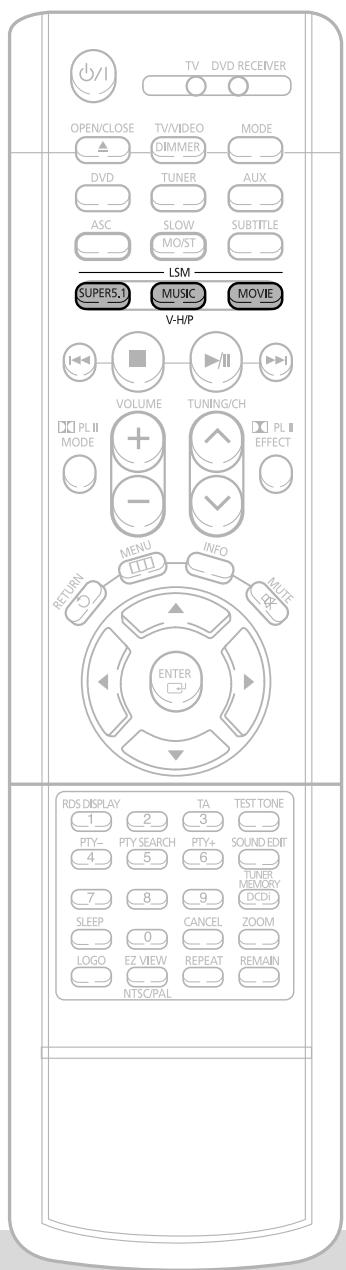
SUPER 5.1
You can reproduce a 2-channel sound source, such as CD, and radio broadcast, in 5.1-channel surround sound.

MUSIC
If you press the MUSIC button when listening to a 2-channel sound source, it will be reproduced in 5.1-channel surround sound so that you can enjoy a dynamic sound with a sense of presence.

MOVIE
You can select from 3 different modes of sound field for movies.
Press SUPER5.1 button.
Each time the button is pressed, the selection alternates between SUPER 5.1 and SUPER OFF.
- Select "SUPER 5.1" to play 2-channel sound in 5.1 channels.
Press MUSIC button.
Each time the button is pressed, the selection changes as follows: LIVE JAZZ ROCK CLASSIC DISCO LSM OFF.
Press MOVIE button.
Each time the button is pressed, the selection changes as follows: CINEMA STADIUM LSM OFF.
Note
- When you insert a DVD recorded in 2-channel or multi-channel format and press the SUPER 5.1 button, the message "THIS FUNCTION APPLIES ONLY 2CH SOURCE" appears in the display and it will not work.

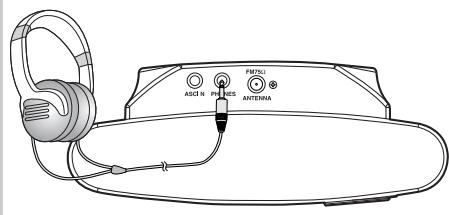
Virtual Headphone Function
Use headphones (not supplied) for private listening pleasure.
You can enjoy a dynamic sound effects similar to that of 5.1 channel surround sound using conventional stereo headphones.
Plug the headphones into the headphone jack.
- You can purchase headphones from most Electronics stores.
2 Press V-H/P button.
Each time the button is pressed, the selection alternates between V-H/P ON and V-H/P OFF.
Note
-
Do not listen at extremely high volume levels when using headphones.
Extended, high-volume listening can lead to permanent hearing loss. -
VIRTUAL HEADPHONE ON: Select to enjoy a 5.1-channel surround sound that gives the feeling of being in a baseball park or concert hall.
- VIRTUAL HEADPHONE OFF: Select to listen to a standard 2-channel stereo sound.
Remote Control Unit
1 Press TUNER button.
- The selection toggles back and forth between "FM" each time the TUNER button is pressed.
2 Tune in to the desired station.
Automatic Tuning 1
When 1≤slant 1≤slant 1 is pressed, a preset broadcast station is selected.
Automatic Tuning 2
Press and hold to automatically search for active broadcasting stations.
Manual Tuning
Briefly press to increase or decrease the frequency incrementally.
Main Unit
1 Press the Function button to select the desired band (FM).
2 Select a broadcast station.
Automatic Tuning 1
Press the STOP (■) button to select
PRESET and then press I▶▶I button to select the preset station.
Automatic Tuning 2
Press the STOP (■) button to select "MANUAL" and
then press and hold 144 button to automatically search the band.
Manual Tuning
Press STOP (■) to select MANUAL and then briefly
press I to tune in to a lower or higher frequency.
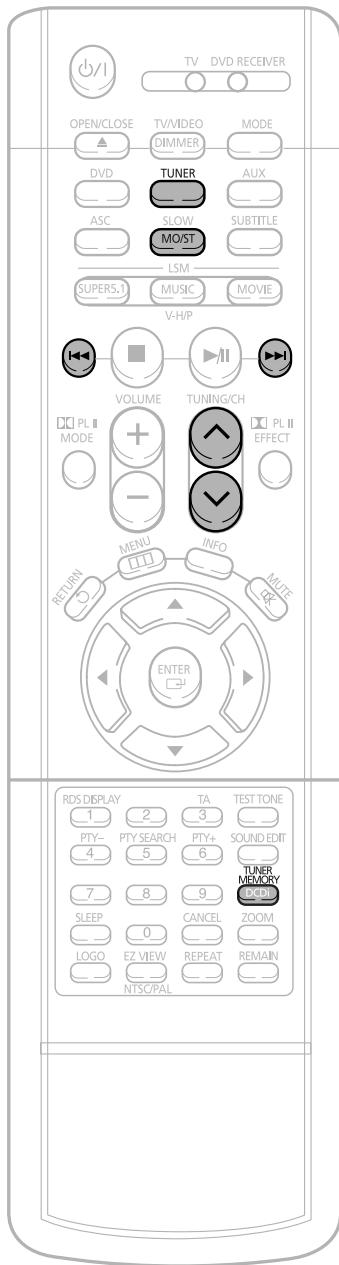
Press MO/ST button to listen in Mono/Stereo.
(This applies only when listening to an FM station.)
Each time the button is pressed, the sound switches between "STEREO" and "MONO".
- In a poor reception area, select MONO for a clear, interference-free broadcast.
Example: Presetting FM 89.1 in the memory
Press the TUNER button and select the FM band.
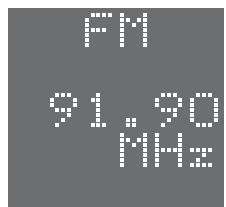
2 Press TUNING/CH to select "89.10".
Refer to Step 2 on page 71 to automatically or manually tune in to a station.
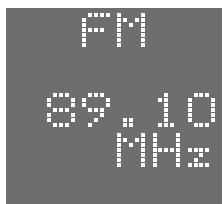
3 Press the TUNER MEMORY button.
- "PRGM" flashes in the display. Tune in to a station.
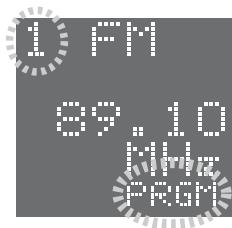
4 Press to select preset number.
- You can select between 1 and 15.
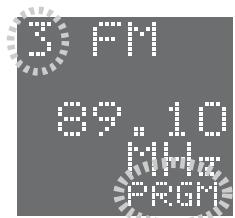
Press the TUNER MEMORY button again.
- Press the TUNER MEMORY button before 'PRGM' disappears from the display.
- 'PRGM' disappears from the display and the station is stored in memory.
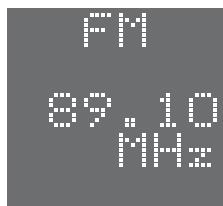
6 To preset another station, repeat steps 2 to 5.
To tune in to a preset station, press on the remote control to select a channel.
Using the RDS (Radio Data System) to receive FM stations
RDS allows FM stations to send an additional signal along with their regular program signals. For example, the stations send their station names, as well as information about what type of program they broadcast, such as sports or music, etc.
When tuned to an FM station which provides the RDS service, the RDS indicator lights up on the display.
Description on RDS function
- PTY (Program Type) : Displays the type of programme currently being broadcast
- PS NAME (Program Service Name): Indicates the name of broadcasting station and is composed of 8 characters.
- RT (Radio Text): Decodes the text broadcast by a station (if any) and is composed of maximum 64 characters.
-
CT (Clock Time) : Decodes the real time clock from the FM frequency.
-
Some stations may not transmit PTY, RT or CT information therefore this may not be displayed in all cases.
-
TA (Traffic Announcement) : When this symbol flashes it shows that the traffic announcement is in progress.

- RDS is not available for AM broadcasts.
- RDS may not operate correctly if the station tuned is not transmitting.
RDS signal properly or if the signal strength is weak.
What information can RDS signals provide?
You can see the RDS signals the station sends on the display.
TO show the RDS signals
Press RDS DISPLAY while listening to an FM station.
Each time you press the button, the display change to show you the following information:

PS (Program Service) :While searching, "PS" appears and then the station names will be displayed. "NO PS" appears if no signal is sent.
RT(RadioText): while searching, "RT" appears and then text messages the station sends will be displayed. "NO RT" appears if no signal is sent.
Frequency: station frequency (non-RDS service)
About characters shown in the display
When the display shows PS,or RT signals,the following characters are used.
- The display window cannot differentiate upper case and lower case Irtters and always uses upper case letters.
- The display window cannot show accented letters, "A," for instance, may stans for accented "A's" like "A, A, A, A and A."
Note
- If searching finishes at once, "PS", and "RT" will not appear on the display.
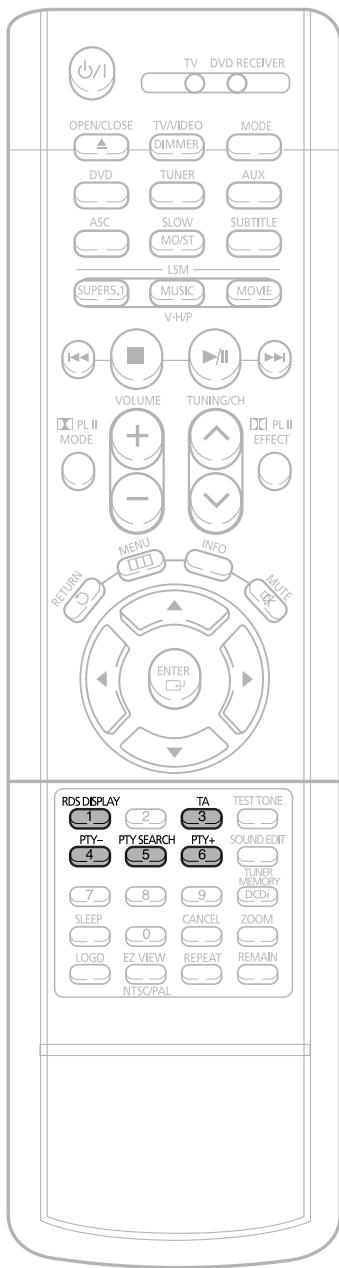
PTY (Program Type) indication and PTY-SEARCH function
One of the advantages of the RDS service is that you can locate a particular kind of program from the preset channels by specifying the PTY codes.
To search for a program using the PTY codes
Before you start, remember...
- The PTY Search is only applicable to preset stations.
- To stop searching any time during the process, press PTY SEARCH while searching.
- There is a time limit in doing the following steps. If the setting is cancelled before you finish, start from step 1 again.
- When pressing the buttons on the primary remote control, make sure that you have selected the FM station using the primary remote control.
Press PTY SEARCH while listening to an FM station.
2 Press the PTY-or PTY+until the PTY code you want appears on the display.
- The display gives you the PTY codes described to the right.
3 Press PTY SEARCH again, while the PTY code selected in the previous step is still on the display.
- The center unit searches 15 preset FM stations, stops when it finds the one you have selected, and tunes in that station.
| Display | Program Type |
| NEWS | • News including an announced opinion and report |
| AFFAIRS | • Several matters including a current incident, documentary, discussion and analysis. |
| INFO | • Information including weights and measures, returns and forecast, matters interesting the customer, medical information, etc. |
| SPORT | • Sports |
| EDUCATE | • Education |
| DRAMA | • Drama-Radio serial, etc. |
| CULTURE | • Culture-National or local culture including the religious problem, social science, language, theater,etc. |
| SCIENCE | • Natural science and technology |
| VARIED | • Others-Speech, amusing program (quiz, game), interview, comedy and satirical play, etc. |
| POP M | • Pop music |
| ROCK M | • Rock music |
| M.O.R.M | • Current contemporary music considered to be "easylistening." |
| LIGHT M | • Light classical music- Classical music and instrumental and chorus music |
| CLASSIC | • Heavy classical music-Orchestra music, symphony, chamber music and opera |
| OTHER M | • Other music - Jazz, R&B country music |
| WEATHER | • Weather |
| FINANCE | • Finance |
| CHILDREN | • Children's programmes |
| SOCIAL A | • Social affairs |
| RELIGION | • Religion |
| PHONE IN | • Phone in |
| TRAVEL | • Travel |
| LEISURE | • Leisure |
| JAZZ | • Jazz Music |
| COUNTRY | • Country Music |
| NATION M | • National Music |
| OLDIES | • Oldies Music |
| FOLK M | • Folk Music |
| DOCUMENT | • Documentary |
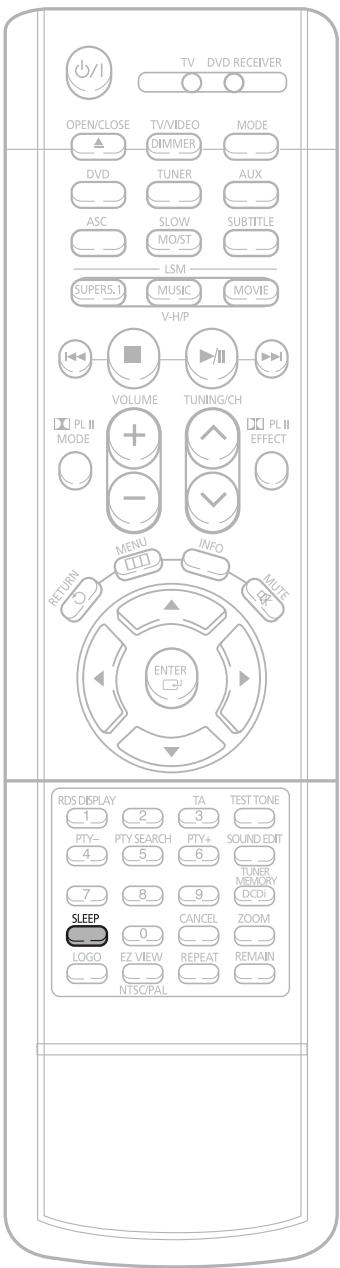

Sleep Timer Function
You can set the time that the DVD player will shut itself off.
Press SLEEP button.
- "SLEEP" will be displayed. Each time the button is pressed the preset time changes as follows: 10 20 30 60 90 120 150 OFF.
To confirm the sleep timer setting, press SLEEP button.
The remaining time before the DVD player will shut itself off is displayed.
- Pressing the button again changes the sleep time from what you have set earlier.
To cancel the sleep timer, press SLEEP button until OFF appears on the display.
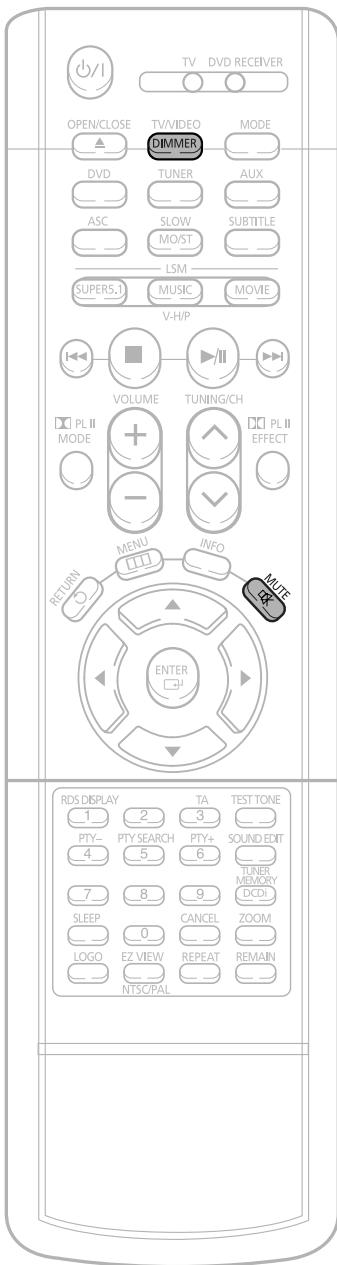

Adjusting Display Brightness
Touch your hands to the front of main unit to automatically turn on the LED and Operation Buttons.
Press DIMMER button.
- Press the DIMMIER button to toggle between DIMMER AUTO DIMMER ON DIMMER OFF on the Display.
DIMMER AUTO : Touch your hands to the operation buttons, and it will turn on for about 5 seconds and then turn off.
DIMMER ON : Operation buttons are always turned on.
DIMMER OFF: Operation buttons are always turned off.
Note
- In DIMMER AUTO mode, if you touch the LED buttons on the main unit once, firstly the LED brighten, and then touch again the function will work.

Mute Function
This is useful when answering the door or a telephone call.
Press MUTE button.
- 'MUTE' flash in the display.
- To switch the sound back on (at the same volume as before), press MUTE again or the VOLUME buttons.
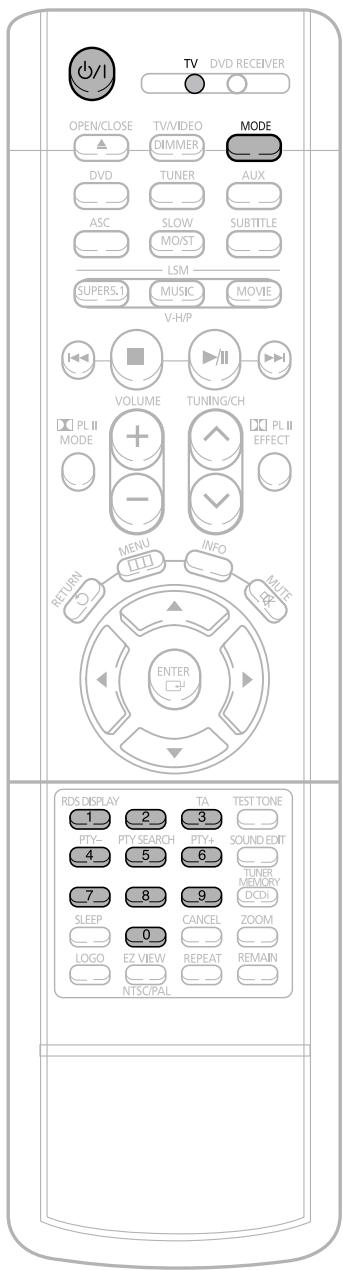
When operating a TV with the remote control
Press the MODE button to make the TV indicator on the remote control flash.
2 Press POWER button to turn on the TV.
3 Point the remote control toward the TV.
While holding down POWER, enter the code corresponding to your brand of TV.
- If the code matches the TV's code, the TV will be turned off.
- If there is more than one code listed for your TV in the table, enter one at a time to determine which code works.
Example: For a Samsung TV
While holding down POWER, use the number buttons to enter 00, 01, 02, 03, 04, and 05.
5 Pont the remote control toward the TV and press POWER. If the TV turns off or on, the setting is complete.
- You can use the TV POWER, VOLUME, CHANNEL, and Numeric buttons (0~9).
Note
- The remote control may not work on some brands of TVs. Also some operations may not be possible depending on your brand of TV.
- If you do not set the remote control with the code for your brand of TV, the remote control will work on a Samsung TV by default.
TV Brand Code List
| No. | Brand | Code | No. | Brand | Code |
| 1 | SAMSUNG | 00(Initial Value), 01, 02, 03, 04, 05, 73 | 30 | BRANDT | 41 |
| 2 | ANAM | 06~11, 59 | 31 | FERGUSON | 41 |
| 3 | DAEWOO | 12~18, 20, 21 | 32 | PIONEER | 41, 48, 74 |
| 4 | LG | 05, 20, 21, 22, 53 | 33 | TELEAVA | 41 |
| 5 | HITACHI | 23, 40, 41, 49 | 34 | FINLUX | 05, 42, 47 |
| 6 | JVC | 24, 55 | 35 | FISHER | 31 |
| 7 | SHARP | 27, 33, 34, 35, 54 | 36 | AKAI | 31 |
| 8 | SONY | 27, 36 | 37 | YOKO | 05 |
| 9 | TOSHIBA | 27, 37, 42, 43, 44, 46 | 38 | PHONOLA | 05, 45, 47 |
| 10 | SANYO | 27, 30, 31, 32 | 39 | RADIOLA | 05, 45 |
| 11 | MITSUBISHI | 05, 27, 28 | 40 | SCHNEIDER | 05 |
| 12 | MATSUSHITA | 09, 26 | 41 | NEWSAN | 58 |
| 13 | TELEFUNKEN | 41, 49, 51, 57 | 42 | CONTINENTAL EDISON | 49 |
| 14 | RCA | 29, 61 | 43 | SALORA | 48 |
| 15 | PANASONIC | 07, 09, 26, 48, 49, 50 | 44 | SELECO | 48 |
| 16 | SABA | 40, 41, 47, 48, 49 | 45 | NOKIA | 48 |
| 17 | PHILIPS | 05, 45, 47, 64, 65, 66, 67, 68, 69 | 46 | REX | 48 |
| 18 | GRUNDIG | 39, 42, 46, 70, 71, 72 | 47 | MVAR | 46 |
| 19 | ZENITH | 38 | 48 | IMPERIAL | 46 |
| 20 | MIVAL | 52 | 49 | CGE | 46 |
| 21 | NOBLEX | 56 | 50 | BANG & OLUFSEN | 47 |
| 22 | EMERSON | 19 | 51 | BRIONVEGA | 47 |
| 23 | MAGNAVOX | 25 | 52 | FORMENTI | 47 |
| 24 | LOEWE | 05, 60 | 53 | METZ | 47 |
| 25 | THOMSON | 40, 41, 49, 62, 63 | 54 | WEGA | 47 |
| 26 | NORDMENDE | 40, 41, 49 | 55 | RADIOMARELLI | 47 |
| 27 | LOEWE OPTA | 36, 47, 05 | 56 | SINGER | 47 |
| 28 | BLAUPUNKT | 39 | 57 | SINUDYNE | 47 |
| 29 | SIEMENS | 39 |
Before Calling for Service
Refer to the chart below when this unit does not function properly. If the problem you are experiencing is not listed below or if the instruction below does not help, turn off the unit, disconnect the power cord, and contact the nearest authorized dealer or Samsung Electronics Service Center.
| Symptom | Check/Remedy |
| Disc tray does not open. | • Is the power cord plugged securely into the outlet? • Turn off the power and then turn it back on. |
| Playback does not start. | • Check the region number of the DVD. DVD discs purchased from abroad may not be playable. • CD-ROMs and DVD-ROMs cannot be played on this DVD player. • Make sure that the rating level is correct. |
| Playback does not start immediately when the Play/Pause button is pressed. | • Are you using a deformed disc or a disc with scratches on the surface? • Wipe the disc clean. |
| Sound is not produced. | • No sound is heard during fast playback, slow playback, and step motion playback. • Are the speakers connected properly? Is the speaker setup correctly customized? • Is the disc severely damaged? |
| Sound can be heard only from a few speakers and not all six. | • When listening to a CD or radio, sound is output to the front speakers (L/R) only. Select "PRO LOGIC II" by pressing D/DPL II (Dolby Pro Logic II) on the remote control to use all six speakers. • Make sure that the DVD disc is 5.1-CH compatible. • If you set C, SL, and SR to NONE in the speaker mode in the audio setup of the setup screen, no sound is heard from the center speaker and the front left and right speakers. Set C, SL, and SR to SMALL. |
| Picture does not appear, sound is not produced, or the disc tray opens 2 to 5 seconds later. | • Was the DVD player suddenly moved from a cold place to a warm one? When condensation forms inside the player, remove the disc and let the player stand for 1 or 2 hours with the power on. (You can use the player again after condensation disappears.) |
| Dolby Digital 5.1 CH Surround Sound is not produced. | • Is there a "Dolby Digital 5.1 CH" mark on the disc? Dolby Digital 5.1 CH Surround Sound is produced only if the disc is recorded with 5.1 channel sound. • Is the audio language correctly set to DOLBY DIGITAL 5.1-CH in the information display? |
| ·Disc is rotating but no picture is produced. ·Picture quality is poor and picture is shaking. | ·Is the TV power on? ·Are the video cables connected properly? ·Is the disc dirty or damaged? ·A poorly manufactured disc may not be playable. |
| The remote control does not work. | ·Is the remote control being operated within its operation range of angle and distance? ·Are the batteries exhausted? ·Have you selected the mode(TV/DVD) functions of the remote control (TV or DVD) correctly? |
| Audio language and subtitles do not work. | ·Audio language and subtitles will not work for DVDs not containing them. And depending on the disc, they may work differently. |
| Menu screen does not appear even when the menu function is selected. | ·Are you using a disc that does not contain menus? |
| Aspect ratio cannot be changed. | ·You can play 16:9 DVDs in 16:9 WIDE mode, 4:3 LETTER BOX mode, or 4:3 PAN SCAN mode, but 4:3 DVDs can be seen in 4:3 ratio only. Refer to the DVD disc jacket and then select the appropriate function. |
| Can't receive radio broadcast. | ·Is the antenna connected properly? ·If the antenna's input signal is weak, install an external FM antenna in an area with good reception. |
| ·The main unit is not working. (Example: The power goes out or strange noise is heard.) ·The DVD player is not working normally. | ·Turn off the power and hold the button on the main unit for longer than 5 seconds. Using the RESET function will erase all stored settings. Do not use this unless necessary. |
| The password for rating level has been forgotten. | ·While “NO DISC” message appears on the display of main unit, hold the main unit's button for longer than 5 seconds. “INITIALIZE” appears on the display and all settings will return to the default values. ·Press the POWER button. Using the RESET function will erase all stored settings. Do not use this unless necessary. |

Handling discs
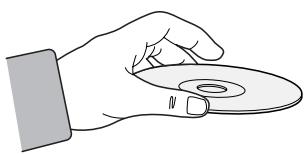
Do not touch the playback side of the disc. Hold the disc by the edges so that fingerprints will not get on the surface.
Do not stick paper or tape on the disc.

Disc Storage
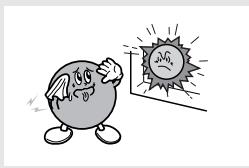
Do not keep in direct sunlight
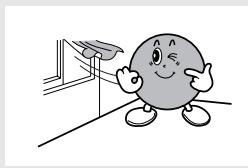
Keep in a cool ventilated area
Keep in a clean Protection jacket. Store vertically.
Caution
- Do not allow the discs to become contaminated with dirt.
- Do not load cracked or scratched discs.

Handling and Storing Discs
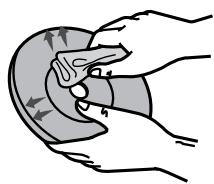
When you get fingerprints or dirt on the disc, clean it with a mild detergent diluted in water and wipe with a soft cloth.
- When cleaning, wipe gently from the inside to the outside of the disc.
Note
- Condensation may form if warm air comes into contact with cold parts inside the player. When condensation forms inside the player, the player may not operate correctly. If this occurs, remove the disc and let the player stand for 1 or 2 hours with the power on.
| GENERAL | Power Consumption | HT-DS1000/1100 : 30W | |
| PSWS1000E/1100E : 150W | |||
| Weight | MAIN UNIT : 2.25kg | ||
| VERTICAL STAND : 6.35kg | |||
| HORIZONTAL STAND : 1.5kg | |||
| Dimensions (W x H x D) | 180 x 500 x 68 mm | ||
| Operating Temperature Range | 5°C ~ 35°C | ||
| Operating Humidity Range | 10% ~ 75% | ||
| F M T U N R | Usable Sensitivity | 10dB | |
| S/N Ratio | 60dB | ||
| Distortion | 0.5% | ||
| V O D E O T | Composite Video | 1.0Vp-p(75Ω load) | |
| Component Video | Y:1.0Vp-p(75Ω load) | ||
| Pr:0.70Vp-p(75Ω load) | |||
| Pb:0.70Vp-p(75Ω load) | |||
| HDMI | Impedance: 85~115Ω | ||
| A M P L I F I E R | Front speaker output | 100W x 2(4Ω) | |
| Center speaker output | 100W(4Ω) | ||
| Rear speaker output | 100W x 2(4Ω) | ||
| Subwoofer speaker output | 150W(3Ω) | ||
| Frequency range | 20Hz~20kHz | ||
| S/N Ratio | 70dB | ||
| Channel separation | 60dB | ||
| Input sensitivity | (AUX)500mV | ||
| S P E A K E R S | Speaker system (PSDS 1000E) | 5.1ch speaker system | |
| Front/Center/Rear speaker | Subwoofer speaker | ||
| Impedance | 4Ω x 5 | 3Ω | |
| Frequency range | 150Hz~20kHz | 30Hz~200Hz | |
| Output sound pressure level | 82dB/W/M | 85dB/W/M | |
| Rated input | 100W | 150W | |
| Maximum input | 200W | 300W | |
| Dimensions (W x H x D) | Front/Rear | 70 x 1388 x 145 mm | |
| Center | 414 x 82 x 155 mm | ||
| Weight | Front/Rear | 6.0 kg | |
| Center | 1.5 kg | ||
| Speaker system (PSDS 1100E) | 5.1ch speaker system | ||
| Front/Center/Rear speaker | Subwoofer speaker | ||
| Impedance | Front/Rear | 4Ω x 4 | |
| Center | 4Ω | ||
| Frequency range | 100Hz~20kHz | 30Hz~200Hz | |
| Output sound pressure level | 86dB/W/M | 86dB/W/M | |
| Rated input | 100W | 150W | |
| Maximum input | 200W | 300W | |
| Dimensions (W x H x D) | Front/Rear | 380 x 1388 x 245 mm | |
| Center | 418 x 140 x 150 mm | ||
| Weight | Front/Rear | 7.5 kg | |
| Center | 2.8 kg | ||
| ANGLE | Recorded onto some DVD discs are scenes which have been simultaneously shot from a number of different angles (the same scene is shot from the front, from the left, from the right, etc.). With such discs, the Angle button can be used to change the angle of view for specific scenes. | ||
| CHAPTER NUMBER | These numbers are recorded on DVD discs. A Title is subdivided into many sections, each of which is numbered, and specific parts of the video can be searched quickly using these numbers. | ||
| DVD | A high-density optical disc on which high-quality pictures and sound have been recorded by means of digital signals. Incorporating a new video compression technology (MPEG-2) and high-density recording technology, a DVD disc comprises two 0.6 mm thick discs bonded together. | ||
| PCM | An acronym for Pulse Code Modulation - another name for digital audio. | ||
| PBC (PLAYBACK CONTROL) | This is recorded on a video CD (version 2.0). Selected scenes or information can be chosen from the menu displayed on the TV monitor. | ||
| REGION NUMBER | Both the DVD player and DVD discs are encoded with a region number. If the region number on the DVD disc does not correspond to the region number of the DVD player, the player cannot play the disc. | ||
| SUBTITLES | Translated appearing at the bottom of the screen. A DVD disc can contain up to 32 subtitle languages. | ||
| TITLE NUMBER | These numbers are recorded on DVD discs. When a disc contains two or more movies, these movies are numbered as Title 1, Title 2, etc. | ||
| TRACK NUMBER | These numbers are assigned to the tracks which are recorded on video and audio CDs. They enable specific tracks to be located quickly. | ||
| VIDEO CD | Contains recordings of pictures and sound whose quality is roughly comparable to that of video tape. This player also supports video CDs with playback control (version 2.0). | ||
| DIGITAL SURROUND | You can enjoy 5.1 (or 6) channels of high fidelity digital sound from various digital input sources such as DVD, CD etc. DTS provides a realistic, clear surround sound that has not previously been available from conventional surround sound. | ||
| DOLBY DIGITAL | 5.1 (or 6) Channel Digital Surround sound reproduced from DVDs and LDs recorded as a digital signal (with DOLBY disc marking). With better sound quality, dynamic range, and directionality than traditional Dolby surround technology, you can enjoy dynamic, realistic sound. | ||
| DOLBY DIGITAL PRO LOGIC II | A 4 channel analog sound reproduced from a program source such as a videotape or LD with the DOLBY mark. You can enjoy a more realistic, robust sound unavailable from regular stereo sources. | ||
THIS APPLIANCE IS MANUFACTURED BY:
SAMSUNG
ELECTRONICS