
1923 - Guitar amplifier MARSHALL - Free user manual and instructions
Find the device manual for free 1923 MARSHALL in PDF.


| Product Type | Guitar Amplifier |
| Brand | Marshall |
| Model | 1923 |
| Amplifier Type | Combo |
| Power Output | 20 Watts RMS |
| Speaker | 1 x 12" Celestion |
| Channels | 2 (Clean and Overdrive) |
| Controls | Volume, Gain, Treble, Middle, Bass, Presence, Master Volume |
| Inputs | 1 x 1/4" Instrument Input |
| Outputs | 1 x 1/4" Speaker Output, 1 x 1/4" Line Out |
| Dimensions (W x H x D) | 24.1 x 19.1 x 10.6 inches |
| Weight | 34 lbs (15.4 kg) |
| Power Supply | Mains Voltage (100-240V AC, 50/60Hz) |
| Cooling | Passive (no fan) |
| Construction | Solid wood cabinet with vinyl covering |
| Front Panel | Black control panel with white text |
| Rear Panel | Power switch, fuse holder, IEC power inlet |
| Included Accessories | Power cord, user manual |
| Warranty | 1 year limited warranty |
| Cleaning | Wipe with dry cloth; do not use solvents |
| Safety | Class I equipment; ensure proper grounding |
Frequently Asked Questions - 1923 MARSHALL
User questions about 1923 MARSHALL
0 question about this device. Answer the ones you know or ask your own.
Ask a new question about this device
Download the instructions for your Guitar amplifier in PDF format for free! Find your manual 1923 - MARSHALL and take your electronic device back in hand. On this page are published all the documents necessary for the use of your device. 1923 by MARSHALL.
USER MANUAL 1923 MARSHALL
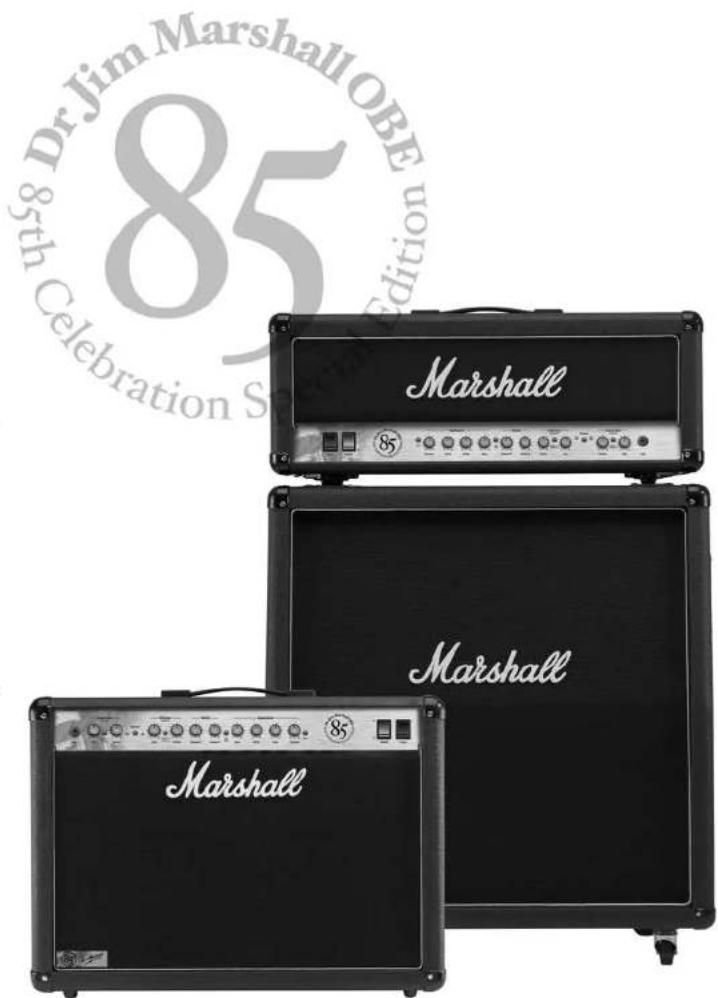
1923 Special Edition
Owners Manual

natural_image
Black-and-white portrait of an elderly man in a suit, smiling (no text or symbols visible)Marshall
From the Chairman
Congratulations on your purchase of this very special Marshall amplifier – the 1923.
Firstly, I must say that I fool very honoured that the team at Marshall have created this amplifier to commemorate my 85th birthday. I am simply thrilled with the design, the quality of craftsmanship and of course the way it sounds - big, bold and brimming full of Marshall tone.
Throughout my 85 years and in particular my past five decades in the amplifier business, I have witnessed many changes in the world of music. I have seen trends come and go, whole new genres created and old ones revived. But whatever the musical style of the last 46 years there has always been a Marshall amp to suit – and there's a good reason for this. When I made the first Marshall amplifier in the early 1960s it was built to satisfy the demands from guitarists for a 'bigger sound' I'm pleased to say that this ethos of listening to the requirements and aspirations of guitarists is as important today as it has ever been, remaining an integral part of our continuing amplifier development.
I would like to thank the whole Marshall team for marking my 85th year in such a poignant way and extend my gratitude to all Marshall staff, past and present, for their hard work, skill and craftsmanship. I have been privileged to have met many talented musicians over the years, some of whom have become close friends, and to them I would like to extend my gratitude for their inspiration and friendship. I would also like to thank my family for the years of love and support they have shown me, and last, but by no means least, you the guitarist . . . it's your passion for music that drives me and the Marshall team to carry on creating now innovative amplifiers and speaker cabinets.
I sincerely hope that this Limited Special Edition 1923 brings you countless hours of playing pleasure and I would like to welcome you to the ever increasing Marshall family.
Yours Sincerely
Dr. Jim Marshall OBE Dr. Jim Marshall OBE


1. Power Switch
This is the On/Off switch for the mains electric power to the amplifier.
Note: Please ensure the amplifier is switched off and unplugged from the mains electricity supply whenever it is moved!
2. Standby Switch
The Standby Switch is used in conjunction with the Power Switch (1) to 'warm up' the amplifier before use and to prolong the life of the valves. When powering up the amplifier always engage the Power Switch (1) first, leaving the Standby switch in the 'OFF' position. This enables the heater voltage, allowing the valves to come up to their correct operating temperature. After approximately two minutes the valves will have reached their correct operating temperature and the Standby Switch can be engaged, enabling the HT. In order to prolong valve life, the Standby Switch alone should also be used to turn the amplifier on and off during breaks in a performance. Also, when switching the amplifier off, always disengage the Standby Switch prior to the main Power Switch.
3. Deep Switch
The Deep Switch adds a tuned or resonant bass boost to your sound, increasing bottom end thud, without making your tone woolly around the all important low end.
4. Presence Control
Adds higher frequencies to the guitar tone, creating crispness and bite. Turning this up will make the sound more cutting and in your face.
5.Treble Control
Controls the high frequencies of the guitar tone, making your guitar sound brighter when increased.
6. Middle Control
Dictates the middle register of the amplifier. Turning this up will make your guitar sound latter. Conversely reducing the amount of middle in your tone will result in a sharper and thinner guitar sound for the classic "scooped" tone.
7. Bass Control
Controls the amount of low frequencies or bottom and in your tone.
8.Tone Shift
The Tone Shift Switch reconfigures the tone network components to give a new dimension to passive tone shaping. With the switch selected to the 'in' position and the Middle Control (Item 6) turned down the result is a scoped mid sound ideal for certain classic metal styles.
Reverb
9. Channel B
Controls the reverb level on Channel B.
10. Channel A
Controls the reverb level on Channel A.
Ultra Gain / Channel B
11. Volume
Governs the volume level of Channel B.
12. Lead 1 / Lead 2 Switch
The Channel B features two modes. The first, Lead 1, gives an open high gain crunch, with traditional Marshall characteristics, similar to a hot-rooded JCM 800 2203 master volume. The Lead 2 mode however gives a mid-boosted to coupled with even higher gain possibilities.
13. Gain
Controls the gain level for Channel B. As the amount of gain increases so will the distortion level in your sound.
14. LED
Indicates when Channel B has been selected.
15. Channel Switch
Selects Channel A or Channel B.
16. LED
Indicates when Channel A has been selected.
Classic Gain / Channel A
17. Volume
Governs the volume level of Channel A
18. Clean / Crunch
As with Channel B, Channel A features two modes. The first, Clean, is reminiscent of an early 1959 Plexi Super Lead head. Depending on Gain settings (item 19) this mode will take you from clean to a controlled Plexi style crunch. Crunch will take you up to a JCM 800 2203 style grind.
19. Gain
Controls the gain level for Channel A. As the amount of gain increases so will the distortion level in your tone.
20. Input Jack Socket
This high impedance input is where you plug your guitar into the amp. You must use a screened (shielded) guitar cable. Never use an unscreened (unshielded) speaker cable because you will find it very noisy to the point of annoyance. The input to any guitar amplifier is a very sensitive part of the signal path and is therefore susceptible to air born radio interference, hence the need for a screened guitar cable. This screened cable should preferably be of good quality. If you are in any doubt regarding this, your Marshall dealer will be more than happy to help, advise and supply you.


Footswitch
1. Channel
By connecting the supplied PEDL10001 footswitch to this jack it is possible to switch between Channel A and Channel B. The footswitch will override the front panel Channel switch position (item 15).
2. Reverb Footswitch
By connecting another PEDL10001 footswitch (optional) to this jack it is possible to remotely switch reverb on and off.
Effects Loop
3. Send
For connection to the input of an external effect processor.
4. Return
For connection from the output of an external effects processor.
5. Loop Level
The loop level can be adjusted to match either floor pedals, requiring a low level or effects processors which require a high level.
Loudspeaker Outputs
With all valve amplifiers it is imperative that the amp is connected to a load whilst in operation and that the impedance selected on the amp
matches the total impedance of the speaker cabinet(s) being used.
Failure to comply with these points will result in damage to the amplifier.
The three outputs, a dedicated 16 Ohm output and two outputs selectable between 4 and 8 Ohms.
The amp should not be run into an impedance less than 4 Ohms.
6. 16 Ohm Output
For the connection of a 16 Ohm speaker cabinet, it should be noted that when this Speaker Output is in use the remaining Speaker Outputs, items 7 and 8, will become inoperational.
7 & 8. 4 & 8 Ohm Outputs
For use when the total impedance of speaker cabinets used is either 4 or 8 Ohms. That is, when using either a single 4 Ohm cab, a single 8 Ohm, two 8 Ohm cabs or two 16 Ohm cabs.
9. Impedance Selector
Allows selection of 4 or 8 Ohms impedance for items 7 & 8. See Loading Points.
10. H.T. fuse
See rear panel for correct value.
11. Mains Input
Your amp is provided with a detachable mains (power) lead which is connected here. The specific mains inout voltage rating that your amplifier has been built for is shown on the ba panel. Before connecting for the first time, please ensure that your amplifier is compatible with your electricity supply. If you have any doubt, please get advice from a qualified person. Your Marshall dealer will help in this respect.
12. Mains fuse
See rear panel for correct value.
Loading Points
One 4 Ohm cabinet, set to 4 Ohms One 8 Ohm cabinet, set to 8 Ohms
Two 8 Ohm cabinets, set to 4 Ohms Two 16 Ohm cabinets, set to 8 Ohms
N.B. Always ensure that proper speaker leads are used to connect speakers, not guitar leads!
WARNING!
If loudspeaker is disconnected a high voltage can be present at these output terminals. Operation in this manner can damage your amplifier, therefore ensure that loudspeaker is properly connected.
Your amp should be completely powered down before changing loads.
Follow all instructions and heed all warnings
KEEP THESE INSTRUCTIONS!
* EUROPE ONLY CE - Note: This equipment has been tested and found to comply with the requirements of the EMC Directive (Environments E1, E2 and E3 EN 55103-1/2) and the Low Voltage Directive in the E.U.
* EUROPE ONLY - Note: The Peak Inrush current for the 1923 and 1923C is 33 amps.
- Marshall
- From the Chairman
- Power Switch
- Standby Switch
- Deep Switch
- Presence Control
- 5.Treble Control
- Middle Control
- Bass Control
- 8.Tone Shift
- Reverb
- Channel B
- Channel A
- Ultra Gain / Channel B
- Volume
- Lead 1 / Lead 2 Switch
- Gain
- LED
- Channel Switch
- LED
- Classic Gain / Channel A
- Volume
- Clean / Crunch
- Gain
- Input Jack Socket
- Footswitch
- Channel
- Reverb Footswitch
- Effects Loop
- Send
- Return
- Loop Level
- Loudspeaker Outputs
- 16 Ohm Output
- & 8. 4 & 8 Ohm Outputs
- Impedance Selector
- H.T. fuse
- Mains Input
- Mains fuse
- Loading Points
- WARNING!
- Follow all instructions and heed all warnings
- KEEP THESE INSTRUCTIONS!
Brand : MARSHALL
Model : 1923
Category : Guitar amplifier